REGIONAL SUBSEA SYSTEMS: ENABLING RESILIENCE VALUE IN THE DIGITAL ECONOMY By Daniele Silva
INTRODUCTION: THE RESIL- and the east coasts of Africa were security standards, and can be affected by multiple cable cuts, expressed as: IENCE PARADIGM
For decades, the global submarine telecom infrastructure has been designed and built around a relatively limited number of major cross-regional routes connecting strategic hubs. This model has successfully supported the exponential traffic growth and has driven capacity investments, enabling digital integration on a global scale. Today, however, the economic value of service continuity and resilience is becoming crucial. The key question is therefore no longer “Can we afford to invest in resilience?” but rather “Can we afford not to?”. Recent events over the past few years have shown that even individual cable faults can have systemic effects, amplifying the vulnerability of entire countries or regions. An emblematic example is represented by the events in February and March 2024, when, within a few weeks, both the west 74
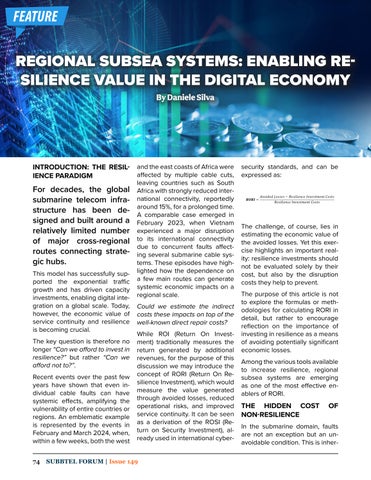
leaving countries such as South Africa with strongly reduced international connectivity, reportedly around 15%, for a prolonged time. A comparable case emerged in February 2023, when Vietnam experienced a major disruption to its international connectivity due to concurrent faults affecting several submarine cable systems. These episodes have highlighted how the dependence on a few main routes can generate systemic economic impacts on a regional scale. Could we estimate the indirect costs these impacts on top of the well-known direct repair costs? While ROI (Return On Investment) traditionally measures the return generated by additional revenues, for the purpose of this discussion we may introduce the concept of RORI (Return On Resilience Investment), which would measure the value generated through avoided losses, reduced operational risks, and improved service continuity. It can be seen as a derivation of the ROSI (Return on Security Investment), already used in international cyber-
SUBBTEL FORUM | Issue 149
The challenge, of course, lies in estimating the economic value of the avoided losses. Yet this exercise highlights an important reality: resilience investments should not be evaluated solely by their cost, but also by the disruption costs they help to prevent. The purpose of this article is not to explore the formulas or methodologies for calculating RORI in detail, but rather to encourage reflection on the importance of investing in resilience as a means of avoiding potentially significant economic losses. Among the various tools available to increase resilience, regional subsea systems are emerging as one of the most effective enablers of RORI.
THE HIDDEN COST NON-RESILIENCE
OF
In the submarine domain, faults are not an exception but an unavoidable condition. This is inher-