INTEGRATED FIBER OPTICS: SUPPORTING SUSTAINABLE ENERGY, OFFSHORE WIND AND THE GLOBAL TRANSITION TO RENEWABLES By Tobias Borg
An offshore wind export coming increasingly important in cable can stretch for hun- supporting system operation and oversight. dreds of kilometres across the seabed and remain in A DUAL-PURPOSE DESIGN Optical fibre is integrated directservice for decades. Once installed, these assets are effectively inaccessible for visual inspection and physical access is extremely limited. Their location on or beneath the seabed means that any form of direct monitoring or intervention requires specialised vessels and equipment. When faults occur, locating and repairing them can take time, and the associated loss of power transmission can be significant, particularly where large volumes of generated energy depend on a single export route. For this reason, modern high-voltage subsea cables increasingly incorporate optical fibre within their structure. The fibre provides a data pathway and enables the cable to report on its condition through a range of monitoring techniques. As offshore wind farms expand in scale and distance from shore, and as high-voltage interconnectors link power systems across longer distances, this capability is be56
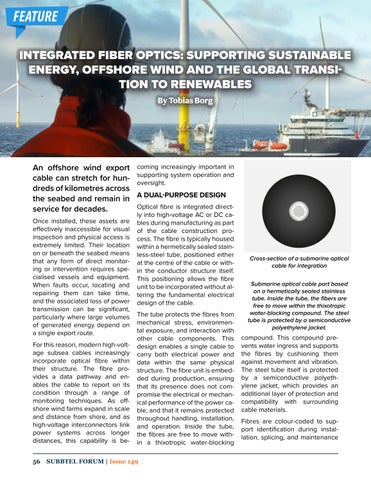
ly into high-voltage AC or DC cables during manufacturing as part of the cable construction process. The fibre is typically housed within a hermetically sealed stainless-steel tube, positioned either at the centre of the cable or within the conductor structure itself. This positioning allows the fibre unit to be incorporated without altering the fundamental electrical design of the cable. The tube protects the fibres from mechanical stress, environmental exposure, and interaction with other cable components. This design enables a single cable to carry both electrical power and data within the same physical structure. The fibre unit is embedded during production, ensuring that its presence does not compromise the electrical or mechanical performance of the power cable, and that it remains protected throughout handling, installation, and operation. Inside the tube, the fibres are free to move within a thixotropic water-blocking
SUBBTEL FORUM | Issue 149
Cross-section of a submarine optical cable for integration Submarine optical cable part based on a hermetically sealed stainless tube. Inside the tube, the fibers are free to move within the thixotropic water-blocking compound. The steel tube is protected by a semiconductive polyethylene jacket.
compound. This compound prevents water ingress and supports the fibres by cushioning them against movement and vibration. The steel tube itself is protected by a semiconductive polyethylene jacket, which provides an additional layer of protection and compatibility with surrounding cable materials. Fibres are colour-coded to support identification during installation, splicing, and maintenance