THE SOUTH CHINA SEA ROUTING TAX: THE GEOPOLITICAL COST SHAPING INDO-PACIFIC SUBSEA CABLE ECONOMICS By Billy Buddell
Western-aligned cable operators are making individually rational routing decisions that are collectively reshaping the economy of Indo-Pacific connectivity. The cumulative increased cost of these decisions is becoming a structural constraint on project viability. New Western-aligned cable builds are consistently avoiding the South China Sea (SCS) in favour of longer routes through Indonesia and the Philippines. These alternative paths are shallower, operationally more complex, and more expensive. This shift reflects broader U.S.-China tech decoupling, in which cables are assessed as strategic infrastructure, rather than purely private commercial assets. This makes the more direct route between Southeast and Northeast Asia increasingly unattractive for Western-aligned consortia. Operators are therefore treating geopolitical risk as an engineering and economic restraint, rather than a background political con80
THE PRICE OF GEOPOLITIIn practice, this means route plan- CAL ALIGNMENT cern.
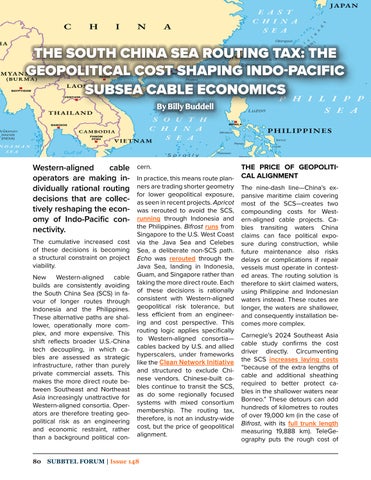
ners are trading shorter geometry for lower geopolitical exposure, as seen in recent projects. Apricot was rerouted to avoid the SCS, running through Indonesia and the Philippines. Bifrost runs from Singapore to the U.S. West Coast via the Java Sea and Celebes Sea, a deliberate non-SCS path. Echo was rerouted through the Java Sea, landing in Indonesia, Guam, and Singapore rather than taking the more direct route. Each of these decisions is rationally consistent with Western-aligned geopolitical risk tolerance, but less efficient from an engineering and cost perspective. This routing logic applies specifically to Western-aligned consortia— cables backed by U.S. and allied hyperscalers, under frameworks like the Clean Network Initiative and structured to exclude Chinese vendors. Chinese-built cables continue to transit the SCS, as do some regionally focused systems with mixed consortium membership. The routing tax, therefore, is not an industry-wide cost, but the price of geopolitical alignment.
SUBBTEL FORUM | Issue 148
The nine-dash line—China’s expansive maritime claim covering most of the SCS—creates two compounding costs for Western-aligned cable projects. Cables transiting waters China claims can face political exposure during construction, while future maintenance also risks delays or complications if repair vessels must operate in contested areas. The routing solution is therefore to skirt claimed waters, using Philippine and Indonesian waters instead. These routes are longer, the waters are shallower, and consequently installation becomes more complex. Carnegie’s 2024 Southeast Asia cable study confirms the cost driver directly. Circumventing the SCS increases laying costs “because of the extra lengths of cable and additional sheathing required to better protect cables in the shallower waters near Borneo.” These detours can add hundreds of kilometres to routes of over 19,000 km (in the case of Bifrost, with its full trunk length measuring 19,888 km). TeleGeography puts the rough cost of