COHERENT PLUGGABLE TRANSPONDERS IN SUBMARINE NETWORKS: A NEW ARCHITECTURAL OPTION? By Geoff Bennett & Sumudu Edirisinghe
In recent years, impressive improvements of pluggable coherent optics performance and data rate improvements positioned them as a viable rival to well established embedded coherent transceivers for metro and long-haul terrestrial applications. In these applications coherent pluggable optics, that can be deployed in a variety of architec-
48
tures, can offer important savings in power, space, and cost for network operators. However, their use has not been widely explored in ultra-long-haul subsea cable systems, where performance-optimized embedded coherent optics continue to be the prevalent solution deployed. As we will show here, recent field trials indicate that the performance of the latest generation of pluggable transponders has improved dramatically, and this technology could increasingly become an option in today’s
SUBBTEL FORUM | Issue 148
fast-moving and high demand market for submarine network capacity.
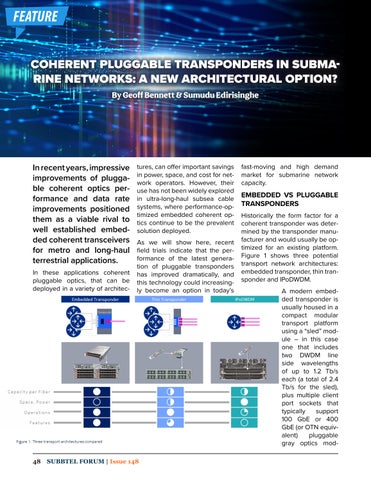
EMBEDDED VS PLUGGABLE TRANSPONDERS Historically the form factor for a coherent transponder was determined by the transponder manufacturer and would usually be optimized for an existing platform. Figure 1 shows three potential transport network architectures: embedded transponder, thin transponder and IPoDWDM. A modern embedded transponder is usually housed in a compact modular transport platform using a “sled” module – in this case one that includes two DWDM line side wavelengths of up to 1.2 Tb/s each (a total of 2.4 Tb/s for the sled), plus multiple client port sockets that typically support 100 GbE or 400 GbE (or OTN equivalent) pluggable gray optics mod-