SUSTAINABLE SUBSEA
GREEN CABLE SHIPS FOR A GREENER INTERNET – FROM LIFE: ALTERNATIVE FUEL CHOICES FOR CABLE MARINE by David Howard, René d’Avezac de Moran, and Derek Cassidy Alternative fuels for the ships used to install and repair submarine cables can significantly reduce lifecycle greenhouse gas emissions of subsea cables by transitioning away from heavy fuel oil towards alternative greener fuels. The objective is for marine operations to reach net-zero greenhouse gases (GHG) in line with International Maritime Organization (IMO) [1] targets. Uncertainty around IMO policy and the choices of alternative fuels leave ship designers with difficult decisions. The Sustainable Subsea Networks team has been working over the past year to develop models to investigate the quantity of GHG each aspect of the industry generates during the survey, manufacture, installation, commissioning and operation (including maintenance) of typical transatlantic and transpacific systems. The reason for developing these models is so we can critically examine how the GHG emissions of these systems can be reduced, ideally to Net Zero, and to enable us to demonstrate to system users that the submarine cable industry is environmentally compliant. This article focuses on the marine aspects of the systems’ carbon budgets principally:
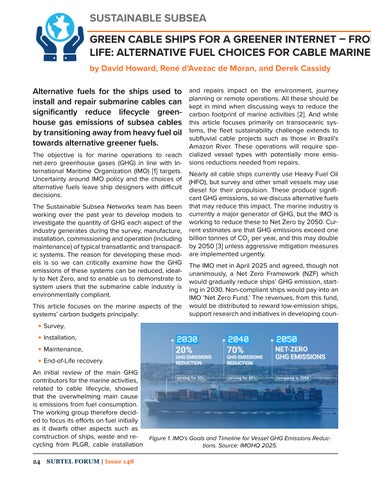
and repairs impact on the environment, journey planning or remote operations. All these should be kept in mind when discussing ways to reduce the carbon footprint of marine activities [2]. And while this article focuses primarily on transoceanic systems, the fleet sustainability challenge extends to subfluvial cable projects such as those in Brazil’s Amazon River. These operations will require specialized vessel types with potentially more emissions reductions needed from repairs. Nearly all cable ships currently use Heavy Fuel Oil (HFO), but survey and other small vessels may use diesel for their propulsion. These produce significant GHG emissions, so we discuss alternative fuels that may reduce this impact. The marine industry is currently a major generator of GHG, but the IMO is working to reduce these to Net Zero by 2050. Current estimates are that GHG emissions exceed one billion tonnes of CO2 per year, and this may double by 2050 [3] unless aggressive mitigation measures are implemented urgently. The IMO met in April 2025 and agreed, though not unanimously, a Net Zero Framework (NZF) which would gradually reduce ships’ GHG emission, starting in 2030. Non-compliant ships would pay into an IMO ‘Net Zero Fund.’ The revenues, from this fund, would be distributed to reward low-emission ships, support research and initiatives in developing coun-
• Survey, • Installation, • Maintenance, • End-of-Life recovery. An initial review of the main GHG contributors for the marine activities, related to cable lifecycle, showed that the overwhelming main cause is emissions from fuel consumption. The working group therefore decided to focus its efforts on fuel initially as it dwarfs other aspects such as construction of ships, waste and reFigure 1. IMO’s Goals and Timeline for Vessel GHG Emissions Reduccycling from PLGR, cable installation tions. Source: IMOHQ 2025. 24
SUBTEL FORUM | Issue 148