
Geopolitics, AI, and security are redefining the future of global submarine connectivity.

TECHNOLOGY DRIVEN CABLE MARKET CYCLES
Forecasting Carrier Trends for 2026 by
Mattias Fridström
Uncovering
by Derek Cassidy
Uncovering future-proofing strategies by Zack Spica
Tracing Technology Driven Market Cycles by José Chesnoy
HISTORY OF TRANSATLANTIC OPTICAL FIBRE SYSTEMS Charting Transatlantic Fibre Evolution
Stewart Ash, Stuart Barnes, Phil Black, Bill Burns & Chris Swan

Grace Koh

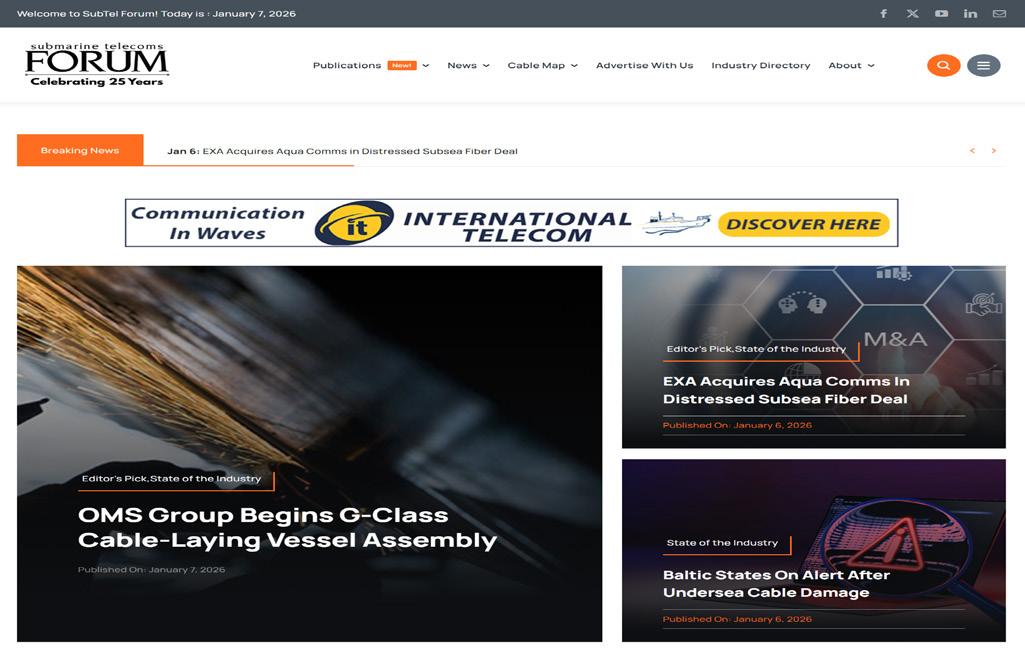
In 2026, SubTel Forum marks 25 years as the leading independent intelligence platform serving the global submarine cable industry. Over a quarter century, SubTel Forum has evolved from a specialist publication into the industry’s most trusted source for data, analysis, mapping, and editorial insight. SubTelForum.com now stands as the central reference point for operators, suppliers, investors, governments, and advisors shaping global connectivity.
What follows is a guide to SubTel Forum’s most important products and resources for 2026.
At the core of SubTel Forum are its flagship publications, which define how the industry understands itself.
Submarine Telecoms Industry Report (Annual)
The industry’s benchmark analytical report. Each edition delivers rigorous assessment of market
structure, ownership trends, capacity growth, investment drivers, and forward outlooks. It remains essential reading for executives and policymakers navigating an increasingly strategic infrastructure sector.
Submarine Cable Almanac (Biannual)
A data driven reference providing detailed system level coverage of global submarine cable networks. Each biannual edition includes maps and structured data on routes, capacity, ownership, status, and technical attributes. It is one of the most frequently cited resources in the industry.
Cableship Codex (Biannual, Launching 2026)
New in 2026, Cableship Codex is a biannual intelligence product focused exclusively on the global cable ship fleet. It delivers authoritative coverage of vessels, ownership, technical capability, utilization trends, and market dynamics. For the first time, the industry gains a structured, recurring reference
dedicated to the assets that build and maintain global subsea infrastructure.
Online SubTel Cable Map
An interactive digital platform mapping more than 600 submarine cable systems worldwide. It supports research, planning, and analysis through an intuitive interface designed for professionals.
Printed Submarine Cable Map
The definitive physical reference of global submarine fiber infrastructure. Updated and reprinted multiple times each year for distribution at key industry conferences, it reflects the latest system developments and is widely displayed in offices, boardrooms, and event venues across the global subsea sector.
SubTelForum.com Directory
The SubTel Forum Directory is the industry’s most comprehensive free listing of vetted submarine cable companies, service providers, and specialists. Designed for speed and clarity, it enables practical commercial discovery and strengthens community connectivity across the ecosystem.

News Now RSS Feed
The daily pulse of the submarine cable industry. News Now curates global coverage spanning projects, outages, regulation, technology, and geopolitics. It is a core tool for staying informed in a fast moving sector.
SubTel Forum App
The SubTel Forum App continues to mature in 2026 as a primary mobile access point. It integrates news, editorial content, data driven insights, and alerts into a streamlined experience built for real time awareness and professional use.
A curated collection of long form articles, interviews, and expert discussions exploring the technical, commercial, historical, and strategic dimensions
of submarine communications.
Spanning more than 25 years, the Submarine Telecoms Forum Magazine Archive offers an unmatched historical record of the industry’s evolution. It serves as a living institutional memory for researchers, analysts, and practitioners.
Authors Index
The Authors Index enables readers to locate articles by contributor and follow the work of leading industry voices, reinforcing SubTel Forum’s role as the platform of record for submarine cable thought leadership.
SubTel Forum produces tailored reports addressing specific market needs, including Global Outlook analyses, data center and OTT studies, offshore energy connectivity, regional systems assessments, unrepeatered systems reviews, and comprehensive cable datasets covering more than 550 systems.
After 25 years, SubTelForum.com remains the industry’s most complete and trusted intelligence platform. Built on continuity, independence, and execution discipline, it continues to support those designing, financing, building, and operating the infrastructure that connects the world.



to Issue 146 of SubTel Forum, our Global Outlook edition, featuring a preview of Submarine Networks EMEA ’26.
2026 has arrived at full throttle. New industry announcements are already coming fast, while the global geopolitical landscape continues to shift almost daily. I start each early morning with a large mug of coffee and a sense of anticipation about what the day’s headlines will bring. With less than a month behind us, it is already clear that this will be a year to remember, or possibly one we will spend years trying to forget.
Not to be outdone, we at SubTel Forum have been busy, moving decisively into the new year. Across our platform, we are updating our products anew, refining our data, refreshing our formats, and strengthening how our intelligence is delivered, so that readers, partners, and advertisers are better equipped to navigate what lies ahead with clarity and confidence.
New in 2026, beginning with Issue 146, we have taken a deliberate step forward in how SubTel Forum looks, reads, and performs digitally. Where past issues reflected a more traditional magazine layout, the new design introduces cleaner typography, stronger visual hierarchy, and improved spacing that prioritizes clarity and pace. Paragraph indents have been replaced with modern spacing, section headers are more assertive, and page layouts breathe more easily across both print and digital formats. In parallel, while SubTel Forum has long published on Issuu, we are now improving the discoverability of

individual articles. The result is a publication that is more contemporary, more readable, and more discoverable without compromising the depth and authority our readers expect.
In February, we will publish the 57th edition of the SubTel Forum Submarine Cable Almanac, the industry’s essential reference for submarine cable systems worldwide, organized by system age. Launched as a quarterly publication in 2011, the Almanac has become a trusted snapshot of the global subsea landscape, covering more than 650 current and planned domestic and international systems.
Advertising opportunities remain open for this issue. To reserve space, contact Nicola Tate.
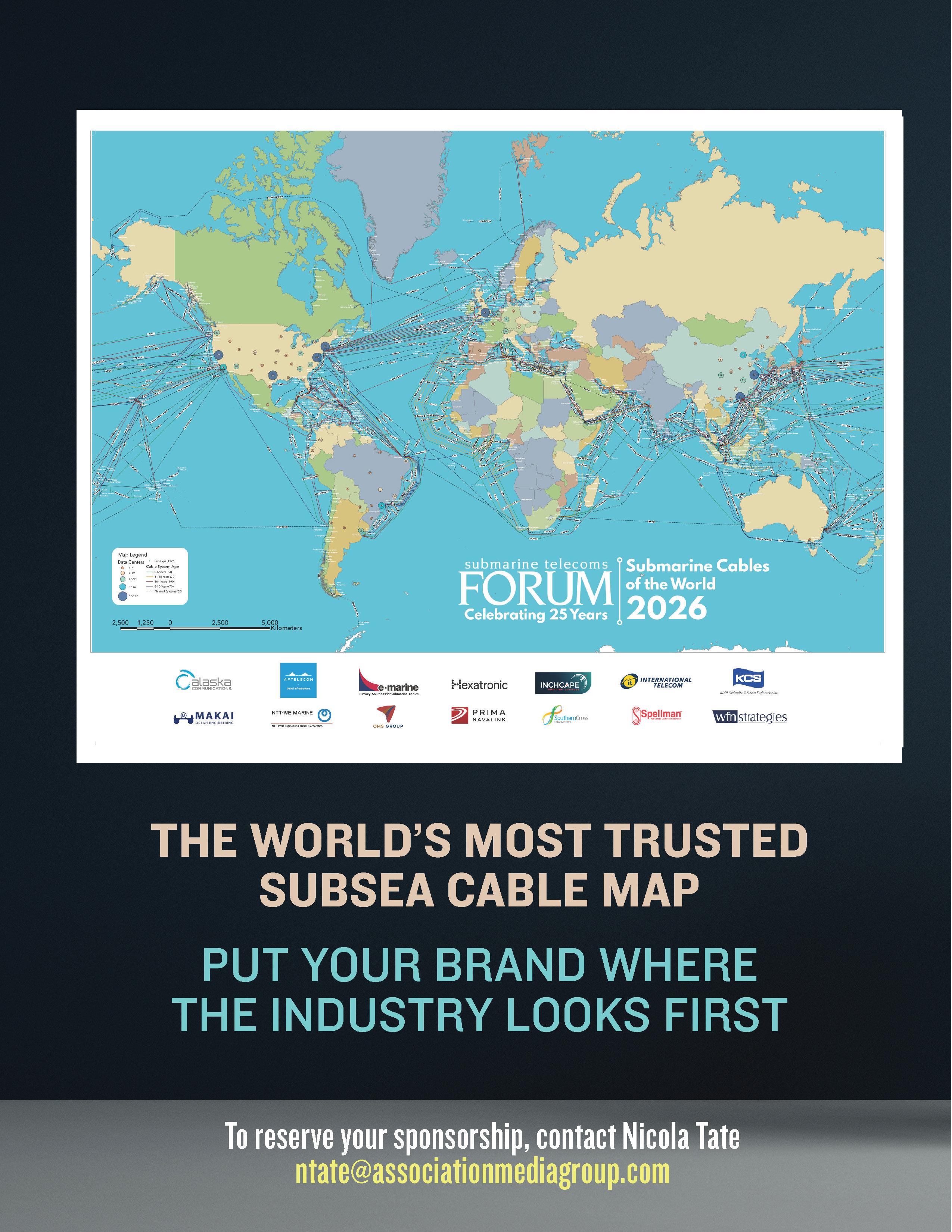
The first print run of the 2026 Submarine Cables of the World wall map is complete and will be handed out this month at PTC ’26. We will then print updated editions for Submarine Networks EMEA in May
and Submarine Networks World in September. Advertising opportunities are available for the May and September editions, placing your brand directly in front of the global subsea community and on office walls worldwide.
Click here to secure your spot!
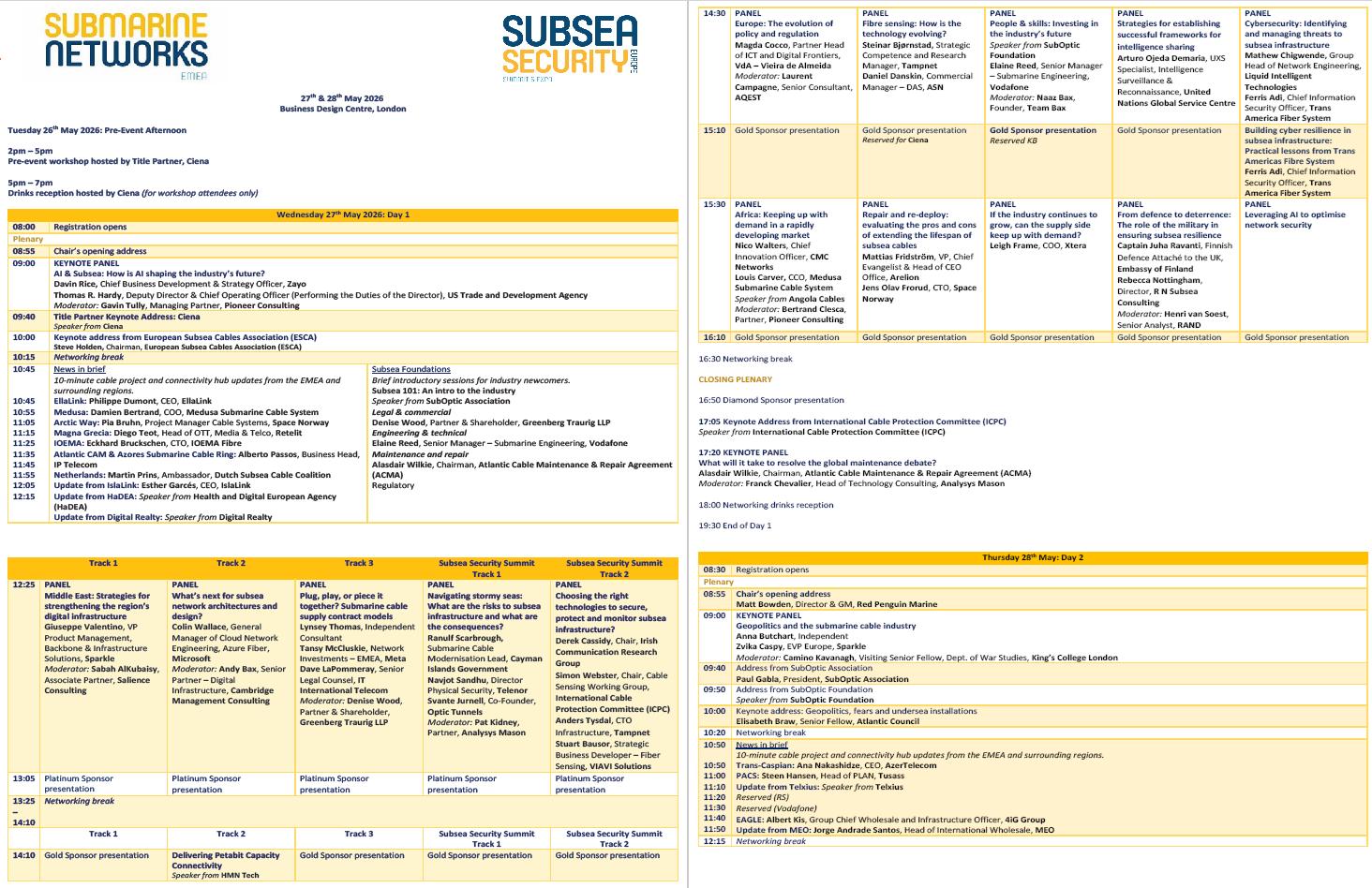
We are looking ahead to Submarine Networks EMEA in London this May. The event remains one of the most important annual gatherings for the global subsea community, bringing together operators, suppliers, investors, and policymakers. We look forward to reconnecting with industry colleagues and engaging in forward-looking discussions shaping the next phase of global connectivity.
Our thanks, as always, go to our outstanding authors. Special appreciation to this issue’s advertisers: ACS, APTelecom, Fígoli Consulting, Submarine Networks EMEA 2026, Southern Cross, and WFN Strategies. And do not miss our perennial reader favorite, Where in the World Are All Those Pesky Cableships?
Good reading, and Slava Ukraini

.

Wayne Nielsen is the founder and publisher of Submarine Telecoms Forum, one of the industry’s most trusted intelligence platforms, reaching more than 150,000 readers in 115 countries. He is also Managing Director of WFN Strategies, with over 35 years of global submarine cable experience spanning commercial, governmental, and offshore energy systems.

EXECUTIVE President
EDITORIAL AND ANALYTICS
Analytics
Kieran Clark | kclark@subtelforum.com |
SALES AND ADVERTISING REPRESENTATION
Sales and Advertising Nicola Tate | ntate@associationmediagroup.com | +1 804 469 0324
Advertising information: subtelforum.com/advertise-with-us
Contributions from SubTel Forum editorial staff and industry experts including Andrés Fígoli, Iago Bojczuk, Camila Paulino, John Maguire, Kristian Nielsen, Kieran Clark, Nicola Tate, Nicole Starosielski, Phillip Pilgrim, and Wayne Nielsen Feature Writers
Bill Burns, Chris Swan, Chris Wood, Derek Cassidy, Grace Koh, José Chesnoy, Mattias Fridström, Phil Black, Stewart Ash, Stuart Barnes, and Zack Spica
March 2026 – Finance & Legal featuring ICPC Plenary ’26 Preview
Authors Index
subtelforum.com/authors-index Industry Directory directory.subtelforum.com
Magazine Archive subtelforum.com/magazine-archive
Online Submarine Cable Map subtelforum.com/submarine-cable-map
GOVERNANCE Board of Directors
Wayne Nielsen, Margaret Nielsen, Kristian Nielsen and Kacy Nielsen Corporate information: subtelforum.com/corporate-information SUBMISSIONS
Contributions are welcomed and should be submitted to: pressroom@subtelforum.com
PUBLISHING AND LIABILITY NOTICE
Submarine Telecoms Forum magazine is published bimonthly by Submarine Telecoms Forum, Inc. It is an independent commercial publication serving as a freely accessible forum for professionals engaged in submarine cable systems and global digital infrastructure. No part of this publication may be reproduced or transmitted in any form, in whole or in part, without prior written permission from the publisher.
While every effort is made to ensure accuracy, the publisher accepts no liability for errors or omissions in editorial or advertising content, or for any consequences arising therefrom. The editor reserves the right to edit all submitted material.
SUBSCRIPTIONS AND ENQUIRIES
Submarine
Copyright © 2026 Submarine Telecoms Forum, Inc.

by Kieran Clark
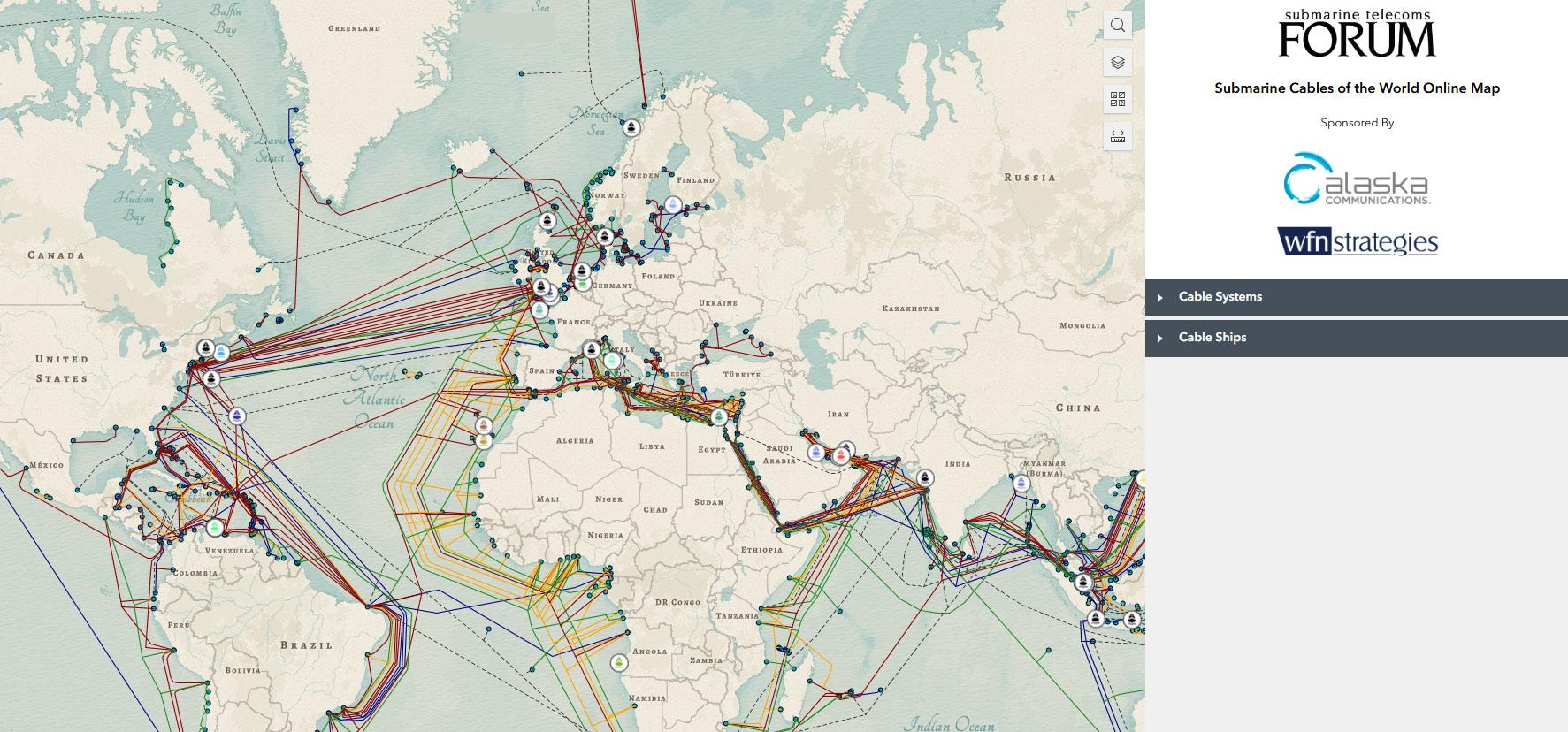
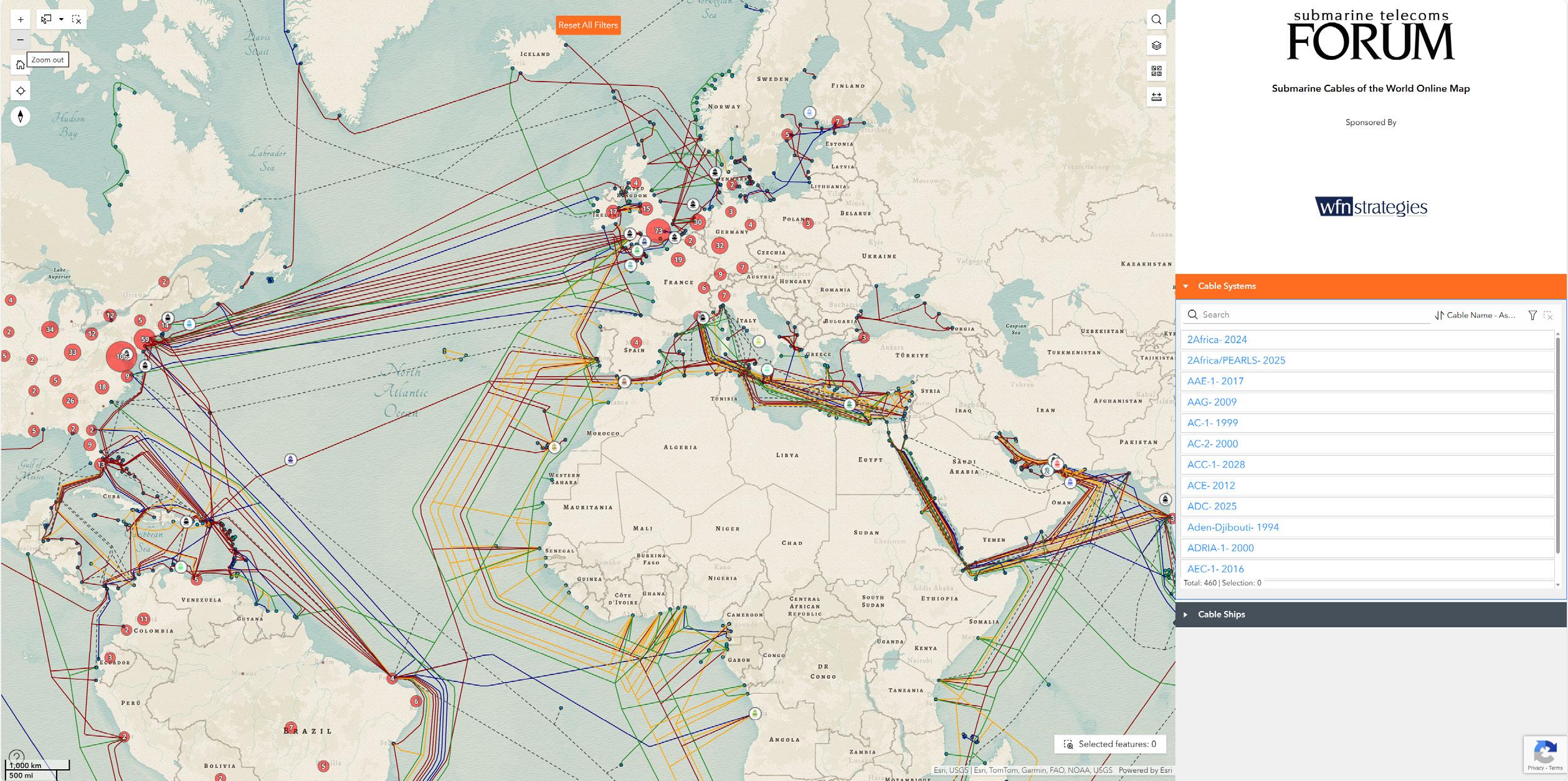
The SubTel Cable Map—powered by Esri’s ArcGIS platform—offers an interactive and detailed way to explore the global network of submarine cables.
This indispensable resource provides information on over 440 existing and planned systems, more than 50 cable ships, and upwards of 1,100 landing points. Connected directly to the SubTel Forum Submarine Cable Database and integrated with our News Now Feed, the map enables real-time tracking of industry activity and cable-specific news coverage.
Submarine cables serve as the foundation of global digital infrastructure, carrying more than 99% of international data traffic. These systems enable the seamless connectivity the world depends on—from personal communication to enterprise operations. Without them, modern, high-speed global communication simply wouldn’t be feasible.
Our analysts continually update the map using verified data from the Submarine Cable Almanac and valuable input from industry contributors. This ensures a timely and accurate picture of the subsea cable landscape, spotlighting the latest deployments and developments. As we approach the end of the year, map updates may slow during the holiday season, but our commitment to delivering reliable insights remains unchanged.
We’re proud to feature WFN Strategies as the current sponsors of the SubTel Cable Map. Additional sponsorship opportunities are available—offering high-visibility placement for your logo and a direct link to your organization. It’s a great way to align your brand with global connectivity and the future of the submarine cable industry.
We invite you to explore the SubTel Cable Map and gain a deeper understanding of the vital role submarine cable systems play in our interconnected world. As always, if you are a point of contact for a system or company that requires updates, please email kclark@subtelforum.com
We hope the SubTel Cable Map proves to be a valuable resource for you, offering insight into the continually evolving submarine cable industry. Dive into the intricate network that powers our global communications today. Happy exploring!
Kieran Clark is Senior Analyst at Submarine Telecoms Forum, Inc. He joined in 2013 as a Broadcast Technician supporting live event streaming, bringing over eight years of production experience. Promoted to Analyst in 2014, he now leads research and maintenance for the SubTel Forum Submarine Cable Database and Online Map, with analysis featured across most SubTel Forum publications.
JANUARY 18, 2026
NEW SYSTEMS:
• Candle
• Dhivaru
• Fastnet
• SEACOM 2.0
UPDATED SYSTEMS:
• 2Africa/EMIC-1
• 2Africa/PEARLS
• Anjana
• Arctic Way Cable
• Bifrost
• BTI
• Bulik
• CADMOS-2
• CSN-1
• Echo
• IEX
• JUNO
• Medusa
• Raman
• SEA-H2X
• Tabuaula


by SubTel Forum Staff
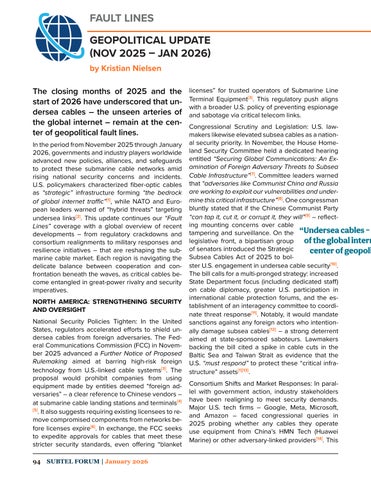
Submarine cables are the unsung infrastructure of the modern world.
STRATEGIC SHIFTS IN SUBMARINE CABLE POLICY
Carrying an estimated 99% of all intercontinental internet traffic, they are the backbone of financial systems, cloud computing, government communications, and everyday life online.
For much of their history, these systems were treated as neutral infrastructure — engineered, financed, and operated with minimal political involvement. But in the past year, that picture has changed dramatically. Governments now see cables as strategic assets, and in some cases as vulnerabilities.
Policies, regulations, and even naval operations are being reshaped by concerns about espionage, sabotage, vendor trust, and geopolitical rivalry. Major developments since late 2024 have reshaped dynamics in the United States, Europe, Russia, China, Japan, Southeast Asia, and the wider Indo-Pacific.
UNITED STATES: REGULATION, SECURITY, AND VENDOR TRUST
In July 2025, the U.S. Federal Communications Commission (FCC) adopted new rules creating a “presumption of denial” for submarine cable licenses involving equipment or operators linked to “foreign adversaries.” (Latham & Watkins, 2024) The rules also prohibit using technology from companies on the FCC’s “Covered List,” such as Huawei and ZTE (Submarine Networks, 2025).
FCC Commissioner Brendan Carr explained: “We have seen submarine cable infrastructure threatened in recent years by foreign adversaries, like China. We are therefore taking action here to guard our submarine cables against foreign adversary ownership, and access as well as cyber and physical threats.” (IEEE ComSoc Tech Blog)
Congress has also stepped in. In September 2025, the House of Representatives passed the Undersea Cable Control Act, which would restrict exports of sensitive cable technology, direct agencies to iden-
tify and secure critical components, and instruct the U.S. to work with allies on global standards (De Bevoise LLP Insights, 2024).
The impact is already visible. Cable projects planning landings in Hong Kong have been cancelled or rerouted (Latham & Watkins, 2024). Consortia are expected to disclose vendor ties, equipment origin, cybersecurity safeguards, and even repair ship availability. The SEA-ME-WE 6 cable is the most high-profile example: although HMN Tech’s bid was cheaper, the contract went to SubCom under U.S. diplomatic pressure, raising costs and delaying delivery (Reuters, 2025). Vendor trust is now an explicit requirement, not a background consideration.
Europe’s awareness of cable vulnerability sharpened in late 2024, when multiple data cables between Sweden, Finland, and the Baltic states were damaged. Some incidents coincided with anchor drags by vessels flagged to China, while another involved simultaneous disruption of cables and a gas pipeline (CSIS, 2025). Although no government has published definitive proof of sabotage, officials increasingly describe such events as hybrid threats.
In February 2025, the European Commission responded with an Action Plan on Cable Security worth nearly €1 billion (Semafor, 2025). Funding is earmarked for enhanced monitoring, spare cable stockpiles, and a fleet of dedicated repair vessels. One EU official described the approach as moving from passive resilience to “active deterrence, detection, and repair.”
NATO has also taken a larger role, deploying naval assets and underwater drones and launching exercises focused on cable protection (IEEE ComSoc Tech Blog). A new Maritime Centre for the Security of Critical Undersea Infrastructure in the UK is coordinating allied responses. Meanwhile, the Critical Entities Resilience Directive requires operators to assess sabotage risks and maintain emergency plans. Permitting processes for urgent repairs, historically slow, are being streamlined.
Click here for the full
Submarine Telecoms Industry Report 2025/2026
Europe is now treating submarine cables with the same seriousness as pipelines and power grids.
Since 2022, Russian companies have been largely excluded from international cable consortia (Latham & Watkins, 2024). Western governments view Russian participation as a security risk. At the same time, European navies continue to monitor Russian “research” vessels suspected of mapping or interfering with cables — the so-called “shadow fleet.”
Moscow’s response has been to build sovereign alternatives. The Polar Express cable, a 12,650 km system along Russia’s Arctic coast from Murmansk to Vladivostok, is entirely state funded (Latham & Watkins, 2024). Scheduled for completion by 2026, it will provide Russia with an independent communications corridor between Europe and Asia.
China continues to pursue ambitious subsea cable projects under its Digital Silk Road initiative, with systems connecting Asia, Africa, and the Middle East (Subsea Cables Industry News, 2025). Companies such as HMN Technologies remain active, but their participation in global projects is narrowing.
Governments in the U.S., Europe, Japan, and elsewhere cite concerns about supply-chain transparency, foreign state influence, and the risk of espionage or sabotage. As a result, Chinese bids are increasingly excluded even when they are technically strong and economically competitive (Reuters, 2025).
The SEA-ME-WE 6 cable highlights this shift. HMN Tech initially offered the lowest bid, but the contract was reassigned to SubCom after U.S. diplomatic pressure, reflecting the growing role of geopolitics in procurement decisions.
Japan: Subsea Cables as National Security
The most significant new development in 2025 came from Japan. In September, Tokyo formally

designated subsea cables as a national security priority (Financial Times, 2025).
The government is preparing to subsidize NEC, Japan’s leading subsea cable manufacturer, to acquire a fleet of large cable-laying ships (TS2.Tech, 2025). NEC currently charters vessels — for example, one from a Norwegian company under a four-year lease signed in 2022 — but officials view this as a vulnerability.
One government source told the Financial Times: “The Japanese government thinks this situation is very serious, so we are thinking we need to make some intervention.” Another cited risks of “espionage or cable-cutting sabotage,” and even the possibility that cables could one day serve as submarine detection systems [Source 1 Financial Times].
NEC has already laid more than 400,000 km of cables worldwide. Owning ships would allow NEC to guarantee faster response times for installation and repairs, making it more competitive in major tenders (Tom’s Hardware, 2025). NEC executive Takahisa Ohta acknowledged: “Owning a vessel is a huge fixed cost … but the market is booming now … one option is to acquire our own ship, and it’s something we’re considering.” (RioTimes Online, 2025)
Japan’s move has far-reaching implications. It enhances self-reliance, strengthens competitiveness, aligns with Quad and Indo-Pacific connectivity goals, and may provide a model for other governments to follow.
Southeast Asia is a region where these geopolitical tensions play out daily. Countries such as Vietnam, Indonesia, and the Philippines are building new cables to meet growing demand, but they are also being pulled by competing offers of investment and influence (Reuters, 2025).
Reuters reported in 2025 that U.S. officials have lobbied Vietnam to avoid Chinese suppliers as it plans up to ten new cables by 2030. Chinese
companies continue to offer attractive pricing and financing, creating a delicate balance for regional governments.
To manage these pressures, many projects are reconfiguring routes. New trans-Pacific systems are bypassing Hong Kong, while consortia increasingly use mixed suppliers to reduce dependency on any one country (AInvest/Nikkei, 2025). Governments are tightening permits for landings and repairs, requiring local oversight, while some have relaxed cabotage rules to speed emergency work.
The Indo-Pacific has emerged as a focal point for cooperative connectivity. The Quad alliance — the U.S., Japan, Australia, and India — has pledged to connect every Pacific Island state by the end of 2025, committing over USD $140 million in combined funding (JFIR, 2025). Japan’s forthcoming fleet would directly support these efforts by providing installation and repair capacity.
Alternative routes are also being developed to enhance resilience and bypass chokepoints. Projects such as Far North Fiber and Polar Connect in the Arctic, along with multi-branch loops across Northeast Asia, North America, and Southeast Asia, are being advanced [Source 12 Rio Times Online]. Japan’s geography makes it both a hub and a vulnerability, with many landing stations concentrated near Tokyo. The government is therefore encouraging diversification of landing sites, while projects such as the Southeast Asia–Japan Cable 2 (SJC2) already provide new routes
and over 126 Tbps of capacity (AInvest/Nikkei, 2025).
Over the last year, submarine cables have moved from being technical projects managed quietly by private consortia to becoming critical assets at the heart of national and international security.
Key lessons are emerging. Fleet ownership matters, as Japan’s NEC subsidies show (Financial Times, 2025). Vendor trust is central, with U.S. and European policies reshaping procurement (FCC, 2025) (Semafor, 2025). Routing, redundancy, and permitting are now strategic as well as technical. And geopolitical blocs — the U.S., EU, Japan, Australia, and their partners — are increasingly aligning on what constitutes “trusted infrastructure.”
The submarine cable industry stands at a new inflection point. Politics is now as important as bandwidth. For investors, operators, and policymakers alike, understanding these dynamics is no longer optional — it is essential.
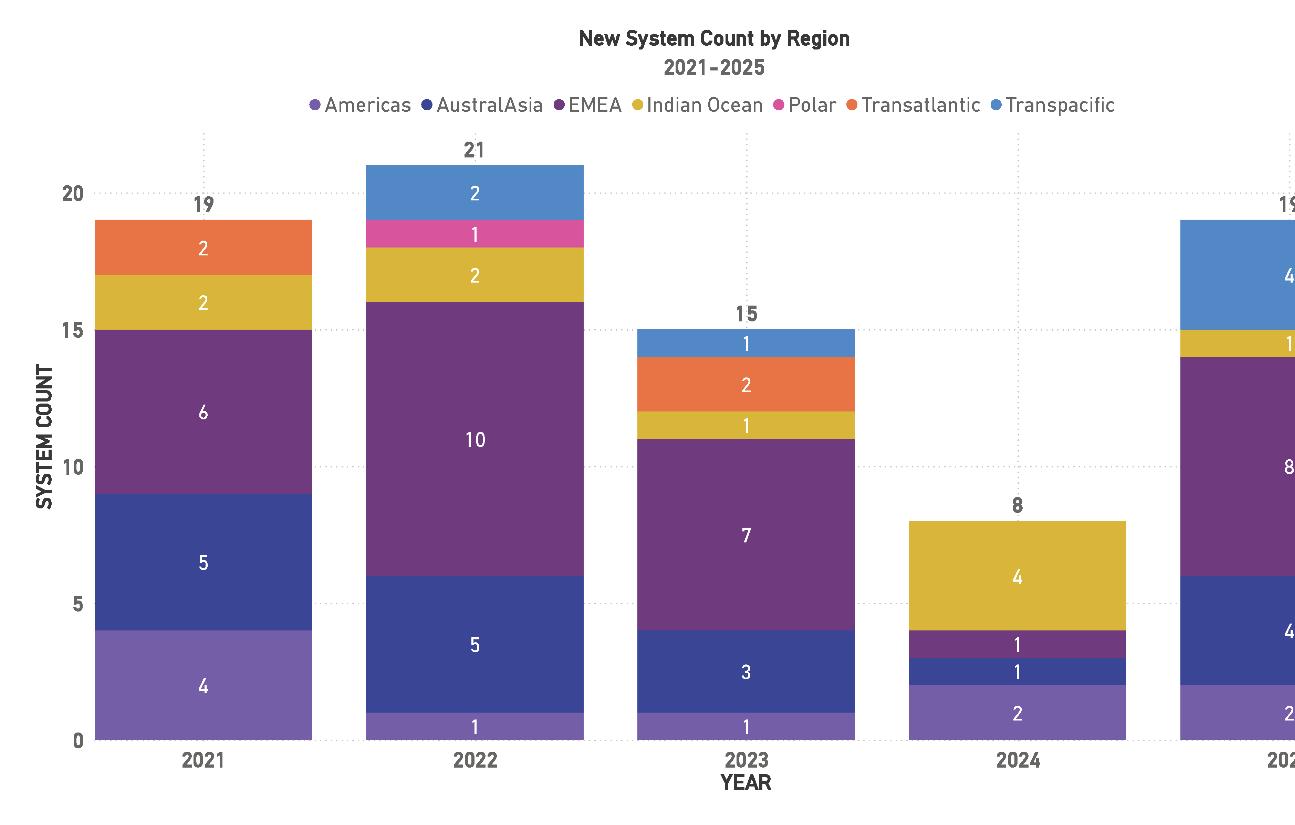

The submarine cable industry continues to demonstrate resilience and steady expansion, with new deployments reflecting the growing demand for global connectivity, low-latency routing, and enhanced resilience across major corridors. While year-to-year fluctuations remain a defining feature of the industry, the longer-term trajectory continues upward, supported by both hyperscaler-backed projects and regional consortia.
Between 2021 and 2025, new system installations have shown both peaks and troughs as projects move through complex financing, permitting, and construction cycles. The year 2022 marked the high point, with 21 new systems coming online, followed by a decline in 2023 (15 systems) and 2024 (8 systems). Data for 2025, however, shows a rebound to 19 systems, highlighting the cyclical but resilient nature of industry growth. EMEA has consistently led in new system count, underscoring its role as the most active region for cable development, while the Transpacific’s resurgence in 2025 illustrates renewed investment in transoceanic routes. AustralAsia continues to make steady contributions, while the Indian Ocean and Polar regions remain far less active, reflecting ongoing economic and geographic challenges.
Over the five-year period, EMEA emerges as the dominant contributor to system additions, while Transpacific growth in 2025 signals its return as a priority corridor for global capacity. Compared to last year’s report, which noted a steady decline in new installations after 2020, the updated figures suggest a more uneven but ultimately stronger recovery, with growth concentrated in high-demand long-haul routes.
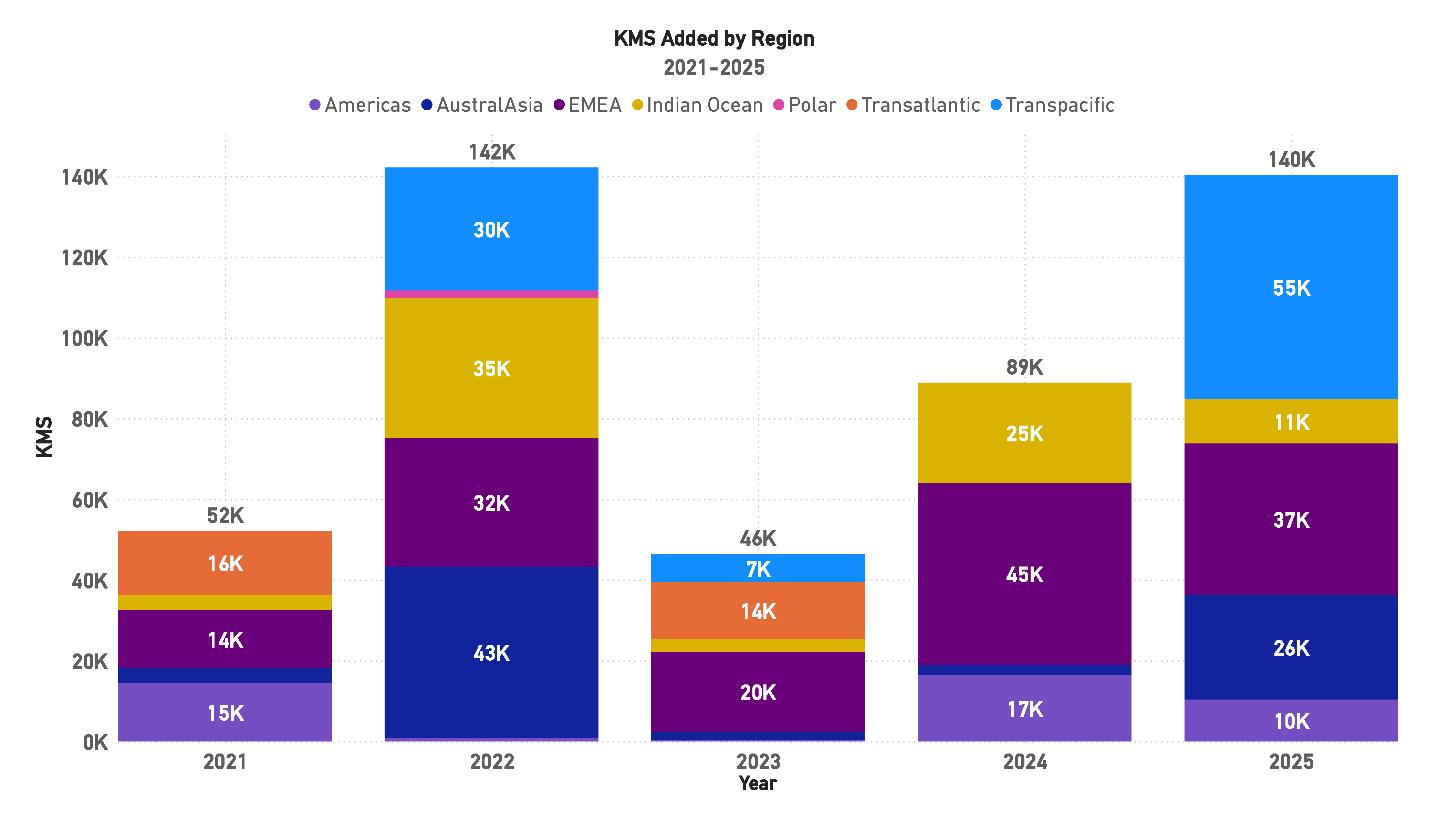
When measured in kilometers of cable installed, the story diverges from system counts, emphasizing the importance of system scale. In 2022, the 21 new systems contributed 142,000 kilometers, making it the standout year of the period. By contrast, 2023 delivered 15 systems but only 46,000 kilometers, reflecting a year dominated by shorter or regional builds. The year 2024, despite having only 8 new systems, recorded 89,000 kilometers, highlighting the scale of large projects in the Indian Ocean and EMEA. Projections for 2025 suggest another strong year, with nearly 140,000 kilometers expected to be added, supported by significant Transpacific and EMEA deployments.
Taken together, these results highlight the disconnect that can occur between system count and total kilometers installed. While smaller regional projects boost the number of systems in a given year, the longest-haul builds, particularly in the Transpacific


• Global system coverage—active, planned, future
• Capacity forecasts and regional build trends
• Supply chain, investment, and geopolitical insights
• Verified datasets based on real industry research
• Essential for strategic planning
and EMEA regions, account for the bulk of kilometers added. Compared to last year’s assessment, the growth in kilometers is greater than expected, underscoring the industry’s strategic focus on scaling capacity along its largest and most critical routes.
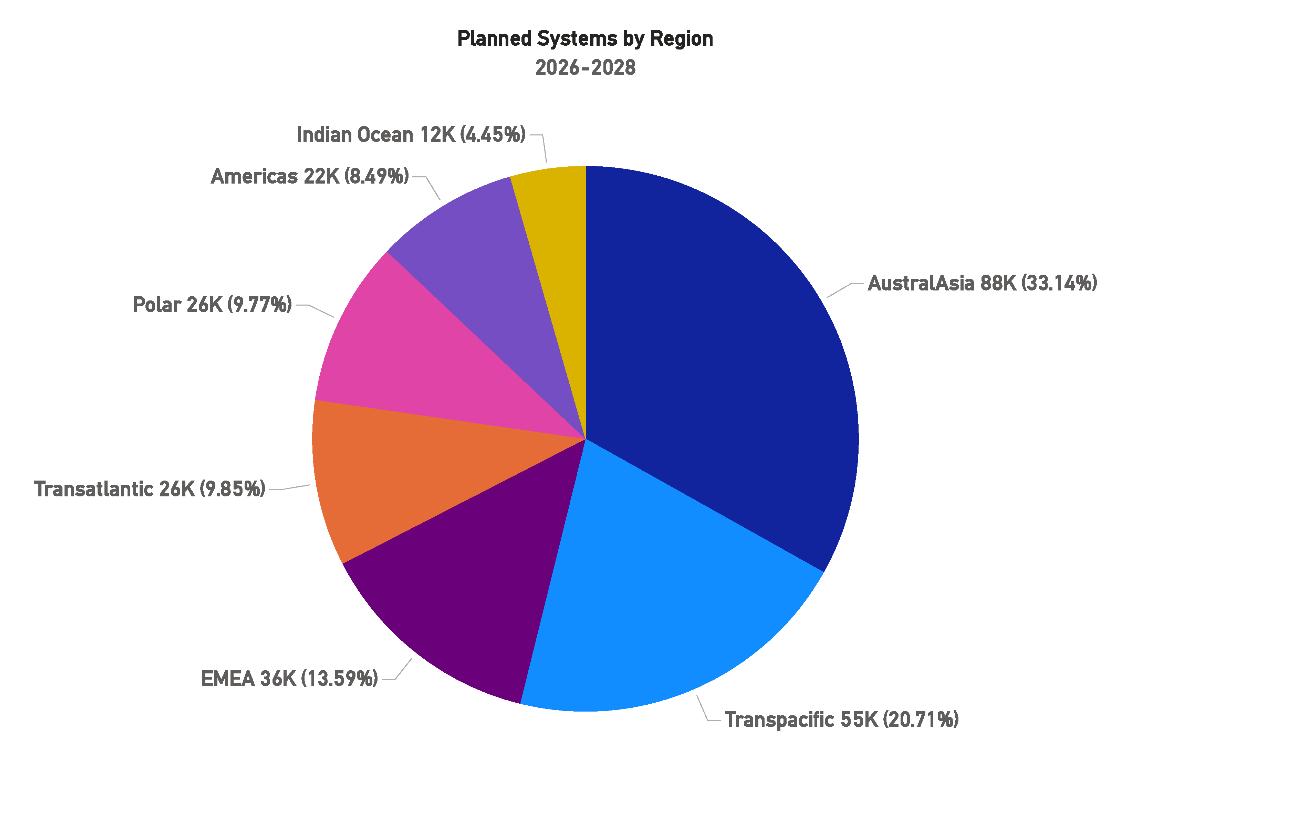
Looking ahead, planned systems between 2026 and 2028 further reinforce these dynamics. AustralAsia leads with 88,000 kilometers of projected builds, accounting for one-third of future deployments, while the Transpacific follows with 55,000 kilometers, or just over 20% of the total. EMEA remains steady, with 36,000 kilometers planned, while the Transatlantic and Polar regions each account for approximately 26,000 kilometers. The Americas and Indian Ocean regions, with 22,000 kilometers and 12,000 kilometers respectively, remain on the lower end of future activity.
These projections suggest that long-haul routes will continue to dominate global growth, with AustralAsia emerging as the most active hub of development. The renewed emphasis on Transpacific builds reflects the need for both replacement of aging systems and diversification of capacity between Asia
and the Americas. Compared to last year’s forecast, AustralAsia’s projected share has increased, while EMEA and the Transatlantic remain stable contributors, underscoring the broadening distribution of global infrastructure investment.
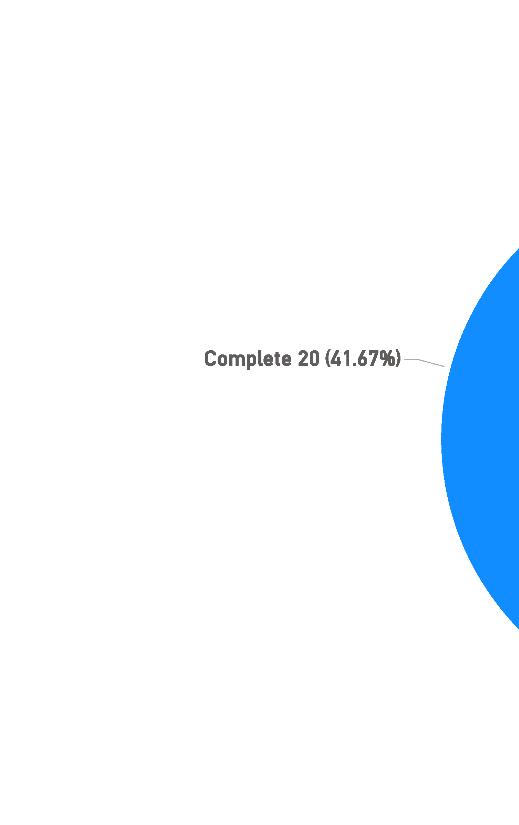
Despite this healthy pipeline, securing financing remains one of the industry’s most pressing challenges. As of the 2026–2029 forecast, 20 of the 48 planned systems have reached Contract in Force (CIF) status, representing 41.67%. While this is an improvement over last year’s report, where just over 20% of systems were CIF, it still leaves the majority of projects awaiting final commitments. The increase suggests progress in overcoming earlier financing hurdles, though challenges persist amid rising costs, regulatory complexities, and continued global economic uncertainty.
The CIF rate remains a key indicator of which systems are most likely to move forward. Projects that achieve CIF status have secured the necessary contractual and financial backing, giving them a far higher likelihood of being realized. Those that remain incomplete face the risk of delay or cancellation, particularly if they lack hyperscaler participation or sufficient
consortium support. The current figures suggest that while industry activity remains strong, the timing of deployments will continue to be influenced by financing cycles and broader market conditions.
In summary, the period from 2021 to 2025 highlights the industry’s ability to adapt to fluctuating conditions, while projections through 2029 reaffirm
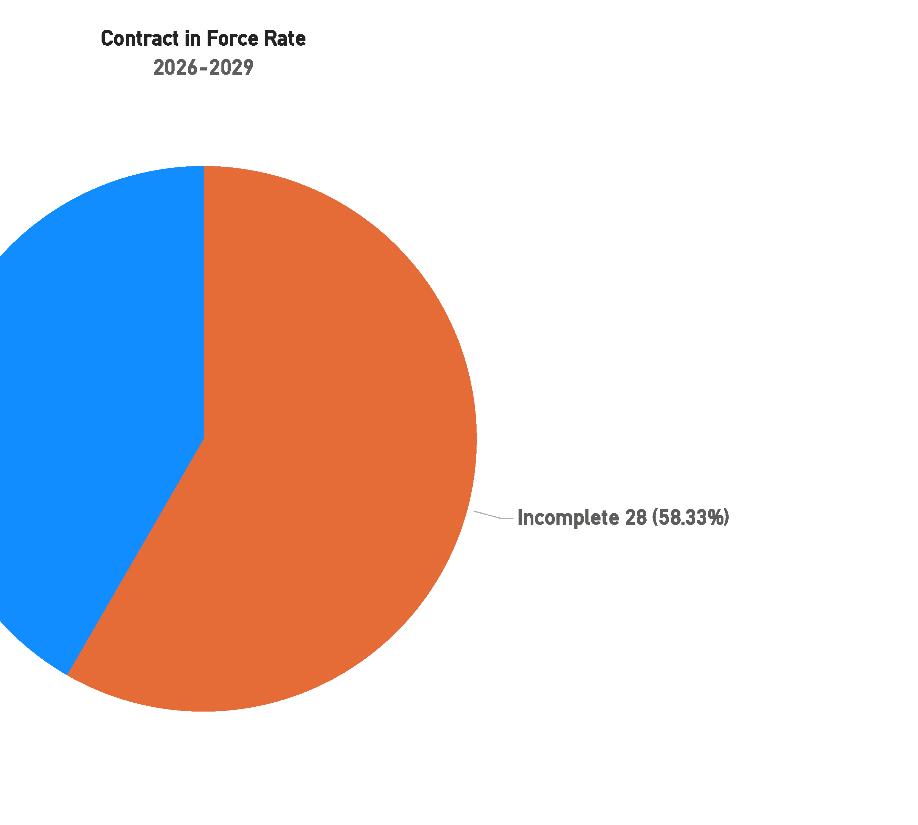
Contract In Force Rate, 2026-2029
the long-term trajectory of steady growth. EMEA, AustralAsia, and the Transpacific stand out as the primary corridors of expansion, while the CIF rate underscores the challenges that remain in bringing ambitious plans to completion.
An in-depth examination of the decommissioning of Out-of-Service (OOS) submarine cable systems highlights the growing importance of this often-overlooked stage of the industry’s lifecycle. While many cables continue to operate well past their anticipated End-of-Service (EOS) dates, the process of removing, recycling, or otherwise managing these aging systems has become increasingly relevant as global connectivity infrastructure expands. Companies such as Subsea Environmental Services, Mertech Marine, and Submarine Cable Salvage, Inc. remain at the forefront of recovery and recycling efforts, offering solutions that balance operational, financial, and environmental considerations. Mertech Marine has continued its long-standing focus on the recovery and repurposing of cables, while Subsea Environmental Services and Submarine Cable Salvage, Inc. have emphasized sustainable practices, including materials recycling and environmentally conscious removals.
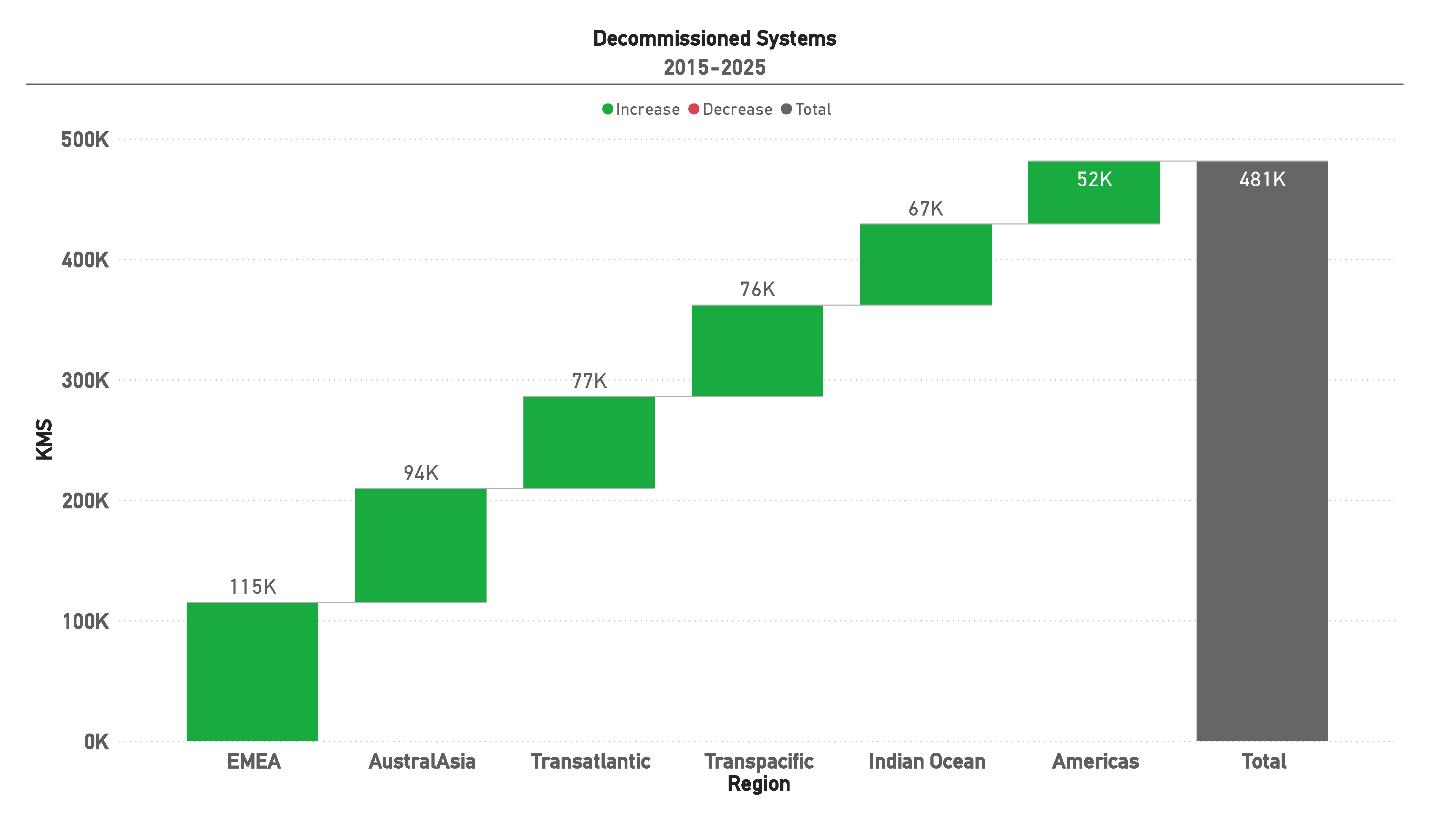
Between 2015 and 2025, approximately 481,000
kilometers of submarine cable systems are expected to be decommissioned worldwide. The EMEA region accounts for the largest share, with 115,000 kilometers taken out of service, reflecting both its historical role as a hub of subsea connectivity and the aging infrastructure concentrated in the region. AustralAsia follows with 94,000 kilometers, while the Transatlantic and Transpacific regions report 77,000 and 76,000 kilometers, respectively, underscoring the significant turnover in long-haul systems. The Indian Ocean region contributes 67,000 kilometers to global decommissioning totals, and the Americas account for 52,000 kilometers. Together, these figures highlight the ongoing transition as older systems reach the end of their useful life, particularly those built during the rapid buildout of the late 1990s and early 2000s.
Compared to last year’s analysis, which estimated 411,000 kilometers of cables taken out of service from 2014 to 2024, the updated totals reflect both continued retirements and improved tracking of decommissioned systems across multiple regions. EMEA remains the largest contributor, consistent with its status in previous years, while AustralAsia has grown in share as more regional systems age out of service. The Americas and Indian Ocean remain relatively smaller contributors but nonetheless illustrate the steady global spread of decommissioning activity.
Technological advancements have extended the lifespan of many cables beyond their expected EOS, often surpassing the standard 25-year benchmark through upgrades at landing stations and network management improvements. However, aging infrastructure inevitably faces higher risks of equipment failure, service interruptions, and increased maintenance costs, leading operators to transition systems into OOS status. The decision to physically remove these systems remains complex: while environmental regulations in some regions now mandate removal, in others, cables are left on the seafloor due to prohibitive recovery costs and the potential for ecological disturbance.
With an estimated 85 additional systems projected to reach EOS within the next five years, and another 53 by 2032, the issue of decommissioning is expected to intensify. Historical precedent shows that fewer than 60 systems have been fully removed in the past two decades, underscoring the gap between cables aging out of service and those actually reclaimed or recycled. This discrepancy places increasing pressure on both operators and regulators to address the environmental and logistical challenges of managing decommissioned assets.
Specialized companies such as Mertech Marine and Subsea Environmental Services play a vital role in bridging this gap. By focusing on recovery and recycling, these firms ensure that valuable materials can be repurposed while mitigating the environmental impact of aging infrastructure. Their expertise in cable removal and sustainable disposal practices offers a path forward for an industry facing mounting regulatory scrutiny and growing public expectations around environmental responsibility.
In conclusion, the decommissioning of Out-of-Service submarine cable systems remains a multifaceted challenge at the intersection of technical feasibility, financial cost, and environmental stewardship. As hundreds of thousands of kilometers of cable near the end of their operational life, coordinated strategies involving system owners, regulators, and specialized recovery firms will be essential. The coming decade will test the industry’s ability to not only expand global connectivity but also responsibly manage the inevitable retirement of its oldest infrastructure.


by Iago Bojczuk, Camila Paulino and Nicole Starosielski
Cable Landing Stations (CLSs) are the energy-dense operational nodes in the entire submarine network.
As the critical interface where subsea cables meet the terrestrial grid, the CLS brings together an essential triad of functions: transmission (SLTE), supervision (traffic management), and power (PFE).
As explored in previous editions of the Sustainable Subsea Networks column, it is in these facilities that a system’s energy requirements are most visible and where the industry can take the most measurable actions to advance sustainability.
However, determining exactly what to measure, where to measure it, and how to report the results remains an open question among operators. This column focuses on those questions and describes whether we should focus on energy, particularly electricity generated from fossil fuels, in these discussions. The reason lies in the need to track the sector’s environmental footprint.
Empirical research shows that grid electricity used at the CLS, alongside marine fuel consumed by the global fleet of cable ships, is among the most significant contributors to the network’s operational carbon emissions. Life cycle assessments point to the dry-plant entry point of a cable system as a key site for sustainability gains (Donovan 2019).
A typical CLS sits a few hundred meters from the beach manhole and connects to that manhole via a short, unrepeated fiber link. This is a practical operational boundary where it makes sense to instrument energy use, building systems, and termination equipment in support of metrics and reporting.
Yet this boundary takes very different physical and architectural forms around the world, which makes standardization difficult. It can range from hardened, subterranean bunkers from the Cold War era designed for physical resilience, to modern, modular “cable huts” that favor rapid deployment, and to massive, multi-story urban landing stations that must integrate with dense electrical grids. At the CLS, there are many different technologies and
problems, whether managing salt-air corrosion at a tropical landing site or addressing the extreme thermal loads of an AI-integrated facility.
Here, we focus attention on one aspect of CLS sustainability that remains consistent no matter what the context: energy use for building function.
Consider a common scenario. In a CLS, energy costs can rise noticeably even when everything seems normal: traffic remains stable, there are no
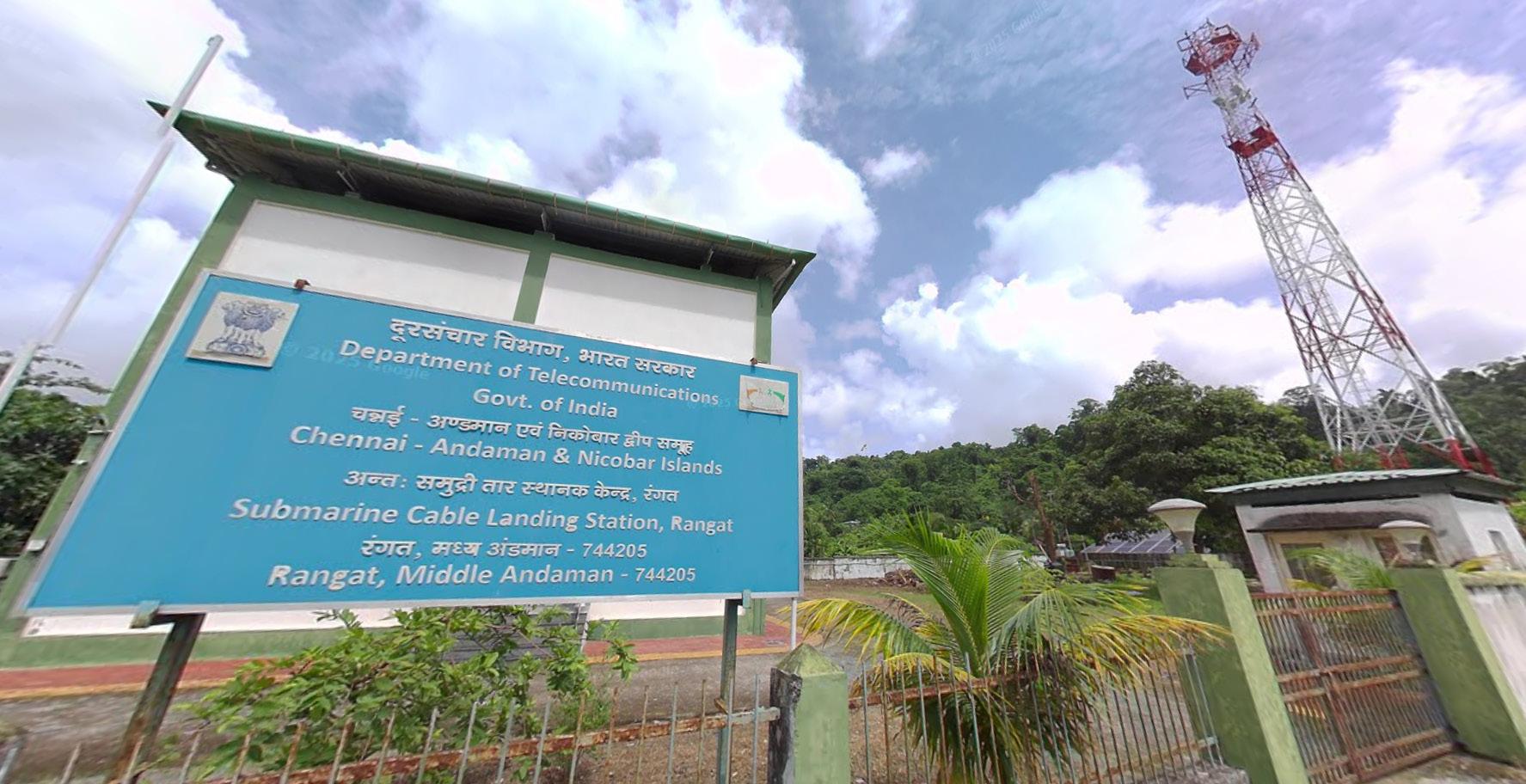
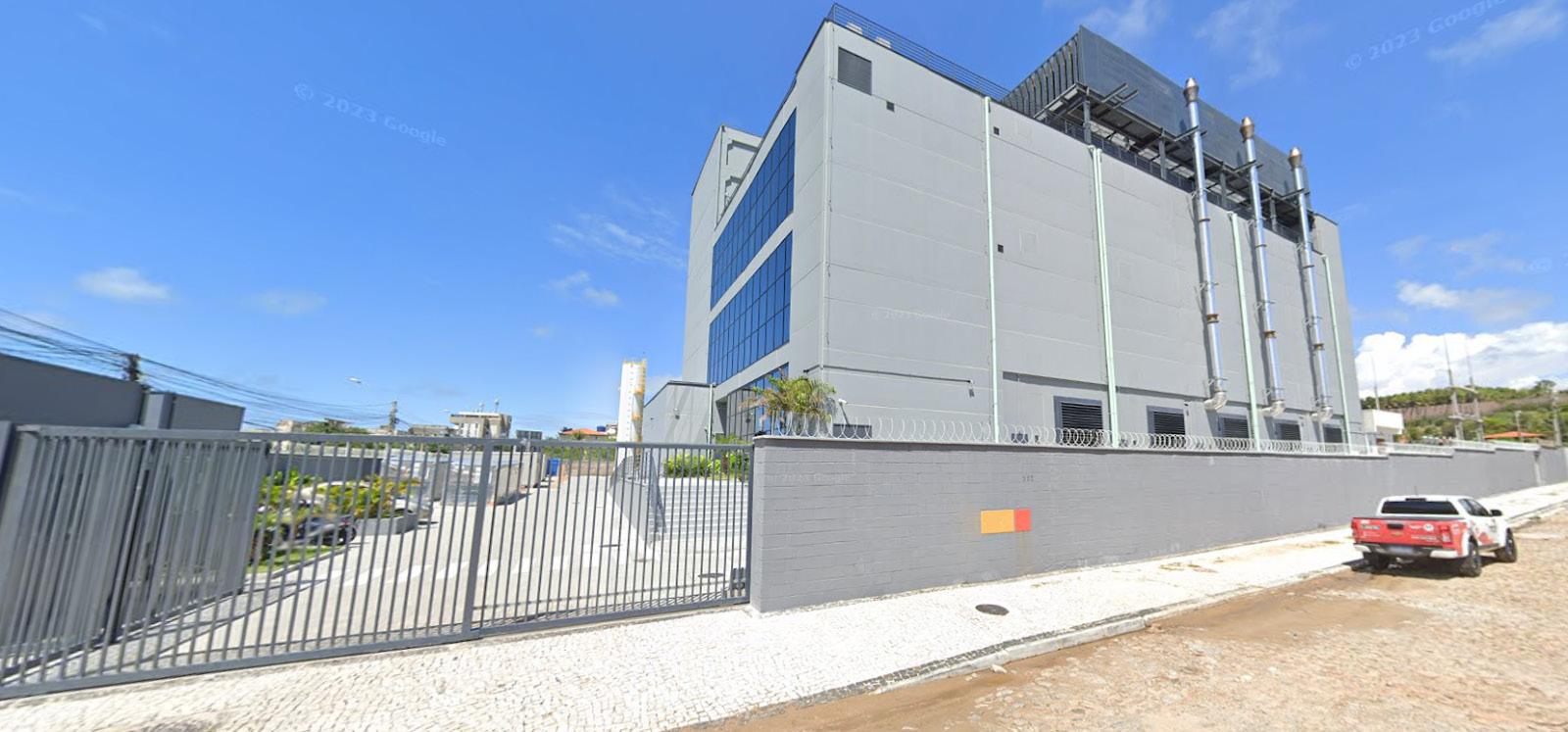
Note: The image at the top (captured in 2024) shows an example of a CLS in India, located approximately 2,859 m from the shore (estimated straight-line distance). The image at the bottom (captured in 2023) shows an example of a CLS in Brazil, with a larger facility likely coupled with data centre infrastructure, located about 393 m from the shore.
major alarms, and the equipment that keeps the cable running—such as the PFE and the transmission systems (SLTE/TLTE)—continues to operate. When this happens, the issue is usually not with the “cable equipment” itself, but with the supporting infrastructure that enables the station to function. This includes the electrical system that converts and distributes power (rectifiers/DC plant, UPS, and batteries), as well as the cooling and climate-control system (HVAC).
In fact, industry data indicate that while transmission equipment typically accounts for about 50% of the load, cooling systems alone can consume up to 43%, with the remaining 7% split between power infrastructure and lighting (Regnicoli, Reschini, and Paz, 2019).
This is why metrics are so important. They help distinguish energy used for the core service of maintaining connectivity from energy spent to support the site, such as power conversion, cooling, lighting, and security. With this visibility, operations teams can pinpoint where waste occurs and make more confident decisions about where to invest. Without clear, comparable metrics, how can operators know whether rising energy use reflects real demand or simply inefficiency in the systems that keep the station running?
In this month’s SubTel Forum column, we explore the critical role of structured energy monitoring through the lens of the Sustainable Subsea Networks project’s Report on Best Practices in Cable Landing Station Sustainability, published earlier this year by the SubOptic Foundation.
Moving beyond theoretical “nameplate” values— such as maximum rated power draw or voltage— and measuring actual consumption is essential not only for operational efficiency, but also for proactive risk management and failure prevention. Transparency is also important in reporting to consortia and auditors. Consistent measurement methodologies, even in shared facilities, can strengthen a CLS’s credibility and reinforce the investment case for sustainability improvements.
Because the point of presence (PoP) may be located hundreds of kilometers inland, operators often rely on a dedicated terrestrial link, sometimes with repeaters, to connect the PoP to the CLS. In practical terms, the CLS is where the submarine system interfaces with the site’s electrical and building infrastructure, making it the most sensible place to establish a baseline and standardize monitoring and metering.
This has implications for how to set up a CLS facility. To operate, the CLS converts optical signals into electrical signals (and vice versa) through termination and transmit/receive equipment. This stack represents a measurable load, the telecom/ICT “load”, that can be used as a reference to distinguish the energy that directly supports traffic processing from the additional consumption required to keep the site running (electrical losses, cooling, and building services).
In addition, many CLS facilities rely on network management systems to supervise and control traffic and cable operations, as well as power feed equipment (PFE), which injects direct current to power repeaters and other elements of the wet plant.
From a performance and sustainability standpoint, the PFE is a critical block: it creates an “energy bridge” between onshore operations and the reliability of the submarine link, and should therefore be treated as a distinct metering point.
Together with building utilities consumption (including cooling and, where applicable, water), the CLS
becomes the most actionable place to track Power Usage Effectiveness (PUE), Carbon Usage Effectiveness (CUE), Water Usage Effectiveness (WUE), and Renewable Energy Factor (REF), sustainability metrics that are becoming common in the data center industry.
Below is Figure 2, which serves as a broad sketch of where the metrics matter most in a systems-level view of a cable system. Here, PUE depends on separating the CLS’s total energy from the energy allocated to the telecom load (Terminal Equipment). CUE requires converting electricity (and fu-
els, where applicable) into CO₂e. WUE depends on measuring water associated with cooling and building services. REF requires quantifying the share of renewable energy in the supply mix. In a CLS, it is particularly important to treat the PFE as an explicit metering block because it links onshore operations to the energy consumption associated with the wet plant.
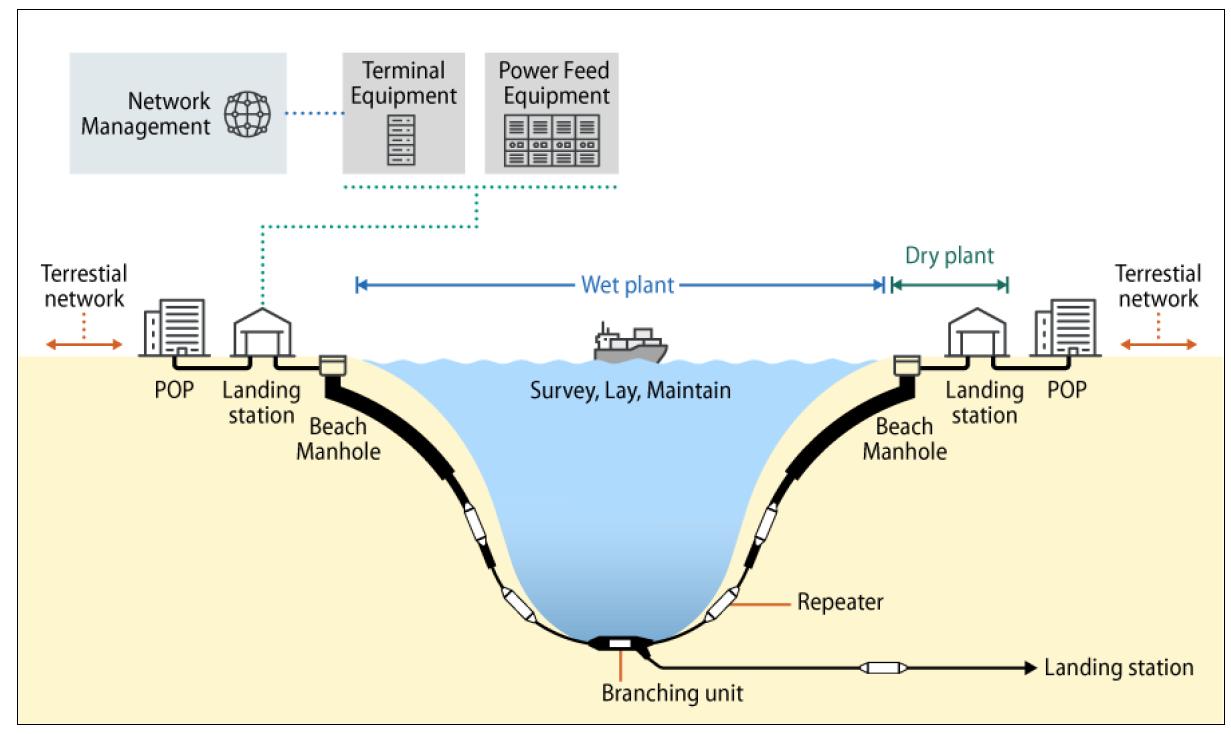
Figure 2. The CLS’s Position in the End-to-End Submarine Cable System. Source: Gallagher and Carter (2022).
In this context, the first thing to measure is energy, because it is the most immediate (and most actionable) dimension of environmental and operational performance in a CLS. The Report on Best Practices in Cable Landing Station Sustainability (2025) shows that, in practice, many facilities do monitor the station’s total consumption and keep historical records, but they do not measure electricity at all the points required to accurately assess core metrics (such as PUE, CUE, and WUE), nor to allocate consumption and emissions to specific infrastructures or to rooms/users/customers within the site.
Note: A CLS (dry plant) connects the PoP and the terrestrial network to the submarine cable (wet plant) via the beach manhole. The figure highlights the operational blocks where measurements are typically taken for sustainability metrics (total site energy, telecom load/terminal equipment, PFE, and building infrastructure), while the wet plant is monitored primarily through performance and link-integrity telemetry. The dry plant concentrates the critical operational blocks: Terminal Equipment (optical/telecom equipment) and Power Feed Equipment (PFE), which injects power to supply components of the wet plant. The system is also supervised by Network Management, responsible for monitoring and control.
In other words, when you can “see” only the total, you lose the ability to pinpoint waste, understand losses, and prioritize interventions where they matter most. That is why standards associated with PUE, for example, define metering points with
increasing levels of precision (from the UPS output to the ICT equipment input) to convert energy into comparable, management-ready data.
For the subsea cable industry, the sustainability conversation is entering a phase where measure-
decarbonization) into defensible technical and financial decisions.
Our published report underscores this point: metrics can indeed enable internal benchmarking, guide investments, and help the sector prepare for a landscape in which transparency and reporting are likely to become more demanding, whether driven by customers, consortia, insurers, or regulation. This is particularly urgent as studies show that the grid electricity used at the terminal—along with marine fuel for maintenance—is a primary contributor to the industry’s carbon footprint (Donovan, 2019).
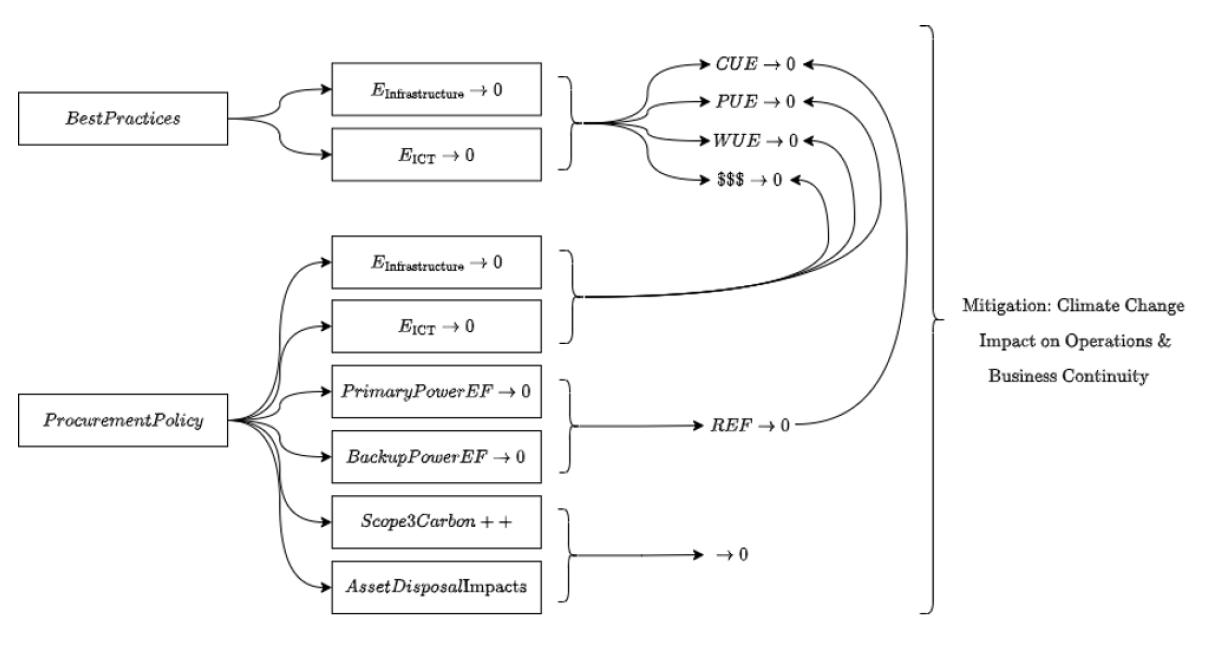
Figure 3. Inter-dependencies: Best Practices, Metrics, Procurement Policy, Climate Change Impact Mitigation
Source: Report On Best Practices In Cable Landing Station Sustainability. SubOptic Foundation, 2025.
The diagram shows how operational best practices improve energy efficiency, especially for supporting infrastructure (and, in some cases, for ICT as well)—thereby influencing metrics such as CUE, PUE, and WUE and reducing costs. In parallel, procurement policies (for products and services and for selecting low-carbon energy suppliers) affect REF, infrastructure, and ICT efficiency and, consequently, drive CUE/PUE/WUE even lower. These decisions also affect Scope 3 emissions and the end-of-life sustainability of assets. Taken together, these actions strengthen climate-risk mitigation for operations and business continuity.
ment is no longer optional but a prerequisite for management. Without metrics, there is no reliable baseline, no way to demonstrate improvement, and it becomes difficult to turn intent (ESG, efficiency,
The report also provides an important diagnosis of the sector’s “state of practice.” Although total CLS energy consumption and historical data are often available, electricity is generally not measured at the points needed to calculate key metrics accurately (such as PUE, CUE, and WUE) or to allocate consumption/overhead by area, subsystem, or customer, especially for CLS facilities housed within data centers, where allocating shared power and cooling becomes more complex.
In the survey sample reported in the CLS sustainability survey, as part of the study designed by the Carbon3IT team, found that only one case assessed PUE in compliance with the standard, and holistic sustainability/efficiency practices were rare.
In practical terms, the industry already has part of the instrumentation in place (BMS/DCIM are widely present), but many routines still rely on manual collection and lack zoning and “disaggregated”
measurements (by M&E, by rooms, by customers).
1
As a first step along this path, PUE (Power Usage Effectiveness) is a metric that is widely established in data centers and already familiar to the market (Avelar, Azevedo, and French, 2012). When applied to the CLS context, the value of PUE lies less in “comparing companies” and more in building operational discipline: tracking the site’s energy performance over time and measuring the effects of changes. This can include, for example, HVAC upgrades, retrofits, power-conversion optimization, and operational adjustments (Bojczuk et al., 2024).
At the same time, there remain key limitations: CLS sites tend to have higher PUE because telecom loads are smaller, and the indicator can be distorted by climate, building age, and design choices; moreover, it is possible to “improve” PUE without reducing absolute consumption. In other words, PUE can be useful as an internal metric, but it should not be treated as a universal seal of performance.
Building on these limitations, the practical recommendation is to move toward a “suite” of metrics rather than relying on a single number. Beyond PUE (or an equivalent overhead metric), it is useful to consider absolute consumption (kWh), the origin of energy (renewable share, on-site/off-site), and indicators more closely aligned with the service delivered, for example, relating energy use to what the CLS provides in terms of capacity, such as Tbps per kW.
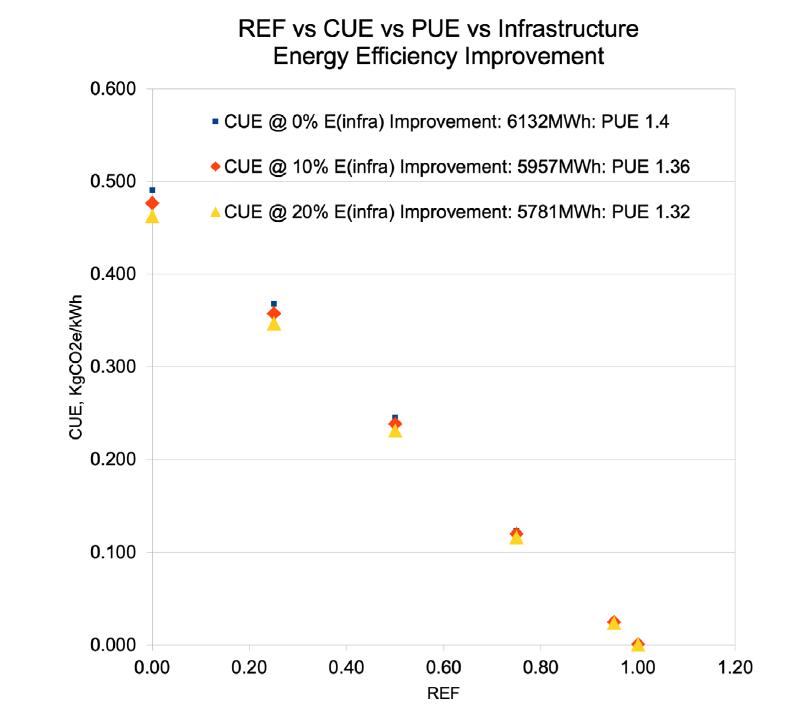
Figure 4. REF vs CUE vs PUE vs Progressive Infrastructure Energy Efficiency Improvement
Source: Report On Best Practices In Cable Landing Station Sustainability. SubOptic Foundation, 2025.
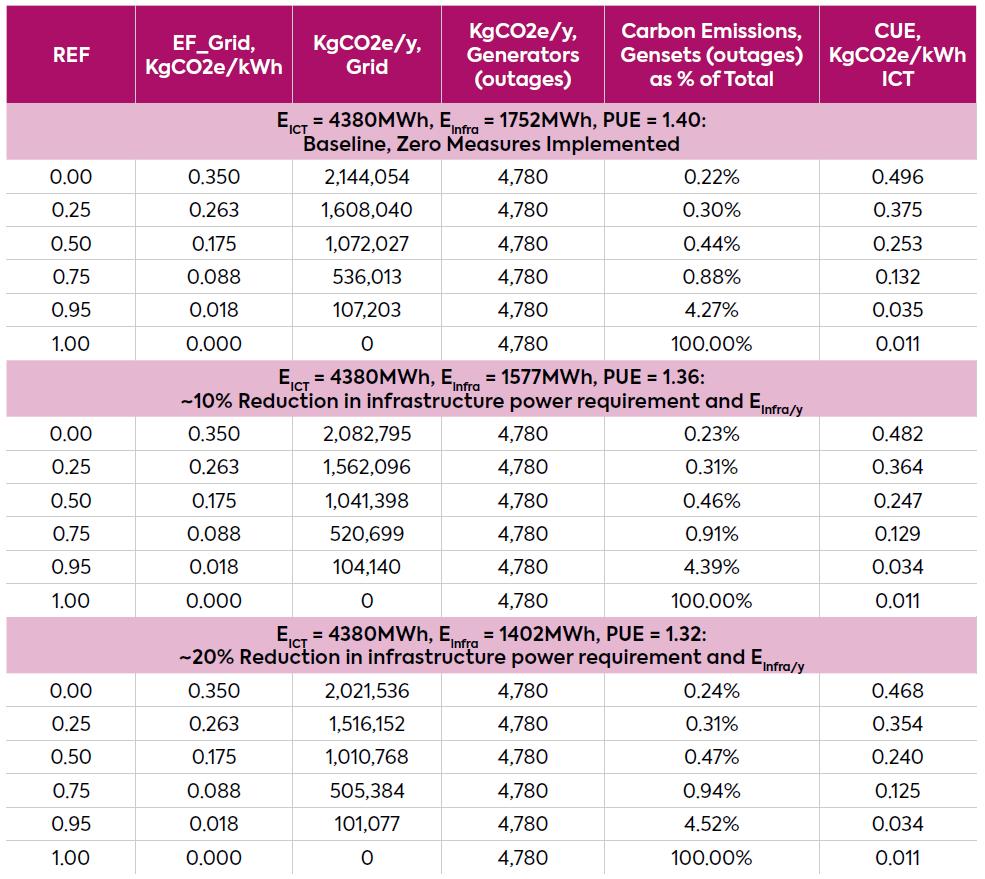
A simplified example linking metrics and absolute values considers a facility with a 500 kW ICT load and 200 kW of supporting infrastructure (700 kW total), resulting in 4,380 MWh/year (ICT), 1,752 MWh/ year (infrastructure), and a PUE of 1.4. The chart shows how infrastructure-efficiency improvements (10% and 20% reductions in infrastructure consumption) reduce CUE, in combination with different REF levels (0 to 1), assuming a grid emissions factor of 0.35 kgCO₂e/kWh when REF = 0.
ecutive stakeholders.
In a way, this approach is more “native” to the subsea cable sector: it combines facilities efficiency with operational performance and creates a value narrative that resonates with both technical and ex-
The key point, however, is measurement quality: metrics only gain credibility when they are grounded in proper metering and transparent reporting
1. In addition, optimizing measurement is also about design. For example, the industry’s shift toward Modular Cable Landing Stations (MCLS)— prefabricated offsite and assembled in remote locations—offers a unique opportunity to standardize energy instrumentation at the design phase. By ‘baking in’ sensor locations and PUE baselines during manufacturing, operators can mitigate the risks of construction in extreme environments while ensuring immediate, granular visibility into energy performance from day one (Marks and Collington, 2010).
methods.
Based on this, the report recommends structuring an agenda around two mutually reinforcing tracks: (1) adopting established frameworks (the EU Code of Conduct and/or EN 50600-5-1) and a minimum set of standardized metrics (PUE, CUE, WUE, REF), and (2) running these metrics within a continu-
A crucial point is to report metrics alongside absolute values (kWh, m³, emissions factors), because ratios alone can obscure real-world conditions (for example, seasonal changes, a smaller telecom load, or ICT gains that change the denominator).
The report also draws attention to common reporting gaps in the sector, such as emissions not disaggregated across Scopes 1, 2, and 3, and the role of generator diesel (testing and maintenance regimes) in climate impact, while also noting that CLS have specific characteristics (coastal environments, salinity/humidity, and high resilience requirements such as 2N/2N+1) that shape how “best practices” should be applied.
Source: Report On Best Practices In Cable Landing Station Sustainability. SubOptic Foundation, 2025.
The figure above illustrates the impact of REF and infrastructure energy-efficiency improvements on CUE, while also presenting CUE, PUE, and the associated annual energy consumption.
ous-improvement cycle (assess current practices, establish a baseline, action plan, measure impact, reassess) (European Commission, 2025).
Reliable metrics are the most pragmatic starting point for turning sustainability into operational practice. They provide visibility into where energy is being consumed, where losses occur, and which interventions deliver measurable gains without compromising resilience. Applied to a CLS, this requires clearly defining the boundary between the station and the beach manhole and instrumenting essential points (total site energy, telecom load, PFE consumption, and building utilities such as HVAC and, where applicable, water), making it possible to move beyond aggregate consumption and toward comparable, decision-useful indicators.
As discussed, the core challenge is operational: many stations have already started collecting data on consumption histories. Yet, they do not necessarily measure at the points needed to calculate and disaggregate metrics robustly, especially in “mixed-use” settings or when the CLS is hosted within a data center, where allocating shared power and cooling becomes more complex. Here, this may limit the ability to pinpoint waste, prioritize investments, and demonstrate impact.
The recommended set of actions for next steps, therefore, is to strengthen metering/monitoring, data management, and reporting as keystone activities; adopt recognized frameworks (such as the EU Code of Conduct and/or EN 50600-5-1, as we discussed in our previous column in SubTel Forum); and operate a minimum suite of metrics (PUE, CUE, WUE, and REF) with clear boundaries, combining ratios with absolute values (kWh, m³, emissions factors) and explicitly addressing emissions across Scopes 1, 2, and 3 as well as the role of generator diesel.
Rigorous metrics support the evolving economic role of the landing station. Governments and investors increasingly view these facilities as catalysts for local development, capable of attracting data-intensive secondary industries (see the references for a report commissioned by the Hawaii Broadband Office (2020) for further details on government involvement and economic linkages to the CLS).
Potential high-tech tenants or sectors dependent on CLS facilities often possess their own aggressive sustainability mandates/ A CLS that can transparently report its CUE and REF becomes a competitive asset, positioning the station not merely as a passive landing point but as a critical, sustainable hub in the digital economy.
This agenda rests on a simple principle: measuring metrics is a prerequisite for managing and advancing sustainability. Only by measuring energy use and the factors that influence it can operators identify improvement opportunities, prioritize actions, and justify investments
This article is an output from a SubOptic Foundation project, Sustainable Subsea Networks, funded by the Internet Society Foundation.
Avelar, V., Azevedo, D., & French, A. (Eds.). (2012). PUE™: A comprehensive examination of the met-
ric (White Paper No. 49, Version 6). The Green Grid Association. Available at: https://datacenters.lbl.gov/sites/default/files/WP49-PUE%20 A%20Comprehensive%20Examination%20 of%20the%20Metric_v6.pdf
Bojczuk, I., Herbert, E., Brand, M., Youssef, H., & Starosielski, N. (2024, May). What’s in an efficiency metric? The case of power usage effectiveness (PUE) at the cable landing station. Submarine Telecoms Forum Magazine, (136), 10–14.
Donovan, C. (2010). “A life cycle assessment of fibre optic submarine cable systems.” [Conference Proceedings]. SubOptic 2010 Conference & Convention, Yokohama, Japan.
European Commission. 2025.”‘European Code of Conduct for Energy Efficiency in Data Centres”, The Joint Research Centre: EU Science Hub. Available at: https://publications.jrc.ec.europa. eu/repository/handle/JRC141521
Gallagher, J. C., & Carter, N. T. (2023). “Protection of undersea telecommunication cables: Issues for Congress.” Congressional Research Service. Available at https://www.congress.gov/crs-product/R47648
Marks, A., & Collington, T. (2010). “Risk mitigation through industrialized construction: Integrating prefabricated, modular cable landing stations into build-out programs” [Conference Proceedings]. SubOptic 2010 Conference & Convention, Yokohama, Japan.
Regnicoli, G., Reschini, A., & Paz, R. (2023). “Setting a realistic plan for energy efficiency and sustainability in the cable landing station” [Conference Proceedings]. SubOptic 2023 Conference, Bangkok, Thailand.
SubOptic Foundation (2025) Report on best practices in cable landing station sustainability. London: SubOptic. Available at: https://www.suboptic. org/papers-presentations/report-on-best-practices-in-cable-landing-station-sustainability
Undersea Telecommunication Cables: Technology
ASK THE EXPERT
Question for the author(s)? Click here!
Overview and Issues for Congress. (2025). Available at: https://www.congress.gov/crs-product/ R47237
Iago Bojczuk is a Research Associate at the Berkeley Center for New Media (BCNM) within the College of Engineering at the University of California, Berkeley. His research interests lie in three core areas: digital infrastructures and sustainability, science and technology policy, and the governance of large-scale complex systems.


Camila Paulino is a Master’s student at NOVA University Lisbon. Her research focuses on health and development, particularly in the context of climate resilience and adaptation.
Nicole Starosielski is Professor of Film and Media at the University of California, Berkeley. Dr. Starosielski has published over forty essays and is author or editor of five books on media, communications technology, and the environment, including is author of The Undersea Network (2015). She is a principal investigator on the SubOptic Foundation’s Sustainable Subsea Networks research initiative.


by Kieran Clark
For much of the year, the global cable-ship fleet looked busy without always looking purposeful.
Vessels were constantly on the move—crossing basins, slowing, stopping, regrouping—yet much of that motion was hard to read. Ships were present in the right places, but what they were actually up to often wasn’t obvious.
November and December felt different.
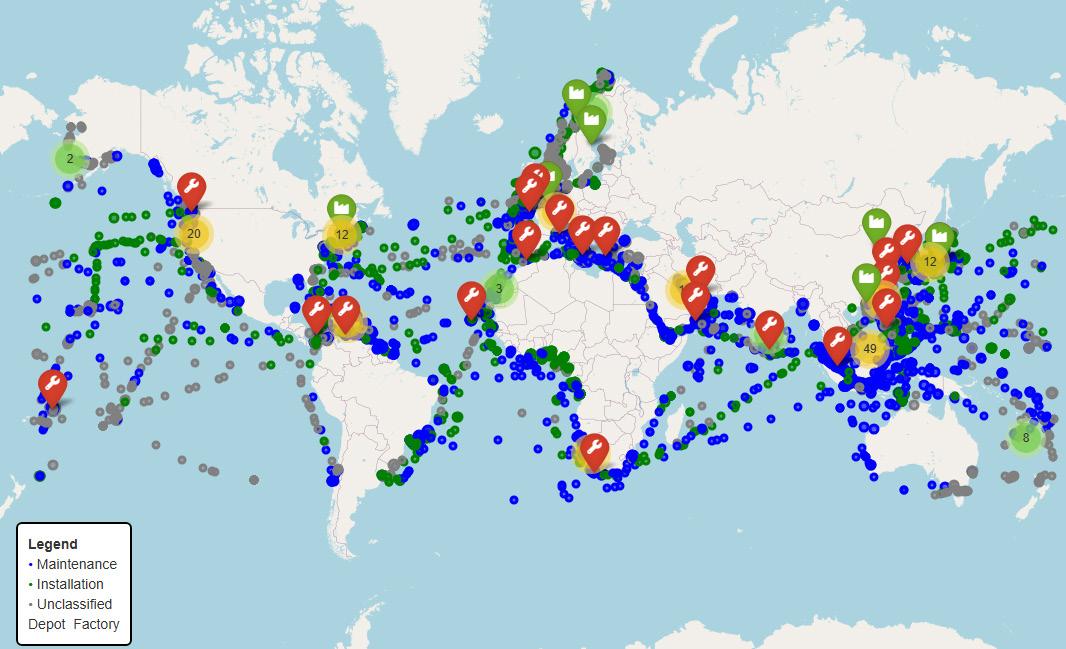
Looking at AIS patterns from the final two months of 2025, the fleet appeared to spend less time drifting between possibilities and more time clustering around familiar working grounds. Repair corridors lit up more consistently. Factory hubs fed longer, more coherent deployment tracks. And some of the wide, featureless idle zones that had dominated earlier months began to thin out.
That doesn’t mean uncertainty disappeared. AIS still only tells us where ships are, not why they’re there. But during this period, vessel behavior lined up more often with places where cable work normally happens, and less often with places where intent is anyone’s guess. Instead of a fleet largely in motion, November and December show something closer to a fleet settling into a rhythm—cycling through depots, returning to known routes, and staying put long enough in the right places to sug-
gest work rather than waiting.
At a global level, the November–December activity map immediately feels more structured than earlier snapshots. Idle points are still widespread, but they cluster more tightly around known cable routes, repair corridors, and infrastructure hubs.
Across the North Atlantic, maintenance-linked behavior traces familiar transoceanic paths, stretching from North America through the Bay of Biscay and into Northern Europe. These are heavily cabled waters, and the fleet’s presence reflects that maturity. Ships don’t simply pass through; they slow, linger, reposition, and return.
East and Southeast Asia remain the densest areas of activity, but the character of that density has changed. Instead of overlapping, indistinct clusters, clearer zones of maintenance and installation emerge. Factory hubs in Japan and Korea act as visible launch points, feeding strings of installation-linked behavior into surrounding seas.
Even in traditionally harder-to-read regions—parts of the South Pacific and Indian Ocean—the map looks less diffuse. Idle behavior still appears far from infrastructure, but it occupies less space and breaks into smaller pockets rather than dominating entire basins.
As in previous issues, this analysis is built on AIS-derived idle points—moments when vessels slowed or remained stationary long enough to indicate some- Figure 1: Vessel Activity Map (Nov–Dec 2025)
thing more than transit. Those idle points were then interpreted using proximity to known cable depots and factories, along with repeat-visit and movement patterns.
The aim isn’t to label individual ships with certainty. It’s to look at thousands of small decisions—where vessels pause, where they return, and where they move next—and ask what those patterns resemble when viewed in aggregate.
Across November and December, three broad shifts stood out:
• Maintenance-like behavior appeared more frequently and more continuously.
• Installation-like behavior became less episodic and more route-oriented.
• Unclassified idling, while still present, occupied less geographic and analytical space.
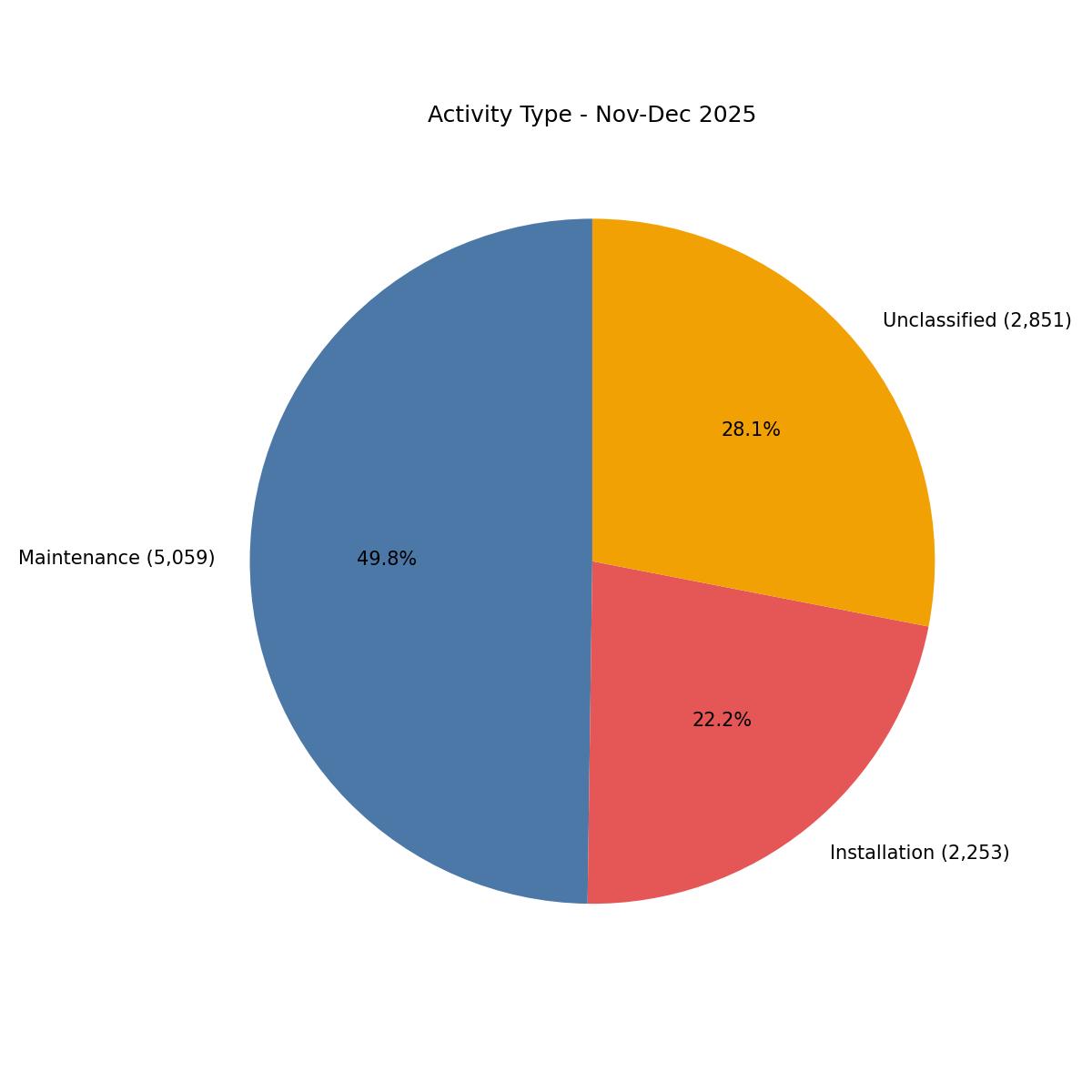
2: Projected Activity Type (Nov–Dec 2025)
The activity breakdown reinforces what the map suggests. Maintenance accounts for roughly half of all observed idle behavior during the period, making it the dominant signature across the global fleet. Installation follows at just over one-fifth, while unclassified activity drops below one-third.
This balance marks a clear departure from earlier in the year, when unclassified behavior often dominated. The fleet still spends time in ambiguous situations, but a larger share of its idling now aligns with recognizable operational contexts.
Maintenance behavior appears steady rather than spiky. Ships return repeatedly to depots, linger near high-risk routes, and reposition in ways that suggest readiness rather than response alone. Installation behavior, meanwhile, looks sustained rather than fleeting—more like deployment campaigns than isolated loading events.
Maintenance emerged as the most consistent rhythm in the November–December data.
In the North Atlantic, vessels traced established repair corridors with little deviation. Idle points cluster near depots, then stretch outward along routes before looping back again. This pattern suggests a fleet operating in cycles—preparing, deploying, and resetting—rather than reacting to isolated faults.
East and Southeast Asia show a similar cadence. Dense cable networks and heavy traffic mean that repair readiness is always close to the surface. Ships cycle through depots in Japan, Korea, and coastal China, then remain nearby rather than dispersing widely.
Even regions that typically show more sporadic maintenance—such as the Mediterranean and Persian Gulf—display steadier behavior. Ships still move broadly, but they tend to pause closer to known cable infrastructure than earlier in the year.
Installation activity also changed character during the period.
Earlier datasets often showed installation as shortlived bursts near factories. In November and December, those bursts stretched into lines. Installation-linked idle points followed vessels outward from factory hubs, forming visible deployment corridors rather than isolated clusters.
This was most pronounced in East Asia, where factory density supports sustained build activity. Ships appear to load, depart, pause along expected deployment paths, and continue onward—leaving behind a chain of installation-linked behavior that looks more like active laying than staging.
Installation signals also appear more frequently in the North East Atlantic and North Sea. While smaller in scale, these patterns suggest upgrades or regional expansions rather than entirely new systems.
One of the subtler signals in the November–December data isn’t where ships stopped, but how often they returned.
Across many regions, vessels didn’t just appear near depots or along cable routes once and move on. Instead, the same areas were visited repeatedly, sometimes by the same ships and sometimes by different ones, creating a rhythm of use rather than a single event. This pattern is easy to miss when looking at static maps, but it becomes more apparent when viewing idle behavior over time.
In maintenance-heavy regions such as the North Atlantic and Southeast Asia, this repetition is especially pronounced. Vessels cycle out from depots, pause along known routes, reposition, and then loop back again. The behavior suggests ongoing readiness rather than one-off response—ships staying close enough to intervene quickly rather than dispersing once a task is complete.
Installation-linked behavior shows a different kind of repetition. Instead of looping back, vessels tend
to progress forward in stages. Idle points appear spaced along a corridor, implying pauses for work before continuing on. The spacing between these pauses is more regular than in earlier datasets, reinforcing the impression of sustained deployment rather than opportunistic staging.
What’s notably less common in November and December is long, repeated idling in places with no obvious operational anchor. In earlier months, some vessels appeared to linger in open water or peripheral zones for extended periods, returning again and again without a clear pattern. Those behaviors haven’t vanished, but they occur less frequently and occupy less analytical space.
This shift matters because repetition adds context. A single idle point can mean almost anything. A pattern of returns—or a steady march forward—starts to suggest intent, even when intent can’t be directly observed. In this dataset, the fleet appears to make fewer aimless stops and more purposeful ones, whether that purpose is maintaining aging infrastructure or pushing a new system into place.
Looking at activity by region highlights how infrastructure and network maturity shape fleet behavior.
East Asia stands out as the most installation-forward region, with installation activity outpacing both maintenance and unclassified behavior. Southeast Asia and the China Coast lean heavily toward main-
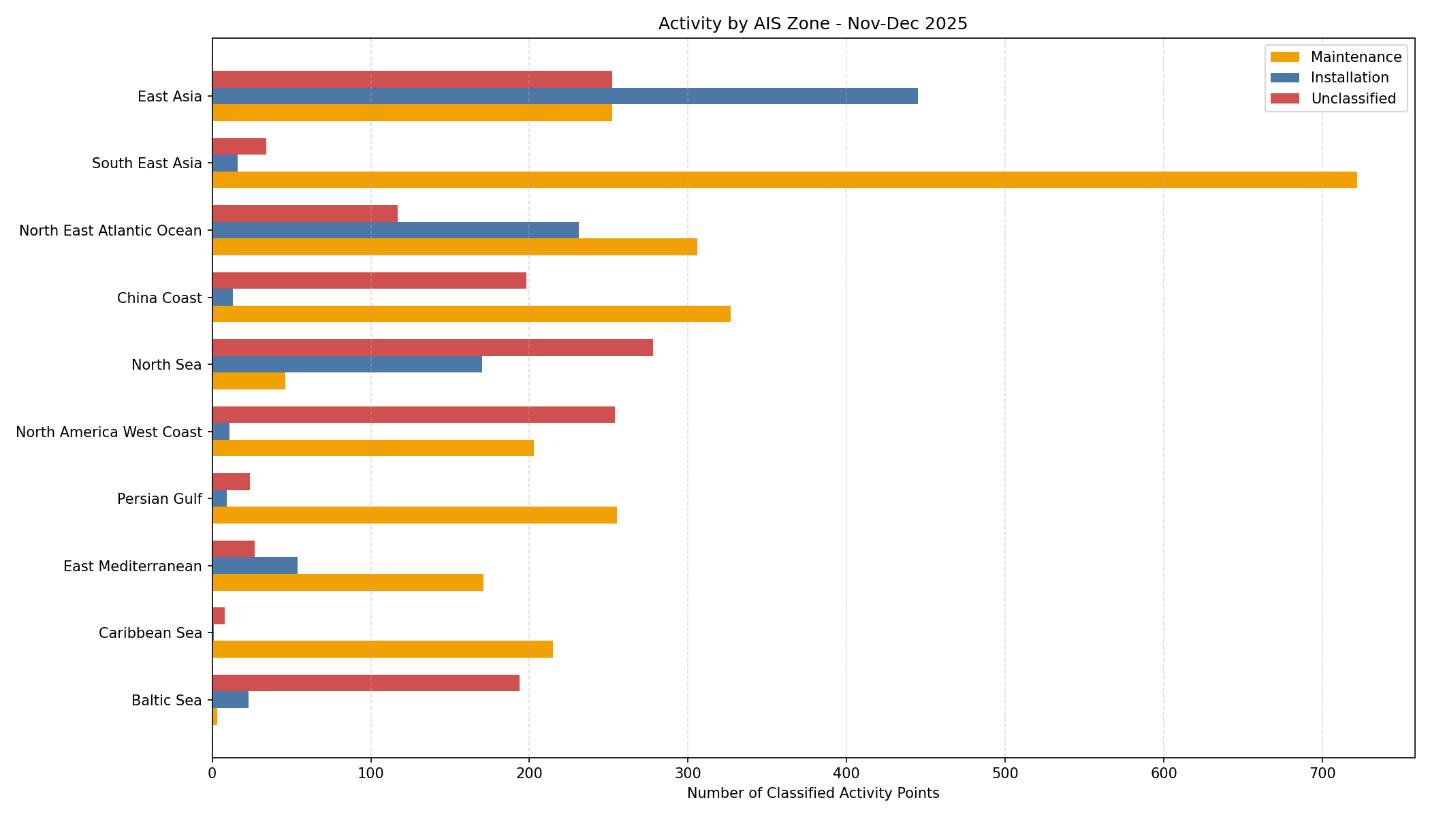
Figure 3: Activity by AIS Zone (Nov–Dec 2025)
THE EXPERT
Question for the author(s)? Click here!
tenance, reflecting dense regional networks and constant repair demand.
The North East Atlantic continues to function as the backbone of the global repair system, showing strong maintenance activity alongside a meaningful installation presence. The North Sea, despite its dense infrastructure, retains a higher share of unclassified behavior—likely a result of overlapping offshore industries that complicate AIS-based inference.
Elsewhere, activity levels vary. The Persian Gulf shows maintenance-heavy behavior consistent with regional operational needs, while the Baltic Sea remains difficult to interpret, with unclassified activity dominating.
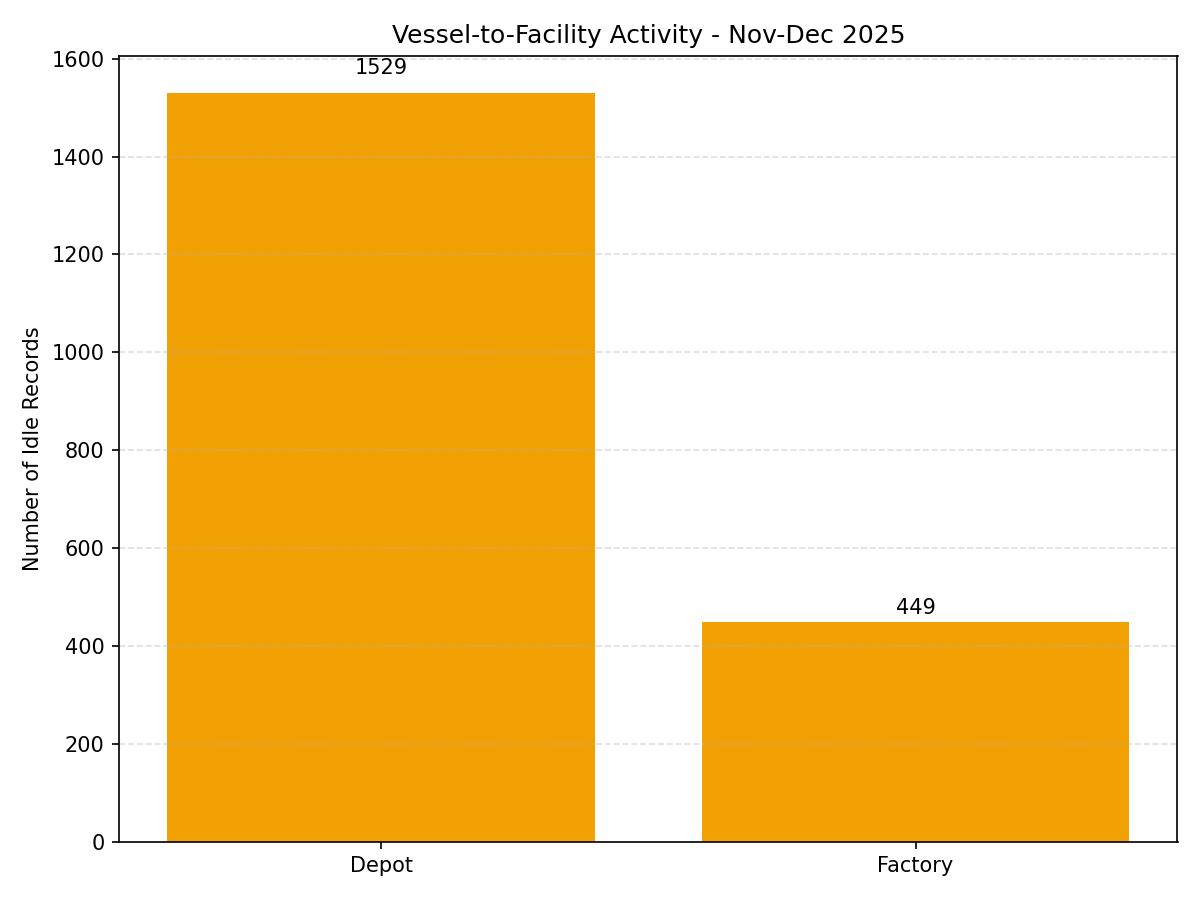
Infrastructure proximity continues to shape how the fleet operates. During November and December, vessels were more than three times as likely to idle near depots as near factories.
Depots act as operational anchors. Ships return repeatedly for resupply, crew changes, equipment preparation, and tasking. This produces a steady background of maintenance-linked behavior, especially in regions with dense depot coverage.
Factory-linked activity, while smaller in volume, appears more sustained than earlier in the year. Instead of brief loading spikes, factory proximity coincides with longer installation phases, reinforcing the idea of extended deployment campaigns.
Compared with earlier in 2025, the November–December dataset presents a fleet that appears more engaged and easier to contextualize. Maintenance and installation signals occupy more of the map, while unclassified behavior retreats.
This doesn’t mean the fleet has become transparent. Remote regions, sparse infrastructure, and
multi-purpose offshore operations will always limit inference. But when ships are busy, their work leaves patterns—and during these two months, those patterns were easier to follow.
Rather than a fleet waiting for direction, the late-year picture looks more like a fleet doing what it exists to do: maintaining the cables that already carry the world’s traffic, and quietly extending the network where capacity and demand require it.
Kieran Clark is Senior Analyst at Submarine Telecoms Forum, Inc. He joined in 2013 as a Broadcast Technician supporting live event streaming, bringing over eight years of production experience. Promoted to Analyst in 2014, he now leads research and maintenance for the SubTel Forum Submarine Cable Database and Online Map, with analysis featured across most SubTel Forum publications.


by John Maguire
While it’s not the perfect metaphor— there’s no single (or even multiple, a la the octopus’) beating heart—if the internet can be thought of as having a circulatory system, its blood vessels run along the seabed.
Submarine fiber-optic cables overwhelmingly carry most international data traffic—more than 99% of it1—quietly linking data centers, clouds, enterprises and consumers across continents. Governments now widely and openly describe submarine cables as critical infrastructure, in the same category as energy grids and oil or gas pipelines2 .
Over the next decade, the commercial outlook for these underwater highways is, to coin a phrase, interesting. It is simultaneously both buoyant and fraught, experiencing strong growth in demand and ambitious build-outs—but in an environment presenting rapidly evolving, growing geopolitical and operational risk.
ing to US$ 50.8 billion by 2032 (8.2% CAGR)4, while SNS Insider predicts systems revenue reaching roughly US$ 35.9 billion by 2032 from US$ 15.3 billion in 2023, close to 10% CAGR5 .
The phenomenon is not confined to telecom cables either. Subsea power cables, interconnectors and those typically used to connect offshore wind farms, islands and cross-border grids, add another growth engine. Fortune Business Insights, for example, sees that segment expanding from US$ 11.98 billion in 2025 to US$ 18.56 billion by 2032, a 6.45% CAGR6
Taken together, the commercial picture is clear: tens, if not hundreds of billions of dollars of capex are slated for wet-plant and associated infrastructure through at least the early 2030s.
“If the internet can be thought of as having a circulatory system, its blood vessels run along the seabed: submarine fiber-optic cables that quietly carry more than 99% of international data traffic and are now openly treated by governments as critical infrastructure.”
Depending on which analyst you decide to believe on a given day, the global submarine cable systems market is on track for high single- to low double-digit annual growth into the early 2030s. MarketsandMarkets, for example, projects submarine cable systems revenue rising from US$ 19.95 billion in 2025 to US$ 33.75 billion by 2030, representing a compound annual growth rate of 11.1%3
Other forecasters are even more bullish. PS Market Research estimates US$ 27.5 billion in 2024 grow-
1 https://blog.telegeography.com/2023-mythbusting-part-3
A generation ago, submarine cable consortia were dominated by incumbent telecom carriers, e.g., focussing on the Atlantic region in the interests of brevity, Verizon, BT, Deutsche Telekom, Orange, etc… Today, many of these erstwhile hegemons—Orange is a notable exception—rarely play at the transoceanic infrastructure layer at all. Others, e.g., Sparkle, Telxius have refocussed geographically. Hyperscale cloud platform and content providers, those who became important customers to that previous generation of infrastructure developers—Google, Meta, Microsoft, Amazon—represent the new hegemony.
TeleGeography data shows content providers’ international bandwidth demand has outpaced all other customer groups and now accounts for most of the
2 By way of a example: https://docs.fcc.gov/public/attachments/DOC-413057A1.pdf and www.enisa.europa.eu/sites/default/files/publications/Undersea%20cables%20-%20What%20is%20a%20stake%20report.pdf
3 https://www.marketsandmarkets.com/Market-Reports/submarine-cable-system-market-184625.html
4 https://www.psmarketresearch.com/market-analysis/submarine-cable-systems-market-report
5 https://www.snsinsider.com/reports/submarine-cable-systems-market-1833
6 https://www.fortunebusinessinsights.com/industry-reports/sub-sea-power-cables-market-100478
new capacity deployed on many long-haul routes7
An Australian Strategic Policy Institute (ASPI) study describes how these hyperscalers have “fundamentally transformed the global sub-cable landscape,” reshaping who funds cables, where they land, and how they are architected8
In some regions, their growth rates have been staggering. Earlier analyses of the Middle East, for instance, found hyperscalers’ share of international bandwidth rising at a 100% CAGR between 2016 and 2020, admittedly from a low base—but also into what are still relatively heavily regulated markets, as they raced to support cloud regions and content delivery9 .
What’s driving this shift?
• AI and cloud computing: Large AI models are bandwidth-hungry, as enormous volumes of traffic shuttle between GPU-rich data centers and end users.
• Streaming and gaming: Ultra-HD video and interactive content push continuous, high-volume flows over the global network, including subsea routes.
• Data-center clustering: Subsea cables increasingly land directly into or adjacent to major carrier-neutral data centers, turning them into global interconnection hubs10
The commercial knock-on of all this is that what feels like most long-haul submarine cable projects are now being initiated and majority-funded by a small handful of tech giants—they can be counted on one’s fingers while one has one hand in one’s pocket—who either take large capacity blocks on consortium cables or build private systems where they control the wet plant, landing stations and most of the fiber pairs. This concentration of buying power gives them leverage on routes, technical
specs, pricing and—and this is critically important in respect of more deeply entrenching the hegemony—schedule.
On the engineering side of the sector, the industry is in the midst of a quiet revolution:
• Space Division Multiplexing (SDM) designs favor higher fiber pair counts at slightly lower per-fiber spectral efficiency, but maximizing total capacity and improving resilience.
• Open-cable architectures let different vendors supply wet plant, repeaters and terminal equipment, reducing vendor lock-in and letting operators upgrade line cards more frequently in data centers.
• High-fiber-count cables are being designed with specific cloud regions in mind, effectively turning subsea systems into extensions of hyperscalers’ land-based private backbones.
Commercial models mirror these technical shifts. Classic multi-carrier consortia are giving way to:
• Hyperscaler-led builds, where a cloud provider sponsors a system and sells (or, perhaps more often, doesn’t sell) surplus capacity.
• Neutral infrastructure players that build cables and provide campus-based data center capacity on a wholesale basis to serve multiple OTTs, carriers and ISPs.
• Hybrid structures combining carriers, tech companies and, sometimes, states, especially on politically sensitive routes. A good example of state support is the European Union’s Connecting Europe Facility11
7 https://blog.telegeography.com/telegeography-content-providers-submarine-cable-holdings-list-new
8 https://aspi.s3.ap-southeast-2.amazonaws.com/wp-content/uploads/2024/10/28023544/Connecting-the-Indo-Pacific.pdf The quoted text can be found on page 6.
9 https://developingtelecoms.com/telecom-technology/telecom-cloud-virtualization/11695-hyperscalers-hit-100-cagr-in-international-bandwidth-across-me.html
10 https://www.teraco.co.za/blog/how-subsea-cables-power-the-data-centre-driven-digital-economy/
11 https://www.submarinenetworks.com/en/nv/news/cef-digital-programme-grants-150-million-financial-support-for-multiple-subsea-ca-
This restructuring tends to accelerate decision-making and financing, but it perhaps also ties the fate of this class of strategic infrastructure more tightly to the investment cycles and risk appetite of a few firms. It remains the case that the relatively long, slow payback of even the most successful submarine cable falls outside most private equity return horizons—a non-issue for a hyperscalers.
The same forces that make submarine cables so commercially attractive also make them strategically vulnerable. A small number of densely used corridors now carry a disproportionate share of global traffic.
Nowhere has this been more visible recently than in the Red Sea. On 6 September 2025, multiple major cables— including SEA-ME-WE-4 and IMEWE—were cut near Jeddah, Saudi Arabia, disrupting internet connectivity across parts of Asia and the Middle East and contributing to latency spikes on Microsoft’s Azure cloud platform12. This followed earlier incidents in 2024 and early 2025 that had already highlighted the vulnerability of the same corridor13
• Landing stations as weak points: often concentrated near coastal cities, they can be targeted with physical sabotage, power cuts or cyber-enabled attacks.
• Single routes and clusters: many regions still depend on a handful of cables following similar seabed paths; concentration magnifies the impact of one incident.
• Limited repair assets: there is a globally ageing and relatively small fleet of specialized repair vessels and crews.
A 2025 threat assessment by Recorded Future notes that complex, fragmented permitting regimes and territorial disputes can significantly delay repair operations, prolonging outages, especially in politically sensitive waters15 .
“Concentration magnifies risk: when multiple cables follow the same seabed paths and depend on limited repair assets, a single incident can cascade into regional or even global disruption.”
Further north, suspected sabotage of the Estlink 2 undersea power cable between Finland and Estonia in late 2024 prompted NATO to increase its presence in the Baltic Sea and triggered broader concerns about hybrid attacks on underwater energy and telecom infrastructure14
European and EU-agency reporting underscores several structural fragilities: ble-projects
Let us be very clear here that it’s widely acknowledged that most human damage to submarine cables is accidental or, at worst, negligent. Very little is malicious16 That said, your writer is always especially conscious when this fact is pointed out, of the maxim of financial markets: Past performance is not an indicator of future performance. As Joseph Heller wisely counselled us “Just because you’re paranoid doesn’t mean they aren’t after you.”17
Industry groups are sounding the alarm. The European Subsea Cables Association (ESCA) and the International Marine Contractors Association (IMCA) warn that regulatory barriers, skilled-worker shortages and under-invested repair fleets are compromising Europe’s ability to restore damaged cables quickly18. Their joint statements call for streamlined
12 https://www.reuters.com/world/middle-east/red-sea-cable-cuts-disrupt-internet-across-asia-middle-east-2025-09-07
13 https://www.iptp.net/blog/how-did-we-survive-the-red-sea-fiber-optic-cable-disaster/
14 https://www.theguardian.com/world/2024/dec/27/estonia-begins-naval-patrols-to-protect-cable-after-suspected-sabotage-finland
15 https://www.recordedfuture.com/research/submarine-cables-face-increasing-threats
16 https://www.escaeu.org/faqs/subsea-cable-security/
17 Joseph Heller, Catch-22.
18 https://www.brookesbell.com/news-and-knowledge/article/eu-associations-warn-regulatory-hurdles-threaten-subsea-cable-repair-159583/

permits, recapitalisation of repair ships, and strategic stocks of spare cable and equipment to avoid “repair gaps” that could cascade into systemic failures.
From a purely commercial point of view, each of these problems has a balance-sheet dimension: longer outages mean higher SLA penalties, reputational damage, and potentially political backlash for operators and their biggest customers.
As cable cuts and, however tenuously suspected, sabotage incidents stack up, governments are, as we’ve seen, moving from treating subsea networks as background infrastructure to front-line national security assets.
Recent regulatory and policy trends include:
• National resilience strategies: Several European governments and EU bodies are examining minimum-redundancy requirements, resilience assessments, and closer public-private coordination on subsea infrastructure19 .
• Tighter foreign-investment scrutiny: Ownership and control of landing stations and key segments are increasingly subject to security reviews, especially where non-allied state actors or state-linked firms are involved2.
• Security-by-design expectations: ENISA and other bodies, as we have shown, emphasize route diversity, monitoring, and physical hardening of landing facilities to reduce single points of failure.
For cable owners and investors, that translates into additional capex and opex:
• More diverse routing (even if it’s longer and more expensive to build).
• Investing in monitoring systems, anomaly detection (e.g., acoustic fiber sensing) and security operations around landing zones.
• Participating in multi-stakeholder repair alliances and joint maintenance agreements.
The upside—and this is borne out by direct personal experience—is that resilience is fast becoming a premium product feature. Enterprises and hyperscalers are increasingly willing to pay for diverse paths, higher SLAs and (along, in most cases, along with some governments) clear visibility into how quickly an operator can detect and either prevent or repair a fault. That opens new revenue opportunities for carriers, neutral infrastructure companies, companies that specialise in detection and specialized insurance and risk-analytics providers.
Despite the risks, the commercial outlook for the sector remains decisively positive, if somewhat more nuanced than a generation ago. Over the next decade, key opportunity zones include:
High-growth corridors
Indo-Pacific routes connecting Southeast Asia, India, the Middle East and Europe continue to see heavy investment, driven by cloud regions and data center ecosystems.
Latin America and Africa remain under-connected relative to demand, making them attractive for new systems and upgrades.
19 https://blog.telegeography.com/regulatory-geopolitical-environment-cable-faults-maintenance-repairs https://www.subseacables.net/ reports-and-coverage/under-pressure-restoring-digital-hydrostatic-lifelines
Question for the author(s)? Click here!
• Integrated data center ecosystems. Subsea cables are no longer just country-to-country links; they increasingly connect specific data centers or data center concentration areas to one another.
• Security and monitoring services. Providers of route analytics, cable-threat intelligence, AISbased ship-tracking around cable corridors, and real-time performance monitoring are positioned to benefit as cable owners look to reduce mean time to detect and respond to threats and events.
• Repair, maintenance and specialist fleets. With ESCA, IMCA and others calling for recapitalisation of repair capacity, there is room for ship-owners, marine engineering firms and offshore-services providers to carve out profitable niches, especially if policy moves to support quasi-“strategic reserve” models for repair assets.
• Insurance and financial risk solutions. As outages like the Red Sea cable cuts demonstrate the systemic risk of subsea chokepoints, insurers and financial markets are being forced to rethink how they price digital-infrastructure risk, creating demand for more granular products and analytics.
The next chapter of the submarine-cable story won’t be written solely in terabits per second or route maps. It will hinge on whether the industry, and the governments that rely on it, can scale capacity while also scaling resilience.
Commercially, the signals are strong: robust growth forecasts, hyperscalers with enormous investment plans, and a digital economy that has no functional substitute for high-capacity subsea fiber. Strategically, however, recent outages and suspected sabotage episodes have turned the spotlight on to a more uncomfortable reality: these underwater highways are simultaneously indispensable and vulnerable.
For investors, operators and policymakers, the decisive question is no longer whether to build more cables, but how to build, protect and repair them fast enough to keep the world’s data flowing when, as it inevitably shall, something on the seabed goes wrong.

John Maguire is Director, EMEA at APTelecom with 30 years of telecommunications experience across global markets. He has sold security and network control software, built regional federation fibre networks, and established interconnect and wholesale structures in emerging markets. His career spans OEM and service providers, fixed and mobile domains, and roles in general management, sales, operations, and business development. He is Dublin-based and has worked worldwide.
As the global submarine cable sector continues to evolve at an unprecedented pace, few events serve as a clearer signal of what’s ahead than Submarine Networks EMEA.
Organized by Total Telecom, Submarine Networks EMEA brings together top decision-makers, innovators, and infrastructure builders shaping the future of global connectivity. With Submarine Networks EMEA 2026 on the horizon, we sat down with Kerry Merritt, Head of Content at Total Telecom, to discuss this year’s focus, industry trends, and what lies ahead for the event—and the ecosystem it supports.
1. CAN YOU INTRODUCE SUBMARINE NETWORKS EMEA 2026 AND EXPLAIN THE CORE MISSION BEHIND THE EVENT?
One of the first things we realised when we started working with this sector is that it’s more than just an industry, it’s a global community. While the existence of subsea infrastructure has often flown under the radar for the public, it is of fundamental importance and forms the backbone of the global digital economy. But it’s the people behind these networks who make the industry truly special. That’s why we’ve built Submarine Networks EMEA to be more than just a conference; it’s the annual meeting place in EMEA for the subsea community. Keeping pace with the industry’s shifting priorities is our focus and we’ve got some exciting additions for 2026 to help us do just that. Also, by working closely with the diverse group of experts who make up our Advisory Board, we continue to curate a programme which keeps up to date with what’s happening in the market and enables us to bring together the global subsea ecosystem.
2. TELL US MORE ABOUT THE LAUNCH OF THE CO-LOCATED SUBSEA SECURITY SUMMIT & EXPO ALONGSIDE SUBMARINE NETWORKS EMEA 2026?
One of the new additions for 2026 is the Subsea Security Summit & Expo; a timely forum aimed at
bringing together stakeholders from industry, government, military, defence, and finance to discuss the evolving threats posed to subsea cables and to explore strategies for protecting these critical assets. The Subsea Security Summit will be co-located with Submarine Networks EMEA meaning that one ticket grants you full access to both events.
Key themes will include understanding the risks to subsea infrastructure (from malicious activity to accidental damage), technology innovations in the protection and monitoring of cables, cybersecurity, physical protection of submarine and related infrastructure, the role of the military, legal and diplomatic tools, AI and network security, the evolving geopolitical context, and issues around national security.
3. HOW DOES SUBMARINE NETWORKS EMEA 2026 DIRECTLY ENGAGE WITH AND IMPACT THE GLOBAL SUBMARINE CABLE MARKET?
This year, we’re expecting up to 1,500 attendees, with the events acting as a central hub for the industry with a range of attendees including cable owners, hyperscalers, manufacturers, governments, and investors joining. Additionally, with the launch of the Subsea Security Summit, we are directly addressing the market’s priority of improving the resilience and protection of submarine cables.
Beyond providing a forum to learn about the latest technical and commercial developments, the events offer unmatched networking opportunities. Submarine Networks EMEA has become a must-attend event in the industry’s calendar because it is a place where real business gets done.
4. WHAT KEY INNOVATIONS IN SUBMARINE CABLE SYSTEMS OR EMERGING APPLICATIONS WILL TAKE THE SPOTLIGHT THIS YEAR?
Perhaps unsurprisingly, AI and its effect on the subsea sector will be taking centre stage in 2026; from how it’s impacting capacity demands and route planning, to how AI is being leveraged to enhance network monitoring and security. As always, we’ll also be covering numerous technology themes;
innovations in subsea network architectures, strategies for meeting increasing capacity demands, technical strategies for extending cable lifespans, and CLS design. Thanks to the addition of the Subsea Security Summit, we’ll also be able to take a deeper look at the swathe of technologies which are being deployed to protect, monitor and secure subsea infrastructure, including seabed sensors, fibre sensing, satellite and surface monitoring technologies, and capabilities for tracking vessels such as AIS and VMS.
We’re excited to announce the development of a dedicated educational programme for 2026 and to introduce the Subsea Foundations sessions. With the expansion of the event portfolio to include the Subsea Security Summit, we are expecting to see lots of new faces joining us in 2026, some of whom may be new to the industry. That’s why we’re including a series of introductory content sessions which will give an overview of essential themes such as legal and commercial, engineering, maintenance and repair, permitting, and regulation. The programme will also a feature a dedicated networking schedule including the popular session for early careers professionals, giving them a valuable space to engage with senior executives.
As Head of Content, Kerry oversees the strategic direction of Total Telecom’s portfolio, which includes events in the UK, US, and Europe. In 2018, she and the team successfully launched Submarine Networks EMEA which has now become the region’s largest annual subsea event. Since then, she has remained focused on developing the event by curating high-quality, industry-leading content that reflects the changing needs of the subsea community.
6. HOW IS SUBMARINE NETWORKS EMEA CHAMPIONING DIVERSITY, INCLUSION, AND EDUCATION WITHIN THE SUBSEA AND TELECOM INDUSTRIES?
Education and access to knowledge are fundamental building blocks of a more diverse subsea industry. To help foster a more inclusive industry, we’ll be continuing with our offer of free tickets for students, recent graduates and apprentices, making the event more accessible to those who are starting out in their careers in this field. Plus, we’re working to launch a dedicated two-day programme for early careers professionals at this year’s event (this will be in addition to the Subsea Foundations sessions, which will be an important element of this programme).
Submarine Networks EMEA is organised by Total Telecom, part of the global events business, Terrapinn. Within the events industry, Terrapinn is recognised as a sustainability leader thanks to the extensive efforts made by teams throughout the company to undertake operational initiatives to reduce environmental impacts as well as to contribute positively to their local communities. All Terrapinn events have a sustainability plan which they’re marked against and include targets around prioritising green suppliers, booking green hotels and travel for staff, collecting data on energy consumption for each event, reducing waste, and booking sustainable venues (the Business Design Centre where Submarine Networks EMEA is held has achieved carbon-neutral status).
Set to be Europe’s leading AI infrastructure event, Hyperscale Live will be truly unique as it will bring together stakeholders from across the hyperscale ecosystem: connectivity, data centres, energy, finance, and real estate.
There’s so much fantastic work being done already in the industry to attract, train and support the people who will make up the future industry workforce, and we’re delighted to be working with key organisations to support and amplify their initiatives such as the SubOptic Association, ESCA and their NextGen Working Group. Plus, new for 2026, we’re proud to announce that we’ll be working with the SubOptic Foundation as our official “Charity Partner” and supporting them with their vital work around education and sustainability.
Finally, we are committed to ensuring our agenda reflects the global nature of the subsea market and is carefully curated to include a diverse range of voices from around the world.
7. WITH SUSTAINABILITY TOP OF MIND, HOW IS SUBMARINE NETWORKS EMEA CONTRIBUTING TO THE INDUSTRY’S TRANSITION TO MORE CIRCULAR, LOW-IMPACT PRACTICES?
For this particular event, sustainability is one of our primary content themes and we’ve got a fantastic panel on the subject with speakers already confirmed from Ocean Risk Alliance and Start Campus.
8. LOOKING AHEAD, WHAT’S NEXT FOR TOTAL TELECOM IN SHAPING THE FUTURE OF DIGITAL INFRASTRUCTURE EVENTS?
2026 will see Total Telecom launch a very exciting new event called Hyperscale Live 2026. Set to be Europe’s leading AI infrastructure event, Hyperscale Live will be truly unique as it will bring together stakeholders from across the hyperscale ecosystem: connectivity, data centres, energy, finance, and real estate. We’re delighted to launch this timely forum in Lisbon, at the brilliant venue where SubOptic 2025 was held.
Beyond Hyperscale Live, we’ve got a busy year ahead. After a record-breaking edition in 2025, Connected Britain 2026, the UK’s largest digital infrastructure event, is set to be even bigger and the programme will be expanding to cover new themes such as data centres, AI, public sector transformation, skills and training. Our portfolio of events in the US is also going strong with Connected America 2026 taking place in Dallas in April and Broadband Communities Summit in Houston in August.
Tuesday 26th May 2026: Pre-Event Afternoon
2pm – 5pm
Pre-event workshop hosted by Title Partner, Ciena
5pm – 7pm
Drinks reception hosted by Ciena (for workshop attendees only)
08:00 Registration opens Plenary
08:55 Chair’s opening address
09:00 KEYNOTE PANEL
AI & Subsea: How is AI shaping the industry’s future?
27th & 28th May 2026
Business Design Centre, London
Wednesday 27th May 2026: Day 1
Davin Rice, Chief Business Development & Strategy Officer, Zayo
Thomas R. Hardy, Deputy Director & Chief Operating Officer (Performing the Duties of the Director), US Trade and Development Agency
Moderator: Gavin Tully, Managing Partner, Pioneer Consulting
09:40 Title Partner Keynote Address: Ciena
Speaker from Ciena
10:00 Keynote address from European Subsea Cables Association (ESCA)
Steve Holden, Chairman, European Subsea Cables Association (ESCA)
10:15
Networking break 10:45
News in brief
10-minute cable project and connectivity hub updates from the EMEA and surrounding regions.
EllaLink: Philippe Dumont, CEO, EllaLink
Medusa: Damien Bertrand, COO, Medusa Submarine Cable System
Arctic Way: Pia Bruhn, Project Manager Cable Systems, Space Norway
Magna Grecia: Diego Teot, Head of OTT, Media & Telco, Retelit
IOEMA: Eckhard Bruckschen, CTO, IOEMA Fibre
Atlantic CAM & Azores Submarine Cable Ring: Alberto Passos, Business Head, IP Telecom
Netherlands: Martin Prins, Ambassador, Dutch Subsea Cable Coalition
Update from IslaLink: Esther Garcés, CEO, IslaLink
Update from HaDEA: Speaker from Health and Digital European Agency (HaDEA)
Update from Digital Realty: Speaker from Digital Realty
12:25
Middle East: Strategies for strengthening the region’s digital infrastructure
Giuseppe Valentino, VP Product Management, Backbone & Infrastructure
Solutions, Sparkle
Moderator: Sabah AlKubaisy, Associate Partner, Salience Consulting
What’s next for subsea network architectures and design?
Colin Wallace, General Manager of Cloud Network Engineering, Azure Fiber, Microsoft
Moderator: Andy Bax, Senior Partner – Digital Infrastructure, Cambridge Management Consulting
Subsea Foundations
Brief introductory sessions for industry newcomers.
• Subsea 101: An intro to the industry
Speaker from SubOptic Association
• Legal & commercial Denise Wood, Partner & Shareholder, Greenberg Traurig LLP
• Engineering & technical
Elaine Reed, Senior Manager – Submarine Engineering, Vodafone
• Maintenance and repair
Alasdair Wilkie, Chairman, Atlantic Cable Maintenance & Repair Agreement (ACMA)
• Regulatory
Plug, play, or piece it together? Submarine cable supply contract models
Lynsey Thomas, Independent Consultant
Tansy McCluskie, Network Investments – EMEA, Meta Dave LaPommeray, Senior Legal Counsel, IT International Telecom
Richard Harrison, Deputy General Counsel, ASN
Moderator: Denise Wood, Partner & Shareholder, Greenberg Traurig LLP
Navigating stormy seas: What are the risks to subsea infrastructure and what are the consequences?
Ranulf Scarbrough, Submarine Cable Modernisation Lead, Cayman Islands Government
Navjot Sandhu, Director Physical Security, Telenor
Svante Jurnell, Co-Founder, Optic Tunnels
Moderator: Pat Kidney, Partner, Analysys Mason
PANEL
Choosing the right technologies to secure, protect and monitor subsea infrastructure?
Derek Cassidy, Chair, Irish Communication Research Group
Simon Webster, Chair, Cable Sensing Working Group, International Cable Protection Committee (ICPC) Anders Tysdal, CTO Infrastructure, Tampnet
Stuart Bausor, Strategic Business Developer – Fiber Sensing, VIAVI Solutions
14:30 PANEL
Europe: The evolution of policy and regulation
Magda Cocco, Partner Head of ICT and Digital Frontiers, VdA – Vieira de Almeida
Moderator: Laurent Campagne, Senior Consultant, AQEST
PANEL
Fibre sensing: How is the technology evolving?
Steinar Bjørnstad, Strategic Competence and Research Manager, Tampnet
Daniel Danskin, Commercial Manager – DAS, ASN
15:10 Gold Sponsor presentation Gold Sponsor presentation Reserved for Ciena
PANEL
People & skills: Investing in the industry’s future
Elaine Reed, Senior Manager – Submarine Engineering, Vodafone
Elizabeth Rivera Hartling, Manager, Subsea Engineering, Meta
Moderator: Naaz Bax, Founder, Team Bax
Presentation from HWG Law
PANEL
Strategies for establishing successful frameworks for intelligence sharing
Arturo Ojeda Demaria, UXS Specialist, Intelligence Surveillance & Reconnaissance, United Nations Global Service Centre
PANEL
Cybersecurity: Identifying and managing threats to subsea infrastructure
Mathew Chigwende, Group Head of Network Engineering, Liquid Intelligent Technologies
Ferris Adi, Chief Information Security Officer, Trans America Fiber System
Kent Bressie, Partner, HWG LLP Gold Sponsor presentation Building cyber resilience in subsea infrastructure:
Practical lessons from Trans Americas Fibre System
Ferris Adi, Chief Information Security Officer, Trans America Fiber System
15:30 PANEL
Africa: Keeping up with demand in a rapidly developing market
Nico Walters, Chief Innovation Officer, CMC Networks
Louis Carver, CCO, Medusa Submarine Cable System
Speaker from Angola Cables
Moderator: Bertrand Clesca, Partner, Pioneer Consulting
PANEL
Repair and re-deploy: evaluating the pros and cons of extending the lifespan of subsea cables
Mattias Fridström, VP, Chief Evangelist & Head of CEO Office, Arelion Jens Olav Frorud, CTO, Space Norway
PANEL
If the industry continues to grow, can the supply side keep up with demand?
Leigh Frame, COO, Xtera
16:10
16:30 Networking
CLOSING PLENARY
16:50 Diamond Sponsor presentation
17:05 Keynote Address from International Cable Protection Committee (ICPC)
Speaker from International Cable Protection Committee (ICPC)
17:20 KEYNOTE PANEL
What will it take to resolve the global maintenance debate?
Alasdair Wilkie, Chairman, Atlantic Cable Maintenance & Repair Agreement (ACMA)
Moderator: Franck Chevalier, Head of Technology Consulting, Analysys Mason
18:00 Networking drinks reception
19:30 End of Day 1
08:30 Registration opens Plenary
08:55 Chair’s opening address
Matt Bowden, Director & GM, Red Penguin Marine
09:00 KEYNOTE PANEL
Geopolitics and the submarine cable industry
Anna Butchart, Independent
Zvika Caspy, EVP Europe, Sparkle
Thursday 28th May: Day 2
PANEL
From defence to deterrence: The role of the military in ensuring subsea resilience
Captain Juha Ravanti, Finnish Defence Attaché to the UK, Embassy of Finland
Rebecca Nottingham, Director, R N Subsea
Consulting
Moderator: Henri van Soest, Senior Analyst, RAND
PANEL
Leveraging AI to optimise network security
Moderator: Camino Kavanagh, Visiting Senior Fellow, Dept. of War Studies, King’s College London
09:40 Address from SubOptic Association
Paul Gabla, President, SubOptic Association
09:50 Address from SubOptic Foundation
Speaker from SubOptic Foundation
10:00 Keynote address: Geopolitics, fears and undersea installations
Elisabeth Braw, Senior Fellow, Atlantic Council
10:20 Networking break
10:50
10:50
News in brief
10-minute cable project and connectivity hub updates from the EMEA and surrounding regions.
Trans-Caspian: Ana Nakashidze, CEO, AzerTelecom
PACS: Steen Hansen, Head of PLAN, Tusass
Update from Telxius: Speaker from Telxius Reserved (RS)
Connecting East to West: Fánan Henriques, Product & International Business Director, Vodafone
EAGLE: Albert Kis, Group Chief Wholesale and Infrastructure Officer, 4iG Group
Update from MEO: Jorge Andrade Santos, Head of International Wholesale, MEO
12:15 Networking break
13:10 PANEL
The evolution of subsea ownership models
Speaker from Telxius
Diego Teot, Head of OTT, Media & Telco, Retelit
Christos Holevas, Network Development, Meta
Moderator: Chris George, Principal, SELF Infrastructure
13:50 PANEL
Finance & investment
Mike Cunningham, CEO, Crosslake Fibre
Jaime Rodriguez-Ramos, Operating Director, I Squared Capital
Stuart Blythe, Legal Advisor, SubOptic Association & Partner, Baker Botts
Moderator: Andrew Lipman, Partner, Morgan, Lewis & Bockius
14:30 PANEL
15:10 Close of conference
15:30 Exhibition closes
PANEL
Marine spatial planning: Collaboration between marine sectors
Stephen Hall, Head of Partnerships, Nippon Foundation-GEBCO Seabed 2030
Moderator: Jennifer Godwin, CEO, Seabed User & Developer Group
PANEL
Sustainability
Karen Sack, President & Executive Director, Ocean Risk Alliance
Jayne Stowell, Trustee, SubOptic Foundation, Non-Executive Director, Start Campus
PANEL
Building the Arctic network: A technical and commercial perspective
Steen Hansen, Head of PLAN, Tusass
PANEL
Safeguarding subsea infrastructure: The evolving legal and policy landscape PANEL
Strategies for enhancing the physical security of network infrastructure
PANEL
Collaboration across borders: How does the global industry protect submarine cables?
PANEL
Ensuring route diversity is more important than ever: What are the key considerations?
Tony O’Sullivan, CEO, RETN
Bram Peeters, Chief Network Services Officer, GÉANT
Speaker from Angola Cables
John Tibbles, Executive Director Operations, SubOptic Foundation

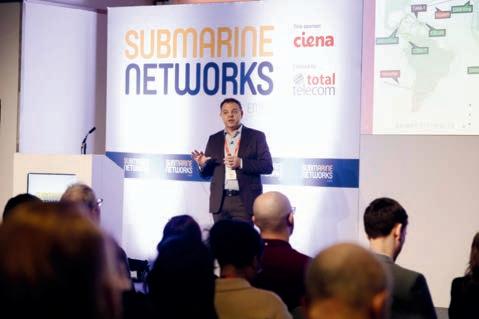

Submarine Networks EMEA is the region's largest subsea event, bringing together 1,500 senior leaders from the global subsea market for two jampacked days of learning, collaboration and networking.
In addition to offering plenty of networking opportunities, attendees will be able to enjoy thought-leading panels, technical presentations, workshops and cable project and connectivity hub updates.
Taking place on 27-28 May, expect to see more attendees, more speakers and more exhibitors than ever before. With 1500+ industry leaders in attendance, Submarine Networks EMEA 2026 is expected to be the biggest edition of the event to date.
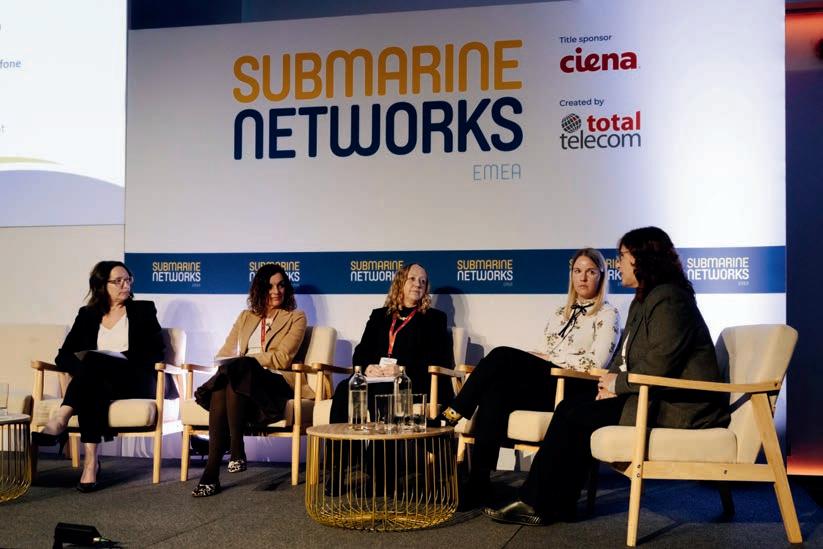
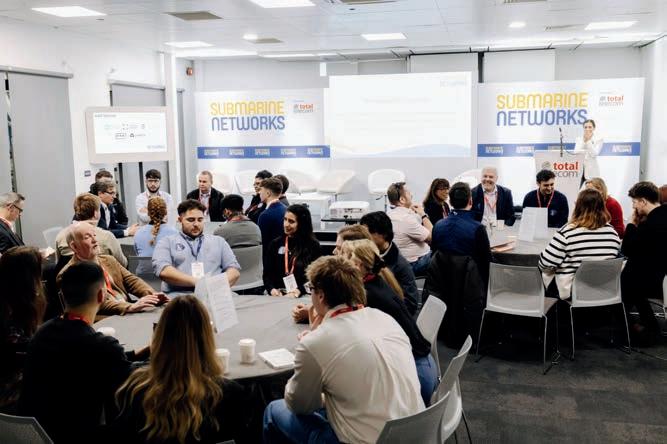
Responding to growing industry demand, this year’s event is co-located with the new Subsea Security Summit & Expo, exploring the critical issue of protecting global subsea infrastructure. With one ticket, attendees gain access to both shows and content streams.
For all newcomers to the subsea industry, we have also developed our existing learning programme to create Subsea Foundations. Participants will be able to join exclusive networking sessions and workshops, all designed to get to grips with the complex and exciting subsea market.
Don’t miss out! Join us at the Business Design Centre in London on 27–28 May to be part of the EMEA’s most important subsea event.
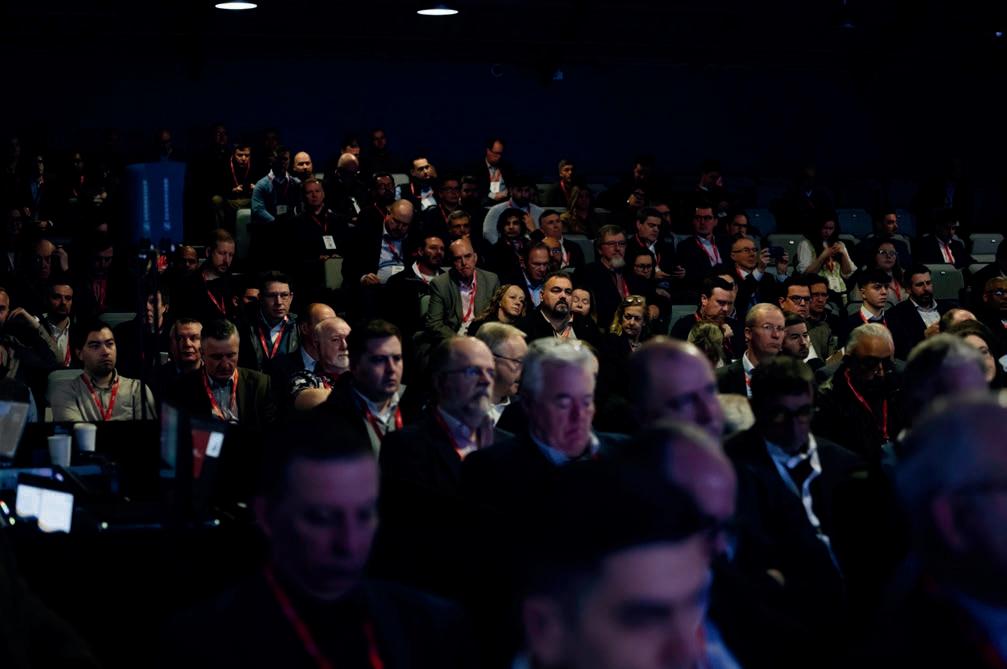
“One of the few events dedicated to subsea cables. Great attendance, quality of presentations and speakers.”

“I have left getting onto 4 tender lists. This wouldn’t have happened if I didn’t travel to the show.”
“The content was extensive, valid and enlightening.”

Early bird, group discounts, student and *subsidised tickets are available at www.totaltele.com/subnets
Apply to sponsor Halle.Dockerill@totaltele.com
Apply to speak Kerry.Merritt@totaltele.com
We’ve developed a new programme to help industry newcomers get to grips with the subsea market. Join us for exclusive networking sessions, introductory workshops with industry leaders and more.

26th May | 2pm - 5pm | Business Design Centre, London

Title Partner, Ciena, will be hosting a pre-event masterclass. All attendees are invited to attend and RSVP is required. You must be registered to Submarine Networks EMEA or Subsea Security Summit & Expo to attend.
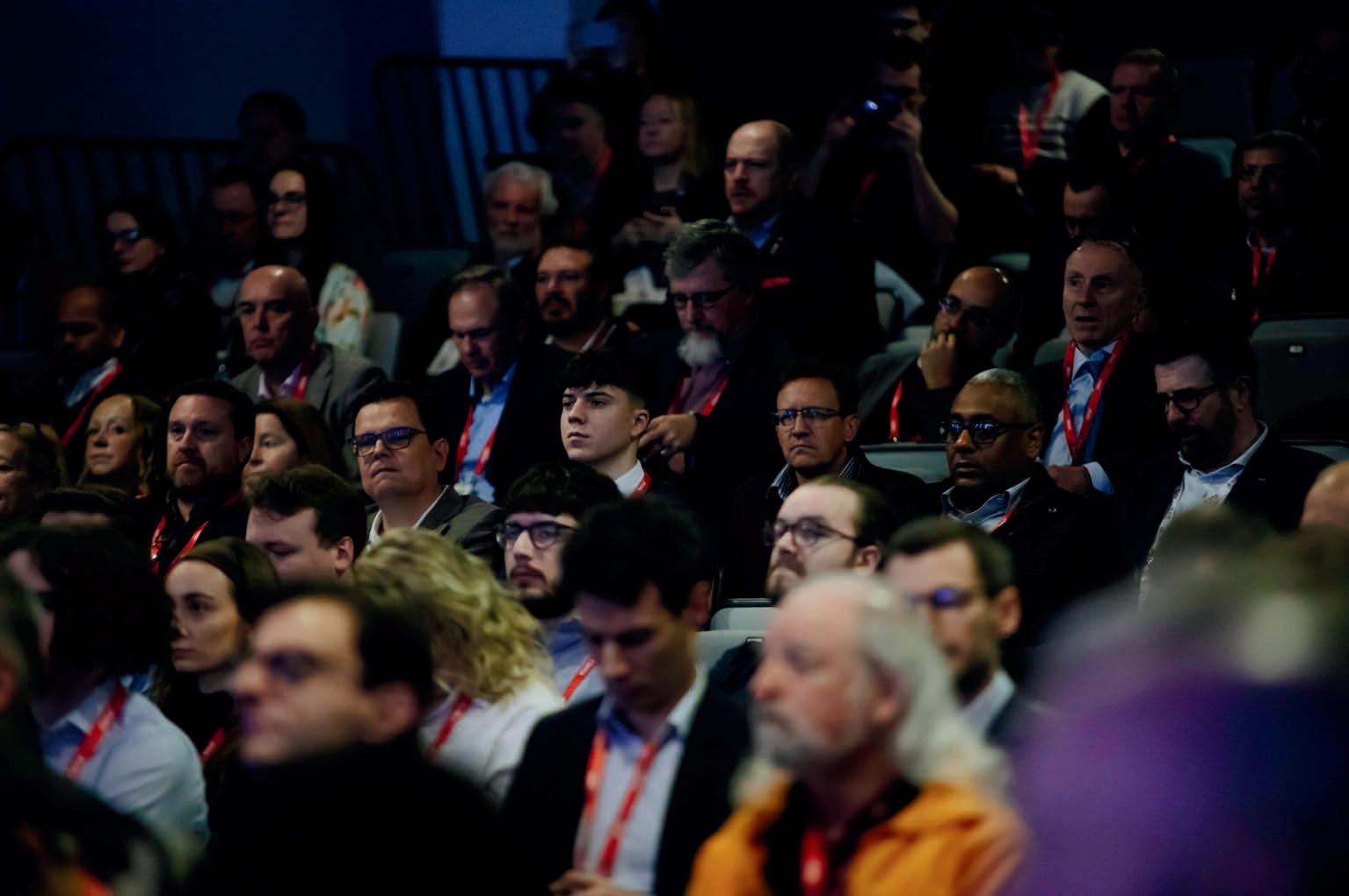
First look at the conference agenda:
WEDNESDAY 27 MAY
08:55: Chair’s opening address
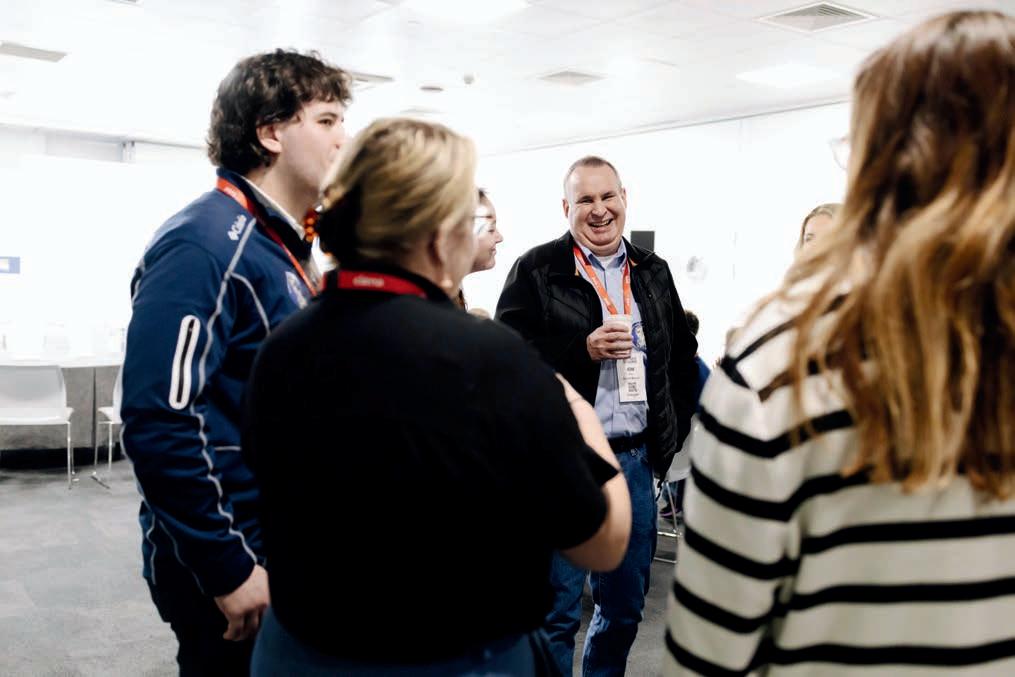
09:00 Keynote panel - AI & Subsea: How is AI shaping the industry’s future?
09:40: Keynote address from Title Sponsor, Ciena
10:00: Keynote address from European Subsea Cables Association (ESCA)
THURSDAY 28 MAY
08:55: Chair’s opening address
09:00: Keynote panel - Geopolitics and the submarine cable industry
09:40: Keynote address from SubOptic Association
10:00: Keynote address - Geopolitics, fears and undersea installations
10:50 News in Brief: project updates

By Mattias Fridström

According to the Chinese Zodiac, 2026 is the Year of the Horse. In Chinese culture, horses symbolize confidence, responsibility, and a strong dislike of being restrained. They are energetic and intelligent, thriving on both physical and mental challenges—but they can also be easily swayed and impatient. In many ways, these traits mirror the most successful companies in our industry. You need confidence to lead, yet the agility to respond to whatever happens in your network every single day. In today’s turbulent world, past success is no guarantee for the future. Staying sharp and using intelligence is more critical than ever, especially when the rules seem to change by the month. Despite these challenges, traffic continues to grow, and new opportunities keep emerging. In keeping with my tradition of sharing ‘Top 3’ predictions for the year ahead, here are my thoughts for 2026.
1. Redundancy and resiliency have become the hottest currency in networking. While this isn’t an entirely
new trend, it has grown increasingly critical in every aspect of a telecom operator’s work. In the past, a large network map and a promise of “99.99…% uptime” were often enough. Today, many customers demand multiple layers of redundancy—everything from multiple entrances to a PoP building to at least four independent routes between core sites. Operators now need to demonstrate, in detail, how every route is fully redundant and why there are no single point of failure in the network. Crossings are, of course, unavoidable, but there are ways to design them while maintaining redundancy. In 2026, operators will present customers with more detailed network maps than ever before
2. AI is everywhere. Beyond intense speculation of an ‘AI bubble’, it is widely accepted that AI is here to stay, and in the future, most companies will leverage it in some shape or form. The telecom industry is no exception. While we are still a few years away from fully self-healing networks,
the number of AI-driven use cases is growing rapidly. One simple example involves the fact that every telecom operator’s network typically consists of a mix of owned and leased infrastructure. As with any technology, upgrades and configuration changes are inevitable. Combine this with city infrastructure projects—continual construction with a sustained impact on ducts and cables—and the challenge becomes clear. Managing hundreds of planned works each month and predicting their potential impact is no easy task. AI will make this process far more manageable, ultimately reducing customer downtime. 2026 will bring significant progress in these areas.
3. Quantum security is here. With the rising number of cyberattacks and data breaches, the responsibility to keep data secure and uncompromised has never been greater. Experts warn that if you haven’t already developed a quantum security strategy, you’re falling behind. As quantum computing advances, traditional
encryption methods may no longer be sufficient. Much of today’s sensitive data is being collected and stored, and once quantum technologies become widely available in the coming years, information that was once deemed secure could be easily decrypted and misused. While quantum networks are expected to make an entrance after 2030, quantum security techniques will be available much sooner. Protecting sensitive data will continue to be a key priority for many companies in 2026
1. Traffic is still growing (and growing). Every year, we assume that the most mature markets have reached their bandwidth consumption peak. After all, nearly everyone in these regions already has access to mobile or broadband services, and do we really have more hours in the day to spend gaming or streaming video? It’s easy to understand why traffic increases in less developed regions as more people come online, and that trend will certainly persist. But for those already connected, can bandwidth usage continue to grow? The answer is yes. In 2026, we’ll see new online experiences and applications we didn’t even know we needed, and AI-driven features will only add to demand. A global Internet traffic growth rate of 20–30% is still a solid prediction for the year ahead.
2. Satellites are emerging as a valuable complement. Many people still believe that glob-
al Internet traffic is carried by a handful of satellites, much like TV signals were 40 years ago. Nothing could be further from the truth. The vast majority of global traffic travels through fiber-optic cables, and nearly all intercontinental traffic flows via subsea cables laid on the ocean floor. However, this doesn’t mean modern satellites are irrelevant –they serve as an excellent complement. Satellites fill critical gaps where fiber is difficult to deploy or protect. Conflict zones benefit great-
structure (RPKI) is a system designed to verify the association between IP address blocks and the entities authorized to announce them. Today, most major Internet backbone operators use RPKI to prevent route hijacking. However, RPKI alone is no longer considered sufficient, and a new mechanism called ASPA (Autonomous System Provider Authorization) has emerged. ASPA extends RPKI by allowing specific Autonomous System (AS) numbers to be recognized as legitimate
ly from LEO (Low Earth Orbit) satellites, and remote regions would have no connectivity without them. As a result, more telecom customers are requesting satellite links as a last-resort backup. When the unthinkable happens and multiple cables fail simultaneously, a satellite connection can keep essential data flowing. Expect to see more of this in 2026.
3. RPKI is not enough. Resource Public Key Infra-
upstream providers. Even if this is only an incremental improvement, it adds an extra layer of protection against BGP route hijacking. Although ASPA is not yet fully developed or widely deployed, it is expected to play an increasingly important role in the coming year, as the ongoing effort to combat malicious Internet actors intensifies.
1. Where is my data? Con-
cerns about data sovereignty have grown significantly in recent years and will become even more critical as emerging technologies continue to evolve. The shift toward storing more data in the cloud triggered these challenges, and with AI entering the stage, they are not going away. The public Internet and cloud infrastructure were fundamentally built on the principle of using the best available resources, regardless of national boundaries. However, this approach now clashes with new data regulations in many countries. Today, the physical location of data often matters more than its usability. In 2026, this will have a profound impact on how services are designed and delivered to customers.
adoption accelerates, more training and inference data will be travelling through global networks and across national boundaries. Unfortunately, this traffic now faces a labyrinth of regulatory scrutiny as it changes jurisdiction. With deeper AI integration, customers are demanding that their data remains within the digital boundaries of their respective countries. At the same time, new laws and regulations are being continuously proposed and
networks will become a major talking point.
2. Where is my traffic? As AI
implemented, creating an ever-changing compliance landscape. The framework in Europe is becoming particularly complex as national government strategies need alignment with EU directives, while also adhering to US and non-European data sovereignty rules. In 2026, the physical traffic flowing across
3. How can I prove where my data resides? IP packet technology was designed to be route agnostic–simply selecting the best available path at any given moment. Proving to a client exactly where each packet traveled from point A to point B is therefore far from simple. While it’s possible to build tunnels or use other mechanisms to force traffic along specific paths, doing so adds another layer of complexity for traffic engineering teams who are already facing significant challenges. Showing detailed maps of physical cables is easy—but proving that customer traffic actually uses those cables is a different story altogether. In 2026, trust and transparency between operators and clients
will be more important than ever.
1. Sea cables. SMART cables have been discussed for years, but only recently have any been deployed. SMART – technology originally designed to support scientific research – stands for Science Monitoring And Reliable Telecommunications. These cables can provide valuable environmental data, including temperature, pressure, and seismic activity, and they bring tangible benefits to both short- and long-distance submarine systems. Recently, sensing technology on subsea cables has gained significance beyond scientific applications and in particular, with respect to the threat of cable sabotage in certain regions. However, these intelligent cables still face legal and regulatory challenges, as international maritime laws begin to catch up with the new technology. In 2026, we can expect to see more cables doing more than just carrying light while we continue to debate the rules to operate them.
vehicles, seismic activity, and more—along the entire length of a cable system. Excavation is still one of the biggest threats to cable infrastructure, so the detection of an excavator approaching a cable could prevent costly damage and downtime. Adding AI into the mix could take this even further: by training systems to recognize which noises correspond to which threats, we could see a new, proactive way to protect our networks. As with any new technology, there are significant costs involved, but this is certainly an area worthy of further exploration.
scenarios worth investigating further. Watch this space in 2026.
“In 2026, expect to see many new data centers launched in Northern Europe, where climate, energy, stability, and skilled labor combine to create an ideal environment for AI infrastructure.”
2. Terrestrial cables. Most cables installed today are fiber-based, and by nature, fiber is highly sensitive to external impacts. Using fiber optic sensing technologies such as DAS (Distributed Acoustic Sensing) on these fibers allows operators to detect vibrations—caused by
3. Metro cables. The ability to detect external activity along fiber cables presents exciting new opportunities. Cities are typically packed with fiber infrastructure, but they also present far more threats to cables than rural areas. By combining sensing technology with AI-driven models and detecting risks before they cause damage, unnecessary outages could be dramatically reduced. Beyond traditional telecom services, there are many compelling use cases to explore. For example, detecting the sound of a traffic accident could trigger an immediate alert to emergency services. While privacy concerns must of course be addressed, there are numerous
1. Northern Europe. Although this region is sparsely populated, it offers significant advantages for building an AI data center. Despite global warming, the climate is cold, which helps reduce cooling costs. Combine that with a wealth of affordable land, zero seismic activity, abundant green energy, and a politically stable environment, and you have all the key ingredients for a successful AI data center. The Nordic countries also boast a highly skilled workforce and a long tradition of operating power-intensive industries where downtime is not an option. While some AI applications require extremely low latency, most AI workloads can be processed remotely—in data centers where these benefits can be realised. In 2026, expect to see many new data centers launched in this increasingly attractive region.
2. The Iberian Peninsula. As the global Internet becomes increasingly meshed - to support regional connectivity, new connectivity hubs emerge. Marseille was the first major southern European hub, but the Iberian Peninsula is fast becoming the next strategic location. Both Portugal and Spain have established multiple connectivity points to North and South
America, as well as Africa and the Middle East. Combine this with extensive access to hydropower, and you have the ideal foundation for AI data center growth. While a few additional terrestrial fiber routes would be desirable, this region is developing rapidly and is successively closing its connectivity gaps. In 2026, expect this dynamic region to see significant traffic growth—both within the region and passing through.
3. Mexico. This market has experienced tremendous growth in recent years, driven by 5G adoption, fiber expansion, and an overall surge in data demand. With the financial sector embracing new mobile banking solutions, there are no signs of this trend slowing down. But challenges remain, of course. Some regions still lack viable long-distance fiber routes, and power availability is another critical constraint that needs addressing. Additionally, Increased data usage also brings with it a corresponding rise in cybersecurity threats. Navigating this complex landscape will require careful planning, but the potential returns are significant. This region is expected to continue its strong growth trajectory throughout 2026.
1. The AI Agent. AI agents might not wear capes, but they’re the real superheroes of customer service. Sure, they don’t start out being perfect—but unlike humans, they don’t need coffee breaks, never roll their eyes at a prob-
lem, and they don’t put you on hold while “checking with a supervisor.” They just keep learning and improving. They are a refreshing contrast to the telecom customer service experience of old: endless queues, haunting elevator music, and the occasional “your call is very important to us” that steals time you will never get back. The AI agents are coming to save the day— one query at a time.
2. The traditional voice trader. Twenty years ago, telecom operators were living the good life—raking in cash from voice calls and lucrative roaming fees. Fast forward to today, and thanks to mobile apps, and a universal obsession with free Wi-Fi, the golden era is all but a faint memory. Nevertheless, international phone calls aren’t gone yet. There is a small, distinguished group of voice traders out there - telecom ninjas in their secret lair, working tirelessly to keep the old-school phone call alive. They’re the vinyl collectors of the telecom world—rare, passionate, and slightly mysterious.
3. The certification team. Telecom used to be a “best effort” business—basically, the industry’s way of saying, “We’ll try our best, pinky promise.” Then came GDPR, NIS, NIS2, DORA, SOC2, ISO-to name but a few, and an alphabet soup of compliance acronyms. Suddenly, companies that thrived on skilled manual fixes had to start documenting all those things they did behind the curtain. And of course, this all happened
while they were in the midst of a major digital transformation journey. Internal certification teams are the new superheroes—armed with checklists instead of capes— making sure everyone plays by the rules
Predictions are, of course, just predictions, and we wish everyone in the telecom ecosystem –from our customers and network business partners to the end-users and everyone in between - a brighter year ahead, with good health and prosperity. One thing is certain, 2026 will be a year filled with excitement and change, but as we always say here at Arelion, “You can’t predict the future, but you can be ready!”

Mattias Fridström has over 20 years’ experience in the telecommunications industry, combining deep technical expertise with insight into the networked economy. A former CTO of Telia Carrier/Arelion, he has held senior roles since joining Telia in 1996. Fridström holds an M.Sc. in Electrical Engineering from the University of Wollongong and is Arelion’s Chief Evangelist.
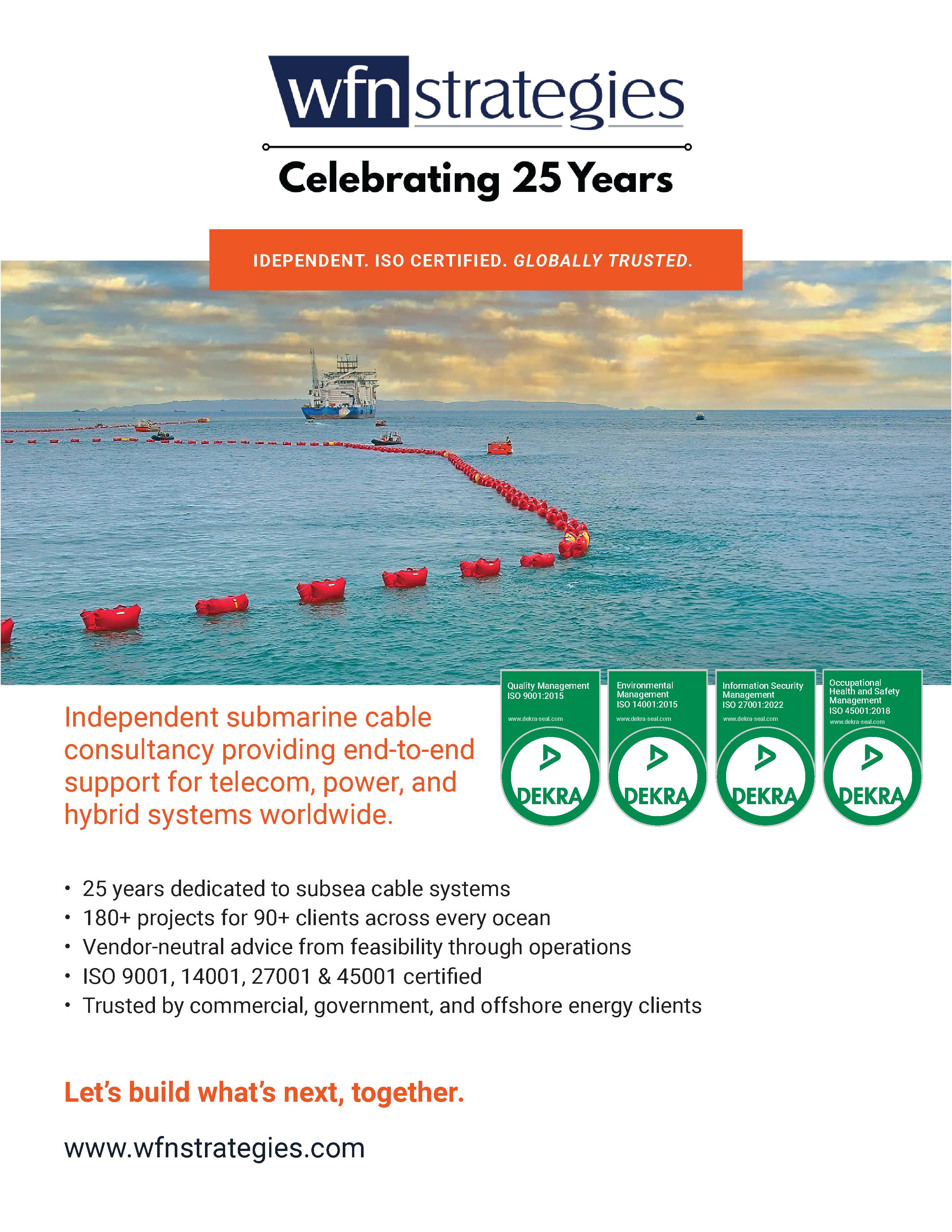
By Chris Wood

According to analysts1, over the next five years there is a $2.9 trillion digital opportunity in Africa, which is the world’s fastest-growing bandwidth market and home to more than 1.5 billion2 people (nearly ⅕ of the world’s population) - an estimated 60%3 of whom are under 25 years old.
Fuelled by significant investment in physical and virtual digital infrastructure, technology diversification and rising demand for connectivity and digital services, Africa’s digitisation is progressing at speed.
Internet use throughout the continent is expanding quickly across regions and income levels, with approximately 40% of Africans now online - up from less than 30% just a few years ago, but still well below the global average of 66%.
The manner in which people, businesses and governments connect and operate is being transformed by a huge increase in connectivity and digitisation initiatives, driving ever more data consumption.
1 The Cloud and Africa’s USD$ 2.9 Trillion Digital Opportunity, Cenerva, September 2025
2 Worlddata.info
3 Worldometer, 2025
All of this additional connectivity is being delivered through more undersea cable systems landing on the continent, terrestrial fibre expansion and satellite network deployment, the growth of data centres (DCs), Internet Exchange Points (IXPs) and cloud infrastructure, the emergence of new technologies, the enhancement of mobile networks and activities addressing affordability and policy issues.
ano subsea cable systems has more than trebled the continent’s digital capacity, with recent announcements about Google’s Umoja and Meta’s Waterworth cables indicat-
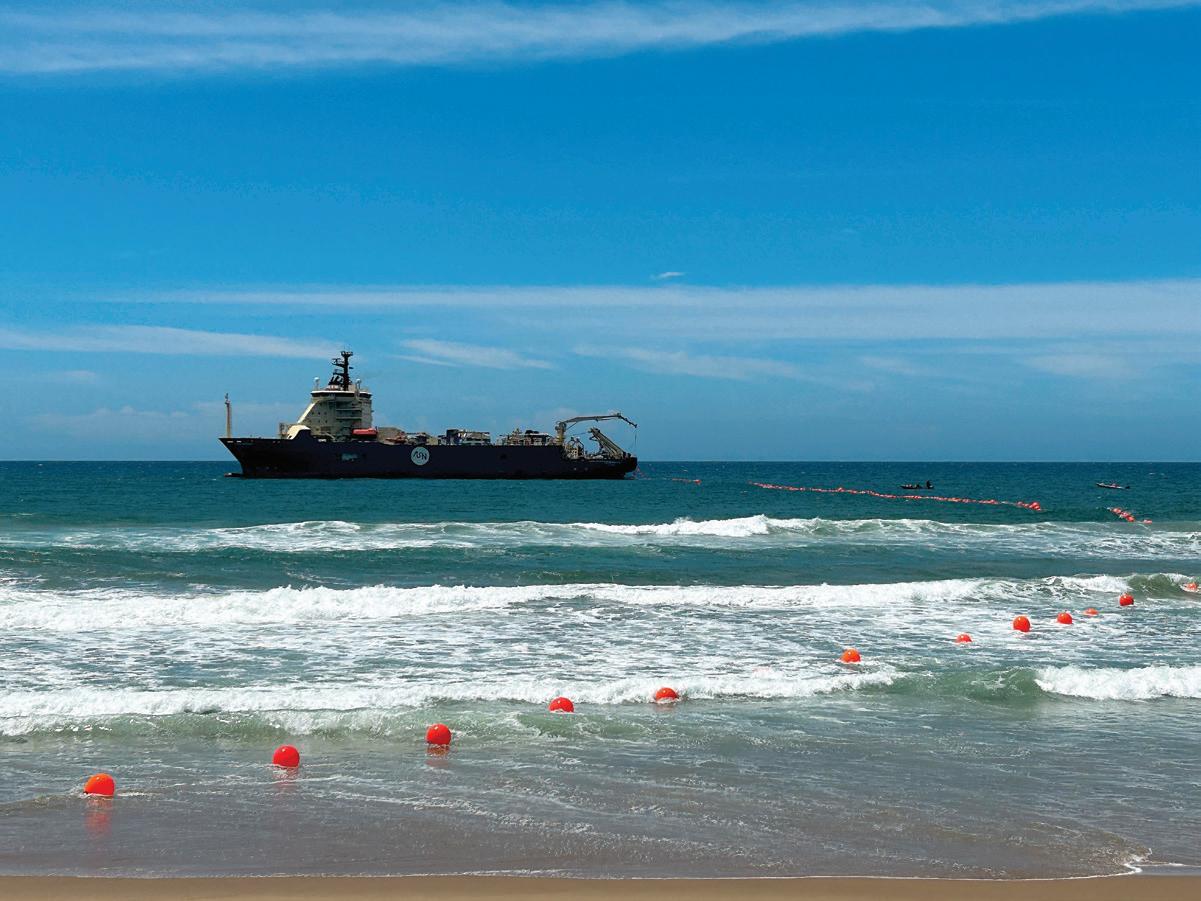
Subsea cable systems are a key enabler to making the latest digital products and services accessible to businesses and individuals in Africa, increasing data usage and enhancing digital economies.
The recent entry into service of the ultra-high capacity 2Africa and Equi-
ing that there is still more to come.
This new wave of submarine cables is dramatically increasing international capacity and route diversity between Africa and key hubs in Europe, Asia and the Americas. It is also facilitating faster broadband speeds, reduced costs, enhanced service reliability and the delivery of better mobile connectivity across the continent.
An important initial consideration when choosing an organisation to partner with in Africa is identifying whether or not they have a deep understanding of and involvement with the major subsea cable systems landing on the continent?
Also, does that organisation have a track record of making significant strategic investment in subsea cables?
WIOCC Group owns fibre pairs on the two largest subsea cable systems landing in Africa, 2Africa and Equiano, is a major operator on all other key subsea networks serving the continent and has activated by far the largest proportion of traffic carried on the EASSy cable.
In terms of expertise and influence, WIOCC Group’s Director of Subsea Networks, Verne Steyn, serves on multiple working groups for major subsea cable systems landing on the African continent and is also a member of the SubOptic Executive Committee.
TERRESTRIAL NETWORK GROWTH
Many initiatives are underway to
improve connectivity between coastal landing points and inland cities via regional fibre networks, reducing the digital divide for landlocked countries.
According to the most recent figures from Africa Bandwidth Maps, Africa’s total inventory of operational terrestrial fibre-optic transmission networks had grown to 1,407,250km by June 2025. In the preceding 12 months, an additional 70,093km of fibre-optic network entered service – equivalent to 192km each day.
Approximately a quarter of the total fibre inventory in sub-Saharan Africa is within cities - at least 357,190km was metropolitan fibre rings and FTTX (fibre-to-the-home / building) networks. Metropolitan fibre rings distribute bandwidth from fibre-optic nodes to districts and suburbs around each city, while FTTX (fibre-to-the-home / building) networks provide the last mile access and deliver fibre bandwidth right to the door.
Satellite broadband operators (such as Starlink and Amazon Leo) and telecom operator partnerships are increasingly bringing high-speed internet to rural and remote areas where tradi-
tional infrastructure is scant, although high costs and regulatory challenges remain.
Africa’s DC capacity is expanding fast from a very low base (it represented less than 1% of global capacity just a few years ago), driven by organisations seeking to localise internet traffic and data, improve connectivity and application performance, and reduce costs.
The huge increases in data consumption demand are starting to be mirrored in the need for additional DC capacity and the African DC market is booming, particularly in the key markets - South Africa, Nigeria and Kenya. There is an increasing focus on developing open-access, carrier-neutral DCs that attract multiple network operators and foster rich digital ecosystems.
Edge DCs have also started to become more prevalent, initially in South Africa, where they enable local data processing, reduce latency, improve application performance and reduce backhaul costs.
There is also explosive growth in IXPs, which are also crucial for keeping internet traffic local, leading to reduced latency and lower costs, and better network resilience.
Investments from Development Finance Institutions (DFIs), such as the World Bank’s IFC, and private organisations are underpinning new facilities in countries such as Ethiopia, Angola, Ivory Coast, Mozambique and the Democratic Republic of Congo – enabling/boosting local hosting for cloud, mobile money, AI
and other digital services.
Supported by a variety of hyperscale and colocation facilities, markets like South Africa, Nigeria, Egypt and Morocco are rapidly becoming regional digital hubs.
The massive volume of additional international capacity and bandwidth delivered by new and planned subsea cable systems has triggered huge growth in Africa’s cloud.
According to Statista’s Public Cloud – Africa report4, Africa’s cloud market is growing at a compound annual growth rate (CAGR) of over 23% - significantly higher than those of more mature markets (the CAGR for the cloud markets in Europe and North America are 11% and 10% respectively) – and has a projected market revenue of US$44.26 billion by 2030.
More and more African enterprises are choosing to run workloads in the cloud, while businesses and governments are also adopting digital tools and rolling out innovative, easier-to-access digital services – all of which are driving cloud growth.
Growth is also being driven by increased data and digital service demand, greater internet penetration and local DC development. This is creating opportunities for local companies such as OADC to build core and edge DC facilities, facilitating the creation of hubs in countries such as South Africa, Nigeria and DRC.
5G networks and small edge data centres are being deployed in more urban and commercial cen-
4 Statista, Public Cloud Africa, 2025
tres, enhancing capacity and enabling the deployment of increasingly advanced and powerful new services.
Mobile networks remain the primary mechanism for providing internet access. Mobile broadband (3G/4G) coverage reaches c. 80% of the population, with 4G adoption steadily rising and 5G rolling out in more than 30 countries. At the same time, FTTX initiatives are also increasing across key markets, bringing fixed highspeed broadband to a growing number of homes and businesses.
Partly due to the cost efficiencies generated by larger amounts of bandwidth now being available in the market and increased competition, broadband costs have fallen significantly and increased the affordability of internet connectivity packages in many African markets.
Development finance and public-private initiatives are also actively funding additional backbone networks and rural connectivity projects, demonstrating growing confidence from investors and governments.
Improved digital infrastructure is enabling the introduction and growth of eGovernment services, fintech, e-commerce, streaming services and mobile money, all of which fuels economic growth and inclusion.
Local digital platforms and services are expanding as internet
access improves, fostering entrepreneurship and market integration.
Digital adoption and digital services are rising markedly despite the complexities involved in bringing all of the above together and the ongoing challenges presented by:
the need for continued scaling of infrastructure investment to match rapidly increasing demand for data and online services
affordability, power supply and limited digital skills issues data sovereignty concerns regional/national disparities (for instance, parts of Central Africa still trail in connectivity)
To take advantage of the additional bandwidth being brought to the continent by major new subsea cables, hyperscalers, content providers, carriers and Internet Service Providers (ISPs) need to partner with an organisation which can seamlessly link this new international capacity to an integrated mix of resilient, open-access physical and virtual digital infrastructure - from cable landing stations, data centres (DCs), and terrestrial fibre and metropolitan networks, to digital clouds, on-ramps and interconnection platforms.
Physical digital infrastructure
• Box Out
• Subsea cables
• Cable landing stations
• Terrestrial fibre
• Data centres (DCs) - core and edge
• Internet Exchange Points
(IXPs)
• Metropolitan networks
• Outsourced holistic managed network and infrastructure services
Interconnection platforms which address both local and global digital transformation demands by giving enterprises and service providers easy access to virtual connectivity services and diverse digital ecosystems.
• Clouds
• On-ramps
• Content
• Applications
According to the United Nations there are currently 54 fully recognised, sovereign countries in Africa, making the continent a very complex
place to do business.
Local experience and expertise are therefore invaluable for businesses seeking to operate efficiently and effectively on the continent, where there is a complex mix of challenges, which is why many choose to partner with WIOCC Group. With nearly 20 years of experience, WIOCC Group has been delivering integrated digital connectivity, infrastructure and solutions to wholesale clients within Africa and between Africa and the rest of the world.
WIOCC has the local knowledge and expertise that inspires confidence in its ability to deploy reliable, flexible and scalable open-access core digital infrastructure solutions to meet the needs of their clients.
To help hyperscalers, telcos, mobile network operators (MNOs),
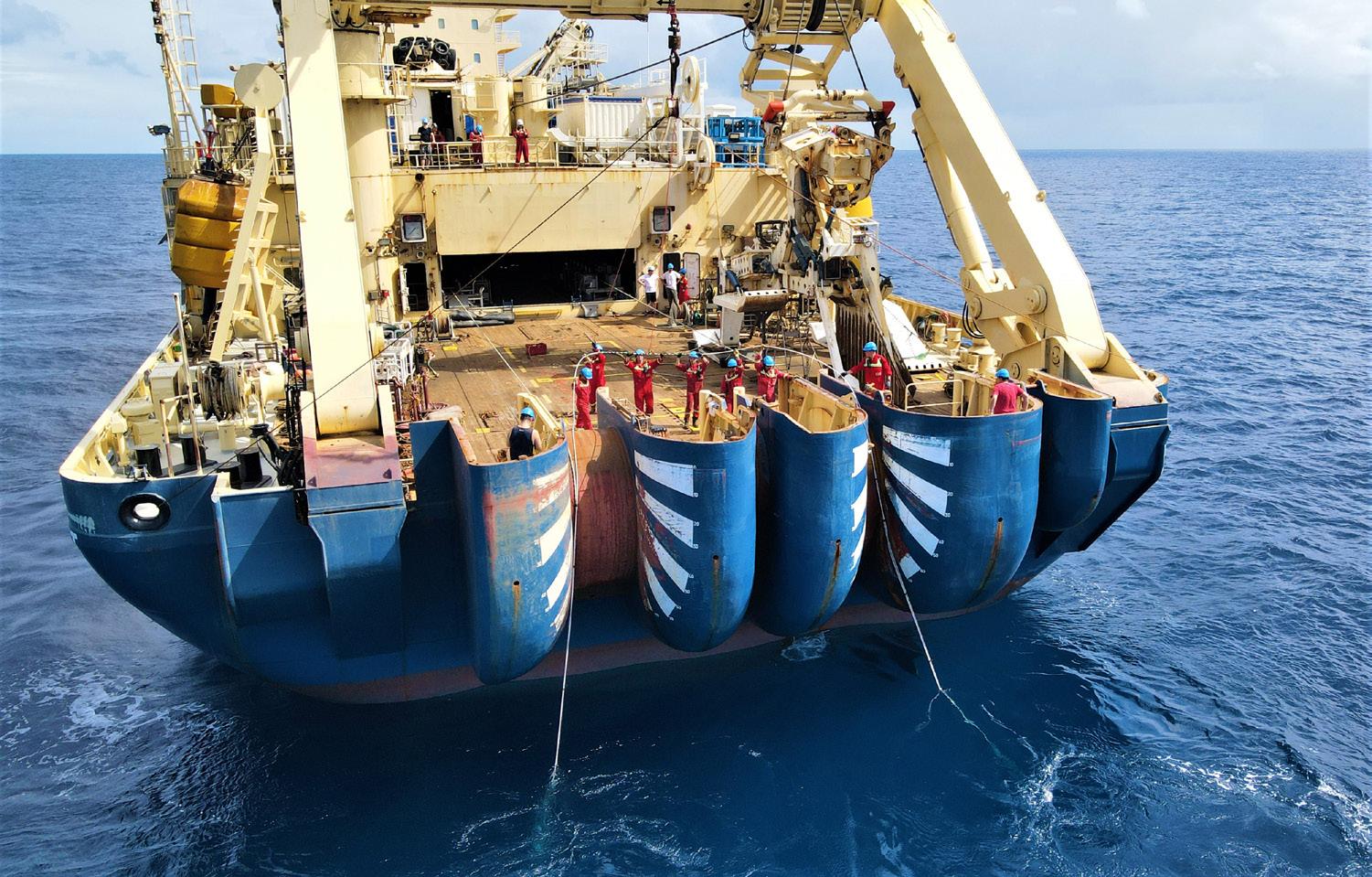
ISPs and major enterprises meet the AI-influenced rapidly evolving market demands, and continue to provide intelligence-driven, locally relevant digital services, organisations in the digital connectivity, infrastructure and services space need to be agile and continually look to introduce innovative service and product offerings.
Since 2008 WIOCC Group has been innovating and evolving its offerings, to ensure its wholesale clients can continue to meet the dynamic needs of their customers. A few examples of this innovation are:
• Building a virtual connectivity ‘ring’ around Africa – to provide clients with network resilience (by securing capacity on multiple subsea cable systems and backhaul routes) and maximise service uptime
• Offering managed end-toend solutions – eliminating the need to coordinate multiple operators throughout the continent
• Adding an open-access, carrier-neutral data centre (DC) offering and building a unique pan-Africa network of core and edge DCs – to provide co-location data management services and enable local data processing, reducing latency, enhancing application performance and cutting backhaul costs by delivering data, content and services closer to end users
• Introducing OAfabric – a future-ready foundation which unites cloud and local connectivity with OADC’s colocation solutions, and establishes an innovative, scalable African infrastruc-
ture platform that addresses both local and global digital transformation demands.
• Creating Open Access Technical Services (OATS) – which allows companies to leverage WIOCC’s assets, experience and existing licenced entities to meet their managed network requirements.
• Offering future-ready solutions – WIOCC Group’s unique network infrastructure provides clients with the flexibility and scalability to meet the fast-growing demand for reliable solutions, driven by consumer customers, enterprise clients and the ecosystem that supports them.
Chris Wood, WIOCC’s Group CEO, has been in place since the company’s formation in 2008, and the senior management team have been there almost as long. This continuity in leadership has helped the company maintain a client-centric vision, strategy and focus, which has been key to the establishment and growth of trusted, long-term relationships between WIOCC Group and its clients and stakeholders.
The high regard that WIOCC is held in by major stakeholders in the digital connectivity and infrastructure industry in Africa was evident following multiple subsea cable outages off the coast of Côte d’Ivoire in March 2024, which caused massive and widespread disruption to internet and network services across West and Southern Africa. Through its long-established relationships across the industry, WIOCC was
able to identify and source vital components and critical cooperation from suppliers, partners and other connectivity providers, resulting in connectivity services being restored in the fastest possible time to as many organisations as possible.
Because of WIOCC’s policy of investing in diverse, highly-scalable national and international connectivity infrastructure, allied to the very strong partnerships it has forged with equipment suppliers, data centre companies and other network operators, within five days WIOCC was able to:
1. Add more than 2.5Tbps of network capacity
2. Configure in excess of 100 individual restoration circuits (from 150Mbps up to 800Gbps capacity)
3. Restore more than 30 key industry players operating across southern and West Africa
Given the sheer enormity of demand for digital connectivity on the African continent, the market for the provision of integrated digital infrastructure and solutions will inevitably become more crowded.
At this point, purchasers of integrated digital connectivity and infrastructure solutions, such as hyperscalers, will increasingly evaluate the offerings of competing providers based on the excellence of their offerings and the trust, integrity and local expertise they associate with each provider, as well as price.
With a near 20-year track record of providing reliable, resilient dig-
ital connectivity, infrastructure and service solutions in Africa, supplemented by an established policy of making significant strategic investments in digital infrastructure and services, to keep pace with the continent’s rapidly evolving digital transformation, Africa-headquartered WIOCC Group is the trusted partner of choice in Africa, where it is helping organisations take advantage of a $2.9 trillion digital opportunity.
Chris Wood has led WIOCC Group since its formation in 2008. He has been instrumental in accelerating Africa’s digital transformation, enabling access to world-class connectivity, digital services, and infrastructure that support economic growth and social development across the continent.
The
By José Chesnoy
submarine telecom market has a reputation for being a cyclical market.
The market is fueled by the virtuous circle illustrated in Figure 1: a new technology allowing to increase the capacity of the cables reduces the cost per bit, and deployment induces new applications; the new applications themselves induce new capacity needs and the new capacity needs maintain and revive the market. This virtuous loop induces nevertheless oscillations and the oscillations are correlated
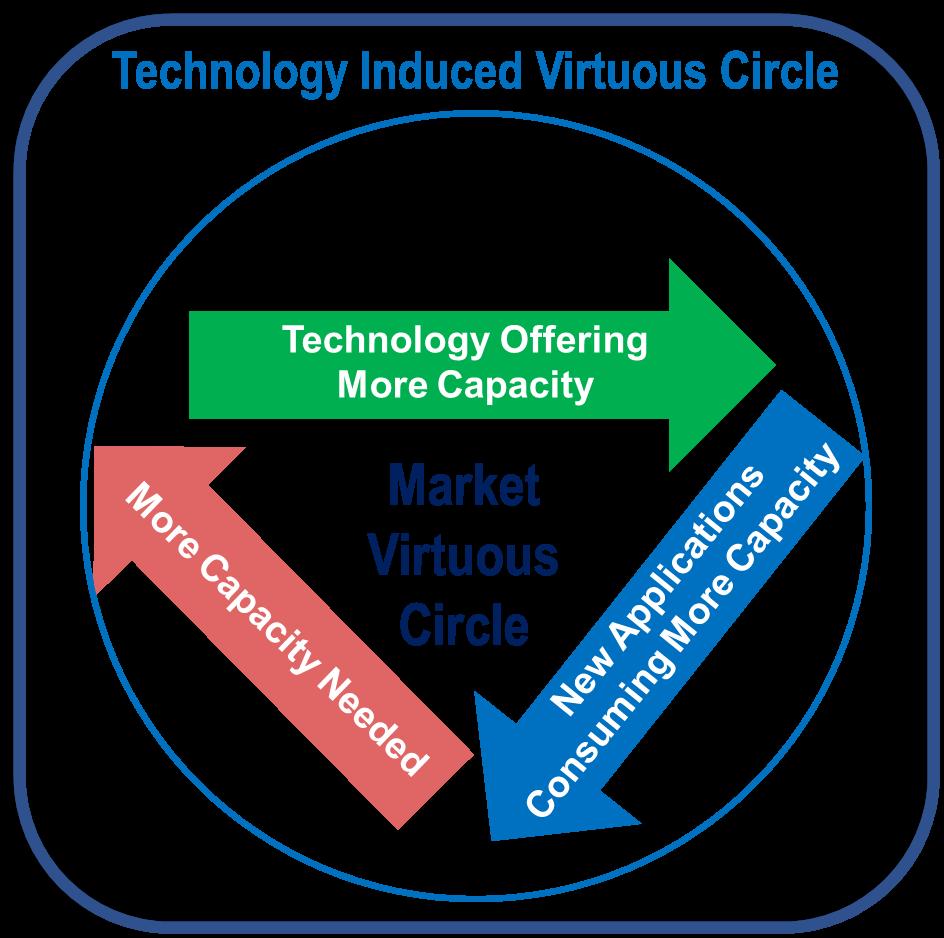
with the technologies that succeed one another: when a technology is introduced, it triggers a market blooming, followed by a depression sometimes amplified by the expectation of a new technology coming soon.
This article illustrates the correlation between market cycles and technologies observed since the advent of optical fiber in submarine cables in years’1980 until today. Figure 2 shows the smoothed cable length laid (RFS) over the years 1987 to 2025 taken from the SubtelForum Industry Reports: the cycles are striking with variations between market highs and lows of a factor well above 10. These variations explain the submarine industry’s well-known reputation as a cyclical market; a reputation now embedded in the collective memory.
We comment below the Milestones indicated on this Figure 2:
The 1990s were marked by the advent of newly introduced optical fibers in regenerated cable systems, following the major trans-
atlantic and transpacific systems, TAT 8 in 1988, and TPC3 in 1989. This was the first phase of global equipment with optical telecom cables. It was also the time when cable overtook satellite for the first time since the “early bird” in 1965, and the fear to disappear. The industrial tool took about ten years to establish. The peak was in the 1990s reaching 50,000 km of systems deployed per year, that look modest at present time, but these early submarine cables were jewels installed just to cover the modest pre-Internet market of voice with very few data.
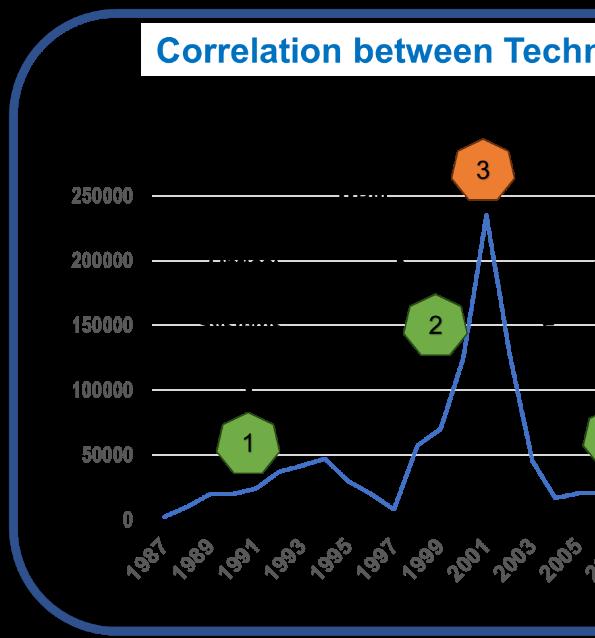
The very promising application of optical amplification based on Erbium Doped Fiber Amplifiers (EDFA) started its development in early 1990, and shortened the market life of regenerated systems, even inducing a market drop induced by customers waiting for the new technology.
The boom brought about by erbium-doped fiber optic amplification or EDFA, which kept its promises, was multiplied by the advent of WDM. After the two major transatlantic cables, TAT12 to TAT-13 and Transpacific cable TPC 5, in 1996, the technology was established, and the period up to 2001 was a period of massive investment, where both public and private operators began installing cables without really analyzing the needs. Investments were colossal in the cable suppliers’ factories and in the laying marine department, espe-
cially since the optical cable was in the “Internet” ecosystem. Production and installations increased from just above 10,000 km per year at the low point to more than 200,000 km per year at the maximum. These massive investments were soon recognized as overinvestments as they did not correspond to real market needs. And soon what had to have happened, happened:
Indeed, the bursting of the Internet bubble (2000–2002) not only wiped-out startups and pastel-shirted traders, it also torpedoed the ambitions of submarine cable consortia. After the telecom operators and private investors rush on amplified fiber optics cables, convinced that the Internet would grow exponentially—and that bandwidth was
for a few tens of millions).
The disaster was in all areas: submarine cable factories became instantaneously empty and laying fleet unused. This event left its mark on memories and led to caution in the community towards excessive reactivity to the market.
The Internet bubble was global, but with the uncontrolled booming of amplified EDFA cables, our submarine industry had a significant contribution to the Internet bubble blow.
This dramatic topic was documented in 2018 in STF magazine 99: “The light years of the bubble” by José Chesnoy https:// issuu.com/subtelforum/docs/ stf-issue_99/72 )
“The installed networks could carry up to a hundred times more data than the global market demanded at the time.”
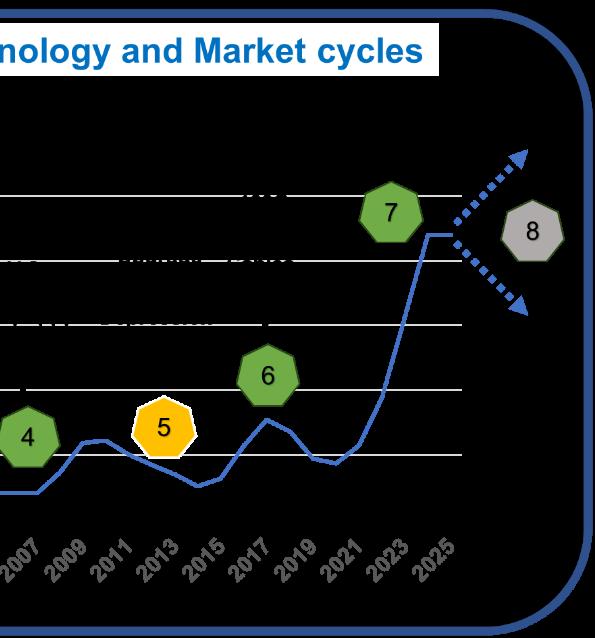
correlated with technology
the gold of the 21st century, the result was insane overcapacity. The installed networks could carry up to a hundred times more data than the global market demanded at the time. When the bubble burst, these infrastructures became phantom assets. Everyone knows the cascade of bankruptcies of cable operators: Among the major cables sold «for scrap» or at bargain prices, here are the most emblematic: FLAG (One of the symbols of overinvestment: built for several billion, then bought for a few hundred million), Global Crossing (worth over $50 billion in 2000 and sold for $250 million in 2002), 360networks ($2 billion worth of infrastructure sold
After the bubble burst, a large number of installed cables were left unused, since the available capacity on existing cables was enormous. The Atlantic is a good illustration of this level of over-equipment during the Internet bubble: in 2001, five transatlantic links were built, the last being a double Apollo link. It was not until 2015, 14 years later, that the new transatlantic cable Hibernia (now EXA press) was built. New capacity needs had become practically nonexistent after 2001. Oversized industrial tools were restructured. During more than 5 years, the capacity per fiber, and technology evolution was incremental, focused mainly on lowering cost of 10 Gb/s systems, slightly improving amplifier bandwidth and dispersion
mapping. The market regained its color in 2009-2010. It hoped for a new life with Coherent technology, and expected the construction of new large cables.
2010 to 2015 was a golden age for new terminal manufacturers with the advent of the new capacity upgrade market enabled by coherent transponders. The spectacular increase in capacity of already installed cables was a factor of 10, illustrated in Figure 3 for the case of Apollo, which shows that from 2010 to 2015, the capacity that could be installed on this cable increased from 80 x 10 Gigabits per second to 80 x 100 Gigabits per second!
Despite the demonstrated improvement of capacity for new cables, the advent of Coherent technology was therefore a second market destructive wave after the bursting of the In-
ternet bubble and delayed the market’s recovery by another 5 years. It’s a bit of a paradox that an extraordinary new technology in the field of submarine cables actually led this time to a decline in the new cable market during 5 years.
Around 2015-2019, we saw the peak of new coherent cables based on +D fiber with the installation of large modern cables such as SeaMeWe-5, AAE-1 or Marea cables. So, five years after their technical renaissance, the true market renaissance of Coherent cables as we know them today took place in 2015, with the arrival of new non-telecom oper-
where the cable is offered by traditional cable suppliers, while the terminal is delivered and installed separately by terrestrial terminal suppliers.
“It’s a bit of a paradox that an extraordinary new technology in the field of submarine cables actually led this time to a decline in the new cable market during 5 years.”
ators, the hyperscalers leaded by Google and Meta that have promoted the Open Cable approach
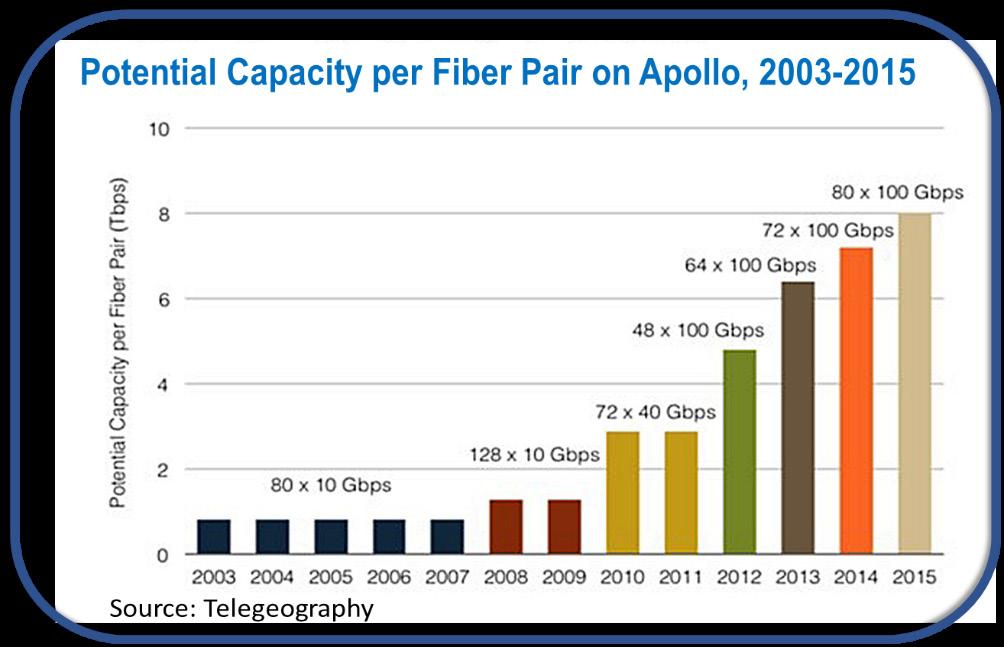
Finally, in modern times, hyperscalers are dominating the market with a voracious appetite for new cables. Capacity per fiber have reached the glass ceiling of the Shannon limit, and all that remains is to increase the number of fibers per cable, and the next capacity gains are achieved at cable level through Spatial Division Multiplexing (SDM) by significantly increasing the number of fibers, under rather unchanged cable powering conditions to optimise the total capacity (much more versus increase of capacity per fiber), but we are now reaching a limit of around 500 terabits per cable, and hyperscalers are always demanding more diversity, connectivity with minimal latency, and additional security objectives. What is spectacular is that we are once again reaching 200,000 km of cable laid per year, but established this time for more than 2 years, and the demand does not seem to decay. On the other hand, manufacturers, suppliers and marine installers alike, have learned the lessons of the Internet bubble and are not over-investing, which means that we find ourselves with a market constrained by a supply limited by production capacity with very low growth. The pragmatic limit of 24 pairs per cable, or 500Tbit/s used by meta for all their new cables (while they would like to reach more capacity), while Goo-
gle limits itself to 16 fiber pairs per cable (or about 300Tbit/s) looks stable since several years, waiting for a new technology gap. But now, new cables aren’t just about increasing capacity; they’re being installed to bring redundancy and diversity to an already
“Cloud
ready understood by Confucius: “Experience is a lantern on our back that only shows the path we have already traveled”.
Cloud applications of hyperscalers continue to dominate, but the great uncertainty comes from
applications of hyperscalers continue to dominate, but the great uncertainty comes from artificial intelligence, which in a few years has come to consume now about 25% of international traffic resources, while other applications are expected to have moderate needs for new capacity. Pessimists will say that there will be a burst of an artificial intelligence bubble, while optimists believe on the contrary that Artificial Intelligence may change the game, with need for Pb/s to multi-Pb/s cables at longer term.”
richly meshed network. With this in mind, diversified landings have multiplied (one need only look at the new landing sites in recent cable landings), and the cables have often multiple landings. The new cables ensure diversity on already equipped routes. The future Waterworth cable is a striking illustration, ensuring transatlantic, transpacific, and Mediterranean diversity (everyone is thinking about the diversity of the Red Sea bypass…) Aiming for capacities far greater than existing cables makes temporarily less sense in this context of route diversity and the technically capped present capacity cables may be acceptable for several years.
One has to be modest concerning the future expectations! As al-
artificial intelligence, which in a few years has come to consume now about 25% of international traffic resources, while other applications are expected to have moderate needs for new capacity. Pessimists will say that there will be a burst of an artificial intelligence bubble, which will obviously be followed by a fall in the submarine market (certainly not as strong as the fall of the Internet bubble, since there are many other applications that are still relevant), while optimists believe on the contrary that Artificial Intelligence may change the game, with need for Pb/s to multi-Pb/s cables at longer term. These cables shall not only require new technologies enabling more bandwidth, fibers and/or cores at cable and repeater levels, but also innovative powering solutions, since cable Shannon
limits will also be reached. In the immediate future, the lengths of new cables available per year are limited by existing cable technology, and by the fear of manufacturers of overinvesting, a limitation increased by the aging fleet of laying vessels to be replaced, and the long timescale of this fleet renewal.
For more information: The third edition of the book “Undersea Fiber Communication Systems” edited by José Chesnoy and Jean-Christophe Antona, includes not only an historic overview, but overall cover all the modern technologies implemented in the submarine cable market: https://subtelforum.com/new-edition-of-undersea-fiber-communication-systems/

Dr. José Chesnoy is co-editor of the third edition of Undersea Fiber Communication Systems (Elsevier). An École Polytechnique MSc and PhD, he pioneered amplified submarine cables at Alcatel Research and spent 25 years at Alcatel Submarine Networks, serving as CTO until 2014. A Bell Labs Fellow, he co-founded Subsea Optica in 2019.
By Derek Cassidy
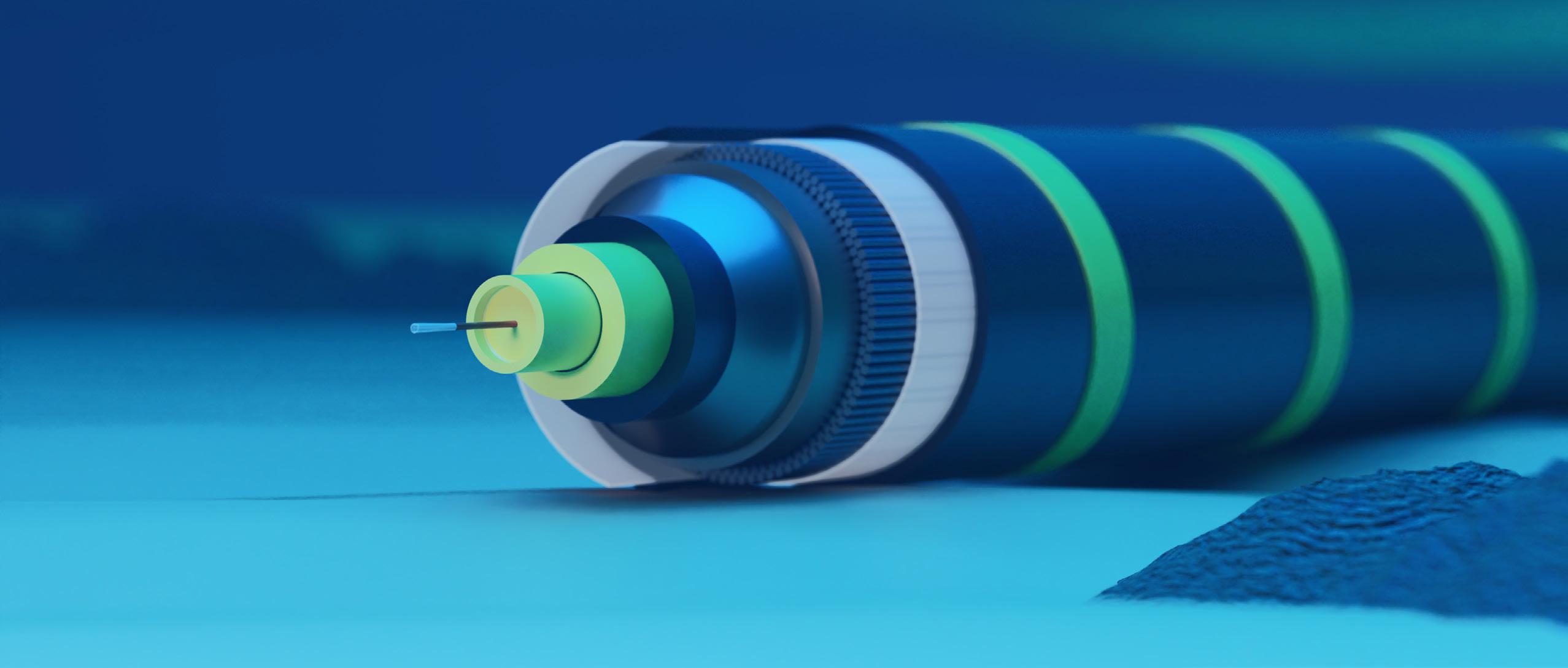
This is a short essay on the establishment of the direct United States telegraph cable and finding it still intact near its original position, although this is incorrectly marked in various sites and will remain a secret to keep it safe.
To tell the story correctly I will have to lead into the crossing of the Atlantic by the Anglo-American Telegraph Company and their many attempts culminating in the successful 1866 trans-Atlantic Telegraph Cable and ultimately why the direct United States telegraph cable cable came into being. This will then lead onto the discovery of the shore end of the DUST cable and the question marks about the shore-end that has been found.
In 1852 the New York, Newfoundland, and London Telegraph Company was established by Frederic Gisborne. This was to establish a new telegraphic link from Newfoundland to New
York that would allow for faster communication between Europe and America by intercepting the telegraphic messages from the vessels as they sailed past Newfoundland and then transmitting them via telegraph signalling to New York. This would help to shorten the time for messages to between Europe and America by at least three days. Cyrus Field met with Gisborne, in 1854, and was very interested in his plan of joining Newfoundland to New York with a telegraph cable, both overland and underwater. Cyrus Field soon joined the board of the New York, Newfoundland, and London Telegraph Company and that same year Charles Bright, and John Wilkins Brett also became signatories, and this created a position where two members were from Britain1. With the establishment of this new board the company agreed with the Government of Newfoundland, a new charter, giving the New York, Newfoundland, and London Telegraph Company sole rights over all telegraphic transmission and its use for 50 years until 19042. This caused a lot of problems over the years as it denied access to Newfoundland to
other submarine telegraph companies and even for Marconi and trans-Atlantic radio service from 19013 who first established a radio wireless station on Signal Hill, St Johns in 1901 but had to move to Cape Breton Island, Nova Scotia, all because of the agreement and charter for single right of use of Newfoundland as a connection for all trans-Atlantic Telegraph traffic4. In 1856 the Atlantic Telegraph Company was established with Cyrus Field, Charles Bright and John Wilkins Brett along with sixteen members from Britain, eight members from the United States and three from Canada/ Newfoundland5. This came about when Cyrus Field decided that if a cable could be laid from Newfoundland to Nova Scotia, why not from Newfoundland to Europe and so the idea got traction and soon after seeking others to offer financial support the Atlantic Telegraph Company was founded6 .
With the establishment of the Atlantic Telegraph Company the project to connect Europe with the Americas got underway. Cyrus Field started the process of raising monies on both sides
of the Atlantic. The Atlantic Telegraph Company took control of the New York, Newfoundland, and London Telegraph Company in 1856 to form one company responsible for all trans-Atlantic telegraph traffic between London and New York, once connectivity was possible and completed.
There were three attempts to lay the cable between 1857 and 1858. The third and successful attempt in August 1858 last just over 30 days. There were issues with the cable armouring, designed by Is-
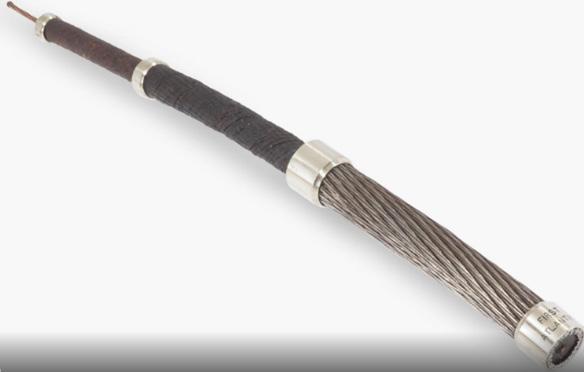
ambard Kingdon Brunel7, the storage of the cable between August 1857 and July 1858 before it was used for the second attempt8. The failure of the cable in September was down to several factors, namely the storage conditions and the deterioration of the Gutta Percha, the increased current used and controlled by Wildman Whitehouse which in conjunction to the Gutta Percha, not insulating the conductor properly, caused a short in the electrical circuit and so the cable failed9
In 1865 Cyrius Field along with the Atlantic Telegraph Company Board decided to try again. The American Civil war [1861-65] had got in the way and soon after agreeing new terms with the stake holders and raising more
funds a new cable had been designed by the Telegraph Construction and Maintenance Company [TELCON]10. TELCON was awarded the contract to lay the cable, and the owners offered the SS Great Eastern as the ship that could carry and lay the full cable in one go. The ships owners also agreed that they would take no payment for the laying if it was not a success but would take £240,000 worth of stock in the Atlantic Telegraph Company as payment if it was a success11. As we know the cable failed about 600 miles from Newfoundland and the Atlantic Telegraph Company ceased trading and a new company, the Anglo-American Telegraph Company was established12. In 1866 a new cable was ordered, constructed and the fifth attempt to cross the Atlantic was started. On the 13th of July 1866 the SS Great Eastern left Valentia Island and on the 27th of July the cable was landed, at Heart’s Content Trinity Bay, Newfoundland13. It was a success, and this cable opened trans-Atlantic telegraph communications between London and New York. The 1866 trans-Atlantic telegraph cable also initiated the establishment of the first real international financial and stock markets, that is the corner stone of our economy today14 .
With the establishment of the 1866 trans-Atlantic cable, the SS Great Eastern and her numerous support vessels recovered the 1865 trans-Atlantic cable and spliced it onto spare 1865
cable15. It successfully landed at Heart’s Content on the 9th of September 1866; the Anglo-American Telegraph Company now had a monopoly on all telegraph traffic between Valentia to New York via Newfoundland. The agreement or charter of agreement between the company and the Newfoundland Government meant that no other company or authority could use Newfoundland as a telegraph station, wired or wireless, between 1854 and 1904. For many telegraph companies looking at the prospect of installing a trans-Atlantic telegraph submarine cable, they would need to look south towards Nova Scotia, creating a longer distance for the cable to travel between Europe and Canada. This created a headache for many telegraph companies who hoped to build their own trans-Atlantic Telegraph Submarine connection, as access to Newfoundland was now only possible if all telegraphic traffic went through the Anglo-American Telegraph Company.
Technically the Anglo-American Telegraph Company had a monopoly on all trans-Atlantic telegraph traffic between London and New York. In 1869 the French company, La Société du
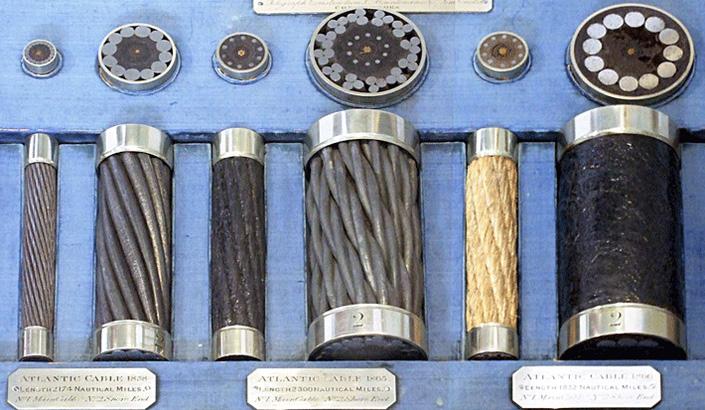
Câble Transatlantique Française, installed a new submarine telegraph cable between Brest, France and St Piere and Miquelon [a French overseas territory] off the coast of Newfoundland and then onto Cape Cod/Duxbury, Massachusetts16. This cable was in direct competition to the Anglo-American submarine telegraph cables from Valentia. However, the two companies entered into an agreement where they would fix prices for telegraphic traffic so that they would remain as the two prominent operators across the Atlantic 17. In 1873 the Anglo-American Telegraph Company took control of the French cable both financially and technical assets. It meant transferring staff from Valentia to Brest to manage and operate the trans-Atlantic cable, making sure that all traffic revenue went directly to the Anglo-American Telegraph Company18 .
As the Anglo-American Telegraph Company [AATC] had taken over La Société du Câble Transatlantique Française, in 187319, they also took ownership of a new trans-Atlantic cable project that the French company had already put into action, the cable was already produced, and the AATC
took ownership of this cable and used it for the next Valentia Island to Heart’s Content cable installation in 1873. As the original French cable was longer than the cable needed for the Valentia Island to Heart’s Content link, over 1,000nm or 1,852Kms, this was incorporated into the fourth cable from Valentia to Heart’s Content that was completed in 1874.20 .
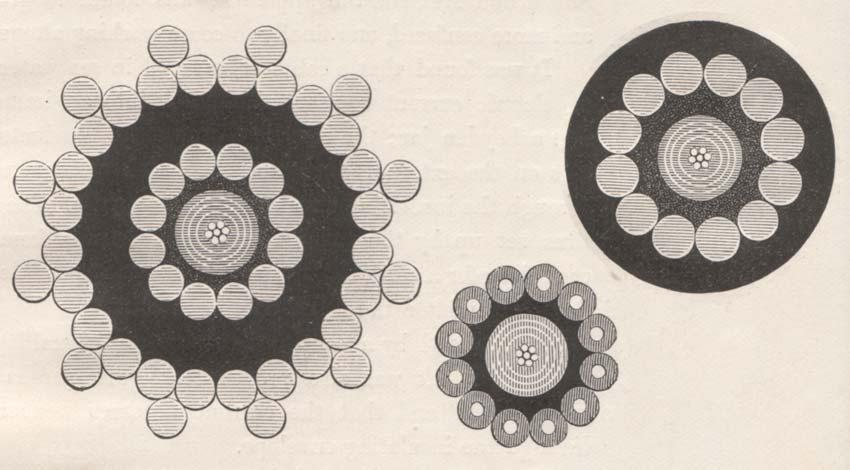
In 1873, the year that AATC took over the French Telegraph Company, Siemens Brothers decided to break the monopoly on trans-Atlantic telegraphy. They were contacted by a large lobby of American Businessmen to try and break the high trans-Atlantic telegraphic monopoly, and Siemens soon took up the task21 They investigated the possibility of getting investors from both sides of the Atlantic but only found real favour in America, but the investment interest here was not as hoped by the Siemens Brothers. So, they decided to go ahead and undertake the project themselves and build a new trans-Atlantic telegraph submarine cable from the UK to America. In 1873 the Direct United States Telegraph Cable Company was established22. The cable vessel CS Faraday23 was especially commissioned for this new task and she was ready by April 1874. The cable had now been manu-
factured, and her maiden voyage would be the installation of the cable between Conception Bay, Newfoundland and Ballinskelligs and then onwards to Rye Breach, New Hampshire. However, when the CS Faraday approached Conception Bay, she was met with a court injunction denying her access to land the cable due to the charter agreement between the AATC and the Newfoundland Government. The CS Faraday had to find an alternative landing point and Tor Bay Nova Scotia was picked, this was the first of many issues that would beset this project24. The cable was installed, and now it was the trans-Atlantic section that needed completing, however I have found conflicting information on this. On one site it states that the maiden voyage was the Tor Bay to Rye Beach link while on other sites and documents it mentions that the last connection was Rye Beach and the cable was then tested by William Thompson, who stated that the cable was good. Whatever section was completed first is still part of the story but not the primary issue. The section from Tor Bay to Ballinskelligs was beset with issues and it was not until September 1875 that the cable was ready for service25. However, during the installation at Ballinskelligs there is a story relating to a coil of cable being dropped overboard accidently and the Superintendent of the cable station offered a reward to anyone who would retrieve it. D. O’Leary26, a local from Ballinskelligs offered to help and went into the water and retrieved the cable and pulled it ashore. However, I have difficulty with this as the cable would have weight 675kgs per 100Mts and this would have been very diffi-

cult if not impossible for someone to drag up from the bottom and pull ashore on his own.
However, the Direct United States Telegraph Cable [DUSTC] operated from September 1875 to 1877 when it came under the control of the AATC and soon the monopoly was reestablished with AATC controlling all telegraphic traffic across the Atlantic27. A new overland telegraph cable was installed between Ballinskelligs28 and Valentia Island so that the systems could operate mutually29. In 1887 and again in 1910 the cable was rerouted firstly to Halifax and then finally to Harbour Grace, Newfoundland30 In 1920 the GPO purchased the cable from Western Union, who had taken control of all AATC assets in 191131 and leased it back to them. They did this as they wanted to have some control over trans-Atlantic telegraph traffic and they called this cable Imperial Cable no 1. In 1923 the cable was diverted to Mousehole and that’s when Ballinskelligs ceased operations32 and my story begins.
THE DIRECT UNITED STATES TELEGRAPH CABLE SHOREEND AND THE MYSTERY OF ITS DESIGN
In July 2025 I was introduced to Paul Keating, whose family have a long history in cable recovery,
by David Howard who is an artist and has a deep interest in submarine cables. I was invited by Paul to visit his site and to look at a cable that he knew I would be interested in. I arrived and I could not believe what I was seeing, a section of DUSTC cable still preserved and well looked after by Paul.
I enquired about it, and Paul gave me the history and timeline covering the time his father purchased the land, recovered spare cable from the seabed for historical purposes and his investigations into this very cable. I was assured that this was the only cable that came ashore, and it was well protected on the beach and now appears on his land. The section of cable is protected by the Keatings who look after it and protect it from the environment and others etc. I was given a piece of the cable and from here I started my investigations and research, and one thing struck me immediately, it was not the same design as seen on the many websites that discuss the Direct United States Telegraph cable. The well-known presentation boxes that the Siemens Brothers had produced for presentation pieces33 also show a dissimilarity between the two different presentation pieces as seen in figure 4, presented by Siemens, and the cable I had in my hand. I have come across two examples of these presentation boxes, and they are both different. The shore-ends have the distinctive 1865 shore-end ar-

mouring, but the inner armouring and electrical core are different in the two presentation pieces, as are the other cable samples34 as can be seen in figures 4 and 5 below.
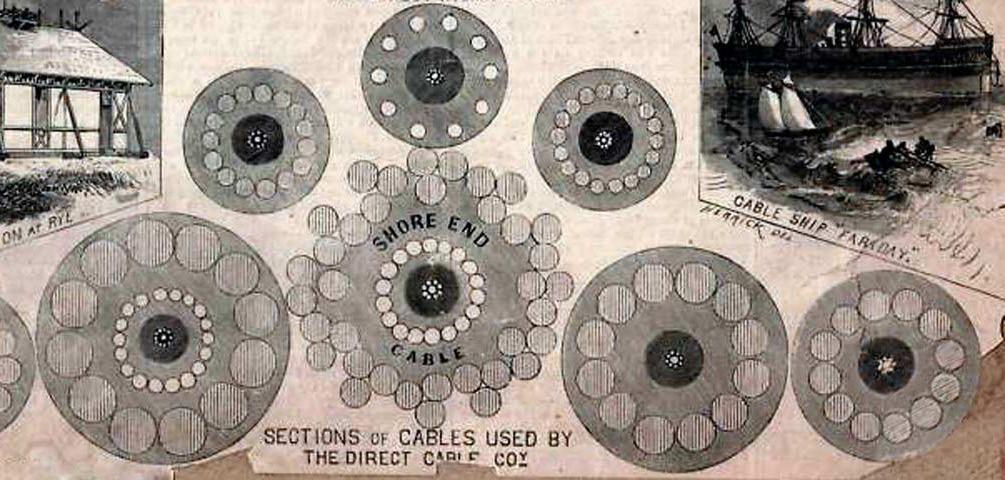
After the debacle of trying to land the cable in Newfoundland it was laid between Rye Beach, New Hampshire and Tor Bay, Nova Scotia and was then tested and commissioned. The second leg was then undertaken to connect Tor Bay with Ballinskelligs. As the Siemens Brothers already had a partnership with R.S. Newall and Company with regards to cable manufacture and so in 1873 they decided to build a new cable from Porthcurno to New York. The Porthcurno landing site to Canada was deemed not capable of carrying telegraphic traffic at the same speeds as the AATC telegraphic systems due to core size and so Ballinskelligs was selected, as already discussed.
The section of cable I have is totally different. The core is small, and the inner armouring is made up of 10 bundles of three armouring wires while the pictures and cable sections in figures 4 and
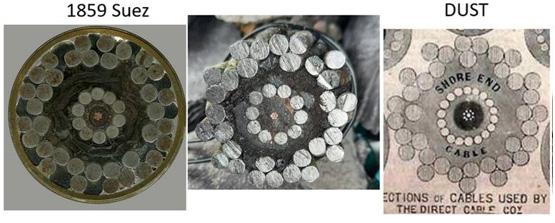
5 have 12 bundles of 3 armouring wires as seen from samples from the pictures on the various websites etc. I did investigate the route from the site to the beach with the site owner and it is well protected and the only cable. I have been assured that for the last sixty years Joe C Keating has carried out a lot of work investigating this cable and it’s the only one that comes ashore.
I have looked at other cable samples, and an example are seen in figure 6, all share the same shoreend armouring, and none of them match the dimensions either in the inner core or inner armouring, either in count or size.
What we do know is that the core size of DUSTC cable sample is the same size as the Suez Canal 1859 core35. The size and number of strands on the inner core also match, however, the outer armouring shows the difference. The Suez Canal has 12 3-streands while the DUSC has only 10 3-strands. The strand dimensions are also different, but the whole cable cross section shares the same diameter.
This is a cable that does not match up to the original designs that the Siemens Bros had produced, nor does it match with any examples of cables that have already been produced. Even the India cable
which shares the same shore-end design does not match either. It is a perplexing situation to have the actual cable, but it does not match the produced examples etc.
This is only a small piece in the history of the direct united states telegraph cable, I needed to tell the history surrounding why it came into existence, the establishment of the first trans-Atlantic telegraph cables, their monopoly and the need to break it that closed the monopolistic cycle and establish competition, although it was not fully broken until 1883 when the Commercial Cable Company established its presence in Waterville and began competing with the Angle-American Telegraph Company and subsequently Western Union.
Although the 1873, 1874, and 1894 trans-Atlantic cables from Valentia were still operational in 1960 along with others from Waterville, the DUSC also had a long lifespan but soon fell out of favour just after WW11. It had a long-chequered career and now it leaves a big question, why was the core size of the Ballinskelligs shore-end so small, was it a quick replacement for the coil that fell overboard. Did D. O’Leary manage to bring the cable ashore, it was a heavy cable, and we do not know how big the coil was that was lost overboard. Along with the currents, water weight and environmental conditions this feat, if possible, is very hard to understand how possible it is, but the story is a good one and so I
will leave that there.
But regarding the cable itself, there now seems to be more questions about this cable sample. I am assured it is the DUSTC and having been on site, investigated its routing and the location of the original cable station, which no longer exists I am certain that it is the cable. I have also investigated the route of the cable from Ballinskelligs to Valentia Island Cabla Station, and I was shown the route, it is an underground connection and so no submarine cable was used to connect these two cable stations, unfortunately the underground route no longer exists with a cable insitue, see figure 8.
There are question marks over the core size as well, but one thing could be the answer. R.S. Newall who were the original contractors for the Suez Canal cable of 1959 recovered any spare cable and was allowed to keep it as the cable failed and abandoned in 186136. Siemens had a close relationship with R.S. Newall and Company, and the question is could they have made some shore-end cable available, with a different shore-end armouring

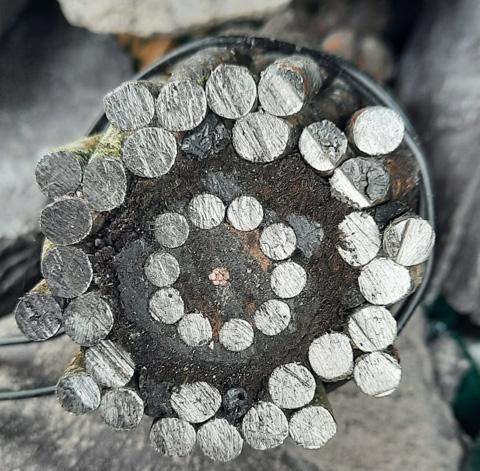
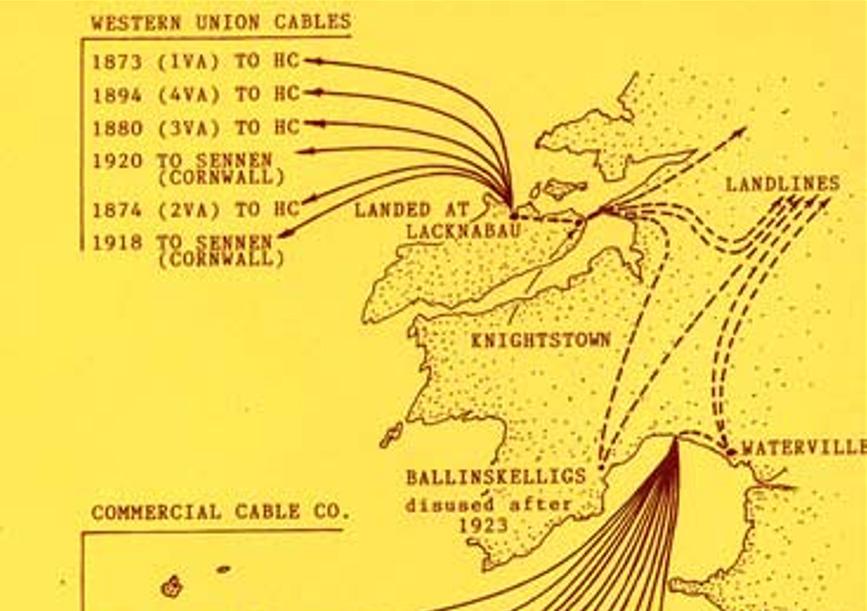
8. Terrestrial telegraph route connecting Ballinskelligs to Valentia Island Cable Station.
count. What if the original coil that fell overboard was never recovered due to its weight? This story will continue, and investigations will continue to find an answer to the question “What is it with this Direct United States Telegraph Cable”?
With many thanks to Paul Keating, Joe C Keating [whose endeavours in his submarine cable archaeology helped bring this part of our communication heritage into the light] and David Howard, a renowned artist who helps to present these pieces and bring them back to life.
1 Carter, S. “Cyrus Field: Man of Two Worlds”, Putnam, 1968.
2 M.E. Grenander Department of Special Collections and Archives. https://archives.albany.edu/challange?next=/ description/catalog/mss096. Accessed 10th September 2025.
3 Marconi.https://www.heritage.nf.ca/articles/ society/Marconi-gugliemo.php. Accessed 10th September 2025.
4 dtorres. Case Files: Guglielmo Marconi | The Franklin Institute.2016. https://fi.edu.en.news/ case-files-guglielmo-marconi. Accessed 10th September 2025.
5 Hearn, C., G. “Circuits in the Sea: The Men, the Ships, and the Atlantic Cable”, Praeger, 2004.
6 Steele, J., G., “A Thread Across the Ocean: The Heroic Story of the Transatlantic Cable”. Harper Perennial, 2003.
7 Field, H., M., “History of the Atlantic Telegraph”, Charles Scribner & Co, 1866.
8 Field, H., M., “History of the Atlantic Telegraph”, Charles Scribner & Co, 1866.
9 History of the Atlantic Cable and Submarine Telegraphy-The life of William Thomson: The Atlantic Telegraph Failure. https://atlantic-cable.com/books/thomson/imdex.htm. Accessed 17 September 2025.
10 History of the Atlantic and Submarine Telegraphy-The Ancestors of the Telegraph Construction and Maintenance Company. https://Atlantic-cable.com/cablecos/telcon/index.htm. Accessed 15 September 2025.
11 Mays, A., “The Great Eastern”, PK Porthcurno, 2021.
12 History of the Atlantic Cable and Submarine Telegraphy-The Anglo-American Telegraph Company, https://atlantic-cable.com/ CableCos/AngloAmerican/.Accessed 19 September 2025.
13 Field, H., M., “History of the Atlantic Telegraph”. Charles Scribner & Co., 1866.
14 Cassidy, D., “Submarine Networks: An Evolutionary Change”, Subtel Forum, Vol 126, 2022.
15 Cassidy, D., “The Trans-Atlantic Telegraph Cable of 1966”, Subtel Forum, Vol 107, 2019.
16 History of the Atlantic Cable and Submarine Telegraphy-1869 French Atlantic Cable. https://atlantic-cable.com/Article/1869French/ index.htm. 20 September 2025.
17 Blundell, J., W., “The manual of submarine telegraph companies” London, 1871.
18 Blundell, J., W., “The manual of submarine telegraph companies”, Legare Street Press, London, 1871.
19 Headrick, D., R., “The Invisible Weapon: Telecommunications and International Politics, 1851-1945”, Oxford University Press, 2012.
20 Bright, C., “The Story of the Atlantic Cable”, Appleton &Co., 1903.
21 https://dandadec.wordpress.com/ wp-content/uploads/2013/07/direct-us-telegraph-company.pdf/accessed 27-October-2025.
22 “Europe Calling America”, Inspiring, Siemens. https://siemens.com/global/en/company/about/history/stories/transatlantic-cable. html.Accessed 21 Sept 2025.
23 Taltavall, J., B., “Siemens New Ship Faraday”. Telegraph and Telephone Age. 41 (9). 202–205, 1923.
24 vLex.https://justis.vlex.com/search/jurisdiction:;IE/Direct+United+States+Cable=Company+v+Anglo-American+Telegraph+Company/ vid/803013409.Accessed 31-0ctober-2025.
25 History of the Atlantic Cable and Submarine Telegraphy-Direct United States Cable Company. https??atlantic-cable.com/Cablecos/DirectUS/index.htm. Accessed 29 July 2025
26 Cable O’Leary’s -. https://visitballinskelligs. com/heritage/cable-olearys/. Accessed 17 Sep. 2025.
27 https://dandadec.wordpress.com/ wp-content/uploads/2013/07/direct-us-telegraph-company.pdf/accessed 30-Sept-2025.
28 https://scolarship.law.duke.edu.cgi. viewcontent.cgi?article=3250&contect=lcp. Accessed 29-October-2025.
29 Bright, C., “The Story of the Atlantic Cable”, Appleton &Co., 1903.
30 History of the Atlantic Cable and Submarine Telegraphy-Other Atlantic Cables. https:// atlantic-cable.com/Atrticle/SA/70.index.htm. Accessed 29 Sept 2025.
31 History of the Atlantic Cable and Submarine Telegraphy-Jose Manuel Gil. https://atlantic-cable.com/CableStories/WG-MK/index. htm. Accessed 29-Sept. 2025.
32 https://dandadec.wordpress.com/ wp-content/uploads/2013/07/direct-us-telegraph-company.pdf/accessed 30-Sept-2025.
33 History of the Atlantic Cable and Submarine Telegraphy-Direct United States Cable Company. https??atlantic-cable.com/Cablecos/DirectUS/index.htm. Accessed 29 July 2025.
34 History of the Atlantic Cable and Submarine Telegraphy-British Cable Manufacturers. https://atlantic-cable.com/CableCos/BritishMfrs/index.htm#siemens. Accessed 17 September 2025.
35 History of the Atlantic Cable & Submarine Telegrapgy-1859 Suez-Aden-Karachi Cable. https://atlantic-cable.com/Cables/1859SuesKarachi/index.htm.Accessed 03-Oct-2025.
36 History of the Atlantic Cable and Submarine Telegraphy-1859 Suez-Aden-Karachi Cable. https://atlantic-cable.com/Cables/ 1859SuezKarachi/index.htm. Accessed 19 Sept 2025.

Derek Cassidy is a Chartered Engineer with over 30 years’ experience in telecommunications, specialising in optical engineering and submarine networks. He is completing a part-time PhD at UCD under Prof. John Healy and Prof. John Sheridan. Cassidy chairs the Irish Communications Research Group and serves on international standards, advisory boards, and heritage projects.
By Zack Spica

For all the attention paid to satellites and server farms, the real plumbing of the digital world lies on the ocean floor, on glass strands no thicker than a garden hose, buried thousands of meters below the ocean surface.
They carry the internet. They carry power. They have markets, intelligence, military orders, and central bank liquidity. They are, in short, the glass nervous system of the global economy.
Until recently, these arteries were taken for granted. Operators focused on uptime and bandwidth; regulators didn’t think in terms of conflict zones below sea level. That calculus is unravelling. Deliberate disruptions in the Baltic Sea, the Eagle S and Fitburg incidents, have exposed a strategic tension: adversaries are now probing Europe’s digital backbone in ways that combine physical action, operational ambiguity, and geopolitical signalling.
As grey-zone actors probe these blind spots with intent and impu-
nity, Europe confronts a critical vulnerability: the mismatch between the strategic value of its digital backbone and its capacity to protect it. This article examines how Europe is beginning to treat its undersea infrastructure as a strategic frontier and how companies like Lumetec are helping close the gap between awareness and action in a battlespace where attribution is murky, but the stakes are anything but.
Over 99% of all international data traffic, including encrypted military communications and more than $10 trillion in daily financial transactions, flows through these undersea cables, not satellites (Carnegie Endowment, 2025). Yet most of them operate with the same passive assumption that governed telecommunications in the 1990s: bury it deep and hope for the best.
Historically, infrastructure was defined by what was visible: bridges, pipelines, and energy grids. But in the digital economy, the most valuable systems are invisible, and cables are now critical to
power projection.
This is particularly true for Europe, which relies heavily on transatlantic data routes, intra-regional fibre paths, and connections to North Africa and the Middle East. More than 250 active cables connect European territories (Carnegie Endowment, 2025). Many converge at a few hypersensitive chokepoints, such as Marseille, Copenhagen, or the southern English coastline, forming what experts now call the “digital GIUK gap”: a narrow corridor between Greenland, Iceland, the UK, and Norway that is the Western world’s most exposed communications artery.
Disrupting even a single transatlantic route can induce traffic bottlenecks, increase transmission costs, trigger SLA breaches, and even delay high-frequency trading settlements. And yet, most cables are owned by private consortia with minimal obligation to share telemetry, threat data, or incident reports with national authorities.
Recent incidents from the unexplained severing of Arctic cable links off the Norwegian coast to coordinated strikes on Taiwan’s undersea network have shown that subsea infrastructure is becoming a frontline domain in strategic competition (BBC, 2025). Western analysts increasingly identify these cables as soft targets in a hardening world, where military, criminal, and hybrid actors exploit grey zones beneath the surface (Gallagher, 2025).
The Baltic Sea, long considered a secure NATO-adjacent waterway, now reads more like a testbed for grey-zone operations. In early 2024, Europe received a warning it largely failed to act on. The Eagle S, a Russian-linked oil tanker, was found to have damaged multiple subsea power and telecom cables in the Baltic Sea, including high-capacity lines connecting Finland, Estonia, and Sweden (Politico, 2025). Although the case was ultimately dismissed for insufficient evidence of intent, it exposed a dangerous legal and operational blind spot in Europe’s seabed security.
cidents. The Baltic Sea, a shallow, infrastructure-dense region bordered by eight NATO states and Russia, has become a focal point for hybrid threats targeting power lines, internet cables, and gas pipelines.
It’s precisely this strategic ambiguity that prompted a sharper tone from European Commission President Ursula von der Leyen, a former German defence minister and one of the EU’s most vocal advocates for resilience in critical infrastructure. Speaking to the European Parliament in October 2025, she framed the pattern in stark geopolitical terms:
“This is a deliberate and targeted grey zone campaign against Europe. And Europe must respond.
ability to name and track actors, primarily when operating in the shadows, is now essential.
• Legal ambiguity is a vulnerability. Without a clear framework for cross-border response and prosecution, Europe remains exposed.
• Visibility is power. Real-time monitoring and integrated intelligence are no longer optional; they’re strategic imperatives.
The seabed is now a strategic frontier, and the EU intends to defend it accordingly.
“Adversaries are probing Europe’s digital backbone through grey-zone operations that combine physical action, operational ambiguity, and geopolitical signalling beneath the sea.”
We must investigate every incident. And we must not shy away from attributing responsibility. Because every square centimetre of our territory must be protected and safe.” (EEAS, 2025)
On 23 October 2025, the European Commission launched a €20 million program to secure submarine cables, backed by a newly published risk assessment and mitigation framework. What’s novel here is the integration of civilian data with military-grade sensing, blurring the line between telecom operations and strategic surveillance.
In December 2025, Finnish authorities seized the Fitburg, a cargo ship sailing from Russia, after it allegedly severed a major undersea telecoms cable between Helsinki and Tallinn (Reuters, 2025). The vessel, which had been dragging its anchor across the Gulf of Finland, is now under investigation for aggravated sabotage. It can be considered the most serious legal escalation yet in a growing series of subsea in-
With the EU’s new Cable Security Action Plan underway, the Fitburg episode offers a timely, concrete example of why Europe is rushing to build real-time detection capabilities and coordinated response frameworks to defend its strategic seabed.
So far, three takeaways crystallised for EU policymakers and security planners:
• Attribution is a deterrent. The
Published under the EU Action Plan on Cable Security, the initiative lays out three core deliverables:
• Comprehensive mapping of all active and planned subsea cables connected to EU territory
• Risk assessment across seven strategic threat vectors, including hybrid operations, environmental hazards, and data interception
• The creation of Regional Cable Hubs (one per sea basin)equipped with real-time data fusion capabilities and AI-driven threat analysis
Member States now have until 31 March 2026 to submit proposals for Regional Cable Hubs, which must include:
• Multimodal data integration (including shipping telemetry, cable performance, and environmental signals)
• Live threat classification and situational visualisation tools
• Rapid-response protocols that coordinate between cable operators, cybersecurity agencies, and military assets
lem; it has a situational awareness problem. A Russian-linked vessel dragged anchor across one of the most sensitive subsea telecom corridors in the Baltic, allegedly severing a key connection between Finland and Estonia. The act took hours. Detection took days. Attribution is still uncertain.
In the fog of the seabed, denial is a strategy.
Lumetec delivers what subsea infrastructure has long lacked: persistent, real-time awareness of what’s happening underwater, when, and why. And that is precisely what 21st-century deterrence demands. Instead of watching the sea from above, Lumetec listens to it from below.
“Where AIS depends on voluntary broadcast and surface-level inference, seabed-based sensing captures direct physical contact—anchor drops, net entanglements, and unauthorized interaction.”
The Cable Security Toolbox, due in late 2025, will provide a menu of mitigation technologies, standard operating procedures, and investment priorities, from landing station reinforcement to AI-powered vessel tracking.
The EU also plans to maintain momentum by integrating cable resilience into broader programs such as CEF Digital and the Cyber Solidarity Act, and potentially into NATO critical infrastructure mandates.
If the Fitburg incident revealed anything, it’s that Europe doesn’t just have a cable security prob-
It uses two sensing technologies embedded in the fiber corridor itself:
(DAS): This turns standard subsea fiber into a dense acoustic sensor array. It detects physical vibrations from environmental and anthropogenic factors (e.g., gear movement, anchor strikes, vibrations) around every nearshore stretch of a cable. Not approximations; actual waveforms, carrying structure, context, and meaning.
State of Polarization (SOP): This complements DAS by monitoring large-scale, coast-to-coast movements of a cable. Although it is a much less sensitive tech-
nique, SOP is readily available in standard telecommunication networks and is well-suited for detecting sediment shifts, burial changes, and ground contact through variations in light polarization signals.
Besides, it incorporates seismo-acoustic AI models to detect, track, and identify surface and non-surface actors, such as UUVs, cable-tapping systems, or anchor drags operating below traditional visibility thresholds. And through AI pattern association, it maps historical patterns, creating a continuously evolving threat baseline for each region, while simultaneously building the world’s largest database of maritime threat signatures, using civilian infrastructure hidden in plain sight.
Lumetec’s architecture is non-invasive, meaning it doesn’t require cable replacements or invasive installations as it works alongside telecom traffic. It’s designed for modular deployment, allowing member states or private operators to build coverage incrementally. Just as visible surveillance deters crime, Lumetec’s persistent monitoring acts as a digital perimeter, alerting potential bad actors that their movements will be seen, recorded, and attributable. Region by region, cable by cable. And it’s interoperable with the kind of infrastructure the EU’s Regional Cable Hubs will need to deploy under the Commission’s Action Plan.
The most serious subsea threats neither announce themselves nor depend on broadcast signals. Lumetec delivers a level of subsea awareness that AIS-based systems fundamentally lack. By anchoring sensing capability at
the seabed through DAS & SOP rather than at the surface, Lumetec captures direct physical interactions, including anchor drops, net entanglements, and unauthorized contact, all of which provide an uninterrupted view of the domain where the most consequential threats take shape.
Where AIS relies on voluntary signal transmission and surface-level inference, Lumetec operates independently, detecting and classifying dark vessels without any external broadcast data. Its sensing architecture originates from the seabed itself, not the sky, enabling it to register and distinguish physical contact events such as anchor drops, net entan-
flips that asymmetry. It collects intelligence. It attributes intent. And when needed, it escalates to decision-makers with confidence.
In strategic terms, Lumetec’s greatest value may lie in its time compression; it closes the gap between intrusion and insight. That’s what the Fitburg incident lacked. It wasn’t just about stopping a cable from being cut. It was about knowing the threat was there at all.
When hybrid threats exploit the legal and sensory void at sea, deterrence depends on visibility: the ability to detect, attribute, and respond in near real-time. The

glements, or unauthorized seabed interaction. This inversion of the traditional monitoring model, from seabed up rather than surface down, provides an uninterrupted view of the domain where the most consequential threats take shape.
Still, Lumetec’s relevance extends beyond compliance. It gives Europe and any allied operator a way to reclaim initiative in a domain where it has been ceded for too long. Every time a cable is struck, tampered with, or probed without consequence, adversaries gather information. Lumetec
Baltic cases serve as a turning point not just in policy, but in the operational logic of infrastructure defence.
We have witnessed how Europe’s strategy is strengthening through the creation of Regional Cable Hubs, integrated risk assessments, and cross-domain coordination. Yet policy and funding matter only if they translate into operational awareness fast enough.
Lumetec’s model, engineered around multimodal fiber sensing, represents precisely that capabil-
ity in practice. Its architecture fuses signal anomalies, behavioural analytics, and historical baselining, not to passively record disruption, but to preempt it. In this way, it doesn’t just secure infrastructure; it restores initiative. It ensures that seabed events are no longer mysteries to be solved after the fact, but patterns to be recognised before escalation.
Beneath the waves, deterrence begins with detection, and the clock is already ticking.
Dr. Zack Spica is a geophysicist and leading expert in fiber optic sensing. After PhD and postdoctoral work at Stanford and the University of Tokyo, he founded a research group at the University of Michigan using subsea telecom cables to study Earth systems and infrastructure health. As founder of Lumetec Inc., he leads multi modal data fusion research to safeguard subsea assets and deliver maritime domain awareness.
By Stewart Ash, Stuart Barnes, Phil Black, Bill Burns & Chris Swan
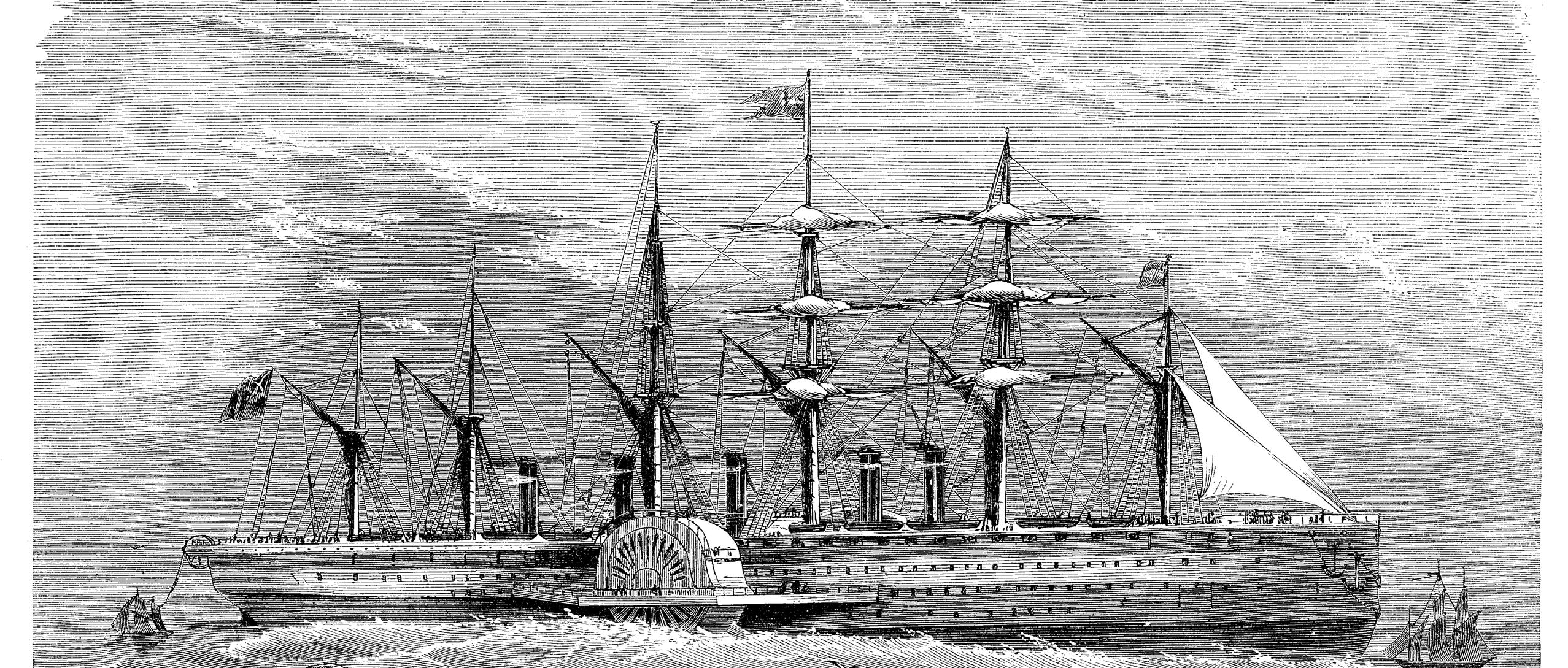
In 1960, Charles Kuen Kao joined Standard Telecommunication Laboratories (STL), the research division of Standard Telephones & Cables Ltd (STC), a wholly owned subsidiary of International Telephone & Telegraph (ITT).
He initially worked in the long-haul waveguide group under Antoni Karbowiak before joining Alec Reeves’ optical research team in 1963. There Kao began working on options for a low-loss optical guiding mechanism, and George Alfred Hockham joined him in this study. They soon began to consider transmitting light through thin fibres of glass, investigating the many issues through a combination of experiments and theoretical analysis, and on 27 January 1966, Charles Kao described their progress to the members of the Institute of Electrical Engineers (IEE) at a conference in London. To mark the event, STC issued a press release from STC House, its headquarters at 190 The Strand in London: Announce fibre communications 1966 | Opti-
The second to last paragraph contained a prophetic statement that would take much hard work and many years to bring to fruition. Kao’s presentation was met with a large amount of scepticism and in some cases ridicule. The telecoms industry was looking for a technology which would offer higher traffic-carrying capacity than the existing coaxial cable network, and waveguide technology was widely seen as the future. However, STC had a particular incentive to make optical fibres a success, as one of ITT’s major profit-making centres was its submarine cable systems division. STC and its predecessors had been the world’s leading suppliers since the inception of the industry in 1850, and waveguide technology was not compatible with submarine cables, so that could not be the way forward for this large part of ITT’s business.
The first transatlantic telephone cable, TAT-1, had been installed between Canada and the UK in 1956, and provided 36 x 4kHz voice channels. Subsequently, advances in technology were implemented in TAT-3 and TAT-
4, installed in 1963 and 1965, which carried 138 x 3kHz voice channels between the USA and UK and France respectively. Although progress was slow in increasing the capacity of submarine coaxial cable systems, no real alternative for transoceanic telecommunications existed. However, in 1965 the first commercial communications satellite, ‘Early Bird’, was launched, and in 1969 Intelsat launched three satellites, creating a global TV and speech communications network that spanned the Atlantic, Pacific and Indian Oceans. By 1973, Intelsat had 80 signatory countries.
Despite the fact that submarine cables offered a better quality of service for telephony, with no perceivable delay or echo, and infinitely better security (because the signals were not airborne), satellites could carry television channels, provided more voice channel capacity, and delivered a cheaper service. By the mid1970s, satellite systems had become the dominant service for transoceanic telephony. The submarine cable industry responded to this challenge by increasing the bandwidth of its systems, but this was only achieved by
reducing the spacing between repeaters. Transatlantic systems TAT-5 (361 repeaters), installed in 1970, carried 856 x 3kHz voice channels; TAT-6 (694 repeaters), installed in 1976, carried 4,000 x 3kHz channels; and TAT-7 (664 repeaters), installed in 1983, with an increased diameter (1.7”) coaxial cable, carried 4,246 x 3kHz channels. The technology had reached its technical and economic limit, and it still did not match the traffic-carrying capability of satellites. Without STC/ ITT’s continued investment in and championing of the development of optical fibre transmission over this period, submarine cables as an industry would almost certainly have been consigned to history.
By 1973, the ongoing research at STL had reached a point where they felt confident to apply for a significant increase in budget. A demonstration to the President of ITT, Harold Geneen, and ITT senior management in Brussels secured the package. That summer, a lightning strike destroyed the communications system in the headquarters of the Dorset police force. The chief constable was advised to contact STC for a solution that would make the system less vulnerable to lightning by replacing the coaxial cable connecting the radio mast to the transmission equipment with a fibre optic link. This was supplied by STL and was up and running by September 1973. It was the world’s first commercial fibre optic transmission system.
In 1976, STL, in collaboration with British Telecom, began a field trial of a fibre cable system linking Hitchin and Stevenage telephone exchanges. This proved that fibre cable could be installed and
jointed under normal field conditions, and could carry 140Mbit/s between the exchanges. The 9km link used multimode fibre and the signal was regenerated every 3km. In 1980, STC conducted another world leading trial by installing submarine optical fibre cable in Loch Fyne to prove feasibility. This trial used both multimode and single mode fibres. In parallel, STC/STL was supporting British Telecom in making and installing single mode optical fibre cable for the Martlesham-Ipswich Monomode Experiment (MIME) which, in 1981, convinced BT that single mode fibre at longer wavelengths was the way forward for both landline and submarine systems.
In July 1979, ITT began selling STC stock to the British public, then in 1983 STC plc became a British company quoted on the London Stock Exchange. Kenneth Corfield had been STC’s Managing Director since 1970 and, having been knighted in 1980, became the company’s Chairman. Sir Kenneth was a great supporter of the submarine cable division and a believer in the future of fibre optics, so ongoing investment in STL and STC’s submarine cables division was secured. In 1984, Corfield masterminded a takeover of UK computer company ICL. His rationale for this move was that technologies were bound to converge, and in the future individuals would have just one device to provide computer, telephone and television services. Instead of lauding Corfield as a visionary, which in hindsight he undoubtedly was, the markets considered his strategy ridiculous and castigated him. The share price plummeted, the company went into decline, Corfield was eventually
forced out, and STC was finally taken over by Canadian company Northern Telecom (Nortel) in 1991. We now know that Corfield was ahead of his time; his acquisition of ICL is a strong indication of the direction of STC’s senior management strategy at the beginning of the Optical Era.
Things were also changing in the USA. On 8 January 1982, the breakup of AT&T, the monopoly provider of transoceanic cables, to form what were called the ‘Baby Bell’ companies, was finalised. While under the settlement AT&T was allowed to retain its long-distance service, following the deregulation of telecoms in Europe, new submarine cable owners known as ‘Carriers’ Carriers’ began to appear. They did not offer a service to end customers, providing capacity only to licenced international carriers. This would lead to an increase and diversification in the submarine cable owner base and more demand for transatlantic cables. The switch from coaxial cable to fibre optic systems would require significant changes in manufacturing processes, operating procedures, and scheduling. Cable and repeaters are generally manufactured at different locations; for example, STC’s cable factory was in Southampton, and their repeaters were made 100 miles away in Greenwich, Southeast London. The coaxial termination joint between the cable and repeater took 2-3 hours to complete, with an additional half hour for testing, and this allowed the system to be assembled on the cableship as the cable was loaded. From a manufacturing standpoint this required all the cable and repeaters to be ready for loading before the cableship was
brought to the berth. Cable manufacture had to commence with the first piece of cable to be laid, so that the bottom sections in the factory tanks could be on top in the ship’s tanks. The repeater manufacturing schedule could be slightly more flexible, but a significant amount of storage was required in the factory so that repeaters could be delivered in batches to the cableship to match the cable loading schedule.
The termination joint and testing procedures for an optical system are far more complex and can take up to 24 hours to complete. Therefore, the process, known as System Assembly and Test (SAT), had to be moved into the cable factory, and all the procedures developed and carried out by STC’s shipboard engineers over the 30 years of repeatered coaxial cables had to be taught to cable factory personnel. One of the most significant of these was the management of cable ends to ensure that they were jointed to the correct repeater without being crossed with other cables! To accommodate these new procedures, an area for SAT had to be set up in the cable factory and the assembly process revised. As with coaxial cables, fibre optic cable manufacture starts with the first section to be laid, as does repeater manufacture, which is scheduled to match the progress of cable manufacture, so less storage space for complete repeaters is required in the repeater factory but a large SAT area is required in the cable factory. Finally, the transfer line from the cable factory to the cableship had to be modified to accommodate the transfer of in-line repeaters safely!
The first transoceanic Optical Fi-
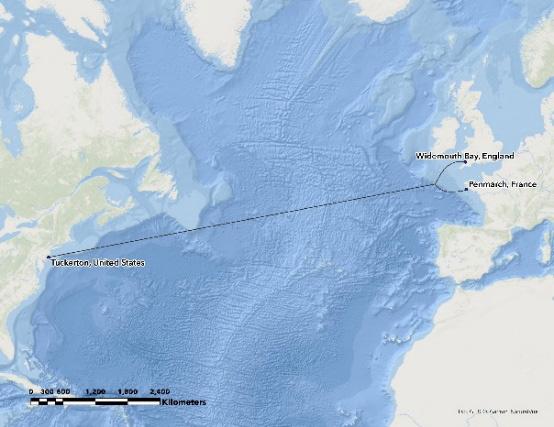
bre system was TAT-8, commissioned by AT&T, British Telecom and France Telecom, for which the planning had begun in late 1980. The system included a new submerged housing, a ‘Y’ shaped Branching Unit (BU) to provide power switching and fibre routing. This allowed a three-legged system to be built. The 5,475km USA leg from Tuckerton, New Jersey to the BU was manufactured by AT&T Submarine Networks, the 360km French leg from Penmarch to the BU was manufactured by Alcatel SubMarcom, and the 870km UK leg from Widemouth Bay to the BU was manufactured by STC Submarine Systems. To achieve the project deadlines purchasers and manufacturers worked together in the Joint Optical Submarine Systems (JOSS) Committees, sharing research and development information. TAT-8 operated at a wavelength of 1,310nm and a line rate of 280Mbit/s over two fibre pairs, providing 8,000 x 64kbit/s voice channels. It went into service on 14 December 1988, nearly twenty-three years after Charles Kao
had told the members of the IEE that such a thing would be possible. With the exception of cable jointing, this would be the end of this level of international technology collaboration. From then on it was out-and-out competition. TAT-8 was taken out of service in 2002 after less than half its 25 years design life. During TAT-8’s lifetime technology continued to advance, with France, the UK and the USA being connected by higher and higher capacity submarine cables.
The first ‘Private’ transatlantic optical fibre system was PTAT-1. It was commissioned by Private Transatlantic Telecommunications Systems Inc. (Cable & Wireless plc and Sprint) and manufactured in 1989 by a single supplier, STC Submarine Systems. This had four fibre pairs operating at a wavelength of 1,310 nm and a line rate of 420Mbit/s, achieving a design capacity of 18,000 x 64kbit/s voice channels. Initially it was planned to connect Brean in the UK and Manasquan in New Jersey, with a spur to Devonshire in Bermuda, but mid-way through
the supply contract a branch to Ballinspittle in Ireland was added. It was taken out of service in 2004.
The next transatlantic cable was TAT-9, again commissioned by a consortium of owners led by AT&T, British Telecom and France Telecom. The system was supplied by Alcatel SubMarcom, AT&T Submarine Networks and STC Submarine Systems and went into service in 1992. The 4,410km system connected SaintHilaire-de-Rez in France with Goonhilly in the UK and Manahawkin in the USA. There were two additional landings: Pennant Point in Nova Scotia Canada and Conil de la Frontera in Spain. Operating at 1,550nm, TAT-9 was the first system to use a line rate of 565Mbit/s, providing a design capacity of 80,000 x 64kbit/s voice channels. In addition, it was the only transatlantic system to include Undersea Branching Multiplexers (UBM). It was operational in time for the opening ceremony of the Barcelona Olympic Games on 25 July 1992. TAT-9 was taken out of service in 2004; it too had operated for less than half its design life, but such was the advance in technology that it had become economically redundant.
Also in 1992, TAT-10, commissioned by AT&T went into service. The transatlantic link from Greenhill in the USA to Norden in Germany was supplied by its subsidiary, AT&T Submarine Systems Inc (SSI). The coastal festoon from Norden to Terschelling and Alkmaar in Holland, was supplied by STC Submarine Systems. It operated at a wavelength of 1,550nm and a line rate of 565Mbit/s and was taken out of service in 2003.
TAT-11 went into service in 1993.
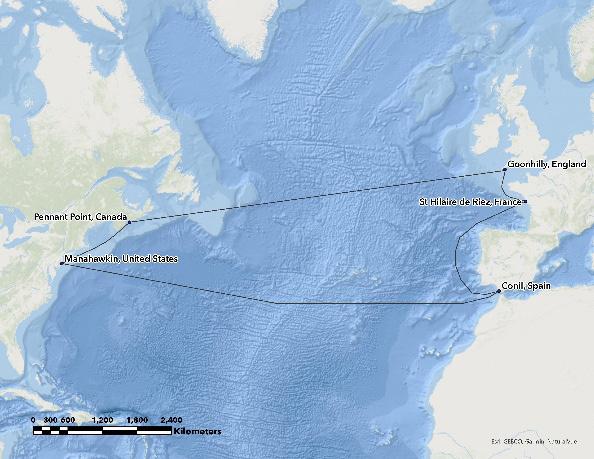
It connected Manahawkin in the USA with Saint-Hilaire-de-Rez in France and Oxwich Bay in Wales. The system operated at a wavelength of 1,550nm with two fibre pairs between the USA and UK and a single fibre pair between the USA and France and the UK and France, all links operating at a line rate of 565Mbit/s. The system was retired in 2004, having been the last TAT system to use regenerative repeaters. The next generation of systems would operate at a wavelength of 1,550nm but would use optical amplifier repeaters.
The next transatlantic cables to connect the USA with France and the UK were TAT-12 & TAT-13. Although numbered separately they were designed as a ring system, the first across the Atlantic, and were the first optically amplified transatlantic systems to be built. As the capacity of submarine cables expanded, the problem for network operators of how to find alternative capacity to reinstate their traffic in the event of a cable fault became more of a concern. Submarine cable capacity had outgrown satellites as a source of
restoration, and the quality of service on satellite links wasn’t good enough for most cable customers. The solution was to build a ring network; this would allow the north and south cables to each carry up to a maximum of 50% of their total design capacity, so that in the event of a fault on one cable its traffic could be switched to the spare capacity on the other cable in milliseconds. This appeared to be an elegant solution, but there was a major problem. Because of the reliability of submarine cables across the Atlantic (one fault every 2-3 years), ring networks had 50% of their capacity unutilised for most of the time. The money men came up with a solution: customers who had bought the first 50% of the capacity were guaranteed restoration. This was called ‘Protected Capacity’, and the cable operator would then sell capacity in the other 50% as ‘Unprotected Capacity’ at a lower unit price. The only problem with this commercial solution was that owners of ‘Unprotected Capacity’ could enjoy uninterrupted service for months if not years until they experienced a cable fault and
lost connectivity. When this happened, they were not happy!
The purchasers’ agreement for TAT-12/13, known as a ‘Construction & Maintenance Agreement (C&MA), was signed on 16 December 1992 by 45 carriers from 34 countries, led by AT&T, British Telecom and France Telecom. The supply contracts were awarded early in 1993 to AT&T
were carried out using Universal Jointing (UJ) technology. In the USA the ring was completed by a 162km repeaterless link between Greenhill and Shirley, supplied by AT&T SSI and installed in the autumn of 1994. At the European end, a 370km cable between Penmarch and Porthcurno in Cornwall UK was supplied by Alcatel SubMarcom; it contained 4 repeaters
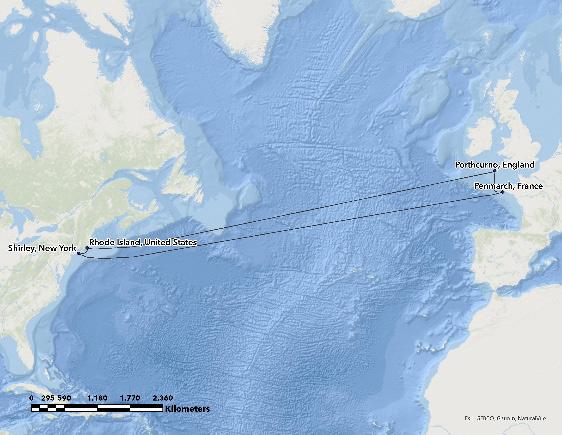
SSI, Alcatel SubMarcom and STC Submarine Systems. The northern cable connected Greenhill, Rhode Island in the USA with Bude in Cornwall. Installed in the summer of 1995, it was 5,913km (3,759km STC + 2,154km AT&T SSI) long and contained 133 repeaters spaced 45km apart. The southern cable connected Shirley, Long Island in the USA with Penmarch in Brittany, France. It was 6,321km (4,127km AT&T SSI + 2,194km Alcatel) long with 140 repeaters spaced 45km apart, and was installed in the summer of 1996. Each supplier provided its own design of repeaters and the mid-ocean interfaces between the different cable designs
spaced 74 km apart and was installed in the spring of 1995. Each link had 2 fibre pairs and operated at a wavelength of 1,550nm and a line rate of 5Gbit/s, giving a total design capacity of 10Gbit/s. The complete ring network went into service in September 1996 and was taken out of service on 31 December 2008.
The supply contracts for TAT-12/13 were let to AT&T SSI, Alcatel SubMarcom and STC Submarine Systems; however, in the early 1990s Nortel had run into financial difficulties. Despite STC Submarine Systems’ success, it had always been an outlier to Nortel’s core business, and in 1994 it was sold to Alcatel Alsthom. The last trans-
atlantic system to be supplied by STC Submarine Systems was CANTAT-3. It was purchased by a consortium of Teleglobe Can-
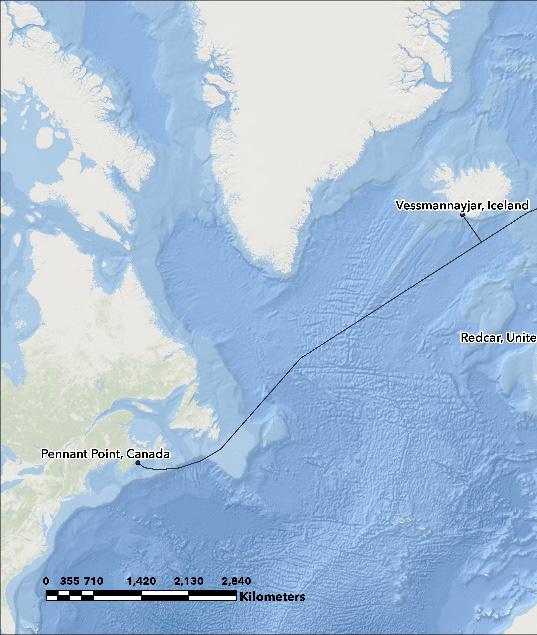
ada Inc, Deutsche Bundespost Telekom, Telecom Danmark, the Iceland PTT, and British Telecom plc. It was the last first-generation regenerative repeatered system across the Atlantic, and the first to use SDH and SONET transmission technology. Using NL 16 lasers operating at 1,550nm over 3 fibre pairs with a line rate of 2.5Gbit/s, it was the first system to offer 30,000 x 64kbit/s voice channels per fibre pair. The cable was manufactured at STC’s factories in Portland Oregon and Southampton. This 7,500km system was the first optical fibre system to connect Canada with Europe, with 89 repeaters spaced at 87km intervals and three fibre routing BUs. It went into service in 1994 and connected Pennant Point Nova Scotia to Redcar in the UK, Blaaberg in Denmark and Sylt in Germany, with additional spurs to Vestmannaejar in Iceland and Tjørnuvik in the Faroe Islands. It was taken out of service in 2010.
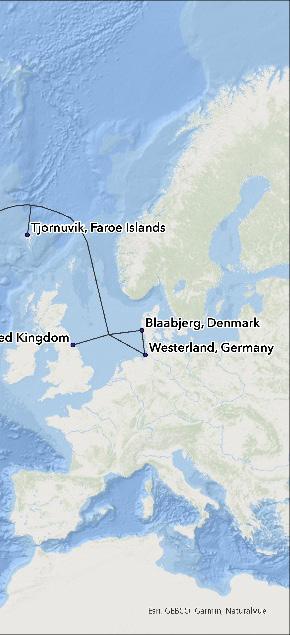
(1994-2010)
By November 1994, the newly merged company was operating as Alcatel Submarine Networks (ASN). It had inherited two different cable designs and two different repeater types, with four cable factories and two repeater production facilities. Also, apart from its significant share of TAT-12/13, STC had another important contract in hand, Rioja, another optically amplified system. Significant rationalisation was required. It was decided to close STC’s Portland, Oregon and Alcatel’s Botany Bay cable factories, and once the cable currently under manufacture at the Southampton factory and its associated SAT was complete, it too was closed in 1997. ASN would base its cable supply on the Alcatel design manufactured in the Calais factory that had been in operation since 1891. When it came to repeaters, the STC housing had a number of better design elements and some excellent low-cost features. Steel was used for the housing, with a robust epoxy coal tar coating that was easy to apply, and the electrical integrity was maintained by an internal polyethylene sleeve. The glanded bulkhead was watertight and it had far superior hydrogen management. Perhaps the most significant design feature was the armour clamp assembly. Invented by John Crownshaw; the ‘Crownshaw Clamp’ is fitted to almost all repeaters. By contrast the Alcatel repeater had a major cost problem, as the internal unit was
over-moulded to provide electrical integrity and the moulding machine that did this was enormous. Not surprisingly, ASN decided to go forward with the STC design, the Marcoussis facility in southern Paris was closed, and repeater manufacture centred on the Enderby Wharf site in Greenwich. This had been a submarine cable manufacturing site since 1857. By Christmas Eve 1994, two completed Rioja repeaters were in the cold tank.
Rioja comprised three segments, with landings at Porthcurno in the UK, Santander in Spain, Verne in Belgium and Alkmaar in Holland. The supply contract was let to STC Submarine Systems by British Telecom, Telefonica, Belgacom and KPN. It was the first optically amplified submarine system to be installed in Europe. Finally installed under the ASN banner, it operated at 1,550nm with a line rate of 2.5Gbit/s over two fibre pairs and went into service in 1995. At that time the industry was struggling with Polarisation Mode Dispersion (PMD) that
took time to resolve. Rioja was an important system because it was the first submarine system to trial Wave Division Multiplex (WDM). During early experiments it was found that the optical amplifiers could simultaneously amplify signals at two or more wavelengths (λ). This capability was initially developed over terrestrial systems but had yet to be tested over an installed submarine system. During the commissioning phase of Rioja S1, from Porthcurno to Santander, ASN carried out the first WDM trial. The segment length was 939km with 10 optical amplifier repeaters 90km apart, so to simulate a transoceanic length the fibres were looped at each end to create a test length of 3,711km with 40 amplifiers in series. The test comprised 4λ x 2.5Gbit/s using a 231-1 Pseudorandom Binary Sequence (PRBS) pattern. The success of this trial quickly led to 16λ WDM, then the ability to reduce the spacing between wavelengths was further developed for terrestrial systems, giving birth to Dense Wave Divi-
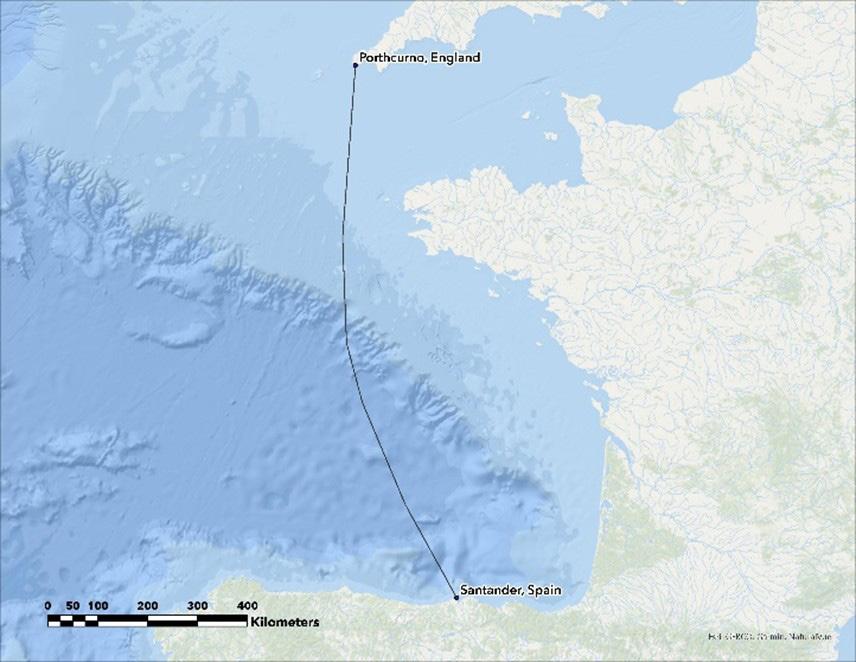
sion Multiplexing (DWDM), which was quickly taken up by the submarine cable industry. In a relatively short timescale, the available capacity on a fibre pair for an optically amplified system had moved from one λ at 5Gbit/s in the mid-1990s to an industry standard offering of 64λ, each carrying 10Gbit/s — making 640Gbit/s — by the year 2000.
By the mid-1990s the world’s oceans were spanned by >900,000km of operational submarine fibre optic cable systems, which carried over 95% of all international telecommunications traffic. This traffic comprised a mixture of voice, text, pictures, video and commercial data. By far the greatest concentration of this traffic was across the Atlantic between Europe and the Americas.
Liberalisation, plus advances in system design capacity through DWDM, combined with the ‘dotcom’ boom of the late 1990s, led to an unprecedented build of new transoceanic cable systems. The system owners were all chasing an over-optimistic forecast of massive growth in traffic. However, in reality it was the supply of new capacity and not the demand for it that was spiralling. This meant that there was significant overcapacity on transatlantic routes, and this drove prices down. The low-capacity first-generation systems quickly became uneconomic to operate and were decommissioned. In addition, due to their inability to achieve predicted revenues, a number of the surviving second-generation optically amplified systems changed hands at fire-sale prices. In the end there were seven transatlantic systems that survived, all competing for the available mar-
ket. These were: AC-1, owned by Global Crossing, which went into service in 1999; AC-2, then owned by Global Crossing [formerly Yellow, built for Level 3], in service in 2000 and now owned by Lumen; FA-1 North/South [formerly Flag Atlantic] in service in 2001; Hibernia Atlantic [formerly 360 Atlantic] in service in 2001; TAT-14 in service in 2001; TGN in service in 2001; and Apollo North/South in service in 2003.
Because of the large number of cable systems and the available capacity, the transatlantic market was, and still is, one of the most competitive in the submarine cable telecommunications industry. Connections between the USA and Europe are critical to financial markets. In particular, fast connections between London and New York are important for a small number (15-20) of banks that engage in ‘high frequency trading’. For these companies, a few milliseconds difference in transmission rates can make a huge difference in profits. They
will always look for the quickest connection and if one bank has it, then the others must follow; so it is an all-or-nothing market where the customer is prepared to pay a significant premium. Therefore, in this segment of the market, achieving the lowest latency connection between principal global financial centres provides a competitive advantage to the cable owner.
Latency, or round-trip delay (RTD), is a measure of the time required to transmit a data packet from one location to another and back, and is a function of route length and system design. AC-1 was the first to claim the lowest RTD connection across the Atlantic. The shortest transatlantic link connecting Brookhaven in the USA with White Sands Bay in the UK contains 2 fibre pairs initially equipped with 8λ x 2.5Gbit/s. AC-1 was originally owned by Global Crossing but was acquired by Level 3 Communications in 2011 and then by Century Link in 2017. The system had a design
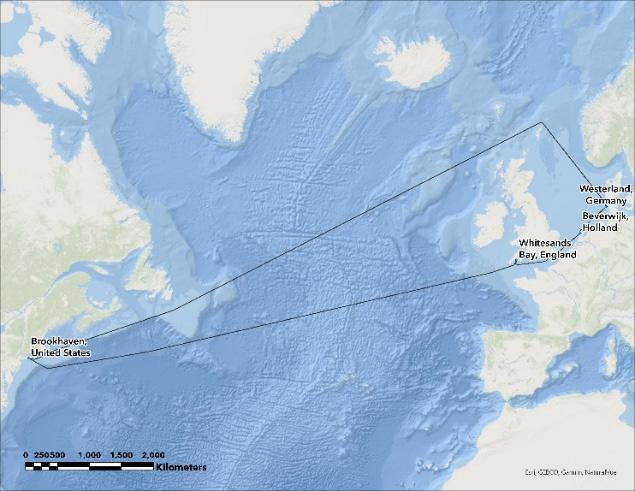

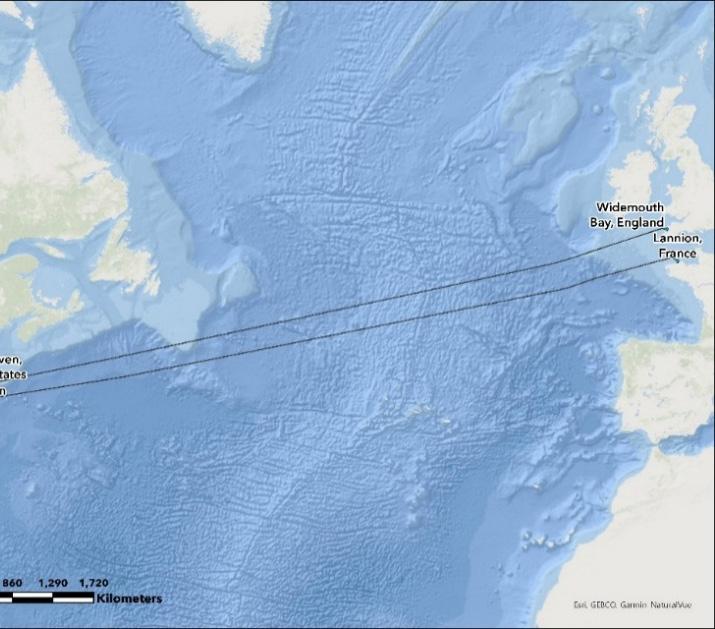
life of 25 years, but in May 2023 Global Crossing Communications applied to the FCC for a new landing licence for a further 25 years.
In early 2002, ASN entered a joint venture agreement with Cable & Wireless plc (C&W) to build a transatlantic system called Apollo. The UK based company formed was Apollo Submarine Cable System Ltd, in which ASN took an equity stake. This was a unique model for the Optical Era, but harks back to the Telegraph Era, when many of the Eastern Telegraph Company’s cables were built by Telcon and paid for, in part, with shares in the operating company.
The Apollo system has a ring structure: Apollo North is 6,200km and Apollo South approximately 7,000km. Both segments support four fibre pairs with an initial design capacity of 3.2Tbit/s, giving a total system capacity of 6.4Tbit/s. It went into service in February 2003. In 2014, it was upgraded to a total system capaci-
ty of 25Tbit/s with Alcatel-Lucent’s 1620 Light Manager (LM) submarine line terminal equipment using coherent transmission at 100Gbit/s. In 2015, a capacity of 8Tbit/s per fibre pair was achieved. The collaboration between C&W and ASN produced a system design that was built for maximum reliability. Apollo is now owned by Vodafone but can still claim the best fault history when compared to any other optical fibre system crossing the Atlantic.
Apollo was, in many respects, a replacement for the Gemini cables. Gemini was commissioned by a private company, Gemini SCSL, a joint venture between C&W and WorldCom Inc., and supplied by ASN. It had two
transoceanic cables: Charleston, Rhode Island USA to Oxwich Bay, Swansea, Wales, and Manasquan, New Jersey USA to Porthcurno. The combined lengths of these two cables was 12,115km, and the ring was completed by terrestrial cables at each end. It was originally designed to operate with one λ (1,550nm) and a line rate of 2.5Gbit/s but commissioning tests showed that it could operate at 8λ x 2.5Gbit/s per fibre pair giving an initially system capacity of 80Gbit/s. It went into service in October 1997, so it was the second optically amplified system across the Atlantic. Because ASN had built on their experience of their Rioja trial, Gemini was the first transatlantic system to be commissioned with enhanced capacity due to WDM. It was retired in January 2005.
After Apollo, although demand grew steadily, no new transatlantic cables were built for over a decade. This was because of the unused capacity that was already available in the market. In addi-
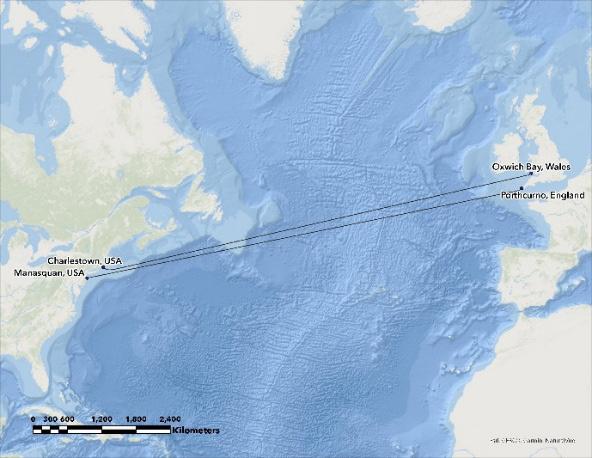
tion, the advances in transmission technology, through DWDM and other coherent technologies, enabled the existing systems to first absorb the traffic growth and then be upgraded, well beyond their original design capacity, to accommodate further increase in demand.
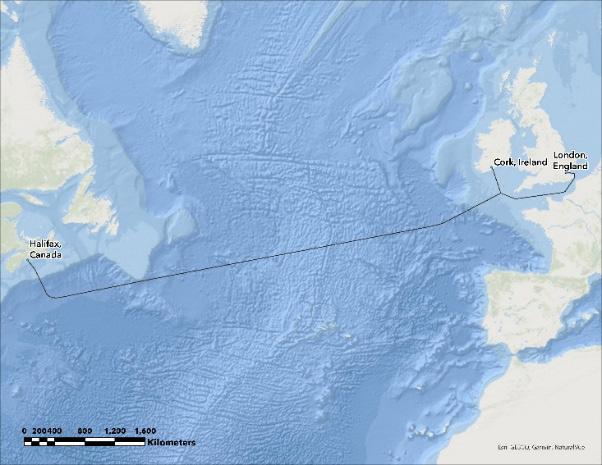
On 15 September 2015, Hibernia Express went into service, a 4,600km system connecting Canada with the UK. Supplied by TE SubCom llc and specifically designed for the financial community, it has 6 fibre pairs and is equipped with 100λ x 100Gbit/s, providing an overall capacity of >53Tbit/s. In January 2017, it was acquired by GTT and became GTT Express. In September 2021 it was purchased by EXA Infrastructure and renamed EXA Express. This system currently offers the lowest latency route between London and New York, with a RTD of 58.55ms.
In the past decade, companies such as Amazon, Facebook (Meta), Google and Microsoft
have entered the market as system owners, and this has driven a demand for even higher fibre count repeatered systems to interconnect their data centres. This has resulted in the development of twenty-four fibre pair systems delivering capacities >30Tbit/s, and a new generation of Branching Units (BU). These BUs support enhanced electrical switching capability with sophisticated optical paths, including Full Fibre Drop (FFD) fibre pairs switching, and Optical Add-Drop Multiplexing (OADM) wavelength switching, over and above simple fibre routing.
In July 2023, the Amitié/AEC-3 cable went into service. Supplied by ASN, it connects Lynn in Massachusetts, USA, with Bude in Cornwall, UK and Le Porge in the Gironde in France. The system is owned by a consortium of Meta, Microsoft, Aqua Commons and Vodafone. It is made up of three segments connected via the latest BU design: Segment 1-1 from Lynn to BU1 is 5,276km with 16 fibre pairs having a design capacity of 20.1Tbit/s; Segment 1-2 from BU1 to Bude is 645km with 12 fibre pairs having a design capacity of 20.1Tbit/s; Segment 1-3 from BU1 to Le Porge is 871km with 12 fibre pairs having a design capacity of 20.1Tbit/s. Although the
landing points are different, this system echoes the architecture of the first transatlantic optical fibre system, TAT-8.
On 4 September 2025, ASN announced in a press release that it had successfully completed a field trial on Amitié/AEC-3 utilizing its SMAT3 coherent technology. It stated:
‘This trial exceeded previous industry benchmarks in terms of spectral efficiency, achieving a remarkable 7.52bit/s/Hz and a spectral efficiency of 6.17bit/s/Hz if we take into account only the usable ethernet payload, with an 800G line rate single carrier over live traffic using 400GE clients. It addresses the fibre pair with the most comprehensive WSS functionality, providing a capacity of 24Tb/s per fibre pair using 400GE/800GE clients with operational margin.
ASN’s latest commercial transponder technology, SMAT3, was used with water-filling adjustment, achieving an operating speed of 130 Gbaud and facilitating next-generation coherent transport with capacities of up to
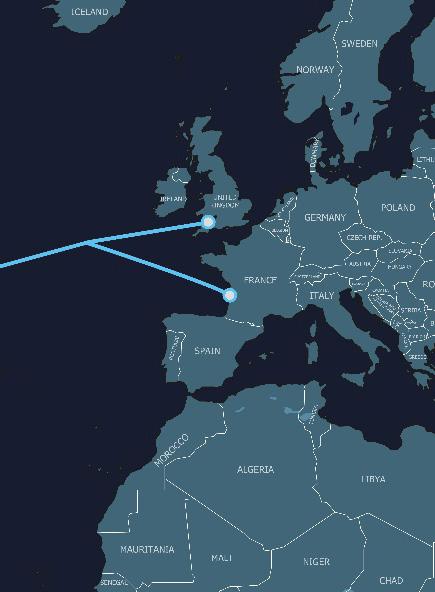
(2023 – In Service)
Submarine Networks
1.2 Tb/s per wavelength.’
Sixty years have passed since Charles Kao stood in the lecture hall at the IEE and made his prediction that transoceanic fibre optic cables were achievable. It has been a long road to today’s submarine cables environment, and a few brilliant and dedicated scientists, engineers and chemists from around the world found practical solutions to every problem that they encountered. The British were central to, and led the way in, this world-changing revolution that saved the submarine cable industry from extinction. While we have been unable to recognise in this article most of the British pioneers (many of whom are no longer with us) and their contributions, they should never be forgotten, so we have done our best to list them in the Acknowledgements!
The authors would like to thank Kieran Clark of WFN Strategies for providing the early system maps that we have used. Also, special thanks to Oliver Henry and the ASN MarComs team for approving the ASN content from 1994 onward and for permission to use the Amitié/AEC-3 map. However, most importantly, we acknowledge the British pioneers who gave our industry such a great future: Bill Burchell, Kevin Byron,
Howard Chan, Sabih Chaudry, Martin Chown, Peter Colgate, John Crownshaw, Richard Epworth, Duncan Gunn, Steve Hill, George Hockham, John Irven, Alan Jeal, Kevan Jones, Steve Jones, Charles Kao, Paul Kirkby, Garth Lamb, John Leach, John Lees, Paul Lighty, Jock Marsh, John Midwinter, Paul Morkel, George Newns, Nigel Parsons, David Payne, Simon Poole, Murray Ramsay, Alec Reeves, John Russell, Charles Sandbank, Sebastian Savoy, Peter Selway, Alice Shelton, Dimitra Simeonidou, Gary Speed, Chris Stark, Clive Stewart, Nigel Taylor, John Tilly, Raymond Uffen, Derek Willets, Bob Williamson, Peter Worthington and Robin Worthington.

Bill Burns is an English electronics engineer and historian whose career began at the BBC in London before moving to New York in 1971. His discovery of a section of the 1857 Atlantic cable sparked a lifelong focus on undersea cable history. He founded the Atlantic Cable website and has visited every surviving telegraph cable station worldwide.

Stewart Ash has spent his entire career in the submarine cable industry since graduating in 1970. From development and installation roles at STC to senior leadership at Cable & Wireless Marine and Global Marine Systems, he later became an independent consultant. A noted cable
historian, he has authored multiple works, including The Cable King.

Stuart Barnes is Chairman of Xtera and a veteran submarine systems technologist. Educated at Queen Mary College London, he worked on early optical cable and repeater systems at STL and held senior roles at STC, Nortel, and Alcatel. He co founded several technology companies and is Visiting Professor of Electrical Engineering at Southampton University.

Philip Black is a pioneering optical fibre engineer who led the development of low loss fibre manufacturing processes at STL. He later became Technical Director of STC Submarine Systems and a board member of ASN. His career spans research leadership, international standards work, patented innovations, and independent consultancy in submarine systems.

Chris Swan is a former senior executive of STC Submarine Systems and Alcatel Submarine Networks. Educated at Imperial College London, he led optical cable and fibre development before holding senior roles in marketing and customer support. His background bridges applied chemistry, manufacturing, and global submarine cable system operations.
By Grace Koh
“What crazy news to ring in the new year!”
This was the second WhatsApp message I received in 2026. The first message was a link to an article describing the Finnish detention of a cargo ship headed for Saint Petersburg, accused of deliberately cutting submarine cables in the Baltic Sea.
Unfortunately, incidents like these are hitting mainstream news with greater frequency. The articles I read on New Year’s Day pointed to increasing cable disruption in the Baltic Sea as part of a suspected “hybrid war” campaign conducted by the Russians. Finnish President Alexander Stubbs tweeted, “Finland is prepared for security challenges of various kinds, and we respond to them as necessary.” This is a new public policy environment for submarine cables, for which the only truly durable solutions will require a rich public-private dialogue.
Governments worldwide are increasingly alert to the risks facing submarine cables, and they are eager to act. In the United
States, Congressional interest has surged. While the 115th Congress (2017-2018) saw no bills focused on submarine cables, the 119th Congress (2025-2026) introduced at least seven bills that regulate submarine cable deployment, security, or repair. Approximately five more bills require government agencies to assess various aspects of the submarine cable ecosystem for a total of twelve bills. In the past ten years, the submarine cables have moved from the backwater of U.S. Congressional policymaking to a national security and infrastructure priority.
This trend isn’t limited to the United States government, of course. The EU Parliament similarly increased its activity. The 10th Euro-
capacity of submarine cables and hybrid attacks in the Baltic Sea. This activity caps the ramp up that occurred from 2022-2024 in the 9th EU Parliament term. The 8th term saw only two questions related to specific submarine cable transactions. The policy makers in the Middle East, the Indo-Pacific, and east Asia are increasing work on submarine cables, as are multilateral organizations, such as North Atlantic Treaty Organization (NATO) and the International Telecommunication Union (ITU). Brazil just concluded a public consultation on submarine cables to develop its National Submarine Cable Policy. The upshot to all these government initiatives is that submarine cables are no longer treated as neutral telecom
“Submarine cables are no longer treated as neutral telecom assets—they are now viewed as strategic, vulnerable, and security-critical infrastructure.”
pean Parliament term (2024-29) has kicked off with the three documents on securing undersea cables, most notably the EU Action Plan on Cable Security as well as five questions examining repair
assets. Governments now view submarine cables as strategic, vulnerable, and security-critical infrastructure across the globe.
The recent rise in geopoliti-
cal threats – such as the war in Ukraine as well as superpower competition between the United States, China, and other countries – have all combined to alert governments to the potential vulnerability of this critical infrastructure.
A second factor in the increase in policymaking and regulatory activity is the notion that “economic security is national security.” The G7 governments at the Hiroshima Summit in May 2023 produced a statement that “ensuring economic resilience and economic security globally remains our best protection against the weaponization of economic vulnerabilities.” Economic security now encompasses a wide range of government interventions in multiple jurisdictions to address market failures or risks, from preventing sensitive technology transfers and securing critical minerals to mitigating pandemics, infrastructure security, climate change, and supply-chain vulnerabilities.
Many of these government policies primarily aim to deny access to critical infrastructure, technologies, or markets by perceived adversaries or foreign entities. These measures often include export controls, investment screening, and limitations on supply chain participation, with the intent of preventing potential security threats. While such regulations can be effective in addressing specific vulnerabilities, they can also have the unintended consequence of restricting resilience, innovation, or investment. As a result, denial-focused approaches may inadvertently cre-
ate barriers to economic growth, international collaboration, and the modernization of essential infrastructure.
In the case of submarine cables, traditional, denial-focused strategies (such as restricting foreign supply chain access) are necessary but insufficient. And because submarine cables are inherently vulnerable and cannot be fully hidden or hardened, national security must also prioritize regulatory modernization and proactive support for industry-led resilience. The first defense against disruption has always been infrastructure redundancy. This includes reducing bureaucratic barriers to cable deployment and repair, updating outdated legal penalties for cable damage, and supporting geographic diversity to avoid single points of failure.
This means enriching the notion of “national security” with the mandate to support increased economic activity. This is a significant change in attitude when it comes to national security regulation. It requires governments to recognize that denial is not the only means of bolstering national security.
And it requires the private sector to better engage with government. As governments move to protect this critical infrastructure, industry may be concerned that government action will mean more regulation, more cost, and more delay. Yet, the heightened attention presents a golden opportunity for the private sector and technology vendors to educate policymakers to help ensure that the resulting actions ultimately improve the situation.
A productive public–private dialogue is essential. On the one hand, governments bear the weighty burden of ensuring the security and resilience of a critical infrastructure, but they often lack the operational and technical expertise and do not own or control the cables. The fact remains that much of the submarine cable infrastructure is deployed, maintained, and secured by private companies. Submarine cable deployment is not a commercial activity for the faint of heart. It takes enormous capital resources and a

hefty tolerance for chaos and ambiguity. Public funding is limited, and private equity is scarce. Accordingly, policymakers must consider how their actions affect the commercial incentives of cable owners and operators.
The best public policy is formed when an ongoing public-private dialogue can agree on how to achieve significant societal goals. These agreements result in durable, lighter touch regulatory regimes that have the potential to shape industry to meet public policy priorities.

For the private sector, failure to engage can mean, at worst, debilitating regulation in the name of national security that does not actually contribute to a robust and secure submarine cable ecosystem. At best, we lose out on opportunities to improve conditions for the deployment and maintenance of cables.
Recent U.S. regulatory recommendations illustrate this dynamic. The Federal Communications Commission (FCC) proposed the first change to its submarine cable landing licenses rules since 2001. Among other things, the proposed rules initially considered shortening the license terms from 25 years to 5 years. Industry quickly engaged to explain that a shortened license term would harm the FCC’s goals of creating a more secure and resilient network of submarine cables. Specif-
ically, the regulatory uncertainty would deter investment and planning in submarine cables. The upfront investment of millions or billions of dollars is made with the expectation of a 25-year lifespan for the cable. Shortening the license term would introduce significant uncertainty for investors and operators, making it less attractive to invest in new cables or upgrades. The risk that a license might not be renewed discourages long-term planning and investment, potentially killing projects or reducing interest in U.S. cable landings. This unpredictability could slow the expansion and modernization of critical infrastructure, harming U.S. economic and national security interests.
Ultimately, the FCC was persuaded that a shortened license term would not serve the public interest and adopted interim reporting requirements instead.
But industry can also take this opportunity to shape changes in regulations. Governments are recognizing that complicated permitting and licensing regimes make it difficult to deploy cables. The EU Recommendation on the security and resilience of submarine cable infrastructure noted that national governments should
“ensure that the most rapid treatment legally possible is given” to applications for submarine cable permitting. Similarly, the U.S. Department of Homeland Security (DHS) stated in its Priorities for DHS Engagement on Subsea Cable Security & Resilience, “Enhancing the overall reliability and predictability of government licensing and permitting processes is key to achieving the United States’ interests in maintaining a leadership role in the subsea cable industry.” These are just a few examples that show Government is willing to put its money where its mouth is and to consider streamlining some of the onerous permitting regimes to further submarine cable security and resiliency. In fact, the introduction of the Undersea Cable Protection Act of 2025 is the direct result of sustained engagement by industry with officials at the National Oceanic and Atmospheric Administration, other agencies at the Department of Commerce, and members of Congress. If passed, the bill would eliminate costly and duplicative permitting requirements in national marine sanctuaries for subsea cables, potentially opening new routes and streamlining the time required to deploy submarine cables particularly on the West Coast of the United States. Policymakers in Congress (as well as in government agencies such as DHS or the FCC) are interested in bolstering submarine cable resilience and security. When industry explains the potential implications and challenges caused by oner-
ous submarine cable permitting requirements, policymakers can act to improve them and suggest alternative policies.
These government efforts are not limited to the United States. The European Commission has currently tasked an Expert Group with issuing a report on the Security and Resilience of EU Submarine Cable Infrastructure. Members of industry are currently participating in a review of the expected report to ensure that it accurately captures the state of the industry and that the recommendations support the private sector’s investment in this critical infrastructure. Similarly, the Indonesian government has also convened a National Subsea Cable Team under the Coordinating Food Affairs Ministry (formed in 2025), to manage and protect its crucial submarine cable infrastructure from threats like theft, coordinate deployment, optimize space, and encourage investment, working with international partners like Australia to adopt best practices. These efforts aim to streamline chaotic routing, address security concerns, and leverage cables for economic and data security, involving various agencies under a whole-of-government approach.
of opportunities where industry can engage and provide expertise. When doing so, it is important to keep several principles in mind.
Recognize the government’s priorities: Governments have legitimate concerns about the critical nature of the submarine cable infrastructure. National security is a legitimate concern. Ecological conservation, health of the fishing industry, or a domestic source of critical minerals are legitimate concerns for a diverse citizenry. It is not enough for industry to argue simply that the threats are imagined or that other industries are less important. Industry must recognize that policymakers have the difficult task of balancing multiple important equities.
Demonstrate that our values are shared: The private sector has long prioritized the security and resilience of submarine cables as commercial imperatives. Many government officials are unaware of the extent to which
in the economics or technologies of the business. They often do not understand the technical limitations or the economic drivers for business practices. Often, governments will respect the efficiencies that the private sector has created and seek to disturb them as little as possible.
Be realistic and flexible: Industry may need to understand that governments may not find commercial practices sufficient for meeting government goals. In those instances, dialogue with the government is even more important to craft a practical path forward. An honest dialogue with real facts about commercial practices can help to shape a solution.
GOVERNMENTS HAVE AN IMPORTANT ROLE IN COORDINATING BETWEEN AGENCIES, BETWEEN PUBLIC-PRIVATE EFFORTS, AND MULTILATERAL EFFORTS
“Failure by industry to engage with government can result in debilitating regulation in the name of national security that does little to strengthen the submarine cable ecosystem. By contrast, sustained public–private dialogue can produce lighter-touch, more durable regulatory regimes that improve security, resilience, and long-term investment in critical infrastructure.”
In world that has recently recognized the importance of submarine cables, there is no shortage
cable operators implement security measures, conservation controls, or other actions. Educating policymakers on the steps that industry has taken to further public policy priorities can show governments that the goals are shared. Government officials, particularly the political decisionmakers, are typically not steeped
Governments must come to the table ready to engage as well. National security must mean supporting economic activity in addition to the conventional wisdom that denial-based approaches still protect national interests. For governments, supporting economic activity requires coordination with the private sector as discussed above. It also requires coordination across and within its national security branches and its economic activity branches, as well as inter-governmental coordination in multilateral institutions.
Given that submarine cables are inherently international—crossing

multiple jurisdictions and governed by diverse regulatory systems—multilateral cooperation is essential. Governments should participate in global forums and regional alliances to harmonize regulatory standards, share threat intelligence, and develop joint protocols for cable protection and rapid incident response. Collaborative efforts can include establishing best practices for permitting and licensing, coordinating security measures against hybrid threats, and investing in redundancy and geographic diversity to minimize single points of failure. By working together, governments can reduce bureaucratic barriers, avoid conflicting regulations, and foster a resilient, secure, and innovative global communications network that benefits both public and private stakeholders.
Multilateral coordination is particularly important when it comes to enforcement activity. Deterrence of maritime malfeasance is tricky to define and enforce. First, attribution is inherently challenging: cables lie thousands of meters underwater, incidents often occur far from witnesses, and distinguishing deliberate sabotage from accidents (such as fishing or anchoring) requires sophisticated forensic evidence that may be inconclusive. Second, jurisdictional
complexity complicates enforcement, since cables traverse territorial seas, exclusive economic zones, and the high seas,
each governed by different legal regimes and involving multiple states with overlapping or unclear authority. Third, gaps and ambiguities in international law—particularly regarding enforcement mechanisms and penalties under instruments like United Nations Convention on the Law of the Sea (UNCLOS)—limit states’ ability to investigate, detain, or prosecute foreign vessels. Fourth, political and diplomatic constraints can deter action when suspected actors are state-linked or when enforcement risks escalation, retaliation, or economic fallout. Finally, common capacity constraints, including limited maritime patrol resources and weak coordination between civilian cable operators and government authorities, reduce the likelihood that violations will be detected, investigated, and successfully penalized. Discussion with the private sector to understand and map commercial operations and practices are critical inputs to defining multilateral solutions to these challenges.
Most importantly, national security should be redefined as a shared responsibility—one that recognizes the critical role of private investment and innovation, and that balances security with the need for a robust, flexible, and globally integrated commu-
nications network. The current geopolitical situation is likely to keep submarine cables in the government spotlight. Public-private dialogue is crucial—not only to prevent counterproductive regulation but also to address long-standing challenges and ensure the resilience of this critical infrastructure.

Grace Koh is Vice President of Government Relations at Ciena, leading the company’s public policy strategy and government engagement. Previously, she served as Head of Office and Vice President of Government Affairs for Nokia North America and as U.S. Ambassador to the ITU World Radiocommunication Conference. She was also a Partner at DLA Piper’s Global Telecom Practice. Koh holds a BA from Yale and a JD from the University of Pennsylvania.

by Kristian Nielsen
The closing months of 2025 and the start of 2026 have underscored that undersea cables – the unseen arteries of the global internet – remain at the center of geopolitical fault lines.
In the period from November 2025 through January 2026, governments and industry players worldwide advanced new policies, alliances, and safeguards to protect these submarine cable networks amid rising national security concerns and incidents. U.S. policymakers characterized fiber-optic cables as “strategic” infrastructure forming “the bedrock of global internet traffic”[1], while NATO and European leaders warned of “hybrid threats” targeting undersea links[2]. This update continues our “Fault Lines” coverage with a global overview of recent developments – from regulatory crackdowns and consortium realignments to military responses and resilience initiatives – that are reshaping the submarine cable market. Each region is navigating the delicate balance between cooperation and confrontation beneath the waves, as critical cables become entangled in great-power rivalry and security imperatives.
National Security Policies Tighten: In the United States, regulators accelerated efforts to shield undersea cables from foreign adversaries. The Federal Communications Commission (FCC) in November 2025 advanced a Further Notice of Proposed Rulemaking aimed at barring high-risk foreign technology from U.S.-linked cable systems[3]. The proposal would prohibit companies from using equipment made by entities deemed “foreign adversaries” – a clear reference to Chinese vendors –at submarine cable landing stations and terminals[4] [5]. It also suggests requiring existing licensees to remove compromised components from networks before licenses expire[6]. In exchange, the FCC seeks to expedite approvals for cables that meet these stricter security standards, even offering “blanket
licenses” for trusted operators of Submarine Line Terminal Equipment[3]. This regulatory push aligns with a broader U.S. policy of preventing espionage and sabotage via critical telecom links.
Congressional Scrutiny and Legislation: U.S. lawmakers likewise elevated subsea cables as a national security priority. In November, the House Homeland Security Committee held a dedicated hearing entitled “Securing Global Communications: An Examination of Foreign Adversary Threats to Subsea Cable Infrastructure”[7]. Committee leaders warned that “adversaries like Communist China and Russia are working to exploit our vulnerabilities and undermine this critical infrastructure”[8]. One congressman bluntly stated that if the Chinese Communist Party “can tap it, cut it, or corrupt it, they will”[9] – reflecting mounting concerns over cable tampering and surveillance. On the legislative front, a bipartisan group of senators introduced the Strategic Subsea Cables Act of 2025 to bolster U.S. engagement in undersea cable security[10] . The bill calls for a multi-pronged strategy: increased State Department focus (including dedicated staff) on cable diplomacy, greater U.S. participation in international cable protection forums, and the establishment of an interagency committee to coordinate threat response[11]. Notably, it would mandate sanctions against any foreign actors who intentionally damage subsea cables[12] – a strong deterrent aimed at state-sponsored saboteurs. Lawmakers backing the bill cited a spike in cable cuts in the Baltic Sea and Taiwan Strait as evidence that the U.S. “must respond” to protect these “critical infrastructure” assets[1][13] .
“Undersea cables –of the global internet center of geopolitical
Consortium Shifts and Market Responses: In parallel with government action, industry stakeholders have been realigning to meet security demands. Major U.S. tech firms – Google, Meta, Microsoft, and Amazon – faced congressional queries in 2025 probing whether any cables they operate use equipment from China’s HMN Tech (Huawei Marine) or other adversary-linked providers[14]. This
scrutiny has largely driven American companies to favor Western vendors for new cable projects. Indeed, several international cable consortia have quietly restructured to exclude Chinese suppliers in recent years, even before formal rules take effect[15] [16]. For example, industry reports noted that only a couple of new cables in 2024–2025 were supplied by China’s HMN Tech, “each connecting China exclusively” to friendly markets[17]. The U.S. government’s sustained campaign – from export sanctions to public pressure – has effectively raised the costs and risks for any consortium considering untrusted technology[15]. As a result, North American and allied operators are increasingly opting for “trusted” cable routes and partners, even at higher upfront cost, to ensure long-term resilience.
the unseen arteries internet – remain at the geopolitical fault lines.”
Transatlantic and Alliance Initiatives: U.S. strategic focus on cables extends beyond domestic shores. Late 2025 saw Washington explore new routes to connect allied regions: notably, the U.S. House approved a study for a direct Trans-Atlantic cable link to Africa (via the U.S. Virgin Islands) to enhance secure connectivity with African nations[18]. Such a link would bypass traditional European hubs, reflecting American interest in diversifying routes amid geopolitical uncertainty. Additionally, through forums like the Quad and G7, U.S. officials have been coordinating with allies on undersea cable security exercises and information-sharing. Canada and the U.S. continued joint efforts to monitor Arctic and North Atlantic cable corridors, wary of Russian naval activities along those vital links. Although no major incidents were reported in North American waters this quarter, U.S. Cyber Command and the Navy have signaled heightened vigilance, performing regular patrols near critical cable landing sites. Overall, the United States and its partners are entering 2026 with a more robust policy toolkit – regulatory, legal, and diplomatic – to safeguard the subsea networks underpinning the global digital economy.
EU Action Plan and Cable Security Hubs: Across the Atlantic, Europe has moved assertively to shore up its undersea cable defenses. The European Commission in late 2025 rolled out concrete measures under its new EU Action Plan on Submarine Cable Security. A landmark report published in October mapped out all existing and planned cables touching EU territory and identified seven main risk scenarios – ranging from hostile sabotage to natural disasters – that could threaten these systems[19][20] . This coordinated risk assessment, conducted with Member States and the European Union Agency for Cybersecurity (ENISA), provides the first-ever comprehensive look at Europe’s subsea vulnerabilities. In tandem, Brussels announced €20 million in funding to launch Regional Cable Security Hubs as part of the Digital Europe Programme[21][22]. These hubs – one per major sea basin – will serve as monitoring and rapid-response centers, aggregating real-time data on cable status and using AI-driven analysis to detect threats[23]. The pilot hub is planned for the Nordic-Baltic region, a logical choice given recent Baltic Sea incidents. Additionally, the EU is financing stress-tests of undersea cable infrastructure under a new Cyber Solidarity initiative[24]. By co-funding up to 70% of these projects, European authorities aim to improve early-warning capabilities and ensure faster incident response across member states. As an EU official noted, protecting cable infrastructure against hybrid attacks is now seen as vital to “the security and defence of the Union”[25]. A Cable Security Toolbox of best practices is slated for release by the expert group by end of 2025, alongside a priority list of “Cable Projects of European Interest” eligible for future public support[22]. In short, Europe has transitioned from reactive concern to a proactive strategy – investing in resilience up front to deter both adversaries and accidents.
Baltic Sea Incidents and NATO Response: These measures come none too soon, as the Baltic and North Sea region experienced a fresh wave of un-
dersea infrastructure disturbances during this period. In late December 2025, Finnish authorities seized a cargo ship, the MV Fitburg, on suspicion of deliberately damaging the Helsinki–Tallinn submarine cable linking Finland and Estonia[26][27]. Underwater surveys revealed the ship’s anchor had been dragged along the seabed for tens of kilometers, apparently ripping through the cable in the Gulf of Finland[28]. Finnish special forces boarded the St. Vincent-flagged vessel – which had been en route from Russia to Israel – in a high-profile New Year’s Eve operation, detaining crew members for investigation[29]. Officials are now examining whether this was a willful act of sabotage; if so, it would mark one of the boldest attacks on European telecom infrastructure in recent memory. Just days later, on January 2, 2026, Latvian police reported damage to an undersea telecom cable between Latvia and Lithuania in the Baltic Sea[30]. Investigators boarded a vessel in the area as part of the inquiry, though as of this writing no perpetrator has been confirmed[30] . While the Latvia-Lithuania cable cut did not cause noticeable outages (local traffic was rerouted seamlessly, according to Latvia’s Prime Minister)[31], it has further raised alarms in Baltic capitals.
tampering with critical seabed infrastructure[34][35]
The Alliance has also integrated national surveillance assets (such as undersea sensors and satellite monitoring) into a coordinated network for realtime detection of cable disturbances[35]. NATO Secretary General Mark Rutte, speaking at a Baltic security summit, warned that recent sabotage of energy and communication links demands robust enforcement: “Ship captains must understand that threats to our infrastructure will have consequences, including possible boarding, impounding, and arrest”[36]. Finland’s swift interception of the Fitburg shows this warning being put into practice. Meanwhile, the EU’s Baltic member states are bolstering their own capabilities – for example, Estonia and Sweden have begun deploying remote-operated underwater drones to inspect cables, and Norway’s new specialized surveillance ship is now patrolling North Sea cable routes.

NATO and EU officials describe these incidents as part of a pattern of “hybrid threats” since the start of Russia’s war in Ukraine[2]. Since 2022, more than a dozen unexplained cable or pipeline outages have been recorded in the Baltic region, some linked to suspected Russian or even Chinese vessel activity[32][33]. In response, NATO significantly stepped up its presence in the Baltic Sea throughout 2025, launching a dedicated operation dubbed “Baltic Sentry” earlier in the year. This mission involves deploying Allied frigates, maritime patrol aircraft, and even unmanned undersea vehicles to deter
Resilience and Redundancy Efforts: Europe is complementing its security focus with efforts to add redundancy to its network. The European Commission’s October report floated the idea of identifying Cable Projects of European Interest – essentially new routes or additional cables deemed strategically important[22] Candidates include proposed routes that would reduce single points of failure, such as bypassing the vulnerable English Channel and Baltic choke points by routing cables overland or via the Arctic. Indeed, Nordic countries are exploring an Arctic subsea cable corridor that would connect Europe to Asia via polar waters, thereby avoiding heavily monitored traditional routes. While the ambitious Far North Fiber Arctic cable (connecting Finland to Japan via the Northwest Passage) faces technical and funding hurdles, its backers cite security as a key rationale, given that it would skirt areas where Russian vessels
have been active. In Southern Europe, EU funding has already supported new links across the Mediterranean – for instance, a cable between Spain and Italy and diverse routes into Greece – to ensure traffic can be rerouted if any one path (such as the Strait of Sicily) is disrupted. Additionally, European telecom operators are increasing the exchange of real-time cable performance data through the newly established EU Cable Hubs. By sharing anomalies or pressure readings on cables, they hope to spot potential tampering or damage faster and coordinate repairs more efficiently. All these measures underscore a shift in Europe from complacency to hardening mode: after a wake-up call from recent attacks, the continent is fortifying its undersea lifelines through joint vigilance, smarter networks, and a show of force above and below the waves.
Subsea: In the Indo-Pacific, submarine cables have increasingly become strategic battlegrounds in the competition between China and the U.S. and their respective partners. Southeast Asia’s undersea cables are now seen as “strategic fault lines” in the US–China rivalry[37], no longer mere passive infrastructure but potential instruments of coercion or influence. Over the past quarter, this dynamic has played out through both competitive and cooperative moves. On one hand, China continues to expand its “Digital Silk Road” undersea projects, aiming to enhance connectivity with regions in Asia, the Middle East, and Africa that align with its Belt and Road Initiative[38]. Chinese state-backed firms are involved in new cable systems spanning from East Asia to the Indian Ocean. However, Beijing’s ambitions are meeting growing resistance. U.S.-aligned nations are actively pushing back against Chinese involvement in regional telecom links, citing security risks. For example, Chinese bids have been blocked or outmaneuvered in multiple Pacific Island
cable projects. The United States, Japan, Australia, and partners are instead funding alternatives to ensure smaller nations’ connectivity doesn’t rely on Chinese technology[39][40]. This cable diplomacy was on display in December 2025 when Papua New Guinea announced that Alphabet’s Google will build three new domestic subsea cables for PNG –a project fully funded by Australia under a recent defense cooperation pact[41][42]. The $120 million initiative will vastly improve internet capacity across PNG’s main islands and is explicitly framed as advancing “digital security [and] regional stability” under the PNG-Australia “Pukpuk” Treaty[43]. Notably, that treaty gives Australia access to PNG’s communications infrastructure (cable stations, satellites) in return for the investment[44], intertwining subsea cables with broader military partnership. It also reflects how Big Tech is being enlisted in geopolitical infrastructure goals: while Australia bankrolls the PNG cables, Google will actually lay and operate them[45], bringing its technical prowess to bear in a strategic context.
“Recent cable disturbances in the Baltic Sea have accelerated NATO and EU efforts to protect critical seabed infrastructure.”
Allied Collaboration and New Routes: The PNG project is part of a wider Allied effort to counter Chinese influence in the Pacific by building out secure networks. Over the past few years, Australia, the U.S., and Japan together have spent more than A$450 million (~$300M) on subsea cables for Pacific islands and neighboring states[39]. This includes the Coral Sea Cable System (linking Australia with Solomon Islands and PNG) and the forthcoming East Micronesia Cable, which will connect island nations like Nauru, Kiribati, and Micronesia after a Chinese bid was rejected on security grounds. Japan and India, too, are stepping up – Japan is co-investing in cables to Southeast Asia and has tightened oversight of landing stations on its territory[46], while India is pursuing its own regional cables (for example, connecting the Andaman & Nicobar islands) to assert control over key nodes. Another remarkable
development came from Google in late 2025: the company revealed plans to build a data hub on Australia’s remote Christmas Island – a location of strategic importance in the Indian Ocean – along with new subsea cables linking that island to Australia’s mainland and onward to Africa and Asia[47]. These planned cables, Google said, will “deepen the resilience” of internet infrastructure across the Indian Ocean region[47]. In effect, this creates alternative pathways for data traffic that bypass traditional choke points (like the South China Sea or Malacca Strait) which could be vulnerable in a conflict. By extending one cable branch westward to Africa and another northward to Asia, the project would interconnect allied networks across vast distances, adding redundancy in case any single route is disrupted. Such initiatives illustrate how Indo-Pacific partners are knitting together a web of secure, diverse routes – from the Pacific Islands to South Asia and beyond – to hedge against the loss or compromise of any one link.
Excluding Untrusted Gear: Another trend in the region is the conscious decision by many Asian operators to source critical equipment from non-Chinese vendors, aligning with Western security preferences. A case in point: in December 2025, the new Bangladesh Private Cable System (BPCS) consortium inked a deal with Finland’s Nokia to supply terminal equipment for Bangladesh’s first privately-led international subsea cable[48][49]. The cable will run from Singapore to Cox’s Bazar, offering Bangladesh a new route independent of its reliance on Indian terrestrial links[50]. The signing ceremony drew diplomats from the European Union, Japan, and Finland, underscoring the geopolitical significance observers attach to even such national projects[51] . While Chinese companies historically provided much of South Asia’s telecom gear, the presence of European and Japanese representatives signaled a shared interest in steering critical infrastructure projects toward trusted partners. Similarly, in East Asia, a Singtel-led consortium announced a major new cable, AUG East, to connect Singapore, Japan, and other Asian hubs; it chose Japan’s NEC as the
system supplier[52]. These choices reflect a broader realignment: countries in Asia-Pacific are increasingly balancing cost considerations with security imperatives when building out connectivity. In many cases, this means forgoing Chinese vendors – even subsidized ones – in favor of equipment from Europe, Japan, or the U.S. that is perceived to carry fewer security risks.
The Indo-Pacific region also witnessed ongoing cable vulnerabilities directly linked to geopolitical tensions. Taiwan, in particular, remains a flashpoint. The island has suffered repeated disruptions to the subsea cables connecting its offshore islands to the main island – incidents Taiwan’s government has attributed to Chinese vessels. In early 2025, no fewer than four undersea cables serving Taiwan were severed within a two-month span[53]. In one June 2025 case, investigators traced the damage to a Chinese fishing boat’s anchor, and the captain was held responsible[54]. Although those were relatively localized links (affecting Matsu and Kinmen islands), they underscore the gray-zone tactics China can employ against Taiwan’s communications. The mainland’s military exercises around Taiwan have openly simulated targeting undersea cables, according to defense experts, as a means to isolate the island without a full invasion. These threats have prompted Taipei to enhance its backup communication options (including microwave and satellite links) and to work quietly with friendly nations on rapid cable repair arrangements. Japan has also voiced concerns over undersea cable security in the East China Sea and Pacific. Japanese defense planners note that a significant portion of Japan’s international internet traffic flows via cables that pass near Taiwan and through the South China Sea – areas within reach of the Chinese navy. In response, Japan and the U.S. have deepened cooperation on undersea infrastructure protection as part of their alliance dialogues[46]. This includes information-sharing on undersea surveillance and the development of new sensors to detect cable interference. The Quad (U.S., Japan, Australia, India)
has likewise identified undersea cables as a critical infrastructure domain for collaboration[55], with joint exercises and technology partnerships aimed at improving cable resilience and repair response times in the Indo-Pacific. In South Asia, India is reportedly considering an “undersea cable protection zone” around the Andaman and Nicobar Islands, which host major cables linking to Singapore, to prevent encroachment by foreign vessels.
In summary, the Indo-Pacific theater is experiencing a bifurcation of its submarine cable ecosystem: one aligned with the West and its allies, emphasizing security and resilience, and another centered on China’s vision of a digitally connected sphere of influence. The next-generation cables being planned and built in this region – whether it’s a U.S.-funded Pacific island link or a Chinese-invested Eurasian corridor – reflect far more than technical upgrades; they are manifestations of strategic intent. As we enter 2026, undersea cables in Asia-Pacific are not only carrying data, but also the weight of great-power competition.
Red Sea Under Siege: Nowhere have the geopolitical risks to submarine cables been more starkly illustrated than along the Red Sea corridor and broader Middle East. This region – a critical chokepoint where nearly 15 major cables thread through the narrow Bab-el-Mandeb Strait between Yemen and the Horn of Africa – has seen a series of alarming cable disruptions. The past year brought an unprecedented cluster of incidents. In early September 2025, multiple cables were simultaneously severed near the Red Sea city of Jeddah, Saudi Arabia, causing major internet traffic shifts for connectivity between Europe and Asia[56][57]. Microsoft’s Azure cloud platform reported sudden latency spikes on September 6 as several key routes went down, forcing emergency rerouting of data between Asia and Europe[58]. NetBlocks, a cybersecurity watchdog, confirmed noticeably degraded connectivity in countries including India, Pakistan,
Saudi Arabia, the UAE, and Kuwait as a result[59][57]
The affected systems reportedly included the SEAME-WE 4 and IMEWE cables (linking South Asia with the Middle East and Western Europe) and the Falcon cable serving the Gulf[60]. Coming almost exactly one year after a similar spate of Red Sea cuts in early 2024, these incidents have heightened concerns that the Red Sea is becoming a hot zone for intentional cable sabotage amid regional conflicts. Notably, back in February 2024, a Houthi rebel attack on shipping in the Red Sea indirectly knocked out three major cables – AAE-1, EIG, and SEA-MEWE-5 – when a drifting ship’s anchor (from a vessel hit by missiles) dragged across the seabed[61]. That single event disrupted an estimated 25% of the internet traffic between Asia and Europe for weeks[61] , causing slowdowns across multiple continents. And in March 2025, the China-backed PEACE cable (which connects East Africa, the Middle East, and South Asia to Europe) was cut about 1,450 km off the Egyptian coast in the Red Sea[62]. The outage from the PEACE cut isolated large parts of East Africa, requiring several weeks to repair[63][64] .
By late 2025, the Red Sea cable chaos had reached a point where global cloud providers and governments could not ignore it. Microsoft publicly acknowledged the vulnerability of this corridor, and international telecom unions have flagged the Red Sea as one of the world’s “weakest links” in internet infrastructure[65][66]. The pattern of damage – often coinciding with flare-ups in the Yemen conflict – strongly suggests geopolitics at play. Yemen’s Houthi rebels, fighting a Saudi-led coalition, have been accused of deliberately targeting undersea cables to put pressure on adversaries (the Yemeni government in exile alleged such plans in 2024) [67]. The Houthis deny intentionally cutting cables, but they did claim responsibility for attacks on ships that indirectly caused cable breaks. Meanwhile, some Gulf officials quietly suspect that Iran (which supports the Houthis) could be abetting a strategy of sabotaging critical infrastructure, though no direct evidence has emerged. The result is that four major cable systems in the Red Sea were severed
over 2024–2025[68], and repairs have been hampered by the need to secure repair ships in a conflict zone. For instance, AAE-1’s repair after the December 2024 cut took over four months, partly due to de-mining operations and security clearances needed for cable ships in Yemeni waters[69][60]. Every outage has ripple effects: African countries on the far end of these cables (Kenya, Djibouti, Nigeria via extensions, etc.) experienced slowdowns or had to reroute traffic southward around Africa[70]. The September 2025 cuts prompted network providers to reroute internet paths via longer circuits (e.g. around the Cape of Good Hope or through the United States), demonstrating the inherent resilience of the internet’s design but also incurring higher latency for users[71] .
International Responses and Alternate Routes: The spate of Red Sea incidents has galvanized international efforts to secure alternative routes and enhance monitoring. Egypt – whose Red Sea coast and Suez Canal host many of these cables – convened emergency meetings with operators to expedite the deployment of submarine cable shields (basically underwater observatories) at critical points along the route. Saudi Arabia and Egypt have also increased naval patrols in the Red Sea, aiming to deter sabotage of cable infrastructure. In late 2025, the International Cable Protection Committee (ICPC) praised these efforts but called for even greater international naval cooperation to protect what it termed a “global internet hotspot”. The ICPC is pressing for a Red Sea maritime safety agreement that would designate certain stretches as protected cable zones where military vessels from neutral countries could escort cable-laying or repair ships during conflicts. NATO, while not directly operating in the Red Sea, has offered intelligence support (satellite imagery and maritime surveillance data) to track vessels in the area that might pose threats. Moreover, the repeated outages have renewed calls for diversifying away from the Suez route. Telecom Egypt, the country’s cable landings operator, has itself promoted a “Red Sea bypass” by investing in alternate terrestrial fiber routes across
Egypt and new cables that go around the Arabian Peninsula. One example is the proposed Israel–Cyprus–Greece cable link (often referred to as the “East Med Corridor”), which, combined with terrestrial links through Israel and Jordan, could funnel traffic between Asia and Europe without transiting the Red Sea. Although political turmoil (especially the recent conflict in Israel/Gaza) delayed this project, European and Middle Eastern partners still see merit in it for resilience. Likewise, industry giants like Google have pursued the “Blue-Raman” cable pair – a split system routing from India to Europe via the Middle East: the Blue portion runs west from India to land in Saudi Arabia, while the Raman portion runs from Jordan/Israel to Europe. This innovative route avoids Egypt’s waters, reducing reliance on the Red Sea and Suez. As of January 2026, the Raman segment (connecting Jordan to Italy) was reportedly nearing completion, though geopolitical tensions could affect its timeline. If realized, Blue-Raman will be a tangible outcome of geopolitics steering cable design – in this case, forging a new pathway because traditional ones have become insecure.

African Connectivity and Power Plays: For sub-Saharan Africa, geopolitical shifts in the cable arena offer both risks and opportunities. Africa’s internet connectivity has historically depended on a few major submarine cables landing on its coasts, many of which then traverse politically sensitive regions on their way to Europe or Asia. The PEACE cable outage in March 2025, for instance, left East African countries scrambling for bandwidth since PEACE had been a newer, high-capacity route intended to supplement the older EASSy and SEACOM cables[72]. While traffic was largely rerouted to those older systems (and via the west coast of Africa through the Equiano and WACS cables), the incident underscored Africa’s vulnerability to distant

geopolitical events. In response, African telecom authorities are advocating for greater route diversity and self-reliance. One significant development is the nearing completion of the 2Africa cable, a massive 45,000 km consortium system (spearheaded by Meta) that will encircle the entire African continent and connect to Europe, the Middle East, and Asia. Portions of 2Africa began coming online in late 2025, and it is expected to be fully operational by 2026. Notably, 2Africa has both western and eastern legs up to the Mediterranean, providing an alternative path that could mitigate the impact of a Red Sea cut – traffic can be looped around the other side of Africa if one route is down. African stakeholders see 2Africa as a game-changer, though it, too, is not immune to geopolitics: one of its landing partners is China Mobile, and U.S. sanctions on certain Chinese tech have required careful planning to avoid banned components. Meanwhile, the United States is showing fresh interest in African connectivity as part of its geopolitical calculus. The U.S. House’s approval of a feasibility study for a direct U.S.–Africa submarine cable reflects Washington’s recognition that Africa’s links should not all run through potentially vulnerable hubs (like Egypt or Europe) [73]. A direct cable from the U.S. to West Africa could provide a secure, alternative route for internet traffic and bolster ties with African nations by improving their access to North American networks. It would also serve as a counter to China’s significant investments in African telecom infrastructure. China has financed or built many terrestrial backbones and data centers in Africa, and Chinese firms are involved in existing African cables like SAT-3/WASC and the upcoming 2Africa (through minority stakes). A U.S.-backed cable would signal a strategic “digital bridge” linking the U.S. and Africa, likely excluding Chinese participation and ensuring control over the technology used.
Security and Resilience Initiatives: In Africa and the Middle East, where resources for cable security can be limited, international cooperation is proving vital. The African Union in late 2025 discussed creating a regional rapid response team for submarine cable breaks, which could work with global cable ship operators to speed up repairs in African waters. Given that repair delays can be costly (each week offline affects economies and services), the idea is to have standby agreements and perhaps station a dedicated cable maintenance vessel off East Africa. There’s also movement on the policy front: at the UN’s International Telecommunication Union (ITU), African and Middle Eastern countries supported a new resolution in November 2025 calling for “peaceful and cooperative use of undersea critical communications infrastructure.” While largely symbolic, it urges UN members to refrain from attacking cables in conflict and to assist in repairs – a norm that, if respected, could protect cables in warzones like Yemen or Ukraine. Furthermore, tech companies and NGOs are contributing to resilience. For example, SpaceX and other satellite broadband providers have offered satellite backup links to countries like Yemen, Somalia, and Lebanon when undersea cables were cut, providing temporary relief from outages. Some African ISPs are now blending satellite and fiber paths so that if a submarine cable goes down, essential traffic can fail over to satellite (albeit at reduced capacity). This hybrid approach is gaining traction as a way to mitigate complete blackouts.
In summary, the Middle East and Africa’s submarine cable situation in late 2025 highlights both the perils of geographic chokepoints and the innovative efforts to overcome them. The Red Sea remains a powder keg for cable disruptions, driven by regional conflicts and great-power meddling. But awareness is translating into action: more surveillance of critical stretches, new cables that loop around hot zones, and international collaborations to keep information flowing. Africa, straddling multiple geopolitical spheres, is leveraging both Western and Eastern partnerships to expand its connectivity –
and in doing so, becoming a theater where digital infrastructure competition plays out. As we turn the page to 2026, stakeholders in the Middle East and Africa are urgently working to ensure that the next cable cut – when it inevitably comes – does not cut off entire nations from the digital world.
The past several months have reaffirmed that submarine cables are no longer an afterthought in geopolitics – they are front and center. From Washington’s regulatory halls to the bottom of the Baltic Sea, actions taken between November 2025 and January 2026 demonstrate a collective realization: the world’s communications lifelines must be protected against 21st-century fault lines. National security reviews, like those by the FCC and U.S. Congress, are tightening the grid on who can own and operate cable infrastructure[3][4]
International alliances, be it NATO in Europe or the Quad in Asia, are devising coordinated defenses and backup plans for scenarios once relegated to fiction. And in regions such as the Red Sea, hard lessons from outages are accelerating investments in redundancy and diverse routes[60][62] .
Yet, challenges abound. The geopolitical tug-of-war shows no sign of abating – if anything, cables could become an even more tempting target or leverage point. Russia’s undersea activity, China’s push for digital influence, proxy conflicts in the Middle East – these all ensure that cable security will remain in the spotlight. There is also the matter of cost: diversifying routes and replacing equipment can be enormously expensive, and not every country can afford to do so. Smaller and developing nations risk being caught in the middle, dependent on one side or the other for connectivity. This makes international norms and cooperative mechanisms (like the ITU resolution and ICPC protocols) all the more crucial to pursue, so that even in times of conflict, a baseline respect for keeping the internet running is maintained.
“Submarine cables are no longer an afterthought in geopolitics – they are front and center.”
Encouragingly, the industry and governments are also enhancing their cooperation. Telecom operators are engaging with defense and cybersecurity agencies like never before – a trend evidenced by joint forums and the sharing of threat intelligence (for example, cable companies now routinely receive naval warnings about suspicious vessel movements). The creation of monitoring hubs in Europe[21], as well as similar discussions in Asia, will enable faster detection of anomalies, whether caused by natural events or human malfeasance. In essence, a more resilient architecture is slowly taking shape: one built on trusted technologies, protected pathways, and close collaboration between the public and private sectors.
In conclusion, the global submarine cable network entering 2026 is more geopolitically charged than ever, but also more robust in the face of that reality. Fault lines—political, economic, and strategic—may run along the ocean floor, but concerted efforts are underway to prevent them from fracturing our connected world. The coming year will likely bring new tests, from technological arms races (e.g. quantum encryption over cables) to further incidents at sea. The developments chronicled here suggest that governments and industry alike are meeting these tests with eyes wide open. As one senior lawmaker aptly put it during the recent U.S. hearing: “Every inch of our digital infrastructure is a battlefield”[9]. If so, then securing the global submarine cable system has become a mission of shared international importance – one where vigilance, cooperation, and innovation must continue to guide the way forward.
REFERENCES:
[1] [10] [11] [12] [13] [53] [54] Senators push bill to boost U.S. role in undersea cable security - Focus Taiwan https://focustaiwan.tw/politics/202511260005
ASK THE EXPERT
Question for the author(s)? Click here!
[2] [26] [27] [28] [29] [30] [31] Baltic states on high alert after fresh subsea cable damage incidents - Splash247
https://splash247.com/baltic-states-on-high-alert-after-fresh-subsea-cabledamage-incidents/
[3] [5] [6] Submarine Cable Buildout Modernization -- FCC Welcomes Comments on Proposed Rules by November 26, 2025 | Guice Offshore
https://www.guiceoffshore.com/submarine-cable-buildout-modernization-fcc-welcomes-comments-on-proposed-rules-by-november-26-2025/
[4] [7] [8] [9] [14] MEDIA ADVISORY: Chairmen Gimenez, Ogles Announce Hearing on Safeguarding Subsea Cables from Threats Posed by Adversaries – Committee on Homeland Security https://homeland.house.gov/2025/11/18/media-advisory-chairmen-gimenezogles-announce-hearing-on-safeguarding-subsea-cables-from-threats-posedby-adversaries/
[15] europe and the second cold war in submarine cable networks https://www.secondcoldwarobservatory.com/dispatch-2025-4
[16] [17] Subsea cables: how the US is pushing China out of the internet’s ...
https://ig.ft.com/subsea-cables/
[18] [37] [73] U.S. House approves Africa cable link study | Submarine Telecoms Forum, Inc. posted on the topic | LinkedIn https://www.linkedin.com/posts/subtel-forum_us-house-oks-study-of-africacable-link-activity-7343289915251515392-AHcl
[19] [20] [21] [22] [23] [24] [25] Security of Cables: Commission publishes landmark report and funding for Cable Hubs | Shaping Europe’s digital future
https://digital-strategy.ec.europa.eu/en/news/security-cables-commission-publishes-landmark-report-and-funding-cable-hubs
[32] [33] Mapping Undersea Infrastructure Attacks in the Baltic Sea | Wilson Center
https://gbv.wilsoncenter.org/article/mapping-undersea-infrastructure-attacks-baltic-sea
[34] [35] [36] NATO launches ‘Baltic Sentry’ to increase critical infrastructure security | NATO News
https://www.nato.int/en/news-and-events/articles/news/2025/01/14/nato-launches-baltic-sentry-to-increase-critical-infrastructure-security
[38] [56] [58] [61] [62] [68] [70] Red Sea Cable Cuts: The Hidden Crisis Threatening Global Internet Infrastructure
https://breached.company/red-sea-cable-cuts-the-hidden-crisis-threaten -
ing-global-internet-infrastructure/
[39] [40] [41] [42] [43] [44] [45] [47] Google to build subsea cables in Papua New Guinea under Australia defence treaty | Reuters https://www.reuters.com/world/asia-pacific/google-build-subsea-cables-papua-new-guinea-under-australia-defence-treaty-2025-12-12/
[46] With eye on Beijing, Japan and Australia urged to divvy up Pacific https://www.japantimes.co.jp/news/2025/12/11/japan/australia-japan-sea-lanes-report/
[48] [49] [50] [51] BPCS, Nokia Ink Deal for Bangladesh’s First Private Subsea Cable - SubTel Forum https://subtelforum.com/bpcs-nokia-ink-deal-for-bangladeshs-first-privatesubsea-cable/
[52] AUG East cable to meet surging AI bandwidth demand - Light Reading https://www.lightreading.com/cable-technology/aug-east-cable-to-meet-surging-ai-bandwidth-demand
[55] Indo-Pacific nations bolstering defense of undersea cables against https://ipdefenseforum.com/2024/09/indo-pacific-nations-bolstering-defense-of-undersea-cables-against-emerging-vulnerabilities/
[57] [59] [60] [63] [64] [65] [66] [67] [69] [71] Red Sea cable chaos: Why the Internet didn’t go dark https://gulfnews.com/technology/red-sea-cable-chaos-why-the-internet-didntgo-dark-1.500263896
[72] PEACE Cable Cut in the Red Sea, Repair to be Prolonged https://www.submarinenetworks.com/en/systems/asia-europe-africa/peace/ peace-cable-cut-in-the-red-sea,-repair-to-be-prolonged
Kristian Nielsen is based at WFN Strategies’ Ashburn, Virginia office. He has over 18 years’ experience in submarine cable systems, including Arctic and offshore oil and gas fiber projects. As Chief Revenue Officer, he oversees contracts, change orders, subcontractors, and financial monitoring, and provides client representation, logistics, engineering support, and due diligence expertise.

by Andrés Fígoli
Submarine cable systems are essential for global connectivity, but their protection depends not only on regulatory frameworks or technological advances - it also relies heavily on relationships built at the local level.
One of the most overlooked but critical tools in submarine cable governance is the cable awareness campaign, which aims to inform about the location and importance of specific submarine systems in a territory.
These campaigns are not publicity stunts or symbolic gestures; they are operationally relevant efforts that, when done correctly, directly contribute to the protection and longevity of cable infrastructure. Cable owners make a structured effort to inform, engage and coordinate with local stakeholders - especially those whose daily activities may intersect with submarine cable infrastructure, such as fishing companies and unions, naval authorities and relevant representatives from telecom regulators or ministries. These initiatives aim to reduce risk, build mutual understanding and promote shared responsibility for the protection of submarine cables.
They are usually carried out once a year for a few days in a particular country or region by one or more cable owners who decide to do it together. The idea is to go through the landing countries of the submarine system or to involve other cable owners who share the same landing countries. For example, a telecommunication company may develop a cable campaign for 4 submarine cables sharing the landing station and invite other competitors to join the effort if they have similar critical seabed telecom infrastructure nearby.
Typically, a facilitator with expertise in the industry would be hired by the cable owners to contact local stakeholders a few weeks in advance to coordinate a visit to their premises or offices. This would include a long list of authorities, usually 4-6 per day, and the campaign would end with a final report a few weeks
later with feedback and some practical recommendations from the facilitator on how to improve the protection of the submarine cable in that particular country, both at sea and in the landing areas.
It is important to note that despite the strategic value of awareness campaigns, not all cable owners conduct them. This lack of uniformity means that in many regions critical submarine cable systems operate without consistent local engagement - increasing the risk of incidents that could have been prevented through proactive communication. However, such a failure, for whatever reason (e.g. financial, strategic), is never an excuse for a fisherman to damage a submarine cable.
One of the most important steps in designing and implementing an awareness campaign is selecting the right facilitator. This is not about choosing the most charismatic speaker or the most visually appealing materials - it is about working with individuals or teams who understand local realities, can communicate effectively with fishermen and maritime authorities and are willing to spend more time listening than speaking.
“Awareness campaigns are symbolic gestures; they are forts that, when done correctly, the protection and longevity
A provider who focuses solely on distributing brochures, flyers with maps of submarine cables or giving slick presentations may miss the point entirely. The best awareness-raisers are those who can build trust, speak the local language (sometimes literally) and understand the informal networks that shape day-to-day decision-making in local governments.
They treat these sessions not as one-off events but as part of a long-term strategy for building relationships, enabling them to send follow-up emails or even make phone calls that will be answered. In some cases, they may also be invited by local authorities to explain technical specifications in regional cable systems as part of a formal consulta-
tion process or workshops, or be asked by cable owners’ legal advisers to act as expert witnesses in cable damage cases in local courts.
The profile of the facilitator is usually a staff member from cable maintenance companies, or even consultants who used to work for or with them. Ideally, they should have previous experience on board the cable maintenance vessels so that they can quickly answer technical questions about tendering and repairs. They also usually have good experience in other countries, so they can bring their niche knowledge of how to solve the same problems in other latitudes. This is probably the feature most appreciated by the local authorities, as they have the opportunity to consult on how to better shape their maritime spatial planning initiatives or even improve the regulatory framework.
are not publicity stunts or are operationally relevant efcorrectly, directly contribute to longevity of cable infrastructure.”
If the current campaign provider is not delivering results - if there is no improvement in stakeholder engagement, if cable incidents continue, or if local actors feel they are not understood or even listened to - then it is time to change. It makes no sense to stick with a failing strategy simply out of inertia.
Is price an issue? Imagine continuing to pay high cable repair costs, typically in excess of USD1 million per event, rather than choosing a good facilitator for less than 1% of that for each country that could prevent the need for repairs.
Cable owners and operators should treat awareness campaigns with the same seriousness as maintenance agreements or landing permit compliance. This means setting clear expectations, seeking feedback from local stakeholders and being willing to adjust the approach based on evidence. Sometimes a change in tone, language or even format
can make a significant difference. In other cases, a complete change of facilitator is needed to restore credibility and momentum.
Awareness campaigns are often confused with public relations exercises. But true cable awareness work is not about sympathy or popularity. It is a technical and political intervention designed to reduce risk, build common understanding and create mechanisms for cooperation that can endure in moments of tension or crisis.
The aim is not to win applause but to build practical knowledge and mutual respect. For example, the captain of a fishing trawler may not care about bandwidth capacity but he will pay attention if a cable cut could lead to legal liability. Framing the conversation in terms of shared risks and responsibilities is far more effective than vague references to global connectivity or the digital economy.
Cable owners usually also send a technical representative to answer questions about their own submarine network, and in some cases an in-house lawyer. The latter deployment serves two purposes. Firstly, for the lawyer to receive practical training about the maritime sector, which is often not covered in law schools, and secondly, for he or she to be prepared for future litigation in the event of cable damage in that jurisdiction. Indeed, the campaign’s full list of interviewees is an invaluable resource for suspects or even allies.
Successful campaigns require more than one-way communication. They require cable owners and operators to be willing to stay at the table and listen. That means acknowledging complaints to cable owners at scheduled meetings with fishermen unions, even if they are misinformed or legally unfounded. It means answering tough questions about cable routes or repair delays. It means being there when tensions rise.
Some stakeholders may show disagreement or
Question for the author(s)? Click here!
even anger during these meetings, but it is better for a cable owner to be there than to rely on the opinion of a facilitator, who is always a third party, even though he is a contractor of the cable owner. This is the key difference that stakeholders value most, as opposed to the non-appearance of those other telecom cable owners who remain aloof. And over time, the ones that turn up will earn respect.
Listening is a skill. It builds credibility and can often reveal simple solutions to recurring problems. For example, asking maritime authorities about the risks associated with low tide in a cable landing area can help to further assess whether deeper burial is needed or the location of the beach manhole needs to be changed. Or when getting information about a new power subsea cable project could help avoid or minimise the risk of a submarine cable crossing. But these solutions only emerge when there is active, honest, two-way dialogue.
An awareness campaign is not about pretending there are no tensions or hiding behind technical jargon. It is about being honest regarding the purpose of the cable, the legal framework for its operation and the responsibilities of all parties involved. Communities value clarity. They are more likely to cooperate if they feel they are being respected, not managed. Generations of families may have fished in a cable landing zone and are likely to continue to do so after the cable is decommissioned.
Therefore, both the facilitator and the representatives of the cable owners present at these meetings should have at least a basic knowledge of fishing, power cables, dredging, port operations and the activities of the other stakeholders. From the outset, when attempting to provide information about their telecommunications infrastructure, they should at least demonstrate a willingness to show empathy by preparing themselves before such meetings.
Certainly, cable owners should explain why some of those seabed activities are restricted in cable zones, how incidents are investigated and the actu-
al risks facing their infrastructure. They should also be clear about what they can and cannot offer in terms of coordination or cooperation. Setting realistic expectations from the beginning is essential, especially if the other parties feel that a cable owner is obliged to compensate them for its use of the seabed, a shared public resource rather than one reserved for a select few.
Ultimately, cable awareness campaigns are about more than minimizing the next incident - they are about creating a culture of coexistence and shared responsibility for critical infrastructure. When local stakeholders feel part of the process, they are more likely to voluntarily protect cables, report suspicious activity and warn others.
Well-executed awareness campaigns also have a legal dimension: they can demonstrate due diligence in the event of litigation or other conflicting seabed projects, showing that the cable owner took reasonable steps to prevent damage. This makes them useful not only for community relations but also as a strategic legal tool.
Done correctly - with the right people, clear messages and a genuine commitment to dialogue - they can reduce the number of incidents, build resilience and promote long-term sustainability. Not because they are persuasive or polished but because they work.
Andrés Fígoli is author of the two-volume Legal and Regulatory Aspects of Telecommunication Submarine Cables and director of Fígoli Consulting, advising on all aspects of subsea cable work. A Northwestern LL.M. and University of the Republic law graduate, he brings 20+ years’ industry experience and served on the ICPC Executive Committee (2015–2023).


by Philip Pilgrim
Welcome 2026 and Happy New Year to all. I wish you a healthy and pleasant year ahead!
CABLE GROWTH IN 2026:
Before delving into this month’s Back Reflection, I would like to thank SubTel Forum & Telegeography for their excellent industry data. It gives us reason for good cheer and points to many years of growth in our industry. We see approximately 600 significant cables now in service. Another 40 new cables will be coming online in 2026, another 30 planned
ganic CAGR over the past 160 years is a very healthy lower limit for our industry to suffer: at 20% growth, capacity demand doubles every 4 years! CAGR is even much higher on the other common routes connecting our planet.
SENSING IN 2026:
AI is stated to be the big data mover to drive capacity growth. I cannot argue but what excites me are new technology breakthroughs in fiber sensing. These are finally taking shape, and the understanding of their capabilities is slowly reaching those in the industry. I’ll give the message a little push here
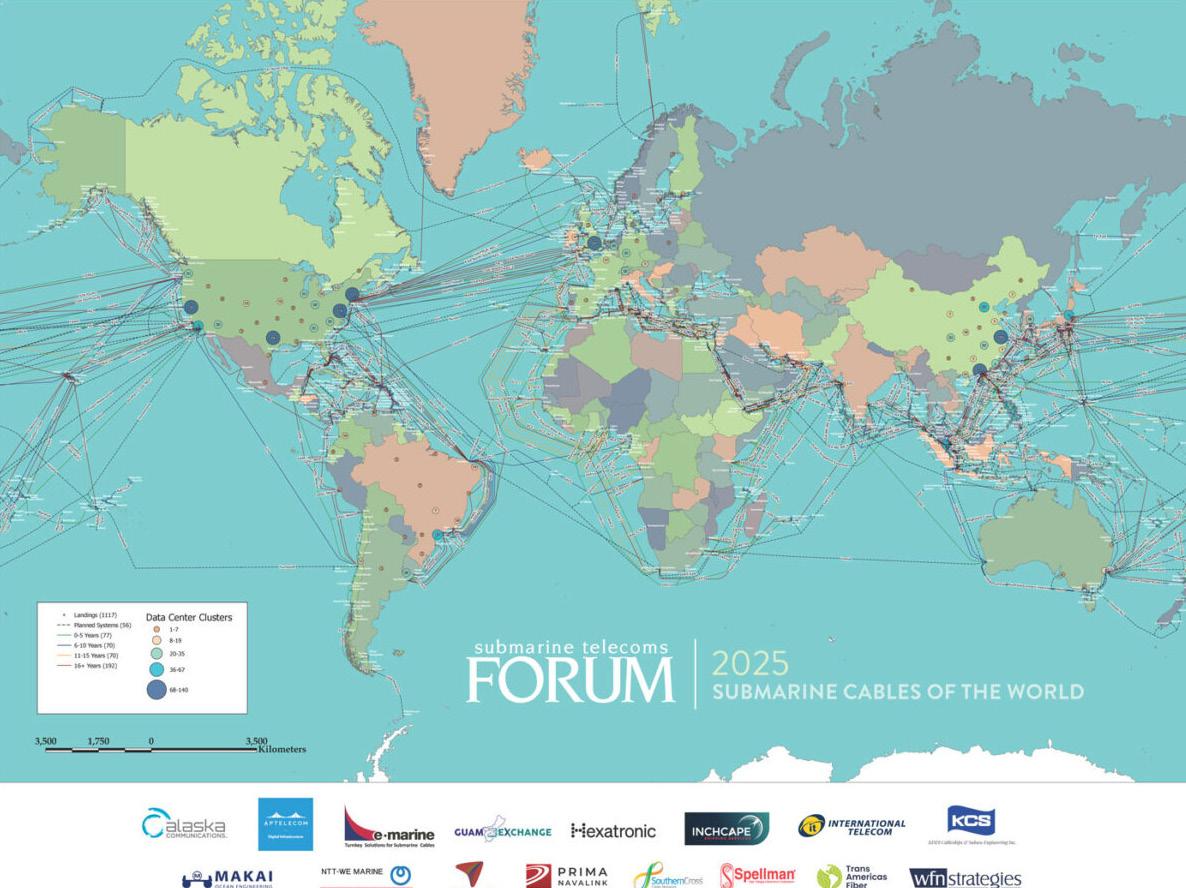
for 2027 and 15 more for 2028. We are set for a bright future with more cables than ever connecting our planet.
CAPACITY GROWTH IN 2026:
For capacity upgrades, there is also excellent news. Even on the oldest route with lowest growth, the transatlantic, a demonstrated minimum of 20% or-
to help: These devices allow us to finally see the happenings inside a working submarine cable in real-time.
Fiber sensing is a practical breakthrough as significant as Heaviside’s modelling of every point along a cable; that I will discuss later in this article.
In the past, a submarine cable was basically a black

box with only input and output available for analysis at the shores. We had to indirectly infer what was transpiring along the transmission path. Now, in mere milliseconds, with fiber sensing tools, we can fully characterize a live working cable. We can see every splice (good and bad), amplifier gains, filter functions, SNR, polarization gains and losses, and many more parameters along the whole cable at every point in the spectrum.
With so many aging cables from the dot-com boom, we can use these sensing tools to identify and prioritize the parts of these cable that need the most attention to revive their operational functionality after years of aging and damage. Scheduling these “fixes” with repairs in the critical areas will be the easy way to renew these cables.
With sensing, we can also monitor the cable’s health in real time and witness live events, like bottom currents strumming cable suspensions, trains/vehicles passing over the cable between the CLS and beach, anchors and seismic events straining the cable, and cable breaks when they occur.
We can validate repair splices in milliseconds and release ships from the repair site faster than before.
We can watch the cable, like viewing a TV, and monitor the effects of rock dumps, mattress lays, and other maintenance activities when cables are
crossed.
We can verify depth of burial and cable health as it is laid and compare to baselines taken at the factory and when loaded.
During the 25-year lifetime of a cable, we can compare cable performance to the commissioning baseline and measure absolute aging (not just a comparison to the yearly baseline).
In modern history, cable health and fault finding COTDR’s go back over 30 years and Loop Gain techniques over 75 years. These were both reactive methods for cable monitoring. The new cable sensing devices are the “next-gen real-time supervisory” that run proactively and takes us into the future. They will act as watchdogs on every fibre and protect the cables. This will carry all of the new SDM cables through a healthy and productive lifetime that will maximize performance/capacity and reduce downtime.
Ok. I will step down from my sensing soapbox and get back to business for this Back Reflection January 2026: The interweaving of submarine cables and advances in physics.

This topic is dear to me, and somewhat new to me. Recently, my continued historical research into submarine cables has revealed a greater depth of involvement by many of physics’ great minds. Faraday, Thomson, Maxwell, Heaviside, Joule, Stokes, Hamilton, Fourier, Tait, and many more have all participated in the advancement of our industry. One would see some of their names occasionally in articles, but only after investigating, can one see how deeply they were involved.
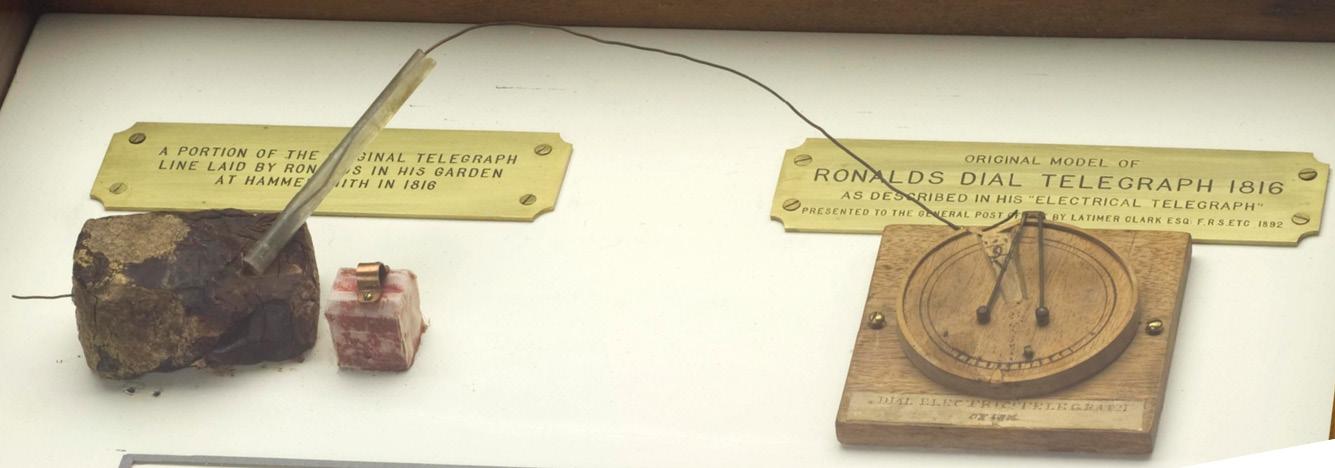
The development of field theory, understanding electromagnetism, development of wave theory, development of unification theories and the development of advanced mathematical techniques occurred the mid to late 1800’s. These theories, and their associated scientists, were intertwined with the development, operation, and troubleshooting of submarine cables.
When researching historical cable evolution, most
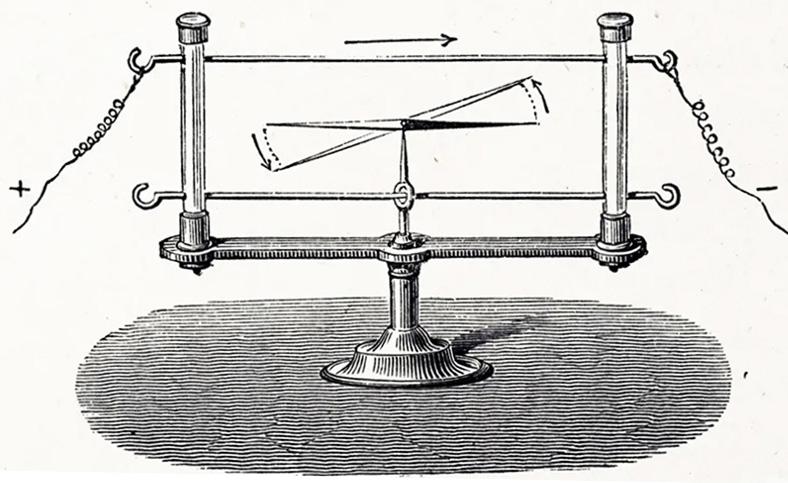
technical documents seem to focus on the industrial efforts put into the physical aspects of cables: purifying copper, purifying insulation, strengthening steel, developing cable construction machinery, developing lay machinery, developing cable ships, improving manufacturing quality processes and consistency, etc. but at the same time, in the background, great minds were dealing with other challenges of submarine cables: understanding electricity, magnetism, capacitance, inductance, testing, as well as developing new math techniques to describe these. Even a mundane challenge like measuring the resistance was a great task. There were no multimeters, there were no units of resistance, there were no reference standards. Even Mr. Ohm was alive during these early days, so no Ohm unit!
In a very short time, all of these additional theoretical planning support systems for guiding effectual submarine cable designing, manufacturing, and operating, had to be developed. It is behind the scenes, in academia, where this transpired. Oc-
casionally some of this information made it to laymen, via magazines, but for most, it was hidden in privileged lectures and publications that were not available to the common man.
The science of telegraphy began with the sending of electrostatically generated charges along paths. There were no batteries at that time. Georges-Louis Le Sage first did this in 1776 (parallel communications along parallel wires). Francis Ronald developed a serial system along a buried single wire (insulated in glass tubes) in 1816. His device also included timing synchronization.
In 1800, the battery was invented by Alessandro Giuseppe Antonio Anastasio Volta, but it was not until twenty years later that Hans Christian Ørsted discovered, by accident, that current

Michael Faraday
in a wire produces a magnetic field (1820). This field could move a compass needle.
Michael Faraday, trained in chemistry and an excellent experimenter, made his first chemical battery in 1812, at age 21, and conducted experiments on chemical solutions. As an experimental chemist, he used electricity from his battery to decompose compounds and produce gases. In 1821 he sidesteps from electrochemistry into electromagnetism and repeats the experiments of Ørsted to make a new discovery: electricity passing through a wire in a magnetic field can cause mechanical motion of the wire. Basically, the electric motor was invented (though not optimized!).
In the following ten years, we do not see much advancement by Faraday with electromagnetism until 1831. He seemed to focus on electrochemistry and optics, rather than on electromagnetism, during this period. He did attempt to make parallel wires move but without success (repeating the work of André-Marie Ampère). He was lacking the coil geometry needed to increase the magnetic force of
the wire. It was during this dry spell for Faraday that William Sturgeon applied a battery to a coiled wire and invented the electromagnet in 1824. This device was the foundation of magnetic telegraphic communications. Like Faraday’s 1821 electric motor, it took many years for the 1824 electromagnet to be optimized and put to use in telegraphy.
In 1828 Joseph Henry, had improved Sturgeon’s electromagnet design. In 1831 he applied it to a 1-mile-long experimental telegraph system in Albany, NY.



telegraph system but it was more like a giant galvanometer that you observed from a distance using a telescope…. basically, an electronic semaphore adaptation.
The first working commercial telegraphs were implemented in England starting in 1837 by William Fothergill Cooke and Charles Wheatstone. Like Gauss and Weber, these telegraphs used galvanometers, rather than an electromagnet, as the receiver. They functioned in this manner: current from a source ran through a long wire and deflected a compass at the far end. The early systems in England used 5 wires and deflected 5 needles. A matrix overlay would converge the needles to a letter.
It is said that Morse learned of the electromagnet the next year, 1832, and conceived of the telegraph system then. Morse later worked with Leonard Gale (an assistant of Henry), to develop a working magnetic telegraph that was first demonstrated in 1838.
In 1833 Wilhelm Weber and Carl Friedrich Gauss made a

It was different in America, electromagnetic telegraphy systems, based on Henry’s work, were the fashion at this time. These systems were demonstrated by Alfred Vale, Samuel Morse, and soon Samuel Colt. Though well developed, these electromagnetic telegraph systems were not put to commercial use until 1844. Oops… I jumped ahead a wee bit. Let’s go back to 1831.
1831 was a big year for Faraday as well as for physics. In his experiment of winding two copper wire coils around the same steel ring, Faraday discovered that he could send electrical current though one coil and detect it with a compass (galvanometer) connected to the second coil. This invention is the transformer that transforms energy: electrical energy into magnetic energy then back into electrical energy. The process is called mutual inductance.
He also discovered that moving a permanent magnet in a copper coil produced a current in the coil when in motion. Vice versa, he showed moving a coil over a fixed permanent magnet also produced current in the coil. He then developed a machine that converted the motion of a rotating copper disc in a magnetic field to be a continual source of electricity. It was the first generator. This work is also the beginning of electromagnetic theory and precursor to Maxwell’s Equations. It also unified the electric theory as up until that point; electricity could be generated electrostatically (friction machines), and electrochemically (battery). Now it could be generated electromagnetically. This was also groundbreaking as it started field theory by use of an interesting method. Faraday visually revealed the magnetic field. He showed the magnetic field’s


A Faraday 1854 Lecture summary where he postulates gravity is electric field effect.
lines of force by sprinkling iron filings around permanent magnets, and around electromagnets. Faraday’s experimental work now opens the floodgates for contemporary mathematicians to go to work and start translating these new observations to new equations. Like many great people at the time, who moved telegraphy forwards, Faraday was not mathematically inclined. For theoretical and mathematical advancement, it was left to others to form Faraday’s discoveries into equations. His experiments in 1831 and 1832 motivated Weber, Gauss and Pavel Schilling to develop telegraph prototypes and advance the concept. Cooke and Wheatstone developed their telegraph after seeing Schilling’s telegraph demonstrated in Germany in 1836.
In 1836, Faraday makes another experimental discovery and shows the charge within an enclosure (socalled Faraday Cage) is zero. Another nugget for Maxwell.
In 1842, as a student at Cambridge, William Thomson (Lord Kelvin), at 18, wrote a paper: On the uniform motion of heat in homogeneous solid bodies, and its connection with the mathematical theory of electricity In this paper, he mathematically modelled the passage of electric (electrostatic) charge (current) though substances the same way as models work for heat transferring through substances. Maxwell will later describe this paper as motivating.
In 1845, Thomson, who is following Faraday’s work, writes to Faraday with a suggestion of using magnetic fields to polarize light. Faraday, using special glass which he developed, succeeds in doing this and furthers the concept that light is an electromagnetic wave.
In 1846, Faraday writes a paper Thoughts on Ray Vibrations where he postulates that electromagnetic waves are coupled and transmitted though solids by vibrations of the atoms within the solid; even though a crude atom model did not exist at that time. He argues that there is no aether in copper wire to conduct the electromagnetic field and that it must be the copper atoms themselves that couple and transfer the field. In effect, the lines of force themselves are the aether. He also speculates that this phenomenon
Excerpt from an 1884 lecture on Faraday.

may be applicable to gravity.
In 1848, Thomson continues his work in thermodynamics and theoretically calculates the temperature of absolute zero. As we know, the Kelvin temperature unit will be named in his honour in 1954.
In 1849, Thomson again writes to Faraday with further thoughts on analogies between thermodynamic methods and magnetic methods. This stimulates Faraday’s thought on magnetic fields and their interactions with paramagnetic and diamagnetic materials. Their ability to conduct, or to weakly conduct magnetic fields is analogous to materials’ ability to conduct, or weakly conduct, heat, or to conduct, or weakly conduct, electricity.
In 1851 Thomson writes the paper
A Mathematical Theory of Magnetism.
In 1853, Latimer Clark, an employee of the Electric

Telegraph Company, invited Faraday to study their telegraph system (mostly terrestrial aerial with new submarine cables in the offing). They analysed the cause of signal retardation in submarine cables. Their experiments utilized 100 miles of gutta percha coated copper wire immersed in a canal near the Gutta Percha Company’s factory. They also experimented with the long-distance pole-line aerial wires of the ETC as well as the buried gutta percha coated subterranean wires between London and Manchester (~ 1,500 miles: 8 wires of ~ 187.5
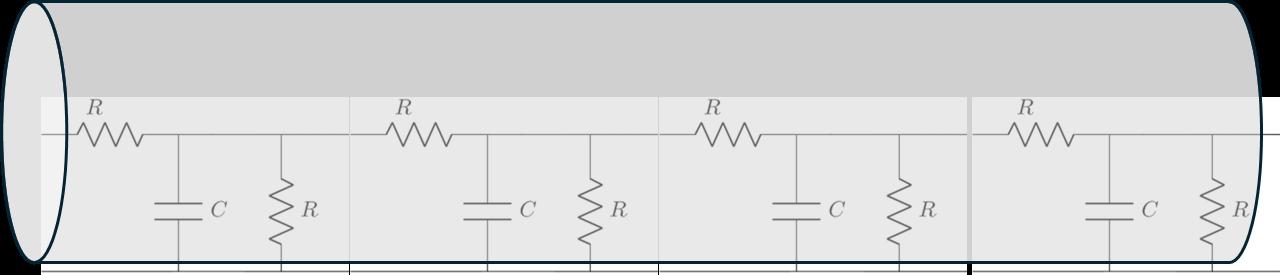
Thomson’s Law of Squares Cable Model


miles). Note this MANLON test bed was later used by Morse and Whitehouse in 1856.
The work of Clark and Faraday was presented by Faraday in January 1854 in his paper
On Electrical Induction. It shows that aerial wires do not suffer from signal retardation whereas the subterranean and submarine wires do. Submarine wires suffer the most. They used batteries, switches and galvanometers to characterize the propagation delays due to “Leyden Jar” effects (now called capacitance).
Faraday calculated the surface of 100 miles of gutta percha line and its equivalence to a Leyden jar. They also placed galvanometers at different locations along the 1,500 looped test bed and watched/ timed the signals propagate (0mi, 750mi, & 1,500mi). Faraday reports it took 2 seconds for a signal to pass the ~ 1,500km. It was at the time of these experiments that consideration for a transatlantic cable was discussed in England (Brett) as well as in Newfoundland (Gisborne).
Faraday and Clark’s London-to-Manchester subter-
ranean test bed was used again in 1856 by Samuel Morse, Edward Orange Wildman Whitehouse, and Sir Charles Tilston Bright, but was even looped longer at 3,000 miles. They claimed results that were much more favourable than what Clark and Faraday had witnessed in 1853. Morse said they could send up to 5 signals in a second for 3,000 miles. Faraday could only do 5 signals in 10 seconds over 1,500 miles! Subaqueous transmission would be much slower.
In April 1854, Faraday follows his January subaqueous paper with a subterranean paper where he credits Werner Siemens as the first to note retardation of telegraph signals in buried gutta percha lines in 1850. He re-prints Siemens’ work and findings to make the point. Also, in Q1 of 1854, we see James Clerk Maxwell jump into the fray. He writes to his friend Thomson and requests guidance on what works to read/study with respect to “learning-up” on electricity.

We do not see the reply letter, but much later in 1854, Maxwell is again writing to Thomson thanking him and mentions in a letter that he is now starting to better understand electricity and Faraday’s lines of forces. He also mentions corresponding with George Gabriel Stokes.
Faraday & Clark’s work and papers on retardation, along with the murmurs of a cable to America, is now stirring up interest. Stokes communicates with Thomson soon after Faraday’s papers. Throughout 1854 they work the signal retardation problem as can be seen in their correspondence. They


come up with the cable retardation being the square of the length of the cable (Law of Squares). They estimate the retardation for a 14,000 mi cable (1/2 way around the earth) to be 490 seconds based on real-world 1/10 second retardation for a working 200 mi London-Brussels cable. A 2,000-mile Atlantic cable would have a 10 second delay based on their work. Thomson also showed, in 1855, that lowering the resistance of a submarine cable’s copper conductor would decrease the retarding effect.
In 1855, one year after graduating from Cambridge and having followed Thomson’s required reading list, Maxwell wrote a paper called: On Faraday’s Lines of Force. In this, he mathematically translated Faraday’s findings to equations for electricity and magnetism. It became the foundational math describing modern electromagnetic theory. The work was refined and published in 1861 as On Physical Lines of Force. In 1864 he writes A Dynamical Theory of the Electromagnetic Field. It is a further refinement of is past two papers and contains his famous 20 equations describing electromagnetism.
It was later translated by Oliver Heaviside into what is now referred to as Maxwell’s equations. There were only 4 differential equations in Heaviside’s work rather than twenty due to the concurrent evolution of vector calculus from William Rowan Hamilton’s quaternion math. The evolution involved Peter Guthrie Tait, Josiah Willard Gibbs, Maxwell, and Heaviside.

During the period from the mid-1850s to the mid1860’s, Thomson was
deeply involved in the transatlantic submarine cables as a director in the Atlantic Telegraph Company. He knew of the challenge of signal retardation for several years prior, so he improved instruments for operating over these cables. He greatly increased the sensitivity of the mirror galvanometer for use with very low voltages. He determined that using low voltages will maximize the data rate. Thomson also revised a second galvanometer for functioning on a rolling cable ship at sea, and at the same time, this galvanometer was also bathed in the huge electromagnetic field emanating from the hull (the powered coil of cable). Thomson implemented a movable bar magnet to null this field. We can assume Thomson and Maxwell are in communication during this time but not much comes from Maxwell on submarine cables apart from some poetry. Thomson seems focused on the practical as he had previously developed the telegraph equation “law of squares” for retardation, so very little additional theoretical transmission theory was needed. He develops an ink & paper data recorder (siphon recorder) to work with his sensitive receivers.

We can see an interesting Thomson and Henry Charles Fleeming Jenkin’s paper in 1861 On the True and False Discharge of a Coiled Electric Cable where the “back emf” is noted momentarily when a battery is disconnected from an energized coil of submarine cable. The magnetic field of the coil collapses and induces a voltage that counters the capacitive discharge of the cable. The initial EMF voltage noted on the galvanometer is called a “false voltage”.
Between the 1855 and 1867, Thomson and Tait are also writing a physics textbook on mechanics and dynamics: Treatise on Natural Philosophy.
In 1857, Maxwell writes to Faraday about his
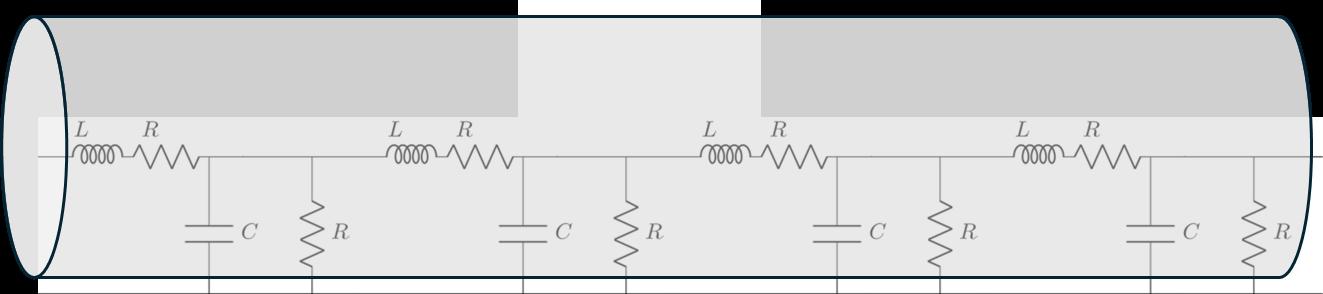
lines of force and proposes that perhaps they could be applied to gravity. He states: ” I have now merely tried to show you why I do not think gravitation a dangerous subject to apply your methods to, and that it may be possible to throw light on it also by the embodiment of the same ideas which are expressed mathematically in the functions of Laplace and of Sir W.R. Hamilton in Planetary Theory.”
From 1861 to 1864, there is an effort in England to create reference units. Maxwell, Thomson and Jenkins are enlisted by the British Association for the Advancement of Science (BAAS). They form the Committee on Electrical Standards and are tasked with developing a unit of resistance. They devise the BA unit which is renamed to the “ohm” in 1872.
Following Maxwell’s 1861 paper, he calculates the speed of the electromagnetic field in 1862 and notes it is so close to the speed of light that it cannot be a coincidence.
Maxwell’s 1865 paper, A Dynamical Theory of the Electromagnetic Field, continues his thought that electromagnetic waves and light are the same thing. This work is the foundation for radio waves.
In 1867, Thomson publishes, On Vortex Motion, where he hypothesizes atoms as complex forms similar to twisted strings. Each string is the proposed path of the flow of the aether. It is geometrical and somewhat similar in concept to
orbital shapes of Bohr. In it, each element would have a different atomic vortex shape.
By 1869, Oliver Heaviside (Wheatstone’s nephew) at age 19, has been operating the 1868 submarine telegraph cable between England and Denmark for a year. He develops techniques for locating shunt faults (No-Loss of Current-like testing). At that time, he presents a paper to Thomson and Maxwell on optimizing test instruments for measurements that are typically conducted on submarine cables. It is called The Best Arrangement of Wheatstone’s Bridge for measuring a Given Resistance with a Given Galvanometer and Battery
In 1873 Heaviside proposes a duplex method of telegraphy, however other methods have been unsuccessfully tried in the past and Stearns in the USA is testing one on the Atlantic cable in 1873.
Maxwell publishes A Treatise on Electricity and Magnetism in 1873 which is the culmination of his past papers and lays the foundation for electromagnetic theory. In it he even cites young Heaviside’s work optimizing a Wheatstone Bridge. In the same paper, Maxwell references many submarine cables and submarine testing data. It is obvious that Maxwell has been keeping abreast of submarine cables for the past 8 years… not just the poetry.
In August 1876, Heaviside writes the paper On the extra Current, where he shares the “Telegrapher’s Equation”. This is an improvement on Thomson’s Law of Squares (that models the
ASK THE EXPERT
Question for the author(s)? Click here!
submarine cable as a network of only resistors and capacitors). Heaviside’s newer equation includes inductance and leakage through the insulator. This is a more complete and more accurate cable model. Solving the equation enables concepts like impedance matching and even coaxial cable theory; that will be used on the first unrepeatered telephone cables and the transatlantic repeatered telephone submarine cables in the 1950’s. Books on Heaviside indicate he used this LCR model when he operated the 1868 UK-DEN cable.
In 1880 Heaviside patents the idea of coaxial cables and postulates their benefit for high frequency signals (that he suggests could be of images rather than sounds). Did he just invent cable TV?
In 1884 Heaviside publishes his distillation of Maxwell’s 20 Equations to 4 by using vector calculus that was developed by Heaviside. These are published in several articles in the telecom magazine The Electrician.
In 1887 Heaviside recommends loading aerial lines, submarine telegraph cables and submarine telephone cable with inductors to improve transmission quality. It goes unheeded for 10 years.
This completes the above crude chronological path of the early evolution of electromagnetic theory. We see that throughout the journey, Faraday, Thomson, Maxwell, and Heaviside’s thoughts, experiments, and theories were intimately intertwined with submarine telecommunications.
I am especially delighted to have learned that Heaviside was a shunt fault expert. In my early days of operating submarine cables, finding these elusive faults was always a fun challenge. Even unknowingly, until a few days ago, in 1994, I had applied Thomson’s 1855 RC law of squares to find a most challenging type of shunt fault in a submarine cable (momentary shunting while attempting to power up... the fault exists for less than 1 second, then the PFE shuts down!). I will write an article on this and general electrical fault-finding methods in a future
2026 STF with the Tinsley team (we planned this at the last SubOptic). This will include the fantastic works of my fault-finding mentors: Daniel Welt, Ahmed El Sakkary, and my father, Phil Pilgrim.

Philip Pilgrim is Subsea Business Development Leader for Nokia’s North American region, marking 30 years in the subsea sector. Based in Nova Scotia, Canada, he brings deep industry experience alongside a personal passion for subsea archaeology, including researching and locating historic submarine cable and telegraph routes and related infrastructure.
Paul Deslandes has been appointed Chief Executive Officer of Global Marine Group. He previously served as Managing Director –Telecoms at the company, following senior roles including Head of Project Delivery and Senior Project Manager. With more than 15 years at Global Marine, Deslandes brings extensive experience in subsea installation, project delivery, and vessel operations, having led major telecoms programmes across global submarine infrastructure projects.
Natalia López Céspedes has been appointed General Manager of Chile Data Centers – Asociación Chilena de Data Centers. Based in Santiago, Chile, she previously served as Digital Infrastructure Manager at Desarrollo País, where she led national digital infrastructure initiatives. López Céspedes has also held senior roles within Chile’s telecommunications sector, including leading the Telecommunications Development Fund under the Undersecretariat of Telecommunications, and brings experience from both public-sector leadership and management consulting.
Michael Pothitos has been appointed Managing Director at H.I.G. Capital, based in London, United Kingdom. He was previously Principal, Infrastructure Private Equity at the firm, having also served as Director within the same team. Pothitos brings extensive experience in infrastructure investment and governance, and currently holds several non-executive directorships, including roles with Xtera, Polar, and Fluo, supporting digital infrastructure and connectivity-focused businesses.
Mohammad Shatnawi has taken on a new role as Director, International Pre-Sales & Infrastructure Solution at Mobily, based in Saudi Arabia. He previously served in senior international facilities management and wholesale carrier relations roles at the company, with responsibilities spanning international capacity, submarine cable systems, and optical transport. Shatnawi brings more than 16 years of experience at Mobily, supporting international connectivity initiatives across KSA, MENA, and GCC markets.


News from November 10, 2025 through January 14, 2026
This Issue’s News Now highlights a surge of activity across the global subsea cable sector, from storm-related repairs and system upgrades to major new builds and strategic acquisitions. Governments, hyperscalers, and operators are accelerating investment as resilience, capacity, and regional connectivity take center stage.
• Tiree Subsea Cable Repairs Begin After Storm Damage
CURRENT SYSTEMS
• FLAG Acquires Fiber Pair on Google’s Echo Subsea Cable
• Meta Completes Core of 2Africa Subsea Cable
FUTURE SYSTEMS
• SUBCO’s SMAP On Track For May Go-Live
• TAM-1 Subsea Cable Lands in Panama
• Liberty Networks to Build El Salvador Submarine Cable
• BPCS, Nokia Ink Deal for Bangladesh’s First Private Subsea Cable
• Globe Plans Mindanao Submarine Cable Project
• Google to Lead $120M Papua New Guinea Subsea Cable Scheme
• Australia Funds Second Subsea Cable for Solomon Islands
• Introducing Dhivaru and Two New Connectivity Hubs
• Australia Connects AUKUS Base to New Subsea Cables
• China Mobile Lands Hong Kong Segment of SEA-H2X Cable
• OMS Group Begins G-Class Cable-Laying Vessel Assembly
• EXA Acquires Aqua Comms in Distressed Subsea Fiber Deal
• Baltic States on Alert After Undersea Cable Damage
• Prysmian-Led JV With Fincantieri to Acquire Xtera
• WIOCC Secures $65M to Expand Africa’s Digital Infrastructure
• ICPC Study on Environmental Impact of Subsea Cable Recovery
• NTT Group Weighs Building New Ship for Undersea Cables
• Colombo Dockyard to Build High Spec Cable-Layer in Sri Lanka
SUBTEL FORUM
• Submarine Cable Almanac Issue 56 – Out Now!
TECHNOLOGY & UPGRADES
• Ribbon Hits 20 Tbps on JUNO Trans-Pacific Subsea Cable


by Nicola Tate
One of the most overlooked aspects of advertising success is frequency — how often your audience sees your message. In specialized industries where decisions are often measured in months and years, steady and consistent visibility is what keeps your brand top of mind. Here are a few tips to consider when considering frequency in your campaigns.
1. The rule of seven (and beyond). One common guideline in marketing (often called the ‘Rule of 7’) suggests that a viewer generally needs to encounter your message several times before acting — many marketers use ‘7’ as a convenient benchmark. While not a hard and fast rule, several sources reference it as a useful planning framework. The longer and larger the purchasing process is likely the more frequent messaging needs to be.
2. Plan for long-term visibility. Short bursts of ads may create awareness, but steady exposure over quarters or years builds familiarity and trust — the foundation of future sales.
3. Use varied but consistent creative. Refresh imagery or headlines to avoid fatigue, but maintain the same brand colors, fonts, and tone to reinforce recognition.
To maintain consistent visibility and reach the right audience over time, there’s no better partner than SubTel Forum properties. Contact me to explore long-term campaign packages that keep your message in front of the right people all year.

Originally hailing from the UK, Nicola moved to the US when she was just four years old. Aside from helping companies create effective advertising campaigns Nicola enjoys running (completed the Chicago marathon in 2023, the Berlin marathon in 2024, and will be running the London marathon in 2025), hiking with her husband, watching her boys play soccer, cooking, and spending time with family.

CONNEC T INN O VATIVELY. EN GAGE GLOBALLY. GR O W EX P ONENTI AL LY.
SubTel Forum continues to be the most trusted voice in the global submarine cable industry, with unparalleled reach, deep market engagement, and a proven platform for thought leadership and brand visibility.
We continue to provide industry suppliers with a wide range of connection options and for 2026 we are excited to introduce a new product, the Cableship Codex! The Cableship Codex is an industry reference dedicated to the world of cableships and their operators, vendors, and innovations. Like all SubTel Forum offerings, the Codex is built to inform, connect, and elevate the industry.



United States (30.1%)
France (13.22%)
United Kingdom (11.23%)
South Africa (10.47%)
Singapore (7.11%)
India (6.78%)

Japan (6.1%)
Australia (5.48%)
Germany (5.46%)
Philippines (4.05%)
THE DECISION MAKERS: 64.28% of the SubTel Forum audience are either the final decision maker or have a high influence on the final purchase. 35.72% are involved in making purchasing recommendations.
DEEP INDUSTRY EXPERIENCE: 85.72% of the SubTel Forum audience have greater than ten years of industry experience.
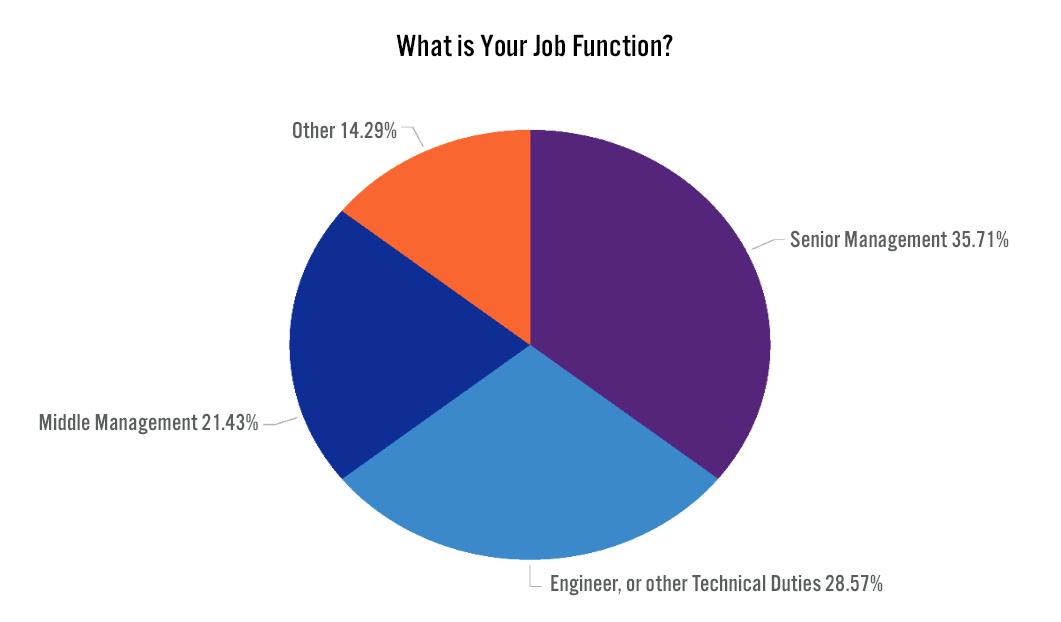
SubTel Forum, the premier publication in the submarine telecoms industry, offers focused issues that delve into specific market aspects. Each issue stands out with:
•An average of more than 1,000 unique reads per issue and an average read time of more than 8 minutes.
•Two Months Exposure & Endless Archiving: Extended visibility and perpetual access for your ads
SPONSO R SHIP BENEFITS W ITH SUBTEL FO R UM :
•Video Embedding: Optional 30-second slot for Full and Two-Page ads.
•Social Media Shoutouts: For Full and Two-Page spreads on LinkedIn, Facebook, and Twitter.
AR T & V IDEO R EQ UIR EMENTS :
•Print Ads: 300 dpi in PDF or JPG with crop marks.
•Video Ads: 30-second clips in 1280x720 or 1920x1080 resolution, mp4 format.
• Optional Video - 30 seconds ▪1280x720 or 1920x1080 resolution - mp4 Video File
EDITORIAL CALENDAR:
January 2026: Global Outlook, SNW EMEA '26 Preview
March 2026: Finance & Legal, ICPC '26 Preview
May 2026: Global Capacity
July 2026: Regional Systems, SNW '26 Preview
September 2026: Offshore Energy, IWCS '26 Preview
November 2026: Data Centers & New Tech, PTC '27 Preview, STF @25
Learn more, customize your campaign, or place an order by contacting Nicola Tate at [+1] 804-469-0324 or ntate@associationmediagroup.com
The SubTel Forum Almanac is a key reference for the submarine cable industry. Each issue showcases major international systems with detailed pages featuring system maps, landing points, capacity, length, and RFS year, among other data.
DO W NLOADS & EXPOSURE :
• Each issue averages about 850 unique reads, 215 clicks, and a greater than 24 minute read time.
•Six months of exposure plus permanent archiving.
Advertisement1 Issue
2PageSpread$2,600
SPONSO R SHIP BENEFITS :
•Banner ad on the Almanac web page for the issue duration.
•Prominent two-page spread ad near the front.
•Logo/Link on cover and webpage acknowledgement.
•Social media acknowledgement.
AR T & V IDEO R EQ UIR EMENTS :
• Size: 17” W x 11” H for Two-Page Spread. Resolution: 300 dpi, in PDF or JPG
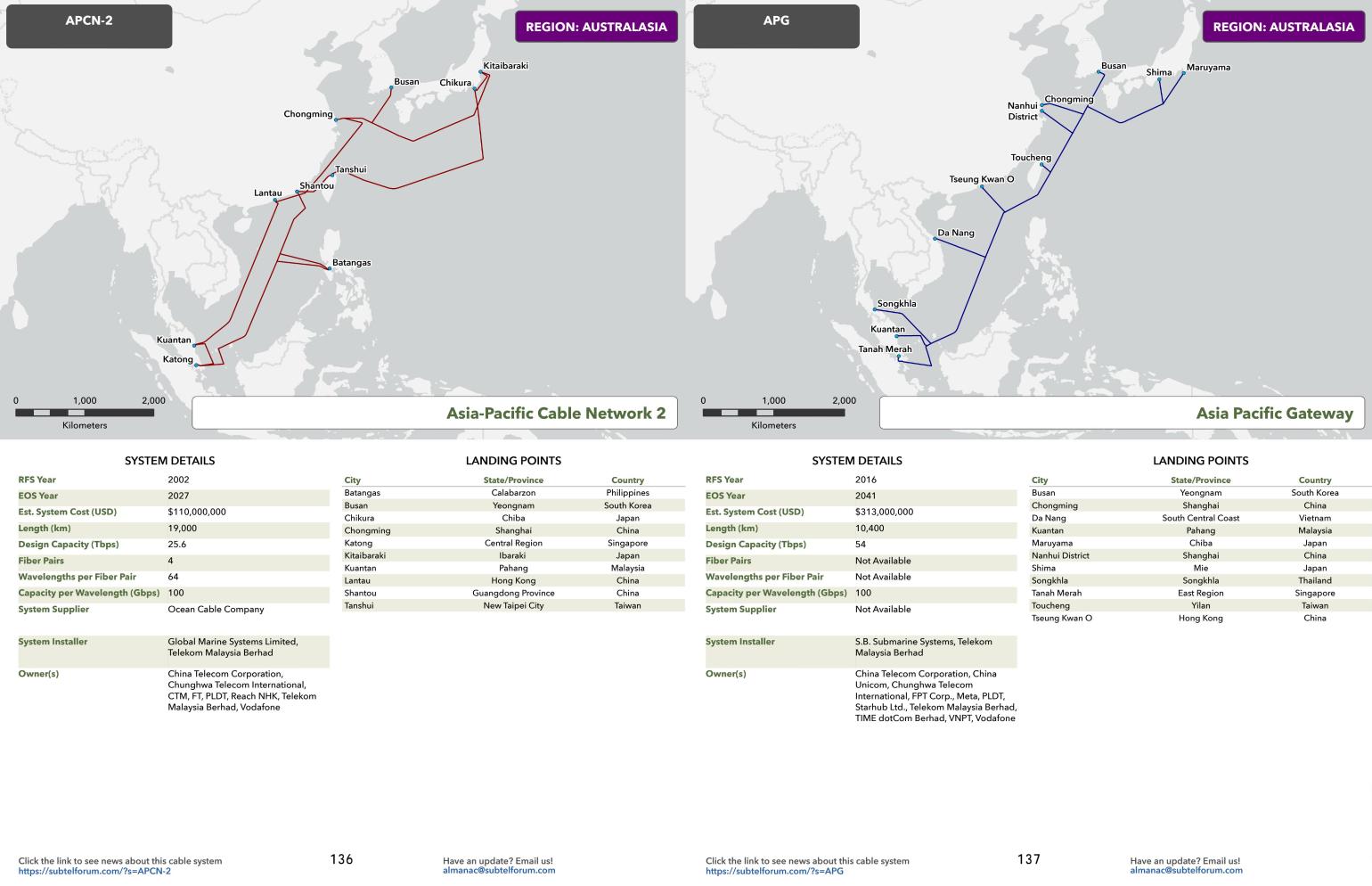
EDITORIAL CALENDAR:
February 2026: By System Age
August 2026: By Region
The SubTel Forum Cableship Codex is a brand new publication delivering expert analysis, fleet intelligence, and operational insights on the global fleet of cable installation and maintenance vessels. An essential reference for marine coordinators, project managers, operators, and decision-makers in subsea cable deployments, each issue includes featured profiles of cable ships, regional fleet coverage and deployment maps, insights and trends, and much more.
Advertisement1 Issue
2PageSpread$2,600
SPONSO R SHIP BENEFITS :
•Banner Ad on the Cableship Codex web page for the issue duration.
• Prominent two-page spread in the first third of the publication (or location as requested).
AR T & V IDEO R EQ UIR EMENTS :
• Size: 17” W x 11” H for Two-Page Spread.
Resolution: 300 dpi, in PDF or JPG
EDITORIAL CALENDAR:
May 2026: The Global Fleet - Capacity, Age & Coverage
November 2026: Year in Review - Missions, Metrics & Standouts
The SubTel Forum Annual Report offers the latest, comprehensive data on the submarine fiber market, analyzing system capacity, productivity, and industry outlook. The yearly Industry report typically generates more than 2700 unique reads with an average read time of more than 11 minutes.
ANNUAL PRICE: $3,350
SPONSO R SHIP BENEFITS :
•Two-page Spread Ad.
•Social media acknowledgement.
•Press release and mailer acknowledgement.
AR T & V IDEO R EQ UIR EMENTS :
• Two-page Spread: 17” W x 11” H, 300 dpi in PDF or JPG.
•Optional video: include a blank box for overlay; no size restrictions.
LOCK IN NO W FO R 20 26!
Sponsors can secure a spot in one of the various categories below. First come-first served!
•Global Overview
•Capacity
•Ownership Financing Analysis
•Supplier Analysis
•System Maintenance
•Cable Ships
•Hyperscalers and The Evolution of Submarine Cable Ownership
•Special Markets
•Regulatory Outlook
•Regional Analysis and Capacity Outlook
Note: Subtel Forum reserves the right to change categories
THE SUBMARINE TELECOMS FORUM DIRECTORY
This new directory is designed for industry professionals to locate companies that provide products or services to the submarine telecom cable and network operations sector. In the last twelve months more than 5,600 users viewed more than 10,000 pages. Make sure your company is featured prominently!
• Starting at $625/year
Feature your logo on our beautiful, large format print map, which proudly showcases every major international submarine cable system. This map is a fixture in many offices across the industry.
Limited Availability:
Wide Distribution:
Only 22 spaces for logos.
Over 4,500 copies shared at key industry events including Pacific Telecommunications Council (January 2026), Submarine Networks EMEA (May 2026), Submarine Networks World (September 2026), and IWCS Cable & Connectivity Industry Forum (November 2026).
ANNUAL PRICE: $4,500
SPONSO R SHIP PERKS :
•Comlimentary Web Banner on News Now feed
•Social Media shoutouts
•Acknowledgement in press releases and mailers
•In addition to the print copies that you may pick up during key industry events you can secure a print-ready PDF to print copies for staff and customers. Updated quarterly!
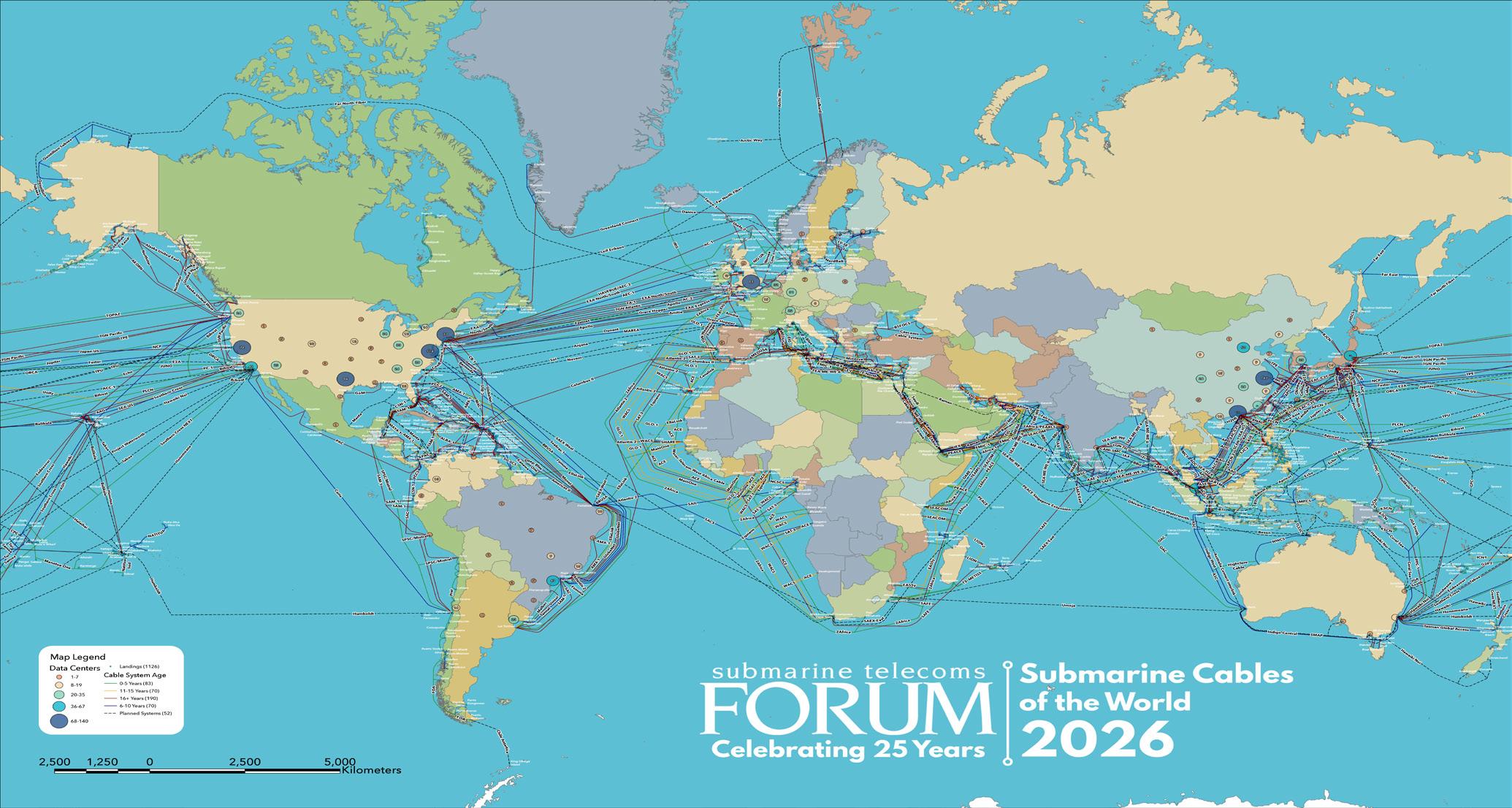






New for 2026, the SubTel Forum Online Cable Map will feature quarterly themes that spotlight the biggest conversations in our industry.
•Q1: System Age & Lifecycle – Maintenance, repair & replacement
•Q2: Regional Connectivity – Africa, APAC, Americas, Europe, Polar
• Q3: Technology & Suppliers – Innovation, ESG, installation & supply chain
• Q4: Owners & Investors – Hyperscalers, carriers, consortia & finance
QUARTERLY PRICE: $3,150
This map is a valuable tool for anyone interested in the submarine cable industry, allowing detailed exploration of global cable infrastructure.
SPONSORSHIP BENEFITS FO R THE SUBTEL FO R UM ONLINE C A BLE M AP:
• Duration: 3-month exposure.
•Visibility: Your logo and link featured on every page.
These benefits offer sponsors significant exposure and opportunities to highlight their company within e-submarine telecoms community.