BACK REFLECTION
PRACTICAL INTRODUCTION TO THE EARLY DAYS OF CABLE FAULT FINDING BY PHILIP PILGRIM
H
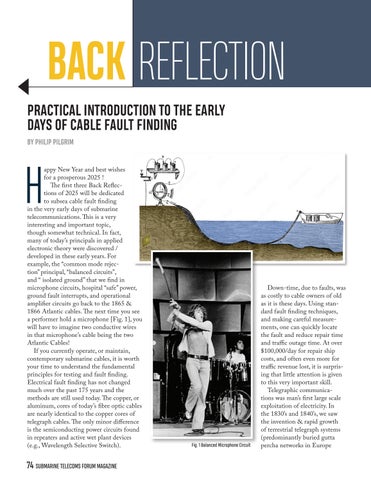
appy New Year and best wishes for a prosperous 2025 ! The first three Back Reflections of 2025 will be dedicated to subsea cable fault finding in the very early days of submarine telecommunications. This is a very interesting and important topic, though somewhat technical. In fact, many of today’s principals in applied electronic theory were discovered / developed in these early years. For example, the “common mode rejection” principal, “balanced circuits”, and “ isolated ground” that we find in microphone circuits, hospital “safe” power, ground fault interrupts, and operational amplifier circuits go back to the 1865 & 1866 Atlantic cables. The next time you see a performer hold a microphone [Fig. 1], you will have to imagine two conductive wires in that microphone’s cable being the two Atlantic Cables! If you currently operate, or maintain, contemporary submarine cables, it is worth your time to understand the fundamental principles for testing and fault finding. Electrical fault finding has not changed much over the past 175 years and the methods are still used today. The copper, or aluminum, cores of today’s fibre optic cables are nearly identical to the copper cores of telegraph cables. The only minor difference is the semiconducting power circuits found in repeaters and active wet plant devices (e.g., Wavelength Selective Switch).
74 SUBMARINE TELECOMS FORUM MAGAZINE
Fig. 1 Balanced Microphone Circuit
Down-time, due to faults, was as costly to cable owners of old as it is these days. Using standard fault finding techniques, and making careful measurements, one can quickly locate the fault and reduce repair time and traffic outage time. At over $100,000/day for repair ship costs, and often even more for traffic revenue lost, it is surprising that little attention is given to this very important skill. Telegraphic communications was man’s first large scale exploitation of electricity. In the 1830’s and 1840’s, we saw the invention & rapid growth of terrestrial telegraph systems (predominantly buried gutta percha networks in Europe