FEATURE
THE IMPACT OF AI ON SUBMARINE NETWORKS BY BRIAN LAVALLÉE
A
lthough associated with a great deal of hype, Artificial Intelligence (AI) is real and will undoubtedly have an impact on our business and personal lives, although to what extent remains to be seen in the coming years. Before it can have a significant impact our lives, it will first impact networks, including submarine networks. There are two ways to look at the impact of AI on submarine networks: “infrastructure for AI” and “AI for infrastructure.” Infrastructure for AI refers to the impact on storage, compute, and connect (network) assets that bring AI to life, albeit a digital one. AI for infrastructure refers to using AI on infrastructure itself — such as minimizing energy consumption or improving network traffic patterns for an optimal return on existing network assets over time.
INFRASTRUCTURE FOR AI
Large Language Models (LLMs) leverage Deep Learning (DL) using artificial neural networks, which “mimic” biological concepts related to how the human brain works. For an LLM to be successfully trained, massive amounts of valid training data is required. Unless this data is already in the cloud data center where the AI infrastructure is hosted, it must be moved into the cloud, say from a large en-
60 SUBMARINE TELECOMS FORUM MAGAZINE
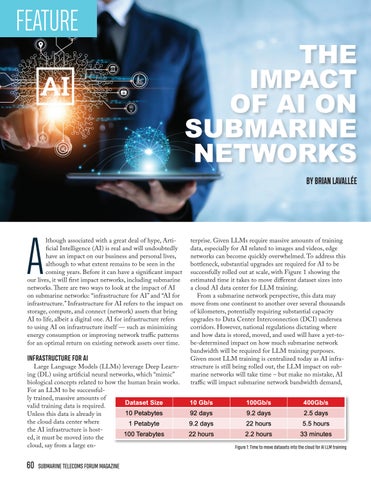
terprise. Given LLMs require massive amounts of training data, especially for AI related to images and videos, edge networks can become quickly overwhelmed. To address this bottleneck, substantial upgrades are required for AI to be successfully rolled out at scale, with Figure 1 showing the estimated time it takes to move different dataset sizes into a cloud AI data center for LLM training. From a submarine network perspective, this data may move from one continent to another over several thousands of kilometers, potentially requiring substantial capacity upgrades to Data Center Interconnection (DCI) undersea corridors. However, national regulations dictating where and how data is stored, moved, and used will have a yet-tobe-determined impact on how much submarine network bandwidth will be required for LLM training purposes. Given most LLM training is centralized today as AI infrastructure is still being rolled out, the LLM impact on submarine networks will take time – but make no mistake, AI traffic will impact submarine network bandwidth demand,
Figure 1: Time to move datasets into the cloud for AI LLM training