EXORDIUM
FROM THE PUBLISHER
WELCOME TO ISSUE 140 OF SUBTEL FORUM, OUR SPECIAL GLOBAL OUTLOOK EDITION FEATURING A PREVIEW OF
SUBMARINE NETWORKS EMEA ‘25, AND HAPPY 2025!
We have been experiencing a polar vortex throughout a considerable portion of the US this month. Warmish temperatures for Christmas and the New Year have been followed by record pushing snow and ice, which from my vantage here in Virginia is always something to watch and experience. The usual runs on toilet paper, eggs, and milk that we typically see when such an event is coming have not been realized this time. Normally people are shopping up to the last second in order to acquire these valuable items to ‘survive’ the impending mother lode of a storm. But not this time. Maybe we have matured a little since 2020 and learned to take things in a little more stride.
In any case and in spite of the Arctic blast, we are still pushing ahead with some new SubTel Forum creations this year...
SUBMARINE TELECOMS FORUM MAGAZINE ARCHIVE
We are pleased to introduce the SubTel Forum Magazine Archive, a comprehensive collection of past issues offering valuable insights into the last 23 years of the submarine telecommunications industry. This archive is an essential resource for staying informed on project updates, market trends, technological advancements, and regulatory changes. Whether you are conducting research, tracking industry developments, or seeking expert perspectives, the archive offers an accessible way to explore in-depth information and analysis. Dive into the trends, technologies, and expert insights that have shaped the submarine cable
industry and driven global connectivity over the past two decades. Click here to check it out!
2025 SUBMARINE CABLE MAP(S)
The 2025 Submarine Cables of the World wall map is now complete and ready for distribution at the industry’s most significant events. This includes PTC in January, Submarine Networks EMEA in February, and updated version at Submarine Networks World in September, ensuring unparalleled global visibility for your brand. Want your logo prominently displayed in Singapore? Click here to secure your spot!
We’re delighted also to unveil the bespoke SubOptic ’25 Submarine Cable Map, crafted exclusively for the triennial conference in Lisbon this June. This special edition map will spotlight the latest advancements in subsea cable technology and global connectivity, offering a unique and highly valued resource for attendees. Distributed solely at
SubOptic ’25, it provides an exceptional platform to showcase your brand at one of the industry’s most anticipated events. Want to make an impact in Lisbon? Click here!
SUBMARINE NETWORKS EMEA CONFERENCE
We’re thrilled to be heading to London in February for the Submarine Networks EMEA Conference . SNEMEA always delivers a stellar event, and we look forward to reconnecting with industry friends while exploring the latest innovations.
THANK YOU
Thank you to John Maguire for his outstanding work in authoring 2024’s six insightful installments of Capacity Connection; your contributions have been invaluable to our readers and the industry. We also extend a warm welcome to Eric Gutshall, who will be taking the reins and leading the department in 2025, and look forward to your fresh perspectives and continued excellence!
Thank you as always to our awesome authors who have contributed to this issue of SubTel Forum. Thanks also for their support to this issue’s advertisers: Fígoli Consulting, Southern Cross, Submarine Networks EMEA, United Cable Company, and WFN Strategies. Of course, our ever popular “where in the world are all those pesky cableships” is included as well.

Good reading – Slava Ukraini , and save me a seat at the nearby pub… STF

Wayne Nielsen, Publisher
A Publication of Submarine Telecoms Forum, Inc. www.subtelforum.com | ISSN No. 1948-3031
PRESIDENT & PUBLISHER: Wayne Nielsen | wnielsen@subtelforum.com | [+1] (703) 444-2527
VICE PRESIDENT: Kristian Nielsen | knielsen@subtelforum.com | [+1] (703) 444-0845
ANALYTICS: Kieran Clark | kclark@subtelforum.com | [+1] (540) 533-6965
SALES: Nicola Tate | ntate@associationmediagroup.com | [+1] (804) 469-0324 subtelforum.com/advertise-with-us
DESIGN & PRODUCTION: Weswen Design | wendy@weswendesign.com
DEPARTMENT WRITERS: Andrés Fígoli, Anisha Singh, Caroline Crowley, Eric Gutshall, Isabel Jijon, Kerry Merritt, Kieran Clark, Melina Tisopulos, Nicole Tate, Philip Pilgrim, Stephanie Gay, Syeda Humera, and Wayne Nielsen
FEATURE WRITERS: Brendan Press, Brian Lavallée, John Tibbles, Jose Amaro, Kieran Clark, Kristian Nielsen, and Mattias Fridström
NEXT ISSUE: March 2025 – Finance & Legal featuring ICPC ’25 Preview
MAGAZINE ARCHIVE: subtelforum.com/magazine-archive

Submarine Telecoms Forum, Inc. www.subtelforum.com/corporate-information
BOARD OF DIRECTORS: Margaret Nielsen, Wayne Nielsen, Kristian Nielsen and Kacy Nielsen
Contributions are welcomed and should be forwarded to: pressroom@subtelforum.com.
Submarine Telecoms Forum magazine is published bimonthly by Submarine Telecoms Forum, Inc., and is an independent commercial publication, serving as a freely accessible forum for professionals in industries connected with submarine optical fiber technologies and techniques. Submarine Telecoms Forum may not be reproduced or transmitted in any form, in whole or in part, without the permission of the publishers.
Liability: While every care is taken in preparation of this publication, the publishers
cannot be held responsible for the accuracy of the information herein, or any errors which may occur in advertising or editorial content, or any consequence arising from any errors or omissions, and the editor reserves the right to edit any advertising or editorial material submitted for publication.
New Subscriptions, Enquiries and Changes of Address: 21495 Ridgetop Circle, Suite 201, Sterling, Virginia 20166, USA, or call [+1] (703) 444-0845, fax [+1] (703) 349-5562, or visit www. subtelforum.com.
Copyright © 2025 Submarine Telecoms Forum, Inc.
SUBMARINE TELECOMS
ISSUE

5 QUESTIONS WITH KERRY MERRITT PLUS SUBMARINE NETWORKS EMEA 2025 PREVIEW
Talking submarine cable industry with total telecom’s head of content

THE CARRIER GUIDE TO 2025: TRAFFIC, TECHNOLOGY AND UNSUNG HEROES
Forecasting 2025 telecom trends and technology evolution By Mattias Fridström


32 50 42 54 46 57
THE ‘WET WAR’: COULD SUBMARINE CABLE SECURITY CONCERNS THREATEN GLOBAL STABILITY?
Assessing geopolitical tensions and subsea cable security By
John Tibbles

THE TOP 10 STORIES OF 2024: A YEAR IN REVIEW
Reviewing 2024’s most pressing subsea cable trends

THE HIDDEN LIFELINES: SUBSEA CABLES, MARITIME SECURITY, AND CYBERSECURITY UNDER GLOBAL SCRUTINY
Protecting subsea cables with AI and SMART technologies By José Amaro

FROM FOLLOWER TO LEADER: HOW THE MIDDLE EAST IS SHAPING THE FUTURE OF GLOBAL CONNECTIVITY
Middle East advancing as global connectivity leader By Brendan Press

THE IMPACT OF AI NETWORK REQUIREMENTS ON SLTES
AI
By Brian Lavallée

ANCHORING SUCCESS
Choosing
Kristian
Under
Global
Digitizing
Kieran Clark

A
Kieran Clark
Find


INSIDE THE WORLD OF SUBTEL FORUM: A COMPREHENSIVE GUIDE TO SUBMARINE CABLE RESOURCES
TOP STORIES OF 2019
The most popular articles, Q&As of 2019. Find out what you missed!
NEWS NOW RSS FEED
Welcome to an exclusive feature in our magazine, where we explore the captivating world of SubTelForum.com, a pivotal player in the submarine cable industry. This expedition takes us on a detailed journey through the myriad of resources and innovations that are key to understanding and connecting our world beneath the oceans.
mapping efforts by the analysts at SubTel Forum Analytics, a division of Submarine Telecoms Forum. This reference tool gives details on cable systems including a system map, landing points, system capacity, length, RFS year and other valuable data.
DISCOVER THE FUTURE: THE SUBTEL FORUM APP
CONNECTING THE DEPTHS: YOUR ESSENTIAL GUIDE TO THE SUBTEL FORUM DIRECTORY
Keep on top of our world of coverage with our free News Now daily industry update. News Now is a daily RSS feed of news applicable to the submarine cable industry, highlighting Cable Faults & Maintenance, Conferences & Associations, Current Systems, Data Centers, Future Systems, Offshore Energy, State of the Industry and Technology & Upgrades.
PUBLICATIONS
Submarine Cable Almanac is a free quarterly publication made available through diligent data gathering and
Submarine Telecoms Industry Report is an annual free publication with analysis of data collected by the analysts of SubTel Forum Analytics, including system capacity analy sis, as well as the actual productivity and outlook of current and planned systems and the companies that service them.
CABLE MAP
In our guide to submarine cable resources, the SubTel Forum Directory shines as an essential tool, providing SubTel Forum.com readers with comprehensive access to an array of vetted industry contacts, services, and information. Designed for intuitive navigation, this expansive directory facilitates quick connections with leading vendors, offering detailed profiles and the latest in submarine cable innovations. As a dynamic hub for industry professionals, it fosters community engagement, ensuring our readers stay at the forefront of industry developments, free of charge.
2024 marks a groundbreaking era for SubTel Forum with the launch of its innovative app. This cutting-edge tool is revolutionizing access to submarine telecommunications insights, blending real-time updates, AI-driven analytics,
The online SubTel Cable Map is built with the industry standard Esri ArcGIS platform and linked to the SubTel Forum Submarine Cable Database. It tracks the progress of

and a user-centric interface into an indispensable resource for industry professionals. More than just a technological advancement, this app is a platform fostering community, learning, and industry progression. We encourage you to download the SubTel Forum App and join a community at the forefront of undersea communications innovation.
YOUR DAILY UPDATE: NEWS NOW RSS FEED
Our journey begins with the News Now updates, providing daily insights into the submarine cable sector. Covering everything from the latest technical developments to significant industry milestones, this feed ensures you’re always informed about the latest trends and happenings. It’s an essential tool for professionals who need to stay on top of industry news.
THE KNOWLEDGE HUB: MUST-READS & Q&AS
Dive deeper into the world of submarine communications with our curated collection of articles and Q&As. These insightful pieces offer a comprehensive look at both the history and current state of the industry, enriching your understanding and providing a broader perspective on the challenges and triumphs faced by submarine cable professionals.
IN-DEPTH PUBLICATIONS
• Submarine Cable Almanac: This quarterly treasure trove provides detailed information on global cable systems. You can expect rich content including maps, data on system capacity, length, and other critical details that sketch a vivid picture of the global network.
• Submarine Telecoms Industry Report: Our annual report takes an analytical approach to the industry, covering everything from current trends to capacity analysis and future predictions. It’s an invaluable resource for anyone seeking to understand the market’s trajectory.
VISUALIZING CONNECTIONS: CABLE MAPS
• Online SubTel Cable Map: An interactive tool mapping over 550 cable systems, perfect for digital natives who prefer an online method to explore global connections.
• Printed Cable Map: Our annual printed map caters to those who appreciate a tangible representation of the world’s submarine fiber systems, detailed in a visually appealing and informative format.
EXPLORING OUR PAST: MAGAZINE ARCHIVE
Explore the Submarine Telecoms Forum Magazine Archive, a comprehensive collection of past issues spanning 23+ years of submarine telecommunications. This essential resource offers insights into project updates, market trends, technological advancements, and regulatory changes. Whether researching industry developments or seeking

expert analysis, the archive provides valuable perspectives on the technologies and trends shaping global connectivity.
FIND THE EXPERTS: AUTHORS INDEX
Our Authors Index is a valuable tool for locating specific articles and authors. It simplifies the process of finding the information you need or following the work of your favorite contributors in the field.
TAILORED INSIGHTS: SUBTEL FORUM BESPOKE REPORTS
• Data Center & OTT Providers Report: This report delves into the evolving relationship between cable landing stations and data centers, highlighting trends in efficiency and integration.
• Global Outlook Report: Offering a comprehensive analysis of the submarine telecoms market, this report includes regional overviews and market forecasts, providing a global perspective on the industry.
• Offshore Energy Report: Focusing on the submarine fiber industry’s oil & gas sector, this report examines market trends and technological advancements, offering insights into this specialized area.
• Regional Systems Report: This analysis of regional submarine cable markets discusses capacity demands, development strategies, and market dynamics, providing a detailed look at different global regions.
• Unrepeatered Systems Report: A thorough examination of unrepeatered cable systems, this report covers project timelines, costs, and operational aspects, essential for understanding this segment of the industry.
• Submarine Cable Dataset: An exhaustive resource detailing over 550 fiber optic cable systems, this dataset covers a wide range of operational data, making it a go-to reference for industry specifics.
SubTelForum.com stands as a comprehensive portal to the dynamic and intricate world of submarine cable communications. It brings together a diverse range of tools, insights, and resources, each designed to enhance understanding and engagement within this crucial industry. From the cutting-edge SubTel Forum App to in-depth reports and interactive maps, the platform caters to a wide audience, offering unique perspectives and valuable knowledge. Whether you’re a seasoned professional or new to the field, SubTelForum.com is an indispensable resource for anyone looking to deepen their understanding or stay updated in the field of submarine telecommunications.
SUBTEL CABLE MAP UPDATES
BY KIERAN CLARK
The SubTel Cable Map, built on Esri’s ArcGIS platform, offers a dynamic and interactive way to explore the global network of submarine cable systems. This essential resource provides detailed information on over 440 current and upcoming cable systems, more than 50 cable ships, and over 1,000 landing points. Directly connected to the SubTel Forum Submarine Cable Database and integrated with our News Now Feed, the map gives users real-time insights into the industry, allowing them to view current and archived news related to each cable system.
Submarine cables are the backbone of global communications, carrying over 99% of the world’s international data. These cables connect continents and enable the seamless connectivity we rely on for everything from daily communications to critical business operations. Without this vast network, fast, efficient communication between countries and continents would not be possible.
Our analysts work diligently to keep the SubTel Cable Map up to date with data from the Submarine Cable Almanac, along with valuable feedback from users. This ensures a comprehensive and accurate view of the industry, highlighting both the latest deployments and key updates. As the year draws to a close, updates to the map may slow slightly as we move into the holiday season, but our commitment
Submarine cables are the backbone of global communications, carrying over 99% of the world’s international data. These cables connect continents and enable the seamless connectivity we rely on for everything from daily communications to critical business operations.
to delivering timely, reliable information remains as strong as ever.
We also want to highlight that a sponsor slot is currently available for the SubTel Cable Map. Sponsorship offers an excellent opportunity to showcase your organization to a global audience, with your logo prominently displayed on the map and linked directly to your company’s offerings. This is a unique chance to demonstrate your commitment to global connectivity and support for the submarine cable industry.
We invite you to explore the SubTel Cable Map and gain a deeper understanding of the vital role submarine cable systems play in our interconnected world. As always, if you are a point of contact for a system or company that requires updates, please email kclark@subtelforum.com.

Below is the full list of systems added and updated since the last issue of the magazine:
We hope the SubTel Cable Map proves to be a valuable resource for you, offering insight into the continually evolving submarine cable industry. Dive into the intricate network that powers our global communications today. Happy exploring! STF

KIERAN CLARK is the Lead Analyst for SubTel Forum. He originally joined SubTel Forum in 2013 as a Broadcast Technician to provide support for live event video streaming. He has 6+ years of live production experience and has worked alongside some of the premier organizations in video web streaming. In 2014, Kieran was promoted to Analyst and is currently responsible for the research and maintenance that supports the Submarine Cable Database. In 2016, he was promoted to Lead Analyst and his analysis is featured in almost the entire array of Subtel Forum Publications.
Do you have further questions on this topic?
ASK AN EXPERT
JANUARY 20, 2025
UPDATED SYSTEMS:
2Africa
AMX-3
Halaihai
Nuvem
Oman Emirates Gateway (OEG) South Pacific Connect Interlink (SPCI)
UNDER PRESSURE: THE GROWING IMPORTANCE OF SUBSEA CABLES AND DIGITAL INFRASTRUCTURES IN UN POLICYMAKING
BY CAROLINE CROWLEY, MELINA TISOPULOS, ANISHA SINGH, STEPHANIE GAY, AND ISABEL JIJON
This past September, the United Nations General Assembly (UNGA), the main policymaking body of the UN, convened for its 79th annual session. On this occasion, digital infrastructure was in the spotlight. The Assembly’s resultant Pact for the Future document incorporated matters of sustainable development and global governance, as well as a wide array of challenges and objectives. Among these, there was a strong emphasis on digital technologies and infrastructures in a subsection of the Pact known as the Global Digital Compact (GDC).
Shortly after the UNGA, country-level initiatives focusing on subsea networks also gained global coverage, with over a dozen member states signing agreements to address specific goals for developing infrastructure resilience. As highlighted in the recent major industry conferences such as the annual meeting of the Pacific Telecommunications Council (PTC) in Hawai’i and Submarine Networks World (SNW) in Singapore, this increased international focus on subsea cables and digital infrastructure has been driven not only by several recent and widely-publicized cable outages, but by the rapid rise of artificial intelligence (AI), growing cybersecurity and data security concerns, the need for equitable access to the global digital economy, and heightened attention to climate impacts. While the UNGA and member nations addressed the threats around AI, safety,
and equity extensively, the language around the environmental sustainability of digital infrastructure was relatively limited.
To date, several UN member states have implemented sustainability legislation for information and communications technologies (ICTs), using specific metrics, benchmarking, strategies and locally established programs to monitor and mitigate impacts, which is especially important given the ramping electricity usage of the data center industry. Still, the top-down prioritization from international agreements remains comparatively vague. Without robust sustainability goals and global coordination for digital infrastructure, progress could be fragmented and risks placing an undue burden of environmental impacts or mitigation efforts on developing areas, leading to potential sustainability blind spots. We believe that sustainability, alongside security and equity, deserves critical attention in global digital infrastructure governance.
In this month’s column, our undergraduate University of California, Berkeley research team, part of the SubOptic Foundation’s Sustainable Subsea Networks project, analyzes some of the UNGA documentation and the major priorities presented on matters relevant to digital infrastructure. The current international goals often foreshadow the direction of future legislation, especially when it comes to environmental and social
responsibility. As we show, while much of this goal-setting emphasizes government-industry collaboration for future policy design, there is yet a great deal to be done to facilitate the integration of environmental sustainability into the core practices of various digital infrastructure sectors.
DIGITAL INFRASTRUCTURES IN THE INTERNATIONAL SPOTLIGHT
The UNGA is responsible for establishing goals and resolutions affecting all 193 member nations, as well as approving the UN’s budget. As such, its resolutions carry significant weight on the international policymaking stage. Frameworks as significant as the UN’s 17 Sustainable Development Goals (SDGs) have come from this body, framing international policymaking, investments, and civil society initiatives since their official publication in 2015. Having this scale of international focus on the digital infrastructure industries, in particular on subsea telecommunication cable networks, highlights the growing perceived importance of and risks to the sector. Taking up over a quarter of the published Pact for the Future, the Global Digital Compact (GDC) tackles the issue of digital technologies, particularly AI, and associated infrastructure such as data centers and subsea cables. The document acknowledges the tremendous opportunities and benefits that these technologies can bring, especially in regards to pursuing the SDGs.
The GDC calls for international cooperation around objectives including the expansion of digital economy benefits to all, the development of a digital space respectful of human rights, and the enhanced international governance of AI and its beneficial uses. This focus is motivated largely by the changing landscape of the global digital divide, a key equity issue in an increasingly online world. While the global digital economy was valued at $14.5 trillion in 2021 according to the World Economic Forum, its benefits remain unevenly distributed. Nearly 2.6 billion people (one-third of the world’s population) still lack reliable internet access, particularly in developing nations, making fair distribution a key component of this year’s goal-setting.
The GDC also acknowledged the inherent risks that emerging digital technologies can bring, largely in reference to the understudied dangers posed by AI. Many of the UN recommendations here align strongly with the social justice-oriented SDGs, prioritizing the need for secure digital systems and governance that ensures the protection of human rights in digital spaces.
While not directly a product of the GDC, the UNGA was followed by several crucial initiatives on subsea cable resilience. The Joint Statement on the Security and Resilience of Undersea Cables in a Globally Digitalized World was signed just over a week following the Compact’s publication. The Joint Statement includes an agreement between 15 UN member countries and the EU to improve the resilience of global subsea networks. Key signatories included the United States, the United Kingdom, and Japan, among others. But more than just featuring nations that have been historically involved in subsea telecommunications
development, the Joint Statement included smaller Pacific nations such as Tonga and Tuvalu. The inclusion underscores the growing recognition of the unique challenges faced by small island nations in the global digital economy, many of which still lack the cable redundancy needed for a truly resilient Internet connection. Following this, the International Advisory Body for Submarine Cable Resilience, supported by the UN’s International Telecommunications Union and the International Cable Protection Committee, likewise drew together dozens of leaders from around the world to suggest practices that enhance the resilience of subsea cables.
providers that commit to transparency in their practices. This foreshadows greater involvement of governments in the cable laying and maintenance processes, a clearly expressed goal of the United States Bureau of Cyberspace and Digital Policy (CDP). This notion was echoed in a conversation hosted by Microsoft between CDP Ambassador Stephan Lang and Pacific Telecommunications Council president Bill Barney, wherein the goal was expressed that countries must prioritize their subsea networks as key areas of national defense.
Collectively, the span of September to December 2024 represented a significant expansion in the international
The GDC also acknowledged the inherent risks that emerging digital technologies can bring, largely in reference to the understudied dangers posed by AI. Many of the UN recommendations here align strongly with the social justice-oriented SDGs, prioritizing the need for secure digital systems and governance that ensures the protection of human rights in digital spaces.
More than just safety in purely digital spaces, though, country-level documentation following the Global Digital Compact called for legislation to enhance the security of digital infrastructure, especially subsea cables. Calls for diversified cable routes that prevent chokepoints and at-risk areas were high in the priorities of the multi-member Joint Statement on undersea cables. The solution proposed for improved future layouts was stronger risk assessment procedures, especially the careful selection of cable
dialogue on digital infrastructure resilience. But why now does the UN, as the global platform with the most visibility in policymaking see such an urgent need to dedicate a significant portion of its proceedings of the Pact of the Future to digital technologies? The urgency stems from a number of recent trends. The first and most prominent is the rise of AI and its yet-understudied impact on current and future Internet infrastructure systems. Predicted to grow three times faster than the entire IT market, the
SUBSEA
AI industry could hit nearly $1.3 trillion and hundreds of millions of users by 2028. Though recognized to hold great promise and potential for the fulfillment and development of some SDGs, there are also concerns on the utilization of this new technology. Conversations around ethics, equity, and energy use are appearing in news coverage and policy debates around the emerging technology, which remains largely unregulated at both national and international levels.
HOW DOES SUSTAINABILITY FIT IN?
In our analyses, we found, however, that sustainability was not addressed in great depth within the GDC, particularly in regard to the rising energy, water, and material usage by expanding digital infrastructure industries. A critical issue here is the growth in power draw for data centers, having increased 20–40% annually in recent years according to the International Energy Agency. This expansion, largely driven by AI, is accompanied by the risks of “con-
siderable strain” on local grids and delayed clean energy transition goals should centers be powered by carbon-intensive energy sources. National responses to this have been varied. Many nations lack the expertise at the regulatory level to optimally engage the sector and implement best global practices for enhancing sustainability and greening data centers. On the other hand, individual nations and cities have addressed the issue of sustainable digital infrastructure in recent years, such as the German

Energy Efficiency Act of 2023 and its encouragement of efficient hardware and renewable energy for data centers. Beijing data centers must reach 100% renewable energy by 2030 to avoid increased power tariffs.
Nonetheless, the GDC does initiate a discussion on the sustainability of digital technologies and supporting infrastructure. It is primarily framed, however, in terms of the potential of technology to enhance broader global sustainability efforts. The GDC promotes AI and emerging digital technologies as innovative solutions for ongoing climate problems and underscores that this can only manifest if the environmental impacts of these technologies are mitigated. Accordingly, it calls for integrating sustainability across the digital life cycle and designing infrastructure to mitigate environmental challenges. While the inclusion of these considerations contributes to bringing digital infrastructure sustainability to the global stage, the dialogue is noticeably sparse in comparison to the goal-setting on digital security and equity.
The GDC recognizes these are all interrelated issues: that digital technologies cannot enhance sustainability until the digital divide is addressed. The two go hand in hand; developing countries are disproportionately impacted by the environmental costs of global digitalization because of wealthier nations’ practices of material extraction and waste management. Yet, they have significantly fewer technological services and opportunities than the wealthier nations who employ unsustainable digital practices. Thus, the GDC recognizes connectivity as a
fundamental enabler for human rights and aims to establish resilient and sustainable internet access for all.
Environmental sustainability does, however, play a larger role in country level agreements. In the United States and United Arab Emirates Joint Statement on Strategic Partnership, published shortly after the Pact for the Future, the two nations call for investment in clean energy infrastructure to power AI. The Statement also promotes achieving a circular economy that uses refined recycling practices to enhance resource efficiency. While these goals are not included in the GDC, similar initiatives are reflected across other UN bodies. Over the last year, the sustainability and governance of digital technology and infrastructure has emerged as an area of focus within the broader UN system. For instance, the UN Trade and Development’s 2024 Digital Economy Report calls for a circular digital economy that addresses sustainability at each point in the digital life cycle. Efforts to address infrastructure in particular are also underway. The UN Environment Programme is creating guidelines on the green public procurement of data centers and global data governance. Similarly, the latest United Nations Climate Change Conference established the Declaration on Green Climate Action, which expresses a similar but more expansive iteration of the GDC’s notion of using technology to support sustainability. To ensure the environmental harm of technologies are addressed, the Declaration explicitly calls for reducing the energy consumption and greenhouse gas emissions from
the ICT sector as well as developing climate-resilient infrastructure. Such initiatives demonstrate that while digital infrastructure is not foregrounded in the GDC, it is increasingly recognized as a sustainability priority within the broader UN system. Not only is there more discussion around the issue itself, but also a rise of tangible efforts to develop and integrate globally and environmentally conscious solutions. This integration throughout the UN carries the potential for digital and infrastructure sustainability to be holistically addressed and set a uniform precedent for member nations to follow. STF

CAROLINE CROWLEY is an undergraduate student at the University of California, Berkeley pursuing a B.S. in Environmental Economics and Policy. She works as a research assistant with the SubOptic Foundation’s Sustainable Subsea Networks team. Her work analyzes global, national, and local policies regulating the environmental sustainability and resilience of digital infrastructure.

MELINA TISOPULOS is an undergraduate at the University of California, Berkeley studying Society and Environment (B.S.) and Media Studies (B.A.). She serves as an assistant researcher for the SubOptic Foundation’s Sustainable Subsea Networks team, where she investigates sustainable data center solutions.

ANISHA SINGH is an undergraduate student in Operations Research & Management Science (B.A.) and Economics (B.A.) at the University of California, Berkeley. She works as a research assistant for the Sub Optic Foundation’s Sustainable Subsea Networks team, working on improving the sustainability of the cable project life cycle from mining and procurement through to manufacturing and maintenance.
ANALYTICS
Click here to view the entire 2024-2025 Industry Report
GLOBAL OVERVIEW: SYSTEM GROWTH
[Reprinted Excerpts from SubTel Forum’s 2024/25 Submarine Industry Report]
SYSTEM GROWTH
The submarine cable industry continues to adapt and evolve in the aftermath of the COVID-19 pandemic, with its long-term impacts becoming more apparent. While initial disruptions were anticipated to manifest in 2020 and 2021, the more substantial effects on project timelines and completions have unfolded in the years following. Projects already in the pipeline before the pandemic generally maintained momentum, but those still in the early stages faced considerable delays, impacting the pace of new installations.
It is important to recognize that the planning and preparation phase for submarine cable systems is often shorter than the subsequent installation and commissioning phases. Consequently, the number of completed systems in recent years has lagged behind pre-pandemic forecasts. However, the past two years have seen steady recovery, culminating in a notable resurgence in 2024, which recorded the highest number of new systems installed over the last five years.

Since the previous industry report, progress has continued across multiple regions. The year 2024 stands out as a pivotal year with 24 new systems coming online, reversing the downward trend observed since 2020. This surge in activity underscores the industry’s resilience and its continued importance in expanding global connectivity.
Over the last five years, the submarine cable industry has seen considerable growth across several regions, with EMEA leading in system additions, totaling 34 during this period. The Indian Ocean region, however, has lagged

behind, with only three new systems deployed.
2024 marked a significant increase in installations, with 24 new systems, the highest in this timeframe, reversing the general downward trend observed in the preceding years. In contrast, 2023 saw the fewest additions, with just 10 new systems deployed.
Comparing to last year’s report, where EMEA had added 35 systems over five years and the Indian Ocean was projected to add five, this year’s figures show a slight adjustment, particularly in the Indian Ocean region where only three new systems have been confirmed. The upward shift in 2024 indicates renewed momentum in the industry, especially in key regions like AustralAsia and EMEA.

KMS Added by Region, 2020-2024

When shifting focus to the total kilometers of cable installed, a different narrative emerges compared to the number of new systems. The correlation between the number of systems added and the total kilometers of cable laid does not always align. For instance, in 2022, 18 new systems were installed, contributing to a total of 140,000 kilometers, while 2020 and 2021 saw similar system counts but much lower totals of 44,000 and 52,000 kilometers, respectively.
In 2023, the trend held steady with a modest 35,000 kilometers of cable installed, in line with its low system count. However, 2024 marks a significant rebound, with nearly 200,000 kilometers added, driven primarily by major contributions from EMEA and the Transpacific regions.
EMEA continued to lead the industry with 63,000 kilometers of cable installed over the past five years, consistently
Planned Systems by Region, 2025-2027
recording the highest annual increases. Comparatively, the Transpacific region, while adding fewer systems, installed 24,000 kilometers, highlighting the disparity between system count and total kilometers installed.
Compared to last year’s trends, where the industry was still rebounding from pandemic-related delays, 2024 demonstrates strong growth, especially in terms of the total kilometers installed. This significant expansion in cable
infrastructure underscores the increasing demand for global connectivity and the strategic importance of both EMEA and the Transpacific regions in fulfilling this demand.
Looking ahead to the next few years, the focus of submarine cable deployments shows significant regional variations. The Transpacific region leads with a projected 65,000 kilometers of cable to be installed, accounting for over 32% of the total planned kilometers. This reflects a renewed emphasis on strengthening routes between North America, South America, Australia, and East Asia. The need to replace aging infrastructure, particularly systems nearing the end of their economic and engineering lifespans in the Pacific, is a driving factor for this growth.
AustralAsia is expected to contribute 47,000 kilometers, representing nearly 24% of future cable installations. Both regions demonstrate the increasing demand for robust connectivity across vast distances, underpinning their critical role in global data traffic.

In contrast, the Indian Ocean region has the lowest projection, with just 12,000 kilometers planned. This is consistent with its historical reliance on large, multi-regional systems to meet its connectivity needs, rather than standalone projects. The Polar region also remains a niche area for growth, with 17,000 kilometers of new cable planned, reflecting ongoing interest in extending connectivity to the Arctic.
Comparing this to last year’s forecast, both EMEA and AustralAsia remain key areas of future expansion. EMEA is projected to install 21,000 kilometers, accounting for over 10% of future planned projects, while the Transatlantic region is set to contribute 23,000 kilometers. Although these regions are not leading in terms of total kilometers, their steady growth continues to support global network resilience.
The projected figures for the Americas, at 16,000 kilometers, and the Indian Ocean, at 12,000 kilometers, follow similar patterns to previous years, where these regions maintained a more modest pace of development compared to the Transpacific and AustralAsia regions.
This outlook highlights the strategic importance of replacing aging systems and expanding routes in key regions, especially as demand for high-capacity, low-latency networks continues to rise globally.
Achieving a Contract in Force (CIF) status is essential for any submarine cable project, marking the point where the project moves beyond initial planning and enters development. This step confirms that contracts are signed and funds have been committed, making the project more likely to ma-
terialize. However, many projects face delays in reaching CIF status, often due to financing hurdles, which are exacerbated by the global economic uncertainty seen over the past year.
As of the 2025-2027 forecast, only 7 out of 34 planned systems, or 20.59 percent, have reached CIF status. This is a notable drop compared to last year’s figure, where nearly 48 percent of systems achieved CIF. The slowdown in systems reaching this milestone is largely tied to the current economic landscape, where financing remains one of the most significant obstacles.
The global economy has faced substantial uncertainty, driven by factors such as geopolitical tensions, rising inflation, and tightening lending standards. In 2023, banks significantly tightened lending standards to levels last seen during the global financial crisis of 2008, making it increasingly difficult for businesses to secure loans (Cúrdia, 2024). This, combined with ongoing inflationary pressures and economic shocks such as the war in Ukraine, has created a volatile environment for investment and project financing (Ahir, Bloom, & Furceri, 2023). Such uncertainty has played a critical role in slowing the progress of many submarine cable projects toward CIF.
As seen in previous years, projects that fail to reach CIF often struggle to move forward, as securing financing is a crucial step in ensuring the project’s viability. Although some systems may overcome these barriers in the coming years, others may face longer delays or even risk cancellation. The broader economic volatility only compounds these challenges, making CIF more important than ever in determining the fate of future submarine cable systems. STF
Contract in Force Rate, 2025-2027
OUT OF SERVICE SYSTEMS ANALYSIS
An in-depth examination of the complexities surrounding the decommissioning of Out-of-Service (OOS) submarine cable systems reveals important insights into this evolving aspect of the industry.
Despite many cable systems exceeding their estimated End-of-Service (EOS) dates, the process of decommissioning often remains under the radar. However, recent developments have placed this issue back in the spotlight.
Companies such as Subsea Environmental Services, Mertech Marine, and Submarine Cable Salvage, Inc. have been at the forefront of addressing the challenges posed by decommissioned cables. Mertech Marine, for instance, has continued its long-standing efforts in the recovery and recycling of OOS cables, having actively participated in the recovery of multiple cable systems over the past year. Similarly, Subsea Environmental Services and Submarine Cable Salvage, Inc. offer innovative solutions that focus not only on cable recovery but also on environmental sustainability.
Publicly available data indicates that approximately 130 submarine telecommunications cable systems have been
taken OOS in the last decade, representing about 20% of all cables ever activated. While the prevailing practice is to leave retired cables on the ocean floor to protect marine ecosystems, high reclamation costs remain a significant deterrent for many operators. Nonetheless, the industry is seeing an increased focus on recycling and sustainability as environmental concerns grow.
Over the ten-year period from 2014 to 2024, a total of 411,000 kilometers of submarine cable systems are projected to go out of service globally. The EMEA region accounts for the largest share of this, with 105,000 kilometers decommissioned. This makes up a significant portion of global decommissioning, with AustralAsia following at 88,000 kilometers. Other regions such as the Transatlantic and Indian Ocean have decommissioned 70,000 kilometers and 61,000 kilometers, respectively.
The Transpacific and Americas regions, critical for longhaul connectivity, have also seen substantial decommissioning with 55,000 kilometers and 32,000 kilometers, respectively. The decommissioning trend underscores the lifecycle

Decommissioned Systems, 2014-2024
of these systems, many of which are nearing the end of their operational lives.
Compared to last year’s data, EMEA continues to account for the largest portion of decommissioned systems globally, historically responsible for over 65,000 kilometers since 2013. This regional dominance reflects EMEA’s position as a hub for many global subsea connections, but it also indicates the aging infrastructure in this region. AustralAsia, which also plays a significant role in regional connectivity, follows closely behind. In contrast, regions like the Americas and the Indian Ocean, while essential for certain routes, have lower decommissioning rates compared to EMEA and AustralAsia.
Technological advancements, while extending the lifespan of many systems beyond their expected End-of-Service (EOS) dates, have introduced additional challenges. Upgrades at landing stations and within data centers have allowed some cables to exceed the industry-standard 25year lifespan. However, as these systems age, they face increased risks of equipment failure, leading to more frequent service interruptions and eventual decommissioning.
Moreover, as regulatory frameworks evolve, several regions now mandate that decommissioned systems be properly removed or recycled, which adds to the complexity of managing aging infrastructure. The costs and logistics of reclamation efforts remain a significant barrier, particularly in regions where older systems are still in place but nearing obsolescence.
The global network continues to expand, and decommissioning and replacement of older infrastructure are crucial to
maintaining reliable connectivity. An estimated 85 systems are expected to reach their EOS within the next five years, with an additional 53 reaching EOS by 2032. Given that fewer than 60 systems have been decommissioned over the last two decades, this growing number of aging systems is a cause for concern across the industry.
Specialized companies like Mertech Marine and Subsea Environmental Services play a crucial role in the recovery and recycling of decommissioned submarine cable systems. These companies focus on acquiring Out-of-Service (OOS) cables, recovering valuable materials, and ensuring proper environmental management throughout the process. By providing solutions that repurpose or recycle decommissioned cables, they help mitigate the environmental impact of aging infrastructure and contribute to the sustainable management of submarine cable systems. Their expertise ensures that cables are responsibly removed from the ocean floor while adhering to environmental regulations and recycling practices.
In conclusion, the management of Out-of-Service (OOS) submarine cable systems represents a multifaceted challenge. Coordinated efforts between system owners, regulatory bodies, and specialized consultants are essential for making informed, sustainable decisions about aging infrastructure. With hundreds of thousands of kilometers of cables nearing the end of their lifecycle, the industry faces an increasingly urgent need to address both the technical and environmental challenges of decommissioning. STF
DISCOVER THE OCEAN OF OPPORTUNITY
Your Premier Portal to Locate Companies for Submarine Telecoms Collaboration

Content Highlights:
• All-Encompassing Listings: Dive into a world-class directory of submarine telecom product and service providers.
• Intuitive Search: Effortlessly navigate to the services and solutions tailored to your mission.
• Spotlight on Innovation: Engage with the leaders driving the industry forward through technological advancements.
SET SAIL FOR SUCCESS

BOOKMARK THE SUBTEL FORUM INDUSTRY DIRECTORY TODAY!


The 2024/2025
INDUSTRY REPORT READ IT NOW!
MAIN TOPICS FOR THIS Y EAR’S REPORT INCLUDE:
• Global Overview
• Capacity
• System Ownership
• Supplier Analysis
• System Maintenance

• Cableships
• Market Drivers and Influencers
• Special Markets
• Regional Analysis and Capacity Outlook
WHERE IN THE WORLD ARE THOSE PESKY CABLESHIPS?
BY SYEDA HUMERA
ANCHORING PROGRESS: A 2024 YEAR IN REVIEW OF THE GLOBAL SUBMARINE CABLE FLEET
As the backbone of global digital connectivity, the submarine cable fleet plays a pivotal role in maintaining and expanding the infrastructure that powers the internet. In 2024, this specialized fleet was at the forefront of vital operations, from laying new submarine cables to maintaining and repairing existing networks across the globe. This article provides a comprehensive year-end analysis of the fleet’s activities, leveraging Automatic Identification System (AIS) data to uncover key operational trends and regional dynamics.
Through detailed Power BI visualizations, this report highlights the patterns that defined 2024 for the cable ship fleet. From the busiest operational zones to seasonal variations in vessel activity, the data reveals how this fleet adapted to meet rising global connectivity demands while navigating geopolitical complexities and environmental challenges. These insights offer a clearer understanding of how the industry balanced its growing responsibilities with the need for efficient and sustainable operations.
The past year also saw notable advancements in the technology supporting submarine cable operations. Investments in AI-powered navigation, predictive maintenance systems, and eco-conscious cable-laying techniques have enhanced the efficiency and precision of cable ship activities. These innovations not only supported the fleet’s ability to handle increasing workloads but also underscored the industry’s
commitment to minimizing environmental impact.
As we review 2024, the data showcases the global submarine cable fleet’s critical role in maintaining the world’s digital infrastructure. The fleet’s ability to respond to emerging challenges, from rapid regional expansion to addressing unexpected disruptions, demonstrates its importance in sustaining global communications. This analysis offers stakeholders valuable insights into the strategies and technologies shaping the fleet’s operations and highlights areas for continued growth and innovation.
Looking ahead, the trends identified in this year’s review will serve as a foundation for planning future operations. By combining advanced data analytics with innovative practices, the submarine cable fleet remains well-positioned
to meet the demands of a rapidly evolving digital world in 2025 and beyond.
2024 AVERAGE VESSEL SPEEDS
Amidst the ever-evolving maritime industry, data plays a pivotal role in understanding the dynamics of global trade and communication. Building on prior analyses, the latest data highlights significant trends across 2024, revealing critical insights into vessel speed and operational patterns.

A closer look at the monthly trends showcases distinct seasonal variations, with average AIS speeds fluctuating between 2.1 knots in September—the lowest recorded—and 3.0 knots during May and July. These variations underscore the dynamic nature of maritime operations, influenced by environmental conditions, market demands, and strategic shifts.
September emerges as a key focal point, with the sharp decline to 2.1 knots suggesting temporary operational slowdowns or external disruptions, such as weather-related factors. This contrasts sharply with the steady climb in average speeds toward December (2.8 knots), reflecting increased activity and preparations for the year-end. The peaks in May and July (3.0 knots) highlight periods of heightened vessel movement, likely driven by optimized navigational strategies and seasonal shipping demands. These shifts in speed metrics have broad implications for logistics, port operations, and supply chain coordination. Industry stakeholders can leverage these insights to refine scheduling precision, optimize resource allocation, and adapt fleet operations to align with seasonal patterns. For instance, the dip in September serves as a reminder to anticipate disruptions, while the recovery in October and acceleration in December highlight the importance of strategic planning to capitalize on year-end demand.
By situating these data points within the broader operational context of 2024, stakeholders gain a robust reference for evaluating efficiency and planning future interventions. The trends evident in this report go beyond surface-level analysis, offering actionable insights that equip the maritime industry to address emerging challenges, maximize efficiency, and align strategies with evolving global demands.
The data from January to December 2024 highlights the maritime industry’s adaptability to seasonal variations, operational disruptions, and strategic realignments. These trends provide a foundation for predictive insights, enabling more informed and refined decision-making. As global maritime operations continue to evolve, data remains the compass guiding the industry toward resilience, innovation, and sustainable growth.
2024 NAVIGATION STATUS YEAR IN REVIEW
In our latest analysis of navigation statuses for 2024, the “Moored” status is the most prevalent, recorded at 20,592 instances. This represents the significant portion of maritime activity that occurs while vessels are securely stationed at docks or harbors. The “Moored” status is critical for operations such as cargo loading and unloading, refueling, and routine maintenance, which are essential for supporting global maritime logistics.
In contrast, the “Not Defined (Default)” status appears as the least recorded, with only 6 instances. While statistically negligible, this category highlights occasional gaps in navigation data collection and underscores the need for continuous improvement in data accuracy across the industry.
The data distribution reflects a diverse range of operational statuses. Following “Moored,” other notable statuses include “(Blank)” at 18,044 instances, “Restricted Manoeuvrability” at 18,015 instances, and “Under Way Using Engine” at 15,420 instances. These categories capture the active and transitional phases of maritime operations. Meanwhile, statuses such as “At Anchor” (4,937 instances), “Not Under Command” (191 instances), and “Under Way
CABLESHIPS
Sailing” (167 instances) illustrate specialized navigation scenarios and lower-frequency operations.
The “Moored” status accounts for approximately 26.61% of the total recorded navigation statuses, reflecting the importance of port-centric activities within the broader maritime industry. The range of counts, from 6 to 20,592, highlights the variability in vessel operations, shaped by factors such as port activity levels, environmental conditions, and the logistical requirements of global trade.
By examining this data, stakeholders can better understand the operational patterns of vessels, enabling more effective resource allocation, enhanced planning, and improved decision-making. The “Not Defined” status, while minimal, serves as a reminder of the importance of reliable data collection to ensure comprehensive analysis and insights.
The 2024 navigation status data underscores the significance of portbased activities and the operational diversity within the maritime industry. As the sector continues to adapt to evolving global demands, efforts to refine data accuracy and expand the understanding of less common statuses will be instrumental in driving more informed strategies and fostering greater resilience in maritime operations.
ing accurate maneuverability to ensure successful deployment and repair of subsea infrastructure.
Outliers within the scatter plot demonstrate the fleet’s adaptability, with some vessels achieving speeds exceeding 15 knots. These higher-speed vessels are designed for long-distance transit between project sites in deeper waters, where draught restrictions are less critical. The presence of these outliers illustrates the increasing demand for rapid redeployment capabilities, driven by the global expansion of submarine cable projects.

AVERAGE SPEED VS. AVERAGE DRAUGHT (2024)
The 2024 scatter plot analysis of AIS data provides key insights into the relationship between vessel speed and draught, particularly for the submarine cable ship fleet. This visualization highlights the operational dynamics and engineering diversity that define global maritime activities.
The majority of vessels cluster around draughts of 6 to 7 meters and speeds between 4 and 8 knots. This grouping represents the core of submarine cable ship operations, where stability and controlled speeds are crucial for precision tasks like cable-laying and maintenance. These vessels operate effectively in near-shore, shallow waters, prioritiz-
The scatter plot reveals no strong correlation between speed and draught, highlighting the mission-specific nature of submarine cable operations. Lower speeds paired with moderate draughts dominate in shallow coastal regions, where precision navigation is essential. In contrast, higher speeds and draughts are observed in vessels designed for efficient transits across open ocean areas. This operational balance underscores the fleet’s versatility in addressing diverse project requirements.
KEY OBSERVATIONS:
• AIS speeds ranged from 0 to 15 knots, while draughts spanned from approximately 4.3 to 7.5 meters.
• The clustering of speeds and draughts reflects the emphasis on stability for near-shore precision tasks.
• Outliers emphasize the fleet’s ability to adapt to high-
speed, long-distance transit demands.
The scatter plot analysis for 2024 underscores the dual nature of submarine cable ship operations: precise, slower movements in near-shore environments versus faster transits in open waters. This balance highlights the fleet’s adaptability to meet the growing demands of global submarine cable infrastructure. By understanding these operational dynamics, maritime stakeholders can optimize fleet performance, allocate resources more effectively, and plan strategically for future demands.

summer months. This variability underscores the influence of seasonal conditions and mission-specific requirements on sailing activities.
MONTHLY AVERAGE SHIP SPEED BY NAVIGATION STATUS (2024)
The ribbon chart illustrates significant variations in average ship speeds across three navigation statuses: Restricted Manoeuvrability, Under Way Sailing, and Under Way Using Engine throughout 2024. These trends reflect the dynamic nature of maritime operations, shaped by both seasonal conditions and the specific requirements of submarine cable ship activities.
March and December emerge as pivotal months, with notable peaks in speed. In March, ships under the Under Way Sailing status reached an average of 17.24 knots, indicating periods of rapid transit or operations in favorable open-water conditions. December similarly saw a sharp increase in speeds, with Restricted Manoeuvrability averaging 13.27 knots. This surge likely corresponds to intensified year-end activity, such as project completions, repositioning for future operations, or responding to increased demand. In contrast, May represents a period of slower operations across all statuses, with the highest average speed recorded at just 3.73 knots under the Under Way Using Engine category. This dip may reflect planned maintenance, reduced activity due to environmental factors, or the seasonal timing of operational slowdowns. Speeds under Under Way Sailing show significant variability throughout the year, with extreme peaks in March offset by minimal activity during the
Overall, the chart highlights the strategic use of navigation statuses to balance fleet efficiency and operational needs. Restricted Manoeuvrability speeds remained relatively high during several months, such as January and September, suggesting its critical role in operations that demand precision and mobility. Meanwhile, the steady speeds observed under Under Way Using Engine point to its use in consistent, low-intensity transit scenarios, particularly near ports or project sites.
Looking ahead, the data suggests that year-end operations are likely to remain intensive, with December’s trends pointing to a continuation of heightened activity during the final quarter. The slower months, such as May, may reflect opportunities for planned maintenance or operational realignments to optimize fleet performance. By analyzing these patterns, stakeholders can better anticipate periods of increased demand, allocate resources effectively, and align operational schedules with seasonal and mission-driven needs. This adaptive approach will be critical for meeting the growing demands of global submarine cable projects in the years to come.
AIS ZONE ACTIVITY OVERVIEW (2024)
The area chart presents a clear snapshot of global maritime activity by geographic region in 2024, offering valuable insights into the operational focus and regional dynamics
CABLESHIPS
of the submarine cable ship fleet. The visualization highlights significant differences in activity levels across various AIS zones, reflecting both regional demand and the strategic importance of certain areas in global maritime operations.
East Asia and Southeast Asia emerge as the most prominent zones, collectively occupying a substantial portion of the chart. This concentration underscores the critical role these regions play in global submarine cable infrastructure, driven by dense coastal populations, high bandwidth demand, and the proliferation of new cable projects. The consistent activity levels in these zones also suggest a year-round focus on maintenance and deployment, as these regions are hubs for international connectivity.

further investment in new submarine cable systems, necessitating continued fleet presence.
The North Sea and Northeast Atlantic Ocean also feature prominently, reflecting the importance of these regions in supporting Europe’s digital economy and connecting it to global networks. These areas are likely influenced by a combination of new projects, such as transatlantic cables, and ongoing maintenance of critical subsea systems.
Smaller but still significant zones, such as the Caribbean Sea, Persian Gulf, and Red Sea, indicate focused activity that aligns with regional priorities. The Caribbean, for instance, serves as a key link for inter-island and intercontinental connectivity, while the Persian Gulf and Red Sea are critical transit points for global trade and communications. These areas reflect the diverse operational demands placed on the submarine cable ship fleet, from shallow-water precision operations to supporting high-traffic transit routes.
Interestingly, zones such as West Africa and the Indian Ocean show growing activity, potentially signaling emerging markets or increasing demand for robust connectivity. As global digitalization continues, these regions may see
The distribution across all zones highlights the strategic balancing act required to meet global connectivity demands. While established markets like East Asia remain dominant, activity in less prominent regions demonstrates the expanding geographic scope of submarine cable projects. This trend suggests an increasingly interconnected world, where even remote areas are becoming integral to the global digital ecosystem.
Looking forward, the data indicates that regions such as Southeast Asia and East Africa will remain key focal points for submarine cable activity, driven by economic growth and digital transformation. Meanwhile, zones like the North Sea and Northeast Atlantic will continue to play a vital role in supporting established markets and ensuring the resilience of transoceanic connections. The insights from this chart provide a roadmap for understanding regional priorities and planning future fleet deployments to meet evolving demands.
CONCLUSION: CHARTING THE FUTURE OF THE GLOBAL SUBMARINE CABLE FLEET
As we close the chapter on 2024, the insights gleaned from AIS data analysis underscore the critical role of the
global submarine cable fleet in maintaining and expanding the world’s digital infrastructure. This year’s data reveals not only the operational patterns and regional dynamics shaping the industry but also the technological advancements and sustainability efforts driving its evolution. From increased activity in established hubs like East Asia to the emergence of growing markets in regions such as West Africa and the Indian Ocean, the data tells a story of an industry adapting to meet the demands of a rapidly interconnected world.
Looking forward, the continued collection of annual AIS data will unlock even greater potential for analysis and predictive modeling. As year-over-year data becomes available, it will enable stakeholders to identify long-term trends, assess the effectiveness of fleet operations, and fine-tune strategies for the future. Comparative analysis across multiple years will enhance our understanding of seasonal variations, regional shifts, and the evolving impact of geopolitical and environmental factors. This growing dataset will also allow for more accurate forecasts, empowering stakeholders to plan with greater confidence and efficiency.
Additionally, as data collection techniques improve and technologies like AI-powered analytics and digital twins
become more widespread, the maritime industry will be better equipped to optimize fleet performance. These advancements will not only enhance operational efficiency but also support sustainable practices, ensuring that the industry continues to balance connectivity demands with environmental stewardship.
By continuing to refine and expand this annual analysis, the submarine cable fleet can position itself to address emerging challenges, embrace new opportunities, and maintain its essential role in supporting global communications. The lessons of 2024 remind us that data is not just a tool for reflection—it is a compass guiding the industry toward resilience, innovation, and sustainable growth. As we embark on a new year, this ongoing commitment to data-driven insights will serve as the foundation for a stronger, more connected future. STF

SYEDA HUMERA, a graduate from JNTUH and Central Michigan University, holds a Bachelor’s degree in Electronics and Communication Science and a Master’s degree in Computer Science. She has practical experience as a Software Developer at ALM Software Solutions, India, where she honed her skills in MLflow, JavaScript, GCP, Docker, DevOps, and more. Her expertise includes Data Visualization, Scikit-Learn, Databases, Ansible, Data Analytics, AI, and Programming. Having completed her Master’s degree, Humera is now poised to apply her comprehensive skills and knowledge in the field of computer science.

CAPACITY CONNECTION
GLOBAL OUTLOOK: TRENDS AND OPPORTUNITIES IN SUBMARINE CABLE CONNECTIVITY FOR 2025
BY ERIC GUTSHALL
As we step into 2025, the global bandwidth capacity landscape continues to evolve, driven by technological advancements, increased data consumption, and shifts in market demands. From the financial centers of Tokyo and Chicago to the data hubs in Marseilles and Mumbai, submarine cables form the critical backbone of our hyper-connected world. This article delves into the key trends, emerging demands, and strategic developments shaping the industry across the Atlantic and Pacific oceanic corridors that United Cable Company has observed as brokers for over nearly three decades in the bandwidth brokerage business.
THE STATE OF GLOBAL BANDWIDTH CAPACITY
Global bandwidth capacity has surged over the past decade, driven by explosive growth in data-intensive applications such as AI, video streaming, and cloud computing. Hyper-scalers, including Google, Amazon Web Services (AWS), and Meta, continue to drive demand for high-capacity, low-latency routes to support their sprawling infrastructures.
The Atlantic corridor remains a critical artery, connecting major data and financial hubs in North America and Europe. Pricing trends in this region reflect robust demand, with some routes commanding rates between $3,750–$6,500 per MRC* for
a 100G link between NY4 and LD5. In contrast, financial low-latency routes—such as the 10Mbps connection between the CME (Chicago Mercantile Exchange) and LD5—can cost $150,000 per MRC for <63ms latency, with rates exceeding $325,000 per MRC for <59ms at the 10G level.
The Pacific corridor, spanning routes such as Los Angeles, San Jose, and Seattle to Tokyo, Hong Kong, and Singapore, shows significant pricing variability. Bandwidth offers for 100G links priced between $15,000 and $19,250 per MRC, while 10G links range around $3,750–$5,000 per MRC. For instance, the PC-1 cable—one of the Pacific’s major transoceanic systems, although the cable is nearing its end of life (with only 4-5 more years of usage) with the advent of Topaz cable will replace PC-1 and there is always the reliable TGN-P
cable. All three of these cable are primarily used by Fintech firms.
Latency performance on these routes has become a key differentiator. For example, the Tokyo (TY2) to Chicago (CME) route boasts an impressive 118.7ms latency, making it highly sought-after for industries requiring ultra-fast data transfer, such as high-frequency trading and fintech. A 1G connection on this route can command a price between $6,000–$11,000 per MRC, while 10G is now rare and no longer available in the marketplace. Previous 10G units were sold for between $13,000 and $30,000 per MRC.
*Note: MRC = Monthly Recurring Charge
ATLANTIC VS. PACIFIC: MARKET DYNAMICS AND TRENDS
While the Atlantic corridor remains the most mature market with


relatively stable pricing, the Pacific region is seeing greater diversification in cable systems and pricing strategies. The Transatlantic route, which boasts the first cable built in the 1850s, continues to lead in overall traffic volume. However, increased demand from Asia and the rising need for more submarine cables, lower MRC price points, and reduced equipment costs are contributing to the shift in market dynamics. These factors highlight the growing demand from Asia-Pacific economies and their integration into global markets. We continue to see trends in the Atlantic for 100G and/or 10G wavelengths are one third of the cost of traditional Pacific routes of the same capacity.
Major data hubs like Tokyo, Singapore, and Hong Kong serve as critical nodes for data transfer and as strategic
drop-off points for distributing IP traffic, often acting as major financial hubs. These hubs are linked to subsea routes that stretch westward to Marseilles and Mumbai. Marseilles and Mumbai also act as “drainpipes” for Trans-Pacific traffic and redundancy, stabilizing high-capacity data flows between the Atlantic and Pacific systems. Marseille is quickly evolving into the new world hub from London for diverse connectivity with 22+ submarine cables by the end of first quarter in 2025. A typical 10G from Singapore to Marseilles on PEACE, AAE1 or SMW5 is $3,750 MRC or $19-$22K on 100G.
Emerging routes to secondary markets, such as Jakarta, Chennai, and Cape Town, are also gaining traction, reflecting an increased focus on expanding global connectivity beyond
traditional financial hubs like Frankfurt and Milan.
DRIVERS OF DEMAND: AI, FINTECH, AND SOCIAL MEDIA
Several key factors are fueling the surge in demand for submarine cable capacity:
1. AI and Machine Learning:
AI-driven applications require massive data processing and storage capabilities. Hyper-scalers are investing heavily in dedicated routes to support AI workloads, connecting data centers across continents with low-latency, high-capacity links. i.e. Tesla is a prime example in the U.S., with traffic from a single site exceeding nearly 20 Terabits for AI, shared across four U.S. carrier infrastructures.
2. Fintech and Low-Latency Markets:
Photo
CAPACITY CONNECTION

High-frequency trading (HFT) and cryptocurrency exchanges depend on the fastest possible routes to major equity centers like Chicago, New York, New Jersey, London, Frankfurt, Marseilles, Milan, Mumbai, and Singapore. Low-latency connectivity has become a critical requirement, driving innovations in route design and the establishment of financial exchange locations, including the use of wireless longhaul options (Microwave, Millimeter-Wave, and Free-Space Optics in metro areas). Innovations in fiber optic technology, such as hollow core fiber for short metro extensions, further support these needs.
3. Social Media: Platforms like TikTok are driving exponential growth in video traffic for apps and web-driven platforms, requiring robust infrastructure to handle high-bandwidth demands. These platforms also benefit from proxim-
ity to AWS data centers and other cloud service providers that support their global reach.
4. Entertainment Content Delivery and Cloud Computing: The rise of 4K/8K video streaming, virtual reality, and edge computing underscores the need for resilient and scalable submarine cable networks to support international content delivery and live events. Both 4K and 8K streaming require substantial bandwidth to deliver high-quality video content; “higher” in this context refers to even higher resolutions like 16K, which is still in its early stages of development but will demand even more bandwidth. Streaming and broadcast services will continue to drive this development, with organizations like Amazon, Apple, Microsoft, TikTok, Zoom, Google, and Netflix leading their respective industries. A typical streaming handheld device requires around 5
Mbps of traffic to your handheld device. Just imagine multiplying that by every device in use which clearly underscores the scale of the demand.
NOTABLE CABLE SYSTEMS AND INITIATIVES
Several submarine cable systems stand out as pivotal enablers of global connectivity in 2025:
• PC-1 (Pacific Crossing-1): A key financial route linking the U.S. West Coast to Japan, known for its competitive pricing and low-latency performance.
• Dunant MAREA and Amitié Cables: These systems enhance transatlantic connectivity, supporting growing bulk wholesale traffic and financial hubs between North America and Europe.
• SEA-ME-WE 6: Extending from Southeast Asia to Europe, this cable underscores the importance of linking emerging markets to established hubs.
• Grace Hopper Cable: Connecting
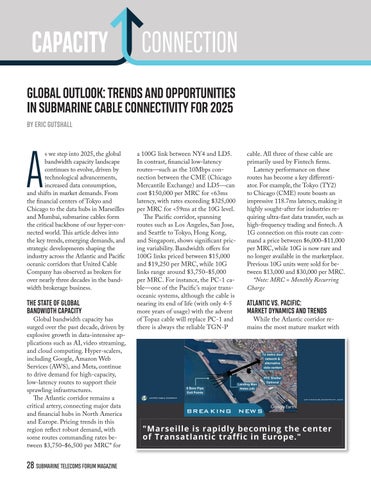
Photo from telecoms.com

the U.S. to Spain and the U.K., this innovative system is designed to meet the needs of modern applications like AI and big data analytics.
• EXA Express: The ULL submarine cable of the Atlantic, with <59ms latency from NY4 to LD5.
OPPORTUNITIES AHEAD
The submarine cable industry stands at the crossroads of innovation and expansion. In 2025, stakeholders must address several challenges to capitalize on emerging opportunities:
• Sustainability: With growing concerns about environmental impact, there is an urgent need for eco-friendly cable deployment practices and energy-efficient operations.
• Geopolitical Stability: As global tensions impact critical infrastructure, ensuring the security and reliability of cable systems will be paramount.
• Emerging Markets: Expanding connectivity to underserved regions
offers significant growth potential, unlocking new opportunities for economic and social development.
CONCLUSION
As we navigate the complexities of 2025, the submarine cable industry remains a foundational base of global digital transformation, communication, and the global economy. From hyper-scalers investing in dedicated routes to emerging markets driving connectivity demand, the trends shaping this sector reflect a dynamic and interconnected future. With the Atlantic and Pacific corridors at the forefront of this evolution, the industry is poised for continued growth, innovation, and impact. STF

ERIC GUTSHALL is the Founder and CEO of United Cable Company (UCC), a global leader in telecommunications services, where he oversees brokerage, consulting, marketing, and infrastructure projects. With over
30 years of industry experience, Eric is recognized for his strategic vision and deep network of global connections. He founded UCC in 2002 to transform global connectivity through innovative solutions and exceptional customer service. Throughout his career, Eric has generated over $1.4 billion in revenue, working with clients across North America, Europe, and Transatlantic markets. Notably, his leadership at Hibernia Atlantic from 2004 to 2016 played a key role in expanding the company from a small operation to a global network, culminating in the development of Hibernia Express, the first new transatlantic cable in over a decade. He transformed the company from -$10M to $145M annual revenue operation and ultimately facilitated the sale of Hibernia to GTT (now EXA) for $610M.ev
Prior to founding UCC, Eric held leadership roles at Tyco Submarine Systems, TSSL/TyCom, and MCI, where he earned recognition as MCI’s Top Salesperson and led major sales initiatives that generated millions in revenue, all while working in the 100 Wall Street office in the heart of Manhattan’s financial district. His expertise in direct and indirect sales, business development, and marketing has made him a trusted leader in the telecommunications industry. Eric holds a Bachelor of Applied Professional Sciences in Industrial Management from the University of South Carolina (1992). His commitment to innovation and excellence continues to shape UCC’s vision for the future of global connectivity.
5 QUESTIONS WITH KERRY MERRITT
Talking Submarine Cable Industry with Total Telecom’s Head of Content

1.
CAN YOU INTRODUCE SUBMARINE NETWORKS EMEA 2025 AND SHARE THE CONFERENCE’S CORE MISSION?
Since its launch in 2018, Submarine Networks EMEA has gone from strength to strength and is now successfully established as the largest and most important annual subsea connectivity event. Following a record-breaking event in 2024, we’re expecting over 1,000 senior leaders from the global subsea industry to join us again in February for the 2025 edition in London.

Our goal continues to be to deliver a world-class event that brings together key stakeholders from the subsea communications ecosystem for two days of learning and networking opportunities. Our programme is carefully curated with the support of our Advisory Board to reflect the most pressing and relevant topics in the submarine cable industry today, from security and geopolitics to technology and new cable deployments.
Our growing attendee list is a true reflection of all the key players in the global submarine cable market.
2.
IN WHAT WAYS DOES TOTAL TELECOM ENGAGE WITH THE SUBMARINE CABLE MARKET?
Although events are our primary business, Total Telecom is a well-respected digital news platform. Our Editorial team, Harry and Georgia, work tirelessly publishing daily news stories from the global communications market. The team regularly reports on the latest goings-on from the subsea market, ensuring that we’re keeping our readership up to date with the industry year-round.
Of course, our work on Submarine Networks EMEA never stops as we’re always researching and developing new ideas for the programme to ensure that we remain the EMEA’s most important subsea event.
3.
WHAT DO YOU CONSIDER THE PRIMARY FACTORS BEHIND SUBMARINE NETWORKS EMEA 2025’S CONTINUED SUCCESS IN THE TELECOM INDUSTRY?
The answer to this one is simple: people! Both the team behind the event and the people we work with in the industry who support us year in, year out, are incredibly dedicated. We have a really experienced and passionate team at Total Telecom who work hard to ensure the
continued success of the event, from marketing, to sales, to operations, and editorial. It’s a real team effort!
Not only do we have a fantastic expert Advisory Board who support us with the programme, but we have excellent relationships with individuals and companies throughout the industry who generously share their expertise and advice on and ideas to help keep the event exciting and informative year after year.
Having the willingness to allow Submarine Networks EMEA to evolve with the times while still keeping true to its core audience is something we’re very proud of.
4.
HOW IS SUBMARINE NETWORKS EMEA 2025 HELPING TO SHAPE THE NEXT GENERATION OF THE SUBMARINE CABLE AND TELECOM SECTORS?
For several years now, we’re proud to have offered free tickets to students, recent graduates, and apprentices working on recognised programmes to attend the event. This is something we’re pleased to continue and each year we’re seeing an increase in uptake of these complimentary tickets.
In an event-first in 2024, we hosted a “Junior Top Dogs” networking event in partnership with Aqua Comms and HOT Telecom. Although the “Junior Top Dogs” brand is well-known in the industry, it was the first time we’d run anything like it at Submarine Networks EMEA and it was such a success that we’ll be bringing it back in a slightly new format for 2025! Over 60 attendees took part last year and it was great to see so many new faces networking with well-respected executives.

In February, we’ll be hosting the event again on Day Two of the conference. In addition to the popular speed networking part of the event, we’ll also be adding dedicated roundtables focusing on some of the hottest topics in the subsea industry.
5.Attendees of Submarine
LOOKING AHEAD, WHAT’S NEXT FOR TOTAL TELECOM AS IT CONTINUES TO SHAPE THE FUTURE OF GLOBAL COMMUNICATIONS?
17th February | 2pm - 5pm
2025 is set to be another big year for Total Telecom! After we kick off the year with Submarine Networks EMEA, we’ll be heading over to the US in March for our 3rd annual Connected America event. The US continues to be an important market for us as we continue the development of our Broadband Communities event portfolio, which Total Telecom acquired in 2023.
The team is also continuing its focus on the UK connectivity sector with our Connected North and Connected Britain events taking place in April and September, respectively. Across the two events, over 10,000 attendees will convene in Manchester and London to explore the development of the UK’s digital infrastructure and what this means for people, communities and businesses. STF
The masterclass will focus Title Partner, Ciena, will “Sustainably scaling
How to scale submarine their sustainability metrics
KERRY MERRITT joined Total Telecom 8 years ago and assumed the role of Head of Content in 2021. She has led on the production of Submarine Networks EMEA since its inception in 2018 and has responsibility for steering the content strategy across Total Telecom’s events portfolio.
WHY ATTEND SUBMARINE NETWORKS EMEA 2025?
Following a record-breaking event in 2024, Submarine Networks EMEA returns to London on 18th – 19th February for two and a half days packed with learning and networking opportunities. This year, over 1,000 attendees from the global submarine cable market will be in attendance.
AUDIENCE
The new hardware and down the cost of capacity also improving sustainability The commercial aspects technologies Successful customer use
As the EMEA region’s largest and most important subsea conference, the networking possibilities are unparalleled, with many of the industry’s most important figures in attendance. This includes senior decision makers from across the subsea ecosystem, including subsea cable owners, wholesale carriers, hyperscalers, turnkey suppliers, cable manufacturers, marine service providers, governments and regulatory agencies, data centres, investment firms, legal experts, consultants, and more.
THE CONFERENCE
Put together with the support of our incredible Advisory Board, this year’s programme is split into nine key themes: commercial strategy, sustainability, market dynamics, data centres, technology innovations, resilience and security, people and skills, regulation, and operations. Before the main conference begins, attendees will be able to join our Title Partner, Ciena, for a pre-event masterclass and drinks on the afternoon of Monday 17th February. This year the ever-popular masterclass will focus on how to scale submarine networks for the future while also improving

sustainability metrics. Ciena will take a deep dive into the latest hardware and software technologies that can drive down the cost of capacity and improve service resilience. Additional focus will be given to the commercial aspects associated with introducing these new technologies. Relevant insight will be shared from a number of customer use cases, followed by an evening drinks reception for attendees to unwind and discuss the day.
Looking towards the main conference on 18th and 19th February, the opening keynotes, moderated by Pioneer Consulting and featuring speakers from cable owners from across the EMEA region, will discuss ‘a privatised subsea cable world’. Speakers from the European Subsea Cables Association and our Title Sponsor Ciena will also give keynote addresses. One of our continued missions is to ensure that speakers from across Europe, the Middle East and Africa are represented on the agenda and have the platform to discuss their unique challenges and opportunities. To this end, we’ll have dedicated sessions focused on the subsea cable market in each of these geographies, including ‘regional spotlights’ on the rapidly growing regions of MENA and Africa. We’ll
also be featuring speakers from surrounding regions with a particular focus on North America.
Other panel highlights at Submarine Networks EMEA 2025 include sessions on fibre sensing technologies, the future of SMART cables, the legal landscape of the subsea industry, scaling capacity to meet increasing bandwidth measures, cable security, data management and governance, subsea financing, sustainability, regulation, subsea maintenance, strategies for ensuring infrastructure resilience for smaller nations, and a focus on the increasing use of the seabed worldwide and the consequences.
Finally, our highly popular ‘News in Brief’ sessions will provide updates from more than 15 subsea cable projects and connectivity hubs currently in development, under construction, or recently completed. Project owners, developers, and data centre companies will share the latest on the progress of their infrastructure builds in these snappy and informative presentations.
NETWORKING
Events are all about meeting people and developing

meaningful professional connections. Throughout Submarine Networks EMEA we offer a myriad of opportunities to engage with other attendees, including booking 1-2-1 meetings via our dedicated event app, dedicated networking breaks, and plenty of space for both formal and informal meetings.
Finally, after a busy first day at the conference, attendees can kick back with a drink at our evening networking reception. Being such a tight-knit and sociable industry, one thing is certain – the drinks reception is always a lively and fun event, providing the perfect opportunity to catch up with colleagues old and new in a more relaxed environment!
THE EXHIBITION
The exhibition floorplan is filling up faster than ever and we’ve got some fantastic companies set to showcase their innovative offerings. We’re delighted to welcome both new and familiar faces to the event this year. Keep up to date with who will be attending on our ‘Partners’ page on the event website and if you’re interested in getting involved as a sponsor, get in touch with our Commercial Manager, Laura O’Reilly.
LOCATION
Attendees of Submarine
2025 will see the event return to its long-term home at the Business Design Centre in London. Located in the heart of busy Islington, this popular location is home to many fantastic bars and restaurants for attendees to enjoy after our evening drinks receptions. Its central location and excellent transport links make it quick and easy to reach the venue by underground, train, or by air travel.
17th February | 2pm - 5pm
SHAPING THE NEXT GENERATION OF THE SUBSEA INDUSTRY
Those who know the team at Total Telecom will know how passionate we are about supporting the industry in its efforts to encourage new talent and faces into the sector. As we have done for several years now, we’re pleased to offer free tickets for: students, graduates and apprentices on placement in the industry, those on a graduate training programme, and those who are enrolled on or have recently completed a skills training programme.
Title Partner, Ciena, will “Sustainably scaling
The masterclass will focus
In an event-first in 2024, we hosted a “Junior Top Dogs” networking event in partnership with Aqua Comms and HOT Telecom. Although the “Junior Top Dogs” brand is well-known in the industry, it was the first time we’d run anything like it at Submarine Networks EMEA and it was such a success that we’ll be bringing it back in a slightly new format for 2025! Over 60 attendees took part last year and it was great to see so many new faces networking with well-respected executives. In February, we’ll be hosting the event again on day two of the conference. In addition to the popular speed networking part of the event, we’ll be offering dedicated roundtables on some of the industry’s hottest topics.
How to scale submarine their sustainability metrics
The new hardware and down the cost of capacity also improving
sustainability The commercial aspects technologies
As a business, we’re keen to support activity within the industry that encourages the next generation of telecoms professionals and supports their career development programmes. If you’ve got any ideas about how to leverage the Submarine Networks EMEA and Total Telecom platforms to achieve these goals, don’t hesitate to reach out to the team.
GET INVOLVED!
Successful customer use
Pre-registration is a must registered for Submarine
We can’t wait to open the doors to Submarine Networks EMEA this February and look forward to seeing you there.
If you work for a European-based subsea cable owner, wholesale carrier, or public sector organisation, we have a limited allocation of free tickets available. If you don’t qualify for a free ticket, we’re delighted to offer a 20% discount as a reader of our valued partner, Submarine Telecoms Forum - simply use the code STF20 when booking.
For any questions about the event, get in touch with Submarine Networks EMEA’s Producer, August Skinner. STF

18th - 19th February, 2025
| London
Submarine Networks EMEA is the largest annual subsea connectivity event, bringing together 1,000 senior leaders from the global subsea market for two jampacked days of learning, collaboration and networking.
In addition to offering plenty of networking opportunities, attendees will be able to enjoy thoughtleading panels, technical presentations, workshops and cable project and connectivity hub updates.


#SubNetsEMEA


18th - 19th February 2025 Business Design
Attendees of Submarine Networks EMEA are invited to join the...

PRE-EVENT MASTERCLASS
17th February | 2pm - 5pm | Business Design Centre, London
Title Partner, Ciena, will be hosting a pre-event masterclass on “Sustainably scaling submarine networks”
The masterclass will focus on:
How to scale submarine networks for the future whilst improving their sustainability metrics
The new hardware and software technologies that will drive down the cost of capacity and improve service resilience, whilst also improving sustainability metrics
The commercial aspects associated with introducing these new technologies
Successful customer use cases
Pre-registration is a must as spaces are limited. You must be registered for Submarine Networks EMEA to secure your place.
Early bird, group discounts, and *subsidised tickets available at www.totaltele.com/subnets
AGENDA
Tuesday 18th February
08:00: Registration opens
09:00: You get a cable, you get a cable, and you get a cable: A privatised subsea cable world
09:40: Keynote address from Title Partner, Ciena
10:00: Keynote address from European Subsea Cables Association (ESCA)
10:15: Networking break
10:40: News in brief: Grid Telecom
10:50: News in brief: IOEMA
11:10: News in brief: Atlantic CAM
11:30: News in brief: TAMTAM
11:40: News in brief: Polar Connect
11:50: News in brief: Pisces
12:00: News in brief: HaDEA
12:20: The legal landscape of the subsea industry
12:20: Using fibre sensing technologies to help secure existing cables
12:20: Regional spotlight: MENA
13:00: Presentation from National Oceanography Centre
13:20: Networking break
14:10: Presentation from HMN Technologies Co. Limited
14:30: The future of SMART cables
14:30: Scaling capacity on subsea cables to meet increasing bandwidth demands
14:30: Collaboration to ensure the resilience and security of subsea infrastructure
15:10: Celebrating your landing party: How best to survive a 25-year relationship
15:10: Presentation from Ciena
15:10: Regional spotlight: Africa
15:30: SMART cables: Data management and governance
15:50: Financing strategies for global subsea and data centre infrastructure
15:50: Sustainability and the subsea industry
16:30: Networking break
17:05: Keynote address: International Cable Protection Committee (ICPC)
17:25: Increasing use of the seabed: A focus on the unintended consequences of human activities
18:00: Networking drinks reception
Wednesday 19th February
08:30: Registration opens
09:10: How is the evolving data centre landscape influencing cable system builds?
09:55: Keynote address from SubOptic & Update on SubOptic 2025
10:15: Networking break
10:15: ‘Junior Top Dogs’ Networking Event
10:55: News in brief: Confluence-1
11:05: News in brief: Unitirreno
11:15: News in brief: Tusass Connect
11:25: News in brief: Update from Colt
11:35: News in brief: Update from GlobalConnect Carrier
11:45: News in brief: BlueMed
12:35: Networking break
13:10: Regulation & the subsea sector
13:30: How do you solve the subsea maintenance question?
13:50: Good citizens and good managers of the seabed: Working towards common goals
14:10: Strategies for ensuring resilience for smaller nations
14:30: How does the industry organise itself to protect submarine cables?


SPONSORSHIPS AVAILABLE


THE CARRIER GUIDE TO 2025
TRAFFIC, TECHNOLOGY AND UNSUNG HEROES
BY MATTIAS FRIDSTRÖM
According to the Chinese Zodiac, 2025 is the Year of the Snake. In Chinese culture, snakes are associated with wisdom, charm, elegance and transformation. They are intuitive, strategic and intelligent. In many ways I can’t help of thinking that this is exactly how telecom companies need to be in 2025. With continued geopolitical tension and tough market conditions, the only way to stay relevant is to adapt. We must use all our wisdom and transform ourselves into a better version of what we are today. With the support of AI, we need to carefully transform our operations, while keeping our customers happy and our networks up and running. But in spite of all these challenges, traffic is still growing, and new opportunities continually arise. In keeping with our traditional ‘Top 3’ predictions for the year ahead, here are a few thoughts for 2025.
THE TOP 3 GLOBAL CARRIER INDUSTRY TRENDS
1. Five ants are more than four elephants. This was the name of one of the most popular shows in Swedish television history and in many ways, it is a fitting metaphor for today’s Carrier industry. More route diversity means a better protected network and greater performance. With today’s turbulent geopolitical environment, operators must protect their networks as much as they possibly can and the best way of doing that is to deploy as many routes as possible between any two locations. The large “elephant” routes are generally more economical, but also far more vulnerable when faults do occur. A multitude of smaller “ant” routes can be more expensive to operate but provide greater resilience overall. During 2025, we will see many new routes added - even routes that have previously been deemed not to be financially viable.
2. AI gets the power. It is widely agreed that AI is here to stay and in future, most companies will take advantage of it in some way or another. This means that data centers hosting GPUs and other AI related equipment will need enormous amounts of power - the greener the better. When you ask AI companies about their priorities, power comes first, second and third on the priority list, with connectivity a close fourth. While it still is not clear exactly how AI will impact long-distance traffic, operators will need to evaluate the business case for constructing new fiber routes to areas where there is a lot of power, but not much connectivity. Will it really be worth connecting to these remote data centers, or should that be left to the regional players?
3. Sustainability initiatives may finally happen. For many years, operators and enterprises have been telling the industry that green initiatives are on their agenda - with many customers saying that they are prepared to pay a premium for greener services. In turn, carriers have candidly published ambitious sustainability targets, but at the end of the day, few customers have really been prepared to pay more for sustainability, and little has changed. Cost is still the most important selection criteria for network buyers. During 2025, companies will be under pressure to report their sustainability KPIs and there will be greater focus on this area. CSRD, ESRS, and SEC climate disclosure rules, together with EU Taxonomy are buzzwords that will really matter in 2025.
THE TOP 3 TECHNOLOGY AND TRAFFIC TRENDS
1. C and L join the band. Now we’re at Shannon’s limit, we need to find new ways of increasing our optical footprint - a particular challenge where fiber is a scarce resource. During the last couple of years, our industry discovered the possibility of using part of the optical spectrum known as the L-band. It still takes some effort to add L-band usage to operational C-band systems, but it is by far the best way to increase capacity when your underlying resource is only a single fiber pair. During 2025, we will see more projects that make use of both the L and the C-band, and with any luck, the implementation process will become a lot simpler (and less costly) over time.
2. MOFN is back. Ten years ago, in a marketplace where knowledge about running global networks was a rare commodity, managed network sales were pitched as the land of opportunity for carriers. Essentially, this came down to leasing out fiber pairs and equipping them with optical gear for a comprehensive managed network solution. As time has passed, however, spectrum and other optical solutions have gradually succeeded this approach. We are now seeing the return of the managed network but under a different name - Managed Optical Fiber Network. High-capacity needs but limited human resources mean that some businesses are again asking operators for MOFN solutions. During 2025 we will see many more of these solutions.
3. IPoDWDM for real. Some operators tested the new 400G ZR technology already back in 2021, and since then, the technology has really matured, with standards coming together even for 400G ZR+ pluggable components. The huge CAPEX savings combined with a lot less OPEX when power usage falls is the main driver
FEATURE
here for operators. There are still some operational issues to resolve, but during 2025 many more operators will start using this technology either to connect more locations with their IP networks or simply just transfer their current IP core network to something far more cost-effective and scalable.
THE TOP 3 FIBER INNOVATIONS THAT NOW SEEM POSSIBLE
1. Hollow core fiber. Hollow-core fiber is a promising innovation for Internet carriers as GenAI accelerates. This type of cable allows operators to transmit light through an air-filled core, rather than glass fiber - enabling higher speeds, lower signal losses and other improvements that support the connectivity requirements of emerging applications. Hollow-core fiber currently faces production scalability and cost challenges which inhibit widespread implementation. It’s a compelling innovation but it comes with a hefty price tag if used to replace large legacy networks. Still, the industry may yet overcome these obstacles eventually and begin wider deployment within the next few years. During 2025 we will be hearing more about this great opportunity.
2. Multicore fiber. There are still many places where space is limited and where pulling-in thick multifiber cable is simply not feasible. Multicore fiber is optical fiber that contains multiple cores within a single strand. It is possible to transmit much more bandwidth while retaining the same form factor and size of the cable. It is widely used inside data centers between switches, servers and storage devices but is yet to reach long-distance networks. With Shannon’s limit already here, there will be an increased demand for new fiber everywhere and we might see some use cases in long distance networks where a multicore fiber cable could be used within a legacy duct infrastructure.
3. The fantastic plastic dream. Plastic fiber has been around for a long time and is widely used across short distances, with the main advantage being lower cost per meter. There has never really been a viable use for plastic fiber across long distances due to attenuation and dispersion limitations. Long-haul deployment of cheap plastic fiber is in many ways a pipedream in a world where we will need a lot more fiber everywhere. There is a common misconception that everything will be wireless in the future - in reality, wireless and wireline will coexist to deliver the unique benefits of each technology. While cheap plastic fiber used across long distances may still seem unrealistic in 2025, we can always keep our fingers crossed for a technological breakthrough.
THE TOP 3 BEST ENHANCEMENTS WITH AI FOR A CARRIER
1. Predicting faults. Networks are currently churning out operational data that is often not used (or not possible to use) for operational efficiency enhancements. It isn’t a new idea to use historical data trends to predict when the next equipment failure may occur, but with the use of AI & machine learning we are now closer than ever to a practical solution. By applying intelligent analysis of high volumes of operational data - such as temperature and processing efficiency - within a short period of time, operators should be able to identify the anomalous behaviour that can predict the likelihood of future hardware failure within a reasonable margin of error. If, for example, a network card can be proactively swapped-out before it fails and customers do not notice, we will have all won a significant operational victory. With AI now a reality, there are many reasons to believe that this will start to happen during 2025.
2. More speed and transparency. Most Operators have many customers. Often, when a fiber cable goes down, many customers are affected at the same time and they all want to know every detail about the failure, time-to-repair and the service resolution. With the support of AI, good trouble-ticketing and network inventory systems, operators should now be much better equipped to provide customers with more useful information during an outage. Many operators today still rely on manual routines, and the few that have become more automated are usually regarded as less customer friendly. Most customers end up calling them anyway when they do not understand the automated information they receive. During 2025, good customer experience will still be critically important, but AI will help make it better.
3. Hands off! The Carrier industry has for years been extremely manual by nature. Poor data quality in combination with complex workflow tasks has made automation difficult. With new AI tools, this now seems to be something the industry can overcome, and we can finally have workflow engines driving processes without the human touch. We still need very accurate data but with the support of AI, operators can do much more than they could before. Faster and more accurate delivery flows mean that operators can deliver services sooner, making their customers happier. During 2025, a lot of focus will be on speeding things up.
THE TOP 3 THREATS YOU NEED TO PROTECT YOUR NETWORK FROM.
1. The weather. Our industry has recently made significant progress in fostering collaboration between network operators, infrastructure owners, regulatory authorities and industry traceback groups in successful resistance to DDoS attacks. While these efforts seek to combat malicious traffic flooding our network servers, what about the natural disasters flooding our physical infrastructure? Unfortunately, extreme weather events significantly disrupted global communications in 2024 and while many service providers are only beginning to discuss weatherproofing network infrastructure, even fewer are actively implementing effective weatherproofing strategies. As climate change escalates, these contingency plans (or lack of them) will enter the spotlight in 2025. While we still have much work to do, possible enhancements may include deeper collaboration with authorities to leverage advanced geospatial monitoring systems and help us to anticipate natural disasters. More care when evaluating potential network sites will also prove crucial. Traditionally, operators viewed forests as sufficiently safe and remote for the deployment of fiber optic cables. However, with more forest fires, service providers will need to be more thoughtful about where they dig fiber and may need to bury cables deeper in vulnerable regions.
2. Anchors. The world’s oceans are criss-crossed with sea cables and there are many more to come. Traditionally, fishermen have been the sea cable’s worst enemy, but recently we have seen a number of cases where cables have been broken in odd places with large cargo vessels too close for comfort to the actual break. Sabotage or not, it clearly shows that operators will need even more cables to sustain a reliable and resilient network that can work even if multiple cables are cut. For years operators have worked to find the shortest and best routes for their traffic but in future, we need to combine this with routes that enhance geographical diversity. During 2025 this will be hotly discussed and some older or soon-to-be retired cables will be given a new lease of life. Recycling is the way forward in 2025.
3. Cyber-attacks. Unfortunately, with the volatile geopolitical situation we currently have, we will undoubtedly see an increase in DDoS attacks across all geographies. New attack vectors are emerging and attacks originate from new sources. Carpet bombing attacks have been particularly popular during the 2024. The positive thing here is that both systems and operators are becoming better at fighting off attacks. A large number of attacks are currently
stopped before they even are noticed thanks to the collaborative efforts of larger Tier 1 IP backbones to stop them. AI will certainly help attackers find new weapons for their arsenal, but at the same time, operators are using AI to develop new mitigation techniques. This ongoing power struggle between good and evil will intensify during 2025.
THE TOP 3 UNSUNG HEROES
1. The billing administrator. Sending out invoices is normally a fairly straightforward task. But issuing correct invoices in a world where things change very fast, where traffic goes up and down rapidly and deals are done to correct past mistakes, can be a real challenge. Add to that customer consolidation and billing becomes a dark art. Without our fantastic billing administrators this topsy-turvy industry would be even more chaotic.
2. The cable coiling guy. The world needs more submarine cables, but without someone to follow a cable when it is loaded on to a deployment vessel, there wouldn’t be any submarine routes. Walking several kilometers in a tight circle to make sure the maximum possible amount of cable is loaded on to the boat is no mean feat.
3. The corporate AI police. With the introduction of AI comes endless possibilities to improve what you do. But also, the unlimited potential to make mistakes much worse. It might make sense to ask your favorite AI program to take minutes from your strategy meeting, but within minutes, the whole world can read them on the Internet. Company AI law enforcement police is neither a popular nor easy task.
Predictions are, of course, just predictions, and we wish everyone in the telecom ecosystem – from our business partners in the network to end-users and everyone in betweena brighter year ahead, with good health and prosperity. One thing is certain, 2025 will be a year filled with excitement and change, but as we always say here at Arelion, “You can’t predict the future, but you can be ready!” STF

With over 20 years in the telecommunications industry, MATTIAS FRIDSTRÖM can be considered a veteran – but his enthusiasm hasn’t faded.
Mattias combines expert knowledge with anecdotes from behind the scenes and deep insight into the networked economy: What are the challenges of tomorrow for network providers? How can we meet ever-increasing traffic demand and customer quality expectations within the same cost frame?
Mattias holds an M.Sc. in Electrical Engineering from the University of Wollongong, Australia. Since joining Telia in 1996, he has worked in a number of senior roles within Telia Carrier / Arelion and most recently as CTO. Since July 2016 he is Arelion´s (former Telia Carrier) Chief Evangelist.


THE HIDDEN LIFELINES
Subsea Cables, Maritime Security, and Cybersecurity Under Global Scrutiny (A Reflection)
BY JOSÉ AMARO


Every time we send an email, browse social media, or join a video call, we’re relying on a vast, hidden infrastructure beneath the oceans—subsea telecommunications cables. These critical cables, stretching thousands of kilometers across the seafloor, carry over 97% of international internet traffic, acting as the digital world’s lifelines. But as the global economy becomes more interconnected, these cables are increasingly vulnerable to threats.
Recently, both Europe and the United States have ramped up efforts to protect subsea cables from both physical and cyber threats. The European Union (EU) has implemented the NIS2 Directive[1] and theMaritime Security Strategy[2], placing subsea cables at the heart of their critical infrastructure protection. In the U.S., agencies like the Department of Homeland Security (DHS) and the Federal Communications Commission (FCC) are increasing measures for cyber and physical defence, especially after recent cases of damage and espionage involving these vital systems.
However, the dangers to these vital networks are growing. In August 2023, a major incident occurred off the coast of Cameroon, severely damaging the West Africa Cable System (WACS) and South Atlantic 3 (SAT3) cables. This caused widespread internet outages across Cameroon, Gabon, Congo-Brazzaville, and the Democratic Republic of Congo. The disruption, reportedly caused by a rockfall, took several weeks to repair, illustrating the fragility of these essential links and their vulnerability to both natural disasters and potential sabotage.
This incident follows a series of threats to submarine cables, ranging from attempts to sabotage Arctic submarine cables (2019), to cyberattacks on landing stations (2021) in the US and Europe, to physical sabotage in contested regions such as the South China Sea. The 2022 incident, which involved the mysterious cutting of two cables near the Shetland Islands, is another clear example of how even apparently remote cables can become targets. With these events in mind, the need for comprehensive protection strategies is more critical than ever.
tems such as YARIS, IORIS and SEAVISION traditionally employed to combat illegal activities like illegal fishing, piracy, and drug trafficking, can be adapted (if they aren’t already!) to monitor and protect critical submarine cables. By utilizing AIS satellite technology, these platforms can track vessel movements in real-time across open waters, enabling authorities to swiftly detect unauthorized vessels near sensitive cable routes. Continuous surveillance helps identify suspicious behaviors, such as vessels lingering near critical subsea cables, which could signal potential threats. This proactive approach enhances the security of these critical infrastructures, ensuring that authorities can intervene before any damage occurs.
Along coastlines, the combination of AIS and RADAR provides an even more detailed picture of maritime activity. By monitoring both the surface and the surrounding airspace, authorities can detect potential risks at key points like landing stations, where cables transition from sea to land. This area is particularly vulnerable to both physical attacks and espionage, as it’s often the point where data can be intercepted if security measures are weak.
On the other hand, one of the most interesting advances in submarine cable technology is the development of so-called SMART (Sensor Monitoring And Reliable Telecommunications) Cables. These cables do more than just transmit data; they are also equipped with sensors that actively monitor the environment around them.
Beyond monitoring, artificial intelligence (AI) adds a powerful layer of protection. AI algorithms can process vast amounts of data from AIS and RADAR systems to detect patterns of behavior associated with illegal or threatening activity. For instance, if a vessel is found operating outside of its normal shipping route or its movements suggest surveillance or espionage, the system can trigger an alert, allowing security forces to investigate immediately.
Maritime security information-sharing platforms are crucial in mitigating the risks posed to subsea cables. Sys-
In addition to real-time monitoring, AI-based fencing technology can create virtual ‘geo-fences’ around the most vulnerable areas. If any unauthorized vessel crosses these restricted zones, the system sends an alert to the authorities, acting as a proactive approach that enables early detection of potential threats before they can cause damage. By integrating machine learning, these systems can even learn from preceding incidents, improving their ability to predict and classify future risks, such as espionage, sabotage, or even natural disasters.
On the other hand, one of the most interesting advances
in submarine cable technology is the development of so-called SMART (Sensor Monitoring And Reliable Telecommunications) Cables. These cables do more than just transmit data; they are also equipped with sensors that actively monitor the environment around them. This type of equipment can detect things like seismic activity, tsunamis, ocean bottom pressure, ship movements or even temperature changes, which allows them to send data in real time to the authorities on land. This technology acts as an early warning system, alerting authorities to potential threats, whether it’s an impending natural disaster or a suspicious ship or other (submersible) equipment in the vicinity that could pose a risk of sabotage.
Ultimately, the protection of subsea cables is a challenge that demands a concerted global effort. No single nation can effectively safeguard its own waters in isolation, as the scope and importance of this infrastructure extend far beyond national borders.
Currently, the world’s first SMART cable system, called TAMTAM, is being deployed between Vanuatu and New Caledonia in the Pacific Ocean. This region is particularly vulnerable to tectonic activity, making it an ideal location for the deployment of these advanced cables. Additionally, projects are also underway in regions such as Portugal, where a SMART cable is set to connect the mainland to the Azores and Madeira.
By integrating this SMART Cable technology with existing Maritime Security Platforms, the global security network becomes much more powerful. These platforms already track the movements of vessels using AIS, satellite and RADAR tools, but combining this layered information with the real-time data from smart cables provides a much clearer picture of what is happening underwater, on the surface and possibly in the airspace.
– provide an essential foundation for the protection of subsea infrastructure, they are no longer sufficient in addressing the complex and evolving threats of the modern era, particularly those related to cybersecurity and physical sabotage.
In today’s world, where cyber and physical threats are more sophisticated, modern agreements and updated strategies are urgently required to tackle the specific challenges posed by the 21st century. This is especially crucial as more cables are being laid in geopolitically strategic areas, such as the Arctic and the South China Sea, where tensions and vulnerabilities are higher. Therefore, ensuring the continued security of the global digital network will depend on robust international cooperation, coordinated efforts among governments, and comprehensive approaches that blend advanced technology with effective policy frameworks. The security of these digital lifelines is not just a matter of national interest but a collective global responsibility. STF

Through a combination of cybersecurity protections, real-time data sharing, and AI-powered threat detection, maritime security platforms offer a promising solution to the escalating risks facing subsea cables. These measures can help prevent both accidental and malicious damage, ensuring that the global network remains secure.
Ultimately, the protection of subsea cables is a challenge that demands a concerted global effort. No single nation can effectively safeguard its own waters in isolation, as the scope and importance of this infrastructure extend far beyond national borders. To ensure the security of these vital connections, countries must actively collaborate and coordinate across regions. While frameworks like the United Nations Convention on the Law of the Sea (UNCLOS)[3] – adopted in 1982
JOSÉ AMARO is a Cybersecurity/Maritime Security Consultant for EU, Africa and Indo-Pacific, Privacy Law Consultant, Jurist, and ISO/27001 Lead Auditor. He has been actively engaged in managing projects related to maritime security, cybersecurity, compliance, governance, and risk management, with a focus on the Maritime and Telecommunications sectors.
He has a law degree from the Faculty of Law of the University of Lisbon and a postgraduate qualification in Securities and Capital Markets Law, as well as a postgraduate qualification in EU Data Protection Law (Advanced), in Lisbon University.
He holds certifications as ISO/IEC 27001:2022 Lead Auditor, Data Privacy Practitioner (CDPP) from the Irish Computer Society, Maritime Ports Facility Security Officer, and Project Management Professional (PMP®).
Currently, he serves as a senior international consultant and advisor, specializing in critical infrastructure security and cybersecurity.Additionally, he participates as a legal advisor in EU Maritime Security projects across Africa and the Indo-Pacific.
Sources:
- European Union Agency for Cybersecurity (ENISA) Report on Subsea Cables
- NIS2 Directive and EU Maritime Security Strategy
- United Nations Convention on the Law of the Sea (UNCLOS)
- Recent Incidents Involving Subsea Cables in Shetland and Faroe Islands (ENISA)
- https://www.smartcables.org |
[1] https://eur-lex.europa.eu/eli/dir/2022/2555
[2] https://oceans-and-fisheries.ec.europa.eu/ocean/blue-economy/other-sectors/maritimesecurity-strategy_en
[3] https://www.imo.org/en/ourwork/legal/pages/ unitednationsconventiononthelawofthesea.aspx and https://eur-lex.europa.eu/EN/legalcontent/summary/united-nations-convention-on-the-law-of-the-sea.html


FEATURE THE ‘WET WAR’ Could Submarine Cable Security Concerns Threaten Global Stability?
BY JOHN TIBBLES
INTRODUCTION
Has there ever been a period when subsea cables a have been so often in the news? Not only have they been in the media almost daily, but for mostly the wrong reasons. They seem to have almost become either weaponised or legitimate targets rather than bridging oceans and societies to bring people together for peaceful reason. This was an idea postulated by the telegraph pioneers 150 odd years ago with the completion of first Trans-Atlantic cable.
How have we come to this from a seemingly tranquil subsea environment that allowed telecom companies and more recently internet content providers to connect the world to an unprecedented degree? We have arrived at this worrying situation where our once niche and invisible industry is no longer threatened by geopolitical tensions but is the cause of them.
The answer of course is politics!
SOME HISTORY
In the three decades since the Berlin Wall fell and the Cold War ended, telecom carriers, content providers and entrepreneurs built cable networks for their own services but also as business opportunities. Politics in that era that
meant fishermen’s rights, local planning/zoning authorities and some regulatory issues. Often annoying, but benign compared with what we face today
That isn’t to say that governments were not involved with cables via various security and or military bodies but there was not the focus that there is today. Ten years ago, a dragged anchor could cut a cable, and it didn’t make the news media, now its prelude to WW3.
Subsea cables have existed for 150 years and have been targeted occasionally since then. In the late 1950s when the first TAT cables were built, they were to serve both civil and military needs.
These early systems were largely built by and used by the USA’s, AT&T, who were the world’s largest international telephony carrier and used their own technology and resources to build the cables. They also used their domination of the voice market to their advantage, but they didn’t control the content of the calls. There were other parties, UK, France, Japan etc. who also had large volumes of traffic and the capability to construct, install and maintain such systems. This carried on well into the optical fibre age as the likes of TAT8 and PTAT lead the industry into the new era mostly dominated by consortium systems but also some
private competitors. There was still government involvement since outside the USA it was the norm for telecom carriers to be state owned enterprises. Even after deregulation and privatisation there was still the opportunity for political involvement on issues such as protection of suppliers and use of the cable ship fleets. Deregulation also promoted ‘open access, allowing for the first time telecom operators to access cables at both ends to provide the global networks of the 80s and 90s.
THE RISE OF THE INTERNET
Google and the social networks with very high-volume data transfer speeds completely changed the use of cable from telecom operators to global content providers who worked together to build their own systems higher capacity with more intriguing names than TPC or TAT.
Unlike the ex-monopiles they didn’t have the long-term relationships with military and security services that the major global carriers had. However, the content providers rapidly began to rule the waves to the point where we arrive at today with the announcements of two real mega entirely global systems developed for Google and Meta. Truly global these will provide the capacity for the next big thing - AI. Both are major US corporations and inevitably closely connected to political and governmental entities enabling US control of the Internet and subsea network to reach a new level.
DIGITAL POLITICS
The new dominant parties not only control how data gets from A to B, but they also control much of the content that is carried and much of what they don’t control other US monoliths like AWS and Microsoft do.
Because of this unprecedented level of control and its critical importance to global trade, media and social interaction’ government awareness recognised how the world economy depends on the internet and its building blocks. Data centres and terrestrial wireless networks are essential elements, but they are located in individual countries and thus comply with national legislation. It is the subsea cables that link the world together, out of sight and outside the jurisdiction of any one government since International Waters are just that International and outside of any one countries control.
There is of course UNCLOS, the United Nations Law of the Sea but it is very widely encompassing and does not provide detailed provisions on subsea cables that reflects their importance today.
It is only in recent years that digital technology has been
the focus of concern in terms of national security. It started with concerns about China’s Huawei mobile/cell phone infrastructure and has migrated from there to subsea.
STATE INTERVENTION ONCE AGAIN
Early cables were owned by state owned monopolies and thus effectively controlled by a small number of maritime states. As 2025 dawns subsea cables are front and centre in media coverage and in the security concerns of many countries. Consequently, in September the UN developed a pact known as the Global Digital Compact (GDC) aimed at promoting the need for legislation and action to enhance the security of digital infrastructure; especially subsea cable which are almost entirely in international waters. It also drew attention to the existence of choke points on the network and the need for strategic diversity, transparency in the manufacture of subsea plant and scrutiny of the limited number of subsea cable equipment providers.
The United states Bureau of Cyberspace and Digital policy had clearly expressed goals resulting in a US Department of Homeland Security (DHS) policy paper which states:-
‘DHS POLICY PRIORITIES FOR SUBSEA CABLES’
• Ensure continued U.S. leadership in the subsea cable industry.
• Promote secure and resilient subsea cable networks and supply chains and counter foreign adversary threats’ (https://www.dhs.gov/news/2024/12/18/dhs-leadershipsupport-subsea-cable-security-resilience)
US Homeland security have already intervened in helping fund cable projects in the Pacific and Indian Oceans to ensure they were built by Subcom whose management apparently have connections to the incoming US administration. DHS have also made it clear that systems where there is a strong element of control by states they are not comfortable with, i.e. China, will not get landing rights in the USA. Such a policy of course could prevent any new US-China system and thus impair communications between the world’s biggest economies.
Another type of state intervention is the French Governments purchase of ASN, the world’s leading supplier of subsea cable systems. Subcom, are committed to providing the massive Google network which will stretch their production capability, but ASN may secure much of the Meta network contracts or will there be a transatlantic US vs EU/UK trade dispute over submarine cable provision? In different area of subsea, operations, the Government of Italy is aiming to ensure that TI-Sparkle with its extensive
FEATURE
subsea network especially in the Mediterranean will remain in Italian ownership
Such actions will also impact third parties especially as the US requirements for surveillance and transparency on new systems will increase system production costs and limit the opportunities for multi-party cost sharing because some locations on a major route may not be deemed acceptable to the USA. In that case not only are they excluded but the price increases for others in the project who must bear the costs of losing one or more landings. Sustainability in manufacturing and installation may be deferred to save costs and along with the environment this does not seem to be a priority of the incoming US administration.
So called private systems which already have difficulty attracting funding because of the perceived risks to successful deployment will face even greater challenges because of these requirements. Something already demonstrated in the Pacific area.
A SECOND DIGITAL DIVIDE
The phrase digital divide describes the differences in accessibility to digital service for commerce and leisure between what is often called the developed and developing world. It is an economic term.
The US and the 36 countries signed the so-called UN New York protocols but that means 100 or so countries didn’t. That includes places with some of the world’s largest populations like India, China, Indonesia and Africa. Consequently, much of the world gets dragged in to the long-standing US China technology disputes which may well get more intense with the change of Government in the United States and already foreshadowed by the DHS proposals.
All these developments lead to situations where it will become harder and harder to build networks that serve the needs of all the populations on potential routes resulting in a second ‘political ‘digital divide. The massive increase in traffic because of the wider use of AI and thus the internet in general means more and more people risk become isolated from others because they are served by the ‘wrong’ network. The increase in capacity that AI already requires today may not be there tomorrow due to this political separation into two global subsea network groupings and thus two internets. This is something I discussed in previous articles for STF, one lead by the USA and the other by China. ‘Billions of Dollars versus Billions of People’ ???
CONCLUSIONS
It is reasonable for any government to protect its territory and economic foundations from serious impairment.
but much of the digital infrastructure now the focus of such concern is not wholly within one country’s territory or territory of its allies. International subsea cables are by their nature terminated in different countries that may have diverging political and economic policies. Will there be another US China system under these rules? What will happen to regional systems in the South China sea and western India Ocean where smaller, non-aligned states may have difficulty in increasing capacity to the two major regional states China and India if they also want US connectivity.
Of course, the USA is not alone in having these concerns and wanting to protect is geopolitical and economic interests. Other world power nations have the same issues and will surely react , for example could a second BRICS concept develop as an alternative to having to build under Homeland Security/NY Protocols. That grouping alone has close to 4 billion people around the world and rapidly growing their appetite for online commerce and social networking. In Europe, notwithstanding their support for the NY Protocols they must preserve the capability to build subsea systems by supporting ASN and secondly acting as a moderator or mediator.
Finally, as indicated in the title will the world face a new phenomenon a ‘Wet War’ a lack of interconnection between two internets where both leading proponents seek to control not just connectivity but content and which escalates beyond the seabed. Impairment of global communication because of over hyped concerns about subsea networks would be catastrophic! Perhaps we will be saved from that dangerous development by a doctrine taken from the Cold War era ‘Mutually Assured Disruption’!
I would like to thank Elina Noor Senior Fellow Asia Program at the Carnegie Endowment for International Peace for her excellent article on Subsea Network Resilience in S E Asia where she addresses some of these issues in a more scholarly way. STF

JOHN TIBBLES has spent a working lifetime in global telecoms much of it in the subsea cable arena where he held senior positions responsible for subsea investments and operations at Cable and Wireless and MCI WorldCom and as an internal advisor consultant to Reach and Telstra Reach. John spent many years working for C&W in Bermuda and established the first private subsea cable offshore company and has worked extensively with both consortia and private system models. He has a wide background and expertise in most commercial matters of international telecoms and since ‘retiring’ he has remained active in the industry as a consultant, commentator and at times a court appointed expert and has been a panellist and moderator at international events.
PROVEN PROCESSES AND METHODOLOGIES
• Defined Processes
• Template Driven
• PMP Based Project Management Approach
• Rigorous Documentation Controls
• Quality Assurance Focused
• Secure Records Storage
• Accessible and User Friendly
INTRODUCING THE VIRTUAL REP
• In-Field Analysis Without In-Field Risk
• Remote real-time analysis and reporting without the added cost of today’s in-field representation liabilities.

Reviewing 2024’s most pressing subsea cable trends

Stories of 2024
A YEAR IN
As we reflect on 2024’s most-engaging stories,
we’ve refined our analysis to include not just total views but also the depth of engagement. To ensure a balanced and meaningful ranking, we used a weighted scoring system that prioritizes average engagement time (70%) over views (30%).
OUR METHODOLOGY
To account for differences in scale between views (which can reach tens of thousands) and engagement time (measured in seconds), we normalized both metrics to a scale of 0 to 1. This allowed us to compare them on equal footing. The normalization process involved dividing each story’s metric by the maximum value observed across all stories:
The final weighted score was calculated using the formula:

This approach ensured that stories with high engagement times received greater emphasis, reflecting the audience’s sustained interest.
THE TOP 10 STORIES
1. “HOUTHIS HIT UNDERWATER COMMUNICATIONS CABLES”
In February 2024, Houthi rebels targeted and damaged four major submarine communication cables in the Red Sea. This attack caused widespread disruptions in internet connectivity between Europe and Asia, highlighting the vulnerability of global communication infrastructure to geopolitical conflicts. With 68,217 views and an average engagement time of 99.9 seconds, this story captured significant attention and raised global awareness about the risks of cable sabotage. Read more: Houthis Hit Underwater Communications Cables.
2. “NEC, NTT’S 7,000KM MULTICORE FIBER OPTIC EXPERIMENT”
This groundbreaking experiment by NEC and NTT in March 2024 marked a significant milestone in optical communication technology. The successful 7,280km transmission using coupled 12-core multicore fiber demonstrated the potential for revolutionizing subsea connectivity. While it garnered fewer views (1,139), the story’s technical significance and an average engagement time of 103 seconds made it a key highlight of the year. Read more: NEC, NTT’s
Table 1: 2024 Top Story Key Metrics
FEATURE
3. “REPAIR VESSELS SET SAIL FOR SUBSEA CABLE REPAIRS”
In April 2024, repair vessels were deployed to address critical subsea cable outages following a series of regional disruptions. This operational narrative resonated strongly with industry stakeholders, emphasizing the importance of resilience in maintaining global connectivity. The story’s 1,564 views and an average engagement time of 92.9 seconds underscore its relevance. Read more: Repair Vessels Set Sail for Subsea Cable Repairs.
4. “UNDERSEA CABLE INTERNET RESTORED IN EAST AFRICA”
After weeks of outages impacting internet connectivity in East Africa, restoration efforts brought much-needed relief to the region in May 2024. This story highlighted the technical challenges and achievements involved in repairing subsea cables, resonating with readers who depend on reliable internet access. With 7,299 views and an engagement time of 84.7 seconds, it ranked as one of the year’s most impactful stories. Read more: Undersea Cable Internet Restored in East Africa
5. “CHINESE SHIP DETAINED OVER BALTIC CABLE SABOTAGE”
In a dramatic turn of events, a Chinese ship was detained in October 2024 on suspicion of sabotaging Baltic submarine cables. This story combined elements of geopolitical intrigue and critical infrastructure security, capturing the audience’s attention. With 3,547 views and an average engagement time of 81.5 seconds, it underscored the global need for vigilance in protecting vital communication systems. Read more: Chinese Ship Detained Over Baltic Cable Sabotage.
DEEPER INSIGHTS
The themes present in the top stories of 2024 reflect ongoing industry trends and challenges. The targeting of submarine cables by Houthi rebels and the detention of a Chinese ship for suspected sabotage highlight the increasing threat posed by geopolitical conflicts to global connectivity. Meanwhile, technological breakthroughs, such as NEC and NTT’s multicore fiber experiment, demonstrate the industry’s continued push for innovation to meet growing data demands. Operational challenges, like the East African outages and subsequent repairs, emphasize the critical need for resilient infrastructure in an ever-connected world.
An analysis of audience engagement reveals that stories with technical depth or geopolitical intrigue tend to draw sustained interest. For example, the multicore fiber experiment, despite having fewer views, achieved a high ranking due to its average engagement time of 103 seconds, indicat-
ing strong reader investment in the story’s content. Similarly, narratives involving human efforts, such as repair vessel deployments, resonate well, likely because they highlight tangible solutions to pressing problems.
The stories of 2024 not only highlight the industry’s resilience but also provide a glimpse into future reporting priorities. Geopolitical tensions are likely to remain a key area of focus, given their potential to disrupt global communications. At the same time, breakthroughs in technology and repair efforts will continue to captivate audiences, emphasizing the importance of innovation and operational excellence. By understanding what resonates with readers, future content can better address the needs and concerns of a rapidly evolving industry.
KEY TRENDS AND OBSERVATIONS
Engagement Over Clicks: Stories with higher engagement times consistently ranked higher, demonstrating the importance of content quality over sheer popularity.
Technological Innovations: Breakthroughs like NEC’s multicore fiber experiment captivated audiences despite lower view counts, emphasizing the industry’s appetite for innovation.
Operational Resilience: Stories highlighting repair efforts and operational challenges resonated strongly, reflecting the industry’s focus on maintaining connectivity.
Security Concerns: Geopolitical tensions and security breaches, such as the Baltic cable sabotage, drew significant attention, signaling the need for vigilance in protecting critical infrastructure.
WHY THESE STORIES RESONATE
The engagement metrics underscore a few critical factors:
• Relevance: The stories addressed real-time issues with global implications.
• Depth: High engagement times suggest that readers found the content informative and worth their time.
• Connection: The human stories behind infrastructure challenges often resonate beyond the technical details.
LOOKING AHEAD
The year 2024 has shown the importance of engaging and insightful reporting on the submarine cable industry. As the world becomes increasingly interconnected, the need for secure, resilient, and innovative infrastructure will only grow. By continuing to highlight these themes, we can foster a better understanding and collaboration across the industry. STF
FROM FOLLOWER TO LEADER:
How The Middle East Is Shaping The Future Of Global Connectivity
BY BRENDAN PRESS

In the telecommunications industry, for a period, it was believed that the Middle East was playing a game of catch-up with other international markets. However, it’s fair to say that the region is now a key player in the global connectivity landscape.
A decade of dramatic economic growth has placed incredible demand on digital services, with digitally empowered citizens expecting high speed and quality connectivity. In response, cable providers have invested in their networks and diversified their routes through the region. Some of the world’s largest hyperscalers are even laying down their own infrastructure to future-proof operations. Content enablers situated in and around these regions are investing in new points of presence (PoP) to open opportunities to the rest of the world too.
The Middle East is and will continue to be a unique and exciting place to do business. For the players who want to get a piece of the pie, there are important points of difference to understand and implement. From evolving business models to supply chains, ultimately, it’s prioritising partnerships and collaboration that will be the winning formula.
A UNIQUE CROSSROADS
Geographically, the Middle East occupies a strategic position between East and West, making it an essential hub for global data flows. This unique advantage has long attracted investments in submarine cables and terrestrial networks to bolster international connectivity. Today, countries such as the UAE and Qatar are not just transit hubs but innovation epicenters. With high-speed links spanning
FEATURE

Asia, Africa, and Europe, the region is pivotal in ensuring uninterrupted global internet traffic.
Additionally, the Middle East’s abundant sunlight is one of the region’s most valuable natural resources, offering a distinct advantage for data centers. By harnessing solar power, data centers can develop advanced cooling systems capable of handling the extreme temperatures that define the Gulf climate. This integration of solar energy into connectivity infrastructure reflects the Middle East’s forward-thinking approach, leveraging its natural assets. In addition to its solar-powered advantage, the Middle East also boasts favorable conditions for business growth. The region’s availability of vast expanses of land provides ample space for constructing data centers and other critical infrastructure. Combined with a regulatory environment
that is increasingly business-friendly, the Middle East is positioned as an attractive destination for global investments.
INVESTMENTS IN DIGITAL INFRASTRUCTURE
The Middle East’s transformation into a global connectivity hub has been driven by its ability to rapidly scale digital infrastructure to meet surging demand. Over the past decade, telecom providers have embraced innovative technologies and embarked on ambitious network expansions to keep pace with the region’s growing digital economy. These investments have ensured the region is equipped to support both local and international digital ecosystems.
Take Qatar, for example. As part of its National Vision 2030, the country is strategically investing in digital infrastructure, positioning the telecom industry as a critical enabler of a dynamic, innovation-led economy. By recognizing the importance of robust infrastructure, Qatar’s Vision aims to create environments where businesses can process vast amounts of data, develop cutting-edge digital products, and expand their services regionally.
Across the Middle East, similar strategic goals are being pursued. This drive for digital transformation and the integration of emerging technologies such as artificial intelligence (AI), cloud computing, and the Internet of Things (IoT) spans across key sectors - from finance to retail and public services. These efforts are reinforcing the region’s role as a key junction for the global internet backbone, with diverse and resilient routes connecting East and West.
NO LONGER PLAYING CATCH UP
The Middle East’s transformation from a follower to a leader in the connectivity landscape can largely be attributed to the role of hyperscalers, cable networks, and overthe-top (OTT) service providers. These hyperscalers have recognized the region’s immense potential and are making substantial investments to build out their own infrastructure. By establishing data centers and PoPs across multiple nations, they reduce latency and create an environment conducive to digital innovation.
For example, the expansion of data centers across the Middle East by hyperscalers like Amazon Web Services, Microsoft Azure, and Google Cloud is driving the adoption of cloud computing. These providers offer scalable services that allow businesses in the region to manage and process large datasets with reduced latency. For instance, Saudi Arabia’s Vision 2030 includes developing cloud computing infrastructure to support digital transformation across sectors, enabling more efficient government services, financial institutions, and businesses.

The demand for advanced technologies like IoT and AI is also driving demand across the region. For example, in finance, AI is supporting predictive analytics, risk management, and fraud detection. In retail, it enhances personalized customer experiences through recommendation engines. Healthcare also benefits from AI with predictive analytics for patient outcomes and personalized treatment plans. What’s more, Governments are leveraging AI for efficiency in the public sector, using smart city initiatives and automated administrative processes to improve urban living.
The integration of IoT is transforming industries such as smart transportation, utilities, and manufacturing. In the Gulf region, cities like Dubai are becoming smart cities equipped with IoT technologies to manage infrastructure - from traffic lights and parking systems to energy use and water management. These advancements are innovating the industrial and logistics sectors, creating new benchmarks for efficiency and automation in the global market.
These advancements underscore the critical need for reliable connectivity with low latency, which is essential for supporting not only mission-critical industries, but the region’s ambitions to remain at the forefront of global connectivity.
STRATEGIES FOR SUCCESS
To capitalize on the growth opportunities presented by the Middle East, businesses should consider several key fac tors. Understanding and navigating the regulatory landscape is crucial; business-friendly policies - such as incentives for
economic diversification, tax benefits, and grants for sustainable energy projects - can significantly enhance a company’s competitive advantage. Businesses that leverage these incentives can position themselves well within the Middle Eastern market and take advantage of its growing digital economy.
Moreover, the region’s challenging climate - particularly the high temperatures common in the Gulf - necessitates specific operational strategies for data centers. Innovative solutions, such as solar power can help address these challenges effectively, ensuring operational efficiency in this unique environment.
Finally, forming strong partnerships with local stakeholders - including government bodies, technology providers, and renewable energy firms - can provide critical resources and support. These collaborations enable businesses to access local market insights, expertise, and supportive policies necessary for long-term sustainability in the region. With the right partnerships, businesses can effectively navigate the Middle East’s dynamic landscape, taking advantage of its growth and positioning themselves to thrive within the global connectivity framework. STF

BRENDAN PRESS is the Chief Commercial Officer of Gulf Bridge International (GBI), bringing over 20 years of experience in the telecommunications industry to the role. GBI is a provider of robust infrastructure that fuels innovation and growth. Connecting East and West via the Middle East, its diverse network is enhancing societies’ access to digital experiences and is the foundation for far-reaching transformation.
FEATURE THE IMPACT OF AI ON SUBMARINE NETWORKS
BY BRIAN

Although associated with a great deal of hype, Artificial Intelligence (AI) is real and will undoubtedly have an impact on our business and personal lives, although to what extent remains to be seen in the coming years. Before it can have a significant impact our lives, it will first impact networks, including submarine networks. There are two ways to look at the impact of AI on submarine networks: “infrastructure for AI” and “AI for infrastructure.” Infrastructure for AI refers to the impact on storage, compute, and connect (network) assets that bring AI to life, albeit a digital one. AI for infrastructure refers to using AI on infrastructure itself — such as minimizing energy consumption or improving network traffic patterns for an optimal return on existing network assets over time.
INFRASTRUCTURE FOR AI
Large Language Models (LLMs) leverage Deep Learning (DL) using artificial neural networks, which “mimic” biological concepts related to how the human brain works. For an LLM to be successfully trained, massive amounts of valid training data is required. Unless this data is already in the cloud data center where the AI infrastructure is hosted, it must be moved into the cloud, say from a large en-
terprise. Given LLMs require massive amounts of training data, especially for AI related to images and videos, edge networks can become quickly overwhelmed. To address this bottleneck, substantial upgrades are required for AI to be successfully rolled out at scale, with Figure 1 showing the estimated time it takes to move different dataset sizes into a cloud AI data center for LLM training.
From a submarine network perspective, this data may move from one continent to another over several thousands of kilometers, potentially requiring substantial capacity upgrades to Data Center Interconnection (DCI) undersea corridors. However, national regulations dictating where and how data is stored, moved, and used will have a yet-tobe-determined impact on how much submarine network bandwidth will be required for LLM training purposes. Given most LLM training is centralized today as AI infrastructure is still being rolled out, the LLM impact on submarine networks will take time – but make no mistake, AI traffic will impact submarine network bandwidth demand,

LAVALLÉE
Figure 1: Time to move datasets into the cloud for AI LLM training
as evidenced by the massive amount of ongoing cable and capacity upgrades by hyperscalers for future AI purposes.
INTRA DATA CENTER NETWORKS
AI was borne in the same data centers hosting traditional non-AI cloud services that we use daily in our business and personal lives. However, AI storage, compute, and network infrastructure requirements quickly became too complex and demanding for traditional cloud infrastructure for use cases like LLM training, the underlying technology of Generative AI (GenAI) applications. Traditional cloud infrastructure success is driven by being cost-effective, flexible, and scalable, which are also essential attributes for AI infrastructure. However, a new and more extensive range of network performance requirements are needed for AI, such as rapid dynamic resource scaling, higher bandwidth, isolation to eliminate resource contention, and lower latency.

AI applications, such as LLM training leveraging DL and artificial neural networks, involve moving massive amounts of data within a data center over short, high-bandwidth, low-latency networks operating at 400Gb/s and 800Gb/s to 1.6Tb/s and even higher in the future. Just like customized AI-specific processors like Central Processing Units (CPUs) and Graphics Processing Units (GPUs) are being developed, network technology innovation is also required to fully optimize AI infrastructure such as new optical transceivers, Optical Circuit Switches (OCS), co-packaged modules, custom Network Processing Units (NPUs), standards-based UEC and UALink-based networking platforms, and a myriad of other new and exciting networking technologies.
Although network technology advancements will help address AI performance challenges, the massive amounts of required space and energy consumption associated with AI will lead to many more data centers being constructed and interconnected, overland and undersea, to unite land, sea, and cloud networks. The distances within and between data centers will require very different network technology and network solutions.
CAMPUS NETWORKS
A single modern GPU, the foundational element of AI compute clusters, can consume as much as 1,000 watts,
so when tens to hundreds of thousands (and more) are interconnected for purposes like LLM training, associated energy consumption becomes a monumental challenge for single data center operators. New AI infrastructure will rapidly consume energy and space within existing cloud data centers. This is leading to new data centers being constructed in a “campus” where data centers are separated typically by 10 kilometers or less to minimize latency for improved AI application performance and LLM training convergence. Campuses will need to be located near available energy that is reliable, sustainable, and cost-effective. Campus data centers will be connected to each other and to distant data centers using optics optimized for specific cost, power, bandwidth, latency, and distances.
DATA CENTER INTERCONNECTION (DCI) NETWORKS
As AI infrastructure is hosted in new and existing data centers, interconnections similar to those currently used for traditional cloud services will be required. This will be achieved using similar optical transport solutions, albeit at higher rates, such as modern Submarine Line Terminal Equipment (SLTE) modems operating at 1Tb/s or higher over transoceanic distances. How much new traffic are we talking about? According to recent analysis from research firm Omdia, monthly AI-enriched network traffic is forecasted to grow at approximately 120% (CAGR) from 2023 to 2030, as shown in Figure 2, meaning a lot of additional traffic for global networks to carry in the future, some of which will be carried over submarine cables with the exact amount to be determined, as it’s still early days for precise AI traffic forecasting and segmentation, but it looks promising for cable operators too.
For enterprises, AI is driving the need to migrate data and applications to the cloud due to economics, in-house gaps in AI expertise, as well as challenging power and space limitations. As cloud providers offer AI-as-a-Service and/
Figure 2: Net new monthly AI-enriched network traffic growth forecast from 2023 – 2030 (source: Omdia)
FEATURE
or GPU-as-a-Service, performing LLM training in the cloud will require enterprises to move huge amounts of training data between their premises into the cloud across different instances, including submarine networks in some cases. This will drive the need for more dynamic and higher speed bandwidth interconnections, requiring more cloud exchange infrastructure, which represents a new telco revenue-generating opportunity.
DISTRIBUTED LLM TRAINING
In some cases, the required data to train an LLM may not be allowed to leave a country due to local data privacy laws. To overcome this requirement, a centralized LLM in training can be pushed to data centers in different countries over submarine cables, trained using in-country data, and the updated models sent back to a centralized data center for consolidation. Once updated, the model is sent back to regional data centers for further training using local data that remains in country. Eventually, the LLM model flowing back and forth converges to a “trained state” without training data ever leaving regional data centers thereby respecting local rules and regulations. The fully trained LLM is then pushed out to regional data centers in different countries over submarine networks for inferencing, using the LLM with real-world data. The amount of traffic carried between data centers over submarine cables in such a training scenario will also be less than moving LLM training datasets into a centralized data center.
by humans or machines, allows for faster data processing for near real-time AI inferencing to be achieved, meaning more edge data centers interconnected and more AI models flowing over terrestrial and submarine networks of varying distances depending on where the LLM is trained and then used for inferencing.
BALANCING ELECTRICAL POWER CONSUMPTION AND SUSTAINABILITY

AI is being deployed at an increasingly rapid pace, creating new opportunities and challenges. A serious challenge to be addressed is that AI infrastructure is notoriously power-hungry during the LLM training phase, which consumes so much electricity that new and existing AI data center locations are highly dependent upon the availability of reliable, secure, and cost-effective energy generation and distribution. This means not all countries will be able to host AI training infrastructure, over and above geopolitical concerns, so training data for such countries will have no choice but to flow over submarine networks to distant AI infrastructure. This challenge is exacerbated as LLMs become more complex, requiring constantly increasing amounts of compute, storage, and network capabilities.
OPTIMIZED AI PERFORMANCE AT THE NETWORK EDGE
Once an LLM is trained, it’s “optimized and pruned” to provide an acceptable inferencing (i.e., using AI in the real-world) accuracy within a much smaller infrastructure footprint in terms of compute, storage, and energy usage. These optimized AI models are pushed out to the edge to reduce the strain on core data centers hosting LLM training, reduce latency, and abide by regulations related to data privacy concerns by hosting data locally. Placing AI storage and compute assets in geographically distributed data centers closer to where AI is created and consumed, whether
Although AI infrastructure compute and storage assets consume far more electrical energy than the networks that interconnect them, network bandwidth growth cannot scale linearly with associated power consumption – this is not sustainable or cost-effective. This means network technology must also consistently reduce electrical power (and space) per bit to “do its part” in an industry so critical to enabling AI. Figure 3 illustrates how Ciena’s relentless Submarine Line Terminal Equipment (SLTE) modem technology evolution continually improves the achievable spectral efficiency while also reducing the required power per and space per bit from an AI network viewpoint.
AI FOR INFRASTRUCTURE
Although networks, overland and undersea, will ultimately dictate the success of AI infrastructure rollouts and associated services, the benefits of AI can be used on
Figure 3: Ciena WaveLogicTM modem innovation constantly improves power and space savings per bit

the networks as well to improve their design, deployment, and ongoing operations. AI can aid in the design of the most efficient network designs to ensure optimal energy consumption once the end-to-end network, including the submarine cable and terrestrial backhaul segments, is up and running. AI can use gathered real-time telemetry data from highly instrumented networks to generate actionable insights such as recommending preventive maintenance to addressing impending outages before they occur, optimizing traffic routes to better utilize existing assets to defer or eliminate expensive capacity upgrades, and providing faster fault resolution by examining and analyzing real-time alarms and performance data.
AI chatbots can also be used, allowing network operators to “talk to their network” to rapidly create new network services, perform “what if” scenarios to decide how and when to perform capacity upgrades via interactive network planning, and receive instant guidance on tasks rather than having to wade through oceans of manuals.
AI can be used to improve professional services that are always critical to the successful deployment and operation of any submarine network, from the lifecycle stages of cradle to grave, and everything in between. AI can aid in determining how, when, and where to perform network capacity upgrades, how to roll over traffic to new network assets, and effectively retire existing submarine cable networks. AI complements human service knowledge and expertise to do what’s already being performed — albeit faster and more efficiently with fewer manual task errors.
AI DATA IS ONLY VALUABLE IF IT CAN MOVE
According to TeleGeography, as shown in Figure 4, content providers represent most international bandwidth growth in all regions worldwide. As they continue to invest eye-watering amounts of money into AI data centers, the amount of associated traffic flowing over terrestrial and submarine networks will grow unabated. AI investments are currently taking place inside data centers to develop LLM training clusters (storage, compute, networks) and is where most network traffic growth is today. However, as AI
inferencing (using trained AI LLMs on real-world data) is rolled out to the network edge coupled with training data and models moved between data centers, traffic will certainly grow across long distance terrestrial and submarine networks, although it’s still early days to quantify how much new traffic this will be and where, but overall, it will be significant in the long term.
THE SUCCESS OF AI DEPENDS ON NETWORKS
Hype aside, AI will provide new benefits across different industries that will positively affect both our business and personal lives over time. However, the rapid and widespread adoption of AI is heavily dependent on many factors like ongoing capital investments, new data centers, energy availability, geopolitics, and more. This is no different from other technology inflection points, like steam engines, electricity, and the internet. As AI challenges are worked out over time, its success and widespread availability will continue unabated with networks ultimately determining its success because AI is only valuable if data moves, and this is the critical role of networks, overland and undersea. By uniting terrestrial, submarine, and cloud networks, the success of AI will continue unabated. STF

BRIAN LAVALLÉE is Senior Director, Market & Competitive Intelligence at Ciena. An industry veteran, he has more than 20 years of telecommunications experience with previous roles in Product Line Management, Systems & Network Engineering, Research & Development, Business Development, and Operations. In his career, he’s worked in numerous areas related to packet and optical networks from access to submarine networks, and everything in between. Brian holds a Bachelor of Electrical Engineering from Concordia University and an MBA in Marketing & International Business from McGill University, both located in Montréal, Québec, Canada.
Figure 4: Content providers versus others bandwidth growth by region (reference TeleGeography)
ANCHORING SUCCESS
Choosing the Right Partner for Submarine Cable Projects
BY KRISTIAN NIELSEN
Submarine cable systems are the unsung heroes of global connectivity, silently facilitating the communication and data exchange that power our digital age. These intricate projects, spanning vast oceans and connecting continents, demand precision and expertise at every stage. From marine surveys to cable installations and ongoing post-deployment operations, the success of such endeavors often rests on one crucial decision: selecting a trusted partner for client representation.
A reliable partner is more than just an overseer; they are a guardian of the project’s integrity, ensuring every detail aligns with technical standards and the client’s goals. With years of experience, multidisciplinary skills, and a steadfast commitment to excellence, the right partner can turn challenges into opportunities, ensuring projects are delivered efficiently and sustainably.
SUCCESS
COMPREHENSIVE INFIELD SUPPORT STAGES
At every stage of a submarine cable project, the presence of skilled infield support can mean the difference between success and costly delays. WFN Strategies provides comprehensive oversight and expertise across all critical phases:
1. MARINE SURVEY OPERATIONS
Before the cable is laid, extensive marine surveys are conducted to map the seabed and identify the optimal route.
This stage requires:
• WFN Representatives to ensure compliance with route survey specifications, verifying the quality of collected data through rigorous analysis and reporting.
• Close coordination with survey teams to address potential hazards like underwater obstructions or environmentally sensitive areas, ensuring these are mitigated before installation begins.
• Daily progress reports that document findings and provide actionable recommendations for any detected anomalies, ensuring route safety and accuracy.
2. SHORE-END INSTALLATION
This phase involves preparing the cable’s entry points into the landing stations, which are critical for connecting subsea systems to terrestrial networks. Key activities include:
• Monitoring Horizontal Directional Drilling (HDD) operations to ensure that boreholes for cables meet structural and environmental standards.
• Supervising shore-end protections, including pipe protection and jetting operations, to prevent damage during installation and ensure long-term resilience.
• Overseeing the installation of System Line Termination Equipment (SLTE) and related infrastructure, ensuring all components adhere to design specifications and are optimized for maintenance access.
3. MARINE INSTALLATION ACTIVITIES
During this phase, the cable is deployed along the predetermined route. Critical responsibilities include:
• Monitoring vessel operations, including cable loading, lay procedures, and burial processes, to ensure compliance with predefined technical and contractual requirements.
• Utilizing advanced tools such as C-OTDR testing to assess the cable’s optical performance during and after installation. This ensures the system meets operational standards.
• Real-time reporting of any delays or deviations from the plan, supported by detailed logs and corrective actions to maintain the project schedule.
• Reviewing and approving shipboard instructions, ensuring alignment with best practices and operational efficiency.
4. POST-LAY INSPECTION AND BURIAL (PLIB)
Once the cable is laid, post-lay operations are conducted to confirm its protection and stability. In this phase:
• Representatives conduct detailed reviews of burial depths
FEATURE
and inspect cable placement to confirm adherence to the Route Position List (RPL).
• Advanced tools and technologies, such as remotely operated vehicles (ROVs), are employed to assess the integrity of the installation and identify any exposed segments requiring immediate remediation.
• Comprehensive PLIB reports provide actionable insights into the quality and security of the cable, ensuring compliance with environmental and technical standards.
5. COMMISSIONING AND ACCEPTANCE
This final phase validates the system’s readiness for operation through rigorous testing and certification. Key responsibilities include:
• Witnessing system validation tests, which cover electrical, optical, and transmission performance, to ensure the system meets contractual obligations.
• Compiling detailed System Acceptance Reports that document findings and outline any issues requiring rectification before final approval.
• Verifying the readiness of associated facilities, such as Cable Landing Stations (CLS), to ensure seamless integration with the subsea system.
• Providing follow-up assessments post-handover to validate operational stability and performance.
EXPERTISE AND INNOVATION
A trusted client representation partner draws on a proven track record of success, bringing invaluable insights from a portfolio of complex projects. Their experience spans the most challenging environments, whether navigating the icy waters of polar regions or managing installations along densely populated coastlines. This seasoned perspective allows them to anticipate obstacles, devise innovative solutions, and maintain progress against all odds. But expertise isn’t confined to experience alone; it extends to multidisciplinary skills—an intricate blend of
geophysical analysis, marine engineering, and environmental compliance that ensures no aspect of the project is left to chance.
Equally critical is impartiality. In an industry often influenced by competing interests, an independent client representation partner acts as a steadfast advocate for the client. They offer unbiased recommendations, free from the pressures of promoting specific technologies or contractors. This impartiality ensures that every decision is made with the client’s best interests at heart, safeguarding the project’s objectives and fostering trust among all stakeholders. Their role as a vigilant guardian extends to overseeing contractor compliance, ensuring all operations adhere to contractual obligations and technical specifications.
Beyond expertise and impartiality, comprehensive project support stands as a cornerstone of effective client representation. Skilled Client Representatives, deployed at every phase, serve as the Purchaser’s on-site experts. Their responsibilities range from supervising marine surveys to managing cable installations and shore-end landings. By combining technical knowledge with proactive oversight, these professionals ensure operations are executed seamlessly. Real-time reporting tools further enhance this support, delivering transparency that empowers stakeholders to make informed decisions promptly. Advanced dashboards provide insights into vessel positions, environmental conditions, and progress milestones, creating a collaborative environment where challenges are addressed with agility.
A trusted client representation partner draws on a proven track record of success, bringing invaluable insights from a portfolio of complex projects. Their experience spans the most challenging environments, whether navigating the icy waters of polar regions or managing installations along densely populated coastlines.
TECHNOLOGY AND STANDARDS
The integration of cutting-edge tools—such as predictive modeling and live action tracking—sets exceptional partners apart. These technologies enable precise execution, tracking metrics like cable burial depth and equipment performance while forecasting potential risks. A robust client
representative database ensures rapid mobilization of experts, strategically positioned near key marine hubs to meet dynamic project demands. Such capabilities not only streamline workflows but also provide the flexibility to adapt to unforeseen circumstances without compromising project timelines.
Adherence to international standards is yet another hallmark of a trusted partner. Certifications like ISO 9001 (Quality Management), ISO 14001 (Environmental Management), ISO 27001 (Information Security), and ISO 45001 (Occupational Health and Safety) reflect a commitment to excellence. These credentials signify a rigorous alignment with global best practices, ensuring consistency, reliability, and compliance across all phases of a project. Through diligent risk management protocols, these partners navigate regulatory landscapes, secure necessary permits, and validate post-installation data to safeguard long-term reliability.
Our Consulting services will evolve to address emerging market trends and client needs, while our Client Representation services will remain a cornerstone of our value proposition, bridging the gap between clients and contractors.
At WFN Strategies, we are dedicated to providing comprehensive Consulting and Client Representation services that drive project success and safeguard our clients’ interests. Our Consulting services form the foundation of our forward-looking approach, offering strategic guidance and actionable insights to help clients navigate the complexities of subsea projects. By addressing critical areas such as feasibility assessments, regulatory compliance, risk management, and market analysis, we empower our clients to make informed decisions, minimize risks, and capitalize on opportunities.
Complementing our Consulting services, WFN’s Client Representation offering ensures proactive oversight and technical assurance throughout project execution. Acting as trusted agents, our representatives maintain a clear focus on transparency, diligence, and professionalism, ensuring alignment with industry best practices, contractual obligations, and client expectations. Together, our Consulting and Client Representation services deliver an integrated support system that optimizes performance and drives projects toward successful outcomes.
Looking ahead, WFN Strategies will continue to enhance both Consulting and Client Representation offerings by leveraging our global experience, ISO-accredited standards, and commitment to excellence. Our Consulting services will evolve to address emerging market trends and client needs, while our Client Representation services will remain a cornerstone of our value proposition, bridging the gap between clients and contractors. Whether in marine surveys, cable installations, or subsea construction, WFN will ensure that every project is executed with precision, efficiency, and integrity.
Our vision is to be the trusted partner for Consulting and Client Representation in the subsea industry, enabling clients to achieve their goals with confidence and clarity. By integrating strategic planning with operational excellence, WFN Strategies is positioned to lead the industry in delivering innovative, high-impact solutions that shape the future of subsea connectivity.
In an era where global communication underpins every aspect of modern life, the role of submarine cable systems cannot be overstated. Choosing a partner who embodies excellence and professionalism not only ensures the success of individual projects but also strengthens the foundation of global connectivity, paving the way for seamless communication and collaboration across the globe. STF

KRISTIAN NIELSEN is based in the WFN Strategies main office in Sterling, Virginia USA. He has more than 15 years’ experience and knowledge in submarine cable systems, including Arctic and offshore Oil & Gas submarine fiber systems. As Chief Revenue Officer, he supports the Projects and Technical Directors, and reviews subcontracts and monitors the prime contractor, suppliers, and is astute with Change Order process and management. He is responsible for contract administration, as well as supports financial monitoring. He possesses Client Representative experience in submarine cable load-out, installation and landing stations, extensive project logistics and engineering support, extensive background in administrative and commercial support and is an expert in due diligence.
BUILDING
THE SUBTEL FORUM
MAGAZINE ARCHIVE
A Journey of Innovation, Technology, and Industry Empowerment
BY KIERAN CLARK
The launch of the SubTel Forum Magazine Archive marks a transformative moment for SubTel Forum. For the first time in over 20 years of publication, the magazine’s entire history—over 140 issues spanning two decades—has been digitally unified and made accessible to professionals, researchers, and enthusiasts in the submarine telecom industry. The Archive isn’t just a collection of PDFs; it’s a thoughtfully curated resource that brings the history, trends, and innovations of the submarine cable industry to everyone’s fingertips.
This achievement required an innovative combination of technology, expertise, and collaboration, from leveraging AI for data extraction to building a custom WordPress plugin tailored to meet the Archive’s unique needs. Here’s the story of how it came together.
EXTRACTING AND ORGANIZING TWO DECADES OF DATA
The first and most significant challenge was making sense of
over 140 legacy PDFs. The older issues, published as far back as 2001, lacked the structured metadata necessary for uploading and managing them efficiently on platforms like Issuu. Details like publication dates, themes, and issue titles were often inconsistently formatted or buried within the documents themselves.
Faced with this daunting task, the SubTel Forum team turned to AI, leveraging its growing expertise in automation and machine learning. Instead of manually sifting through each PDF, the team developed a Python-based AI tool capable of scanning, identifying, and extracting key metadata. The tool could locate and standardize essential details, creating structured data files for each issue. This innovation not only saved countless hours but also ensured greater accuracy than a manual process could have achieved.
LEVERAGING ISSUU FOR SEAMLESS INTEGRATION
With the metadata in hand, the next step was deciding how


to host and present the Archive. The team chose Issuu for its robust capabilities, including responsive viewing, interactive features, and ease of access for users across devices. However, working with Issuu wasn’t as simple as uploading the PDFs.
The team had to dive into the Issuu API to automate the upload process and ensure every issue was paired with its correct metadata. By integrating API calls into the workflow, the team could upload each issue with its title, description, and publication date already populated, ensuring a professional and seamless presentation.
Even with API integration, there were challenges. Older issues required additional adjustments to align with modern platform requirements, while newly published issues needed to sync with the Archive’s structure. Weekly updates were automated, ensuring the Archive remains current without requiring significant manual intervention.
CUSTOM WORDPRESS PLUGIN: A TAILORED SOLUTION
As the Archive began to take shape, another critical decision arose: how to integrate it into the SubTel Forum website. Existing solutions were considered, but they often came with significant drawbacks. Off-the-shelf plugins or third-party tools lacked the flexibility needed to handle the Archive’s unique requirements. Many would have required starting from scratch, re-uploading all the content and metadata to fit predefined structures.
Instead, the team opted for a custom-built WordPress plugin. This approach allowed for complete control over the Archive’s design, functionality, and user experience. The plugin connects directly to the Issuu API, fetching the latest data weekly to keep the Archive current. It also organizes the issues by year, displays them in an intuitive grid layout, and includes a sticky sidebar navigation to help users jump to specific years quickly.
The decision to build a custom solution wasn’t just about functionality—it was about future-proofing the Archive. With the flexibility of custom code, the team can continue to expand the Archive’s capabilities, such as integrating it with other tools and resources.
The result of this work is a digital library that is both accessible and visually engaging. The Archive groups issues by year, displays them in a clean grid layout, and allows users to explore each issue via clickable cover images. Each issue is accompanied by its title, theme, and publication month, giving users immediate context about its content.
KEY FEATURES INCLUDE:
• Dynamic Updates: The Archive syncs weekly with Issuu, ensuring new issues are available as soon as they’re published.
• Interactive Layout: Users can browse issues organized by
year and quickly navigate using a sticky sidebar.
• Comprehensive Coverage: Every issue from 2001 onward is included, making this the most complete resource on the submarine telecom industry’s history.
For industry professionals, the Archive is more than just a convenience. It’s a resource for historical research, a tool for identifying trends, and a gateway to the insights that have defined two decades of innovation.
A GLIMPSE INTO THE FUTURE: THE AUTHOR’S INDEX
The Archive’s launch is just the beginning of a broader vision. While it provides a centralized platform for accessing SubTel Forum issues, the team is already working on the next phase: the Author’s Index. This project will transform the Archive into a fully searchable database of all articles and authors featured in SubTel Forum
Before the Archive, finding a specific article or author was an arduous process, requiring users to manually search through individual PDFs. The Author’s Index will change that by linking directly to articles in the Archive, enabling users to search by keyword, topic, or contributor.
Building the Author’s Index requires careful preparation. The Archive was a critical first step, ensuring all issues were digitally organized and easily accessible. The next challenge lies in indexing each article, a task that will rely on the same AI expertise used to build the Archive.
The development of the SubTel Forum Magazine Archive is a testament to the SubTel Forum team’s commitment to innovation. From leveraging AI to solve data challenges to building custom tools that align with the industry’s needs, every step of this project reflects a forward-thinking approach.
This Archive isn’t just a celebration of SubTel Forum publication history. It represents a commitment to making that history accessible to the global community while laying the groundwork for future innovation.
For the submarine cable industry, the Archive represents a new era of accessibility and connectivity. Explore the Archive today at subtelforum.com/magazine-archive. Whether you’re a seasoned professional or a newcomer to the field, this resource is designed to provide value, insight, and inspiration for years to come.
Beyond its usefulness to the industry, the Archive was a valuable learning experience for the SubTel Forum team. It required mastering new tools, working across multiple platforms, and solving challenges that spanned data management, web development, and user experience design. The project showcased the power of combining technical expertise with a commitment to community service, resulting in a resource that benefits both the team and its audience. STF
FEATURE CHARTING THE DEPTHS
A Comprehensive Review of 2024’s Pioneering Insights in Submarine Telecoms Forum Magazine
BY KIERAN CLARK

INTRODUCTION
The submarine telecommunications industry continued its upward trajectory in 2024, facing challenges and opportunities head-on with a mix of innovation, resilience, and strategic foresight. Submarine Telecoms Forum Magazine chronicled this journey across the year, providing a platform for industry leaders to share insights into key trends and emerging technologies shaping the sector. From economic analyses and regional developments to groundbreaking innovations in AI and sustainability initiatives, the magazine’s collection of articles painted a vivid picture of an industry at the forefront of global connectivity. This review offers a deep dive into the critical themes that defined 2024 and examines how these developments chart a course for the future of submarine telecommunications.
ECONOMIC AND MARKET ANALYSIS
The economic landscape of the submarine telecoms industry in 2024 was marked by both growth opportunities and significant challenges. Throughout the year, the industry grappled with the effects of economic instability and geopolitical tensions while navigating the rising demand for connectivity. Investment in new systems surged, with both established players and emerging markets making substantial commitments to expand capacity. Despite economic pressures, including inflation and fluctuating fuel costs, the
industry demonstrated its resilience by focusing on strategic growth. Articles explored the delicate balance between risk and reward, highlighting how economic drivers like hyperscaler investments and regional growth were shaping the industry’s future.
The financial pressures faced by operators also spurred innovation in cost management, as discussions on efficient cable deployment, maintenance strategies, and collaborative partnerships emerged as critical themes. Economic analyses throughout the year highlighted the importance of longterm planning to ensure profitability and sustainability in an increasingly competitive market.
2024 ECONOMIC AND MARKET ANALYSIS FEATURE ARTICLES
• “The Carrier Guide to 2024”, Mattias Fridström, Issue 134
• “The Role of Regulation in Recovering Decommissioned Subsea Cables”, Anjali Sugadev, Isabelle Cherry, Michael Brand, and Michelle Elsa George, Issue 135
• “Free Trade Challenges in the Submarine Cable Industry”, Patricio Rey, Issue 135
• “Forecasting the Voyage”, Syeda Humera and Kristian Nielsen, Issue 135
• “Forecasting Capacity Needs in Feasibility Studies”, Daniel Leza and Kristian Nielsen, Issue 136
• “Setting the Stage for Success: The Crucial Role of Effective Onboarding in Project Kickoffs”, Kristian Nielsen, Issue 137
TECHNOLOGICAL ADVANCEMENTS
Innovation was a constant theme across 2024, with technological breakthroughs redefining the submarine cable landscape. Artificial intelligence featured prominently as a transformative force in the industry. Articles showcased how AI is revolutionizing workflows, from predictive maintenance to optimizing network performance. The application of large language models (LLMs) to automate data formatting and streamline project planning was particularly noteworthy, offering efficiency gains that reduced costs and improved accuracy.
Quantum technologies also emerged as an exciting frontier. Although still in its infancy, quantum computing and quantum key distribution were highlighted for their potential to enhance cable security and optimize traffic routing. These advancements, while not yet widely implemented, point to a future where the industry leverages cutting-edge technologies to address challenges such as redundancy, encryption, and secure communications.
Substantial progress was also made in the design and deployment of cable systems themselves. High Voltage Direct Current (HVDC) technology gained traction, enabling more efficient power transmission over long distances. Meanwhile, bio-based materials for cable insulation marked a significant step toward sustainability, reducing the environmental footprint of new systems. These innovations underscored the industry’s dual focus on technological growth and environmental responsibility.
2024 TECHNOLOGICAL ADVANCEMENTS FEATURE ARTICLES
• “Rethinking Submarine Cable Cybersecurity in the Age of SMART Cables Technology and the NIS2 EU Directive”, José Amaro, Issue 139
• “Into the Future: Quantum Technologies and the Impact on the Resilience of the Subsea Cable System”, Devon A. Johnson, Issue 139
• “Wet-Plant: Innovation and Speculation”, Tony Frisch, Issue 139
• “The Age of Submarine Cables Becoming Sentient Is Here”, Raj Jayawardena and Mark Englund, Issue 139
• “Transforming Workflows with AI”, Kieran Clark, Issue 139
INFRASTRUCTURE AND REGIONAL GROWTH
The expansion of submarine cable infrastructure was a defining characteristic of 2024. Regional developments in areas such as AustralAsia, the Americas, and the Indian Ocean showcased the industry’s commitment to closing the digital divide. Articles explored how new systems are enabling connectivity in underserved regions, driving economic growth and fostering innovation.
Route diversity was another key topic, with an emphasis on mitigating vulnerabilities caused by geopolitical instability or natural disasters. Investments in alternative routes, such as bypassing bottleneck areas like the Red Sea and the Strait of Malacca, were seen as critical to ensuring network resilience. Polar regions also garnered attention, with projects like Arctic Connect paving the way for scientific and commercial connectivity in previously unconnected areas. Regional connectivity projects were highlighted as engines of economic growth. For example, AustralAsia experienced explosive capacity growth fueled by hyperscaler investments, while the Americas focused on steady capacity upgrades to support both intra-regional and transoceanic connectivity. These developments illustrated the importance of regional collaboration and strategic planning in meeting the world’s growing data demands.
2024 INFRASTRUCTURE AND REGIONAL GROWTH FEATURE ARTICLES
• “The Symbiotic Relationship of Submarine and Terrestrial Cables”, Jorge Lozano, Issue 136
• “Lisbon: A Digital Gateway Enabling Growth and Resilience”, Keith Shaw, Issue 136
• “TAM-1 Submarine Cable System”, Guy Arnos, Issue 137
• “Antarctic Connectivity Projects”, Saurabh Maral, Issue 137
• “The Path to Valentia and the Birth of the Victorian Internet”, Derek Cassidy, Issue 138
• “Clearing the Beach”, Miro Napoleão, Issue 138
• “The Evolution of Cable Landing Stations: Powering the Next Wave of Subsea and Terrestrial Network Integration”, Joel Ogren, Issue 139
• “Sines, Portugal, Emerges as the European Atlantic Hub”, Fernando Borges Azevedo, Issue 139
SUSTAINABILITY AND ENVIRONMENTAL STEWARDSHIP
Sustainability remained at the forefront of the industry’s priorities in 2024, with numerous articles exploring how environmental considerations are influencing operations and decision-making. Offshore energy projects, particularly in renewable sectors like wind farms, demonstrated the submarine telecom industry’s ability to adapt to changing energy dynamics. Cables designed to handle the unique demands of offshore energy systems, including bio-based materials and advanced insulation, highlighted a commitment to reducing environmental impact.
Data centers, often viewed as the backbone of the digital economy, also featured prominently in discussions about sustainability. Efforts to align data center operations with renewable energy sources, particularly in regions like Scan-
FEATURE
dinavia, signaled a broader industry-wide push toward minimizing carbon footprints. Articles highlighted the role of advanced cooling techniques and energy-efficient designs in shaping the future of data centers and their integration with submarine cables.
Sustainability initiatives extended beyond environmental goals, addressing social and economic factors as well. Collaborative efforts to establish harmonized global standards for sustainable cable deployment and maintenance were emphasized as essential for the industry’s long-term viability.
SUSTAINABILITY AND ENVIRONMENTAL STEWARDSHIP FEATURE ARTICLES
• “The Importance of Subsea Cable and Route Diversity”, Chris Wood, Issue 136
• “What Have the British Ever Done for Us?”, Bill Burns and Stewart Ash, Issue 138
• “What Have the British Ever Done for Us? Part 2”, Bill Burns and Stewart Ash, Issue 139
RISK MANAGEMENT AND SECURITY
In an increasingly interconnected world, safeguarding submarine cable infrastructure has never been more critical. Throughout 2024, the magazine explored how the industry is addressing threats ranging from cyberattacks to geopolitical instability. The integration of AI into security protocols was a recurring theme, with predictive analytics playing a pivotal role in identifying potential vulnerabilities and mitigating risks.
Geopolitical tensions, particularly in regions like the Red Sea and South China Sea, underscored the importance of route redundancy and collaborative partnerships. Articles discussed how operators are working with governments and international organizations to ensure the resilience of critical infrastructure.
Physical risks, such as cable faults caused by natural disasters or human activity, were also addressed. Advances in cable design, including more durable materials and enhanced fault detection systems, were presented as solutions to these persistent challenges. The industry’s proactive stance in risk management was evident, with a clear emphasis on ensuring the reliability and security of global communications networks.
2024 RISK MANAGEMENT AND SECURITY FEATURE ARTICLES
• “Stepping Up to Meet Subsea Security Challenges”, Kathy Kirchner, Issue 136
• “Mitigating the Risk of Red Sea Disruption Along the Digital Silk Road”, Brendan Press, Issue 137
• “To Secure Undersea Cables, Take Lessons from the British
Empire’s All-Red Line”, Douglas R. Burnett and Kristin Berdan, Issue 138
SOCIETAL IMPACT AND INDUSTRY COLLABORATION
As submarine cables continue to underpin global connectivity, their societal implications were explored in depth throughout the year. Articles highlighted how connectivity advancements are fostering economic development, enabling education, and bridging cultural divides in regions that previously lacked access. The interplay between the industry and societal progress was particularly evident in discussions about the role of cables in supporting offshore energy transitions and data-driven economies.
Collaboration emerged as a cornerstone of industry progress in 2024. Conferences, events, and partnerships were celebrated as vital forums for knowledge exchange and innovation. These gatherings facilitated the sharing of best practices, driving the industry forward in areas such as sustainability, security, and technological development.
2024 SOCIETAL IMPACT AND INDUSTRY COLLABORATION FEATURE ARTICLES
• “Arctic Cables: Digital Sovereignty and Geopolitics”, Alexandra Middleton and Bjørn Rønning, Issue 134
• “Good Practices for Subsea Cable Policy”, Sonia Jorge, Evelyn Namara, and Tahani Iqbal, Issue 135
• “Global National Security and Sanctions”, Andrew D. Lipman and Denise S. Wood, Issue 135
• “Too ‘Critical’ for the Public”, Kristian Nielsen, Issue 139
CONCLUSION
The 2024 collection of articles in Submarine Telecoms Forum Magazine offered a multifaceted perspective on an industry that continues to innovate and adapt to an ever-changing world. From advancements in AI and quantum technologies to regional growth and sustainability initiatives, the year’s contributions illuminated the challenges and opportunities shaping the future of submarine telecommunications. As the industry looks ahead, the insights and innovations of 2024 provide a strong foundation for continued progress, ensuring that submarine cables remain at the heart of global connectivity. STF
KIERAN CLARK is the Lead Analyst for SubTel Forum. He originally joined SubTel Forum in 2013 as a Broadcast Technician to provide support for live event video streaming. He has 6+ years of live production experience and has worked alongside some of the premier organizations in video web streaming. In 2014, Kieran was promoted to Analyst and is currently responsible for the research and maintenance that supports the Submarine Cable Database. In 2016, he was promoted to Lead Analyst and his analysis is featured in almost the entire array of Subtel Forum Publications.

BACK REFLECTION
PRACTICAL INTRODUCTION TO THE EARLY DAYS OF CABLE FAULT FINDING
BY PHILIP PILGRIM
Happy New Year and best wishes for a prosperous 2025 ! The first three Back Reflections of 2025 will be dedicated to subsea cable fault finding in the very early days of submarine telecommunications. This is a very interesting and important topic, though somewhat technical. In fact, many of today’s principals in applied electronic theory were discovered / developed in these early years. For example, the “common mode rejection” principal, “balanced circuits”, and “ isolated ground” that we find in microphone circuits, hospital “safe” power, ground fault interrupts, and operational amplifier circuits go back to the 1865 & 1866 Atlantic cables. The next time you see a performer hold a microphone [Fig. 1], you will have to imagine two conductive wires in that microphone’s cable being the two Atlantic Cables!

If you currently operate, or maintain, contemporary submarine cables, it is worth your time to understand the fundamental principles for testing and fault finding. Electrical fault finding has not changed much over the past 175 years and the methods are still used today. The copper, or aluminum, cores of today’s fibre optic cables are nearly identical to the copper cores of telegraph cables. The only minor difference is the semiconducting power circuits found in repeaters and active wet plant devices (e.g., Wavelength Selective Switch).

Down-time, due to faults, was as costly to cable owners of old as it is these days. Using standard fault finding techniques, and making careful measurements, one can quickly locate the fault and reduce repair time and traffic outage time. At over $100,000/day for repair ship costs, and often even more for traffic revenue lost, it is surprising that little attention is given to this very important skill. Telegraphic communications was man’s first large scale exploitation of electricity. In the 1830’s and 1840’s, we saw the invention & rapid growth of terrestrial telegraph systems (predominantly buried gutta percha networks in Europe
Fig. 1 Balanced Microphone Circuit

and pole lines in North America). At that time, many scientists were involved directly, or indirectly, with telegraphy. These great minds were busy with the mundane challenges of improving the crude systems that used switches, wires, insulators, and batteries; but from their efforts, electromagnetic theory, signaling theories, coding theories, encryption theories, electronic component theories, manufacturing techniques, scientific standards & units, manufacturing chemistry, metallurgy, navigation, time standards, processes & quality, and even very bad poetry arose. The telegraph was a catalyst for discovery and invention whose returns for mankind far exceeded even those of all space programs of the 1960’s.
EARLY UNITS:
Although Alessandro Volta (Volt) had passed in 1827, and André-Marie Ampère (Amp) in 1836, Georg Simon Ohm (Ohm) was still alive to witness the early submarine telegraph cables.
In the early 1850’s, there were no SI units. There was no “volt”, there was no “amp”, and there was no “ohm”. However, we did have an understanding of Ohm’s 1827


Theory I = V / R.
Voltage references for the early cables were simply the number of batteries connected in series. Although Alessandro Volta invented the battery in 1800, a practical battery was not developed until 1836 by the British scientist John Frederic Daniell.
Current references for the early cables were simply “compass” deflections (in degrees) using a standard tool called a Galvanometer. Hans Christian Ørsted invented the instrument in 1820, and its improvements continued for many decades to increase its sensitivity. Although it was initially a test instrument for the early submarine cables, a highly sensitive version became the “receiver” for the Atlantic Cables. Resistance references for the early cables did not exist for the first few years. Resistive coils (spools) soon became references. However, a unit or measure was
Fig. 2 1874 Network Drawing with resistance in Siemen Units (S.U.)
Fig. 4 Battery Bank (in series)
Fig. 3 Daniell Cell Components
BACK REFLECTION
first used in 1860. It was the Siemens Unit (S.U.) proposed by Werner von Siemens, who was heavily involved in subsea cable manufacturing. The S.U. was based on the resistance of a column of mercury at a specific temperature.
[Fig. 2] is an 1874 schematic for a network with resistance in S.U. and voltage is # of cells
EARLY TEST INSTRUMENTS:
In the 1850’s, the test instruments used in submarine cable construction, laying, and maintaining were: the Daniell Cell (battery), Resistance Coils, the Galvanometer, and the Wheatstone Bridge.
DANIELL CELL
This battery was invented in 1836 and was one of the first practical batteries. It was first used in subsea demolition to clear the sunken ship Royal George in 1839. A submarine umbilical connected the explosives to the battery.
The Daniell cell [Fig. 3] consisted of a copper anode (+) and a zinc cathode (-). The copper container was filled with a copper sulfate solution and a porous pot (earthenware) held the sulfuric acid and “zinc”. These batteries required a great deal of attention to function. Refreshing the acid and replacing the plates were typical chores. Usually, a telegraph station had workers dedicated to maintaining the batteries. The batteries could be wired in series [Fig. 4] to increase the voltage applied to the cable when testing.
RESISTIVE COILS
These were simply spools of wire that would emulate distances of submarine cable. The units used were in nautical miles of cable [Fig. 5]. As there were no units of resistance until



the Siemens Unit “S.U.” in 1860, these resistive coils were bespoke. There were also rheostats (variable resistors) in use [Fig. 6]. One variant had a crank and dial [Fig. 7] which showed the wire’s length in nautical miles of cable.
GALVANOMETER
These early devices for measuring current consisted of a compass and a coil of wire. The compass would deflect relative to the current through the coil. The instrument shown below [Fig. 8] is an Astatic Galvanometer. It has two compass needles (one in reverse) to neutralize the Earth’s magnetic field. The current to be measured passes through a coil that only acts on one of the needles.

The deflection of the needle was not directly proportionate to the current, so early measurements of submarine cables did not easily translate to I = V / R. For example, in the cable factory,
Fig. 7 Early Rheostat Variant
Fig. 5 Resistive Coil Set
Fig. 6 Early Rheostat
Fig. 8 Astatic Galvanometer
if 60 batteries were applied to the full cable, and the instrument deflected 10°, the same 60 batteries applied to half the cable may cause a deflection of 25°. If the deflection followed true current, we would assume 20° deflection at twice the current. For this reason, if you wanted to know the current (deflection) to shorts (faults) along the cable, you would have to make baseline measurements in the factory as the cable was constructed. This baseline work was done on the four 1853 Dutch-UK cables at steps of 10 nautical miles.
WHEATSTONE BRIDGE
This early test instrument, and its nulling concept, has been used in countless other test instruments since. The electrical circuit is simply two voltage dividers in parallel with a galvanometer between the dividers. These devices typically are in the form of a diamond [Fig. 8].
The “bridge” concept of this device has been exploited once AC power
was “invented”. A “bridge rectifier” was developed to convert AC to DC power. This device is a common component in nearly all power supplies in everyday electronics we use today.
WHEATSTONE BRIDGE FUNCTIONING
To understand how a Wheatstone bridge works, you must understand how a voltage divider works: Here are two simple voltage divider circuits [Fig. 10], one on the left and another on the right:


A battery bank of 100 volts is applied to two resistors in series. The sum of resistance for each divider is 1,000 ohms (750 + 250 on the left, and 500 + 500 on the right). The current flowing through each divider is derived from Ohm’s Law: current = voltage/resistance I =V/R = 100/1000 = 0.1A. The voltage drop across each resistor is also derived from Ohm’s law: V= I * R , so for the 750 ohm resistor the drop from 100V = 0.1A * 750ohms = 75 volts. So, the voltage enters the 750 ohm resistor at 100V and exits at 25V due to the 75V drop. Likewise, the 25ohm resistor has a 25V drop so the voltage enters at 25V and exits at 0V. This is similar for the two 50ohm resistors where each drops 50V.


Fig. 10 Two Voltage Dividers
Fig. 11 Two Voltage Dividers (variation on right)
Fig. 12 Wheatstone Bridge Circuit
Fig. 9 Wheatstone Bridge
BACK REFLECTION
Now, if we change the resistances of the resistors in the right divider [Fig. 11], the current through the divider will change but the voltage dividing, and proportional ratios of voltage and resistance remains. In this case, the resistors used are 7,500 ohms and 2,500 ohms for a total resistance of 10,000 ohms. So, the current reduces to 0.01A.
Now, if we place a current measuring galvanometer between the two voltage dividers [Fig. 12], no current would flow through it, as each end is the same 25 Volts. You need a voltage difference before current will flow. This is the “nulling” (zero flow) concept that is the centerpiece of the Wheatstone bridge; and of course, the connection through the galvanometer resembles a “bridge” between the two divider circuits.
Now that you are almost an expert, to save connections, and for efficiency, the circuit above is reduced to this [Fig. 13]. The classic diamond-like shape of the Wheatstone Bridge. Of course, there is a bit of math needed to use this instrument. It is not too scary: When a Wheatstone bridge is nulled and the current through the bridge is 0A, R1 * R4 = R2 * R3. So, in Fig. 13 we have 750 * 2500 = 250 * 7500. So, if we are missing one of the values, we can find it by balancing the

bridge and then solving. If we did not know R4, the solution would be R4 = (R2 * R3) / R1 = (250 * 7500) / 750 = 2,500 ohms. Pure magic.
So, what does this have to do with finding a fault in a submarine cable? Let’s go back in time and solve a problem for a cable break between Ireland and England. Let’s assume the cable is 100 nautical miles (nm) in length and the resistance of the copper wire is 50 ohms per nm. This gives a total resistance through the cable of 5,000 ohms [Fig. 15].
If we were in the cable factory and had to measure the cable resistance
with our Wheatstone Bridge, the configuration would be [Fig. 16]:
For the above, R2 & R3 were arbitrarily chosen, they could be any value. Once they are in place, then the unknown Rcable would be found by changing R? until the Galvanometer bridge shows 0 current (null current). In this case R? would be 100 ohms to null the current. Rcable = (R2*R3) / R? = (1000 * 500) / 100 = 5000 ohms.
Now that we have completed a basic factory measurement, let’s go to the field and assume we are in the station and the cable has broken somewhere. Let’s use the Wheatstone bridge to find the location [Fig. 17]:
In this case, we connect the Wheatstone bridge to the faulted cable and assume the faulted end of the cable is exposed to the ocean and is effectively grounded. At this point we do not know the resistance of the cable (but it is really 2,000 ohms), so that is sensed by the instrument. We keep our R3 at an arbitrary 500 ohms, and R2 at an arbitrary 1,000 ohms. We then vary R? while observing the galvanometer and stop when the Galvanometer shows no current through the bridge. This gives R? = 250ohms. We then solve for Rcablefault by RCF = (1000 * 500) / 250 = 2000 ohms. So, the resistance of the cable from the
Fig. 13 Wheatstone Bridge Circuit (Typical Form)
Fig. 15 Submarine Cable 100 nautical miles and 5,000 ohms
station to the fault is 2,000 ohms. So, at 50 ohms per mile, the fault is 40 nm from the station.
Tests can be run from the far end and hopefully they resolve to the fault at 60 nm. It is possible that the fault is not well grounded to the ocean and has resistance. If the far end reported the fault at 62 miles away, we could assume the fault resistance to be 50 ohms and the distances to the fault to be 39 nm and 61nm. Also, note that testing with negative voltage to the ocean improves the conductivity at the fault. Testing with positive voltage to the fault will “seal it” due to electrochemical depositing of an insulating green layer of Copper Chloride over the exposed copper conductor [Fig. 18]. This will change the resistance of the


measurement, and it will creep higher and higher in resistance until it shows “open” (infinite resistance). If you were using the Wheatstone bridge and testing positive voltage into the fault, the continuously rising resistance of the cable would drive you mad!
An important lesson for all working with contemporary submarine cables: one should always set the power feed
polarity to negative when powering into a fault (for measurements). If you discover that your repeaters are unidirectional and your power feed cannot be repolarized to negative, then any minimal savings for this feature-loss are costing you in fault locating accuracy for the 25 to 30 years of system operations. Any new submarine cable system should be specified to have bidirectional polarity powering capability. A lesson from 175 years ago. STF

PHILIP PILGRIM is the Subsea Business Development Leader for Nokia's North American Region. 2021 marks his is 30th year working in the subse a sector. His hobbies include "Subsea Archaeology" and locating the long lost subsea cable and telegraph routes (and infrastructure). Philip is based in Nova Scotia, Canada.
Fig. 16 Submarine Cable Factory Testing with Wheatstone Bridge
Fig. 17 Faulted Cable Testing with Wheatstone Bridge
Fig. 18 Copper Chloride Coating on Copper Wire Exposed to Salt Water
LEGAL & REGULATORY MATTERS
KEY PRINCIPLES FOR WRITING EFFECTIVE LEGAL OPINIONS
BY ANDRÉS FÍGOLI

Writing legal opinions is a pillar of legal practice, requiring not only a deep understanding of the law, but also strong analytical and critical thinking skills. Legal professionals are tasked with providing objective, well-reasoned analysis that helps clients, businesses, or the public make informed decisions. As such, producing effective legal opinions goes beyond the surface of simply interpreting the law; it requires consistency, independence and a pragmatic approach to ensure both accuracy and clarity.
This article explores these essential principles in the world of submarine
cables, along with practical tips on how to avoid common pitfalls, such as implicit bias and external influences, that can compromise the value of a legal opinion.
I. CONSISTENCY AND CREDIBILITY IN LEGAL OPINIONS
Consistency in legal opinions is crucial to building a reputation for reliability. A lawyer who contradicts his or her own previous publications or statements without adequate justification risks damaging his or her own credibility as well as that of his or her client. For example, if a lawyer has publicly supported a particular inter-
pretation of a statute, it is essential that future opinions either support that interpretation or, if there is new evidence or precedent, clearly explain the reasons for a revised position. This approach ensures consistency and reinforces the authority of the lawyer’s perspective.
Imagine a submarine cable owner deciding to proceed with dispute resolution proceedings against another carrier for breach of an IRU agreement based on the interpretation of that agreement by its external counsel. The surprise may come during a hearing when the defendant cites the law journal article written by the plaintiff’s
external counsel many years ago with the opposite interpretation. To maintain consistency, it is therefore essential to thoroughly review previous opinions and publications on the same or related issues before finalising a new opinion.
It is still a famous anecdote in Uruguayan courts that a young lawyer lost an important case against his former famous professor from the law school, where the latter used arguments that were exactly the opposite of those claimed in the many textbooks he had written for students. The defeated lawyer approached him after the final judgement and asked him about this contradiction, and the senior academic replied from his victorious podium without regret that money matters and that justice is the responsibility of the judge and not his priority.
Of course, the solution is not to write academic articles without substance or papers without a personal approach, merely quoting the opinions of other academics, without risking criticism for oneself or even jeopardising future cases that may be involved. Lawyers, as champions of advocacy among all other professions, should not behave like peacocks who just show off their feathers. It is a matter of upholding one’s principles from the outset, during the soul-searching process of deciding whether or not to take on a new client, knowing that he will need the services of another colleague who will have more appropriate arguments for that client’s interests.
II. CONFIDENTIALITY AND PUBLIC DISCOURSE
Confidentiality is central to the practice of law. Most legal opinions, especially those intended for internal
or client-only use, contain sensitive information that must be protected. However, any lawyer should also be careful not to approach a legal problem with such a view of his or her own beliefs and moral values that such an opinion might one day be made public.
During my internship in a law firm in Uruguay, there was a well-known quote by one of its founders from the beginning of the last century, Dardo Regules, inspired by ancient Greek philosophy, that one must be able to proclaim loudly the same opinion in the Plaza Independencia, Montevideo’s most important public square.
In plain English, this means that a company should not pretend to have a lawyer to advise it on illegal actions such as greenwashing the publicity for a new submarine cable system. Other short-term strategies to obtain speedy cable landing permits, such as lying or deliberately omitting to give important information to government officials in order to obtain such permits, only prove to boomerang against such external lawyers’ trust and confidence relationship, which is essential to properly serve other future clients in the future.
III. INDEPENDENCE OF JUDGMENT AND PROFESSIONAL OBJECTIVITY
Legal professionals are often employed by firms, government agencies or corporations. However, maintaining independent judgement is essential to providing unbiased, credible legal opinions. A sound legal opinion should be based on the law and analysis of the facts, not on institutional interests.
If a lawyer is hired by a government to assess whether its digital agenda and real-world practices effectively
promote the installation of new cables, such a legal opinion should be based on real-world practice, not on reading an outdated official website. Similarly, academic research studies may be funded by OTTs when landing in a new country to support a digital inclusion agenda, but this does not mean that the researcher must use misleading indicators or unreliable statistics.
Legal experts must critically evaluate sources of information and avoid being swayed by propaganda or media narratives, especially in sensitive cases such as recent cable damage. By maintaining objectivity, they can provide balanced and accurate assessments, even in complex scenarios with political implications.
Here are some examples of how the media might report on two hypothetical sabotage incidents involving cable damage. In the first, local fishermen deny involvement in damaging a cable and witnesses report seeing a foreign submarine nearby. Here, objective analysis requires checking the facts rather than assuming the nationality of the submarine on the basis of speculation and further suspicion of the local fishermen, who are statistically the prime suspects in such incidents.
In the second case, a fishing trawler from a rival nation is seen leaving an exclusive economic zone after suspicious activity near the damaged cable. Clearly, simply zigzagging in a cable zone is not enough to prove deliberate misconduct when such a course is taken in an attempt to recover lost fishing gear. Rather than presuming guilt on the basis of nationality, the lawyer should evaluate the evidence impartially, especially if other trawlers
LEGAL & REGULATORY MATTERS
KEY PRINCIPLES FOR WRITING EFFECTIVE LEGAL OPINIONS
BY ANDRÉS FÍGOLI
from the coastal State have fished in the same cable protection zone.
In both cases, contacting reliable sources or conducting an independent investigation can provide clarity and avoid speculative conclusions. Otherwise, the media coverage of these cases would simply be propaganda for a particular government. Subsequently, they would be cited by respected academic researchers in their papers as a long list of alleged sabotage in the midst of geopolitical tensions, simply because they came from official sources. The lack of esprit critique, which is supposed to be the essential basis of any university study, may be due to pervasive apathy or lack of willingness, or even other darker motives such as pushing an arms-race agenda.
Unfortunately, this has recently led some researchers to theorise about the submarine cable industry without any real factual basis. A path that takes them away from real practice when it comes to proposing realistic solutions to everyday problems in the industry, such as proposing 24/7 maritime surveillance to protect submarine cables in the vast oceans.
In some situations, the best response may be to refrain from expressing an opinion, particularly where there is insufficient evidence or where the issue is speculative. This caution ensures that the legal professional does not compromise his or her integrity or credibility by engaging in discussions with inconclusive evidence. This is particularly important when the press and media need some professionals
or experts to give their opinion on a recent cable outage.
IV. PRAGMATIC SOLUTIONS OVER EMPTY RHETORIC
Legal opinions should focus on pragmatic solutions rather than abstract theories or superficial recommendations. Clients and institutions seek legal advice that they can apply in real-world scenarios, not generalities or “empty talk.”
Rather than making general suggestions such as “continue the dialogue” in a study on how to improve cable protection, a more effective recommendation might be to suggest specific pragmatic measures that can be measured in the future. This specificity adds value and ensures that the advice is not just theoretical but actionable.
In addition, it is important to read and understand the law itself, rather than reading other people’s opinions about it, before commenting on new legislation. Understanding the law at first hand is crucial to developing an independent opinion, allowing the lawyer to form a sound, independent viewpoint and ensuring that he or she is not simply echoing the interpretations of others without critical evaluation. As seen above, many think tanks and research centres publish opinions on legal issues and may be influenced by specific agendas, funding sources or editorial lines. It is therefore prudent to consider their potential biases when citing these sources, and to ensure that they are transparent about their funding and affiliations.
Finally, in any litigation, the external lawyer should provide clarity about the options and next steps available. A lengthy legal process may be appropriate for other industries, but not for wholesale telecommunications, where decisions need to be made quickly in line with market developments. This means that the legal adviser has to give clear, holistic advice to the client, sometimes recommending a bad deal rather than a good lawsuit, instead of thinking about how to get more legal fees.
CONCLUSION
The role of a legal opinion is to provide clear, objective and actionable insights. Maintaining integrity in legal opinions is a long-term strategy for any lawyer who wants to be seen as independent. By adhering to principles such as consistency, confidentiality, independence, pragmatism and objective analysis, legal professionals can ensure that their opinions are valuable, trustworthy and professionally sound. STF

ANDRÉS FÍGOLI is the Director of Fígoli Consulting, where he provides legal and regulatory advice on all aspects of subsea cable work. His expertise includes contract drafting and negotiations under both civil and common law systems. Additionally, he has extensive experience as an international commercial dispute resolution lawyer. Mr. Fígoli graduated in 2002 from the Law School of the University of the Republic (Uruguay), holds a Master of Laws (LLM) from Northwestern University, and has worked on submarine cable cases for almost 21 years in a major wholesale telecommunication company. He also served as Director and Member of the Executive Committee of the International Cable Protection Committee (2015-2023).

ON THE MOVE
IN THE DYNAMIC REALM OF CORPORATE ADVANCEMENTS, THIS MONTH SPOTLIGHTS A SERIES OF NOTABLE TRANSITIONS AMONG INDUSTRY LEADERS.

RAUL GIL Joins Prysmian Transmission as EVP & CEO
Raul Gil has been appointed as EVP & CEO of Prysmian Transmission. Based in Milan, Italy, Raul brings extensive experience in the submarine cable industry, having served as COO of Prysmian’s Submarine Cable Business and VP of Submarine Power, Telecom, and Offshore Business Units. His leadership spans over a decade, with roles focusing on engineering, sales, and P&L in Prysmian’s global operations.

LER MIAO MIAO Becomes Senior Director at AirTrunk
Ler Miao Miao has joined AirTrunk as Senior Director, Customer Success, beginning in 2025. With previous leadership positions at Keppel Data Centres as Vice President, Commercial Network, and Google as Strategic Negotiator, Miao brings her expertise in the APAC data center industry to AirTrunk’s growing operations.

JIM POOLE Named Vice President of Product Development at American Tower
Jim Poole has stepped into the role of Vice President of Product Development at American Tower. Based in Woburn, Massachusetts, Jim will oversee the company’s Edge Data Center portfolio. With a distinguished career at Equinix as VP of Global Business Development and founder of Digital Infrastructure Group, his insights will drive innovation in telecommunications and digital infrastructure.
These transitions underscore the vibrant and ever-evolving nature of the industry, as seasoned professionals continue to explore new challenges and avenues for impactful contributions.
SUBMARINE CABLE NEWS NOW
CABLE FAULTS & MAINTENANCE
Taiwan Accuses Chinese Ship of Cutting Submarine Cables
PTA Warns of Internet Disruptions Nationwide
Finland Detains Russian Vessel Over Cable Damage
AAE-1 and APG Cable Disruptions Impact Vietnam’s Internet
Finland: Cable Break Due to Excavation Accident
Chinese Ship Detained Over Baltic Cable Sabotage
Baltic Cable Damage Sparks Sabotage Probes
Germany Suspects Sabotage After Undersea Cables Severed
CONFERENCES & ASSOCIATIONS
ITW Asia Debuts in Singapore This December
CURRENT SYSTEMS
NEC Completes ADC Submarine Cable
VAKA Cable Lands, Tuvalu’s First
SEAMEWE-3 Cable Retired After 25 Years in Service
Arcotel Suspends Telconet Submarine Cable Operations
Isle Au Haut Installs First Subsea Cable for High-Speed Internet
DATA CENTERS
STC Group Launches Bahrain Data Park, 2Africa Cable Extension
e& Partners with WIOCC to Drive Digital Growth in Africa
FUTURE SYSTEMS
Singapore, Vietnam Firms Discuss Undersea Cable Plans
Datagrid and Chorus Announce Trans-Tasman Subsea Cable
New Submarine Cable Project for Canary Islands
Google, Meta Invest in India’s Submarine Fiber
SETAR, Orange, Telxius Unveil CELIA Caribbean Cable
Chile Moves Forward on Antarctica Submarine Cable
Meta’s $10B Global Subsea Cable Initiative
Telecom Egypt, Mobily to Bridge Red Sea with New Subsea Cable
Cirion Technologies Announces New Subsea Cable Route, SAC-2
Black Sea Submarine Cable Project Finalizes Its Feasibility Study
STATE OF THE INDUSTRY
Nokia Seals Submarine Cable Unit Sale
NATO to Enhance Naval Patrols to Protect Undersea Cables
UN, ITU Launch Body to Boost Submarine Cable Resilience
IT International Telecom Converts Vessel for Cable-Laying
NATO’s Baltic Sea Challenges Amid Sabotage Concerns
ITU & ICPC Launch Advisory Body for Subsea Cable Resilience
FCC Launches First Review of Submarine Cable Rules Since 2001
SUBTEL FORUM
SubTel Forum Launches Comprehensive Magazine Archive
Submarine Cable Almanac Issue 52 – Out Now!
TECHNOLOGY & UPGRADES
Aqua Comms, Ciena Set Benchmark with WaveLogic 6 Trial
Colt, Ciena Achieve Terabit Transmission on Grace Hopper Cable Nokia, Islalink Set 800Gbps Transmission Record on IONIAN Cable
ADVERTISER CORNER
BY NICOLA TATE
Welcome to this issue’s advertising and marketing tip! In the last issue I covered the importance of consistent branding to build trust, make your campaigns cohesive, and to define your company’s sense of purpose. This month I want to focus on what you should do once you have a marketing campaign running and you’re receiving clicks.
Let’s pretend you are running a campaign with SubTel Forum (what a great choice!), with both banner advertising featured on the website and an advertisement in three issues of the magazine. You have created a great value proposition, your call to action is on point, and your branding is consistent across all ads. You are crushing it! Now readers and site visitors are clicking or scanning QR codes – what’s next?
The first step to leveraging those extremely valuable clicks is to ensure a retargeting pixel is active on your website. A retargeting pixel captures website visitors and allows you to target them with additional digital ad campaigns. This helps push them further down your marketing and sales funnel. There are many companies that enable businesses of all sizes to utilize retargeting technology including Google, AdRoll, and Retargeter. We also run our own platform and can help.
If you are already retargeting your website the next step is making sure the landing page provides a clear next step
for the site visitor. Basically, what do you expect someone that has clicked your ad to do once they visit? If you would like them to view a demo or register for a webinar make sure that is very clear and all details, including the registration fields, are above the fold.
If you do expect visitors to provide their contact details make sure to minimize what is required. The fewer required details the more registrations you will receive. In most cases an email address and name should suffice. You can then easily locate the job title, company name, etc. based on the name and email address.
While not comprehensive, the two recommendations above should help you more effectively capture the leads you’re working hard to generate. As always, I hope you find these tips helpful, and if you are seeking to put all of them into action there is simply no better place to facilitate connections and showcase your product or service than SubTel Forum properties. Contact me to find out the latest, most effective ways to make a connection. STF

Originally hailing from the UK, NICOLA TATE moved to the US when she was just four years old. Aside from helping companies create effective advertising campaigns Nicola enjoys running (completed the Chicago marathon in 2023 and will be running in the Berlin marathon in 2024), hiking with her husband, watching her boys play soccer, cooking, and spending time with family.
Submarine Telecoms Advertising

A T A GLANC E
Submarine Telecoms Forum is the leading digital platform for the submarine cable industry, offering a dedicated e-magazine, daily news, and streaming video content. We serve over 150,000 users across 125 countries, providing free, comprehensive insights into submarine telecom cable and network operations. As a trusted source for information, we ensure you stay informed and connected in the fast-paced world of submarine telecommunications.
OU R SPONSORS INCL U DE :

Top 10 Countries by Readership


United States (30.1%)
France (13.22%)
United Kingdom (11.23%)
South Africa (10.47%)
Singapore (7.11%)
India (6.78%)

Japan (6.1%) Australia (5.48%)
Germany (5.46%)
Philippines (4.05%)
THE DECISION MAKERS: 64.28% of the SubTel Forum audience are either the final decision maker or have a high influence on the final purchase. 35.72% are involved in making purchasing recommendations.
DEEP INDUSTRY EXPERIENCE: 85.72% of the SubTel Forum audience have greater than ten years of industry experience.

Lorem ipsum
MAGAZINE
SubTel Forum, the premier publication in the submarine telecoms industry, stands out with:
• Over 100,000 Downloads:
• Two Months Exposure & Endless Archiving:
SPONSO R SHIP BENEFITS W ITH SUBTEL FO R UM :
• Video Embedding:
• Social Media Shoutouts:
• Dedicated Email Campaign:
A R T & V IDEO R EQ U I R EMENTS :
• Print Ads:
• Video Ads:
•
EDITORIAL CALENDAR:
January 2025: Global Outlook and SNW EMEA preview
March 2025: Finance & Legal and ICPC preview
May 2025: Global Capacity and SubOptic preview
July 2025: Regional Systems and SNW World preview
September 2025: Offshore Energy and IWCS preview
November 2025: Data Centers & New Technology and PTC preview

ALMANAC
The SubTel Form Almanac, released quarterly,is a key reference for the submarine cable industry. Each issue showcases major international systems with detailed pages featuring system maps, landing points, capacity, length, and RFS year, among other data.
QUA R TE R LY DO W NLOADS & EXPOSURE :

SPONSO R SHIP BENEFITS :
A R T & V IDEO R EQ U I R EMENTS :

2 PAGE SPREAD 11” x 17”
The SubTel Forum Annual Report offers the latest, comprehensive data on the submarine fiber market, analyzing system capacity, productivity, and industry outlook. Key features include:
• Annual Downloads & Exposure: Over 560,000 downloads, with one-year exposure and permanent archiving.
ANNUAL PRICE: $3,200
SPONSO R SHIP BENEFITS :
• Two-page Spread Ad.
• Social media acknowledgement.
• Press release and mailer acknowledgement.
A R T & V IDEO R EQ U I R EMENTS :
• Two-page Spread: 17” W x 11” H, 300 dpi in PDF or JPG.
• Optional video: include a blank box for overlay; no size restrictions.
LOCK IN NO W FO R 20 2 5 !
• Global Overview
• Capacity
• Ownership Financing Analysis
• Supplier Analysis
• System Maintenance
• Cable Ships
• Hyperscalers and The Evolution of Submarine Cable Ownership
• Special Markets
• Regulatory Outlook
• Regional Analysis and Capacity Outlook
NEW FOR 2025 - THE SUBMARINE TELECOMS FORUM DIRECTORY
This new directory is designed for industry professionals to locate companies that provide products or services to the submarine telecom cable and network operations sector. Engage the more than 150,000 users across 125 countries that consume Submarine Telecoms Forum’s e-magazine, daily news, and streaming video content.
• Starting at $599/year
Learn more, customize your campaign, or place an order by contacting Nicola Tate at [+1] 804-469-0324 or ntate@associationmediagroup.com
PRINT CABLE MAP
Limited Availability:
Wide Distribution:
Over 4,500 copies shared at key industry events including PTC (January 2025), Submarine Networks EMEA (Februray 2025), and IWCS Cable & Connectivity Forum (October 2025), ensuring a year-long exposure. Additionally, an updated print-ready PDF cable map will be available for all sponsors.
ANNUAL PRICE: $4,500
SPONSO R SHIP PERKS :
• Comlimentary Web Banner on News Now feed
• Social Media shoutouts
• Acknowledgement in press releases and mailers
• Optional 30-second video in 1280 x 720 or 1920 x 1080, MP4 format.
• In addition to the print copies that you may pick up during key industry events you can secure a print-ready PDF to print copies for staff and customers. Updated quarterly!
Add a special printing for SubOptic 2025 happening June 2025. $1,750 additional cost for annual sponsors or $3,500 for the single printing.

ONLINE CABLE MAP
• • • • • QUARTERLY PRICE: $3,000
SPONSORSHIP BENEFITS FO R THE SUBTEL FO R UM ONLINE C A BLE M A P :
• Duration:
• Visibility:
•
• Social Media Recognition:

Learn more, customize your campaign, or place an order by contacting Nicola Tate at [+1] 804-469-0324 or ntate@associationmediagroup.com

