FEATURE WET-PLANT Innovation and Speculation
BY TONY FRISCH
I
nstalled in 1986, UK-Belgium 5 was the first subsea cable system to exploit optical fibers. It used 1310 nm single-wavelength transmission and 3 fiber-pairs to achieve a total capacity of about 0.75 Gbit/s over a distance of around 120 km. The latest subsea systems use coherent transmission at 1550 nm, WDM and 16-24 fiber-pairs to achieve capacities greater than 500 Tbit/s over thousands of kilometers. This factor of over 600,000 has been achieved with a number of innovations, and it’s interesting to speculate on what might happen next. Moving from 1310 nm to 1550 nm improved the attenuation, but a more significant change was the move from fixed rate regenerators to optical amplifiers which can amplify many wavelengths and exploit more complex modulation schemes. Erbium-doped fiber amplifiers were first introduced to subsea systems around 30 years ago and have evolved steadily to satisfy the demands for more capacity.
60 SUBMARINE TELECOMS FORUM MAGAZINE
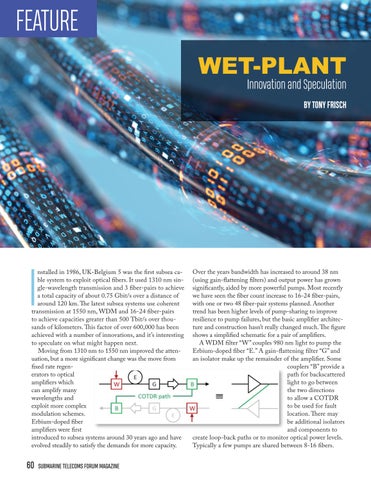
Over the years bandwidth has increased to around 38 nm (using gain-flattening filters) and output power has grown significantly, aided by more powerful pumps. Most recently we have seen the fiber count increase to 16-24 fiber-pairs, with one or two 48 fiber-pair systems planned. Another trend has been higher levels of pump-sharing to improve resilience to pump failures, but the basic amplifier architecture and construction hasn’t really changed much. The figure shows a simplified schematic for a pair of amplifiers. A WDM filter “W” couples 980 nm light to pump the Erbium-doped fiber “E.” A gain-flattening filter “G” and an isolator make up the remainder of the amplifier. Some couplers “B” provide a path for backscattered light to go between the two directions to allow a COTDR to be used for fault location. There may be additional isolators and components to create loop-back paths or to monitor optical power levels. Typically a few pumps are shared between 8-16 fibers.