FEATURE
POWERING THE FUTURE WITH HELP FROM OUR PAST
BY MIKE DANIEL
E
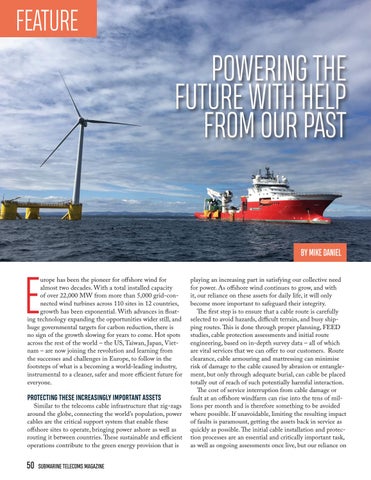
urope has been the pioneer for offshore wind for almost two decades. With a total installed capacity of over 22,000 MW from more than 5,000 grid-connected wind turbines across 110 sites in 12 countries, growth has been exponential. With advances in floating technology expanding the opportunities wider still, and huge governmental targets for carbon reduction, there is no sign of the growth slowing for years to come. Hot spots across the rest of the world – the US, Taiwan, Japan, Vietnam – are now joining the revolution and learning from the successes and challenges in Europe, to follow in the footsteps of what is a becoming a world-leading industry, instrumental to a cleaner, safer and more efficient future for everyone.
PROTECTING THESE INCREASINGLY IMPORTANT ASSETS
Similar to the telecoms cable infrastructure that zig-zags around the globe, connecting the world’s population, power cables are the critical support system that enable these offshore sites to operate, bringing power ashore as well as routing it between countries. These sustainable and efficient operations contribute to the green energy provision that is
50
SUBMARINE TELECOMS MAGAZINE
playing an increasing part in satisfying our collective need for power. As offshore wind continues to grow, and with it, our reliance on these assets for daily life, it will only become more important to safeguard their integrity. The first step is to ensure that a cable route is carefully selected to avoid hazards, difficult terrain, and busy shipping routes. This is done through proper planning, FEED studies, cable protection assessments and initial route engineering, based on in-depth survey data – all of which are vital services that we can offer to our customers. Route clearance, cable armouring and mattressing can minimise risk of damage to the cable caused by abrasion or entanglement, but only through adequate burial, can cable be placed totally out of reach of such potentially harmful interaction. The cost of service interruption from cable damage or fault at an offshore windfarm can rise into the tens of millions per month and is therefore something to be avoided where possible. If unavoidable, limiting the resulting impact of faults is paramount, getting the assets back in service as quickly as possible. The initial cable installation and protection processes are an essential and critically important task, as well as ongoing assessments once live, but our reliance on