SUBMARINE TELECOMS
FORUM ISSUE 112 | MAY 2020
GLOBAL CAPACITY
EXORDIUM FROM THE PUBLISHER WELCOME TO ISSUE 112, OUR GLOBAL CAPACITY EDITION
I
f ever there was a need for connectivity, it is today - That is what I wrote for our last issue and given the last eight weeks or so I think it is more true than ever. When we started putting this edition together, I wondered how our call-out for articles would be received. We were determined to publish SubTel Forum as always, but were worried that many would simply have their minds on other more concerning matters (fair enough), and that we would merely circulate a much smaller version of its former self. But instead what we found was that many had a lot to say, whether a proper article or a considered company statement about their coping. And as the weeks were leading up to our publishing a picture began emerging of how we as an industry are handling these unprecedented days. I joined this business at the height of the Cold War and in that 35 plus years I think I have never been a more proud member of this industry than today. We are literally keeping the world stitched together in the midst of a nightmarish situation. Through innovation, perseverance and a dash of audacity we are keeping the pipes open and working, allowing an incredibly significant number of our fellow humans to stay home and stay safe, as well as assisting those in their fight on the front lines. So, how do we pitch in?
We are literally keeping the world stitched together in the midst of a nightmarish situation.
2 SUBMARINE TELECOMS MAGAZINE
Two mornings before things shut down, I marched uninvited into my pastor’s office and announced rather rudely that she would need to rethink things going forward; that seeing and being with people was not going to be happening for a while. Many of us are doing things for our communities or neighbors, whether as a business or an individual. I am not much of a sewer, so making masks is a non-starter. But
A Publication of Submarine Telecoms Forum, Inc. www.subtelforum.com ISSN No. 1948-3031 PRESIDENT & PUBLISHER: Wayne Nielsen | wnielsen@subtelforum.com VICE PRESIDENT: Kristian Nielsen | knielsen@subtelforum.com SALES: Teri Jones | tjones@subtelforum.com | [+1] (703) 471-4902
at SubTel Forum we do have cameras and A/V equipment and so, on every Wednesday and Sunday Kristian and I and four other souls are at our town’s Lutheran church streaming bible study and services for residents both near and far alike; people of all ages and persuasions writing across Facebook Live their comments and fears and hopes. Breaking quarantine week after week, it certainly holds some risk, but for me it also seems like the right thing to do right now. As I said, I do not sew. Today, some twenty-two industry people joined our staff in putting their inspired, reflected thoughts into this issue and we are profoundly grateful for their generosity of time and talent, especially at this current time. We are also grateful to our friends at Southern Cross who bought an advert in this issue at a time when no one else is spending marketing dollars – Thank you. We hope to be back in our office next month. We hope to be back to the new ‘normal’ soon after. We will see. In the meantime, if ever there was a need for connectivity, it is today. STF Good reading and stay well,
Wayne Nielsen Publisher
EDITOR: Stephen Nielsen | snielsen@subtelforum.com DESIGN & PRODUCTION: Weswen Design | wendy@weswendesign.com DEPARTMENT WRITERS: Anders Ljung, Antoine Rey, Derek Cassidy, Hector Hernandez , Ian Douglas, John Graham, José Chesnoy, Kieran Clark, Kristian Nielsen, Michel Martin, Motoyoshi Tokioka, Rebecca Spence, René Avezac de Moran, Stephen Nielsen and Wayne Nielsen SUBMARINE FEATURE WRITERS: Bill Burns, Byron Clatterbuck, Chris Wood, Dag Aanensen, Derek Cassidy, Eric Handa, Gareth Parry, Henry Lancaster, John Tibbles, Mattias Fridström, Sean Bergin and Stewart Ash
TELECOMS
FORUM
REGIONAL SYSTEMS
NEXT ISSUE: JULY 2020 — Regional Systems AUTHOR AND ARTICLE INDEX: www.subtelforum.com/onlineindex Submarine Telecoms Forum, Inc. www.subtelforum.com/corporate-information BOARD OF DIRECTORS: Margaret Nielsen, Wayne Nielsen and Kristian Nielsen SubTel Forum Analytics, Division of Submarine Telecoms Forum, Inc. www.subtelforum.com/store/reports LEAD ANALYST: Kieran Clark | kclark@subtelforum.com | [+1] (703) 468-1382
RESEARCH ANALYST: Rebecca Spence | rspence@subtelforum.com | [+1] (703) 268-9285 SubTel Forum Continuing Education, Division of Submarine Telecoms Forum, Inc. www.subtelforum.com/education CONTINUING EDUCATION DIRECTOR: Kristian Nielsen | knielsen@subtelforum.com | [+1] (703) 444-0845 Contributions are welcomed and should be forwarded to: pressroom@subtelforum.com. Submarine Telecoms Forum magazine is published bimonthly by Submarine Telecoms Forum, Inc., and is an independent commercial publication, serving as a freely accessible forum for professionals in industries connected with submarine optical fiber technologies and techniques. Submarine Telecoms Forum may not be reproduced or transmitted in any form, in whole or in part, without the permission of the publishers. Liability: While every care is taken in preparation of this publication, the publishers cannot be held
responsible for the accuracy of the information herein, or any errors which may occur in advertising or editorial content, or any consequence arising from any errors or omissions, and the editor reserves the right to edit any advertising or editorial material submitted for publication. New Subscriptions, Enquiries and Changes of Address: 21495 Ridgetop Circle, Suite 201, Sterling, Virginia 20166, USA, or call [+1] (703) 444-0845, fax [+1] (703) 349-5562, or visit www.subtelforum.com. Copyright © 2020 Submarine Telecoms Forum, Inc.
VOICE OF THE INDUSTRY
ISSUE 112 | MAY 2020
SUBMARINE TELECOMS
FORUM ISSUE 112 | MAY 2020
CONTENTS
16
features
7 QUESTIONS WITH 7 INDUSTRY PLAYERS
22
THE IMPACT OF COVID-19 ON TELECOMMUNICATIONS AND THE FUTURE By Eric Handa and Sean Bergin
20
A GLOBAL CRISIS: SHOWCASING DEPENDENCE ON SUBMARINE CABLE INFRASTRUCTURE AFTER A GLOBAL CRISIS
4 SUBMARINE TELECOMS MAGAZINE
By Henry Lancaster
26
BEYOND COVID-19: REIMAGINING THE FUTURE OF TELECOMMUNICATIONS By Byron Clatterbuck
30
43
By Gareth Parry
By Dag Aanensen
THE PORTHCURNO STORY
NORDIC CAPACITY OUTLOOK
36
45
By Mattias Fridström
By Stewart Ash and Bill Burns
39
51
PORTRAITS OF SIR JOHN PENDER: 1816-96
THE NEW NORMAL FOR OPERATORS AND BUSINESSES
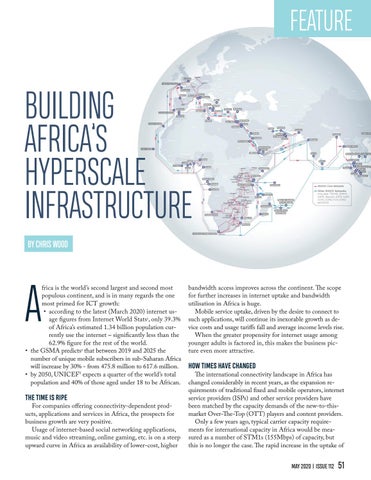
BUILDING AFRICA’S HYPERSCALE INFRASTRUCTURE
SUBSEA CABLE DEMAND POST COVID 19
By Chris Wood
By John Tibbles
departments
EXORDIUM........................................................ 2 SUBTELFORUM.COM.......................................... 6 STF ANALYTICS.................................................. 8 CABLE MAP UPDATE......................................... 12 WHERE IN THE WORLD..................................... 14
BY CHRIS WOOD
BACK REFLECTION........................................... 66
CONTINUING EDUCATION ................................. 72 ON THE MOVE...................................................74 SUBMARINE CABLE NEWS NOW....................... 76 ADVERTISER CORNER.......................................77 MAY 2020 | ISSUE 112
5
SubTelForum.com
Visit SubTelForum.com to find links to the following resources
FREE RESOURCES FOR ALL OUR SUBTELFORUM.COM READERS TOP STORIES OF 2019
The most popular articles, Q&As of 2019. Find out what you missed!
NEWS NOW RSS FEED
Keep on top of our world of coverage with our free News Now daily industry update. News Now is a daily RSS feed of news applicable to the submarine cable industry, highlighting Cable Faults & Maintenance, Conferences & Associations, Current Systems, Data Centers, Future Systems, Offshore Energy, State of the Industry and Technology & Upgrades.
PUBLICATIONS
Submarine Cable Almanac is a free quarterly publication made available through diligent data gathering and
6 6SUBMARINE TELECOMS MAGAZINE SUBMARINE TELECOMS MAGAZINE
mapping efforts by the analysts at SubTel Forum Analytics, a division of Submarine Telecoms Forum. This reference tool gives details on cable systems including a system map, landing points, system capacity, length, RFS year and other valuable data. Submarine Telecoms Industry Report is an annual free publication with analysis of data collected by the analysts of SubTel Forum Analytics, including system capacity analysis, as well as the actual productivity and outlook of current and planned systems and the companies that service them.
CABLE MAP
The online SubTel Cable Map is built with the industry standard Esri ArcGIS platform and linked to the SubTel Forum Submarine Cable Database. It tracks the progress of
some 300+ current and planned cable systems, more than 800 landing points, over 1,700 data centers, 46 cable ships as well as mobile subscriptions and internet accessibility data for 254 countries. Systems are also linked to SubTel Forum’s News Now Feed, allowing viewing of current and archived news details. The printed Cable Map is an annual publication showcasing the world’s submarine fiber systems beautifully drawn on a large format map and mailed to SubTel Forum Readership and/or distributed during the Pacific Telecommunications Conference in January each year.
VIDEO STREAMING AND TUTORIALS
Watch all our industry relevant videos and streams. SubTel Forum streams the Submarine Cable Sunday sessions during the Pacific Telecommunications Conference in January each year on both YouTube and Facebook, as well
as other special events during the year. SubTel Forum tutorials teach how to use the ever growing SubTel Cable Map, including various map layers for data centers, cable ships, etc.
CONTINUING EDUCATION
SubTel Forum designs educational courses and master classes that can then appear at industry conferences around the world. Classes are presented on a variety of topics dealing with key industry technical, business, or commercial issues. See what classes SubTel Forum is accrediting in support of the next generation of leaders in our industry.
AUTHORS INDEX
The Authors Index is a reference source to help readers locate magazine articles and authors on various subjects.
EXCLUSIVE INFORMATION FOR SUBSCRIBERS OF MARKET SECTOR REPORTS SUBTEL FORUM ANALYTICS MARKET SECTOR REPORTS
SubTel Forum Subscribers have exclusive access to SubTel Forum online MSRs updated quarterly:
DATA CENTER & OTT PROVIDERS: details the increasingly shrinking divide between the cable landing station and backhaul to interconnection services in order to maximize network efficiency and throughput, bringing once disparate infrastructure into a single facility. If you’re interested in the world of Data Centers and its impact on Submarine Cables, this MSR is for you. GLOBAL CAPACITY PRICING: historic and current capacity pricing for regional routes (Transatlantic, Transpacific, Americas, Intra-Asia and EMEA), delivering a comprehensive look at the global capacity pricing status of the submarine fiber industry. Capacity pricing trends and forecasting, simplified.
GLOBAL OUTLOOK: dive into the health and wellness of the
global submarine telecoms market, with regional analysis and forecasting. This MSR gives an overview of planned systems, CIF and project completion rates, state of supplier activity and potential disruptive factors facing the market.
OFFSHORE OIL & GAS: provides a detailed overview of the
offshore oil & gas sector of the submarine fiber industry and covers system owners, system suppliers and various market trends. This MSR details how the industry is focusing on trends and new technologies to increase efficiency and automation as a key strategy to reduce cost and maintain margins, and its impact on the demand for new offshore fiber systems.
REGIONAL SYSTEMS: drill down into the Regional Systems
market, including focused analysis on the Transatlantic, Transpacific, EMEA, AustralAsia, Indian Ocean Pan-East Asian and Arctic regions. This MSR details the impact of increasing capacity demands on regional routes and contrasts potential overbuild concerns with the rapid pace of system development and the factors driving development demand.
SUBMARINE CABLE DATASET: details 400+ fiber optic cable
systems, including physical aspects, cost, owners, suppliers, landings, financiers, component manufacturers, marine contractors, etc.
COMING SOON! Cable Analysis Toolbox, Cable Planner’s Toolbox, Mapping Tools, and more features in 2020 and beyond! STF
MARCH 2020 | ISSUE 111 MAY 2020 | ISSUE 112
77
ANALYTICS
BY KIERAN CLARK
SUBMARINE TELECOMS MARKET SECTOR REPORT: GLOBAL CAPACITY PRICING EDITION
T
o address the growing reporting and analysis needs of the submarine fiber industry, SubTel Forum Analytics continues its Market Sector Report series – designed to provide the industry with the information it needs to make informed business decisions. The Submarine Telecoms Market Sector Reports cover a specific sector of the submarine fiber industry and areupdated on a quarterly basis. The Global Capcity Pricing edition provides a an overview of capacity pricing on major submarine cable routes around the world. SubTel Forum Analytics collected and analyzed data derived from a variety of public, commercial and scientific sources to best analyze and project market conditions. While every
8
SUBMARINE TELECOMS MAGAZINE
care is taken in preparing this report, these are our best estimates based on information provided and discussed in this industry. The following Executive Summary provides an overview of the topics addressed in the Global Capacity Pricing Market Sector Report.
EXECUTIVE SUMMARY
It all starts in the Atlantic. Transatlantic routes have set trends throughout the history of the submarine fiber industry and will continue to do so in the future. The New York – London route is the most commercially competitive in the world and will continue to be so through the foreseeable future.
Transatlantic routes have set trends throughout the history of the submarine fiber industry and will continue to do so in the future. The New York – London route is the most commercially competitive in the world and will continue to be so through the foreseeable future.
The Transatlantic will be greatly impacted by the market shift from connecting cities to connecting data centers. As Content Providers like Amazon, Facebook, Google and Microsoft continue to expand their infrastructure and drive cable development, continue to expect new cables that do not follow the more traditional routes. (Figure 1) Like the Transatlantic routes, Transpacific routes will be shaped by the market shifting towards interconnection of data centers instead of simply connecting population centers. Cloud service providers are developing infrastructure in a major way all throughout East Asia and the Pacific. Expect new cables to connect to critical trade and technology hubs that will not necessarily adhere to traditional cable routes. (Figure 2) As Content Providers are driving several new Transatlantic and Transpacific cables, the possibility of these cable owners selling off their excess capacity and negatively impacting the market needs to be considered. Capacity pricing for routes in the Americas region will depend heavily on economic health in South America. While these routes may never see the same level of demand as the Transatlantic and Transpacific, they are becoming increasingly important to Content Provider infrastructure plans and global economic development. Intra-Asia routes will continue to provide important paths between Tokyo, Singapore and Mumbai. While the Tokyo – Singapore route should remain relatively unchanged in the future, the Singapore – Mumbai has the most potential for growth. As new
FIGURE 1: Transatlantic 10G Monthly Lease Pricing
FIGURE 2: Transpacific 10G Monthly Lease Pricing
FIGURE 3: EMEA to Asia 10G Monthly Lease Pricing STF
MAY 2020 | ISSUE 112
9
ANALYTICS cables and telecoms development turn towards India’s growing technology sector, this region is prime for growth. EMEA to Asia routes have been well established for decades and carry important traffic between Europe and Asia. However, they are high latency and expensive to operate. Threats to the health of this route will be planned systems that bypass the Suez Canal to avoid sustained economic and political instability in the Middle East and Arctic routes that connect Europe to Asia via much shorter pathways. Should these alternatives become truly competitive, these routes will be negatively affected. (Figure 3) SubTel Forum Analytics has developed a new Pricing Benchmark model to help identify healthy cable routes. This model considers several cost and pricing factors to provide a quick reference score to help the industry better understand the economic health of submarine cable systems from a route and regional perspective. Overall, there seems to be a healthy global market, but a lot depends on what OTT providers will do and how cost-effective system upgrades and new cables can be implemented.
BENCHMARKING
BY KIERAN CLARK
SubTel Forum Analytics has introduced the Pricing Benchmark – a numerical grading system calculated from a variety of data points to help consumers better understand the health of submarine cable systems from a route and regional perspective. The benchmark grading system will also provide decision makers the tools to help support their business plans. The Pricing Benchmark is a numerical grade calculated on various factors including 100G circuit pricing, cable construction/installation cost, and the number of available wavelengths for sale on a cable system. This model does not consider depreciation and is intended as a rough estimate. This Pricing Benchmark assumes the Annual Costs as the total system cost divided by the standard 25-year expected life span of a cable system, assumes Available Wavelengths as the total capacity of all systems on the route divided by 100G wavelengths, assumes Lit Wavelengths as the average lit capacity percentage for the region and assumes the wholesale pricing of 100G wavelengths is
the median price for a given route to calculate Sales. We hope this report will prove to be a valuable resource to the submarine fiber industry at large. To purchase this report, please click the link below. STF KIERAN CLARK is the Lead Analyst for STF Analytics, a division of Submarine Telecoms Forum, Inc. He originally joined SubTel Forum in 2013 as a Broadcast Technician to provide support for live event video streaming. He has 6+ years of live production experience and has worked alongside some of the premier organizations in video web streaming. In 2014, Kieran was promoted to Analyst and is currently responsible for the research and maintenance that supports the STF Analytics Submarine Cable Database. In 2016, he was promoted to Lead Analyst and put in charge of the newly created STF Analytics. His analysis is featured in almost the entire array of SubTel Forum publications. WORKS CITED Bressie, K. (2019). Global Regulatory Update. PTC ‘19. Honolulu, HI: Pacific Telecommunications Council. International Cable Protection Committee. (2018, May 17). Subsea Cable Community Gains Voice in the United Nations. Retrieved from International Cable Protection Committee: https://www.iscpc.org/documents/?id=2971
SubTel Forum Analytics provides a web-based subscription model for all its standard reporting services. An annual subscription provides access to all the Market Sector Reports as well as several useful analytics tools for the submarine fiber industry. Subscribe today to get access to the Global Outlook Market Sector Report!
SUBTELFORUM.COM/REPORTS 10
SUBMARINE TELECOMS MAGAZINE
PM 2.0 by
PROVEN PROCESSES PROVEN PROCESSES AND METHODOLOGIES • • • • • • •
Defined Processes Template Driven PMP Based Project Management Approach Rigorous Documentation Controls Quality Assurance Focused Secure Records Storage Accessible and User Friendly
INTRODUCING THE VIRTUAL REP
• In-Field Analysis Without In-Field Risk • Remote real-time analysis and reporting without the added cost of today’s infield representation liabilities.
GET IT RIGHT THE FIRST TIME
WWW.WFNSTRATEGIES.COM/PM-2-0
FEATURE Interactive Cable Map Updates
T
he SubTel Cable Map is built with the industry standard Esri ArcGIS platform and linked to the SubTel Forum Submarine Cable Database. It tracks the progress of some 300+ current and planned cable systems, over 800 landing points, as well as mobile subscriptions and internet accessibility data for 254 countries. Systems are also linked to SubTel Forum’s News Now Feed, allowing viewing of current and archived news details. This interactive map is a continual work and progress and regularly updated with pertinent data captured by analysts at SubTel Forum and feedback from our users. Our goal is to make easily available not only data from the Submarine Cable Almanac, but also more and more new layers of system information. For this update, we have added two brand new data layers to the map. The first layer features well over 1700 data center factilities plotted by address and represents nearly 200 companies. The second layer added tracks the current location of every installation and maintenance cable ship in the world, updated every 6 hours. To learn even more about these fantastic new data sets, please watch the associated tutorial videos! Want to learn more about how to use the great features of the map? Take a look at our tutorial video series below: 1. Print Widget 2. General Map Usage 3. Group Filter Widget 4. Select Tool 5. Control Buttons 6. Share Widget
12
SUBMARINE TELECOMS MAGAZINE
7. Data Centers 8. Cable Ships We hope you continue to make use of the SubTel Cable Map in order to learn more about the industry yourself and educate others on the importance of submarine cable systems. Please feel free to reach out to our Lead Analyst, Kieran Clark, should you have any comments, questions or updates at kclark@subtelforum.com.
Since the last issue of the Magazine, the map has updated 39 systems. The full list of updated systems are as follows: MAY 18, 2020 SYSTEMS UPDATED: PLCN Manatua One DARE1 CANI
SUBTELFORUM.COM/CABLEMAP Austral SAEx2 SAEx1 New Pacific Americas II Celtic Norse ARBR Guantรกnamo Bay Cable 2 Guantรกnamo Bay Cable Galapagos Subsea System Botnia Norsea Com-1 SEA-US HK-G
Estrecho de Magallanes Honotua NCSCS SAIL GTT Express GTT North/South IG-1 ASC ATISA MCT Jupiter North Sea Connect SAPL GO-1
HAVFRUE/AEC-2 Dunant EIG EllaLink Seabras-1 Arctic Connect BtoBE
MAY 2020 | ISSUE 112
13
WHERE IN THE WORLD ARE THOSE PESKY CABLESHIPS? BY REBECCA SPENCE
T
are no longer active, it is important to note that Figure 4 he last two months have certainly been a roller coaster indicates nearly 50% of the vessels tracked were intended to of change around the globe and the submarine telereach their destinations by the beginning of March based coms community has not been immune. With the on their estimated arrival dates. The actual number of vesneed to maintain and repair cables still an ongoing sels that returned in that short time rose when regulations necessity, some vessels have been able to continand restrictions were put in place by various governments ue working, but many others have shut down operation, around the word. This immediate need to choosing to return to port to ride out the return to safety, created a logistical nightCoronavirus storm. mare for the resource and project manWhen the data set for the first edition agers who were tasked with getting their of Where in the World Are Those Pesky employees onto flights home as countries Cableships was pulled in late February, were shutting down their borders to work was chugging along, business as travelers. usual. Less than two weeks later, the Currently 10 vessels remain in transit number of vessels still in transit had represented in Figure 4. Half are expected dropped significantly. Figure 1 is the to reach their destination in the coming breakdown of vessels in transit in Febweek, leaving only 5 vessels actively workruary, with Figure 2 showing a signifiing to complete their assignments over cant 71% drop in traffic from February the next several months. As the pandemic through April. continues to wane, the number of vessels While the pandemic has surely had a back in transit will begin to increase sigrole to play in the volume of vessels that Figure 1: Arrived at Destination – May 2020
Figure 2: Arrived at Destination Comparison
14
SUBMARINE TELECOMS MAGAZINE
Figure 3: Weeks Left Estimated in Transit – May 2020
nificantly, though projects may have to shift their timelines to account for the weeks of inactivity. As compared to last issue, the Regions of Activity has seen a fair amount of change, even with the drop of vessels in transit. Eight new regions were added to the data set, indicated in red, including the Aegean Sean, Caribbean Sea, South Africa, and the North West Atlantic Ocean. The China Coast and Baltic Sea having the highest growth, going from 5% and 4% respectively. Previously the most active area was East Asia, which fell to 3%. It will be interesting to watch this data set to see if these numbers reverse once vessels are back to full production in the coming weeks. The major change for the fleet distribution is the addition of tracking for Alcatel Submarine Network’s the Ile D’Ouessant, which began its first task in mid-March. Per their press on September 19, 2019, the Ile D’Ouessant will
eventually replace the Peter Faber. “Thanks to this acquisition, ASN is rejuvenating its fleet and reinforcing its presence in the Atlantic area.” Only time will tell whether the changes shown here are a result of the international crisis effecting project progress. One thing is for certain, submarine cables are connecting the world and are vital now more than ever. Hopefully, the coming weeks will have us all returning to some semblance of normal, and these vessels will once again be moving freely across the world. STF REBECCA SPENCE is the newest member of the SubTel Forum team. She joined our ranks as a Research Analyst at the end of 2019. A graduate of Christopher Newport University, this is Rebecca’s premier article for the STF magazine.
Figure 4: Weeks Left Estimated in Transit - Comparison
Figure 5: Regions of Activity
MARCH 2020 | ISSUE 111
15
FEATURE
3 QUESTIONS WITH 7 INDUSTRY PLAYERS:
Talking the Evolving Reality with BT Ireland, Fugro, Global Marine Group, Hexatronic, International Telecom, NEC and WFN Strategies
O
n March 12, as companies worked to assess how project timelines and capacity would be affected by the looming threat of a global pandemic, the situation became more anxious with the announcement by the U.S. President Trump that there would be a travel ban on Europe. This followed a ban on China in January. Within a month, practically the whole world had come to a standstill. Only the most necessary of industries were still active. Companies working on a myriad of projects already slowed by caps on group numbers and social distancing were given a rude awakening to how difficult times could get. Two months later, the use of the internet has seen a global high, with streaming services seeing large increases in use of bandwidth; schools corporations and families alike have become dependent on video chat services like Zoom and Google Meet; and we have no way to know when we can get back to “normal.” The submarine telecoms industry is responsible for the global infrastructure that has kept meetings happening, money being spent online, and students meeting in digital classrooms. As such, more stress than ever before has been put on this industry. For that reason, Submarine Telecoms Forum reached out to members of the industry to ask how things are going. For this Q&A, we spoke to six individuals, asking them each three questions:
16 SUBMARINE TELECOMS MAGAZINE
• What would you like the world to know about how the pandemic has affected your company, or your day to day work environment? • Have supply issues changed the timeline you had set for the projects you are working on, and if so, how are you handling these changes? • What are you plans moving forward in the coming weeks and months? We’d like to thank Derek Cassidy of BT Ireland, René Avezac de Moran of Fugro, Ian Douglas of Global Marine Group, Anders Ljung of Hexatronic, John Graham of International Telecom, Motoyoshi Tokioka of NEC, and Hector Hernandez of WFN Strategies, for taking the time to tell us bit about their businesses during these uncertain times.
DEREK CASSIDY SENIOR OPTICAL SPECIALIST BT IRELAND
I
n Ireland we have been in lockdown since the end of March, however that is not to say that the country had not taken action beforehand. In fact, to the contrary, the Health Service Executive and the Health Protection Surveillance
Centre had already issued guidelines in late February, had cancelled high profile public gatherings and were monitoring the situation very closely. They had also set up a system of contact tracing to identify people who had come into contact with a suspected Covid-19 case. It was not until March that a full lockdown was ordered by the State, however many Companies, Universities and Public Bodies had already acted in a way that would protect the lives of their staff and that of the public. The Irish Government took a serious approach to the situation and without hesitation the country took heed and followed suit. Technically the country closed down with the exception to the Members of the front line, Law Enforcement, Blue Light Services, Health and Safety Bodies and other essential Services as they were advised to keep going. Other businesses such as Retail, Transport and Manufacturing were also seen as vital due to their role in helping to keep people safe and offer some sort of continual support. Telecommunications were seen as a vital part of the fight to keep the country going during this lockdown period as the different Telecom Operators were providing the backbone to the communications network. As more and more people worked from home the pressure on the network provided, by the fixed and mobile services, saw a huge increase in demand. This was due to the increased use of external broadband services to create multiple virtual LANs via VPNs and other company designed IT Infrastructure, both virtual and fixed. There was a huge increase in the use of ZOOM and other licensed and proprietary team and conference suites. With the lockdown in full force and many people working from home, the ability to make essential travel was made easier due to the lack of vehicular traffic. The maintenance and upgrading of communication networks to cope with the increased demand also benefited from the low traffic volume as access to communication transmission sites was unhindered. However as social distancing was a rule to be adhered to the ability to work in groups was greatly reduced which would have affected some systems, but this was also a benefit as a lot of work could be carried out unhindered. Education also took a hit as all schools were advised, if not ordered, to close. This has had a very negative impact on exams and student assessments, but plans were put in place to make sure that continual study support was given by tutors and teachers, this has had to ability to keep students in touch with their tutors and in some case their classmates in virtual classrooms. New ways to examine students and to grade their work is also being investigat-
ed so that access to higher learning and opportunities are not missed. However, Universities, like my own, also shut down and as all exams and assessments were put on hold this could lead to some issues were lab research was required. PhD research students also suffered, especially the ones in their research phase were results were needed for the fulfillment of their studies. However other phases of the research cycle needed to kick in to counteract the temporary change in research policy. This has helped put focus on the written and liturgy research phase and the increased communication with tutors and supervisors has also aided in keeping the University educational theme continue with any major setbacks. However as this is a worldwide fight against Covid-19, we are not alone but as an island we have felt the economic hit a bit worse than others, but we are resilient. The plans being formulated by many companies must align with the strategy set out by the Government under best guidance from the Health Protection Surveillance Centre. As all industries have to adopt new measures to help protect staff and the public, there must be a cognizant understanding and awareness that the only way forward is to follow the guidelines. Many countries are slowly coming out of their own self-imposed lockdowns, there is still a fear that a resurgence of Covid-19 infections can take off again. For this reason, the lockdown in Ireland will have a phased approach, just like other countries are following. However, as a nation that has a history of communications, technology, and pharmaceutical advancements we need to co-operate with our peers both national and international to try and beat Covid-19.
RENÉ D’AVEZAC DE MORAN GLOBAL BUSINESS DEVELOPMENT – SUBSEA CABLES FUGRO
O
ur priority is the safety and well-being of our employees, clients and the communities in which we operate. A good part of our workforce is working remotely, many from home, and our field staff and marine crews are continuing to operate and meet the needs of our clients. Fortunately, the innovation and investment programs that we embarked upon well before the current situation unfolded have been key to keeping our important operations running safely and efficiently. These include developing remote operaMARCH 2020 | ISSUE 111
17
FEATURE tions to reduce the need for people working in the field; for example, remote positioning is now used extensively for geophysical route surveys and increasingly for operations such as rig moves, remotely operated vehicle (ROV ) deployment, and other marine operations. We can securely send survey data from vessels to onshore cloud-based data processors and we can even operate autonomous vessels offshore from our remote operations centres in key locations around the world. As a global business with staff in 61 countries, we are able to draw on the resources needed to keep projects on track. We have had to implement some additional measures when operating across borders, such as following quarantine restrictions and putting extra medical checks and procedures in place. We moved very quickly to respond to the Covid-19 threat and had imposed precautions such as social distancing, extra sanitation and temperature checks ahead of these becoming mandatory in many parts of the world. We’re exceptionally proud of how our teams are working together to keep projects going during this challenging period. To mitigate the impact of the sudden and unprecedented deterioration in market circumstances, our priorities moving forward are to preserve the health and well-being of our people and other stakeholders. Moreover, many of our strategies and programmes, such as the focus on remote operations, have proved key to our resilience during this period and remain a priority. We will continue innovating to acquire and analyse Geo-data for our clients in a safe and efficient manner. While this pandemic has had an unprecedented impact on the world economy, this will not stop us from working hard with our clients to deliver on their projects. The needs of the communities we serve will remain and we will carry on contributing to a safe and liveable world as the situation improves.
IAN DOUGLAS CEO GLOBAL MARINE GROUP
A
s you know we provide an important service, ensuring that the world’s critical infrastructure remains operational. We are working very hard, as ever, to do this and have recently completed a higher number of repairs than usual, right across the globe. We are still fully operational; we have robust health and safety plans in place to ensure that this continues to be the case.
18
SUBMARINE TELECOMS MAGAZINE
It is becoming increasingly difficult to manage crew changes, due to the current restrictions imposed by governments with countries at different stages of this pandemic. This is where it’s really important to think about all our seafarers, many of which have already extended their contracts and have been extremely accommodating, I’m very mindful how difficult it must be for them to be so far from home right now. Like many other company’s we’ve taken many proactive steps to ensure continued operations. We have a Covid Response Team in place which deal with issues from crew welfare, to engaging with health care professionals to ensure we have the best advice available to managing the on-going challenges of crew changes and port calls. We are one of the largest suppliers of UJ & UQJ jointing kits with some of the specialised components coming from smaller firms. Therefore, we have been focusing very much on our supply chain and in particular understanding any supplier issues well in advance so where needed we can support individual suppliers ensuring continued flow of critical parts that make up these jointing kits. Thankfully things continue to operate as normal with our biggest issue being delayed dispatch due to constraints on some air freight routes. Our primary concern is the welfare and safety of our people, this will continue to be the case. With this effectively managed it’s ensuring the continuity of our service to all our customers globally. Like all businesses we’re watching carefully how the pace of the pandemic progresses and assessing the impacts this will have on our business as well as the industries we work in. Being proactive here is vital.
ANDERS LJUNG SALES MANAGER, SUBMARINE CABLE SYSTEMS HEXATRONIC CABLES & INTERCONNECT SYSTEMS AB
F
rom a submarine cable point of view, we currently don’t see any effects from this pandemic. The only difference is that we now are performing the FAT’s virtually. Material deliveries have been delivered on time from our suppliers in Europe. Deliveries from us have been delivered on time to our customers. From a company group level, with a focus on the FTTH business, we have seen a minor negative effect in UK and New Zealand due the lockdown in these countries.
JOHN GRAHAM OWNER IT INTERNATIONAL TELECOM
T
he work environment at the office has not changed very much. People normally travel in this industry but now they are at home. In each location people who can work at home do and those that cannot are at the office. At the office all spaced out and have conferences on teams with others. Kitchens are closed and social distancing rules are there. All the same on most projects. There are a few minor glitches but workarounds in all cases. Steady as we go. No plans to change anything.
MOTOYOSHI TOKIOKA EXECUTIVE DIRECTOR - GLOBAL SALES NEC
M
any of the NEC’s submarine cable business team have been used to working remotely since many years ago, because we travel a lot. Also, NEC has been preparing for doing company-wide tele-work during the coming Tokyo 2020 Olympic and Paralympic games as the Japanese and the Tokyo metropolitan governments try to reduce number of commuters during the planned events. Not only NEC but also other large companies in Tokyo have been making similar efforts for some years. Though the Tokyo 2020 Olympic and Paralympic had to be postponed due to the pandemic, thanks to the efforts we have been making, shifting fully to tele-work was relatively easy. We have been doing tele-work for more than a month now, and we will be doing so for another month at least. We have been trying to identify where supply chain issues exist and keep impacts minimum. While we have not encountered any serious issue as of the last week, we will continue to monitor situations carefully. This is something we will continuously need to stay careful as the global sourcing may get affected long term. As commented, we will keep working mostly remotely with our clients, prospects, suppliers, employees and other stake holders while performing minimum and necessary on-site transactions including manufacturing. This pandemic will change and reconstruct ways we work as well as we live, and it will be each of us in this industry to make the changes more beneficial to the world.
HECTOR HERNANDEZ PROJECTS MANAGER WFN STRATEGIES
W
e made the decision to close our offices in Virginia the day before the governor closed the commonwealth. With most of our people working virtually in other states or countries anyway, the impact of an office closure was minimal. We regularly use video conferencing both internally and with clients, so daily video synch-ups were simply added to the schedule. Covid -19, however, has made working in-field projects more challenging from a logistical perspective. We are supporting various projects with Field Representation and getting people resources on to vessels has been a struggle. Mainly because the situation is constantly changing and restrictions/guidelines are continually evolving; so, you have to be flexible and ready to change plans on a dime. Thankfully, with both this flexibility and the can-do efforts of our people, no client field work has been to date negatively impacted. Moving forward, we have sped up our implementation of our PM 2.0 Virtual Rep system. We have moved from field testing to field use months before we planned, due in no small way to the support of forward thinking clients. As such, we will minimize or even eliminate the number of our in-field representation personnel, providing both client and us much more flexibility in the future.
MAY 2020 | ISSUE 112
19
FEATURE
A GLOBAL CRISIS
Showcasing Dependence on Submarine Cable Infrastructure
T
he spread of the contagious SARS-CoV-2 virus, which causes the illness COVID-19, has led to a range of physical distancing measures and lockdowns. In turn this has resulted in many millions of people being required to work from home. Compounded by demand for online entertainment, there has been a sharp spike in internet traffic since mid-February. Internet Exchange Points have reported significant traffic increases, while daytime traffic in individual countries has increased by 40% or more. The strain on telecom networks has been dealt with by several measures, including a reduction in video quality by some OTT VoD players (Netflix and Amazon in Europe, for example), and the acquisition of additional bandwidth from wholesale providers (particularly noticeable in Africa and Latin America). However, since telecom networks are geared to manage peak traffic - roughly during the hours of 6pm to 10pm - most have coped with the increased traffic demands in working day hours. During the last two decades BuddeComm has been analysing the maturing telecom infrastructure globally, assessing its readiness to support smart infrastructure and its associated components (including tele-working, tele-health, tele-education and similar services). It is a testament to the robustness of this infrastructure that in the short space of three months telecom networks internationally have coped with the extra traffic demanded of them. It will be fascinating to assess what long-term patterns will emerge from the crisis, in terms of tele-working becoming mainstream rather than a perceived bonus for employees, and tele-health being considered normal
20
SUBMARINE TELECOMS MAGAZINE
BY HENRY LANCASTER
rather than just an aspirational cost-saving platform. There are good reasons to expand internet capacity, and to keep doing so as a continuing process. Africa is a case in point. It is one of the world’s regions where traffic demand will be particularly high in coming years. Many African countries are experiencing strong economic growth: in 2019 ten of the top 20 and five of the top ten GDP performers were in Africa. This growth ultimately depends on old-fashioned infrastructure, including roads, rail and ports, but also connectivity. This is why so much effort is underway to build national telecom networks and to link them to the global economy. Redundancy is a good argument in itself for having multiple cables. Cables are not infallible to breaks and other disruptions, though the number of breakages on submarine cables is dwarfed by the number of terrestrial cable breakages, often made by overenthusiastic building contractors. In March 2020, the SAT3 cable, running along the continent’s East Coast, was broken, leading to unstable services in several African countries. At the same time, the WACS cable - running from South Africa to the UK - was also broken, resulting is low internet speeds for several of the connected countries. Ideally, traffic on a cut submarine cable should be diverted to another submarine cable, and not go terrestrially: reroutes via land-based networks are costly for customers needing low-latency (the financial sector comes to mind) and add further pressure on terrestrial links. Kenya provides a clear example of where efforts to expand terrestrial networks are dependent on submarine infrastructure.
The country has invested in the 6,400km National Fibre Optic Backbone Infrastructure (NOFBI) cable project connecting all major towns, and with connecting links to Tanzania and Zambia. It is also a partner in the 4,000km Eastern Africa Backhaul System (EABs) linking up cities in Kenya, Uganda, Rwanda, Burundi and Tanzania to the EASSy submarine cable system. In addition, redundancy for the TEAMS cable is provided by a terrestrial link to landlocked Ethiopia and to South Sudan. Together, these efforts not only tie together the regional terrestrial cable infrastructure but crucially provide a link to submarine systems. The knock-on effect for end-users is also a sound justification: lower wholesale access costs mean lower retail pricing. In much of Africa this translates as lower mobile backhaul and so lower mobile data charges. Without this positive effect, a good proportion of the population will still be priced out of the internet, and so out of the internet economy. Another point to consider is that many countries tout themselves as, or aspire to be, regional IT hubs. This attracts investment in data centres which, linked to regional and international cables, in turn attracts more business. Kenya’s own ambition to be a regional IT hub is in line with its Digital Economy Blueprint, launched in 2019. This ambitious plan provides the framework for a digital ecosystem affecting hundreds of millions of people in about half of the countries in Africa. The plan includes the usual pillars to provide some structure (digital government, digital business, infrastructure, digital skills etc.). These ambitions explain why Kenya has not held back from investing in five submarine cables to which it is directly linked. All of this ultimately relies on improved submarine connectivity. Sticking with the region, Djibouti is a hub for international cables in the Horn of Africa. It is a pivot for cables running along the east Coast of Africa, also linking through to the Mediterranean as well as to India and the Far East. Cables include the SeaMeWe-3 and SeaMeWe-5 cables between Europe and the Far East, the EASSy and Seacom systems, which follow similar routes to South Africa, the Europe India Gateway (EIG), and the Aden-Djibouti cables. More recent is the DARE 1 system, which has landed in Mombasa, also serves Somalia and Tanzania Djibouti Telecom is the central link for these cables, being either a consortium member or having other operational responsibilities: the company manages landing sites for other cables, such as the 10,100km Australia West Express (AWE) system which runs to Perth and interconnects with the EIG, SEACOM, EASSy, SEA-ME-WE 3, SEA-MEWE-5 and AAE-1 systems. The PEACE cable system is also making progress. Hua-
wei Marine Networks in January 2018 started surveying the route connecting Pakistan with Djibouti, Somalia and Kenya. A second phase will connect to South Africa and Europe, giving a total length of 13,000km, while an extension will run to the Seychelles by mid-2021. On the other coast, Angola has become a cable hub for southern Africa. The country is a landing point for the SAT-3/WASC/SAFE system connecting South Africa to Europe and the Far East, and also other systems including the WACS, WASACE and SACS. The country’s connections to international fibre cables are managed by Angola Cables, set up as a public-private partnership. Progress has been steady, with the recent completion of the data centre at Fortaleza in Brazil. This will channel traffic on the SACS and Monet cables between southern Africa, Latin America and the US. The SACS landing station in Florida was completed in November 2019. The deployment of submarine and terrestrial cables across the globe in recent years is continuing to empower emerging countries, fostering e-commerce and nibbling away at technological discrimination which had hitherto prevented a proportion of their populations from being part of the wider IP-enabled community. There is no room for assuming that bandwidth will remain sufficient, as the current health crisis has so suddenly shown. STF HENRY LANCASTER has been a Senior Analyst at BuddeComm since 2005, overseeing markets across the Americas and the Caribbean, Europe and Africa. He provides detailed analyses on individual countries and market segments, incorporating mobile, broadband, digital media, regulations, M&A activity, and operator strategies. He assesses comparative international trends and also concentrates on more specific areas touching on technological developments, competition issues, and government ICT policies. Prior to joining BuddeComm, Henry was a Senior Research Fellow at the University of London. BuddeComm is an independent research and consultancy company, focusing on the telecommunications market and its role within the digital economy. We specialise in high-level strategic and statistical research and provide consultancy services to international agencies, governments and businesses. The research offered by BuddeComm’s worldwide network of researchers and analysts encompasses 200+ countries, 500 companies and 200 discrete technologies and applications.
FOR FURTHER INFORMATION, PLEASE SEE RELATED BUDDECOMM REPORTS: • • • • • • •
Africa Telecommunications Research Asia Telecommunications Research Australia, New Zealand & South Pacific Telecommunications Research Europe Telecommunications Research Latin America (Includes the Caribbean) Telecommunications Research North America Telecommunications Research The Middle East Telecommunications Research
MAY 2020 | ISSUE 112
21
FEATURE
THE IMPACT OF COVID-19 ON TELECOMMUNICATIONS AND THE FUTURE BY ERIC HANDA AND SEAN BERGIN
H
ow is the telco industry responding to the Covid-19 crisis? Most Telecom operators are deliberating their next moves in these uncertain times and many operators have already taken steps to mitigate damage to their business and increase assurances for customers. Some of the key considerations on everyone’s minds in our industry are issues such as maintaining efficiency with a workforce largely working from home, coping with the surge in demand for capacity and bandwidth and addressing cost & revenue issues for financially impacted customers, both consumer and commercial. Let’s take a look at the bigger picture. There has never been a period of traffic growth like we have seen in March in the whole history of the Internet, with traffic growth of 30-60% over the last few weeks when compared to traditional annual traffic growth of 30-45%. Netflix traffic is up 58%; YouTube 13%; PlayStation 170%; WhatsApp 609%; Facebook 27%; Skype 304%; collaboration tools 350%; Zoom traffic is up 800% and finally, Akamai has reported a 30% increase in network traffic. Gaming traffic is way up, as are entertainment services in general. Traditionally, there has always been a night-time peak
22
SUBMARINE TELECOMS MAGAZINE
of traffic, with people coming home from work and turning to streaming services and other forms of online entertainment, but that peak has now also extended into the daytime hours. Given that the networks (in general) are built and designed to accommodate these peaks, we should as an industry, be able to cope with this ‘new normal’ extended usage profile – for now. In the international submarine cable space, we have seen an increase in demand particularly for lit services, but not to the extent that some may have expected. The challenge is as it always has been however, turning up capacity quickly, particularly on consortia led systems that typically have fixed upgrade cycles which in most cases is at best, is a six-month process. We have also been hearing that access to SLTE cards to light services is becoming problematic to source. Some submarine cable factories have been closed and others are operating at less than 50% capacity due to staffing and obvious understandable health and safety concerns. Again however, most networks have been designed and provisioned to accommodate for peak consumption (and beyond), so from our perspective, we believe that the international connectivity in place today, should theoretically be able
to cope with the new norm created by this extraordinary set of circumstances we find ourselves in with COVID-19. Let’s shift away from network stresses and demands for a moment and look at some of the other issues faced by the industry or in some instances, created by the industry. There are some fundamental differences in each country’s markets, but if we look at emerging markets in particular, they face a unique set of challenges beyond those of us living in established economies. Freedom of movement has become an issue with COVID-19 lockdowns. In South East Asia, Africa and India for example, the predominant method of accessing the internet is via a mobile device, with the latest statistics showing that 90% of the market access the internet in this manner for approximately four hours a day. In most emerging economies within South East Asia, India, Africa and beyond, these are also largely pre-paid environments with ~90% of the market paying for services in this manner with cold hard cash. Many subscribers don’t have bank accounts in what are predominately cash economies, so from a logistics perspective, most carriers and subsequently their subscribers in these markets, still rely on ‘top-up’ scratch cards purchased from small corner stores in increments as low as one dollar. These cards still need to be manufactured, distributed and subsequently purchased by subscribers – not a straight-forward task in a COVID-19 environment. In locked down environments, simply getting to a corner store to purchase a top up card represents a challenge for some and this assumes that the corner store is actually open. One could argue that this is also exasperating a social divide, where low income folks living in prepaid environments are forced to place their health at greater risk beyond those with online banking tools, simply to obtain credit for their phones in order to access the internet. With the backdrop above, COVID-19 is bringing into focus the delta between low and middle/upper income sectors. We always think of the internet as something that brings the world closer together, but does it really? Education for example, is another area that is being impacted on by COVID-19 massively. Many schools have rolled out on-line collaboration tools such as Google Classroom to enable students to continue to progress through their curriculums from home. Even if we assume the schools have the wherewithal to roll out the curriculum in this format, it still presupposes that the students have access to a tablet or computer and of course, the internet. This remains a significant barrier for low income households and most certainly a major barrier in emerging markets where placing food on the table is a constant challenge before we even mention the impacts of COVID-19
Many schools have rolled out on-line collaboration tools such as Google Classroom to enable students to continue to progress through their curriculums from home. Even if we assume the schools have the wherewithal to roll out the curriculum in this format, it still presupposes that the students have access to a tablet or computer and of course, the internet. in the context of factory closures, lost service industry jobs, etc. Tablets and computers are simply a bridge too far for scores of families in emerging markets. The networks that we have all contributed to building to support this interconnected world is nothing short of amazing, yet it’s very easy to see that we have a long way to go bridging these emerging divides. With all of the tools at our disposal such as online banking enabling us to pay for internet access from the safety of our homes, through to on-line classrooms, COVID-19 is highlighting the fact that there is still a long way for us to go before the internet delivers on its promise to bring the world closer together. Social divides are widening, and we suspect that if COVID-19 drags on, we will start to see further divides emerge, such as education for the reasons mentioned above. MAY 2020 | ISSUE 112
23
FEATURE Let’s also give a thought to the technology roadmap that we are currently on. With service industries all but shut down along with most factories, many consumers have lost jobs and subsequently their incomes. Does buying internet access become a discretionary expense? Carriers need healthy revenue streams. In most markets, carriers are planning to roll out 5G, or have already commenced. This roll out requires capital and lots of it. With job losses and a high level of uncertainty as to when things will ramp up again, household discretionary spending may see telco’s revenues suffer. After all, maintaining the mortgage and keeping the lights on will take priority over internet access in many households, especially those in emerging markets. This, coupled with depressed ARPU’s and churn, looming spectrum auctions and 5G equipment roll-out costs, what sort of a delay should we potentially anticipate with regard to 5G rollouts in a post COVID-19 world? When will this happen?
With service industries all but shut down along with most factories, many consumers have lost jobs and subsequently their incomes. Does buying internet access become a discretionary expense? Carriers need healthy revenue streams. In most markets, carriers are planning to roll out 5G, or have already commenced. This roll out requires capital and lots of it. 24
SUBMARINE TELECOMS MAGAZINE
So far, we have looked at the network implications of COVID-19 and we have also looked at some of the ‘divides’ that COVID-19 is creating in the context of social and education. There are, however, some broader perspectives to consider which have significant potential ‘new world order’ implications. There have been some short-term responsive changes in relation to COVID-19, but it would be fair to assume that some long-term structural changes will manifest in regard to digital infrastructure as a consequence that we will expand upon later. For example, will IoT, smart city infrastructure and other functions such as tracking and surveillance be accelerated as the demands for such increase? There have been examples where CCTV has been used to identify infected people leaving airports and track them all the way to their homes or hotels via CCTV networks. This is a great use of technology, but are we ready for this in a ubiquitous, permanent reality as a society? There are many positives which will emerge from this extraordinary time we are living in. Coming out of COVID-19, millions of users worldwide will be more connected and more familiar with digital tools. Will remote learning become a new norm? The learnings and subsequent refinements that educators have been making over the past few weeks to enable effective learning via the internet certainly augers well for leveraging into rural and remote communities on a more permanent basis. Will greater numbers of people working from home become the new norm? Businesses are gaining a better understanding of the challenges and potential longterm benefits and drawbacks of homeworking. Back in the telco space, telecom network operators have gained first-hand experience in dynamic network traffic management in short order. In this ‘new normal’, many things have changed in network dynamics, business dynamics and many other areas of life we hadn’t considered before, such as education. We need to start looking with greater focus at post COVID-19 realities of how important connectivity really is for business, education, government, commerce, and life in general. The new network must be able to accommodate and support the demands and stresses presented by the global digital village that we have evolved into as face to face meetings and conferences are over for this year and perhaps limited next year. APTelecom is predicting the need for more capacity than ever to support this new and unexpected demand that was not foreseen even 60 days ago. The www.ncta.com website is an excellent source to see how networks are performing and where and why this is happening on a national level, at least in the US. APTelecom believes internationally a multiple of at least 1.8 to normal yearly purchases for Telecom operators will continue during and well beyond this COVID-19 period. The case for virtual
reality, unified communications, and the need for better collaboration tools underpinned by connectivity will only enhance the role that bandwidth plays in keeping business and the world moving forward during this pandemic and beyond. APTelecom has been involved with multiple sales transactions on the 10G and 100G level to support the telecoms industry’s response to COVID-19 demands. The submarine cable routes that have been in the most demand for the last 40 days from our clients are USA to Brazil, USA to Europe/UK, USA to Japan, Japan to Hong Kong and Singapore and Asia to Europe. Many delivery lead times which normally take 15 – 30 days have been compressed to 5 days or less due to the excellent work ethic of the technical staff around the world in many Equinix data centres, consortia operations staff along with private submarine cable owners and operators. Everyone is pulling together to help meet this unexpected demand curve. The submarine cable routes and industry has been asking many questions that others in different industries such as the service sector have likely been asking. For example, how long will this global pandemic go on? When will this be over? What will life be like when things return to normal? The question APTelecom is asking is this potentially the new normal? Increases in video telephony demand will continue well into the coming months and years ahead. Will ITW and Submarine Networks World happen in 2020 for June and September respectively or will this be pushed to 2021 or an online version be developed for this normally important face to face touch-point industry-wide meeting? These questions can’t be answered at this point. No one can be sure at this point in time on the road ahead nor if a vaccine will be developed to defeat and cope with the Corona Virus, making the need for international global submarine cable industry’s stability and health more important than ever. Without submarine cable connectivity the world of commerce, education, gaming, research, family, and medicine along with a host of other aspects of every day normal life would be incredibly challenging, if not impossible to do. Telecommunications remains crucial and has increased in its importance during this period as an essential umbilical cord for many practicing social distancing. The submarine cable industry must start to ask itself some serious questions. Is the submarine cable industry answering the call and stepping up, meeting the current challenge? Is the submarine cable industry post pandemic going to have to build more systems on a larger scale to support increased and unexpected demand for future pandemics? Will fibre to the home need to be rethought as fibre to the home and business as the lines have now become blurred due to home working? Will the potential points of failure force new areas to develop
sooner rather than later as “hotspot” regions that potentially have a second wave of the virus re-emerge forcing shifts in bandwidth requirements? This is an exciting time yet also a sad time with such loss of human life. We hope everyone remains safe and healthy during this pandemic period and a vaccine is developed soon. Both co-founders of APTelecom, Sean Bergin and Eric R. Handa look forward to seeing everyone in the near future. Thank you to all that are keeping the telecom industry up and running during this period. STF As Co-Founder and CEO, ERIC R. HANDA has built APTelecom (www.aptelecom.com) into a globally recognized leader in telecom consulting. Since launching in 2009, Handa has grown APTelecom from a start-up business to an award-winning global organization which has generated over US $315 million in sales for clients, and has been named the Sales Team of the Year by the Global Customer Sales and Service Awards, as well as a Silver Award winner of the 2014 Fastest Growing Company EMEA by the Best in Business Awards. Telecom Review Magazine awarded APTelecom the Best VAS Consulting Company in 2016 and 2017. APTelecom are proud winners of the AI Global Media CV Magazine “Best Submarine Cable & Fibre Consultancy 2019” award. Handa is an experienced telecommunications executive with expertise spanning global management, sales, and leadership roles. Prior to founding APTelecom, Handa worked for AT&T, Tyco Electronics, Tata, and Bharti Airtel in a number of senior operations, research, and sales assignments. Handa has covered, and resided (fourteen years overseas Hong Kong, Singapore, London) in a multitude of primary and emerging. He is an expert contributor to Wired.com’s “Innovation Insights” section, and is regularly quoted by the most prestigious global media outlets in the world on the topic of telecom in emerging markets, including Entrepreneur Radio, Bloomberg, BusinessWeek, Telecom Review North America, SubTel Forum, CommsDay, and Fierce Telecom. Handa is a Pacific Telecom Council (PTC.org) innovation awards judge. APTelecom has also developed a culture of giving back, and established its signature “State of Subsea” series, which is a 501c charity. APTelecom has donated more than 10% of its profit annually since inception (www.stateofsubsea.com). Handa is an avid supporter and volunteer of Habit for Humanity and Bloom Again Foundation. SEAN BERGIN is co-founder of APTelecom, a globally recognized leader in telecom and fiber consulting, sales and commercialization. Taking the business from start-up to an award-winning global organization that has generated more than US$315 million in sales for clients. Sean has significant management experience focused across Asia which was gained at Telstra, BT, and Hutchison and is also on the Vice President to the Board of Governors for the Pacific Telecommunications Council. Sean has been instrumental in building APTelecom into a globally recognized leader in telecom and fiber consulting, elevating from a startup business to an award-winning global organization that has generated over USD 195 million in sales for clients. Under Sean’s leadership, APTelecom has been named the “Sales Team of the Year” by the Global Customer Sales and Service Awards and has won multiple other accolades including the Silver Award in the Network Products Guide’s 10th Annual 2015 Hot Companies and Best Products Awards, Bronze Winner for the Best in Biz Awards 2015 International, and the Silver Award Winner for the “2014 Fastest-Growing Company EMEA” by the Best in Biz Awards. Bergin has also spearheaded many of APTelecom’s charitable initiatives, including its signature “State of Subsea” series, which is a 501c charity organization whose proceeds are donated to select global non-profit organizations. Also, Sean is currently the Vice President of the Board of Governors for the Pacific Telecommunications Council (PTC) and an active speaker and panelist within the ICT sector.
MAY 2020 | ISSUE 112
25
FEATURE
BEYOND COVID-19: REIMAGINING THE FUTURE OF TELECOMMUNICATIONS BY BYRON CLATTERBUCK
T
he world is currently facing a catastrophic health crisis. But beyond that, a dramatic reshuffling of the global economy, society and life as we know it is also taking place. Our priorities, predictions and planning are entirely different now as we try to not only survive the pandemic, but also to think about what a post-viral era will look like. In response to leaders across all sectors asking what it would take to navigate the crisis and beat COVID-19, McKinsey & Company recommended a call to action across five stages: Resolve, Resilience, Return, Reimagination and Reform. Inspired by their research and responsive thinking, I would like to take these insights a step further into the ICT space – proposing five critical horizons the telecommunications sector needs to consider in order to begin navigating what may come next.
ADDRESSING AND RESOLVING IMMEDIATE CHALLENGES
Undoubtedly, one of the biggest strains on the communications industry right now is how to manage the changing connectivity requirements of users. With a nationwide lockdown in South Africa and the closure of offices and social gathering sites, people now rely solely on their mobile devices or FTTH connections to remain online, work remotely and to socialise. Vastly more amounts of data are required over mobile networks and handsets, increasing data flows via mobile base
26
SUBMARINE TELECOMS MAGAZINE
stations and thus using more capacity on metro and national fibre backbones. And for FTTH, this means that, while many companies have generously offered to upgrade bandwidth for their home-user customer base, the backbone networks that carry this traffic are becoming congested, and some are having a hard time coping with the traffic loads. The mobile networks in particular, are struggling to adjust to the high throughput requirements caused by the “work from home” directive. To top this off, recently two key high-speed international subsea cables stopped working – SAT-3 was undergoing repairs, and the WACs subsea system suffered a cable cut. As a result, almost 50% of South Africa’s international data transmission routes were temporarily cut-off and were thus unable to transmit data between the continent and Europe. Fortunately, the East Coast of Africa’s cable systems like the SEACOM and the EASSy cable systems ensured that South Africa’s international data traffic could still run along Africa’s east coast, holding up most international connections to the rest of the world. For these immediate challenges, it has been a bit of a scramble with telecommunications providers trying to upgrade and add more capacity where it is needed, switch capacity transmission routing to alternative paths and reassure customers that connectivity will stay up and on. Fortunately, the high-capacity WACs cable was repaired and put back in service on April 6, 2020. Most governments have identified how critical communica-
tions, particularly reliable data communications, are to an economy and a society; and as such, telecommunications services are classified as being an “essential service” that can still operate under emergency conditions. Our sector plays a key role in civil society – without the Internet, learners couldn’t complete the academic year and hospitals couldn’t refer tests and screenings to specialists. Our very existence and ability to adapt to change is driven by, and enabled through, the Internet. Having said that, it takes time to redesign networks that were originally built to deliver high-speed capacity to large office buildings, to now redirect that bandwidth to the numerous households of staff working remotely. Gathering teams together in a centralised location to collaborate and share costs is the very reason we have offices in the first place. So, decentralising data connectivity will naturally increase costs and decrease efficiency in the network design – two factors we need to consider in our resolution.
BUILDING RESILIENCY FOR KNOCK-ON EFFECTS
viders with consumer, business and wholesale customers across broader markets will likely fare better. If this crisis has taught us anything, it’s that planning is key, and we must learn and adapt as we go. Businesses and governments now have an opportunity to educate themselves on risk mitigation and scenario planning for future events like this. In our industry, specifically, we can take away the lesson of always adding additional capacity and resiliency to our networks. We are forced to think outside the box, contemplating how to make networks more reliable and yet flexible, allowing their data requirements to move in patterns we didn’t consider before. The silver lining here is that, had this global pandemic happened a decade ago without smartphones or reliable fibre at home, the fallout for most of society and our economies would have been more immediate and catastrophic. At the very least, this crisis has proved just how powerful and important distributed computing and cloud technology is at enabling civil society services, including education, healthcare and policing.
Mobile phone and FTTH users will continue to want and need data connectivity, viewing it as vital to keep their lives and businesses on track,
Consumers and businesses, as a result of the pandemic, unfortunately now have less money to spend and are concerned about saving and retaining what money they do have in order to survive. Ultimately, both groups are looking to manage costs and avoid any unnecessary expenses during this difficult time. Mobile phone and FTTH users will continue to want and need data connectivity, viewing it as vital to keep their lives and businesses on track, and therefore, will continue to pay their suppliers as it is unlikely that anyone will risk being cut off from the Internet during this crisis. While business users on the other hand may begin to reconsider their office voice and data needs, their offices will largely be without employees making use of these services. In turn, smaller ISPs may suffer as customers delay payments, and they in turn won’t be able to pay the larger ISPs that support and provide services to them, and so the domino effect continues. Even though telecommunications are considered an “essential service” this doesn’t mean that every business customer is also providing an essential service, and unfortunately, many offices will remain closed. As a result, new fibre installations will slow new deliveries, new billing growth will drop, and gradually revenue growth will slow too. Smaller ISPs that don’t have cash reserves to deal with this slowdown will struggle to manage their cash flows, with larger players taking a knock too. More diverse pro-
PLANNING TO RETURN THE BUSINESS TO SCALE
In the telecommunications space, we have to believe that 80% of our lives and businesses will return to normal over the next six months. It is adapting to the 20% that has changed, and changed radically, that we need to plan around. To make sure that while the unexpected can always happen, we should always be prepared to deal with circumstances that have happened before. This means some simple guidelines which will ensure that all key staff in an organisation are able to work remotely if needed, and that all the data and systems that they require are redundant and accessible from remote locations. If anything, the push to true digitalisation has just been given a giant shove by this current crisis. How we will work, where we will work and the scale and time of what we will do are all things that can’t be planned in exact detail. However, we must challenge our thinking in terms of learning to be flexible and adaptable. And largely this means being able to work remotely and securely if needed. And to ensure that our staff and company are protected and able to survive. The uptick in gigabit-speed Internet to the home, means that more and more companies have come to realise that “work” is what employees do, and not a place that they drive to every day. One positive learning from this experience is that businessMAY 2020 | ISSUE 112
27
FEATURE es can continue to take advantage of the efficient “new normal” concepts we have discovered during the crisis. For example, hot-desking saves on office space and utilities; virtual meetings reduce travel time and save on fuel usage and expenses.
REIMAGINING THE NEW NORMAL AND REINVENTING ACCORDINGLY
Disasters shouldn’t be the only catalysts for change and finding new and inventive ways of doing things – our ability to adapt in less challenging times is testament to this. The COVID-19 crisis presents business leaders with opportunities to grow, improve their performance and enhance their capabilities. Most businesses when faced with disaster, immediately resort to extreme austerity measures in an attempt to curb operational expenditure. These streamlined cost structures not only help to weather the onslaught of the ensuing economic storm, but share insight by testing the true value productivity tools, beyond vendor rhetoric and hyperbole. I’m looking at you, meeting-that-could-have-been-an-email. Telcos will need to conduct basic business prudence and risk evaluations, deciding which costs are fixed and crucial versus variable and non-essential. Gearing companies to be more digital, flexible, scalable, adaptable and customer-centric will make them more resilient against future shocks. Telcos need to look internally at their own organisations and work processes, and evaluate how the greater use of virtual applications and tools can further improve productivity, as well as flexibility in the new normal. These lessons may be able to be applied to other industries, and Telcos can certainly help to guide and enable other industries to understand what is possible to achieve, at what cost, and over what time frame. Businesses that survive the crisis will have proven that they can remain responsive while adapting to change.
Thankfully, this has not been the case in South Africa, where healthy competition and diversity in providers has meant the general population has been able to reap the proverbial connectivity rewards – whether this has been by way of fixed or mobile broadband. As a result, many South African metros are rapidly closing the gap in broadband Internet speeds when compared with some leading first-world countries. For mobile operators, this highlights that the spectrum debate has very real consequences. Spectrum efficiencies help mobile networks to improve their reliability, signal strength and ultimately drive end-user costs down. South Africa’s regulator, as response to the pandemic, has cut through the onerous requirements for additional spectrum, vital for the roll-out of 4G and 5G services. This “emergency spectrum” will relieve the strain on mobile networks, alleviating the broadband service demand. This is especially critical for un-serviced and under-serviced locations, assisting both government and networks to ease network congestion. Although temporary, industry bodies are hopeful that the emergency spectrum release will demonstrate the ability of MNOs and government to work collaboratively in the interests of civil society. As an essential service provider, we have a duty to society but are also acutely aware of the need to keep our employees safe. Currently, operators and networks are working together to support service delivery and government imperatives. And if we can do this in times of crisis, we should be able to do this all the time, just as the regulator has demonstrated in the thorny subject of spectrum allocation. While we can’t predict how the pandemic will evolve, we can reflect on how things have changed and will continue to do so. Some factors remain outside of our control, but our actions and attitudes are still very much in our grasp. It’s going to take tenacity and innovation to beat COVID-19, but we must prevail if we are to discover what’s next. STF
Businesses that survive the crisis will have proven that they can remain responsive while adapting to change.
REFORMING REGULATORY AND COMPETITIVE ENVIRONMENTS
When we start to see data connectivity as an underlying necessity, we should see a lot more industry collaboration and sector support, which will be both to the industry and the broader society’s benefit. The South African Telco industry has come together, as a result of the crisis, as never before, to collectively work on company-wide challenges, such as access to wayleaves, properties for fibre cables, and scarce spectrum. In other parts of the world, limited competition and deployment constraints severely hampered Internet service providers (ISPs) from rolling last mile services on competitive terms.
28
SUBMARINE TELECOMS MAGAZINE
As Chief Executive Officer at SEACOM, BYRON J. CLATTERBUCK is responsible for all aspects of the business and for leading the company in its transition to become a Pan-African communications service provider. Byron has more than 18 years’ experience managing and developing telecommunication businesses with revenue in the hundreds of millions of dollars. His career in the telecommunications industry has seen him drive large acquisitions, investment projects, and manage global sales and marketing for a range of leading global telecoms operators, including BT, Level 3 Communications, REACH Network Services and Tata Communications. Byron holds a Master of Business Administration from the University of Hong Kong and is fluent in Mandarin Chinese.
STAY CURRENT
FOLLOW US ON SOCIAL MEDIA SUBTEL-FORUM
@SUBTELFORUM
@SUBTELFORUM
SUBTELFORUM MAY 2020 | ISSUE 112
29
FEATURE
The landing of the first cable in 1870 from the illustrated London News
THE PORTHCURNO STORY BY GARETH PARRY
F
our years ago, we celebrated the anniversary of the first successful trans-Atlantic telegraph cable. That was a huge achievement in itself and it also gave confidence to investors and Victorian entrepreneurs to embark on under-sea cable projects in the Far East. John Pender (later Sir John Pender) was one such entrepreneur. His story takes us to the quiet sandy cove in Cornwall at Porthcurno. Porthcurno, a village that became home to thousands of trainee engineers before they set off to live on remote locations all over the world and provide communication initially across the British Empire, and soon after, communication to the east and west. Porthcurno was initially a hub for Britain. It became the hub of the British Empire and by the 1920’s was the most important international telegraph station in the world. It all started in 1870, 150 years ago. The story of technical progress in the early days of international telegraphy is documented in many excellent texts. Less well recorded are the stories of the lives of the young people who joined the organisation, often with little or no idea of what lay ahead of them. It is fascinating to compare, and contrast these, with the career paths of our current generation.
30
SUBMARINE TELECOMS MAGAZINE
The complete Porthcurno story is possible because of the comprehensive archive housed at Porthcurno. It stores documents from the Eastern and Associated Telegraph companies as well as the archives of the company Cable and Wireless. Two important publications are held there too. The first is “Snapshot in Time” written by the St Levan Local History Group and is a transcription of the diaries of George Spratt who entered the service of the company in 1870. The second is an unpublished article, a “A History of Porthcurno” by D. Cleaver who was manager of the combined Cable Station and Engineering School at Porthcurno in 1954. ( John Packer, Honorary Curator at PK Porthcurno, reproduced Cleaver’s document in 1988). The Foreword to Cleaver’s writing is fascinating. It is written by G. G. Wren. It says “The reason for asking me to write the forward may be that Trainees at the original cable I, born in 1862, knew station. George Spratt author of the Porthcurno Cove well diary is on the far left before a cable was landed in it. As a boy of about 8 I saw in 1870, the laying of the first cable landed there, and fired by my imagination I became in July 1878 one of six ‘men’ (I was 15) sent from the training school to Singapore, the first step to 30 years of service in the Far East”. Another extract gives insight to life in this
new industry. Unskilled beginners paid for their own keep and earned no wages until they were appointed to the staff. “Henry Clarke, age 18, arrived November 24th, 1870. No previous experience in telegraphic service. No salary or pay until reported capable of working three systems (Mirror, Morse inker, and Siphon Recorder)” Starting from modest beginnings, with just 15 members of staff in 1871, the station grew rapidly and by 1872 the number of staff had increased to twenty-seven of whom, fifteen were trainees. The date 1872 was an important one because this was the year Pender formed the Eastern Telegraph Company. This company was to play a dominant role in international communications for next 50 years. In 1877 a Mr W. H. Ash was appointed Superintendent of Porthcurno. Ash had the authority to penalise bad behaviour among some of the trainees Carcavelos 1 (and records show that there were indeed Vigo some unruly young men at Porthcurno!). Scilly Isles He was in post for thirty-four years and Carcavelos 2 Cleaver estimates that between three and Gibraltar 3 four thousand probationers (as they were called) must have served under him. When Madeira qualified, the majority of these were sent Fayal 1 overseas, taking with them, no doubt, tales Brest 1 of life at Porthcurno under the strict rule Brest 2 of “old man Ash”. Gibraltar 4 The first fifty years were indeed successful. At the time of the fiftieth anniversary of the formation of the Eastern Telegraph Company, there were ten telegraph cables coming ashore on the Porthcurno beach. Around this time however significant events arose which had a major impact on the operations of the Eastern Telegraph Company. Revenues across the whole sector began to drop. Technical developments started to have significant effects on how international communications were organised. Specifically, a regenerator relaying system, providing automatic reception and re-transmission of signals, was coming into use. There was no need for the hundreds of Porthcurno trained operators to be located around the world. This might have been the means to adjust to the then challenging economic environment. But Porthcurno
was not the only place where important developments in communication were happening. In the late 1890’s a young, ambitious and able Italian engineer had arrived in Cornwall. This was, of course, Marconi. Marconi conducted his wireless experiments only a short distance from Porthcurno. In fact, on the Lizard peninsular. His experiments were observed suspiciously by the engineers at Porthcurno and in 1901 they went as far as constructing a receiving aerial to listen in to his broadcasts! (more on this in John Packer “The Spies at Western Point”, PK Trust 2005). By and large however, cable and wireless offered different opportunities. Eastern dominated global communication but Wireless offered access to shipping and remote locations. That was until Marconi started to experiment, again in Cornwall, with shorter wavelengths and a re-designed beam transmitter. This was 1870 a huge success and in 1926 the Marconi 1873 Beam Radio was ready for commercial use. 1878 With backing from the British Post Office, 1887 Marconi Wireless Telegraph Company 1898 set about establishing a global wireless 1901 network which could compete with the services offered by the Eastern and associ1906 ated telegraph companies. 1886/1919 What happened next was to change 1918 life at Porthcurno for the next fifty years. 1919 The Imperial Wireless and Cable Conference was held A glimpse inside the in London and recommended cable hut at the top of the beach that cable and wireless communications across the British Empire be amalgamated and merged into a company “Imperial and International Communications Ltd.”. The Eastern, along with the Marconi Wireless Telegraph Company would cease to exist. A short time later, the company was re-named “Cable and Wireless”. It was a dominant communication company for many years. Porthcurno became a communication station for Cable and Wireless and a training ground for thousands of Cable and Wireless engineers. Even today, locally in Cornwall, Porthcurno is still sometimes referred to as “Cable and Wireless”. In the process, Porthcurno gained two diverted cables which had previously terminated at Mousehole harbour. (Their remains still exist there). They had been Post Office MAY 2020 | ISSUE 112
31
FEATURE cables and one had been the direct cable across the Atlantic to Harbour Grace, Newfoundland, laid in 1874. Cleaver points out that Porthcurno was then the biggest cable station in the world and could receive and automatically re-transmit up to two million words a day. Cleaver also mentions that at this time a 100-volt lighting system was installed in the Porthcurno valley using the companies generating plant. This meant the abandoning of paraffin lamps. It also enabled the provisioning of bathrooms with hot and cold water and saw an end to bath nights in front of the kitchen fire! War broke out in 1939. It was no secret that Porthcurno received and transmitted messages to allies and troops. It took on an importance that could never have been anticipated and, so crucial was it to the war effort, that operations moved into secret tunnels. You can visit them today. They maintained communication with London and the rest of the world throughout the war under all circumstances. Sometimes communication with London failed. Cleaver writes “When all else failed a suitcase of telegraphic traffic was slung aboard the night train to Paddington (London). Somehow these fellows always got through and returned as empties.”. Amazingly, as far as we know, Porthcurno was never deliberately attacked. Bombs fell in the Penzance and West Penwith area, but none damaged the telegraph operations at Porthcurno. After the war, the government changed, and nationalisation of the communications industry took place. Remarkably, Porthcurno remained outside the ring-fencing of the nationalised communications industry. As Cleaver points out “PK was still Cable and Wireless and cable head of overseas submarine telegraphy”. I wonder why? Perhaps because it had played such a strategic role in the war. It had, after all, been, in effect, another branch of the armed forces. Not only was there a move to bring back Porthcurno into a prominent role but there was a move to create a training college for telecommunication engineers. And in 1950 this began to happen. The impact of this was huge and was probably the most significant development in the training and education of
32
SUBMARINE TELECOMS MAGAZINE
communication engineers world-wide. Several thousand men, yes almost entirely men, came to Cornwall and learnt their skills at PK and went on elsewhere as employees of Cable and Wireless. The company looked after them, encouraging them to keep in contact through the Zodiac magazine and provided them with experience and opportunities. Many of them came back to Cornwall and still help at PK Porthcurno. One such person is John Packer. John spent most of his career working overseas for Cable and Wireless at many different locations – Nigeria, Ascension Islands, Aden, Caribbean, Solomon Islands and, on his return to Cornwall he lectured at the Training College and became Head of Development. Just to illustrate the breadth of experience and training that Cable and Wireless provided we note that John worked on submarine cables, telegraph and broad band coaxial, HF and tropospheric scatter radio, line of sight microwave, and satellite. He was responsible for the College Museum and is Honorary Curator at PK today – one of many retired Cable and Wireless staff who still contribute their amazing knowledge and technical skills. Telegraph and all communications operations at the Cable and Wireless, Porthcurno site ceased in 1970. One hundred years after they had begun. But it was not the end. The Training College survived and was in existence until 1993. It then moved to Coventry. Mercury Communications had been established (wholly owned by Cable and Wireless) and senior management decided that travel to Cornwall was taking up too much time for training courses. We could have lost everything from that era but retired staff from the Training College were not going to let that happen. David- Kendall-Carpenter decided to place a unique collection of beautiful brass and mahogany instruments from the pioneering years in a disused room in the WWII tunnels to create a small college museum. Fortunately, there were many others who saw this as an opportunity to develop the idea of creating a museum that would celebrate the history of communications. John Packer was among them. In 1998 the museum opened to the public. Cable and Wireless became its main sponsor
and Dave Foot, as chair, ensured that substantial funding was provided by Cable and Wireless to provide secure employment for staff. Later, Mary Godwin, who was responsible for the London based archive of Cable and Wireless, persuaded the company to transfer the archive to Cornwall. It is now housing one of the most important, collection of documents on the history of communications. With all the changes in the communications sector that had occurred in the past decade, the financial security of the museum and its collections and archive became a challenge. The Vodafone Foundation stepped in and today the museum can look forward ambitiously to the next decade. Porthcurno beach and its neighbour Sennen Cove still play an important role in current day communication. Fibre optic cables come ashore at these beaches and elsewhere in Cornwall. One of the most significant for Porthcurno was TAT 12/13. This was the first to include the erbium doped fibre optic amplifiers that have transformed the design of international communication systems. 2020 was going to be a year to celebrate at PK with a
re-enactment of the landing of the 1870 cable, a performance of an especially commissioned play at the neighbouring Minack theatre, and numerous other events. Sadly, this will not happen in 2020 so we are thinking about 150 + 1 celebrations. STF GARETH PARRY is a volunteer at the Telegraph Museum Porthcurno where he gives demonstration lectures to visitors and carries out research in the arc hive. He joined the board of trustees in 2015 and is now chair of the board. Following a seven-year period at the Royal Signals and Radar Establishment in Malvern, Worcestershire, he spent the rest of his career in academia, lecturing in physics and electronic engineering and carrying out research in optoelectronics and optical fibre communication. He held professorial positions in Electronic Engineering and Engineering Science at UCL and Oxford and was subsequently appointed Professor of Applied Physics and Director of the Centre for Electronic Materials and Devices at Imperial College London. He still holds an emeritus professorship at Imperial. He is a Fellow of the Institute of Physics and a Fellow of the Royal Academy of Engineering. His interests now focus on the history of telegraphy and the stories of the Victorian pioneers who first had the enthusiasm and confidence to pursue their vision of a global communication network. He was made a Bard of the Cornish Gorsedh in 2014 for his involvement with the Cornish language and continuing work for Cornwall.
Eastern House today, home to the museum. The war time tunnels hide behind in the cliff face
MAY 2020 | ISSUE 112
33
ISO 9001:2015 certified designer and imp for commercial, governmen
34
THROUGHOUT
SUBMARINE TELECOMS MAGAZINE
plementer of submarine fiber cable systems ntal and oil & gas companies
T THE WORLD.
MARCH 2019 | ISSUE 104
35
FEATURE
THE NEW NORMAL FOR OPERATORS AND BUSINESSES
T
BY MATTIAS FRIDSTRÖM
oday the telecoms industry has become a truly global business unlike any other, with few borders. In recent times, the importance of the networks has been illustrated to every business and citizen, as data centres and fibre networks across the globe work to meet everybody’s needs during the COVID-19 pandemic. Whilst data travels largely with freedom across the globe, data centres themselves are an area where we still see signs of nationalism forming as Governments legislate to ensure certain data can only be stored in specific jurisdictions. Whilst we do not see those decisions impact the industry significantly, there is an irony to it, given the giant leap forward that led to growth in the data centre market is of course the internet and cloud services.
climate change and has lower bills, with no performance hit in terms of your business needs, why wouldn’t you? It’s how more and more data centre owners are thinking as it speaks to their and their client’s corporate goals, as well of those of IT and finance. We want an industry where the need for superior performance does not leave you with only a metropolitan choice – the sector is moving that way, and we’re doing what we can to make it happen faster. Our A1299 backbone alone accounts for more than 60 percent of global routes, connected via 300+ POPs and is expanding all the time, giving data centre providers and enterprises much greater choice over locations that meet their required circumstances.
THE RIGHT CIRCUMSTANCES IN THE RIGHT PLACE
The world is undoubtably going through an extremely difficult time in the wake of the COVID-19 outbreak, causing unimaginable suffering to so many people. It is also, perhaps more than ever before, highlighting the essential role of the Internet as the means for people to keep in touch with loved ones and stay updated on the latest developments. For some sectors, it is also a vital tool enabling them to stay afloat amid legislator after legislator taking actions to foster, incentivise or enforce social distancing in the hope of reducing the spread of the virus. Operators across the globe have been working like crazy to make sure the connectivity and capacity that everyone is relying upon stays available and performs well – in these unprecedented times that has meant a lot of creative thinking to overcome a number of challenges. Operators are built on the premise of ‘being global’ and have had to find new ways to deal with the travel restrictions under which we all find ourselves, as well as the social distancing measures in place in every country. All of us are doing what we must to thwart the advance of the virus.
Staying with data centres, when decisions are being made about where to build, the driving factor historically for providers has been “Where is the most convenient site for my customers?” There are usually a number of factors that play into that, with geographical proximity to customers, bandwidth, latency and performance being the main considerations. Frankfurt and Amsterdam are great examples where city locations have won out: There are many data centres in both – they are convenient for customers and perform well, but neither has good green energy resources, a cold climate to utilise for cooling and land is very expensive, which directly impacts cost for clients. Our own goal has always been to balance the equation, so that a need for low latency, does not immediately mean a compromise has to be made in terms of location, environmental impact and cost – essentially data centres should be built where the conditions are right. There will always be a need for some metropolitan data centres, but if you could take advantage of a data centre that helps address
36
SUBMARINE TELECOMS MAGAZINE
THE CONSEQUENCE OF COVID-19
A practical example is where an engineering team may be working at one end of a link crossing a European border. Where previously they would simply cross the border to complete the work at the other end of the link, in today’s circumstances, their passports suddenly matter in a way engineering teams have not experienced before. It has meant having separate engineering teams available in every country and that is no easy undertaking for any operator and slows their work. The same, of course, is true of gaining access to and having stored equipment delivered to sites. Data centres and warehouses have rightly introduced much tighter and rigid access controls, to stop the virus entering their sites, when they are already operating on skeleton staff. Creativity and a ‘can do’ attitude has been a critical to every part of the industry: working out how to gain access, exploring new delivery methods, and routes to be taken – these are all challenges that everyone has risen to.
people working from home – after all, these tools making it much easier for teams to stay more closely in touch. Additionally, sales teams are learning to mobilise these tools to move deals forward in a time when they cannot meet clients. However, one of the biggest elements has to be consumer use. Families, separated by the need for social
COVID-19 TRAFFIC TRENDS
COVID-19 has not just changed the way the industry is working, it has fundamentally changed the way traffic is moving around the world. Those changes are happening on several levels, so, let’s take a look at what we are seeing on our own AS1299 fibre backbone. Looking at Figure 1, we can see how traffic consumption has changed intra-day across Europe. The black like shows the average difference in traffic through the hours of Monday 23rd March, against the average for February 2020 in pink, with an individual March Monday shown in grey. The rise in daytime traffic is dramatic, with increases pushing 50 percent by 10am, with 0800hrs to 1700hrs having the largest growth throughout the day. This is consistent with what we have seen in other regions around the world as people work and consume content at home. The type of traffic being seen is also very interesting, with a particularly high increase in video conferencing. We would expect to see an increase as a result of more
isolation, are learning to use these tools to remain close to one another and check-in on each other’s well-being. For children, who are very adept with technology as we all know, these tools are helping them stay in touch with friends and continue their schooling, or extra-curricular activities such as music lessons or dance classes. Figure 2 shows how this traffic has risen not only in terms of its total volume, but consistently above the February 2020 average across the whole 24 hour clock. MAY 2020 | ISSUE 112
37
FEATURE Perhaps the most interesting traffic trend of all is the consistency with which the daily pattern we observed is repeated throughout the week – the whole week – Monday to Sunday. Figure 3, shows the third week in March 2020, and you can see the repeating pattern clearly, one that we would have traditionally associated with a Sunday afternoon. Every day has become Sunday! You can also see in pink that this pattern had started to emerge in February – removing the weekly seasonal component in the data, the increase is about 35 percent throughout March.
THE MONTHS AHEAD
Over the coming months there is going to be much more for us to learn as an industry about the way traffic volumes and behaviour has evolved. Perhaps the most telling of all will be how behaviour changes in the longer-term when people are able to return to their place of work. Will there be a thirst for more home working? Will companies realise they don’t need to travel so much? Will consumers
TRENDS OUTSIDE THE TRAFFIC
Outside the traffic and the overall impact, the coming months are likely to see a knock-on effect of the current pandemic that will impact operators and businesses in a couple of ways in the year ahead. The first of those is the availability of equipment. We touched on the logistical challenges of working with equipment that has already been manufactured, but production of equipment itself has been on hold around the world, or at least greatly reduced, for some time. Operators wanting to update equipment or expand areas of their network to cope with the increased traffic volumes are going to struggle to get their hands on the essential equipment they need. Operators will need to review their plans, prioritise and go through careful contingency planning if they are to fulfil their objectives. On a broader industry technology point, we have seen for some time a much greater interest in technologies such as SD-WAN (Software-Defined Wide Area Networks) and DIA (Direct Internet Access). These both can play a big part in simplifying networks, increase the agility of provisioning and automating network changes and management, which in turn can reduce operational and connectivity costs. A great example of how important software defined WAN’s are becoming is that according to Gartner’s 2018 “Market Trends: Emerging SD-WAN and NFV Services Market” report, by 2021, at least 40% of new global enterprise WAN service contracts will incorporate Network Function Virtualisation features. This prediction was made a year before the pandemic, but we believe the interest in these technologies will now accelerate, given the restrictions operators have been under, and the experience of needing to rapidly review and optimise networks.
38
SUBMARINE TELECOMS MAGAZINE
turn away from traditional television services in favour of streaming across a much wider age range? Will those people that were forced into doing more online, such as shopping, video conferencing and streaming have found a new confidence in technology to enrich and ease aspects of their daily lives? For operators and businesses too, a ‘new normal’ is definitely going to emerge. A light has been shone on what can be achieved using new technologies such as SD-WAN and more generally network automation, as well the new processes engineers have had to adopt. One thing is for sure – as an industry we have shown ourselves ready to take on the challenge that was set before us. The planning and investment that has been taking place over decades has proved itself and has served every part of our communities well. STF MATTIAS holds an MSc in Electrical Engineering from the University of Wollongong, Australia. Since joining Telia in 1996, he has worked in a number of senior roles within Telia Carrier and most recently as CTO. Since July 2016 he has been Telia Carrier’s Chief Evangelist.
FEATURE
SUBSEA CABLE DEMAND POST COVID 19 BY JOHN TIBBLES
F
orecasting demand for subsea cable capacity is never easy, so there won’t be any figures here just some thoughts. ‘Crises Create Change’ is hardly a new observation or comment but for most of us, in Europe at least, alive today we have not seen anything on the scale of the pandemic of 2020. The general view is that one had to live through WW2 to have any similar experience. Many allusions are made to ‘the war’ by politicians and media but they are generally spurious as there is no visible enemy and national boundaries are respected even less than in wartime. Europe in wartime was of course about one thing-staying alive. However, in the United States the war, still very much a crisis was fought somewhere else but its impact still profound. WW2 launched changes in the US economy that endured and fundamentally changed American economics. The incredible production capacity and capability shown by the United States from 1942 brought about the beginnings of the Interstate Highway network, the basis for a nationwide and transcontinental airline network and perhaps most relevant to this article the Bell System Long Distance Network. Each of which had a huge economic multiplier effect that propelled the US to become the world’s largest economy Thus, a crisis can bring good as well as bad but that depends to a degree where you are and when your timelines start. Let’s say our timeline starts in January 2020 – just before the annual global telecoms conference known as PTC. Appropriately for this topic it is held in Hawaii, almost exactly equidistant from Washington and Beijing.
THE SUBSEA CABLE WORLD IN JANUARY 2020
‘Our’ world, as it relates to the silent invisible digital highways under the oceans was a busy one. The entry of big data in to the subsea cable arena some years before
had been disruptive but it had brought very high levels of growth in capacity available. Some traditional players were pushed out of the market and others motivated to dig in and defend their position. Either way there were several major new cables and a lot of new even higher capacity cables were in the planning and development stage. One could almost say the industry was booming, except that this particular industry never really booms for everyone at the same time. System suppliers were still finding decent profit margins elusive and facing challenges to keep their owners and corporate masters happy even at a time when demand for their products was very strong. That product global digital optical capacity is being deployed on a bigger scale than ever before thanks to new design and new technology continually increasing the capacity of individual systems There was even a general public awareness that subsea cables really are one of the foundations of the internet and the cloud that the 21st century was coming to rely on in more and more ways. They were now featured in articles in the popular press and mass media being sponsored by icons of the digital age lead by Google and Facebook and not ‘so last century’ telcos. Not wholly true of course but true enough to finally make people in general realise that these systems were really important. However there were a few clouds on the horizon following on from the US governments increased political hostility to China that developed, via debates about 5G networks, to a flat refusal to allow subsea cables with seemingly any connection, financial or physical with China to interlink with US communication networks.
THE REAL WORLD - FEBRUARY 2020
While all this was going on media reports began to appear of a flu like virus appearing in central China. These reports, MAY 2020 | ISSUE 112
39
FEATURE like the virus itself began to spread at an astonishing rate. By the time the undersea cable community had reconvened in London for Submarine Networks World it was the subject of conversation and amusement at the idea of not shaking hands with colleagues from around the world in case they had mingled with the wrong people at PTC. Within a few short weeks of that event many of us were confined to our homes, international travel stopped abruptly, our social lives put on hold and our working lives became something you conducted from your home not your office. It had a name, COVID 19 and was now a Pandemic. Almost overnight or so it seemed the whole world changed, urban conurbations became ghost towns public transport emptied, major highways had nothing but trucks and far fewer of those. In the skies the crisscross patterns of airliner contrails disappeared, a primary symbol of globalisation vanished completely. Nature began to reassert itself adding even more entertaining animal content to the internet as its use rocketed without apparent change. Subsea cables and antennas look the same busy or bustling, no empty streets and rows of parked Boeings in the virtual world. Globally the capacity of mobile networks or subsea cables held up extraordinarily well as people moved offices to their homes, supervised children’s online schooling, kept in touch with friends and family and daily life via laptops and tablets. Media commentators speculated about so called lockdown effects and forecasters on the inevitable negative impact on many if not all economies when lockdowns ended. Time for me to add my view on just what, the first global crisis of the 21st Century, is going to mean for Subsea Cable Capacity.
PANDEMICS, POLITICS AND PROJECTIONS CHINA (FRONT AND CENTRE ON TRADE TECHNOLOGY AND PANDEMIC POLITICS)
The intensifying war of words and aggressive actions between China and US will dominate international diplomacy for years to come. Telecoms in the form of 5G and subsea cables servicing China are in the forefront of this political schism which has spread beyond the US to its allies. There is no doubt that politicians are escalating the blame game over COVID 19, either to cover their own shortcomings, boost their election prospects or seek some legitimate form of redress for economic damages. Not exactly the right background for more capacity to be needed to link the world’s largest economies. It was not that long ago that any transpacific cable had at its heart a China landing. Any new such system seeking to serve Asia will
40
SUBMARINE TELECOMS MAGAZINE
en.wikipedia.org
try to avoid that, but it is challenging when looking at the South China sea and its territorial claims. On a far wider front many countries are waking up to the idea that outsourcing while great for the bottom line (and executive compensation) is not such a smart thing when taken to the excesses that have been uncovered by the pandemic. The irony of ‘developed ‘countries having to beg, steal but, definitely not borrow, medical protective equipment from states they and their populations often look down upon was accompanied by wider realisation that this dependency exists right across their economy. If countries curtail this kind of commerce, then demand for digital capacity on those paths will surely decline.
DEPRESSION? RECESSION?
Either way not a happy ending to the pandemic. Governments must find some ways of recouping their borrowings or depleted reserves and having extremely high unemployment levels isn’t likely to help. De-globalisation or ‘on-shoring’ would seem attractive not just to replace tax revenues but maintain social integrity by recouping thousands of production jobs once deemed too expensive to compete with Asia. But less globalisation means less in many economic segments: less global banking, less business travel, less sea freight less everything. Hardships in these newly prospering countries means increased domestic political tensions and that means less tourism often the second plank of these economies to cheap manufacturing. Overall, it doesn’t paint a picture of a strong global economy and that may adversely affect subsea cables projects especially when it comes to investment. Per-
haps only the big data companies with their mighty balance sheets can consider building new systems but they depend hugely on targeted advertising mostly for discretionary consumer products, often the first victims of recession.
SOVEREIGN INDEPENDENCE
It isn’t just manufacturing jobs and critical medical supplies more and more countries are beginning to question the extent to which their global trade is really dependent on foreign states. In the internet world, already US centric, if only the US big data companies can afford new subsea investments some governments may start to question excessive dependence. The rather complex although, somewhat hypocritical, relationship between communications integrity and national security make more media copy every day. National security safeguards in one country are seen as foreign intrusion in another. Geographically determined bottlenecks don’t go away and political instability remains high in many parts of the world. Therefore, with an increasingly visible US domination of the subsea network, there may be a case for a more robust and SubTel_Ad_May2020.pdf 1 29/04/2020 12:50:59 PM geographically wider spread subsea cable network. Perhaps
something like the BRICS* concept of ten years ago has found that time has caught up with the idea. Especially as we have all recently discovered a minor incident in one country can become a global crisis in weeks if not days. (* BRICS, a politically motivated idea for a cable linking major ‘non-western’ economies Brazil, Russia, India, China, South Africa)
CHANGES IN DEMAND DRIVERS
Until relatively recently subsea systems focussed on linked major economic centres and that will always remain important but today several other factors come into consideration when looking at paths needing new investment:
DATA CENTRES VS FINANCIAL CENTRES
Data centres are often located in remote regions whereas financial centres are in populous ones. The more data we create and store the more hyperscale data centres are needed. Certainly, some of these will be in major cities but data centres thrive on cheap power and large-scale renewable power generation (along with Nuclear). These facilities don’t coexist with
POWERING THE CLOUD, UNDER THE SEA Southern Cross Cable Network is proud to be the leading independent provider of international cable connectivity between Australia and New Zealand to the USA and Pacific Islands. Low latency. High Quality. Rapid Scalability. Maximum Flexibility. Financial Security. C
M
Mission critical networks trust Southern Cross to be with them for the long term.
Y
CM
MY
More Pacific Island nations place confidence in Southern Cross than any other other cable system.
CY
CMY
Proudly supporting AARNet and the Oceania research community since 2003.
K
Helping our customers in this time of crisis.
fast. direct. secure MAY 2020 | ISSUE 112
41
FEATURE large populations and so remote regions are often seen as more suitable and a hyper scale DC can justify its own subsea cable
MORE RESILIENCE VS MORE CAPACITY
The same historical choke points remain in the network caused by geography or politics or both. With the post Pandemic world likely to be less politically stable is there not a case for more geographic diversity than exists today. In the case of some countries it has often been the realisation that after getting one fibre optic cable you need second one to protect the digital economy you are trying to build around the first.
SIZE VS SOPHISTICATION
In the past most cables focussed on connecting established areas of high capacity demand. With new developers with new goals there is more emphasis on connecting countries where the sheer population size and its youthful demographic creates its own kind of demand.
IT’S NOT ALL ABOUT COVID 19
Although this article focusses on the impact of the CV19 pandemic there are other aspects.
INDIA
Well known industry commentator Nil Tagare recently made a compelling case that India, the second most populated country on earth, should need one of the largest subsea networks in the world. This would be driven by increasing demand and a growing digital economy but he then goes on to describe how bureaucracy and vested interests have to date held back this development and questions how long that can last and whether India can reach similar demand levels for China the only other country that can compare population wise. Clearly, Facebook believe there is huge growth opportunity on the sub-continent with their recent large stake in one of India’s largest digital operators, will others follow?
TECHNOLOGY
Another new source of demand could be completely new technology like LEO optical satellites which need subsea fibre optics to link their ground stations in order to provide resilience and reliability for their products and their ground stations often require location in remote locations.
SUMMARY
1. Over the generations subsea cables have reflected trade patterns and trade routes The internet and therefore subsea cable network largely reflects the needs of the early years of this century. Will this crisis force a rethink to focus on population size and demographics?
42
SUBMARINE TELECOMS MAGAZINE
2. Political fallout from the Pandemic may well see China lose a large part of its economy to a trend of ‘de globalisation’ and thus reduce commercial demand. Could China’s sheer size in terms of population and China refocus on other regions like Africa and LATAM create sufficient demand to offset those losses? 3. Could India reduce and refine its complex regulations to become a new driving force for demand as some of the above issues limit subsea growth focussed on growth in China? 4. Will a post pandemic global recession radically slow down new system development just because there is no money or investment and falling demand on established paths? 5. Will post pandemic political and security considerations make nations question ‘digital dependency’ resulting the development of new routes focussed on resilience not least cost or low latency? 6. Increasing political instability and security concerns may give rise to systems planned solely for intelligence, security and military purposes.
CONCLUSION
No one knows the real economic repercussions post CV19; indeed no one even knows when the pandemic will be declared officially history. A severe economic slowdown allied to a reversal of globalisation and outsourcing may well negatively impact new cable build on conventional routes. Of course, one could argue that changes in work habits, less travel and less physical presence will add to ‘conventional’ demand. Less conventional sources of demand like digital service growth in mass populations, security and digital independence may create demand for new paths such as the Southern Oceans and unconventional routings in the Indian and Pacific Oceans. Let us hope that whatever happens this unusual and often fascinating industry will continue as a vital part of the digital economy and one that unites rather than separates nations. And for those of us involved in it that remains interesting and challenging, and always remember that the future comes one day at a time. — Dean Acheson, US Secretary of State 1949-53 STF JOHN TIBBLES has spent a working lifetime in global telecoms much of it in the subsea cable arena where he held senior positions responsible for subsea investments and operations at Cable and Wireless and MCI WorldCom and as an internal advisor consultant to Reach and Telstra Reach. John spent many years working for C&W in Bermuda and established the first private subsea cable offshore company and has worked extensively with both consortia and private system models. He has a wide background and expertise in most commercial matters of international telecoms and since ‘retiring’ he has remained active in the industry as a consultant, commentator and at times a court appointed expert and has been a panellist and moderator at international events.
FEATURE
NORDIC CAPACITY OUTLOOK
T
he Covid-19 has radically changed the data traffic profile in the Nordics. During mid-March most Nordic countries required private, businesses and governments employees to work remotely from home. Schools shutdown and students were sent home to follow remote learning programs. This created an overnight need for increased data capacity and the industry responded to the challenge. In Norway Telenor is the largest carrier with 80 per cent of all telecommunication data traffic. During April, fixed mobile traffic increased by 43% during business hours. Mobile data was up 20% with a peak during evening/night. Video meetings was up 350% and for fixed broadband the traffic was up 40% during business hours (which is normally 08-16 in Norway!) SMS messaging is running at 70% above normal usage, the traffic growth is mostly driven
BY DAG AANENSEN
by sms messages from the Health Authorities and Municipalities to the country´s inhabitants. The spread of Covid-19 virus created an overnight surge for global video conferencing. Zoom experienced a dramatic increase in number of daily participants. Up from 10 mill in Dec 2019 to 300 Mill a day in March 2020. Zoom has shortly become a fast-rising market player in the Nordics, challenging the national carriers and OTT´s. The OTT´s responded quickly and launched new services to meet the massive need for video conferencing. Facebook launched a new web video chat service “Messenger Rooms” for as many as 50 people, “WhatsApp” video calls for up to eight people and video calls on Facebook dating. Facebook video streaming service require enormous amounts of bandwidth capacity and create large amounts of datacentre-to-datacentre traffic.
Mobile data was up 20% with a peak during evening/ night. Video meetings was up 350% and for fixed broadband the traffic was up 40% during business hours (which is normally 08-16 in Norway!) SMS messaging is running at 70% above normal usage
MAY 2020 | ISSUE 112
43
FEATURE
One single video stream is supported by hundreds of servers that simultaneously synchronise and compute with milliseconds precision to keep the video data stream open and live. By 2021 Cisco estimates that video streaming will make up 82% of all the internet traffic. When you add the 50 billion IoT devices projected to come online by 2021 the need for zettabytes capacity will increase tenfold by 2025. After the world has overcome the Covid-19 and the society slowly opens up again the question is if the data traffic will continue to grow or return back to normal levels. So far, the Nordic data networks has performed and delivered well during this emergency and provided all services as required by the users. There is still much unlit potential capacity between all the Nordics major cities to meet future demand. Over the next 10 years data computing will move to areas where there is access to multiple dark fibers and clean green electricity. The OTT´s continue to make their datacentre operations more energy-efficient and sustainable, reducing carbon footprint and turning to renewable energy sources. Google is operating at 100% renewable energy,
Facebook reached +50% last year and has committed to be 75% renewables by 2023. The Nordic objective remains steady - in 2030 the Nordics could host 50% of all European non latency dependent cloud and be powered by renewable energy sources. To support this vision 12 submarine cable projects are in early project phase, under planning or installation, totalling in a 350 MUSD investment. One new ongoing project is the Havtor submarine cable - a new faster and more secure submarine cable between Norway and Denmark. Havtor will connect datacentres in Jutland Denmark with datacentres in the Southwest coast of Norway, a region with an abundance of green electricity power at EU lowest prices. STF
When you add the 50 billion IoT devices projected to come online by 2021 the need for zettabytes capacity will increase tenfold by 2025.
44
SUBMARINE TELECOMS MAGAZINE
DAG AANENSEN the CEO of Nordic Consulting and possesses more than 25 years of senior technical, operational and executive experience in the global telecommunications industry. He was responsible for buying/selling many of Europe’s active fiber optical telecommunications systems for both undersea and terrestrial applications. The most recent project is Havtor – a new submarine fiber optical cable providing the shortest and most secure crossing of the North Sea from Norway to Denmark.
FEATURE
PORTRAITS OF SIR JOHN PENDER: 1816-96
John Pender MP Illustrated London News 1863
BY STEWART ASH AND BILL BURNS
T
he celebrations for the 150th anniversary of the first all-British submarine telegraph cable to India were to include an exhibition at the PK Porthcurno – Musewas a draconian dictator. However, this was to backfire on um of Global Communications pkporthcurno.com. Lebouchere, as the epithet would later be used as a term of The programme was intended to be launched on 4 respect and endearment. June with a special ceremony to open the Porthcurno exhiOver John Pender’s lifetime a wide range of drawings, bition, and this was to be co-ordinated with a similar event in Lisbon, at the Museu das Comunicações. These locations etchings, photos, portraits in oils and watercolours of him were produced, and each has its own story, but there are are the two ends of the final segment of the cable to India five portraits that are perhaps the most interesting, with the that went into service on 23 June 1870. However, because final two being linked together in an intriguing tale. of the ‘Lockdown’ due to Covid-19, the Museum is curJohn Pender was elected as Liberal MP for Totnes in a rently closed and the exhibition has been postponed, with a by-election on 12 December 1862, and tentative new date of spring 2021. the news of his election was reportThe exhibition was intended to ed in an article that appeared in the have two main themes: the 1870 cable, Illustrated London News, together with known as ‘The Red Sea Line’, and an engraved portrait, on 21 February the life of Sir John Pender, ‘The Cable 1863. This is the first known image of King’. John Pender was dubbed ‘The John Pender MP. Cable King’ by the Liberal MP HenThe earliest known portrait in oils of ry Du Pré Labouchere (1821-1912) John Pender was commissioned in 1864, during the battle for control of the when he became the first chairman of Direct United States Cable Company, the Telegraph Construction & Mainin 1877. Lebouchere was a shareholder tenance Co (Telcon). To complete the in that company and the proprietor merger between the Gutta Percha Co of a magazine called The Truth, which and Glass, Elliott & Co, John Pender he had founded to expose what in his had risked his entire fortune by putting view were scandals. He used the magaup a personal guarantee of a quarter of zine to vilify Pender and coined the million pounds. This was a risk he took term to describe him in a derogatory again in 1869 in order to promote and manner, intending to imply that he Telcon Portrait of John Pender 1864 MARCH 2020 | ISSUE 111
45
FEATURE launch the British-Indian Submarine Telegraph Co. For almost 100 years, this portrait hung in Telcon’s Board Room until the company merged with British Insulated Callender’s Cables Ltd. After the merger was formally completed on 5 February 1959, the two companies began the process of restructuring. As part of the reorganisation the Telcon headquarters, and with it the Board Room, were no longer required. On Caricature of 20 March 1961, Sir John Dean, the John Pender Chairman of Telcon, wrote to John 1873 Jocelyn Denison-Pender (1907-65), 2nd Baron Porthcurnow, who was at that time the effective head of Cable & Wireless (C&W ), offering the portrait to the company. John Jocelyn would become the Chairman of C&W, replacing 85-year-old Sir Edward Wilshaw (18791968) when he retired in 1964. John Jocelyn wrote back to Dean the following day and accepted his offer. The portrait was transferred to C&W in June that year, then John Jocelyn had it cleaned, and assessed by experts, who attributed it to George Frederic Watts (1817-1904). The portrait was given to John Willoughby Denison-Pender (1933-2016), 3rd Baron Porthcurnow, on his father’s death and it remains part of the family archive. After the completion of the cable to India, John Pender continued to expand his cable network to Australia and China though the British India Extension Co (founded in 1869), the China Submarine Telegraph Co (founded in 1869) and the British Australian Telegraph Co (founded in 1870). To achieve this, he worked closely with his friend Daniel Gooch (1816-89), who had replaced him as Chairman of Telcon in 1868. Both men promoted these cable projects and invested in the operating companies, with Pender becoming the chairman of each. All three operating companies awarded the supply contracts to manufacture, install and commission the systems to Telcon. In 1873, these three companies were merged to form the Eastern Extension, Australasia & China Telegraph Co, under Pender’s chairmanship, and the cable network was further extended with a cable to New Zealand in 1876. After the success of the cable to India, the building of these cables attracted a lot of public interest, and on 28 October 1871, a short article about John Pender and his exploits was published in Vanity Fair as No. 35 in the series
46
SUBMARINE TELECOMS MAGAZINE
‘Men of the Day’, together with a caricature portrait of him painted by the French artist and illustrator Jacques ( James) Joseph Tissot (1836-1902). The original is now in the National Portrait Gallery. Although John Pender had done more than anyone else to ensure the success of the 1865 and 1866 Atlantic Telegraph cables, his name was not among those of the six leading members of the project who were honoured by Queen Victoria for their part in this world-changing project. This lack of recognition was due to the scandal surrounding the 1865 General Election, when Pender was re-elected as MP for Totnes but was then accused of bribery in retaining his seat. Pender was later exonerated, but the actions of the chairman of the Parliamentry Select Committee that investigated the accusations, the Liberal MP Edward Pleydell Bouverie (1818-89), through a report to the House of Commons, ensured that it was impossible for Queen Victoria to recognise Pender’s unequalled contribution to the Atlantic project. Further to this, although John Pender’s companies became a major benefit to the British Empire, he was not in favour with William Gladstone (1809-98). The two men had fallen out over Home Rule for Ireland and Gladstone’s ambition to nationalise Pender’s international telegraph companies. For more than 20 years, Gladstone successful blocked any attempt to get Pender’s name onto the honours list. Eventually the British establishment did honour Pender, when on 10 January 1888, in Queen Victoria’s New Year Honours list, he was appointed Knight Commander of the Order of St Michael and St George (KCMG) for his services to the Empire. This honour was granted on the recommendation of Pender’s next door but one neighbour, Robert Arthur Talbot Gascoyne-Cecil (1830-1903), 3rd Marquess of Salisbury, who had succeeded Gladstone as Prime Minister. In 1892, once again at Salisbury’s instigation, this honour was raised to Grand Cross of the Order of St Michael and St George (GCMG). Shortly after the announcement of John Pender’s KCMG, a committee was formed under the chairmanship of Sir James Anderson (1824-93), who was by then Vice Chairman of the Eastern Telegraph Co, to organise a banquet in John Pender’s honour. The committee agreed that they should have a portrait painted to present to Lady
He described John Pender as ‘a Pender, with a copy that she could self-made man’ and ‘good friend’ before present to the Board of the Eastern giving a brief résumé of his career in Telegraph Co. telegraphy, starting with Pender’s chairLady Pender was John Pender’s secmanship of the British & Irish Magond wife, Emma, née Denison (1816netic Telegraph Co, through his crucial 90). She was an imposing woman who contribution to the Atlantic Telegraph, came from a long line of landed gentry; the telegraph to India, the formation intelligent, astute in business, and of the Eastern Telegraph Co, and the forthright in her opinions. Her caution extension of his network to Australasia, in financial affairs balanced John’s adChina and South Africa. venturous risk-taking spirit and togethHe ended his speech by proposing er they made a formidable partnership. the following toast: There is only one known portrait of Emma, a full-length (84ins x 50ins) ‘I came here to ask you, as I ask portrait of her seated. This was comyou now, to drink the health of the missioned by John Pender as a present man to whom, more than any other, for his wife on her fortieth birthday, we owe the present development of and was painted in the summer of Emma Pender by Phillip Westcott 1856 the telegraph system of the world.’ 1856 by Phillip Westcott (1815-78). At that time the family lived in ManJohn Pender opened his reply by chester and Emma was pregnant with saying: her youngest daughter, Marion (18561955). The painting was hung in their ‘Lord Derby has given me a very residence there, Crumpsall House. Latpleasant task to perform; that is, to er it was moved to 18 Arlington Street present to my wife in the name of in London, and from 1876 to Foots my friends a portrait of myself. I Cray Place in Kent. After John Pender’s doubt whether there could be anydeath it was passed down through the thing more pleasing for a husband family and now forms part of the Denito do to an affectionate and loving son-Pender Archive. wife. It will afford me the greatest The commission for John Pendpleasure to tell her of it, and I beer’s portrait was awarded to Hubert lieve that the pleasure she will have von Herkomer (1849-1914) and he in receiving the picture from my produced a painting (54ins x 43ins) Sir John Pender MP KCMG 1888 friends may possibly be the greatest of John Pender seated, facing forward. she has experienced in her life.’ It was displayed for the first time at a banquet held at the Hotel Metropole in Central London After the banquet, the portrait was put on display at the on Monday 23 April 1888, when 220 guests sat down to a dinner honouring Sir John Pender. The event was under the Royal Academy, but when Emma saw the copy she was not as pleased as her husband had promised his friends she chairmanship of Edward Henry Stanley (1826-93), 15th would be. In fact, she was very disappointed, and expressed Earl of Derby, and once the meal was over, Lord Derby her feelings about it to her son-in-law George William Des proposed the traditional loyal toasts to Queen Victoria and Voeux (1834-1909), who was then Governor of Hong Kong, the armed services. He continued: in a letter that she started on 24 April. So exercised was she that she wrote three drafts before settling on the following, ‘Sir John Pender, it now devolves on me to perform a which is an excerpt from what she finally wrote on 27 April: very agreeable duty, and that is to ask you to act as an intermediary for Lady Pender, and on her part to accept from ‘The portrait which was given to me was really not there. the committee and from your friends who have met in this It had gone into the Rl. Academy & was “personated” by room the picture which we now see on the opposite wall.’ MAY 2020 | ISSUE 112
47
FEATURE a copy, painted by Herkomer at the same time, and which I was to offer to the Telegraph Boards to hang in their Board room. Owing to my continued ill health I have not been out or able to see either of these pictures until the replica was brought here on Wednesday. Herkomer is one of the greatest & best artists we have, but he has conceived an ambition to show universal genius, to rival Shakespeare, Wagner, Irving, & everyone else. So he has been writing a play, setting its songs to music of his own, building a theatre, painting its scenery, training his pupils for the actors, & taking the principal part himself. Unfortunately our two portraits were being painted whilst all this work was going on & they have suffered in consequence. I have written Herkomer & told him “That the pictures represent a much heavier, older, & more common place man. – Are wanting in expression of the vigour & strength of purpose which mark Sir John’s features so plainly. That I cannot make up my mind to present the one intended for the Telegraph Boards as I should not like Sir John to be handed down to posterity thus. And it appears to me right to tell him, Herkomer, this before I express the opinion publicly, for I must give my reasons for withholding the gift.” – Is it not both annoying & painful? I shall of course have to see Herkomer, & then I must also tell him that the work is coarse, careless and bad!’
Herkomer’s Replacement Portrait of Sir John Pender 1889
John Pender in Wick 1884
The letter Emma wrote to Herkomer was more restrained: ‘18 Arlington Street S.W. April 26 1888 Dear Mr Herkomer, I feel really in a great dilemma, but after very anxious consideration I am sure it is wisest to say frankly to you what is my feeling concerning my husband’s portrait. Owing to illness I was unable to go to your Studio in Ebury
48
SUBMARINE TELECOMS MAGAZINE
Street, to see the original picture, but yesterday the picture arrived here. May I confess to being most sadly disappointed? It seems to me wanting in expression of the vigour and strength which Sir John’s ability and great force of character mark upon his features so plainly. To me the picture represents a much heavier, older and more common place man. I cannot make up my mind to present it to the Telegraph Board as I should not like him to be thus handed down to posterity. And it appears to me to be only right to tell you of this before I express it publicly, for unfortunately I must give my reasons in withholding the picture. It is most painful to have to write this. But you are too GREAT I know, to think I do wrong in candidly owning my opinion of the work. And trusting, you will therefore forgive me any annoyance I may cause you. Believe me Yours very truly Emma Pender’ The original drafts of these letters to Herkomer and William are among a collection of Emma’s letters held in the Denison-Pender archive. John Pender had obviously sat for the artist, so must have been content with the outcome, and based on photographs of him at that time, the portrait was a faithful depiction of the 71-year-old man. However, Emma was clearly very unhappy and Herkomer recognised that as she was a major patron of the arts, and the Royal Academy in particular, she was in a position to seriously damage his reputation. He therefore felt he had no option but to agree to paint a new portrait, at no charge, that would meet Emma’s expectations. The replica painting was sent back to Herkomer, and once the original portrait was delivered to Emma from the Royal Academy, it was consigned to the cellar at Arlington Street. What ultimately became of the copy is unknown.
Listing of the He
In the first week of January 1890, Herkomer’s replacement portrait was delivered to Foots Cray Place. It was much more to Emma’s liking, as she explained to William in her letter of 14 January 1890: ‘We have got Herkomer’s new portrait of Sir John here. It is admirable. Slightly compressed in the lips but, an excellent & satisfying likeness. He became ashamed of the two things he painted in 1888 & offered to try again if Sir John would sit for him, & without fee. My letter had cut him to the quick & for a while he felt only anger. Then he examined the pictures & this is the result. Herkomer goes to Egypt with Sir John. They leave on Saturday & join the ship in Genoa.’ It is not clear whether or not Sir John had the time to sit for Herkomer to produce this second portrait as Emma indicated he had requested. It is believed that the inspiration for this painting was a photograph of John Pender taken in Wick, where he was then the sitting MP. This photo was taken on 23 August 1884, when Pender was given the freedom of the town in a ceremony at which he was appointed a Burgess of the Royal Borough of Wick. This portrait is the last known image of Sir John Pender, and was hung in a prominent position on the wall of the gallery at 18 Arlington Street, but Emma was only able to enjoy it for a few months. Her health had been declining for some time, and she had suffered with chronic kidney disease for some years. She finally succumbed at 18 Arlington Street on 8 July 1890, after four days of suffering from a severe case of pneumonia. As explained in the January Issue article on Robert Dudley’s drawings, in 1894 Pender had a 316-page catalogue of his art collection assembled by Bradbury, Agnew & Co and printed by Whitefriars Press of London. It was entitled Pictures, Drawings and Sculptures forming the Collection of Sir John Pender GCMG, MP. A copy is held in the Paul Getty Museum in California, and is also available on line. On page 29 of the oil painting section for Arlington Street, both Herkomer portraits were listed, together with a brief biography of the artist, with the second version taking precedence over the first. A black and white image of the second portrait can be found in the front of this catalogue. https:// archive.org/stream/picturesdrawings00unse#page/n9/mode/2up Sir John Pender died on 7 July 1896 at Foots Cray Place, and in the first codicil to his will, dated 31 July 1890, he bequeathed most of the family artworks to his children. The second Herkomer portrait was part of the bequest made to Emma’s eldest son, John Denison (1855-1929):
‘I bequeath to my said son John Denison Pender absolutely the Busts of myself and my late Wife by Brodie the portrait of myself (standing) by Herkomer and also the Sculpture of my two daughters by McDougal.’
rkomer Portrait
s 1894
Aware of his mother’s failing health, her son John had changed his surname name to Denison-Pender by royal warrant early in 1890. Emma was aware of this and had given it
The Court Room at New Electra House c.1960
her approval. On 23 January 1890, she wrote a letter to her daughter, Marion, explaining this. Marion was in Hong Kong with her husband William: ‘John has applied for permission to take the name of Denison-Pender as sir (sic) name. I did not think he cared much about such things until I received an official notice from the Herald’s Office, asking if I were willing as being head of the family to grant the name & arms to my descendant. – I have granted it.’ So, from that time on, he was John Denison DeniMAY 2020 | ISSUE 112
49
FEATURE son-Pender, but although his mother had approved the change, it appears that Sir John did not wish to recognise this in his will. No mention of the first portrait was made in the will and it did not appear in the auction catalogue of Messrs Christie, Manson & Woods. The sale of most of Sir John’s vast art collection was held at the end of May and in early June 1897 in Christie’s auction rooms at 8 King Street, St James Square London. In April 1899, the first Herkomer portrait was donated by John Denison Denison-Pender to the Royal Borough of Wick to hang on display in the Town Hall, where it can still be seen to this day. The second Herkomer painting was donated to the Eastern Telegraph Co, and from 1902 it hung in the Court Room Cover of The Cable King of Electra House, 84 Moorgate in London. Electra House was severely damaged by fire in an air-raid on 10 May 1941 and Sir John’s portrait, along with those of Sir John Denison Denison-Pender KCMG and his eldest son, John Cuthbert (1882-1949), 1st Baron Porthcurnow, both by Beatrice Bright (1861-1940), were moved to the new headquarters of Cable & Wireless at New Electra House on Victoria Embankment. On 24 July 1944, the portraits escaped damage for a second time when part of New Electra House was destroyed by a V1 flying bomb. In January 1959, a portrait of John Jocelyn Denison-Pender (1907-65), 2nd Baron Porthcurnow (Sir John’s eldest great grandson), by Edward Irvine Halliday (1902-84) was added to the other portraits in the Court Room. In 1964, the Herkomer, together with the portraits of Sir John’s son, grandson and great grandson, were moved to the new headquarters of Cable & Wireless Limited (C&W), Mercury House, in Holborn. When the Telegraph Museum was established in Porthcurno in 1998, the second Herkomer portrait, together with the extensive C & W archive
50
SUBMARINE TELECOMS MAGAZINE
was donated to the museum to form part of its permanent collection. This imposing portrait appears on the cover of Sir John Pender’s biography, The Cable King, published in 2018. It was intended that the exhibition would reunite the Denison-Pender archive portraits with the 2nd Herkomer portrait, but it is hoped this can be achieved in the spring of 2021, Covid-19 permitting! STF BILL BURNS is an English electronics engineer who worked for the BBC in London after graduation before moving to New York in 1971. There he spent a number of years in the high-end audio industry, during which time he wrote many audio, video, and computer equipment reviews, along with magazine articles on subjects as diverse as electronic music instruments and the history of computing. His research for these articles led to a general interest in early technology, and in the 1980s he began collecting instruments and artifacts from the fields of electricity and communications. In 1994 a chance find of a section of the 1857 Atlantic cable inspired a special interest in undersea cable history, and soon after he set up the first version of the Atlantic Cable website <https://atlantic-cable.com>, which now has over a thousand pages on all aspect of undersea communications from 1850 until the present. Bill’s interest in cable history has taken him to all of the surviving telegraph cable stations around the world, and to archives and museums in North America and Europe. He has presented papers on subsea cable history at a number of conferences, and in 2008 he instigated and helped organize the 150th Anniversary Celebration for the 1858 Atlantic cable at the New-York Historical Society. Most recently, in 2016 he was involved with the celebrations in London, Ireland and Newfoundland to mark the 150th anniversary of the 1866 Atlantic cable. Since graduating in 1970, STEWART ASH has spent his entire career in the submarine cable industry. He joined STC Submarine Systems as a development engineer, working on coaxial transmission equipment and submarine repeater design. He then transferred onto field engineering, installing coaxial submarine cable systems around the world, attaining the role of Shipboard Installation Manager. In 1986, he set up a new installation division to install fibre optic submarine systems. In 1993, he joined Cable & Wireless Marine, as a business development manager and then move to an account director role responsible for, among others the parent company, C&W. When Cable & Wireless Marine became Global Marine Systems Ltd in 1999, he became General Manager of the engineering division, responsible for system testing, jointing technology and ROV operation. As part of this role he was chairman of the UJ Consortium. He left Global Marine in 2005 to become an independent consultant, assisting system purchasers and owners in all aspects of system procurement, operations, maintenance and repair. Stewart’s interest in the history of submarine cables began in 2000, when he project managed a celebration of the 150th anniversary of the submarine cable industry. As part of this project he co-authored and edited From Elektron to ‘e’ Commerce. Since then he has written and lectured extensively on the history of the submarine cable industry. From March 2009 to November 2015 he wrote Back Reflection articles for SubTel Forum. In 2013 he was invited to contribute the opening chapter to Submarine Cables: The Handbook of Law and Policy, which covered the early development of the submarine cable industry. To support the campaign to save Enderby House—a Grade II listed building—from demolition, in 2015 he wrote two books about the history of the Telcon site at Enderby Wharf on the Greenwich Peninsula in London. The first was The Story of Subsea Telecommunications and its Association with Enderby House, and the second was The Eponymous Enderby’s of Greenwich. His biography of Sir John Pender GCMG The Cable King was published by Amazon in April 2018.
FEATURE
BUILDING AFRICA’S HYPERSCALE INFRASTRUCTURE BY CHRIS WOOD
A
frica is the world’s second largest and second most populous continent, and is in many regards the one most primed for ICT growth: • according to the latest (March 2020) internet usage figures from Internet World Stats1, only 39.3% of Africa’s estimated 1.34 billion population currently use the internet – significantly less than the 62.9% figure for the rest of the world. • the GSMA predicts2 that between 2019 and 2025 the number of unique mobile subscribers in sub-Saharan Africa will increase by 30% - from 475.8 million to 617.6 million. • by 2050, UNICEF3 expects a quarter of the world’s total population and 40% of those aged under 18 to be African.
THE TIME IS RIPE
For companies offering connectivity-dependent products, applications and services in Africa, the prospects for business growth are very positive. Usage of internet-based social networking applications, music and video streaming, online gaming, etc. is on a steep upward curve in Africa as availability of lower-cost, higher
bandwidth access improves across the continent. The scope for further increases in internet uptake and bandwidth utilisation in Africa is huge. Mobile service uptake, driven by the desire to connect to such applications, will continue its inexorable growth as device costs and usage tariffs fall and average income levels rise. When the greater propensity for internet usage among younger adults is factored in, this makes the business picture even more attractive.
HOW TIMES HAVE CHANGED
The international connectivity landscape in Africa has changed considerably in recent years, as the expansion requirements of traditional fixed and mobile operators, internet service providers (ISPs) and other service providers have been matched by the capacity demands of the new-to-thismarket Over-The-Top (OTT) players and content providers. Only a few years ago, typical carrier capacity requirements for international capacity in Africa would be measured as a number of STM1s (155Mbps) of capacity, but this is no longer the case. The rapid increase in the uptake of MAY 2020 | ISSUE 112
51
FEATURE bandwidth-hungry applications across sub-Saharan Africa has driven up international capacity demands from carriers and ISPs needing extra connectivity to the internet globally. At the same time, global OTT players and content providers have been building their presence and capability in Africa – migrating their content and applications to servers in local data centres and thereby delivering new capabilities and service performance improvements to African consumers. This is enabling them to boost customer acquisition and maximise their revenue opportunities on the continent. The result is that capacity requirements are now measured in multiples of100Gbps, often on more than one route for diversity, as new players look to purchase the high-performance and scalable, international infrastructure they need for efficient and reliable delivery of their bandwidth-hungry content.
HYPERSCALE STRATEGY DELIVERS CAPACITY SCALABILITY AND RESILIENCE
This is the context for WIOCC’s investment in constructing Africa’s first, truly hyperscale network infrastructure, designed to future-proof its client relationships by ensuring its ongoing ability to service their dynamic and ever-growing capacity and capability - in terms of network reach and expertise - requirements. Only a wholesale vendor with a well-established track
record of strategic investment in subsea and terrestrial infrastructure, and the ability to maintain such levels of investment going forward, has the necessary future-proof capacity, low cost base, local expertise and flexibility to provide solutions that are able to meet the exacting demands of the largest buyers of capacity. WIOCC is one of very few companies to be in this position, having invested well over $300 million in the last ten years in international submarine cable systems serving Africa’s eastern and western seaboards. It has integrated these subsea investments with the terrestrial networks of its 14 African shareholders and has built its own terrestrial infrastructure in key sub-Saharan Africa markets to extend reach inland. It has also been very proactive in recruiting and upskilling the right people. The result is a unique capability to offer the reach, resilience, scalability and support needed in this dynamic market.
INVESTING IN …. SUBMARINE CABLE SYSTEMS
WIOCC has made very significant, strategic investments in the EASSy, WACS and EIG submarine cable systems, to create a high-capacity, “hyperscale ring around Africa” that interconnects key locations in the main ‘bridgehead’ markets of Kenya, South Africa and Nigeria, and more than 20 other countries across Africa.
CORONAVIRUS INCREASES RELIANCE UPON HIGH-UPTIME BANDWIDTH CONNECTIVITY With increasing numbers of African businesses temporarily closing their offices and switching to remote working in the face of the global coronavirus pandemic, the importance of reliable, diversity-rich international connectivity has probably never been greater. “In these challenging times, our track record of investment in enhancing the reliability, capacity and reach of our network, together with our commitment to delivering highly-responsive client service, are proving a welcome source of reassurance for our clients - an international mix of OTT players, content providers, telecoms companies, operators and ISPs,” said WIOCC CEO, Chris Wood. He added, “to help businesses continue to operate effectively through these
52
SUBMARINE TELECOMS MAGAZINE
extraordinary times, we are implementing additional measures such as increasing sparing and equipment redundancy in our pan-African network and liaising closely with all third-party network and equipment suppliers to mitigate against route outages and unforeseen support challenges. “To protect our staff whilst maintaining the ability to run an effective organisation, we have moved from office-based to borderless working, extending the use of our existing cloud-based support systems. Our responsive Client Champions therefore remain accessible 24/7 and have secured “key worker” status for our Field teams in critical countries, meaning that they continue to be able to support the provision of reliable and scalable capacity for our clients.”
WIOCC is going even further to help its clients operate effectively in these extraordinary and challenging times by: • increasing sparing and equipment redundancy in our pan-African network • liaising closely with all third-party network and equipment suppliers to mitigate against route outages and unforeseen support challenges. • moving from office-based to borderless working - to protect staff while continuing to operate effectively • extending the use of our existing cloudbased support systems, so our Client Champions remain accessible 24/7
WIOCC owns almost 30% of the EASSy cable, which serves Africa’s eastern seaboard, and it is by far the largest capacity user on the system. It is also one of the largest activators of capacity on the WACS subsea system, which traverses Africa’s west coast. Taken together, this makes WIOCC one of the leading carriers of international traffic in Africa. These investments are sufficient to enable WIOCC to serve both the capacity and diversity needs of its customers. However, WIOCC also has the flexibility to build even greater levels of protection into its solutions for specific clients by integrating capacity on other subsea systems, including AAE1, SAT3/SAFE, Seacom, SMW5, TEAMS and TE North.
INVESTING IN …. TERRESTRIAL INFRASTRUCTURE
Whilst investment in subsea infrastructure is critical for future-proofing international connectivity capabilities, this alone is not sufficient to meet the needs of African and international customers. Such organisations require seamless integration of subsea and terrestrial links, delivered as a one-stop-shop service to their in-country Points of Presence (PoPs), clients’ business locations and/or data centres for interconnection to other organisations. An ability to secure scalable, resilient, cost-efficient in-country connectivity beyond the cable landing stations is also, therefore, imperative. WIOCC has an ongoing programme of terrestrial infrastructure investment in specific markets, focused on deploying the hyperscale connectivity needed to meet clients’ evolving needs. This programme includes enhancing the reach, capacity and resilience of its terrestrial fibre assets, and establishing and expanding metro networks in key locations demanded by clients.
INVESTING IN …. PEOPLE
Responsiveness is one of the most critical expectations clients place on their connectivity solutions providers. However, the ability to provide excellent client service and build close, partnership-style working relationships is only possible if the right people are in the right place, with the right skills, mindset and tools. WIOCC invests in its people, helping them build their skills so they can continue to deliver excellent levels of client service, and in bringing in new talent to add additional capabilities where and when needed. A central element of this is WIOCC’s Training and Development programmes, which have been instrumental in helping employees gain a host of specialist professional qualifications covering technical and project management skills. To meet the needs of an expanding client base and continue to deliver excellent client service, WIOCC has doubled
its workforce in the last five years and increased the number of people working within its Nairobi-based Network Operations Centre (NOC) by a factor of two. The NOC is manned by skilled Client Champions who help WIOCC deliver high end-to-end service management and are available 24/7/365 to respond to client questions at any time. WIOCC has also increased its international workforce to meet local needs and utilise local skill sets. Its South Africa operation has grown to include a back-up NOC and staff with commercial, operations, engineering, programme management and business development capabilities. WIOCC has also recruited locally in Nigeria into Commercial and Programme Management functions, in addition to setting up locally-staffed offices in Mauritius and the United Kingdom.
HYPERSCALE YOUR CONNECTIVITY INTO AND WITHIN AFRICA
Investing now, at sufficient scale, in reliable, cost-efficient international network reach is the only way to guarantee ongoing ability to service clients’ future requirements: ever-increasing volumes of traffic, delivered over resilient, diversely-routed connections into a widening number of African locations, and all at a competitive price. Meeting the current and future capacity demands of global carriers, OTT players and content providers requires working with a forward-thinking wholesale partner that is doing all of this and leading the way by building Africa’s hyperscale infrastructure. That organisation is WIOCC; uniquely placed to understand and deliver high-bandwidth, assured, future-proof network infrastructure solutions throughout Africa. STF As WIOCC CEO, CHRIS WOOD has revolutionised the delivery of high-capacity connectivity between Africa and the rest of the world. He has grown WIOCC from an unknown start-up in 2009 into the organisation responsible for Africa’s first, truly hyperscale network infrastructure and widely recognised as Africa’s carriers’ carrier. His vision initiated significant, strategic investments in the EASSy, WACS and EIG submarine cable systems that created WIOCC’s high-capacity, “hyperscale ring around Africa”. This interconnects key locations in the main ‘bridgehead’ markets of Kenya, South Africa and Nigeria, and serves more than 20 other countries across Africa through seamless links to the combined terrestrial networks of WIOCC’s 14 African shareholders and its own terrestrial infrastructure in key sub-Saharan Africa markets. Africa’s first, truly hyperscale network infrastructure delivers to WIOCC clients – OTTs, Content Providers, carriers, ISPs and mobile operators – the fully-scalable, managed, carrier-grade connectivity needed to service their dynamic and ever-growing requirements for network capacity and greater reach. NOTES 1. Internet World Stats, Africa Stats, 2017 2. GSMA, The Mobile Econ 3. UNICEF, August 2014. Generation 2030/Africa Report omy, 2020
MAY 2020 | ISSUE 112
53
REACH YOUR TARGET SUBMARINE CABLE
INDUSTRY AUDIENCE Advertise in SubTel Forum publications used by decisionmakers across the entire industry: • SubTel Forum Magazine • Submarine Cable Almanac • Submarine Telecoms Industry Report • Submarine Cables of the World Wall Map • Submarine Cables of the World Online Map
SUBTELFORUM.CO
OM/ADVERTISING
FEATURE
USS Niagara showing her sails and boilers working with smoke from funnels (www.atlantic-cable.com)
VALENTIA ISLAND TELEGRAPH SUBMARINE CABLE STATION A Continuing Success
V
alentia, an Island just of the coast of Kerry, Southern Ireland is 7 miles long and 2 miles wide and is one of the westerly points of Ireland. It was also known for its underwater basaltic columns, the same as the Giants Causeway in Northern Ireland. To many people in the early 1800s it was just an island where fishing, farming along with a lighthouse, which had been established on the island in 1841 and a slate quarry were the major forms of employment,. However to others the slate quarry was well known within certain circles as it was used in Westminster Palace, the British Library and the roof of St Pauls Cathedral in London and Paris Opera House. At its height of production in the 1850s it employed nearly 500 people. For miles around it was the only industry other than fishing or subsistence farming. Communications and transport to the island were difficult as its only connection was by small ferry between the island and Portmagee. Travel to Dublin was very slow process as it would take a horse and rider over 2 ½ days or a carriage 7 days to travel the distance. Another way to get a message to Dublin would be by boat and that would take just as long as a horse and rider. However things were about to change and trust the island into the annuls of communication history. In the early years of the 1850s Cyrus Field, a paper magnet from New York, took an interest in telegraphy and this lead to him to a meeting with Frederick Gisborne who had connect-
56
SUBMARINE TELECOMS MAGAZINE
BY DEREK CASSIDY
ed North America and Newfoundland, via Nova Scotia with a telegraph line. However this venture did not prove profitable for Gisborne and Cyrus Field had acquired his interests. Field had investigated the ideas of Gisborne and wanted to push the telegraphic connection further. He had looked at the telegraphic connection between Newfoundland and New York and immediately knew that by looking at the technology available he could use this to build a better connected future. He also knew that he could not do this alone so he pulled together like minded people such as William Thompson (Lord Kelvin) and Charles Tilson Bright. Connecting America to Europe by laying a transatlantic cable between Newfoundland and Western Europe would be a world changing event as it would connect the old and new worlds together. It would also help to connect the financial markets of New York and London. Ireland was the obvious place to land a telegraphic cable from North America. Originally Galway was selected with Clifden as the most westerly town that would become the telegraphic landing point. Field discussed these optiones with very experienced people in the areas of telegraphy, Sea Bed Surveys, accessible landing sites and connections to existing telegraphic systems. However with influence from the Knight of Kerry and surveys carried out by Matthew Maury, who had carried out oceanographic and seabed depth surveys of the North Atlantic, West Kerry was selected as
Paying out the Atlantic Telegraph Cable from the deck of the USS Niagara From the Illustrated Times of London, 15 August 1857 (www.atlantic-cable.com)
the most suitable location. Valentia Island was seen as the best option for the European terminus or telegraphic cable station. The Atlantic Telegraphic Company was formed and Field started raising interest in the venture with the US and British Governments. Charles Tilson Bright, who was Chief Engineer with the British and Irish Magnetic Telegraph Company extended the telegraph footprint in Ireland to Valentia so that the new transatlantic cable could connect into the Irish Network, which had connections to Britain via Donaghadee and Howth. During one of Field’s trips to London he came across Isambard Kingdom Brunel who have given him some advice on the armouring design for the cable, unbeknownst to Cyrus but this would not be the only time that Isambard Brunel would have an influence on transatlantic telegraphy. Field had outsourced the manufacture of the cable to two different companies, which did prove somewhat problematic. When the cable had been manufactured and the project was fully financed the US and British Governments offered the services of two naval vessels to lay the telegraphic submarine cable. August 1857 a large crowd had gathered on the shores of White Strand, near Ballycabery Castle. An American naval vessel the USS Niagara, 328 foot screw frigate, lay in Dowlas Bay. She was a large three masted vessel with a steam driven propeller as its main propulsion system. She was also new to the US Naval fleet as she was only commissioned that April. She set sail on the 22nd on her first voyage to Gravesend, in Britain. Here she was retrofitted for the task of laying the transatlantic cable and carrying out sea trails before sailing to Valentia Island alongside the HMS Agamemnon. They both carried enough cable for their part of the cable laying process. The Niagara was to lay the first section and when completed the Agamemnon would splice her cable to the end piece and continue to lay to Bulls Arm in Trinity Bay, Newfoundland. Niagara stood majestically in Dowlas bay paying out cable to the smaller boats that were helping to lay the shore end of the first transatlantic telegraph cable. This was truly a momentous occasion that West Kerry and Ireland had never seen before. No other attempt like this had ever been undertaken and it was only 7 years after the very first submarine cable had been laid across the English Channel. The crowds were in gleeful mood as they watched all this unfold and soon as the shore end was laid the USS Niagara
set sail, laying out the transatlantic cable as it went, slowly across the bay towards the open ocean. To get this far was an achievement, both technological and economical. As the USS Niagara steamed out to sea and was beyond sight of land the cable snapped, however, after some time the ship’s crew managed to grapple it from the seabed and reconnected it. The transatlantic challenge continued. On the 11th August the cable snapped again about 320 miles from the coast at a depth of 4,400m or 14,400 feet. So deep that trying to grapple it would be near impossible. So the expedition came to an end. The USS Niagara along with the HMS Agamemnon returned to Britain to off load the transatlantic cable. However the project went back to the drawing board for at least another year as the window to operate in the North Atlantic was coming to a close. The cable was stored on the Quayside, uncovered open to the elements. The following year in March the two ships met again near London and were retrofitted again with new cable laying and braking system which Charles Bright had redesigned. Soon they loaded the transatlantic cable and were carrying out sea trails for the next cable laying expedition. This time they would meet in mid-Atlantic, a major achievement when oceanographic charts were only being developed. On the 26th June 1858 the two naval ships met at the agreed location Mid-Atlantic. They spliced their cable ends together and started the lay. However soon afterwards the cable snapped so they agreed to try again and again it snapped. Tension was both high among the crew and on the cable so slack was applied. This time it worked and the cable laying continued until it snapped again for the third time after 230 miles of cable had been laid. They ended the cable lay and returned to port. On the 29th July they met MAY 2020 | ISSUE 112
57
FEATURE Agamemnon laying the 1858 Atlantic submarine cable (www.atlantic-cable.com)
again for the second time that year, or the third attempt to lay the transatlantic cable. This time it was successful and on the 5th August the cable as brought ashore at Bulls Arm, Trinity Bay and Valentia Island. On the 16th August telegraphic communications between America and Europe was successful, with William Thompson in Bulls Arm and Whitehouse in the Slate Yard, Knightstown. However there were disagreements between the two men over how much power was needed to drive the circuit and soon Whitehouse increased the power. This was the final straw and soon the signals became weaker until they finally stopped with multiple earths being detected in the cable as it had burnt out. There were two elements that attributed to the cable failure, the armouring wires were not strong enough which lead to multiple attempts due to cable breakage and the storage of the cable in an outdoor damp environment. The fluctuations in temperature in this outdoor environment caused the gutta percha insulation to change its viscosity. This change in density caused the copper telegraphic wires to shift their positions in the centre of the insulation to different parts depending on the change in viscosity of the gutta percha and in some cases to being only millimetres away from the armouring wires. This was the end of this chapter in Valentia’s role in telegraphic innovation and soon despair entered the arena. With the American Civil war causing a stop to any further exploits in the North Atlantic. The idea that Valentia Island could become the telegraphic gateway to Europe seemed lost. However other scientific advancements were also taking place on the island. In 1862 the great European Arc of longitude was established between the Ural Mountains in Russia and Valentia Island co. Kerry. With this achievement in finally solving the longitude question across Europe, there was one more milestone to reach and Foilhommerum Bay July 13th 2016 that was to establish the final longitudinal reading and measurements for the north Atlantic, between America and Europe, however, they needed to cross it with a submarine telegraph cable first. Finally after a lot of behind the scenes work in Britain and Ireland and
58
SUBMARINE TELECOMS MAGAZINE
after a lot of engineering, cable redesign and better understanding of how cable was laid along deep ocean seabed, a new attempt was got underway in 1865. Cyrus Field was still the leading entrepreneur and guiding light behind the project, Charles Bright was still involved after having redesigned the cable laying equipment and one ship was now involved in the full cable laying process, the SS Great Eastern, designed by none other but Isambard Kingdom Brunel. William Thompson (Lord Kelvin) however was now just an observer and adviser. The SS Great Eastern was purchased to complete the full installation. Large crowds gathered on the cliffs overlooking Foilhommerum Bay at the opposite end of Valentia from where the 1858 cable was landed. It was July and the days were long with good weather. There was some optimism in the air as a new cable was manufactured to a different design and new telegraphic instruments had been developed that could cope with low voltages and current. The SS Great Eastern loaded and connected the shore end of the cable that had been laid by another ship, the Caroline, to the main cable on board and started her journey. With great applause and jubilation with a lot of publicity the SS Great Eastern started the cable lay. New techniques were deployed to continually test and monitor the cable, most of these developed by James Graves a new member of the Atlantic Telegraph Company who was employed as a Telegraphic Officer. However on the
SS Great Eastern in a storm during the 1866 cable lay (www.atlantic-cable.com)
31st July the cable snapped just off the bough of the SS Great Eastern. The cable slipped to a depth of 12,000 feet. Hope for retrieving the cable was lost and the SS Great Eastern returned to Britain. But hope was not lost as First Officer Halpin knew that this was not the end. Cyrus Field would still not be beaten and he Canada. The Longitudinal puzzle had finally been solved. formed a new company, Anglo-American Telegraph ComThis was the closing of another chapter in the story of pany, to lay a new cable across the north Atlantic. On the Valentia Cable Station. The successful completion of not 13th July 1866 a fifth attempt was made to successfully lay just one cable but two cables across the Atlantic opened the transatlantic cable. This time a newer cable was manuup the world of communication. Valentia now stood as the factured with a better outer armouring design that would gateway to Europe. However for Valentia Island to become prove successful. Again there was hope in the air that this a successful telegraphic station it needed a proper purpose would be a success, it too was helped with a lot of publicity built cable station and so in 1868 a new cable house was to promote this great adventure. On the 27th July the SS opened. A new chapter in the history of Valentia Island Great Eastern landed the shore end of the 1866 cable at as a strategic and important telegraph submarine cable Heart’s Content, Trinity Bay. Soon telegraphic messages station had begun. The two transatlantic cables connected were being sent back to Valentia “Our shore end has been to an armoured cable buried along roads and across fields laid” being a notable quote from the expedition. from the cable hut at Foilhommerum Bay to a telegraphic But that was not the end of this adventure. First Officer Halpin, an Irish man from Wicklow, who was responsible for hut in the Slate Yard in Knightstown. This cable had 6 the first cable lay of 1865, had recorded the route of the 1865 cores of 7 stranded telegraphic copper wires as its transmission medium. Soon this cable and made sure that the cable was diverted from the 1866 cable did not come near slate yard to the new Valenits sister cable. In early Septia Island Submarine Teletember the SS Great Eastern graph Cable Station. had successfully managed to However the 1865 and recover the 1865 cable from 1866 transatlantic cables the seabed, along with other were not the last cables landships in the flotilla. After ed at Valentia, many other spending some hours splicing cables to Heart’s Content, Le the 1865 cable to spare 1866 Harve, Emdem and Sennen cable it was finally landed at were successfully completHeart’s Content on Septemed and together they added ber 7th. Now there were two Valentia Island Cable Station (www.valentiaisland.ie) to the world wide web of transatlantic cables connecttelegraphic connectivity. ing America to Europe. Valentia Island SubmaWhen the two cables were rine Cable Station was the successfully laid and connectscene for many telegraphed other tests to establish the ic innovations over the longitudinal arc across the years. It became part of the North Atlantic got underway Great Red Line, a British between Foilhommerum Bay telegraphic communications and Heart’s Content and system circling the globe. At soon the question was anone point it had over 200 swered. Valentia was crucial employees working at the and centre to the longitudicable station and on occasnal arc between the Urals in Monument at Telegraphic Field at Foilhommerum Bay, Valentia Island sions it handled nearly 97% Russia and Heart’s Content MAY 2020 | ISSUE 112
59
FEATURE The cable station came back to life again as this enterprise of all British-American telegraphic traffic. Telegraphic officers from Valentia became Stations Supervisors across the took off. Engineering design and innovation concepts globe for other Telegraphic Companies, as their experience were soon being practiced again within the walls of the old cable station. However its importance in communicaand knowledge was much sought after. Prosperity on the tion history was not lost as the buildisland flourished. ing was never raised to the ground but Valentia Island also became the kept in place for future needs, such as home of the Valentia Wireless Station, this. Its importance in communication later to be renamed as Valentia Radio. history, even though recorded, were This wireless station was originally seen as past glories. located at Crookhaven in Co. Cork The Valentia Island Development and was established in 1901 by MarCompany was established in 2010 coni as the North Atlantic Wireless to look at promoting the island with Service. This wireless service was the regards to increased industrial investfirst of its kind was used to receive and ment. Soon they started to investigate send telegraphic messages to ships at other means of promoting the island, sea. However in 1914 it was moved to its culture and heritage. With the caValentia Island, where it is still located ble station on their doorstep and with today as Valentia Radio, owned and Logo for the Valentia Transatlantic Cable Foundation such and influence in communication operated by the Irish Coast Guard. it was seen as a given to make sure Valentia Radio is the oldest still workthat any positive promotion and investment on the island ing Wireless Station in the world. would include the cable station. It was difficult to ignore The last cable to be connected to Valentia Island was the deep heritage that the island evoked, the first transatin the 1920s and the reason for this was that Ireland was lantic cable, completion of the longitude measurements, becoming independent from Britain and the UK Govthe wireless station and culture. However that was soon to ernment wanted all future telegraphic transmission to go change. A group of local people got together and decided through Porthcurno or Sennen. However the cable station operated all the way up to 1966 when the use of telegraphic that enough was enough and that the importance of the Valentia Island Telegraphic Submarine Cable Station was transmission was overtaken by the onset of new telephone too important to be lost in the pages of history and forcables. Telephone cables were deployed in the early thirgotten in time. A new process to promote the cable station ties however it was in 1956 that TAT-1 was laid across and its historical past was soon founded and a process to the Atlantic that opened up the new era of transatlantic telephonic communications. Telegraphy was seen as a dying art but was still needed. However with ever more telephone cables being laid across the globe the end was in sight. The Valentia Island Telegraphic Submarine Cable Station was finally closed in 1966 and it was shut up without any order to dismantle the structure. This was a blow to the local economy as the Slate Quarry had closed in 1911and fishing and farming were intensive but not wide spread across the population. The island was ready to become a forgotten island. Its past was glorious full of innovation and engineering triumphs, but now it was looking into an uncertain future. However in the 1970s the cable station was selected as the new site for Valentia Industries. They took over the building and soon started to breathe new life into this part of west Kerry. The new era of communications
60
SUBMARINE TELECOMS MAGAZINE
get the cable station listed as a World Heritage Technological Site got underway in 2013. To help this process the local Valentia Island Development Company (VIDCo) established a charity called the Valentia Transatlantic Cable Foundation (VTCF). It was to have a board with members from across industry who were prominent in their own fields and internationally known amongst their peers. This foundations purpose was to get www.iet.org World Heritage status for the Valentia Island Telegraphic Submarine Cable Station and to establish an innovation centre, museum and centre of excellence in West Kerry. The cable station was an ideal location for this centre of excellence as it had established itself as a leading light in communication history and as it was now still operating as a premises. It was also the oldest submarine cable station in the world that was still an operational building with people working from and within its premises. In 2016, on the 150th anniversary of the 1866 transatlantic cable, the inaugural launch of the VTCF series of lectures got underway with great support from many Irish and international people of influence. A major telecommunications Company, BT, with its own communication history going back to 1846 with the establishment of the Electric Telegraph Company, is one of the leading supporters of the project and is also represented on the board of the VTCF. Ties of cooperation were established between Valentia Island and Heart’s Content and in 2016 another event took place on the 27th July to celebrate the 150th anniversary of the successful completion of the 1866 cable, this event was a re-enactment of the first telegraphic messages between Heart’s Content and Valentia using telegraph keys but using land lines instead of dedicated telegraph wires. It was so successful that the two cable stations carry out this exercise every year on the 27th July in honour of such a huge achievement in connecting the world. But that is not the end of the story, a new project has gotten underway to lay a new submarine cable from Reenard Point to Valentia Island and terminating in the cable station. This will reconnect the station to the communi-
cations network. The new submarine cable will enable fast communications between the island, Kerry and the rest of Ireland. It will enable higher speeds with wide range broadband improvements across the island and West Kerry. The cable station will once again become a fully operational submarine cable station proudly showing of its mantle as being the world’s oldest and one of its most influential, as it was the first to connect Europe to America. By doing this it established long distance communication and helped to coin the phrase the “Victorian Internet”. It was on Valentia Island were the idea of the internet was born. The new submarine cable will enable the island to be the best connected in terms of communication but also as a hot bed of innovation enabling the cable station to establish itself as an important influence on communications once again. It will also enable the Island and the area around the island to undergo a digital transformation, help establish a new digital strategy that will be an enabler for change that will bring Valentia Island and the surrounding areas it into the new digital age. The new submarine cable will be called the AOC cable or Anthony O’Connell cable in memory to one of the most influential and important person who ever came from Valentia. Valentia Island entering the new age of digital transformation and communicational change to become the new innovation centre of excellence! STF DEREK CASSIDY is doing a PhD in the field of Optical Engineering; Waveguide creation and Wavelength manipulation with UCD, Dublin. He is a Chartered Engineer with the IET and Past-Chair of IET Ireland. He is Chairman of the Irish Communications Research Group and Technical Lead on the Valentia Island (Submarine Cable Station and Wireless Station) World Heritage Bid. He is also currently researching the Communication History of Ireland. He is a member of SPIE, OSA, IEEE and Engineers Ireland. He has patents in the area of Mechanical Engineering and author of over 30 papers on Optical Engineering. He has worked for 27 years in the telecommunications industry of which 22 years have been spent working for BT Ireland in their Engineering Department and leading their Submarine Cable Division. Derek holds the following Degrees; BSc (Physics/Optical Engineering), BSc (Engineering Design), BEng (Structural/Mechanical Engineering), MEng (Structural, Mechanical, and Forensic Engineering) and MSc (Optical Engineering).
MAY 2020 | ISSUE 112
61
• Almanac Data Sets • Capacity Pricing • Data Center and Cable Market Studies • Market Sector Reports • Customized Reporting
POWERFU INSIGHTF AND
subtelforum.com/reports
ANA
UL FUL
ALYTICS
Undersea Fiber Commu r Communication Undersea Systems, Fiber 2eComm This comprehensive book provides both a
high-level overview of submarine Edited by: José Independent T nt submarine Edited Telecom by: Chesnoy José Expert, Chesnoy former Independent CTOsystems ofsubmarine Alcatel-Luc submar and theNetworks detailed specialist technical Submarine data Submari for N Submarine the design, installation, repair, and all other aspects of this field.
Undersea Fiber Communi ea Fiber Communication Systems, 2e both Undersea Fiber Com This comprehen This comprehensive book provides a high-level This overvie compr
Edited by:Edited José Chesnoy submarinesubm Tele y Independent submarine Telecom Expert, former CTO of Alcatel-Lucent by: JoséIndependent Chesnoy Independent SubmarineSubm Netw Submarine Networks
the and the detailed specialist technical data forand design, anddetailed installat the det aspects of this field This comprehensive book provides both a high-level overview of submarine systems and the detailed specialist technical data for design, installation, repair, and all other aspects of this field
This comprehensiv This com and the detailed and thesp
Undersea Fiber KEY FEATURES KEY FEATURES Co Communication Systems, 2e KEY FEATURES KEY FEATUR
Y FEATURES KEY FEATURES new co Features new content on: by: José Chesnoy • Features • • Features n Features cont • Features new content on:Edited • new Feature Ultra-long Ultra-long haul submarine transmission technologies for telecommunications Independent Submarine Telecom Expert, Ultra-lo Ultra-long haul submarine transmission technologies for Alternativ Alternative submarine cable applications, such as scientific or oil and gas U form former CTOof of Alcatel-Lucent Submarine deve • Addresses the development high-speed networks for multiplying Internet Networks and broadband • Addresses • the Addres Alterna services Alternative submarine cable applications, such as scientif AW With cont with: With with:contributions of authors from key suppliers acting in the domain, services service such Coherent such Coherent optical technologyCiena, for 100Gbit/s or above asAs as Alcatel-Lucent, NEC, channels TE-Subcom, Xtera, from consultant • Addresses the Addresses the development of high-speed networks • for Addresses multiplyin and Wetopera plant and Wetoperators plant opticalsuch networking and configurability da as Axiom, OSI, Orange, and from University and overo • Provides a full overview references of the evolutionsuch of the as fieldTelecomParisTech, conveys the strategic importance of large • Provides • a full Provide organizat organization and Suboptic, services with: services with: services w undersea projects undersea projects with: unders treatin treating the field in a broad, thorough and un-biased approach. Technical Technical and organizational life cycle of a submarine network Cohere Coherent optical technology for 100Gbit/s channels or ab Upgrades Upgrades of amplified submarine cables by coherent technology C KEY FE KEYplant FEATURES K Wet Wet optical networking and configurability pla W DESCRIPTION DESCRIPTION DESCRIPTIO •SinceFeatu • Features new content Since publication of the• Since publication of the 1st edition in 2002,on: there has been a radical evolution of the global public • Provides a full o Provides a full overview of the evolution of the field • conveys Provides the as •networ U communication •network with the haul entry submarine of submarine transmission cables in the Terabit era. Thanksfor to optical communication communica Ultra-long technologies te telecommunications technologies, the trans technologies, the transmission on a single fiber can achieve 1 billion simultaneous phone calls technologie undersea projec undersea projects with: undersea ISBN: 9780128042694 ISBN: 9780128042694 across the ocean! across EISBN: 9780128043950 EISBN: • theAlo • Alternative submarine cable applications, such as9780128043950 scientific or oilacross the ocean! Technic Technical and organizational life cycle of a submarine net T an and gas PREVIOUS EDITION ISBN: : PREVIOUS EDITION ISBN: Modern submarine Modern submarine optical cables are fueling the global internet backbone,9780121714086 surpassing by far all Modernopt sub 9780121714086 • Addre • Addresses of the development of high-speed networks for multiplying Upgrad Upgrades amplified submarine cables by coherent tech U• alternative techniques. alternative techniques. This new edition of Undersea Fiber Communication Systems provides a alternative
15
Intern PUB DATE:2015 December 2015 Internet and broadband services with:PUB DATE: December detailed explanation of detailed explanation of all technical aspects of undersea communications systems, with an detailed exp LIST PRICE: $195.00/ LIST PRICE: $195.00/ optical technology for 100Gbit/s channels orThis above emphasis onemphasis the•mostC emphasis on the•mostCoherent recent breakthroughs of optical submarine cable technologies. fully or £120.00/€140.00 £120.00/€140.00 updated new edition is updated new edition is theplant best resource demystifying enabling optical technologies, updated • ne W • Wet optical for networking and configurability FORMAT: Paperback FORMAT: Paperback operations equipment, operations, up to marine installations, and is an essential reference for those in contactequipment, equipment, • Provid• • Provides a full overview of the evolution of the field conveys the PAGES: 702PAGES: 702 with this field. with this field. with this fie strate strategic importance of large undersea projects with: AUDIENCE: AUDIENCE:
DESCRIPTION ESCRIPTION DESCRIPTION publication ofev nce publication of the 1st edition in 2002, there Since has been Since a radical publicati
Undersea Fiber Communication Systems, 2e EDITED BY JOSÉ CHESNOY
Independent Submarine Telecom Expert, former CTO of Alcatel-Luvent Submarine Networks With contributions of authors from key suppliers acting in the domain, such as Alcatel-Lucent, Ciena, NEC, TE-Subcom, Xtera, from consultant and operators such as Axiom, OSI, Orange, and from University and organization references such as TelecomParisTech and SubOptic, treating the field in a broad, thorough and un-biased approach.
KEY FEATURES
Features new content on: • Ultra-long haul submarine transmission technologies for telecommunications • Alternative submarine cable applications such as scientific or oil and gas Addresses the development of high-speed networks for multiplying Internet and broadband services with: • Coherent optical technology for 100Gbit/s channels or above
• Wet plant optical networking and configurability Provides a full overview of the evolution of the field conveys the strategic importance of large undersea projects with: • Technical and organizational life cycle of a submarine network • Upgrades of amplified submarine cables by coherent technology
For more information, or to order visit: store.elsevier.com/9780128042694 Enter EGIN318 for up to 30% off and free shipping!
BACK REFLECTION Introductory Remarks by José Chesnoy, Editor of Back Reflection
P
ower feeding of a submarine cable is often a discrete part of the system. The operation staff has identified from the beginning that it is a high voltage equipment needing specific training and that manipulation of itt can immediately impact the transmission. Any change has to be done carelully, usually by the after sales team of the supplier. Evelrybody has not realised that the PFE is a very specific equipment that feed the return current of the cable through the earth. It is why it deserve a specific high power earthing technique that is well separated from the station grounding earth.
Cable powering is an important part of the system treated in a “power budget” as for transmission itself. It is properly treated in technical texbooks about submarine cables [*] , but since transmission is now capped by the Shannon limit, powering is catching a new interest in our world since power feeding of the cable become nowaday the limiting factor of the achievable capacity of future submarine cables. The topic of Powering being of such a paramount importance, we shall dedicate at least a session of the Subtelforum magazine. For this purpose I am very proud to invite Michel Martin and Antoine Rey for their expertise of the field at the operational and after sales aspect, with a pronounced curiosity for the historic backaground. [*] Updated text book of submarine cable technology can be found in the reference book “Undersea fiber communication systems ed.2, Elsevier, José Chesnoy editor”.
HISTORICAL OVERVIEW OF SUBMARINE CABLE POWERING BY MICHEL MARTIN AND ANTOINE REY FOREWORD
As long as the early submarine cables were only designed for telegraphic communications, no active component was inserted (repeater, amplifier) on the cable. In fact, there were a few exceptions on some British cables, where one repeater was inserted at the edge of the continental shelf, but powering of that single element was not a real problem. Things changed with long distance systems designed for telephony. The first one of this type, the Florida – Cuba system, deployed in 1950 was equipped with three repeaters, and TAT1, (1956), required 51 repeaters. As we will see in this article, the key requirements have not changed in more
66
SUBMARINE TELECOMS MAGAZINE
than 150 years, even though the transmission medium changed regularly: The in line elements ( repeaters, active equalizers, branching units nowadays) are: • fed by a constant DC current, • electrically connected in series The resulting DC voltage needed to power the line is higher than the standard 48V available from the cable station power plant, since the voltage drops of each wet plant element add. Powering a system is an integral part of the design of a submarine system [Reference 1, Reference2]. However, little information is to be found in the literature, compared to the transmission performance, cable
technology and marine installation. This is changing nowadays, and the « electrical power budgets » are nearly as important as the « optical power budgets » on the very long distance high capacity systems. But, let’s go back to the early age of the repeatered systems.
THE COAXIAL SYSTEMS POWER/SIGNAL SEPARATION
The transmission medium being a coaxial, the obvious solution was to share the conductors between the AC transmission signal and the DC power. This requires combining AC and DC in the station and separating /re-
combining them in each repeater, by the means of a Power Separation Filter (PSF). See Figure 1.
TRANSMISSION BAND SEPARATION
While not directly related to the powering, we will see that the band split had an impact on the powering. As early as 1943 (in Holyhead – Port Erin between the Wales and the Isle of Man), the British used a mono-container repeater. This repeater (this will also be the case later for the French design) could accommodate the electronics and filters to amplify two frequency bands, one for each direction. Because of its bulkiness, laying a repeater required the cable ship to nearly stop at this time [Reference 3]. In addition, the maximum frequency to be transmitted was higher than for a uni-directional amplifier, therefore increasing the number of repeaters in the system. But the clear advantage was the ability to handle bi-directional communications with only one cable. In the US, the choice was different. From 1950 (Florida-Cuba in 1950 until 1964 (Thule – White Bay) the AT&T “SB” design was based on a flexible repeater. It was easier to lay because the repeater diameter was only slightly bigger than the cable diameter. But the repeater could not accommodate all the components required to transmit in both directions. On the positive side, transmitting in one direction
reduced the number of repeaters because of the lower frequency. But two cables were needed to establish a bi-directional communication Because of this, the only transatlantic systems using this architecture were TAT1 (1956) and TAT2 (1959). On these “SB” systems [Reference 4], such as TAT1 or TAT2, the two cables are electrically connected into a loop. Four power feeding equipment, generating a constant current from an AC source, are required. The system is powered in Intensity: each PFE is delivering 225 mA all along the line. When both currents are identical in the cables, there is no current flow in the local earths of the station as illustrated in Figure 2.
POWERING ARCHITECTURE FOR BI-DIRECTIONAL CABLES
There was a clear cost incentive to provide bi-directional communication in only one cable. Even though the repeater was more complex, and more units were required on the line, there was a significant saving of cable and marine operations. Therefore, soon, all systems, even the longest ones looked alike in terms of powering architecture, as shown in Figure 2 What about the loop that carried the line current? It is still there, but this time it closes through the earth, not via the twin cable, nor by a second return wire inside the single cable that could not be seriously considered. See Figure 3. MARCH 2020 | ISSUE 111
67
BACK REFLECTION
From a power consumption perspective, a direct comparison is difficult between the TAT2 double cable loop and the singe bidirectional cable TAT3 since it was longer and provided more capacity than TAT2. However, the line current of a TAT3 repeater is less than double the current of its TAT2 counterpart and globally the system is more efficient as well from the electric perspective.
THE POWER PATH
Knowing that the Power Separation filters disappeared with the coaxial cable, we now have a situation as depicted in Figure 4 that was not changed since more than 70 years.
use the earth as a return path in submarine cables? Not really, the earth leakage in a standard equipment is an indication that its metal case may be at the potential of a live wire, not an indication that the earth would somehow no longer be linked to the ground potential. In a telecommunication station, the PFE is the only equipment that implements the so-called Single-wire earth return (SWER) or single-wire ground return [Reference 5] used alternatively in other specific powering schemes for
THE EARTH RETURN
Let us highlight below how peculiar the submarine powering is. When dealing with electricity, earth or ground is commonly associated with the word “protection” and it is mandatory to maintain earth current to zero! In a home or business applications, such as all the other equipment in a submarine station, a safety issue is identified when a current leaks from a live wire to the earth. The hazard is coming from the identification that the leak could bypass to a human touching the equipment as illustrated in Figure 5. Safety normalization (such as CE marking in Europe) is especially focused to this potential issue. In a PFE, we are “leaking” the whole current to the earth! Therefore, is it a safety problem to
68
SUBMARINE TELECOMS MAGAZINE
the electric trains and tramways, with the rails as a return path, or some rural power distribution developed around 1925 in New Zealand.
THE SYSTEM EARTH
To achieve that, one need in each extremity to build an Earth connection that is very specific compared to the station earth since it has to transport electrical energy. The quality, in term of resistivity of this connection is the key point as the return current will pass through, so that the return
voltage should be low. Practically it is recommended that the global resistance of the ground should be lower than typically 3 Ohms. Thus, the return voltage will be limited to a few volts and monitored to trigger alarms as it is mirroring the return path quality. To reach that requirement the System earth is built with electrodes located on the beach close to cable landing where the ground resistivity is good enough. The number and electrodes and their nature are determined by engineering. The calculation is done on the base of ground resistivity characteristics. It is to be noted that sometimes when the ground quality is not good enough to meet the resistivity specifications, it is required to complete the system earth with a Sea plate close to the submarine cable. The main consequence of this kind of powering is electrodes corrosion by electrolysis. The type and quantity of electrodes are calculated to cope with resistivity and electrode consumption. This engineering calculation is performed to ensure system working for 25 years. In addition, the good health of these connections have to be checked regularly. In case of deterioration, the effect will be a resistivity increase and then a return loss voltage increase, ending possibly by the loss of the connection. Modern PFE are able to monitor the return loss voltage and can trigger alarms when the values are not inside the correct range for a safe working. In addition, the earth failure will
trigger the differential breaker leading to stopping general electrical supply protecting thus the users.
SINGLE OR DOUBLE END FEEDING
There was no such question at the beginning. Systems were always “single end fed”, probably for simplicity reasons. And the resilience to a shunt fault which is so important on optical systems was not considered. By the time the central conductor of a coaxial was exposed to the sea, the transmission had already suffered. Because of the high system voltages required, the TAT cables were double end fed, with balancing between the stations done several times a day. In modern systems, a shunt fault happening usually close to the coast, the optical core can still be protected, and it is a really interesting feature to be able to power the system from the other side during the time needed to repair. It led to the definition of systems that are “double end fed with single end feeding capability”. This capability is especially important since the long cable are no longer redundant.
POWERING TECHNOLOGY VOLTAGE AND CURRENT RANGE
Referring to Figure 6, established from the database of cables installed between 1943 and 1984 [Reference 6], the coaxial cables equipped with vacuum tubes
required line currents between 200 and 500 milliamps (mA). With transistors, the current dropped below 200 mA, before raising again for high capacity systems. For the first optical systems, with so many challenges on the transmission point of view, a rather conservative value of 1.6 A (later extended to 2 A) was used, capped in addition by the switching electronics of Branching Units. For the same period, the voltage could exceed 10000 volts on the transatlantic systems as displayed in Figure 7.
Today’s system requirements are very similar, in the 1A range and a voltage up to 15000 V, this limit coming from the polyethylene electrical properties for use for 25 years.
PFE TECHNOLOGY
PFE technology has evolved since the 1950’s. Whatever the technology, to create a high voltage DC current, somewhere in a PFE block diagram, there is also AC involved in the conversion. And obviously, a PFE needs to provide an uninterruptible current. On the SB systems, the problem was solved by assembling on the same shaft an AC motor connected to the mains, a DC motor driven by 130 volts batteries for the back-up, and the alternator feeding the rectifiers. The system was duplicated and included also a spare set. Later, in the 1960’s, when solid state switching became available, the commonly adopted architecture consisted in a conversion of the 48V (provided by a duplicated power plant) into a high voltage (1 to 3 kV) constant current (typically 1A) source. The required voltage was (and is still) obtained by stacking these elementary converters. The switching frequencies first ranged from 50 Hz to 2 KHz, which could be identified with their associated humming or whining noise. Then, when technology allowed switching at frequenMARCH 2020 | ISSUE 111
69
BACK REFLECTION cies of 20 kHz or above, the cable stations became nearly silent. This situation did not last for very long, since the SLTE’s were about to require forced air cooling, but that is another story.
REPEATER TECHNOLOGY
For the coaxial systems, as discussed before, DC needs to be separated from the signal through Power Separating filters (PSF). As a rule, the voltage dropped in the circuitry that consumes most of the power, acts as a voltage source for the other elements of the repeater electronics. As an example, in the SB systems [Reference 4], equipped with vacuum tubes, the heaters are connected in series, providing a voltage reference of 55 volts. In the SF system, [Reference 7] equipped with transistors, it is the last transistor of the three stage amplifier that defines the operating voltages of the first two stages. Nowadays, since there is a clear separation between the copper carrying the DC and the fibers carrying the signal, there is no need for PSF in the repeaters. And the internal voltage source is defined by a stack of Zener diodes.
EPILOGUE
Power feeding equipment principles have not changed since the beginning of the amplified submarine systems. Technology has evolved. 70 years ago, generating a high voltage constant current in an interruptible manner was a challenge. It is no longer the case. But with its high voltage, and its unique feeding of current
70
SUBMARINE TELECOMS MAGAZINE
through the sea earth, in every station, the PFE is respected and feared. Something new happens now in the community of engineers: optics being touching the Shannon limit, system powering is now limiting the ultimate capacity of future systems! STF References : Du Morse à l’Internet, R.Salvador, G.Fouchard, Y.Rolland, A.P.Leclerc, Edition Association des Amis des Câbles Sous Marins, 2006 (book) Undersea Fiber Communication Systems, Ed.2, José Chesnoy ed., Elsevier/Academic Press ISBN: 978-0-12-804269-4 (book) José Chesnoy, Submarine Cable Positioning - From Astronavigation to GPS, SubtelForum Magazine 111, page64, https:// issuu.com/subtelforum/docs/subtel_forum_111 SB Cable System, Bell System Technical Journal 30, 1-65 January 1951 Single-wire earth return (SWER) , Wikipedia, https://en.wikipedia.org/wiki/Single-wire_earth_return NTIA Contractor Report CR-84-31 1984 World’s Submarine Telephone Cable,www.its.bldrdoc.gov › publications › download › CR-84-31.pdf Bell Journal bstj49-5-631 SF system May 1970
Special thanks to: Gerard Fouchard, Stewart Ashe, Richard Buchanan and Adrian Hilton for their fruitful inputs and comments.
MICHEL MARTIN, graduated from Ecole Nationale Supérieure D’Ingenieurs de Toulouse, works presently as a technical consultant on submarine cable projects, after a career in Alcatel-Lucent Submarine Networks. He held various positions there, among which cable laying and commissioning engineer. When in charge of the Network Management System design, he was involved in the integration tests and deployment of the early optical systems (TAT8, TAT9). Later, as a technical bid manager he was particularly focused on the wet plant (System design and BU architectures). In this role, he participated to the negotiations of many recent submarine cable systems. ANTOINE REY, Engineer, is an independent telecommunication expert in submarine telecommunications. He started his career in 1979 at Thomson CSF in the microwave transmissions. Further, he joined the submarine business in 1993 in Alcatel organization within Alcatel Submarine Networks, where he took several positions in R&D. In 2010 he became After Sales Director until 2019.
ADVERTISE WITH US!
THE VOICE OF THE SUBMARINE CABLE INDUSTRY
FOR MEDIA & SPONSORSHIP INFORMATION VISIT: SUBTELFORUM.COM/ADVERTISING
MARCH 2020 | ISSUE 111
71
CONTINUING EDUCATION UPDATE ON UPCOMING COURSES BY KRISTIAN NIELSEN
L
ife is still on pause, but that does not mean that the world has stopped! We have been diligently iterating and refining the curriculum for the industry’s first formally accredited educational curriculum – PTC Academy. Set for an initial course release in Bangkok during late September, PTC Academy is focused on training professionals who have some experience in the industry but need more exposure in middle to upper management concerns and techniques.
COURSE: PTC ACADEMY: EXECUTIVE INSIGHT FOR EXCEPTIONAL LEADERS DATES: 27-29 SEPTEMBER 2020
The PTC Academy provides exceptional management training to rising industry leaders. Course topics examine the global telecom industry, strategies to identify and solve issues in your business, and more. Expert instructors with senior executive experience lead each course, which includes a mix of presentations, in-depth case studies, and interactive exercises.
KEY TOPICS:
• Introduction to Telecom: Key Trends and Changes in Business Models • 5G and Beyond • Pipes to Platforms: Cloud and Data Centers • Your Career, Your Ladder • Doing Well While Doing Good • How Would You Do It? • OTT: Opportunity or Threat?
72
SUBMARINE TELECOMS MAGAZINE
WHO IS THIS COURSE FOR?
Professionals with 5 to 10 years’ experience in one or more functional areas at communications service provider firms, data center or collocation firms, infrastructure supplier firms, application providers, device suppliers, construction or maintenance firms, regulatory bodies, industry-related consulting firms, or other firms allied to the field. Anyone has not yet had general responsibilities for profit and loss at their firms. Experts in their own fields interested in learning about key business factors in related industry segments. Anyone who wants to learn more about the industry’s history and how business strategies have changed.
COURSE DESCRIPTION
The purpose of this course is to provide mid-career professionals with an overview of key C-level management challenges and perspectives, including: • Business context of the telecom industry globally; the key changes since the monopoly era gave way to competition; structure of the industry and broader ecosystem, business, and revenue models; key customer trends, value chain roles, and functions; key industry issues including revenue, revenue growth, profit margins, product life cycles, product substitution, regulation, competition, and the impact of the Internet • How C-level executives can manage or benefit from over the top competition and opportunities
• C-level perspectives on balancing stakeholder welfare (customers, employees, partners, and society) • Key issues and trends in data center and cloud computing, and how they affect communications • How C-level executives approach key revenue, competition, cost, and innovation challenges (workshop) • How mid-level managers can prepare for C-level advancement • Overview of the data center and cloud computing businesses; customers; products; growth A core team of expert instructors with senior executive experience lead each course, supplemented by local guest instructors. A mix of presentations, workshops, in-depth case studies, and interactive exercises are featured. To learn more about or sign up for this course, please visit https:// subtelforum. com/upcoming-courses STF
MARCH 2020 || ISSUE ISSUE 112 111 MAY 2020
73 73
ON THE MOVE RYAN WOPSCHALL, WOPSCHALL CONSULTING, LLC.
Ryan Wopschall announced in January 2020 he would be the Principal Consultant at Wopschall Consulting, LLC. The new firm specializes in submarine telecommunications infrastructure development, procurement and implementation.
NICHOLAS KAZAZ, HOLMAN, FENWICK AND WILLAN
In April of this year, Nicholas Kazaz was promoted to Senior Associate at HFW.
DAVID HEXIMER, TAMPNET NORTH AMERICA
After 6 years loyal service, David Heximer was promoted to Managing Director of Tampnet North America as of April 1. “I have been blessed with working with many of the industry leaders over the years. I have learned that having a team of experts with a clear focus on customer service is the differentiator. Tampnet is just that team and I am excited at the opportunities ahead of us.”
74
SUBMARINE TELECOMS MAGAZINE
MICHEL MARCELINO, SEABORN NETWORKS
Michel Marcelino was appointed as Senior Vice President, Head of Latin America for Seaborn Networks on April 1. Michel’s experience with sales and marketing for Vogel and American Tower in Brazil, will lend well to his new roll managing Seaborn’s sales organization and channel strategies. ”Michel brings a wealth of established relationships within the wholesale telecom industry and a deep knowledge of the Latin American telecoms market,” said Larry Schwartz, Seaborn’s CEO. “We have known and worked with Michel for many years and we are thrilled to have him on our team.”
MARY YANG, CIENA
“Ciena is a pioneer in groundbreaking technology and constantly redefines the limits of the industry in ways that change the way the world communicates. With Ciena’s leadership team, I look forward to carving out new opportunities for growth and strengthening our position in shaping the future of network transformation for our customers,” said Yang. Mary Yang was appointed as Senior Vice President and Chief Strategy Officer for Ciena with the responsibility for driving Ciena’s overall corporate strategy as well as execution of corporate development activities, including mergers and acquisitions (M&A) and
related integrations. Reporting to President and CEO Gary B. Smith, Yang will serve as an integral member of Ciena’s executive team and a key interface between the company’s engineering and product development teams, sales and marketing organization, and Chief Technology Office.
AMET NOVILLO, EQUINIX
Equinix announced on April 14 that they have appointed Amet Novillo Suarez as their new Managing Director of Mexico. Amet has more than 25 years of experience in IT and Telecoms with Axtel and Alestra and will be an invaluable asset to help guide Latin America through the expected telecommunication growth the next few years. Amet stated “I am honored by the opportunity to join a technology leader and a company so dynamic that it responds nimbly to customer connection needs. Together with the team in Mexico, we will provide unmatched services to our customers to accelerate their journey of digital transformation and continue to achieve worldwide recognition as industry leaders. “
RUI ARAUJO FARIA, ANGOLA CABLES
In addition to his role as Head of Sales for Africa, Rui Araujo Faria was recently appointed Customer Care Coordinator at Angola Cables in March 2020.
CARL GRIVNER, GLOBAL CLOUD XCHANGE
On April 22 Global Cloud Xchange, (GCX) made the declaration that Carl Grivner would be joining the GCX board as its fifth member. Mr. Grivner, who is currently the CEO of Colt Technology Services, will serve on the Audit Committee, focusing on the renewed industry-leading phase of GCX, as the Company successfully emerges from a voluntary pre-packaged Chapter 11 restructuring. “We are excited to welcome Carl to our Board of Directors. Carl brings extensive international executive leadership experience, which is vital to our future operations and strategy,” said Jim Ousley, Chairman of Global Cloud Xchange. “Carl’s counsel and expertise will bring energy to our board and bolster our commitment to building industry-leading solutions to serve our customers and shareholders better.”
AALOK KUMAR & TAKAYUKI INABA, NEC CORPORATION
Toyka based NEC Corporation made some big changes going into the second quarter of 2020 by welcomed Aalok Kumar as President and CEO, and appointing Takayuki Inaba as Executive Chariman of NEC Technologies India. Mr. Akihiko Kumagai, President of the Global Business Unit, NEC Corporation, said, “This management restructuring exercise is aimed at accelerating our evolution in India. Capacity building in India will not only bolster our business in this country but also support our global businesses.” STF
HAVE EXCITING EMPLOYMENT NEWS TO SHARE WITH THE INDUSTRY? LET US KNOW! EMAIL ON-THE-MOVE@SUBTELFORUM.COM MAY 2020 | ISSUE 112
75
SUBMARINE CABLE NEWS NOW CABLE FAULTS & MAINTENANCE
STATE OF THE INDUSTRY
Maintenance of Asia-America submarine cable completed, connectivity fully restored
Three Companies Apply for Telecoms Licences in Bermuda
Telekom Malaysia Restores International Capacity
Facebook to Acquire $5.7bn Stake in Reliance Jio
AAG Submarine Cable Repair to Take Two More Weeks APCN2 Submarine Cable Has Been Damaged WACS Submarine Cable Outage Resolved New Undersea Cable Disruption Impacts Vietnam Internet SAT-3, WACS Suffer New Cable Fault
GCX Appoints Carl Grivner to Board of Directors Team Telecom Formalized into New Committee GCX Announces Majority Emergence from Bankruptcy Hexatronic Wins Submarine Cable Orders Totaling 40 MSEK Orange Unveils First Mission for Urbano Monti Vessel
Subsea Cable Damage Claims: The Legal Approach
Attorney General Will Chair Committee to Review Foreign Participation in the U.S. Telecommunications Sector
New SAT-3 Cable Fault Affects Angola, Gabon
Seaborn Appoints New Senior VP, Head of LATAM
Shunt Faults on Seacom and WACS
NEC Corporation Appoints New CEO of Indian Business
CONFERENCES & ASSOCIATIONS
SUBTEL FORUM
ICPC International Call to Action for COVID-19
We Have Redesigned the SubTel Forum Website!
A Message to the PTC Community
CURRENT SYSTEMS Sparkle Adds Fiber Pair on Google Curie Submarine Cable Seaborn Networks Chooses JaxNAP for AMX-1
DATA CENTERS KDDI America Announces New Cloud Services Business
FUTURE SYSTEMS Vodafone, TPG Merger Receives FIRB Approval Avaroa Cable, Vodafone Get Ready for Manatua Cable HMN Kicks off Senegal Horn of Africa Regional Express Cable OPT Awards Contracts to ASN and Intelia PEACE Cable Manufacture in Advanced Stages by HMN Israel to Participate in Google Cable Project Google Approved to Use US-Taiwan Portion of PLCN DARE1 Subsea Cable Deployment Officially Completed
76
SUBMARINE TELECOMS MAGAZINE
TECHNOLOGY & UPGRADES Infinera Unveils New Compact Modular Optical Transport Solutions Infinera Breaks Industry Record with 800G
ADVERTISER CORNER Dear Readers,
W
ell, it has been an interesting past two months hasn’t it? When this magazine ran two months ago, we were two days away from closing our office for the foreseeable future. At the time, we did not know when we would be able to open again, I can certainly say I did not expect to be working on the magazine from my home office with my children joyously destroying toys in the next room. But here we are, and despite the state of the world (or maybe TO spite the state of the world) we have pulled together a hugely impressive issue. Like it has for almost twenty years, this magazine is written of and for the industry – without the phenomenal and tremendous support of authors and sponsors, there would be no SubTel Forum. I would like to thank the authors of this issue for their time and expertise. I would also like to make a special “thank you” to Southern Cross, who is our sole sponsor this issue. Thank you for believing in this magazine and helping us to continue the work that we do. These are extraordinary times and your contributions of time and advertising are humbling.
What is the Submarine Cable Database? Some ten years ago I started a spreadsheet so that I could edify myself on the submarine cable industry, if you were in the industry then you know well how tight-lipped we were. As we had just released the STF News Now feed, I was uniquely placed to glean as much public domain information about
Kristian Nielsen Vice President
ble Map, Almanac and Market Sector Reports. Every quarter, we validate our data with owners, suppliers, consultants – anyone that would have firsthand knowledge of a cable system. Good news, our Analysts have just completed the latest validation! You can purchase a version of the data collected in the Submarine Cable Dataset found here: subtelforum.com/product/subma-rinecable-dataset. Buying the Dataset grants access to that data for one (1) whole year, you benefit from our quarterly updates at no extra cost. And even better, we are running a promotion for $500 off any Report through the end of May. Use REMOTE in the cart during your checkout to take advantage of the code. The data is current, validated and best yet, on sale! With that, Submarine Cable Industry, I bid you good health and good fortunes. Let’s get back to work. STF Humbly yours,
SUBTEL FORUM ANALYTICS
I would be remiss to not mention the extraordinary effort the analysts of SubTel Forum. In the past weeks they have performed the monumental task of contacting owners, suppliers and any stakeholders on current and planned cable systems all to update the Submarine Cable Database.
cable systems as possible. Since then, the Database has grown into a massive entity consisting of over 500 current and planned systems detailed by over 60 unique data fields. This database fuels nearly every SubTel Forum publication, including the Ca-
Kristian Nielsen Vice President
MARCH 2020 | ISSUE 111
77
78
SUBMARINE TELECOMS MAGAZINE