SUBMARINE TELECOMS
FORUM ISSUE 102 | SEPTEMBER 2018
OFFSHORE ENERGY
EXORDIUM FROM THE PUBLISHER ‘LORD, GRANT ME ONE MORE BOOM AND I PROMISE NOT TO SCREW IT UP!’
W
elcome to Issue 102, our Offshore Energy issue. I recently had my first trip to Houston in a while. It was great feeling the renewed vibe of big Oil and Gas again. Kicking off our first O&G project in a donkey’s age was a wonderful experience for the company and seeing smiles on the faces of the industry was a far cry from just a few years ago when the topic on everybody’s lips was the falling price of a barrel. I had the opportunity to dine with an old industry friend there and he was noticeably giddy about life. He was talking about new projects, new opportunities, new horizons. It was obvious things have much improved over the recent months. If you have been keeping your ear to the ground you have no doubt heard stories of new fiber being considered, or dare say, being implemented in the O&G sector. When they talk new drilling, they are also potentially talking new fiber, and that’s an awesome thing for our industry, which is always looking for another leg to its dining table. And the O&G industry today is so much more intelligent about its submarine cable needs. It has been doing its homework; it has learned and is looking to do some very interesting things in the future. What I continue to find interesting is the difficulty of our two industries to completely understand each other. A desktop study in O&G is not the same as a desktop study in submarine telecoms. A feasibility or pre-feasibility study is different, and they use terms like FEED and FPSO and FLNG. Nonetheless it is really important that we continue to learn each other’s language so that we can better work with and support them in the future. In that recent meeting I was really heartened by their unprompted comment telling me how they plan to attend
2 SUBMARINE TELECOMS MAGAZINE
and participate in SubOptic 2019 in NOLA. They expressed real interest in what the conference was trying to do with O&G content and said that they hoped SubOptic would provide real discussion about O&G cable. They want to benefit from our earth changing technologies. We’ve also done a new thing this issue, which we hope from time-to-time will be of use to selected segments within our industry. This issue’s theme overview is based off a new report being offered by STF Analytics, this one being dedicated to the O&G market. We used our SQL powered Submarine Cable Database with data collected from the public domain and various interviews to develop and estimate market growth. Some of the results mentioned herein come from the summary from the formal version of the Submarine Telecoms Market Sector Report – Offshore Oil & Gas September 2018 Edition, which is purchasable (cheap!), really useful and forward looking. Sponsored by Alcatel Submarine Networks, it is meant
Submarine Telecoms Forum, Inc. 21495 Ridgetop Circle, Suite 201 Sterling, Virginia 20166, USA Tel: [+1] 703.444.0845 Fax: [+1] 703.349.5562 www.stf-inc.com ISSN No. 1948-3031 PRESIDENT & PUBLISHER:
Wayne Nielsen | wnielsen@subtelforum.com
VICE PRESIDENT:
Kristian Nielsen | knielsen@subtelforum.com
CONFERENCE DIRECTOR:
Christopher Noyes | cnoyes@subtelforum.com
LEAD ANALYST:
Kieran Clark | kclark@subtelforum.com
JOURNALIST & COPY EDITOR:
Stephen Nielsen | snielsen@subtelforum.com
LAYOUT & DESIGN
Weswen Design | wendy@weswendesign.com
DEPARTMENT WRITERS:
Christopher Noyes, Denise Toombs, Jacques Augé, José Chesnoy, Kieran Clark, Kristian Nielsen and Wayne Nielsen
FEATURE WRITERS:
to provide a fairly clear understanding of where this submarine cable market segment is today, where its headed tomorrow and who is making it happen. If you have an interest in offshore O&G fiber, please take a look and tell us what you think. Lastly, as always, we have some rather excellent articles in this edition, which we hope you continue to enjoy. STF Good reading,
Wayne Nielsen Publisher
Amy Marks, Brian Lavallée, Charles Foreman, Dr. Jose Andres, Dr. Venkata Jasti, Greg Berlocher, Guillaume Huchet, Jan Kristoffer Brenne, Jeffrey Hill, Jeremiah A. Mendez, Lara D. Garrett, Rob Eastwood and Robert Thomas.
NEXT ISSUE: NOVEMBER 2018 – Datacenters & New Technology Contributions are welcomed, and should be forwarded to: pressroom@subtelforum.com. Submarine Telecoms Forum magazine is published bimonthly by Submarine Telecoms Forum, Inc., and is an independent commercial publication, serving as a freely accessible forum for professionals in industries connected with submarine optical fiber technologies and techniques. Submarine Telecoms Forum may not be reproduced or transmitted in any form, in whole or in part, without the permission of the publishers. Liability: While every care is taken in preparation of this publication, the publishers cannot be held responsible for the accuracy of the information herein, or any errors which may occur in advertising or editorial content, or any consequence arising from any errors or omissions, and the editor reserves the right to edit any advertising or editorial material submitted for publication. Copyright © 2018 Submarine Telecoms Forum, Inc. V O I C E O F T H E I N D U S T RY
SUBMARINE TELECOMS
FORUM
ISSUE 102 | SEPTEMBER 2018
CONTEN TS features
10
MODULAR CONNECTIONS IN SUBSEA CABLE PROJECTS
21
3 QUESTIONS WITH GREG BERLOCHER
Robert Thomas, Jeremiah Mendez, and Lara Garrett
16
HIGH SPEED TELECOMMUNICATIONS FOR OFFSHORE ASSETS Charles Foreman
4 SUBMARINE TELECOMS MAGAZINE
23
NORTH SEA PATHWAYS Brian Lavallée
39
26 Amy Marks
OILCOMM AND FLEETCOMM CONFERENCE & EXPOSITION
29
44
MODULAR CONSTRUCTION IN OFFSHORE ENERGY
Jeffrey Hill
FIBER SENSING IS EVERYWHERE
IMPROVED POWER CABLES DEPLOYMENT
By Guillaume Huchet and Jan Kristoffer Brenne
Dr. Venkata K. Jasti and Dr. Jose Andres
36
SELF-FLEETING CABLE DRUM Rob Eastwood
DON'T MISS OUR NEW REPORT THAT'S AVAILABLE NOW! PAGE 6
departments EXORDIUM........................................................ 2 STF ANALYTICS REPORT..................................... 6 BACK REFLECTION........................................... 50 FROM THE PROGRAMME COMMITTEE............... 58
FROM THE CONFERENCE DIRECTOR.................. 60 SUBMARINE CABLE NEWS NOW....................... 62 ADVERTISER CORNER...................................... 64
ANALYTICS
BY KIERAN CLARK
SUBMARINE TELECOMS MARKET SECTOR REPORT Offshore Oil & Gas Edition
T
o address the growing reporting and analysis needs of the submarine fiber industry, STF Analytics has launched a new product this month to provide the industry with the information it needs to make informed business decisions. The Submarine Telecoms Market Sector Report will be a bi-monthly product covering a specific sector of the submarine fiber industry and coincides with the theme of each issue of the SubTel Forum Magazine. The first edition of this report addresses the offshore oil & gas sector of the submarine fiber industry with the next edition to address new technology and data centers. The first edition of the Submarine Telecoms Market Sector Report was authored by the analysts at STF Ana-
6
SUBMARINE TELECOMS MAGAZINE
lytics, which is a Division of Submarine Telecoms Forum, Inc., and provides submarine cable system analysis for SubTel Forum’s Submarine Cable Almanac, Cable Map, Industry Report and Industry Newsfeed. For this Offshore Oil & Gas edition, STF Analytics utilizes its proprietary Oil & Gas Submarine Cable Database, which was initially developed in 2012 and modified with real-time data thereafter, and tracks some 80+ current and planned cable systems for the Oil & Gas sector, including project information suitable for querying by client, year, project, region, system length, capacity, landing points, owners, installers, etc. The Oil & Gas Submarine Cable Database is purpose-built by STF An-
alytics’ database administration team, which is powered by My SQL and retained on a Microsoft Azure platform. Data is collected from the public domain and interviews with industry experts and is the most accurate, comprehensive, and centralized source of information in the industry. At present, STF Analytics’ Oil & Gas Submarine Cable Database is chronicling the work of some 17 cable owners, 5 system suppliers, 4 system surveyors and 7 system installers. In addition, it manages data for some 82 projects, across 8 regions. To accomplish this report, STF Analytics conducted continuous data gathering throughout the year. Data assimilation and consolidation in its Oil & Gas Submarine Cable Database
was accomplished in parallel with data gathering efforts. Trending is accomplished using known data with linear growth estimates for out years 1, 2 and 3. STF Analytics collected and analyzed data from deriving from a variety of public, commercial and scientific sources to best analyze and project market conditions. While every care is taken in preparation of this report, these are our best estimates based on information provided and discussed in this industry. The following Executive Summary provides an overview of the topics addressed in this month’s report.
EXECUTIVE SUMMARY
WTI and Brent Crude Combined Five-Year Price History, 2013-2018
Number of Systems by Year, 2018-2022
As the world’s energy demand continues to increase, hydrocarbons like oil and natural gas will remain a key component of global energy policies. There are a couple different long-term scenarios affecting demand for hydrocarbons that largely depend on the adoption of alternative energy sources. Long term fiber telecom system growth in the offshore energy sector hinges on how fast or slow alternative energy sources are adopted. However, short-term outlook remains strong –
largely due to increased oil exploration efforts to fuel both energy independence policies and developing nations seeking to industrialize. Growth in this sector is ultimately tied to the price of hydrocarbons. Over the last 30 years oil prices continue to trend slightly upwards, despite the two major price crashes in the last 10 years. Natural gas has remained stable, trending slightly downwards. Post-crash, the recovery of the offshore energy market has led to an increase in platform construction activity. With a revitalized oil market,
new exploration efforts and desire for increased automation and data processing will drive demand for new submarine fiber systems. There is expected to be over $2.6 billion worth of investment in offshore oil & gas submarine fiber systems over the next several years with most of this growth happening in just three regions. Three main cable suppliers, four main installers and three main surveyors serve the offshore energy sector. All of these companies have valuable experience specific to offshore energy telecoms and will handle most projects moving forward. STF KIERAN CLARK is the Lead Analyst for STF Analytics, a division of Submarine Telecoms Forum. He originally joined SubTel Forum in 2013 as a Broadcast Technician to provide support for live event video streaming. He has 6+ years of live production experience and has worked alongside some of the premier organizations in video web streaming. In 2014, Kieran was promoted to Analyst and is currently responsible for the research and maintenance that supports the STF Analytics Submarine Cable Database. In 2016, he was promoted to Lead Analyst and put in charge of the newly created STF Analytics. His analysis is featured in almost the entire array of SubTel Forum publication
We hope this report series will prove to be a valuable resource to the submarine fiber industry at large. To purchase a full copy of this report, please click the link below. Purchase your copy of the Submarine Telecoms Market Sector Report: Offshore Oil & Gas Edition today!
STFANALYTICS.COM/OIL-GAS-REPORT
BY KIERAN CLARK
ISO 9001:2015 certified designer and impl for commercial, governmen
THROUGHOUT
lementer of submarine fiber cable systems ntal and oil & gas companies
T THE WORLD.
FEATURE
MODULAR CONNECTIONS IN SUBSEA CABLE PROJECTS:
Can Subsea Telecom Benefit From O&G and Scientific Connection Methods? BY ROBERT THOMAS, JEREMIAH A. MENDEZ, AND LARA D. GARRETT
T
he subsea cable systems used for traditional commercial telecom applications have relied on permanent cable connections for many decades. The polyethylene over-molded cable-to-cable joint is the workhorse of such undersea cable installations, facilitating system construction and integration in the factory, and then reliable cable installation and at-sea repairs. The offshore Oil & Gas and Scientific communities, alternatively, have relied upon wetmate and dry-mate connectors to support their operations that require a high degree of modularity and reconfigurability. For more than 20 years, submarine telecom cables have been employed to serve Oil & Gas and Scientific requirements, and these systems increasingly make use of in-line fiber-optic connectors. In this article, we will review and discuss applications that combine traditional subsea telecom cables with these modular connection elements. The performance of technologies, products, and installation techniques supporting these reconfigurable connector applications have been steadily improving. System-planners and architects may use these technologies that offer more flexibility and modularity at specific locations in the system. We will define some remaining areas of development that could lead to wider
10
SUBMARINE TELECOMS MAGAZINE
acceptance and utilization of these technologies across the undersea telecom industry generally.
OVERMOLDED JOINT
The “overmolded� joint has supported fiber-optic systems since the 1980s and coaxial systems even earlier from the 1960s. Polyethylene injection molding of the entire joint-box provides encapsulated jointed cable lengths, for example between repeater and branching unit couplings. The encapsulation provides electrical insulation and water ingress protection. This is a reliable and highly repeatable process, used in the factory for system assembly, and shipboard for installation and maintenance. The joint supports the low-loss splicing, storage, and protection of multiple fibers and restoration of the electrical conductor between spliced ends. While submarine telecom cable suppliers all maintain a proprietary joint design, there is an agreed-upon degree of standardization. Through the efforts and activities of the Universal Jointing Consortium (UJC), the submarine cable community can therefore use a common suite of shipboard equipment to facilitate the repair and interconnection of the cables from different manufacturers in maintenance scenarios. The UJC collaborates on universal jointing (UJ),
universal coupling (UC), and universal quick jointing (UQJ) methods. The overmolded joint is also extremely useful in the expansion of systems, either by the addition of trunk cable, or by the addition of branch cable to a stubbed branching unit. While the overmolded joint is here to stay, there are some situations where use of a joint has limitations. There is typically a 2.5 water-depth length of additional cable, or a bight, needed when joining two installed lengths of submarine cable. This cannot be avoided with a repair, but is it always necessary for a pre-laid shore end connection, branch leg extension, or final splice? Also, ships must carry jointing facilities, either permanent or mobile, to make these connections. These ships are either purpose-built cableships, or outfitted ships-of-opportunity. A lightweight (unarmored) cable joint at sea takes approximately 10-12 hours, dependent on testing requirements, with an additional 6-8 hours needed for armored cables.
OIL & GAS AND SCIENTIFIC USE
The offshore Oil & Gas industry and the Ocean Science community have structured their subsea architectures with a significant degree of modularity, enabled using both wet-mate and dry-mate connectors. Wet-mate connectors are in the undersea plant and designed to be mated when submerged; dry-mate connectors may be installed in the above-surface or the subsea plant, but are designed to be mated in above-surface conditions. Offshore O&G depends upon diverless operations supporting subsea facility construction, valve operation, component repair and replacement, well construction, and the management of flowlines, production systems and reservoirs. These facilities are installed and maintained by Remotely Operated Vehicle (ROV ). Similarly, scientific observatories, especially cabled ocean observatories, position subsea nodes in regions of interest, connecting their measurement instruments and experimental packages to high-bandwidth fiber optic systems. The nodes distribute communications bandwidth and electrical power through wet mate connectors. In this manner, experiments can be changed out or replacement equipment substituted.
CONNECTOR DESIGN PARAMETERS
Wet mate and dry mate connectors have been in use for decades, in both the oil and gas and scientific markets. Wet-mate connectors provide a means for subsea cable connection (optical, electrical, or both) by ROV at depths near to 2,500 m and beyond. Connectors that accommodate 8 fibers are in wide use, with higher capacity products
Figure 1: Functional icons of subsea connection elements. © 2018 TE SubCom, a business unit of TE Connectivity.
in use and continuing development by connector manufacturers. Nominally, system designers assume 0.5 dB of loss, per path, when using an optical wet mate connection, although experience indicates lower loss is more typical. Overall system performance is not generally affected due to the minimal number of WMC used, with typically 2-4 required to complete a connection. Pre-termination of these connectors to the cable is required, usually in the factory, but in some cases in the field. Electrically, individual wet mate connectors can support various DC and AC voltages, typically in the low to medium range, or more using multiple connectors. Dry-mate connectors can serve as quick interconnections for topside optical cables as a transition from the subsea umbilical and riser cables in O&G applications. Topside dry-mate connectors greatly simplify the riser pull-in process. Since they are pulled through the water column, they need to withstand the full seafloor depth of the installation. Pre-termination of the optical cable is required prior to the installation activity. Like wet-mate connectors, optical power level, insertion loss, and back reflection must be reviewed when considering dry mates for system use.
OIL & GAS APPLICATIONS
Figure 1 includes functional icons that represent high-level connection components to address a variety of connection scenarios and methods. In these diagrams, the simple blue line represents one or more fiber pairs. Offshore platforms connect to seafloor devices through SEPTEMBER 2018 | ISSUE 102
11
FEATURE riser umbilical cables that may include electrical, optical, and fluid paths. Riser fibers are accessed on the seafloor through an Umbilical Termination Assembly (UTA) structure, with fibers terminated in bulkhead-mounted wet mate connector plugs. Seafloor equipment has been developed to provide well proven, highly-reliable telecom subsea cable integration technology with wet-mate connectors. The most common unit for a telecom subsea tie-in is the deployment pallet (DP). The DP facilitates fiber connection
Figure 2: ROV installed Optical Flying Lead connects fiber between offshore platform and submarine telecom cable. © 2018 TE SubCom, a business unit of TE Connectivity.
Figure 3: One of several offshore platforms connected to submarine telecom network through FDC. © 2018 TE SubCom, a business unit of TE Connectivity.
Figure 4: DP deployment, connector mate by FOB, and DP after installation is complete. © 2018 TE SubCom, a business unit of TE Connectivity.
12
SUBMARINE TELECOMS MAGAZINE
from a submarine cable to an existing UTA via a flying lead. The DP terminates fibers from one end of a submarine telecom cable into one or more wet-mate connector plugs. The housing is secured to a weldment frame at a height and orientation that enables wet mate connections by ROV. The DP is positioned on the seafloor near a UTA. The flying lead is placed on the seafloor in a storage device and deployed between the DP and UTA by an ROV (Figure 2). Optical Flying Leads (OFL) are used to make connections to or between bulkhead plug connectors. The flying lead contains the optical fibers and is typically a 100m length of pressure balanced oil-filled (PBOF) hose. One or both ends of the flying lead are terminated with a receptacle wet-mate connector. The fiber distribution canister (FDC) is like the DP, but is an in-line device where some or all the fibers from two cable ends are distributed among multiple wet-mate connectors. The FDC allows future platforms to be easily integrated into a network. The FDCs three main functions are to: 1. Allow pass-through of some of the optical fibers from the platform to the network, 2. Allow other fibers to be terminated locally for plug-in accessibility, and 3. Provide electrical continuity, if required. The FDC mechanical design is like the DP, but is fitted with additional wet-mate connector ports to enable fiber connections from primary to subtended platforms or sensor packages. The FDC is pre-spliced in-line with the submarine cable in anticipation of future plug-ins. Figure 3 illustrates wet-mate connection of a platform 100 km from the FDC. In keeping with the philosophy of adapting existing technologies, both the DP and FDC use standard undersea amplifier bodies to house off-the-shelf wet-mate connectors. This design exploits standard, well-proven mechanical couplings and fiber jumpers, and facilitates routine handling throughout cable factory
and shipboard operations. DP and FDC deployment take advantage of the standard amplifier housing and flexible cable coupling designs. The housings are handled like other subsea bodies aboard the cableship, including storage and passage through the cable handling machinery. Just prior to overboarding, the housing is secured to the weldment frame and deployed using the branch cable. DP hardware in stages of deployment is shown in Figure 4.
SCIENTIFIC APPLICATIONS
Scientific applications with these connectors include the installation of an extension cable between a Node and a remote instrument package, or experiment unit. While O&G applications rely on independent flying leads, where a flying lead has a connector on each end of the PBOF, scientific applications use flying leads that are integrated into the deployment pallet. Figure 5 illustrates this type of connection with a direct-connect deployment pallet (DC DP). Note also that the extension cables can be buried for additional protection. The integrated flying lead approach reduces the amount of wet mate hardware, the number of ROV dives, and the number of connectors in the optical path, but has implications with respect to sparing and degree of modularity. Both approaches have been implemented successfully. Direct Connect DP hardware in stages of deployment is shown in Figure 6.
EXPERIENCE WITH MODULAR PRODUCTS
TE SubCom has significant experience with modular connections supporting the Oil & Gas and Scientific communities on many projects. Heavy activity in the past 18 months has prodded us to review our history with these products. The review represents projects where SubCom procured, integrated, and installed in-line connectors into systems or accommodated Purchaser-supplied connectors into our system designs. If we look at the products terminated to SubCom cables and subsequently installed by SubCom or others, we can summarize our experience with wet mate products as follows: • 19 units (DP or FDC) installed with a total of 47 bulkhead wet-mate connectors. • 12 units (Direct Connect DP) installed with a total of 12 receptacle wet-mate connectors. These units also included 2 electrical conductors in Dual Conductor Cable in addition to optical fibers. • 14 independent flying leads installed with a total of 28 receptacle wet mate connectors; and • 40 receptacles have been mated from flying leads to bulkhead plug wet mates on SubCom products (DP or FDC)
and customer provided products (UTAs, sensor equipment, or science nodes). For dry-mate connectors, on 5 offshore platforms we have provided connectors for our Dynamic Riser Cable or accommodated Purchaser provided connectors on their umbilical risers. Looking at the SubCom history with these products, these numbers indicate that there is a significant body of experience successfully using wet-mate and dry-mate connectors in submarine telecom cable applications There are additional areas of effort that have not yet been implemented. We have successfully used wet and dry-mate connectors in high-optical power applications requiring Raman amplifiers and ROPA. We have not yet needed to power repeaters through wet mate connectors, but this should be achievable. An advantage of modular construction is phased installation. Many wet-mate connectors can be pre-installed, remaining on the seafloor for years before they are finally connected. In one instance we connected a new wet-mate receptacle to a bulkhead plug installed subsea eight years prior. In this case and others, the offshore facility was ready and waiting for high-bandwidth fiber to arrive. Although more long-term data is needed, our experience has been that once installed, these connectors function well. And during the time we have been working with wet-mate connectors the actual ROV mating operation has improved significantly. Connector alignment design features, ROV manipulator technology, high-resolution ROV video, and the experience and training of ROV pilots have all combined to make the subsea mating of connectors a routine operation. Terminating a submarine cable with a wet mateable connector is what permits the connection of submarine telecom cable with a multi-function (electrical, optical, hydraulic) dynamic umbilical. The combination of DP (connector) and joint can combine to enable precise touch down-install positioning with no excess cable on the seafloor. In the case of FDCs, which can be thought of as a connectorized branch unit, these can be laid as trunk, with little or no tendency to loop. In a sense the OFL PBOF hose is the enabling interface between connectors from different vendors when necessary.
MODULARITY IN TELECOM PRODUCTS
Is there a place for the use of wet-mate and dry-mate connectors in traditional commercial subsea telecom? As stated earlier, the use of fixed joints is not going away and will be used almost exclusively in most systems. However, there are places in a telecom system that are analogous to the described O&G applications that might benefit from SEPTEMBER 2018 | ISSUE 102
13
FEATURE
Figure 5: Cabled Ocean Observatory node connected to an instrument package. © 2018 TE SubCom, a business unit of TE Connectivity. Figure 6: Direct-Connect DP through stages of deployment. © 2018 TE SubCom, a business unit of TE Connectivity.
connectors. For example, connectors are likely to be used near system endpoints or in last-mile applications. This may be a solution looking for a problem, but system planners should start by asking these questions: • Are there places where redundant or temporary physical paths are needed? • Is there any advantage to a replaceable segment that is connectorized, like the extension cable? • Would a dry mate connector provide any benefits in a beach manhole? • Is there any advantage to having a wet-mate connection to a pre-laid shore end? What is needed for further adoption in traditional commercial telecom systems?? • Purchasers would probably want to see more reliability-driven qualification. • Demonstrated support for high optical power levels for repeaterless point-to-point or repeaterless branch applications. • Assurance of delivery that meets program schedules • System qualification to incorporate electrical powering of a repeatered system.
CONCLUSION
The use of wet-mate and dry-mate connectors have long provided a means for connections between submarine telecom cable and other cables that are outside of the UJ/UC world.
14
SUBMARINE TELECOMS MAGAZINE
Modular connections, with sufficient redundancy, provide an approach that the traditional commercial subsea telecom industry may want to consider. This is a powerful interface that could bring significant advantages outside of the current usage in cable systems for O&G and scientific applications. STF BOB THOMAS is a system engineer at TE SubCom responsible for telecom projects in the offshore oil and gas and scientific areas. For over 30 years he has worked with undersea cable systems in commercial telecom and government applications. His undersea cable background includes work in cable ship construction and in the development and manufacture of undersea vehicles. JEREMIAH MENDEZ is a director in the Undersea Cable and Mechanical Development department in TE SubCom’s Research and Development organization. He has degrees in mining, mineral, and mechanical engineering. He began his career over 20 years ago, working on undersea cable jointing design, and is currently responsible for the advanced technology group and special applications (oil & gas and scientific observatories) of TE SubCom’s undersea fiber optic cable product line. DR. LARA GARRETT is the Director of System Engineering at TE SubCom. She has extensive experience in the design of reconfigurable architectures for undersea systems, including all aspects of both terminal and undersea equipment. Her interests are in advanced architectures that meet the unique requirements of next generation undersea systems. She received her Ph.D. in Electrical Engineering from the University of Texas at Austin and worked for many years in the area of long-haul transmission research.
OUT NOW! THE FIRST IN A NEW SERIES OF BI-MONTHLY REPORTS FROM STF ANALYTICS Submarine Telecoms Market Sector Report: Offshore Oil & Gas Edition
Featuring exclusive data and analysis from STF Analytics – • 80+ Systems represented • Exclusive data collected direct from owners and suppliers • State of the market and trends • Signature analysis • Priced for every budget
BUY YOURS TODAY!
HTTPS://STFANALYTICS.COM/OIL-GAS-REPORT SEPTEMBER 2018 | ISSUE 102
15
FEATURE
HIGH SPEED TELECOMMUNICATIONS FOR OFFSHORE ASSETS: Implementing a Submarine Fiber Optic System to Connect Oil & Gas Facilities BY CHARLES FOREMAN
INTRODUCTION
T
he days of Oil & Gas facilities requiring only voice and a little data are long gone. Today’s Oil & Gas operations require massive amounts of data and moderate voice connectivity. If the operations are on land and close to established communications infrastructure, this connectivity is not a major concern. However, if the Oil & Gas operations are offshore and beyond the microwave RF (radio frequency) horizon, communications are a significant consideration. Offshore platforms and wells require real-time voice and data connectivity to the onshore facilities and onwards to the rest of the world, i.e., local company offices, corporate headquarters, the Internet, the public telephone network, etc. There are presently two viable options for offshore connectivity beyond the microwave RF horizon;
16
SUBMARINE TELECOMS MAGAZINE
satellite and submarine fiber optics. Satellite provides less voice and data throughput at lower cost. Submarine fiber optics provides “infinite” bandwidth, but at a higher cost. This paper explores the considerations of implementing a submarine fiber optic system to connect offshore Oil & Gas facilities, based upon experiences in the Oil & Gas sector in the Gulf of Mexico, Australia, Persian Gulf and West Africa.
BACKGROUND OF SUBMARINE FIBER CONNECTIVITY
The first step in bringing high speed telecommunications to an offshore Oil & Gas facility is to establish the voice and data requirements. Given that a submarine fiber system is designed for 25 years, whatever you think the ultimate requirements will be, go ahead and double that. Operational voice and data has an asymmetrical flow, i.e.,
more data flowing from offshore to onshore; while administrative voice and data has an asymmetrical flow in the other direction. More administrative data flows towards the offshore facilities due to personnel moral and welfare requirements, i.e., offshore personnel want their highspeed Internet connectivity. There are several major types of offshore facilities. The largest are the manned production platforms, the Floating Production Storage and Offloading units (FPSOs); and the Floating Liquefied Natural Gas facilities (FLNGs). For this discussion, we will say that the offshore facility requires 100Gbps, bidirectional connectivity, which is easily handled with today’s 100Gbps, multiple wavelength systems. Today’s systems can transmit 270 wavelengths on one fiber pair, each wavelength carrying 100Gbps, i.e., 27Tbps. For our purposes, this is “infinite” bandwidth. The offshore locations will be dictated by the geographical locations of the Oil & Gas reservoirs. These geographical locations can be anywhere from close to the shore (shallow water depth) to off the continental shelf (deep water depth). The facilities will be integrated with the subsurface infrastructure. The marine topology is a major consideration for locating the topside facilities. For the production platforms, a corridor will be established for the transfer pipeline(s) from offshore to onshore. Ideally, an adjacent communications corridor will be established for the submarine fiber cable. This will allow for the best protection of the cable given all the subsea activities that are part of the field development. For the FPSOs and FLNGs, there won’t be a pipeline corridor to onshore as the production is offloaded directly from the FPSO or FLNG. The submarine cable route to shore will depend upon the sea bottom topology and commercial considerations of crossing (or skirting) adjacent lease blocks. Ideally, there would be two paths to the shore for redundancy. If not, there should be at least two fiber pairs in the cable (four fibers). The following tasks should be considered to establish the viability of the project: • Identify all available cable routes in the region that could be utilized for connectivity • Document all critical background information regarding any existing fiber systems – when built, technology employed, expected end-of-life, etc. • Engage all identified fiber operators in discussions to identify spare capacity on all their cable systems, and the carrier’s interconnect requirements • Review commercial terms of potential partners • Identify Service Level Agreement expectations for 100Gbps leased services
• Solicit interconnect proposals from interested carriers • Explore potential teaming agreements with operators of global fiber networks to gauge their interest in acquiring capacity.
CONNECTIVITY OPTIONS
Submarine fiber optic systems are expensive to install, as well as to operate and maintain. Given the location of the Oil & Gas fields, other neighboring assets, and potential synergistic relationships, there are several business models that can be considered.
OPTION 1 – PRIVATE CABLE OWNERSHIP
Private ownership requires the company to assume all the responsibility and risk for the system. The company must undertake the fiber optic system like any other major Oil & Gas project. The company will have a large capital outlay followed by yearly operations and maintenance expenses. The advantage of private cable ownership is that the company is in control of a vital aspect of its operations, i.e., its communications.
OPTION 2 – LEASE SERVICE
If another company owns and operates a nearby submarine cable, it would be advantageous to lease communication service from them. This would save the capital expense of installing the system. The operating expenses (i.e., yearly lease costs) would be greater than private cable ownership. The major risk of this model is that the company would not have direct control of the communications facilities. The SEPTEMBER 2018 | ISSUE 102
17
FEATURE Oil & Gas company can’t control the system capacity nor the remaining life of the system. This could be mitigated with a stringent Service Level Agreement.
OPTION 3 – CONSORTIUM CABLE OWNERSHIP WITH OTHER OIL & GAS COMPANIES
A consortium ownership spreads the capital and expense costs and risks of operating a submarine system. This would be similar to several companies owning and operating an offshore production platform. The major benefit of this model is that each company can have access to all the bandwidth it needs in a secure manner without having to fund the entire system, (i.e., individual wavelengths for each owner). This option depends upon the geographical location of the offshore facilities and possible multiple onshore landing points. Depending upon location, a ring fiber system could be deployed. The system does not have to be fully populated on Day One. Branching Units could be part of the initial installation; allowing for future connectivity. It might even be possible to allow for non-Oil & Gas partners to connect their facilities. For instance, if the submarine system passes close to onshore population centers, local telecommunications suppliers may want capacity on the system, though historically this has proven to be rather difficult to accomplish. Once onshore, the voice and data must be able to interface to the home office(s). Ideally, the necessary facilities already exist, i.e., the Cable Landing Station is available. It might be necessary for the new system to build the onshore facilities with the onward connections. Generally, an Oil & Gas company does not want to be in the communications business. However, good communications are an absolute requirement to safely and efficiency operate a field. The type of ownership that provides the best connectivity at reasonable cost will suggest the best option. A Business Case Analysis will analyze the scope of the connectivity; market and suppliers of such connectivity; cost-benefit analysis of available connectivity options; and sensitivity analysis, risk assessment and contingencies associated with various connectivity options.
Taking the results of the Preliminary System Engineering and Third-Party Traffic Circuit Options, the Business Case Analysis will consider action steps and major milestones to develop a plan that will be a guide through the entire project lifecycle. Specifically, the connectivity Business Case Analysis will delineate the following considering Service Level Agreement versus build-out/owning/operating assets: • Market assessment of submarine cable • Development of system technical configurations • Establishment of provisional capital and running costs for implementation and operations & maintenance • Estimation of cable system cost for each option • Development of business model • Accomplishment of commercial and financial analysis • Summarization of all parties’ preferences and gap analysis.
Each Oil & Gas submarine system is unique and has its own risks. Items that are high-risk for one system may not be at all risky for another system. Project risks must be identified and mitigated as soon as possible.
18
SUBMARINE TELECOMS MAGAZINE
RISK ASSESSMENT
Each Oil & Gas submarine system is unique and has its own risks. Items that are high-risk for one system may not be at all risky for another system. Project risks must be identified and mitigated as soon as possible. Some possible risks are: • Environmentally sensitive areas • Archeological sensitive sites • Existing fishing activities • Existing or future seabed activities – mining or Oil & Gas leases • Possible local population compensation claims • Conflicting responsible governmental authorities • Complex subsea facilities • Unique geological features • Insufficient (or lack of ) local infrastructure.
HIGH-LEVEL SYSTEM DESIGN
The submarine fiber optic system can be a point-topoint system (festoon) or an add/drop system that supports multiple offshore facilities. The system interface points are in the communications room on the offshore facility and in the onshore Cable Landing Station. Voice and data distribution on the offshore platform is standard other than the distribution wiring is in a marine and hydrocarbon environment. The onshore interface might be local but will
probably require interfaces to forward the voice and data to national or international corporate offices. The basic submarine system is well understood given that the first submarine telegraph cable was installed in 1848. The challenge is usually the offshore termination. Older facilities never seem to have enough room; neither in the communications room, in the duct work, nor in the J-tubes where the cable comes onboard. The lack of real estate can be overcome, but it may take some creative engineering to find adequate space and maintain the structural integrity and safety of the offshore facility. Newer offshore facilities usually have adequate room for present and future communications systems. Fortunately, capacity upgrades of the fiber optic system can be done by simply adding additional cards to the existing rack. The onshore Cable Landing Station is much easier to install even if a new site must be developed. The various components of a submarine fiber optic system are well identified. The following is a high-level list of the items must be considered when implementing a submarine fiber optic system to an offshore facility: • Budget – the capital and expense budgets for the life of the system • Plan of Work and Schedule – the scope and timeframe of the project • System capacity — number of fiber pairs, traffic (e.g., 100Gbps, expandable to 200Gbps) • System interfaces – SDH, Ethernet, other • System availability – Service Level Agreements, available 99.999% of the time (the system will be carrying operational critical traffic) • Regulatory and Permitting – establish a permitting matrix so that everyone knows who is responsible for what permits and the expected timing • Simultaneous Operations – special considerations when installing around offshore hydrocarbon facilities • Desktop Study – establish basic route, identify pipeline and cable crossings, identify cable armoring types, identify cable protection (burial requirements) • Marine Survey – verify the Desktop Study and confirm cable types for manufacture • Cable Route Engineering -- ensure the physical security of the submarine system from natural and man-made hazards through route selection, slack allocation, cable type (including armor) choice, and the use of industrystandard cable burial and protection practices • Offshore facilities – confirm method of cable interface, i.e., seabed equipment, J-tube/I-tube/over-hang head/ rotary joint, topside routing, floor space, HVAC, electrical
power/backup, security/alarms • Onshore facilities – beach manhole, outside plant, ocean ground bed (if required), Cable Landing Station space, HVAC, electrical power/backup, security/alarms • Network Operations and Maintenance – Network Management System, spares, test equipment, technical assistance • Marine Maintenance – maintenance contract, wet plant spares • Training – high-level system design training and technician training • Documentation – system manuals, as-builts, test results, software • Warrantee – dry plant and wet plant warrantee support. The amount of involvement depends upon the ownership option. It could be that the company is responsible for everything. Or the company might only lease services, and the provider is responsible for everything between the service interface points.
PROJECT PERMITTING AND ENVIRONMENTAL ASSESSMENTS
Probably the most important aspect of a submarine fiber optic project is permitting. While the actual installation is SEPTEMBER 2018 | ISSUE 102
19
FEATURE well understood, and the risks can be mitigated, permitting tends to be unique for every system. The permitting process can be a moving target – last project’s permits may not be quite enough for this project. It is imperative that a permitting team be assembled as soon as the project becomes an actuality. Installation contingency plans must be developed for unanticipated additions and slips in the permit schedule. Local representation is necessary for permits. Without local help, permits will take longer and may even come to a stop. There is a plethora of permits and environmental assessments that are required for a submarine project. There could be an abundance of jurisdictions having a say in the permitting process. The exact types of permits can also be a moving target. Therefore, it is never too early to initiate the permitting process.
OPERATIONS AND MAINTENANCE
The operations and maintenance of the system will be based upon industry standards and procedures. Again, the amount of company involvement depends upon the ownership option. If the company owns the system, the company might choose to outsource the operations and maintenance. If the company is only leasing services, the Service Level Agreements will govern the supplier’s operations and maintenance efforts. No matter which ownership option is chosen, the following items must be considered: • Unless there are spares and communications technicians on the offshore facilities, it could take considerable time to arrange the logistics of maintaining and repairing the offshore terminal equipment. • It would be highly desirable to have two separate paths for the NMS information to be transmitted to the Network Operations Center. This will allow better visibility of any dry plant equipment alarms. • A cable awareness program should be instituted with the local maritime communities. Besides the cable system owner not wanting the cable damage by fishing activities, the local fishermen do not want their equipment damaged by snagging a cable. It is beneficial to both parties to know exactly where the cable is. • The wet plant must be covered by a marine maintenance agreement. Marine maintenance is somewhat of a misnomer as there is normally no need for any routine or preventative maintenance to be carried out on the submerged plant. Perhaps the correct term should be marine repair, but marine maintenance is the term used within the submarine cable industry. However, in environmen-
20
SUBMARINE TELECOMS MAGAZINE
tally sensitive areas, the regular inspection of the cable condition on the seabed is sometimes included in permit requirements. Marine Maintenance is a shared service where several cable owners share the service of resources within a defined operational area. The agreement can either be Private where the marine contractor and cable owner agree prices and conditions on a bilateral basis, or Club agreement where conditions and prices are linked with all the other participating cable owners. After verifying the existence and approximate location of a fault, the company’s Marine Maintenance Authority will authorize mobilization of the cableship or other marine resources to affect a repair. The Marine Maintenance Authority should act as the crucial point of information exchange between the cableship, the terminate stations, and the Network Operations Center until the repair is completed. The time to recognize and repair a system fault depends upon its location in the system. If the failure is in the Cable Landing Station, it may take a nominal four hours. If the failure is on the platform (FPSO, FLNG), it may take a nominal four hours if there is a communications technician onboard with the required spares. If a technician must be flown out to the platform, it may take 24 hours. If there is a cable fault, it will probably take a couple weeks to mobilize a repair vessel, pick up the spares, steam to the site of the fault, find the fault, and repair the fault.
CONCLUSIONS
Offshore Oil & Gas facilities’ high capacity telecommunications connectivity to onshore can be supported by submarine fiber optic systems. There are unique Oil & Gas considerations that must be addressed in order to implement the fiber optic systems. Fortunately, most of these considerations have been identified and addressed over the last 20 years. Submarine fiber optic systems offer the best solution for high speed communications over the life of the offshore facilities. STF CHARLES FOREMAN is Systems Engineering Manager for WFN Strategies and possesses more than 35 years’ experience in Submarine Cable Network Engineering, including Arctic and offshore Oil & Gas submarine fiber systems. He was previously responsible for the development of a strategic telecoms plan for Saudi Aramco, Manager of Systems Engineering for Fujitsu America, as well as a Systems Engineer for NEC America and a Project Engineer for the Arabian American Oil Company. He has supported WFN Strategies in the engineering, provision, installation and commissioning of submarine and terrestrial fiber optic, microwave and trunked mobile telecom systems for Oil & Gas projects in Angola, Australia, Brunei, Malaysia, Nigeria, Papua New Guinea, Qatar, Russia, Saudi Arabia, Trinidad & Tobago, UAE, UK and USA (Alaska, Colorado, Gulf of Mexico, and Wyoming).
FEATURE
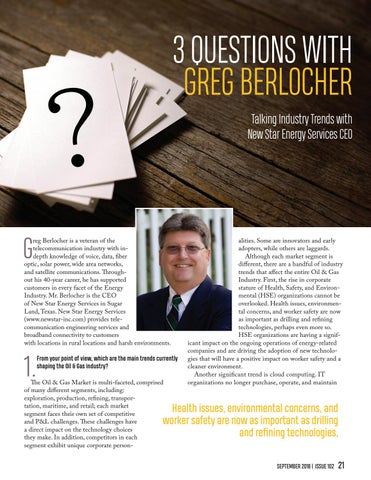
3 QUESTIONS WITH GREG BERLOCHER Talking Industry Trends with New Star Energy Services CEO
G
reg Berlocher is a veteran of the telecommunication industry with indepth knowledge of voice, data, fiber optic, solar power, wide area networks, and satellite communications. Throughout his 40-year career, he has supported customers in every facet of the Energy Industry. Mr. Berlocher is the CEO of New Star Energy Services in Sugar Land, Texas. New Star Energy Services (www.newstar-inc.com) provides telecommunication engineering services and broadband connectivity to customers with locations in rural locations and harsh environments.
1.
From your point of view, which are the main trends currently shaping the Oil & Gas industry?
The Oil & Gas Market is multi-faceted, comprised of many different segments, including: exploration, production, refining, transportation, maritime, and retail; each market segment faces their own set of competitive and P&L challenges. These challenges have a direct impact on the technology choices they make. In addition, competitors in each segment exhibit unique corporate person-
alities. Some are innovators and early adopters, while others are laggards. Although each market segment is different, there are a handful of industry trends that affect the entire Oil & Gas Industry. First, the rise in corporate stature of Health, Safety, and Environmental (HSE) organizations cannot be overlooked. Health issues, environmental concerns, and worker safety are now as important as drilling and refining technologies, perhaps even more so. HSE organizations are having a significant impact on the ongoing operations of energy-related companies and are driving the adoption of new technologies that will have a positive impact on worker safety and a cleaner environment. Another significant trend is cloud computing. IT organizations no longer purchase, operate, and maintain
Health issues, environmental concerns, and worker safety are now as important as drilling and refining technologies, SEPTEMBER 2018 | ISSUE 102
21
huge banks of servers to support their company’s software applications, they simply subscribe to cloud-based servers instead. Computing has become a service, much like electricity; you simply make a connection and pay the monthly bill. Just a few years ago, when an oil company wanted to add computing services, they would have to go through the bureaucratic process of having to issue a purchase order for a new server, wait on hardware to be delivered, and then finally bringing it online. At best, this process this took weeks. With cloud computing, a new instance of a server can be spun up in the cloud in less than twenty minutes. Cloud computing has significantly increased oil company’s flexibility and nimbleness, while driving down manpower requirements. Another significant trend is merger of Information Technology (IT) with Operations Technology (OT). SCADA systems, and other industrial automation systems, are powerful operational tools but they don’t play well in the same sandbox with other computing platforms. Up until now, SCADA systems have been silos of information, containing lots of data that other departments desire, but the data has been isolated. MQTT (Message Queueing Telemetry Transport) is a data transport protocol that allows multiple computing platforms to exchange information efficiently and securely, and breaking down silos of information within an organization.
connectivity at work as they enjoy in their homes. Video surveillance, is not new, but its role has been greatly expanded beyond intrusion detection: automated access systems at land-based drilling rigs are now replacing human gate guards; cameras on drilling rigs are monitoring employees for high risk behavior; and video cameras are being added at pump stations and compressor stations to compliment a pipeline’s SCADA system. Connected worker programs are another growing trend in the Energy Industry. Wearable technology can now bring back video from individual employees, monitor the employee’s respiration and heart rate, and warn the employee of imminent threats. As they mature, connected worker programs will add even more demand for bandwidth.
To meet the growing need for computing power, mammoth data centers have come online around the globe, each featuring multiple connections to different fiber networks.
2.
What is driving the requirement for more Oil & Gas capacity? Cloud computing is driving significant bandwidth demands in the Oil & Gas Market. To meet the growing need for computing power, mammoth data centers have come online around the globe, each featuring multiple connections to different fiber networks. Cloud computing on a global scale allows energy-related companies to attack massive engineering projects on a 24-hour basis. As the business day on one continent closes, an engineering team hands off their project to colleagues on a different continent. These collaborative projects require significant amounts of bandwidth. The increasing use of video is also driving demand for bandwidth in the Oil & Gas Industry. As popular smartphone applications, like Facetime, have become mainstream, employees have come to expect the same level of
22
SUBMARINE TELECOMS MAGAZINE
3.
What is the most intriguing application that could drive the adoption of international and regional fiber cable capacity in Oil & Gas? Without a doubt, the widespread adoption of 4D seismic systems would have a greater impact on the growth rate of subsea fiber in the Oil & Gas Industry than any other technologies noted. 4D seismic systems allow reservoir engineers to see how the condition of a reservoir changes over a period of time. Rather than send seismic ships out to do new surveys, a subsea fiber optic network would be installed at the well site, with hydrophones permanently implanted in the seabed. Instead of waiting on periodic data from seismic vessels, reservoir engineers could see instantly how a reservoir responds to stimulation. Over the last decade, a small number of 4D systems have been implemented in different oil basins around the world and engineers have been refining the software tools used in modelling the data. Predictions are very encouraging, with geophysicists estimating that production could be enhanced by 7%, or more, over the life of the well through the use of 4D seismic. The cost of a 4D system will vary, depending on a number of factors, but, for sake of discussion, let’s use an estimate of $20 million per well. It is easy to see the return on investment and envision a 4D seismic system being included in the budget of every deep water well being planned in the future. The widespread adoption of 4D seismic systems will have a tremendous and lasting impact on the adoption rate of new subsea fiber optic systems around the world. STF
FEATURE
NORTH SEA PATHWAYS: Digital Oilfields to Ultra-Secure Data Centers
BY BRIAN LAVALLÉE
T
ampnet is a Norwegian based global operator of oil field telecommunications, wholesale capacity, and mobile LTE services. Tampnet operates the largest offshore multi-terabit, low latency optical network in the North Sea, which reliably serves over 240 offshore assets such mobile rigs, Oil&Gas Floating Production, Storage, and Offloading (FPSO) platforms, and exploration rigs. Reliable, high-speed, low latency network services are the primary goals of their network, which includes 2,500km of subsea fiber-optic links, multiple strategically located 4G LTE base stations, as well as a multitude of traditional point-to-point radio links. The state-of-the-art optical network employs an all-optical Colorless-Directionless-Contentionless (CDC) design that achieves the lowest latency possible with a Layer 0 Control Plane that’s both OTN and mesh capable for sub-100G services rates.
BACKDROP: THE DIGITAL OFFSHORE OILFIELD
Big data analytics, remote exploration and internet of things are market trends set to impact a wide array of industries. For the oil and gas industry, these new advances are reality today. Fiber optic networks, and the digital
resources that they interconnect, are facilitating this technological transformation by allowing the entire offshore energy ecosystem to more efficiently manage resources (ex. oil drilling platforms). Offshore energy corporations leverage submarine networks, like Tampnet’s, to connect offshore assets to onshore assets to realize a variety of operational benefits to help differentiate via operational efficiency. Some of the important benefits that interconnected offshore digital oilfields offer are listed below. • Constant access to onshore experts located anywhere in the world via connections to the global internet allowing faster and improved decision making • Significantly improved efficiency of offshore operations, coupled with vastly reduced downtimes • Improved operational safety/security for offshore personnel and assets via continuous communications • Ongoing communications between onshore and offshore personnel to expedite critical decisions • Near real-time visibility, control, and oversight to best manage exploration activities and drilling assets SEPTEMBER 2018 | ISSUE 102
23
FEATURE
Tampnet North Sea Network Assets & Connectivity
To maximize the value of all the data collected from offshore assets, broadband and mobile LTE connectivity must be provided via modern submarine telecommunication networks to ensure a constant flow of immense amounts of actionable data to and from offshore assets and onshore data centers.
OPPORTUNITY: CONNECTING CRITICAL DESTINATIONS BEYOND THE DIGITAL OILFIELDS
The recent emergence of Sweden, Norway, and Finland as superior data center markets is highlighted by Cushman and Wakefield’s annual study of global data center markets. In 2013, all three countries placed in the top 10 globally. Today, just three years later, the same study placed all three countries in the top 5 of all markets globally for data center attractiveness. It’s not hard to see why, as these countries collectively possess a vibrant, educated workforce, access to green and secure energy, low operating costs and enjoy the support of local and national governments and industry. Along almost any measure, such as total operating costs, available energy in terms of megawatts already deployed, modernization, and physical security of the facilities themselves, the Nordic region has quite possibility the most advanced portfolio of data centers in the world. Until recently, access to the Nordic region data center market was constrained by congested and non-diverse routes from mainland Europe through Denmark and Sweden. This has now been changed as Tampnet enters the market for the wholesale connectivity. Markets such as London and Dublin, even Amsterdam and Paris, now can
24
SUBMARINE TELECOMS MAGAZINE
access the region via Tampnet’s direct North Sea routes. Furthermore, Tampnet also has direct continental access via its system to Denmark. Together with Tampnet’s northern route to Aberdeen, southern route to Lowestoft (UK) and its direct route to Denmark, Tampnet can offer customers the ultimate in diversity – three diverse and direct routes from the data center markets in the Nordics to the rest of Europe. No other network in place can offer this capability today placing Tampnet and its customers in an enviable competitive position.
THE NORTH SEA AS A STRATEGIC ROUTE OFFERING CRITICAL DIVERSITY TO KEY MARKETS IN EUROPE
Besides offering highly reliable and protected data center connectivity, Tampnet also offers their customers an alternative for transport to carrier hotels, peering exchanges, and points beyond the Nordics, such as Russia and Central and Eastern Europe. By enabling a northern alternative connecting these markets, Tampnet provides geographic diversity from congested infrastructure found in Belgium, Netherlands and Germany. In many cases Tampnet’s alternative routes offer reductions in latency as well, which is always a sought after benefit. Tampnet also offers competitive advantages by combining the latest in CDC optical technology across its entire infrastructure, which means a failure in one part of the network does not interrupt traffic in other parts of the Tampnet network ensuring resiliency and high network availability. In addition, because Tampnet’s subsea routes are switched on offshore platforms, Tampnet can shift traffic
mid-span in the event of an outage at sea. This capability is particularly helpful in the ever increasingly congested, yet vital waterways of Europe. Security and reliability-minded end users of optical networks incorporate redundant contingency paths as part of their risk analysis since terrestrial and submarine networks are susceptible to faults, regardless of the cause. Network path redundancy is key to improved Business Continuity and Disaster Recovery plans and as cloud-based content and applications are increasingly migrated into distant data centers, constant network access is critical to corporate viability making constant uptime within the network component ever more necessary. Tampnet’s large installed base of over 240 interconnected offshore assets is solid proof of Tampnet’s ongoing commitment to operating high availability services and the entire ecosystem relying on Tampnet continue to put their trust in their services. Tampnet’s network was designed from inception with the offshore energy sector’s ultra-reliable connectivity needs in mind, which is very similar to connectivity needs of other sectors in northern Europe, such as large data center operators, carriers, ISPs, cloud, and content providers.
It’s not hard to see why, as these countries collectively possess a vibrant, educated workforce, access to green and secure energy, low operating costs and enjoy the support of local and national governments and industry.
UNIQUE SOLUTIONS, ADVANCED TECHNOLOGY AND SUPERIOR RELIABILITY
Since 2001, Tampnet’s mission to create industry solutions for the energy sector has brought it to the unique position of operating critical and vital infrastructure not just for the North Sea, but for the Nordic region as a whole. Offering multiple diverse paths to and from the UK and Norway, combined with the latest in CDC capabilities, provides its customers with a highly unique and superior solution for reaching and transiting the Nordics when compared to most traditional, more conventional routes. As we enter the next decade, the stage is already set for the introduction of new and exciting technologies, such as 5G, the Internet of Things (IoT), big data analytics, artificial intelligence, and augmented/virtual reality, which will all further disrupt the markets and application spaces served by Tampnet’s expansive network assets. As this profound and exciting transformation continues to unfold before our eyes, the global demand for highly secure and scalable data centers interconnected over highly robust and
resilient network connectivity will continue to grow. Tampnet, and its partners in the Nordic region, have created a rather unique pairing of connectivity, scalability, security, and cost effectiveness that is currently unique in the Data Center Interconnect industry. STF BRIAN LAVALLÉE is Senior Director of Portfolio Solutions Marketing with global responsibility for Ciena’s Packet, 5G, Cable MSO, and Submarine network solutions. He has over 20 years of telecommunications experience with previous roles in Product Line Management, Systems & Network Engineering, Research & Development, and Manufacturing. During his career, he has worked in numerous areas related to packet and optical networks from access networks to submarine networks, and everything in between. He holds a Bachelor of Electrical Engineering from Concordia University and an MBA in Marketing and International Business from McGill University, both located in Montréal, Québec, Canada.
SEPTEMBER 2018 | ISSUE 102
25
FEATURE
MODULAR CONSTRUCTION IN OFFSHORE ENERGY With So Many Advantages for Oil and Gas and Beyond, Why Not Modular? BY AMY MARKS
T
echnology advances in flexibleww construction have increased significantly in recent years, leading to applications in a wide range of industries with rigorous performance specifications and technical requirements such as Oil and Gas, wind, and marine energy production. To cite but one example, the development cycle of a conventional Offshore Floating Production System (FPS) can range anywhere from five to seven years from blueprint to first oil. However, through the use of modular construction and standardized designs, many operators have been able to reduce time to first oil to just three years after beginning construction, while improving the overall operating flexibility of their facilities.
STICK-BUILT VERSUS MODULAR CONSTRUCTION
Before we proceed with an examination of the benefits of modular construction to the offshore energy industry, let’s level set by establishing some shared definitions. Historically, the most common method of construction has been stick-built, also known as “on-site construction.” Like any build, a traditional stick-built structure is typically designed by an architect and approved by the customer. The raw materials are then delivered to the job site, frequently shipped
26
SUBMARINE TELECOMS MAGAZINE
in multiple loads throughout the duration of the project, and then cut to size, as the building or critical infrastructure is assembled on site. In contrast to stick-built, modular construction involves prefabrication of material and integrating equipment and systems into modules offsite in a controlled manufacturing facility. The manufacturing setting ensures more stringent quality control as building components are less affected by environmental elements. More on that later. Once constructed, the modules are delivered to an offshore platform or building site where they can be installed and eventually commissioned.
ADVANTAGES OF MODULAR CONSTRUCTION IN OFFSHORE ENERGY
Modular construction techniques have been used throughout the offshore energy industry, and particularly in the Oil and Gas sector, for decades. However, as the industry copes with fluctuating commodity prices and continues to look for new ways to increase operational efficiency, reduce costs and
maintain profitability, modular design-build solutions are becoming even more common. Most notably, when time is money, modularized construction can reduce an offshore energy project’s development schedule on a number of levels. First, the chance of running into delays caused by weather or other environmental factors is minimized by assembling modules using prefabricated parts offsite in a designated facility. Next, building offsite affords operators the ability to perform work on multiple areas of a facility simultaneously, which is not always possible when using the traditional stickbuilt approach as the amount of work space onsite is often limited, or when tasks need to be performed sequentially. Lastly, by performing work offsite, operators can create certainty around critical path items by moving them offsite for prefabrication bettering the overall project schedule, and also mitigating the chance of trickle-down delays. Additionally, prefabricating modules provide significant advantages to quality control and assurance. Metal expansion and contraction caused by variations in temperature can impact the structural integrity of welds manufactured in an outside, onsite environment. In contrast, plant fabrication, performed offsite and often indoors, produces weld reject rates that are substantially lower. Prefabrication also allows for the testing of modules before arriving onsite, which means that any problems with equipment or systems can be identified and quickly resolved in the factory, significantly reducing costs during the installation and commissioning phase of a project.
ACCESS TO A SAFER AND MORE TALENTED WORKFORCE
Particularly critical in the Oil and Gas industry, where in developing or emerging markets the pool of experienced tradespeople such as welders and electricians can be limited, modular
construction offers immediate access to the talent required to build large-scale facilities. By selecting an offsite module fabrication facility in a region where there is an adequate supply of skilled labor, offshore energy firms not only gain access to trained professionals but also lower their operational expenditures. That’s because with a stick-built approach, the challenge of securing skilled craftsmen and women can very often inflate costs due to the need to provide travel allowances and housing accommodations to set them up in remote locations. Prefabricating offshore energy facility components also reduces the number of individuals required to work onsite, which can simplify construction activities and increase overall safety. This is especially the case with expansion and upgrade projects, as it reduces the need to perform construction work in close proximity to ongoing facility operations. Additionally, modular construction and prefabrication can minimize the need to shut down parts of an existing plant, thus reducing downtime and increasing production. It also levels the labor that is left onsite reducing the peaks and valleys that are often hard to manage.
SUBSEA, THE IOT AND THE EDGE
In the subsea sector, the use of modular design-build methods continues to gain traction in the form of Modular Cable Landing Stations (MCLS) sited around the world. This is especially useful in harsh or remote environments, and in emerging markets where there is an absence of existing data centers near cable landing points into which cable system owner-operators can directly connect their networks in Point of Presence (PoP) to PoP configurations. It’s also important to note that while new cable builds by Over-the-Top (OTT) providers continue to receive the lion’s share of industry attention, not all subsea cable systems are long-haul transoceanic networks with two to three cable landing stations. For example, the Hawaiki Transpacific Submarine Cable System when complete will have cable landings in Sydney, Australia; Oahu, Hawaii; Pacific City, Oregon; and American Samoa. Undoubtedly, MCLS — by providing a permanent, structural steel and concrete building that is non-combustible and built to withstand the harshest environments, including heavy wind and seismic loads — can provide the solution to a complex cable network in a region known to be vulnerable to extreme weather events. MCLS have the benefits of a Containerized Cable Landing Station (CCLS) solution but possess higher quality and durability than traditional site-built stations that containers cannot provide. Like other modular construction applications, the best MCLS are built in a controlled enviSEPTEMBER 2018 | ISSUE 102
27
FEATURE ronment by experienced labor that integrates design flexibility to meet a project’s specific technical requirements. Given that the International Data Corporation (IDC) predicts that by next year, 45 percent of data created by the Internet of Things (IoT) will be stored, processed and analyzed at the edge of the network, prefabricated, modular solutions are also the perfect solution for both edge and micro data centers. Especially when we consider the IHS Markit forecast that the IoT market will grow from more than 15 billion devices in 2015 to more than 75 billion in 2025, it becomes clear that modular design-build methods will be the methodology as it was for the telecom companies growing their cellular networks with modular cellular equipment enclosures in the last few decades. Traditional “stick build” construction, whereby various components are transported to a site and then laboriously put together into a final product, will not be able to keep pace with the rapid transformations of the Internet of Everything (IoE) and its demands of low latency connectivity at the edge of the network. Bottom line, there will be just too many things, too much data and too little time for the construction of stick-built, monolithic data centers, but modular edge and micro data centers can quickly answer the call, especially those modular building systems that are able to scale quickly without disrupting data transmissions in the operating facility. Additionally, with the introduction of more and more Artificial Intelligence (AI) and machine learning applications into the Oil and Gas industry, the use of modular edge and micro data centers, especially in remote, arid or marine environments, will become critical. The use of real-time sensors feeding data into AI systems is already prevalent in oil production operations, including forecasting, the optimization of supply chain and the automation of routine tasks.
modular systems are designed and built to provide the functionality and usability of a building, while taking advantage of efficiency and consistency of factory production methods; containerized systems force components into a specific format for ease of transportation. Moreover, containerized data center vendors typically prefer or even require the use of specific equipment and hardware vendors, locking companies in to a single ecosystem. They are also small and cramped to work in— about the size of a semi-trailer — and for that reason are better suited for temporary deployments. There are also constraints in how a company will be able to expand as its capacity needs grow. A modular data center can be easily modified by simply increasing the floor space and changing layout configurations. With a containerized data center, you’re limited to adding another unit, in effect, creating a double-wide trailer. Modular data centers also offer concurrent maintainability and support for a wider variety of hardware if fabricated by a design-build firm and not a manufacturer of equipment. Depending on the implementation, different components can easily be combined with packaged components such as full racks, while prefabricated power systems can be added as additional power capacity is needed. Cooling systems can also be prefabricated, including pumps, chillers, plumbing, condensers, and air handlers. Modular design-build techniques and prefabricated components can be customized to accommodate virtually any industrial need or technical requirement. Guided by a knowledgeable and experienced partner in modular construction, companies in any vertical, including Oil and Gas, can leverage the benefits of this paradigm shift to accelerate project schedules, reduce costs, increase productivity and become more competitive in an increasingly globalized marketplace. STF
#NOTACONTAINER
AMY MARKS is the CEO of XSite Modular, the leading design-builder of Modular Critical Infrastructure Buildings (CIBs) including Modular Cable Landing Stations (MCLS), ILA and PFE shelters, Edge and Micro Data Centers constructed in the United States and shipped all over the world. XSite’s permanent, structural steel and concrete buildings are non-combustible and built to withstand security threats and the harshest environments including heavy wind and seismic loads. Our CIBs have the benefits of a containerized station solution but with higher quality and durability than both containers and traditional site-built stations. XSite’s CIBs are built in a controlled environment with experienced labor forces while our process provides design flexibility to meet our clients’ requirements, both technically and aesthetically. Amy is an Alumna of Harvard Business School and the University of Florida. She’s published several white papers including Risk Mitigation through Industrialized Construction. Amy is a highly sought-after chairperson and keynote speaker for many international conferences on construction and was appointed by Singapore’s Building Construction Authority’s (BCA) to their International Panel of Experts focused on prefabrication and construction productivity.
Some people often associate modular construction with prefabricated residential homes, while in the telecom sector, IT administrators and engineers frequently think of containerized data centers. Let me be clear: Containerized data centers are delivered in an actual shipping container or a structure of similar size. However, they are not modular data centers. Modular data centers are buildings built to customer specifications offsite and shipped in pieces for site installation. The finished product can be as solid, secure, and functional as any other traditionally-built structure. Containerized data centers are retrofitted ISO containers, or constructed to fit the same format, primarily to save cost and provide simpler shipping. The priorities are different:
28
SUBMARINE TELECOMS MAGAZINE
FEATURE
IMPROVED POWER CABLES DEPLOYMENT: Control of Touchdown Tension is Critical to Successful Submarine Power Cable Installations BY DR. VENKATA K. JASTI AND DR. JOSE ANDRES
I
n the recent years, there has been an increase in submarine power cable installations, and industry predictions estimate that such installations will continue to increase primarily due of two factors: First, offshore wind energy installations continue to increase particularly in Northern Europe, where installations are moving to “Phase 3s” which involves installations further offshore that require longer export cables. Second, there is an increase in grid interconnection cables between countries with surplus power and those with high demand. In both these cases, installations will involve longer routes and deeper waters. All studies on submarine power cable failures point to installation issues as one of the leading causes of failures to date. To prepare for the future, installers need to quickly learn to rectify installation issues experienced in the past
and apply improved methods to the more challenging installations of the future. Submarine power cable installation is a complicated process with many overlapping steps. In this article, the focus is on improvements that can be made in planning and installation phases to maintain proper cable tension during installation to avoid some of the typical failures.
ESTABLISHING “PLANNED BOTTOM TENSION”
Maintaining a proper cable tension at the touchdown point is a critical step in avoiding some of the common causes of failures during the installation. If a cable is installed with too high a bottom tension, cable spans will be created on the seafloor resulting in heavily loaded contact points along the cable as seen in Figure 1a. When the cable is exSEPTEMBER 2018 | ISSUE 102
29
FEATURE posed to ocean currents, such spans will oscillate and chafe at the contact points. If spans are long, the cable can bend beyond its allowable Minimum Bend Radius between the contact points. Alternatively, if cable tension is too low, the cable may experience excessive bending near the touchdown point as shown in Figure 1b. If bending exceeds the cable’s Minimum Bend Radius, it will be permanently damaged. The damage could be immediate as in this case of over-bending or the damage could be gradual as with cable spans. To avoid such issues associated with improper cable tension, it is important to perform pre-lay analysis. The first analysis recommended is cable span analysis in which the resting shapes of the cable on the seafloor are calculated for different cable tensions. Such analysis provides the expected free span lengths, reaction forces, bend radii and shear forces along the cable. The higher the cable tension, the longer the resulting cable spans will be. From this span analysis, the maximum tensions allowed at the touchdown points along the route are established. The second analysis recommended is Figure 1a: High bottom tension will lead to cable spans on the ocean bottom with heavily loaded contact points. These heave analysis. This involves modeling spans can cause excessive bending leading t immediate failure, or they can oscillate under ocean currents slowly vessel motions at various sea states chafing the cable at the contact points. using vessel RAOs and an imposed Figure 1b: Low bottom tension leads to excessive bending near the touchdown point. If such bending exceeds the cable’s wave spectrum. The motion of the cable over-boarding point during heave Minimum Bend Radius (MBR), the cable may fail. motions is used to simulate the cable shape below the vessel. During a down heave, cable bottom tension is reduced to its minimum, and cable bending is maximum. During an and terrain conditions (rough vs smooth), different bottom tension targets can be assigned to each section of the route. up heave, cable bottom tension is maximum, and the cable MakaiPlan is a purpose-built route engineering tool that is under the most tension. The bottom tension oscillates is used by the majority of cable route planners world-wide. around a mean value, and the oscillations increase as the Makai recently added the option to include “Planned Botsea state becomes more extreme. From the results of heave tom Tension” in the Route Position List (RPL) specifically analysis, the minimum tension allowable at the touchdown for power cable installations. point is established, and the sea states that are too extreme for safe cable laying are established. Combining results from the above analyses, a target for MAINTAINING TARGET BOTTOM TENSION IN REAL-TIME Planned Bottom Tension should be established for the instalTo maintain in real-time the target bottom tension while lation along the route. For longer lays with varying depths deploying the cable, the installers will first have to calculate
30
SUBMARINE TELECOMS MAGAZINE
Figure 2: MakaiLay screen capture from a recent installation conducted with RT Casey, Inc. The most challenging section of the installation was through a narrow channel between an existing cable and a pinnacle on the ocean bottom. The black line is the planned Route Position List (RPL), the yellow line is the as-laid position as calculated by Makai’s cable model in real-time during the installation, the orange line is the ROV observations made post-installation, and the red line is the barge course. The barge was guided off the RPL to counter the cable deflections caused by ocean currents. The mean absolute deviation between the ROV measurements and cable model calculation was 1 meter.
the bottom tension in real-time, as it cannot be measured directly. Most power cable installations log ship measurements (such as GPS positions, Gyro readings, top tension and top cable payout length) and ROV measurements (USBL position). Thus, some of the top and bottom measurements related to the cable in the water column are known. From these boundary condition measurements with a physically accurate cable model, it is possible to accurately “construct” the cable shape in the water column and estimate the bottom tension. The more sophisticated the cable model, the more accurate the shape and bottom tension calculations will be. Using a
dynamic cable model which does not just calculate static shapes joining the top and bottom co-ordinates, but accounts for vessel dynamics (speed up, slow down, turning) and ocean currents (if available), will increase this accuracy. Makai’s 3D dynamic cable model is such a model. The real-time installation control software, MakaiLay, which is built around this model, has been under constant development and commercial use for the last 30+ years. This software has been installed on 35+ cable laying vessels world-wide. The next step is to control the bottom tension in realtime. The principal control “knob” installers have available SEPTEMBER 2018 | ISSUE 102
31
FEATURE in order to maintain the target bottom tension is adjustment of Ship slack. Ship slack is the ratio of cable payout speed to ship speed. In most installations, ship speed is kept constant, and cable payout is constantly adjusted to adjust ship slack. When ship speed is constant, on a flat bottom, the bottom tension will decrease when the cable payout rate is increased, and bottom tension will increase when the cable payout rate is decreased. Importantly, the response of bottom tension at the touchdown point to a change in cable payout rate is almost instantaneous making this a very favorable real-time control method. During a cable installation, as the terrain slope changes,
the cable payout rate has to be adjusted to maintain the target bottom tension. When laying cable up the slope, the cable length in the water column decreases, and extra cable is deposited along the up-slope. In response, cable payout must be reduced proportionally to maintain the target bottom tension. Similarly, the payout rate must be increased when laying down the slope. Managing such payout adjustments manually can be tedious and error-prone. Taking advantage of the instantaneous response of the bottom tension to a change in cable payout rate, Makai developed an Auto-Tension module to work in conjunction with the MakaiLay real-time cable model. With this mod-
Figure 3: Screen shot of MakaiLay’s geospatial 3D viewer showing the cable shape calculated by ROV tracking method. The latest shape matches the ship’s GPS coordinates at the top and the ROV’s USBL coordinates near the touchdown. The shape in-between is calculated by the dynamic cable model that accounts for all ship dynamics and changing ocean currents. Cable shapes calculated in the previous time-steps are also shown in the 3D viewer so that the installer can easily observe any cable dynamic trends.
32
SUBMARINE TELECOMS MAGAZINE
ule, the cable lay is simulated into the future accounting for the current cable shape and all upcoming terrain changes. The module then automatically adjusts future cable payout rates and issues new payout instructions as needed to the cable engine operator. MakaiLay with Auto-Tension was used on a power cable installation off the U.S. west coast performed by RT Casey, Inc. The grid interconnection cable was ~3.8 kilometers long and was 90 meters deep at its deepest point with several alter-courses. The installation corridor was particularly narrow in one section where the cable was installed between an existing cable and a pinnacle on the seafloor as shown in the Figure 2. Strong tidal currents of up to 2.5 knots were present throughout the installation. Despite these challenges, the cable was successfully installed well within the installation corridor, and an average target bottom tension of ~750 kilograms was maintained during the installation. Post installation, the as-laid coordinates of the cable were measured by an ROV, and the mean absolute deviation between these measurements and the as-laid calculations made in real-time by Makai’s cable model was 1 meter, which was within the navigation accuracy of the ROV.
lations over time. To avoid such cumulative errors, a more reliable instantaneous measurement is needed. Top cable angle is one such measurement that can be reliably used in shallow waters. In shallow waters, the top angle changes measurably when the bottom tension changes. In deeper waters, the sensitivity of the top angle change to bottom tension change drops off, and it can no longer be used as a reliable measurement. Since most of the power cable installations use ROVs for tracking the touchdown point, the instantaneous USBL position of the ROV can be used as a boundary condition in the cable model. The resultant calculated shape can accurately predict the cable bottom tension. Makai recently added such an “ROV tracking” option to MakaiLay software and used it for monitoring the cable shape on two legs of the North Sea link installation carried out by Prysmian Group. In conclusion, proper analysis to establish the planned bottom tension and followed by use of a proven installation management method in real-time, such as automatic payout control and ROV tracking will significantly improve tension control on submarine power cables during deployment. This method will eliminate the common failure modes resulting from bottom spans and minimum bend radius violations. STF
Top cable length out distance and top tension measured at the cable overboarding point are frequently used as boundary conditions.
ROV TRACKING TO IMPROVE TENSION CONTROL
Any cable model relies on boundary conditions that are measured in real-time to calculate the cable shape and the bottom tension. Top cable length out distance and top tension measured at the cable over-boarding point are frequently used as boundary conditions. Both have some drawbacks when used for power cable installations. Top tension measurements are noisy and are very sensitive to calibration mistakes making these measurements less desirable. Cable payout length measurements are prone to cumulative errors. Cable payout length is measured by roto-meters, and most roto-meters will have some slippage and calibration errors. While these errors are very low (~0.1%), they can still add up over long cable lays. As described in the above paragraphs, bottom tension is very responsive to changes in cable payout at the surface, so cumulative errors can cause drift in bottom tension calcu-
DR. JASTI, joined Makai’s submarine cable systems group in 2009, after earning his Ph.D. in mechanical engineering from Carnegie Mellon University. Currently, he is the technical leader for commercial submarine cable activity at Makai. This includes maintaining our proprietary submarine cable model, sales, and training of our worldwide clients in the use of our flagship MakaiLay and MakaiPlan software. In recent work, he has focused on applying the extensive knowledge Makai has gained from telecom cable installations to benefit the subsea power cable and seismic exploration markets. DR. ANDRES is Makai’s President and CEO. He is responsible for all aspects of Makai’s diverse portfolio of business and leads a team of technical program managers in areas including renewable energy, submarine cables, and subsea technology. Dr. Andres is the founding member of the submarine cable group and has overseen its growth over the last 30 years from an R&D project to the producer of world’s #1 software for route engineering (MakaiPlan) and real-time at-sea management (MakaiLay). He is still involved with submarine cable activities both in commercial as well as defense applications.
SEPTEMBER 2018 | ISSUE 102
33
REGISTRATION NOW OPEN! Bringing together nearly 1,000 professionals from the submarine cable industry to network, share knowledge and ideas, learn from the top experts and exhibit at the premier event for the industry.
Register at www.suboptic2019.com
New O Join the
SubOptic 20
@SubOpticC
8-11 April 2019
New Orleans Marriott | New Orleans, Louisiana, USA
Orleans Conversation!
019
@SubOpticCon
Con
SubOpticCon
SubOptic Association members receive a special registration discount – Join Now! https://suboptic.org/join-the-association
FEATURE
Factory test of a dual cable engine set with holdback
SELF-FLEETING CABLE DRUM: It’s All About the Cable!
BY ROB EASTWOOD
W
hen the SS Great Eastern laid the first successful transatlantic cables it used a drum-wheel with four turns of cable. For the cable to enter and exit at the same positions it had to be fleeted, with the coil pushed sideways by a “knife”. 150 years later and that same layout is still widely used. The engineer of the Great Eastern hadn’t invented the concept; he was vastly improving the simpler rope windlass drums, including knives, familiar to old time sailors. The drum is still the best way to hold a cable load but the knife pushing on the side is always an undesirable high
36
SUBMARINE TELECOMS MAGAZINE
side load contact - something that wears grooves - and when objects like repeaters and joints arrive, it is a skilled task to manipulate the coils and knife so the object can pass through cleanly. Telecoms cables have become remarkably more resilient since those days but the gentler the cable handling during deployment, the lower the risk of an in-service failure. Our ever more digital lives depend on the quality of those cables and how they are laid. SMD has supplied linear cable engines of up to twenty wheel pairs which are, of course, knife-free - but few ships
can afford the length of deck space required. Linear engines also only work on the cable sheath which can limit the ultimate grip compared to drums. SMD has also supplied plain drum tensioners with knives where that was the client preference or budget but has always looked for better solutions.
THE SELF-FLEETING CHALLENGE
In the 1980s there were several industry attempts to develop a self-fleeting cable tensioner that did not need knives, a drum where the cable would simply enter and exit in a continuous stable running spiral. One of those systems had Only one stave in a group is moving down while all its neighbours are moving slowly up. a series of transverse conveyors. There have also been modified knife concepts like fleeting rings. A particularly interesting concept to SMD was a stave drum, where the surface of the drum is overlaid with a number of staves almost all gently moving to fleet the cable across the surface, counteracting the natural action of the cable to wind to the side of the drum. At the same time, a small number of staves are rapidly resetting in the opposite direction – all this being driven by a cam mechanism. However, the challenges of a cam and stave mechanism that can easily slide laterally while resisting high, unbalanced, radial and circumferential loads should not be underestimated especially when that mechanism that has to operate continuously for months at a time in a harsh environment. In factory test SMD accepted that challenge and as a first exercise built an ROV umbilical with state-of-art variable speed drive controls. pre-tensioner which proved the mechanism – it is still in The first pair of new cable engines was supplied to KCS factory service today. SMD’s engineers realised that driv(Kokusai Cable Ship Co.) in July 2018. A repeat purchase ing the fleeting mechanism independently could deliver for them - they also operated first generation machines. other cable manipulations, especially for passing objects. The experience was applied to a cable drum solution that equipped three ships in the early 2000s. The new-build A MESMERISING SIGHT cable lay vessel market went quiet for many years. Then, in To see a 4m diameter, 40 tonne capacity drum cable 2017, recognising the improving demand for telecoms cable engine rotating at high speed with the horizontal staves all lay and other related applications, SMD completely re-enmoving in a subtle wave motion, is mesmerising. The cable gineered the product as a high precision production item sits in a gentle spiral around the drum, rather like a standSEPTEMBER 2018 | ISSUE 102
37
FEATURE ing wave, and all the while the cable is arriving and departing at speed. Couple that with a fast reacting electrical drive for constant tension control and it makes for a system that gives the cable the gentlest transition from storage tank to seabed. Cable drums are based on the classic “capstan equation”, TD = THB eμΦ and THB = Holdback Tension μ = friction Φ = number of turns (in radians) where the drum tension capacity TD is given by: The cable friction is usually just a given. Holdback tension and number of turns are the only factors that can be practically adjusted. The initial holdback is provided by a short (4-wheel pair) linear cable engine. A 50:1 multiplication of the holdback is easy to achieve with a few turns on the drum. The linear engine, as well as providing the holdback tension, also controls the cable entry on the drum and there is an adjustable guide on the other side for running in reverse when recovering a cable. The lay tension resistance generated by the drum is dissipated in heat somewhere (the Great Eastern had wrought iron band brakes with wooden block shoes in a water bath). The generated power, from load handling by electric drive, can potentially be fed back to the ship but due to risks of power distortion most customers prefer to dissipate it into the resistor bank as heating.
Passing a dummy repeater in test
38
SUBMARINE TELECOMS MAGAZINE
PASSING JOINTS AND REPEATERS
Joints and repeaters are another area of potential risk for lay operations and cable integrity. They are large objects relative to the cable and giving them the least stress as they pass from storage tank to sea significantly reduces the risk of something going wrong, either to themselves or to the adjacent cable wraps. Ideally the joints and repeaters should pass around the drum without touching the other cable wraps. This is something that the self-fleeting drum can do very well because the cam mechanism can operate at different speeds to the drum. This can increase or decrease the fleeting effect – the coils can be as wide or as narrow as the user desires within the limits of the drum width. Also, if the cam ring rotates at the same speed and direction as the drum, then there is no fleeting effect and the net effect is a plain drum. Using a combination of these effects and moving the linear engine can set up an ideal spacing suitable for a repeater arrival. When the repeater arrives, the drum can stop fleeting and the repeater pass around a plain drum without landing on any coils. The whole process can take place without pause to the lay.
NEW APPLICATIONS
In deep sea lift operations, the self-weight of steel ropes negates their lift capacity at depth. Aramid type fibre ropes have been seen as the answer as they have low weight in water and excellent net lift capacity even at ultra-depths. However, fibre ropes do not hold their shape when under high tension on a multi-layered winch drum. Introducing a self-fleeting cable drum tensioner may be the answer as the main rope can then be reeled on a low tension storage drum. Analogies with the transatlantic cable lay can be a bit tenuous now. Nonetheless, it is surprising how many things they got right on those first lays. However, the wisdom of putting the cable through the least possible handling risk always remains true and self-fleeting drums can certainly help to do that. STF ROB EASTWOOD is the Chief Engineer responsible for Deck Equipment at SMD, and has more than thirty years’ experience designing, building and installing launch, recovery and asset handling systems for the company. SMD developed some of the earliest subsea cable burial machines together with the deck equipment to deploy them and today more than 50% of the world’s subsea cable ploughs, jet trenchers and their handling equipment are supplied by SMD.
FEATURE
OILCOMM AND FLEETCOMM CONFERENCE & EXPOSITION: Showcasing Rapidly Evolving and Diversified Mobile Industries
BY JEFFREY HILL
O
ilComm has been serving as the energy industry’s leading forum for telecommunications and networking technology since the turn of the century. Now paired with its FleetComm counterpart for commercial transportation and shipping markets, OilComm and FleetComm will open its doors for the 18th time on Wednesday, October 3rd, 2018 to a much more diverse audience seeking a more diverse set of solutions for a more diverse set of challenges. The exhibit hall floor will feature the mobile industry market’s leading satellite, wireless, cellular, microwave and fiber communications technology vendors, alongside machine-learning application developers, sensing and predictive
analytics providers, cybersecurity consultants, Virtual- and Augmented-Reality (VR/AR) hardware suppliers and other new entrants seeking to meet industry demands in the dawn of the “Big Data” era. In creating a 2018 OilComm and FleetComm conference program that would match the excitement of the show floor while providing learning opportunities for end-users, we identified a handful of key topics for sessions. They are:
1.
The convergence of Information Technology (IT) and Operational Technology (OT) teams within industry organizations. For many years, the idea of integrating IT and OT processes has presented the oil and gas industry with a list of technical, logistical, and security challenges. However, now that standards have matured, and IP devices on Industrial IoT networks have flourished, integrating IT and OT has become an affordable, feasible, and essentially critical transformation for the industry. Kicking off the OilComm and FleetComm program, we have an opening session featuring Baker Hughes Technical Product and Security Leader Paul Brager, Noble Energy CISO Rob Nolan, and ExxonMobil Cyber Security Vulnerability Testing and Management Director Andrew Taylor. Together, the group will discuss how to overcome some of the unexpected challenges related to breaking down IT and SEPTEMBER 2018 | ISSUE 102
39
FEATURE OT silos, controlling devices and programs at the network edge, efficient collaboration, and working with standards. The session will also include strategies and tips from industry leaders and workforce specialists. Continuing with the theme of IT/OT convergence, BP Energy Segment Engineering Technical Authority Dennis Brewer will join NCC Group Technical Director Damon Small and Rigstar Industrial Telecom President of U.S. Operations Rick Sperandio in a discussion about how to make corporate IT and OT processes more cohesive and efficient by dealing with “Shadow IT.” The term is used to describe solutions specified and deployed by departments other than IT that are used internally without explicit organizational approval. Shadow IT can create serious inefficiencies and expose networks to cyber-attacks. These issues quickly becoming more serious and widespread as unauthorized technologies are being marketed and sold directly to the engineering levels of companies.
2.
Protecting networks from internal negligence and external threats. Of course, the “Shadow IT” conversation also includes another long-standing, top issue for OilComm / FleetComm — cybersecurity. As big-data-driven businesses enjoy the benefits of efficiency and predictability, they must also be aware of liabilities. During a cybersecurity conversation at our 2018 OilComm and FleetComm advisory board meeting, one of our members observed that “a company’s cyber-security strategy is only as good as its weakest link.” A system administrator reusing a weak password sounds like a small oversight, but it’s more than enough to cripple a major company network — no matter how sophisticated the rest of the system may be. Network threats are constant. With cyber-attacks becoming more and more sophisticated and dangerous, it has become essential to invest in a complete cyber-security strategy beyond just hiring another IT specialist, installing software and tracking hardware. Proposing a budget for a cyber-security battle plan isn’t easy, especially since many of our industries are emerging from a downturn during which cyber-security budgets were actually cut. OilComm and FleetComm’s day two opening session, “Big Data, Big Responsibilities: The Business Case for Investing in a Cyber-security Culture,” led by SES Networks’ Morten Hansen, will explain how to justify aggressive investments in cyber-security. Attendees will hear from ex-
40
SUBMARINE TELECOMS MAGAZINE
perienced industry network security pros such as Diamond Offshore Drilling Director of Global Infrastructure Timothy Jackson, Cisco’s Product Line Manager of IoT Security Robert Albach and SecurityGate Co-Founder and CTO Cherise Esparza-Gutierrez. Speakers on this session will share tips on how to remain proactive against and adaptive to new threats, as well as how to implement a company-wide culture of responsibility for protecting networks. For more in-depth technical cyber security knowledge, check out a presentation by Rex Lee, whose firm RML has consulted numerous U.S. government agencies on cybersecurity threats and solutions. Rex will discuss the pros and cons of “Surveillance Capitalism” — a business model that supports surveillance and data mining business practices employed by with leading ìoT products. While these products are designed to monitor, track and data mine the product user for financial gain, Rex argues that they also pose huge privacy, cyber security and safety risks for anyone who works within government, the defense industry, enterprise business and within critical infrastructure (utility, public safety, oil & gas).
3.
The Private 5G “Experience” for Mobile Industry. Major telcos and cellular service providers have only recently launched consumer awareness programs for commercial 5G services, but mobile industries have been con-
ceptualizing what 5G means for their operations for years. These industries have been spending billions of dollars on supporting infrastructure, driven by bullish market projections, developments in standardization, an endless list of game-changing applications, and a seemingly infinite supply of excitement from investors. As the OilComm/FleetComm community includes several key target markets for private 5G, we felt it was appropriate to bring everyone together for a chance to ask tough and direct questions directly to the 5G network builders. What capabilities can private 5G services truly deliver for industry? How will 5G be defined? How much will 5G cost both early adopters and latecomers? When will multiple options be available on the market? Will available hardware and connected devices be ready for 5G? Will 5G networks be secure and more flexible? Chevron RF Engineering Architect Al Sinopoli and Surface Technologies’ Head of It Arnaud Feletin will join a handful of 5G service providers to discuss and answer these questions during the closing session.
4.
Artificial Intelligence, Machine Learning, and Augmented Reality. If you’re looking for a grounded and hype-free conversation about automated industrial transportation, look no further than our FleetComm session, “The Impact of AI-Powered, Self-Organizing Management Systems on Industrial Fleet Operations.” Two of the most brilliant minds working with industrial AI (Oceaneering’s Mark Stevens and HyperGiant Co-Founder Will Womble) will explore what will happen when major fleet operators give their vehicles the ability to learn and self-organize. While Artificial Intelligence (AI) and machine learning hasn’t transformed industrial transportation as quickly as Uber and Lyft changed the taxi business, adaptive technologies are already integrated in common driver safety and crash detection systems. We’re about to see a significant leap in AI technology for fleet management. Mark and Will will explain the facts behind the self-managing fleet, including: realistic AI adoption timelines based on available and affordable technology; how vulnerabilities and risks would be addressed and managed in an automated ecosystem; how the driver and ship captain’s roles would change; what automated fleets could (and should) learn that experienced operators don’t already know; and more. While these were the four most popular requests in terms of conference topics, the 2018 OilComm and FleetComm show highlights a wide range of thought leadership within our industry. We hope you will join us at the Houston Marriott Westchase Hotel on Wednesday, October 3rd and Thursday, October 4th for what we feel is the most exciting conference and exhibit hall we’ve ever assembled in our 18-year history. For more information on how to register to attend OilComm and FleetComm, visit www. oilcomm.com. Readers who use the code SUBTEL18 when they register qualify for a free Exposition Hall Only pass. STF
While these were the four most popular requests in terms of conference topics, the 2018 OilComm and FleetComm show highlights a wide range of thought leadership within our industry.
JEFFREY HILL is Chairman of OilComm and FleetComm Conference & Exposition and leads the development of all conference programs in Access Intelligence’s aerospace and telecommunications events portfolio, which includes SATELLITE, OilComm and FleetComm, and DC5G. He joined Access Intelligence’s aerospace team in 2008 and previously served as Web Editor for Next City magazine, and as the Director of Communications for Drexel University’s Media Arts and Design colleges and programs.
SEPTEMBER 2018 | ISSUE 102
41
POWERFUL ANALYTICS
CUSTOMIZED REPORTING Delivered in 10 business days SPECIAL MARKETS — Oils & Gas, Cableships, Upgrades and more From REGIONAL TO GLOBAL Market Reports
ORDER YOURS TODAY
STF ANALYTICS CUSTOM REPORTING
WWW.STFANALYTICS.COM
FEATURE
FIBER SENSING IS EVERYWHERE:
Distributed Acoustic Sensing For Submarine Telecommunication Systems BY GUILLAUME HUCHET AND JAN KRISTOFFER BRENNE
O
ver the past decades, fiber has virtually become the only channel of transmission for fixed communications. It first appeared on the longest segments of underwater and terrestrial telecommunications networks, and now fiber reaches every office, every home, installed along highways, railways, power lines and pipelines. All networks are now embedding fiber as a standard. Fiber is now everywhere! Oil & Gas offshore fields are no exception to the rule. Most of the new offshore platforms coming into operation use fiber for communication with their shore base and their subsea production systems. Alongside this massive development driven by increasing bandwidth requirements, a number of fiber-based measurement techniques have emerged. DAS (Distributed Acoustic Sensing) is a measurement technique based on fiber sensitivity to mechanical disturbances: such as vibrations or pressure variations. It effectively turns every single piece of fiber into a potential vibration or acoustic sensor. With the widespread deployment of fibers on infrastructures, DAS has thus become a common monitoring tool in many areas. In the rail industry, DAS can be used to detect the location of the trains and monitor rolling stock conditions. In the oil industry, DAS is used for terrestrial pipeline monitoring to detect, locate or identify nearby activities and potential threats such as unplanned digging works or intrusion attempts. Early warnings provided by DAS allows the operator to immediately trigger preventive actions before damage occurs.
FROM PIPELINE MONITORING TO SUBMARINE CABLE MONITORING
DAS interrogators used for pipeline monitoring have a typical reach of 40 km. Multiple interrogators are installed as required along the pipeline route to cover the desired length
44
SUBMARINE TELECOMS MAGAZINE
when longer than 40 km. During the commissioning phase after installation, as a calibration, typical threats (such as excavating) can be simulated at various locations along the pipeline and a database of signatures can then be recorded for future comparison when the system is in service. Pipelines are much more expensive assets than submarine telecommunication systems, but when we consider the importance of the data they carry we could say that they are equally worth protecting. In principle, a DAS interrogator can simply be connected to a submarine cable, assuming a dark fiber is available for monitoring. However, the submarine environment calls for specific requirements for submarine cable DAS interrogators: • longer range; the interrogator should be able to cover the entire length of the cable that is the most likely to be damaged, e.g. the shallow water section. In many cases, this will exceed 40 km; • higher sensitivity; the interrogator should be able to detect a threat approaching the cable early enough to have enough response time for corrective actions (for example, contact with the approaching vessel); • calibration free; given the difficulty and cost to access an installed submarine cable, it should be possible to classify threats without prior calibration during commissioning.
THE DAS INTERROGATOR
ASN has recently launched the development of a DAS interrogator dedicated to the protection of submarine telecommunication cables. This interrogator uses an innovative interrogation technique, which provides a significantly improved signal to noise ratio and a high-fidelity measurement of the fiber mechanical constraints. Several tests were conducted to evaluate the performance of the developed prototype in real cases and the most sig-
Figure 1
nificant results are presented in the section below. A simple dropped object test was first performed to demonstrate the ability of the system to detect the tiniest mechanical disturbances on a submarine cable; the interrogator was connected to a standard armored and sheathed subsea cable and a pencil of a few grams was dropped from 10 cm Figure 2 height at a distance of 120km; the corresponding signal was clearly detected by the interrogator with a resolution of less than 10 meters. Tests at sea have also been performed; a standard ASN OALC5 LW cable was installed in an area with strong currents and regular maritime traffic. The figure below represents the bathymetric profile of the installation area in the shore section. A first test was performed to highlight the ability of the system to detect the vibrations induced by currents. The acoustic spectrum of the DAS signal (between 3Hz and 1kHz) was recorded at 2 separate times of the day. The left figure above shows the DAS signal recorded one hour after low tide; some currents are present and vibrations (characterized by a wide band low frequency spectrum) are detected at position 500m (1 channel corresponds to 10m). The right figure shows the DAS signal recorded three hours after low tide, when currents are expected to be stronger. The vibrations at position 500m are stronger and other vibrations appear at position 1500m with the same frequency pattern – wide band low frequency. Another test was performed to assess the capability of the DAS interroFigure 3 gator to detect the acoustic signature
of activities near the cable. For this purpose, hydrophones were positioned along the cable as references. The DAS signal was recorded as a passenger boat crossed the cable. The frequency spectrum of this signal is shown in figure B. The acoustic signature of the vessel appears clearly (characterized by frequency rays). The same signature had been recorded with the reference hydrophones, as shown in figure D. These last two experiments confirmed the potential of the DAS interrogator to not only detect activities near a submarine cable but also, thanks to spectrum analysis, to classify them without prior calibration. Further enhancements on signal processing should make it possible to identify the signatures of various threats which submarine cables might be exposed to: seabed movements (earthquake, landslides), currents, seabed intrusive activities (trawling, anchoring). Other sea trials are currently in progress on several systems to gather additional data for this purpose. Those trials will also provide further indication regarding sensitivity to seabed intrusive activity near the cable and subsequently the time available to send alarms when such activity is detected.
SEPTEMBER 2018 | ISSUE 102
45
FEATURE
Figure 5 & 6
CONCLUSION
Technology now exists to detect mechanical disturbances on standard telecommunication fiber optic cables. There is no need for special fibers inside the cable, just an available dark fiber will make an excellent sensor. The DAS interrogator developed by ASN provides long reach and superior sensitivity which makes it particularly adequate to monitor the whole section where the submarine cables are particularly vulnerable and where statistically most cable cuts occur. In addition, the signals generated by the interrogator make it possible to classify the threats to the cable integrity (vibrations, seabed intrusive activity, etc.) without prior calibration. Such DAS equipment could be coupled with AIS message transmitter systems which can alert mariners in real time when issues arise. Corrective actions can then be taken before an incident happens. STF GUILLAUME HUCHET received his Master’s degree in Optics from Ecole Supérieure d’Optique in Paris in 2000. He joined Alcatel Submarine Networks in 2001 and held several project management positions, ranging from system engineer to contract manager, with a strong involvement in ASN’s Scientific and Oil & Gas projects. In 2014, Guillaume was appointed CTO for the diversification markets, in charge of product line and technical proposals. JAN KRISTOFFER BRENNE is R&D Manager at Alcatel Submarine Networks Norway AS located in Trondheim. He has over 15 years’ experience in fiber optics sensing technology and was heavily involved in developing the permanent reservoir monitoring system Optowave currently in use within the oil and gas industry for improved oil recovery. The Optowave system includes typically 15 000 to 25 000 individual optical sensor channels with a seabed coverage in the range of 50 to 150 km2
46
SUBMARINE TELECOMS MAGAZINE
Figure 7
8-11 April 2019 | Â ew Orleans Marriott, N New Orleans, LA
Engage with the PREMIER EVENT OF 2019 www.suboptic2019.com
Connect with us! Click FOLLOW LinkedIn www.linkedin.com/company/suboptic-conference/ FaceBook www.facebook.com/SubOpticCon/ Twitter twitter.com/SubOpticCon Instagram www.instagram.com/subopticcon/
Share a Post Click share at the bottom of a SubOptic post so that your connections, friends and colleagues can share in your excitement for the 2019 event.
Tag SubOptic 2019 Tag SubOptic by using the @ symbol when you are commenting or posting.
Comment on Posts Your opinion matters and potential attendees want to hear from you prior to the event.. Comment on posts and start a discussion.
Engage fellow members of the subsea telecommunications industry to spread the word about the event, the opportunity to submit an abstract and the chance to be part of an event that is SEPTEMBER 2018 | ISSUE 102 47 advancing the industry through its connections.
Undersea Fiber Commu r Communication Undersea Systems, Fiber 2eComm This comprehensive book provides both a
high-level overview of submarine Edited by: José Independent T nt submarine Edited Telecom by: Chesnoy José Expert, Chesnoy former Independent CTOsystems ofsubmarine Alcatel-Luc submar and theNetworks detailed specialist technical Submarine data Submari for N Submarine the design, installation, repair, and all other aspects of this field.
Undersea Fiber Communi ea Fiber Communication Systems, 2e both Undersea Fiber Com This comprehen This comprehensive book provides a high-level This overvie compr
Edited by:Edited José Chesnoy submarinesubm Tele y Independent submarine Telecom Expert, former CTO of Alcatel-Lucent by: JoséIndependent Chesnoy Independent SubmarineSubm Netw Submarine Networks
the and the detailed specialist technical data forand design, anddetailed installat the det aspects of this field This comprehensive book provides both a high-level overview of submarine systems and the detailed specialist technical data for design, installation, repair, and all other aspects of this field
This comprehensiv This com and the detailed and thesp
Undersea Fiber KEY FEATURES KEY FEATURES Co Communication Systems, 2e KEY FEATURES KEY FEATUR
Y FEATURES KEY FEATURES new co Features new content on: by: José Chesnoy • Features • • Features n Features cont • Features new content on:Edited • new Feature Ultra-long Ultra-long haul submarine transmission technologies for telecommunications Independent Submarine Telecom Expert, Ultra-lo Ultra-long haul submarine transmission technologies for Alternativ Alternative submarine cable applications, such as scientific or oil and gas U form former CTOof of Alcatel-Lucent Submarine deve • Addresses the development high-speed networks for multiplying Internet Networks and broadband • Addresses • the Addres Alterna services Alternative submarine cable applications, such as scientif AW With cont with: With with:contributions of authors from key suppliers acting in the domain, services service such Coherent such Coherent optical technologyCiena, for 100Gbit/s or above asAs as Alcatel-Lucent, NEC, channels TE-Subcom, Xtera, from consultant • Addresses the Addresses the development of high-speed networks • for Addresses multiplyin and Wetopera plant and Wetoperators plant opticalsuch networking and configurability da as Axiom, OSI, Orange, and from University and overo • Provides a full overview references of the evolutionsuch of the as fieldTelecomParisTech, conveys the strategic importance of large • Provides • a full Provide organizat organization and Suboptic, services with: services with: services w undersea projects undersea projects with: unders treatin treating the field in a broad, thorough and un-biased approach. Technical Technical and organizational life cycle of a submarine network Cohere Coherent optical technology for 100Gbit/s channels or ab Upgrades Upgrades of amplified submarine cables by coherent technology C KEY FE KEYplant FEATURES K Wet Wet optical networking and configurability pla W DESCRIPTION DESCRIPTION DESCRIPTIO •SinceFeatu • Features new content Since publication of the• Since publication of the 1st edition in 2002,on: there has been a radical evolution of the global public • Provides a full o Provides a full overview of the evolution of the field • conveys Provides the as •networ U communication •network with the haul entry submarine of submarine transmission cables in the Terabit era. Thanksfor to optical communication communica Ultra-long technologies te telecommunications technologies, the trans technologies, the transmission on a single fiber can achieve 1 billion simultaneous phone calls technologie undersea projec undersea projects with: undersea ISBN: 9780128042694 ISBN: 9780128042694 across the ocean! across EISBN: 9780128043950 EISBN: • theAlo • Alternative submarine cable applications, such as9780128043950 scientific or oilacross the ocean! Technic Technical and organizational life cycle of a submarine net T an and gas PREVIOUS EDITION ISBN: : PREVIOUS EDITION ISBN: Modern submarine Modern submarine optical cables are fueling the global internet backbone,9780121714086 surpassing by far all Modernopt sub 9780121714086 • Addre • Addresses of the development of high-speed networks for multiplying Upgrad Upgrades amplified submarine cables by coherent tech U• alternative techniques. alternative techniques. This new edition of Undersea Fiber Communication Systems provides a alternative
15
Intern PUB DATE:2015 December 2015 Internet and broadband services with:PUB DATE: December detailed explanation of detailed explanation of all technical aspects of undersea communications systems, with an detailed exp LIST PRICE: $195.00/ LIST PRICE: $195.00/ optical technology for 100Gbit/s channels orThis above emphasis onemphasis the•mostC emphasis on the•mostCoherent recent breakthroughs of optical submarine cable technologies. fully or £120.00/€140.00 £120.00/€140.00 updated new edition is updated new edition is theplant best resource demystifying enabling optical technologies, updated • ne W • Wet optical for networking and configurability FORMAT: Paperback FORMAT: Paperback operations equipment, operations, up to marine installations, and is an essential reference for those in contactequipment, equipment, • Provid• • Provides a full overview of the evolution of the field conveys the PAGES: 702PAGES: 702 with this field. with this field. with this fie strate strategic importance of large undersea projects with: AUDIENCE: AUDIENCE:
DESCRIPTION ESCRIPTION DESCRIPTION publication ofev nce publication of the 1st edition in 2002, there Since has been Since a radical publicati
Undersea Fiber Communication Systems, 2e EDITED BY JOSÉ CHESNOY
Independent Submarine Telecom Expert, former CTO of Alcatel-Luvent Submarine Networks With contributions of authors from key suppliers acting in the domain, such as Alcatel-Lucent, Ciena, NEC, TE-Subcom, Xtera, from consultant and operators such as Axiom, OSI, Orange, and from University and organization references such as TelecomParisTech and SubOptic, treating the field in a broad, thorough and un-biased approach.
KEY FEATURES
Features new content on: • Ultra-long haul submarine transmission technologies for telecommunications • Alternative submarine cable applications such as scientific or oil and gas Addresses the development of high-speed networks for multiplying Internet and broadband services with: • Coherent optical technology for 100Gbit/s channels or above
• Wet plant optical networking and configurability Provides a full overview of the evolution of the field conveys the strategic importance of large undersea projects with: • Technical and organizational life cycle of a submarine network • Upgrades of amplified submarine cables by coherent technology
For more information, or to order visit: store.elsevier.com/9780128042694 Enter EGIN318 for up to 30% off and free shipping!
BACK REFLECTION
EDFA Blooming:
The Fall of the Barricades
BY JOSÉ CHESNOY WITH CONTRIBUTION OF JACQUES AUGÉ 1. INTRODUCTION
I like to recall that three inventions have made the advent of long-haul optical communications possible since 1990: fused-silica fibers, semiconductor lasers, and last but not the least, Erbium Doped Fiber Amplifier (EDFA). The EDFA is one of the most revolutionary discovery in applied physics of the last three decades. It has enabled our present world of long-distance WDM fiber optics, and especially that of submarine cables. The global internet could not exist as it is today without it. Few technical breakthrough had such an impact in the life of our generations! One can refer to the basic book “Undersea Fiber Communication Systems” for a complete technical textbook about modern submarine cable technology [Ref.1] We had in a previous issue of SubTel Forum the keynote outstanding paper by Emmanuel Desurvire [Ref.2] who provided in his article the view of the key actor of the EDFA discovery in AT&T. In the present paper, I intend to show the other facet of the history: how it was lived by industrials who had to catch up in the shadow, with less traces behind them since their sole objective was to deliver products in time. Since the unexpected disruptive EDFA technology came out of the laboratory very suddenly –as a flower blooming- and became a “must have” for all industrials, one can imagine the effer-
50
SUBMARINE TELECOMS MAGAZINE
vescence to make the right industrial decisions for those who did not have initially in house the native genuine R&D activity on EDFA. An unknown facet of the introduction of EDFA is that it generated very violent internal battles inside companies since actors who made their carrier based on other technologies fought and raised barricades against the EDFA adventurers.
2. SHORT RECALL ON EDFA HISTORY
Rare earth in crystal or glass were well known laser medium in years 80. One just have to remember the Neodymium lasers used already since 20 years when scientists of the David Payne’s team in University of Southampton noticed in 1985-1986 [Ref.3] that Erbium, another rare earth, can be included in silica glass optical fibers with a fluorescence window in the 1.5 micron range that was the new 3rd window offered by silica fibers. The revealed invention of the EDFA took place when a solution was proven so that the Erbium can be included in clever conditions in specific optical fibers, and pumped optically by a low power semiconductor 1.48 micron laser made available and reliable through the semiconductor laser industrial programs. One can say that the invention was done through four key contributors: David Payne in University of Southampton, Emmanuel DESURVIRE and Randy
GILES in ATT Bell Labs, and Masataka NAKAZAWA in NTT. See Ref.2 for more details. This invention had the remarkable flavor to take only two years to move from a scientific esoteric topic to a major industrial proven breakthrough identified for its potential outstanding impact. It was ideal conditions for the original players to become monopolistic, but reality was just different as shown below.
3.THE “LEADERS” AND THE “FOLLOWERS”
Industrial companies have to make their R&D decisions and cannot keep leading on all topics. In years 1990, Alcatel was a leader in transmission, leading the SDH market and areas related to electronic signal processing. This competence had also permitted to become part of the leading teams of the new optical systems – submarine cables in particular – that were based on optical fibers and regenerated electronics (repeaters and terminals). But on the subject of EDFA research, AT&T was the leader, while all the other industrial players, between them Alcatel but also all European and Japanese players, were “followers”. Several conditions made possible the winning race of “followers” at that time: first patents were not yet used as key asset, and the leading industrial players let room open to their followers. Secondly, the competition was not as hard as after the deregulation, and
cross license agreements and cooperated with competitors was broadly acceptable, coined as “coopetition”. In less favorable conditions, the “follower” condition could have been especially dramatic for EDFA that came out of basic research in a very short time. The good luck was that the research was so fast that the basic technologies needed for EDFA were available freely! EDFA was an open worldwide research topic in many university teams behind University of Southampton and there is no basic patent for the EDFA itself while it was indeed a field where many implementation patents came later with a lot of room for innovations. At the end, AT&T was not able to keep the industrial lead on EDFA for itself, as it was readily caught up by the competition. And the EDFA became shortly a general use technology.
4. AVAILABILITY OF THE TWO BASIC TECHNOLOGIES
The reader has understood that the two basic technologies to make EDFA are the semiconductor laser pump and the Erbium doped fiber. The passive components completing technology of couplers and filters was available on the market, and soon also optical isolators. But the active semiconductor pump laser and Erbium doped fiber were not readily available on the market. When the thunderclap of the two funding papers came out [Refs.4 & 5], the other companies realized that they had not anticipated it and started crash programs in a hurry. The Indium Phosphide (InP) investment to build 1.5 microns semiconductor lasers was huge, several
million $, but already done in many telecommunications companies since the semiconductor laser source was already well developed in 1985 (Figure 1). Figure 1: Several Million $ Epitaxy equipment for InP 1.5 microns laser technology It was the main reason why part of R&D was blind and believing that semiconductor amplifiers will naturally catch up EDFA. But the demonstration that 1.48 micron pumping (very close to 1.5 microns) was feasible for EDFA [Ref.6] was at the same time making the industrial pumping solution available for most players Figure 2A: Low cost CVD equipment to grow optical silica fiber preforms based on the very same InP investment (while the 0.98 micron pumping came to design optical sensors. Less than two years after AT&T and University later since Gallium Arsenide GaAs of Southampton demonstrations, the laser technology was not mature). teams in Alcatel could demonstrate a The second good luck was that fiber with more efficiency that AT&T, the optical fiber technology was very establishing an unmatched world broadly present in many research labs record of 3.9 dB/mW for 1.48 microns since it represented an investment pumping |Ref.7]. Records of trans100 times lower than semiconductor mission were even achieved by Alcatel laser technology. The moderate cost with homemade high performance “Chemical Vapor Deposition” (CVD) equipment (Figure 2) had permitted to EDFA boosters pumped at 1.48 introduce very easily the dopants need- microns and published the same year ed for Erbium doped fiber (Aluminum [Ref.8]. And one should stress that Japanese teams of NTT and KDD had and Germanium and indeed Erbium). Alcatel had inserted Erbium in sili- been quite impressive by demonstrating outstanding results in all fields of ca fibers before EDFA with the target SEPTEMBER 2018 | ISSUE 102
51
BACK REFLECTION
EDFA and transmission in IOOC’89. Above the principle of EDFA pioneered by the leaders, the R&D teams worldwide had been very productive to improve implementation by innovation: fiber doping (Ge, Al) with index profile tailoring, fiber splicing with very low loss, InP semiconductor pump design and optimization, EDFA packaging, and gain equalization for WDM… in a very short time. And other complementary technologies such as optical gain equalization and Forward Error Correction followed soon.
5. THE PSYCHOLOGICAL BARRIER AGAINST EDFA
The belief in silicon integration was common inside the community of electronics engineers and in particular of engineers developing submarine cables. This principle happened to be right in most cases since, but it was finally wrong for EDFA. In this case the optical technology proved to win against electronics regeneration. Nevertheless, you can imagine how hard the battle inside a community of electronics engineers was! This had been the first psychologic handicap of EDFA. The second handicap was the hybrid assembly nature of EDFA. At the early time of EDFA, optical amplification was one between many advanced research topics, monitored for the long term evolution in industrial laboratories. All previous evolutions in this optical world was fueled by technology integration. Remember the semiconductor laser that made possible the fiber transmission while solid state lasers were becoming dinosaurs. EDFA is based on discrete compo-
52
SUBMARINE TELECOMS MAGAZINE
nents with no way for integration, and was thus not perceived by most industrial actors of telecommunications as a serious industrial solution (instead Raman or semiconductor amplification). It was classified inside the category of solid state bulk lasers. EDFA was ironically seen as a “do-it-yourself ” device for poor R&D gents! At best, the more serious decision makers
Figure 2B: Drop of glass Pref
orm
Figure 3: EDFA booster amplifier presented by Alcatel in Reference 8
were simply considering EDFA as a long term solution simply because the “necessary” integration was too long term. EDFA demonstrations were simply qualified as “HERO experiments” (Huge Efforts to Restore Optimism). It is interesting in this scope to note that the packaging of EDFA in very small boxes was an argument for the adoption of EDFA (look like integrated!). It was pioneered by research labs in Alcatel early 1990, and
In case you fight against silicon, Surely you are going to lose became soon later a basic product of the new company Alcatel Optronics [Fig.4]. In fact modern EDFA are still hybrid devices and integrated solutions had never show up. One can note that electronics had revenges soon later with Forward Error Correction (FEC) as counted earlier in Ref. 1 and Subtel Forum “Back Reflection” Ref. 9, and more recently with Coherent technologies.
6. THE BATTLE OF EDFA AGAINST SEMICONDUCTOR AMPLIFIERS
The more epic battle that EDFA had to start was against semiconductor amplifiers. This battle was not driven by technical arguments, but by dogmatic logics: huge investments had been done in Indium Phosphide (InP) optoelectronics to integrate semiconductor lasers, and these investments should have been used for the parent Semiconductor Optical Amplifier (SOA). Inside the large telecommunication companies, the battle was between several 100 R&D people in InP against the micro teams of several people working on EDFA. It was again the battle of David against Goliath! David EDFA was finally the winner and the stone used in its slingshot was simply the perfect linearity of the EDA gain in all conditions. This is illustrated by the simple figure 5. One can observe on this figure that in presence of a strong saturation, the time constant of the gain saturation for an additional signal is in the range of a fraction of millisecond, meaning that a communication signal modulated in the multi Gbit/s range, and
having thus variations in the nanosec- had thus the right fatal argument ond range, will cross a perfectly linear against the Goliath InP army. gain, even after hundreds of amplifiers. As discovered early by the EDFA 7. THE BATTLE OF 1480NM PUMPING inventors [Ref. 2], high bit rate and AGAINST 980NM PUMPING WDM signals can thus be amplified Another technical battle that was perfectly linearly. raging inside the technical teams But every electronics engineer was about the pumping wavelength knows that the distortion of amplifica- of EDFA. Academic and laser aware tion comes with saturation of the gain. people were advocating 980nm pumpThis amazing linearity of EDFA was ing, a clear four level scheme having unbelievable for the engineers that had the highest pumping efficiency, while grown inside the electronics world. 1480nm was more likely perceived as a If you compare to the competing dirty two level laser pumping. optical semiconductor amplifier techBut in fact the 1480nm semiconnology, the SOA having a nanosecond ductor pumping was readily demontime constant of its gain suffer intrinstrated |Ref.6], and was recognized sic deep non-linearity precluding any as the more pragmatic industrial proper amplification in the saturated solution since the newly developed regime. InP 1500nm laser technology could Erbium fiber amplification has immediately deliver this plain 1480nm some other major technical advantage against SOA such as its polarization independence and low noise figure preserved by the amazingly low loss achievable when coupling to a line fiber (while connecting a SOA to a fiber ruins all efforts to improve noise figure), but one can ensure that the main argument was its linearity in the saturated regime, providing an automatic imbedded marvelous Automatic Gain ConFigure 4: small size EDFA “Integrated” inside an optical module (pigtailed to the trol (AGC). David input and output connectors)
SEPTEMBER 2018 | ISSUE 102
53
BACK REFLECTION Fabry-Perrot laser, while the quite different GaAs technology needed for 980nm pumping was not ready, suspecting in particular some reliability issues with sudden failures. The paced situation looks quite simple today: 1480nm was effectively a stop-gap solution, and most modern amplifiers implement only 980nm pumping, but one can hardly guess now how harsh the worldwide battles inside the R&D teams were about this choice of the pumping wavelength.
8. THE EDFA BATTLES IN SUBMARINE CABLES
Submarine R&D worldwide community was definitely quite open to new technologies in years 1990 after the success of the first optical transatlantic and transpacific TAT-8
The secret weapon of EDFA is that it stays perfectly linear while saturated and TPC-3 cables put in service in 1989. AT&T was leading the R&D of EDFA and guiding the submarine cable R&D internally but also inside their competitors R&D in Europe (Alcatel and STC) and Japan (KDD)! To share AT&T designs was very simple, based on supplier’s integration working groups targeting the transatlantic (with Alcatel and STC) and transpacific (with KDD) cables integration. This technical “coopetition” goes back to the origin in the coaxial cable design when AT&T shared its designs with all suppliers
Figure 6: Alcatel demonstration of a chain of 20 optical amplifiers at ECOC’91 in Paris
54
SUBMARINE TELECOMS MAGAZINE
worldwide, the paroxysm being in years 1980 when the cable industry joined all its efforts to ensure their survival against the competition of satellites. AT&T had an early belief in optical amplification since 1990 as was shown in the previous paper of Emmanuel Desurvire [Ref.2], and had announced soon the advent of transatlantic and transpacific amplified cables. Their partners had put in place crash programs to catch the train and got the results of AT&T R&D efforts through suppliers working groups for TAT12/13 and TPC-5. The challengers had to demonstrate their competence to the world especially during worldwide conferences. Figure 6 illustrates the public demonstration of a line fiber with 20 cascaded EDFAs at ECOC 1991. The result is finally that the suppliers of submarine cable in Europe and Japan had developed a fantastic engineering around EDFA repeaters ensuring 25 years design life as illustrated by Figure 7 (by courtesy of ASN). This design based on bright new EDFA technology at that time is quite close to the one still in use today. Nevertheless, working on EDFA was done in the industry with high risk since all R&D had to discontinue the increase of bit rate through electronic regeneration. Only one supplier inflated its R&D efforts to run both after EDFA and electronics regeneration
EDFA was not Figure 7: EDFA Amplifier tray always easily inside the Alcatel repeater accepted since in 1995 it was upsetting other parties who raised barricades against the new technology. But the victory of EDFA did not take long. EDFA has also impacted significantly the organizations: the engineers at 2.4 Gbit/s, the natural bit rate after born with electronics have been finally the previous 600 Mbit/s (the channel very flexible and merged with the new capacity increase was traditionally by generation of engineers brought by a factor of 4 as standardized by SDH). optics. The suppliers companies had The conclusion was that AT&T and the others imposed 5Gbit/s for TAT-12 to be very agile or to disappear. This training prepared them to the dereguad TPC-5 vesting the efforts of STC. lation that came shortly after. Ironically, after the battle, the channel The enthusiastic effervescence inside bit rates came back to 2.5Gbit/s over technical teams of submarine cables the nascent WDM systems. more than others had a direct consequence: EDFA was adopted by subma9. CONCLUSION AND EPILOGUE rine cables before any other terrestrial This EDFA story in the shadow transmission application, despite it was is intended to provide a flavor of the the hardest and riskier to accomplish incredible constraints put on the subdue to the longest distances with no marine cable industry in years 1990. way to stop at mid span… STF The technical co-operation (coopetition) between all suppliers at that time After graduating from the French should not hide the strong commerEcole Supérieure d’Optique, Jacques cial competition and the appetite of Augé started his career in THOMSON-CSF/LCR research companies to absorb each other. The center. Then he joined in 1983 the senseless efforts of STC on electronics ALCATEL ALSTHOM research regeneration have certainly contribcenter, working on optical fiber optimization. He initiated then Optical Fiber Amplification research uted to its absorption by Alcatel soon activities (Raman, Erbium) inducing Know-How later. Pirelli cable did not survive itself, Transfer toward industrial units. He has also and the Japanese industry was soon leaded European projects (RACE, BRITE) as prime coordinator. after deeply impacted as well. From 1996 to 1998, he moved to the industrial Internally inside each company, unit ALCATEL FIBRES OPTIQUES to manage
development team for fiber performance improvement. Then, within ALCATEL OPTRONICS, he was in charge of the development team for passive components and EDFA up to 2003. Since 2004, he left the optical telecommunication field for a disruptive activity: owner of an optician’s shop. José Chesnoy, PhD, is an independent expert in the field of submarine cable technology. After Ecole Polytechnique and a first 10 years academic career in the French CNRS, he joined Alcatel’s research organization in 1989, leading the advent of amplified submarine cables in the company. After several positions in R&D and sales, he became CTO of Alcatel-Lucent Submarine Networks until the end of 2014. He was member of several Suboptic Program Committees, then chaired the program committee for SubOptic 2004, and was nominated Bell Labs Fellow in 2010. José Chesnoy is the editor of the reference book “Undersea Fiber Communication Systems” (Elsevier/ Academic Press) having a new revised edition published end 2015. References : 1. Undersea Fiber Communication Systems, Ed.2, José Chesnoy ed., Elsevier/Academic Press ISBN: 978-0-12-804269-4 (book) 2. Emmanuel Desurvire, Erbium Doped Fiber Amplifiers in AT&T Bell Labs : a paced odyssey, Subtelforum Magazine #100, May 2018, p.48, https://issuu.com/subtelforum/docs/subtelforum100 3. S. Poole, D. Payne, R. Mears, M. Fermann, R. Laming, Fabrication and Characterization of Low-Loss Optical Fibers Containing Rare-Earth Ions, Journal of Lightwave Technology 4, p.870 (1986) 4. E. Desurvire, J.R. Simpson and P.C. Becker, High-gain erbium-doped traveling-wave fiber amplifier. Optics Letters, Vol. 12, Issue 11, p.888 (1987) 5. R.J. Mears, L. Reekie, I.M. Jauncey and D.N. Payne, Low-noise erbium-doped fibre amplifier operating at 1.54μm, Electron. Letters, Vol 23, p.1026 (1987) 6. Masataka Nakazawa, Yasuo Kimura, and Kazunori Suzuki, Efficient Er3+-doped optical fiber amplifier pumped by a 1.48 μm InGaAsP laser diode, Appl. Phys. Lett. 54, 295 (1989) 7. J.F. Marcerou, H. Fevrier, J. Auge, J. Ramos, A. Dursin, Feasibility demonstration of low pump power operation for 1.48 mu diode-pumped erbium-doped fibre amplifier module, Electronics Letters, Vol.26, Issue 15, p.1102 (1990 ) 8. B. Clesca, J. Augé, B. Biotteau, P. Bousselet, A. Dursin, C. Clergeaud, P. Kretzmeyer, V. Lemaire, 0. Gautheron, G. Grandpierre, E. Leclerc, P. Gabla, Repeaterless transmission with 62.9dB power budget using a highly efficient Erbium-doped fibre amplifier module, Electronics letters, Vol. 26, Issue 18, p.1426 (1990) 9. José Chesnoy, The Epic of Forward Error Correction in Submarine Cables, Subtelforum Magazine # 95, July 2017, p.49, https://issuu.com/subtelforum/docs/stf-95/53
SEPTEMBER 2018 | ISSUE 102
55
RISE ABOVE
SUBTELFO 56
SUBMARINE TELECOMS MAGAZINE
ELEVATE YOUR COMPANY. ADVERTISE IN SUBTEL FORUM SubTel Forum publications are read and used by decision makers across the entire submarine cable industry.
ORUM.COM SEPTEMBER 2018 | ISSUE 102
57
FROM THE
PROGRAMME COMMITTEE
OIL & GAS AND SPECIAL MARKET TOPICS AT SUBOPTIC
BY DENISE TOOMBS INTRODUCTION
The Oil & Gas/Special Markets Topic Area of the SubOptic 2019 Programme offers a chance to review ideas and issues from markets that are transitioning from fellow seabed users to partners in offshore operations. The energy sector, including oil and gas (O&G), offshore wind, and transmission, will be highlighted in this Topic Area, as well as special markets, such as scientific systems, and cable scrapping and repurposing. The objective of the panel presentations will be to showcase these markets, and the common issues, challenges and solutions they share with submarine telecommunications. As a preview of Special Markets topics, this article highlights some common challenges and approaches our teams have observed working with project developers, operations and compliance managers in offshore energy and subsea cable systems. The focus here is on the front end of the capital project life cycle, as shown in Figure 1, with the goal of sparking some ideas for SubOptic 2019 papers and discussions.
CONCEPT AND FEASIBILITY
Investment in front-end planning has gained importance and is consid-
58
SUBMARINE TELECOMS MAGAZINE
ered established practice, especially where environmental approvals and stakeholder concerns have increased the lead times for developments and introduced scheduling risks. Environmental and stakeholder issues are frequently incorporated earlier into engineering design phases. Programs and strategies implement-
ed at the early stages of projects to reduce overall project risk include: • Feasibility studies. Desktop studies are often expanded to include field visits, stakeholder meetings, and more detailed data gathering to inform better risk assessment and business decisions very early in project/system development. Feasibility
studies – and their close companions, siting studies, constraints analyses – can provide near-term assessments at relatively low cost. • Pilot programs. Offshore energy pilot (or proof-of-concept) projects are scaled-down projects that may qualify for streamlined and shortterm permissions to initiate projects more quickly, as a means of collecting data for subsequent project phase development. • Programmatic leasing. This is a common approach in many countries, in which lease blocks or energy development areas are reviewed and designated at a programmatic level to support lease auctions and conceptual development, deferring more detailed review and acceptance for later stages of engineering design. These designations are also informative for other developments such as subsea network design, which can incorporate planned energy development areas into routing decisions. • Strategic and Programmatic environmental review. Strategic Environmental Impact Assessments (EIAs) and programmatic environmental reviews can be used at the early stages of decision making to identify potentially significant effects of a development, and guide project-level planning and design. Special markets and innovations worthy of exploration include some forward-looking ideas that incorporate O&M and end-of-life issues into early design and feasibility review: • Recycling and repurposing cables and other offshore infrastructure (such as “rigs-to-reefs” programs); • Consider abandonment vs removal
options in initial design to refine life cycle cost estimation; and • Scientific uses or afterlife that add to the current knowledge base, and foster better relationships with resource agencies and stewards.
SITING AND APPROVALS
In some instances, the site selection and approval phases may be longer than technical design, frustrating project teams and developers alike. Approvals, including licensing, frequently involves multiple layers of government authorities and may take years for complex projects. The duration of the approval processes is typically tied to the sensitivity and designated status of the project area environment, as well as stakeholders and how their concerns are raised and resolved during the approval phase. Environmental/stakeholder concerns common to most or all offshore development: • Marine protected areas, designated critical habitat and other protected areas; • Conflict with other seabed users and methods of protection, such as rock placement and mattressing; • Conflicts with other marine uses, such as recreation, military exercises and commercial fishing; • Environmental concerns raised during review of offshore energy and subsea cable projects: Underwater noise during construction and operation (offshore energy operations) and its impacts on marine species; Deepwater habitats, including deepwater and “mesophotic” corals; Identification of project impact boundaries, which define the area
of analysis (and likely mitigation); and Disposition of the structures and material and project end-of-life if they remain in the marine environment for the long term. Strategies for mitigating some of the project risk and environmental impact can be developed during this phase. In addition to front-end planning during the concept and feasibility phase, these include avoidance of designated environmentally sensitive areas, early consultations, and using information developed in strategic and programmatic reviews to screen out high risk areas. Recent development of subsea cable “hubs” with multiple landings are a variation of the programmatic approach: by proposing and permitting for additional capacity, subsequent systems can enjoy compressed permitting lead times.
CLOSING
The SubOptic 2019 O&G and Special Markets Topic Area will be the perfect venue for sharing innovations and approaches to managing risk in these markets. We look forward to the industry’s input! STF DENISE TOOMBS of ERM is a globally recognized expert in environmental permitting/ licensing, marine and fiber capital projects, managing environmental, project and reputational risk over the entire capital project life cycle. She is a strategic partner with development teams, working with engineering, legal and construction teams to site and design projects that are achievable, and obtaining the approvals needed to get the job done. She has extensive experience in subsea cable systems, oil and gas, and other capital projects.
SEPTEMBER 2018 | ISSUE 102
59
FROM THE
CONFERENCE DIRECTOR
SUBOPTIC 2019 IS QUICKLY APPROACHING AND WILL BE HERE BEFORE WE KNOW IT! F
irst up, the discounted Early Bird rates will expire on October 14th. According to a recent survey, the cost of business travel is set to rise 3% is 2019. For those attending SubOptic 2019, we have negotiated a discounted rate for hotel booking, When discussing business travel the business travelers spend about 20 minutes reading hotel reviews before they book a trip, according to a survey by TrustYou and the Tisch Center for Hospitality and Tourism at NYU. This is wasted time on behalf of the traveler which is wasted time they have spent away from their primary position which is wasted corporate money. Ensure that internal processes for employee travel are established and easy to follow and maximizes productivity. In the case of SubOptic2019 the hotel has an excellent rating and reviews and the property. Additionally, the hotel has recently undergone a complete renovation and they are currently completing the renovation of the meeting spaces. SubOptic2019 is taking shape with the call for abstracts ending, the
60
SUBMARINE TELECOMS MAGAZINE
review process will flesh out the final program in the next coming weeks. From the verity of topics covered in the submitted abstracts the program content is sure to be one of the more rememberable conferences. With that we should look at some of the enhancements that have been planned for SubOpitc Conference next year. As a refresher the Program Committee has categized the overlying topics for the conference there will be something of interest for everyone in the industry. • Networks of the Future • Wet Technology • Dry Technology • Marine Advancements • Regulatory, Legal & Security • Commercial and Funding • Global Citizen • Oil & Gas, Special Markets We have developed a process for the Master Class being offered on Monday to have Professional Development Hours (PDHs) and Continuing Education Units (CEUs). The Program Committee has determined the six topics for the Master Class to held on Monday.
Chris Noyes Conference Director STF Events • Principles of Offshore Oil & Gas Submarine Telecoms • Open Submarine Networks • Advancements in Marine Installation and Maintenance • Wet Plant Design and Qualification • Updates to Transmission Technology • Legal and Regulatory Developments In the development of the conference the desire to ensure that each attendee had a conference that provide them with opportunities for learning and increasing their knowledge base, each of the lunches will be have a them. These themed lunches provide an additional opportunity for attendee to gain more knowledge while attending the conference. • Monday - Education we will have a panel of educators discussing what is happening with engineering at their respective institutions • Tuesday – CMA representatives from Contract Management Agreement organizations speak about their products and how they affect the industry.
• Wednesday - Association representatives for the industry associations will have a panel discussion about the benefits of membership in industry associations. • Thursday – Hear representatives of major datacenters and OTTs talk about their plans for the future and how it impacts the submarine cable industry. We are also in the development theming each of the breaks offered during the conference, such as Meet and Greet the Keynote speakers, after their session, Meet and Greet of the SubOptic Executive Committee. Stay tuned to the schedule updates as to the development of each of the breaks. As mentioned before the SubOptic Gala has moved nights it will now be on the Wednesday evening of the Conference. For SubOptic2019 the Gala evening will be in keeping with New Orleans. The kick-off of the evening will begin with reception at the Marriott featuring the debut of the signature “SubOptic Shark Bite” cocktail. The reception will be gathering for the SubOptic2019 Mardi Gras parade form the Marriott to the World-Renowned Antione’s Restaurant creator of the Oyster’s Rockefeller. What is Mardi Gras and why are we have a Mardi Gras event. Well Mardi Gras is French for “Fat Tuesday,” also called Shrove Tuesday. It is the day before Ash Wednesday, which marks the start of Christian Lent season leading up to Easter. During Lent, many Christians fast, and the name Fat Tuesday refers to the last day of eating richer foods before the leaner days of Lent begin. We have taken the meaning and adopted to have an evening of Celebration for the
conference. The evening will be night of fun and celebration for everyone. In keeping with the traditions of past Conference’s New Orleans is a wonderfully historic city that has just celebrated its 300th Anniversary. A timeless city with a unique way of life, New Orleans is a journey and a celebration. Steeped in European traditions and Caribbean influences, the Big Easy calls curious minds to sweet sounds and savory aromas fueled by three hundred years of history. From the moment you arrive, New Orleans will beckon your ears, allure your eyes and enchant your heart. Indulge your senses and explore. We invite you to follow the scent of gumbo floating out the kitchen window, foster a path that leads to the sounds of drums and a Blues guitar, create the route that welcomes you to a historic mansion or a hidden courtyard… We believe that our lagniappe – a little something extra – will stay with you, calling you
back to discover the mystery behind our magical city. New Orleans is and will always be a picturesque metropolitan, a culturally rich haven and an authentic experience. We have developed a program for companies and family members to take part in while attendees are at the conference. We have created the +1 Program which allows an attendee’s companion (over 21) to attend the Welcome & Poster Reception as well the Mardi Gras Gala evening. Additionally, companions and family members can attend several tours that have been arranged to show case and highlight the city. In addition to the number of opportunities that we have provide to explore the city, if you want to explore a little on your own or looking for a place to enjoy a nice dinner the Visit New Orleans Visitors Bureau has created a custom website for SubOptic2019. We can’t wait to see you in New Orleans! STF SEPTEMBER 2018 | ISSUE 102
61
SUBMARINE CABLE
NEWS
CABLE FAULTS & MAINTENANCE Vocus Indicates Possible Sea-Me-We 3 Cable Fault
CURRENT SYSTEMS Airtel, Telecom Egypt Sign Submarine Cable Agreement Hawaiki Selects TE SubCom for Secondary NOC SAIL Connecting Cameroon to Brazil Fully Connected Vocus Turns On ASC Early After SEA-ME-WE 3 Outage
DATA CENTERS
NOW PEACE Cable Landing Cooperation with Pakistan, Djibouti GlobeNet, Facebook to Bring New Cable to Argentina Sunshine Coast Invests AU$35M for JGA Cable Landing Campana Group to Fund ASEAN Network Expansion
OFFSHORE ENERGY Alcatel, Equinor Sign Contract for Reservoir Monitoring
STATE OF THE INDUSTRY Airtel to Float Independent Fibre Infrastructure Company
Telkom Kenya Launches Nairobi Data Center
TPG Confirms Merger Discussions with Vodafone
GTT Communications Announces UK, Europe Divisions
OFS Honored by Cabling Installation & Maintenance
Equinix to Spend $15m on PE2 Data Center Fitout
FUTURE SYSTEMS WFN Strategies to Support EAUFON Route Survey for Kativik New Brazil Cable To Boost US-LATAM Connectivity GÉANT, RedCLARA Sign BELLA Contract With EllaLink Superloop Revenue Doubles as Indigo Nears Completion Canada Inuit Communities to Access High-Speed Internet Survey Underway for Huawei Marine’s Megacable Vocus Switches On ASC Subsea Cable System
62
SUBMARINE TELECOMS MAGAZINE
TECHNOLOGY & UPGRADES SMD to Supply Cable Maintenance ROV to TE SubCom
REGISTRATION
NOW OPEN!
Register at www.suboptic2019.com
ADVERTISER CORNER Kristian Nielsen Vice President
DEAR READERS,
T
he Summer is on its way out the door, and seemingly much sooner than last year! With as much as we’ve had going on this Summer, it feels like there’s barely been a moment to take a breath. SubTel has barreled through product after product since the Spring, actioning one update after another. I’m sure you’ve taken notice, things look a little different around here. Since the Spring, we’ve executed changes in almost every department here, including – • A total overhaul of the SubTel Press Room and Newsfeed. • A thorough Search Engine Optimization (SEO) placing SubTel Forum’s Newsfeed on every major news aggregator service, such as Google, Bing and Yahoo News. • A complete redesign of our flagship SubTel Forum Magazine. • A facelift for the quarterly Almanac, including updated criteria for system inclusion. • A brand-new Ad Purchasing Portal, making ad buying easier and safer than ever. And many, many more back-end changes that help bring news and analysis to you even faster and more reliably than ever. I enjoy writing this piece in September specifically, it gives me a moment to sit and reflect on where we’ve come over what we jokingly refer to as the “slow days of Summer”. If you’ve had anything like our Summer, you’ve been at a dead sprint! The industry always seems to slow down between June and August, but this year seems to buck the trend considerably, we’ve had system announce-
64
SUBMARINE TELECOMS MAGAZINE
ments coming from just about every sector. A few cables were announced, some started surveys, some went in to production at plants, some were even announced as ready for service – so much for the “slow days of Summer”!
The reality is that there’s no time for slow development, without quick and agile adjustment, our mission to this industry will fall behind, something we’ve worked too hard and long to allow. To keep up with the extraordinary pace of development and technological upgrade, SubTel Forum has been actioning these updates and hiring new staff. The reality is that there’s no time for slow development, without quick and agile adjustment, our mission to this industry will fall behind, something we’ve worked too hard and long to allow. With that in mind, we’ve continued to grow, adapt and offer even better publications and products to our readers and advertisers. Our latest addition, the Submarine Telecoms Market Sector Report follows in the same trend. Produced by the fine minds in STF Analytics, the report is created bi-monthly following the themes set out in the SubTel Forum editorial Calendar.
• • • • •
January – Global Outlook March – Finance & Legal May – Global Capacity July – Regional Systems September – Offshore Energy – OUT NOW! • November – Datacenters & New Technology You can find more about the latest Market Sector here: https://stfanalytics. com/oil-gas-report Lastly, I would like to introduce you to our latest addition to the SubTel Forum sales team, Rebecca Khoury. Rebecca comes from the world of quick order publication ad sales, and conference sponsorships - she is a perfect fit with our approach and is going to be an invaluable addition to the staff! I am very pleased to say that Rebecca will be handling advertising sales in the coming months. All advertising inquiries should be directed to her, direct contact details are as follows: Rebecca Khoury Advertising Sales Manager Rkhoury@subtelforum.com Tel - +1 (571) 435-2353 With that, I implore you to enjoy the next round of changes coming to SubTel Forum, the new publications set for release, and of course, make room in your budget for advertising in SubTel Forum! STF Loyally yours,
Kristian Nielsen Vice President
COMING IN OCTOBER 2018/2019 INDUSTRY REPORT!
Featuring exclusive analysis from STF Analytics and opinion from more than 15 industry leaders. Downloaded more than 450,000 times. Advertising available to purchase now! ADVERTISING AVAILABLE TO PURCHASE NOW! USE PROMO CODE: STFSUMMERSALE for a 15% discount! Promotion expires October 10
STF PURCHASING PORTAL:
SUBTELFORUM.COM/ADVERTISING-PORTAL