SubTel Forum Issue #10 - Current Challenges and Opportunities in Submarine Telecoms
Submarine Telecoms Forum is published quarterly by WFN Strategies, L.L.C. The publication may not be reproduced or transmitted in any form, in whole or in part, without the permission of the publishers. Liability: while every care is taken in preparation of this publication, the publishers cannot be held responsible for the accuracy of the information herein, or any errors which may occur in advertising or editorial content, or any consequence arising from any errors or omissions.
Submarine Telecoms Forum is an independent commercial publication, serving as a freely accessible forum for professionals in industries connected with submarine optical fibre technologies and techniques. The publisher cannot be held responsible for any views expressed by contributors, and the editor reserves the right to edit any advertising or editorial material submitted for publication.
Contributions are welcomed. Please forward to the Managing Editor: Wayne F. Nielsen, WFN Strategies, 19471 Youngs Cliff Road, Suite 100, Potomac Falls, Virginia 20165, USA.
Designed and produced by Ted Breeze BJ Marketing Communications, Colchester, UK..
Exordium Exordium Exordium Exordium Exordium
Incredible news – we accomplished our submarine cable industry survey, and everything is great; orders are rolling in, people are being reemployed, life is good again!
Well, not quite. In fact, we learned that while people continue to be optimistic about the future, the present is not all that great. We see some new business; we even see some potential transoceanic systems, but confidence in their success is still low or cautionary at best.
Because I am a “glass-full” kind of guy, first here’s the good news:
· 87% of responders plan to attend SubOptic 2004, and
· 75% of responders believe business in improving
Similarly, here’s the bad news:
· 75% of responders believe we are still deep in the throes of the recession; only 25% have not been egregiously affected
When asked what most does the industry need, we received some very interesting answers, which I invite you to read as enclosed herein.
As I write, we wait here impatiently in Virginia to see where our first major hurricane of the season will come ashore. Will it miss us once again; or has our luck run out, and it’s going to hit us right between the eyes?
Only time will tell.
Wayne Nielsen
Emails to the Editor
Excellent job, as always.
Daron Jones, Managing Editor
UnderWater Magazine
Great publication. Keep up the good work.
Steve Silvano
....................................
A few years ago I was privileged to lodge with a Mrs. Crocket, or maybe Mrs. Puckett on a duck hunting trip to Tangier Island. All the inhabitants spoke with a quaint Elizabethan accent and only the Doctor owned an automobile, which did not run.
Thanks for jogging my memory of this unique and interesting island.
Hansen Long Senior Consultant, T. Soja & Associates, Inc.
of your Subtelforum. We believe it is a good magazine, and benefit from the vast information you provide.
This is Vivian Hua from S. B. Submarine Systems Co. Ltd.(SBSS) in Shanghai, China. SBSS is an affiliated company of Global Marine Systems Ltd. specializing in submarine telecommunication cable installation and maintenance. We established in 1995, Global Crossing and China Telecom are SBSS shareholders.
As a player of submarine cable industry, we read every page
We noticed in your Subtelforum issue 9, latest cableship information table, ‘Maersk Repeater’ is listed as a AP Møller cableship. We are pleased to inform that after 18-month charter of Maersk Repeater via Global Marine, SBSS purchased this ship. This ship is now named ‘Fu Hai’ which in Chinese means lucky sea.
Thanks & regards,
Vivian J.Y. Hua, Assistant Bid Manager
S. B. Submarine Systems Co. Ltd.
(Note from Publisher - Please refer directly any ship changes or modifications to Lloyds List.)
SUBMARINE TELECOMS INDUSTRY
SUR SUR SUR SUR SURVEY VEY VEY VEY VEY
Many thanks to those who found the time to respond to our industry survey cosponsored by SubOptic 2004. Congratulations to Richard Fong of Richfong Consult PTE LTD of Singapore, our lucky respondent winner of the 2002 edition of Undersea Fiber Communication Systems, edited by Jose Chesnoy, Alcatel Optics Group, France and Chairman, SubOptic 2004 Programme Committee.
1Which best describes Academic you?
Engr/Project Mgmt
Management
Marketing
Other
2What best describes your Cable Owner business?
System Integrator
Installer/Maintainer
Marine Surveyor
Other
3Which keynote speaker A good visionary with an would attract you to excellent crystal ball attend SubOptic 2004? Garry Wimmick, ex GX
Phil Hart, C&W
President George W. Bush
R&D speaker
Rob Munier, Tyco
Singapore Technologies
Tyco/Alcatel
4What would you find the Cable laying analysis most stimulating and Creating & driving demand relevant topic for a Intercontinental, regional & local market SubOptic roundtable? demand drivers
New network configurations
O&M
Pricing
Retail services
Submarine cable protection
The need for developing communications in and around 3rd world countries
Time to survey & survey liabilities
5Are you planning to attend Yes SubOptic 2004? No
6Are business conditions Improving improving or getting worse? Worse
7Are you optimistic or Optimistic pessimistic about the Pessimistic future?
Other
8Does your current business Still in Recession performance indicate that Not been Affected we are still in a recession, or has your business not been affected?
9How have client Client requirements are dominated by cost requirements changed over containment the last three years? Expect price checks
Fishing agreements needed more often
Lack of funding
Leases preferred over IRU
More & more responsibilities to DTS/survey contractors
More bottom feeder customers
More QA/QC requirements
Much more discretionary with spend
No inventory buying
10How has the type of project All are small to very short systems you handle changed over Fewer viable customers and partners the last three years?
From world class provider to month to month survival
Little change
More procurement/installation projects
More strategic
Smaller size
11How would you rate the Excellent content of Submarine Good Telecoms Forum magazine? Satisfactory
Unsatisfactory
Poor
12How would you rate the Excellent content of News-Now Good and the STF website? Satisfactory
Unsatisfactory
Poor
13Would you like to see any Access to technical papers? changes in STF News-Now, Employment section or other website information Some contribution from ICPC & SCIG or services? and the like
14In your opinion, what does 3rd party finance for developing world the industry most need? submarine cable networks
Access technologies deployed to bring greater demand to big pipes
Confidence
Demand pull that is unambivalent
Financial backing
Government guaranteed loans
Jean Devos Wake Up Call
More cables being laid
Trust & finance
AsiaNetcomExpandsinThailand
Asia Netcom announced plans for building presence in Thailand as a provider of communication solutions for major enterprise customers. www.subtelforum.com/NewsNow/ 8_august_2003.htm
AsiaNetcom,ChinaNetcom
Interconnect
Asia Netcom and China Netcom completed interconnection of Asia Netcom’s regional fiber network with the national fiber backbone of China Netcom, as well as agreement with China Netcom to bring Asia Netcom’s portfolio of products and services to the Chinese market. www.subtelforum.com/NewsNow/ 31_august_2003.htm
AsiaNetworkCompletesVoIP Deployment
Asia Netcom has announced the full deployment of its Voice-over-Internet Protocol (VoIP) platform.
www.subtelforum.com/NewsNow/20_july_2003.htm
CapacitySaleforARCOS
New World Network, Ltd., a leading provider of advanced, high-speed clear channel and IP services and the principal owner of the Americas Region Caribbean Optical-ring System (ARCOS), has announced a major capacity sale and lease agreement that extends Telgua’s national network to Central America, South America and the Caribbean.
www.subtelforum.com/NewsNow/ 18_august_2003.htm
A brief synopsis of current news items from NewsNow, the weekly news feed available on the Submarine Telecoms Forum website.
CarriersExpandServicesfor Multinationals
A number of carriers have announced expanded services for large corporate users.
www.subtelforum.com/NewsNow/ 18_august_2003.htm
ColumbiaVenturesAnnouncesAnother
TelecomAcquisition
CTC Communications Group, Inc., Columbia Ventures Corporation and Columbia Ventures Broadband LLC announced have entered into an investment agreement and filed a motion with the Bankruptcy Court seeking approval of the investor, the agreement and certain investor protections. www.subtelforum.com/NewsNow/ 10_august_2003.htm
From business case to operation, from satellite networks to submarine, from Alaska to Bahrain to New Zealand
DutchGovernmentSignsIPVPNDeal
Equant has signed a five-year, 160-site contract with the Netherlands Ministry of Foreign Affairs. www.subtelforum.com/NewsNow/ 20_july_2003.htm
FLAGRedeemsNotes,NotesStrong FinancialPosition
FLAG Telecom Group Limited has announced that it has notified The Bank of New York, the trustee under the company’s Indenture dated October 9, 2002, of its election to redeem all series of notes issued by the company under the Indenture on August 25, 2003. www.subtelforum.com/NewsNow/ 8_august_2003.htm
GlobalCrossingAnnouncesVoice ServicesPortfolio
Global Crossing has announced a groundbreaking voice services portfolio that delivers unsurpassed network performance and superior customer support. The voice services offering, the first of its kind within the telecommunications industry; consists of voice services SLAs, loyalty incentives and an unmatched satisfaction guarantee. www.subtelforum.com/NewsNow/ 7_september_2003.htm
GlobalCrossingResultsforJune
Global Crossing has filed a Monthly Operating Report (MOR) with the U.S. Bankruptcy Court for the Southern District of New York, as required by its
Chapter 11 reorganization process. Results reported in the June 2003 MOR are unaudited. www.subtelforum.com/NewsNow/ 10_august_2003.htm
MedicalApplicationFirstforJapanKoreaCable
Kyushu University transmitted real-time Internet endoscopic images of an operation on a gastric cancer patient to the National Cancer Center (NCC) of South Korea via the Japan-Korea submarine cable, enabling a question-and-answer session between Japanese and Korean doctors. www.subtelforum.com/NewsNow/ 31_august_2003.htm
NAPoftheAmericasAddsCustomers
Terremark Worldwide, Inc. has announced that the company has signed 14 contracts with new customers and nine existing customers have expanded their relationship with the NAP of the Americas. www.subtelforum.com/NewsNow/ 8_august_2003.htm
Not everyone has our depth of experience or breadth of capability - but now everyone can profit from it
Realise your business vision with Cable & Wireless www.cw.com/goes
NewWorldSignsAgreementwithNew Edge
New World Network, Ltd signed agreement to provide capacity services to New Edge Networks. www.subtelforum.com/NewsNow/27_july_2003.htm
NewStrategyDirectorforC&W
C&W appointed Giulia Nobili as Group Director of Strategy and Business Development. www.subtelforum.com/NewsNow/ 14eptember_2003.htm
PortlandSalesOfficeforTyco
Tyco Telecommunications has announced the opening of a sales office in Portland, Oregon. www.subtelforum.com/NewsNow/ 14_september_2003.htm
PRIMUSReportsRecordQuarter
PRIMUS Telecommunications Group, Incorporated, announced record results for the second quarter 2003. www.subtelforum.com/NewsNow/ 10_august_2003.htm
RevitalizedFLAGatTelecomWorld2003
FLAG Telecom has announced that it will be exhibiting at the ITU Telecom World 2003 event in Geneva from 12 to 18 October 2003. www.subtelforum.com/NewsNow/ 7_september_2003.htm
SingaporeUniversityPicksAsiaNetcom
Asia Netcom has announced that all Internet connections within its campus have been migrated to
Asia Netcom’s global IP network. www.subtelforum.com/NewsNow/ 8_august_2003.htm
SprintGainsLicense,ExpandsNetwork toTaiwan
Sprint has announced the expansion of its global SprintLink(TM) Internet Protocol (IP) network to include Taiwan, and Sprint’s acquisition of a Type II Telecommunications Business License for the provision of corporate data and IPL services to the Taiwan market.
www.subtelforum.com/NewsNow/ 18_august_2003.htm
TimedotcomAnnouncesNew RelationshipwithAsiaNetcom
Asia Netcom has announced its new strategic working relationship with Time dotcom to provide fully secured high capacity connections for end users in Malaysia.
www.subtelforum.com/NewsNow/ 7_september_2003.htm
OFS innovates today’s major submarine networks with fibers that support longer distances and higher capacities than ever before. The results? Lower system costs and unrivaled performance.
OFS has the optical fiber to support all your emerging system design needs –Lower dispersion management cost Higher reliability Greater capacity and bandwidth
To unleash your system’s full capabilities while keeping your costs competitive, choose OFS fiber for your next submarine cable project.
For more information on OFS’ complete family of fibers for the submarine market, please visit the OFS Fiber website at www.ofsoptics.com or call Tom Davis at (973) 655-1502
MAINTENANCE NEWS MAINTENANCE NEWS
AustraliatoAddressCableProtection Issues
The Australian Government has allocated AU$1.5 million to the Australian Communications Authority (ACA) over the next four years to implement a new regime of cable protection zones, to protect submarine cables considered of national importance in linking Australia to the rest of the world. www.subtelforum.com/NewsNow/27_july_2003.htm
BahamasCarrierAddsARCOS
Connectivity
New World Network, Ltd., principal owner of the Americas Region Caribbean Optical-ring System (ARCOS), has announced that it has signed an agreement with BATELCO (Bahamas Telecommunications Corporation), which will significantly expand BATELCO’s high-speed connectivity in and to The Bahamas with IP connectivity via New World Network’s ARCOS fiber-optic network. www.subtelforum.com/NewsNow/20_july_2003.htm
FariceInstallationWorkProgressing
Canyon Offshore is undertaking route clearance/ burial assessment and post-lay burial projects on the Farice cable between the Faroe Islands and Iceland.
www.subtelforum.com/NewsNow/ 7_september_2003.htm
KoreanDomesticLinkUpgraded
Nortel Networks has completed an optical long-haul DWDM network for Korea Telecom (KT). The network was sold through Growell Telecom Ltd., a Nortel Networks distributor.
www.subtelforum.com/NewsNow/ 31_august_2003.htm
GlobalMarineAwardedHibernia
The cable maintenance contract for the Hibernia Atlantic cable system, has been awarded to Global Marine Systems Limited.
www.subtelforum.com/NewsNow/13_july_2003.htm
MarineServicesCompanyAddsTugboat
Dokai Marine Systems Ltd. has announced the future in tugboat vessels with their newly built Tug “Mirai.” Dokai held an inauguration ceremony for the Mirai on July 23rd, 2003, in Kitakyushu, Japan. www.subtelforum.com/NewsNow/27_july_2003.htm
MatsudairaLeavesC2C
C2C Pte Ltd has announced the resignation of its CEO, Mr. Tsunekazu Matsudaira, who has decided to leave to pursue other personal interests and to spend more time with his family.
The state of Florida has approved new rules regarding the installation of submarine cables in areas where there are coral reefs.
www.subtelforum.com/NewsNow/ 31_august_2003.htm
MAINTENANCE NEWS MAINTENANCE NEWS
NewZealandROVCompanyBought
Seaworks has bought the New Plymouth, New Zealand-based firm Magellan Technologies Ltd. www.subtelforum.com/NewsNow/20_july_2003.htm
NicaraguanCarriertoProvideBackhaul forARCOS
New World Network, Ltd., the principal owner of the Americas Region Caribbean Optical-ring System (ARCOS), has signed a backhaul agreement with Enitel, the primary telecommunication provider in Nicaragua. www.subtelforum.com/NewsNow/ 10_august_2003.htm
SeaStalliontrenchesNorthHoyle ExportCable
In a milestone for the development of UK Renewable Offshore Power Generation, an innovative
subsea plough designed and built by The Engineering Business Ltd (EB) is currently trenching the power export cables for the North Hoyle offshore windfarm.
www.subtelforum.com/NewsNow/ 31_august_2003.htm
ShellLinksNorthSeaPlatformto TampNettNetwork
Shell Expro has linked to the Statoil-owned TampNett network in order to enhance communications for its platforms on the UK continental shelf. Scheduled to run for eight years, this agreement strengthens TampNett’s position as the largest network company in the North Sea.
www.subtelforum.com/NewsNow/27_july_2003.htm
SMDTechnologyInSearchForGold
An undersea exploration vehicle designed and built in Newcastle, UK, is playing a key role in the sal-
vage of what could be the most valuable shipwreck in history.
www.subtelforum.com/NewsNow/ 31_august_2003.htm
VodafoneMaltatoBuildMalta-Italy Cable
Vodafone Malta has announced the award of a contract to Alcatel to build a Malta-Sicily submarine cable system.
WFN Strategies recently received a highly successful Supplier Performance Review, which was accomplished by Dun & Bradstreet. www.subtelforum.com/NewsNow/ 14_september_2003.htm
NEGOTIATING THEMARKET’S HALFPIPE
Time to buy while it still lasts (and quality still available)
There may never be a better time to build a subsea fiber network or buy wholesale broadband capacity – the kind being marketed and sold by the various stripes of carriers’ carriers throughout the world. The reasons are manifold.
Waiting too long in either the hardware/ equipment or capacity markets risks being subject to price inversions resulting from the coming end of availability of cheap distressed or otherwise excess inventory of any type being soaked up and consumed. The next incremental quantities following the sale of these assets will return to price levels that really will have to cover the costs associated with underlying factors of production to create that hardware or capacity. That is, the next incremental amount will no longer have associated with it the discount factor of bankruptcy “cram-down economics” or longago written off sunk costs.
Regarding now as the time to buy fiber networks – Why now as opposed to before?
Before there was an overabundance of large-scale telecom projects being developed and constructed – so-called global network buildouts. Smaller cable projects often got pushed aside or ignored altogether by suppliers.
Now the pendulum has swung in the opposite direction. Global build opportunities have gone. All of the major suppliers that greatly
expanded production capacity to avoid market share loss during the boom have scaled back significantly in the current depressed market conditions. Every supplier now is aggressively pursuing any and all opportunities to provide equipment and services for new networks no matter how small, just to keep their scaled-down factories open and support organizations together – in some cases bidding at cost (or even below cost in the opinion of some observers.) Why now as opposed to continuing to wait? Currently, suppliers have certainly finished with cutting the “fat” from their operations and have no place else to cut except into the muscle. There are significant risks associated with continuing to wait longer. The risks stem from two possible future scenarios: (1) the industry continues to remain depressed for several years, or (2) the industry begins to recover.
If the market remains depressed, suppliers could be forced to further significantly reduce staffing levels and face the loss of important experience and skill sets. If and when a new project comes in, a supplier may have to staff it with relatively inexperienced people since the most experienced and highly-paid workers are those most likely to take advantage of severance packages which save the company the most money when they are let go. A bargain price for a system supplied under this scenario could well be illusory – same as what has been witnessed in the past when new network operators entered a
hot market with unproven skills, but were floated by an urgent need for systems build capacity.
Under the second scenario, if the industry begins to recover to any significant degree, most suppliers will likely be very hesitant to re-expand production capacity until a certain degree of confidence can be reached regarding how sustained a recovery might be. Suppliers will likely err on the conservative side, remaining scaled-down, thus creating the potential for a “tightening” of the supply situation, meaning that delays in some projects could occur and prices (and profit margins) for smaller scale projects could begin to head upwards. The larger projects will again get preferential treatment.
The state of the subsea cable industry has reached its crisis stage one that was perhaps even more acute than had ever been seen before. Cash continues to be King.
Developers with viable projects hold the bargaining power to contract with suppliers at prices that may never be seen again but still at quality levels that match “normal” expectations. Although price is important, selection of a supplier should also consider criteria well beyond price – especially with regards to supplier stability and its ability to warranty its products and/or services in the future.
However, while ultra-low price is a possibility, smart customers realize that the supplier should be allowed to earn a fair profit in order to remain viable for the long run. This
benefits both buyer and seller under the theory of a long-term relationship.
How / Where to gain perspective?
Recently, TSA was asked a (hopefully) rhetorical question by a journalist, “Are independent analysts still needed in today’s telecom market environment?”
To answer a question with a question: Are expert trainers still needed for elite athletes even in the off-season? But of course!
The need remains for current intelligence from those in the market on a day-to-day basis since many parties have been only occasional customers during the past two years, if at all.
One of the best ways that industry can make use of analytically-based consultancies is to support consistently those firms that have demonstrated a long-term commitment to the industry as opposed to the opportunists that entered the market during the bubble years, some of which have since withdrawn now that a lot of the consulting work has dried up.
It is indeed unfortunate, but in retrospect, it must be recognized that many of the overbuilds that were undertaken during the bubble years were based upon over-exuberant projections provided by newly-minted “experts” that, in twenty-twenty hindsight, were not well grounded in the fundamentals.
In TSA’s experience, the manner is which clients derive the greatest value is to engage in
an ongoing relationship over the longer term. Rather than view consultants as short-term specialists for individual project use only, use consultants on a retainer basis to keep the conversation going in order to leverage the client’s in-house expertise and to provide additional independent perspective on market developments on an ad hoc basis. This allows for smooth and efficient information flow, which is more difficult to handle efficiently through a bid for services arrangement each time an issue arises. It supplements in-house training programs to provide that much-needed organizational intelligence building and stretchtype flexibility.
This is one reason why we feel it is vital to supply a daily run-down of significant industry news to clients in the form of TSA NewsFeedTM, which is now in its sixth (6th) year of publication. TSA also supplements these with other monthly and bi-monthly analyses and annual in-depth analyses for certain key market sectors.
Staying on top of your game
The combination of increased competition, price declines, and the shift toward shorter-term capacity leases toward the end of the telecom bubble years resulted in a greater frequency of capacity purchases, and a day-to-day familiarity with market-based capacity pricing on the part of the wholesale customers – the carriers. That went by the boards, however, as the wholesale
capacity market shut down in mid-2001 as customers balked at long-term commitments to ever-decreasing capacity asset valuations (market prices) an uncertainty with regard to the ability of wholesale providers to fulfil their long-term commitments. But the reality is that demand continues to increase at significant rates exceeding 90-100%/year along many market routes, and the major implication going forward is that carriers will begin again to add to their network capacity, since inventory stock has been largely depleted on some routes.
What may contribute to a strategic vulnerability, though, is that many carriers have been out of the capacity purchase game for a few years now and may not be familiar with the latest pricing and terms available in a given market.
As has been covered extensively in TSA’s bimonthly Capacity Price Tracker newsletter, while pricing in some markets shows signs of plateauing in recent quarters, others still exhibit wide fluctuations on a monthly basis.
As TSA has found in its Bandwidth Survey, that pricing awareness is often strongly correlated to a carrier’s “natural geographic” market (market or region of concentration) and/ or to markets in which a carrier has recently purchased capacity. Indeed, price points are a moving variable, and even if carriers are interested in and have operations in a certain market, they may not possess the most recent information available on prices unless they had
recently made actual capacity purchases.
In addition to price indices such as those published by TSA, many customers on both the buy and sell side are turning to knowledgeable hands-on brokering assistance which provides greater focus on the active negotiation and resolution of telecom assets and other services.
One of the leaders in this new field of endeavor is Bandwidth Solutions, Inc. which TSA supports worldwide with ongoing market analysis and maintains an active involvement in up-to-theminute pricing trends an product preferences among the carrier customer community.
Despite the emergence of numerous online capacity listing exchanges, there remains an active market for hands-on brokering arrangements between parties. As has been recently noted in the January 11, 2003 edition of The Economist, “[a trading] screen gives you the price, but the voice gives you the market.”
In conclusion, the question remains for all carriers and potential users of telecom capacity: “Capacity Purchasing is a Game of Skill, Knowledge and Current Events. Are You on Top of Your Game?”
Revisiting the half-pipe analogy, the question is, “Would it be fun to try new things? Will I still be me afterward?” One can only answer honestly for ones’ own self – it is rare that long-term success is possible without at least some degree of successful adaptation to changing terrain or market conditions.
Long-run, steady state market conditions exist only in the dreams of economic theorists. But just as the bubble could not last, neither will the current depression in telecom.
Many carriers have seen continued growth in demand from their markets from the corporate and end-user level which has continued to exist on a very solid basis in most markets around the world. In light of this fact, the time is coming for carriers to initiate capacity purchase once again.
It is not surprising, therefore, that 63% of the TSA Bandwidth Survey respondents intend to purchase capacity in 2003, further reflecting what’s been described above as the draw-down of existing inventory. If this is the case, the existing softness in the market may be altered, and price points and price declines will therefore be impacted as well.
It is further conceivable that the existing “buyer’s market” may even revert once again to a “seller’s market”, particularly on some routes that have less excess capacity (which may reflect un-built as well as unlit capacity) than others. Price declines may slow and even halt altogether as a reflection of these market shifts – a scenario that many service providers appear to already be considering, based upon TSA’s research. Clearly, not all capacity created equal.” Now is the time for informed purchase decisions. Now is the time to be on top of your game.
CABLES BEWARE
FCC regulations can bite
By Andrew D. Lipman and Troy F. Tanner
Submarine cable owners and operators, and even holders of IRU or leasehold interests, who are not paying close attention to the latest rule changes of the U.S. Federal Communications Commission (“FCC”) may find themselves in shallow water without adequate FCC-bite protection.
This is particularly true in today’s environment of economic uncertainty which leads to new creative ways of financing, restructuring, and disposing of excess capacity. It has become almost impossible to keep up with all of the potential scenarios for cable ownership and financing. Yet each new twist brings potential FCC licensing and regulatory liabilities. And with the dramatic drop in new licensing work, the FCC has turned its attention to enforcement issues, and has beefed up its fines for non-compliant licensees. Therefore, it behooves cable capacity owners to familiarize themselves with the latest FCC rules so that they do not find their cables on the receiving end of a big FCC enforcement bite. Below are several key regulatory pitfalls that can catch owners and carriers off guard, with suggestions on ways to avoid them.
New FCC regulations apply to a changed cable environment
Three major developments dramatically changed the U.S. cable industry in the last decade — and as a result — the way the FCC
regulates submarine cables. The first was the introduction of privately financed, noncommon carrier cable systems, starting with the PTAT-1 cable system. The second was the wide scale opening of the U.S. market to foreign carriers as a result of the 1997 WTO Agreement on Basic Telecommunications Services. The third was the overwhelming rush of newly planned cable systems using major technological advancements such as Wave Division Multiplexing (“WDM”). Each of these new developments presented challenges to the FCC as to how cables should be licensed and regulated.
By the end of the 1990’s, the FCC was under great pressure by the submarine cable industry to speed up its processing of submarine cable license applications, while at the same time guard against anticompetitive behavior in the market.
The financial success of Global Crossing’s first private cable, the promise of unlimited need for international bandwidth, and capital markets eager to invest, led the submarine cable industry into a building frenzy, with speed to market being extremely critical to success.
In 1999, the FCC commenced looking at its licensing rules to see if there was a way to expedite licensing, while at the same time addressing private cable industry concerns that consortium-built cables were anticompetitive.
After struggling for over two years to develop new rules, the FCC introduced a new licensing regime in March 2001. Unfortunately, with the downturn in the economy, many of the benefits of the new rules have not been realized. For instance, the number of applications has fallen dramatically, with only two domestic cable applications, and no international cable applications, being filed under the new rules. However, the new rules have had an immediate impact on the way current submarine cable owners are regulated.
As new entrants have entered the U.S. market, and taken advantage of bargain basement prices for cable capacity, some have been able to take advantage of the flexibility of the new rules that allows them to buy U.S. cable capacity without needing to amend an existing U.S. cable license. On the other hand, some carriers have unwittingly brought themselves under the jurisdiction of the FCC by engaging in activities that in the past did not require a license.
Who needs a license?
Not so simple after all?
Under the FCC’s new cable licensing rules, entities that own or control a U.S. landing station, or own or control a five percent or greater interest in the cable system and will use the U.S. points of the cable system, must be a party to the cable license.
That means that even if a cable license has been issued, and the cable built, if there are any new 5% or greater owners added later, that use the U.S. points of the cable system, the cable license must be amended to add them. These new owners then become subject to all of the terms and conditions of the FCC cable license.
There is one major exception to this general licensing requirement. The FCC excludes from
licensing entities that only hold IRUs or leasehold interests in the cable. For instance, on most of Global Crossing’s cable systems, Global Crossing is the only required licensee because its cable users acquire capacity on an IRU basis. On the other hand, a traditional consortium cable will have dozens of entities holding original ownership interests, many of whom could be subject to licensing.
One obscure change in the rules that may catch cable owners unaware is how the FCC defines a 5% ownership interest. The new rules focus on ownership of the entire cable system, not just the U.S. segment. Further, in determining what is “use of the U.S. points of the cable system,” the new rules do not distinguish between use of capacity on an original ownership basis or a lease basis.
As a result, the definition is broad enough to require licensing of a foreign carrier that owns more than 5% of the non-U.S. capacity of the cable, but still “uses” the U.S. point of the cable by leasing U.S. half circuits and providing endto-end private line service to its foreign customers.
The FCC also redefined what it means to “use” the U.S. points of a cable. Under the old rules, foreign carriers that owned U.S. halfcircuits in order to hard-patch traffic through the United States did not need to be licensed by the FCC.
The new rules now include “hardpatching” of traffic through the United States as a “use” of the U.S. point of the cable, even if the foreign carrier is not dropping traffic in the United States or re-originating traffic.
Cable owners need to monitor closely the level of their ownership in a cable. As new parties are added, or drop off, an owner’s overall ownership percentage may change. The FCC requires a cable owner to apply for approval to
Andy Lipman is Vice Chairman of the law firm of Swidler Berlin Shereff Friedman, and the Chairman of the firm’s Telecommunications Group. Andy’s practice is one of the largest in the nation and extends to all areas of telecommunications and information technology.
Andy is a graduate of the University of Rochester (summa cum laude) and the Stanford Law School.
He is a member of the District of Columbia and California Bars and the American Bar Association and the Federal Communications Bar Association.
Troy Tanner is Of Counsel with the law firm of Swidler Berlin Shereff Friedman, LLP where he advises clients on international telecoms regulatory matters. Prior to joining the Firm in 1999, Troy was Chief of the International Policy and Facilities Branch at the Federal Communications Commission.
Troy is a graduate of Brigham Young University (with Honors) and George Washington University Law School. He is a member of the District of Columbia and Virginia Bars and the Federal Communications Bar Association.
be added to an existing cable license if at any time its status changes such that it is put over the 5% threshold. Further, if a non-licensed cable owner already has a 5% interest in a cable, and begins to use the U.S. points of the cable, it also must apply for approval to be added to the cable license.
Conversely, if a cable licensee drops its ownership interest below 5%, or stops using the U.S. points of the cable, it can apply for approval to be removed from the cable license.
Another potential snag relates to the FCC requirement under Section 214 of the Communications Act that mandates that cable owners have specific FCC authority to provide international common carrier services. If a cable owner becomes a licensee on a common carrier cable, it must also file an application for authority under Section 214 to provide services using that particular cable, even if the owner already has received Section 214 authority in another context to provide common carrier services.
FCC requires more than a license –requirements that may snag the unwary. Once a cable owner has made the determination as to whether it needs to be a licensee, it has only begun to scratch the surface of potential FCC regulatory obligations. Some of these obligations only apply to licensees, while others apply to all cable owners, including IRU owners and leaseholders. Listed below are a number of these requirements, and a short summary of their applicability.
Ownership Changes: A cable licensee must receive prior approval from the FCC for any changes to its control. In particular, any change in the licensees’ ownership that results in a new entity having more than 50% of the licensee’s stock must receive prior approval. This obligation catches many licensees off-guard because it can include pro forma changes in ownership such as restructurings and Chapter 11 filings, even when the licensee remains in control of its assets as a debtor-inpossession. There is one exception under the new rules that allows for postnotification of pro forma ownership changes affecting licensees of cables that were licensed or had their licenses modified after the new rules went into effect.
Traffic and Revenue Reports: Pursuant to Section 43.61 of the FCC’s rules, common carriers that provide international
telecommunications services are required to annually report their traffic and revenue data. One cautionary note on this requirement is that the FCC generally considers providing bandwidth as a type of private line service. Therefore, if a foreign carrier has whole circuits on a cable to the United States, and sells bandwidth or private lines all the way to the United States, it could be subject to this filing requirement, not to mention needing FCC Section 214 authority to operate as a U.S. common carrier.
Circuit Status Reports: Pursuant to Section 43.82 of the FCC’s rules, carriers owning U.S. cable circuits must report annually the status of all active and idle international circuits. This includes cable owners having outright ownership interests, IRUs, and/or leasehold interests in bare capacity in a cable. All facilitiesbased international circuits must be reported, regardless of whether the underlying facility is common carrier or non-common carrier in nature. Therefore, even owners of IRUs on private cable systems are subject to this filing requirement.
Annual Regulatory Fees: The FCC assesses an annual regulatory fee on most carriers that own U.S. submarine cable circuits, whether they are a cable licensee or not.
The following prices are for digital reprints of editorial pages from Submarine Telecoms Forum magazine, without alteration. Page size is 8-1/4" x 11-3/4" on 28lb paper stock. Shipping cost is in addition to reprint price.
This requirement applies to facilities-based common carriers providing service to end users or resale carriers, and private submarine cable operators that sell circuits on an IRU basis or lease to customers other than international common carriers. These entities pay a fee based on the number of active 64 KB equivalent circuits they own. This year the fee is US$2.67 per circuit. In previous years, the fee has been as high as US$11 per circuit. A circuit is considered “active” if it is not idle. An idle circuit would include unlit circuits, as well as
circuits that are lit but not presently used for a service. For instance, circuits lit but undergoing testing are considered idle. This designation is significant because only circuits that are active as of December 31 of each year are subject to these regulatory fees.
The Bottom Line: Bite the Bullet Before the FCC Bites Your Cable.
While it is impossible to predict every potential action that might bring FCC enforcement action, cable capacity owners, including IRU and
leaseholders, should arm themselves with a basic knowledge of the FCC’s regulatory requirements and make sure that all required FCC filings are being made. Moreover, when you find your company contemplating new business plans, investments, or changes in ownership structure, a bell should go off that before proceeding, you should check with legal counsel as to the FCC regulatory implications. A little preventive action now ultimately will pay for itself in the long-haul by avoiding costly FCC 427208v2 enforcement action.
Nexans Norway AS P.O Box 130 Økern, N-0509, Oslo Norway
Tel: + 47 22 63 88 20
Fax: + 47 22 63 74 55
US Contact: Les Valentine
Tel. +1 281 578 6900
Fax: +1 281 578 6991
E-mail: les.valentine@nexans.com
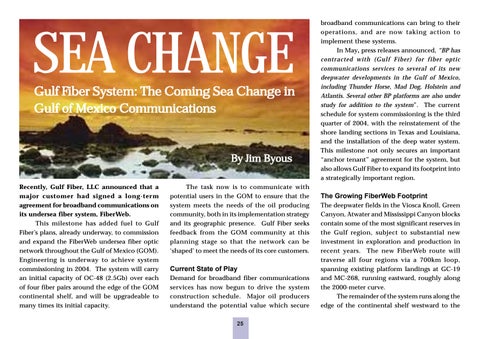
SEA CHANGE
Gulf F Gulf F Gulf F Gulf F Gulf Fiber System: The Coming Sea Change in iber System: The Coming Sea Change in iber System: The Coming Sea Change in iber System: The Coming Sea Change in iber System: The Coming Sea Change in
broadband communications can bring to their operations, and are now taking action to implement these systems.
Gulf of Mexico Communications
Gulf of Mexico Communications
Gulf of Mexico Communications
Gulf of Mexico Communications
Gulf of Mexico Communications
Recently, Gulf Fiber, LLC announced that a major customer had signed a long-term agreement for broadband communications on its undersea fiber system, FiberWeb.
This milestone has added fuel to Gulf Fiber’s plans, already underway, to commission and expand the FiberWeb undersea fiber optic network throughout the Gulf of Mexico (GOM). Engineering is underway to achieve system commissioning in 2004. The system will carry an initial capacity of OC-48 (2.5Gb) over each of four fiber pairs around the edge of the GOM continental shelf, and will be upgradeable to many times its initial capacity.
By Jim Byous By Byous By Jim Byous By Byous
The task now is to communicate with potential users in the GOM to ensure that the system meets the needs of the oil producing community, both in its implementation strategy and its geographic presence. Gulf Fiber seeks feedback from the GOM community at this planning stage so that the network can be ‘shaped’ to meet the needs of its core customers.
Current State of Play
Demand for broadband fiber communications services has now begun to drive the system construction schedule. Major oil producers understand the potential value which secure
In May, press releases announced, “BP has contracted with (Gulf Fiber) for fiber optic communications services to several of its new deepwater developments in the Gulf of Mexico, including Thunder Horse, Mad Dog, Holstein and Atlantis. Several other BP platforms are also under study for addition to the system ”. The current schedule for system commissioning is the third quarter of 2004, with the reinstatement of the shore landing sections in Texas and Louisiana, and the installation of the deep water system. This milestone not only secures an important “anchor tenant” agreement for the system, but also allows Gulf Fiber to expand its footprint into a strategically important region.
The Growing FiberWeb Footprint
The deepwater fields in the Viosca Knoll, Green Canyon, Atwater and Mississippi Canyon blocks contain some of the most significant reserves in the Gulf region, subject to substantial new investment in exploration and production in recent years. The new FiberWeb route will traverse all four regions via a 700km loop, spanning existing platform landings at GC-19 and MC-268, running eastward, roughly along the 2000-meter curve.
The remainder of the system runs along the edge of the continental shelf westward to the
shore landing in Freeport, and landing in Fourchon to the east. The system footprint, sitting astride the edge of the shelf, allows Gulf Fiber to reach out to the new developments in deep water, while at the same time allowing expansion onto the shelf to the more than 3500 platforms, which comprise the majority of the GOM customers.
Reaching Out to the Customers
FiberWeb will not succeed via the backbone system cable alone. Gulf Fiber realizes that in order to really change the GOM communications infrastructure, FiberWeb will have to be available to all customers who require broadband communications (a list which is steadily growing, with the advent of new applications).
Toward this goal, Gulf Fiber and their technology partner, Ocean Specialists, Inc., are developing unique applications to allow inexpensive, rapid connection of platforms, including robust, thin fiber cable, deployed and buried from a high power cable burial ROV, expansion modules on the seabed which will allow branching from the backbone via wetmateable fiber connections, and fast, inexpensive fiber riser systems for connecting mobile drilling units within a field already wired for fiber via a wet-mate connection during the drilling campaign. Additionally, Gulf Fiber’s sister company, PetroCom, is developing wireless, “last mile” techniques for connecting
groups of platforms to fiber in a “spoke and hub” configuration, allowing rapid deployment of fiber connection without the marine construction requirement. These wireless connections will be done only over short distances, where a secure, broadband connection will allow full fiber service with maximum system security against storm and other aggression threats.
Using these innovative methods, Gulf Fiber plans to make fiber service widely available to users in the field, both fixed and mobile.
A Unique Offering to the Oil Industry
The FiberWeb system represents a unique offering in the world of offshore oil industry communications. Up to now, oil producers desiring to have fiber communication service to their platforms have built and owned the infrastructure themselves, whether solely, or in isolated cases, forming small consortia to share the burden. A submarine fiber communications system represents a substantial capital investment, as well as a significant annual operating expense, requiring specialized skill sets to be brought in-house to support. Such an investment typically represents a burdensome departure from the core business offering of the oil producer.
Gulf Fiber is changing this model by offering service on the FiberWeb system on a ‘capacity lease’ basis, offering scalable bandwidth
on a Restored and Maintained basis. Restored because the Ring Architecture allows instant restoration of service in the event of a system fault, and Maintained, in that the system will employ the services of a cable maintenance ship to respond immediately to repairs on a yearround basis. This offering allows the oil producers to access fiber bandwidth services from T-1 (1.55Mb) to DS-3 (45Mb) and up, without having to purchase or operate their own infrastructure.
Ensuring System Security
Cables, umbilicals and pipelines situated in the Gulf of Mexico are exposed to a number of external aggression threats, the majority of which are man-made, created by seabed users, which include oil, shipping and fishing interests. The most significant of these is the fishing industry, who, through their aggressive shrimp trawling techniques has caused damage to a number of cables in the region, generally in the shallow continental shelf areas.
Risk mitigation to ensure system security will take a number of forms. First, the new route is being carefully designed in a way that will minimize risks due to fishing activity and pipeline crossings. A full seabed survey will verify and optimize this design. Gulf Fiber will employ industry-proven subsea cable installation and burial specialists to ensure that the system cable is installed to state-of the industry standards, and
buried to specification throughout the continental shelf region. The recent boom in subsea cable installations has seen the development of very high-horsepower tools and new techniques to ensure deeper, more positive cable burial, to ensure that the FiberWeb installation specifications are met or exceeded.
Gulf Fiber is also partnering with PetroCom to provide network operation and management services, including the diagnostic monitoring of the fiber system through its dedicated Network Operations Center (NOC) in Harahan, LA. The NOC will provide 24x7x365 monitoring of all system functions, repair and maintenance services for all network components, and a 24hr Helpdesk service to all offshore users. In some cases, Petrocom are also providing data restoration via their Satellite network, thus allowing a tertiary restoration facility to customers who desire this added level of security.
The combined infrastructure of the network management services, robust installation and route design, and fully-available cableship maintenance and repair facility, ensure that the customer’s communication service is secure and managed, leaving the customer free to concentrate their valuable resources on oil production rather than telecommunications.
Weather – The Other Aggression Threat
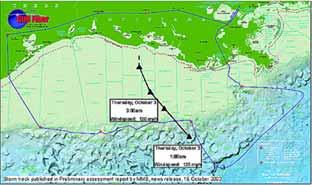
Last year, Hurricane Lili and Tropical Storm Isidore roared through the Gulf, causing large-
Thursday, October 3 3:00 am
Windspeed 120mph
scale evacuation of facilities, and eventually loss of communications along a significant portion of platforms in their paths. In October of 2002,
MMS compiled a report which cited the production loss due to these storms in the range of $450Million, a large percentage of which was related to the MMS requirement to shut-in production wells upon loss of communications aboard unmanned platforms.
Just recently, Hurricane Claudette once again reminded us of the force and frequency of these storms. Early data as of this writing indicates that a significant number of platforms
Thursday, October 3 1:00 am
Windspeed 135mph
lost communication as a result of this storm. Production losses have not been ascertained. In contrast to wireless communication systems, which rely on precise alignment of exposed antenna systems, submarine fiber boards the platform through steel J-tubes or I-tubes, which protect the cable to depths far below the effects of storm activity, and the fiber terminates in a protected communications room, free from exposure to the storm. During Lili, the storm track ran directly across one existing cable segment, putting a terminal platform in the dangerous northeast quadrant of the storm. One
Storm track published in Preliminary assessment report by MMS news release, 16 October 2002
producer aboard an existing FiberWeb terminal platform stated that after all of his wireless systems were destroyed, FiberWeb was his only method of communicating off the platform.
New Applications Cause Surging Demand
Feedback to Gulf Fiber from major oil producers in recent months has indicated that their demand for bandwidth may indeed exceed original expectations. These producers have indicated that applications such as 4-D Seismic, transmitted to shore real-time instead of recorded in-situ, remote platform operations and enhanced instrumentation, and broadband data communications such as corporate intranet and extranet facilities for staff (including video conferencing), are all planned for near-term deployment on many facilities. Discussions have already prompted Gulf Fiber to initiate engineering efforts to allow for Wave-Division multiplexing of the four fiber pairs currently planned, allowing retro-fit upgrade of system capacity many multiples over the current 10Gb currently contemplated over the aggregate fiber pairs.
Gulf Security – A Growing Concern
In the current security-conscious environment, it is notable that the Gulf of Mexico is one of the least-security conscious industrial environments in the U.S. region, yet its offshore reserves are second only to Alaska in terms of domestic reserves. The Port of Houston is ranked
first in the U.S. in terms of waterborne commerce, and eighth in the world. Seven out of the ten busiest ports are located along the Gulf Coast. Plans are currently underway for major LNG offloading facilities offshore the Gulf Coast, and of the just under 4000 platforms in the GOM, the majority are unmanned, with little or no industrial security facilities in place on these structures.
U.S. security agencies and contractors have developed over recent years a variety of security and surveillance applications ranging from radar and aerial surveillance via tethered vehicles, to undersea acoustic monitoring and platformmounted security monitoring systems. Most of these applications require secure bandwidth via fiber to reach their potential.
Lack of a fiber network has held back the deployment of many of these applications, but FiberWeb, positioned to encircle the continental shelf of the GOM, is well-positioned to provide a transport mechanism for these applications. In allowing access to a large number of shallow and deepwater facilities, Gulf Fiber hopes to foster the efficient deployment of security systems, both private and Government-operated. Gulf Fiber has recently become a signatory to the Gulf Coast Ocean Observing System (GCOOS), a federally-mandated body whose mission includes assisting the U.S. Scientific and Government communities in the collection of data to encourage economic growth in the
region, and the advancement of scientific and security interests.
Conclusion
It’s time to get the message out; FiberWeb is on the way, and aiming not only to meet the current communication needs of the GOM, but actually change the way in which the offshore industry communicates. This goal cannot be achieved without support and input from regional customers, who can help steer the strategic and geographic positioning of the system.
Jim Byous is a Director of Gulf Fiber, LLC, and is actively involved in design, construction and recommissioning of the FiberWeb network. He has been involved exclusively in submarine cable installation and maintenance for the past 17 years, for much of that time specializing in the protection of cable systems in high-risk continental shelf environments. Until November 2002, Jim served as Director, Americas, for Global Marine Systems. Jim also currently serves as Managing Director of Ocean Specialist Services, located in Stuart, Florida.
POWERING UP SHIP TO SHORE
SHIPBORNE & LANDBASED POWER FEED SYSTEMS...
Spellman’s Power Feed Equipment (PFE) is used in Shipborne and Landbased Submarine Fiber Optic Cable systems throughout the world.
We have provided PFE components and systems to the world leaders in repeatered optical systems for over 20 years. This experience has been applied to a new generation of low cost, small size Landbased PFE’s. Landbased PFE’s capable of 6kV at 1.2A , full 1+1 redundancy, all in a single 600mm x 600mm bay!
Our Shipborne PFE’s are the industry standard for the worlds cable laying fleet. Spellman shipborne PFE’s can be found on over 55 ships though out the world, from Korea to Baltimore...Hamilton to Hampton Docks!
And, as in the past, you can always count on Spellman’s field service to be there when you need us...Spellman...Powering up...Ship to Shore!
USA - 475 Wireless Blvd. Hauppauge, New York 11788
The issue of maritime security is a matter of critical importance to all marine companies.
Certainly maritime security is of vital interest to Singapore and the region. Some of the most important shipping lanes and trade routes straddle the archipelago of Southeast Asia.
Over a quarter of the world’s trade and half its oil pass through the Malacca Straits. But it is not merely the littoral states that have a stake in the safe passage of ships through these waterways.
In a world linked by international trade and commerce, and with a global economy built on integrated supply chains, any disruption to the security of navigation in these waters would be a shock to the international system. This would clearly induce severe implications for trading nations all around the world.
Why are ships easy prey?
Low manning of ships
Lack of effective implementation of strict anti-piracy measures
Ships are often registered under flags of convenience registers
Reluctance by governments to provide resources to pursue piracy investigations.
Piracy
I n recent times there has been a substantial rise in hijackings in the waters neighbouring Singapore, up from 16 to 25 incidents in 2002.
MARITIME SECURITY
THE NEED FOR AWARENESS AND COMPLIANCE
by Roger Carver
Many such incidents involved smaller boats, such as tugs, barges and fishing boats, in the Malacca Straits and Indonesian waters. Crime syndicates in the area were believed to be targeting vessels carrying valuable palm oil and gas oil.
Indonesia again experienced the highest number of attacks, with 103 reported incidents in 2002. Piracy attacks in Bangladesh ranked second highest with 32 attacks and India was third with 18 attacks.
“Indonesia’s piracy problem calls for serious government action.”
International Maritime Bureau.
Small scale Piracy:
Rob the crew and depart
Attacks usually take place whilst the vessel is at anchor or in port
Ship’s safe is often targeted Occasionally the ship is taken to be sold.
Large scale Piracy:
Rob the crew and steal the cargo
Cargo easily disposed of is usually targeted, ie timber, metals and minerals
Occasionally the ships engines are taken Usually part of a larger criminal organisation.
Phantom ships
Robbers steal the ship
Re-paint, re-name, re-flag and re-register
Offer the services of the ship to a shipper
Sail to an undisclosed destination
Unload the cargo to be sold, then repeat the process
Nearly always part of a larger criminal organisation.
What is being done?
The issue has come to a head post September 11 and the world’s subsequent response to terrorism.
A new, comprehensive security regime for international shipping is set to enter into force on 1 st July 2004 following the adoption by a Diplomatic Conference of a series of measures to strengthen maritime security and prevent and suppress acts of terrorism and piracy.
The International Maritime Bureau’s figures show reported worldwide piracy acts were up 18 % in the first quarter of 2003.
The Conference, held at the London headquarters of the International Maritime Organization (IMO) from 9 to 13 December 2002, was of crucial significance, given the pivotal role shipping plays in the conduct of world trade. The Conference adopted a number of amendments to the 1974 Safety of Life at Sea
Convention (SOLAS), the most far-reaching of which enshrines the new International Ship and Port Facility Security Code (ISPS Code).
The Code contains detailed security-related requirements for Governments, port authorities and shipping companies in a mandatory section (Part A), together with a series of guidelines about how to meet these requirements in a second, non-mandatory section (Part B).
IMO is concerned that piracy continues to be a major threat to shipping safety. During the last few years South East Asia has been the scene of numerous pirate attacks and armed robberies and this is a problem not only for the crews and ship owners, but for the coastal States as well.
The Resolutions require new Ship Security Plans:
Every shipping company must designate a Ship Security Officer for each of its ships.
This officer will be responsible for implementing the Ship Security Plan.
Compliance with New IMO
Maritime Security Measures is due by July 2004.
Ship Security Plans are prepared and submitted for approval by Contracting Government. Each ship carries on-board an approved Ship Security Plan.
Who can help?
Companies with experienced security and maritime professionals on staff can ensure your prompt compliance with the relevant IMO Resolutions and allow you to spend yourtime developing your business without distraction.
Originally with the British Royal Navy, Roger F. Carver is extensively trained in counter insurgency. Upon leaving the Royal Navy, he remained within the maritime environment, working as a marine and security consultant with various organizations around the world. He is now resident in Singapore.
The Resolutions go on to require that:
A Ship Security Assessment is completed for each ship according to IMO and Government regulations.
Roger has spent the last eight years as a consultant to various companies installing Safety Management and Security Systems. He is Managing Director of Nemesis Maritime Private Limited.
wfnstrategies
WFN Strategies assists clients involved in a variety of activities from business development, marketing & sales planning/implementation to installation support, submarine cable provision, system design, system or product procurement, system engineering and investment services.
One of our key strengths is the ability to help you re-evaluate your products or services for alternate markets and future market positioning. Our corporate mission is simple: To assist customers by increasing their profitability, corporate and stockholder value WFN Strategies, LLC 19471 Youngs Cliff Rd Suite 100 Potomac Falls, Virginia 20165 USA
Tel: +1 (703) 444-2527
Fax: +1 (703) 444-3047
Sales@wfnstrategies.com
www.wfnstrategies.com
everyone has our depth of experience or breadth of capabilitybut now everyone can profit from it
Supporting companies in the submarine cable industry for over 10 years
Brochure and literature design and production
Exhibition design and management
Website design and maintenance
Contact Ted Breeze
Tel +44 1206 230472 Fax +44 1206 231640
Email ted.b@virgin.net
Give your exhibition or conference maximum exposure to the submarine telecoms industry. Advertise your event in Submarine Telecoms Forum and reach all the key people. Email: advertising@subtelforum.com
1advertising@subtelforum.com
Letter to a friend
from Jean Devos
and SMW3, only. Even if these two cables were fully upgraded, the installed capacity would only be measured in Gigabits!
So the need is real, particularly between India and the Med.
By the way, the above facts show that no one should see SMW4 as the first cable of a new phase of submarine cable projects, but rather like the missing one from the previous phase. It is also worth noting that SMW4 is a “carrier’s” cable, and not a FLAG 2. Has this any significance for the future business?
I can put myself in the shoes of the suppliers and see the importance of such a project. A buoy! A must be in! Not being part of this action will be dangerous since the market needs several more years to pick up! This project will undoubtedly play an active role in shaping the future supplier industry.
Thank God and geography this cable is structured in several segments and then “splittable” between several suppliers if the purchasers want!
SMW4 : Oasis or Mirage?
SMW4 : Oasis or Mirage?
SMW4 : Oasis or Mirage?
SMW4 : Oasis or Mirage?
SMW4 : Oasis or Mirage?
When you receive this letter, the SMW4 offers from the suppliers will have already been submitted (September the 8th).
SMW4 looks like an oasis in the middle of the desert! A several $100M project! Not seen for a while! Let’s hope it will not end up being a mirage!
It could be the case if the carriers involved do not manage to fund the full project, which runs from Singapore to Marseilles. But the probability that it flies is quite high.
When most of the world’s routes have been equipped with Terabits cable, often several, and often too many, this route is equipped with FLAG
All the parties involved here, purchasers and suppliers alike, need for sure to protect their short-term interest. But they also have the opportunity to work for the long-term general interest of our industry.
Things should be clear when we meet at SubOptic 2004.
See you there.
Jean Devos Jean Devos Jean Devos Jean Devos
www.ptc2004.org
New Times- New Strategies: ICT Rising from the Ashes
11-14 January 2004 • Hilton Hawaiian Village Beach Resort & Spa, Honolulu, Hawaii, USA
New Times - New Strategies, the theme for PTC’04, emphasizes the opportunities that currently exist in the global marketplace for information and communication technologies (ICTs). While North America and Europe still struggle to reinvigorate their economies, several Asian countries have surged ahead in leadership positions with new technologies. PTC’s annual conference offers a congenial venue to interact with major players in the Asia-Pacific region. The conference has long been the most important event that ties Asia to the Americas and the rest of the world.
Seize this golden opportunity to maximize your total participation in PTC’04:
• register early and save • exhibit • sponsor • advertise
Please contact Dolores Fung at +1.808.941.3789, email: dolores@ptc.org or visit the PTC’04 website at www.ptc2004.org for more information.
PTC members enjoy 40% discount on the conference fee. If you are not a PTC member and are interested in joining, please email Justin Riel at Justin@ptc.org.
Diary Diary Diary Diary Diary
FORTHCOMING CONFERENCES AND EXHIBITIONS
22-26 September 2003 Oceans 2003 MTS/IEEE, San Diego, California, USA, www.oceans2003.com/
24-26 September 2003 Submarine Networks World 2003, Singapore, www.carriersworld.com
7-8 October 2003 4th India Telecom Conference, Mumbai, India. www.indianteleconference.com
12-18 October 2003 ITU Telecom World 2003, Geneva, Switzerland, www.itu.org
24-26 November 2003 Hydro 2003: 4th Australasian Hydrographic Symposium, Christchurch, New Zealand, www.hydrographicsociety.org.nz/conference.htm
17-19 February Underwater Intervention 2004, NewOrleans, Louisana, USA. www.underwaterintervention.com 11-14 January 2004 Pacific Telecom Conference 2004, Honolulu, Hawaii USA. www.ptc.org/ptc2004
16-19 March 2004 Oceanology International 2004, London, UK, www.oceanologyinternational.com/
28 March - 1 April 2004 SubOptic 2004, Principality of Monaco, www.suboptic.biz
15-18 June 2004 CommunicAsia 2004, Singapore, www.communicasia.com