

OFFSHORE ENERGY
EXORIDUM FROM THE PUBLISHER
WELCOME TO ISSUE 138, OUR OFFSHORE ENERGY AND IWCS
CABLE & CONNECTIVITY INDUSTRY FORUM ‘24 PREVIEW EDITION!
Autumn has arrived early in Virginia, which for those of us in marathon training is a good thing. Gone are the hot, humid mornings replaced by cool and dryer breezy daybreaks.
This time of year is always a crapshoot period. We become teased with the shorter, cooler days; yet more frequently we get whacked hard with a late hurricane rolling up the east coast. It’s September and we are still seeing named storms in the Gulf of Mexico when normally we watch them fly by, by now. It sounds like earlier prognostications of “several” named storms may be a touch overstated. Are we entering a longer storm period into later October or so, or maybe we are just lucky this year? – we’ll see. Only the next few weeks will tell.
INDUSTRY REPORT
The backroom folks are busy at work writing the upcoming 13th edition of the SubTel Forum Industry Report, which will be published mid-October. We have several guests adding some excellent perspective to this edition, and we will be expanding some of the analysis tools we are using. To say the industry has been busy is an understatement, and the number of planned systems going forward is still impressive. Sponsorship of the Industry Report is still available by talking with Nicola Tate.
ANNUAL INDUSTRY SENTIMENT SURVEY
In this edition of SubTel Forum Magazine, we invite you to participate in our annual Industry Sentiment Survey, a key tool in gauging the current state and future direction of the submarine telecoms industry. The survey is divided into six categories that cover vital aspects of the industry:
Industry Sentiment and Market Outlook captures overall confidence and growth expectations; Project Status and Operations assesses the progress and challenges of ongoing projects; and Technology and Innovation explores the adoption and impact of cutting-edge advancements. We also address Environmental and Regulatory Impact, focusing on sustainability and compliance, as well as Talent and Workforce, which highlights workforce development and skilled labor availability. Lastly, Respondent Profile helps us understand the perspectives of the diverse professionals shaping this industry. Your insights are invaluable, and the results of this survey will be featured in our upcoming Industry Report, offering a comprehensive analysis of key trends and shifts in the global submarine cable market. Take the survey!
SUBMARINE CABLE MAP
Look for our printed submarine cable map at Submarine Networks World in Singapore this month! Sponsorship of the upcoming 2025 version, which will be distributed to attendees at PTC in January is still available by talking with Nicola Tate.
SUBTEL FORUM APP
Thank you to all who have added the SubTel Forum App to their smartphones. The impressive growth in users shows how valuable this tool has become. The app provides real-time updates, comprehensive data, and interactive features for submarine cable projects, seamlessly integrating with our website for easy access to industry insights and collaboration tools. Dive in and explore it today.
SUBMARINE CABLE INDUSTRY DIRECTORY
The equally impressive growth in the use of the Submarine Telecoms Forum Directory highlights its value in enhancing access to resources and celebrating the industry’s collaboration and technical prowess. Aiming to be the premier reference for advancing global connectivity, it continues to make an impact. Check it out and share your thoughts.
THANK YOU
Thank you as always to our awesome authors who have contributed to this issue of SubTel Forum. Thanks also for their support to this issue’s advertisers: AP Telecom, AP Procure, Fígoli Consulting, IWCS, TPG Telecom, Submarine Networks World, and WFN Strategies. Of course, our ever popular “where in the world are all those pesky cableships” is included as well.
Good reading and stay dry! – Slava Ukraini …STF


Wayne Nielsen, Publisher
Publication of Submarine Telecoms Forum, Inc. www.subtelforum.com | ISSN No. 1948-3031
PRESIDENT & PUBLISHER: Wayne Nielsen | wnielsen@subtelforum.com | [+1] (703) 444-2527
VICE PRESIDENT: Kristian Nielsen | knielsen@subtelforum.com | [+1] (703) 444-0845
ANALYTICS: Kieran Clark | kclark@subtelforum.com | [+1] (540) 533-6965
SALES: Nicola Tate | ntate@associationmediagroup.com | [+1] (804) 469-0324
DESIGN & PRODUCTION: Weswen Design | wendy@weswendesign.com
DEPARTMENT WRITERS:
Andrés Fígoli, Dave Kiddoo, John Maguire, Kieran Clark, Nicola Tate, Nicole Starosielski Philip Pilgrim, Syeda Humera, and Wayne Nielsen
FEATURE WRITERS:
Adrian Jelffs, Bill Burns, Derek Cassidy, Douglas R. Burnett, Hermann Kugeler, Kristin Berdan, Miro Napoleão, Stewart Ash, Kristian Nielsen and Greg Otto
NEXT ISSUE: November 2024 – Data Centers and New Technologies

Submarine Telecoms Forum, Inc. www.subtelforum.com/corporate-information
BOARD OF DIRECTORS:
Margaret Nielsen, Wayne Nielsen, Kristian Nielsen and Kacy Nielsen
Contributions are welcomed and should be forwarded to: pressroom@subtelforum.com.
Submarine Telecoms Forum magazine is published bimonthly by Submarine Telecoms Forum, Inc., and is an independent commercial publication, serving as a freely accessible forum for professionals in industries connected with submarine optical fiber technologies and techniques. Submarine Telecoms Forum may not be reproduced or transmitted in any form, in whole or in part, without the permission of the publishers.
Liability: While every care is taken in preparation of this publication, the publishers
cannot be held responsible for the accuracy of the information herein, or any errors which may occur in advertising or editorial content, or any consequence arising from any errors or omissions, and the editor reserves the right to edit any advertising or editorial material submitted for publication.
New Subscriptions, Enquiries and Changes of Address: 21495 Ridgetop Circle, Suite 201, Sterling, Virginia 20166, USA, or call [+1] (703) 444-0845, fax [+1] (703) 349-5562, or visit www. subtelforum.com.
Copyright © 2024 Submarine Telecoms Forum, Inc.
SUBMARINETELECOMS
FORUM IN THIS ISSUE
ISSUE 138 | SEPTEMBER 2024

10 QUESTIONS WITH DAVID KIDDOO AND IWCS PREVIEW
Talking Submarine Cable Industry with IWCS Cable & Connectivity Industry Forum’s CEO/Director

TO SECURE UNDERSEA CABLES, TAKE LESSONS FROM THE BRITISH EMPIRE’S ALL-RED LINE
Secure modern undersea cables by applying lessons from the British Empire's All-Red Line.

36 58 46 68 52 78
WHAT HAVE THE BRITISH EVER DONE FOR US?
Highlighting Britain's key contributions to the submarine cable industry and global telecommunications.
By Bill Burns & Stewart Ash
By Douglas R. Burnett & Kristin Berdan

THE PATH TO VALENTIA AND THE BIRTH OF THE VICTORIAN INTERNET
Exploring Valentia Island's pivotal role in the development of transAtlantic telegraphy and global communication.
By Derek Cassidy

A STEP TOWARD STANDARDIZING SUBMARINE POWER CABLE INSTALLATIONS
Standardization of submarine power cable installations through an end-to-end software approach to enhance QC and minimize risks. By Hermann Kugeler & Adrian Jelffs

CLEARING THE BEACH
Emphasizing Angola's potential as the lowest latency route between Africa's Atlantic and Indian Oceans.
By Miro Napoleão

13TH ANNUAL SUBTEL FORUM INDUSTRY SENTIMENT SURVEY

THE ROLE OF ADVANCED TELECOMMUNICATIONS IN THE OIL AND GAS INDUSTRY
Highlighting advanced telecom's role in transforming the oil and gas industry.
By Kristian Nielsen & Greg Otto
DEPARTMENTS
2 EXORDIUM
Find out about advertising opportunities to connect with our specialized audience.
3 IMPRESSUM/MASTHEAD
Meet our team, from editors to designers, establishing our commitment to transparency.
6 SUBTELFORUM.COM
8 INTERACTIVE CABLE MAP UPDATES
Get the latest on global submarine cable infrastructure from our interactive map.
10 SUSTAINABLE SUBSEA
Discover industry innovations for reducing environmental impact and protecting marine life
18 ANALYTICS
Regional Systems: A Snapshot of Where We Are and Where We Are Headed..
24 WHERE IN THE WORLD ARE ALL THOSE PESKY CABLESHIPS?
Follow the missions of cableships crucial to undersea connectivity.
30 CAPACITY CONNECTION
Effects of the Emergence and Growth in Artificial Intelligence.
90 BACK REFLECTION
The Crash Of Pisces III (Sea Burial, Not Burial at Sea)
94 LEGAL & REGULATORY MATTERS
How To Negotiate Agreements With the OTTs
98 ON THE MOVE
Track the career movements within the submarine telecom sector.
99 NEWS NOW
Stay updated with the latest developments in the submarine telecom world.
100 ADVERTISER CORNER
Find out about advertising opportunities to connect with our specialized audience.


INSIDE THE WORLD OF SUBTEL FORUM: A COMPREHENSIVE GUIDE TO SUBMARINE CABLE RESOURCES
TOP STORIES OF 2019
The most popular articles, Q&As of 2019. Find out what you missed!
NEWS NOW RSS FEED
Welcome to an exclusive feature in our magazine, where we explore the captivating world of SubTelForum.com, a pivotal player in the submarine cable industry. This expedition takes us on a detailed journey through the myriad of resources and innovations that are key to understanding and connecting our world beneath the oceans.
mapping efforts by the analysts at SubTel Forum Analytics, a division of Submarine Telecoms Forum. This reference tool gives details on cable systems including a system map, landing points, system capacity, length, RFS year and other valuable data.
DISCOVER THE FUTURE: THE SUBTEL FORUM APP
CONNECTING THE DEPTHS: YOUR ESSENTIAL GUIDE TO THE SUBTEL FORUM DIRECTORY
Keep on top of our world of coverage with our free News Now daily industry update. News Now is a daily RSS feed of news applicable to the submarine cable industry, highlighting Cable Faults & Maintenance, Conferences & Associations, Current Systems, Data Centers, Future Systems, Offshore Energy, State of the Industry and Technology & Upgrades.
PUBLICATIONS
Submarine Cable Almanac is a free quarterly publication made available through diligent data gathering and
Submarine Telecoms Industry Report is an annual free publication with analysis of data collected by the analysts of SubTel Forum Analytics, including system capacity analy sis, as well as the actual productivity and outlook of current and planned systems and the companies that service them.
CABLE MAP
In our guide to submarine cable resources, the SubTel Forum Directory shines as an essential tool, providing SubTel Forum.com readers with comprehensive access to an array of vetted industry contacts, services, and information. Designed for intuitive navigation, this expansive directory facilitates quick connections with leading vendors, offering detailed profiles and the latest in submarine cable innovations. As a dynamic hub for industry professionals, it fosters community engagement, ensuring our readers stay at the forefront of industry developments, free of charge.
2024 marks a groundbreaking era for SubTel Forum with the launch of its innovative app. This cutting-edge tool is revolutionizing access to submarine telecommunications insights, blending real-time updates, AI-driven analytics,
The online SubTel Cable Map is built with the industry standard Esri ArcGIS platform and linked to the SubTel Forum Submarine Cable Database. It tracks the progress of

and a user-centric interface into an indispensable resource for industry professionals. More than just a technological advancement, this app is a platform fostering community, learning, and industry progression. We encourage you to download the SubTel Forum App and join a community at the forefront of undersea communications innovation.
YOUR DAILY UPDATE: NEWS NOW RSS FEED
Our journey begins with the News Now updates, providing daily insights into the submarine cable sector. Covering everything from the latest technical developments to significant industry milestones, this feed ensures you’re always informed about the latest trends and happenings. It’s an essential tool for professionals who need to stay on top of industry news.
THE KNOWLEDGE HUB: MUST-READS & Q&AS
Dive deeper into the world of submarine communications with our curated collection of articles and Q&As. These insightful pieces offer a comprehensive look at both the history and current state of the industry, enriching your understanding and providing a broader perspective on the challenges and triumphs faced by submarine cable professionals.
IN-DEPTH PUBLICATIONS
• Submarine Cable Almanac: This quarterly treasure trove provides detailed information on global cable systems. You can expect rich content including maps, data on system capacity, length, and other critical details that sketch a vivid picture of the global network.
• Submarine Telecoms Industry Report: Our annual report takes an analytical approach to the industry, covering everything from current trends to capacity analysis and future predictions. It’s an invaluable resource for anyone seeking to understand the market’s trajectory.
VISUALIZING CONNECTIONS: CABLE MAPS
• Online SubTel Cable Map: An interactive tool mapping over 550 cable systems, perfect for digital natives who prefer an online method to explore global connections.
• Printed Cable Map: Our annual printed map caters to those who appreciate a tangible representation of the world’s submarine fiber systems, detailed in a visually appealing and informative format.
EDUCATIONAL OPPORTUNITIES: CONTINUING EDUCATION
SubTel Forum’s commitment to education is evident in our courses and master classes, covering various aspects of the industry. Whether you’re a seasoned professional or new to the field, these learning opportunities are fantastic for deepening your understanding of both technical and commercial aspects of submarine telecoms.

SCAN THE QR CODE TO ACCESS ALL THE RESOURCES THAT SUBTELFORUM.COM HAS TO OFFER
FIND THE EXPERTS: AUTHORS INDEX
Our Authors Index is a valuable tool for locating specific articles and authors. It simplifies the process of finding the information you need or following the work of your favorite contributors in the field.
TAILORED INSIGHTS: SUBTEL FORUM BESPOKE REPORTS
• Data Center & OTT Providers Report: This report delves into the evolving relationship between cable landing stations and data centers, highlighting trends in efficiency and integration.
• Global Outlook Report: Offering a comprehensive analysis of the submarine telecoms market, this report includes regional overviews and market forecasts, providing a global perspective on the industry.
• Offshore Energy Report: Focusing on the submarine fiber industry’s oil & gas sector, this report examines market trends and technological advancements, offering insights into this specialized area.
• Regional Systems Report: This analysis of regional submarine cable markets discusses capacity demands, development strategies, and market dynamics, providing a detailed look at different global regions.
• Unrepeatered Systems Report: A thorough examination of unrepeatered cable systems, this report covers project timelines, costs, and operational aspects, essential for understanding this segment of the industry.
• Submarine Cable Dataset: An exhaustive resource detailing over 550 fiber optic cable systems, this dataset covers a wide range of operational data, making it a go-to reference for industry specifics.
SubTelForum.com stands as a comprehensive portal to the dynamic and intricate world of submarine cable communications. It brings together a diverse range of tools, insights, and resources, each designed to enhance understanding and engagement within this crucial industry. From the cutting-edge SubTel Forum App to in-depth reports and interactive maps, the platform caters to a wide audience, offering unique perspectives and valuable knowledge. Whether you’re a seasoned professional or new to the field, SubTelForum.com is an indispensable resource for anyone looking to deepen their understanding or stay updated in the field of submarine telecommunications.
SUBTEL CABLE MAP UPDATES
BY KIERAN CLARK
The SubTel Cable Map, built on the Esri ArcGIS platform, offers a dynamic and interactive way to explore over 440 current and upcoming cable systems, more than 50 cable ships, and over 1,000 landing points. This tool is seamlessly connected to the SubTel Forum Submarine Cable Database, giving users a thorough overview of the industry.
We are excited to highlight ACS Cable Systems as the official sponsor of the SubTel Cable Map. ACS, a leader in wholesale carrier services, has their logo prominently featured on the map, linking directly to their comprehensive offerings at Alaska Communications. This sponsorship reflects our shared commitment to supporting the global submarine telecommunications industry with reliable infrastructure and connectivity solutions. ACS Cable Systems focuses on providing top-notch, dependable services to meet the needs of international carriers, adding value to their customer relationships. This sponsorship ensures users have quick access to a trusted partner known for their connectivity expertise and customer service excellence.
For more details on ACS Cable Systems and their services, please visit their website.
tion, and sharing geographic insights. Its advanced capabilities make it perfect for the SubTel Cable Map, allowing users to explore complex data interactively.
Integrated with SubTel Forum’s News Now Feed, the map lets users view current and archived news related to each cable system.
Submarine cables are vital to global communications, as they form the backbone of the internet. These cables transmit over 99% of the world’s international data, connecting continents and enabling seamless global connectivity. Without them, the fast, efficient communication we rely on would not be possible.
The SubTel Cable Map is powered by Esri’s ArcGIS platform, a leading GIS technology used for creating and using maps, gathering geographic data, analyzing informa-
Integrated with SubTel Forum’s News Now Feed, the map lets users view current and archived news related to each cable system. This continually updated map reflects data gathered by SubTel Forum’s analysts as well as feedback from users. Our goal is to provide not only the data from the Submarine Cable Almanac but also additional system information layers for a complete industry overview.
We invite you to explore the SubTel Cable Map and gain a deeper understanding of the vital role submarine cable systems play in global communications. All cable data on the map is sourced from public records, and we strive to keep it as current as possible. If you are a point of contact for a system or company that requires updating, please email kclark@ subtelforum.com.
We hope the SubTel Cable Map serves as a valuable

Below is the full list of systems added and updated since the last issue of the magazine:
resource to you and invites you to dive into the ever-evolving world of submarine cable systems. We invite you to start your exploration today and see firsthand the intricate network that powers our global communications. Happy exploring! STF

KIERAN CLARK is the Lead Analyst for SubTel Forum. He originally joined SubTel Forum in 2013 as a Broadcast Technician to provide support for live event video streaming. He has 6+ years of live production experience and has worked alongside some of the premier organizations in video web streaming. In 2014, Kieran was promoted to Analyst and is currently responsible for the research and maintenance that supports the Submarine Cable Database. In 2016, he was promoted to Lead Analyst and his analysis is featured in almost the entire array of Subtel Forum Publications.
Do you have further questions on this topic?
SEPTEMBER 16, 2024
SYSTEMS ADDED:
• Bulikula
SYSTEMS UPDATED:
• 2Africa/PEARLS
• Deep Blue One
• Europe-Middle East-Asia
• Far North Fiber
• Firmina
• Halaihai
• Oman Emirates Gateway
• Proa
• Uniterreno
WHY SUSTAINABILITY MATTERS TO US
BY NICOLE STAROSIELSKI
For this month’s issue, we asked our members: Why does sustainability matter to you? What hopes of change do you have for the subsea industry, the broader digital infrastructure space, or the world? What advice do you have for others who care about these issues? Why should they join us? We received a wide array of responses, which we feature below.
Our members are from around the world, and we believe that global coordination – between people who genuinely care about sustainability from different nations, companies, and age groups – is the path to a better future.
FROM THE INDUSTRY
SIMON APPLEBY (SUBSEA ENVIRONMENTAL SERVICES)
“Despite mankind’s infinite ability for innovation, we all operate in a closed system of finite resources.
A focus on sustainable development is development which meets the needs of the present without compromising the ability of future generations to meet their own needs. This focus is something I try to live up to. Recovering and recycling out-of-service submarine cables is a clear demonstration of this approach, returning high quality, increasingly scarce materials into the global value chain, promoting a sustainable future for our industry.
As a founder member of Subsea
Environmental Services, contributing to making this possible is something I am proud to be a part of. I am confident we can develop the benefits of this opportunity and help to deliver the sustainable future required. To quote Rob Newman, there is no planet B!”
JOHN BOOTH (MANAGING DIRECTOR, CARBON3IT LTD)
“About 15 years ago I visited the Eden Project in the UK. At the time I was installing servers and rolling out new desktops and laptops to large corporations. I recall visiting one large organization twice over four years replacing perfectly good equipment with newer equipment and got to thinking whether this was sustainable, even more so when at Eden I saw the WEEE man.
Seeing a towering statue made out of waste electronic equipment had a

profound effect on me and triggered me undertaking a degree in technology from the Open University and after that starting Carbon3IT Ltd to provide consultancy on the environmental impact of ICT equipment, devices, network and data centers.
Now, my colleague Nick Morris and I are very active in this field providing a lot of insight into the environment impact and sustainability for data centers and now via the Sustainable Subsea Networks project, Cable Landing Stations where we are researching the use of data center metrics and designs to cross fertilize sustainability and energy efficiency concepts.
Through our other research it is quite clear to me that the tech industry isn’t sustainable and that we will soon face a reckoning, this may come through legislation, it may come through consumer pressure, it may come from not being able to access the materials we need, but it will come and we need to be ready, the world needs sustainable technology and communication links.”
DEREK CASSIDY (ICRG/BT) IRELAND

“Sustainability matters because it helps to preserve the future for our future. By understanding and working with our environment we can help sustain it for our future needs. Being conscious of the seabed, its
WEEE Man
ecosystem and the environmental impact that submarine cable systems can sometimes infuse into the local system, by focusing on the best in practice tools and procedures, we as an industry lead the way in preserving the seabed for its natural inhabitants.
Instead of following rules, we should rewrite them so that the impact on the seabed and environment is negligible and even invisible, we should be the leaders in this field and help promote sustainability.
Having a sustainability procedure that is agreed by all will help to push forward a publicized view that is accepted by the overall marine industry is accepted by all.”
ERICK CONTAG (SUBOPTIC FOUNDATION)
“Sustainability is important to me because it secures a healthier planet for our future generations. It’s through our collective actions that we will truly make a difference in shaping the world we leave behind.”
SHEREEN ELTAYEB (BUSINESS DEVELOPMENT ENGINEER, TELECOM EGYPT)
Giza, Egypt

“As a Telecommunications engineer, I was always concerned about sustainable energy sources. I was wondering if there would come a day when a green perspective would rule the world. A few years later, I got the answer. Now, I am still in Egypt, and I am a PhD candidate studying sustainable project management.
The way I see sustainability is that it means not compromising your ethics and values towards the planet earth.
To embrace sustainability goals is the volition to restore the planet from the deeds of old generations for the good of future generations. The altruistic mindset drives you to take the hard way in order to gain long-term fruits that you may never taste.”
KERI GILDER (CEO, COLT TECHNOLOGY SERVICES)
From: Leadville, Colorado
Currently located in: London, UK

“I suffer from climate anxiety. My fears around climate change – the urgent need to slow its impact on our planet, our people and living world, and the legacy we leave to our children - keep me awake at night and are constantly on my mind. Climate anxiety is real: almost 60% of 16-25 year olds in a study of 10,000 people across 10 countries are very or extremely worried about climate change, and for 45%, their concerns negatively affect their daily life. As an industry, and as one of the biggest contributors to carbon emissions, we have a duty to lead lasting change. We urgently need to address this together, but instead of feeling afraid we must see it for the remarkable opportunity it is. Globally, we’re experiencing the highest-ever volume of subsea cable construction. Our industry is comprised of some of the world’s greatest technical and innovative minds, which is why we’re finding ways to deliver sustainable digital infrastructure that don’t cost the earth. We can position cable landing stations to take advantage of natural resources and cooling techniques; we can reuse hardware components, extract precious metals from equipment and contribute to
the circular economy; we can reduce fuel consumption and use renewable energy sources; we can utilize uncrewed service vessels and benefit from technologies like AI for intelligent, sustainable, traffic routing. If we come together, as an industry, what we can achieve is limitless. And imagine that as a legacy: subsea and digital infrastructure is the force for good.”
DAVE HORNER (GOOGLE)
From: Southport, UK
Currently located in: London, UK

“Sustainability matters to me personally because I believe in leaving a healthier planet for future generations. Embracing ever evolving technological advances of recent years provides us options that our previous generations didn’t necessarily have available to choose from at all. That enables us to actively choose to create sustainable solutions, and help shape a better future for ourselves and generations to come. We’re dangerously close to a point of no return, and we have a collective responsibility to protect the planet as a whole, ensuring a healthy living environment for both humans and animals, by making conscious choices.
I’ve always been fascinated with the underlying engineering of how things work, and growing up that easily led me into strongly believing we should always prioritize repairing / fixing wherever possible, alongside reuse and recycling, instead of continuing to be a disposable generation. But it’s important we also make active choices upfront (long before reuse/recycling) to reduce our impact on the planet, by constantly rethinking the “always done that way”
approaches, and help others become more aware to minimize pollution and carbon emissions. Collectively we all must collaborate to ensure a more sustainable future for everyone and everything on this planet.”
TAKAHIRO KASHIMA (NEC CORPORATION)
Japan
“During my time at university, I conducted research on global warming. Through this research, I found that the recent rapid increase in temperatures is an exceptionally abnormal variation in Earth’s history. In Japan, too, we are facing a rise in the frequency and severity of natural disasters such as typhoons and floods each year. The reason I chose to work at NEC, a company providing IT and network solutions, is that we need to find ways to balance a richer quality of life with more efficient energy use. I felt that I could contribute to addressing this challenge through our business activities. Optical submarine cables are indispensable social infrastructure that enables people worldwide to access information equitably and lead more enriched lives. Let us continue to make efforts to ensure that the submarine cable industry remains a sustainable industry for the future.”
ALBERTO LEIVA (CUSTOMER SERVICE
MANAGER, TELXIUS)
Madrid, Spain

“Since I was a child, I have always been instilled with the need to keep nature free of trash. What struck me the most was when I saw images of beaches
SUBSEA
or forests with garbage, and since then I have been aware of sustainability in daily life. I believe that we all have the possibility of contributing to a certain extent to having a cleaner and more efficient world with regards to resource consumption.
On the other hand, a great challenge for our industry is to find a balance between development and sustainability, and I believe collaboration and implementation of good practices can help to achieve this.”
QUYNH NGUYEN (OCEANIC ENVIRONMENTAL CABLES GMBH)
From: Hanoi, Vietnam
Currently located in: Hamburg, Germany

“People naturally react to immediate threats, like quickly ducking when your ice cream scoop is about to fall on your shirt. But when it comes to climate change, the danger can feel distant and abstract, like waiting for your favorite ice cream to melt in a freezer that’s slowly warming up – it takes forever. The choices we make today will shape the world our children and grandchildren inherit, just as we are dealing with the choices that were already made long ago. It’s not just about protecting the planet; it’s about ensuring we don’t prioritize our own comfort over our future.
In the subsea industry, my hope is for a strong shift towards more sustainable practices that minimize environmental impacts. Every action, no matter how small, contributes to the larger goal. Together, we can forge a path to a more sustainable and equitable future for all.”
PETE NISBET (MANAGING PARTNER, EDENSEVEN (PART OF CAMBRIDGE MC))
London, UK

“I’ve been involved in the energy and carbon sector for over three decades and have seen the way in which changes in consumer needs and regulation can force businesses and government bodies to ‘move the dial’ when it comes to attacking climate change. Over this period, we’ve seen great advances in technology and the overall appetite to decarbonise, but it is clear to see that the speed of execution isn’t quick enough at the moment and we need to collectively do more.
I personally and I know the rest of the team at edenseven feel privileged to play a small part in trying to accelerate positive change across this and other sectors by using our experiences/knowledge and those of others to make a difference.”
NICK MORRIS (CARBON3IT)
Location: Pale Blue Dot
“Sustainability is important to me because it gives our civilization, our species a shot at making it through the next century without experiencing

significant regional collapse.
Why? The billions of humans alive now and to come, in poor states and rich, have absolutely legitimate desires and needs for high quality services in: water; nutrition; housing; cooling; heating; education; healthcare; transport; security; effective public sector institutions...
The magnitude and growth momentum of these needs are unprecedented.
Hence, being able to fulfill them in ways which are sustainable forcibly reduces local and regional tensions that may otherwise result in armed conflict, violence, and destruction of life-supporting physical and organizational infrastructures.
Having witnessed the impacts of conflicts and resulting local collapses, as many of you also have, I realize that the potential amplification of these horrors is also without precedent: we need all the tools we can muster to minimize this amplification, and sustainability is a tool that bakes in low impact performance for decades to come.
‘Nature’ doesn’t care about the welfare of any species, including humans, or indeed, the existence of life itself: this one is on us.
Nature is indifferent.
I am not.”
GUSTAVO REGNICOLI (R&G TELECOMM GROUP)
Buenos Aires, Argentina

“If we separate trash at home, prefer bikes, spend more money for a hybrid car or A++ rating appliances as personal sustainability initiatives, we should dedicate part of our professional time to influence these same matters while we do business. So, setting a concrete
EE&S plan for submarine cable operations and how to do it are a challenge, departing from simplest matters, with immediate results, to more complex and resource demanding solutions. Many ideas make a tendency.”
VEDRANA STOJANAC (CIENA GLOBAL SUBSEA; LEAD OF SUSTAINABLE SUBSEA NETWORKS CABLE LANDING STATION GROUP)
From: Zagreb, Croatia
Currently located: New York, USA

“My awareness of climate change began in 2006 when I watched Al Gore’s documentary An Inconvenient Truth. Nearly two decades later, the urgency of the issue continues to be amplified by voices across generations, from the 98-year-old biologist Sir David Attenborough to the 21-year-old activist Greta Thunberg. Their message resonates deeply: everyone has a voice and a role to play in addressing the climate crisis, no matter how small the contribution might seem. My own understanding of climate change became personal 15 years ago during a visit to Antarctica. Seeing green patches of grass and experiencing rainfall in a place renowned for its frozen, barren landscape was a rare glimpse into the accelerating effects of global warming – a contrast to the icy wilderness I had expected.
Working within the subsea cable communications industry at Ciena, I am very aware of the intersection between technology and environmental impact, which has underscored the importance of sustainability in my field. Through my further involvement with SubOptic’s Global Citizen Working Group on Sustainable
Subsea Networks, I have become more committed to fostering both industry and personal changes that can drive awareness and progress in the fight against climate change.”
JOHN TIBBLES (SUBOPTIC FOUNDATION)
England, UK

“I lived on the island of Bermuda for almost thirteen years at a time when my children were very young. The Atlantic Ocean really was everything to them since Bermuda is such a tiny island of just twenty square miles. Living there, you face the ocean every day, from its balmy blues and aquas in the summer to forbidding gray and white tumultuous waves in the winter. You are just a speck. Because of this very intimate relationship, you also become aware that in some ways the oceans are fragile, you see the small changes in temperatures and currents as well as human impact: cleaning boilers and dumping heavy oil fuel are not something you see on the news on the other side of the world, but in Bermuda you see them close up.
Bermuda is not easily accessible by ships or cables being surrounded by an extinct volcano upon which a reef–the farthest north coral reef–has grown and clings precariously to life as I write this. So in the subsea world, while our direct impact is quite modest we can improve it and we are taking steps to do so. Those modest improvements become part of the work that we need to do to protect the oceans because when you live literally on one you realize just how fragile they are despite their vast size. Protecting the oceans protects us all–and every little helps.”
HESHAM YOUSSEF
(SENIOR TRANSMISSION ENGINEER, TELECOM EGYPT; SUSTAINABLE SUBSEA NETWORKS RESEARCHER)
From and currently located in: Alexandria, Egypt

“I believe that sustainability is a pressing global issue because of factors such as climate change and increasing demand for IP traffic. As someone working in the field of optical transmission, I am particularly concerned about the sustainability of subsea cables since they are crucial for internet traffic. In my perspective, the primary challenge in establishing a sustainable subsea network is meeting the increasing demand for IP traffic and enhancing the transmission fiber’s capacity. Suppliers in this industry are encountering the challenge of increasing data capacity by enhancing modulation techniques to increase bit rates per channel. Research is also being conducted on space-division multiplexing (SDM) to boost fiber transmission capacity, such as multicore fibers and multi-mode fibers.
For those looking to contribute to sustainable internet efforts, it’s important to understand the key factors that drive sustainable network infrastructure. This includes using renewable energy in the industry to reduce carbon emissions. It’s also crucial to explore technologies that can handle the high demand for IP traffic. These two aspects play a significant role in maintaining sustainability in the subsea industry.”
SUBSEA
FROM THE NEXT GENERATION: STUDENTS ON SUSTAINABILITY
IAGO BOJCZUK (SUSTAINABLE SUBSEA NETWORKS GLOBAL POLICY CONSULTANT AND PHD RESEARCHER)
From: Atibaia, in the state of São Paulo, Brazil
Degree (in progress): Sociology, University of Cambridge
Currently located in: Cambridge, UK

“I grew up in the countryside of Brazil, and my childhood memories always take me back to being surrounded by trees, waterfalls, animals, and a bright, clear night sky. However, it wasn’t until I began my doctoral studies that I started thinking about sustainability as both a thinking and an action-oriented practice that should be at the core of everything we do. Today, I research digital infrastructures in the context of Global South countries, and I aim to raise awareness of how natural resources and geographic circumstances are intimately tied to the digital worlds we are building.
Grounding the internet within these diverse realities brings sustainability to the forefront, especially in a world facing the climate crisis where we need to act fast and in collaborative ways. As I like to remind myself every day, the internet should serve as a tool for building a global village, but this requires collaboration between governments and companies to ensure that connectivity is equitable, not extractive and that it follows principles guiding us toward a greener future. It is a difficult task, but one that fuels my passion for
sustainability as an essential part of how we must shape the future.”
One of the immediate challenges I see is the need to balance investments in sustainability in ways that benefit both businesses and the countries involved over the long term. I often compare the digital infrastructure sector to space exploration—while the investment may be substantial at first, the potential to leverage the outputs for broader societal gains is immense and spans generations.
My advice to others is to always think about the internet as a global endeavor, and, as such, we need to approach sustainability the same way.”
TOCHUKWU EGESI (SUSTAINABLE SUBSEA NETWORKS, PHD RESEARCHER)
From: Southern Nigeria
Degree (in progress): PhD in Computer Science at the University of Cape Town) Currently located in: Braga, Portugal

“As someone who hails from the Southern part of Nigeria, I have witnessed firsthand the devastating impact that industrial activities, particularly oil extraction, can have on the environment. The pollution in my home region has caused severe damage to ecosystems, health, and livelihoods. This personal experience drives my deep commitment to sustainability. My research on broadband internet infrastructure in Akwa Ibom State, Nigeria (the only state outside Lagos, Nigeria, that hosts a cable landing station) is not only about advancing digital connectivity but also about ensuring that such advancements do not come at the cost of environmental degrada-
tion. We can and must develop technologies that serve society without compromising the health of our planet.
One of the biggest challenges in achieving a sustainable subsea network is balancing the need for rapid technological advancement with environmental conservation. My hope for the future is that we will develop more energy-efficient technologies and adopt practices that minimize environmental impact, such as using renewable energy sources and carefully planning the placement of infrastructure to avoid sensitive ecosystems. In the broader digital infrastructure space, I aspire to see a shift towards a circular economy where resources are reused and recycled, and where digital expansion is pursued in harmony with nature.
My advice to students is to stay informed and be proactive. Sustainability in digital infrastructure is a complex field that requires a multidisciplinary approach. The journey to a more sustainable internet will require innovative thinking and dedication, and there’s a need for fresh perspectives to drive this change.”
ELLA HERBERT (SUSTAINABLE SUBSEA NETWORKS UNDERGRADUATE RESEARCHER)
From: Florida, United States
Degree (in progress): University of California, Berkeley
Currently located in: California, United States

“I care about sustainability because I care about the future of our world. Sustainability is necessary to ensure economic
stability and to preserve resources for future generations. I also believe protecting the environment from harm is important, which is impossible without sustainable development. This is why I am so passionate about my research– setting up standards for the sustainable development of internet infrastructure is crucial for building a lasting future that embraces technological advancements while avoiding burning unnecessary resources.
One of the biggest challenges to achieving a sustainable subsea network is balancing sustainability initiatives with economic growth. In a period of high demand and exploding growth, it is hard to advocate for prioritizing sustainability. However, we must ensure that the infrastructure being put out not only promotes economic prosperity, but also uses resources efficiently and doesn’t harm the environment. My hope is that collaboration in the industry can make it possible to collectively prioritize sustainability since this is the key to long-term economic success.
My advice for other students interested in joining us would be to be bold in sharing your ideas. My experience in the industry so far has been overwhelmingly positive, and having the courage to speak about issues that I found important was vital. As young students, our perspectives are crucial to sustainable development since our future will be most impacted by the decisions being made right now. Speaking up and pursuing pathways that will allow you to share your voice is one of the most important contributions you can make to promoting sustainable internet infrastructure.”
ISABEL JIJON (SUSTAINABLE SUBSEA NETWORKS MASTER’S RESEARCHER)
From: Ecuador
Degree (in progress): Human Rights and Humanitarian Action at Sciences Po Paris’ School of International Affairs Currently located in: France

“As a young person, I am deeply anxious about the future of my loved ones, humanity and the fauna and flora of the planet. I have witnessed the effects of climate change in my home country of Ecuador, even in “untouchable” paradises such as the Galápagos Islands. I particularly worry about the unequal and devastating impacts climate change is having and will increasingly have on less privileged regions of the world, causing or exacerbating humanitarian crises. I am interested in studying collaborative industry and academic efforts to push sustainability on the subsea networks domain, especially the marine fleet and operations. I hope that subsea cables can become a model of sustainability for other global systems or industries that require global mobilization in order to become green.
My biggest advice to those interested in joining us is for them to not self-censor themselves based on their initial studies/area of expertise. There is space for everybody and every talent to contribute in the transition towards a more sustainable way of communicating through subsea networks, and everybody is welcome.”
MARIAM REDA (SUSTAINABLE SUBSEA NETWORKS UNDERGRADUATE RESEARCHER)
Degree (complete): Business Administration, majoring in marketing at Canadian International College Egypt

“During my college years, I gained a deep understanding of sustainability’s importance, particularly in ensuring long-term viability. Businesses that strategically integrate sustainability—minimizing waste, optimizing resources, and considering the triple bottom line (people, planet, profit)— are better equipped for longevity.
For fellow students interested in internet sustainability, I recommend actively seeking internships or projects related to sustainable technology. Collaborate with startups, NGOs, or companies committed to green initiatives. Hands-on experience in this field is invaluable.”
HABIBA SALEM (SUSTAINABLE SUBSEA NETWORKS UNDERGRADUATE RESEARCHER)
Degree (in progress): Business administration with a major in finance at the Canadian International College. Giza, Egypt

“Sustainability has always been a guiding principle for me. Through my work on subsea networks, I’ve had the opportunity to not only translate technical articles from English to Arabic to be published in the Middle East, but also collaborate with my
SUBSEA
colleague on a video promoting sustainability and more. My dedication stems from my belief that the digital infrastructure we develop today directly impacts our environmental future. I am committed to ensuring that the systems we create are sustainable, supporting a greener world for future generations.
One of the primary challenges is finding the balance between rapid technological advancements and minimizing environmental harm. As part of a global team, I have collaborated with colleagues from all over the world to address these issues. My future hope is that sustainability becomes a fundamental aspect of the broader digital infrastructure space, ensuring that technological growth and environmental preservation go hand-in-hand.
My advice is to start now and actively engage in sustainability projects. Whether you have expertise in technology, design, or finance, your unique skills can make a difference. Interdisciplinary collaboration is essential, as sustainability is not just a technical challenge, but a human one that requires all hands on deck.” STF
This article is an output from a SubOptic Foundation project, Sustainable Subsea Networks, funded by the Internet Society Foundation.

NICOLE STAROSIELSKI is Professor of Film and Media at the University of California-Berkeley and a principal investigator on the Sustainable Subsea Networks, a project of the SubOptic Foundation, working to enhance the sustainability of subsea cable systems.
we believe that global coordination – between people who genuinely care about sustainability from different nations, companies, and age groups – is the path to a better future.


[Reprinted from SubTel Forum 2023/2024
Submarine Industry Report]
OFFSHORE ENERGY ANALYTICS
CLICK HERE TO VIEW THE ENTIRE INDUSTRY REPORT

In the latest SubTel Forum’s 2023/24 Submarine Industry Report, an in-depth analysis is provided on the current state and future trends of the offshore energy submarine cable market. The report covers the historical development of oil and gas submarine cables, highlighting initial deployments in the Gulf of Mexico and the North Sea, and the subsequent shift towards fiber optic systems to enhance efficiency and automation. The offshore wind energy sector is experiencing significant growth, driven by advancements in technology and a global focus on sustainability, necessitating robust and efficient submarine cables. The report also discusses the transformative changes in the oil and gas sector, the evolving role of submarine cables in bridging the gap between traditional and renewable energy sources, and the impact of regulatory changes and environmental concerns. Technological innovations are paving the way for the future, with new high-voltage direct current (HVDC) technologies, artificial intelligence, and machine learning playing crucial roles. The report concludes by emphasizing the industry’s ongoing shift towards sustainability and diversification, positioning submarine cables as central to this transition.

HISTORY OF OIL & GAS SUBMARINE CABLES
In the late 1970s, Offshore Telephone took the initial step by deploying a coaxial Oil & Gas cable system in the Gulf of Mexico. This was followed by PetroCom’s FiberWeb inter-platform fiber cable system in the mid-1990s. Unfortunately, both systems failed and were eventually abandoned (Berlocher, 2009).
The first successful Oil & Gas submarine fiber cable was installed in the early 1990s in the North Sea by BP. Subsequent developments include PetroBras’s offshore platform system in the Campos Basin in 1998, BP’s Central North Sea Fiber Optic Cable in 2001, Saudi Aramco’s Offshore Fiber Optic Cable System in 2002, and BP’s GoM cable system in 2008, which became a model for future systems. (Nielsen, 2012)
The industry is increasingly focusing on new technologies to enhance efficiency and automation. This is driving the demand for offshore fiber systems that offer higher bandwidth and lower latency than traditional satellite and O3b connections. These advancements are crucial for worker tracking and safety, remote monitoring, improved seismic mapping, big data analytics, and more. The push for efficiency helps to offset weaker oil prices during tough times and maximize revenue when prices are high. As these technologies become more prevalent, the need for new submarine fiber optic systems will continue to grow.
THE OFFSHORE WIND ENERGY BOOM
The offshore wind energy sector is experiencing a significant boom, driven by technological advancements, and increasing global focus on sustainability. Offshore wind farms are becoming increasingly crucial, requiring durable and efficient submarine cables to transfer generated energy to mainland grids. Unlike their application in oil and gas, where the primary need is for monitoring and data transfer, these cables in the renewable sector are critical for operational success as they have to meet the high demands of electrical transmission over long distances.
Geopolitical issues like the Ukrainian conflict have accelerated this change by making the Oil & Gas sector more cautious in their capital allocation strategies. Investments are increasingly being redirected towards wind and solar energy projects, signaling not just a diversification but also a de-risking strategy. This move is not merely reactive but also anticipatory, as companies expect tighter regulations against fossil fuels soon. The shift towards renewables, therefore, is both a strategic and a defensive move, making room for sustainable growth while insulating against political and environmental vulnerabilities.
Moreover, the offshore wind energy sector is also benefiting from the development of new types of submarine cables designed to meet the unique demands of renewable energy projects. For instance, unlike traditional cables used for Oil & Gas, the new cables designed for offshore wind farms need to withstand different types of environmental stress, including higher voltages and varying seabed conditions. These cables are also expected to have longer lifespans to match the operational life of renewable energy installations, thus reducing the frequency and cost of replacements. (Wall, 2023)
THE OIL & GAS SECTOR: A CHANGING LANDSCAPE
The Oil & Gas sector, once the cornerstone of offshore energy, is undergoing a transformative phase. The industry is grappling with a host of challenges, ranging from geopolitical tensions to environmental concerns. These challenges have led to a cautious approach in capital allocation, with companies increasingly looking at diversification strategies. The sector is not just focusing on oil and gas exploration but is also venturing into renewable energy projects, particularly offshore wind energy.
This shift is not merely a reaction to external pressures but also an anticipatory move. Companies are preparing for a future where fossil fuels might not be the dominant source of energy. Regulatory pressures are mounting, with governments around the world tightening the noose on carbon emissions. In this context, the Oil & Gas sector is looking at renewable energy not just as an alternative but as a necessity for sustainable growth.
The changing landscape is also affecting the submarine cable industry, which has been a vital part of offshore Oil & Gas operations. The cables used in this sector are designed for high data transfer rates, enabling real-time monitoring and control of offshore rigs. However, as the focus shifts to renewable energy, these cables are being adapted to meet the unique demands of offshore wind farms, such as higher voltage requirements and varying seabed conditions.
Moreover, the Oil & Gas sector is exploring less capital-intensive alternatives for its communication and data needs. Companies are considering the use of low and medium earth orbit satellites as a viable trade-off. While these technologies may not offer the same level of reliability as submarine cables, they are being viewed as an acceptable compromise, especially for less data-intensive tasks. (Otto, 2022)
THE ROLE OF SUBMARINE CABLES: BRIDGING THE GAP
Submarine cables have long been the unsung heroes of the offshore energy sector, providing the critical infrastructure needed for both Oil & Gas and renewable energy projects. These cables serve multiple purposes,
ANALYTICS
[Reprinted from SubTel Forum 2023/2024 Submarine Industry Report]
from transmitting energy to mainland grids to enabling real-time monitoring and control of offshore installations.
In the Oil & Gas sector, submarine cables are essential for high data transfer rates, which facilitate real-time monitoring and control of offshore rigs. These cables are designed to withstand the harsh conditions of the deep sea, including high pressure, low temperatures, and corrosive saltwater. However, as the industry shifts its focus towards renewable energy, the requirements for these cables are evolving.
For offshore wind energy projects, submarine cables need to meet different criteria. They must be capable of transmitting high voltages over long distances with minimal energy loss. Additionally, these cables must be designed to withstand varying seabed conditions and environmental stressors, such as strong currents and abrasive sandbanks. The increasing complexity and scale of offshore wind projects are pushing the boundaries of existing cable technology, necessitating innovation and adaptation.
The growing demand for renewable energy is also driving the development of new types of submarine cables. Companies are investing in research and development to create cables that are not only more efficient but also more environmentally friendly. For instance, some companies are exploring the use of bio-based materials for cable insulation to reduce the environmental impact.
playing a pivotal role in shaping the future of both the Oil & Gas and renewable energy sectors. In the Oil & Gas industry, innovations in drilling technology, such as horizontal drilling and hydraulic fracturing, have revolutionized the way oil and gas are extracted. These technologies have made it economically viable to tap into previously inaccessible reserves, thereby extending the life of the industry.
Similarly, in the renewable energy sector, advancements in turbine technology are making offshore wind farms more efficient and cost-effective. The development of larger and more efficient turbines has significantly reduced the cost per megawatt-hour (MWh) of electricity generated, making offshore wind energy increasingly competitive with traditional fossil fuels. Innovations in energy storage solutions, such as advanced batteries and pumped hydro storage, are also contributing to the viability of renewable energy projects.
In the Oil & Gas sector, submarine cables are essential for high data transfer rates, which facilitate real-time monitoring and control of offshore rigs. These cables are designed to withstand the harsh conditions of the deep sea, including high pressure, low temperatures, and corrosive saltwater.
Moreover, the diversification of energy sources is leading to the development of multi-purpose submarine cables. These cables are designed to serve both traditional Oil & Gas projects and emerging renewable energy installations. Such multi-purpose cables are expected to play a significant role in the future, as they offer a cost-effective and flexible solution for the evolving energy landscape.
TECHNOLOGICAL INNOVATIONS: PAVING THE WAY FOR THE FUTURE
As the offshore energy sector evolves, so does the technology that supports it. Technological advancements are
These technological advancements are not just limited to energy production; they are also transforming the submarine cable industry. The development of high-voltage direct current (HVDC) technology has made it possible to transmit electricity over longer distances with minimal energy loss. This is particularly important for offshore wind farms, which are often located far from mainland grids. HVDC technology is also being used in multi-purpose cables that can serve both the Oil & Gas and renewable energy sectors, offering a more flexible and efficient solution.
Furthermore, the industry is exploring the use of artificial intelligence (AI) and machine learning algorithms to optimize energy production and distribution. These technologies can analyze vast amounts of data in real-time, enabling more efficient use of resources and reducing operational costs. AI and machine learning are also being used to predict equipment failures and schedule maintenance, thereby increasing the reliability and lifespan of offshore installations.
REGULATORY CHANGES AND ENVIRONMENTAL CONCERNS: A DOUBLE-EDGED SWORD
The offshore energy sector is increasingly coming under the scrutiny of regulatory bodies and environmental organizations. While the Oil & Gas industry has long been subject to regulations aimed at minimizing environmental impact, the focus is now expanding to include renewable energy projects as well.
In the Oil & Gas sector, companies are facing stricter regulations on emissions and waste disposal. These regulations are driving the industry to adopt cleaner technologies and more sustainable practices. For instance, companies are now required to capture and reuse or safely dispose of methane gas, a potent greenhouse gas, instead of venting it into the atmosphere. This has led to the development of methane capture technologies, which are becoming an integral part of offshore Oil & Gas operations.
On the flip side, the renewable energy sector, particularly offshore wind, is also facing its own set of challenges. While wind energy is considered a clean and sustainable source of power, the construction and maintenance of offshore wind farms have environmental implications. Issues such as noise pollution affecting marine life and the use of rare earth materials in turbine construction are drawing attention from environmental groups.
example, companies are now required to conduct environmental impact assessments before laying new cables, and existing cables are subject to regular inspections to ensure they are not causing environmental harm.
THE FUTURE OF OFFSHORE ENERGY IN THE SUBMARINE TELECOMS INDUSTRY
The offshore energy sector is at a pivotal juncture, influenced by a myriad of factors ranging from technological advancements to regulatory changes.
These environmental concerns are leading to the development of new technologies aimed at mitigating the impact. For example, companies are exploring the use of floating wind turbines that can be positioned in deeper waters, away from sensitive marine ecosystems.
These environmental concerns are leading to the development of new technologies aimed at mitigating the impact. For example, companies are exploring the use of floating wind turbines that can be positioned in deeper waters, away from sensitive marine ecosystems. Additionally, research is underway to develop turbines that do not require rare earth materials, thereby reducing the environmental footprint of these projects.
Regulatory changes are also affecting the submarine cable industry. New standards are being developed for the construction and maintenance of these cables to ensure they are environmentally friendly and sustainable. For
As we have seen, the industry is undergoing a significant transformation, moving away from a singular focus on Oil & Gas to a more diversified approach that includes renewable energy sources like offshore wind.
This shift is not just a response to the changing economic landscape or geopolitical tensions but is also a proactive move towards sustainability. The industry is increasingly adopting cleaner technologies and practices, driven by both regulatory requirements and a growing awareness of environmental concerns.
Submarine cables, once the lifeline of the Oil & Gas sector, are now finding new applications in renewable energy projects. These cables are being redesigned to meet the unique demands of these projects, such as high-voltage electrical transmission over long distances. The role of submarine cables is thus evolving, making them a central element in the broader shift towards a more sustainable and diversified energy landscape.
Technological innovations are also playing a crucial role in this transformation. From advancements in drilling technologies in the Oil & Gas sector to the development of more efficient turbines in the renewable energy sector, technology is acting as a catalyst for change.
However, the journey is far from over. The industry faces challenges, including regulatory hurdles and environmental concerns, that it must overcome to continue this path of diversification and sustainability. But given the current trends and the pace of innovation, the future of offshore energy in the submarine telecoms industry looks promising, marked by greater efficiency, sustainability, and diversification. STF


WHERE IN THE WORLD ARE THOSE PESKY CABLESHIPS?
BY SYEDA HUMERA
ENHANCING
MARITIME OPERATIONS EFFICIENCY: A POWER BI-DRIVEN ANALYTICAL OVERVIEW OF NAVIGATIONAL DATA
INTRODUCTION:
The maritime industry is undergoing significant digital transformation, utilizing advanced analytics to improve efficiency in operations. As critical players in global trade, maritime operations ensure the steady flow of commerce across the world’s oceans. This 2024 Power BI report leverages Automatic Identification System (AIS) data to provide detailed insights into vessel movements, traffic patterns, and navigational trends. The report highlights how both technological advances and shifting geopolitical factors are influencing maritime logistics.
The main objective of this report is to convert AIS data into a strategic resource, offering more than raw numbers by providing actionable insights. Redesigned Power BI visuals enable stakeholders to interact with real-time mapping and predictive analytics, which can forecast congestion, identify potential collision zones, and enhance decision-making for route planning, fleet management, and operational efficiency.
This report also examines how autonomous vessels and digital twin technologies are being incorporated into maritime logistics. These technologies are positioned to increase operational efficiency while reducing human involvement. Additionally, the report looks into the infrastructure of submarine telecommunications networks, crucial for global digital communications, and explores how advancements in these areas are shaping future developments.
Beneath the ocean, submarine cables form the backbone
of global communications networks, influenced by both geopolitical factors and environmental considerations. This year’s report provides updated visualizations of the submarine cable network, showing new deployments, retirements, and strategic expansions. Power BI visuals present a clear view of the industry’s progress, helping stakeholders better understand this critical infrastructure.
These mappings highlight growth within the submarine cable network, focusing on recent investments in materials that improve durability and data transmission. The report also discusses AI-powered routing technologies that optimize data flow by adapting to changing underwater conditions and rising global data demands.
The report emphasizes sustainability, showcasing the
industry’s use of eco-friendly cable-laying methods to minimize environmental impacts on marine ecosystems. These advancements not only address the increasing demand for connectivity but also align with the industry’s focus on environmental responsibility.
The updated Power BI visuals offer a detailed look at the global cable ship fleet, which is responsible for maintaining the submarine cable infrastructure. Real-time positional mapping and predictive analytics provide stakeholders with insights into fleet locations, operations, and global cable maintenance activities.

By incorporating predictive tools, this report promotes a proactive approach to fleet management, identifying potential maintenance issues and optimizing resource allocation. These insights, driven by real-time AIS data, help reduce risks, cut operational costs, and ensure the stability of global communications.
As maritime operations evolve, autonomous vessels and digital twin technologies are emerging as key tools. Autonomous vessels are designed to operate with minimal human intervention, increasing efficiency and reducing costs. Digital twin technology allows for real-time simulations of vessel operations, improving route planning, fuel efficiency, and safety protocols.
This report explores the integration of these technologies within the maritime sector and examines their potential impact. Power BI visuals track key performance metrics, offering stakeholders real-time data to measure the effectiveness of these technologies.
As maritime operations progress, the importance of data continues to grow. The 2024 Power BI report equips stakeholders with the insights and tools necessary to navigate the complexities of global logistics and telecommunications. Each data point serves as a critical resource, supporting smarter and more efficient operations.
This report not only reflects the technological developments shaping the maritime industry but also highlights the strategic value of data in guiding the future of maritime logistics and global connectivity. The visuals presented offer new opportunities for optimizing operations and pursuing a more connected, sustainable world.
In the maritime industry, data plays a crucial role in understanding global trade and communication. Analyzing
vessel speeds offers key insights into sea traffic patterns. Building on previous analysis, this report focuses on July 5th, which accounts for 5.56% of the average AIS speed data. This day stands out as a significant data point, with vessel speeds reaching their highest in July at 7.2, suggesting a peak in activity.
While January sets the pace for the year’s maritime operations, July 5th highlights shifting trends and operational changes as the year progresses. Environmental conditions, seasonal variations, and strategic vessel deployments influence speed metrics, all of which impact maritime operations and telecommunications. After July 5th, a drop is observed, with speeds decreasing sharply to 0.1 by July 8th, likely indicating a temporary slowdown in vessel activity.
The 5.56% contribution from July 5th is likely driven by favorable weather, seasonal adjustments in vessel movements, and market or geopolitical factors requiring strategic positioning. Each data point represents a snapshot of the operational environment, revealing patterns in maritime mobility.
This report concludes that the speed increase observed on July 5th fits within broader trends influenced by environmental, economic, and operational factors. Following this peak, speeds fluctuate throughout July and August, with notable increases around August 23rd at 7.0. The increases have a noticeable effect on operational protocols, fuel efficiency, scheduling, port activities, and supply chain logistics. Understanding the implications of these highspeed days enables industry stakeholders to anticipate similar patterns and adjust resources and planning accordingly.
By situating July 5th within the wider operational context of the year, this analysis serves as a reference point for performance benchmarking. The data from this day provides valuable insights for improving decision-making and operational efficiency across the maritime industry.
In our latest analysis of vessel navigation statuses,
CABLESHIPS
“(Blank)” and “Moored” statuses show the highest counts, with 3.51K and 3.40K entries respectively. These represent vessels either not reporting their status or stationary, suggesting a significant portion of vessels are inactive at any given time. In comparison, the “Restricted Maneuverability” status records 2.79K entries, and “Underway Using Engine” shows 2.39K entries, highlighting active vessel operations, where ships are either constrained in their movements or navigating under power.
The “At Anchor” status accounts for 0.86K entries, reflecting vessels that are stationary but not moored, while “Underway Sailing” records a lower count of 0.08K. The categories “Not Defined (Default)” and “Not Under Command” report minimal or zero counts, indicating fewer vessels in these statuses. This distribution provides insight into the operational diversity of the maritime sector, from stationary vessels in port to those actively navigating.


In contrast, in our previous report, “Underway Using Engine” emerged as the most prominent status with 3,512 entries, accounting for 26.94% of the total count. This marked a more dominant share compared to the current data, where this status is now recorded at 2.39K. Additionally, the prior report highlighted the stark contrast between “Underway Using Engine” and “Not Under Command,” with the former being 351,100.00% higher in count, while this analysis shows minimal changes for “Not Under Command” at 0 entries.
The variation in counts from the last analysis shows a shift in operational patterns. In particular, the drop in the “Underway Using Engine” status indicates a possible decrease in vessel movements or a change in reporting
patterns. Environmental conditions, operational needs, or global trade demands may have influenced these shifts.
This analysis of navigation statuses provides a detailed understanding of maritime operations, showing how vessels’ operational states fluctuate and contribute to the broader picture of global trade. The insights from these data points allow stakeholders to adapt operational protocols, plan for efficiency, and manage resources effectively within the maritime industry.
In global maritime operations, the relationship between speed and draught is a critical factor in understanding vessel performance. The scatter plot illustrates the distribution of these two attributes, showing a wide range of speeds from
near zero to over 12 knots and draughts from 4 to 8 meters. This spread of values reflects the diversity of vessel operations and the various conditions in which ships operate.
Most data points cluster around a draught of 6 meters, with speeds generally ranging from 4 to 8 knots. This suggests that the majority of vessels are operating at moderate speeds and draughts, likely optimized for steady and efficient operations in typical maritime conditions. The relatively flat trendline in the plot indicates that there is no strong correlation between speed and draught, meaning that the operational factors influencing speed may not necessarily be tied to how deeply a vessel sits in the water.

KEY OBSERVATIONS:
The wide range in speeds also highlights the different operational demands placed on vessels. Lower speeds could indicate vessels navigating in congested or restricted waters, while higher speeds suggest faster transits across open ocean routes. Similarly, higher draught values may correspond to vessels carrying heavier cargo, while lower draughts could indicate lighter or empty ships.
The scatter of points and lack of a clear correlation between speed and draught underscores the variability of maritime operations. This variability is influenced by a multitude of factors, including vessel type, cargo weight, weather conditions, and navigational requirements. Some vessels are likely designed for specific tasks, such as highspeed transits or heavy load-bearing, while others are more versatile and balanced in their performance.
This distribution of data provides valuable insights into how vessels are navigating the global seas. By analyzing the relationship between speed and draught, stakeholders can better understand the operational characteristics of different ships and optimize strategies for efficiency, safety, and resource allocation in maritime logistics.
The distribution of vessel types through AIS data provides essential insights into the composition of the global maritime fleet, which is crucial for maritime stakeholders, such as regulatory bodies, shipping companies, and safety organizations. The breakdown of AIS types reveals the diversity in vessel operations and their respective roles in global maritime logistics.
Dominance of “Other Type” Ships: The “Other Type, all ships of this type” category is the most prevalent, accounting for 45.05% of the total, with 6,267 entries. This substantial proportion indicates that a large portion of vessels may either fall into non-standard categories or be versatile ships used in varied operations. Its dominance highlights the need for further clarity in vessel classification, as many ships may not fit into traditional categories.
Dredging or Underwater Operations: With 1,984 entries (14.26%), dredging or underwater operation vessels form the second-largest category. This suggests the significance of maritime maintenance and construction activities in global operations, particularly in areas such as port construction, offshore infrastructure, and seabed management.
Cargo Ships: Cargo vessels, a critical element of international trade, appear in two categories: “Cargo, all ships of this type” (10.76%) and “Cargo, no additional information” (3.1%). Together, they form a significant portion of the dataset, reflecting the essential role of cargo transport in global logistics.
Specialized Operations: The dataset also includes more specialized vessels such as those in “Diving operations” (1.25%) and “Noncombatant ships” (1.57%), reflecting niche but important maritime functions related to underwater exploration, repair, and non-military support roles.
Reserved and Undefined Categories: The “Other Type, reserved for future use” and “Other Type, no additional information” categories account for 5.66% and 9.8% of the dataset, respectively. These categories may represent vessels with ambiguous classifications or those awaiting further specification. “Not available (default)” accounts for 2.89%, indicating that some vessels did not report specific AIS type data.
CABLESHIPS
STRATEGIC IMPLICATIONS:
The dominance of the “Other Type” and the presence of multiple undefined categories suggest opportunities for improving AIS classification systems to better capture the range of vessel functionalities in operation. Maritime stakeholders can leverage this data to refine fleet management strategies and optimize operations based on vessel type. The distribution of dredging and cargo vessels further emphasizes the importance of specialized and cargo-based maritime activities, providing insights into operational planning and regulatory oversight.
This analysis of AIS type distribution not only provides a comprehensive view of vessel roles but also highlights areas where further classification or clarity is needed to ensure more effective maritime operations. By understanding the variety of vessel types and their contributions to global trade and maintenance, stakeholders can enhance their strategies for fleet management, operational efficiency, and compliance with maritime regulations.
The zone activity chart provides a visual breakdown of AIS entries specifically from ships in the submarine cable fleet, highlighting where these specialized vessels are most active globally. This data is essential for cable operators, installers, and maintenance providers, offering insights into where submarine cable activities, such as installation, maintenance, and repairs, are concentrated.
KEY GEOGRAPHIC ZONES: EAST ASIA:
Leading with 2.89K AIS entries, East Asia emerges as the most active region for submarine cable operations. This reflects the region’s significant need for robust communications infrastructure, driven by its dense population and high demand for connectivity. The presence of major tech hubs and economic centers further underscores the region’s importance in global submarine cable activities.
NORTH AMERICA WEST COAST:
The North America West Coast, with 1.51K entries, is another vital area for submarine cable operations. This region plays a critical role in linking North America with key markets in the Asia-Pacific region, where numerous trans-Pacific cables terminate or pass through.
NORTH EAST ATLANTIC OCEAN:
Recording 1.16K entries, this region is central to submarine cable operations that connect Europe and North America. The North East Atlantic is home to some of the most trafficked cable routes in the world, making it a key zone for both installation and repair activities.
SOUTH EAST ASIA:
South East Asia, with 1.07K entries, represents a highly

strategic region for submarine cable activity. The region’s growing economies, coupled with its central location between Asia, Australia, and Europe, necessitate a strong cable infrastructure to support rising data demands.
SOUTH PACIFIC OCEAN:
With 0.82K entries, the South Pacific Ocean is an important region for submarine cables linking the Americas to Oceania and East Asia. This reflects ongoing activities for maintaining and expanding undersea cable systems that are crucial for international connectivity in these remote areas.
CHINA COAST:
The China Coast records 0.78K entries, highlighting its role in global telecommunications. The demand for high-capacity data links along this coast aligns with China’s economic status and its position in the global data market.
NORTH SEA AND PERSIAN GULF:
The North Sea (0.65K entries) and Persian Gulf (0.63K entries) show notable submarine cable fleet activity. The North Sea is critical for connecting Northern Europe, while the Persian Gulf is a hub for cables linking the Middle East to other regions, supporting regional telecom infrastructure.
ADDITIONAL ZONES:
US East Coast: With 0.45K entries, the US East Coast is an important region for submarine cables connecting the United States with Europe and the Caribbean.
South Africa and West Africa: Both regions show moderate activity (0.44K and 0.37K entries, respectively), reflecting the importance of maintaining and expanding connectivity across the African continent.
Red Sea and Caribbean: These regions, with 0.34K and 0.31K entries, are critical for international submarine cable routes passing through these narrow, strategic waterways.
Baltic Sea, Arabian Sea, and Indian Ocean: These regions also see activity related to submarine cable operations, although at lower levels, with entries ranging from 0.17K to 0.23K.
STRATEGIC INSIGHTS:
The data shows that East Asia, North America West Coast, and the North East Atlantic Ocean are key zones for submarine cable operations. These areas reflect high demand for installation, maintenance, and repair activities due to their importance in global communications infrastructure. Additionally, regions like the Persian Gulf and North Sea highlight the strategic nature of cable operations in connecting densely populated or resource-rich areas.
For stakeholders in the submarine cable industry, this data is invaluable for planning fleet operations, optimizing resource allocation, and anticipating future needs in critical regions. The high concentration of submarine cable activities in specific zones indicates where maintenance fleets are likely to be most engaged and where new cable projects may be prioritized.
CONCLUSION:
The 2024 Power BI-driven analysis of AIS data provides a comprehensive view of the global submarine cable fleet’s operations, reflecting the growing importance of data-driven insights in maritime logistics. By leveraging advanced analytics and real-time data visualization, this report offers valuable information for stakeholders involved in the management, maintenance, and strategic planning of submarine cable systems.
Key regions such as East Asia, the North America West Coast, and the North East Atlantic Ocean emerge as focal points for submarine cable activity, highlighting the critical role these zones play in global connectivity. The insights gained from the analysis of vessel speeds, navigation statuses, vessel types, and zone activities underscore the operational diversity of the submarine cable fleet and its essential role in maintaining the world’s communications infrastructure.
The integration of predictive analytics, autonomous vessels, and digital twin technologies further enhances operational efficiency, allowing for smarter resource allocation, proactive fleet management, and improved safety protocols. As the industry continues to innovate, the adoption of eco-friendly practices and cutting-edge technology ensures that submarine cable operations will not only meet growing global data demands but also align with sustainability goals.
By transforming raw AIS data into actionable insights, this report empowers stakeholders to optimize their strategies, anticipate challenges, and make informed decisions that support the ongoing evolution of maritime and telecommunications operations. The 2024 Power BI report serves as a crucial tool for navigating the complexities of the submarine cable industry, guiding stakeholders toward a future of enhanced efficiency, reliability, and sustainability. STF

SYEDA HUMERA, a graduate from JNTUH and Central Michigan University, holds a Bachelor’s degree in Electronics and Communication Science and a Master’s degree in Computer Science. She has practical experience as a Software Developer at ALM Software Solutions, India, where she honed her skills in MLflow, JavaScript, GCP, Docker, DevOps, and more. Her expertise includes Data Visualization, Scikit-Learn, Databases, Ansible, Data Analytics, AI, and Programming. Having completed her Master’s degree, Humera is now poised to apply her comprehensive skills and knowledge in the field of computer science.
CAPACITY CONNECTION
EDITION FOUR: DYNAMICS OF THE SUBMARINE CABLE BANDWIDTH MARKET: THE EMERGENCE
AND GROWTH OF HYPERSCALERS
BY JOHN MAGUIRE
INTRODUCTION
Welcome to Edition Five of Capacity Connections. In previous editions we have looked at subsea technology, regulation, commercialization and the evolution of telecommunications services and their respective, yet all interconnected, influences on the market for subsea connectivity. From our familiar, lofty altitude, in this edition we will explore the emergence of what we know today as hyperscalers. Initially known by the then-dominant telcos, in a nod to their mode of delivery with respect to telco services, as “over-the-top” (OTT) providers, the emergence and growth of hyperscalers has been nothing short of phenomenal, both in the speed and the breadth of their influence. It can be argued that what has happened over certainly the last 15—perhaps as few as 10—years, is that the telco world has been turned on its end. Rather than hyperscalers being OTT with respect to telco services, telco services have become the hyperscalers’ last mile: telcos are now how users access hyperscalers’ services. Players such as Apple, Google and Microsoft, through their respective app stores, have become the world’s go-to providers of value-added services.
EMERGENCE
As their reach and influence has grown, as they have become not just essential but central elements of consumer, enterprise and government communications, hyperscalers, especial-
ly Google, Meta and Microsoft, have increasingly taken the lead in building and controlling submarine cable infrastructure, a role historically dominated by telcos. This shift began around the early 2010s, has rapidly accelerated since then, and continues to accelerate. Prior to 2012, hyperscalers accounted for less than 10% of the total usage of submarine cable capacity. By 2020, however, this figure had surged to over 65%1. Google and Meta have been particularly aggressive, investing in numerous submarine cable projects worldwide. Google, for instance, has been involved in at least 182 such projects, including high-profile cables like Equiano, while Meta has invested
1 https://www.datacenterdynamics.com/en/analysis/ submarine-cables-find-new-impetus-under-hyperscalers/
2 It can be difficult to keep up with Google’s announcement of new subsea cables, usually published at https:// cloud.google.com/blog/products/infrastructure.
in major initiatives like the 2Africa project, set to be one of the largest submarine cable systems globally. The companies have also worked together in Dunant and Echo—and in Africa Pearls. If one is possessed of a nostalgic streak, it is poignant to note that 2Africa surpasses Sea-Me-We3 (SMW3) as the world’s longest submarine cable system just prior to the latter’s withdrawal from service. Having long been as difficult to work with as it has been valuable, SMW3, with its 92 parties and five suppliers, is probably the apotheosis of telco consortium cables3.
FLIPPING THE RELATIONSHIP MODEL
OTTS AS BUYERS
As we’ve already seen, the emergence of the OTTs in the late 2000s into
3 https://en.wikipedia.org/wiki/SEA-ME-WE_3

CAPACITY CONNECTION
the early 2010s was the dawn of a new world. Suddenly, the wholesale businesses of those telcos heavily involved in submarine cables created new roles within their sales organisations4 to manage these massive new customers. Imagine anyone else buying not just 10Gbps, but multiple 10Gbps services. Wow! By 2012, this line of business represented nearly 10% of all traffic and at this rate of acquisition that was hardly surprising.
OTTS AS PARTNERS
Primarily, one assumes, to improve end-user experience, but with the happy incidental consequence of reducing both their own and the telcos’ requirements for bandwidth to serve them, Google and Facebook quickly evolved their end-user offerings.
The introduction of Google Global Cache5 served to deliver frequently accessed content—in those days one expects, primarily YouTube content and search results—to Google-provided and managed servers within the carrier’s own network. This reduced carriers’ requirement for IP transit and probably served as a useful demand management staging point for Google, which was already actively getting directly involved in new infrastructure builds.
In the same timeframe, Facebook (now Meta) introduced “Facebook Lite”6, a chat-optimized version of the social media app that reduced the amount of rich content required to be carried to mobile end-users, especially by bandwidth-limited 3G mobile networks.
4 In some telcos—your writer witnessed this first hand— there were internal arguments as to whether the OTTs, as they were not telcos, should be managed as enterprise rather than wholesale customers. These were, after all, attractive revenue numbers to be chasing.
5 https://support.google.com/interconnect/answer/ 9058809?hl=en#
6 ttps://engineering.fb.com/2016/03/09/android/howwe-built-facebook-lite-for-every-android-phone-andnetwork/
These partnerships have flourished, born more of necessity than affinity, perhaps, and the spectrum of partnerships today is broad. An interesting example is the Dunant submarine cable system, which demonstrates the symbiotic nature of such partnerships. Here, Orange is the landing party in France and formally owns the portion of the cable that extends from the CLS to 12km from shore. This portion of the system is provided back to Google on an IRU basis, obviating the need for Google to obtain a telco licence in France and incurring the regulatory overhead that goes with that7. Hyperscalers today frequently collaborate with telecom operators on submarine cable projects, but such partnerships are, not surprisingly usually structured in a way that gives hyperscalers preferential access to bandwidth—he who pays the piper calls the tune, after all. And there is often competition, within or between countries, to be the landing party. Hyperscalers, of course, design and retain most of a cable’s capacity for their own purposes.
HYPERSCALERS AS SUPPLIERS
As they have invested so heavily in transoceanic submarine cable infrastructure, hyperscalers have rapidly transitioned from being purchasers of longhaul subsea cable bandwidth from telcos to becoming significant suppliers of this bandwidth to them. This arrangement allows telcos to access critical routes and bandwidth, without having to invest the time and effort required to find partners and negotiate all the minutiae that feeds in to construction and maintenance agreements (C&MAs) for new cables. There is massively less influence and control over system design for the telcos
7 https://www.submarinenetworks.com/en/systems/ trans-atlantic/dunant
but, in return, all they need to do is write a cheque, or two.
MARKET EFFECTS
BUY-SIDE
Even where they are not investors in a proposed new cable, hyperscalers today are the savviest of buyers. They understand in detail the costs of bringing a new system to the market and when they buy, they do so on a cost-plus basis.
Moreover, their approach to building looks like disrupting the vendor market in a way that is reminiscent of Henry Ford building motor cars—the bespoke cable has perhaps begun to be displaced by its “batch produced” counterpart. (“You can have any fiber-pair count you like, as long as it is 16”). We are not privy to the cost effects of this shift, but the possible schedule effects are obvious: bespoke design of the fibre, cable, repeaters and branching units is gone as a design stage: they are off-the-shelf and can be manufactured and stocked, shaving months if not years, in the case of a larger consortium, off the lead time from concept to RFS.
SELL-SIDE
The historical dynamics of the submarine cable industry are irreversibly altered. The telcos, who once dominated the segment, now and increasingly frequently, depend on hyperscalers for critical bandwidth on routes—so far, usually transoceanic—where hyperscalers have built or are building their own systems. For their part, the hyperscalers are careful, so far, to limit the number of wholesale customers they must manage through restricting, to relatively large-scale, the capacity they make available in the resale primary market.
AND ANOTHER THING…
To this point, the edition has focused on the hyperscalers and the telcos. This is deliberate simplification. There is another class of player who may be the most profoundly affected by the shifting sands of the market: the wholesale infrastructure provider. This segment comprises entities who provide infrastructure including terrestrial and submarine fibre and data centers and who serve only wholesale customers. Their heritage is as the divested and consolidated wholesale arms of telcos and, because of this, they are divorced from the end users who unknowingly use their services. It is hard to imagine that players in this category will not be badly affected by hyperscaler acquisitiveness. There is significant risk they will, over time, be disintermediated by hyperscalers whose building activities will outstrip them in reach and scale and whose view of risk—and return— are unrelated to the market in which the wholesalers operate.

https://cloud.google.com/about/locations#network (Accessed on 31 AUG 2024)
of deep and broad full-service telco presence, building submarine cable landings become ever more crucial in delivering reliable services. Controlling such cables minimises dependence on telcos to reach customers, reducing them to (usually competitive) last mile providers and eliminating bottleneck facilities, along with the monopolistic pricing associated with them.
CONCLUSION: WHAT HAPPENS NEXT?
The trend of hyperscalers building submarine cables is likely to continue strongly for the foreseeable future, although such an outcome is not without risk.
Increasing demand for global connectivity will continue unabated, driven by some of the factors we have examined earlier in this series, especially growth in cloud and potential growth in AI. As hyperscalers continue to expand into emerging markets, markets with less well-developed infrastructure and no history
On the other hand, we see that expanding global reach, especially as it progresses beyond highly developed markets, will bring hyperscalers increasingly into more regulatorily constrained environments. While in general one would expect governments to favour the establishment of strong hyperscaler presences in their markets, strong nationalistic tendencies, vested interests (e.g., local telcos) and desire for revenue from wealthy arrivals, could conceivably become limiting factors, over time.
To mitigate some of this effect, as hyperscalers’ networks and network builders mature, and must become more discerning in respect of where they decide to build, it will not be surprising, to see a gradual shift towards more collaborative models, where the hyperscalers partner more closely with local telcos, maybe sharing costs and capacity, rather than building completely independent infrastructure.
While the trend of hyperscalers building their own submarine cables is likely to continue owing to the significant advantages it offers, potential regulatory, geopolitical, and market saturation factors could slow the pace or shift the nature of these investments. Given the critical importance of data connectivity and the rapid expansion of digital services globally, hyperscalers will remain key players, with ever growing influence in the submarine cable industry for the foreseeable future. STF

Currently Director, EMEA, with APTelecom, JOHN MAGUIRE has experience gained across a broad spectrum of telecommunications roles and businesses over the past 30 years. He has sold security and network control software to mobile networks worldwide; established a regional federation fibre network across a family of affiliated telcos and, several times, established interconnect networks and wholesale structures for leading telco brands in new entry and emerging markets. He’s done this in roles across the business: using satellite and cable technology, for OEM and service provider companies and in fixed and mobile domains—including for start-ups and mature companies. His roles have encompassed general management, sales management, direct and indirect sales, business development, market development and operations. A native of Dublin, Ireland, he’s also lived and worked in Australia, UK, Singapore, Hong Kong, Thailand, Qatar, UAE and Malaysia. John holds a B.Tech. degree from University of Limerick in Ireland and an M.A. from Macquarie University Graduate School of Management in Sydney, Australia.


10 QUESTIONS WITH DAVID KIDDOO
Talking Submarine Cable Industry with IWCS Cable & Connectivity Industry Forum’s CEO/Director

1.
CONNECTIVITY INDUSTRY FORUM AND WHAT IS THE CONFERENCE’S MISSION?
IWCS organizes the Cable & Connectivity Industry Forum as the premier technology event for the exchange of information about product, material and process innovation for cabling and connectivity solutions. The IWCS Technical Symposium Committee generates an extremely high-caliber program for each year’s Forum and the peer-reviewed papers presented during the Technical Symposium remain archived for ongoing research and education. IWCS also provides networking and development opportunities for industry professionals by offering educational webinars and scholarships. If I could summarize our goals in one short phrase, I would say IWCS facilitates the exchange of critical information and professional networking in an effort to better our industry and enhance the careers for those who are part of it.

2.
CONNECTIVITY INDUSTRY FORUM PARTICIPATE IN THE SUBMARINE CABLE MARKET?
The submarine cable market is an important application for long haul network deployment across wide regions, particularly for optical fiber cables. Our IWCS Forum presents a wide variety Technical Papers covering innovations in materials selection, cable designs, manufacturing, and deployment challenges for the wide range of thermal, mechanical, exposure stresses and other engineering considerations for submarine cables.
3. WHAT ADVANCEMENTS IN SUBMARINE CABLE DESIGN OR APPLICATIONS ARE INCLUDED IN THE IWCS CABLE & CONNECTIVITY INDUSTRY FORUM ‘24?
The robust program for this year includes 14 topic-specific Technical Sessions, offering content relevant to a wide-variety of technical-minded professionals working

in the cable industry. This includes many presentations relevant to our submarine-specific cable audience that highlight advancements in cable materials and the evaluation of long-term aging under environmental stresses. More granular examples of topics that can be experienced at this year’s event include: Few-Mode EDFAs in SDM Systems, Mechanisms for Capacity Restructuring in Subsea Fiber Spectrum Sharing, Generative AI Technology to Design Static, and Dynamic Submarine Cables.
4.
WHAT ARE THE ELEMENTS OF IWCS CABLE & CONNECTIVITY INDUSTRY FORUM’S SUCCESS?
For over 72 years, IWCS has produced the most unique and compelling technical forum to discuss and present the very latest innovations in our global industry. Not only does our international audience learn of the important trends and drivers leading us into the future, but the networking opportunities to meet with global industry suppliers, colleagues, and peers is unmatched! We are extremely thankful to our attendees, exhibitors, presenters, sponsors and — of course the IWCS Symposium Committee — for making our annual event a success. It’s wonderful to see long time supporters return year after year, as well as many new individuals who experience the event for the first time.
5.
HOW IS THE IWCS CABLE & CONNECTIVITY INDUSTRY FORUM HELPING TO PROMOTE A MORE DIVERSE AND INCLUSIVE CABLE INDUSTRY?
In an effort to promote diversity, IWCS has implemented solutions to help develop an inclusive and well-rounded workforce within the cable industry. A few examples of recent IWCS initiatives are: nurturing relationships with colleges and universities to connect young engineers with internship and professional opportunities within the industry; starting a job board to promote open
positions and resumes for those seeking employment; and introducing panel discussions into the Forum program that are focused on supporting and celebrating diversity plus supporting young professionals so they can achieve successful and rewarding careers within this growing industry.
Dr. Corina Neumeister, an R&D leader at Nabaltec and a participant in our 2022 “Women in Cable & Connectivity” panel discussion, summarized the need for diversity very well when she declared, “Having a diverse team is the basis of being innovative.” That’s right! Facilitating industry innovation is a key driver of IWCS and Corina’s statement perfectly summarizes our intent to promote a diverse workforce.
6.
AS SUSTAINABILITY HAS BECOME A HOT BUTTON ISSUE, WHAT IS IWCS CABLE & CONNECTIVITY INDUSTRY FORUM’S DOING TO HELP DRIVE A CIRCULAR ECONOMY?
In recent years, IWCS has received a growing number of Technical Paper submissions related to sustainable materials and products and processes that support recycling initiatives and global sustainability. In addition to the technical innovations shared, IWCS also fosters discussion on high-level concepts paving the way for a more sustainable future. One of several new industry trend panel discussions first introduced at last year’s IWCS Forum, and continued for this year, is focused directly on sustainable initiatives.
At the 2024 IWCS Forum this October, the “Advancements in Sustainability and Recycling for the Cable & Connectivity Industry” panel discussion focuses on how our industry can meet vital sustainable goals through collaborative initiatives and industry partnerships, the selection of materials, and innovative product designs. The panel includes perspectives from chemical and compound suppliers such as Chemours, Dow, Covestro, and Teknor Apex;
associations such as Fluoropolymer Resources Lab (FRL) and Performance Fluoropolymer Partnership (PFP), optical fiber material supplier Teijin Aramid, and manufacturer Prysmian. Please consider attending the event to experience and take part in this interactive dialogue.
7.
THE IWCS CABLE & CONNECTIVITY INDUSTRY FORUM ’24 IS AROUND THE CORNER, WHAT DO WE HAVE TO LOOK FORWARD TO THAT’S NEW AND DIFFERENT?
The 2024 event is the year for new and different! Expanding upon the traditional event elements, we are thrilled to introduce new components for trending developments in sustainability, energy transition, and broadband infrastructure. The event will feature a full-day breakout program, “Navigating the Energy Transition: Smart Grid and Broadband Connectivity” plus an industry innovation session, “Advancements in Sustainability & Recycling”. Complementing the Technical Symposium content, these new event components dedicate time to important dialogue surrounding high-level trends, challenges, and opportunities currently facing the industry. The new elements include several panel discussions with time for the audience to engage with panelists during a Q&A segment. Before making travel arrangements, attendees should make note of the revised schedule for this year’s event. Not only does the event start on Monday (which in recent years started on Sunday), but popular elements have been moved to day one of the program—from what historically have taken place on day two. This includes the Plenary Session Luncheon, Welcome Reception, and the first three technical sessions. The 100-level Professional Development Courses remain on day one (Monday), while the more advanced 200-level courses have been moved to day two (Tuesday).
HOW DO YOU SEE THE IWCS CABLE & CONNECTIVITY INDUSTRY FORUM EVOLVING AMIDST THE SIGNIFICANT CHANGES IN THE INFORMATION AND COMMUNICATIONS TECHNOLOGY (ICT) SECTOR, PARTICULARLY WITH THE RAPID PACE OF DIGITAL TRANSFORMATION?
To stay on top of the rapidly evolving ICT industry, IWCS is expanding its focus to address challenges, opportunity, and change affecting present and future business for cable suppliers, manufacturers, regulatory agencies, and end users such as utilities.
In 2023, we had the pleasure of hosting Stephen Eaves, the inventor of Digital Electricity, to share novel developments in fault managed power (FMPS), which was adopted into the National Electric Code just months earlier.
We’re taking the conversation a step further (actually several steps!) for the 2024 event. Experts from utility providers, policymakers, and innovators of power and communication cables including—but not limited to—Google Fiber, Alabama Power, National Telecommunications and Information Administration (NTIA), Electric Power Research Institute (EPRI), Energy Policy & Security Associates (EPS), and Prysmian will participate in the inaugural industry trend breakout program. The topics include 5G Deployment Tactics and Policy; Supply Chain Effects on the Future Energy Grid; Utility Infrastructure and Reliability; and The Latest Innovations in Power and Communications Cables.
9.
WHAT ARE THE BIGGEST CHALLENGES FOR THE IWCS CABLE & CONNECTIVITY INDUSTRY FORUM AT THE MOMENT?
As with all in-person conferences, recovering from the pandemic has been both a logistical and economic challenge. Travel restrictions and the economic impacts on industry stakeholders has significantly reduced the ability for attendees to attend global events. That said, there is a pent-up demand for hearing of the latest innovations moving us into the post-pandemic future and to network with peers and industry thought-leaders. We are seeing a healthy resurgence in both attendees and exhibitors coming back to IWCS!
10.
WHAT’S NEXT FOR THE IWCS CABLE & CONNECTIVITY INDUSTRY FORUM?
In addition to continue offering the Technical Symposium Sessions, and other event components such as the Plenary Luncheon, Executive Session, and Supplier Exhibition, which have contributed to the success of the event for decades, IWCS plans to continue enhancing the conference with industry trend discussions that have recently been introduced to the program. Plans are already underway for a compelling 2025 IWCS Forum, which will be held October 27 –30 in Pittsburgh, Pennsylvania, USA! STF
DAVID KIDDOO is the CEO / Director of IWCS, Inc. Prior to his current role, David spent over 20 years as the Global Business Manager for Wire and Cable insulation and sheathing products at AlphaGary Corporation. He also had 11 years of wire & cable experience with the Du Pont Company.
IWCS 2024 EVENT PREVIEW
SUBJECT TO CHANGE. REFER TO IWCS.ORG FOR UPDATES.

MONDAY, OCTOBER 14 – THURSDAY, OCTOBER 17 | PROVIDENCE, RHODE
ISLAND
Join industry leaders at the 73rd annual IWCS Cable & Connectivity Industry Forum Monday, October 14 through Thursday, October 17 at the Rhode Island Convention Center in Providence. This robust event features the traditional elements of the IWCS Forum plus additional new components that highlight trending developments in sustainability, broadband infrastructure, and the energy transition. Please note the revised schedule and arrangement of components for this year’s event. David Kiddoo, IWCS Director/ CEO explains the change resulted from a strategy to deliver enhanced content, accommodate easier travel, and provide less direct conflict between the Supplier Exhibition™ and the Technical Symposium. Kiddoo reports, “We expect that a strong kick-off on the first day of the conference — including the core Professional Development Courses, Plenary Keynote Luncheon, Technical Sessions, and the Networking Reception — will benefit all attendees.” The schedule can be previewed in the Event Program found on the iwcs.org website.
The event commences Monday morning with four 100-level “core” Professional Development Courses, which will be continued on Tuesday morning with more advanced 200-level “elective” courses. Read on to learn about the seven unique courses that will be offered at the event.

Attendees should arrive for lunch on Monday afternoon to experience the Plenary Session Luncheon, which features IWCS welcome remarks, award presentations, and a thought-provoking keynote talk, “The Convergence of Energy and Data: Powering and Connecting the Grid of the Future” by Dr. Massoud Amin. Dr. Massoud Amin, Fellow of the IEEE and ASME, is a pioneer in smart grid technologies and a leader in cyber-physical security. He serves as Chairman and President of Energy Policy and Security Associates (EPS Associates) and is an Emeritus Professor, Director and endowed chair at the University of Minnesota. Before joining the University of Minnesota, Dr. Amin was with the Electric Power Research Institute (EPRI) in Palo Alto, California, serving as Area Manager of Infrastructure Security, Grid Operations/Planning, and Energy Markets. Widely recognized as the “father of the smart grid,” Dr. Amin spearheaded the development of 24 technologies that were successfully transferred to industry and led security-related R&D for all North American utilities following the 9/11 attacks, earning the 2002 President’s Award for the Infrastructure Security Initiative and two Chauncey Awards, the highest honor at EPRI. He led research, development, and deployment of smart grids, and the enhancement of critical infrastructures’ security during this period.
In addition to his work at EPS Associates, Dr. Amin is the Chief Technology Officer (CTO) of Renewable Energy Partners (REP), a Minneapolis-based company dedicated to advancing economic opportunity and environmental justice through clean energy projects and workforce training.
Dr. Amin continues to drive innovation and leadership at the intersection of energy systems and digital technologies, with a passion for developing leaders and powering progress.





2024 IWCS Cable & Connectivity Industry Forum


MONDAY–THURSDAY, OCTOBER 14–17


Providence, Rhode Island, USA





Submarine Cable Highlights at the 73 rd annual IWCS Forum
The cornerstone of the IWCS Cable & Connectivity Industry Forum is the Technical Symposium, which allows attendees to experience over 85 previously unpublished Technical Papers featuring research and development for cabling and connector / interconnect technologies, designs, components, materials, fabrication, performance, testing and applications. Listed below are select papers related to subsea cable networks. Additional topics of interest, including fiber optic cables, green energy, cable applications, codes & standards, digital electricity, and cable materials, will also be presented. View the full program on the IWCS website at www.iwcs.org.
"Few-Mode EDFAs in SDM Systems: Modal Gain, Noise Figure and Bit Error Rate Performance"
Presented by: Hesham Youssef, Global Projects and International Network, Telecom Egypt | Sustainable Subsea Networks, SubOptic Foundation
"Evaluating Asset Confiscation's Effectiveness in Managing Submarine Cable Consortiums' Financial Uncertainties: A Comprehensive Simulation Study using Monte Carlo Approach"
Presented by: Tanjil Ahmed, Summit Communications Ltd.
"A Comprehensive Mechanism for Capacity Restructuring in Subsea Fiber Spectrum Sharing"
Presented by: Tanjil Ahmed, Summit Communications Ltd.
"Using Generative AI (Large Language Model) Technology to Design Static and Dynamic Submarine Cables"
Presented by: Yung-Chen Lin, Walsin Lihwa Corporation
"Research and Optimization of Water Penetration Performance on All-Dry Optical Cable"
Presented by: Bo Feng, Yangtze Optical Fibre and Cable Joint Stock Limited Company | Wuhan University of Technology
"Application of a Swellable Water Blocking Fiber Coating for Fully Dry Micro Loose Tube Solution"
Presented by: André Steghuis, BV Twentsche Kabelfabriek TKF


Introducing a new breakout session!
“Navigating
the Energy Transition: Smart Grid and Broadband Connectivity”

Attend the 2024 IWCS Forum to experience a new breakout program that fosters discussion on broad trends critical to global connectivity. Industry experts will share innovations related to data, communication, control, and power cables as applied to the grid of the future. How will composite cables and other multi-technology systems operate together to enable advanced power and connectivity? Make plans now to be part of this critical conversation at the IWCS Forum!
5G / Smart Grid Network – Present and Future Deployment Tactics and Policies
Our modern era demands an unprecedented level of connectivity and electrification. From smart cars, to smart cities, to smart healthcare—the list goes on and on. What hurdles must we overcome to deliver reliable energy and communication networks for everyone and everything—in rural, urban, and all areas in between? What impact does government investment and legislative policy, including the Broadband Equity Access and Deployment (BEAD) program, have on the supply chain, utility and telecommunications providers, and, ultimately, communities?
The Latest Innovations Affecting Power and Communications Cables
To keep up with data center and power demand like we’ve never seen before, cable manufacturers are faced with the challenge to produce products that meet a multitude of functions, rather than via the traditional split of low-, medium-, and high-voltage cables. How will cabling infrastructure and other multi-technology systems operate together to enable the grid of the future? How have manufacturers shown their commitments and capital expenditures to meet project requirements such as the Build America, Buy America Act (BABA)?
Critical Updates on Utility Infrastructure and Smart Grid Reliability & Resilience
What impact does the alternate energy and smart grid of the future have on materials such as copper, aluminum, and fiber? Join us to learn how evolving infrastructure is affecting the demand and procurement process for these materials.
Supply Chain – Impact and Effects of the Future Energy Grid
The United States has an aging electricity grid with many of its systems being 25 years or older. Let’s discuss policies and infrastructure solutions critical to modernizing and creating a more reliable and efficient grid. How are utilities leveraging artificial intelligence (AI) to automate systems and deliver power more efficiently? What challenges are presented by the introduction of AI on network infrastructure?


IWCS 2024 EVENT PREVIEW
SUBJECT
Important note: this year the event starts on Monday and elements have been restructured from past years. View the detailed event schedule, travel information, and registration instructions on the IWCS website.
am
8:30am1:00 pm
October 17
SPONSORSHIPS AVAILABLE


FEATURE TO SECURE UNDERSEA CABLES, TAKE LESSONS FROM THE BRITISH EMPIRE’S ALL-RED LINE
BY CAPTAIN DOUGLAS R. BURNETT, U.S.
NAVY (RETIRED), AND KRISTIN BERDAN

[This article is reprinted with the permission of the U.S. Naval Institute and originally appeared in the July 2024 issue of Proceedings. The article is copyrighted and may be reproduced only with the express written permission of the U.S. Naval Institute.]
In the late 19th century, Alfred Thayer Mahan’s The Influence of Sea Power upon History: 1660–1783 made a case for the importance of naval power, including a strong merchant marine to shape world events and enable free trade. His arguments have stood the test of time, in part because he also considered the role of technology. For example, he wrote that the then-new technology of submarine telegraph cables altered strategy, at least with respect to blockade.1 As Brent Sadler notes in his insightful book U.S. Naval Power in the 21st Century, Mahan’s work is especially relevant to modern supply chains, distributed manufacturing, and instantaneous global communications via undersea cables.2
Fiber-optic submarine cables, like the previous centuries’ merchant ships plying sea lines of communication, are direct international communication links. Through them, a vast amount of video, voice traffic, and data flows around
the globe 24/7. Financial services, news organizations, distributed manufacturing, and international command and control require these cables to function well. There are currently more than 500 garden-hose-diameter international cables touching 1,636 cable landing stations (current or planned)—the arteries of modern media, social, diplomatic, commercial, and military communications.3
These undersea cables route streams of data-to-data centers on land, mainly operated by large technology platform companies such as Microsoft (Azure), Google (GCP), Amazon (AWS), Meta (Facebook), and Tencent (China). The “cloud” is indeed beneath the sea.4
In 2022, Google, Amazon, Meta, and Microsoft used 71 percent of all used international internet capacity.5 Each operates its own data centers to process and store content. To deliver that content, they must ensure their data centers are well connected to each other and to other networks and interconnection locations. The demand for international bandwidth (roughly doubling every two years) drives the development of data centers and undersea cable systems.6 This global infrastructure consists of several layers: cloud regions and data centers, the network of cables
connecting them, and the ports where cable repair ships are based (“base ports”). In many ways, these elements mimic maps from previous centuries showing trade through ports and shipping lanes. (An interactive map showing these modern global infrastructure layers is available at a Google Maps site.)7
CABLE REPAIR IN PEACE AND WAR
Base ports contain marine depots where cable spares needed for repair are stored ready for use. By contract, cable repair ships with their highly trained and seasoned crews are typically required to sail within 24 hours of notice of a fault to a cable system. In 2023, cable systems worldwide suffered 206 faults, the majority caused by fishing and anchoring.8 While submarine cables can be cut, they can also be repaired—if the cable ships can reach the fault.
In peacetime, repairing cables is normally feasible and done with impressive efficiency. In wartime, however, accessing cable faults is a major challenge. State practice and international law have consistently held that submarine cables, cable repair ships, and cable landing stations are legitimate military targets.9 This status was confirmed in 2023 in the Newport Manual on the Law of Naval Warfare:
Military communications cables are military objects and may be targeted during armed conflict. Most military communications cable traffic, however, travels through commercial submarine cables. Military data through such cables is indistinguishable from ordinary commercial Internet traffic. The specific pathways that data packets travel through commercial submarine cables cannot be predicted or controlled by the cable owners. Although civilian submarine cables are civilian objects, their common use by the armed forces means that they may make an effective contribution to military action and their disruption or destruction may offer a definite military advantage.10
Indeed, there is a long history of submarine communications infrastructure being targeted during armed hostilities: from Chile in 1872 cutting the subsea telegraph cable between Lima, Peru, and San Francisco, California, during a war between Chile and Peru and Bolivia; to Saudi Arabia’s bombing in 2022 of the telecommunications facility at Al-Hudaydah during its war with Houthi rebels in Yemen, which destroyed the landing station for the FLAG Alcatel-Lucent Optical Network and SeaMeWe-5 undersea fiber-optic cable systems.11
Naval strategists such as retired Captain Brent Sadler and retired Admiral James Stavridis understand the strategic importance of submarine cables but wrestle with defining an optimal strategy that would allow using cables in wartime while denying their use to an enemy. 12 Despite

FEATURE

the modern emergence of fiber-optic cables and data centers, this strategic challenge remains. The All-Red Line, the strategic submarine telegraph system that bound the British Empire together, offers important lessons.
UNDERSEA CABLES OF THE ALL-RED LINE
In 1866, the successful operation of a transoceanic submarine telegraph network changed international communications. With amazing rapidity, submarine telegraph cables were laid across the world’s oceans, reducing communication lags from days and weeks to minutes. The British government quickly grasped the strategic value of submarine telegraph networks to control and administer the British Empire, as the Imperial Defence Committee noted in a secret 1910 memo: “The maintenance of submarine cable communications throughout the world in time of war is of the highest strategic and commercial interests of every portion of the British Empire.”13 A decision was made at that time to connect all the colonies and possessions with submarine telegraphs. For security, it was further decided that all landing points needed to be on British territory and all cable landing stations staffed by British telegraphers. Since maps of the time frequently showed the British Empire in red, the system became known as the “All-Red Line,” as
depicted in a 1902–3 sketch (Figure 1).14
The Eastern Telegraph Company, a private company, laid much of the All-Red Line (just as private companies mainly lay today’s internet undersea cable systems). The company received government subsidies to build some of the lines and cable stations needed for relays on remote islands (the Cocos Islands, Fanning Island, and Norfolk Island). The All-Red Line was made resilient and robust by numerous cross-connecting cable systems and, in some cases, terrestrial telegraphs. This system served the British Empire with reliable and secure global communications.
British strategists on the Imperial Defence Committee, however, understood the system would be vulnerable in a military conflict. In 1911, they estimated it would take 49 cable cuts to isolate Great Britain and between 5 and 11 cuts each to isolate its major colonies.15
To protect strategic communications, the British took some comfort in the fact that the submarine cable routes in most cases were in the vicinity of major commercial shipping routes patrolled by the Royal Navy. In addition to owning more than 60 percent of the world’s submarine cables, by 1904 the British had a fleet of 28 cable ships flying the red ensign and available in wartime. Near some cable landing stations, guns were deployed to deter raids, and
cable stations secretly stored reserve instruments and spare cable. Decoy cables also were laid from the cable landing station, extending a few miles offshore and designed to confuse raiders who sought to cut the cable in shallow waters.16 Thus, on the eve of World War I, it was noted in the British press that:
The strength of our position is due to the past policy of fostering a system of British-owned cables, spread like a net all over the world, and constituting a monopoly which has grown stronger and stronger with each succeeding year. . . . Now that it has been multiplied many times over . . . the telegraph may be expected to confer its greatest benefits from the strategical point of view.17
This forecast proved accurate. While Germany did cut cables and attack cable stations at the Cocos and Fanning Islands, communications were never lost between various parts of the British Empire. Germany, on the other hand, had all its cables cut in 1914 and was isolated for the duration of the war. As a result of the Royal Navy’s sea control, German cruisers were eliminated as a threat and German cable ships could not carry out repairs. In contrast, British cable ships maintained the British cables and laid new cables throughout the war. Even by today’s standard definition of internet network resilience, published by the U.S. National Institute for Standards and Testing, the AllRed Line remained remarkably resilient in that it could: (1) operate in a degraded mode if damaged, (2) rapidly recover if failure occurred, and (3) scale to meet rapid or unpredictable demands.18
LESSONS FROM THE ALL-RED LINE
First Lord of the Admiralty Winston Churchill and Lord John Fisher, right, leaving an Imperial Defence Committee meeting in January 1913. Just as the Imperial Defence Committee did for the British Empire prior to World War I, today’s U.S. strategists should analyze the current cable infrastructure and landing stations to determine how many cable cuts would be required to isolate the United States. Alamy
From the experience of the All-Red Line, coupled with Mahan’s core strategic sea power views, there are lessons to inform contemporary naval strategists with respect to fiber-optic cables. Just as Mahan considered the new technology of the submarine telegraph, today’s strategists must consider modern technology such as cloud computing. Mahan did not place responsibility for sea power solely on the Navy. In his time, merchant ships and privately held infrastructure, such as coaling stations, were also key elements. Today, private firms are the primary builders,
owners, and operators of submarine cable systems. Sadler defines naval statecraft as the synthesis of strategic objectives with national power to form a course of action by “optimizing [government and private sector] organizational structure for great power competition.”19 This is particularly important for a U.S. submarine cable strategy, considering more than 14 government agencies own a piece of the cable puzzle, and no single agency is in charge.
In addition to military-private industry cooperation, there is also precedent for the armed forces and diplomatic corps to work together in wartime to shut down communication infrastructure (cable and radio facilities). At the start of World War I, Britain pressured neutral countries “with German-owned and -operated cable and radio stations in their territories to shut these facilities down.”20 Today, the U.S. Trade and Development Agency is employing a similar tactic in offering grants valued at millions of dollars to companies in countries in which the planned SeaMeWe-6 cable system is to land, provided those countries reject a Chinese supplier for the system.21 Thus, naval statecraft must incorporate interagency coordination and private industry to be effective on a global scale.
Just as in the days of the All-Red Line, strategic use of submarine cables in wartime requires multiple cable landings with geographically diverse cable systems operated by proven or likely allies. Fortunately, the commercial cable industry has done an incredible job of laying cables in diverse paths across the world with the latest technology with little or no government funding. The major technology companies have deployed their capital to lay new cable systems with the latest fiber-optic technology connecting their data centers. Internet resilience relies in part on these cable system owners agreeing to act as backup for other cables if they are damaged until they can be repaired.
As the Imperial Defence Committee did in the early 20th century, today’s strategists should analyze the current cable infrastructure and landing stations to determine how many cable cuts would be required to isolate the United States. The key systems would be those that connect the United States and its likely key allies and U.S. bases in a great power conflict. At a minimum, this would include the United States (including Puerto Rico, the U.S. Virgin Islands, and Guam), the United Kingdom (including Gibraltar and Diego Garcia), France, Denmark, Norway, Italy, Japan, Korea, Australia (including the Cocos Islands), New Zealand, Singapore, the Philippines, Taiwan, and India.
The All-Red Line did what it could for its time to monitor its cables and cable landing stations. The United States must rethink monitoring submarine cables for hos-
tile interference and take advantage of modern technology. Warships will be too few and overtasked to patrol these key cable systems. Drones, aerostats, and maritime patrol aircraft could contribute to maritime domain awareness, complementing industry monitoring practices using AIS, coastal radar, and aerial and surface surveillance. New techniques using AI to analyze cable operational data for anomalies indicating activities near cables show promise. These advancements mean, for example, that it would be commercially viable to provide a degree of cable protection up to 100 nautical miles from shore at distances up to nine nautical miles from a cable without human involvement.22
A fundamental strength of the All-Red Line was the availability of the largest fleet of cable repair ships in the world (28 at its peak in 1904). Today, there are only two U.S.-flagged subsea cable repair ships in operation. These ships and their U.S. Merchant Marine crews were part of the 2021 Cable Security Fleet Act, which Congress funded in March 2024 by the Consolidated Appropriations Act at an annual cost of $5 million per vessel. However, the original legislation called for six cable ships. The 2021 law should be amended to fund six cable ships (with annual cost increases) as the minimum fleet size needed to provide worldwide coverage. For $30 million, this program would be a national security bargain.
Strategic coordination between the U.S. cable repair fleet and cable ships of the UK, France, and Japan—alongside SubCom, an American company—would greatly enhance repair capabilities. However, the United States needs its own reliable U.S.-flagged and -crewed ships for immediate access in wartime, whether acting with allies or independently. These U.S. naval statecraft measures would strengthen the access to and resilience of submarine cables and the data centers to which they connect. The United States, however, will fare no better than Germany in World War I if the Navy fails to exercise sea power to control the oceans. If a U.S. or allied cable is cut or damaged in wartime, sea power enables cable ships to repair it while denying the same ability to enemies. On this point, Mahan’s view of sea power and its critical importance to the United States remains squarely on target. Unfortunately, the Navy lacks the numbers of ships and a naval statecraft strategy to meet this target in the face of ongoing great power threats. STF

CAPTAIN BURNETT is a 1972 graduate of the U.S. Naval Academy and a surface warfare officer with more than 37 years’ experience in the marine industry as an admiralty attorney. He served as chief counsel and acting administrator at the Maritime Administration from 2017 to 2021.

MS. BERDAN, currently the general counsel at the Internet Security Research Group (ISRG), wrote this paper as an independent researcher before joining ISRG, drawing on her extensive experience in the construction, operation, and security of internet infrastructure. She is a graduate of the University of California, Berkeley, and received her juris doctorate from the University of California, Davis.
REFERENCES
1. Alfred Thayer Mahan, The Influence of Sea Power upon History: 1660–1783 (Boston, MA: Little, Brown and Company, 1890), 39.
2. CAPT Brent D. Sadler, USN (Ret.), U.S. Naval Power in the 21st Century: A New Strategy for Facing the Chinese and Russian Threat (Annapolis, MD: U.S. Naval Institute Press, 2023), 96–97.
3. TeleGeography, Submarine Cable Map 2024.
4. Douglas R. Burnett and Lionel Carter, International Submarine Cables and Biodiversity of Areas Beyond National Jurisdiction: The Cloud Beneath the Sea (Leiden, The Netherlands: Brill, 2017), 3.
5. Lane Burdette et al., State of the Network Report (Telegeography, 2024).
6. Burdette et al., State of the Network Report, 4.
7. Google Maps, https://www.google.com/maps/d/viewer?mid=1ddnkjnB4TjosXoHvV_ hqAQMlHhxKzu4&ll=39.28262043353747%2C0&z=2.
8. International Cable Protection Committee, “A Global Comparison of Cable Repair Commencement Times: Update on the Analysis of Cable Repair Data,” May 2024.
9. CAPT Douglas R. Burnett, USN (Ret.), “Submarine Cable Security and International Law,” International Law Studies97 (U.S. Naval War College Stockton Center for International Law, 2021).
10. James Kraska et al., “Newport Manual on the Law of Naval Warfare,” International Law Studies 101 (U.S. Naval War College Stockton Center for International Law, 2023), 8.6.8.
11. Regarding the 1872 event, see James Fargher, “Attacks on Undersea Cables: a Victorian Legacy,” Strifenlog, 12 April 2016; and John A. Britton, Cables, Crises, and the Press: The Geopolitics of the New Information System in the Americas, 1866–1903 (Albuquerque, NM: University of New Mexico Press, 2013), 72. Regarding the 2022 event, see Khaled A. BaRahma, “Yemen: 96 Hours of Internet Blackout,” Society & Diplomatic Review.
12. Rishi Sunak, “Undersea Cables Indispensable, Insecure,” Policy Exchange, 1 December 2017.
13. Cabinet Internal Papers, Public Record Office, London 11/118/15, Colonial Defence Committee Memorandum 417M, secret, 7 July 1910.
14. The map appears in George Johnson, ed., The All-Red Line: The Annals and Aims of the Pacific Cable Project(Ottawa, Ontario: James Hope and Sons, 1903).
15. The major colony estimates were South Africa and Mauritius with 5 cuts each; Aden and Gibraltar with 9 cuts each; Egypt, 10 cuts; Singapore and Australia with 7 cuts each; Canada, 11 cuts; and Malta with 10 cuts. See P. M. Kennedy, “The Imperial Cable Communications and Strategy, 1870–1914,” The English Historical Review 86, no. 341 (October 1971): 741.
16. Kennedy, “The Imperial Cable Communications and Strategy,” 740–41, 746.
17. Kennedy, 751.
18. U.S. National Institute for Standards and Testing, Information Technology Laboratory, Computer Security Resource Center, csrc.nist.gov/glossary/term/network_resilience.
19. Sadler, U.S. Naval Power in the 21st Century, 9.
20. Jonathan Reed Winkler, NEXUS: Strategic Communications and American Security in World War I (Cambridge, MA: Harvard University Press, 2008), 22.
21. Joe Brock, “U.S. and China Wage War Beneath the Waves—Over Internet Cables,” Reuters, 24 March 2023.
22. International Cable Protection Committee, “Advances in Fiber-Optic Sensing to Monitor the Marine Environment: From Cable Protection to Ocean Observation,” The ICPC Environment Update, no. 223 (June 2023).


A STEP TOWARD STANDARDIZING SUBMARINE POWER CABLE INSTALLATIONS:
An End-to-End Software Approach
BY HERMANN KUGELER AND ADRIAN JELFFS

The offshore power cable market plays a critical role in meeting the increasing demand for renewable energy sources – from providing electrical transmission from offshore wind to linking regional grid interconnections.
However, despite their critical roles in fulfilling growing demand, the installation of many of these cables continues to be completed without the aid of established software practices, which, if adopted can reduce installation risks and costs.
An end-to-end software approach, providing seamless support from planning to post-installation with automated route planning, installation simulator training, a-priori simulation, and at-sea monitoring and control, would help standardize and enable greater quality control throughout the process.
Mirroring the telecom industry, early adoption of software tools can be seen as burdensome by the early operational teams, who are experienced in their traditional methods. However, despite the industry experience, there remains an inherent lack of visibility into what truly happens beneath the surface. After several decades, Makai Ocean Engineering (Makai) now estimates upwards of 90% of the global telecom fleets uses the end-to-end software suite of MakaiPlan,
MakaiPlan Pro, and MakaiLay – reducing risk through improved planning, simulations, monitoring and control, and operator training. Many of these fundamental installation risks remain for power cable installations, and increase even more when installing in dynamic sea states and deep water.
Power cable failures account for a significant portion of insurance claims in offshore energy projects around the globe. According to industry reports, cable-related issues constitute over 80% of insurance claims for offshore windfarms1, a staggering figure that underscores the critical importance of installation management. These failures are often related to fishing activities, vessel anchoring, cable abrasion, damage after violating minimum bend radii and environmental factors that can often be attributed to poor installation design and planning, inadequate tension control during installation, and under burial. Using advanced software tools, such as the Makai suite of programs, can significantly help to minimize these risks.
1 Maloney, D. (n.d.). 80% of insurance claims in offshore wind are related to subsea cable failures – how can the industry manage these risks?. DNV. https://www.dnv.com/ article/80-percent-of-insurance-claims-in-offshore-wind-are-related-to-subsea-cable-failures-how-can-the-industry-manage-these-risks/
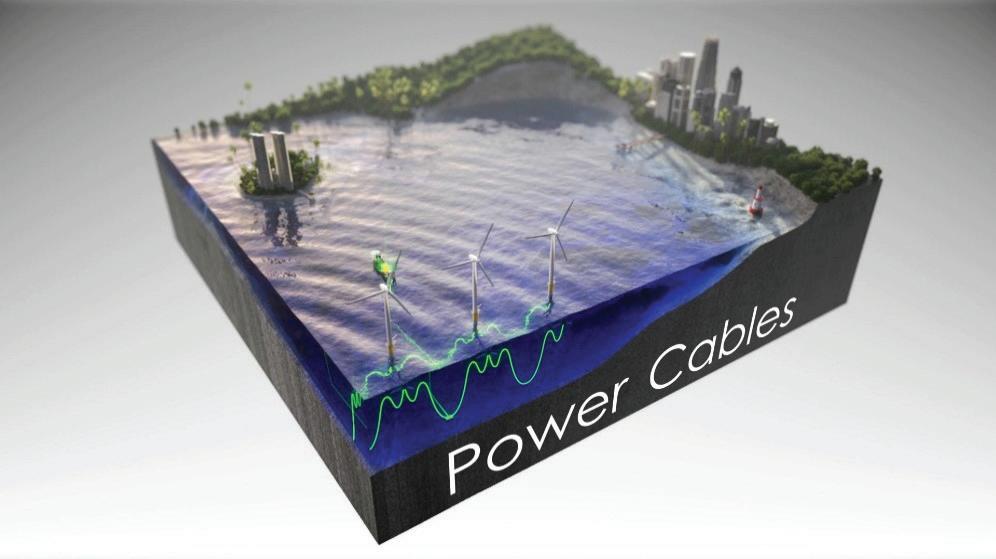
The telecommunications industry, which has long relied on submarine cables for global connectivity, has already adopted these advanced tools, leading to improved installations and a noticeable reduction in failures, setting new standards for quality control in subsea operations.
Installation of power cables is different to telecom cables due to their weight and stiffness, resulting in shorter layback distance, installation with bottom tension instead of slack, and lower installation speeds compared to the telecom systems. However, careful control is still required for maintaining target tensions, staying within recommended cable bend radii, and avoiding suspensions, with additional challenges when installing in currents or dynamic sea states. In the present state of the industry, many of the risks during power cable installation are addressed through varied ad-hoc methods, tools, and preprepared charts.
The next generation of MakaiPlan, MakaiPlan Pro, and MakaiLay software is being developed to address this gap and industry need. Leveraging the established risk reduction achieved by end-to-end software solutions for the telecom industry, steps are being taken to develop these tools to provide an improved and standardized approach for power cable planning and installation.
NAVIGATING THE RISKS: THE HIGH-STAKES WORLD OF SUBMARINE CABLE INSTALLATION
Submarine power cables are often laid in some of the most challenging environments on Earth. The oceans have a dynamic landscape, characterized by varying topographies, unpredictable waves and currents, and diverse bottom types.
Power cables are generally heavy and stiff, and must be laid with tension at the location they touch down on the seabed, referred to as bottom tension. Too much tension and the cable is likely to span across seabed contours, which can prohibit the depth of post-lay burials or introduce points exposed to abrasion and external risks. Too little bottom tension and the cable may exceed its minimum bend radius, causing physical damage, which can have immediate consequences or allow water ingress to the cable over time. When laying on seabed slopes, the varying catenary size can make the use of top tension measurements to calculate cable bottom tension unreliable without knowing the exact touchdown position and amount of cable in the water column. In waves, the vessel heave is directly felt by the cable, causing rapid and dynamic changes in the cable tensions.
To date, most offshore energy projects have been installed in relatively shallow waters (<100m), where a
FEATURE
collection of methods are used for quality control. As sea operators control bottom tensions using tabulated analysis, observe cable top angle and top tension, and deploy remote operated vehicles (ROV) for observation of the touchdown points. However, even in these less challenging environments, cable failures have been alarmingly frequent, often resulting from improper laying techniques, inadequate tension control, or unforeseen environmental factors.
As the offshore energy industry moves further offshore into deeper waters, the challenges of cable installation are expected to increase significantly. In deep water, the use of ROVs for touch down monitoring become logistically more challenging and measured top angle and top tension become less reliable due to the inherently steep cable catenary and resulting touch down position uncertainty.
These current failures and future challenges highlight the opportunity with more stringent adoption of software to improve standardization and quality control throughout the process. Makai Ocean Engineering has developed additional tools from the MakaiPlan and MakaiLay products, a software suite for route planning and cable and ship sim-
ulation, that address three important factors (1) improved real-time monitoring and data-collection, (2) in-office training simulators, and (3) batch heave analysis.
REAL-TIME MONITORING AND DATA LOGGING: FOUNDATION OF CONTINUOUS IMPROVEMENT
One of the most significant advancements in quality control for submarine cable installations is the development of real-time data logging systems.
Accurate data logging is a cornerstone of quality control in submarine cable installation. By recording detailed information throughout the installation process, operators can monitor the progress of the installation, verify that it meets specifications, and identify potential issues that need to be addressed. Collecting, maintaining, and analyzing data throughout the installation process is critical not only for ensuring the immediate success of the project but also for providing long-term assurance to all stakeholders involved, including installers, project developers, owners, and insurers.
MakaiLay offers comprehensive data logging capabilities, capturing a wide range of parameters, including as-laid

cable conditions, cable deployment data, vessel parameters, environmental conditions, and more. This data provides a valuable record of the installation, which can be used for post-installation analysis and continuous improvement.
Significant enhancements have been made in the latest versions of MakaiLay to allow the logging of generic data from a large range of data feeds and arbitrary formats. This flexibility enables the software to be more readily configured to log data that is available and relevant to the cable installation. This can be particularly useful during post-lay analysis.
Accurate record keeping is essential for cable installers to substantiate that installations are completed correctly and according to best practices, reducing their liability. The enhanced data-logging improves documentation and better automates record keeping for the project. It also plays a crucial role in ensuring the insurability of the project, as insurance providers rely on detailed records to assess risks and minimize disputes.
Beyond these immediate benefits, detailed data management provides peace of mind for project developers and owners, confirming the cable’s long-term integrity. The data collected contributes to the industry’s broader knowledge base, allowing operators to refine their techniques, improve future installations, and enhance overall project outcomes. In essence, the process of data logging and analysis is not just about documentation—it’s about protecting the interests of everyone involved and advancing the industry’s efficiency and reliability.
In real-time the simulation software and data-logging can be used during lays to increase detection and address issues before they occur. There can be multiple influencing factors from combinations of slope, current, and heave that can be challenging for humans to quickly interpret and make the best decisions without the aid of software tool and reliable data. This level of real-time insight is invaluable in maintaining the integrity of the installation and avoiding costly errors.
IN-OFFICE SIMULATION: PLANNING FOR PRECISION
Training and work force development has become a critical factor across the maritime industry, and cable installation is no exception. One of the most crucial aspects of preparing for a successful cable installation is understanding how the cable will behave under various conditions during the lay, and having the skillset to make the necessary decisions based on various possible external conditions. The new Makai Training Simulator is designed to provide cable operators with a deep understanding of the expected cable behavior specific to their project, and a realistic simulator experience.
The training simulator has the capability of generating realistic data for the simulated vessel, equipment, and selected sensors – and a true simulator experience for the
operator. By investing time in training, operators can avoid costly delays and major risks to the cable during installation, while reduce costly at-sea time otherwise required for training. The simulation allows operators to explore how the cable will respond to dynamic situations such as vessel starts and stops, slopes, and alter-courses. Combined with the heave and span tools, the Makai software package can be used for operators to directly see and learn how their decisions impact the on bottom cable properties. Operator training remains essential for ensuring that the cable can be laid on course and with acceptable bottom slack or tension.
BATCH HEAVE ANALYSIS TOOL: MANAGING THE IMPACT OF VESSEL MOTION
Heave, or the vertical movement of the vessel due to wave action, is one of the most challenging environmental factors to manage during submarine power cable installation. Heave can significantly impact cable tension and the bend radius of the cable catenary, potentially leading to cable damage if not properly managed. To address this challenge, the MakaiLay Batch Heave Analysis Tool has been developed to allow operators to simulate the effects of vessel heave based on a combination of factors including sea states, wave data, ship and cable properties, ocean depth, and the cable shape.
Operators currently rely on engineering analysis during the planning process to develop lookup tables that can be referenced for safe heave conditions during the at-sea installation. However, this process remains manual intensive, time-consuming, and lacks standardization across projects. The fidelity of the analysis and the ability to seamlessly incorporate the guidance into software for the at-sea operators are inherently limited by this process.
The Batch Heave Analysis Tool allows operators to calculate and export heave data in batches during the planning stages – using the depths observed along the MakaiPlan route and site specific bathymetry. This capability means the tool can simulate and analyze a series of conditions over time, providing a more comprehensive view of how the cable will behave dynamically under varying conditions throughout the installation process. The heave analysis can use vessel Response Amplitude Operators (RAOs) and wave spectra, thereby integrating the properties of the ship and random sea states, to create realistic simulations of ship motions— such as heaving, pitching, and rolling—and their impact on the cable.
By enhancing the analysis and simulation in MakaiPlan and seamlessly feeding the results for use in at-sea MakaiLay operations, higher fidelity decision making can be achieved, standardized methods can be adopted
FEATURE
throughout the process, alerts can be automated, and overall efficiency and quality control greatly improved. This tool is being implemented to move towards automating and standardizing what is currently an ad-hoc process. As trust is gained in these tools, through early adoption and use, it can provide opportunities to increase the range of conditions installers are confident to continue operating, provide opportunity to reduce installation costs and risks, and provide tools to install into deeper and more challenging waters.
THE FUTURE OF SUBMARINE CABLE INSTALLATION: A COMMITMENT TO QUALITY

As the offshore energy sector continues its rapid expansion, the challenges associated with submarine cable installation will only grow in complexity. The move toward deeper waters and harsher environments demands tools that can deliver precision, reliability, and adaptability. MakaiLay’s Power Module stands out as a critical solution, providing the advanced capabilities needed to navigate these highstakes scenarios. The tools being developed today address immediate quality control and risk mitigation needs, and provide opportunity for safer deep installations in the future. Automating previously manual processes and offering sophisticated tools to address potential challenges before they escalate will be crucial for the success of future offshore projects. With MakaiLay, the industry is well-equipped to meet these demands, ensuring that power cables are laid with the precision and care required to support the global transition to renewable energy. As the industry evolves, so too must our approach to cable installation, embracing innovative technologies that secure not just the cables themselves, but the future of energy transmission.
MAKAI OCEAN ENGINEERING’S LEGACY IN OFFSHORE CABLING
Makai Ocean Engineering (Makai) is no stranger to subsea cable monitoring and simulation, having operated in some of the world’s most demanding environments. With over 50 years of experience, Makai’s software has
been instrumental in the installation of more than 1 million km of cable worldwide. The MakaiPlan and MakaiLay software suite is a standard in the telecom industry, used by over 90% of the subsea telecommunications cable installation fleet, providing an end-to-end software solution from planning, installation, and post-installation analysis. Building upon this strong foundation, the Makai team aims to bring their expertise into the renewable energy and power grid sector.
If you are working on a power cable or offshore energy project, and are interested in learning more or testing this software’s capability, please reach out to Hermann Kugeler at hermann.kugeler@makai.com. STF


HERMANN KUGELER, Vice President of Business Development for Makai Ocean Engineering, joined the company in 2018. In this role, he leads the team’s marketing and business development efforts, both within the U.S., and internationally. Hermann supports commercial and federal projects spanning Makai’s areas of expertise and services. He received his B.S. degree in Mechanical Engineering, from the University of Denver.
ADRIAN JELFFS, Sr. Software Engineer for Makai Ocean Engineering, has recently been promoted to Cable Group Manager, responsible for managing the development, maintenance, and product releases of Makai’s subsea cable software suite, MakaiPlan & MakaiLay. Mr. Jelffs has over 28 years of software development, electrical system design, and R&D experience. He received his B.Eng. in Electronic Systems Engineering from University of York.
PROVEN PROCESSES AND METHODOLOGIES
• Defined Processes
• Template Driven
• PMP Based Project Management Approach
• Rigorous Documentation Controls
• Quality Assurance Focused
• Secure Records Storage
• Accessible and User Friendly
INTRODUCING THE VIRTUAL REP
• In-Field Analysis Without In-Field Risk
• Remote real-time analysis and reporting without the added cost of today’s in-field representation liabilities.


WHAT HAVE THE BRITISH EVER DONE FOR US?
PART 1
BILL BURNS AND STEWART ASH
Many of our readers will be aware of the recent decision by Nokia to sell 80% of its stake in Alcatel Submarine Networks (ASN) to the French State, represented by the Agence des Participations de l’État (APE). Thanks to its Anglo-French connections, with manufacturing sites in both Calais and Greenwich, ASN can trace its history back to the very start of the submarine cable industry. For the first hundred years
or so, submarine cables was very much a British story. The concept was invented in the UK, and the British dominated both the supply and network operations industries over that period. Along the way, British engineers invented a number of things that are fundamental to today’s optical fibre submarine systems, including submarine cables themselves, polyethylene, lightweight deep-water cables, rigid repeater housings, the linear cable engine, the optical-cable plough,
Steam Tug Goliath laying the Dover to Calais Cable, 28 August 1850 (Illustrated London News)
pulse code modulation (PCM), optical fibre and the erbium doped fibre amplifier (EDFA).
From our very first issue in November 2001, SubTel Forum has brought our readers many articles on different aspects of the history of our industry, including its ‘Back Reflection’ series feature, which first appeared in 2009, and the authors thought that this latest change in the industry’s structure was an ideal opportunity to combine these reflections into a timeline of the British contribution to this globally significant industry.
It is generally accepted that the start of the submarine cable industry dates back to 28 August 1850, when the steam tug Goliath laid a gutta percha insulated copper wire between Dover and Calais (See Back Reflection Issue 53 September 2010). This wire was installed for the ‘Father of Submarine Telegraphy’, John Watkins Brett (1805-63), and his brother Jacob (1808-93) (See Back Reflection Issue 73 November 2013). This wire was laid to a deadline so that the Brett Brothers could retain their French landing licence and, having no external protection, it soon failed on the rocks off of Cape Grisnez.
A year later an armoured cable was laid between Dover and Calais, its success achieved largely due to Thomas Russell Crampton (1816-88) (See Back Reflection Issue 54 November 2010). This project did not run smoothly, as a legal case involving patent infringement ensued, resulting in the cable being armoured by Robert Sterling Newall (1812-89) (See Back Reflection Issue 55 January 2011). The problems did not end there. The cable was laid from the barge Blazer, towed by two tugs, but because of the primitive cable control system the cable ran out more than a mile short of the French coast. A further 5nm (9.3km) was ordered and Newall claimed that he also provided this, but if he did, he subcontracted the work to Kuper & Co, because it was armoured at their new factory at Morden Wharf on the Thames at Greenwich. The telegraph between London and Paris went into commercial service on 13 November 1851 over the ‘Crampton’ ca-
ble, allowing the opening and closing prices of funds on the Paris Bourse to be known on the London Stock Exchange the same day.
Kuper & Co had been saved from bankruptcy by George Elliot (1818-93), and his chief accountant, Richard Atwood Glass (1820-73), then suggested to Elliot that armouring submarine cables could be a lucrative revenue stream for the Morden Wharf factory. Over the next three years, Kuper &


SS Persian loading the Bretts’ Mediterranean Cable at Morden Wharf, June 1854 (Illustrated London News)
HMS Agamemnon Loading the Atlantic Cable at Enderby Wharf, July 1857 (Illustrated London News)
FEATURE
Co secured several profitable contracts. As a result, Glass was made a partner and in 1854 the company was renamed Glass, Elliot & Co Ltd.
With the early success of short submarine cables across the English Channel and the Irish and North Seas, pioneers began to think about a cable across the Atlantic Ocean. The main advocate in the UK was John Watkins Brett, and in the USA the challenge was taken up by Cyrus West Field (1819-92). (See Back Reflection Issue 62 March 2012). Field formed the New York, Newfoundland and London Telegraph Co in the USA, and in the UK, the Atlantic Telegraph Co was set up by British investors. The two companies placed orders for 2,500nm of gutta percha insulated copper core from the Gutta Percha Co and split the armouring between R S Newall & Co and Glass, Elliot & Co. The space required for the production of 1,250nm of armoured cable was too large for the Morden Wharf factory, so in 1857, in partnership with William Thomas Henley (1814-82), Glass, Elliot acquired the derelict Enderby Rope Works, which was less than a mile upstream from their Morden Wharf factory. The partnership did not last long, and the following year W T Henley’s Telegraph Works Co was established in its own manufacturing facility, located down river on the opposite bank of the Thames at North Woolwich.

investors lost a great deal of money. There was a public outcry, and numerous conspiracy theories circulated (See Back Reflection Issue 69 March 2013). A Joint Committee of Inquiry was set up in 1859 (See the first Back Reflection Issue 43 March 2009), but investors had been burned, and raising new capital became very difficult. As has been well documented, Cyrus Field never gave up, but less well known is that the challenge was taken up in Britain by James Stuart Wortley (1805-81). His contribution to the final success of the Atlantic Telegraph was told in SubTel Forum in five parts (See Issues 113, 114, 115, 116 &117 July, September, November 2020 & January, March 2021).
As is well known, two unsuccessful attempts to lay the Atlantic cable were made in 1857, and it was not until August 1858 that a connection was established between Newfoundland and Ireland. However, although over 400 messages were sent over the cable, it failed after a few weeks and

The Great Eastern laying the 1865 Atlantic Cable by Robert Dudley (1826-1909) Courtesy of Alcatel Submarine Networks
Despite the lobbying of Field and Wortley in the early 1860s, raising enthusiasm for an Atlantic cable with investors remained difficult, and the death of the leading British investor, John Watkins Brett, did not help matters. The breakthrough came when Richard Atwood Glass explained to Cyrus Field that the only way to successfully lay an Atlantic cable would require a company large enough to take on the full risk and be responsible for the entire project, but Glass, Elliot could not do this. Field needed a leading British businessman to replace Brett, and so, on one of his many visits to England, he approached a friend, the Manchester cotton merchant John Pender (1816-96). Pender took on the challenge, and in 1864, by putting up a personal guarantee of £250,000, he was able to convince the directors of the Gutta Percha Co and Glass, Elliot to merge to form the Telegraph Construction & Maintenance Co (Telcon), with Pender as its first chairman (See Back Reflection Issue 75 March 2014).
Taking into consideration the recommendations of the Joint Committee, the Atlantic Telegraph Co, having acquire the residual interests of the New York, Newfoundland and London Telegraph Co, placed a contract with Telcon to manufacture and lay a new Atlantic cable. A consortium led by Daniel Gooch (1816-89) acquired the SS Great Eastern and converted her for cable work. The first attempt at laying
the new cable, in the summer of 1865, failed in deep water some 600nm from Newfoundland (See Back Reflection Issue 83 July 2015), but the following year, Gooch and Pender led the formation of a new company, the Anglo-American Telegraph Co, and working with the Atlantic Telegraph Co they contracted Telecon to make another cable that the Great Eastern successfully laid, then she recovered the end of the 1865 cable and connected it to Newfoundland. This was achieved solely by entrepreneur businessmen and private finance, the vast majority of which came from Britain.
The success of the Atlantic Telegraph meant that submarine cable projects went from being a high-risk investment to ‘Blue Chip’ opportunities. In 1869, John Pender stood down as Chairman of Telcon in favour of Daniel Gooch and set about realising his vision of a global network of submarine cables. His first project was a cable to India, which went into service in 1870 (See SubTel Forum Issue 111 March 2020). From there Pender would go on to build his global network and establish the company that would dominate world telecommunications for many years, the Eastern & Associated Telegraph Companies (ETC). (See SubTel Forum Issues 124 &125, May & July 2022).
To service this market, more manufacturing capability was required. The contracts for all Pender’s cables went to Telcon. Because Telcon had acquired the Gutta Percha Co

CS Colonia Moored off Enderby Wharf c. 1906
FEATURE
it became impossible for R S Newall to obtain insulated core and they ceased submarine cable manufacture in 1870. However, other companies entered the market, all based along the River Thames. W T Henley remained in business at North Woolwich, mainly due to subcontract work from Telcon, and in 1863 Siemens Brothers opened a factory at Charlton and would become Telcon’s major competitor. Hooper’s Telegraph Works Ltd was formed in 1870 with a factory at Millwall. The India Rubber, Gutta Percha and Telegraph Works Co, was established in what became known as Silvertown in 1854, making rubber-insulated land cables, and entered the submarine cables market in 1867. To meet the demands of the industry the vast majority of large projects went to Telcon or Siemens Brothers, with the other companies acting as subcontractors. The companies on the River Thames were the sole source of submarine cable manufacture from 1870 until 1891, when La société Générale des Téléphone opened a cable factory in Calais. (See Back Reflection Issue 47 November 2009). This facility is where ASN manufactures its submarine cables today. By the end of the century submarine telegraph cables had almost encircled the globe, and the Eastern & Associated Telegraph Company had become the largest telecommunications company in the world (See Back Reflection Issue 60 November 2011). The final section of the global girdle was completed when Telcon was awarded the supply contract for the first transpacific telegraph cable system by the Pacific Cable Board, in 1901. This system linked Australia with Canada and included the longest ever single-span telegraph circuit of 3,458nm (6,416km) between Bamfield on Vancouver Island,

Canada, and Fanning Island, now part of Kiribati. Telcon did not have a ship large enough to lay this segment in one operation, so the company commissioned Swan, Hunter & Wigham Richardson Ltd to build one. The 7,981 gross tonnage Colonia was launched in 1902. After laying this record link, she had a long career, during which she laid more than 80,700nm of cable before she was retired and sold into the whaling industry in 1928.

Ironically, this final piece of the jigsaw had a negative impact on the market for submarine telegraph cable manufacture. There were now very few contracts for new systems, duplication of major routes to provide additional capacity and system restoration, along with spare cable for repairs, made up the vast majority of the market volume. Development shifted to improving signalling speed and increasing the number of channels that could be transmitted over a single cable. After WWI an alternative technology challenged what up to that point had
1947 SCL 1.7” Coaxial Cable Sample
CS Ocean Layer in Laying HAW-1 in 1957, by Montague Dawson (1890-1973) Courtesy of Alcatel Submarine Networks
been a monopoly market for long-distance telegraphy. In 1919, Guglielmo Marconi (1874-1937) was granted his first operating licence in Britain, and wireless telegraphy made major inroads into the international telegraph market.
Due to these factors, the market could not support the existing number of manufacturers. In 1894, Hoopers was incorporated as Hooper’s Telegraph & India Rubber Works Ltd and continued to make submarine cables until 1914. It did not re-enter the submarine cable market after WWI. W T Henley’s left the submarine telegraph cable market in 1900, and the India Rubber, Gutta Percha and Telegraph Works Co went in 1922. This left just the two leading suppliers, but neither could survive on its own, so in 1935, Telcon and Siemens Brothers merged their submarine cables divisions to form Submarine Cables Ltd (SCL), based at the Enderby Wharf site.

Competition from radio telegraphy also affected the submarine cable operators’ business. In April 1929, ETC merged with Marconi’s Wireless Telephone Company Ltd, together with some smaller submarine cable operating companies, to form Imperial and International Communications Ltd. Additional overseas cable operating companies were acquired and in 1934, Imperial became Cable & Wireless Ltd (C&W). The Chairman was Sir John Pender’s grandson John Cuthbert Denison-Pender (1882-1949). So, from 1935, the submarine cable market was still dominated by the British, with SCL as the leading system supplier and C&W the world’s largest telecommunications operator.
The first submarine telephone cable of any note was laid across the English Channel in 1891. This system was supplied by Siemens Brothers from its Charlton factory and used a telegraph cable design. The first submarine telephone cables made by Telcon were laid across the Solent, and then the Irish Sea, in 1896. Again, they were based on a telegraph cable design and were manufactured at Enderby Wharf, the Morden Wharf site having been
run down and abandoned at the end of 1895. These cables were limited to transmission over relatively short distances due to the distorting effects on the signal caused by the cable’s capacitance. This was known as ‘retardation’ by the Victorian engineers, and its effects were far more of an issue on long cables than short ones.

To overcome the capacitance problem, two technological breakthroughs were required. The first was the result of research by British physicist and engineer Oliver Heaviside (1850-1925) into the ‘skin effect’ of telegraph signals, leading to his patent of the coaxial cable in 1880. The second came in 1933, when scientists at the Northwich, Cheshire, laboratories of Imperial Chemical Industries (ICI) discovered polyethylene, which could be used to solve the problem of the high capacitance of gutta percha insulated cables. This new material had a lower dielectric constant than gutta percha; it was tougher, more easily processed, non-hygroscopic and most importantly, cheaper to manufacture. Polyethylene became available for experimental cable manufacture in 1938, but its use was restricted to military
Enderby Wharf Gantry and Cable Engine Courtesy of Alcatel Submarine Networks
TAT-1 Repeater Prepared for Exhibition by SCL at Greenwich © Submarine Cables Limited, Greenwich
FEATURE
cables during WWII. The first submarine telephone coaxial cable to use polyethylene was made by SCL and was laid across the English Channel between Cuckmere and Dieppe in 1945.
The French manufacturing capability in Calais, established in 1891, had been destroyed during WWII. The manufacture of submarine cables in Japan, which had started in 1915, had grown steadily, based on the needs of its domestic market. In 1941, a major factory had been opened by the Nippon Submarine Cable Company, but again, as a result of WWII, this facility was also out of action. In the USA, the Simplex Wire & Cable Co had been established in the 1890s, but their submarine cables were almost entirely used in domestic crossings for rivers and lakes, and US Government official cables. Simplex did not fully enter the commercial cable industry until the 1950s, so submarine cable manufacture remained largely a British monopoly until then.

pressure were not overly significant. All these systems were provided by SCL.
In 1950, Standard Telephones & Cables (STC), the UK subsidiary of a US-owned group, International Telephone and Telegraph (ITT), entered the submarine cable market. Its main factory was at North Woolwich, next door to the then defunct W T Henley factory, and in 1956 STC opened a cable factory in Southampton.
Low-loss polyethylene coaxial cables allowed submarine telephony over medium distances, but to cross the oceans, amplification of the signal was essential. The idea of including housings in a submarine cable had first been patented in 1865, but the technology had not been forthcoming. To insert an amplifier into a subsea housing raised a number of major technical problems, such as how to enclose the amplifier in a water-tight casing but still get access to the transmission path, how to integrate it into the cable, how to provide power to the amplifier and, because it had to be based on thermionic vacuum tubes (valves), how to dissipate the heat. Most importantly, all the amplifiers had to be reliable, so that they would not have to be recovered and replaced in the event of a fault. These problems took time to resolve, but the first submerged amplifier was introduced into the already laid Anglesey to Port Erin coaxial cable in 1943. By 1947, a new coaxial system containing a single amplifier had been laid between the United Kingdom and Germany, and shortly afterwards other systems followed to the Netherlands and Denmark. Because the North Sea was relatively shallow, the effects of hydrostatic
For a telephone cable that could cross the Atlantic, Bell Laboratories developed a unidirectional valve amplifier, together with a flexible housing that could be laid by passing it through the standard cable-laying machinery of the time. This approach was adopted for TAT-1 and TAT-2, and although the amplifiers were made in the USA, the vast majority of the cable was manufactured by SCL at Enderby Wharf and its new Erith factory. SCL and STC also made in-line rigid housing bi-directional amplifiers for TAT-1’s onward circuit from Newfoundland to Nova Scotia, and the entire cable was laid by the British General Post Office (GPO) cableships and SCL’s cableship Ocean Layer. TAT-1 went into service in 1956 and TAT-2 followed 3 years later. [see https://atlantic-cable.com/Cables/1956TAT-1/STC.htm which also has details on STC’s 1951 and 1954 cables].
The original cable loading jetty at Enderby Wharf was completely reconstructed in 1951, then in 1954 SCL installed a new gantry and cable-hauling engine to load the TAT-1 cable onto the ships. Seventy years on, this equipment is still there and recently the Greenwich Industrial History Society (GIHS) has approached Historic England in an attempt to get this equipment saved for posterity by having it listed. Historic England are currently conducting an investigation into GIHS’s proposal.
These transatlantic telephone cables did not quite put an end to transoceanic submarine telegraphy. In the mid1950s the US-based Commercial Cable Company began to promote a project called ‘Deep Freeze’. This involved a transatlantic coaxial telegraph cable, but it eventually failed
The Linear Cable Engine Courtesy of Alcatel Submarine Networks
to get the necessary government support and was never built. (See Back Reflection 78 & 79, September & November 2014). However, it is clear that ‘Deep Freeze’ left a significant legacy to the submarine cable industry.
The Commercial Cable Company was by then owned by ITT so it was natural that ITT’s subsidiary, STC, would have been the supplier for the system. It was planned to go into service in 1957 and this project was one of the main reasons that STC opened its cable factory in Southampton in 1956. Deep Freeze would have been the longest coaxial submarine cable in the world, including 65 deep sea housings spaced every 55nm (102km). It was designed as a single cable system, carrying 120 telegraph circuits plus 5 voice channels, thus requiring bi-directional transmission. To hold the subsea circuitry, STC required a new housing and fortuitously, from 1952 onwards, the GPO and Cable & Wireless had led a design and development programme in collaboration with SCL and new entrant STC to develop such a housing for submarine telephone cables. The pro-
gramme resulted in an in-line, rigid housing design which had room inside it for filters that allowed bi-directional transmission over a single cable. This was ideal for the Deep Freeze subsea circuitry and the housing became part of the submerged plant design. There is little doubt that the Deep Freeze requirements informed this development. The term repeater had been used in the telecommunications industry for devices that boost signals by amplification or regeneration for many years and may even date back to the original 1865 patent for a subsea housing that was intended to contain circuitry to repeat telegraph signals. The primary function of the Deep Freeze housing was to regenerate telegraph signals, and it was christened a ‘Repeater’.
Having unidirectional amplifiers, TAT-1 and TAT-2 required two cables to create a telephone circuit; however, the first Repeaters were provided by SCL/STC for the single cable extension from Newfoundland to Nova Scotia.
This British Repeater could provide up to 60 x 4 kHz voice circuits, over twice the capacity of the TAT-1 and

FEATURE
TAT-2 systems and being bi-directional, this part of the system required only a single cable. Ninety of these repeaters were supplied by SCL and STC for the next transatlantic telephone system, CANTAT, that went into service in 1961. However, because of the rigid housing the Repeaters would not pass through the standard cable machinery used to deploy the cable. This problem was initially solved by the use of by-pass ropes (See Back Reflection Issue 65 September 2012), and then the Linear Cable Engine (LCE), jointly developed by British Telecom and Dowty Boulton Paul, yet another British invention. It was first installed on the British Telecom ship CS Alert (IV) in 1971 and then on the Cable & Wireless ship CS Mercury the following year. This type of cable engine can now be found on all modern cableships.
The in-line housing, known as a ‘Repeater’ has been with us for 70 years and although, for the vast majority of this period, Repeaters have contained amplifiers rather than regenerators, the name, given by the British to their rigid housings, has passed the test of time.
primary cable-making facility. In 1972 the Erith factory was shut down.
The 1970s brought a second alternative technology threat to the submarine cable market in the form of satellite telecommunications. (See Back Reflection Issue 84 September 2015) Satellite systems offered wider bandwidth to carry more voice channels and could also carry TV circuits. The submarine cable industry responded to this challenge by increasing the bandwidth of its systems. The valves in the Repeaters were replaced by semiconductors, allowing much wider-bandwidth amplification. TAT-5, installed in 1970, carried 856 voice channels; CANTAT-2, an STC system installed in 1974, carried 1,840 x 3kHz voice channels; and further capacity increases were introduced for TAT6 and TAT-7.

CANTAT involved a second technical revolution -- lightweight cable (LW) for deep water (> 1,000ftms). Again, this product was developed by C&W, the GPO, SCL and STC, and both manufacturing companies provided cable and repeaters for the system. Needless to say, Repeaters and LW cable are ubiquitous in modern submarine cable systems.
The next decade saw the supply market expand, with competitors to SCL and STC based in the USA, France and Japan. However, the British Commonwealth was able to provide SCL and STC with some major projects known as the Commonwealth Cables: after CANTAT, COMPAC went into service in 1963, and SEACOM in 1967. (See Back Reflection Issue 76 July 2014). TAT-3, which provided 136 x 3kHz voice channels, was installed in 1963 and STC supplied all the cable.
Foreign competition meant that two UK-based submarine cable system manufactures could not survive, so in 1970 STC acquired SCL, moving its submarine cable division to Enderby Wharf and making Southampton its
In 1975, the last cable manufactured at Enderby Wharf was a 5MHz system carrying 490 x 3kHz voice channels. It was laid between Port Moresby and Cairns (A-PNG) by CS John W Mackay the following year. The
John W Mackay was built, by Swan, Hunter & Wigham Richardson for the Commercial Cable Company (CCC) in 1922. STC had acquired her after a major refit in 1965, and she had been used on a number of projects throughout the 1960s and 1970s. When she returned to Greenwich following the A-PNG lay she was retired, and after being moored on the ‘Dolphins’ off Enderby Wharf until the mid-1980s, she was finally scrapped in 1994. Her 57 years cable laying career made her the longest serving cableship of all time.
Although the major high-capacity systems were built for the Atlantic route, STC also developed a 45Mhz system which was used for medium-haul systems. The longest system of this type was PENCAN-3, laid from Spain to the Canary Islands in 1977, which was equalised to carry 5,520 x 3Khz voice channels.
In achieving the wider bandwidths there were two penalties to pay. Firstly, due to the loss profile of coaxial cables, Repeater spacing had to be reduced. For STC’s 14MHz system design, Repeater spacing was 7-8nm (13-15km); for the 45MHz system the spacing was reduced to 4-5nm (8.4-
CS John W Mackay on the Dolphins at Enderby Wharf c. 1983 Courtesy of Alcatel Submarine Networks
9.3km), adding further to the increased cost of the submerged plant. Secondly, the gain profile of the wide band amplifiers could not perfectly match the loss of the cable, so an additional housing had to be introduced after every 12-15 Repeaters. This housing was called an ‘Equaliser’ and used passive components to even out the gain discrepancies. The American, French and Japanese manufacturers built these Equalisers in the factory, either as fixed circuits or with limited ability to adjust them remotely. STC took a different approach and were the only company to design and build the Equalisers while the system was being laid. (See Back Reflection Issue 66 November 2012).
Throughout the Telephone Era of submarine cables, the vast majority of international telecommunication operators enjoyed monopoly licences in their own countries, and the biggest of these had marine divisions that provided the ships for laying and maintenance worldwide. At the beginning of the 1980s there was a global move towards liberalisation and privatisation in the telecommunications market. In 1983, ITT sold STC, and STC plc was formed, with the Greenwich and Southampton sites becoming a wholly owned subsidiary, STC Submarine Systems.

Despite the fact that submarine cables offered a better quality of service for telephony, with no perceivable delay or echo and infinitely better security (because the signals were not airborne), satellites could carry several television channels, offered more voice channel capacity and, most importantly, a cheaper service. Therefore, by the mid-1970s satellite systems had become the dominant service for transoceanic telephony, a market-leading position that would be maintained until the late 1980s. This dominant position did not change until the advent of optical fibre submarine system technology.
Even in the face of competition from submarine system manufacturers in France, Japan and the USA, STC Submarine Systems remained the leading supplier of submarine cable systems during the Telephone Era. In 1986 STC supplied the last submarine coaxial telephone system to be installed, a 14Mhz system between India and the United Arab Emirates. This marked the end of the Telephone Era and coincidentally the beginning of the Optical Era. We will tell you about the British contribution to the submarine systems industry throughout the Optical Era in the next issue. STF

BILL BURNS is an English electronics engineer whose career began at the BBC in London. In 1971, he moved to New York and worked in the high-end audio industry, writing reviews and articles on audio, video, computer equipment, and electronic music instruments. His research sparked an interest in early technology, leading him to collect artifacts related to electricity and communications.
In 1994, Bill discovered a section of the 1857 Atlantic cable, igniting his fascination with undersea cable history. He created the Atlantic Cable website (https://atlantic-cable.com), which now has over a thousand pages on undersea communications history. Bill has visited every surviving telegraph cable station globally and numerous archives and museums. He has presented papers at various conferences and organized the 150th Anniversary Celebration for the 1858 Atlantic cable in 2008. In 2016, he participated in celebrations for the 150th anniversary of the 1866 Atlantic cable.

Since graduating in 1970, STEWART ASH has spent his entire career in the submarine cable industry. He began at STC Submarine Systems as a development engineer, then moved to field engineering, managing global coaxial cable installations and becoming Shipboard Installation Manager. In 1986, he established a division for installing fiber optic systems.
In 1993, Stewart joined Cable & Wireless Marine, advancing to account director before becoming General Manager of Global Marine Systems Ltd’s engineering division in 1999. There, he oversaw system testing, jointing technology, and ROV operations and chaired the UJ Consortium. Since 2005, he has been an independent consultant, assisting with system procurement, operations, maintenance, and repair.
Stewart’s interest in submarine cable history began in 2000, leading him to co-author “From Elektron to ‘e’ Commerce.” He has written extensively on the subject, including a chapter for “Submarine Cables: The Handbook of Law and Policy” and books supporting the preservation of Enderby House. His biography of Sir John Pender, “The Cable King,” was published in 2018.
An STC 14Mhz Repeater Being Laid
FEATURE THE PATH TO VALENTIA AND THE VICTORIAN

1 INTRODUCTION
Valentia Island Telegraph Submarine Cable Station is on the Irish tentative list for World Heritage Status [1]. This is an ongoing process and is expected to be adjudicated by the United Nations UNESCO World Heritage Centre in Paris, at the next UNESCO WHS Meeting. It is by understanding why Valentia Island is so important to development of long-distance telegraph transmission and will help us to understand links between Valentia and UCD and their historical importance.
2 THE BIRTH OF TELEGRAPH COMMUNICATION
Telegraph communications or the telegraph was first patented in England in 1837 by William Cooke and Charles Wheatstone [2]. This was a culmination of a long evolutionary process of investigation and research in which Cooke and Wheatstone understood the practical use and its productive purpose. Many others contributed to previous work and these ideas helped shape the revolutionary process and ideas that to this end.
The telegraph could only have been possible by three major discoveries in electricity and its properties. The first was the discovery of electrical conduction and induction
by Stephen Grey [3] in the 18th century, the second major discovery was energy storage and the invention of the battery by Volta [4] in 1800 and third discovery was the relationship between electricity and magnetism by Oersted [5] in 1820. These three discoveries, although independent of each other made the possibility of electrical communication over wire, or telegraph communication, possible.
It was not just down to the investigations by Cooke and Wheatstone and their achievements that made telegraph communication possible. We need to understand the developments and discoveries by Samuel Morse, Alfred Vail & Leonard Gale in the United States [6], William Brooke O’Shaughnessy [7] in India, and Werner von Siemens working with the Prussian Army Telegraph [8].
Each working in different parts of the world, working separately and without knowledge of each other’s investigations, had undertaken research in communications by using electrical charge. Morse had come across the development in electrical magnetism and its association with conductivity on a trans-Atlantic crossing in 1832 and was very interested in these ideas [9]. It was this chance meeting on the ship that got him interested in the concept of communication by electrical circuit over a single wire. On his
THE BIRTH OF THE VICTORIAN INTERNET
BY DEREK CASSIDY

arrival in the United States, he went to work on his idea of the telegraph with Gale and Vail [9].
William Cooke who was studying medicine in Paris came across the idea of the electric telegraph when one of his professors used an apparatus that worked just like a telegraph in his lectures. It was only an experimental form of the electric telegraph, and it immediately grabbed his attention. He gave up medicine and returned to England on the preposition of putting the ideas of the electric telegraph into operation. However, he needed help and consulted many academics about his ideas which lead him to meet Charles Wheatstone in 1836 and together they started to work on their telegraph principles. Cooke and Wheatstone turned to the
railway, who were looking for a new way to communicate between stations, stops and sidings so that safe locomotive transport could be achieved. In 1837 they built the first telegraph network between two railways stations, and this has been established as the first commercial telegraph network in operation and they were granted a patent for their telegraph and signaling method in June 1837 [10].
In India, William O’Shaughnessy, a doctor working for the East India Company pondered the idea of a communications network covering the Indian sub-continent [7]. The East India Company was a commercial trading company set up in 1600 but became the ruling authority over many parts in India in 1757 [11]. As the East India Company grew in operation, control, and authority by the middle of the 19th century there was a need to have an efficient communication network, specifically for the Militia or standing military arm of the East India Company. It was this need for a new communication network and some recent information and correspondence that O’Shaughnessy came across that turned his attention to the new developments in telegraphy. He knew that the sub-continent needed a new communication network that could transmit and receive messages faster than the standard horse and rider method. As India was being ruled by a semi-military company the need to have fast communications so that its industrial and economic infrastructure would thrive, especially between military, Government and Administration. O’Shaughnessy set about working on a primitive telegraph network that soon spawned a new technological development in telegraphy and the ideas of insulation were also researched. The electric telegraph was introduced into India in 1837 [12] and during this stage O’Shaughnessy also looked at the issues around insulation due to the humidity of the Indian climate. He came up with the idea of Gutta-percha, which was just being introduced into the European market but was well known in eastern Asia and on the Indian Sub-Continent for its supple, malleable form and its water repellent properties [13].

He soon developed a rudimentary insulation telegraph system that was also deployed across rivers, making O’Shaughnessy the first
William Brook O’Shaughnessy
Courtesy: Biography of Sir William Brooke O’Shaughnessy - Red Historia
FEATURE
person to install a submarine telegraph cable across rivers with proper insulation.
In East Prussia, also with a view to fast communications for the military, Werner von Siemens, who was an officer in the East Prussian Army, had a very keen interest in the new technology of telegraph communications. He had been assigned a military role in the deployment of telegraph as a subterranean and submarine communications systems so that the army could deploy the telegraph as an operational communication system, and this led him to the use of Gutta-percha as the material for insulation. However, as this research and investigation was initially for the purpose of military communications, the need to develop a commercial telegraph for public use was always on the horizon. Soon after leaving the army and the establishment of his company, Siemens, his investigations, and deep interest in the telegraph turned towards commercial deployments and activity [14].
It was by these separate developments that culminated in the development of the telegraph and the submarine telegraph cable. However, we must also look at other factors such as the coding methods, developments in insulation, following on from O’Shaughnessy’s research and the ability to transmit across long distances. We need to discuss these factors so that we can fully understand the development of the telegraph and the first telegraph company, Electric Telegraph Company. This will lead onto the first telegraph networks and the need to cross the oceans and the technology needed to complete this. Valentia and its place in the first successful commercial trans-Atlantic Telegraph Submarine Cable and its effect on society, the economy and technology.
3 CODING METHODS
introduced as the 5-needle telegraph, which over time was reduced to a one needle system that lasted on the railways for well into the 1930s [15].
Their original and subsequent designs for the telegraph system on the railways helped to develop different scenarios for the railways including block work and single line right of ways which delivered a safer system of work. The telegraph idea itself was not seen by the public as a necessity, however, after the arrest of Thwall on the 1st of January 1845 [16] and its publication across the press that public interest began to increase. Soon the need for telegraph systems across the UK was seen as a social need and was soon finding its place as a means of communication in society. In 1846 Cooke and John Ricardo, a wealthy businessman who had a financial interest in the Cooke and Wheatstone patents, established the Electric Telegraph Company [17], the first telegraph company in the world.

Wheatstone also developed other coding techniques for the telegraph and some of these were used on private wires and experimental purposes only, however it proved that the electric telegraph could operate with any number of coding techniques that Cooke and Wheatstone could throw at it, if the codes and the instruments used followed certain principles.
Cooke and Wheatstone initially looked at a way to send and receive the electrical telegraph signals with the use of an instrument that would indicate the presence of electrical current by the movement of needles. Their first trials included a complex 60 coded system which proved too complicated. So, a less complicated system was devised and
Another coding form was investigated for telegraph communication, and it was one that would last well into the 21st century, its initial development was first undertaken by Samuel Morse, Alfred Vail & Leonard Gale in 1832 [18], when Morse was credited with the invention of the telegraph, however no commercial working telegraph had yet gone into production. In 1838 Morse and Gail had finally come up with a working code, called the Morse code, which was patented in 1840. By 1844 they had built a telegraph between Baltimore and Washington, and it was on the 24th of May 1844 when the first long distance Morse code was successfully transmitted [18].
Hamburg, 1848, Friedrich Clemens Gerke took Morse Code and by changing some of the code and technically making it a bit easier, his innovation or interpretation of the original Morse code was called the Hamburg Telegraph [19].
Werner Von Siemens as an officer in the Prussian Army,1843 before he set up the Telegraphen-Bauanstalt von Siemens & Halske in 1847 (Photo: Siemens Historical Institute).
In 1851 at an International Telegraph Conference the Gerke version of the Morse code was adopted internationally, while America and Canada still used the American Morse Code version (Samuel Morse version). However, in 1865 the International Telegraph Union, which was established in Paris that year, adopted a new version of Morse code that was a variant of Gerke’s original version. This new ITU code is the Morse code heard and transmitted today [20].
Dublin 1845, Charles Hancock was looking for a solution that would help him produce bottle stoppers. When he was introduced to Gutta-percha by his brother Thomas, he immediately understood the flexible and mouldable attributes of this new natural rubber. Charles took out a patent on his new idea of Gutta-percha bottle stoppers and set up a company with Henry Bewley, a Dublin Chemist, who was producing soda. This company was called the Gutta Percha Company [18]. In 1848 Henry Bewley came up with the idea of extruding Gutta-percha into pipe moulds. This new way of moulding Gutta-percha into a pipe was soon introduced to the telegraphic world and research was done on a way to insulate copper wire for underground telegraphic cables. Henry Bewley took out a patent on his new method of extruding Gutta-percha over copper wires, something that had a direct impact on the future of telegraphy and submarine telegraph cables [21-22].
As we can see the two events mentioned above, happened in two different countries and without any interlinking communication. They were very closely united in the common purpose of driving the ideas of telegraphy further, incorporating these developments with the use of Gutta-percha as the insulation, due to its malleable and water repellant properties [23]. It is interesting to note that these two separate companies were both producing Gutta-percha insulated telegraphic wires, but with different insulating techniques. As Henry Bewley and the Gutta-percha company were now producing insulated telegraphic wire for the commercial market, Siemens were producing them for the military but set up “Telegraphen-Bauanstalt von Siemens & Halske” or Siemens and Halske Telegraph Company. Two separate markets, one allowing patents to be filed and ownership of the research (Gutta-percha Company) and the other (Siemens and Halske Telegraph Company) being established in a military research environment that did not allow patents to be pursued and so could not claim any rights to or claim infringements on patents as its development was for military use. However, the company soon developed into commercial operation [24].
But as the 1840s ended and with the telegraph already undergoing a revolutionary change in design and technology, the next steps in this evolutionary process would lead to a new
leap in the development of submerged or submarine telegraph cable design and deployment. These new developments would push telegraphy into the next generation and totally revolutionize telegraph communications in a way that was only thought off and even thought impossible a few years earlier.
4 THE NEW ERA IN TELEGRAPH COMMUNICATION: SUBMARINE CABLE TELEGRAPHY.
In 1847 John Watkins Brett and Jacob Brett had received a license from the French Government to lay a submarine cable across the English Channel and land it in France. However, the license lapsed in 1849 but they managed to get it renewed again for ten years if they managed to lay a submarine cable by September 1850 [24]. They came up with a plan and in the early part of 1850 the English Channel Submarine Telegraph Company was set up [18,21]. They ordered 25 miles of no.14-gauge copper wire to be covered with Gutta-percha from the Gutta-percha Company. The cable, although only having the constituent parts of Gutta-percha and centre copper core was the first submarine Telegraph cable built for a commercial purpose. The cable, when being laid, needed lead weights to keep it on the bottom of the English Channel. The cable was successfully laid on the 28th of August 1850, just within the time allowed under their licence

agreement. But even though it was the first submarine telegraph cable ever laid connecting two countries, it also has the notoriety of being the first submarine telegraph cable to be damaged while in operation[25]. It was lifted off the sea floor by a French fisherman who thought that his fishing tackle had got caught on some seaweed and cut it away. This was the first case of submarine cable damage caused by fishing. It was also the start of the age of submarine cable telegraphy which directly led to the many innovations in submarine cable technology and the submarine cable designs we have today. This has been labelled as the first leap in submarine cable design technology [25].
In 1851 the Brett Brothers established another company called the Submarine Telegraph Company [26], it was successful until it was nationalised and subsumed by the GPO in 1890. This company set about redesigning a new cable
Copper wire covered with Gutta Perch for insualtion, 1850 Dover to Calais cable.
FEATURE
design and ordered a new telegraph wire coated with the Gutta-percha insulation from the Gutta-percha company. One of the improvements was that this cable had four telegraph cores, each one covered in Gutta-percha. However, the main design change was that the cable was to be covered by a wire wrap, or armouring cable. It is interesting to note that this posed a large problem for the cable handlers as no telegraph cable had ever been protected by armouring wire before. The Gutta-percha company handed over the four lengths of Gutta-percha covered telegraph copper cores to a rope making company who would install the wire armouring and infill to form the cable. But issues arose with the technique being used by E. Weatherley & Co. who were originally rope makers but who had been contracted to make the cable. The technique they were using was one originally patented by R.S.Newall & Co. There was a disagreement, and it was finally resolved when the contract for the armouring was given to R.S Newall & Company. However, to complete the contract, they had to install the armouring wires at E. Weatherley & Co. premises. So, it was agreed that R.S.Newall & Co. would carry out the manufacture of the armoured cable with the Gutta-percha cores inside. The main reason why R.S.Newall was selected was that their wire rope deigns include a hemp inner core, which would be replaced by the Gutta-percha core(s) and so producing an armoured submarine cable [27].
The Submarine Telegraph Company successfully laid the cable on the 13th of November 185, it became operational, and stayed in service for well over 30 years. This is the second leap in submarine cable design in that it was designed with armouring wire for protection against outside aggression. It was also the first armoured submarine telegraph cable to go into commercial service [28]. Telegraph communication spread across the globe like a spider’s web, across mountains, rivers, lakes, and seas. However, there was still one obstacle that was out of reach. Connecting
Europe with America. But this prospect was seen as a prize to be won by people who were driven with the idea that the Atlantic Ocean could someday be conquered by a telegraph submarine cable capable of connecting the old and new worlds. Cyrus Field led a handpicked team of Engineers and Scientists. They set about getting the funds to fulfil their dream on connecting Europe and America and set about designing and manufacturing the cable required.
5 THE FIRST TRANS-ATLANTIC TELEGRAPHVALENTIA ISLAND TO NEWFOUNDLAND
In 1858 after 3 attempts to cross the Atlantic Ocean, the third attempt finally succeeded. But it failed after 30 days due to the use of high voltage and current [29] used to drive the electrical signals across the long-distance cable and with the added failure of the insulation[30]. This failure increased engineering ideas and technological innovation that kept powering the telegraph age and submarine telegraphy. The 1857-8 trans-Atlantic cable did prove that it was possible for a telegraph cable to span long distances and that the technologies proven during these installations opened a new world of long-distance telegraphy. Soon submarine telegraph cables were spanning distance up to hundreds of miles. In 1859 the Gutta-percha Company supplied a telegraph core covered with Gutta-percha and R.S.Newall & Co. completed the submarine telegraph cable build. This


William Thompson (left) and his Mirror Galvanometer (Right) replica, in UCD.
new telegraph cable had a total length of 632 miles as it was being laid between Singapore and Jakarta via Banca or the Bangka Islands [18]. The cable although in two lengths, as it was connecting islands, did show that telegraph connectivity over these long distances was only possible due to the advances in technologies that were used for the first trans-Atlantic telegraph cable [31]. Cable armour design, insulation, and storage were some of the innovative changes that can be directly attributable to the first Valentia cable. Other innovations such as electrical connectivity, Morse code receivers such as the mirror galvanometer, batteries and power supply voltages used for the electrical current needed to transmit the telegraph pulses across these great distances [32].
Even though the first real attempts to lay a trans-Atlantic cable between Valentia and Newfoundland was not a success [33], the discoveries and innovations that were derived from the team in Valentia had a very profound effect on telegraph communication for many more years to come and would have a direct effect on the future trans-Atlantic attempts from Valentia to Newfoundland.
William Thompson mirror galvanometer: William Thompson (elevated to 1st Baron Kelvin in 1892 by Queen Victoria) had investigated the issues surrounding the transmission of electrical signal over the full length of the trans-Atlantic telegraph cable [34]. He was aware that an existing instrument, the galvanometer, could help with the receiving of signals over this distance, but its use as a telegraph instrument was one that was never put into practice and as such there was no real way of reading the electrical signals. After the failure of the 1857 expedition, he went about researching the use of needle inflection and its uses for current detection, just like the instrument that Cooke and Wheatstone used. However, upon investigation and further research and upon happenstance he noticed that a mirror suspended by a fine wire could also be deflected with very small amounts of electrical current.
In 1858 before the next attempt to lay the trans-Atlantic cable [28], William Thompson perfected the instrument, tested it on submarine telegraph cables in the Bay of Biscay and then used it on the next attempt in June 1858. When the cable was finally landed on the 5th of August 1858 and connectivity was made, he used his new instrument, the mirror galvanometer [35], as the receiver of the electrical signals across the cable. This new devise, one that would change the history of long-range telegraphy, was connected at each end, the words finally came through. The mirror galvanometer was patented that year by William Thompson and until a newer technology was invented this devise was used the world over on all long-distance submarine and overland telegraph cables.
The cable armouring: The cable armour, used for the 1858 trans-Atlantic cable, was made of seven strands wound around a central strand and making up eighteen bundles. This was to become the armouring wire for the main section of the cable. This design was inspired by a conversation between Isambard Kingdom Brunel and Cyrus Field as they meet one evening in London in 1856 [36]. This design, although great for tensioning wire or wire rope is good when multiples of this design are used together to lift or hold an object in tension. However, using this wire rope design, acting as a submarine cable armour, other stresses effect the wire rope due to the submarine cable laying process. On a wire rope when force is applied the force or tension is along the axis of the wire rope and all parts and all the wires work in unison to counteract the force. However, in the wire rope armour used for this cable, when the cable is being laid on the seabed the force applied is spread around the central axis of the cable and the armour takes different levels of force depending on its positioning at that point. With solid wire armour the force is applied evenly to the wire, however in armouring designed by Brunel the force is not even due to the strands. The total cross-sectional area of a solid wire of the same diameter as the total number of strands per seven wire bundle is not the same. The solid wire has a bigger cross-sectional area and therefore bigger counteraction to the force applied. The armour of the first trans-Atlantic cable was too weak to be able to hold the cable section is suspension under the ship and over a long distance proved fatal. To overcome this design, flaw all future submarine cable armouring wires were solid and wound in the same direction along the full length of the cable [37].
Telegraph transmission: The transmission speed of the first submarine telegraph cable was very slow and it would take an extra ordinate amount of tie to send a message. With the use of the mirror galvanometer the speed increased to about two to two and half words a minute. Which was fast across such an expanse of water. However, with the research carried out by Thompson in making the mirror galvanometer a more refined and precise mirror galvanometer was constructed to increase the transmission speed across the Atlantic. In 1866 the transmission speed was eight words a minute [32] compared to 4 words on the 1858 trans-Atlantic cable. Also, with the ability to investigate and trial new transmission technologies across newer longer distance submarine cables the increase in word transmission had increased so much that by 1900 the word transmission speed could be as fast as fifty words a minute, with duplexing and quad duplexing techniques employed, three hundred words a minute could be successfully transmitted [37].
FEATURE
Cable braking system: The cable braking system is a design used to help lay submarine cables from the back of ships and slows down the paying out of the cable. It was designed by Charles Tilson Bright, and it was based upon the original designs used for cables that were laid by the British and Irish Magnetic Telegraph Company and with consultation with C.S Varley from the Electric Telegraph Company and John Brett from the Submarine Telegraph Company. The first cable paying out system and braking system, used on the 1857 cable expedition, proved difficult to measure the force applied when the cable was in suspension under and behind the ship. In 1858 when the next attempt was carried out Charles Bright made a few changes to the equipment that allowed for a graduated brake which would apply a small amount of force and it could also be measured [34]. However, after the cable was finally landed and connectivity was made. Charles Bright dismantled the cable laying equipment and redesigned it so that all moving parts had the ability to have their applied force measured. The force itself was also graduated so that the force could be applied and removed even with the cable was being laid, without causing damage to the cable. This design was to become the blueprint for all future designs and its next use was for the submarine cables being laid across the Mediterranean and the next trans-Atlantic telegraph expeditions [38].
Deep sea cable laying: Deep-sea cable laying had not been carried out before the adventures associated with the 185758 submarine telegraph cable and re-engineered during the 1865 and 66 cable expeditions. Everything that was done to lay the cable on the seabed was done out of engineering designs that were produced and manufactured specifically for these projects. There were no other previous attempts undertaken, therefore there was no information that could be used to help design these solutions to get over the engineering challenges, other than from the experienced gain. This also proved somewhat difficult because without anything to go on the success of laying the submarine cable was solely based upon the solutions that Charles Bright managed to design to help with the cable laying process [39]. But the successful laying of the trans-Atlantic telegraph cable in 1858 did prove that it could be done It was also the starting point for all other deep sea submarine cable laying operations that can trace their historical lineage all the way back to the successful laying of the 1858 trans-Atlantic telegraph cable, specifically the 1866 trans-Atlantic cable [40].
6 VALENTIA AND ITS LEGACY
In the history of telegraph transmission, no other place has had more of an impact or effect on submarine telegraph
cable transmission than the Valentia Island Cable Station. With the 1857-58 trans-Atlantic cable the Cable Station was in the Slate Yard in Knightstown because the cable was landed just beside the harbour. However, as the 1865-66 cables were landed at Foilhummerum Bay, at the opposite end of the island, there was a small cable hut in a field opposite the landing site and from here an inland cable was laid to the Slate Yard in Knightstown, technically an extension of the submarine telegraph cable. This inland cable was the same design as the 1865 cable shore end with an inner and outer armour, sometimes called rock armour in today’s submarine cable terminology, it had 6 telegraph cores between the two armoring wires and two telegraph cores in the centre of the cable. Each telegraph copper wire core (seven stranded copper wire) was coated with Gutta-percha insulation. This is the first time this type of cable was used with the capability to offer extra connectivity [41]. Technically this land section could connect eight different submarine telegraph cables. When the 1866 cable was landed and the 1865 was finally connected the two centre telegraph cores of the land section were used for these two cables. The extra six telegraph cores were kept for other submarine cables that were to be connected. The cable was in use up to the late 1930s.
The 1866 trans-Atlantic submarine telegraph cable was the first successful commercial cable, and it helped the telegraph industry to develop long distance communication across oceans. The final frontier or oceanic submarine telegraphy was now finally conquered by the new trans-Atlantic cable of 1866. This act alone helped Engineers and Telegraphers look to finally connecting India with a long-distance submarine Telegraph Cable. As India was already connected by 1864, but this was across land and was not a stable service. On the 23rd of June 1870. Charles Bright who was so instrumental in the original 1857-58 trans-Atlantic cable was the Chief Engineer on the new submarine telegraph cable form Britain to India, which was a success. It was through the technologies and innovations surrounding the trans-Atlantic telegraph cable that enabled the opening of long-distance submarine cable telegraphy [18,37,42].
As Valentia opened the world to long distance submarine telegraph transmission and along with the different technological achievements that came with the cable, the ability to connect Europe and America also had a very positive effect on the economy and markets, both financial and stocks markets. With regards to the economic advantages associated with the 1866 cable was the ability of stock markets to have an even better view of the stocks and shares being sold on the New York Stock Exchange and then compare these with their financial dealings taking place on the London Stock Exchange.
The availability of these stock prices, for all sorts of goods, helped create a true global economic revival and was the start of what we call the global economy [43].
Valentia was also central for establishing the European Arc of longitude, which was central to the establishing of Greenwich Mean Time across Great Britain and for navigational purposes. Today we see Ireland and Britain as in one time zone sharing the same time, yet within different longitudes. The first changes to the use of common time came in 1847 when the railways established a common time for all railways, which became known as railway time. This new time was also the start of the common railway time schedules, which was only possible due to the telegraph connecting most stations and enabling this rollout of the new common railway timetables we use today. This railway time became the common time across the Island of Britain. Work to investigate longitudinal time was carried out on Valentia Island in 1862. Using telegraph communication, the European Arc of Longitude between Valentia Island, the western most point of Europe, and the Ural Mountains being the eastern most point of Europe. Longitude between these two pints and across Europe was properly measured. This also helped to establish the correct times across various countries across Europe. Valentia Island also went on to finally solve the longitudinal question across the North Atlantic, this was only possible using the trans-Atlantic cable of 1866, which was pivotal in solving this question. Again, Valentia was not only at the center of the world for bringing America and Europe together through the new trans-Atlantic cable, but it was also the answer to the final longitudinal question [44]. It was because the question of longitude across Europe was answered the British Government establishment of Greenwich Mean Time across Britain in 1880, followed by Ireland in 1916. All these changes in time were only possible due to the establishment of the telegraph network and especially the trans-Atlantic cable from Valentia to Heart’s Content [45].
7 TELEGRAPH SPEED

the first telegraphs of 1837 and the new age in long distance telegraphy in 1866. For example, for the first few years of telegraphy the transmission speed was measured in letters per minute and in 1858 the average speed of transmission of about words a minute, but the 1858 trans-Atlantic telegraph cable could only operate at about two words a minute. This had increased to eight words a minute on the 1866 trans-Atlantic telegraph cable and in 1870 the average words per-minute had increased to ten words. However, the technological changes that were taking place such as duplexing and better batteries and telegraph keys meant that the words per minute had now increased to about thirty words per minute in 1900. With the addition of duplexing and multiplexing it would increase this word count to a maximum average of three hundred words per minute by 1910. However, as the telegraph was dependent on the manual input of Morse code as the coding method of the day, some technologists looked at the idea of mechanical input of Morse code which would increase the word count even more, however that was not common practice amongst the telegraph companies [33].
8 NEW TECHNICAL INNOVATIONS
It can also be seen that the speed at which telegraph messages could be transmitted had also increased between
With communications comes evolution such as the coined phrase “communication evolution”, which the telegraph was a cornerstone in such a revolutionary change. New technologies within the field of telegraphy include the introduction of duplex telegraph transmission, multiplexing techniques and even telegraph signal amplification through the act of induction, which the telephone system used with their induction coils along their transmis-
1858, 1865 and 1866 submarine telegraph cable samples
FEATURE

sion paths, years later. A lot of these technologies were researched first on the long-distance submarine telegraph cable systems. Even the idea of measuring the earth’s magnetic field and the movement of the Earth’s crust in seismic movements [46], although the tectonic plates were not actually discovered until the late 20th century. These and other innovational and scientific investigations were accrued out and researched by James Graves from Valentia Telegraph Cable Station with work carried out on the trans-Atlantic cables. James Graves would also come up with the testing protocols for submarine telegraph cable repairs as he could also identify the distance to breaks in submarine cables by applying the laws of electrical resistance etc. These techniques were developed to calculate the distance to the fault, something that is still used today on shunt faults by using the same formulas [46,47]. The foundations of seismic testing and sensing were first investigated by James Graves from the Valentia Island Telegraph Cable Station. His work, in its infancy within this area of research, has been widely referenced and researched as it formed the foundation of these new technologies in cable sensing and are now used in optical fibre sensing [48]. His work on understanding cable earthing techniques was also investigated and even solved problems on the 1865 and 1866 cables. His research into these issues and the solutions found are still used today and are one of the major testing techniques used to monitor submarine cables, such as the Tinsley system used on modern optical submarine cables can trace its history right back to James Graves research [48].
9 THE GROWTH OF LONG-DISTANCE TELEGRAPHY
It cannot be said that the successful delivery of the 1866 trans-Atlantic submarine telegraph cable had no influence on the world of submarine telegraphy, the success of the 1866 trans-Atlantic submarine telegraph cable immediately set in motion the project to deliver the France to America cable that was delivered in 1869, by the French Company La Société du Câble Transatlantique Française. This cable went from Brest to St. Pierre in Newfoundland and then on to Cape Cod, Massachusetts and it was laid by the SS Great Eastern. This cable was called the French Atlantic Telegraph Cable, and it was a successful one. The issues
and problems that the original trans-Atlantic telegraph cables in 1857-58 and 1865 encountered were overcome by solutions that were found by Charles Bright, C.F. Varley, and William Thompson regarding the electrical current and power needed to feed the telegraph cable with its many messages and new improvements in words per minute were also achieved [49]. The age of trans-Atlantic telegraphy had arrived, and many new cables were planed and laid across the ocean connecting Europe and America. New cable stations were also required for these new cables as they were not all operated by the same company.
10 CONCLUSION AND PRESERVING THE PAST FOR THE FUTURE
To understand our telegraph history, we must first look at the major influences that helps charted this course in history. To point to a particular place or event is usually difficult as there are technological innovations and advancements that helped chart this course. But one place does stand out and it is Valentia Island Cable Station and its staff who carried out research on the 1865 and 1966 cables that still define subsea technologies today. The event that defines the telegraph era was the successful completion of the first successful trans-Atlantic telegraph cable, the 1866 cable. But it could not have been truly successful if it were not for men like Charles T Bright, William Thompson and Cyrus W Field. The Telegraph landscape across the globe was forever changed when all three coming together along with the deployment of the SS Great Eastern to help deliver long distance telegraphy and establish the world markets. STF

DEREK CASSIDY is doing a PhD in the field of Optical Engineering; Photopolymers, Self-Written Waveguides, and Wavelength manipulation with UCD, under Prof. John Healy and the late Prof. John Sheridan. He is a Chartered Engineer with the IET/UK Engineering Council-Engineers Ireland and Past-Chair and Committee Member of IET Ireland. He is Chair of the Irish Communications Research Group; Advisory Board Member of Submarine Networks EMEA and member of numerous standards committees on Optical Engineering under the umbrella of the IEEE and Future Networks. He is also currently researching the Communication History of Ireland. He is a member of SPIE, OPTICA, IET, IEEE and Engineers Ireland. He holds patents, in the area, of Mechanical Engineering and author of over 30 papers on Submarine Cable Technology, Communications and Optical Engineering. He has been working in the telecommunications industry for over 30 years managing submarine networks and technical lead on optical projects, both nationally and internationally including the Queen/Obama (2011) and G8 (2013). Derek holds the following Degrees: BSc (Physics/Optical Engineering), BSc (Engineering Design), BEng (Structural/Mechanical Engineering), MEng (Structural, Mechanical, and Forensic Engineering) and MSc (Optical Engineering).
References
“World Heritage Tentative List for Ireland”, Dept. Heritage and Local Government, www. gov.ie, (retrieved 22nd July 2023).
Guarnieri, M., “Messaging Before the Internet—Early Electrical Telegraphs”. IEEE Industrial Electronics Magazine. 13 (1): 38–41+53. doi:10.1109/MIE.2019.2893466. hdl:11577/ 3301045. S2CID 85499543, (2019).
Desmond, J.B., (1997). “A History of Classical Physics: From Antiquity to the Quantum”, Barnes & Noble Books. P. 28 ISBN 0-7607-0601-8. (1979).
John, J., “Pioneers of Electricity; Or Short Lives of the Great Electricians”, London: The Religious Tract Society, (1902)89-102.
Ørsted, H. C., Jelved, K., Jackson, A. D., Knudsen, O., “Selected Scientific Works of Hans Christian Ørsted”, Princeton University Press, (1998).
Reid, J.D., The Telegraph in America: Its Founders, Promoters and Noted Men New York: Arno Press, (1974).
Ghose, S., “William O’Shaughnessy-An Innovator and Entrepreneur”, Indian Journal of History of Science, 29 1 (1994)9-22.
Von Werner, S., “Werner Von Siemens, A Life in Science of Service, Technology and Industry”, Gottingen, (1975).
Morse, S., (December 26, 2006) [1839], “Letter to the New-York Observer”, Princeton University Press, Vol. 17, No. 16, (1839) 62.
Bowers, B., “Sir Charles Wheatstone FRS, 1802–1875”, London: Her Majesty’s Stationery Office, (1975)155..
Bowen, H. V., “Revenue and Reform: The Indian Problem in British Politics, 1757–1773”. Cambridge, UK: Cambridge University Press, (1991).
Gorman, M., “Sir William O’Shaughnessy, Lord Dalhousie, and the Establishment of the Telegraph System in India”, Technology and Culture, vol. 12, no. 4,(1971)581-601.
Rogers, H. J., “Telegraphing and Submarine Cables—Gutta-Percha as an Insulator”, Scientific American, vol. 4, no. 7, (1861)102-103.
Shaping the Future. The Siemens Entrepreneurs 1847–2018. Ed. Siemens Historical Institute, Hamburg (2018).
Marland, E. A.,” British and American Contributions to Electrical Communications”, The British Journal for the History of Science, vol. 1 1(1962)31-48.
Baxter, C., “The Peculiar Case of the Electric Constable”, Oneworld, London, (2013).
Beauchamp, K., History of Telegraphy, Institution of Engineering and Technology, (2001). Burns, R.W., ”Communications: An international history of the formative years”, Institution of Electrical Engineers, (2004)79-84.
Brecht, H., “Friedrich Clemens Gerke, an almost forgotten Hamburg writer and inventor”, Journal of the Association for Hamburg History, Volume 86, (2000).
ITU Recommendation. International Telecommunication Union. ITU-R M.1677-1. Retrieved June (2023).
Haigh, Kenneth Richardson, “Cableships and Submarine Cables”, Adlard Coles, (1968).
Bright, C., Submarine Telegraphs, London: Crosby Lockwood, (1898).
Jenkin, F., “On the Insulating Properties of Gutta Percha”., Proceedings of the Royal Society of London, vol. 10, (1859)409-415.
Bradshaw, W. F., “THE FIRST SUBMARINE CABLE”, Scientific American, vol. 82, no. 25, (1900)388-398.
Ash, S., Douglas R., Beckman, R., Tara, M. “The development of submarine cables”, ,Submarine Cables: The Handbook of Law and Policy, Martinus Nijhoff Publishers, (2013).
Huurdeman, A. A., “The Worldwide History of Telecommunications”, Wiley, (2003).
Scott, J. W., Wilson, B., “1851: Precipice in time”, Heyday: Britain and the Birth of the Modern World, Hachette UK, (2016).
Graves, J., “Hemp- versus iron-covered cables”, Journal of the Society of Telegraph-Engineers and Electricians, vol. 12, no. 50, (1884)589-594.
Hunt, B. J., “Scientists, Engineers, and Wildman Whitehouse: Measurement and Credibility in Early Cable Telegraphy”, The British Journal for the History of Science, vol. 29, no. 2, (1996)155-169.
“Insulation of the Atlantic Cable”. The College Courant, vol. 4, no. 20, (1869)314-324.
Freezee, W. D., The First Trans-Atlantic Cable, Journal of the Washington Academy of Sciences, vol. 68, no. 1, (1978)3-13.
Varley, C. F., “On the Relative Speed of the Electric Wave through Submarine Cables of Different Lengths, and a Unit of Speed for Comparing Electric Cables by Bisecting the Electric Wave”, Proceedings of the Royal Society of London, vol. 12, (1862)211-216.
Jenkin, F., “Experimental Research on the Transmission of Electric Signals Through Submarine Cables. Part I. Laws of Transmission through Various Lengths of One Cable”, Philosophical Transactions of the Royal Society of London, vol. 152, (1862)987-1017.
Wise, M. N., and Smith, C., “Measurement, Work and Industry in Lord Kelvin’s Britain”, Historical Studies in the Physical and Biological Sciences, vol. 17, no. 1, (1986)147-173.
Field, H.M., “The Story of the Atlantic Telegraph”, CreateSpace Independent Publishing Platform, (2015).
Gordon, J.S.,“A Thread Across the Ocean, The heroic story of the trans-Atlantic Cable”, Harper Perennial, (2003).
Squier, G. O., “Multiplex Telephony and Telegraphy over Open-Circuit Bare Wires Laid in the Earth or Sea”, Science, vol. 51, no. 1323, (1920)445-449.
Bright, C., Bright, E.B., “The Life story of the late Sir Charles Tilson right, Civil Engineer; With which is incorporated the story of the Atlantic Cable and the First Telegraph to India and the Colonies”, Volume ii, Palala Press (reprint), (2018).
“Ocean Telegraphy”, Scientific American, vol. 20, no. 23, (1869)358.
Cassidy, D., “The Trans-Atlantic Telegraph 1866”, Submarine Telecom Forum, Regional Systems, Vol 101,(2019)52-57.
Ayrton, W. E., “Report on the Course of Telegraphic Engineering”, Imperial College of Engineering, Tokei, (1877).
Wenzlhuemer, R., “The British Indian telegraph network. In Connecting the Nineteenth-Century World: The Telegraph and Globalization”, Cambridge: Cambridge University Press, (2012)211-242.
Müller, S., “The Transatlantic Telegraphs and the ‘Class of 1866’ — the Formative Years of Transnational Networks in Telegraphic Space, 1858-1884/89”, Historical Social Research / Historische Sozialforschung, vol. 35, no. 1(2010)237-259.
Lovering, J., “On the Determination of Transatlantic Longitudes by Means of the Telegraphic Cables”, Memoirs of the American Academy of Arts and Sciences, vol. 9, no. 2, (1873)437-477.
Bartky, I. R., “One Time Fits All: The Campaigns for Global Uniformity”, Stanford University Press, (2007).
Graves, J., “Earth currents and earthquakes”, Journal of the Society of Telegraph Engineers, vol. 2, no. 6, (1873)432.
Graves, J., The causes of failure of deep-sea cables, Journal of the Society of Telegraph-Engineers and Electricians, vol. 13, no. 51, (1884)119-126.
Graves, J., “Earth currents”, Journal of the Society of Telegraph Engineers, vol. 2, no. 4, (1873)102-110.
Graves, J. and C. F. Varley, C.F., “Continuation of the discussion on Mr. W. Smith’s paper, ‘On curbed signals for long cables’”, in Journal of the Society of Telegraph Engineers, vol. 8, no. 26, (1879)117-126.
FEATURE CLEARING THE BEACH
THE CASE FOR ANGOLA AS THE LOWEST LATENCY ROUTE CONNECTING AFRICA’S ATLANTIC & INDIAN OCEANS
BY MIRO NAPOLEÃO

Except for South Africa, Angola has the highest number of current and planned submarine cable landings on its territorial shores in the Southern African Development Community (SADC). Yet Angolan public and private enterprises have failed to capitalize on either the country’s privileged geographical position between the Atlantic Ocean – Central Africa – Southern African axis, or the massive upsurge in primarily U.S.-based funds allocated for investment in information and communications technologies (ICT) infrastructure projects in Africa since 2018. Several factors such as language barrier, ineffective U.S. funding awareness campaigns, an unclear ICT foreign investment strategy by the Angolan government, unavail-
ability of data regarding existing telecom infrastructure in Angola, and a general inability of Angolan enterprises to comply with international funding eligibility criteria play a significant role in the failing. Shortcomings that have not gone unnoticed by Angola’s regional neighbors and international companies who have been prime beneficiaries of said opportunities, despite Angola’s initial success stories connecting to the global Internet through the seas.
Like the country’s insertion to the global economy in the late 15th-century, Angola’s connection the global Internet ecosystem in the early 21st-century was through the Atlantic Ocean, considered spectacular yet full of controversy during both periods in time. In the early 2000s, the

Angolan government’s investments in submarine fiber optic cable systems endowed the country with access to three international wired Internet gateways, namely: SAT-3/ WASC (2002), WACS (2012) and SACS (2018), with a planned fourth system (2Africa) to land on the country’s shores soon. Moreover, between 2006-2015 significant investments with public money by Angolan firms were made on land with the modernization and expansion of domestic fiber optic backbone, metro and FTTx networks. So, what went wrong? A combination of poor network designs and constructions, decades of disinvestment, inefficient operations and even poorer maintenance practices led to a generalized state of obsolescence of the terrestrial fiber
optic infrastructure. To compound matters, very few terrestrial cross-border fiber connections between Angola and its neighboring countries were implemented, leaving the country poorly integrated to the wider region. In effect, Angola’s coastal Internet landings fail to clear the beach. On the opposite side, companies in neighboring French-speaking and English-speaking African countries’ adoption of a different approach to foreign funding has and continues to pay off, despite Angola’s arguably better geographical, political, socio-economic and technical advantages.
Since 2018, U.S. and western Europe’s renewed engagement with Africa has led to a new drive to connect Africa from coast to coast. A couple of notable examples are the
One Africa Broadband Network by Liquid Intelligent Technologies (2021) connecting Muanda, Democratic Republic of the Congo (DRC) to Dar es Salam, Tanzania and Cape Town, South Africa, and the more recent Africa Cross-Continental Fiber Backbone (planned), sponsored by CSquared Group to connect the Atlantic and Indian Ocean coasts of Africa potentially through several countries including the DRC, Uganda, Kenya, Tanzania and/or Zambia. The common denominators between both initiatives are the use of U.S. federal funding; the development of metro fiber and tower networks in cities or towns and last-mile connections along the fiber backbone route and the connection on either extremity to a submarine fiber optic cable landing station (CLS). Another curious similarity is the fact that neither system crosses Angola, despite the fact the country is politically more stable than many of its regional competitors; occupies a privileged geostrategic position on the Atlantic Ocean – Central Africa – Southern Africa axis; has a larger and more robust gross domestic product compared to other sub-Saharan African countries; has one of the largest populations in the region with a common history and a common language spoken nationwide, and most crucially it presents the shortest latency route compared to all other terrestrial fiber routes currently or planned to connect both of Africa’s coasts. Albeit complex, the potential reasons for this situation are not insurmountable but rather present opportunities for Angola.
As is often the case, communication is key. The fact that Angola has a predominantly Portuguese-speaking population and that the country is surrounded by countries that speak French and English goes a long way in explaining both the challenges faced by Angolan firms and international firms and investors interested in doing business among themselves, but also the comparative ease of doing business between the latter and other African countries in the region. Furthermore, there is a tremendous disconnect between Angolan ICT businesses who are starved for funds to invest in their existing or new assets and the various available western-based sources of funding, either in terms of awareness of the existing funding options, funding amounts or funding eligibility criteria. Moreover, despite repeated public statements by high-ranking U.S. government officials over the past 3 years that Angola is the number one priority in terms of the U.S.’ foreign policy in Africa, the Angolan government has been unable to develop an effective foreign policy strategy to leverage on the vast resources made available by the U.S. to modernize and expand the country’s ICT infrastructure. Of course, the lack of access to up-todate data on existing and planned terrestrial fiber networks
and the non-enforcement by the Angolan telecom regulator of legislation mandating the sharing of ICT infrastructure among the dominant actors in the market simply serve to compound the situation even further.
Despite these challenges there are opportunities as well. On the one hand, Angola’s political and economic standing have served the country well in the past and may yet be applied in a coordinated fashion by the Angolan government to guide and facilitate business transactions between the countries ICT firms and foreign firms and investors interested in doing business in Angola. On the other hand, the U.S. could leverage the use of existing federal trade and investment initiatives such as Prosper Africa (USAID) for example, to intensify the promotion of increased trade and investment between the U.S. and Angolan firms by opening a country office and organizing awareness campaigns in both countries for their respective ICT firms to participate in. Lastly, business interactions across the Atlantic pond does not have to be of the exclusive initiative of states, but rather ICT firms from both sides have an opportunity to engage directly with one another and create associations to advocate on behalf of their industry, exchange data, expertise and know how, and views on common challenges and opportunities, such as the development of mutual assistance to aid Angolan ICT firms comply with international funding criteria, and providing support for foreign ICT firms navigate the bureaucracies and linguistic and cultural complexities of doing business in Angola.
The significance of the underlying point being key: that connecting CLS on Angola’s Atlantic coast and extending fiber optic terrestrial networks across the country’s hinterland, through its multiple Eastern and Southeastern borders through to multiple East African countries’ own CLS will make for much needed terrestrial fiber route diversity, geographic redundancy for other cross-continental fiber networks and most crucially the lowest latency route connecting the Americas and Europe on the west of Africa’s Atlantic Ocean coast and Asia and the China on the East of Africa’s Indian Ocean coast, potentially contributing to both Angola’s and the region’s socio-economic development, and to improved global communications and trade. STF

MIRO NAPOLEÃO has vast and first-hand experience of starting and developing telecom enterprises in Africa. He has a bachelor’s degree in international relations with concentration in African Studies (American Military University), and +20-years career across 3 sectors: humanitarian, ICT and energy. Over this period, Miro has occupied several roles from founding partner for a major ISP in Angola, to key account manager for Oil & Gas, project manager for offshore O&G submarine fiber cable systems. Currently, Miro owns and manages KumoxiCom, a IaaS firm with presence in Angola and Portugal.


13TH ANNUAL SUBTEL FORUM
INDUSTRY SENTIMENT SURVEY
The annual SubTel Forum Industry Sentiment Survey serves as a vital barometer for understanding the state of the submarine telecoms industry. By gathering insights from professionals across the globe, we aim to capture the collective mood, market expectations, and emerging trends that are shaping the future of this critical sector. This year, we have refined our questions into six key categories to provide a more comprehensive view of the industry’s landscape.
Industry Sentiment and Market Outlook gauges the overall confidence levels within the industry, capturing how professionals feel about the current state of the market, anticipated areas of growth, and the investment climate. This category is essential for understanding the broad mood within the industry and identifying regions or sectors where optimism or caution prevails. Project Status and Operations focuses on the practical aspects of the industry’s current work, assessing project timelines, operational challenges,
and the impact of external factors such as travel restrictions. This provides a clear picture of how projects are progressing and where delays or cancellations might be occurring.
Technology and Innovation explores the industry’s readiness for and adoption of emerging technologies, such as AI, quantum computing, and autonomous vessels. This category helps identify which innovations are expected to have the most significant impact on the industry and how prepared companies are to integrate these advancements. Environmental and Regulatory Impact examines the industry’s approach to sustainability and regulatory compliance, highlighting how companies are navigating environmental challenges and adapting to new regulations. This section sheds light on the growing importance of green practices

SENTIMENT
and the regulatory hurdles that may impact industry growth.
Talent and Workforce addresses the availability and development of skilled labor, a critical factor in sustaining industry momentum. This category looks at challenges in attracting, retaining, and developing talent, providing insights into the workforce dynamics that could influence the industry’s future. Finally, Respondent Profile offers context by understanding the background, experience, and influence of the survey participants. By analyzing the demographics and roles of respondents, we gain a better understanding of how different perspectives might shape the overall sentiment and insights shared in the survey.
In the upcoming issue of 2024/2025 Industry Report, we delve into the results of the latest survey, offering a comprehensive analysis that highlights both continuity and change across these categories. By comparing the data with previous years, we can identify emerging trends, shifts in sentiment, and the strategies industry leaders are employing to navigate an ever-evolving landscape. This comparative approach not only provides a snapshot of the current state of the industry but also offers valuable foresight into its future direction, enabling stakeholders to make informed decisions in a rapidly changing environment.
2024 /2025 SUBMARINE CABLE INDUSTRY SURVEY
INDUSTRY SENTIMENT AND MARKET OUTLOOK
What do you consider the overall state of the industry?
a. Very Optimistic
b. Optimistic
c. Neutral
d. Pessimistic
e. Very Pessimistic
How do you feel about market activity in the industry?
a. Significantly More Work
b. More Work
c. No Change
d. Less Work
e. Significantly Less Work
How do you see industry investment?
a. Above Average
b. Average
c. Below Average
What is your outlook on industry mergers and acquisitions in the next year?
a. Increase
b. Remain Stable
c. Decrease
Which sector do you anticipate will see the most growth in the coming year?
a. Submarine Cables
b. Data Centers
c. Satellite Communication
d. 5G & Telecommunications
e. Other (Please specify)
FEATURE
This year, what region do you see the most activity?
a. Americas
b. Australasia
c. EMEA
d. Indian Ocean Pan-East Asian
e. Polar
f. Transatlantic
g. Transpacific
PROJECT STATUS AND OPERATIONS
How do you find current project status?
a. Some Delay
b. Significant Delay
c. No Delay
d. Project Cancellation
What is your present status of work?
a. No Change
b. I am working remotely
c. My travel has been limited
d. Increased travel time
e. My travel has been cancelled
TECHNOLOGY AND INNOVATION
What emerging technologies do you believe will have the most significant impact on the industry in the next five years?
a. AI & Machine Learning
b. Advanced Materials
c. Quantum Computing
d. Autonomous Vessels
e. Other (Please specify)
How prepared is your organization for the adoption of new technologies?
a. Very Prepared
b. Prepared
c. Neutral
d. Unprepared
e. Very Unprepared
ENVIRONMENTAL AND REGULATORY IMPACT
How do you view the industry’s current approach to environmental sustainability?
a. Leading the Way
b. Making Progress
c. Neutral
d. Lagging Behind
e. Not a Priority
What do you see as the biggest regulatory challenge facing the industry today?
a. Data Sovereignty
b. Environmental Regulations
c. Security Compliance
d. Trade Restrictions
e. Other (Please specify)
TALENT AND WORKFORCE
How do you assess the current availability of skilled labor in the industry?
a. Abundant
b. Sufficient
c. Neutral
d. Insufficient
e. Critical Shortage
What is the biggest challenge in workforce development for your organization?
a. Attracting Talent
b. Training and Development
c. Retention
d. Succession Planning
e. Other (Please specify)
RESPONDENT PROFILE
What is your job function?
a. Senior Management
b. Middle Management
c. Engineer, or other Technical Duties
d. Other
What is your purchasing power in your organization?
a. Final Decisionmaker
b. Recommendation and High Influence
c. Recommendation and Little Influence
d. Recommendation and No Influence
How many years have you been in the industry?
a. 1-3 Years
b. 4-6 Years
c. 7-10 Years
d. 16-20 Years
e. 20+ Years
Where do you reside?
a. Africa/Middle East
b. Asia/Pacific
c. Europe
d. North America
e. South America
DISCOVER THE OCEAN OF OPPORTUNITY
Your Premier Portal to Locate Companies for Submarine Telecoms Collaboration

Content Highlights:
• All-Encompassing Listings: Dive into a world-class directory of submarine telecom product and service providers.
• Intuitive Search: Effortlessly navigate to the services and solutions tailored to your mission.
• Spotlight on Innovation: Engage with the leaders driving the industry forward through technological advancements.
SET SAIL FOR SUCCESS

BOOKMARK THE SUBTEL FORUM INDUSTRY DIRECTORY TODAY!


INTRODUCTION
THE ROLE OF ADVANCED TELECOMMUNICATIONS IN THE OIL AND GAS INDUSTRY:
Trends and Future Prospects
BY KRISTIAN NIELSEN AND GREG OTTO
In an era of rapid technological advancement, the oil and gas industry is increasingly reliant on telecommunications to enhance efficiency, safety, and productivity. As operations move into more remote and challenging environments and integrate new technologies such as AI and robotics, the need for robust, reliable, and secure communication networks has never been greater. This article explores the key trends in telecommunications within the oil and gas sector, highlighting how these advancements are transforming the industry and what the future may hold.
1. DIGITAL TRANSFORMATION AND IOT INTEGRATION
The digital transformation sweeping across industries globally has found a significant foothold in the oil and gas sector. Central to this transformation is the integration of Internet of Things (IoT) technologies, which enable the real-time monitoring and control of operations and maintenance, particularly in remote and offshore locations. Furthermore, robotics and remote inspection systems enhanced with artificial intelligence/machine learning give improved holistic visibility of an oil and gas asset.
1.1 REMOTE MONITORING AND CONTROL
One of the most significant applications of IoT in the
oil and gas industry is remote monitoring and control. IoT devices, such as sensors and smart meters, are deployed across facilities to gather real-time data on various operational parameters related to production, asset integrity and maintenance items. This data is transmitted via telecommunications networks to centralized control centers, where it can be analyzed and used to make informed decisions.
For instance, offshore platforms equipped with IoT sensors can monitor critical equipment such as rotating equipment, mooring systems, environmental controls, processing units and other equipment. By continuously tracking performance metrics, operators can detect anomalies early and take corrective action before issues escalate into costly failures and downtime. This capability is especially valuable in remote locations where sending maintenance teams and materials is time-consuming and expensive.
1.2 PREDICTIVE MAINTENANCE
Predictive maintenance is another area where IoT integration is revolutionizing the oil and gas industry. Traditional maintenance approaches, which often rely on scheduled inspections and reactive repairs, can lead to unnecessary downtime and unplanned equipment failures. IoT sensors, however, enable a more proactive approach by continuously monitoring the health of equipment and
predicting when maintenance will be required.
For example, vibration sensors installed on rotating machinery can detect early signs of wear and tear, allowing maintenance teams to intervene before an unplanned breakdown occurs. This not only reduces downtime but also extends the lifespan of critical assets. However, the effectiveness of predictive maintenance depends on the seamless transmission of data from the sensors to the analytics platforms, underscoring the importance of reliable telecommunications infrastructure.
1.3 ROBOTICS AND REMOTE INSPECTION
Robots and drones provide the ability to provide a new level of inspection previously not easily done by onboard crews. Robots with their small size are able to get into areas that humans are unable to access easily or safely, and drones are able to get new view angles of entire assets and home into areas of interest. When combined with onshore engineering and maintenance teams with real-time access and control to these tools, issues can be more readily identified before they can be detected by sensor systems. For example, identifying corrosion or degraded cables can be done on a regular basis while other day to day work continues.
2. ROBUST TELECOMMUNICATION SYSTEMS
In order to support the technologies and work methods highlighted above requires a robust telecommunication system consisting of a intrasite connectivity and local distribution networks to connect to individual devices such as computers, handhelds, drones, robots, controllers and sensors. Such a holistic telecommunication system will consist of multiple technologies (e.g., hybrid) working together to provide a robust network that has high capacity, low latency, security and high reliability. Often the system will use fiber and microwave to tied together all the points of the distribution network (e.g., cellular towers. microwave hubs, LAN and WiFi )
2.1 SUBMARINE AND TERRESTRIAL FIBER OPTIC NETWORKS
Fiber optics networks and especially submarine fiber networks and terrestrial fiber networks are often the preferred choice to build the intrasite network. Both submarine and terrestrial fiber networks when properly engineered, constructed and maintained satisfy all characteristics of a robust network as described previously. However, there are times when fiber networks may not be feasible due to high capital cost, difficult terrain and subsurface environments, regulatory and other reasons. In addition, a second layer of the intrasite component of a network can be done with fiber such as terrestrial fiber in a large plant or geographical oil
and gas site or to other offshore platforms in close vicinity.
2.2 MICROWAVE NETWORKS
Microwave networks can be a cost effective alternative or backup to fiber networks in both terrestrial and offshore environments. As an alternative, while they are lower cost to build (order of 20% of cost) their capacity is significantly limited (Gbps) and the reliability of microwave networks is constrained by the path engineering and limitations such as distance between microwave hops and number of hops. Microwave networks are a strong choice as the second layer of the intrasite component in a larger geographical oil and gas site and to other offshore platforms in close vicinity where they utilize fiber as the backhaul to globe and their limits are within the limited needs of one or two smaller assets/locations.
2.3 5G AND PRIVATE LTE NETWORKS
Mobile networks based on 5G, and LTE are able to play both in intrasite and distribution networks. They can be used to extend 10’s of Mbps of capacity to other nearby assets as well as provide 10’s of Mbps of capacity to individual devices such as tablets and robots with LTE/5G radios within them. Mobile networks provide miles connectivity then WiFi which provides 100’s of feet of range which enables their buildout using fewer RF radios and antennas lowering the cost and effort. Capacity of the system can be expanded with larger spectrum assignments as demand grows.
5G technology is characterized by its low latency, high bandwidth, and ability to connect a large number of devices simultaneously. These features make it particularly well-suited for the oil and gas industry, where real-time communication and data processing are critical.
For example, 5G can support advanced applications such as augmented reality (AR) and virtual reality (VR) for remote inspections and maintenance. Field technicians equipped with AR glasses can receive real-time guidance from experts located thousands of miles away, improving the accuracy and efficiency of repairs. Additionally, 5G’s low latency enables more responsive control of autonomous vehicles and drones used in exploration and monitoring activities.
In addition to 5G, the oil and gas industry is increasingly adopting private LTE networks. Unlike public networks, private LTE networks are dedicated solely to a specific organization, providing greater control over network performance, security, and coverage.
Private LTE networks are particularly valuable in remote areas where public networks are unavailable or unreliable. They offer high-capacity communications that can support
FEATURE
a wide range of applications, from video surveillance to remote equipment monitoring. Moreover, because these networks are private, they offer enhanced security features that are essential for protecting sensitive operational data.
2.4 SATELLITE
Satellite technologies now come in geostationary (GEO), medium earth orbit (MEO) and low earth orbit (LEO) and provide intrasite connectivity. GEO is the most common and readily accessible with various spectrum ranges. However, GEO is higher cost with the most limited bandwidth for building and often impacted by ambient environmental states. MEO has been around for about a decade and brought down latency by about 80% versus GEO and increased capacity. This has made it a good short term solution and backup to fiber networks.
Recent advancements in satellite technology have significantly improved the speed, reliability, and latency of satellite communications. The deployment of low Earth orbit (LEO) satellites, in particular, has been a game-changer for the oil and gas industry.
LEO satellites orbit much closer to the Earth than traditional geostationary satellites, resulting in lower latency and faster data transmission. This makes them ideal for real-time applications, such as video conferencing, remote monitoring, and emergency communications. As more LEO satellite constellations are launched, the coverage and capacity of satellite networks will continue to improve, further enhancing their utility for the oil and gas industry. In addition, LEO is able to take advantage of phased array and flat panel antennas of much smaller size making it more feasible on offshore facilities with limited deck space. The one word of caution in working with LEO is to ensure there is adequate spectrum or capacity in the desired region.
2.5 WIFI
Wi-Fi networks are very common and nearly every device is able to work on WiFi or a few specialized variations. WiFi is low cost to per access point to install but requires numerous access points to cover large areas due to its limited range and reduced ability to penetrate structures to provide coverage. Careful engineering of RF coverage can mitigate issues as well as the use of specialized antennas systems such as RF emitting coax antennas.
2.5 WIRED AND ETHERNET
Wired networks with twisted pair and low cost fiber is well suited for fixed locations needing high capacity and limited competition for capacity. Fiber can be used to sub
distribution points in the site (e.g., additional telecommunication rooms) and also to individual devices. Wired networks are best built early on and can get costly to build later in the life of the asset due to cost of new conduit runs and opening up walls and ceilings. Wired networks to connect servers, control systems and fixed cameras will continue to be a common decision.
4. CYBERSECURITY AND NETWORK RESILIENCE
As the oil and gas industry becomes more digitized and interconnected, the importance of cybersecurity and network resilience cannot be overstated. Protecting critical infrastructure from cyber threats is a top priority, and telecommunications networks play a central role in this effort.
4.1 INCREASED FOCUS ON SECURITY
The growing reliance on digital systems in the oil and gas industry has made it a prime target for cyberattacks. These attacks can have devastating consequences, including operational disruptions, environmental damage, and financial losses. As a result, companies are investing heavily in cybersecurity measures to protect their telecommunications networks and the data they transmit.
For example, systems will be classified and segregated based on their classification with firewalls and similar technologists limiting or even preventing access across different zones. Furthermore, encryption technologies are being used to secure data transmitted over fiber optic cables and wireless networks. Additionally, intrusion detection systems are being deployed to monitor network traffic for signs of unauthorized access or malicious activity. By integrating cybersecurity into their telecommunications infrastructure, oil and gas companies can mitigate the risks associated with digital operations.
4.2 RESILIENT NETWORK DESIGN
In addition to cybersecurity, network resilience is a critical consideration for the oil and gas industry. Operations in remote and offshore environments are often subject to harsh weather conditions, natural disasters, and other disruptions. Therefore, telecommunications networks must be engineered to withstand these challenges and continue functioning without interruption. Such engineering considers physical security, topography, bathymetry, external traffic and environmental incidents and collateral damages (e.g., flooding, turbidity, high winds, offshore and on shore mud slides and more).
As identified above, a common approach to achieving network resilience is the use of diverse communication
paths. For example, a network might combine fiber optic cables with satellite and microwave links to ensure that if one path fails, others can take over. Additionally, companies are investing in robust physical infrastructure, such as armored cables and weather-resistant equipment, to protect their networks from environmental hazards.
4.3 RESILIENT POWER
One area to especially focus on in budling a resilient network is power stability. In remote locations, utility power may be unreliable so dual generator backup might be required compared to a single generator. Having adequate fuel onsite and readily available becomes critical. Battery backup is intended to be used for short term while backup solutions wind up and provide a few hours for personnel to show up to address a catastrophic failure. Due to the power draw of HVAC, battery backup is not viable so sites will not have HVAC while on battery and can overheat in a few hours and shutdown or damage equipment.
The use of solar and wind solutions can be considered as a primary however, it must be noted these are highly subject to environmental conditions and are not viable for backup power as there is a high probability they won’t be available when needed. In addition, the space requirements to achieve the power levels required 30-100 kw might be a limiting factor.
4.4 MONITORING, MAINTENANCE, INSPECTION AND TESTING
Things change due to planned and unplanned events. Much of this change is caused by humans but outside events can also cause equipment and components to fail. Therefore, routine inspection, maintenance and testing is imperative to a robust and resilient network. Monitor for issues and out of tolerance operations, inspect to look for issues before they impact including site inspections for damage and finally test systems to ensure backups solutions work as expected. As networks run 99.99% or more of the time without issue, backup solutions can fail without being detected without proper monitoring, maintenance, inspection and testing.
5. UNIFIED COMMUNICATIONS AND COLLABORATION TOOLS
The rise of digital communication platforms is transforming how teams in the oil and gas industry collaborate, especially when they are dispersed across multiple locations. Unified communications (UC) platforms that integrate voice, video, messaging, and data sharing are becoming increasingly popular.
5.1 ENHANCED COLLABORATION
Unified communication tools enable seamless collaboration between teams located in different parts of the world. For example, engineers on an offshore platform can participate in a video conference with colleagues in a central office, sharing real-time data and visuals to solve complex problems. This reduces the need for travel, lowers costs, and speeds up decision-making processes.
In addition to traditional communication channels, UC platforms are integrating advanced features such as AI-powered virtual assistants and data analytics tools. These features help teams manage their workflows more efficiently, identify potential issues early, and make better-informed decisions.
CONCLUSION
The oil and gas industry’s reliance on advanced telecommunications is set to increase as operations and maintenance become more digitized and move into more remote and challenging environments. The expansion of hybrid networks with fiber optic cores and distribution using 5G and private LTE when supplemented with LEO and microwave will provide a robust connectivity solution. The continued growth of the emphasis on cybersecurity and network resilience are all contributing to the industry’s transformation.
As these technologies continue to evolve, they will enable the oil and gas industry to operate more efficiently, safely, and sustainably. The future of telecommunications in this sector promises to bring even greater innovations, further solidifying its role as a critical enabler of the industry’s success. STF

KRISTIAN NIELSEN is based in the main office in Sterling, Virginia USA. He has more than 15 years’ experience and knowledge in submarine cable systems, including Arctic and offshore Oil & Gas submarine fiber systems. As Chief Revenue Officer, he supports the Projects and Technical Directors, and reviews subcontracts and monitors the prime contractor, supplier, and is astute with Change Order process and management. He is responsible for contract administration, as well as supports financial monitoring. He possesses Client Representative experience in submarine cable load-out, installation and landing stations, extensive project logistics and engineering support, extensive background in administrative and commercial support and is an expert in due diligence.

Greg Otto is Technical Director at WFN Strategies. Greg’s experience includes subsea cable system implementations, program/project management, planning, engineering, product development and O&M. His work brings to WFN Strategies a holistic and integrated approach that integrates the multiple disciplines of project management, technical, operational, commercial and feasibility activities for both implementation and repair of such systems.
Greg holds a Bachelor of Science in Electrical Engineering and has worked with multiple Oil & Gas companies during his career. In addition, Greg is the President/CEO of a nonprofit organization where he furthers the use his entrepreneurial skills and capabilities to help others.
BACK REFLECTION
AN INUKSUK FROM 1854?
BY PHIL PILGRIM

First an apology. This Back Reflection is done in haste as my vacation has overlapped with the article’s deadline. I had hoped to find time to cover the many exciting telegraph-related activities conducted over past two weeks but instead, I will share the most interesting one. No worries, I will cover the others in future articles (including the colourful “Smash my Ass” Brook trek, this waterway was previously called “Station Brook”.
During late August, we were fortunate to vacation in the province of Newfoundland, where I was born, and where all early transatlantic subsea cables landed and their related backhauls were installed. This telecommunication infrastructure dates back to 1851. Since the province is both sparsely
populated and sparsely developed, it is fairly easy to find the untouched “archeological remains” of these old
systems that connected London to New York City... basically INTERNET 1.0 circa 1858.

Fig.1 Rock Cribs Identified in 2019 (poles are digitally drawn on photo to enhance clarity)
Fig.2 Rock Cribs Used in 2024

Our previous trip in 2019 had us exploring in the eastern-most part of the province where Janet “discovered” remains of the old telegraph line across the island. This line of approximately 450 miles, was constructed from 1853 to 1856 in preparation for the first Atlantic Cable’s lay (attempted unsuccessfully in 1857 then successfully in 1858). Below (Fig.1) is a photo of the exact rock cribs that Janet spied from the car in 2019. These piles of rocks helped to prop-up poles in this region of shallow soil. It is still done to this day (Fig.2).
This year, we assumed we could use the same search technique in a different part of the province. Basically, we just had to find “piles of rocks” to find the line, (easy right?), but to our surprise this new region had even more rocks than the 2019 region. In fact, it had thousands of rocks and
boulders strewn and piled everywhere due to glacier depositions. A further challenge was the mature plant growth in August. Spring is certainly a better time to explore when there is no vegetation underfoot hiding objects of interests as well hiding a leg-breaking crevasses and foot-soaking streams. Slogging about this area in boots at 30 C of August takes a bit of an effort for sure. On a positive note, the heat kept the flies away.
Using maps from the 1800’s and archived documents from the internet, we were able to narrow the telegraph route crossing to a search area of ~ 3km perpendicular to the line. After no luck viewing the line from the truck, I embarked on a journey with GPS, metal detector, and camera. It was disheartening to find nothing after a 2 km stomp. The whole area has metallic geological deposits in the bed-
rock, so the metal detector was a “boy crying wolf” the whole time. I was having no success at all. I decided to return empty handed to Janet and the truck. Alas, on the way back I stumbled across a caribou bone. I figured it would be something to show Janet for my efforts. As I reached down to pick it up (Fig.3), a metre in front of me was the rusty telegraphic line poking out of the moss!
I left the items and returned with good news, and we planned for returning the next morning.
It was a foggy morning and when travelling back to the wire location, I met two of Santa’s friends (Fig.4).
They were not too bothered. I arrived at the wire and looked around the area in hope of finding a rock crib. This would absolutely locate the route, but no luck again. I expanded the sweep and came across an unusu-
Fig.3 Metal Detector, GPS, 1854 Telegraph Wire, Caribou Bone
BACK REFLECTION
al rock structure one km away from the wire. At first, I thought it was an Aboriginal item as it reminded me on an Inuksuk (used in Northern Canada’s tundra regions as path markers, and markers for places of importance). The structure was a periscope-like rock (Fig.5) propped up by a pile of rocks. On closer inspection, it seemed that the periscope rock’s shape was cut (Fig.6) from a flat rectangular rock. When taking photos and trying to understand what I was looking at, I noticed an odd long rectangular stone laying beside it. It seemed like it may have fallen off. I looked at my GPS, this structure was exactly on the line between the two adjacent telegraph stations. I then after some time, I noticed the rectangular rock (Fig.7) was pointing true north! Eureka!! perhaps this structure was placed by the telegraph route surveyors (path finders) before the line crews came through with the poles and wires. This is my best guess as what I found (Fig.8). I have alerted the government heritage agencies of Newfoundland as this may be of interest and could possibly be much older than my best guess. The only survey marker reference I could find is in Gisborne’s 1851 survey of the route. He initially planned on placing markers as he travelled across southern Newfoundland, but his priorities changed enroute to just getting across the island and surviving. You can find details of his survey in SubTel Forum Magazine’s past editions: #129 & #130. STF


References: https://issuu.com/subtelforum/docs/subtel_forum_129 https://issuu.com/subtelforum/docs/subtel_forum_130
PHILIP PILGRIM is the Subsea Business Development Leader for Nokia's North American Region. 2021 marks his is 30th year working in the subse a sector. His hobbies include "Subsea Archaeology" and locating the long lost subsea cable and
telegraph routes (and infrastructure). Philip is based in Nova Scotia, Canada.
Fig.4 Caribou [aka Reindeer]
Fig.5 Periscope Rock?


Fig.6 Cut Stone
Fig.7 North Pointer Stone (Behind Periscope)
Fig.8 Interpretation of Structure
LEGAL & REGULATORY MATTERS
THE “DARK SIDE” OF MARINE INSURANCE
BY ANDRÉS FÍGOLI

Recent statistics presented at the plenary session of the International Cable Protection Committee (ICPC) 1 continue to clearly attribute the cause of telecom submarine cable failures to human activity, accounting for 85% of all cases, with fishing followed by anchoring as the main factor. Other causes such as natural events (e.g. seabed slides), wet equipment failure and abrasion (permanent contact of the cable with rocks) remain at very low levels.
Unfortunately, there are no official statistics on how actively cable owners pursue legal claims against the perpetrators. However, based on the author’s more than 20 years of experience investigating cable failures worldwide, including international waters, it is fair to say that one-third of these cases were settled with the shipowners
1
or their insurance companies within months of the date of the cable failure, a further one- third have to wait a few years in litigation with mixed results depending on the evidence and case law, while the remainder had no conclusive evidence for finding a suspect to blame.
So where are the missing insurance companies that should be providing coverage for these vital telecommunications infrastructure owners? Insurance companies are mostly reluctant to issue these policies to submarine cable owners, and in this article, we will also address and analyse the reasons why this same industry is generally negligent in controlling its own customers (e.g. fishermen) who damage telecom submarine cables.
INSURANCE COVERAGE FOR WET PLANT
Typically, insurance companies will not provide coverage for the wet plant portion of a subsea telecom system
(underwater components), unlike the terrestrial segment, against third party risks such as fishing activities or even earthquakes. In recent years, however, there have been a few exceptions where international connectivity is regularly affected by seabed landslides or volcanic activity.
Yet, this leaves 85% of telecom submarine cable failures without adequate insurance coverage. Even the floating wind industry, still in its infancy, has adequate bespoke coverage because those involved have made risk management a priority. Their projects get bigger every year, and they always make sure they are both bankable and insurable.
It can be argued that power cables are shorter and therefore less risky than telecom cables. Nevertheless, today’s major energy projects, such as the link between Morocco and the UK show that their days as 70-100 km systems are long gone. Moreover,
Palmer-Felgate, A. “Global Cable Repair Data Analysis”, ICPC Annual Plenary, Singapore, 1 May 2024.
according to the ICPC statistics mentioned above, only 2% of telecom cable failures occur on the high seas.
There may be other reasons to justify the insurance industry’s absence from this telecom sector, perhaps related to past experiences where the insurance industry suffered heavy losses, the financial basis or even the complexity of understanding subsea systems. However, this has not prevented regional investment banks and development finance institutions from investing in this telecommunications infrastructure.
Now, if we imagine for a moment a hypothetical future scenario in which telecom cable companies could obtain insurance coverage on a broad basis at affordable prices, this would surely provoke an immediate reaction from the shipping industry. The insurance companies would feel compelled to control the negligent activities of their own customers (e.g. reckless fishermen), which are the main cause of disruptions to undersea telecommunications systems. Otherwise, they would be forced to start paying compensation to distressed cable owners, in a world where there are at least 3 cable outages per week, or more accurately, about 7 cable failures every two weeks. This would indeed benefit the telecommunications industry. But would it also benefit the insurance industry?
P&I CLUBS
A shipowner will normally have Protection and Indemnity (P&I) insurance coverage, which protects and indemnifies them against their legal liabilities to third parties (e.g., telecom companies) arising out of the
operation of a vessel (e.g., trawling, anchoring).
It is well known that 90% of the world’s goods are transported by ship, and if we add the fishing industry as a major customer of marine insurers, its economic importance far exceeds that of the submarine cable industry. If an insurance company begins to control the activities of these powerful customers, they would surely flee to another competitor with fewer restrictions. Thus, they simply choose to prioritize these deep-pocketed customers over the owners of the telecommunications cables.
In addition, P&I insurance is a form of mutual marine insurance provided by P&I Clubs2. The risks of merchant shipping are too great for individual companies to bear, so shipowners/ operators have decided to insure each other by forming “clubs”, a risk pooling system. They are called “members” of the club, where they insure each other against such liabilities on an annual basis.
It is estimated that 13 P&I Clubs insure approximately 90% of the world’s ocean-going fleet (e.g. cable-layers). Their cover is provided on an indemnity basis; normally the insured (e.g. the owner of a fishing vessel) first compensates the telecommunications company and the club then reimburses the member. The fixed premium liability insurers are another type of mutual insurance with some differences from the P&I Clubs and deserve the same comments.
As a member of these clubs, a
2 See Lambert, L., “Cable damage claims against vessels: How safely does your cable lie (or lay)?”, Presentation to the ICPC Annual Plenary, San Diego, California, USA, 16 May 2019.
cable-laying vessel owner would be sitting on both sides of the table. He would be collecting money from cable owners to repair a cable damaged by fishermen, while at the same time he would be part of a mutual insurance system, a P&I Club, that might include the same fishermen. Would there be any adverse effect in such a P&I Club as a result of such a cable failure? Not at all. As a result, there is no further incentive for either of them to impose any restrictions or controls on the fishing vessel operators in that club, or they might lose a member who would look for a better club without such restrictions.
This outdated system should be revised to give priority to the victims rather than the perpetrators of most submarine cable incidents, thus reversing a set of rules that unilaterally serves the interests of the latter. Similarly, with regard to environmental damage, some authors3 suggest that there should be real insurance companies, separate from the shipping companies through their P&I Clubs, an initiative that could be replicated for the submarine cable industry.
OUTDATED REGULATIONS AND CONTROLS
A shipowner’s liability may be limited if it is covered by the 1976 Convention on Limitation of Liability for Maritime Claims (LLMC). Thus, a trawler that damages a submarine cable would be required to pay a fraction of the compensation based on the tonnage of the vessel.
This unfair rule, which benefits
3 See Pieth, M., Betz, K., “Flags of convenience. Below the surface of global shipping industry”, 2024. Available at: https://flags-of-convenience.info/
LEGAL & REGULATORY MATTERS
THE “DARK SIDE” OF MARINE INSURANCE
BY ANDRÉS FÍGOLI
only the shipping industry and its insurers, clearly overprotects them against any logic based on law and economics. The cost of repairing a submarine cable can easily exceed USD 2,000,000, and compensation could be reduced to less than a quarter of that amount.
By 2024, only 54 countries will be members of the LLMC and hopefully the current trend of 13 countries denouncing this convention will continue. The latter is the right path for any nation that needs to launch its agenda as an international communications hub.
Another issue relates to the control mechanisms of port authorities on local vessels to verify that they are insured against damage to third parties (e.g. submarine cable owners). While in most countries a certificate of validity is required before departure, in others such control is difficult to enforce, leaving a subsea cable owner with an expired insurance certificate and an impounded rusty trawler worth a fraction of the damages claimed.
Clearly, additional control mechanisms should be applied by insurance companies and P&I Clubs to help enforce the rules and controls. For example, there could be mandatory cable awareness activities that insured clients should attend, or incentives such as premium discounts for further AIS control by insurance companies when their clients’ vessels (e.g. trawlers) enter protected submarine cable zones.
Insurance policies also have their limitations. As seen in the 2014
Canadian court decision for the case of Société Telus Communications vs. Peracomo Inc., the captain of a fishing vessel who acted recklessly with intent to cut a submarine cable that he knew or should have known was a telecommunications cable, caused him to lose his insurance coverage and become personally liable for the damages himself.
In addition, when a cable is damaged, it is mandatory to identify the suspected vessel and threaten arrest as soon as possible. A cable owner should then identify the P&I Club and investigate the financial condition of such vessel and obtain a letter of undertaking from the P&I Club on the basis that the cable owner agrees not to arrest the suspected vessel4. However, some state-owned vessels are not insured by P&I Clubs, making it impossible to obtain such a letter of undertaking and making it more difficult to pursue legal action.
CONCLUSIONS
There is a problem of wrong incentives in the insurance industry for dealing with telecommunication submarine cable matters. Unfortunately, there is insufficient incentive to get the P&I Clubs to control their members who negligently damage this vital infrastructure. Both the maritime and telecommunications industries have significant power and influence on the international economy, which
4 See ICPC Recommendation 19 “Preparatory Actions for Civil Claims Development for Cable Damage”, March 2021.
deserves to be treated under balanced conditions and on a fair, non-discriminatory basis, eliminating or minimizing the occurrence of unnecessarily risky activities, such as fishing in cable protection zones.
The P&I Clubs could also introduce various controls in ports and at sea. By adopting best practices and standard procedures within their industry, this would prevent clients from moving from one club to another in order to avoid these obligations.
Finally, the insurance industry should take a different approach so that cable owners could also benefit from insurance coverage for the wet plant of their subsea systems. This would allow the telecommunications industry to choose and be on the same level of protection as other similar industries that share the seabed such as the offshore wind power sector. STF

ANDRÉS FÍGOLI is the Director of Fígoli Consulting, where he provides legal and regulatory advice on all aspects of subsea cable work. His expertise includes contract drafting and negotiations under both civil and common law systems. Additionally, he has extensive experience as an international commercial dispute resolution lawyer. Mr. Fígoli graduated in 2002 from the Law School of the University of the Republic (Uruguay), holds a Master of Laws (LLM) from Northwestern University, and has worked on submarine cable cases for almost 21 years in a major wholesale telecommunication company. He also served as Director and Member of the Executive Committee of the International Cable Protection Committee (2015-2023).

ON THE MOVE
IN THE DYNAMIC REALM OF CORPORATE ADVANCEMENTS, THIS MONTH SPOTLIGHTS A SERIES OF NOTABLE TRANSITIONS AMONG INDUSTRY LEADERS.

DALE KNIPP has joined Alaska Communications as Senior Vice President, Business.
Dale brings extensive experience and innovation to the role, with a wealth of telecom and technology expertise. He has held various leadership positions at major telecom companies, including Comcast, Verizon, Cox, Dish, and Charter.
These transitions underscore the vibrant and ever-evolving nature of the industry, as seasoned professionals continue to explore new challenges and avenues for impactful contributions.
SUBMARINE CABLE NEWS NOW
CABLE FAULTS & MAINTENANCE
Submarine Cable Faults Disrupts Internet in Pakistan
Cable Cut to Hit Net Users in the UAE
Another Internet Cable Fault Hits South Africa
Pakistan Internet Issues Linked to Faulty Submarine Cable
2024 East Africa Submarine Cable Outage Report
Finally, Progress With Red Sea Cable Repairs
Massive Internet Outages Have Been Reported Across Africa
Vava’u and Ha’apai Suffer Third Cable Blackout
CONFERENCES & ASSOCIATIONS
ICPC and CIL Report on Submarine Cable Law Released
IWCS Opens Registration for 2024 Forum
CURRENT SYSTEMS
PEACE Subsea Cable Goes Live
Deep Blue One Cable Goes Live in Suriname
DATA CENTERS
NextDC Launches Darwin Data Center in Northern Australia
Citadel Launches Guam’s First Commercial IXP
FUTURE SYSTEMS
Pioneer Chosen to Help Develop Bangladesh’s First Private Cable
SEA-H2X Subsea Cable Lands in the Philippines
Meta to Boost Pakistan Internet with New Cable
India Subsea Cable Projects Set to Launch by March 2025
Dhiraagu Debuts Submarine Cable
Verizon Requests License to Operate Pacific Fiber Cable
Telin, BW Digital Boost Indonesia-Singapore Connectivity
Google Vessel Plans Five Undersea Cables in Polynesia
Medusa Project To Bridge North Africa With 8.7K Submarine Cable
STATE OF THE INDUSTRY
US and EU Align on Submarine Cable Safety
Deep Seabed Mining Threatens Global Subsea Cable Network
Cable Ship Raises Tensions Between Turkey and Greece
SUBTEL FORUM
Submarine Cable Almanac Issue 51 – Out Now!
TECHNOLOGY & UPGRADES
Arelion and Ciena Achieve 1.6 Tb/s Data Transmission Milestone
FiberSense, Southern Cross Monitor NZ Subsea Network
Telxius Upgrades Global Network to 400G With Juniper Networks
ADVERTISER CORNER
BY NICOLA TATE
Welcome to this issue’s advertising and marketing tip! Last month I covered the benefits of a good value proposition for your advertising campaigns. This month I thought I would touch on the importance of a strong “call to action” or “CTA”.
A “call to action” provides the target audience of your message with an instruction of what action you would like them to take upon viewing your marketing message. A strong “CTA” applies to virtually any marketing activity including sponsored articles, web banners, print ads, tradeshow booths, and webinars. A clear and concise “CTA” enables the audience to quickly understand your offer.
In addition to ensuring the CTA is clear and concise it should also match or further the marketing message AND it should correlate with the eventual landing page or next step that is being asked of the audience member. For example, if the CTA asks the audience member to click to learn more about cable splicing technology and the landing page features multiple subjects like cable salvaging, cable laying, and cable splicing you will drive away some of those hard-earned clicks!
Here are six examples that can be effective (when paired with a good value proposition):
1. Subscribe today so you won’t miss another issue
2. Save your seat. Register now
3. Attend the webinar to learn the five tips about X
4. Learn more about XYZ
5. Download the whitepaper now
6. See how X company leveraged our technology
And here are four examples that are common, but may not work as well:
1. Submit your email
2. Buy Now (in most b2b marketing the purchase decision is not instant!)
3. Join the Party (if the offer isn’t specifically signing up for a party skip the “cutesy” and be direct)
4. Scan me! (QR codes can be guilty of this! Why am I scanning? What is the value?)
Another important note about a CTA – you should only have one! This sounds obvious, but it can be difficult, especially in email marketing and print advertising, to avoid creating multiple calls to action. I can be guilty of this myself when sending out emails regarding the latest and greatest SubTel Forum offers!
Speaking of the latest and greatest SubTel Forum offers, if you are seeking to reach high-level decision-makers in the submarine cable industry there is simply no better place to facilitate connections and showcase your product or service than SubTel Forum properties. Contact me to find out the latest, most effective ways to make a connection. STF

Originally hailing from the UK, NICOLA TATE moved to the US when she was just four years old. Aside from helping companies create effective advertising campaigns Nicola enjoys running (completed the Chicago marathon in 2023 and will be running in the Berlin marathon in 2024), hiking with her husband, watching her boys play soccer, cooking, and spending time with family.
Submarine Telecoms Advertising

A T A GLANC E
Submarine Telecoms Forum is the leading digital platform for the submarine cable industry, offering a dedicated e-magazine, daily news, and streaming video content. We serve over 150,000 users across 125 countries, providing free, comprehensive insights into submarine telecom cable and network operations. As a trusted source for information, we ensure you stay informed and connected in the fast-paced world of submarine telecommunications.
OU R SPONSORS INCL U DE :

Top 10 Countries by Readership


United States (30.1%)
France (13.22%)
United Kingdom (11.23%)
South Africa (10.47%)
Singapore (7.11%)
India (6.78%)

Japan (6.1%)
Australia (5.48%)
Germany (5.46%)
Philippines (4.05%)
THE DECISION MAKERS: 64.28% of the SubTel Forum audience are either the final decision maker or have a high influence on the final purchase. 35.72% are involved in making purchasing recommendations.
DEEP INDUSTRY EXPERIENCE: 85.72% of the SubTel Forum audience have greater than ten years of industry experience.

Lorem ipsum
MAGAZINE
SubTel Forum, the premier publication in the submarine telecoms industry, stands out with:
• Over 100,000 Downloads:
• Two Months Exposure & Endless Archiving:
SPONSO R SHIP BENEFITS W ITH SUBTEL FO R UM :
• Video Embedding:
• Social Media Shoutouts:
• Dedicated Email Campaign:
A R T & V IDEO R EQ U I R EMENTS :
• Print Ads:
• Video Ads:
•
EDITORIAL CALENDAR:
January 2025: Global Outlook and SNW EMEA preview
March 2025: Finance & Legal and ICPC preview
May 2025: Global Capacity and SubOptic preview
July 2025: Regional Systems and SNW World preview
September 2025: Offshore Energy and IWCS preview
November 2025: Data Centers & New Technology and PTC preview

ALMANAC
The SubTel Form Almanac, released quarterly,is a key reference for the submarine cable industry. Each issue showcases major international systems with detailed pages featuring system maps, landing points, capacity, length, and RFS year, among other data.
QUA R TE R LY DO W NLOADS & EXPOSURE :

SPONSO R SHIP BENEFITS :
A R T & V IDEO R EQ U I R EMENTS :

2 PAGE SPREAD 11” x 17”
The SubTel Forum Annual Report offers the latest, comprehensive data on the submarine fiber market, analyzing system capacity, productivity, and industry outlook. Key features include:
• Annual Downloads & Exposure: Over 560,000 downloads, with one-year exposure and permanent archiving.
ANNUAL PRICE: $3,200
SPONSO R SHIP BENEFITS :
• Two-page Spread Ad.
• Social media acknowledgement.
• Press release and mailer acknowledgement.
A R T & V IDEO R EQ U I R EMENTS :
• Two-page Spread: 17” W x 11” H, 300 dpi in PDF or JPG.
• Optional video: include a blank box for overlay; no size restrictions.
LOCK IN NO W FO R 20 2 5 !
• Global Overview
• Capacity
• Ownership Financing Analysis
• Supplier Analysis
• System Maintenance
• Cable Ships
• Hyperscalers and The Evolution of Submarine Cable Ownership
• Special Markets
• Regulatory Outlook
• Regional Analysis and Capacity Outlook
NEW FOR 2025 - THE SUBMARINE TELECOMS FORUM DIRECTORY
This new directory is designed for industry professionals to locate companies that provide products or services to the submarine telecom cable and network operations sector. Engage the more than 150,000 users across 125 countries that consume Submarine Telecoms Forum’s e-magazine, daily news, and streaming video content.
• Starting at $599/year
Learn more, customize your campaign, or place an order by contacting Nicola Tate at [+1] 804-469-0324 or ntate@associationmediagroup.com
PRINT CABLE MAP
Limited Availability:
Wide Distribution:
Over 4,500 copies shared at key industry events including PTC (January 2025), Submarine Networks EMEA (Februray 2025), and IWCS Cable & Connectivity Forum (October 2025), ensuring a year-long exposure. Additionally, an updated print-ready PDF cable map will be available for all sponsors.
ANNUAL PRICE: $4,500
SPONSO R SHIP PERKS :
• Comlimentary Web Banner on News Now feed
• Social Media shoutouts
• Acknowledgement in press releases and mailers
• Optional 30-second video in 1280 x 720 or 1920 x 1080, MP4 format.
• In addition to the print copies that you may pick up during key industry events you can secure a print-ready PDF to print copies for staff and customers. Updated quarterly!
Add a special printing for SubOptic 2025 happening June 2025. $1,750 additional cost for annual sponsors or $3,500 for the single printing.

ONLINE CABLE MAP
• • • • • QUARTERLY PRICE: $3,000
SPONSORSHIP BENEFITS FO R THE SUBTEL FO R UM ONLINE C A BLE M A P :
• Duration:
• Visibility:
•
• Social Media Recognition:

Learn more, customize your campaign, or place an order by contacting Nicola Tate at [+1] 804-469-0324 or ntate@associationmediagroup.com

