SUBMARINE TELECOMS
FORUM ISSUE 134 | JANUARY 2024
GLOBAL
OUTLOOK PLUS SUBMARINE NETWORKS EMEA PREVIEW
EXORIDUM FROM THE PUBLISHER HAPPY NEW YEAR AND WELCOME TO ISSUE 134, OUR GLOBAL OUTLOOK FEATURING SUBMARINE NETWORKS EMEA ’24 PREVIEW!
2
023 was an awesome year and 2024 is looking to be just as good, if not better. And as always, we start the new year with an invigorated sense of optimism about the opportunities ahead. So, let’s get started…
CAPACITY CONNECTION
SubTel Forum Magazine proudly introduces “Capacity Connections,” a new department focusing on the critical aspects of submarine cable capacity and connectivity. Aligned with our annual themes, it promises in-depth insights into industry challenges and opportunities. Led by expert John Maguire, this initiative will incorporate diverse perspectives, covering topics from global trends to new technologies, solidifying its role as a key resource for professionals in the field.
2024 SUBMARINE CABLE MAP
We’re excited to announce the upcoming release of our 2024 Submarine Cables of the World printed wall map, a must-have resource for industry professionals. This meticulously crafted map is a visually stunning representation of global submarine cable networks and an invaluable tool for anyone in the field. We’re thrilled to share that it is distributed at prominent industry conferences, including PTC ’24 and Submarine Networks, ensuring wide visibility among key players in the industry.
SUBTEL FORUM APP
We have developed an innovative app, a milestone in the submarine telecommunications industry. This app, a blend of strategic foresight and industry dedication, offers real-time updates, comprehensive data, and interactive
2 SUBMARINE TELECOMS FORUM MAGAZINE
features for submarine cable professionals. Integrated with our website, it provides an intuitive interface and easy access to industry knowledge. More than a mere information tool, the app is an interactive platform fostering learning and collaboration. It includes real-time project tracking and AI-driven analytics, evolving with user needs. This app epitomizes our commitment to technological and human advancement in undersea communications.
“THIS WEEK IN SUBMARINE TELECOMS”
Our new “This Week in Submarine Telecoms” is a weekly, curated email for approved users, delivering the latest industry developments directly to subscriber inboxes at subtelforum.com. This digest presents essential news, insights, and updates, providing a concise overview of significant weekly events. Our goal is to keep users informed and at the forefront of the submarine telecommunications field. This service underscores our dedication to fostering a knowledgeable professional community, reliant on current, accurate information for strategic decisions in submarine
A Publication of Submarine Telecoms Forum, Inc. www.subtelforum.com | ISSN No. 1948-3031 PRESIDENT & PUBLISHER: Wayne Nielsen | wnielsen@subtelforum.com | [+1] (703) 444-2527 VICE PRESIDENT: Kristian Nielsen | knielsen@subtelforum.com | [+1] (703) 444-0845
cable operations. Interested in subscribing? [Link]
PTC ’24 CONFERENCE
Attending the PTC ’24 Conference in Honolulu this month is an opportunity we eagerly anticipate. The Pacific Telecoms Council is renowned for organizing exceptional conferences, and we expect this event to be no different. It presents an excellent chance for learning and connecting with industry friends and peers. These conferences are not just informative, but also serve as vibrant hubs for networking and sharing insights. We’re looking forward to diving into the latest developments, engaging in meaningful discussions, and exploring new innovations in the telecommunications field alongside fellow professionals at this esteemed event.
THANK YOU
Thank you to our awesome authors who have contributed to this issue of SubTel Forum. Thanks also for their support to this issue’s advertisers: AP Telecom, AP Procure, Fígoli Consulting, Submarine Networks EMEA, and WFN Strategies. Of course, our ever popular “where in the world are all those pesky cableships” is included as well. Good reading – Slava Ukraini and see you at the Mai Tai Bar…STF
Wayne Nielsen, Publisher
ANALYTICS: Kieran Clark | kclark@subtelforum.com | [+1] (540) 533-6965 SALES: Kristian Nielsen | knielsen@subtelforum.com | [+1] (703) 444-0845 DESIGN & PRODUCTION: Weswen Design | wendy@weswendesign.com DEPARTMENT WRITERS: Andrés Fígoli, John Maguire, Iago Bojczuk, Kieran Clark, Kristian Nielsen, Nicole Starosielski, Philip Pilgrim, Syeda Humera, and Wayne Nielsen FEATURE WRITERS: Alexandra Middleton, Bjørn Rønning, Chris Wood, Harry Baldock, Kerry Merritt, Kieran Clark, Kristian Nielsen, Laura Curwen, Laura O’Reilly, Mattias Fridström, and Rob Chambers NEXT ISSUE: MARH 2024 – Finance & Legal AUTHOR & ARTICLE INDEX: www.subtelforum.com/onlineindex
Submarine Telecoms Forum, Inc. www.subtelforum.com/corporate-information BOARD OF DIRECTORS: Margaret Nielsen, Wayne Nielsen, Kristian Nielsen and Kacy Nielsen SubTel Forum Continuing Education, Division of Submarine Telecoms Forum, Inc. www.subtelforum.com/education CONTINUING EDUCATION DIRECTOR: Kristian Nielsen | knielsen@subtelforum.com | [+1] (703) 444-0845
,
Contributions are welcomed and should be forwarded to: pressroom@subtelforum.com. Submarine Telecoms Forum magazine is published bimonthly by Submarine Telecoms Forum, Inc., and is an independent commercial publication, serving as a freely accessible forum for professionals in industries connected with submarine optical fiber technologies and techniques. Submarine Telecoms Forum may not be reproduced or transmitted in any form, in whole or in part, without the permission of the publishers. Liability: While every care is taken in preparation of this publication, the publishers cannot be held
responsible for the accuracy of the information herein, or any errors which may occur in advertising or editorial content, or any consequence arising from any errors or omissions, and the editor reserves the right to edit any advertising or editorial material submitted for publication. New Subscriptions, Enquiries and Changes of Address: 21495 Ridgetop Circle, Suite 201, Sterling, Virginia 20166, USA, or call [+1] (703) 444-0845, fax [+1] (703) 349-5562, or visit www.subtelforum.com. Copyright © 2024 Submarine Telecoms Forum, Inc.
IN THIS FORUM ISSUE
SUBMARINE TELECOMS
ISSUE 134 | JANUARY 2024
F E AT U R E S
46
60
52
62
6 QUESTIONS WITH TOTAL TELECOM
WHY ATTEND SUBMARINE NETWORKS EMEA 2024?
56
CHARTING THE DEPTHS: A COMPREHENSIVE REVIEW OF 2023’S PIONEERING INSIGHTS IN SUBMARINE TELECOMS FORUM MAGAZINE
4 SUBMARINE TELECOMS FORUM MAGAZINE
TOP 5 SUBMARINE CABLE NEWS STORIES OF 2023
THE CARRIER GUIDE TO 2024 By Mattias Fridström
69
ARCTIC CABLES: DIGITAL SOVEREIGNTY AND GEOPOLITICS By Alexandra Middleton and Bjørn Rønning
73
D E PA R T M E N T S
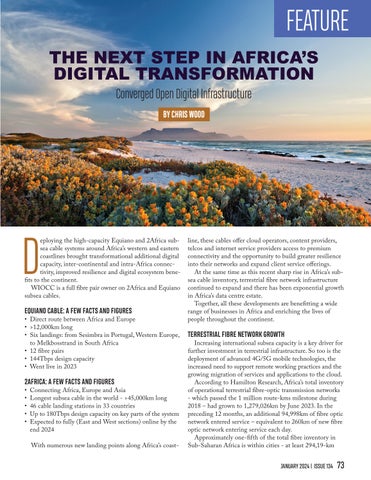
THE NEXT STEP IN AFRICA’S DIGITAL TRANSFORMATION By Chris Wood
EXORDIUM...................................................... 2 SUBTELFORUM.COM........................................ 6
76
INTRODUCING THE SUBTEL FORUM APP
CABLE MAP UPDATE........................................ 8 NEW
SUSTAINABLE SUBSEA..................................... 9 WHERE IN THE WORLD...................................16 CAPACITY CONNECTION.................................. 24 STF ANALYTICS.............................................. 30 BACK REFLECTION......................................... 84
80
ISO 45001: THE VANGUARD OF MARITIME SAFETY AND CLIENT REPRESENTATION
LEGAL & REGULATORY MATTERS..................... 90 ON THE MOVE................................................ 94 SUBMARINE CABLE NEWS NOW..................... 95 ADVERTISER CORNER.................................... 96
By Kristian Nielsen
JANUARY 2024 | ISSUE 134 5
SubTelForum.com
VisitSubTelForum.com SubTelForum.com to to find find links resources Visit linkstotothe thefollowing following resources
FREE RESOURCES FOR OUR SUBTELFORUM.COM READERS INSIDE THE WORLD OFALL SUBTEL FORUM: A COMPREHENSIVE GUIDE TO SUBMARINE CABLE RESOURCES
TOP STORIES OF 2019
W
The most popular articles, Q&As of 2019. out what elcome to an exclusive feature in ourFind magayou missed! zine, where we explore the captivating world of SubTelForum.com, a pivotal player NEWS NOWinRSS theFEED submarine cable industry. This Keep onexpedition top of ourtakes worldusofon coverage with our free News a detailed Now daily industry Now is and a daily RSS feed of journey through theupdate. myriadNews of resources news applicable thekey submarine cable industry, innovations thattoare to understanding and highlighting Cable Faultsour & Maintenance, connecting world beneathConferences the oceans. & Associations, Current Systems, Data Centers, Future Systems, Offshore Energy, the Industry and Technology DISCOVERState THE of FUTURE: THE SUBTEL FORUM APP & Upgrades. 2024 marks a groundbreaking era for SubTel PUBLICATIONS Forum with the launch of its innovative app. Submarine Cable Almanac is a free quarterly This cutting-edge tool is revolutionizing access publication made available through diligent data gathering and to submarine telecommunications insights,
6 SUBMARINE TELECOMS MAGAZINE FORUM MAGAZINE
mapping efforts by the analysts at SubTel Forum Analytics, a divisionreal-time of Submarine Telecoms Forum. This reference blending updates, AI-driven analytics, and a tool gives details on cable includingresource a systemformap, user-centric interface into systems an indispensable inlanding points, system capacity, More length,than RFSjust year and other dustry professionals. a technologvaluable data. ical advancement, this app is a platform fostering Submarine Telecomslearning, Industryand Report is an progression. annual free community, industry publicationWe with analysis of collected by analysts encourage youdata to download thethe SubTel Fo-of SubTel Forum including system at capacity analyrumAnalytics, App and join a community the forefront sis, as well as actualcommunications productivity andinnovation. outlook of current of the undersea and planned systems and the companies that service them.
CABLE MAP
YOUR DAILY UPDATE: NEWS NOW RSS FEED
Our journey begins with the News Now upThe online SubTel Cable daily Map insights is built with dates, providing into the industry submastandard Esri ArcGIS platform and linked to the SubTel rine cable sector. Covering everything from the Forum Submarine Cable Database. It tracks the progress latest technical developments to significant in-of
dustry milestones, this feed ensures you’re always informed about the latest trends and happenings. It’s an essential tool for professionals who need to stay on top of industry news.
THE KNOWLEDGE HUB: MUST-READS & Q&AS
Dive deeper into the world of submarine communications with our curated collection of articles and Q&As. These insightful pieces offer a comprehensive look at both the history and current state of the industry, enriching your understanding and providing a broader perspective on the challenges and triumphs faced by submarine cable professionals.
IN-DEPTH PUBLICATIONS
• Submarine Cable Almanac: This quarterly treasure trove provides detailed information on global cable systems. You can expect rich content including maps, data on system capacity, length, and other critical details that sketch a vivid picture of the global network. • Submarine Telecoms Industry Report: Our annual report takes an analytical approach to the industry, covering everything from current trends to capacity analysis and future predictions. It’s an invaluable resource for anyone seeking to understand the market’s trajectory.
VISUALIZING CONNECTIONS: CABLE MAPS
• Online SubTel Cable Map: An interactive tool mapping over 550 cable systems, perfect for digital natives who prefer an online method to explore global connections. • Printed Cable Map: Our annual printed map caters to those who appreciate a tangible representation of the world’s submarine fiber systems, detailed in a visually appealing and informative format.
EDUCATIONAL OPPORTUNITIES: CONTINUING EDUCATION
SubTel Forum’s commitment to education is evident in our courses and master classes, covering various aspects of the industry. Whether you’re a seasoned professional or new to the field, these learning opportunities are fantastic for deepening your understanding of both technical and commercial aspects of submarine telecoms.
FIND THE EXPERTS: AUTHORS INDEX
Our Authors Index is a valuable tool for locating specific articles and authors. It simplifies the process of finding the information you need or following the work of your favorite contributors in the field.
TAILORED INSIGHTS: SUBTEL FORUM BESPOKE REPORTS
• Data Center & OTT Providers Report: This report delves into the evolving relationship between cable landing stations and data centers, highlighting trends in efficiency and integration. • Global Outlook Report: Offering a comprehensive analysis of the submarine telecoms market, this report includes regional overviews and market forecasts, providing a global perspective on the industry. • Offshore Energy Report: Focusing on the submarine fiber industry’s oil & gas sector, this report examines market trends and technological advancements, offering insights into this specialized area. • Regional Systems Report: This analysis of regional submarine cable markets discusses capacity demands, development strategies, and market dynamics, providing a detailed look at different global regions. • Unrepeatered Systems Report: A thorough examination of unrepeatered cable systems, this report covers project timelines, costs, and operational aspects, essential for understanding this segment of the industry. • Submarine Cable Dataset: An exhaustive resource detailing over 550 fiber optic cable systems, this dataset covers a wide range of operational data, making it a go-to reference for industry specifics. SubTelForum.com stands as a comprehensive portal to the dynamic and intricate world of submarine cable communications. It brings together a diverse range of tools, insights, and resources, each designed to enhance understanding and engagement within this crucial industry. From the cutting-edge SubTel Forum App to in-depth reports and interactive maps, the platform caters to a wide audience, offering unique perspectives and valuable knowledge. Whether you’re a seasoned professional or new to the field, SubTelForum.com is an indispensable resource for anyone looking to deepen their understanding or stay updated in the field of submarine telecommunications.
SCAN THE QR CODE TO ACCESS ALL THE GOODNESS THAT SUBTELFORUM.COM HAS TO OFFER JANUARY 2024 | ISSUE 134 7
SUBTEL CABLE MAP UPDATES
T
he SubTel Cable Map, built on the industry-leading Esri ArcGIS platform, offers a dynamic and engaging way to explore over 440 current and planned cable systems, 50+ cable ships, and more than 1,000 landing points. This interactive tool is linked to the SubTel Forum Submarine Cable Database, providing users with a comprehensive view of the industry. Submarine cables play a pivotal role in global communications, acting as the backbone of the internet. They are responsible for transmitting over 99% of all international data, connecting continents and enabling global connectivity. Without these underwater highways, the speed and efficiency of global internet communication that we enjoy today would not be possible. The Esri ArcGIS platform, upon which the SubTel Cable Map is built, is a powerful geographic information system (GIS) for working with maps and geographic information. It is used for creating and using maps, compiling geographic data, analyzing mapped information, sharing and discovering geographic information, and using maps and geographic information in a range of applications. Its robust capabilities make it an ideal platform for the SubTel Cable Map, allowing for dynamic, interactive exploration of complex data. With systems connected to SubTel Forum’s News Now Feed, users can easily view current and archived news details related to each system. This interactive map is an ongoing effort, updated frequently with valuable data collected by SubTel Forum analysts and insightful feedback from our users. Our aim is to provide not only data from the Submarine Cable Almanac, but also to incorporate additional layers of system information for a comprehensive view of the industry. We encourage you to explore the SubTel Cable Map to deepen your understanding of the industry and to educate others on the critical role that submarine cable systems play in global communications. All submarine cable data for the Online Cable Map is sourced from the public domain, and we’re committed to keeping the information as current as
possible. If you are the point of contact for a company or system that needs updating, please don’t hesitate to reach out to kclark@subtelforum.com. Below is the full list of systems added and updated since the last issue of the magazine:
NOVEMBER 13, 2023 SYSTEMS ADDED: • CPC • Nuvem
SYSTEMS UPDATED: • Humboldt • ACC-1 • Anjana • Apricot • Bifrost • CSN-1 • Gold Data 1 • Hawaiki Nui
We hope the SubTel Cable Map serves as a valuable resource to you and invites you to dive into the ever-evolving world of submarine cable systems. We invite you to start your exploration today and see firsthand the intricate network that powers our global communications. Happy exploring! STF KIERAN CLARK is the Lead Analyst for SubTel Forum. He originally joined SubTel Forum in 2013 as a Broadcast Technician to provide support for live event video streaming. He has 6+ years of live production experience and has worked alongside some of the premier organizations in video web streaming. In 2014, Kieran was promoted to Analyst and is currently responsible for the research and maintenance that supports the Submarine Cable Database. In 2016, he was promoted to Lead Analyst and his analysis is featured in almost the entire array of Subtel Forum Publications.
Do you have further questions on this topic?
ASK AN EXPERT
SUBTELFORUM.COM/CABLEMAP 8 SUBMARINE TELECOMS FORUM MAGAZINE
• SAEx West • SEA-H2X • SING • TOPAZ
SUBSEA SUSTAINABLE SUBSEA NETWORKS IN THE MENA REGION COP28 and the Egypt SubOptic Symposium BY IAGO BOJCZUK AND NICOLE STAROSIELSKI
S
ince its first edition in 1995 in Germany, the Conference of the Parties (COP) to the United Nations Framework Convention on Climate Change (UNFCCC) has annually brought together representatives from around the world—diplomats, governments, members of civil society, and the private sector—to discuss and organize initiatives on the impacts of climate change. Despite controversies and criticism of the slow pace of the decision-making processes, the outcomes of COP are often influential in setting an international agenda. This event is a global forum for debating states’ obligations, assessing progress in combating climate change, and making decisions on the implementation of the UNFCCC. Every year, the topic of connectivity and digital technologies gains more importance at COP. In his opening remarks at COP28 in Dubai, United Arab Emirates (UAE), UN Secretary-General Antonio Guterres told world leaders, “We have the technologies to avoid the worst of climate chaos—if we act now.” Addressing member states from around the world, Guterres emphasized that climate sustainability is the only viable pathway to economic sustainability. In the logo for COP28, satellites feature prominently, situated along with solar panels and wind turbines. This gives the impression that satellites are among the most significant technologies moving us toward a sustainable future. The icons were present everywhere on the sprawling conference grounds at Expo City in Dubai in December 2023. Subsea cables—the backbone of the global internet— were notably absent, even though technologies
Image 1. Satellites surround
and are incorporated into the
COP28 logo.
JANUARY 2024 | ISSUE 134 9
SUBSEA dependent on subsea cables, such as artificial intelligence, were discussed extensively. This oversight of subsea cables was something that Telecom Egypt and the SubOptic Foundation sought to address in a second event in early December in Cairo. The Egypt SubOptic Symposium brought together experts in subsea cables from around the world to speak with students at the Arab Academy for Science, Technology & Marine Transport. Held at the Smart Village, near Telecom Egypt’s headquarters, students were introduced to topics ranging from optics to marine survey, as well as sustainability. Members of the Sustainable Subsea Networks research project traveled to these events to present on how cables are critical to sustainability and vice versa. As an initiative of the SubOptic Foundation, with a mandate to conduct research and facilitate connections that enhance sustainability, we took the opportunity to learn about developments in sustainability of interest to the industry. In this month’s column, we describe some of these lessons learned. We also describe the vision of subsea cable sustainability that we conveyed at these events. We are pleased to announce that new members, recruited from the SubOptic Symposium in Cairo and UAE-based e&, will be joining our international team.
COP28 AND THE FUTURE OF DIGITAL NETWORKS
At the COP pavilions, from the Technology & Innovation Hub to the Energy Transition Hub, networked digital technology was envisioned as part of a sustainable
10 SUBMARINE TELECOMS MAGAZINE
Image 2. The iconic “Energy Trees” surround the Terra Pavilion at Expo City Dubai. These 18 rotating trees, ranging from 10 to 15 meters in height, track the sun’s movement to optimize solar energy absorption. Annually, their solar panels generate about four gigawatt-hours of electricity.
Image 3. Cisco Dashboard Demonstration for Data Centers
future. Artificial intelligence was at the forefront of numerous exhibits, including those showcased by IBM and Microsoft. It was also a central subject of talks and discussions, such
as “Navigating the Intersection of AI and Sustainability” and many other panels and presentations. In the early days of the conference, the United Nations and
Microsoft announced a partnership to develop an AI-powered platform and global climate data hub. This initiative will measure and analyze global progress in reducing emissions in line with the Paris Agreement. The platform will simplify the validation and analysis of climate data submitted by countries. It will also include advanced analysis capabilities and tools for planning carbon reduction strategies. Additionally, a team of researchers led by David Sandalow, a fellow at the School of International and Public Affairs at Columbia University and a former U.S. Energy Department official, issued an “AI for Climate Change Mitigation Roadmap” during COP28. The report recommended the integration of AI tools across climate change mitigation. It also suggested that companies with relevant datasets should consider sharing portions of them publicly. For the remainder of the week, AI—especially the possibilities of generative AI—was present in various forms, even in art exhibits such as the interactive “Tree of Life,” which invited users to pledge to sustainability and rewarded them with a custom AI-generated image. AI was described as a core component of climate tech–including applications in financing, data collection and reporting, prototyping new technologies, and rapidly scaling up climate solutions. As foreshadowed by the COP28 logo, Earth observation satel-
Image 4. Model of the DU data center on display at the Cybersecurity Council exhibit at the Technology & Innovation Pavilion.
Image 5. Video booth of the Moro Green Data Center at the Energy Transition Pavillon at COP28.
lites were also highlighted as sustainable technologies. There was less focus on how to make digital technologies more sustainable or on AI’s energy usage. Cisco’s sustainability dashboard was one outlying example. The fully customizable dashboard allows inputs from building sites—in the demonstration Cisco featured data centers— and enables companies to assess energy usage and emissions produced by networked devices as well as the buildings themselves. Measurement techniques such as this are relevant
for subsea cable landing facility owners and operators, since the tracking of facility and device emissions are a critical part of developing sustainability measures. Sustainable digital infrastructure was also on display in the exhibit for the Moro Hub Data Center, a facility owned by the Dubai Electricity and Water Authority (DEWA). In 2022, it was recognized as the biggest solar-powered data center in the world by Guinness World Records.
JANUARY 2024 | ISSUE 134 11
SUBSEA
Image 6. Nicole Starosielski presenting during COP28 in Dubai.
THE ONLY SUBSEA CABLE DISCUSSION AT COP28
Sustainable Subsea Networks gave the only, and likely first, presentation on subsea cables at COP. Invited by Faisal Al-Samahi, Senior Director of Carrier & Wholesale International Cables at e&, Nicole Starosielski, Professor at the University of California-Berkeley and a Principal Investigator of the Sustainable Subsea Networks project, showcased a synopsis of the state of sustainability in the industry. Starosielski, previewing some of the results of the Sustainable Subsea Networks Best Practices Report, described various aspects of sustainability in the industry. Examples exist in network design, manufacturing, marine operations, cable landing stations, and business operations. The presentation also touched on end-oflife considerations for cables, the de-
12 SUBMARINE TELECOMS FORUM MAGAZINE
velopment of sustainability metrics, and future industry directions. “Actions for sustainability are reshaping the conversations at every stage of the network development, and this is a space where we need young people. Where we need teams who are interested in thinking about how we can do things the best way we can,” Starosielski told the audience. She then presented the two new members of the team, Mariam Alobaid and Jawahir Albannay, two Emirati electrical engineers who currently work in project and product management for Etisalat by e&. Following the presentation, discussions emphasized the importance of collaboration within the subsea cable industry, and participants urged companies in the industry—from manufacturing to operations—to unify their efforts. This involves sharing relevant data, reporting best practices,
testing new technologies, and working to stay ahead of emerging regulatory frameworks. Lessons Learned: Some Relevant Trends for Subsea Cable Networks At COP28, we observed many trends relevant to the subsea cable industry. For example, the conference had many panels that previewed developments in sustainable maritime industries. In one panel Erik Giercksky, head of the UN Global Compact Ocean Stewardship Coalition, emphasized that both collaboration and diverse approaches to building ships were going to be necessary. “The transition should not be limited to a few countries or Danish and French companies, but should include a broader range of nations to tap into the economic opportunities that sustainability can bring about,” he said. As the subsea cable industry is likely to follow the much more expansive
shipping industry, these talks offer a preview of what is to come. We also learned about the role of biofuels as an initial strategy in addressing climate change, specifically biodiesel, which is already in use by many vessels. Many emphasized how the production of biodiesel from sustainable resources needs to be dramatically increased to meet needs by 2030. Others described that while biodiesel is a step forward, it cannot completely address future energy needs. Even if companies cannot make the fuel transition yet, several participants agreed on the importance of starting with small but impactful actions, such as replacing outdated, diesel-intensive equipment with electric generators. In another event focused on the intersections of AI and sustainability, representatives from Microsoft MENA, e& enterprise IoT & AI discussed how ESG practices are now going beyond merely enhancing a company’s image. In the MENA region, and especially in the UAE, they are now seen as a catalyst for un-
locking numerous commercial opportunities, especially when they can be powered by AI. Ahmed Ameen Ashour, Chief Sustainability Commercial Officer at Microsoft MENA, advised: “Start by actively reporting and examining your carbon footprint. It’s important to leverage even the simplest of technologies in this effort. At Microsoft, we acknowledge that much of today’s ESG data management is done using basic applications like Excel. But there’s a significant opportunity to enhance our approach by integrating AI tools. This shift can lead to the emergence of new, powerful capabilities in handling ESG data.” Companies are at various stages of sustainability maturity, and each needs to start where feasible. Practices like measuring, reporting, and benchmarking have shown positive impacts across various sectors, leading to the rise of “Sustainability as a Service”’ in the region and other parts of the world. The use of AI tools has dramatically shifted the landscape in recent years, as more services are
launched enabling the analysis of large data sets and numerous parameters. This trend is not limited to large corporations; small and medium-sized enterprises are also making considerable progress by using new data-focused tools. For the subsea cable industry, such tools may come in handy as accounting and disclosure become more pervasive practices.
EGYPT SUBOPTIC SYMPOSIUM: AN OPPORTUNITY FOR CONNECTION AND LEARNING
Over 100 undergraduate students from the region gathered for the Egypt SubOptic Symposium at the Arab Academy for Science, Technology, and Maritime Transport in Cairo. Organized by Telecom Egypt and the SubOptic Foundation, this event marked the first time a SubOptic Symposium was held in the Middle East & North Africa region. The event brought together industry members to give students an overview of the work involved in delivering a cable system— from research and planning to marine operations and installation.
Image 8. Speakers and students at the Egypt SubOptic Symposium in Cairo.
JANUARY 2024 | ISSUE 134 13
SUBSEA
Image 9. Nicole Starosielski presenting about sustainability in the subsea cable industry to students during the Egypt SubOptic Symposium in Cairo.
After the opening remarks, Mohamed Nasr, Managing Director & CEO of Telecom Egypt, highlighted to the students the global nature of the industry and the importance of possessing a diverse skill set, particularly for talent from the Middle East and North Africa (MENA) region. “You need to continue learning because in this industry, like in any other sector, there is always something new to learn, change, and understand… after all, we are connecting the world,” he mentioned, emphasizing the high stakes and increasing demand for all kinds of talents. This sentiment was echoed throughout the day in many of the presentations and discussions. Elaine Stafford of DRG Undersea Consulting and the SubOptic Foundation described how the amount of data and information generated and necessitated by AI will continue to
14 SUBMARINE TELECOMS FORUM MAGAZINE
require more cable systems. “The expectation is that it will continue to grow,” she explained. As an industry that brings the world together and facilitates the economic, social, and welfare needs of the global
Sustainability should be seen as a collective, mission-driven challenge that can be addressed by collaboration towards a greater purpose. community, sustainability is also an important aspect of the story and the mission to “connect the world.” Sustainability should be seen as a
collective, mission-driven challenge that can be addressed by collaboration towards a greater purpose. Dr. Michael Clare from the UK’s National Oceanography Centre and Marine Environmental Advisor to the International Cable Protection Committee (ICPC) emphasized that the marine environment and oceans are at the heart of climate change work and the UN sustainable development goals. They play an important role in curbing global warming. “There is a really important need to communicate between researchers, governments, and industry, to share knowledge and understanding,” he said, emphasizing the need for a broad understanding of sustainability. Jean Aude from Alcatel Submarine Networks also noted the importance of connecting the industry to science. He mentioned that ASN possesses a substantial amount of data and there
is an ongoing program to disseminate some of this data, which could be crucial for scientists aiming to enhance their understanding of the ocean. “This data feeds into models that facilitate a deeper comprehension of ocean currents and atmospheric circulation. There are certain databases being considered for this purpose,” he remarked. Presenters also discussed the need for training new talent in regions that are developing digital infrastructure. Dr. Ahmad Abdo from Ciena noted, “it is intelligence and local capacity at the edges of these systems around the world that need to make the most of it.” Most universities do not offer direct training opportunities for young talent in fields ranging from STEM disciplines like engineering or physics to oceanography, and social science areas such as law, policy, or economics, to benefit from joining the industry. Attending this Symposium and presenting results from our final report, we continued our efforts to ensure sustainability is part of the ongoing conversation. We also are excited to welcome three talented participants in the event to our research team: Hesham Youssef, Mariam Reda, and Habiba Salem. Sustainability cannot be addressed by a single set of researchers in one part of the world: it must occur in collaboration across the industry and the globe. Luckily, the subsea industry is well-positioned for this collaboration, with a long history of experience in working together to address technical, commercial, and legal and political challenges.
THE NEAR FUTURE
As this year’s edition of COP came
to an end, many proposals emerged. The key decisions include a USD 30 billion climate solutions fund and agreements made to triple renewable energy capacity to 11,000 GW. The final text coming out of COP28, for the first time, has concluded with a call to address the main cause of the climate crisis, fossil fuels, and what some have called the “beginning of the end for the fossil fuel era” that is
“There is a really important need to communicate between researchers, governments, and industry, to share knowledge and understanding." DR. MICHAEL CLARE at the core of climate change. Even with these actions, however, there was a consensus that much more action is required. Critics worldwide stressed the importance of rapidly phasing out fossil fuels. For most of the negotiations, one major concern was the absence of precise language in policies for this phase-out and a need for global accountability. Many climate experts worldwide agreed that the resulting text is only the beginning and many are still divided about what direction the agreement takes us in. As an academic-industry part-
nership, we are working to build a network of scholars, industry members, and citizens committed to greening the internet. Being in Cairo and Dubai has enabled our team to learn more about the MENA region and the possibilities for sustainability there, and perhaps more importantly, develop collaborative partnerships with companies, individuals, and students. We welcome you to join us in this collective effort. STF IAGO BOJCZUK is Ph.D. candidate in the Department of Sociology at the University of Cambridge, where his work investigates the material, cultural, economic, and political dimensions of digital infrastructures in the Global South. NICOLE STAROSIELSKI is Associate Professor of Media, Culture, and Communication at NYU. Dr. Starosielski’s research focuses on the history of the cable industry and the social aspects of submarine cable construction and maintenance. She is author of The Undersea Network (2015), which examines the cultural and environmental dimensions of transoceanic cable systems, beginning with the telegraph cables that formed the first global communications network and extending to the fiber-optic infrastructure. Starosielski has published over forty essays and is author or editor of five books on media, communications technology, and the environment. She is co-convener of SubOptic’s Global Citizen Working Group and a principal investigator on the SubOptic Foundation’s Sustainable Subsea Networks research initiative
Do you have further questions on this topic?
ASK AN EXPERT
JANUARY 2024 | ISSUE 134 15
WHERE IN THE WORLD ARE THOSE PESKY CABLESHIPS? BY SYEDA HUMERA
SUBMARINE TELECOMMUNICATIONS 2024: NAVIGATING THE DEPTHS OF CONNECTIVITY IN A HYPERCONNECTED ERA INTRODUCTION
In our hyperconnected world, the submarine telecommunications industry stands as a vital architect of the digital age. Submarine cables, resembling the lifeblood of our global communication network, weave through the ocean depths, ensuring the seamless flow of data, voice, and video across borders. This report embarks on an exciting exploration, delving into the intricacies, challenges, and opportunities that define the ever-evolving landscape of submarine telecommunications.
THE UNDERSEA WEB
Imagine a captivating web, not spun by spiders but crafted by the brilliance of engineers and visionaries. This invisible web spans the ocean’s depths, connecting nations, businesses, and individuals. Submarine cables, often as slender as a garden hose, serve as the threads of this undersea web, transmitting the vital pulse of our modern civilization—data.
KEY FINDINGS AND TRENDS
Unprecedented Growth: The insatiable demand for data continues to propel extraordinary growth within the submarine telecommunications industry. Bandwidth and connectivity needs have skyrocketed, reflecting the ever-increasing reliance on digital communication. Geopolitical Significance: Submarine cables have transformed into strategic assets, triggering nations to compete
16 SUBMARINE TELECOMS FORUM MAGAZINE
for control and security in an increasingly digital world. The geopolitical landscape is deeply influenced by the pursuit of dominance in undersea connectivity. Environmental Considerations: Recognizing the imperative of sustainability, the industry is actively exploring ways to minimize its environmental footprint and safeguard marine ecosystems. Environmental responsibility has become a central focus amid the industry’s expansion.
THE CARTOGRAPHY OF CONNECTIVITY MAPS: NAVIGATING THE SUBSEA LANDSCAPE IN 2024
Maps are not merely geographical representations; they serve as portals into the intricate network of submarine cables crisscrossing the globe. Understanding this cartography is
crucial for comprehending the industry’s expansive reach and influence in the current year.
TIMELINE VISUALIZATION: CHARTING THE DIGITAL EVOLUTION THROUGH 2024
Timelines unveil the industry’s ongoing evolution, marking milestones from the first transatlantic cable to the latest advancements. Each timeline entry signifies a triumph of human ingenuity, showcasing the continuous progress of undersea connectivity. Embark on this journey with us as we dive into the fascinating world of submarine telecommunications, where innovation, connectivity, and sustainability converge to shape the digital future of 2024.
LINE CHART
Mapping Data’s Unceasing Flow in 2023 “November Insights: A Deep Dive into Speed Averages in the Telecommunications Industry”
INTRODUCTION:
As we delve into the intricacies of the telecommunications industry, November emerges as a pivotal month, wielding a significant impact on the average speed metrics. This report explores the implications of November on speed averages, revealing its noteworthy contribution to the industry landscape.
“SPEED DYNAMICS IN NOVEMBER”
In this section, we dissect the nuances of speed dynamics during the month of November. Analyzing fluctuations, trends, and anomalies provides a comprehensive understanding of how this specific timeframe influences the overall speed metrics within the industry.
“7.20% SURGE: UNRAVELING THE SIGNIFICANCE”
November showcases a remarkable surge, contributing a substantial 7.20% to the average speed in the telecommunications sector. This section delves into the factors driving this surge, examining whether it’s a result of technological advancements, increased demand, or other industry-specific variables.
“AVERAGE SPEED BENCHMARKS: THE INDUSTRY STANDARD” To contextualize the 7.20% surge, this section estab-
JANUARY 2024 | ISSUE 134 17
CABLESHIPS lishes the baseline average speed benchmarks within the telecommunications industry. By comparing November’s performance against these standards, we gain insights into whether this surge represents a deviation from the norm or an expected seasonal pattern.
“INDUSTRY IMPLICATIONS: HOW NOVEMBER SETS THE PACE”
November’s influence extends beyond mere speed metrics. This section explores the broader implications of the observed surge on industry operations, customer experiences, and the competitive landscape. Understanding these implications is crucial for industry stakeholders navigating the dynamic telecommunications market.
NAVIGATING NOVEMBER: DAY 4’S IMPACT ON MONTHLY AIS.SPEED AVERAGES INTRODUCTION:
Amidst the seas of AIS. SPEED data analysis, November’s Day 4 emerges as a focal point, contributing a notable 7.20% to the overall monthly average speed. This report delves into the significance of this specific day, unraveling its impact on the maritime industry’s speed dynamics.
OVERVIEW:
November Day 4 holds a distinctive position, accounting for a substantial 7.20% of the monthly average AIS.SPEED. This analysis seeks to explore the implications of this contribution on the broader maritime landscape.
KEY OBSERVATIONS:
Day 4 Surge: November’s Speed Boost
18 SUBMARINE TELECOMS FORUM MAGAZINE
November Day 4 stands out as a significant contributor, propelling the monthly average AIS.SPEED with a remarkable 7.20% surge. Delve into the factors behind this surge, whether influenced by operational strategies, external events, or industry trends. Monthly Average Benchmark: Contextualizing the Surge Contextualize the 7.20% surge by establishing a bench-
mark for the overall monthly average AIS.SPEED. Analyze whether this contribution represents a deviation from the norm or aligns with expected patterns, shedding light on the reliability and predictability of November Day 4’s impact. Industry Implications: Adapting to Day 4 Trends Explore how this surge on November Day 4 influences maritime operations, route planning, and decision-making within the industry. Understanding the implications enables stakeholders to adapt strategies and optimize resources effectively.
CONCLUSION:
As November’s Day 4 makes a notable 7.20% contribution to the monthly AIS.SPEED average, it becomes imperative for the maritime industry to navigate and adapt to the dynamics of this specific day. By dissecting the surge, contextualizing it within monthly averages, and understanding its implications, stakeholders can harness
data-driven insights to enhance operational efficiency and responsiveness. This report underscores the strategic significance of pinpointing specific days that wield a substantial influence on industry metrics.
VISUALIZING VESSEL STATES: PEAKS AND TROUGHS IN NAVIGATION STATUS – A DATA ODYSSEY OVERVIEW:
Embarking on a journey into Navigation status data, our analysis unveils a captivating story of maritime dynamics. The status “Moored” emerges as a formidable leader, boasting an impressive Count of 3,797. In stark contrast, “Not Under Command” takes a humble position with the lowest Count at 8. This monumental 47,362.50% difference paints a vivid picture of the rich tapestry of vessel states.
VISUAL REPRESENTATION: KEY OBSERVATIONS:
Moored: The Majestic Dominance JANUARY 2024 | ISSUE 134 19
CABLESHIPS AIS.NAME by AIS.NAME and AIS.DESTINATION
Power BI Desktop
CLICK THE IMAGE TO GO TO THE INTERACTIVE VERSION OF THE NETWORK GRAPH “Moored” steals the spotlight with a commanding Count of 3,797. This category asserts its dominance, constituting a significant 33.25% of the overall Count of OBJECTID*, portraying the prevalence and importance of vessels in this state. Not Under Command: A Tranquil Underrepresentation In contrast, “Not Under Command” assumes a tranquil position with the lowest Count of OBJECTID* at 8. This revelation accentuates the unique nature of vessels falling into this category, calling for a closer examination of their role in the maritime dataset. Diverse Range Across All Categories Our analysis spans 6 AIS.NAVSTAT categories, offering a captivating range in the Count of OBJECTID* from a modest 8 in “Not Under Command” to an impressive 3,797 in “Moored.” This diversity showcases the myriad activities and states captured within the maritime dataset.
CONCLUSION
As we unravel the distribution of vessel states through Navigation status categories, the significance for maritime safety, navigation, and traffic management becomes evident. The dominance of “Moored” highlights its pivotal role, while the understated presence of “Not Under Command” beckons us to explore its nuances further.
20 SUBMARINE TELECOMS FORUM MAGAZINE
UPDATE:
The narrative evolves with “Moored” still reigning at 3,797, a staggering 47,362.50% higher than the lowest contender, “Not Under Command,” at 8. “Moored” continues to command 33.25% of the total Count of OBJECTID*. Across all 6 AIS.NAVSTAT, the Count of OBJECTID* unfolds, ranging from 8 to 3,797, showcasing the vast spectrum of maritime states in exquisite detail.
SCATTER CHART: POINTS OF CONNECTION SCATTER PLOT ANALYSIS: AIS.SPEED VS. AIS.DRAUGHT OVERVIEW:
In our exploration of maritime data, two vessels, POLARIS 3 and ILE DE RE, emerged as exceptional entities, boasting the highest average AIS.SPEED and AIS. DRAUGHT, respectively. This scatter plot analysis delves into the intriguing relationship between AIS.SPEED and AIS.DRAUGHT for these remarkable vessels.
VISUAL REPRESENTATION: KEY OBSERVATIONS:
POLARIS 3: Speed Champion POLARIS 3 takes the lead with the highest average
AIS.SPEED at an impressive 12.15. Its data points on the scatter plot are anticipated to gravitate towards the higher end of the AIS.SPEED axis, signifying its exceptional speed capabilities. ILE DE RE: Draught Leader ILE DE RE claims the draught leadership with the highest average AIS.DRAUGHT at 9.27. Its data points on the scatter plot are expected to cluster towards the higher end of the AIS.DRAUGHT axis, illustrating its substantial draught.
SCATTER PLOT INSIGHTS:
Relationship Analysis: By scrutinizing the scatter plot, we aim to unearth potential correlations or patterns between AIS.SPEED and AIS.DRAUGHT for these vessels, providing a deeper understanding of their operational dynamics. Outliers: Identification of outliers in the scatter plot holds the potential to unveil exceptional instances of speed or draught, offering additional insights into the unique characteristics of POLARIS 3 and ILE DE RE.
CONCLUSION:
This scatter plot analysis provides a visual journey into the relationship between AIS.SPEED and AIS. DRAUGHT for POLARIS 3 and ILE DE RE. With POLARIS 3 excelling in speed and ILE DE RE leading in draught, it showcases the diverse attributes of vessels within our dataset.
UPDATE:
Adding a layer of depth to the narrative, POLARIS 3 not only boasts the highest Average of Speed (12.15) but also commands the top position in the Average of Draught (9.27). This update underscores the vessel’s exceptional capabilities in both speed and draught, further enriching our understanding of its unique profile within the maritime landscape.
6. NETWORK GRAPH: THE COMPLEX WEB
Network graphs unveil the intricate connections between cable systems, revealing the interdependence that underpins global communication.
NETWORK GRAPH ANALYSIS: SOURCES AND DESTINATIONS INTRODUCTION
The network graph presented in this report aims to provide a visual representation of the relationships between different sources and their corresponding destinations. This analysis is essential for understanding the patterns of connections and interactions in a complex system, such as transportation, data flow, or supply chains.
DATA COLLECTION AND PREPARATION
The dataset used for this analysis includes information on various sources and their associated destinations. Sources and destinations can represent a range of entities, from airports and cities in transportation networks to data centers and endpoints in telecommunications.
NETWORK GRAPH VISUALIZATION
Network Graph: The Complex Web Network Graph Analysis: Sources and Destinations Introduction: The network graph presented in this report aims to provide a visual representation of the relationships between different sources and their corresponding destinations. This analysis is essential for understanding the patterns of connections and interactions in a complex system, such as transportation, data flow, or supply chains. Data Collection and Preparation: The dataset used for this analysis includes information on various sources and their associated destinations. Sources and destinations can represent a range of entities, from airports and cities in transportation networks to data centers and endpoints in telecommunications. Network Graph Visualization: The network graph below illustrates the connections between sources (nodes) and their destinations (edges). The size of the nodes and the thickness of the edges are proportional to the frequency or significance of connections.
KEY INSIGHTS: HUBS AND CONNECTIVITY:
In the network graph, some sources and destinations serve as hubs with numerous connections. These hubs play a crucial role in facilitating connectivity within the system. The degree centrality of nodes (sources or destinations) can be used to identify the most connected entities. High-degree nodes are potential hubs.
PATTERNS OF FLOW:
Analyzing the directionality of edges can reveal patterns of flow. For example, in transportation networks, arrows may indicate the direction of travel from source to destination. The presence of bidirectional edges suggests mutual JANUARY 2024 | ISSUE 134 21
CABLESHIPS interactions between sources and destinations.
CLUSTERING AND COMMUNITIES:
The network may exhibit clusters or communities of sources and destinations that have stronger connections within their groups than with entities outside of their clusters. Detecting and analyzing such clusters can provide insights into the structure and organization of the system. Practical Applications: Understanding the network of sources and destinations has several practical applications: Optimization: Identifying hubs and high-traffic routes can help optimize resource allocation and logistics. Resilience Planning: Analyzing network connectivity aids in resilience planning by identifying critical nodes and potential vulnerabilities. Route Planning: In transportation networks, this analysis can inform route planning for efficiency and reduced congestion. Conclusion: The network graph of sources and destinations provides a valuable visual representation of the connectivity and relationships within a complex system. By analyzing this graph, we gain insights into hubs, flow patterns, and potential communities within the network. This analysis serves as a foundation for making informed decisions, optimizing operations, and enhancing the resilience of the system. As we continue to navigate and understand complex systems, network graph analysis remains an indispensable tool for uncovering hidden patterns and connections.
DETAILED ANALYSIS: AIS.TYPE DISTRIBUTION - UNVEILING THE DOMINANT PLAYER WITH A DONUT CHART OVERVIEW:
In our meticulous examination of AIS.TYPE distribution, we present a fresh perspective with the introduction of a Donut Chart, offering an engaging visual representation of the prominence of specific types. This analysis focuses on the AIS.TYPE categories, highlighting the highest count, the hierarchy of categories, and their proportional impact on the overall dataset.
VISUAL REPRESENTATION: KEY OBSERVATIONS:
Highest Count - 90 Takes the Lead The AIS.TYPE category 90 emerges as the undisputed leader, commanding the highest count at a substantial 4,706. This category stands out prominently in the center of the Donut Chart, emphasizing its prevalence.
22 SUBMARINE TELECOMS FORUM MAGAZINE
Followed by 33 and 70 In the hierarchy of AIS.TYPE distribution, categories 33 and 70 secure the second and third positions, surrounding the central dominance of category 90 in the Donut Chart. These categories showcase notable counts, contributing significantly to the overall diversity within the dataset. Proportional Impact: Category 90 Dominates with 46.77%: The proportional impact of category 90 becomes visually apparent in the Donut Chart, occupying a significant portion of the overall chart. Accounting for a staggering 46.77% of the total Count of AIS.TYPE, this category remains the focal point in shaping the landscape of AIS. TYPE distribution.
CONCLUSION:
The AIS.TYPE analysis, presented in the innovative form of a Donut Chart, not only captures the numerical distribution but also provides a visually engaging perspective on the dominance and hierarchy within the dataset. Understanding the significance of each category is pivotal for contextualizing the dataset, and the introduction of the Donut Chart adds a layer of clarity and aesthetics to this exploration.
SIGNIFICANCE:
The introduction of the Donut Chart in this detailed analysis enhances the accessibility and visual impact of the AIS.TYPE distribution insights. Stakeholders can now grasp the hierarchy, dominance, and proportional impact of each category in a more intuitive and engaging manner, facilitating a deeper understanding of the dataset’s dynamics.
EXPLORING VESSEL DISTRIBUTION: A VISUAL SYMPHONY WITH WATERFALL CHART DYNAMICS OVERVIEW:
Dive into the intricate dance of vessel distribution across 26 distinct zones as we unveil a fresh perspective using the visually captivating Waterfall Chart. This analysis delves deep into the hierarchy of vessel counts, showcasing the vast disparities between zones, and accentuating the proportional influence each zone wields on the broader dataset.
VISUAL REPRESENTATION: KEY OBSERVATIONS:
Highest Count - East Asia Ascends East Asia, a towering giant in the maritime landscape, claims the throne with the highest Count of Vessel at an impressive 1,509. Watch as this pinnacle is visually portrayed at the summit of the Waterfall Chart, underscoring its dominance and significance among the zones. Followed by Indian Ocean As the cascade descends, the Indian Ocean gracefully assumes the second position with the lowest Count of Vessel at 39. Observe the dramatic drop, symbolizing the diverse distribution of vessels across these zones, each with its unique characteristics and maritime identity. Proportional Impact: East Asia Dominates with 15.00%: Let your eyes follow the flow of the Waterfall Chart as East Asia exerts its proportional impact, occupying a substantial portion of the visual canvas. Accounting for 15.00% of the total Count of Vessel, East Asia emerges as a central force shaping the landscape of vessel distribution.
CONCLUSION:
The Waterfall Chart becomes a mesmerizing visual narrative, weaving together the tale of vessel distribution across diverse zones. From East Asia’s commanding presence to the subtlety of the Indian Ocean, each zone contributes to a nuanced understanding of the dataset, unveiling a rich tapestry of maritime dynamics.
SIGNIFICANCE:
The introduction of the Waterfall Chart in this detailed analysis transforms data into a visual symphony, enhancing accessibility and engagement. Stakeholders are invited to traverse the cascading tiers, observe the hierarchy, and appreciate the proportional significance of each zone in a visually intuitive manner. This dynamic presentation enriches their comprehension of the dataset’s complex interplay, offering insights that extend beyond mere numbers.
CONCLUSION
The submarine telecommunications industry, a beacon of connectivity in our contemporary world, not only facilitates global communication but also symbolizes a bridge connecting nations and people across vast oceans. In the midst of its pivotal role, this industry faces multifaceted challenges, navigating through geopolitical intricacies and grappling with environmental considerations. As we culminate this report, consider it an invitation
to embark on a profound journey of exploration into the hidden realms of undersea cables. Our mission has been to unravel the intricacies, celebrate industry triumphs, and chart a course toward an era where connectivity transcends all boundaries. Throughout these pages, we’ve delved into the concealed world of undersea cables, where cutting-edge technology converges with the boundless expanses of the world’s oceans. The collective voyage we’ve undertaken aims to unearth the industry’s secrets, comprehend its profound significance, and illuminate the path forward in this age of limitless connectivity.
NEW INSIGHTS, NEW HORIZONS:
Now, as we augment our understanding with new insights, the landscape of submarine telecommunications undergoes dynamic changes. The industry grapples with unprecedented demands for data, leading to unrelenting growth. Geopolitical significance becomes more pronounced, and environmental responsibility takes center stage in the industry’s expansion. In this updated context, the submarine telecommunications industry stands at the forefront of technological innovation, driven by an insatiable appetite for data. Geopolitics intertwines with undersea connectivity, shaping the industry’s landscape. The imperative of sustainability and environmental responsibility fuels endeavors to minimize the industry’s footprint on marine ecosystems.
FORWARD INTO LIMITLESS CONNECTIVITY:
As we conclude, we find ourselves on the cusp of a new era in submarine telecommunications. The industry’s odyssey into the future beckons us to explore uncharted territories, adapt to emerging challenges, and continue fostering connectivity that transcends limitations. Together, let us sail into this era where submarine cables not only bridge continents but also pave the way for a truly interconnected world. STF SYEDA HUMERA, a graduate from JNTUH and Central Michigan University, holds a Bachelor’s degree in Electronics and Communication Science and a Master’s degree in Computer Science. She has practical experience as a Software Developer at ALM Software Solutions, India, where she honed her skills in MLflow, JavaScript, GCP, Docker, DevOps, and more. Her expertise includes Data Visualization, Scikit-Learn, Databases, Ansible, Data Analytics, AI, and Programming. Having completed her Master’s degree, Humera is now poised to apply her comprehensive skills and knowledge in the field of computer science.
JANUARY 2024 | ISSUE 134 23
CAPACITY
CONNECTION SUBSEA
DYNAMICS OF THE SUBMARINE CABLE BANDWIDTH MARKET: FACTORS INFLUENCING DEMAND AND PRICE BY JOHN MAGUIRE
INTRODUCTION
Welcome to Submarine Telecom Forum’s new department, Capacity Connections. In this section of the magazine over the coming months we’re going to look at commercial aspects of the submarine cable industry: The capacity market. This is where all the technical wizardry involved in dense wave division multiplexing (DWDM), reconfigurable optical add/drop multiplexers (ROADMs), wavelength selective switching (WSS) and the ‘open cable’ meets, usually, the telco that integrates and provides the services that connect our homes and offices—indeed, our mobile devices—delivering us the benefit of all of this wizardry. In an era where global connectivity is so fundamental to our lives, submarine cables play a critical role, enabling transfer of vast amounts of data across oceans, connecting continents and—as we shall later in this series see—communities on much smaller landmasses. These undersea fiber-optic systems form the backbone of international communication connectivity and provide for a seamless flow of information. The bandwidth market associated with submarine cables is a complex and dynamic environment, influenced by a variety of factors on both the supply and demand sides that affect pricing. This initial article surveys the state of the bandwidth market in submarine cables, identifying key factors
24 SUBMARINE TELECOMS FORUM MAGAZINE
that drive demand, prompt new cable builds to address supply issues and, consequently, shape pricing strategies. We identify factors here and describe them at a high level. In forthcoming articles, we’ll look in at some of the factors in greater detail, remaining focussed on the non-technical dimensions that are perhaps not elsewhere widely considered in Subtel Forum.
THE SUBMARINE CABLE ENVIRONMENT
Since the mid-19th century, when the first telegraph cables were laid across the Atlantic Ocean, continuous generational technological advancements have transformed these cables from copper telegraph lines to today’s high-capacity fiber-optic
networks. Where we used to measure cable capacity in ‘simultaneous telephone calls’ we now, generally—and only if compelled—speak of how many HD movies a cable could deliver in a second. As we’ve evolved from a population of people talking on the telephone to one watching HD movies on our mobile devices, global demand for data has surged exponentially. It continues to do so, driven by the proliferation of digital services, cloud computing, artificial intelligence, mobility and the internet of things (IoT). As a result, of these shifts in use cases coupled with advancements in submarine cable technology, the submarine cable industry has wit-
nessed a substantial increase in both the number of cables and their total capacity. This growth is indicative of the crucial role submarine cables play in meeting the ever escalating global demand for bandwidth.
FACTORS AFFECTING PRICING CABLE INFRASTRUCTURE AND TECHNOLOGY
The cost of laying and maintaining submarine cables is a significant factor influencing bandwidth pricing. The technological specifications of the cables, including their respective capacity and data transmission capabilities, impact their construction cost. Upgrading existing or deploying new cables with the latest technology allows for higher data rates that can, indeed must, affect end user pricing. (For our purposes, an end user is the telco—usually the last entity in the value chain who directly buys fiber pairs or discrete capacity in a submarine cable). The adoption of technologies, such as DWDM, ROADMs and WSS for example, has greatly increased bandwidth availability and utility in a submarine cable. Similarly, the concept of the ‘open cable’ has lowered barriers to entry and fostered ‘cooperatition’ (cooperating while competing1). These innovations contribute to increased efficiency, but also entail higher overall upfront cost, again affecting the overall pricing strategy of submarine bandwidth providers.
REGULATORY ENVIRONMENT
The regulatory landscape also significantly influences submarine cable 1 http://ethonomics.org/ethonomics-unpacked/fourkey-ideas/cooperatition/
Figure 1: Cable map showing cables transiting from the Red Sea to the Mediterranean (Source: subtelforum.com/online-map/)
pricing. Governments and regulatory bodies may impose license fees, duties, or other regulatory requirements on submarine cable operators. Complicated cabotage arrangements associated with maintaining and repairing systems are a perennial headache. Regulatory costs become part of the overall financial structure and ultimately are covered in business models that feed into bandwidth pricing. Furthermore, regulatory barriers to entry can affect the level of competition in specific regions. Restrictions on new cable installations or limitations on foreign ownership may create oligopolistic markets, where a few
providers have a dominant position, influencing pricing dynamics.
COMPETITION
The submarine cable industry is marked by intense competition among providers in every level of the vertical, all vying for a share of the global market—this is no less true for cable operators in respect of bandwidth than elsewhere. The presence of multiple cables on the same route connecting major data hubs can lead to competitive pricing as providers seek to attract customers from one another. The strategic positioning of JANUARY 2024 | ISSUE 134 25
CAPACITY
CONNECTION
submarine cables also plays a role in determining competition. Cables connecting major economic centers or serving as primary links between continents often face greater demand, allowing providers to command higher prices for their bandwidth services—or encouraging new entrants.
routes. These routes have historically been less attractive, so one is forced to infer that they will have an impact on cable build costs and, ultimately, bandwidth prices.
REGULATORY-COMPETITIVE NEXUS
The increasing penetration of the internet across the globe is a primary driver of bandwidth demand. As more regions and countries—and more people within them—gain internet access, the demand for international connectivity grows. Emerging economies, in particular, contribute significantly to the rising demand for submarine cable bandwidth as they integrate into the global digital economy. The government of Bangladesh, for example, is reported to be forecasting growth nationally from an aggregate 5 Tbps today to 35 Tbps in the next two years, as 5G mobile rolls out and the nation’s schools go online2. Taken in isolation, this is an incredibly exciting prospect, but what it really points to is vast latent demand. Where else does it exist?
Two special ‘local’ factors need to be identified and considered separately from global issues. It is difficult to classify either as solely a regulatory or a competitive issue. First of these is the question of Egypt. Since the first cables connecting East Asia to Europe were built, with SEAMEWE in 1985, each cable connecting East and West has had to transit Egypt. No one looking at regulation and market issues as they affect pricing can ignore this situation. Egypt has had a monopoly, enforced by successive Egyptian governments, on this transit. Bearing in mind that they’re driven by the need for diversity as well as to avoid monopoly rent, it is exciting to see efforts now being made to break this, but we need to remain cautious, as a cosy duopoly or oligopoly is rarely much better from a consumer’s point of view than a monopoly. The South China Sea also deserves special mention. This is a region where a plethora of competing maritime territorial claims is being pursued by the surrounding countries. Military activity, ‘dark ships’ and suspicious activities surrounding submarine infrastructure—all wrapped up in complicated permitting and cabotage arrangements— have rendered it attractive to builders of new cables to consider alternative
26 SUBMARINE TELECOMS FORUM MAGAZINE
FACTORS INFLUENCING DEMAND GLOBAL INTERNET PENETRATION
MOBILE EVOLUTION: 5G AND THE INTERNET OF THINGS (IOT)
The proliferation of mobile devices, including growing penetration of smartphones and tablets, also fuels bandwidth demand. The mobile consumption of rich media content, online streaming services, and social media, contribute to the need for higher data transfer rates and this ever-growing demand drives submarine cable operators—a category that includes such internet giants as Meta and Google— 2 https://www.thedailystar.net/business/news/threefirms-spending-tk-1000cr-first-private-submarine-cable-3481351
to rise to meet these demands. The rise of IoT and the deployment of 5G networks contribute to the exponential growth in connected devices. This will grow further when 5G roaming becomes prevalent. From smart cities to industrial automation, these technologies rely on a robust and low-latency global communication infrastructure, of which submarine cables are an integral and essential part. The surge in the number of connected devices and the need for real-time data transfer propel the demand for ever higher bandwidth capacity at sustainable prices.
CLOUD SERVICES AND DATA CENTERS
The expansion of cloud services, the growth in the number of cloud regions and the consequent establishment of increasing numbers of large-scale data centers, are key factors driving bandwidth demand. Cloud providers rely heavily on robust and high-capacity networks to ensure seamless access to data and applications hosted in the cloud. Submarine cables play a critical role in connecting these data centers across different logical and geographical regions. The concept of the open cable also feeds into this as the traditional, discrete, dedicated cable landing station building built near a coast is progressively being superseded by high-end, competitive data centers in which separate fiber pairs from the same submarine cable are terminated competitively. The growth of Artificial Intelligence (AI), edge computing and the trend of enterprises migrating IT infrastructure to the cloud, further amplifies the demand for reliable and high-performance submarine cable connectivity.
Bandwidth providers catering to the needs of cloud service providers find themselves in a position to capitalize on the growing demand for intercontinental data transfer.
FUTURE TRENDS AND CHALLENGES CABLE MAINTENANCE, CAPACITY UPGRADES AND NEW CABLE DEPLOYMENTS
Cable maintenance and repair is an area of real impact commercially. If we consider a typical, say, 20-year indefeasible right of use (IRU) in a new submarine cable costing US$ 100 million. This asset will have an annual operations and maintenance (O&M) charge of, perhaps, 3.5%. Over the lifetime of the IRU, its owner will pay charges of US$ 70 million in addition to the original purchase price. Increasing efficiency in new cables, driving down the unit cost of new bandwidth, can quickly render a mature but not technically obsolescent system uneconomical and can see commercially reasonable outcomes delivered by technically unnecessary factors. Do we need to consider new O&M models? To meet the escalating demand for bandwidth, the industry is witnessing a continuous cycle of capacity upgrades and the deployment of new submarine cables. Suppliers invest in research and development to enhance transmission technologies and increase the overall capacity of networks. Additionally, new cable projects are planned to connect underserved regions and accommodate growing data traffic between major global data hubs and much smaller centers. These developments, while addressing the demand for bandwidth, also present challenges related to funding, regulatory approvals, and environmental
considerations as well as the ultimate test: sustainability. We see interesting developments by the previously named internet behemoths. Such is their confidence in their architecture, and the demand they see, that they are now investing prospectively—an entirely new departure for the industry—in manufacturing cable or electronics against future builds. This is a boon for the affected suppliers, but one wonders if bottlenecks might emerge further down the value chain, and what might be done to mitigate them if that becomes necessary.
SUSTAINABILITY
The environmental impact of submarine cables, from manufacturing to deployment and maintenance, is gaining attention. As the industry expands, there is a growing emphasis on adopting sustainable practices and minimizing the ecological footprint of cable projects. Innovations in eco-friendly materials, cable deployment techniques, and energy-efficient technologies are likely to become more prevalent in future submarine cable projects.
SECURITY AND RESILIENCE
As the importance of submarine cables in global communication grows, ensuring the security and resilience of these networks becomes paramount. The risk of cable damage due to natural disasters, accidents, or intentional disruptions poses a significant threat to international connectivity. Bandwidth providers are investing in technologies and strategies to enhance the security and redundancy of submarine cable networks, mitigating the potential impact of disruptions.
IN CONCLUSION
The state of the bandwidth market in submarine cables reflects a dynamic and evolving landscape shaped by technological advancements, market competition, and global connectivity trends. The interplay of factors influencing both pricing and demand underscores the complexity of the industry. As the world becomes more interconnected, the submarine cable industry will continue to play a pivotal role in enabling the seamless flow of information, and its evolution will be marked by ongoing innovations, challenges, and responses to the ever-growing demand for international bandwidth at prices that enhance, not inhibit that growth. In our next issue, we shall examine how new procurement approaches being wrought by a small number of big players are changing the economics of the industry in one geography and ponder on the possible broader global implications of these changes. STF Currently Director, EMEA, with APTelecom, JOHN MAGUIRE has experience gained across a broad spectrum of telecommunications roles and businesses over the past 30 years. He has sold security and network control software to mobile networks worldwide; established a regional federation fibre network across a family of affiliated telcos and, several times, established interconnect networks and wholesale structures for leading telco brands in new entry and emerging markets. He’s done this in roles across the business: using satellite and cable technology, for OEM and service provider companies and in fixed and mobile domains—including for start-ups and mature companies. His roles have encompassed general management, sales management, direct and indirect sales, business development, market development and operations. A native of Dublin, Ireland, he’s also lived and worked in Australia, UK, Singapore, Hong Kong, Thailand, Qatar, UAE and Malaysia. John holds a B.Tech. degree from University of Limerick in Ireland and an M.A. from Macquarie University Graduate School of Management in Sydney, Australia.
JANUARY 2024 | ISSUE 134 27
28 SUBMARINE TELECOMS FORUM MAGAZINE
Converged Connectivity Consulting APTelecom is an award-winning consulting firm founded in 2009. APTelecom’s reach and expertise spans a wide range of emerging global markets. Among the company’s core offerings are due diligence, fiber sales, data center and strategic consulting services.
Connectivity Data Center Services Due Diligence Emerging Markets Satellite Education
aptelecom.com
JANUARY 2024 | ISSUE 134 29
ANALYTICS
[Reprinted from SubTel Forum 2023/2024 Submarine Industry Report]
GLOBAL OUTLOOK
A Snapshot Of Where We Are And Where We Are Headed GLOBAL OVERVIEW | EXECUTIVE SUMMARY
T
he submarine fiber optic telecommunications industry is experiencing increased data demand, largely driven by the adoption of cloud services, mobile devices, and new technologies like 5G. This demand is both quantitative and qualitative, as the types of data being transmitted are also changing. While these cables have traditionally carried telecommunication data, there is now a growing share of content and cloudbased data. This change aligns with broader shifts in global data consumption, where streaming services, cloud computing, and data centers are becoming more central. Data from 2018 to 2023 shows a Compound Annual Growth Rate (CAGR) of 13.3% in submarine fiber capacity on major routes, such as the Transatlantic sector. These figures, while indicating growth, also represent a decrease from previous periods. Future projections estimate a 75.4% increase in global capacity by 2025, contingent on the successful development of new systems, many of which are still in early stages. Financially, the industry has attracted $21 billion in investments from 2012 to 2023. The investment pattern is cyclical, with fluctuations occurring approximately every eight to nine years. In 2023, investments peaked at $5.2 billion, contrasting with a low of $0.5 billion in 2015. Despite the current downturn, the anticipated global bandwidth demand suggests a likely increase in financial activity between 2024 and 2025. Operationally, the industry has installed approximately 670,000 kilometers of cable over the last decade. Australasia has been a significant contributor, responsible for 27% of total investments from 2019 to 2023. In terms of technology, the industry is rapidly adopting 400G wavelengths and high fiber pair count systems, essential for meeting the burgeoning data demands and maintaining global competitiveness. Developed markets are generally early adopters of these technologies. Ad-
30 SUBMARINE TELECOMS FORUM MAGAZINE
ditionally, the integration of Artificial Intelligence (AI) is revolutionizing advanced monitoring and predictive maintenance. AI algorithms analyze data from sensors and undersea cable systems to identify potential issues before they escalate, allowing for proactive maintenance and optimized system performance. These technological advancements are not only meeting growing data demands but also significantly improving the energy efficiency and decision-making speed in new system deployments. The role of Hyperscalers such as Google, Amazon, and Facebook is becoming increasingly pivotal in shaping the submarine fiber optic telecommunications industry. These tech giants are not merely investing in the industry; they are becoming key players by owning a significant share of private networks. Their investments are particularly concentrated in high-traffic routes like the Transpacific and Transatlantic sectors. This shift towards private ownership is a game-changer, fundamentally altering the industry’s traditional business models. It’s not just a matter of who owns the cables; it’s about who controls the data and, by extension, the global digital infrastructure. The impact of this shift is most evident in regions undergoing rapid digital transformation, where Hyperscalers are becoming the main contributors to new capacity. Notably, these Hyperscalers are not passive investors but active influencers. They have specific requirements for high-capacity, low-latency connections to serve their sprawling data center networks. These needs are pushing the industry towards rapid technological advancements, including the adoption of 400G wavelengths and high fiber pair count systems. Their financial resources and strategic imperatives often position them as early adopters, setting the pace for the rest of the industry. This trend is particularly pronounced in the Americas, Transatlantic, and Transpacific regions, where Hyperscaler investments
are driving the demand for new systems and influencing the types of technologies that are being adopted. On the financial front, the industry’s investment cycles often align with these technological shifts and market strategies. This synchronicity suggests an industry that is not just reactive but strategically poised to leverage emerging market opportunities. Investments in the industry have been cyclical, peaking at intervals of approximately eight to nine years. The most recent peak in 2023 saw investments reach $5.2 billion, contrasting with a low of $0.5 billion in 2015. Despite this cyclical nature, the underlying trend points to a likely increase in financial activity, especially between 2024 and 2025, driven by the anticipated global bandwidth demand. Regionally, the Americas stand out as a hub of activity, with total capacity increasing nearly fourfold from 2016 to 2020. However, this growth comes with nuances. The average yearly lit capacity in the region remains relatively low, suggesting a level of market caution. This could be attributed to various factors, including economic volatility and political uncertainties, particularly in Latin America. This region presents a complex landscape of both opportunities and challenges, with its lower lit capacity potentially indicative of either market overestimation or caution stemming from regional instabilities. In contrast, the EMEA region is experiencing a steady upward trajectory. Several factors contribute to this growth, including the need to upgrade aging infrastructure and the rising demands from data centers. The region is also becoming a focal point for future installations as data processing requirements evolve. The role of edge computing, which involves processing data closer to its source, is becoming increasingly significant. This could lead to a more complex network topology, requiring strategic planning and potentially offering new opportunities for the industry. In terms of financing, the industry is witnessing a shift towards more diversified investment sources. While consortium models have traditionally been the backbone for funding, there is a growing role for private equity and infrastructure-focused funds. This diversification is not just a financial strategy; it’s a catalyst for faster decision-making and potentially quicker deployment of new systems. The industry is also becoming more agile in leveraging market opportunities, thanks in part to this financial flexibility. Geopolitical factors are another critical dimension. National security concerns are leading to increased scrutiny over the ownership and control of submarine cable systems. This has resulted in more stringent regulatory frameworks, which are influencing the choice of routes and landing points for new cables. The industry is adapting by conducting comprehensive risk assessments and
diversifying routes to minimize geopolitical risks, thereby ensuring a more resilient global network. The growing importance of edge computing is also shaping the planning of new submarine cable systems. As data processing moves closer to the data source, the industry is considering how to integrate these new architectures into the design and deployment of submarine cables. This could lead to more distributed landing points and a more complex network topology, offering both challenges and opportunities for the industry. In the area of maintenance and repair, there is a move towards more predictive and proactive approaches. Advances in monitoring technologies are enabling real-time health checks and predictive analytics, aimed at minimizing downtime and ensuring more reliable service. This focus on reliability is not just a technical requirement but a business imperative, given the critical nature of submarine cables for global communications. Another emerging trend is the industry’s focus on environmental sustainability. As the global push for greener technologies gains momentum, suppliers are becoming increasingly conscious of the ecological impact of their activities. Environmental assessments are now a standard part of the planning and implementation process for new cable deployments. This focus on sustainability is not just a response to regulatory requirements but also a proactive measure to mitigate the environmental footprint of submarine cable systems. It’s becoming a competitive differentiator and a point of corporate social responsibility that stakeholders are paying close attention to. The role of public-private partnerships is also gaining prominence in the industry. Governments and private enterprises are collaborating more than ever to fund and deploy new systems, especially in regions that are strategically important but may not offer immediate commercial incentives. These partnerships are crucial for expanding connectivity to underserved areas and for enhancing geopolitical ties, thereby contributing to the industry’s long-term resilience and growth. In conclusion, the submarine cable industry is undergoing a transformative phase, significantly influenced by technological advancements, including the integration of Artificial Intelligence. These are coupled with shifting data consumption patterns, diversified funding sources, and geopolitical considerations. These trends are not only expanding the industry’s capabilities but also adding layers of complexity that necessitate agile strategic planning and innovation. Despite these multifaceted challenges, the industry appears well-prepared to navigate them, fortified by its ongoing commitment to technological innovation and strategic adaptation. STF JANUARY 2024 | ISSUE 134 31
ANALYTICS
INDUSTRY SENTIMENT
T
his survey was conducted over several weeks and promoted through regular SubTel Forum publications as well as social media channels. We’re delighted to announce that the survey garnered over 100 responses, setting a new record for our Industry Sentiment feature. The industry’s overall outlook is overwhelmingly optimistic. Notably, the categories of “very pessimistic,” “pessimistic,” and “neutral” were not selected by any respondents. Compared to last year, the “very optimistic” category has seen an approximate 15% increase, indicating a highly positive view of the industry. In line with this optimism, most respondents have reported a more favorable perception of market activity. Over half have experienced or observed an increase in work compared to the previous year. However, the uptick in work has led to some slowdowns due to longer work queues. Respondents have noted a nearly 20% increase in project delays since last year, although the “significant delay” category has diminished.
The EMEA (Europe, Middle East, and Africa) region continues to dominate the industry, with projects like 2Africa and Sea-Me-We 6 capturing much of the sector’s focus. Other regions, such as AustralAsia and Transpacific, have also seen growth, largely due to the exploration of new routes. Despite the industry’s apparent boom, there has been a slight decrease in investment levels compared to last year’s survey. While investment remains near average, the “below average” category has seen a close to 15% increase. The survey reveals a highly optimistic outlook for the industry, with a record number of respondents and a significant increase in the “very optimistic” category. While there has been a surge in work and market activity, it has also led to some project delays. The EMEA region remains the industry’s stronghold, but other regions are also showing growth. Investment levels have slightly cooled but remain near average. Overall, the industry appears to be on a positive trajectory, albeit with some areas for improvement. STF
Compared to last year, the “very optimistic” category has seen an approximate 15% increase, indicating a highly positive view of the industry.
32 SUBMARINE TELECOMS FORUM MAGAZINE
GLOBAL OVERVIEW | INDUSTRY SENTIMENT
INDUSTRY SENTIMENT
Figure 1: Overall State of the Industry, 2023
Figure 2: Market Activity, 2023
JANUARY 2024 | ISSUE 134 33
INDUSTRY SENTIMENT
Figure 3: Project Status, 2023
Figure 4: Work Status, 2023
34 SUBMARINE TELECOMS FORUM MAGAZINE
GLOBAL OVERVIEW | INDUSTRY SENTIMENT
INDUSTRY SENTIMENT
Figure 5: Industry Investment, 2023
Figure 6: Regional Activity, 2023
JANUARY 2024 | ISSUE 134 35
GETTING TO KNOW YOU
Figure 7: What is Your Job Function?, 2023
Figure 8: What is Your Purchasing Power in Your Organization?, 2023
36 SUBMARINE TELECOMS FORUM MAGAZINE
GLOBAL OVERVIEW | INDUSTRY SENTIMENT
GETTING TO KNOW YOU
Figure 9: How Many Years Have You Been in the Industry?, 2023
Figure 10: Where do you Reside?, 2023
JANUARY 2024 | ISSUE 134 37
SYSTEM GROWTH
I
n the realm of submarine cable systems, the far-reaching and enduring effects of the COVID-19 pandemic continue to reveal themselves, with their full scope becoming increasingly clear. Contrary to initial expectations, the pandemic’s true impact on the submarine cable industry didn’t fully manifest in 2020 or 2021 but is anticipated to have a more significant influence in the coming years. While projects that were already in the
planning stages during the pandemic generally stayed on course, some experienced notable delays. In contrast, projects that had not yet started essential surveys, manufacturing, or installation faced significant setbacks. It’s important to note that the planning and preparation phase for a submarine cable system, from concept to operation, is typically shorter than the actual installation and commissioning phases. As a result, the number of
Figure 25: New System Count by Region, 2019-2023
38 SUBMARINE TELECOMS FORUM MAGAZINE
GLOBAL OVERVIEW | SYSTEM GROWTH
Figure 26: KMS Added by Region, 2019-2023
Figure 27: Planned Systems by Region, 2023-2027
completed submarine cable systems in the post-pandemic years is expected to fall short of the ambitious forecasts made before the pandemic began. Since our last Industry Report, the sector has seen substantial progress. PRAT, CDSCN, NO-UK, Cross Channel Fiber, and HAVSIL have all been successfully commissioned and accepted, adding a total of 18 new submarine cable systems to the service roster by the end of 2021. This momentum has carried into 2022, with an additional eleven submarine cable systems becoming operational. Notably, Equiano and Grace Hopper are
nearing service activation, poised to further enrich the industry’s connectivity landscape by year’s end. These advancements and ongoing trends highlight the resilience and adaptability of the submarine cable industry, emphasizing its vital role in sustaining global connectivity. In the current year, submarine cable systems have made significant strides in four key regions: EMEA, Indian Ocean, Americas, and Australasia. EMEA leads the pack with the most cable installations over the past five years, totaling 35 systems. Additionally, the Indian Ocean region is set to add five new systems this year. JANUARY 2024 | ISSUE 134 39
ANALYTICS
Figure 28: Contract in Force Rate, 2023-2027
The Transatlantic region also marked a milestone with the Amitié system entering service this year, further enhancing connectivity. When we shift our focus to the total kilometers of cable installed, a different narrative emerges compared to the number of new systems. It’s evident that the number of new systems added in some regions did not always directly correlate with the amount of kilometers installed. For instance, the Transpacific region added only two cable systems over the past five years, but these systems collectively span 24,000 kilometers. In contrast, EMEA outpaced all other regions by adding 63,000 kilometers of cable and also recorded the highest annual increase in new cable. Globally, there are 87 planned submarine cable systems expected to be completed over the next five years. Within this group, a significant subset of precisely 31 systems is projecting a 2023 Ready for Service (RFS) date. While certain systems like Equiano and Grace Hopper are nearing completion and are poised to go live before the end of this year, it seems unlikely that all the remaining systems targeting a 2023 RFS date will successfully meet this goal. Some have already begun the installation process and may face minor delays, potentially pushing their deployment schedules into 2024, while others could encounter more substantial setbacks. Looking ahead, EMEA and Australasia are set for significant growth through 2025. EMEA, with upcoming projects like Africa1, Equiano, 2Africa, PEACE, and SHARE, is expected to complete a
40 SUBMARINE TELECOMS FORUM MAGAZINE
multitude of systems, accounting for 29 percent of all future announced systems in this region. Similarly, Australasia is projected to host 22 percent of all planned projects, featuring key initiatives like ADC, PDSCN, and Apricot. In contrast, the Americas are looking to add 14 more systems, followed by 12 in the Indian Ocean and 10 in the Transpacific region by the close of 2025. The Transatlantic region is slated to introduce an additional four systems during this timeframe. Although making up just four percent of the total announced systems through 2025, the Polar region plans to add four systems, marking an astonishing 166 percent increase. In a groundbreaking move, Chile expressed interest in November 2021 to install a cable connecting Antarctica, aiming to advance scientific and technological development in its southern regions. If achieved, this would establish the first-ever connection to the continent. For various reasons, some submarine cable systems never advance beyond the planning stage. SubTel Forum has determined that achieving a Contract in Force (CIF) status is a strong indicator of whether a system will eventually become operational. Currently, 48 percent of planned systems have reached CIF status, while the remaining 52 percent have yet to hit this crucial milestone (Figure 18). Some of these systems are in the early stages of development, having only been recently announced, and are expected to provide further updates in the months to come. However, some may never make it to the ocean floor. STF
OUT OF SERVICE SYSTEMS ANALYSIS PERSPECTIVES OF KRISTIAN NIELSEN
An in-depth examination of the complexities and solutions related to the decommissioning of Outof-Service (OOS) submarine cable systems reveals critical insights into this often-overlooked aspect of the industry. Despite many cable systems exceeding their estimated End-ofService (EOS) dates, the decommissioning of these systems often goes unnoticed and rarely makes headlines. However, recent developments have brought attention to this issue. Specifically, the International Cable Protection Committee (ICPC) and companies like Mertech Marine and Submarine Cable Salvage have confirmed the decommissioning of two submarine cable systems this year. Mertech Marine has been a pioneer in this sector for over 18 years. They have developed a comprehensive system for acquiring OOS cables from owners, recovering
Video 5: Kristian Nielsen, Quality & Client Fulfillment Director - WFN Strategies
salvageable sections, and recycling various materials. Just in the current year, they have been actively involved in the recovery of segments from six different cable systems. Their expertise is complemented by other specialized companies like Subsea Environmental Services and SubNOVEMBER 2023 | ISSUE 133 41
ANALYTICS
Figure 29: Decommissioned Systems, 2013-2023
marine Cable Salvage, which offer innovative solutions for managing, repurposing, and recycling these underwater communication systems. These companies have completed an impressive range of projects, recovering tens of thousands of kilometers of OOS cable, with a strong focus on both recovery and environmental sustainability. Publicly available data indicates that around 113 submarine telecommunications cable systems have been taken OOS in the last decade. This figure represents a significant 18% of all cables ever activated. The common practice when a cable system is retired is to leave it on the ocean floor. This is primarily done to preserve the marine life that may have developed around it, but it’s also influenced by the high costs associated with cable reclamation efforts. Regionally, the EMEA (Europe, Middle East, and Africa) has been the most active in decommissioning, accounting for a staggering 67% of all decommissioned systems. Since 2013, EMEA has decommissioned 65,000 cable kilometers, which
Technological advancements have been both a blessing and a curse. They have enabled many cable systems to surpass their estimated EOS dates, some even exceeding the industry-standard 25-year lifespan. This is often due to ongoing system upgrades and equipment replacements in landing stations and data centers.
42 SUBMARINE TELECOMS FORUM MAGAZINE
is 63% higher than the Americas, the region with the next highest total. Australasia and the Americas follow with 14% and 12.4%, respectively, while all other regions have seen three or fewer decommissioned systems. Technological advancements have been both a blessing and a curse. They have enabled many cable systems to surpass their estimated EOS dates, some even exceeding the industry-standard 25-year lifespan. This is often due
GLOBAL OVERVIEW | OUT OF SERVICE SYSTEMS ANALYSIS
to ongoing system upgrades and equipment replacements in landing stations and data centers. However, it’s crucial to note that 85 systems are expected to reach their EOS within the next five years, with an additional 53 expected by 2032. Given that fewer than 60 systems have been decommissioned in the last two decades, this growing number of aging systems is a cause for concern. As these systems age, they encounter a range of challenges, from increasing equipment failures that lead to more frequent service interruptions, to the complexities of regulatory compliance. Regulatory frameworks in many jurisdictions now mandate the removal or recycling of these systems, and non-compliance can result in severe penalties. Moreover, the technological advancements that have extended the life of some systems can also render older systems incompatible with new technologies, necessitating either upgrades or complete replacements. System consultants are invaluable in this complex landscape. They offer a structured approach to these challenges, backed by accredited maintenance planning systems and international quality standards. They serve as a crucial link between the client and specialized companies, ensuring that projects are well-planned, risks are mitigated, and key milestones are achieved. In conclusion, the end-of-life management of submarine cable systems is a multifaceted challenge that requires coordinated efforts from various stakeholders. By collaborating with specialized companies and leveraging the expertise of system consultants, the industry can make informed, sustainable decisions for its aging infrastructure.
CONCLUSIONS
From the Industry Sentiment section, it's evident that the submarine cable industry is experiencing a phase of robust optimism. This positive sentiment is reflected in the substantial increase in the "very optimistic" category among survey respondents, signifying a highly favorable
view of the industry's prospects. This optimism aligns with the reported increase in market activity and project engagements. However, this surge in activity has not been without challenges, as evidenced by the noted increase in project delays, partly attributed to longer work queues. Regionally, the EMEA (Europe, Middle East, and Africa) continues to be the dominant player in the industry, with significant projects like 2Africa and Sea-Me-We 6. Despite this growth, there has been a slight dip in investment levels, indicating a potential area for vigilance. In examining the System Growth and Out of Service Systems sections, two key themes emerge: the ongoing expansion and the challenge of managing aging infrastructure. The industry has seen notable progress with the commissioning of several new submarine cable systems, demonstrating their critical role in global connectivity. This growth is expected to continue, with a significant number of planned systems set to be completed in the coming years, although some may face delays. On the other hand, the decommissioning of Out-of-Service (OOS) systems presents a complex challenge. With a significant percentage of cables reaching or exceeding their End-of-Service (EOS) dates, the industry faces the dual task of ensuring effective decommissioning while managing the environmental and regulatory implications. The involvement of specialized companies in cable recovery and recycling highlights the industry's commitment to sustainability and regulatory compliance. In conclusion, the submarine cable industry is on a positive trajectory, marked by growth, technological advancements, and a strong sense of optimism. However, it must navigate the challenges of project delays, investment fluctuations, and the intricate process of decommissioning aging infrastructure. By balancing these elements, the industry can continue to play a pivotal role in global connectivity and technological advancement. STF
CLICK HERE TO VIEW THE ENTIRE INDUSTRY REPORT
FEATURE
E L B A L I A V A NOW
Hotellneset
Svalbard
Pola
r Ex
Dikson
Utqiaġvik
a bse
n
io
till
Wainwright
Su
Prudhoe Bay
Polar
s Expres
Aasiaat
t Greenland Con n ec North (GCN)
Kotzebue
Breivika
Rǿst
Quin till io
m-1
K
-U
ion 1
Norse a Co
O
C-L
r ta
a
SJC
nou kvi lle EACC2 C SCAN
ng-S iha
Ko
SEAAA H2X G AS E EA C-C 2C
E-1 AA
H ALC on g
E-W E I ST
E6
4
A-M SE
X IA
F
SEA-ME-W
DA R
PE
a
SE
fric 2A
a-1 fric
K
JJ
SA
FE
frica
O AC
st Ea EX
Creve Rodrigues Coeur Terre Rouge Baie du Jacotet La RS Saint-Paul Cambuse MA Mauritius Sainte-Pierre Sainte Marie
NWCS
SA
N
le clere Cab High
Madagascar
T3
2Afric
WAR
E
Ale
LEV
E-1 TE A AC MS OM
E
AC
no Eq
a
Mai nO W ne A W AC CS GLO S -1 SA AC T-3 E SA T-3 2Africa Eq uian o AC E
uia
2A
SAEX Wes t
G
SING BB
I-M
AC E
Link
E-W E Fa lco n EIG FE 2A A fric a/PE ARLS Afr ica -1 I-ME-W E
u MedNa
Athena
EIG
o uian Eq
CSN-1
SAEX
ec
Waing
3
EASSy
LIO
t Wes C AS
A Glo MX-1 E be Ne llaLi t G nk lob eN et
2A fri c
a 2A
fric
M
CFX-1
PCC S
N
Sumbawa Kendal Bali Banyu Urip Besar Jember Muncar Mataram
-WE
alb
Toamasina
igo
M
Mahajanga
Toliara
Christmas Island
ME
Natitua Sud
N-2
Ind
e
Jakarta Cirebon
Cocos (Keeling Islands)
LIO
SEA-
Mana tu One a
3 Wes t
ACE
n-9
ca
X-1
X
CX
-1
aiki Haw
r ou de av
ss
Cro rn
En
rn Cr ASH oss
uthe
uthe
So
So CPC
X
CPC
Za
H2
uth Cro ern ss
SEAG AA G
So
Tayta
Kota Kinabalu
67
Victoria
AC O
TDC E
SJC2
Nasu Bat San Co
C2
SJ
SJC
Kiamsam Telisai Tungku M Miri Tara R1 Tan SK Bintulu ASE Sungai Kuching Dumai Tuas Rengit Kalimantan Sangata Batam Tanjung Pontianak Bemban Kuala Tungkal Sungai Kakap Balikpapan B Ketapang Muntok Tanjung Sungsang Pandan Pangkalanbun Palembang Bandjermasin Takesung Tanjung Kalianda Bawean S Pakis
Penang Kuantan Medan Cherating Indonesia Morib Mersing Panipahan
ASC
So uthe Cro rn ss
ALC
SJC2
ALC
P L CN
X IA
Vũng Tàu
SE A-H 2X
RNAL
C
Sihanoukville
FEA
Satun Thailand Kuala Kurau
AP
SEA
Songkhla
AD
C
AD
2
EASSy
E3 E-W SEA-M SAFE
AAE-1
AL C
APG
EX SA ast E
Maputo
Kamorta
E6 ME-W
Quy Nhon
Rayong Sri Racha
Long Rangat Island Havelock
Great Nicobar
Tseung Kwan O
Lantau
ALC
ACC-1 Ujung Pankah
2Africa
EASSy
M
Da Nang
2Africa
Moroni Mutsamudu Mayotte Chindini Mamoudzou Kaweni
S Swakopmund
T IS
SIGMAR
frica
WAC
E
AC
WAC
M
EX St. Helena SA t Wes
E4
Wenchang Hainan Lingshui
E
East
Nacala
G
SEACOM
Sangano
Luanda
ACE
S AC W
77 Hong Kong
Zhuhai
12
Cox's Bazar
E-W
IAX SEA-M Port Blair Little Andaman BB E-Wi2i G E 5 Car Nicobar
SIN
M
S
E
in
Florianopolis
A
EASSy SEACO
Muanda Dar es Salaam
S
tis-
SAC
Fir m
E
Mombasa
Pointe-Noire
WAC
CS WA
PEAC
on
2Africa
MSC
BBG
nsi
3
SEA-ME -W
5
Myanmar Thanlyin Ngwe Saung Yangon MIST Pyapon
SAEX
Cabo San Juan São Tome Corisco Libreville Santana Port Gentil Annobón
TSA
IAX
te
SA CS
T-3 SA
Hulhumale Malé
Ex
S AC W
SAIL
South West Bay
EASSy
re
ca
Mogadishu
Bata
TGN-TIC
Chennai
Chetlat Kiltan SA Bitra Androth EX Agatti Bangaram Kochi Ea M Kalpeni Cochin st Tuticorine Minicoy Mount Colombo Lavinia Matara
po
2Afri
2A
15 an
10
2 Caldera
Easter Island
Rio de Janeiro
Atl
38
Praia Grande Santos São Paulo
Douala Limbe Kribi
Malabo
ACE ACE NCS CS
Mumbai
3
G
Cotonou
Accra
lcon
G SIN
Abidjan
6
E
E
AC
Lagos
Lome
Fa
BB
Monrovia
AC
Iquique Tocopilla Antofagasta
Bosaso
Berbera
Freetown
E-W
8
2
Arica
istral
SPSC/M
CS
2Africa/PEARLS E I-ME-W SEACOM IC-1 EIG EM SEAMEWE 5
SEA-
Djibouti City Conakry
le
31
Kuakata
GBI
an
m Ra
Salalah Al Ghaydah
FEA AAE-1
Banjul
A MX -1
Tubuai
Bustan
Jeddah
Fuz Dadeng Islands Guanyin Mountain G Shanto
5
2
E AC
Salvador
Bandar Abbas
Khasab Al Hidd Manama Jask Al Khobar Dubai Chabahar Al-Kheesa Karachi Kalba POI Doha Al -1 Fujairah AfricaTWA Daayen Abu Barka Qalhat -1 AA Al Seeb AlMuscat Dhabi E
Thuwal
S
Soroosh
Dummam
an
37
Bushehr
PE
7
2 Lima Lurin
TEAS
Ram
Suro
aC ab
-2
Atlantis
Ch
Kharg
A-M
E
1
12 26
Al-Faw
Al Safat Failaka Kuwait City
ga
A
US
BR
Beirut Nahariya Haifa Amman
SE
AC
13
Tel
E-1 AA Al Hudaydah MENA man Aden IEX Ra 1 2Africa PEA CE ICHaramous G2A EM
Fortaleza
Rurutu
Port Said
Abu Talat Alexandria Aviv Suez Aqaba Taba Haql Zaafarana Ras Duba Ghareb
Dakar
a
Manatua O n
P EA C
Sidi Karir
9
Tartus
Sin
ina
4
Iskele
Yanbu
2Afric
Rarotonga
Tobruk
El Quawef
Girne Yeroskipos
E AC
Fir m
tis-2
Aitutaki
Darna
Tripoli
44 Mersin Samandag
Marmaris
Chania Heraklion
xandro Tympaki s Africa MEDUSA EM -1 IC-1 S EAME-WE 6 LEV
Poti
PE
ink
SAM-1
l M N-A /Mistra SC SP
ern uth ss So Cro T X NE
Neiafu Pangai Sekena
Nuku'alofa
Annaba
Sochi
ic
EllaL
SA Am C eri ca
3
SAM-1
Kaukura Arutua Makemo Huahine Fakarava Papenoo Uturoa Moorea To'ahotu
Vaitape
SAT-3 ne MainO ACE
Atlan
Cayenne
Manta Punta Salinas
SPS
Takaroa
IONIAN
Palermo Trapani Koropi Bizerte Sicily Catania Mazara Minerv Pozallo Kélibia del Vallo a Golden Bay Saint George's Bay Saint Paul's Bay Ale Blue
Port Sudan
Afr
lue
Kourou
Buenaventura
Praia
E AC SAT-3 ne inO Ma
ne
Manihi
us til
Aethos Preveza
CS BSFO Caucasu s Cab System le
IEX
GLO-1
SAM-1 Salinas Máncora SAM-1
PA
Manatua One
i Tu oa m Sa Tui a o m Sa
ern uth So ss Cro XT i ik NE
wa
Rangiroa
a wk
Collo
Corfu
Crotone
Istanbul
6
E-1 AA an frica Ram 2A
W est
De O ep ne B
s II
l C/Mistra
Ses Covetes
Cagliari
S
İğneada
Durres
Otranto
Olbia
Mangalia Balchik Varna BSFOC
Dubrovnik Bar
Nouakchott
ACE
est mW
1 sra ab Se SA U BR
et
N
Totness
13
Atlantis-2 WACS
6
A ATITU
Alicante
Ilyich Novorossiysk
Pescara Rome-Fiumicino Bari
EllaLink
Maroc Teleco
EX
be
rie
Cu
Galapagos Subsea System
Palma
Kerch
Ajaccio
Nouadhibou
S WAC1 GLO-
SA
Nuka Hiva Hiva Oa
Fakaofo
Ha
iS
Tu
Puerto Puerto General Ayora Villamil Puerto Baquerizo Moreno
4 Válencia
Odessa
Milan Italy Savona Genoa Monte Carlo Toulon Civitavecchia
Dakhla
lo
Honotua
SAC
Sesimbra Sines
a
Lanzarote Santa Cruz Güimar 2 de La Palma Piedra Santa San Sebastian de la Gomera El Gran Canaria Medano
GLO-1
Paramaribo
Ofu Harbor Luma Pago Pago Aunu’u Wharf
oa
am
III
et G
Georgetown
Kiribati
3
2Afric
Barcelona
Atlantis-
Tulum
5
Atafu
C
bus
lum
Co
on
PA C
-ME SEA -WE
Nuvem
M
th
France Marseille Gavá
Lisbon
3
-1
1
Bomba Ladyville
Logi
Tallinn
Kolobrzeg
Rostock
5
Pe n
Rock Sound
Kotka
7
Helsinki Hanko
LV -SE
a i ble fric ud Sa n Ca 2A o Visi frica 2A
Veracruz
d ol 1 a at D
Gol Cuidad Lázaro Cárdenas Ixtapa
X-1
Marsh Harbour Upper Bogue
G
ern
Manzanillo
N
Le Porge
Bilbao
2 FEA GLO-1 Chipiona El Djemila Estepona SAT-3 Algiers Atlantis-2 Rota Conil Oran Tetouan Columbus III Columbus II Nador Asilah k GLO-1 lin Atlan na tis-2 Casablanca Ca Funchal EllaL ink W SAT- AC 3 S
u
Cat X-3 AM Crooked Island s II Tikal/ Island bu CFX Providenciales m lu -1 s-1 Turks and Caicos Islands C Santiago Co Guantánamo Cancun De Cuba Bay Puerto Plata A San Grand Cayman Montego Kaliko Macao Beach BRUS San Bay Juan Ocho Rios CX Cayman Anguilla Pedro Islands Kingston Santo Domingo Punta St. Basseterre Bull Morant Cana Ponce CS Dickenson Bay Martin Bay Puerto N Point Puerto Cortes Beausejour Montserrat -1 ALB Lempira Saint-Louis Baillif CS A-1 Puerto Trujillo Puerto M Canefield Madiana Beach PC AY La Lamentin Port Castries Barrios Puerto San Jose Castries A Baby Cabezas Bridgetown Chateaubelair -1 PAC Pegwell Beach Carriacou Oranjestad Bluefields San SA Canouan Port Salines Punto IT Barranquilla Conference Curaçao Andres Pigeon Point Macqueripe Riohacha Fijo Maria CX Toco Cartagena Puerto Limón D Maiquetia Camuri Trinidad Chiquita Blu ee Ustupo Tolu Battery Pratt e p O Fort Amadour Panama City
ata
dD
T
EX
ss
Cro
erm
Arc o
Mazatlán
2
Beach
Crown
-1 Haven
Miami Nassau
AM
CS PC
US
SEAKekeha Keawaula Lihue Kaunakakai Kahe Maui Point TBD Spencer
u So
A
22 SAMB
Boca Raton Naples
Graciosa
Saint David's Bermuda Paget
s ica mer
Vero Beach
Nui
Haw
AAG
East Coast United States
Jacksonville
ICS
aiki
iB
SA
rn
uthe
So
10
15
Corvo
Ponta Delgada
em in
MAC
23
th or
Bifrost
Unity
27
52
3
s Cros
IN
PLCN
G
20 Myrtle Beach
C-BUS
2
18
Rosarito
Bifrost
ACC-1
11
Flores
Faial
AM
United States Beach Tijuana
2
Confl uence1
5
Anjana
da
Echo
74 San Luis Morro Bay Obispo Grover Beach BifrostLos Angeles41Hermosa
1
22
Saint Hilaire
Santander Sopelana
Vigo
EIG
PC-1
itie
N pe TG Euro ern
-1
Dunant
H
TPUJUNO
ca fri 2A
GLO
Apollo
MAREA
112
Virginia Beach
Am
A
Faster
7
ress
EXA Exp
Amitie
Hopper
Grace
uth
87
41
5 Stavsnas
34
20
Apollo
US
Pacific TPE
11
EXA o North/S
Lynn
Charlestown Narragansett Northport Island Park New York Wall Brookhaven Manasquan Wall Township Tuckerton
-1 CB
Pacific
Japan-US
5
Point Arena
Buffalo
EXA
2
Atlantic AC-
ME D
TGN
JupiterNCP
18
35
9
4
36
121
London Brean Domburg Brighton Bude Bruges Bredene Widemouth Bay Highbridge Blackpool Sands Sennen Cove L'Ancresse Bay Porthcurno Veules-les-Roses Saints Bay Greve De Lecq St. Quens Lannion Plerin Bay Penmarch
outh North/S
FA-1
TGN
Halifax Herring Cove Pennant Point
Toronto
Eureka
Larvik Kristiansand
tirreno Uni IEX
Bif
1 AEC-
tern
4
10
st
ro
ific
VFRU HA th /Sou North
Miquelon-Langlade New Victoria
2
Warrenton Bandon Nedonna Beach Hillsboro Portland Winema Florence
TOPAZ
TGN Pac
6
Cork
2 AEC-
es NW TG rope Eu
EXA
Milton Rose Blanche Fortune Lamaline Saint-Pierre
Harbor Pointe
Banff Aberdeen
18
Vancouver
14
Eastern Light
Stockholm Nynashamn
Stavanger Lista
Haraldsholm
Mariehamn
Husnes Tysvær
Larne Carrickfergus Killala Norden Lusk Leckanvy De Marne -2 Southport Galway Dublin ESAT Eemshaven Holyhead Deeside Clwyd Beverwijk ea Zandvoort Lowestoft Kilmore Quay Oxwich Aldeburgh Pang Amsterdam Bay
Happy Valley-Goose Bay
E/
Port Alberni
Kollsnes Bergen
Hirtshals Gothenburg Fårösund Ventspils Kungsbacka Thisted Hanstholm Lyngsa Osterby Skalvik Liepāja Nybro Måde Kristinelund Fanø Sventoji Ålsgårde Barsebäck Saltcoats NordBalt Klaipeda Ystad ea Blaabjerg Esbjerg Girvan Newcastle Dueodde Korsør Pang Sylt Gedebak Odde Redcar Port Westerland Rödbyhavn Gedser Mielno Puttgarden Grenaugh Humanby
Scotland
Coleraine
Katthammarsvik
N
Kuujjuaraapik
Chisasibi
Ella
star
Wes t
rth
Maywick
Orkney Ayre of Cara Dunnet Bay
n
Erikso
Leif
North star
No
Sture
Sandwick Shetland
Umiujaq
Prince Rupert
st
RN
Alaska Al United East Uni aska ted
Coffman Ketchikan
We
Akutan
Nesje
2
MEDUS A
ON AUF
nk
Sand Point King Cove
Wrangell
efa
Vaasa
Ålesund Måløy
Florø
Sh
Shefa 2
E
aLi Se
O AK
Cold Bay False Pass
Inukjuak
Juneau
Umea
Brekstad Trondheim Øysanden Åndalsnes
Hitra
Kristiansund Molde
Tjørnuvík
Nor se
Haines
Lena Point
Ala Hawk Inlet Ala ska U Angoon nite sk a d Ea Sitka Petersburg Un st ite d W est
Kodiak
-1
IRIS
Ko d Ke ia k na i
Skagway
ce
Funningsfjørður Tórshavn
rse
Qaqortoq
Celt ic
Puvirnituq
Seward
Larsen Narrow Bay Cape
Chignik Bay Perryville
Akulivik
No
B KK Digite k -1 AC
Kenai
Homer
ic
Greenland Connect
Valdez
Whittier
Danice
Ce lt
WA CS
bs
McHugh Point
Anchorage
Nikiski
Unalaska
Fa ri
Thorlakshofn Vestmannaeyjar Landeyjarsandur
Grindavik
Nuuk
Salluit
Ivujivik
AC E
n Su
Seyðisfjörður
Maniitsoq
Cape Dorset
Iqaluit
Nukunonu Tokelau
Bodø
Sisimiut
Nome
Kimmirut
PC Wallis and Futuna Mata-Utu Tuasivi Leava
Murmansk
Harstad
Point Hope
ea
TGN
Amderma
uin
Q
S
a
METIS
16
Punta Maldonado del Este
Constitución
23
An
te
l
2
Las Toninas
Talcahuano
Durban
isu
Mal Ta bec nn at Un
S
Prat
HC
2
Concón Valparaíso
Concepción
r
Mtunzini
7
La Serena
Juan HCS Fernandez
HCS
Amanzimtoti
Melkbosstrand Yzerfontein Cape Town Duynefontein
2A
fri c
South Africa
SEACOM 2Afri ca
SAFE
Port Elizabeth
a
2Afric
a
SAFE
Puerto Saavedra
Puerto Godoy Puerto Montt Linao Punta Meimén Quellon Puerto Chacabuco
Landings
Tortel
FOA
Planned Systems In Service Systems
Espiritu Santo
Punta Dungeness
Punta Arenas
1,000
500
0
1,000
2,000
3,000
4,000
Kilometers
FO A Puerto Williams
Ch
ile
rti Anta ca
DISTRIBUTED AT KEY 2024 INDUSTRY CONFERENCES IWCS CABLE & CONNECTIVITY INDUSTRY FORUM, PTC, SUBMARINE NETWORKS EMEA, AND SUBMARINE NETWORKS WORLD
44 SUBMARINE TELECOMS FORUM MAGAZINE
Perth
xpre
ss
2024 SUBTEL FORUM CABLE MAP Polar Expres s
Tiksi
Pevek
Anadyr
Polar Express
larr Express ss Po lare o Exp
P
Fa
rE
ast
Magadan
Okha
COMING TO A WALL NEAR YOU
Mys Levashova
Far East
Petropavlovsk-Kamchatsky
Yuzhno-Sakhalinsk
H S CS
Vladivostok
Nakhodka
s
Expres
Polar
Nevelsk
3
Ishikari
TOPAZ PC-1
C RJ
12
TOPAZ
N
Incheon
Geoje
E
69
2
ot ric
GO
o
Ech
EA C-C
Ngeremlengui
Tarawa
a
CS
si ne icro t M able C
Papua
Jayapura
VCS
Vanimo
KSC N
Wewak
N Lorengau K SC
SMPCS
Nauru Kavieng Kokopo
N N KSC
KSCN
KSC Kimbe Lae Kikori PN KeremaPopondetta
Madang
Majuro
Eas
C
le
SMPCS
C
CP
Kosrae
CP
AJC
Makassar
Pohnpei
Chuuk
Ca b
KS C
S
Toweli Luwuk L T Sulawesi
n
Kwajalein Atoll
1
Magachgil
PPC-1
Ngardmau
o
tru-
Ech
S
AAG
Bifrost
SEA-US AAG
TPU
PD
-U
Echo
Bifrost PLCN
KI
N
st fro Bi
1 ACC-
Echo Sugar Dock Tachognya Beach Saipan Sasanlagu Piti Tanguisson Point Alupang Agat
Han
Kauditan Maluku
PC-1
ACC-1
PLCN
Apricot
H2
Manado Tutuyan
US
TPU
Claveria
akan njung Selor
Japan-
PC-1
th JGA Nor
APG
Jupiter
Ballesteros ASE
La Union San Fernando Aurora A p ricot
Cavite Daet ugbu Pasacao tangas Santa Magdalena n Jose S CN Calbayog oron Boracay Ormoc Maasin City ay Leganes Siargao amboanguita Buenavista Cagayan de Oro Liloy u Zamboanga Davao EA City City
NCP
Jupiter
Faster
Unity
Ap
ot ric Ap
H2 Cab le
C-C EA
EA SJC2 -M E 3 -W E
TGN Pacific
TPE
NCP
AJC
AP C TP N-2 E
SJ C C NCP 2 AD Faster C2 L N SJ NA Nago TG Asia zhou R Okinawa 4 ag Tanshui SJC Intr Pali s Toucheng -2 Guningtou APCN 2C ou C-C r E A Dawu e S E A pit O Fangshan Ju AD U C TP
2C
JUNO
Unity
J U NO
A
G FE
AP
TPE
C
C2 EAC-
P
2C APG
Fukuoka Hioki
Shanghai Lingang Nanhui A PG S District
NC
E
APG
GO KI
TP
P
140 A G
Japan-US TGN Pacific TGN Pacific
CPC
TP
hongming
Takahagi Ajigaura Kitaibaraki Ninomiya Miura Busan Kamogawa Toyohashi Wada Maruyama Kitakyushu Shima
CP
11
Japan Naoetsu
C
33
Taean
Qingdao
Arawa
LN G G
Tuvalu
Port Moresby Alotau
ra Co
Darwin
aiki Haw Nui
ea
TLSS
CPC
lS
C
Honiara
h Sout
Haw
Daru
C
TLSS
Hawaiki N ui
JGA
Dill Dili Kupang
Nu aiki i
N
a Ambalawi Ende
gapu
Tu am o
Savusavu S i
Port Vila
Fiji Suvaa
-1
an a
Oxford Falls AJC Sydney Alexandria Brookvale
aiki
Haw
12
waiki
Mangawhai Heads
Access
Whenuapai Ngarunui Beach
Melbourne McGaurans Beach
5
HCS
Takapuna Auckland
Sandy Point
Bass Strait 1
Inverloch
hern
T NEX Ha
HCS
Tasman Global
Levin Nelson
Ha
w
aik
iN
Christchurch
i aik ui
Ha N
ik i wa i u
Dunedin Invercargill
Nui
ui
Ha waiki
Stanley Four Mile Bluff Boat Harbour
Haw N
Indigo Central
Cro
Sout
ss
rn
uthe
So
HCS
on
En
iN
aik
aw
H
Southern Cross NEXT
G
ui
ss
r Cro ou ern av de outh S
dw
Brisbane
Tui m oa
G2P2
Mouli Island Lifou We Poindimie Yate Tadine Nouville Vao Noum'ea
Cros Southe sCro rn ss
Nui Hawaiki
Coral Sea
PPC-1
aiki A JG h Haw Nui Sout
Sunshine Coast
ern XT uth NE a So Sss Cro
ICN1 Port Hedland
aiki Haw ui N
JANUARY 2024 | ISSUE 134 45
FEATURE
6 QUESTIONS WITH TOTAL TELECOM Talking Submarine Cable Industry With The Submarine Networks EMEA Team
1.
WHAT IS THE SUBMARINE NETWORKS EMEA CONFERENCE AND WHAT IS ITS MISSION?
[Harry Baldock, Editor] Organised by Total Telecom, Submarine Networks EMEA is the region’s leading subsea-focused event. Now in its seventh year, the 2024 event will see over 1000 senior attendees from the global submarine communications mar-
ket come together under one roof in London. The conference has seen steady growth since its launch and has become a must-attend event for the EMEA and surrounding regions. It’s our ongoing mission to deliver an event that encourages partnerships across international borders and helps to acreate a more connected world. The conference aims to promote new thinking in the subsea sector by providing a platform for the industry’s leaders to showcase innovation, discuss common challenges and benchmark new technologies, business models and ideas.
At Total Telecom, we’ve always prided ourselves on putting together events that are driven by the strength of the content. Since the event’s inception, Submarine Networks EMEA has been proud to work with an Advisory Board of well-respected leaders from across the industry who offer their expertise and guidance on the topics that make up the conference programme.
46 SUBMARINE TELECOMS FORUM MAGAZINE
2.
WHAT ARE THE KEY ELEMENTS OF SUBMARINE NETWORKS EMEA’S SUCCESS?
[Kerry Merritt, Head of Content] There are two key factors behind the growth and success of Submarine Networks EMEA; people and content. At Total Telecom, we’ve always prided ourselves on putting together events that are driven by the strength of the content. Since the event’s
inclusion are always an integral theme at Submarine Netinception, Submarine Networks EMEA has been proud works EMEA. Last year’s programme featured discussions to work with an Advisory Board of well-respected leadon how to support the personal and career development ers from across the industry who offer their expertise of individuals working within the sector, including a case and guidance on the topics that make up the conference study from Vodafone on the launch of their apprenticeship programme. Thanks to their support we’re able to deliver programme. a focussed and innovative agenda that reflects the most For 2024, we’re delighted to exciting and important topics continue to offer free tickets to within the wider industry. students, recent graduates, and Beyond our Advisory Board, Beyond our Advisory Board, we rely on a apprentices. We’re also working we rely on a multitude of people to include even more opportuto make the event the success multitude of people to make the event nities for those who are new to that it is, including speakers, the success that it is, including speakers, the industry to meet and ensponsors, media partners, insponsors, media partners, industry gage with long-serving memdustry association partners and association partners and attendees. bers of the community. Plus, attendees. As a mainstay of the we’ve got some exciting plans submarine cable sector’s calendar, in store to keep the conversaSubmarine Networks EMEA is a tion around diversity, inclusion key meeting place for the indusand people development going. try’s leaders bringing together individuals and companies from across the subsea communications ecosystem. And of course, our team at Total Telecom who work hard HOW DOES SUBMARINE NETWORKS EMEA SHARE AND behind the scenes to deliver the event with the incredible PROMOTE DEVELOPMENTS RELATED TO THE GLOBAL support of key stakeholders from within the industry. SUBSEA CABLE MARKET? [Laura O’Reilly, Commercial Manager] Throughout the year our team keeps abreast of the latest THE SHORTAGE OF TELECOMS ENGINEERS IS BECOMING A GLOBAL CHALLENGE FOR THE SECTOR – news and developments from the global subsea market to PARTICULARLY IN THE SUBMARINE CABLE INDUSTRY. ensure that we’re inviting speakers from the companies who WHAT IS SUBMARINE NETWORKS EMEA DOING TO are driving the development of new subsea projects and ADDRESS THIS CHALLENGE? technology innovation. Across the Submarine Networks EMEA programme, attendees will find sessions focused [Kerry Merritt, Head of Content] Although it’s a relatively niche part of the telecommuni- on all aspects of the industry from commercial models and cations sector, the submarine cable industry is critically im- financing to regulation and technology strategy. Another popular session on the agenda is the ‘News in portant for keeping us all connected. In a world with more Brief ’ which features 10-minute updates from subsea cable devices, more technology applications and more people owners, developers and data centre providers on the latest than ever before, the demands for bandwidth and capacity projects and connectivity hubs that are under development continue to increase. The industry is made up of hugely in the EMEA and worldwide. talented and knowledgeable individuals who work tirelessFinally, our focus on the subsea market extends beyond ly year-round to ensure that new and existing systems are built and maintained to meet these requirements. However, the event thanks to our online news platform (www.totaltele.com) where we regularly publish the latest updates and there’s one question that keeps cropping up; how do we industry news. ensure the future of the submarine cable industry? Attracting and training new talent is going to be key to ensuring the long-term future of the sector, as is transferWITH THE 2024 EVENT JUST AROUND THE CORNER, ring knowledge from industry veterans to the next genWHAT CAN ATTENDEES EXPECT? eration. Events like Submarine Networks EMEA offer a [Laura Curwen, Marketing Manager] hugely important opportunity for knowledge sharing and We’re really excited about the programme for networking which can prove invaluable for those who are this year which will see 150 speakers joining us for the new to the industry. event in London. This year’s agenda will be split into nine Conversations around skills, recruitment, diversity and key themes: commercial strategy, sustainability, market
3.
4.
5.
JANUARY 2024 | ISSUE 134 47
FEATURE dynamics, data centres, technology innovations, This year we’re focused security, the future of on ensuring that the subsea, regulation and programme represents operations. Our Title companies and speakers Sponsor Ciena will also be kicking proceedings from every region that off with a pre-event makes up EMEA and will be workshop on the aftershowcasing these varied noon of 28th May. markets with geo-focused This year we’re focused on ensuring that the pro- panel discussions, allowing gramme represents comus to delve deeper into the panies and speakers from unique regional challenges every region that makes and opportunities. up EMEA and will be showcasing these varied markets with geo-focused panel discussions, allowing us to delve deeper into the unique regional challenges and opportunities. We’ll be back at the Business Design Centre in London– a popular venue with attendees thanks to its handy transport links and a great choice of restaurants and bars for the evenings after the conference.
6.
WHAT’S IN STORE FOR TOTAL TELECOM IN 2024?
[Rob Chambers, Managing Director] 2023 was a big year for Total Telecom which saw us extend our event portfolio into the US for the first time. Our inaugural Connected America conference in Dallas, Texas was a huge success, bringing together over 1,100 telecoms professionals from across the country. We’re already looking forward to the 2024 edition in March! We also acquired Houston-based events and publishing business - Broadband Communities and are excited to be working with the team to deliver the Broadband Communities Summit 2024. Our expansion plans in the US don’t stop there, so watch this space! In the UK and Europe, our events continue to go from
48 SUBMARINE TELECOMS FORUM MAGAZINE
strength to strength. Connected Britain, our flagship “Connected” event is set to achieve record attendance again this year with over 7,500 people set to attend. In addition, Connected Germany 2024 will be back in Munich this November with over 1,500 attendees from the German connectivity sector attending. STF ROB CHAMBERS has been Managing Director of Total Telecom, a division of Terrapinn Group, since 2010 and has overseen the transformation from traditional print publisher to multi-platform media owner. He was responsible for the launch and development of the award winning ‘Connected’ brand which now delivers must attend events in the UK, Germany, and the United States of America. Rob has worked in the media industry for many years with experience encompassing financial, broadcast and technology sectors, as well as a joint venture digital startup. Rob is a member of the PPA Independent Publishers Network and sits on the board of the UK Fibre Connectivity Forum. KERRY MERRITT joined Total Telecom 7 years ago and assumed the role of Head of Content in 2021. She has led on the production of Submarine Networks EMEA since its inception in 2018 and has responsibility for steering the content strategy across Total Telecom’s events portfolio.
For the past 18 months, LAURA O’REILLY has been Total Telecom’s Commercial Manager for Submarine Networks EMEA. Last year, Laura significantly contributed to the unparalleled commercial success and played a pivotal role in establishing the pre-eminent Subsea Conference in the EMEA region. HARRY BALDOCK has been the Editor at Total Telecom since 2019, reporting on all the latest trends and news developments in the global telecoms market. He also a judge of the Connected Britain Awards and the World Communication Awards, and frequently serves as a moderator at major telecoms conferences. Having worked in Marketing for 5 years across various industries, LAURA CURWEN began her journey in Events Marketing a little over a year ago as the Marketing Manager at Total Telecom. Her impactful contributions have been instrumental in driving the year-on-year growth of Submarine Networks EMEA, whilst successfully managing and integrating the newly acquired US-based Broadband Communities Summit portfolio.
Quality Management ISO 9001:2015
Environmental Management ISO 14001
Information Security Management ISO 27001
www.dekra-seal.com
www.dekra-seal.com
www.dekra-seal.com
c e r tif ie d
c e r tif ie d
c e r tif ie d
wfnstrategies.com
WFN Strategies is an accredited, industry-leading consultancy specializing in the planning, procurement, and implementation of submarine cable systems. We support commercial, governmental, and offshore energy companies throughout the world. We analyze and advocate renewable energy alternatives for clients’ submarine cables. JANUARY 2023 | ISSUE 128 49
28th - 30th May 2024 Business Design Centre, London
#SubNetsEMEA
1000+ attendees
50+ sponsors & exhibitors
150+ indus leading spe
9 key themes
250+ organisations
1 unmissab
Use code ‘STF20’ to get 20% off your Submarine Networks EMEA 2024 tic
50 SUBMARINE TELECOMS FORUM MAGAZINE
stryeakers
ble event
r cket
EMEA's Pre-eminent Subsea Conference Submarine Networks EMEA is the leading annual subsea connectivity event in the region, bringing together 1000 senior leaders from the global subsea market for two jam-packed days of learning, collaboration and networking.
www.totaltele.com/subnets JANUARY 2024 | ISSUE 134 51
FEATURE
WHY ATTEND SUBMARINE NETWORKS EMEA 2024?
F
ollowing a record-breaking event in 2023, Submarine Networks EMEA returns to London on 28th – 30th May for two and a half days packed with learning and networking opportunities. This year, over 1,000 attendees from the global submarine cable market will be in attendance.
AUDIENCE
As the EMEA region’s largest and most important subsea conference, the networking possibilities are unparalleled with many of the industry’s most important figures joining us for the event. This includes senior decision makers from across the subsea ecosystem, including subsea cable owners, wholesale carriers, hyperscalers, turnkey suppliers, cable manufacturers, marine service providers, governments and regulatory agencies, data centres, investment firms, legal experts, consultants and more.
THE CONFERENCE
Put together with the support of our incredible Advisory Board, this year’s programme is split into nine key themes: commercial strategy, sustainability, market dynamics, data centres, technology innovations, security, the future of subsea, regulation and operations. Before diving into the main conference, attendees will be able to join our Title Partner Ciena for a pre-event workshop and drinks on the afternoon of 28th. Always popular, the workshop provides in-depth insights into crucial industry topics and is the ideal way to kick off your Submarine Networks EMEA experience. We’ll be releasing more details about what’s in store for this year’s workshop in the coming weeks! Looking towards the main conference on 29th and 30th
52 SUBMARINE TELECOMS FORUM MAGAZINE
May, the opening keynotes, chaired by Pioneer Consulting and featuring speakers from cable owners from across the EMEA region, will take a broad overview of trends, opportunities, and challenges for the global subsea cable market. Speakers from the European Subsea Cables Association and our Title Sponsor Ciena will also give keynote addresses. In collaboration with the team behind Sustainable Subsea Networks, a research initiative of the SubOptic Foundation, another of our keynote sessions will be centred on the critical topic of how the industry can collaborate towards a greener future. One of our missions this year is to ensure that speakers from across Europe, the Middle East and Africa are represented on the agenda and have the platform to discuss their unique challenges and opportunities. To this end, we’ll have dedicated sessions focused on the subsea cable market in each of these geographies, including an event-first with a keynote panel on the dynamics of the Middle Eastern cable industry. We’ll also be featuring speakers from surrounding regions with a particular focus on North America. Other panel highlights at Submarine Networks EMEA 2024 include sessions on subsea financing, commercial models, strategies for delivering connectivity for underserved regions, the roadmap for capacity upgrades, sensing technologies, cable security, the talent gap, and approaches to fibre-optic cable maintenance. A key feature of Submarine Networks EMEA and one of our most popular sessions is the ‘News in Brief ’ segment, which features on both days of the event. This year, attendees will hear updates from up to twenty subsea cable projects and connectivity hubs that are currently in development, under construction or recently completed. Project
owners, developers and data centres will share the latest on the progress of their infrastructure builds in these snappy and informative presentations.
NETWORKING
Events are all about meeting people, making- and nurturing professional connections. That’s why we place so much importance on networking at Submarine Networks EMEA. Throughout the conference we offer a host of chances for engaging with other attendees, including booking 1-2-1 meetings via our dedicated event app, networking breaks and plenty of space for both formal and informal meetings. Finally, after a busy first day at the conference, attendees can kick back with a drink at our evening networking reception. Being such a tight-knit and sociable industry, one thing is certain – the drinks reception is always a lively and fun event, providing the perfect opportunity to catch up with colleagues old and new in a more relaxed environment!
THE EXHIBITION
The exhibition floorplan is filling up faster than ever and we’ve got some fantastic companies set to showcase their innovative offerings. We’re delighted to welcome both new and familiar faces to the event this year. Keep up to date with who will be attending on our ‘Partners’ page on the event website and if you’re interested in getting involved as a sponsor, get in touch with our Commercial Manager, Laura O’Reilly.
LOCATION
2024 will see the event return to its long-term home at
the Business Design Centre in London. Located in the heart of busy Islington, this popular location is home to many fantastic bars and restaurants for attendees to enjoy after our evening drinks receptions. Its central location and excellent transport links make it quick and easy to reach the venue by underground, train, or by air travel.
SHAPING THE NEXT GENERATION OF THE SUBSEA INDUSTRY
Those who know the team at Total Telecom will know how passionate our team is about supporting the industry in its efforts to encourage new talent and faces into the sector. As we have done for several years now, we’re pleased to continue to offer free tickets for students, recent graduates, and apprentices. As a business, we’re keen to support activity within the industry that encourages the next generation of telecoms professionals and supports their career development programmes. So, if you’ve got any ideas about how to leverage the Submarine Networks EMEA and Total Telecom platforms to achieve these goals, don’t hesitate to reach out to the team.
GET INVOLVED!
We can’t wait to open the doors to Submarine Networks EMEA this May and look forward to seeing lots of you there. If you work for a European-based subsea cable owner, wholesale carrier or public sector organisation, we have a limited allocation of free tickets available. If you don’t qualify for a free ticket, we’re delighted to offer a 20% discount as a reader of our valued partner, Submarine Telecoms Forum - simply use the code STF20 when booking. STF
JANUARY 2024 | ISSUE 134 53
28th May - 30th May Business Design Centre, London Attendees of Submarine Networks EMEA are invited to...
PRE-EVENT WORKSHOP 28th May | Business Design Centre, London Pre-registration is required: Spaces are limited and you must be registered for Submarine Networks EMEA to secure your place.
AGENDA
29 - 30 May Keynotes Trends, opportunities, and challenges for the global subsea cable market Keynote addresses from the European Subsea Cables Association (ESCA), SubOptic Association & the International Cable Protection Committee (ICPC) Title Partner presentation from Ciena News in Brief: Cable project and connectivity hub updates Collaborating towards a greener future Delivering enhanced subsea connectivity in the Middle East
Commercial strategy
Security
Technology & operations
Commercial models & innovative partnerships Subsea financing: is it getting harder or easier?
Strategies for promoting subsea cable resilience and security
Capacity upgrades: what are the latest innovations? Strategies for using existing subsea assets for environmental monitoring
54 SUBMARINE TELECOMS FORUM MAGAZINE
y n
Market dynamics
Data centres
The future of subsea
Strategies for delivering connectivity for underserved regions Collaboration opportunities for connecting digital infrastructure in Africa
How are subsea cables part of larger infrastructure plays in the wider ecosystem?
The talent gap: what does the industry need? How is the sector addressing the challenge of skills shortages?
Installation, maintenance & operations
Sustainability
Regulation How should and can industry work with different national jurisdictions? Environmental planning considerations
Is there a need for a collaborative approach from the industry to the maintenance issue? If yes, what should this look like?
Cables and the environment: looking towards the future
*Agenda topics and timings are still subject to change
SCAN TO FIND OUT MORE! Early bird, group discounts, and *subsidised tickets available at www.totaltele.com/subnets
JANUARY 2024 | ISSUE 134 55
FEATURE
CHARTING THE DEPTHS: A Comprehensive Review of 2023’s Pioneering Insights in Submarine Telecoms Forum Magazine INTRODUCTION
2023,” offered a window into the strategic decision-making driving investments and expansions. They underscored the balancing act between harnessing growth opportunities and navigating economic challenges, laying out a roadmap for the industry’s financial journey.
In the dynamic world of submarine telecommunications, 2023 emerged as a year of profound insights and pivotal developments. Submarine Telecoms Forum Magazine served as a crucial platform for this discourse, featuring a rich collection of articles penned by distinguished authors. Their contributions delved into the complexities, challenges, and advancements of the submarine cable industry, shaping our understanding and anticipation of its future course. This piece aims to retrospectively analyze and appreciate the diverse perspectives and expert knowledge shared through these articles, reflecting on how they collectively charted the course of an industry at the cusp of technological and strategic transformation.
Technological innovation was at the forefront, with articles such as “Making Open Submarine Cables Work” leading the charge. These contributions illuminated the leaps in cable technology, network management, and efficiency enhancements, forecasting a future steered by high-capacity, resilient networks and AI-driven solutions.
KEY THEMES AND TRENDS
INFRASTRUCTURE AND DEVELOPMENT
ECONOMIC AND MARKET ANALYSIS
This year’s articles provided a panoramic view of the industry’s economic landscape. With detailed examinations of market dynamics, these pieces, like “The Carrier Guide to
56 SUBMARINE TELECOMS FORUM MAGAZINE
TECHNOLOGICAL ADVANCEMENTS
The expansion of digital infrastructure globally was a central narrative. The magazine’s focus on new routes and upgraded networks highlighted the growing footprint of submarine cables. This theme emphasized the strategic role of these infrastructures in bridging digital divides and
collaboration, and trendsetting. These gatherings were portrayed as vital in sculpting the industry’s future narrative.
enhancing global connectivity.
LEGAL AND REGULATORY INSIGHTS
The intricate tapestry of legal and regulatory frameworks governing the industry was skillfully unraveled in several articles. These discussions illuminated the complexities of operating in international waters, spotlighting the need for harmonized regulations and strategic legal navigations.
RISK MANAGEMENT AND SECURITY
The criticality of safeguarding submarine cable infrastructure against various threats was vividly portrayed. The emphasis on risk management strategies underscored the industry’s proactive stance in ensuring the security and resilience of these vital communication lifelines.
SUSTAINABILITY AND ENVIRONMENTAL CONSIDERATIONS
A growing commitment to environmental stewardship was evident. Articles on sustainable practices in cable operations showcased the industry’s shift towards minimizing ecological impacts while maintaining operational efficiency.
GEOPOLITICAL IMPACTS AND INDUSTRY CHALLENGES
The magazine adeptly tackled the influence of geopolitical dynamics and industry-specific challenges. These articles offered a real-time lens into the industry’s adaptability and resilience in the face of global uncertainties.
INDUSTRY EVENTS AND CONFERENCES
The coverage of key industry events and conferences underscored their role as crucial forums for knowledge sharing,
CASE STUDIES AND REGIONAL FOCUS
The magazine’s case studies, and regional analyses provided tangible illustrations of the industry’s challenges and achievements. These pieces brought to light the practical applications of strategic investments and collaborations, particularly in regions striving for enhanced connectivity and economic growth.
THE ROLE OF CULTURE AND SOCIETY
The interplay between the submarine telecom industry and societal dynamics was subtly woven into the 2023 narratives. The discussion on the societal impacts of connectivity advancements highlighted the industry’s broader role in promoting global collaboration and fostering cultural exchanges.
CONCLUSION
The 2023 collection of articles in Submarine Telecoms Forum Magazine offered a multi-faceted perspective on an industry that is both a driver and a reflection of our globally connected world. Thanks to our excellent authors, these contributions not only enriched our understanding of the present state of submarine telecommunications but also illuminated the pathways leading to its future. As we look forward to the developments of 2024 and beyond, the insights from the past year lay a foundation for continued innovation, strategic growth, and a deeper commitment to global connectivity.
2023 FEATURE ARTICLES ECONOMIC AND MARKET ANALYSIS • EXPEDITING AFRICA’S DIGITAL TRANSFORMATION (Chris Wood, 128) • INDIA’S VIRTUAL ASSISTANT INDUSTRY AND ITS NEED FOR BETTER INTERNET BANDWIDTH (Reese Jones, 132) • SUBSEA CABLES: No Longer a Cyclical Industry? ( John Tibbles, 128) • SUPPLY AND GREATER DEMAND: Are There Enough Subsea Cables? (Bertrand Clesca and Philip DeGuzman, 128)
• THE CARRIER GUIDE TO 2023: Traffic Technology and Unsung Heroes (Mattias Fridström, 128)
GEOPOLITICAL IMPACTS • ASSESSING OFFSHORE RISKS FACING CABLE ASSETS IN DISPUTED WATERS (Robert van de Poll, Peter Bekker, 132) • CABLE CONFLICTS: Impact of Geopolitics on Global Capacity ( John Tibbles, 130)
JANUARY 2024 | ISSUE 134 57
FEATURE INDUSTRY CHALLENGES AND FUTURE OUTLOOK • IS GRAVEL SWITCH KENTUCKY A THREAT TO THE FINANCIAL VIABILITY OF STARLINK? (Greg Berlocher, 132) • OUT OF THE FRYING PAN & INTO THE FIRE? How the Submarine Cable Industry May Be Escaping One Hostage Situation Only to Run into Another ( Julian Rawle, 128) • THE FUTURE OF SUBSEA CABLES: We’ll Need Larger More Efficient Subsea Cable Systems In More Places To Meet Growing Demand For Global Bandwidth (Alex Vaxmonsky, 133)
INDUSTRY EVENTS AND CONFERENCES • ICPC ‘23 Overview / Why Attend? (Not Listed, 129) • ICPC ’23 Plenary Agenda (Not Listed, 129)
• REASONS TO ATTEND THE IWCS CABLE & CONNECTIVITY INDUSTRY FORUM (Rebecca Dippel, 132) • SUBMARINE NETWORKS EMEA PREVIEW (N/A, 130)
• SUBMARINE NETWORKS EMEA Plenary Agenda (N/A, 130) • SUBMARINE NETWORKS World PREVIEW (N/A, 131)
• SUBMARINE NETWORKS World Plenary Agenda (N/A, 131) • SUBOPTIC 2023 IS IN BANGKOK THAILAND ON 13-16 MARCH! (Alice Shelton, 128)
INFRASTRUCTURE AND DEVELOPMENT • A COLLABORATIVE APPROACH BETWEEN SUBSEA CABLES AND DATA CENTRES: How Green Technology is Changing Western Australia and the Planet for the Better (Peter Bannister, 128) • Building and operating a subfluvial fibre optic communications network in the major rivers of the Amazon Basin (Michael Stanton, Eduardo Cezar Grizendi, 131)
• CONVERGED OPEN DIGITAL INFRASTRUCTURE: Accelerating the Digitisation of Africa (Chris Wood, 130)
58 SUBMARINE TELECOMS FORUM MAGAZINE
• NEW SUBSEA CABLE CAPACITY IN THE MEDITERRANEAN IS TURNING THE REGION INTO A GLOBAL DIGITAL CROSSROADS (Keith Shaw, 130)
• THE ROLE OF FACILITIES MANAGEMENT IN DATA CENTERS: Trends and Best Practices (David Korede, 133)
• UNDERSTANDING THE IMPORTANCE OF TERRESTRIAL BACKHAUL NETWORKS TO END-TO-END SUBMARINE NETWORK SERVICES (Brian Lavallée, Richard Norris, Darwin Evans, Sergejs Markovejs, Lidia Galdino, Pascal Pecci, 133)
LEGAL AND REGULATORY INSIGHTS • ADDING A NEW BRANCH TO AN EXISTING CABLE: Legal Considerations (Mike Conradi, Lewis Baxter, 129)
• BRIDGING THE LEGAL REGIME UNDER THE UNCLOS AND PRECAUTIONARY PRINCIPLE FOR SUBMARINE CABLE FIBRE OPTIC PROJECTS (Wahab Jumrah, 128) • CURRENT TOPICS IN FEDERAL COMMUNICATIONS COMMISSION AND NATIONAL SECURITY REVIEWS FOR SUBMARINE CABLE SYSTEMS (Andy Lipman, Ulises Pin, 129)
• RECENT MARINE SPATIAL PLANNING DEVELOPMENTS AND ITS IMPACTS ON REGULATORY APPROVALS FOR SUBMARINE TELECOMMUNICATION CABLES: A Study Case for Belgium Cyprus and Greece (Mencía Martínez, Rita Melo, 129) • THE BEST PART OF BREAKING UP… (Leigh Frame, 128)
RISK MANAGEMENT AND SECURITY • INCREASING AVAILABILITY OF SUBSEA TELECOM INFRASTRUCTURE THROUGH MONITORING VIBRATIONS IN OPTICAL FIBRE CABLES (Steinar Bjørnstad, Anders Tysdal, Cato Lammenes, 131)
• PROTECTING THE MARITIME BACKBONE OF SOCIETY IS A MATTER OF URGENCY (Mathias Balling, 133) • SANCTITY IN PERIL: Evaluating the Subsea Cable Threat Landscape (Devon Johnson, 133)
• THE CHALLENGES OF PROTECTING CRITICAL SUBSEA INFRASTRUCTURE (Dallas Meggitt, Steve McLaughlin, Jeffrey Wilson, 128)
• SUSTAINABLE DIGITAL INFRASTRUCTURE IS THE WORKING FOUNDATION FOR GLOBAL ECONOMIC GROWTH (Gisle M. Eckhoff, 128)
SUBMARINE CABLE SYSTEMS
• US OFFSHORE WIND REACHES THE GULF OF MEXICO: A New Energy Frontier Looks To Replace An Old Energy Frontier… Maybe (Bill Wall, 132)
• 2023 GLOBAL SUBSEA INDUSTRY HEADWINDS AND OPPORTUNITIES (Sean Bergin, Tom Soja, 130)
TECHNOLOGICAL ADVANCEMENTS
• ASEAN HERITAGE PARKS AND LEGAL TOOLS FOR SUBMARINE CABLE PROTECTION (Wahab Jumrah, 131) • IMPROVED INSTALLATION ASSETS FOR THE GROWING SUBSEA FIBRE OPTIC INFRASTRUCTURE MARKET (Ralph Manchester, Robert Haylock, and Scott Mabin, 128)
• INTEGRATING MONITORING TECHNOLOGIES TO SECURE SUBMARINE CABLES ( Jan Petter, Morten Martin Connelly, Steinar Bjørnstad, Jan Kristoffer Brenne, Andrew Desforges, 130) • MUSINGS ON ATLANTIC SYSTEMS (Wayne Nielsen, 129)
• SUBMARINE CABLE SYSTEMS: Capacity Connectivity and Bandwidth - Part 1 (Derek Cassidy, 133)
• SUBSEA CABLES AND THE MOST EXPLOSIVE VOLCANIC ERUPTION THIS CENTURY (Mike Clare, 133)
• THE MOST EXTREME PORTAL IN THE WORLD: Submarine Optical Networks One Step Away From Connecting Antarctica ( Javier Valdez, 131)
• CABLE ROUTING AND POWER INTERCONNECTION: Tools to Solve the Bottleneck (Hermann Kugeler, Greg Rocheleau, Matthew Richwine, 132)
• Demystifying the Consultant’s Role in System Implementation and Commissioning (Kristian Nielsen, 131) • MAKING OPEN SUBMARINE CABLES WORK: The Need for Intelligent Optical Power Management (Geoff Bennett, 132) • New Tech – PM 2.0 2023 Enhancements and Beyond (Kristian Nielsen, Greg Reinecke, 133)
• REGARDING THE BUILDING BLOCKS OF SYSTEM DEVELOPMENT (Kristian Nielsen, 129)
• SUBSEA TELECOMMUNICATIONS CABLES: The Critical Infrastructure Connecting Our World (Marc Kebbel, 132) • USING GIS TECHNOLOGY TO VISUALIZE THE SUBMARINE CABLE MARKET (Kier Clark, 129)
• THE OLISIPO SUBMARINE CABLE SYSTEM: Enhancing Connectivity Unlocking the Hub Potential of Sines (Diego Matas, 131) • THE PACIFIC: Securing the Future ( John Hibbard, Paul McCann, 131)
SUSTAINABILITY AND ENVIRONMENTAL CONSIDERATIONS • SOMETIMES “ENOUGH” IS NOT ENOUGH: Singapore May Be Able to Square the Data Centre Growth Circle Sustainably... ( Julian Rawle, Nigel Parnell, John Murray, 130) • SUSTAINABLY ADDRESSING GLOBAL BANDWIDTH GROWTH (Brian Lavallée, 130)
JANUARY 2024 | ISSUE 134 59
FEATURE TOP 5 SUBMARINE CABLE NEWS STORIES OF 2023
I
n 2023, SubTel Forum’s newsfeed highlighted the dynamic and ever-evolving landscape of the submarine telecommunications industry. As a leading source of news and analysis in this sector, our website has been at the forefront of reporting on both the successes and challenges within the world of undersea communications. The most viewed posts of the year, as determined by our audience, offer a fascinating snapshot of what topics resonated most with our readers and the broader community engaged in this field. This year, the top stories on our site were not just about groundbreaking technological advancements or significant industry conferences. Instead, they reflected a keen interest
in the real-world impacts of undersea cable operations, particularly the challenges and disruptions that can arise. These posts, ranging from reports of new cable deployments to accounts of unexpected cable faults, underscore the critical importance of submarine cables in our increasingly connected world and highlight the industry’s ongoing efforts to maintain and enhance global communication networks. As we explore these top-viewed posts, we gain valuable insights into what drives interest and discussion in the submarine telecoms community and how these stories shape our understanding of the industry’s current state and future direction.
BELOW IS A LIST OF THE TOP 5 STORIES FROM AROUND THE WORLD OF SUBMARINE TELECOMS FOR 2023: #5 - META’S 480TBPS US-SPAIN ANJANA SUBMARINE CABLE
Meta plans to launch the world’s highest-capacity subsea cable by 2024, named Anjana. This 7,121km cable, offering 480Tbps across 24 fiber pairs, will connect northern Spain with the east coast of the US. Read more
60 SUBMARINE TELECOMS FORUM MAGAZINE
#4 - WACS CABLE UNDERGOES REPAIRS OFF AFRICAN COAST
The West African Cable System (WACS) underwent repairs following damage that affected Telecom Namibia’s internet services. The damage, believed to be caused by subsea rockslides, impacted connectivity to Europe. Read more
#3 - GOOGLE’S TPU SUBSEA CABLE REVEALED
Google announced the TPU subsea cable, an 8,370mile network connecting the US, Taiwan, Philippines, and Guam. Set to be operational by May 2025, it aims to meet the growing demand for capacity in the Asia-Pacific region. Read more
#2 - FOUR CABLE FAULTS IMPACT VIETNAM TELECOMS
Vietnam faced internet speed issues as four out of five undersea cables connecting the country globally were damaged. This situation left only one cable fully functional, significantly slowing down internet connectivity. Read more
#1 - SOUTH AFRICA UNDERSEA CABLES BREAK
Connectivity in South Africa was severely affected due to breaks in the WACS and SAT-3 undersea cables. The breaks, caused by a rock fall in the Congo Canyon, made quick repairs unlikely, leading to slow internet speeds. Read more
The analysis of the most viewed posts on SubTel Forum in 2023 reveals a notable trend: stories about cable breaks and issues garnered more attention than those about new system announcements, conferences, or technological advancements. This observation suggests that users are more intrigued by the challenges and disruptions in the submarine cable industry rather than its achievements or forward movements. One reason for this heightened interest in cable breaks could be the immediate impact these events have on people’s lives and businesses. Cable faults often lead to significant disruptions in internet connectivity, affecting a wide range of activities from personal communications to global commerce. Such incidents highlight the vulnerability of our heavily interconnected world and the reliance on undersea cables for global internet infrastructure. Furthermore, cable breaks are often dramatic and unexpected, making them more newsworthy. They sometimes involve complex repair operations in challenging environments, adding an element of intrigue and urgency to the story. In contrast, announcements about new systems or technological advancements, while important, might be perceived as routine progressions in the industry. This trend also reflects a broader human tendency to focus on problems and immediate concerns over positive developments. Stories about disruptions or challenges often evoke stronger emotional responses and a sense of urgency, leading to higher engagement levels. In summary, the predominance of cable break stories in top-viewed posts underscores the critical importance of reliable submarine cable networks and the public’s keen interest in the stability and resilience of global internet infrastructure. It also highlights the need for continuous monitoring, maintenance, and advancements in this field to mitigate the impacts of such disruptions. STF
JANUARY 2024 | ISSUE 134 61
FEATURE
A
ccording to the Chinese Zodiac, 2024 is the Year of the Dragon. In Chinese culture, dragons are considered powerful, endlessly energetic, and full of vitality. They are goal-oriented yet idealistic and romantic at the same time. In everything that they do, they strive for the highest standards and always do their best. In many ways, I can’t help thinking that these are the characteristics of most telecom companies in our industry. If you do not perform to the best of your ability, you risk falling behind and someone else will take your place. There are few signs that the current climate of high inflation, geopolitical tension, and war in Europe is going to change anytime soon. To navigate these choppy waters, this means everyone must remain on their toes and be at the top of their game. Despite the challenges, traffic continues to grow, and some promising new technologies are starting to mature. In keeping with our traditional ‘Top 3’ predictions for the year ahead, here are a few thoughts for 2024.
THE TOP 3 GLOBAL CARRIER INDUSTRY TRENDS
1. The global Internet is more important than ever. Greater geopolitical tension means that we’ll need to work harder than ever to preserve the global Internet as the universal platform it was originally intended - where anything, anywhere is connected to everything, everywhere. More than ever and in a period of war and political turmoil, we need to protect the flow of reliable and honest information. Despite many challenges and threats to its integrity, the public Internet still provides a platform where information is freely available. And as the ‘splinternet’ and other restrictive mechanisms for controlling traffic threaten the integrity of an open Internet, it is ultimately still the best platform for global communication - and will be for many years to come. Keeping a free and open global Internet up and running will be priority #1 in 2024. 2. The fine balance between security and transparency. 2023 saw several acts of sabotage on telecom infrastructure and it is unlikely this won’t happen again in 2024. The telecom sector has previously been very generous with sharing maps of its infrastructure and providing information about important connections points between networks. While this transparency has generally been in everyone’s best interests, we need to take a long hard look to see whether there are other, more secure ways of
62 SUBMARINE TELECOMS FORUM MAGAZINE
THE CARRIER GUIDE TO
2024
TRAFFIC, TECHNOLOGY AND UNSUNG HEROES BY MATTIAS FRIDSTRÖM
sharing this information. To limit outages and damage to critical infrastructure, fishermen will still need to know where communication cables are, but not at the expense of national security. 3. Ongoing economic challenges. The telecom industry will continue to face some tough economic challenges in 2024 - fueled by high interest rates, sustained inflation and ongoing geopolitical tensions. Most carriers will need to speed up their automation journeys, find new ways of running their networks and of course better ways to take care of their customers. Off-shoring, near-shoring, outsourcing, and insourcing are just examples of strategies that need to be given further consideration in 2024. In short, a lot more automation and closer collaboration will be the keys to success in 2024.
THE TOP 3 TECHNOLOGY AND TRAFFIC TRENDS
1. Further optical innovation despite Shannon’s limitations. Historically, some carriers have resisted the move towards open optical networking, while others have
welcomed it with open arms. This reluctance is understandable because transforming network infrastructure is seldom difficult, but often necessary. Shannon’s limit dictates the absolute limit on how much traffic can be transmitted across a fiberoptic cable. Although we have essentially reached this point already, optical vendors are still striving to find new ways to get the most out of every strand of fiber; Using both the C-band and L-bands, developing new types of fiber, and decreasing the power draw of every component are just a few ways hardware vendors can help carriers run their networks as efficiently as possible. 2024 will only bring further progress... 2. AI for everything. The automation of provisioning and everything else in the service assurance wrap is nothing new. Operators have been working on this for many, many years. However, the telecom industry is still far too reliant on manual work. With recent developments In Artificial Intelligence, hopefully this will now finally change. Repetitive tasks can be replaced by AI applications such as ChatGPT - to both speed up the workflows and increase service accuracy, by limiting the scope for human error. When there is enough data, AI can do miracles and 2024 will be the year when AI enters the main telecom stage. 3. Internet traffic patterns will be redefined. Looking at the 24-hour traffic curve, public Internet traffic distribution has remained largely unchanged for many years. The largest traffic peak is in the evening when people return home from work to play online games or stream videos. However, with the emergence of AI this is set to change. Model training and generative AI have the potential to generate enormous traffic peaks between datacenters at any given time of the day. Much of this traffic will be carried across private lines within operator networks, but inevitably, some will reach the public Internet. Exactly how this will evolve in 2024 is up for debate, but AI will certainly bring new traffic peaks at times we don’t expect it today.
THE TOP 3 TELECOM DREAMS
1. Teleported technicians. Finding and retaining good field service technicians is not an easy feat. As networks grow, the sheer number of components increases the potential for failure in the network. At the same time, customers are becoming less tolerant of outages and they expect maximum service uptime. More gear in more sites, combined with a shrinking workforce of field technicians is a recipe for trouble. Teleportation would immediately solve this problem. A single technician could repair a fiber cable in the mountains, change a transponder in the harbor and then repair a router in a major city within the space of a couple of hours. And still have time to
read homework with the kids the same evening. It might just be a dream, but carriers will continue to do their best to shorten repair times in 2024. 2. Indestructible fiber cables. For some reason it seems that knowing exactly where fiber cables lie is one of the few things the telecom industry cannot fully control. Every week, there are cables cuts for a whole variety of reasons, and an unbreakable fiber cable would spare us a lot of unnecessary downtime - and billions of dollars as well. The digger driver who unwittingly hits a cable with his bucket would see it, carefully move it away, and continue with the task at hand, without the NOC turning red. Everyone would be happy. Unfortunately, this is merely a pipedream, and we will be forced to repair many more fiber cables during 2024, simply because those that need to know don’t know where they are. As an industry we just need to get better at this. 3. Telecom equipment without external power. With energy supplies still volatile and pricing still comparatively high, one big telecom dream would be network equipment that could operate indefinitely, without the need for external power. While the industry is good at finding new ways of reducing the power draw in legacy networks and new installations, this is still one of the biggest operator challenges. Energy costs still represent a fair share of carrier OPEX and until we have gear that runs on air alone, this will continue to be a challenge throughout 2024.
THE TOP 3 DISRUPTIVE TECHNOLOGIES
1. ZRx. IPoDWDM has really changed the way carriers approach network design - both in long-haul and metro/ regional segments. By removing the entire transport layer (DWDM) between routers, the future cost of operating an IP-based network is drastically reduced. Both in terms of CAPEX investment, and lower running costs. Of course, mixing boxes that previously worked happily on their own increases operational complexity and new management system challenges, but this will forever change the way networks are built and operated. Pluggable optics are the biggest game-changer we’ve seen in a very long time. 2. FWA. When it comes to throughput and reliability, there is no doubt that fiber technology is superior to wireless, but it is also no secret that fiber installation is often a very costly and time-consuming exercise. This is where Fixed Wireless Access (FWA) Technology comes into play. 50% of the world’s population is still waiting for reliable broadband access, and with 5G now being widely rolled out, this technology will be the first (and perhaps only) choice in many parts of the world during 2024. 3. Quantum Networking. While general adoption of this JANUARY 2024 | ISSUE 134 63
FEATURE technology is still at least 10 years away, there are already small signs of its promise. It is debatable whether quantum networking would really work for transporting 1s and 0s in fiber cables like we do today, but the hype around this will only increase during 2024. Quantum Key Distribution and a few other services are already here, but it is not until we can transport quantum traffic over longer distances that the real paradigm shift will take place. It will not happen in 2024, but we will certainly see some exciting developments in the coming year. Watch this space!
THE TOP 3 THINGS YOUR EMPLOYEES NEED TO DELIVER A TOTAL CUSTOMER EXPERIENCE.
1. A common system for customer quotes. Consider an enterprise customer who would like to connect their HQ with their branch offices, their manufacturing plant and the 3 data centers they use for data storage. They are not really sure about what they need but want to see offers for different bandwidth and traffic routing options. In addition, their Finance department would like to consider different contractual terms. An initial proposal would probably be a combination of 15 different local operator quotes, 60 different routing scenarios, 3 different bandwidth options and 4 different contracts. For most carriers this is still handled manually. The carriers that handle this the best will come out on top. 2. A universal trouble-ticketing system. Most carriers still manage their platforms separately, whether it is fiber, DWDM or IP. At the same time, they provide multiple customer services on these platforms in parallel. A fiber outage will in most cases affect all customers, and as such, there is a need for an intelligent trouble-ticketing tool that can provide relevant and accurate information to all affected customers - on an individual basis, quickly and with the greatest possible transparency. Unfortunately, most Carriers still cut and paste between different management systems simply to provide basic outage information to their customers. The carriers that get this under control will be well-placed to provide the best customer experience in 2024. 3. An online portal that just works. Whilst our industry has put in a lot of effort to reduce manual workloads, some things still need the human touch. There is of course much that a carrier could replace with a great online experience using the latest API features. We all have data pouring out of our systems, and by sharing more with our customers, they benefit from greater transparency and gain more trust in us. However, relationships are important and we should of course intervene when
64 SUBMARINE TELECOMS FORUM MAGAZINE
necessary, but for everything else, the data should be at the customer’s fingertips.
THE TOP 3 UNSUNG HEROES
1. The Service Migrator. From time to time, there is a need to move a box from one site to another - for many reasons. Sometimes, an entire PoP needs to be moved to a new location and thousands of services with live customers might need migrating on many dark nights. And with a network that never sleeps, and customers who suffer from every service interruption, the Service Migrator needs to strike a fine balance between time, cost, and customer expectations. In an ever-changing environment, where networks grow larger by the day, these tasks will become more important than ever. 2. The ocean controller. With Governments around the world waking up to the vital importance of underwater infrastructure, we have seen some new protective initiatives in different parts of the world - including navy patrols in areas where subsea cables carry critical traffic. Incredibly long cables and a myriad of slow-moving ships make for an extremely complex environment to monitor. The people who look tirelessly in all directions for anomalies on the ocean surface deserve our respect and admiration. Let’s hope the odd whale or two brightens up their day. 3. The office mover. After the pandemic, most companies in the telecom industry quickly realized that hybrid working is the way forward: some time in the office and some time working from home. This led to half-empty offices most days and the need for most companies to find smaller offices for their staff. While moving is nothing new, we need to recognize the people who spend their time choosing new furniture, designing new meeting rooms and installing new coffee machines in the hope that more people want to spend at least some of their time back in the office. Predictions are, of course, just predictions, and we wish everyone in the telecom ecosystem – from our business partners in the network, to end-users and everyone in between, a brighter year ahead, with health and prosperity. One thing is certain, 2024 will be a year filled with excitement and change, but as we always say here at Arelion, “You can’t predict the future, but you can be ready!” STF With over 25 years in the telecommunications industry, MATTIAS FRIDSTRÖM can be considered a veteran – but his enthusiasm hasn’t faded. Mattias combines expert knowledge with anecdotes from behind the scenes and deep insight into the networked economy: What are the challenges of tomorrow for network providers? How can we meet ever-increasing traffic demand and customer quality expectations within the same cost frame?
CALL FOR PAPERS IWCS SEEKS TECHNICAL PAPERS FOR THE ANNUAL CABLE & CONNECTIVITY INDUSTRY FORUM
I
WCS calls industry professionals and academic researchers to submit a brief 300–500 word abstract summarizing research or emerging technologies affecting the global cable and connectivity industry. Abstracts will be reviewed by the IWCS 2024 Technical Symposium Committee and authors of accepted abstracts will gain international exposure for their work. Technical Papers will be presented during the Technical Symposium component of the 2024 IWCS Cable & Connectivity Industry Forum, which is scheduled to take place October 14–17, 2024 in Providence, Rhode Island, USA. Participants have the option to present their Technical Paper as a presentation or as a poster display. Papers will be published in the IWCS research archives and select papers may be featured in relevant industry magazines, providing participants additional recognition for their work and their company. Additionally, presenters have the opportunity to receive prestigious awards for their research and presentation. The IWCS Technical Symposium Committee recently announced the following awards for papers presented during last year’s Forum. The Jack Spergel Memorial Award for Outstanding Technical Paper will be announced soon. • Kitts-Kingsley Award for Best Presentation: Mr. Michael Dodds, Leviton, “Channel Performance Degradation from Installation Stresses” • Award for Outstanding Poster Paper: Ms. Brita Kunze, Delta Tecnic, “UV Protection and Lightfastness of Outdoor Cables”
Examples of paper topics range from manufacturing processes of copper and optical fiber cables, innovative cable design, codes and standards, connectivity and assemblies, installation techniques, materials and extrusion processing, and more. A complete list of suggested topics is available on the IWCS website. Additional topics are also welcome. IWCS accepts submissions from all industry profession-
als, with no limitation of job title or level of experience. Examples of past authors’ roles include, but are not limited to: Engineering, Research & Development, Product Management, and Academia in a variety of market and industry segments relevant to cable products, materials, processes, and applications. A referral program is available for those who wish to refer their colleagues to submit a paper. When a colleague submits their abstract, they will be asked to enter your name as the referral source. The person who refers the most authors of accepted Technical Papers will receive complimentary full-access registration to the 2024 Cable & Connectivity Industry Forum. Suggested topics, submission criteria, and resources to refer colleagues can be found at iwcs.org/present. The deadline to submit a Technical Paper abstract is April 5, 2024.
ABOUT IWCS
IWCS is a not-for-profit organization that has hosted the premier event for new technologies in cable and connectivity products, processes, and applications for the past 72 years. The Cable & Connectivity Industry Forum is the leading worldwide event to explore topical issues, learn about new technologies, and network with colleagues from the communications, data, electronics, power, industrial, automotive, and aerospace industries. In addition to the Forum, IWCS is committed to the development of industry professionals and scholars by hosting educational webinars, publishing research, and awarding scholarships. The IWCS Technical Symposium Committee generates an extremely high-caliber program for each year’s Forum. Peer-reviewed papers presented during the Technical Symposium and recordings from the IWCS Webinar series remain archived for ongoing research and education. For further information, visit the IWCS website at www.iwcs.org or contact David B. Kiddoo, CEO, at dkiddoo@iwcs.org. JANUARY 2024 | ISSUE 134 65
66 SUBMARINE TELECOMS FORUM MAGAZINE
JANUARY 2024 | ISSUE 134 67
FEATURE
ARCTIC CABLES: Digital Sovereignty and Geopolitics BY ALEXANDRA MIDDLETON AND BJØRN RØNNING
INTRODUCTION
Subsea cables are in the spotlight. Governments around the world view them as part of critical infrastructure1 and disruptions in data flow, because of their damage causes resonance. Subsea cables are a crucial element of digital sovereignty. More than 99% of Internet Traffic passes through submarine cables, making them a vital asset and vulnerable spot. Whoever owns the cable can control the flow of data, possibly spy on it and in the event of a conflict, cut off communications for certain regions or even entire nations2. In January 2022, a fiber cable connecting the Svalbard archipelago in the Arctic to mainland Norway was damaged, sparking theories of a man-made attack by hostile nations3. While direct evidence of cybercrime is lacking, 1 Bueger, C., & Liebetrau, T. (2021). Protecting hidden infrastructure: The security politics of the global submarine data cable network. Contemporary Security Policy, 42(3), 391-413. 2 Dalmont, C. (2020). Digital Sovereignty · Submarine cables, as important an issue as 5G. Institute Thomas More. https://institut-thomas-more.org/2020/10/02/digital-sovereignty-%C2%B7-submarine-cables-as-important-an-issue-as-5g/
3 Svinhoe, D. (2022). Svalbard cable damage caused by ‘external influences’ but probably not intentional, say police. Datacenterdynamics. https://www.datacenterdynamics.com/en/ news/svalbard-cable-damage-caused-by-external-influences-but-probably-not-intentional-say-police/
68 SUBMARINE TELECOMS FORUM MAGAZINE
this incident underscores the growing attention paid to cables as critical infrastructure. The spotlight on Arctic cables has prompted significant developments, including the establishment of a Critical Undersea Infrastructure Coordination Cell at NATO headquarters in February 2023. Furthermore, in July 2023, the Vilnius Summit and NATO allies took further steps to create the Maritime Centre for the Security of Critical Underwater Infrastructure within NATO’s Allied Maritime Command (MARCOM). These initiatives signify a heightened recognition of the strategic importance of safeguarding undersea infrastructure in the Arctic and beyond.4 This article focuses on the current development of Arctic Cables and argues that the revival of Arctic cables on the global agenda is a function of digital sovereignty, critical infrastructure, and geopolitical concerns.
BACKGROUND
The enduring concept of Arctic subsea cables has long
4 Moaghan et al.(2023). NATO’s Role in Protecting Critical Undersea Infrastructure. CSIS. https://www.csis.org/analysis/natos-role-protecting-critical-undersea-infrastructure
a lack of political will to support such ambitious ventures, leading them to fade or be abandoned. As of 2023, there has been a noticeable shift in the arena of Arctic cables towards autonomy, departing from collaboration and emphasizing the sovereignty of individual states. This shift is exemplified by instances such as the EU and Russia independently undertaking Arctic subsea cable projects.
EUROPE
been envisioned to enhance connectivity and provide internet access to remote Arctic regions. The proposition to bring subsea cables to the Arctic was driven by fostering socio-economic development and facilitating new industries, including the data centre sector in the Arctic. Notably, the Russian-owned ROTACS initiative, initiated in 2011, aimed to enhance Arctic connectivity in the North-East direction following the contours of the Northern Sea Route. In the North-West direction, a US-based Quintillion explored the Trans-Arctic route, while the subsequent Arctic Connect project in North-East direction sought to establish a link between the Arctic and Asia in partnership with the Russian Megafon telecom operator5. It is noteworthy that adversaries were willing to collaborate in the construction of the subsea cable, as demonstrated by the Arctic Connect project. However, none of these initial projects resulted in tangible outcomes and faced challenges such as shifting geopolitical dynamics, financial constraints, or 5 Middleton, A. & Ronning, B. (2022). Geopolitics of Subsea Cables in the Arctic. The Arctic Institute – Center for Circumpolar Security Studies. https://www.thearcticinstitute. org/geopolitics-subsea-cables-arctic/
The European Union has emphasized the importance of submarine cables to ensure the security of infrastructure and services and to establish digital sovereignty6. The debate on digital sovereignty in relation to submarine cables has been raging for some time in most western countries. The debate on digital sovereignty related to submarine cables has been developing for some time. The world’s major powers like the United States and China have been in the lead laying submarine cables as part of digital sovereignty, but also Russia and Europe are catching up with new projects. In 2023, Europe, through the Polar Connect Initiative, began to actively pursue the establishment of secure and resilient Arctic subsea cables to enhance connectivity with Asia and North America. This initiative, driven by NORDUnet and Nordic NRENs7, aligns with the Vision 2030 objective8 of creating the first submarine cable system in the Arctic. In July 2023 NORDUnet and CINIA released a statement regarding their collaborative efforts to drive two complementary subsea cable systems9: • FAR NORTH FIBER system (FNF), which will be routed through the Northwest Passage between Greenland and Canada. • POLAR-CONNECT system (PC), which is planned to be routed under the ice cap of the North Pole in the Arctic Ocean, just North-East of Greenland. The FNF initiative aims to become an inaugural pan-Arctic submarine telecom cable system linking Europe to Asia via the Northwest Passage. Currently, progressing through its commercial development phase, the FNF project is anticipated to be finalized and operational by the conclusion of 2026. The Far North Fiber project includes collaborations with companies from various countries. Japan’s 6 Maurel, E. (2022). Submarine cables and digital sovereignty. Parliamentary question - E-001219/2022. https://www.europarl.europa.eu/doceo/document/E-9-2022-001219_ EN.html 7 A national research and education network (NREN) is a specialised internet service provider dedicated to supporting the needs of the research and education 8
https://nordu.net/polar-connect/
9 https://nordu.net/cinia-and-nordunet-collaboration-on-arctic-connectivity/#:~:text=NORDUnet%20and%20Cenia%20today%20released,Passage%20between%20Greenland%20and%20Canada.
JANUARY 2024 | ISSUE 134 69
FEATURE
Arteria Networks Corporation provides corporate services over a high-capacity fiber backbone. In the United States, Far North Digital and its Canadian affiliate, True North Global Networks, focus on developing the Far North Fiber backbone project. The Finnish company CINIA contributes secure data network solutions and operates a ~15,000-kilometer submarine fiber optic network. International involvement features Alcatel Submarine Networks (ASN) as the principal supplier, renowned for their extensive experience in submarine cable systems and Arctic installations.10 In contrast, the PC endeavour is poised to be the second Arctic submarine telecom cable system charting a course north of Greenland. Currently undergoing a feasibility study, the PC project is anticipated to be actualized around the year 2030.11 These two proposed routes aim to reduce latency and increase resilience in connectivity (Map 1). What is striking in this initiative is the pursuit of two Arctic cable approaches, including the readiness to embrace the trans-Arctic route, which crosses the central Arctic Ocean.
PROPOSED ARCTIC SUBSEA CABLES. (SOURCE: NORDUNET)
The motivation behind the Polar Connect Initiative lies in addressing the growing data demands across the research, 10 https://www.farnorthfiber.com/about
11 https://nordu.net/cinia-and-nordunet-collaboration-on-arctic-connectivity/
70 SUBMARINE TELECOMS FORUM MAGAZINE
development, innovation, and education sectors. Europe’s major involvement in these initiatives is driven by the goal of strengthening its digital autonomy. By actively participating in the early stages, Europe aims to secure capacity owned and managed by research and education communities, ensuring benefits in terms of cost, bandwidth, and latency. The initiative aligns with the broader vision of the European Data Gateways Declaration12, emphasizing the need to control Europe’s digital destiny and avoid isolation in the digital ocean. The Polar Connect Initiative, viewed as a strategic investment in fundamental digital infrastructure, intends to advance regional development in the Nordics and Northern Europe. It also aims to connect European research and education networks, contributing to post-COVID-19 economic recovery.In 2023, Polar Connect Initiative conducted a series of webinars focused on the necessity and feasibility of a resilient submarine cable system in the Arctic, emphasizing its potential to improve backbone connectivity and offer benefits to the scientific community. The initiative, highlighted in a seminar in Brussels, further underscores its objective of establishing a secure and resilient data connection between Europe and the Asia-Pacific for the benefit of trade, security, 12 Minestrial Declaration. European Data Gateways as a key element of the EU’s Digital Decade. https://digital-strategy.ec.europa.eu/en/news/digital-day-2021-europe-reinforce-internet-connectivity-global-partners
and science. The Polar Connect Initiative positions itself as a pivotal element in securing Europe’s digital autonomy and sovereignty, aligned with the broader vision of European connectivity and collaboration in the Arctic region.
USA
For a long time, the Arctic cable was pioneered by Quintillion, a provider of undersea fiber-optic cables that stretch under the Arctic Ocean and all the way down the Bering Straits to the Aleutians. The company was the first and only telecommunications operator to build a submarine and terrestrial fiber-optic cable network in the US Arctic region. According to Quintillion’s website, the company plans to expand its network to connect Asia and Europe through the Arctic. There has been no concrete updates on the scheduling and status of the project13. It appears that Quintillion has adjusted its focus, transitioning from broader ambitions to operate as a domestic and regional connectivity provider. Notably, their main initiative currently in progress is the development of a domestic system connecting Nome and Homer, Alaska, as indicated by the publicly available Request for Proposal (RFP) on their website. This strategic shift aligns with the acquisition of Quintillion by Grain Management in April of this year14. The press release from Grain Management emphasizes their commitment to accelerating broadband expansion in Alaska, without overt indications of broader ambitions beyond the domestic market. The US government has been investing in Arctic communications and technologies to extend and enable US Coast Guard operations in the Arctic.15 However, little information is available on the current state of undersea infrastructure development plans in the Arctic by the USA. Hence, it appears that the USA is focusing on the development of the Far-North Fiber project, together with consortium partners and stakeholders.
RUSSIA
Announced in April 2020, the Polar Express, a Russian regional subsea system spanning 12,650 km, is equipped with six pairs of optical fibers with a capacity of up to 104 Tbps. at an approximate cost of $1 billion USD, is poised to traverse Russia’s entire Arctic coastline from Murmansk to Vladivostok. Spearheaded by the Russian Federation’s Ministry of Transport, the Federal Agency for Maritime and River Transport
(Rosmorrechflot), and the Federal State Unitary Enterprise (FSUE) Rosmorport, this ambitious undersea cable project aligns with the Russian government’s vision for the Northern Sea Route’s digital integration, complementing its focus on oil and gas initiatives and environmental efforts in the Arctic16. Positioned as a pivotal digital infrastructure for the expansion of the Northern Sea Route, the Polar Express presents the shortest fiber-optic route connecting Europe and Asia. This alternative to satellite communications in northern latitudes holds the promise of facilitating widespread and cost-effective communication and high-speed Internet access in the Arctic. Beyond connectivity, the Polar Express project aims to catalyze the development of sustainable technologies for northern regions and contribute to the establishment of a data processing center infrastructure. In October 2022, a significant stride was made in the Polar Express initiative as the inaugural segment of the trans-Arctic underwater optical fiber communication line reached completion. Stretching approximately 1200 km from Teriberka in the Murmansk region to Amdyorma in the Nenets Autonomous Okrug, this achievement marked a milestone for the project. Extensive research and preparatory work has been conducted prior to laying the line under Arctic conditions.17 The dedicated cable-laying vessels operated by the main contractor, AO “Upravlenie Perspektivnykh Tekhnologiy” (Management of Advanced Technologies), played a key role in executing this task. Moreover, Russia is currently advancing its terrestrial connectivity infrastructure through the TEA NEXT project, which is a new fiber-optic communication line that connects the western and eastern borders of Russia. The project was launched by Rostelecom and consists of 96 dark fiber lines that are available to international operators and global OTT companies for Europe to Asia (Eurasia) connectivity. The project is being operated by Atlas, which is supported by financial and strategic partners, including one of the Russian banks and several international investors and communication operators. The total investment for the project is expected to be US$500 million within several years18. The TEA NEXT project is a crucial undertaking for Rostelecom, particularly in light of the “Development Strategy of the Communications Industry until 2035”19 approved 16 Middleton, A. & Rønning, B. (2020). Arctic subsea cables: Knowns and unknowns. https://www.highnorthnews.com/en/arctic-subsea-cables-knowns-and-unknowns. Accesed 25 January 2021.
13 https://www.quintillionglobal.com/system/out-asia-europe/
17 https://xn--e1ahdckegffejda6k5a1a.xn--p1ai/novosti/polyarnyi-ekspress-na-vystavke-transport-rossii/
15 https://www.fisheries.noaa.gov/inport/item/57238
19 https://tadviser.com/index.php/Article:Communication_Industry_Development_ Strategy_in_the_Russian_Federation
14 https://www.prnewswire.com/news-releases/grain-management-acquires-quintillion-to-accelerate-broadband-expansion-in-alaska-301788328.html
18 https://www.submarinenetworks.com/en/systems/eurasia-terrestrial/tea-next
JANUARY 2024 | ISSUE 134 71
FEATURE by the Russian government. This strategy highlights the significance of upgrading existing backbone communication networks by using domestic equipment and fiber-optic cables. The project aims to boost the country’s export telecommunications potential, which is linked to the rise in traffic transmitted between Europe and the Asia-Pacific region20. Thus, the Russian Polar Express cable project is part of a larger effort to advance Russia’s digital sovereignty by relying on domestically produced cables, laying vessels and supporting infrastructure. Another aspect of connectivity projects is their focus on the Asia-Pacific market, which has become an important partner for Russia in the current geopolitical realities.
ARCTIC CABLES IN GLOBAL PERSPECTIVE
Most undersea cables linking Europe and Asia pass through Egypt, serving as a crucial land connection between the Mediterranean and the Red Seas. Recently, there has been a shift in cable consortiums, such as SEA-ME-WE5, where earlier collaborations included both Chinese and US companies. However, by 2023, the US had objected to Chinese involvement in the upcoming SEA-ME-WE6 project21. In response, China proposed its own EMA cable system, connecting Hong Kong to France via Egypt. This, coupled with the growing demand for connectivity between Asia and Europe, adds pressure to Egypt as a critical choke point for terrestrial cable routes. Due to geopolitical risks, cable operators are exploring alternative routes between Europe and Asia to circumvent Egypt. The Blue-Raman cable project (Google/Sparkle) and TEAS – Trans Europe Asia System (Cinturion) aim to create a new corridor by traversing the Mediterranean Ocean and Red Sea via Israel22. The cost estimates for these projects vary, ranging from $400 million to $900 million, depending on the complexity and number of landings. In contrast, cables taking the northern route through the Arctic Ocean, such as the Far North Fibert and Polar Connect cable projects, are projected to cost between $1.2 billion and $1.5 billion. Furthermore, the financial viability of these northern route projects is uncertain, and they may require support from governmental agencies to proceed. Arctic cables are becoming regionally driven projects to safeguard digital sovereignty as part of the critical infrastructure. Arctic cables are increasingly viewed as part of a critical infrastructure that requires robustness and redundancy. The 20
21 https://subtelforum.com/china-pulls-back-from-sea-me-we-6/#:~:text=February%20 10%2C%202023%20China%20has%20cut%20its%20participation,physical%20infrastructure%20that%20transmits%20the%20world%E2%80%99s%20online%20traffic.
22 https://datacenterpost.com/cinturions-teas-trans-europe-asia-system-a-game-changing-project-for-global-connectivity/
72 SUBMARINE TELECOMS FORUM MAGAZINE
Far North Fiber Europe project, which aims to enhance connectivity between the European Union and its strategic partners, has been granted 19,318,400 euros in funding. The Polar Connect project, which is dedicated to similar goals, secured 1,826,526.00 euros of funding. Both projects received financial support from the European Union23.
KEY INSIGHTS
The development of Arctic cables is shaped by geopolitical considerations, country-level competition, digital sovereignty, and the race to establish connectivity in the region. Nations compete for influence, economic benefits, and early access to Arctic infrastructure, making the efficient deployment of undersea cables a critical factor. This complex interplay involves navigating technological challenges while pursuing national interests and impacting broader geopolitical dynamics in the Arctic region. In addition, Arctic cables are not isolated; they are influenced by the global connectivity arena and cost considerations, further shaping the decision-making process. Hence, it is evident that the primary driving forces behind Arctic cables in the current era are digital sovereignty and geopolitics. These driving forces not only define the strategic importance of the Arctic region but also highlight the challenges associated with the realization of Arctic cable projects. This is a dynamic environment that demands up-to-date information and close monitoring. Additionally, vigilance is crucial as major players, such as China, turning their attention to the region, potentially reshaping its connectivity dynamics. STF ALEXANDRA MIDDLETON is a Postdoctoral Researcher, with PhD in Economics and Business Administration from University of Oulu. Her research focuses on the socio-economic changes that happen in the Arctic. It aims to answer the questions: How to develop the Arctic in the most sustainable way? How to secure that local communities and indigenous people benefit from the Arctic exploration? She has published both scientific and media articles on sustainable business development, human capital, innovations and connectivity solutions in the Arctic. Her recent research contributions include book chapters «Sustainability in the Arctic: Under what rules?», «Data centres development in the Nordic Arctic region» and «Maritime Transportation along the Northern Sea Route». BJØRN RØNNING is an independent telecom professional and subject matter expert in digital infrastructure. He has a degree in electronics and cybernetics, and for the last 10 years he has been an entrepreneur and adviser to investors and operators of fiber optic submarine cables and data centers. He is also holding the position as general manager of the trade association Norwegian Data Center Industry, the voice of the data center industry in Norway.
23 https://hadea.ec.europa.eu/system/files/2023-12/CEF%20DIGITAL%20List%20 of%20selected%20Project%20under%20Call%202.pdf
FEATURE THE NEXT STEP IN AFRICA’S DIGITAL TRANSFORMATION Converged Open Digital Infrastructure BY CHRIS WOOD
D
eploying the high-capacity Equiano and 2Africa subsea cable systems around Africa’s western and eastern coastlines brought transformational additional digital capacity, inter-continental and intra-Africa connectivity, improved resilience and digital ecosystem benefits to the continent. WIOCC is a full fibre pair owner on 2Africa and Equiano subsea cables.
EQUIANO CABLE: A FEW FACTS AND FIGURES
• Direct route between Africa and Europe • >12,000km long • Six landings: from Sesimbra in Portugal, Western Europe, to Melkbosstrand in South Africa • 12 fibre pairs • 144Tbps design capacity • Went live in 2023
2AFRICA: A FEW FACTS AND FIGURES
• Connecting Africa, Europe and Asia • Longest subsea cable in the world - >45,000km long • 46 cable landing stations in 33 countries • Up to 180Tbps design capacity on key parts of the system • Expected to fully (East and West sections) online by the end 2024 With numerous new landing points along Africa’s coast-
line, these cables offer cloud operators, content providers, telcos and internet service providers access to premium connectivity and the opportunity to build greater resilience into their networks and expand client service offerings. At the same time as this recent sharp rise in Africa’s subsea cable inventory, terrestrial fibre network infrastructure continued to expand and there has been exponential growth in Africa’s data centre estate. Together, all these developments are benefitting a wide range of businesses in Africa and enriching the lives of people throughout the continent.
TERRESTRIAL FIBRE NETWORK GROWTH
Increasing international subsea capacity is a key driver for further investment in terrestrial infrastructure. So too is the deployment of advanced 4G/5G mobile technologies, the increased need to support remote working practices and the growing migration of services and applications to the cloud. According to Hamilton Research, Africa’s total inventory of operational terrestrial fibre-optic transmission networks - which passed the 1 million route-kms milestone during 2018 – had grown to 1,279,026km by June 2023. In the preceding 12 months, an additional 94,998km of fibre optic network entered service – equivalent to 260km of new fibre optic network entering service each day. Approximately one-fifth of the total fibre inventory in Sub-Saharan Africa is within cities - at least 294,19-km JANUARY 2024 | ISSUE 134 73
FEATURE was metropolitan fibre rings, which distribute bandwidth from fibre optic nodes to districts and suburbs around each city, and FTTH/B (fibre-tothe-home/ building) networks, which provide the last mile access and deliver fibre bandwidth right to the door.
DATE CENTRES
Africa’s fastest-growing data centre company is WIOCC Group company Open Access Data Centres is deploying and operating a unique open-access, core-to-edge, pan-Africa data centre ecosystem. Established to transform the provision of data centre services in Africa, OADC constructed five core data centres and over 30 edge facilities during its first 18 months of operation. Committed to investing over $500m over a five-year period, OADC is developing a unique digital ecosystem of open-access, Tier-III, core and edge data centres across Africa – including at major cable landing locations and in key business and connectivity hubs. In parallel, it is rolling out OADC EDGE data centres to help service providers cost-effectively extend their network reach and meet the rapidly growing demand for content storage, processing and delivery at the network edge.
THE GAME CHANGER: CONVERGED OPEN DIGITAL INFRASTRUCTURE
The rate of Africa’s digitisation changed dramatically when WIOCC Group innovatively went beyond connectivity and integrated this high-capacity subsea and terrestrial infrastructure with open-access digital interconnection points. This created converged open-access digital infrastructure (CODI), a unique, flexible and easily scalable mesh of open-access connectivity hubs (core and edge data centres) interlinked by open-access networks. From content providers, cloud operators and major enterprises, to fixed-line and mobile telcos, large Internet Service Providers (ISPs) and smaller Wireless Internet Service Providers (WISPs), connectivity-dependent business of all
74 SUBMARINE TELECOMS FORUM MAGAZINE
sizes can use CODI to help them build the businesses they want now, and in the future. Because of synergies between connectivity hubs and the hyperscale networks, CODI also enables companies to reduce operational complexities, lower their costs and move spend from Capex to Opex. CODI is driving transformational change on the continent, because if provides a level playing field which enables all operators to easily and cost-effectively access reliable, scalable international capacity at open digital hubs, driving the development of vibrant digital ecosystems.
RICH OPPORTUNITIES FOR DATA-RELATED BUSINESSES IN AFRICA
Africa is the world’s second most populous continent and has a young demographic. So, given the fact that younger people have a greater propensity for using digital technologies, products, applications and services, there is significant scope for companies providing businesses and individuals with access to data-driven products and services to grow their businesses – as well as for businesses developing those
products and services. • Estimated population1 of Africa: • African population growth rate2: • Median age3 of population in Africa: • Internet users4 in Africa:
1.46 billion 2.37% per annum 19 years >590 million
Africa’s digital transformation is already well underway and its internet economy is becoming more established. However, 57%5 of Africa’s population do not access the internet (compared to 31.4% for the rest of the world), so there is clearly huge opportunity for further significant growth. The adoption of social media and content services such as Facebook, Netflix, YouTube and Google is increasing markedly. For example, the number of Facebook subscribers6 in Africa has risen more than five-fold in less than 10 years: • 50 million in 2013 • 170 million in 2017 • >255 million in April 2022 Businesses continue to make use of and migrate to improved cloud-based applications and solutions, as well as outsourcing key functions to third parties and supporting large numbers of remote and home workers. The growth among individuals is being driven by multiple factors, including improved access to reliable, lower-cost and high-speed connectivity. As a result, there is a sustained, rapid increase in the use of internet-based social networking applications such as TikTok, Instagram and Snapchat; music and video streaming, such as Netflix, Amazon Prime and South Africa-headquartered Showmax; and online gaming. As well as the roll-out of advanced 4G and 5G networks, a wave of new high-speed, low latency, connectivity-dependent technology, applications and services are emerging and further accelerating demand for high-quality, low latency bandwidth. Similarly, an increasing number of devices such as multi-media entertainment centres, security cameras, smart televisions, in-home heating/cooling controls and so many more are now embedded with sensors, processing ability, software and other technologies which communicate over the Internet, or other communications networks. Edge data centres, such as those deployed in South Af1
Worldometer, 2023
3
Worldometer, 2023
2 4 5 6
Worldometer, 2023
rica by OADC, now provide more widespread accessibility to affordable, low latency connectivity and higher quality end-user experiences.
AFRICA’S DIGITAL BACKBONE
WIOCC is Africa’s digital backbone and a leading player in the African wholesale connectivity market. To support local operators deliver the reliable, high-speed connectivity demanded by end-users, it operates open-access national and metro fibre networks across Africa.. In South Africa, it operates a hyperscale national backbone connecting key business hubs which is supplemented with metro network coverage across all major cities. In Nigeria, WIOCC is deploying a national fibre network with over 70 Points of Presence (PoPs) and extending its metro coverage to all major data centres and cable landing stations. WIOCC also offers clients multiple-path, redundant routes throughout coastal countries such as Kenya, Tanzania, and Mozambique, and from the coast into landlocked countries including Botswana, Lesotho, Malawi, Uganda, Zambia and Zimbabwe.
CODI – HELPING ACCELERATE AFRICA’S DIGITAL TRANSFORMATION
With access to reliable, high-speed connectivity fundamental to the digitisation of Africa, businesses wanting to take advantage of the wealth of opportunities presented by the explosion of digital products, services and applications need a resilient, easily scalable, open-access digital backbone with the capacity and reach to deliver throughout Africa. WIOCC Group’s unique converged open digital infrastructure offering – a mesh of open access connectivity hubs interlinked through pan-Africa open access networks – is meeting this challenge and transforming digital Africa. STF CHRIS WOOD is Group CEO of Africa’s converged open-access digital infrastructure leader WIOCC Group, the parent company of WIOCC, Africa’s digital backbone, Open Access Data Centres (OADC), Africa’s fastest-growing data centre company and Open Access Technical Services (OATS), holistic managed network and infrastructure services in Africa.. Chris has been instrumental in improving Africa’s global connectivity, helping transform the continent’s digital landscape and creating an environment in which all Africans can take advantage of world-class technology developments to build better lives, better businesses and a better world. By deploying converged open-access digital infrastructure (CODI) across Africa, Chris is driving the infrastructure that will expedite and underpin Africa’s digital transformation.
Internet World Stats, 2023 Internet World Stats, 2023 Internet World Stats, 2023
JANUARY 2024 | ISSUE 134 75
FEATURE
INTRODUCING THE SUBTEL FORUM
APP BY KIERAN CLARK
INTRODUCTION
In the rapidly evolving landscape of submarine telecommunications, staying connected and informed is more critical than ever. The new SubTel Forum app is a pivotal resource for professionals, offering immediate and comprehensive insights into the industry’s pulse. The SubTel Forum app is designed to serve as the digital confluence for news, analysis, and data, standing as a testament to SubTel Forum’s commitment to delivering cutting-edge information directly to your fingertips. It’s not just an app; it’s a gateway to a world where information is power, and timely access to that information is crucial. In an industry where a single development can have far-reaching implications, the app provides a platform for professionals to stay ahead of the curve. It offers a curated experience, sifting through the deluge of industry news and updates to bring the most relevant and impactful stories to its users. The app’s design philosophy is built on user-centricity, ensuring that the interface and features are aligned with the needs and preferences of industry professionals. It’s a result of meticulous planning, extensive research, and a deep understanding of the challenges and information requirements of the submarine telecommunications sector. The app aims to bridge the gap between the fast-paced devel-
76 SUBMARINE TELECOMS FORUM MAGAZINE
opments in the industry and the professionals who need to stay informed. By providing a streamlined, intuitive, and comprehensive resource, the SubTel Forum app is not just keeping professionals updated; it’s helping shape the future of global connectivity. The introduction of the SubTel Forum app marks a significant milestone in digital resource provision for the submarine telecommunications industry. It embodies a commitment to empowering professionals with a user-centric platform, thoughtfully designed to navigate the complexities of global connectivity. This commitment is mirrored in the app’s features, each crafted to address the specific needs of its users. As we explore these features in the following sections, we’ll delve into how the app not only delivers essential information but also enhances the way professionals interact with and utilize this data. This seamless blend of form and function is what sets the SubTel Forum app apart as a vital tool in a highly specialized field.
CORE FEATURES OF THE SUBTEL FORUM APP
The SubTel Forum app is engineered to keep its users at the forefront of the submarine telecommunications sector. It achieves this through a suite of tailored features:
Live Newsfeed: The app’s live newsfeed is not just a stream of updates; it’s a dynamic portal to the heartbeat of the submarine telecommunications world. Here, users can access real-time information about technological breakthroughs, project milestones, and industry trends. The feature is designed to offer a comprehensive view, ensuring that every piece of news is a blend of immediacy and depth. Access to Publications: The app’s integration of key publications like the SubTel Forum Magazine, the Submarine Cable Almanac, and the Submarine Telecoms Industry Report is an innovative step. It transforms the app into a digital library, where the latest research, analysis, and thought leadership in the industry are just a tap away. This not only saves time but also enriches the professional knowledge base of the users. Sharing Made Simple: The sharing feature goes beyond just a tool; it’s a bridge connecting users with their networks and communities. Whether it’s a groundbreaking story or a thought-provoking article, the app ensures that sharing this information is seamless and instantaneous. This feature enhances the collaborative spirit of the industry, fostering a culture of knowledge-sharing and community building. Instant Notifications: The push notification system of the app is tailored to keep users in the loop without overwhelming them. It’s a fine-tuned balance between alerting users to the latest developments and respecting their time and attention. This feature is particularly beneficial for professionals who need to stay informed but are often caught up in their demanding schedules.
USER EXPERIENCE AND INTERFACE
The design philosophy of the SubTel Forum app is rooted in simplicity and clarity. This is evident in its sleek and modern interface, which prioritizes ease of navigation. The
designers have meticulously crafted an environment that is both visually appealing and functionally intuitive. The app’s layout, with its uncluttered design and logical organization, reflects a thoughtful approach to presenting a wealth of information in an accessible manner. The SubTel Forum app shines in its user-friendly interface, ensuring that navigation is a seamless experience. From the home screen to the detailed sections, every element is placed with the user’s journey in mind. The app employs familiar navigational cues and interactive elements, making it easy for users to find what they’re looking for without confusion or frustration. This intuitive interface design is crucial for an app that serves a wide range of content and functionality. Understanding that its user base comprises individuals with varying degrees of comfort with technology, the SubTel Forum app is designed to be inclusive. Whether a user is a seasoned tech professional or someone less familiar with digital apps, the interface is approachable and easy to comprehend. The developers have ensured that the learning curve is minimal, making the app an accessible tool for all professionals in the submarine telecommunications industry, regardless of their tech proficiency.
ANTICIPATED UPDATES FOR 2024 AND BEYOND
The planned introduction of a comprehensive search function in 2024 is a significant leap forward for the SubTel Forum app. This feature will allow users to query the app’s extensive articles database in real-time, utilizing various adjustable criteria to tailor their search. Whether filtering by category, keyword, or other parameters, this enhanced search capability aims to make information discovery both efficient and user centric. JANUARY 2024 | ISSUE 134 77
FEATURE This real-time querying and filtering will enable users to quickly access the most relevant and current content, tailored to their specific interests in the submarine telecommunications field. Personalization is at the core of the app’s 2024 road map. Users will be able to enjoy features like category favoriting, allowing them to tailor their newsfeed to show more of what they prefer. Push notifications can be customized based on category or specific keywords, ensuring users are alerted to content most relevant to them. Additionally, the ability to favorite articles for easy access later will enhance the reading experience, making it more convenient for users to revisit and engage with content that resonates with them. A key goal for the SubTel Forum app in the upcoming year is the development of offline access. This feature will empower users to download content and engage with it without requiring an internet connection. This enhancement is particularly crucial for users who may be in areas with limited connectivity or wish to save data. The SubTel Forum app’s 2024 updates will also introduce additional navigation inputs, enhancing user interaction and accessibility. Swipe gestures are being integrated to offer a more intuitive and natural way to navigate through the app’s content. This feature is particularly appealing for users who prefer quick and effortless browsing. Alongside this, the app is exploring the incorporation of voice command functionality, catering to those who favor hands-free operation or require an alternative form of input. These advancements in navigation are aimed at providing a
78 SUBMARINE TELECOMS FORUM MAGAZINE
more dynamic and adaptable user experience, aligning with diverse user preferences and needs.
CONCLUSION
The SubTel Forum app, as it stands today, is a robust tool that has already begun to redefine how professionals in the submarine telecommunications industry access and interact with critical information. It represents a fusion of technological innovation and user-focused design, setting a new standard in digital resources for the industry. The app’s current features, including the live newsfeed, access to key publications, intuitive sharing, and instant notifications, collectively create a comprehensive and engaging user experience. Looking ahead, the future of the SubTel Forum app is bright and promising. The anticipated updates for 2024, including enhanced search capabilities, personalization options, offline access, and additional navigation inputs, demonstrate an ongoing commitment to improvement and user satisfaction. This evolution is not just a testament to technological advancement but also an invitation to users to be a part of this journey. We encourage our user community to engage with the app, provide valuable feedback, and contribute to shaping its future, ensuring it continues to be an essential tool for professionals worldwide.
RELEASE ANNOUNCEMENT
As we gear up for the exciting release of the SubTel Forum app, we are thrilled to announce its official launch at PTC ‘24, the prestigious telecoms conference in Honolulu, on Monday, January 22. This event marks a significant milestone in our journey, introducing a revolutionary tool to the world of submarine telecommunications. The app, designed for both Android and iOS platforms, is set to enhance access to submarine telecommunications information. To be among the first to experience this powerful tool, we invite you to join the SubTel Forum Subscribers List. By clicking here, you can sign up and receive an email notification when the app is released. Be part of this landmark event and embrace the future of digital connectivity in the submarine telecommunications industry.STF KIERAN CLARK is the Lead Analyst for SubTel Forum. He originally joined SubTel Forum in 2013 as a Broadcast Technician to provide support for live event video streaming. He has 6+ years of live production experience and has worked alongside some of the premier organizations in video web streaming. In 2014, Kieran was promoted to Analyst and is currently responsible for the research and maintenance that supports the Submarine Cable Database. In 2016, he was promoted to Lead Analyst and his analysis is featured in almost the entire array of Subtel Forum Publications.
STAY CONNECTED
ENGAGE WITH US ON SOCIAL MEDIA
subtel-forum
@subtelforum
@subtelforum
Sub TelForum
FEATURE ISO 45001: THE VANGUARD OF MARITIME SAFETY AND CLIENT REPRESENTATION BY KRISTIAN NIELSEN INTRODUCTION:
In the intricate tapestry of maritime operations, the International Organization for Standardization’s ISO 45001 emerges not merely as a standard but as a guiding lighthouse in the vast ocean of occupational health and safety management. This article delves into how the integration of ISO 45001 within client representation practices in maritime ventures not only aligns with legal compliance but also robustly fortifies safety measures, thereby safeguarding the well-being of personnel and upholding the highest industry standards.
DECODING ISO 45001: A GLOBAL BENCHMARK FOR SAFETY
At its core, ISO 45001 is an embodiment of a global consensus on safety. It presents an international standard for health and safety at work, meticulously developed by national and international standards committees, independent of governmental influences. The essence of ISO 45001 is enshrined in its commitment to proactive risk management, continual improvement, and the establishment of a comprehensive framework aimed at identifying, mitigating, and managing risks in the workplace. This standard is not just a set of guidelines; it’s a strategic compass, embedding safety as a foundational pillar of organizational ethos.
CLIENT REPRESENTATION ON MARITIME VESSELS: THE GUARDIANS OF SAFETY AND COMPLIANCE
Client representatives aboard maritime vessels serve a pivotal role, acting as the crucial nexus between commercial
80 SUBMARINE TELECOMS FORUM MAGAZINE
objectives and the on-ground realities of marine operations. They are the stewards of cargo operations, the enforcers of contractual compliance, and the champions of safety protocols. By embedding ISO 45001 into their roles, these representatives enhance their capacity to advocate for and implement rigorous safety measures, thereby becoming custodians of both human life and commercial interests.
THE CRUCIAL ROLE OF ISO 45001 IN CLIENT REPRESENTATION
Incorporating ISO 45001 within the realm of client representation practices propels the maritime industry towards a horizon aligned with globally acknowledged safety benchmarks. It mandates a vigilant, proactive approach to identify, assess, and mitigate risks in the challenging and unpredictable marine environment. Through rigorous adherence to this standard, client representatives transcend their traditional roles, becoming instrumental in endorsing and applying stringent safety protocols, thereby ensuring the protection of onboard personnel and the continuity of operations.
EMPOWERING CLIENT REPRESENTATIVES: THE STRATEGIC ADVANTAGES OF ISO 45001 INTEGRATION
The strategic adoption of ISO 45001 not only enhances the capabilities of client representatives but also equips them with a structured, robust framework to navigate the complex safety challenges inherent in maritime operations effectively. This integration cultivates a culture deeply rooted in safety consciousness and continual improvement, empowering client representatives to be proactive champions of safety and compliance with international safety standards.
OPERATIONAL EFFICIENCY AND REPUTATION MANAGEMENT THROUGH SAFETY
The intertwining of ISO 45001 with maritime operations transcends safety – it is a catalyst for enhanced operational efficiency. Equipped with the tenets of this standard, client representatives contribute significantly to reducing operational downtime that often stems from safety-related incidents. Moreover, their steadfast advocacy for safety not only reflects positively on the reputation of shipowners/operators and clients but also signals a broader commitment to responsible and ethical practices in maritime operations.
CHALLENGES AND STRATEGIES FOR EFFECTIVE IMPLEMENTATION
Integrating ISO 45001 within the unique context of maritime client representation presents its own set of challenges, distinct to the sector. Tailoring safety frameworks to suit the operational realities of the marine environment requires innovative strategies, a deep understanding of maritime nuances, and collaborative efforts across various levels of operation. Overcoming these challenges demands not just comprehensive knowledge but a steadfast commitment to developing and implementing bespoke safety measures tailored for the high seas.
ISO 45001 AND PM 2.0: A SYNERGISTIC APPROACH
Within the framework of our PM 2.0 system, particularly in the application of Client Representatives in the field, there lies a profound emphasis on rigorous health, safety, and environmental (HSE) practices during installation projects. This aligns seamlessly with ISO 45001:2018’s focus on occupational health and safety management systems, striving to provide safe and healthy workplaces, prevent work-related injury and ill health, and proactively improve OH&S performance. Client Representatives play an integral role in the oversight of marine survey operations, ensuring compliance with technical specifications of the supply contract
and adherence to safety practices. They also assess the condition and maintenance of vessels, along with the suitability of personnel, mirroring ISO 45001:2018’s focus on managing risks and enhancing HSE performance. Their responsibility extends to ensuring that the Supplier’s operations align with agreed procedures and maintaining adequate records, a key requirement under ISO 45001:2018 for documentation and record-keeping as part of an OH&S management system. Moreover, it’s imperative to ensure that Client Representatives meet the standards required by the Supplier, including medical fitness and sea-survival certification, in line with ISO 45001:2018’s requirements for competence, training, and awareness. Adopting safety measures like Toolbox talks and scheduling additional time for HSE safety meetings, which are integrated throughout the route survey program, demonstrate the organization’s unwavering commitment to continuous improvement in OH&S performance, a core principle of ISO 45001:2018.
TOWARDS A SECURE MARITIME FUTURE: THE ROLE OF ISO 45001
Looking forward, the integration of ISO 45001 within client representation roles is poised to make a significant impact in shaping a safer, more resilient maritime industry. Client representatives, acting as guardians of safety and compliance, play a vital role in ensuring secure voyages and fostering sustainable industry growth.
CONCLUSION: A BEACON OF SAFETY AND COMPLIANCE IN MARITIME OPERATIONS
In summary, client representation on maritime vessels is more than a role; it’s a commitment to safety, compliance, and responsible maritime practices. By incorporating ISO 45001 within these roles, the industry not only reinforces its dedication to safeguarding lives and protecting assets but also fosters a safety-centric culture at sea. Client representatives, armed with the principles of this standard, navigate towards a future where safety and compliance form the bedrock of maritime operations, ensuring secure voyages and the sustainable growth of the industry. STF KRISTIAN NIELSEN, as the Chief Revenue Officer (CRO) at WFN Strategies, is at the forefront of spearheading revenue strategies and operational alignment crucial to the company’s success. With a rich tapestry of experience in sales, marketing, and strategic alliance cultivation, Kristian leverages data-driven insights to optimize market penetration, client acquisition and retention, and sustainable revenue growth. Under his leadership, WFN Strategies has seen a transformation marked by innovative approaches, the development of high-performance teams, and customer-centric initiatives, cementing its position as a leader in the industry.
JANUARY 2024 | ISSUE 134 81
FEATURE
82 SUBMARINE TELECOMS FORUM MAGAZINE
AVAILABLE TO READ NOW! the 2023/2024
INDUSTRY REPORT MAIN TOPICS FOR THIS YEAR’S REPORT INCLUDE: • • • • •
Global Overview Capacity System Ownership Supplier Analysis System Maintenance
• • • •
Cableships Market Drivers and Influencers Special Markets Regional Analysis and Capacity Outlook
CLICK HERE TO READ NOW! JANUARY 2024 | ISSUE 134 83
BACK REFLECTION
GUNS N’ CABLES (THE LAST DUEL IN NEWFOUNDLAND) BY PHILIP PILGRIM
H
appy New Year to all! I hope that 2024 is as interesting and as rewarding as this past year. It is truly wonderful to see our industry continue to connect the world year upon year. With respect to Guns n’ Cables, in a mere 5 years, it will be 200 years since a young Samuel Colt’s first experimented with submerged wire covered with tarred cloth in July of 1829; but even with guns in the title, this article has little to do with Colt. This issue’s Back Reflection is the eyewitness story of an event that celebrated its 150th anniversary last September 25th. It occurred just after the fourth successful transatlantic cable landed in Heart’s Content, Newfoundland, in August of 1873. The main character in this story was employed in someway at the cable station but so far, research has been unable to uncover his exact role. Many of the people mentioned in the story have connections to the telegraph goings-on in St. John’s Newfoundland at that time. The reason for selecting this topic is one of clarification. Just a few days ago, on December 28th, 2023, a story on a Canadian news site repeated folklore and hearsay passed down from a song about this event. Much of the colour in their piece comes from an article written by M.J. O’Mara in The Cadet Vol.6 No.2 July 1919. O’ Mara was the Chief Inspector of Weights and Measures for St. John’s at the time of the event and his brother, John, was a telegrapher, who
84 SUBMARINE TELECOMS FORUM MAGAZINE
had worked in the telegraph office in St. John’s then relocated to the United States. O’Mara’s article adds a few interesting details but seems to follow the lyrics of the song therefore, he may not have been an eyewitness. Local newspapers and magazines in Newfoundland have long been running the story off and on over the decades and each a nearly verbatim copy of the previous. Fortunately, in past subsea research from a few years ago, I had the luck to stumble across a detailed description of the event from an eyewitness. It differed from the news article so now seems like a good time to share it. Hopefully, the publishing of this SubTel Forum article will improve the clarity of the event and can help improve the accuracy through its future referencing.
Before jumping into the story, here are some background items and a few clarifications that should make it more enjoyable:
THE DITTY:
A song/poem was written about the duel. Only fragments of the song occur in most of the articles that I have come across, but it seems to be in full in the article below. I have had no luck (yet) in finding the original composer. The eyewitness alludes to the possible composer being Charlie McCarthy, who is said to have worked for a Dr. Dearin (M.D. and drug store owner) in St. John’s at the time of the duel. When researching further, I found a John McCarthy, who owned a store since the 1850’s in St. John’s. He had five sons: Martin & Mi-
chael (who ran the store) and Patrick, Walter, and John (“who are all gifted singers and musicians”) .... but no “Charlie McCarthy”, so a dead end (unless one of the sons went by perhaps a middle name of Charlie). Another possible contributor is Edward (Ned) St, George, wo went on to be a teacher and avid poet under the penname Eros Wayback. Figure 1. 1932 Map of St. John’s
THE MISS:
In the eyewitness’ article, the fair young lady, whose love was fought for, is stated to be a Miss Jones from an outport (small rural costal village). Other versions state she was a “City Belle” and left her name as Miss “BLANK” out of respect, however some versions name her as Miss “White”. I believe this is from the corruption of “Blank” to “Blanc” to “White” which is the anglicized conversion of “Le Blanc”, This conversion was commonly done in Newfoundland. This clearly shows the passage of suppositions and inaccuracies over the years. The recent news article states “Miss White”.
THE VILLAIN:
The protagonist, Augustine Healey, was actually the antagonist as the song
Figure 2. Approximate Locations of the Duel and Fight
was supposedly written by his friend and was biased in his favour. The song portrays Denis Dooley as the weaker, and as the instigator but it was the opposite. The eyewitness sets this straight but alas, what is written is written and can not be changed. Dooley’s deeds are forever remembered in the song.
It seems both lads were very young and amicable, yet one suffered a moment of bad judgement to set the ball in motion. Fortunately, friends of both were the wiser and executed a wonderful and honourable “way out” for both. Many versions of the tale label it as a comical affair, but it is clearly a grim JANUARY 2024 | ISSUE 134 85
BACK REFLECTION
and deadly example of how human emotions and pride can quickly escalate towards tragedy. Records reveal that both lads had come from good families: Denis (Din) Dooley’s father, Garrett, was an upstanding citizen of the community and an active in marine construction projects and owner of a vessel. Denis had attended Saint Bonaventure College and was the older duelist. Augustine (Gus) Healey’s father was the respected postmaster whose office was in the same building as the telegraph office. Augustus had also attended Saint Bonaventure College and was the younger duelist.
THE LOCATION:
In 1873, St. John’s was much less sprawling than today. The story takes place on the southwest edge of the city. It occurs in both a forest and in a field, well away from the city centre near the water. The initial activity is in a wooded hollow near Fort Townsend (which was literally at the Town’s End). The garrison of the fort were removed two years prior, so it was abandoned at the time. This fort was in close proximity to Saint Bonaventure College, which both had duellists attended. LeMarchant Road was a path from Fort Townsend leading out of the city. It passed the land owned by farmer John Casey. His barn is referenced in the song. Historical documents show Casey’s land to be at the top of Flower Hill street. The city suffered a massive fire in 1892 and was razzed to the ground. A later 1932 city map shows these streets as well as a long road called Casey Street, which
86 SUBMARINE TELECOMS FORUM MAGAZINE
Figure 3. The Back of Fort Townsend 1852
carries on to a pond. It is still named Mundy’s Pond as called out in the O’Mara article of 1919. Our references: Casey; LeMarchant; Flower Hill; and Mundy, all fall nicely together on the map!.
THE EYEWITNESS:
Like the writer of the song, the eyewitness is also a mystery. He knew all involved and was clearly at the event. He sheds light on the conflict and the characters in a good way. A letter from this eyewitness to a Mr. J. W. Kinsella, in California at the time, was published in the 1914 “Christmas Bells” periodical. Mr. Kinsella published other stories each year in similar magazines for the first 30 years of the century. Research shows him to have been an active Catholic his whole life chairing many meetings and fund-raising events. All involved seem to have been schoolmates at Saint Bonaventure’s College of St. John’s and the event occurred not long after. Kinsella became superintendent of the General Post Office and was one of their longest serving employees. It is clear that he was good friends with the
eyewitness, and with all involved in the story.
THE LETTER:
The letter to Kinsella could be considered to have been written in the “Newfinese” language. Many of the expressions are rooted in very old Irish and English sayings. For all ye young gaffers, please think of it as something from Tolkien’s works where Dwarves and Hobbits are reminiscing, and you may better enjoy the journey back in time!
A DUEL IN 1873 “ALL’S WELL. THAT ENDS WELL” ( J. W. Kinsella) Los Angeles, Calif., September 10th., 1914 Dear Kinsella, In heaven’s name, who told you I was here? Your letter was the biggest surprise for thirty years, and though it has saddled me with a tremendous task, it is as welcome as well as our annual vacation used to be at Old St. Bonaventure’s forty-one or forty-two years ago. Just recall, if you can, the joy and ecstasy on the advent of those epochs and ‘twill give you an idea, old
chap, how happily I received your letter. But never, under the hallowed roof of the old school-room, with the ruler, like the sword of Damocles, hanging over my head, did the good Mr. Fenelon set me a more difficult Q.E.D on the blackboard against the wall, than you have done, by asking me to send you all the particulars about the duel between Healey and Dooley. How well you remember that I was one of the gay boys who arranged the meeting. Poor Healey, can you ever forget him when in college? ever a truant, always plotting, never out of mischief, punished every day for “dare deviltry”; remember his scaling the wall, night after night, to keep what we now call “a date” in Barnes’ Lane, or some other Lane. For the years he was with us there, my friend, was there a day or an hour that he wasn’t in trouble—not one. And yet, mind you, he was the best and most admired of all. In classics none of us could equal Healey. On the ball alley, he could shame us; in all recreations he was “it”—you, I, all, loved and respected him, and he knew it, and reciprocated in his own frank, open way. While in our beloved Alma Mater he was the admired of the fair sex, so was he after leaving it, to a degree that brooked no opposition. His “best girl”, a Miss Jones, from a near outport was the admiration of all the boys of our set; but “hands off ”, and march, when Healey appeared. “But;” oh, those “buts”—Din Dooley, another Bonaventure boy (before our time), came on a visit to St. John’s from
Figure 4. Saint Bonaventure College in 1904
Heart’s Content, where he was connected with the Anglo-American Telegraph Company, and did the trick. In the parlance of those days, “he cut Healey out”; as Din put it himself—Veni, Vidi, Vice. You remember the verses composed in connection with the duel, a few days after the affair. Listen: On Friday last at three PM, two love bestricken chaps, Up to Fort Townshend hollow met, for satisfaction raps; One of them was Healey Gus, the other Dooley Din, Came over here from Heart’s Content, Miss Jones’ green heart to win. Quoth Healey, poor presumptuous youth, This day I’m fully bent You ne’er shall see Miss Jones again, Or, return to Heart’s Content.
Dooley was a prince of a fellow, a chap who would hand you over his last pipefull, and who would put himself in any form of danger and inconvenience to serve a friend or companion. Din was the second son of the late Garrett Dooley, Esq., and was esteemed and beloved wherever he was known. No wonder then that day after day, and night after night, Dooley monopolized Miss Jones’ company to the complete exclusion of our classmate, and the result was a duel to the death. On the afternoon of the 24th. September, 1873, a challenge was placed in poor Dooley’s hands, which read in the usual courteous and gentlemanly manner, either to relinquish Miss Jones’ company from that moment and forever, or send word to Mr. Allen, who would later call upon him to choose weapons for a duel to the death— the pistol—the sword or the dagger. Up with the crowd, of course I went, JANUARY 2024 | ISSUE 134 87
BACK REFLECTION anticipating harm, With a case of surgeon’s instruments, tucked up beneath my arm. There was Burnham Fred, and St. George Ned, and Mitchell Bryan and Roy, There was Curly Mack and Pirate Jack, and Charlie Ryall and I”. I never found out who the “I” was; but I believe it to be Charlie McCarthy, who was then at Dr. Dearin’s as clerk, and who was a playboy of great repute in those days. Late that night the renowned Thomas Allen called upon Dooley at his club room, and all arrangements were made for the meeting at 2:30 on the following day. Place—Fort Townshend hollow; weapons-pistols. All preliminaries, distance of fire or aim to be settled at the meet. That night McCarthy procured two of the most formidable weapons I ever beheld; they were hired from Mr. Kilpatrick’s gun-shop, where they had been shelved, perhaps for years. One, I distinctly remember, was three inches longer than the other; the boys called it a horse pistol; the other was a short, bulky weapon, said to be a blunderbuss. Its uses, or why ‘twas ever manufactured no man ever knew; but loaded with small shot and a quarter of the powder it could contain, ‘twould be wise for everyone to give it a wide berth, even in the hands of an expert. But with the exception of the two principals, nearly everyone knew no danger was imminent, as the shot was extracted from both weapons late
88 SUBMARINE TELECOMS FORUM MAGAZINE
Figure 5. Examples of a Blunderbuss (Top) and a Horse Pistol (Bottom)
that night at Jim Whalen’s saloon, and a small charge of powder only left in the awful weapons for the fray. The morning of the day of the duel was a beautiful one, and at 2:30 PM, besides the principals and seconds and Dr. (?) McCarthy two or three others were on the ground; but solemn was the gathering and sad. Then spoke Tom Allen bold and brave, Now boys, you’ll take your stand; Be strong, be calm, and take good aim At the word of my command. Fire-when I say one, two three; But take good care you don’t shoot me; For I wish to make it known to you, That in St. John’s good men are few. The most solemn moment of all was when St. George approached them with the firearms. Dooley, being the challenged party, was given the choice of weapons. I’ll never forget the look of horror that passed over his countenance as he gazed at the deadly instruments for a moment or two, and then with quivering lips took
the longer one in his shivering hand, with the view, no doubt, of being so many inches nearer his opponent. St. George then, with grave countenance, turned to Healey with the remaining pistol and said: “Here, Gus, boy, riddle him, ‘tis as good as ever water wet”. The absurdity of the remark in connection with a firearm caused a titter all ‘round, and to show you the nerve and dare-deviltry of Healey, he replied: “All right, Ned; I hope we’ll wet it later”. Well, Kinsella, thirty years after that evening, I read the “Pickwick Papers”, and when Snodgrass said to poor Winkle in his duel with Doctor Slammer”, “Be steady and wing him”, I bawled out at the top of my voice laughing, and frightened all at home, as the words of St. George came back to me,-”Riddle him, Healey; riddle him!”. Sixteen paces were measured off and the combatants placed in position; then St. George says, in that slow, peculiar drawl of his—”Gentlemen, is there anything; any last word you wish to say before the word of command is given?” “ Yes”, said Dooley, “Break it gently to Papa!. “ And as quick as lightning Healey shouts—”And give the job to Tom McGrath.” McGrath, you’ll remember, was a prominent undertaker at that time, and had a factory near the Army and Navy Saloon. One, two, three’. Instantly two flashes of powder beamed forth, but neither du-
ellist fell. At this moment, as if waiting till the mischief was done, a posse of police arrived on the scene; a general dash of everyone present immediately followed, and, as if by mutual consent, took their course to Fogarty’s farm; you know the old cricket field; and there in the rear of the old barn, long since, I suppose, torn down, a terrible fistic encounter took place. “With empty pistols, smoking hot. We steered to Fogarty’s farm; Where Dooley Din got well oiled off Behind John Casey’s barn”. I might here state that the “wag” who composed the poetic parts of this essay was the friend and companion of Healey. It isn’t true that Healey had the best of the fight. Dooley was an older and heavier boy than Healey, and although poor Gus was perhaps the pluckier and more popular of the two, he was the first to show the flag of truce, which Dooley instantly respected by offering him the hand of good- fellowship; and then without a second’s hesitation, with Healey’s hand clasped in his, the next words of Dooley won for him the good will and respect of all: “And now, gentlemen, we will away to the Tavern and wet, very much, Gus Healey’s pistol”. “At the Tavern, then, ten wets we had, And the hours passed off gaily; But the best two friends of all, by dad, Were Din Dooley and Gus Healey”. Miss Jones never recognized either of the gentlemen after that day, and it
speaks volumes for her respectability and good sense. She was much sought after by the best and most eligible young men of the day! 0h! no names here. Years after she married a gentleman of some means, and made her home in Old England,
carefully maintained and stored to give no advantage to either participant. There exists a matched pair from St. John’s that was used in a previous, and deadly duel that took place in 1826. This set is now stored in a museum in St. John’s. The eyewitness description of the differing pistols clearly shows that the 1826 matched set of weapons was not used in the 1873 duel. A couple of last-minute finds give a list of most of the students of St. Bonaventure College between 1856 to 1871. On it, one can see: Augustine Healey, Denis Dooley, Frederick Burnham, Edward St. George, John Kinsella, and James Whelan. We also see that Gus Healey ended up in a bit of trouble in England in 1908 for stock market “bucketeering” (acting as an intermediary purchaser using false buy and sell prices). The Figure 6. Gus Healey Arrested in England news item also states that he had worked at the Philip Hutching’s where she is living today, surrounded by dry goods store in the 1880’s, where her children and grandchildren, to many Fred Burnham also worked and made and all of them she has probably told the a lifelong career there as their buyer. story of the challenge duel in NewfoundPoor Gus. STF land, between two of her friends in the PHILIP PILGRIM is the Subsea far but happy past, dear Jack -- when you Business Development Leader for and I were boys! Nokia's North American Region. In closing, this is reported to have been the last duel in Canada, although Newfoundland was a British colony at the time and only joined Canada in 1949, it fits both domains nicely. With respect to the pistols used in 1873, traditionally duels are fought with matched pairs of pistols that are
2021 marks his is 30th year working in the subse a sector. His hobbies include "Subsea Archaeology" and locating the long lost subsea cable and telegraph routes (and infrastructure). Philip is based in Nova Scotia, Canada.
REFERENCES:
https://collections.mun.ca/digital/collection/xmasannuals/id/1066/rec/37 https://collections.mun.ca/digital/collection/cns_period/id/27393/rec/1
JANUARY 2024 | ISSUE 134 89
LEGAL & REGULATORY MATTERS
AVOIDING GREENWASHING IN THE CABLE INDUSTRY WITH GENUINE ENVIRONMENTAL PRACTICES By Andrés Fígoli
G
reenwashing is a marketing strategy in which companies exaggerate or misrepresent their commitment to environmental sustainability, often to improve their public image and financial performance. In the context of the submarine cable industry, greenwashing involves making misleading claims about the environmental friendliness of these undersea infrastructure projects. Why would companies in the submarine cable industry be tempted to engage in greenwashing? There are several reasons, and here we will analyze some of them in light of what is happening in other industries.
BRAND ENHANCEMENT.
In an age where environmental concerns are paramount, portraying a company as environmentally responsible can lead to a more positive brand image. This, in turn, can attract more customers and investors. While it is true that submarine cables can have a low carbon footprint, it is also true that cable owners should not fall into the trap of making false claims about it. Many carriers and OTTs have implemented effective decar-
90 SUBMARINE TELECOMS FORUM MAGAZINE
bonization programs, which should not lead to shortcuts in marketing campaigns that mislead the public by claiming inaccurate contributions to the transition to a low-carbon future without evidence. In July 2023 the Swiss Fairness Commission, the self-regulatory body of the advertising and communications industry, condemned the football’s world governing body FIFA for mak-
ing false and misleading statements about the reduced environmental impact of the 2022 World Cup in Qatar1. The tournament was marketed as the first fully carbon neutral tournament, and FIFA committed to reducing and offsetting the carbon emissions it would generate. 1 KlimaAllianz v. FIFA, Swiss Commission for Fairness, 6 July, 2023. https://www.faire-werbung.ch/wp-content/uploads/2023/08/No_188_22.pdf
However, it was clear that such an event would have an environmental impact with the construction of air-conditioned stadiums and the thousands of fans flying to the tournament. In its decision, the Commission therefore stated that sustainability goals should not be claimed to have been achieved in the absence of definitive and generally accepted methods to measure them or to ensure that measures have been implemented.
COMPETITIVE ADVANTAGE.
Today, claiming to be greener than the competition can be a way to stand out. Companies often use these green marketing messages to attract more customers concerned about the effects of climate change or blue economy investors, and to compete unfairly with other more environmentally friendly projects. An exaggerated carbon offset claim by a submarine cable owner for its new project would make it appear to mitigate more emissions than it actually does. A claim such as “our new system is climate positive” or “climate neutral” should be followed by rigorous scientific validation that the carrier’s environmental project overcompensates for its own CO2 emissions, or the company should refrain from making the untrustworthy claim. In fact, they can be considered serious fraud schemes and serve as a legal justification to terminate any external funding from regional investment banks and development finance institutions. Additionally, this misallocation of resources can hinder real sustainability efforts where they are most needed, and postpone others that are more environmentally friendly, such as Science Monitoring
And Reliable Telecommunications (SMART) cables.
REGULATORY COMPLIANCE.
Compliance with environmental regulations and standards is mandatory when applying for permits for new landing cable systems. In order to expedite the process or minimize the possibility of delays, a carrier or its subcontractor may be tempted to exaggerate its compliance with these regulations to appear more environmentally responsible than it actually is. Greenwashing can involve selectively reporting positive environmental aspects of a submarine cable project while downplaying or omitting negative impacts. For example, a company may emphasize its efforts to protect marine ecosystems (e.g., coral reefs, Posidonia Oceanica), but not disclose the energy consumption or potential damage to the seabed during the installation of subsea infrastructure. Many public hearings during the cable landing permit process are the baptism of fire for many carriers, where they must address the legitimate concerns of local communities. Those telecommunication companies that have not done their homework by properly preparing Environmental Impact Assessment (EIA) documents in advance are easily overwhelmed by the pragmatic knowledge of opposing local people who know their waters and ecosystems well. Indeed, the subsequent cable landing operations are not the stage to convince local authorities and communities that their ecosystems will not be affected without previous supporting evidence. This is crucial as long as the submarine cable owner and its subcontractors can be prosecuted for environ-
mental crimes if shore works are not carried out in accordance with their permits and the commitments set out in the application documents they have prepared (i.e. technical annexes to the EIA). Greenwashing could also be used to cut costs, as carriers may seek to reduce expenses by minimizing their environmental impact. For example, they may be tempted to cut corners on cable decommissioning practices to save on the operational costs of scraping, without adhering to international standards for sustainable waste management. When a submarine cable reaches the end of its 25-year lifespan, a cable owner typically hires a subcontractor to salvage and recycle redundant subsea infrastructure. These subcontractors should, at a minimum, meet international environmental standards to ensure that any waste is properly recycled or disposed of. In fact, many telecommunication companies have entire sustainability departments that are challenged to rely on self-assessment forms completed by their suppliers rather than requiring ISO or other independent audit certifications from them. This practice might be considered careless, especially when compared to the more stringent standards observed at the cable installation stage, and that that green marketing campaigns would be strictly limited to the active cable systems.
IMPLICATIONS FOR THE INDUSTRY.
The practice of greenwashing in the submarine cable industry can have significant consequences, including the misallocation of resources by investors, customers and governments to support MAY 2023 | ISSUE 130 91
LEGAL & REGULATORY MATTERS
CULTURE OF REGULATORY GOOD STANDING By Andrés Fígoli
projects that do not deliver the environmental benefits claimed. In addition, greenwashing claims can cause irreparable damage to marine ecosystems by cutting corners on environmental protection during cable installation. In fact, when an operator lands in a new country to expand its footprint, this can be the first and last mistake it makes. When cases of greenwashing are uncovered, any company suffers severe reputational damage that can lead to legal action, fines, and loss of stakeholder confidence. In the past year, governments and climate advocacy groups have taken matters into their own hands to combat greenwashing, and the number of climate litigation cases is set to increase dramatically in almost every industry by 2023, from an initial focus on oil and gas companies. Moreover, researchers suggest that this litigation trend may increasingly focus on the ocean, the world’s largest carbon sink. Therefore, any submarine cable owner concerned about the possibility of greenwashing lawsuits needs to take a critical look at their public statements and marketing campaigns to ensure that there is evidence and data to support their claims. Promoting transparency, accountability and genuine environmental responsibility is essential to effectively combat greenwashing in the submarine cable industry. Further developments in the legal arena ensure that any company that engages in greenwashing may find itself in a difficult position to defend its reputation or even its business
92 SUBMARINE TELECOMS FORUM MAGAZINE
continuity. First, many countries have enacted legislation that penalizes misleading environmental claims and requires companies to report on the environmental and social impacts of their business activities, as well as the business impact of their environmental, social and governance (ESG) efforts and initiatives, such as the Corporate Sustainability Reporting Directive (CSRD)2 in the European Union, which has come into force in early 2023. In addition, there is a trend to legislate against SLAPPs (Strategic Lawsuits Against Public Participation) or procédures bâillons, those lawsuits designed to censor, intimidate, and silence critics by burdening them with the costs of legal defense until they cease their criticism or opposition. This is a litigation confrontation strategy that some environmental groups have faced when denouncing greenwashing practices. In late 2022, the solicitors’ regulator in England & Wales warned them that they should guard against getting involved in abusive litigation aimed at silencing legitimate critics, a clear message that law firms need to do more about SLAPPs3. Last, in countries that have ratified the UNECE Convention on Access to Information, Public Participation in Decision-making and Access to Justice in Environmental Matters, also known as the Aarhus Convention, any environmental defender can seek help from the United Nations 2 See https://eur-lex.europa.eu/legal-content/EN/TXT/?uri=CELEX:32022L2464 3 See https://www.sra.org.uk/solicitors/guidance/ slapps-warning-notice/
Special Rapporteur under its Article 3(8), which requires states to “ensure that persons exercising their rights in conformity with the provisions of this Convention shall not be penalized, persecuted or harassed in any way for their involvement.”. The usual political pressure through press releases and media statements by the environmental defenders is complemented by this rapid response mechanism that goes beyond the national level. In summary, the submarine cable community should be aware of these developments and seek to avoid making the same mistakes as other industries. Dishonest practices that have undermined global sustainability are now under increased public scrutiny. Ensuring a healthy industry also means proactively ensuring that environmental labels and claims are robust, transparent, reliable and consistent with each company’s actual global environmental commitments. STF ANDRÉS FÍGOLI is the Director of Fígoli Consulting, where he provides legal and regulatory advice on all aspects of subsea cable work. His expertise includes contract drafting and negotiations under both civil and common law systems. Additionally, he has extensive experience as an international commercial dispute resolution lawyer. Mr. Fígoli graduated in 2002 from the Law School of the University of the Republic (Uruguay), holds a Master of Laws (LLM) from Northwestern University, and has worked on submarine cable cases for almost 21 years in a major wholesale telecommunication company. He also served as Director and Member of the Executive Committee of the International Cable Protection Committee (2015-2023).
JANUARY 2024 | ISSUE 134 93
ON THE MOVE IN THE DYNAMIC REALM OF CORPORATE ADVANCEMENTS, THIS MONTH SPOTLIGHTS A SERIES OF NOTABLE TRANSITIONS AMONG INDUSTRY LEADERS. NEW APPOINTMENTS TO THE PTC BOARD OF GOVERNORS BRIAN TELLAM, previously a significant figure in the Australian telecommunications sector, has been appointed as a member of the PTC Board of Governors. He currently serves as the Managing Partner at Cornerstone Capital Partners. TITO COSTA has joined the Board, bringing a wealth of experience from Elea Digital in Brazil, where he holds the position of Chief Revenue Officer.
ISABELLE PARADIS, President of HOT TELECOM in Canada, is another notable addition to the Board, recognized for her leadership in the North American telecom industry.
This new composition of the Board marks a significant step forward in the Council’s mission, bringing together a diverse range of experiences and insights from the telecommunications industry. For more details on the election results and the profiles of the new members, visit PTC Board of Governors Election Results.
INDUSTRY MOVES JEFF (JAKE) MILLER, formerly Executive Vice President at DIF Capital Partners, is now the Chief Financial Officer at Assured Communications.
RALPH ZINCK, previously a Bid Coordinator at IT International Telecom, Inc., has taken up a new position as Leisure Consultant at ZHR Inc.
ROBERT PEPPER, with his extensive background in global connectivity policy and planning at Meta, USA, is now part of the PTC Board, adding a valuable perspective to the governance team.
These transitions underscore the vibrant and ever-evolving nature of the industry, as seasoned professionals continue to explore new challenges and avenues for impactful contributions.
94 SUBMARINE TELECOMS MAGAZINE
SUBMARINE CABLE NEWS
NOW
CABLE FAULTS & MAINTENANCE
STATE OF THE INDUSTRY
Undersea Cables Fully Restored for Vietnam
WIOCC Group Unveils OATS for Africa’s Digital Growth
CURRENT SYSTEMS
SUBTEL FORUM
Lakshadweep Connects via Submarine Cable
Submarine Cable Almanac – Issue 48 Out Now!
DATA CENTERS
TECHNOLOGY & UPGRADES
LINX Nairobi: East Africa’s New IXP Hub
Xtera Boosts Legacy Cable to 1.3 Tbit/s per Pair
FUTURE SYSTEMS ARTERIA, AT TOKYO Partner for Tokyo Port Submarine Cable NSF Studies Subsea Cable to Antarctica Sparkle Launches GreenMed Cable 2Africa Cable Lands in Canary Islands Sparkle’s BlueMed Cable Lands in Corsica NCC Supports Meta Subsea Cable Plan in Nigeria Liberty Networks & Gold Data’s Pan-Regional Cable Cayman Islands to Build New Submarine Cable Google Docks Firmina Cable in Brazil Telxius Joins Google’s Firmina Subsea Cable System
NOVEMBER 2023 | ISSUE 133 95
ADVERTISER CORNER W elcome to the 2024 Media Kit for Submarine Telecoms Forum, your essential guide to navigating the vibrant and constantly evolving world of submarine telecommunications. This comprehensive Media Kit is tailored to meet the needs of industry professionals, advertisers, and researchers who are keen to make their mark in this specialized field. Packed with crucial information, it offers insights into market trends, editorial content, and unique advertising opportunities. Whether you're looking to launch a new product, enhance your brand visibility, or engage with leading experts and decision-makers, this Media Kit provides the tools and knowledge needed for successful industry engagement. With its focus on upcoming events, detailed audience demographics, and a strategic editorial calendar, the 2024 Media Kit is more than just a publication – it's a gateway to opportunities in the world of submarine telecommunications. STF KRISTIAN NIELSEN is based in the main office in Sterling, Virginia USA. He has more than 14 years’ experience and knowledge in submarine cable systems, including Arctic and offshore Oil & Gas submarine fiber systems. As Quality & Fulfilment Director, he supports the Projects and Technical Directors, and reviews subcontracts and monitors the prime contractor, supplier, and is astute with Change Order process and management. He is responsible for contract administration, as well as supports financial monitoring. He possesses Client Representative experience in submarine cable load-out, installation and landing stations, extensive project logistics and engineering support, extensive background in administrative and commercial support and is an expert in due diligence.
96 SUBMARINE TELECOMS FORUM MAGAZINE
2024 Your Gateway to Influential Submarine Telecoms Advertising
C O N N E C T I N N O V AT I V E LY. E N G A G E G L O B A L LY. G R O W E X P O N E N T I A L LY. JANUARY 2024 | ISSUE 134 97
Welcome to a new era of advertising with SubTel Forum in 2024. We’re combining revolutionary and diverse advertising options with a focus on impact and customization. Our offerings this year are designed to cater to a spectrum of marketing strategies within the dynamic submarine telecoms industry, offering a unique blend of opportunities for every advertiser’s need.
98 SUBMARINE TELECOMS FORUM MAGAZINE
AT A G L A N C E Submarine Telecoms Forum is the leading digital platform for the submarine cable industry, offering a dedicated e-magazine, daily news, and streaming video content. We serve over 150,000 users across 125 countries, providing free, comprehensive insights into submarine telecom cable and network operations. As a trusted source for information, we ensure you stay informed and connected in the fast-paced world of submarine telecommunications.
OUR SPONSORS INCLUDE:
JANUARY 2024 | ISSUE 134 99
AUDIENCE OVERVIEW In 2024, we’re expanding our reach to more industry professionals and decision-makers. We are your link to a vast network in the telecom world.
OUR AUDIENCE
BY THE NUMBERS
65%
are final decision-makers or high influencers of purchasing decisions.
85%
of readers have been in the industry for greater than 10 years.
More than
4100
SUBTEL FORUM 2024 SPONSORSHIP
SUBMARINE TELECOMS FORUM MAGAZINE
2023 SOCIAL MEDIA
B R E AK D O W N LINKEDIN followers: 7 , 0 6 3 impressions:
265,579 reactions:
4,376
clicks: 7, 9 2 3
FACEBOOK followers: 9 9 1
X/TWITTER
followers: 1 , 3 9 8
SUBTEL FORUM 2024 SPONSORSHIP
5
JANUARY 2024 | ISSUE 134 101
S TA R T Y O U R 2 0 2 4 A D V E R T I S I N G JOURNEY WITH US Ready to elevate your brand in 2024? Reach out to our dedicated team at sales@subtelforum.com for personalized advertising solutions. We’re here to collaborate with you in achieving your marketing aspirations. Let’s make your campaign a success together.
Editorial Calendar Booking Deadline
Artwork Deadline
Conference Participation
Global Outlook edition featuring SNW EMEA Preview: Start the year with a comprehensive view of the industry.
1 January 2024
8 January 2024
PTC ‘24
Highlighting age of the world’s systems.
8 February 2024
15 February 2024
Finance & Legal edition featuring ICPC ’24 Preview: Get the lowdown on the financial and legal aspects.
1 March 2024
8 March 2024
ICPC Plenary ‘24
SubTel Forum Magazine #136
Global Capacity edition featuring SNW World Preview: Explore the world’s data highways and their capabilities.
1 May 2024
8 May 2024
Submarine Cable Almanac – Q2
Highlighting regions of the world’s systems.
8 May 2024
15 May 2024
Submarine Networks EMEA ‘24
Regional Systems edition featuring Cables & Connectors Industry Forum Preview: Dive into the specifics of regional connectivity.
1 July 2024
8 July 2024
Highlighting suppliers of the world’s systems.
8 July 2024
15 July 2024
Offshore Energy edition: Uncover the link between energy and subsea cables.
1 September 2024
8 September 2024
Submarine Networks World ‘24
The most accurate, comprehensive data on the submarine fiber market.
1 September 2024
8 September 2024
Cables & Connectors Industry Forum ‘24
SubTel Forum Magazine #139
Data Centers & New Technology edition featuring PTC ’25 Preview: Stay ahead with the latest tech insights.
1 November 2024
8 November 2024
Submarine Cable Almanac – Q4
Highlighting owner of the world’s systems.
8 November 2024
15 November 2024
Showcasing every major international submarine cable system.
20 November 2024
1 December 2024
Publication
Theme
JANUARY 2024 SubTel Forum Magazine #134 FEBRUARY 2024 Submarine Cable Almanac – Q1 MARCH 2024 SubTel Forum Magazine #135 MAY 2024
JULY 2024 SubTel Forum Magazine #137 AUGUST 2024 Submarine Cable Almanac – Q3 SEPTEMBER 2024 SubTel Forum Magazine #138 OCTOBER 2024 2024/25 Submarine Telecoms Industry Report NOVEMBER 2024
DECEMBER 2024 SubTel Forum Cable Map
6102
SUBTEL FORUM 2024 SPONSORSHIP
SUBMARINE TELECOMS FORUM MAGAZINE
SubTel Forum Bi-Monthly
MAGAZINE
SubTel Forum, the premier publication in the submarine telecoms industry, offers focused issues that delve into specific market aspects. Each issue stands out with: • Over 100,000 Downloads: Your message reaches a vast audience with each publication. • Two Months Exposure & Endless Archiving: Extended visibility and perpetual access for your ads. We also provide a tiered advertising structure, accommodating various marketing needs and budgets. Choose from half-page, full-page, and two-page spread options, with discounts for multiple-issue commitments. Advertisement
1 Issue
2 Issues
3 Issues
4 Issues
5 Issues
6 Issues
Half Page
$1,200
$1,145
$1,085
$1,025
$965
$905
Full Page
$2,000
$1,905
$1,810
$1,705
$1,605
$1,505
2 Page Spread
$3,500
$3,325
$3,150
$2,980
$2,805
$2,625
SPONSORSHIP BENEFITS WITH SUBTEL FORUM: • Web Banner: Feature on our News Now feed. • Press & Mailer Recognition: Announcement of your sponsorship. • Video Embedding: Optional 30-second slot for Full and Two-Page ads. • Social Media Shoutouts: For Full and Two-Page spreads on LinkedIn, Facebook, and Twitter. • Dedicated Email Campaign: Exclusive for Two-Page sponsors. AD OPTIONS (SEE EXAMPLES TO THE RIGHT): • Half Page: Great visibility, no additional perks. • Full Page: Includes a social media campaign/mention. • Two-Page Spread: Maximum exposure with social media and a dedicated sponsor email. ART & VIDEO REQUIREMENTS: • Print Ads: 300 dpi in PDF or JPG with crop marks. • Video Ads: 30-second clips in 1280 × 720 or 1920 × 1080 resolution, mp4 format. • Optional Video - 30 seconds • 1280 × 720 or 1920 × 1080 resolution – mp4 Video File
AD EXAMPLES HALF PAGE AD
8.5” x 5.5”
FULL PAGE AD
8.5” x 11”
2 PAGE SPREAD
11” x 17”
SUBTEL FORUM 2024 SPONSORSHIP
7
JANUARY 2024 | ISSUE 134 103
SubTel Forum Quarterly
ALMANAC
The SubTel Forum Almanac, released quarterly, is a key reference for the submarine cable industry. Each issue showcases major international systems with detailed pages featuring system maps, landing points, capacity, length, and RFS year, among other data. QUARTERLY DOWNLOADS & EXPOSURE: • Over 525,000 downloads per issue. • Three months of exposure plus permanent archiving. Advertisement
1 Issue
2 Issues
3 Issues
4 Issues
2 Page Spread
$2,500
$2,125
$1,800
$1,550
2024 TOPICS INCLUDE: • Q1 - Age • Q2 - Region • Q3 - Supplier • Q4 - Owner SPONSORSHIP BENEFITS: • Prominent Two-Page Spread Ad near the front. • Logo/Link on cover and webpage acknowledgment. • Web Banner on News Now feed. • Social media acknowledgment. • Press release and mailer mention. ART & VIDEO REQUIREMENTS: • Size: 17” W x 11” H for Two-Page Spread. • Resolution: 300 dpi, in PDF or JPG. • Optional 30-second video in 1280 × 720 or 1920 × 1080, mp4 format.
8104
SUBTEL FORUM 2024 SPONSORSHIP
SUBMARINE TELECOMS FORUM MAGAZINE
SubTel Forum Industry
REPORT
The SubTel Forum Annual Report offers the latest, comprehensive data on the submarine fiber market, analyzing system capacity, productivity, and industry outlook. Key features include: • Annual Downloads & Exposure: Over 560,000 downloads, with one-year exposure and permanent archiving. • Tiered advertising structure, accommodating various marketing needs and budgets. Choose from half-page, full-page, and two-page spread options. Advertisement Size
Cost
Half Page
$1,200
Full Page
$2,000
2 Page Spread
$3,200
AD EXAMPLES HALF PAGE AD
SPONSORSHIP BENEFITS: • Web Banner on News Now feed. • Social media acknowledgment. • Press release and mailer acknowledgment. AD OPTIONS (SEE EXAMPLES TO THE RIGHT): • Half Page: Great visibility, no additional perks. • Full Page: Includes a social media campaign/mention. • Two-Page Spread: Maximum exposure with social media and a dedicated sponsor email. • Optional video: Include a blank box for overlay; no size restrictions. ART & VIDEO REQUIREMENTS: • Print Ads: 300 dpi in PDF or JPG with crop marks. • Optional Video - 30 seconds 1280 × 720 or 1920 × 1080 resolution – mp4 Video File LOCK IN NOW FOR 2024! Sponsors can secure a spot in one of the various categories below. First come-first served! • Global Overview • Capacity • Ownership Financing Analysis • Supplier Analysis • System Maintenance • Cable Ships Note: Subtel Forum reserves the right to change categories
• Hyperscalers and The Evolution of Submarine Cable Ownership
8.5” x 5.5”
FULL PAGE AD
8.5” x 11”
2 PAGE SPREAD
11” x 17”
• Special Markets • Regulatory Outlook • Regional Analysis and Capacity Outlook SUBTEL FORUM 2024 SPONSORSHIP
9
JANUARY 2024 | ISSUE 134 105
SubTel Forum
PRINT CABLE MAP Feature your logo on our beautiful, large format print map, which proudly showcases every major international submarine cable system. This map is a fixture in many offices across the industry. • Limited Availability: Only 22 spaces for logos. • Wide Distribution: Over 4,500 copies shared at key industry events like PTC and Submarine Networks EMEA and World, ensuring a year-long exposure.
ANNUAL PRICE: $4,000 SPONSORSHIP PERKS: • Complimentary Web Banner on News Now feed. • Social media shoutouts. • Acknowledgment in press releases and mailers. • 25 free copies for sponsors.Resolution: 300 dpi, in PDF or JPG.
10 106
SUBTEL FORUM 2024 SPONSORSHIP
SUBMARINE TELECOMS FORUM MAGAZINE
SubTel Forum
ONLINE CABLE MAP The SubTel Forum Online Cable Map is built with the industry-standard Esri ArcGIS platform, linked to the SubTel Forum Submarine Cable Database. It offers comprehensive tracking of: • Over 550 current and planned cable systems. • More than 1,500 landing points. • In excess of 1,700 data centers. • 53 cable ships. • Integration with SubTel Forum’s News Now feed for current and historical news.
QUARTERLY PRICE: $3,000 This map is a valuable tool for anyone interested in the submarine cable industry, allowing detailed exploration of global cable infrastructure. SPONSORSHIP BENEFITS FOR THE SUBTEL FORUM ONLINE CABLE MAP: • Duration: 3-month exposure. • Visibility: Your logo and link featured on every page. • Company Profile: 75-word description in the company announcement. • Additional Promotion: Complimentary web banner on SubTel Forum’s News Now feed. • Social Media Recognition: Acknowledgment on LinkedIn, Facebook, and Twitter. • Official Acknowledgment: Mention in press release and mailer. These benefits offer sponsors significant exposure and opportunities to highlight their company within e-submarine telecoms community.
SUBTEL FORUM 2024 SPONSORSHIP
11
JANUARY 2024 | ISSUE 134 107
SUBTEL FORUM 2024
Where Submarine Telecoms Advertising Meets Innovation. FOR ALL ADVERTISING INQUIRIES, CONTACT: NICOLA TATE ntate@associationmediagroup.com 804.469.0324
Join us in shaping the future of telecom marketing. 108 SUBMARINE TELECOMS FORUM MAGAZINE
SUBTEL FORUM 2024 SPONSORSHIP
13
JANUARY 2024 | ISSUE 134 109
FEATURE COMING NEXT ISSUE!
YOU CAN BE A PART OF OUR NEXT ISSUE! SUBMIT AN ARTICLE
contact editor@subtelforum.com
SPONSOR AN ADVERTISEMENT
110 SUBMARINE TELECOMS FORUM MAGAZINE
contact sales@subtelforum.com
MARCH 2021 | ISSUE 117 110