FEATURE UNDERSTANDING THE IMPORTANCE OF
TERRESTRIAL BACKHAUL NETWORKS TO END-TO-END SUBMARINE NETWORK SERVICES
BY BRIAN LAVALLÉE, RICHARD NORRIS, DARWIN EVANS, SERGEJS MARKOVEJS, LIDIA GALDINO, AND PASCAL PECCI
T
here’s a critical symbiotic relationship between submarine and terrestrial networks and operators, which is the foundation of the global internet and associated socioeconomic benefits enjoyed by all connected citizens of Earth. Submarine cable networks are critical infrastructure in an increasingly connected world, but they are only part of the end-to-end connection story, as traditional Communications Service Provider (CSP) central offices and Internet Content Provider (ICP) data centers can be located tens to hundreds of kilometers inland. This means that the terres-
trial network segments on each end of any submarine cable are critical parts of the end-to-end story for Data Center Interconnection (DCI) applications, and even non-DCI services terminating in traditional telecom central offices.
TRADITIONAL SUBMARINE NETWORK AND TERRESTRIAL NETWORK DEMARCATION
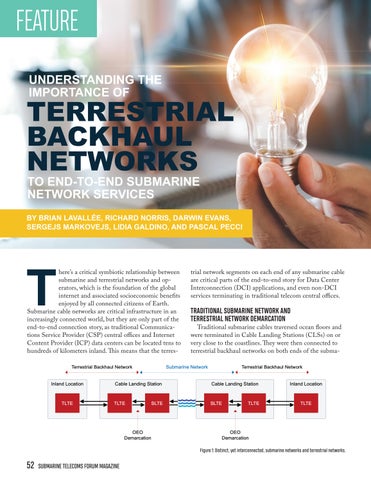
Traditional submarine cables traversed ocean floors and were terminated in Cable Landing Stations (CLSs) on or very close to the coastlines. They were then connected to terrestrial backhaul networks on both ends of the subma-
Figure 1: Distinct, yet interconnected, submarine networks and terrestrial networks.
52 SUBMARINE TELECOMS FORUM MAGAZINE