CABLE & CONNECTIVITY
FORUM SUBMARINE TELECOMS
ISSUE 132 | SEPTEMBER 2023
OFFSHORE ENERGY

INDUSTRY FORUM PREVIEW PLUS
EXORIDUM FROM
THE PUBLISHER
WELCOME TO ISSUE 132, OUR OFFSHORE ENERGY AND INTERNATIONAL WIRE AND CABLE SYMPOSIUM PREVIEW EDITION!
FOX RED?
Peg and I are picking up a new puppy this week.
The amazing chocolate lab we had for nearly 14 years left us unexpectedly a few weeks ago, leaving us with a giant hole. Four visiting grandchildren and two cats aside, the house is a lot quieter without a big dog. We were planning to find a new friend in a couple of months, but when we investigated our old breeder’s website we found she had the perfect option for us. So, with little time to mourn our recent loss, we are endeavoring on a new relationship with what will one day be a very large fox red labrador retriever boy dog. But that sizeable size will be a ways away.
It will be good to have an eight week old baby in the house once again – I do hope he learns quickly to sleep through the night.
IWCS
We are pleased to be working with the International Wire and Cable Symposium for the first time, who have their annual convention in Orlando, Florida in September.
Should you be attending IWCS, please visit the SubTel Forum booth for a complimentary submarine cable map.
12TH ANNUAL SUBMARINE TELECOMS INDUSTRY REPORT
We are gearing up for the release of our 12th Annual Submarine Telecoms Industry Report, coming this October, which is typically downloaded around 500,000 times each year, and used throughout the year as an industry metrics reference. We are reaching out to voices in our industry for input, and advertising slots are limited and are filled on a
first-come, first-serve basis. Interested?
Click here to secure a spot in the upcoming Industry Report!
ANNUAL INDUSTRY SENTIMENT SURVEY
We are presently conducting our annual industry sentiment survey, the results of which will be punctuated throughout the 12th Annual Submarine Telecoms Industry Report. We typically receive hundreds of responses, which is incredibly useful in deciphering the mood and perceived direction of our industry.
Click here to record your thoughts in SubTel Forum’s Annual Industry Sentiment Survey.
2024 SUBMARINE CABLE MAP
We are preparing our 2024 Submarine Cables of the World printed wall map, set for release early next year. The map will be distributed at key industry conferences like PTC ’24 and Submarine Networks, and sponsor’s logos will be a constant presence on customers’ walls throughout the
2 SUBMARINE TELECOMS FORUM MAGAZINE
year. Interested?
Click here to secure a spot in the upcoming Cable Map!
SUBMARINE NETWORKS WORLD CONFERENCE
We are thrilled to be traveling to Singapore again next week to attend the Submarine Networks World Conference. The folks at Terrapinn previously provided some excellent content to the magazine, and we expect their event to be another excellent opportunity to learn, as well as see industry friends.
ASK THE EXPERT BUTTON
The “Ask the Expert” button was added to a number of department articles, and we are still a little overwhelmed with the interest and response – Thanks – and please keep asking.
THANK YOU
Thanks for their support to this issue’s advertisers: Submarine Networks World, Fígoli Consulting, International Wire and Cable Symposium, and WFN Strategies. Thanks also to the many authors who continue to make our issues interesting and so far reaching. Of course, our ever popular and newly refashioned “where in the world are all those pesky cableships” is included as well.
Lastly, we hope that SubTel Forum continues to be your premier destination for news and analysis related to the submarine cable industry.
Good reading – Slava Ukraini , and see you at the Long Bar… STF

DEPARTMENT WRITERS:
DESIGN &
Weswen Design | wendy@weswendesign.com
Andrés Fígoli, Greg Otto, Kieran Clark, Kristian Nielsen, Nicole Starosielski, Philip Pilgrim, Syeda Humera, and Wayne Nielsen
FEATURE WRITERS: Bill Wall, David Kiddoo, Elaine Stafford, Erick Contag, Geoff Bennett, Greg Berlocher, Greg Rocheleau, Hermann Kugeler, Kristian Nielsen, Marc Kebbel, Matthew Richwine, Peter Bekker, Rebecca Dippel, Reese Jones, and Robert van de Poll
NEXT ISSUE: NOVEMBER 2023 – Data Centers & New Technology featuring PTC ’24 Preview, SubTel Forum 22nd Anniversary, and International Wire and Cable Symposium Preview Edition

AUTHOR & ARTICLE INDEX: www.subtelforum.com/onlineindex

Submarine Telecoms Forum, Inc. www.subtelforum.com/corporate-information
BOARD OF DIRECTORS: Margaret Nielsen, Wayne Nielsen and Kristian Nielsen
SubTel Forum Continuing Education, Division of Submarine Telecoms Forum, Inc. www.subtelforum.com/education
CONTINUING EDUCATION DIRECTOR: Kristian Nielsen | knielsen@subtelforum.com | [+1] (703) 444-0845
Contributions are welcomed and should be forwarded to: pressroom@subtelforum.com.
Submarine Telecoms Forum magazine is published bimonthly by Submarine Telecoms Forum, Inc., and is an independent commercial publication, serving as a freely accessible forum for professionals in industries connected with submarine optical fiber technologies and techniques. Submarine Telecoms Forum may not be reproduced or transmitted in any form, in whole or in part, without the permission of the publishers.
Liability: While every care is taken in preparation of this publication, the publishers cannot be held
Wayne Nielsen, Publisherresponsible for the accuracy of the information herein, or any errors which may occur in advertising or editorial content, or any consequence arising from any errors or omissions, and the editor reserves the right to edit any advertising or editorial material submitted for publication.
New Subscriptions, Enquiries and Changes of Address: 21495 Ridgetop Circle, Suite 201, Sterling, Virginia 20166, USA, or call [+1] (703) 444-0845, fax [+1] (703) 349-5562, or visit www.subtelforum.com.
Copyright © 2023 Submarine Telecoms Forum, Inc.
of Submarine Telecoms Forum, Inc. www.subtelforum.com | ISSN No. 1948-3031 PRESIDENT & PUBLISHER: Wayne Nielsen | wnielsen@subtelforum.com | [+1] (703) 444-2527 VICE PRESIDENT: Kristian Nielsen | knielsen@subtelforum.com | [+1] (703) 444-0845 ANALYTICS: Kieran Clark | kclark@subtelforum.com | [+1] (540) 533-6965 SALES: Kristian Nielsen | knielsen@subtelforum.com | [+1] (703) 444-0845
A Publication
PRODUCTION:
ISSUE 132 | SEPTEMBER 2023
FEATURES
5 QUESTIONS WITH DAVID KIDDOO

CABLE ROUTING AND POWER INTERCONNECTION
By Hermann Kugeler, Greg Rocheleau and Matthew RichwineREASONS TO ATTEND THE IWCS CABLE & CONNECTIVITY INDUSTRY FORUM

 By Rebecca Dippel
22 38 26 43 32 45
INDIA’S VIRTUAL ASSISTANT INDUSTRY AND ITS NEED FOR BETTER INTERNET BANDWIDTH
By Rachel JustisMAKING OPEN SUBMARINE CABLES WORK
 By Geoff Bennett
SUBSEA TELECOMMUNICATIONS CABLES
By Marc Kebbel4 SUBMARINE TELECOMS MAGAZINE
SUBMARINE TELECOMS
FORUM IN THIS ISSUE


ASSESSING OFFSHORE RISKS FACING CABLE ASSETS IN DISPUTED WATERS By Dr Pieter Bekker and Robert van de Poll IS GRAVEL SWITCH, KENTUCKY A THREAT TO THE FINANCIAL VIABILITY OF STARLINK? By Greg Berlocher NAVIGATING THE END-OF-LIFE CHALLENGES FOR SUBMARINE FIBER OPTIC CABLE SYSTEMS By Kristian Nielsen US OFFSHORE WIND REACHES THE GULF OF MEXICO By Bill Wall 50 56 62 64 EXORDIUM ........................................................... 2 SUBTELFORUM.COM ............................................. 6 CABLE MAP UPDATE 8 SUSTAINABLE SUBSEA 9 WHERE IN THE WORLD ........................................ 14 STF ANALYTICS ................................................... 28 BACK REFLECTION 72 LEGAL & REGULATORY MATTERS 78 ON THE MOVE ..................................................... 82 SUBMARINE CABLE NEWS NOW .......................... 83 ADVERTISER CORNER 84 SEPTEMBER 2023 | ISSUE 132 5 DEPARTMENTS
FREE RESOURCES FOR ALL OUR SUBTELFORUM.COM READERS
The most popular articles, Q&As of 2022. Find out what you missed!
TOP STORIES OF 2019
The most popular articles, Q&As of 2019. Find out what you missed!

NEWS NOW RSS FEED
a division of Submarine Telecoms Forum. This reference tool gives details on cable systems including a system map, landing points, system capacity, length, RFS year and other valuable data.
NEWS NOW RSS FEED
Keep on top of our world of coverage with our free News
Keep on top of our world of coverage with our free News Now daily industry update. News Now is a daily RSS feed of news applicable to the submarine cable industry, highlighting Cable Faults & Maintenance, Conferences & Associations, Current Systems, Data Centers, Future Systems, Offshore Energy, State of the Industry and Technology & Upgrades.

Now daily industry update. News Now is a daily RSS feed of news applicable to the submarine cable industry, highlighting Cable Faults & Maintenance, Conferences & Associations, Current Systems, Data Centers, Future Systems, Offshore Energy, State of the Industry and Technology & Upgrades.

PUBLICATIONS
mapping efforts by the analysts at SubTel Forum Analytics, a division of Submarine Telecoms Forum. This reference tool gives details on cable systems including a system map, landing points, system capacity, length, RFS year and other valuable data.
Submarine Telecoms Industry Report is an annual free publication with analysis of data collected by the analysts of SubTel Forum Analytics, including system capacity analysis, as well as the actual productivity and outlook of current and planned systems and the companies that service them.
CABLE MAP
Submarine Telecoms Industry Report is an annual free publication with analysis of data collected by the analysts of SubTel Forum Analytics, including system capacity analysis, as well as the actual productivity and outlook of current and planned systems and the companies that service them.
CABLE MAP
PUBLICATIONS
Submarine Cable Almanac is a free quarterly publication made available through diligent data gathering and
Submarine Cable Almanac is a free quarterly publication made available through diligent data gathering and mapping efforts by the analysts at SubTel Forum Analytics,
The online SubTel Cable Map is built with the industry standard Esri ArcGIS platform and linked to the SubTel Forum Submarine Cable Database. It tracks the progress of
The online SubTel Cable Map is built with the industry standard Esri ArcGIS platform and linked to the SubTel Forum Submarine Cable Database. It tracks the progress of some 450+ current and planned cable systems, more than 1,200 landing points, over 1,700 data centers, 37 cable ships
6 SUBMARINE TELECOMS MAGAZINE
SubTelForum.com Visit SubTelForum.com to find links to the following resources FREE RESOURCES FOR ALL OUR SUBTELFORUM.COM READERS SubTelForum.com Visit SubTelForum.com to find links to the following resources
as well as mobile subscriptions and internet accessibility data for 254 countries. Systems are also linked to SubTel Forum's News Now Feed, allowing viewing of current and archived news details.
The printed Cable Map is an annual publication showcasing the world's submarine fiber systems beautifully drawn on a large format map and mailed to SubTel Forum Readership and/or distributed during Pacific Telecommunications Conference in January each year.
CONTINUING EDUCATION
SubTel Forum designs educational courses and master classes that can then appear at industry conferences around the world. Classes are presented on a variety of topics dealing with key industry technical, business, or commercial issues. See what classes SubTel Forum is accrediting in support of the next generation of leaders in our industry.
AUTHORS INDEX
The Authors Index is a reference source to help readers locate magazine articles and authors on various subjects.
SUBTEL FORUM BESPOKE REPORTS
SubTel Forum provides industry analyses focused on a variety of topics. Our individualized reporting can provide industry insight for a perspective sale, business expansion or simply to assist in making solid business decisions and industry projections. We strive to make reporting easy to understand and keep the industry jargon to a minimum as we know not everyone who will see them are experts in submarine telecoms.
In the past we have provided analyses pertaining to a number of topics and are not limited to those listed below. Reach out to info@subtelforum.com to learn more about our bespoke reports.
DATA CENTER & OTT PROVIDERS: Details the increasingly shrinking divide between the cable landing station and the backhaul to interconnection services in order to maximize network efficiency throughout, bringing once disparate infrastructure into a single facility.
If you are interested in the world of Data Centers and its impact on Submarine Cables, this reporting is for you.
GLOBAL CAPACITY PRICING: Details historic and current capacity pricing for regional routes (Transatlantic, Transpacific, Americas, Intra-Asia and EMEA), delivering a comprehensive look at the global capacity pricing status of the submarine fiber industry. Capacity pricing trends and forecasting simplified.
GLOBAL OUTLOOK: Dive into the health and wellness of the global submarine telecoms market, with regional analysis and forecasting. This reporting gives an overview of planned systems, CIF and project completion rates, state of supplier activity and potential disruptive factors facing the market.
OFFSHORE ENERGY: Provides a detailed overview of the offshore oil & gas sector of the submarine fiber industry and covers system owners, system suppliers and various market trends. This reporting details how the industry is focusing on trends and new technologies to increase efficiency and automation as a key strategy to reduce cost and maintain margins, and its impact on the demand for new offshore fiber systems.
REGIONAL SYSTEMS: Drill down into the Regional Systems market, including focused analysis on the Transatlantic, Transpacific, EMEA, AustralAsia, Indian Ocean Pan-East Asian and Arctic regions. This reporting details the impact of increasing capacity demands on regional routes and contrasts potential overbuild concerns with the rapid pace of system development and the factors driving development demand.
SUBMARINE CABLE DATASET: Details more than 450 fiber optic cable systems, including physical aspects, cost, owners, suppliers, landings, financiers, component manufacturers, marine contractors, etc. STF
SEPTEMBER 2023 | ISSUE 132 7
SUBTEL CABLE MAP UPDATES
The SubTel Cable Map, built on the industry-leading Esri ArcGIS platform, offers a dynamic and engaging way to explore over 440 current and planned cable systems, 50+ cable ships, and more than 1,000 landing points. This interactive tool is linked to the SubTel Forum Submarine Cable Database, providing users with a comprehensive view of the industry.
Submarine cables play a pivotal role in global communications, acting as the backbone of the internet. They are responsible for transmitting over 99% of all international data, connecting continents and enabling global connectivity. Without these underwater highways, the speed and efficiency of global internet communication that we enjoy today would not be possible.
The Esri ArcGIS platform, upon which the SubTel Cable Map is built, is a powerful geographic information system (GIS) for working with maps and geographic information. It is used for creating and using maps, compiling geographic data, analyzing mapped information, sharing and discovering geographic information, and using maps and geographic information in a range of applications. Its robust capabilities make it an ideal platform for the SubTel Cable Map, allowing for dynamic, interactive exploration of complex data.
With systems connected to SubTel Forum’s News Now Feed, users can easily view current and archived news details related to each system. This interactive map is an ongoing effort, updated frequently with valuable data collected by SubTel Forum analysts and insightful feedback from our users. Our aim is to provide not only data from the Submarine Cable Almanac, but also to incorporate additional layers of system information for a comprehensive view of the industry.
We encourage you to explore the SubTel Cable Map to deepen your understanding of the industry and to educate others on the critical role that submarine cable systems play in global communications. All submarine cable data for the Online Cable Map is sourced from the public domain, and we’re committed to keeping the information as current as possible. If you are the point of contact for a company or system that needs updating, please don’t hesitate to reach
out to kclark@subtelforum.com.
Below is the full list of systems added and updated since the last issue of the magazine:
SEPT. 18, 2023
SYSTEMS ADDED:
• Amilcar
• Anjana
• Gold Data 1
• Natitua Sud
• T3
• Tikal/AMX-3
• TPU
SYSTEMS UPDATED:
• 2Africa
• Amitié
• BaSICS
• BlueMed
• CeltixConnect
• Confluence-1
• EMIC-1
• IAX
• IEX
• Leif Erikson
• MEDUSA
• N0R5KE VIKING
• PDSCN
• PEACE
• Saudi Vision Cable
• SEA-H2X
• SIGMAR
• TOPAZ
We hope the SubTel Cable Map serves as a valuable resource to you and invites you to dive into the ever-evolving world of submarine cable systems. We invite you to start your exploration today and see firsthand the intricate network that powers our global communications. Happy exploring! STF
KIERAN CLARK is the Lead Analyst for SubTel Forum. He originally joined SubTel Forum in 2013 as a Broadcast Technician to provide support for live event video streaming. He has 6+ years of live production experience and has worked alongside some of the premier organizations in video web streaming. In 2014, Kieran was promoted to Analyst and is currently responsible for the research and maintenance that supports the Submarine Cable Database. In 2016, he was promoted to Lead Analyst and his analysis is featured in almost the entire array of Subtel Forum Publications.
Do you have further questions on this topic?

ASK AN EXPERT
8 SUBMARINE TELECOMS FORUM MAGAZINE
SUBTELFORUM.COM/CABLEMAP
THE SUSTAINABLE SUBSEA NETWORKS REPORT: A Call for Participation
BY NICOLE STAROSIELSKIOver the past ten years, the internet’s sustainability has become a growing concern. Researchers, policy-makers, and businesses have all sought to assess and reduce the carbon emissions produced by digital infrastructure. Efforts have largely focused on data centers, energy-intensive facilities where internet content is housed. Subsea telecommunications cables have been almost entirely absent in this discussion. While many individual companies and organizations had developed their own innovative approaches to assessing sustainability and implementing best practices, as of 2021, no industry-wide metrics had been developed for assessing the sustainability of a subsea cable, nor had any industry-wide collaboration formed on sustainability.
By conducting research, convening events, and hosting discussions on sustainability, the Sustainable Subsea Networks project has begun to facilitate an industry-wide conversation. The project’s final report will offer a wide-ranging guide to potential approaches for the subsea telecommunications cable industry to mitigate its carbon emissions going forward.
Drawing from materials provided by many companies as well as their public disclosures, this report will document the range of sustainability initiatives and best practices that exist across the sector for the first
time. Subsea telecommunications cables have long been recognized as an enabler of a more sustainable future, providing opportunities for reduced travel, more efficient access to information, and facilitating international climate-related science. The information compiled in the report will offer a striking picture of an industry in transition--moving towards a more efficient and sustainable future across the lifecycle of a cable. By centralizing information on these efforts, the report will provide insight into sustainability initiatives that can be scaled and replicated across many parts of the industry worldwide.
The report will also address the
major drivers of sustainability: customer demand, future regulatory change, green finance, parent companies’ climate values, and the commitment of individuals. Building on these documented, existing efforts, the report will outline paths for future development. The report will also identify ways that companies might work together to build a sustainable future.
We publish this article to welcome members of any subsea cable company to contribute information about their sustainability best practices to our report. Please contact us at nicole.
starosielski@berkeley.edu before October 15 to be included.
SEPTEMBER 2023 | ISSUE 132 9 SUBSEA
SUBSEA
SUSTAINABILITY REPORT TOPICS:
1. Emissions Accounting and Disclosure – including sections on Greenhouse Gas (GHG) Protocol, CDP, Task Force on Climate Related Financial Disclosures (TCFD), and other Sustainability Indices

2. Carbon Emissions Targets – including sections on Science Based Targets Initiative, Climate Pledge, the SME Climate Commitment, and other Targets
3. Energy Targets – including sections on RE100, Energy Attribute Certificate (EAC), Power Purchase Agreement (PPA), and Onsite Renewable Installations
4. Emissions Offsets and Removal – including sections on Carbon Offsets and Carbon Removal
5. Standards and Certifications –including sections on ISO 14001, ISO 50001, ISO 9001, TL 9000, Leadership in Energy and Environmental Design (LEED), Energy Star Certification, and Green Marine Europe
6. Sustainable Design and Manufacturing – including sections on Connecting Facilities to Carbon Neutral and Renewable Energy, Making Facilities Energy Efficient, Eco-Design, and Reducing Emissions from Armor
7. Sustainable Marine Operations and the Wet Plant – including sections on Making Vessels and Marine Operations Efficient, Plugging into Shore Power, Transitioning Fuel Source, Connecting to Offshore Renewables, Deploying Autonomous Vessels, and Protecting Cables
8. Sustainable Cable Landing Station and the Dry Plant – including sections on Powering
Cables with Carbon Neutral and Renewable Energy, Solar Power at the Cable Landing Station, Wave-Powered Cables, Hydrogen Fuel Cells, Alternatives for Diesel Generators, Making the Cable Landing Station Energy Efficient, Retrofitting the Cable Landing Station, Power Usage Effectiveness (PUE), and Upgrading Submarine Line Terminal Equipment and Extending Lifetime
9. Sustainable Business Operations – including sections on Operating Environmentally and Working Remotely
10. Sustainability at End-of-Life –including sections on Recovering, Recycling Cables, and Redeploying Cables
11. Cables for Science: SMART Cables and Ocean Observatories
12. The Future of Sustainable Subsea Networks – including sections on
Motivating Forces for Change and Next Steps in Sustainability STF
NICOLE STAROSIELSKI is Associate Professor of Media, Culture, and Communication at NYU. Dr. Starosielski’s research focuses on the history of the cable industry and the social aspects of submarine cable construction and maintenance. She is author of The Undersea Network (2015), which examines the cultural and environmental dimensions of transoceanic cable systems, beginning with the telegraph cables that formed the first global communications network and extending to the fiber-optic infrastructure. Starosielski has published over forty essays and is author or editor of five books on media, communications technology, and the environment. She is co-convener of SubOptic’s Global Citizen Working Group and a principal investigator on the SubOptic Foundation’s Sustainable Subsea Networks research initiative
Do you have further questions on this topic?

ASK AN EXPERT
10 SUBMARINE TELECOMS MAGAZINE
COMING SOON!


WHERE IN THE WORLD ARE THOSE PESKY CABLESHIPS?
BY SYEDA HUMERASUBMARINE TELECOMMUNICATIONS: NAVIGATING THE DEPTHS OF CONNECTIVITY
In today’s interconnected world, cable ships play a crucial role in the maintenance and expansion of our telecommunication networks. These specialized vessels are responsible for installing and repairing submarine cables, which serve as the backbone of our global connectivity. From July 1 to August 31, 2023, a period of intense activity occurred, showcasing the vital importance of cable ships in powering global telecommunications.
Cable ships are essential for seamless data, voice, and video transmission across continents and under the world’s oceans. Without their expertise, our international communication, financial transactions, and information exchange would face significant disruptions. During the specified period, cable ships were actively involved in laying new cables, conducting repairs, and expanding networks to remote areas. Their advanced technology, skilled crew, and specialized equipment ensure uninterrupted data flow in our digital age.
The significance of cable ship activities lies in their direct contribution to global telecommunications. New cable installations expand network reach and capacity, enabling faster and more reliable communication. Maintenance and repair operations safeguard against disruptions caused by natural disasters, damage, or sabotage. Connecting remote regions provides economic opportunities, education, and improved access to services for isolated communities.
With the increasing reliance on cloud computing, IoT devices, and emerging technologies, the demand for robust
telecommunication networks continues to grow. The observed cable ship activity between July 1 and August 31, 23 demonstrates the industry’s dedication to meeting this demand. These operations ensure the smooth functioning of our current digital landscape while setting the stage for future expansion and innovation.
Exploring global cable ship activity during this period allows us to appreciate the immense efforts undertaken by these vessels and their crews. They navigate challenging seas and employ intricate cable-laying machinery to maintain the lifelines that connect our world. Join us as we delve into their operations, understand their invaluable contributions, and gain insights into the dynamic realm of global telecommunications empowered by cable ships.
• Challenges and Opportunities: While submarine telecom-
14 SUBMARINE TELECOMS FORUM MAGAZINE
munications have come a long way, they face evolving challenges:
• Rising Data Demands: The exponential growth in data usage, driven by the Internet of Things (IoT) and emerging technologies, demands higher-capacity cables.
• Resilience and Security: Protecting undersea cable networks from disruptions and cyber threats is paramount. Innovations in cable design and cybersecurity are crucial.
• Environmental Impact: As concerns for the environment grow, developing eco-friendly cable materials and installation methods is vital.
EXPLANATION OF BAR GRAPH:
The bar graph represents the frequency of AIS status updates, providing insights into the activities and movements of vessels. AIS, or Automatic Identification System, is a tracking system used in the maritime industry to monitor and transmit vessel information, including position, speed, course, and status updates.
Axes: The x-axis of the bar graph displays the different AIS status categories (e.g., “Underway”, “At anchor”, “At port”), while the y-axis represents the frequency or count of status updates. The scale of the y-axis depends on the range of frequencies observed in the dataset.
ANALYSIS OF AIS ENTRY COUNTS IN NAVIGATION STATUS:
In our analysis of the Navigation dataset, we examined the counts of AIS entry across various categories. Here are the key findings:
Highest and Lowest Counts:
The highest count of AIS Entry was observed in Moored, with a total count of 3,063.
In contrast, the category which is presently (Not under command) had the lowest count of AIS Entry at 2.
Percentage Increase:
Moored, with 3,063 counts, was a remarkable 153,050.00% higher than not under command, which had only 2 counts.
Contribution of Moored:
Moored accounted for a substantial portion of the total count of AIS Entry, representing 31.41% of the entire dataset.
Range Across All Categories:
Across all 7 Navigation Status categories, the counts of AIS Entry ranged from the lowest at 2 to the highest at 3,063.
These findings provide valuable insights into the distribution of AIS Entry counts within the Navigation status dataset, highlighting the significant variation in counts across different categories. Moored stands out as the category with the highest count, demonstrating its significance within the dataset.Top of Form
NOTABLE PATTERNS
The bar graph can highlight patterns that indicate certain activities or conditions. For example, if there is a high frequency of “At port” status updates, it suggests that vessels are spending a significant amount of time in port, possibly for maintenance, repairs, or loading/unloading activities. This pattern could be indicative of a port’s importance as a hub for vessel operations or a significant repair/maintenance center.
Other patterns might include a high frequency of “Underway” status updates, indicating vessels actively navigating or moving between locations, or a notable number of “At anchor” updates, signifying vessels are stationary but not in a port or underway. These patterns can provide insights into vessel traffic, trade routes, and activities in different regions.
Analyzing the distribution and frequencies of AIS status updates through the bar graph can aid in understanding vessel operations, identifying patterns, and making informed decisions related to maritime activities. It offers a snapshot of the current state of vessels and their move-
JULY 2023 | ISSUE 131 15
Power BI DesktopNavigation Status 0.0K 0.5K 1.0K 1.5K 2.0K 2.5K 3.0K NAVIGATION STATUS A I S E N T R Y Moored Restricted manoeuverab l ty Under way using engine At anchor Under way sail ng Aground Not under command 3063 2855 2698 1001 73 61 2
CABLESHIPS
ments, providing valuable information for stakeholders in the maritime industry, including port authorities, vessel operators, and researchers.
Additionally, the analysis of the Average of AIS Entry revealed significant disparities, with Moored having the highest sum and being substantially higher than not under category, which had the lowest sum. The distribution of AIS Entry across the different Navigational Status categories varied widely, ranging from 2 to 3,063.
EXPLANATION OF LINE GRAPH:
The line graph represents the Average of AIS.SPEED over a specific period, with a focus on the data point for July, particularly on Day 21. This graph allows us to analyze trends and variations in AIS.SPEED, offering insights into the ship’s behavior on that specific day and its overall impact on the two-month period.
Axes: The x-axis represents time, typically displayed as days or dates.
The y-axis represents the Average of AIS.SPEED, indicating the typical speed of the ship during a specific period.
Line: The line connecting the data points represents the Average of AIS.SPEED over time. The line’s slope and direction convey the overall trend or pattern of speed variations during the two-month period.
INTERPRETATION (JULY DATA):
On Day 21 of July, the data point shows that AIS.SPEED made up 6.88% of the overall Average of AIS.SPEED during the entire two-month period. This percentage provides an understanding of the significance of the ship’s speed on that day within the broader context of the dataset.
Analyzing this specific data point, we can infer that on July 21st, there was an event or activity that influenced the ship’s speed. This could be due to various factors, such as navigational requirements, operational demands, or environmental conditions.
It’s important to note that this 6.88% contribution of AIS.SPEED on July 21st might indicate a relative increase or decrease compared to surrounding days. Further analysis, including comparing this data point to adjacent days and considering historical trends, would provide deeper insights into the significance of this speed variation.
Understanding the factors driving fluctuations in AIS. SPEED on specific days is crucial for stakeholders in the maritime industry. It can help identify patterns, optimize operations, and assess the impact of external factors on vessel speed.
To gain a comprehensive understanding of the ship’s behavior and its impact on AIS.SPEED, it’s valuable to continue monitoring and analyzing data points over time, especially on days when significant variations occur.
In conclusion, this analysis of the line graph for the July data point on Day 21 provides insights into the ship’s speed behavior on that specific day. It highlights the importance of monitoring and interpreting speed variations to understand the dynamics of maritime activities and make informed decisions for operational efficiency and safety.Top of
FormCOMPARISON OF LINE AND BAR GRAPH:
Both visuals contribute distinct perspectives on maritime activities. The line graph of average speed trend focuses on vessel velocities, showcasing an overall upward trend and significant fluctuations during the analyzed period. It provides insights into vessel speed variations and potential factors driving these changes, such as weather conditions, operational demands, or industry requirements.
On the other hand, the bar graph of AIS status updates sheds light on vessel activities and their distribution across different categories. It highlights the dominance of Moored and the unequal distribution among the Navigational Status categories. This information aids in understanding vessel operations, identifying patterns, and making informed decisions related to maritime activities.
16 SUBMARINE TELECOMS FORUM MAGAZINE
Power BI Desktop Average of SPEED by Day 0 2 4 6 8 DAYS A VERA GE OF SPEED July1July4July6July11July13July16July18July19July20July21July22July23July24July25July26July27July28July29July30July31August1August2August3August4August5August6August7August8August9August10August11August12August13August14August15August16August17August18August19August20August21August22August23August24August25August26August27August28August29August30August31 7.5 1.3 9.0 0.0 0.0 7.0 7.3 0.0 0.0 1.0 2.3 2.5 4.1 4.3 1.7 1.4 2.1 2.2 3.1 1.7 3.6 2.3 3.4 2.8 2.0 3.0 1.7 2.3 2.2 1.8 2.6 2.5 2.3 2.1 3.0 2.5 2.1 2.5 2.0 3.6 2.0 0.5 2.3 2.2 2.4 2.1 2.1 0.9 3.3 2.5 2.1
By combining the analysis of both the average speed trend and AIS status updates, stakeholders can gain comprehensive insights into maritime activities. The average speed trend informs about vessel velocities, potential acceleration, and factors influencing speed variations. Meanwhile, the AIS status updates provide valuable information on vessel activities, distribution, and patterns across different status categories. This holistic understanding supports optimized planning, scheduling, and decision-making in the maritime industry, ultimately enhancing efficiency and operational effectiveness.
SCATTER PLOT OF AVERAGE SPEED VS AVERAGE DRAUGHT:
The scatter plot represents the relationship between the Average Speed and average draught of ships. Before discussing the plot, it is essential to understand what draught is and why it matters in maritime operations.
Draught refers to the vertical distance between the waterline and the deepest point of a ship’s hull. It determines how deep a ship sits in the water, affecting its buoyancy, stability, and maneuverability. Draught is a critical consideration for ship operators as it influences various factors, including cargo capacity, navigational limitations, and fuel efficiency.
Axes: In the scatter plot, the x-axis represents the average draught values, while the y-axis represents the Average Speed values of the ships. The scales of the axes depend on the range of draught and speed values observed in the dataset.
Data Points: Each data point in the scatter plot represents a specific ship, indicating its average draught and Average Speed. The position of the data point on the graph reflects the relationship between these two variables.
Interpretation: The scatter plot allows for the examination of the correlation or relationship between Average Speed and average draught. Generally, a ship with a larger draught might be expected to have a slower speed due to increased water resistance and displacement. However, the scatter plot can reveal interesting correlations or outliers that deviate from this expectation.
Correlations: If the data points in the scatter plot exhibit a noticeable trend, such as a negative slope or clustering, it suggests a correlation between draught and speed. A negative slope would indicate that ships with higher draught tend to have lower speeds, conforming to the expectation. Conversely, a positive slope would suggest an unexpected relationship, where ships with larger draughts have higher speeds.
Outliers: The scatter plot also helps identify outliers, which are data points that deviate significantly from the general trend or pattern. For instance, if a ship has a large draught but exhibits a high speed, it suggests unique characteristics or operational considerations. There could be various reasons for this anomaly, such as the vessel’s design, propulsion system, cargo type, or specialized operations.
These outliers can be of particular interest as they may uncover interesting insights into ship operations, technological advancements, or industry-specific factors. They provide an opportunity for further investigation and understanding of the underlying reasons behind their unexpected performance.
By analyzing the scatter plot of Average Speed versus average draught, stakeholders can gain insights into the relationship between these two variables for ships. It allows for the identification of correlations, patterns, and outliers that can provide valuable information for ship design, operational planning, and optimization of vessel performance.
Overall, the scatter plot offers a visual representation of the relationship between Average Speed and average draught, shedding light on expected trends and revealing intriguing outliers that can stimulate further exploration and investigation within the maritime domain.
On visual 3 of the analysis our attention is drawn to a specific vessel, Polaris 3, which exhibited exceptional values for both Average of AIS.SPEED and Average of AIS.DRAUGHT. These standout characteristics provide insights into the unique capabilities and potential roles of Polaris 3 within the maritime domain.
Average of AIS.SPEED (12.61): Polaris 3 recorded the highest average speed among all vessels in the dataset. This impressive speed indicates that Polaris 3 is a vessel capa-
SEPTEMBER 2023 | ISSUE 132 17
0 2 4 6 8 10 AVERAGE OF SPEEED A VERA GE OF DRA UGHT 0 2 4 6 8 10 12 14
Power BI Desktop Average of SPEED and DRAUGHT by Ship
ble of swift and efficient navigation. Such a high average speed can be advantageous for various maritime activities, especially those requiring time-sensitive operations, rapid transport, or the ability to cover long distances quickly.
Average of AIS.DRAUGHT (9.05): Polaris 3 also exhibited the highest average draught value. A high draught value suggests that the vessel sits deeper in the water. This characteristic can be valuable for specific types of cargo transport or for navigating regions with deeper waterways. Vessels with high draught values are often suited for transporting heavy cargo or operating in areas where water depth is a critical factor.
These exceptional characteristics of Polaris 3 highlight its unique capa bilities and potential roles within the maritime industry. Its high speed makes it suitable for tasks requiring swift movement, while its substantial draught indicates its suitability for specific cargo transport or navigation in deeper waters.
By identifying Polaris 3 as the vessel with the highest Average of SPEED and Average of DRAUGHT, this analysis provides valuable insights into the diverse capabilities and functions of different vessels within the dataset. Stakeholders in the maritime industry can use this information to understand the specific attributes and potential applications of vessels like Polaris 3, optimizing their use for various operational requirements.
NETWORK GRAPH OF DESTINATIONS:

The network graph showcasing the destinations of global cable ship activities provides a visual representation of the interconnectedness and relationships between various locations involved in submarine cable operations. This graph offers insights into the patterns, connectivity, and factors influencing the popularity of certain destinations within global cable ship activities.
The graph demonstrates the interconnectedness of global cable ship activities by showcasing the links or edges between different destinations. Each node represents a specific destination, and the edges illustrate the connections between these destinations based on cable ship activities. The presence of multiple connections between nodes indicates the extent
of cable ship operations and the interdependency of different regions within the global submarine cable network.
Several factors contribute to the popularity of certain destinations within global cable ship activities:
Geopolitical Considerations: Geopolitical factors play a significant role in determining the popularity of destinations for submarine cables. Countries or regions with high population densities, economic significance, or strategic importance tend to attract submarine cable investments. These destinations require
well-established landing stations, data centers, and interconnection points are attractive for cable ship activities. These destinations provide opportunities for connectivity expansions, redundancy, and improved international connectivity. Favorable marine conditions, suitable landing sites, and proximity to major network hubs also influence the selection of destinations.
Market Demand and Emerging Technologies: Market demand and emerging technologies influence the popularity of destinations within cable ship activities. High-growth regions, emerging markets, or areas with increasing demands for data and communication services become attractive destinations for submarine cable investments. Locations with a strong presence of data centers, cloud computing facilities, or technology-driven industries also drive the demand for improved connectivity and support cable ship activities.
International Collaboration and Partnerships: Collaborations and partnerships between countries, industry stakeholders, and cable operators influence the interconnectedness of global cable ship activities. Joint ventures, consortiums, and international agreements promote the development of shared cable systems that connect multiple regions and foster international cooperation. These collab-
18 SUBMARINE TELECOMS FORUM MAGAZINE
Power BI Desktop Cableship Network Graph Power BI Desktop Cableship Network Graph CLICK THE IMAGE TO GO TO THE INTERACTIVE VERSION OF THE NETWORK GRAPH
CABLESHIPS
orative efforts aim to enhance cross-border communication, strengthen economic ties, and improve global connectivity.
By examining the network graph of global cable ship destinations, stakeholders can visualize the interconnectedness of submarine cable activities and gain insights into the popularity of specific destinations. It helps identify the interdependencies, patterns, and connectivity within the global submarine cable network. Understanding the geopolitical, infrastructural, and market-driven factors that influence destination choices is crucial for policymakers, industry stakeholders, and researchers involved in the planning, expansion, and optimization of submarine cable networks.
CONCLUSION AND LOOKING FORWARD:
In conclusion, the analysis of global cable ship activities has provided several key findings and insights into the industry. Let’s summarize these findings and explore their implications for the future:
INCREASING AVERAGE SPEED AND NAVIGATIONAL STATUS TRENDS:
The data revealed an upward trend in the average speed over the specified period, corroborated by both this month’s (September) and last month’s (July) reports. This indicates an overall increase in vessel speeds, potentially driven by factors such as improved technology, optimized routes, or the need for faster data transmission. This trend suggests a commitment to enhancing efficiency and meeting the growing demands for faster connectivity.
RISE IN MOORED VESSELS:
Interestingly, there was a significant rise in the count of vessels categorized as “Moored.” This could indicate a variety of factors, such as increased maintenance activities, strategic positioning, or even heightened security measures at ports.
AMBIGUITY IN SPEED-DRAUGHT RELATIONSHIP:
Both reports did not show a clear trend in the relationship between vessel speed and draught, indicating that other factors may be influencing vessel speed. This adds a layer of complexity to our understanding of what drives vessel behavior and speed.
INTERCONNECTEDNESS OF CABLE SHIP ACTIVITIES:
The network graph showcased the interconnectedness of global cable ship activities, emphasizing the extensive network of submarine cables and the collaborative efforts between countries and regions. This interconnectedness highlights the importance of international collaboration
and partnerships in expanding and maintaining global telecommunications infrastructure.
ANTICIPATING THE FUTURE:
As we look forward, it becomes evident that a persistent drive toward augmenting speed and operational efficiency is underway. This impetus is catalyzed by ongoing technological innovations, encompassing swifter cable-laying methodologies and the embrace of novel propulsion systems. These technological strides are poised to further amplify vessel speeds, ushering in a new era of celerity in maritime operations.
Furthermore, the escalating demand for high-speed internet connectivity, propelled by emerging technologies such as 5G and the Internet of Things (IoT), is poised to propel the imperative for bolstering submarine cable networks. Consequently, cable ship activities are poised to experience an upswing as they play an instrumental role in the augmentation and upkeep of these vital undersea infrastructures.
FINAL THOUGHTS:
Crucially, the landscape of cable ship endeavors remains susceptible to the influences of impending events and developments. The deployment of fresh submarine cable systems, linking hitherto underserved regions, stands as a prime example of an opportunity that can galvanize heightened cable ship operations and maintenance endeavors. Moreover, geopolitical considerations, regulatory shifts, or alterations in market dynamics can all sway the prioritization of specific destinations for cable ship activities.
In addition, the continuous evolution of cable technologies, encompassing the advent of higher-capacity fiber optic cables and the integration of sustainable energy solutions into cable systems, is poised to redefine the modus operandi of cable ship operations. These innovations hold the promise of rendering cable laying, maintenance, and repair processes both more streamlined and environmentally sustainable. STF
SYEDA HUMERA, a graduate from JNTUH and Central Michigan University, holds a Bachelor’s degree in Electronics and Communication Science and a Master’s degree in Computer Science. She has practical experience as a Software Developer at ALM Software Solutions, India, where she honed her skills in MLflow, JavaScript, GCP, Docker, DevOps, and more. Her expertise includes Data Visualization, Scikit-Learn, Databases, Ansible, Data Analytics, AI, and Programming. Having completed her Master’s degree, Humera is now poised to apply her comprehensive skills and knowledge in the field of computer science.

SEPTEMBER 2023 | ISSUE 132 19

ADVERTISING SPOTS NOW OPEN REACH OUT TO KNIELSEN@SUBTELFORUM.COM TO RESERVE YOUR SPACE NOW!
2024 SUBTEL FORUM CABLE MAP COMING TO A WALL NEAR YOU
DISTRIBUTED AT KEY INDUSTRY CONFERENCES LIKE PTC ’24 AND SUBMARINE NETWORKS WORLD

5 QUESTIONS WITH DAVID KIDDOO
Talking Submarine Cable Industry with IWCS’s CEO/Director

David B. Kiddoo is the CEO/Di rector of IWCS, Inc. IWCS provides a forum for the exchange of information among cable & connectivity suppliers, manufacturers and users on advancements in materials, processes and products for transmission systems of voice, data, video signal and electrical current.
David is also the Executive Director of the Communications Cable and Connectivity Association (CCCA). CCCA is a non-profit association comprised of leading manufacturers, distributors and material suppliers. The organization is a major resource for well-researched, fact-based information on the technologies and issues vital to the structured cabling industry.
Prior to his current assignments, David spent over 20 years as the Global Business Manager for Wire and Cable insulation and sheathing products at AlphaGary Corporation. He also had 11 years of wire & cable experience with the Du Pont Company.

1. WHO IS IWCS AND WHAT IS THE ASSOCIATION’S MISSION?

IWCS is a not-for-profit organization that has hosted the premier event for new technologies in cable and connectivity products, processes, and applications for the past 71 years. The Cable & Connectivity Industry Forum is the leading worldwide event to explore topical issues, learn about new technologies, and network with colleagues from the communications, data, electronics, power, industrial, automotive, and aerospace industries. In addition to the Forum, IWCS is committed to industry professionals and scholars by hosting professional development courses, educational webinars, publishing research, and awarding scholarships.
2. HOW DOES IWCS PARTICIPATE IN THE SUBMARINE CABLE MARKET?
Technological advancements related to submarine cables are critical to connecting our global
22 SUBMARINE TELECOMS FORUM MAGAZINE
FEATURE
communities as well as renewable offshore wind power. With that in mind, IWCS encourages industry professionals and academic researchers to submit technical papers to be considered for its annual Technical Symposium. The Call for Papers for the 2024 IWCS Forum will open soon, with information available on the website at iwcs.org/present
3. ARE ADVANCEMENTS IN SUBMARINE CABLE DESIGN OR APPLICATIONS INCLUDED IN THE PROGRAM FOR THE UPCOMING IWCS FORUM?
The 72nd annual IWCS Forum, taking place September 17–20, 2023 in Orlando, Florida USA features several presentations directly related to submarine cable developments. Examples of subsea-related presentations from the 2023 IWCS Technical Symposium include:
• “Development of 22.9Kv Submarine Horizontal Directional Drilling (HDD) Power Cable” presented by Sangmin Oh, Gaon Cable Co. Ltd.
• “35 Years of Fiberoptic Coastal Installations In Norway” presented by Svend Hopland, Hopland MarinInstal
• “Sea Trial Results of OCC-SC630” presented by Hirose Tadafumi, OCC Corporation
Additionally, Prysmian Powerlink is participating in one of the three topical panel discussions featured at the IWCS Forum with a presentation on offshore energy. The “Renewable/Offshore Energy” session will focus on current cable transmission system developments, which are facilitating the transition to green energy. The panelists will provide an overview of the current market, various projects, an update on the progress of standards, and key challenges in offshore wind farm applications. It will also cover the cable systems involved in bringing this energy to communities.
4. WHAT ARE THE ELEMENTS OF IWCS’S SUCCESS?
IWCS is committed to strengthening our mission-critical cable and connectivity industry. In addition to hosting the annual IWCS Forum, which exchanges important information on industry technologies and advancements, IWCS also offers webinars, provides networking opportunities, and helps to support the workforce.

5. HOW IS IWCS HELPING TO PROMOTE A MORE DIVERSE AND INCLUSIVE CABLE INDUSTRY?
Diversity and inclusion is critical to the success of our industry. IWCS helps to promote and encourage under-represented workforce segments such as
women in the many STEM (science, technology, engineering, and mathematics) roles that are common in technical roles throughout the communications, data, electronics, power, industrial, automotive, and aerospace industries that make up the larger cable industry. The 2022 IWCS Forum featured panel discussions that featured women of the industry and discussed tips geared towards employers and employees for a successful career starting out in the cable connectivity industry.
6. AS SUSTAINABILITY HAS BECOME A HOT BUTTON ISSUE, WHAT ARE IWCS’S PLANS FOR SHARING INDUSTRY-RELEVANT INFORMATION THAT HELPS DRIVE A CIRCULAR ECONOMY?
In support of initiatives advancing a circular economy, IWCS is proud to share sustainable developments affecting the cable and connectivity industries. Sustainable topics include material selection, manufacturing processes, and network infrastructure. New this year, IWCS added Industry Sustainability Panel Discussions to the event program. The “Environmental Sustainability and Recycling for the Cable & Connectivity Industry” Panel Discussion, sponsored by Chemours, will focus on how new product designs featuring recycled materials can contribute to the important balance of safety, performance and sustainability. Additionally, the aforementioned “Renewable/Offshore Energy” Panel Discussion will share global developments impacting green energy transmission.
7.
FIBER OPTIC CABLES ARE COMMON IN SUBSEA APPLICATIONS. DOES IWCS SHARE DEVELOPMENTS RELATED TO OPTICAL FIBER?
Absolutely! Technologies related to optical cable products, materials, processes, and applications are shared through IWCS. In addition to multiple fiber optic presentations during the Technical Symposium, IWCS offers the annual core professional development course “Fiber Optic 101: Fundamentals of Optical Fibers & FO Cable Design & Application.” Instructed by renowned industry experts, this is one of several courses offered in the program. The 2023 IWCS Forum will also offer a more advanced elective course titled, “Fiber Optic 212: Advances in Optical Fibers and their Applications.” These complement additional courses on the topics of cable materials, copper cable, and extrusion methods. STF
SEPTEMBER 2023 | ISSUE 132 23
TECHNICAL SYMPOSIUM SUPPLIER EXHIBITION™
FOCUSED PANEL DISCUSSIONS
101
September 17 – 20, 2023
September 17 – 20, 2023
Orlando, Florida, USA
Orlando, Florida, USA
PLENARY & KEYNOTE EXECUTIVE SESSION PROFESSIONAL DEVELOPMENT
View the detailed event schedule, travel information, and registration instructions at iwcs.org.

SCHEDULE AT A GLANCE
Supplier Exhibition™ Supplier Spotlight Session
Sessions 7, 8, 9
PLUS: Fault-Managed Power Panel Discussion


Poster Paper Session
Sessions 13, 14, and 15
"Havana Nights" Networking Reception
24 SUBMARINE TELECOMS FORUM MAGAZINE
September
September
Professional Development Courses Optical Fiber 101 Extrusion 101 Copper 101 Materials 211 Session
Executive Session
PLUS: Sustainability Panel
iwcs.org SUNDAY
17 MONDAY
18 TUESDAY September 19 WEDNESDAY September 20
1
Sessions 2, 3, 4, 5, 6
Discussion Sessions 10, 11, and 12 PLUS: Renewable/ Offshore Energy Panel Discussion
Attendees
Materials
Supplier Exhibition™ Lunch on Your Own Lunch on Your Own Lunch for Professional Development Course
Plenary Luncheon with awards and Keynote presentation Professional Development Courses Optical Fiber 212 Copper 202
OFFSHORE ENERGY

HIGHLIGHTS AT THE 2023 IWCS FORUM
• “Development of 22.9Kv Submarine Horizontal Directional Drilling (HDD) Power Cable” presented by Sangmin Oh, Gaon Cable Co. Ltd.
• “35 Years of Fiberoptic Coastal Installations In Norway” presented by Svend Hopland, Hopland MarinInstal
• “Sea Trial Results of OCC-SC630” presented by Hirose Tadafumi, OCC Corporation
PLUS:
Many additional presentations on related technologies and industry trends such as optical cables, sustainability, green energy, cable applications, codes & standards, digital electricity, cable materials, and more!
Industry Sustainability Panel Discussion RENEWABLE / OFFSHORE ENERGY
Sponsored by:
The renewable energy market is experiencing unprecedented growth globally, particularly in US where robust statelevel procurement targets, national targets and technological advancements have inaugurated the era of offshore wind. This push for clean energy has spotlighted demand for improved system performance, the development of sustainable and circular cable materials, new installation methods, long-term protection systems, and efficient system design are all part of enabling the energy transition. With the great growth potential in the market, challenges still exist in development of standards, regulatory challenges, and establishment of domestic cable production for all renewable markets.
This Panel Session will focus on current cable transmission system developments which are facilitating the transition to green energy. The Panelists will provide an overview of the current market, various projects, an update on the progress of standards, and key challenges in offshore wind farm applications. It will also cover the cable systems involved in bringing this energy to communities.
Join the IWCS e-newsletter to receive information about upcoming events and webinars. Interested in submitting a technical paper for the 2024 IWCS Forum? Details about the 2024 Call for Papers will be shared soon. Sign up to receive updates at iwcs.org/newsletter. iwcs.org/newsletter
JANUARY 2023 | ISSUE 128 25
REASONS TO ATTEND THE IWCS CABLE & CONNECTIVITY INDUSTRY FORUM
BY REBECCA DIPPELIt’s simple— IWCS provides an opportunity for international representatives from the communications, data, electronics, power, industrial, automotive, aerospace, and similar industries to gather in person for valuable networking, learning, and career and business growth.
The 72nd annual IWCS Cable & Connectivity Industry Forum takes place September 17–20, 2023 in Orlando, Florida, USA. This premier event features the traditional elements of the IWCS Forum, including a Technical Symposium featuring previously unpublished Technical Papers, Executive Session, Plenary Luncheon with influential Keynote Speaker, Supplier Exhibition™, and Professional Development Courses. New enhancements include a “Havana Nights” themed welcome reception and expert panel

discussions on topics related to emerging technologies and industry sustainability.
Continuing momentum from last year’s successful event in Providence, USA, which was the first in-person IWCS Forum held since 2019 due to the COVID-19 pandemic, the IWCS Symposium Committee has crafted a robust program for the 2023 Cable & Connectivity Industry Forum. “The energetic networking and exchange of information displayed at last year’s Forum was refreshing,” shares IWCS Director/CEO David Kiddoo. He continues, “We look forward to picking up where we left off!” The event schedule, which can be previewed at iwcs.org/program, kicks off with optical fiber, copper cable, materials, and extrusion focused Professional Development Courses on Sun-
26 SUBMARINE TELECOMS FORUM MAGAZINE
day, continues with concurrent sessions and the Supplier Exhibition™ on Monday and Tuesday, and concludes with technical sessions on Wednesday.
related to cable and connectivity technologies. The Symposium allows attendees to experience previously unpublished Technical Papers featuring research and development for cabling and connector/interconnect technologies, components, materials, fabrication, performance, testing, and applications. The threeday Technical Symposium includes multiple presentations in each of the following sessions, organized by topic:
• Network Reliability & Measurements
• Design, Testing & Applications for Copper Ethernet, PoE and Energy Cables – (Parts 1 and 2)
• Specialty Applications
• High-Density Loose Tube
The highly anticipated Executive Session and Plenary Session with keynote speaker will take place on Monday, September 18. The Executive Session is designed for the general management of the cable & connectivity industry supply chain companies. The following important issues and economic trends facing the industry in these uncertain times will be addressed by expert speakers.
• Global Economic Outlook, Robert Fry, Robert Fry Economics
• Metallic Wire and Cable: Recession Risk vs. Green Energy Transition, Chenfei Wang, CRU Group
• Optical Cable: Demand Growth Pared Back as Challenges Mount, Chenfei Wang, CRU Group
• Digital Electricity: Leading the Transition to an Energy Efficient World, Stephen Eaves, VoltServer and Luis Suau, Sinclair Digital Services

• Elements of an Industry Business Plan to be Successful in the World of AI and Electrification, Scott Klososky, Future Point of View, llc.

• Connectivity
• Fiber Manufacturing
• Multi-Core & Specialty Fiber
• Codes & Standards
• Cable Materials & Properties
• Cable Modeling & Design
• Optical Fiber Coating Materials
• Specialty Installation
• High-Density Ribbon
The Supplier Exhibition™ continues its two-day program, providing plenty of opportunity and incentive for all attendees to visit with premier suppliers from around the world. “IWCS really helps individuals stay abreast of the latest technologies and trends within the industry,” says returning exhibitor Chris Huntly of Cimteq by UL Solutions. Huntly continues, “The event was well organized, in a good facility with very good exhibitor booths and interesting presentations.”
New this year, IWCS has added multiple expert panel discussions centered around emerging technologies and industry sustainability to the program for Tuesday, September 19th and Wednesday, September 20th. The topics include:
• Fault-Managed Power: A Safe and Disruptive Innovation for Powering the Future
• Renewable/ Offshore Energy
Following the Executive Session, Scott Klososky will take the stage during the Plenary Session luncheon to perform the keynote presentation titled, Disruptive Digital Transformation and Delivery of the Ambient Intelligence Backbone. Klososky, founding partner of digital strategy firm, Future Point of View, will offer thought-provoking insights on technological advancements that are fundamental to our social and professional lives.
The cornerstone of the IWCS Cable & Connectivity Industry Forum is the Technical Symposium, which is recognized around the world as the premier exchange of information
• Environmental Sustainability and Recycling for the Cable & Connectivity Industry
Visit iwcs.org for the most up-to-date event information and registration instructions. Registration is available on the IWCS website and on-site through the conclusion of the event. STF
REBECCA DIPPEL is Media Contact for IWCS. She is a creative leader focused on converting business objectives into actionable marketing programs using thoughtful strategy and a variety of communication tools.

SEPTEMBER 2023 | ISSUE 132 27
ANALYTICS
OFFSHORE ENERGY
Thoughts from Greg Otto
[Reprinted from SubTel Forum 2022/2023 Submarine Industry Report]
L ast year continued to be challenging for many industries around the world due to the continued COVID-19 pandemic and the realization of many of its longer-term and secondary impacts on the global economy. This year, the Oil & Gas Industry has been further impacted by geopolitical instability (namely the conflict in Ukraine) as well as the continued pressure to move from fossil fuels towards renewable energy sources. Demand for hydrocarbons is returning to pre pandemic levels but is still slightly reduced. Production levels are returning to normal though overall activity remains low
 Video 9: Greg Otto, Technical Director - WFN Strategies, LLC
in terms of growth. Despite a 2021 and 2022 jump in oil prices including a significant increase following the invasion of Ukraine, Oil & Gas companies have not shifted more capital to developing Oil & Gas fields. Likewise, large telecommunication systems have also not been funded and many over the past few years have ceased to be active projects with only a few expansion branches off existing systems being progressed.
This trend is concerning for the long-term growth of submarine fiber for the Oil & Gas Industry as companies look to improve margins, redirect capital to renewable energy and navigate regulatory uncertainty. It is expected that Oil & Gas companies will look to minimize capital spend on telecommunication systems using medium and low earth orbit satellite solutions and occasional branch legs to the most prolific of production facilities. Furthermore, the use of subsea tie backs to existing platforms – many of which already have fiber –is a strategy employed by many Oil &
Gas companies to reduce investment and time to first oil. While there is value in the high capacity, low latency and reliability of submarine fibers, alternatives such as low earth orbit satellite will provide many of their needs to support

REGIONAL ANALYSIS AND CAPACITY OUTLOOK | TRANSATLANTIC REGION
0 2 4 6 8 10 2025 2024 2023 2022 2021 2020 2019 2018
FIGURE 71: SYSTEMS BY YEAR 2018-2025
SPECIAL MARKETS | OFFSHORE ENERGY
Figure 71: Systems by Year, 2018-2025
Figure 70: World Liquid Fuels Production and Consumption Balance 2017-2023
ANALYTICS
remote operations, surveillance, IOT and robotics.
BY THE NUMBERS
Before 2019, there were several new systems added around the world, as various offshore energy companies began to realize the benefits of fiber systems for their offshore facilities.
However, a dip in oil prices in late 2018 through early 2019 and an overall global economic downturn slowed – or flat out halted – progress on systems starting in 2019 and carried through into 2021 when combined with the pandemic. Even though oil prices rebounded in 2021 and into 2022, it became clear that there is little relationship between oil price and investment in submarine fiber systems. This is because there is a focus to improve margin on Oil & Gas production to protect against the perceived volatility in oil price and to generate capital to support alternative energy projects such as wind and solar.
Multiple systems were under consideration in 2019-2021 and much of this work has halted as the new corporate strategies are embedded and realized. What is difficult is to tell is how many projects were actually started “internally” and then shelved during this window as Oil & Gas companies generally do not officially announce these projects as they are not core business. As such, the information is expected to no longer be representative of reality and actual deliveries will be much lower.
Going forward, Oil & Gas companies are going to evaluate many factors prior to deciding whether to invest in submarine fiber systems for production facilities:
1. Is the development lifespan long enough (e.g., more
than 15 years) to payback?
2. Are there existing solutions which can be integrated for lower capital?
3. What level of connectivity is really needed?
4. Are there ways to share capital in a low-risk manner?
5. What is the timeline to deliver a submarine system versus the lifespan and first oil
30 SUBMARINE TELECOMS FORUM MAGAZINE
0 1000 2000 3000 4000 5000 2025 2024 2023 2022 2021 2020 2019 2018
20 40 60 80 100 120 Sep-22 Jul-22 Apr-22 Jan-22 Oct-21 Jul-21 Apr-21 Jan-21 Oct-20 Jul-20 Apr-20 Jan-20 Oct-19 Jul-19 Apr-19 Jan-19 Oct-18 Jul-18 Apr-18 Jan-18
FIGURE 72: KMS ADDED BY YEAR 2018-2025
FIGURE 73: BRENT CRUDE QUARTERLY PRICE HISTORY 2018-2022
Figure 72: KMs Added by Year, 2018-2025
Figure 73: Brent Crude Quarterly Price History, 2018-2022
This means there will be close examination of alternative solutions such as low and medium earth orbit satellite, use of LTE/5G links to existing and occasional submarine fiber expansion of existing systems. The expansion of the existing systems will be aided by situations where a telecommunications company (e.g., Tampnet in North Sea and Gulf of Mexico) will be able to provide the capital and allow companies to buy submarine fiber as a service using operational costs.
Based on publicly available data, it should be expected that the growth curve for new fiber will heavily flatten downwards as the truth of the situation is realized. For example, as costs rise across all industries and regulation on fossil fuels continues to get more stringent, the commercial viability of new offshore development will continue to be less attractive. This is becoming more apparent as companies like ExxonMobil announce selling of stakes (Johnson, 2021) and the decommissioning of existing facilities. (Jahic, 2022) More realistically, expect one system every few years with up to five new branches (up to 150 km) in length being added globally. Although the addition of branches will more likely be in spurts and occur every couple of years as often multiple branches will be integrated into a single campaign for several reasons including optimization of vessel costs such as mobilization and demobilization.
8.1.1 THE OIL BENCHMARK
Looking at the average quarterly price of a barrel of oil over the last five years via the Brent Crude, oil prices reached their peak in the third quarter of 2022 as the impact of the geopolitical instability in Ukraine on energy prices became apparent. Expectations are that oil prices will be remain volatile due to several factors including:
1. Geopolitical unrest such as Ukraine conflict and other potentials
2. OPEC manipulating the market
3. Government intervention such as the US releasing significant portions of its strategic reserve
4. Regulatory actions to promote alternative energy
5. Seasonal demand changes
6. Recession impacts on personal and corporate demand
All of these will cause temporal changes in the price of oil and maintain volatility. For this reason, the major Oil & Gas companies are planning to always operate on the expectation of low oil prices and take minimal action other than generating profits and capital when prices are high.
8.1.2 DEDICATED VS. MANAGED SYSTEMS
Dedicated systems are those built primarily by one or more Oil & Gas companies to serve their specific offshore facility’s needs. Managed systems are those operated by a third-party telecoms service provider to one or more Oil & Gas companies’ offshore facilities.
As companies push further out and explore new areas for development, there are fewer shared systems including microwave and LTE/5G. With most growth in offshore energy happening in previously untapped areas that are increasingly further away from established infrastructure, expect the prevalence of dedicated systems to continue as there is often a single operator, especially in the early days of an asset’s development cycle.
When Tampnet acquired the BP GoM offshore cable system in August of 2020 (Tampnet Press Release, 2020), it was speculated that a new trend could be emerging where commercial telecoms companies own and operate multiple systems specifically for offshore Oil & Gas clients. One challenge telecommunications companies have is that they need to lock in clients to sanction their investments and projects and Oil & Gas companies make decisions like these over years. This is not conducive to moving such projects forward so many fall off from stagnation and lack of decision. Tampnet acquired an existing system with an installed user base which mitigated the risk that is prevalent in new systems.
8.1.3 OUTLOOK: AN UNCERTAIN FUTURE
There are many factors working against a growth trend in the submarine fiber industry to support offshore Oil & Gas. Predominantly, this is the result of changing strategy in the operators related to protecting their margin through price volatility, redirecting of capital to alternative energy and general concern with the political and regulatory landscape. Some fields and basins where fiber systems have been considered may be put up for sale to lower cost producers which means even less interest in submarine fiber investment. Several states such as California here in the United States (Davenport, Friedman, & Plumer, 2022) alongside countries in Europe (Carey & Steitz, 2021) and elsewhere have put forth legislation to ban the future manufacture of any fossil fuel powered vehicles in the coming decades which will further impact the outlook for this industry.
While the Oil & Gas industry is not, if ever, completely going away any time soon – as oil is still essential for things like plastic and other modern necessities – the outlook remains clouded and the prospects for submarine fiber continue to trend downwards.
SEPTEMBER 2023 | ISSUE 132 31 SPECIAL MARKETS | OFFSHORE ENERGY
The Need for Intelligent Optical Power Management
BY GEOFF BENNETTMAKING OPEN
SUBMARINE CABLES WORK
There are over 550 submarine cables under the seas and oceans of the planet – 480 in operation and a further 70 under construction. Over 99% of intercontinental traffic passes over these cables (not via satellites), and they carry updates from our Facebook friends, our Google searches, and over $10 trillion in financial transactions every day.
These cables are typically designed with a 25-year engineering life. Think about that for a moment…a cable that is 20 years old today may have at least another five years of operational life in it. But since it was designed, the potential capacity of such a cable has increased by a factor of 12 or more thanks to the evolution of coherent transponder technologies.
These mid-life upgrades are vital to maintaining the economic effectiveness of the cable – but who provides those updated transponders? You can see from Figure 1 that, over the past 25 years or so, submarine cable technology has also evolved, with different generations being focused on different types of transponder, and different capacity growth strategies.
In the early days of submarine cable projects, it was normal for the entire project to be carried out by a single company – including the wet plant (everything that’s under the water), the power feed equipment (PFE), and the submarine line terminal equipment (SLTE – the terminal unit, transponders, and optical power management). Today we refer to these as “turnkey” projects, and they are much less
32 SUBMARINE TELECOMS FORUM MAGAZINE
FEATURE
common than the alternative – open submarine cables. In an open cable, the wet plant and SLTE can be purchased from different vendors, and there’s complete flexibility to purchase best-of-breed transponders throughout the engineering life of the cable, which is usually designed as at least 25 years.
In this article I’d like to answer these key questions:
• What drove the move from turnkey to open cables?
• What are the benefits of open cables?
• What are the potential drawbacks of open cables?
• Why is optical power management needed?
• How can we minimize or eliminate the drawbacks and maximize the benefits of open cables?
FROM TURNKEY TO OPEN
Referring to Figure 1, if we turn the clock back to 2007, submarine cables were always turnkey projects that were designed to support contemporary 10 Gb/s transponders, which used direct-detect technology with virtually no signal processing and based on a fixed frequency grid (usually 50 GHz). The most significant optical impairment at that time was chromatic dispersion, and this was compensated for in the cable itself by using alternating spans of positive- and negative-dispersion fiber types. The resulting cable designs are referred to as “dispersion-managed” (DM), and there were at least two significant generations of DM cables that refined the dispersion management mechanism in the cable.
As part of the turnkey principle, the operators of these cables were commercially obliged to buy transponders from the wet plant vendor, and usually these transponders were priced much higher than equivalent terrestrial transponders, as well as having much longer lead times.
Around this time, the contractual restrictions for some of these turnkey cables began to expire, and savvy cable operators got in touch with terrestrial transponder vendors to see if their transponders could be used in submarine cables –and in most cases, the results were perfectly fine. Terrestrial transponders were cheaper and the lead times much shorter. Other cable operators began to follow suit as soon as their contractual obligations expired. Let’s be clear – these were not “open cables” because they had not been designed to be open, neither technically nor commercially. But in most cases the terrestrial transponders were found to work.
Then, around 2009, coherent transmission began to revolutionize the terrestrial market. Coherent transponders could transmit at higher data rates and support much higher fiber capacity over existing terrestrial fibers. Wet plant vendors did not have in-house coherent transponder development and so they were at an even bigger disadvantage. By 2010, the first generations of 40G and 100G coherent transponders bought from terrestrial vendors began to be deployed on existing dispersion-managed cables. Gradually terrestrial vendors began to win increasing amounts of market share in a market that was dubbed the “SLTE upgrade market” – where third-party transponders were deployed onto cables that were previously turnkey projects.
The first-generation coherent deployments were incredibly successful – delivering first a 4x increase in capacity per fiber pair (with the short-lived 40G transponder generation) and soon a 10x increase (with 100 Gb/s transponders) compared to 10G direct detect. Part of this success was suppressing the building of new submarine cables for several years because so much new capacity had been created simply by upgrading the transponders.
For a very brief period of time, some fiber pairs would continue to use direct-detect transponders in part of the spectrum, but new capacity would be provisioned using coherent transponders. In other words, the two transponder types would share the same optical spectrum. There was a certain level of angst around how effective this sharing could be because of certain nonlinear interactions between intensity-modulated direct-detect waves and coherent waves. Fortunately, the advantages of coherent were so overwhelming that legacy 10G transponders were quickly removed and replaced by an “all-coherent” optical spectrum

SEPTEMBER 2023 | ISSUE 132 33
Figure 1
and the problem of sharing spectrum between direct-detect and coherent vanished.
During this period, cloud computing and storage was becoming well established and the “hyperscalers” like Google, Meta, Microsoft, and Amazon were beginning to increase their demand for capacity – both terrestrial and subsea. Submarine network planners recognized that, while Gen 1 coherent was incredibly successful, the transponders were operating on cables that had not been designed for coherent transmission. In particular, the DM cables had low chromatic dispersion – even zero dispersion in some parts of the spectrum. The compensating fibers also had a low effective area, which meant that the optical power was concentrated and would also trigger nonlinear effects more easily. Given that coherent transponders can compensate for chromatic dispersion, a new type of cable was conceived using uncompensated optical fiber with high dispersion and large effective areas. Gen 1 transponders could not operate on these proposed cable designs because they had only receiver-based signal processing that could not compensate for the high chromatic dispersion. A second-generation optical engine design with wavelength data rates up to 200 Gb/s was already available and being deployed on DM cables. Gen 2 (and onward) coherent includes signal processing in both the transmitter and receiver and can deal with extremely high values of chromatic dispersion.
One of the first of these uncompensated cables, which was designed without compromise and with total focus on per-fiber capacity, was the MAREA trans-Atlantic cable. MAREA uses high-dispersion, large-effective-area fiber, along with relatively short amplifier spacing, with the original goal of enabling 16QAM transmission and 200 Gb/s waves across the Atlantic. Although initial transponders were not quite able to achieve the 20 Tb/s projected design capacity, in September 2018, Infinera’s ICE4 technology set a world record over MAREA for trans-Atlantic performance with 200 Gb/s wavelength data rates and a total fiber pair capacity of 26.2 Tb/s – over 30% more than the original design capacity for MAREA. This impressive record was smashed in 2021 when Infinera’s ICE6 optical engine was able to close the link at 650 Gb/s data rates and a total capacity of 28 Tb/s. At this capacity we are within 1 or 2 dB of the theoretical limit for each fiber pair.
It’s likely that MAREA will continue to hold the record for trans-Atlantic capacity per fiber pair because wet plant design focus has shifted away from capacity per fiber pair toward per-cable capacity based on a cable architecture called space-division multiplexing (SDM). At the time of writing, all SDM cables have been designed as open cables.
THE ADVANTAGES OF OPEN CABLES
In an open cable, the wet plant is sourced from one vendor…but fiber pair operators are free to source transponders and optical power management from any vendor they choose. This ability is key, because submarine cables have an engineering life of around 25 years and in that time, if the past 15 years are anything to go by, there may be seven or more generations of transponder technology.
The value of an open cable is that it allows the fiber pair operator to deploy the best-of-breed coherent transponders – independent of vendor – over the lifetime of the cable.
Each generation of transponder brings advantages such as higher spectral efficiency, higher wavelength data rates, smaller footprint per Gb/s, and lower cost and power per Gb/s of service traffic. At any point in time, Vendor A’s transponder may have a significant advantage over Vendors B, C, and so on. Based on performance examples from the past decade, the ability to have this vendor-independent choice could mean a capacity difference of anything from 15% to 100% between the transponders from Vendor A and Vendor X.
Open cables are usually offered on a per-fiber-pair basis – but more recently there has been a trend to divide the spectrum within a given fiber pair and offer demarcated chunks of spectrum to different tenants. This spectrum sharing has become a new type of headline service offering on cables such as EllaLink – a cable running over 6,000 km between Portugal and Brazil.
THE CHALLENGES OF OPEN CABLES
There are some challenges for open submarine cables in a similar way as there are challenges for terrestrial open optical networks. For example, if the performance of a turnkey cable fell short of the contractually agreed “number,” then the wet plant vendor is responsible. The number measured was known as the Q-factor (quality factor), and was defined in ITU-T G.976 and G.977. The way that the quality factor is defined in these documents tends to favor the older direct-detect modulation technologies that predate coherent transmission.
Open cables use coherent transponders and the individual fiber pair operators needed a more appropriate metric to be sure that the wet plant they were accepting was up to standard. Fortunately, work has been taking place in the Open Cables Working Group with the SubOptic organization for several years to help define new metrics, known as GSNR and SNRASE, that are defined in G977.1. As the number of fiber pairs in cables increases with the trend towards SDM designs, automating the process of open cable characterization is an essential part of a comprehensive SLTE solution.
34 SUBMARINE TELECOMS FORUM MAGAZINE
FEATURE
THE NEED FOR OPTICAL POWER MANAGEMENT
Open cables also present a challenge when it comes to optical power management, which is an essential process in all submarine cables. But the key question is, who does it? Let’s look at this in more detail.

Long-distance submarine cables make use of in-line optical repeaters typically spaced between 60 and 110 km apart, depending on the cable design. For reasons mainly of equipment reliability and system stability, these repeaters operate in constant power mode, in contrast to terrestrial repeaters that tend to include automated power control protocols whose job is to achieve as close to constant gain per channel as possible. What happens if the optimum power level is not maintained? In very simple terms, if too little power is injected into the fiber, there is more optical gain available in the repeater chain and the service wavelengths may experience too much amplification and may exceed nonlinear levels. If there is too much optical power, then there will not be enough gain for the service wavelengths, and they may fall below their minimum OSNR level.
When cables were turnkey, the wet plant vendor would provide a solution for power management. There was no choice offered – as the cable operator you would have to accept the feature set that the wet plant vendor offered, with no competitive pressure to drive innovation in optical power management. In an open cable, the wet plant vendor will offer a basic fiber gateway device – essentially just a location where fiber pairs can be terminated, and where wet plant monitoring can be installed. Fiber pair operators are then free to choose a
best-of-breed optical power management solution.
Figure 2 shows how this works. On the right the wet plant is terminated in the gray fiber gateway, which then presents each individual fiber pair in the cable for use by the fiber pair operator. Fiber Pair 1 is shown in detail, with the fiber pair being connected to a second gateway wavelength-selective switch (WSS) owned by the fiber pair operator. In this case, a modern open cable would require a flexible-grid WSS – an optical switch that can deal with a flexible frequency grid as defined in ITU-T G.694.1. And in the case of spectrum sharing, this WSS provides ports for the fiber pair operator (in green) and each of the spectrum tenants (Tenant A in blue and Tenant B in red). The ports on this WSS act as spectrum sharing demarcation, which is a vital element when it comes to writing contractual language for spectrum sharing as it defines and polices the frequency range allocated to each tenant, as well as the fiber pair operator.
Also connected to the WSS are amplified spontaneous emission (ASE) and possibly continuous wave (CW) idlers and a power management controller, which is basically a compute function that can be located in an external server or, more conveniently, within the management cards of the SLTE transponder platform. The power management controller will usually run a number of power management applications that assist the network operations team in handling specific power management tasks. Let’s take a look at a couple of examples as we look at how to make open cables work more effectively.
SEPTEMBER 2023 | ISSUE 132 35
2
Figure
MINIMIZING DRAWBACKS, MAXIMIZING BENEFITS
In a turnkey submarine cable, optical power management would be included with the wet plant vendor’s solution. However, these solutions often included proprietary features that would either prevent or limit the effectiveness of third-party transponders on the fiber pair. In the case of open cables, the advantages of using the best-of-breed transponder at any given point in the life cycle of the cable are overwhelming – but somebody has to replace all the software functionality that would have previously been developed by the turnkey vendor. Crucially, there is now competitive pressure to innovate the optical power management function, as well as enabling it to operate with a mixed set of transponders on the same fiber pair.
Let’s look at a couple of examples, which I’ve illustrated in Figure 3a and 3b. The first example shows a manually driven service provisioning process, while the second example shows automated power recovery.
Figure 3a shows how optical power injected into a fiber pair can be made up of service wavelengths (from the fiber pair operator plus one or more spectrum sharing tenants) or from optical power loading devices such as ASE or CW idlers. An ASE device is basically an erbium-doped fiber amplifier (EDFA) plus a variable waveband filter (usually a WSS) that can shape the width of the EDFA output across the spectrum. CW idlers are like transponders but with no signal modulation – just a very narrow carrier wave. When first brought into service, the cable is loaded using ASE optical power, which I have shown in green because it is provided by the fiber pair operator’s ASE device for all tenants on the fiber pair.

Note that at this point Tenant B has no operating transponders. Perhaps they have just purchased the spectrum and now they need to provision wavelength services. In conjunction with the fiber pair operator, Tenant B would gradually bring up its service wavelengths while the fiber pair operator would trim the width of the ASE spectrum using the flexible-grid gateway WSS (the orange gateway in Figure 2). At the end of the provisioning process, Tenant B’s spectrum would look something like Figure 3b. Note that provisioning is always performed manually.
Now let’s think about what happens if the optical power from one or more transponders is unexpectedly lost – for example, if all Tenant B’s transponders are lost. The optical power loss is detected by the flexible-grid gateway WSS, and the optical power management device will automatical-
ly trigger the extension of the ASE spectrum, returning it to the state shown in Figure A.
There can be several reasons why multiple transponder signals are suddenly lost at the same time. For example, the spectrum tenant may use scripts for configuration and a “copy and paste” approach to configurations. If a mistake meant that transponders were tuned into the wrong part of the spectrum (i.e., outside the designated frequencies allocated to Tenant B) and this error were copied to all the transponder configurations, then when the scripts were applied, it could result in all the transponders being blocked.
A more common issue would be if this tenant were optically expressing through the cable landing station and across a terrestrial backhaul link to a data center. If the terrestrial backhaul link suffered a fiber break, then all the wavelengths would be lost at the same time.
Once Tenant B’s transponders are recovered, the provisioning process described above is repeated and the spectrum is returned to the state shown in Figure 3b.
OPEN SUBMARINE CABLES – THE NEW NORM
The advantages of open cables in submarine networks are clear – the ability to choose best-of-breed transponders along with competitive pressure for both transponders and optical power management.
To make these cables work, we need to replace the proprietary functions that would normally exist in a turnkey system, and a sophisticated, intelligent optical power management capability is crucial. STF
GEOFF BENNETT is the Director of Solutions & Technology for Infinera, a leading manufacturer of Intelligent Transport Network solutions. He has over 25 years of experience in the data communications industry, including IP routing with Proteon and Wellfleet; ATM and MPLS experience with FORE Systems; and optical transmission and switching experience with Marconi, where he held the position of Distinguished Engineer in the CTO Office. Geoff is a frequent conference speaker and is the author of “Designing TCP/IP Internetworks”, published by VNR.

36 SUBMARINE TELECOMS FORUM MAGAZINE
Figure 3
FEATURE

SEPTEMBER 2023 | ISSUE 132 37 wfnstrategies.com WFN Strategies is an accredited, industry-leading consultancy specializing in the planning, procurement, and implementation of submarine cable systems. We support commercial, governmental, and offshore energy companies throughout the world. We analyze and advocate renewable energy alternatives for clients’ submarine cables. Information Security Management ISO 27001 www.dekra-seal.com certified Environmental Management ISO 14001 www.dekra-seal.com certified Quality Management ISO 9001:2015 www.dekra-seal.com certified
CABLE ROUTING AND POWER INTERCONNECTION

Tools to Solve the Bottleneck


 BY HERMANN KUGELER, GREG ROCHELEAU AND MATTHEW RICHWINE
With vast wind and solar resource potential, the world is poised to harvest these renewable energies for a cleaner, more sustainable future. Wind and solar farms are mature technologies being deployed at ever increasing rates, with the U.S. Energy Information Administration projecting over 70 GW of newly installed wind and solar generation in 2023 and 2024, bringing non-hydro renewables from 15% of US generation in 2022 to 18% in 2024 with further increases in growth anticipated in the remainder of the decade and coming decades. However, this rapid growth is putting significant strain on the existing power transmission
infrastructure, overloading transmission lines, and creating bottlenecks for queued renewable energy projects. The problem requires better tools for planning power injection, interconnection, and transmission. Where and how to connect new power generation systems on the grid, such as offshore wind, has significant implications for project cost and feasibility. The multi-disciplinary challenge of integrating these sources into the grid has created a severe bottleneck. The New York Times recently reported, in their June 12, 2023 article “Why the U.S. Electric Grid Isn’t Ready for the Energy Transition”, that while there are a multitude of challenges, “the problems start with
38 SUBMARINE TELECOMS FORUM MAGAZINE
FEATURE
planning – or rather, a lack of planning”.
Linking renewable energy projects to mainland grids and upgrading existing grid infrastructure, involves comprehensive cable routing, sub-station, and transmission line upgrade planning. The challenges include optimization of power cable routes and costs around a large number of geospatial environmental, regulatory, societal, and infrastructure constraints; optimization of cable routes for cost; and minimization of stress and overload on the existing transmission grid from any new power injection. In many cases, the stress and overload of the transmission grid occurs hundreds of miles from the actual project site. Lack of proper planning can result in prohibitive upgrade costs for developers at later stages of the project, disagreements between developers and grid operators, and poses a risk that will continue to limit projects from getting developed. Developers may have an offshore cable route which is lower cost, but the selected point of interconnection may result in hundreds of millions of downstream transmission upgrades. How can developers determine this earlier in the project? How can the government and grid operators better plan and facilitate mitigation of these issues? The traditional methods for planning have required developers, grid operators, and regulatory agencies to piece solutions together from an array of different consultants and disparate tools. As more projects come on line, the grid networks are becoming more stressed, and wholistic planning that can account for system optimization becomes critical early in the project.
Makai Ocean Engineering (Makai) has developed a new prototype GIS-based software for offshore and onshore renewable energy power interconnection and planning; with sights sets on providing the tools needed to better solve this interconnection planning bottleneck. The Makai team, in collaboration with Telos Energy, is developing the software MakaiPlan Digital Twins for Grids (MakaiDTG), with the goal to provide a much neeeded integrated approach. The new software targets the development phases of energy projects, by providing automated route generation for both offshore power cable and onshore transmission line routes, real-time project cost-estimations, and predictions for the substation interconnection needs and downstream regional grid upgrades. This synergistic partnership combines Makai’s unparalleled expertise in GIS-based cable planning software with Telos Energy’s long-standing experience in renewable energy integration and grid planning, setting the stage for a step-change in renewable energy project planning.
MAKAI OCEAN ENGINEERING’S LEGACY IN OFFSHORE CABLING
Makai Ocean Engineering (Makai) is not new to cable
route engineering, working in the world’s most demanding environment, the deep blue. With over 50 years of experience, Makai’s software has been used to install more than 600,000 km of cable worldwide. The MakaiPlan and MakaiLay software suite is a standard in the industry, used by over 90% of the subsea telecommunications cable installation fleet, providing an end-to-end software solution from planning, installation, and post-installation analysis. Building upon this strong foundation, the Makai team aims to bring their expertise into the renewable energy and power grid sector.
TELOS ENERGY: COMPLETING THE TEAM
Telos Energy has a rich experience in renewable energy and grid planning. Telos has carved a niche for itself by offering data-driven insights, power flow modeling, and strategic consultations that have helped real-world renewable energy projects not only reach their potential and integrate seamlessly into existing grids. Their proficiency in grid planning and depth of understanding from integration of commercial projects provides a robust team equipped to tackle the challenges of both offshore and onshore renewable energy projects.
WHAT IS MAKAIDTG?
MakaiDTG expands on the Makai team’s previous Automated Route Generation (ARG) tools. MakaiDTG deploys a novel cable route model based on automated heuristic algorithms, applied to geospatial and geotechnical data, and visualized and controlled through a GIS-based user interface. Built into the tool are a variety of purpose-built functionalities unique to cable and power transmision such as automated node placement, cable type selections, and cost estimations. But what does this mean in more practical terms? Let’s delve into the distinct features that set MakaiDTG apart from conventional planning tools.
KEY COMPONENTS OF MAKAIDTG

SEPTEMBER 2023 | ISSUE 132 39
FEATURE
ROBUST USER INTERFACE
MakaiDTG’s user interface (UI) is based off MakaiPlan, and is a GIS-based platform that supports the visualization of multiple geospatial data layers. These include nautical charts, bathymetry, terrestrial topographyand existing cables, among many others. The platform has been upgraded and tested for compatibiltiy with terrestrial databases, providing for the first time, the capability in MakaiPlan for both onshore and offshore cable routing.
REAL-TIME AUTOMATIC ROUTING

When it comes to cable route planning, a one-size-fits-all approach is too simplified, with complex tradeoffs on each project between risk and financial cost. MakaiDTG employs a modified A* (A-start) algorithm to automatically generate viable cable routes that uses array of constraints and weighted scorings. This algorithm considers physical conditions (e.g., slopes, elevations), financial costs, and a large number of geospatial constraints that can include regulatory, environmental, societal, and infrastructure, among others. Optimized routes are generated as the constraints and factors are weighted against each other as relative costs. In conjunction with an efficient graph traversing approach, this generatesthe lowest total combined techincal and financial cost route. In contrast to pure AI/ML based automation methods, the method provides a robust automated tool that is still underpinned by a set of clear and fundamental physical rules, and allows for high level control by the user when desired.
By doing so, MakaiDTG minimizes risks while maximizing the efficiency of the project. It doesn’t merely find the path of least resistance; it finds the most optimized path that satisfies multiple, often conflicting, criteria. This is crucial in today’s world, where renewable energy projects must navigate a complex web of regulatory and environmental considerations.
INTEGRATED POWER SYSTEMS MODEL
With automated and optimized routing complete, what else is there to be done? In many renewable energy projects, the power injection into the grid causes stress on existing networks that can result in overloaded conditions, and
prohibitively expensive updgrade costs. Accounting for these impacts and costs early is critical, and requires what is known as power flow modeling. As part of the ongoing devleopment, the Makai team is integrating a power flow tool with Telos Energy. These tools use power systems data of existing grid networks, projected power injection from a queue of potential future projects, and power injection from the user’s project to identify whether any transmission lines in the regional grid become overloaded. A contingency analysis is often completed to assess conditions as a function of failure in other parts of the grid network. The output provides information required to asess whether grid upgrades are required, and if so, to what exent. In many cases, this drives the interconnection costs. Whether you’re integrating solar, wind, or any other form of renewable energy, the software will provide a high level view of the infrastructure changes needed to ensure reliable operation of the grid after interconnection. At typical costs in excess of $1million per mile for transmission line upgrades, and transmission lines extending from tens to hundreds of miles, the costs can be significant. An integrated planning tool can pre-empt bottlenecks and delays, thereby streamlining the project timeline.
EXTENSIVE COST MODELS
Cost estimations are provided in the model for submarine cables, transmission cables, and substations. Work is in the early stages for cost models, but are anticipated to include parameterizations for both offshore and onshore subsystems, including substations for transforming from medium to high voltage. Offshore, cost factors are primarily based on mobilzation distance and the depths, which impact cable type and cable installation speeds. Cost factors on land may be based on regional factors, proximity to roads, and other factors that increase complexity of cable installation and costs of easements. The software aims to provide a comprehensive estimate of system level cost, spanning planning through installation, and detailed at the subsystem level. These provide a complete real-time anlaysis tool for combined cost and technical interconnetion analysis.
40 SUBMARINE TELECOMS FORUM MAGAZINE
NAVIGATING REGULATORY AND ENVIRONMENTAL HURDLES: A COMPREHENSIVE APPROACH
One of the most complex challenges in establishing grid connections for offshore renewable energy projects lies in navigating the labyrinthine of regulatory and environmental landscape. Traditional grid planning tools tend to prioritize technical feasibility and capital expenditure (CAPEX) when identifying cable routes or planning transmission upgrades. While these are undoubtedly essential criteria, they often tell only part of the story. What often gets overlooked is that a technically sound route with low initial costs might not always be the most viable option when factoring in long-term sustainability and compliance costs.
For example, imagine a cable route that is technically feasible and also offers the lowest CAPEX. On paper, it appears perfect. However, if that route traverses ecologically sensitive areas such as coral reefs, protected species habitats, or if it conflicts with existing maritime or land zones dedicated to conflicitng use, the eventual permitting and regulatory process poses significant risk and cost. Agencies may trigger environmental impact assessments, rerouting, or even halt projects midway, leading to cost overruns and delays. These risks can jeopardize the entire project and tarnish the reputation of the involved companies.
This is where MakaiDTG aims to fill the void. It’s designed not just as a grid planning tool but as a comprehensive interconnection planning solution. The geosptial-based ARG tool is programmed to consider the nuanced challenges posed by regulatory and environmental factors, and has now been adapted to function across both marine and terrestrial route applications. It’s capable of evaluating real-time geospatial data, environmental guidelines, and regulatory frameworks to suggest routes that are not only technically feasible and financially sound but also compliant with all relevant rules and guidelines.
When an engineer inputs project parameters into MakaiDTG, the system sifts through these multiple layers of data to identify potential bottlenecks or challenges. It then recalculates optimal routes that consider these factors, allowing for a level of proactive planning that is virtually unheard of in traditional grid planning processes.
The power of MakaiDTG becomes even more evident when considering its application across different geographies and regulatory jurisdictions. Each country, state, or even local government might have its own set of rules governing offshore and onshore renewable energy projects. MakaiDTG’s flexible architecture can be customized to understand these variances, making it a universally applicable tool for projects worldwide. For global renewable energy companies operating
across different regions, this means the ability to standardize their planning processes while still maintaining local compliance—a win-win situation for efficiency and governance.
By providing an integrated platform that can swiftly adapt to regulatory and environmental considerations, MakaiDTG transcends the role of a mere cable route planning tool to become a holistic solution for the power generation to grid interconnection space. Its dynamic adaptability will help projects remain on schedule and within budget, without neglecting critical environmental and regulatory factors. As the renewable energy landscape becomes increasingly complex and diverse, tools like MakaiDTG will be indispensable in ensuring that projects are not just financially viable but also sustainable and compliant in the long term.
INTEGRATED DATABASE: A SYMPHONY OF GIS AND POWER SYSTEMS DATA
Traditionally, GIS data and power systems data have existed in separate silos. Makai and Telos are working to break down these barriers by creating an integrated database that allows these two distinct types of data to communicate seamlessly. This database functions as the backbone of the MakaiDTG software, providing a rich, unified source of information that can be leveraged for highly efficient planning and execution of renewable energy projects.
The integration of GIS data enables the system to consider geographical constraints, like terrain and proximity to sensitive ecological zones, while power systems data allows for a deep understanding of existing grid infrastructure, power capacities, and electrical engineering specifications. By amalgamating these different layers of information, the database offers a multidimensional view that could not be achieved through separate datasets.
But what truly sets this initiative apart is its incorporation of dynamic grid modeling. This aspect of the database isn’t merely descriptive; it’s predictive. It uses sophisticated algorithms to model how proposed upgrades to substations and downstream infrastructure will interact with existing grid elements and future renewable energy projects. This predictive modeling is invaluable for planners, offering foresight into potential bottlenecks, system vulnerabilities, or inefficiencies that may arise from new interconnections.
The ability to visualize power generation sites, geospatial characteristics, and proposed upgrades to the regional grid, within a single GIS-based user interface is what sets this tool apart from others. It allows the user to have a view of both the present and future states of a renewable energy project and its integration into the broader power grid.
SEPTEMBER 2023 | ISSUE 132 41
FEATURE
UNPRECEDENTED OPPORTUNITIES FOR ITERATION AND OPTIMIZATION
The amalgamation of all these features within a single tool provides an unparalleled platform for iteration and optimization. Planners and engineers can quickly tweak various aspects of a project, and instantly see the cascading effects on costs, grid efficiency, and regulatory compliance. Grid operators can efficiently assess various upgrade and interconnection schemes, and their queue of potential projects. This capability transforms the planning process from a static, one-off exercise into a dynamic, iterative optimization problem, that is expected to greatly reduce the time and burden of renewable energy project planning.
In summary, the integrated database and dynamic grid modeling being developed by Makai and Telos represent a step-change in the approach to renewable energy grid interconnection. It offers an unprecedented level of holistic planning, marrying geographic, technical, and financial data in a unified, real-time platform.
WHY MAKAIDTG IS A GAME-CHANGER FOR OFFSHORE RENEWABLES
Traditionally, each offshore renewable project have long, manual and iterative planning phases, often taking months. This involved multiple stakeholders and multi-disciplinary teams, fraught with potential for delay. The renewable energy market has a need for an automated tool that can be used for early-stage power transmission planning. MakaiDTG eliminates these inefficiencies by providing a unified platform where engineers can initialize, plan, predict, and optimize a wide range of critical transmission line and grid installation options based on the project’s unique constraints. Furthermore, there is a gap in the market for a software tool that can be used for both terrestrial and offshore transmission. Developers often need to use one tool for the terrestrial grid interconnection, and another for the offshore power transmission. With the growing interest and adoption of marine renewables, the industry needs an integrated tool that allows developers to quickly evaluate the transmission feasibility and costs from offshore platform to terrestrial grid.
PAVING THE WAY FOR MORE OFFSHORE VENTURES
By solving the interconnection bottleneck, tools like MakaiDTG play a pivotal role in de-risking early phase project development and facilitating broader policy decisions. This innovation will not only reduce the project’s lead time but also ensure that these renewable energy sources can be integrated more efficiently, thereby reducing energy loss and maximizing returns on both private and government investments.
MakaiDTG is poised to be a significant catalyst in the growth of offshore and renewable energy projects. As we move closer to a sustainable energy future, tools like MakaiDTG not only solve today’s challenges but pave the way for more efficient and effective renewable energy systems in the years to come.
In conclusion, as offshore renewables continue to promise a sustainable energy future, it is quintessential to have advanced tools like MakaiPlan’s DTG to bridge the integration gap. Through automation, visualization, and real-time feedback, this tool ensures that the journey from the depths of our oceans to the heart of our cities is seamless and efficient.

WHAT’S NEXT?
While Makai continues to develop this tool under U.S. Department of Energy funding, we are interested in using this software as a service and as case studies for commercial clients. The commercial version of this software is expected to launch in late 2024. STF
HERMANN KUGELER, Makai’s Vice President of Business Development, joined the company in 2018. In this role, he leads the team’s marketing and business development efforts, both within the U.S., and internationally. Hermann supports commercial and federal projects spanning Makai’s areas of expertise and services. He received his B.S. degree in Mechanical Engineering, from the University of Denver.


GREG ROCHELEAU, joined Makai in 2009 as an Ocean Engineer, after earning his B.S. in Chemical Engineering from University of Colorado at Boulder and M.S. in Physical Oceanography from the University of Hawaii. He is currently the President and CEO of Makai, with experience leading development of multidisciplinary engineering and software programs. He is currently leading the development of MakaiPlan DTG.
MATTHEW RICHWINE is a founding partner of Telos Energy and is a leader in power systems engineering, power electronic controls, and system stability. For over fourteen years, he has been designing, testing, and analyzing thermal and renewable power generation equipment and studying the stability of power systems ranging from tens of megawatts to tens of gigawatts.

42 SUBMARINE TELECOMS FORUM MAGAZINE
INDIA’S VIRTUAL ASSISTANT INDUSTRY AND ITS NEED FOR BETTER INTERNET BANDWIDTH
BY RACHEL JUSTISToday’s burgeoning professional problems need new, innovative solutions to answer them. Even a business leader or a chief executive officer doesn›t have the same role as they did a few years ago. Not only do these corporate directors require the ability to set the vision and strategy for their company—they also need experience with other C-suite roles, resilience in the current world of rinse-and-repeat crises, and adaptability to attain
any skills that might be useful. But being a successful leader doesn›t necessarily mean being a Renaissance person. Many have found the secret to making their professional lives easier and more efficient: delegation.
That’s where India’s virtual assistant industry comes in. With this service, business leaders can hire skilled professionals for essential tasks, while Indian workers get the advantage of a higher salary than they’d otherwise receive

SEPTEMBER 2023 | ISSUE 132 43 FEATURE
locally. However, India’s virtual assistant industry needs better internet bandwidth for this partnership to work well. Here’s an overview of the issue.
AN OVERVIEW OF INDIA’S VIRTUAL ASSISTANT INDUSTRY
The idea of virtual assistants may sound foreign, but the idea is straightforward. They’re essentially administrative assistants that work remotely from the client they're assisting. That means you can rely on them to do everything from reviewing and answering correspondence to scheduling appointments and maintaining calendars to preparing communications, invoices, and reports. You can expect them to be prompt and have excellent attention to detail.
Virtual assistants can be hired from anywhere—however, an assistant from India means having a worker on a 12-hour flip from the US, allowing entrepreneurs to organize shifts so that the company can work around the clock. Indian virtual assistants are also fluent English speakers who are professional and polite. It’s thus no surprise that India’s virtual assistant industry is thriving, with companies like WERVAS and Brickwork India—founded as far back as 2016 and 2005, respectively—now leading the industry and offering services worldwide.
THE IMPORTANCE OF BETTER INTERNET BANDWIDTH FOR INDIA’S VIRTUAL ASSISTANT INDUSTRY
Indian virtual assistants operate remotely—and most of the time, a world away from their clients. This requires a robust internet connection. Unfortunately, India currently has an average internet speed of 77.64 Mbps, ranking it at 81st place globally. For comparison, the internet speed in the United States is 256.03 Mbps. Some reasons for this poor connectivity could be coverage issues in certain parts of India and the outdated usage of copper network fibers. Overloaded networks could also be a cause.
Still, it’s important to note that the sharp spike in 4G mobile network usage and its consequent internet connectivity boosts began only in 2016, and in that short span of time, India has improved leaps and bounds. It’s not a
stretch to hypothesize the government, and its technological experts will continue to enhance internet quality for the sake of the nation’s professionals, including its virtual assistants.
CURRENT INITIATIVES IMPROVING INTERNET BANDWIDTH

A critical initiative for India’s internet bandwidth is subsea cables, which can deliver the high-speed, low-latency bandwidth capacity that businesses and virtual assistants require. India is investing in these cables, with one of the latest projects being the IAX cable that aims to run from India across the Asia Pacific. Ultimately, the goal is for the cable to connect Mumbai and Chennai to Thailand, Malaysia, and Singapore and turn Sri Lanka—and eventually, India as a whole—into a connectivity hub. Another initiative is the BharatNet Project. This telecom project aims to enhance the country’s internet connectivity in rural areas. Currently, it has facilitated over 601,026 fiber-to-the-home connections, and the government looks to connect as many villages to the internet over the next 2.5 years. Other internet connectivity projects include the creation of 4G and 5G networks and public Wi-Fi initiatives. Once completed, all these programs are set to help current virtual assistants perform better—and give more Indians access to virtual assistant careers for the benefit of the industry.
India’s virtual assistant industry consists of highly proficient workers that can support business leaders. However, India will need better internet bandwidth for these virtual assistants to reach their fullest potential. STF
44 SUBMARINE TELECOMS FORUM MAGAZINE
RACHEL JUSTIS is a tech-enthusiast who enjoys reading about modern innovations. She works as a full-time business consultant and likes to blog during her free time.
FEATURE
A critical initiative for India’s internet bandwidth is subsea cables, which can deliver the high-speed, lowlatency bandwidth capacity that businesses and virtual assistants require. India is investing in these cables, with one of the latest projects being the IAX cable that aims to run from India across the Asia Pacific.
SUBSEA TELECOMMUNICATIONS CABLES
The Critical Infrastructure Connecting Our World
BY MARC KEBBELAccording to TeleGeography there are around 485 in-service telecommunications cable systems lying on or just below the seabed. Responsible for carrying more than 99 % of internet traffic between continents, these fragile subsea networks are the lifeblood of the global economy. We fail to protect them at our peril.
Subsea cabling has moved on a long way since 1850, when it was first laid in the English Channel to transmit telegraph signals between England and France. Today there is an increasingly intricate spiderweb of subsea telecommunications cables around the globe.
This surprisingly vulnerable network carries nearly all intercontinental electronic communications traffic. It therefore plays a critical role in the day-to-day running of businesses and public services the world over.
WHAT LIES BENEATH
Today’s subsea communications cables use optical fibres, each as thin as a single strand of human hair and sheathed in protective insulating layers, to transmit telephone and internet signals. According to the International Cable Protection Committee, a single fibre pair can carry digitised
information (including video) equivalent to 150 million simultaneous phone calls.
Subsea telecommunications cables used to contain between two and eight pairs of fibres. However, given the exponential rise in data traffic and the need for speed, cable owners are now looking for new ways to increase the number of fibres in each bundle without reducing transmission efficiency. A recently laid transatlantic cable has squeezed in a record-breaking 24 pairs of fibres, enabling the transmission of vast quantities of data at astonishing speeds of up to 500 terabytes a second.
The latest trend is Spatial Division Multiplexing – a disruptive design approach that aims to optimise the cost per byte and boost capacity by up to 70 %.

THE CHALLENGES
Despite the huge cost of installing subsea telecommunications cables – between $200 million and $2 billion, depending on the design and length of the system – they continue to proliferate around the globe in an attempt to satisfy our insatiable appetite for data.
The data they transport has transformed individuals,
SEPTEMBER 2023 | ISSUE 132 45
FEATURE
FEATURE
businesses, communities, societies, countries and even entire continents. Yet keeping these subsea cables running continuously also presents many challenges, including those outlined below.
NEW CONNECTIVITY REQUIREMENTS
There’s a growing amount of infrastructure on the seafloor requiring connection.
In the oil and gas industry, for example, many operators deploy fibre-optic interconnectors between fields, as well as between platforms and the shore. This enables operators to access data from sensors located on platforms and wells in real time, to optimise performance.
The rapid expansion of offshore wind farms has also contributed to the increase in cabling on the seabed, with array cables transporting the electricity produced by individual wind turbines to an offshore substation; and export cables then transmitting power from the substation to the network onshore. The array and export cables usually incorporate fibre optics for data transmission.
UNDERCAPACITY
The demand for high-speed data is relentless. It’s growing at a phenomenal rate, driven partly by business, but mainly by people’s obsession with social media – and video in particular.
Users were once satisfied with high-definition video. Satisfied, that is, until 2K became available… then 4K, then 8K, then 16K and now we have 32K Ultra HD. It’s users of streaming platforms and social media who are largely responsible for the extraordinary rise in data traffic carried by subsea cables.
Seamless streaming in high definition is what today’s users expect. Demand will continue to rise – the new 2Africa cable will be a major contributor. It is a 45,000 km subsea cable system and the largest cable project in the world. It will facilitate communications for over three billion people across three continents, with a design capacity of up to 180 terabytes per second. The challenge ahead is how to meet future demand.
OVERCROWDING
Laying more subsea telecommunications cables or increasing the capacity of the existing ones by introducing more sophisticated terminal equipment might be the solution to the capacity shortage. However, the increase in the number of subsea assets is creating a new problem: overcrowding.
Some estimates put the number of active and planned subsea telecommunications cables at more than 550.
Indeed, according to French telecom carrier Orange, there are now more than 1.5 million km of active international subsea telecommunications cables. As the seabed becomes more congested, the ‘traditional’ routes and landing areas might become unavailable for future systems – if this happens, new routes and landing areas will need to be found. In the coming years, these congested areas might also need to be partially cleared of out-of-service cables, to make room for the installation of new systems.
Another solution to overcrowding is the modern tendency to assign digital ‘corridors’, as has been done in Indonesia. In principle, the idea of corralling all telecommunications cabling within a defined, narrow route has many advantages. For example, shipping and fishing vessels can more easily avoid these clear cable highways.
Also, the cables cover a smaller area of the seabed, so will cause less damage to the natural environment, supporting the aims of the United Nations Decade of Ocean Science for Sustainable Development. The initiative is a 10-year framework for a wide range of stakeholders across the world to identify, generate and use critical ocean knowledge to manage the ocean sustainably.
However, the use of corridors will add significant complexity and time to installation, maintenance and repair activities. There are around 100 telecommunications cable faults a year on average. If a fault develops in a congested area where many cables cross each other, this can make cable recovery and repair very difficult.
Rearranging the crossings may help minimise the risk of interference with nearby cables but this would involve a substantial amount of administrative work, including a requirement for all stakeholders to sign crossing agreements.
To address these problems, the industry has developed guidelines for route planning, cable crossings and distance from existing infrastructure on the seabed. Many stakeholders feel that the crossing regime needs to be reviewed and revised.
Corridors require greater lengths of telecommunications cable too because a new line may have to be rerouted, to circumvent protected areas. If corridors are narrowed or made available for the future installation of data centres, some countries may end up being disconnected from their own offshore cables and will have to rely on collaboration with other friendly nations.
RESTRICTED AND NON-PERMITTED AREAS
The Ocean Decade project is resonating with governments around the world that are working to reduce marine pollution, restore natural marine habitats, replenish fish
46 SUBMARINE TELECOMS FORUM MAGAZINE
stocks and mitigate the effects of climate change.
This increase in protective activities places constraints on subsea telecommunications cable routing in some areas. For example, seagrass meadows are important in the fight against climate change because of their impressive carbon-storing ability – they also provide a welcome habitat for many marine species. Dredging through these precious meadows and laying cables could cause irreversible damage.
Similar restrictions are imposed in areas where cable-laying activities could disturb breeding areas for fish or birds.
ACCIDENTAL DAMAGE
Anchors from fishing and merchant vessels are thought to cause around a quarter of all damage to subsea telecommunications cables. In May 2023, for example, a ship’s anchor damaged the Coral Sea cable system in the Solomon Islands, disrupting services in Malaita and the Western and Choiseul Provinces.
Trawling and fixed nets are thought to account for more than a third of all damage to subsea telecommunications cables. It’s a big issue in the East China Sea, where stow nets are used extensively for fishing. Cable damage there is mainly caused by anchors that are allowed to drag through the mud, as well as by nets that are jointly trawled by a pair of vessels – the nets sometimes snag on the cables below.
NATURAL HAZARDS
Continental and insular shelves and slopes, oceanic ridges, submarine landslides, turbidity currents (dense flows laden with sediment) and vibrating or rubbing against the seafloor by bottom currents are among the many natural hazards that can cause damage to multiple subsea cables.
On 6 August 2023, two subsea cable breaks occurred simultaneously near the Congo Canyon, probably caused by a submarine landslide and turbidity currents. The breaks caused significant drops in internet performance on all of South Africa’s networks.
Seismic activity and the movement of tectonic plates can also wreak havoc. In December 2006 an earthquake off southern Taiwan caused submarine landslides and fast-flowing turbidity currents that broke nine fibre-optic subsea cables. This severely disrupted Southeast Asia’s regional and global telecommunications links.
In January 2022 a large underwater volcano erupted, causing damage to Tonga’s international subsea telecommunications cable – many cuts and displaced cable pieces were discovered along a 50 km section of the 827 km line, which was originally laid in 2013.
SABOTAGE, TERRORISM, THEFT AND PIRACY
There are many points on the network where several subsea telecommunications cables pass through the same location. These locations are public knowledge, making them vulnerable to malicious, strategic attacks by saboteurs and terrorists.
To reduce exposure to the risk of sabotage or terrorism, countries may seek to diversify. Rather than having all their eggs (subsea telecommunications cables) in one basket, they may decide to tap into additional regions, such as Europe or Africa.
Theft and piracy also pose a threat. Back in 2007, two Vietnamese fishing boats were seized by the authorities with around 80 tons of fibre-optic cable on board – the fishermen had mistakenly believed the cable to be copper and had intended to sell it as scrap. As a result, Vietnam lost 80 % of its connectivity with the rest of the world for several weeks.
In July 2016 a ship laying telecommunications cable in the Red Sea was fired upon by 16 armed pirates. The ship’s armed security team returned fire, causing the pirates to flee.
COLLABORATION – THE ONLY WAY FORWARD

The world needs to exert more control over the growth of the already extensive subsea telecommunications cable network. However, with so many different stakeholders, reaching agreement will not be easy.
Politicians want solutions that protect the national interest; tech giants want to drive up global data consumption; users want reliable, high-speed broadband and 5G; developers want to build new offshore wind farms; fishermen want the freedom to fish; environmentalists want to protect biodiversity and mitigate the effects of climate change… the list goes on and on.
A one-size-fits-all solution is an impossibility. But a round-table discussion between the different stakeholder groups would be a step in the right direction. It would open the doors to more efficient collaboration and enable all stakeholder voices to be heard.
Access to high-quality and accurate sets of Geo-data from cable route surveys can also assist stakeholders in making informed decisions to minimise risk and maximise the protection of the environment. STF
SEPTEMBER 2023 | ISSUE 132 47
MARC KEBBEL is Service Line Director Hydrography and Cable Route Surveys at Fugro.


MAIN TOPICS FOR THIS Y EAR’S REPORT INCLUDE: INDUSTRY the 2023/2024 REPORT IT'S ALMOST HERE... Contact Kristian Nielsen | knielsen@subtelforum.com • Global Overview • Capacity • System Ownership • Supplier Analysis • System Maintenance • Cableships • Market Drivers and Influencers • Special Markets • Regional Analysis and Capacity Outlook Reserve your space today as topics are going quickly!
ASSESSING OFFSHORE RISKS FACING CABLE ASSETS IN DISPUTED WATERS
BY DR PIETER BEKKER AND ROBERT VAN DE POLLINTRODUCTION
With the oceans covering some 70 percent of the Earth’s surface, maritime boundary disputes represent a key area of investment risk assessment for offshore investors, including the telecommunications cable industry. Just over 50 percent of the world’s maritime boundaries have been delimited by treaty, and those that are covered by treaty are not always clearly defined. The number of boundary-related disputes is a function of the number of coastal States and their potential boundaries: out of the 193 Member States of the United Nations, there are 162 coastal States having oceanic coastlines.
The exercise of some type of jurisdiction over multi-jurisdictional submarine cables and cable-related activity by coastal States may result in concurrent jurisdiction, and consequently, conflicts of jurisdiction on the part of various countries, including the coastal States at both ends of the cable system, the transit State—defined as the coastal State whose maritime zone(s) a transiting submarine cable traverses, without such State having a direct economic interest in the cable—, and possibly the State under the laws of which the owner of the cable, or the cable (survey) ship, is incorporated and in whose territory the owner has its registered office. Thus, various States may exercise concurrent jurisdiction over various parts of a cable system and cable-related activity based on different rules and principles.
Two common scenarios triggering conflict and uncertainty involve, first, a common pressure-connected deposit that is located in a maritime area claimed by two or more coastal States and, second, the situation where a common deposit is found straddling an established boundary. Coastal States routinely issue new offshore oil and gas blocks near or beyond unresolved maritime boundaries. This practice has resulted in an increase in boundary-related disputes involving coastal States combined with an increased submission of such disputes to international courts and tribunals, with international oil companies holding acreage, and companies owning or planning submarine telecommunications cables, in disputed maritime zones being caught in the middle and facing uncertainty pending resolution of the inter-State boundary dispute.
The Law of the Sea and related United Nations rules and procedures govern any offshore activity, and they dictate the rights and obligations of the world’s 162 coastal States. This includes the rules set forth in the United Nations Convention on the Law of the Sea (“UNCLOS”), a multilateral treaty that is presently in force for 168 countries. Many of its provisions reflect customary international law and as such also bind States that have not ratified this “Constitution for the Oceans,” the United States being a prominent example.
Maritime boundary delimitation involves a combination of geoscience and international law, the two disciplines being
50 SUBMARINE TELECOMS FORUM MAGAZINE
FEATURE
intertwined. Therefore, a proper assessment of the legal and scientific aspects of possible boundary-related issues affecting a planned cable route calls for an integrated approach based on best-science, derived from present-day satellite imagery and use of sophisticated boundary software, and best-law originating from international law instruments and jurisprudence. The recent increase in the number of submarine cable routes and the need for replacement of existing cable systems has given rise to an uptick in marine surveys being carried out in disputed maritime areas. Coastal States along the planned route of a transiting submarine cable may or may not require a survey permit for the benefit of the company carrying out survey activity for the cable, or they may impose other conditions on cable-related activity. Sometimes, a coastal State refuses to allow an offshore survey or imposes other restrictions on the freedom to lay and maintain transiting cables and associated activity, thereby triggering Law of the Sea jurisdictional issues pertaining to offshore cable survey activity in support of planned routing for transiting submarine cables.
Depending on the route of the cable and the existing maritime zones in the maritime waters it traverses, a separate analysis will need to be made with regard to each individual zone in order to determine the measures that each coastal State may lawfully take with regard to cables traversing the maritime zone(s) over which it has either full or limited jurisdiction. Typically, a cable route will involve the territorial waters, the exclusive economic zone (“EEZ”),
a special zone of up to 200 nautical miles from the baselines from which the breadth of the territorial sea is measured and providing for exclusive sovereign rights once declared by a Coastal State, and the continental shelf (“CS”), including in some cases the “extended” continental shelf (“ECS”) beyond 200 nautical miles, of two or more coastal States.
The right of coastal States to impose conditions on the activity of cable route survey ships and on cable laying and maintenance or repair in maritime zones subject to their sovereignty, i.e., in the territorial sea (up to 12 nautical miles from the baselines from which the breadth of the territorial sea is measured), is unquestioned. Coastal States enjoy full sovereignty in the territorial sea, whereas they enjoy more limited “sovereign rights” beyond the territorial sea. There is generally no right to lay and maintain submarine cables in internal waters or the territorial sea. The sovereignty of the coastal State includes such activity, and thus both laying and maintaining submarine cables require coastal State consent and they are subject to coastal State regulation that may impose conditions for cables entering the territorial sea. Thus, for purposes of analysis, a basic distinction lies between (a) the territorial sea and (b) maritime zones beyond the territorial sea.
HIGHLIGHTING POTENTIAL COMPLEXITY: THE BAY OF BENGAL
The potential complexity generated by claims to overlapping maritime zones of coastal States with adjacent or opposite coasts is illustrated by the Bay of Bengal, a multi-jurisdictional

SEPTEMBER 2023 | ISSUE 132 51
area featuring existing and planned submarine cable systems. Two separate boundary rulings issued by different international tribunals in cases between Bangladesh and Myanmar and India, respectively, in 2012 and 2014, have created a special boundary regime incorporating “grey areas” in the Bay of Bengal, which potentially are in play depending on the planned route of any submarine cable in these waters, as is highlighted in the illustration on the previous page.
As a direct result of the delimitations affected by the two tribunals, the “grey areas” in the Bay of Bengal will need proper legal and scientific review in order to obtain an understanding of what these maritime spaces are and what they may mean for any possible future risks associated with laying and maintaining a subsea cable through the waters of the Bay of Bengal. Similar complexity is encountered in different parts of the world featuring crowded geographical situations, especially Southeast Asia and the Caribbean.
THE APPLICABLE INTERNATIONAL LAW REGIME
As regards the international law regime pertaining to transiting cables, Article 112 of UNCLOS confirms the general rule that “[a]ll States are entitled to lay submarine cables and pipelines on the bed of the high seas beyond the continental shelf,” including the ECS, as the case may be. Therefore, all States have the right to lay cables beyond the outer limits of the CS/ECS. The only limitation to the freedom to lay cables on the high seas is set forth in Article 79(5) of UNCLOS: “When laying submarine cables or pipelines, States shall have due regard to cables or pipelines already in position.”
Article 56(1) of UNCLOS confirms that coastal States have certain sovereign rights pertaining to the exploration and exploitation of natural resources in their EEZ as well as exclusive jurisdiction “as provided for in the relevant provisions of this Convention” with regard to (i) the establishment and use of artificial islands, installations and structures; (ii) marine scientific research; and (iii) the protection and preservation of the marine environment. Having “sovereign rights” is different from having sovereignty: a coastal State enjoys full territorial sovereignty only in the territorial sea, based on a mix of different types of baselines (i.e., “normal” and/or “straight”) defining the low-water line and/or the presence of offshore relevant features such as islands, islets, sandbars, and drying reefs and rocks.
The text of Article 56(1) confirms that the coastal State has no residual jurisdiction to regulate matters in its EEZ beyond the three areas mentioned in this provision. Article 56(2) of UNCLOS further qualifies the rights enjoyed by the coastal State in its EEZ by providing that, in exercising its rights and performing its duties under UNCLOS in the EEZ, “the
coastal State shall have due regard to the rights and duties of other States and shall act in a manner compatible with the provisions of this Convention.” One of the relevant “provisions of this Convention” is Article 300 of UNCLOS, which imposes a general obligation of good faith on all States having ratified UNCLOS. The duty of States, including coastal States, to carry out their international law obligations in good faith stems from a general principle of law. While this duty does not create obligations where none otherwise exist, it is a fundamental principle cohering the system of international law by governing the creation and performance of legal obligations. Pursuant to Article 74 of the Charter of the United Nations and as expressed in that instrument’s preamble, all 193 UN Member States have undertaken to abide by “the general principle of good-neighbourliness, due account being taken of the interests, and well-being of the rest of the world, in social, economic, and commercial matters.”
Article 58 of UNCLOS addresses the rights and duties of States other than the coastal State in the EEZ. Article 58(1) confirms that “all States” enjoy the freedoms spelled out for the High Seas in Article 87 of UNCLOS, including “the laying of sub-marine cables” and “other internationally lawful uses of the sea related to these freedoms, such as those associated with the operation of ships, aircraft and submarine cables and pipelines, and compatible with the other provisions of this Convention.”
Article 58(3) of UNCLOS qualifies the rights enjoyed by States other than the coastal State in the EEZ by providing that, in exercising their rights and performing their duties under UNCLOS in the EEZ, (1) “States shall have due regard to the rights and duties of the coastal State” and (2) they “shall comply with the laws and regulations adopted by the coastal State in accordance with the provisions of this Convention and other rules of international law in so far as they are not incompatible with this Part.” In other words, a mutual obligation of “due regard” applies in the EEZ in recognition of the general need for the accommodation of uses of the oceans, and the coastal State does not enjoy an unfettered right to adopt laws and regulations in the EEZ.
According to Article 58(2) of UNCLOS, “Articles 88 to 115 and other pertinent rules of international law apply to the exclusive economic zone in so far as they are not incompatible with this Part [i.e., Part V concerning the EEZ].” This provision makes the referenced High Seas provisions applicable to the EEZ, and the EEZ regime hence incorporates the High Seas freedom referred to in Article 87 of “laying of submarine cables and pipelines, and other internationally lawful uses of the sea related to these freedoms, such as those associated with the operation of ships,
52 SUBMARINE TELECOMS FORUM MAGAZINE
FEATURE
aircraft and submarine cables and pipelines.” This provision underscores that the EEZ has a residual High Seas character as regards the laying of cables.
While pre-laying survey activity, i.e., a hydrographic survey for the purpose of delineating the route of a submarine cable, is not explicitly mentioned in Article 87 of UNCLOS, such activity in our view must be regarded as an essential component of cable operations and can be considered “other internationally lawful uses of the sea” associated with the freedom to lay submarine cables. Article 112 of UNCLOS (“Right to lay submarine cables and pipelines”) confirms that “[a]ll States are entitled to lay submarine cables and pipelines on the bed of the high seas beyond the continental shelf.” Based on Article 58(2), all States (and their nationals) also have the right to lay and repair submarine cables on the seabed in the EEZ.
There is support in the literature for the proposition that coastal State legislation requiring consent for the delineation of submarine cables beyond the territorial sea is contrary to the express wording and intention of UNCLOS, and that certain laws and regulations in relation to submarine cables, including those imposing requirements for permits, cannot be considered “reasonable measures” for the exploration and exploitation of resources in the EEZ because they may cause unnecessary project delay and expenditure.
With regard to the regulation of cable-laying activities on the Continental Shelf (and by extension the ECS), which may overlap with a coastal State’s EEZ, Article 79(2) of UNCLOS clarifies that “[s]ubject to its right to take reasonable measures for the exploration of the continental shelf, the exploitation of its natural resources and the prevent, reduction and control of pollution from pipelines, the coastal State may not impede the laying or maintenance of such cables or pipelines.” UNCLOS does not specify the scope of the “reasonable measures” that the coastal State may take in order to protect its economic or environmental interests in the maritime zones beyond the territorial sea—the outer limit is probably constituted by the duty of the coastal State not completely to impede the laying of submarine cables by other States and by the general duty of good faith in exercising its rights under UNCLOS and international law generally.
Article 79(3) of UNCLOS, which provides that “[t]he delineation of the course for the laying of such pipelines on the continental shelf is subject to the consent of the coastal State,” by its express wording suggests that it applies only to submarine pipelines, not submarine cables. In other words, the coastal State may not dictate the cable route in maritime zones over which it has functional jurisdiction, such as the EEZ and the CS/ECS.
CONCLUSION
Both coastal States and user States must exercise their “due regard” obligations in good faith in applicable zones of maritime jurisdiction, particularly the EEZ, and it can be considered an abuse of right by the coastal State, as meant in Article 300 of UNCLOS, to refuse to authorize cable survey activity and the laying or repair of submarine cables in its EEZ or its CS/ECS without giving any reasons or for purely political purposes, or to require permits or impose fees/taxes for such activity. In the CS/ECS, such coastal State conduct can also be said to contravene the “reasonable measures” restriction imposed by UNCLOS.
In general, we believe that contemporary international law supports the view that, beyond the territorial sea limits, user States and their nationals have a right to conduct hydrographic surveys for cable routes as lawful uses of the sea related to the freedom of the laying of cables within Articles 58(1) and 79(1) of UNCLOS, as long as they have due regard to the rights and duties of the coastal State in relation to resources and economic activities in the EEZ and the CS/ECS. Therefore, if a foreign cable (survey) ship, through its flag State or directly, informs the relevant coastal State authorities of its planned activities, including its location, and assures the coastal State that the activities of the ship are not prejudicial to the coastal State’s rights and duties with respect to resources and economic activities in the EEZ and/or the CS/ECS, the survey and cable-laying activity is in accord with UNCLOS and cannot legitimately be frustrated or interfered with by the coastal State. STF
DR. PIETER BEKKER is a professor and Chair in International Law at the Centre for Energy, Petroleum and Mineral Law and Policy (CEPMLP), University of Dundee (UK), and an active member of the New York Bar representing energy and telecom sector clients in connection with transnational projects. A national of The Netherlands, he is the elected Co-Chair of the Law of the Sea Interest Group within the American Society of International Law. He holds law degrees from Harvard Law School and Leiden University in The Netherlands.
ROBERT VAN DE POLL, B.SC, M.SC.ENG., is Global Director of Law of the Sea at Fugro (Corp. Headquarters, Netherlands). He is a Global GeoScientific expert on Law of the Sea, advising Governments and Industry, with over 2200 LOS projects completed in 146 of the 162 Countries he globally manages for Fugro, advising nearshore-foreshore and offshore Global mapping applications. He created the CARIS LOTS (Law Of The Sea) software, used by the United Nations, International Courts and Tribunals and Industry, to solve LOS Maritime Boundary disputes. Robert holds “Honorary Lecture Positions” at (i) Dundee University, UK, (ii) University of Malta, Malta, and (iii) ANCORS, University of Wollongong, Australia. A new Global unique application Robert has created, using for all nearshore shallow mapping applications is the Fugro’s SatRecon (4DSSM Imagery) Analysis application.


SEPTEMBER 2023 | ISSUE 132 53
NEED WE YOUR

The Annual Industry Report is already in the mill but would not be complete without your voices.
MAKE SURE YOUR VOICE IS INCLUDED!

YOUR
CLICK HERE TO TAKE THE SURVEY TODAY!
INPUT
IS GRAVEL SWITCH, KENTUCKY A THREAT TO THE FINANCIAL VIABILITY OF STARLINK?
 BY GREG BERLOCHER
INTRODUCTION
Starlink is a magnificent amalgam of advanced technologies in a single network architecture, including software defined satellite modems; satellites produced in assembly-line fashion; electronically steerable satellite antennas capable of tracking satellites; recyclable launch vehicles that can inject scores of satellites into low earth orbit in a single launch; and thousands of Low Earth Orbit (LEO) satellites that orbit approximately 400 miles above the Earth’s surface. The Starlink constellation of satellites was specifically designed to provide low latency, high speed Internet service at reasonable prices. Starlink quickly captured the imagination of everyone in Unserved & Underserved Land and dreams of Starlink terminals quickly displaced ponies as the most wanted Christmas gifts in rural America. Unfortunately, the financial titans, network architects, software developers, and RF engineers that created Starlink underestimated a risk that could threaten the economic viability of Starlink: Gravel Switch, Kentucky.
Additonal financial threats to Starlink will come from Cut and Shoot, Texas; Truth or Consequences, New Mexico, and Booger Hole, West Virginia. Although these communities were singled out for their humorous names, they exemplify small towns and communities across the United States being targeted for fiber projects. In 2022, there was an unusually aggressive number of fiber projects installed in the United States and the number of homes passed by fiber reached its highest number ever. Could the aggressive rollout of rural fiber networks cut into the potential subscriber base that Starlink desperately needs for financial viability?
UNSERVED & UNDERSERVED MARKETS
As part of the $787 Economic Stimulus Package in 2009, the Federal Government allocated $7.2 Billion for broadband services for unserved or underserved markets. Designed to close the digital equity divide, the funds in the stimulus package were specifically allocated to build out broadband access in areas where it wasn’t economically via-
56 SUBMARINE TELECOMS FORUM MAGAZINE
FEATURE
ble to do so. Fiber access came to many rural communities for the first time.
Fast forward to 2021 and the Infrastructure Investment and Jobs Act dedicated $65 Billion for additonal broadband initiatives across the United States. The term broadband is fairly inclusive in the Infrastructure Investment and Jobs Act and it applies to satellite technology and fiber, as well as other technologies. How will the majority of the funds be used? Time will tell, but it is clear that the United States Government is making a significant investment in its telecommunications infrastructure.
Whatever the percentage, a large chunk of the government funding will be used to pay for the deployment of tens of thousands of miles of fiber in rural areas. In a February 2023 article written by Kevin Morgan, who covers the Fiber Market noted, “More fiber was deployed in 2022 than ever before, according to the 2022 Fiber Provider Survey released by the Fiber Broadband Association. The industry advanced its goal of closing the digital

equity gap. The research shows that fiber providers passed 7.9 million additional homes in the U.S. in 2022 – the largest annual deployment ever, bringing the total number of homes passed with fiber broadband to 68 million, up 13 percent over the past 12 months and 27 percent over the past 24 months.”
It should be noted that “homes passed” is a different metric than “homes connected”; however, from a telecommunications professional’s perspective, fiber isn’t a viable alternative unless there is a fiber backbone that is feasible to connect to.
In his concluding remarks, Morgan stated that “Research estimates more homes will be passed in the next five years than have been passed to date.”
It is clear, the aggressive rollout of fiber in rural areas will accelerate over the next five years. How will this affect Starlink? Could the aggressive rollout of fiber in rural markets in the United States jeopardize the financial viability of the broadband constellation? Let’s explore the company, their network, service offerings, cost structure, and competitive risks.
Owned by American aerospace company SpaceX, Starlink is a constellation of satellites in low earth orbit. Starlink’s mission is to provide low latency broadband services to the masses, at affordable monthly subscription rates. Assembly-line manufactured satellites are lifted into low earth orbit on SpaceX rockets, both of which have gone through generation changes. As of the week of the article’s writing, 22 Starlink satellites were launched into low earth orbit on a SpaceX Falcon 9 launch vehicle.
Starlink offers their Internet services on a best-efforts basis. It is interesting to note that they do not offer a Service Level Agreement (SLA) on any of their services, nor provide Quality of Service (QOS). Starlink only offers their services on a best-efforts basis. Pricing is month-to-month with zero guarantees that the service will perform as billed. While the month-to-month pricing is a potential positive to certain customers, Starlink’s best-efforts commitments allow the company to potentially raise rates 6 times in as many months, or potentially raise rates 300% in a single month after a customer purchases a Starlink terminal, which is proprietary.
Anecdotal evidence gathered from knowledgeable satellite professionals suggests that Starlink service is wildly popular when it first arrives in a region but throughput numbers decline quickly as the number of subscribers in an area grows. A friend’s father, who lives in an rural setting was ecstatic when he experienced 200 MB downloads speeds the first few months after his Starlink terminal was
SEPTEMBER 2023 | ISSUE 132 57
FEATURE
installed. A year later and his download speeds have dipped below 20 MBPS.
I heard variations of that story multiple times; however, I took special notice when I heard of a group of First Responders that were counting on their Starlink terminal for broadband connectivity after a disaster. No one considered that 100 other relief agencies and First Responders would show up with Starlink terminals in the same geographic area. The immediate crush of satellite traffic brough the throughput to a crawl.
As their network has evolved, Starlink’s v1.5 satellites weight has grown to 300 Kg, up from a V1.0 satellite’s weight of 260 Kg. Starlink terminals are easily observable from Earth and Astronomer Jonathan McDowell tracks the constellation. As of July, there were 4,519 Starlink satellites in orbit, along with 32 non-operational satellites.

In December 2022, the FCC granted SpaceX the approval to launch and operate up to 7,500 next generation Starlink satellites. The FCC did not grant SpaceX its full request, which included deployment of nearly 30,000 Starlink satellites.
Geosynchronous satellite operators launch one, or several, satellites, at a time into geosynchronous orbit, which is approximately 23,0000 miles above the Earth’s surface. Geosynchronous satellites, once in orbit, have an outstanding track record of reliability and often provide a 15-year
service, or longer, lifespan. A geosynchronous satellite requires periodic station keeping, which requires rocket fuel. When the fuel is used up, geosynchronous satellites are boosted into a “parking orbit” at a higher altitude and decommissioned.
In contrast, Starlink launches 21, or more, of their v1.5 satellites at a time on a SpaceX Falcon 9 launch vehicle. Starlink Gen 2 satellites are much larger and heavier and require SpaceX’s Starship launch vehicles to get into space. Beside the different altitude in which they orbit, LEO and GEO satellites have significantly different lifespans. While it is relatively common for geosynchronous satellites to remain in service up to 17 years, the lifespan of a Starlink satellite is 5-6 years.
Since the lifespan of Starlink’s satellites are so short, the constellation must be replenished on a methodical basis. Unlike geosynchronous satellite operators, or the rural fiber circuit in Gravel Switch, Kentucky, SpaceX must constantly spend money replacing satellites at their end of life. Let’s look at the numbers.
It would be inconceivable for Starlink to replace all 7,500 satellites in a single year. To make the replacement cadence achievable, one sixth of the total number of satellites needs to be replaced annually, but the jury is still out whether Starlink’s satellites will last five or six years. In the six-year time lifespan is accurate, 1,250 Starlink satellites must be
58 SUBMARINE TELECOMS FORUM MAGAZINE
built and launched into orbit every year to maintain the constellation. If the life span of a satellite turns out to be five years, instead of six, the annual number of replacement numbers will be higher than the numbers below.
From a capital perspective, Starlink’s two major expenses are construction and launch costs. It has been difficult to get exact figures on the cost to manufacture a Starlink satellite. Those who follow the Satellite Industry for a living base their estimates on Elon Musk’s statement that “The manufacturing costs for Starlink satellites are well below $500,000”. Most pundits estimate that the current cost is in the $250,000-300,00 range for V 1.5 satellites. If these figures are correct, the annual CAPEX requirements for replacement satellites will be $375 Million. The new V2.0 satellites are significantly more expensive to build.
Getting 1,250 new satellites successfully in orbit every year is the other major capital cost. For this exercise, we used the public pricing for SpaceX’s Falcon 9 launch vehicle. In May 2022, SpaceX raised the cost of a Falcon 9 launch from $62 Million to $67 Million, stating that inflation was the reason for the price increase.
Earlier this summer, a Falcon 9 successfully delivered 54 Starlink V1.5 satellites into low earth orbit. Using $67 Million as the launch cost, the launch cost is roughly $1.25 Million per V 1.5 satellite; however, not all launches have inserted 54 satellites.
Adding the cost to build 1,250 replacement satellites every year to the launch cost brings the annual investment to $2 Billion just to keep the constellation at 7,500 satellites. There are plenty of financial analysts that are convinced that Starlink’s annual investment will be closer to $3 Billion per year.
In addition to CAPEX concerns, launch cadence is also a major factor in the successful replenishment of the constellations 7,500 satellites. SpaceX needs to be able to successfully launch 1,250 satellites every year, which is not guaranteed. For sake of discussion, we will assume the Falcon 9 will be used as the launch vehicle. If SpaceX is able to deliver 21 V1.5 satellites into orbit with a single launch, 60 successful launches per year will be needed, or a cadence of more than 1 per week. If SpaceX is able to place 55 satellites in orbit with a single launch, 23 successful launches per year will be needed, or a launch approximately every 2 weeks. The relentless pace of launches is daunting. A single supply chain issue relating to a critical component of either a Starlink satellite or Falcon 9 launch vehicle could have a disastrous effect.
Jonathan Hofeller, Starlink VP of Starlink Commercial Sales, was quoted in a May 2022 article in Cybernews.com
stating that Starlink has 250,000 subscribers across different business segments. Starlink targets four major markets: Rural & Remote Communities, Government, Businesses, and Urban Customers.
The company has been successful in attracting early adopters in the Oil & Gas and Maritime Markets, but the jury is still out whether the titans of the Energy Industry will ignore their long-standing requirements for strict Service Level Agreements and exacting security standards, and start using, essentially, what is a consumer-grade Internet service.
The pricing to the Oil & Gas and Maritime Markets is substantially higher than what residential subscribers pay, thus providing Starlink important profits, but it important to note that these two large markets don’t provide enough profit to keep Starlink afloat by themselves. Revenues from consumers are absolutely critical to the financial viability of Starlink.
But how many subscribers will it take for Starlink to reach breakeven? Experts in the Satellite Industry have crunched the numbers and estimate that Starlink will require 3 million subscribers to be financially viable.
Roger Rausch, principal of the satellite consultancy TelAstra, Inc, noted in a 2020 article published by Insider, “There are a total of 2 million satellite subscribers in the United States, and not very many in other parts of the world.”
If Starlink requires 3 million subscribers for the constellation to be economically viable, where will the subscribers come from? It is highly unlikely that Starlink will swoop in and take away all of Dish and Viasat’s customers in the United States. That means that Starlink must identify and sell 2.75 million new customers to add to their existing customer base before their money runs out.
The fight for rural America’s Internet loyalty will be waged over the next few years. The aggressive rollout of fiber to rural markets in the United States is making a major impact on unserved and underserved markets. Little did anyone imagine that the economic viability of Starlink could be decided by consumers in Gravel Switch, Cut and Shoot, and Booger Hole. STF
GREG BERLOCHER helped launch the first Ku-band shared hub service in 1986 and has been active in the Satellite Industry since. He was a Contributing Editor for Via Satellite Magazine for 8 years. Mr. Berlocher owns New Star Energy Services, which provides a portfolio of products and services to the IoT Market.

SEPTEMBER 2023 | ISSUE 132 59
THE POWER OF TECHNOLOGY AND COLLABORATION
Don’t miss the premier conference for digital infrastructure, telecommunications, and ICT


COLLABORATION REGISTER NOW AT PTC.ORG/PTC24
NAVIGATING THE END-OFLIFE CHALLENGES FOR SUBMARINE FIBER OPTIC CABLE SYSTEMS
Spotlight on Industry Solutions and the Consultant’s Role
BY KRISTIAN NIELSENWhen a submarine fiber optic cable system approaches its end of life, the challenges are multifaceted. From maintenance woes to regulatory hurdles, the complexities can be overwhelming. However, the industry is not without solutions. Specialized consulting companies offer innovative ways to manage, repurpose, and recycle these underwater communication lifelines. Let’s delve deeper into the unique approaches these companies take and the specific cable systems they have worked on, while also highlighting the pivotal role of system consultants.
1. MAINTENANCE CHALLENGES
As your submarine cable system ages, maintenance becomes increasingly cumbersome. Equipment failures rise, leading to more frequent faults and service interruptions. This is often a harbinger of the system’s impending obsolescence, usually indicating a need for replacement within two to three years. The cost of maintaining an aging system can quickly become prohibitive, making it essential to explore alternative solutions.
2. PERMITTING STATUS
Regulatory compliance is not just a box to tick; it’s a significant consideration in the end-of-life management of submarine cable systems. Many jurisdictions now mandate the removal or recycling of these systems, and non-compliance can result in severe penalties. Keeping abreast of the latest permitting requirements is crucial to avoid legal complications.
3. UPGRADE POSSIBILITIES
Technological advancements are a double-edged sword. While they offer the potential for system upgrades, they also make older systems increasingly incompatible with new technologies. A comprehensive analysis can help determine whether your system can be modernized or if a complete replacement is more practical.
4. REPLACEMENT PARTS AND SPARES
The hunt for replacement parts becomes a treasure quest as systems age. The availability of spares dwindles, and even when found, they may not be compatible with newer technologies. An exhaustive inventory and a feasibility study for sourcing modern replacements are indispensable.


62 SUBMARINE TELECOMS FORUM MAGAZINE
FEATURE
5. UNUSED BRANCHING UNITS (BUS)
Unused BUs offer a glimmer of hope for extending the system’s economic life. By connecting these units, you can tap into new markets and customer bases, thereby maximizing the system’s utility and profitability. However, this requires a thorough market analysis to assess viability.
SPOTLIGHT ON INDUSTRY SOLUTIONS
SUBMARINE CABLE SALVAGE
This company is a pioneer in repurposing out-of-service (OOS) submarine cable systems specifically for ocean science community environmental studies. They have a unique approach that not only recycles but also adds value to decommissioned cables. By utilizing these OOS systems, they offer a cost-effective and environmentally friendly solution for cabled ocean observatories. These observatories are strategically positioned on the ocean floor and are vital for real-time data collection used in scientific research, ocean management, disaster mitigation like earthquake and tsunami detection, and environmental protection. Submarine Cable Salvage owns an impressive portfolio of more than 8,000 kilometers of submarine cables that are already being repurposed for ocean science. Moreover, they are in the process of acquiring an additional 2,000 kilometers to expand their operations.
MERTECH MARINE
This company is a global leader in the recovery and recycling of OOS submarine cables. They operate across multiple oceans—Atlantic, Mediterranean, Pacific, and Indian—and have a comprehensive in-house setup that includes their own marine fleet and factories. This enables them to control the entire process from recovery to recycling, ensuring quality and efficiency. Since their inception in 1998, Mertech Marine has recovered and recycled a staggering 60,000 kilometers of cable. They currently manage the recovery and recycling of approximately 15,000 kilometers per year using their own resources. Notably, since 2004, they have recovered over 20,000 kilometers of OOS cable acquired directly from cable owners, showcasing their extensive experience and capability in this niche field.
SUBSEA ENVIRONMENTAL SERVICES
Established in 2014, this company has carved a niche for itself by focusing on both the recovery and environmental sustainability of OOS cables. They have successfully completed 16 projects across the Atlantic, Pacific, and Mediterranean, recovering more than 27,000 kilometers of OOS
cable. Their commitment to environmental sustainability makes them a go-to choice for organizations that are not just looking for recovery solutions but also want to ensure that the process is as eco-friendly as possible.
THE CONSULTANT’S EDGE
The role of a system consultant is pivotal in navigating these challenges. Consultants bring a structured approach to the table, backed by accredited maintenance planning systems and international standards of quality. They act as a linchpin, coordinating between the client and specialized companies. Their level of expertise is crucial for making informed decisions, whether it’s choosing to repurpose the system for scientific research or opting for complete recycling.
PROJECT PLANNING
One of the consultant’s most valuable contributions is in project planning. They create a detailed project plan that highlights risks and mitigation strategies, key aspects of the project schedule, and the recommended approach for progressing the project. This ensures that the project stays on track and meets all its milestones, thus guaranteeing the successful implementation of the client’s submarine cable.
NOTABLE PROJECTS
In the past, several high-profile cables were either scrapped or repurposed. These include BRUS, China-US, Columbus-3, France-Israel, HAW-2, HAW-4, MAT-2, and various TAT series cables. Companies like Mertech Marine, Submarine Cable Salvage, and Subsea Environmental Services were instrumental in these projects, showcasing their expertise and commitment to sustainable practices.
In conclusion, the end-of-life management of submarine cable systems is a complex but navigable challenge. By partnering with specialized companies and considering the key aspects outlined above, you can make informed, sustainable decisions for your aging systems. STF
KRISTIAN NIELSEN is based in the main office in Sterling, Virginia USA. He has more than 14 years’ experience and knowledge in submarine cable systems, including Arctic and offshore Oil & Gas submarine fiber systems. As Quality & Fulfilment Director, he supports the Projects and Technical Directors, and reviews subcontracts and monitors the prime contractor, supplier, and is astute with Change Order process and management. He is responsible for contract administration, as well as supports financial monitoring. He possesses Client Representative experience in submarine cable load-out, installation and landing stations, extensive project logistics and engineering support, extensive background in administrative and commercial support and is an expert in due diligence.

SEPTEMBER 2023 | ISSUE 132 63
US OFFSHORE WIND REACHES THE GULF OF MEXICO

A New Energy Frontier Looks To Replace An Old Energy Frontier… Maybe
BY BILL WALLINTRODUCTION
Dare I say it, since my last article for SubTel Forum in September 2021 the US Offshore Wind (OSW) industry has matured on the US east coast to the point where utility scale offshore windfarms are currently under construction. The 800MW Vineyard Wind project located some 15 miles off the island of Martha’s Vineyard, Massachusetts in BOEM Lease Area OCS – A0501 is well underway. Recently in 2023 Vineyard Wind (a joint venture between AVANGRID, Inc. and Copenhagen Infrastructure Partners (CIP), installed their offshore substation onto a pre-installed 4-leg jacket foundation. See Figure 1 below. The 3000+ ton substation topside was installed by a European OSW vessel the Orion. (Still no dedicated OSW construction vessels in the US yet)
As the sun is setting on the New England Horizon the Deme OSW vessel Orion is placing the substation top sides onto the foundation. See Figure 2 below.
Once operational the Vineyard 1 Offshore Substation will accept the various submarine cable “Strings” of Inter Array Cable (IAC) that interconnect each wind turbine at a voltage of say 66KV. Then the power from the IAC strings is transformed up to a higher transmission voltage level, say 230KV, for transmission to shore via the project export cable for connection to the shore side grid.
Another US OSW project that now has “Steel in the Water” is the South Fork project a 130MW OSW farm under construction in BOEM Lease area OCS – A0517 some 35 miles off Montauk, Long Island in New York State. South fork recently installed their first OSW turbine foundation. The Mono-Pile foundation was installed by another
64 SUBMARINE TELECOMS FORUM MAGAZINE
FEATURE
Figure 1: The Vinyard 1 Offshore Substation (Courtesy Avangrid)
European OSW vessel, Figure 3 below shows the foundation installation vessel in action at the site.
It should be noted that although projects such as Vineyard Wind 1 and South Fork are currently under construction the post pandemic interest rate hikes and the subsequent worldwide supply chain constraints & shortages have slowed up development of other US OSW projects that were looking to also commence construction in this period.
US OSW REGULATORY REGIME REMINDER
In a previous STF article I had described how the use of the waters off the coasts of the US are regulated and made available to the various seabed users. It is worth reminding again how this process is applied. The US Federal Regulator, the Bureau of Ocean Energy Management or BOEM (https://www.boem.gov/) is an agency of the US Department of the Interior and regulates the leasing of offshore sites for offshore wind energy development and for Offshore Oil & Gas exploration and production under the auspices of the Outer Continental Shelf Lands Act (August 7th, 1953). BOEM, after receiving input from adjoining states, designates “Call Areas” as possible sites for offshore wind development; those sites are then scrutinized

for environmental & energy production suitability during a detailed Public Review process. If deemed viable the areas are then designated as “Wind Energy Areas” (WEA) and eventually offered to pre-qualified offshore wind developers under a competitive leasing auction whereby the developers bid against one another for the right to develop a lease area. Once a developer “wins” an auction by bidding the highest

SEPTEMBER 2023 | ISSUE 132 65
Figure 2: The Vinyard 1 Offshore Substation Top Side Installation (Courtesy Deme Group)
Figure 3: The installation of a Mono-Pile at the South Fork OSW Site
dollar amount BOEM then awards a 25-year lease to the developer that then starts an environmental permitting process to determine that the developers planned usage will not endanger the environment. NOTE: The awarding of a federal lease by BOEM does not automatically allow the OSW developer to start producing power and transmitting said power ashore. That right must be bid & negotiated with the various utility commissions in individual states adjacent to the offshore lease area. (A rather complex process whereby an OSW developer may bid and win a lease offshore from the federal government but not win the right to transmit power into an adjacent state)
OSW LEASE AUCTION HISTORY – LAND SPECULATION ON A GRAND SCALE
When BOEM first started the offshore wind lease auction process back around 2010 prices for lease areas on the East Coast were relatively inexpensive with lease areas being sold for prices in the low hundreds of thousands. Then in 2015 there was a lease sale for 2 areas offshore New Jersey, one area went for just under $900,000.00 and the other sold for just over $1M. Prices and developer interest had started to increase. 2016 saw a lease auction off New York state where the one lease area up for auction was sold for $45M. Then in 2018 lease prices jumped markedly, three areas were in play for a lease auction off Massachusetts and each area went for a record $135M each. The cheap land rush was over. This trend continued with 2 lease areas off North Carolina being sold for $160M each.

The New York Bight Bonanza: In early 2022 BOEM announced a lease auction sale of 6 wind energy areas in the region known as the New York Bight. The New York Bight is that area of the Atlantic Ocean bordered by Long Island, NY to the north and the New Jersey shoreline to the west. Figure 4 below shows the NY Bight

area and the 6 sites up for auction.
The US OSW industry thought the NY Bight Lease Auction would be well subscribed, over 20 bidders put
66 SUBMARINE TELECOMS FORUM MAGAZINE
FEATURE
Figure 4: The NY Bight BOEM Lease Areas (Courtesy BOEM)
Figure 5: The NY Bight BOEM Lease Auction Results (Courtesy BOEM)
down a hefty deposit to qualify to take part in the auction. This was no surprise as power prices in the New York and New Jersey markets are much higher than the rest of the country and the demand for large scale renewable energy sources is driven by ambitious state goals to cut power production by fossil fuels and increase renewable energy. When the auction took place even the most optimistic pundits in the industry were somewhat taken aback by the results. The auction took over 4 days to complete with multiple bidding rounds and when the dust settled the auction had brought in a total of $4.37 Billion for the 6 sites. Figure 5 below shows the final results and the final winning bid price for each site. Note one lease area OCS – A0539 went for over $1 Billion. OSW Projects at these NY Bight sites are now being actively bid into renewable energy RFPs from New York & New Jersey.
California Dreaming: With the east coast now basically wrapped up, BOEM turned its attention to the west coast. California, long a fervent supporter of renewable energy, was looking favorably at the OSW industry as a viable solution to its lofty state mandated renewable energy goals. One big difference from the previously leased areas on the east coast is that the continental shelf on the west coast is much shorter and sites suitable for OSW generation were in much deeper water (+ 1000M DOW) than any previous lease auction. This would mean that that OSW turbines would need to be “floating” rather than being placed on bottom-fixed foundations such as jackets or mono-piles. The technology for utility scale floating wind farms is currently somewhat lagging that for fixed bottom foundation projects meaning that California projects would likely see a longer development horizon to their Commercial Operation Date (COD). Nonetheless BOEM

went ahead and nominated 5 sites offshore California to be included in a lease auction. Two sites are located off the northern California coast and the remaining 3 off the cen-
tral coast area. The lease auction took place in December 2022 and was relatively well subscribed taking in a total of over $757M in winning auction bids which, considering the unknowns in the California development process, was a very healthy result. Figure 6 below shows the final results of the California lease auction and the final winning bid price for each site.


GO SOUTH YOUNG MAN – THE GOM AWAITS
With the east & west coasts now well in play for OSW
SEPTEMBER 2023 | ISSUE 132 67
Figure 7: Early Offshore Platform Design (Courtesy American Oil & Gas Historical Society)
Figure 8: Early offshore drill rig in the GOM region
Figure 6: The California BOEM OSW Lease Auction Results (Courtesy BOEM)
FEATURE
development BOEM turned its sights south to the Gulf of Mexico (GOM) region off the coasts of Texas & Louisianna. This is an area that is very familiar to the teams at BOEM as oil & gas leasing has been going on here for decades. Before reviewing the GOM lease auction let’s review some interesting offshore history.


Offshore Oil & Gas Heritage: Long before any Offshore Wind projects were even thought of anywhere in the world the search for oil & gas to fuel the industrial revolution turned its sights out to sea. The US GOM region pioneered this search and set an offshore oil & gas industry in motion that is still active today. As early as the mid-19th century oil & gas entrepreneurs were looking for ways to explore the offshore waters for fossil fuel reserves.
Figure 7 below shows an early patent application for an offshore platform that eerily resembles the quintessential modern-day GOM shallow water, jacket foundation design.
In the late 19th century and early 20th century wildcatters pushed the limits of technology to pursue oil & gas production on the water. Wooden drill rigs were set up on inland lakes in Ohio and Louisianna, wooden piers were built in California stretching out into the ocean from the beach. These piers held crude drilling rigs that searched for oil deposits in the seabed with a couple of hundred feet of the beach. Once producing these wells came in at 400 to 500 hundred barrels a day. This progress tempted the early
pioneers to go further offshore and in the mid 1940’s the Kerr McGee oil company built the first offshore drilling rig in the Gulf of Mexico that was out of sight of land some 10 miles out to sea off Louisiana in about 18 to 19 feet of water. Figure 8 below shows the 1947 Kerr McGee rig.
This early attempt at offshore oil exploration spawned a whole new logistics industry of supply vessels, mud boats, safety vessels, dive crews, crew boats etc. etc. and so started the Gulf of Mexico oil & gas maritime industry which became the standard for offshore oil & gas exploration and production the world over. When the oil was discovered in the North Sea off Aberdeen in the 60’s it was GOM technology & expertise
68 SUBMARINE TELECOMS FORUM MAGAZINE
Figure 9: Rig/Platform Distribution GOM 80’s/90’s
Figure 10: US GOM BOEM Lease Sites
that got it going. That first rig 10 miles offshore in the 1940’s started a boom in oil & gas production in the shallow waters of the US Gulf of Mexico region as can be seen in the graphic below in Figure 9 showing rigs/platforms in the shallow Gulf area off Texas & Louisiana in the late 80’s/early 90’s.
Epilogue 2023: Like many shallow-water oil/gas producing areas worldwide, output declined and shallow water production in the area has all but run dry. Most wells in the shallow water areas are now being plugged and abandoned and any remaining platforms should be recovered and scrapped.
BOEM OSW Lease Auction GOM: After successful lease auctions on the east & west coasts BOEM was looking forward to another successful lease auction in the GOM region. Three potential wind energy lease areas were designated in shallow water areas. Lease OCS – G37344 off the coast of Louisiana and Leases OCS – G37335 and OCS – G37336 both located off the coast of Galveston in Texas. Minimum water depths across the 3 sites ranged from 10 meters to 16 meters and maximum water depths from 25 to 36 meters, so each site was solidly in the GOM shallow water area. Figure 10 below shows the 3 sites and their relationship to the Texas & Louisiana coast lines.
At least 9 or 10 developers qualified for the lease sale. Then in late August this year the auction was held. Unfortunately, the industry interest for these sites was much lower than anticipated. The two sites off Texas received no bids and the site off Louisiana received just one serious bid after only 2 rounds of bidding. Lease OCS – G37334 off the coast of Louisiana went for a high sale bid of $5.6M. Figure 11 below shows the lease auction result criteria.
SUMMARY
The Gulf of Mexico lease auction in August this year held great promise and anticipation. Could offshore wind play a part in replacing the shallow water heritage from previous offshore oil/gas ventures? The maritime & subsea expertise & infrastructure was certainly in place locally to support the OSW project development. Unfortunately, market forces contrived to dash such hopes in the area. It could have been the fact that in general power prices are lower in the southern US than the North-East or California, it could have been the current financial situation where the cost-of-

money has risen sharply due to the increase in interest rates, it could have been the current supply chain crunch where components such as submarine cable are in short supply or lead times have lengthened beyond all expectations. Who knows, but for now the new energy frontier will not be replacing the old energy frontier any time soon…

FOOTNOTES
For a good read on the history of both offshore and on-shore oil/gas exploration and production I highly recommend the American Oil & Gas Historical Society at https://aoghs.org/ one particular interesting tale especially for Brits in the audience is called “The Roughnecks of Sherwood Forest” and can be found at https://aoghs.org/ petroleum-in-war/roughnecks-of-sherwood-forest/ STF
Having joined his first Cable ship (CS Edward Wilshaw) in January 1974 at age 21 BILL WALL has over 47 years of worldwide offshore marine construction & development experience specializing in submarine cables and more recently the US offshore wind market. He has held positions ranging from sales, marketing, project management, contract negotiation, project development & project implementation in the marine industry for various companies including his previous positions at offshore wind developer Deepwater Wind, offshore transmission developer The Atlantic Wind Connection and US Wind Inc. in Maryland. He is currently the Project Director at LS Cable Systems America (LSCSA) in Fort Lee NJ. LSCSA is a leading supplier of submarine power cable systems to the Offshore Wind Industry.
Footnote: Still having a great time in this ever-changing business, the submarine cable industry has been very good to me & my family over the years, and I must say thank you to my Wife Bernadette & my son Liam for putting up with all the travel & time away from home. Sorry guys, no retirement on the horizon yet!
SEPTEMBER 2023 | ISSUE 132 69
Figure 11: GOM Lease Auction Result August 2023
2023 SUBMARINE CABLES OF THE WORLD


Limited Number Available


LEGEND LANDINGS (1,099) DATA CENTER CLUSTERS IN-SERVICE (383) PLANNED (65) CABLE SYSTEMS
SUBMARINE CABLES OF THE WORLD MAP


144 78 67 54 44 36 33 26 23 18 15 13 12 12 12 9 9 5 4 3 3 2 2 Thanlyin Invercargill Christchurch Melbourne Buenavista Kochi Bazar Pyapon Satun Songkhla Penang Mersing Kuantan Sri Racha Sihanoukville Ketapang Bandjermasin Sangata Toweli Waingapu Kupang Sulawesi Papua City Miri Kota Kinabalu Da Nang Da Nang Nasugbu La Union Ballesteros Shantou Fangshan Fangshan Toucheng Chongming Qingdao Incheon Geoje Kitakyushu Shima Maruyama Ajigaura Naoetsu Nevelsk Mys Levashova Magadan Madang Port Moresby Perth Stanley Honiara Poindimie Suva Pohnpei Majuro Majuro Sasanlagu Ngwe Saung Anyer Daet Beach Bluff Taytay Coron Lingang Tanjung Pandan Kuakata Magachgil Quy Nhon Whenuapai Savusavu Fuzhou Port Hedland Christmas Sunshine Kamorta Vũng Tàu Rayong Sandy Point Little Andaman Mangawhai Great Nicobar Kwajalein Atoll Panipahan Wenchang Kuala Tungkal Tutuyan San Buenavista Palembang Tarakan Tanjung Selor Takesung (Keeling Anadyr Dikson Pevek Petropavlovsk-Kamchatsky Minicoy Takahagi Dill Tadine Kosrae Tarawa Daru Jayapura Kavieng Kerema Kimbe Kokopo Lae Lorengau Popondetta Vanimo Wewak Lingshui Balikpapan Zamboanga City Kalimantan Bajo Indonesia Japan Kyrgyzstan Cambodia South Korea Laos Myanmar Mongolia Malaysia Nepal New Zealand Philippines Papua New Guinea North Korea Russia Thailand Vietnam Australia Bangladesh India China RNAL PPC-1 AJC AAG TGNIntra-Asia APCN-2 APCN-2 SE -ME-WE4 TPE SJC SJC Faster FEA AA1 SEA-ME-WE 3 AAG AAG SEA-US SEA-US Hantru-1 ASE GOKI SEA-ME-WE 3 EAC-C2C BBG APG SouthernCrossNEXT I-ME-WE EAC-C2C Coral Sea NCP NCP GA S Hawaiki PPC-1 G dwan1 JGA North A C Tasman Global Access ASE ASC i2i SCAN Endeavour Japan-US Unity Indigo West Jupiter PC-1 Indigo Central Faster PLCN SouthernCross TGN Pacific TGN Pacific OAC OAC TPE H N Hawaiki Nui ACC-1 ALC SJC2 SAEXEast MIST IAX SEA-M -W 6 ADC E AH X HawaikiNui H2Cable H2 Cable TOPAZ Pol xp s IAX SIGMAR Apricot Eas M crone a Cable HawaikiNui SAEX East Echo JUNO Echo Ap i Apio ACC-1 ACC-1 ACC-1 Bifrost Bifrost Bifrost Express PolarExpress Polar Express xp s NTT WE MARINE 3 2 Kuwait City Bushehr Kharg Manama Doha Dubai Fujairah Al Seeb Chabahar Karachi Mumbai Al-Faw Bandar Abbas Al Ghaydah Island Khasab Jask Iran Oman Saudi Arabia Yemen Afghanistan United Arab Emirates India Pakistan Falcon TGNGu GB CS BBG TGN Gulf GBICS SEA-ME-WE3 SEA-ME-WE5 Falcon I-ME-WE SEA-ME-WE 4 EIG FEA FEA SEACOM OAC TEAMS AAE-1 TGNEurasia MENA 2Africa/PEARLS Raman Af a-1 IEX Raman SE -ME-WE 6 2Africa f RLS SEA-ME-WE 6 SING PEACE EMIC-1 Raman TEAS TEAS TEAS 7 6 3 2 Zaafarana Annaba Tartus Marmaris Palermo Bizerte Kélibia Catania Savona Bari Otranto Durres Bar Corfu Istanbul Mangalia Darna Mazara Vallo Monte Carlo Tripoli Dubrovnik Koropi Pozallo Toulon Tobruk El Quawef Balchik Said Ras Cagliari Civitavecchia Kerch Trapani Girne Samandag Preveza Collo Tympaki Heraklion Amman İğneada Haql Rome-Fiumicino Ajaccio Croatia Italy Libya Romania Serbia Syria Tunisia Turkey Bulgaria Bosnia and Herzegovina Algeria Egypt France Greece SEA-ME-WE4 TE North SEA-ME-WE 3 Alexandros MedNautilus AAE-1 Hawk LEV SEA-ME-WE5 I-ME-WE Athena AAE-1 MENA BIOS Jonah Arsinoe EA Minerva MEDUSA PEACE Blue Blue SEA-ME-WE 6 EACE TEAS IEX Africa-1 2Africa TEAS TEAS EMIC-1 EMIC12 8 4 City Camuri Punto Fijo Riohacha Barranquilla Cartagena Tolu Ustupo Bluefields Lempira Trujillo Cortes Tulum Cancun Naples Miami Vero Beach Rios Montego Bay Bay Puerto Plata San Juan Canefield Rock Sound Cat Island Crooked Island Providenciales Bonaire Marsh Harbour Morant Point Half-Moon Bay Tortola Bull Bay Port Castries Maiquetia Curaçao Ponce Sandy Point Saint John's San Pedro Toco Pigeon Point Grand Cayman Honduras Haiti Mexico Nicaragua Panama United States Venezuela Colombia Costa Rica Cuba Dominican Republic SCF PAN-AM MAC MAYA-1 SAM-1 PCCS CFX1 PCCS Monet AmericasINorth SAC Glob Net ALBA-1 SAM-1 Columbus III PAC AmericasII A M X1 Colu bus ColumbusII A s-1 Arcos-1 CSN-1 Firmina CX Thuwal Al Hudaydah Jeddah Port Sudan Djibouti City Djibouti City Yanbu Ras Duba Haql Saudi Arabia Somalia Yemen Egypt Eritrea Somaliland Sudan South Sudan Ethiopia Falcon MENA SEA-ME-WE 3 SEA-ME-WE5 TGN Eurasia FEA EIG EIG AAE-1MEWE SEAMWE EAS SEACOM PEACE Africa-1SaudiVision Cable AMEWE6 2Africa 2Africa Raman Raman IEX EMIC-1 TEAS 73 67 13 5 5 2 Mersing Sihanoukville Ketapang Pangkalanbun Bandjermasin Sangata Toweli Bintulu Miri Tungku Kota Kinabalu Da Nang Da Nang Nasugbu Cavite La Union Shantou Fangshan Taytay San Tanjung Pandan Quy Nhon Quy Nhon Vũng Tàu Vũng Tàu Wenchang Kuala Tungkal Kiamsam San Jose de Buenavista Muntok Palembang Tarakan Tanjung Selor Lingshui Balikpapan Balikpapan Pinamalayan Zamboanga City Indonesia Cambodia Laos Malaysia Philippines Thailand Vietnam China SEA-ME-WE 3 AAG APCN-2 SJC RNAL ASE APG AAE-1 APG EAC-C2C TGN Intra-Asia Jasuka SCAN ALC ADC SJC2 SEA-H2X SEA-H2X A CLOSER LOOK RED SEA SOUTHEAST ASIA MEDITERRANEAN GULF INDIAN OCEAN CARIBBEAN 0 500M 1B 1.5B 2B 2.5B 2022 2019 2018 2015 2014 (IN BILLIONS USD) SUBMARINE CABLE SYSTEM INVESTMENT, 2013-2022 87.2K KMS Transpacific Transatlantic Polar Indian Ocean EMEA AustralAsia Americas REGIONAL DISTRIBUTION OF NEW CABLE, 2013-2022 87.2K 71.4K KMS 51.9K KMS 148.6K KMS 3K KMS 500M 1B 1.5B 2B 2.5B 3B 3.5B 4B 2025 (IN BILLIONS USD) SUBMARINE CABLE SYSTEM INVESTMENT, 2013-2022 0 50 100 150 200 250 300 350 400 Telehouse CyrusOne Digital Realty Equinix CenturyLink TOP DATA CENTER PROVIDER FACILITY COUNT TRANSPACIFIC TRANSATLANTIC POLAR INDIAN OCEAN EMEA AUSTRALASIA AMERICAS REGIONAL DISTRIBUTION OF NEW CABLE, 2013-2022 115.9K KMS 37.7K KMS 85.4K KMS 129.4K KMS 88.2K KMS 32.1K KMS 32.9K KMS TRANSPACIFIC TRANSATLANTIC POLAR INDIAN OCEAN EMEA AUSTRALASIA AMERICAS REGIONAL DISTRIBUTION OF NEW CABLE, 2013-2022 115.9K KMS 37.7K KMS 129.4K KMS 88.2K KMS 32.1K KMS 32.9K KMS BY THE NUMBERS SUBMARINE CABLE SYSTEM INVESTMENT 2013-2022 REGIONAL DISTRIBUTION OF NEW CABLE 2013-2022 TOP DATA CENTER PROVIDER FACILITY COUNT CONTENT PROVIDER FACILITY COUNT SUBMARINE CABLE SYSTEM INVESTMENT 2023-2026 REGIONAL DISTRIBUTION OF NEW CABLE, 2023-2026 2023 WORLD MAP GET YOUR COPY TODAY $35 USD CLICK HERE TO BUY NOW
BACK REFLECTION
FOX ISLAND CABLE HUT: THEN AND NOW

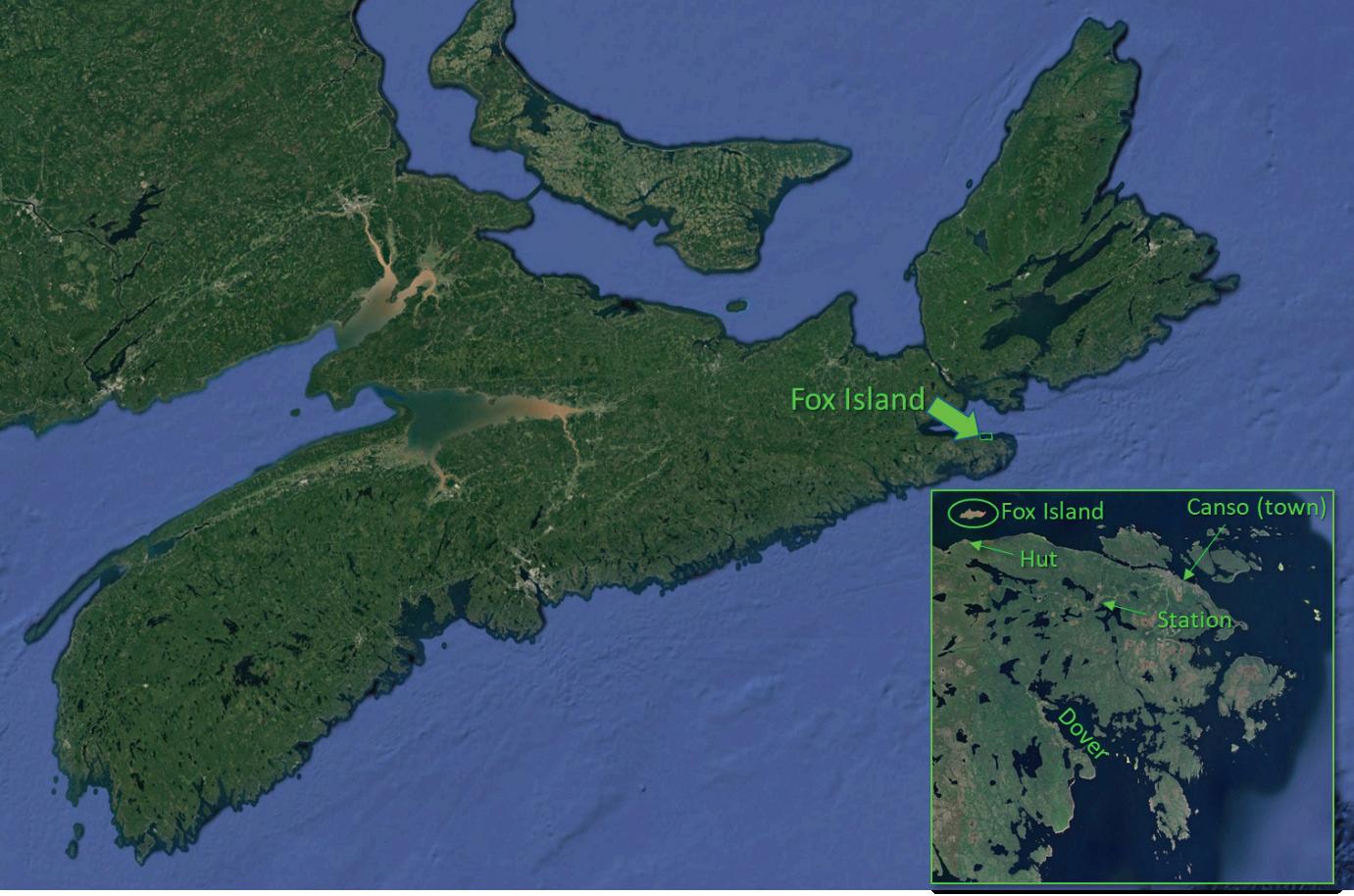 BY PHILIP PILGRIM
It has been a very strange summer here in Nova Scotia. An unusual period of dry air and high temperatures in late May stimulated high winds for two weeks. Unfortunately, forest fires occurred, and we were evacuated. For a short time after, all was good and life was back in order; but in late July, we had over 30 cm of rain in just two days which caused severe flooding. The joke was that we prayed too hard for rain during the fires. Since then, we have had only hot, humid, and uncomfortable weather. We have not had much time to do historical submarine cable exploring so perhaps we will find a spot in the fall.
72 SUBMARINE TELECOMS FORUM MAGAZINE
Figure 1: Fox Island Area Cable Hut, 129 Years Old (Nestle Inn).
Figure 2: Fox Island, Nova Scotia
With this said, we will be taking a break from the Newfoundland terrestrial build and will use photos from a past 2015 exploration to highlight a sketch of a cable hut building.
In 1894, the application of commercial submarine cables was nearly 50 years old (with respect to Samuel Colt’s 1845 cable). By 1894, fourteen transatlantic cables had been laid and the fifteenth (MAIN3) was being laid from Waterville, Ireland to the Canso area of Nova Scotia by the Commercial
Cable Company (aka Mackay-Bennett Cable Company).
Direct cables from Europe/UK
first began to land in Nova Scotia in 1874. By 1894, six landed in the area of Canso. I write “area” as the Hazel


SEPTEMBNER 2023 | ISSUE 132 73
Figure 4: 1894 Photograph of Cable Hut near Fox Island, Nova Scotia (looking east)
Figure 3: 1894 Sketch of Cable Hut near Fox Island, Nova Scotia (Thanks to Bill Burns atlantic-cable.com)
BACK REFLECTION
Hill cable station was deep inland and was approximately 4 km from the nearest beach. We will discuss this unique and prolific cable station in a later article. In this article, we will look as the Fox Island landing site’s cable hut.
Fox Island is located 5.6 km Northwest of the cable station. The 1894 transatlantic cable landed on the mainland south of Fox Island. Just as with past cable landings, the tradition of hiring an artist to make sketches and paintings of the activities continued. In this case the artist was Henry Ash.

Here is an 1894 sketch of the cable landing and cable hut at Fox Island landing.
The building still exists in that location today and has become the core of a cottage.
Based on comparing Ash’s sketches to the cottage in figure 6, the original hut seems to have been extended on its west side (red), dormers added on the front (red) and back (figure 3), and the original narrow windows shortened (green) and two new windows added (red). The centre chimney was removed, and a porch has also been added on the west end. It is possible that the cottage was relocated in the relative vicinity.
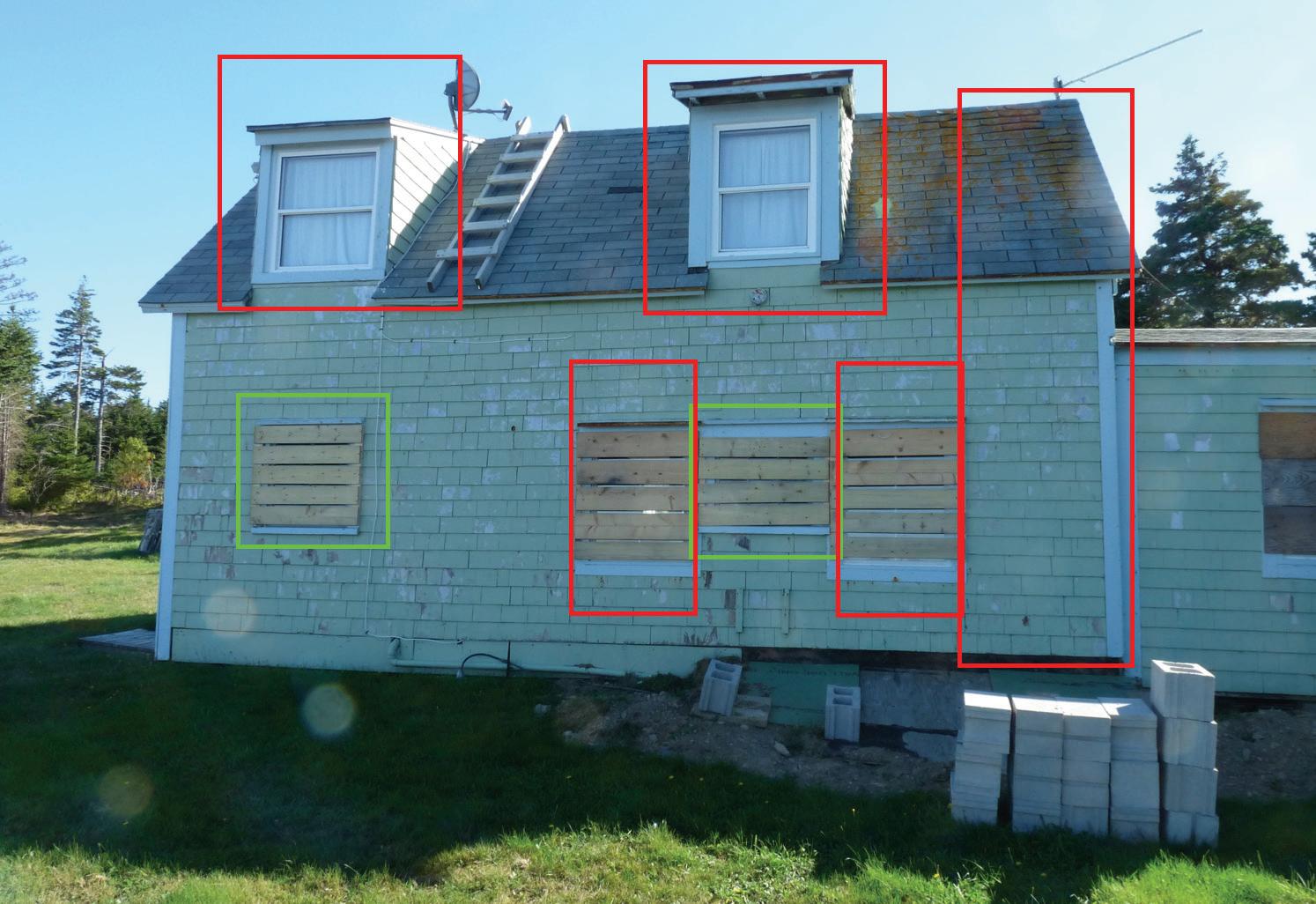
An interesting feature that remains on the east peak is a beam and ring for hoisting supplies to the top floor (this apparatus is on the opposite end from Ash’s sketch in Figure 3).
Here is a composite photo looking east and Ash’s sketch looking east. Although the photo was taken slightly northwest of the hut, the background aligns nicely (green). I’ll have to return and try to get a photo with better
74 SUBMARINE TELECOMS FORUM MAGAZINE
Figure 5: Cottage Adapted from 1894 Cable Hut near Fox Island. (looking west)
Figure 6: Cottage Adapted from 1894 Cable Hut near Fox Island. (looking south)
alignment.
In figure 9 below, you can see the hut’s east side from a distance. There is clearly a door and high window on this side as well as a ground floor window. It is too distant to see the hoist beam detail.


Of course, a story on Fox Island would be incomplete without a photo of Fox Island.
Finally, the local cable station in Canso, referred to as Hazel Hill, was in operation well into the 1960’s; so many cables landed in the area. It is actually quite difficult to identify most due to there being so many! Not a bad problem to have. Figure 12 is one that was protruding through the ground at the land’s end near the hut. I walked a few km south along the cable path (Trench Road) and found several more, including many with “newer” polyethylene insulation. STF
PHILIP PILGRIM is the Subsea Business Development Leader for Nokia's North American Region. 2021 marks his is 30th year working in the subse a sector. His hobbies include "Subsea Archaeology" and locating the long lost subsea cable and telegraph routes (and infrastructure). Philip is based in Nova Scotia, Canada.

SEPTEMBNER 2023 | ISSUE 132 75
Figure 8: Then and Now 1894 Cable Landing Site.
Figure 7: Hoist Beam and Ring (East side of hut)
BACK REFLECTION


76 SUBMARINE TELECOMS FORUM MAGAZINE
Figure 9: 1894 Sketch of Cable Hut near Fox Island Nova Scotia (Thanks to Bill Burns atlantic-cable.com)
Figure 10: Fox Island, Nova Scotia


SEPTEMBNER 2023 | ISSUE 132 77
Figure 12: Buried Cable Galore!
Figure 11: 1894 Sketch of Fox Island, Nova Scotia (Thanks to Bill Burns atlantic-cable.com)
LEGAL & REGULATORY MATTERS
WHEN CUSTOMERS DON’T PAY THEIR BILLS
By Andrés FígoliAfter the capacity service is finally delivered to customers and the service is working well, a carrier may have to deal with certain customers who fail to pay the carrier’s invoices. There are a variety of scenarios behind this attitude, such as bankruptcy filings, delays in processing payment orders, or even emails sent directly to spam folders in customers’ mailboxes.
And there is a special group of challenging debtors: customers who had no intention of paying their debts in the first place and have strategically positioned their pawns accordingly. Here are some tips for dealing with

these special and time-consuming customers.
CLEAR CONTRACT TERMS
These difficult debtors know that a key factor in any collection process is negotiating a good service agreement that solves the common multi-jurisdictional problem where the customer’s location and assets are different from the cable owner’s location, and the governing law may not even match the courts or arbitration venue.
Therefore, if the customer insists on local law and courts, it is advisable to consult with local counsel in that jurisdiction to avoid surprises later. This includes
situations where the local legal process may be excessively slow or even opaque, with a suspiciously consistent tendency to favor local companies in case law.
Other suspicious requests during contract negotiations may include:
• Low interest rates on past due invoices.
• Cure periods of more than 30 days to correct a breach of contract.
• Refusal to pay reasonable upfront fees in an IRU.
• The right to terminate without cause during the initial term of the contract and only in favor of the customer.
None of these individual instances
78 SUBMARINE TELECOMS FORUM MAGAZINE
may be considered sufficient to designate a counterparty as a “potential debtor”. However, if they accumulate, they can potentially lead to significant problems before the ship even sets sail.
Certainly, this is an inherent risk for international carriers that can be eliminated or minimized through measures such as letters of guarantee, deposits or upfront fees, but most of the industry may find it difficult to bear the associated costs. Therefore, a carrier should also rely on its own behavior to ensure that customers honor a signed contract.
SEND A STRONG MESSAGE
Unfortunately, in every industry, there is a minority of operators who are unwilling to pay their bills and are on the verge of bankruptcy because they know they will not pay their bills after they get a deal. The key for a cable operator is to take a firm stance, similar to the signs commonly seen in supermarkets to deter shoplifters, by making it clear that the company will always pursue legal action or impose fines regardless of the amount stolen.
This customer is relying on the fact that small amounts of money owed may not be worth a cable operator’s time to pursue the case in court. This is true. Each jurisdiction has its own costs, including attorneys’ fees, discovery, expert witnesses, or even the risk of having to pay the other party’s attorneys’ fees as well. This “cost-benefit test” for pursuing litigation is well known to such debtors. Other tests relate to the concept of “economic viability” of small cases: at least a 1:10 ratio of costs to recovery, meaning that the total budget for pursuing the case (typically attorneys’ fees and other costs mentioned above) must not exceed
1/10 of the value of the claim (e.g., the amount of the invoices plus interest).
Even some of the usual preventive measures taken by creditors may prove insufficient, such as analyzing the financial situation of a customer from the moment of signing the contract. This type of debtor usually leaves no trace of their financial records, or they hide them in such a way that it can lead to a false positive of a good status situation.
The cable owner should also consider litigation assignment or funding to reduce budgetary pressures, but this may be too expensive or burdensome for small cases.
Much of the deterrent effect on habitual debtors comes from the company’s unwavering policy of thoroughly investigating and, if necessary, relentlessly pursuing its claims to the end. This simultaneously demonstrates financial strength, persistent commitment to carrier service, and a consistently strong deterrent to any potential debtor in the industry who will think twice before spending time and money to default on a contract.
This is a key strategy for winning the high moral ground before the battle even begins in court and increasing the likelihood of a successful settlement afterward. Otherwise, the debtor will view the cable owner as weak and willing to settle for any amount, and at worst, the carrier would send the wrong internal message within its own organization that would attract other potential debtors.
PROTECT THE STAFF
The carrier’s employees are often the most vulnerable in this scenario, as they serve as the first line of defense against the passive violence/fraudulent behavior of a difficult debtor. There is
a risk that their conversations, emails, and other forms of communication may be used against them in court.
A carrier’s in-house counsel must show empathy and maintain a heightened sense of vigilance at all stages to protect the company’s personnel from the debtor’s malicious arguments and bad faith counterclaims in court or before the national telecom regulator.
This is especially true when it comes to service level agreement (SLA) disputes, such as late service delivery and service outages due to force majeure. All of these scenarios can be maliciously asserted as exceptio non adimpleti contractus, or an excuse for the debtor to withhold payment due to a prior breach of contractual obligation by the carrier.
This type of survival strategy, sometimes desperate, causes great distress to network operations personnel and salespeople who find themselves in the spotlight within their own company and potentially in subsequent litigation over whether there has actually been a breach of the SLA. In-house counsel should carefully and objectively determine the underlying facts, whether the customer has clearly rejected the invoices after sending them to the customer in accordance with the dispute resolution procedure in the contract, or whether the service delivery has been a real nightmare for the customer with regular outages and lack of support in accordance with the escalation list in the SLA.
This approach should be followed throughout the process, with periodic evaluations of whether it makes more sense to continue, negotiate, or drop the case.
KNOW THE FACTS
An attorney must first know the facts and avoid a witch-hunt mentality
MAY 2023 | ISSUE 130 79
LEGAL &
REGULATORY MATTERS
WHEN CUSTOMERS DON’T PAY THEIR BILLS
By Andrés Fígoliunless a crime or willful misconduct is involved. They should ask the right questions of their own employees and subcontractors to assess the weakness of the case at the outset, before a claim letter is sent, not after everything has been said and done.
In addition, the attorney chosen for this task should be a meticulous person who digs into the details and is prepared to have a clear mind to turn the changing scenarios into legal evidence of the debtor’s disrespectful behavior and to conduct the pre-trial negotiations if they are unsuccessful.
Attorneys must instill confidence in employees to get the real facts; otherwise, the same facts may emerge during trial or discovery, creating an embarrassing situation for both the attorney and the salesperson that could quickly change an entire case. Every carrier employee needs to understand that the truth needs to be known before a claim letter is sent, and that includes prior discussions during meetings, exchange of high-voltage emails, or even mistakes that have not yet been discovered by the other party.
To do this, the attorney must fully understand the company’s internal processes for preparing a claim and resolving a cable outage, and of course, look for any clues or missing information in the various email exchanges:
The customer has effectively triggered the dispute resolution process set forth in the capacity lease agreement, which does not allow for the suspension of the termination until such dispute is resolved.
The carrier network area did not properly respond to multiple emails from the customer to resolve a series
of minor service outages.
The SLA escalation list was not properly updated, resulting in miscommunication between both parties.
Of course, no company is free from service delivery errors, but that does not diminish the role of a lawyer who must evaluate the evidence and assess whether they have a strong case or not. When faced with a weak case, it is advisable to consider not pursuing it beyond a simple exchange of letters of claim with the debtor, rather than increasing legal costs with a low probability of success in court.
An attorney can provide advice on how to respond to emails from debtors’ representatives, how to protect each employee without putting them in a conflicted position, and how to avoid these common email mistakes:
• Responding to some of the customer’s arguments and forgetting to accept or reject others, which can lead to the misconception that the carrier has accepted them.
• Replying to a new email thread without the previous disclaimers about the risk of delays for a requested new activation date that were in another email thread.
• Responding inappropriately to a
customer’s email that is provocative and uses bad manners.
We are human, and it is unrealistic to expect everyone to think like a litigator in order to avoid forced errors. Fortunately, the courts usually consider the principles of good faith and fair dealing when deciding these cases. STF
ANDRÉS FÍGOLI is the Director of Fígoli Consulting, where he provides legal and regulatory advice on all aspects of subsea cable work. His expertise includes contract drafting and negotiations under both civil and common law systems. Additionally, he has extensive experience as an international commercial dispute resolution lawyer. Mr. Fígoli graduated in 2002 from the Law School of the University of the Republic (Uruguay), holds a Master of Laws (LLM) from Northwestern University, and has worked on submarine cable cases for almost 21 years in a major wholesale telecommunication company. He also served as Director and Member of the Executive Committee of the International Cable Protection Committee (2015-2023).
Do you have further questions on this topic?

80 SUBMARINE TELECOMS FORUM MAGAZINE
Every carrier employee needs to understand that the truth needs to be known before a claim letter is sent, and that includes prior discussions during meetings, exchange of high-voltage emails, or even mistakes that have not yet been discovered by the other party.
ASK AN EXPERT
ON THE MOVE
MAURIZIO MOLLANO has transitioned from Makai Ocean Engineering to Google, where he will serve as Technical Program Manager for Submarine Cable Construction.


GAVIN MCMILLAN has announced that he is the new Interim Chief Executive Officer at RevoluGROUP.
STEVE GRUBB, formerly of Meta, has taken on multiple new roles. He is now an Advisory Board Member for Inligo Networks, founder of Grubb Blue Ocean Solutions, and Chief Scientific Officer for LifeSciencePLUS.

MITCH CHENEY is moving from his role as Regional Manager, EMEA at OMS Group to become the Business Development Director at RSK Group.
MIKE CONSTABLE is now the Principal at Infra-Analytics Pte Ltd, offering strategic consulting and advisory services in the subsea telecommunications infrastructure sector.
JASON O’ROURKE is transitioning from Marketing Manager at Pacific Telecommunications Council to Marketing Director at Horizon Engage in New York.
BILL BARNEY has taken on advisory roles at RTI Cables and EdgeConneX as Advisor and Non-Executive Director Asia.


These transitions highlight the dynamic nature of the industry, with experienced professionals continually seeking new challenges and opportunities to make impactful contributions. We wish them all the best in their new roles.
HAVE A NEW HIRE YOU WANT TO HIGHLIGHT IN THE NEXT ISSUE OF SUBTEL FORUM MAGAZINE? Feel
82 SUBMARINE
TELECOMS MAGAZINE
free to send a direct message to Kieran Clark on LinkedIn or send the announcement to kclark@subtelforum.com.
IN THE EVER-EVOLVING LANDSCAPE OF CORPORATE TRANSITIONS, SEVERAL INDUSTRY LEADERS HAVE RECENTLY MADE SIGNIFICANT CAREER MOVES.
SUBMARINE CABLE NEWS NOW
CABLE FAULTS & MAINTENANCE
WACS Submarine Cable to Be Fully Repaired This Week
WACS Cable Undergoes Repairs Off African Coast
WIOCC Restores ISPs on Equiano Cable Amid Outages
South Africa Undersea Cables Break
Frequent Cable Breaks in Asian Subsea
Tonga Cable Fixed 18 Months Post-Eruption
CONFERENCES & ASSOCIATIONS
IWCS Opens Registration for 2023 Industry Forum
International Cable Protection Committee Announces 2024 Plenary
CURRENT SYSTEMS
Aqua Comms AEC-3 Subsea Cable Now Live
Vocus Proposes A$6.3B Bid for TPG Assets
Vocus Activates DJSC Subsea Cable Segment
RETN Launches Low-Latency London-Paris Link
DATA CENTERS
Cirion Plans 20mw Data Center in Santiago, Chile
FUTURE SYSTEMS
2Africa Cable Comes to Crete
Sparkle Activates BlueMed Cable in Italy
Echo Cable Network: DXN Builds Landing Station in Palau
SubCo to Lay New SMAP Cable in Australian Waters
Amazon Transpacific Fiber Cable Approved
Center3 Chooses Ciena’s 800G for 2Africa Cable
Google Firmina Cable to Land in Argentina
2Africa Cable Lands in Mozambique
2Africa Subsea Cable Lands in Luanda, Angola
Fiji Explores Plans for Second Subsea Cable
STATE OF THE INDUSTRY
ENISA Highlights Cybersecurity Risks in Subsea Cables
GTA Gains Approval for New Cable Landing Station in Guam
Italy Set to Take Over Telecom Italia’s Submarine Cable Unit
Ciena Sets Targets to Reduce Greenhouse Gas Emissions
KT Submarine to Rebrand as LS Marine Solution
WIOCC Group Appoints New Head of Product
OADC Appoints Sayuri Moodliar as Head of ESG
SUBTEL FORUM
Submarine Cable Almanac – Issue 47 Out Now!
TECHNOLOGY & UPGRADES
OMS Group Commissions Makai Software for Fleet
SEPTEMBER 2023 | ISSUE 132 83
ADVERTISER CORNER
As you may know, SubTel Forum is gearing up for the release of two of our cornerstone publications: the 12th Annual Submarine Telecoms Industry Report, coming this October, and the 2024 Submarine Cables of the World printed wall map, set for early next year. I’m reaching out to offer you an exclusive opportunity to significantly elevate your brand’s visibility in the submarine telecoms industry through these impactful platforms.
WHY YOU SHOULD ADVERTISE IN THE INDUSTRY REPORT - $4,250
• The report is downloaded around 500,000 times each year.
• Advertising slots are limited and are filled on a firstcome, first-serve basis.

Click here to secure your spot now in the upcoming Industry Report!

Our publications at SubTel Forum resonate with a global audience spanning over 85 countries. A significant portion—more than 55%—of our readers hold Middle or Senior Management roles, and over 60% wield considerable purchasing influence or are the final decision-makers in their organizations. The upcoming Industry Report will delve into a comprehensive range of topics vital to the submarine telecoms sector.
WHY SPONSOR THE 2024 SUBMARINE CABLES OF THE WORLD MAP - $4,750
• The map is distributed at key industry conferences like PTC ’24 and Submarine Networks World.


• Your logo will be a constant presence on potential customers’ walls throughout the year.
• You’ll receive a tile web banner visible on the SubTel Forum news feed, which garners 10,000 views per month.


Click here to secure your spot now in the upcoming Cable Map!
Being handed out at these conferences ensures that your brand is seen by the right audience—industry professionals who are decision-makers and influencers. With your logo prominently displayed, you’ll be top-of-mind throughout the year. Plus, the added web banner on our site, which receives 10,000 views per month, offers another layer of visibility.
To secure your advertising spot, please reach out to me directly at knielsen@subtelforum.com or call [+1] 703-444-0845. STF

KRISTIAN NIELSEN is based in the main office in Sterling, Virginia USA. He has more than 14 years’ experience and knowledge in submarine cable systems, including Arctic and offshore Oil & Gas submarine fiber systems. As Quality & Fulfilment Director, he supports the Projects and Technical Directors, and reviews subcontracts and monitors the prime contractor, supplier, and is astute with Change Order process and management. He is responsible for contract administration, as well as supports financial monitoring. He possesses Client Representative experience in submarine cable load-out, installation and landing stations, extensive project logistics and engineering support, extensive background in administrative and commercial support and is an expert in due diligence.
84 SUBMARINE TELECOMS FORUM MAGAZINE
-SAM-1 APCN-2-lantis-2 Atlantis-2 Atlantis-2EASSy MainOne-EA-US GOKI NEXT SEA-ME-WESPSC/Mistral America EAC-C2C I-ME-WE NorthstarAmericas BRUSA GlobeNet Endeavour Svalba Southern Columbus ColumbusMonet Seabras-1 - SAEX-Firmina FirminaSEA-MEHawaiki--- Bifrostawaiki Hawaiki3- EA-ME-W SEA-ME-WEI-ME-WE - inoeMAYA-1AmeColumbus-ME-WE 3---EACntra-Asia SJC2 SEA-HA CLOSER LOOK SUBMARINE CABLES OF THE WORLD BY THE NUMBERS 2023 MAP LEGEND IN-SERVICE (383)
SUBTEL FORUM BI-MONTHLY MAGAZINE

The premier publication for the submarine telecoms industry. Each issue is built around a central theme, discussing that specific aspect of the submarine fiber market.
• Over 100,000 downloads per issue
• Two months exposure
SPONSORSHIP BENEFITS:
• Complimentary tile Web Banner on SubTel news feed
• Optional :30 Embedded Video (Full-Page and Two-Page Spread ads only)
• Social Media acknowledgment (LinkedIn, Facebook & Twitter)
• Acknowledgment in announcement Press Release and Mailer
2023 TOPICS & ARTWORK DEADLINES:
January Global Outlook | Art due Jan 2
March Finance & Legal | Art due Mar 6
May Global Capacity | Art due May 1
July Regional Systems | Art due July 3
September Offshore Energy | Art due Sept 4
November Data Centers/New Technology | Art due Nov 6
ART & VIDEO REQUIREMENTS
• Full Page: 8.5” W x 11” H | Half Page: 8.5” W x 5.5” H
• 300 dpi, High-Resolution PDF or JPG with crop marks
• Optional Video: Include blank box in ad design for video over-lay (size: no restrictions)
• Optional Video - 30 seconds
• 1280 × 720 or 1920 × 1080 resolution – mp4 Video File
SEPTEMBER 2023 | ISSUE 132 85
SUBTEL FORUM IS EXCITED TO PARTNER WITH YOUR BUSINESS ON THE FOLLOWING SPONSORSHIP OPPORTUNITY
INVESTMENT PRICE PER INSERTION 1 Issue 2 Issues 3 Issues 4 Issues 5 Issues 6 Issues 1/2 Page $1,750 $1,700 $1,650 $1,600 $1,550 $1,500 Full Page $3,500 $3,450 $3,400 $3,350 $3,300 $3,250 2 Page Spread $5,000 $4,950 $4,900 $4,850 $4,800 $4,750 1 HALF PAGE AD FULL PAGE AD 2 PAGE SPREAD AD EXAMPLES 8.5” x 5.5” 8.5” x 11” 11” x 17”
SUBTEL FORUM IS EXCITED TO PARTNER WITH YOUR BUSINESS ON THE FOLLOWING SPONSORSHIP OPPORTUNITY
SUBTEL FORUM ALMANAC
Released quarterly and serves as a reference tool for anyone interested in the submarine cable industry. The Almanac features each major international system on its own page, along with a system map, landing points, system capacity, length, RFS year and other valuable data.

• Over 525,000 downloads per issue
• Three months EXCLUSIVE Sponsorship
QUARTERLY INVESTMENT: $5,000
EXCLUSIVE 3-MONTH SPONSORSHIP BENEFITS:
• Full-Page Ad (optional :30 embedded Video) near front of document
• Logo/Link on Cover and acknowledgment on Publication Webpage
• Complimentary tile Web Banner on SubTel news feed
• Social Media acknowledgment (LinkedIn, Facebook & Twitter)
• Acknowledgment in announcement Press Release and Mailer
ART & VIDEO REQUIREMENTS
• Full Page: 8.5” W x 11” H
• Add an additional .125” all the way around if you’d like your ad to bleed
• 300 dpi, High-Resolution PDF or JPG with crop marks
• Optional Video: Include blank box in ad design for video over-lay (size: no restrictions)
• Optional Video - 30 seconds
• 1280 × 720 or 1920 × 1080 resolution – mp4 Video File
ARTWORK DEADLINES:
February/March/April Issue Art due Feb 6
May/June/July Issue Art due May 8
August/September/October Issue Art due Aug 7
November/December/January Issue Art due Nov 13
86 SUBMARINE TELECOMS FORUM MAGAZINE
SUBMARINE
ISSUE 43 AUGUST 2022 2
CABLE ALMANAC
SUBTEL FORUM IS EXCITED TO PARTNER WITH YOUR BUSINESS ON THE FOLLOWING SPONSORSHIP OPPORTUNITY
SUBTEL FORUM INDUSTRY REPORT 3

Updated annually, the Report provides the most accurate, comprehensive data on the submarine fiber market. The analysis of data includes system capacity analysis as well as the actual productivity and outlook of current and planned systems and the companies that service them.
• Over 560,000 downloads per issue
• One-year exposure
YEARLY INVESTMENT: $4,250
SPONSORSHIP BENEFITS:
• Two-page Spread Ad
• Complimentary Tile Web Banner on SubTel news feed
• Social Media acknowledgment (LinkedIn, Facebook & Twitter)
• Acknowledgment in announcement Press Release and Mailer
ART & VIDEO REQUIREMENTS
• Full Page: 8.5” W x 11” H | Art due Oct 2
• Add an additional .125” all the way around if you’d like your ad to bleed
• 300 dpi, High-Resolution PDF or JPG with crop marks
• Optional Video: Include blank box in ad design for video over-lay (size: no restrictions)
LOCK IN NOW FOR 2023!
Sponsors can lock into a specific category below. First come-first served!
• Global Overview
• History of Submarine Telecoms
• System Growth
• Out of Service Systems
• Evolution of System Ownership and Customer Base
• Capacity Ownership
• Financing Analysis
• Historic Financing Perspective
• Regional Distribution of Financing
• Current Financing
• Supplier Analysis
• System Suppliers
• Installers
• Surveyors
• Recent Mergers, Acquisitions, and Industry Activities
• System Maintenance
• Publicity
• Reporting Trends & Repair Times
• Club Versus Private Agreements
• Cable Ships
Note: Subtel Forum reserves the right to change categories
• Current Cable Ships
• Shore-End Activity
• Market Drivers and Influence
• Hyperscalers
• Data Centers
• Special Markets
• Offshore Energy
• Unrepeatered Systems
• Sustainability
• Regional Market Analysis and Capacity Outlook
• Transatlantic Regional Market
• Transpacific Regional Market
• Americas Regional Market
• AustralAsia Regional Market
• EMA Regional Market
• Indian Ocean Pan-East Asian Regional Market
• Polar Regional Market
SEPTEMBER 2023 | ISSUE 132 87
SUBTEL FORUM IS EXCITED TO PARTNER WITH YOUR BUSINESS ON THE FOLLOWING SPONSORSHIP OPPORTUNITY


SUBTEL FORUM PRINT CABLE MAP
Add your Logo to this beautiful, large format print map which showcases every major international submarine cable system, and we are proud to say, hangs in many offices in our industry.
• Only 22 spaces available!
• Over 3,500 distributed
• PTC '24 and SNW '24 Conferences Distribution
• Art Deadline| November 3
YEARLY INVESTMENT: $4,500
SPONSORSHIP BENEFITS:
• Complimentary tile Web Banner on SubTel news feed

• Social Media acknowledgment (LinkedIn, Facebook & Twitter)
• Acknowledgment in announcement Press Release and Mailer
• 25 Complimentary copies for Sponsor
88 SUBMARINE TELECOMS FORUM MAGAZINE
4
78 32 23 20 16 15 13 2 Myanmar Niger Nigeria Papua New Angola of Congo Germany Algeria Ethiopia Unity Faster PPC-1 WACSSEA-ME-WE ManatuaOne SAM-1 SAM-1 Intra-Asia APCN-2 Falcon SAT-3 SAT-3-FEA WACS WACS Atlantis-2 Atlantis-2 Atlantis-2SEA-ME-WE SEA-ME-WE EllaLink EASSySEACOM MainOne MainOne HawkSEA-ME-WESEA-US Hantru-1 MAYA-1 GOKI SouthernCrossNEXT SouthernCrossNEXT SEA-ME-WE EllaLink DARE-1 EAC-C2C Southern NEXTNorth/South SPSC/Mistral I-ME-WE SAFE ACE Americas GLO-1 GLO-1 GLO-1 EAC-C2C LION-2 TGNEurasia AAE-1 MENA ACE PAN-AM Hawaiki I-ME-WE AlaskaUnitedWest Hawaiki Northstar PPC-1Americas North PCCS ASE BRUSA BRUSA Arsinoe GlobeNet SAM-1 Endeavour AKORN Endeavour Japan-US ASH GlobeNet Svalbard Indigo West TEAMS Southern Cross SouthernCross SACS Columbus NCP SouthernCross EXA GreenlandConnect PAC Jupiter TGN Pacific Arcos-1 Columbus Columbus OAC AMX-1 AMX-1 Curie Curie SAM-1Monet Monet Monet Seabras-1 SAC MedNautilus Polar Express SINGSJC2 SAEXEast MIST-ADC Firmina Firmina Firmina CelticNorsePEACE SEA-ME-WE PEACE CSN-1 HawaikiNui Equiano Equiano Equiano H2Cable HopperIAXSIGMAR 2Africa HawaikiNui EMIC-1 2Africa IRIS East 2Africa SAEXWest SAEXWest SAEXWest 2Africa2Africa 2Africa 2Africa EchoTOPAZ Hopper Bifrost Echo 2Africa Hawaiki Hawaiki ACC-1 ACC-1 TEAS TEAS TEAS Polar Express Polar Express NTT WE MARINE India Falcon BBG TGN Gulf GBICS SEA-ME-WE SEA-ME-WE Falcon SEA-ME-WE FEA SEACOM OAC TEAMS Eurasia MENA 2Africa/PEARLS RamanRaman- SEA-ME-WE SING PEACE EMIC-1 TEAS Italy Libya Syria Turkey Herzegovina Egypt SEA-ME-WE North Alexandros MedNautilus AAE-1 HawkI-ME-WE BIOS Jonah Arsinoe PEACE Blue Blue Africa-1 EMIC-1Republic PAN-AM MAYA-1 SAM-1 PCCSPCCS Monet Americas North SAC ALBA-1 SAM-1 Columbus PAC AmericasColumbusArcos-1 CSN-1 Firmina Falcon MENA SEA-ME-WE SEA-ME-WE TGN Eurasia FEA EIG-EACO PEACE Africa-1SaudiVision Cable2Af 2Africa Raman Raman EMIC-1 TEAS 73 China SEA-ME-WE AAGSJC RNAL ASE APG AAE-1 APG EAC-C2C TGN Intra-Asia Jasuka SCAN ALC ADC SJC2 SEA-H2X SEA-H2X A CLOSER LOOK RED SEA SOUTHEAST ASIA MEDITERRANEAN GULF INDIAN OCEAN CARIBBEAN SUBMARINE CABLES OF THE WORLD Indian Ocean TOP DATA CENTER PROVIDER FACILITY COUNT POLAR BY THE NUMBERS SUBMARINE CABLE SYSTEM INVESTMENT 2013-2022 REGIONAL DISTRIBUTION SUBMARINE CABLE SYSTEM INVESTMENT 2023-2026 REGIONAL DISTRIBUTION OF NEW CABLE, 2023-2026 2023 MAP LEGEND LANDINGS (1,099) DATA CENTER CLUSTERS IN-SERVICE (383) PLANNED (65)
SUBTEL FORUM IS EXCITED TO PARTNER WITH YOUR BUSINESS ON THE FOLLOWING SPONSORSHIP OPPORTUNITY
SUBTEL FORUM ONLINE CABLE MAP
Built with the industrystandard Esri ArcGIS platform and linked to the SubTel Forum Submarine Cable Database, the Subtel Forum Online Cable Map tracks the progress of:

• 550 Current & Planned Cable Systems
• 1,500+ Landing Points
• 1,700+ Data Centers
• 53 Cable Ships
• Systems are also linked to SubTel Forum’s News Now Feed, allowing viewing of current and archived news details
• If you haven’t had the chance, use this link to the Online Cable Map to explore our many features
12-MONTH EXCLUSIVE SPONSORSHIP INVESTMENT: $35,000
SPONSORSHIP BENEFITS:
• 12-Month Exclusive Sponsorship of the Online Map
• Your Logo/Link on every page
• 75-word Company Description of company Announcement
• Complimentary tile web banner (visible on SubTel news feed)
• Social media acknowledgment (LinkedIn, Facebook & Twitter)
• Acknowledgment in announcement Press Release and mailer
SEPTEMBER 2023 | ISSUE 132 89
5


90 SUBMARINE TELECOMS FORUM MAGAZINE FEATURE MARCH 2021 | ISSUE 117 90 COMING NEXT ISSUE! YOU CAN BE A PART OF OUR NEXT ISSUE! SUBMIT AN ARTICLE contact editor@subtelforum.com SPONSOR AN ADVERTISEMENT contact sales@subtelforum.com