FORUM SUBMARINE TELECOMS
GLOBAL CAPACITY

130 | MAY 2023 Featuring Submarine Network EMEA Conference Preview
ISSUE

Ihad the pleasure of attending ICPC in Madrid last month, which was an extremely well-considered and effective event for the 200 or so of us attendees. Not only was it the first time we met in the flesh in four years, but it was also a chance to meet or make friends with folks we had not seen for a long time, if ever. Congratulations to the ICPC team for making such a memorable plenary.
Welcome to Andrés Fígoli who has volunteered to create a new department for SubTel Forum, that being Legal & Regulatory Matters. And for his premier article he has penned an interesting look at capacity agreements, namely “Three Things You Should Know About Capacity IRU Agreements.” We are thrilled to have his insights going forward.
Congratulations to this year’s recipients of SubTel Forum’s Excellence in Industry Awards presented in March at SubOptic ’23 in Bangkok; namely:
• Michael Clare, SubOptic 2023 Best Oral Presentation Award
• Kristina Shizuka Yamase Skarvang, SubOptic 2023 Best Poster Presentation Award
• Nancy Cai, SubOptic 2023 Best Newcomer Award
We have the pleasure of republishing their papers in this issue, which are all very interesting reads.
The 46th issue of the Submarine Cable Almanac will be available later in May and will contain details on every
major submarine cable system in the world. Keep an eye out for all the new cables mentioned (https://subtelforum. com/almanac/).
In our last issue we added the “Ask the Expert” button to a number of department articles and are a little overwhelmed with the interest and response – Thanks – and please keep asking…
We are thrilled to be traveling to the UK at the end of the month and attending the Submarine Networks EMEA Conference. The folks at Total Telecom provided some excellent content to this issue, and we expect their event to be an excellent opportunity to learn, as well as see a lot of industry friends.
Thanks for their support to this issue’s advertisers: Submarine Networks EMEA, Fígoli Consulting, and
WFN Strategies. Thanks also to the many authors who continue to make our issues interesting and so far reaching. Of course, our ever popular “where in the world are all those pesky cableships” is included as well.
Lastly, we hope that SubTel Forum continues to be your primary destination for news and analysis related to the submarine cable industry.
Stay well and save me a seat at the nearest pub – Slava Ukraini STF

www.subtelforum.com | ISSN No. 1948-3031
PRESIDENT & PUBLISHER: Wayne Nielsen | wnielsen@subtelforum.com | [+1] (703) 444-2527
VICE PRESIDENT: Kristian Nielsen | knielsen@subtelforum.com | [+1] (703) 444-0845
PRODUCTION MANAGER: Hector Hernandez | hhernandez@wfnstrategies.com | [+1] (210) 338-5413
EDITOR: Stephen Nielsen | snielsen@subtelforum.com
ANALYTICS: Kieran Clark | kclark@subtelforum.com | [+1] (540) 533-6965
SALES: sales@subtelforum.com | [+1] (703) 444-0845
DESIGN & PRODUCTION: Weswen Design | wendy@weswendesign.com
DEPARTMENT WRITERS: Andrés Fígoli, Iago Bojczuk, Kieran Clark, Kristian Nielsen, Philip Pilgrim, and Wayne Nielsen
FEATURE WRITERS: Andrew Desforges, Brian Lavallée, Chris Wood, Dag Roar Hjelme, David Tappin, Dean Veverka, Edward Pope, Emily Lane, Isobel Yeo, James Hunt, James Panuve, Jan Kristoffer Brenne, Jan Kristoffer Brenne, Jan Petter Morten, John Murray, John Tibbles, Julian Rawle, Keith Shaw, Kerry Merritt, Kevin Mackay, Kristian Nielsen, Kristina Shizuka, Kurosh Bozorgebrahimi, Marta Ribó, Martin Connelly, Michael Clare, Michael Williams, Nancy Cai, Nigel Parnell, Peter Talling, Richard Wysoczanski, Robin André Rørstadbotnen, Ronald Rapp, Sally Watson, Samiuela Fonua, Sarah Seabrook, Sean Bergin, Shane Cronin, Steinar Bjørnstad, Steinar Bjørnstad, Taaniela Kula, Tom Soja, Valey Kamalov, and Yamase Skarvang
NEXT ISSUE: JULY 2023 – Regional Systems featuring Submarine Networks World Conference Preview
 Wayne Nielsen, Publisher
AUTHOR & ARTICLE INDEX: www.subtelforum.com/onlineindex

Submarine Telecoms Forum, Inc. www.subtelforum.com/corporate-information
BOARD OF DIRECTORS: Margaret Nielsen, Wayne Nielsen and Kristian Nielsen
SubTel Forum Continuing Education, Division of Submarine Telecoms Forum, Inc. www.subtelforum.com/education
CONTINUING EDUCATION DIRECTOR: Kristian Nielsen | knielsen@subtelforum.com | [+1] (703) 444-0845
Contributions are welcomed and should be forwarded to: pressroom@subtelforum.com.
Submarine Telecoms Forum magazine is published bimonthly by Submarine Telecoms Forum, Inc., and is an independent commercial publication, serving as a freely accessible forum for professionals in industries connected with submarine optical fiber technologies and techniques. Submarine Telecoms Forum may not be reproduced or transmitted in any form, in whole or in part, without the permission of the publishers.
Liability: While every care is taken in preparation of this publication, the publishers cannot be held
responsible for the accuracy of the information herein, or any errors which may occur in advertising or editorial content, or any consequence arising from any errors or omissions, and the editor reserves the right to edit any advertising or editorial material submitted for publication.
New Subscriptions, Enquiries and Changes of Address: 21495 Ridgetop Circle, Suite 201, Sterling, Virginia 20166, USA, or call [+1] (703) 444-0845, fax [+1] (703) 349-5562, or visit www.subtelforum.com.
Copyright © 2023 Submarine Telecoms Forum, Inc.
ISSUE 130 | MAY 2023
5 QUESTIONS WITH KERRY MERRITT

SUBMARINE NETWORKS EMEA PREVIEW


22 32 26 35 28 42
2023 GLOBAL SUBSEA INDUSTRY HEADWINDS AND OPPORTUNITIES
 By Sean Bergin and Tom Soja
INTEGRATING MONITORING TECHNOLOGIES TO SECURE SUBMARINE CABLES
By Jan Petter Morten, Martin Connelly, Steinar Bjørnstad, Jan Kristoffer Brenne, and Andrew Desforges
SOMETIMES “ENOUGH” IS NOT ENOUGH
By Nigel Parnell & edited by Julian Rawle with contributions from John Murray
CONVERGED OPEN DIGITAL INFRASTRUCTURE

By Chris Wood

62 SUBOPTIC 2023 BEST ORAL PRESENTATION AWARD
WHAT CAN WE LEARN ABOUT VOLCANIC HAZARDS FOR SUBSEA CABLES FROM THE 2022 HUNGA TONGA-HUNGA HA’APAI ERUPTION?
By Keith ShawBy Michael Clare, Isobel Yeo, James Hunt (National Oceanography Centre, UK), Sally Watson Richard Wysoczanski, Sarah Seabrook, Michael Williams, Emily Lane, Kevin Mackay (National Institute of Water and Atmospheric Research, New Zealand), Peter Talling, Edward Pope (Durham University, UK), Shane Cronin (University of Auckland, New Zealand), Marta Ribó (Auckland University of Technology, New Zealand), Taaniela Kula (Tonga Geological Services, Kingdom of Tonga), David Tappin (British Geological Survey, UK), Samiuela Fonua, James Panuve (Tonga Cable Ltd), Dean Veverka (Southern Cross), Ronald Rapp (SubCom), Valey Kamalov (Google)
68 SUBOPTIC 2023 BEST POSTER AWARD
COMPARING SENSITIVITY OF STATE OF POLARIZATION



 By Kristian Nielsen
MONITORING AND DISTRIBUTED ACOUSTIC SENSING IN THE SVALBARD ARCTIC SUBMARINE COMMUNICATION CABLE
By Brian Lavallée By KristinaShizuka Yamase Skarvang (NTNU), Steinar Bjørnstad (Tampnet), Robin André Rørstadbotnen (NTNU), Kurosh Bozorgebrahimi (SIKT), Jan Kristoffer Brenne (ASN), Dag Roar Hjelme (NTNU)
72 SUBOPTIC 2023 BEST NEWCOMER PRESENTATION AWARD

PRICE IS RIGHT: IN(TERNAL)VESTING IN CARBON PRICING FOR SUSTAINABLE GROWTH
By Nancy Cai (Telstra)

The most popular articles, Q&As of 2022. Find out what you missed!
The most popular articles, Q&As of 2019. Find out what you missed!

a division of Submarine Telecoms Forum. This reference tool gives details on cable systems including a system map, landing points, system capacity, length, RFS year and other valuable data.
Keep on top of our world of coverage with our free News Now daily industry update. News Now is a daily RSS feed of news applicable to the submarine cable industry, highlighting Cable Faults & Maintenance, Conferences & Associations, Current Systems, Data Centers, Future Systems, Offshore Energy, State of the Industry and Technology & Upgrades.
Keep on top of our world of coverage with our free News Now daily industry update. News Now is a daily RSS feed of news applicable to the submarine cable industry, highlighting Cable Faults & Maintenance, Conferences & Associations, Current Systems, Data Centers, Future Systems, Offshore Energy, State of the Industry and Technology & Upgrades.


mapping efforts by the analysts at SubTel Forum Analytics, a division of Submarine Telecoms Forum. This reference tool gives details on cable systems including a system map, landing points, system capacity, length, RFS year and other valuable data.
Submarine Telecoms Industry Report is an annual free publication with analysis of data collected by the analysts of SubTel Forum Analytics, including system capacity analysis, as well as the actual productivity and outlook of current and planned systems and the companies that service them.
Submarine Telecoms Industry Report is an annual free publication with analysis of data collected by the analysts of SubTel Forum Analytics, including system capacity analysis, as well as the actual productivity and outlook of current and planned systems and the companies that service them.
PUBLICATIONS
Submarine Cable Almanac is a free quarterly publication made available through diligent data gathering and
Submarine Cable Almanac is a free quarterly publication made available through diligent data gathering and mapping efforts by the analysts at SubTel Forum Analytics,
The online SubTel Cable Map is built with the industry standard Esri ArcGIS platform and linked to the SubTel Forum Submarine Cable Database. It tracks the progress of
The online SubTel Cable Map is built with the industry standard Esri ArcGIS platform and linked to the SubTel Forum Submarine Cable Database. It tracks the progress of some 450+ current and planned cable systems, more than 1,200 landing points, over 1,700 data centers, 37 cable ships
as well as mobile subscriptions and internet accessibility data for 254 countries. Systems are also linked to SubTel Forum's News Now Feed, allowing viewing of current and archived news details.
The printed Cable Map is an annual publication showcasing the world's submarine fiber systems beautifully drawn on a large format map and mailed to SubTel Forum Readership and/or distributed during Pacific Telecommunications Conference in January each year.
SubTel Forum designs educational courses and master classes that can then appear at industry conferences around the world. Classes are presented on a variety of topics dealing with key industry technical, business, or commercial issues. See what classes SubTel Forum is accrediting in support of the next generation of leaders in our industry.
The Authors Index is a reference source to help readers locate magazine articles and authors on various subjects.
SubTel Forum provides industry analyses focused on a variety of topics. Our individualized reporting can provide industry insight for a perspective sale, business expansion or simply to assist in making solid business decisions and industry projections. We strive to make reporting easy to understand and keep the industry jargon to a minimum as we know not everyone who will see them are experts in submarine telecoms.
In the past we have provided analyses pertaining to a number of topics and are not limited to those listed below. Reach out to info@subtelforum.com to learn more about our bespoke reports.
DATA CENTER & OTT PROVIDERS: Details the increasingly shrinking divide between the cable landing station and the backhaul to interconnection services in order to maximize network efficiency throughout, bringing once disparate infrastructure into a single facility.
If you are interested in the world of Data Centers and its impact on Submarine Cables, this reporting is for you.
GLOBAL CAPACITY PRICING: Details historic and current capacity pricing for regional routes (Transatlantic, Transpacific, Americas, Intra-Asia and EMEA), delivering a comprehensive look at the global capacity pricing status of the submarine fiber industry. Capacity pricing trends and forecasting simplified.
GLOBAL OUTLOOK: Dive into the health and wellness of the global submarine telecoms market, with regional analysis and forecasting. This reporting gives an overview of planned systems, CIF and project completion rates, state of supplier activity and potential disruptive factors facing the market.
OFFSHORE ENERGY: Provides a detailed overview of the offshore oil & gas sector of the submarine fiber industry and covers system owners, system suppliers and various market trends. This reporting details how the industry is focusing on trends and new technologies to increase efficiency and automation as a key strategy to reduce cost and maintain margins, and its impact on the demand for new offshore fiber systems.
REGIONAL SYSTEMS: Drill down into the Regional Systems market, including focused analysis on the Transatlantic, Transpacific, EMEA, AustralAsia, Indian Ocean Pan-East Asian and Arctic regions. This reporting details the impact of increasing capacity demands on regional routes and contrasts potential overbuild concerns with the rapid pace of system development and the factors driving development demand.
SUBMARINE CABLE DATASET: Details more than 450 fiber optic cable systems, including physical aspects, cost, owners, suppliers, landings, financiers, component manufacturers, marine contractors, etc. STF

[Reprinted with permission from SubTel Forum 2022/2023 Submarine Industry Report]
The world continues to consume ever-increasing amounts of data, with bandwidth continuing to skyrocket. This demand – driven by a continued shift towards cloud services, an explosion of mobile device usage and mobile technology like 5G –provides numerous opportunities for the submarine fiber industry.
For the period 2018-2022 submarine fiber capacity on major routes has increased at a Compound Annual Growth Rate (CAGR) of 13.3 percent, including upgrades and new system builds. (Figure 23) This is down as compared to the same analysis at this time last year, when the CAGR along major submarine cable routes was 18.2 percent.
As global demand continues to increase at a rapid pace, sustaining infrastructure growth will be challenging and potentially cause demand to exceed supply. To date, the industry has been able to keep up with demand— but it will be necessary to continue focusing on increasing capacity even further to meet the increasing demand. This is where technology like 400G wavelengths and high fiber pair count systems can have a positive impact.
Based on reported data and future capacity estimates, global capacity is estimated to increase up to 75.4 percent by the end of 2025. (Figure 24) Despite multiple systems planned over the next three years boasting design capacities of more than 200 terabits per second, overall capacity growth projections are less than they were a year ago when there was a 100 percent capacity increase planned for the following three years.
However, not all announced systems are far enough along in the development process to have decided things
like fiber pair counts and design capacity, so expect to see an increase in possible bandwidth as these details are finalized and new systems are announced – especially as 400G wavelength technology and high fiber pair count systems become more prevalent. Additionally, the demand impact brought about by COVID-19 forced many people to re-evaluate their bandwidth needs and gear up for additional capacity to facilitate remote working environments.
Since 2015, major submarine cable routes have averaged 18 percent lit of total design capacity. A large capacity buffer is designed for cable systems to deal with sudden spikes in demand, such as handling rerouted traffic due to a cable fault.

Transatlantic routes are the most competitive globally – especially those connecting the two biggest economic hubs in the world of New York and London – and carry traffic between the highly developed economies and technology markets of North America and Europe.
The Transatlantic region has seen low to moderate
design capacity growth during the period 2016-2020 at a CAGR of 16 percent due to regular upgrades and a new system each year for the period 2015-2018 and one new system in 2020. (Figure 25) This is down from last year where the CAGR for the period 2015-2019 was 22.9 percent. On average, the Transatlantic route has maintained a lit capacity at 23 percent of total for this five-year period, well over the global average of 18 percent. The last two years have seen 27.3 and 36.8 percent, respectively. Additionally, lit capacity has increased at a CAGR of 40.9 percent during this period, indicating that demand is greatly outpacing capacity build out.
Based on publicly announced information, lit capacity
growth in the Transatlantic region is currently projected to outpace design capacity growth by 2025. (Figure 26) While there is still time for systems for 2025 to be developed, that window is closing considering a typical submarine cable project takes 2-3 years to implement. The meteoric rise in bandwidth demand is driven by individuals and businesses continuing to switch to cloud and web based services as they have since the start of COVID.
However, with the advent of 400G technology and high fiber pair count systems (16 to 24 or more) it is possible that design capacity will be able to stay ahead of demand through system upgrades and new systems announced over the next 12-18 months.
As in the Transatlantic region, Hyperscalers continue to expand their infrastructure across the Pacific and account for a significant portion of new system builds. Systems along this route connect the economies of the United States and Canada with Australia and East Asia.
The Transpacific has observed similar growth to that of the Transatlantic with 16.6 percent CAGR for the period 2016-2020. This is about the same last year where the CAGR for the period 2015-2019 was 15.7 percent. The region has maintained an average of 29.4 percent lit capacity during this time – noticeably higher than global averages. (Figure 27) In 2015, lit capacity was as low as 15 percent, indicating a short-term capacity overbuild in this region that has only recently begun to recede with 2019 and 2020 observing lit capacities of 29.3 and 47 percent, respectively. As in the Transatlantic region, Hyperscalers continue to expand their infrastructure across the
Pacific and account for a majority of new system builds.
As one of the more competitive regions in the world – with a diverse number and type of both systems and customers – the Transpacific is expected to increase from its CAGR of 26.6 percent to 27.3 percent through 2025 based on publicly announced system information. (Figure 28) While lit capacity is not currently expected to outpace design capacity by 2025 as in the Transatlantic, based on currently available information lit capacity may reach as high as 69.7%. More systems need to be developed and additional upgrades performed along Transpacific routes to stay ahead of this steep rise in demand.
The Americas region has seen significant growth in the last few years, almost quadrupling in total capacity from 233.5 Tbps. in 2016 to 803.5 Tbps in 2020 along major routes. This region has observed a CAGR of 27.9 percent for the period 2016-2020. (Figure 29) This is about the same as last year where the CAGR for the period 20152019 was 28.5 percent.
The region has maintained an average yearly lit capacity of 9.4 percent, far below the global average. Much of this growth had been expected to derive from growing markets in Latin America developing new systems and capacity upgrades to the United States. However, this growth has not been realized yet and may be due to current economic and political issues through Central and South America.
Hyperscalers again continue to be the primary drivers of new systems along this route adding several high-capacity systems in
2017 and 2018 that increased the total capacity along this route by over 160 percent from 2016. Typically, Hyperscalers had partnered with traditional telecoms carriers that add this capacity to the general market but now they are primarily building cables entirely for their own use. However, Google has sold a fiber pair to Sparkle on the Curie submarine cable system in 2020 and another fiber pair to Lumen on Grace Hopper across the Atlantic earlier this year, showing that Hyperscalers may be willing to monetize these assets.
Based on publicly announced system information this route will observe a design capacity CAGR of just 8.4 percent for the period 2019-2023. (Figure 30) This indicates a potentially significant slowdown in new capacity demand as much of the existing infrastructure remains unlit.
Growth in this region is typically fueled by markets in Latin America – Brazil, Argentina, and Chile amongst others – and helped by the expansion of Hyperscalers in South America. However, due to persistent economic and political uncertainty in the region and a possible overbuild over the last several years the normal demand drivers for systems in this region have been absent. Much of the new bandwidth slated to be in place by 2025 is along a route serving just the East Coast of the United States where demand is still rising.
Growth along this route depends on huge infrastructure builds connecting major hubs throughout Asia and Southeast Asia – something that does not happen every year.
The Intra-Asia route has maintained minimal to moderate design capacity growth since 2016 with a design capacity CAGR of 17 percent for the period 2016-2020. (Figure 31) This is down slightly from last year where the CAGR for the period 2015-2019 was 19.5 percent. Lit capacity falls below global trends at
12.4 percent of total design capacity.
Over 700 Tbps capacity is already available along these routes and over 1,000 Tbps will be added through 2025, adding a sizeable increase of 143 percent. This capacity growth is driven by several cables over 140 Tbps in capacity being developed in the region through 2025. As demand increases across the Pacific especially between Asia, Australia and the United States there is potential for lit capacity to grow significantly as more traffic is being routed to and from Asia.
Based on publicly announced planned system information this route will observe a design capacity CAGR of 18.8 percent for the period 2021-2025. (Figure 32). STF
The SubTel Cable Map, built on the industry-leading Esri ArcGIS platform and linked to the SubTel Forum Submarine Cable Database, offers a dynamic and engaging way to explore over 440 current and planned cable systems, 50+ cable ships, and more than 1,000 landing points. With systems connected to SubTel Forum’s News Now Feed, users can easily view current and archived news details related to each system.
This interactive map is an ongoing effort, updated frequently with valuable data collected by SubTel Forum analysts and insightful feedback from our users. Our aim is to provide not only data from the Submarine Cable Almanac, but also to incorporate additional layers of system information for a comprehensive view of the industry
We encourage you to explore the SubTel Cable Map to deepen your understanding of the industry and to educate others on the critical role that submarine cable systems play in global communications.
All submarine cable data for the Online Cable Map is sourced from the public domain, and we’re committed to keeping the information as current as possible. If you are the point of contact for a company or system that needs updating, please don’t hesitate to reach out to kclark@subtelforum.com
Below is the full list of systems added and updated since the last issue of the magazine:
MAY 15, 2023
SYSTEMS ADDED:
Anjana
Hong Kong-Sihanoukville
Natitua Sud
T3
SYSTEMS UPDATED:
2Africa
Apricot
Asia Direct Cable
Asia Link Cable
BlueMed
Far North Fiber
India-Asia Express
PDSCN TEAS
We hope the SubTel Cable Map serves as a valuable resource to you and invites you to dive into the ever-evolving world of submarine cable systems. Happy exploring! STF
KIERAN CLARK is the Lead Analyst for SubTel Forum. He originally joined SubTel Forum in 2013 as a Broadcast Technician to provide support for live event video streaming. He has 6+ years of live production experience and has worked alongside some of the premier organizations in video web streaming. In 2014, Kieran was promoted to Analyst and is currently responsible for the research and maintenance that supports the Submarine Cable Database. In 2016, he was promoted to Lead Analyst and his analysis is featured in almost the entire array of Subtel Forum Publications.
Do you have further questions on this topic?

The bustling city of Bangkok, Thailand hosted the 10th edition of the SubOptic conference from March 13th to 16th, 2023. The longest-running and most comprehensive conference in the global subsea cable industry, SubOptic reconvened with the theme “Navigating the Open Seas—Collaboration on Our Critical Infrastructure.” The conference, last held in 2019 in New Orleans, widened its scope and interest in sustainability topics for 2023.
From day one, sustainability took center stage, building on the momentum of other recent industry events, such as the 2023 Pacific Telecommunications Conference in Honolulu, Hawaii. Maja Summers, Vodafone Carrier Services representative and Chair of the Program Committee for SubOptic 2023, emphasized that for gatherings of global scope such as SubOptic, “the environmental and social responsibility of the subsea community needs to be in focus.” This year’s call for participants encouraged for the first time the submission of research and initiatives to the “Clean Green Submarine” track, spanning topics such as renewable energy, green marine operations, and optical environmental sensing technologies. Indeed, sustainability-related initiatives and projects were a central theme throughout the conference.
Urs Hölzle, Senior Vice President for Technical Infrastructure at Google, kicked off the conference with a keynote presentation in which he
presented on Google’s work to achieve a carbon-free internet. Over the following days, conversations encompassed a variety of environmental topics, from the recent approval of the long-awaited United Nations High Seas Treaty, to innovative SMART (Science Monitoring and Reliable Telecommunications) cable systems, to carbon reduction through greening operations. Presentations, poster sessions, and discussions emphasized the pressing importance of sustainability.
For the Sustainable Subsea Networks team that traveled to Bangkok, SubOptic was an excellent opportunity to present our recent empirical research and explore partnerships with industry members. For us, the highlight of the event was the
SubOptic Foundation Congress on Sustainability, an event that made subsea history as the first intentional gathering of members from across sectors and around the world to discuss metrics for sustainability in the subsea cable industry. The Congress was made possible by funding and institutional support from the SubOptic Foundation and the Internet Society Foundation. It gathered industry leaders to share insights from ongoing initiatives and potential strategies for the cable networks of the future. In this article, we share the Congress discussions in detail, as its participants’ contributions will be a crucial foundation for sustainable development in the coming years.
Nicole Starosielski, Associate Pro-fessor at New York University as well as Principal Investigator and Industry Lead on the Sustainable Subsea Networks grant project, moderated the session and introduced ten potential sustainability metrics for discussion. Our research indicates that a set of metrics or numerical parameters is crucial given potential future pressure from new regulations globally. Data quantification and utilization will also be critical to greening the industry across all stages, from planning and manufacturing to operations and recycling: a set of metrics allows companies to establish baselines against which progress can be measured.
Dr. Starosielski revealed preliminary findings from conversations with twenty-five member companies of SubOptic and from the research team’s carbon footprint assessment of a submarine cable. The session also highlighted where the best sustainable practices are taking place, showcasing the Sustainable Subsea Networks Map developed in partnership with Telegeography.

Following this demonstration, a panel discussion followed in an open and guided format. Industry members shared existing practices and goals. Some companies have made significant progress by leveraging emerging technologies for marine surveying, employing strategies for recycling cables, and expanding the use of renewable technologies. Merete Caubet, Vice President of Sales and Business Development at Bulk Fiber Networks, emphasized the importance of thinking about sustainability efforts collectively across both data centers and subsea networks.
Caubet mentioned that Bulk Infrastructure started reporting its carbon footprint in 2020 and is committed to reducing it by 50% by 2030. She emphasized the need for a closer
examination of energy use across the industry, an aspect that has seemingly been overlooked until recently (check here a recent column article we recently wrote on the topic). She stated that 90% of Bulk Fiber Networks’ data centers in Europe are connected to renewable energy sources. Caubet underscored the importance of positioning assets in areas with access to renewable energy sources, and stated: “we need to improve the energy efficiency of these projects while also paying attention to small-scale data centers, where most of the processing takes place.”
Ensuring the reliability and resilience of the global subsea cable network is crucial, especially given the increased data traffic during the COVID-19 pandemic. Andy Palmer-Felgate, Submarine Cable Engineer at Meta, stressed the importance of planning innovation around cut-
ting-edge technology, such as ocean energy, but also emphasized the need for a thorough examination of resilience from various angles. He stated, “access to the grid is important, but it is also essential to have a backup. If you can use a combination of direct green energy and still maintain reliability, that is fantastic.” This highlights the need for a sustainable approach that balances innovation with dependability.
of Product Marketing at Ciena, shed light on the company’s strides in implementing coherent optics within submarine networking. Over the past years, Ciena’s technological progression in coherent optics has enabled the company to expand its capacity from an initial 10 gigabits per second per wavelength to an impressive 800 gigabits per second per wavelength, representing an 80-fold increase in
Brian Lavallée, Senior Directorthe span of approximately one decade. Additionally, the power per bit per second has decreased by 80%, while the space per bit per second has been reduced by 90%. “These advancements also fit into existing platforms, a trend we see among our competitors. Architectural changes have occurred as well, such as the introduction of coherent modems in submarine cables,” Lavallée explained. He also touched on the company’s foray into the software domain, where the internet and networks are becoming increasingly integrated, heralding another significant development in the industry.
Regulation emerged as a key issue to tackle in the context of recycling. Although an overall consensus on the extent of industry collaboration regarding data sharing, for instance, does not yet exist, some participants argued that establishing a principle and consensus around cable recovery and recycling as a common goal would be achievable.
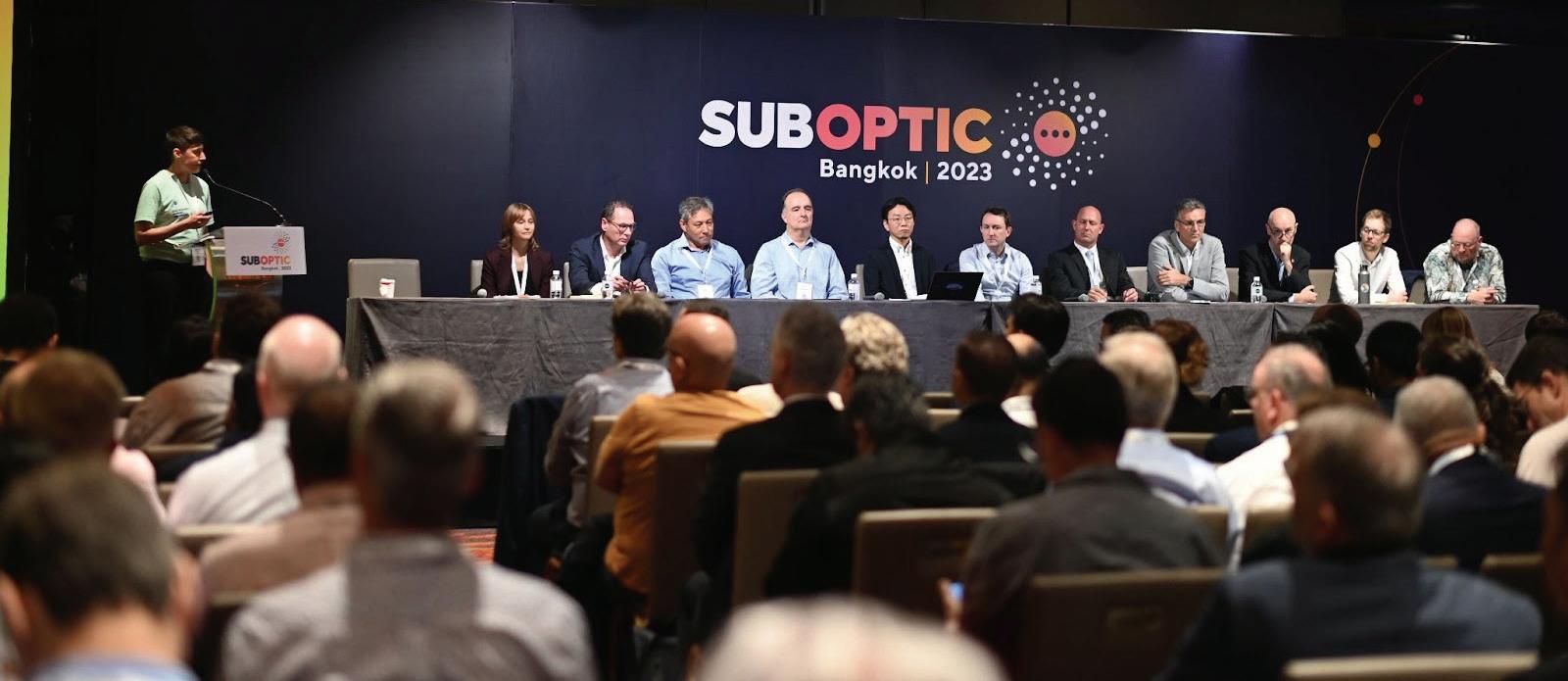
Alywn du Plessis, CEO of Mertech Marine, revealed that the company began tracking its carbon footprint as early as 2015. Du Plessis stressed the array of factors to consider when weighing recycling options, including the business case, crew safety, cable types, implications for other cables in the region, and more. He posited that when a cable can be safely recovered and recycled, taking into account technical aspects and various other factors, the process is more sustainable and economically advantageous. “Even though we’ve proven that these cables can last, we can’t predict what the situation will be like in the distant future. So, whenever it’s possible to safely remove cables while considering a wide range of factors, we believe it should be done,” du Plessis said. However, he cautioned that the business case for re-
covering these cables is often precarious, with many uncontrollable factors such as commodity pricing affecting the business model. This renders the process highly challenging and necessitates further industry collaboration.
Sustainability in marine operations was a significant focus of the Congress. Fugro Singapore Marine Pte Ltd aimed to reduce its emissions by over 40% between 2018 and 2023, despite expanding its operations. René d’Avezac de Moran, Service Line Manager, introduced several methods to mitigate environmental impacts associated with subsea cable network surveys and installations. He cited the growing interest in using vessels that consume less energy or adopt greener fuels, as well as improving efficiency and speed, optimizing routes, and reducing heat generated by the vessels. d’Avezac de Moran also highlighted the recent innovation of autonomous surface vessels, which have already achieved success in other industries. He expressed enthusiasm for their adoption in compliance with more sustainable practices and expectations for reducing carbon emissions. “Adapting
these technologies to our industry and finding new markets can make a huge difference,” d’Avezac de Moran stated. “It not only benefits the environment but also creates a safer work environment for everyone involved. People are increasingly interested in these innovations, and we believe they will continue to gain traction in the future.”
Metrics for enhancing sustainability can also help drive corporate changes from within companies. Dean Veverka, CTO & VP Operations at Southern Cross Cables Limited, emphasized the importance of internally tracking carbon emissions at various stages of installation in order to identify areas for reduction and potential investment in innovation. By breaking down operations into specific components and quantifiable parameters, different teams with their own objectives can collaborate more effectively on deploying a sustainable cable system. Veverka stated, “Once we’ve gathered the necessary data, we then are to come back across teams and ask, what is our baseline? Can we improve each of those? I think that’s when discussions can help drive sustainable change.”
The carbon emissions of the subsea cable industry are significant, but when compared to the impact of other sectors like fishing, they are relatively small. But it is not enough to simply label one industry as more harmful than another when considering sustainability. As suggested by Michael Clare, Principal Researcher at the UK’s National Oceanography Centre, “we need to consider sustainability within an even broader sense.” Although the industry has given considerable thought to marine sustainability, there are multiple factors related to cable installation and protection that need to be addressed. They also need to consider the increasing complexity involving governments and new regulations that are becoming stricter in the face of environmental concerns. This opens up an opportunity to consider how the industry can interact with governments to ensure sustainable use of the aquatic environment. As pointed out by Takahiro Kashima, manager at NEC Corporation, perhaps it is worth considering whether the “industry should rely on governments to control illegal activities so that private stakeholders don’t need as much protection.”
One concrete proposal for marine operations is the adoption of speed optimization as a practice: going the optimal speed for fuel efficiency. While in some cases reduced speed would lead to environmental benefits, Kashima cautioned that “speed optimization does not always lead to carbon reduction.” If the marine installation is not completed during the workable season due to speed optimization, additional vessel mobilization could be required, which would result in additional CO2 emissions.
The shift toward a digitized, albeit decentralized, workforce was a prominent topic in sustainability discussions. Nigel
Bayliff, CEO of Aqua Comms,shared insights on how his company, with teams spanning from San Francisco to Brisbane, has integrated ESG metrics into its corporate objectives. This integration has allowed for flexible work arrangements tailored to employees’ individual needs. Bayliff highlighted, “We’re more focused on the results of work rather than its location.” He further elaborated that AquaComms’ policies enable staff to work remotely from other countries for extended durations, provided it aligns with the company’s overarching goals. The team convenes in person once or twice a year at conferences to maintain connections.
“Remote work is the only way we can operate effectively,” asserted Bayliff. Echoing this sentiment, Emmanuel Danjou, Head of Business Development at Alcatel Submarine Networks, argued that adopting remote work has contributed to reducing the industry’s overall carbon footprint. Danjou noted that his company has started to establish control centers globally, thus curtailing the need for travel. “We are currently using these centers for remote operations, which initially seemed daunting due to the nature of the tasks. However, we have experienced success in this area and look forward to expanding their usage in the future,” Danjou shared.
Comprehending the role of global regulators in the industry is crucial, as licensing processes have grown increasingly complex over the past two decades due to heightened recognition of various stakeholders’ involvement. For instance, Singapore’s Marine Ports Authority mandates the use of specific materials to minimize the carbon footprint. Michael Constable emphasized the importance of understanding the roles and positions of regulators worldwide. “We will be forced by the regulators around the world with their own ideas on things, possibly without industry input,” he cautioned.
The Congress’s conclusion underscored the pressing need for industry collaboration in devising a green matrix. Failing to do so may result in companies being compelled to adhere to diverse regulations across nations, potentially without input. It could become necessary for businesses to obtain a green rating or showcase outstanding efforts in cable construction and operation to secure landing licenses. Proactively championing sustainable practices serves the industry’s best interest, helping to circumvent conflicting regulatory perspectives worldwide.
Following the Congress, sustainability discussions were prominently

featured throughout SubOptic 2023. Throughout the week, research talks, masterclasses, and poster sessions covered a wide range of topics, such as cutting-edge research and techniques related to SMART cables, innovative technologies in Uncrewed Surface Vehicles (USV) for marine operations, and the impact of Spatial Division Multiplexing (SDM) on subsea cables. Conversations also explored the ongoing challenges, both from engineering and regulatory/commercial perspectives, in decommissioning cables and the potential of building renewable-powered data centers to minimize the internet’s carbon footprint. Notable was also the vast geographic orientation of the research spanning from South East Asia to the Middle East and North Africa and from the Nordics to the Pacific Islands.
Amidst these presentations, there was a strong sense of the need to maximize capacity for the networks of the future while reducing costs–from marine to cable manufacturing. However, it is essential to ensure that advancements in efficiency and sus-
tainability go hand in hand to prevent any negative environmental impact.
Since its inception in 1986, the SubOptic conference has witnessed how significant changes in telecommunications have shaped the world. These changes have also come with new global challenges that are becoming imperative, such as addressing climate change, tackling alarmingly rising sea levels, and ensuring more equitable access to information. As we anticipate future SubOptic conferences and other industry gatherings, it is essential to recognize the growing importance of sustainability. From adopting metrics to advocating for renewable energy, the industry can make an enormous difference in expanding critical infrastructures while leveraging collaboration. For this topic, the conference theme, “Navigating the Open Seas—Collaboration on Our Critical Infrastructure,” could not be more appropriate.

The SubOptic Global Citizen Working Group and the Sustainable Subsea Networks Advisory Board are committed to working on developing metrics for sustainability in the coming years. We
welcome new members to the Group and Board: Matthew Bowden (Red Penguin Marine), Jack Bullen (Aqua Comms), Merete Caubet (Bulk Fiber Networks), René d’Avezac de Moran (Fugro), Emmanuel Danjou (Alcatel Submarine Networks), Jas Dhooper (Aqua Comms), Salvador Jimenez-Sanchez (Red Penguin Marine), Connor Shipton (Vodafone) and Vedrana Stojanac (Ciena). We look forward to sharing our progress in two years at SubOptic 2025.

This article is an output from a SubOptic Foundation project funded by the Internet Society Foundation. STF
Do you have further questions on this topic?
As we approach the end of the second quarter of 2023, it’s the perfect time to once again ask: Where in the World Are All Those Pesky Cableships?
SubTel Forum tracks AIS updates every 6 hours from 53 vessels that make up the global cable ship fleet. Between March 3 and May 3, the cableship fleet logged 14,043 AIS updates based on SubTel Forum’s tracking system. Nearly half of these updates, 6,897 out of 14,043, indicated no movement speed during this 60-day period, showing no significant change in overall activity compared to the previous period. This lack of movement is generally attributed to

ship repairs, scheduled maintenance, and upgrades. For this edition of Where in The World Are Those Pesky Cableships, our analysts have created an updated heat map showing where the cable ship fleet was most active around the world. Red, orange, and then yellow indicate the highest amount of activity, while lower activity is represented by increasing shades of blue. As indicated by the heat map, the main AIS zones of activity over the past 60 days were China Coast (7%), East Asia (13.5%), Indian Coast (5.5%), North East Atlantic Ocean (7%), and South East Asia (9%). From the total 26 AIS zones, these five accounted for 42 percent of all AIS activity for the cable ship fleet.
The hotspots of activity in these regions can be attributed to new system installations, as well as repairs and maintenance of existing infrastructure. Comparing the busiest regions to the activity observed in March, some have remained constant, while others have shifted. For example, East Asia and North East Atlantic Ocean continue to be among the top areas of activity, while China Coast and Indian Coast have emerged as new hotspots this time around. The change in the busiest regions is typically due to active submarine cable builds in these areas and increased maintenance activities compared to other regions of the world over any given time period.

The cable ship fleet has experienced significant growth and changes in vessel ownership distribution in recent years, reflecting the industry’s adaptation to evolving
market dynamics. Despite the addition of new vessels and the conversion of existing ones, there is still concern that there is a cable ship capacity crunch. Many installers are fully booked through 2024, and external vessels are being hired on a more frequent basis to keep up with project workloads. The overall age of the fleet remains high –between 20 and 30 years old – with only a handful of new, modern vessels coming into service over the last few years.
As the industry moves towards sustainable practices, the cable ship fleet has seen the introduction of energy-efficient vessels that contribute to lowering its environmental impact. This trend signals a strong commitment by the industry to prioritize sustainability while meeting the increasing demand for connectivity.
The cable ship fleet continues to be busy with new system installations and repairs, responding to the growing need for connectivity in various regions worldwide. While some hotspots of activity remain constant, others have shifted, reflecting the ever-changing landscape of the submarine cable industry. The ongoing challenge is to keep up with the ever-increasing demand while embracing sustainability and innovation. STF
KIERAN CLARK is the Lead Analyst for SubTel Forum. He originally joined SubTel Forum in 2013 as a Broadcast Technician to provide support for live event video streaming. He has 6+ years of live production experience and has worked alongside some of the premier organizations in video web streaming. In 2014, Kieran was promoted to Analyst and is currently responsible for the research and maintenance that supports the Submarine Cable Database. In 2016, he was promoted to Lead Analyst and his analysis is featured in almost the entire array of Subtel Forum Publications.
As the industry moves towards sustainable practices, the cable ship fleet has seen the introduction of energy-efficient vessels that contribute to lowering its environmental impact.


For over 20 years, Total Telecom (part of Terrapinn Group) has built its reputation as a trusted news source for the global telecommunications industry. Coupled with a constantly evolving events portfolio that offers unique networking opportunities for senior executives from across the communications sector, we pride ourselves on being a content and people-focussed business.
Our events and online platform are all about bringing people together. It’s simply what we do and with a breadth of experience in the events, publishing, and telco markets, it’s something that we’ve gotten very good at!
In 2018 we launched Submarine Networks EMEA as a sister event to the Submarine Networks World conference, which has been held in Singa-
pore for over 25 years. The decision to launch a more regionally focused conference came at a time of increasing activity in the EMEA submarine cable industry. Five years later, the event continues to go from strength to strength and in 2023 we expect over 800 executives from the global subsea market to join us in London.
In addition to producing Submarine Networks EMEA we actively cover the subsea telecommunications sector as a media brand, reporting on new projects, developments, and news.
As an events’ organiser, we are very conscious of the role that we play in creating and supporting a more diverse and inclusive industry. Across all our events we make a conscious effort to improve the gender-balance on our agendas, providing a platform for many of the incredible women that are already playing an important role in the telecoms sector.
But of course, true diversity is about so much more than the avoidance of all-male panels at industry events.
At Total Telecom, we focus on a number of initiatives that can hopefully play a small part in supporting this approach.
Firstly, students, recent graduates, and apprentices, can attend any Total Telecom event completely free of charge. We want to make our events as accessible as possible, so, by removing some of the costs involved with attending the event, we hope that more organisations will consider sending their new recruits as well as their more senior executives.
Secondly, we seek to amplify these new industry voices by having young people and industry newcomers join panel discussions and other sessions, giving them a platform to have their say on the future of the sector.
There are so many fantastic initiatives already taking place - the SubOptic Foundation’s mentoring scheme is just one that jumps to mind – and we’re always engaging with the industry itself for ways in which we can be more involved and really work together to make a positive change. It’s a team effort after all.
Sustainability is another important topic to Total Telecom and to the wider Terrapinn Group. Last year, Terrapinn became a member of isla – an independent organisation founded by events professionals and aimed at supporting the industry to transition towards a more sustainable and green future. Across the organisation we are taking active steps to reduce our carbon footprint; reducing waste at events, offsetting staff travel, working with suppliers and venues to ensure our operations are in line with our sustainability targets (full details of which can be found in our Sustainability Policy).
It’s been a busy year already for the Total Telecom team with two events already behind us. March saw us launch our inaugural event in the US – Connected America. With over 1,000 attendees from across the connectivity sector, Connected America was our biggest launch to date and sees us continue to expand our “Connected” events portfolio. This events series is especially important to us as it looks not only the development of communications infrastructure (be it fixed, mobile, subsea, data centres, etc.) but also at what this connectivity can en-
able for people, businesses, and communities. The scope of these events is potentially huge and the team are already looking forward to our flagship Connected Britain event in September, which will bring together over 5,000 attendees from the private and public sector.
And of course, we can’t wait for Submarine Networks EMEA 2023 later this month! STF
KERRY MERRITT currently heads up the Content Team at Total Telecom, the leading provider of news, insight and events for global telecoms. Total Telecom serves the global telecom industry, with special focus on executives within operators, service providers and the enterprise users of telecom products and services.
The telecommunications industry, like many others, has a lot of work to do when it comes to promoting diversity. To truly achieve a more diverse future, we believe that the industry must start from the beginning and look at how people begin their careers in this exciting and dynamic industry.BY KIERAN CLARK


31st May - 1st June 2023
Business Design Centre, London
Submarine Networks EMEA is the leading annual subsea connectivity event in the region, bringing together 800 senior leaders from the global subsea market for two jam-packed days of learning, collaboration and networking.

In addition to offering plenty of networking opportunities, attendees will be able to enjoy thought-leading panels, technical presentations, workshops and cable project and connectivity hub updates.
SPEAKING OPPORTUNITIES: kerry.merritt@totaltele.com SPONSORSHIP & EXHIBITION
MARKETING OPPORTUNITIES: laura.curwen@totaltele.com
Submarine Networks EMEA 2023 is set to be another fantastic event, with over 800 attendees from the global subsea industry set to attend. Now in its sixth year, the event has gone from strength-to-strength and has firmly established its position as the EMEA region’s pre-eminent submarine cable event.


For the second year running, the event will kick off with a pre-event workshop hosted by the SubOptic Association. The SubOptic Members’ Forum will take place on the afternoon of 30th May and is open to both members and non-members of the Association. The afternoon will consist of a welcome from the new Executive Committee, highlights from SubOptic 2023 in Bangkok, insights from the Working Groups, and a look at what’s in-store for the Association. The afternoon will conclude with a networking drinks event held at Jack’s Café (located at the Business Design Centre).
The conference on 31st May will open with a keynote panel exploring “What’s on the horizon for the submarine cable industry?”. Attendees will hear from Gary Waterworth (Network Investments, Meta), Mario Martín (CEO, Telxius), Javier Hector Lloret (Senior Expert, Submarine Cables, Omantel), Adil Alaskah (CTO, Center3) and Gavin Tully (Managing Partner, Pioneer Consulting). Ciena’s Thomas Soerensen will then share his take on market trends and Steve Dawe will provide an update on the activities of the European Subsea Cable Association (ESCA).
Back by popular demand, the ‘News in Brief’ sessions offer an opportunity to hear the latest cable project updates and developments from connectivity hubs in the EMEA and surrounding regions. This year a record-breaking nineteen organisations are taking part, with speakers representing cables including Zeus, IRIS, Tusass Connect, Asia Connect 1, TEAS, IONIAN, and Far North Fiber - to name just a few!
The rest of the day one programme will cover hot topics including public-private partnerships for funding subsea projects, spectrum sharing, subsea cable resilience, investment in the Nordics, emerging connectivity hubs, the future of SLTE, transponder technology evolution, the future of partnerships and the changing dynamics of supply contract commercials and project funding.
The day one programme will conclude with an update from the International Cable Protection Committee (ICPC) followed by a panel discussion on digital infrastructure investment in Africa. Speakers from WIOCC, Digital Realty, Orange, Liquid Dataport and Balancing Act will explore how subsea cables are supporting the ICT sector’s devel-
Attendees of Submarine Networks
30th May | Bus
What you can expect from
A welcome from the ne Highlights from SubOpt Insights from the Worki Look forward to what’s Evening Drinks Recepti
Pre-registration is a must as registered for Submarine Networks

opment in Africa and connecting the continent’s booming data centre eco-system.
The second day of the event is also packed with lots more exciting content, starting with a session on how to maximise subsea infrastructure with SMART Cables. Speakers will include Bruce Howe, Ceci Rodriguez Cruz and Jose Barros, who will represent the JTF SMART Cables and will be joined by Joel Ogren (CEO, Assured Communications) and Olivier Courtois (Director, ASN).
Other highlights from the programme include sessions on innovations in submarine cable regulation, sustainability, updates from the SubOptic Foundation, insights on Vodafone’s industry-leading apprenticeship programme and discussions on licensing and regulation.
The team at Total Telecom can’t wait to see everyone in London at the end of the month for Submarine Networks EMEA 2023! STF

31st May - 1st June
Business Design Centre, London
Networks EMEA are invited to join the...
iness Design Centre, London
MAY
08:00: Registration opens
08:55: Chair's opening address
09:00: What's on the horizon for the submarine cable industry?
09:40: Keynote address from the European Subsea Cables Association (ESCA)
09:55: Submarine cable industry trends – the challenges and the opportunities
10:15: Networking break
10:45: News in brief: GÉANT
10:55: News in brief: China Unicom Global
11:05: News in brief: Digital Global Gateways
11:15: News in brief: Unitirreno
11:25: News in brief: SAEx
11:35: News in brief: Update from Digital Realty
11:45: News in brief: Far North Fiber
11:55: News in brief: IONIAN
12:05: News in brief: N0r5ke Viking
w Executive Committee
tic 2023 in Bangkok
ng Groups
in store for the Association on
12:15: Funding subsea infrastructure through publicprivate partnerships
12:15: Building next generation submarine cable networks
12:15: Subsea cable resilience: perspectives on cable protection
12:55: Closing the gap to Shannon: transponder technology evolution for next gen SDM cables
12:55: Lessons learned for network resilience from recent extreme natural hazards
13:15: Networking break
14:10: Presentation from Vertiv
14:10: Do you know where you're going to?
14:30: Supporting the development of the people shaping the industry's future
14:30: Spectrum sharing: addressing the operational challenges of cables with high fibre counts
14:30: Investment in the Nordic region
15:10: Presentation from Eastern Light
15:10: The future of SLTE
15;10: Developing connectivity hubs in the EMEA region
Early bird, group discounts, and *subsidised tickets available at www.totaltele.com/subnets
15:30: What does the future of subsea cables look like?
15:30: Shifting sands – the changing dynamics of supply contract commercials and project funding
15:50: Building the communications eco-system: from subsea, to the data centre, and beyond
16:30: Networking break
17:10: Update from the International Cable Protection Committee (ICPC)
17:25: Strategies for accelerating digital infrastructure development in Africa
18:00: Networking drinks reception

JUNE
08:30: Registration opens 09:15: Maximising undersea infrastructure: the journey towards SMART cables

10:15: Networking break
10:35: News in brief: Update from Altibox Carrier
10:45: News in brief: Asia Connect 1 (ACC-1)
10:55: News in brief: Update from Telxius
11:05: News in brief: Confluence-1
11:15: News in brief: IRIS
11:25: News in brief: Tusass Connect
11:35: News in brief: EXATEL expansion strategy
11:45: News in brief: TEAS
11:55: News in brief: Update from Sparkle
12:05: Update from the SubOptic Foundation
12:20: Building a greener submarine cable industry
12:50: Networking break
13:50: Regulation of submarine cables
14:10: Licensing and regulation
14:10: Case study: lessons learned from Vodafone's apprenticeship programme launch
 BY SEAN BERGIN AND TOM SOJA
As we stare down the second half of 2023 and look towards 2024 and beyond, there is no better time to consider the implications of the fundamental changes that are happening within our industry and also the external factors that influence the shape of our sector. There is a lot to unpack and digest, but the shifting dynamics in the subsea space could broadly be dissected into the following components: technology, chokepoints/ routing, cost of construction, production and vessel availability, cost of capital/inflationary pressures and also tech layoffs. All of these elements are factors, or at least considerations, in building any business plan when developing a new subsea cable system. Let’s take a high-level look at each of these components, in no particular order, which shape the landscape of the industry and attempt to understand if any headwinds may actually be masquerading as opportunities.
It’s the people that make our industry tick, so this is as good as any place to start. Currently, our industry is dominated by a more senior demographic. Just go to any subsea focussed conference and scan the crowd and you will note that the majority of the people in our sector are without doubt male
and forty-years old plus, plus. Are we putting enough effort in to attract a broader (and younger) demographic to the industry? It’s important that we do focus on new talent particularly as our industry evolves, and evolution obviously requires fresh ideas. “What got us here will not get us there” comes to mind.
It’s not like there aren’t enough displaced folks in the tech industry (of all genders, races, and ages) that would be able to fit right in with minimal upskilling. Consider significant layoffs1 in the tech space (congruent sectors to subsea) in 2023 alone – around 80,000 of them and this is just the last 4 months. Add to that further planned layoffs due to bite in May and June, and we are looking at a significant amount of available talent for our industry to draw from. Although it’s an unpleasant picture, it certainly does create an opportunity for the subsea industry to look at gaining some ‘fresh blood’ to help shape the future from an extremely diverse and talented pool of resources. Sure, they aren’t subsea experts, but who of us was when we joined the industry?
Where is the opportunity here? Ironically, the submarine cable industry provides a large part of the physical components that comprise the virtual ecosystem that is the Internet and 1
global communications infrastructure. Certain economics and other business aspects do have crossover between the physical world and the bits and bots of the tech world. Those types of talents are welcome, particularly in business model innovation.
PTC and SubOptic have both prioritized attracting younger talent to our highly dynamic and vital industry, as have companies such as Google, with its summer submarine cable boot camps. These efforts are to be applauded, but more initiatives are needed, and all are welcome.
We are operating in an environment of higher-than-normal inflation, supply chain limitations, and heightened geopolitical tensions. Times are challenging, no doubt. How many companies that have been the backbone of our industry for the last decade or so, will be economically viable within a decade from now if they continue on their current path? What is really being done to evolve the business models that drive our industry in light of the challenges we are currently facing? I am sure these questions are what many shareholders, Boards and CEOs are grappling with at the moment – how to balance the need for short term profitability whilst managing long term transformation and
growth aspirations. In the subsea space, this is a complex issue given evolution of technology, the cost of construction and supply chain challenges.
Opportunity Amidst Economic Uncertainty does exist. One of the enduring lessons from Covid is that the global telecom infrastructure played a key role in enabling the global economy to endure massive shutdowns for an unprecedented amount of time. To the extent that the global economy may be in a temporary period of uncertainty – for example, with concomitant belt tightening for business travel, the lessons of Covid taught us to work smarter.
Things aren’t necessarily so dire for our industry, and it could indeed again be countercyclical for our industry - sort of a ‘heads we win, tails, we win again’ situation, as was the case with the pandemic. Looking back to previous global economic downturns such as the banking crisis of the 2008 - that did not have a significant knock-on effect to our industry either.

When this author started in the subsea space, E1’s (2Mb) where big international circuits. Working on deals for STM1’s (155Mb) and above was a huge deal. Nowadays, we are talking about 400Gb circuits delivered over >20Tb fibre pairs and even spectrum solutions (fractional fibre pairs). Then comes along SDM (Space Division Multiplexing) technology, with the capability to enable sixteen, twenty-four or even more fibre pairs per system. Finally, the greater flexibility on offer that comes with WSS (Wavelength Selective Switching) technology now also come into play to complicate things. Everything has evolved from a technology perspective, and as a consequence the business models need to evolve in parallel. What impacts do these enhancements and improvements in technology do to a traditional subsea business model? In short, the models need to be looked at differently for it to make sense.
Technology improvements over the last 5 years have been amazing, but what will these high capacity, high fibre count systems do to the health of the industry overall? Let’s take a snapshot of the transpacific market as it sits today. The last four cables officially announced (JUNO, BiFrost, Echo & TOPAZ) have a combined fibre count of 60 fibre pairs yielding a total of 864Tb, an average of 14Tb per pair. That’s right, SIXTY FIBRE PAIRS. The question that we should be asking ourselves is what this will do to the average price of capacity in the market once these systems are all in service. One has to assume that the historic average negative CAGR on pricing of around 17% transpacific will skyrocket. It simply has to. So, once the average market price decreases, how will developers be able to make a business case stack up to build something new in the last half of this decade?
Our industry thrives on technology and re-invention and therein is the opportunity - it has always been thus. But the most enduring business models have never been based on ‘who has the best technology’ or ‘who has the biggest cable,’ but rather, what type of new and innovative services can be offered over it. With ever decreasing capacity costs, new services become more economically viable and it’s the scaling of those new innovations that will drive future business models, not merely more of the ‘same old, same old’ at ever lower prices. Back in the E-1 days, voice traffic was 90+% of all international telecom traffic. Today, voice is merely an app, and often times, free.
Cost per bit will undoubtably be one of the key issues moving forward. A push to drive this down which is a consequence of improvements in technology coupled with vendors being squeezed, may generate ‘high fives’ amongst certain developers/buyers of systems in the industry, but this potentially leads to a situation where build economics simply won’t stack up in the future. In spite of all the technology advancements and reduction in cost per bit, there are some fundamental building blocks (commodities) that will not decrease in price in concert. Raw commodities, such as copper and oil which is both the feedstock of cable insulation material as well as the fuel for the ships that install and repair the cables, are all required to get these systems built and laid. At what point does it become impossible to make a business case stack up and generate sensible IRR’s? It ‘feels’ like capacity prices still have a long way to fall. I am not convinced that the same can be said for manufacturing economics.
It’s in a private developer’s interest to see the price of capacity remain relatively stable, or at least be able to factor in an acceptable level of price decline. Price decline is the number one enemy of any subsea business plan. That is, of course, unless you have serious levels of free cashflow underpinned by massive core demand. So, we have some really complicated dynamics at play here. One segment of the market driving the price per bit down as low as possible, another segment doing all it can to keep the price per bit stable. And, in the background the suppliers of the technology are creating solutions which support the first objective. The industry is undoubtably at odds with itself to an extent. What does this all mean for future builds beyond what’s in planning today?
There is certainly opportunity in the construction space. SDM technology was a major step-change breakthrough in cost-per-bit reduction on the manufacturing side. While there is no doubt that factory wages and other commodity prices will continue to fluctuate over time, the ability to derive greater capacity per constructed element still has some
ways to go before all additional technologies are exhausted. Innovations – that word again – in new fibre types (multicore, hollow core, etc.), better power supplies (enabling longer systems with more fibre pairs), more efficient greener vessel design with new types of fuels and propulsion systems – are but a few of the items being worked on by the leaders of our industry. Not all the innovations are necessarily ‘sexy’ but there is progress to be made and is being made on a number of fronts that don’t necessarily garner headlines in the popular press.
Submarine cables are owned and operated by private companies and support a nation’s economy. TeleGeography recently estimated2 that over 40 trillion dollars of daily financial transactions are transmitted by submarine cable infrastructure. By default, protecting a nation’s economy relies upon third-party agreements, commercial models, and foreign owned repair vessels. Globally, between 20232025, projected investment in new cables will be approximately $11.8B, seeing an additional 380,000km of cable deployed that will require maintenance services. However, corresponding investment in vessels assets designated to maintain this vast, expanding network infrastructure is lacking. The industry is only now coming to terms with the anticipated impact of this investment dichotomy.
The global fleet of specialized cable installation and repair vessels numbers approximately 50 vessels. Of these, approximately 21 vessels are dedicated to zone and private maintenance agreements. The majority of vessels are older than their design lifetime of twenty-five years, as the economic case for investment in new assets face significant challenges. High running costs, an aging fleet and inflationary factors do not appear to be recognized in commercial negotiations for maintenance when up for renewal.
From the fleet operator’s perspective, there is an almost ‘expected’ discount at each renewal negotiation that is driven by procurement departments who are incentivized to achieve favorable or discounted price points. There is an element of short-termism in this approach without a corresponding balance of risk or lengthened contract terms (e.g., five to ten years) that will aid vessel investment economics and allow fleet operators to build a pragmatic business case for reinvestment. Perhaps investment in additional vessels remains an opportunity for an entrepreneurial mind.
Maintenance opportunities may sound a bit mundane, however, it’s an interesting space. It’s clear that our indus-
try lacks an adequate response to cable outages in certain parts of the world. This gives rise to a major opportunity for new players to join in with fresh, long-term investment capital, even beyond the initial new players that have arisen over the past few years. This is a particularly opportune time also, to re-examine the balance of negotiating power between cable owners and maintenance providers as several of the zone agreements come up for renewal over the next few years. There is certainly room for consideration of innovative economic and risk models for those club agreements beyond the ‘tried and true’ and perhaps even beyond what is currently on offer by private maintenance agreements.
The submarine cable industry has long been an obscure niche industry. For better or worse, it is now gaining recognition of its importance even by world leaders for its strategic and security value, in addition to its massive importance to economic value. So, in addition to risk and cost, strategic consideration on multilateral geopolitical levels enter the equation.
Three problematic regions come to mind in the context of headwinds and opportunities in the subsea sector. Namely Egypt, the Strait of Malacca, and the South China Sea. All three represent different challenges and the market appears to be investing in innovative routing solutions to minimize future risks.
Egypt has long been talked about and a viable alternative to compliment the traditional route traversing the Red Sea and onwards to Marseilles and the FLAP (Frankfurt, Lon don, Amsterdam, Paris) markets. Finally, this is starting to crystalize with planned systems such as Blue Ramon, EMC and Neutrality One all eyeing a. terrestrial bypass through a combination of territories such as Saudi, Jordan and Israel. Not only will this bifurcate risk, but it should also serve to re duce operational costs be avoiding the NTRA fees in Egypt.
The Strait of Malacca is the typical entry point for all cables headed to Singapore from Europe and/or India. At its narrowest point in the Phillips Channel of the Singapore Strait, the Strait of Malacca is only about 1.7 miles wide, creating a natural bottleneck with the potential for collisions, grounding, or oil spills, not to mention anchor drags. Given reliance on Singapore as a hub, plans are in place to bring subsea cables terrestrially across the South of Thailand (north of this bottleneck) and continue their subsea journey to Singapore via the Gulf of Thailand. Again, innovative routing aimed at mitigating and de-risking what is a single point of failure.
Finally, it would be remiss to not talk about the South China Sea. Given geopolitics at play, new routes to avoid this region are being developed. We are seeing new ‘great circle’ routes being followed between Singapore and the
USA avoiding the South China Sea and we are also seeing the establishment of systems between Singapore and north Asia routing south out of Singapore and then heading north via the south-eastern most point of the Philippines, thus avoiding the South China Sea altogether.
New routing challenges without a doubt create opportunity for our industry. New routes create new builds which in turn, fuel ongoing growth and opportunity for all of us in the subsea space.

In summary, there’s no question that the submarine cable industry is very vibrant in terms of innovation at all levels, be it technical, strategic, economic and security. The industry we are in has never been more important than it is today. Moving forward, anyone with ambition, a bit of talent and a willingness to learn would be hard-pressed to find a more multifaceted, challenging, and exciting business environment. The fact that submarine cables are (finally!) becoming recognized for their intrinsic value rather than for their ‘investment and quick flip’ value like 25 years ago is a very good thing.
Spread the word. The submarine cable industry is thriving, continues to innovate and evolve as any healthy industry must continually accomplish over time. An industry built around work in the sea is very accustomed to headwinds (and also crosswinds and tailwinds). Navigating the uncertainties and overcoming the challenges for the benefit of mankind in what we do - really. Be proud. STF
SEAN BERGIN, along with co-founder & CEO Eric Handa have taken APTelecom from a startup business to an award-winning global organization which has generated over $500 million USD in sales for clients and provided valuable insights to clients seeking reach and expertise spanning a wide range of markets including Africa, Southeast Asia, EMEA, LATAM & South America. Bergin has significant management experience at both national and international levels at Telstra, BT, and Hutchison. Bergin has also served as Director of Sales for Australia Japan Cable. He is highly experienced with complex, high value deals and has significant consulting experience in the areas of due diligence consulting and M&A. Bergin has covered, lived, and resided in a multitude of primary and emerging markets across Asia, Australia, and Europe. Bergin also sits on the of the Board of Governors at the Pacific Telecommunications Council (PTC), is a former President and Chair and is a frequent speaker and panelist within the ICT sector.
TOM SOJA is a Leader and Innovator in the International Submarine Cable Industry. For more than 30 years, he has assisted a wide variety of clients with compelling analysis of opportunities in the industry, developing actionable plans, and training and leading senior technical and commercial teams to construct and commercialize submarine cable networks globally.
Mr. Soja is President of T Soja & Associates, Inc. (TSA) which he founded in 1997. Last month TSA celebrated its 25th Anniversary. Mr. Soja has provided strategic advisory and hands-on support to telecommunications companies, content delivery players (OTTs), network entrepreneurs, investors, lenders, the legal community, the insurance industry, offshore oil & gas producers, network and equipment suppliers, government policy makers and regulators. Mr. Soja currently serves as a reviewer on the SubOptic papers sub-committee on Regulatory, Permits, Legal and Security.

 BY JAN PETTER MORTEN, MARTIN CONNELLY, STEINAR BJØRNSTAD, JAN KRISTOFFER BRENNE, AND ANDREW DESFORGES
The crippling effects on society and business from fiber breaks are a worry for cable owners and governments. The most common cause for such cable damages are bottom-trawl fishing and ship anchors that snag cables on the seabed. For regions with limited route diversity, this can result in major disruption like the multiple incidents that damaged the cables connecting Shetland and Faroe to the mainland in October 2022. The threat to submarine telecom systems has been exacerbated by the recent deterioration of global security, making willful sabotage to disturb marine infrastructure a scenario that must be considered.
Fortunately, substantial resources are made available for repairing submarine cables in case of an incident. The coordinated coverage of dedicated repair ships around the world ensures quick response. The spending on the maintenance agreements governing these capacities show that cable damage is considered a serious condition justifying
continuing investments to mitigate.
A submarine cable system comprises sophisticated terminal equipment for monitoring the performance and integrity of technical components like modems and repeaters. This supports the reliable and stable telecom connections that we rely on. However, very limited attention is directed to protecting the cable along the seabed route. Other than cable burial at installation, direct monitoring for potential threats is often limited to sporadic inspection surveys to determine the state of the cable.
The lack of comprehensive seabed cable monitoring is perhaps to be expected, since it is expensive and inefficient to do subsea inspections over long distances along cables. Persistent cable threat monitoring is therefore usually limited to surface monitoring using e.g., guard vessels, collection and monitoring of AIS (automatic identification system) vessel movements data, and some places radar. Until recently, cost effective and robust seabed sensor tech-
nologies were not available for the distance scales required. However, this situation is no longer the case as fiber optic sensing technologies have now enabled real-time and longrange monitoring suitable to protect marine assets.
DAS (distributed acoustic sensing) utilizes properties of backscattered light in fiber optic cables to determine any vibrations and waves influencing the cable. Such disturbances can be due to e.g., nearby objects moving on the seabed, or physical contacts with a cable segment exposed in the water. This makes the DAS measurement very well suited to detect fishing gear and anchors on the seabed, as well as any equipment that snags or attaches to the cable. The DAS data have a dense spatial resolution and can locate a disturbance close to the cable on the meter scale, and will sample the interaction at frequencies typically above 500 Hz. Due to the high sensitivity and low-noise environment in the ocean, it is even possible to locate and track the source of a seabed interference that is offset by up to 3 km from the cable, and at a range of 120 km along (Waagaard et al., 2022).
The DAS monitoring only requires connection to one end of an optic fiber at the cable landing. Moreover, the operation of DAS monitoring can coexist with data traffic in the same fiber (Brenne et al., Suboptic 2023), making the technology cost effective both to deploy and operate. The data processing is implemented as edge computing that handles the massive data rate from the instrument to generate sparse information about location and characteristics for detected objects in real time. This output is suitable for distribution to an online and live mapping service, or database storage for long-term statistics about activity along a cable. Figure 1 provides a schematic overview of the operation of the system.
Analysis of AIS data is used by cable operators to safeguard marine assets and is realized as a real-time service giving monitoring teams a live view of vessel activity near submarine cables. The system will automatically generate alerts whenever, for example,
a fishing vessel is reporting to operate within a protection zone. The surface data from AIS can be integrated with the sub-surface detections from DAS to enhance the situation understanding. The identity and reported status of the fishing vessel can be corroborated with tracking data for any fishing gear on the seabed. Since the two data types are independent, the DAS tracking data can be used to complement the coverage if the AIS records are not available due to e.g., poor coverage of land-based antennas. This is very relevant as experience has shown that in some areas, 2/3 of the fishing activity goes undetected from AIS receiver stations.

A long-term deployment of an integrated DAS and AIS cable threat monitoring system on a North Sea telecom cable has detected a large number of fishing and anchoring events (Morten et al., Suboptic 2023). We have analyzed the performance of this system for real-time applications as well as for determining seasonal and geographic traffic hotspots. In Figure 2 we show a snapshot from the cable monitoring GUI. The captured event is characteristic of bottom-trawl fishing activity that represents a risk to damage the cable. The seabed cable route is shown in the map as a red line, with the tracks from about one hour of movements from the positions detected for the vessel by AIS (yellow line, triangle symbol) and for the seabed trawl moving on the seafloor by DAS (blue lines, circle symbol). The green zones designate 500 m, 2 km, 4 km distance from the cable. The data show that the fishing vessel approaches the cable from north-west and performs a turn within the cable protection zone, with the seabed gear crossing the cable twice. The direct observations of the seabed activity combined with the vessel data enables a well-informed situation understanding that could trigger a decision to make a vessel intervention. A monitoring team could make the vessel crew aware of the risk to damage the cable and loss of the fishing equipment. If necessary, accurate information about the incident can also be provided to guard vessels or coastguard for appropriate action.
The cost of an offshore
cable repair operation can be on the million-dollar scale. Because of this high cost, the savings from even a single negated repair due to the operation of a DAS and AIS cable threat monitoring system will make it cost-effective. The investment in hardware and operations to support the integrated DAS and AIS system are modest in comparison to repair vessel operations.

Much like the effect on road safety from automated speed control, the adoption of active cable threat monitoring would also result in increased awareness of about the risks of operating in the proximity of marine assets. This will reduce the number of outages and the cost of cable ownership. Further cost reduction will be achieved from the statistics of where and when potentially hazardous subsurface activity typically occurs. This will enable targeted cable protection measures like e.g., ensuring proper cable burial in elevated risk segments over time, placement of rock bags, and dialogue with mariners.
For the future, we anticipate that cable surveillance enabled by DAS will transform the way cable risk and operations are managed. Long-range and real-time monitoring that identifies seabed activity will also be an effective response to increased cybersecurity and sabotage threats. These fiber optic solutions can also be integrated in other submarine installations such as power cables, offshore wind farms, and pipelines. The data coverage from such sensor systems will also enable other applications to benefit wider society for example coastal surveillance, seismological hazards early warnings, marine biology studies, and climate change research.
• O.H. Waagaard, J.P. Morten, E. Rønnekleiv, S. Bjørnstad, Experience from long-term monitoring of subsea cables using distributed acoustic sensing, OFS conference, U.S., 2022.
• J.K. Brenne, J.P. Morten, J. Jacobsen, O. Ait-Sab, A. Calsat, P. Plantady, J.-F. Baget, Distributed acoustic sensing solution for repeatered networks, SubOptic conference, Thailand, 2023.
• J.P. Morten, M. Connelly, S. Bjørnstad, J.K. Brenne, A. Desforges, Integrated DAS and AIS for real-time cable threat monitoring, SubOptic conference, Thailand, 2023. STF
JAN PETTER MORTEN is Principal Engineer at ASN Norway, focusing on fiber optic sensing applications and signal processing. He received a PhD in theoretical physics in 2008 from NTNU, Norway and has experience in geophysical imaging, electromagnetics, ultrasound, and development of HPC software.


ANDREW DESFORGES Co-Founder & Director of Operations of UltramapGlobal. Andrew Desforges (“Des”) created UltramapGlobal in 2013 with fellow Director Martin Connelly. Des has led geo-information systems, application development and data capture projects since 1998. He’s seen demands on ocean-based cable protection intensify exponentially as the cable population, and associated threats, also increase.
JAN KRISTOFFER BRENNE is R&D Manager at ASN Norway, with over 20 years’ experience in fiber optics sensing technology and was heavily involved in the development of the distributed acoustic sensing system OptoDAS. He received a MSc in physics in 2002 from NTNU, Norway and has experience in low-noise lasers, fibre Bragg gratings, interferometric sensing, and distributed fiber optic sensing.
MARTIN CONNELLY is Co-Founder & Commercial Director of UltramapGlobal. Martin with co-director Andrew Desforges created UltramapGlobal in 2013, to focus on reducing subsea cable strikes – to zero. UltramapGlobal has achieved this in so many of our territories, it’s a goal we are comfortable in retaining.

STEINAR BJORNSTAD is strategic competence and research manager at Tampnet AS and has previously worked in several industry companies including Telenor and Ericsson and founded TransPacket. He is also since 2004 Associate professor IIK/NTNU Trondheim, Norway and from 2018 Senior research scientist SIMULA Oslo MET, Norway. He holds a master in physics from the University of Oslo (1991) and Ph.D. in telecommunication from the University in Trondheim, Norway (2004). He founded TransPacket in 2009 and has been involved in IEEE standardization, 802.1 Ethernet and 1914.1/1914.3 mobile fronthaul. He is author/co-author of more than 60 scientific papers and has several international patent-families.

 BY NIGEL PARNELL & EDITED BY JULIAN RAWLE WITH CONTRIBUTIONS FROM JOHN MURRAY
Over the last sixty years, Singapore’s geographical position, its free and open market economy, its stable government, and market-oriented regulatory environment has under-pinned a remarkable transformation of this small city state into the region’s richest commercial hub and home to the regional headquarters of many multinational organisations. However, the irresistible rise of Information Communications Technology as a core component of global commerce has brought the city state’s pre-eminence as an ICT hub into question as Singapore faces significant challenges from within and without.
Although Singapore has by far the highest GDP per capita in the region, since the end of the pandemic, the country’s GDP growth is lagging behind its neighbours, especially Indonesia, Philippines, Malaysia, Cambodia,
and Vietnam. This reflects the physical constraints, such as population size and land mass, that Singapore faces. Eventually, logistics, space, human capital capabilities, and costs of doing business in Singapore will become either saturated and/or cost prohibitive. By this time, Singapore will need to have re-positioned and reinvented itself.
Moreover, when we focus down on the requirements of the ICT community, two key requirements have become so important that they are overriding other considerations. Those are Sustainability and Diversity.
In the last fifteen years, Hyperscalers have become highly influential, not only in the design and development of transmission networks, such as the existing 25 and planned 14 international submarine fibre-optic systems landing in Singapore, but also in defining data centre business strategies.
According to Cloudscene, there are 100 data centres in Singapore, providing a variety of capabilities that include Managed Cloud, Hosting, Co-location, and Connectivity Services.
Meta, Google, Amazon Web Services, and Microsoft, not to mention the upcoming content providers like Alibaba, Huawei, and Tencent, require a different type of data centre infrastructure to meet their requirements for Cloud, Content Distribution, and in the future, Artificial Intelligence-driven services. These kinds of services require 100% up-time and have led to the creation of “Availability Zones” where multiple, physically diverse data centres are connected via a meshed network of data transmission lines. Under this evolving scenario, Singapore cannot remain a single-source provider of either interconnectivity or data storage and processing power.
The major Hyperscalers have sustainability embedded in every aspect of their corporate policies, business strategies, and day-to-day operations. For example, AWS contract for “renewable power from utility-scale wind and solar projects that add clean energy to the grid”; Microsoft is “accelerating work to set business-group specific annual carbon intensity targets based on fundamental business drivers”; Google is “harnessing next-generation geothermal energy or implementing carbon-intelligent computing with the aim of being “the first major company to operate on 24/7 carbon-free energy by 2030”; and Meta is “championing renewable energy, engaging our suppliers, and boosting energy and water efficiency in our data centres”. The growing trend towards incorporating sustainability into business practices is going to be an increasing challenge for the limited resources available in Singapore.
The first outward sign that these challenges were having an impact appeared in 2019 when the Singapore Government imposed a moratorium on data centre construction, due to concerns over the ability to maintain sufficient power generation for the island and the environmental
impact. According to Forrester, Singapore’s contribution to global carbon emissions is over 200 times greater than the percentage of its land area among global territories. Data centres alone currently account for around 7% of the island’s electricity consumption and are forecast to consume more that 12% by 2030.

By the admission of the Prime Minister’s own National Climate Change Secretariat, “With the limited renewable energy options available to us and the current technological capabilities, we are not able to generate sufficient baseload electricity from renewable sources reliably for Singapore”. Only solar power generation is considered to be worthwhile developing here but even taking into account various initiatives to promote this alternative power source, the Government expects that solar will still only contribute 2 GW by 2030 or around 3% of the total forecast requirement.
The importation of clean power from regional grids is part of Singapore’s plans to address the power crunch. However, the developer of the high-profile “Sun Cable” project, which was envisaged to supply 15% of Singapore’s energy needs with power from Australia has gone into Financial Administration. A less ambitious RFQ has recently been issued to import power from Malaysia.
Source: Our World in Data
The Data Centre Moratorium has now been lifted and replaced by a government-controlled series of tenders for additional data centre capacity which has spawned some interesting initiatives to create what is known as “Singapore Plus”, a virtual data centre campus that extends into the State of Johor in Malaysia and onto Batam Island in Indonesia, with attendant submarine fibre-optic cables to mesh this additional data centre capacity into the Singapore eco-system.
Some take the view that the Moratorium gave the Government breathing space to generate new ideas to address the sustainability issues around an expanding data centre industry, but new initiatives so far are merely scratching at the surface. This dismal view is compounded by that fact that data centres in tropical Singapore require large amounts of water, another scarce and ecologically sensitive resource, to keep the servers cool.
Others speculate that the Moratorium was lifted because of competition arising from the improvement in conditions for data centre development in other parts of South-East Asia, especially Indonesia, Malaysia, and the Philippines. In response, the Singapore Sovereign wealth fund, GIC, has also recently entered into a partnership with data centre provider, Polymer Connected, to build a hyperscale data centre campus in Jakarta, and SingTel continues to extend its data centre capacity and capability with strategic investments, alliances, and partnerships in data centres across Asia.
In September 2021, Meta announced that it had chosen Singapore as the site of its first billion-dollar data centre in Asia, with an 11-storey, 170,000 square metre (1.8 million square feet) structure in the industrial district of Jurong East, slated to be operational in 2022. However, in December 2022, Data Centre Frontier reported that Meta “is pausing construction to “rescope” a number of its projects.” As of publication date for this article, there is no public announcement that the Singapore project has been completed.
Providing physical diversity for both data centres and the submarine cables that serve them is also a challenge for Singapore. With a territory of just 709

sq. Km, Singapore is smaller than New York City. Land reclamation, for which Singapore is famed, is limited in what it can achieve.
For Singapore to significantly expand its current economic capabilities, use of prime recreational and open spaces will be required. In Singapore’s most recent Long Term Plan Review, the Urban Redevelopment Authority (UDA) conceptualised blurring the boundaries between where people work and where they live, shop, and dine. This would contradict the Singapore Government’s stated aims in its “Green Plan 2030”. In the first half of 2023, it is expected that the government will offer a 6.8-hectare site near Jurong Lake as the beginning of development for a second CBD. However, as of the end of April 2023, there is

no indication of when this offer will be made available.
Singapore is still able to attract human resources to its hi-tech sector. According to recent Government data, about 75% of the workforce is in service industries that include telecoms and IT. However, the required expansion of infrastructure that includes housing, health care, education, sanitation, service infrastructure, transport etc. to support economic growth is already bumping up against the drive for sustainability in growth.
Geo-political tensions, particularly in this case, between China and the West, led by the United States, have spilled over into trade wars and concerns over cybersecurity and human rights. At first, this appeared to favour Singapore as Hong Kong’s lustre as a digital hub quickly faded but the constraints on Singapore’s growth described above have played into the Hyperscalers’ desire for greater physical diversity in Asian markets.
There are ten major transpacific or intra-Asian submarine fibre-optic systems planned to be RFS by 2025. One or more hyperscalers are participating in five of these projects. All but one (“Topaz”) are slated to land in Singapore but six of these (“ADC”, “Apricot”, “Bifrost”, “CAP-1”, SEA-H2X, & “ALC”) will also land in the Philippines. Of those six, Apricot and Bifrost will include a landing in Indonesia which will also see “Echo” and “SEA-ME-WE-6” landing there.
According to Arizton’s most recent research report, the development of the Philippines data centre market has gained significant traction in recent years. Manila is the most popular site for data centre operators, with 12 distinct third-party data centre facilities, making up more than 75% of the country’s current power capacity. PLDT is planning an increase in data centre power capacity from 34 to 62 megawatts by 2024. Other investments include Digital Edge’s 10MW “NARRA1” data centre; a “green” data
Meta Singapore; Indonesia; Palau (BU); USA
ADC CTG, National Telecom, CU, PLDT, Singtel, Softbank, Tata, Viettel Singapore; Malaysia; Thailand (BU); Vietnam (BU); Philippines (BU); PRC; Japan
Topaz Google Canada; Japan
Apricot Google, Meta, PLDT, Chunghwa Telecom, NTT Singapore; Indonesia; Thailand; Cambodia; Vietnam; Philippines; Taiwan; PRC; Korea; Japan; Guam, USA
Bifrost Keppel T&T, Google, Meta, Telin, Converge USA; Philippines; Indonesia; Singapore
CAP-1 CMI, Converge, Meta, AWS Singapore; Philippines; USA
SEA-H2X CMI, CU, Converge, PPTel PRC; Philippines (BU2); Thailand (BU5); Malaysia; Singapore
ALC CTG, Globe Telecom, Dito, SingTel, UNN PRC; Philippines; Brunei; Singapore
SEA-MEWE-6
SingTel, Batelco, Bharti Airtel, STC, BSCCL, SLT, Orange, Dhiraagu, Djibouti Telecom, Mobily, TE, Telin, TM, TWA
France; Italy; Greece; Turkey; Egypt; KSA; Djibouti; Yemen; Qatar; Bahrain; UAE; Oman; Pakistan; India; Maldives; Sri Lanka; Bangladesh; Myanmar; Thailand; Malaysia; Singapore; Indonesia 2025
SJC-2
CMI, Chuan Wei, Chunghwa Telecom, Meta, KDDI, Singtel, SK Broadband, VNPT, Telin
Singapore; Thailand (BU); Cambodia (BU); Vietnam (BU); Taiwan (2 BUs); PRC (BU); Korea (BU); Japan (2, 1BU)
centre, entirely powered by geothermal and wind energy; the 72MW “MNL1” which will be the largest hyperscale data centre campus in the Philippines; and investments by Alibaba, Aboitiz InfraCapital, and Edge Connex.


Indonesia has seen a rapid growth in postCOVID start-ups, along with exponential growth in take-up of digital services by a growing population, resulting in new demand for hyperscale data centres.
Government initiatives are further accelerating the growth in demand for digital infrastructure and greater connectivity across the archipelago. A feasibility study for Indonesia’s first national data centre project has received US$190M in funding from the French Government.
NTT already has three data centres in Jakarta, Indonesia and, in October 2022, Equinix announced expansion plans in Indonesia costing US$74 million. Furthermore, the Indonesian and Singapore Governments are working hard to develop the “Nongsa Digital Park” as a special zone and major hub for data centres on Batam Island. Around twenty data centre operators are said to be looking at the possibility of launching operations there.
Telin, is also committed to developing a second data hub in Kalimantan, where the new capital is planned to be located.
Despite the fact that Singapore manages to maintain political neutrality and other South-East Asian countries are not yet fully developed competitors, one can see from this breakdown of cable and data centre developments that the hyperscalers and other major regional data centre operators are spreading their bets.

For now, Singapore remains as the premier data centre hub and location of choice in the SEA region, but the geo-political, commercial, and purely geographical reasons for Singapore’s ICT premier hub status are being supplanted or supplemented by other considerations, mainly related to the nature of the market demands that are evolving as a result of technological advances.
As applications, such as Artificial Intelligence, Virtual and Augmented Reality, and Machine-to-Machine become more sophisticated and move into a meshed Cloud, the data centres of the
future will be on a scale that is, today, almost unimaginable. This trend will require, not only more submarine fibre-optic cables with greater throughput, but also space and power to drive the servers and keep the data centres cool. Singapore
is simply incapable of meeting these physical demands with the land and power generation resources that it has.
Singapore is further constrained by the global push for sustainable solutions to all of society’s issues. To make matters worse in the ICT sector, the main drivers of data centre growth, the hyperscalers, have a vision of availability zones with a meshed network of physically diverse data centres.

The answers to this dilemma for Singapore lie, not in defending its current position with worthy but inadequate measures to address land use and sustainable power generation, but in recognising the virtual nature of the ICT sector going forward. Singaporean financial and human capital can be deployed usefully and profitably in other geographies to maintain the island nation’s status as a major regional player but within a much larger arena which affords better access to resources that are sustainable and provides the physical diversity required to ensure as close to 100% network and service availability as possible.
There is no chance that Singapore will fade away as a centre for economic activity, but it must adapt to the changes that are occurring in the political, social, economic, and technological environments and find a modified role which transcends its physical limitations. STF
NIGEL PARNELL is an experienced telcoms executive, a career that started in Cable & Wireless, initially trained as an Engineer he left as an Executive and Board Member and graduated from Harvard Business School in 1994 in Business Management and Development. His career took him globally from Australia to Canada, Europe to India and the Far East with periods living and working in Bahrain, Mauritius, Yemen, Maldives, Bermuda, Antigua, Japan and Trinidad and Tobago. His final role before leaving C&W was Vice President International Submarine and Satellite Services.

After leaving C&W he joined Nortel and continued with a global role, followed by jobs with Alcatel Lucent, Nokia and his final “Corporate Role” was with T-Systems.

Post 2013 he formed his own consultancy company specialising in “Complex Operational Management” working with a broad spectrum of companies that included, Barclays Bank, Alcatel Lucent, DSM and Nokia. His private life he is Private Pilot with single, Multi Engine and aerobatics ratings, qualified Rugby coach and referee, and enjoys both Clay Pigeon and Long-Range target shooting,
Living in rural Oxfordshire he enjoys the country life, walking with his three dogs, fishing, managing a large garden. Locally he is involved in the local community as Chair of both the Village Hall and Parish Council

JULIAN RAWLE possesses 23 years’ experience in the submarine fiber optic industry, together with a business development track record in emerging markets going back to 1990. He developed several new businesses in countries of the former Soviet Union, latterly with Cable & Wireless. Went on to lead international marketing efforts for Japanese marine installer, NTTWEM, before joining Pioneer Consulting. He acquired Pioneer and transformed the business into a leading centre for submarine expertise. Successfully supported the Main One (Nigeria-Portugal) private submarine cable project and Brazilian investment bank, BTG Pactual, in acquiring GlobeNet (Brazil-US) submarine cable. Operating independently since 2014, long-term projects have included working with Campana on the SIGMAR submarine cable between Myanmar and Singapore, supporting Oman Broadband’s entry into the international carrier market, and helping Gulf Bridge International to analyse options for new routes. Currently working with Mitsui on various cable infrastructure projects and supporting the Government of Turks & Caicos with a cable feasibility study.
JOHN MURRAY is a Global ‘C’ level Executive with a demonstrated history of managing people and operations in Asia, China and the USA in the telecommunications industry much of it with Cable & Wireless plc. A career that has developed through operational, marketing and financial management to Chief Executive level encompassing Broadband, Mobile, International Business, Wholesale Carrier and Submarine Cable Systems including a few start-ups in Houston and Beijing. Now working as a consultant to Submarine Cable operators and Private Equity firms where I can provide an unusually broad wealth of operational insight, vision and marketing experience.

Deployment of the new, high-capacity Equiano and 2Africa subsea cable systems is facilitating transformation of Africa’s digital landscape; not just because of the significant additional capacity, connectivity and resilience they are bringing, but also because they are being landed into open access data centres.
This innovative integration of high-capacity subsea infrastructure with open access digital interconnection points is helping to establish and foster a convergence towards open digital infrastructure, which is driving transformational change on the continent. It enables a level playing field for all operators to easily and cost-effectively access reliable, scalable international capacity at open digital hubs, driving the development of vibrant digital ecosystems.
With this new subsea cable capacity now coming on stream to improve delivery of digital content, services and technologies, it is imperative that a reliable, scalable, open-access digital backbone with sufficient scale, reach and resilience is available to underpin the realisation of these opportunities throughout Africa.
As a pioneer of developing connectivity into, out of and around the continent, WIOCC Group is taking on the challenge to transform digital Africa and accelerate the continent’s digitisation. It has a comprehensive programme
in place to deploy converged, open digital infrastructure – a mesh of open access connectivity hubs interlinked with open access networks – throughout the continent, supporting better opportunities, better businesses and a better world for all Africans.
WIOCC has landed the Equiano and 2Africa cables into open access, carrier-neutral, data centres operated by WIOCC Group company Open Access Data Centres (OADC), helping in ensuring the long-term availability of high-capacity, open access international connectivity to Africa’s wholesale market.

Content providers, cloud operators, fixed-line and mobile telcos, Internet Service Providers (ISPs) and major enterprises all make use of such connectivity to further accelerate the digital transformation of the continent.
After a 10-year hiatus, when no new subsea cable systems were deployed between Africa and the rest of the world, the DARE1 and METISS regional cable systems were deployed in 2021.
However, Africa’s international subsea capacity inventory will increase dramatically with the new >140Tbps Equiano and 2Africa cable systems going live this year and next. These new cables will completely transform Africa’s digital landscape, bringing much-needed additional capacity, connectivity and resilience that will enable service providers in
Africa to deliver the benefits of digital technology to more businesses and individuals across the continent.
At 12,000km long and with a design capacity of 144Tbps, approximately 20 times larger than the last cable system landed on Africa’s western seaboard, the Equiano cable system is now in service delivering connectivity between South Africa, Namibia, Nigeria, Togo and Europe.
With a design capacity of up to 180Tbps, the 45,000km 2Africa cable is one of the world’s largest subsea cable systems and is expected to come online by the end of 2023 (2Africa East) and by the end of 2024 (2Africa West). When complete, it will interconnect Europe, Africa, the Arabian Gulf, India, Pakistan and Asia, with 27 landings in 19 African countries.
Both cables have been designed and deployed over routes that are diverse to existing subsea systems, with multiple new landing points along Africa’s coastline, offering capacity purchasers the opportunity to build greater resilience into their networks and service offerings to customers.

The arrival of this transformational new subsea capacity, combined with the rollout of advanced 4G/5G mobile technologies, the increased adoption of remote working practices and the growing migration of services and applications into the cloud, has undoubtedly expedited investment in terrestrial infrastructure across Africa.
According to the latest data from telecom market specialist Hamilton Research, Africa’s total inventory of operational terrestrial fibre-optic network increased to 1,260,451km in March 2023, an increase of 81,154km in the last year – including 36,128-km of metro and access fibre, and 40,208-km of national long haul and cross-border fibre. In addition, a further 119,062km of fibre-optic network was under con-
struction, 125,541km planned and 69,352km proposed. The new cross-border fibre routes include: between Congo and Cameroon; between Central African Republic, Cameroon and Congo; from South Africa to Zambia via Bulawayo in Zimbabwe; and between Mombasa and Nairobi in Kenya to Uganda.
Approximately 20% of the total fibre inventory is within city boundaries, as metropolitan fibre rings – which distribute bandwidth from fibre-optic nodes to districts and suburbs around major cities – and fibre-to-the-home / fibre-to-the-building (FTTH/FTTB) networks, which provide the last-mile access, delivering fibre bandwidth right to the doorstep.
As an operator of open access national and metro fibre networks in many African countries, WIOCC plays a leading role in the wholesale connectivity market, supporting local operators in their delivery of the reliable, high-speed connectivity demanded by end-users.
For example, in South Africa WIOCC operates a hyperscale national backbone connecting all key business hubs, which is supplemented with metro network coverage across all major cities. This enables WIOCC’s wholesale clients to extend their services to client sites anywhere on its network.
Meanwhile in Nigeria, it is deploying a 4,500+km national fibre network with 84 Points of Presence (PoPs) and extend-
ing its metropolitan fibre network across Lagos and throughout Lagos State.
WIOCC also offers clients multiple-path, redundant routes throughout coastal countries such as Kenya, Tanzania, and Mozambique, and from the coast into landlocked countries including Botswana, Lesotho, Malawi, Uganda, Zambia and Zimbabwe.
The result of this huge infrastructure investment is that connectivity and solutions providers are able to develop offerings based on resilient and fully scalable end-to-end digital connectivity throughout Africa, supporting the launch and uptake of digital technologies and content way beyond the cables’ coastal landing stations.
The digitisation of Africa is already well underway and the continent’s internet economy is now firmly established.
However, 57%1 of the world’s second most populous continent (estimated 1.46 billion2 population) still do not access the internet - compared to 31.4% for the rest of the world. Meanwhile, 70% of sub-Saharan Africans are under the age of 303 and so are likely to become frequent, high-capacity users of digital technologies when they are able to access international connectivity.
Demand for capacity is rising exponentially across the board, with businesses increasingly migrating to cloudbased solutions, outsourcing key functions to third parties and continuing to support large numbers of home workers.
At an individual level, the use of internet-based social networking applications, content sharing, entertainment streaming, online gaming, etc., is growing rapidly – facilitated by improved access to reliable, more affordable, highspeed bandwidth; cheaper handsets; more African content and an enhanced end-user experience - as more and more content is migrated to Africa.
1 Internet World Stats, 2021
2 Macrrotrends 2023
3 Young People’s Potential, the Key to Africa’s Sustainable Development, United Nations, 2021,
While the arrival of the Equiano and 2Africa subsea cable systems certainly provided an essential building block for Africa’s digital transformation, the integration of this new subsea infrastructure with open access digital interconnection points is helping businesses and individuals within Africa to participate more fully in this digital revolution.

It is the establishment of converged open digital infrastructure that is really driving transformational change in Africa. STF
WIOCC Group CEO CHRIS WOOD has led the company since its formation in 2008, driving the implementation of converged open access digital infrastructure across Africa and enabling content providers, cloud operators, fixed-line and mobile telcos, Internet Service Providers (ISPs) and major enterprises to accelerate the digital transformation of this rapidly developing continent.

Chris has grown the company into Africa’s digital backbone, the organisation responsible for the continent’s first, truly hyperscale network infrastructure, and one of the largest providers of connectivity to the ‘Big 5’ capacity users in Africa.
Chris has contributed significantly to Africa’s digitisation imperative, ensuring the ability of WIOCC Group clients to deploy scalable, value-added services through extensive infrastructure investment and improvement:
His vision is driving WIOCC’s strategic investments in major submarine cable systems serving Africa; deployment of a hyperscale terrestrial fibre infrastructure interconnecting key markets and international subsea cables; metropolitan network rollout; and the launch of a transformational data centre operator, promising a pan-African network of open-access, carrier-neutral data centres enabling interconnected, integrated ecosystems.
Subsea cables are now recognised as a critical part of the internet and the ‘cloud,’ i.e., virtually all human communication. Recognition has led to them becoming politicised with concerns expressed about their security and the consequences of interruptions or the risks of interception.

At the time of writing subsea systems are not just politicised but tools and targets of geopolitical and even military conflict. Media frenzy about cutting cables and stealing the data they carry has increased pressure on politicians to ‘do something.’
Personally, I think this is sad. In the 1970s I saw how telecom networks brought countries and peoples together and shrank the world despite cold-war era geopolitics. It wouldn’t be stretching the truth too much to suggest that from 2023 cable strategies might end up pushing people and societies further apart.
Cutting cables is nothing new; telegraph cables were cut as part of wartime strategies in WW1 and the Spanish America war. But telegrams were not integral to all international commerce trade and social interaction to the extent that the internet is today.
From the 1920s through to almost the end of the century cables were a secure means of communication. The INTELSAT satellite era which arrived in the early 1970s used capacity and flexibility to eclipse cable economics, but they still used readily interceptable radio wave technology.
The Millennium: cables are again the dominant factor in global telecoms. The application of high-speed optical technology radically increased capacity that could not readily be intercepted, except at landing stations. The Cold War was over, ushering in a relatively stable and cooperative era in international relations. Of course, efforts were still underway to intercept traffic carried by cables - it was very secret and didn’t make the news.
Twenty years on instability reigns again. A new form of economic superpower conflict developed re-awakening mistrust. In the telecom’s world, it began with the 5G controversy. The idea that equipment sourced from a potentially hostile power could control or monitor networks in distant countries. Leaks to the media resulted in stories of huge-scale interception of subsea traffic by traditional Western allies arousing concerns that the cable network could be vulnerable to interception and interruption in the event of a new major conflict. In 2022, Russia invaded Ukraine and National Security is again front and centre. In a cyberspace-era conflict the components of the internet and the cloud become potential weapons - none more so than subsea cables.
Cables are hard to find in the deep oceans; they may be thousands of kilometres long but just a couple of centi-
metres in diameter. Closer to shore the task is easier with published maps and landing station locations. However, aggressor vessels are vulnerable close inshore being easy to detect and warned off. In ‘times of heightened tension’ one would hope that some serious military and intelligence tasks would be to intercept such submersible or surface vessels.
Increased risk occurs in areas where there is a significant concentration of cables, such as:
• The inshore areas of the North Atlantic
• The Red Sea, even before Sudan erupted
• Singapore and the Malacca Strait
• South China Sea.
Is it possible to deploy deterrence vessels to all such locations, and will there be more no-go areas?
On land traditional cable stations have largely disappeared but it is not difficult to trace the land routes of the cable from shore to a data centre and duct routes are vulnerable to any kind of special forces or embedded terrorist intervention.
A more recent threat might not be to the cable itself but to attacking it through its control systems -the NOCs. Modern technology allows systems to be controlled remotely, often very remotely. In some cases, this is to outsource this activity as a cost-saving or operational measure. While physical assault on such NOCs is possible, locating them is harder as they can be in countries not even served by the system they manage. A more realistic threat is ‘hacking’ - i.e., a cyber-attack which is entirely conceivable since remote NOCs are connected via the internet.
Any aggressive action against systems might well focus on these high-risk areas due to the proliferation of ‘targets.’ Geography limits the mitigation of these risks in these regions and alternative routes can add hundreds or even thousands of kilometres of route length resulting in increased costs and perhaps more importantly increased latency. Difficult choices persist!
The alternative to interrupting/cutting subsea systems is intercepting them to steal data. Deliberate cutting of one cable might not be that significant but cutting a large number would be harder. Also unintended consequences could damage the aggressor, inability to trade or lack of access to financial markets. Additionally, if you can intercept a cable for intelligence purposes why cut it if you can decipher what it carries?
Subsea cables have been successfully intercepted - the best-known example being the US Navy’s Ivy Bells proj-
ect during the Cold War. Tapping into a coaxial cable was possible, but tapping into an 18 Terabit data stream (just one of many pairs in modern subsea cable) presents the aggressor with a vast amount of data much of which has encryption overlaid on the basic optical data stream.
What you do with all that data and how you do it without the cable operator knowing is a massive challenge. The easiest way to undertake this is at a CLS and it is widely known that many countries undertake this form of interception and analysis. However, its value can be limited because the majority of the data relates to the home country of location ‘espionage target’ and communications interruption ‘tapping’ can have complex legal and political implications.
These potential threats lead initially to identifying a clear need for diversity on a geographic as well as network architecture. In the last two years, geopolitical issues have risen to the top of the security tree. This has resulted in regulators or other government agencies in some countries persuading or mandating their major subsea system users to avoid cables landing in specified countries or being manufactured by certain parties. Until recently that meant users might choose one system over another for other than purely economic reasons for example to avoid the perceived risk of interception or areas of high risk, e.g., the Red Sea.
This started with demands from the USA to remove Huawei 5G equipment from major networks in the US and, significantly, its allies. This raised concerns over what original equipment manufacturers could embed in systems that might impair a nation’s security. At the same time, it was becoming clear that major US users, (by definition the OTT group who are the dominant voices in subsea) would not use systems manufactured by or operationally controlled by Chinese companies or parties seen as close to China - Hong Kong being the largest victim.
By far the most direct intervention of recent years saw the US government persuade the participants in the SEMEWE 6 cable system - (3500 miles from the USA) to overturn their original choice of supplier in favour of US-owned SubCom. This involved a combination of (subsidised) lower pricing and political pressure on the consortium members. A major escalation.
China, the target of this action, also has global political influence, especially in the developing world. It has rapidly growing and competitive content mass, potential AI deployment as well as the technical capability to manufacture subsea systems. Inevitably China reacted by announcing a new Chinese manufactured system over much the same path. SEMEWE 6 developments were the first steps in an able cold war.
Of course, many parties along the route of the two systems have the opportunity to access two ultra-high capacity systems, improving diversity and lowering prices but is that the precursor of superpowers mandating that if you want to access networks in one country you cannot choose but must use the system built and operated by that country? - Google on System A; Tik Tok on system B - In effect two internets.
For the moment there is a large disparity in terms of content, accessibility, and traffic volume in favour of one party. This has led to suggestions that there will soon be two ‘clouds‘ but only one of which can be trusted and only one of which provides access to the largest content and service provider base in the world.
The current state of geopolitics has led to suggestions that only one of the clouds and their supporting cable networks can be trusted. The US has a great deal of influence on subsea the largest users are nearly all-American OTTs and SubCom is a significant manufacturer, even more so with direct government support. While not formally US policy there are voices in America calling on the government to extend support both financially and politically to this concept of a ‘Trusted Cloud’ an internet based on democratic and market accountability.
Other countries have an interest in this struggle. The EU is the world’s largest trading bloc and while dominated by NATO members it seeks to go its own way on trade and today that includes digital technology; 5G, AI, Internet/Cloud and social media. They all rely on subsea cables in one way or another.
The EU is home to the world’s largest subsea cable supplier, ASN. A genuinely European company with a Finnish owner, it is based in France with an important component supplier in the UK. Can the EU allow such a critical resource to be adversely impacted by the policies of two competing trading blocs? Can it maintain its preferred position of balance and independence, or must it be relegated to a supporting role in America’s ‘grand design’?
Similar questions face NEC, based in Japan traditionally a strong US ally, NEC has been a supplier in many systems in Asia and around the world. Will both companies have to compete with heavily subsidised products from US or China; can they compete with the power politics deployed to influence customers and countries? France has made its own position clear by terminating both SEAMEWE 6 and its Chinese counterpart.
In recent years new countries have emerged as major destinations for cables; countries that are increasingly shaping the future. What is India’s view as the world’s largest country by population and the dominant force in the Indian
Ocean cable strategy? Other significant countries are Brazil (larger than the continental USA and dominating the South Atlantic, South Africa (a true global bridge nation where two Oceans meet) Indonesia the fourth most populous nation will rival Singapore as Asia’s gateway. All have tried to maintain an independent political status in recent years must they be forced to choose, or do they have the political will and economic strength to resist?
Why are super-power politics relevant to Global Capacity? System capacity globally has been influenced by technology development to increase the capability of individual systems and the availability of finance to fund the construction of multiple new ones. As demonstrated above there is now a very big factor impacting the choice of system supplier and commercial use of the subsea network. Ultimately the development and structure of the global subsea network itself. In a word, Geopolitics!
Two internets backed by powerful political differences mean two cable networks. On some paths, capacity will be duplicated while on others only one choice will be viable or permissible. Some new routes will be longer to avoid problems but that increases latency. More competition on some paths, less on others. More choice of suppliers in some cases, less in others. Both scenarios impact how much capacity is available at what cost and when. So yes it is very very relevant.
Are we seeing the creation of a ‘digital cold war’ dominated by the USA on one side and China on the other?
Will the sheer complexity and cost of ‘two internets,’ but without direct links between the two largest global economies, highlight the need to cooperate?
Perhaps, once again the sheer ability to freely communicate will bring people together rather than push them further apart. I hope so! However literally as I finish writing this a media item pops on my PC G-7 to support deep-sea cable network for emerging nations Digital chiefs to outline financial assistance with World Bank at Japan meeting - never out of the news these days.) STF
JOHN TIBBLES has spent a working lifetime in global telecoms much of it in the subsea cable arena where he held senior positions responsible for subsea investments and operations at Cable and Wireless and MCI WorldCom and as an internal advisor consultant to Reach and Telstra Reach. John spent many years working for C&W in Bermuda and established the first private subsea cable offshore company and has worked extensively with both consortia and private system models. He has a wide background and expertise in most commercial matters of international telecoms and since ‘retiring’ he has remained active in the industry as a consultant, commentator and at times a court appointed expert and has been a panellist and moderator at international events.

Subsea cables, and indeed terrestrial links, enable the Internet traffic to flow across and between regions, with stops in major interconnected metros, and provide the foundation for digital economies, connecting millions of end users. One of the most interesting— and vital ‘new’ interconnected regions we see emerging today are based all around the Mediterranean Sea, landing in countries on Europe’s southern and southwestern shores.
The Mediterranean plays an important role in enabling global connectivity because it occupies a prime geographic position between developed markets and new emerging
markets. Countries in Europe and Asia Pacific have grown trade routes and economies in this way, which are now becoming increasingly known as ‘’digital backbones’’.
Marseille has traditionally been the main cable landing site in the Mediterranean region, but Equinix believes that creating alternative subsea cable hubs in other Mediterranean markets will vastly enhance safety and reliability. This, in turn, will open up the benefits of subsea cables to a wider

range of businesses and end users. The Global Interconnection Index (GXI) 2023, a market study conducted by Equinix, supports this view, revealing that subsea hubs are expected to drive digital growth across the Europe, Middle East, and Africa (EMEA) region. Digital-first businesses are drawn to these markets as they offer an ideal location for them to “land and expand” their data traffic. These subsea cable hubs enable them to receive incoming intercontinental traffic and relay it via low-latency interconnection to core digital hubs such as Frankfurt, London, Amsterdam, and Paris located further inland.
To provide additional options for landing traffic on and around the Mediterranean coast, Equinix is playing a leading role in building and expanding interconnected hubs across Italy, France, Spain, and Portugal. While Marseille has historically been the busiest subsea destination in Southern Europe, new cable system builders and operators are seeking diversity of landing sites along the North Mediterranean coastline for various reasons, including enhanced resiliency and better meshing in the event of failures. By developing these alternative subsea cable hubs in the Mediterranean, Equinix is broadening access to these essential connections, making it simpler for businesses of all types and sizes to expand their digital footprint. This includes the recently announced Equinix BA2, our new Equinix IBX® data center in Barcelona an the second Equinix facility in this important Mediterranean city.
Many of the new subsea cable projects that drive digital growth now land or are extended to Equinix’s facilities around the Mediterranean. For instance, the 2Africa consortium, one of the most important subsea cable system developments of this decade with currently the largest geographic cable at 45,000km, lands at Equinix’s GN1 data center in Genoa. It also extends to Equinix’s ML5 facility in Milan, with Retelit delivering the fronthaul. Equinix LS1 in Lisbon is the termination point for the West Africa leg of the cable, with LS2 expansion planned for 2024. Additionally, Sipartech’s DarkSea/Medloop cable, built by ASN, connects Italy, France, and Spain, with an RFS of 2023 and a strengthened network to 400G+.
Looking at some of the companies that invest in subsea cables in and around the Mediterranean—such as Meta and Vodafone with the 2Africa cable and Google with the Equiano cable—it’s easy to see what their incentive is. Namely, these are companies that participate in the “eyeball economy.” Their business model is all about getting eyeballs
on screens to view content (and advertising) while providing valuable metadata.
For these companies, a continent like Africa is a particularly lucrative opportunity because there are currently more than 800 million Africans that aren’t using the internet at all. Connecting even a small portion of that number is the new frontier for companies in the content and digital media sector, including social media, gaming and on-demand video streaming. This is especially true since many of these companies have begun to reach the point of market saturation in Europe and North America.

By examining the Mediterranean region’s numerous digital connections to other regions like Africa, Latin America, and the Middle East, it’s evident that closing the digital divide and stimulating digital economies is a global effort. Equinix, the world’s digital infrastructure company has a significant a global footprint and is committed to playing its part in bringing about these positive changes wherever it operates.
Equinix invests in hubs that serve subsea cable operators in the Mediterranean, but it also considers where else those cables land and how it can support the Internet Society’s goal of achieving 80% local caching and content distribution. Therefore, Equinix brings carrier-neutral colocation and industry-leading digital infrastructure services to emerging markets.
Subsea cable hubs like Barcelona and those throughout the Mediterranean, are vital to our digital economy because they provide the ideal conditions to support thriving digital ecosystems. Companies across the globe are embracing the power of ecosystems to help them meet their digital transformation goals, and they’re using direct, private interconnection services to help them do it.
Interconnection allows businesses to exchange data with partners and service providers quickly, reliably and securely. According to the GXI, interconnection bandwidth is forecast to continue growing at over 35% CAGR in each region and major metro over the next five years, a key indicator of how many businesses are relying on interconnection to enable digital acceleration. STF
KEITH SHAW is a unique senior International Telecommunication Specialist with Post-Graduate qualified in Electronics, Telecommunications, Business, Marketing and Management, and past Board Member of Pacific Telecommunications Council. He has a proven track record in the development of long-term customer partnerships spanning over 30+ years, leading/collaborating negotiations in Hong Kong, Asia, Africa, Europe and the Middle East within the Telecommunications, Data Centre and more recently the key Cloud Provider Market, and is based in Amsterdam.
 BY KRISTIAN NIELSEN
Over the last year I’ve touched on elements of system development when having an expert on your side of the negotiating table is absolutely critical. In this exciting edition, I’d like to outline to steps and procedures typical in the review and acceptance of the most core elements of system development – the system design, desktop study and associated site visits.
These three elements are where the proverbial rubber meets the road, where years of planning come to bear fruits. Having a qualified consultant on your side of the table is absolutely critical in managing the volume and technical nature of the documents required.
Your consultant will assist you in developing and monitoring the Design Review and Technology Demonstrations of the Submarine System, resulting in a System Design Review Report.
Within an agreed period of the Contract in Force date, the supplier will need to conduct a Design Review covering the technology and design principles of major components of the System. You will only have influence over those as-
pects of the design that relate to the Company connections (or to where design is not in line with agreed premise or demonstrates clear deficiencies). The supplier will also provide updates on the status of any outstanding qualifications in the Monthly Reports.
Your consultant will attend Design Review meetings and Technology Demonstration to assess the compliance of the marine plant against the system Technical Specification. Your consultant should utilize its experience and expertise in similar systems and, where appropriate, obtain feedback from Supplier. In addition, your consultant should apply the following quality procedures to review and assess the design developed by the supplier:
• ICPC Recommendation 2, Issue 10, Cable Routing and Reporting Criteria
• ICPC Recommendation 3, Issue 9A Telecommunications Cable and Oil Pipeline/Power Cables Crossing Criteria
• ICPC Recommendation 9, Issue 4, Minimum Technical Requirements for a Desktop Study
The System Design Review Report review will include assessment of qualification results for raw material suppli-
ers, wet plant design qualification including the cable design, cable repairs, jointing boxes, couplings, and universal joint. All the qualification reports should be reviewed and commented upon by a qualified QA Consultant.
Your consultant will accomplish a Methods of Procedure (MOP) for the Design Review effort, delineating the specific who, what, when and where before the effort begins.
In its System Design Review Report, your consultant will provide assurance of the submarine system design, specifically around your connection to the system with a view to ensure:
• System design and construction is to standard industry practices, e.g., ICPC, ITU
• System is within your system philosophy
• System meets your end-to-end requirements
• System costs within normal industry parameters
• System is robust and reliable
• System is expandable and upgradeable
• System will work at the outset and for its design life of 25 years.
Your consultant will then complete for you a detailed and expansive System Design Review Report. This effort is usually accomplished by your consultant’s in-office QA personnel.
The purpose of the Cable Route Engineering Review Report is to assess the suitability of the proposed submarine cable route, installation methodology and type of cable deemed to be most suitable for the installation environment. This effort is critical to the development of the overall system - without such a review and confirmation of the CRE, there is a risk of manufacturing the incorrect amount of cable required for the system. In the best case scenario, this will unnecessarily add to the overall cost of the system. In the worst case scenario, you run out of cable or won’t have enough spares available for eventual repairs.
The purpose of the Site Survey Review Report is to assess the suitability of the proposed landing sites and confirm the ability to construct terrestrial infrastructure that reaches the landing sites.
Your consultant will accomplish, with other applicable contractors, site visits to your various proposed shore-ends. Your consultant will travel to and perform site visit survey
representation for the duration of the site visit operations. Any concerns with the nature of the landings, terrain, environment, local issues, etc., will be noted and discussed. Your consultant will accomplish a Site Survey Report regarding data collected during the site visit. The Site Survey Report serves as a reference for the Route Development Study and permitting activity.
Your consultant will accomplish a MOP for the Site Survey effort, delineating the specific who, what, when and where before the effort begins.
This effort is typically accomplished by Your consultant’s in-field you Representative personnel.
Your consultant will accomplish site visits in accordance with ICPC Recommendation No. 9 Minimum Technical Requirements for a Cable Route Study.
The objectives of the site visits to potential landing sites and locations are to determine their suitability and gather data necessary to include the following, non-exclusive, factors for the subsequent reporting. Specifically, Your consultant will:
• Determine existing infrastructure for landing and terminating a submarine cable
• Identify suitable locations to land the submarine cable and construct or refurbish suitable landing facilities (for example landing stations, beach manholes, system earthing facilities and ducts) if no existing infrastructure exists (include latitude/longitude positions and photographs of the area in the site and DTS report)
• Identify and map existing utilities that may conflict with proposed routing and/or support a new landing
• Determine shore end protection measures required (i.e., cable armoring, burial, articulated pipe, directional drilling, etc.)
• Establish marine and terrestrial constraints, that may determine whether the cable landing is to be direct from the main lay cableship or a separate shore end installation
• Identify issues that may constrain operations at the proposed landing including the climate and weather and its potential impact on the construction, durability, and impact of the cable into any proposed landing area, site, and beach descriptions (of all alternate landings investigated)
• Establish potential for beach erosion during severe storms, effects of ice, seismic events, marine traffic, and fishing activity
• Understand beach utilization by the public (and implications of applying access restrictions during laying operations)
• Highlight local communications mechanisms (radio permits required, cell phone/mobile signal strengths)
• Determine site accessibility (roadway width, surface, etc.)
• Conduct working space and conditions assessment
• Document local facilities (civils contractor availability, shore end support, divers, hotels, etc.) and general facilities (airport, taxis, local ports, truck hire, etc.)
• Assessment of availability of locally chartered survey vessels and diving contractors
• Identify potential local shipping agents.
Your consultant will establish the landing requirements, terrestrial cable routing, location of the Shore Station, local infrastructure and support, etc. The Your consultant’s Site Survey Team will comprise of personnel with significant surveying, hydrographic and shore-end submarine cable experience - your consultant will conduct a Site Survey to fully understand the requirements for landing the cable. However, the requirement for a survey may be revised after review of available drawings, photographs, plans and reports.
To accomplish the desired sites to be visited in an efficient and orderly fashion, Your consultant will develop a Site Visit schedule, which may be modified, should events dictate.
The site visit team may include one or more you Representatives. All pre-defined beach manhole locations and landing points will be visited.
The following tasks will be accomplished:
• Determination of WGS 84 coordinates of landfall or manhole using time averaged positions obtained from a hand-held GPS receiver.
• A north oriented, approximately scaled sketch (or sketches) of the immediate landing area showing the landfall or manhole (and giving their WGS 84 coordinates).
• Captioned panoramic photo coverage, preferably viewed from the landfall or manhole, and ideally taken at low tide will be made with cardinal directions (N, S, E, W) indicated.
• An approximate beach profile extending from the shoreline through the manhole will be accomplished.
• Environmental or cultural features that might be disturbed by cable installation, such as live coral, mangrove stands, beach vegetation, archaeological sites, historical buildings, etc.
• Environmental protection areas and the agencies that regulate them will be identified, and regulations concerning them will be determined.
Your consultant will provide a Daily Log of Site Visit activities, highlighting current activities, planned activities, and areas of concern, issues, and proposed solutions, namely the Daily Progress Report. This report will be provided as available on a daily basis during the Site Visits.
Your consultant will provide a detailed Site Survey Report for each site visited, detailing as necessary and available.
A written report will be completed, describing all the site visit activities and discussing any characteristics, physical or cultural, that would affect subsequent project activities including, but not limited to: landing, small boat, and diver swim surveys, cable installation, long term cable safety, property ownership, proximity to the local communications infrastructure, beach access, the surficial beach geology (emphasis on cable burial), the probable geological substrate (useful for estimating the local water table for the electrical grounding of repeated systems), the shallow water seabed morphology and geology, the exposure of the site to seasonal winds and seas, surf, turbidity, fishing activity (type, scale), future development.
Outlined above, some of the most basic building blocks of cable system development can seem very simple but are in reality quite complicated and require a great deal of commercial and technical experience. By employing a consultant, you are employing decades of experience without the overhead of multiple full time positions. A consultant will sit on your side of the negotiating table and find the best possible solutions for your system. STF
KRISTIAN NIELSEN is based in the main office in Sterling, Virginia USA. He has more than 14 years’ experience and knowledge in submarine cable systems, including Arctic and offshore Oil & Gas submarine fiber systems. As Quality & Fulfilment Director, he supports the Projects and Technical Directors, and reviews subcontracts and monitors the prime contractor, supplier, and is astute with Change Order process and management. He is responsible for contract administration, as well as supports financial monitoring. He possesses Client Representative experience in submarine cable load-out, installation and landing stations, extensive project logistics and engineering support, extensive background in administrative and commercial support and is an expert in due diligence.

 BY BRIAN LAVALLÉE
Industry analysts at TeleGeography forecast that global used international bandwidth is expected to grow at a compounded annual growth rate (CAGR) of 33% between 2022 and 2029, roughly doubling every 2.5 years. However, the carbon footprint of networks that address this growth simply cannot scale linearly from socioeconomic and environmental perspectives. This means a “bending of the curve” is required in that the carbon footprint grows at a lower rate than associated bandwidth grows. In other words, the watts/bit, space/bit, and cost/bit decrease as network capacity increases to address global bandwidth growth, which shows no signs of abating over the next decade. There’s no “Plan B” for submarine networks because there’s no technology today, or on the innovation horizon, that can reliably and cost-effectively scale to submarine cables based on fiber-optic transmission technology. This means that as an industry, we must continually evolve what we’ve been doing for decades until the next eureka technology moment. How can our industry reliably, cost-effectively, and sustainably scale to address bandwidth demand growth between continental landmasses? By adopting and adapting
several ingenious technologies and network architectures available today and tomorrow. These technologies span the Open Systems Interconnection (OSI) model, from the Physical layer to the Application layer. We’ll discuss options available to submarine cable operators to maintain pace with global bandwidth growth and do so in a cost-effective and sustainable manner, which are often seen as contradictory design and business goals.
Over a decade ago, modems based on coherent optical transmission were introduced, initially to address long-haul terrestrial networks, say from New York to Los Angeles. However, after a field trial over an existing submarine wet plant, the proverbial lightbulb went off, as coherent modems provided better performance than incumbent modems using traditional Intensity-Modulation Direct-Detection (IMDD) On-Off Keying (OOK). This field trial was a monumental turning point in the submarine network industry and changed how submarine wet plants were designed, built, and maintained right up to today. Improve-
ments in Submarine Line Terminal Equipment (SLTE) modems have steadily progressed to bring us ever closer to the dreaded Shannon Limit, but we can’t surpass this physical limit. We can get as close as technologically possible albeit with less equipment, via higher channel rates, for vastly reduced power and space requirements.
When the first 40Gb/s coherent optical modems were introduced, a new architecture change called “Optical Bypass” was also introduced and deployed in the traditional Cable Landing Station (CLS). Historically, early end-to-end optical networks had a clear demarcation between submarine and terrestrial networks, shown in Figure 1, due to political, economic, technological, and other reasons. This demarcation point served the industry well for decades but was rendered obsolete when replaced by an innovative and simpler end-to-end network architecture based on “Optical Bypass,” which Ciena pioneered over a decade ago.

The advent of coherent modems, Reconfigurable Optical Add/Drop Multiplexers (ROADMs), and intelligent optical power management meant traditional Optical-Electrical-Optical (OEO) stages in the CLS were no longer required. SLTE could now physically be relocated further inland directly into the Central Office (CO) of Communications Service Providers (CSPs) or data centers of Internet Content Providers (ICPs). Power Feed Equipment (PFE) usually remains in the CLS for a variety of reasons, such as safety due to very high voltages involved
in powering the long chain of wet plant optical amplifiers, which are commonly (and incorrectly from a technical perspective) referred to as “repeaters” for historical reasons.
By leveraging coherent modems, ROADMs, intelligent optical power balancing, and data-driven intelligent control resulted in revolutionary SLTE providing a much simpler end-to-end network architecture, overland and undersea, as shown in Figure 2. This innovative approach was, and still is, significantly less expensive to build, own, and operate because considerably less equipment is required in the CLS—and in the terrestrial backhaul networks connecting the CLS to inland Point-of-Presence (PoP) on each end of the submarine cable network. For example, what used to take six modems per channel wavelength (two for the submarine cable and four for the two terrestrial backhaul networks) could be done with just two modems relocated in the inland PoP SLTE. This reduced complexity results in considerably less power, space, cost, and latency.
How’s this possible? Because modern coherent modems provide enough optical margin to propagate not only across long submarine cables at much higher channel rates, but also over terrestrial backhaul routes to the inland PoPs on each end of a submarine cable. In the CLS, ROADMs based on Wavelength Selective Switch (WSS) technology not only replaced legacy Synchronous Digital Hierarchy (SDH) Interconnection Equipment (SIE), which consumed enormous amounts of power, but also provided intelligent

We can get as close as technologically possible albeit with less equipment, via higher channel rates, for vastly reduced power and space requirements.
submarine optical power management. A summary of this more sustainable network architecture is provided below.
• Significant savings in power, space, and cost by eliminating a considerable amount of equipment.
• Simpler end-to-end network architecture to own and manage due to less overall equipment required.
• Reduced latency due to the elimination of multiple OEO conversion stages in the CLS on each end.
• Elimination of SIE in the CLS on each end of the cable, as the market shifts to wavelength services.
• Elimination of Terrestrial Line Terminal Equipment (TLTE) by replacing it with SLTE relocated from the CLS inland to the inland Central Office or data center on each end.
Submarine network operators can operate the submarine cable and terrestrial backhaul network segments on each end as a single, unified, and seamless all-optical photonic— no OEO stages—connection. Optical Bypass was rapidly adopted globally and helped stimulate the drive towards Open Cables where SLTE, and the wet plant they connect to on each end, come from different vendors. By leveraging open Application Programming Interfaces (APIs) and a next-generation domain controller, submarine cable operators could more easily manage multi-vendor Open Cables. This allows submarine cable operators to select from a broader vendor supply chain to build best-of-breed endto-end networks that not only have the best capacity, latency, cost, and reliability, but also the most sustainability (i.e., lowest power/ bit and space/bit).
The introduction of coherent modems over a decade ago was a pivotal moment for the network industry, overland and undersea. Coherent modems continue to evolve since introduced with throughput-optimized Forward Error Correction (FEC), Frequency Division Multiplexing (FDM), Probabilistic Constellation Shaping (PCS), rich in-
strumentation and metrics, streaming telemetry, and other technologies. These enabled submarine cable operators to transport ever-increasing amounts of data across their undersea network assets. Each generation of modem increased the amount of data transmitted per channel for an aggregate higher overall submarine cable capacity—albeit using fewer modems. Increasing overall cable capacity with fewer modems yields improved economies of scale, to combat price erosion, and better overall sustainability.
Fewer modems hosted in fewer platforms provide significant savings in associated cost, power, and space. For example, Figure 3 compares 6.4Tb/s of capacity over three generation of Ciena’s WaveLogicTM modems yielding an 87.5% reduction in footprint and 80% savings in energy consumption. These savings translate into tangible reductions in upfront CAPEX and ongoing OPEX, especially as it relates to soaring energy costs in many parts of the world. Although not talked about in the past as much as it is now, sustainability has always been a design goal for each generation of coherent modem technology, and the result of this focus is quantifiably impressive with additional benefits upcoming with future generations.
Ciena recently announced our latest generation of WaveLogic 6 optical technology, which will be leveraged in Ciena’s GeoMesh Extreme submarine network solution. Compared to WaveLogic 5 Extreme, WaveLogic 6 Extreme will provide ~ 15% of spectral efficiency improvement, 50%

reduction in power and space, 1Tb/s per channel over transpacific reaches of 12,000km, and be supported in existing host platforms to further reduce waste. This provides improved capacity to address global growth in a highly sustainably manner.
As we continually approach the Shannon Limit, business benefits will start to shift from massive increases in capacity on existing cables to reducing the cost, space, and energy per bit in a more environmentally and economically sustainable manner. In other words, providing the same submarine cable capacity, at the Shannon Limit, with less energy-consuming hardware will become the focus of SLTE modem innovation going forward. However, new wet plant innovations will allow us to side-step the Shannon Limit constraints of traditional submarine cable designs with a new generation of high-performance wet plants.
Forecasted growth cannot be addressed without the need for ongoing SLTE modem innovation, wet plant innovation, and more cables deployed around worldwide, and this is exactly what’s happening now. Several new submarine cables have been announced along different submarine network routes that incorporate new wet plant technologies with additional wet plant technologies already being looked at for the future.
Wet plants evolved a few years ago with the introduction of uncompensated cables. Chromatic dispersion, once the enemy of IMDD-OOK optical transmission, which turned light on and off to represent digital ones and zeros, is a friend of coherent optical transmission. Uncompensated wet plants are easier to design, operate, and maintain with
improved total cable capacity by allowing coherent SLTE modems to better perform. This yields more submarine cable capacity using existing undersea assets consuming the same amount of energy. However, uncompensated cables alone cannot address Shannon Limit constraints, so more wet plant innovation is required and is already being tested in labs worldwide.
Spatial Division Multiplexing (SDM), shown in Figure 4, increases the number of fiber pairs from a traditional 4 to 8 pairs to 16 to 24 pairs, and even higher in the future. This provides massive increases in total capacity compared to traditional cables deployed just a few years ago and is a promising wet plant technology.
Although SDM is a commercially available option to massively increase the information-carrying capacity of submarine cables, other more forward-looking wet plant innovations are being investigated to further increase wet plant capacities. One such innovation is Multi-Core Fiber (MCF) cables, shown in Figure 5, which add two or more optical cores to a single optical fiber, which theoretically doubles the capacity of the fiber. If the cores are far enough apart, say with 2 cores, MCF is “uncoupled,” while more cores closer together are “coupled.” The latter means optical transmission in adjacent cores will interact and interfere with each other thus requiring new techniques, such as Massive Input Massive Output (MIMO) used in wireless network transmission. A new generation of coherent modems that exploit coupled MCF submarine cables will subsequently require a significant amount of time, investment, and development.
There’s also the possibility of leveraging C+L Band technology in future submarine cables, which has been sidelined

Forecasted growth cannot be addressed without the need for ongoing SLTE modem innovation, wet plant innovation, and more cables deployed around worldwide.
with the advent of C-band SDM cables, that essentially doubles the supported cable capacity. By leveraging the latest SLTE modems alongside SDM, MCF, and C+L Band wet plants, we should be able to achieve submarine cables with total capacities in the multiple petabits per second (Pb/s) range, where 1 petabit is 1,000,000,000,000,000 bits. From a sustainability perspective, using fewer massive capacity submarine cables to address global bandwidth demand growth results in a smaller overall carbon footprint. However, valid questions about diversity and availability quickly come to the forefront of discussions so a balance between the number of cables required to address global bandwidth growth, diversity, availability, and sustainability is required, as these business goals are tightly intertwined and, often, contradictory.

Most SLTE deployed in the past few years is highly instrumented and supports streaming telemetry data via open APIs providing real-time insights into the performance of the submarine network. This measured performance data can be fed into an analytics engine leveraging machine learning and artificial intelligence to produce actionable insights. Once a change has been applied to the network, and its state changes, it will be reflected in real-time streaming telemetry to provide closed-loop automation. A network that can adapt allows submarine network operators to maximize the utilization of their existing network assets.
For example, let’s consider the typical 25-year design lifespan of a submarine cable, which means that it ages over time and remains within the forecasted number of fiber repairs due to human and natural faults; the deployed capacity will remain intact for 25 years. However, what if the submarine cable has just been deployed? Can we trade off end-of-life margin early in the cable lifespan and run it “hotter”? Analytics can provide insights into whether an
operator can “upshift” channel rates for a limited time early in the lifespan of a submarine cable. Analytics can also take inventory of all submarine and terrestrial backhaul assets and provide insights into maximizing already deployed network assets. This avoids, or at least delays, deploying more energy-consuming equipment to address bandwidth growth, which leads to improved sustainability.

There are many technology and architecture options available to improve the sustainability of submarine networks, including terrestrial backhaul networks at each end. By constantly innovating SLTE connected to existing submarine cables, the watts/bit is continually reduced as capacity grows—meaning fewer submarine cables, and their associated CO2 footprint, are required. However, existing global submarine cable network infrastructure simply can’t address global bandwidth growth—meaning more cables will be required.
Because of continual technology innovation across our industry, we’ve been able to maintain pace with healthy growth in submarine network bandwidth demand while simultaneously reducing the associated carbon footprint per bit. A question often raised these days is, will addressing global bandwidth growth result in an ever-increasing overall carbon footprint, even with impressive sustainably gains achieved, due to so many more bits being transported overall? Time will tell how far we can push submarine network technology and architectures, but what I do know is that sustainability is at the forefront of design goals, as it should be. STF


Since SubOptic 2010 in Yokohama, SubTel Forum has presented three Excellence in Industry Awards for each conference. In conjunction and timed with each triennial SubOptic conference, the Excellence in Industry Awards were created to honor the exceptional contributions to the conference, reflecting the best and brightest stars in the submarine profession from across the globe.
The long process managed by each SubOptic conference Papers Committee to select the conference presenters is an arduous task. The Papers Committee’s reviews of the abstracts and papers form the basis of a short list of candi-

dates for the Excellence in Industry Awards, thus honoring individuals who have made an impact on the profession through their contribution of papers and posters to the SubOptic conference program.
SubTel Forum again presented Excellence in Industry Awards to honorees during SubOptic 2023. Honorees received a desktop award engraved with the SubOptic logo and presentation of the awards took place during the SubOptic 2023 Closing Ceremony on 16 March. Profiles of the award honorees and their respective papers have been published in this issue of SubTel Forum Magazine. STF


Michael
Clare,Isobel Yeo, James Hunt (National Oceanography Centre, UK), Sally Watson Richard Wysoczanski, Sarah Seabrook, Michael Williams, Emily Lane, Kevin Mackay (National Institute of Water and Atmospheric Research, New Zealand), Peter Talling, Edward Pope (Durham University, UK), Shane Cronin (University of Auckland, New Zealand), Marta Ribó (Auckland University of Technology, New Zealand), Taaniela Kula (Tonga Geological Services, Kingdom of Tonga), David Tappin (British Geological Survey, UK), Samiuela Fonua, James Panuve (Tonga Cable Ltd), Dean Veverka (Southern Cross), Ronald Rapp (SubCom), Valey Kamalov (Google)
The 15th January 2022 Hunga Tonga-Hunga Ha’apai volcanic eruption was the most explosive on Earth in more than a century. Here, we present findings from surveys performed only months after the large eruption to show how powerful pyroclastic flows plunged into the ocean, scouring deep gullies, and causing extensive damage to international and domestic cables, cutting communication links to the Kingdom of Tonga. These powerful flows travelled at high speeds (up to 122 km/hour) over >100 km. We share lessons learned from this event and discuss how to better understand the hazards posed by other volcanoes to subsea cables.

Subsea cables provide critical communications links, carrying >99% of all intercontinental digital data traffic worldwide[1]. While geological hazards only account for <15% of reported subsea cable faults globally[2], such events can be particularly significant as they can affect very large areas of seafloor, damaging multiple cable systems synchronously[3]. Remote island nations are particularly reliant on submarine cables; however, they are often located in regions that are prone to natural hazards, such as earthquakes, tropical storms, underwater landslides and volcanic activity[1]. Diversity in cable routes and landing station locations ensures that most regions are sufficiently resilient to the
impacts of both human and natural hazard-related cable damage[4]; however, islands that have few connections will be more vulnerable[5]. In this paper, we discuss the case of the January 2022 Hunga Tonga-Hunga Ha’apai volcanic eruption that led to extensive damage to the Kingdom of Tonga’s only subsea international telecommunications cable, severed it from the global network at a critical time for disaster response.
Our overarching aim is to share results of recent surveys that reveal the seafloor impacts of the largest volcanic eruption in the last century and provide new insights for cable routing and resilience. We address the following questions.
1) What explains the unusually exten-
sive damage on the international and domestic cables that serve the islands of Tonga? 2) What can we learn about the series of events that followed the major eruption on 15th January 2022 and hazards for cables along the Tonga-Tofua Arc in the South Pacific? 3) What are the broader implications for assessing threats to cables in other volcanically-active regions?
The most recent eruption of Hunga Tonga – Hunga Ha’apai began on 20th December 2021. The initial phases of the eruption were low explosivity, producing predominantly steam plumes with minor ash components, reaching heights of ~16 km. Relatively low explosivity activity, predominantly from the explosive interaction of hot volcanic material and seawater, continued from the start of the eruption to 5th January, producing small pumice rafts (floating volcanic rocks), ash and steam plumes[6]. During this phase, the small subaerial island that connected the islands of Hunga Tonga and Hunga Ha’apai almost doubled in area from ~3 km2 to 5 km2, and the vent, which was the same as that active during a 2014/15 eruption, remained subaerial[7]. Following a short hiatus, activity recommenced at the same vent on 14th January 2022[8]. The subaerial eruption generated a plume that reached a height of around 20 km (Fig. 1). Low explosivity volcanic activity was observed into the early hours of the 15th when satellite imagery showed that the island (that grew during previous phases of the eruption) had been removed. At 17:15 local time (04:15 UTC) on 15th January, the volcano entered a different eruptive phase. Two large explosions were detected from a submarine vent slightly to the east of the previous vent, producing an ash plume that reached 57 km in height and generating tsunamis that were detected around the world, with run
up heights of 18-20 m on several Tongan islands[7-12]. Pyroclastic density currents formed during the eruption and plunged into the ocean, contributing to the generation of tsunami waves[13].
Two subsea cables connect to Tongatapu (the main island of Tonga), which include an international cable that runs towards the west and a domestic cable (Fig 2). These cables were both broken on 15th January, but not synchronous with the main eruption. Instead there was a lag of 14 and 88 minutes after the eruption for the domestic and international cable breaks respectively. Repair of the international cable took five weeks due to the exceptional extent and remoteness of the damage. The closest repair ship was in Papua New Guinea (2500 km away) and significant additional lengths of cable were needed. The delay of the cable faults after the eruption prompted initial speculation as to whether they were caused by seismicity associated with the eruption, local failures from the steep slopes adjacent to the cable routes, or density flows created by the eruption itself. If the latter, then this would be an unprecedented observation of such powerful and long runout flows. Unusually for this region, high-resolution bathymetric surveys had been performed around Hunga Tonga-Hunga Ha’apai prior to the eruption[14,15]. To answer the question of what caused the cable damage and inform the routing of repaired cables, post-eruption seafloor surveys were conducted, providing a unique insight into this globally-significant event.

The data we analyse here come from two offshore surveys, performed just a few months after the eruption, including by the RV Tangaroa in April/May 2022 and the Uncrewed Surface Vehicle (USV) Maxlimer in July/August
2022. These surveys acquired: i) multibeam bathymetric data to compare with pre-eruption surveys performed in 2016 and 2017 [14,15] to document any changes to the seafloor; ii) seafloor photography to observe impacts on benthic biological communities; and iii) multi-coring to sample seafloor deposits.
Based on these rapid post-eruption surveys, Seabrook et al.[15] showed that major seafloor change occurred within the caldera, where up to 900 m thickness of material was removed by the eruption; accounting for a missing volume of ~6-7 km3. The gross morphology of the volcano flanks did not change fundamentally, in contrast to other volcanic eruptions such as in 2018 at Anak Krakatau, Indonesia, where half of the volcanic island collapsed into the ocean[16]. No evidence of slope failures was observed on the volcano flanks, nor the surrounding terrain. Instead, localised erosion was observed on the steep volcano flanks, where up to 100 m-deep gullies and trains of upslope-migrating scours were incised on the steepest parts of the volcano flank (Fig. 3), accounting for an additional eroded volume of 3.5 km[3,15]. The dominant picture over the remaining area is of deposition; an average of 2.8 m elevation gain across the surveyed area, with localised accumulations of >20 m in thickness[15]. Seafloor photographs reveal exposed bedrock where sediment has been stripped on the steep volcano flanks and widespread blanketing of volcanic sediment, with ripples locally observed, several tens of km away from the volcano, leading to loss of almost all seafloor life[15]. Coring recovered granular volcanic deposits with sharp bases that fine upwards, which are overlain by finer ash fall-out deposits. These locally erosional and more widely depositional patterns were created by fast and dense seafloor flows of sediment that initiated when pyroclastic flows entered the ocean.

The seafloor flows were funnelled along gullies that
radiate from the steep flanks of the volcano; three of which are effectively aimed at the domestic cable that lies within a valley 15 km downslope to the southeast of the caldera rim (Fig. 4). Sediment density flows triggered by pyroclastic flows impacted the domestic cable orthogonally, and were then deflected to the north and south (i.e. parallel to the cable) by the seafloor relief. As the flow transitioned to lower gradients (i.e. within the valley where the domestic cable lies), it deposited up to 22 m of volcanic sediment on top of the cable (Fig. 3). Based on the time between the collapse of the eruptive column and the damage to the domestic cable and the identified flow pathways, we calculate an averaged velocity of 68-122 km/hour for these flows; the fastest velocity documented for any underwater density current. The remarkably fast and voluminous nature of these flows explain the extensive damage to 105 km of the domestic cable. For context, the fastest recorded velocities for sediment density flows to date were 72 km/hour (based on sequential cable breaks due to the Grand Banks landslide offshore Newfoundland in 1929, the 1954 Orleansville earthquake offshore Algeria, and the 2006 Pingtung earthquake offshore Taiwan[3,17]).
The flows were then steered along tortuous paths created by the irregular volcanic topography into deeper water, where they impacted the international cable 70 km from the volcano. Multibeam bathymetric data reveal the presence of bedforms along the flow pathway within a valley flanked by seamounts. The averaged velocity of the flows that reached the international cable is estimated at 34-51 km/hour, and while flows were decelerating, this is still remarkably fast and explains the damage along 35 km of the cable length. For example, the maximum velocity of sediment density flows that damaged multiple cables in 2020 in the deep-sea Congo Canyon, West Africa was 29 km/hour[18].
Based on the evidence of damage to the two subsea cables and data gathered from rapid response surveys, we have shown that:
• Individual volcanic eruptions can create multiple pyroclastic flows that radiate from all sides of the volcano flanks.
• The resultant density flows can travel at fast velocities (up to 122 km/hour) and erode the seafloor to >100 m depth on steep slopes.
• At breaks in slope, these flows may suddenly deposit thick accumulations, and can even flow upslope where they have sufficient inertia.
• These dense flows preferentially exploit, and are steered by, pre-existing topography and may maintain high densities over distances of >150 km.
• The volume of material that blanketed the seafloor following the eruption (due to ash fall as well as density flows) has effectively smoothed some of the pre-existing volcanic relief, which may provide more preferable conditions for a surface laid cable.
The 2022 eruption is estimated to be on the order of a 1:1000-year event for this volcano. As a result, it is unlikely that an equivalent eruption of Hunga Tonga-Hunga Ha’apai will occur within the design life of the repaired cables, although there are many similar volcanoes in the region. Little is known about why this eruption escalated so rapidly to become so explosive and there is a need to better understand the controls on such a hazardous event. This eruption also raises questions about hazards posed by the many other active volcanoes along the Tonga-Tofua Arc[15]. Recent mapping around nearby Fonuafo’ou (formerly known as Falcon Island, which is presently submerged) reveals it has a similar dimension caldera, has likely experienced similar eruptions in its past, and is more charged with magma than Hunga Tonga-Hunga Ha’apai is currently. However, most of the volcanoes in the region are poorly or un-surveyed, particularly in the case of those that are entirely submerged and unmonitored. This creates a blind spot with regards to low probability but high impact hazards[19,20].
We now discuss some recommendations. More extensive multibeam bathymetric coverage is required to identify the locations and nature of different volcanoes (especially sub-

merged edifices, which are the least well understood), better characterise the terrain for cable routing, and improve the assessment of associated volcanic hazards. Repeated seafloor surveys can provide an indication of volcanoes that have recent or are undergoing phases of activity and can aid in monitoring their development[21]. Regional seismo-acoustic monitoring of volcanic and associated hazards (e.g. seismicity, slope failure) could enable a greater forewarning of events, such as the 2022 eruption. In addition, monitoring could be improved by the use of land-based seismic networks and ocean bottom node arrays. This could include the installation of bespoke instrumented cables[22] or fibre-optic sensing such as distributed acoustic sensing, State of Polarisation or interferometry along standard telecommunications cables[23,24].
Additional and more geographically-diverse cables routes and landing stations would provide greater resilience; however, identifying alternative appropriate routes is challenging in regions where there is sparse, detailed bathymetric data and as geologically complex as the Tonga-Tofua Arc. Steep slopes lie to the east and north of the islands of Tonga where they transition to a deep-sea trench. This is the focal point for seismogenic earthquakes. The steep slopes can also be prone to slope failure and are incised by submarine canyons, and hence are sub-optimal locations for cable routing[3]. One of the biggest challenges facing the repair operation offshore Tonga was the unprecedented extent of damage, requiring significant lengths of new cable. Holding a more local stock of replacement cable could mitigate this in future; however, the damage caused by the 2022 eruption was unprecedented and this would need to be assessed on a cost-benefit basis.
Cable faults related to volcanic hazards are relatively rare, largely because cable routing aims to avoid active volcanic centres. Most natural hazard-related faults are instead attributed to earthquakes, storms and submarine landslides or turbidity currents. However, there have been a small number of faults linked to volcanic hazards, which are not always associated with eruptions. These generally affected small islands, including those in the Pacific and the Caribbean. There is a socioeconomic push to connect these regions; hence, there will be a growth in cable routes that traverse volcanically active areas, meaning that associated hazards cannot necessarily be fully avoided in future.
• We now discuss some of these previously-documented instances of cable damage associated with volcanic hazards. In 1902, eruptions of Mount Pelee, Martinique and La Soufriere, Saint Vincent were accompanied by a loss of submarine telegraphic cable contact[25,26]. Eruptions on the south-west flank of Montserrat caused major disruptions to the regional telecommunications network in the Caribbean in 1997 following pyroclastic flows and dome collapse[27]. A 2015 eruption of the submarine Kick ‘em Jenny Volcano led to damage of the ECFS and SCF cables tens of kilometres away, caused by a landslide and debris flow that originated from a collapse of the crater rim and flank[28,29].
• The aftermath of volcanic eruptions may also pose additional challenges to cable operations for survey, installation and repair.
• It is hard to say with any certainty when a volcanic eruption has ended, particularly in remote regions where there is little or no geophysical monitoring, so establishing at what point it is safe to deploy repair vessels requires a judgement call.
• Volcanic eruptions can cause substantial bathymetric changes, that may pose navigational hazards to vessels. Eruptions may both directly (as a result of ash fall, pyroclastic flows, lava flows or lahars) or indirectly (from the generation of tsunamis) damage nearby ports, coastal infrastructure and ships, meaning repair vessels may need to travel longer distances to reach the site, or to mobilise for repairs[30].
• Pumice rafts (islands of floating volcanic rock produced by some eruptions) can block vessel water intakes, abrade hulls and endanger operations[31]. These rafts may cover thousands of square kilometres of the ocean, hampering efforts to reach repair sites or carry out repairs once there[32].
• Exclusion zones are often imposed around volcanoes
during and after activity to protect vessels from potential hazards. This may also make reaching damaged sites logistically challenging. Access can be further complicated where damage to cables has resulted in loss of communications.
• Active and dormant seamounts and other volcanic terrain create a rough seabed topography. Such rough terrain can exacerbate abrasion and suspension fatigue, especially in an energetic ocean.
• Volcanic eruptions may also exert an influence on weather and climatic conditions, resulting in unexpected conditions[33].
The exceptional damage to the cables offshore Tonga following the Hunga Tonga-Hunga Ha’apai eruption was related to pyroclastic flows that entered the ocean and created long run out density flows. This demonstrates that any standoff distances may need to be >100s of kilometres, which is generally impractical for islands along volcanic arcs, particularly given the low probability of such events. However, when they do occur their impacts can be wide-reaching as clearly demonstrated here. Enhanced seafloor mapping and improved volcanic monitoring is required to improve our understanding of volcanic activity and associated hazards, while increased diversity of routes and landing points, backup stocks of cable for repairs, and complementary communications (e.g. low-level satellites) will increase resilience. STF
We thank the Kingdom of Tonga for allowing us to undertake this research, and in particular acknowledge the support of Permanent Secretary for Natural Resources; the Nippon Foundation through the NIWA-Nippon Foundation Tonga Eruption Seabed Mapping Project for providing financial support; and The Nippon Foundation-GEBCO Seabed 2030 project and their alumni for their support. This work would not have been possible without the captain, crew, and scientists aboard RV Tangaroa (Voyage TAN2206) and the use of SEA-KIT International’s Uncrewed Surface Vessel Maxlimer for mapping the caldera. We extend our gratitude to everyone involved in these voyages and for assistance in processing the results. We acknowledge funding from the Natural Environment Research Council (NE/X00239X/1 and NE/X003272/1), University of Auckland and support from the International Cable Protection Committee.
Burnett, D.R. and Carter, L., 2017. International submarine cables and biodiversity of areas beyond national jurisdiction: the cloud beneath the sea (p. 80). Brill.
Kordahi, E., Rapp, R.J., Stiz, R.K., Sheridan, S., Irish, O.B., Wall, D., Waterworth, G., Perratt, B., Wilson, S., Holden, S. (2019). Global trends in subsea cable system faults, SubOptic, 2019, New Orleans, Session OP8-1
Carter, L., Gavey, R., Talling, P.J. and Liu, J.T., 2014. Insights into submarine geohazards from breaks in subsea telecommunication cables. Oceanography, 27(2), pp.58-67.
Palmer-Felgate A, ‘A Global Comparison of Repair Commencement Times: Update on the Analysis of Cable Repair Data’, ICPC 2018 Plenary Meeting, 10-12 April 2018, Cape Town, South Africa.
Franken, J., Reinhold, T., Reichert, L. and Reuter, C., 2022. The digital divide in state vulnerability to submarine communications cable failure. International Journal of Critical Infrastructure Protection, 38, p.100522.
Global Volcanism Program, 2015. Report on Hunga Tonga-Hunga Ha’apai (Tonga) (Wunderman, R., ed.). Bulletin of the Global Volcanism Network, 40:1. Smithsonian Institution. https://doi. org/10.5479/si.GVP.BGVN201501-243040
Lynett, P., McCann, M., Zhou, Z., Renteria, W., Borrero, J., Greer, D., Fa’anunu, O., Bosserelle, C., Jaffe, B., La Selle, S. and Ritchie, A., 2022. Diverse tsunamigenesis triggered by the Hunga Tonga-Hunga Ha’apai eruption. Nature, 609(7928), pp.728-733.
Global Volcanism Program, 2022. Report on Hunga Tonga-Hunga Ha’apai (Tonga) (Crafford, A.E., and Venzke, E., eds.). Bulletin of the Global Volcanism Network, 47:2. Smithsonian Institution.
Global Volcanism Program, 2022. Report on Hunga Tonga-Hunga Ha’apai (Tonga) (Bennis, K.L., and Venzke, E., eds.). Bulletin of the Global Volcanism Network, 47:3. Smithsonian Institution.
Poli, P. & Shapiro, N. M. Rapid characterization of large volcanic eruptions: measuring the impulse of the Hunga Tonga Ha’apai explosion from teleseismic waves. Geophys. Res. Lett. 49, e2022GL098123 (2022).
Gupta, A.K., Bennartz, R., Fauria, K.E. and Mittal, T., 2022. Eruption chronology of the December 2021 to January 2022 Hunga Tonga-Hunga Ha’apai eruption sequence. Communications Earth & Environment, 3(1), pp.1-10.
Proud, S.R., Prata, A.T. and Schmauß, S., 2022. The January 2022 eruption of Hunga TongaHunga Ha’apai volcano reached the mesosphere. Science, 378(6619), pp.554-557.
Pakoksung, K., Suppasri, A. and Imamura, F., 2022. The near-field tsunami generated by the 15 January 2022 eruption of the Hunga Tonga-Hunga Ha’apai volcano and its impact on Tongatapu, Tonga. Scientific reports, 12(1), pp.1-15.
Cronin, S., Brenna, M., Smith, I., Barker, S., Tost, M., Ford, M., Tonga’onevai, S., Kula, T. and Vaiomounga, R., New Volcanic Island Unveils Explosive Past. Eos http://eos.org/scienceupdates/new-volcanic-island-unveils-explosive-past (2017).

Seabrook, S., Mackay, K., Watson, S.J., Clare, M.A., Hunt, J.E., Yeo, I.A., Lane, E., Clark, M.R., Wysoczanski, R., Rowden, A.A., Hoffmann, L.J., Armstrong, E., Williams, M.J.M (2023, In Review). Pyroclastic density currents explain far-reaching and diverse seafloor impacts of the 2022 Hunga Tonga Hunga Ha’apai eruption. Nature Communications (Pre-print).
Hunt, J.E., Tappin, D.R., Watt, S.F.L., Susilohadi, S., Novellino, A., Ebmeier, S.K., Cassidy, M., Engwell, S.L., Grilli, S.T., Hanif, M. and Priyanto, W.S., 2021. Submarine landslide megablocks show half of Anak Krakatau island failed on December 22nd, 2018. Nature communications, 12(1), pp.1-15.
Talling, P.J., Paull, C.K. and Piper, D.J., 2013. How are subaqueous sediment density flows triggered, what is their internal structure and how does it evolve? Direct observations from monitoring of active flows. Earth-Science Reviews, 125, pp.244-287.
Talling, P.J., Baker, M.L., Pope, E.L., Ruffell, S.C., Jacinto, R.S., Heijnen, M.S., Hage, S., Simmons, S.M., Hasenhündl, M., Heerema, C.J. and McGhee, C., 2022. Longest sediment flows yet measured show how major rivers connect efficiently to deep sea. Nature communications, 13(1), pp.1-15.
Cassidy, M. and Mani, L., 2022. Prepare now for big eruptions. Nature, 608, pp.469-471.
Goff, J. and Terry, J.P., 2016. Tsunamigenic slope failures: the Pacific Islands ‘blind spot’?. Landslides, 13(6), pp.1535-1543.
Caress, D.W., Clague, D.A., Paduan, J.B., Martin, J.F., Dreyer, B.M., Chadwick, W.W., Denny, A. and Kelley, D.S., 2012. Repeat bathymetric surveys at 1-metre resolution of lava flows erupted at Axial Seamount in April 2011. Nature Geoscience, 5(7), pp.483-488.
Howe, B.M., Arbic, B.K., Aucan, J., Barnes, C.R., Bayliff, N., Becker, N., Butler, R., Doyle, L., Elipot, S., Johnson, G.C. and Landerer, F., 2019. SMART cables for observing the global ocean: science and implementation. Frontiers in Marine Science, 6, p.424.
Jousset, P., Currenti, G., Schwarz, B., Chalari, A., Tilmann, F., Reinsch, T., Zuccarello, L., Privitera, E. and Krawczyk, C.M., 2022. Fibre optic distributed acoustic sensing of volcanic events. Nature communications, 13(1), pp.1-16.
Nishimura, T., Emoto, K., Nakahara, H., Miura, S., Yamamoto, M., Sugimura, S., Ishikawa, A. and Kimura, T., 2021. Source location of volcanic earthquakes and subsurface characterization using fiber-optic cable and distributed acoustic sensing system. Scientific reports, 11(1), pp.1-12.
Anderson, T., 1908. VII. Report on the eruptions of the Soufrière in St. Vincent in 1902, and on a visit to Montagne Pelée in Martinique -Part II. The changes in the districts and the subsequent history of the volcanoes. Philosophical Transactions of the Royal Society of London. Series A, Containing Papers of a Mathematical or Physical Character, 208(427-440), pp.275-303.
Pyle, D.M., Barclay, J. and Armijos, M.T., 2018. The 1902–3 eruptions of the Soufrière, St Vincent: Impacts, relief and response. Journal of Volcanology and Geothermal Research, 356, pp.183-199.
Global Volcanism Program, 1997. Report on Soufriere Hills (United Kingdom) (Wunderman, R., ed.). Bulletin of the Global Volcanism Network, 22:5. Smithsonian Institution. https://doi. org/10.5479/si.GVP.BGVN199705-360050.
Global Volcanism Program, 2015. Report on Kick ‘em Jenny (Grenada). In: Sennert, S K (ed.), Weekly Volcanic Activity Report, 22 July-28 July 2015. Smithsonian Institution and US Geological Survey.
Global Volcanism Program, 2017. Report on Kick ‘em Jenny (Grenada). In: Sennert, S K (ed.), Weekly Volcanic Activity Report, 26 April-2 May 2017. Smithsonian Institution and US Geological Survey.
Paris, R. 2015, Source mechanisms of volcanic tsunamis. Philosophical Transactions of the Royal Society A, 373, 1–15, doi:10.1098/rsta.2014.0380.
Carey, R., Soule, A.S., Manga, M., White, J. D. L., McPhie, J., Wysoczanski, R., Jutzeler, M., Tani, K., Yoerger, D., Fornari, D., Caratori-Tontini, F., Houghton, B., Mitchell, S., Ikegami, F., Conway, C.; Murch, A., Fauria, K., Jones, M., Cahalan, R., McKenzie, W. 2018, The largest deepocean silicic volcanic eruption of the past century. Science Advances, 4, 1–7, doi:10.1126/ sciadv.1701121.
Jutzeler, M., Marsh, R., Sebille, E., Mittal, T., Carey, R. J., Fauria, K. E., Manga, M., McPhie, J. (2020). Ongoing Dispersal of the 7 August 2019 Pumice Raft from the Tonga Arc in the Southwestern Pacific Ocean. Geophysical Research Letters, 47, 0–3, doi:10.1029/2019gl086768 Marshall, L.R., Maters, E.C., Schmidt, A., Timmreck, C., Robock, A. and Toohey, M., 2022. Volcanic effects on climate: recent advances and future avenues. Bulletin of Volcanology, 84(5), pp.1-14.
DR MIKE CLARE is a Principal Researcher in Ocean Biogeoscience at the National Oceanography Centre, UK. His research focuses on deep sea processes, the influence of climate change and human activities on the seafloor, and assessing risks to seafloor infrastructure. He has published >70 papers in international peer-reviewed scientific journals. Since 2019, he has been the Marine Environmental Advisor to the International Cable Protection Committee, and provides evidence for policy to various stakeholders. He currently leads cutting-edge research into monitoring deep sea hazards and recent cable-damaging natural hazards in the deep-sea Congo Canyon and offshore Tonga.
 By Kristina Shizuka Yamase
The existing optical fiber telecommunication infrastructure is an attractive alternative for creating a global geophysical activity sensing network. This paper compares State of Polarization (SOP) sensing and Distributed Acoustic Sensing (DAS) in a field measurement on a telecommunication cable in Svalbard, Norway. SOP sensing is used on an alien wavelength in a live single-span passive submarine cable communication system. Unlike DAS, direct physical fiber perturbation is measurable without saturating, while distributed signals from earthquakes are still measurable. The combined environmental and background noise limits the minimum detectable SOP variations to corresponding to signals from ML 2-3 earthquakes in our infrastructure.
Sub-sea fibre telecommunication infrastructures are spanning the world. Additional utilization of this telecommunication network for monitoring environmental and geophysical parameters is attractive as it enables high granularity worldwide monitoring. Using Distributed Acoustic Sensing (DAS), detecting phase changes in a back-reflected signal is a well-established technique. Various studies have
demonstrated submarine sensing of both earthquakes, ship passing, and whale soundings [1]. However, DAS systems currently have a range constraint of approximately 150 km [2]. The SOP of an optical signal in a fiber cable is susceptible to mechanical disturbance brought on by geophysical vibrations. In [3], where a long active subsea cable of 10,000 km was used, SOP-based sensing was used to detect earthquakes as well as ocean swells. The work demonstrated that

SOP information may be extracted from telecommunication systems in operation by accessing telemetry data from the coherent receivers. This simplifies detection compared to the more advanced DAS method, using a dedicated instrument containing a laser with high demands to phase stability. Therefore, SOP signals have recently been studied as an attractive alternative for global geophysical activity sensing network systems showing susceptibility to mechanical disturbances and reaching longer distances compared to DAS [3, 4]. SOP detection is simpler than DAS, but there are limitations in location information and sensitivity. Limits in detection, and utilization of data from SOP variations, have not been as thoroughly explored as the well-established DAS technique. In particular, simultaneous DAS and SOP monitoring for comparing sensitivity and data content has not been explored.

In this contribution, we perform simultaneous monitoring using DAS and SOP and report results from a field test conducted in August 2022 in Isfjorden, Svalbard, Norway. The field study was implemented between Longyearbyen and New Aalesund on a 250 km passive fiber. DAS interrogators were connected to each side of a dedicated dark fiber within the same cable as the communication system, allowing the entire 250 km length of the fiber to be covered by DAS sensing, investigating how and when the acoustic wave affected the cable. Simultaneously, SOP fluctuations were observed using a polarimeter connected to an alien wavelength in a live communication system using EDFA and Raman amplifiers. In this type of system, downloading SOP data from coherent receivers were not supported. Earthquakes are observed on both SOP and DAS data, and the comparison of sensitivity and interpretation of the field test results are discussed.
Figure 1 displays a schematic representation of the SOP sensing system as well as a map of the optical fiber cable. The DWDM system and an EDFA amplifier at Ny-Aalesund were utilized to transmit modulated light with a wavelength of 1542.94 nm into an “alien wavelength” using a wavelength-specific 1 Gb/s Ethernet (GBE) SFP module. The polarimeter (PM1000, Novoptel) is placed in Longyearbyen, receiving the light at the alien wavelength after travelling through the 250 km fiber. The signal was wavelength-multiplexed with the live communication traffic wavelengths. The signals are amplified by a Raman amplifier and an EDFA and before demultiplexing. The degree of polarization (DOP) and optical power at the polarimeter were 0.85 and -8.6 dBm, respectively. The polarimeter sampling frequency was set to 3100
Hz. From both sides of a dedicated dark fiber (type G.652D), two DAS interrogators (OptoDAS, ASN) were connected within the same cable as the fiber used for SOP measurements. The DAS interrogator operated at 1550 nm wavelength to sample 30,000 channels with 4.08 m spacing from 0 to 120 km from both sides, with a sampling frequency of 645.16Hz. Both SOP and DAS monitoring data were transmitted to southern Norway through the network of Sikt.
The polarimeter outputs the three normalized Stokes parameters. To study the SOP variation, we write , where is the initial Stokes vector. For small polarization variations, is in a plane transverse to . We therefore characterize the SOP variations using the vector . The SOP data were smoothed using a Gaussian-weighted moving average with a window size of 150 samples, followed by downsampling to 30Hz. For the time-frequency analysis, the power
spectral density (PSD) of the length of was estimated using 2 seconds windows, sliding one second at a time. In addition, the time-frequency results were smoothed by averaging over the nearest neighbor samples in both frequency and time domain.
To access the impact of human activities close to the endpoints we recorded both DAS and SOP signals during different local human activities. Figure 2 shows the time-frequency analysis of the SOP. Strong local perturbations, such as touching the fiber directly or hitting the wall in the server room, results in large SOP variations. However, local vibrations due to human activity on the ground above buried land cables is below the system noise floor. The average noise floor, without any local human activity varied from day to day. A noise floor of -65 dB/Hz in the 0.5 to 3 Hz band as seen in Figure 2 corresponds to an angular deviation of over the Poincare sphere [4]. Signals from marine and geophysical activity will to a large extent be limited to frequencies below 3 Hz. Directly touching the fiber resulted in signals varying up to -25 dB/Hz, while for vibration on the ground over the cable, the variations were up to -52 dB/Hz. For DAS, directly touching the fiber causes signal saturation, while vibrations on the ground above the cable were within the dynamic range.

For earthquake analysis, the arrival times of the P- and S-waves and the duration of the signal from the earthquake were verified by analysing DAS data. Figure 3 shows the time-frequency analysis of the SOP signal during two low-magnitude earthquakes. According to seismic data from NORSAR, Earthquake A, an ML3.47 earthquake, occurred on the 19th of August, while Earthquake B, an ML2.70 earthquake, was on the 21st of August. The time the P- and S-waves first hits the cable is indicated. However, part of the SOP signal is significantly delayed since waves first reaches other part of the cable much later. Figure 4 shows the corresponding frequency analysis of the DAS data during the P- and S-waves. Note that the apparent strong signal around 120 km is noise. The earthquakes are seen as strain in the 1 to 3 Hz range along the whole cable. The peak strain is on the order of 10-11/Hz for earthquake A. The magnitude of an earthquake cannot directly be converted to strain magnitude on the fiber. For the two earthquakes considered here, earthquake A caused factor of 10 more strain on the fiber than Earthquake B, in
spite of the fact that the excursion, based on the reported magnitude, should be a factor 6 or larger. However, due to the high background noise during Earthquake A, especially the P-wave was challenging to identify in the SOP data. The average signal level below 3 Hz prior to the earthquakes were -64 dB/Hz and -70 dB/Hz for earthquake A and B respectively. Thus, earthquake B caused less strain on the fiber, but due to the lower noise level both the P- and S-waves could be identified.
The sensitivity of the SOP signal, here defined as the minimum detectable SOP variation, is strongly affected by background environmental noise. Both the SOP and the DAS data shows that the environmental noise varies from day to day. Factors contributing to the background noise floor of the SOP measurement are noise from the optical amplifiers, receiver noise from the polarimeter, and possibly effects from other data traveling in the same fiber. Environmental noise varying from day to day could be due to temperature, weather, and ocean activities. Future work would be to establish a methodology to characterize and differentiate both noise and periodic signal trends for SOP sensing.
Integrating SOP sensing for monitoring low-frequency geophysical parameters in live telecommunication networks using an alien wavelength is demonstrated. Using a polarimeter, we are able to detect an ML2.7 earthquake. Local signals on land, such as human activity over a buried cable, is found to create weak SOP variation below the noise floor. The level of the environmental noise is shown to vary on different time scales, including day-to-day variations. In future work, effort will be put into enhancements in the processing of the monitored signal and limiting noise for enhancing sensitivity and detection capabilities. STF
The authors acknowledge the Norwegian Research Council and the sponsors of the Centre for Geophysical Forecasting at NTNU for financial support (Grant No. 309960), ASN for the support with configuring the DAS interrogator, and Sikt for letting us use the DWDM-system.
[1] M. Landrø et al., “Sensing whales, storms, ships and earthquakes using an Arctic fibreoptic cable,” Earth and Space Science Open Archive, pp. 39, 2021
[2] O. Waagaard et al., “Real-time low noise distributed acoustic sensing in 171 km low loss fiber,” OSA Continuum, vol. 4, no. 2, pp. 688-701, 2021

[3] Z. Zhan et al., “Optical polarization-based seismic and water wave sensing on transoceanic cables,” Science., vol. 371, no. 6532, pp. 931–936, 2021

[4] A. Mecozzi et al. “Polarization sensing using submarine optical cables”, Optica, vol. 8, no. 6, pp. 788-795, 2021.
KRISTINA SHIZUKA YAMASE SKARVANG is a PhD student at the SFI Centre for Geophysical Forecasting (CGF), Department of Electronic Systems, Norwegian University of Science and Technology (NTNU). She is working on embedding optical polarization-based geophysical activity sensors in optical data communication systems. The project aims to develop a sensor system that can be integrated into an optical fibre infrastructure to differentiate geophysical signals from other activities.
Every business decision is associated with environmental externalities. With that in mind, internal carbon pricing (ICP) is growing as corporate decision-making tool to incorporate climate change-related risks and opportunities. Embedding environmental considerations is part and parcel of working towards our shared ambition of sustainable growth. To do so, companies can consider ICP to understand the true environmental impacts of business activities. This article examines the recent trends and various designs of ICP based on the available reports and data from the Carbon Disclosure Project (CDP), exploring case studies in the technology and telecommunications sector.
As more countries corral together to tackle climate change, carbon pricing measures such as taxes or emissions trading systems are important not only for international politics but also businesses. Increasingly, more companies are adopting ICP to guide their corporate decision-making (such as project or investment decisions and procurement). ICP refers to the method of voluntarily assigning a monetary value to carbon emissions generated from a company’s business operations. By internalising the cost of a company’s greenhouse gas emissions (GHG), ICP induces environmentally conscious behaviours which decreases the company’s direct and indirect GHG. The Task Force on Climate-related Financial Disclosures (TCFD) advocates ICP in scenario analysis as a forward-looking metric to facilitate the climate transition for a low-carbon economy for financial institutions.1 With greater pressure placed on businesses by regulators and stakeholders, ICP is expanding amongst the private sector and telecommunication players to not only respond to such regulations but also demonstrate greater social responsibility through progress in environmental, social and governance (ESG) standards.
1 TCFD. (2017). Final Report: Recommendations of the Task Force on Climaterelated Financial Disclosures.
Financial Stability Board. Basel, Switzerland: Bank for International Settlement.
Based on the Climate Change reports published by the CDP, which manages a global disclosure system for companies to assess environmental impacts, ICP is cited to be adopted for multiple purposes, including:2
• Navigating GHG regulations
• Stakeholder expectations
• Changing internal behaviour
• Driving energy efficiency
• Driving low-carbon investment
• Identifying and seizing low-carbon opportunities
With companies pledging to reduce GHG emissions, ICP is one of the many climate change strategies in their arsenal, although motivations could vary from pleasing stakeholders to changing behavioural practices inside the company. In 2020, over 50% of submissions reported chang-
ICP refers to the method of voluntarily assigning a monetary value to carbon emissions generated from a company’s business operations.
ing internal behaviour as a reason for implementing ICP.3
Benefits of ICP include being leveraged as a climate-risk management tool, helping to hedge against regulations, meet existing GHG emissions reduction targets, identifying low-carbon opportunities by considering climate change in corporate decision-making, and building internal awareness of sustainability amongst employees. Adopting ICP could not only provide more accurate financial and non-financial evaluations, but also provide intangible yet invaluable reputational advantages by appealing to favourable sentiment from government, NGOs, socially conscious investors, and consumers.
The design of ICP could be considered with a four-dimensional framework as per Lam et al. (2017):4
Dimension ICP Parameter Best Practice ICP Approach
Height Carbon price level
Width
GHG emissions coverage
Depth Business influence
Time Development Journey
Price level per unit of GHG emitted (e.g., currency/ tCO2e)
Extent that GHG spans the value chain (Scope 1 to 3) and how
How it influences business decisions and value chain partners
Considers the impact over time, and the intervals between ICP being levied
Set at a level to influence business decisions
Extensive to cover critical emissions areas
Implemented with material impact on business decisions
Revisit the other dimensions in line with business strategy for ICP
The four-dimensional framework serves as a useful guidance in evaluating companies’ ICP approaches. For a successful ICP operations, there should be a clear ownership and responsibilities mapped to accountable persons, with considerations as to the four dimensions of height, width, depth, and
3 CPLC. (2021). Putting a price on carbon. London: Carbon Pricing Leadership Coalition. 10. 4 Lam, L., Klein, N., Quant, M., Neelis, M., Eddy, G., Saltzman, D., . . . Bartlett, N. (2017). Howto guide to corporate internal carbon pricing - Four dimensions to best practice approaches Ecofys, The Generation Foundation and CDP. London: The Generation Foundation.
time. To do this, companies could build a centrally organised team in the form of a project management office (PMO), comprising of key staff from cross-sections of the business (such as finance, manufacturing, logistics, retail, real estate) to kick-start and monitor the execution the action plan.5 In the long-run however, companies should aspire for ICP to be part of regular business cadence by instilling a general sense of sustainability awareness, with the overall responsibilities lying with employees in everyday decision-making.
Prices vary between companies, industries, jurisdictions as well as the chosen instrument of ICP. Some main methodologies include:6
• Social cost of carbon (to internalise environmental costs)
• Abatement costs (to reduce emissions)
• Benchmarking (through peer comparisons)
• External guidance (for price recommendations).
SCC internalise the costs from climate damages by including costs of not avoiding damage to environment and costs associated with minimise climate-related damage.
Abatement costs are costs associated with reducing emissions considered in parallel with an existing technology.
Companies could watermark their ICP based on comparable peers in a similar sector or jurisdiction. However, CDP data shows a wide range, with a median of USD$28 per tCO2e for shadow prices, and USD$18 per tCO2e for internal carbon taxes.
This includes regulatory frameworks and scientific studies, from the EU Emissions Trading System (ETS), UN Global Compact to research publications. Companies can align with the governments’ climate policy, with local and regional regulatory frameworks being critical in considering an implementation of an ICP approach. Most companies, operating internationally, closely mointor the EU-ETS, anticipating other countries to follow their stance, as Europe has been at the forefront of advanced regulations and policies for environmental preservation.
An eminent research initiative includes Report of the High-level Commission on Carbon Prices, suggesting carbon price to be within USD$40-80 per tCO2e by 2020 and USD$50-100 per tCO2e by 2030 to be consistent with the Paris Agreement. As of 2022, less than 4% of global emissions are above the price needed by 2030.7
The width factors the means and extent of how GHG emissions are accounted for within a company’s value chain. This includes the ICP instrument itself as well as the business activities and scope that ICP applies to.
There are 3 main ICP types:8
• internal fee/tax
• shadow price; and
• implicit price.
An internal fee/tax places a monetary value on emissions and charges those costs to the company’s expenses. On the other hand, a shadow price and an implicit price do not involve actual financial transactions.
A shadow price is a hypothetical value allocated to carbon measures to manage the potential climate-related risks and opportunities, and an implicit price is a company’s estimated cost of reducing emissions and adhering to regulations.
Due to the hypothetical nature of a shadow price, companies may choose to implement shadow pricing over internal carbon fee. In 2020, the most widely adopted type is the shadow price, adopted by 50.8% of companies with ICP. Implicit prices and internal fees were used by 19.3% and 15.0% of companies, respectively.9
The applications of ICP could be carefully defined within certain parameters. The article provides further de -
7 High-Level Commission on Carbon Prices. (2017). Report of High-Level Commission on Carbon Prices. World Bank. Washington DC: World Bank.
8 Won, K., Broadstock, D., Bradley, H. (2022). Corporate Internal Carbon Pricing: Global Trends and Challenges. Singapore: Energy Studies Institute. 3.
9 Won, K., Broadstock, D., Bradley, H. (2022). Corporate Internal Carbon Pricing: Global Trends and Challenges. Singapore: Energy Studies Institute. 3.
tails in some case studies, but generally companies could apply ICP to Scope 1, 2 emissions, with some including business travel only or car fleet only for Scope 3. For many companies, Scope 3 is the most arduous and vague when it comes to carbon emissions’ calculations, yet account for the vast majority of a company’s carbon footprint. Nonetheless, a company could design the ICP by keeping in mind the organisational resources and capacity in implementing and monitoring the outcomes of ICP.
Similarly, the coverage of ICP could apply to certain functions, this could include the capital investment portfolio for large business cases. For capex, this too could be unconditional (applying to all projects, or alternatively be restricted to certain types of projects). For other organisations with a more aggressive ICP policy, it could apply to a wider group, such as procurement, research & development, or in some cases, across the entire company for all operations. For companies with an untested approach to ICP, it could start with certain local offices or products, before discerning whether to continue with a more comprehensive application. 10
The depth dimension of an ICP design is seen by not only the permeation of ICP responsibilities within the organisation, but also the sharing of sustainability considerations with companies’ value chain partners.11
Within an organisation, many ICP roll-out are governed by a central team with direct reporting to a C-suite or board member. Executives’ involvements are critical in driving the ICP roll-out and development. Furthermore, the role-modelling by senior members of an organisation simultaneously drives greater sustainability awareness (beyond ICP), whilst galvanising organisations to factor ICP within their everyday responsibilities.
Some companies go as far as re-evaluating their value
In 2020, the most widely adopted type is the shadow price, adopted by 50.8% of companies with ICP. Implicit prices and internal fees were used by 19.3% and 15.0% of companies, respectively.
chain and approach their up-stream and down-stream partners with the aim of exchanging information (particularly for companies in the provisions of physical goods). The focus is educating and empowering their partners to align on carbon reporting methodology and reporting. The extent of which partners are integrated could showcase how embedded the sustainability agenda is within an organisation whilst pro-actively addressing climate change issues.
As most ICP approaches are relatively new and experimental in companies, companies can revisit their ICP design to make appropriate revisions. Companies could flag to monitor market dynamics or alternatively movements in prices set by regulatory trends.
The below provides some details of ICP adoption as per the Climate Change reports published with the CDP.
Adoption Companies
Uses ICP
BT
China Telecom
Digi Telecommunications
NTT Data
COLT Technology Services
Singtel
Telefonica
Microsoft Alphabet
Vodafone
Does not use ICP, but plan to in the next 2 years
Does not use ICP and do not anticipate doing so in the next 2 years
Table
Lumen Technologies
Tata Communications
Telstra
Orange
Meta
AT&T
Tele2
Deutsche Telecom
Ciena
Cisco
Singtel pilots ICP for Singapore using shadow pricing (Scope 1 to 3)
Singtel’s ICP objectives includes changing internal behaviour and driving energy efficiency. To do this, Singtel applied a hypothetical price of SGD$50 per tCO2e for energy-intensive business cases such as large capital expenditure projects.
COLT implements new travelling policy from 2021, effective 2022 (GHG Scope 3)
To achieve COLT’s objective of changing internal behaviour, COLT established a business travel policy applicable to all functions, setting an internal cost of carbon at €13 per tCO2e to be reinvested for carbon reduction initiatives in line with their goals. Employees can see the carbon associated with the travel when they book using their specially developed travel booking platform, with encouragement to choose the least carbon intensive form of travel as per the booking platform. The travel management company then provides a quarterly report to COLT to both assess the carbon costs and ringfence the funding.
Telefonica considers costs of equipment, cost of energy consumed, and cost associated with carbon emissions of procured equipment (Scope 1 to 2)
Telefonica cites objectives of driving energy efficiency, driving low carbon investment, and seizing low-carbon opportunities. Telefonica uses an implicit carbon price based on the price of carbon credits purchased in each region and considers the shadow price of carbon in procurement. As such, Telefonica assessed based on “Total Cost of Ownership (TCO)” which “includes the cost of purchasing the equipment, the cost of the energy consumed (electricity or fuels) and the cost associated with the carbon emissions of the equipment (either through energy consumption and/or leakage of refrigerant gases)”.\
As most ICP approaches are relatively new and experimental in companies, companies can revisit their ICP design to make appropriate revisions. Companies could flag to monitor market dynamics or alternatively movements in prices set by regulatory trends.
Microsoft’s early mover leadership in environmental and climate leadership (Scope 1 to 3)
Microsoft has multiple objectives, including changing internal behaviour, driving energy efficiency, driving low-carbon investment, identifying, and seizing low-carbon opportunities, as well as supplier engagement. Microsoft established a carbon fee starting in July 2012, which is applied to all Scope 1, 2, and 3 emissions, with the same price company-wide in more than 100 countries. The fee is paid by each division based on its carbon emissions and is used to fund sustainability improvements. The carbon fee is intended to drive efficiency, innovation, and culture change within the company. The fee is revaluated annually and reflects the company’s investment strategy to reduce emissions and achieve carbon neutrality and negative targets. Starting in July 2020, the fee was also applied to Scope 3 emissions and continues to be increased to incentivize more aggressive measures to reduce emissions and better match the underlying cost of carbon abatement. In March 2022, the company announced an increased fee across all scopes to meet their FY30 goals and promote energy efficiency and design changes.
Alphabet (Scope 2)
Alphabet cites an alternative objective, which is to assist their risk assessment. Alphabet uses shadow pricing as part of their risk assessment model, to support strategic decision-making related to future capital investment, such as individual data centre facilities to consider future energy costs. Data centres represent most of the electricity use, with Alphabet operating some of the most efficient data centres. Before building a data centre, Alphabet includes a shadow pricing, which enables them to achieve carbon neutrality via energy efficiency, sourcing renewable alternatives or purchasing high-quality carbon credits for remaining emissions. Alphabet usings the social cost of carbon recommended by the US Federal Government’s Interagency Working Group on the Social Cost of Greenhouse gases, placing the value of USD$51 per tCO2e in 2020.
Vodafone forecasts energy costs across the business (Scope 2)
Vodafone aims to drive energy efficiency and low carbon-investment. Vodafone assesses how energy and
carbon costs may evolve for each of the business divisions, by calculating the cost of carbon offsetting or potential carbon pricing and carbon taxes to assess costs and risks in the business. By modelling potential additional energy costs with an implicit price, Vodafone drives business cases towards renewable energy and more energy efficiency as part of its Net Zero strategy.
ICP are a way for companies to evaluate and control the carbon emissions produced by their operations. Overall, the ICP design should be distinctively tailored to each companies’ business model and goals, considering the four-dimensional framework. The case studies show a growing number of companies within the telecommunications and technology industry are considering ICP, with a wide variety of approaches to accomplish their unique business objectives and sustainability agendas. Considering the importance of addressing sustainability challenges, companies can consider ICP within their operations and with their value chain partners to achieve sustainable growth. STF
[1] CPLC. (2021). Putting a price on carbon. London: Carbon Pricing Leadership Coalition.
[2] High-Level Commission on Carbon Prices. (2017). Report of High-Level Commission on Carbon Prices. World Bank. Washington DC: World Bank.
[3] Lam, L., Klein, N., Quant, M., Neelis, M., Eddy, G., Saltzman, D., Cushing, H., Bartlett, N., (2017). How-to guide to corporate internal carbon pricing - Four dimensions to best practice approaches. Ecofys, The Generation Foundation and CDP. London: The Generation Foundation.
[4] Moller, K., Schatzmann, J., Schmid, J. (2022). Internal Carbon Pricing. How to Operationalize, Measure and Control Carbon Emissions. Switzerland: University of St Gallen.
[5] TCFD. (2017). Final Report: Recommendations of the Task Force on Climate-related Financial Disclosures.
Financial Stability Board. Basel, Switzerland: Bank for International Settlement.
[6] Won, K., Broadstock, D., Bradley, H. (2022). Corporate Internal Carbon Pricing: Global Trends and Challenges. Singapore: Energy Studies Institute.
NANCY CAI is responsible for program management at Telstra International, where she drives corporate social responsibility initiatives. She started her career at Telstra as a graduate, after rotating through the infrastructure and M&A teams.

Microsoft established a carbon fee starting in July 2012, which is applied to all Scope 1, 2, and 3 emissions, with the same price company-wide in more than 100 countries.
While the telecom industry has been operating for quite some time and has made significant advances in our knowledge of benthic marine environments, climate change is one issue that we will have to face in conjunction with all offshore maritime industries and the wider world. The push for projects concerning environmental monitoring and communications is spreading throughout the industry, with a current focus on issues relating to marine megafauna and fisheries targets. Initiatives such as SMART cables and similar monitoring systems in offshore wind will go a long way towards narrowing existing knowledge gaps and ensuring that we have lengthy and reliable data records as our seas undergo this period of immense change.
As mentioned previously, interdisciplinary initiatives such as ROSA will be integral in encouraging data sharing and data tracking as some common fisheries and conservation target species exhibit spatial and temporal distribution shifts. By working together, industry and local stakeholders can broaden our collective knowledge of how the oceans around us will be impacted by climate change related phenomena. As such, we can hope to mitigate issues to the best of our abilities and focus on nurturing sustainable growth of both telecom and offshore wind industries, keeping the world connected and providing reliable sources of clean, renewable wind energy. Similarly, collective knowledge on natural system faults, both for subsea cables and offshore wind infrastructure, will contribute to our understanding of how best to shift future engineering and operation innovations to cope with an increase in strength and frequency of inclement weather events and other climatic factors.
Throughout both industries, a common theme is the importance of early and continued stakeholder engagement. “We stand by the idea that stakeholder engagement and outreach with other maritime users and operators is incredibly important,” Ryan Wopschall, ICPC GM states, “Raising awareness of subsea cables within the offshore renewable energy sector and encouraging developers and stakeholders to contact us in regard to new and ongoing projects will further facilitate safe and efficient use of marine resources and long-term protection of seabed infrastructure.” All marine users must be considered throughout project development, and these considerations, alongside those of public perceptions, will help to pave the way for
community buy-in and long term success of these installations.
In the past century and a half, humans have come to understand a significant amount about our oceans and how they function. Through the course of hundreds of subsea cable installations, the telecom industry has been at the forefront of uncovering benthic knowledge. Our understanding of seafloor hydrology, shifting sediments, ecological interactions, and even earthquakes and tsunamis has greatly increased. By taking what we have learned and applying it to the burgeoning offshore wind industry, we can best position ourselves to reap the rewards of an extensive renewables network while mitigating social, environmental, and ecological impacts. We have extensive local fisheries and communities networks, professional guard vessels and crews, broad knowledge of the marine environmental and applicable requirements and legislation, and, above all, we have a vision for long-term, sustainable success in harnessing our renewable natural resources for clean energy. To our partners in the offshore wind industry— we are ready and willing to help you reach your goals.
Emma Martin is the Marine Systems
Associate at Seagard. She has her BA in Biology from Boston University, USA and her MSc in Marine Systems and Policies from the University of Edinburgh, Scotland. She has performed marine field work around the world and looks forward to continuing to support maritime infrastructure developments.

Wind S & gloomy with every appearance of rain; determined to start however & at 10 a.m. we were off, Frank Paul accompanying us for one day’s march in search of deer. We went in W.NW½ W direct for Mitchel’s Hill, so called from an old Indian of that name having once resided there, & at 3½ p.m. having crossed an inconsiderable stream called King’s brook we encamped in a small droke of woods under the hill. By this time we were pretty wet as it had rained so hard since noon. I spent the eve of this the first anniversary of my wedding talking about my dear love to Joe & listening to his various past adventures. After sun down it snowed a little but we passed a tolerably comfortable night under the silk. Ahead 10 miles.
Note. The road must pass round the head of White Bear Bay take the sloping tongue northward & then run off W.N.E.½ E for Mitchell’s Hill. It will average £30 per mile to which add £50 for the first brooks & £35 for the latter. Land is very poor after rising up from the Bay. I should have remarked that either the relative positions of White Bear Bay & Bay of Despair are incorrectly laid down on this chart or else the variation of the compass must be considerably less as we made a full W by N course the whole distance whereas per chart a W. course would barely fetch it.
Memo. During this month of October we had 21 wet days!

NOVEMBER 1ST. 1851.
Thick fog & rain. I offered Frank Paul 6/- to proceed on another day’s march but he declined travelling this season in such weather at any price. At 10 a.m. we left him under Mitchell’s Hill & travelled W by N until we struck the eastern brook of Little Barrysway. Never have I seen a heavier fall of rain. Every little stream a river & the marshed dreadfully heavy. We toiled for 7 successive hours without stopping a moment to either eat or rest, Joe’s only cry being “Must go ahead captain else no catch bush tonight”. My limbs became so chafed from the friction of wet swanskin that blood
trickled down them. My long boots were constantly filled with water & our bread became mere poultice. In fact half an hour’s soaking in a pond could not have rendered our march more thoroughly distressing. At 4 p.m. , Joe pulled up & exclaimed “never catch Grandy’s brook tonight must stop”. At this time we were shivering with cold wind having veered from S. to N.E. For a whole hour did we try every means for lighting a fire under a high rock at the foot of which a few stunted trees eked out a bare sustenance. They were not over 5 feet high. At last we succeeded in raising a smoke & contrived to get the chill out of us by submitting to partial suffocation We threw our camp over a short tree & crawled under its flopping shelter to pass
the night. We lay close together allowing our dogs to come under the wet blanket for the warmth of their animal heat. Sleep we could not so we passed most of the night talking & listening to the wind & rain. Joe paid me a compliment by saying “that he never see white men travel like me”. “You much better than plenty Indians”. “Suppose your other men here tonight, in morning dead”, etc. Soon after we had started in the morning he asked me “suppose weather like this all day you able to stand him?”. I replied “Me try, Joe”. & nothing seemed to excite his admiration so much as the fact that throughout the entire day & night not a murmur had escaped my lips, so different, as he remarked from the growling & swearing between Despair & White Bear Bays on the occasion of any little shower wetting my men. We saw for the first time, today, a white hare but could not get within a shot. Numerous ptarmigan rose near us but it was too wet to stop for them. At this time we were due north of Little Berrysway a glimpse of those waters we caught during a momentary lull in the storm about sundown.
Ahead 15miles. We marched over 20 miles of ground today.
Note. In laying out the road the contractor should make a W.N.W. course from about 4 miles north of White Bear Bay & run 2 miles north of La Poile Bay as we could perceive an easier lay of country north of us. The whole country over

which we passed today is either treeless barren or base marsh & will average £25 per mile to which add £60 for two bridges. Indian Joe Paul should accompany the party working on this section as he is well acquainted with the country hereabouts.
Cleared up at daylight wind N.E. It was an hour & a half’s work to light our bush fire & then it occupied us until 3½ p.m. before our clothes & bread were dry enough to carry. After an hour’s walk we reached Grandy’s Brook & set to work making a raft. As we had only tomahawks, we had to rest content with a very small one. The moon & stars shone brightly & we set up chatting until one a.m. Among other matters I learned that throughout the summer the reindeer
of Newfoundland are divided into two parties the great body. Of them being in the northern portions of the Island & the rest on the high lands of Cape Ray. About the 15th of November they are en
route southward & Eastward, the northern herds coming down upon the wide necks between Western Little River & East Bay (Bay of Despair) between Eastern Little River, Long Harbour & Piper’s Hole & via the Isthmus to the peninsula of Avalon. The neck of land between White Bear Bay & Western Little River & between East Bay of Despair & Eastern Little River being almost encompassed by swift streams & lakes are seldom visited by then in any numbers. The Cape Ray herds travel inwards and winter between Little Barrysway Brook & White Bear Bay. At all seasons of the year however stragglers are to be met with in various locations. Judging from every hunter’s information with whom I have conversed & from the number of old antlers & deer paths I am inclined

to believe that there are hundreds of thousands of these deer upon the Island. Wolves also must be abundant Joe telling me that in one “Company” last year he counted upwards of 500! Ahead 1 mile.
Note. Grandy’s brook will cost £40 for to bridge & the road £30 to make. Having picked up a piece of galena over a day or two previous to this date I showed it to Joe who pronounced it silver. There was an Indian tradition that some 3 years ago an Indian was travelling northward from the southern shore with his two daughters & that while mounting a steep hill his foot accidently displaced the mossy covering revealed to sight a mass of shining mineral. Having knocks off a portion with his tomahawk he carried it to St. Pierre’s & gave it to the Priest who promised to send it to France & have the supposed silver tested, & that if it is of any value the Indian should have benefit of it. A year afterward the Priest gave this man a small silver cross & $6 in money telling him to keep the matter quiet for the present. Meanwhile the Priest, the Indian & one of the daughters died. The remaining one is still alive & the silver cross is now in her possession! Having accidentally become acquainted with the name of the location of this traditionary mine I was not a little startled on picking up a fragment of galena in its immediate neighborhood. I have little doubt but that there is mineral wealth in this island altho’ Mr. Jukes remarks that discovery of mines must in a great measure be left to chance as the universal mossy covering is an almost insurmountable obstruction to mineralogical pursuits.
Gloomy and threatening, wind S.W. At 5 a.m. we pushed off our raft & had a
very ticklish voyage as the timber being small & not very buoyant, we narrowly escaped a capsize in the middle of the stream which was both swift and deep. We saw an otter in this stream when too much engaged to get a shot. At noon down came the rain again but we were obliged to continue on as there were no sheltering woods near until we arrived at the North Arm brook of Connoire just about sun set. We encamped on its eastern band as we could not find a convenient crossing place. During the entire march we had only come across 3 ptarmigan & these “We begut” (Joe’s dog) frightened away. Our dogs being almost frantic with hunger, ran madly after every partridge they saw. We could only afford them a mouthful of biscuit as continued bad weather had not only delayed us but also materially lessened the bulk & quantity of our bread. At 7½ p.m. it poured down in good earnest & we crept under our silk wet and cold to pass another miserable night. Ahead 10 miles.
Note. Two small streams which we forded today will cost £30 to bridge as there was no timber growing on their banks & the river on whose banks we are now encamped about £40. about 2 miles north of us where the road must run we could have escaped several nasty deep gulshes which we were now forced to scramble through. The road will average £30 per mile. Land miserable except in the bottom of Grandy’s Brook & Connoire river where there are some good spots of natural meadows.
NOV. 4TH.
Our camp was a good deal torn from the gale of last night but it held up bravely. As it was still raining & blowing we could not proceed, so I sat down to hear a few
more of Joe’s yarns. Among others he repeated from a book of traditions (written in the Indian allegorical language the native explanation of the cause of thunder. “We not know,” said Joe, “for long time what make thunder noise. One day squaw sit all alone in wigwam in wood, by and bye in come three little small white men with very big heads, big mouth, & long hair like gold, they say to squaw, we make thunder with mouth. God tell us ‘you go make thunder in clouds suppose you stop & make no thunder one year. I go down and destroy all the world. That’s the way Captain we know what make thunder, and added Joe seriously. “ I not heard much thunder long time now I think soon world finished”. Instead of laughing at his story I merely remarked that it was very wonderful, and I told him how we accounted for thunder. He listened very attentively until I had finished & then quite simply replied that he tho’t his own explanation “more true”. Had I laughed at his tradition I should have lost many an amusing narration from his carefully preserved “book of history”. At 3 p.m. the wind got round into the N.W. & we endeavoured to find a crossing place. In vain however was our trial & the result was that altho’ the brook was not particularly broad we had, in consequence of being one continuous boiling rapid, to face down to salt water thro’ deep gulshes & droke of timber. This was very disheartening as we could see an easy lay of country for 7 miles just on the other side of this stream. At sun down we reached the arm & whilst Joe was preparing our raft I set to work, erected our tent & headed to the kettle. There were 2 black seals on the opposite shore about 400 years across. Too far for a shot. We had but one day’s bread left now and we made up our minds to cook “Webegut” or “Le
Muche” if too hard pressed again for Joe was getting sick & often wondered how I could stand it. A month’s bad weather, hard walking, poor feeding, wet lying & constant wet feet had not improved the health of strength of either of us. There is no good land in this arm.
Up before the sun, wind W.SW. & gloomy. At 10 a.m. our raft was ready. The wind now blew strongly which made a heavy lap in the Bay, so much so indeed that Joe pronounced it very unsafe. Being short of food however we risked it & fortunately reached the opposite shore in safety, the dogs swimming after us. We then mounted a steep ridge which we followed up until we could see the line of ground so far as Couteau Brook. There was a clear open barren country throughout that entire distance we faced off S.W. for Duck Island on which Joe said there were inhabitants living. He shot 2 ptarmigan en route & instantly stopped to pluck & cook them, they being the first fresh meat we had eaten since leaving White Bear Bay. At 4 p.m. we reached salt water & on making a signal were ferried across to the Island. This place is a small fishing station. There are 5 houses & one or two potatoe patches on the Island otherwise it is a barren & desolate spot. We passed the night at the house of a Mr. Benjamin Moffatt (late of Hermitage Bay) who was very kind to us. At certain seasons there are immense flocks of wild fowl in this neighbourhood. Ahead 5 miles.
Note. The road today will average £30 per mile to which add £30 for bridging Couteau Brook. Land valueless.
Wind S.W. blowing in squalls & threatening rain. We determined to start, & at 9½ a.m. were off in a skiff for the bottom of Couteau Bay 4 miles inland from which we again fell in with our old track. We had not proceeded far before down came the rain again, accompanied by snow, we held on our way however until we reached Cinque Cerf Brook which we forded about knee deep and encamped on its opposite bank. As the wind was westerly and every appearance of a fine night we made a simple shelter of bushes and before and immense fire passed a comfortable night. At this time the ground was white with snow. Ahead 4 miles. Note. Cinque Cerf Brook is broad and shallow & will cost £30 to bridge. The road will average £30. Also there is some good land in the vicinity.
7TH.
Breakfasted on two “rock ptarmigan” which we had shot yesterday afternoon. This is a different bird altogether from the common partridge of the country, being much smaller with an iron grey plumage. Joe informed me that there is still another species (3 in all) for Newfoundland ptarmigan. At 8 a.m. we were off. Wind N.E. & very cold. The hill tops being capped with snow and the ponds sheeted with ice. We walked at a great pace keeping Joe Paul’s hill a point North of our course. DIAGRAM, Paul’s Hill, distance 15 miles. The cold water in the overflowing marshes made my feet & limbs ache. It was so intense. We passed the eastern arm of La Poile about 2 p.m. & reached the North Arm of that Bay about 4½ p.m. Here we found the “United Brothers” lying at anchor
& we soon made merry over the bake pot; replenished as were her stored with onions carrots & parsnips etc. thro’ the kindness of Mr. Dawe of Burgeo who had put them on board for my use upon our boat’s calling in there on her passage up. We saw several black ducks today but could not get a shot. Ahead 12 miles. Note. The country over which we passed today was very hilly & rugged & will cost £35 per mile; add to which £25 for one bridge & £10 for one other. The land very barren.
Wind N.E. & very cold. I was sorry to find Dady very ill from rheumatism in the back occasioned by the exposure when last travelling with us. There are two Indian families living in La Poile Bay & I put up at the house of Louis Antoine, a very ingenious man but unfortunately a cripple. He was formerly an immensely powerful & supple man but one day when carrying a barrel of flour on his shoulder he slipt and irretrievably injured his spine. As he played the violin well & had 2 nice looking daughters we danced until midnight & again had the Micmac dance to perfection. Hoping to make a speedier journey by having another Indian with me, I hired one named Benjamin Gabriel to go with us to the Cape which place we hoped, with moderate weather, to reach within 4 days march. I purchased a ham for 3/0 & packed up sufficient provisions for 6 days out from our sea stores. Ordering Captain Jack to proceed to Port au Basque & there await my arrival by boat from Cape Ray.
Full moon last night & lovely weather this morning wind W.N.W. & at 11
a.m. the boat having weighed anchor I started with Joe and Benjamin by taking N by W & N ½ N. course until 2 p.m. when the wind worked round SW & down came the everlasting rain in torrents. There being no woods to run for shelter we soon got a thorough drenching in as cold a rain as ever fell. A 3 p.m. we reached the N west brook of La Pole which we waded knee deep & then continued for 5 miles further until meeting with a few stunted spruce trees about 5 feet high. We made a temporary shelter of boughs under which to pass the night. We were startled by several heavy claps of thunder as we were trying to kindle our wretched fire. This weather is enough to frighten a man. At 8 p.m. the wind went back northward and it cleared up. Shivering with cold we lay down on the wet ground to pass the night. I slept well however being fatigued with carrying my load (55-60 lbs) over rugged hills all day. Ahead 9 miles. Note. Some little time must be devoted to finding but an easy ascent from La Poile Bay as the rise westward is very considerable; then once the high land is mounted however it is easy country. The road would average £30 per mile to which add £50 for 2 bridges. No good land leaving La Poile.
NOV. 10TH.
Clear and cold, wind W. Travelled off W. by N. & W ½ N until we made Garia Brook about 2 miles north of the Arm. We had some trouble in crossing this gulsh as it was very deep & perfectly precipitous. We had to skirt along its edge for more than a mile before we could venture to drop from crag to crag to the water edge. We had then to break the young ice wad across slippery tor-
rent middle deep and break thro the ice again on the opposite shore. The intense cold made our hearts ache, We had a tremendous hill to climb when across & continued our march until near sun down when seeing but little chance of falling in with any wood we raised a screen of small touching bushes, there being no poles even half high enough on which to rig the camp. It now commenced to snow with the wind at N.E. & we were about to enter on the climax of our sufferings. At this time we were on the summit of a very high country with barren table lands and gulshes bare of vegetation around us. About midnight we had 6 or 7 inches of snow around us and our bodies under the blankest were flush with the surface of it. This was not very bad but about midnight, the wind having veered into the S.E. the snow changed to rain and our position can be more easily imagined than described. Wet thro & shaking with cold. I sat or rather cowered down over my bag wrapped in a soaked blanket until an hour after daylight. We then with the utmost difficulty set a few green bushes on fire & warmed ourselves in the smoke. Ahead 15 miles. There appears to be some well wooded land in the Garia Bay but otherwise our march today was over desolate barrens. Our land mark after leaving La Poile was Paul’s Hill & we passed close under its SW side. The road however must run north of that eminence a mile or two & the course should be W by N.W.N. until Cape Ray bears SW as Garia Gulsh is impassible for a road where we crossed it. There will be an expense of £50 in crossing & bridging Garia Brook & the road will average £30 per mile.
NOV.
Wind E.S.E snowing & blowing hard
all day. Benjamin almost dead with cold. Improved our shelter & then lay down to sleep from pure fatigue. Miserable.
NOV. 12TH.
Awoke in the middle of a stormy night (the tilt on the same spot) wet, cold and fireless to find matters only worse. The snow was 2 feet deep & drifting heavily. At daylight Joe appeared frightened & expressed his feelings in the following significant terms. “Captain, I feel all same suppose 2 guns point at my head on this side and the other side (suiting the action with words) suppose I move a little bit this side one go off suppose I move a little bit this side the other go off”. We crouched behind our shelter holding our famished dogs in our arms for the sake of heat their bodies imparted & again at sundown lay down to live or die. Soon afterwards a perfect gale arose accompanied by sleet & snow. Chilled and numbed, at my suggestion we lashed the guns, chart case & a few small sticks together and threw our silk tent over them and crept under to avoid that piercing pitiless storm. Another such night and this would finish Benjamin & go very hard with Joe & myself altho’ in truth I may say that notwithstanding I had not on my inside flannels (not having ever worn such an article of clothing) I stood it better than Joe. Whilst under the flapping wet silk the following dialogue took place between Joe & myself. Joe What you say Captain, give up? G. What do you say Joe? J. Suppose you say give up we go down land not stick bread, meat. G. I never said “give up” Joe in my life & won’t now. (long pause) Captain? Yes. You, not white man your father must be Indian. We call you Cap-
tain no more you are “Waabeck Albino”. Then it was that I obtained the name of the “White Indian” among the Micmac & interior tribes of Newfoundland. Well! Said Joe in conclusion ,”Suppose fine tomorrow, we try him” He would not say he gave up before a pale face.
Awoke at dawn of day by the convulsive coughing of Benjamin to find matters outside about the same. In desperation we set fire to our shelter in order to get a last warn & a cup of tea, packed up and fared westward. After one or two falls Joe stopped short turned around & said emphatically “No man able to go ahead now, near cape more snow than here. At this time Cape Ray was visible thro an occasional break in the flying mist & was about 13 or 14 miles distant. Inspired by the sight I was terribly anxious to reach it, asked Joe if he could plough thro it if was to give him a £20 reward. Another plunge into a snow bank brought forth this following ejaculation. “suppose you give me two thousand pounds Weabeck, me not able!” Without a word no sustain a yoke of oxen we made rapid progress in the direction of Garia Bay. We marched for 2 hours thro some very fine groves of beach and spruce before reaching salt water. As we looking for a place to encamp for the night I discovered a snug little winter tilt which we unceremoniously took possession of. Inside we found pots, kettles, pork, flour, tea, sugar, and salt fish. This was a perfect God send to us as it was now snowing hard again & another cold night under the tent was a thing not to be tho’t of with indifference. We were so very near to the end of our survey that I at one
time meditated making snow shoes & proceeding on. Joe however informed me that a line of road could readily be made between Burnt Island brook & the Cape and as our boat’s charter is already 3 days up & the men’s wages running on I tho’t it hardly worth while going to any further expense in this matter especially as I knew from the past stormy weather that our boat must of necessity still be where we left her. Ahead 2 Miles.
Note. Garia Bay is the best wooded spots have yet visited & there are some good natural meadows & some very fine spots of land in the neighbourhood. The road hence to the Cape will average £30 per mile to which add £150 bridging 5 more brooks I should like to visit this spot again.
A tolerable night in a bunk a foot shorter than my body & up and off soon after daylight. The bay was covered with ice about ½ an inch thick so that we could neither walk on it or make use of a flat bottomed boat which we found away in the bushes. We therefore picked our way along the rough beach until we reached the N.W. brook. Here Joe proposed making a raft but I set that idea aside by plunging in up to the middle and forcing a passage across amidst ice an immense boulders of granite around whose edges sharp plates of ice we congealed which made the passage long an dangerous as the current was very strong. The water was not luke warm by any means. After crossing the tide drove us up into the hills again & it was 3p.m. before we came in sight of the houses on Garia Point. When on the high land we saw a large boat beating to windward some 4 miles off shore which Joe
pronounced to be the “United Brothers”. The sight was so inspiriting that we ran at an Indian trot for the last 2 hours. The instant we reached the settlement I jumped into a boat & put out to sea in pursuit of the craft we had seen. After hours sailing & pulling I fired 2 shots which were instantly answered by the vessel & in a few minutes I was again on the welcome deck of the “United Brothers”. It was an extraordinary piece of good fortune thus to catch her. We shot 3 ptarmigan close to the houses, the severe weather having driven them out near the salt water. We put up at the house of Mr. John Smith an industrious & kind man. An old man of the name of Baker is the patriarch of the place & the tilt in which we passed the last night belongs to him. Altho’ near 80 years of age & rich this old gentleman still attends to his salmon nets and otter traps frequently staying a week by himself in his little hunting hut. Smith is well off, he and his 2 men having taken 400 quintals of cod during the summer fishing alone. Wind W. with snow.
NOV. 15TH.
Calm until noon when a light breeze sprang up from the westward. We put to sea & about 2 p.m. just as the wind died away reached La Pole. On landing I was met by the Rev’d Mr. Appleby (Protestant Minister) who took me to his house where I was treated with greatest hospitality. His kind English Lady together with the home comforts of his bedroom made me for a while forget our recent hardships. I met the Rev’d Mr. Bowland of Channel, Mr. Clemont (the manager of the Jersey establishment) & Mr. Reid of the Custom House to all of whom I am indebted for their kindness. During
the night the wind went round S.E. & it stormed & rained furiously. As I listened to the howling storm I felt thankful that we were not undergoing a repetition of the 12th instant. 4 mile run.
NOV. 16TH.
Sunday. Wind S.W. with a tremendous sea running. We had Divine service to-day in a neat little church which is a credit to the place. Notwithstanding the unfavourable weather there was quite a good attendance. I spent the day with Mr. & Mrs. Appleby & accompanied Mr. Clemont home in the evening. La Poile is a very thriving looking place. The fine establishment over which Mr. Clemont presided being in splendid order. Not even a rotten stage or unpainted outhouse (the universal eye sore in Newfoundland villages) marred the general good taste of the “Room”.
NOV. 17TH.
Wind E.N.E. prepared to start. Mr. Clemont very kindly giving me some wine and other creature comforts. Just as we were getting under weigh the wind died off & poor Mr. Boland who had started an hour previously remained in sight, just outside of the harbour in a rolling sea all day. I returned to the kind hearth of Mr. Appleby’s parlour & slept at Mr. Clemont’s house again. A gusty wind from the E at sundown accompanied with rain. We have had 14 wet days this month already! But even the old-
est inhabitants agree that the fall of 1851 was almost unprecedented in the annals of wet-tempestuous weather.

NOV. 18TH.
Calm in the morning. At 11a.m. however a light breeze sprang up from the N.E. & we put to sea. At 3 p.m. it fell calm again and we had to put our sweeps & row until dark. We groped our way to the entrance of Bay de Couteau & there anchored in 10 fathoms of water. By this time it was blowing hard from the N.E. with snow. 14 mile run.
NOV. 19TH.
Wind N.E. Started before day light. At noon it fell calm & we had to pull again until 7 p.m. before we anchored in Burgeo after a run of 20 miles. I
was very kindly welcomed by Mr. Dawe & enjoyed the opportunity of thanking him for his present when our boat called on her westward voyage. Burgeo consists of a multitude of small Islands the settlement however being in the numerous small coves on the main shore.

NOV. 20TH.
Calm until 10 a.m. when a light breeze springing up N by W we put to sea. We made but very little progress however until 1 p.m. when we were favoured by a nice breeze from the N.W. at sun down we were off La Hune & Hanrahan wished to anchor there for the night. The weather promising to hold fine however I over ruled his suggestion & we ran on for New Harbour & at 11pm landed Joe Paul (Benjamin having left us at La Poile) from the punt. Joe was very much affected when bidding me adieu & I left my rifle, double barreled gun, & blanket in his charge until we should meet again when he promised to give me a deer skin canoe & some furs for them. The wind being right aft & plenty of it we steered out to sea for St. Pierre’s & had a heavy rolling night of it.
At daybreak we were off Miquelon Head & entered St. Peter’s harbour at 2½ p.m. after a splendid run of 100 miles. At sun down the wind went into the east and commenced blowing hard so that we made a fortunate hit by running all night.
Blowing a whole gale from the eastward. I made the acquaintance of Mrs. Fitzgerald & was very kindly entertained by her 3 sons. St. Peter’s is a desolate looking spot as even the stunted bush wood of Newfoundland is here wanting. The streets are exceedingly narrow & the houses small & wretched looking. The resident population is about 1500 but in summer it 3 or 4 times that & there is very considerable business in fish carried on.
Sunday, wind S.E. fresh, & a tremendous sea outside. A small brig which put to sea in the morning returned to the roads until the swell had time to abate a little. The people were somewhat anxious about their packet schooner from Sydney (Cape Breton) already over due “she was never afterwards heard of”.
Wind W.S.W. & blowing hard. We started at 8 a.m. & after a fine run of 55 miles withing 6½ hours reached Burin. Here I met an old friend Peter McPhee & spent a pleasant evening at the house of Mr. Poor. After 3.p.m. it rained hard all night. Wind S.
Wind today S & equally with snow. We got away at 9½ a.m. & the breeze dying away we made for Oderin at which place we arrived at 4 p.m. Here I met another Halifax acquaintance Mr. Furlong by whom I was entertained in the most friendly manner. Mr. Furlong presented me with a valuable chart on leaving him & informed me the reports
concerning Mr. Bennett’s copper mine were wonderful. 25 mile run.
NOV. 26TH.
Wind N.E. & little of it but we started at 8 a.m. & bated about all day in the reach. At 4 p.m. it blew a heavy snow storm from the SE. Fortunately another boat which was in the same predicament as ourselves piloted us into Petit Forte an hour after sun down. During the night it blew a whole gale so that most fortunate that we made a harbour as our position was one of great danger. I passed the night on shore before a smokey fire & without even a blanket covering. 5 mile run.
NOV. 27TH.
Still blowing hard from E! ward. At 1 p.m. it cleared up with a northerly winds & sharp frost. It was too late in the day however to run for Placentia so we remained on board all day.
NOV. 28TH.
Wind N.N.W. & plenty of it. We had a good rolling run of 32 miles & reached Placentia at 1p.m. Here I met an old Halifax acquaintance with whom I dined & afterwards put up at the house of a fine old lady Mrs. Morris’s where I was exceedingly comfortable. La Muche seemed thoroughly to appreciate his quarters.

NOV. 29TH.
A terrific storm of snow from the eastward, could not move. By a fortunate chance I met Mr. Wiffen of Little Southern Harbour in Placentia & for a small consideration induced him to take the United Brothers off our hands in this port. This was really pleasing for all my crew could now return with me in one party to St. John’s.
NOV. 30TH.
Still storming from the eastward, could not start.
DEC. 1ST.
Stormy yet, but at 8 a.m. we started & walked 17 miles by sundown thro heavy snow drifts as yet unbroken. We stopt all night in St. East mountain tilt & passed a very unpleasant night. The country over which we passed is level but extremely barren.
DEC. 2ND.
Wind W & overcast. We had a
very heavy tramp through deep swamp & over a desolately barren country. We were obliged to ford two considerable streams about 2½ feet deep the water which was bitterly cold. It will be a matter of difficulty to build good bridges over these streams as the ice rafts heavy in them.
Note. I could produce a model of a good & cheap bridge which I could guarantee for a reasonable consideration. I think one build upon my plan would cost 50 to 10 less than any other that could stand two spring freshets. It was an hour or two after dark before we reached Salmonier a distance of 17 miles. We travelled on the new road, or rather where the new road is to be for at present it is almost impassable for even a pedestrian.
DEC. 3RD.
Wind W & clear. At 6½ P.M. we reached Holyrood after a heavy walk of 22 miles thro the snow.
DEC. 4TH.
Fine weather wind W. a little after sundown we again entered St. Johns after an absence of 3 months & 4 days. During which time a great task was accomplished.
Gisborne was accurate in his estimates for this survey duration. In Figure 5, we see that his estimate before the journey was two and a half months of walking. Even with the setbacks, he completed all but 15 miles in two and a half months.
The hardships and endurance of this survey team are sobering and heartwarming. Gisborne was a determined, skilled, and kind leader. Throughout the journey, he let his men take their leave if they wished and he also knew when to thin the team and work with only experienced travelers to make progress. With respect to the hardships of travel during the survey, we see the exact same hardships endured by the linesmen who would operate and repair the telegraph system that would be installed by 1856.
There are many references to this survey where claims of abandonment, deaths, and crippling injury are made but none of this is stated in Gisborne’s Journal. If one did not read carefully,
one could easily make such assumptions. For example, it would seem that that young Benjamin Gabriel passed away at the western-most end of the journey after four straight days of exposure to rain and snow in the treeless barren; however, Gisborne’s entry on Nov. 20th mentions that Benjamin was dropped off at La Poile from the United Brothers while it sailed back east. Benjamin also appears in a table of wages. A wonderful historical find that provided more insight into this survey is a list of the survey’s expenses and names of the team members and their pay (Table 1). It seems rather crude that the list calls out the local Mic Mac aboriginals as “Indians”. It also initially seems like they are at the bottom of the pay scale, however, with a little bit of math correlations and references to dates in the journal, we see that all men were paid the exact same wage of ~ £0.29 per day (~ £52 adjusted to 2023) . Only Captain Hanrahan, Patrick Ryan, and Joe Paul were paid extra.
Patrick and Joe are mentioned in Gisborne’s journal as being his “best men”. By conducting the extrapolation, we also can see the team members who left in the undocumented first month of the survey: between the start of the survey (Sept. 1, 1851) and when this journal starts (Oct. 7, 1851).
Mr. L Morrissey is one of the original six members, starting in St. John’s, but he is not mentioned in the journal. His pay extrapolates to his departure

on Oct. 6, 1851 and perhaps his departure motivated Mr. Patrick Ryan, another of the original six to depart on Oct. 10, 1851.
Figure 6 is a photo of the Telegraph Line in Western Newfoundland in 2019. Janet saw the piles of rock from the road while we were scouting. It turns out this is the same location is where Gisborne had to end his westward trek. While the rock piles remain, the poles, wooden cribs, and insulators are long gone. It

turns out that the 1856 pole line in this location was re-deployed from Garia to St, Georges in 1891 by Alexander MacKay. All items of the line were actually removed and reused. I walked ~ 5km of the line and was able to recover a broken insulator from 1879 (the third “upgrade”) as well as pulled a preserved pole base from the bottom of a crib located in a bog. Knowing these items mark the end of the survey make them even more special. STF
PHILIP PILGRIM is the Subsea Business Development Leader for Nokia's North American Region. 2021 marks his is 30th year working in the subse a sector. His hobbies include "Subsea Archaeology" and locating the long lost subsea cable and telegraph routes (and infrastructure). Philip is based in Nova Scotia, Canada.

Here are some guidelines that salespeople and lawyers should follow when negotiating Capacity Indefeasible Rights of Use (IRU) agreements:
It is one of many legal forms for commercializing capacity. A Capacity IRU agreement grants the right to use a specific amount of capacity over a long-term period, typically 10–20 years, without transferring ownership of the underlying asset, that is, the submarine cable.
Therefore, make sure to define the term Capacity and use it extensively in the contract to differentiate it from other similar services in the wholesale telecom market, such as spectrum, wavelength, or even dark fiber. It is sometimes better to be repetitive in an agreement than argue afterwards that the negotiated and agreed Capacity IRU with extremes A-Z was only a point-to-point dedicated bandwidth, and not something else.
The term IRU stands for Indefeasible Right of Use and refers to the exclusive, unrestricted, and indefeasible right to use the bandwidth of a determined capacity service of a fiber cable. Accordingly, the capacity supplier will be committed to providing the capacity services associated with the IRU contract, possibly without making any reference to a specific cable infrastructure.
This last aspect is also relevant when considering bankruptcy1, and it is
advisable to include additional terms in the agreement to clarify that there is no sale of assets or transfer of title. Hence, it is recommended to explicitly state that the sale of the Capacity IRU does not transfer any form of title or ownership in any real or personal property, including, but not limited to, the supplier network.
operations in those markets to avoid any legal burdens commonly restricted to the mobile/retail business, such as price control mechanisms, obligations to publish the service offer, or standard network interconnection agreements.
During its life cycle, any cable submarine system is expected to experience a service outage.
For such cases, the sole remedy provision in a SLA is an important clause that specifies the customer’s options for receiving compensation or terminating the contract if the service provider does not meet the agreed-upon service levels.
This is also important for those who are outside the wholesale market, such as local tax authorities or antitrust watchdogs, that may request a copy of these agreements to calculate the market share of international connectivity of a specific cable owner. For such purposes, the submarine cable owner landing in that country should carefully analyze the contract beforehand, in accordance with applicable local laws that may impose dominant operator obligations.
A similar approach should be considered to avoid potential restrictive criteria from national telecom regulators. Before signing a multijurisdictional capacity IRU agreement, lawyers should carefully examine the appropriate local terms used for capacity IRU
While it is essential to customize SLAs to meet customers’ needs and expectations, it is also important to remember that the supplier of capacity IRU service is merely a provider and not a partner of its customers. Financial entities may receive numerous claims when their clients experience interruptions in wire transfers or other banking operations due to disruptions caused by force majeure events in submarine cables. However, these inherent business risks should not be passed on to the carrier.
Other alternatives to SLA credits are typically requested by the financial industry as IRU capacity customers, such as redundancy or emergency plans, specific termination rights or harsher monetary penalties. To limit its risk exposure, the carrier should know where to draw a red line.
Even with the best possible capacity IRU contract and its SLA, it is not
The term IRU stands for Indefeasible Right of Use and refers to the exclusive, unrestricted, and indefeasible right to use the bandwidth of a determined capacity service of a fiber cable.
always possible to prevent a carrier’s salesperson from sending a letter to their customers using phrases such as “valued partner” or making promises about future partnerships in pre-sales presentations. When dealing with compensatory damages claims against a carrier, the courts generally consider the context and the local usage or custom of trade. Therefore, it is advisable to include a contractual provision stating that the executed agreement constitutes the entire understanding and agreement between the parties and supersedes all previous written or oral representations.
Boilerplate clauses are standardized language in a contract that usually appears at the end of a commercial agreement (Severability, Headings/Construction, etc.). They do not contain commercial terms and are rarely negotiated.
However, the importance of these provisions should not be underestimated. Some of them are extensively negotiated to allocate the risk of potential liabilities or damage to the undersea infrastructure (Force Majeure, Indemnification, Liability caps, Representations, Warranties), or to provide a stronger legal position in case of future litigation. (Governing law/Jurisdiction).
Every lawyer negotiating a capacity IRU agreement should carefully understand these approximately 20–40 provisions and know how to apply them in the changing scenario of the wholesale industry.
Consequently, there is an imperative need for a “less desk, more deck” approach to legal education. Any in-house counsel or external advisor involved in a negotiation should have visited a cable station and/or cable
maintenance ship and attended at least one cable-aware activity. This will provide them with first-hand knowledge of weak areas in their own cable company, as well as how engineers tackle day-to-day difficulties with sea and inland infrastructure owned by both their company and third parties.
force majeure provisions.
Gaining first-hand knowledge of the fishing industry, maritime traffic, naval authorities, and other seabed users would provide a clear perspective on red lines that should not be negotiated. This would enable proposing pragmatic legal solutions and being prepared to understand how each contractual clause should be used in case of emergencies. For example:
• changes in landing permits and the national legal framework that may impact the regulatory compliance provisions.
• how a maintenance or upgrade activity is communicated to the affected customers in accordance with the SLAs, and what happens when the procedure is not followed.
This pedagogical symbiosis between engineers and lawyers is essential to effectively bridge the gap between the two fields and add value to a company’s negotiation of each capacity IRU contractual provision. It is important to know how to use these provisions appropriately and effectively, assessing each business risk as either remote or plausible with a “think-do” attitude.
For instance, explicitly excluding “cable cuts” as a force majeure event in long-term agreements proposed by customer legal counsel could potentially create problems in the future. While a submarine cable may not sustain damage due to fishing activities at the time of the capacity IRU agreement’s execution, because the cable was not laid in a hot spot for fishing activities, the location of fishing hot spots may change over the 15-year IRU term, which could affect the risk of cable cuts and the applicability of
• contractual terms regarding debt collection of unpaid customer invoices, and how to use them when pursuing the assets in several countries where customer affiliates have assets. STF
ANDRÉS FÍGOLI is the Director of Fígoli Consulting, where he provides legal and regulatory advice on all aspects of subsea cable work. His expertise includes contract drafting and negotiations under both civil and common law systems. Additionally, he has extensive experience as an international commercial dispute resolution lawyer. Mr. Fígoli graduated in 2002 from the Law School of the University of the Republic (Uruguay), holds a Master of Laws (LLM) from Northwestern University, and has worked on submarine cable cases for almost 21 years in a major wholesale telecommunication company. He also served as Director and Member of the Executive Committee of the International Cable Protection Committee (2015-2023).
Do you have further questions on this topic?

It is important to know how to use these provisions appropriately and effectively, assessing each business risk as either remote or plausible with a “think-do” attitude.

NIGEL BAYLIFF exits Aqua Comms and starts as Senior Director, Global Submarine, GGN at Google on May 5th.

LAURENT MARTINEZ transitions from Submarine Sales Leader EMEA to Director of Sales, EMEA Submarine and Africa Region at Ciena.

IAN DOUGLAS departs Global Marine as CEO to join XLCC as CEO.
RICHARD ROGERS shifts from Director Oil & Gas/Scientific at SubCom to Director Integrated Subsea Systems at Ocean Specialists, Inc.


HERVE FEVRIER departs Meta as a fulltime employee and begins consulting at Landelles Consulting LLC.

NITIN TIKKU moves from Senior Director of Sales at AT&T to VP of Global Business Development for Telstra Americas.

OMAR KHAN leaves Google as Strategic Negotiator for a new position in Global Network at a Stealth Startup.

PIERRE TREMBLAY leaves Equinix as Principal Architect – Subsea Cable Works to join Google as Subsea Cable Construction Lead for APAC.
HAVE A NEW HIRE YOU WANT TO HIGHLIGHT IN THE NEXT ISSUE OF SUBTEL FORUM MAGAZINE?
Feel free to send a direct message to Kieran Clark on LinkedIn or send the announcement to kclark@subtelforum.com.
Singtel Affected by Submarine Cable Damage
Conferences & Associations
IWCS Extends 2023 Paper Deadline to Apr 21
Seacom Seeks More Capacity From New Cables
Paratus, Infinera Unite for 20x Faster Connectivity
Seacom Goes Live on Google’s Equiano Cable
The Rise of Thailand’s Data Centre Industry
Exa Infrastructure: $42.5m in Iberian Infra
Perth’s Data Centre Wave to Continue – Equinix
EdgeConneX Interconnects With Barcelona CLS
Meta’s 480Tbps US-Spain Anjana Submarine Cable
2Africa Subsea Cable Lands in Jeddah and Yanbu
PLDT Targets 1-Petabit with Subsea Cables
Natitua Sud Cable Lands in Toahotu Bay
FPT Plans $87M Undersea Cable
India-Asia-Xpress Cable Lands in Sri Lanka
2Africa Subsea Cable Reaches Port Said, Egypt
Amilcar Cabral Cable Unites West Africa
Orange Reveals France-Tunisia Submarine Cable
Far North Fiber Advances Pan-Arctic Connectivity
ICPC Study: Impact of Cables on Seafloor Carbon
Hawaii to Receive $115M to Improve Connectivity
FCC Intl. Section 214 Order: Major Changes
G-7 Backs Deep-sea Cable Network for Nations
OEG Offshore Grows with Pelagian Acquisition
Zayo Launches Manchester-NY Submarine Route
NIMASA, NCC Partner on Submarine Cable Regs
Telstra Names Nitin Tikku as VP of Global Business Development for the Americas
Angola Cables is now TelCables Brasil
Nokia Upgrades Indonesian Telco Subsea Network
EXA Infrastructure Deploys Infinera’s ICE6 on TAE
ASE Reduces Cable Power by 60% With Ciena
Sumitomo, US Conec Partner on MMC Multi-Fiber
Open XR Forum Completes Point-to-Point Trial of 400G Pluggable Optics basec

Marketing with SubTel Forum is one of the easiest and most cost-effective means of reaching the submarine fiber cable market. By placing an ad, or logo, on one of our fine products, your brand is visible to the thousands of readers and consumers of our publications. Our readers hail from over 85 countries, with more than 55% representing either Middle or Senior Management. In our most recent poll of demographics, we found that more than 60% of our readers carry a high purchasing influence or are the final decision maker in their organizations. To be featured in SubTel Forum means to be seen by the literal movers and shakers in the industry. If you are interested in being seen in the submarine cable industry, advertise in SubTel Forum today!


The premier publication for the submarine telecoms industry. Each issue is built around a central theme, discussing that specific aspect of the submarine fiber market.
• Over 100,000 downloads per issue
• Two months exposure
SPONSORSHIP BENEFITS:
• Complimentary tile Web Banner on SubTel news feed
• Optional :30 Embedded Video (Full-Page and Two-Page Spread ads only)
• Social Media acknowledgment (LinkedIn, Facebook & Twitter)
• Acknowledgment in announcement Press Release and Mailer
2023 TOPICS & ARTWORK DEADLINES:
January Global Outlook | Art due Jan 2
March Finance & Legal | Art due Mar 6
May Global Capacity | Art due May 1
July Regional Systems | Art due July 3
September Offshore Energy | Art due Sept 4
November Data Centers/New Technology | Art due Nov 6
ART & VIDEO REQUIREMENTS
• Full Page: 8.5” W x 11” H | Half Page: 8.5” W x 5.5” H
• 300 dpi, High-Resolution PDF or JPG with crop marks
• Optional Video: Include blank box in ad design for video over-lay (size: no restrictions)
• Optional Video - 30 seconds
• 1280 × 720 or 1920 × 1080 resolution – mp4 Video File
SUBTEL FORUM IS EXCITED TO PARTNER WITH YOUR BUSINESS ON THE FOLLOWING SPONSORSHIP OPPORTUNITY
Released quarterly and serves as a reference tool for anyone interested in the submarine cable industry. The Almanac features each major international system on its own page, along with a system map, landing points, system capacity, length, RFS year and other valuable data.

• Over 525,000 downloads per issue
• Three months EXCLUSIVE Sponsorship
QUARTERLY INVESTMENT: $5,000
EXCLUSIVE 3-MONTH SPONSORSHIP BENEFITS:
• Full-Page Ad (optional :30 embedded Video) near front of document
• Logo/Link on Cover and acknowledgment on Publication Webpage
• Complimentary tile Web Banner on SubTel news feed
• Social Media acknowledgment (LinkedIn, Facebook & Twitter)
• Acknowledgment in announcement Press Release and Mailer
ART & VIDEO REQUIREMENTS
• Full Page: 8.5” W x 11” H
• Add an additional .125” all the way around if you’d like your ad to bleed
• 300 dpi, High-Resolution PDF or JPG with crop marks
• Optional Video: Include blank box in ad design for video over-lay (size: no restrictions)
• Optional Video - 30 seconds
• 1280 × 720 or 1920 × 1080 resolution – mp4 Video File
ARTWORK DEADLINES:
February/March/April Issue Art due Feb 6
May/June/July Issue Art due May 8
August/September/October Issue Art due Aug 7
November/December/January Issue Art due Nov 13

Updated annually, the Report provides the most accurate, comprehensive data on the submarine fiber market. The analysis of data includes system capacity analysis as well as the actual productivity and outlook of current and planned systems and the companies that service them.
• Over 560,000 downloads per issue
• One-year exposure
YEARLY INVESTMENT: $3,750
SPONSORSHIP BENEFITS:
• Two-page Spread Ad
• Complimentary Tile Web Banner on SubTel news feed
• Social Media acknowledgment (LinkedIn, Facebook & Twitter)
• Acknowledgment in announcement Press Release and Mailer
ART & VIDEO REQUIREMENTS
• Full Page: 8.5” W x 11” H | Art due Oct 2
• Add an additional .125” all the way around if you’d like your ad to bleed
• 300 dpi, High-Resolution PDF or JPG with crop marks
• Optional Video: Include blank box in ad design for video over-lay (size: no restrictions)
Sponsors can lock into a specific category below. First come-first served!
• Global Overview
• History of Submarine Telecoms
• System Growth
• Out of Service Systems
• Evolution of System Ownership and Customer Base
• Capacity Ownership
• Financing Analysis
• Historic Financing Perspective
• Regional Distribution of Financing
• Current Financing
• Supplier Analysis
• System Suppliers
• Installers
• Surveyors
• Recent Mergers, Acquisitions, and Industry Activities
• System Maintenance
• Publicity
• Reporting Trends & Repair Times
• Club Versus Private Agreements
• Cable Ships
Note: Subtel Forum reserves the right to change categories
• Current Cable Ships
• Shore-End Activity
• Market Drivers and Influence
• Hyperscalers
• Data Centers
• Special Markets
• Offshore Energy
• Unrepeatered Systems
• Sustainability
• Regional Market Analysis and Capacity Outlook
• Transatlantic Regional Market
• Transpacific Regional Market
• Americas Regional Market
• AustralAsia Regional Market
• EMA Regional Market
• Indian Ocean Pan-East Asian Regional Market
• Polar Regional Market
SUBTEL FORUM IS EXCITED TO PARTNER WITH YOUR BUSINESS ON THE FOLLOWING SPONSORSHIP OPPORTUNITY





Add your Logo to this beautiful, large format print map which showcases every major international sub- marine cable system, and we are proud to say, hangs in many offices in our industry.
• Only 22 spaces available!
• Over 3,500 distributed
• PTC ‘24 Conference Distribution
• Art Deadline| November 3
YEARLY INVESTMENT: $4,300
SPONSORSHIP BENEFITS:
• Complimentary tile Web Banner on SubTel news feed

• Social Media acknowledgment (LinkedIn, Facebook & Twitter)
• Acknowledgment in announcement Press Release and Mailer
• 25 Complimentary copies for Sponsor
Built with the industrystandard Esri ArcGIS platform and linked to the SubTel Forum Submarine Cable Database, the Subtel Forum Online Cable Map tracks the progress of:

• 550 Current & Planned Cable Systems
• 1,500+ Landing Points
• 1,700+ Data Centers
• 53 Cable Ships
• Systems are also linked to SubTel Forum’s News Now Feed, allowing viewing of current and archived news details
• If you haven’t had the chance, use this link to the Online Cable Map to explore our many features
12-MONTH EXCLUSIVE SPONSORSHIP INVESTMENT: $35,000
SPONSORSHIP BENEFITS:
• 12-Month Exclusive Sponsorship of the Online Map
• Your Logo/Link on every page
• 75-word Company Description of company Announcement
• Complimentary tile web banner (visible on SubTel news feed)
• Social media acknowledgment (LinkedIn, Facebook & Twitter)
• Acknowledgment in announcement Press Release and mailer

