
128 | JANUARY 2023
FORUM SUBMARINE TELECOMS ISSUE
Featuring SubOptic ’23 Conference Preview GLOBAL OUTLOOK
In December, I ran our church’s outside Christmas Festival, which had more than 1,000 parents and kids, including a friend and members of her orthodox church, who sold imported candy and talked about the war; the proceeds of which were sent to Lutheran World Relief in Ukraine. Then like many, we took advantage of the end of year and enjoyed an extended break from the fast paced 2022. Some of us traveled; some of us stayed home and recuperated from a crazy prior 12 months. This new year starts with its usual optimism and grandeur, and the pace of things is still fast. 2023 looks to be another busy, busy year for our industry.

We have been busy as well and start the new year with a number of interesting updates and additions.
With a new year comes a new look for the SubTel Forum Website. Redesigned to be cleaner and more responsive than ever, SubTel Forum’s new website enables notifications through all major desktop and Android browsers allowing subscribers to be notified of
news as it breaks! The website is wicked fast and provides the same if not more information quickly and easily. We hope you will agree…
Our Submarine Cable Map for 2023, which showcases every major international submarine cable system, was again distributed at the PTC ’23 conference. It will then be mailed next month to industry movers and shakers, and we hope you are as excited as us on how it looks.
We are pleased to be supporting SubOptic ’23 again this year. SubOptic is a wonderful conference, and the association has provided some excellent articles this issue to better describe their submarine cable content we can all enjoy in March. They also provided an update on the SubOptic Foundation, which many of us actively support.
Since SubOptic 2010 in Yokohama, SubTel Forum has presented during the closing ceremony three “excellence” awards. This year we will present in Bangkok the following
• Best Oral Presentation Award
• Best Poster Presentation Award
• Best Newcomer Award
We are printing again a Submarine Cable Almanac for SubOptic ’23 attendees, which will feature each major international system on its own page, along with a system map, landing points, system capacity, length, RFS year and other valuable data. This limited-edition hard copy will be available in the conference bags at SubOptic ’23 in Bangkok in March 2023, then live for months and years as a table-top reference tool for conference participants.
Thanks for their support to this issue’s advertisers: Southern Cross, SubOptic, and WFN Strategies. Thanks also to the many authors who made this issue one of our largest and best to date. Of course, our ever popular “where in the world are all those pesky cableships” is included as well.
Mussorgsky’s ‘Great Gate of Kiev’ has played countless times in my head over the last year. How the world reached this place escapes me, but I take heart in the spirit of a people who will in spite of so many hardships fight to remain free – Slava Ukraini

See you in the Mai Tai Bar in January and somewhere similar in Bangkok in March. STF
www.subtelforum.com | ISSN No. 1948-3031
PRESIDENT & PUBLISHER: Wayne Nielsen | wnielsen@subtelforum.com | [+1] (703) 444-2527
VICE PRESIDENT: Kristian Nielsen | knielsen@subtelforum.com | [+1] (703) 444-0845
PRODUCTION MANAGER: Hector Hernandez | hhernandez@wfnstrategies.com | [+1] (210) 338-5413
EDITOR: Stephen Nielsen | snielsen@subtelforum.com
ANALYTICS: Kieran Clark | kclark@subtelforum.com | [+1] (540) 533-6965
SALES: sales@subtelforum.com | [+1] (703) 444-0845
DESIGN & PRODUCTION: Weswen Design | wendy@weswendesign.com
DEPARTMENT WRITERS: Hunter Vaughan, Kieran Clark, Iago Bojczuk, Kristian Nielsen, Nick Silcox, Nicole Starosielski, Philip Pilgrim, and Wayne Nielsen
FEATURE WRITERS: Alice Shelton, Bertrand Clesca, Chris Wood, Dallas Meggitt, Dr. Y. Niiro, Gisle M. Eckhoff, Jeffrey Wilson, John Hibbard, John Tibbles, Julian Rawle, Leigh Frame, Lynsey Thomas, Mattias Fridström, Paul McCann, Pernilla Eriksson, Paul Gabla, Peter Bannister, Philip DeGuzman, Raj Jayawardena, Ralph Manchester, Robert Haylock, Scott Mabin, Steve McLaughlin, and Wahab Jumrah
NEXT ISSUE: MARCH 2023 – Finance & Legal, featuring ICPC ’23 Conference Preview

AUTHOR & ARTICLE INDEX: www.subtelforum.com/onlineindex

Submarine Telecoms Forum, Inc. www.subtelforum.com/corporate-information
BOARD OF DIRECTORS: Margaret Nielsen, Wayne Nielsen and Kristian Nielsen
SubTel Forum Continuing Education, Division of Submarine Telecoms Forum, Inc. www.subtelforum.com/education
CONTINUING EDUCATION DIRECTOR: Kristian Nielsen | knielsen@subtelforum.com | [+1] (703) 444-0845
Contributions are welcomed and should be forwarded to: pressroom@subtelforum.com.
Wayne Nielsen, PublisherSubmarine Telecoms Forum magazine is published bimonthly by Submarine Telecoms Forum, Inc., and is an independent commercial publication, serving as a freely accessible forum for professionals in industries connected with submarine optical fiber technologies and techniques. Submarine Telecoms Forum may not be reproduced or transmitted in any form, in whole or in part, without the permission of the publishers. Liability: While every care is taken in preparation of this publication, the publishers cannot be held
responsible for the accuracy of the information herein, or any errors which may occur in advertising or editorial content, or any consequence arising from any errors or omissions, and the editor reserves the right to edit any advertising or editorial material submitted for publication.
New Subscriptions, Enquiries and Changes of Address: 21495 Ridgetop Circle, Suite 201, Sterling, Virginia 20166, USA, or call [+1] (703) 444-0845, fax [+1] (703) 349-5562, or visit www.subtelforum.com.
Copyright © 2022 Submarine Telecoms Forum, Inc.
ISSUE 128 | JANUARY 2023
5 QUESTIONS WITH PAUL GABLA
SUSTAINABLE DIGITAL INFRASTRUCTURE IS THE WORKING FOUNDATION FOR GLOBAL ECONOMIC GROWTH


 By Gisle Eckhoff
45
SUBOPTIC 2023 IS IN BANGKOK, THAILAND ON 13-16 MARCH!
By Alice SheltonSUBMARINE TELECOMS FORUM EXCELLENCE IN INDUSTRY AWARDS

30 52
THE CARRIER GUIDE TO 2023
By Mattias Fridström48
42 36 37

OUT OF THE FRYING PAN AND INTO THE FIRE?
 By Julian Rawle
EXPANDING GLOBALLY SUBOPTIC SYMPOSIA
By Dr. Y. Niiro2022: REALISING THE PACIFIC
 By John Hibbard and Paul McCann
THE BEST PART OF BREAKING UP….
By Leigh FrameIMPROVED INSTALLATION ASSETS FOR THE GROWING SUBSEA FIBRE OPTIC INFRASTRUCTURE MARKET
By Ralph Manchester, Robert Haylock and Scott MabinA HOLISTIC APPROACH TO SUSTAINABLE DEVELOPMENT
 By Pernilla Eriksson and Lynsey Thomas
A COLLABORATIVE APPROACH BETWEEN SUBSEA CABLES AND DATA CENTRES

 By Peter Bannister
BRIDGING THE LEGAL REGIME UNDER THE UNCLOS AND PRECAUTIONARY PRINCIPLE FOR SUBMARINE CABLE FIBRE OPTIC PROJECTS
By Wahab JumrahTHE CHALLENGES OF PROTECTING CRITICAL SUBSEA INFRASTRUCTURE


By Dallas Meggitt, Steve McLaughlin and Jeffrey Wilson
SUBSEA CABLES: NO LONGER A CYCLICAL INDUSTRY?
 By John Tibbles
80
EXPEDITING AFRICA’S DIGITAL TRANSFORMATION


By Chris Wood
SUPPLY AND GREATER DEMAND
By Bertrand Clesca and Philip DeGuzman
THE EVOLUTION OF CABLE NETWORK MONITORING AND SENSING

By Raj Jayawardena

The most popular articles, Q&As of 2022. Find out what you missed!
The most popular articles, Q&As of 2019. Find out what you missed!

a division of Submarine Telecoms Forum. This reference tool gives details on cable systems including a system map, landing points, system capacity, length, RFS year and other valuable data.
Keep on top of our world of coverage with our free News
Keep on top of our world of coverage with our free News Now daily industry update. News Now is a daily RSS feed of news applicable to the submarine cable industry, highlighting Cable Faults & Maintenance, Conferences & Associations, Current Systems, Data Centers, Future Systems, Offshore Energy, State of the Industry and Technology & Upgrades.

Now daily industry update. News Now is a daily RSS feed of news applicable to the submarine cable industry, highlighting Cable Faults & Maintenance, Conferences & Associations, Current Systems, Data Centers, Future Systems, Offshore Energy, State of the Industry and Technology & Upgrades.

mapping efforts by the analysts at SubTel Forum Analytics, a division of Submarine Telecoms Forum. This reference tool gives details on cable systems including a system map, landing points, system capacity, length, RFS year and other valuable data.
Submarine Telecoms Industry Report is an annual free publication with analysis of data collected by the analysts of SubTel Forum Analytics, including system capacity analysis, as well as the actual productivity and outlook of current and planned systems and the companies that service them.
Submarine Telecoms Industry Report is an annual free publication with analysis of data collected by the analysts of SubTel Forum Analytics, including system capacity analysis, as well as the actual productivity and outlook of current and planned systems and the companies that service them.
PUBLICATIONS
Submarine Cable Almanac is a free quarterly publication made available through diligent data gathering and
Submarine Cable Almanac is a free quarterly publication made available through diligent data gathering and mapping efforts by the analysts at SubTel Forum Analytics,
The online SubTel Cable Map is built with the industry standard Esri ArcGIS platform and linked to the SubTel Forum Submarine Cable Database. It tracks the progress of
The online SubTel Cable Map is built with the industry standard Esri ArcGIS platform and linked to the SubTel Forum Submarine Cable Database. It tracks the progress of some 450+ current and planned cable systems, more than 1,200 landing points, over 1,700 data centers, 37 cable ships
as well as mobile subscriptions and internet accessibility data for 254 countries. Systems are also linked to SubTel Forum's News Now Feed, allowing viewing of current and archived news details.
The printed Cable Map is an annual publication showcasing the world's submarine fiber systems beautifully drawn on a large format map and mailed to SubTel Forum Readership and/or distributed during Pacific Telecommunications Conference in January each year.
SubTel Forum designs educational courses and master classes that can then appear at industry conferences around the world. Classes are presented on a variety of topics dealing with key industry technical, business, or commercial issues. See what classes SubTel Forum is accrediting in support of the next generation of leaders in our industry.
The Authors Index is a reference source to help readers locate magazine articles and authors on various subjects.
SubTel Forum provides industry analyses focused on a variety of topics. Our individualized reporting can provide industry insight for a perspective sale, business expansion or simply to assist in making solid business decisions and industry projections. We strive to make reporting easy to understand and keep the industry jargon to a minimum as we know not everyone who will see them are experts in submarine telecoms.
In the past we have provided analyses pertaining to a number of topics and are not limited to those listed below. Reach out to info@subtelforum.com to learn more about our bespoke reports.
DATA CENTER & OTT PROVIDERS: Details the increasingly shrinking divide between the cable landing station and the backhaul to interconnection services in order to maximize network efficiency throughout, bringing once disparate infrastructure into a single facility.
If you are interested in the world of Data Centers and its impact on Submarine Cables, this reporting is for you.
GLOBAL CAPACITY PRICING: Details historic and current capacity pricing for regional routes (Transatlantic, Transpacific, Americas, Intra-Asia and EMEA), delivering a comprehensive look at the global capacity pricing status of the submarine fiber industry. Capacity pricing trends and forecasting simplified.
GLOBAL OUTLOOK: Dive into the health and wellness of the global submarine telecoms market, with regional analysis and forecasting. This reporting gives an overview of planned systems, CIF and project completion rates, state of supplier activity and potential disruptive factors facing the market.
OFFSHORE ENERGY: Provides a detailed overview of the offshore oil & gas sector of the submarine fiber industry and covers system owners, system suppliers and various market trends. This reporting details how the industry is focusing on trends and new technologies to increase efficiency and automation as a key strategy to reduce cost and maintain margins, and its impact on the demand for new offshore fiber systems.
REGIONAL SYSTEMS: Drill down into the Regional Systems market, including focused analysis on the Transatlantic, Transpacific, EMEA, AustralAsia, Indian Ocean Pan-East Asian and Arctic regions. This reporting details the impact of increasing capacity demands on regional routes and contrasts potential overbuild concerns with the rapid pace of system development and the factors driving development demand.
SUBMARINE CABLE DATASET: Details more than 450 fiber optic cable systems, including physical aspects, cost, owners, suppliers, landings, financiers, component manufacturers, marine contractors, etc. STF
[REPRINTED WITH PERMISSION FROM 2022/2023 SUBMARINE INDUSTRY REPORT]
As any avid follower of the submarine cable industry will know, the true effects of COVID on the submarine cable industry were not seen in 2020 or even 2021 but will be felt more over the next several years. Systems that were planned for installation during the pandemic were able to keep working towards their goals, albeit with some significant delays in some circumstances. However, planned systems that had not yet been surveyed, manufactured, or scheduled for installation suffered the most significant setbacks. From start to finish, the planning and preparation of a cable system takes far less time overall than the actual installation and commissioning. Therefore, the number of cable systems accomplished over the next several years will be less than the number anticipated prior to the pandemic.
After the last Industry Report was published, PRAT, CDSCN, NO-UK, CrossChannel Fibre and HAVSIL all accomplished commissioning and acceptance and were lit at the end of 2021, bringing the total to 18 for the year. So far in 2022 eleven more submarine cable systems have been lit, with Equiano and Grace Hopper additionally expected to be ready for service before the end of this year.
The four regions that have had new submarine cable systems accomplished this year are EMEA, Polar, Transpacific and AustralAsia. AustralAsia has experienced a steady decline in submarine cable installations over the past five years with only three systems having been installed in 2022 but still maintains the highest number of new systems added over the last five years, for a total of 29 systems. (Figure 15) The Indian Ocean has not added any new systems this year but the Americas and Transatlantic will soon see a system added once Amitié has entered service.
EMEA is the region with the second largest number of cable system installations over the past five years at 22, including five systems in 2022 alone. Africa has been go -
ing through a digital transformation over the past decade with almost every country in Africa having at least one submarine cable connection. The continued investment in submarine cable capacity will allow for the digital divide between Africa and the rest of the world to narrow even
farther. These new systems create a “significant reduction in international bandwidth costs, increased bandwidth consumption, and demand for emerging technologies.” (AFR-IX, 2021)
Southern Cross NEXT and Jupiter were both ready for service in July 2022 adding two new Transpacific systems. Five new systems have been added to this region over the last five years.
The total kilometers of cable installed gives a very different view than that of new systems added. While a given region may have had a larger number of new systems added, the overall length added has not been as high. For instance, while the Transpacific region only saw the addition of three cable systems this over the past five years, those cable systems collectively covered nearly 72,000 kilometers – more than any other region. (Figure 16) The Transpacific also received the largest amount of new cable in one year for the period 2018-2022 with a full 30,000 kilometers installed in 2022 alone.
Globally, there are 88 planned systems in the works over the next five years. (Figure 17) A significant portion of the 88 planned systems, 31 systems to be exact, are still publicizing a 2022 RFS date. Though some systems like Equiano, Grace Hopper, and Amitié are close to completion and will likely go live before the end of the year; it is very unlikely that all remaining systems planning for a 2022 RFS date will reach this goal. A few have already begun installation and should not be delayed too much – simply sliding into 2023 – while others will encounter more significant delays.
Regionally, EMEA and AustralAsia will see the largest growth percentage through 2025. EMEA has Africa1, Equiano, 2Africa, PEACE and SHARE among others, all aiming to be completed in the next few years, so it is no surprise that 29 percent of all announced future systems touch the region. Another 22 percent of all planned projects will touch the AustralAsia region, including ADC, PDSCN and Apricot to name a few.
So far, the Americas look to add 14 more systems: 12 in the Indian Ocean and 10 in the Transpacific region through the end of 2025. The Transatlantic is expected to produce an additional four systems during this same period.
The Polar region, though still only four percent of the total announced systems through 2025, plans to add 4 systems, which would be a 166 percent increase. In late November 2021, Chile announced their interest in installing a cable to connect Antarctica, “to promote scientific and technological development of the southern regions of Chile.” It would be the first cable to connect to the continent should it come to fruition. (Wenger, 2021)


For a variety of reasons, some systems never make it past the planning stages. SubTel Forum has found that the announcement of being Contract in Force (CIF) is a good indicator of whether a system will enter service or not. Currently 51 percent of planned systems have announced they are CIF while 49 percent have yet to reach this important
milestone. (Figure 18) Some are still in early development stages, having just been announced recently and will provide further updates in the coming months. But some will never see the bottom of the ocean floor.
Unlike the commissioning of a new system, the decommissioning of an Out of Service (OOS) cable system hardly ever makes the headlines. In preparation for this year’s Industry Report, the analysts at SubTel Forum were not able to find news of any systems having been decommissioned over the last year, even though a fair number are well past their estimated End of Service (EOS) dates.
Though there were no announcements of out of service systems this year, two submarine cable systems are confirmed to have been decommissioned recently as ICPC spread the word of the cable recovery work being done by the team at Mertech Marine. Over the past 18 years Mertech Marine has developed a system by which they acquire the cable from the owner, recover sections as feasible and recycle the various materials. This year, they have worked to recover portions of six separate systems, according to the member notifications sent by the International Cable Protection Committee. A small number of other companies are also working to repurpose decommissioned cables to be utilized for scientific research.
Based on information found in the public domain, less than 60 submarine telecommunications cable systems have been taken OOS in the last 20 years. This is roughly 11 percent of the total number of cables that have ever been lit, according to available information on early cable systems. Once a system is taken out of service it is typically left at the bottom of the ocean floor. This practice is mainly to protect the marine life that may have grown around the cable, but also because it is a costly process to have the cable reclaimed.
EMEA has seen the largest number of cables removed, accounting for 46 percent of the total pool. 24 percent were in AustralAsia and the Transatlantic has lost less than 10. The Transpacific, Americas and Indian Ocean regions all decommissioned less than 5 systems in the last 20 years and the Polar region has not lost any as its oldest active cable was only activated 15 years ago.
(Figure 19)
With technology advancing every day, more cable systems are living past their estimated EOS dates. Though there are undoubtedly systems that have been taken out of service without a formal announcement, many are still actively used well passed their industry standard 25-year life span. This is possible with the aid of system upgrades and equipment replacements in the landing stations and data centers. As such, there are already dozens of systems
that have passed their EOS dates – some by as many as eight years.
Of those that have not yet reached their maturity dates, 85 systems will reach EOS in the next five years, and another 53 by 2032. (Figure 20) Considering that less than

60 systems have been taken out of service in the last 20 years, the number of maturing systems that will reach end of service in the coming 20 years is some cause for concern.
Altogether, 43 percent of the current submarine cable systems relied on today will be technologically obsolete or OOS within the next ten years. Some of these systems will be replaced by state-of-the-art projects that can fulfill the same capacity requirements using less cables, but the subsea cable industry cannot rest on its laurels over the next several years; new systems need to be implemented to replace aging infrastructure at a steady pace considering rising bandwidth demands.
Based on data in the public domain for systems accomplished between 2012 and 2022, as the number of systems increased, the split between single and multiple owner cable systems stayed consistent. Single owner cable systems averaged 57 percent of all cable systems installed in the last ten years. (Figure 21) Though there has been an increase in the number of Consortiums working together to bring a system to fruition, it is balanced by the number of companies that have the means to implement a cable without assistance.
Looking forward, the percentage of single owner cable systems is increasing and will account for roughly 75 percent of the projects planned over the next 4 years. (Figure 22)With the influx of Hyperscaler driven systems, it is no surprise that single owner cable systems are on the rise. Their ability to finance an entire system and desire to control all its capacity is shifting the industry norm. However, while single owner systems have more flexibility in the early design stages, it is not as easy for funding to be secured as it would be for consortia systems. Those single owner systems that are not Hyperscaler driven have a much higher rate of falling off, so these projections will certainly change over time. STF
The SubTel Cable Map is built with the industry standard Esri ArcGIS platform and linked to the SubTel Forum Submarine Cable Database. It tracks the progress of over 440 current and planned cable systems, 50+ cable ships and over 1,000 landing points. Systems are also linked to SubTel Forum’s News Now Feed, allowing viewing of current and archived news details.
This interactive map is a continual work and progress and regularly updated with pertinent data captured by analysts at SubTel Forum and feedback from our users. Our goal is to make easily available not only data from the Submarine Cable Almanac, but also more and more new layers of system information.
We hope you continue to make use of the SubTel Cable Map to learn more about the industry yourself and educate others on the importance of submarine cable systems.
All the submarine cable data for the Online Cable Map is pulled from the public domain and we always strive to keep the information as up to date as possible. If you are the point of contact for a company or system that needs to be updated, please don’t hesitate to reach out to rspence@ subtelforum.com.
The full list of updated systems since the last issue of the magazine are as follows:
NOVEMBER 21, 2022 SYSTEMS ADDED
2Africa/PEARLS
ALC
Deep Blue One
Highclere Cable
Medloop
Olisipo
Pencan-9
Unitirreno Systems Updated
2Africa
ACC-1
ADC
Amitié
BaSICS
Celtic Norse
CeltixConnect
EMIC-1
FEA
G2P2
Grace Hopper
HAVFRUE/AEC-2
Havhingsten/CC-2
Indigo West
Malbec
MENA
Norsea Com-1
PEACE
PEACE Singapore Extension
Saudi Vision Cable
SEA-H2X
Shefa 2
TLSSC STF
KIERAN CLARK is the Lead Analyst for SubTel Forum. He originally joined SubTel Forum in 2013 as a Broadcast Technician to provide support for live event video streaming. He has 6+ years of live production experience and has worked alongside some of the premier organizations in video web streaming. In 2014, Kieran was promoted to Analyst and is currently responsible for the research and maintenance that supports the Submarine Cable Database. In 2016, he was promoted to Lead Analyst and his analysis is featured in almost the entire array of Subtel Forum Publications.

Page 85
https://subtelforum.com/?s=AAE-1 Click the link to see news about this cable system almanac@subtelforum.com Have an update? Email us!


As we welcome a new year of exciting possibilities and opportunities for the submarine cable industry it’s the perfect time to once again ask: Where in the World Are All Those Pesky Cableships?
SubTel Forum tracks AIS updates every 6 hours from 53 vessels that make up the global cable ship fleet. Between October 24th and December 23rd, the cableship fleet logged over 15,000 AIS updates based on SubTel Forum’s tracking system. Over half of these updates indicated no movement speed during this 60-day period marking a slight decrease in activity from the previous period. This lack of movement is generally attributed to

repairs, scheduled maintenance and upgrades, as well as a general end of year slowdown.
For this edition of Where in The World Are Those Pesky Cableships, our analysts have created a heat map showing where the cable ship fleet was most active around the world. Red, orange and then yellow indicate the highest amount of activity while lower activity is represented by increasing shades of blue. As indicated by the heat map, the main AIS zones of activity over the past 60 days were East Asia, Indonesia, North Sea, South East Asia and the Western Mediterranean. From the total 26 AIS zones, these five accounted for 46 percent of all AIS activity for the cable ship fleet.
The cableship fleet grew more in 2022 than any year in the last 10, and the distribution of vessel ownership has shifted quite significantly. At the end of 2021, SubTel Forum was only tracking 44 cableships but this number increased to include nine more vessels between December 2021 to December 2022. A handful of these additions are vessels that have only recently been added to SubTel Forums AIS tracking data. Some were added after seeing a shift in their focus from power cables to telecoms cables. In October, the Normand Clipper signed an extended contract with NTT for installation projects over the next several years.
There have also been several conversions, like ASN’s Ile de Molene, which was christened this past summer. Orange Marine’s new vessel the Sophie Germain is now active and will be tracked accordingly in the SubTel Forum system moving forward. She is the first battery powered, energy efficient submarine cable laying vessel in the entire fleet and a further indication of how committed this industry is to overall sustainability and lowering its environmental impact.
Despite this high amount of activity and new vessels added to the fleet, there is a real concern that there is a cable ship capacity crunch. As Dan Swinhoe of DatacenterDynamics discussed in early December, and based on new cable activity observed by SubTel Forum there is

some concern that there is not enough cable ship capacity to keep up with new cable demand. Several installers such as ASN are fully booked through 2024 and external vessels are being hired on a more frequent basis to keep up with project workloads. Additionally, the overall age of the fleet is quite high – between 20 and 30 years old – with only a handful of new, modern vessels coming into service over the last few years.

However, it is clear the cable ship fleet will remain busy for the foreseeable future. This is always a nice problem to have! STF
KIERAN CLARK is the Lead Analyst for SubTel Forum. He originally joined SubTel Forum in 2013 as a Broadcast Technician to provide support for live event video streaming. He has 6+ years of live production experience and has worked alongside some of the premier organizations in video web streaming. In 2014, Kieran was promoted to Analyst and is currently responsible for the research and maintenance that supports the Submarine Cable Database. In 2016, he was promoted to Lead Analyst and his analysis is featured in almost the entire array of Subtel Forum Publications.
Asea change is underway in global network geography. In the past, subsea cable routes were designed to link major population centers. Following the rise of cloud computing, cables increasingly interconnect data centers, which may or may not be located near the populations they serve. Content providers will account for a majority of CAPEX spending from 2022-2024 across Atlantic, Pacific, and U.S.-Latin America cable routes, observes analyst Tim Stronge of TeleGeography. An important consideration for these companies, he points out, is how to connect their data centers. As just one example, the cable landing point at Virginia Beach in the United States was “the safest spot to land with the shortest distance to ‘Data Center Alley’” in Ashburn, Virginia (Glose 2018).
Around the world, data centers are also being established near cable landing sites. Many cables today even land in data centers and network exchanges. As Nigel Bayliff, CEO of Aqua Comms, tells us: “cable landing stations and data centers go hand-inhand to create the foundation layer of the internet in any country, and as such they are symbiotic--they both lead and lag each other. Data centers get built near landings—landings are built to serve data center locations.”
Now, with the increasing pressure of global climate change, a third kind of infrastructure has entered
the mix: the electrical network. Data centers demand huge amounts of power, and for reasons both economic and environmental, operators are looking to both cheap and renewable energy sources. A cluster of data centers at The Dalles, Oregon, in the United States, was located there in part because of the inexpensive and abundant hydropower. Google’s Chilean data center sources power from a massive solar farm in the Atacama region. Locations such as Iceland and Norway have attracted data center investment in part by leveraging their cool climates and renewable resources.
Subsea cable landing stations themselves require relatively little
power to operate, but the cable - data center - energy connection means that network design and decisions about terminal locations are increasingly power-sensitive. This month’s Sustainable Subsea column, brought to you by the SubOptic Foundation’s Sustainable Subsea Networks research project, asks: how have certain locations emerged as cable hubs, and how did these cable connections become intertwined with the data center landscape? Given that companies are increasingly pursuing net-zero goals, how can networks of the future be connected to renewable energy developments?
As case studies, we hone in on two important nodes in the global
cable network: Ireland and Fortaleza, Brazil. We chose these for several reasons. First, these locations have historically been critical gateways for telecommunications rather than end-destinations in themselves. Their story reveals how existing on-the-way hubs may adapt to a new ecosystem. Second, each has a substantial number of cable connections as well as a relatively green grid. While they do not offer the level of green energy available in Iceland and Norway, they have more cable systems than many Nordic countries and provide a strong foundation of connectivity. Third, although they are not hubs of data center development such as Singapore, they have nonetheless attracted data centers (unlike, for example, the cable hubs of Djibouti). Below, we describe how each location became a telecommunications hub and speculate about how renewable energy might affect its future potential.
In an earlier article of the Sustainable Subsea column, “More Cables = Less Carbon?”, we suggested that, because cables have a low carbon footprint, a sustainable future might involve laying many more cables to renewable network hubs. Ireland and Fortaleza are two locations that hold possibility as sustainable network hubs: they have cables, data centers, and vast renewable energy potential. The industry has yet to fully embrace this possibility.
This and other green topics will be under discussion at the upcoming Pacific Telecommunications Conference in Hawaii. We invite you to join us at Sunday’s submarine cable panels, sev-
eral of which will be focused around the theme of sustainability.
Our first case study, Ireland, has a rich and unique history of subsea connections, which had little to do with either data center development or the country’s energy matrix. The laying of the first transatlantic subsea telegraph cables in the 1850s brought Ireland to the center of the connected world, and for decades the telegraph had enormous social and economic effects on Valentia Island and Galway.
Following the telegraph, however, Ireland was often overlooked in terms of technological advancement and economic investment, leading to a lull in the country’s role in global telecommunications. British colonial rule meant Ireland was not able to self-determine its economy and resources were extracted and redirected
to British economic concerns. Despite playing an early role in the subsea industry, Ireland was mostly ignored until its independence from Britain in the 1920s. Following attempts at internal economic development, Ireland finally began to emphasize exports as a key economic driver in the mid-twentieth century, which in turn promoted the importance of international connectivity. Cable connectivity, however, was primarily routed through Britain until the PTAT cable was established in 1989.
Today Ireland plays a unique role as a connection point for the global subsea network, claiming fourteen cable connections as of 2020—in comparison to 4 in New Zealand, a nation of similar population size. Ireland’s convenient location as a “gateway to Europe” and comparatively low tax rates made the country a destination for businesses seeking to export their operations. Data

centers have become a key feature of the Irish economy, as the country has over 50 operational data centers and dozens of others either under construction or with permission to be built. Business-friendly policies are one of the primary reasons for the development of data center infrastructure in Ireland, alongside the country’s cool climate. Lower temperatures are strategic for data center operations as they keep energy costs down. Despite this, Ireland was famously passed over by Microsoft in 1999 as a potential site for a data center because of the perceived lack of connectivity on the island.
This changed soon after as Ireland expanded connection via fiber optic subsea cables. Since 2014, seven new trans-Atlantic cables have entered service, with a total of 72 fiber pairs. Three of these connect to Ireland, and account for 20 new fiber pairs. Nigel Bayliff, CEO of Aqua Comms, states that the original and subsequent choice of Ireland as a landing location was the concentration of usage—they are driven by the market and the concentration of data centers. “With no cables,” he tells us, “there is little lifespan in data centers on an island.”
In addition to increased connectivity, a key element in the rapid growth of data centers in Ireland was the economic fallout of the global economic crash in 2007 and 2008. Ireland’s low tax rates became a primary attraction for companies seeking to expand connectivity during the global economic downturn (Brodie & Bresnihan, 2021). This expansion was met with enthusiasm for those concerned with economic prosperity but has also received significant pushback from environmentalists because of data centers’ massive energy demands.
The public pressure from environmentalists, along with technical and logistical concerns about the Irish energy grid, culminated in 2022 with a moratorium on data center expansion. Ireland’s state-owned national grid, EirGrid, decided to halt all data center expansion and consider proposals on a case-by-case basis. This followed a decision by the Commission for Regulation of Utilities to limit the energy and environmental impacts of data centers in Ireland. The city of Dublin’s local government
infrastructure that is not simply efficient, but environmentally sustainable and energy-conscious. Ireland will remain an important subsea landing spot and data center location for all the reasons already described; however, the continued expansion of Ireland as a telecommunications hub will likely need to happen alongside a serious commitment to reduce carbon emissions and energy demands.
has moved to codify a data center moratorium but has received pushback from national leaders, including the Office of the Minister of State at the Department of Housing and Development, though the EirGrid moratorium is ongoing. The issue of data center expansion is fraught within Irish politics and the Irish national discourse at large.
Currently, the expectation is that no new data centers will be added until near the end of this decade. The implications of this are wide-ranging for the Irish economy and to connectivity across the Atlantic to Europe. However, most significantly, the moratorium suggests that Ireland could become a case study for the development of telecommunications
Fortaleza, located in the Brazilian northeast state of Ceará, is one of the most connected subsea landings in Latin America and the Caribbean. As of 2022, Fortaleza is home to 16 in-operation cable systems, with at least 10 of them being systems of international capacity. Industry and government stakeholders go as far as to refer to Fortaleza as an “intercontinental hub,” “a corner of the world,” or a “nodal point of global connectivity.” The city and its surroundings do not generate the same buzz in comparison to other hot locations for hyperscale data center developments—such as the Mexican state of Querétaro or the commune of Quilicura, in Chile. Despite this, Fortaleza has still become a critical node in the
In addition to increased connectivity, a key element in the rapid growth of data centers in Ireland was the economic fallout of the global economic crash in 2007 and 2008.
global network of data trafficking.
The deployment of submarine cables to support internet-related data transmission started in the second half of the 1990s in Brazil. While the vast majority of ICT and telecommunication infrastructure could be found in the major southeast metropolis of São Paulo and Rio de Janeiro, virtually all the subsea cable systems that leave for other continents stop in Fortaleza. As Erick Contag, Vice-President of SubOptic and Trustee of the SubOptic Foundation observes, “Fortaleza’s geographic location represented an ideal point for optical signal regeneration. The subsea and optical technology from this era balanced distance versus capacity per fiber pair, and Fortaleza was perfect for it.”
However, in the early 2000s, Fortaleza was far from being a cable hub as we know it today. Although the city attracted tourists for its large dunes and beaches, the existing infrastructures were mostly for oil and gas. In fact, workers would often commute to nearby cities as economic opportunities were scarce. It took about ten years for Fortaleza to lay the groundwork to interlink cable and data center development. Operators established partnerships with local IT firms for win-win economic competition and benefited from government incentives. Since 2014, Brazil as a whole has been witnessing a new wave of subsea cable system developments, with the industry planning and deploying systems with an increased data transfer capacity of up to 138 Tbps. As of 2022, the subsea cable systems arriving in Brazil give the country access to a network of nearly 180,000 km—with connections to Colombia, Venezuela,
Bermuda, United States, Cameroon, Portugal, Spain, Senegal, Cape Verde, Argentina, French Guiana, among others (OCDE, 2020). As Tim Stronge points out, there is a long tradition here: “Fortaleza was a major landing site well before the content providers emerged as large consumers of demand and investors in new systems.” Today, geography remains
cable landing station and the establishment of the infrastructural capacity built in the Brazilian state of Ceará. Fortaleza’s development as a data center hub has also been strengthened by state policy. As is true for Ireland, the Government of Ceará has been keen on catalyzing investments in the areas of digital, port infrastructure, and the air travel industries (Anuário do Ceará, 2022). The Municipality of Fortaleza also sought to create a favorable environment for these businesses and their sustainable portfolios with tax benefits.
Brazil is a center for data center investment—it concentrates nearly 50% of all the data center investments in the Latin American and Caribbean region (Research and Markets, 2022). And within the country, Fortaleza’s capacity is expanding. In the state of Ceará alone, the number of data centers quadrupled since the start of the COVID-19 pandemic, with the majority being in the metropolitan area of Fortaleza. Angola Cables, Century Link, Ascenty, Hostweb, GlobeNet, Amazon, and Google are just some of the private stakeholders expanding their investments in Fortaleza through cables or data centers.
a major draw. Clara Casanova of EllaLink says Fortaleza’s geographic location as “decisive” for the choice of their recent cable landing.
It is in part because of its long-standing role as a stopover for cables that Fortaleza is today attracting new data center investments from some of the major operators and tech companies in the world. Other factors have also facilitated its emergence as a digital hub, including the attraction of an Internet Exchange to GlobeNet’s
Ireland and Fortaleza each became data center hubs based on similar drivers: tax benefits, local infrastructural capacity, and—decisively—cable connections. Not all cable hubs become data center hubs. Oman and Djibouti, for example, are essential cable hubs but have relatively little data center development. However, cable connectivity is essential for data center development. In turn, more cables are being laid to each of these
While the vast majority of ICT and telecommunication infrastructure could be found in the major southeast metropolis of São Paulo and Rio de Janeiro, virtually all the subsea cable systems that leave for other continents stop in Fortaleza.
locations to connect growing data center infrastructure. Energy is also beginning to play a role in these decisions. There are a host of power-related factors at play in the establishment of cable--data center hubs, Tim Stronge elaborates, including wholesale electricity rates, cooling costs, availability of power from the local grid, local and national taxes on power, and now “the location of these data centers are (in part) determined by the availability of green energy.” The case of Singapore is instructive: as a cable—data center hub, it has nonetheless been limited by the availability of (green) energy.
While Singapore struggles to import green energy from its neighbors (and even from a massive solar farm in Australia), the future of green energy in Ireland and Brazil is much more promising, especially as new regulations pressure the private sector to adopt it, which in turn accelerates research and development to promote more sustainable solutions. According to Andrea Reschini, Energy Efficiency and Sustainability Program Manager at R&G Telecomm Group, renewables are swiftly evolving and the efficiency to deploy them will increase in the years ahead. “The change in the sector will produce more cost-effective solutions, maybe with systems that do not need huge constructions that are hard to deploy or that have negative environmental effects,” she says.
In locations like Ireland and Fortaleza, the possibilities deserve special attention. In both of these sites, there
are a dramatically increasing number of investments in renewables and ambitious policy frameworks to promote a more environmentally-friendly future. Alongside the rise in data centers, Ireland also expanded its commitment to and investment in renewable energy, particularly in the development of wind energy technologies. Historically, its main energy
source had been natural gas. Fueled in part by the EU’s Renewable Energy Directives in 2001 and 2009, Ireland expanded its energy production by renewable sources from three percent in the early 2000s to over 13 percent by 2020, most significantly in wind energy. Today, Ireland is one of eight countries in the world that generates more than 30 percent of its electric-

While Singapore struggles to import green energy from its neighbors (and even from a massive solar farm in Australia), the future of green energy in Ireland and Brazil is much more promising, especially as new regulations pressure the private sector to adopt it, which in turn accelerates research and development to promote more sustainable solutions.
ity from wind and solar (EMBER, 2022).
In light of the economic impacts of the pandemic and the Russia-Ukraine conflict, including inflation and rising energy prices, and the heatwaves of the past several years, energy infrastructure has been stretched thin in Ireland and, as a result, there is some concern about the long-term viability of data center development. The data center moratorium has brought these concerns onto the national and international stages, wedding the future of data centers in Ireland to the country’s climate goal and politics.
As a result, while Ireland’s investment in renewable energy infrastructure was not a motivating reason for the data center development initially, the two have since become intertwined. Amazon has entered into contracts with wind farms to power several of their data centers in Ireland, and Microsoft has agreed to share the capacity of their lithium batteries in their data centers to support the development of renewable energy elsewhere in Ireland. Given the future outlook of energy and climate change, any development in the industry will likely need to be tied to renewable energy to promote long-term economic and ecological sustainability. Without this push for renewable energy, Ireland’s energy infrastructure and public pressure would continue to be obstacles to the development of data centers, and
therefore subsea cables as well.
While Ireland is a site where concerns about data centers’ energy impacts are quite advanced, such concerns have just begun to emerge in Fortaleza. Luckily, the state’s renewable infrastructure is also relatively advanced— making it, like Ireland, an ideal site for the development of a sustainable cable--data center hub. Since early 2020, half of Ceará’s energy matrix has been made up of renewable energies. Across the state, wind energy is a huge source of electricity generation—it is home to 20% of Brazil’s wind farms. Additionally, not only does Ceará take a big chunk of the share of wind farms, but the state also produces far more than the global average–60% higher, due to its geographic characteristics (BRIC Group, 2022).
Yet the state only emerged as a renewable energy hub in recent years—and its development shows
just how quickly energy transition can occur. Until 2007, Ceará was totally dependent on energy suppliers from other states. At the time, the state “imported” 100% of the energy it needed and had only a couple of thermoelectric plants that worked on an emergency basis (Carta Capital, 2012). Until about three years ago, thermal plants still dominated the matrix. Although the state’s wind power potential was investigated in the late 1990s, Ceará has since become the home of the first commercial wind parks in the country as well as the first commercial solar power plant in Brazil. The development of wind options in Ceará was so swift that it catapulted Brazil onto the world stage: in 2012, Brazil was in 15th place in the world ranking of installed wind energy capacity. Currently, Brazil is in 6th place (Global Wind Energy Council, 2022).

Nowadays hydroelectric power is pervasive in Brazil, yet Fortaleza continues to have many petroleum refineries that pose challenges for the climate, as well as cable and data center operators who will increasingly demand greener energy-efficient facilities. Solar options are present, but largely behind wind capacity. Until the beginning of 2022, there were more than 88 photovoltaic solar power plants, registering about 498 MW of power, totaling nearly 10% share of the energy produced locally. The Municipality of Fortaleza alone has an area with a solar potential of 229.5 km², with estimates of a capacity of 458.9 MW alone, which is yet to be fully explored (Silva, 2021).
Just as geography and tax incentives combined to make Fortaleza a cable— data center hub, so too have Fortaleza and the municipalities across Ceará offered consolidated tax incentives and clear legislation that provides legal certainty to investors of new energy systems. The state is at the forefront of streamlining the environmental licensing process, which is one of the most modern in Brazil (SEMACE, 2012).
The State is innovative in making the advocacy and awareness of renewables as clear and open as possible. In fact, Ceará was the first public agency in Brazil to launch an Atlas for renewable energy to better inform and drive more sustainable practices amongst private sector stakeholders. Its most current version is multilingual, available for smartphones, and it covers the potential of wind and solar energy across its territory.
With government support and legislation, new developments began to grow in the state, indicating possible directions for the use of renewables by ICT companies. These examples
include the Ceará 2050 Program–Energy and Business, which aims to turn the state into Brazil’s hub for renewable energy by modernizing infrastructure, increasing energy efficiency across sectors, and attracting renewable investments. In parallel, in July 2021, a law was passed at the state level that introduces the Program for Attracting and Supporting the Generation of Renewable Energy in Ceará (Law No. 17,553). Complementing these public-funded initiatives, the government of Ceará also instituted the State Energy Transition Plan in 2022, with technical and financial support from the World Bank. Named Ceará Verde (Green Ceará), one of the objectives of the project is to support scientific and technological development associated with the production, processing, and use of renewable energies.
Concerns about data centers’ energy draw can produce community resistance and spur governmental moratoriums, which in turn preempt network development. As an alternative, looking to the future—and linking cables and data centers to renewable energy in advance of any
opposition would not only be good for the planet, but good for future data center and cable development. How can these links be made?
First of all, companies might deploy renewable energy at the cable landing station. Renewable technologies have yet to be fully considered in the subsea industry. This is not simply because of the low power draw, but because of the industry’s small scale. According to Winston Qiu, Senior Vice President at Pacific Light Data Communication Co., Limited, the problem of adapting renewable energy is in part a structural one: technical teams usually focus on cable system stability, leaving energy cost considerations to top management. As a result, options for energy generation via renewable means remain largely unexplored. “While the industry may lack the economic scale for massive production of applications and facilities for renewable energy, the subsea cable industry provides new possibilities to explore sustainable alternatives and applications,” says Qiu.
Another option involves purchasing renewable power already available via the grid itself. It is here that state investments in renewable power will become useful—there are more and more opportunities to connect to
Nowadays hydroelectric power is pervasive in Brazil, yet Fortaleza continues to have many petroleum refineries that pose challenges for the climate, as well as cable and data center operators who will increasingly demand greener energy-efficient facilities.
wind and solar energy being created on the grid. Tapping into renewables underscores company commitments to the environment. In places like Ireland, where development is already contentious, and in Fortaleza, where it could become a site of conflict, such commitments are essential to the network’s continued development.
To take a step further, both of these locations have the potential to develop as sustainable network hubs. They each face challenges, of course. Ireland is dependent on its advantageous tax policy, which could be affected by UK or EU taxation initiatives. Likewise, Fortaleza remains distant from the major metropolitan ICT hubs in Brazil and Argentina, and it may be preferable to simply skip directly to the south in the future. To become sustainable network hubs, the ca-
Ireland is dependent on its advantageous tax policy, which could be affected by UK or EU taxation initiatives. Likewise, Fortaleza remains distant from the major metropolitan ICT hubs in Brazil and Argentina, and it may be preferable to simply skip directly to the south in the future.
ble--data center constellation should be linked—via technical means, but also in the public imagination—to available renewable energy infrastructure and the aforementioned government policies for green energy development. In our research we have found that private equity, investors, and content providers are increasingly considering green factors, and such sustainable network hubs will be even more valuable in the future. By intentionally and explicitly finding ways to link to renewable power, cable owners and operators have a chance to participate in a larger movement. This document is an output from the Sustainable Subsea Networks research initiative, funded by the Internet Society Foundation. STF
NICOLE STAROSIELSKI is Associate Professor of Media, Culture, and Communication at NYU. Dr. Starosielski’s research focuses on the history of the cable industry and the social aspects of submarine cable construction and maintenance. She is author of The Undersea Network (2015), which examines the cultural and environmental dimensions of transoceanic cable systems, beginning with the telegraph cables that formed the first global communications network and extending to the fiber-optic infrastructure. Starosielski has published over forty essays and is author or editor of five books on media, communications technology, and the environment. She is co-convener of SubOptic’s Global Citizen Working Group and a principal investigator on the SubOptic Foundation’s Sustainable Subsea Networks research initiative.

IAGO BOJCZUK is a PhD student in the Department of Sociology at the University of Cambridge, where his work investigates the material, cultural, economic, and political dimensions of Big Tech infrastructures in the Global South.

NICK SILCOX is a Ph.D. candidate in the department of English at New York University where he is working on a dissertation on sensing and sensor technologies and environmentality. Nick is also a research assistant on the Sustainable Subsea Networks project.

Anuário do Ceára. 2022. “Agenda de infrastrutura.” www.anuariodoceara.com.br/infraestrutura/
Bresnihan, P. and Brodie, P., 2021. “New extractive frontiers in Ireland and the Moebius strip of wind/data.” Environment and Planning E: Nature and Space, 4(4), pp.1645-1664. https://doi.org/10.1177/2514848620970121
Brodie, P. & Bresnihan, P. 2021. “Energy vacuums: data Centres, renewable energy, and rural politics.” Rupture, Eco-Socialist Quarterly. https://rupture.ie/articles/severedthe-metabolic-rift-between-humans-and-nature-b5x6w
BRIC Group. 2022. “Ceará stands out for renewable energies in Brazil.” https://bric-group.com/article/cearastands-out-for-renewable-energies-in-brazil
Carta Capital. 2012. “Ceará será autosuficiente apenas com energia eólica, diz governador.” www.cartacapital. com.br/tecnologia/ceara-sera-autosuficiente-apenascom-energia-eolica-diz-governador
EMBER. 2022. “Global electricity review.” https://emberclimate.org/insights/research/global-electricity-review2022/#supporting-material-downloads
Global Wind Energy Council. 2022. “Global wind report.” https://gwec.net/global-wind-report-2022/
Glose, B. 2018. “Transatlantic Cables Anchored in Virginia Beach Make the Area a Digital Port.” The Business Magazine of Coastal Virginia. https://covabizmag.com/ transatlantic-cables-anchored-in-virginia-beach-makethe-area-a-digital-port/
OECD. 2020.” Avaliação da OCDE sobre telecomunicações e radiodifusão no Brasil.” OECD Publishing, Paris. https://doi. org/10.1787/0a4936dd-pt
Research and Markets. 2022. “Latin America modular data center market - industry outlook and forecast 2022-2027.” https://bit.ly/3Tt4gY6
SEMACE., 2022. “Legislações para empreendimentos de geração de energia elétrica por Fonte Solar e Eólica.” www.semace.ce.gov.br/resolucoes-estaduais-energiasrenovaveis/
Silva, D. 2021. “Estudo de viabilidade de utiliazção de energia solar em duas unidades públicas do município de Fortaleza-CE.” Centro Universitário Christus. https://repositorio.unichristus.edu.br/jspui/ bitstream/123456789/1130/1/David%20Oliveira%20da%20 Silva.pdf

We were founded on the belief that we should openly share ideas and address issues in a neutral forum representing the global submarine communications industry and ecosystem. We aim to be the voice of the industry, promoting innovation and fostering sustainability of the global communications fabric.
To expand on this a little, the SubOptic Association exists as an open forum to promote the industry, foster debate, exchange ideas and effectuate vital advancement, education and collaboration across the submarine cable telecommunications and wider global communications industries. SubOptic is the place at which the global telecommunications subsea industry can come together to holistically address, and collectively discuss, the industry’s most pressing challenges and innovations.
The SubOptic Association, which gathers subsea telecommunications industry companies and professionals, aims to foster sustainable development of subsea telecommunications networks through a number of focused

initiatives such as the SubOptic Con ference, industry working groups and education drive to nurture the future generation of subsea industry professionals and leaders.
Obviously SubOptic is best known for the triennial conferences it organizes, widely considered to be the global summit of the submarine cable, and now broader, communications community. It stands out as the only event organised by the industry itself, bringing together the whole spectrum of industry professionals. The SubOptic Conference addresses a wide range of topics, from enabling technologies and project development to project implementation and industry future.The SubOptic Association maintains complete editorial and program development responsibility to ensure the conference truly remains “for the industryby the industry”.
But SubOptic is now much more thant just the Sub-
Optic Conference. By creating and driving participation across working groups, forums and conferences, educational partnerships and initiating funds to aid in overall industry workforce development and sustainability, SubOptic delivers most needed vehicles for the alignment, improvement and future of the subsea industry, empowering companies throughout with opportunities to go work with and for the telecommunications subsea industry. SubOptic aligns the greatest minds, serving as a cornerstone and guiding force for the future of global subsea connectivity.
Since changing our mandate in 2017, when we set out to widen our scope and extend membership to all participants in the sector, with the aim of becoming the industry’s global trade association, the SubOptic Assocaition has taken on more than 100 members.
Our membership roster covers all the bases of our industry, from carriers and service providers to global and sub-system suppliers, with also a good representation of consulting firms and industry experts.
I believe this is what makes SubOptic unique and meaningful, as all voices can be heard and our industry challenges can be addressed with a wide variety of points of view and perspectives. With SubOptic, our industry’s future is shaped by the same people who have made it what it is, and have the most profound motivation for it to shine in the future.
In practical terms, to gather all this expertise and energy and apply it to strengthening our industry’s future, we have launched multiple Working Groups, where individuals from companies across the industry come together to tackle global industry challenges. These challenges range from purely technical topics, such as “Fiber Colouring and SDM” or “Open Cable Management”, where experts aim at better technical standardization for sumarine systems, to more societal challenges such as “Diversity, Inclusion and Belonging” (DIB). A notable achievement of this DIB working group is our mentorship programme, now in its second season, pairing young professionals (mentees) with industry experts and figureheads (mentors).
Expanding on that concept of passing the baton between
generations, we have also recognised that our industry has an aging workforce, hence we have been particularly focussed on raising awareness of subsea communications and bringing more young people into the industry, with a particular emphasis on education and research.
To boost the effectiveness of our actions in this line of thought, we thought that a new kind of vehicle would be useful, to provide more visibility for our long-term ultimate goal, which is to ensure a bright future to our industry, and to allow companies and individuals who want to contribute towards these specific objectives to be able to do so in a financially sensible manner. This is the concept behind the SubOptic Foundation, which we have launched in 2021, as an offspring of the SubOptic Association. The SubOptic Foundation is of course maintaining strong ties with the SubOptic Association, as the overarching goals are the same: ensuring the sustainability of our great industry.
From an operational perspective, a dual US-UK legal structure has been established, which allows companies, endowments, foundations, and individuals to contribute to the SubOptic Foundation and its growing programs through tax-deductible contributions and donations. Funding will help to support scholarships and travel, the development of new educational and research programs, fellowships, prizes and competitions for students, etc. For the time being, the SubOptic Foundation is ramping up with the support of the SubOptic Association members, through contribution from their membership fees, but the SubOptic Foundation will embark in a fund-raising campaign in 2023.
The SubOptic Foundation is energized by a group of industry veterans, whose mission is to shape the vision for the SubOptic Foundation initiatives and help implement them. Let me expand on some of these initiatives.
First, we have sponsored, in partnership with Optica Foundation and Google, two editions of the Subsea Optical Fiber Communications Schools (also known as the “Summer Schools”), where we aim to provide to a roster of university students and early-career professionals a deep-dive in technologies for subsea cables networks. The Summer

With SubOptic, our industry’s future is shaped by the same people who have made it what it is, and have the most profound motivation for it to shine in the future.
Schools have already been held twice in full format, in Finland and Sweden, complemented with online mini-meets. The next one is planned for 2024.
With the same motive of sharing experience, we have developed a collection of videos (dubbed ‘Crew Tube’) where industry veterans and experts tell their favourite subsea stories or talk about how they entered the industry to help inspire anyone considering subsea telecommunications as a career choice.
We also acknowledged that, even though most of the proceedings in our industry are conducted in English, the prominent language for international business, we are probably losing some people along the way, as for many, English is not their native language. So starting with Japan in 2020, we have established a series of local-language symposia, targeting primarily local academic communities. In 2022, we have conducted local-language symposia in Japan, France, UK, North America and Latin America, each of these being very well attended with a few hundred students. The success of these symposia may lead to the creation of local SubOptic student chapters, the first one as an offspring of the Latin America symposium.
On the Research front, the Internet Society Foundation (ISOC) awarded in 2021 a grant to a group of researchers led by Dr. Nicole Starosielski. Research is focused on sustainability and the development of a carbon footprint model for the industry. In partnership with Telegeography, this research group will also unveil at our PTC 2023 event the “Undersea Cable Sustainability Initiatives Map”, a graphic depiction of major activities for “greening” the industry.
Just around the corner, we are organizing a special event at the upcoming PTC conference in Hawaii in January. Industry experts will discuss two exciting topics central to subsea communications networks: regional connectivity development and subsea cable sustainability.
Also at the very beginning of 2023, the SubOptic Association members will elect half of our Executive Committee for the following cycle. The Executive Committee is our governance body, which oversees strategic development for the SubOptic Association and drives all the initiatives I just talked about. Hence I encourage our members to vote when the poll opens.
After that comes the event on which we have been focusing a lot of energy in the last two years, the SubOptic’23 Conference. The whole subsea cable industry is eager to come back together, especially after the recent Covid years. The previous conference was held 4 years ago in New Orleans with strong attendance, and we expect an even more thrilling and successful event in March 2023 in Bangkok.
Throughout the year, we will endeavour to re-energize and further develop upon the good work already done in our Industry Working Groups, possibly add one or two more working groups on topics that are really important for the continued development of our industry. And the SubOptic Foundation will also intensify its efforts towards nurturing the next generation of professionals and leaders, by consolidating and expanding local-language symposia, among other initiatives.
Stay tuned, 2023 will be a very exciting year for SubOptic! Looking forward to seeing you in Bangkok in March! STF
PAUL GABLA is a highly respected executive with over 30 years’ experience in the Telecommunications, Aerospace and Defense industries, including more than 20 years directly involved in the subsea cable networks industry.
Prior to his current tenure as Chief Sales & Marketing Officer at ASN (Alcatel Submarine Networks), Paul has been Vice President, Asia Pacific for Alcatel’s former Optical Networking division, and has also held senior management roles in Sales & Marketing at Alcatel Alenia Space, Thales and Rockwell Collins.
Trained as an optical telecommunications engineer, Paul has a dual background in optical systems technology as well as commercial/business development for submarine network projects.
Paul has been involved with SubOptic for many years, and currently serves as President of the SubOptic Association.
The SubOptic Foundation will also intensify its efforts towards nurturing the next generation of professionals and leaders, by consolidating and expanding locallanguage symposia, among other initiatives.

 BY ALICE SHELTON
The SubOptic 2023 conference is now less than 3 months away. The conference will be held in Bangkok, Thailand from 13-16 March. As always, the conference programme will run alongside an exhibition showcasing the latest in submarine cable technology, services and operations and a social programme allowing multiple networking opportunities.
The SubOptic conference is the premier event for the submarine cable industry. Run by the SubOptic Association and bringing together all members of the community every three years, it is the only event of its kind put on by the industry, for the industry. All content shown at the conference is generated and presented by members of the industry, whose papers are selected by teams of independent experts based on the merit of the proposed subject matter.
The SubOptic Association is a non-profit association active in the international submarine cable industry which historically has been best known for its conference. Over the last two conference cycles, SubOptic has expanded its programs and built its membership. Today, the SubOptic Association is proud to have more than 100 active member companies, each of whom plays an important role in the submarine cable industry. The Association exists to promote the industry, foster debate, exchange ideas and act as an
SubOptic 2023 is the eleventh conference to be organized under the SubOptic banner and will mark the 36th anniversary of the first event which took place in Versailles in 1986. The conference has been held twice before in Asia (Kyoto in 2001 and Yokohama in 2010), Thailand is the first Asian country outside of Japan to host a SubOptic conference. The conference, both because of its reputation as a stellar industry event, as well as its unique location, has already attracted several hundred registrations, and the Association is expecting the 2023 conference will exceed pre
The 2023 conference theme is Navigating the Open Seas – Collaboration on our Critical Infrastructure. The criticality of reliable and diverse global connectivity to the world has been accentuated by the COVID-19 pandemic. Today’s new age of remote working, coupled with increased social, commercial and economic dependence on the internet, cloud services, IoT, etc all of which ride over the global fibre backbone beneath the seas, have collectively increased the importance of our industry to the world. Submarine cables, which carry well over 95% of today’s intercontinental com-
munications, are broadly recognized as critical infrastructure. SubOptic 2023 will provide a forum for updating people throughout the industry on the latest technology, commercial approaches, marine challenges and progress, regulatory issues and unique project solutions - all underpinning how submarine cables will continue to be the backbone of global communications in the future in a sustainable way.
Fundamental changes that require cross-industry collaboration are needed to keep pace with the growth in demand being experienced by the submarine industry. Closing the digital divide via increased connectivity and access is underway with new systems being built across the world, and as the industry builds an ever-expanding cable infrastructure, the environmental and social responsibility of the submarine cable community is more crucial now than ever.
The SubOptic Association Executive Committee has entrusted the overall programme development to Maja Summers, Vodafone, as Chair of the Programme Committee. Together with Valey Kamalov, Google, as Papers Chair, they have developed a programme with an incredible range and depth of content. The presentation of papers, either oral or poster, has always been at the heart of the conference programme; it is an opportunity for everybody in the industry to contribute and participate in the conference and to share knowledge in the spirit of collaboration on our submarine cable infrastructure. More on the paper presentations below.

The four-day programme will feature over 100 technical and commercial paper presentations, plus a variety of other interesting sessions. Keynote speakers, panel discussions and round table debates will all focus on important and timely topics within the submarine cable industry. SubOptic has always made educational opportunities for its attendees a priority in planning the content for the conference programme. Masterclass sessions before the official opening of the conference will include a rich set of masterclasses reflecting the latest topics of interest to the conference attendees whether they be technical, commercial or regulatory. The conference will also feature a Shark Tank event, updates from SubOptic’s Working Groups (each focused on a specific topic of interest to the industry), and a new installment of TeleGeography’s renowned ‘Mythbuster’ series.
SubOptic 2023’s six masterclasses are each outlined below, and as can be seen from the list of presenters, SubOptic has indeed lined up a set of ‘masters’ to lead each class.
This masterclass will provide an introduction on sensing technology for complementary usage of global submarine communication assets for earthquake and tsunami detection to enable positive societal impact.
Presented by: Mattia Cantono, Google; Zhongwen Zhan, Caltech and Giuseppe Marra, UK National Physical Laboratory
This masterclass will provide an overview of submarine cable system technology through three generations; telegraph, coaxial and optical systems, looking at the technology evolution over time, cable ships, cable installation methods and other engineering aspects as well as the investment models in place at the time.
Presented by: Philip Pilgrim, Nokia; Eduardo Mateo, NEC and Gary Waterworth, Meta
This masterclass is an update from two SubOptic Working Groups - Open Cables and Open Cable Management. New ideas and recommendations for capacity estimation, spectrum sharing and Commissioning & Acceptance programs, alongside common Open interfaces for wet plant management will be shared and explained.
Presented by: Massimiliano Salsi, Google; Elizabeth Rivera Hartling, Meta and Darwin Evans, Ciena
This masterclass will introduce the audience to the theory and practice of marine route surveys, and the vital role they play in the installation and long-term reliability of submarine cables.
Presented by: Graham Evans, EGS; René d’Avezac de Moran, Fugro; Stuart Wilson, OceanIQ (GMSL) and Dr. Martin Gutowski, Kongsberg
This masterclass will discuss Legal and Regulatory developments including:
• Law of the sea developments with respect to deep sea mining and the BBNJ Treaty
• Sale and leaseback of submarine cable assets
• Submarine cables as critical infrastructure – is new regulation assisting deployment?
Presented by: Stuart Blythe, Baker Botts; Mike Conradi, DLA Piper; Kent Bressie, HWG LLP and Nigel Irvine, Vodafone
This masterclass will address submarine cable network design for availability and diversity. It will cover design & build, operations & maintenance, permits, regulatory and stakeholder coordination and will include a case study on the Tonga volcanic eruption that resulted in loss of all connectivity to this South Pacific nation.
Presented by: Ryan Wopschall, ICPC; Niall Toh, Microsoft; Jamie Gaudette, Microsoft; Andy Palmer-Felgate, Meta and Michael Clare, National Oceanography Centre
SubOptic has sponsored cross industry, collaborative Working Groups studying topics of interest to the submarine cable industry since 2008. The findings of these Working Groups have historically been presented during SubOptic conferences. This material is often still relevant today and can be downloaded by members of the SubOptic Association from the SubOptic website www.suboptic.org. For example in 2013 a group of industry experts developed The GUIDE, focusing on the basic fundamentals of planning, constructing, owning and operating an undersea communications network. These presentations can be used to form the basis of educational material for new recruits, for students potentially interested in jobs within our industry or for niche industry experts who wish to learn more about broader aspects of undersea telecommunications.
Following the launch of the new SubOptic Association and the extended membership, the SubOptic Working Group model has rapidly expanded to include five active working groups. The first to progress was the Open Cables Working Group, whose work has had a profound impact on the industry and the Open Cable concept, defining the interfaces between cables and transmission equipment, and the way to test them against well-defined performance parameters. Their white paper written for presentation at SubOptic 2019 Subsea Open Cables: A Practical Perspective on the Guidelines and Gotchas provided the principles that allowed the industry to move to the now established
Open Cable world. The Working Group went on to publish an IEEE paper Design, Acceptance and Capacity of Subsea Open Cables which subsequently led to the new ITU recommendation G.977.1.

All five Working Groups will present at the SubOptic 2023 conference. The Diversity Inclusion and Belonging Working Group will have a session in the early evening on Tuesday 14 March. They will talk about their industry-wide mentorship scheme which completed its first programme in 2021 and has since launched a second edition with over 50 participants (mentors and mentees) taking part. Anybody in the industry can get involved and support the submarine community; it is a very rewarding and enriching experience. If you would like to get involved, either as a mentor or mentee, please let the Working Group leaders know by completing the following form online: https://forms.gle/ WVQWgakWh69eLNnX9
The Global Citizen Working Group will kick-start the day of masterclasses on Monday 13 March with a panel discussion on Sustainable Subsea Networks Featuring representatives from all the industry’s sectors, participants will discuss how to cooperate and push sustainable initiatives forward for the benefit of all. This session will highlight the latest in sustainability work across the industry, ranging from pioneering uses of renewable energy to the calculation of a submarine cable’s carbon footprint.
The Open Cable Working Group and the Open Cable Management Working Group will present a masterclass on Monday 24 March covering new ideas and recommendations for capacity estimation, spectrum sharing and C&A programs, alongside common open interfaces (APIs) for wet plant management.
And lastly the Technology Innovation Working Group are staging a Shark Tank event, a new addition to the SubOptic conference programme, details below.
The SubOptic Association continues to encourage the volunteers throughout the industry who have been part of our Working Groups, each working on initiatives targeted at adding value in some unique way to our industry.
Modelled on the popular American TV series, Shark Tank, the American franchise of Dragon’s Den in other regions, a panel of technical experts (the ‘Sharks’) will decide whether the technical innovations being presented are

likely to progress beyond initial concept.
Six selected participants get to pitch their ideas to a panel of industry experts including Steve Grubb, Meta and Valey Kamalov, Google.
• A description of the technology
• The impact to the industry
• The timeline and resources needed to bring this to market
You won’t want to miss this new format for SubOptic –Monday 13 March at 4pm.

In the review of abstracts submitted following the Call for Papers, several themes emerged as key topics of interest to the submarine industry in 2022. One of these is clearly Sustainability as the ‘Clean, Green Submarine’ topic area was inundated with 29 abstracts, many of them concerned with ways of improving the carbon footprint of the industry, of more socially responsible networks and on topics around prioritizing sustainability in the lifetime of submarine systems from System Design, Manufacture, Implementation through to Life Cycle Operation.
So we thought it fitting to invite Urs Hölzle, Senior Vice President, Technical Infrastructure at Google to give a keynote on sustainability; A carbon free internet, with brief introduction as follows:
The internet, public clouds, IT in general: all of these should be among the very first industries to reach zero carbon. Google has set a goal for itself to become carbon free by 2030 by using 24/7 carbon-free energy for all its consumption, and by helping its supply chain partners to eliminate the carbon embedded in their products. We believe that this goal isn’t just achievable but also affordable, so that many of the solutions can be adopted broadly across the technology sector.
Urs oversees the design and operation of the infrastructure that powers Google’s services. He joined as the company’s first vice president of engineering and led the development of Google’s original technical infrastructure.

This infrastructure is one of the reasons as to why Google’s search engine is so fast, why YouTube videos rarely stutter, and why Google Cloud is the cleanest cloud in the industry. The highly efficient data centers and servers developed by Urs’ team use less than half the energy of a typical data center, setting new standards more than a decade ago. Google was the first major technology company to become carbon neutral in 2007 and to match 100% of its electricity use by renewable energy, in 2017.
Urs grew up in Switzerland and received a master’s degree in computer science from ETH Zurich and, as a Fulbright scholar, a Ph.D. from Stanford. He was one of the pioneers of “just-in-time compilation,” a fundamental technique used in today’s Java compilers and the V8 Javascript VM in the Chrome browser. He is also known for his red socks and for establishing Google’s dog-friendly culture early on with his free-range Leonberger, Yoshka.
As a professor at University of California, Santa Barbara, Urs received a CAREER award from the National Science Foundation for his work on high-performance implementations of object-oriented languages. He has authored numerous scientific papers and U.S. patents and is a Fellow of the Association for Computing Machinery (ACM), and a member of the Swiss Academy of Technical Sciences and the National Academy of Engineering. Urs serves on the board of the US World Wildlife Fund.
The MythBusters have exploded submarine cable myths at SubOptic since 2012, and SubOptic 2019 was the final chapter. Or … WAS it? Just like any post-peak movie franchise (derivative, pandering, and commercially successful), Alan and Tim are somehow back for more:
• Do cables really handle $10 trillion of financial transactions each day?
• Are we actually going to need dozens of new cables each year in the 2030s?
And much more!
You will laugh, you will cry, you will be mildly entertained! Join speakers Tim Stronge and Alan Maudlin, TeleGeography, for MythBusters IV: Resurrection on Wednesday 15 March.
The Call for Papers was launched in April 2022 and abstracts were submitted up to the deadline in September 2022.
When the portal closed we were amazed, but pleasantly surprised, to find that there were 205 abstracts submitted across the seven topic areas. This represents a record number of submissions for any of the recent SubOptic conferences. It is role of the Papers Chair and Papers Committee to review these abstracts and decide which should be proposed for presentation at the conference.
The Papers Chair for SubOptic 2023 is Valey Kamalov,
Google. His first role was to nominate the Vice Chairs for each of the topic areas. Each Vice Chair then assembles an expert panel of reviewers for their topic area, who together with the Vice Chairmen are responsible for the peer reviews of all submitted abstracts. As in previous years, all reviewers ranked their papers with no indication about the author or the company to ensure a fair process.

We will save any announcement on the papers that will be presented for the Preliminary Programme that will be available online in January. But we can share some statistics from the abstract submissions that shows the length and breadth of the global industry interest in the conference.
The more technical topic areas received the highest number of abstracts with Wet Technology receiving the highest number of submissions.

Vendors dominated in the number of abstracts submitted but there were more abstracts from Academics, Infrastructure players and Government than in previous years.

The 205 abstracts were from 85 different companies/ entities in 30 different countries. Abstracts by region shown to the left.

The conference will be held in the state-of-the-art True Icon Hall located in the ICONSIAM. The ICONSIAM is situated on the shores of the Chao Phraya River, housing one of the largest shopping malls in Asia and with access to some of Bangkok’s finest hotels.

Registration for the conference and for hotel reservations is now open via the SubOptic 2023 website www.suboptic2023.org or via the QR code below.

We have planned a selection of visits and activities for Attendees’ partners coming to Bangkok to cater for all tastes. The cost of these activities is not included in the Partner registration fee. Prices will be available on the conference registration page www.suboptic2023.org. Activities and tours may be cancelled if the number of participants fails to reach the minimum required.
• Monday, 13 March - Colours of Bangkok
Visit to Bangkok Canal, Grand Palace, Temple of Dawn

• Tuesday, 14 March - Discover the Original of Thai’s Floating Market

Visit to the Floating Market
• Wednesday, 15 March - Secret Recipe ‘Thai Cooking

We look forward to seeing you in Bangkok in March. STF
ALICE SHELTON has worked for Ciena since 2018 as Senior Consultant in the Global Submarine Sales team. She started her career in submarine systems as a design engineer at STC Submarine Systems on the historic Greenwich site in the UK. Alice is a Physics graduate from Durham University, a chartered engineer and was elected a Fellow of the UK Institute of Engineering and Technology (IET) in 2000.
Alice has been heavily involved in the SubOptic conference for the last four conference cycles, as Papers Chair in 2013, Programme Chair in 2016 and on the Organising Committee representing Ciena as host in 2019. In 2019 she was elected to the Executive Committee of the SubOptic Association and again is on the Organising Committee for the 2023 conference.

Since SubOptic 2010 in Yokohama, SubTel Forum has presented three Excellence in Industry Awards for each conference. In conjunction and timed with each triennial SubOptic conference, the Excellence in Industry Awards were created to honor the exceptional contributions to the conference, reflecting the best and brightest stars in the submarine profession from across the globe.
The long process managed by each SubOptic conference Papers Committee to select the conference presenters is an arduous task. The Papers Committee’s reviews of the abstracts and papers form the basis of a short list of candidates for the Excellence in Industry Awards, thus honoring individuals who have made an impact on the profession through their contribution of papers and posters to the SubOptic conference program.
SubTel Forum will again present Excellence in Industry Awards to honorees during SubOptic 2023. Honorees will receive a desktop award and wall certificate engraved with SubTel Forum and SubOptic logos.
Presentation of the awards will take place during the
SubOptic 2023 Closing Ceremony on 16 March. Profiles of the award honorees will be published in SubTel Forum Magazine in May.
EXCELLENCE IN INDUSTRY AWARD DESCRIPTIONS

• SubOptic 2023 Best Oral Presentation Award –Selected by SubOptic Programme Committee and presented to a paper presenter for innovative SubOptic oral paper presentation
• SubOptic 2023 Best Poster Presentation Award –Selected by SubOptic Programme Committee and presented to a poster presenter for innovative SubOptic poster paper presentation
• SubOptic 2023 Best Newcomer AwardNominated and selected by SubOptic Programme Committee and presented to a new industry professional STF
BY DR. Y. NIIRO
In the year 2022, a symposium on optical submarine cable systems that started in Japan has expanded rapidly to world-wide. This article will describe: Why did the symposium start from Japan? Why did it expand to the world so quickly? And what will happen in the future?
The first submarine cable in Japan began 150 years ago, when a 1 km long, single-core telegraph submarine cable was laid between Honshu and Kyushu. In 1896, the Okinawa Maru, a full-scale cable ship of 2,200 tons built in England, was put into service (Figure 1). Over the years, telegraph submarine cable technology was inherited, and Japan later developed its own coaxial submarine cable systems, which were laid in the Pacific Ocean and Asian area.

Thirty years ago, recurring meetings of local submarine cable experts began, led by those who had developed and laid coaxial submarine cables, with the aim of passing on the valuable experience of submarine cables. This meeting was held once a year for more than ten years, but gradually declined due to the aging of the members.
Four years ago, concerned about the decline of the submarine cable industry in Japan, the Optical Submarine Cable Sym-
posium was organized to revitalize Japanese submarine cable industry. The first symposium 2019 was attended by 100 people, the second by 300, and the third by 250. As described in the Figure 2, Japan symposium is held once a year at a venue of university to listen to lectures by industry experts on the latest submarine cable technologies, the latest market trends, cable installation, cable maintenance, etc. The symposia were attended by telecommunication companies, equipment manufacturers, cable manufacturers, and cable maintenance specialists and others involved in the submarine cable industry.


The first international SubOptic conference was held in Versailles, France in 1986. After that, the conference was very active due to the global expansion of optical submarine cables, and the number of participants increased year by year. As SubOptic grew, its sponsorship by the system suppliers evolved, and SubOptic reinvented itself with a new constitution as the SubOptic Association in 2017. The focus of the Association continued to be the tri-annual conference which Suboptic was renowned for. Later, just a year or so ago, the Association launched the SubOptic Foundation to expand its value to the industry.SubOptic set up the Foundation to focus on outreach
of the submarine cable industry especially through new education and research initiatives. In part, the Foundation’s hope is to increase awareness of the importance and value of the submarine cable industry to the world and attract new talent to the industry. The SubOptic Foundation called upon industry alumni who have contributed to the industry over the years to serve as advisors to discuss ideas on how to broaden support for the submarine cable industry around the world (Figures 3 and 4).
The SubOptic Foundation Committee focused some of its attention on recent success of the “Japan Symposium.“ Japan had organized its own symposium for the sustainable development of the submarine cable industry. The symposium attracted attention because it was easy for newcomers and students to attend: (1) held in their own language, (2) there was no charge for participation, and (3) they could learn the latest information on submarine cables through lectures. International conferences on submarine cables are held every year in various parts of the world, to study the latest information in the industry. However, most all of these international conferences are held in English and are very expensive, some costing as much as in the thousands of USD per person, making them difficult for students and newcomers to attend.
With the support of SubOptic Foundation trustees and advisors, the symposium was then expanded to France, the United Kingdom, North America (Canada
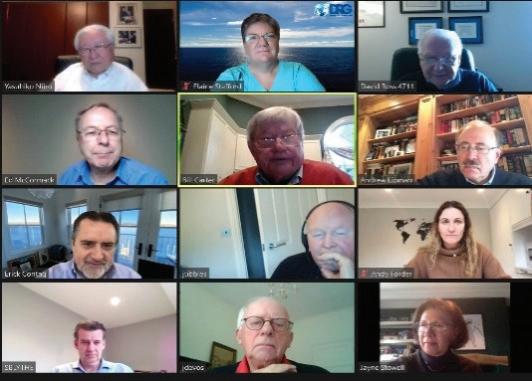


and the USA), and South America in 2022, and inspired by the success of the first Japanese symposium, this initiative has rapidly expanded around the world.

A symposium was held in France in January 2022. The French symposium was designed to invite students from digital technical schools to spend a fun day learning about submarine cables as “Today is the Day of Optical Submarine Cables Supported by French telecom carriers and system suppliers”. The program was designed to help students find jobs in the optical submarine cable industry.

The presentations covered a wide range of topics including global networks, submarine cable technology, geopolitical issues, specific projects, and oceanographic observations, with excellent presentations from French experts in each field (Figure 6). The French symposium was a great success with nearly 300 participants. The symposium will be held again next year.
The UK Symposium was designed to provide students with the opportunity to meet with young presidents and executives active in the submarine cable industry to discuss technology, job hunting, and other topics. This Symposium was branded “WAVE” (Figure 7). The symposium was unique in that it was held in a large meeting space in the iconic BT high-rise tower with a great view of London for a full day, where students
could listen to lectures on submarine cables and consult directly with frontline managers. As you can see from the photo, the submarine cable lecturers are young and brilliant. The UK Symposium was a unique opportunity for students to meet and talk directly with young and veteran managers in the industry (Figure 8).
The Americas Symposium was unique in that it is held simultaneously at several universities on different topics such as optical communication systems, submarine cable systems, and cable ships in order to study submarine cables (Figure 9).
The lectures cover the structure of international networks, the role of international submarine cables, submarine cable technology, installation, maintenance, and operation, etc. The symposium is diverse, using existing videos and lectures by experts in the field (Figure-10).
LATAM symposium on optical submarine cables was held in Chile, South America, in Spanish with the participation of over 80 students (Figure 11), 24 of which were sponsored to travel to Chile from Argentina, Brazil, Colombia, Mexico, and Peru. Held at a Chilean university, the symposium introduced the latest technologies and projects in optical submarine cables from Chilean and International experts. The first day of the symposium was a full day of lectures by experts and opportunities for students to meet with people from the industry, as well as lunch and a cocktail party in the evening. The second day included a tour of two submarine cable landing stations, and a tour of landing sites in the city of Valparaiso.
Future symposia in LATAM are planned in Portuguese in Brazil and Spanish in Uruguay.

The SubOptic symposium, which started in Japan in 2019 “for the sustainable development of the global submarine cable industry” quickly expanded to the rest of the world. On each continent, submarine cables were discussed in local languages such as Japanese, French, English, and Spanish. In the future, the symposium is expected to expand to more countries in more local languages, creating awareness and attracting young professionals to our industry. Videos of some of the recent Symposia are available on SubOptic’s YouTube channel, so that people from around the globe who did not attend can view them and learn from them.


The Japanese symposium is planning to make even better plans in the future, stimulated by the unique projects of other countries around the world. We believe that each country will continue to compete with each other with their unique plan and continue to expand throughout the world.
The SubOptic Foundation will continue to support the global optical submarine cable symposiums, and the symposiums in each country will be networked so that people around the world can share the latest information on submarine cables and contribute to the further development of the world’s submarine cable industry.
Mr. Erick Contag and Mrs. Elaine Stafford of SubOptic Committee assisted me with this manuscript. I would like to thank them. STF
DR. Y. NIIRO carried out pioneering research & development of undersea fiber optic systems at KDD R&D Laboratories in Japan and laid TPC-3 which was the first Trans-Pacific optical fiber submarine cable in 1989. He was CEO of KDD Submarine Cable Systems and President of Tyco Networks Japan. After that, he was Guest Professor of the Tokyo City University. He is representative Director of Bharti Airtel Japan. He is an advisor of SubOptic Foundation.

Bangkok, Thailand | 13 - 16 MARCH 2023

Organised by:
Hosted by:


As digitization gathers pace, where companies decide to store their data will be essential to reduce global emissions.
Industry 4.0 conceptualises the marriage of physical assets and advanced technologies, which both individually and collectively is sparking fundamental industrial changes across the world.
The force behind rapid technology adoption is of course digitization - the engine of our data economic growth. In 2021 IDC valued the US data economy at $255 billion and the European Union at $110 billion. And despite worldwide economic headwinds, spending on IT and business services are set to continue.
For organizations pursuing digital transformation (DX) with the goal of creating new sources of value through digital products, global DX spending is forecast to reach $3.4 trillion in 2026 with a five-year compound annual growth rate (CAGR) of 16.3%, according to the International Data Corporation (IDC) Worldwide Digital Transformation Spending Guide.
With the increase in data-driven industry associated with the cloud, and as new applications for metaverse, AI, Deep Learning, and high-end gaming become mainstream, data storage and processing are set to grow significantly.
It is essential that technology-driven change is provided on a sustainable basis. For digitization to provide real long-term value it must be economically and environmentally sustainable. Given electrification and digitization are crucial to a net-zero future, where this data is transferred and processed has never been more important.
Conventional wisdom about network technology dictates that data centers must be located close to the application or the user base to achieve low latency, for example in the use of autonomous vehicles, where a millisecond can make a huge difference.
But for most applications an added 10ms or 20ms - is completely imperceptible to users.
Therefore, for data to be maintained, stored, processed, accessed, and kept cyber secure will require centralized large-scale data center hubs, which should be running on tens and hundreds of MWs of clean power.
The number of hyperscale data centers currently stands at just over 700 and nearly half of that capacity can be found in the US, followed by China and EMEA. This is set to rise significantly and a recent report by Data Bridge Market
Research estimates that the hyperscale data center market size will grow at a compound annual growth rate of 26.93% in the forecast period of 2021 to 2028.
The increase in capacity is not only being driven by developing new sites, but also by forming partnerships with traditional colocation providers, to increase speed of delivery and by investing in new storage and compute technology to ensure optimum performance and efficiency are achieved.
And when determining the best location for these sites, the availability of secured power capacity remains front and center for decision makers, ensuring both resilience and the ability to rapidly scale.
The big tech companies also provide the best current example of where the digitalization trend and the sustainability agenda meet head-on. AWS, Google, and Microsoft (who between them control over 80% per cent of the public cloud market) have each committed to net zero data center operations by the year 2030.
These commitments were initially made around 2015 and have been added to over the last few years – although prior to energy security and constrained grid capacity becoming systemic threats.
We now live in a world where surging digital demand and stated commitments to net zero data center operations must be achieved just when grid power constraints could become real.
This naturally brings us to the broader energy dilemma. It is expected that worldwide electricity demand will reach 40,000 terawatt hours by 2050 compared with less than 25,000 terawatt hours today.
To give a sense of magnitude an additional 10TWh is equal to boiling the water for 250 billion cups of tea!
Decreasing the load on heavily congested grids will require a step change in thinking – namely that we move away from transferring gigawatts – but instead focus on transferring gigabytes.
Central to this is the deployment of high-capacity transcontinental fiber optic cables, the network of which underpins connectivity across Europe, and ensures seamless data flows for the trans-Atlantic economy, as companies and data exchanges drive the trillion-dollar transatlantic trade.
One such project, which is being developed by Bulk Infrastructure, is the Leif Erikson Cable System. This will consist of a 4,500 km direct link between Kristiansand, southern Norway to the Atlantic-Canada coast in Happy Valley, Goose Bay, in Newfoundland.
From its landing point, the cable extends overland for 1800km (1118 miles) from Goose Bay through to the emerging data center market in Quebec City and with future plans to reach Montreal.
The Leif Erikson cable will be the first trans-Atlantic cable 100% powered by renewable energy, in line with Bulk’s vision to bring sustainable infrastructure to a global user base.
Subsea cables provide intercontinental connectivity for communication and the internet. But today they must be viewed through the same lens as any other major piece of infrastructure – that is as elements of an ecosystem where each piece plays a role in achieving net zero.
This lens is also being shaped by regulatory forces, where both mandatory and voluntary encouragement, companies of all sizes are providing greater insight into their carbon footprint.
Earlier this year, 1300 of the largest UK-registered companies and financial institutions became subject to Task Force on Climate-related Financial Disclosures (TCFD) reporting, which follows a similar trajectory to Japanese and New Zealand regulators.
At present, companies who report on their carbon footprint, follow international standards laid out in the Greenhouse Gas Protocol, which categorises greenhouse gas emissions associated with a company’s Corporate Carbon Footprint (CCF) as scope 1, scope 2, and scope 3 emissions.
Until recently, the focus for companies has been on reporting emissions from direct operations and electricity consumption (Scope 1 & 2). Scope 3 is undoubtedly much harder to measure, as it covers reporting on carbon emissions which include everything beyond a company’s direct operations and electricity use, including supply-chain operations and end-product usage by customers.
For companies who use large amounts of data, where they choose to store and process
it will become ever more important, as they look to meet the growing demand of regulators, customers and investors.
The convergence of these factors is prompting companies to seek digital infrastructure options in locations where public acceptance is based on long-term sustainable operation and low environmental impact.
Although, nowhere in the world is completely immune to energy supply threats or detached from the global energy market. That said, territories such as Norway have a more
sustainable energy profile, producing a surplus of renewable energy and are thus shielded from the steep fluctuations being experienced throughout mainland Europe.
Through the natural advantage of its latitude together with its topography with abundant steep valleys and rivers, hydropower is the mainstay of Norway’s electricity system. Today there are more than 16,000 hydropower plants, producing a combined capacity of 136.4 TWh, accounting for 90% of its power production.
And the Norwegian government has presented a roadmap for a green industrial boost, with renewable energy taking center stage. This includes setting an ambitious plan to continue to enhance offshore wind farm development by increasing the number of wind farms to 1,500 by 2040.
Due to these factors, a data center in southern Norway will on average emit 10x less carbon than for example a data center located in the UK.
According to an analysis by Electricity Map over the past 5 years, carbon intensity in southwest Norway was 24g compared to a UK average of 267g (gCO2eq/kWh). In simple terms, every 1MW workload located in a London data center results in the same volume of carbon emissions as an 11.1 MW load in southwest Norway.
Businesses and consumers are increasingly concerned over the environmental impact of where their data is stored and processed and the topic of where data centers are built will continue to rise up the political agenda.
The investment community has already grasped that companies need to prioritise how they tackle ESG priorities and increasingly that means adopting a long-term strategy for managing their data using green energy.

For that compelling reason, many companies are looking north.
STFGISLE M. ECKHOFF is Executive Vice President for Bulk Data Centers. Previously Eckhoff was the Chief Executive Officer at Stack Infrastructure (previously DigiPlex) where he was instrumental in repositioning DigiPlex from a local player in the Norwegian colocation market, into a globally recognized leader of sustainable, large-scale data centers.
Gisle has a wealth of experience from senior positions in the IT industry in the US, Sweden, the UK and Denmark, as well as at home in Norway. He joined Stack Infrastructure in August 2014 as Chief Executive Officer and is the former Senior Vice President and Managing Director of CGI Group Inc.’s operation in Norway. Gisle has also held many senior management roles at both country and regional levels in Computer Sciences Corporation (CSC). The experience and knowledge gained from heading up the Financial Services vertical in the Nordic region, before becoming Vice President and Managing Director of CSC in both Norway and Sweden, offers both insight and perspective in shaping Bulk’s growth strategy in expanding the Nordic markets.
According to the Chinese Zodiac, 2023 is the Year of the Rabbit. In Chinese culture, rabbits are considered gentle, quiet, elegant and alert. They are responsible, but sometimes reluctant to reveal their thoughts to others - and they have a tendency to escape reality. When encountering difficulties, they are never discouraged, but search persistently for a solution. In many ways, I can’t help but think this is a good metaphor for most telecom companies in our industry. The current climate of high inflation increased geopolitical tension and war in Europe is not going to change any time soon, and there is a need for us all to find solutions for the many challenges we face. Many of these are more complex and quite different in nature to those we are accustomed to.
Despite the global turmoil, network traffic has continued to grow, and we see some really interesting technologies maturing. In the face of this, we’ll need to stay focused and relentlessly pursue our mission to ensure reliable, fast, and secure connectivity across the globe. And in keeping with our traditional ‘Top 3’ predictions for the year ahead, here are a few thoughts for 2023.

1. Security is increasingly important. Geopolitical tensions mean that we’ll need to work even harder than before on security concerns. Where previously our security work mainly focused on the logical layers of the network, we now need to be more vigilant throughout the full stack - from the physical ducts and cables to DDoS protection, firewalls and everything in between. Protecting cables from sabotage is no easy feat, but as an industry, we need to find ways of systematically building more resilience into our networks, so we are less vulnerable if something nasty happens. This is priority #1 in 2023.
2. Infrastructure is increasingly important. Traffic growth continues, but with DWDM equipment becoming increasingly tethered by Shannon’s limit (a limit that defines the maximum physical capacity you can push down a single fiber pair), most operators are suddenly in dire need of more fiber on each route in their network. Previously, you could always just replace your current old DWDM gear with the latest state-of-the
-art hardware and increase your available capacity by sometimes more than 100%. Optical innovation will of course continue, and better gear will enter the market, but during 2023 many operators will need to search for additional fiber pairs.
3. The full ecosystem is increasingly important. The days when one provider could do it all for a single customer are over. In today’s ecosystem, a buyer of telecom services needs to combine key components from multiple vendors to fulfill their needs. This in turn means all service providers needs to make their product and services more adaptable and easier to share. In the end this means even more cross-border collaboration between companies of all kinds within the wider telecom eco-system. In short –a lot more collaboration is needed in 2023.
1. Diversity is everything - everywhere. It was not that long ago when an operator could survive and serve customers fairly well by simply buying the cheapest capacity on the market and building a network with a single cheap vendor. Then came the component shortage and a world in need of much greater network resilience and diversity. In the current market, you need at least two vendors in each technological universe to ensure that you at least have a chance of being well-served by one. On top of this, customers are starting to expect that you will have at least two and sometimes even three physical diverse paths between your network PoPs. Running a network is not quite as easy as it used to be…
2. 400ZR and 400ZR+. 2023 will be the year when we will see mass deployment of these technologies by operators. There is now a good supply of components at competitive prices and the brave carriers who have already completed tests in their networks have shown that the technology works, so there is really nothing stopping it from full deployment. 400ZR and 400ZR+ will of course not completely replace the legacy optical footprint, which is needed for other services, but there are definitely parts of most networks that should be built this way. A combination of the IP and Optical footprint in some network segments will generate massive CAPEX savings whilst still being manageable from an operational point of view.
3. The edge is still very blurry. For years we have discussed where the edge of a network should be and what type of equipment should be located at the edge. Ownership of equipment at the edge has also been a widely debated topic. Local, regional, national and
even international operators have all seen themselves as network edge providers, but in the end, it may well be none of them. Hyperscalers, enterprises - in fact almost anyone could take on this role. The most likely scenario is a combination, but it is still very blurry.
1. Traffic growth. During 2020, public Internet traffic grew by more than 50% and there were some analysts who believed that we would see growth tailing off as the exceptional growth abated. Fortunately, they were all proven wrong and even as many sections of society have returned to normal, we are still seeing solid growth and predict that this will continue in 2023. 2025% growth is not an unreasonable expectation.
2. Working from home. When the pandemic hit hard, the majority of the workforce had no option but to work from home. Now, when we are more or less back to normal, we still see many people working from home or away from the traditional office. We predict this will continue during 2023 and this can only be a good thing. The days in the office, where interaction with colleagues is important, will be combined with days at home - where you can be very effective at moving things forward with fewer distractions and less travel time.
3. Industry events and conferences. During the pandemic, many conferences either went digital or were simply cancelled in anticipation of better times. The conferences that transformed into online webinars were met at first meet with skepticism, but we soon found them to be very convenient. The possibility of listening to an event whenever it suits is something that will stay with us. During 2023, we will continue to see many events online - in perfect combination with events where we meet in person and can hear all the “rumors” we have missed in the corridor during the past few years.
1. Service Delivery. Within the Telecom sector, quality is often only seen in terms of service uptime and usually measured in how many 9’s you can include after 99%. This is changing and operators are finally starting to realize that the overall experience is what counts when quality is assessed. Amongst the most important quality considerations is how service is actually delivered to customers. Timely deliveries combined with transparent communication will keep you at the top of the quality game.
2. Customer care. The entire telecoms industry is on a trajectory to become fully automated with as little human interaction as possible. While this is a given for every aspect of configuration and fault resolution, customers still need to be able to speak to a qualified engineer during certain circumstances when machines don’t have all the answers. Replacing bright individuals with chat bots is not good enough, especially when parts of our industry can still be surprisingly complex. During 2023, we will see continued automation but also more focus on human support for customers when they most need it.
3. Incident management. With incident management, I mean the way companies work with faults that tend to occur on a more or less regular basis – the ones where a fault is fixed but three weeks later the same thing happens again. The telecom industry still struggles a lot with old inventory systems, inaccurate “sold services” lists and a general lack of control of their own networks. During 2023, it will be critical for operators and Infrastructure owners to start activating their best engineers to ensure - at the very least - that the same faults do not reoccur several times within a short space of time.
1. Interest rates. For many years, the cost of borrowing money has been very low and subsequently capital has poured into the Carrier business. Almost anyone could with limited efforts draw a lot of interest in new sea cable routes or rather vague business ideas. Some of these even becoming real in the end. With interest rates now going up it will be very interesting to see how 2023 will pan out. Will we see continued investments in sea cables, terrestrial infrastructure and M&A activity, or will 2023 be a big bump in the road?
2. Rising inflation. It is not only the cost of money that is rising at the moment. With more inflation almost everything a Carrier needs will become increasingly expensive. Power, real estate and labor are all areas where costs could go up and as the competitive landscape in the wholesale world is still fierce there are very few elements of this cost that can be pushed thru towards customers. Some things you can automate but many cost elements will just go up. How this will impact the telecom landscape remains to be seen.
3. More geopolitical turmoil. Historically, telecom networks have so far been very resilient to the ongoing crises in various parts of the world. There is only so much you can do to protect a cable from everyday
hazards, but to protect it from grenades and bombs is a different matter entirely. To predict how this will pan out during 2023 is nigh on impossible.
1. The pest controller. In our high-tech world, there are still a disproportionate number of outages caused by various rodents. Sometimes their mischief takes out the power, but more often than not, they cause major disturbances by biting into the cables themselves. These outages have a high cost in both time and money, so we owe a debt of gratitude to the pest detectives who must identify and negate the threats posed by these furry little troublemakers.
2. The firefighter. The ongoing climate crisis brings with it a number of unprecedented threats to telecom networks. During 2022, there have been some instances where forest fires have been so large and uncontrolled that they have even melted ducts and the cables inside them. Who would have thought that the brave men and women fighting forest fires would also be the heroes of our connected world?
3. The brand and marketing manager. It is a tough job when you spend most of your time launching and building a shiny new brand only to discover that it has been completely misinterpreted in parts of your organization. ‘Pirate’ merchandise including fluffy toys, funny hats and crazy socks don’t really hurt…. or do they? This is the daily challenge of brand managers the world over and these unsung heroes were destined to swim against the tide.
Predictions are, of course, just predictions, and we wish everyone in the telecom ecosystem – from our business partners to end-users and the companies in between, a brighter year ahead, with health and prosperity. One thing is certain, 2023 will be full of excitement and change. As we always say here at Arelion, “You can’t predict the future, but you can be ready!” STF
With over 25 years in the telecommunications industry, MATTIAS FRIDSTRÖM can be considered a veteran – but his enthusiasm hasn’t faded.
Mattias combines expert knowledge with anecdotes from behind the scenes and deep insight into the networked economy: What are the challenges of tomorrow for network providers? How can we meet ever-increasing traffic demand and customer quality expectations within the same cost frame? Mattias holds an MSc in Electrical Engineering from the University of Wollongong, Australia. Since joining Telia in 1996, he has worked in a number of senior roles within Arelion (former Telia Carrier) and most recently as CTO. Since July 2016 he is Arelion’s Chief Evangelist.


According to a recent study by JRC, there is now well over 100 Tbit/s of demand for connectivity between Asia and Europe, rivalling the transatlantic and transpacific routes. However, whereas there is plenty of route diversity on those other routes, geography and geo-politics have dictated that practically all traffic between the Orient and the Occident uses a terrestrial route between the Red Sea and the Mediterranean Sea that is built entirely on Egyptian soil.
Now, while the geography has not changed, there have been tectonic shifts in Middle Eastern political sands which may finally allow some much-needed route diversity. Nothing is yet certain in this regard and there is plenty of evidence to suggest that more upheavals in this region should be expected which could, again, shut down these opportunities but for the time being, cable developers, carriers, and other users of East-West connectivity are looking
forward to enjoying not only a choice of routes but also improved resiliency and lower cost.
JRC has had the privilege of being involved in submarine cable developments in this area for the last two years. We have comprehensively studied the scope for route diversity, both submarine and terrestrial, and we have made an indepth analysis of demand for connectivity to Europe from Asia, Africa, and Australasia. In doing so, we have met and discussed the opportunities and threats in this market with all kinds of stakeholders, including those building new systems and their potential customers. What has become clear to us from this research is that new routes avoiding Egypt could face exactly the same challenges that have beset the industry since the first submarine fiber-optic link between Asia and Europe, SEA-ME-WE-1, was commissioned in 1986. Today, there are eleven major operational intercontinental submarine fiber-optic systems

which traverse Egypt. Another four systems following the same basic route are planned to be in service by 2025. Each of these systems and their customers pay regulatory fees to the Egyptian Regulator and lease terrestrial connectivity from the incumbent operator, Telecom Egypt, which has a long-standing monopoly on international telecommunications services in the country.

When an entity enjoys a natural monopoly in a capitalist economy, one would expect it to seek to maximize its advantage. This can be good in the short-term, especially for the national economy in which the entity resides but, eventually, the lack of competition leads to complacency, inefficiency, a lack of innovation, and higher costs for consumers.
A relevant example of this phenomenon is the “American Telephone and Telegraph Company”, better known today as AT&T, which, for a century, monopolized the American telecommunications industry, preventing fair competition. However, in the early 1980s, the Company was forced to settle a U.S. Government-led anti-trust action by divesting assets and splitting into seven regional companies (the “Baby Bells”). More recently, Alphabet (Google), Meta (Facebook), Amazon, and Microsoft are all facing scrutiny from governments in the United States and Europe for monopolistic behavior. Ironically, these “hyperscalers” are some of the largest users of the Asia-Europe connectivity that passes through Egypt.
In the recent past, carriers have told JRC that the cost of the relatively short transit segment across Egypt doubles the overall cost of a link between Singapore and Europe. One could argue that Telecom Egypt is simply doing what it is supposed to do: maximizing profits for its shareholders, and it is the responsibility of the Egyptian Government to ensure that the Company does not abuse its monopoly position. The problem is that the Ministry of Communications and Information Technology is the shareholder (the Ministry owns 80% of Telecom Egypt) and the Egyptian Regulator, “NTRA”, is a “Statutory Corporation” with a .gov domain name.
The result, of maintaining this monopoly, as shown above, is that, although Egypt’s ICT Sector is contributing 5% of total GDP, it is not developing as a hub for Cloud services. Other locations, like Japan, Singapore,
France, and USA have a similar confluence of submarine cables to Egypt and a burgeoning Cloud market with associated investment in data centres. The difference is that the governments and regulatory regimes in these other locations promote competition.

The only thing sustaining Egypt’s stranglehold on the Europe-Asia route for submarine cables was Arab distaste for dealing with Israel as the logical alternative access

Source: https://newsdos.com/world/google-plans-fiber-optic-cables-between-saudi-arabia-and-israel/

point to the Mediterranean. Solidarity began to weaken during the Trump era when this transactional U.S. President saw opportunities to do deals with individual Gulf states to assist with mainly local issues but this piecemeal approach has had a knock-on effect.
At the same time, a shift in power with the Saudi Arabian Royal Family has led to the promulgation of “Saudi Vision 2030” which is “a strategic framework to reduce Saudi Arabia’s dependence on oil, diversify its economy, and develop public service sectors” (Wikipedia). The rights and wrongs of a regime which is effectively ruled by Crown Prince Mohammed bin Salman is beyond the scope of this article but the impact of this increase in proactivity from KSA on submarine cable development, investing in “2Africa Pearls” and establishing the “East to Med Data Corridor” (EMC) program, is highly significant.
From Israel, it is possible to reach the Red Sea via Aqaba, Jordan but this narrow stretch of water is a cause for concern among cable developers and investors because of the risks of cable damage from shipping and political instability along the coasts of Sudan, Eritrea, and Yemen. A possibly more benign option would be to build terrestrially across Saudi Arabia to Jordan and on to Israel.
Right now, Google, TI Sparkle, and Omantel are collaborating to build the “Blue-Raman” system which will follow the Red Sea-Jordan-Israel option. Meanwhile, Cinturion is working on the “Trans-Europe-Asia System” (TEAS) which will connect India to Europe via multiple landings in the Gulf and a terrestrial link from KSA’s Gulf coast to the border with Jordan and onward to the Mediterranean coast of Israel. At the same time, Reliance Jio is working on the “India-Europe Express”
(IEX) system and Meta is leading a consortium building the “2Africa” system, both of which will follow the traditional route via Egypt. Interestingly, the parties promoting “Blue-Raman” also offer an optional path across Egypt instead of Israel. Perhaps this was the price of Egyptian acquiescence to the inevitable end to its monopoly.

It may seem that the submarine cable industry is jumping out of the frying pan and into the fire by giving companies, such as Saudi Telecom (STC), tremendous bargaining power over these new routes that avoid Egypt. Certainly, early indications are that negotiating deals via KSA are not straightforward and require a lot of time and patience but there are reasons to hope for a different outcome this time.
First and foremost is that Saudi Vision 2030 calls for KSA to become a regional ICT hub and the Kingdom has the funds to back this up. Plans for a new smart city in Neom, close to the border with Jordan are developing but to become a regional ICT hub requires that the hyperscalers, Google, AWS, Meta, and Microsoft (GAMM) establish a significant presence. Ironically, while domestic U.S. politics are threatening GAMM’s current modus operandi, their aims are much more aligned with the U.S. Government when it comes to exerting influence in KSA and the Middle East region in general.
Saudi Vision 2030 also implies that the Kingdom aspires to be more than just a choke point, exacting fees for transit without seeing the bigger picture of opportunities for broader ICT development. Nonetheless, it is to be expected that there will be additional costs for accessing routes across Saudi Arabia but if this premium is within reasonable bounds, the opportunity to gain additional service resiliency will remain attractive. Hyperscalers, in particular, have extremely demanding service levels for uptime which lead them to seek multiple paths serving the same route.
Last but not least, the establishment of new routes avoiding Egypt creates competition. JRC has seen Telecom
Egypt recently revise its pricing structure, reducing both transit fees and the cost of terrestrial dark fibre, as well as investing in new terrestrial routes and improved maintenance and repair services.
Competition is also developing on the other side of the Gulf with new terrestrial systems, such as the “MEETS” and “Silk Route” systems offering all-terrestrial or combined terrestrial-submarine connectivity solutions to Europe. Admittedly, these systems traverse some challenging polities and require a patchwork of interconnections which make one-stop-shop arrangements difficult and relatively expensive. Nevertheless, they reflect the fact that Egyptian hegemony over East-West traffic is coming to an end. STF
JULIAN RAWLE possesses 23 years’ experience in the submarine fiber optic industry, together with a business development track record in emerging markets going back to 1990. He developed several new businesses in countries of the former Soviet Union, latterly with Cable & Wireless, and went on to lead international marketing efforts for Japanese marine installer, NTTWEM, before joining Pioneer Consulting. He acquired Pioneer and transformed the business into a leading center for submarine expertise, and as a member of Extended Team he successfully supported the Main One (Nigeria-Portugal) private submarine cable project. He was a Member of Extended Team which successfully supported Brazilian investment bank, BTG Pactual, in acquiring GlobeNet (Brazil-US) submarine cable. Operating independently since 2014, his long-term projects have included working with Campana, which is building the SIGMAR submarine cable between Myanmar and Singapore, and supporting Oman Broadband’s entry into the international carrier market, and helping Gulf Bridge International to analyse options for new routes.

Looking back over the year of 2022, for those of us lucky enough to be part of the Pacific Region Submarine Cable Industry it has been another amazing journey! 2022 has been a year of growth, a year of surprises and a year for consolidation and achievement!
We think you will all agree - the Pacific Region is stunning – it is an area of magnificent beauty and great opportunity, but it is also a region that presents significant challenges to those who live and work in the region. That said – for most part, 2022 has been a year of “realisation” – realising many dreams for new systems, realising it is not always easy despite the beauty that surrounds us, and realising the vulnerability we all face in life and living! 2022
has been a year of ups and downs, cooperation and care.
So, let’s look back over the last year and see what sort of things that attracted our attention – let us “Realise the Pacific”.

Of all the events that captured our attention during 2022, it is probably the eruption of Hunga Tonga–Hunga Ha’apai and subsequent tsunami that spurred most interest and captured our attention and interest! And influenced much of the ideas, thinking and plans that have emerged over 2022.
The eruption which occurred on 15 January 2022, signalled many interesting aspects that our industry needed to consider more carefully. The eruption severed Tonga’s life-
line to the world – the Tonga-Fiji Cable – and it also severed a domestic cable linking the island of Vava’u into the main island of Tonga. The eruption and subsequent tsunami devastated much of the Tongan communications network, as a result the nation was effectively cut off from the world for more than a day! Whilst the aftereffects of this event are still being experienced in Tonga, this event helped the region towards realising the importance of cable systems to a country’s economy, and amongst other things, the importance of resilience and the need for, and the exercising of restoration plans! It is true to say - the misfortune for Tonga – seeded an awakening for others!
With most of the Pacific Island nations main islands now connected via Submarine Cable into the Global Network, it has been quickly realised that diversity and protection for these cables is essential! A country cannot solely rely upon a single umbilical chord connection – restoration and protection is required. Whilst it is true that over 2022 there has been significant developments in satellite communications solutions globally, it is also being realised that using satellite to restore a failed cable system may not provide adequate capacity to satisfy a data hungry population! As such, the push is now on across the Region to build second cable systems - and to also look more strategically and regionally when considering resilience and security.


Second cable developments are active in Palau, Tonga, New Caledonia, Vanuatu, Solomon Islands, American Samoa and many others who have a burgeoning demand and fear the exposure – learning from the lessons taught by Tonga. As a result, most Pacific Nations are now actively considering or planning second cable systems!
2022 helped us all realise the impacts associated with providing cables to Pacific Island Nations during the COVID pandemic. COVID access restrictions has required innovative thinking as to how a submarine cable can be landed in a “contactless” manner! Many contractors enjoyed prolonged periods of quarantine, whilst other contractors had the experience of travelling to locations via the ocean
rather than the convenience of air travel! Costs blew out, delivery and scheduling activity became complex and often unpredictable. But we all reacted and worked together to ensure systems were delivered and landed despite the problems COVID threw at us all! We truly realised cooperation and care! COVID is not over for the Pacific Islands – maybe it never really will be over – but we have learnt to work together better, to plan much more carefully and to be resilient and innovative – especially when the going gets tough!
But the dollars don’t come easy!! Financially justifying a second cable connection into a small island nation is not simple – second cables rarely generate any significant additional traffic but generate additional costs -- however over the course of 2022, we have seen many of the major governments around the Region stepping up and offering to support their regional neighbours! We have seen funding from the development banks shifting towards nationally
focused activities such as improving customer access or working to develop applications that will improve the lives of the people of the region – and exploit the new connectivity’s being provided by the submarine cables!
The Governments (including Australia, New Zealand, USA and Japan) are now behind most of the new cable developments occurring in the Region, including Palau, Kiribati, Nauru, FSM, Solomon Islands and Tokelau.
You will recall an article we wrote mid-2002 – it addressed what we called “The Missing Pacific Link” – this has been well received and further refined over the course of the last few months. Our view was that as the demand for telecommunications services grew across each and every
preparation for its future connection to the ECHO cable from USA to Singapore while New Caledonia got its second cable. The East Micronesia Cable linking FSM with Nauru and Tarawa in Kiribati was progressed leaving only Tuvalu and Pitcairn Island as so-called PICs without a cable in the near-term.
The numbers as at end 2022 are as follows (for international cables to the global network)
For all of us in the Pacific Region, 2022 has truly been a year of “realisation”! For many years we have all worked to establish systems that enhance the lives of the people. As a result our region has grown to rely upon the benefits that submarine cables bring, abundant high quality lower cost connections, enabling the economic development of industries as well as providing populations to have access to the same services available in larger countries. We have realised the need for cooperation between the telecom carriers and the government service organisations to provide the network infrastructure and applications to exploit the capabilities of the cables.
island-based country across the Pacific – so too did the rationale for regional cooperation – delivering with it the benefits of regional sovereignty, market development and trading, and with these benefits there is the opportunity for a growing sense of regional responsibility, control and capability. This vision remains today – we continue to believe that a region cable linking the north and south Pacific regions is overdue – we believe 2022 is the time for the region to realise – a One Pacific Network.
As such, we also see South Pacific developments at the IP layer looking to optimise traffic flows, exploit the cable available and to enhance the performance of data services for Customers across the region. It is hope that the regional approach to concepts and plans such as these continue as we all grow and learn more about how best to service the needs of the people of the Pacific.
During 2022, we saw Kiribati get its first cable connection at Kiritimati in the mid-Pacific. Tokelau also landed a spur off Southern Cross NEXT to gain its first international submarine cable which it complemented with a domestic festoon linking its three widely separated atolls. Palau landed its second spur in
For us all involved – we continue to grow to realise the many benefits submarine cables can bring to a small island nation. The future looks exciting – development announcements - such as Hawaiki Nui - keep us alert and hopeful – and more new initiatives will continue to excite us all! STF
JOHN HIBBARD is CEO of Hibbard Consulting Pty Ltd. John has worked in the telecommunications industry for over 40 years, and for more than 30 has been associated with submarine cables. An Engineer by qualification, John worked for much of his career at Telstra finishing as Managing Director of Global Wholesale. John was the inaugural Chairman of Australia Japan Cable which he guided to a successful implementation.
Since 2001, John has been an independent consultant in his own company, Hibbard Consulting, involved in strategic and commercial aspects associated with the development and/or implementation of many international submarine cable projects across the Pacific including French Polynesia, Samoa, American Samoa, Tonga, Vanuatu, Solomons, PNG, Palau, FSM, and CNMI. He was President of PTC from 2009 to 2012.

PAUL MCCANN is Managing Director of McCann Consulting International Pty Ltd. Paul has over 40 years network planning & development experience in telecommunications both in international and domestic arenas. Prior to returning to consulting in 2012, Paul spent over 8 years with Verizon in Asia Pacific, driving growth of Verizon’s network across Asia by developing & implementing plans delivering major operational cost reductions and improved service performance. Paul is now managing his own consulting business, specializing in development in the Pacific Region, where the core business focus is on “connectivity” with expertise spanning all aspects of planning and development for Satellite, Submarine cable and Domestic access technologies and business. Paul is well known for his personable nature, his rapport with customers and his ability to deliver on time.

The subsea industry is steeped in conservatism. The ‘IBM buyer’ is prevalent (remember, no one ever got fired for buying IBM) and in these conditions the turnkey approach to contracting system builds continues to dominate. Customers prefer to spend millions of investment dollars ‘protecting’ themselves from delays, which in many cases can be managed and mitigated with careful planning and diligent project management. However, believing that the more responsibility you heap onto your primary contractor the less risk you assume, can be a misguided approach.
One would also imagine that the possibility of saving 20-30% of your system procurement cost would be a tantalising incentive to consider disaggregation; to carefully evaluate the trade-offs between contracting for turnkey supply versus taking some integration responsibility, and by implication, some risk. There exists a real opportunity in the market to review and develop procurement models that suit those customers prepared to accept some of that risk and who have an appetite for realising the significant available gains in dollar terms.
The irony is that the subsea industry has already taken perhaps the hardest step on the path to disaggregation -

when customers pushed to acquire systems that were ‘open’. In other words, to procure the wet plant from one vendor and to require that the resulting cable system could accept terminal equipment from any unspecified vendor and that the system would provide, within certain boundaries, a predictable transmission result. This was surely a giant leap towards disaggregation given that previously, the wet and dry equipment always came from the same vendor, the transmission performance of the system was perhaps the single most important parameter to the customer, and correcting any mistakes in the specification of the wet and open part of a system, post-implementation, is practically speaking impossible. In addition, any consequences of a badly designed open system are likely to echo chillingly round the Customer’s management corridors for much of the 25 years of the system’s operation.
And yet… if we look back over the last ten years of open system procurement, it’s hard to identify any single cable which has had material issues with transmission performance or commercial losses resulting from open system procurement, much less the pattern of difficulties that might have been predicted to arise from such a seismic shift in our industry’s procurement approach. It’s undeniable
that there has been, and continues to be, extensive debate around the optimum contractual framework for wet plant procurement, and an on-going dialogue between various industry participants on how best to specify different aspects (transmission performance, commissioning, network management, etc.) of the open system, but this constant noise risks obscuring the fact that open systems have been a runaway success. No-one questions anymore the economic wisdom of separately procuring the two most critical and co-dependent parts of the end-to-end line design.
Immediate savings of 20-40% on transmission equipment costs were probably achieved by those customers that took the plunge into open systems a decade ago, but the total eventual savings, especially as seen by the broader industry, will have been much higher as competition can be relied upon to improve the breed.
Noting the success of open systems, it seems only natural that customers should continue to seek other areas for improvement within their procurement chain. It makes sense to to assess whether there are other opportunities for cost savings or design/build improvements within a project as a whole. The marine programme is quite a natural next step. Alongside permitting, and depending on which body of water is being
crossed, marine works contribute a large part of the risk profile of a new build system. In terms of savings, it makes sense to consider the advantages of disaggregating some or many parts of the marine programme. Indeed, survey is sub-contracted out by all the turnkey vendors, which begs the question – why shouldn’t customers contract for this scope directly? Having a direct relationship with the survey companies has many advantages, both in terms of control, planning and cost. It also allows customers to kick-start their investment without necessarily funding the entire system build. It can also be an efficient use of seed money in allowing more solid supply proposals, and can be seen by other investors as materially de-risking the eventual supply contract. In these respects, and others, it is a positive step towards keeping projects moving forwards in the early stages of their development.
Similarly, marine installation is another aspect which could be provided as part of a turnkey system provision or through a disaggregated approach, via an integrator such as Xtera, or again contracted directly by a customer. There are advantages – and disadvantages - to all approaches. For turnkey, the ability to understand the moving variables of manufacturing and permitting, such that a suitable marine programme can be developed, is beneficial, but alternatively, the ability to source vessels independently from a number of global providers has its advantages. Utilizing ‘ships of

opportunity’ at short notice can save time and money by making use of vessels that are ‘in the right place at the right time’. In the case of permitting uncertainty, it may also be better to have an open-market choice of vessels, rather than having to join the queue, when the permit dates become certain, of a vertically integrated supplier who may have other priorities than just your system. Performing installation works alongside other in-region projects has its cost advantages, as does being flexible on timing. And selecting in-region suppliers and installers can reduce on freight and transit costs and ship’s time.
We all know and love (loathe?) the joys of permitting. The risks of change in law, regulation, contact points, etc. etc. have hampered many a project. And yet customers continue to outsource this crucial aspect to their turnkey vendors. Is this the best approach? Perhaps a separate and entirely independent in-region permitting expert may be best working under an integrator. And in many parts of the world, where an active hands-on approach by the applicant is the surest way to success, the customer procuring the permits in principle directly is absolutely the best approach. Authorities often prefer to deal with customers directly, especially if they are a national telco, or operator, with good government links. There are many reasons to think long and hard about your approach to contracting permits, and it’s fair to say this is one aspect that turnkey vendors may actually prefer to see outsourced.
Cable supply can also be procured directly, and at times when the market is busy and manufacturing lines are full, this approach can be favourable. With a robust system design, pulled together by an integrator with transmission expertise such as Xtera, outsourcing cable supply can be the most straightforward part of a project to outsource. However, regardless of the sourcing decision, it is important that the customer continues to insist on a single point of contact and accountability for the transmission design. Timing must be well managed to ensure no additional storage costs or vessel waiting time are incurred, but an experienced customer project management team can mitigate these risks as well as any turnkey vendor.
Like everything, there are pros and cons to disaggregated supply. Does separating elements of a project generate gains, or simply move the same costs between several parties instead of one? There are standout savings to be made by contracting directly, markups are removed and contingency budgets de-layered or dissolved. Reducing the number of parties in the contracting chain reduces the intermediaries, the overheads and allows for more direct control. Customers typically have a better and more up-todate understanding of project risk at any given time when working directly with a vendor or through an integrator. Greater transparency is achieved, but the same risks remain – the difference being that the primary contingency budget now sits with the customer. And no one is more motivated than a customer when it comes to saving money. In fact, it is noticeable that customers with a lower budget are often more focused on assisting vendors when it comes to driving projects forward.
As mentioned above, splitting out certain aspects of the project at the early stages can allow customers to get projects off the ground. Reducing early capex investment can keep projects moving forwards as developers seek further investment. Surveys typically contribute to an overall 5-10% of project spend, a small amount to a turnkey vendor, but everything to the survey company. Working directly with a contractor on their complete scope, rather than as a small part of a wider consolidated proposal, can offer multiple benefits in terms of focus, timeliness and cost. Surveys need to be performed in good weather windows which may not align with the timing of letting a full turnkey contract and the ability to move quickly from a contracting perspective could mean the difference between 1 month and 1 year on the overall project timeline.
It is difficult to precisely quantify the gains of disaggregating the supply chain, but it is done in many other industries that are not as risk adverse as subsea. Taking all the above factors into account and with some direct experience to back it up, the author’s view on the potential gains is that

a benefit at contract signature of around 20%+ is achievable and at the outcome (i.e. RFS) of the supply contract, 15% savings vs full turnkey is a reasonable objective.
But what are the risks? Ones that immediately spring to mind are technical disconnects, similar to those mentioned above for open systems. Disconnects such as those that lead to sub-optimal overall design, or instances where an item is working in the vendor’s premises but not once loaded, or installed. Acceptance has the potential to be a minefield. By removing the turnkey factor there is a risk of having no clear party to pursue, or rather several possible parties. It can become a dance of pointing fingers and looking for blame. This is why an experienced integrator with strong design and project management skills is crucial. Experience teaches us what to anticipate and how to avoid it. An integrator can be part of the supply chain, as in the case of Xtera, or an independent consulting company with integration experience, such as SubseaNetworks or Pioneer, or even the customer themselves. Commercial nous and robust contracts with strong provisions for delay or non-performance for the respective scopes, etc are also critical to ensuring that everyone performs to task.
Quantifying the risk of a disaggregated approach is hard and evaluating whether it stands up in times of adversity is perhaps a less well-tested path. For sure there are more new systems that have been supplied as turnkey than not, but looking at unrepeatered systems, in many ways the test-bed of disaggregation where, as a more or less general rule, cable is sourced separately to marine installation works, there is no industry history of issues, delays or faults. More telling is that there is a strong pattern of repeat behaviour suggesting that the approach is tried, has worked and is continued. And looking at the recent COVID-19 pandemic, it is fair to say that the disaggregated system suppliers continued to perform throughout the period, and in the case of NO-UK, delivered the system on-time and in-budget.
As we saw above, there are many ways to disaggregate the supply chain. Customers can choose between one contract with an integrator – not too dissimilar to a turnkey contract but often with differences in risk/cost sharing, billing and transparency. More risk-averse customers may opt for co-contracts, with joint and several terms, with the integrator and the installer and/or cable supplier amongst the various contracting parties. This approach can give
more financial comfort to the customer, as the risk is spread between more entities than just the integrator.
Alternatively, customers with more confidence, or a broader in-house skill set, or simply setting out to be more disruptive and with the pockets to support that ambition, can choose to contract separately for each key aspect of a project survey/installation/wet plant directly and employ a consultant integrator or use their own in-house project managers. Examples of successful disaggregated projects include Shefa and the Crosslake and CrossChannel systems.
The disaggregated contracting model is certainly a viable approach, but not one that is likely to be promoted by the established vertically integrated subsea suppliers. The inherent conservatism of suppliers aligns with a historical conservatism of buyers, including many of the newer customer players in the market, resulting in large parts of the system-build market uniquely pursuing turnkey supply. Many of us imagined that the involvement of content players and search titans would take twenty years off the average age of recruitment in the industry and bring some creative destruction to centuries-old commercial approaches but, for the moment, it remains largely business as usual.
One of the newer players on the customer side had a motto: Move fast and break things. There are customers active in the industry today who have the commercial clout to do just that; to challenge established thinking and to attempt alternatives which may provide millions in capex savings. The consequences may also be fresh thinking, new cost-effective approaches, more vendors and contractors, and more competition for supply. The gains are there for those who break the mould and, continuing that theme, breaking up the turnkey supply contracts is one way to challenge the status quo and create opportunities for faster and more cost-effective system builds. STF
LEIGH FRAME joined Xtera in early 2018 and serves as the Chief Operating Officer and key architect of the company’s strategy. Leigh brings with him a wealth of senior level and hands-on experience, backed up by a network of strong industry relationships at all levels in the customer, supplier and finance communities.
Previously Leigh had an extensive career with Alcatel Submarine Networks, which includes positions as COO, VP Projects and Customer Support, and Director Marketing and Business Development. In addition, he served as an active Board member of the Apollo Submarine Cable System for ten years. His broad experience in the subsea industry over three decades covers corporate strategy, a track record of sales success, marketing, M&A work, operations management, and high risk/high value turnkey project delivery. Leigh holds a Degree in Economics from Leeds University.
Quantifying the risk of a disaggregated approach is hard and evaluating whether it stands up in times of adversity is perhaps a less welltested path.
After a quite few quiet years (decades) there appears to have been a flurry of activity in the subsea telecoms market since 2015. Although older assets and vessels are being extended well beyond their design lives, new hardware orders are now being placed and the market is more buoyant than in previous years. The glut of the equipment provided at the time of the telecoms bubble at the turn of the century, after remaining under utilised for many years, is now difficult or no longer available to purchase on the second-hand market and new equipment is again being supplied. It has to be said that Covid 19 and other geopolitical ambitions over the recent years have made the period more difficult than it could have been with the logistics of quarantine, travel restrictions and lockdowns amongst other things to contend with. Add to this the amount of new cable and routes being installed and the market requirement for low latency can be seen to be putting pressure on the supply chain. It all seems to imply more equipment will be required to install and maintain the systems, to the same high standards, during their lifetime.
The installation and maintenance markets are historically heavily driven by cost with significant competition driving small operating margins, this climate has made investment in new hardware difficult to achieve. With backlogs increasing several new entrants to the market are appearing all requiring hardware and assistance to provide their service

 BY RALPH MANCHESTER, ROBERT HAYLOCK AND SCOTT MABIN
to the market, a good sign of the market potential going forward at least in the near term.
To add to all the previous issues of trying to maintain the communication continuity of the global networks including cable damage from accidental fishing, anchor and natural seabed movements amongst others, there is now an increasingly perceived risk of deliberate sabotage of undersea cables and other infrastructure which is currently prominent in the media at the moment. A current prevalent example of this sabotage appears to be the disruption of the Nord Stream pipe lines, linked to the Ukraine situation, but there are numerous examples of deliberate aggressive destruction of subsea assets over many years particularly in times of conflict. The outcome of this is the additional increased risk awareness of sabotage and the severe impact these events could have on any nations ability to function in the modern digital age with more reliance on global communication, a double ‘whammy’ effect. Given the attention being paid to these risks the use of more diverse routes without bottlenecks will become a more prominent part of the commercial system and network appraisal. More information is also becoming available on the extent of large undersea seabed movements which have the ability to render multiple cables out of service in one event, also experienced in reality. Although the direct route offers the least latency other design drivers must also considered.
Another impact from the pandemic is the inflationary pressures and availability of components with many stocks run down and still requiring replenishment. This increases the challengers in achieving the same delivery timescales, with the added financial pressures being felt across the globe this is taking longer than originally expected to get to pre Covid, pre-conflict levels.
The current ‘elephant in the room’ for suppliers, and customers to some extent, is obtaining of the appropriate export license for equipment which is increasingly stringent for goods with potential dual use criteria, military and commercial. This is particularly relevant to deep water subsea equipment and sensors which can slow the contracting process down, the export licenses are wide ranging also covering rental assets and intellectual information and knowledge. Having expert knowledge and competence to manage this process is important to avoid delays and schedule impacts.
With the perceived increase in activity in the subsea installation market attention has been focused on product improvement and innovation to gain competitive advantage. Although the subsea telecom market is historically very conservative with proven operational procedures driving the requirements of the installation and repair equipment the latest generation of products utilise developments which are compatible with proven operational techniques.

An example of this is the latest telecom plough systems available from Royal IHC which help to improve performance and reduce downtime by incremental improvement to all of its systems.
The current plough systems being supplied by Royal IHC also incorporate a recently patented multi-depth plough arrangement, negating the need for a hinged share while still maintaining performance and stability, this reduces weight and cost of ownership of the asset, Figure 1. Royal IHC continue to develop and protect its intellectual property and being part of a large marine group maintaining technology leadership in our core markets is paramount to both our continued success and the success of our cus-
tomers. Work also continues on the uptake of design tools such as the enhanced optimisation of equipment configurations able to be assessed by computerised iterative routines around the desired functionality, all in the blink of an eye.
The old 3kV umbilical transmission voltages are being replaced by 6kV to reduce heating effects on winches, limiting the required amount of copper in the umbilicals which lead to reduced capex costs while improving transmission efficiencies. The reduction of the weight of the umbilical also has an effect on the mass of the cable and therefore the winch requirements.
Supporting existing equipment forms a large part of the Royal IHC business model with dedicated resource and 24/7 service coverage. Being part of a large group means we have personnel and service centers around the globe. Recent equipment upgrades and life extensions include the addition of a 300kW, 6kV jetting system to a previously supplied IHC plough system, Figure 2, doubling the burial capability of the plough in dense sands. Upgrading and servicing other OEM systems, where we can add customer value by applying our competence, is also another area which we assist customers, for example supplying share extensions to ploughs.
As with all areas of life, improvements in digital and control systems are moving at a seemingly unstoppable pace and the need to protect against obsolescence is ever present. The latest Scada systems use web style systems with improved scaling and ease of use, high speed ethernet protocols are the norm and IP cameras and other sensors have
plug and play capability easing maintenance. Remote diagnostics and assistance are becoming the normal mode of operandi rather than the exception, reducing downtime and improving performance whilst avoiding a prolonged wait for a service engineer arriving on a long-haul flight to provide urgent assistance.
The future development paths of equipment will continue to be incremental with the occasional disruptive technology being introduced, around the corner are significant operator assistive tools in the form of unseen control enhancements. These include digital twins which automatically check that the sensors are reporting correctly and within expectation as well as virtual sensors which improve the redundancy of the systems without additional hardware. Sensor fusion will offer improved clarity and feedback to operators and simplified machine architecture will improve equipment performance.
This revolution is already taking place in other key Royal IHC markets such as dredging vessels where the entire dredging operation can now be controlled by a single operator, the control system suggesting the next set of tasks to be performed automatically and the performance being optimised by an AI system. Performance of a customer’s fleet of vessels is monitored and updated securely to a cloud-based system where they can monitor their assets through dashboards.
Reduction in manning is always a driver to reduce cost and improve operator safety and the long-term goal is to reduce the onboard requirements not least of all the number of accommodation cabins required. With all these improvements though, human oversight is still required. ‘Human in the loop’ is with us for the foreseeable future. This does not mean that the control systems cannot help to reduce operator fatigue, ease diagnostics and improve the performance and efficiency of marine operations in the near term. Better information provided at the corporate level informs decisions in a timelier manner.
Royal IHC, European owned and established in the 17th Century (1642), is the only company in the world which
can supply trenching assets, launch and recovery systems, cable handling equipment as well as the cable lay vessel as a turnkey solution from inhouse products. This complete set of competencies under one roof brings an optimal solution for customers even if only part of the hardware solution is required and supplied. STF

RALPH MANCHESTER received a 1st class honours degree in mechanical engineering from Newcastle Upon Tyne University as part of a Rolls-Royce sponsored programme. After 8 years in power generation he moved into marine equipment where he has developed and managed both subsea and deck equipment for over 25 years, the last 16 years of which were at Royal IHC Limited. He is inventor on numerous patents covering subsea systems and currently holds the position of Technical Partner
ROBERT HAYLOCK graduated from Canterbury Christ Church University with a joint BA / BSc (Hons) before commencing a graduate position within the Royal Bank of Scotland. After gaining 10 years of experience in senior customer facing roles, spanning the banking, insurance and marketing sectors, he moved into the oil & gas industry spending 10 years in various globally focused commercial and sales roles within a leading subsea engineering consultancy. Since joining Royal IHC in early 2022, Robert has been focused upon its subsea vehicle, LARS and cable lay equipment portfolios, supporting an international client base within both the offshore wind and submarine telecommunications sectors.


SCOTT MABIN is a Chartered Mechanical engineer with over 18 years experience in heavy industry. Scott began his career as an engineer in the power generation sector before moving into developing equipment for offshore and subsea applications. Scott has spent the last 11 years creating bespoke and novel solutions to tackle the challenges found within the offshore and subsea sectors. Since Joining Royal IHC in 2015, Scott has lead the development of a number of new Subsea vehicles including Royal IHC’s latest telecommunication Plough.


Speaking at the conclusion of COP27 the Secretary General, António Guterres, said “The world still needs a giant leap on climate ambition.” The words ‘giant leap’ cannot be clearer, there is still an enormous amount to be done to stem the climate chaos, which Guterres says has reached “biblical proportions”. His underlying message was that the most vital “energy source” for change is people power.
Looking forwards this can be the only approach that we take – businesses need to reduce emissions, governments need to support those communities and nations who cannot support themselves, and people need to create a sustainable base on which mankind will operate in the future. Businesses and individuals within the subsea community need
to look at how they run their companies and take steps help create a more sustainable society. These could include aspects such as:
• Reducing climate impact
• Creating a sustainable supply chain
• Having strong business ethics
• Creating a good health, safety and working environment
• Ensuring diversity and gender equality
• Increasing social involvement
As providers of critical infrastructure, it is particularly important that system suppliers, component manufacturers and vessel operators take their responsibility to the planet seriously. Purchasers can play their part by encouraging
steps towards change within their supply chains. At Hexatronic we have built a ‘Sustainability Roadmap’ which is founded on the aforementioned six priority areas. The roadmap shows our contribution to the UN 17 Sustainable Development Goals, outlining our desired position in 2030 and the targets, goals and key actions that will get us there. This article explores the different ways in which the subsea industry can contribute to creating a more sustainable society, and the steps that Hexatronic has taken to play its part.
Over recent years we have seen an increased focus on environmental responsibility within the subsea space. SubOptic 2023 includes a new papers category, Clean Green Submarine – protecting and connecting people and the planet, which aims to cover the environmental and social responsibility of the subsea community. It will encompass subjects such as the use of renewable energy in telecoms networks, development and implementation of sensor technology, ocean observatories, SMART cables and climate initiatives for marine survey, installation and operations. Submarine cable decommissioning, recovery, recycling and redeployment, also form part of the cable system life cycle and play an important part in the impact we have on the environment. From a citizenship perspective, aspects such as harmony amongst seabed users, meeting requirements of environment agencies, educating governments, communities and the public at large about subsea systems, creating the next generation of the work force and ensuring diversity and inclusion within organisations will all be discussed during the conference.
In Issue 122 of SubTel Forum Magazine, Nicole Starosielski and Nick Silcox talked about a ‘Blue industry going green’, profiling three companies going above and beyond in terms of sustainability: Orange Marine, NJFX and the
Solomon Islands Submarine Cable Company. Examples of efforts made include Orange Marine powering some of their vessels in port using the onshore electrical grid rather than the fuel stores to reduce overall emissions and installing solar panels to generate and store electricity to power these stations. NJFX making the decision to become a carbon neutral data center, and SISCC taking measures to increase efficiency and reduce energy consumption. Similarly, at Hexatronic we have put in place 13 key actions to reduce our impact on the environment.
Recognising the urgency of the climate crisis we have committed to 1.5oC science-based emissions reducing targets. Our main focus is high resource efficiency and offering more sustainable products and services. Some of these include: reducing goods transportation by optimising pack sizes, coordinating product deliveries, improving forecasting and establishing local production. Changing modes of goods transportation from air to shipping/train, moving towards a zero-emissions vehicle fleet and introducing new climate adapted materials and technologies.
One important aspect to making change is to measure, record and analyse parameters which will help to determine what changes need to be made, and at what scale: calculating the carbon footprint of products or the level of indirect emissions, for example. Table 1 shows the key climate metrics being measured by Hexatronic since our Sustainability Roadmap was first published in 2019 and where we aim to be by 2030.
An easy change that we can all make is to increase the number of travel-free meetings. Making on-line training and remote field support available in the market also offers a significant step forward. Necessity is the mother of all invention, and if the Covid-19 pandemic taught us anything
it is that we can manage our business and support our teams successfully via a variety of on-line and remote tools.
Using suppliers with a clear and aligned focus on low climate impact is key to reducing emissions throughout supply chains. To create a sustainable supply chain, collaboration with suppliers and sub-contractors with respect to sustainability issues, defining key requirements and ensuring it is adhered to is also very important. We must be active in our actions if we want to evoke real change.

Employees need to feel safe and secure with the way companies manage their working environment. At Hexatronic, employee wellbeing is always in focus, and we care for the work-life balance of our co-workers. This has been addressed through expanding the coverage of ISO 45001 within the wider group, alongside making Health & Safety a priority and ensuring policies are known and respected. Measures such as the Employee Satisfaction Index and the Employee Locally Index are also tracked and monitored.
Furthermore, it is important that our customers, investors and other stakeholders feel trust in Hexatronic and know that we represent a high level of business ethics. Our subsea team, led by Anders Ljung, are well known in the industry for their customer responsiveness and open communication.
Another important aspect of the UN’s Sustainable Development Goals (SDGs) is social engagement, involvement and responsibility. This element is represented in several different SDGs: 3 Good Health and Wellbeing
4. Quality education 8. Decent work and economic growth
10. Reduced inequality and 12. Responsible consumption and production. We are seeing increasing examples of this within our subsea community, Aqua Comms’ recent donation to the RNLI Thames Tower Lifeboat station in lieu corporate gifts, Vodafone’s beach clean ups and Ciena’s Sales & Marketing teams coming together to help communities across the globe.
At Hexatronic we contribute locally and globally by supporting initiatives and non-profit organisations that strive for a socially and environmentally sustainable future. We’re also exploring more ways to understand and meet specific community needs, particularly in underserved areas, and as such
we’ve partnered with Hand in Hand (a non-profit that works with entrepreneurship models to reduce poverty) to provide education, training, and work opportunities to the people of Chawai village in Kenya. “Listening to the needs of the world and its people is the only way we can create a lasting link to a future that benefits us all,” said Henrik Larsson Lyon, CEO Hexatronic Group, with regards to the partnership.
Having sustainability goals is important, but ensuring they are achieved is paramount. Understanding the enablers required to reach targets and actions defined in a company’s sustainability roadmap is the key. For the subsea community to fully embrace change we need to ensure that sustainability needs become a fully integrated part of every business: they should be a natural and integrated part of decision-, steering-, monitoring-, acquisition-, and planning processes. Company cultures needs to change, management teams must ‘walk the talk’. Involvement and collaboration of employees, customers, suppliers and stakeholders is crucial. Let’s inspire change by fostering creativity, awareness and communication. STF
Hexatronic Group’s Sustainability Manager PERNILLA


wfnstrategies.com
WFN Strategies is an accredited, industry-leading consultancy specializing in the planning, procurement, and implementation of submarine cable systems.

We support commercial, governmental, and offshore energy companies throughout the world.


We analyze and advocate renewable energy alternatives for clients’ submarine cables.

How
Western Australia

Occupying a unique geographical gateway into Asia and beyond, Western Australia (WA) has a vision of the future that is focused on growth and connecting to the rest of the world.
This vision has been supported by the WA Government’s goal to move from a ‘resource’ state to a ‘resource, renewable and digital’ state. Once synonymous with mining, over the last decade WA has made moves to plan for a ‘post-mining’ future and diversify the state’s economic profile. The data and technology industries play a substantial role in that future, as do clean energy and renewables projects. In the last few months, there has been strong state government support for WA-based supercomputer, which is the fourth most sustainable in the world, as well as clean energy funding announcements, the release of the Environmental, Social and Governance (ESG) Industry Information Pack, support for sustainable commercial properties, and the consolidation of net zero emissions targets by 2050 to name just a few.
And with a just-released Prospectus for data centre operations and enabling infrastructure in the state, it’s unmistakable that WA is backing its potential to become the southern hemisphere’s clean technology and data superpower.
Perth is the most globally isolated capital city and yet it sits ‘right next door’ to Asia Pacific, home to 4.1Bn people, or some two thirds of global population. Western Australia is a safe back up hub for global Multinational Corporations with Data Centres in Asia Pacific and Europe/USA, accentuating the need by recent political tensions in the South China Sea. Perth is closer to Asia Pacific than Sydney or Melbourne and as such offers far lower latency (faster) connectivity to Asia Pac. Thus, new location opportunities can be offered for global MNCs to establish and support their business-critical operations.
New global technology infrastructure projects are required to have long-term sustainability goals from the outset. Inherently, this means focusing the development’s physical location in areas where energy supplies are secure and low-cost, allowing for realistic and reliable green transitions for customers.
WA’s major power system, the South West Interconnected System (SWIS), boasts the cheapest natural gas price in the OECD, which saw power pricing per kW/h up to 450%
cheaper than Australia’s eastern states in the June quarter. The state is also on trajectory to meet 70% of renewable generation capacity by 2040. The reliability of a cost-effective energy supply, while transitioning the state’s energy networks to allow for full renewable penetration, encourages vendors with decarbonisation targets to invest in WA’s economy.
The successful planning and creation of subsea cables will mean that WA can present itself as one of the most isolated and safest capitals in the world to one of the most connected cities in Australia and beyond. Cables will connect with countries in the Asia Pacific region and to the west coast of the United States. The enabling technology and reliable connectivity ensured by these cables is improving WA’s attractiveness as an investment destination for global and local technology projects, while crucially developing the digital economies of Australia and the Asia Pacific. It is also having the potential to provide a jobs boom in the state, creating roles for highly skilled, tech workers.
Project Koete provides an enabling technology infrastructure platform to include Data Centres and a dedicated international Subsea Cable infrastructure between Singapore and West Coast USA and capacity connectivity with cable landing stations in Perth, Indonesia, and Malaysia plus 6 domestic coastal landing locations between Perth and Darwin.
Project Koete, a subsea cable, and data centre project being developed by Fibre Expressway, will provide over 20,000Kms of secure, carrier neutral, high speed, low latency cable linking Perth to Darwin and Malaysia via Indonesia and Singapore and beyond to the West coast of America. Project Koete aims to use 100% renewable energy, targeting 30+ year scalability assuredness, so customers have a growth plan for decades, not short to medium term. The subsea cable will be an open system and will be SMART (Science Monitoring And Reliable Telecommunications) enabled. Fibre Expressway are proud to be working with Professor Bruce Howe as part of his international Joint Task Force initiative with UNESCO to integrate environmental sensors for ocean bottom temperature, pressure, and seismic acceleration into submarine telecommunications cables.
Meeting the growing requirement for sustainable, strategically positioned data hubs for corporates, Project Koete intends to secure the future of Australia’s sustainable data technology industry by working with GreenSquareDC. It’s a unique proposition for the APAC data market that meets customer demands as rapidly increasing data generation coupled with ESG mandates stipulate the need for synergy in sustainable digital supply chains.
“Subsea cables and data centres are inextricably linked, which is why it is important to create partnerships with new innovative companies such as GreenSquareDC, which allow us to bring truly sustainable data solutions to companies, and in turn help them achieve net zero”, said Peter Bannister, Founder and CEO of Fibre Expressway.

In 2021, the demand market size for Asia Pacific data centres was $US64billion. This is expected to grow to $US93billion by 2027, for 31% growth. These figures exceed the US market, which is predicted to grow 13% during the same period. APAC is fast becoming the most dynamic data centre market globally and players like GreenSquareDC, with its first sustainable hyperscale data centre development in Perth, WA, are intent on contributing to both the state and APAC’s digitally driven economy.
The focus of GreenSquareDC is to incorporate solutions and strategies that contribute to and align with the sustain-
ability goals of their major customer groups. High-profile examples of this include AWS committing to be water positive by 2030, Google’s goal of becoming carbon-free by 2030 and Microsoft’s aim to be carbon-negative and water-positive by 2030, as well as eliminating its dependence on diesel fuel for backup power by 2030. GreenSquareDC’s “5 Pillars to Sustainability” enable a clear transition to net zero and feature 100% renewable energy, fossil fuel-free back up generation, alternative cooling with significantly reduced carbon footprint and wastewater-free cooling and operating systems. GreenSquareDC is also committed to reducing the volume of these systems required to operate its data centre, offering businesses a competitive advantage by improving bottom-line returns.
Addressing sustainability on a larger scale is crucial to future proofing new developments. Collaborations and synchronicity between data centres and enabling subsea cables result in innovative, sustainable, and adaptive new-age data infrastructure solutions for global and regional customers looking to decarbonise their operations.
Walt Coulston, Founder and CEO of GreensquareDC said, “focusing on long term sustainability is the basis of our operation at GreensquareDC. For us it was crucial to be in WA where our efforts of net zero are supported. We are also excited to have the opportunity to partner with great projects such as Project Koete, that share the values and ambitions we hold.”
Still in 2022, it’s rare to hear about alignment between sustainable data centres, subsea cables, and government. The collaboration creates a win for all involved that ultimately benefits end-users who can access low-cost, low-emissions data storage. It is a priority for GreenSquareDC and Project Koete to support not only data-driven global business, but environmentally conscious businesses who are intent on solving some of the toughest sustainability and decarbonisation challenges presented by the digital infrastructure in their supply chains.
And thanks to its favourable policy settings and forward-thinking government, it is no coincidence that WA is central to both GreenSquareDC’s and Project Koete’s plans to ‘Go Beyond’. STF
PETER BANNISTER is the Founder of FEPL currently based in Perth, WA. Over 35 years’ experience in design, build, operation of global telecoms. Experienced in start-up, development and ongoing operations of global telecoms entities and well versed in managing the challenges of large geographically dispersed projects involving multi-national/ cultural internal teams and external vendors with contracts budgets worth more than US$5B. Previous experience with BP UK and Asia Pacific whose projects portfolio included subsea cable installations in the UK North Sea and Gulf of Mexico. Strong Asia Pacific and global experience.

At international level, United Nations Convention for the Law Of the Sea (UNCLOS) dictates specific duty for the coastal states to protect and preserve the marine environment. It further entails the power of the coastal states to exploit its natural resources and impose relevant measures deemed necessary to prevent, reduce and control pollution of the marine environment. Specifically for submarine cable fibre optic projects, UNCLOS affirms the sovereignty of the coastal states in its territorial waters while for EEZ, subject to several provisions in the UNCLOS. As a matter of principle, the coastal states have the right to regulate all activities especially for submarine cable fibre optic projects in order to preserve its marine environment in their territorial sea and EEZ.1
In this contemporary international law development, precautionary principle emerges as a notion that supports protective action before there is complete scientific proof of
1 UNCLOS can be assessed here at webpage https://www.un.org/ depts/los/index.htm
a risk and often used by policy makers when conclusive evidence is not yet available. This principle is backed by several International Court of Justice (ICJ) cases that evident the precautionary approach may or may not acceptable as the generally acceptable practice in international law called as the customary international law. For submarine cable fibre optic projects, this precautionary approach is essential vis-à-vis the state practice to conduct necessary measures before an approval granted by the relevant authorities. As such, this article will explain on how submarine cable fibre optic projects can be argued to seemingly tie the legal regime under the UNCLOS and precautionary principle in order to preserve the marine environment.
Part XII of the UNCLOS on the Protection and Preservation of the Environment, provides the central regime for ocean governance at international level. This includes both general and specific obligations of the state parties to

prevent, reduce and control pollution.
The regimes of the sea designated by UNCLOS are very crucial fo`r marine conservation and preservation since it places the obligation of marine conservation on coastal states. Article 193 of UNCLOS recognizes the sovereign right of the coastal states to exploit their natural resources pursuant to their environmental policies and in accordance with their duty to protect and preserve the marine environment. This provision is crucial as this is the main source of international law that bind the parties of the UNCLOS to protect the marine environment from any activities. Undisputedly, coastal states are in the best position to apply and enforce the UNCLOS backed by the Article 3 and 79 of the UNCLOS on the sovereignty of its territorial waters. In this regard, they are able to adopt relevant measures that is necessary to protect the marine environment.2 3 4
Meanwhile, Article 194 of requires the coastal tates, individually and jointly, to take all measures consistent with UNCLOS that are necessary to prevent, reduce and control pollution of the marine environment from any source, using the best practicable means at their disposal and in accordance with their capabilities. Article 194 further enumerates four sources of pollution:
• the release of toxic, harmful and noxious substances;
• pollution from vessels;
• pollutions from installations and devices used in exploration or exploitation of the natural resources of the seabed and subsoil; and
• pollution from other installations and devices operating in the marine environment.
Finally, Article 204 provides that States shall, consistent with the rights of other States, endeavour to observe, measure, evaluate and analyze, by recognized scientific methods, the risks or effects of pollution of the marine environment.
2 Article 193 provides that States have the sovereign right to exploit their natural resources pursuant to their environmental policies and in accordance with their duty to protect and preserve the marine environment.
3 Article 3 stated that Every State has the right to establish the breadth of its territorial sea up to a limit not exceeding 12 nautical miles, measured from baselines determined in accordance with this Convention.
4 Article 79 is the most relevant provision for the submarine cable. All States are entitled to lay submarine cables and pipelines on the continental shelf, in accordance with the provisions of this article. This is however Subject to its right to take reasonable measures for the exploration of the continental shelf, the exploitation of its natural resources and the prevention, reduction and control of pollution from pipelines, the coastal State may not impede the laying or maintenance of such cables or pipelines.
UNCLOS to a large extent, have provided not only the legal framework, but also adequate governance to protect marine ecosystem for the submarine cable fibre optic projects.
The precautionary principle is a principle that supports taking protective action before there is complete scientific proof of a risk; that is, action should not be delayed simply because full scientific information is lacking5. The precautionary principle or precautionary approach has been incorporated into several international environmental agreements, and can be invoked concerning human-generated activities as well as the preservation of natural resources.
Perhaps the most widely used of the precautionary principle can be found in the Principle 15 of Rio Declaration6:
“In order to protect the environment, the precautionary approach shall be widely applied by States according to their capabilities. Where there are threats of serious or irreversible damage, lack of full scientific certainty shall not be used as a reason for postponing cost-effective measures to prevent environmental degradation”
Rio Declaration suggests that the application of the precautionary approach is where an activity threatens “serious or irreversible damage”. This set as an example of the precautionary principle in practice and some writers suggested that this approach may be accepted as a customary international law, in line with the Article 38(1) (b) of the Statute of ICJ as “evidence of general practice as law”. Therefore, customary international law arise when a practice among nations is extensive and virtually uniform, and accompanied by a conviction that its actions are obligatory under international law. In other words, state practice as evidence of Opinio Juris can establish customary international law instantly if there is no pre-existing customary law to be displaced7
There are two contradicting ICJ cases whether the precautionary principle should be treated as customary law. The first one was the Second Nuclear Test Case8 in 1995 between New Zealand and France. New Zealand argued that the nuclear test that was to be conducted by
5 Boutillon, S. (2022). The Precautionary Principle: Development of an International Standard. Michigan Journal International Law. pg. 433.
6 Rio Declaration on Environment and Development was adopted by United Nations General Assembly in Rio de Janeiro in 1992.
7 Owen McIntyre and Thomas Mosedale (1997). The Precautionary Principle as a Norm of Customary International Law. Journal of Environmental Law. 221-241.
8 The full judgment of New Zealand v. France can be assessed here https://www.icj-cij.org/en/case/59
France poses threat and therefore, France needs to evaluate the impact on the environment before undertaking a potentially dangerous activity and to demonstrate that this activity poses no risk to the environment. New Zealand used the precautionary principle as part of the customary international law, stating that it is a notion that acceptable worldwide. Although the ICJ dismissed the case due to procedural grounds, the dissenting opinion by judge Weeramantry concluded that the precautionary principle was already a standard of international law.
The second ICJ case was the Gabčíkovo-Nagymaros Case9 of 1997 between Hungary and Slovakia where ICJ was reluctant to address the issue of the precautionary principle. In 1989, Hungary suspended the construction work on the Gabčíkovo-Nagymaros Dam, alleging that the project would result in substantial damage to the unique ecosystem of the Danube, would diminish the water supply, and would deteriorate the quality of the water downstream from the dam. Slovakia replied that these threats to the environment were non-existence, and unilaterally proceeded to continue the construction. Although both parties seemed relatively favorable to the precautionary principle, the court did not use it as a test to determine the case.
Despite these two cases are not related to submarine cable fibre optic projects, the precautionary approach taken in these two cases show that the principle has been established but the consensus is not yet reached to its status of customary international law.
As elaborated above, both legal regime under UNCLOS and precautionary principle are working on the same goal – protection of the marine environment. While the legal regime under UNCLOS are very specific towards the protection of marine environment, precautionary principle is called for precautionary measures to general types of environment degradation.
9 The full judgment of Gabčíkovo-Nagymaros Project (Hungary/ Slovakia) can be assessed here https://www.icj-cij.org/en/case/92
Considering that the marine environment is not only fragile but also home to submarine cable fibre optic projects, there is a need for a balanced interests between both legal regime under UNCLOS and precautionary principle as to evidence of general practice of law at the global level.
Further, both precautionary principle and legal regime under the UNCLOS seems to be interacted by stating the obvious – prevention. In order to prevent any environmental harms towards the marine environment, relevant measures need to be done to prevent as such. The duty will eventually come down to the domestic level, where the respective countries need to govern their ocean and submarine cable fibre optic projects with specific regulations.
United Nations emphasised the importance of submarine cable optic fibre as the critical infrastructure via the General Assembly Resolution A/67/120 together with The Oceans and the Law of the Sea Report of the Secretary-General by the United Nations issued on 30 March 201510. In its report, United Nations stated that the environmental dimension of submarine cables is, less apparent. Contrary with the power cable, submarine cables fibre optic themselves are considered to have a low-carbon footprint and a small relative impact on the environment, with the maintenance of submarine cables fibre optic causing the highest impacts as a result of the operation of the cable ships themselves. Submarine cables fibre optic even have the potential to be contribute actively to disaster warning and addressing climate change, with work under way to examine the potential for monitoring purposes.
International Cable Protection Committee (ICPC) in its report11 stated that the potential impacts towards marine environment is very rare as the cables are laid on the ocean floor surface (not buried), thus minimizing any disturbance.
10 For the full UN report, accessed here at https://www.un.org/depts/los/ general_assembly/general_assembly_reports.htm
11 For the full ICPC Report, accessed here at https://www.un.org/depts/ los/biodiversity/prepcom_files/ICC_Submarine_Cables_&_BBNJ_ August_2016.pdf
“In order to protect the environment, the precautionary approach shall be widely applied by States according to their capabilities. Where there are threats of serious or irreversible damage, lack of full scientific certainty shall not be used as a reason for postponing cost-effective measures to prevent environmental degradation”
In other words, cable operations are brief, rare activities in contrast to repetitive and prolonged activities such as fishing and shipping.
This is backed by dedicated authors in submarine cable fibre projects Carter, Burnett, et al. The authors argue that submarine cables are benign to the marine environment. Following almost half a century of optical communications, standardization, safety and environmental sustainability are of great importance throughout the life cycle of fibre optic cables. From manufacturing, usage, scrapping to disassembling, potential impacts on the environment should be lowered to the maximum possible extent.12
With the little to no impact of submarine cables fibre optic towards marine environment, one could argue whether the legal regimes under UNCLOS and precautionary principle are still relevant when deciding the submarine cable fibre optic projects?
The reality is that, the measures or precautionary approach taken by several countries is not to argue whether the submarine cable projects is harmful towards marine environment, but to protect their sovereignty as well as seabed congestion and risks and safety of the vessel. Southeast Asia for example is home to one of the congested submarine cable areas – Indonesia Archipelagos and Straits of Singapore up to Johor waters in Malaysia. As such, the legal regimes under UNCLOS and precautionary approach and are still relevant to assess the project’s impacts towards marine environment.
In Singapore, Info-communications Development Authority of Singapore (IMDA) is the lead agency for facilitating the deployment of submarine cable fibre optic systems into Singapore. Environmental Impact Assessment (EIA) is still mandatory for any submarine cable projects entering into Singapore. IMDA takes serious concerns about the congestion issue within Straits of Singapore, and therefore this measures under IMDA regulations are to overcome the possible impact of cable congestion towards its narrow seabed area and protection towards marine environment.13
Meanwhile in Indonesia, Ministry of Maritime and Fisheries of Indonesia (KKP) issued a new decree to address the issue of disorganized submarine cable routes in 2021. The decree was issued to indicate how underwater communications cables are plotted in the future. The regulations did

12 L. Carter, D. Burnett, S. Drew, G. Marle, L. Hagadorn, D. BartlettMcNeil and N. Irvine. (2009). Submarine Cables and the Oceans—Connecting the World, UNEP–ECMC Biodiversity Series No. 31.
13 More information about IMDA and its role, please access here https:// www.imda.gov.sg/regulations-and-licensing-listing/deployment-andrepair-of-submarine-cable-systems
not come into surprise since Indonesia has one of the most congested and disorganized submarine cable pipelines. As one of the developing market in dire of advance telecommunications, Indonesia has become one of the busiest route for cable to pass through due to its strategic location between Asia and Europe. Environmental Impact Assessment is not a mandatory in Indonesia except if the submarine cable passes through any environmental importance area.14
For Malaysia, all submarine cable projects are required to assess its feasibility projects via Marine Risk Assessment (MRA) with effect from September 2019. MRA is a structured and systematic methodology, aimed at enhancing maritime safety, including safety of navigation, protection of life, health, the marine environment and property, by using risk analysis and cost-benefit assessment conducted by competent marine consultant registered with the Marine Department of Malaysia. MRA is a new mandatory requirement as per Malaysia Shipping Notice 02 / 2019 stipulated under Section 491B of the Merchant Shipping Ordinance, 1952 to address the issue of navigation, safety and protection from marine pollution.15
Despite the legal regime under UNCLOS and precautionary principle are two separate discussions at the global level, both are important provisions in order to assess the protection of the marine environment from submarine cable fibre optic projects. The recent issues that need to be discussed is no longer how the cable optics could bring harm to the environment but the seabed congestion, safety and risks towards the sovereignty of the coastal states.
As such, the link between both legal regime under UNCLOS and precautionary principle as to evidence of general practice of law at the global level are tied together as relevant measures to preserve and protect the marine environment. STF
WAHAB JUMRAH is subsea projects and permitting lawyer at OMS Group based in Kuala Lumpur, specializes in international legal regulatory and permitting of marine subsea cable projects mainly in Southeast Asia and Japan jurisdiction. He is also a candidate of Master of Law (LLM) in University of Malaya, dedicating his research on submarine cable law in Malaysia. In 2022, he was nominated as the In-House Lawyer of the Year from Asian Legal Business (ALB) Malaysia.
14 More information about the new decree by KKP, access here https:// en.antaranews.com/news/224569/kkp-indonesian-navy-agree-topreserve-marine-ecosystem-together
15 More information about the MRA by Malaysia Marine Department, access here https://www.marine.gov.my/jlm/page/safety-of-navigationand-maritime-communication-division-navcom-1

 BY DALLAS MEGGITT, STEVE MCLAUGHLIN AND JEFFREY WILSON
Recent events have brought into dramatic focus the vulnerability of critical subsea infrastructure and the need to protect it. Subsea infrastructure as used in this paper includes undersea cables (both power and communications), pipelines and fixed structures (e.g., oil and gas platforms. Cables and pipelines are linear systems that can extend for tens to hundreds of kilometers. Fixed seafloor structures include systems that are fully submerged or are bottom-founded platforms. Much, if not most, subsea infrastructure is owned by commercial entities; however, nations see this as critical infrastructure and have a strong interest in protecting them. The destruction of the Nordstream 1 and 2 pipeline systems by deliberate sabotage, and the severing of Norwegian communications and defense cables are perhaps the most recent demonstration of the vulnerability of critical subsea infrastructure.
Cables are the nerves of modern societies, and pipelines are
the arteries. Undersea cables are vital infrastructure to the global economy and the world’s communication systems. Subsurface pipelines carry essential fuels from producers to consumers. Disruption of either of these can cause serious economic consequences, potential environmental damage, and serious political confrontations. Until relatively recently, the fact that underwater systems were on the seafloor or buried in it has been the primary factor contributing to their perceived security. The depth guaranteed that it would be very difficult to identify the exact location of the cable or pipeline. In some instances, the activities of the surface vessels looking for “something” in sensitive waters could be monitored (e.g., Russian vessels near undersea cables off the east coast of the US). It was clear as to when the underwater assets might be threatened. The development of advanced undersea vehicles has eliminated this potential advantage. This paper discusses potential threats to critical subsea infrastructure and potential means to mitigate those threats.
Since the beginnings of undersea cable systems, the primary threat to the cables has been “external aggression,” primarily bottom-contact fishing, followed by vessel anchors. In this context, “threats” are distinguished from “hazards” in that threats are man-caused, and hazards are due to natural causes. With the development of advanced underwater capabilities, including high resolution sonars, precise positioning systems, remotely operated vehicles (ROVs) and autonomous unmanned undersea vehicles (AUVs or UUVs), the ability to locate and attack critical subsurface infrastructure has increased substantially. All classes of seafloor infrastructure are now potentially vulnerable to attack by various types of platforms, surface or subsurface, overt, clandestine and covert. The recent attacks on both cables and pipelines were a wake-up call to both the US and the EU. The attack on the Nordstream systems removed a major source of natural gas to Europe. As a result of the severing of the Norwegian cables and the attack on the Nordstream pipelines, protection of subsea infrastructure is receiving dramatically increased attention nationally (US Department of Homeland Security) and Internationally (UK, EU, Middle East). While the Nordstream attacks appear to have been internal explosions, the cable incidents are more problematic and might have been a result of activities by surface vessels observed in the vicinity of the breaks.
An example of vessels capable of subsurface intervention or interference with subsea infrastructure is the Russian vessel Yantar, shown in the figure, observed loitering in the vicinity of undersea communications cables off Ireland and the east coast of the US. This vessel has very sophisticated seafloor mapping and positioning systems and carries a manned submersible capable of diving to 6,000 meters. Many nations have combat divers, ROVs are readily available to both national and non-national entities, and several nations have sophisticated undersea systems, including autonomous underwater vehicles (AUVs or UUVs). The acoustic signatures of UUVs are generally relatively quiet and difficult to detect. While surface vessels can be readily detected by radar, it is difficult to assess intent to damage subsea infrastructure until after the fact of damage. A vessel can be a substantial distance away from a cable fault or pipeline break when the break occurs. A cable or pipeline can be faulted anywhere along its length, and it does not require a military system to conduct the attack. For example, it would be very difficult to definitively classify a small fishing boat or other commercial vessel as a threat. Simple commercial trawling gear can readily fault a cable, and vessel anchors can damage a pipeline. If there is an explosive charge, a delay on the explosive will obscure identification, which likely would be after the fact if at all.
Providing physical security for critical subsea infrastructure is substantially more difficult than either anti-submarine warfare, dealing with a small number of mobile threats, at a distance from the protected assets, with afloat response forces (subs, ships, A/C) already deployed 24/7; or protecting shore facilities, which are fixed assets with typical dimensions of a few km or tens of km, can include physical barriers to provide delay to aid the response, and have a variety of land response forces that are already available on relatively low-cost standby as part of the basic security system on station 24/7. CSI installations, especially cables and pipelines, can be orders of magnitude greater in extent than land facilities. The linear extent of CSI can be over 1000 km, while it is small in diameter. The defender could be faced with potential threats over an entire linear extent of the infrastructure, thus making it nearly impossible to protect an entire CSI asset. The defender is faced with difficult choices as to which space will be protected. The spaces are extensive compared to the typical detection range of sensors, and it would require a very large number of deployed response units to cover the full length of even a single cable or pipeline – and those response units would have
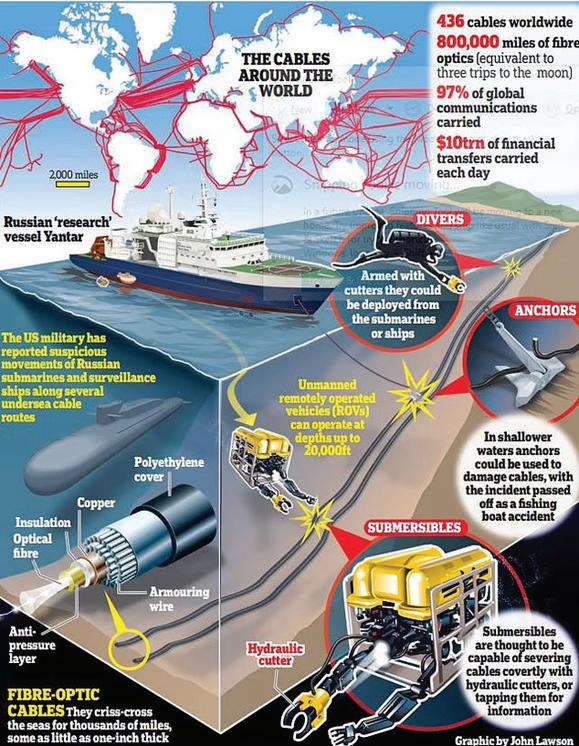
More than 97 per cent of the world’s communications are transmitted through subsea optical fibre cables (Infographic from Daily Mail.com)
to be deployed at sea 24/7, which is very, very expensive. Most modern undersea cable systems are configured as redundant rings, lessening the effects of faulting a single cable. Pipelines are point-to-point, typically without redundancy. The locations of cables and pipelines are generally well-charted to advise fishing vessels of their locations and to reduce the likelihood of anchor strikes. The other side of this, of course, is that it is relatively easy to find cables and pipelines for nefarious purposes.
Several European countries have begun patrolling their cables and pipelines with surface vessels and, in some cases, unmanned underwater vessels (Ref 1). This is a stop-gap measure because of the cost and lack of assets for continuous coverage. The question of where to protect CSI is critical for the most effective and efficient allocation of resources. Previous analyses have suggested that cable landings, the littoral and the continental shelf segments of cable systems are the most vulnerable because of easier access. Concentrating on these segments of both cables and pipelines is a reasonable first series of steps in protecting CSI.
The conventional paradigm for security systems comprises Detection, Classification, Localization and Response. The Factors that govern all these phases are:
1. Factor Time: to detect, classify, localize and respond
2. Factor Space: as a result of the challenges of extensive assets required to protect long linear extents of the CSI.
3. Factor Force: (defense), what do forces defend and how? The defender is faced with the difficult decision of choosing its Alamo.
Detection. Typical undersea sensors – usually acoustic –can have detection ranges of several meters to many kilometers, depending on the frequency and signal processing. Because the CSI of primary interest, cables and pipelines, are linear and can extend for hundreds to thousands of kilometers, a linear sensor that can detect subsea threats over realistic distances is desirable. One type of sensor that potentially meets these criteria is Distributed Acoustic Sensor (DAS) systems. DAS uses an optical fiber that is sensitive to pressure changes to detect acoustic energy. The processing unit for a DAS system is called an interrogator. Appropriate processing can then assess whether the acoustic energy is in fact a signature of interest. This requires a signature “library” of acoustic signals of interest. DAS systems are limited in length to about 80-100 km per interrogator. A system several hundred or thousands of km long would require multiple interrogators and a means for returning the signals to shore
for assessment. Detection distances can be several kilometers. A DAS detection system might provide some deterrent value, and perhaps provide some alerting that there is activity near a cable or pipeline that requires closer investigation.
More expensive conventional beamforming acoustic sensor arrays can probably provide broader area coverage than DAS but are likely to require several arrays along a cable or pipeline, with multiple connections to shore processing. There is more experience with conventional arrays, but they would still require a signature library. A series of conventional arrays along a pipeline route would be very expensive, probably prohibitively so for protecting cables.
Classification. Classifying a detected target as a potential threat is very difficult because it involves an assessment of intent unless the observed activity is clearly aimed at causing damage to a cable or pipeline. Classifying the type of detection – submersible, UUV, submarine, surface ship – can substantially enhance the identification of potential threats. Development of automated target recognition via artificial intelligence and machine learning, while challenging in itself, is likely to be an essential element of broadly applicable CSI monitoring systems.

Localization. Target localization will be critical to efficient vectoring of response forces to a detected and classified threat. Beamforming for acoustic arrays is a well-advanced technology that can provide at least bearings to targets and depending on the nature of the acoustic signal, ranges as well. At the least, a sensor system should be able to detect and localize the presence of a potential threat within some defined buffer around the CSI.
Taken together, Detection, Classification and Localiza-
tion require fusion into actionable intelligence, and integration with other data sources (e.g., radar, AIS) to provide the information needed by response forces for effective prosecution of a target. To respond effectively to an attack against CSI, the detection to engage sequence is crucial to ensure responses to the attack can be in place in enough time to deter, prevent, or counterattack before an adversary can damage or destroy the CSI.
Response. Perhaps the most complex part of the CSI protection conundrum is how and where to respond to identified and potential threats. Ref 2 suggests reinforcing the availability of cable repair ship assets during periods of heightened tensions or conflict but points out that the Submarine Security Fleet act that would facilitate this has not been implemented or funded. An escalating continuum of response offers an approach that can maximize the efficient use of different response assets. A graduated approach might utilize UUV patrols of specific CSI assets that are considered especially critical or vulnerable. If the UUV identifies a suspicious anomaly in the vicinity of a cable or pipeline, it could report this back to a command center. This approach would require baseline surveys of the CSI to provide the background against which anomalies could be identified. A similar approach is used in mine countermeasures operations. Depending on the nature of an identified anomaly, a more detailed inspection by, for example, an ROV, might be appropriate. If there are suspicious surface vessels in the area, a surface vessel or aircraft might be an appropriate response. Internationally agreed-upon Concepts of Operations and rules of engagement will be a necessary component of incident response due to the generally international nature of CSI.
Note that there is a strong relationship between the assumed type of threat, the detection range of sensors along a CSI and the required number and type of response assets.
For example, a fishing vessel dragging a grapnel to cut a CSI cable moves fairly slowly (2-3 kt) but does not have to stop when it crosses the cable to do damage. If the detection range of the sensors is, say two nautical miles (3.7 km), the vessel would reach the cable within about 40 to 60 minutes after detection; a response unit would only have somewhat less than that much time to intercept the vessel before the damage was done. A surface craft doing 30 kt would have to start from no more than about 30 to 45 nm (56-83 km) away to make the intercept. That would imply a lot of surface craft on site 24/7 to cover significant lengths of CSI.
Subsea attacks by divers, ROV or AUV placing charges or cutting cables would take longer on site (more time for response) but the response after detection likely would have
to be subsurface (divers, AUV, etc.) – which takes longer to reach the site and make the intercept.
Aircraft response is of course much faster, but absent the authority for immediate lethal response the aircraft would likely have little effect on the actual outcome of the attack.
Protecting Critical Subsea Infrastructure is an especially challenging problem for the owners of cables and pipelines, and the nations that depend on them. There are challenges in every aspect of the problem. Given the long linear distances of CSI, the defender is faced with the very difficult task of choosing where to defend, and how. But the consequences of ignoring the issues of protecting Critical Subsea Infrastructure are potentially dire. Kicking the can down the road is not a viable option. STF
DALLAS J. MEGGITT is the Technical Director of Sound & Sea Systems, LLC (S3). He is a senior strategic planner for S3, responsible for developing strategic plans for the company.

Mr. Meggitt was a career Navy Civil Service employee and has over 50 years of experience in ocean engineering. His experience includes applications of Autonomous Underwater Vehicles for ocean sensor systems, including undersea surveillance. Mr. Meggitt graduated from the California Institute of Technology with a Bachelor of Science in Aeronautical Engineering. He subsequently earned an MS in Aeronautics, and another MS in Environmental Engineering Science and Ocean Engineering. He is Member of NDIA, the Marine Technology Society, the US Naval Institute, and the Navy League. He is a Registered Professional Engineer.
JEFFREY V. WILSON is a senior ocean technologist and program manager for Sound and Sea Systems, LLC. Mr. Wilson served six years as a Surface Line officer in the Navy before joining the Naval Civil Engineering Laboratory as a career Navy Civil Service employee. He has over 58 years of experience in ocean engineering. His experience includes development of a wide variety of ocean cable systems for applications in undersea surveillance, critical infrastructure protection and ocean science. Mr. Wilson graduated from the U.S. Naval Academy with a BS in Nuclear Weapons Systems. He subsequently earned an ME in Control Systems from Rensselaer Polytechnic Institute and was awarded the Navy’s Weapons Control Systems Engineering fellowship to the University of Washington. He authored seven patents related to ocean cable systems, connectors and handling systems. He is a Registered Professional Engineer.
STEVE MCLAUGHLIN CDR USN (ret) is the Critical Infrastructure Protection Program Manager for Sound & Sea Systems. He holds a B.S. in Biology from University of Oregon (1980), a PSC in International Affairs from the Royal Naval Staff College, Greenwich UK (1991), and a MA (with distinction) in National Security and Strategic Studies from the United State Naval War College, Newport, RI (2003). Steve has worked and led numerous seabed and critical infrastructure security system design projects for the U.S. Navy, hydroelectric, commercial nuclear power plants, and ports & harbors. He has authored numerous articles on maritime security.
Wall Street Journal, Nov 25, 2022: “Fearing Sabotage, Europe Patrols Pipelines with Mine Hunters and Unmanned Subs” Burnett, Captain Douglas R., U.S. Navy (Retired): “Repairing Submarine Cables Is a Wartime Necessity” US Naval Institute Proceedings, Vol. 148/10/1,436
The submarine cable industry is extremely active and busy as 2023 approaches. Almost twenty-five years the dot.com bubble began to deflate with catastrophic results for the subsea business. Back then demand collapsed rapidly with major telecom companies entering Chapter 11 or other bankruptcy processes. Submarine cables were one of the worst segments to suffer as telecoms investment money dried up. What little investment was left, and along with it all new talent headed for the mobile world. The results were factory closures, layoffs, insolvencies and a great deal of excess capacity both in general terms and more importantly specifically related to all those expensive subsea megabits that it seemed nobody wanted. Deja -vu?
The growth of the subsea cable business around the millennium was not just rash speculation, although that certainly happened. International commerce, global corporate networks, massive voice traffic volumes and the promise of the new ‘internet’ were essentially sound reasons as to why new systems were required. Global deregulation encouraged private venture systems alongside the traditional consortium systems. Investment capital flowed into what was seen as a high return technology ventures. But, not for the first time in business, the forecast demand was right, but the X axis was wrong. The internet was not a new business along-
side international voice but the foundation for its eclipse. In addition, mobile phones were just that, phones! They certainly were not smart. Upgrading capacity on a relatively small number of subsea systems was not unduly difficult but terrestrial extension and domestic trunk networks were not integrated with subsea to any great extent. Even worse, what was called the last mile - the Edge in today’s view was hopelessly inadequate for large scale data services and both factors held back deployment of mass digital services.
Could things have been different?
The panic around the Dotcom bust devastated the subsea industry. Financiers foreclosed, and many major carriers exited the industry. However, even then, on a small ‘startup’ level just a short while later a new class of customer emerged. We now know who they are, and they did need all those idle unused megabits. Collectively referred to as the OTTs or Hyperscalers, they did have bandwidth hungry services that the failing subsea network really needed.
These new customers saw the opportunity to acquire capacity - at or below costs; a great opportunity for any enterprise seeking global reach.
Demand for internet-based services and social networks began to grow and before long ‘Hyperscalers’ realised they would need building their own systems, no one else was going to take the risk. They had money, lots of it and a clear understanding of demand, for them there was no risk. No

complex political consortium-based projects, no risky small scale highly leveraged ‘private cables‘ for them. No suppliers with full order books telling them what they could have and when. It was now a case of this is what we want, this is when we want it, and this is how much we are going to pay you.
Twenty years on the industry is booming, on the supplier side much as it was then, major users see the need for more and more capacity, just as it was then. Exciting new technologies like 5G and AI are promising huge increases in demand are beginning to be deployed, just like it was then.
In addition, the world faces widespread recession or at the very least significant economic downturn, political instability from the Ukraine war, Covid and high energy prices which impact anything and everything. Do we face another downturn in undoubtedly challenging times?
Isabelle Paradis is President of Hot Telecom covers all the major world telecom events and interviews all the key players in the subsea sector. This gives her an excellent and balanced overview to answer a couple of questions I put to her. She has very kindly contributed as follows.
Q1: Your business looks across the industry, not just subsea cables and but you do interview the key figures in subsea. At recent events like SNW what was the general view of CEOs on what a global recession might do to the subsea industry?
Isa: There is a consensus amongst CEOs that there is so much pent-up demand for subsea capacity at the moment that it will take several years to catch-up. Therefore, even if there is an economic downturn it should not significantly impact the subsea world.
Q2: Subsea is critically important to the digital world but are other areas of the cloud infrastructure showing any signs of stress or overcapacity due to economic stresses.
Isa: I would think that as the economic stress increases companies will look at reducing cost and one way to achieve this is to move to the cloud. Therefore, in my view the cloud infrastructure should benefit from a recession and not the reverse.
At the end of the twentieth century China and India were insignificant in the cable world. Despite having more than a third of world population between them they only had a handful of cables. In 2023 they are critical nodes of the global internet with major digital economies.
Between them these countries represent a very large and
growing market for subsea cable capacity, on a scale that didn’t exist in 2000 and although very much part of the global economy they do not necessarily follow the trends of the West and in companies like Tik Tok have begun to challenge American dominance.
Population size has a far larger impact on demand than in the past. Countries like Nigeria and Indonesia with huge populations, growing economies and large smartphone penetrations are beginning to use cable capacity in a way for more commensurate with their size. Growth from these regions moderates the risk of western focussed recession impacting the subsea market.
Historically the USA has led the industry. Bell Labs led the technological development followed by AT&T’s vertical integration of services and cable manufacturer and the country was the evangelist for deregulation.
The deregulation wave at the end of the 1990s had a major impact on the subsea market and cables were seen as potentially lucrative investments. With a few exceptions that concept proved disastrous and lead to the bankruptcy/oversupply nightmare that occurred. The two US cable giants AT&T and (MCI) WorldCom were both eventually absorbed into local ‘baby Bell’ companies who had little appetite for subsea. The ATT manufacturing arm was spun off and subsequently sold to private equity with no assured customers.
The USA however remains massively influential, the hyperscale’s are almost entirely American and US security concerns became a huge barrier to entry on manufacturers.
For an American based view, I turned to a long-time industry colleague and commentator on the subsea industry, Sunil Tagare. Sunil doesn’t shrink from controversy, but his blog always covers the most complex and challenging situations in the industry. I asked him the same two questions as above.
Taking your questions together the problems with the 2000 Telecom crash were mainly due to the “Build it and they will come” business plans where the demand lagged by a decade. The reason for that was every carrier wanted to build his own cable and consequently there was overcapacity, and everyone crashed.
It’s a completely different situation today where the demand is there but the OTTs have taken over the leadership of the industry. Nobody can imagine building a cable without the participation of at least one OTT. So, when there is an OTT slowdown, the industry will come to a halt.
The OTTs cannot really stop building cables since the traffic demand is growing by double digits and business requirements are massive. So, the number of projects will slow down and
some of them will be canned. This is going to be a very hard time for the industry as the OTTs try to figure out the minimum projects they must engage in to continue their business.
US will be hurt the most as the regulator Team Telecom has gone rogue and is denying cable landing licenses left and right. US will become the pariah of the submarine cable industry as countries will try to build a global network bypassing the US
Having looked at external factors, politics, pandemics etc. perhaps we should also look at the role of the wider global network itself. Today, there is an integrated all digital network that can go from end user to end user almost anywhere in the world. It’s a very different network to 2000 and this in itself has encouraged and supported the growth of digital services for business and social media on scale unimagined in 2000.
Digital technology is an integral part of life for much of the world and with new subsea systems serving what were once considered less developed countries, even continents, organic growth must continue to accelerate.
I asked a long-time colleague with experience in the carrier and supplier side of subsea his view on my questions
Q1: In the past, there were many technical and commercial considerations which limited the consumption of the capacity, not least the cost of interconnection and the challenges in delivering an end-to-end solution?
Today, Content Providers are developing, building, and funding their own network backbones. They start with a few massive data centres connected by submarine cables and have large off-net connectivity. Then they build out core networks. Finally, they extend their networks to data centres that are located closer to the network edge. This is becoming the point of collaboration, partnership, and even competition with local carriers.
The important message here is that even as content is moved closed to the edge, where it’s both created and consumed, core data centres talk to each other a lot—meaning bandwidth growth between them over submarine cables will continue to increase well into the future.
The key in a submarine development today is the quality of the business plan. With much of the capacity intended for “captive” purposes, I am very optimistic about the outlook, particularly in developing markets or in building new routes.
Q2: Subsea is critically important to the digital world but are other areas of the cloud infrastructure showing any signs of stress or overcapacity due to economic factors.
Again, I feel the key to investment is the quality of the busi-
ness model. There is no one size fits all. The is plenty of choice in some markets – such as the Atlantic. But business models have adopted, and we can expect to see new builds continue.
Don’t forget, the demand for submarine capacity, is dependent on the ability of terrestrial networks to deliver a solution. There’s now a focus on the edge. While theoretically the edge has nothing to do with submarine, the ability to economically aggregate into the edge or distribute from the edge at scale remains a challenge. The bottlenecks that existed years ago at a landing station have now moved to the edge of the network. And we have to solve for this problem.
And finally, we are also getting ready to support adoption of cloud-based services and a new wave of applications and use cases related to a 5G/IoT/AR/VR environment, so submarine networks that connect the world’s data centres must maintain pace with rapid market changes.
There can be no doubt that the world today faces the difficult challenges discussed here. That is without the very real need to address global environmental and sustainability concerns. Subsea suppliers’ operators and industry bodies are addressing how change can be made from within. Sustainability will be a major topic at PTC ‘23 and SubOptic ‘23, something never imagined let alone considered in the millennium years.
The passage of time inevitably brings change as I have tried to reflect here, changes in the scale scope and reach of the digital network as technology and demographics move on. Changes in the leadership and its major participants are only to be expected in a fast-moving technological industry over a period of twenty or more years. I have tried to reflect that in my own views and the comments of experienced colleagues overview kind enough to contribute to this.
Perhaps we can be as optimistic as to say that in spite of change and challenge the subsea contribution to the digital world has a greater chance of helping to solve some of the world’s problems rather than be a victim of them as was case twenty odd years ago. STF
JOHN TIBBLES has spent a working lifetime in global telecoms much of it in the subsea cable arena where he held senior positions responsible for subsea investments and operations at Cable and Wireless and MCI WorldCom and as an internal advisor consultant to Reach and Telstra Reach. John spent many years working for C&W in Bermuda and established the first private subsea cable offshore company and has worked extensively with both consortia and private system models. He has a wide background and expertise in most commercial matters of international telecoms and since ‘retiring’ he has remained active in the industry as a consultant, commentator and at times a court appointed expert and has been a panellist and moderator at international events.

Following extensive investment in submarine cable systems for Africa between 2009 and 2013, which saw deployment of systems such as EASSy, Seacom, TEAMS, SEAS, LION and LION2 on the east coast and WACS, ACE, Glo1 and MainOne on the west, new African subsea systems were few and far between. This ended in 2021, with DARE1, METISS and the ACE extension to South Africa all coming into service. Africa is now preparing for the launch in 2023 of two new 100+Tbps systems – Equiano and 2Africa – interconnecting many locations on the continent’s eastern and western
seaboards, and the PEACE cable, which will interconnect Africa’s eastern seaboard to Asia and Europe.
This ongoing and very significant expansion in Africa’s subsea inventory creates opportunities to play an increasingly important and profitable role in the digital transformation of Africa. Submarine cable investors, cloud operators, content providers and Internet Service Providers (ISPs), fixed and mobile telcos and multinational corporations (MNCs) all stand to benefit from the dramatic increase in Africa’s investment in digitisation and digital technologies.

With an estimated population of 1.341 billion1 and growing at 2.49%2 per annum, Africa is the world’s second most populous continent.
Digital transformation is already well underway across the continent and its internet economy is becoming more established, with more than 500 million internet users and over 330 million eCommerce consumers3. However, despite these huge numbers, still 57%4 of Africa’s population do not access the internet (compared to 31.4% for the rest of the world), so huge opportunity remains.
Adoption of social media and content services such as Facebook, Netflix, YouTube and Google is exploding. There were more than 247 million Facebook subscribers in Africa in December 20215, up from 170 million in 2017 and just 50 million in 2013.
Businesses are migrating to cloud-based solutions and outsourcing key functions to third parties, while continuing to support large numbers of home workers.
The use of internet-based social networking applications, music and video streaming, online gaming, etc., is already growing fast. This is facilitated by a variety of factors, including improved access to reliable, lower-cost, high-speed bandwidth; cheaper, high-specification handsets; more African content and an enhanced end-user experience, as increasing amounts of international content are migrated to Africa.
In Africa, just as in much of the rest of the world, content generation and sharing (TikTok, Snapchat, etc.) and global streaming services such as Netflix and Amazon Prime Video are growing significantly. The uptake of national and regional streaming offerings, from companies like Showmax for instance, is increasing too.
A recent report from Digital TV Research6 predicts that Africa will have 13.64 million paying SVOD (subscription video on demand) subscriptions by 2027, up from 4.90 million at end-2021, and the percentage of TV households paying for at least one subscription will increase by nearly 70% in that same period.
As well as the roll-out of advanced 4G and 5G networks, a wave of new high-speed, low latency, connectivity-dependent technology and services are emerging and further ac-
1 Worldometer, 2022
2 Worldometer, 2022
3 Statista
4 Internet World Stats, 2021
5 Statista
6 Africa SVOD Forecasts, 2022
celerating demand for high-quality, low latency bandwidth. The Internet of Things (IoT), a phrase barely heard a few years ago, is rapidly becoming a part of everyday conversation as more and more objects - including multi-media entertainment centres, security cameras and in-home heating/ cooling controls - are embedded with sensors, processing ability, software and other technologies and communicate over the Internet or other communications networks.
More widespread accessibility to affordable, low latency connectivity has also triggered the development of multiple drone applications – from mobility and transportation to security, exploration and photography – as well as other applications including e-health services and automated factory management.
All of these developments are enriching the lives of people throughout Africa and underpinning ongoing increases in internet uptake and bandwidth utilisation across the continent.
To initiate the development of an increasingly digital Africa, significant additions have been made to Africa’s subsea and terrestrial inventories over the past year or so, however much more needs to be done to enable companies, institutions and individuals on the continent to fully benefit from the burgeoning mass of business and life-enhancing products and services.
As outlined above, 2022 was very much the year of Africa’s “mega-systems” with two new 140+Tbps subsea cable systems – Google’s Equiano cable and the Meta-led 2Africa cable - beginning their deployment around Africa’s coast, bringing a huge increase to Africa’s subsea capacity inventory.
The 12,000km, 12 fibre pair Equiano cable has a 144Tbps design capacity, roughly 20 times larger than the last cable system built to serve Africa’s western seaboard, and is expected to go live in early 2023.
The 45,000km 2Africa cable, with a design capacity of up to 180Tbps on key parts of the system, is also currently in deployment, will operate 27 landings in 19 African countries and is expected to come online by end 2023 (East) and end 2024 (West).
As well as boosting inter-continental and inter-country connectivity, both subsea cables also bring resilience and ecosystem benefits.
• Designed and implemented over cable routes that are
diverse to existing subsea systems and with numerous new landing points on Africa’s coastline, the cables offer capacity purchasers the opportunity to build greater resilience into their networks and service offerings to customers.
• As both systems are based on open access principles, service providers will be able to access capacity at carrier-neutral data centres and open-access cable landing stations on a fair and equitable basis, supporting the development of healthy internet ecosystems.
Pan-African wholesale connectivity provider WIOCC is playing a vital role in transforming Africa’s digital backbone. Having invested in fibre pairs on both cables, WIOCC is ensuring that sufficient capacity on the two systems is available to the wholesale marketplace, as well as ensuring that this international capacity is available beyond the landing stations, via national, metro and local networks.
WIOCC landed the Equiano cable directly into WIOCC Group company Open Access Data Centres’ (OADC) flagship carrier-neutral data centre (DC) in Lagos, Nigeria, and is also extending the system from its South Africa landing in Melkbosstrand, north of Cape Town, into the new OADC Rondebosch facility in Cape Town. In early 2023, WIOCC will also land the new 2Africa cable directly into the OADC Durban facility.
The other large-scale subsea system in deployment throughout 2022 was PEACE: a 12,000km multi-Tbps system linking Pakistan, Kenya, Egypt and Europe. The Pakistan – Egypt – Europe segment went live earlier in 2022 and construction of the Kenya segment was completed in November 2022.
The increase in international subsea capacity is a key driver for further investment in terrestrial infrastructure, as is the deployment of advanced 4G/5G mobile technologies, the increased need to support remote working practices and the growing migration of services and applications into the cloud.
According to Hamilton Research, Africa’s total inventory of operational terrestrial fibre-optic network increased by 34,474km over the 12 months to June 2022, to 1,184,028km. At that time, a further 119,062km of fibre-optic network was under construction, 125,541km planned and 69,352km proposed.
Approximately 20% of this total fibre inventory is within city boundaries, as metropolitan fibre rings and fibreto-the-home / fibre-to-the-building (FTTH/FTTB) networks. These metro rings distribute bandwidth from fibre-optic nodes to districts and suburbs around major
cities. FTTH/FTTB networks provide the last-mile access, delivering fibre bandwidth right to the doorstep.
WIOCC plays a leading role in the wholesale connectivity market in many African countries, operating open access national and metro fibre networks to support local operators in delivering the reliable, high-speed connectivity demanded by end-users. In South Africa, it operates a hyperscale national backbone connecting all key business hubs, supplemented with metro network coverage across all major cities, enabling its wholesale clients to extend their services customer sites anywhere on its network. Meanwhile in Nigeria it is deploying a national fibre network with over 70 Points of Presence (PoPs), as well as extending its metro coverage to all major data centres and cable landing stations. WIOCC also offers clients multiple-path, redundant routes throughout coastal countries such as Kenya, Tanzania, and Mozambique, and from the coast into landlocked countries including Botswana, Lesotho, Malawi, Uganda, Zambia and Zimbabwe.
Historically, large-scale telecoms - and data centre - deployment in Africa has been on an operator-by-operator basis, resulting in multiple parallel investments in the network infrastructure supporting the continent’s digitisation initiatives. However, with connectivity so fundamental to supporting the expansion of Africa’s digital capabilities, taking advantage of the opportunities presented by digital transformation requires deployment of a reliable and extremely scalable open-access digital backbone with the capacity, reach and resilience to deliver its benefits throughout Africa. WIOCC Group is taking on this challenge, with a programme in place to deploy converged, open digital infrastructure – a mesh of open access connectivity hubs interlinked through open access networks – throughout the continent… transforming digital Africa. STF
WIOCC Group CEO CHRIS WOOD has been instrumental in improving Africa’s global connectivity and key elements of its digital infrastructure and capabilities.

Since WIOCC’s founding in 2007, Chris has grown the company into Africa’s digital backbone, the organisation responsible for the continent’s first, truly hyperscale network infrastructure.
Chris’s vision is driving WIOCC’s strategic investments in major submarine cable systems serving Africa; deployment of a hyperscale terrestrial fibre infrastructure interconnecting key markets and international subsea cables; metropolitan network rollout; and the launch of a transformational data centre operator, promising a pan-African network of open-access, carrier-neutral data centres enabling interconnected, integrated ecosystems.
When we look at the current state of optical fiber transmission technologies, we may feel as if it is a never-ending journey towards greater optical transmission capacities – especially within fiber optic submarine cable systems. The past three decades have brought with them several technical breakthroughs, beginning with the introduction of optical amplification into submerged repeaters, followed by the advent of optical wavelength multiplexing and optical coherent transmission technology. Most recently, we’ve seen a significant increase in fiber count. These milestones have greatly enhanced the capability of submarine fiber optic cable system technology to meet the insatiable traffic demands of the world’s population, and it must not be taken for granted.
If we take a closer look at the historical evolution of subsea fiber optic cable capacity and what is coming in the short term, the situation undoubtedly looks less rosy. The latest cable systems have the ability to transport more capacity than their predecessors, but the new challenge for system designers is the shrinking gap towards the fundamental Shannon limit, which places an upper limit on per-fiber capacity, and the practical electrical and mechanical limita-
tions that coincide with respecting this limit. This situation raises a simple question: Can foreseeable evolutions in cable technology handle forecasted traffic demand growth rate?

This article will focus on trans-Atlantic cable systems for two reasons. First, the trans-Atlantic route is traditionally where the newest cable technologies have been introduced over the past 150 years. Second, it offers superior cable capacity than the other trans-oceanic routes, due to its moderate length and strong pressure to minimize the cost per transported bit.
The saga of trans-Atlantic cable systems started in 1858 with the short-lived deployment of a telegraphic cable system between Ireland and Newfoundland that operated for only three weeks before ultimately failing due to a number of mounting issues. This first trans-Atlantic cable did, however, send a total of 732 messages during its fleeting lifespan. The inaugural celebratory message, sent by Queen Victoria to U.S. President Buchanan, took more than 30 hours to be transmitted! The message read: “England and
America are united. Glory to God in the highest, and on Earth, peace, good will toward men.” The transmission speed never exceeded one word per minute.
While a failed, yet still encouraging undertaking, engineers would build on it to improve the cable design and technology, eventually offering higher capacity and longer lifetimes. The TAT-1 (Trans-Atlantic No. 1) cable system between Scotland and Newfoundland was the first trans-Atlantic telephone cable system based on coaxial cable technology. TAT-1 was put into commercial service in 1956, initially carrying 36 telephone channels before being upgraded to 72 channels in 1960. In its first 24 hours of public service, there were 588 calls from London to the U.S. and 119 calls from London to Canada.
The next subsea cable breakthrough occurred following two major inventions in the 1960s and early 1970s. These were the availability of compact semiconductor lasers operating at room temperature, and the use of optical fibers offering low attenuation at wavelengths where semiconductor lasers emit light. With the use of these technologies, the TAT-8 cable system entered into commercial service in 1988. TAT-8 utilized 1300 nm single mode fiber
and 280 Mbits/s transmission technology. The very next trans-Atlantic cable entered into commercial service in 1991 and doubled the transmission rate of TAT-8 by operating at 560 Mbit/s per fiber in the 1500 nm optical window, where optical fiber attenuation was (and still is) minimal.

The TAT-8 through TAT-11 cable systems also relied on electrical regeneration, which took place within undersea bodies known as “repeaters.” Electrical regeneration is the process by which the optical signal along a fiber is converted into an electrical signal in order to restore its original characteristics, which may have been degraded as the signal traversed the fiber span. The electrical signal is then reconverted into an optical signal as it continues towards the next repeater and its final destination.
The next technological innovation occurred in 1996 with the operation of the TAT-12/13 cable systems. Both of these cables introduced optical amplification within the undersea repeaters. Unlike the previous generation of repeaters, which centered around electrical regeneration, the TAT-12/13 repeaters employed optical amplification. Repeaters utilizing optical amplification can process multiple modulated optical carriers at the same time and are
bit-rate and protocol-agnostic, allowing for upgrades with higher-speed transmission equipment when made available during the lifetime of the cable system.
A number of technical evolutions would carry the industry for almost two decades. However, it wasn’t until the mid2010s when the industry saw the first trans-Atlantic cable systems (i.e., EXA Express and AEC-1) designed for use with optical coherent transmission technology. Although coherent transmission techniques were introduced in radio-based communication systems a few decades earlier, the ability to adapt this technology and enable its use for undersea systems was a significant achievement. It provided a boost in per-fiber capacity by a factor of approximately 10 when compared to previous generations of transmission technology.
One last characteristic to keep in mind is the total number of fibers within an undersea cable. To enable bidirectional transmission, two fibers are required, which is known as a “fiber pair.” While the number of fiber pairs within a cable system started at two and eventually grew to eight, it was not until 2021 that cable system designs could accommodate more than eight. Trans-oceanic systems today are able to support up to 24 fiber pairs (or more in the near future).
To assess the pace at which trans-Atlantic cable capacity has increased, we need to look at the per-fiber capacity and the cross-sectional cable capacity of past trans-Atlantic cable systems. In the case of a ring architecture (with two physically separated cables between North America and Europe), we will only consider the cross-sectional capacity of one cable. In the case of “Y” design (with one landing site in North America and two in Europe), we will consider the capacity of the trunk cable between North America and the branching unit splitting the cable into two European branches.
Figure 1 below represents the cross-sectional capacity from the TAT-8 cable system to the latest announced trans-Atlantic system – a yet to be publicly named cable from Meta that will be supplied by NEC and is planned to enter into commercial service in 2024. For the cable systems that are still in service, the thickness of the horizontal bars represents a graphical estimation of the capacity achievable with current generation Submarine Line Terminal Equipment (SLTE) transmission technology.
From the TAT-8 to MAREA cable systems, significant effort has been applied to increasing the per-fiber-pair capacity, with the number of fiber pairs of these cable systems comprising anywhere between three and eight, depending on the number of co-owners and their respective business models. In order to make efficient use of the limited electrical power available to the repeaters, system designers began to increase the number of fiber pairs for the post-MAREA cable systems. This resulted in 12 fiber pairs for Dunant in 2021; 16 fiber pairs for Grace Hopper and Amitié in 2022-2023; and 24 fiber pairs for Meta’s upcoming trans-Atlantic cable in 2024.
Referring back to the use of optical coherent transmission technology, a twofold impact on subsea cable system capacity unfolded. For legacy systems, new coherent SLTE technology enabled cable systems to multiply their original design capacity estimates by up to 10x. For newer cable systems (deployed since mid-2010s), a new cable system line design was adopted, which relied on an uncompensated link with highly chromatically dispersive fibers. This new line design, combined with the use of coherent SLTE transmission technology, stronger Forward Error Correction (FEC) code, denser carrier spectral packing, transmission margin optimization, and additional innovations from SLTE vendors, resulted in an original design capacity 20x higher than a pre-coherent cable system design. These advances

truly paved the way for cloud computing, high-definition content, and other technologies prevalent in today’s society.
Interestingly enough, the design capacity for a given cable system is a figure that can significantly move over time, even for coherent systems. In 2015, the MAREA cable system was originally specified to support about 13 Tbit/s per fiber pair. Three years later, once MAREA was in commercial service, Infinera demonstrated a per-fiber capacity of 26.2 Tbit/s, before demonstrating 28 Tbit/s in 2021 (with some margin for commercial operation). If eliminating this margin, Infinera was able to demonstrate up to 30 Tbit/s per fiber pair!
When comparing this figure to the Shannon-limited capacity of about 42 Tbit/s for the MAREA cable system, as driven by MAREA’s large effective area fiber and short repeater spacing, the gap to the Shannon-limited capacity is about 28% (i.e., as little as 1.5 dB) for MAREA. SLTE vendors continue to improve their subsea technology found within optical transponders, but it is clear that the ability to reduce this 28% gap with the Shannon limit even further will be expensive, and that entirely closing the gap may not realistically be achievable. Unlike what the industry experienced over a decade ago, no technical breakthrough will ever allow a subsea cable system to increase its optical fiber design capacity by a factor of 10 again.
Given this realization, system designers had to start exploring other paths to achieve higher cable capacities. From 2018 onwards, instead of trying to further increase the
per-fiber capacity and compensate for high-fiber nonlinear interference inherent in this approach, designers, suppliers, and owners focused on maximizing the cross-sectional cable capacity by increasing the overall fiber count within a system. Although the increases in per-fiber capacity have slowed significantly – and have actually decreased slightly when compared to the capability of the MAREA cable system, which can support up to 20 Tbit/s across the Atlantic Ocean (a standard figure based on current transponder technology) – the net result is a continuous increase in the cross-sectional cable capacity, as shown earlier in Figure 1.
Figure 2 illustrates at what pace cross-sectional cable capacity has been increasing over the past few decades. When looking at the first fiber optic trans-Atlantic cable system, and considering the latest expected trans-Atlantic system to enter into commercial service in 2024, cross-sectional cable capacity has increased at a 46% Compound Annual Growth Rate (CAGR).
If we focus on optically amplified cable systems (starting from the TAT-12/13 cable system), the cross-sectional cable capacity growth rate is reduced from a CAGR of 46% to 32%. If we look at the period from 2000 to 2024 and from 2018 to 2024, the cable capacity growth rate further slows to a CAGR of 16% and 14%, respectively.
If we assume the installation of a 32-fiber pair cable sys-
tem in 2026, with a per-fiber-pair capacity of 18 Tbit/s, the 2024 to 2026 cable capacity growth rate would be equivalent to a CAGR of 10%. These CAGR figures show that, in spite of all the new technologies discussed thus far, the pace at which the trans-Atlantic cable system cross-sectional capacity is increasing over time appears to be inexorably slowing down.
Figure 2 also shows that the growth of per-fiber capacity is slowing on a CAGR basis. As previously referenced, since 2018 the industry is experiencing a decrease in per fiber capacity. However, this is compensated for by the increases in fiber count, which nevertheless enable an increase in cross-sectional cable capacity.
On the bandwidth demand side, telecom market research firm TeleGeography reported a 50+% CAGR for the used trans-Atlantic bandwidth between 2015 and 2021. For the midterm, trans-Atlantic bandwidth demand is expected to grow at a CAGR close to 35% over the 2022-2027 period.
It is obvious that these numbers illustrate a clear disconnect between traffic growth rates on the demand side and cable technology on the supply side.
At the SubOptic Conference in 2019 and the PTC (Pacific Telecommunications Council) Conference in 2020, TeleGeography addressed this supply and demand discrepancy within the trans-Atlantic route and concluded that more cable systems will be required to cope with the projected demand growth rate. Assuming an aggressive potential roll-out scenario (which includes the implementation of 32-fiber-pair and 50-fiber-pair cable systems capable of transmitting 20 Tbit/s per fiber pair in 2023 and 2025, respectively), TeleGeography forecasted the need to have two new trans-Atlantic cable systems in service in 2020, one more in 2021, and one additional system in 2024.
Two years later in 2022, it is worth looking at what happened, and what is happening over the next few years, within the trans-Atlantic “seascape.”
The top half of Table 1 corresponds to the scenario built by TeleGeography in 2019 to assess the number of new trans-Atlantic cables required (Lines #4 and #5) in order to accommodate traffic demand. This scenario was based not only on the forecasted traffic demand growth rate, but also on an assumed technology evolution scenario described in Lines #1 to #3.
The bottom half of the table is fed by existing cable systems (Havfrue in 2020, Dunant in 2021, and Grace Hopper in 2022) and new cable systems that have been publicly
announced (Amitié in 2023, and the Meta cable in 2024). Line #8 provides an estimate of the cable capacity based on current SLTE technology, while Line #9 corresponds to cable capacity enabled by potential future SLTE technology.
The 2022 scenario confirms the 2019 vision: More cable systems are required (and have been built) to meet bandwidth demand. The 2019 scenario, however, may have been reliant on a technology evolution that appears to have been slightly too aggressive, as this scenario underestimates the number of new cables required in 2026 by 28% (and overestimates technology improvement in the subsea industry).
The submarine cable industry may need to accept that current and future system technologies may not be able to offer the required increases in capacity to meet the needs of expected bandwidth demand growth rate over the next several years. This discrepancy in the supply and demand growth rate can be solved by:
1. Building more cable systems to stay ahead of bandwidth demand needs.
2. A profound electrical, mechanical, and/or optical redesign of subsea cable systems to enable packing and powering more fiber cores and optical amplifiers (such a redesign may not be available for another five to 10 years).
3. A radical modification within the content delivery chain.
With regards to the content delivery chain, this cannot be achieved by simply building more caching locations near Internet end-users. The development of numerous caching locations over the past two decades has not prevented the trans-Atlantic traffic to grow at a 35+% CAGR. This means that an increased supply in submarine cables is likely the best path forward for the industry to address growing bandwidth demand across the Atlantic Ocean, at least over the next three to five years.
Internet demand will only continue to increase. The industry must act swiftly if we are to keep pace. STF
BERTRAND CLESCA is Partner at Pioneer Consulting, the full-service submarine fiber optic telecommunications consulting and project management company. He joined Pioneer Consulting four years ago after three decades spent in the optical telecommunication industry in positions spanning from basic research to sales and business development. Bertrand provides strategic advisory and hands-on support to Pioneer Consulting clients worldwide.

PHILIP DEGUZMAN is Director of Client Solutions at Pioneer Consulting. He has over a decade of experience in the undersea cable industry, ranging from system design and engineering to project management. Philip brings his technical expertise and project management skills in advising Pioneer Consulting’s global clients in the development and management of new submarine cable systems.

It’s hard to think of a better proof point for growth and ambition amongst the submarine cable community than a quick look at the annual SubTel Cable Map update that shows an increase of fifty-five cable landings, twenty-two new cable systems, $1.2 billion investment and 26,300 miles of new cable laid over the last year.
The stats are mind-boggling in terms of miles of fiber estimated to have been installed – 3 billion, with 800,000+ miles of dedicated submarine capacity and 500+ active dedicated cables linking continents. The pace of deployments continues at speed and scale. SEA-ME-WE3, now the longest of the fiber links, spans more than 17,000 miles linking South-East Asia, the Middle East, and Western Europe.
While the growth rates and related metrics are impressive, it is important to consider the emerging uses and potential applications of the fiber optic infrastructure. This is a crucial issue for the telecommunications sector, particularly for subsea investors and operators. It is clear that we must utilize the resources already in place effectively, given the constraints and efficiency demands of global commerce.

Doing more with less has been a familiar theme in how the ICT community approaches innovation and change. The wider community also now sees technological advancements as central to tackling collective challenges and, in particular, the existential crises of our time – how to respond and adapt to limit the impacts of climate change.
A simple example of how quickly technology can help meet these challenges was evident during the recent/ongoing Covid pandemic. As international travel shut down and civilian aircraft movements virtually evaporated overnight, we saw a massive increase in demand for bandwidth and connectivity as face-to-face interactions moved online. In fact, 2020 was the only year on record where co2 emissions dropped largely due to the reduction in fossil fuels typically burnt through transportation (Nature.com https://rdcu. be/c1p0u ) and the replacement of many physical human movements with online interactions.
Fiber networks played a crucial role in enabling a shift to remote work during the pandemic and are anticipated to
continue powering the technology of the future. According to the latest estimates, the fiber optic market is expected to continue growing at a CAGR of 10.3% through 2027 thanks in large part to the role fiber plays in enabling video streaming, gaming, and overall higher bandwidth demand due to increasing numbers of internet users and the need to enable a range of technologies like 5G.
The unexpected increase in reliance on high-performance fiber optic cable connections during the COVID-19 pandemic has highlighted the need for the submarine telecoms sector to think more strategically and consider a wider range of use cases for existing investments. Additionally, it is crucial for the industry to develop use cases that support efforts to address global challenges such as climate change. The knowledge gained from the pandemic response provides an opportunity for the industry to explore new possibilities and drive innovation in this area.
In the near term, the primary function for subsea cables will of course, remain as the conduit that delivers data services for the globe, however, there are important ancillary uses that have emerged over the last few years that have now gained maturity and are being activated at a rapid pace.
To keep fiber operating optimally, today’s operators are eyeing new ways to monitor cables for issues such as dB loss, nearshore interference events and natural disasters, all of which can result in massive financial and reputational issues for operators and their customers. Using the cable itself as the monitoring or sensing service is now widely recognized as the best way to make sure these assets stay secure underwater and underground, and of course staying online consistently for customers.
The first fiber optic sensor received a patent in the 1960s and just 10 years later, fiber optic sensors were in the field, offering measurements that provided reliable data on fiber cables. Fast forward to today and fiber optic sensing technology is used in a variety of industries, including the oil and gas industries, to provide valuable data and sound alarms when there are issues such as leak detection.
When we talk about network evolution, we also should talk about the evolution of network monitoring and sensing that include fiber optic sensor technologies such as OTDRs, FOGs and IoT devices.
Fiber optic sensors (FOS) can gauge the stress of a fiber optic structure to alert of issues that can result in data speed deficiencies. The fiber optic technologies used to help with these critical alerts include:
OTDR, which utilizes a measurement of “time of flight” to both detect and locate breaks in optical fiber.
Fiber Optic Gyroscopes (FOGs), which act as a gyroscope that can utilize light to calculate motion, which in turn can measure the speed of a fiber optic cable.
Internet of Things (IoT), which are a collective network of devices that use real-time collection and the exchange of data to monitor networks at specific locations.
Today distributed fiber sensing and vibration ranging, and detection technology (VID+R) are some of the newest technologies that deliver sensing capabilities through the fiber strands themselves.
Because of their wide reach, submarine fiber optic infrastructure can be leveraged as a massive, dense, longrange gapless sensing array. Utilizing advances in photonics, hybrid cloud computing, machine learning, and artificial intelligence, distributed fiber sensing (DFS) inside cables is essentially leveraging standard telecommunication optical fiber for a new paradigm in digital awareness.
With DFS, new Sensing-as-a-Service (SaaS) products are providing 24/7/365 cable monitoring, which secures and improves performance, resilience, and maintenance of fiber infrastructure while detecting a wide range of occurrences around the cables, including:
• Live cable strike and anchor drag monitoring
• Burial condition awareness
• Geotechnical surveying below fiber
• Storm monitoring
• Leak detection for adjacent energy pipelines
The global distributed fiber optic sensing market, which was valued at $1.2 billion USD in 2021, is expected to grow at a CAGR of 7.3% through 2030. Protecting those networks through the latest monitoring techniques is imperative for operators that want to avoid reputational and costly damage as a result of unexpected outages. Additionally, fiber monitoring has next gen uses that go beyond just protecting cables.
Tsunami, earthquakes, and submarine landslides are major hazards for both subsea cable infrastructure and the planet’s coastal populations. The risks posed by these natural hazards are predicted to increase this decade: by 2030, 50% of the world’s population will live on a coast and the demand for subsea cable internet connectivity would have grown 16x from today (doubling every 2 years).
FiberSense has been protecting near-shore submarine
cables by leveraging optical fiber DWDM bandwidth through its DigitalAsset Marine service. To date this service has focused on external aggression threats like anchor drag leading to cable break which we now track in real-time. Essentially, we have transformed the cable to not only act as a conduit for information, but also as a dense, wide-aperture, long-term, gapless sensing array.
The next challenge is to adapt this technology and convert the intercontinental cables to act as seismic and ocean wave sensors to provide the earliest possible warning for immanent natural disasters.
Alternative forms of earthquake and tsunami early warning systems are uneconomical in the oceans, due to the high cost of sensors, underwater housings, data telemetry, and operations and maintenance. Earthquake sensing with fiber-optics offshore and onshore can provide actual quantitative event magnitude estimates, real-time estimates of the number of seconds of early warning time to populated areas, and rapid peak ground acceleration maps by address after the shaking for first responders to prioritize hardest hit buildings. Tsunami wave detection is also possible, pre-
senting the first economical local-to-regional tsunami early warning concept to send alerts to higher ground before the event, and provide run-up inundation reports afterwards.
Utilizing advances in photonics, hybrid cloud computing, machine learning, and artificial intelligence, the FiberSense suite of Sensing-as-a-Service (SaaS) products are providing 24/7/365 monitoring on subsea and terrestrial telecommunications cables, which secures and improves the performance, resilience, and maintenance worldwide.

At FiberSense, we are excited to be revealing more of these sensing use cases as part of the upcoming SubOptic 2023 event in Bangkok. Keep an eye out for us and we look forward to seeing you there! STF
RAJIV (RAJ) JAYAWARDENA is EVP, Business Development & Transformation of FiberSense. Raj brings over 20 years of leadership in the telecommunications industry to his role as EVP of Business Development & Transformation at FiberSense. With more than a decade of experience in the submarine cable industry, Raj’s previous positions include senior roles within Australian carriers and management positions at Vocus Communications, Nextgen Networks and PowerTel. Raj is an electrical engineer with a passion for creating commercial outcomes for new technology.

Happy New Year 2023! I wish all a safe and enjoyable year ahead. Over the Christmas break, I thought about Back Reflection topics for 2023 and decided to focus on the terrestrial route across Newfoundland that was constructed between 1851-1856 and ran for over 50 years. This was a critical path for success of the first three Atlantic Cables (1858, 1865, and 1866) but very little has been published on this link.
During the period from 1856 to 1866, when there were no transatlantic submarine cables in service, the terrestrial path across Newfoundland, along with the Gulf of St Lawrence cable, and the terrestrial route through Cape Breton remained very active. These systems, from Plaister Cove to St. John’s/Cape Ray, were leased to the Associated Press by Cyrus Field’s New York, Newfoundland and London Telegraph company. The AP leased the remaining path all the way to NYC (in Nova Scotia, New Brunswick, Maine, New Hampshire, Massachusetts, Connecticut and New York) and partnered with fast steamship lines across the Atlantic to run the news to and from Europe via Cape Race and St. John’s (the most eastern tip of North America). In contrast to the fort-like shelter of St. John’s harbour, Cape Race is akin to the Cliffs of Moher. News was exchanged on the calm wharves of St. John’s but at Cape Race, news packets would be exchanged between passing steam vessels and small boats departing from the treacherous shores to inter-
cept. (Digression: after wireless radio was invented, the Cape Ray station was still working and was the first to receive signals from the Titanic in distress).
All historical events in Europe and America, including the Civil War in America (1861-1865), and the tragic announcement of the death of President Lincoln (1865), travelled on this line across Newfoundland.
While researching submarine telegraph cables, I have come across many snippets of interesting information on this link that are seemingly lost in the back pages of long forgotten books. These snippets can tell a great story if collated and shared. I will attempt to do this by covering the planning, the exploration, the execution, the success-
es, the failures, and the people involved in this route.
Just as the recent STF November 2022 issue was a glimpse into the lives of two linesmen who worked this route, this issue will look at two more linesman and their incredible dedication to ensure communications between London and NYC endured.
The people of Newfoundland and their government were proud to be part of the first communication wonder of the world and it was very serious business for all Newfoundlanders.
Communication between England and her colonies was first conducted by written word via ship. England’s first colony,
outside of Europe, was Newfoundland (1520) and this expanded into British North America (most of Canada and the United States) shortly afterwards.
Initially, communications focused on issues related to trade in fish, furs, tobacco, etc. but as the colonies expanded, the typical issues of a growing country came to the forefront and the need for communications and news also grew. Communications itself soon became a trade and speed of communications became a business advantage.
We can easily plot the evolution of the communication path between England and North America and the inevitable requirement for a terrestrial path across Newfoundland. This is covered in the video for this article. To summarize; the first telegraph systems were constructed in the United Kingdom and North America in the late 1840’s. As seaports with new telegraph services came online, the seaports closer to each other became the ports of call for the mail/news ships, the reduction in transatlantic steaming distances reduced the time a message was in flight. Here are the mean distances, seaports, and timeline for transatlantic mail/news travel in the early years of telegraph.

With these details in hand, and importance of the Newfoundland line now realized, I will pass the baton to two prolific Newfoundland historians who provide insight into two Newfoundlanders who worked the line.
The first story is the obituary of the line repairer William Tobin. It gives the account of the typical daily challenges endured at the rugged west-end of the Newfoundland in 1862. The remote telegraph line

across southern Newfoundland had stations at the heads of significant bays (Fjord-like in most cases). Each station had repairers who maintained the lines. Ice storms and wind were the causes of most line failures. Each repairer was responsible for the maintenance of the sections immediately
east and west of their station up to the halfway point.
Here is an excerpt from the NY Times describing an outage in western Newfoundland and showing the importance of the route for the press and international news.
MR. WILLIAM TOBIN-THE LAST OF THE OLD GUARD OF REPAIRERS
MARCH 19TH., 1923
(BY
H. F. SHORTIS,HISTORIOGRAPHER)
Monday I received a telegram from Mr. R. S. Munn, Harbor Grace, announcing the sad news that Mr. William Tobin, the doyen of Telegraph
(August Only)
1858-1866
6,400
6,200
Liverpool-NYC (6,400km Submarine Cable & Telegraph)
Liverpool-Galway (480km Submarine Cable & Telegraph)
Galway-Cape Race (3,200km ship)
Cape Race -NYC (2,520km Submarine Cable & Telegraph)
hours (14.6 days)
hours (1.3
* The first “Pony Express” operated in 1849 in NS, Canada. It ceased operation after the NS telegraph line was constructed later that year.
** F.O.J Smith (US Politician and Businessman supporting Samuel Morse) was not fond of the Associated Press so he would not lease them capacity over his telegraph network from Boston to Portland, so the AP leased a high-speed express train to bypass his network,
Repairers , fortified with rites of Holy Church, had passed peacefully trustfully into the arms of his Creator, whose call to render an account of the inestimable gift of a truly Christian life, was obeyed with the same spirit of submissions that actuated him throughout. His many sterling qualities and kindliness of heart endeared him to a wide circle of friends, while in his family life he was a most devoted husband and father. The deceased would be about 80 years of age.
There was a fearful storm of sleet last Saturday, which prostrated the telegraph line between Grandy’s Brook and the Bay of Despair, N.F., for miles. Every exertion is being made to repair it, and the line will soon be in working order.
To give a sketch of the life and experience of Wm. Tobin would be to write the history of the great telegraph enterprise in this country, which I have already given in the Telegram. He was one of those hardy pioneers in telegraph extension who saw the greatest invention of modern times in its swaddling clothes and taking it by the hand placed it successfully and firmly on the basis as we see it today. I do not know the exact date that he joined up as repairer in the old New
York, Nfld. and London Tel. Co., but I know that he was stationed at Grandy’s Brook on the old West Line in 1862, with the late Alex J. Saunders, father of the present Supt. H.A. Saunders of the Anglo-American Tel. Co., as chief operator. Previous to going on the old West Line, he was employed with the regular repairers along the line round Conception Bay. I cannot remember, at present, an operator repairer alive in Newfoundland today who was contemporaneous with Wm. Tobin when he first entered upon his duties. At Garia there was Durfee, and previous to him Matt Scanlan; Smith of Channel; Small at White Bear Bay; Roberts at Rose Blanche; White at Burgeo; Roche at Placentia; then along line were Mike Kavanagh,
G. M. Gaden, Mort Brien, Leslie of Bay D’Espoir, Blackadder of Black River, Thomey and Phippard at Bay du Nord, and I previous to them, Jim Scanlan and many others. Jim Scanlan was one of the most expert telegraphers I have ever known. Among the repairers the veterans of a thousand fights, were Abbott, Lamer, Henderson, Ned and Tom Foley, Lemoine, Gosney of Black River, and some score or more of picked men. But good and all as they were, Wm. Tobin stood out most prominent-a man of splendid physique, indominable courage, grim determination and herculean strength. He was always to be relied on in every emergency, and well the late Supt. A. M. Mackay was aware of the fact. Perhaps a few of his almost incredible

experiences will give a slight idea of the characteristics of the deceased, as well as the unconquerable spirit and wonderful hardihood possessed by him in his younger days. In the early sixties of the past century he went over his section, thirty miles and return, from Grandy’s Brook to Cinq Serf- 60 miles in one day. On another occasion there were two lines across the country and some trouble occurred.
After a great N. E. thaw; and heavy freshets, which burst up all the ice on the rivers and rendered travelling impossible, orders were sent on by Mr. Mackay to start the repairers west from Grandy’s Brook and east from Garia. Mr. Tobin went over his section, notwithstanding the condition of the country, and returned to the office reporting his section in first class condition and no trouble. The trouble was still on. Grandy’s Brook called up Garia, and the Garia operator challenged Tobin’s report, claiming it was impossible for him (Tobin) to get over his section, as the Garia repairer could get only two miles from his station, when he found the first brook impassable to him. A further order went to Grandy’s Brook to start Tobin again to continue until he met the Garia repairer or go on to Garia office. Mr. Tobin started at daylight, knowing full well that his section was O.K. He took the shortest cut through an almost unknown country, removed his clothing, tied it up and secured it on his head, swam the rivers, removing the ice floating about with his hands, When he arrived at the main river dividing his section from the Garia repairer’s he was undecided, for a moment, what to do; whether to remain
on his own side or swim the river that night, or face it in the morning. At last he made up his mind and plunged in-swam the river (late in December) cut wood to make a fire and dry his clothes (his food being also wet)-afterwards continued on towards Garia, thirty miles distant. Nothing gave him serious trouble until he reached La Poile river about 3 o’clock in the afternoon, when he found the foaming billows rushing down. Even his dauntless bid to give way; for the moment, but he was determined to get across. All alone in the wilds of the country he followed the river down, thinking to cross down by the side of the salt water-which he found to be impossible, the tide being very high, with a tremendous sea on. He retraced his steps back to the river a mile or two up, but to no purpose, and once more returned to the seashore. In the meantime, the tide was falling, and conditions were improving, so he decided to swim across the head of La Poile Bay. He was a most powerful swimmer, and like a duck in the water. He landed on the other side, and took the line again, and continued towards Garia. One other river intervened which he overcame and arrived safely at Garia at 11 o’clock in the night, having removed the trouble on the line seven miles east of the section.
Such was the deceased veteran-the last of the old repairers of the old NY, Nfld. and London Tel. Co. of over sixty years ago.
After the amalgamation of the above Company with the Anglo-American, the latter taking over the lines, and the former ceased to
exist, Mr. Tobin was stationed at Harbor Grace, where he resided up to the time of his death.
About 1887 he spent some time in Gambo, and it was there his feet were severely frostbitten, while in the discharge of his duties. Day or night Wm. Tobin was ever ready to go on his section in case of trouble on the line, and when I was a telegrapher, I often wondered how human flesh could withstand the hardship undergone by him upon many occasions-out in the heart of the country in bitter frost, blinding snowstorms, gales of wind and rainstorms, yet the dauntless spirit of Wm. Tobin had never been known to yield, and never was it known that he returned to the office without having found and repaired the break or other trouble on the line. What a responsibility rested upon the success

of one man-the -repairer – when in the old days, the business of the Old and the New World was held up until the trouble was repaired, and well Wm. Tobin knew the great responsibility that rested on him-and never was he known to fail.
The deceased leaves a son, Rory, telegraph operator in Heart’s Content, one sister, Mrs. Edward Sinnott of Placentia, to mourn their sad loss. His wife (nee Miss Bridget Hanrahan), daughter of that highly respected citizen of former years in Harbor Grace (Mr. Rodger Hanrahan) who was one of the five men, who 125 years ago, purchased the land upon which the Roman Catholic Cathedral now stands, predeceased him about fifteen years ago.
Requiescat in pace, H. F. Shortis March 19th., 1923
The author, Henry Francis Shortis (1855-1935), was also involved in telegraphy. He was cable station operator at the Heart’s Content cable station in 1873 when the Great Eastern laid two cables from there to Ireland and to Nova Scotia. He also worked at the Harbour Grace telegraph office. On the side, he took-up journalism and wrote for several publications. In his later years he worked as a telegrapher and postmaster and was one of the projectors of the Newfoundland Historical Society (started in 1905). After his retirement, he was appointed Historiographer of the Newfoundland Museum where he continued to write and rescue many historical works from fading away. Many of the details we now have on early telecommunications in Newfoundland are from his efforts. This second story occurs at the
eastern end of the Newfoundland terrestrial route in the early summer of 1861. Like William Tobin, the telegraph operator Thomas Scanlan’s great spirit and endurance ensure that international news passes.

This story was published in a newspaper (Harbour Grace Standard 188701-15) and periodical (Christmas Colonist 1886) and was also reworked by the first Premier of Newfoundland in a book titled: Stories of Newfoundland, Source Book for Teachers (1949)
(BY REVEREND MOSES HARVEY, F.R.G.S.)
Our story takes us back to the year 1861— a memorable year in the annals of the world. The great Civil War in the United States had commenced, and the first act in the bloody drama was beginning to unfold itself. In February of that year the Southern Confederacy was formed and an-
nounced its determination to maintain its independence by the stern arbitrament of the sword. In April the first shot was fired, and Fort Sumter was taken by the impetuous Southerners. The North replied to the challenge by a call for seventy-five thousand men to quell the rebellion and proclaimed a blockade of the Southern ports. Men became aware that a war of giants had begun, the results of which would be felt throughout the civilized world. The public mind was throbbing with feverish excitement, and every item of intelligence was eagerly looked for.
Early in May the news was borne across the Atlantic, that England had recognized the Confederacy as a belligerent power. The South was elated and exultant ; the North angry
and indignant to find mere “rebels” so suddenly elevated to the respectable position of belligerents. Who could tell what further steps England might take: Possibly the next steamer might bring the intelligence that she refused to recognize the blockade of the Southern ports which had cut off her supplies of cotton, crippled her manufactories and thrown many thousands of her operatives into idleness and poverty. The public mind awaited the next news with intense anxiety.
At the time referred to, the crystal dome of the Atlantic, had not yet been converted into a whispering gallery between two worlds, by means of submarine cables. Three years before, in 1858, a cable had been successfully laid from Ireland to Newfoundland, but af-
ter working for a few weeks it became dumb. Five years had still to elapse before communication between the two hemispheres was permanently established. But, as Newfoundland was in communication with the Continent of America, by a cable between Cape Ray and Cape North, and a landline to St. John’s, the quickest route for the conveyance of news was across this Island. A boat-service was established at Cape Race at a heavy expense and great risk to life, to intercept passing steamers, from which canisters, containing the latest European news, were tossed into the sea, and picked up by the daring boatmen off that storm-beaten coast. Still better, however, for the transmission of news at that exciting time, was the line of steamers between Galway

and St. John’s, which often covered the distance in six days. On their arrival, the news they brought was at once flashed all over America and was often of the most momentous importance.
There was, however, one serious drawback to the transmission of news. The year 1861 was an unquiet one in Newfoundland. Two political parties were fighting for the mastery. Political passions, unhappily intensified by religious animosities, ran high. Society was disturbed; tumult and riots broke out in various places. Frequently the overland telegraph wires were cut, and the poles torn down by the partisans of one side, in order to gain an advantage over the other, by cutting them off from communication with their friends in the Capital. What cared they that communication with the Continent was interrupted for days— that news of the last importance to England and America was arrested in transmission ? If they could only circumvent a rival candidate at the elections, and bother the Government, that was to them of more consequence than the success of North or South or the supply of cotton to the starving operatives of Lancashire. Their petty, party politics swallowed up every other consideration.
It was at such times of interrupted communication that the genius, courage and activity of the telegraph staff, under the able management of Mr. A. M. MacKay, shone out conspicuously in their efforts to restore communication and forward the important intelligence for which both the Old and the New Worlds were panting. Our story refers to one of these achievements.
On a Saturday night, early in June,
the steamer Prince Albert glided into St. John’s Harbour. She had made a splendid run and arrived in a few hours less than six days from Galway. The news she brought was of international importance. The recognition of the Southern Confederacy by England had led to an angry diplomatic correspondence which brought the two Powers to the verge of a serious quarrel. The news by the Prince Albert was reassuring and conveyed the information that England was determined to observe a strict neutrality. Other news, public and private, was also brought, and it was of the last importance that it should be at once transmitted to New York. But, the day before the wires had been cut, poles destroyed and a great gap in the line of communication created. What was to be done? How save the honour of the Telegraph Company and the credit of the country ? It was found that the nearest point from which New York could be reached was La Manche, on the Shore of Placentia Bay, Which, by the only practicable route, was about 100 miles distant from St. John’s. The roads were rough and hilly : the arms of two Bays had to be crossed in boats, and then a rude path through the woods had to be followed till La Manche was reached. A desperate effort must be made to have the news in New York in time for Monday morning’s newspapers. Every moment, therefore, was precious.
A selection was at once made, from the telegraphic corps, of a courier to start on this important service. He was a tried and trusty agent—resolute, tenacious of purpose, full of resources when an emergency arose, and pos-
sessed of immense physical endurance. “The hour” brought “the man.” He received his orders; and just as the chimes from the cathedral proclaimed the hour of midnight on Saturday, a light waggon drove up to the door of the telegraph office. The driver was Jim Sullivan with his rat-tailed mare “ Kitty”—an ungainly animal, but full of nerve and pluck, having an immense stride, and reckoned the best roadster in St. John’s. “Kitty” seemed sulky and out of sorts at being aroused from her slumbers to take the road at midnight; but when Jim patted her rough neck and called her by his pet names, and whispered in her car a promise of unlimited oats, she pricked up her ears, and her dark eye? shone with intelligence, and she began to paw the ground, eager for the start, as though she knew how much depended on her strength and endurance. The office door opened, and the courier appeared, with a great leathern bag stuffed with the precious despatches, worth their weight in gold in New York. For a moment, his keen eye surveyed horse and wagon to see that all was right. He leaped lightly into the conveyance, flung a joke or two at his companions, who were wishing him “ good speed” and “ success,” and with the words, “Now then Jim,” Kitty was off like a flash, butting away with resolute shoulders into the dark midnight. No whip ever touched Kitty. Occasionally she bent back one ear to catch her master’s voice of command or encouragement, and that was enough. Her great strides seemed to devour the road.
The route fixed on was St. John’s to Kelligrews, on the south shore
of Conception Bay, a distance of 20 miles, along which Kitty was now whirling our courier. The Bay must then be crossed in a boat to Brigus, on the opposite shore. Then came another land journey, first to Spaniard’s Bay, then to New Harbor, on the shore of Trinity Bay; thence by boat to Rantem, at the head of that Bay, and then a tramp along a rough path, through the primeval woods, across the neck of land that separates Trinity and Placentia Bays, to La Manche, the terminus of the journey.
In an hour and a quarter after leaving St. John’s Kitty rattled into Topsail, having covered 12 miles of a rough hilly road in that time. She tore through the village, without pause, startling the sleepers in that quiet hamlet, having yet eight miles before her. Jim knew that on this special service the pay would be liberal; and though his Kitty was covered with foam, and at intervals tossed the flakes from her resolute lips, he cheered her on by his tenderest words of encouragement and gave her no time even to draw breath. The spirited animal responded nobly, and with ears now bent back buckled afresh to the road.
In another hour Kelligrews was reached: and Kitty, with heaving flanks and outstretched neck, and dripping with sweat and foam stood still. Jim leaped down and covered her with caresses, which seemed to be a sufficient reward for all her exertions. The courier looked at his watch—” Quarter past two— well done Jim—take this— be good to Kitty —now for a boat.”
But, to his dismay, the courier found, when he reached the beach, that the wind was unfavourable for
crossing by a sailing boat. Here was what he called “ a fix.”’ After considering the situation for a moment, his resolution was taken. A few miles to windward there was a spot called Lance Cove, from which, if he could reach it, he could cross the Bay with a floating sheet, as he knew by the direction of the wind. Poor Kitty was used up. He must foot it. With his leathern pouch over his shoulder, he started at a run, making four miles in less than an hour. There was a faint dawn in the eastern sky on Sunday morning, as he thundered at the door of Paddy Kelly’s tilt and shouted for a boat. Startled from his slumbers, Patrick concluded that the demand for a boat in these troubled times meant some electioneering movement, and he was determined to have nothing to do with politics. “ Be off,” he cried, “ I want to have nothin’ to do with yer elections—I’ll open my door to no man at this hour of the night.” The impatient courier, meantime, kept pounding the door and remonstrating loudly. “Don’t you know me, Paddy; I’m no election man.” Paddy’s face now appeared at a windowpane, and he called out. after a brief glance, “ Why, it’s niver yerself, is it, Mr. Scanlan ?” “Yes, yes; open, quick.” In ten minutes, Paddy’s skiff was bounding over the waters of Conception Bay, with a fair wind. At 5 o’clock, a.m., the courier stepped ashore at Brigus. Not a soul was astir. He knew that to look for a horse and waggon at such an hour would cause a long delay. Tightening his belt, he started on foot for Spaniard’s Bay, eight miles distant, and the road rough and hilly. He arrived at half- past seven o’clock, secured a guide and again
started, by a rough path, for New Harbour, on the South Shore of Trinity Bay. After a weary march of four hours and a half, he reached New Harbour at noon, mud-bespattered and almost exhausted. He at once applied to Deacon Newhooks, rapidly explained the situation, and asked him to get a boat manned at once for Rantem. The Deacon was at first shocked at the thought of Sabbath desecration, and ominously shook his head. “ The thing couldn’t be done ; no one would go on Sunday.” A hint, however, was given that “ money was no object,” and the Deacon began to see that it was a case of “need-cessity”. Leaving the courier to partake of some refreshment, he disappeared, and speedily returned with four stalwart young fishermen, who said they were willing to go, but added that he would have a rough time, as the wind was blowing strong from the North-east, and they would have hard work to beat up to Tickle Point under reefed canvas. To do this, a punt load of ballast was needed. The Deacon looked aghast at the proposal to collect ballast on the Sabbath Day. He pondered for a while—the young fishermen awaiting his decision. “ Well,” he said, at length, “its a case very like the ox and the ass (no offence Mr. Scanlan), in Scripture, that got into a pit on the Sabbath day—Go for the ballast boys.” In a few minutes the boat was launched and away. But after a fierce fight with the north-easter for over an hour, and all getting drenched to the skin, they found themselves unable to double Tickle Point. The courier’s heart began to sink. Was he going to fail when success seemed within his grasp? Not so. He ordered
the fishermen to run the boat to the nearest landing place. Leaping ashore with a guide, he struck into the “ forest primeval” for Tickle Harbor. It proved a terrible tramp through swamp and bog. At length he reached a lagoon inside Tickle Harbor settlement, where a ferry was established. To his horror, the courier found that the ferryboat was at the other side and no other boat available. Being Sunday, the ferryman was sound asleep, and they shouted themselves hoarse in vain. At length, a gun was procured, and a few discharges brought the ferryman. A dinner of hard-boiled eggs was swallowed and the courier, now buoyant and triumphant, crossed the harbor and bounded ashore. His difficulties were now at an end. He had but to walk a few miles along the telegraph line, and at nine o’clock in the evening he entered La Manche Telegraph Station. The contents of the leathern pouch were spread out, and the work of sending West began at once. All night long the ticking of the instrument went on and the wearied courier had to keep awake and direct operations. But the victory was won. The Prince Albert’s news was in the New York papers on Monday morning; and on all the bulletins before businessmen reached their offices.
The tired but happy courier sank into a deep sleep when the despatches had been sent off. He slept and rested during Monday. St. John’s being still cut off by the injury to the wires, the whole of Tuesday was spent in receiving from the West the accumulated despatches of several days. Laden with this important freight the courier started early on Wednesday morning
for Chapel Arm, 28 miles distant. He arrived at 3 o’clock p.m., only to find that a large portion of telegraph wire had been cut down and carried off, the poles also being destroyed. The work of destruction was skilfully done, at a place where no repairs could be effected till a steamer was despatched from the capital, 120 miles away, with a supply of wire. But the courier was equal to the emergency. He had fortunately brought with him a small hand- instrument. Dashing into the woods, he soon found the John’s end of the wire, and to his great relief, there was “life” in it. Speedily, he fastened his key to a stump made the necessary connections between the line and the magnet and proceeded to unload his leathern pouch. It was filled with despatches concerning the war—the movements of troops, the march of the fiery Southerners to invade the North, which a few weeks after brought on the battle of Bull’s Run. Matters of the weightiest interest depended on the speedy transmission of such news, which was to be sent to Cape Race and thence flung on board a passing steamer. Hundreds of local telegrams also swelled the list.
Here, then, in a dark wood, in the wilds of Newfoundland, a curious sight presented itself on this calm summer’s evening. A stout keen-eyed man, in torn, begrimed clothing is seated on the stump of a tree. Before him, a huge roll of despatches, for which all Europe is eagerly looking. He is working, as for dear life, at his telegraph key. The whole population of Chapel Arm have turned out to see “ the man sending off the news.” There
is the group of weather-beaten fishermen, young and old, and some of their women- kind, too, standing around the operator, and gazing, in dumb wonder, at his rapid movements. To them he is a magician. The shades of night begin to descend, and the mosquitoes gather in myriads to feast on human blood. The courier called for volunteers to provide and hold torches to enable him to read his despatches, for some willing hands also to keep off the mosquitoes, whose bites are torturing him. The torches are lighted and throw their glare on a picturesque and motley group. The dark background of the woods, the eager faces, illuminated by torch-light, the indomitable operator in the centre spelling off words that will startle the world,—what a scene for a painter ! It is with difficulty, in the lurid, imperfect light, that he can read his despatches: and the torches have to be held so near, that whiskers, eyebrows and all hirsute appendages, are speedily scorched and disappear. Meantime the mosquitoes, utterly indifferent to the poetry or importance of the scene, ply their bloody work. and in spite of the nimble fingers of the women picking off the pests, his cheeks begin to stream with blood. Both hands are engaged at the instrument, so that he can only relieve himself by flapping his ears at intervals. The interest of the onlookers never flags for a moment, for are they not aiding in a performance of world-wide interest ! It is eleven o’clock before the pile of despatches are all disposed of; and then the operator rises, hair scorched, face begrimed with smoke and streaming with blood, hardly able
to stand upright. He has been at work for six hours. The honest fishermen are touched with his manly pluck and gave three ringing cheers to celebrate the close of his labors.
The weary courier now wends his way homeward in leisurely stages. But his memorable journey is not to end without another episode, somewhat ludicrous in character. He reaches the banks of a beautiful lake, called Hodge Water. The day is hot, the clear water very tempting for a bath. All around is a perfect solitude—not a human being in sight. His clothing is all bespattered with mud. How delightful will be a plunge into garments washed. No fear of any interruption. He speedily divests himself of pants, drawers, and shirt, and after some delicious plunges, he sets himself to work on his washing, and spreads all on the bridge to dry. Meantime, to keep up the circulation, and while away the time during the process of drying, he commences a series of frolicsome romps up and down the bridge and in and out of the water. His work is done, and he feels like a schoolboy released from his tasks. But, on a neighbouring hill, overlooking the lake, a woodman and his wife witness the latter performance, and are horrified at the sight of a man in a state of nudity leaping and dancing on the bridge. They at once conclude that he is a lunatic, escaped from an asylum, and fly for their lives towards Brigus, warning the settlers, as they go along, that “ a naked, “ cracked man” is coming, and that they should bar their doors.” Unconscious of all this, our courier dons his garments and pushes
on homeward, whistling as he goes. To his astonishment, he finds every door closed against him, and all appeals for admittance or refreshments denied. At last, however, he reaches “ home sweet home” his toils are ended.
This is a perfectly true tale of “ how the Prince Albert’s news reached New York.” The hero of the story is still active and vigorous and now enjoys his otium cum dignitate as, Telegraph Superintendent, and one of the most esteemed inhabitants of Brigus. To hear Mr. Scanlan, relate his adventures in the early days of telegraphy, of which I now have given a specimen is one of the most agreeable treats imaginable.
The author, Reverend Moses Harvey (1820-1901), was a Scotsman educated in Belfast and ordained to the Presbyterian ministry in 1844. He emigrated to Newfoundland in 1852. He was a
minister, lecturer, writer and naturalist who promoted ideas such as fisheries conservation and its scientific study. His work lead to the establishment of the Fisheries Research Board of Canada and a floating laboratory. He was a made a fellow of the Royal Geographical Society in 1886 and the Royal Society of Canada in 1891. He discovered a species of giant squid which is named in his honor (Architeuthis (Megaloteuthis) harveyi). Reverend Harvey was a contemporary of Fredric Newton Gisborne and confirmed that Gisborne projected a transatlantic telecommunications system long before Cyrus Field became involved. This confirmation came after Field and company attempted to remove any credit to Gisborne and the matter entered the public record by Field. They went so far as to have portraits of the directors painted but left out Gisborne, who was a director at that time. In the coming STF articles, you will see that the Newfoundland Telegraph System was conceived by Gisborne in 1849, surveyed by him in 1851, and constructed under his leadership between 1851 and 1856. STF

PHILIP PILGRIM is the Subsea Business Development Leader for Nokia's North American Region. 2021 marks his is 30th year working in the subsea sector. His hobbies include "Subsea Archaeology" and locating the long lost subsea cable and telegraph routes (and infrastructure). Philip is based in Nova Scotia, Canada.

BRIAN CONNON started a new volunteer position as President-elect The Hydrographic Society of America.

LYNSEY THOMAS started a new position as Board Member at Cirion Technologies.


CHRISTOPHER PENNISI started a new position as Chief Commercial Officer - Citadel Data Centers at CITADEL Pacific Ltd.

MATT WHITLOCK started a new position as Project Director - Subsea CableAustralia at BW DIGITAL LTD.
QIAN ZHONG started a new position as Subsea Quality Lead at Google. STF

EIMEAR REIHILL starting a new position as Associate Director Marketing Communications at Colliers.
HAVE

Submarine Cable Damage Impacts Asia, Africa
SHEFA-2 Cable Fault Has Been Repaired
Conferences & Associations
ICPC 2023 Plenary ‘Call for Papers’ Issued
U.S. Urges Rejection of Connection to Cuba
Claro Invests in AMX-1 Connection to Costa Rica
Data Centers
GTT Grows Partnership With Cologix
OFS Selected by DC Blox for US E.Coast Network
Globe Telecom Doubles 5G Footprint
Gold Data to Build Cable in Gulf of Mexico
Morocco Will Be Part of the “Medusa” Project
Uruguay OKs Google’s Firmina Cable
Telecom Egypt and Grid Telecom to Build Subsea System Connecting
Egypt and Greece
Cuba, France Agree to Connect Submarine Cable
Bharti Airtel, Meta to Extend Subsea Cable to India
PLDT to Fast Track Cable Landing Stations
Arctic Fibre-Optic Cable Secures First Investment
PLDT Investing in Asia-North America Cable
MAGAZINE: OFFSHORE ENERGY
Four Bids in Petrobras Offshore Fiber Tender
Telecoms Group GTT Emerges From Chapter 11
Converge ICT Goes International
APTProcure Names Jeffrey Fraser as Managing Partner
NTT to Invest in Data Centers, Submarine Cable
The Cable Ship Capacity Crunch
BAI Communications Closes ZenFi Acquisition
EXA Prepares for Subsea Cable Growth in Italy
Submarine Cable Almanac – Issue 44 Out Now!
SubTel Forum Magazine #127 – Data Centers and New Technologies –
Featuring PTC ‘23 Conference Preview – OUT NOW!
SubTel Forum Call for Articles – Global Outlook Issue
Marketing with SubTel Forum is one of the easiest and most cost-effective means of reaching the submarine fiber cable market. By placing an ad, or logo, on one of our fine products, your brand is visible to the thousands of readers and consumers of our publications. Our readers hail from over 85 countries, with more than 55% representing either Middle or Senior Management. In our most recent poll of demographics, we found that more than 60% of our readers carry a high purchasing influence or are the final decision maker in their organizations. To be featured in SubTel Forum means to be seen by the literal movers and shakers in the industry. If you are interested in being seen in the submarine cable industry, advertise in SubTel Forum today!

The premier publication for the submarine telecoms industry. Each issue is built around a central theme, discussing that specific aspect of the submarine fiber market.
• Over 100,000 downloads per issue
• Two months exposure
SPONSORSHIP BENEFITS:
• Complimentary tile Web Banner on SubTel news feed
• Optional :30 Embedded Video (Full-Page and Two-Page Spread ads only)
• Social Media acknowledgment (LinkedIn, Facebook & Twitter)
• Acknowledgment in announcement Press Release and Mailer
2023 TOPICS & ARTWORK DEADLINES:
January Global Outlook | Art due Jan 2
March Finance & Legal | Art due Mar 6
May Global Capacity | Art due May 1
July Regional Systems | Art due July 3
September Offshore Energy | Art due Sept 4
November Data Centers/New Technology | Art due Nov 6

ART & VIDEO REQUIREMENTS
• Full Page: 8.5” W x 11” H | Half Page: 8.5” W x 5.5” H
• 300 dpi, High-Resolution PDF or JPG with crop marks
• Optional Video: Include blank box in ad design for video over-lay (size: no restrictions)
• Optional Video - 30 seconds
• 1280 × 720 or 1920 × 1080 resolution – mp4 Video File
SUBTEL FORUM IS EXCITED TO PARTNER WITH YOUR BUSINESS ON THE FOLLOWING SPONSORSHIP OPPORTUNITY
Released quarterly and serves as a reference tool for anyone interested in the submarine cable industry. The Almanac features each major international system on its own page, along with a system map, landing points, system capacity, length, RFS year and other valuable data.

• Over 525,000 downloads per issue
• Three months EXCLUSIVE Sponsorship
QUARTERLY INVESTMENT: $5,000
EXCLUSIVE 3-MONTH SPONSORSHIP BENEFITS:
• Full-Page Ad (optional :30 embedded Video) near front of document
• Logo/Link on Cover and acknowledgment on Publication Webpage
• Complimentary tile Web Banner on SubTel news feed
• Social Media acknowledgment (LinkedIn, Facebook & Twitter)
• Acknowledgment in announcement Press Release and Mailer
ART & VIDEO REQUIREMENTS
• Full Page: 8.5” W x 11” H
• Add an additional .125” all the way around if you’d like your ad to bleed
• 300 dpi, High-Resolution PDF or JPG with crop marks
• Optional Video: Include blank box in ad design for video over-lay (size: no restrictions)
• Optional Video - 30 seconds
• 1280 × 720 or 1920 × 1080 resolution – mp4 Video File
ARTWORK DEADLINES:
February/March/April Issue Art due Feb 6
May/June/July Issue Art due May 8
August/September/October Issue Art due Aug 7
November/December/January Issue Art due Nov 13
The print Almanac will feature each major international system on its own page, along with a system map, landing points, system capacity, length, RFS year and other valuable data.
• This limited-edition hard copy of the Submarine Telecommunications Forum will be available in the conference bags at SubOptic ’23 in Bangkok in March 2023.

INVESTMENT: $5,750
SPONSORSHIP BENEFITS:
• Complimentary tile Web Banner on SubTel news feed
• Social Media acknowledgment (LinkedIn, Facebook & Twitter)
• Acknowledgment in announcement Press Release and Mailer
ART REQUIREMENTS
• Full Spread ad: 17 ” W x 11” H
• Add an additional .125” all the way around if you’d like your ad to bleed
• 300 dpi, High-Resolution PDF or JPG with crop marks
• Art Deadline| January 16
SUBTEL FORUM IS EXCITED TO PARTNER WITH YOUR BUSINESS ON THE FOLLOWING SPONSORSHIP OPPORTUNITY

Updated annually, the Report provides the most accurate, comprehensive data on the submarine fiber market. The analysis of data includes system capacity analysis as well as the actual productivity and outlook of current and planned systems and the companies that service them.
• Over 560,000 downloads per issue
• One-year exposure
YEARLY INVESTMENT: $3,750
SPONSORSHIP BENEFITS:
• Two-page Spread Ad
• Complimentary Tile Web Banner on SubTel news feed
• Social Media acknowledgment (LinkedIn, Facebook & Twitter)
• Acknowledgment in announcement Press Release and Mailer
ART & VIDEO REQUIREMENTS
• Full Page: 8.5” W x 11” H | Art due Oct 2
• Add an additional .125” all the way around if you’d like your ad to bleed
• 300 dpi, High-Resolution PDF or JPG with crop marks
• Optional Video: Include blank box in ad design for video over-lay (size: no restrictions)
Sponsors can lock into a specific category below. First come-first served!
• Global Overview
• History of Submarine Telecoms
• System Growth
• Out of Service Systems
• Evolution of System Ownership and Customer Base
• Capacity Ownership
• Financing Analysis
• Historic Financing Perspective
• Regional Distribution of Financing
• Current Financing
• Supplier Analysis
• System Suppliers
• Installers
• Surveyors
• Recent Mergers, Acquisitions, and Industry Activities
• System Maintenance
• Publicity
• Reporting Trends & Repair Times
• Club Versus Private Agreements
• Cable Ships
Note: Subtel Forum reserves the right to change categories
• Current Cable Ships
• Shore-End Activity
• Market Drivers and Influence
• Hyperscalers
• Data Centers
• Special Markets
• Offshore Energy
• Unrepeatered Systems
• Sustainability
• Regional Market Analysis and Capacity Outlook
• Transatlantic Regional Market
• Transpacific Regional Market
• Americas Regional Market
• AustralAsia Regional Market
• EMA Regional Market
• Indian Ocean Pan-East Asian Regional Market
• Polar Regional Market


Add your Logo to this beautiful, large format print map which showcases every major international sub- marine cable system, and we are proud to say, hangs in many offices in our industry.
• Only 22 spaces available!
• Over 3,500 distributed
• PTC ‘23 Conference Distribution
• Maps then mailed to 2500 of the industry movers and shakers in February 2023
• Art Deadline| November 3
YEARLY INVESTMENT: $4,300
SPONSORSHIP BENEFITS:
• Complimentary tile Web Banner on SubTel news feed

• Social Media acknowledgment (LinkedIn, Facebook & Twitter)
• Acknowledgment in announcement Press Release and Mailer
• 25 Complimentary copies for Sponsor
SUBTEL FORUM IS EXCITED TO PARTNER WITH YOUR BUSINESS ON THE FOLLOWING SPONSORSHIP OPPORTUNITY
Built with the industrystandard Esri ArcGIS platform and linked to the SubTel Forum Submarine Cable Database, the Subtel Forum Online Cable Map tracks the progress of:

• 550 Current & Planned Cable Systems
• 1,500+ Landing Points
• 1,700+ Data Centers
• 53 Cable Ships
• Systems are also linked to SubTel Forum’s News Now Feed, allowing viewing of current and archived news details
• If you haven’t had the chance, use this link to the Online Cable Map to explore our many features
12-MONTH EXCLUSIVE SPONSORSHIP INVESTMENT: $35,000
SPONSORSHIP BENEFITS:
• 12-Month Exclusive Sponsorship of the Online Map
• Your Logo/Link on every page
• 75-word Company Description of company Announcement
• Complimentary tile web banner (visible on SubTel news feed)
• Social media acknowledgment (LinkedIn, Facebook & Twitter)
• Acknowledgment in announcement Press Release and mailer

