
FORUM SUBMARINE TELECOMS ISSUE 126 | SEPTEMBER 2022 OFFSHORE ENERGY FEATURING EVOLVING SUBSEA TECHNOLOGIES

It was thrilling and wonderful to see so many industry friends last week at SNW, and yes, it was incredibly useful to talk and catch-up in person about current and future projects. I had a marvelous dinner with Julian, Laurent and Kristian following the Ciena reception at Raffles Long Bar where we talked not about business, but instead about our families, how we had all fared over the last many months, our aspirations for the evolving future and so on – it was a most memorable and special evening with old friends.
11TH ANNUAL INDUSTRY REPORT
P
2 SUBMARINE TELECOMS MAGAZINE
WELCOME TO ISSUE 126, OUR OFFSHORE ENERGY EDITION, FEATURING EVOLVING SUBSEA TECHNOLOGIES!
The analysts here are busy writing and graphing their way to wards our 11th annual edition of the Submarine Cable Industry Report, which will be published in October. We are in the pro cess of reaching out to industry experts and doers and adding their comments and thoughts as available. A lot has happened in the last year and a lot will be happening going forward; so, we are excited to see where things will end up in the report.
We are also accomplishing our annual industry sentiment survey, which is embedded in this issue and on our website,
SINGAPORE RECAP
the results of which will be highlighted in our upcoming Industry Report. We hope the results will continue to be a barometer, albeit imperfect, of future industry activity. Please do participate in the survey, which is linked below:
CLICK HERE TO TAKE THE INDUSTRY SENTIMENT SURVEY
EXORIDUM FROM THE PUBLISHER
eg and I traveled to England this summer, stayed in our village with friends in the New Forest, played tourists in London, and had an awe some long-awaited visit. Our friends arranged tickets to Blenheim Palace where my personal hero Churchill was prema turely borne 148 years ago. After spending the day touring the home and grounds, we found ourselves down the road a few miles to a small church in a nearby village where among others his father, Randolph, and immediate family were buried, including Winston and wife Clementine. I must admit I had assumed he would be buried in some more auspicious location like Westminster, but instead in the end he had chosen to lie simply with his family in Oxfordshire. I am reminded of that scene from “The Darkest Hour” when he is talking with FDR in his ‘WC’ on an encrypted phone transmitted via radio waves and am in awe of what a cool and important industry we support. And with the recent passing of Queen Elizabeth II, I am reminded anew of how much an individual can indeed shape the world in so many positive ways.
FINDING WINSTON
YEARLY INDUSTRY SENTIMENT SURVEY
A Publication of Submarine Telecoms Forum, Inc. www.subtelforum.com
NEXT ISSUE: NOVEMBER 2022 – Data Centers & New Technology, featuring PTC ’23 Conference Preview

AUTHOR & ARTICLE INDEX: www.subtelforum.com/onlineindex
ISSN No. 1948-3031

SubTel Forum Continuing Education, Division of Submarine Telecoms Forum, Inc. www.subtelforum.com/education
2023 SUBMARINE CABLE MAP
DEPARTMENT WRITERS:
THANKS TO AUTHORS AND ADVERTISERS
Liability: While every care is taken in preparation of this publication, the publishers cannot be held
Happy reading and stay well, Wayne Nielsen, Publisher
responsible for the accuracy of the information herein, or any errors which may occur in advertising or editorial content, or any consequence arising from any errors or omissions, and the editor reserves the right to edit any advertising or editorial material submitted forNewpublication.Subscriptions, Enquiries and Changes of Address: 21495 Ridgetop Circle, Suite 201, Sterling, Virginia 20166, USA, or call [+1] (703) 444-0845, fax [+1] (703) 349-5562, or visit www.subtelforum.com.
CONTINUING EDUCATION DIRECTOR: Kristian Nielsen | knielsen@subtelforum.com | [+1] (703) 444-0845
Submarine Telecoms Forum magazine is published bimonthly by Submarine Telecoms Forum, Inc., and is an independent commercial publication, serving as a freely accessible forum for professionals in industries connected with submarine optical fiber technologies and techniques. Submarine Telecoms Forum may not be reproduced or transmitted in any form, in whole or in part, without the permission of the publishers.
VICE PRESIDENT: Kristian Nielsen | knielsen@subtelforum.com | [+1] (703) 444-0845
BOARD OF DIRECTORS: Margaret Nielsen, Wayne Nielsen and Kristian Nielsen
CONFERENCE PREVIEWS
DESIGN & PRODUCTION: Weswen Design | wendy@weswendesign.com
Work has also begun on our printed Sub marine Cable Map, which will be distributed at PTC ’23 then mailed globally thereafter. We have some great add-ons in mind, which will show nicely with the busy world we work. SubTel Forum’s Submarine Cable Map is coming once again to a wall near you.
Thank you especially to the excellent Authors who have contributed to this edi tion! Thanks also for their support to this issue’s advertisers. Of course, our ever pop ular “where in the world are all those pesky cableships” is included as well. Thank you as always to our readers and supporters for honoring us with your interest.
EDITOR: Stephen Nielsen | snielsen@subtelforum.com
FEATURE WRITERS: Alexandra Middleton, Bjørn Rønning, Brendan Press, Derek Cassidy, Eugene Park, Eve Griliches, Geoff Bennett, Greg Otto, Ian Thomas, Kristian Nielsen, Mark Englund, Mike Pan, Phil Anderson, Riley Kooh, Rob Cash, Shu Zhuang, Stephen Nielsen, and Sushin Adackaconam
SALES: Teri Jones | tjones@subtelforum.com | [+1] (703) 471-4902
Anne Pasek, Hunter Vaughan, Kieran Clark, Nick Silcox, Nicole Starosielski, Philip Pilgrim, Rebecca Spence, Terri Jones, and Wayne Nielsen
Submarine Telecoms Forum, Inc. www.subtelforum.com/corporate-information
Starting with November’s issue, we will be accomplishing from time to time previews of future industry conferences, the first being PTC ’23 in January. We plan to talk about conference content related to submarine cables, as well as speakers that might be of in terest. We are re-engaging as an industry, have a number of related conferences in the offing, and want to support them as best we can.
Copyright © 2022 Submarine Telecoms Forum, Inc.
With closing thoughts on the situa tion in Ukraine, let me quote Churchill’s marvelous words: “This is not the end, this is not even the beginning of the end, this is just perhaps the end of the beginning.” In a world full of Putins, be a Zelenskyy. #Ukraine STF

Contributions are welcomed and should be forwarded to: pressroom@subtelforum.com.
PRESIDENT & PUBLISHER: Wayne Nielsen | wnielsen@subtelforum.com | [+1] (703) 444-2527
ANALYTICS: Kieran Clark| kclark@subtelforum.com
PROJECT MANAGER: Rebecca Spence | rspence@subtelforum.com | [+1] (703) 268-9285
By Ian Thomas
By Derek Cassidy
FUTURE OFFSHOREPROOFINGSYSTEMS

By Greg Otto and Kristian Nielsen
DISTRIBUTED FIBRE OPTIC SENSING FOR CO2 INJECTION MONITORING

18 39 20 44 30 22 28 34 IN ISSUETHIS
By Stephen Nielsen
SUBMARINE NETWORKS: AN CHANGE,EVOLUTIONARYPART2

By Brendan Press
WHY DIVERSE CONNECTIVITY ROUTES ARE A NECESSITY FOR THE TOURNAMENT AT FIFA WORLD CUP QATAR 2022


SCOPE 3 CHALLENGESEMISSIONS
EVOLVING SUBMARINETECHNOLOGIESSUBSEAIMPACTINGCABLES
By Riley Kooh
4 SUBMARINE TELECOMS MAGAZINE SUBMARINE TELECOMS ISSUE 126 | SEPTEMBER 2022 FORUM FEATURES 7 QUESTIONS WITH ROB CASH HOW ROVS ARE UTILIZING IMAGING AND OFFSHORETECHNOLOGIESAUTOMATIONTOINNOVATEINSPECTIONS


USING EXISTING SUBMARINE CABLES AS A TSUNAMI WARNING NETWORK
GEOPOLITICS OF ARCTIC

By Mark Englund
VC AND PRIVATE EQUITY EXPECT AFRICANSUB-SAHARANECONOMICBOOST

RISE OF HYPERSCALERS PLACES SUBSEAIMPORTANCEGREATEROFTESTINGOPTICALCABLES

HOW DISTRIBUTED FIBER SENSING IS ADVANCING SUBSEA CABLE MONITORING


By Geoff Bennett
By Alexandra Middleton and Bjørn Rønning
By Shu Zhuang
SUBSEA CABLES IN THE

48 52 A STEP-CHANGE IN CAPABILITY By Rob Cash 74 58 64 68 NEXT GENERATION TRANSPONDER TECHNOLOGY TO ALIGN WITH SUBSEA SDM CABLES By Sushin Suresan 72 EXORDIUM 2 SUBTELFORUM.COM 6 STF ANALYTICS ............................................................. 8 CABLE MAP UPDATE ................................................... 10 WHERE IN THE WORLD 12 SUSTAINABLE SUBSEA ................................................ 14 BACK REFLECTION ...................................................... 80 ON THE MOVE ............................................................. 90 SUBMARINE CABLE NEWS NOW 91 ADVERTISER CORNER ................................................. 94 DEPARTMENTS DON'T MISS The SentimentIndustrySurvey HERE!
By Phil Anderson
Telecoms Industry Report is an annual free publication with analysis of data collected by the analysts of SubTel Forum Analytics, including system capacity analy sis, as well as the actual productivity and outlook of current and planned systems and the companies that service them.
6 SUBMARINE TELECOMS MAGAZINE
of news applicable
find
a
our
coverage with our free News Now daily industry update. News
Submarine Cable Almanac is a free quarterly publica tion made available through diligent data gathering and mapping efforts by the analysts at SubTel Forum Analytics,
Visit SubTelForum.com to
NEWS NOW RSS FEED
CABLE MAP
FREE RESOURCES FOR ALL OUR SUBTELFORUM.COM READERS
mapping efforts by the analysts at SubTel Forum Analytics, a division of Submarine Telecoms Forum. This reference tool gives details on cable systems including a system map, landing points, system capacity, length, RFS year and other valuableSubmarinedata.
The most popular articles, Q&As of 2021 and 2022. Find out what you missed!
The most popular articles, Q&As of 2019. Find out what you missed!

Telecoms Industry Report is an annual free publication with analysis of data collected by the analysts of SubTel Forum Analytics, including system capacity analy sis, as well as the actual productivity and outlook of current and planned systems and the companies that service them.
PUBLICATIONS
NEWS NOW RSS FEED
Energy, State of the
& As
The online SubTel Cable Map is built with the industry standard Esri ArcGIS platform and linked to the SubTel Forum Submarine Cable Database. It tracks the progress of
Keep on top of our world of coverage with our free News
Keep on top of world of Now is daily RSS feed to the submarine cable industry, high Conferences sociations, Systems, Offshore Industry and Technology & Upgrades.
SubTelForum.com find links to the following resources
a division of Submarine Telecoms Forum. This reference tool gives details on cable systems including a system map, landing points, system capacity, length, RFS year and other valuableSubmarinedata.
SubTelForum.com to links to the following resources
Current Systems, Data Centers, Future
PUBLICATIONS
CABLE MAP
Now daily industry update. News Now is a daily RSS feed of news applicable to the submarine cable industry, highlighting Cable Faults & Maintenance, Conferences & Associations, Current Systems, Data Centers, Future Systems, Offshore Energy, State of the Industry and Technology & Upgrades.


lighting Cable Faults & Maintenance,
TOP STORIES OF 2019
Submarine Cable Almanac is a free quarterly publica tion made available through diligent data gathering and
The online SubTel Cable Map is built with the industry standard Esri ArcGIS platform and linked to the SubTel Forum Submarine Cable Database. It tracks the progress of some 450+ current and planned cable systems, more than 1,200 landing points, over 1,700 data centers, 37 cable ships
FREE RESOURCES FOR ALL OUR SUBTELFORUM.COM READERS
Visit SubTelForum.com
SUBMARINE CABLE DATASET: Details more than 450 fiber optic cable systems, including physical aspects, cost, owners, suppliers, landings, financiers, component manufacturers, marine contractors, etc. STF
SEPTEMBER 2022 | ISSUE 126 7
GLOBAL CAPACITY PRICING: Details historic and current capacity pricing for regional routes (Transatlantic, Transpacific, Americas, Intra-Asia and EMEA), delivering a comprehensive look at the global capacity pricing status of the submarine fiber industry.
The Authors Index is a reference source to help readers locate magazine articles and authors on various subjects.
OFFSHORE ENERGY: Provides a detailed overview of the offshore oil & gas sector of the submarine fiber industry and covers system owners, system suppliers and various market trends. This reporting details how the indus try is focusing on trends and new technologies to increase efficiency and automation as a key strategy to reduce cost and maintain margins, and its impact on the demand for new offshore fiber systems.
See what classes SubTel Forum is accrediting in support of the next generation of leaders in our industry.
If you are interested in the world of Data Centers and its impact on Submarine Cables, this reporting is for you.
SUBTEL FORUM BESPOKE REPORTS
GLOBAL OUTLOOK: Dive into the health and wellness of the global submarine telecoms market, with regional analysis and forecasting. This reporting gives an overview of planned systems, CIF and project completion rates, state of supplier activity and potential disruptive factors facing the market.
AUTHORS INDEX
as well as mobile subscriptions and internet accessibility data for 254 countries. Systems are also linked to SubTel Forum's News Now Feed, allowing viewing of current and archived news details.
SubTel Forum provides industry analyses focused on a variety of topics. Our individualized reporting can provide industry insight for a perspective sale, business expansion or simply to assist in making solid business decisions and industry projections. We strive to make reporting easy to understand and keep the industry jargon to a minimum as we know not everyone who will see them are experts in submarine telecoms.
DATA CENTER & OTT PROVIDERS: Details the increasingly shrinking divide between the cable landing station and the backhaul to interconnection services in order to maximize network efficiency throughout, bringing once disparate infrastructure into a single facility.
In the past we have provided analyses pertaining to a number of topics and are not limited to those listed below. Reach out to info@subtelforum.com to learn more about our bespoke reports.
The printed Cable Map is an annual publication show casing the world's submarine fiber systems beautifully drawn on a large format map and mailed to SubTel Forum Readership and/or distributed during Pacific Telecommu nications Conference in January each year.
REGIONAL SYSTEMS: Drill down into the Regional Systems market, including focused analysis on the Trans atlantic, Transpacific, EMEA, AustralAsia, Indian Ocean Pan-East Asian and Arctic regions. This reporting details the impact of increasing capacity demands on regional routes and contrasts potential overbuild concerns with the rapid pace of system development and the factors driving development demand.
SubTel Forum designs educational courses and master classes that can then appear at industry conferences around the world. Classes are presented on a variety of topics dealing with key industry technical, business, or commercial issues.
CONTINUING EDUCATION
Capacity pricing trends and forecasting simplified.
The immediate impacts are concern ing, but the long-term effects of the global pandemic may yet result in a boon for the submarine fiber industry. Global production cost and regulatory uncertainty faced by the oil & gas in dustry drives the need to reduce costs to remain profitable. Additionally, COVID-19 forced many industries to expand their remote work and auto mation capabilities – all of which need the capacity and reliability that only fiber can provide.
L
ried through into 2021. As prices and the economy began to pick back up through the latter half of 2021, several systems were announced for 2022 and beyond – making it seem like things were back on track.
Looking at the average quarterly price of a barrel of oil over the last five years via the West Texas Intermediate benchmark, oil prices reached their peak in the third quarter of 2022 as the impact of the geopolitical instability in Ukraine on energy prices became apparent. Prices have started to trend downwards once more as distribution adjusts to the new normal and new energy policies are adopted worldwide. However, it is very likely that prices will rise in winter as these new policies and distribution processes are tested – especially in Europe. Additionally, if the United States slows down or dis continues its usage of the Strategic Oil Reserve this will further inflate prices.
BY KIERAN CLARK
BY THE NUMBERS
on fossil fuels continues to get more stringent, the commercial viability of new offshore development will continue to be less attractive. This is becoming more apparent as companies like ExxonMobil announce selling of stakes (Johnson, 2021) and the decommissioning of existing facilities.
While 2023 is currently predict ed to have a respectable increase in system activity, this increase is largely due to delayed systems rather than the price of oil. Further, with the con tinued uncertainty surrounding the fossil fuels industry in general even the growing need for automation and remote monitoring may not be enough to justify investment in telecoms assets for offshore facilities.
ANALYTICS
Looking forward, another sharp reduction in planned systems is ob served in 2024 and beyond. As costs rise across all industries and regulation
DEDICATED VS. MANAGED
ast year was challenging for many industries around the world due to the continued COVID-19 pandemic and the realization of many its impacts on the glob al economy. This year, the oil & gas industry has been further impacted by geopolitical instability – namely the conflict in DemandUkraine.forhydrocarbons con tinues to be reduced compared to pre-pandemic levels, while production capability has been met with difficul ties imposed by pandemic measures and additional pushes by governments around the globe towards renewable energy sources. As a result, submarine fiber activity in this market has been brought almost to a halt since 2019.
THE OIL BENCHMARK
Before 2019, there were several new systems added around the world, as various offshore energy companies began to realize the benefits of fiber systems for their offshore facilities.
(Jahic, 2022)
However, a dip in oil prices in late 2018 through early 2019 and an overall global economic downturn slowed – or flat out halted – progress on systems starting in 2019 and car
General economic uncertain ty caused by aftereffects of the COVID-19 pandemic measures in 2021 continued to lower demand. Additionally, efforts to move from reliance on fossil fuels by changing energy policies around the world fur ther reduced long-term outlook. Due to these circumstances, no systems entered service in 2021. However, as the industry focuses on utilizing new technologies to increase efficiency and automation as a key strategy to reduce cost and maintain margins – especially considering the new reality brought on by a post-COVID economy – demand for new offshore fiber systems should increase through 2024 compared to the previous 3 Unfortunately,years.due to the ongoing conflict in Ukraine that has affected global availability and distribution of petroleum products alongside contin ued pushes for renewable energy, there is still a large amount of uncertainty for the future of offshore facilities. The growth that had been expected for 2022 has shifted to 2023 or later due mainly to several projects being delayed. However, multiple projects currently planned for 2023 are 1,000 kilometers or more in length. As a result, the projected amount of cable added rises significantly in 2023
Dedicated systems are those built primarily by one or more Oil & Gas
8 SUBMARINE TELECOMS MAGAZINE
As of now, 58 percent of all planned systems through to 2024 will be Dedicated, and 42 percent will be Managed systems.
Figure 3: West Texas Intermediate Quarterly Price History, 2018-2022

SEPTEMBER 2022 | ISSUE 126 9
When Tampnet’s acquired the BP GoM offshore cable system in August of 2020 (Tampnet Press Release, 2020), it was speculated that a new trend could be emerging where commercial telecoms companies own and operate multiple systems specifically for offshore oil & gas clients. However, this model has not appeared to catch on as of yet, likely due to the previously mentioned uncertainty surrounding the oil & gas industry in general making it an inher ently risky investment at this time.
companies to serve their specific offshore facility’s needs. Managed systems are those operated by a third-party telecoms service provider to one or more Oil & Gas companies’ offshore facilities.
Figure 1: Systems by Year, 2018-2025

regulations and policies. While the oil & gas industry is not completely going away any time soon – as oil is still essential for things like plastic and other modern necessities – the outlook remains clouded and the prospects for submarine fiber continue to trend downwards. STF
Figure 2: KMS Added by Year, 2018-2025

AN UNCERTAIN FUTURE
As companies push further out and explore new areas for drilling, they can rely less and less on existing systems managed by commercial telecom providers. With most growth in off shore energy happening in previously untapped areas that are increasingly further away from established infra structure, expect the prevalence of ded icated systems to continue. In addition, offshore energy companies have gen erally preferred to outright own their telecoms infrastructure in the past. This can potentially provide better flexibility and direct control of overhead costs.
industry was hit particularly hard as demand andcrisisbylargelyictheirhadforimpactwhichcomingvehiclesfossilmanufacturetoforthelsewhere&inalongside&port,StatesinasSeveralforthefurtherpolicybeganmanyplummetedworldwideandgovernmentstomakechangesthatimpactedfutureneedfossilfuels.statessuchCaliforniaheretheUnited(DavenFriedman,Plumer,2022)countriesEurope(CareySteitz,2021)andhaveputlegislationbanthefutureofanyfuelpoweredinthedecadeswillfurthertheoutlookthisindustry.Whileoilpricesrecoveredfrompandemlows,thiswasspurredonthegeopoliticalandUkraineonlyservedtohighlight the risks associated with fossil fuels and reliance on previously existing distribution channels. Additionally, the increased price of oil does not change the fact that exploration and production are becoming both more expensive and burdensome due to inflation, changing
The trend since the beginning of the COVID-19 pandemic has been the same for many industries around the globe – uncertainty. The oil & gas
SUBTELFORUM.COM/CABLEMAP
Take a few minutes and look around! Another addition we made was the 3D Globe button in the right tool bar that gives you a fantastic view of all of the systems, planned and in-service, around the world. If you drag the globe around to the Pacific, you will get a view of how vast Trans pacific systems really are.
by System option and apply. The landings for any selected system will show in the win dow to the left.
10 SUBMARINE TELECOMS MAGAZINE
All of the submarine cable data for the Online Cable


H
SUBTEL CABLE MAP UPDATES
ave you visited the thetheortemseesystemsSimplyorlandingsthefeaturegertips.datawithdrivencablecomedatesthecontinuingexperienceamonthsoverworkedmap?OnlinerevampednewlyCableWehavediligentlythepastseveraltogiveyoucompletelynewandaretomakeregulardataupourusershavetoexpect.ThenewonlinemapisauserexperiencemanylayersofatyourfinThenewestgivesyouabilitytoseepersystemselectedsystems.selecttheyouwanttoeitherinthesyslisttotheright,bydraggingwithselectiontoolinmenubar.ThenclickontheLandings
Since our last Subtel Forum Magazine Issue in August we have updated 11 systems and added another 3. To clear the landings, simple hit the trash can in Landings by Sys tem and start again.
Map is pulled from the public domain and we always strive to keep the information as up to date as possible. If you are the point of contact for a company or system that needs to be updated, please don’t hesitate to reach out to rspence@ subtelforum.com. AGAIN TO INFINERA FOR CABLES MAP!

OF THE WORLD
REBECCA SPENCE is the Project Manager from Submarine Telecoms Forum. Rebecca possessed more than 10 years’ experience as an analyst and database manager, including for the small business division of prominent government contractor, General Dynamics IT. She is a regular contributor to SubTel Forum Magazine and is based out of Hillsborough, North Carolina USA.

UPDATED LibertyJupiterZeusAu-AleutianEuropaKanawaTopazChannel Islands 9 C-LionApricotPeaceMist 1
SPONSORING THE SUBMARINE
THANK YOU
ADDED JunoSEA-H2KPDSCN
SEPTEMBER 2022 | ISSUE 126 11
STF
WHERE IN THE WORLD ARE THOSE PESKY CABLESHIPS?
With the number of projects currently accomplishing their wet plants around Africa and the Middle East, it is no surprise that EMEA saw almost half of all reported vessel activity in the past two months at 48 percent. 2Africa, the Saudi Vision Cable, Equiano and PEACE cable are all actively going into the water. Google is expected to announce the completion of the Equiano cable system in the com ing weeks, freeing up several vessels that have been working for many months to complete the lengthy project. This project includes the Ile de Sein which was seen landing Equiano cable in Melkbosstrand, South Africa at the beginning of August.
12 SUBMARINE TELECOMS MAGAZINE
At the beginning of September, the Reliance and Lodbrog, two of the less common vessels shared on social media, were both spotted off the coast of Singapore. Both images courtesy of Andrew Blears.


West Africa, the North Sea, and North East Atlan tic have all seen a regular amount of activity sharing 26 percent of the overall activity between the three regions in this data set as well as the two months prior that we analysed in the last issue.
tion did increase from 15 percent to 17 per cent and remains the busiest section of the Austral Asia region. These past two months 43 percent of vessel activity came from the Austral Asia region, up from 38 percent in the July Issue of Where in the World are Those Pesky Cableships.
The C/S Intrepid has been hard at work on the wet plant for the AU-Aleutian system in Alaska. This project and the movements of the Intrepid account for much of the 6
BY REBECCA SPENCE
The number of vessels reporting East Asia as their loca
W
ow, can we really be three quarter of the way through 2022? This year has really flown by with the world seemingly returning to normalcy after the chaos of covid. The global submarine cableship fleet is no different, with landings and cable announcements being released at a consistent pace.
Untilfleet!next time, my dear vessel enthusi asts, travel safe. You know where to tag me, so keep those vessel shots coming! STF

REBECCA SPENCE is the Project Manager from Submarine Telecoms Forum. Rebecca possessed more than 10 years’ experience as an analyst and database manager, including for the small business division of prominent government contractor, General Dynamics IT. She is a regular contributor to SubTel Forum Magazine and is based out of Hillsborough, North Carolina USA.
The biggest news in the world of Ca bleships these past two months was the inauguration of OMS’ newest vessel, the Cable Vigilance in Dunkirk! She was originally built in 2006 and under went a comprehensive conversion at the Remontowa Shipyard in Poland earlier this year. The Cable Vigilance and her team are already fulfilling their duties as a repair vessel, having recently repaired the Greenland Connect cable after a fault was discovered in late June. Welcome back to the


SEPTEMBER 2022 | ISSUE 126 13
percent of vessel activity seen in the Americas over the past 60 days.

The Internet’s Contentious Carbon Footprint and a Subsea Solution
n just a short period of time, public perception of the internet’s environmental impact transformed dramatically. News outlets began to report on the climate costs of ever-expanding digital infrastruc tures, often targeting data centers and video streaming services as climate villains. For example, BBC News exposed what they dubbed “ dirty streaming ” and The Guard ian warned of a coming “ tsunami of data ” that could consume up to one-fifth of the world’s energy. Large environmental nonprofits also raised the alarm. Greenpeace’s “ Click Clean ” campaign grades tech companies based on their investment in clean and renewable energy sourc es. And the Shift Project calls for “ digital sobriety ”—an approach that seeks to significantly limit the data intensity of digital services and even ban certain types of high-bandwidth content for environmental reasons. More and more members of the public, it seems, want the informa tion and communications technolo gies (ICT) sector to act on climate, or else be subject to new regulations andCoordinatedsanctions.
BY NICK SILCOX, ANNE PASEK, NICOLE STAROSIELSKI, AND HUNTER VAUGHAN
environmentalists vary wildly and are the topic of unsettled debates. Some predict a catastrophic increase in car bon emissions in the coming decades, while others suggest that the industry can achieve green growth, with sig nificant climate benefits for a range of related sectors, through increased efficiency measures. Without certainty in the research community, it’s hard to know who to believe. Journalists, meanwhile, continue to report on the most sensationalist figures, which reflect poorly on the ICT sector.
data centers that power Amazon or Google’s cloud computing infra structure. Subsea cables, conversely, have largely remained outside of both scientific calculations and media controversy–for now. However, there is a wider advocacy push brewing that may have a direct impact on subsea cable systems. Regulation is com ing and subsea systems may end up subject to it.
14 SUBMARINE TELECOMS MAGAZINE
I
action can be hard to achieve, however, when we don’t all agree on whether there actually is a problem. Despite rising public con cern, we don’t actually and definitively know the exact carbon footprints of the internet or the ICT sector. Measurements from academics and
In this article from the Sustain able Subsea Networks research project, an initiative of the SubOptic Foundation, we describe why these debates have reached an impasse and how this lack of consensus can be expected to continue. We also suggest that there are alternative ways around
Up until this point, public anxiet ies have been largely directed toward big brands, including the carbon emissions from heavy streamers like YouTube and Netflix, and the massive
MORE CABLES = LESS CARBON?
SUBSEAsustainable
The reasons for this enduring uncertainty has less to do with the particular researchers, and more to do with the difficulty of assessing the carbon footprint of a rapidly evolving global sector.
THE SCIENCE SO FAR…
In the other camp, researchers ar gue that the crisis is overstated. These advocates argue that digital networks are a net social and environmental
Within debates about the carbon footprinting of ICT researchers largely fall into two camps. Each paints a sig nificantly different picture of the climate impacts of the industry with equally different suggestions for its future.
SEPTEMBER 2022 | ISSUE 126 15
This implies a different way of thinking about environmental sus tainability and the internet. Instead of only focusing on restrictions, a sustainable future might also be one where more cables are built to funnel data traffic to places where renew able energy is abundant. In short, the internet could reduce its carbon footprint by changing its structure–and laying more cables–rather than simply trying to shrink in size or become exponentially more efficient. This in turn changes how we might approach sustainability in the indus try. Instead of asking “What is the carbon footprint of the entire net work?”, the more actionable question might be: “How can we locate more infrastructure in places that are more sustainable?” Subsea cables will be critical to the answer.
the kinds of digital content that are valuable and necessary. The digital networks, as a result, would be funda mentally changed: no longer defined by increasingly abundant speeds and storage capacities, but now limited to a fixed size (one that is probably smaller than it is today).
good, that their climate impacts are both overstated, and that increased innovation and efficient designs will allow them to expand dramatically without increasing carbon emissions. This presents a vision of the future where the sector continues its current growth model, connecting more and more devices and data sources to a carbon neutral cloud. In this account, Big Tech leads the green energy tran sition by getting even bigger.
the uncertainties in current carbon footprinting efforts. In particular, we argue that by moving subsea systems from the margins of discussions about ICT sustainability to their center, new pathways for action become leg ible and calculable. We suggest that the subsea cable industry’s smaller carbon footprint, high reliability, and low environmental impacts could be leveraged to create a lower carbon internet infrastructure as a whole.
newable energy infrastructure is still lacking. This future demands urgent and drastic changes to network infra structures and digital culture, changes that would require decreasing global data traffic and rethinking the indus try’s fundamental business models. Such an unprecedented outcome could result from a combination of consumer actions, increasing regu latory pressures, and debates about
In the first camp researchers offer an alarming vision of the internet’s increasing energy demands, partic ularly in a world that is still largely fossil fuel dependent and where re
The reasons for this enduring uncertainty has less to do with the particular researchers, and more to do with the difficulty of assessing the carbon footprint of a rapidly evolv ing global sector. For one, the data that we have about ICT is limited. Industry statistics are generally kept private, and only partially shared with select researchers, which can lead to inconsistencies. It’s also the case that such data are often out of date, forcing researchers to guess whether or not past trends will hold true in the future. Additionally, data can often be overly general, given that different network
Unfortunately, there is no scientific consensus to tell us which story is ac curate, and thus which course of action we should pursue. This leaves the sever ity of the issue uncertain and prolongs the debate around carbon emissions–and the potential for bad press.
...subsea cables are essential: by expanding use of the subsea system, the number of cables, and cable capacity overall (rather than building yet more data centers and content delivery nodes in every region), data could be trafficked to and from low carbon hubs across the subsea network.
SUBSEAsustainable
The usual approach to scientific debates is to wait for researchers to settle the matter through the pub lication of more compelling studies (and, if society needs an answer more quickly, to perhaps provide more research funding!). However, in the case of ICT’s climate impacts, a waitand-see approach may not be the best course of action. These questions have been debated for more than decade without resolution, and access to high-quality data has not improved. Meanwhile, global demand for cli mate action has intensified.
components have different environ mental impacts and efficiencies based on changes in geographic location, time of day, and rate of network traffic. When researchers try to construct a carbon footprint of the internet they are in a difficult position of relying on partial data and personal models, many of which differ and create opportu nities for propagating errors. All this leads to wildly different predictions.
It is therefore prudent to ask: how should the industry act today without certainty about these global questions of measurement? Are there actions that it can take that will have concrete impacts, without necessarily coming down in favor of universally shrinking or expanding our networks?
16 SUBMARINE TELECOMS MAGAZINE
HOW TO PROCEED WITHOUT GLOBAL CERTAINTY: A CASE FOR MORE SUBSEA CABLES
We can start with what we do know: the local conditions in differ ent parts of the network across the globe. This knowledge provides a path forward that sidesteps the need for agreement about the overall footprint of the global network.
Regional differences are a key part of this strategy, and are familiar to
However, in a more geographical approach to ICT’s climate question, subsea cables are essential: by expand ing use of the subsea system, the num ber of cables, and cable capacity overall (rather than building yet more data centers and content delivery nodes in every region), data could be trafficked to and from low carbon hubs across the subsea network. The marginal emis sions of subsea cables mean that global data transmission can be significantly increased, while global data storage concentrates in the greener parts of the planet. The industry’s historical knowl edge of working with regions and communities around the world would be invaluable to such a transition.
those in the subsea industry. Along with contrasting regulatory and in frastructural conditions, each location in the world also comes with very specific local environmental opportu nities and constraints. It’s much easier to measure the carbon footprint of operations at specific positions on the ground than it is to tally the sector as a global whole. Some locales have abundant hydropower. Others have much less water to go around, but lots of wind or sun. The environmental merits of placing ICT infrastructures in different locations are knowable and significant: some parts of the world are better choices than others. This allows for a shift in how we frame ICT’s climate impacts: instead of focusing solely on the size of the sector (should it grow or shrink?) we can think about its shape (what network structures will produce better or worse climate outcomes?). Our net works could be reconfigured to increase traffic to areas that have lower carbon footprints, including localities that em brace renewable energy sources or limit fossil fuels. Likewise, local parts of the network that are carbon intensive can be targeted for increased sustainability efforts. This allows ICT to help accel erate regional energy transitions.
Subsea cables would play a central role in this new approach precisely be cause this infrastructure already has an unusually low carbon footprint, relative to the rest of the network. This is a de parture from the way cables have been treated in ICT climate studies so far. Most carbon footprinting efforts that focus on global estimates ignore subsea cables for this reason: they are seen as so marginal to the overall picture that they amount to nothing more than a rounding error. It’s safe to skip them when all you’re doing is calculating the global size and growth of the sector.
CONCLUSION
SEPTEMBER 2022 | ISSUE 126 17
NICK SILCOX is a Ph.D. candidate in the department of English at New York University where he is working on a dissertation on sensing and sensor technologies and environmentality. Nick is also a research assistant on the Sustainable Subsea Networks project.

between hubs of clean energy gener ation. What’s more, the subsea cable sector has both global reach and deep expertise in working with local stake holders to minimize environmental and social risks. The carbon savings to this approach could be substantial and significantly easier to measure and monitor. In this way, the future of sustainability in the industry might lie in embracing and emphasizing the oldest elements of the network. STF
Our intention in highlighting these particular projects is not to suggest that every solution or path forward necessarily be modeled on these existing designs. Rather, these projects make it clear that a local, comparative approach to carbon impacts and sustainable energy use within ICT is both possible and impactful. Additionally, such designs support different kinds of political efforts in the process. Instead of asking us to choose only between a future internet that is much smaller or much larger than it currently is, these projects suggest that network structures might instead become greener by becoming more responsive to local conditions.
ANNE PASEK is the Canada Research Chair in Media, Culture, and the Environment at Trent University, as well as the Energy and Climate Lead in the Sustainable Subsea Networks project.


The subsea cable industry could be a key component and champion of this proposal: it already has a small footprint, which could be mobi lized to move data around the world
This approach would obviously not work for every use case. Some data have tight latency requirements, or are constrained by national sovereign ty concerns. However, these concerns would not be significant for many, if not most, cases, and there are some interesting developments that point towards this direction.
NICOLE STAROSIELSKI is Associate Professor of Media, Culture, and Communication at NYU. Dr. Starosielski’s research focuses on the history of the cable industry and the social aspects of submarine cable construction and maintenance. She is author of The Undersea Network (2015), which examines the cultural and environmental dimensions of transoceanic cable systems, beginning with the telegraph cables that formed the first global communications network and extending to the fiber-optic infrastructure. Starosielski has published over forty essays and is author or editor of five books on media, communications technology, and the environment. She is co-convener of SubOptic’s Global Citizen Working Group and a principal investigator on the SubOptic Foundation’s Sustainable Subsea Networks research initiative
Artists and researchers have also experimented with more spatiallydistributed approaches to green networks. Solar Protocol is a global network of small-scale solar-pow ered servers, which are configured to “direct internet traffic to wherever the sun is shining” (because it’s always shining somewhere!). This network design follows the sun, pushing traffic to wherever energy is most abundant according to conditions at the local nodes. This also allows the network to be responsive to changing seasons,
As climate politics plays an increasingly large role in ICT reg ulations and reputations, it’s clear that every part of the sector will need to develop new approaches to the question of their carbon emissions. As we’ve suggested, the ICT sector overall is caught in contentious and unresolved scientific debates about its future. We may never get definitive answers to the question of our net works’ carbon footprint so long as it is calculated in terms of a single global number. Our approach has been to instead pose the question differently: looking to the organization of global network infrastructure rather than ex clusively focusing on growth trends.
GREENER NETWORK PRECEDENTS
Some examples can be found in big ICT players looking to better account for local climate and infrastructure conditions. Google has recently adopted a model similar to what we are proposing with their regional data center compute strategies, dynam ically moving computational work to data centers that are situated in lower carbon energy settings, hour by hour. Google calls this “carbon intelligent computing,” and it is a key part of their effort to decarbonize by 2030. While this is an admirable plan, it is not yet fully global in scope. Additional benefits, supported by the low-carbon character of the subsea cable industry, could accelerate load shifting and support greener network designs that take advantage of even more significant spatial differences in clean power generation.
weather patterns, and maintenance fac tors, providing a high degree of uptime powered entirely through intermittent sources of zero carbon energy.
HUNTER VAUGHAN is Senior Research Associate at the Minderoo Centre for Technology and Democracy, University of Cambridge.

IS PARKBURN PRECISION HANDLING SYSTEMS CURRENTLY INVOLVED WITH ANY NEW SUBMARINE CABLE PROJECTS?
To partner with our clients, to provide solutions based on Sound Engineering Principles that meet or exceed their requirements, with focus on Safety Needs, Pro ductivity, Flexibility, Reliability and Lifecycle Cost.
Listening to our clients
AS SUSTAINABILITY HAS BECOME A HOT BUTTON ISSUE IN OUR INDUSTRY, WHAT ARE PARKBURN PRECISION HANDLING SYSTEMS’ PLANS FOR SUSTAINABLE OPERATIONS GOING FORWARD?
WHAT IS PARKBURN PRECISION HANDLING SYSTEMS’ MISSION?
Talking Network Trends with Parkburn Precision Handling Systems’ Operations Manager
3.
WHAT MAKES PARKBURN PRECISION HANDLING SYSTEMS UNIQUE IN THE SUBMARINE SYSTEM MARKET?
5.
WHAT IS NEXT FOR PARKBURN PRECISION HANDLING SYSTEMS?

WITHQUESTIONSROBCASH
After several years in development Parkburn are completing the final detailed design of the industry’s first true SFCDE, that does not require any external or internal mechanical devices such as fleeting rings, knives or moving parts, to move the cable across the face of the cable drum sur face. The technology is based on the patented capstan technol ogy developed specifically for handling synthetic fibre rope at high tension. This technology is the traction device at the heart of the revolutionary MacGregor Fibretrac 150Te crane. STF
The theme of invention and improvement has continued
FEATURE
HOW DOES PARKBURN PRECISION HANDLING SYSTEMS PARTICIPATE IN THE SUBMARINE CABLE MARKET?
Our depth of knowledge and experience in this market goes back to the development of the first lin ear cable engine in the late 1960’s. Then, in the mid to late 1990’s Parkburn developed and took to market all electric drive, digitally synchronized handling systems which greatly improved the reliability, performance and efficiency of cable operations all with exceptional control, especially when lay ing cable in shallow water / at low outboard tension.
4.
Within approximately the last 18 months, Park burn has 5 x shipsets of deck equipment to its worldwide customer base, with an additional 2 x systems to be deliv ered by year end.
to the present day with the developed for market, Parkburn Self Fleeting Capstan Drum Engine (SFCDE).
Providing products that are robust and reliable for use in all offshore environments.
6.
1.
Parkburn from early years has enthusiastically adopt ed AC drive technology to make systems perform with a higher level of precision, control and efficiency, including providing options to return excess system energy to the ships supply, reducing overall vessel power demands and so helping reduce emissions. Biodegradable oils and lubri cants are also now the base case for all our required support hydraulic circuits and moving parts.
WHAT ARE THE ELEMENTS OF PARKBURN PRECISION HANDLING SYSTEMS’ SUCCESS?
18 SUBMARINE TELECOMS MAGAZINE 7
7.
2.
Parkburn designs and manufactures state of the art back deck handling, drives and controls equip ment, for safe, reliable, efficient, and fully synchronized marine cable lay and repair operations.

SEPTEMBER 2022 | ISSUE 126 19 wfnstrategies.com WFN Strategies is an accredited, industry-leading consultancy specializing in the planning, procurement, and implementation of submarine cable systems. We support commercial, governmental, and offshore energy companies throughout the world. We analyze and advocate renewable energy alternatives for clients’ submarine cables.


FEATURE
next 5 years,” said a representative of Makai Ocean Engi neering. “We believe there will be significant emphasis in automation and clean energy within the coming years.”
EVOLVING TECHNOLOGIESSUBSEAIMPACTINGSUBMARINECABLES
A VERY BRIEF LOOK
20 SUBMARINE TELECOMS MAGAZINE
For this article, we heard from Tampnet and Makai Ocean Engineering. We asked a batch of questions regard ing their company, and where they believe the industry is heading.Tampnet is a company founded in 2001 in Stavanger, Norway, according to the company website. It runs “the world’s largest offshore high capacity communication network in the North Sea and the Gulf of Mexico, serving customers within oil & gas, wind energy, maritime and carrier sectors with first class telecommunications.”

W
Alternately, Makai Ocean Engineering (Makai) is a tech nology company founded in 1973 on the Makai Research
To learn more about the current climate and expected development of this alternative side of the industry, Subma rine Technologies Forum reached out to companies spear heading these developments to get a more personal take on where the industry and technology is, and where it’s going.
BY STEPHEN NIELSEN
ithin the Submarine Cable Industry, it would not be an exaggeration to say that the first signifi cant technology that comes to mind is the cable. Heck, it’s in the name. Lower latency, higher fibre pairs, zero attenuation: these are the technology dreams of the industry. But what about all the other subsea technologies that are groundbreaking and going into imple mentation all over the world?
“The market for subsea technologies appears to be expanding, and that growth is expected to continue in the
Companies in many fields are developing new technolo gies that are currently or will have significant influence over the future of the Submarine Cable Industry and all subsea industries.SEA-KIT International’s Uncrewed Surface Vessel (USV) Maxlimer was recently used to complete an initial survey of Hunga-Tonga Hunga-Ha’apai, a submarine volca no in the South Pacific. In other areas, cable segments from Tampnet are being used as part of a seismic monitoring system, assisting in early earthquake warnings.
Input from companies like this gives us a unique look into the developing world of ocean technology and its many facets. While there may not always be direct overlap be tween some technologies and the large cable systems, there is not denying the potential benefit new developments could have down the line on the overall industry. There may come a time where the cable infrastructure crisscrossing the globe serves several purposes beyond just data transmission. STF
Pier in Waimanalo, Hawaii. “Our clients have referred to us as a “think tank” for ocean-related problems, owing to our repu tation for being innovative, fast, and thorough in our designs.”
Companies in the Ocean Technology business will have wide ranging types of projects, including unique survey projects, unmanned drones exploring dangerous areas, or many other projects. When asked about some of their most memorable application of their technology in a project, both companies recalled very different, but fascinating events.
Possibly because of the two companies’ very different fo cuses, when asked where they see their industry in the next
As an example, they mention the use of cables fitted with monitoring equipment for seismic and earthquake detec tion. “Another application is to use the cable to monitor for potential hazards, protecting the cable itself.,” They add. “By placing acoustic sensing equipment on fibre cores, the fibres behave as very long microphones, picking up noise along the cable. This can be used to detect excavators on land, and fishing trawlers dragging on the seabed, alerting the cable owner of any potential dangers to the cable’s integrity.”
He was previously employed by Winchester Star newspa per and Capital News Services, and is an American citizen based in Sterling, Virginia USA.
Makai provides practical solutions and technologies to solve real world challenges. Makai provides ocean engineer ing a software solutions. “Our subsea cable software has been used on several record breaking projects,” said Makai in the Q&A. “The most recent memorable achievement is that our subsea cable software, MakaiLay, is now used by over 90% of the subsea telecom cable installation fleet.”
STEPHEN NIELSEN is Editor at Submarine Telecoms Forum and possesses more than 10 years’ experience in examining submarine cable systems. He has previously supported blogging and streaming at various PTC and SubOptic conferences. He is also a 6th Grade English Teacher and a former Finalist for Society of Professional Journalism’s Mark of Excellence Award.

“The consequence was that in the middle of this storm the offshore asset went from a very poor quality VSAT with just a few Mbps and more than 500ms delay on the link to shore, to an extremely stable 30Mbps connection with less than 40ms delay carried through our 4G and subsea fibre network. The crew was blown away and could not understand why they all of a sudden had a blazing fast and rock-solid connec tion to shore in the middle of one of the worst storms in the history of their operations in the North Sea!
Tampnet related a time that their technology came through in a pinch during a storm:

SEPTEMBER 2022 | ISSUE 126 21
“The most memorable moment was in 2013, when our first commercial customer on our 4G/LTE network had to prematurely cut across from their legacy VSAT satellite connection to shore to our new 4G/LTE system that was just being commissioned onboard. This happened during a very strong storm, with 23m wave height in the North Sea causing their satellite antenna to get damaged and mis aligned to the degree that they lost communications.
When answering the same question, the Tampnet repre sentative said, “The basics of subsea technology will remain the same, with submarine fibre optic cables carrying the vast majority of the world´s communications.” They added, however, that the speed of technology’s development and evolving capabilities of transmission technology connect ed to cable systems could possible capacity and speed “is increasing at a mind-blowing speed.”
five years, their answers were equally different.
According to Makai, they believe that there will be signif icant focus on automation and on green energy. In the same vein, when asked about the growing relevance of sustain ability in the industry, the Makai representative answered, “Makai is also developing new tools and technologies to support the greater offshore renewable energy markets with a near term focus on offshore wind. Makai’s technologies will help advance and support the growing offshore wind market, with tools to help in the planning and hardware technologies to reduce the cost of installation.”
“Makai has also long been a proponent and leader for marine renewable energy technologies like Seawater Air Conditioning (SWAC) and Ocean Thermal Energy Con version (OTEC). Makai will continue to advance these technologies globally to meet renewable energy goals.”
Makai, on the other hand, shared a time where their appli cation of a new energy technology created a pioneering step in green energy: “In 2015 Makai made history by connecting our pilot OTEC plant to the U.S. grid, marking the first time baseload renewable energy from OTEC fed the U.S. electri cal grid. This was a momentous achievement that proved that OTEC is a viable energy source for portions of the U.S.
“Today, a single strand of fibre can carry many terabits of data per second. This evolution is likely to continue. In ad dition to this, we are seeing new uses for our subsea cables, where the cable or fibre cores inside of it is being used for new scientific purposes,” said Tampnet.
variant of Gerke’s original version. This new ITU code is the Morse code heard and transmitted today, however the American Morse Code is still used by some licenced train ing schools in America.
SUBMARINE NETWORKS: AN EVOLUTIONARY CHANGE, PART 2
22 SUBMARINE TELECOMS MAGAZINE
BY DEREK CASSIDY
FEATURE
C
oding across the telegraph networks, even though in its infancy was also seeing a change. In Hamburg, 1848, Friedrich Clemens Gerke studied Morse Code and manipulating it he had made it easier to under stand. His innovation or interpretation of the original Morse code was called the Hamburg Telegraph. In 1851 at an International Telegraph Conference the Gerke version of the Morse code was adopted internationally, while the US and Canada still used the American Morse Code ver sion (Samuel Morse version). However, in 1865 the Inter national Telegraph Union, which was established in Paris that year, adopted a new version of Morse code that was a
Fig 1: Transatlantic telegraph cable arrives at Heart’s Content, Newfoundland, July 27, 1866. Engraving by unknown artist.
From 1851 to 1865 the second variant of Morse Code or Hamburg Code was widely used across Europe and the Far East and in 1865 it changed again to become the final ver sion that would be used. However, this version was not used on the 1866 cable as the original Morse code was still the official code used in the Americas. Even though the Ham burg code and the new ITU-T Code (introduced in 1865) was the officially used versions, many operators used the

The technologies surrounding telegraph transmission across oceans and seas was constantly hitting the barrier or wall and this wall was called impedance or signal attenu ation attributed to the length of the cable. The 1858 cable nearly succeeded in overcoming this barrier but it was not until the determination of Cyrus Field, William Thomp son and many other Heroes of the Telegraph era that this wall was finally breached. It was not only signal loss that was overcome, but new technological advancements allow ing for long distance telegraph transmission were made possible. The constant research and development in cable design would also have very serious, mostly positive effects on society, financial and stock markets as well as international communica tions on a military, government and society level. The 1866 trans-Atlantic Telegraph Cable heralded a new chap ter in telegraphy which meant that the developments in new technology that made the 1866 cable possible would affect society as a whole.
prove that the electrical current being sent across telegraph submarine cables could be detected at the receiving end by the use of a suspended mirror and influenced by electrical magnetism could reproduce the electrical signals as light on a receiving plane, no matter how faint they were.
With the 1866 trans-Atlantic cable was landed, connect ed and tested for continuity there was an agreement that the expedition team would set out towards the spot where the 1865 cable was lost 600 miles to the east on the ocean floor.
code that they were familiar with unless they were asked to change the cypher. Technically the telegraph used a com mon transmission coding language to connect the different cities, markets and industries across the continents.
Fig 2: A replica of Thompson’s Mirror Galvanometer

Friday, July 27th, 1866, was just like any other normal day, the trans-At lantic telegraph cable had just been laid and the first telegraph message, across the cable, from Heart’s Content to Valentia Island had just been sent. However, it did set of a chain of events that would eventually lead to the expansion of telegraph communications across the globe. It was not the fact that this trans-Atlantic cable had been successfully laid, for the 1858 trans-Atlantic cable, the third such attempt had also been successfully laid, although it only operated for less than a month before it completely failed. It was the technological advances that had taken place between 1858 and 1866 that enabled such a great leap towards success. We all know that the 1858 cable failed due to the high electrical charge that Whitehouse insisted on being transmitted across the cable, along with the failure to properly store the trans-Atlantic cable between the 2nd failed attempt in September 1857 and the start of the 1858 expedition. These two factors would lead to major changes and studies into how telegraph, telephone (COAX) and Optical Cable would be stored in the future. William Thompson, who had researched and eventually patented the mirror galvanometer, was able to
SEPTEMBER 2022 | ISSUE 126 23
The recovery of the 1865 submarine telegraph cable was already agreed by Cyrus Field and the Anglo-American Telegraph Company. Hamilton was first officer onboard the SS Great Eastern and had laid the 1865 cable. He was a meticulous person who had charted, plotted and noted the last known position of the 1865 cable, on the seafloor, within a couple of kilometers. He was tasked with this re
covery project, on top of his already stressful project to lay the 1866 cable between Valentia Island and Heart’s Con tent. As Hamilton had already noted and charted the laying of the 1865 cable, the failure location and depth he was in the best position to lead with this expedition. The rest of the expedition had already agreed that Hamilton’s approach to the recovery of the cable was the best possible solution to a very serious problem. The combined lifting capability of the SS great Eastern along with three other ships that would help to spread the weight of the cable that lay on the seabed more than twelve thousand feet below, would be the procedure to be followed. Lifting the cable alone would have been near impossible for the SS Great Eastern, but with added help, all four ships would work in unison to successfully recover the cable. The overall engineering process involved in laying and recovering deep-sea subma rine telegraph cables was still in the learning and discovery
The first of these was the successful completion of the French cable to Newfoundland. The success of the 1866 trans-Atlantic submarine telegraph cable immediately set in motion the project to deliver the France to America cable that was delivered in 1869, by the French Compa ny La Société du Câble Transatlantique Française. This cable went from Brest to St. Pierre in Newfoundland and then on to Cape Cod, Massachusetts and it was laid by the SS Great Eastern. This cable was called the French Atlantic Telegraph Cable and it was a successful one. The issues and problems that the original trans-Atlantic telegraph cables in 1857-58 and 1865-66 encountered were overcome by solutions that were found by Charles Bright, C.F. Varley and William Thompson with re gards to cable laying, breaking, the electrical current and
The 1866 trans-Atlantic Telegraph cable, once complet ed, had shown that with the right engineering technologies the oceanic barrier to telegraph transmission had been overcome. The development of two more long distance telegraph submarine cables was put in motion.
This act of cable recovery was the first such attempt in deep water. Notwithstanding that Charles Bright lead
Firstimpossible.OfficerHalpin, on the SS Great Eastern had kept charts and recorded of where the 1865 cable had been lost the previous year and had also made sure that the 1866 cable would be laid on the seafloor at least 200 miles south of the 1865 cable route. This was to make sure that he would have a better chance of recovering the 1865 cable without fowling the 1866 cable. On the 1st Au gust the SS Albany and HMS Terrible both left Trinity Bay and headed out towards the spot where the 1865 cable was lost and then on the 9th August, after getting fresh sup plies and refueling, the SS Great Eastern and SS Medway set out to join up with HMS Terrible and SS Albany. They arrived on the site recorded a year earlier and after three weeks and 30 attempts to grapple the cable from the depth they succeeded in getting a successful grapple of the 1865 cable. The recovery process started with multiple grapples runs between all four vessels and when grappled they lifted and then suspended the cable off the seabed. Each in turn, Terrible, Albany, Medway and the Great Eastern lifted the cable slowly so as not to create a situation where the weight was too heavy for one or more vessels and a capsize to hap pen. On the 1st September the cable was successfully lifted to the surface and the cable end was then officially trans ferred to the Great Eastern. On the morning of the 2nd September the 1865 cable was now spliced to spare cable 1866 telegraph cable on board and after making calcula tions and arrangements the fleet set out to Heart’s Content for the second time laying the spare 1866 cable on a route to Heart’s Content, now connected to the 1865 cable and transmitting test telegraph messages to Valentia Island to make sure continuity was good. On the 7th September the 1865 trans-Atlantic cable was landed at Heart’s content and soon afterwards transmission to Valentia was now being done over two cables.
24 SUBMARINE TELECOMS MAGAZINE FEATURE
phase but with the experience already gained so far and with the added successful completion of the 1866 telegraph submarine cable, the recovery did not look that
Fig.3: Shows a cross section of the Brest to St. Pierre trans-Atlantic Telegraph submarine cable. Note that there are three separate sections as opposed to the two used on the 1865 and 66 telegraph cables and the common shore end design shared with the 1865 telegraph submarine cable.
an expedition in 1857 to the recover the 330 miles of telegraph cable that was lost after the first attempt from Whitestrand, Caherciveen. Bright’s successful recovery of the cable along with re-engineering of the cable pay ing out equipment led to design changes and increased knowledge of cable recovery and repair. It was these advancements made in 1857 which were directly attribut able to the short-lived success of the 1858 cable and the recovery of the 1865 cable.

er who went on to become known as the “Cable King”, a proposal was made to the Secretary of State for India that a new cable be laid from England to India. Using the vessel that laid the 1866 submarine telegraph cable, the SS Great Eastern, to lay the bulk of the cable from Bombay (Mum bai) to Aden. From Aden a new cable would be laid up the Red Sea to the Suez Canal and then from here, across Egypt to the Mediterranean and then onto Malta. The next leg would be from Malta to Gibraltar and then to Carcave los and the final leg to Porthcurno. However, the British
Engineer for the new submarine telegraph cable that would connect Britain with India. For a long time, the telegraph connection between Britain and India was troublesome as it took an overland route across Europe and Asia to reach its final destination. Telegraph messages of all kinds could not be relied on to be fully de livered due to the unsecure path the cables took. However, with the advancement of long-distance telegraph transmis sion being successfully proven by the three previous cables; 1865, 1866 and 1869 trans-Atlantic Cables the engineering and technology was now available to finally lay a new sub marine telegraph cable between Britain and India.
SEPTEMBER 2022 | ISSUE 126 25
In December 1866 the Telegraph Construction and Maintenance Company, under the guidance of John Pend
Government said that this was not seen as a necessary need as the overland telegraph cable was operational, however not efficiently. So, in 1868 John Pender decided to set up submarine telegraph companies to complete the submarine cable system as a private system. The route was selected and the SS Great Eastern was the ship that would do the cable lay and so the project was inaugurated on the 6th November 1869 when the SS Great Eastern left Portland Docks with the new India cable, she was supported by three other ships, Hibernia, Hawke and Chiltern. Portland is still used today as the main depot for submarine cable storage in Great Brit ain and is operated by Global Marine Services Ltd.
Robert Halpin, who was First Officer on the SS Great Eastern during the 1865 and 1866 trans-Atlantic cable
Fig.4: An illustration of the cable route between Mumbai and Aden and then up the Red Sea to Egypt.
power needed to feed the telegraph cable with its many messages and new improvements in words per minute were also achieved. The age of trans-Atlantic telegraphy had arrived, and many new cables were planed and laid across the ocean connecting Europe and America. New cable stations were also required for these new cables as they were not all operated by the same company. In 1873 the Anglo-American Telegraph Company took over the French telegraph company La Société du Câble Trans atlantique Française and a new interconnecting cable was laid between Heart’s Content and St Pierre to create a loop on the Canadian side of the Atlantic.Thiscable was slightly longer than the 1866 trans-At lantic cable, but the technology and engineering used was a direct result of the successful 1866 cable. Technology, cable design and engineer ing were advancing all the time, and this could be seen in the next big step in the march to cross the oceans with tele graph wasconnectivity.submarineCharlesBrightcreatedtheChief

The India cable was successfully landed in Porthcurno on the 6th June 1870 and was the first cable to land here. The India cable had a total of eight cable landing sites and each site was a telegraph cable station and repeater station. The last cable landing site was Porthcurno, which was the terminal for the India cable, and it became just as im portant as Valentia as a submarine telegraph cable station and was the principal telegraph landing point in Great Britain for trans-Atlantic and other long distance submarine telegraph cables, second only to Valentia Island in Ireland.
put into the economies across the globe was measurable and soon the economical woes of 1866 gave way to the economic revival of 1867.
expeditions and who masterminded the recovery of the 1865 cable from the depths of the Atlantic Ocean, was now Captain of the Great Eastern. His experience was to show when he successfully completed the lay of the French Atlantic cable in August 1869. He was now again in the middle of a new expedition that was going to test the ideas of submarine telegraphy to the limits. The new India cable or Red Sea cable as it was sometimes called would have an approximate length of over six thousand miles and its Bombay (Mumbai) to Aden section was longer than the trans-Atlantic cable of 1865 or 1866. Which would only have been possible because of the engineering success of the 1866 trans-Atlantic cable.
Another great change was the development of fast inter national communication and Government Foreign Policy. In the case of Britain, having colonial dependencies across the world meant that communications were very import ant, which meant a reliable fast communication system was needed and urgently. Great Britain, being the largest colonial power in the 19th century reluctantly saw teleg raphy, although expensive, as a fast means to communicate across the empire. However, there were instances where the telegraph could not be used such as connectivity to Canada, India and Australia. All three dependencies either had no
The other major change that these long-distance submarine telegraphs cables were seen within the mon etary and stock markets. The impact was enormous so much so that it had a direct effect on the financial, stock & commodities markets of London, Paris and New York

Fig.5: The many different cable sections used in the Britain to India cable of 1870.
The 1866 trans-Atlantic cable in effect had led directly to the devel opment of two more long distance submarine telegraph cables. How ever, it must be noted that the shore end design of the 1865 trans-Atlantic cable, even though has proven not to a be good one as it allows for anchors and other heavy fishing gear to get tangled up with it, was also used on the 1869 French trans-Atlantic cable and the 1870 Britain to India cable. As technology and engineering design had made such vast advancements it still needed more research into how to fully protect a submarine cable from damage caused by entanglements and hits by fishing gear and anchors.
and even as far afield as the Far East and other economic giants. Being able to connect all these markets with a tele graph web of connectivity helped to nurture the markets in international trade and development. Instead of trading with the Americas and relying on communications that would take weeks to be delivered and then more weeks for the answer to be received the ability to communicate and get an answer within a matter of hours was a development factor that pushed the markets into an era of advance ment. However, 1866 was a year were there was economic turmoil and the possibility of recession, the injection or positivity that the 1866 trans-Atlantic Telegraph cable
26 SUBMARINE TELECOMS MAGAZINE FEATURE
direct connection with Great Britain or had a telegraph connection that was open to abuse, sabotage or even eaves dropping as it did not follow a path across British con trolled lands.
So not only where the long-distance telegraph cables used for telegraph transmission, it is with their insitu loca tion that they were ideal subjects to research and investigate so that new developments in submarine cable engineering could be advanced. STF
The success and engineering developments of long-dis tance telegraph transmission especially with the first four cables of the late 1860s and the India and other Atlantis cables, the SS Great Eastern proved to be a worthy vessel and great asset to the development and deployment of telegraph connectivity across the globe. The ship worked in the four corners of the globe under the stewardship of now Captain Halpin who had gained so much knowledge and experience delivering so many telegraph submarine cables.
But the 1866 and 1870 cables overcame these obsta cles and soon the development of a new telegraph system to incorporate Australia was now seen that ever more possible. These developments in long distance telegraph communications also meant that Governors and Counsel lor staff in Embassies across the Globe saw their personal power wane. Before the development of long-distance telegraph communication, Governors, Councillor & Em bassy Staff along with Government Representatives and Agencies had a certain amount of power dealing with the different colonial dependencies due to the fact that Tele graph connectivity was very poor or non-existent. As a lot of decisions needed to be made quiet urgently, the local Governors or Embassy Staff would make these decisions and then formally report back to the Foreign Office or Military HQ with their decision as a delay waiting on a reply could be detrimental to the on-going issue. Howev er, as soon as long-distance telegraph communication was made available their decision-making power was taken away from them as they could get the required answers within the day rather than wait weeks. This was seen as the Foreign Office power struggle that centralised decision making, but it also made it more efficient and introduced the common foreign policy. Other changes that were made were directly related to military planning and decision making. With fast and reliable telegraph communication between the crown dependencies & colonies the military machine could keep in constant contact with local HQ and the military decision makers in Britain.
The submarine cable design would undergo some change in the 1800s. The single stranded armouring would soon be the mainstay of submarine cables and only increased in diameter depending on location and would be a common development over the multi-stranded armouring as used on the 1857/8 and 1865/69 and India submarine cables. It was soon acknowledged that the single armouring wire was
better and also lighter compared to the multi-stranded type and also offered better protection against fishing gear fowl ing. Soon technology advances allowed for the increased word count and transmission capability that could be trans mitted across long distance telegraph submarine cables.
DEREK CASSIDY is doing a PhD in the field of Optical Engineering; Self-Written and Polymer Waveguide creation and Wavelength manipulation with UCD, Dublin. He is a Chartered Engineer with the IET and Past-Chair of IET Ireland. He is Chairman of the Irish Communications Research Group. He is also currently researching the Communication History of Ireland. He is a member of SPIE, OSA, IEEE and Engineers Ireland. He has patents in the area of Mechanical Engineering and author of over 30 papers on Optical Engineering. He has been working in the telecommunications industry for over 29 years managing submarine networks and technical lead on optical projects. Derek holds the following Degrees: BSc (Physics/Optical Engineering), BSc (Engineering Design), BEng (Structural/Mechanical Engineering), MEng (Structural, Mechanical, and Forensic Engineering) and MSc (Optical Engineering).

SEPTEMBER 2022 | ISSUE 126 27
Another great advancement in submarine cable engi neering was the ability to localise a submerged fault on a cable. This was put to great use by James Graves, from Valentia Island, who would go on and become the Superin tendent of Valentia for 44 years. Graves was working on the 1865 cable, transmitting to the Great Eastern and receiving massages from her though the cable until that fateful day in August when the cable broke. However, instead of just giving up, Graves carried out many experiments on the cable testing the cable impedance and also receiving strange electrical perturbances which he needed to investigate. He wrote and published many papers on his experiments along with many others including C.F. Varley. Charged with this knowledge of submarine telegraphy and electrical charge across the cable he successfully put it to good use when the 1866 trans-Atlantic telegraph cable stopped working in 1872 and it suffered three different breaks which were all recorded, and the location identified by Graves. The 1865 cable lasted until 1877 when it too failed and the locations recorded. The two cables, the original successful trans-At lantic telegraph cables that made the world of submarine telegraphy happen, were never repaired, but the 1866 cable did get a new lease of life when the Heart’s Content end was taken up and then laid from St Pierre to Bay Roberts to add in extra capacity to link up with the French Atlantic cable. This happened in 1880 and this cable was successful until it failed in 1949.
ibre optic cable-based sensing can be used for multiple areas of CO2 storage monitoring, including monitoring CO2 injection into the well, monitoring where the CO2 plume goes, induced seismicity and temperature effects.

DISTRIBUTED FIBRE OPTIC SENSING FOR CO2 MONITORINGINJECTION
“We were able to track very quickly, and with great detail, the movement of the CO2,” she said.
After only 580 tonnes of CO2 had been injected, it was possible to identify the CO2 plume on 2D seismic images, with seismic data captured using the DAS systems.
Fibre optic cable-based acoustic sensing, technical name ‘Distributed Acoustic Sensing’ (DAS), can be very useful in CO2 storage. It can be used to better understand the storage site before injection starts, to monitor the injection and check for leaks in the well, to make seismic surveys of the whole storage area and monitor the progress of the CO2 plume deep below the surface, to listen for ‘induced seismicity’ which could be indicative of movement of CO2 outside the storage area, and to monitor for deformation of the well.
FEATURE 28 SUBMARINE TELECOMS MAGAZINE
Reprinted with kind permission from Digital Energy Journal
F
The systems are used at the Otway Project in Australia, a CCS research site. At Otway, Silixa has 40 km of DAS cable installed in 5 different wells, put in place over 2014-2020.
speaking at a Finding Petroleum forum in London in May. Silixa’s DAS instrumentation have and are being used in CCS projects and research in Canada, USA, Iceland, Spain, Norway, Italy, Turkey, Australia, South Korea and Japan, she said. For some projects Silixa provides equipment; for other projects the company also provides data collection and analysis services.
Anna Stork, senior geophysicist with Silixa, a company which provides the technology, explained how it is used,
After only 580 tonnes of CO2 had been injected, it was possible to identify the CO2 plume on 2D seismic images, with seismic data captured using the DAS systems.
A second case study is the Aquistore Project in Saskatch ewan, Canada, a demonstration and technology testing site. It is connected to the Boundary Dam power plant which has carbon capture attached. Most of the CO2 from Boundary Dam is used for EOR projects elsewhere but CO2 has been injected at the Aqui store site since 2015, with over 400,000 tonnes stored so far.
The technology can use the same fibre optic cables which are used for telecommunications. Or it can use a special fi bre optic cable designed in a way to increase the amount of backscattering – this means that there is more information coming back to the instrument which can be analysed.
As the volume injected increased from 36,000 tonnes to 141,000 tonnes, the plume could be seen growing. If you were able to look at it from above, you would see it grow first towards the North and East, then a bit to the South
SEPTEMBER 2022 | ISSUE 126 29
The seismic source, a surface orbital vibrator (SOV), used was the size of a washing machine drum. This is much less disruptive to agriculture than Vibroseis trucks. It can be switched on automatically – something which proved particularly useful when Covid lockdowns made it difficult to travel to the site.
Following these deployments, Silixa has developed a monitoring “solution” specifically for CCS including a range of technologies, called Carina CarbonSecure.
THE TECHNOLOGY
One cable can contain mul tiple fibres, and each fibre can be used to measure different parameters (temperature, seis mic and strain signals) simulta neously.Measurements can be made with a resolution of less than 1m along the cable. The measure ment is made by taking a moving average of neighbouring points on the fibre.
The distributed fibre optic sensing family also includes
temperature (DTS) and strain (DSS) sensing. The light is modulated by temperature variations and changes as small as 0.01 degrees C can be detected, and strain (stretching of the cable) can be measured at one microstrain (part per million) resolution.
It aims to provide as much processing on site as possible with an “Edge Computing” set-up to reduce the amount of data which needs to be sent off site.
DAS technology makes use of the way vibrations and sound waves modulate light going through an optical fibre. The light pulse is produced by an ‘interrogator’ which also records and processes the returning light from the fibre. The changes in the light are detected by analysing “back scattered light”, because some of the light is reflected or ‘scattered’ back to the starting point of the cable.
It is possible to make simultaneous measurements at all points. This way, it is possible to detect changes which only happen at narrow areas of the cable, something which may not be detected if you have a recording system with a limit ed number of individual receivers.
With the source in one position, it is possible to take seismic ‘readings’ for each metre of the cable, thus along the full wellbore if it is a borehole deployment. By moving the seismic source to different locations and taking multiple readings, it is possible to make a 3D seismic image. The quality of the signal is monitored throughout a survey.
Silixa has recorded re peated seismic surveys since 2013, which provide a base line pre-injection survey and post-injection surveys, enabling imaging the CO2 plume evolu tion over time.
The system can be configured to provide alerts if unusual activity is detected. In this case, a decision can be made to stop injecting.
As the volume injected increased from 36,000 tonnes to 141,000 tonnes, the plume could be seen growing. If you were able to look at it from above, you would see it grow first towards the North and East, then a bit to the South, she said.
The cables can be tens of kilometres long. The cables are usually about a quarter of an inch thick, and fibres are often en cased in a metal tube. The cables do not need any maintenance and are designed to last for de cades. In a well, the cable can be clamped to the casing or tubing, or cemented behind the casing.
In acoustic sensing, as used for seismic measurements, the system can record sounds with a dynamic range of 120 dB, at frequencies from millihertz to kHz.
The alternative recording device for seismic in wells is geophones. These are much harder to deploy downhole, being bulkier, and often breaking in harsh environments, Dr Stork said. STF
They start with a requirement to identify those emissions which are considered material to the organisation from a list of 15 Industrycategories.standard methodologies must be used to ensure figures reported are true, verifiable and free of material errors.
30 SUBMARINE TELECOMS MAGAZINE
In the US, the Securities and Exchange Commission (SEC) looks set to bring in a mandate for Scope Three emissions to be disclosed for most companies.
In the energy industry such services may include the hire of supply boats, drilling rigs and other equipment. It may include the use of energy products, such as oil and gas.
Reprinted with kind permission from Digital Energy Journal
Expectation 12 references the close collaboration that exists
FEATURE“S
But they left gaps around the upstream supply chain
Less obvious may be the emissions associated with the generation of renewable sources of energy such as biofuels, electricity and hydrogen.
Scope Three management is an evolving beast
cope Three” emissions are the emissions associ ated with the value chain – this includes supply chain provision of goods and services to the disposal of the products a company sells.
SCOPE 3 EMISSIONS CHALLENGES

The challenges associated with quantification of Scope Three emissions are considerable.
BY IAN THOMAS
responsibility that is now very much central to the latest GHG Protocol responsibilities for Scope Three.
In the UK, the North Sea Transition Authority, which is overseeing the North Sea Transition Deal, sets out best practice in environmental management within the oil and gas lifecycle.
Measured carefully and reported accurately, Scope Three has the potential to drive innovation sector-wide, improve links and relations with individual groups, and reduce costs through enhanced efficiency.
From an oil and gas perspective, the 2020 IPIECA guide lines on Scope Three emission reporting focussed on down stream consumption based upon the final product created.
All of these are fundamental to developing the sustain able future we are striving for.
It does this through a series of stewardship ‘expectations’ with the latest additions (11 and 12) solely focusing on net zero and the supply chain. These outline the considerations for reducing greenhouse gas emissions on both the physical environment and society.
Another example is to use remote inspections of equip ment. This can be used to avoid the need to bring in multi ple specialists which would result in travel emissions.
There are signs that offsetting itself has had its day. A major US energy company, NextEra Energy, has coined the phrase ‘real zero’ – achieving zero climate pollution without the use of offsetting by 2045.
Given the acknowledged challenges, it goes without saying that those preparing the figures need to be qualified practitioners and experienced in the industry sector.
SEPTEMBER 2022 | ISSUE 126 31
Vysus Group became an AccountAbility AA1000AS licensed provider earlier this year, enabling us to offer independent verification of non-financial disclosures and emission statements to our clients within the energy sector.
It is critical that emissions data is of verifiable quality. Faulty or misleading data, improperly gathered, or secured, can have a significant negative impact on the credibility of reported data or disclosures. s
The people responsible for ensuring figures are true, secure and free of material errors should have demonstrable competen cies within the industry sector and in the data assurance process.
There has been some use of the term “Scope Four emis sions” to pertain to so-called avoided emission. Scope Four is not a recognised term, and it is already being identified as a means of greenwashing.
Equally concerning is the scenario where business invest ment decisions are made on the basis of poor data.
within the energy supply chain, and drawing on this resource to outline transition projects such as CCUS and electrifica tion, amongst others, illustrating further areas for cooperation.
Whilst it is legitimate to calculate the emissions avoided by a certain course of action, the fact remains that to do this, Scope One, Two and Three emissions for all options must be assessed.
OFFSETTING
One example of avoided emissions with which we are all fa miliar is video conferencing, as this has removed (i.e., avoided) the emissions that would have arisen from attendee transport and using a meeting room with equipment and lighting.
IAN THOMAS is Senior Principal Consultant at Vysus Group (Formerly Lloyd’s Register Consulting – Energy Ltd), an engineering and technical consultancy, offering specialist asset performance, risk management and project management expertise across complex industrial assets, energy assets (oil and gas, nuclear, renewables), energy transition projects and rail infrastructure.

Greenwashing is a term everyone will have come across. An example from 2020 led to the withdrawal of an entire advertising campaign by one multinational oil and gas op erator, following complaints to the UK regulator as to the credibility of certain claims in the advertising.
Combined with our expertise from other technical areas within the industry, we are now in the position where we can cover the full energy value chain, and the various emis sion levels at specific points. STF
Just as we have a shared responsibility to bring down our emissions, we have a shared responsibility to share learning and collaborate together to embed new knowledge and processes into our methods.
Broadly speaking, the move has been welcomed, albeit with some caveats, and reveals that if accelerating the ener gy transition is to happen at the pace we need it to, adapt ing existing processes will be fundamental.
As the importance of sustainable reporting and informa tion disclosure continues to expand, there will need to be a closer connection between operators, regulators, investors, joint venture partners and other stakeholders.
An accounting process for real offsetting, such as perma nent CO2 sequestration, remains a work in progress.
CREDIBILITY OF DATA
It goes to prove how such messages must always be sub stantiated by clear evidence and data.
Also, it reduces the risk of accusations of greenwashing. This is particularly important in a time when there are increasing claims of greenwashing in the media.
Verifying the vast data streams through an independent and competent third-party adds to the credibility of any statements released to the media or elsewhere, building trust with investors, shareholders and the public.
Offsetting can be seen as a method for wealthy countries and companies to greenwash their figures rather than tackle the true global environmental impact of their emissions.
That is to say, a specialist in one field such as manufac turing may not be competent to identify emission sources in a completely unrelated industry such as upstream oil and gas or a downstream refinery.
NEED FOR COLLABORATION
Such specialist organisations have ‘real world’ experi ence and know how to apply the principles embodied in AA1000 AS or ISAE3000 standards to support operators with net-zero obligations.
Organisations that have direct heritage in data verifica tion and assurance, and who have a long history within the oil and gas sector, are more than qualified to understand the challenges and to offer solutions.
AVOIDED EMISSIONS
NEED FOR SPECIALISTS
NEEDWE YOUR MAKE SURE YOUR VOICE IS INCLUDED!
The Annual Industry Report is already in the mill but would not be complete without your voices.

YOUR INPUTCLICK HERE TO TAKE THE SURVEY TODAY!

FEATUREFUTUREGrowingOFFSHOREPROOFINGSYSTEMSNetworkstoMeetComingChallenges
BY GREG OTTO AND KRISTIAN NIELSEN

based on consideration of immediate and future potential needs, there are several additional specific design decisions with respect to:
Today, these criteria are changing as companies learn more about how technologies such as automation, robotics, artificial intelligence and collaboration are critical to safe and reliable production while optimizing and maximizing efficiency. This is further compounded as the cost to do offshore work in the energy industry increases with higher level standards and scrutiny towards safety and engineering. For example, in creased frequency and diligence for inspections and protective measures to manage corrosion and have driven higher costs and workloads which in return are driving use of robotics.
ffshore energy fields are dynamic and evolve over the years new production platforms come on station, old platforms are decommissioned, new turbines are installed, and older ones are decommissioned. In addition, facilities have ongoing projects and minor expansion. As energy companies look to become more effi cient and address climate change, new digital technologies and applications are introduced, and new communication solutions become available, most notably wireless technol ogies such as 5G.
2. Inter-platform dependency and criteria for its use;
Expansion of a submarine fiber network can take multi
O
3. One or two cable landing stations;
• Branching unit counts including futures and spares;
Where older facilities would not have previously qualified for high capital fiber investments in the past, the growing workload has driven an expanding need for improved connectivity and has re-invigorated the desires to expand existing fiber optic systems.
SEPTEMBER 2022 | ISSUE 126 35
In4G/5G.addition,
5. Fiber only versus a hybrid using fiber, microwave,
• System routing and backbone modification allowances;
• Optical wavelength capacity and multiplexing;
• Power Feed sizing for powered systems; and
Due to the high capital cost of fiber networks, the payback time exceeded ten years and required a base production of at least 40 or 50 thousand barrels per day per fiber attached facility. As such, the typical offshore facility identified for fiber connections would have at least a 100,000 boe/day production profile and at least a fifteen year expected life before serious decline in production.
Therefore, where older facilities would not have previously qualified for high capital fiber investments in the past, the growing workload has driven an expanding need for improved connectivity and has re-invigorated the desires to expand ex isting fiber optic systems. Companies like Tampnet in the UK and US have business models directly related to this where they look to expand fiber backbones using fiber and wireless technologies to serve the expanded customer market.
4. Powered (repeatered) versus Passive (repeaterless); and
have a material impact on the capability to expand a submarine fiber system to additional facili ties. Based on distance limitations, capacity, spare fibers, tolerance to outages and many other factors, the ability to
Submarine fiber systems for offshore energy have several different decisions captured in their basis of designs includ ing the choices below:
• Fiber count and assignments;
When most of the early offshore oil and gas submarine cable networks were built, the business case was measured in terms of production gain (e.g., boe/day) that could be attributed to improved connectivity and new applications. Focus on fewer offshore personnel did not drive value as those beds would inevitably be replaced with other work ers, such as maintenance and project personnel who would work to improve production efficiency (boe/day).
EXISTING SYSTEMS
• Requirements for fault tolerance to support “in service” modifications.Thedecisions
Together, these factors drive the need to routinely expand and contract offshore energy networks, as well as modify them to address long term issues such as where “mid span” facilities are decommission causing a platform to platform network to fail.
1. Trunk and Branch versus Platform to Platform ring;
ple forms and the method chosen is dependent upon sev eral different factors including the original system design, the needs of demanding facilities, local considerations and obviously cost constraints. These considerations will be briefly explored in this paper.
2. Shorter term needs
Modify and extend Trunk close to new facilities with direct fiber connection
1. One facility connection is required
3.
3.
Table 1 Common Expansion Options
1. Immediate connectivity needs
4. Expected duration of connection (< 5 years, 5-10 years, 10 or more years);
In a trunk and branch system that is powered, branch lines are often limited between 75 and 100 km. With qual ity engineering, a branch leg might reach 150 km without having to implement costly branch leg repeaters and on facility power feed equipment.
Prior to starting any ex pansion design, a study of the existing system is critical to understand the options and limits available and how this may impact existing operations. This review will help determine the range of capital cost expo sure, scope of work and the risks to the integrity of the existing system. Extending a system too far, thereby exceeding initial engineering limits, or creating an inter-facility dependency, may create an unacceptable risk to the existing customer base. Furthermore, the system design will determine if modifications can take place while maintain ing some level of service for users or subject them to several days of outage.
3. Older assets Lower service levels required Multiple assets Reduced capital availability Tough subsea environment
6.
2. Newer and large-scale assets
36 SUBMARINE TELECOMS MAGAZINE FEATURE
2. Existing work in the basin which can be leveraged (reduce mobilization costs);
INITIAL EVALUATION
4.
7.
3. Impacted facilities can accept integrity and reliability risks
5. Useable branching unit is existing
1.
2.
1. Existing system cannot meet totality of needs for new facilities Large expansion plans required Existing system is older and will not have lifecycle Security issues dictate something different
2.
3. Existing fiber risers/umbilicals in place
4. Potential to serve as a future connectivity hub
Once it has been decided to look at ways to expand the system and an understanding of the current system has been completed, a set of conceptual ideas would be generated. This step should be accomplished in a few days or weeks and would not address, but may capture, any technical or other issues to be explored further. From this, a set of options should be devel oped based criteria including:
2.
3.
1. New facilities need direct fiber connection (as noted above) Direct fiber connection is needed to trunk and cannot be made under existing design. Existing system has design allowance to add 100+ km of trunk length including power and optical budget.
1. Facilities to be connected including location and prior ity or criticality;
Option Supporting Conditions (many of which are inter-related)
2. System is capable of multiple facilities on single branch
Wireless Solutions
Modify or reroute fiber ring (Platform to Platform ring) Need to remove existing facility from ring (due to age or other) Existing system is passive Limited fiber counts available
5. Capital availability;
Subtend (extend fiber network on backside)
5.
1. Facilities are within repeaterless reach of “Host” facility Facility can accept & tolerate dependency on “Host” Facility Host facility has excess capacity which can be shared Multiple facilities in area can be supported by a Host Facility.
Direct Fiber Connection (trunk and branch)
expand a system can be heavily limited by engineering. And of course, the cost to expand is always a critical factor.
Similarly, a passive, unpowered system may only allow connections up to 400 km between the two ends of the op tical pair which can cause issues for longer and farther-reaching offshore energy networks.
1. Smaller number of new facility connections
6. Wavelengths or fiber capacity available
3. Service level requirements (availability, bandwidth, tolerance to outage factors);
Modify a branch line
2.
4.
3.
New System
4.
The set of options taken forward will give a range of ca pability, performance, time and cost. Options which clearly do not meet the business conditions and needs should be removed from further analysis.
• Documenting collateral work and impacts such as build ing 4G/5G nodes;
• Component by component assessment as being fit for purpose and limits;
A thorough review of the above will identify several potential gaps and allow for correction and adjustment as to help drive a successful project outcome. The following examples highlight some of the challenges an expansion project might incur in the offshore energy sector:
• In adequate optical budget due to length or loss attribut able to specific components;
The detailed analysis phase is about removing as much risk as possible from the next steps so that a final decision on how to expand the system can be completed with a high degree of confidence.
• Mis understanding of system design and technical details such as branch leg design
• Documenting engineering and project process and re sponsibilities for facilities;
Unlike a normal telecommunications cable, an offshore energy telecommunications system is being built into a facility whose core function is to produce energy. This production is generating tens to hundreds of million dollars of revenue a year. As such, the engineering and buildout of connectivity while important is not the first priority and the projects have an obligation to align into the engineering and operations of these facilities with the least amount of disruption. Close coordination with the facility teams is an imperative to capture unique requirements early and address them including documenting them in supply contracts.
• Non operable existing infrastructure such as failure to complete build or damage.
DETAILED ANALYSIS
SEPTEMBER 2022 | ISSUE 126 37
• Assessing topside infrastructure on faculties including fiber, HVAC, power and space;
8. Impact to existing system design and tolerances.
• Determine the need or value in completing any other
• Validating & scheduling timelines with critical suppliers, facility operations teams;
• Validating assumptions and technical understanding and addressing issues;
• Internal operations and engineering team processes inte gration and alignment;
• Unique vessel requirements which are not properly cap tured and result in project changes; and
The conceptual options developed during this initial phase can take on many different structures. Table 1 shows several different options which can be used to expand a submarine cable system for offshore energy. The table lacks specific quantitative numbers as these will be specific to each cable system and each expansion plan such that “definitive” rules are not possible. Instead, a full analysis has to be completed to determine what is viable.
The detailed analysis phase is about removing as much risk as possible from the next steps so that a final decision on how to expand the system can be completed with a high degree of confidence. The removal of risk comes from:
• Physical testing of existing infrastructure (e.g., riser fiber);
• Determining if there are equipment availability or in teroperability issues;
Once the options have gone through this second level of vetting, a project concept can be selected and move forward. As part of this, a high level scope of work will be produced
• Collecting existing documentation on system, infrastruc ture, and facilities;
• Determining the backup connectivity solution.
system upgrades and refresh; and
• Competing activities on facilities cause deferral of work and mis-aligned schedules;
7. Subsea design and conflict potential; and
• Removing unknowns through research;
• Need for costly upgrades to HVAC and electrical systems on facilities to meet extra load;
• Completing critical engineering to ensure technical limits are maintained;
6. Desired “go-live” date;
It would be common and expected that an expansion plan supporting multiple facilities might include some combination of the above options. For example, expanding a direct fiber connection to a new platform and then using 5G to reach several nearby facilities might be a valid option. Likewise, a multi-step process might be used such as using wireless until a fiber connection can be constructed.
• Topsides construction and modifications (e.g., fiber, HVAC, electrical, 4G/5G, racks);
• Commissioning and data migration.
Actual construction will require the engineering and installation plans be pre-approved by all parties and that procedures are properly documented. Once working near facilities, their simultaneous operations and field entry along with other procedures will have to be adhered to and
Early on, a schedule will need to be developed that includes addressing the timing and impacts to other systems users. For example, will the full system need to be taken offline or can a full outage be prevented by performing power isolation on the trunk when cutting in a new branching unit so that each termi nal point is single end fed during the installation. Getting this work scheduled will take significant effort and multiple months of advance notification is required to ensure overall project plans are met. Scheduling will need to be completed several months in advance with notifications and with preliminary timelines starting more than a year in advance. Existing cus tomers may push for shifts in schedule to accommodate critical work they have planned, and this will have to be managed.
CONCLUSION
• Backup solution design; and
these projects are not the primary focus of the offshore energy industry and any major gaps will not be taken lightly. Project interruptions may result in material time and cost impacts up to and including stopping the project entirely. Properly working as a team with the relevant facility teams throughout the project is critical to finding a viable solution. STF
38 SUBMARINE TELECOMS MAGAZINE FEATURE
often taken an extra half day to complete. Also, vessels may have to be pre-approved to work in the defined areas.
Early on, a schedule will need to be developed that includes addressing the timing and impacts to other systems users.
By the time the project is in this final phase, engineering should be able to handle most issues. There will be multiple iter ations during detailed planning and engineering however, most of these should be normal work activities. When working in field near the facilities, close planning with the subsea and facili ty teams will be required to define points of interface and expec tations clearly. Each point of interface between different party ownership (e.g., umbilical termination assembly and submarine cable ends) will have to be fully documented at a physical and logical level including how connections are to be made.
• Submarine cable (e.g., main line, trunk modifications, branching unit install, branch leg);
Expanding a submarine cable system to meet grow ing and changing needs in the offshore energy market is necessary and possible. Evaluating the options takes a good understanding of the expectations for the connectivity as well as the capabilities of the existing system to find a viable solution which is within financial boundaries. The solution itself may comprise of multiple technology solutions based on the Mitigatingrequirements.riskincluding technical, financial, scheduling and procedural from the project happens during all phases as
During this phase, a commercial approach should be selected with an option for the customer to purchase a fiber service, instead of with self-building. This is often a com mon approach where there are companies with this specific corporate objective that can help mitigate and manage the project and reduce long term responsibilities and there is “shared” infrastructure already in place.
Greg holds a Bachelor of Science in Electrical Engineering and has worked with multiple Oil & Gas companies during his career. In addition, Greg is the President/CEO of a nonprofit organization where he furthers the use his entrepreneurial skills and capabilities to help others.

• Dry Plant System modifications (e.g., SLTE, PFE, CLS);
GREG OTTO is the Technical Director for WFN Strategies. Greg’s experience includes subsea cable system implementa tions, program/project management, planning, engineering, product development and O&M. His work brings to WFN Strategies a holistic and integrated approach that integrates the multiple disciplines of project management, technical, operational, commercial and feasibility activities for both implementation and repair of such systems.
• Riser and umbilical (e.g., new riser or umbilical hook up);
ENGINEERING AND CONSTRUCTION PHASE
KRISTIAN NIELSEN is the Quality & Fulfilment Director at WFN Strategies. Kristian is based in the main office in Sterling, Virginia USA. He has more than 14 years’ experience and knowledge in submarine cable systems, including Arctic and offshore Oil & Gas submarine fiber systems. As Quality & Fulfilment Director, he supports the Projects and Technical Directors, and reviews subcontracts and monitors the prime contractor, supplier, and is astute with Change Order process and management. He is responsible for contract administration, as well as supports financial monitoring. He possesses Client Representative experience in submarine cable load-out, installation and landing stations, extensive project logistics and engineering support, extensive background in administrative and commercial support and is an expert in due diligence.
including the different workstream to be engineered and completed during the subsequent phases. This work could po tentially be broken be broken into the following workstreams:
The adoption of robotics and imaging technology is becoming increasingly more common in the management of critical infrastructure, making submersible remotely op erated vehicles (ROVs) crucial tools for asset management in energy, infrastructure and aquaculture industries. Using ROVs, operators can remotely monitor assets and assess changes over time to ensure structural integrity, efficiency and effectiveness while saving money, time and keeping personnel safe.
FEATURE
HOW ROVS ARE UTILIZING IMAGING AND AUTOMATION TECHNOLOGIES TO INNOVATE OFFSHORE INSPECTIONS

In addition to gathering advanced data to enhance asset management in a variety of industries, ROV pilots will be able to remotely deploy and control the vehicle to inspect submerged infrastructure from anywhere in the world. Au tonomy, remote technologies and progressive web applications continue to advance and empower operators to pilot their ROV beyond line of sight to improve remote operations.
ABSTRACT
The use of a variety of imaging and modeling technolo gies on ROVs such as stereo cameras, sonar and lasers allow operators to capture data and build models to compare degradation and changes over time. Using cloud-based software, operators and engineers can share, view and com pare their underwater missions in great detail, even through
BY RILEY KOOH
Relying on case studies from aquaculture and energy industries, Deep Trekker’s presentation will provide real life examples of ROV use to illustrate how emerging technolo gies can greatly augment asset management. More specifi
murky or turbid water conditions. Using the latest model ing and positioning software, this crucial data can then be tracked and monitored over time. The resulting information provides asset management teams with invaluable insight to optimize their asset management practices.
SEPTEMBER 2022 | ISSUE 126 39
40 SUBMARINE TELECOMS MAGAZINE FEATURE
This growth trend has already begun in China, with 16,900 new builds in 2021 alone [4]. As construction ramps up and offshore wind takes a larger presence in providing

cally, real-world missions will demonstrate the capabilities of the newest portable submersible ROV and imaging technologies to optimize agement for offshore, renewables and aquaculture industries.
Figure 1: Global Map of Offshore Wind Turbines
Figure 2: Graph Showing Exponential Development of Offshore Wind Installations
[4]
global energy, ongoing inspections and maintenance will become vital to limit potential downtime.
[2]
OFFSHORE WIND
Below is a map from 4C Offshore showing the location of over 1,000 of the world’s offshore wind farms:

There is one clear observable pattern from this map: the majority of the world does not utilize offshore wind to gen erate electricity, however there is a large cluster around the United Kingdom and Northern Europe, with minor pres ences in Eastern North America and India. While this may be a relatively centralized concept in a current setting, rapid growth is estimated to raise these 341,000 reported offshore turbines to over 3,000,000 within the next two decades [3].
Pre and post construction inspections as well as ongoing surveillance for corrosion and signs of structural wear are how small anomalies can be caught early to streamline pro duction as well as prevent or limit continued maintenance. ROVs offer a cost effective solution for power producers to keep eyes on the submerged portions of their structures with no added hassles of complicated training programs.
According to the 2018 World Energy Outlook Report, offshore wind can be expected to increase by an astounding 1000% by 2040 [1]. Deep Trekker’s mission in the rapidly growing Offshore Energy industry is to provide robotic solutions to streamline the process of submerged asset inspections, while eliminating the need to put divers at risk. These assets range from pipelines, legs/sea chests on offshore platforms, pilings for offshore wind farms, cable inspections, moorings and more.
Looping back to the 2018 World Energy Outlook Report, offshore oil and gas produc tion is projected to grow up to an impressive 30% by 2040 [1]. These developments will produce vast amounts of energy funneling through miles of new pipelines, which will re quire visual inspections and monitoring during submerged asset construction and installation. Additionally, any offshore pipelines made prior to the early 1970s are considered as “aged or old pipelines”, with lower quality metallurgical constituents and external corrosion coating. According to a recent report from the U.S. De partment of Transportation, in 2022 there are still millions of miles of pre-1970s pipe mains being used globally today [5]
These aged structures have suspected weak points and smaller leaks that over time become larger, creating worsening conditions for the structure. Leaks can be massive and catastrophic, garnering a lot of unwanted negative attention. Having an issue like Deepwater Horizon or Exxon Valdez has obvious environmental degradation, public backlash and safety compromises. Major economic concerns can arise from these situations as well, with BP incurring over $60 billion USD in charges resulting from the incident [7].
Figure 4: Rendition of Project AROWIND Concept [8]
In February of 2022, Deep Trekker, alongside VOYIS and HydroSurv, were the recipients of a multimillion-dollar grant to fund the Autonomous Remote Offshore Wind Inspec tion, Navigation, and Deployment Project (AROWIND). The project scope will be to demonstrate a fully remote USV

By implementing dedi cated procedures of regular inspections, issues like suspected weak points or small leaks can be addressed before escalation. Building a consistent portfolio of in spection reports allows for effective asset status mon itoring and more econom ical forecasting of routine repairs. As an end-state, this will result in higher ef ficiency and increased safety for everyone involved, as well as surrounding areas.
SAMPLE APPLICATION: AROWIND PROJECT
Figure 3: Table Breakdown of US-Canada Pipelines [6]

SEPTEMBER 2022 | ISSUE 126 41
An on-board ROV removes the expense of regular inspections by servicing compa nies while still reducing the risk of ignored water-bound structures.
OFFSHORE OIL & GAS
based inspection solution for offshore wind farms.
42 SUBMARINE TELECOMS MAGAZINE
This project will define a new standard for offshore wind farm inspection methodology using remote and resident deployment solutions. Remote autonomous inspection solu tions can unlock the key to keeping up with asset manage ment during exponential industry growth. By consolidating this solution in Canada, diverse local supply chains will grow in tandem with the offshore wind market over the next decade, solidifying Canadian manufacturing jobs in a chang ing economic environment. This project is expected to create 55 new direct jobs and an estimated 275 indirect jobs [8].
SAMPLE APPLICATION: ‘ASSET INSIGHT’
SAMPLE APPLICATION: SNOC
Sharjah National Oil Corporation (SNOC), one of the leading energy producers in the UAE, has also experienced the benefits of ROVs for asset management. They utilized a Deep Trekker ROV to inspect a subsea pipeline which spanned a total length of 14km. Previously, they would
HydroSurv and Deep Trekker will collaboratively integrate the REVOLUTION ROV onto a USV, while developing a novel system that autonomously and reliably deploys the ROV once the survey site is reached. Remote control technologies will initially be employed for manu al shoreside control, and vehicle autonomy will be slowly introduced using ultra-short baseline technology. The goal for autonomy is to remove any necessary human interaction and assist in the automation of survey trajectories.
their submerged inspections. This not only cost the orga nization significant amounts of time and money, but also came with the inherent risk associated whenever divers enter the water. Completing around 1,200 inspections a year on a variety of structures, these costs and risks would compound even further, due to the repeated frequency [2].
Since introducing an on-board ROV, operators can perform convenient and efficient underwater inspections without having to put divers in danger. The team noted that the easy operation made a big difference in their choice to obtain a Deep Trekker specifically. In addition to be ing portable and straightforward to deploy, the controller is simple yet intuitive, with a very short learning curve to become comfortable using the vehicle. On top of this, orga nizations can frequently leave their systems online during tasks like tank inspections, since the ROV operators remain perfectly safe onshore.
FEATURE
Figure 5: An ROV Utilizing a Thickness Gauge
Asset Insight, a Netherlands based visual inspection company, originally required a dive team to conduct any of

ADDITIONAL
STF
APPLICATIONS: SEISMIC OCEAN BOTTOM NODES
Iea.REFERENCES(n.d.).World energy outlook 2018 – analysis. Retrieved August 12, 2022, from https:// M.www.iea.org/reports/world-energy-outlook-2018G.(n.d.).TheFutureofEnergy:OffshoreWind.Retrieved August 12, 2022, from https:// Frangoul,www.deeptrekker.com/news/offshore-windA.(2017,September08).CNBCSustainable Energy. Retrieved August 12, 2022, aogr.com/magazine/sneak-peek-preview/advances-scale-up-nodal-acquisitionAdvancesRetrievedlater-its-business-as-usual-136905theconversation.com/bp-paid-a-steep-price-for-the-gulf-oil-spill-but-for-the-us-a-decade-04).Davidenergy-pipeline-networkcanadianenergycentre.ca/circling-the-earth-11-times-key-facts-about-the-canada-us-Canada-USKaplan,esg-risks-aging-pipelines-us12,ESGwp-content/uploads/2022/06/GWEC-Offshore-2022_update.pdfwhy-they-matter.htmlhttps://www.cnbc.com/2017/09/08/there-are-over-341000-wind-turbines-on-the-planet-fromGlobalOffshoreWindReport2022.(n.d.).RetrievedAugust12,2022,fromhttps://gwec.net/risksofAgingPipelinesforU.S.EnergyInfrastructureInvestors.(n.d.).RetrievedAugust2022,fromhttps://www.sustainalytics.com/esg-research/resource/investors-esg-blog/L.,&Milke,M.(2021,March30).Circlingtheearth11times:Keyfactsabouttheenergypipelinenetwork.RetrievedAugust12,2022,fromhttps://www.M.UhlmannJeffreyF.LissProfessorfromPracticeandDirector.(2021,OctoberBPpaidasteeppriceforthegulfoilspill.RetrievedAugust12,2022,fromhttps://Canada’sOceanSuperclusterannounces$6.7Marowindproject.(2022,February17).August12,2022,fromhttps://oceansupercluster.ca/arowind-project/‘scaleup’nodalacquisition.(n.d.).RetrievedAugust12,2022,fromhttps://www.Figure6:GraphicalRepresentationofSeismicNodes[9]
SEPTEMBER 2022 | ISSUE 126 43
require a diver to conduct this inspection, which came accompanied by associated repeating costs, risks, and time of a dive of that scale.
Another submerged asset to address is offshore shal low water seismic nodes. These nodes are commonly used to collect subsurface data for oil and gas exploration and are an efficient alternative to ocean bottom cable surveys. Typically, shallow water nodes can operate in water up to 700m (2,300ft). For nodes at depths up to 305m (1,000ft), far beyond the physical capabilities of divers, ROVs are an effective tool to position these nodes.

By utilizing the vehicle’s grabber arm capabilities, operators can position nodes beside platforms, sea-floor wells and pipe lines with ease. Typically, shallow water nodes operate for 15 days between collection and inspection, resulting in over two weeks of performance uncertainties. Due to their simple and rapid deployment, ROVs can also be used to quickly assess the nodes for any potential displacement issues.
RILEY KOOH has been the Content Manager for Deep Trekker Robotics for over a year. Since joining the company in 2021, he has studied and produced a variety of research and technical papers, as well as long-form editorials surrounding the use of ROVs and Remote Pipe Crawlers throughout the Aquaculture, Offshore Energy, Infrastructure, Ocean Science, Police, and Defense industries. In his first year, he has seen his works be published in Aquafeed International, New foundland Aquaculture Industry Association, Hydropower Magazine, The Journal of Ocean Technology, and More.”

– which will mark the first time the tournament has been hosted in the Middle East, as well as outside of its tradi tional summer slot – an important consideration is how the event will be accessible to all. As such, while Ronaldo, Messi and Mbappé may make the headlines, no player will be as integral to the tournament as connectivity.
BY BRENDAN PRESS
On top of that, how we consume football has evolved far beyond simply watching the games. We now have increased access to teams and players. Whether through social media, analysis breakdown from pundits, or fantasy and prediction leagues, the opportunity to engage and get closer to the action has never been greater.
WHY DIVERSE CONNECTIVITY ROUTES ARE A NECESSITY FOR THE TOURNAMENT AT FIFA WORLD CUP QATAR 2022

THE WORLD CUP IS AN ENGINE FOR DEVELOPMENT
o many, the FIFA World Cup is the pinnacle of sport. Passion, happiness and, even, despair, combine to produce a concentrated festival of football that draws in billions of viewers from across the globe. More than half the world’s population tuned into the last World Cup in 2018, and FIFA President, Gianni Infantino, predicts that the number of viewers for this coming World Cup will reach 5 billion.
FEATURET
Therefore, as we look ahead to this year’s edition in Qatar
44 SUBMARINE TELECOMS MAGAZINE
When the World Cup comes to town, so does an econ omy boost. Hassan Al Thawadi, Secretary General of the Supreme Committee for Delivery and Legacy (the organisa tion responsible for the planning and delivery of the World Cup) predicts that “the contribution to the economy essen tially would be around $20 billion”, – approximately 11% of Qatar’s GDP in 2019, prior to the onset of the pandemic.
SEPTEMBER 2022 | ISSUE 126 45
CONNECTIVITY PROVIDERS ARE A DRIVING FORCE
A large majority of cables and traffic between West Asia, South Asia, and East Asia pass through Egypt and the Mediterranean Sea to Europe. This means one route is responsible for carrying almost all the data between the regions to provide Asia-Europe connectivity. The challenge here is that that level of traffic creates bottlenecks, and bot tlenecks mean outages and high latency – effects that can have impacts to businesses and nations.
The country’s placement in the Gulf also makes it a via ble place to become a central hub of the world for business, travel, and connectivity. In geographical terms, the Middle East is perfectly situated to serve as a bridge between the Eastern and Western worlds, and for connectivity this means low latency, high-capacity cable routes that can help to drive global transformations and economies.
However, for Qatar to achieve its goals, the importance of investment in connectivity capabilities cannot be understat ed. The transfer of data is the life blood of so many aspects of our lives and delivering an unforgettable World Cup to everyone on the planet is an audition on the world stage.
WHY DIVERSIFICATION IS KEY ON AND OFF THE PITCH
To mitigate these costly implications there needs to be diversification of Asia to Europe cable routes. Instead of almost all traffic passing through Egypt and the Suez Ca nal, it can instead go north through diverse terrestrial cable routes that pass via the Gulf, Iran, Iraq and Turkey.
Fans everywhere want to seamlessly watch matches and highlights or see what their favourite players are up to in between games, and low latency, high-capacity cable
In Qatar’s case, it is investing more than $300 billion into the 2022 event. Not only is it building the stadiums, but it’s modernising its national infrastructure too. Al Thawadi also said, “The World Cup is meant to serve as an engine to push forward and accelerate a lot of the initia tives that the government has already committed to, already had planned, whether that’s in terms of urban development or economic diversification.”
Its understanding of the surrounding countries’ geopo litical and regulatory landscapes also means organisations based there are valued partners that can provide seamless access to the new areas of the world that would otherwise be difficult to navigate.
networks that can handle the spikes in traffic are critical to that. As such, connectivity companies in the region are increasing capacity, availability and increasing capabilities to provide an enhanced service.
The country laid out its National Vision for the future, with it aiming that by 2030 ‘it would be an advanced soci ety capable of sustaining its development and providing a high standard of living for its people’. The event is therefore a key driver in the Middle East’s digital transformation journey and is instrumental in transforming Qatar into attractive commercial destination.
Diversification of cable networks will have a huge role to play in ensuring World Cup content is seamlessly accessible by everyone across the world for the entirety of the tourna ment, and for Asia to Europe data flow beyond that.
These upgrades mean we’re already seeing big technol ogy players entering the Middle East, with brands such as Meta, Google, AWS and Microsoft investing. Local customers expect to be able to access services quickly and seamlessly, so these firms are elevating diversified routes and locally hosted data centres to the top of their agendas.
In addition to these examples, a successful World Cup will be further proof that the region houses the ideal connectivity partners for global organisations looking to en hance their capabilities at scale, and they are working closely with the Supreme Committee to make sure that happens.
However, achieving that boost requires investment as there’s a need to enhance infrastructure and stadium capabilities. As the in-stadium fan experience continues to evolve, it’s forecasted that there will be a 67% increase yearon-year in sports venue data usage meaning stadiums must be equipped with the best mobile and IP-based networks to cater for this huge growth. Indeed, fan experience is such a key aspect of the event, that countries invest a lot of money into ensuring that it can put on the greatest show. However, planning goes beyond the World Cup, with it often used as a catalyst to drive development within the host nation long after the closing ceremony.
This means that should one of the routes fail due to capacity constraints or other reasons, there is an immedi ate substitute that keeps users connected. This redundancy means a continuous flow of data between Asia, the Gulf and Europe, which will keep the football on our screens during the World Cup and – vitally – that organisations and countries stay connected.
The importance of a diversified cable network can be likened to the need for diverse tactics on the pitch. For example, if a team only attacks down the left, quite quick ly the opposition team will work that out and place more players on that side to restrict movement. Similarly, if they rely too heavily on one player, should they get injured, it’s very difficult to restructure the team in real-time overall strategy can be lost.
QATAR’S TIME TO SHINE
Yet, the World Cup is so much more than a football tournament. It’s the driver of investment, long term strategy, development and a strong economy. The Su preme Committee is committed to delivering an event that will also ensure a legacy and its connectivity partners
As such, teams diversify their tactics. Transitioning from left, right to the up the middle in order to keep the oppo sition on their toes and score when they’re out of position. While they also practice to ensure workloads can be split among players, meaning the strategy remains even if one player has to be substituted for another.
investment into diversified robust cable routes and their protection, users of such networks are empowered. They have low latency, high-capacity connec tivity that connects operations in Asia to Europe through diversified routes via Iran, Iraq and Turkey, as well as the more commonly used route via the Suez Canal.
Withdeserve.ongoing
In other words, ongoing investment and diversification into robust cable networks will be a key factor to user expe rience across the world, during the World Cup and beyond as the globe continues to digital transform.
Come 20th November 2022, all eyes will be on Qatar. The opening ceremony will be immediately followed by the tournament’s opening game – Qatar versus Ecuador – and will mark the beginning of a festival of football that will last just under a month. One of the most watched sporting events in the world, it will be Qatar’s opportunity to show itself to the planet and demonstrate why it’s best placed to connect the world.
BRENDAN PRESS is Chief Commercial Officer at Gulf Bridge International with over 20 years leading commercial teams to deliver exceptional results across a broad range of disciplines.

are working towards that goal. It’s clear that partners are dedicated to ensuring that football fans around the world don’t miss a goal and preparations have been underway for years. They have an unwavering commitment to service continuity which will provide the consistency of services that end-users and global football fans across the world
As the world continues to develop, these diversified connectivity routes will keep organisations and nations connected and encourage the development of innova tive technologies and boost economies. But, in the short term, it means the delivery of another unforgettable World Cup. STF
46 SUBMARINE TELECOMS MAGAZINE FEATURE

PM 2.0REQUESTBY A QUOTE YOUR PROJECT ANALYTICS ANYTIME. ANYWHERE. PROVEN PROCESSES AND METHODOLOGIES • Defined Processes • Template Driven • PMP Based Project Management Approach • Rigorous Documentation Controls • Quality Assurance Focused • Secure Records Storage • Accessible and User Friendly INTRODUCING THE VIRTUAL REP • In-Field Analysis Without In-Field Risk • Remote real-time analysis and reporting without the added cost of today’s in-field representation liabilities.

W
1 https://www.iscpc.org/information/learn-about-submarine-cables/timeline-history/
3 operations.htmlhttps://www.cnbc.com/2021/10/04/worlds-longest-under-sea-electricity-cable-begins-
Subsea power cables, too, are looked to as a game chang er in the energy sector as the solution to transmitting high-voltage electricity underwater. Use cases for subsea ca bles continue to develop. They play a central role in harness ing offshore energy, with impressive projects like the recently completed North Sea Link3 drawing attention to countries’
48 SUBMARINE TELECOMS MAGAZINE
Within two years, the transmission speed had already im proved to 20 words per minute. Fast-forward 150 years later and subsea cables have evolved to become communication superhighways, responsible for transporting 99% of internet and cloud traffic globally across approximately 500 submarine cables that span 1.3 million kilometers of ocean floor.2
hen the first telegraph message sent via subsea cable was transmitted in 1868 between the UK and Can ada, a lack of cable capacity and repeaters restrict ed the cable transmission to 2 words per minute. Although piecemeal, messages arrived quicker than the next fastest transmission method: steamships, which would require 10 days to travel between the two locations.1
need to reap the benefits of superior ocean wind activity and tidal power generation. Given the increasing dependence the global economy has on both connectivity (internet and cloud) and power transmission, subsea cables are therefore increasingly vital, which is why it is crucial that innovations in threat mitigation keep evolving to ensure reliable delivery of critical connectivity and power to our communities.
HOW DISTRIBUTED FIBER SENSING IS ADVANCING SUBSEA CABLE MONITORING

BY MARK ENGLUND
2 https://www.submarinecablemap.com/
FEATURE
Much like the evolution of subsea cables themselves, distributed fiber optic sensing, and specifically vibration detection and ranging (VID+R) technologies, have seen rapid growth and are reaching an inflection point in adop tion. Fiber sensing benefits cable operators by providing instantaneous awareness of threats across every meter of the long linear asset for the first time. This type of actionable real-time information drives clear cost savings and avoids downtime. While fiber optic sensing is increasingly being adopted for telecommunications cables, it remains a less er-known solution for power cables. With the distributed fiber sensing (DFS) market expected to grow at a com pound annual growth rate of 7.3% over the next eight years, reaching a total market value of $2,553.5 million USD by
Undoubtedly, the vast majority of subsea cable outages each year are caused by external aggression, including an chor drag and bottom trawling events from fishing vessels. Impacts from natural disasters like tsunamis are another leading cause of disruption, along with geological shifts. Sometimes the damage is massive and apparent, like the 2008 submarine cable disruption in the Mediterranean Sea that left millions without internet5, or the subsea power cable cut in 2020 that left 18,000 homes on the Isle of Skye without power, forcing the provider to call on a diesel-fueled power sta tion to provide back-up electricity6 Other times, near misses or partial strikes can damage cables without immediately cutting power. Such latent damage can go unnoticed for a period before inevitable cable fail ure occurs, requiring repairs even years after the damaging event. In any scenario, cable breaks and faults interrupt vital supply. Repair costs can be up to 10 million pounds, or $12 million USD, and are usually accompanied by reputa tional damage and lost revenue on top of the direct repair costs. Typically, a jointing vessel will need to be mobilized and the jointing operation can often take from 40 to 60 days to complete the repair7, adding to the costs.
• Live cable strike monitoring
For subsea power companies, there are significant ad vantages to be gained with the application of this proven technology. Subsea telecommunications cables are equally
• Burial condition awareness
SEPTEMBER 2022 | ISSUE 126 49
20304, subsea power operators have plenty to gain by paying attention to this technology in the coming years.
• Vessel detection and tracking
Undoubtedly, the vast majority of subsea cable outages each year are caused by external aggression, including anchor drag and bottom trawling events from fishing vessels.
• Geotechnical surveying below fiber
Because of their wide reach, fiber optic infrastructure can be leveraged as a massive, dense, long-term gapless sensing array. Utilizing advances in photonics, hybrid cloud com puting, machine learning, and artificial intelligence, DFS inside subsea cables is essentially leveraging standard tele communication optical fiber for a new use case. With DFS, new Sensing-as-a-Service digital awareness products are providing 24/7/365 cable observation that detects a wide range of occurrences around the cables, including:
As previously mentioned, fiber optic sensing is increas ingly being adopted for telecommunications cables, but is a lesser-known solution for subsea power cables. However, many power cables are constructed with fiber optics built in to serve double duty as telecommunications cables as well as electricity transporters. This allows for subsea cable mon itoring via DFS, and more specifically the game-changing category of, VID+R. VID+R sits alongside distributed temperature and strain sensing in the DFS portfolio but is unique in one very powerful aspect – the very high sensitivity of VID+R is cable of detecting and classifying objects and events that are on but also off board the cable. This is also achieved over a long and continu ous length via sensing and analyz ing the unique vibration signatures of a given object and/or event. In this context, VID+R brings a total and sustained wide area surveil lance capability around the marine cable for unprecedented situational awareness for the cable owners. This surveillance capability is easily deployed over the fiber optic strands al ready embedded in subsea power cables to measure changes in temperature and structural integrity.
As subsea cable operators are aware, they are one of the few pieces of critical infrastructure that are essentially invisible once deployed to the bottom of the ocean – in contrast to almost all other critical infrastructure, the subsea cable owners have virtually no idea what is hap pening around their assets. There have been protection techniques that monitor what is happening directly above their cables. Traditional methods include AIS beacon monitoring, surface ship patrols and aerial survey; howev er, these methods are easy to avoid (AIS beacons turned 4 7company-ssen-investigates-blackout-caused-by-subsea-cable-failureredundancy65sensing-dfos-markethttps://www.grandviewresearch.com/industry-analysis/distributed-fiber-optic-sensor-https://www.wired.com/2008/12/mediterranean-c/Infacttherewasaneedtoairliftextradieselgeneratorsfromthemainlandforhttps://www.theguardian.com/business/2020/oct/22/scottish-energy-https://iumi.com/news/iumi-eye-newsletter-march-2018/subsea-cable-and-damage-claims
off), have large time/space gaps in the surveillance of the asset, are costly and their operational times are limited and impacted by weather. Fundamentally, these surveil lance approaches are not directly on the asset and are not the full length of the asset 24/7/365. Enter distributed fiber sensing technology.
THE EVOLUTION OF DISTRIBUTED FIBER SENSING FOR SUBSEA POWER CABLE MONITORING
DIAGNOSIS, RECOVERY TIME AND COST
8
stations where there is an increased risk of multiple cables being taken out by the same event.
Report-by-The-Insight-Partners.htmlSubmarine-Power-Cable-Market-Size-Worth-11-82Bn-Globally-by-2028-at-6-4-CAGR-Exclusive-https://www.globenewswire.com/en/news-release/2022/03/18/2406112/0/en/
TOTAL SITUATIONAL AWARENESS FOR THE FIRST TIME
CULPABILITY
as vulnerable and under-protected as subsea power cables. Historically both classes of infrastructure have lacked real-time alerts that defend against events that lead to cable breaks and result in significant revenue loss.
Distributed Fiber Sensing advancements are changing the way we monitor subsea cables, and in particular, sensing as a service represents the future of DFS for real-time detection and classification of external aggressors, precise damage lo cating, and the ability to aid in assigning culpability. Because of their wide reach through existing fiber optic cables, VID+R technology is superior for subsea cable monitoring in several key ways:
These insights have come from a diverse experience base as 1) Head of the Optical Fiber Sensor laboratory, DSTO Australia 2) Founder, executive director and CEO of an optical fiber component company supplying high performance fibre Bragg gratings for sensing and telecommunications, 3) a US business development executive of a $1B subsea telecommunication cable supplier in to carriers and the supertechs and 4) a US business development & strategy executive of a $4B business spanning the total optical fiber network relevant to Cloud (subsea & international, terrestrial and in data centre). Mark has an honours degree in Engineering from the CDU and a PhD in optical fiber sensing from the University of Sydney and is a member of the Australian Institute of Company Directors.
Integration with AIS can aid and assist in assigning culpa bility of any damages incurred. If a ship is the cause of such damage, and the cable operator can prove the negligence of that ship, then the operator may well succeed in recovering substantial sums in damages from the ship owner. A strong deterrence effect also arises as vessels operating in and around protected cables now know that their activities are traceable, leading to incentives for skippers to act in a less risky manner.
Today, most of the damage to submarine cables occurs in shore-end, shallow water and most of that damage is due to anchor drag and fishing net trawling. High-risk areas are also found at cable protection zones and near landing
Mark is a keen promoter of new business models.
By helping to eliminate cable strikes and reducing the amount of unplanned reactive emergency repair works, DFS monitoring can reduce onsite risks of accidents from repair crews, as well as danger to any third parties near the site of cable damage or potential tsunami or subsea volcanoes.
MARK ENGLUND is Founder and CEO of FiberSense. Mark has over 25 years’ experience in sonar, optical fiber technology, engineering and business building.

He has a track record for seeing new market opportunities early and a pragmatic approach to building and positioning businesses to effectively engage these opportunities. This track record has been built over 25 years as an engineer, entrepreneur and business owner around a singular focus on the question of where the key value drivers are sitting in optical fibre networks and sensor systems.
By 2028, the subsea power cable market size is expected to reach upwards of $11.82 billion USD
By 2028, the subsea power cable market size is expected to reach upwards of $11.82 billion USD8, an increase of more than $4 billion USD from its 2021 value due to increasing investment in offshore energy and rises in cross country subsea power connec tions and underwater data centers. With greater lengths of costly subsea infra structure to protect, the power industry is primed to join the subsea telecoms community in greater adoption of timeand money-saving tech like DFS services and move closer to the goal of preventing damage from occurring in the first place.
This “always on” and total length surveillance form of protection on the cable enables continuous threat mon itoring with real-time reports served up 24/7 on the asset and the option to contact or interdict the threat before damage occurs.
By eliminating the risk of interruption and boosting the security of supply, subsea cable operators can play an important role in meeting growing stakeholder expectations and regulatory demands while securing the future of subsea cable protection for future decades through DFS and VID+R technology. STF
50 SUBMARINE TELECOMS MAGAZINE FEATURE
THE CASE FOR DFS FOR SUBSEA POWER CABLE MONITORING
Consequential loss claims resulting from power cable damage can be substantial and subsea power cables cost approximately $1,200 per meter, or $1.2 million per kilo meter, making monitoring an important form of insurance. Accuracy and precision in fault localization cut down on time to locate issues along hundreds of kilometers of subsea cables, thereby speeding up the repair and reducing costs over time. Eliminating unplanned power interruptions also increases revenue and decreases supply penalties.
SAFETY
ADVERTISE, SPONSOR, EXHIBIT, HOST A MEETING, OR PARTICIPATE IN THE PTC AWARDS 2023. DISCOUNTPTC.ORG/PTC23/REGISTERRATESAVAILABLE UNTIL 31 OCTOBER
BECOME A PTC MEMBER
Play a part in the global non-profit membership organization to improve the quality of life through ICT initiatives. VISIT PTC.ORG/JOIN

GEOPOLITICS OF SUBSEA CABLES IN THE ARCTIC
This article addresses the status of Arctic cables projects that are currently in flux. Bringing security and geopolitical considerations into the analysis, it traces the evolution of recent subsea cables projects in the Arctic, and focuses on

Connectivity in the Arctic is the cornerstone for sustain able development, promoting commercial development, addressing social concerns, and advancing transportation infrastructure in Arctic regions. Much of the Arctic is remote as a region, with low population density and harsh climatic conditions making it one of the last areas to gain broadband connectivity. Historically, development of connectivity infra
FEATURES
ubsea cables are essential parts of infrastructure, in that they serve to transmit all Internet data. For something so critical to our modern life they are well hidden in the depths of oceans and seas. Subsea cables have recently made headlines. The volcanic eruption in Tonga cut the fiber optic cable connecting the archipelago to the rest of the world. Underwater cables are vulnerable to natural disasters and the consequences are felt both locally and globally. However, it is not only natural disasters but also security risks that may affect the func tioning of the subsea cables. The Arctic Svalbard archipel ago experienced a subsea cable disruption in January 2022 that would require repair, but the underlying reasons for the problem are unclear, with some media quickly suggesting cable sabotage as part of military stance.1)
structure in the Arctic has been hampered by difficult terrain, climate, distances, and the need to serve sparsely populated regions. Cold temperatures, snow, and ice can affect the reliability of communications equipment and require spe cial measures to mitigate risks. In addition to these factors, higher costs and staffing challenges affect the deployment of network infrastructure in some Arctic regions. Costs of deploying and maintaining connectivity infrastructure in areas without road access and electrical grids were identified as risk factors in a report by the Arctic Council Task Force on Improved Connectivity in the Arctic.2) Due to the low population density and harsh environment, businesses in the Arctic have historically been unable to make strong cases for connectivity infrastructure investment and have relied on public investment through programs and grants.3) Access to modern subsea cable infrastructure can be considered an essential human right due to the provision of broadband services. Yet many Arctic settlements are still deprived of it.
52 SUBMARINE TELECOMS MAGAZINE
BY ALEXANDRA MIDDLETON AND BJØRN RØNNING
Since their origination, subsea cables projects in the Arctic have developed along shipping routes in both the North-East and in North-West directions. Already in 2011 in the North-East direction, Russia initiated the stateowned project ROTACS (Russian Optical Trans-Arctic Submarine Cable System). In April 2012, the Russian owned Polarnet Project Company signed an agreement with the US-based Tyco Electronic Subcom (TES) for the con struction of the ROTACS. The project was put on hold and later terminated as a consequence of the Russian annexation of Crimea in 2014. Severe sanctions on Russia, especially on high-tech exports, also contributed to the project termina tion.4) Later, the Arctic Connect project was initiated on the North-East corridor to cover connectivity needs in the Arctic.
In the North-West direction, the US-based company Quintillion was the first company to launch a Trans-Arctic project through the North-West passage. In 2017, Quin tillion had challenges due to the fraudulent actions of the former CEO.5) The construction of the Trans-Arctic subsea cable did not materialize then. In 2022, Quintillion announced its plans to build a Japan-Washington State Trans-Pacific Cable System (JAWS TPCS), which will provide a diverse and low-latency connection between the United States and Japan, as well as onward connectivity to Asia-Pacific destinations.6) The cable is designed to enable interconnection with the existing Alaskan network. In the final stage of the project, the submarine cable is planned to extend east from Northern Canada through the Northwest Passage, with potential landings in the Canadian Arctic, Greenland, and Iceland en route to London, England. The newest Trans-Arctic cable project along the North-West route is the Far North Fiber Express Route project that is analyzed further in the article.
The Arctic Connect subsea cable was an initiative led by Finland, starting from 2015, that planned to link Europe and Asia through a subsea fiber optic cable on the seabed along the Northern Sea Route (NSR).
the Arctic Connect, a Trans-Arctic subsea cable project that was jointly developed by Finland and Russia and is currently on hold indefinitely. Additionally, it will analyze the role of the Russian-led Polar Express subsea cable project from Murmansk to Vladivostok with landing lines to the largest ports and settlements along the Russian Arctic zone and a new project, Far North Fiber Express Route, that will con nect Europe with Japan and Asia via the Northwest Passage in the Arctic.
The total length of the Arctic Connect subsea cable was estimated to be 13,800 km, using the shortest path be tween Asia and Europe, compared to the numerous existing subsea cable systems that are currently connecting Asia and Europe via the Arabian/Red Sea and the Mediterranean Sea. The Arctic Connect subsea cable project was planned to be finished between 2022-2023 with an estimated cost of 0.8 to 1.2 billion USD.8)
Arctic Connect would link Europe with Russia and Asia and provide a better internet connection with lower laten cy, thanks to the shorter distance. Additionally, the lower shipping traffic along the NSR as compared to the south shipping corridors was anticipated to make Arctic Connect cable less prone to disruptions caused by human activities.
The Arctic Connect subsea cable was an initiative led by Finland, starting from 2015, that planned to link Europe and Asia through a subsea fiber optic cable on the seabed along the Northern Sea Route (NSR). The initiative was led by the Finnish Ministry of Transport and Communications and was carried out by the Finnish state-owned fiber infrastructure operator Cinia Ltd. In March 2016, Cinia Ltd announced that it would build the Arctic Connect undersea data cable, connecting Europe with Asia.7)The Arctic Connect project mission was partly meant to improve the connectivity in Arctic areas, in line with the objectives of the Arctic Council. Previously, Cinia had already completed the fast and cyber secure C-Lion1 submarine cable connection between Finland and Germany. The Arctic Connect cable aimed to meet the current availability of and additional needs for fiber-optic connectivity that was planned from South ern Finland to Kirkenes, Norway to Murmansk, Russia.
SEPTEMBER 2022 | ISSUE 126 53
INTERNATIONAL COOPERATION AND ARCTIC CONNECT
A preliminary study for Arctic Connect was launched in 2015, followed by a political feasibility study conducted the next year. In order to operate in the Russian controlled Arc tic waters, Cinia needed a Russian partner. In June 2019, Cinia and one of the largest Russian telecom operators, MegaFon, signed a memorandum of understanding (MoU)
HISTORY OF ARCTIC CABLES DEVELOPMENT
In December 2019, MegaFon agreed to create the split-ownership joint venture Arctic Link Development Oy with Cinia for the construction of the Arctic Connect sub marine cable. The first marine survey work for the project was started in August 2020 and was finished in November 2020. In 2020, the Arctic Connect project became even more international with new partners from Japan, Norway and Finland.10) At the same time the project was cloud ed by non-transparent financial and cost structures, the uncertainty of foreign investor engagement, and evolving geopolitical threats.11) Finally, in May 2021, MegaFon announced that the structure and economy of the project was to be reconsidered, and subsequently the project was halted.12) Taking into consideration the current geopolitical context with growing economic isolation of Russia from the West, it appears to be unlikely that the cooperation between Cinia and MegaFon would ever resume. Moreover, Cinia is now committed to the Arctic Express cable through a MoU.
Starting in August 2021, the project is already underway with more than 400km of subsea cable being deployed. Interestingly, given the size and complexity of this project the cable system is supplied solely by Russian suppliers and equipment manufacturers. The first batch of cable was manu factured at the Office of Advanced Technologies plant which was recently opened in Murmansk. In total, nine vessels will participate in the work of laying the cable: four survey ves sels, three support vessels, and two cable-laying ships.
on the Arctic Connect subsea cable project.9)
Closely linked to Polar Express are plans to connect it to
With the Arctic Connect project being halted, Cinia has been searching for other Arctic subsea cable projects to partner with. In December 2021, Cinia signed a MoU with Far North Digital/True North Global Networks for developing a Pan-Arctic cable system. This system, named Far North Fiber Express Route, will run from Japan via the Northwest Passage to Europe. In Europe, the cable system will branch off and land in Ireland and in Northern Norway. The cable design will provide express fiber routes via Asia to Europe, as well as serve local settlements in US and Canadian Arctic territories.14) The system is slightly longer than the previously planned Arctic Connect system and will likely measure over 16,000 km end-to-end, from Japan to Norway. The build cost of this system is estimated at EUR 1.2 billion. No timeframe has been announced yet.
GEOPOLITICAL SHIFTS
A Russian regional subsea system, Polar Express, was an nounced in April 2021, which featured a 12,650km subsea cable and cost 1 billion USD, running along Russia’s entire Arctic coastline, from Murmansk to Vladivostok. This subsea cable project is being developed by the Ministry of Transport of the Russian Federation, the Federal Agency for Maritime and River Transport (Rosmorrechflot), and the Federal State Unitary Enterprise (FSUE) Rosmorport. Polar Express is promoted by the Russian state as a digital component of the development of the Northern Sea Route and to support oil and gas and environmental projects in the Arctic. The shortest fiber optic link between Europe and Asia is an alternative to satellite communications in northern latitudes, providing widely distributed, affordable communications and fast Internet in the Arctic. Polar Ex press will include a series of offshore, auxiliary, and research cables that will be used for different purposes. The project is expected to be completed by 2026.13)
terrestrial cables in the Russian Arctic region. In December 2021, the largest digital services provider in Russia, Rost elecom, announced a joint venture, which proposed to build a terrestrial route between Asia and Europe, traversing the Russian Federation. Rostelecom’s ambitions to build a new terrestrial system have been known in the market for a while, and the potential competition from this project would likely put more stress on the commercial viability of the Arctic Connect project. But what was likely the most important issue to resolve for Russian authorities was to maintain sovereignty, economic development, and nation al interests through fully Russian-owned and operated critical infrastructure. It is unlikely that any geopolitical risks would affect this project because the cable has already been manufactured and has started to be laid, using Russian owned capabilities.
For a long time there was very little progress on the de velopment of connectivity in the Arctic with subsea cables. The plans to connect the Arctic through Nordic-Russian cooperation in the name of Arctic Connect did not ma terialize. What remains now is two alternative projects: a Russian-led Polar Express and a revised project Far North Fiber Express, which is led by Cinia and goes westwards. Geopolitically, moving away from Russian project coopera tion in favour of projects led by US/Canadian interests is a big shift for the Nordic countries.
54 SUBMARINE TELECOMS MAGAZINE FEATURE
FAR NORTH FIBER EXPRESS
RUSSIAN-LED POLAR EXPRESS CABLE
One can only speculate on the reasons for MegaFon halting the Arctic Connect project, but the Polar Express would be taking away most of the commercial rationale for building the Arctic Connect system that shares a similar
9. Cision (2019) Arctic telecom cable initiative takes major step forward. Cision News, 6 June, 2019. major-step-forward,c2835271.https://news.cision.com/cinia/r/arctic-telecom-cable-initiative-takes-Accessed1June2022
10. Cinia (2020). The Arctic Connect telecom cable project becomes more international. becomes-more-international.https://www.cinia.fi/en/news/the-arctic-connect-telecom-cable-project-Accessed30May,2022
19. Antarctica Will Receive Its First Submarine Cable. Submarine Telecoms Forum, 26, November. https://subtelforum.com/antarctica-will-receive-its-first-submarine-cable/. Accessed on 3 February 2022
2. Arctic Council (2019) Arctic Council Task Force on Improved Connectivity in the Arctic. SAOXFI205_2019_RUKA_06_TFICA_Report-3rd-Draft%206%20May.pdf.https://oaarchive.arctic-council.org/bitstream/handle/11374/2369/Accessed on 1 June 2022
12. “Мегафон” линии связи Arctic Connect. https://www.interfax.ru/business/769075. Accessed on 1 February 2022

8. Jüris F (2020) Handing over infrastructure for China’s strategic objectives: ‘Arctic Connect’ and the Digital Silk Road in the Arctic. Policy Brief. https://sinopsis.cz/en/ arctic-digital-silk-road/ Accessed 1 June 2022
5.` Carr A (2019) The Billion-Dollar High-Speed Internet Scam. Bloomberg, 8 October. arctic-was-1-billion-scam.www.bloomberg.com/news/features/2019-10-08/quintillion-ceo-s-promise-to-wire-the-https://Accessed2June2022
ALEXANDRA MIDDLETON is a Postdoctoral Researcher, with PhD in Economics and Business Administration from University of Oulu. Her research focuses on the socio-economic changes that happen in the Arctic. It aims to answer the questions: How to develop the Arctic in the most sustainable way? How to secure that local communities and indigenous people benefit from the Arctic exploration? She has published both scientific and media articles on sustainable business development, human capital, innovations and connectivity solutions in the Arctic. Her recent research contributions include book chapters «Sustainability in the Arctic: Under what rules?», «Data centres development in the Nordic Arctic region» and «Maritime Transportation along the Northern Sea Route».
4. Lehto M, Hummelholm A, Iida K, Jakstas T, Kari M.J, Minami H, Ohnishi F & Saunavaara J (2019) Arctic Connect Project and cyber security control, ARCY. Informaatioteknologian tiedekunnan julkaisuja, (78/2019). handle/123456789/63655/978-951-39-7721-4.pdf?sequence=1.https://jyx.jyu.fi/bitstream/Accessed1June2022
6. Submarine Telecoms Forum (2022). Quintillion Plans Cable to Connect Japan to the Arctic, 2 August. https://subtelforum.com/quintillion-plans-cable-to-connect-japan-to-thearctic/. Accessed 4 August 2022
11. Middleton, A & Rønning, B (2020) Arctic subsea cables: Knowns and unknowns. High North News, 1, December. https://www.highnorthnews.com/en/arctic-subsea-cables-knownsand-unknowns. Accessed on 1 February 2022
path through the NSR. At the same time, Russia has plans to develop a data center industry in its own Arctic regions. Rostelecom announced its plans to launch the first regional data center in the Arctic zone of the Russian Federation in the summer of 2022.15) In terms of business, Cinia’s goal remains the same as with the Arctic Connect project — to make Finnish and Nordic data centers more attractive for international data center operators and establish a Nordic hub between the Asian and continental Europe.
13. Polar Express (2022). https://xn--e1ahdckegffejda6k5a1a.xn--p1ai/. Accessed 29 May 2022
18. Cunningham, A (2022) Underneath the Ice: Undersea Cables, the Arctic Circle, and International Security, The Arctic Institute, 29 March. Juneorg/underneath-ice-undersea-cables-arctic-circle-international-security/.https://www.thearcticinstitute.Accessed12022

The aftermath is that there will most likely be at least two large Arctic subsea cables in less than five years. Apart from Polar Express projects, there are smaller regional proj ects, such as a 1,900 km submarine cable connecting the Alaskan Arctic towns of Prudhoe Bay and Nome,16) and a 2,400 km subsea cable linking Nunavut, Canada with Nuuk, Greenland.17)
15. Первый летом 2022 года. Ria Novosti, 16, October. https://ria.ru/20211016/arktika-1754857540.html. Accessed on 2 February 2022
16. Quintillion(2021) Arctic Fiber Optic Cable Network: Quintillion’s Project Explained. explained/.www.quintillionglobal.com/arctic-fiber-optic-cable-network-quintillions-project-https://Accessed3June2022
BJORN RONNING is a telecom professional and has through his career worked as an advisor in the national and international digital infrastructure space, including terrestrial and subsea fiber optic networks, data centers and related digital infrastructure. He is currently holding the position as general manager of the trade association Norwegian Data Center Industry, the voice of the data center industry in Norway.
It should be noted that internationally, there is a great need for more legal statutes governing undersea cables and the threats to these systems.18) Apart from addressing geo political tensions and threats, when developing subsea cables the needs of the local people and business should be included in the projects from the beginning. Increased cyber security and sovereignty considerations will bring more attention to the ownership and financing structure of these Arctic subsea cable projects. The subsea cables are finally reaching the most remote places on earth, with an Antarctic subsea cable project launched in December 202119) and two large-scale Arctic projects on the way. Subsea cables are becoming part of the critical infrastructure in the Arctic, providing oppor tunities for connectivity, sovereignty, and conditions for the development of further business and human potential in the region. Hence, subsea cables in the Arctic create precondi tions for the proper functioning of a digital economy. STF
в Арктике ЦОД могут запустить в Мурманске
решил пересмотреть проект подводной
SEPTEMBER 2022 | ISSUE 126 55
17. Government Nunavut – Community and Government Services (2020) UnderSea Fibre Optic Cable Installation. https://www.nirb.ca/portal/pdash.php?appid=125425. Accessed 3 June 2022
7. Arctic Connect (2016). africa/arctic-connect.https://www.submarinenetworks.com/en/systems/asia-europe-Accessed2June2022
1.REFERENCESBaldock. H (2021) Subsea sabotage? World’s most northern cable knocked offline by unknown event. Total Telecom, 12 January. 15sabotage-Worlds-most-northern-cable-knocked-offline-by-unknown-event.https://www.totaltele.com/512136/Subsea-AccessedonJanuary2022
14. Nilsen, T. (2021). New trans-Arctic pathway for Asia-bound subsea cable. The Barents Observer, 21, December. 2022energy/2021/12/new-pathway-cinias-asia-bound-subsea-cable.https://thebarentsobserver.com/en/industry-and-Accessedon1February
3. Arctic Economic Council. (2021) Connectivity Infrastructure in the Arctic. Accessedarcticeconomiccouncil.com/reports/connectivity-infrastructure-in-the-arctic-2021/.https://on1June2022
TO YOUR NEWSAY HELLO NEW ONLINE MAP FEATURES I nteractive 3D rendering Drag to highlight desired systems Multiple cable system view User selected base map Print/save option


NEW FAVORITE BOOKMARK


2015 United Nations report estimated that every year, an average of 60,000 people and $4 billion USD in assets are exposed to the global tsunami hazard, which can be triggered by certain types of undersea earthquakes or volcanic eruptions. Many of us will remember the horrific events of Boxing Day 2004, when the Sumatra-Andaman undersea earthquake triggered a tsunami that resulted in the deaths of almost a quarter of a million people in 14 different countries.
A
58 SUBMARINE TELECOMS MAGAZINE
• Land-based detectors are the backbone of seismic detection, but as the name suggests they can’t always be located close to potential seismic subsea zones.
• The SMART (Science Monitoring And Reliable Tele
The world has a number of different earthquake detec tion systems deployed or in development today:
• Ocean-based Deep-ocean Assessment and Reporting of Tsunamis (DART) buoys are an excellent solution, but there are very few of them, and they are frequently out of action because of harsh conditions or even vandalism.
communications) Cables initiative includes seismic, pressure, temperature, and acoustic sensors that can be installed in adapted subsea repeater modules, or even in separate dedicated modules along the cable. But the first such cable will only be ready in 2025, and the rollout of subsequent SMART Cables could be slow.
BY GEOFF BENNETT
One of the obvious factors in early warning is that the closer a detector is to the epicenter, the earlier the warning can be to those in danger. For every 200 km the detector is from the epicenter, there is an additional one minute of delay for a potential warning of an impending tsunami. The SubTel Forum database shows there are 444 sub marine cables around the world today. What if we use the existing submarine cables, adding something to them that would allow them to be used as a detection network? While they may not be as capable as SMART Cables that are specifically designed for seismic detection, they have the benefit of being in place already.
FEATUREUSINGEXISTINGSUBMARINECABLESASATSUNAMIWARNING NETWORK
ing cables too hard was fully understood. When coherent transponders were first introduced, there were whimsical laboratory demonstrations of how the phase patterns of a transmission would vary if the researcher gently hit the fi ber spool with a rubber hammer. The goal was to show how the receiver could adapt immediately to the birefringence disturbance caused by physical impact to the cable.
1. There must be something to measure at the end of the cable that is directly related to seismic activity some where along its length.
SEPTEMBER 2022 | ISSUE 126 59
The four criteria we need in such a detection system are:
3. If we can reliably locate seismic events along a single cable, the location of the epicenter could be triangu lated if measurements could be synchronized between multiple cables.
If we now apply this to a submarine cable, we can certainly measure how hard the receiver is working to deal with SOP changes, and this would be directly proportional to any physical disturbances along the cable. The result is that we can measure the instantaneous SOP for a given wavelength of light on the fiber. Modern coherent tran sponders will be constantly correcting for SOP variations, so it is perfectly possible to tap into this process and extract the data as telemetry into an external system. Note that I am referring to the idea of tapping into the compensation circuit for one or more live data wavelengths.
Figure 1: Polarization and birefringence of light

Figure 2: Ocean swell effects on SOP in the Curie cable Antonio Mecozzi et al., Optica Vol. 8, Issue 6, pp.

2. Ideally, we need to be able to localize the source of the signal along the cable, since cables can be thousands of kilometers long.
WHAT CAN WE MEASURE?
Figure 2 shows this for a real submarine cable – the Curie system that runs from Los Angeles, California in the U.S. to Valparaiso, Chile – a cable distance of just over 10,000 km. While the red zones are clear across a timespan of about six weeks, it’s extremely difficult to localize these signals to an
4. We need to keep the incremental cost of deploying such a system to a minimum so that it becomes a no-brainer for a cable operator.
Optical fibers are an engineering marvel – built to incredibly precise specifications and tolerances. But once they are deployed, they may be subjected to stresses that trigger certain optical impairments. If these stresses vary, like the movements of an undersea earthquake, then the impairments will vary along with them. Let’s look at some terminology.Theimpairment in question in Figure 1 is the bire fringence along the fiber path. As the figure shows, light propagates along the fiber in the Z axis and the electro magnetic field oscillates in two axes that are normal to the propagation path – let’s call them X and Y. When light is launched into any fiber, it will experience tiny variations in the refractive index experienced by each polarization axis, referred to as birefringence. When we apply this to optical data symbols, the different polarizations will result in a differential group delay (DGD) imposed on the symbol. While DGD is measured at a specific point in time, the polarization mode dispersion (PMD) of the fiber is the statistical average of the DGD along its entire length. Disturbances in the birefrin gence along the fiber path will result in changes in the state of polarization (SOP) for the Modernlight.coherent tran sponders must deal with these SOP variations in order to operate correctly, especially in older terrestrial fibers that may have been installed be fore the implications of pull
area along the cable.
Figure 3: Diagnostic transponder and high-loss loopback (HLL)
In these cables, a diagnostic transmitter is tuned to 1561 nm and launched into the cable. The echoes from each repeater can be monitored, and this information can be used to detect fiber breaks along the cable, among other things. The precision is only as fine as the repeater spacing, which is not enough to direct a cable repair ship, but the diagnostic wavelength acts a rapid detection of a break, so that an optical time domain reflectometer (OTDR) device can be moved onto the fiber pair to more precisely locate the distance along the cable before the break.
We now send outbound pulses of light, shown in orange, and we see the return pulses, shown in dotted green, com ing back in turn from each HLL element in the repeater. With current methods, the pulse rate has to be longer than the return time for the furthest repeater – otherwise adjacent pulses will overlap with echoes from the previous pulse. This is an important factor because the pulse fre quency will limit the temporal resolution of the measure ments. In a 10,000 km cable, for example, it would take a pulse around 50 ms to reach the furthest repeater and another 50 ms to return, thus limiting the pulse interval to no less than 100 ms. One approach to enhance the pulse frequency would be to send a series of pulses with slightly different wavelengths, but still within the return bandwidth of the high-loss loopback. Each echo would be on the orig inal wavelength, so it would be possible to distinguish them and send new pulses before having to wait for the furthest pulse to return.
A DIAGNOSTIC TRANSMITTER
SUBMARINE REPEATERS
60 SUBMARINE TELECOMS MAGAZINE FEATURE
Long-distance submarine cables include in-line repeaters that look like bulges along the cable. Typically, these are spaced every 55 to 80 km along the cable, and most of the repeaters deployed in existing cables include a diagnostic component called a fiber Bragg grating (FBG). The FBGs are tuned so that they reflect back somewhere less than 1% of a tight band of waves at about 1561 nm, known as a high-loss loopback (HLL) – note that, in contrast, a low-loss loopback would reflect back almost 100% of the light. The HLL wavelength is not a wavelength used for revenue-generating services because it loses around 1% of its power as it passes through each amplifier. While the amplifier boosts the signal it also boosts noise, so this is not an ideal wavelength for real data services.
But this leads us to the next requirement because, as Figure 2 shows, measurements of in-service transponders represent the integration of any and all physical disturbances along the entire cable – which could be several thousand kilometers long. So, in addition to a substantial noise floor on the signal, it’s quite possible that physical disturbances, including seismic events, may be occurring in multiple places along the cable.

Is there a way that we could localize the closest point along the cable the physical disturbance is affecting? The answer could well be yes –thanks to a feature in most submarine repeaters.
Let’s assume we deploy our own diagnostic transmitter at one end of the cable as shown in Figure 3. Because 1561 nm is in the middle of the amplified band, the diagnostic pulse will be able to reach the end of the cable outbound, and the return pulses will also be amplified on their way back to the diagnostic transmitter. This aspect is critical because it allows SOP measurements to be taken along the entire cable.
• Dedicated equipment can be installed – like in the experiment conducted by the U.K.’s National Physical
Figure 4: Interpreting the data
Figure 5 shows how that might happen with only four cables in the network and a seismic event just south of Ha waii. The yellow circles show the progress of a wave through the Earth’s crust – as you can see, it would impinge on each of the cables. I’ve shown these encounters multiple times along the cable, but the reality is somewhat more complex because of the way that seismic waves propagate through the crust. But the more measurement points, the higher the confidence in the data.
The left side of Figure 4 shows the location of the epi center (yellow star), and the locations of repeaters 90-110 in the Curie cable. The blue chart shows the signal from repeater 104, which showed the strongest signal. On the right of Figure 4 you can see the wave of the earthquake signal across a number of repeaters on Curie, with repeater 110 at the bottom and 90 and the top.

INTERPRETING THE ECHOES
COST REDUCTION OPTIONS
late an event location. For the moment, this is proving too challenging without the addition of the HLL approach to localize the signal along the cable length. But by combining the data from multiple cables, it may well be possible to zero in on an epicenter, as well as get a better idea of the magnitude of an event.
One of the best ways to ensure that more cables can take part in the sensor network is to minimize the incremental cost of deploying the necessary equipment. Let’s take a look at the options so far:
• Existing coherent transponders can stream SOP data from their receivers, which will result in an integration of signals from the entire cable length. To date, the industry has not found a way to use the HLL localization, even when combined with data from other cables.
In February 2022, Infinera had the opportunity to test our seismic detection prototype on the Curie cable system. This is a seismically active area, with the Nazca tectonic plate running almost the whole length of Chile. On Febru ary 22 at 18:16 GMT, there was a magnitude 6 earthquake with its epicenter just over the border in Argentina, but at the intersection with Bolivia and Chile. Fortunately, there were no casualties, but this event provided an excellent opportunity to test the system.
The remaining drawback in using a conventional subsea cable is that we have a single data point for the epicenter. However, Google’s original plan was to monitor data from multiple cables and to try to correlate it in order to triangu
REAL EARTHQUAKE DATA
So, what actually comes back to the diagnostic trans mitter? Thanks to the HLL in each repeater, rather than a full integration of the sig nals from the full length of the cable, a pulse returning from repeater N will contain the integration of signals up to that point. Given that we also have the signals from repeaters 1 to N, we can “subtract” each signal math ematically until we have a return signal from repeater N, and the same can be done for each repeater along the cable. While this generates extremely interesting results, one way to make the process more robust would be to mea sure from both ends of the cable and combine the data to assist in isolating all the potential signal from an individual repeater span.
GLOBAL DETECTOR NETWORK
SEPTEMBER 2022 | ISSUE 126 61
CONCLUSION
• Part of the capacity of an in-service transponder could be used. This is the approach taken in Infin era’s trial with Google on the Curie cable. Let’s take a look at this approach in more detail.
Using the hundreds of existing submarine cables as seis mic detectors is a tempting proposition and would buy time for a new generation of dedicated SMART Cables to come into service. Infinera has shown that we can use a commer cially available optical engine to simultaneously carry rev

With this approach, only a fraction of the capacity of a transponder is lost to the seismic detection technique, and this can significantly lower the cost of implementing the sensor function on a cable.

Figure 5: Combining the detection data over multiple cables
Laboratory and reported in the May 2022 edition of Science magazine. This test used a conventionalbeedficationEvencost-effectivebeitlaboratoryiscountermulti-channelasnarrow-linewidthspecial,laserthetransmitterandafrequencyasadetector.Thissomewhatexpensiveequipmentbutcouldalmostcertainlydevelopedintoamoreproduct.then,thehigh-specicomponentsneedwouldmeanitwouldmoreexpensivethantransponders.
Figure 6: ICE6 and the use of subcarriers as a diagnostic signal
Figure 6 shows the output from a single laser on Infinera’s ICE6 optical engine. One of the characteristics of this engine is that the laser carrier is divided into multiple Nyquist subcarriers using the digital signal processor (DSP) in the transmitter. The transmitter can generate four or eight subcarriers, depending on the configuration used. In this case we generate four subcarriers – three of them carry data as usual but the fourth is tuned into the HLL waveband and used as the diagnostic signal. Note that this fourth subcarrier looks narrower than the other three – in fact, the figure is not to scale, and it would be much narrower in real life. This is because it carries a tone pulse, as opposed to a modulated data signal. Using a tone allows for a much cleaner signal and avoids the need for DGD compensation.
enue-generating traffic and provide a detector signal. The low incremental cost of this technology could enable cable operators to join a worldwide network of seismic sensors. STF
GEOFF BENNETT is the Director of Solutions & Technology for Infinera, a leading manufacturer of Intelligent Transport Network solutions. He has over 25 years of experience in the data communications industry, including IP routing with Proteon and Wellfleet; ATM and MPLS experience with FORE Systems; and optical transmission and switching experience with Marconi, where he held the position of Distinguished Engineer in the CTO Office. Geoff is a frequent conference speaker and is the author of “Designing TCP/IP Internetworks”, published by VNR.
62 SUBMARINE TELECOMS MAGAZINE FEATURE

ThroughoutSummary
both industries, a common theme is the importance of early and continued stakeholder engage ment. “We stand by the idea that stakeholder engagement and outreach with other maritime users and operators is incredibly important,” Ryan Wopschall, ICPC GM states, “Raising awareness of subsea cables within the offshore renewable energy sector and encouraging developers and stakeholders to contact us in regard to new and ongoing projects will further facilitate safe and efficient use of ma rine resources and long-term protection of seabed infra structure.” All marine users must be considered throughout project development, and these considerations, alongside those of public perceptions, will help to pave the way for
community buy-in and long term success of these installa tions.Inthe past century and a half, humans have come to understand a significant amount about our oceans and how they function. Through the course of hundreds of subsea cable installations, the telecom industry has been at the forefront of uncovering benthic knowledge. Our under standing of seafloor hydrology, shifting sediments, ecolog ical interactions, and even earthquakes and tsunamis has greatly increased. By taking what we have learned and ap plying it to the burgeoning offshore wind industry, we can best position ourselves to reap the rewards of an extensive renewables network while mitigating social, environmental, and ecological impacts. We have extensive local fisheries and communities networks, professional guard vessels and crews, broad knowledge of the marine environmental and applicable requirements and legislation, and, above all, we have a vision for long-term, sustainable success in harness ing our renewable natural resources for clean energy. To our partners in the offshore wind industry— we are ready and willing to help you reach your goals.
While the telecom industry has been operating for quite some time and has made significant advances in our knowledge of benthic marine environments, climate change is one issue that we will have to face in conjunction with all offshore maritime industries and the wider world. The push for projects concerning environmental monitoring and communications is spreading throughout the industry, with a current focus on issues relating to marine megafau na and fisheries targets. Initiatives such as SMART cables and similar monitoring systems in offshore wind will go a long way towards narrowing existing knowledge gaps and ensuring that we have lengthy and reliable data records as our seas undergo this period of immense change.
Emma Martin is the Marine Systems Associate at Seagard. She has her BA in Biology from Boston University, USA and her MSc in Marine Systems and Policies from the University of Edinburgh, Scotland. She has performed marine field work around the world and looks forward to continuing to support maritime infra structure developments.

@subtelforum @subtelforum subtel-forumSubTelForum
As mentioned previously, interdisciplinary initiatives such as ROSA will be integral in encouraging data sharing and data tracking as some common fisheries and conserva tion target species exhibit spatial and temporal distribution shifts. By working together, industry and local stakeholders can broaden our collective knowledge of how the oceans around us will be impacted by climate change related phe nomena. As such, we can hope to mitigate issues to the best of our abilities and focus on nurturing sustainable growth of both telecom and offshore wind industries, keeping the world connected and providing reliable sources of clean, renewable wind energy. Similarly, collective knowledge on natural system faults, both for subsea cables and offshore wind infrastructure, will contribute to our understanding of how best to shift future engineering and operation innova tions to cope with an increase in strength and frequency of inclement weather events and other climatic factors.
SEPTEMBER 2022 | ISSUE 126 63
STAY CURRENT FOLLOW US ON SOCIAL MEDIA
play for offshore wind.
Climate Change
early three-quarters expect GDP growth of 4%-plus this year and two out of five predict 4.5%-plus next year, beating IMF forecast, and internet connectivity is extremely important for driving growth, say 57% of Ventureexecutives.capital (VC) and private equity leaders are ex pecting a sub-Saharan African economic boom with GDP growth beating Interna tional Monetary Fund forecasts this year and next year, new research* for blockchain-based mobile network operator World Mobile shows.
The IMF** is predicting sub-Saharan Africa’s econ omy will expand by 3.7% this year and 4% next year and warns that the impact of Russia’s invasion of Ukraine and the global shock to oil and food prices is affecting the
N
Nearly three-quar ters (74%) expect GDP growth in the region to be 4%-plus this year with one in five (21%) predicting 4.3% or higher. For 2023, 90% expect GDP growth to beat the IMF forecast of 4% with more than two out of five (43%) predict ing 4.5% growth or higher.
region, which is recovering from the after-effects of the COVD-19 pandemic and US interest rate rises.
VC AND PRIVATE EQUITY EXPECT SUB-SAHARAN AFRICAN ECONOMIC BOOST

However, the senior VC and private equity executives questioned across the UK, US, the Middle East, Singapore, Hong Kong, France and Germany believe economic growth in the region will beat expectations, and they highlight ef forts to improve internet connectivity as a potential reason.
BY PHIL ANDERSON
The research highlights the importance to VC and private equity executives of improvements to internet connectivity
64 SUBMARINE TELECOMS MAGAZINE
Venture capital (VC) and private equity leaders are expecting a sub-Saharan African economic boom with GDP growth beating International Monetary Fund forecasts this year and next year
FEATURE
He is a corporate/financial communications expert with 28 years’ experience of advising at CEO and board-level, with wide-ranging experience in external and internal communications, issues management, stakeholder engage ment, crisis PR and media relations. He spent two decades at Citigate Dewe Rogerson, where I was Board Director for 16 years. I have worked across a broad range of sectors including investment management, banking, insurance, tech, healthcare, fintech, blockchain/crypto, aviation and retail. Clients have included State Street, Invesco, Barings, Sainsbury’s Bank, NN Investment Partners, Textron Aviation, MetLife, Global Blockchain Business Council and the unicorn Avaloq. He also supported several start-ups and smaller companies, helping develop their communications strategies and build their profile.
in driving economic growth – around 57% say it is extremely important while 29% believe it is important. Around 12% say it is important along with other factors, while just 1% say it is not very important to economic development. But World Mobile warns innovation could be held back if businesses do not recognise the importance of internet connectivity.
* In June 2022, Independent research company PurePro file interviewed 100 senior private equity and venture capital executives based in the US, UK, Saudi Arabia, the United Arab Emirates, France, Germany, Hong Kong, and Singapore
Micky Watkins, CEO of World Mobile said: “Global economic growth is being hit by the fallout from the Rus sian invasion of Ukraine and the widening impact on food and fuel prices along with rising interest rates in the US.
“Countries in sub-Saharan Africa which are commodity importers are particularly affected, so it is good to see that venture capital and private equity investors on the ground believe that the economic outlook is more optimistic than thought by the IMF.
SEPTEMBER 2022 | ISSUE 126 65
“They are right to highlight the importance of internet connectivity to economic development and it will only grow in the future, particularly for areas where deliver ing affordable and reliable connectivity remains an issue. World Mobile’s network based on the sharing economy sells affordable network nodes to local business owners, so they have the power to connect themselves and others while sharing the rewards. This will enable more people to access the opportunities that internet connectivity creates.”
World Mobile’s hybrid network takes a more sustainable approach than that of legacy mobile operators, offering innovative solutions to environmental, social and gover nance concerns. By using solar-powered nodes, second-life batteries and energy-efficient technology, the network mitigates its environmental impact. World Mobile also facilitates positive and sustainable societal growth through the application of its “sharing economy”, where locals share in the ownership and rewards of the network. STF
PHIL ANDERSON is Managing Director of Perception A, a research and insight-based communications consultancy, which offers clients a breadth of services from strategy and planning to campaign development and execution.

** Regional Economic Outlook for Sub-Saharan Africa, April 2022 (imf.org)
World Mobile’s balloons will be the first to official ly launch in Africa for commercial use, offering a more cost-effective way to provide a digital connection to people and is the first step in its mission to help bring nearly four billion people online before 2030 in line with the UN and World Bank’s SDGs.
World Mobile is one of the major innovators revolution ising internet connectivity in Africa and is already working with the government in Zanzibar. Its innovative solution in cludes launching a unique hybrid mobile network delivering connectivity supported by aerostats backed up with a range of technologies including mesh networking, hybrid spectrum, renewable energy, and blockchain. It plans to expand the network throughout the continent and is in discussions with government officials in Tanzania and Kenya, as well as other territories underserviced by traditional mobile operators.


Main topics for this year’s report include: INDUSTRY the 2022/2023 report it's almost here... Reserve your space today as topics are going quickly! Contact Terry Jones at tjones@subtelforum.com • Global Overview • Capacity • System Ownership • Supplier Analysis • System Maintenance • Cableships • Market Drivers and Influencers • Special Markets • Regional Analysis and Capacity Outlook


A
t last count, there are an estimated 436 submarine cables stretching more than 1.3 million kilometers around the globe, according to TeleGeography. Those cable are essential to how we all communicate and gather information, as they transmit between 97%99% of the world’s data. To ensure their proper deployment and operation – and to efficiently locate and repair any faults – advanced testing solutions and processes must be incorporated.Maintaining transmissions through subsea cables has a profound impact on more than just how people live their lives. It has a major financial impact. The global submarine cable system market is expected to grow from $14.40 billion in 2021 to $16.15 billion by the end of this year. Growth will continue – reaching $22.7 billion by 2026, according to Research and Markets.
With such investment comes equally high expectations. Submarine cables integrate various elements (figure 3) that
There are two main factors contributing to this growth: COVID-19 – The global pandemic has changed the way in which people live. Remote working environments are expected to continue for the foreseeable future, creating more demand for video conferencing and other streaming technologies.

68 SUBMARINE TELECOMS MAGAZINE
Hyperscalers – Perhaps a bigger reason for the growing deployment of subsea optical cables is the influx of hyper scale data centers. Such facilities are used by global tech nology corporations to deliver key services worldwide. A hyperscale data center is defined as one that has more than 5,000 servers, occupies 10,000 square feet, and has a flexible architecture for a homogenous scale-out of greenfield appli cations. Figure 2 provides the growth projection of hyper scale data centers, according to Synergy Research Group. Hyperscale data centers are the reason, Google, Meta, Microsoft, and Amazon are prominent players in the submarine cable market. Each is making considerable investments into new subsea cables. In fact, the capacity deployed by private network operators like hyperscalers is outpacing traditional Internet backbone operators. By 2024, the group is expected to own more than 40 long-distance cables connecting every continent with the exception of Antarctica.
UNDERSTANDING SUBMARINE CABLES
BY SHU ZHUANG
RISE PLACESHYPERSCALERSOFGREATERIMPORTANCEOFTESTINGSUBSEAOPTICALCABLES
Figure 2: Hyperscale data centers will be a key growth factor for submarine cables in the coming decade.

On average, more than 100 submarine cables suffer a break annually. Many are caused accidently by fishing vessels as they pull their anchors. Given the growing importance of the traffic transmitted over subsea cables, however, there is grow ing concern that nefarious acts may be undertaken to damage cables, as Networkwell.operators deploy cable ships to lay or repair underwater cables. On average, one of these deep-sea vessels is commissioned each year to meet the growth in deep sea cables. Engineers on those ships who are responsible for
100 EDFAs may be in a single subsea cable optical link.
ENSURING INSTALLATION AND OPERATION
Figure 1: Submarine cables stretch more than 1.3 million kilometers across the ocean floor worldwide. Image courtesy of TeleGeography.

must be tested before the cables are dropped down to the seabed at depths of 3+ kilometers (km). Monitoring must also be done on the cables to ensure proper data transmis sion and for networks to meet key performance indicators (KPIs). Verification needs to be done on:
• Submarine Line Terminal Equipment (SLTE) – To meet the growing demand, SLTE is operating at higher speeds ranging from 200Gbit/s to 800Gbit/s.
SEPTEMBER 2022 | ISSUE 126 69
• Optical cable – There are typi cally several fiber pairs within an optical submarine cable. The optical cable leverages DWDM technology to maxi mize the capacity.
• Optical Feedback Path – A part of the EDFA section, the path is essential when conducting network tests.
• EDFA Section – This layer contains several components, including Erbium-Doped Fiber Amplifier (EDFAs). EDFAs are optical amplifiers that amplify the optical signal along the cable. More than
ADVANTAGES OF A C-OTDR
A C-OTDR is the optimum instrument to accurately measure and characterize the optical submarine network. It accurately locates faults to within 10 meters (m). It works on the same basic principles of an OTDR. Conventional OTDR technology, however, isn’t a viable option because an EDFA only amplifies in the forward direction and employs components that are unidirectional. Backscattered light – critical for mea suring optical cable – is not able to return via its original path, as a result.
A C-OTDR also has the added ability to transmit on an adjustable narrow wavelength, so the instrument is used in a live network alongside real traffic within the DWDM network. To conduct measurements, the C-OT DR transmits two pulses, both of which are typically placed as far away from live traffic as possible to min imize interference. A probe pulse is sent to a DWDM channel, while a dummy pulse occupies a second channel commonly adjacent to the probe pulse. A dummy pulse is necessary because of the automatic gain control system of theInEDFA.alivesystem, the input to an EDFA is at a constant power level across multiple channels. Testing with a C-OT DR is often completed on a system with no traffic (aka “unlit”), too. When testing on an unlit system, the EDFA gain control cannot maintain a stable output due to the pulsing power nature of the C-OTDR. To compensate, the C-OT DR outputs pulses on two channels to ensures a constant input level to the EDFA. The test pulse is generated for a short pe riod, while the load pulse is on for the remainder of designated time. The ratio between the two is determined by testing the pulse width selected on theOnC-OTDR.thereceiver side of the C-OTDR, there are several enhancements over a standard OTDR:
km long, for testing purposes, as well.
70 SUBMARINE TELECOMS MAGAZINE FEATURE
accuracy.Figure
To offset this sce nario, the majority of installed and planned systems include the aforementioned optical feedback path within the EDFA betweenfiber,connectedples.usingtheausingbackBackscatterenclosure.lighttravelstotheC-OTDRthispath,allowingC-OTDRtomonitorsubmarinecableOTDRprinciTworepeatersarebytheopticalwhichistypically40kmand90

3: Major components of a submarine system.
laying the subsea cables face a number of challenges. Ex amples include understanding all installation requirements and knowing the specific parameters for installation. Coherent Optical Time Domain Reflectometer (C-OT DR) and OTDR measurements form the main method of ensuring the proper laying of the cable, as well as to monitor cable operation and accurate locate faults when they occur.
• Improved filtering –Input of the C-OTDR isFigure 4: A C-OTDR data point resolution will impact measurement

MORE ACCURATE FAULT LOCATION AT ANY DEPTH
Multiple laser signals – up to 160 or more – of different wavelength are multiplexed in submarine cables. Accurate testing of the power of these signals is necessary to ensure operation of subsea optical cables. If the power is too low, the signal will not be received at the other end. If it’s too high, the signal may break transmission equipment.
CONCLUSION
The importance of submarine cables in global networks is becoming greater with the growth of hyperscale data centers. To ensure proper deployment of new cables and their ongoing operation, a new generation of C-OTDRs and OSAs have been developed. They allow for extremely accurate distance measurements and full characterization of optical events in submarine optical cables. The coherent technology and submarine cable optical feedback path of C-OTDRs ensure thousands of km of fiber can be char acterized quickly and efficiently, helping to ensure the expensive task of fault restoration is completed as quickly and efficiently as possible. STF
SHU ZHUANG is Senior Product Marketing Manager at Anritsu Company. She has more than 20 years of experience in product marketing, pre-sales, global network design, system design engineering and system verification roles. She holds an MBA in Electrical and Computer Engineering from Stevens Institute of Technology.

SEPTEMBER 2022 | ISSUE 126 71
IMPORTANCE OF MEASURING SIGNAL POWER
Each 1.2 million data point sample is averaged over time before the trace is displayed on the C-OTDR screen. Faster processing is achieved because fewer data points are averaged when a range setting of less than 12,000 km is selected.Using a C-OTDR with fewer data points can be detri mental when longer links must be measured. For example, if the C-OTDR has 10,000 data points maximum and the range is set to 8,000 km, an 800m data point inaccuracy will be created. As seen in figure 4, the inaccuracy can cause
is necessary because a submarine network is comprised of many optical amplifiers that in crease the power level to the DWDM wavelengths. It also increases the Amplified Spontaneous Noise (ASE) level. As each amplifier raises the ASE level, the coherent detection method enables the C-OTDR to detect signals that would normally be “hidden” within or below the noise.
A C-OTDR is essential for submarine cable because it enables accurate fault location on any length of a subma rine network. The data point resolution of many tradi tional OTDRs is typically based on the km range setting of the instrument. For example, an OTDR with 50,000 data points is affected by the range setting. It is a critical issue with submarine networks, as the distance in subsea cables is several orders of magnitude longer than terrestri al networks.C-OTDRs are designed with 1.2 million data points and automatically reduce the number of points, depending on the distance range setting. The latter feature has several •advantages:Thenecessary 10m resolution is maintained irrelative of the km range setting to ensure the C-OTDR is not the weakest point when locating a fault
• Coherent detection – Coherent detection re-injects the original transmitted wavelength, allowing the resultant to show only data at exactly that wavelength. This method removes all other noise for improved signal-to-noise, so data from well below the normal noise floor can be reconstructed.Coherentdetection
DuringIEC61282-12.installation of submarine cables, the OSA is used for additional measurements, as well. Among the other tests the analyzer performs are channel wavelength, gain tilt (flatness of each channel power), and spectrum width.
extended delays in locating the end fiber fault. The result is the network will be down and/or operate at a substandard level for a longer period. Given the value and investment in the networks, the financial implications can be astronomi cal in such a scenario.
filtered to remove the active DWDM channels, as well as extra noise.
• Processing time of the C-OTDR is reduced while the trace is calculated
An optical spectrum analyzer (OSA) is an instru ment that displays the optical power of the signal under test. The OSA conducts Optical-Signal-to-Noise Ratio (OSNR) for accurate noise power measurements. The On/ Off measurement method is most effective on subma rine optical cables. It allows OSNR analysis of polarized multiplex signals by turning off each channel, so the noise power of each can be measured individually in accordance with
• The C-OTDR is capable of conducting approximately 8 samples per second
U
NEXT GENERATION TRANSPONDER TECHNOLOGY TO ALIGN WITH SUBSEA SDM CABLES

BY SUSHIN SURESAN
Building and deploying subsea cables can take a village. Planners have to forecast capacity requirements today and meet the demands of the future. There must be physical infrastructure, including power to land the cable and house the SLTE and PFE equipment, terrestrial fiber connectivity into POP or Data Center, and there must be a redundancy plan with alternate deployed cable routes in case of any failure or fiber cut. And while subsea cables are a part of the growing digital economy, they have now become a critical asset to our internet infrastructure. New highly available workloads and services with consistent performance are delivered across subsea cables and this is driving additional routes to serve increasing capacity needs.
72 SUBMARINE TELECOMS MAGAZINE
ndersea cables dramatically increase the reach of the internet by connecting new populations to provide them the economic benefits of high-speed connectiv ity. New applications driving large amounts of data transfer continue to emerge – Metaverse, new VR/ AR experiences, and ML/AI on demand. This has led to more data being managed at the edge of the network, but warehouse-scale computing still requires massive amounts of data to be exchanged between data centers or between data center and the network edge. Gartner predicts global cloud spending to increase to $917B by 2025. While com munications service providers are evolving to offer cloud and content services with 5G architectures, hyperscale cloud and content providers continue to connect their data centers across the oceans with subsea cables while adding capacity and new routes for reliability.
SUSHIN SURESAN leads Cisco’s optical systems product management team that is responsible for a suite of hardware and software products for terrestrial and subsea optical networks. His 15 years at Cisco spans development, pre-sales and product management experience in optical networking. In his previous role, he drove Cisco’s compact modular / DCI optical transport portfolio into an industry leading solution. Sushin grew up in Muscat – Oman, has a bachelor’s degree in electronics and communication engineering from NIT Trichy and has a MBA degree from Wharton.

SEPTEMBER 2022 | ISSUE 126 73

Higher fiber count cables imply more total bandwidth to fulfill with coherent transponders. Solutions will soon be available that can provide industry-leading baud rates at 140Gbaud. It would only take approximately 30 wave lengths to light up an entire fiber pair. Current genera tion transponder technology running at lower baud rates require 50% more transponders to fill the same fiber pair. This problem is exacerbated when the fiber pair count increases to 16 and 20 and further with future SDM cables that can support up to 24 fiber pairs in a single subsea cable. With several hundreds more wavelengths to manage and deploy, this implies more power, space, and operational complexity.
Until 2020, trans-Atlantic and trans-Pacific cable deployments had 2, 4 or 6 fiber pairs per cable. The MAREA cable that went RFS in 2018 was unique with 8 fiber pairs and short repeater spacing to maxi mize performance. This cable formed the benchmark for multiple trans-At lantic capacity records. MAREA also formed the background for an im pending problem for subsea cables.
To maximize the capacity of each fiber pair, network operators can leverage Acacia’s advanced 3D shaping technology with the new Coherent Interconnect Module (CIM) 8 module (powered by the Acacia Jannu DSP) in the Cisco NCS 1004 Transponder, which will allow net work operators to achieve the best sensitivity and capacity across any cables and any part of the available repeater bandwidth. Traditional transponder technologies can only operate at a few discrete baud rates, with 50G or 100G line side payload increment. Unfortunately, the combination of payload rate and baud rates creates a large step function in required SNR sensitivity. The early generation of coherent product operating at 34 or 56Gbaud, with a few discrete modulation formats were limited to SNR sensitivity gaps as large as 3-4dB. Current generation of product narrows that gap slightly, but it still suffers from the same funda mental limitations.
Scaling optical fiber capacities has been the focus of multiple generations of Digital Signal Processors (DSP) and high-speed optical components over the last decade. However, as we approached Shannon Capacity limits, capacity gains from coherent tran sponder innovation alone are getting incrementally smaller and a new approach was needed.
By combining probabilistic shaping with a powerful FEC algorithm, we can achieve the best SNR sensitivity and get even closer to Shannon’s limit. And by leveraging this con tinuously variable baud rate, we can accommodate any cable to maximize the capacity, regardless of the cable delivered SNR evolution across any fiber pairs and spectrum region. In reality, not all the cables are perfectly flat, and we have to get the most capacity out of what’s available. STF
We expect most new subsea cables to leverage SDM technology and further drive down cost per bit. This in turn enables cable owners to offer an entire fiber or a slice of spectrum as a capacity service. SDM with higher fiber count cables creates more availability of fiber and spectrum for wholesale and retail buyers.
BEHIND THE TECHNOLOGY
A new generation of undersea cables was developed to use higher count of fiber pairs. At slightly reduced capac ity of each fiber pair, the total cable capacity is increased drastically by taking advantage of the linear bandwidth gain from additional fiber pairs and trade off the logarith mic scale repeater power gain per fiber pair (i.e., OSNR).
Space Division Multiplexing, or SDM, is the term used to describe these new cables. SDM increases the cable fiber pair count from 4-8 pairs to 12, 16 and upward of more than 20 fiber DUNANTpairs.wasthe
SPACE DIVISION MULTIPLEXING HELPS INCREASE CAPACITY OF SUBSEA CABLES
Accessing additional spectrum and packing more fibers into the cable was the next step to continue rais ing fiber capacities while observing available electrical power constraints.
first SDM cable to go live in Febru ary 2021. With 12 fiber pairs, the cable provided 250Tbps across the Atlantic. In July 2022, 20 fiber pair JUNO system was announced that would deliver an astounding 350Tbps of capacity trans-Pacific by 2024.
A CHANGESTEPContributionsAnCAPABILITYINOverviewofParkburn’stotheCableLay Market
Hydraulic 21 WP LCE in final assembly in the 1970’s


Example AC 4WP DOHB Example AC 2WP Cable Transporter

The Parkburn group was originally established in Hamilton, Scotland in 1989. Expanding significantly since its beginning, following an acquisition in 2002 of Dowty Precision Handling Systems; a new company, Parkburn Precision Handling Systems Ltd was formed.
74 SUBMARINE TELECOMS MAGAZINE
product development is part of Parkburn’s DNA and has led to many improvements and refine ments of both LCE and CDE technologies. The intro
FEATURE
P
Parkburn have been at the forefront of the evolution of
CABLE LAY TECHNOLOGY
Linear Cable Engines (LCE’s) and Cable Drum Engines (CDE’s) since the late 1960’s after the company was ap proached by the British Post Office to assist with the de sign and manufacture of a fast, safe and efficient method of deploying a recovering subsea telephone communica tions cables with large modules (repeater nodes). In 1970 the first Linear Cable Engine (LCE) (and supporting equipment) was built, tested, and supplied for the vessel CSContinuousAlert.
BY ROB CASH
arkburn Precision Handling Systems Limited is a privately owned, engineering company that specialises in the design, manufacture, installation, and service of product handling systems.
A 75Te prototype proof of concept winch was designed and built, after many months of success ful testing using various ropes and cables, including steel armoured f/o cables, and the significant level of interest in the technology from many industries and clients, the decision was made to build the first production unit capable of lifting 150Te. The unit has since gone through technology qualification under DNV. This unit has been selected by MacGregor cranes as the engine for their new Fibretrac crane installed with 3500m of rope.
SEPTEMBER 2022 | ISSUE 126 75
1. The initial development investment has been targeted for use as a general-purpose winch for synthetic fibre rope. The self-fleeting drum offers many advantages over current winch technologies including normal direct pull drum and capstan winch systems, providing a progressive de-tensioning profile over the full wraps on the drum that minimises rope slip and fatigue. The self-fleeting removes the need for spooling devices at high loads, a common source of fatigue.

duction of AC drive technology is a good example, utilising compact electric drives and digital controls has provided cable operators precise and smooth speed and tension control capabilities, which signifi cantly reduces the risk of damaging the product whilst providing exceptional speed and tension control, as well as precise lay control during very shallow to deep water operating environments.
Example 18WP AC Linear Cable Engines (LCE)

CABLE DRUM ENGINES
AC Electric Cable Drum Engine (CDE)
The current Parkburn CDE technolo gy has proved to be exceptionally robust and reliable. Removing fleeting rings and fleeting knives coupled with significant reduction of moving parts can significant ly improve operating costs and minimises required deck space.
Parkburn’s cable drum engine technology has also become an industry standard, essen tially a large capstan drum utilizing mechani cal devices such as fleeting rings and knives to correctly position the cable on the drum. The development of freely rotating fleeting rings by Parkburn during the early 1990’s has also been widely adopted by industry.
Parkburn’s innovation/ contribution to Cable Drum Engine Design does not stop there. Since 2012, Parkburn has been developing a self-fleeting drum concept that creates a natural helix for the cable as the drum rotates. This is achieved by merging two drums that are offset to each other where the geometry of the offsets creates the cable helix pitch within the device.
STATUS
THE NEXT DEVELOPMENT – SELF-FLEETING CDE

(Watch the Self-Fleeting CDE concept here: https://youtu.be/nUTFK2ejVcw)
2. During the last 2 years, Parkburn have tested in con junction with clients many telco cable configurations on the 75Te prototype system, to ensure the system
A combination of light weight synthetic rope and the Capstan brings to the market the first crane capable of delivering the maximum crane SWL to maximum working depth. The crane is currently being prepared for shipment to the USA to be deployed with a cus tomer for operations in the GOM.


can handle the various combinations of f/o cables, repeater nodes, and connection hardware seen within the industry. After successful testing Parkburn has now moved from concept to detailed design of the dedicated telco system to provide an open one-sided device allowing the drum engine to be used for direct cable lay operations including the ability to recov er cables at any position within the laid spread for maintenance purposes.
FEATURE
(Watch the DWC build https://youtu.be/SBwosXGjZ8g)here:
150Te Deep Water Capstan Fibre rope
Self-FleetingwinchCDE

ROB CASH is Operations Manager at Parkburn Precision Handling Systems Ltd with responsibilities that include Site Manager for the Parkburn Telford design and manufacture facility and reporting to the board of directors. He possesses 28 years’ experience in the submarine cable handling systems and marine product deployment and retrievals markets.
He was part of the team that developed and delivered the world’s first all-electric drive cable handling system for the CS Bold Endeavor in 1999, and all of the subsequent vessel’s & projects and that have followed, as the world moves from analogue to digital control.

Maersk Connector DualCarouselBasket
SEPTEMBER 2022 | ISSUE 126 77
Andy Lawson, Parkburn Director
OD of drum: Ø4600mm, Width of drum: 1300mm, Natural winch helix (Rope Pitch: 188mm), Number of wraps: 3, Line Speed: 8 knots (247 m/min), Drum speed: 17rpm, SWL: 40T
BASIC SPECIFICATION:
“Parkburn develops solutions that provide tangible benefits for its customers. The self-fleeting cable drum engine is a great example of this. We are very pleased to offer the subsea telecoms market a stepchange in capability.”
CAROUSEL TECHNOLOGY
Parkburn systems from 1250Te to 7000Te capacity have proven extremely reliable fitted both on deck and underdeck, engineered to suit the vessels available space, deck strength and other vessel particulars, all to the required class standards and certification requirements of theAproject.recentinnovation by Parkburn and the client was the development of the first dual basket 7000Te system de signed to lay 2 cables simultaneously and in parallel from


two independently driven baskets, through 2 independent firing lines, fully synchronized in speed control, all from one operator’s control position. This fully automated system is currently in work on board the CS Maersk Connector as pictured below. STF
In addition to Parkburn’s LCE and CDE technologies, Parkburn continues to develop its carousel product range. More recently Parkburn has been design ing and manufacturing fully integrated electric drive carousel and aft lay tracked tensioner systems, primarily for offshore wind and related operations, both for marine and land-based platforms.
KEEP MAP LEGEND LANDINGS (1044) OFFSHORE FACILITIES (18) IN SERVICE (19) PLANNED (6) 16+ YEARS (130) 0–15 YEARS (231) PLANNED (62) UP TO 5 26-506-25 100+51-100 OIL & GAS SYSTEMS CABLE SYSTEMS AGE DATA CENTER CLUSTERS Number of Data Centers


Click here to request a complimentary map YOUR WALLS UP-TO-DATE NTT WE MARINE A CLOSER LOOK RED SEA SOUTHEAST ASIA GULFMEDITERRANEANINDIANOCEANCARIBBEANSUBMARINE CABLES OF THE WORLD 2022 20202021201920182016201520142013 SUBMARINE CABLE SYSTEM INVESTMENT, 2012–2021 (IN BILLIONS) EMEAINDIANTRANSPACIFICOCEAN 132K KMS 52K REGIONALKMS DISTRIBUTION OF NEW CABLE, 2012–2021 20232022 1B 2B 3B 4B 5B 6B0 SUBMARINE CABLE SYSTEM INVESTMENT, 2022–2024 (IN BILLIONS) TOP DATA CENTER PROVIDER FACILITY COUNT Number of Data Centers CHINA CHINADIGITALTELEHOUSEMOBILEREALTYTELECOM TOP DATA CENTER PROVIDER FACILITY COUNT CHINA MOBILE CHINA CHINADIGITALTELEHOUSEUNICOMPTTCYRUSONEREALTYEQUINIXCENTURYLINKTELECOM CONTENT PROVIDER FACILITY COUNT EMEAINDIANTRANSPACIFICOCEAN REGIONAL DISTRIBUTION OF NEW CABLE, 2022 2025 36K KMS 62K KMS 2K KMS EMEAINDIANTRANSPACIFICOCEAN 132K KMS 52K REGIONALKMS DISTRIBUTION OF NEW CABLE, 2012–2021 BY THE NUMBERS 0 20 40 60 80 100 120 MICROSOFTFACEBOOKGOOGLEAMAZON NUMBER OF DATA CENTERS CONTENT PROVIDER FACILITY COUNT



80 SUBMARINE TELECOMS MAGAZINE
For sure, this was part of the French Cable. The French transatlan tic telegraph cable was built in 1879,
BY PHILIP PILGRIM
telegraph cable between France and the United States made landfall. This stretch of beach is constantly chang ing, with sand washing out sections of dunes as winter storms pound the fragile coastline. Lighthouses, build ings, parking lots, anything manmade have all fallen to the Atlantic’s bat tering. Yet this cable was prominently obvious, looking as though a construc tion crew recently left it. It looked old yet in remarkably good condition.
BACK REFLECTION
INTRODUCTION
On a cold winter morning, I was walking the beach in Eastham (Cape Cod), Massachusetts and noticed something sticking out of the dune,
protruding back into the sand towards the water’s edge. Taking a closer look, I thought it could be a water pipe uncovered by recent storms. But then it occurred to me that I was standing near the point where an old submarine
Figure 2: Segment of 1891 cable at Eastham, Mass

SPOTTING THE FRENCH CABLE - CHRIS JANSON, NOKIA
Figure 1: Cable Landings Found by Kyle Hollasch (1875) and Chris Janson (1879)
This is the third and final article is a series that offers encouragement and guidance for you to spend time at a coastline and hunt down a submarine cable. In this issue, my good friends Chris Janson and Kyle Hollasch, provide accounts and background on cables they each found on the shores of New England.

THE FRENCH CABLE
HISTORICAL CABLE LOCATING (PART 3)
SEPTEMBER 2022 | ISSUE 126 81
COAST GUARD BEACH AND THE CAPE COD NATIONAL SEASHORE
stretching from Brest, France to North Eastham, Massachusetts (US). Around 1891, the US landing site was moved to a more accessible location in Orleans, requiring a several mile-long connecting cable directly over where I stood in Eastham. The connection was built safely away from the ocean dune at the time, running parallel to the shore for a mile before veering inland, across the Nauset Marsh and Orleans town cove, coming ashore at a present-day town boat ramp adja cent to the cable landing station, now a museum. This cable was in-service until 1959, operated by La Compag nie Française du Télégraphe (i.e., The French Cable Co.), offering telegraph services spanning 5,878 km.
The location where my dog Kai and I accidentally spotted the cable is at Coast Guard Beach within the Cape Cod National Seashore. It is named for the nearby coast guard station, long out of service, perched atop the dune near where the cable protrudes.


Figure 3: 1891 Cable Route
By today’s standards, the French cable offered impossibly slow capac ity. But consider that 131 years ago, we had no internet, smart phones, voice phones, TV or radio. Wireless radio transmission was just an idea in the minds of Tesla and Marconi. Information transmitted faster than a steamship would prove remarkable, with profound economic effect. By 1890, telegraph cable transmission speeds had improved through various compensation techniques. But it would take a long time to reach speeds ap proaching just 100 words per minute.
just a few feet above the high tide line. It is fascinating to me to witness this seemingly simple piece of metal placed here over 130 years ago and used for decades to help the world communicate. To see this right at that point where the ocean meets the land, subjected to the fury of our climate, makes one contemplate how small we are in this world.
Writings from the Eastham historical society indicate that the existing structure was built long after the 1891 cable landing station relo cation and addition of the Eastham-Orleans connect ing cable. It is likely that the cable is placed very close to this newer structure as it makes its way from the now exposed ocean beach to the Nauset Marsh and on down to ThisOrleans.beach has been battered since the dawn of time. Locals know that the ocean here takes several feet of sand each year in winter Nor’easters. The most notable here was during the great storm of 1978, when an entire parking lot, access road and several structures were destroyed in a matter of days. At that time, the connector cable would have been safely 50-100 feet back from the dune. But by 2021, when we spotted the cable, it was exposed
Figure 4: 1891 cable on display at Orleans cable station museum
BACK REFLECTION
“A kind of funny related anec dote—back in the late 70’s my Dad bought a small power boat. On one of our first outings with the new boat, we launched at the Orleans town cove ramp, directly where I know that cable came ashore. Now, my Dad was not too familiar with Town Cove or his new boat at the time. Turns out we were launching
82 SUBMARINE TELECOMS MAGAZINE
ety.org/coast-guard-life-saving-stationFrenchCableStation/https://atlantic-cable.com/Article/https://www.easthamhistoricalsoci
Chris and I spent many hours discussing his find and pouring over historical charts, photos, and records to better understand what was found, and to differentiate it from other cable landings in the area. It was a reward ing exercise as we learned that Chris also spent time where the 1869 cable landed in Duxbury, Mass. I am sure he will investigate this site now that he has “bagged” one cable find! Chris and Bill Burns (Atlantic-Cable.com) also schooled me: there is another extension of the 1869 French Cable that landed in Nova Scotia close to where I am located. That place is called Big Lorraine near the French settle ment of Louisburg. Janet and I had a wonderful day exploring the eastern half of that bay this past spring but with no luck. Another trip is planned and hopefully we can “bag” a French cableWhentoo.Chis sent me his article, he included this wonderful note that must be shared:
at dead low tide and yeah… we ran aground as skipper Dad tried, eventually successfully, to free us by driving his new motor through the sand. We easily could have hit the cable unless it was buried several feet down. Memories!”
THE ISLE OF SHOALS CABLEKYLE HOLLASCH, CIGNAL AI
REFERENCES:
FINAL THOUGHTS
Now there must be a pun in this somewhere as a tiller is what turns a boat, and a tiller is also what turns soil.
Figure 5: Station at Coast Guard Beach
When one thinks of the state of
Figure 6: Coast guard beach bathhouse during Storm of ‘78 (Cape Cod National Seashore)


Figure 9: Something spotted while walking
Figure 10: A cable on the foreshore for sure


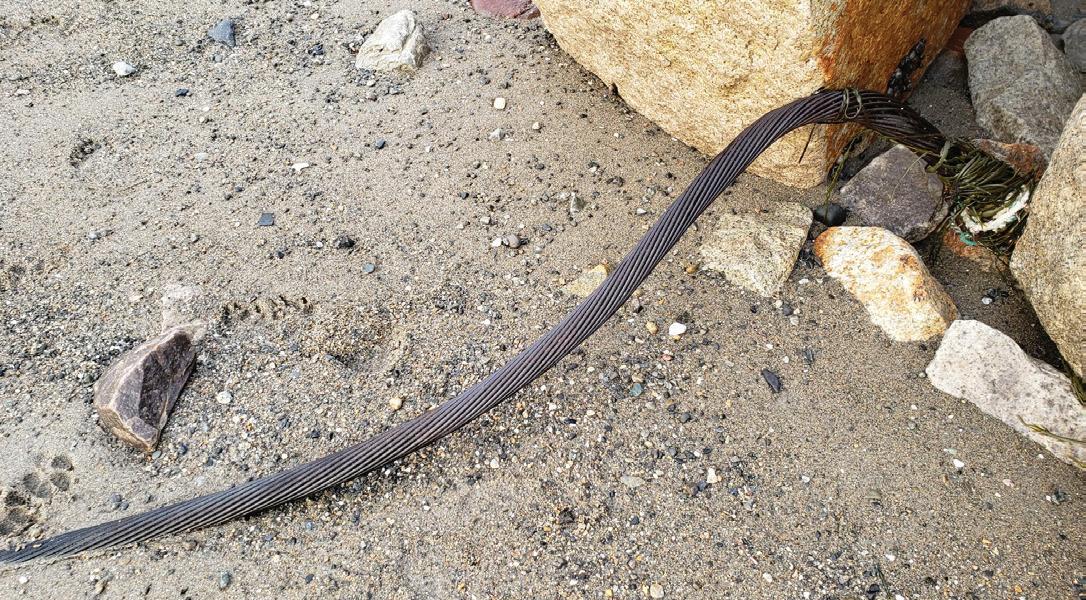
It was on one of these sandy stretches in the town of Rye that I (along with my loyal companion Titus), stumbled across a small piece of -mentarilysheathingitsconductorscablesrustingveryItheadingneathbeforeaboutblegardenabankwasimmediatelyipextraordinaireandtelageThankscationstelecommunihistory.tothetuofco-workercablehistorianPhilPilgrim,IknewwhatIlookingat.Protrudingfromaofbouldersandbitthickerthanahose,thecawasexposedforthreemetersdivingbethesandandouttosea.wasundoubtedlyold-atwisting,braidofironprotectingthewithin,rubberyouterlonggone.Myheartmoracedcouldthisbethe
SEPTEMBER 2022 | ISSUE 126 83
Figure 8: Titus “Cable Pointer”
Figure 7: Town Cove Landing, Orleans
New Hampshire, perhaps they think of its colorful fall foliage, its rugged mountains, or its equally rugged state motto “Live Free or Die”. What they probably do not think of is the beach. But unbeknownst to many, New Hampshire has a coastline. Tucked be tween Massachusetts and Maine, the Granite State kisses the Atlantic for twenty-nine mostly rocky, occasionally sandy, kilometers.

morning on the beach, even if that particular cable only traversed ten kilometers of ocean. But now I have caught the bug, and I’m determined to locate the 1875 Direct Cable. The landing station still stands and is now a private residence. But the cable itself, and the Sunken Forest of ancient cedar stumps it snakes through as it approaches land, will prove more challenging. They are reportedly only visible when just the right seasonal and tidal conditions are met - much like those ancient shipwrecks that reappear from time to time. Whenever that occurs again, I will be ready.
Figure 12: The Direct Cable landing station, 1875.

FINAL THOUGHTS AND LAST-MINUTE RESEARCH
BACK REFLECTION
Back in July 2019, Kyle sent me an email with incredible pictures of his cable find on a beach. He found it early in the morning while walking his dog. Due to the proximity of the Rye

But alas, the Direct Cable landed a few miles to the south on a spot now aptly known to locals as Cable beach. So, then what was this cable I found? Most likely it provided ser vice to the Isles of Shoals, a cluster of small, ragged islands ten kilometers
It was a thrill to find a small piece of telecommunications history that
Figure 11: Scale
Figure 13: The Direct Cable landing station, today.

84 SUBMARINE TELECOMS MAGAZINE
from the mainland and directly to my east. In the late 19th century one of the islands was home to a massive hotel which catered to prominent literary and artistic figures of the time. Like many of us today, they wanted to escape the city and be immersed in natural beauty - but not entirely disconnected from civilization.
famous Direct Cable? Enter ing service in 1875, the first direct trans-Atlantic cable between Europe and America terminated in Ballinskel ligs, Ireland and Rye, New Hampshire (briefly touch ing land in Tor Bay, Nova Scotia) - a journey of 5,743 km. Previous cables landed in Newfoundland, their mes sages requiring a slow and expensive relay over terrestri al telegraph service enroute to the USA. In addition to its record distance, the Direct Cable introduced innovations such as full-duplex communication and was a critical link during World War 1 until its decommissioning in 1921.
cable station and a road called “Cable Road,” we first thought perhaps it was the 1875 Direct Cable, but Kyle’s cable was a few kilometers to the north near Wallis Sands Beach. This is a bit too far to travel by storm so there is a slim possibility that it could be a re-purposed and re-routed 1875 cable; but there are no records and parts of that cable worked into the 1950’s so it would have been obsolete to reroute.
Figure 14: Kyle’s Cable Location

In final preparations of this article, and a big thanks to SubTel Forum’s Wayne Nielsen’s enduring patience for our late submission, we had anoth er look at what this cable could be just last night. Kyle is currently at a conference, so he is busy all day. We ended up exchanging emails well past midnight to complete this final push. Checking the wonderful iBoating. com online chart site showed no cables in the area. A deeper search revealed the chart below shows a “Cable Area” connecting Wallis Sands to the Isles
Figure 15: Wallis Sands “Cable Area” heading to Appledore Island
SEPTEMBER 2022 | ISSUE 126 85

BACK REFLECTION
86 SUBMARINE TELECOMS MAGAZINE

SEPTEMBER 2022 | ISSUE 126 87

88 SUBMARINE TELECOMS MAGAZINE
BACK REFLECTION
Figure 16: Dr. Richard Walding’s Drawing (IndicatorLoops.com)
of Shoals and Appledore Island. This cable may be an abandoned telegraph, telephone, or even a power cable.
So, Kyle’s cable may have had a military purpose? But this is it? Google Books to the Rescue: The Electrical Engineer A Weekly Review of Theoretical and Applied Electricity · Volume 16 and it mentions a cable landing at Wallis Sands Beach in August 1893.

Figure 17: Perhaps the world’s first “Cable Truck”
Dr. Richard Walding’s wonderful IndicatorLoops.com website shows the area to be a hot spot for World War II submarine detecting arrays. This over lays nicely with the chart above.

So, to confirm if this is the 1893 “Safety Cable”, we will need Kyle to revisit the site and count the number of armouring wires. Most telegrapgh cables made in the UK had even num bers of armour wires. Typical counts are 10,12,14, and 16. This “made in USA” cable has 15! It should be easy to Aidentify.quick and crude check gives us hope that it could be 15 (or 14 or 16). Looking at half the cable in a photo
So, it seems Kyle’s cable could be a telegraph cable prior to 1905.
“The company’s (Stone Tele graph and Telephone Company) first commercial radiotelegraph link was between the Isle of Shoals and Portsmouth, New Hamp shire, which operated during the summer of 1905, replacing a failed Western Union telegraph cable.”
Online research helps to form a better idea of possible dates and functions:
SEPTEMBER 2022 | ISSUE 126 89
I hope that these three articles on finding cables, and the wonderful ac counts of Chris and Kyle (along with Kai and Titus) encourage you to spend an enjoyable day at the coastline. Just explore like a child and maybe you will discover more of our past. When you look out at the sea and wonder what lays beyond the horizon, think of these wonderful cables and how the have brought the world together! S TF
Figure 18: The 1893 Isle of Shoals Cable


REFERENCES:
Figure 19: 14, 15, or 16 wires?
and counting the visible wires in a crosssection shows more than 7 but less than 8:
J?hl=en&gbpv=1&pg=PA125book_of_Electri/WSgyAQAAMAAtion/The_New_Everybody_s_Hand_FrenchCableStation/https://atlantic-cable.com/Article/https://www.indicatorloops.comhttps://www.google.com/books/edi
Kyle mentioned his last walk in this area has the cable now buried under a metre or more of sand, so he will have to suffer many more pleasant beach walks before we can identify this cable.
CONCLUSION:
PHILIP PILGRIM is the Subsea Business Development Leader for Nokia's North American Region. 2021 marks his is 30th year working in the subsea sector. His hobbies include "Subsea Archaeology" and locating the long lost subsea cable and telegraph routes (and infrastructure). Philip is based in Nova Scotia, Canada.

ANDREW WOODWARD joined Parkburn Handling Systems this past month as well. He will be serving as Sales Engineer and “is looking forward to helping partners old and new with a range of world class offering.”

FiberSense welcomed PETER HUBBARD to the team as their new Lead Engineer in August. He stated he “is excited to make smartcities a reality around the world.”

INGVAR KESKITALO joined the growing team at Bulk Fiber Networks as their new Technical Solutions Manager. An industry veteran, Ingvar has over 30 years’ experience with managing projects, companies, and networks in the ICT and telecom sector.

A press release from OPT New Cale donia announced the return of THOMAS D DECKKER after 12 years. He is will be serving as the new Deputy Direc tor General until the end of 2022 at which point he will take over as the Director General succeeding Philippe Gervolino, the current CEO.
Equinix welcomed LISA MILLER as their new Senior Vice President of Plat form Alliances in late August. Lisa has held a variety of senior leadership roles over the last 30 years and has experience that spans the globe. ”

HAVE A NEW HIRE YOU WANT TO HIGHLIGHT IN THE NEXT ISSUE OF SUBTEL FORUM MAGAZINE? Feel free to send a direct message to Rebecca Spence on LinkedIn or send the announcement to rspence@subtelforum.com.
RANDY BROGLE, formerly an Executive for Meta Fiber Investments, was named CEO of LS Networks at the beginning of August. Randy has over 25 years of experience in the telecom munications industry. According to the company press release he will “lead the company’s froth plans to invest in the buildout of its fiber network and support the delivery of high-capacity connectivity solutions to transform under served communicates across the region.”
90 SUBMARINE TELECOMS MAGAZINE
ON THE MOVE
Aqua Comms welcomed PAUL CATUREGLI as Business Development Director for International Telecom and Subsea In frastructure. With experience at Tata Communications and GlobalCom among others, he has over 20 years’ of knowledge of the industry.


In early September AZAM ALI joined Bangladesh Submarine Cable Com pany Limited as their new Managing Director. Mr. Ali has a BSc in Elec trical and Electronic Engineering and previously served as the Deputy Man aging Director at Bangladesh Tele communications Company Limited.

After completing her Masters in Telecommunications & Network Engineering, NIA (NEEHARIKA) GUPTA has joined the team of Telstra as a Network Engineer. She is “thrilled to embark on this exciting new chapter! And is looking forward to an amazing learning experience working with the super talented team.”
MAUREEN KELLEHER was promoted the Customer Care and Inside Sales Manager for Hexatronic US. In the announcement, Beni Blell, VP of Sales stated “Maureen has demon strated exceptional levels of customer service and leadership qualities.”


STATE OF THE INDUSTRY
FUTURE SYSTEMS
Telstra Appoints Steve Mundt to Head Enterprise and Technology Sales for the Americas
BaSICs Cable System Has Launched PEACE Cable to Pakistan Now Ready For Service PLDT’s Transpacific System, Jupiter, Is Live Sparkle Adds the Monet Submarine Cable to Its Assets Southern Cross NEXT Is Now In-Service!
Pioneer Consulting Engaged for Malha Óptica NOW
Greenland Connect Repairs Have Been Completed Sea-Me-We-5 Fault Causing Disruptions
Greenland Connect Repair to Start This Month
3i Infrastructure plc Completes Acquisition of GCX Phoenix Celebrates 25 Years!
TECHNOLOGY & UPGRADES
SUBMARINE CABLE
CABLE FAULTS & MAINTENANCE
CURRENT SYSTEMS
APG Experiencing Loss of Service From Fault
Italian Navy & Sparkle Sign MoU for Cable Protection Open Access Data Centres Appoints New CEO
SEPTEMBER 2022 | ISSUE 126 91
OFFSHORE ENERGY
DATA CENTERS
NEWS
Africa DCs Breaks Ground for Samrand Expansion OTT Providers Pausing DC Projects in Dublin Landing of Equiano Extends WIOCC’s Offerings
A-2-Sea is Changing the Subsea Cable Industry
Eric Dalessio is Telstra’s New Customer Service VP Dr. Y. Niiro will be Project’s Japan Director BAI Communications Acquiring ZenFi Networks E-marine PJSC Commissions MakaiLay Across Their Fleet OMS Group Launches Fifth Cableship In France
TEAS Cable Lands with Lightstorm in India Hawaiki Nui Could Connect to French Polynesia Google Officially Unveils Equiano in South Africa Saudi stc Launches Vision Submarine Cable East Micronesia Cable Project Has MOU ENCOM Authorizes Google’s Firmina Cable Google’s Equiano Cable Has Landed in South Africa Installation of PDSCN has Commenced C/S Intrepid Has Arrived in Alaska for Installation Quintillion Plans Cable to Connect Japan to the Arctic Desarrollo País and H2 Have Issued RFP MIST to Land in Santhome Beach, Chennai NEC Chosen to Build Juno Cable System New Company to Build & Operate JUNO Cable Farice and Far North Digital Have Inked an MoU BlueMed Construction Site Kicks Off
SUBMARINE TELECOMS FORUM MAGAZINE
• Social Media acknowledgment (LinkedIn, Facebook & Twitter)
CLICK HERE TO VISIT OUR ONLINE STORE
September 2023: Offshore Energy
January 2023: Global Outlook
July 2023: Regional Systems
March 2023: Finance & Legal
100,000+ downloads per issue. Two-month exposure. Rates start as low at $1,750 Go to our Online Store for size and discount options.
November: Data Centers & New Technology

Now Featuring: PTC Conference Preview (NEXT ISSUE — ART DUE NOV. 7)
May 2023: Global Capacity
The annual ALMANAC and INDUSTRY REPORT sponsorships are upgraded to a 2-page spread - video option. No rate increase.Forthe November DATA CENTERS & TECHNOLOGYNEWmagazine, we have added a PTC CONFERENCE REVIEW section.
I'm always here for questions.
92 SUBMARINE TELECOMS MAGAZINE
ADVERTISER CORNER
2022 SUBMARINE TELECOMS FORUM MAGAZINE ISSUE THEMES:
Greetings!Ihavea couple updates we are pleased to announce:
Sponsorship Benefits:
• Complimentary tile web Banner on our news feed.
• 30 second optional Video (Full-Page/2-Page Spread only)
• Acknowledgment in Press Release and Mailer
• Complimentary tile web Banner on our news feed
and
• Social Media acknowledgment -LinkedIn, Facebook & Twitter
• Exclusive
NEXT AVAILABLE ISSUE: NOVEMBER / DECEMBER / JANUARY
SUBTEL FORUM
• 30
FIRST COME, FIRST SERVED CATEGORIES GO QUICK. LOCK IN FOR 2022 NOW! One full-year of benefits: $3,750
• Sponsors can choose their category from below. First come, first served
SPONSORSHIP BENEFITS:
Quarterly
SPONSORSHIP BENEFITS: sponsorship on Cover Spread (11” x 17”) near front of document second optional promotional Video web Banner on our news feed. Media LinkedIn, Release mailer
• Acknowledgment on publication webpage
• 2-Page Spread (optional :30 embedded Video)
acknowledgment-
• Complimentary tile
ALMANACSUBMARINE CABLE ALMANAC ISSUE 43 AUGUST 2022 1. GLOBAL OVERVIEW 1.1 Industry Sentiment 1.2 Submarine Telecoms: Our Technology Roots 1.3 Capacity 1.4 System Growth 1.5 Out of Service Systems 1.6 Evolution..Sys. Ownership/Cust. Base 2. OWNERSHIP FINANCING ANALYSIS 2.1 Historic Financing Perspective 2.2 Regional Distribution of Financing 2.3 Current Financing 3. SUPPLIER ANALYSIS 3.1 System Suppliers 3.2 Installers 3.3 Surveyors 3.4 Recent Mergers, Acquisitions, and Industry Activities 4. SYSTEM MAINTENANCE 4.1 Publicity 4.2 Reporting Trends and Repair Times 4.3 Club Versus Private Agreements 5. CABLE SHIPS 5.1 Current Cable Ships 5.2 Shore-End Activity 6. MARKET DRIVERS AND INFLUENCERS 6.1 Hyperscalers 6.2 Data Centers 7. SPECIAL MARKETS 7.1 Offshore Energy 7.2 Unrepeatered Systems 8. REGIONAL MARKET ANALYSIS AND CAPACITY OUTLOOK 8.1 Transatlantic Regional Market 8.2 Transpacific Regional Market 8.3 Americas Regional Market 8.4 AustralAsia Regional Market 8.5 EMEA Regional Market 8.6 Indian Ocean Region 8.7 Polar Regional Marke
SEPTEMBER 2022 | ISSUE 126 93
525,000+ downloads per issue. Three-month exposure. cost: $5,000
• 2-Page
• 560,000+ downloads per issue.
Facebook & Twitter • Acknowledgment in Press
SUBMARINE TELECOMS ANNUAL INDUSTRY REPORT


• Logo/Link throughout your section
• Logo/link
• Acknowledgment in Press Release and Mailer
• Social
CLICK HERE TO VISIT OUR ONLINE STORE
• Planned cables – 80+, updated bi-weekly
• Cableships – location/status of 45+, updated every 6 hours

THE NEW SUBTEL FORUM ONLINE CABLE MAP




Let’s keep the submarine telecoms industry strong, viable, and growing! STF
For Rates and Benefits Recap (including website & social media), go to the SubTel Forum ONLINE STORE. Or just shoot me an email with you questions. I am at your service.
• In-service Cables – details 450+, updated bi-weekly

• Data Centers – 1,700+, updated quarterly


Add Your Logo to this beautiful, largeformat print map that showcases every major international submarine cable system and proudly hang in many offices in our industry. It is not too early to lock in your spot for 2023!
Yearly logo cost: $3,750
• Acknowledgment in Press Release and mailer
Terri Jones, Sales Manager, SubTel Forum tjones@subtelforum.com

NTT WE MARINE A CLOSER LOOK SEA SOUTHEAST ASIA GULFMEDITERRANEANINDIANOCEANCARIBBEANSUBMARINE CABLES OF THE WORLD 2022 MAP LEGEND (1044) OFFSHORE FACILITIES IN SERVICE (19) PLANNED (6) 16+ YEARS (130)(231) PLANNED (62) UP SYSTEMS CLUSTERS CABLE SYSTEM INVESTMENT, 2012–2021 REGIONAL DISTRIBUTION OF NEW CABLE, SUBMARINEMENT,CABLE2022–2024 BILLIONS) PROVIDER FACILITY UNICOM DISTRIBUTION OF NEW CABLE,DISTRIBUTION2022OF NEW CABLE, 2012–2021 BY THE NUMBERSPROVIDERCOUNT

The NEW Online Cable Map is now available online - features printable PDF maps. Thanks to our annual Sponsor: Infinera
HERE ARE JUST A FEW FEATURES: :
94 SUBMARINE TELECOMS MAGAZINE
Exclusive Yearly Sponsorship: $35,000
SUBTEL FORUM PRINT CABLE MAP
ADVERTISER CORNER
• Complimentary tile web Banner on SubTel Forum Newsfeed


ADDITIONAL SPONSORSHIP BENEFITS:
• Social Media acknowledgmentLinkedIn, Facebook & Twitter
MARCH 2021 | ISSUE 117 95 COMING NEXT ISSUE! YOU CAN BE A PART OF OUR NEXT ISSUE! SUBMIT AN ARTICLE contact editor@subtelforum.com SPONSOR AN ADVERTISEMENT contact sales@subtelforum.com

