BACK REFLECTION
THE “ALMOST” SECOND SUBMARINE CABLE IN NORTH AMERICA: 1855 NEWFOUNDLAND – NOVA SCOTIA BY PHILIP PILGRIM
I
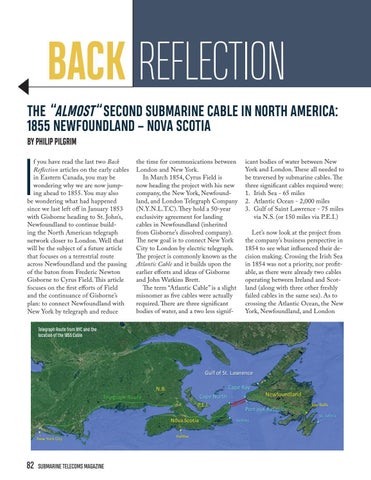
f you have read the last two Back Reflection articles on the early cables in Eastern Canada, you may be wondering why we are now jumping ahead to 1855. You may also be wondering what had happened since we last left off in January 1853 with Gisborne heading to St. John’s, Newfoundland to continue building the North American telegraph network closer to London. Well that will be the subject of a future article that focuses on a terrestrial route across Newfoundland and the passing of the baton from Frederic Newton Gisborne to Cyrus Field. This article focuses on the first efforts of Field and the continuance of Gisborne’s plan: to connect Newfoundland with New York by telegraph and reduce Telegraph Route from NYC and the location of the 1855 Cable
82
SUBMARINE TELECOMS MAGAZINE
the time for communications between London and New York. In March 1854, Cyrus Field is now heading the project with his new company, the New York, Newfoundland, and London Telegraph Company (N.Y.N.L.T.C). They hold a 50-year exclusivity agreement for landing cables in Newfoundland (inherited from Gisborne’s dissolved company). The new goal is to connect New York City to London by electric telegraph. The project is commonly known as the Atlantic Cable and it builds upon the earlier efforts and ideas of Gisborne and John Watkins Brett. The term “Atlantic Cable” is a slight misnomer as five cables were actually required. There are three significant bodies of water, and a two less signif-
icant bodies of water between New York and London. These all needed to be traversed by submarine cables. The three significant cables required were: 1. Irish Sea - 65 miles 2. Atlantic Ocean - 2,000 miles 3. Gulf of Saint Lawrence - 75 miles via N.S. (or 150 miles via P.E.I.) Let’s now look at the project from the company’s business perspective in 1854 to see what influenced their decision making. Crossing the Irish Sea in 1854 was not a priority, nor profitable, as there were already two cables operating between Ireland and Scotland (along with three other freshly failed cables in the same sea). As to crossing the Atlantic Ocean, the New York, Newfoundland, and London