BACK REFLECTION
BY BILL BURNS
THE FOUNDING OF THE EASTERN TELEGRAPH COMPANY
2
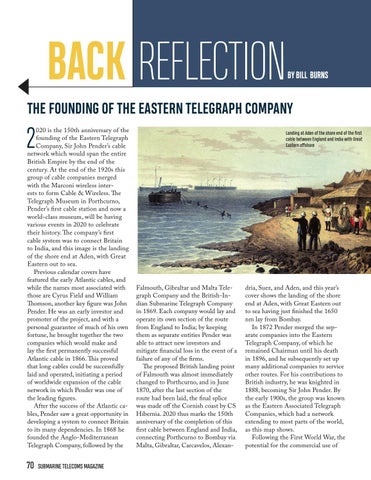
020 is the 150th anniversary of the founding of the Eastern Telegraph Company, Sir John Pender’s cable network which would span the entire British Empire by the end of the century. At the end of the 1920s this group of cable companies merged with the Marconi wireless interests to form Cable & Wireless. The Telegraph Museum in Porthcurno, Pender’s first cable station and now a world-class museum, will be having various events in 2020 to celebrate their history. The company’s first cable system was to connect Britain to India, and this image is the landing of the shore end at Aden, with Great Eastern out to sea. Previous calendar covers have featured the early Atlantic cables, and while the names most associated with those are Cyrus Field and William Thomson, another key figure was John Pender. He was an early investor and promoter of the project, and with a personal guarantee of much of his own fortune, he brought together the two companies which would make and lay the first permanently successful Atlantic cable in 1866. This proved that long cables could be successfully laid and operated, initiating a period of worldwide expansion of the cable network in which Pender was one of the leading figures. After the success of the Atlantic cables, Pender saw a great opportunity in developing a system to connect Britain to its many dependencies. In 1868 he founded the Anglo-Mediterranean Telegraph Company, followed by the
70
SUBMARINE TELECOMS MAGAZINE
Landing at Aden of the shore end of the first cable between England and India with Great Eastern offshore
Falmouth, Gibraltar and Malta Telegraph Company and the British-Indian Submarine Telegraph Company in 1869. Each company would lay and operate its own section of the route from England to India; by keeping them as separate entities Pender was able to attract new investors and mitigate financial loss in the event of a failure of any of the firms. The proposed British landing point of Falmouth was almost immediately changed to Porthcurno, and in June 1870, after the last section of the route had been laid, the final splice was made off the Cornish coast by CS Hibernia. 2020 thus marks the 150th anniversary of the completion of this first cable between England and India, connecting Porthcurno to Bombay via Malta, Gibraltar, Carcavelos, Alexan-
dria, Suez, and Aden, and this year’s cover shows the landing of the shore end at Aden, with Great Eastern out to sea having just finished the 1650 nm lay from Bombay. In 1872 Pender merged the separate companies into the Eastern Telegraph Company, of which he remained Chairman until his death in 1896, and he subsequently set up many additional companies to service other routes. For his contributions to British industry, he was knighted in 1888, becoming Sir John Pender. By the early 1900s, the group was known as the Eastern Associated Telegraph Companies, which had a network extending to most parts of the world, as this map shows. Following the First World War, the potential for the commercial use of