SUBMARINE TELECOMS
FORUM ISSUE 109 | NOVEMBER 2019
DATA CENTERS AND
NEW TECHNOLOGY
EXORDIUM FROM THE PUBLISHER
WELCOME TO ISSUE 109, OUR DATACENTERS & NEW TECHNOLOGY AND 18TH ANNIVERSARY, AS WELL AS PTC ’20 PREVIEW EDITION!
O
n the last long run of my annual marathon training at 16 of 22 miles I tripped and fell hard on an autumnal leaf covered gravel path and cracked a rib. The last time I had cracked a rib was probably twenty years earlier when I took a kick to the chest in a Tae Kwon Do class; so, I had a pretty good idea what I was dealing with and how long it could take to heal. But I was still hopeful that I could repair enough in the 3 weeks before my run. So, I took it easy, skipped short runs for a while and then in the second week went back to the pool for my Wednesday swim and in short order reminded myself just how much ribs can hurt. Still I remained hopeful until the weekend before when I just couldn’t get out and run 5 measly miles, and as a result, I bagged my annual run with the Marines. I had worked through the bone spur I picked up at the Easter Island marathon last year with a jell shot and a lot of Ibuprofen and Kinesio tape. I had put in the time and the miles, even a half marathon in June. But sometimes life bites back in ways you never see coming and trips you up. I like running with the Marines for lots of reasons, but mainly because they persevere. Above my desk at home are two age curled pages; one defining “Stamina” and the other “Endurance”. So, on the day of my annual run I instead canned my Thanksgiving applesauce and ‘ran’ vicariously through the sporadic local television coverage as the wettest day in weeks occurred outside. And last week, I signed-up and started my plan for accomplishing a half marathon, this one being next May, as well as my next marathon – same time next year. Next year I’ll avoid that trail when the leaves drop! At the start of our 19th year, we at SubTel Forum have lots of new, exciting plans in store.
PORTHCURNO 150TH ANNIVERSARY
Beginning this issue, SubTel Forum is publishing a series of articles leading up to the main 150th anniversary of the first
2 SUBMARINE TELECOMS MAGAZINE
India telegraph cable, which will be celebrated for the month of June 2020 at the Telegraph Museum Porthcurno in Cornwall, England. Bill Burns has written a piece entitled, “The Founding of the Eastern Telegraph Company”, featuring an Image of the Great Eastern laying the Aden shore-end and a brief summary of the cable lay and a synopsis of the ETC’s development up to C&W and the Museum. In subsequent issues, we will be highlighting the month-long schedule for the Porthcurno event, as well as other historic articles.
ON-LINE AUTHOR AND ARTICLE INDEX
We recently created an Online Index for over 100 previous SubTel Forum Magazine issues and five times that many authors and articles, allowing one to reference sources and locate magazine articles on many submarine cable related subjects. The Online Index scans the table of contents of each issue of SubTel Forum and highlights authors and topics. Give it a try at www.subtelforum.com/onlineindex.
SUBSCRIPTION REPORT SERVICE
For our reporting, we have moved to a simple web-based subscription service, which provides access to all the Market Sector Reports, as well as several useful analytics tools for the submarine fiber industry. Subscribers get access to the new Data Center & OTT Providers Market Sector Report, for instance, as well as other market sector reports authored by STF Analytics. Give it a look at https://stfanalytics.com/store.
SUBTEL FORUM 18TH ANNIVERSARY ISSUE
When Ted Breeze and I established our little magazine in 2001, our hope was to get enough interest to keep it going for a while. We were building on our previous successes of “Soundings” and “Real Time” from BT Marine and SAIC, respectively, and we realized that the industry that had sustained us was headed into a dark time; it would need a place to express itself like never before.
A Publication of Submarine Telecoms Forum, Inc. www.subtelforum.com ISSN No. 1948-3031 So, we kicked around a few ideas, talked with a few trusted industry friends, and took a BIG chance. And in November 2001, just after 9/11 and the start of our largest industry downturn, and with a budget consisting of the balance of a severance package from me and some “borrowed” software and pics from him, we published our first issue, which consisted of eight articles and seven complimentary advertisements. Both the initial authors and sponsors showed us a tremendous amount of faith. In our now 18th year we have had to up our game in ways never originally imagined, try novel approaches to businesses new to us, even recreate our mission statement as a part of our drive toward providing continuing education: “To provide a freely accessible forum for the illumination and education of professionals in industries connected with submarine optical fiber technologies and techniques.” We continue to publish SubTel Forum with two key founding principles always in mind, which annually I reaffirm to you, our readers: 1. That we will provide a wide range of ideas and issues; 2. That we will seek to incite, entertain and provoke in a positive manner. Thank you to the more than 90+ Sponsors and 500+ Authors who have contributed to SubTel Forum over the last 18 years! So, here’s to you, our readers and supporters, thank you as always for honoring us with your interest. STF Happy reading,
Wayne Nielsen Publisher
PRESIDENT & PUBLISHER: Wayne Nielsen | wnielsen@subtelforum.com VICE PRESIDENT: Kristian Nielsen | knielsen@subtelforum.com SALES: Teri Jones | tjones@subtelforum.com | [+1] (703) 471-4902 EDITOR: Stephen Nielsen | snielsen@subtelforum.com DESIGN & PRODUCTION: Weswen Design | wendy@weswendesign.com DEPARTMENT WRITERS: Bill Burns, Kieran Clark, Kristian Nielsen, Roland Certeza and Wayne Nielsen FEATURE WRITERS: Alan McCurdy, Andy Palmer-Felgate, Bruce Neilson-Watts, Derek Webster, Elaine Stafford, Eric Handa, Herve Fevrier, Himmat Singh Sandhu, Houlin Zhao, Jean-Francois Baget, Olivier Tremblay-Lavoie, Patrick Faidherbe, Paul Gabla, Robert Lingle, Jr., Siddhartha Raja, Stephen Nielsen, Steve Grubb, Steve Lentz, Tony Purcell and Yvonne Lin NEXT ISSUE: JANUARY 2020 Global Outlook AUTHOR AND ARTICLE INDEX: www.subtelforum.com/XXXX
Submarine Telecoms Forum, Inc. www.stf-inc.com BOARD OF DIRECTORS: Margaret Nielsen, Wayne Nielsen and Kristian Nielsen
STF Events, Inc. www.stfevents.com CONFERENCE DIRECTOR: Christopher Noyes | cnoyes@stfevents.com | [+1] (703) 468-0554
STF Analytics, Division of SubTel Forum, Inc. www.stfanalytics.com LEAD ANALYST: Kieran Clark | kclark@subtelforum.com | [+1] (703) 468-1382 Contributions are welcomed and should be forwarded to: pressroom@subtelforum.com. Submarine Telecoms Forum magazine is published bimonthly by Submarine Telecoms Forum, Inc., and is an independent commercial publication, serving as a freely accessible forum for professionals in industries connected with submarine optical fiber technologies and techniques. Submarine Telecoms Forum may not be reproduced or transmitted in any form, in whole or in part, without the permission of the publishers. Liability: While every care is taken in preparation of this publication, the publishers cannot be held
responsible for the accuracy of the information herein, or any errors which may occur in advertising or editorial content, or any consequence arising from any errors or omissions, and the editor reserves the right to edit any advertising or editorial material submitted for publication. New Subscriptions, Enquiries and Changes of Address: 21495 Ridgetop Circle, Suite 201, Sterling, Virginia 20166, USA, or call [+1] (703) 444-0845, fax [+1] (703) 349-5562, or visit www.subtelforum.com. Copyright © 2019 Submarine Telecoms Forum, Inc.
V O I C E O F T H E I N D U S T RY
SUBMARINE TELECOMS
FORUM ISSUE 109 | NOVEMBER 2019
CONTEN TS features
14
5 QUESTIONS WITH HENRIK ROLAND CERTEZA
16
CONNECTING DATA CENTERS WITH SUBMARINE CABLES By Steve Grubb, Herve Fevrier and Andy Palmer-Felgate
22
AN APPRECIATION By Subtel Forum staff
26
INTRODUCING SUBTEL FORUM’S ONLINE AUTHOR AND ARTICLE INDEX
28
PTC’20 VISION 2020 AND BEYOND By Elaine Stafford
4 SUBMARINE TELECOMS MAGAZINE
34
52
INSIDERS’ PERSPECTIVES REVISITED
NEW INTERNET GEOGRAPHY By Jean-Francois Baget
58
44
ADVANCED OPTICAL FIBERS FOR CONNECTING DATA CENTERS
PUSHING THE LIMITS OF UNDERSEA CABLE NETWORKS TO PROVIDE GLOBAL DATA CONNECTIVITY
By Alan McCurdy and Robert Lingle, Jr.
By Olivier Tremblay-Lavoie
48
64
USER STORY: WEB MAPS SHARE DETAILED SUBMARINE CABLE DATA
WHY GREEN DATA CENTRES ARE THE FUTURE By Tony Purcell
By Yvonne Lin
departments
EXORDIUM........................................................ 2 STF ANALYTICS REPORT..................................... 6 CABLE MAP UPDATE......................................... 12 CONTIUING EDUCATION.................................... 68
BACK REFLECTION........................................... 70 ON THE MOVE...................................................74 SUBMARINE CABLE NEWS NOW....................... 76 ADVERTISER CORNER...................................... 78 NOVEMBER 2019 | ISSUE 109
5
ANALYTICS SUBMARINE TELECOMS MARKET SECTOR REPORT:
BY KIERAN CLARK
SUBMARINE TELECOMS
MARKET SECTOR REPORT
DATA CENTER & OTT PROVIDERS
Data Center & OTT Providers
T
o address the growing reporting and analysis needs of the submarine fiber industry, STF Analytics continues its Market Sector Report series – designed to provide the industry with the information it needs to make informed business decisions. The Submarine Telecoms Market Sector Report is a bi-monthly product covering a specific sector of the submarine fiber industry, coinciding with the theme of each issue of the SubTel Forum Magazine. This edition provides an in-depth look at the Over-the-Top (OTT) and Data Center markets and how they impact the submarine fiber industry. STF Analytics collected and analyzed data derived from a variety of
6
SUBMARINE TELECOMS MAGAZINE
public, commercial and scientific sources to best analyze and project market conditions. While every care is taken in preparing this report, these are our best estimates based on information provided and discussed in this industry. The following Executive Summary provides an overview of the topics addressed in this month’s report.
EXECUTIVE SUMMARY
The world continues to consume more and more bandwidth as digital activity for both enterprise and consumer applications move to “the cloud”. The companies behind these services – including the likes of Ama-
zon, Facebook, Google and Microsoft – continue to grow at nearly astronomical rates to keep up with demand which presents numerous opportunities for the submarine fiber industry to provide new infrastructure for the growing digital economy. Data Center and OTT providers are an increasingly integral part of the submarine cable system development process. OTT providers like Amazon, Facebook, Google and are moving from capacity purchasers to cable owners. While transoceanic cable systems are expensive – well over $100 million USD just to get across the Atlantic – these assets represent
business potential in the billions for major OTT providers. Even the annual operations expenditure to manage and maintain cable infrastructure is a fraction of potential revenue that can be realized through implementation of reliable, high capacity network infrastructure. Additionally, these non-traditional actors are encouraging new routes and growing new markets. South America and Africa are two prime examples of regions changing as a result of the efforts from data center and OTT providers. An OTT provider can be the cornerstone of a cable system project that would otherwise never get past the planning stages and these companies were the driving force behind 31 percent of systems that went into service from 2016-2019. (Figure 1) The arrival of a major OTT provider not only brings new telecoms infrastructure to a region but also the cloud services that company provides. Not only are these new players now driving where cables are going, they are helping to push along new innovations inside of the cable systems themselves. New transmission technology to handle higher capacity wavelengths, increased fiber counts for more overall system capacity and streamlined network management and the push for open systems leading to shared system architecture are just a small sampling of new technologies and ideas these providers are backing. Another major change OTT providers have brought to global networks is shifting the focus from city to city connections to data center to data center connections. Unlike an Equinix or a Digital Realty, OTT providers do
Figure 1: OTT vs Non-OTT Providers, 2016-2019
Figure 2: Enterprise Public Cloud Provider Usage, 2019
not necessarily need to build infrastructure in locations with a variety of interconnect options. Instead, they favor locations that provide economic and cost saving benefits to reduce the operational expenditure impact of their data center facilities. For these companies, building a submarine fiber system is equivalent to an offshore energy company building an oil pipeline as the infrastructure is simply a
means to move product – data in this case – and is not by itself revenue generating. Cloud adoption is at an all-time high as companies continue to shift towards both cloud storage and cloud computing to drive their business. Amazon Web Services and Microsoft Azure lead the way in enterprise adoption with no sign of slowing down. (Figure 2) These cloud services are NOVEMBER 2019 | ISSUE 109
7
ANALYTICS global in nature and inevitably their traffic will end up traveling over submarine telecommunications cables. As a result, data center providers have become more involved with the submarine fiber industry, especially around cable landing stations where they can capitalize on interconnection and colocation opportunities – especially in those areas where multiple cables come ashore to a single location. The International Data Corporation estimates worldwide Public Cloud Services Spending will reach $210 billion USD in 2019 – an increase of 23.8 percent over 2018. (International Data Corporation, 2019) All this reinforces the idea that the cloud is here to stay and will need even more infrastructure to support massive growth in already established markets – let alone new ones. Additionally, some data center providers work to bridge the gap between the cable landing station and backhaul or interconnection services to maximize network efficiency and throughput for their customers by attempting to bring once disparate infrastructure into a single facility. More closely integrating data center and cable landing facilities cuts down on network latency and increases data security.
BY KIERAN CLARK
As with any market sector involving tech, long term outlook is difficult to forecast. There is always the potential for a disruptive new piece of technology or software to enter the market and upset established dynamics or for a market bubble to burst. Numerous tech companies like Facebook, Twitter, Snapchat and Amazon have stumbled in the past year with both privacy and long-term profitability concerns resulting from declining user counts, increased competition from rival companies and, in the case of Facebook, uncomfortable inquiries in front of the United States Congress about data privacy. Further, ongoing global trade disputes introduce a measure of uncertainty over the global markets at large which tempers expectations that the current rate of growth will continue indefinitely. However, until something drastic changes the course of the larger tech and internet-based industries, the immediate future promises a wealth of opportunity for the submarine telecoms industry. OTT providers continue to develop new infrastructure at a rapid pace to meet their bandwidth needs which seem to grow every year as data and cloud services continue to grow in scale and capability.
We hope this report will prove to be a valuable resource to the submarine fiber industry at large. To purchase a full copy of this report, please click the link below. STF Analytics is moving to a webbased subscription model for all its reporting services. An annual subscription provides access to all the Market Sector Reports as well as several useful analytics tools for the submarine fiber industry. Subscribe today to get access to the Data Center & OTT Providers Market Sector Report! STF KIERAN CLARK is the Lead Analyst for STF Analytics, a division of Submarine Telecoms Forum, Inc. He originally joined SubTel Forum in 2013 as a Broadcast Technician to provide support for live event video streaming. He has 6+ years of live production experience and has worked alongside some of the premier organizations in video web streaming. In 2014, Kieran was promoted to Analyst and is currently responsible for the research and maintenance that supports the STF Analytics Submarine Cable Database. In 2016, he was promoted to Lead Analyst and put in charge of the newly created STF Analytics. His analysis is featured in almost the entire array of SubTel Forum publications.
PURCHASE YOUR COPY OF THE SUBMARINE TELECOMS MARKET SECTOR REPORT: DATA CENTER & OTT PROVIDERS EDITION TODAY! 8
HTTPS://STFANALYTICS.COM/SUBSCRIBE SUBMARINE TELECOMS MAGAZINE
OUT NOW! INDUSTRY-LEADING ANALYSIS DRILLING INTO THE O&G MARKET
Submarine Telecoms Market Sector Report: Offshore Oil & Gas Edition Featuring exclusive data and analysis from STF Analytics – • 80+ Systems represented • Exclusive data collected direct from owners and suppliers • State of the market and trends • Signature analysis • Priced for every budget
SUBSCRIBE TODAY!
STFANALYTICS.COM/SUBSCRIBE
ISO 9001:2015 certified designer and imp for commercial, governmen
10
THROUGHOUT
SUBMARINE TELECOMS MAGAZINE
plementer of submarine fiber cable systems ntal and oil & gas companies
T THE WORLD.
MARCH 2019 | ISSUE 104
11
FEATURE Interactive Cable Map Updates S
ubTel Forum’s Submarine Cables of The World Interactive Map is built with the industry standard Esri ArcGIS platform and linked to the STF Analytics Submarine Cable Database. It tracks the progress of some 295+ current and planned cable systems, over 780 landing points, as well as mobile subscriptions and internet accessibility data for 254 countries. Systems are also linked to SubTel Forum’s News Now Feed, allowing viewing of current and archived news details. This interactive map is a continual work and progress and regularly updated with pertinent data captured by analysts at STF Analytics and feedback from our users. Our goal is to make easily available not only data from the Submarine Cable Almanac, but also more and more new layers of system information. Want to learn more about how to use the great features of the map? Take a look at our tutorial video series below: 1. Print Widget 2. General Map Usage 3. Group Filter Widget 4. Select Tool 5. Control Buttons 6. Share Widget
We hope you continue to make use of the SubTel Cable Map in order to learn more about the industry yourself and educate others on the importance of submarine cable systems. Please feel free to reach out to our Lead Analyst, Kieran Clark, should you have any comments, questions or updates at kclark@subtelforum.com.
12
SUBMARINE TELECOMS MAGAZINE
Since the last issue of the Magazine, the map has received added five new submarine cable systems and updated thirty-three more. The full list of updated systems are as follows: SYSTEMS ADDED:
Chennai – Andaman & Nicobar Islands JGA North JGA South Oman Australia Cable Trans Pacific Network
SUBMARINECABLESOFTHEWORLD.COM SYSTEMS UPDATED:
Akorn Alaska United West ATISA AU-Aleutian BP GoM BtoBE CanTaT-3 Caucasus Cable System Coral Sea Crosslake Fibre Eagle Eastern Light
EllaLink Faster GBICS GlobeNet H2 Cable Hawaiki I-ME-WE Jupiter Katittuq Nunavut MainOne Manatua One NCP PEACE
PLCN Project Koete SACS SAIL SEA-ME-WE 5 Southern Cross Southern Cross NEXT WACS
NOVEMBER 2019 | ISSUE 109
13
FEATURE
5 QUESTIONS WITH ROLAND CERTEZA
Talking Technology Trends with GTA’s President and Chief Executive Officer
1.
What is GTA’s mission? GTA’s mission is to help its customers make the most of island life while providing unique solutions and connectivity. As the largest full-service telco in Guam, GTA offers reliability and uptime with its proven expertise as a U.S.owned carrier.
2.
How does GTA participate in the submarine cable market? We believe, and have shown, that Guam’s strategic location offers international cables the resilience needed to connect the Pacific region, including Asia and Australia, with the North America region. We’re U.S.-owned, and we have the experience in working with global networks. Our years of technical experience, starting with our CTO, down to the teams that support him, make us the experts in connecting the Pacific region – from west to east. Our customers rely on GTA to provide unique solutions going end-to-end, and we take them from Guam all the way to Los Angeles on our own network.
14
SUBMARINE TELECOMS MAGAZINE
3.
Is GTA currently involved with any new submarine cable projects? The latest evolution of our work can be seen with the construction of the new cable landing station for SEA-US, where we’re also doing the day-one configuration. Beyond that, we’ve entered into a joint venture with RTI to build the first neutral Cable Landing Station and Data Center in Guam, the Gateway Network Connections (GNC). This facility is going to be a crucial connection point and intersection for several cable lines including; SEA-US West, SEA-US East, Hong Kong-Guam Cable System (HK-G), Japan-Guam-Australia North Cable System ( JGA North), and Japan-Guam-Australia South Cable System ( JGA South).
4.
What is your view on the connectivity market? There’s a lot of exciting opportunities right now in the connectivity market, specifically in the Pacific region. Due to its location, Guam offers networks a safe and secure communications hub for global undersea cables connections.
We already support high-speed networks which enable global communications and the modern world. Plus, communications evolutions like 5G are approaching. Other nations in the Asia region, like the Philippines and Indonesia, are developing their global communications network, and as these countries develop, more people are getting internet access. This presents a material change in their cost structure, in how they route, and how information gets to and from the U.S. Our goal is to partner with these telecoms and offer them the resilience they need.
5.
What’s next for GTA? Currently, GTA is in a joint venture with RTI and is scheduled to complete the GNC Cable Landing Station and Data Center in early 2020. That momentum has been exciting, and since it’s a neutral landing station, we’re expecting new connectivity to the island. We plan to grow alongside RTI and continue talking about Guam’s
importance as a communications hub. We want to make sure that GTA is at the center of it all and that we’re relevant to what’s happening on or through the island. STF ROLAND CERTEZA is the President and Chief Executive Officer of GTA. Certeza has been instrumental in the company’s strategic initiatives innovating GTA for the past 13 years. As a results-proven leader, he has lead the way to GTA’s globalized investments in the undersea cable industry, grown GTA’s retail footprint, transformed GTA’s portfolio and ignited a vision for the future of GTA. As a telecom veteran, Certeza infuses a new dynamic culture to Guam’s telecom industry with his experience working with the world’s most renowned companies such as Apple, Verizon, Sprint and Deloitte & Touche. His extensive expertise in sales and marketing has ignited creativity and innovation in the telecom industry on the island. Certeza holds a B.S. in Business Administration-Accounting from San Diego State University and is a proud Alumni of the University of Guam where he obtained his MBA. He is also an active member of the Island Sustainability Community Advisory Board created to shape and cultivate a sustainable future for our region. While Certeza devotes his time to GTA and its growth, he enjoys his time with his wife Amy and his passion for surfing. Certeza is the son of Gerry and Lina Certeza.
The First Neutral Cable Landing Station and Data Center in Guam Boosts the Island’s Global Communications Importance
I
n early 2020, a veritable fortress of global communications will open its doors on Guam. The Gateway Network Connections (GNC) facility, which is engineered to withstand a Category 5 hurricane and tsunami flooding, is Guam’s first combined neutral Cable Landing Station (CLS) and Data Center (DC). The GNC site is expected to play a crucial role in the next generation of global communications. It will connect several new and existing undersea cable lines, essential communications pathways that enable high-speed digital and voice communications between the United States, Asia and Australia. Built via a joint venture between RAM Telecom International (RTI) and Teleguam Holdings (GTA), the facility will leverage Guam’s strategic location in the Pacific region as a hub and connection point for undersea cables. “GNC will unlock the value of more than $3 billion in undersea cables that land on Guam,” said Roland Certeza, CEO of GTA. “GTA has the largest buried fiber footprint on Guam, which allows us to provide additional protection. Beyond connecting the island, this facility will provide onward connectivity among Asia, Australia and the United States.” The 11,800-square-foot, Type 3 designed data center will include approximately 250 racks of capacity and utilize 2 megawatts of power. This vital east-west connection point will bridge the Asia-Pa-
cific intersection for multiple cables: SEA-US West, SEA-US East, Hong Kong-Guam Cable System (HK-G), Japan-Guam-Australia North Cable System (JGA North), and Japan-Guam-Australia South Cable System (JGA South). HK-G, JGA North and JGA South are owned by RTI. In addition to these cable systems, the GNC facility is designed to accommodate at least five additional cable systems and will provide critical connectivity to other active cable systems on Guam. The joint venture between GTA and RTI signals an increased importance and opportunity for the island. GTA, the largest full-service telecommunications company in Guam, is an investor in SEA-US, a cable system that links Indonesia, the Philippines, Guam and Hawaii to the mainland U.S. RTI, an independent undersea cable owner, is based in San Francisco, California. “Guam has always had strategic importance in the telecommunications field,” said Lou Leon Guerrero, Governor of Guam. “This investment underscores our administration’s commitment to strengthening our telecommunications infrastructure and ultimately providing new economic opportunities for our island. We congratulate GTA and their partners in achieving this important milestone, and we look forward to their continued contributions to our island and people. NOVEMBER 2019 | ISSUE 109
15
FEATURE
CONNECTING DATA CENTERS WITH SUBMARINE CABLES Driving Innovation and Key Metrics
A
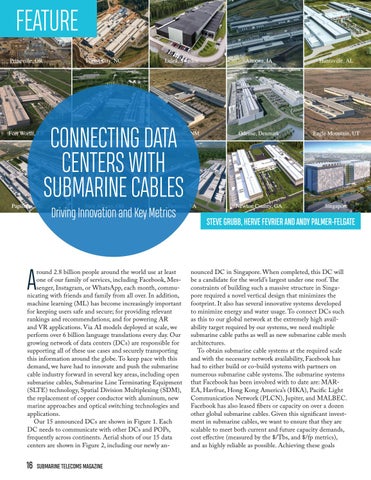
round 2.8 billion people around the world use at least one of our family of services, including Facebook, Messenger, Instagram, or WhatsApp, each month, communicating with friends and family from all over. In addition, machine learning (ML) has become increasingly important for keeping users safe and secure; for providing relevant rankings and recommendations; and for powering AR and VR applications. Via AI models deployed at scale, we perform over 6 billion language translations every day. Our growing network of data centers (DCs) are responsible for supporting all of these use cases and securely transporting this information around the globe. To keep pace with this demand, we have had to innovate and push the submarine cable industry forward in several key areas, including open submarine cables, Submarine Line Terminating Equipment (SLTE) technology, Spatial Division Multiplexing (SDM), the replacement of copper conductor with aluminum, new marine approaches and optical switching technologies and applications. Our 15 announced DCs are shown in Figure 1. Each DC needs to communicate with other DCs and POPs, frequently across continents. Aerial shots of our 15 data centers are shown in Figure 2, including our newly an-
16
SUBMARINE TELECOMS MAGAZINE
STEVE GRUBB, HERVE FEVRIER AND ANDY PALMER-FELGATE
nounced DC in Singapore. When completed, this DC will be a candidate for the world’s largest under one roof. The constraints of building such a massive structure in Singapore required a novel vertical design that minimizes the footprint. It also has several innovative systems developed to minimize energy and water usage. To connect DCs such as this to our global network at the extremely high availability target required by our systems, we need multiple submarine cable paths as well as new submarine cable mesh architectures. To obtain submarine cable systems at the required scale and with the necessary network availability, Facebook has had to either build or co-build systems with partners on numerous submarine cable systems. The submarine systems that Facebook has been involved with to date are: MAREA, Havfrue, Hong Kong America’s (HKA), Pacific Light Communication Network (PLCN), Jupiter, and MALBEC. Facebook has also leased fibers or capacity on over a dozen other global submarine cables. Given this significant investment in submarine cables, we want to ensure that they are scalable to meet both current and future capacity demands, cost effective (measured by the $/Tbs, and $/fp metrics), and as highly reliable as possible. Achieving these goals
required Facebook to innovate and push the submarine cable industry in several key directions. The first is in the area of open submarine cables. Our first submarine open cable system, which was co-built with Microsoft and Telxius, was MAREA, schematically Figure 1: Map of Facebook shown in Figure 3. We have Data Centers pushed the open submarine cable concept in order to decouple submarine wet plant technology from dry plant submarine transponder technology (i.e., SLTE) in order to maximize the capacity and value of each cable. We also want to be unencumbered in choosing the best topology to meet our network goals. This often entails integrating our submarine and terrestrial links, terminating the SLTE transponders at a DC or POP rather than at the cable landing station (CLS). Although the engineering and capacity lighting of submarine cables push the limits of optical link engineering and coherent transponders, once they are completed we can treat them as just another link in our global network. We have been leading efforts to standardize the specifications and measurements of open submarine cables, this work culminated in the formation of a working group which kicked off at Suboptic 2019 [1]. To maximize the value of our submarine cable fiber pairs and ensure they meet our future capacity needs we have continuously pushed the boundaries of SLTE technology by performing state of the art field trials of new coherent technologies. These trials resulted in the testing and subsequent deployment of 16-QAM SLTE technology on one of our trans-Atlantic MAREA fiber pairs at a record-setting 26.2 Tb/s per fiber pair [2]. Given the increased traffic demands on our submarine cables, the looming Shannon limit that will limit our future capacity gains due to SLTE technology, the long build cycles for submarine projects, as well as our goal of continually lowering cost per Tb/s, we have pioneered and championed the direction of SDM in submarine cable systems. Our initial analysis [3] was done to find a way to increase the capacity of a submarine cable system, with a concomitant lowering of the cost per Tb/s, within a fixed available electrical power budget. The results of the analysis showed a way to increase capacity and lower cost per Tb/s for cable systems as large as 48 fiber pair (fp) — an increase of 6X
over current systems, such as MAREA. While qualified submarine cable and repeaters do not yet exist at these very high fiber count levels, we have embarked on a project to push SDM technology in smaller, more digestible increments as each step in high fiber count cable and repeaters become available. The great news is that even a factor of two increase in fiber count has led to substantial increases in submarine cable capacity and lower cost per fiber pair and Tb/s. A key part of making the economics of an SDM submarine cable system work is the use of lower cost submarine fibers with a lower effective area. The system is run at lower repeater powers where pump power is used more efficiently and nonlinear effects are minimized. Another consequence of the substantial reduction in price per fp and operational costs (already nearly a factor of two in the first SDM step) is that it allows additional players to purchase full fiber pairs in submarine systems, which they could not previously afford, especially in previously underserved submarine cable markets. This trend will continue as we embark on future SDM submarine cable projects. SDM technology also utilizes a high degree of pump laser sharing amongst fiber pairs, which has had the extremely desirable side effect of decreasing pump laser FIT contributions to submarine cable reliability by nearly two orders of magnitude. We expect SDM technology to play an important role in our future submarine cable projects and create a significant sea change in the industry. A one petabit/s submarine cable system should be technically possible in the next five years or so, an increase of 5X over the current state of the art MAREA cable, even without further improvements in SLTE technology. A re-examination and changes in system powering and efficiency will also be necessary to reach this number. It will be perhaps more difficult to find enough parties to use NOVEMBER 2019 | ISSUE 109
17
FEATURE and pay for one petabit/s of capacity in a single submarine cable system. Another important innovation driven by Facebook in collaboration with ASN, has been the replacement of the copper conductor in submarine cables with aluminum [4]. Nearly 2,000 tons of copper are used in each submarine cable system. The price and price volatility of copper has risen dramatically over the past few years due to high demands across the tech industry. Aluminum has a substantially lower price with less volatility, as well as a lower weight, which is imFigure 2: Schematic of the Havfrue Submarine Cable System. The trunk connects Wall Township, NJ to Blaabjerg, portant for ship loading and total cable Denmark with WSS-ROADM enabled branches to Ireland and Norway. capacity loading considerations. These factors can lead to a significant decrease in the cost of an entire submarine cable project. In addition, lower DCR cables can be obtained, in a very cost-effective way, well below one ohm/km, leading to more power efficient submarine cable systems [5]. This development enables SDM to be used more broadly in future submarine cable systems. Aluminum cables also gained traction in the undersea power grid industry, further driving the technologies and economics necessary for aluminum to displace Copper in all future optical submarine cable systems. Facebook is also continuing to drive new optical switching technologies Figure 3: Schematic of MAREA Submarine Cable System. and applications. The rise of WSSROADM technologies in submarine via branches landing in Oldhead, Ireland and Kristiansand, cable systems will allow us to dynamically and flexibly Norway, equipped with WSS-ROADM technology. switch bandwidth (wavelengths) amongst different direcWe continue to pursue advances in WSS-ROADMs. tions throughout the lifetime of the system to accommoHigher density ROADMs would decrease the number of date changes in future bandwidth needs, changes in future submerged bodies leading to a reduction in complexity and SLTE wavelength grids, or restoration of submarine cable capacity. The submarine WSS-ROADM also minimizes the cost. Three-way or higher degree ROADMs would also deamount of stranded bandwidth. Two of our submarine proj- crease branch costs in submarine systems. With the advent of SDM, we are also pursuing the use of optical switches ects, Havfrue and Jupiter will be the first submarine cable (OSW ) to be used to switch full fiber pairs. This has the systems to commercially use WSS-ROADM technology. advantage of lower cost, increased reliability and reduced The Havfrue submarine cable system is shown in Figure 4. operational complexity. However, the amount of stranded This is the first new submarine cable system to be built in bandwidth and reduced flexibility are drawbacks to this the North Atlantic in the past 20 years. Havfrue is unique approach. Future submarine systems, especially SDM in that it can dynamically and flexibly supply capacity to two or three of our data centers, those in Odense, Denmark based, will likely employ a mixture of WSS-ROADMs and (Trunk) and Clonee, Ireland and potentially Lulea, Sweden, OSW to balance these considerations. One benefit of the
18
SUBMARINE TELECOMS MAGAZINE
open submarine paradigm is the ability of each party to choose the switching technologies and usage that best fits the requirements of each party. Connections between DCs need to be extremely reliable in a way that cannot be practically obtained by using N cables in the traditional point to point submarine architecture [6]. Building multiple submarine cables in each of the major oceans allows for the possibility of creating a more efficient, meshed submarine networks. When used in conjunction with the aforementioned optical switching technologies, the possibilities become even more compelling. We run statistical models based on projected fault rates of each cable in order to ensure that we build enough cables and enable a mesh architecture such that we reach the required availability targets to all of our DCs and POPs. We are continually exploring new architectures in submarine systems to obtain the most value from our network, including diverse landings and disaggregation of submarine cables into multi landing feeder networks connecting into one or more trans-oceanic supertrunks. To achieve the highest network availability for the least cost, we focus on maximizing cable protection on each marine link, and then ensuring that an expeditious repair service is in place to minimize outages should they occur. This avoids having to build costly additional redundancy. The biggest cause of submarine cable outages is human activity in the shallow seas of the continental shelf, so identifying landing sites and routes that avoid areas of intense fishing and/or anchoring activity continues to be important. New remote sensing techniques are available to help with this, such as satellite based Visible Infrared Imaging Radiometer identification of light sources indicative of fishing activity, and analysis of the mandatory vessel collision avoidance radio transmissions (known as AIS) to identify where frequent anchoring occurs. Cable installation has benefitted in recent years from the advent of burial tools (ploughs and remotely operated vehicles) with more power and burial depth capability, which is fortuitous as submarine cables are now sharing the seabed with an ever-expanding human industrial presence. Through our involvement with the International Cable Protection Committee we work to ensure that cables can continue to be laid and repaired in the face of increasing competition for seabed real-estate and regulatory changes. When it comes to operating our subsea cables we are concerned about the long term viability of the global fleet of repair ships, with the majority of vessels now nearing the end of their 30-35 year lifespan. These vessels are an often overlooked part of what makes global communications function, so the conversation is one of how can the industry
adapt to make more efficient use of a smaller pool of repair ships, and what new technologies are emerging that might support a sustainable and cost effective means of getting cables repaired quickly to keep the bits flowing. We will continue to push innovations and new directions in the submarine industry that increase our key metrics and optimize our global network. This will allow us to continue in the worldwide deployment of new submarine cables, bringing us closer to Facebook’s mission of connecting the world. We have already witnessed substantial, positive changes in the entire submarine industry during the last 5 years. It will be interesting to see what the next 5-10 years will bring! STF DR. STEVE GRUBB is currently a Global Optical Architect at Facebook, overseeing the build of several new open submarine cable systems and introducing new optical technologies for Facebooks global network. Prior to Facebook, he was a Fellow at Infinera where for 14 years he directed work on next generation Photonic Integrated optical and network technologies. He was also responsible for the first commercial introduction of Raman amplifiers in fiber networks. Dr. Grubb has over 100 published papers and conference contributions and over 75 issued US Patents. DR. HERVE FEVRIER is currently a Global Optical Architect at Facebook, overseeing the build of several new open submarine cable systems and introducing new optical technologies in Facebook global network. Prior to Facebook, he was with Xtera Communications and Alcatel in positions covering all aspects of optical communications. ANDY PALMER-FELGATE is responsible for marine engineering and planning of submarine cable systems at Facebook, and serves on the Executive Committee of the International Submarine Cable Protection Committee. Prior to joining Facebook in 2016 Andy spent a decade with Verizon and was responsible for submarine cable marine operations and maintenance, primarily the Asia-Pac region. Earlier in his career Andy was part of the Marine Operations team at Alcatel Submarine Networks. Andy holds a MSc in Hydrographic Surveying from University College London, a BSc in Ocean Science from the University of Wales, and a Diploma in Law of the Sea from the Rhodes Academy. REFERENCES E. Rivera Hartling et al, “Subsea Open Cables: A Practical Perspective on the Guidelines and Gotchas”, in SubOptic 2019 Papers Archive, Apr. 7, 2019, https://suboptic2019.com/suboptic-2019-papers-archive/ S. Grubb et. al., “Real-time 16QAM Trans-Atlantic Record Spectral Efficiency of 6.21 b/s/Hz Enabling 26.2 Tb/s Capacity, OFC 2019, paper M2E.6. R. Dar et al, “ Submarine Cable Cost Reduction Through Massive SDM”, ECOC 2017. Paper Tu1.E.5. “Alcatel Submarine Networks and Facebook First to Introduce Aluminum Conductor in Optical Fiber Cable for More Cost-Effective Submarine Systems”, Press Release, PTC 2019, January 20, 2019. H. Fevrier et. al., “Facebook Perspective on Submarine Wet Plant Evolution”, OFC 2019, paper M2E.4. E. Stafford, A. Palmer Felgate, S. Fitzpatrick, H, Fevrier, “Will Next Generation Mesh Architectures Meaningfully Change System Reliability or Maintenance Targets ?”, Suboptic 2019, Paper OP1-1.
NOVEMBER 2019 | ISSUE 109
19
Bringing light into the abyss. Did you know that most of the new submarine fiber-optic links deployed in the last 12 months were tested—and continue to be tested—with EXFO equipment? Our fiber expertise contributes to building a global network ecosystem delivering high-speed broadband to connect communities and grow businesses across the oceans.
Essential steps for subsea cable commissioning, monitoring and troubleshooting—done right: Fiber health check: from connector inspection to full fiber characterization
End-to-end high-speed network qualification (e.g., SONET/SDH, OTN and Ethernet)
Valid of any plug 10M to
Hawaiki and EXFO team up to bring light into the abyss. Read the story!
dation ggable from o 400G
* Location of landing stations with new cable installations (last 12 months) equipped with EXFO test solutions.
Remote fiber characterization, testing, and 24/7 monitoring
Automated workflows for efficiency and scalability
FEATURE
AN APPRECIATION
THANKS TO ALL OUR AUTHORS
BY SUBTEL FORUM STAFF
S
ince our first issue in November 2001, more than 500 subject matter experts from around the world have provided timely insight into the health and ever-changing technology of our very special submarine cable industry. SubTel Forum’s vision has always been to be the “Voice of the Industry” and with their help, we have done so. Thanks to all the Authors who have contributed to SubTel Forum over the last 18 years!
Abhijit Chitambar Abiodun Jagun Ph.D. Adam Hotchkiss Adam Sharp Aislinn Klos Alain Peuch Alan Mauldin Alan Mccurdy Alan Robinson Alasdair Wilkie Alex Vaxmonsky Alexis DiGabriele Alexis Pilipetskii Alfred Richardson Alice Amiri Alice Leonard de Juvigny Alice Shelton Allan Green Amanda Prudden Amber Case Amy Marks Anders Tysdal Andrea Rodriguez Andres Figoli Pacheco Andrew Oon Andrew Ray
22
SUBMARINE TELECOMS MAGAZINE
Andrew Rush Andrew Evans Andrew Lipman Andrew Ljung Andrew Lloyd Andrzej Borowiec Andy Bax Andy Cole Andy Lumsden Andy Palmer-Felgate Andy Riga Andy Shaw Anne LeBoutillier Antoine Lécroart António Nunes Anup Changaroth Arnaud Leroy Arunachalam Kandasamy Barbara Dean, Ph.D. Basil Demeroutis Benoit Kowalski Bernard Logan Bertrand Clesca Bill Barney Bill Burns Bill Carter
Bill Glover Bill Kolb Bob Fredrickson Bran Herlihy Brett Ferenchak Brett O’Riley Brett Worrall Brian Crawford Brian Lavallée Bruce Neilson-Watts Bruce Rein Byron Clatterbuck Captain Nick Parker Caroline Elliott Cate Stubbings Catherine Creese Catherine Dixon Catherine Kuersten Charles Laperle Charles Foreman Charlotte Winter Chris Barnes Chris Bayly Chris Butler Chris Ellis Christian Annoque
Christian von der Ropp Christine Cabau Woehrel Christopher Noyes Christopher Wood Chuck Kaplan Cliff Scapellati Clifford Holliday Clive McNamara Colin Anderson Craig Donovan Dag Aanensen Daishi Masuda Dallas Meggitt Dan Parsons Daniel Carragher Daniel Hughes Daniel Perera Daniel Wiser Daryl Chaires David Cassidy David Coughlan David Lassner David Latin David Lipp David Liu Jianmin David Martin
David Mazzzarese David Miller David Robles David Walters David Warnes Dean Veverka Debra Brask Denise Toombs Denise Wood Derek Cassidy Derek Greenham Derek Webster Devin Sappington Dmitri Foursa Donald Hussong Doug Madory Doug Ranahan Doug Stroud Douglas Burnett Edward Saade Edwin Danson Edwin Muth Elaine Stafford Emmanual Delanoque Emmanual Desurvire Eric Handa Erick Contag Erlend Anderson Eyal Lichtman Fan Xiaoyan Fiona Beck Francis Audet Francis Charpentier Frank Cuccio Frank Donaghy, Ph.D. Funke Opeke Gabriel Ruhan Gary Gibbs Genius Wong Geoff Ball Geoff Bennett Geoffrey Thornton Georg Mohs George H Baker George Krebs George M Foote George Miller George Samisoni George Tronsrue Lii
Georges Krebs Gerald Soloway Glenn Gerstell Glenn Wellbrock Gordon Duzevich Graham White Graham Cooper Graham Evans Greg Berlocher Greg Kunkle Greg Otto Greg Stoner Greg Twitt Gregor McPherson Guillaume Huchet Gunnar Berthelsen Guy Arnos Harold Bock Hector Hernandez Helen Veverka Henry Lancaster Herve Fevrier, Ph.D. Himmat Singh Sandhu Horst Etzkorn Houlin Zhao Howard Kidorf Hubert Souise Hugh Thomson Hunter Newby Ian Davis Ian Douglas Ian Fletcher Ian Gaitch Ian Watson Igor Czajkowski Ilissa Miller Inge Vintermyr Ioannia Konstantinidis Iris Hong Jack Richards Jack Runfola James Barton James Case James Cowie James Halliday James Herron Jan Kristoffer Brenne Jas Dhooper Jaynie Cutaia
Jean Devos Jean-Marie Fontaine Jed Duvall Jeff Gardner Ph.D. Jeffrey Hill Jeffrey Hoel Jeffrey Snider Jennifer Gibbons Jeremiah Mendez Jerry Brown, Ph.D. Jim Bishop Jim Byous Jim Lemberg Jing Ning Jiping Wen Joe Capasso Joel Ogren Joel Whitman Joerg Schwartz, Ph.D. John Golding John Hibbard John Horne John Kasden John Manock John Melick John Pockett John Tibbles John Walker John Weisbruch Jon Seip Jonathan Liss Jordan Kearns Jorn Jespersen Jorn Wardeburg Jose Andres, Ph.D. José Chesnoy Jose Duarte Joshua Henson Judi Clark Jukka-Pekka Joensuu Jules BenBenek Julian Rawle Kaori Shikinaka KarenBoman Karl Jeffery Katherine Edwards Katsuyoshi Kawaguchi Keith Russel Shaw Keith Schofield
Ken du Vall Ken Weiner Kent Bressie Kevin Summers Kieran Clark Kristian Nielsen Kristian Ohleth Kurt Ruderman Kylie Wansink Lara Garrett Larry Schwartz Laure Duvernay Laurie Miller Leigh Frame Leo Foulger Liam Talbot Linda Evans Lindsay McDonald Ling Zhao Lionel Carter Lucia Bibolini Lynsey Thomas Madeleine Findley Mai Abou-Shaban Marc Fullenbaum Marc-Richard Fortin Marianne Murfett Mark Davidson Mark Enright Mark Hukill Mark Wickham Marsha Spalding Martin Foster Mattais Fridström Matthew Milstead Mattias Fridström Maui Sanford Maxim Bolshitysnsky Meredith Cleveland Merrion Edwards Ph.D. Michael Reimer Michael Craigs Michael Jones Michaël Marie Michael Nedbal, Ph.D. Michael Ruddy Michael Schneider Michael s Carter Michel Chbat, Ph.D. NOVEMBER 2019 | ISSUE 109
23
FEATURE Michel Martin Mick Greenham Mike Conradi Mike Hynes Mike Last Mikinori Niino Mohamed Ahmed Molilaauifogaa Seanoa-Lamua Morgan Heim Motoyashi Tokioka Muhammad Rashid Shafi Murray Eldridge Nancy Poirier Natasha Kahn Neal Bergano Neil Lambert Neil Tagare Nguyen Vu Nicole Starosielski Nigel Bayliff Nigel Shaw Nikos Nikolopoulos Ning Jing Norma Spruce Olav Harald Nordgard Olivier Courtois Olivier Plomteux Olivier Tremblay-Lavoie Omar Jassim Bin Kalban Pamela Barnett Panagiota Bosdogianni Pascal Pecci Patrick Faidherbe Paul Budde Paul Davidson, Ph.D. Paul Deslandes Paul Eastaugh Paul Gagnier Paul Grant Paul Kravis Paul McCann Paul Polishuk, Ph.D. Paul Rudde Paul Savill Paul Szajowski Paul Treglia Paula Dobbyn Per Handsen Per Ingeberg
24
SUBMARINE TELECOMS MAGAZINE
Pete LeHardy Peter Evans Peter Ford Peter Lange Peter Liu Peter Phibbs Peter Worthington Phil Footnman-Williams Philip Roche Philippe Dumont Pierre Tremblay Priyanth Mehta Puja Borries Raj Mishra Rannveig Bergerød Aase Rannveig Li Raul Magallenes Ray Chrisner Ray Drabble Remi Galasso Renzo Ravaglia Rex Ramsden Rich Potter Richard Faint Richard Kram Richard Nickelson Richard Blann Richard Buchanan Richard Elliott Richard Romagnino Rita Rukosueva Rob Eastwood Rob Hudome Rob Munier Robert Bannon Robert Lingle Robert Mazer Robert McCabe Robert Mecarini Robert Stuart Robert Thomas Robin Russell Rogan Hollis Roger Carver Roland Lim Rolf Boe Ron Crean Ross Buntrock Ross Pfeffer Russ Doig
Rusty O’Connor Sally Sheedy Salon Ma Samir Seth Sammy Thomas Sandra Feldman Scott Foster Scott Griffith Scott McMullen Sean Bergin Serena Seng Sergey Ten Seth Davis Sherry Sontag Shreya Gautam Siddhartha Raja Siew Ying Oak Simon Brodie Simon Frater Sir Christopher Bland Stan Kramer Stephane Delorme Stephanie Ingle Stephany Fan Stephen Dawe Stephen Dres Stephen Grubb, Ph.D. Stephen Jarvis Stephen Lentz Stephen Nielsen Stephen Scott Steve Arsenault Steve Briggs Steve Duthie Steve Grubb, Ph.D. Steve Lentz Steve Misencik Steven Gringeri Steven Shamburek Steven Wells Stewart Ash Stuart Barnes, Ph.D. Subtel Forum Research Team Sverre Myren Tayo Adelaja Ted Clem, Ph.D. Teijiro Kitamura Theresa Hyatte Thomas Popik
Thomas Soja Tiejun Xia Tim Janaitis Tim Pugh Toby Bailey Todd Borkey Tom Davis Tom McMahon Tom Stronge Tong Liu Tony Frisch Travis Kassay Troy Tanner Trygve Hagevik TSA Newsfeed Tsunekazu Matsudaira Ulises Pin Vegard Briggar Larsen Venkata Jasti, Ph.D. Vicky Liang Vinay Nagpal Vinay Rathore Virginia Hoffman Vivian Hua Wang Jingwei Wang Ke Wang Yanpu Wayne Nielsen Wesley Wright Wildred Kwan William Barattino Ph.D. William Harrington William Harris William Marra, Ph.D. William Wall Winston Qiu Xiaoyan Fan Xu Yewei Yali Liu Yiannis Koulias Yoani Sanchez Yoshio Utsumi Yuzhu Hou Yves Baribeau Yves Ruggeri Yvonne Lin Zatri Arbi Zhang Kai Zhao Ling Zhu Hongda
AN APPRECIATION
THANKS TO ALL OUR SPONSORS Thanks to all the sponsors that have contributed to SubTel Forum over the last 18 years: A2Sea AIS Live Alcatel-Lucent Anritsu APAC APTelecom AquaComms atlantic-cable.com Australia Japan Cable Axiom AZEA BJ Marketing Communications Boss Portal Cable & Wireless Caldwell Marine Ciena Columbus Networks Corning Cable Systems CTC Marine Projects CYTA Global Deltaic Systems Digital Energy Journal Digital Oilfields EGS e-Marine Entelec Ericsson euNetworks FLAG Fugro General Offshore Global Marine Systems Ltd Global Netwave Globalinx Subsea Colocation GlobeNet Great Eastern Group Hengtong Marine Cable Systems Hexatronic Huawei Marine Networks ICPC
IEEE Workshop IHC EB Inchcape Shipping Services Infinera Information Gatekeepers International Subsea & Telecoms Services International Telecom ISTS Kokusai Cable Ship Co., Ltd. KT Submarine Lloyds Register - Fairplay Makai MENA Submarine Cable System Mertech Marine Mobius Group NavaTel NEC Nexans Nortel Networks NSW OCC Offshore Communications Conference Offshore Site Investigation Conference OFS OilComm Optical Fiber Communications Optical Transmission Vision Parkburn PHS Promet PTC S. B. Submarine Services Smit-Oceaneering Cable Systems Southern Cross Cable Network Spellman High Voltage STF Analytics STF Events Submarine Cable Forum Submarine Cable Society Submarine Communications Submarine Networks World
SubOptic Association Subsea Communications Conference T Soja and Associates TE SubCom Telecom Egypt TeleGeography Terabit Consulting Thales TMS International Tyco Telecommunications Undersea Fiber Communication Systems Virginia Beach Economic Development WFN Strategies Xtera
NOVEMBER 2019 | ISSUE 109
25
FEATURE INTRODUCING SUBTEL FORUM’S ONLINE AUTHOR AND ARTICLE INDEX
T
he SubTel Forum Magazine Online Author and Article Index has been created as a reference source to help readers locate magazine articles and authors on various subjects. It is intended to be an easy-to-use tool that allows for sorting of data based on criteria such as: • Author Name • Article Title • Issue Number • Issue Theme • Issue year
SubTel Forum’s Online Index was created from magazine issue listings going back to our founding in 2001. The purpose of SubTel Forum’s Online Index is to enable discussion about the recent history of the submarine cable industry and enhance the exchange of information from past and present magazines. This index was created by scraping author, article and issue information from all back issues of SubTel Forum
26
SUBMARINE TELECOMS MAGAZINE
since the first publication in November of 2001. This data was then organized by relevant, searchable criteria and implemented into our existing website database structure to allow for an intuitive user experience. This index will be a continual work in progress and updated with every issue of SubTel Forum – starting with this issue. As we are always looking to improve the accuracy and functionality of all SubTel Forum publications, websites and tools, please drop us a line at rspence@subtelforum.com to provide any feedback. We hope you make use of this valuable tool and invite you to share this index with others to encourage education and discussion about the submarine fiber industry and the people that contribute to its knowledgebase.
www.subtelforum.com/onlineindex
NOVEMBER 2019 | ISSUE 109
27
FEATURE
Jason O’Rourke Photography
BY ELAINE STAFFORD
PTC’20 VISION 2020 AND BEYOND
Submarine Cable Workshop “Big or Small, the Challenges Are Still the Same”
T
he submarine cable market is evolving at a rate that makes it hard for anyone to keep up with all of the latest news, trends, and activities. With so much new and exciting information to keep abreast of, the upcoming Submarine Cable Workshop at PTC’s Annual Conference is a “can’t miss” opportunity! We’ll explore what is happening in the industry, what that tells us about the future, and what we’ve learned from the past that can help moving forward. The PTC’20 Submarine Cable Workshop will explore the vision for cable systems around the globe and into the next decade.
28
SUBMARINE TELECOMS MAGAZINE
Pacific Telecommunications Council’s Conference Panel
Pacific Telecommunications Council’s Conference Q&A
Our expert speakers will be sharing their thoughts on the challenges of both large and small systems. We’ll look toward the future at the increasingly interwoven nature of our cable industry, the satellite industry, data centers, and an ever more meshed and adaptive network. How will we continue to develop talent to plan, design, and build the global communication systems of the future that enable nearly 10 trillion dollars in economic activity – every single day? There is a lot to cover. We’ve worked hard to secure some of the most knowledgeable experts to share their views and ideas with workshop attendees. We hope to see you there!
CHANGING IT UP TO KEEP UP
In keeping with today’s dynamic submarine cable marketplace, the PTC’20 Submarine Cable Workshop on Sunday promises to be more insightful than ever. This year we’ll have over 20 speakers, plus – for the first time ever – a poster session with invited presentations. Please get there early to find a seat as this is often a standing-room-only event. Check the program as we’re starting earlier (08:30) to fit it all in. We also suggest keeping your meeting calendar open for Monday afternoon’s Submarine Cable Session, where some of Sunday’s posters will be followed up with informative and engaging presentations. There were just too many worthwhile topics this year to do them justice all in one day. This year’s Submarine Cable Workshop program will include many of the workshop sessions you’ve grown to know and look forward to year after year. Tony Mosley of Ocean Specialists, Inc. (OSI), the workshop’s emcee, will keep us on schedule to make sure we fit it all in. Here’s what you can look forward to: • An around-the-world update on undersea cable projects and the real challenges they’re facing. Sean Bergin of APTelecom leads this part of the program, chairing a panel with many other familiar faces including Kent Bressie from Harris, Wiltshire & Grannis LLP, with his annual regulatory update. With all that’s going on across
the globe – both in terms of launching new projects and finishing those underway – there’s lots to discuss here! • The workshop’s mainstay morning panel, led by yours truly, will focus this year on how both small and large markets benefit from cooperating together in building a cable, along with sharing practical solutions that facilitate that cooperation. This talented panel includes Philippe Dumont, EllaLink; Ricardo Orcero Guillot, Facebook; Sibesh Bhattacharya, Asia Development Bank; Fiona Beck, South Atlantic Express Ltd.; Terry Bleakley, Intelsat; and John Hibbard, Hibbard Consulting Pty. Ltd. It’s hard to imagine a team with this much wealth of knowledge all onstage at once sharing their experience! • Lunch will be served to anyone lucky enough to have a seat at a table. Immediately afterwards, the lunchtime panel will focus on the challenges and opportunities faced by the submarine cable industry and data centers, as together we build the world’s critical communications infrastructure. This panel is being sponsored by the SubOptic Association, which is working to grow its value to the industry through a number of initiatives above and beyond the SubOptic conference. (More on that later.) The panel will be chaired by Erick Contag, upcoming chairman of SubOptic’s Executive Committee, who has recruited notaNOVEMBER 2019 | ISSUE 109
29
FEATURE ble executives to share their ideas – Bevan Slattery, Superloop; Naoki Yoshida, NEC; Shalini Lagrutta, DXN; Oliver Jones, Chayora Limited; Roland Certeza, GTA Teleguam; and Paul Gabla, Alcatel Submarine Networks. • TeleGeography’s annual update will close out the day, but they’re keeping their topical focus a surprise for later. We’re anxious to hear what they’ll share in January, as we all know they are consistently full of interesting insights on trends in international capacity demand, pricing, data centers, etc. But before TeleGeography’s Workshop, we’ve also added some new twists to this year’s submarine-cable program, which we’re hopeful will make the workshop even more valuable than ever. • Before participating in the workshop’s morning panel, Terry Bleakley from Intelsat, will provide us all with a high-level technical and commercial overview of the latest innovative satellite network solutions and how they will complement the global undersea network to serve the market as a whole. There has been a lot of discussion at recent conferences and in the news about these new satellite networks providing “internet to the world.” We thought it was important to provide all of us, who typically have our heads below water, with an understanding of what that means, vis-à-vis the global cable network providing today’s backbone to the World Wide Web. • The organizing team is especially pleased to include the workshop’s first-ever poster session this year. We’ve extended the mid-morning coffee break to provide an opportunity to mingle with old acquaintances and learn about the industry’s most recent initiatives in more detail. We’ll have a variety of posters, prepared by some of our industry’s movers and shakers. Some of the poster presenters will represent insights they wish to share as individuals, or as their companies. Others are representing teams who are collaborating together on new industry initiatives – working to help us move forward in new and important ways. Several of the posters will be from established or new SubOptic Working Groups: • Elizabeth Rivera-Hartling, Facebook, will be updating us on the SubOptic Open Cables Working Group’s progress and next steps; • Sergei Makovejs, Corning, will talk about fiber improvements which enable Petabit cables;
30
SUBMARINE TELECOMS MAGAZINE
• • • •
• Ljupco Jovanovski, Google, will talk about SubOptic’s newest Working Group, focused on fiber color coating, which is becoming more challenging as tomorrow’s SDM cables are being deployed with so many fiber pairs; • Fiona Beck, Bermuda Business Development Agency, will have a poster on best practices appropriate for setting up cable protection zones; Tim Stuch, Facebook, will talk about another new SubOptic Working Group focused on open management system interfaces; Brian Lavallée, Ciena, will have a poster discussing how AI can help improve network OA&M and anticipate problems before they occur; Tony Mosley, OSI, will have a poster on disaster recovery; Graham Evans, Nicole Starosielski, and Antoine Lecroart will provide an overview of the SubOptic Global Citizen Working Group’s plans;
And last, but far from least, Valey Kamalov will also show us a very short video from the Subsea Optical Fibre Communications 2019 International Summer School held in Finland last August, where students from more than 50 countries learned about our industry. It was a huge success and plans are being made to hold another session in summer 2020! So, the PTC’20 Submarine Cable Workshop will be jam-packed with lots to learn. Tony Mosley, Paul McCann, and I have worked as a team to put this program together and look forward to seeing you all there. Don’t forget! We start early on Sunday at 08:30. Please keep an hour free on Monday afternoon at 15:30 for our poster follow-up and Topical Session. STF ELAINE STAFFORD has been leading the development, engineering, implementation and sales of undersea fiber-optic cable system projects worldwide since the early 1980s. Most recently, in her consulting role, Ms. Stafford has advised DRG clients with broad business support to investors (due-diligence analysis, market studies, feasibility studies, business plans) and project-specific work such as planning, engineering, procurement management and project management for cable networks across the globe. While at DRG, she’s provided support for the owners of numerous new networks. Prior to joining DRG, Ms. Stafford was an executive at Tyco Telecom, AT&T Submarine Systems and at AT&T Bell Laboratories with responsibilities spanning business development, global sales, project management, network engineering, product management, system design, system test, and the development of terminal equipment (hardware and software) for undersea networks.
OUT NOW! THE WORLD - BY THE NUMBERS FROM THE VOICE OF THE INDUSTRY Submarine Telecoms Market Sector Report: Regional Systems Report
Featuring exclusive data and analysis from STF Analytics – • Backed by industry-leading Submarine Cable Database • Overview of cable systems on a region by region basis • In-depth look at regional submarine fiber markets • Signature analysis • Priced for every budget
SUBSCRIBE TODAY!
STFANALYTICS.COM/SUBSCRIBE
19-22 JANUARY 2020 | HONOLULU, HAWAII
The Pacific Rim’s Premier Telecommunications Event Join more than 7,900 industry attendees in discussing forward-looking views and implications on topics representing the breadth and depth of ICT.
LAST CHANCE TO SAVE 16 DECEMBER REGISTER TODAY AT PTC.ORG/PTC20
What’s New | PTC HUB Showcase your company’s new products or services. Network with ICT industry leaders and build your business. Give a 10-minute talk or tutorial on a specific topic. PTC.ORG/PTC20/PTC-HUB
PTC’20 DIAMOND SPONSOR
Submarine Cable Track Here’s a look at just some of the many powerhouses in the Submarine Cable Workshops at PTC’20.
Sean Bergin
Terry Bleakley
Brianna Boudreau
Kent Bressie
Erick Contag
Co-Founder & President APTelecom
Regional Vice President, Asia-Pacific Sales Intelsat
Senior Analyst TeleGeography
Partner and Head of International Practice Harris Wiltshire & Grannis LLP
Executive Chairman, GlobeNet Telecom and President, SubOptic Executive Committee
Philippe Dumont
Oliver Jones
Ljupco Jovanovski
Amy Marks
Paul McCann
CEO EllaLink
Co-Founder & CEO Chayora Limited
Senior Subsea Cable Engineer Google
CEO XSite Modular
Managing Director McCann Consulting
Tony Mosley
Ricardo Orcero-Guillot
Bevan Slattery
Elaine Stafford
Tim Stronge
Director of Business Development Ocean Specialists Inc.
Network Investments-EMEA Facebook
Founder of Cloudscene, Superloop, Megaport, NEXTDC and Co-Founder, PIPE Networks
Managing Partner DRG Undersea Consulting
Vice President of Research TeleGeography
SUNDAY, 19 JANUARY 2019 08:30-10:45 SUBMARINE CABLE WORKSHOP 1 10:45-12:00 SUBMARINE CABLE WORKSHOP 2 12:00-14:00 SUBMARINE CABLE LUNCHEON: MEETING GLOBAL DEMAND WITH CRITICAL COMMUNICATIONS INFRASTRUCTURE OVER THE NEXT DECADE [SPONSORED BY SUBOPTIC] 14:00-15:15 TELEGEOGRAPHY WORKSHOP [ORGANIZED BY TELEGEOGRAPHY]
MONDAY, 20 JANUARY 2019 15:30-16:45 TOPICAL SESSION: SUBMARINE CABLE
FEATURE 2019/2020 SUBMARINE TELECOMS
INDUSTRY REPORT INSIDERS’ PERSPECTIVES REVISITED
34
SUBMARINE TELECOMS MAGAZINE
In October, SubTel Forum published Issue 8 of our annual Submarine Telecoms Industry Report (https://subtelforum.com/products/submarine-telecoms-industry-report/), which was authored by the analysts at STF Analytics, a Division of Submarine Telecoms Forum, Inc. It provides submarine cable system analysis for SubTel Forum’s Submarine Cable Almanac, Cable Map and Industry Newsfeed. For the Industry Report, STF Analytics utilizes both interviews with industry experts and its proprietary Submarine Cable Database, which was initially developed in 2013 and updated with real-time data thereafter. The database tracks some 400+ current and planned domestic and international cable systems, including project information suitable for querying by owner, year, project, region, system length, capacity, landing points, installers, etc. SECRETARY GENERAL OF THE INTERNATIONAL TELECOMMUNICATION UNION, MR. HOULIN ZHAO
T
he submarine telecoms cables spanning our oceans are the information superhighways that form the ‘backbone’ of the global ecosystem of information and communication technologies (ICTs). Their construction prizes durability and longevity. Their capacity is unparalleled. Their manufacture and deployment are major undertakings. Submarine telecoms cables are emblematic of the enormous investment required to connect the world. I would like to thank the Submarine Telecoms Forum for offering ITU the opportunity to contribute to this report. The Submarine Telecoms Industry Report aims to offer a global view of the latest innovations in submarine telecoms technology, the latest deployment projects, evolving business relationships, and prospects for the future of the industry. This global view of the industry’s technical and business dynamics helps companies to build new partnerships and advance in unison. This is an objective that ITU is pleased to support. ITU is the United Nations specialized agency for ICT. We coordinate the global allocation of radiofrequency spectrum and satellite orbits. ITU standards are critical to the operation of today’s optical, radio and satellite networks. And we assist developing countries in the application of advanced ICTs. Our global membership includes 193 Member States and some 900 leading companies, universities, and international and regional organizations. ITU is unique in the ICT standards world as the only body to include governments. We are also unique in the United Nations system as the only body to include the private sector. We are in a unique position to bring the benefits of ICT innovation to all regions of the world.
The global ICT ecosystem is a remarkable feat of engineering, and a similarly remarkable feat of international collaboration. For over 150 years, ITU has provided a neutral platform to bring cohesion to ICT innovation worldwide. The submarine telecoms industry has been integral to this work, participating in the development of ITU international standards for the design, construction, deployment and operation and maintenance of submarine telecoms systems. Our latest standardization project in this domain is addressing transversely compatible DWDM (dense wavelength division multiplexing) applications for repeatered submarine telecoms systems. This project is also covering the characterization and commissioning of ‘open cable networks’, a shift towards the separation of dry and wet plant procurement. I welcome you to join the ITU standardization community. The principles underlying the ITU standardization process ensure that all voices are heard, that standardization projects do not favor particular commercial interests, and that resulting standards have the consensus-derived support of the diverse, globally representative ITU membership. Enabling Infrastructure for Climate Action ICT infrastructure has become enabling infrastructure for innovation in fields such as energy, transportation, healthcare, financial services and smart cities. This infrastructure also has significant potential to support climate action. In recent years, the extraordinary breadth and capacity of the submarine telecoms network has motivated the initiation of an ambitious new project: that of equipping submarine communications cables with climate and hazard-monitoring sensors to create a global real-time ocean observation network. This network would be capable of providing earthquake NOVEMBER 2019 | ISSUE 109
35
FEATURE and tsunami warnings as well as data on ocean climate change and circulation. Submarine cables are uniquely positioned to glean key environmental data from the deep ocean, which at present is grossly under sampled for monitoring the climate. Equipping cable repeaters with clim-ate and hazard-monitoring sensors – creating ‘Science Monitoring And Reliable Telecommunications (SMART) cables’ – would yield data of great value to climate science, disaster warning and the future of our oceans. Realizing this vision is the primary objective of the ITU/ WMO/UNESCO-IOC Joint Task Force on SMART Cable Systems, a multidisciplinary body established in 2012. There was never any doubt that this project was feasible. What was required, however, was a coordinated international effort to mobilize the necessary political and business will to bring stakeholders together to determine their respective roles. Chief on the Joint Task Force’s list of priorities has been devising means for the private sector to drive the sustainable growth of the envisaged SMART cable network. A variety of stakeholders have contributions to make, but telecoms companies are at the heart of the project. They will own and manage SMART cable infrastructure, becoming lead contributors to the advancement of climate science and disaster warning. Telecoms companies and cable manufacturers are the right custodians of this responsibility.
These industry players are expert in manufacturing and deploying submarine telecoms cables designed to last 25 years. Their knowledge comes from many years of experience and it is essential that we capitalize on their expertise. Cable manufacturers are best placed to build and install SMART sensors as an integral part of the production process, ensuring the compatibility of SMART sensors with the engineering of the repeater and its deployment environment. SMART cables are expected to be field-proven by ongoing demonstrations and proposed pilot systems in Europe, Asia-Pacific, and The Americas. The work of the Joint Task Force and experience gained in the field will establish a minimum set of requirements for SMART sensors. This set of requirements will feed into ITU’s international standardization work. The Joint Task Force has contributed a synopsis of its latest report to this issue of the Submarine Telecoms Industry Report. Your feedback on the report would be most welcome. HOULIN ZHAO was first elected 19th Secretary-General of the International Telecommunication Union at the Busan Plenipotentiary Conference in October 2014. He took up his post on 1 January 2015. ITU Member States re-elected Houlin Zhao as ITU Secretary-General on 1 November 2018. He began his second four-year term on 1 January 2019. Prior to his election, he served two terms of office as ITU Deputy Secretary-General (2007-2014), as well as two terms as elected Director of ITU’s Telecommunication Standardization Bureau (1999-2006). Houlin Zhao is committed to further streamlining ITU’s efficiency, to strengthening its membership base through greater involvement of the academic community and of small and medium-sized enterprises, and to broadening multi-stakeholder participation in ITU’s work.
BRUCE NEILSON-WATTS, MANAGING DIRECTOR GLOBAL MARINE SYSTEMS LIMITED
“W
ithout doubt, the headwinds facing the submarine telecom maintenance industry continue to build. Older lower capacity cables look towards retirement while the younger generation of high capacity builds continue to satisfy our unabated appetite for low latency bandwidth. We count cable ships, make assumptions about their capability based on age and ask ourselves “What next?” Well the good news is that the number of cable ships is increasing, albeit slowly. The bad news is they are getting older and from a fleet of 47 (give or take), only 4 have been built in the last decade as direct replacements. But despite our disparaging mindset about ageism, the global fleet continues to support the market. Statistics may indicate time to repair is increasing in some parts of the world but look a little deeper and we will
36
SUBMARINE TELECOMS MAGAZINE
find that protectionism aka cabotage and increased regulation is the root cause of delay. This creates domestic opportunity and new players emerge to solve any emergent issues. With increased competition, unit costs to maintain or repair cables continues to fall as it has for the past twenty years in tandem with capacity pricing. But salaries, steel and fuel are commoditized and we are reaching the limits of what can be achieved through rigorous procurement practice, but there are emergent indicators of change. The next generation of repair platforms will benefit from improvements in marine technology: they will operate with fewer people, burn less fuel, be more powerful and flexible enough to work across industry sectors. A modern ‘repair’ vessel will offer services to the telecom, renewables and
oil & gas markets. It is already happening. The traditional cost-sharing models are changing, allowing the vessel operators to streamline investment risk and use their vessel more effectively and efficiently than in the past. With the global proliferation of wind farms, new ideas and ways to solve collective problems are being addressed which can hopefully result in lowering the unit cost of wet maintenance in the
telecom sector. The current batch of vessels, most of which are based on 1990s technology will need to be replaced by DP2 platforms with more powerful and effective ROVs. It does require more dialogue and knowledge-sharing between the power & telecom sectors but with increased demand for access and rights to the sea floor from different stakeholders, there are overlaps and inevitable compromise results.”
DEREK WEBSTER, ANDGET LIMITEDLIMITED
W
hen I went to school, I had books and access to a Library. My children went to school with Laptops and access to the Internet. That is a revolution in just one generation which has social and industrial impact. The revolutionary connected infrastructure that delivered that revolution is predominantly fibre, the nervous system of the internet. We hear the term ‘Cloud’ and the perception that data and processing is performed in the ether. In reality, the ‘Cloud is on the ground’ and mainly in specialized facilities call Data Centers. The Cloud and the Internet would not be able to function without Data Centers which are the heart and lungs supporting all infrastructure including the CPU brains inside servers within rack enclosures. What is a Data Center? I do not want to quote the Wikipedia definition of a ‘Data Centre is a facility used to house computer systems and associated components, such as telecommunications and storage systems. It generally includes redundant or backup power supplies, redundant data communications connections, environmental controls.’ The question of ‘what is’ I want to expand as follows: “a Data Centre is” • Data Driven Critical infrastructure
• A Data Factory that processes digital workloads • Moving Photons & Electrons (the Strawberry) processing Applications & Services • Engines of an outsourcing digital revolution • An Asset Class If we look at just the potential Data Center Impact from the arriving ‘The Internet of things’ (IoT) as a segment model and think of what a future revolution might look like with today’s crop of emerging technology combined with the context of a data driven society & commercial world then the Data Center landscape will see change. The Data Center sector is very young and in industrial revolution/human terms is still a toddler, aware of the world around it and its place within it while exploring all avenues before finding or being placed on a path. Predicting the future is always going to be subjective and a risky activity. What is clear is that our increasing dependency of all things digital and the massive growth of digitalization are driving volumes and with volumes we will see more commoditization of that Data. Data as a commodity demands ‘Data-as-a-utility’.
ERIC HANDA CEO, APTELECOM
“S
ubmarine cables over the last 100 years have played a vitally important role in making the world a smaller place. Today, submarine cables are making the world a smaller connected community as a result of high speed, instant, and effective communications. Submarine cables continue to carry the majority of financial transactions, so-
cial media, government communication, and commerce on an unprecedented level. Many readers most likely grew up with radio or black and white television prior to the current technological revolution that’s taken place be it cell phones, high speed broadband at home, streaming videos and near perfect 4K connections from half way around the world and NOVEMBER 2019 | ISSUE 109
37
FEATURE no doubt, have a true appreciation for the evolution that has taken place in the last 50 years. APTelecom see’s submarine cables continuing to play an important role as traffic becomes more direct (ie: less dependency on traditional hub and spoke routes of the USA, UK, Japan, etc. as local content continues to be developed). For example, the Southern Hemisphere is well positioned to continue to build modern and cost-effective, high-end transmission capacity to the rest of the world. This connectivity will promote further trade and commerce and redefine routing traffic in the very near future. Submarine Cable capacity for reasons of diversity in avoiding points of failure and ‘enabling always on’ networks is critical for banking and finance, aviation, and various other industries that utilize cloud computing, artificial intelligence, and are poised to seize on the upcoming 4th Industrial Revolution of automation. Networks are critical to delivering software and services in an advanced and in many cases near real time basis that could have only been imagined some 50 years ago. In many areas of technology, we are even approaching Shannon’s law limits and the theoretical capacity that is possible over submarine cables and terrestrial cables. Looking at the current submarine cable market, prices continue to decline in line with Moore’s Law, yet with the
increase in computing power doubling and in some cases tripling, coupled with advancements in line card and LTE technology it’s a testament to the research and development teams around the globe in action. Many global submarine routes only offer 100G interfaces replacing the old STM4 and 10G’s of bygone days. No doubt, 1Tb cards will be available in no time soon. As CEO of APTelecom, its with tremendous pleasure and pride to support many existing and new submarine cable systems in the Asia Pacific, LATAM, and Atlantic regions. From our perspective, the Arctic region will likely have a system built in less than three to five years, the Southern Hemisphere will continue to build out, seeking diversity creating new hubs around the world that rival the likes of Los Angeles, London, New York, and Tokyo. Pressure is building for more cost-effective cables using new raw materials due to build cost pressure to support those rolling out SDN and cloud-based solutions that require five to seven paths on one particular route in order to have secure, diverse, and reliable transmission service linking countries around the world. We hope you enjoy this report and wish you all the best as your likely downloading this PDF which at some point the bits to enable viewing are being delivered over a submarine cable in some depths of the ocean across the planet!
HIMMAT SINGH SANDHU & SIDDHARTHA RAJA WORLD BANK
T
he global economy is increasingly digital. The internet and other information and communication technologies (ICTs) are changing the way individuals, businesses and governments operate. Their resilience to natural disasters, and their ability to recover in the aftermath, is thus critical to the resilience of the economy. This chapter discusses the impact of climate events on various types of digital infrastructure. It highlights key considerations for governments and digital infrastructure owners to make their infrastructure more resilient, while maintaining affordability of services. We find that digital infrastructure is vulnerable to various climate risks, but that technology choices and network design can improve redundancy and resilience of networks, by design. Certain infrastructures warrant greater ex ante investment in their resilience considering their criticality in the broadband value chain (submarine cables or landing stations) while others could follow repair and recovery options (mobile network antennas, poles, and towers). The private sector’s motivations to invest in resilience
38
SUBMARINE TELECOMS MAGAZINE
are driven by (i) economic incentives to reduce the risk of their investments by mitigating against climate risk; (ii) serving their client’s needs, adhering to Service Level Agreements, and upholding their reputation; and (iii) serving the interests of their area of operation by providing a critical service during emergencies.31 This last motive ensures the public good provided by this privately-owned infrastructure, acknowledging its mission-critical nature for an economy. The importance of telecommunications infrastructure, particularly submarine cables and landing stations is also increasingly highlighted in discussions around national security. In addition to action taken on cybersecurity and the protection of critical online infrastructure, the physical protection of the internet’s underlying infrastructure should also be a policy and industry-wide priority. The private sector, as owners of much of the infrastructure, will need to take the lead in investing in resilience of their assets, while the public sector plays the role of a
facilitator and develops the right enabling environment for investment in resilience of critical infrastructures. The public sector’s policy leadership on climate resilience of critical infrastructures is necessary in driving actions across
sectors, and fostering a holistic approach to climate adaptation, resilience, and disaster recovery. Given below are some high-level recommendations for the building of greater resilience in global telecommunications infrastructure.
PATRICK FAIDHERBE MANAGING PARTNER, AQEST
W
ithin the submarine cable industry, Regional Systems are at the same time a unique challenge and a strong indicator of the tendency of the global market. Because they connect various and different countries and markets, they bring much more complexity and problems to be solved than any single point-to-point system. This is one of the main reasons why they present a unique and difficult challenge. Each country is obviously different with its specific population, habits, social norms, services needed and specific expectations from any new submarine cable landing in the country. On top of that, laws are never the same from one country to another and getting a permit for each landing of a regional system is always a new adventure. To bring more complexity, the laws may change during the lifetime of the project and the politicians and governments in power in each respective country may also change. But the markets that the new systems are supposed to link are also subject to potential big changes. The local economy of each country may flourish or not and accordingly, the demand in data to be transferred may vary. As an example, some systems have indeed been recently promoted on the basis of a similar growth for each of the market they were connecting but as one of this market was suddenly hit by an economic and financial crisis, the whole business model of the system was suddenly drastically modified and had to be reconsidered accordingly.
On top of this unique challenge, Regional Systems are also a very interesting and strong barometer of our global submarine cable market evolution from a geographic and an economic perspective. Geographically, the impact of regional systems isn’t indeed limited to the region itself. In particular, the success of a regional system may surely affect the regions role in the larger cable net. As an example, this is particularly obvious with the whole European Nordic region with more and more projects being announced and developed in the last months in Denmark and Norway thanks to those implemented previously in Finland. And one can already anticipate that this will help to contribute to the future development of the Arctic region. Economically, because most of the Regional Systems are at the moment developed and proposed by the Content Providers which are looking for connecting their own Data Centers, they fully confirm this trend of our industry that has been in place for the last five years. Any change of this trend will certainly be seen through a change in the ownership and approach of the Regional Systems. In summary, each region is unique, and a Submarine Cable System will not only affect the region it belongs to but others as well. Then, compiling the following studies of the regional systems will provide the trends for the Submarine Cable System Industry in its entirety.
PAUL GABLA, CHIEF SALES & MARKETING OFFICER ALCATEL SUBMARINE NETWORKS SUBMARINE NETWORKS NEVER SLEEP… he trend has been confirmed over the last couple of years: the number of new submarine cable projects and capacity requirements are increasing steadily, and fast. On several strategic routes, where installed capacities are already very large, we expect growth rates higher than 50% per annum.
T
Capacity requirements are mostly driven by web players, who play a growing part in fueling both the number of projects and volume of investments. While in the early 2000s, traditional telecom carriers were the main investors in submarine network infrastructure, we have seen a profound transformation of the sector
FEATURE in recent years: it is now a volume market, with a world market growth rate of over 10%, driven by the considerable needs of 2.0 players. OTTs, whether independently or as part of a consortium, have become major players in our submarine cable networks industry. Their key objectives: optimize their network infrastructure, provide superior quality of service to their users and improve connectivity between their data centers deployed around the world. However, we witness at the same time a growing demand for regional and local connectivity, the goal being to bring high-bandwidth connectivity to people all around the globe, even in remote areas, allowing them to benefit, beyond basic communications, from modern services such as tele-learning, tele-medicine among others. In these cases, building large pipes is not the priority, and business cases are somewhat irrelevant. In that sense, submarine networks contribute to public service missions. A few other factors contribute to the fast-growing need for submarine networks: • An ever-increasing number of users connecting to fixed and mobile internet;
• Internet services that are increasingly bandwidth-intensive; • The growing volume of connected objects (including Internet of Things) that contribute to filling existing pipes. In the coming years, 5G network deployments around the world will also have a significant impact on capacity requirements for subsea systems: more and more users connected to the mobile Internet, with consumer bandwidth services. Submarine networks customers are therefore looking for solutions to optimize the cost of building new bandwidth, and in that respect, SDM (Spatial Division Multiplexing) is the latest trend, as it allows to multiply the number of fiber pairs running in a submarine cable, hence offering customers the lowest cost per bit. More generally, the submarine networks industry is continuously looking for technical and operational advances that allow to build more cost-effective and resilient systems. The submarine systems market was worth $2.6 billion in 2016 and is expected to exceed $6 billion by 2023.
STEPHEN NIELSEN SUBMARINE TELECOMS FORUM
T
he SS Great Eastern, a massive 22,500-ton steam ship crossed the Atlantic Ocean in 1866. In its wake, the six-mast behemoth unspooled 4,300 km of cable, creating the first trans-continental connection and forever changing the world’s communications. The ship was a monster of its time (almost 700 feet in length). It had been originally christened Leviathan a year earlier and was designed as a passenger and cargo ship. After a failed launch due to structural issues, the owners were forced into bankruptcy and sold the ship at auction. Instead, it was loaded with cable and became one of the earliest ships of its kind. More than 150 years later, fleets of cable ships are the workhorses of the still-evolving submarine telecoms industry. While technology has changed and ships are driven by diesel instead of steam and wind, still
40
SUBMARINE TELECOMS MAGAZINE
do the job in basically the same way, if with incomparably greater precision and forethought. The shipside of the industry is also a diverse field, with some providers owning dedicated ships, or hiring other companies that only lay cable – not design systems. The cable ships are employed in a variety of ways. Some models are dedicated and outfitted for laying cable. Others, usually smaller and more maneuverable, only repair breaks. Many today are design to serve dual purpose. The ships service laying large, trans-continental systems, small regional connections, or to reach out to oil platforms. The cable ships are an inseparable part of the submarine telecoms industry – without which, the dream of a global network would be impossible.
STEVE LENTZ, DIRECTOR OF NETWORK DEVELOPMENT OCEAN SPECIALISTS, INC.
“T
he last two years have seen the announcement of only a few new offshore fiber optic projects serving the oil & gas industry, along with the completion of projects initiated prior to 2015. Despite this hiatus, fiber optic communications for offshore assets have proven their merit and will continue to be developed. Several of the major oil & gas producers remain committed to using fiber optic communications to serve offshore developments. As new oil & gas developments are entering the planning stages, further interest in fiber optic communications can be expected. The level of investment in communications infrastructure for offshore oil & gas production assets has always been dependent on the overall investment in those assets. From 2011 to 2014 the price of oil remained around $110 per barrel. Offshore developments were attractive. Communications upgrades, which could improve productivity, were more easily justified. The drop in the oil price, which occurred during the second half of 2014, put some projects on hold and resulted in the dissolution of more speculative projects. A reduction in telecommunications projects then resulted from the overall drop in offshore activity. During the period from 2015 to 2017, projects started in 2014 or earlier were completed, including: additional connections to the BP Gulf of Mexico System, the North West Cable System in Australia, a private system in Newfoundland, and further development in the North Sea. By 2017, the reduction in active projects became clearly noticeable, as seen in the few construction announcements during 2018 and 2019, which included continued network expansion in the North Sea and ENI’s completion of a fiber optic cable installation in Mexico. Since 2014, the price of oil has been marked by substantial volatility and no new “benchmark” price has been established. From a low of less than $30 per barrel in mid-2016, the price has recovered to an average of about $57 per barrel through the first three quarters of 2019. This makes planning and investment difficult, whether for entirely new production facilities or improvements to existing facilities. Communications systems, which are often seen as operating costs rather than strategic investments, fall into the latter category and struggle to gain traction.
Nevertheless, the major energy producers are beginning to adjust to this volatility and some new investments are proceeding. A consortium of companies forming the Mozambique Rovuma Venture has made a public request for high speed fiber optic services. While the primary objective is to serve the onshore gas compression plant, it is assumed that a subsea cable will be needed to reach this remote location. As the Rovuma gas fields are located offshore, connections to offshore assets may be added there in the future. Another recent development is in Guyana, where ExxonMobil has issued an RFI for environmental and regulatory support for a fiber optic project to serve the Stabroek field. However, the number of publicly announced projects does not tell the whole story. Several of the energy producers remain committed to fiber optics and consider them an essential part of any new development. A few undersea telecommunications systems have been installed with stubbed Branching Units for future offshore connections. A number of developing but as yet unannounced projects provide a reason for optimism. The subsea telecommunications industry has also undergone a shift over the last five years, most notably as a result of the Over The Top (OTT) providers driving a significant portion of investment in new cables. Smaller, regional cable systems continue to be developed, but must often search for revenue. As a result of these shifts, the two industries will need to find new ways to work together. Shared infrastructure, that is cable systems that provide end-to-end capacity as well as connections to offshore assets, may become more popular. The Gulf of Thailand, Tampnet North Sea and Vocus North West Cable System are all examples of this. Availability of resources is another challenge, with undersea cable factory capacity and cable ships being close to full utilization for several years now. Early and careful planning will be essential, as will flexible business models with multiple revenue sources, but this will come as no surprise to anyone familiar with either of the two industries. In conclusion, I believe that fiber optics for offshore oil & gas production will remain a small but viable piece of the overall subsea cable system marketplace. “
NOVEMBER 2019 | ISSUE 109
41
BACK REFLECTION
BY JOSÉ CHESNOY
RISE ABOVE
STF-INC 42
SUBMARINE TELECOMS MAGAZINE
ELEVATE YOUR COMPANY. ADVERTISE IN SUBTEL FORUM SubTel Forum publications are read and used by decision makers across the entire submarine cable industry.
NC.COM NOVEMBER 2019 | ISSUE 109
43
FEATURE
PUSHING THE LIMITS OF UNDERSEA CABLE NETWORKS TO PROVIDE GLOBAL DATA CONNECTIVITY
C
loud-based communication conjures up thoughts of data sharing in the sky, but we need to look to the bottom of the ocean when it comes to international data communications. Undersea cable networks are responsible for carrying most of the world’s intercontinental digital communications – relied upon to support global connectivity including the internet. With approximately 1.2 million kilometers of fiber optic subsea cables currently in service worldwide according to TeleGeography, over 99% of international data traffic is traversing ocean floors via cable – and failure is not an option.
44 SUBMARINE TELECOMS MAGAZINE
BY OLIVIER TREMBLAY-LAVOIE
With 5G becoming a reality, the importance of submarine networks becomes even more evident as we look to the tsunami of demand growth coming from evolving cloud and edge computing requirements, and tighter performance requisites to deliver reliability and low latency for video, ultra-HD, gaming, and new immersive technology experiences. Data rates are mushrooming from 100G and 200G today, to 400G and beyond, adding to the challenge to keep pace. In terrestrial networks, data centers are developing at the edge, bringing cloud-based services closer to end users to
support businesses, consumers and content experience. In the backbone network, data centers connected by subsea networks are thousands of kilometers apart but serve the same purpose, enabling faster time to revenue for individuals and businesses exchanging critical information. With the transition to 5G networks that’s already under way and expected to quickly expand globally, massive numbers of machine-to-machine communications will be enabled, and in due course ultra-reliable, low-latency applications will be supported. With everything from autonomous vehicles, home surveillance Artificial Intelligence applications, and even home appliances potentially connecting to the network, 5G networks will drive even more ‘data center to data center’ traffic, requiring more interconnections including more undersea fiber optic links. Against this backdrop of hyper service demand, how will submarine cable networks support reliable connectivity? Ultimately there are two avenues: to upgrade the terminal plant of existing network links to maximize capacity and capability, which has already been underway, or to deploy new cable routes optimized for highest performance. Both approaches require significant investment and have inherent challenges. Factors that must be considered include power availability, security, and selecting the right or latest technology to support traffic flow over the next 20-25 years, all of which require world-class testing and automated processes to ensure success.
networks – some of which are across oceans. So we have collaborated with partners to build several subsea fiber optic cables that are leading the industry in terms of routes, capacity, and flexibility,” says a post on the Facebook Engineering Community. This trend is creating new locations for cable landing stations – sometimes referred to as cloud campuses – which have historically been key elements in how data center geography and internet traffic flows. The level of data redundancy between the sites is increasing. Involvement of new players in the submarine cable market is bringing data centers to new sites with increased importance on cloud-based connectivity strategically located to enhance business and user experiences. New opportunities exist for shared use of infrastructure which defrays the cost of deployment. OPEN cable architecture which separates the ‘wet plant’ or submerged parts of the network from the terminal line, provides one cable infrastructure that accommodates multiple users. Many of the new players, such as data center operators and hyperscale companies, are choosing the OPEN cable approach for affordability, efficiency and especially the flexibility to supply or lease part of these networks to multiple parties, making such deployment economically viable. Subsea fiber optic links are limited by the availability of power to enhance signal further down the lines, and by their capacity. Recent network designs strive to increase fiber capacity to maximize existing investment. For new cable installations, increased demand is being met by deploying more fibers, so instead of 4 to 6 fiber cables, operators are now looking at 16, 24 or 32 fiber counts. This means 4x to 16x more fiber to test, commission, and monitor as the fiber plant is installed. This impressive investment in cable is intended to maximize capacity for the next 20 years to ensure best return on investment and faster time to revenue.
With the transition to 5G networks that’s already under way and expected to quickly expand globally, massive numbers of machine-to-machine communications will be enabled, and in due course ultra-reliable, lowlatency applications will be supported.
UNDER THE SEA: INVESTING IN THE NETWORK
Subsea cable networks typically have been built and owned by consortiums which are partnerships between communications service providers or private enterprise. However, in recent years, more webscale companies like Facebook, Google, and Amazon have been building and investing in new undersea cable to support the exchange of data between their data centers scattered around the world. These companies have become the largest investors in the most recent additions to undersea fiber routes. “Facebook’s apps are used around the world. Once we have a new data center and terrestrial fiber network in place, we need to connect it to other data centers and
SUCCESS FACTORS FOR DEPLOYMENT
Although submarine networks are similar to longhaul terrestrial networks, fiber installation, servicing, and supporting a submarine network can be much more
FEATURE complicated. Technicians can find and repair service issues in terrestrial networks within hours or worse case days, whereas subsea network faults are more challenging and can take weeks to resolve. Locating, troubleshooting and fixing fiber faults in subsea networks can involve helicopter surveillance, cable ship navigation to the site which can cost hundreds of thousands of dollars per day, all while navigating regulations specific to international waters or owner/partner considerations. With that amount of time and expense at stake, it’s important to get things right from day 1 in submarine networks. The strength of partnerships is key in undersea deployments, because these are major projects that need strong support from customers and industry anchor customers such as webscale companies, data center operators, and telecom companies. Specialized know-how needs to come from third parties such as subsea telecom contractors, systems vendors, and test, monitoring, and analytics experts. This critical collaboration is needed throughout the end-toend deployment process. From a test and monitoring perspective, EXFO has identified five areas that are key to success. EXFO has direct insight into success factors given that over 80% of new submarine cables deployed globally within the last year were, and continue to be, tested using EXFO solutions. The company is committed to best practices as experts in optical testing, transport testing, and fiber monitoring. • Fiber health-check 101: The first step in any fiber infrastructure deployment is to confirm that the essential fiber components are up to standards. This includes making sure that each fiber connector is free of any defects or contamination, which today remains the biggest source of issues in fiber networks. It’s also important to validate that the optical link design can support the required transmission power over distance –
particularly relevant to submarine networks. • End-to-end characterization: Once the basics are covered, the next step is to provide a clear picture of the physical layer installation by confirming and documenting each important optical component characteristic such as insertion loss (IL) and optical return loss (ORL), and ensuring there are no faulty events along the fiber route. Because distance between repeaters is also optimized and depends on power design and availability, attenuation (dB/km) is also important to consider. With an eye to maximizing the capacity of each fiber, operators are using DWDM architectures and coherent system transmissions with more advanced modulation schemes where chromatic dispersion (CD) and polarization mode dispersion (PMD) tolerances can have a direct impact on performance. This makes fiber characterization testing a key requirement to guarantee high-speed submarine transmission. • Optical transceivers performance: Pluggables are at the heart of high-speed optical networks, available in a wide variety of formats and specifications, dependent on the technology selected, design, and line-rates required (from 10M to 400G). These critical components must be carefully validated before service activation and commissioning. As transceivers manufacturers introduce smaller, faster, less power-consuming solutions – including features to support OPEN systems trends – it’s more and more challenging to accommodate this combination of technologies on a single unit. Especially in the Test & Measurement world, flexibility to accommodate multiple interfaces is required. • High-Speed Transport commissioning: Once installation is confirmed and the system is ready for turn-up, the next step is to stress-test the network with specific traffic to validate if the entire network supports the different
The strength of partnerships is key in undersea deployments, because these are major projects that need strong support from customers and industry anchor customers such as webscale companies, data center operators, and telecom companies.
46 SUBMARINE TELECOMS MAGAZINE
types of traffic required today as well as the wide variety of rates which high-speed networks require. Bit Error Rate (BER), latency, and throughput validation have become a must. Additionally, specific standards like Y.1564 and RFC 6349 should be included. Network verification needs to include multiple technologies – OTN, Ethernet, SONET/SDH, and Fiber Channel – as solutions move from the data center landing stations to wet plant. • Fiber monitoring to improve reliability and accelerate MTTR:
error while speeding up deployment for best return on investment. A benefit of adopting automated test protocols and reporting is having immediate access to test data to integrate into historical data for evolution tracking and to properly map cable components. This provides an additional layer of visibility when tallying sites and architectures when different contractors are involved, enabling informed decisions on issues management and network planning.
Increasingly submarine network owners are turning to OTDR-based monitoring solutions to test the network during deployment, but they also integrate full 24/7 surveillance to enable monitoring cables, especially in shallow coastal waters where 80% of fiber issues, breaks, and repairs occur. This becomes particularly relevant in the case of OPEN networks to ensure there is real-time visibility into the quality of fibers being allocated to different customers and to immediately understand which fiber route or cable is impacted in case of degradation or issue. Given the volume of data and the critical need for high continuity and reliability in any cloud or web business, ability to troubleshoot and respond to outages can have a huge impact on customer experience.
There’s an old expression that says, “May you live in interesting times” and for the subsea networking community, this is indeed an interesting time. Today we find ‘the cloud’ under the ocean, delivering data across the world including all types of applications from gaming, to streaming video, to immersive technologies. Undersea cable needs to continue to address redundancy, capacity, reach, latency, and availability with the end goal of delivering a differentiated customer experience. We anticipate seeing more collaboration between service providers and webscale companies, and perhaps even government participation to serve the needs of a world population of which approximately 40% lives within 100 km of the coast, according to the United Nations. The rise of the data center will see even greater demand for advanced connectivity and automation-based service and testing as networks evolve. STF
LOOKING AT 2020 AND BEYOND
Operators are engaging new modulation systems such as Coherent, PAM4, 64-QAM, PCM and more, plus improving the optics systems and technologies to get the best performance from already embedded cable.
UPGRADING TO MEET DEMAND
For existing cable installations, the emphasis is on improving performance and capacity by optimizing existing links, rather than boosting signal strength. Operators are engaging new modulation systems such as Coherent, PAM4, 64-QAM, PCM and more, plus improving the optics systems and technologies to get the best performance from already embedded cable. Automating and standardizing processes across teams can mitigate risk and speed time to revenue both for existing networks and for new builds, especially as network complexity increases and OPEN systems supporting multiple customers become more prevalent. Automating processes, whether at the equipment testing level or in terms of best practices for technicians, can reduce human
OLIVIER is Portfolio Marketing Leader at EXFO, where he’s been helping spearhead go-to-market strategies for EXFO test and measurement solutions portfolio since 2011. He has over 17 years’ experience in the telecom industry, including experience at Bell, a leading Canadian operator, where he helped launch the company’s first IPTV and fiber-to-thehome residential services. Olivier brings considerable expertise in high-tech product marketing and sales channel management and a unique grasp of today’s market trends, technologies and test applications in the field of fiber optic deployment. Olivier’s passion for understanding EXFO’s customers, their reality and the critical challenges they face gives him a real edge when it comes to leveraging EXFO’s intelligent, automated solutions to meet their needs and communicating the company’s unique value proposition.
NOVEMBER 2019 | ISSUE 109
47
FEATURE
BY YVONNE LIN
USER STORY: WEB MAPS SHARE DETAILED SUBMARINE CABLE DATA Reprinted with kind permission from: https://www.esri.com/en-us/landing-page/industry/telecommunications/2019/submarine-telecom-forum-case-study
S
ubTel Forum is a media company located in the United States that serves hundreds of thousands of readers in over 100 countries. SubTel Forum publishes an independent commercial e-magazine, SubTel Forum, and complimentary digital and print publications that discuss the submarine telecommunications cable industry. SubTel Forum’s operating divisions provide data-driven business intelligence services (STF Analytics) and organize and manage conferences (STF Events).
CHALLENGE
Ninety-eight percent of the world’s internet runs on submarine fiber-optic cables, yet as an industry, we have not had a suitable, freely available mapping tool for our hundreds of subsea systems. SubTel Forum needed a mapping system that could incorporate years of various disparate submarine cable data and be easily used by industry person-
48
SUBMARINE TELECOMS MAGAZINE
nel throughout the world. The Submarine Cable Database enables analysis for the Submarine Cable Almanac, Cable Map, Industry Tender Package, and Industry Newsfeed. The Submarine Cable Database was developed in 2013 and modified with real-time data thereafter. It tracks more than 400 current and planned domestic and international cable systems, including project information suitable for querying filtered by client, year, project, region, system length, capacity, landing points, data centers, owners, and installers. The purpose-built Submarine Cable Database was developed by a dedicated database administration team and is powered by SQL and retained in a Microsoft Azure platform environment. Maps are produced with ArcGIS Pro, in the same format and visual style as SubTel Forum’s annually printed Submarine Cables of the World Interactive Map. Data is collected from the public domain, and the da-
tabase is the most accurate, comprehensive, and centralized source of information in the industry. At present, the Submarine Cable Database is chronicling the work of 18 financiers, 477 cable owners, 22 system suppliers, 12 upgraders, 15 system surveyors, and 25 system installers. In addition, it manages data for more than 450 projects across seven regions and more than 700 landing points. Capacity pricing data collection and analysis are included in this effort.
SOLUTION
SubTel Forum’s Submarine Cables of the World Interactive Map was built with Esri ArcGIS platform and linked to the STF Analytics Submarine Cable Database. Systems are also linked to SubTel Forum News Now Feed, allowing users to view current and archived news details. Through the implementation of a freely available, manipulatable mapping tool, the considerable data locked within the complex of a research database is now accessible. The tools incorporated through the Esri platform have given new life to the data collected by the analysts of STF Analytics—moreover, the submarine cabling industry now has a reference tool with detail unlike that of any other tool available. As a work in progress, Submarine Cables of the World Interactive Map is updated throughout the year with pertinent data. SubTel Forum’s goal is to make easily available not only data from the Submarine Cable Almanac but also more and more new layers of system information.
RESULTS
The specific challenge presented with taking a complex database into a GIS platform was two-fold, a protocol for data validation of existing datasets was needed, followed by a protocol for future data collection and maintenance. SubTel Forum employed an employee managed crowd sourcing effort for data collection – all system information was
derived from the public realm by a dedicated analyst as well as freely accepted from update recommendations. Users of the Map can offer suggestions and recommendations for edits through a simple email prompt, but the Analyst must exercise scrutiny in validating the edits. Esri products gave new life to the data collected by the analysts of STF Analytics, and moreover, provided the submarine cabling industry a reference and mapping tool with detail unlike any other available. “Esri ArcGIS has allowed us to develop way beyond what had been only a simple database to having a fully functional, easily interactive visual mapping and database tool used by anyone throughout the international submarine cable industry.” —Wayne Nielsen, Publisher, Submarine Telecoms Forum. STF
YVONNE LIN is an Industry Solutions Marketing Coordinator at Esri. She supports the Utilities Team with various marketing collaterals such as email marketing, events, webinars, and strategic marketing campaigns. As a marketing coordinator at Esri, she puts her experience to work supporting electric/gas industry organizations around the world. Esri are the global market leader in GIS and have helped customers improve results since 1969. Esri build ArcGIS, the world’s most powerful mapping and spatial analytics software, believing location intelligence can unlock data’s full potential in every organization. ArcGIS is the heart of the Esri Geospatial Cloud. ArcGIS CHALLENGE - SubTel Forum needed a mapping system offers greater insights using contextual that could incorporate years of various disparate submarine tools to visualize and analyze data, as well as collaborate and share via cable data and be easily used by industry personnel maps, apps, dashboards and reports.
INDUSTRY - TELECOMMUNICATIONS USER - SUBTEL FORUM
throughout the world.
SOLUTION - ArcGIS Pro, ArcGIS Online, Web Appbuilder for ArcGIS RESULT - Esri products gave new life to the data collected by the analysts of STF Analytics, and moreover, provided the submarine cabling industry a reference and mapping tool with detail unlike any other available.
NOVEMBER 2019 | ISSUE 109
49
FEATURE
50
POWERFUL ANALYTICS
SUBMARINE TELECOMS MAGAZINE
CUSTOMIZED REPORTING Delivered in 10 business days SPECIAL MARKETS — Oils & Gas, Cableships, Upgrades and more From REGIONAL TO GLOBAL Market Reports
ORDER YOURS TODAY
STF ANALYTICS CUSTOM REPORTING
WWW.STFANALYTICS.COM
NOVEMBER 2019 | ISSUE 109
51
FEATURE
NEW INTERNET GEOGRAPHY Bringing the Sea to the Data Center
BY JEAN-FRANCOIS BAGET
I
n recent years, submarine telecom industry obviously saw a trend of strong capacity increase and change in the topology with submarine traffic now reaching the data centers (DC). As stated by all traffic demand analysis, the most growing demand is coming from the internet content providers, that accounted for about 55% of the overall undersea traffic in 2018 (source Telegeography) and beyond 80% on the transatlantic route. These internet content providers are mainly interconnecting their critical hyperscale data centers and building the infrastructure to deliver services from these data centers to the final users through various access points (PoPs). According to Cisco Global Cloud Index, these large data centers accounted in 2018 for 41% of processing power and 39% of IP traffic, and these figures will raise in 2021 to 69% and 55% respectively. Even if most of data center traffic remains inside its walls, the data center to data center traffic is growing at a CAGR of 32% and should be close to 3 ZettaBytes per year in 2021 (source Cisco GCI). With those figures in mind, we can now state that the submarine cable market is now married to the booming hyperscale data center market. Such linkage is visible in the geography of new projects: • Some landings are moving to areas where webscale internet companies have chosen to locate their major DC, like Virginia in the US or Ireland, • Some major DC are located in the main hubs of the submarine routes, the best example being Marseille and
52 SUBMARINE TELECOMS MAGAZINE
its successful DC developments, • Some cables are launched toward scarcely populated areas that have been chosen to host major DCs due to cool weather and cheap energy. Data Centers Interconnect (DCI) applications require not only the best transmission technology to support their huge capacity demand but also features to allow a seamless integration between the dry and wet plants. A unique network management system to supervise both types of network elements is a good example or a continuity of the COTDR signal over the full network. DCI applications requirements may not be drastically different from traditional undersea networks but they increase the emphasis on a few characteristics: • Integrated O&M for all supporting elements for efficient operation and control of the network, • High capacity combined with optimum cost per bit, • Minimum latency, • Security and confidentiality of the information. Data Center interconnection, Data Center connection to remote Point Of Presence (PoP) as well as PoP-toPoP long distance interconnection are usually covered in submarine systems under the generic term “PoP-to-PoP solution”. This generic term will be used for the remaining of the article.
Figure 1: Components of a PoP-to-PoP network
the resilience of the system based on protected routes with A PoP to PoP solution is a technology framework to either optical switch or ROADM using route diversity. deliver the interconnection services expected by the Data Extension of the submarine line to the PoP can cross Center user. It encompasses the undersea transmission a city in an unrepeatered mode but can easily span across and terrestrial protected routes using state-of-the-art regions or countries thanks to “dry repeaters”, that are technology. Integration of terrestrial segments in large similar to terrestrial in-line amplifiers (ILA) but assembled submarine systems have been developed long before the with SLTE hardware and designed to be fully compatible connection of data centers, and Panama and Egypt crossings, just to name a few cases, have been the perfect places with the submarine line and mechanisms. In such case the amplifier located in the CLS and performing the interface to refine these technologies. between the wet and dry worlds is named a “Dry/Wet ReRegarding such PoP to PoP solution, and more specifpeater” and has a very compact layout. ically when connecting hyperscale data centers, the first Recent designs in subsea transmission are mostly based focus is the resilience of the solution including protection on Spatial Division Multiplexing (SDM) when the capacity against any terrestrial cable cut. The first component of the system outside of the beach is the Cable Table : Impact of terrestrial backhaul on system capacity - Transatlantic case Landing Station (CLS) or PFE hut, where the subsea High OSNR System SDM - Lower OSNR System 25 Tb/s per FP between CLS 13 Tb/s between CLS cable is terminated CLS to PoP Distance CLS to PoP Distance and the powering of PoP to PoP Capacity vs PoP to PoP Capacity vs the cable takes place. Side A - In km Side B - In km CLS to CLS (Reduction in Tb/s) CLS to CLS (Reduction in Tb/s) It is key to keep the 0 0 0,0 0,0 land route short 100 0 1,5 0,3 between the landing 100 100 2,6 0,6 and CLS in order 500 0 5,4 1,4 to make the unprotected fiber route 500 100 6,1 1,7 as short as possible. 500 500 8,5 2,6 From the Cable 1000 0 8,5 2,6 Landing Station all 1000 100 8,9 2,8 the way to the PoP, 1000 500 10,6 3,7 other options are 1000 1000 12,3 4,6 available to increase NOVEMBER 2019 | ISSUE 109
53
FEATURE is the highest requirement. Compatibility of SDM cable with in-land extension is then key to maintain all the benefits achieved with this technology. Thanks to the SDM innovative system design, extension of undersea line over long distance terrestrial links has been made easier, making two blows with one stone! SDM core characteristic is to design the undersea transmission line with lower repeater power and lower optical signal to noise ratio (OSNR) value. As parameters of such design are closer to a typical terrestrial system, the penalty generated by the lower OSNR terrestrial extension is reduced. To show the benefit, we have studied the impact of extending a typical SDM transatlantic system (6600 km) over a terrestrial link (G.652D fiber, 80km span) taking into account different scenarios corresponding to different lengths of terrestrial extensions. We clearly see an impact on capacity as soon as we extend the link length, the longer the worst. We also check the lower impact on SDM designs. Such total capacity reductions have to be weighted vs the cost of equipment and the benefits of having a single end-to-end connection between the Data Centers. However, these typical values need to be recomputed for each link as it depends on the OSNR of the submerged line and spacing and characteristics of the terrestrial amplifiers. In addition to the ability to extend the line, protection and resilience is a major criteria to be assessed. From the CLS to the DC/PoP, a field proven reliable solution is the Optical Multiplex Section Protection (OMSP) between two fully disjoint fiber routes. OMSP is fully integrated in the product set of subsea and terrestrial optical nodes and can be combined with terminal, ROADM, optical amplification or bandwidth sharing equipment configurations. OMSP protection switches are triggered by optical power or remote defect
54 SUBMARINE TELECOMS MAGAZINE
Figure 2: OMSP on terrestrial route
Figure 3: Meshed network with OMSP sections
Figure 4: Protection of a critical landing
indication criteria and are very simple to operate. In case of amplified links with a chain of dry repeaters, a mechanism is activated to shutdown (and eventually restart) the amplifiers in case of fiber cut is detected, to avoid keeping a line running on optical power (white noise) that does not transport any traffic. The node supporting the OMSP switching in the CLS is called “Y Node� in the ASN terminology as shown in the drawing below. OMSP protection does protect a single point-to-point link, however the business requirement can be to connect several data centers or PoP from a single submarine fiber landing in a given CLS. Such distribution of traffic can be easily performed with a ROADM terrestrial node that can be placed in the CLS, in any intermediate location or one of the PoP. ROADM nodes have by default 2 or 3 degrees, but higher number of directions can be put in place, by example for connecting a CLS to more than two different PoPs. For full protection, any link between ROADM nodes and CLS or PoP, or between 2 ROADM nodes, can be protected with OMSP. About network resilience, it is obvious that another critical part of the system in terms of cable cut is the submarine landing, e. g., the part of the undersea cable that is laid in shallow water and can be hit by fishing trawlers or large ship anchors. Many systems built during last century had the form of a physical ring, providing full system redundancy. While such architecture may not be cost efficient in our modern days, redundancy of some key landings may be considered, or at least protection of a landing by a neighbor with the help of fiber switching Branching Unit (FS BU). Such architecture, commonly called a dog bone network,
may prove its efficiency in securing access to strategic hyperscale data centers. The key functionality of Branching Units is to provide undersea connectivity and flexibility. Traditional branching units offer fixed fiber pair routings, but new generation products with subsea WSS (Wavelength Selective Switch) offer full flexibility down to the wavelength level. This also means that a fiber pair connected to the data center on one end, can route traffic to a large set of PoP or caching locations in different landing countries. Thanks to the flexibility of the WSS-ROADM, this routing can be adjusted to match to changing traffic patterns and accommodate major events that trigger a large volume of multimedia flows like Olympic games. We have seen that the submarine network, even with terrestrial extensions can provide resilience and flexibility to perfectly protect DCI and Data Center to PoP traffic. One further key benefit of using a single end-to-end transmission media is to ensure security of the data flow. By removing the need for any regeneration, but also of any de-multiplexing across the transmission path, this drastically limits the number of locations in the network, where accidental or malicious failure can happen. In addition, consistent monitoring of all elements can help detecting any unusual event like a non-standard power level anywhere between the PoPs. Sensing technologies can also be implemented over critical sections of the fiber path, to enable detection of any potential aggression to the fiber. Thanks to the combined design of terrestrial and submarine components of the system, submerged plant supervision and control boards can be placed in different
Figure 5: Comprehensive System Monitoring
NOVEMBER 2019 | ISSUE 109
55
FEATURE Figure 6: Integration in the overall SDN backbone
OSS or SDN Orchestrator
SN 10 SDN API
SLTE SDN API
SN 10 GUI
SN 10 SDN Controller SLTE incl Tributaries
Portal
DR
DR
Cable Station
locations in the network, removing the need for specialized staff in the CLS, apart from PFE operation. This flexibility applies also to the COTDR that can operate through a terrestrial line. Considering the strategic importance of such connections for any business running over the cloud, efficient O&M is a key criterion for selection of the right technology. Submarine NMS, and more specifically ASN SN10, has always been dedicated and specialized for the management of core optical networks, providing O&M efficiency gains thanks to such specialized design. Criticality on such backbone is on early detection of any degradation and clear identification of the source of any issue, which can be complicated by the large volume of alarms raised by any fiber/cable failure. Inside ASN PoP to PoP solution, all transmissions segments, both wet and dry, are managed in a consistent way and presented to the operator in an integrated way with the same look and feel. The implementation of Machine Learning algorithms helps the analysis of performance data and the system is able to identify performance degradation patterns and issues reports summarizing the outcomes of its analysis. It is obvious that choosing a common supplier for wet line, dry line as well as transmission SLTE is providing a great O&M benefit thanks to the common NMS for all components of the system,. However, extension of the submarine technology to the PoP over any terrestrial links, as described earlier, is available in the open system model, leaving to the final customer the choice of its transmission (tributaries) supplier. Such architecture provides the benefits of the PoP to PoP solution in terms of low latency, data security and seamless dry and wet integration. In order to get the best of both worlds, SDN technology can be
56 SUBMARINE TELECOMS MAGAZINE
Cable Station
DR
DR
Portal
SLTE incl Tributaries
used to integrate the specialized submarine management into a wider and more flexible terrestrial system. In such an architecture, the SDN controller can perform full monitoring and provisioning on all elements, through the APIs delivered by the submarine network management as well as the transmission equipment or its NMS. As a conclusion, solutions are fully available and qualified to deliver all functionalities, security and resilience for the connection of data centers and PoP across a mix of submarine and terrestrial links, both in an open or turnkey architecture. The introduction of flexibility in the dry and wet segments thanks to WSS technology is perfectly fitting the traffic requirements of the companies operating over the cloud. In addition, extension of the submarine transmission over the terrestrial segments to the PoP/DC, despite a slight decrease of capacity, is providing benefits for end-to-end resilience and latency. Finally, availability of a specialized NMS like the ASN SN10 can boost the efficiency of the O&M teams and help reduce the system downtimes, while the next generation of interfaces will soon enable the full integration in the SDN architecture. STF JEAN-FRANCOIS BAGET is currently Technical Marketing Manager in Alcatel Submarine Networks. He joined Alcatel Submarine Network in 1994 where he was involved in various technical functions in design, integration and engineering. From 2007 to 2019, he has been leading the technical implementation of submarine network systems, both for new builds and upgrade project. His background covers Network Management, Optical Network Architecture and WDM transmission and he is PMI-PMP certified for project management. He recently joined ASN Product Strategy, Management and Marketing group. This article integrates the contributions of various members of the group, with a special thanks to Arnaud Leroy, SLTE product manager.
NOVEMBER 2019 | ISSUE 109
57
FEATURE
ADVANCED OPTICAL FIBERS FOR CONNECTING DATA CENTERS: Taking Advantage of New Transmission Technologies
BY ALAN MCCURDY AND ROBERT LINGLE, JR.
C
onnections between large cloud data centers can be divided into four regimes conceptually. The shortest are metro links up to (perhaps) 60 to 80km, where the link latency is low enough such that several DC’s comprise one large distributed switching fabric. The second is data center connectivity over the regional network in the range of 500 to 600km with pluggable 400G optics over amplified spans, loosely termed “400G-ZR+,” similar to the range of the Open ROADM project. Massive cross-continent long-haul data flows also occur point-to-point between large data center campuses. Finally, subsea traffic is a critical aspect of the DC network, as shown by the fact that Google & Facebook are two of the largest funders of subsea networks in the last five years, with Microsoft and AWS also participating. Large effective area, ultra-low loss (ULL) fibers provide key benefits in network design in each of these spaces. In particular, it is possible to construct a seamless network of ULL optical fibers with 125 mm2 mode field area (ITU category G.654.E) across the data center interconnect networks.
ADVANCED OPTICAL FIBERS
Modern optical fiber design and manufacturing excellence has enabled competitively priced fibers with properties which were unattainable just a few years ago. The properties which are of increasing value today when using
58
SUBMARINE TELECOMS MAGAZINE
new transmission technologies are: attenuation, optical mode field size and nonlinear index of the fiber core. Optical fibers with low attenuation (~ 0.15 dB/km for submarine fibers and ~ 0.17 dB/km for terrestrial fibers at 1550 nm wavelength) serve the purpose of preserving the signal strength, so that less gain is required at the amplifier locations (every 60 – 100 km depending on the link design). Since each amplifier adds noise, a low attenuation fiber offers a way to preserve high signal-to-noise ratio (OSNR). The fiber mode field size and nonlinear index both affect the distortions and intermodulation (generally called nonlinear impairments) which occurs due to interactions between the transmitted light and the glass in the fiber core. Even though these impairments are very small, they can add up to problems in two scenarios: 1) transmission over long distances (such a transoceanic links which are many thousands of kilometers) and 2) transmission using high-order modulation formats (16QAM and higher) where the signal constellations are very sensitive to noise. Spreading the optical power over a larger cross-sectional area lowers the nonlinear interaction with the glass. Large mode field fibers require special design to preserve the signal through the inevitable fiber bends which occur during cabling and deployment. The most advanced optical fibers have light-guiding modes which occupy roughly twice the cross-sectional areas as conventional fibers (150 mm2 ver-
the G.652.D fiber. Other tests (demonstrated at the OFC 2019 conference this year) pitting G.654.E fiber against installed-base G.652 fiber on spools have showed a 50% reach advantage for G.654.E. The value of ultra-low fiber loss in un-amplified applications is obvious, as is well-known in unrepeatered submarine links. But the role of the large mode field of G.654 in such short distances may not seem obvious at first glance. Again, the large mode field combats fiber/light nonlinear interactions, which are typically thought to gradually build up over very long distances (thousands of kilometers). To TERRESTRIAL CONNECTION BETWEEN DATA CENTERS Over the past ten years, enormous “hyperscale” data cen- see nonlinear effects at 100 km reach may seem surprising. ters have been multiplying around the world. But data cen- However high bit rates on single wavelengths are obtained through increasing the complexity of the modulation forter planners must balance the cost savings of centralization of functionality with the performance advantages (especial- mat (far beyond conventional QPSK used for 100 Gbps). The transponder used in these demonstrations utilizes ly latency) of geographical distribution (as close as possible 64QAM modulation to end users). The chalwhich is quite sensitive to lenge of connecting these noise of any type, so nondata centers (through linearity quickly becomes both terrestrial and suban issue over conventional marine links) has driven fibers. new technologies. On the The 400G ZR optical terrestrial side many of module should be a very these “DCI” connections popular form factor for are in the range of ~ 100 metro DCI. The Optical km in length. This has alInternetworking Forum lowed the use of very high (OIF) has been working bit-rate wavelengths over for several years on the metro fiber without the 400G ZR agreement need for inline amplifiers, and is now considering where DCI links operate an 800G version. Wavewith wavelength speeds lengths carrying data at > 100 Gbps. An examthese speeds will certainly Figure 1. Enhanced OSNR margin using G.654.E fiber. The advanced fiber allows 2 dB ple of this is the recent more optical power to be launched, thereby spreading out the 64 QAM constellation and benefit from the improved demonstration by Furupreserving performance. OSNR performance of kawa Electric Company advanced G.654.E fibers. and Fujitsu of 600 Gbps This is particularly true wavelengths over 100 km as these agreements intend to use less costly, interoperable reach with commercial gear and installed ribbon cable [4], coherent optics which will likely benefit from lower imusing the Fujitsu flex-rate 1FINITY TM T600 transponder. pairments over G.654 fiber than over conventional fiber. This test compared the performance of ITU-T category High-speed links over regional distances require in-line G.652.D (OFS AllWave®) fiber against G.654.E (OFS amplifiers. Our colleagues at Fujitsu also applied engineerTeraWave® ULL) fiber and found that the reach could be ing rules to predict performance of the 1FINITY TM T600 extended by 25% with the advanced G.654.E fiber. This is shown in Figure 1 where the OSNR margin (excess OSNR transponder with amplified spans operating at 400 Gbps. beyond that required to hit the desired bit error rate) is The results are shown in Table 1, where a comparison is shown at various link reaches. The G.654.E fiber has > 2 dB shown between transmission over G.652.D and G.654.E fiOSNR margin across the range of link distances tested and ber. There is a substantial reach and cost benefit to using the hits 125 km maximum distance compared to 100 km for G.654.E fiber. This benefit accelerates for larger amplifier sus 80 mm2). The improved nonlinear index is a function of getting away from the typical germanium doping, used to raise the refractive index of conventional optical fiber cores, and moving to pure silica core fibers. This requires lowering the refractive index of the surrounding cladding in order to confine the light to the core. Hence fluorine doping is generally used in the cladding glass. Though the effect of the nonlinear index reduction is not as large as changing the mode field size, every little bit helps!
NOVEMBER 2019 | ISSUE 109
59
FEATURE hut spacing (cost savings through long spans). The implication of a longer maximum reach is the avoidance of signal regeneration, which is exceedingly expensive.
DATA CENTER TO THE SHORELINE FOR SUBSEA TRANSPORT
Terrestrial wavelengths are historically terminated at shoreline terminal equipment located Table 1: 400 Gbps link reach for different fiber types using Fujitsu design rules with 1FINITYTM T600 at a cable landing station, where the traffic is transmission gear. groomed and re-transmitted onto more highly be understood from a consideration of the Shannon Law efficient submarine transmission systems. However, comscaling of spectral efficiency (how much information can be panies providing colocation services, such as Equinix, Inc., are now suggesting a model where the typical shoreline ter- carried in a unit of bandwidth, bit/sec/Hz) with signal-tomination is bypassed and traffic flows directly to the inland noise ratio, as shown in Figure 2. This scaling is not linear but is logarithmic. Hence the slope of this curve is lower at data center [2]. Power feed equipment, of course, typically the operating point of an advanced G.654 fiber than for a remains consolidated for all the cable’s users at the shoreconventional G.652 fiber. If any network impairment ocline. Among the several advantages of the new approach is curs, the spectral efficiency will degrade for both fiber types, the preservation of the high-performance submarine link but more so for the G.652 fiber because of the steeper slope all the way to the end user (of which there can be several, at its operating point. in diverse geographical locales). In some cases, submarine In the ideal scenario, the fibers can be cabled in the transoceanic link can be terrestrial network and inShannon’s scaling with SNR given continuity by trancluded in the design rules sitioning to an advanced governing the overall subG.654 terrestrial optical fiber type marine link. Optimizing at the shoreline, so that end-to-end links containmaximum capacity can be ing both undersea and terG.652 maintained on each transrestrial segments obtains a mission wavelength. Terlower cost per unit capacity restrial G.654.E fibers don’t (cost-per-bit, CPB) than have quite the performance separately optimizing the of the best submarine fibers two segments, as demonbut can be cost effective strated in the study in [3]. This optimization includes Figure 2. Because advanced (ultra-low loss G.654) fibers operate at higher spectral efficiency, and sometimes easier to they suffer lower penalty due to shortcomings in the network (because of the shallow slope cable. Appropriate care the choice of fiber type, of the Shannon curve at their operating point) than conventional G.652 fibers. should generally be taken in span lengths, etc. Such an cabling G.654 fibers, as the analysis shows that there is larger mode fields make the no point in designing (and fibers somewhat more susceptible to enhanced loss through paying the high cost of ) a submarine segment to deliver fiber bending (either in the cable construction or installation). high OSNR when the terrestrial portion is not capable of For these reasons, OFS specifically designed the TeraWave® supporting a similar OSNR. This immediately shows the SCUBA 125 subsea fiber for use in both ocean and terrestrial value of upgrading the terrestrial connecting segments cable constructions, for network designs requiring highest if possible. A secondary result of this work is that use of performance. Loose tube cable constructions are typically an advanced optical fiber on land incurs a smaller CPB preferred, though ribbon cables are possible, as described penalty than conventional fiber when the repeater noise earlier in the joint Furukawa/Fujitsu work. An additional figure (NF), shoreline terminal equipment, or span lengths advantage of high-performance fibers on shore is that the disare suboptimal (often terrestrial segments must work with tribution of traffic out of the submarine fibers is simplified. brownfield infrastructure with fixed hut spacing). This can
60
SUBMARINE TELECOMS MAGAZINE
THE TRANS-OCEANIC LINK BETWEEN DATA CENTERS
need to be changed (made more expensive) as fibers pairs are added. In reality, there will be added cable cost for the Transmission under the ocean is fundamentally difvery high fiber-count cases. ferent than on land because of the difficulty of powering Trans-oceanic SDM cable systems currently in planning, repeaters far from shore. Carrying the electrical power for as well as under construction, use 12 to 16 fiber pairs, which these repeaters requires a sizeable conductor in the cable can be considered first-generation SDM, including sharing which adds size, weight and expense. Because of these conductor constraints, terminal voltages are typically quite pump lasers across amplifiers in the repeater to save cost and increase reliability. For example, Google has announced limited, which constrains the amount of electrical powa trans-Atlantic cable project named Dunant which will er available for each repeater (optical amplifier). A new employ 12 fiber pairs, including power-optimized repeattechnology which is receiving a lot of attention lately is ers, with a design capacity of 250 Tb/s of data [5]. Google space-division multiplexing (SDM). The idea here is that also announced the Equiano SDM cable from Portugal to the valuable repeater power can be most effectively used, South Arica. In the future, a second generation of SDM in the sense of providing lowest CPB or highest throughcables will deploy 24 to 32 fiber pairs. put, by lowering the signal power in each fiber span and Figure 3 shows the results of calculations from [4] that adding more fibers to the cable. These extra fibers have the added benefit of being a convenient unit of capacity trading (as opposed to optical waveOptimum # Fiber mode effective area lengths) which can be pairwise marketed to fiber pairs (fp) for given fiber customers. 150 125 80 effective area Until recently, cables with four to six fiber pairs were the norm, which enabled high power < 10 fp 10-24 fp > 24 fp wavelengths to be used, thereby favoring optical Trans-Pacific fibers with highest possible mode field. 150 Trans-Atlantic < 16 fp 16-32 fp > 32 fp mm2 is a favored mode field area which delivers unprecedented spectral efficiency on a single Table 2: Fiber Pair (fp) count regimes where advanced fibers with different core sizes are preferred to fiber. With an SDM strategy it is awkward to significantly increase the fiber count of the 150 achieve lowest cost-per-bit transport, following Table II of2 Ref [4]. Note that all fibers are assumed to have 0.155 dB/km attenuation at 1550 nm, but the 80 mm variant is still in R&D. mm2 fiber because of bending loss concerns (assuming minimal increase in the cable size, the fibers will be more tightly packed in the SDM scenario). So even though the large mode area fibers might perform better, even at lower signal power, packaging concerns give reason to lower the fiber area. How low should one go? This now becomes a techno-economic question where a trade-off is made between the cost (added fibers and repeaters) and the capacity (the maximum information rate the entire cable carries) and packaging effects in the cable. Operating at lower signal power with longer spans lowers the spectral efficiency so more fibers are required to make up the difference. It is always possible to raise the capacity of a cable by adding more fiber pairs, but it is not always cost-effective to do so. Recent studies have examined this cost trade-off for an array of fibers types [4], taking into account the technical and economic factors impacting the cost and capacity of Figure 3. Minimizing CPB as a function of fiber pair count, using different fiber mode area choices, in a representative 11,000 km trans-Pacific SDM cable an SDM cable. Table 2 shows optimum fiber type choices system example [4]. Note that an 80 mm2 fiber with 0.155 dB/km loss (green for different cable fiber counts for transoceanic distances curve) is still in R&D. (trans-Pacific is roughly twice the trans-Atlantic reach). Note that it is assumed here that the cable design does not NOVEMBER 2019 | ISSUE 109
61
FEATURE estimate the “wet-plant cost-per-bit” benefit from using an advanced, ULL fiber design, as a function of fiber pair count in the cable, referenced to a standard terrestrial-grade ULL fiber (0.17 dB/km attenuation) with standard mode area (80 mm2) in light blue. Wet plant CPB results from dividing the estimated cost of the wet-plant assets by the calculated total capacity of the cable, as a function of number of fiber pairs. We exclude the dry plant costs on the shore because that equipment is independent of the fiber design chosen, whereas the optimum spacing between repeaters, as one example, depends critically on the fiber properties. The 150 mm2 fiber shown in dark blue has been the workhorse of the past few years for non-SDM cable with 4 to 8 fiber pairs; however, it will be too bend sensitive to deploy in high fiber count SDM cables. On the other hand, the fiber shown in red, with 125 mm2 mode field area, (such as OFS TeraWave® SCUBA 125 fiber) offers the optimum cost-performance trade-off in the range of 10 to 24 fiber pairs, giving good performance in higher fiber count cables. The importance of the 125 mm2 is highlighted by the fact that the fiber represented by the green curve – a standard core size fiber with 0.155 dB/km attenuation at 1550 nm – is not a manufacturable fiber at this time. The fiber choice represented by the pink curve becomes the fiber of choice > 24 fp, for the trans-Pacific case, in accord with Table 2 even with the higher cost of the 0.160 dB/km case. This is because the bend loss in the tightly packed cable may preclude use of the higher mode area fiber.
capacity and cost savings. These fibers have been a de facto standard in submarine networks for some years now and are now gaining traction in terrestrial data center interconnects. The combination of ultra-low fiber attenuation and a range of large mode field sizes seem to ideally position G.654 fibers for new applications in the foreseeable future. STF
Trends that have been noted include wavelengths carrying ever higher data rates over terrestrial segments, SDM submarine cables with cost savings through more efficient use of limited electrical power, and migration of submarine terminal points inland from the shore.
CONCLUSIONS
Both the number of data centers and traffic between data centers continue to increase. That is giving opportunity for new technologies to help optimize optical transport for DCI. Trends that have been noted include wavelengths carrying ever higher data rates over terrestrial segments, SDM submarine cables with cost savings through more efficient use of limited electrical power, and migration of submarine terminal points inland from the shore. In all these cases, advanced G.654 fibers can provide enhanced DWDM
62
SUBMARINE TELECOMS MAGAZINE
ALAN MCCURDY is a Distinguished Member of Technical Staff at OFS. He does technical business case development and support for new fiber products, marketing of the same, and, when time allows, works on advanced noise and fiber measurement problems in optical communications. Alan has worked in telecommunications since joining the Enterprise Networks Group at Lucent Technologies twenty years ago. Prior to that, he spent nine years on the Electrical Engineering faculty of the University of Southern California. He earned B.S. degrees in Chemical Engineering and Physics from Carnegie Mellon University, and a Ph.D. from Yale University.
ROBERT LINGLE, JR. is Sr. Director of Strategic Marketing at OFS in Norcross, GA, as well as Adjunct Professor of Electrical and Computer Engineering at the Georgia Institute of Technology. He has a research background in short pulse lasers and their application to fundamental processes in liquids and interfaces, with a Ph.D. in physics from LSU and a postdoc in surface physics at UC Berkeley. At Bell Labs and now OFS, he f irst worked in sol-gel materials chemistry and then managed the development and commercialization of many new optical f iber products. He currently works with customers and technology partners to help OFS understand and influence the technology trends in the market. REFERENCES [1] T. Gonohe et al., “Transmission performance of 600-Gbps per wavelength signals over installed slotted-core cable using G.654.E Optical Fibers,” International Wire and Cable Symposium 2019, 9-1. [2] F. Salley et al., “We landed the cable; now what?,” SubOptic 2019, OP8-2. [3] A. McCurdy et al., “Techno-economic study of optical links containing both submarine and terrestrial segments,” SubOptic 2019, OP8-3. A. McCurdy, Submarine Telecoms Forum Issue 103, November 2018, pp 20 – 23 “Cost Effective Intercontinental Data Center Connections”, https://issuu.com/subtelforum/docs/subtelforumissue103 [4] K. Balemarthy et al., “Optimum fiber properties and pair counts for submarine space division multiplexing,” SubOptic 2019, OP18-2. [5] https://cloud.google.com/blog/products/infrastructure/a-quick-hop-across-the-pondsupercharging-the-dunant-subsea-cable-with-sdm-technology
STAY CURRENT FOLLOW US ON SOCIAL MEDIA
SUBTEL-FORUM
@SUBTELFORUM
@SUBTELFORUM
SUBTELFORUM
FEATURE
WHY GREEN DATA CENTRES ARE THE FUTURE
BY TONY PURCELL
Data centres are among the highest consumers of power. Globally, data centres consume around 416 terawatts – that’s over 35% more power than the entire UK’s electricity consumption. Now indispensable for many organisations, colocation services and cloud computing are just two of the many benefits data centres can bring, and with the surge of organisations updating their computing infrastructures, the demand for data centres is increasing exponentially. However, with so many organisations investing in new data centres, it’s worth considering the harsh realities of data centre power consumption and how companies can mini-
64
SUBMARINE TELECOMS MAGAZINE
mise carbon emissions and increase energy efficiency. The green data centre market is gaining in popularity as more organisations strive to become more energy conscious. When it comes to employing sustainability measures though, data centres present their own, unique set of challenges. Unlike other industries, data centres don’t produce waste or products, instead the challenge is to minimise the energy consumption. In today’s ecosystem, sustainability programmes for data centres are no longer a nice to have, they are vital to explore and implement both from a financial and social standpoint.
But what measures can organisations take to source clean energy, increase efficiency and achieve their sustainability goals?
THE CHALLENGE
Across the world, there are over 13 billion internet-connected devices in use. Fast forward a few years and many non-connected products of the past will be connected, driving the number of connected devices to 100 billion by 2025. We’re already seeing this boom in connected devices in the consumer electricals space, with fridges, thermostats, and even smart locks for homes being internet-enabled. Entire industries are adapting too, just look at the megatrends of connectivity and autonomous driving in the automotive sector, or the way we’re increasingly streaming services like Netflix and Amazon Prime instead of watching terrestrial television. The increase in IoT enabled devices, edge computing and artificial intelligence, in addition to the growth of developing nations, is contributing to a huge need for computing power and driving the growth in the number of data centres being developed. Emissions from data centres are estimated to grow from 3% today, to an estimated 5.5% in 2025, putting significant strain on existing energy supplies, as well as presenting an even bigger challenge to contain global warming. Data centres are changing faster than ever and while many operators have risk management practices in place, the current strain on data centres is pushing their capacity to its limits. As capacity increases, so do costs, cooling requirements and energy consumption and without comprehensive plans, organisations risk significantly impacting global sustainability efforts. Meanwhile, emission and energy consumption are on the rise, so significant developments are needed to address these challenges while maximising savings and speeding up sustainability transformation. Assessing risk, implementing a strategy, developing efficient processes and sourcing clean power will all contribute towards the sustainable growth of data centres in the future.
ASSESS YOUR RISK
In order to start making improvements, organisations must conduct a 360-degree review of their operations, mar-
ket, environmental pressures and regulations to determine their sustainability strategy. A recent paper highlights the use of artificial intelligence and machine learning in industries such as global agriculture, transport, energy and water, and demonstrates the impact these technologies can have on reducing worldwide greenhouse gas emissions. Using this research, and research similar to this, and applying it to the organisation’s business model will help to determine how to prioritise certain operations over others and whether specific technologies will help the organisation to achieve their sustainability goals. For example, Google has been reviewing its data centre operations and concluded that their energy use was too high. To reduce this, they established advanced temperature management practices to cut facility energy use. Of course, Google’s R&D team has a significant amount of money to invest in data centre infrastructure and experimental technology, but the steps they’ve taken set a good precedent for the industry as a whole.
IMPLEMENT A STRATEGY
Once a thorough review has taken place, organisations can implement a comprehensive strategy that aligns with their sustainability goals. In order to be as effective as possible, it’s important to set aggressive goals that push the organisation to constantly think and revaluate their sustainability plans. Setting high targets demonstrates that the organisation takes sustainability seriously and ensures that they’re always striving to achieve more. When devising a plan, organisations must consider the technology they use, the design of their data centres and whether the option of feeding the data centre with clean power is realistic. IT equipment operating temperatures have increased over the years which has significantly reduced the need for mechanical cooling in many climates. However, through accelerated research, further gains in IT operating temperatures are imperative in order to further reduce cooling energy and allow these efficiency gains to impact more climates globally. Similarly, as data centre design becomes more complex, organisations must evaluate how they manage their data centres. When designing and building a data centre from incepNOVEMBER 2019 | ISSUE 109
65
FEATURE tion, it’s possible to develop a wholly energy efficient data centre. Whether it’s a hyperscale or micro data centre, in order to manage operations more efficiently, data centre infrastructure management can deliver a wealth of benefits including predictive modelling, analytics, forecasting and data management. By adopting the latest building technologies and encouraging sustainable sourcing of materials, organisations can ensure that their facilities are operated, maintained and refurbished more sustainably. Organisations must prioritise their sustainability programmes now as the demand for sustainability measures, clean energy and efficient facilities increases.
EFFICIENCY IS KEY
Having developed and implemented a sustainability programme, it’s important to constantly update and review progress to ensure your data centre is being managed as efficiently as possible. Once the programme has begun, its necessary to start thinking about energy procurement efforts and how the organisation can maximise its efficiency without compromising on costs. Here are some examples of ways in which data centres can maximise efficiency: 1. Export heat. If heat recovery is available, consider exporting heat to neighbouring facilities as a ‘part of giving back’. 2. Review your operating temperatures. Ensure your data centre isn’t running too cool, current operational parameters are now as high as 32 degrees Celsius Set policy that new equipment that should operate at higher temperatures. Phase out legacy equipment that requires lower set points 3. Maximise Cooling efficiency. Ensure air distribution paths are controlled efficiently (e.g. hot or cold aisle containment) to minimise recirculation and to reduce fan power. Consider the use of evaporative cooling which can provide significant energy savings across most geographies including hot climates 4. Think about water cooling. Water conducts heat much better than air, so water can be more effective and
66
SUBMARINE TELECOMS MAGAZINE
efficient as a cooling medium. 5. Use renewable energy sources. Many internet giants are securing green energy supply arrangements (see Clean Power below). 6. Match supply and demand. The use of variable speed drives can make a significant energy reduction in a part loaded data centre, 7. Replace legacy plant and equipment. The use of the latest technologies can make significant reductions in losses. For example, UPS and Chiller system efficiencies have improved significantly during the last several years. 8. Remove non-essential equipment. For example, legacy data centres often incorporate isolation transformers that only increase losses 9. Audit the estate. Virtualise services, consolidate processes onto equipment with spare capacity and remove all redundant equipment 10. Review resilience and capacity. Carefully consider resilience strategy and match plant deployment to load growth.
SOURCE CLEAN POWER
Energy conscious companies are beginning to invest in green data centres as the urgency for a more sustainable world continues to a. For example, the U.S.-Norwegian start-up company, Kolos is building the world’s largest data centre in Northern Norway that will use local hydropower and wind for minimising energy costs. Increasing the awareness of green energy globally is imperative and organisations that use or own data centres must lead the charge and use green energy as a part of their operations. Similarly, they also have a responsibility to encourage the regulatory bodies to implement policies that inspire organisations to adopt renewable energy facilities. With the global climate crisis increasing, many consumers are aligning themselves with businesses that are making conscious efforts to be more sustainable. If your organisation is failing to show commitment to the cause, consumers and other businesses may look to other providers.
Organisations can investigate renewables, consider distributed energy resources and assess more energy efficient storage options, all while keeping costs down. The energy industry is continuing to develop and grow, and with that high energy consumption needs rise. As such, the sector should prioritise and accelerate its adoption of renewable energy. It’s interesting and encouraging to note the recent collaboration between Microsoft and ENGIE for a long-term solar and wind energy power purchase agreement (PPA) in the United States and the implementation of Darwin, an energy software developed by ENGIE using Microsoft Azure’s intelligent cloud services to optimise performance of ENGIE’s wind, solar, and hybrid (wind + solar) renewable assets worldwide.
WE ALL MUST COMMIT TO CHANGE
Data centre energy consumption will continue to rise and if steps aren’t taken to reduce its impact, the cost for both the business and the environment will be significant. In our 24/7, data-driven world, consumers constantly demand connectivity, and as a result, data centres are having to work harder than ever before. However, with sustainability becoming a priority for many organisations, measures need to be taken to ensure the data centres around the world are as efficient and sustainable as possible. There are already companies making significant strides to drive sustainability transformation forward. Amazon, Microsoft and Facebook have all committed to 100% renewable energy use and this trend will not slow down – instead, it will accelerate in the coming years. Of course, not every organisa-
tion can realistically transform their sustainability efforts as easily as some of the big players in the tech world, but there are small steps companies can take to meet their targets and keep up with demand. As the demand for green data centres increases, organisations must ensure that they implement rigorous sustainability programmes that address all of their needs. The steps that organisations must take include considering renewable energy sources, utilising technologies that speed up processes and constantly reviewing and updating any sustainability plans and goals. Running an energy efficient data centre can only happen with careful planning and implementation. If every measure is executed effectively then green data centres will be able to provide a good service that consistently delivers results while positively contributing to a more sustainable world. STF TONY PURCELL, BSc (Hons) CEng, MIET, is Chief Officer – International for RED, a company of ENGIE Impact. Tony is a Chartered electrical engineer with over 40 years’ experience successfully leading design teams on large scale complex projects. He has also set up and run design offices in Europe, Middle East and Asia. His project experience includes several mixed-use schemes (projects in excess of 500,000m2), master plan infrastructure designs including a 430MW district cooling and electrical infrastructure scheme, and several high super high rise projects included leading the design team for the Burj Khalifa, the world’s tallest building at 829m. He has a passion for low energy high resilience design and has designed over 30 large data centre projects in Europe ME and Asia. Tony, now based in RED’s Dubai office, has overall responsibility for RED’s delivery in Asia, Middle East and Africa regions whist he also continues to engage in technical development and hands on design for resilient data centres and major projects.
NOVEMBER 2019 | ISSUE 109
67
CONTINUING EDUCATION ACCREDITED TRAINING FOR THE NEXT GENERATION Bringing accredited continuing education to the submarine cable industry BY KRISTIAN NIELSEN
O
n August 1, 2019, SubTel Forum was officially awarded the certification of Accredited Provider of Continuing Education and Training, a process that was first started some two and a half years earlier. “After a fairly grueling two and one-half years’ audit process, SubTel Forum is incredibly pleased to receive IACET accreditation, which allows us to provide continuing education to our submarine cable industry as a whole,” said Wayne Nielsen, President, in a press announcement made in early August.
WHAT MAKES IACET SO SPECIAL?
IACET Accredited Providers are a group of educators dedicated to quality in continuing education and training. All approved providers follow the ANSI/IACET Standard for Continuing Education and Training and have been thoroughly assessed by a third party, providing quality standard for their education. The International Association for Continuing Education and Training (IACET) developed the original Continuing Education Unit (CEU) and today ensures that providers of continuing education and training can prove they provide high-quality instruction by following the ANSI/IACET Standard for Continuing Education and Training through a rigorous accreditation process. “We believe this may a first for our international industry; where accredited continuing education can be offered on any continent to industry personnel. As such, we are developing new training opportunities beginning in 4th Quarter of 2019,” said Nielsen. “Since 2001, it has been our goal to provide education to the submarine cable industry, and now with IACET accreditation, we are taking a leap forward to that end.” Using this new accreditation, we intend to design educational courses that can then appear at industry conferences around the world. Classes will be on a variety of topics dealing with key industry issues. Our aim, as with so many other avenues of SubTel Forum, is to bring another opportunity for education to market.
68
SUBMARINE TELECOMS MAGAZINE
What differentiates this new training will be official, internationally recognized credits. What are we going to pursue for training? “Anything related to submarine cables,” said Nielsen. “It could be technical, business, or commercial.” To that end, we are partnering with industry innovators to bring the most current and ground-breaking techniques and tools. Our first training program, drawing on relationships and broad experience, will address Client Representation Standardization. SubTel Forum has partnered with Offshore Analysis & Research Solutions (OARS) to develop the training program. OARS, founded in 2007, is a staffing and training company survey consulting and data services company based in Houston, Texas. They specialize in offshore project services with a long history in oil & gas, submarine telecom, renewables, and hydrography. SubTel Forum and OARS are developing a rigorous training program designed to standardize the approach and reporting of client representation during the implementation of submarine cable systems. The course will broadly outline standards, QC methods, procedures, and best practices for: • Geomatics and positioning correction methods • Geophysical imagery collection and analysis • Hydrographic processing and quality control • Reporting and documentation • HSE offshore We are incredibly proud to partner with OARS for this effort, we believe that their experience and approach will bring a tremendous training program to market For now, watch this space, more news on how to apply and attend will follow in the next issue of SubTel Forum Magazine! STF
Submarine Telecoms Forum Continuing Education & Training CLIENT REPRESENTATION STANDARDIZATION Standards, QC methods, procedures, and best practices for: • Geomatics and positioning correction methods • Geophysical imagery collection and analysis • Hydrographic processing and quality control • Reporting and documentation • HSE offshore
Coming in 2020
Developed with Offshore Analysis & Research Solutions
BACK REFLECTION
BY BILL BURNS
THE FOUNDING OF THE EASTERN TELEGRAPH COMPANY
2
020 is the 150th anniversary of the founding of the Eastern Telegraph Company, Sir John Pender’s cable network which would span the entire British Empire by the end of the century. At the end of the 1920s this group of cable companies merged with the Marconi wireless interests to form Cable & Wireless. The Telegraph Museum in Porthcurno, Pender’s first cable station and now a world-class museum, will be having various events in 2020 to celebrate their history. The company’s first cable system was to connect Britain to India, and this image is the landing of the shore end at Aden, with Great Eastern out to sea. Previous calendar covers have featured the early Atlantic cables, and while the names most associated with those are Cyrus Field and William Thomson, another key figure was John Pender. He was an early investor and promoter of the project, and with a personal guarantee of much of his own fortune, he brought together the two companies which would make and lay the first permanently successful Atlantic cable in 1866. This proved that long cables could be successfully laid and operated, initiating a period of worldwide expansion of the cable network in which Pender was one of the leading figures. After the success of the Atlantic cables, Pender saw a great opportunity in developing a system to connect Britain to its many dependencies. In 1868 he founded the Anglo-Mediterranean Telegraph Company, followed by the
70
SUBMARINE TELECOMS MAGAZINE
Landing at Aden of the shore end of the first cable between England and India with Great Eastern offshore
Falmouth, Gibraltar and Malta Telegraph Company and the British-Indian Submarine Telegraph Company in 1869. Each company would lay and operate its own section of the route from England to India; by keeping them as separate entities Pender was able to attract new investors and mitigate financial loss in the event of a failure of any of the firms. The proposed British landing point of Falmouth was almost immediately changed to Porthcurno, and in June 1870, after the last section of the route had been laid, the final splice was made off the Cornish coast by CS Hibernia. 2020 thus marks the 150th anniversary of the completion of this first cable between England and India, connecting Porthcurno to Bombay via Malta, Gibraltar, Carcavelos, Alexan-
dria, Suez, and Aden, and this year’s cover shows the landing of the shore end at Aden, with Great Eastern out to sea having just finished the 1650 nm lay from Bombay. In 1872 Pender merged the separate companies into the Eastern Telegraph Company, of which he remained Chairman until his death in 1896, and he subsequently set up many additional companies to service other routes. For his contributions to British industry, he was knighted in 1888, becoming Sir John Pender. By the early 1900s, the group was known as the Eastern Associated Telegraph Companies, which had a network extending to most parts of the world, as this map shows. Following the First World War, the potential for the commercial use of
The Eastern Associated Telegraph Companies network in the early 1900s
radio became evident, and in 1926-27 the shortwave Beam Wireless Service, developed by Marconi and operated by the GPO, came into operation to provide radio communication with distant parts of the Empire. This of course was in direct competition not only with the lines of the Eastern Associated Telegraph Companies, but also with the government-owned Pacific cable – which in effect meant that the British Government was competing with itself. With the Eastern Group also suffering a reduction in its profits because of the competition from radio, John Pender’s son Sir John Denison Denison-Pender, now Chairman of the group, approached the British Government at the end of 1927 for help in resolving the situation. Negotiations took place between the cable companies, the Marconi interests, and the government, with the
eventual outcome of a merger of the cable and wireless interests. Initially known as Imperial and International Communications Ltd., in 1934 the company changed its name to Cable & Wireless Ltd. The full history of the evolution of the Eastern Telegraph Company into Cable & Wireless may be read here: https://atlantic-cable.com/CableCos/ CandW/index.htm The Telegraph Museum in Porthcurno, Pender’s first cable station and now a world-class museum, will be having various events in 2020 to celebrate the 150th anniversary of the landing of the first cable there. Information will be posted at the Museum’s website: https://telegraphmuseum.org. STF BILL BURNS is an English electronics engineer who worked for the BBC in London after graduation before moving to New York in 1971. There he spent
a number of years in the high-end audio industry, during which time he wrote many audio, video, and computer equipment reviews, along with magazine articles on subjects as diverse as electronic music instruments and the history of computing. His research for these articles led to a general interest in early technology, and in the 1980s he began collecting instruments and artifacts from the fields of electricity and communications. In 1994 a chance find of a section of the 1857 Atlantic cable inspired a special interest in undersea cable history, and soon after he set up the first version of the Atlantic Cable website, http://atlantic-cable.com, which now has over a thousand pages on all aspect of undersea communications from 1850 until the present. Bill’s interest in cable history has taken him to all of the surviving telegraph cable stations around the world, and to archives and museums in North America and Europe. He has presented papers on subsea cable history at a number of conferences, and in 2008 he instigated and helped organize the 150th Anniversary Celebration for the 1858 Atlantic cable at the New-York Historical Society. Most recently, in 2016 he was involved with the celebrations in London, Ireland and Newfoundland to mark the 150th anniversary of the 1866 Atlantic cable.
NOVEMBER 2019 | ISSUE 109
71
Undersea Fiber Commu r Communication Undersea Systems, Fiber 2eComm This comprehensive book provides both a
high-level overview of submarine Edited by: José Independent T nt submarine Edited Telecom by: Chesnoy José Expert, Chesnoy former Independent CTOsystems ofsubmarine Alcatel-Luc submar and theNetworks detailed specialist technical Submarine data Submari for N Submarine the design, installation, repair, and all other aspects of this field.
Undersea Fiber Communi ea Fiber Communication Systems, 2e both Undersea Fiber Com This comprehen This comprehensive book provides a high-level This overvie compr
Edited by:Edited José Chesnoy submarinesubm Tele y Independent submarine Telecom Expert, former CTO of Alcatel-Lucent by: JoséIndependent Chesnoy Independent SubmarineSubm Netw Submarine Networks
the and the detailed specialist technical data forand design, anddetailed installat the det aspects of this field This comprehensive book provides both a high-level overview of submarine systems and the detailed specialist technical data for design, installation, repair, and all other aspects of this field
This comprehensiv This com and the detailed and thesp
Undersea Fiber KEY FEATURES KEY FEATURES Co Communication Systems, 2e KEY FEATURES KEY FEATUR
Y FEATURES KEY FEATURES new co Features new content on: by: José Chesnoy • Features • • Features n Features cont • Features new content on:Edited • new Feature Ultra-long Ultra-long haul submarine transmission technologies for telecommunications Independent Submarine Telecom Expert, Ultra-lo Ultra-long haul submarine transmission technologies for Alternativ Alternative submarine cable applications, such as scientific or oil and gas U form former CTOof of Alcatel-Lucent Submarine deve • Addresses the development high-speed networks for multiplying Internet Networks and broadband • Addresses • the Addres Alterna services Alternative submarine cable applications, such as scientif AW With cont with: With with:contributions of authors from key suppliers acting in the domain, services service such Coherent such Coherent optical technologyCiena, for 100Gbit/s or above asAs as Alcatel-Lucent, NEC, channels TE-Subcom, Xtera, from consultant • Addresses the Addresses the development of high-speed networks • for Addresses multiplyin and Wetopera plant and Wetoperators plant opticalsuch networking and configurability da as Axiom, OSI, Orange, and from University and overo • Provides a full overview references of the evolutionsuch of the as fieldTelecomParisTech, conveys the strategic importance of large • Provides • a full Provide organizat organization and Suboptic, services with: services with: services w undersea projects undersea projects with: unders treatin treating the field in a broad, thorough and un-biased approach. Technical Technical and organizational life cycle of a submarine network Cohere Coherent optical technology for 100Gbit/s channels or ab Upgrades Upgrades of amplified submarine cables by coherent technology C KEY FE KEYplant FEATURES K Wet Wet optical networking and configurability pla W DESCRIPTION DESCRIPTION DESCRIPTIO •SinceFeatu • Features new content Since publication of the• Since publication of the 1st edition in 2002,on: there has been a radical evolution of the global public • Provides a full o Provides a full overview of the evolution of the field • conveys Provides the as •networ U communication •network with the haul entry submarine of submarine transmission cables in the Terabit era. Thanksfor to optical communication communica Ultra-long technologies te telecommunications technologies, the trans technologies, the transmission on a single fiber can achieve 1 billion simultaneous phone calls technologie undersea projec undersea projects with: undersea ISBN: 9780128042694 ISBN: 9780128042694 across the ocean! across EISBN: 9780128043950 EISBN: • theAlo • Alternative submarine cable applications, such as9780128043950 scientific or oilacross the ocean! Technic Technical and organizational life cycle of a submarine net T an and gas PREVIOUS EDITION ISBN: : PREVIOUS EDITION ISBN: Modern submarine Modern submarine optical cables are fueling the global internet backbone,9780121714086 surpassing by far all Modernopt sub 9780121714086 • Addre • Addresses of the development of high-speed networks for multiplying Upgrad Upgrades amplified submarine cables by coherent tech U• alternative techniques. alternative techniques. This new edition of Undersea Fiber Communication Systems provides a alternative
15
Intern PUB DATE:2015 December 2015 Internet and broadband services with:PUB DATE: December detailed explanation of detailed explanation of all technical aspects of undersea communications systems, with an detailed exp LIST PRICE: $195.00/ LIST PRICE: $195.00/ optical technology for 100Gbit/s channels orThis above emphasis onemphasis the•mostC emphasis on the•mostCoherent recent breakthroughs of optical submarine cable technologies. fully or £120.00/€140.00 £120.00/€140.00 updated new edition is updated new edition is theplant best resource demystifying enabling optical technologies, updated • ne W • Wet optical for networking and configurability FORMAT: Paperback FORMAT: Paperback operations equipment, operations, up to marine installations, and is an essential reference for those in contactequipment, equipment, • Provid• • Provides a full overview of the evolution of the field conveys the PAGES: 702PAGES: 702 with this field. with this field. with this fie strate strategic importance of large undersea projects with: AUDIENCE: AUDIENCE:
DESCRIPTION ESCRIPTION DESCRIPTION publication ofev nce publication of the 1st edition in 2002, there Since has been Since a radical publicati
Undersea Fiber Communication Systems, 2e EDITED BY JOSÉ CHESNOY
Independent Submarine Telecom Expert, former CTO of Alcatel-Luvent Submarine Networks With contributions of authors from key suppliers acting in the domain, such as Alcatel-Lucent, Ciena, NEC, TE-Subcom, Xtera, from consultant and operators such as Axiom, OSI, Orange, and from University and organization references such as TelecomParisTech and SubOptic, treating the field in a broad, thorough and un-biased approach.
KEY FEATURES
Features new content on: • Ultra-long haul submarine transmission technologies for telecommunications • Alternative submarine cable applications such as scientific or oil and gas Addresses the development of high-speed networks for multiplying Internet and broadband services with: • Coherent optical technology for 100Gbit/s channels or above
• Wet plant optical networking and configurability Provides a full overview of the evolution of the field conveys the strategic importance of large undersea projects with: • Technical and organizational life cycle of a submarine network • Upgrades of amplified submarine cables by coherent technology
For more information, or to order visit: store.elsevier.com/9780128042694 Enter EGIN318 for up to 30% off and free shipping!
ON THE MOVE JUSTIN BARTH, SALES ENGINEER, AND DAVID LOWE, CHANNEL PARTNER ACCOUNT EXECUTIVE, ARVIG
On October 30, 2019, Arvig announced the hire of two industry veterans to their indirect sales team to meet the needs of rapid business growth in the Minneapolis-St. Paul metropolitan and surrounding areas. Justin Barth and David Lowe have joined Arvig’s Enterprise Retail Fiber Sales Team. “As our network and fiber-assets grow so does the number of customers we work with throughout the region, and our team is growing accordingly,” said Dave Schornack, Director of Business Development and Sales at Arvig. “Because of our dedication to providing more than just a connection and instead offer personalized service, we need a robust sales force to offer the white-glove service agents and customers want.” Barth, a Sales Engineer, is responsible for designing custom voice, data and internet solutions for customers. His professional experience includes more than 14 years of industry experience including systems administration, Network Operations Center (NOC) and expertise in sales engineering for medium to large enterprise companies. Lowe, a Channel Partner Account Executive, is responsible for building relationships with new and current agencies and customers. Lowe has more than 20 years of experience in the telecommunications industry. He brings an extensive engineering
background pulling from his tenure as a voice technician before working in telecommunications sales and sales management for more than five years.
REBECCA SPENCE, RESEARCH ANALYST, SUBMARINE TELECOMS FORUM
Rebecca Spence joined the SubTel Forum analytical team as Research Analyst in October. Spence’s duties will support the ongoing efforts
by SubTel Forum and STF Analytics by assisting with data acquisition and validation, system supplier and owner interviews and other research focused analytical efforts. Spence brings unique expertise to the SubTel Forum team with background in business analysis, database maintenance and marketing support. “We’re thrilled to welcome Rebecca to the team,” said Kieran Clark, Lead Analyst. “Her enthusiasm and passion for detail-oriented work are already a tremendous asset to our analytical efforts.” STF
HAVE EXCITING EMPLOYMENT NEWS TO SHARE WITH THE INDUSTRY? LET US KNOW! EMAIL ON-THE-MOVE@SUBTELFORUM.COM 74
SUBMARINE TELECOMS MAGAZINE
ADVERTISE WITH US!
FOR MEDIA & SPONSORSHIP INFORMATION VISIT: STF-INC.COM
THE VOICE OF THE SUBMARINE CABLE INDUSTRY JULY 2019 | ISSUE 107
75
SUBMARINE CABLE
NEWS NEWS
CABLE FAULTS & MAINTENANCE
Major Perth to Singapore Submarine Cable Cut Seacom Suffers Outage Affecting Services in Europe Submarine Cable Fault Disrupts Pakistan Internet Pakistan Internet Restored After Submarine Cable Fault
CONFERENCES & ASSOCIATIONS 2020 ICPC Plenary – Call for Papers WFN Strategies to Speak at InfraGard National Disaster Resilience Council
CURRENT SYSTEMS
Broadbased Communications, Dolphin Telecom Sign Distribution Deal Seacom’s Link Between Joburg, Cape Town Is Live Telstra and Spark Ink Deal for New Tasman Cable MainOne Lands Submarine Cable in Cote D’Ivoire Angola Cables, AmLight to Develop REN Linking Florida, Africa Telxius, NJFX Provide CLS to CLS Terrestrial Connection Indonesia Completes East Palapa Ring Project Quintillion, ATLAS Expand Arctic Data Infrastructure Crosslake Fibre Toronto – New York Network Goes Live Seaborn Networks’ IP Network is Now Fully Operational GlobeNet to Pass Fiber Through Venezuela, Colombia to Brazil
DATA CENTERS
AARNet Goes Live with Cisco Subsea Data Center Interconnect Solution MainOne Expands Data Center Footprint in Ghana StarHub to Deliver Data Center Services Through AirTrunk BICS Extends European Network Footprint Digital Realty To Combine With Interxion Angola Cables, DE-CIX Partner for Brazil Interconnection Google Data Center Project in Uruguay Under Way
76
SUBMARINE TELECOMS MAGAZINE
NOW
FUTURE SYSTEMS
JGA North Cable System Begins Installation Fiber Cable Through Marianas Trench Approved ASN Begins Construction of Southern Cross NEXT Cable Angola Cables, TM Global Plot New Subsea Route for the Southern Hemisphere Orange, PCCW Global Sign Deal for PEACE Cable Norwegian Cable Receives Funding Approval from EFTA Cable Landing Station Completed in Sunshine Coast Coral Sea Cable System Final Splice Completed Paperwork for Southern Cross Next Cable Build Signed Off Pioneer Consulting to Support Southern Cross NEXT Crosslake Fiber Selects Hylan to Construct Fiber Fourth Subsea Data Cable for Tasmania Edges Closer PLDT Invests P7 Billion for JUPITER TransPacific Cable Oman Australia Cable from Australia to EMEA Announced EllaLink Completes Marine Survey, Licensing Solomon Islands Undersea Cable Live by Feb 2020 EllaLink, Telxius Collaborate on Latin America, Europe Connection OPIC to Support World’s Longest Subsea Telecommunications Cable Vote on Tierra Del Mar Cable Ends in Tie Cable Landing Station Underway for Cook Islands DXN Limited signs Southern Cross Cable Limited Manatua Consortium Approves Start of Cable Lay Chennai-Andaman Cable to be Completed by 2020
OFFSHORE ENERGY
ASN Completes the Johan Sverdrup PRM System
STATE OF THE INDUSTRY
Quintillion Partners with APTelecom in Asia and the US RCom’s Subsea Division, GCX, Files for Bankruptcy FCCC Reviews and Reduces Charges for FINTEL Cable Landing Station Converge ICT Gets $250-M From US Equity Firm
RCom CEO Bill Barney Steps Down Bermuda Efforts to Attract Undersea Cable Industry Alcatel Submarine Networks Acquires Construction Vessel CFIUS Proposed Rules Target Critical Technology, Sensitive Personal Data and Real Estate Philippines’ ICT Sector Investments Reach All-Time High Angola To Privatise Angola Telecom, Appoints New Board HC2 Marine Services to Sell Huawei Marine JV NTT Creates Undersea Cable Unit in Singapore Hengtong to Buy Huawei Marine Networks GCX to Emerge From Chapter 11 Bankruptcy
SUBTEL FORUM
SubTel Cable Map Tutorial: Share Tool Submarine Telecoms Industry Report Issue 8 Now Available Web Maps Share Detailed Submarine Cable Data Submarine Cable Almanac – Issue 32 Out Now!
TECHNOLOGY & UPGRADES
Acacia Shows First 1.2Tbps Single-Channel Module Infinera Doubles OTEGLOBE Subsea Capacity SEA-ME-WE 5 Upgrades With Ciena Geomesh Extreme SubCom Achieves Qualification for High Fiber Count Cable Infinera Announces XR Optics for Transport Network Cisco Demonstrates 26.4Tbps on MAREA Subsea Cable EXFO Introduces Industry’s First Integrated Test Solution for Troubleshooting DWDM Networks Guernsey ISP Sure Prep 300Gbps Upgrade Ciena Completes Upgrade of IMEWE Submarine Cable
OUT NOW! THE LATEST IN A SERIES OF BI-MONTHLY REPORTS FROM STF ANALYTICS Submarine Telecoms Market Sector Report: Global Outlook
Featuring exclusive data and analysis from STF Analytics – • Backed by industry-leading Submarine Cable Database • State of the global market and changing trends • Overview of new & disruptive technology • Signature analysis • Priced for every budget
SUBSCRIBE TODAY!
STFANALYTICS.COM/SUBSCRIBE
ADVERTISER CORNER Kristian Nielsen Vice President Hello Folks!
T
his is it, the last issue of the year and the time we announce our 2020 editorial schedule and rates – that’s right, the 2020 MEDIA KIT is now available! I’ve taken grate care in reviewing and analyzing the data and comments from the mid-year readership survey. There were some absolutely superb comments that aided the direction of new topics in the Industry Report. O&G telecoms applications? That came from one of you. Arctic project updates? You. Charts that were easier to read on large monitors? You, again. Without you, these publications simply wouldn’t exist, your continued feedback and sponsorship are what fuel this entire operation. So with that, please check out the new 2020 MEDIA KIT! Mark you calendars and buy and ad or two. Loyally yours,
Kristian Nielsen Vice President
DIGITAL PUBLICATION AND NEWS FORUM
20 20 ww w.s ubt elfo rum .co
m
TO VIEW THE 2020 MEDIA KIT, CLICK HERE 78 SUBMARINE TELECOMS MAGAZINE
MEDIA KIT
OUT NOW! FEATURING EXCLUSIVE DATA AND ANALYSIS FROM STF ANALYTICS • • • • •
Backed by industry-leading Submarine Cable Database Spotlighting 10G/100G Monthly Lease and 100G IRU pricing Detailed pricing analysis on major cable routes Route "Benchmarking" to communicate route health Signature analysis
SUBSCRIBE TODAY!
STFANALYTICS.COM/SUBSCRIBE