FEATURE
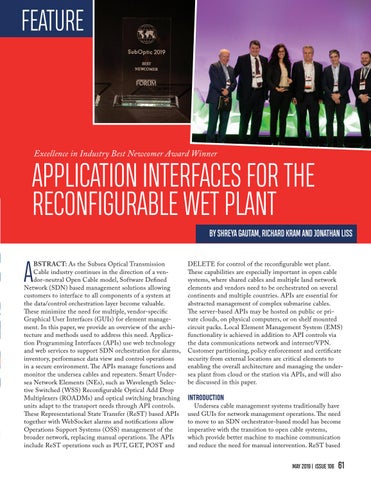
Excellence in Industry Best Newcomer Award Winner
APPLICATION INTERFACES FOR THE RECONFIGURABLE WET PLANT
BY SHREYA GAUTAM, RICHARD KRAM AND JONATHAN LISS
A
BSTRACT: As the Subsea Optical Transmission Cable industry continues in the direction of a vendor-neutral Open Cable model, Software Defined Network (SDN) based management solutions allowing customers to interface to all components of a system at the data/control orchestration layer become valuable. These minimize the need for multiple, vendor-specific Graphical User Interfaces (GUIs) for element management. In this paper, we provide an overview of the architecture and methods used to address this need. Application Programming Interfaces (APIs) use web technology and web services to support SDN orchestration for alarms, inventory, performance data view and control operations in a secure environment. The APIs manage functions and monitor the undersea cables and repeaters. Smart Undersea Network Elements (NEs), such as Wavelength Selective Switched (WSS) Reconfigurable Optical Add Drop Multiplexers (ROADMs) and optical switching branching units adapt to the transport needs through API controls. These Representational State Transfer (ReST) based APIs together with WebSocket alarms and notifications allow Operations Support Systems (OSS) management of the broader network, replacing manual operations. The APIs include ReST operations such as PUT, GET, POST and
DELETE for control of the reconfigurable wet plant. These capabilities are especially important in open cable systems, where shared cables and multiple land network elements and vendors need to be orchestrated on several continents and multiple countries. APIs are essential for abstracted management of complex submarine cables. The server-based APIs may be hosted on public or private clouds, on physical computers, or on shelf mounted circuit packs. Local Element Management System (EMS) functionality is achieved in addition to API controls via the data communications network and internet/VPN. Customer partitioning, policy enforcement and certificate security from external locations are critical elements to enabling the overall architecture and managing the undersea plant from cloud or the station via APIs, and will also be discussed in this paper.
INTRODUCTION
Undersea cable management systems traditionally have used GUIs for network management operations. The need to move to an SDN orchestrator-based model has become imperative with the transition to open cable systems, which provide better machine to machine communication and reduce the need for manual intervention. ReST based MAY 2019 | ISSUE 106
61