FEATURE
Excellence in Industry Best Poster Award Winner:
EVALUATION AND OPTIMISATION OF THERMAL MANAGEMENT IN HIGHPOWER REPEATERS
BY IAN WATSON, LEO FOULGER, DAVID WALTERS AND PETER WORTHINGTON
A
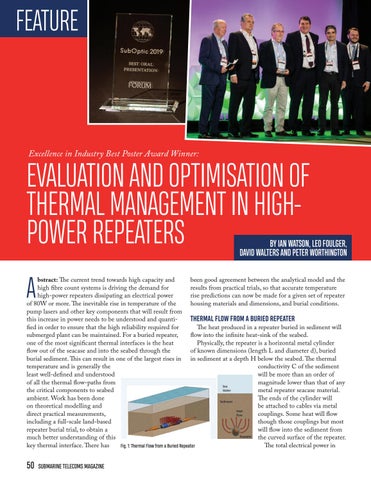
been good agreement between the analytical model and the bstract: The current trend towards high capacity and results from practical trials, so that accurate temperature high fibre count systems is driving the demand for rise predictions can now be made for a given set of repeater high-power repeaters dissipating an electrical power housing materials and dimensions, and burial conditions. of 80W or more. The inevitable rise in temperature of the pump lasers and other key components that will result from this increase in power needs to be understood and quantiTHERMAL FLOW FROM A BURIED REPEATER fied in order to ensure that the high reliability required for The heat produced in a repeater buried in sediment will submerged plant can be maintained. For a buried repeater, flow into the infinite heat-sink of the seabed. one of the most significant thermal interfaces is the heat Physically, the repeater is a horizontal metal cylinder flow out of the seacase and into the seabed through the of known dimensions (length L and diameter d), buried burial sediment. This can result in one of the largest rises in in sediment at a depth H below the seabed. The thermal temperature and is generally the conductivity C of the sediment least well-defined and understood will be more than an order of of all the thermal flow-paths from magnitude lower than that of any the critical components to seabed metal repeater seacase material. ambient. Work has been done The ends of the cylinder will on theoretical modelling and be attached to cables via metal direct practical measurements, couplings. Some heat will flow including a full-scale land-based though those couplings but most repeater burial trial, to obtain a will flow into the sediment from much better understanding of this the curved surface of the repeater. key thermal interface. There has The total electrical power in Fig. 1: Thermal Flow from a Buried Repeater
50
SUBMARINE TELECOMS MAGAZINE