CONTRIBUTING AUTHORS: Alex Vaxmonsky, Andrés Fígoli, Anjali Sugadev, Glenn Hovermale, John Maguire, Kieran Clark, Kristian Nielsen, John Tibbles, Philip Pilgrim, and Syeda Humera
Submarine Telecoms Forum, Inc. www.subtelforum.com/corporate-information
BOARD OF DIRECTORS: Margaret Nielsen, Wayne Nielsen and Kristian Nielsen
Contributions are welcomed and should be forwarded to: pressroom@subtelforum.com.
Submarine Telecoms Cable Industry Report is published annually by Submarine Telecoms Forum, Inc., and is an independent commercial publication, serving as a freely accessible forum for professionals in industries connected with submarine optical fiber technologies and techniques. Submarine Telecoms Forum may not be reproduced or transmitted in any form, in whole or in part, without the permission of the publishers.
Liability: While every care is taken in preparation of this publication, the publishers cannot be held responsible for the accuracy of the information herein, or any errors which may occur in advertising or editorial content, or any consequence arising from any errors or omissions, and the editor reserves the right to edit any advertising or editorial material submitted for publication.
New Subscriptions, Enquiries and Changes of Address 21495 Ridgetop Circle, Suite 201, Sterling, Virginia 20166, USA, or visit www.subtelforum.com.
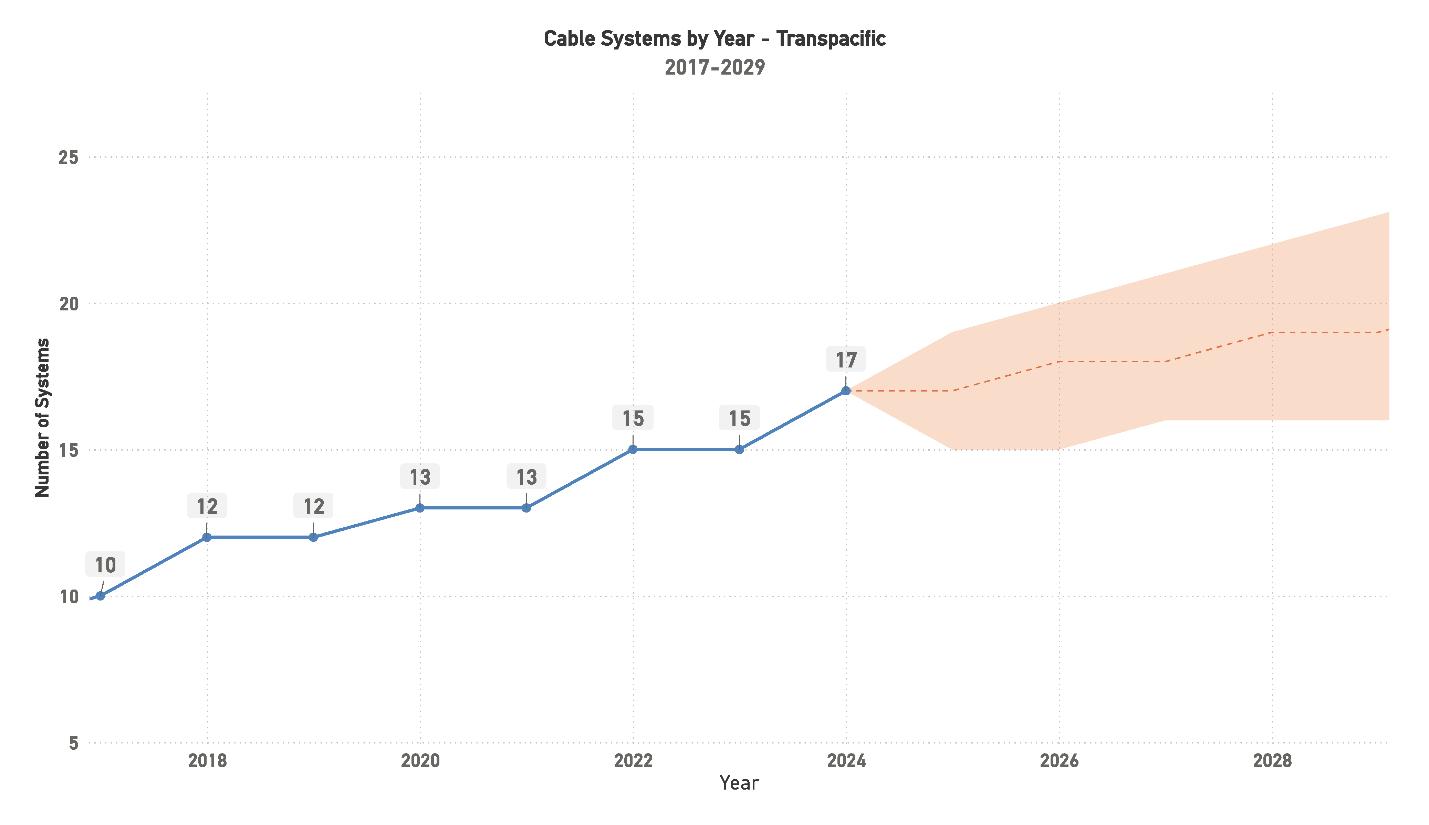
Figure 106: Cable Systems by Year – Transpacific, 2017- 2029.........................................................................194
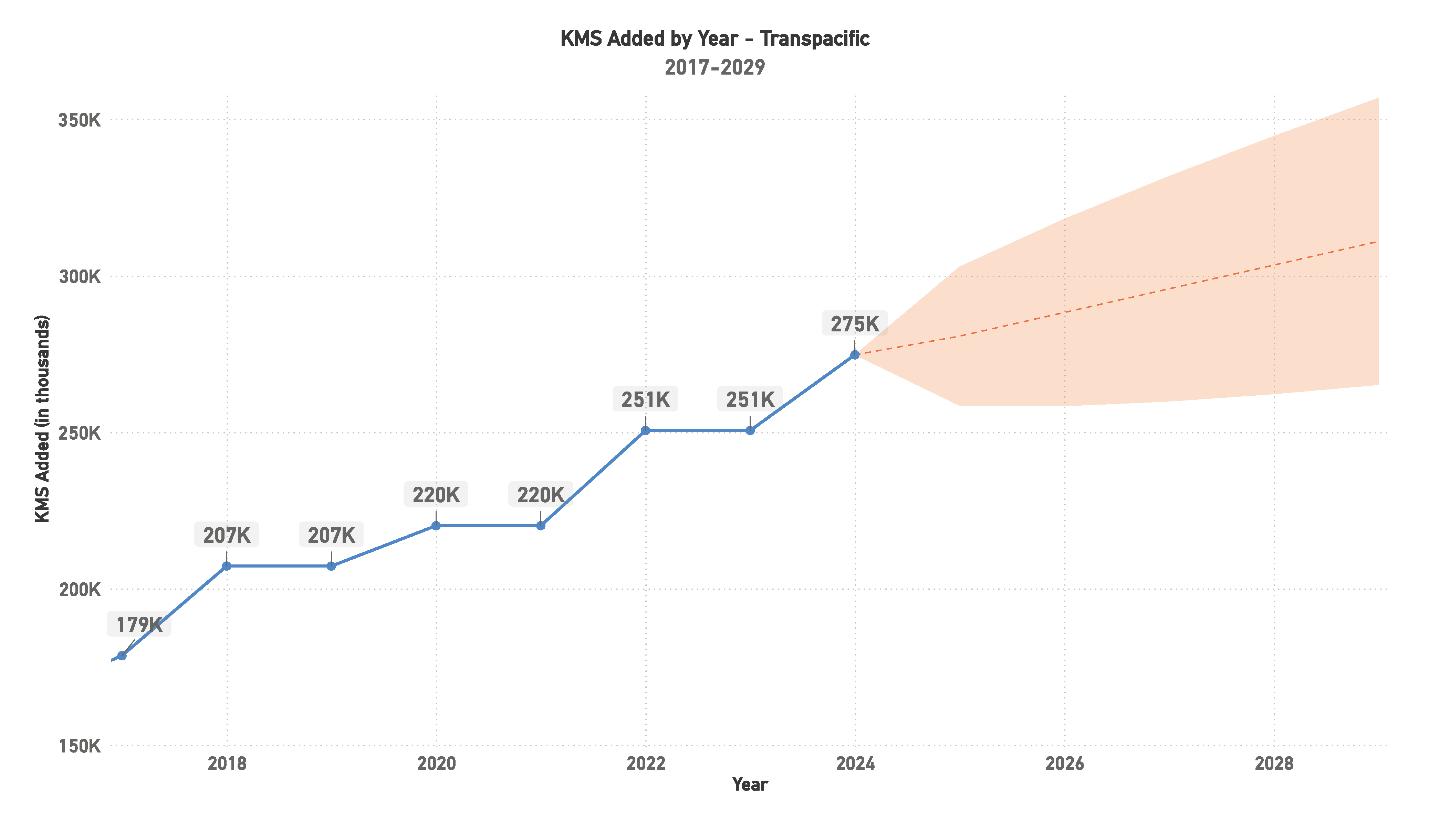
Figure 107: KMS Added by Year – Transpacific, 2017- 2029........................................................................ 195
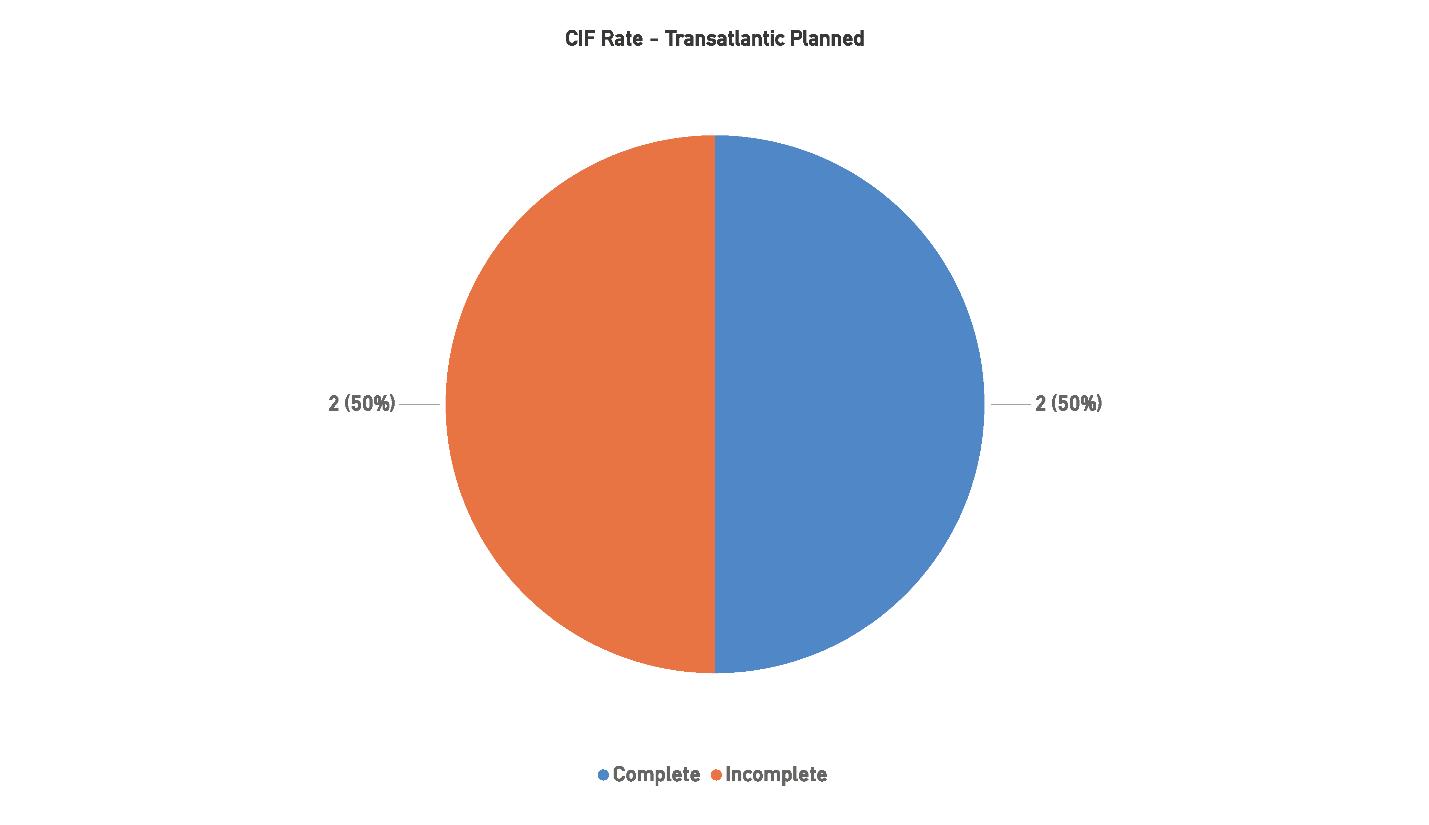
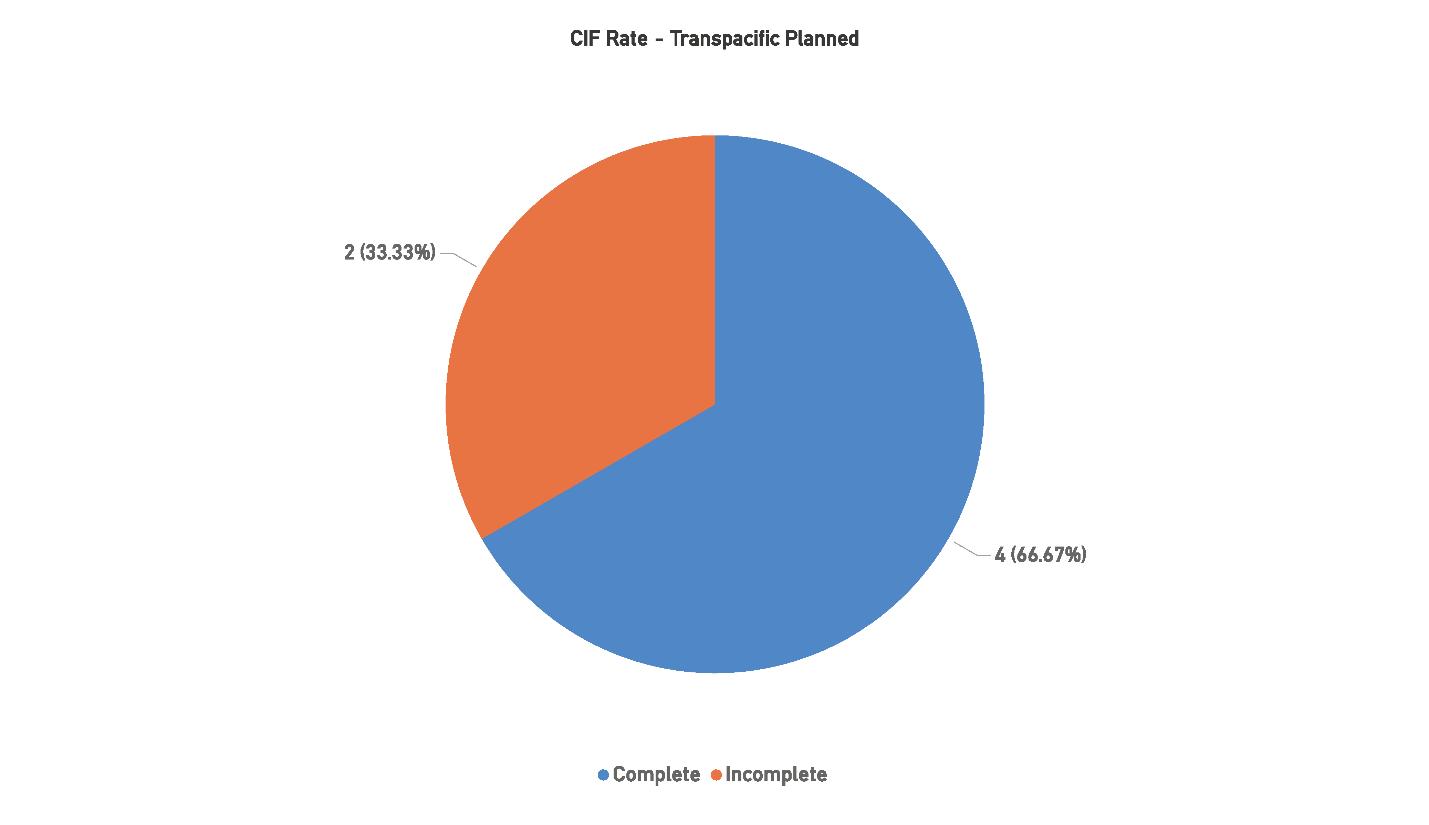
Figure 108: CIF Rate – Transpacific Planned 195
LIST OF VIDEOS
Video 1: Wayne Nielsen, PublisherSubmarine Telecoms Forum, Inc. 6 Video 2: Kieran Clark, Senior AnalystSubmarine Telecoms Forum .............................................. 10
Video 3: Glenn Hovermale, Marine CoordinatorWFN Strategies 82
Video 4: Syeda Humera, AnalystSubmarine Telecoms Forum .............................................. 94
Video 5: Andrés Fígoli, Lawyer – Figoli Consulting 142
The year 2024 marked a pivotal period for the submarine cable industry. Amid geopolitical tensions, economic volatility, and supply chain disruptions, the industry has demonstrated remarkable resilience and adaptability. Positioned to meet the accelerating demand for global data, the industry stands at an exciting crossroads of growth and innovation.
This report delves into the critical trends shaping the future of submarine cables, from expanded data capacity and evolving ownership models to fortified regulatory frameworks aimed at enhancing security and resilience. Global initiatives like the “New York Principles” spotlight a collective commitment to cable security, while major hyperscalers drive growth on key routes across the Transpacific and Transatlantic. Innovative financing, strategic mergers, and advanced technologies continue to propel the industry, which is navigating an increasingly complex landscape through collaboration, resilience, and technological advancement.
Our annual Industry Report aims to be a cornerstone ana -
This report delves into the critical trends shaping the future of submarine cables, from expanded data capacity and evolving ownership models to fortified regulatory frameworks aimed at enhancing security and resilience.
lytical resource, complementing our other SubTel Forum offerings: the Submarine Cable Map printed in January, May and September, plus the Submarine Cable Almanac released quarterly, and the online Submarine Cables of the World Interactive Map. This report provides comprehensive analysis and forecasts, serving as an invaluable guide for those seeking to understand the health and trends of the submarine cable industry. It delves into both global and regional markets, addressing
Video 1: Wayne Nielsen, Publisher - Submarine Telecoms Forum, Inc.
The year 2024 marked a pivotal period for the submarine cable industry.
key issues such as new systems, upgrades, ownership structures, financing, market drivers, and anticipated geopolitical and economic impacts.
Last year’s edition was downloaded over 500,000 times and cited extensively in business journals and periodicals. We are both optimistic and confident that this year’s report will withstand similar scrutiny, and we hope you’ll agree.
We are honored to have Doreen Bogdan-Martin, Secretary-General of the International Telecommunication Union, once again contribute this year’s foreword, sharing insights on the ITU’s initiatives and the current state of submarine cables.
In this report, we’ve identified more than $15.4 billion in new projects actively being pursued. Of these, contracts worth $8.2 billion are already in force, with $6.7 billion of those slated for completion in 2024 alone.
We’ve drawn insights from various articles in recent issues of Submarine Telecoms Forum Magazine and our proprietary Market Sector Reports to enrich our discussion on various industry topics. Special thanks go to this year’s contributing industry specialists, namely: Alex Vaxmonsky
• Andrés Fígoli
• Anjali Sugadev
• Geoff Bennett
• Glenn Hovermale
• John Maguire
• Kieran Clark
• Kristian Nielsen
• John Tibbles
• Philip Pilgrim
• Syeda Humera
We also extend our heartfelt thanks to this year’s sponsors, who have played a crucial role in making the annual Industry Report possible:
• APTelecom
• Figoli Consulting
• Infinera
• WFN Strategies
While the future may be uncertain, one fact remains clear: our industry, with its rich 175+ year history, continues to be a thriving, essential, and ever-evolving enterprise.
In the coming months, we are committed to providing as much new data as possible in a timely and useful manner. As the saying goes, an informed industry is a productive industry.
Thank you for your continued interest and trust in SubTel Forum’s 13th annual “Submarine Telecoms Industry Report.”
Good reading and Slava Ukraini ,
Wayne Nielsen Publisher & President, Submarine Telecoms Forum, Inc.
WAYNE NIELSEN is Publisher & President of Submarine Telecoms Forum, Inc. and possesses more than 35 years’ experience in submarine cable systems, including polar and offshore Oil & Gas submarine fiber systems, and has developed and managed international telecoms projects in Antarctica, the Americas, Arctic, Europe, Far East/Pac Rim and Middle East. In 2001, he founded Submarine Telecoms Forum magazine, the industry’s considerable voice on the topic. He is also Managing Director of WFN Strategies, which provides design, development, and implementation support, as well as commercial and technical due diligence of submarine cable systems for commercial, governmental, and Oil & Gas clients. He received a postgraduate master’s degree in International Relations, and bachelor’s degrees in Economics and Political Science, and is a former employee of British Telecom, Cable & Wireless and SAIC.
Thoughts From Doreen Bogdan-Martin, ITU Secretary-General Foreword
Greetings from New Delhi, where we are wrapping up the governing conference for ITU standardization work, the 2024 World Telecommunication Standardization Assembly (WTSA-24).
WTSA-24 encompasses work on standards for submarine telecoms cables — the arteries of our interconnected world carrying the lifeblood of global communications.
As our economies and digital ambitions grow, so does our reliance on this vital global infrastructure.
On behalf of the United Nations agency for digital technologies, I applaud the submarine telecoms industry for building the solid foundation our shared digital future needs.
ITU is proud to have supported this industry from its very beginnings.
to improve resilience of this vital infrastructure that powers global communications and the digital economy.
This Advisory Body will bring together governments, regulatory authorities, industry leaders, and key stakeholders in areas related to enhancing the safety, redundancy, and protection of submarine cables.
We are fully committed to delivering this same value to innovation for climate action.
On behalf of the United Nations agency for digital technologies, I applaud the submarine telecoms industry for building the solid foundation our shared digital future needs.
This year marks 40 years since ITU first standardized optical fibre, highlighting the remarkable speed at which today’s expansive optical networks have been built.
Over the past four decades, ITU standards have also supported optical-network capacity to grow at an average of 40 per cent each year.
Not only have our standards helped the submarine telecoms industry evolve in a cost-effective manner, but they also offer certainty when it comes to reliability and interoperability.
Right now, in partnership with the International Cable Protection Committee (ICPC), ITU is setting up an International Advisory Body for Submarine Cable Resilience to promote dialogue and collaboration on potential ways and means
Two new ITU standards for both SMART (scientific monitoring and reliable telecommunications) cables and cables dedicated to scientific sensing have just been completed.
The climate and hazard monitoring sensors included in SMART cables are designed to coexist with telecom components and match the lifespan of commercial cables.
The prospect of a real-time ocean observation network creates compelling opportunities for disaster risk reduction, such as more accurate early warnings of tsunamis. This network could also capture a wealth of valuable data for climate science.
These new standards build on the pioneering work of the ITU/WMO/UNESCO/IOC Joint Task Force on SMART Cable Systems, which helped develop the technical and financial feasibility of SMART cables. The task force now supports ongoing SMART cable deployments and continues to study potential new capabilities for future deployments.
EllaLink, the transAtlantic cable system connecting the European and South American continents, was the first to
As our economies and digital ambitions grow, so does our reliance on this vital global infrastructure.
dedicate a fibre of a commercial telecoms cable to environmental sensing between Madeira Island and the trunk cable.
Portugal is now set to build SMART into the new ContinentAzoresMadeira (CAM) ring cable linking the mainland to islands a thousand kilometres out in the Atlantic Ocean.
SMART capability will form around 10 per cent of the total cost to deploy the new government sponsored CAM cable, expected to enter service in 2025.
An Italian demonstrator project is using 21 kilometres of SMART cable to monitor seismic activity on the seafloor near Mount Etna. Other SMART projects are underway in Indonesia, the Vanuatu–New Caledonia island area, and even Antarctica.
This year’s Submarine Telecoms Industry Report provides a platform for industry leaders and experts to share views on the latest developments in submarine telecoms and associated hopes for the future.
With its global scope and strong support from the community it serves, ITU is proud to support this report – especially in a WTSA year.
WTSA-24 comes at a time when reaching consensus on international technical standards is more important than ever, especially to ensure that new and emerging technologies are used as a force for good for all.
The Global Digital Compact, adopted at the UN General Assembly last month as part of the UN Pact for the Future, and the upcoming WSIS+20 Review next year, provide a framework to ensure that new technologies benefit everyone, everywhere.ITU standards help create the confidence to continue innovating and investing in digital technologies with the aim of achieving universal connectivity and sustainable digital transformation, ITU’s dual strategic objectives and my top priorities.
To reach these goals, we need all hands on deck and a range of diverse perspectives.
ITU’s standardization inclusive processes ensure that all participants’ voices are heard.
If you are not already a contributing member of the ITU standards community, I encourage you to join us and help create the shared digital future we want — one built on collaboration, consensus, and innovation. STF
Doreen Bogdan-Martin ITU Secretary-General
DOREEN BOGDAN-MARTIN took office as Secretary-General of the International Telecommunication Union (ITU) on 1 January 2023.
With over three decades of leadership experience in global telecommunications policy, Ms. Bogdan-Martin has emphasized the need for digital transformation to achieve economic prosperity, job creation, skills development, gender equality, and socio-economic inclusion, as well as to build circular economies, reduce climate impact, and save lives. Her historic election by ITU Member States in September 2022 made her the first woman ever to head the nearly 160-year-old organization. Known for mobilizing innovative partnerships, she aims to promote meaningful connectivity, intensify cooperation to connect the unconnected, and strengthen the alignment of digital technologies with inclusive sustainable development.
Methodology
This edition of the Submarine Telecoms Cable Industry Report was developed by analysts at Submarine Telecoms Forum, Inc., who also contribute analysis for SubTel Forum’s Submarine Cable Almanac, online and print Cable Maps, and Industry Newsfeed.
For this report, a multi-faceted approach was utilized, combining interviews with industry leaders and data from our proprietary Submarine Cable Database. The database, continuously updated since 2013, tracks over 500 active and planned domestic and international cable systems. It allows queries based on various parameters including client, year, project, region, system length, capacity, landing points, data centers, owners, installers, system cost, upgrade status, and more.
The Submarine Cable Database is maintained by a dedicated team and powered by MySQL. Maps are created using ArcGIS Pro, following the same visual style as the Submarine Cables of the World print map. All data visualizations, such as charts, are produced in Power BI, which is connected in real-time to the database to ensure the most current data is represented.
For this report, a multifaceted approach was utilized, combining interviews with industry leaders and data from our proprietary Submarine Cable Database. The database, continuously updated since 2013, tracks over 500 active and planned domestic and international cable systems.
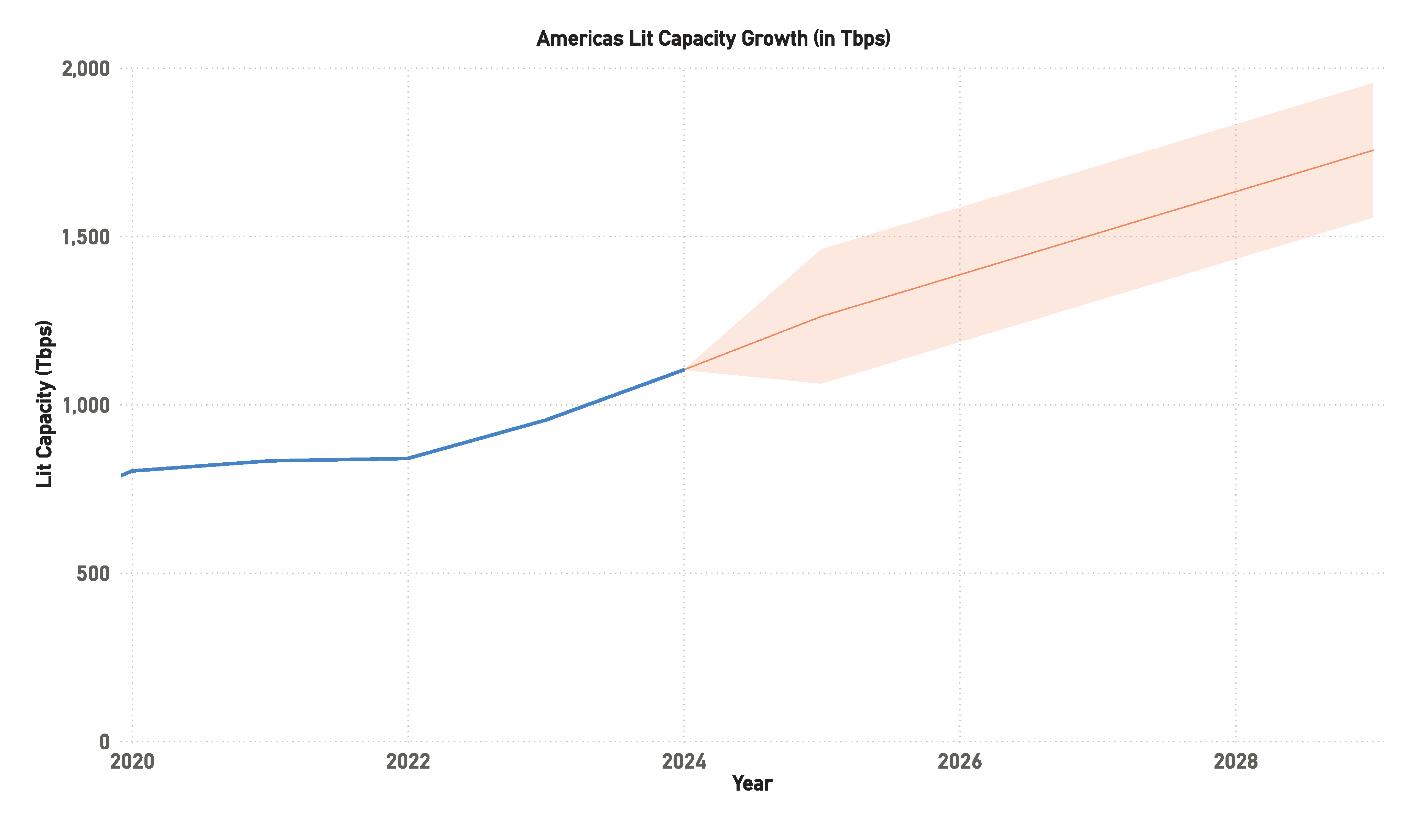
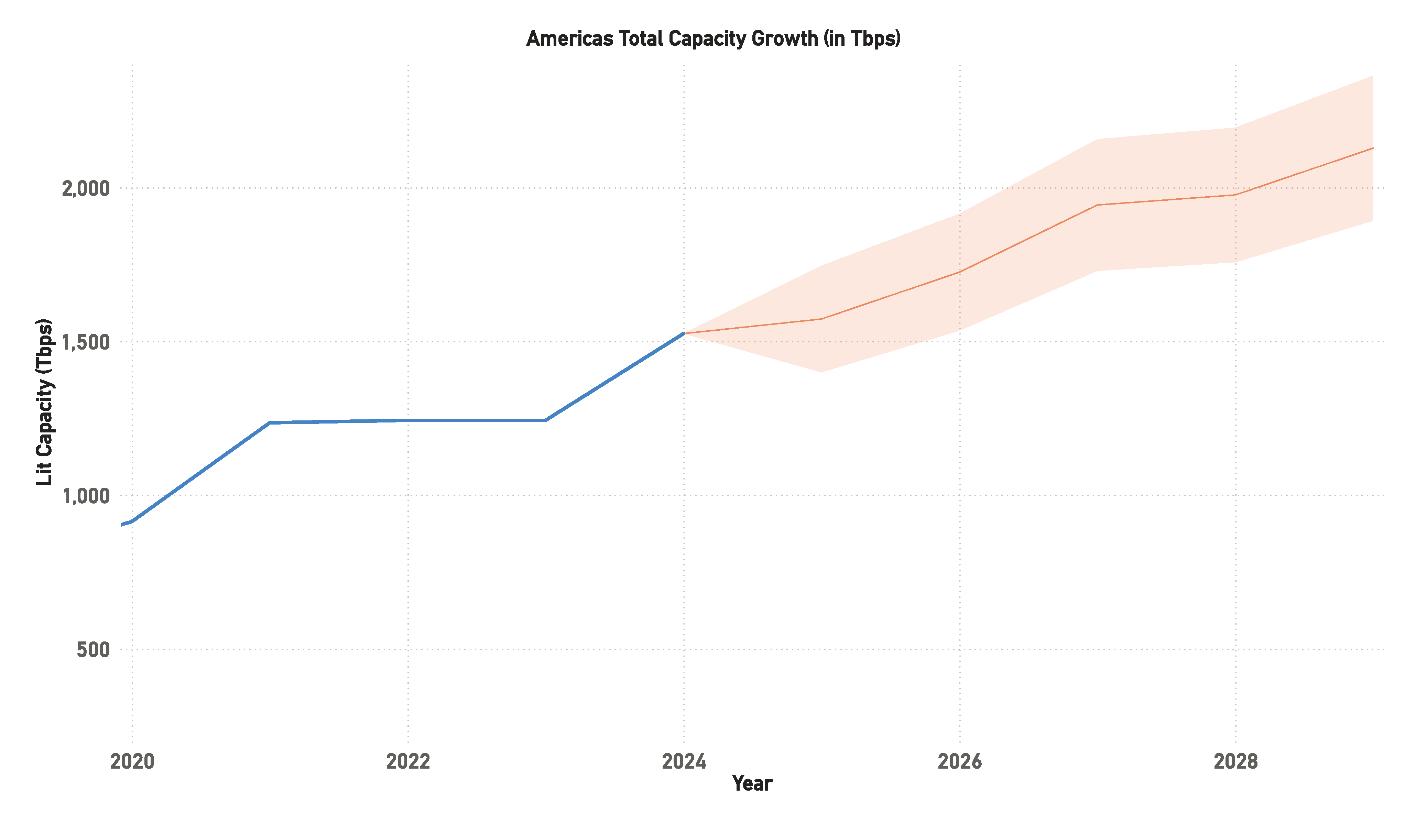
Projections in the report are generated using the Power BI forecast function, which leverages the Exponential Smoothing (ETS) algorithm to predict future data points based on historical trends. This method accounts for seasonality, trends, and noise in the data, providing a well-grounded basis for forecasting future market conditions.
Data gathering for the report is a continuous process throughout the year, drawing from public, commercial, and scientific sources. Data assimilation is conducted in
Video 2: Kieran Clark, Senior Analyst - Submarine Telecoms Forum
Projections in the report are generated using Power BI.
parallel to ensure accurate market projections.
To determine Compound Annual Growth Rate (CAGR) for capacity growth, two methods are applied: one calculates CAGR over a specific period, while the other uses a rolling two-year CAGR to minimize extreme variances, enabling a year-to-year comparison. Since 2019, adjusted FCC reporting requirements have necessitated the use of modeling to estimate capacity growth, using average growth rates from 2015-2018 as a basis for projections from 2019 onward.
For unrepeatered systems, a maximum cable length of 250 km is applied, with exceptions for systems publicly announced as unrepeated. Trending is based on known data, with linear growth estimates for future years. Power BI’s forecast model is used for line graph projections, employing time-series algorithms to predict future values based on historical data.
In estimating system cost, when public information is unavailable, a standardized formula of $50,000-$70,000 USD per kilometer of cable is used, based on industry averages.
While every effort is made to ensure the accuracy of this report, the projections and estimates provided are based on the best available information at the time of publication. STF
KIERAN CLARK is the Lead Analyst for SubTel Forum. He originally joined SubTel Forum in 2013 as a Broadcast Technician to provide support for live event video streaming. He has 6+ years of live production experience and has worked alongside some of the premier organizations in video web streaming. In 2014, Kieran was promoted to Analyst and is currently responsible for the research and maintenance that supports the Submarine Cable Database. In 2016, he was promoted to Lead Analyst and his analysis is featured in almost the entire array of Subtel Forum Publications.
SYEDA HUMERA, a graduate from JNTUH and Central Michigan University, holds a Bachelor’s degree in Electronics and Communication Science and a Master’s degree in Computer Science. She has practical experience as a Software Developer at ALM Software Solutions, India, where she honed her skills in MLflow, JavaScript, GCP, Docker, DevOps, and more. Her expertise includes Data Visualization, Scikit-Learn, Databases, Ansible, Data Analytics, AI, and Programming. Having completed her Master’s degree, Humera is now poised to apply her comprehensive skills and knowledge in the field of computer science.
Executive Summary
The global submarine cable industry continues to experience dynamic growth, driven by increasing demand for digital connectivity and the rising importance of resilient, secure communications infrastructure. Throughout 2024, the industry has faced new challenges and opportunities, shaped by a confluence of geopolitical, technological, and economic factors. This report provides a comprehensive overview of the most significant trends, examining key developments in capacity growth, ownership, financing, supplier activities, and regulatory changes, while offering a regional analysis of current and future systems.
Subsea cables have increasingly become focal points of national security discussions. Once considered solely as commercial assets, they now play a critical role in geopolitics, particularly as they are responsible for the vast majority of global communications, including financial transactions, internet traffic, and even military operations. In response, governments around the world are taking steps to protect these networks from potential threats.
The establishment of the “New York Principles,” endorsed by over thirty nations, is a notable development in cable security, aiming to bolster resilience against both state and non-state actors. However, there are growing concerns about a potential bifurcation of global internet connectivity, with some nations embracing these security frameworks while others, such as China, may not.
At the same time, the industry is grappling with the complexities of nationalization and public-private partnerships (PPPs). The drive to nationalize subsea cable infrastructure, while aimed at protecting national interests, has the potential to stifle innovation. Case studies from the oil and telecommunications sectors offer insights into the potential pitfalls of state ownership. PPPs, however, have emerged as a viable middle ground, blending government oversight with the efficiency of private-sector operations. Successful projects like the Hawaiki Submarine Cable and the Coral Sea Cable System illustrate the benefits of this approach, showing how it can balance strategic priorities with operational needs.
The global demand for data continues to grow unabated, driving capacity expansion across submarine cable systems.
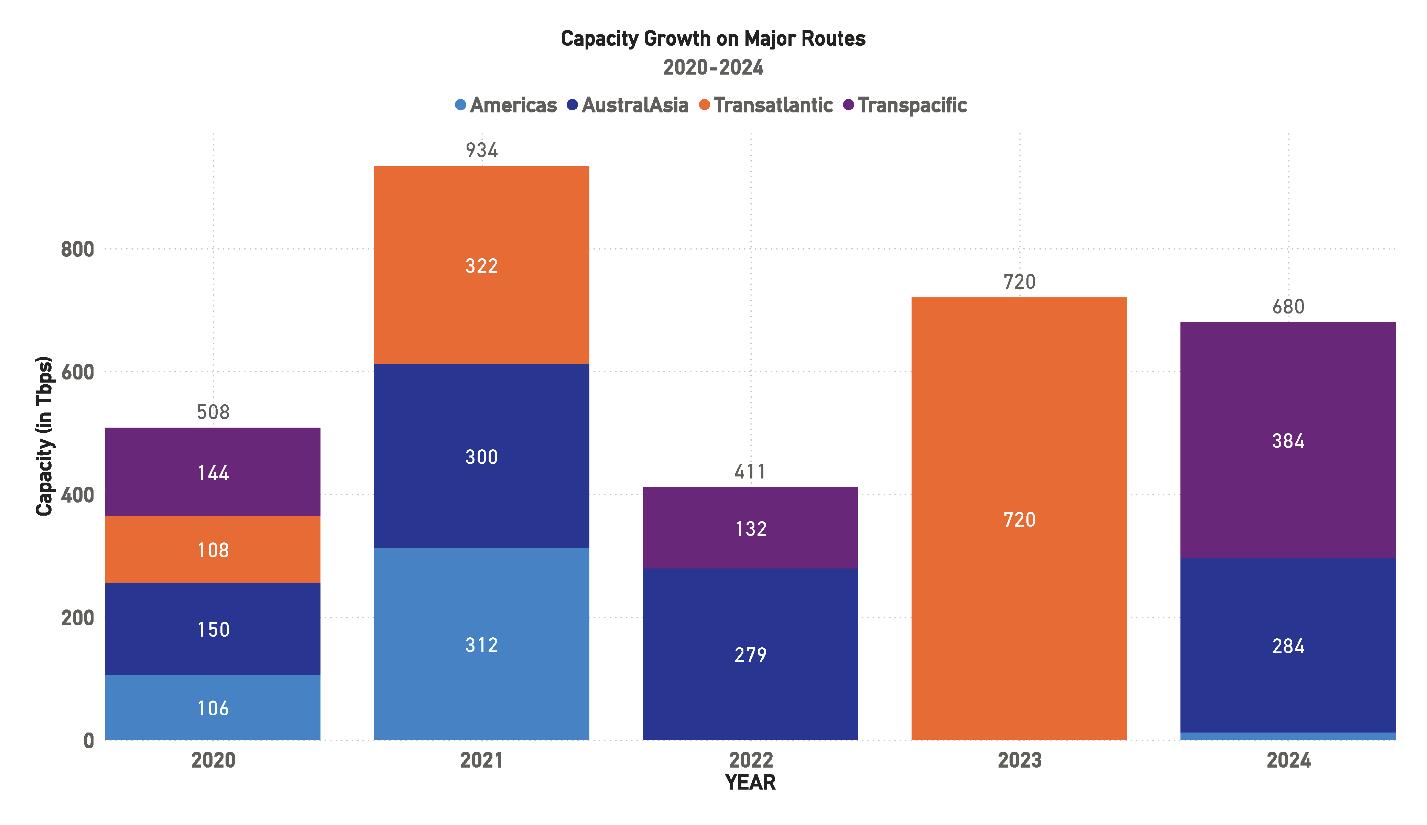
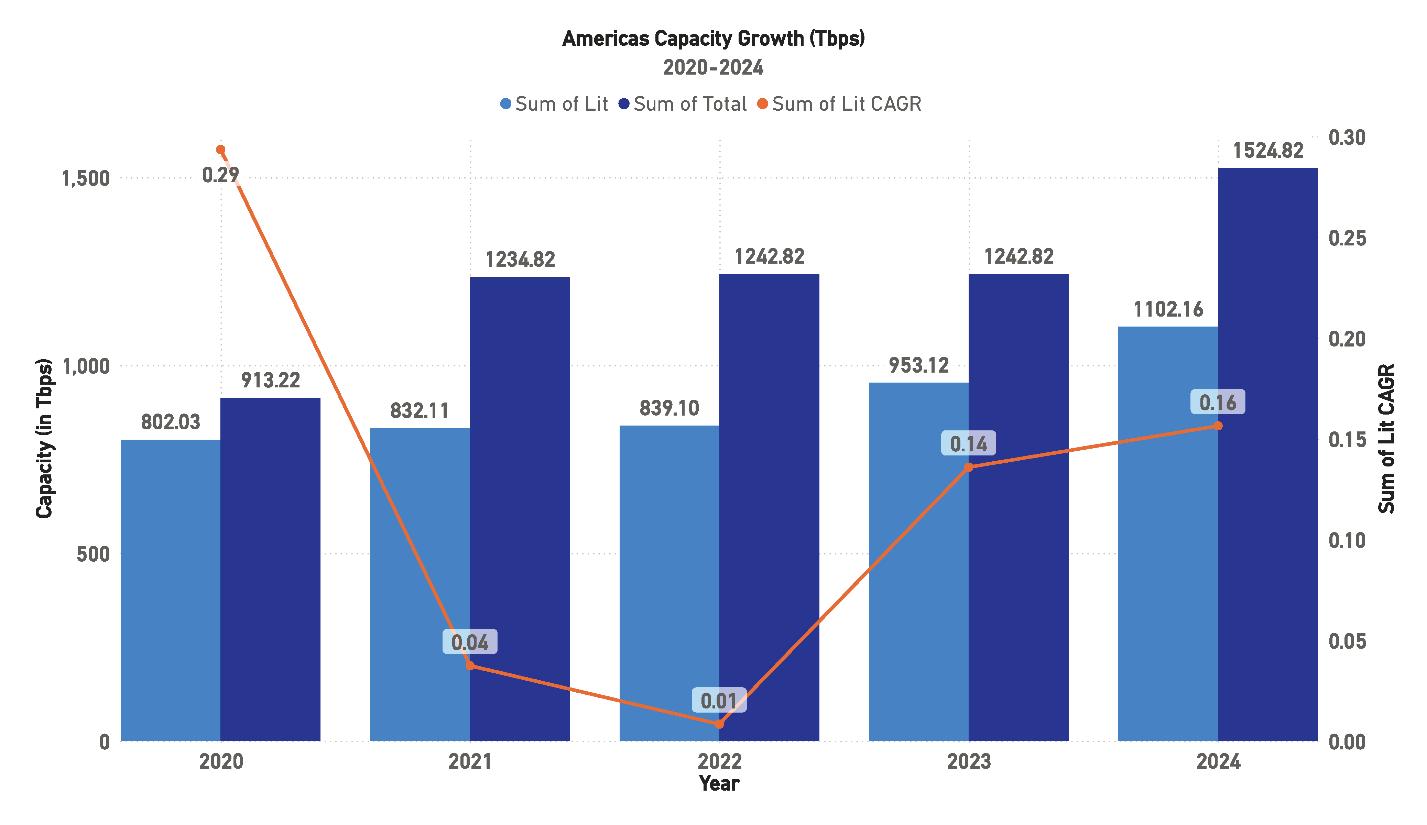
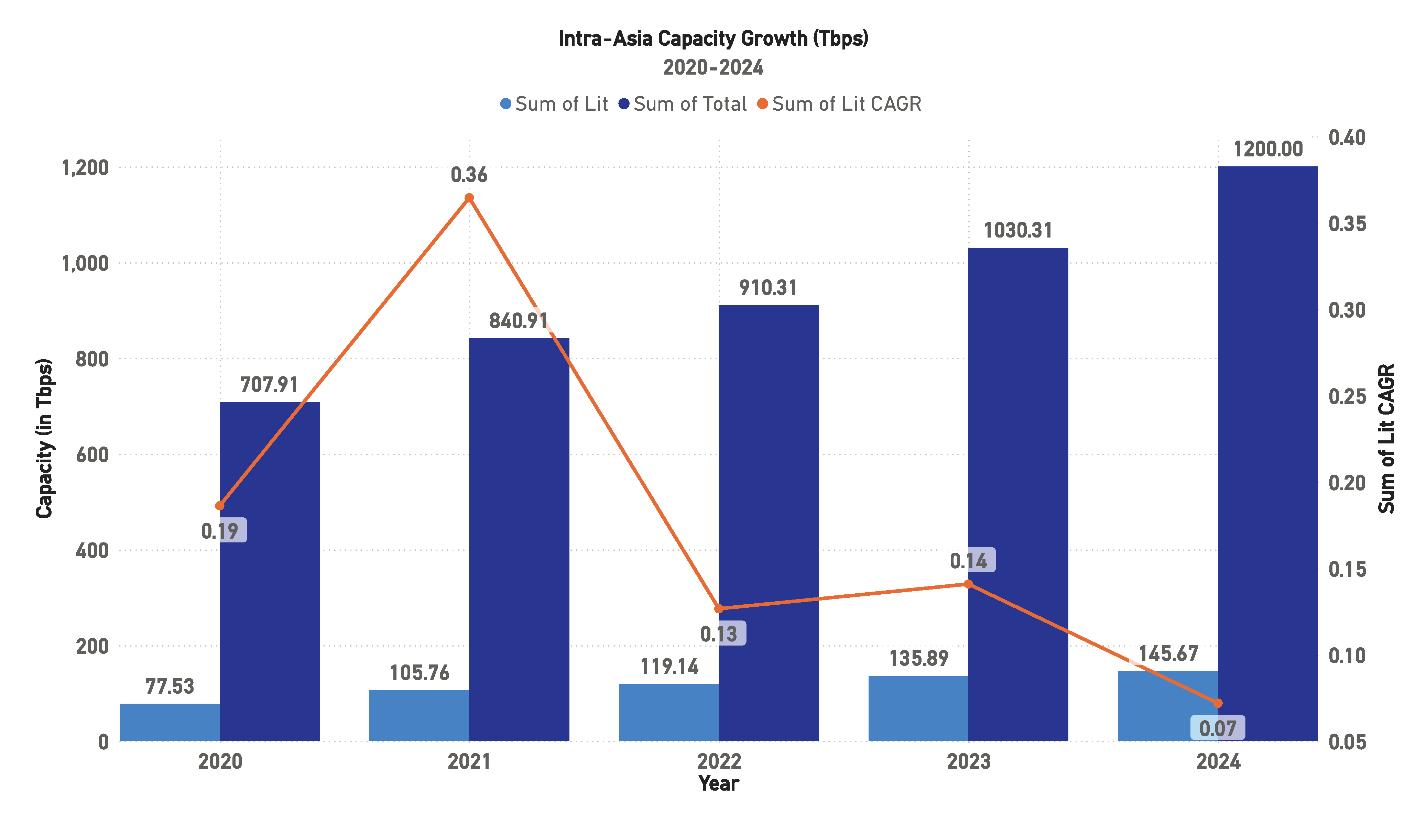
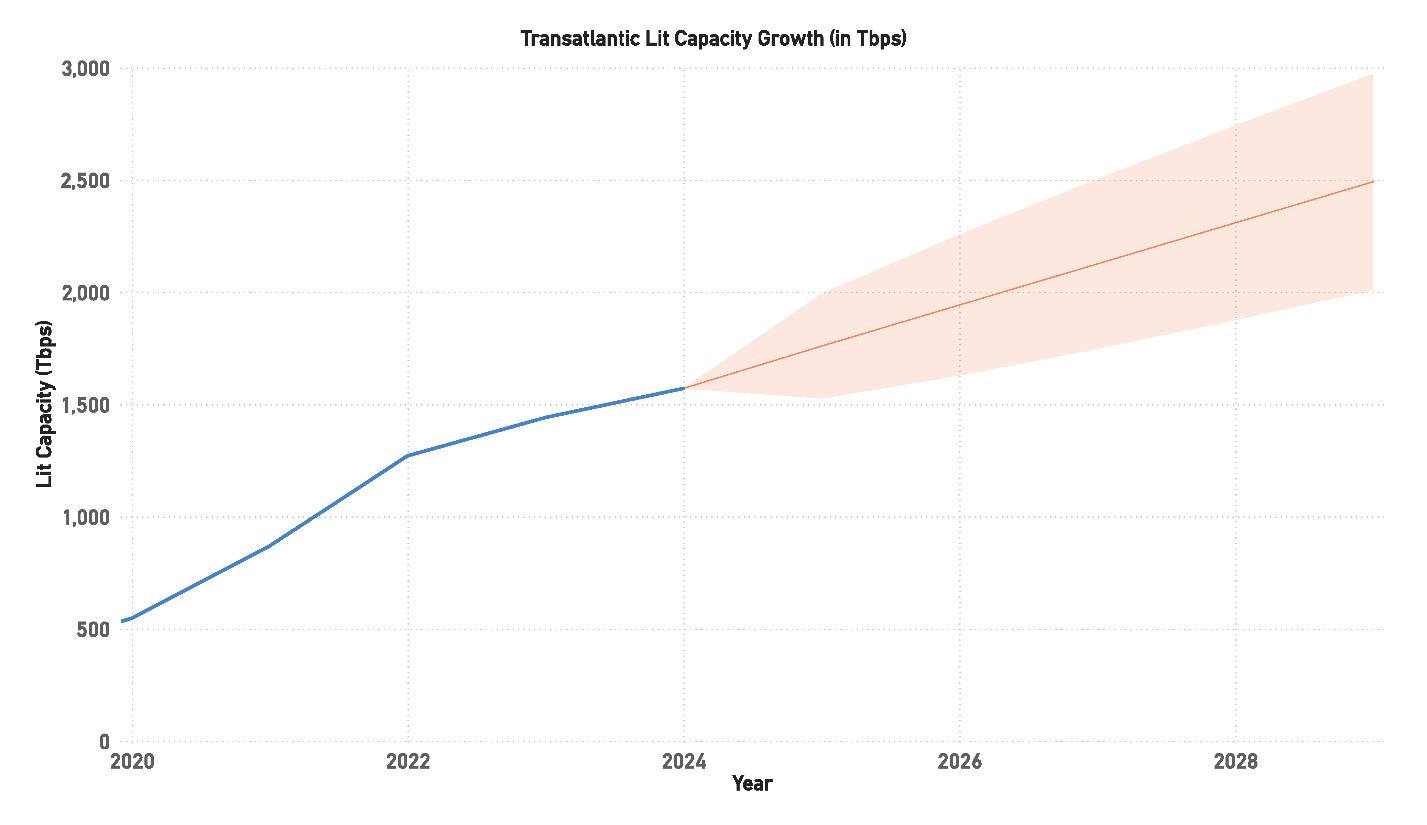
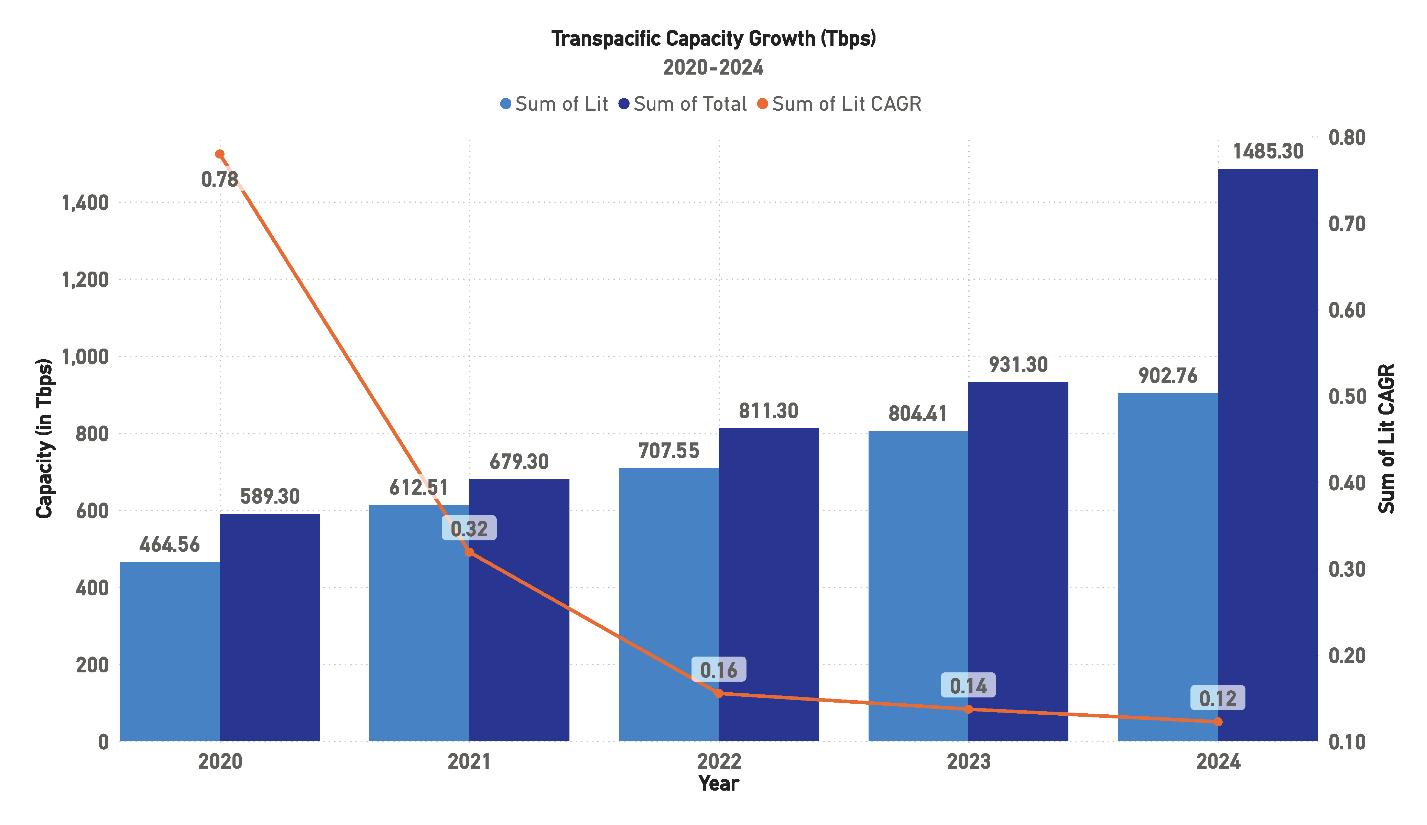
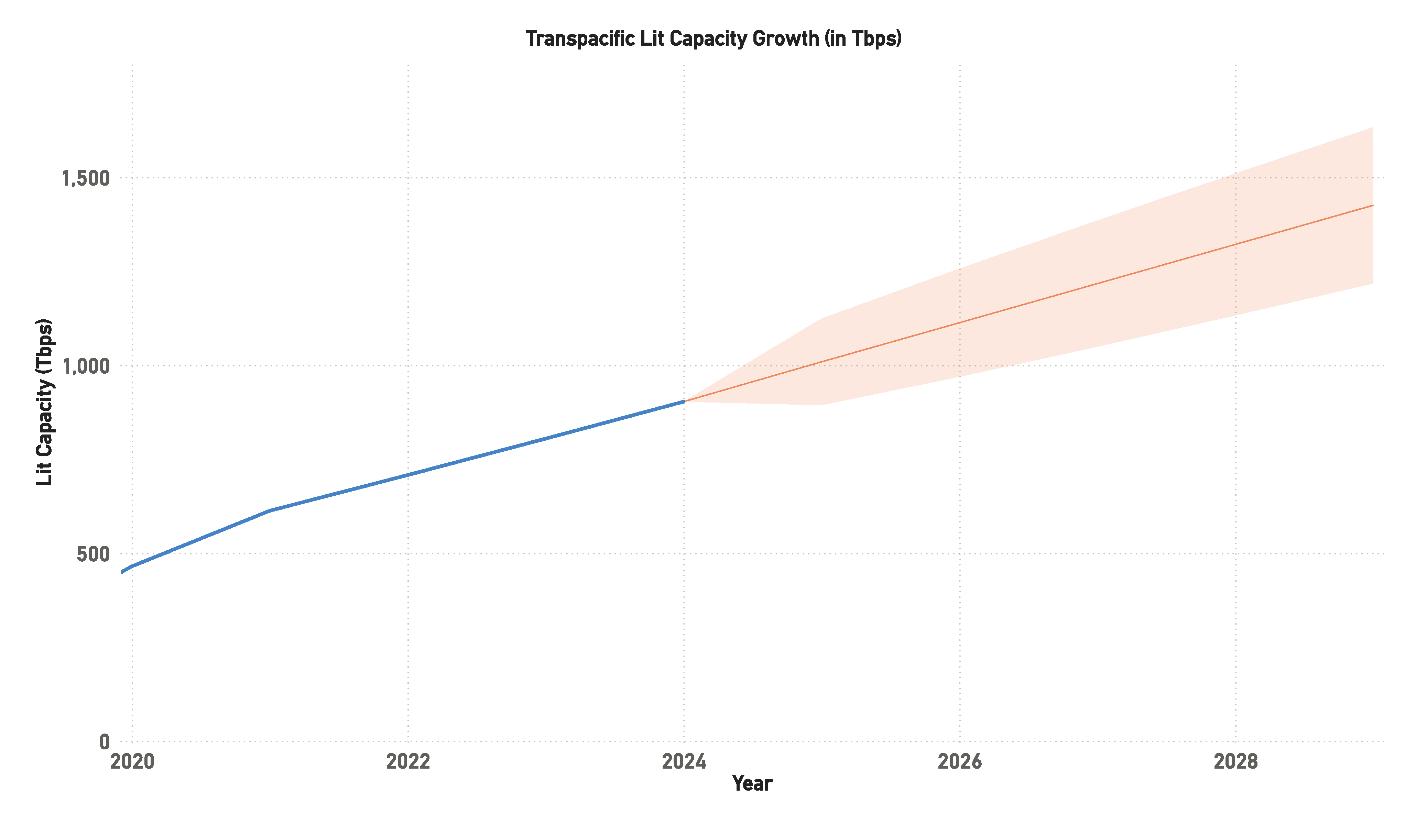
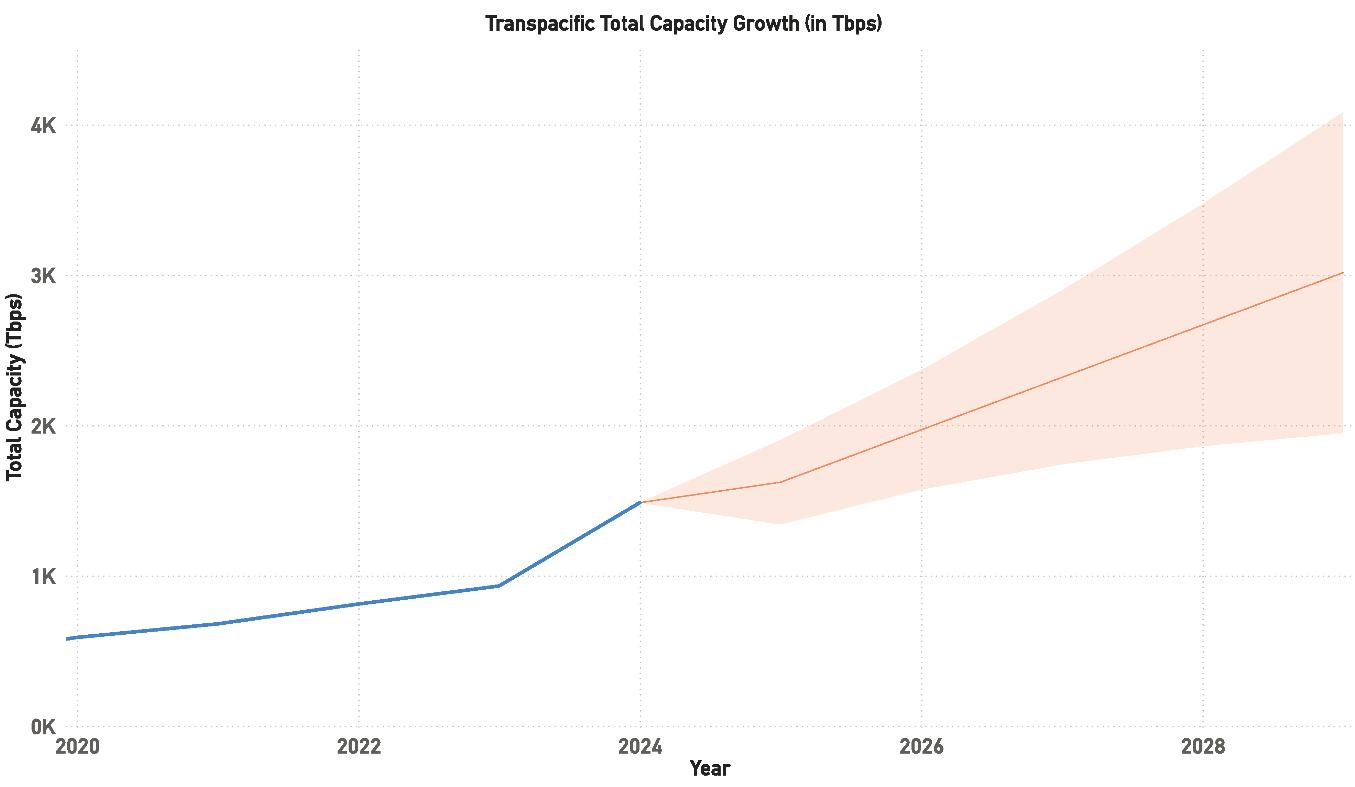
Between 2020 and 2024, capacity on major routes such as the Transpacific and Transatlantic regions has surged, propelled by increasing data transmission needs, cloud services, 5G networks, and streaming platforms. Hyperscalers—companies like Google, Amazon, and Microsoft—have played a key role in this expansion, particularly on routes between the Americas, Asia-Pacific, and Europe. While the Americas has seen more modest capacity growth, the Asia-Pacific region has rebounded strongly, reflecting the region’s growing importance in global data flows.
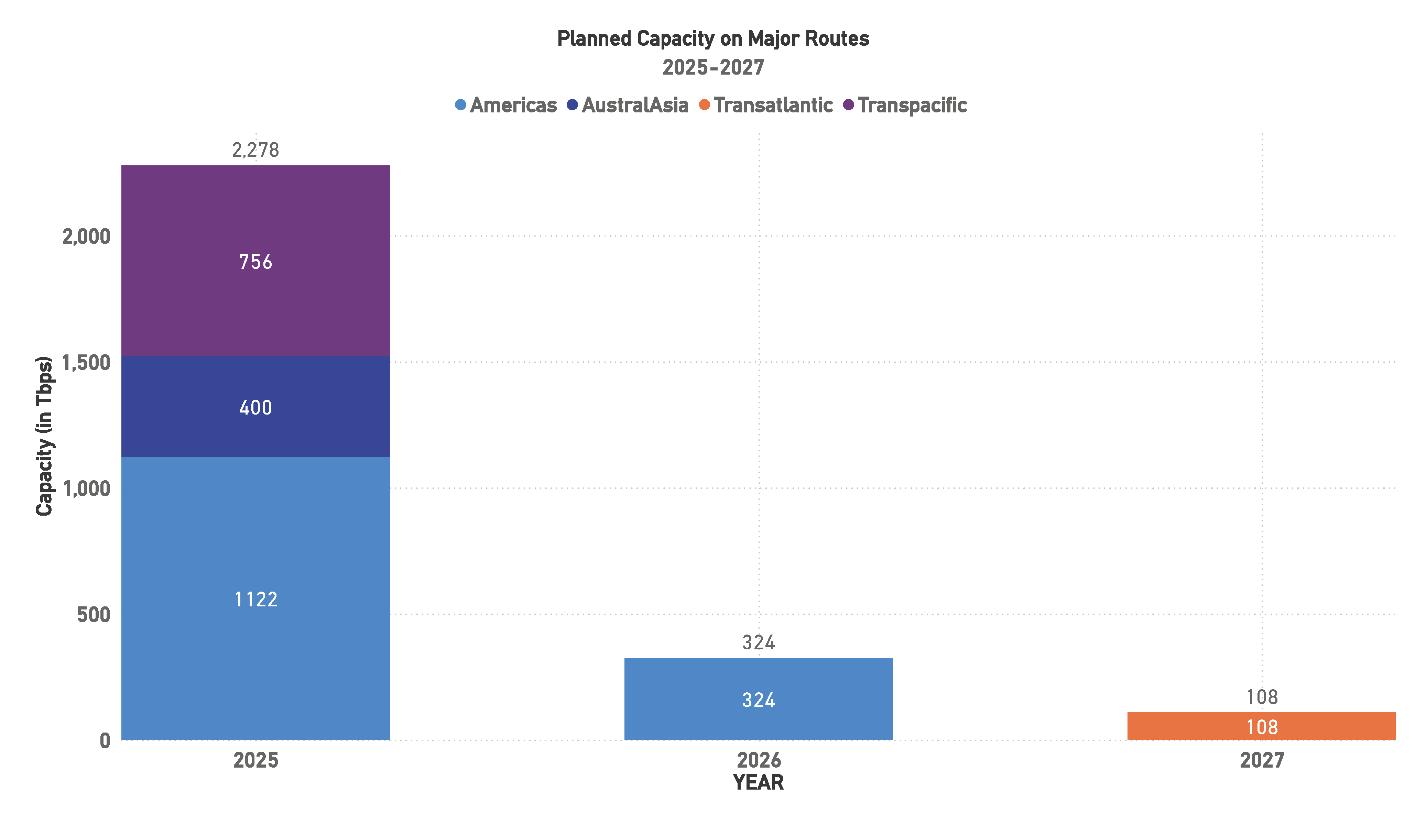
Despite these capacity expansions, there are signs that growth may taper off in the coming years. Projections for 2025 suggest a more measured increase in capacity, with the industry’s focus shifting towards system upgrades and efficiency improvements rather than new deployments. Technological advancements, such as 400G wavelengths and Space Division Multiplexing (SDM), are expected to play a pivotal role in supporting continued demand. Additionally, the rise of open cables and advances in optical technology have made it possible to extract greater performance from existing infrastructure.
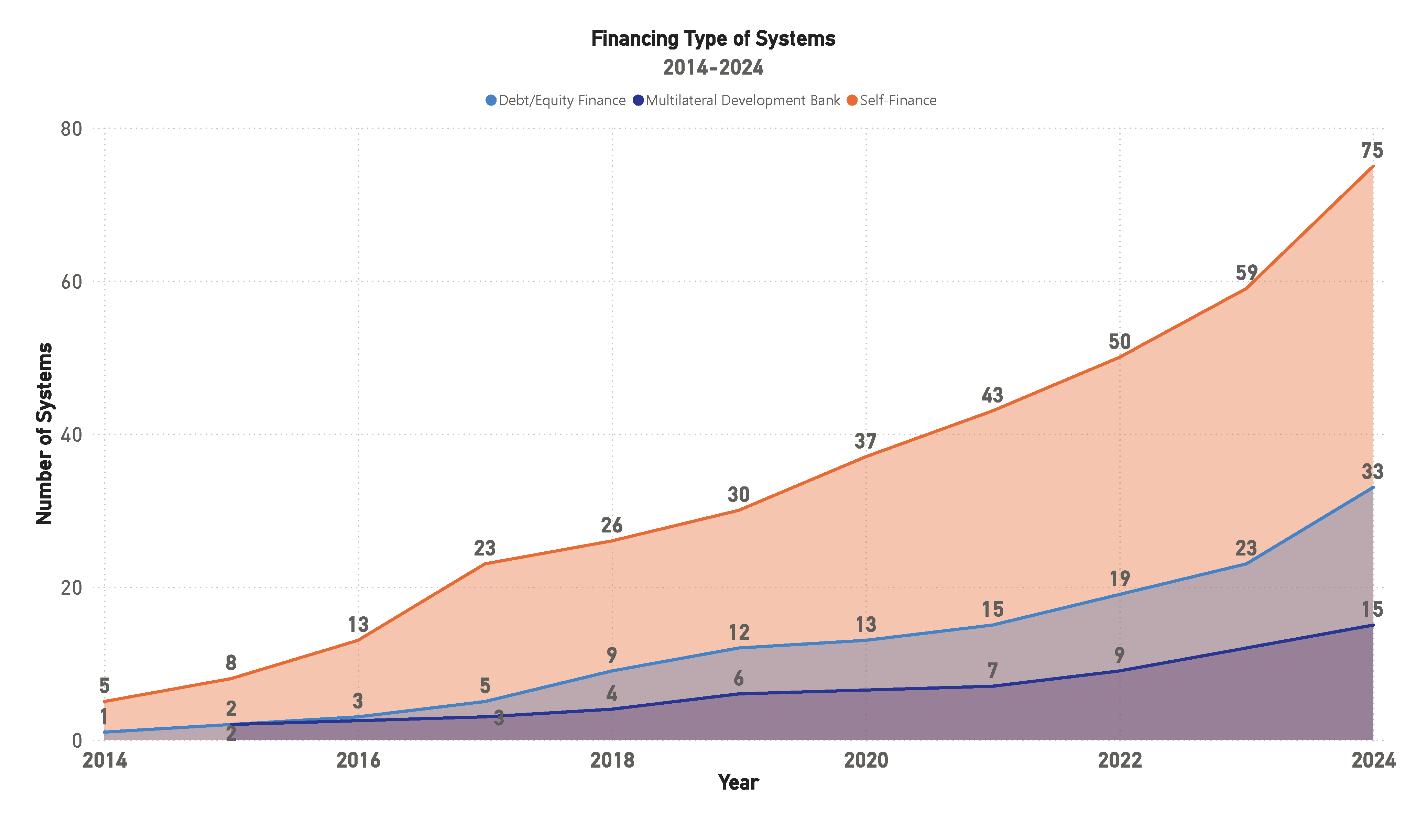
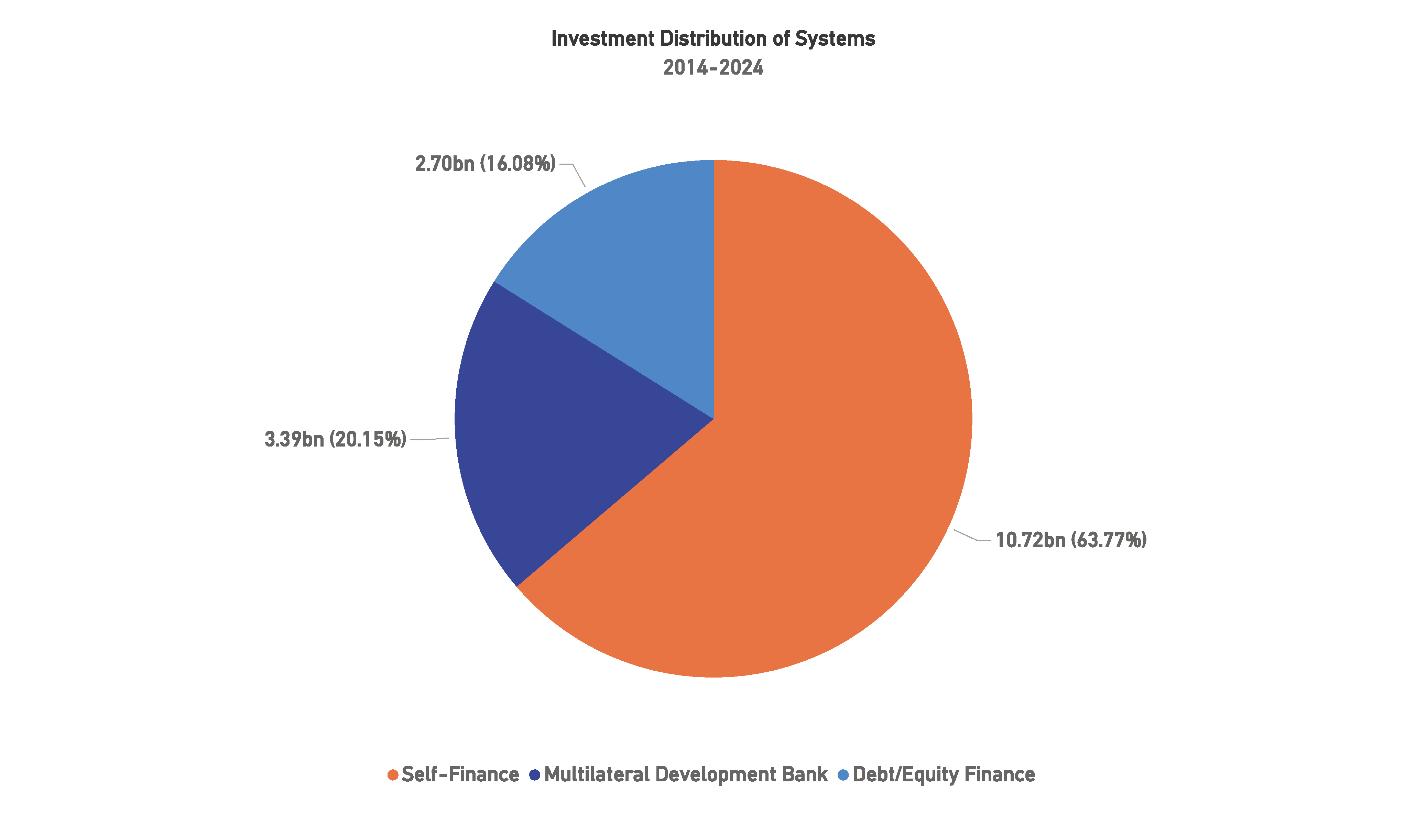
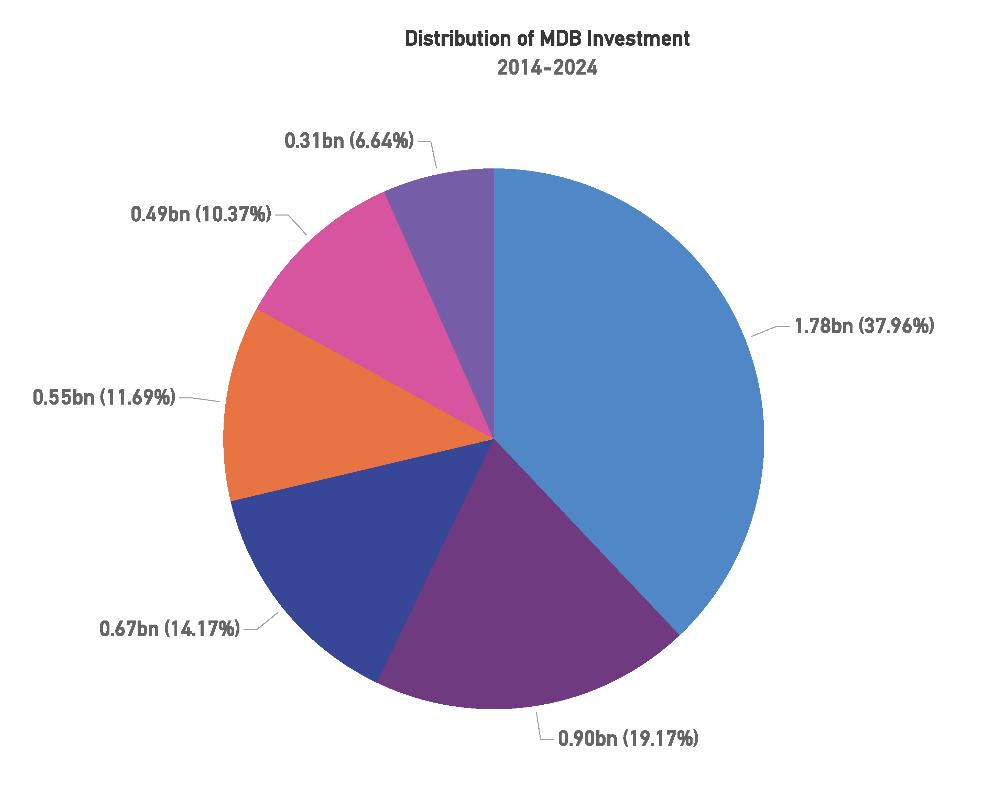
Ownership and financing trends in the submarine cable industry highlight the growing financial autonomy of operators. Self-financing now accounts for nearly two-thirds of all investments, underscoring the industry’s maturity and the ability of operators to independently fund large-scale projects. Multilateral Development Banks (MDBs) continue to provide essential support in developing regions, where access to traditional financing is limited. Debt and equity financing, while smaller in scale, have gained traction as operators increasingly seek to share financial risk. Regionally, MDB financing has been concentrated in EMEA and the Transpacific regions, reflecting ongoing efforts to address connectivity gaps in these areas.
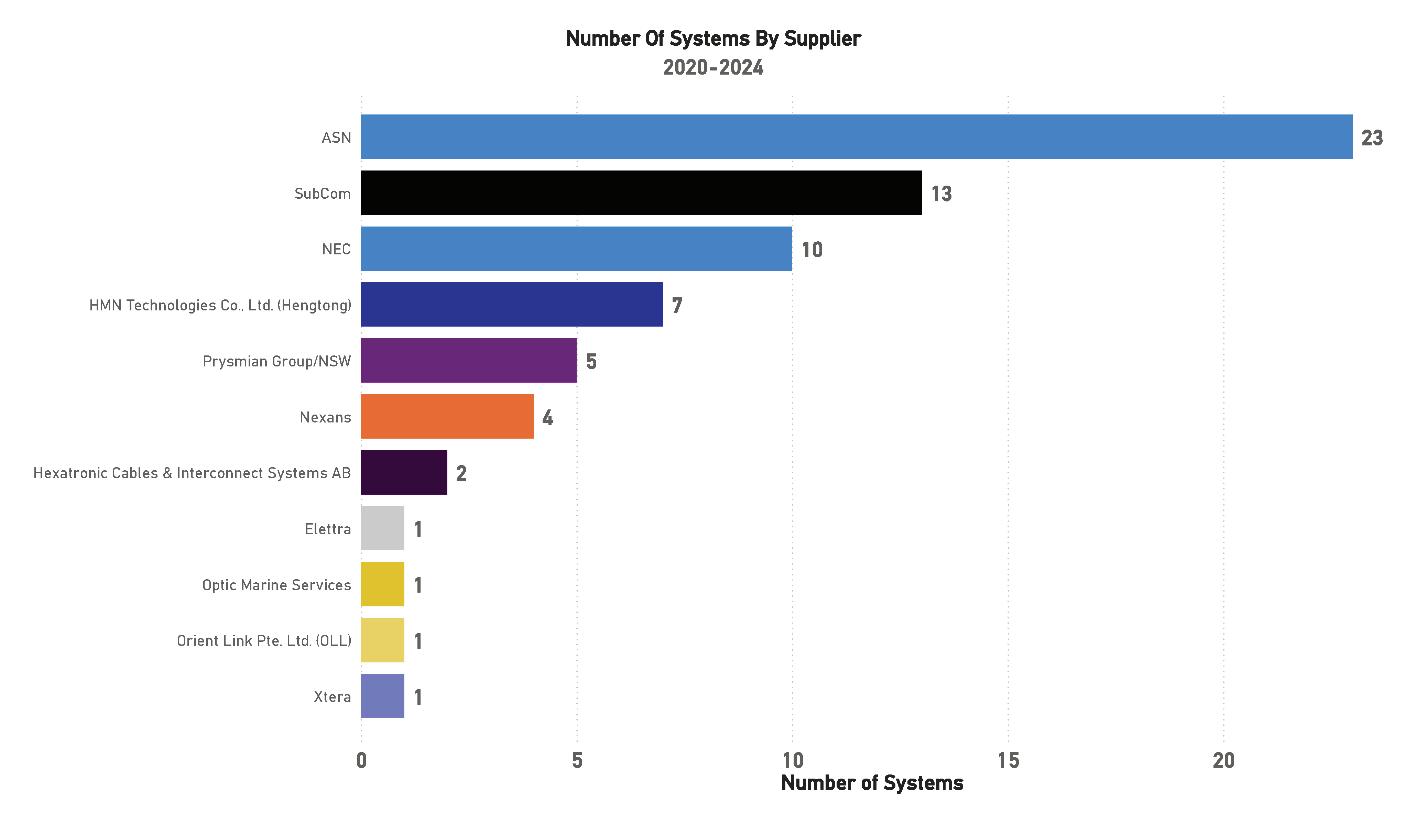
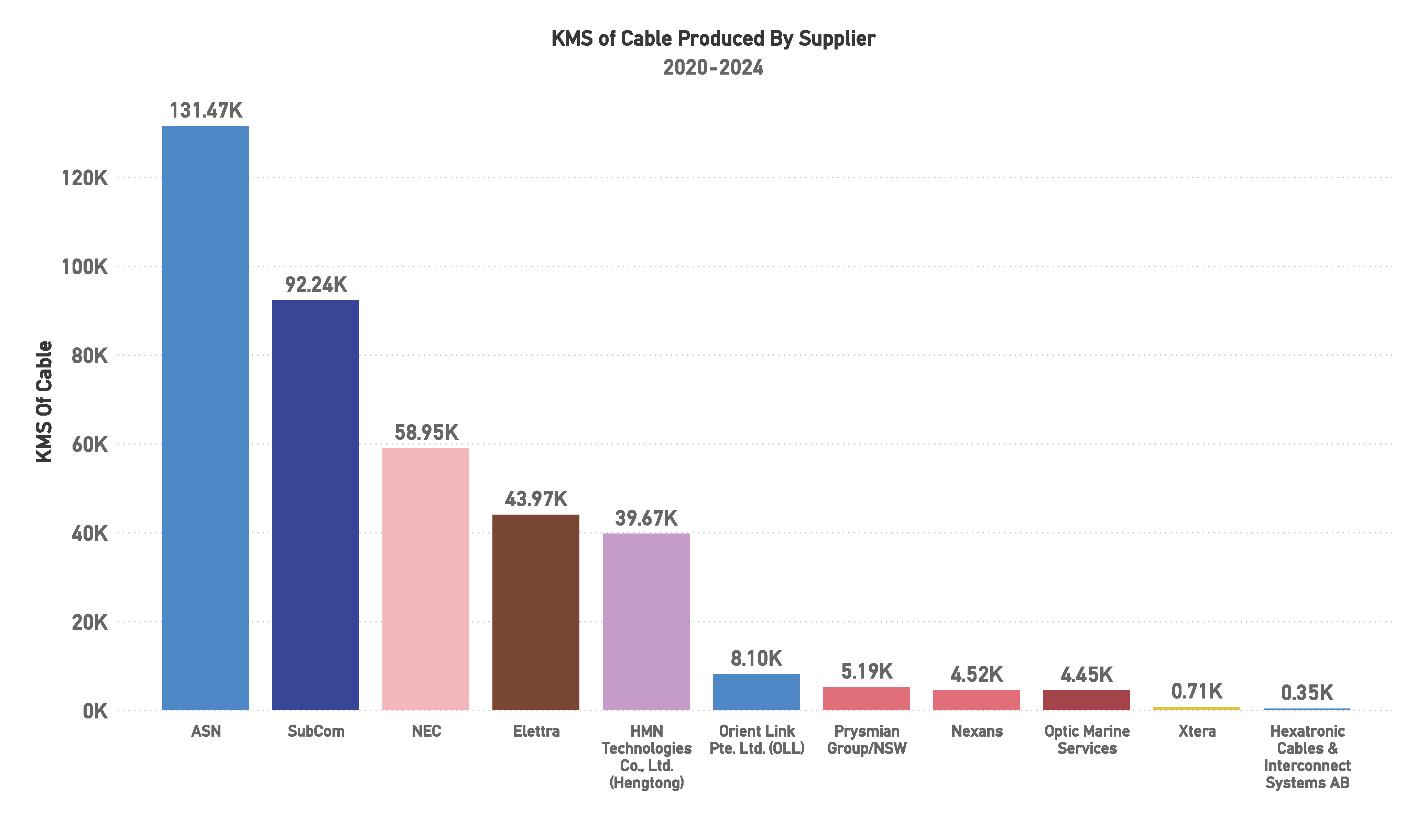
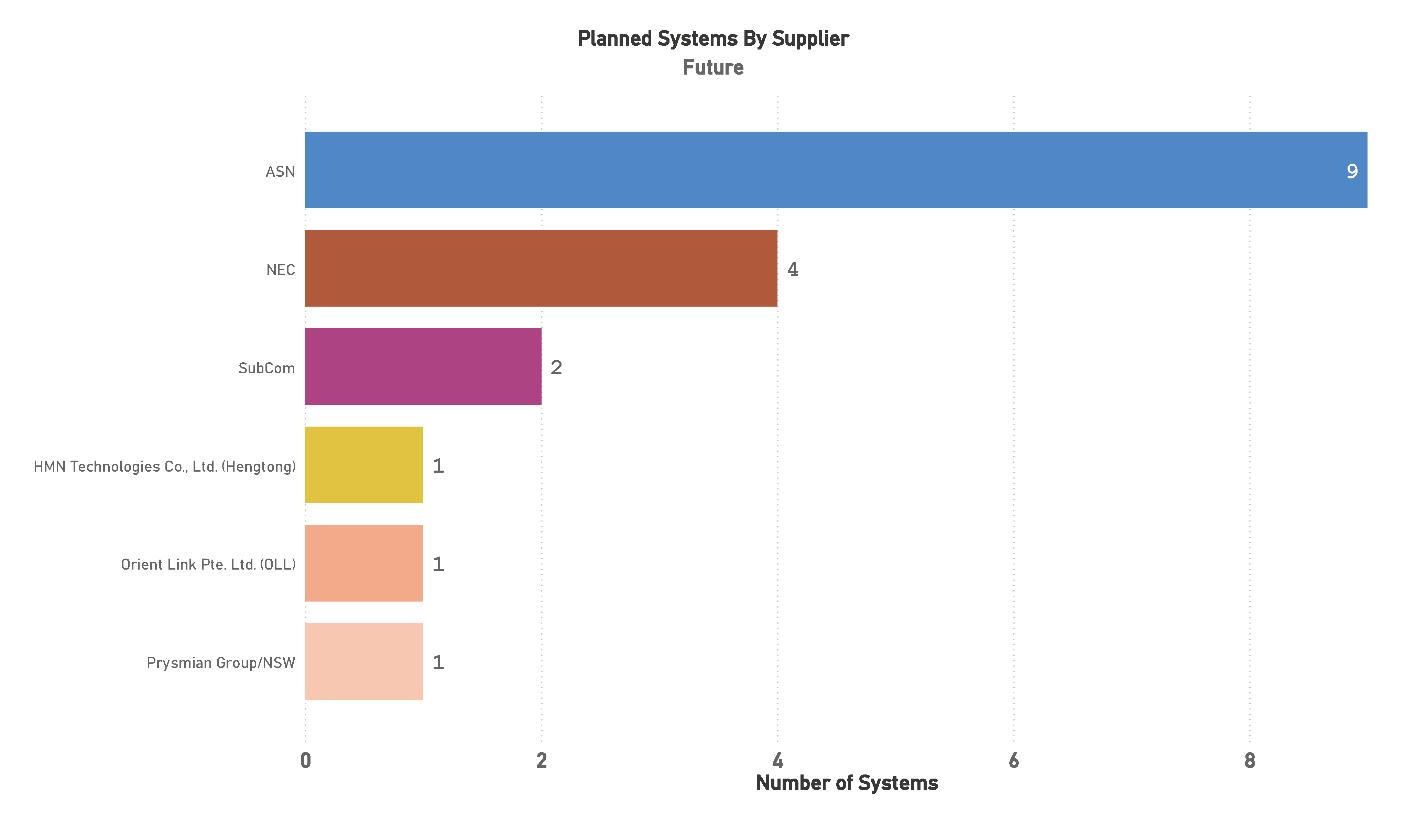
Suppliers such as Alcatel Submarine Networks (ASN), SubCom, and NEC have dominated the market from 2020 to 2024, with ASN emerging as the industry leader. These suppliers are also diversifying into offshore wind projects, capitalizing on synergies between subsea communications and energy infrastructure. Looking ahead, ASN is poised to maintain its lead in the market, with several major projects
The global submarine cable industry continues to experience dynamic growth
planned for 2024-2027. Surveying activity, a critical component of cable deployment, has also seen growth, with ASN and EGS leading the field in ensuring the safe installation of new systems.
The submarine cable industry’s regulatory landscape has evolved significantly in 2024, with global initiatives aimed at improving resilience and security. The International Telecommunication Union (ITU) and the European Commission have spearheaded efforts to foster international collaboration, creating advisory bodies and expert groups to address vulnerabilities in subsea infrastructure. In parallel, the dominance of Hyperscalers in building and controlling new cable systems has raised concerns about competition and market diversity. Regulatory strategies are being developed to protect national telecom sectors while ensuring the resilience of global connectivity.
Geopolitical tensions, particularly in regions like the South China Sea, have also impacted the industry’s regulatory focus. Security initiatives, such as NATO’s critical infrastructure monitoring, reflect the increasing global attention on safeguarding submarine cables from malicious actors. At the same time, countries such as Kenya, Ghana, and South Africa have streamlined their licensing processes for cable installation, promoting international investment. These regulatory adaptations highlight the industry’s growing importance in both economic and security contexts.
Mergers and acquisitions continue to reshape the industry landscape. Notable deals in 2024 include Nokia’s sale of a majority stake in Alcatel Submarine Networks to the French government, and Nokia’s acquisition of Infinera to bolster its optical networking capabilities. These transactions, alongside the acquisition of Telecom Italia’s Sparkle unit by KKR and the Italian government, signal a continued focus
on enhancing capacity, security, and resilience in the face of growing demand. Such moves reflect the industry’s strategic importance in maintaining global connectivity amid increasing geopolitical risks.
Across all regions, the submarine cable industry has seen steady expansion. The Americas region has added new systems to meet growing connectivity demands, though challenges such as regulatory instability and environmental risks remain. In AustralAsia, the market has matured, with Southeast Asia driving growth, while the EMEA region remains a critical hub for international connectivity, supported by ongoing and planned projects. The Indian Ocean region, a vital trans-regional connector, has made consistent progress despite logistical and political hurdles.
The Polar region, though smaller in scale, holds promise for the future, as its strategic position could reduce latency between continents. However, extreme environmental conditions and high costs present significant challenges. In the Transatlantic and Transpacific regions, Hyperscalers continue to lead growth, focusing on optimizing system performance and increasing resilience to support the growing global demand for data traffic.
The future of the submarine cable industry is poised for continued growth, with a strong emphasis on upgrading existing systems and ensuring the resilience of new infrastructure. Collaboration between governments, private companies, and international organizations will be key to navigating the financial, regulatory, and environmental challenges that lie ahead. As global data demand continues to rise, the submarine cable industry remains an essential backbone of the digital economy, providing critical links that enable global connectivity in an increasingly complex geopolitical landscape. STF
INSIDE THE WORLD OF SUBTEL FORUM: A COMPREHENSIVE GUIDE TO SUBMARINE CABLE RESOURCES
TOP STORIES OF 2019
The most popular articles, Q&As of 2019. Find out what you missed!
NEWS NOW RSS FEED
Welcome to an exclusive feature in our magazine, where we explore the captivating world of SubTelForum.com, a pivotal player in the submarine cable industry. This expedition takes us on a detailed journey through the myriad of resources and innovations that are key to understanding and connecting our world beneath the oceans.
mapping efforts by the analysts at SubTel Forum Analytics, a division of Submarine Telecoms Forum. This reference tool gives details on cable systems including a system map, landing points, system capacity, length, RFS year and other valuable data.
DISCOVER THE FUTURE: THE SUBTEL FORUM APP
CONNECTING THE DEPTHS: YOUR ESSENTIAL GUIDE TO THE SUBTEL FORUM DIRECTORY
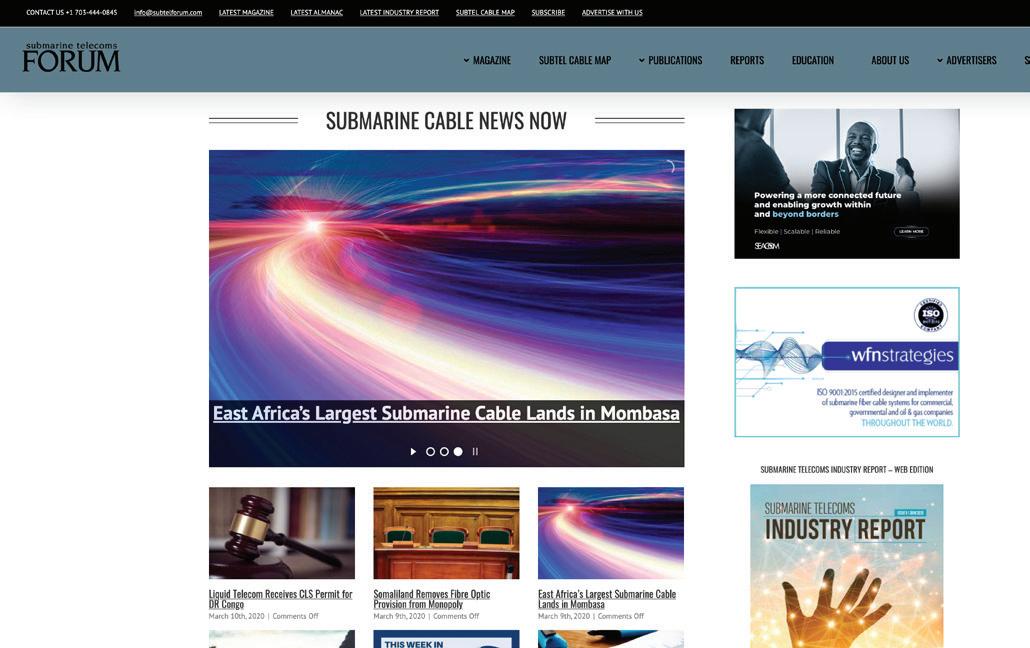
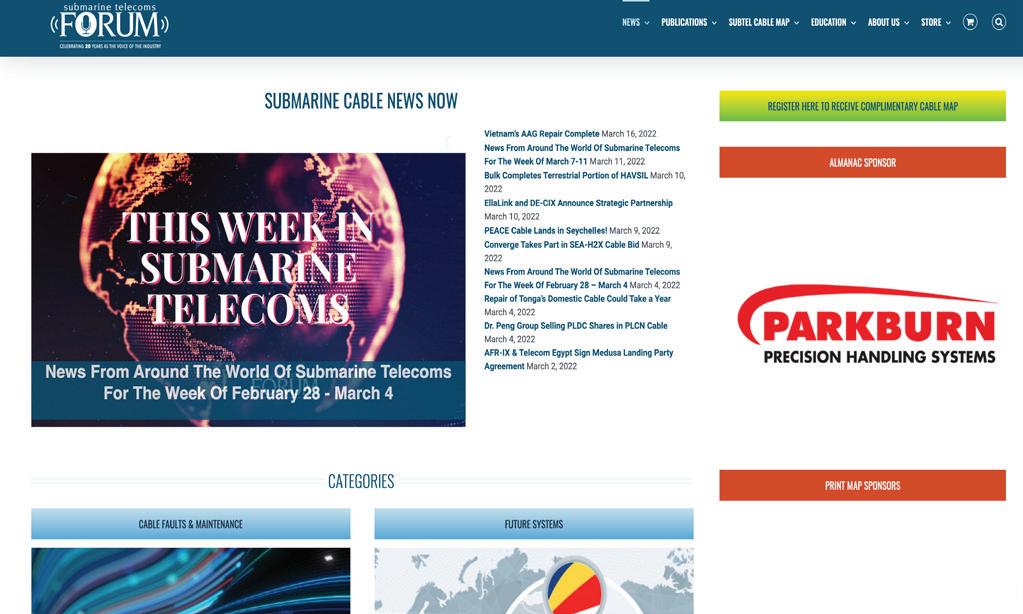
Keep on top of our world of coverage with our free News Now daily industry update. News Now is a daily RSS feed of news applicable to the submarine cable industry, highlighting Cable Faults & Maintenance, Conferences & Associations, Current Systems, Data Centers, Future Systems, Offshore Energy, State of the Industry and Technology & Upgrades.
PUBLICATIONS
Submarine Cable Almanac is a free quarterly publication made available through diligent data gathering and
Submarine Telecoms Industry Report is an annual free publication with analysis of data collected by the analysts of SubTel Forum Analytics, including system capacity analy sis, as well as the actual productivity and outlook of current and planned systems and the companies that service them.
CABLE MAP
In our guide to submarine cable resources, the SubTel Forum Directory shines as an essential tool, providing SubTel Forum.com readers with comprehensive access to an array of vetted industry contacts, services, and information. Designed for intuitive navigation, this expansive directory facilitates quick connections with leading vendors, offering detailed profiles and the latest in submarine cable innovations. As a dynamic hub for industry professionals, it fosters community engagement, ensuring our readers stay at the forefront of industry developments, free of charge.
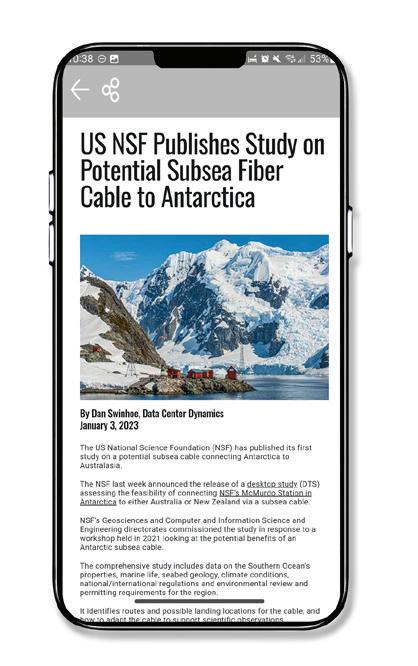
2024 marks a groundbreaking era for SubTel Forum with the launch of its innovative app. This cutting-edge tool is revolutionizing access to submarine telecommunications insights, blending real-time updates, AI-driven analytics,
The online SubTel Cable Map is built with the industry standard Esri ArcGIS platform and linked to the SubTel Forum Submarine Cable Database. It tracks the progress of
and a user-centric interface into an indispensable resource for industry professionals. More than just a technological advancement, this app is a platform fostering community, learning, and industry progression. We encourage you to download the SubTel Forum App and join a community at the forefront of undersea communications innovation.
YOUR DAILY UPDATE: NEWS NOW RSS FEED
Our journey begins with the News Now updates, providing daily insights into the submarine cable sector. Covering everything from the latest technical developments to significant industry milestones, this feed ensures you’re always informed about the latest trends and happenings. It’s an essential tool for professionals who need to stay on top of industry news.
THE KNOWLEDGE HUB: MUST-READS & Q&AS
Dive deeper into the world of submarine communications with our curated collection of articles and Q&As. These insightful pieces offer a comprehensive look at both the history and current state of the industry, enriching your understanding and providing a broader perspective on the challenges and triumphs faced by submarine cable professionals.
IN-DEPTH PUBLICATIONS
• Submarine Cable Almanac: This quarterly treasure trove provides detailed information on global cable systems. You can expect rich content including maps, data on system capacity, length, and other critical details that sketch a vivid picture of the global network.
• Submarine Telecoms Industry Report: Our annual report takes an analytical approach to the industry, covering everything from current trends to capacity analysis and future predictions. It’s an invaluable resource for anyone seeking to understand the market’s trajectory.
VISUALIZING CONNECTIONS: CABLE MAPS
• Online SubTel Cable Map: An interactive tool mapping over 550 cable systems, perfect for digital natives who prefer an online method to explore global connections.
• Printed Cable Map: Our annual printed map caters to those who appreciate a tangible representation of the world’s submarine fiber systems, detailed in a visually appealing and informative format.
EDUCATIONAL OPPORTUNITIES: CONTINUING EDUCATION
SubTel Forum’s commitment to education is evident in our courses and master classes, covering various aspects of the industry. Whether you’re a seasoned professional or new to the field, these learning opportunities are fantastic for deepening your understanding of both technical and commercial aspects of submarine telecoms.
SCAN THE QR CODE TO ACCESS ALL THE RESOURCES THAT SUBTELFORUM.COM HAS TO OFFER
FIND THE EXPERTS: AUTHORS INDEX
Our Authors Index is a valuable tool for locating specific articles and authors. It simplifies the process of finding the information you need or following the work of your favorite contributors in the field.
TAILORED INSIGHTS: SUBTEL FORUM BESPOKE REPORTS
• Data Center & OTT Providers Report: This report delves into the evolving relationship between cable landing stations and data centers, highlighting trends in efficiency and integration.
• Global Outlook Report: Offering a comprehensive analysis of the submarine telecoms market, this report includes regional overviews and market forecasts, providing a global perspective on the industry.
• Offshore Energy Report: Focusing on the submarine fiber industry’s oil & gas sector, this report examines market trends and technological advancements, offering insights into this specialized area.
• Regional Systems Report: This analysis of regional submarine cable markets discusses capacity demands, development strategies, and market dynamics, providing a detailed look at different global regions.
• Unrepeatered Systems Report: A thorough examination of unrepeatered cable systems, this report covers project timelines, costs, and operational aspects, essential for understanding this segment of the industry.
• Submarine Cable Dataset: An exhaustive resource detailing over 550 fiber optic cable systems, this dataset covers a wide range of operational data, making it a go-to reference for industry specifics.
SubTelForum.com stands as a comprehensive portal to the dynamic and intricate world of submarine cable communications. It brings together a diverse range of tools, insights, and resources, each designed to enhance understanding and engagement within this crucial industry. From the cutting-edge SubTel Forum App to in-depth reports and interactive maps, the platform caters to a wide audience, offering unique perspectives and valuable knowledge. Whether you’re a seasoned professional or new to the field, SubTelForum.com is an indispensable resource for anyone looking to deepen their understanding or stay updated in the field of submarine telecommunications.
Global Overview
INDUSTRY SENTIMENT
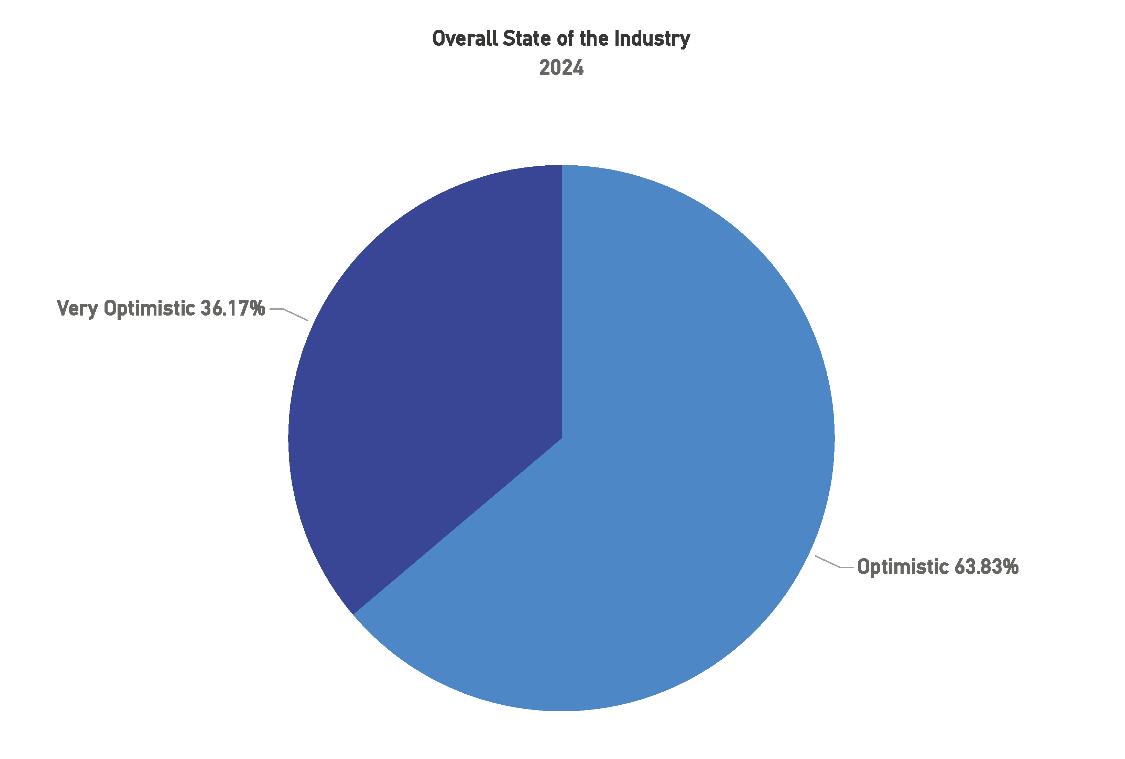
This year’s Industry Sentiment Survey received over 100 responses, maintaining consistent participation levels compared to last year. The overall outlook remains highly positive, reflecting the industry’s robust growth. The results of the survey provide insight into market optimism, work levels, regional activity, and investment trends.
The overall sentiment is optimistic, with a combined 100% of respondents selecting either “optimistic” or “very optimistic.” Notably, the “very optimistic” category saw an increase of approximately 15% from last year, which highlights the growing confidence in the industry. Respondents indicated that their businesses and the industry at large are poised for continued growth in 2024, with expectations of new projects and more active markets.
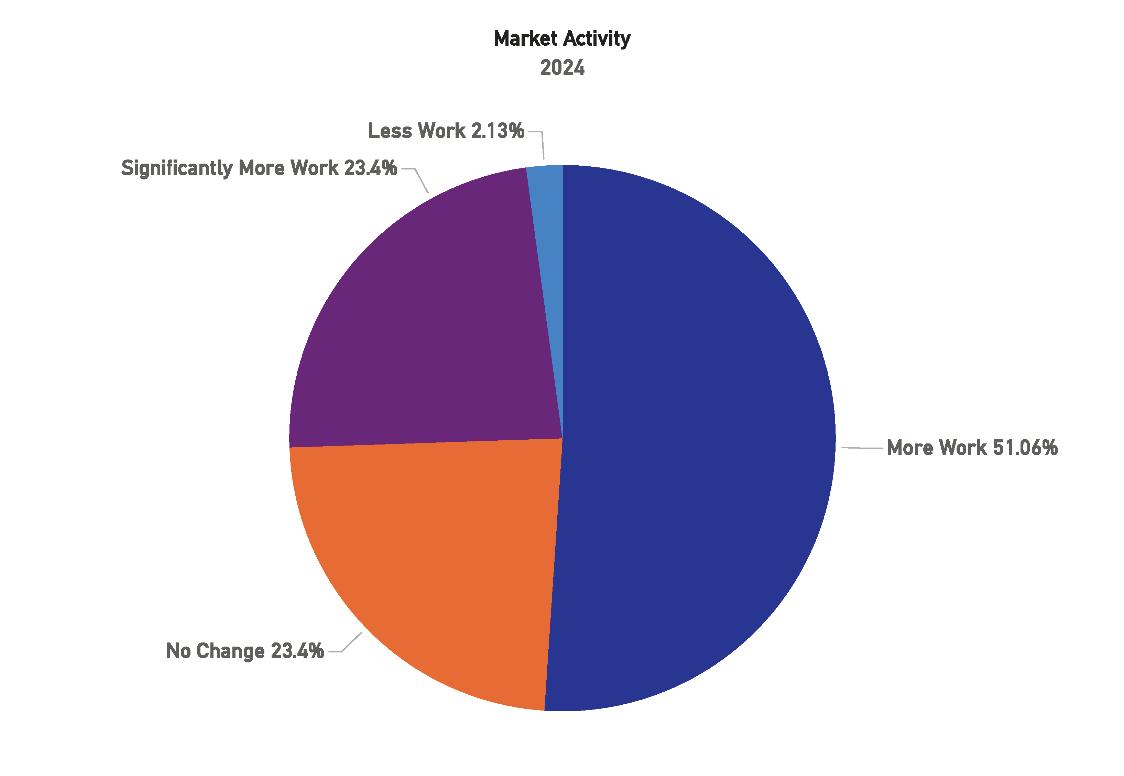
The survey also captured trends in market activity, revealing that over 50% of respondents have seen increased workloads. This reflects an ongoing demand for projects in both traditional and emerging markets. However, there is a notable balance of respondents, around 23%, reporting no change in work levels, while a smaller fraction (about 2%) saw less work than in previous years.
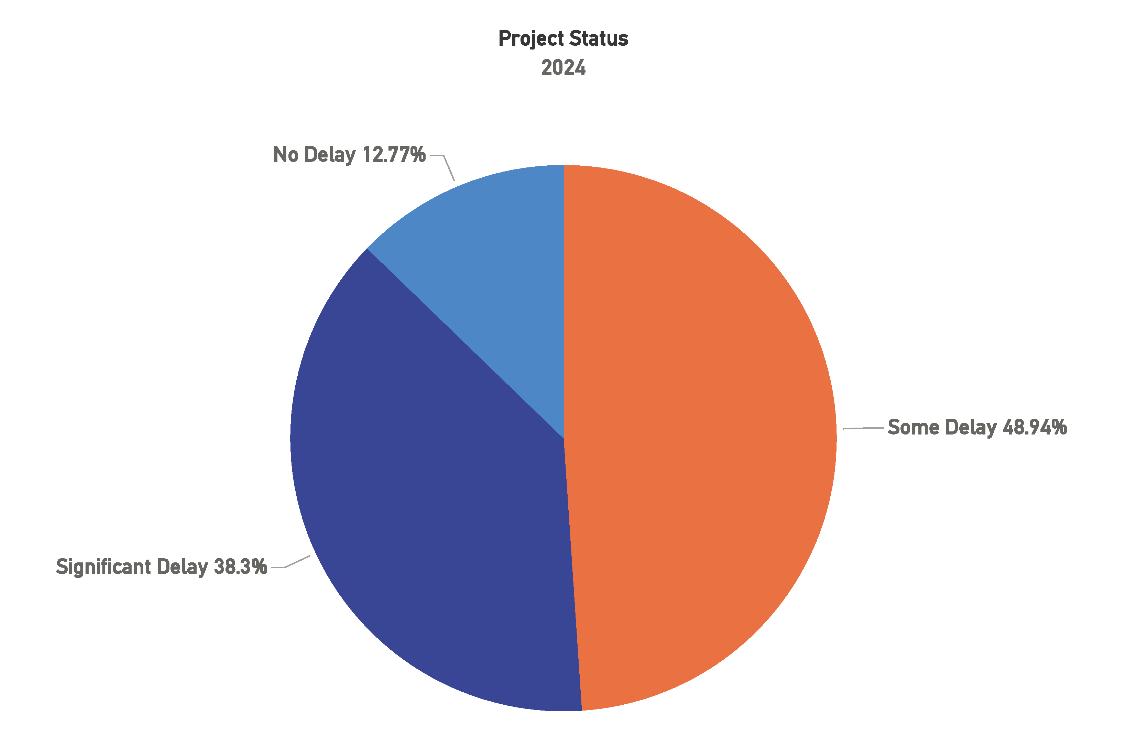
shift from last year, where delays were less prominent. This could be a reflection of the industry’s growing pains as more work pours in, straining resources and timelines.
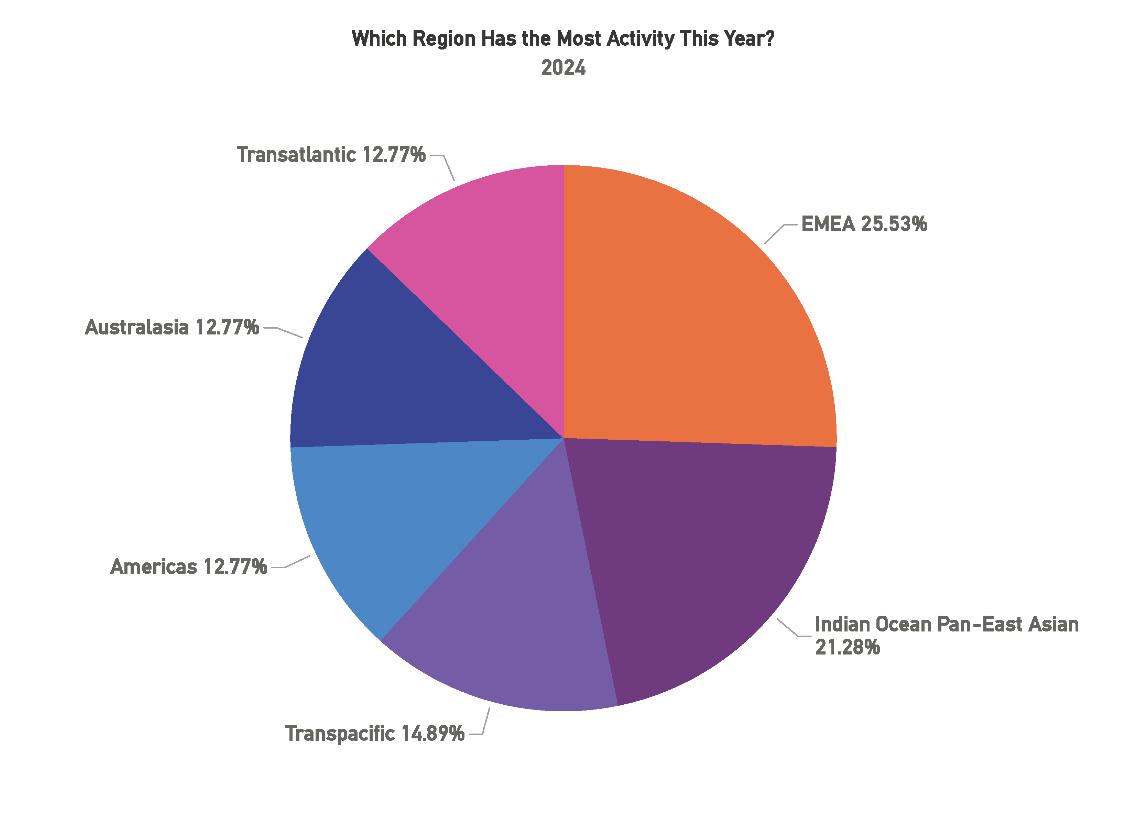
Regionally, the EMEA (Europe, Middle East, and Africa) market remains the most active, accounting for 25.53% of industry activity, with major projects like 2Africa and SeaMe-We 6 still playing a prominent role. Following closely is the Indian Ocean Pan-East Asian region, which saw over 21% of activity. Other regions, such as Australasia and Transpacific, also showed consistent work levels, indicating a broad global distribution of industry focus.
The overall sentiment is optimistic, with a combined 100% of respondents selecting either “optimistic” or “very optimistic.” Notably, the “very optimistic” category saw an increase of approximately 15% from last year, which highlights the growing confidence in the industry.
With the rise in market activity, project delays have become a growing concern. The survey showed that about 48% of respondents have faced some delays in their projects, while nearly 38% reported significant delays. This is a
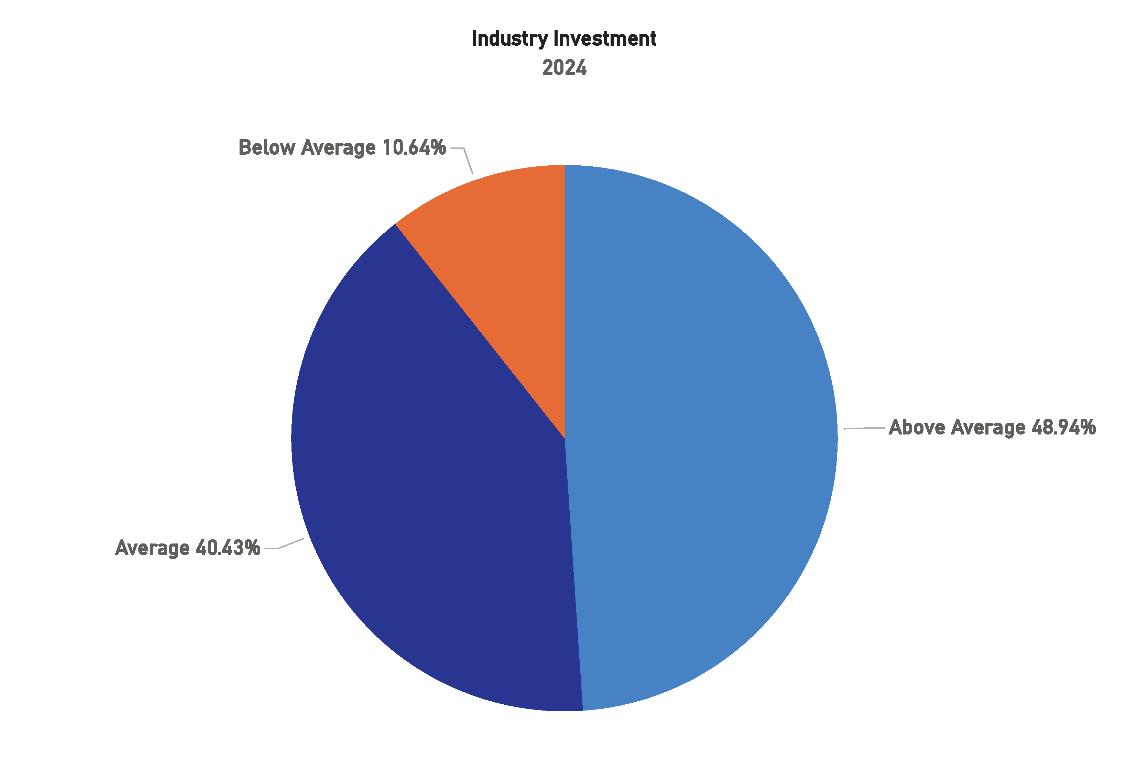
In terms of investment, nearly half of the respondents indicated that industry investment is above average, which aligns with the growing optimism. However, 10% reported below-average investment levels, a slight increase compared to previous years. This could indicate a cautious approach from some segments of the market, perhaps influenced by global economic uncertainties or concerns about project timelines.
Overall, the survey results point to a strong year for the submarine cable industry, with high optimism, growing work levels, and continued investment. However, there are challenges ahead, particularly regarding project delays and uneven regional investment. As the industry continues to expand, balancing growth with operational efficiency will be key to sustaining its positive trajectory. STF
INDUSTRY SENTIMENT
Figure 1: Overall State of the Industry
Figure 2: Market Activity
INDUSTRY SENTIMENT
Figure 3: Project Status
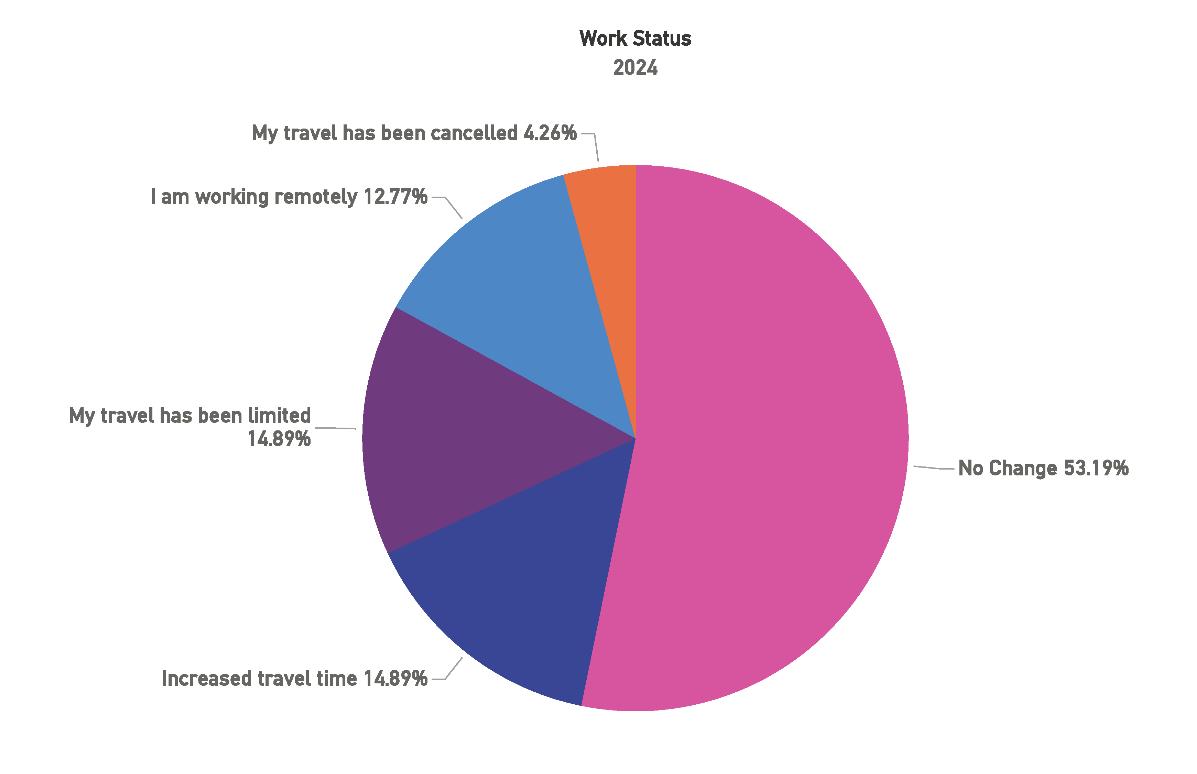
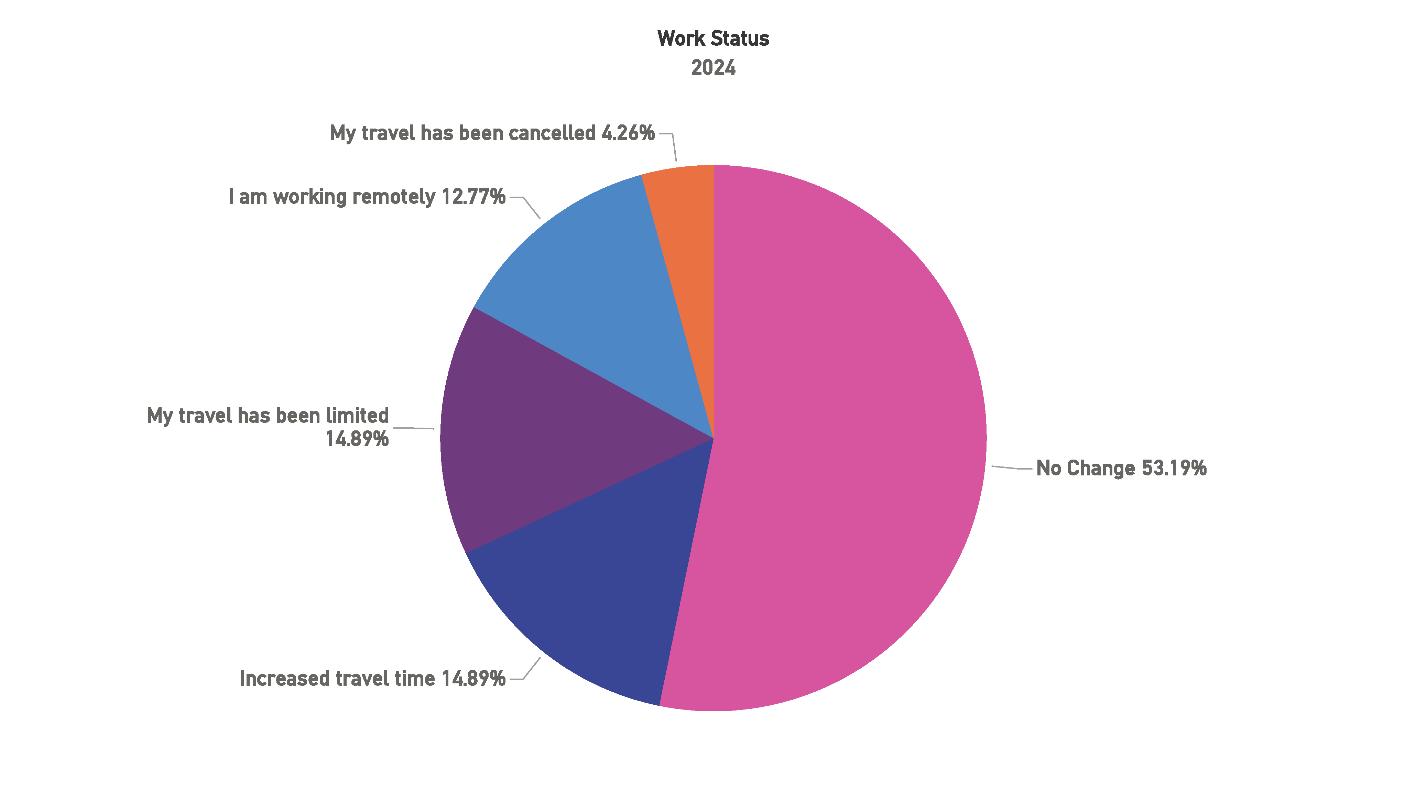
Figure 4: Work Status
INDUSTRY SENTIMENT
Which Region Has the Most Activity This Year?
Figure 5: Industry Investment
Figure 6:
GETTING TO KNOW YOU
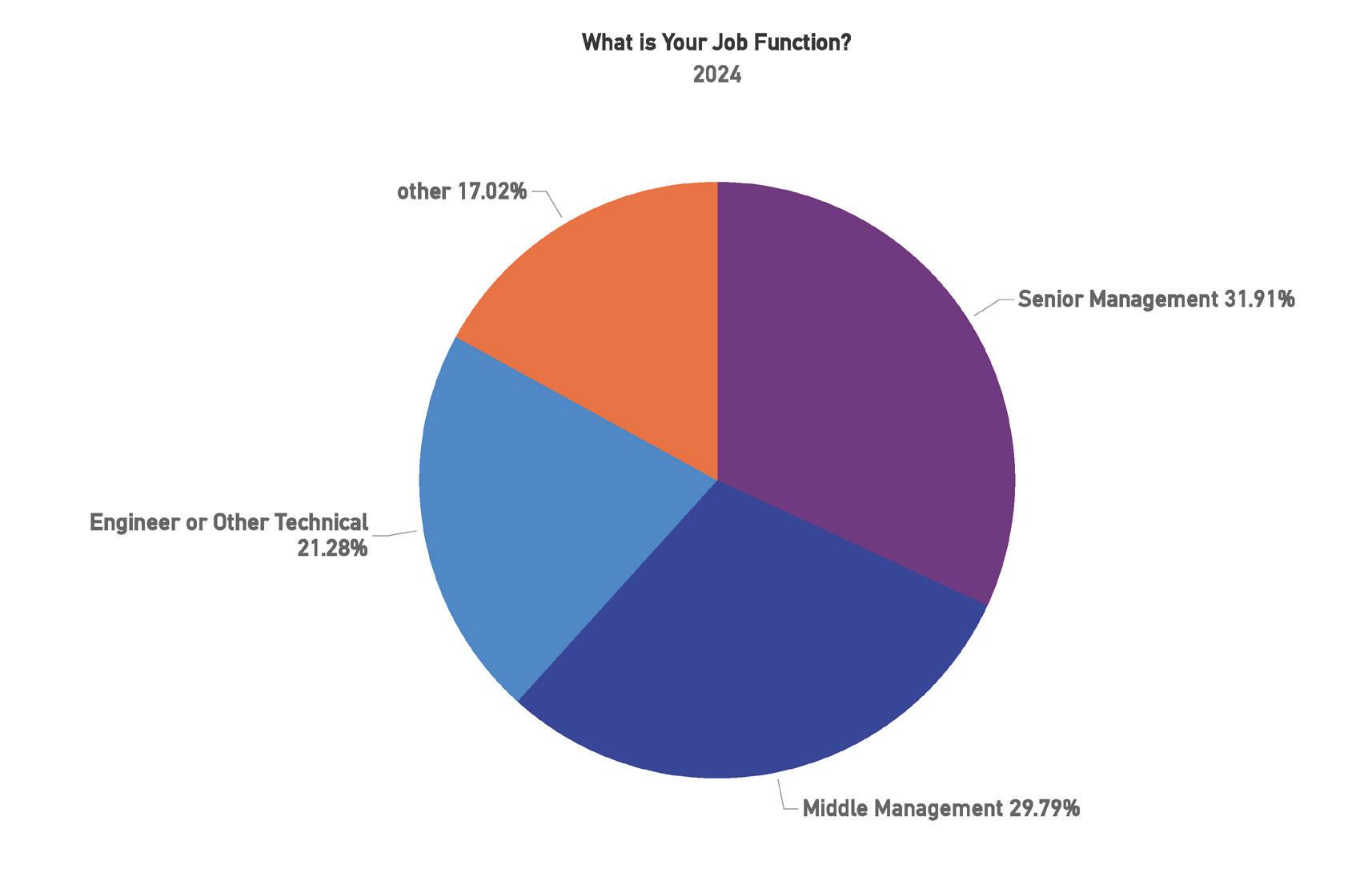
7: What is Your Job Function?
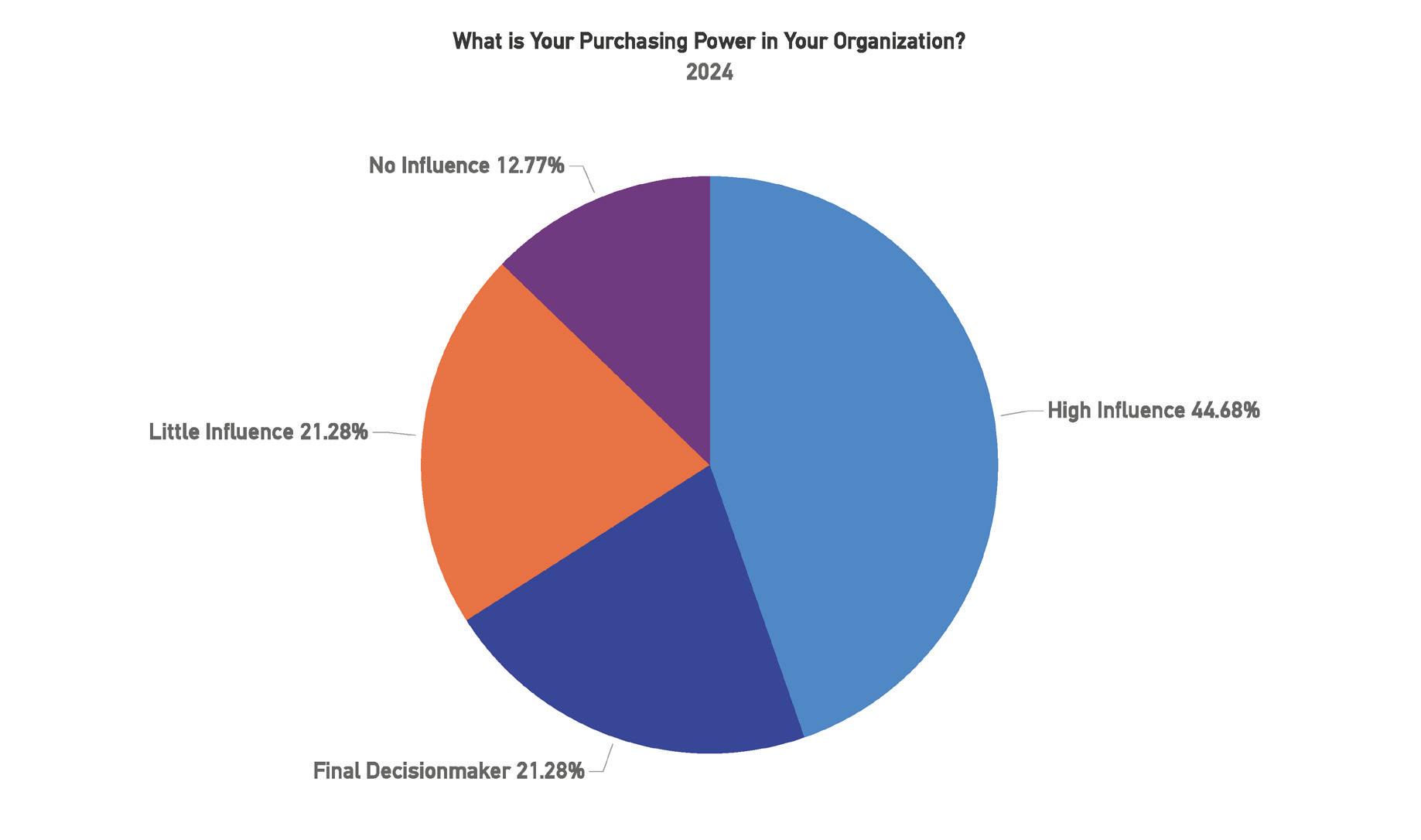
8: What is Your Purchasing Power in Your Organization?
Figure
Figure
GETTING TO KNOW YOU
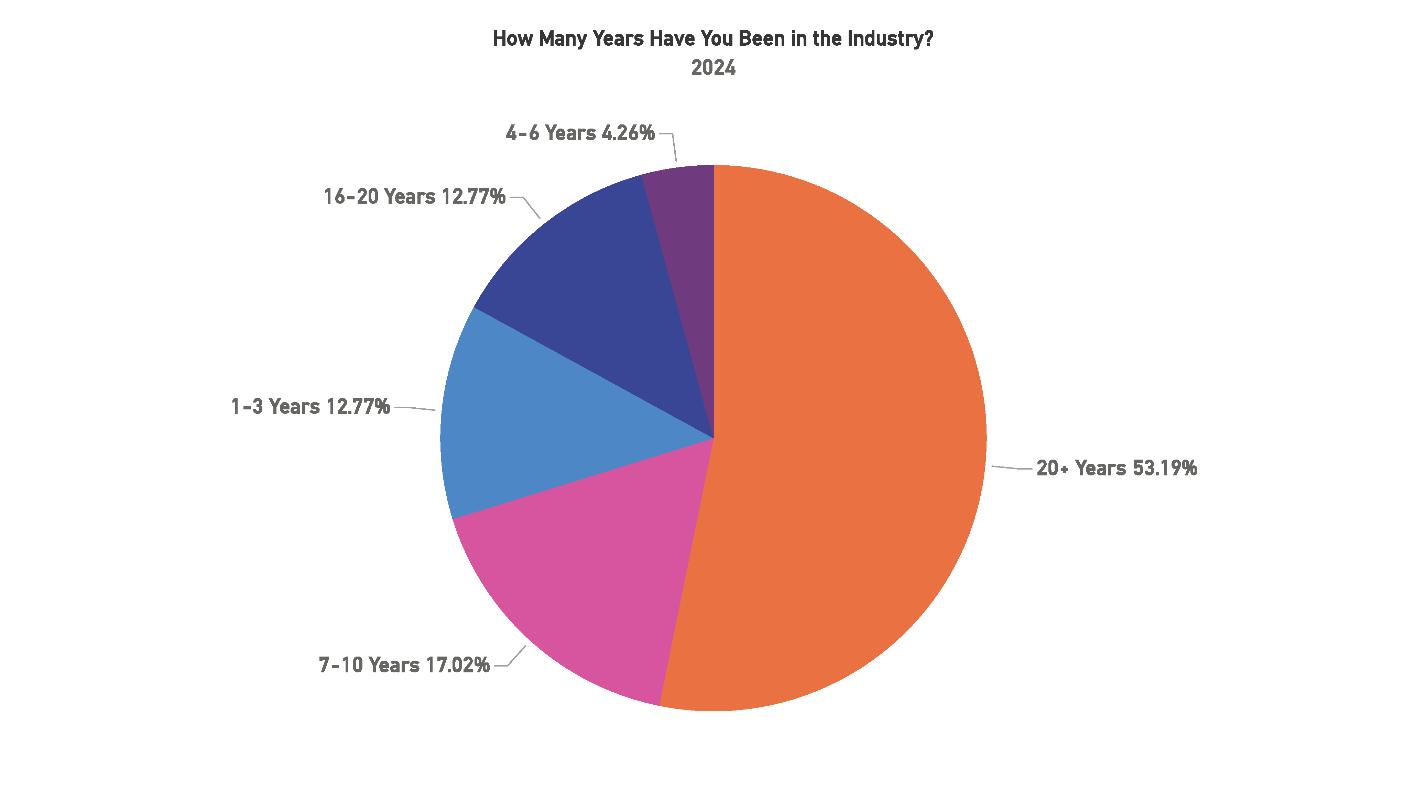
Figure 9: How Many Years Have You Been in the Industry?
Figure 10: Where Do You Reside?
REFLECTIONS FROM THE DEPTHS
A Subsea Journey: Perspectives of Phillip Pilgrim
This Back Reflections, for the 2024 Industry Report Edition, is a collection of interesting and hopefully amusing submarine telecom items. Many are from my 34 years working in the industry, past colleagues, and recent historical research in this field. Hopefully, some wisdom and a few laughs can be gleaned.
NAKED TRUTH
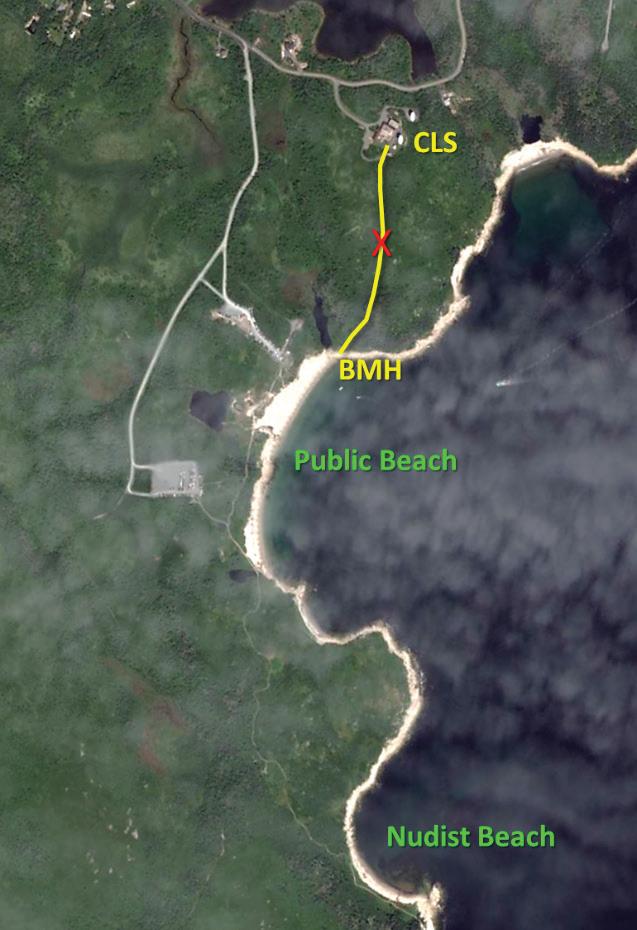
An SLTE installer was on site for a few weeks. He was part of a team installing a new system in the early 1990’s. He enjoyed nature and took a daily walk along the cable path to the beach after lunch. One day, he returned sooner than normal. He had a shocked look on his face. He met a man with nothing on but a backpack walking casually towards him along the cable path. The nudist beach was in a cove 1 km south of the beach manhole. Our CLS was 1 km to the north.
FIRE & 24 / 7 COVERAGE
Back in the 90’s, our station was growing. New construction was underway for a new wing. This was our first expansion. It would provide more room for an upcoming new submarine cable terminal and new satellite terminals. At that time, we operated 24 / 7 in three shifts: 08:00 to 16:00, 16:00 to 24:00, and 00:00 to 08:00. The full crew worked the day shift, and one man worked each back shift, with co-workers available “on call”. The facility was huge, and the technician would conduct a
walking “round” inspection every hour. On this occasion, the evening technician noted remnant welding smells during most of the evening shift, then he eventually saw smoldering in the new ceiling interface between the existing building and the expansion. It caught fire and he quickly called the local fire department. All was made good; the volunteer fire department did an excellent job. Welding from earlier in the day had ignited insulation that smoldered for hours, then eventually ignited. If the site was unmanned, much worse could have happened. These days, with submarine cable stations and submarine cable being listed as critical infrastructure, it is strange for cost saving measure to push for unmanned sites, it is strongly recommended that all reconsider the 3 top avoidances for subsea systems: Risk, Risk, Risk.
Belts and braces approach is always the best way forward. Our CLS was very remote, as are most, so experienced boots on the ground 24 / 7 is the best low-cost guarantee for a 25 year (Beginning to End-of-Life) up time.
ICE & CHRISTMAS STORMS
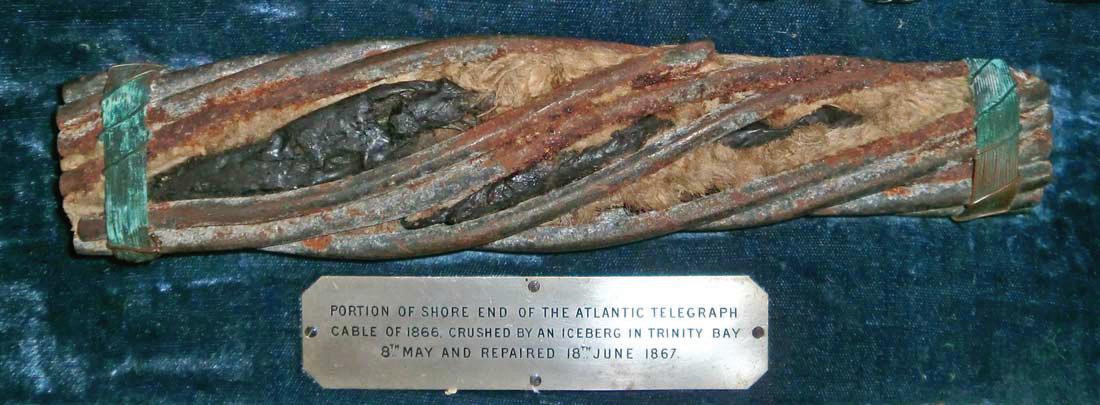
By 1867, the many cables in Atlantic Canada were damaged by ice. The wind and tides piled broken “spring” ice on the beach as if it was God’s giant bulldozer at work. The first significant North American cable of 1852, between Prince Edward Island & New Brunswick, was lost to ice as well as the 1856 and 1866 cables on this same route. Further east, the first successful transatlantic
Figure 11: Compass Error
cable of 1866 suffered the same fate, but in its case, the instigator was an iceberg in the spring of 1867. The locals and cable station staff watched the grounded berg pass through Trinity Bay, Newfoundland. It was stuck in place for about 4 days before it continued to scrape along the bottom and then cut the 1866 cable. Fortunately, the 1865 cable, in the same vicinity but deeper, was not cut, so transatlantic communications remained up.
Even to this day, ice piling on beaches damages cables. As new cable routes expand further north, it is best practice to plan for this. The earth is now passing towards its cyclical (~100,000 year) interglacial temperature peak, and the remaining northern ice will inevitably melt / break up.
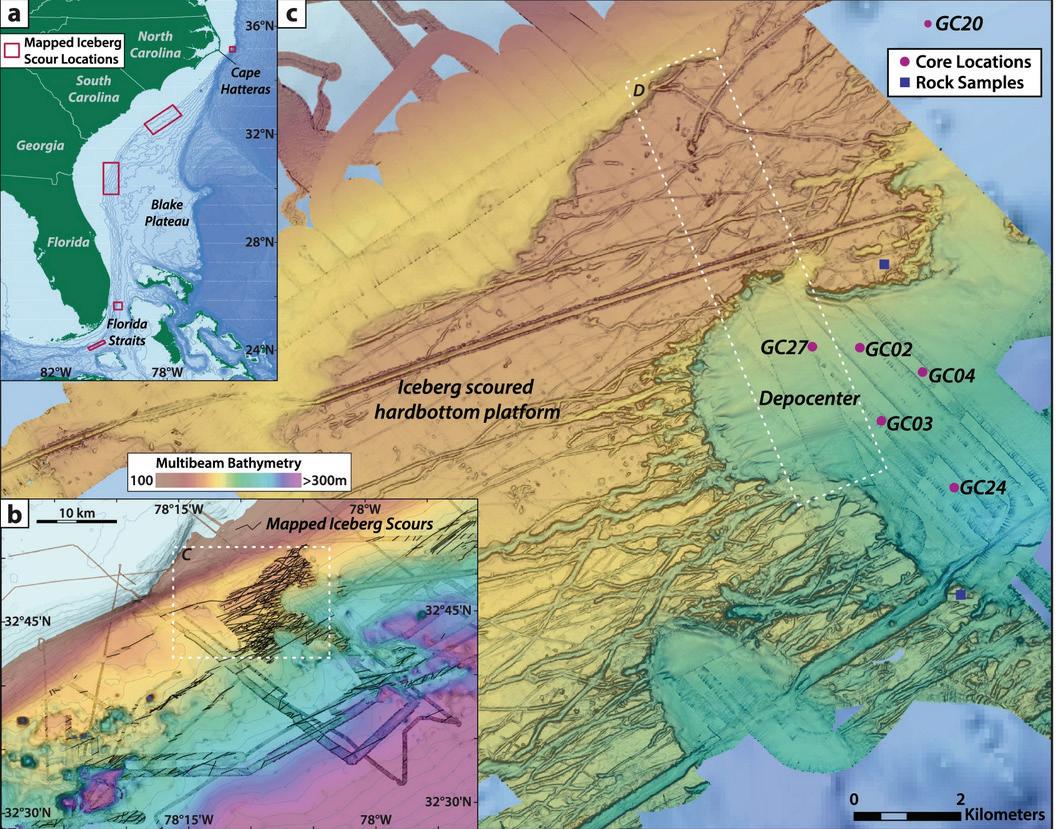
Digression: Back in the 1980’s, while in university, a fellow geophysics student landed a summer job that entailed reviewing bathometric seafloor images for iceberg scour (historical gouges where iceberg bottoms had dragged across the bottom). This work was for risk mitigation: predicting the rate and size of bergs that could cause future “discomfort” for planned oil field platforms in this area. The same data is available, and applicable, for subsea cables.
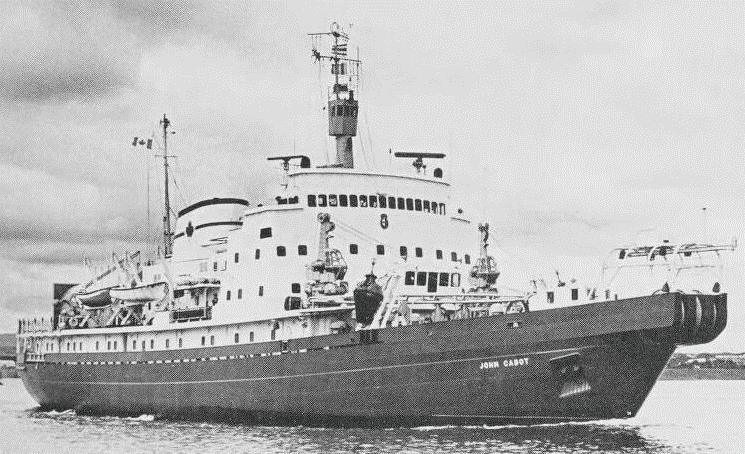
When I started in subsea telecoms in the early 90’s, my father, and many of his colleagues, had worked on submarine cables since the 1960’s. They mentioned many times that the first cables to Greenland and to Iceland that suffered greatly from icebergs. So much care and consideration were taken for repairs that icebreakers were on call to support cable ships. A famous Canadian cable ship from that time was the CS John Cabot. It was a purpose-built icebreaker / cable ship for these northern cables. It was the rescue ship of the Pieces III submersible off Ireland in 1973 and sadly, the recovery vessel in the 1985 Air India Flight 182 crash, also off Ireland, and nearly in the same location.
I also recall the story of a ship in the English Channel during the 80’s, that dragged an anchor and cut many cables. This was during the Christmas holidays when traffic and revenue was greatest. It was a significant disruption.
Digression: In the patch where I mostly worked, the North Atlantic, most cable faults were “shunt faults”. These faults are not complete cuts but are electrical “shorts”, and the cable can usually operate while damaged. In other parts of the world, such as the South China Sea, most faults are
clean cuts. Shunt faults are electrical in nature and require precise, and careful measurements, using calibrated test equipment or calibrated power feeds. Cuts are much easier to locate as the end of the optical fibre is viewed using a test instrument called a Coherent Optical Time Domain Reflectometer (COTDR). It usually has an accuracy of 300m or less. I will toot my own horn in saying that the last electrical fault I located, nearly 20 years ago, was within 200m of the fault. The ship’s crew were delighted as the ship was placed nearly right above the fault and there was no delay in the repair. This shunt fault location was carefully calculated using electrical techniques where each 1V of error placed the ship 2.5km further from the fault.
SHOCKING. SHUNTS, AND SAFETY
“Death on Contact” is the grim High Voltage warning on many power feeds. In my early career, once I had earned my transmission “chops”, I focused on locating cable faults using electrical and passive optical supervisory methods. It was an academic challenge to pinpoint the fault, as well as a considerable saving to the company. You could validate your whole year’s salary (and more) by reducing cable repair by a single day. I was very lucky to have mentors who had done this work since the 1960’s as well as new brilliant engineers to the industry like Daniel Welt and Ahmed El-Sakkary, and the brilliant trainers from AT&T
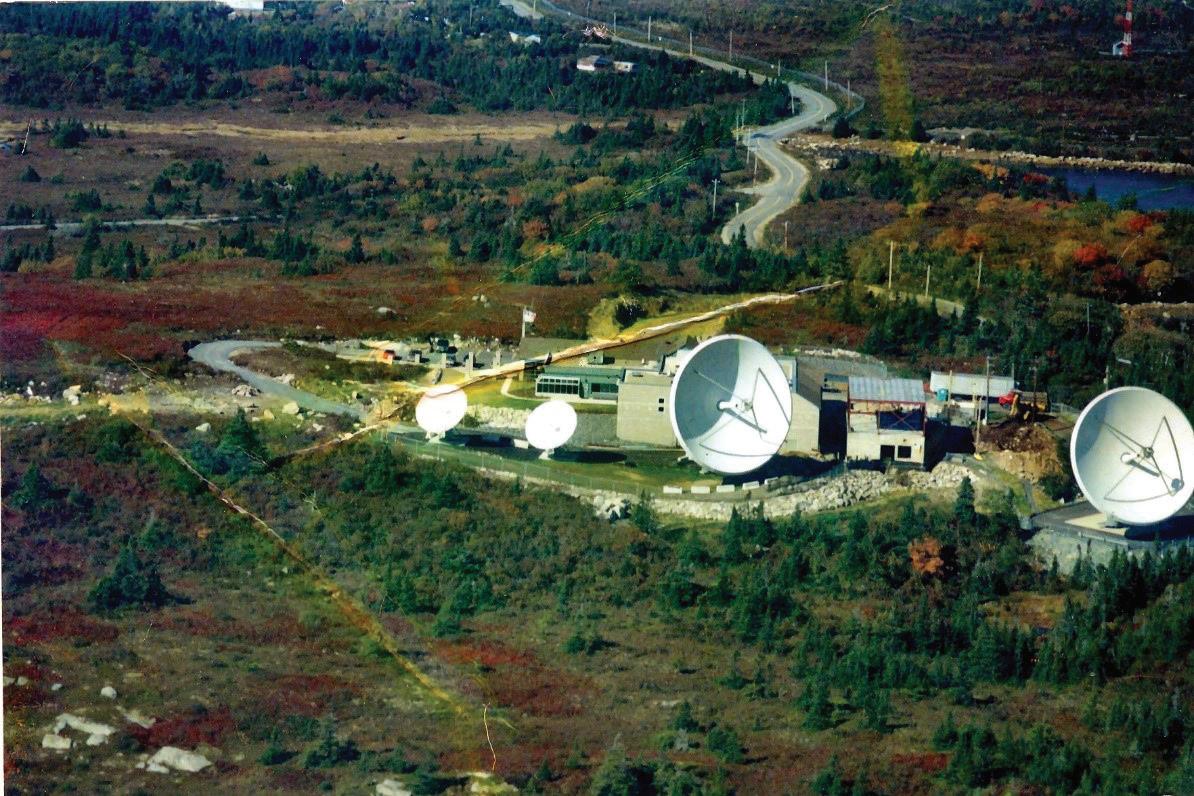
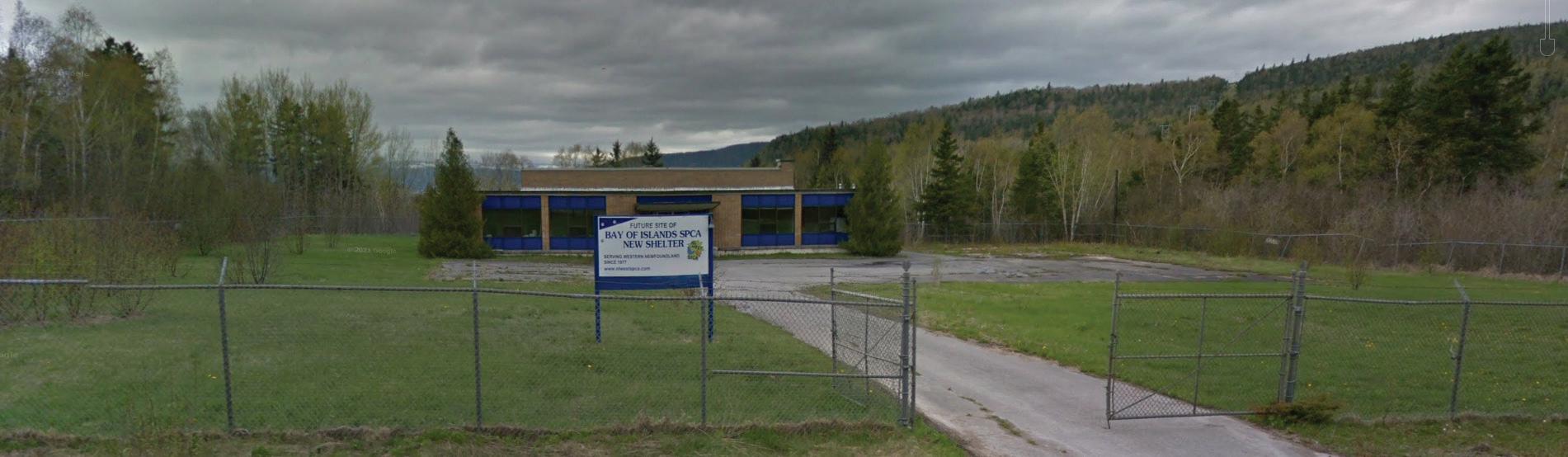
Figure 12: Third CLS Expansion (CANTAT-3), Pennant Point
Figure 16: PFE Danger
Submarine Systems Incorporated.
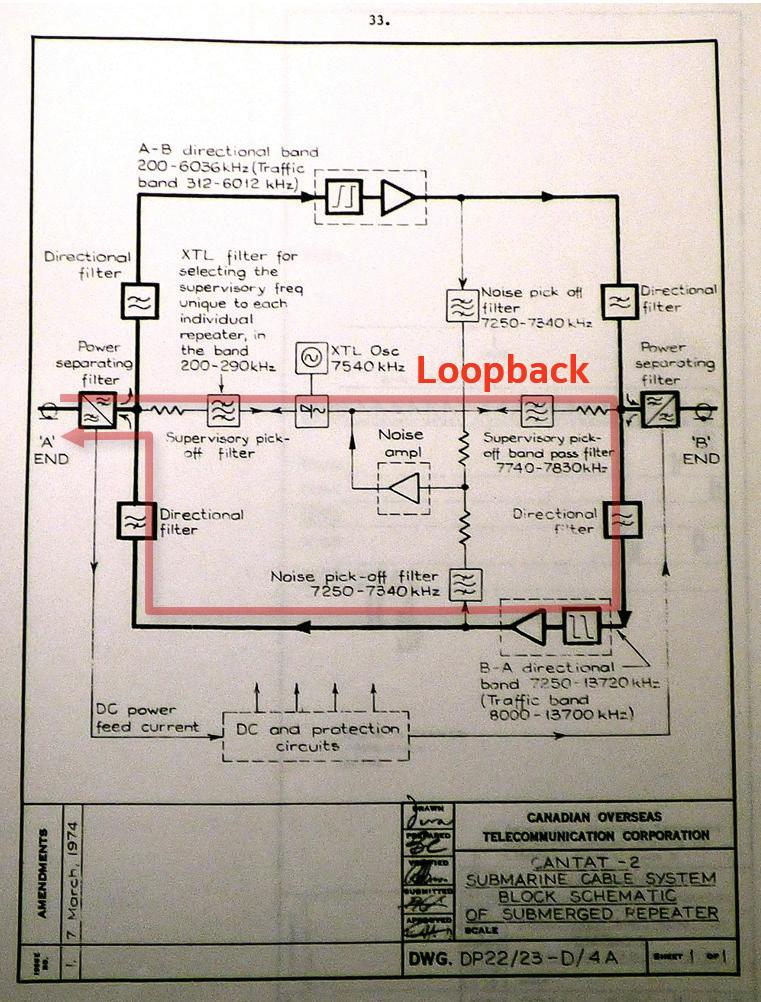
Digression: The passive loop-gain measurements now used in optical cables evolved from the same principals used on the first coaxial telephone transatlantic cables from the 1950’s. Likewise, the same electrical methods used for locating electrical faults on the power conductors of today, were used since the early telegraph cables of the 1850’s by the likes of Lord Kelvin, Michael Faraday, James Clerk Maxwell, Oliver Heaviside, the Siemens brothers, and Charles Wheatstone.
Submarine cable power supplies, aka Power Feed Equipment (“PFE” if you talk-thetalk), are just giant DC testbench power supplies that you may have used in science classes. Their maximum voltage outputs and maximum current outputs have increased over the years from literally a battery cell, made in a sewing thimble with acid, to approximately 20,000 V at 3 A these days. This makes a submarine cable as lethal as an overhead high-voltage power line. There is |ALWAYS| great risk of injuring an engineer anywhere along the cable. Because of this, comprehensive training, mechanical safety interlocks (with secure keys), power safety protocols, and safety warning stickers
are used to protect all who operate, maintain, and repair submarine cables. Although these are in place, Murphy’s law exists. Here are a few notes from my work with PFE’s over the years.
The first PFE I became acquainted with was at two years old, in 1967. My father worked on the CANTAT-1 cable and I recall being terribly startled by the sound of the motor alternator room where a matrix of whirring electrical motors sounded. These converted 60Hz AC power to a higher voltage and higher frequency. The motor alternators were a stage in the PFE’s buildup to the high voltage needed to drive the cable.
The second PFE was for CANTAT-2. It had a similar motor-alternator step-up architecture but it was not so scary in 1991. Inside this PFE was a “Hot Transfer Switch” (HTS) which was used to switch power to the cable head from a pair of PFE “cubicles” that operated in parallel. Transferring between working and standby would allow one to take a “cubicle” offline for repairs and maintenance. The HTS was a make-before-break. In our case on that day, it was a break. The HTS had failed during a scheduled maintenance transfer and dropped the cable. My well-trained elder colleagues instantly restarted the cable
Figure 14: Iceberg Scour off Florida.... Yes, Climate Does Change
and noted the cause. They saw it before. The silver coating on the switch contacts had corroded. “Go figure”: PFE’s being near beaches and exposed to remnant “salty air” 24 / 7. When the system was taken down, the faulty switch was exercised with the lights out in the equipment room to better investigate the troubled device. The switch gave a wonderous display of sparking much like you saw when Scotty cross-linked power bus A to bus B in a cramped Jeffery Tube. The new spare switch was then efficiently installed, and the cable system brought back online. The old switch was sent back to the factory for re-plating. This is the real-world stuff that MTBF, MTTR and time without a spare is based upon.... RISK, RISK, RISK.
Many interesting PFE events transpired over the next 10 years, but I’ll save them for a future “technical” article on fault locating methods. Here are three additional interesting cable power stories:
When commissioning a new cable system, I worked with an experienced engineer from the system provider. The system was still being installed, but there were many delays at sea due to the weather. All parties were keen to progress the acceptance tests, so we began the PFE testing. It was understood that the PFE being tested was connected to a test load of resistors and the cable end was terminated in the overhead racking where the outside plant cable would be pulled into the facility the following week. Upon powering, the meters on the PFE were jumping wildly. This was not expected as the PFE should have been powering into a very stable test load of resistors. Moments later two LAN engineers came white-faced and running into the equipment room. They observed HV arcing above their heads in the ladder racking in the LAN room. The PFE was directed to the cable rather than to the dummy load. This was a scary
event but also a bit comical in hindsight. As a customer, you never see all the details so I will guess that the cables inside the PFE were incorrectly connected. Fortunately, it was a low voltage PFE, and the maximum voltage was 3kV. A year later, we found the ocean ground and station ground cables crossed over in a different station. Similarly, this would have occurred during installation of the PFE and was a potentially deadly mistake: any work on the “thought to be isolated” ocean ground would have put full cable voltage on the ground cable if the ground was lifted (disconnected) at the beach.
An early “computer controlled” PFE with automated start-up had poorly written software code. When in Current-Regulation mode, it would ramp the voltage as high as it could to achieve the desired current. If the cable was open, no current would flow so the PFE would ramp the voltage to maximum then shutdown. Unfortunately, the same dangerous, and poorly written automation software, had a volatile default High Voltage shutdown. Every time the PFE was repowered, or the controller reset, the HV shutdown would return default to the maximum 18 kV. So, when the PFE ramped up int no load, it would hit 18kV then shut down. On one occasion, newly trained
Figure 17: CANTAT-2 Loop Gain Path in Repeater
Figure 15: Icebreaking Cable Ship John Cabot in 1965
engineers at this cable station were working with a cable ship and were asked to turn on the PFE and power towards the vessel. The cable ship fortunately had the cable end safely in a termination box but in open (unterminated). The newly trained engineers attempted to turn the cable up 3 times before the ship called yelling “STOP!!!”. I could imagine the sound of an 18kV arc within a metal test room on a ship.
These same PFE’s had a design challenge, where socalled “blind-mate” high voltage contacts would occasionally crack under use and arc (similar sparking like on the HTS). At this time, I was part of the team operating the system, so we took it upon ourselves to do the repair. Yours truly, with a colleague standing-by, turned off the PFE, did all safety checks, discharged all HV points, applied safety grounds, and crawled into the PFE to make the repair. 10 years earlier, I had a similar privilege of dangerous work to bypass the Resistor-Capacitor lightning arrestor array inside the beach manhole. Even when using safety grounds in the work area, voltage checks, confined-space checks, and written confirmation that all PFE’s in the system are down, it was very nervous work.
those days); and by the time you exposed these, the safety interlock procedure also depowered the equipment. Our satellite equipment, on the other hand, had no safety interlocks. With a Philip’s screwdriver, you could simply remove a back panel and expose to 30 to 50 kV power supplies and cables. The TWT and Klystron amplifiers required very high voltages to operate. The back panels were typically sharp-edged floppy sheet metal and the HV cables were soft spark-plug-like automotive cables.
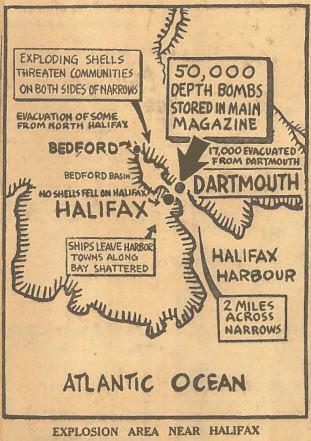
Digression: Around this same time, on a flight back to Europe, I had the privilege to sit beside an underwater ordinance remover from Holland. He was returning from his job of removing shells in Halifax Harbour. I remembered hearing on the news they were discovered in the mud on an anchor pulled onboard a waiting ship.
A final note on high voltage safety. Back in the 1990’s, our cable station was also a satellite earth station. We found it ironic that one needed to “jump through hoops” to access the high voltage areas of the submarine PFE, (~ 12kV max in
UNFIT?
Just an interesting trivia: Submarine cable (without repeater), has a Failurein-Time (FIT) of 0 per billion hours of operation. FIT values are used in statistics to estimate probabilities of failure / down time. Submarine cables are one of the most reliable devices on the planet. As an example, a deep-water section of the 1875 Direct Cable was in service into the mid 1950’s. It operated for over 75 years.
OVER THE TOP COST CUTTING
Now for your optical transmission lesson: Total Output Power of an optical repeater is often referred to as TOP. TOP is effectively how much optical power is pushed into the fibre. One would think that a higher TOP is better. For example, the Optical Signal to Noise Ratio (OSNR) at the far end, is the key metric for the performance of a submarine cable and OSNR is directly related to TOP. A higher TOP can translate to better performance BUT.... there are two other very important considerations:
1. If the TOP is too high, the optical signals are severely distorted, just as high-volume sound systems reach a point where they distort pleasant music, the invisible interactions of the high-power optical traffic signals with
molecules in the glass fibres, can deteriorate the signal’s quality significantly.
2. If the TOP is high, one could space repeaters further apart and reduce the number of repeaters in a cable. A significant initial cost saving.
I have had the good fortune to either operate, or design, o r test over 50 submarine cable systems worldwide. In general terms, system designs with a high ratio of repeater count to distance, and moderate TOP, are the best practice. These ensure maximum system performance (and capacity) for years to come. Any upfront savings on repeater count reduction are a poor trade-off for loss of traffic revenue due to loss of optical performance. Likewise, extending submarine terminals further than required will sacrifice maximum capacity & sacrifice performance. Studies can easily be done to quantify the trade-offs.
OFF-CABLE DCN & WHAT GOES AROUND, COMES AROUND: RESTORATION
A DCN is a data communication network. It is usually used for the terminal equipment at each cable end to interwork. 99.99999% of the time, an internal communication DCN network path through the working cable is fine, but when a cable is cut, this path is lost. Therefore, any cable system requires a diverse external “off-cable” network for internal communications.
of 3, we would each pull our restoration patches. The phone call went “3... 2... 1... dead silence...”. We immediately called each other, had a laugh, and verified the traffic was normalized. We both knew that our dropped phone call was also on the traffic path we were normalizing. Not ideal, but all worked out well in the end.
Although cable restoration became passé in the year 2000, when the submarine industry was turned upside down, the newer high-capacity cables of today carry so much traffic that consideration for reserving off-cable capacity for restoration, and cable restoration agreements will inevitably return.
GHOSTS & LIGHT SOURCES
Again, with this early November issue aligning well with Halloween and with All Souls Day, here is a true cable-related ghost story that will make you think twice about physics and light sources, and true sources.
In the 1990’s we worked a cable to Blaabjerg, Denmark and satellite links to Blaabjerg, Denmark. At the end of one cable repair, I was working from Canada with a cable engineer in Blaabjerg. We coordinated traffic normalization to switch the traffic from satellite restoration path back to the cable path. While on the phone, we agreed that after a count
In 1973, the CANTAT 2 submarine cable system was under construction. Teams of engineers and construction workers overwhelmed the short-term accommodations of the tiny village of Beaver Harbour Nova Scotia and vicinity. This location was the western end of the cable. Our family was one of many that relocated from Newfoundland, all families had members who had operated the older cables landing there. Other cable operators relocated from North Sydney, Nova Scotia. Engineers and managers from the offices of the Canadian Overseas Telecommunications Corporation (COTC) travelled to the area from across Canada. The system providers of STC (cable) and PYE (mux & microwave backhaul), both out of the UK, sent teams of engineers and managers to install, commission, and train. The towns in the area overflowed. Our family
Figure 20: “Faraday Station” 1875 Direct Cable Station, Torbay, Nova Scotia
Figure 21: Chekov said: “But Kiptan, the OSNR is off the scale! We would only need one repeater!”
settled for a time in a motel, then to a company trailer, others in apartments, and others in rental houses. One family from the UK rented a house across from the funeral home in the nearby town of Sheet Harbour. I recall my parents becoming friends with this family. One day, I recall my mother and her friend from the UK talking in our trailer’s living room, with very troubled looks on their faces. Years later I learned the story: My mother’s friend awoke one night in the small house with a strange man standing motionless at the end of the bed. She woke her husband who also saw the man. It was a ghost. I am not sure what occurred after that, but two eyewitnesses viewing light energy without a source certainly shows there is more to our corporal world than physics can explain. If you happen to read historical writings of Israel, you will see several references to such “light events”, so it is not really a new phenomenon, but perhaps poorly understood by most.
HOCKEY STICKS FOR EVERYONE!
Let’s end on a positive note and have a laugh at me at the same time :)
In the early 2000’s, during the dot-com boom, I was a hum-bug. I thought I was clever by theorizing that there was a maximum data consumption per-human, and the new growth curves of 2000 were not sustainable. Effectively you could assume that each human could only consume the
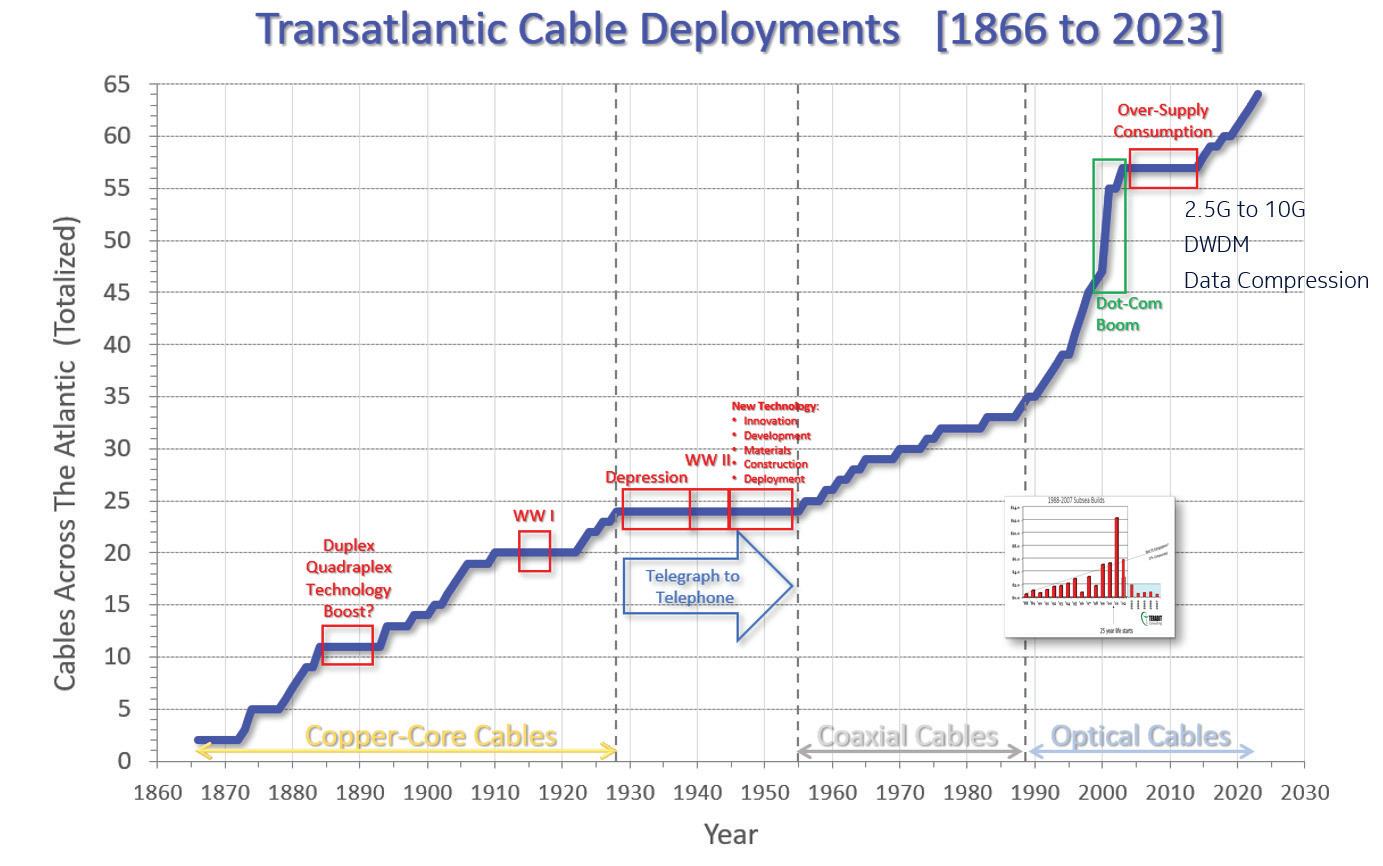
maximum data of serial video feed, at that time ~3 Gb/s for 3G-SDI. You could make corrections for statistical multiplexing, sleeping, bidirectional flow gaps, age of people, data compression, etc. Once you came up with a number, that was it, a consumption limit per human. You could then theorize that the consumed data was mostly stored or generated locally, and a small portion of the consumed data came from remote sites, requiring submarine cables for transmission. Basically, the theory distilled down to data transfer to / from a region being directly proportional to population in a modern, well-connected population. A crude calculation would go like this. Population of USA = 340 million, Maximum data stream per individual = 50 Mb/s. Total Data Consumption of USA = 17 Pb/s. If you assumed most of this data was generated locally and 10% was from overseas cables, then the USA would only need 1.7 Pb/s of total subsea capacity (to Europe, to Asia, and to South America). A contemporary SDM cable of 24 fibre pairs with 30Tb/s per fibre pair can supply 720 Tb/s. Just a few cables would provide more than my theory predicts, so I am clearly, and thankfully, wrong. Long live machine-machine comms and cute cat videos!!! So, I resigned from forecasting the future and now look backwards. Things now paint a very nice picture for our industry. Here is a plot of all transatlantic cable growth (qty) from 1866 to the present: STF
GEOPOLITICS
Perspectives of John Tibbles
INTRODUCTION
I began writing this article about three weeks ago but have constantly revised it, as there have been numerous articles about subsea cable systems in both mainstream and trade media during that time. Who would have thought this five years ago?
This is part of a series I’ve written, offering personal perspectives on the subsea world where I spent most of my career. Initially, they focused on increasing awareness of the subsea network, but they have increasingly covered geopolitical issues and their effects on our industry. Now, subsea cables are a geopolitical issue—and a significant one. How has this concerning transformation come about?
THE WHY
Cable capacity has grown massively due to the demands of the internet, providing an economic vehicle for the internet’s development—from the fledgling world wide web to the needs of hyperscale users. The network has remained highly reliable, considering its complexity. Interruptions have almost always been caused by factors such as mudslides, subsea volcanoes, and fishing, typically referred to as external aggression.
THE WHO
Governments were once more deeply involved with telecoms than they have been in recent years. Telecom operators were usually government bodies that owned the cables. However, with global telecom deregulation spreading, things became much more laissez-faire, and regulation was more about enabling than overseeing, though licenses and permits remained tricky issues. Generally, there was little interest in what telcos did or how they operated. Competition meant lower prices and new services, so all seemed well in the world.
Of course, this hands-off approach could go too far. It did when doubts began to surface about the potential that critical equipment in the new 5G mobile networks might be compromised. Could monitoring or disconnection be remotely controlled by a foreign entity? The supplier of the equipment in question was Huawei, from China. The anxiety over this issue was so great that the U.S., which had first raised the concerns, used its political influence to ensure operators in certain allied countries reconsidered using Huawei 5G equipment, which would have formed the backbone of their cellular networks.
Cable capacity has grown massively due to the demands of the internet, providing an economic vehicle for the internet’s development— from the fledgling world wide web to the needs of hyperscale users.
However, cables are global infrastructure, and eventually, geopolitics was bound to catch up. Now, “aggression” seems to mean just that: deliberate, targeted efforts to damage or disrupt a cable, or even monitor and extract the data being transported. That data carries the internet in all its forms—from international banking to amusing cat videos, from social gatherings to military secrets, from airline holiday bookings to the management of global logistics. All of this is jumbled together in a maze of commercial and state-level encoding. Thanks to the diversity of the global network, the internet can reroute itself quickly and securely. It has become the internet—and we cannot live without it.
Huawei was becoming a major player in subsea operations, offering innovative equipment and often significantly lower prices. Before long, the same alarm bells started ringing. Concerns were raised in Washington and other capitals that Huawei’s equipment might have more capabilities than advertised. It was suggested that users in those countries not only reconsider Chinese-made equipment but also avoid using cable systems with significant elements of Chinese control, such as cable stations or maintenance vessels. The result was disastrous for Huawei, which eventually sold its business to Hengtong. At the same time, China was extending its influence over the South China Sea—critical geography for Transpacific cables. Incidents and political tensions there led to the postponement of an
almost complete transpacific system and the costly rerouting of new systems.
That covered the technical concerns, but geopolitics isn’t only about technology. Russia’s invasion of Ukraine has divided international opinion and led to western sanctions. While Russia is a huge country, with minimal oceanic coastline, subsea cables matter little to them and their allies. However, many military and security bodies in the West now express concern, almost to the point of alarm, that while Russia may have little dependency on subsea cables, it doesn’t mean they fail to recognize their strategic importance and vulnerability. Deliberate damage to undersea cables is nothing new.
Technological advances and international collaborative efforts, such as those led by the International Cable Protection Committee, have greatly improved the protection of cable systems. However, these cables are now potential targets for military operations, which is a wholly different issue— cables now face deliberate threats.
THE WHERE – RESPONSES
In the last 18 months, there have been more and more media articles expressing the vulnerability of subsea systems and speculating about who might benefit from interference or eavesdropping. Memories of the Ivy Bells project during the Cold War, when U.S. submarines secretly tapped Russian cables in the northwestern Pacific, come to mind.
risk assessments regularly across the cable life cycle, taking into account technical and non-technical risk factors such as undue influence by a third country on suppliers and service providers,” or “Managing security risks, including from highrisk suppliers of undersea cable equipment.”
What does “undue influence” or “high-risk” actually mean in a market where there are only four suppliers worldwide, three in countries that signed the accord and one that didn’t, along with another 130 or so nations? If you are a nation that might be considered to exert “undue influence” or might be seen as a “high-risk supplier,” you might be China.
REACTIONS AND QUESTIONS
Does this sow the seeds of two internets: those signed up to this accord and their allies, versus those who haven’t signed because they have a different worldview or a different relationship with the country where the fourth supplier is based?
Does this sow the seeds of two internets: those signed up to this accord and their allies, versus those who haven’t signed because they have a different worldview or a different relationship with the country where the fourth supplier
is based?
Could the same thing be done with fiber optics? How can these vital but seemingly vulnerable arteries be protected? Diplomacy can be slow-moving, but this time there have been significant and rapid responses to such potential threats (and prompted more rewriting). Announcements from the U.S. State Department, the UN, and the EU have resulted in the proclamation of the ‘New York Principles.’ Although it sounds like an episode from The Sopranos, the Principles represent an accord among over thirty countries to cooperate on the security, protection, resilience, and even usage of the subsea network. These steps and actions, if adopted, might mitigate perceived risks. This is a positive approach because cables are never unilateral. They connect, at a minimum, two countries, often with several intermediate landings along their overall length of thousands of kilometers.
However, amidst the collaborative language are some curious expressions. Take, for example, “Consider security
Will this begin to divide the internet into two? If so, how will hyperscale content providers expand their businesses into developing countries, often with large populations? Will some parties view the Principles as a step toward American hegemony, not just over subsea cables but the entire seabed? Two recent articles in Australian media have expressed concern over such a possibility. It’s interesting that these concerns come from Australia—a nation with its head in the West but its body very much in the Asian hemisphere.
Can the world’s two largest economies really distance themselves from one another through the very medium that has brought the world together more than at any other time in history, despite numerous global conflicts? How will one of the world’s largest trading relationship function with no long-term internet connectivity, considering that for international data transfer, subsea cables are the internet?
SOME CONCLUSIONS
This is why I am writing this version at Cork Airport after attending the Valentia Island Subsea Cable Security and Resilience Symposium—a far-sighted event hosted by the Government of Ireland, local historical bodies, and the ICPC, where I presented a paper on subsea network resilience. Underlining the seriousness of the event was an informed keynote address from the Taoiseach (Irish PM), who traveled five hours from Dublin to speak. It was a novel, though perhaps not for long, unique event, with nearly 100 attendees.
These included European military representatives, Irish, Australian, and U.S. academics, Irish and European government officials, and numerous experts from the subsea cable industry around the world.
There were some very interesting discussions, such as how the military might protect cables and who should pay for enhanced protection—government or cable owners (the latter is the right answer, but it might not be the easiest to implement). How might certain countries react to the Principles? I was particularly struck by a presentation on this topic by someone who, in past years, would have been called a “China watcher.” Dr. April Herlevi, who speaks the language and has lived in China, offered a balanced and nuanced presentation. This gave me hope that global responses to the Principles might be equally balanced and nuanced, as China—with its 1.3 billion people—is a complex country with immense industrial and economic resources. It cannot simply be shut out from a world in which it has many friends and the capability to become the hub of a second internet.
divided Berlin. With two unconnected and politicized internets, could events like these happen again?
If you look at the footnote below, you’ll see where our meeting was held. Adorning the walls in the old cable station, now a museum, were numerous excerpts from press commentaries of the time. They all extolled the virtues of cables as bringing peace and goodwill to the world. Perhaps we should remember that.
In 1858, the first successful transatlantic telegraph cable was laid between Valentia Island and Heart’s Content in Newfoundland, Canada. It connected the Old World with the New World and forever changed the world in general.
(For more informed commentary on China and its neighboring seas from Dr. April Herlevi, see War on the Rocks.)
Do I have concerns? I do. At my age, I have vague memories of my parents’ anxiety over the Cuban Missile Crisis and a split Europe, with Russian and U.S. tanks nose to nose in
FOOTNOTE
Valentia Island is a beautiful part of County Kerry in the far southwest of Ireland. We were blessed with sunny weather that only enhanced its beauty. It is remote—three hours’ drive from Cork Airport and over five from Dublin.
So, why there? Because in 1858, the first successful transatlantic telegraph cable was laid between Valentia Island and Heart’s Content in Newfoundland, Canada. It connected the Old World with the New World and forever changed the world in general. The meeting was held in the original cable station complex, restored and maintained by the Valentia Island Transatlantic Cable Foundation (https://www.valentiacable.com/), which is working toward gaining UNESCO Industrial World Heritage Status. I wish them luck. STF
NATIONALIZING SUBSEA COMMUNICATIONS IN THE 21ST CENTURY
Perspectives of Kristian Nielsen 1.4
Subsea communication cables are the invisible backbone of the modern digital age. They carry over 95% of international data traffic, enabling everything from financial transactions to social media interactions. As global dependency on these cables intensifies, the debate over their management has gained prominence: Should governments nationalize these critical infrastructures to protect them, or should private investment continue to drive innovation and efficiency?
This article explores the complexities of managing subsea communications by examining academic insights from Stephen Korbin and D’Souza & Megginson. We will delve into the potential benefits and challenges of nationalization and privatization and consider how Public-Private Partnerships (PPPs) can offer a balanced solution that leverages the strengths of both models.
KORBIN’S INSIGHTS: UNDERSTANDING NATIONALIZATION
Stephen Korbin’s research in the 1980s provides a foundational understanding of why governments choose to nationalize industries. His studies show that nationalization is often a strategic decision driven by economic motivations, rather than political opportunism.
Stephen Korbin’s research in the 1980s provides a foundational understanding of why governments choose to nationalize industries. His studies show that nationalization is often a strategic decision driven by economic motivations, rather than political opportunism. It is typically selective, targeting industries of strategic importance, such as oil and telecommunications, where national control can significantly influence economic stability and security.
One of Korbin’s key concepts is the ‘Domino Effect.’
During the 1970s, Libya’s decision to nationalize British Petroleum’s assets inspired a wave of similar actions across the Middle East. Countries like Algeria, Iraq, and Iran followed suit, driven by a desire to control their natural resources and assert economic sovereignty. These actions were not merely reactive; they were part of a broader strategic effort to increase state revenue and reduce foreign dependency. Korbin’s methodology was rigorous. He analyzed political and economic factors across a broad range of countries and industries from 1960 to 1980. By identifying patterns and outcomes of nationalization efforts, he highlighted how these actions align with broader national goals. His research suggests that governments may consider nationalizing subsea cables for similar reasons: to protect national interests, secure critical infrastructure, and reduce reliance on foreign entities.
THE CONSEQUENCES OF NATIONALIZATION: A DECLINE IN INNOVATION
While nationalization can increase state control over critical assets, it often comes at a cost—particularly to innovation. Several factors contribute to this decline:
1. Reduced Incentives for Innovation: Nationalized companies typically focus on stability and employment rather than risk-taking and innovation. In Venezuela, for example, after the nationalization of the oil industry in 1976, the state-owned company PDVSA initially maintained high levels of technical competence. However, over time, po-
litical interference and underinvestment in research and development (R&D) led to a significant decline in technological advancement. By the early 2000s, PDVSA’s exploration and production capabilities had deteriorated compared to its global peers.
2. Bureaucratic Constraints: State-owned enterprises (SOEs) often have less flexibility in decision-making due to bureaucratic structures. A study by the OECD on SOEs across various sectors found that these entities generally have lower productivity and innovation levels compared to private firms. The lack of competitive pressures and profit incentives reduces the urgency to innovate, leading to stagnation.
3. Decreased R&D Investment: Nationalization frequently results in a decline in R&D spending as funds are redirected toward meeting state priorities. In the telecommunications sector in Latin America during the 1980s, state-owned companies were slow to adopt advancements like digital switching and fiber optics. The privatization wave in the 1990s led to a surge in innovation and infrastructure upgrades, highlighting the innovation gap during the period of state ownership.
assets, marking the start of a broader nationalization campaign across its oil sector. This action significantly increased state revenues and reduced foreign influence, allowing Libya to assert its economic sovereignty.
The impact was profound. Libya gained control over its most valuable asset and set a precedent that inspired other countries in the region, such as Algeria, Iraq, and Iran, to take similar actions. However, the nationalization of Libya’s oil industry also had drawbacks. The efficiency of the sector declined as state-owned companies lacked the technological expertise and management skills of their private predecessors. This led to decreased production capacity and strained relations with foreign investors and governments.
This case illustrates the double-edged sword of nationalization: while it enhances state control and revenue, it can also lead to operational challenges and reduced efficiency.
D’SOUZA & MEGGINSON: THE CASE FOR PRIVATIZATION
State-owned enterprises (SOEs) often have less flexibility in decision-making due to bureaucratic structures.
A study by the OECD on SOEs across various sectors found that these entities generally have lower productivity and innovation levels compared to private firms.
4. Shift in Operational Focus: Nationalized industries often prioritize strategic goals over profitability. In the Indian banking sector, for instance, nationalization led to an increased focus on financial inclusion and employment generation. While these are valuable social objectives, they were achieved at the expense of technological innovation and service improvement.
These examples illustrate the complex trade-offs associated with nationalization. While it provides governments with greater control over critical industries, it often results in a decline in innovation and efficiency. For the subsea communications industry, where technological advancement is crucial for maintaining secure and reliable connections, these potential drawbacks are particularly concerning.
CASE STUDY: NATIONALIZATION OF THE LIBYAN OIL INDUSTRY
A prime example of nationalization is the Libyan oil industry in 1970. Driven by rising nationalism and a desire to control its resources, Libya nationalized British Petroleum’s
In contrast to Korbin’s findings on nationalization, D’Souza & Megginson provide a compelling argument for privatization. Their analysis of 85 countries found that privatization often leads to significant performance improvements, particularly in utilities and telecommunications. Privatized firms tend to be more profitable, efficient, and innovative due to competitive pressures and a focus on profitability.
A notable example is the privatization of Mexico’s national telecommunications company, Telmex, in the 1990s. Before privatization, Telmex struggled with inefficiencies, poor service quality, and limited network coverage. However, after being sold to private investors, including Grupo Carso, led by Carlos Slim, Telmex underwent a remarkable transformation. The company invested heavily in expanding its network, improving service quality, and modernizing its infrastructure. Within a decade, the number of fixed telephone lines had nearly doubled from 6.4 million in 1990 to over 12 million by 2000.
This example illustrates the potential benefits of privatization: increased efficiency, better service, and greater investment in infrastructure. However, it also raises questions about accessibility and affordability, as privatized entities often prioritize profitability.
THE MIDDLE GROUND: PUBLIC-PRIVATE PARTNERSHIPS IN SUBMARINE CABLES
Public-Private Partnerships (PPPs) have emerged as a viable middle ground, blending the benefits of both nationalization and privatization. In the submarine cable industry, PPPs bring together the resources, expertise, and capital of private companies with the regulatory support and strategic oversight of governments. These partnerships are particularly effective for large-scale projects that require significant investment and have strategic importance.
PPPs enable governments to maintain a degree of control and influence over critical infrastructure while benefiting from private sector efficiency and innovation. They help share the financial and operational risks associated with these projects, which are often too large and complex for a single entity to handle alone.
CASE STUDY: THE HAWAIKI SUBMARINE CABLE
One of the most successful examples of a PPP in the submarine cable industry is the Hawaiki Submarine Cable, which connects the United States, Australia, New Zealand, and several Pacific islands. This 15,000-kilometer cable provides high-capacity connectivity across the Pacific region, enhancing digital connectivity for millions of people.
The project was developed through a partnership between Hawaiki Submarine Cable LP, a private company, and several government entities. The New Zealand government, through its Crown Infrastructure Partners, invested in the project to ensure that it met the country’s national broadband objectives. This involvement was crucial in addressing New Zealand’s reliance on existing trans-Pacific cables, which were nearing capacity.
and the Solomon Islands. This 4,700-kilometer cable was developed through a public-private partnership, with the Australian government contributing AUD 137 million, covering about two-thirds of the project’s total cost. The remaining investment came from private sector partners and the governments of Papua New Guinea and the Solomon Islands.
The Coral Sea Cable System is part of Australia’s broader strategy to provide secure and reliable internet infrastructure in the Pacific region, countering potential influence from Chinese state-linked companies. By participating in this project, the Australian government not only improved regional connectivity but also strengthened its strategic influence in the Pacific. This case demonstrates how PPPs can serve as tools for strategic geopolitical influence, ensuring that infrastructure development supports both economic growth and national security objectives.
Public-Private Partnerships (PPPs) have emerged as a viable middle ground, blending the benefits of both nationalization and privatization. In the submarine cable industry, PPPs bring together the resources, expertise, and capital of private companies with the regulatory support and strategic oversight of governments.
CASE STUDY: ASIA-AMERICA GATEWAY (AAG) SUBMARINE CABLE SYSTEM
The strategic importance of the Hawaiki cable cannot be overstated. It provides critical internet redundancy for New Zealand and reduces the country’s dependency on other cables, thereby enhancing both resilience and security. This partnership exemplifies how PPPs can align commercial viability with national strategic interests.
CASE STUDY: THE CORAL SEA CABLE SYSTEM
Another noteworthy example is the Coral Sea Cable System, which connects Australia with Papua New Guinea
The Asia-America Gateway (AAG) Submarine Cable System, which connects Southeast Asia with the United States, is another example of a successful PPP. This 20,000-kilometer cable system provides connectivity to countries like Malaysia, Thailand, Singapore, the Philippines, and Vietnam. It involves a consortium of stateowned and private sector telecom companies, including Telekom Malaysia and PLDT (Philippines). Governments supported the project through regulatory facilitation and, in some cases, direct investment from state-owned telecom operators. The AAG cable system is strategically important as it provides an essential data route between Southeast Asia and the U.S., reducing dependency on other trans-Pacific cables and enhancing connectivity for the participating countries. This example highlights how PPPs can effectively balance the need for strategic control with the benefits of private sector participation.
THE BENEFITS OF PUBLIC-PRIVATE PARTNERSHIPS IN SUBMARINE CABLES
Public-Private Partnerships offer several key benefits in the submarine cable industry:
1. Risk Sharing: One of the primary advantages of PPPs is the distribution of financial and operational risks between
the public and private sectors. This approach enables large-scale projects, such as the Coral Sea Cable System, which would be too risky for a single entity to undertake alone.
2. Access to Capital and Expertise: PPPs allow governments to leverage private investment and technical expertise. In the case of the Hawaiki cable, private sector efficiency in design, deployment, and maintenance was complemented by public support to ensure the project met national infrastructure goals.
3. Alignment with National Interests: Governments can ensure that submarine cable projects align with national security and economic development goals. The New Zealand government’s investment in the Hawaiki cable ensured that the project supported the country’s broadband objectives.
4. Enhanced Infrastructure Development: PPPs can accelerate the deployment of critical infrastructure, especially in underserved regions. The Asia-America Gateway improved connectivity for multiple Southeast Asian countries, fostering regional economic growth.
to operational inefficiencies and a decline in innovation. The case of Libya’s oil industry, where nationalization increased state control but eventually led to reduced efficiency and technological stagnation, validates Korbin’s conclusions.
On the other hand, D’Souza & Megginson’s research shows that privatization enhances performance through improved profitability, efficiency, and innovation. This is exemplified by the transformation of Mexico’s Telmex, which moved from being a stateowned entity with limited network coverage and poor service quality to a profitable, innovative company with widespread service improvements and infrastructure expansion.
As global dependency on subsea cables continues to grow, the decisions made today will shape the future of global connectivity and security. By adopting a hybrid model that integrates the strengths of both public and private sectors, we can ensure that this critical infrastructure remains robust, efficient, and secure for years to come.
5. Strategic and Geopolitical Influence: By participating in submarine cable projects, governments can enhance their strategic influence in key regions. The Coral Sea Cable System is a clear example of how infrastructure development can also serve as a tool for geopolitical strategy.
CONCLUSION: BALANCING CONTROL AND EFFICIENCY WITH CASE STUDIES AS VALIDATION
The academic findings from Korbin and D’Souza & Megginson provide valuable insights into the debate over nationalization versus privatization in the subsea communications industry. Korbin’s research demonstrates that while nationalization can secure strategic interests, it often leads
These academic insights align with the outcomes of PPPs in the submarine cable industry. The Hawaiki Submarine Cable and the Coral Sea Cable System demonstrate how PPPs can effectively combine the strengths of both models. The New Zealand government’s investment in the Hawaiki cable ensured alignment with national strategic interests while leveraging private sector efficiency and innovation. Similarly, the Australian government’s involvement in the Coral Sea Cable System enabled the project to support regional security goals while benefiting from private sector participation.
These case studies validate the academic arguments, showing that a hybrid model—where public oversight is combined with private sector dynamism—can provide a balanced solution for managing critical infrastructure like subsea communications. As global dependency on subsea cables continues to grow, the decisions made today will shape the future of global connectivity and security. By adopting a hybrid model that integrates the strengths of both public and private sectors, we can ensure that this critical infrastructure remains robust, efficient, and secure for years to come. STF
SYSTEM GROWTH
The submarine cable industry continues to adapt and evolve in the aftermath of the COVID-19 pandemic, with its long-term impacts becoming more apparent. While initial disruptions were anticipated to manifest in 2020 and 2021, the more substantial effects on project timelines and completions have unfolded in the years following. Projects already in the pipeline before the pandemic generally maintained momentum, but those still in the early stages faced considerable delays, impacting the pace of new installations.
It is important to recognize that the planning and preparation phase for submarine cable systems is often shorter than the subsequent installation and commissioning phases. Consequently, the number of completed systems in recent years has lagged behind pre-pandemic forecasts. However, the past two years have seen steady recovery, culminating in a notable resurgence in 2024, which recorded the highest number of new systems installed over the last five years.
Since the previous industry report, progress has continued across multiple regions. The year 2024 stands out as a pivotal year with 24 new systems coming online, reversing the downward trend observed since 2020. This surge in activity underscores the industry’s resilience and its continued importance in expanding global connectivity.
Over the last five years, the submarine cable industry has seen considerable growth across several regions, with EMEA leading in system additions, totaling 34 during this period. The Indian Ocean region, however, has lagged behind, with only three new systems deployed.
2024 marked a significant increase in installations, with 24
new systems, the highest in this timeframe, reversing the general downward trend observed in the preceding years. In contrast, 2023 saw the fewest additions, with just 10 new systems deployed.
Comparing to last year’s report, where EMEA had added 35 systems over five years and the Indian Ocean was projected to add five, this year’s figures show a slight adjustment, particularly in the Indian Ocean region where only three new systems have been confirmed. The upward shift in 2024 indicates renewed momentum in the industry, especially in key regions like AustralAsia and EMEA.
When shifting focus to the total kilometers of cable installed, a different narrative emerges compared to the number of new systems. The correlation between the number of systems added and the total kilometers of cable laid does not always align. For instance, in 2022, 18 new systems were installed, contributing to a total of 140,000 kilometers, while 2020 and 2021 saw similar system counts but much lower totals of 44,000 and 52,000 kilometers, respectively.
In 2023, the trend held steady with a modest 35,000 kilometers of cable installed, in line with its low system count. However, 2024 marks a significant rebound, with
Figure 23: New System Count by Region, 2020-2024
nearly 200,000 kilometers added, driven primarily by major contributions from EMEA and the Transpacific regions.
EMEA continued to lead the industry with 63,000 kilometers of cable installed over the past five years, consistently recording the highest annual increases. Comparatively, the Transpacific region, while adding fewer systems, installed 24,000 kilometers, highlighting the disparity between system count and total kilometers installed.
Compared to last year’s trends, where the industry was still rebounding from pandemic-related delays, 2024 demonstrates strong growth, especially in terms of the total kilometers installed. This significant expansion in cable infrastructure underscores the increasing demand for global connectivity and the strategic importance of both EMEA and the Transpacific regions in fulfilling this demand.
Looking ahead to the next few years, the focus of submarine cable deployments shows significant regional variations. The Transpacific region leads with a projected 65,000 kilometers of cable to be installed, accounting for over 32% of the total planned kilometers. This reflects a renewed emphasis on strengthening routes between North America, South America, Australia, and East Asia. The need to replace aging infrastructure, particularly systems nearing the end of their economic and engineering lifespans in the Pacific, is a driving factor for this growth.
AustralAsia is expected to contribute 47,000 kilometers,
representing nearly 24% of future cable installations. Both regions demonstrate the increasing demand for robust connectivity across vast distances, underpinning their critical role in global data traffic.
In contrast, the Indian Ocean region has the lowest projection, with just 12,000 kilometers planned. This is consistent with its historical reliance on large, multi-regional systems
Figure 24: KMS Added by Region, 2020-2024
Figure 25: Planned Systems by Region, 2025-2027
to meet its connectivity needs, rather than standalone projects. The Polar region also remains a niche area for growth, with 17,000 kilometers of new cable planned, reflecting ongoing interest in extending connectivity to the Arctic.
Comparing this to last year’s forecast, both EMEA and AustralAsia remain key areas of future expansion. EMEA is projected to install 21,000 kilometers, accounting for over 10% of future planned projects, while the Transatlantic region is set to contribute 23,000 kilometers. Although these regions are not leading in terms of total kilometers, their steady growth continues to support global network resilience.
The projected figures for the Americas, at 16,000 kilometers, and the Indian Ocean, at 12,000 kilometers, follow similar patterns to previous years, where these regions maintained a more modest pace of development compared to the Transpacific and AustralAsia regions.
This outlook highlights the strategic importance of replacing aging systems and expanding routes in key regions, especially as demand for high-capacity, low-latency networks continues to rise globally.
Achieving a Contract in Force (CIF) status is essential for any submarine cable project, marking the point where the project moves beyond initial planning and enters development. This step confirms that contracts are signed and funds have been committed, making the project more likely to materialize. However, many projects face delays in reaching CIF status, often due to financing hurdles, which are exacerbated by the global economic uncertainty seen over the past year.
As of the 2025-2027 forecast, only 7 out of 34 planned systems, or 20.59 percent, have reached CIF status. This is a notable drop compared to last year’s figure, where nearly 48 percent of systems achieved CIF. The slowdown in systems reaching this milestone is largely tied to the current
economic landscape, where financing remains one of the most significant obstacles.
The global economy has faced substantial uncertainty, driven by factors such as geopolitical tensions, rising inflation, and tightening lending standards. In 2023, banks significantly tightened lending standards to levels last seen during the global financial crisis of 2008, making it increasingly difficult for businesses to secure loans (Cúrdia, 2024). This, combined with ongoing inflationary pressures and economic shocks such as the war in Ukraine, has created a volatile environment for investment and project financing (Ahir, Bloom, & Furceri, 2023). Such uncertainty has played a critical role in slowing the progress of many submarine cable projects toward CIF.
As seen in previous years, projects that fail to reach CIF often struggle to move forward, as securing financing is a crucial step in ensuring the project’s viability. Although some systems may overcome these barriers in the coming years, others may face longer delays or even risk cancellation. The broader economic volatility only compounds these challenges, making CIF more important than ever in determining the fate of future submarine cable systems. STF
Figure 26: Contract in Force Rate, 2025-2027
OUT OF SERVICE SYSTEMS ANALYSIS
An in-depth examination of the complexities surrounding the decommissioning of Out-of-Service (OOS) submarine cable systems reveals important insights into this evolving aspect of the industry. Despite many cable systems exceeding their estimated End-of-Service (EOS) dates, the process of decommissioning often remains under the radar. However, recent developments have placed this issue back in the spotlight.
Companies such as Subsea Environmental Services, Mertech Marine, and Submarine Cable Salvage, Inc. have been at the forefront of addressing the challenges posed by decommissioned cables. Mertech Marine, for instance, has continued its long-standing efforts in the recovery and recycling of OOS cables, having actively participated in the recovery of multiple cable systems over the past year.
Similarly, Subsea Environmental Services and Submarine Cable Salvage, Inc. offer innovative solutions that focus not only on cable recovery but also on environmental sustainability.
Publicly available data indicates that approximately 130 submarine telecommunications cable systems have been taken OOS in the last decade, representing about 20% of all cables ever activated. While the prevailing practice is to leave
retired cables on the ocean floor to protect marine ecosystems, high reclamation costs remain a significant deterrent for many operators. Nonetheless, the industry is seeing an increased focus on recycling and sustainability as environmental concerns grow.
Over the ten-year period from 2014 to 2024, a total of 411,000 kilometers of submarine cable systems are projected to go out of service globally. The EMEA region accounts for the largest share of this, with 105,000 kilometers decommissioned. This makes up a significant portion of global decommissioning, with AustralAsia following at 88,000 kilometers. Other regions such as the Transatlantic and Indian Ocean have decommissioned 70,000 kilometers and 61,000 kilometers, respectively.
The Transpacific and Americas regions, critical for longhaul connectivity, have also seen substantial decommission-
ing with 55,000 kilometers and 32,000 kilometers, respectively. The decommissioning trend underscores the lifecycle of these systems, many of which are nearing the end of their operational lives.
Compared to last year’s data, EMEA continues to account for the largest portion of decommissioned systems globally, historically responsible for over 65,000 kilometers since 2013. This regional dominance reflects EMEA’s position as a hub for many global subsea connections, but it also indicates the aging infrastructure in this region. AustralAsia, which also plays a significant role in regional connectivity, follows closely behind. In contrast, regions like the Americas and the Indian Ocean, while essential for certain routes, have lower decommissioning rates compared to EMEA and AustralAsia.
Technological advancements, while extending the lifespan of many systems beyond their expected End-of-Service (EOS) dates, have introduced additional challenges. Upgrades at landing stations and within data centers have allowed some cables to exceed the industry-standard 25year lifespan. However, as these systems age, they face increased risks of equipment failure, leading to more frequent service interruptions and eventual decommissioning.
Moreover, as regulatory frameworks evolve, several regions now mandate that decommissioned systems be properly removed or recycled, which adds to the complexity of managing aging infrastructure. The costs and logistics of reclamation efforts remain a significant barrier, particularly in regions where older systems are still in place but nearing obsolescence.
The global network continues to expand, and decommissioning and replacement of older infrastructure are crucial to maintaining reliable connectivity. An estimated 85 systems are expected to reach their EOS within the next five years, with an additional 53 reaching EOS by 2032. Given that fewer than 60 systems have been decommissioned over the last two decades, this growing number of aging systems is a cause for concern across the industry.
Specialized companies like Mertech Marine and Subsea Environmental Services play a crucial role in the recovery and recycling of decommissioned submarine cable systems. These companies focus on acquiring Out-of-Service (OOS) cables, recovering valuable materials, and ensuring proper environmental management throughout the process. By providing solutions that repurpose or recycle decommissioned cables, they help mitigate the environmental impact of aging infrastructure and contribute to the sustainable management of submarine cable systems. Their expertise ensures that cables are responsibly removed from the ocean floor while adhering to environmental regulations and recycling practices.
In conclusion, the management of Out-of-Service (OOS) submarine cable systems represents a multifaceted challenge. Coordinated efforts between system owners, regulatory bodies, and specialized consultants are essential for making informed, sustainable decisions about aging infrastructure. With hundreds of thousands of kilometers of cables nearing the end of their lifecycle, the industry faces an increasingly urgent need to address both the technical and environmental challenges of decommissioning. STF
CAPACITY
2.1 GLOBAL CAPACITY
1. CAPACITY
The global demand for data continues to drive substantial growth across major submarine cable routes. From 2020 to 2024, several key trends have emerged that highlight both the opportunities and challenges within the submarine fiber industry.
Transatlantic routes were the only ones to experience growth in 2023, adding 132 Tbps of capacity. In contrast, other major routes like the Transpacific and AustralAsia saw a year of stagnation before bouncing back strongly in 2024. The Transpacific route is projected to add 384 Tbps in 2024, while AustralAsia will add 284 Tbps, showcasing the increasing focus on routes that connect the Asia-Pacific region with other global markets.
nificant capacity additions seen in previous years, signaling a potential plateau in demand across this route or a shift in investment focus toward other regions.
Transatlantic routes were the only ones to experience growth in 2023, adding 132 Tbps of capacity.
The Americas saw a modest increase in 2024, adding only 12 Tbps. This slower growth trend contrasts with the sig-
Overall, the capacity growth between 2020 and 2024 highlights the ongoing need for new cable systems and capacity upgrades, particularly in the Asia-Pacific region. The push towards higher-capacity systems, such as those utilizing 400G wavelengths and increased fiber pair counts, remains essential to keeping pace with the world’s ever-growing data transmission requirements.
Additionally, as the industry continues to expand, balancing supply and demand for submarine cable capacity will be a critical factor in determining the future growth trajectory. Ensuring that systems are not only built but also optimized for future scalability will be key to meeting the ongoing demand for data transmission.
Figure 28: Capacity Growth on Major Routes, 2020-2024
Out of Service Systems Analysis
Looking ahead, the submarine cable industry is poised to experience significant capacity growth across several key routes by 2025. The Americas route is expected to see the most substantial increase, with 1,122 Tbps of capacity projected to be added. The Transpacific route will follow closely behind with 756 Tbps, while AustralAsia will see an addition of 400 Tbps. This strong capacity growth underscores the industry’s focus on bolstering connectivity across these high-demand regions.
Interestingly, planned capacity additions decrease sharply in the following years. In 2026, only 324 Tbps of capacity is expected to be added on the Americas route, a significant decline from the previous year’s growth. Similarly, 2027 projects a modest increase of 108 Tbps on the Transatlantic route. This suggests that while there is substantial growth on the horizon, much of it will be concentrated in 2025, with a slower rate of new capacity coming online in the subsequent years.
In 2026, only 324 Tbps of capacity is expected to be added on the Americas route, a significant decline from the previous year’s growth. Similarly, 2027 projects a modest increase of 108 Tbps on the Transatlantic route. This suggests that while there is substantial growth on the horizon, much of it will be concentrated in 2025, with a slower rate of new capacity coming online in the subsequent years.
These projections reflect the submarine cable industry’s current development pipeline, which, while impressive in the near term, shows signs of tapering off in the medium term. However, it is important to note that many planned systems have not yet finalized their capacity specifics, meaning there is potential for these numbers to grow as new systems are announced or existing projects reach more advanced stages of development. The adoption of advanced technologies like 400G wavelengths and high fiber pair count systems will continue to play a pivotal role in meeting the ever-increasing global demand for data transmission.
While these figures are substantial, they also indicate the need for continued investment in new systems beyond 2025 to maintain momentum and support future global data growth. The industry will need to focus on ensuring that announced systems are brought to completion and that future projects address both regional connectivity needs and global demand. STF
Figure 29: Planned Capacity on Major Routes, 2025-2027
LIT CAPACITY
Since 2020, improvements in data collection have significantly enhanced the accuracy of lit capacity reporting for submarine cable routes, with the average lit capacity now around 61 percent of total design capacity. This reflects growing demand from cloud services, 5G networks, and streaming platforms.
Although the Federal Communications Commission (FCC) has anonymized reporting, reducing visibility at the individual cable level, the overall accuracy of the data has improved. The industry now receives reliable totals for regional and route-level capacity. While this data only covers cables that touch the U.S., as a significant center of the internet, trends observed here often shape broader global patterns.
As the demand for data transmission continues to grow, particularly with the widespread adoption of cloud services, 5G networks, and streaming platforms, it becomes more critical to monitor and project lit capacity with greater accuracy to ensure that submarine cable infrastructures can meet future needs.
2.2.1 AMERICAS
The Americas region has experienced substantial growth in recent years, with total capacity along major routes nearly quadrupling from 233.5 Tbps in 2016 to 803.5 Tbps in 2020. This surge reflects the increasing demand for data transmission capacity across North, Central, and South America, driven largely by the rise of cloud services, data center expansions, and the growing adoption of digital services in Latin America.
From 2020 to 2024, the Americas region has continued to experience significant capacity growth, although the pace has fluctuated. In 2020, total capacity was 913.22 Tbps, with lit capacity at 802.03 Tbps. By 2024, total capacity is expected to reach 1,524.82 Tbps, with lit capacity projected to grow to 1,102.16 Tbps. However, the Compound Annual Growth Rate (CAGR) for lit capacity shows significant variability during this period. In 2020, the lit capacity CAGR was 29%, but it dropped sharply to 4% in 2021, before rebounding to 16% by 2024.
This volatility in CAGR suggests that while the Americas region is still expanding its total capacity, the pace of lit capacity growth is subject to fluctuations due to economic and political factors, particularly in Latin America. The region has struggled with underutilized capacity, and much of the growth has been concentrated in the United States, where demand remains high. Emerging markets in Latin America have yet to fully realize their potential as major drivers of new system growth, largely due to ongoing economic instability and political challenges.
Hyperscalers have played a key role in driving new capac-
ity growth in the Americas, particularly along North-South routes connecting the United States with key markets like Brazil, Chile, and Argentina. However, many new systems built by Hyperscalers are primarily for their own use, limiting the capacity available for broader market consumption. While these systems are critical for supporting cloud services and data center traffic, they do not necessarily translate into higher lit capacity across the region unless the broader market begins to utilize these resources more effectively. Looking forward, lit capacity in the Americas is projected to continue its upward trend, but the rate of growth is expect-
Figure 31: Americas Lit Capacity Growth (in Tbps)
Figure 32: Americas Total Capacity Growth (in Tbps)
ed to slow compared to earlier years. By 2028, lit capacity could reach anywhere between 1,700 Tbps and 2,000 Tbps, depending on regional demand and the extent to which unlit capacity is utilized. The slower growth reflects a combination of factors, including a potential overbuilding of capacity in recent years and the economic and political uncertainties facing key markets in Latin America.
Brazil, Argentina, and Chile have traditionally been the main drivers of new system demand in Latin America, and these markets remain critical for the region’s long-term capacity needs. However, growth in these areas has been slower than anticipated, largely due to economic constraints. The potential for further growth is there, particularly as Hyperscalers continue to expand in South America, but the full realization of this capacity may take longer than expected.
Much of the new bandwidth expected to be in place by 2025 will likely be concentrated on routes serving the East Coast of the United States, where demand continues to grow. While this offers opportunities for North American operators, it may not significantly benefit markets further south unless broader economic recovery and political stability are achieved in Latin America. The region’s future capacity growth will depend on how effectively existing infrastructure is utilized and whether new investments are made to expand system capacity.
The total design capacity in the Americas region is expected to grow steadily, with projections suggesting it will reach between 2,000 Tbps and 2,500 Tbps by 2028. This growth is driven primarily by new system builds, upgrades to existing systems, and the increasing demand for data transmission
across both North and South America. By 2025, total capacity is expected to reach 1,524.82 Tbps, while lit capacity is anticipated to rise to 1,102.16 Tbps, representing a significant increase over previous years.
However, despite this robust growth in total capacity, the region continues to face challenges in utilizing this capacity effectively. Much of the existing infrastructure remains unlit, with operators hesitant to invest further until demand materializes more fully. This has created a situation where the region has ample potential capacity, but its actual usage remains constrained by external factors, including the pace of economic recovery and technological adoption in Latin America.
The long-term outlook for the Americas remains positive, particularly as demand for data transmission grows in both the North and South. However, the region will need to address the current underutilization of capacity and ensure that future growth is supported by investments in infrastructure and technology to meet the needs of emerging markets.
2.2.2 INTRA-ASIA
Growth along the Intra-Asia route is contingent on significant infrastructure builds that connect major hubs across Asia and Southeast Asia, a development that does not occur annually. The Intra-Asia region has seen periodic surges in capacity growth, driven largely by the need to connect emerging markets in Southeast Asia with established hubs like Singapore, Hong Kong, and Tokyo. However, this growth has been slower and more variable than on other major global routes, reflecting the complexity of building infrastructure in this diverse region.
Figure 33: Intra-Asia Capacity Growth (Tbps)
From 2020 to 2024, the Intra-Asia route experienced moderate growth in design capacity. In 2020, total capacity reached 707.91 Tbps, with lit capacity at 77.53 Tbps. By 2024, total capacity is expected to rise to 1,200 Tbps, while lit capacity is projected to grow to 145.67 Tbps. However, the Compound Annual Growth Rate (CAGR) for lit capacity has seen a significant drop during this period. The CAGR for lit capacity was 36% in 2021, but by 2024 it is expected to fall to just 7%.
This fluctuation in growth can be attributed to the irregular nature of infrastructure development in the region. Largescale projects, such as new submarine cable systems, are not developed annually, and the region’s capacity expansion
is often tied to the completion of major builds. As a result, growth tends to occur in bursts rather than at a steady pace. Additionally, the relatively low lit capacity as a percentage of total design capacity suggests that there is still significant room for growth, particularly as more traffic is routed through Southeast Asia’s emerging markets.
Despite these fluctuations, the outlook for the Intra-Asia region remains positive, with capacity projected to continue increasing over the next few years. However, the region’s ability to meet growing demand will depend on the timely completion of new systems and the ability of operators to fully utilize the available capacity.
Figure 34: Intra-Asia Lit Capacity Growth (in Tbps)
Figure 35: Intra-Asia Total Capacity Growth (in Tbps)
Looking ahead, lit capacity along the Intra-Asia route is expected to grow steadily, with projections indicating that it could reach 200 Tbps by 2028. This growth will be driven by increased demand for connectivity within Asia as well as rising traffic between Asia and other global regions, particularly the United States and Australia. As data consumption and cloud services continue to expand in markets like India, Indonesia, and Vietnam, the region is poised for substantial growth in both lit and total capacity.
In addition to the new cable systems being developed, technological advancements such as 400G and higher fiber pair counts will also contribute to capacity expansion. These new systems will provide the region with the infrastructure needed to handle future traffic demands, particularly as more data-intensive services, such as 5G and cloud computing, take hold in Asia. However, the region will need to overcome challenges related to regulatory issues and geopolitical tensions, which have the potential to delay the completion of new systems and impact overall growth.
Total design capacity in the Intra-Asia region is expected to continue its upward trajectory, with projections suggesting that it could reach between 1,500 Tbps and 2,000 Tbps by 2028. This represents a significant increase over current levels, reflecting the region’s growing importance as a hub for global data transmission. By 2025, total capacity is expected to reach 1,200 Tbps, with lit capacity anticipated to rise to 145.67 Tbps.
However, as with other regions, the challenge for Intra-Asia will be ensuring that this capacity is fully utilized. Much of the existing infrastructure remains underutilized,
and operators will need to focus on maximizing the use of available capacity to meet future demand. This will require ongoing investment in both infrastructure and technology, as well as close collaboration between governments, telecom operators, and tech companies to ensure that the region’s capacity needs are met.
The long-term outlook for Intra-Asia is positive, with demand for data transmission expected to grow as emerging markets continue to develop and more traffic is routed through Asia. However, the region’s growth will depend on its ability to address the challenges posed by infrastructure development, regulatory hurdles, and geopolitical risks.
2.2.3 TRANSATLANTIC
Transatlantic routes are among the most competitive globally, particularly those connecting the major economic hubs of New York and London. These routes facilitate traffic between the highly developed economies and technology markets of North America and Europe, playing a crucial role in sustaining the global digital economy.
From 2020 to 2024, the Transatlantic region has seen strong growth in both lit and total design capacity. This growth is being driven by a surge in demand for data transmission, particularly as more businesses and consumers rely on cloud services, 5G networks, and streaming platforms. The region has historically been a critical corridor for global internet traffic, and this trend continues to hold true.
As of 2024, total capacity has reached 2,278.64 Tbps, while lit capacity has grown to 1,571.02 Tbps, representing a
significant increase over previous years. This rise in capacity indicates that cable operators and stakeholders are working to keep pace with the ever-growing demand. However, the Compound Annual Growth Rate (CAGR) for lit capacity has slowed over the past few years. In 2021, the CAGR was at a peak of 59%, but it has since declined to 9% by 2024. This suggests that while capacity expansion is ongoing, the rate of lit capacity growth is stabilizing after the substantial surge seen in the early 2020s.
This leveling off of the CAGR could indicate a more measured approach to future upgrades and deployments,
as cable operators seek to avoid overbuilding. However, it also highlights the importance of closely monitoring capacity trends to ensure there is enough room for future growth. The region’s reliance on these cables means any shortfall in capacity could have significant implications for global internet traffic. Although the total capacity is growing, the industry must ensure that the amount of lit capacity keeps pace with demand. If not, there could be risks of bottlenecks or congestion in the future, particularly as new data-intensive applications and services continue to emerge.
Looking ahead, lit capacity in the Transatlantic region
Figure 38: Transatlantic Total Capacity Growth (in Tbps)
Figure 37: Transatlantic Lit Capacity Growth (in Tbps)
is projected to continue its upward trajectory, though at a slower rate than the rapid growth seen between 2020 and 2022. The forecast suggests that lit capacity could reach anywhere from 2,500 Tbps to 3,000 Tbps by 2028. While this represents a slower growth rate compared to previous years, it still points to a steady expansion of capacity to meet the evolving needs of businesses and consumers.
One of the key drivers behind this growth is the increasing reliance on cloud-based services and platforms, which require massive amounts of data transmission across international borders. Additionally, as more industries adopt digital transformation strategies, the need for reliable and fast data transmission continues to grow. The widespread adoption of 5G networks, which enable faster internet speeds and more efficient data transfer, is another critical factor in this capacity expansion.
However, despite these positive trends, there are risks on the horizon. The growth of lit capacity is expected to slow, which could mean that future capacity needs may outpace what is available, especially if demand continues to rise at its current rate. If this happens, there could be regional disparities in the availability of high-speed internet, with more developed markets benefiting while underserved regions struggle to keep up. As such, it is essential for stakeholders in the submarine cable industry to plan for both short-term needs and long-term growth to avoid any disruptions or limitations in global connectivity.
The total design capacity of the Transatlantic region is also projected to continue growing over the next several years, with estimates ranging between 3,500 Tbps and 4,000 Tbps
by 2028. This growth is driven by the continued introduction of new submarine cables, many of which are utilizing the latest advancements in cable technology. Systems with higher fiber pair counts, such as those using 16 to 24 fiber pairs or more, and cutting-edge technology like 400G, are contributing to the rapid expansion of overall capacity.
In the short term, this suggests that the industry is wellequipped to meet the current demand. However, over the longer term, there is still some uncertainty about whether the rate of new cable installations and upgrades will be enough to keep up with growing global data traffic. The increasing deployment of new cables over the next few years is a positive sign, but if the rate of new installations starts to slow down, it could lead to potential capacity shortfalls in the longer term, especially as new technologies and applications emerge.
Despite this uncertainty, the forecast remains generally optimistic. The current pipeline of planned cable projects indicates that the industry is actively working to meet the growing demand. However, the ongoing challenge will be to ensure that capacity expansions keep pace not only with current demand but also with future innovations that may require even more bandwidth. Continued investment in new systems, upgrades to existing cables, and close collaboration among stakeholders in the industry will be crucial to ensuring that the Transatlantic region remains a vital and competitive corridor for global data transmission.
2.2.4 TRANSPACIFIC
In the Transpacific region, Hyperscalers are also extending their infrastructure, mirroring trends seen in the Transatlan-
Figure 39: Transpacific Capacity Growth (Tbps)
tic area. These systems serve as vital links connecting the economies of the United States and Canada with Australia and East Asia.
From 2020 to 2024, the Transpacific region saw steady capacity growth, driven by the ongoing demand for cloud services, data centers, and connectivity between North America, East Asia, and Oceania. This region is highly competitive, with major Hyperscalers like Google, Amazon, and Microsoft playing key roles in building new systems to handle increasing data traffic.
In 2020, the total capacity was 589.30 Tbps, with lit
capacity reaching 464.56 Tbps. By 2024, total capacity is projected to reach 1,485.30 Tbps, with lit capacity growing to 902.76 Tbps, reflecting a steady upward trend in system usage. However, the CAGR for lit capacity has seen a noticeable decline. Starting at 78% in 2020, the CAGR has fallen sharply to 12% by 2024. This decrease in the CAGR mirrors trends seen in other major cable routes, such as the Transatlantic, where capacity growth is beginning to stabilize after the initial boom period of the early 2020s.
Despite the slower CAGR, overall capacity continues to increase, and the region’s reliance on these routes is only
Figure 41: Transpacific Total Capacity Growth (in Tbps)
Figure 40: Transpacific Lit Capacity Growth (in Tbps)
set to grow. With Hyperscalers heavily invested in expanding their infrastructure, the Transpacific region is poised to maintain its role as a critical link between major economies. However, the rapid decline in CAGR suggests that capacity upgrades and expansions may need to keep pace with the long-term growth in data demand to avoid potential capacity shortfalls. Without continued investment in new systems and upgrades, the region could face bottlenecks, especially as demand for faster and more reliable data transmission increases.
Looking ahead, lit capacity in the Transpacific region is expected to continue growing steadily, though at a slower pace than in the early 2020s. Projections suggest that lit capacity could range from 1,500 Tbps to 1,800 Tbps by 2028. This steady rise reflects ongoing demand from cloud services, 5G networks, and data-heavy applications, which continue to drive traffic across the Pacific.
Hyperscalers remain the key players in this region, driving both new system builds and system upgrades. As more businesses shift to cloud-based solutions and expand their global presence, the demand for high-capacity, low-latency routes across the Pacific will continue to grow. However, the gradual decline in CAGR suggests that future growth may be more measured, with operators focusing on optimizing existing systems and gradually expanding capacity through system upgrades.
That said, there remains a risk that future capacity needs may not be fully met if the pace of new system builds slows down or if upgrades do not keep pace with increasing demand. Given the strategic importance of this region for global internet traffic, any delays or disruptions in capacity expan-
sion could have significant implications for the broader digital economy. Therefore, stakeholders must carefully monitor both short-term and long-term capacity trends to ensure that supply keeps pace with demand.
Total design capacity in the Transpacific region is expected to continue rising, with projections ranging between 3,000 Tbps and 4,000 Tbps by 2028. This reflects the sustained demand for high-capacity routes linking North America with East Asia and Oceania. New submarine systems, such as those employing high fiber pair counts (16 or more) and advanced technologies like 400G, are expected to contribute significantly to this increase.
The Transpacific region’s strategic importance cannot be overstated. It not only serves as a critical conduit for data traffic between major economic regions but also plays a vital role in ensuring global internet stability. As demand continues to grow, operators will need to invest in both new systems and system upgrades to meet future capacity requirements. While the current growth trajectory appears strong, it is crucial that the region continues to see steady investment to avoid any potential capacity constraints in the future.
In the long term, the outlook remains positive, with capacity projections suggesting that the region will continue to be a major player in global data transmission. However, the ongoing challenge will be ensuring that the pace of system development and upgrades keeps up with the exponential growth in data traffic. Close collaboration between Hyperscalers, telecom operators, and other key stakeholders will be essential to maintaining this growth and ensuring that the region remains competitive on the global stage. STF
CAPACITY PRICING
Excerpts From John Maguire
In 2024, the submarine cable capacity market evolved rapidly, driven by the global demand for bandwidth and the rise of cloud computing, artificial intelligence (AI), and Hyperscalers like Google, Meta, and Microsoft. Submarine cables, as the backbone of digital infrastructure, facilitate transmission of vast amounts of data across oceans, linking continents and powering global connectivity. This year brought significant advancements in technology, the ascent of new industry leaders, and shifting market dynamics that introduced both opportunities and challenges.
Cloud services and AI have increased pressure on data centers and networks to support low-latency, high-capacity connections. Hyperscalers have heavily invested in new cables, such as Google’s Equiano and Meta’s 2Africa, reshaping traditional telecom roles and gaining control of critical infrastructure to support their global operations. These developments are altering market economics.
However, regulatory pressures are growing, especially as Hyperscalers expand into emerging markets with stricter oversight and revenue-sharing demands. Geopolitical tensions, particularly in the South China Sea, have added hurdles to deployment, while AI’s energy consumption escalates. Companies must now balance these challenges with sustainability goals, investing in energy-efficient infrastructure and renewable energy.
As the industry adapts, it remains focused on enhancing efficiency, expanding global capacity, and ensuring network resilience. This review examines the key trends and developments in 2024, highlighting innovations, shifting market power, and strategic collaborations shaping the future of global connectivity.
2.3.1 TECHNOLOGICAL ADVANCEMENTS AND BANDWIDTH EXPANSION
In 2024, technological advancements continued to drive the expansion of submarine cable capacity, cutting operational costs while enhancing global connectivity. As data demands surged, fueled by the growth of cloud computing, AI, and edge computing, the industry responded with innovations that pushed the limits of capacity, efficiency, and flexibility.
Wavelength Division Multiplexing (WDM) and Spatial Division Multiplexing (SDM) were key drivers of this expansion. WDM has significantly increased data transmission on a sin-
gle fiber by using multiple light wavelengths, while reducing costs. Cables like Marea have benefited from these systems, enabling high-capacity transfers between the U.S. and Europe. SDM has further enhanced capacity by deploying multiple optical paths within the same cable, expanding bandwidth without a proportional increase in energy consumption. The 2Africa cable exemplifies this technology, increasing bandwidth while keeping energy demands low. Together, WDM and SDM have revolutionized global data transmission.
In addition, breakthroughs in materials science, like hollow-core fibers, have improved transmission by reducing latency and enhancing signal integrity over long distances. Projects in the Asia-Pacific region are experimenting with hollow-core fibers to optimize high-speed connections. Advanced optical amplifiers have further extended signal reach without degradation, cutting the need for repeaters and lowering costs, as seen in the Dunant system connecting the U.S. and France.
The rise of open cables has also reshaped the capacity landscape. Open cables, such as the Japan-Guam-Australia North (JGA-N), allow multiple operators to share infrastructure, reducing barriers to entry and promoting flexibility. This model has accelerated global submarine cable deployment, allowing stakeholders to meet growing demand more efficiently.
Looking forward, the industry is prioritizing flexible, upgradable infrastructure with technologies like reconfigurable optical add-drop multiplexers (ROADMs), which extend cable lifespans and offer sustainable connectivity solutions.
In summary, advancements in WDM, SDM, hollow-core fibers, and open cable models have expanded bandwidth and reshaped the industry’s economics. These innovations have positioned the submarine cable sector to continue meeting global data demands while ensuring scalable, efficient, and sustainable connectivity.
2.3.2 THE RISE OF HYPERSCALERS AS INFRASTRUCTURE LEADERS
In 2024, Hyperscalers such as Google, Meta, Microsoft, and Amazon solidified their dominance in the submarine cable industry. Once merely consumers of bandwidth, they have become key infrastructure developers, leading major cable projects worldwide. This shift has transformed the market,
where traditional telecom providers are no longer the leaders.
Hyperscalers now finance and build many of the largest submarine cables, ensuring they have the bandwidth to support their growing global operations, particularly in cloud services and AI applications. Google’s Equiano and Meta’s 2Africa projects are prime examples, vastly improving connectivity across Africa and reducing the influence of traditional telecom providers. Hyperscalers’ control over bandwidth has shifted market power, with telecom operators now purchasing capacity from the very companies they once supplied.
This shift has also profoundly impacted the secondary market for bandwidth. Historically, telecom companies sold excess capacity to other providers. Now, Hyperscalers retain most of the bandwidth they build, limiting availability for resale and reducing secondary market activity. By controlling significant portions of bandwidth, Hyperscalers set pricing and availability, further diminishing traditional telecom operators’ influence on international connectivity.
Hyperscalers’ projects are ambitious, with Google’s Equiano cable transforming Africa’s digital landscape, and Meta’s 2Africa adding over 45,000 kilometers of cable to connect Europe, the Middle East, and Africa. Amazon is also investing heavily in new routes to support its AWS services in South America and Asia-Pacific. These investments solidify Hyperscalers’ role as dominant infrastructure developers.
As Hyperscalers continue to lead cable construction, their influence will only grow. Their focus on integrating submarine cables with global cloud infrastructure expands capacity and reshapes the competitive landscape. Microsoft’s MAREA cable is another example of Hyperscalers dictating the future of connectivity. By developing open cable models, Hyperscalers retain control while allowing multi-tenant use, setting prices and availability for key routes.
In summary, Hyperscalers have drastically shifted market power from traditional telecom providers, becoming the primary architects of international connectivity and controlling the infrastructure that will drive the next generation of cloud services and AI.
2.3.3 CLOUD COMPUTING AND DATA CENTERS DRIVING BANDWIDTH DEMAND
The rapid expansion of cloud services and data centers has profoundly impacted the submarine cable industry, driving unprecedented demand for high-capacity, low-latency bandwidth. Hyperscalers like Google, Microsoft, and AWS continue extending their cloud infrastructure across established and emerging markets, spurring the deployment of new submarine cables to meet the needs of a cloud-driven world.
Cloud regions, localized data center hubs, have become critical for reducing latency, improving performance, and meeting regional data sovereignty requirements. Hyperscal-
ers are aggressively expanding these regions, with Google Cloud establishing new ones in South Africa, Microsoft Azure expanding into the Middle East, and AWS growing across Asia-Pacific. These expansions necessitate high-capacity cables linking cloud regions across continents, particularly in emerging markets like New Zealand, South Africa, and Kuwait, where connectivity fosters digital growth.
Google’s Equiano cable, connecting Europe to Africa, is a prime example of how these investments support growing cloud infrastructure across continents. Similarly, Microsoft Azure has expanded its presence in the Middle East, relying on international cables to deliver cloud services. AWS continues driving new cable deployments in Asia-Pacific to meet increasing demand.
The rise of AI and data-intensive applications has further accelerated demand for international connectivity. AI-driven technologies—ranging from machine learning to real-time analytics— require vast amounts of data to be processed and transmitted globally, placing immense pressure on networks. AI applications rely on low-latency, high-capacity cables to ensure real-time processing of data and seamless global cloud service delivery.
The advent of edge computing, which processes data closer to users, has also intensified the need for submarine cables. As data flows between users and global cloud regions, greater pressure is placed on cable infrastructure to maintain connectivity and performance. The investments by Hyperscalers in AI and edge computing are reshaping the bandwidth demands of the submarine cable industry.
Hyperscaler investments in expanding cloud infrastructure have been a major catalyst for new submarine cable routes. This investment supports enterprise and consumer applications alike, ensuring seamless delivery of cloud services. Google’s Equiano and Microsoft Azure’s growing presence in underserved regions further illustrate the direct correlation between cloud infrastructure and bandwidth demand. These cables enable Hyperscalers to deliver low-latency services to businesses and consumers globally.
As AI and data-driven services expand, the submarine cable industry will play an increasingly central role in supporting the global cloud ecosystem. Hyperscaler investments in cloud infrastructure will continue driving new cable deployments, ensuring scalable, resilient, and high-performance global connectivity for the next generation of digital applications.
2.3.4 CHALLENGES IN AN EVOLVING MARKET: REGULATORY AND OPERATIONAL PRESSURES
The rapid expansion of the submarine cable industry in 2024 has been met with significant regulatory, geopolitical, and operational challenges. As demand for international bandwidth surges, driven by Hyperscalers, AI, and data centers, the industry must navigate complex political landscapes, meet growing energy demands, and comply with evolving regulations. These
factors add complexity to deployment and raise concerns about sustainability, security, and global collaboration.
Geopolitical tensions, especially in the South China Sea and Red Sea, pose significant challenges for the submarine cable industry. In the South China Sea, territorial disputes, military activity, and cable cuts have increased costs and operational difficulties. Similarly, the Red Sea has become a hotbed for cable disruptions. Earlier this year, multiple underwater cables in the Red Sea were damaged, allegedly due to Houthi rebel activity, severely disrupting internet traffic between Europe, Asia, and the Middle East. The outage impacted up to 70% of data traffic on major routes, affecting several cables, including Seacom and AAE-1. Deploying cables in these politically sensitive regions requires navigating conflicting government interests and mitigating risks of intentional damage. In response, operators are increasingly investing in security measures and designing cable routes with greater resilience and redundancy, aiming to prevent future disruptions on such critical communication links.
The expansion of AI and Hyperscaler-driven data centers also presents energy challenges. These facilities require vast amounts of electricity, often sourced from renewable energy, leading to competition for limited green resources. This pressure forces the industry to adopt sustainable practices, such as eco-friendly materials and energy-efficient systems, and to locate data centers near renewable sources like wind and solar farms. However, the availability of energy can influence where cables and data centers are deployed, adding complexity to planning. Regulatory scrutiny has intensified as Hyperscalers expand into regulated and developing markets. Governments are imposing new regulations on cable deployments, including demands for revenue-sharing, local data storage, and compliance with national security protocols. These regulations aim to protect national interests but can slow deployments and complicate project management. In markets like Africa and the Asia-Pacific, government restrictions on data flows and infrastructure sovereignty create additional obstacles for Hyperscalers, forcing them to adopt strategies to comply with local laws. Looking ahead, the submarine cable industry must work closely with regulatory bodies to ensure secure and efficient global connectivity. As Hyperscalers expand into developing regions, they will need to address local regulatory demands while continuing to grow their global infrastructure.
2.3.5 FUTURE OUTLOOK: GROWTH, INNOVATION, AND ADAPTATION
As the submarine cable industry looks to the future, growth, innovation, and adaptation will be crucial to meeting rising bandwidth demand while addressing regulatory and operational challenges. AI, evolving market dynamics, and the need for resilience will drive continued expansion, but
this growth comes with both opportunities and obstacles.
The explosive growth of AI is reshaping global connectivity. AI-driven applications—like machine learning and predictive modeling—are increasing demands on data centers and global networks, with submarine cables providing the backbone for international data flows. To support AI’s energy-intensive data centers, new cable routes will increasingly connect to renewable energy sources like wind and solar farms. Specialized, energy-efficient cables will be key to managing the immense data volumes generated by AI while aligning with sustainability goals.
Projects like Dunant, designed to handle AI-driven traffic, represent the future of AI-specific cable infrastructure. As AI workloads grow, these tailored cables will ensure global data transfer remains resilient and efficient.
Hyperscalers like Google, Meta, and Microsoft are also reshaping the submarine cable market. Historically, telecom operators led cable deployments and resold bandwidth to smaller providers. However, Hyperscalers now build cables primarily for their own cloud and AI operations, reducing their capacity for resale and shifting market power away from traditional operators.
This shift is forcing smaller telecoms to adapt by seeking partnerships, diversifying offerings, or targeting niche markets. Hyperscaler dominance is pressuring traditional operators to innovate and remain relevant in a market where Hyperscalers control most of the bandwidth.
As Hyperscalers push into regulated and developing markets, collaboration with local telecoms is becoming essential. Telecom operators help Hyperscalers navigate regulatory environments, secure permits, and comply with local laws. Partnerships in regions like Southeast Asia and Africa are accelerating cable deployment by mitigating risks that Hyperscalers alone might face.
With market saturation in developed regions, both Hyperscalers and telecoms are exploring new growth opportunities in emerging markets where bandwidth demand is still rising. Collaborating on new cable deployments in South America and the Caribbean is helping expand infrastructure in underserved regions.
As regulatory scrutiny increases, Hyperscalers and telecoms must work closely with governments to ensure compliance while expanding infrastructure. This will be especially critical in regions like China, where restrictions on data flows pose unique challenges for Hyperscaler-led projects.
The future of the submarine cable industry will depend on its ability to adapt to AI’s rising demands, Hyperscaler-led infrastructure development, and the need for sustainable, energy-efficient systems. As new routes connect data centers to renewable energy, and Hyperscalers continue shaping market evolution, the industry must stay agile. Collaboration between Hyperscalers, telecoms, and governments will be key to expanding global connectivity while addressing regulatory, environmental, and market challenges.STF
Ownership Financing Analysis
HISTORIC FINANCING PERSPECTIVE
In the continually evolving world of submarine cable infrastructure, financing remains a critical factor in shaping the trajectory of global connectivity projects. Analyzing the financing trends from 2014 to 2024 provides key insights into the prevailing strategies used to fund these essential systems. Self-Finance continues to dominate as the primary method for financing submarine cable projects. The first chart shows a steady and consistent rise in the number of self-financed systems, culminating in a sharp increase to 75 self-financed systems in 2024. This method accounted for nearly two-thirds (63.77%) of the total investment over the past decade, as illustrated by the second chart. Self-finance’s popularity can be attributed to the level of control it offers system owners, allowing them to dictate the direction of their projects without the need for external financial involvement.
Multilateral Development Bank (MDB) financing has remained relatively stable over the same period, with a slow but steady rise in the number of systems funded by MDBs, reaching 15 systems in 2024. While this method represents only 20.15% of total investment, it plays an important role in funding infrastructure projects in regions where financing from traditional sources may not be as accessible. MDBs offer a reliable avenue for financing critical infrastructure in emerging markets, providing consistent support in areas where the need for connectivity is growing.
Debt/Equity Financing also shows a gradual increase in utilization, particularly from 2020 onward, reflecting a growing interest in collaborative financing approaches for submarine cable systems. By 2024, 33 systems have been funded through debt and equity arrangements, accounting for 16.08% of total investment. While this meth -
Figure 42: Financing Type of Systems, 2014-2024
od remains the smallest of the three, it offers a notable alternative for operators seeking to mitigate financial risks through shared investment.
One notable trend observed is the growing reliance on self-finance as the preferred option for funding. This method not only leads in terms of raw numbers but continues to demonstrate robust growth. It provides system owners with greater flexibility and autonomy in decision-making while also reflecting confidence in the ability of these systems to generate returns without the need for external funding. The dominance of self-financing reflects the maturing of the submarine cable industry, where many operators and consortiums have the financial capability to self-fund largescale projects.
projects require external capital or when projects are in less developed regions that benefit from MDB-backed financing.
The second chart further emphasizes the breakdown of total investment across these financing strategies. Self-financed systems represent the majority, with $10.72 billion invested from 2014 to 2024, followed by $3.39 billion from MDB financing, and $2.70 billion from Debt/Equity financing. These figures highlight the diverse approaches that continue to drive submarine cable deployment, ensuring that global connectivity continues to grow to meet the increasing demand for data transmission.
As submarine cable systems continue to proliferate, the choice of financing methods will remain a critical factor in determining the success and resilience of these networks.
However, despite self-finance’s predominance, both Debt/Equity Finance and Multilateral Development Bank financing continue to play critical roles in facilitating the expansion of submarine cable infrastructure. These financing options, while smaller in scale, provide essential support, particularly in cases where large-scale
As submarine cable systems continue to proliferate, the choice of financing methods will remain a critical factor in determining the success and resilience of these networks. The dominance of self-finance, alongside steady contributions from MDBs and Debt/Equity Finance, illustrates the evolving strategies within the industry as it adapts to new challenges and opportunities in the years ahead. STF
Figure 43: Investment Distribution of Systems, 2014-2024
REGIONAL DISTRIBUTION OF FINANCING
3.2.1 MULTILATERAL DEVELOPMENT BANKS
Multilateral Development Banks (MDBs) have continued to play a crucial role in financing submarine cable projects, particularly in regions where infrastructure development is essential for economic growth. Between 2014 and 2024, MDBs have invested $4.69 billion into submarine cable systems worldwide, distributed across various key regions to enhance global connectivity.
The EMEA (Europe, Middle East, and Africa) region remains the largest recipient of MDB investment, accounting for $1.78 billion (37.96%) of the total funds. This is a slight decrease from last year, where EMEA held a 42.5% share of the $2.1 billion total MDB investment. While the region’s share of the total has reduced slightly, EMEA continues to receive significant funding due to the broad demand for connectivity, particularly across its emerging markets and underserved areas.
One of the most notable shifts this year is the Transpacific region, which now accounts for $0.90 billion (19.17%) of MDB funding. In comparison, last year, the Transpacific region had not yet attracted MDB funding, highlighting a major change in investment priorities. This reflects the growing importance of the Asia-Pacific region in the global data network, driven by rapid economic growth and the increasing need for robust infrastructure to support it. MDBs are stepping in to support long-haul, transoceanic cables and large-scale projects that are crucial for connecting Asia-Pacific to other global regions.
The Americas region received $0.55 billion (11.69%) of MDB investment, a significant drop from last year’s 24% share of the $2.1 billion total MDB funding. This decrease suggests that MDBs are shifting their focus away from the Americas as the region’s infrastructure is more mature, and self-financing has become a more viable option for many projects. Nevertheless, MDB funding remains important in select projects where external support is necessary for economic development.
The Transatlantic region accounts for $0.49 billion (10.37%) of the total MDB investment, down from 23% last year. This decrease highlights the shifting focus of MDB investments towards regions with more urgent connectivity needs, although the Transatlantic region remains strategically important, particularly in linking North America to Europe and Africa.
AustralAsia received $0.67 billion (14.17%) of MDB investments, representing steady support for the region compared to last year’s 14% share. This continued investment suggests that while AustralAsia has a relatively mature connectivity landscape, MDBs still recognize opportunities for growth and regional development in certain areas.
Finally, the Indian Ocean region received $0.31 billion (6.64%) of MDB investment, which is notable given its geographic challenges and the region’s reliance on external funding for connectivity projects. This is a small but signifi-
Figure 44: Distribution of MDB Investment, 2014-2024
cant increase compared to last year when the Indian Ocean region historically saw minimal MDB investment.
3.2.2 DEBT/EQUITY FINANCING
Debt and Equity financing remains an essential strategy for funding submarine cable systems, particularly for larger projects that require significant financial backing. From 2014 to 2024, the distribution of debt and equity-financed investment reflects the varied approaches taken across different regions, each with its own unique financing needs and challenges.
AustralAsia leads in this category, capturing 27.9% of the total Debt/Equity financed investment, amounting to $1.45 billion. This is a significant shift from last year’s data (2013-2023), where the Americas led with 26% Debt/Equity financing. The increased funding for AustralAsia highlights the growing demand for connectivity in the region, driven by the need for both regional and international connectivity, as well as collaborations between governments and local telecom companies.
Transpacific systems account for $0.89 billion (17.09%) of the total investment, reflecting the substantial costs associated with building large transoceanic cables in this region. Although the Transpacific region remains third in terms of system count, the scale and complexity of the systems, which often span vast distances, continue to attract significant Debt/Equity investment. This is consistent with last year’s findings, where the Transpacific region accounted for 16% of Debt/Equity-financed systems.
EMEA (Europe, Middle East, and Africa) follows closely with 17.3% ($0.90 billion) of the total investment. This represents a notable increase from last year, where EMEA accounted for 14% of Debt/Equity financing. The growth in EMEA reflects
continued investment in new systems to meet the region’s growing data demands, particularly in areas with burgeoning economies and the need for improved connectivity.
The Americas, despite leading in Debt/Equity-financed systems last year, now account for 12.29% ($0.64 billion) of the total investment. This marks a shift from last year’s 26%, reflecting the increasing prevalence of self-financing methods in the region. With several mature markets, the Americas are less reliant on Debt/Equity financing than in previous years, although it remains a critical component for larger, more complex systems.
Indian Ocean investments represent $0.62 billion (11.98%) of Debt/Equity-financed systems, a significant increase compared to previous years when this region attracted minimal interest. This growth highlights the emerging opportunities in the Indian Ocean, where improving connectivity has become a priority for both regional governments and international players.
Transatlantic systems represent $0.55 billion (10.57%) of the total Debt/Equity-financed investment. Although this is slightly lower than last year’s 13% share, the Transatlantic region continues to receive notable investments as demand for capacity across the Atlantic remains high. Given the region’s well-established infrastructure, much of the new investment focuses on upgrading existing systems or adding new, high-capacity cables to meet future needs.
Finally, Polar systems have received $0.15 billion (2.88%) in Debt/Equity investment, reflecting the limited but growing interest in developing connectivity in this challenging and remote region. This small percentage remains consistent with last year’s trends, where Polar regions attracted little investment due to logistical and commercial challenges.
Figure 45: Distribution of Debt/Equity Financed Investment, 2014-2024
These trends emphasize that while AustralAsia and Transpacific have seen increased Debt/Equity financing, more mature markets like the Americas and EMEA are beginning to rely less on this form of financing as self-financing and other funding methods take precedence. Despite these shifts, Debt/ Equity Financing continues to play a vital role in facilitating the expansion of submarine cable systems, particularly in regions that require large-scale, collaborative investments.
3.2.3 SELF-FINANCED
Self-Financing remains the dominant method for funding submarine cable systems, representing a significant portion of total investment over the past decade. The breakdown of Self-Financed investments by region from 2014 to 2024 illustrates how different regions prioritize funding their systems independently, reflecting the unique characteristics and needs of each market.
EMEA continues to lead in Self-Financed investment, capturing 24.08% of the total, which amounts to $3.57 billion. This maintains EMEA’s position as the largest recipient of Self-Financed funds, slightly increasing from last year’s figure of 23%. The region’s extensive geographical reach and established infrastructure support numerous point-topoint systems that are often developed without large consortiums, allowing for more autonomy in financing.
Indian Ocean investments have risen significantly, now making up 20.78% of Self-Financed funding, totaling $3.08 billion. This is a notable increase from the 17% share recorded between 2013 and 2023. The multi-regional systems, like SEA-ME-WE-type cables, involve multiple stakeholders but remain largely self-financed due to their nature as vital utility infrastructure, rather than purely revenue-generating assets.
AustralAsia represents 18.15% ($2.69 billion) of the total Self-Financed investment. While slightly lower than the 22% observed in the previous decade, this region continues to see significant government-backed systems that are less reliant on capacity sales for financial justification. AustralAsia remains a key player in the global self-financed infrastructure landscape.
The Americas account for 15.59% ($2.31 billion) of the total Self-Financed investment, in line with last year’s figure of 15%. Although systems in the Americas often serve as revenue-generating assets, a portion of these systems remain self-financed, particularly for smaller-scale or region-specific projects. The consistent share of self-financing in the Americas underscores its importance in the regional infrastructure development process.
Transpacific systems have secured 12.41% ($1.84 billion) of Self-Financed investments, reflecting their high costs and strategic importance. This marks a small increase from last year’s 14%, indicating the continued reliance on self-financing for large-scale, long-distance systems across the Pacific, where consortium financing may be less feasible or desirable.
Transatlantic systems represent 7.3% ($1.08 billion) of the total Self-Financed investment, largely driven by the Hyperscalers’ capacity to fund their systems without external financing. Although this percentage is consistent with the previous decade’s share of 7%, the Transatlantic region remains an essential part of global connectivity and continues to attract significant self-financed investment.
Finally, Polar systems account for the smallest share of Self-Financed investment at just 1.69%, amounting to $0.25 billion. This slight decrease from the 2% recorded in last year’s data reflects the ongoing developmental challenges and lower overall demand for connectivity in the Polar regions, where projects tend to be more complex and less commercially viable.
These trends underscore the sustained importance of Self-Financing as the leading method for developing submarine cable systems. While regions like EMEA and the Indian Ocean continue to lead in self-financed investments, AustralAsia and the Americas remain significant contributors to this category. The Transpacific and Transatlantic regions, though smaller in terms of self-financed investment, continue to attract notable attention for their critical role in global data transmission. STF
Figure 46: Distribution of Self-Financed Investment, 2014-2024
CURRENT FINANCING
Between 2014 and 2024, submarine cable system investment experienced significant fluctuation. While the industry saw a low point in 2015, with investments of just $0.5 billion, investment levels rebounded by 2016 and beyond, eventually reaching $2.4 billion in 2016 and $2.8 billion in 2018.
These investments align with increased cable deployment in those years. However, between 2019 and 2020, the industry witnessed another dip, with investment levels decreasing to $0.9 billion in 2020. Despite this, 2022 marked a resurgence, with $1.9 billion invested. 2024 is projected to hit a significant peak in system investment at $4.5 billion, representing a dramatic increase over the previous years, signifying an investment boom. This anticipated rise mirrors the global industry’s commitment to meet growing demand and bandwidth requirements, reinforcing the industry’s cyclical investment pattern that occurs approximately every eight to nine years.
The system deployment numbers follow a similar cyclical pattern to financial investments. From 2014 to 2024, an estimated total of 687,000 kilometers of submarine cables were deployed globally, averaging around 68,700 kilometers per
year. The peak years for system deployment correspond with the periods of high investment.
In 2016, a notable increase occurred with 62,000 kilometers of cable deployed. In 2018, deployment levels increased to 75,000 kilometers, following the industry’s cyclical investment rise. Though there was a dip in deployment in 2020, coinciding with the lower investment, deployment surged back to 81,000 kilometers in 2022, emphasizing the resilience of the submarine cable industry. A significant jump in system deployment is forecasted for 2024, with an estimated deployment of 169,000 kilometers, further aligning with the peak investment cycle.
Regionally, the investment landscape from 2020 to 2024 shows that EMEA leads in total investment, securing 32.1% or $5.37 billion of total investment. This is a notable increase from the previous reporting period, where EMEA accounted for 15%.
The substantial growth in this region is driven by large-scale projects, including the near completion of key systems such as 2Africa and Equiano. Following EMEA, AustralAsia secures 22.12% or $3.70 billion of total investment. This region continues to play a crucial role in global connectivity, consistently attracting significant investment due to its unique geographic challenges
Figure 47: System Investment, 2014-2024
and demand for interconnectivity across vast distances.
The Transpacific region also attracted significant attention, accounting for 18.06% or $3.02 billion of investment. The Americas followed with 12.57% ($2.10 billion) of total investment. This represents a slight decrease in overall investment when compared to previous years. Despite this, connectivity needs between the Americas, East Asia, and Europe continue to drive investment. The Indian Ocean and Transatlantic regions captured 8.16% ($1.36 billion) and 5.49% ($0.92 billion) of total investment, respectively. Finally, the Polar region attracted the smallest amount of investment at $0.25 billion (1.5%), continuing to be an area
of minimal investment due to its relatively low demand.
This section highlights the ongoing financial commitment within the submarine cable industry to ensure that global communications infrastructure continues to grow, evolve, and meet the demands of an increasingly interconnected world. The cyclical nature of investment, correlating with system deployment, illustrates the resilience and adaptability of the industry, particularly in response to emerging technological needs and bandwidth requirements. With key regions such as EMEA and AustralAsia leading investment, it is evident that the global submarine cable industry will continue to play a pivotal role in shaping the future of global connectivity. STF
Figure 48: System Deployment by Year, 2014-2024
Figure 49: Regional Investment in Submarine Cable Systems, 2020-2024
Supplier Analysis
SYSTEM SUPPLIERS
4.1.1 CURRENT SYSTEMS
In the submarine cable industry, supplier activity has been a critical component in shaping the deployment of systems globally. Between 2020 and 2024, ASN (Alcatel Submarine Networks) has delivered 23 systems during this period. SubCom followed with 13 systems, while NEC contributed 10 systems. Other significant contributors include HMN Technologies Co., Ltd. (Hengtong), which installed 7 systems, Prysmian Group/NSW with 5, and Nexans with 4 systems. Smaller but notable contributors included Hexatronic, Elettra, Optic Marine Services, Orient Link Pte. Ltd. (OLL), and Xtera, each contributing between 1 and 2 systems.
from HMN Technologies, Prysmian, and Nexans illustrates the increasing competition within the industry, particularly as more suppliers look to establish themselves as key players in the deployment of future systems.
In the submarine cable industry, supplier activity has been a critical component in shaping the deployment of systems globally.
ASN, SubCom, and NEC have maintained a strong presence, reinforcing their status as critical players in the submarine cable supplier landscape. The significant activity
In terms of kilometers of cable produced, ASN again leads the way, producing 131,470 kilometers of cable from 2020 to 2024. SubCom follows with 92,240 kilometers, while NEC produced 58,950 kilometers. Notably, Elettra and HMN Technologies Co., Ltd. (Hengtong) contributed substantial amounts as well, with 43,970 kilometers and 39,670 kilometers, respectively. Other contributors, including Orient Link Pte. Ltd. (OLL), Prysmian Group/NSW, Nexans, and Optic Marine Services, each produced between 4,000 and 8,000 kilometers, highlighting their roles in supporting the global demand for submarine cable systems.
Figure 50: Number of Systems by Supplier, 2020-2024
ASN and SubCom’s dominance in cable production reflects their capacity to handle large-scale projects across various regions. NEC, despite being a top player, experienced a reduction in cable production, potentially linked to disruptions caused by the COVID-19 pandemic, particularly in Japan. However, their contributions remain significant, underscoring their continued relevance in the industry.
The diversification of supplier portfolios continues to play a role in overall industry dynamics. Suppliers such as ASN, SubCom, and NEC have expanded beyond submarine
telecommunications to include sectors like offshore wind power, which offers lucrative opportunities aligned with their production capabilities. This diversification has contributed to fluctuations in the volume of telecom-specific systems delivered.
Looking ahead, the interest in major Transpacific routes and direct Asia-South America-Europe connections is expected to drive further demand for submarine cable systems. Only a handful of major companies, primarily ASN, SubCom, and NEC, are likely to have the capacity to manage
Figure 51: KMS of Cable Produced by Supplier, 2020-2024
Figure 52: Planned Systems by Supplier, Future
these large-scale projects. Smaller players, including Hexatronic and others, will continue to be instrumental in shorter, unrepeatered systems, ensuring that various markets can continue to develop even as the industry focuses on global-scale connectivity solutions.
4.1.2 FUTURE SYSTEMS
Looking forward, the data on planned systems between 2024 and 2027 highlights the leading role of industry veterans like ASN and NEC. ASN is involved in nine planned systems, representing a notable 39% of future projects. This is an increase from last year’s estimate of seven systems, reflecting ASN’s sustained ability to secure contracts for major new infrastructure. NEC, with four planned systems, accounts for 17% of future projects, a slight decrease from last year when it was involved in five systems. SubCom, which is involved in two planned systems (9%), has also remained active but shows a decline compared to last year’s five systems, potentially due to underreported projects or a strategic shift in its portfolio.
smaller, these suppliers continue to play important roles in niche markets and shorter, unrepeatered systems, supporting the overall diversity of supply.
The competitive landscape among submarine cable suppliers is expected to remain dynamic over the coming years. While longestablished companies maintain their leadership positions, the involvement of diverse suppliers across various regions and project types demonstrates the industry’s ongoing adaptation to global connectivity demands.
In addition to these major players, smaller suppliers such as HMN Technologies Co., Ltd. (Hengtong), Orient Link Pte. Ltd. (OLL), and Prysmian Group/NSW are involved in one planned system each. Though their project counts may be
It is important to note that the number of planned systems does not always correlate directly with the volume of cable produced. While suppliers like ASN and NEC continue to secure most new systems, other suppliers could still have substantial involvement in specific, large-scale projects, particularly as new systems develop. Moreover, industry trends show that suppliers are diversifying into other sectors, such as offshore wind energy, which could influence the balance of future cable production and demand.
The competitive landscape among submarine cable suppliers is expected to remain dynamic over the coming years. While long-established companies maintain their leadership positions, the involvement of diverse suppliers across various regions and project types demonstrates the industry’s ongoing adaptation to global connectivity demands. As infrastructure needs evolve, particularly with the growing importance of cloud services and renewable energy integration, the roles and market shares of suppliers will likely continue to fluctuate. STF
INSTALLERS 4.2
In recent years, the global cable ship ownership landscape has seen notable shifts. SubCom now stands at the forefront, owning eight vessels, while Orange Marine and ASN follow closely, each with six ships under their control. Global Marine and Optic Marine also hold significant positions with five vessels each. These top five companies collectively account for approximately 60% of the global fleet. This dominance not only highlights their role in system installations but also emphasizes their strategic presence in the market.
It is important to note that while these figures represent the number of vessels directly owned and operated by each installer, many also utilize “vessels of opportunity.” This approach allows for increased operational flexibility, enabling companies to take on a wide variety of projects in diverse locations around the world. The availability of such vessels helps expand the geographical reach of these suppliers, allowing them to conduct projects beyond their traditional operational regions.
As a result of this enhanced flexibility, cable owners now have a broader range of options when selecting suppliers for
new systems, giving them more freedom to choose partners based on specific project needs rather than proximity or fleet size. This shift has fostered a more competitive and dynamic environment within the industry, further diversifying the landscape of cable system installation projects.
4.2.1 CURRENT INSTALLATIONS
Between 2020 and 2024, the landscape of submarine cable installations has continued to diversify among a number of key players. ASN remains the most prominent installer, responsible for 24 systems, representing 25.26% of all installations globally during this period. Orange follows closely with 14 systems, or 14.74%, further showcasing its continued growth in the industry. SubCom has also maintained a significant role, installing 13 systems, accounting for 13.68% of the global total. Other noteworthy installers include NEC with 9 systems (9.47%) and HMN Technologies, which has contributed 8 systems (8.42%).
Smaller companies, such as Elettra and Prysmian Group/ NSW, continue to maintain a presence in the industry, with each installing 5 (5.26%) and 6 systems (6.32%), respec-
tively. These firms are complemented by IT International Telecom and Optic Marine Services, who each installed 3 systems (3.16%), showing the competitive and varied landscape of cable system installations. The remaining installations are dispersed among several other companies, including Global Marine Systems Limited, Baltic Offshore, and DNeX Telco, all of whom have installed 1 or 2 systems in recent years. The diversity of these figures highlights a broad spectrum of capabilities among installation firms, as well as the adaptability of companies with multi-regional capabilities.
In comparison to last year’s data, there has been a notable increase in the activity of both ASN and Orange, who have seen incremental growth in the number of systems installed. ASN, which had installed 28 systems from 2019 to 2023, remains the largest player but with a slightly reduced share of total systems installed, indicating a broader distribution of installations among other companies in the market.
From a regional perspective, the EMEA (Europe, Middle East, and Africa) region continues to lead in total kilometers of cable installed, with 149,290 kilometers of cable deployed between 2020 and 2024. This represents a significant increase from previous years and underscores the region’s continued expansion of its telecommunications infrastructure, particularly with large-scale projects aimed at connecting Africa and Europe.
AustralAsia remains a major focal point for new cable deployments, with 87,990 kilometers installed, driven by both governmental initiatives and increasing private sector involvement. The Indian Ocean region has also seen substantial activity, with 82,220 kilometers installed, reflecting ongoing efforts to enhance connectivity between Europe and
Asia, especially through alternative routes that bypass the more volatile Middle East region.
The Transpacific region, long known for its large-scale, high-capacity cable systems, installed 67,500 kilometers during this period, sustaining steady growth driven by the demands of cloud service providers and the continuous push for improved transoceanic connectivity between Asia and North America. The Americas region saw the installation of 45,330 kilometers, a decrease from last year’s figures, as much of the immediate demand for connectivity has been met. Similarly, the Transatlantic region has remained stable, with 36,980 kilometers installed, largely driven by demand for additional capacity between North America and Europe. The Polar region continues to see minimal activity, with only 1,800 kilometers installed during this period.
The increase in activity within the EMEA and Indian Ocean regions highlights the ongoing shift towards enhancing global connectivity through major infrastructure projects. This trend is likely to continue, with several large-scale systems currently in development that are expected to further bolster the connectivity between Africa, Europe, and Asia. Meanwhile, regions such as the Americas and Transpacific are anticipated to see steadier growth, supported by ongoing demand from hyperscale technology companies seeking to expand their global networks.
In summary, the current landscape of submarine cable installations remains dynamic, with major players continuing to lead the market while smaller firms carve out specialized roles in regional and niche projects. The steady growth across multiple regions reflects the broader industry’s resilience and adaptability in meeting the evolving demands of global connectivity. STF
Figure 54: KMS Installed by Region, 2020-2024
SURVEYORS 4.3
4.3.1 CURRENT SURVEYS
From 2020 to 2024, the landscape of surveying activities within the submarine cable industry remains diverse but is clearly led by a few dominant players. ASN emerges as the most active company in this space, accounting for 16 systems surveyed, which represents 30.77% of the total systems. While ASN maintains the largest share, this marks a decrease from their previous 40.56% share between 2019 and 2023, indicating a slight shift in survey activities toward other companies.
EGS follows closely behind with 13 systems surveyed, capturing 25% of the market. This increase in EGS’s activity reflects the company’s growing role in the submarine cable sector, particularly in regions requiring specialized environmental and geotechnical expertise. Fugro has also made significant contributions, surveying 8 systems (15.38%), showcasing its continued involvement in high-complexity projects where precise ocean floor mapping and analysis are crucial.
Elettra and IT International Telecom hold a smaller but still notable share of the market, surveying 6 systems (11.54%) and 5 systems (9.62%), respectively. These firms are recognized for their reliability in niche regions and projects, often undertaking surveys for consortium-owned systems or smaller private cable operators.
A handful of other companies, including Axians, Global Marine Systems Limited, OGS, and Orange, have each surveyed 1 to 2 systems (1.92% per company) during this period. Though these companies have a smaller share, their involvement highlights the variety of firms available for cable owners to consult, particularly in highly specialized or regionalized surveys.
Comparing these figures to previous years, ASN’s relative decline from 40.56% to 30.77% suggests a broadening of the competitive landscape. This change may be attributed to the increasing reliance on regionally specialized survey firms like EGS and Fugro, who can offer localized knowledge and expertise, particularly in emerging markets or regions with
Figure 55: Systems Surveyed by Company, 2020-2024
complex seabed conditions.
The increase in EGS’s share, rising from 28% to 25%, further solidifies its reputation as a key player in the surveying market, particularly as submarine cable projects expand to new regions requiring sophisticated geophysical and geotechnical assessments. Fugro’s 15.38% share is consistent with its long-standing role as a go-to provider for detailed seabed studies, especially for transoceanic systems and projects involving challenging environmental conditions.
Elettra, IT International Telecom, and other smaller firms continue to maintain steady involvement, focusing on smaller-scale or specialized projects that may not require the full breadth of services offered by larger competitors. This highlights the diverse nature of the industry, where cable owners can choose from a wide array of surveyors based on the specific needs of their projects. Surveying remains one of the most critical phases
Surveying remains one of the most critical phases in the lifecycle of a submarine cable system. Accurate seabed data is essential for route planning, ensuring that cables are laid in safe, stable locations that minimize the risk of damage from environmental factors or human activity.
in the lifecycle of a submarine cable system. Accurate seabed data is essential for route planning, ensuring that cables are laid in safe, stable locations that minimize the risk of damage from environmental factors or human activity. Surveyors like ASN, EGS, and Fugro play a pivotal role in ensuring the long-term success of these projects by providing comprehensive data on ocean floor conditions, geohazards, and potential obstacles.
The global reach of these surveyors also underlines their importance to the industry. As submarine cable systems expand to increasingly remote and diverse geographical regions, the expertise of these surveyors becomes invaluable. Their ability to provide reliable, accurate data, regardless of location or project complexity, ensures that cable owners can proceed with confidence in both their route planning and cable installation processes.
Figure 56: Survey Status of Planned Systems, Future
4.3.2 FUTURE SURVEYS
Embarking on a survey is one of the critical early steps in implementing a submarine cable system. From 2024 to 2027, the industry is seeing a noticeable improvement in survey completion rates, reflecting steady progress despite ongoing challenges.
For this period, 53% of planned systems (25 systems) have completed their surveys, which is a notable increase compared to the 25% survey completion rate observed in the 2023-2026 period. This improvement suggests that while the industry continues to face complexities, it is making better strides in pushing projects through the critical survey phase. Additionally, nearly all systems scheduled for 2024 have had their surveys completed, a strong sign of proactive work toward system implementation.
The completion rate of surveys serves as an early indicator of potential delays in system implementation, as transitioning from the survey phase to full system completion often takes an average of 18 months. With 53% of systems surveyed, several of these systems may still be on track, but we could see extended timelines for some, pushing their completion into 2025 and beyond.
Regionally, the survey data for the 2024-2027 period reveals distinct trends:
• EMEA remains a major focus for future cable projects, with 13 completed surveys and 12 still incomplete. While progress is being made, the relatively high number of incomplete surveys suggests that several projects in the region are facing challenges that could delay their implementation. However, the region is still on track with a balanced completion rate, reflecting its strategic importance to global connectivity efforts.
be done, but the region remains on a growth trajectory.
• The Indian Ocean region has seen 4 surveys completed, with 7 still incomplete. Progress is being made, but environmental and logistical hurdles are likely slowing survey processes across the region. The completion rate indicates that while there are difficulties, steady advancement is being achieved.
• The Transpacific region has completed 3 surveys, with 6 incomplete. This completion rate reflects the complexities and scale of the projects in this region, where many large-scale systems are still in the early stages of their surveys. While there are significant hurdles, the region is showing moderate progress.
• The Polar region remains the most challenging, with no completed surveys and 3 still incomplete. Harsh environmental conditions and technical complexities continue to pose substantial barriers to progress, making this the most delayed region in terms of survey completions.
While the total of 47 planned systems shows the industry’s determination to expand, the 22 incomplete surveys across various regions serve as a reminder of the ongoing complexities in submarine cable installations.
In comparison to the previous period, the increase in survey completion rates from 25% (for the 2023-2026 period) to 53% (for the broader 2024-2027 period) suggests that the industry is making meaningful progress, despite some ongoing challenges. These challenges could stem from logistical issues, increased project scope, or the greater complexity of newer cable systems in development. Nonetheless, the fact that over half of the planned systems have completed their surveys highlights the industry’s resilience and determination to push forward with ambitious global connectivity plans.
• The Americas has completed 9 surveys, with 8 remaining incomplete. Although the region has seen strong progress, the near-even split between completed and incomplete surveys may be indicative of political and economic factors slowing some projects, particularly in South America. Nevertheless, the region is performing reasonably well given its current challenges.
• AustralAsia has completed 5 surveys but still has 10 incompletes. This suggests that, despite ongoing investment and a significant number of planned systems, many projects in the region are experiencing delays in survey completion. The current completion rate shows there’s work to
While the total of 47 planned systems shows the industry’s determination to expand, the 22 incomplete surveys across various regions serve as a reminder of the ongoing complexities in submarine cable installations. The transition from incomplete surveys to completed systems will likely continue to face delays, pushing some projects into later years, such as 2025 or even 2026.
In conclusion, while the survey completion rates are lower than in previous years, the scale and ambition of the planned systems for 2024-2027 remain impressive. As these systems move through the survey phase and into full implementation, the industry’s ability to adapt to these challenges will play a crucial role in determining the timeline and success of future cable deployments. STF
CONSULTANTS AND CLIENT REPRESENTATION SERVICES
Perspectives of Glenn Hovermale
In the submarine telecom industry, consultancy and client representation services are critical components for ensuring the smooth design, planning, and compliance of cable systems. In 2024, the consultant and client representation market continued to grow, with an estimated market size of $12,000,000, building on the $5,000,000 valuation from the previous year This section explores the trends, key players, and market dynamics that have driven growth and will continue to shape global connectivity
4.4.1 CONSULTANCY SERVICES: CHARTING THE COURSE
In 2024, consultancy services were valued at approximately $12,000,000, showing continued strength after maintaining a steady valuation of $10,000,000 over the last couple of years. This market primarily consists of specialized consultancies based in the United States and Europe, serving a wide range of projects set to reach Ready for Service (RFS) as far out as 2028. The chart below illustrates the annual growth in consultant services since 2020, showing a slight decrease in 2022 followed by recovery in 2024.
Consultancy services have remained relatively stable, with fluctuations largely driven by the volume of new projects and systems reaching their RFS dates. While the consultant value dipped to $5M in 2023, it is expected to bounce back to $12M in 2024, indicating renewed confidence in the consulting market as new cable projects are launched.
IN-HOUSE VS. EXTERNAL PROVIDERS
In 2024, 18% of submarine cable systems were man-
aged and planned by in-house teams, a drop from previous years. This shift reflects a continued reliance on external consultancies, which now handle 30% of the market, up from 21% in 2023. The consultant market share pie chart shows that while the unknown portion of market share remains significant at 52%, the portion handled by consultancies has grown as cable developers recognize the value of expert guidance in system planning and execution.
This increase in reliance on external consultancies demonstrates a growing trend of outsourcing highly specialized tasks, particularly as cable systems become more complex with higher capacities and technological requirements.
Client representation services saw a resurgence in 2024, rising to $5,500,000 from the $2,300,000 reported in 2023 This segment focuses on ensuring that cable installation, handling, and testing meet supplier specifications. As the data shows, client representation services have experienced fluctuations in recent years
Video 3: Glenn Hovermale, Marine Coordinator - WFN Strategies
but are expected to hit a new high in 2024, with a combined market size of $12,000,000, when factoring in consultancy services.
The client rep market share demonstrates that while a majority (62%) of services remain outsourced to external providers, the contractor segment has grown significantly Contractors now represent 36% of the market, highlighting a preference for third-party verification in ensuring system
integrity, particularly as the technological demands of subsea systems increase.
External providers continue to dominate this sector, with only 2% of client representation services managed internally by cable developers, compared to the much larger reliance on contractors. This trend highlights the industry’s need for third-party assurance and technical expertise in ensuring the successful deployment of these complex systems. STF
From 2015 to 2024, SubTel Forum recorded a total of 237 publicized cable fault stories across multiple global regions. The majority of these stories stem from human activities, such as anchoring and fishing operations, which frequently lead to damage. Additionally, natural disasters, including earthquakes and underwater volcanic eruptions, have played a significant role in cable faults, though at a lower frequency.
Regional analysis shows that the AustralAsia region accounted for 36.3% of all reported faults, making it the most
Regional
analysis
shows that the AustralAsia region accounted for 36.3% of all reported faults, making it the most fault-prone area. EMEA follows with 28.7%, and the Americas contribute 20.3%.
fault-prone area. EMEA follows with 28.7%, and the Americas contribute 20.3%. Other regions like the Indian Ocean, Transpacific, and Transatlantic have reported lower percentages, each accounting for less than 10% of the total fault stories.
There has been a notable uptick in media coverage this year, with the number of reported incidents spiking to 46, the highest figure since tracking began. This sudden increase is likely due to heightened public awareness of submarine cables, particularly following the widely publicized Red Sea
Figure 60: Cable Fault Stories per Region, 2015-2024
cable incident in March 2024. This event, driven by a major geopolitical occurrence, has placed submarine cables in the global spotlight more than ever before, significantly influencing the volume of media reports.
Historically, media coverage of cable faults has been minimal, with the bulk of information spreading through unofficial channels like social media. This lack of formal reporting makes it difficult to assess the true extent of risks associated with submarine cables. However, the global interest following this year’s Red Sea incident has opened a new chapter in how these critical infrastructure faults are covered by the media. While earlier years showed a steady decline in cable fault stories, the dramatic rise in 2024 could signify a turning point in both public awareness and media reporting on submarine cable issues.
This trend suggests that in addition to managing physical cable faults, the industry may need to adapt to the increasing scrutiny and attention these incidents are receiving from the public and policymakers alike.
This trend suggests that in addition to managing physical cable faults, the industry may need to adapt to the increasing scrutiny and attention these incidents are receiving from the public and policymakers alike. Looking forward, while cable fault numbers are predicted to decrease gradually, media attention is likely to remain heightened as the world becomes more conscious of the critical role these cables play in global communications.STF
Figure 61: Total Cable Fault Stories, 2015-2024
REPORTING TRENDS AND REPAIR TIMES
From 2015 to 2024, the average reported repair time for submarine cable faults fluctuated significantly. The repair times have generally followed an upward trend, with periods of improvement followed by sharp increases. In 2023, the average repair time reached 40 days, marking a slight improvement compared to some previous years, particularly the steep rise in repair durations experienced in 2021 and 2022.
The increase in repair times over the years can be attributed to multiple factors. One of the most prominent reasons is the limited availability of new cable ships added to the global fleet since 2001. With a growing number of new systems being deployed worldwide, the existing fleet is becoming stretched, resulting in longer wait times for repairs. This challenge is further exacerbated by the growing complexity of repairs, particularly in geographically and politically sensitive regions such as the Middle East and Southeast Asia.
contributed to the perception of longer repair times, as more incidents are included in the overall calculations.
Geopolitical challenges have also impacted repair times, as demonstrated by delays in certain areas due to regulatory hurdles or conflicts that restrict access to affected cables. These challenges are evident in places like India and Southeast Asia, where repairs often face bureaucratic delays, and the Middle East, where regional instability adds further complications.
Furthermore, the rise in awareness around submarine cables has led to better tracking of fault stories and reporting. With increased scrutiny of cable outages, more data is available, and minor faults that might not have been tracked in previous years are now being accounted for. This has
Despite these challenges, the industry remains resilient, continuing to maintain global connectivity even in difficult circumstances. The modest reduction in repair times in 2023 can be seen as a positive sign, particularly in regions like Vietnam and off the coast of Africa, where multiple cable faults occurred. These regions have historically presented difficulties in terms of logistics and accessibility, and yet the industry managed to bring repair times back down somewhat.
Moving forward, unless significant investments are made in expanding the cable ship fleet or streamlining repair protocols in certain regions, the upward trend in repair times may continue. This will likely prompt further discussions around improving global maintenance strategies and ensuring that the necessary resources are in place to meet the growing demands of the submarine cable industry. STF
Figure 62: Average Reported Repair Time in Days, 2015-2024
CLUB VERSUS PRIVATE AGREEMENTS 5.3
Marine maintenance in the submarine cable industry operates under two primary types of agreements: private and club. These agreements provide the structure for how repair and maintenance services are delivered to submarine cable systems across the globe.
5.3.1 TRADITIONAL CLUB AGREEMENTS
Club agreements involve multiple cable owners who pool their resources to share the cost and services of maintenance. Within each Maintenance Zone, the cable owners appoint a Maintenance Authority, who acts as the main point of contact between the cable owners, the marine service providers, and depot operators. This system is advantageous because it allows cable owners to benefit from shared resources while ensuring their systems are maintained efficiently and at a lower cost.
5.3.1.1
OCEANS CABLE MAINTENANCE AGREEMENT
The 2 Oceans Cable Maintenance Agreement (2OCMA) covers the southern Atlantic and Indian Oceans, with its operations primarily based out of Telkom SA’s facilities in Cape Town, South Africa. Orange Marine supports these operations with vessels and facilities, providing coverage for several cables in the region.
5.3.1.2 ATLANTIC CABLE MAINTENANCE AGREEMENT
Established in 1965, the Atlantic Cable Maintenance Agreement
(ACMA) has long set the standard for cable maintenance in the North Atlantic and beyond. The agreement extends across the Atlantic Ocean, Southeast Pacific, and Northern Europe. Key providers such as Global Marine, Orange Marine, and SubCom support the agreement with vessels and facilities.
5.3.1.3 MEDITERRANEAN CABLE MAINTENANCE AGREEMENT
The Mediterranean Cable Maintenance Agreement (MECMA) operates out of La Seyne-sur-Mer, France, covering the Mediterranean, Black, and Red Seas. Orange Marine and Elettra provide the marine support necessary for cable maintenance in this densely trafficked area.
5.3.1.4
NORTH AMERICAN ZONE CABLE MAINTENANCE AGREEMENT
The North American Zone Cable Maintenance Agreement (NAZ) spans from Alaska to the Equator and covers
Figure 63: Traditional Club Agreements Map
both coasts of North and South America. Global Marine Systems Limited oversees the operations from its base in Victoria, Canada, providing crucial support for systems in this region.
5.3.1.5 SOUTHEAST ASIA/ INDIA OCEAN CABLE MAINTENANCE AGREEMENT
The Southeast Asia/Indian Ocean Cable Maintenance Agreement (SEAIOCMA) covers an extensive area from Djibouti to Guam. It is supported by multiple operators, including ACPL, IOCPL, and Global Marine Systems Limited, who base their vessels in strategic ports like Singapore, Colombo, and Manila.
5.3.1.6 YOKOHAMA ZONE CABLE MAINTENANCE AGREEMENT
Focusing on the northern Asia and northwest Pacific regions, the Yokohama Zone Cable Maintenance Agreement is managed by companies such as KCS, KTS, and SBSS. Their facilities and vessels are based in ports like Yokohama, Japan; Keoje, Korea; and Wujing, China.
5.3.2 PRIVATE MAINTENANCE AGREEMENTS
Unlike club agreements, private maintenance agreements are custom contracts tailored to the specific needs of individual system owners. These contracts allow cable owners more direct control over the terms and services provided, often through private ship operators.
5.3.2.1 ATLANTIC PRIVATE MAINTENANCE AGREEMENT
The Atlantic Private Maintenance Agreement (APMA) provides private cable maintenance services in the Atlantic and Mediterranean regions. Support is provided by ASN and SubCom from bases located in Calais, France; Curacao; and Cape Verde.
5.3.2.2 ASIA PACIFIC MARINE MAINTENANCE SERVICE AGREEMENT
The Asia Pacific Marine Maintenance Service Agreement (APMMSA) is managed by SubCom, which provides cable maintenance for the Asia Pacific region. The vessels and facilities are based in Taichung, Taiwan.
5.3.2.3 E-MARINE
E-marine focuses on the Arabian Gulf, Red Sea, and Indian Ocean regions. Their base ports are located in Hamriya, UAE, and Salalah, Oman. E-marine’s strategic positioning allows them to provide rapid response to systems in these heavily trafficked waters.
5.3.2.4 SOUTH PACIFIC MAINTENANCE AGREEMENT
The South Pacific Maintenance Agreement (SPMA) covers the southern Pacific up to the Hawaiian Islands, supported by SubCom with vessels and facilities based in Samoa. STF
Figure 64: Private Maintenance Agreements Map
• Defined Processes
• Template Driven
• PMP Based Project Management Approach
• Rigorous Documentation Controls
• Quality Assurance Focused
• Secure Records Storage
• Accessible and User Friendly
INTRODUCING THE VIRTUAL REP
• In-Field Analysis Without In-Field Risk
• Remote real-time analysis and reporting without the added cost of today’s in-field representation liabilities.
Cable Ships
CABLE SHIPS
SubTel Forum continues to monitor the activities of the global cable ship fleet, which currently consists of over 80 vessels dedicated to maintaining and expanding the submarine telecommunications infrastructure. Over the past few years, ownership of the fleet has expanded from nine companies to 20, although the overall number of vessels has remained relatively stable. This report focuses on telecommunications cable ships, excluding other vessel types like survey vessels and power cable ships, which serve different roles in the industry.
6.1.1.
FLEET DISTRIBUTION
In terms of fleet distribution, there have been some adjustments since 2023. Global Marine Systems Limited and Orange now each own nine vessels, accounting for 13.04% of the fleet each. SubCom follows with eight vessels, or 11.59% of the fleet, showing a slight reduction in its share compared to 2023.
ASN continues to hold a significant portion of the fleet with seven vessels (10.14%), alongside Optic Marine Services, which also owns seven vessels. E-marine PJSC has expanded its fleet to six vessels, while S.B. Submarine Systems maintains five vessels.
Several other companies, including NTT WE Marine, ASEAN Cableship, Baltic Offshore, and Prysmian Group/ NSW, own three vessels each. Smaller operators, such as DNeX Telco and FT, own only one vessel each, representing the most distributed portion of the fleet.
While the top four companies account for a significant portion of the fleet, the overall ownership landscape remains distributed across a broader range of operators compared to previous years, reflecting gradual changes in the industry.
6.1.2 CABLE SHIP ACTIVITY
The cable ship fleet plays a vital role in enabling global
telecommunications by laying new cables, conducting repairs, and extending networks to underserved regions. In the period between January 1 and September 30, 2024, cable ship activity has shown several notable trends, particularly in terms of average speed, navigation status, and regional hotspots for operations.
AVERAGE SPEED BY MONTH
An analysis of 2024 average speed data reveals monthly fluctuations that highlight both operational and environmental factors. The fleet’s average speed peaked in July at 3.9 knots, significantly higher than the 2023 peak of 3.03 knots in the same month. This increase likely reflects more favorable weather conditions, particularly as most submarine cable operations take place in the Northern Hemisphere. Mid-year months such as July typically see calmer seas, allowing cable ships to transit faster between project locations or complete operations more efficiently without significant disruptions from adverse weather. June 2024, with an average speed of 2.2 knots, recorded the slowest speed of the year, marking a slight increase from the 2.06 knots recorded in October 2023. This relatively low speed may correspond to a period of more complex maintenance operations, likely influenced by seasonal shifts, such
Video 4: Syeda Humera, Analyst - Submarine Telecoms Forum
as harsher weather in certain regions or operational delays due to technical demands. The lower speeds could indicate intensive cable-laying or repair work requiring precise maneuvering, which often demands slower vessel movements.
Notably, average speeds in 2024 have shown greater fluctuation compared to 2023, with a more pronounced difference between high-speed and low-speed months. This could suggest an increase in the intensity of operations
during peak months like July, when weather conditions are most favorable, and slower periods, like June, are likely tied to repositioning or pre-emptive maintenance schedules. These patterns highlight the importance of planning around seasonal changes, with fleet managers needing to allocate resources more efficiently during faster, high-demand periods and anticipate slower operations during months that experience more adverse conditions.
Figure 65: Cable Ship Fleet Distribution by Company
Figure 66: Average Speed by Month, 2024
The influence of the Northern Hemisphere weather patterns continues to play a critical role in shaping fleet activity. The consistency of peak operational speed in July suggests that this remains a key period for cable-laying and maintenance projects, while months like June or October see slower progress due to regional weather challenges or more complex operational demands.
NAVIGATION STATUS AND FLEET UTILIZATION
An analysis of 2024 AIS (Automatic Identification System) data through September 30 offers insights into the operational status of the global cable ship fleet. By comparing the proportional time spent in various navigation statuses to that of 2023, we can identify trends and shifts in the fleet’s activity levels, providing a clearer understanding of how the fleet is adapting to operational demands.
The most frequent navigation status in 2024 remains “Moored”, with 20,592 entries, accounting for 36.5% of total AIS entries this year. This represents a slight increase from 35.4% in 2023, when 28,321 entries were recorded. The uptick in moored status could indicate that ships are spending more time in port or docked for maintenance and planning, though it might also reflect improved efficiency in managing operational downtimes between projects. The consistent proportion suggests that while moored periods remain necessary for fleet upkeep, there is a concerted effort to minimize these downtimes.
“Restricted Maneuverability”, which typically signals cable-laying and repair activities, accounted for 31.9% of entries in 2024 (or 18,015 entries), up from 27.5% in 2023. This increase points to more active cable-laying or repair work relative to the shorter timeframe in 2024, reflecting either an increased number of projects or more efficient execution of those operations. As the demand for submarine cable systems grows globally, this higher proportion suggests that the fleet is actively addressing repair and installation requirements.
Similarly, “Underway Using Engine” status, which indicates ships in transit between operational zones, made up 27.3% of 2024 entries, compared to 25.2% in 2023. This proportional increase suggests that the fleet has spent more time traveling between project locations this year. The higher percentage could reflect longer transit distances due to more geographically distributed projects or potentially more frequent redeployment of vessels to meet urgent operational needs.
On the other hand, “At Anchor” status in 2024 accounted for 8.8% of entries (or 4,937 entries), compared to 8.1% in 2023. This slight increase suggests more frequent shortterm stops at anchor points near project sites. These brief pauses may be linked to operational staging before repairs or installations, indicating that ships are prepared to quickly transition into active status once conditions allow.
Minor Statuses such as “Not Under Command” and “Underway Sailing” saw 0.3% and 0.3% of the total entries, respectively. The “Not Under Command” status, typically
Figure 67: Navigation Status, 2024
reserved for emergencies or unexpected mechanical issues, increased slightly, accounting for 191 entries in 2024 compared to 26 entries in 2023. Meanwhile, “Underway Sailing”, which refers to ships navigating without engine use, showed a slight proportional decline, indicating less reliance on this navigation mode compared to last year.
KEY TAKEAWAYS FROM 2024 DATA
1. Increased Active Operations: The rise in the “Restricted Maneuverability” and “Underway Using Engine” proportions suggests that the fleet is more engaged in core tasks like cable-laying, repairs, and transit between project sites. This is consistent with increasing global demand for submarine cable infrastructure.
2. Steady Mooring Time: Despite the slight increase in “Moored” status, the relatively stable percentage suggests that downtime between operations remains well-managed. Ships are likely maximizing port time for necessary maintenance and pre-deployment tasks, contributing to smoother transitions between active projects.
3. Reduced Idle Time: The proportion of time spent “At Anchor” remains low but has increased slightly. This indicates that while ships may be pausing between tasks more frequently, the fleet is efficiently managing these waiting periods to reduce overall idle time.
REGIONAL ACTIVITY AND STRATEGIC HOTSPOTS
In 2024, the East Asia region accounted for the most
significant share of cable ship activity. This reflects the region’s high demand for expanding submarine telecommunications infrastructure, driven by ongoing technological growth and increasing requirements for high-speed data connectivity. East Asia’s prominence in global connectivity is reinforced by the concentrated efforts to install and maintain vital cable systems.
North America (West Coast) and the Northeast Atlantic regions also demonstrated high levels of operational activity, serving as essential hubs due to their key roles in supporting transpacific and transatlantic communication routes. These regions remain vital for maintaining the flow of global data traffic, as critical infrastructure requires continuous maintenance and upgrades to ensure stability and reliability.
In Southeast Asia and the South Pacific, cable ship operations saw a moderate level of activity, reflecting strategic efforts to enhance connectivity in areas where high-capacity cables have been historically limited. These regions are becoming more important for international data flow, with an increasing focus on installing new systems to accommodate growing demand and improve access to global communication networks.
The 2024 regional cable ship activity data highlights several key trends that carry important implications for global submarine cable operations:
• East Asia’s Continued Dominance: The high concentration of cable ship operations in East Asia reflects the region’s ongoing expansion in data infrastructure, driven by both economic growth and increasing connectivity
Figure 68: AIS Zone Activity, 2024
demands. With numerous new cable systems being deployed, this region is set to continue playing a pivotal role in global data transmission. The sustained operational focus here points to a long-term trend of investment in maintaining and expanding these critical systems. For fleet managers and operators, this means maintaining a presence in East Asia will continue to be a strategic necessity.
• Importance of Transoceanic Routes: Both the North America (West Coast) and Northeast Atlantic regions remained critical areas of operation, reflecting the significance of transpacific and transatlantic routes in global communications. These routes connect major economic hubs, and any disruption in these cables could result in significant impacts on global data traffic. The sustained activity in these regions underscores the importance of maintaining these routes to ensure reliable communication between continents. Operators should continue prioritizing maintenance and upgrades for these essential cables, as they remain lifelines for global commerce and communication.
• Emerging Market Focus: The moderate uptick in activity in Southeast Asia and the South Pacific reflects growing efforts to improve infrastructure in these historically underserved regions. The investment in these areas is not just about expanding connectivity but also about fostering economic growth and international collaboration. As more systems are installed to meet growing
demand, these regions are becoming more integral to the global telecommunications network. For the industry, this signals a shift toward focusing on emerging markets where new opportunities for expansion and development are present.
• Operational Challenges and Fleet Management: The distribution of cable ship activity highlights the operational challenges faced by the fleet. Regions with high activity, such as East Asia and the North America (West Coast), likely require extensive planning to balance both installation and maintenance operations. As fleet activity continues to grow in underdeveloped regions like Southeast Asia, operators will need to optimize fleet management to ensure timely deployments and efficient use of resources across various project sites.
Strategic Implications:
• Long-Term Planning: Operators should continue prioritizing strategic investments in East Asia while ensuring that critical transoceanic routes are well-maintained. The sustained high level of activity in these regions calls for a more long-term approach to both resource allocation and infrastructure upgrades.
• Emerging Markets Investment: The increasing activity in Southeast Asia and South Pacific points to a growing focus on emerging markets. This trend suggests that operators should consider expanding their fleets and
Figure 69: Average Speed (knots) vs Average Draught, 2024
capabilities in these regions to accommodate the future increase in demand.
• Optimizing Fleet Operations: Given the spread of operations across both well-established routes and developing regions, fleet management will need to balance the high-demand zones with the emerging areas. This may involve planning for more dynamic operations to handle both routine maintenance in critical areas and the installation of new systems in emerging regions.
In summary, the 2024 cable ship activity data presents a picture of both stability in established routes and growth in emerging markets. The emphasis on expanding connectivity in underdeveloped areas will likely continue as operators respond to the global demand for reliable and high-capacity data transmission systems. This balanced focus on established and emerging regions will shape the future of cable ship fleet management and global telecommunications infrastructure.
SPEED VS. DRAUGHT ANALYSIS
The scatter plot of 2024 data illustrates the relationship between the average speed and average draught of vessels in the submarine cable ship fleet. As seen in previous years, there is no clear or linear correlation between these two factors, indicating that other operational variables play a significant role in determining vessel speed.
Most vessels in 2024 cluster around draughts of 6 to 7 meters and speeds between 4 and 8 knots, similar to 2023 patterns. This suggests that, as before, many ships are performing cable-laying or repair operations, where moderate speed and stability are prioritized. These operations typically occur in shallower coastal waters, where precision and maneuverability are more critical than speed.
Outliers in the data represent vessels achieving speeds upwards of 15 knots. These vessels likely engage in transit operations, moving between project sites in deeper waters where draught becomes less of a limiting factor. The outliers in 2024 seem more numerous compared to 2023, which could indicate a more dynamic operational environment this year, with ships covering more ground between cable projects or responding to urgent deployments.
Implications of the Data
• Mission-Specific Speeds: The lack of a strong correlation between speed and draught reinforces the idea that vessel speed is heavily influenced by the mission at hand. Cable-laying and repair operations necessitate slower speeds to ensure accuracy and precision, particularly in near-shore environments. On the other hand, higher speeds are achieved when ships are
transiting between regions, as shown by the outliers in the scatter plot.
• Regional Influence on Operations: The lower speeds and draughts in certain vessels reflect operations in regions with shallow waters or where cable systems are being deployed closer to the coast, such as Southeast Asia. These regions require careful navigation, leading to reduced speeds during operations. In contrast, vessels transiting in deeper oceans or between regions have higher draughts and speeds, showing less restriction from operational conditions.
• Fleet Efficiency: The broader range of speed outliers in 2024 could suggest that the fleet has become more efficient in transitioning between operations. As global demand for cable infrastructure continues to increase, fleet operators may have optimized transit times between projects, balancing the need for rapid redeployment with the slow, precise operations required for cable work.
Overall, the 2024 scatter plot highlights a consistent operational pattern within the fleet while showcasing a wider range of vessel speeds. These patterns emphasize the dual nature of cable ship work: precise, slow operations near shore and faster transit speeds in deeper waters. Fleet managers can use this data to better plan their resources, optimizing for both efficient transit and careful operations where necessary.
LOOKING FORWARD
As the global demand for high-capacity data transmission continues to grow, the role of the cable ship fleet will remain crucial in both maintaining existing infrastructure and expanding connectivity to underserved regions. The 2024 data indicates a fleet that is adapting well to growing operational demands while also addressing the emerging challenges posed by regional differences and environmental factors.
Key trends identified in 2024 point toward an increasingly efficient fleet, capable of balancing complex repair and maintenance tasks with rapid redeployment to new project sites. The proportional increases in active operations and transit status suggest that operators are streamlining project execution and improving fleet utilization, ultimately boosting productivity. This efficiency will be essential as the demand for new submarine cables, particularly in emerging markets—continues to rise.
Looking ahead to 2025 and beyond, several factors will likely influence cable ship activity:
1. Emerging Markets Expansion: As regions like Southeast Asia, the South Pacific, and parts of Africa continue to develop their telecommunications infrastructure, cable
ships will be required to increase their presence in these areas. Fleet operators will need to further optimize vessel deployment to efficiently handle simultaneous projects across multiple regions.
2. Technological Advancements: Improvements in cable-laying technology and automation may reduce the time needed for complex installations and repairs, enabling faster project turnaround times. Fleet operators that invest in these technologies may see gains in both speed and precision, helping them stay competitive in an evolving industry.
3. Environmental Challenges: As climate change continues to impact global weather patterns, the fleet may face greater unpredictability in operational planning. The 2024 data suggests that weather patterns play a significant role in determining when and where operations can proceed most efficiently. Future planning will need to account for increasing weather volatility, particularly in regions prone to severe storms or shifting sea conditions.
4. Strategic Resource Allocation: While 2024 saw a rise in Restricted Maneuverability and Underway Using Engine statuses, indicating more active project involvement, fleet managers will need to continue focusing on efficient resource allocation. This includes balancing routine maintenance in critical regions like East Asia and North America (West Coast) with the expansion efforts required in emerging markets.
5. Sustainability and Environmental Impact: There is growing pressure on the maritime industry to reduce its environmental footprint. The submarine cable industry is not exempt from this, and fleet operators may need to explore greener technologies, such as alternative propulsion systems and sustainable ship designs, to meet future regulatory requirements and public expectations.
The 2024 data presents a fleet that is more active, efficient, and responsive to global demand for submarine cable infrastructure. As the need for faster, more reliable connectivity grows, so too will the operational demands on the global cable ship fleet. The industry’s ability to adapt to these challenges through technological innovation, strategic resource management, and environmental stewardship will determine its success in the years to come. Fleet operators and stakeholders will need to stay agile and forward-thinking to meet the increasing expectations of global connectivity.
6.1.3 FUTURE CABLE SHIPS
In a promising step to address the submarine cable capacity crunch observed in recent years, OMS Group has announced a contract with Royal IHC to build a new series of advanced cable-laying vessels. This marks the first time an independent contractor has commissioned new cable ships,
In a promising step to address the submarine cable capacity crunch observed in recent years, OMS Group has announced a contract with Royal IHC to build a new series of advanced cable-laying vessels.
a significant milestone for the industry.
The first vessel, expected for delivery in Q1 2027, boasts a variety of cutting-edge specifications designed to enhance efficiency, capacity, and sustainability. Key proposed features of this 130-meter vessel include:
• Cable Tank Capacity: Designed with a 6,500-tonne cable tank, the vessel will support high-capacity cable deployments.
• Automation & Certification: AUT-IMS certified, meeting high standards for automation to improve both operational efficiency and safety.
• Enhanced Ploughing & Jetting Capability: Able to reach burial depths of up to 3.3 meters, supported by a bollard pull over 100 tonnes, for more effective cable installation and protection.
• Energy Efficiency Innovations:
» Energy Storage System (ESS): Incorporates advanced storage for optimized energy use during cable-laying operations.
» Flexible Generator Setup: Adaptable energy generation to improve operational efficiency and reduce environmental impact.
» HVAC Efficiency: An energy-efficient HVAC system using an enthalpy wheel to reduce overall power consumption.
» Optimized Hull Design: The hull is crafted for fuel efficiency, minimizing drag and reducing the environmental footprint.
This investment signals a strong commitment to sustainable and efficient operations, with a clear focus on enhancing global connectivity. OMS Group’s expansion could ease the strain on cable ship capacity as demand for subsea cables increases worldwide, particularly in regions like Southeast Asia, where telecommunications infrastructure is rapidly developing. By enhancing fleet capabilities with modern, environmentally sustainable vessels, OMS Group not only strengthens its operational capacity but also reinforces its role as an industry leader in subsea cable infrastructure.STF
SHORE-END ACTIVITY
6.2.1 CURRENT SHORE-END ACTIVITY
The deployment of shore-end landings remains a critical element in the global expansion and diversification of submarine cable networks. From 2020 to 2024, a total of 780 landings were utilized across various regions, reflecting both the strategic priorities of cable system operators and the evolving needs of global connectivity.
EMEA leads the way, accounting for 31.19% of all landings during this period with 243 landings. This continues a trend observed in recent years, as the region’s importance in submarine telecommunications has grown significantly due to its central role in linking multiple continents. The region’s stable political environment and advanced infrastructure have made it an attractive option for cable operators.
AustralAsia, following closely behind, contributed 25.03% with 195 landings. This reinforces the region’s status as a dominant force in the global telecommunications market, driven by rapid economic growth and the region’s increasing reliance on digital connectivity. The strategic use of landing
stations in the region has helped secure its place as a global leader in submarine cable systems, particularly for connections to Southeast Asia and the Pacific Islands.
The Americas accounted for 17.33% of the total landings, with 135 landing stations. While still significant, the region’s growth is more stable compared to the rapid development seen in AustralAsia and EMEA. The focus in the Americas has shifted towards route diversity and securing resilience against potential faults, ensuring that cable systems can continue to function even during disruptions.
The Indian Ocean and Transpacific regions, while smaller contributors, still play crucial roles in global connectivity. The Indian Ocean recorded 95 landings (12.2%), often serving as key links for systems connecting Africa, Asia, and Australia. The Transpacific region accounted for 7.45% of total landings with 58 landings, reflecting steady growth in capacity between Asia and the Americas.
The Transatlantic region, with 37 landings (4.75%), remains essential for maintaining high-speed connections
between North America and Europe. Its lower share of landings reflects the well-established nature of the existing infrastructure. However, new cables continue to land in strategically placed stations to provide redundancies for critical connections.
Lastly, the Polar region remains an emerging area of interest, with 16 landings (2.05%) utilized during this period. While still relatively underdeveloped compared to other regions, its strategic importance is growing as operators look to diversify routes and improve connectivity between the Northern Hemisphere and emerging markets.
6.2.2 FUTURE SHORE-END ACTIVITY
Looking forward, the distribution of shore-end landings is set to undergo some notable shifts across the various regions. From 2024 to 2027, 169 new landings are anticipated, distributed across seven key regions, reflecting the industry’s strategic adaptation to global connectivity demands.
While AustralAsia remains a crucial region for landings, its projected share of new landings is expected to decrease significantly, dropping from its previous dominance of 25% to 17.75%, with 30 planned landings. This shift can be attributed to the maturation of key infrastructure in the region, as well as increased focus on route diversity.
Conversely, EMEA is forecasted to see an uptick, with its share rising to 27.81% of future landings, accounting for 47 landings. This marks a substantial increase in activity, driven
by ongoing efforts to enhance intercontinental connectivity between Europe, Africa, and the Middle East, particularly as new routes emerge to support expanding data center infrastructure.
The Americas, although seeing a reduction in share, will still contribute 21 new landings, representing 12.43% of future activity. This steady presence reflects the region’s continued importance in maintaining critical connections across the Western Hemisphere.
Notably, the Transpacific region is projected to increase its share of landings, rising to 18% of the total with 36 new landings. This reflects growing investment in connecting Asia with North and South America, as well as increased capacity to support the region’s expanding digital economies.
The Polar region, while still relatively small in terms of total landings, is expected to more than double its share to 5.92%, with 10 new landings. This indicates growing interest in exploring Arctic routes as a means of diversifying global connectivity, especially as climate change potentially opens new opportunities for shorter, more direct cable routes.
The Indian Ocean will contribute 19 landings, accounting for 11.24% of the total. This region remains key to connecting Africa, Asia, and Australasia, with new infrastructure being implemented to strengthen these links.
Meanwhile, Transatlantic and Polar regions will contribute 6 landings, collectively making up a smaller but still strategic portion of future shore-end activities.STF
Figure 71: Landing Distribution by Region, Future
Hyperscalers and Data Centers
HYPERSCALERS, DATACENTERS, AND THE EVOLUTION OF SUBMARINE CABLE OWNERSHIP
Perspectives of Alex Vaxmonsky
Submarine cables, the fiber optic systems lying on the ocean floor, have been the lifeblood of global communication for decades, facilitating over 99% of international data traffic. Traditionally, these cables were owned and operated by telecom consortia, but in recent years, Hyperscalers (massive cloud and tech companies like Google, Amazon, Meta, and Microsoft) have transformed the landscape of submarine cable ownership. This shift has also significantly influenced data center expansion and integration. In this analysis, we explore how Hyperscalers have disrupted the traditional subsea cable industry and how the evolution of submarine cable ownership has catalyzed new growth patterns in the data center market, fundamentally reshaping global connectivity and infrastructure.
HYPERSCALERS AND SUBMARINE CABLE OWNERSHIP
cables globally, including high-profile systems such as the Curie cable connecting the U.S. and Chile and the Grace Hopper cable linking the U.S., U.K., and Spain.
MOTIVATION FOR HYPERSCALERS’ INVESTMENT IN SUBMARINE CABLES
Hyperscalers have increasingly taken control of the physical backbone of the internet by investing directly in submarine
cables.
The Rise of Hyperscalers, which include major cloud providers and internet giants, operate at an unprecedented scale, managing massive volumes of data across global networks. The rapid growth of cloud computing, social media, and data-intensive services like video streaming, AI, and IoT has driven the need for more efficient and extensive global infrastructure. In response, Hyperscalers have increasingly taken control of the physical backbone of the internet by investing directly in submarine cables. This shift started around the mid-2010s, with companies like Google leading the way. Historically, telecom operators and consortiums dominated submarine cable ownership, but Hyperscalers now account for a significant share of new cable projects. For example, Google owns or co-owns over a dozen submarine
The primary driver for Hyperscalers’ direct investment in submarine cables is control over network capacity, latency, and costs. By owning their own cables or having substantial shares in cable systems, these tech giants can bypass traditional telecom carriers, ensuring their global infrastructure is optimized for their own services. This reduces the reliance on third-party carriers, allowing for better predictability in cost structures and network performance. Additionally, Hyperscalers are incentivized to reduce latency—the time it takes for data to travel from one point to another across the globe. Latency is critical for services such as cloud computing, real-time communication, and video streaming. By owning submarine cables, Hyperscalers can lay cables along the most direct routes, minimizing latency and improving user experience for their customers. Moreover, as data demand explodes with AI, edge computing, and 5G rollouts, Hyperscalers’ strategic investment in submarine cables positions them to meet future bandwidth needs. Ownership also gives them more flexibility in negotiating capacity with other network operators and partners.
HYPERSCALER-CENTRIC CONSORTIA
While some Hyperscalers build and own their cables outright, others form consortia with telecom operators or other tech companies. These hyperscale-centric consortia
are different from traditional telecom consortia because the tech firms generally drive projects. For example, the Marea cable, which connects the U.S. to Spain, is owned by a consortium that includes Microsoft and Meta, as well as Telxius. This new model of ownership allows Hyperscalers to pool resources and reduce costs, while still maintaining control over critical infrastructure.
DATA CENTERS AND CHANGING STRATEGIES
The shift in submarine cable ownership has had profound effects on data center expansion and integration. Hyperscalers, with their direct investments in submarine cables, are now building out massive, globally distributed data centers, often located near the cable landing stations. Historically, data centers were concentrated in key metropolitan hubs with proximity to major population centers and traditional telecom infrastructure. However, the rise of hyperscale ownership of submarine cables has shifted this paradigm. Now, we see a growing trend of data centers being strategically located in coastal areas or close to key cable landing points. For example, Google’s investment in the Curie submarine cable, which connects the U.S. to South America, also coincided with their expansion of data center facilities in Chile. This demonstrates how submarine cables are closely integrated with Hyperscalers’ global data center strategies.
EDGE COMPUTING AND REGIONAL DATA CENTER GROWTH
to expand their reach and serve growing markets with highspeed, low-latency infrastructure.
INTERCONNECTION AND INTEGRATION OF DATA CENTERS
The role of submarine cables in fostering greater interconnection between data centers cannot be overstated. Hyperscalers’ submarine cables link their global data center networks, creating an intercontinental web of high-speed data highways. This increased interconnectivity allows Hyperscalers to offer services with minimal latency and seamless global integration. For example, Google’s private subsea cables, such as Dunant (connecting the U.S. and France), serve to link their global data centers, ensuring faster and more reliable data flows across continents. The development of multi-tenant data centers, where different cloud providers and enterprises co-locate their servers, has also been influenced by submarine cable routes. By collocating near cable landing stations, data centers can offer their tenants superior connectivity, driving the demand for interconnected infrastructure. This interconnectedness is crucial for cloud services, CDNs, and the broader Internet ecosystem to function optimally.
The growth of submarine cables is also tied to the rise of edge computing, where data processing happens closer to end-users to reduce latency. Submarine cables enable edge data centers to flourish in previously underserved regions, transforming coastal cities and developing markets into data hubs.
The growth of submarine cables is also tied to the rise of edge computing, where data processing happens closer to end-users to reduce latency. Submarine cables enable edge data centers to flourish in previously under-served regions, transforming coastal cities and developing markets into data hubs. By improving connectivity and reducing latency in far-flung regions, Hyperscalers are able to expand their services globally and push more data-processing capabilities to the network’s edge. For instance, submarine cables landing in Africa and Southeast Asia are fostering new data center investments in these regions, providing local populations with faster access to cloud services and encouraging economic growth. The rollout of subsea cables such as Google’s Equiano cable, which connects Europe to Africa, is driving this trend. This cable system, when coupled with local data centers, allows Hyperscalers
IMPACT OF GLOBAL CONNECTIVITY AND INDUSTRY DYNAMICS
Democratization of Global Internet Access Hyperscalers’ investments in submarine cables are having a democratizing effect on global internet access. Regions that previously lacked affordable, highspeed international bandwidth are now benefiting from new submarine cables. These cables reduce the cost of international internet traffic, making it easier for local ISPs to offer affordable services to their customers. For instance, in Africa, new cables like Google’s Equiano and Meta’s 2 Africa have the potential to drastically reduce the price of bandwidth, improving internet penetration and allowing millions of people to access digital services for the first time. This helps narrow the digital divide and promotes economic development.
DISRUPTION OF TRADITIONAL TELECOM OPERATORS
The rise of Hyperscalers as major submarine cable owners has disrupted the traditional telecom-centric model. Telecom companies, which previously dominated the submarine cable market, are now competing with Hyperscalers for con-
trol over key international routes. This has led to increased competition, driving down prices for bandwidth and forcing telecom operators to rethink their strategies. Some telecom operators have responded by partnering with Hyperscalers in cable consortia or focusing on providing value-added services like managed cloud solutions or local fiber networks. Others have diversified into data center ownership, attempting to capture a share of the cloud infrastructure market by building facilities near cable landing points or offering interconnection services to cloud providers.
NEW GEOPOLITICAL AND REGULATORY CHALLENGES
in U.S. connected submarine cables due to security concerns. This dynamic could lead to a fragmentation of the global internet, with countries building parallel infrastructure to avoid reliance on foreign-owned cables.
CONCLUSION
The growing role of Hyperscalers in submarine cable ownership also presents new geopolitical and regulatory challenges.
Submarine
The growing role of Hyperscalers in submarine cable ownership also presents new geopolitical and regulatory challenges. Submarine cables are critical infrastructure, and their ownership and control can raise national security concerns. Governments may become increasingly wary of allowing foreign tech companies to control cables that land in their territories, particularly as tensions rise around issues of data privacy, cybersecurity, and digital sovereignty. Countries like China, for instance, have shown interest in building their own cable systems to reduce reliance on Western infrastructure. Meanwhile, the U.S. government has blocked Chinese firms from investing
cables are critical infrastructure, and their ownership and control can raise national security concerns.
The evolution of submarine cable ownership, driven largely by Hyperscalers, has ushered in a new era of global connectivity and data center integration. As Hyperscalers invest directly in submarine cables, they are transforming not only the subsea cable industry but also the broader data center landscape. By strategically integrating cable routes with data center expansion, these tech giants are reshaping the future of global internet infrastructure, fostering faster, more affordable, and more widespread connectivity. This shift also presents challenges for traditional telecom operators and raises new questions about the geopolitical implications of hyperscale-owned infrastructure. As submarine cables continue to play a critical role in global communication, the power dynamics between tech companies, telecoms, and governments will likely evolve, with long-term implications for global digital economies and internet governance. STF
HYPERSCALER ANALYSIS
7.2.1 CURRENT SYSTEMS IMPACTED
Since 2016, the ownership and development of submarine cable systems have steadily shifted toward Hyperscalers like Google, Amazon, Microsoft, and Facebook, who increasingly find it more efficient to own their own infrastructure rather than relying on leasing capacity from traditional telecom companies. This trend has continued as these companies seek to support their massive data needs, which are driven by global cloud services and content delivery across vast distances.
For the period from 2020 to 2024, Hyperscalers were responsible for driving 22 systems, representing 25.29% of the 87 total systems that went into service during this period. This shows a slight increase in the percentage of systems driven by Hyperscalers compared to the 2019-2023 period, where they were behind 24 systems, accounting for 23.5% of the 102 systems that were put into operation. While the total number of systems involving Hyperscalers decreased by two, their proportional influence has grown. This indicates that, despite the fluctuating total number of systems being built, the importance and involvement of Hyperscalers in the global cable market have continued to expand.
new cable projects as they continue to seek greater control over their connectivity infrastructure.
The continued involvement of Hyperscalers is driven by several key factors. The increasing need for higher bandwidth between their global data centers is one major driver. In addition, the desire to secure greater control over their infrastructure, improve the efficiency of their networks, and avoid potential bottlenecks or supply constraints in the traditional leasing model are all factors that continue to push these companies toward building their own systems.
The data shows that the role of Hyperscalers has not diminished but has instead become more strategically important. While there was a slight drop in the number of systems attributed to them, their influence relative to the total number of systems being developed has grown. This suggests that Hyperscalers continue to prioritize infrastructure investments that meet their specific needs for greater control and flexibility, reflecting their long-term commitment to managing their global connectivity requirements independently.
Looking at 2024 in isolation, Hyperscalers have been the driving force behind 22 systems, which is a significant portion of the total systems that have gone live in that year. This continues the trend seen in previous years, with 2023 seeing 14 systems, 2022 seeing 11 systems, and so on. This steady increase illustrates the growing role that Hyperscalers play in
The exponential growth of Hyperscalers continues to drive increasing demand for bandwidth, which is now outpacing the capacity available from traditional carriers. In the past, these companies would have purchased bandwidth from existing telecom providers, but the rapid pace of their growth has made this approach inefficient. As a result, Hyperscalers are now opting to build their own submarine cable systems, which offers several key advantages.
Figure 72: Systems Driven by Hyperscalers, 2020-2024
First, it provides them with greater control over their infrastructure, allowing them to manage and allocate bandwidth based on their specific operational needs. This direct control also reduces their reliance on traditional carriers, eliminating the need to compete for limited capacity on existing circuits. Owning and operating their own infrastructure streamlines the process of increasing capacity. Previously, acquiring additional circuits could take weeks or months; now, Hyperscalers can activate additional bandwidth within days.
The trend of Hyperscaler involvement in submarine cable systems has steadily grown year over year. In 2020, only 5 systems were driven by Hyperscalers out of a total of 20 systems. However, by 2024, Hyperscalers are driving 22 systems out of 65 total systems, marking a significant increase in both their absolute involvement and their share of total systems. This trend shows consistent growth: in 2021, Hyperscalers were involved in 8 systems out of 31 total systems; in 2022, they accounted for 11 systems out of 43 total systems; and in 2023, they were behind 14 systems out of 50 total systems.
The continued involvement of Hyperscalers in submarine cable systems is driven by their increasing need for higher bandwidth between global data centers, as well as their desire for greater control over their infrastructure. Owning their own systems allows these companies to improve network efficiency and avoid potential bottlenecks and supply constraints associated with the traditional leasing model. This strategic approach enables Hyperscalers to manage their global connectivity requirements with greater flexibility and efficiency.
Despite a slight drop in the total number of systems attributed to Hyperscalers, their influence relative to the total number of systems being developed has grown. This highlights a long-term strategy aimed at securing more control over the global connectivity landscape. With the rise of cloud computing, data storage, and global data transfers, controlling infrastructure has become increasingly critical for these companies.
The financial implications of this shift are substantial. While the initial investment in transoceanic cable systems can exceed $100 million per route, the long-term potential revenue generated from controlling these vast networks is significant. Hyperscalers can also benefit from lower operational costs relative to the substantial gains they achieve through improved scalability and reliability. These infrastructure investments not only meet their current bandwidth needs but also ensure their ability to sustain future growth as demand for global data connectivity continues to rise.
7.2.2 FUTURE SYSTEMS IMPACTED
For the upcoming period of 2024 to 2028, 26.47% of the 34 planned systems are expected to be driven by Hyperscalers, a noticeable increase compared to 14% of the 56 systems projected in last year’s report.
This growth demonstrates that, despite recent internal restructuring and market challenges faced by companies like Facebook and Google, Hyperscalers remain significant players in the development of submarine cable infrastructure. Several factors likely contributed to this change. Although
Figure 73: Systems Impacted by Hyperscalers by Year, 2020-2024
challenges like the global chip shortage and COVID19’s lingering effects impacted technological develop ment across industries, Hyperscalers have maintained strong financial positions, enabling them to continue investing in infrastructure projects. The chip shortage, which began in 2020, is expected to resolve soon, likely accelerating technological progress and investment in new systems (J.P. Morgan, 2022). This could explain the higher percentage of systems driven by Hyperscal ers moving forward.
Looking ahead, Hyperscalers’ financial strength ensures that systems they back are more likely to reach implementation. While non-Hyperscaler proj ects often struggle to secure the necessary funding and prove viable business cases, Hyperscaler-driven projects benefit from significant financial support and reduced risk. As more Hyperscaler-backed projects are announced over the next few years, the percentage of systems they influence may rise further. However, the trend currently indicates that Hyperscalers will play a major role in nearly a third of the upcoming submarine cable systems, reflecting their continued expansion into this critical infrastructure.
In terms of financial investment, Hyperscalers are expected to contrib ute $2.65 billion, or 36.32%, of the total projected investment of $7.29 billion over the next several years. This represents a notable increase in both total investment and share compared to previous years. While Hyperscalers may not be the sole owners of every system they invest in, their contributions are vital to ensuring these projects move forward. Hyperscal ers’ financial backing often determines whether a system reaches completion, and their participation is a major factor in sustaining the overall health of the sub marine cable industry.
It is also important to note that while general industry statistics indicate that only about 52% of announced cable systems eventually go into service (Clark, 2019), Hyperscaler-backed systems have historically been more successful in this regard. These systems are typically not announced until they have achieved the critical Contract in Force (CIF) milestone, meaning they are highly likely to be implemented. This reinforces the dominant role Hyperscalers are expected to play in shaping the future of the submarine cable industry, both in terms of system count and financial investment.
Lastly, while no new Hyperscalers have announced plans to enter the submarine cable market, the existing leaders like Google, Amazon, and Microsoft are expected to maintain their investments in upcoming systems. Their ongoing involvement ensures that the submarine cable industry will continue to grow, driven by the need for ever-greater global data connectivity and the associated infrastructure. STF
Figure 74: Systems Driven by Hyperscalers, Future
Figure 75: System Investment Driven By Hyperscalers, Future
DATA CENTER EXPANSION AND STRATEGIC GROWTH PROJECTIONS
Data center providers have become increasingly integral to the submarine telecommunications ecosystem over recent years. A major trend is the strategic positioning of data centers and colocation facilities near submarine cable landing stations to enhance interconnection and optimize network services. This trend is driven by the need for low-latency, high-speed data transmission, and closer proximity to cable landing stations can dramatically reduce network latency. Additionally, hosting data centers near cable landing stations simplifies network infrastructure by minimizing the number of hops required for international data transmission.
Such configurations are especially advantageous for cable landing stations that support multiple submarine cables. These data centers can tap into a broader range of customers, providing them with extensive interconnection opportunities. For instance, Marseille, France, has become a key interconnection hub due to its strategic cable landing facilities, which accommodate 13 international submarine cables. This makes the city a gateway for highspeed connectivity across Europe, Africa, the Middle East, and Asia. Data centers in Marseille benefit from the city’s role as a global interconnection point, providing easy access to backhaul services and interconnection options.
such as artificial intelligence and machine learning. In particular, Equinix and Digital Realty have continued to grow their data center portfolios near key cable landing points, providing high-density interconnection platforms that are critical for cloud service providers and enterprises seeking low-latency connections to global markets.
With data center capacity projected to expand by over 5 GW by 2025, the submarine cable and data center industries are set to grow even more interdependent. This symbiotic relationship will likely spur additional investments in both infrastructure types, further solidifying the role of data centers as pivotal components in global telecommunications.
Moreover, the cost of establishing data centers remains substantial, with construction costs ranging from $7 million to $12 million per megawatt (MW), depending on the location and scale of the facility. This investment is further justified when considering the demand for low-latency, high-performance networks, particularly in locations with multiple cable systems. As these landing stations become critical interconnection points, they offer access to broader customer bases, interconnecting carriers, and service providers. This has incentivized carriers like Equinix and other non-Hyperscaler providers to invest in strategic markets close to these landing points, enhancing their competitiveness.
With data center capacity projected to expand by over 5 GW by 2025, the submarine cable and data center industries are set to grow even more interdependent. This symbiotic relationship will likely spur additional investments in both infrastructure types, further solidifying the role of data centers as pivotal components in global telecommunications.
The rise in data center investments has been particularly strong in regions like North America, Europe, and Southeast Asia. According to Energy Monitor, global data center capacity is expanding rapidly, driven by the need for increased processing power and storage to support new technologies
The global data center market is experiencing remarkable growth, with hyperscale data centers driving much of this expansion. Hyperscale facilities, which are primarily operated by large cloud providers such as Amazon, Microsoft, and Google, surpassed 1,000 globally in early 2024. These
massive infrastructures continue to play a critical role in supporting the growing demand for cloud services, AI workloads, and large-scale data processing. Over the past four years, hyperscale capacity has doubled, and experts project that this trend will continue, with capacity expected to double again within the next four years. (McKinsey & Company, 2023) (Synergy Research Group, 2024)
The increasing reliance on hyperscale data centers is largely attributed to the exponential rise in data generation and the growing adoption of artificial intelligence (AI). AI workloads, which are highly compute-intensive, are reshaping the infrastructure requirements of data centers. Hyperscale operators are responding by scaling their facilities, increasing rack power density, and enhancing cooling technologies to support the massive power consumption driven by AI and cloud computing. Furthermore, the geographical distribution of data centers is also expanding, as companies prioritize proximity to end users to reduce latency and improve efficiency. This is evident in the rise of smaller, strategically placed data centers that complement the larger core facilities. (Synergy Research Group, 2024)
In the U.S., which currently houses 51% of global hyperscale capacity, there are ongoing efforts to expand data center infrastructure across several key regions. Northern Virginia remains the dominant player, contributing nearly a third of the nation’s capacity. However, other regions, such as Texas, Georgia, and North Carolina, are emerging as important hubs for data center development. This diversification is driven by several factors, including power availability, favorable tax
incentives, and increased demand for connectivity across different parts of the country. (Synergy Research Group, 2024)
Globally, the future of data center expansion looks equally robust, with over 440 hyperscale projects currently in various stages of development. These projects are expected to come online over the next few years, further cementing the critical role that hyperscale data centers play in global IT infrastructure. The rise of cloud services, e-commerce, social networking, and AI-driven applications is a key contributor to this rapid growth, pushing both existing hyperscale operators and new entrants to continually expand their capacity to meet demand. Additionally, data centers are increasingly focusing on improving energy efficiency and sustainability as they scale up. The power-hungry nature of data centers has prompted operators to invest in renewable energy sources and advanced cooling techniques to reduce their environmental footprint. Regions like Scandinavia and the Pacific Northwest have become attractive locations for new data centers due to their access to renewable energy and favorable climate conditions that reduce cooling costs. These developments underscore the growing importance of sustainability in data center operations. (Synergy Research Group, 2024)
The combination of rising infrastructure investments, a growing pipeline of projects, and the increasing adoption of AI and cloud technologies suggests that the data center market will continue to expand at a rapid pace. This growth will likely reshape the global landscape, with key regions and hyperscale operators driving forward the next generation of digital infrastructure. STF
Figure 76: Data Center Cluster Map
Special Markets
OFFSHORE ENERGY
Subsea fiber optic cables are becoming an indispensable part of the offshore energy sector, particularly for the offshore oil & gas and wind industries. Both sectors have seen substantial growth in recent years, largely driven by increasing demands for reliable and high-capacity communications to support operations in remote and harsh environments. This report will explore the latest developments in subsea fiber communications supporting these industries, focusing on the expansion of fiber networks in offshore oil & gas, as well as the rapid growth of the offshore wind industry.
OFFSHORE OIL & GAS AND FIBER COMMUNICATIONS
In the offshore oil & gas sector, robust communication networks are essential for supporting the complex operations of platforms, which include drilling, extraction, monitoring, and logistics. Companies like Tampnet have been pioneers in providing high-speed, low-latency communications across critical oil-producing regions. Tampnet’s Gulf of Mexico System, for example, is a major project that illustrates the role of fiber in offshore operations. Tampnet has been upgrading the communications infrastructure in the Gulf of Mexico to integrate fiber optics and 4G LTE networks, enabling enhanced data transfer and remote control of offshore platforms. These upgrades allow oil & gas companies to manage operations more efficiently, with applications such as real-time video surveillance, automation of key processes, and monitoring of equipment through IoT devices. (World Forum Offshore Wind, 2024) (Global Wind Energy Council, 2024) Similarly, other key offshore oil regions, like Brazil’s
Campos Basin, have leveraged subsea fiber for operational improvements. The Campos Basin project is a significant contributor to Brazil’s offshore oil production, and fiber communications have enabled operators to link offshore platforms with onshore control centers. This reduces the need for human presence on platforms while enhancing safety and efficiency. Subsea fiber networks provide the capacity for real-time monitoring and predictive maintenance, which is increasingly vital as oil & gas companies strive to reduce costs and environmental risks. (Global Wind Energy Council, 2024)
Globally, the trend towards digitization in oil & gas is transforming the way
companies
operate. Automation
and digital technologies have become fundamental to reducing operational risks and improving decision-making in real-time. Fiber optics play a critical role in this transformation by providing the bandwidth needed to support data-intensive applications.
Globally, the trend towards digitization in oil & gas is transforming the way companies operate. Automation and digital technologies have become fundamental to reducing operational risks and improving decision-making in real-time. Fiber optics play a critical role in this transformation by providing the bandwidth needed to support data-intensive applications. From monitoring well performance to enabling predictive analytics, fiber communications are essential for optimizing offshore production and ensuring the safety of personnel. (Global Wind Energy Council, 2024)
EXPANSION OF OFFSHORE WIND AND FIBER COMMUNICATIONS
While oil & gas continues to be a key driver of subsea fiber growth, the offshore wind industry is emerging as an equally significant market for fiber suppliers. The offshore wind sector has expanded rapidly over the past decade, with a notable increase in global capacity. In 2020, offshore wind capacity stood at around 29.1 GW, and by 2023, it had increased to approximately 75 GW. The industry is projected to grow even further, with estimates suggesting that global offshore
wind capacity could reach 487 GW by 2033. (Det Norske Veritas, 2024)
Fiber optic communications are critical to the operation of offshore wind farms, providing the infrastructure needed to connect turbines to control centers and national power grids. As the size and complexity of offshore wind farms increase, the demand for reliable and scalable communication networks grows. Subsea fiber networks support real-time monitoring of turbine performance, grid stability, and environmental conditions. These networks also enable remote diagnostics and control, reducing the need for maintenance crews to be physically present on offshore platforms. (Det Norske Veritas, 2024)
Europe continues to lead the offshore wind market, with countries like the United Kingdom and Germany driving much of the capacity expansion. However, new markets in the Asia-Pacific region and the U.S. are expected to fuel further growth. In the U.S., for example, the federal government has set ambitious targets for offshore wind capacity, with a goal of reaching 30 GW by 2030. This growth is expected to spur demand for subsea fiber to connect wind farms along the Atlantic coast (Det Norske Veritas, 2024)
In addition to offshore wind, emerging markets like floating wind farms are opening up new possibilities for fiber suppliers. Floating wind farms, which can be installed in deeper waters than fixed-bottom turbines, require even more advanced communication infrastructure. Subsea fiber networks are key to managing the complexities of floating platforms and ensuring stable operations in challenging conditions.
the simultaneous management of multiple energy sources from a single control center.
For instance, as oil & gas companies look to decarbonize their operations, some have begun exploring ways to power their offshore platforms using electricity generated by nearby wind farms. This not only reduces greenhouse gas emissions but also provides a more stable and sustainable energy source for offshore production. Fiber optic networks will be essential to managing the flow of information between these interconnected systems, ensuring that they operate efficiently and safely.
FUTURE OUTLOOK AND CHALLENGES
The demand for subsea fiber communications is set to grow significantly over the next decade as both the offshore oil & gas and wind industries expand. However, there are challenges that could impact the pace of growth. For the oil & gas sector, geopolitical risks, regulatory changes, and fluctuating oil prices could affect investments in new fiber networks. Similarly, the offshore wind industry faces challenges such as supply chain constraints and rising capital costs, which may slow the development of new projects. (Det Norske Veritas, 2024)
In addition to offshore wind, emerging markets like floating wind farms are opening up new possibilities for fiber suppliers. Floating wind farms, which can be installed in deeper waters than fixed-bottom turbines, require even more advanced communication infrastructure.
Despite these challenges, the long-term outlook remains positive. Both sectors recognize the critical importance of reliable, high-capacity communications in supporting their operations, and fiber optics will continue to play a central role. As digital technologies evolve, the offshore energy industry will increasingly rely on real-time data, predictive analytics, and automation—all of which require robust fiber communications.
INTEGRATION OF OFFSHORE OIL, GAS, AND WIND INFRASTRUCTURE
As the offshore energy sector evolves, there is increasing interest in the integration of offshore oil, gas, and wind infrastructure. Hybrid energy systems, which combine oil & gas platforms with offshore wind farms, could offer significant benefits by sharing infrastructure such as subsea cables, power supplies, and communication networks. Fiber optics could be the backbone of such integrated systems, enabling
In conclusion, subsea fiber communications are vital to the continued growth and success of both the offshore oil & gas and wind industries. As these sectors expand and become more interconnected, the demand for high-speed, reliable communications will only increase. Fiber optic networks will remain the foundation for modern offshore energy infrastructure, enabling the efficient and sustainable production of energy in some of the world’s most challenging environments. STF
8.2 UNREPEATERED SYSTEMS
An unrepeatered cable system is defined by its lack of repeaters between cable landing stations, which allows the signal to travel directly from one landing station to another. This inherently limits the system’s reach, typically keeping the total length of these systems under 250 kilometers, though there are some notable exceptions. Despite these distance limitations, unrepeatered systems offer several key advantages. They can accommodate higher fiber counts and provide higher capacity limits. Additionally, they can be more cost-effective than traditional repeatered systems, depending on key factors such as armoring, burial, and the availability of landing stations.
From 2020 to 2024, a total of 26 unrepeatered cable systems were declared ready for service. When compared to last year’s figure of 33 systems over the 2019-2023 period, this represents a notable reduction. The decline from 9 systems in 2020 to 2 systems in 2024 illustrates a downward trend in the deployment of unrepeatered systems. While 2020 and 2021 saw relatively strong numbers with 9 and 7 systems, respectively, the last few years have experienced
a sharp decline. This decrease could indicate a reduced demand for shorter, more direct systems, possibly due to the increasing focus on longer-haul, higher-capacity systems driven by global data needs. The downward trend might also suggest that the primary markets for unrepeatered systems have been sufficiently addressed, at least for now, leading to fewer projects being commissioned in recent years.
Geographically, EMEA dominated the deployment of unrepeatered systems between 2020 and 2024, accounting for 65.38% of all systems during this period, which equates to 17 systems. This significant concentration in EMEA suggests that the region continues to rely heavily on unrepeatered systems to support its connectivity needs, particularly for shorter regional connections or festoon systems along coastlines. When compared to last year’s figures, EMEA’s share has remained relatively stable, reflecting the ongoing demand for these systems in the region.
AustralAsia, on the other hand, accounted for 5 systems or 19.23%, while the Americas contributed 4 systems or 15.38%. Both regions show slightly less activity compared to EMEA, though the numbers indicate steady participation in
Figure 77: Unrepeatered Systems by Year, 2020-2024
the unrepeatered market. AustralAsia and the Americas are likely investing in unrepeatered systems for specific, regionally targeted needs, possibly to improve domestic or regional interconnectivity without the need for repeaters. These systems are often implemented where shorter distances make cost-effective solutions viable and the need for repeaters is unnecessary. However, when compared to last year’s data, AustralAsia’s share has slightly increased, while the Americas’ share has decreased, which might indicate a shift in focus within the Americas toward longer-haul, repeatered cables.
When examining the total kilometers of unrepeatered cable deployed each year, 2021 stands out as a significant outlier, with 6,200 kilometers of cable laid—an exceptional increase compared to other years. This spike is largely attributable to key systems that were much longer than the typical unrepeatered cable, such as festoon systems that combine multiple unrepeatered sections to extend their reach. The massive increase in kilometers added during this year points to larger-scale projects that may have been regionally or strategically necessary.
in unrepeatered systems seen in recent years. While this variability in kilometers year-to-year suggests a somewhat inconsistent demand for unrepeatered systems, the longterm trend appears to be stabilizing, with fewer, yet more strategically significant, systems being added.
By contrast, 2020 and 2024 saw much more standard figures, each adding 1,700 kilometers, a typical range for unrepeatered systems. 2023 was particularly low, with only 800 kilometers added, a reflection of the overall declining trend
Investment data reinforces the importance of the EMEA region in the unrepeatered cable market. From 2020 to 2024, EMEA accounted for $144 million, representing 41.91% of total unrepeatered system investment. EMEA’s substantial financial commitment is consistent with the region’s reliance on
Figure 79: Unrepeatered KMS by Year, 2020-2024
Figure 78: Unrepeatered Systems by Region, 2020-2024
these systems to address specific connectivity needs, particularly for regional markets and festoon systems. EMEA continues to serve as a key player in the development of unrepeatered cables, reflecting its geographic and economic landscape, where shorter systems may be more practical or cost-effective than larger, transoceanic projects.
The Americas also made significant investments, totaling $139 million or 40.46% of the total. This amount is indicative of the region’s participation in larger, more expensive projects, though the number of systems deployed remains relatively lower compared to EMEA. This suggests that, in the Americas, the focus may be on fewer but larger-scale systems. Meanwhile, AustralAsia invested $61 million or 17.63%, indicating its smaller but consistent share of the global unrepeatered system market. Overall, when compared to last year’s figures, the investment levels have shifted slightly toward a more balanced distribution across regions, as AustralAsia has in creased its investment share, while the Americas’ share has grown in financial terms but decreased in system count.
Looking ahead to the future planned systems, the global distribution is expected to become more balanced. EMEA and the Americas are each projected to account for 33.33% of the upcoming unrepeatered systems, with 4 systems planned in each region. This suggests that while EMEA will continue to play a dominant role, the Americas are expected to ramp up their participation, possibly focusing on new regional connections or festoon systems that do not require repeaters.
AustralAsia and the Indian Ocean are also expected to contribute, each planning to add 2 systems (16.67%). This represents an increase for the Indian Ocean region, which previously saw limited investment and deployment. This uptick in planned systems suggests that the unrepeatered market in these regions may be driven by strategic needs for shorter connections or inter-island systems where repeaters are unnecessary.
Overall, the future outlook for unrepeatered systems points to continued demand, though it remains more regionally concentrated. The decrease in the total number of systems suggests that the major markets for these types of systems may have already been addressed, leading to fewer but still essential projects in the coming years. STF
Figure 80: Unrepeatered Investment by Region, 2020-2024
Figure 81: Unrepeatered Planned Systems by Region, Future
8.3 SUBSEA SUSTAINABILITY YEAR IN REVIEW
Sustainability in the global subsea cable industry has become increasingly significant as demands for connectivity continue to expand and climate change accelerates. In 2024, the industry demonstrated progress in integrating environmental responsibility into its operations, with several companies taking steps to ensure that the development of digital infrastructure aligns with the global imperative to reduce environmental impact. This has not only involved considering greener technologies across the lifecycle of a cable but also refining operations to integrate sustainability into industry practices. In parallel, there has also been a push to attract and train young talent within the digital infrastructure space and ensure that their expertise and voices are leveraged to both help connect the world and advance sustainability across the board.
From technological advancements to global partnerships, the challenge has been to balance the demand for connectivity with the need for sustainable practices. A critical driver of this shift has been the broader recognition around the world that there is an environmental footprint of digital infrastructure, especially data centers, spanning everything from energy consumption and resource use to an impact on ecosystems. As digital demand increases and AI develops, this challenge has come into sharper focus, and the industry is considering an array of sustainability initiatives that can mitigate impact on the environment. Collaboration across industries and borders has played a cru-
From technological advancements to global partnerships, the challenge has been to balance the demand for connectivity with the need for sustainable practices. A critical driver of this shift has been the broader recognition around the world that there is an environmental footprint of digital infrastructure, especially data centers, spanning everything from energy consumption and resource use to an impact on ecosystems.
cial role in advancing sustainability conversations. Stakeholders from companies and academic institutions have worked together to foster sustainability through the exchange of knowledge and research, which will in turn foster technological innovations. Global cooperation can help overcome complex regulatory challenges and lay the groundwork for standardized best practices across the industry, ensuring that sustainability goals can be achieved on an international scale.
At the same time, new talent from younger generations has been actively contributing to these efforts, bringing fresh perspectives and a heightened sense of urgency to address climate change. Through interdisciplinary research and direct involvement in sustainability projects, students and young professionals are foregrounding the importance of sustainability in the subsea cable industry. Their contributions have the potential to not only accelerate innovation but also underscore the importance of climate action for the future of the industry. As their active participation in these conversations has demonstrated, sustainability is no longer a peripheral consideration.
8.3.1 TECHNOLOGICAL INNOVATION AND SUSTAINABILITY METRICS
In 2024, technological innovation continued to play a central role in conversations around sustainability efforts across the subsea cable industry. A key area of focus has been the focus on the need for sustainability metrics that enable operators to monitor and improve their environmental per-
formance. While Power Usage Effectiveness (PUE), Carbon Usage Effectiveness (CUE), and Water Usage Effectiveness (WUE) had been introduced to the data center industry over a decade earlier, their relevance and pitfalls became more apparent in 2024. Despite their limitations, these metrics provide an initial structured framework for assessing energy consumption, carbon emissions, and water usage, which can be nuanced and developed with more specific focus on the subsea cable industry.
PUE for instance, is a widely adopted metric for gauging the energy efficiency of data centers. It measures the ratio of total facility energy consumption to the energy used by IT equipment, allowing operators to identify inefficiencies and optimize their operations. Over the past years, data center industry leaders have made significant strides in reducing PUE by adopting advanced cooling technologies, more efficient hardware, and innovative power management systems. In some cases, operators have achieved PUE scores as low as 1.1, demonstrating substantial improvements in energy efficiency.
Furthermore, CUE and WUE have further enhanced the data center industry’s ability to track its environmental impact. CUE measures the carbon emissions produced relative to the amount of energy consumed, providing insight into how effectively a facility is minimizing its carbon footprint. WUE, on the other hand, tracks the volume of water used in cooling and other processes, highlighting the importance of water conservation, particularly in regions where water resources are limited. These metrics have allowed operators to benchmark their performance and adopt practices that reduce their reliance on fossil fuels and optimize water use.
AI technologies are being employed to optimize energy use in data centers, monitor environmental performance, and improve decisionmaking processes related to power distribution, cooling systems, and overall energy management.
The use of renewable energy in digital infrastructure operations has also grown significantly. Many data centers and, in some cases, cable landing stations are now integrating wind, solar, and geothermal power into their energy mix, reducing their dependence on fossil fuels. In certain regions, the industry has capitalized on natural resources to enhance energy efficiency—for example, some facilities have utilized ambient seawater for cooling purposes, further minimizing the need for energy-intensive air conditioning systems. As renewable energy sources become more accessible and cost-effective, the industry is expected to continue its transition toward greener, more sustainable operations. Looking ahead, the potential integration of sustainability metrics and advanced technologies into subsea cable operations is expected to further improve the industry’s environmental performance. However, for metrics to achieve their full potential, greater engagement among stakeholders is essential – a project that the SubOptic Foundation’s Sustainable Subsea Networks initiative is pursuing. More opportunities for data sharing must be fostered, along with a deeper commitment to quantifying operations. This is especially critical in an evolving regulatory landscape, where stricter environmental regulations are emerging around the globe, placing additional pressure on the industry to enhance transparency and accountability.
8.3.2 INDUSTRY COLLABORATION AND GLOBAL COORDINATION
Advancements in AI and data center efficiency are instructive for those interested in enhancing the sustainability of subsea networks. AI technologies are being employed to optimize energy use in data centers, monitor environmental performance, and improve decision-making processes related to power distribution, cooling systems, and overall energy management. By automating the monitoring of key environmental metrics, AI has expanded the ability of data center operators to reduce energy waste, improve system resilience, and maintain optimal energy efficiency. These AI-driven solutions are enabling operators to achieve more precise control over their energy consumption, potentially leading to reductions in greenhouse gas emissions and more sustainable data center operations.
The sustainability of the subsea cable industry depends substantially on collaboration across borders, sectors, and disciplines. In 2024, industry stakeholders prioritized global coordination, recognizing that the complex and interconnected nature of environmental challenges requires a collective approach. Partnerships between private companies, academic institutions, and industry associations have been essential in advancing sustainability goals within the sector, paving the way for a more unified global strategy for environmental responsibility.
In developing such collaborations, the subsea cable industry could learn from the data center industry’s growing engagement with regulatory bodies, particularly in response to new sustainability-focused regulations. The European Union’s regulations as well as emerging energy efficiency frameworks and standards, such as the European Code of
Conduct for Energy Efficiency in Data Centers (EU CoC) have introduced guidelines that promote transparency in energy usage and the reduction of environmental impact. These regulations have driven the widespread adoption of sustainability metrics, such as PUE, CUE, and WUE. However, rather than focusing on the technical specifics of these metrics, the regulatory landscape has shifted toward accountability and transparency, requiring operators to report on these metrics consistently and mandating the integration of more robust environmental standards in data centers. This push toward transparency is setting new benchmarks for how digital infrastructure operators track and manage their environmental performance.
While the European Union is leading the charge in sustainability regulation and frameworks, other regions are also moving toward stricter sustainability regulations. In the Asia-Pacific, countries such as Japan and South Korea are beginning to adopt similar frameworks, while in North America, governmental bodies are increasingly incorporating sustainability considerations into infrastructure projects. The assessment and alignment of these regulatory frameworks across regions could help to standardize environmental practices in subsea cable operations and drive global compliance with sustainability goals. On the other hand, countries in Latin America—such as Chile and Brazil—are beginning to develop national plans and strategies to address concerns over the electricity consumption of data centers, though clear guidelines and measures have yet to emerge. This highlights that environmental regulations will continue to shape the landscape of developments worldwide, and the industry must stay ahead of the curve to meet these requirements while also growing to meet the demands from sectors like AI.
innovative solutions aimed at reducing the environmental footprint of subsea networks.
Since its establishment in 2020, the Sustainable Subsea Networks initiative has been generating output with the aim of assisting in the investigation of complex sustainability challenges related to cable installation, maintenance, and end-of-life management. One example of this is the Report on Best Practices in Subsea Telecommunications Sustainability, which was released in early 2024, a culmination of two years of research conducted on the subsea cable industry’s best practices in sustainability. Most recently, thanks to a grant renewal by the Internet Society Foundation, the academic-industry initiative has also started documenting the research and development of sustainability metrics tailored to subsea networks.
While the European Union is leading the charge in sustainability regulation and frameworks, other regions are also moving toward stricter sustainability regulations. In the Asia-Pacific, countries such as Japan and South Korea are beginning to adopt similar frameworks, while in North America, governmental bodies are increasingly incorporating sustainability considerations into infrastructure projects.
Other activities are also underway by companies individually or through various working groups. For instance, cable recovery and recycling efforts have demonstrated the immense value of cross-industry partnerships in promoting the circular economy. Looking ahead, international cooperation and regulatory alignment will remain essential as the subsea cable industry works to meet the ambitious sustainability goals set by governments and international organizations. The path forward will require a sustained commitment to collaboration, innovation, and transparency—all key elements that are aligned with the UN Development Goals.
8.3.3 THE ROLE OF YOUNG TALENT AND FRESH PERSPECTIVES
The Sustainable Subsea Networks initiative, a project of the SubOptic Foundation and funded by the Internet Society Foundation, has brought together leaders from across the subsea cable industry to develop best practices, foster knowledge sharing, and coordinate research and engagement between all kinds of relevant stakeholders: from companies to educational institutions. This initiative has provided an important platform for industry players to collaborate on
The integration of young talent and fresh perspectives is an important vector for sustainability within the subsea cable industry. In 2024, the contributions of students and young professionals increased in the industry. Their growing sense of climate urgency has brought new energy to sustainability efforts, which require creative solutions to environmental challenges and pushing the boundaries of established practices.
A notable example of this occurred at the PTC 2024 conference in Honolulu, Hawaii, where a group of undergraduate students from the Sustainable Subsea Networks research team actively participated in discussions on sustainability and digital infrastructure. These students
subsequently reviewed the event and offered their take on topics such as power generation, AI, and geopolitics. Their contributions highlighted the importance of thinking about sustainability across generations and industries—one where the purpose in building a better planet is at the core of building a career in the sector.
Many individuals have contributed to the subsea cable industry’s sustainability efforts. Isabelle Cherry, a student from UC Berkeley, conducted interviews with industry leaders like Alwyn du Plessis of Mertech Marine, delving into the complexities of cable recovery and recycling. Her work not only raised awareness of the challenges and opportunities in cable recovery but also emphasized the critical role of circular economy practices in the industry’s sustainability journey. Iago Bojczuk, a PhD Candidate at Cambridge University and a Global Policy Consultant for Sustainable Subsea Networks, has been advocating for sustainability in the digital infrastructure space in Global South countries, particularly in ensuring that ongoing data center developments align with environmental protection and resource conservation principles.
digital infrastructure across new markets, it faced the difficult task of navigating fragile ecosystems and politically sensitive regions, where balancing technological development with environmental stewardship became particularly challenging. Overcoming these hurdles has been crucial in maintaining momentum toward sustainability goals while ensuring reliable global connectivity.
Geopolitical challenges have been particularly prominent, especially as subsea cable networks expanded into areas with heightened political tensions, such as the Asia-Pacific and South China Sea regions.
The growing involvement of young professionals has also catalyzed greater interdisciplinary collaboration. Academic institutions have become key partners in advancing sustainability within the subsea cable industry. Environmental science, engineering, media, and political science students have conducted sustainability research on empirical case studies in the cable industry—and have chronicled histories, policy landscapes, and industry engagement. SubOptic Foundation symposia in different cities around the globe provided essential platforms for students and young professionals to engage directly with industry leaders. At these events, young voices have offered important takes on the strategic direction of the industry—and the industry has been open to hear fresh opinions and work together toward a more collaborative future.
8.3.4 OVERCOMING CHALLENGES AND ADAPTING TO CHANGE
In 2024, the subsea cable industry’s sustainability journey was marked by significant challenges, driven by geopolitical complexities, environmental sensitivities, and external disruptions. From cable outages to armed conflicts, the resilience of our networks and connectivity is present in the news headlines around the globe. As the industry expanded
Geopolitical challenges have been particularly prominent, especially as subsea cable networks expanded into areas with heightened political tensions, such as the Asia-Pacific and South China Sea regions. In 2023, record incidents of cable cutting were reported in the South China Sea, exacerbated by geopolitical rivalries and maritime disputes. These incidents, along with permitting delays, have complicated efforts to sustainably expand networks in the region. Companies operating in these politically sensitive areas have had to navigate complex regulatory environments while maintaining their commitment to environmental sustainability. For example, many operators have adopted heightened security protocols and engaged with local governments to secure permits that minimize environmental disruption, while also safeguarding the integrity of the subsea networks.
In addition to political considerations, environmental challenges have also emerged in regions such as the Arctic and Amazon, where subsea cable projects must contend with extreme weather conditions, high installation and maintenance costs, and the risk of damaging fragile ecosystems. In the Arctic, for instance, rapid climate change has increased the urgency for careful environmental planning. Operators in this region have worked closely with environmental organizations and regulators to develop environmental impact assessments that mitigate damage to marine ecosystems. Similarly, in the Amazon, companies have adopted technologies that minimize the physical footprint of cable installations, reducing the risk to biodiversity hotspots while maintaining connectivity.
External factors, such as supply chain disruptions and fluctuating commodity prices, can also complicate sustainability efforts. In recent years, the COVID-19 pandemic led to unexpected increases in freight costs and significant delays in the global supply chain, which impacted cable recovery and recycling initiatives, as well as the deployment of new infrastructure. Companies such as Mertech Marine demonstrated resilience in the face of these disruptions by
establishing remote processing facilities in the Philippines. This strategy reduced dependency on global logistics and ensured continuity of operations despite external pressures. These remote facilities have allowed the company to process recovered cables closer to their recovery sites, minimizing transportation-related emissions and improving overall efficiency.
Innovation has played a key role in overcoming these challenges. The subsea cable industry has invested in new technologies and operational strategies designed to enhance sustainability, even in the face of adversity. For example, renewable energy integration has been a priority. By powering data centers and cable landing stations with wind, solar, and geothermal energy, operators significantly reduce their reliance on fossil fuels and decrease their carbon footprints.
8.3.5 CALL TO ACTION: SHAPING THE FUTURE TOGETHER
As the backbone of global digital connectivity, the subsea cable industry must continue to embrace sustainability at every level, from infrastructure development to dayto-day operations. The actions taken today will shape the environmental legacy of the subsea cable sector for decades to come, impacting not only the industry but also the broader digital economy.
data centers and cable landing stations, the development of low-impact cable designs, and the advancement of recycling technologies are just a few of the areas to track. By developing sustainability metrics and embracing a circular economic approach, the industry can ensure that global digital infrastructure remains both sustainable and resilient in the face of climate change and resource scarcity.
Looking ahead, the subsea cable industry must maintain a long-term vision focused on sustainability and resilience. This vision requires a collective commitment to ensuring that global connectivity progresses in tandem with environmental stewardship. Governments, companies, and academic institutions must continue to collaborate on research, policy development, and technological innovation to mitigate the environmental impact of subsea infrastructure.
Governments, companies, and academic institutions must continue to collaborate on research, policy development, and technological innovation to mitigate the environmental impact of subsea infrastructure.
Industry leaders such as Dr. Nicole Starosielski, a Professor at UC Berkeley and the Primary Investigator of the Sustainable Subsea Networks initiative, have been instrumental in promoting sustainability as a central focus for subsea cable operations. Her work, along with that of other experts, has emphasized the need to align global digital infrastructure development with environmental protection, ensuring that sustainability is not an afterthought but an integral part of industry growth. By spearheading these efforts, Dr. Starosielski and her collaborators are not only reshaping industry standards but also cultivating a future workforce equipped to drive sustainable innovation and ensure that environmental stewardship remains at the forefront of global digital infrastructure development. The subsea cable industry’s longterm vision for sustainability will require continuous innovation and adaptation. The integration of renewable energy into
Global regulatory frameworks are driving change across the subsea cable sector. The European Union, in particular, has led the way with sustainability initiatives that promote transparency in energy consumption, carbon reporting, and water usage. These regulations may push the industry toward greater accountability, ensuring that operators meet strict environmental criteria. As other regions begin to adopt similar policies, the industry is poised to set new global standards for sustainable digital infrastructure. Compliance with these regulations may not only be essential for protecting the environment but also for maintaining the ability to operate.
Through a unified effort, the subsea cable industry has the opportunity to shape a future where digital infrastructure is both sustainable and resilient. The challenges of climate change and resource conservation are global in nature, and as a key player in the digital economy, the industry can set new standards for sustainability that prioritize both technological advancement and ecological preservation. Although the subsea cable industry operates largely out of public view, sustainability has become more than just an aspiration. The industry can set a new standard by connecting the world in ways that not only drive technological progress but also promote resilience and environmental responsibility for the future.
STF
Technology
THE EVOLUTION OF SUBMARINE CABLES AND TRANSPONDERS
Perspectives of Geoff Bennett
Submarine communication cables are the backbone of the international data networks, carrying over 99% of intercontinental traffic, and interconnecting nations, companies and communities around the globe. The wet plant part of the cable – the part that stays under salt water at immense pressures for its whole working life – is an engineering miracle because, despite these operating conditions, it is expected to function for at least 25 years. In contrast the dry plant, which includes the Submarine Line Terminating Equipment (SLTE – consisting of submarine terminals, transponders and optical power management) is the only part of the system we can upgrade to enhance performance during the lifetime of the cable.
These two parts of the system have different evolutionary pathways, but they have to be designed to make best use
of the system, whether it’s a new deployment or a 25-yearold cable that could benefit from an end-of-life boost. The transponders that are part of the SLTE are the deciding factor for capacity on a given cable system – the better the transponder the more performance we get. But it should be evident that a newer cable can offer higher capacity than an equivalent older cable with the same transponders.
Let’s take a look at their respective evolutionary cycles. I will focus on cable evolution as a framework, and I will mention transponder evolution and the role of optical impairments in the context of each stage of cable evolution. Let me start with optical impairments because the goal of cable and transponder evolution is to either minimize or compensate for these in order to maximize optical performance. STF
9.2 OPTICAL IMPAIRMENTS IN FIBER
9.2.1
ATTENUATION
As an optical signal travels along the fiber some of the energy is absorbed – or attenuated. Since the introduction of optical fiber in the early 70s the industry has worked hard to reduce fiber attenuation to the point where we are approaching the theoretical minimum of about 0.14 dB/km in a relatively narrow band of wavelengths from about 1530 nm to 1625 nm – the C-Band and the L-Band. It’s amazing to think this tiny window of transmission wavelengths can support tens of terabits per second on a pair of fibers that are thinner than a human hair. The way we deal with attenuation is to operate in this band of waves and also to deploy optical amplifiers every 60-80 km along a submarine cable to maintain acceptable optical power levels.
9.2.2
DISPERSION EFFECTS
Figure 82 shows what dispersion is and why it happens in optical fiber. All dispersion effects have the same result –
that a modulation symbol is dispersed in time along the fiber with the magnitude of the dispersion getting proportionately worse as the distance increases in a linear fashion. In other words, if you send a signal twice as far along the same type of fiber the chromatic dispersion will be twice as bad. So, dispersion is one of several linear impairments in the fiber.
9.2.3 MODAL DISPERSION
Many people may not have encountered modal dispersion in today’s networks, for the simple reason that we use single mode fiber, and this effectively eliminates the risk of modal dispersion. However, even single mode fiber can support multiple modes if we transmit at wavelengths that are shorter than the cutoff wavelength of the fiber. For G.652 fiber this is around 1260 nm, but in G.654 fiber that is engineered to have a larger effective area than G.652, one of the consequences of this larger effective area is a higher cutoff wave-
Figure 82: Dispersion Effects in Optical Fiber
length of around 1530 nm. But since we generally transmit in the C-Band or (very rarely today) L-Band in submarine cables this raised cutoff wavelength is not an issue.
Modal dispersion occurs if there is “enough room” for parts of the modulation symbol to take more than one path along the fiber – shown on the left of Figure 1. If the core is wide enough, we can see how the symbol becomes dispersed. Single mode fiber limits the core diameter to constrain the symbol to a single mode path and thus eliminates modal dispersion. Recently there have been papers that explore the idea of sending different information on different modes of a “few mode” fiber – where potential modes can be constrained to a small number. This would boost the capacity of the fiber pair but would require transponders to be designed to compensate for modal dispersion using a MIMO (Multiple Input/Multiple Output) technique. More on this below.
9.2.4 CHROMATIC DISPERSION
One specific property of optical fiber that has dominated fiber design decisions over time is chromatic dispersion (CD). CD has a simple root cause – longer wavelengths of light travel faster than shorter wavelengths in most transparent media, including the silica used to make optical fiber. While a laser creates monochromatic light – light that is almost all the same wavelength – when we modulate that light (ie. put a digital signal onto it) the width of the signal increases. This means that, as a modulation symbol travels along a fiber it will become more and more dispersed the further it travels because the longer wavelengths in the symbol travel faster than the shorter wavelengths. Now imagine the receiver – which must reliably differentiate ones from zeros in the received modulation symbol. If that symbol has been spread out by CD then it might even overlap with previous and subsequent symbols, and so the job of the receiver is made far more difficult. Until coherent transponders came along (around 2010 in subsea networks) we thought of CD as a “problem to be solved” and because we couldn’t use direct detect transponders to solve it then we had to solve it in the cable. More on this below.
9.2.5 POLARIZATION MODE DISPERSION
Imagine that a modulation symbol that is propagating along the Z-axis would be made up of energy fields that
oscillate in both the X axis and the Y-axis. Now imagine that there are microscopic imperfections in the optical fiber that momentarily allow, for example, the X-axis energy to propagate faster than the Y-axis energy. The modulation symbol would be dispersed as a result. Then imagine that further along the fiber the situation flips, and the Y axis moves faster. This is what happens with PMD, and the alternation makes it very challenging to compensate for. Unlike CD we can’t create an analog method for PMD compensation, although fiber manufacturers have been successful at reducing the baseline PMD in modern fiber.
9.2.6 RELATIVE DISPERSION MAGNITUDES
Figure 1 also shows that Modal Dispersion has the highest magnitude, followed by CD and then PMD. As we scale transmission rates this is the order we encounter the problems. Modal Dispersion is the biggest problem, so we solved it first (in the early 80s) with single mode fiber. Then as we transmit at higher data rates CD becomes an issue, and it was initially solved (in the late 90s) with special dispersion compensating fiber and then later (around 2009) in the coherent transponder. Then we transmit at higher rates, and we find that PMD becomes a problem. We had to wait for the first coherent transponders in 2009 before PMD could be successfully compensated.
9.2.7 NONLINEAR EFFECTS
While dispersion is a linear effect that happens all the time, nonlinear effects only happen if the optical energy of a modulation symbol exceeds a local threshold in the fiber. The nonlinear threshold can be lower, and therefore nonlinear penalties higher, if there is low CD in the fiber or if the optical energy is concentrated into a smaller effective area. Nonlinear effects are always bad, and they are computationally very difficult to compensate for. Even the latest coherent transponders have limited nonlinear compensation and so nonlinear effects become the “limiting impairment” to optical performance in submarine cables today.
The analogy I would give is with your music player. If you keep turning up the volume you may at some point hear distortion in the sound – so this is like the nonlinear effect in optical transmission. STF
9.3 SUBMARINE CABLE EVOLUTION
In Figure 83, I show six distinct eras of submarine cable evolution, with eras 1 to 4 cables already deployed and the first era 5a cable currently being built.
9.3.1 THE FIRST ERA OF SUBMARINE CABLES –TYPE 1 AND 2 CABLES
Referring to Figure 83, in the first era of cable design from around 1998 to 2012, chromatic dispersion was compensated in the analog domain by creating cables with alternating positive and negative dispersion fibers because it was not possible at that time to implement CD compensation in the transponder. Over the 14 years or so that these cable designs were used there were two distinct variations that I show as a Type 1 and a Type 2 cable, and the main difference between them is how sophisticated the analog dispersion management was in the cable – Dispersion-Managed vs Slope Matched.
When the industry began to deploy the first coherent transponders on submarine cables around 2010 they were all deployed on existing, Type 1 and 2 cables – which had plenty of operational life in front of them but would benefit from a capacity boost. The impact was amazing – between a 4X and 10X increase in both wavelength data rate and total fiber capacity was achieved with the Gen 1 coherent transponders
(Gen 1 delivered up to 100G data rates).
As Gen 2 and subsequent generation transponders were deployed over these First Era cables there was a further increase in capacity achieved, but the rate of improvement was eventually limited by the high nonlinear penalty of First Era cables.
Type 1 and 2 cables address the problem of chromatic dispersion by using alternating lengths of positive and negative dispersion fiber along the length of the cable.
Ultimately Type 1 and 2 cables will be constrained by nonlinear impairments.
9.3.2 THE FIRST COHERENT-OPTIMIZED CABLES – TYPE 3 CABLES
By 2012 wet plant companies had started to research and test designs that were optimized for the new coherent transponders, and these Second Era cables made use of high dispersion fibers with much larger effective areas in order to lower the nonlinear penalty. The Second Era is also divided into two types of cable. A Type 3 cable uses more expensive fiber types with extremely large effective area (around 150 µm2). The MAREA transatlantic cable went even further, with un-
83: The Evolution of Submarine Communication Cables
Figure
usually short amplifier spacing and operating at high amplifier power in order to deliver the best Optical Signal to Noise Ratio (OSNR). A higher OSNR enables higher wavelength data rates and higher fiber capacity. However, cables like MAREA can only support a certain number of fiber pairs because there is a finite limit to how much electrical power can be provided at the ends of the cable to power the chain of amplifiers. Unlike terrestrial networks (where mains power can be provided at each amplifier hut) the only place that a submarine cable can be powered (today, at least) is at the end points.
A Type 3 cable is specifically designed for coherent transmission and addresses the problem of nonlinear limits by using high dispersion, large effective area fiber and by designing relatively short repeater distances with high amplifier power levels.
Ultimately Type 3 cables will be electrical power constrained.
9.3.3 SDM DESIGN PRINCIPLES – TYPE 4 CABLES
In order to scale total cable capacity even further, Type 4 cables make use of a design technique called Space Division Multiplexing (SDM). SDM cables operate at lower power levels and use power-saving techniques such as pump farming, which means they can support more fiber pairs. Given that they operate at lower optical power levels, SDM cables do not have to use the more expensive large area fibers used by Type 3 cables, but they have the same positive dispersion approach.
A Type 4 cable addresses the problem of electrical power limits by optimizing for overall cable capacity instead of individual fiber pair capacity.
Ultimately Type 4 cables will be spatially constrained.
Figure 84 shows how effective the design evolution of cables and transponders has been using transatlantic cables as examples. All of these cables are about the same length (around 6,500 km) for a like-for-like comparison.
Apollo, a Type 1 cable had an initial design capacity for the cable of 3.2 Tb/s but, through the use of several generations of coherent transponder, saw an increase in capacity to 10 Tb/s – being limited by a high nonlinear penalty. There are no equivalent Type 2 transatlantic cables but MAREA, a Type 3 cable, delivers the ultimate in fiber pair capacity by using large effective area fiber and short amp spacing for a total of 225 Tb/s. Dunant, one of the first operational SDM cables, may support lower capacity per fiber pair, but has 50% more fiber pairs than MAREA and delivers almost 40% more total capacity. Pushing SDM design principles still further, Anjana (RFS later in 2024) should be the first “half petabit” transatlantic cable, with 24 fiber pairs.
Anjana is effectively the “state of the market” for a transatlantic cable in 2024. For the remaining cable types, we are looking at future predictions.
9.3.4 OVERCOMING SPATIAL LIMITS – TYPE 5 CABLES
Third Era cables make use of multicore fibers to overcome this spatial scaling limit of single core fiber in SDM designs. Initially, with dual or (possibly) 4-core fiber, the crosstalk between the cores is negligible and conventional coherent transponders can be used in Type 5a cables. The era 5b cables use higher core counts and crosstalk is inevitable. Compensation in the transponder is possible theoretically, using a design called a MIMO (Multiple Input, Multiple Output) but the com-
Figure 84: Comparison of Type 1, Type 3 and Type 4 Capacity Levels in Transatlantic Cables
plexity of the transponder rises exponentially. If coupled MCF fibers are only used in submarine cables there is no business case for the development of a costly and complex MIMO transponder. And, at the moment, it looks like terrestrial markets will avoid coupled MCF as it is cheaper to just continue to deploy more fiber pairs to boost capacity, given that terrestrial links are not power-constrained. Note – earlier I mentioned “few mode” fibers and these would also require a MIMO transponder with the same market constraint as coupled MCF.
At some point even the power economy methodology of SDM will run out of steam and Type 5 cable fiber core count may be limited by the ability to power the amplifiers for so many fiber cores. One other thing to note is that it will take longer to repair any high fiber (or core) count cable. In some parts of the world calm weather windows for cable repair may be too short for these cable designs to be practical.
A Type 5 cable addresses spatial constraints in the fiber compartment by implementing multiple fiber cores per fiber filament. Ultimately Type 5 cables will be constrained by the ability to amplify so many fiber cores using the available power.
There may be a specific constraint for Type 5b cables in that there is insufficient market demand to justify MIMO transponder development.
9.3.5
MOVING AWAY FROM GLASS…TO NOTHING AT ALL? TYPE 6 CABLES
Silica core fiber has served the industry very well but as we push the limits for the SDM roadmap it’s clear that silica may be holding us back from further advances. Hollow Core Fiber (HCF) is designed for the light to propagate through air, or inert gas, or a partial vacuum (depending on the design of
the fiber). HCF is already used today in high power laser cutting machines but more recently groups like the University of Southampton have achieved very low attenuations with their design for HCF as telecoms fiber.
In Figure 85 you can see the dual nested structures of this fiber type, which is now owned by Microsoft since the acquisition of Lumenisity in 2022. To date no other company has achieved the low attenuations of this fiber design, but many are trying hard! This type of HCF has a partial vacuum inside the hollow nested tubes.
As Figure 4 shows, HCF could offer lower attenuation, a wider low-attenuation transmission band (O-Band to L-Band potentially), lower latency, low nonlinear effects, and low dispersion compared to silica core fiber. However, there are many practical challenges to overcome first, and it may be ten years or more before we see HCF appear in real world submarine cable designs. There are commercial services running on HCF today, but over short distances (less than 40 km) between terrestrial data centers for low latency applications like financial trading and AI training. Fortunately, HCF does not require changes in transponder design (unless we want to go ultra-wideband or ultra-high power) so in that respect it is actually more attractive than a 5b era cable design.
Just as total speculation on what HCF could offer in a subsea cable, because of the low nonlinear penalty we could easily see unrepeatered Type 6 cables with high capacity per fiber and distances of 1,000 km or more thanks to the very high launch power we could achieve with a custom-designed transponder. Or, for a repeatered transatlantic cable, instead of around 80 repeaters in the link (in a cable such as Dunant), we may be able to close the distance on HCF with only 6 or 8 repeaters. This would also boost the number of fiber pairs that could be supported as the electrical power per fiber pair would be much lower. STF
Figure 85: HCF Structure and Feature Comparison with Conventional Fiber
COHERENT TRANSPONDER EVOLUTION 9.4
I’ve already referred indirectly to transponder evolution throughout this article. Figure 86 summarizes the evolution and behind this table there is a wealth of R&D and feature sets that can be optimized for a given cable type. Ultimately, however, transponder evolution is characterized by two factors: modulation and baud rate. These have been enabled by ever-increasing Digital Signal Processing power, which in turn is enabled by more and more advanced Application Specific Integrated Circuit (ASIC) evolution. The end result is the ability to support higher wavelength data rates over a given cable distance and higher fiber capacity within a given generation of cable.
9.4.1
MODULATION
A coherent detector operates like a very low noise amplifier and, combined with sophisticated digital signal processing and advanced Forward Error Correction, it’s amazing how we can recover a reliable digital signal from what looks like noise.
onto a carrier wave – in this case from a semiconductor laser. In the days before coherent, modulation was relatively crude – with simple on/off keying, or eventually a phase modulated Phase Shift Keying modulation with a direct detection receiver. The big shift in technology occurred around 2009 with the move to phase modulation in the transmitter and a coherent detector with digital signal processing in the receiver. A coherent detector operates like a very low noise amplifier and, combined with sophisticated digital signal processing and advanced Forward Error Correction, it’s amazing how we can recover a reliable digital signal from what looks like noise.
Modulation is simply the idea of imposing a digital signal
Figure 87 shows the evolution of modulation from simple PM-QPSK carrying 4 bits in each modulation symbol to Probabilistically Shaped PM-64QAM carrying up to 12
86: Summary of Coherent Transponder Evolution
Figure
bits per symbol. Note that I have not drawn the two polarizations – X and Y for these modulation constellations to simplify the diagram. The good news about higher order constellations is that they offer higher spectral efficiency – a 3X improvement between QPSK and 64QAM. But at the same time, they drastically reduce the optical reach – by 30X over the same range.
Fortunately, the advent of effective Probabilistic Constellation Shaping (PCS) in Gen 5 coherent transponders (a less effective version appeared in Gen 4) helps to claw back some of that reach by statistically optimizing the use of high-power symbols within the constellation. The result is a lower spectral efficiency than full 64QAM, but far better granularity of modulation and also better reach.
so the spectral efficiency of a given wavelength does not change. However, the data rate carried by the wavelength increases and a rule of thumb is that a higher baud rate signal allows us to close a given length of cable at a higher wavelength data rate.
An interesting option for older, long distance submarine cables with a “difficult” dispersion profile is to switch off PCS and return to fixed, low order constellations with various hybrid modes.
An interesting option for older, long distance submarine cables with a “difficult” dispersion profile is to switch off PCS and return to fixed, low order constellations with various hybrid modes. These are beyond the level of detail in this article, but they offer a useful additional tool in the box for certain cable types. These modes are part of the coherent optical toolkit.
9.4.2 BAUD RATE
Baud rate measures the rate at which we send modulation symbols, and it has increased from 32 GBd in Gen 1 coherent to almost 140 GBd in Gen 6. If we increase the baud rate the spectral width of the signal increases in linear proportion
As baud rate increases, however, we need to think hard about spectral granularity. Fewer transponders are needed to fill the optical waveband. But this also means that if a single transponder is lost in operation, it has a greater effect on the optical power stability in the fiber pair. This is a problem we need to keep in mind for the future. By offering a granular, tunable baud rate along with fine granularity PCS it is possible to optimize bands of waves in the fiber spectrum to squeeze out excess transmission margin and convert it into service capacity.
9.4.3
DIGITAL SIGNAL PROCESSING
A defining property of coherent transponders is the ability to apply powerful signal processing algorithms to a noisy signal. I have said already that CD and PMD can be completely compensated – although this does require a lot of the space on the ASIC. One of the benefits of a future Type 6 HCF cable would be to “give back” all of that ASIC power to be used for other signal processing functions, or to use less power or build a more compact transponder (e.g., a pluggable transponder). STF
Figure 87: Evolution of Phase Modulation Constellations
CONCLUSION
Submarine cables deliver capacity to the internet and to private network links across the planet. Capacity growth has been incredibly successful, and this was driven by multiple generations of submarine cable designs, along with multiple generations of coherent transponders. Transponder upgrades are a vital part of the submarine network market because a cable stays
on the bottom of the sea for its entire 25-year engineering life, and they are the only thing that can be upgraded for additional capacity over this period.
Transponders and cables have evolved together to take advantage of technological developments on both wet plant and dry plant in the cable.
Regulatory Outlook
LEGAL & REGULATORY MATTERS YEAR IN REVIEW
Perspectives of Andrés Fígoli
2024 has been a pivotal year for the launch of several international initiatives in the field of submarine cables. In this report, we look at some of them, explaining their significance for the industry and their impact on national plans.
10.1.1 ITU INVOLVEMENT
Last May, the World Summit on the Information Society (WSIS)+20 Forum High-Level Event 20241 was held in Geneva, Switzerland, co-organized by the International Telecommunication Union (ITU) and other UN agencies such as UNESCO, UNDP and UNCTAD. A special panel of government authorities and cable industry executives was arranged to address submarine cable issues, particularly the need to improve the resilience of the world’s submarine telecommunication networks.
Just a few months later, this has led to the call for nominations towards the creation of an international Advisory Body Group, composed of experts in the field of cable resilience, with an aim to promote dialogue and collaboration on potential ways and means to improve resilience of this critical infrastructure that powers global communications and the digital economy. The following months of this year will consolidate its structure and composition, and lead to a Submarine Cable Resilience Summit in early 2025. The ITU is partnering with ICPC in this effort.
In summary, these new initiatives launched by the ITU open a fresh phase in the telecommunications submarine
1 WSIS Action Line C5: Beneath the Waves: Safeguarding Global Connectivity through Secure Submarine Networks. Available at: https://www.itu.int/net4/ wsis/forum/2024/Agenda/RPWeb?live=False&fs=X7674&cb=OR4SC
cable industry, with the direct involvement of an UN body committed to foster multistakeholder dialogue and building consensus on telecommunications issues.
10.1.2 EUROPEAN COMMISSION RECOMMENDATION
In February 2024, the European Commission published a Recommendation2 setting out a series of actions at national and European Union (EU) level to improve the security and resilience of submarine cables through better coordination across the EU, both in terms of governance and funding.
EU Member States were invited to work with the European Commission to assess the impact of this Recommendation by December 2025 in order to identify appropriate ways forward. Indeed, it is a first step to accurately describe the
2 See “European Commission Recommendation on the security and resilience of submarine cable infrastructures”, 21 February 2024. Available at: https://digital-strategy.ec.europa.eu/en/library/recommendation-securityand-resilience-submarine-cable-infrastructures
Video 5: Andrés Fígoli, Lawyer – Figoli Consulting
regional risks to the cyber and physical security of submarine cable infrastructures, not only those related to their supply chains, which will lead to regular stress tests and further obligations for submarine cable owners.
And it is precisely in the context of such initiatives that policymakers should be aware of and not overlook two current realities. First, according to the 2024 ICPC statistics3 , the major risks to submarine cables continue to be negligent acts of fishing and anchoring, rather than intentional misconduct such as sabotage.
It is likely that the geopolitical confrontation in this multipolar world will continue in crescendo, but this does not mean that Brussels should forget to address the major risks by creating an effective deterrent effect with severe penalties for those who most frequently endanger the submarine cables in Europe. Some would argue that it is a matter of national security, when in fact it is logical thinking based on evidence and proven facts to effectively reduce the average of 500 cable failures per year in the world and defend their own digital sovereignty.
ment by an HYPERSCALER about new mega projects of subsea systems in different oceans of the planet, adding them to their already rich resources of an immense amount of capacity contracted from suppliers. This is a natural expansion plan in any industry, as we have seen in the past with the invasion of large supermarkets against small grocers, or the dominance of international airlines on major routes. However, the lessons learned in these sectors show that each country ultimately regulated the sector to effectively protect its own national industry from extinction.
In order to defend its own digital sovereignty, it is essential for each country to maintain a variety of different suppliers and cable routes that make a connectivity network both robust and competitive.
Second, the dominance of OTTs in the global capacity market is a fact, leaving less room for telecommunication companies to invest in new undersea infrastructure. Therefore, there should at least be no regulatory barriers against the latter, otherwise they will gradually disappear with any coups de grâce, considering that such constraints are precisely not a good recipe for promoting a competitive market, or even a wise decision to ensure the diversification of routes.
By 2025, European policymakers will have to decide how to protect their already weakened telecom wholesale sector while attracting the major HYPERSCALER investments. In the midst of geopolitical tensions around the world, it is not an easy dilemma to solve when better conditions for buying and installing cables are evident for the Hyperscalers, using their leverage of dominant positions and economies of scale. How can an incumbent operator with 3 or 4 regional cable systems compete with an HYPERSCALER that has global reach and can regularly launch a new system that is 5 times more powerful than those of the 2000 boom era?
10.1.3 DEFENDING COMPETITION
In every quarter of 2024, there was a public announce-
3
Now, a long-term regulatory strategy is urgently needed to protect this ecosystem, otherwise only a few wholesale operators will be left in the arena, forcing local governments to inevitably surrender their digital sovereignty to the agenda interests of foreign private companies.
Moreover, public scrutiny of the usual secret conditions under confidential agreements between some governments and OTTs to receive these investments is still a missing piece. This is crucial if countries are not to fall into false traps for short-term gains, such as sacrificing the sustainability commitments set out in the Paris Agreement in order to speed up environmental approvals for the installation of their usual data centers and/ or new submarine cable systems.
Furthermore, in order to defend its own digital sovereignty, it is essential for each country to maintain a variety of different suppliers and cable routes that make a connectivity network both robust and competitive. Currently, the submarine cable maintenance sector presents its market failures with an inefficient distribution of goods and services. This was demonstrated by the multiple cable failures in West Africa in March 2024, which clearly exposed delays or even unavailability of enough cable maintenance vessels to repair the affected submarine cables. If an HYPERSCALER system had been damaged, would it have been in the same queue waiting for the ambulance?
Government delays in granting maintenance permits in certain countries, an old fleet of cable maintenance vessels with an average age of +20 years, and other excuses to divert public attention may always be around the corner. However, some countries are already taking steps to avoid these market inefficiencies, such as India with its studies to have its own fleet, or the French government’s acquisition of Alcatel Submarine Networks.
Geopolitics also plays a role in these market constraints, as governments increasingly use their influence to isolate
Palmer-Felgate, A. “Global Cable Repair Data Analysis”, ICPC Annual Plenary, Singapore, 1 May 2024.
others or ban cable maintenance providers. Under normal circumstances this would be tolerated in a competitive world, but things are approaching a breaking point in the light of global domination, with these market distortions colliding with the universal right of every person to be connected. Indeed, this is a red line if we want no one to be left behind.
10.1.4 SECURITY: FROM HYSTERIA TO PRAGMATISM
Throughout 2023, many security initiatives were launched, and in 2024 these were implemented with further developments. For example, the NATO Maritime Centre for Security of Critical Undersea Infrastructure in Northwood, England, based at NATO’s Allied Maritime Command, with the clear purpose of monitoring the security of submarine energy pipelines and cables against hybrid threats and, as officials further explained, to deny any aggressor the cover of “plausible deniability”.
Less than 10% of cable failures appear in the media out of the 500 per year. It is not uncommon to find that such coverage is biased with propaganda mixed with vague information, turning a simple fishing trawler incident into a massive conspiracy, followed by geopolitical recriminations, inconclusive investigative reports, or even misleading information for an untrained eye in the submarine cable industry.
Accordingly, it would be useful for NATO to publish its own statistics on any sabotage or malicious acts against the submarine telecommunications cable networks, so that the general public is aware and can confirm that these threats are indeed real and not being pushed by researchers with an arms race agenda. It would also ensure that responses are proportional to the actual level of risk. In some cases, without concrete evidence, there is a risk of overreaction, which could lead to unnecessary escalation. This kind of transparency would serve to depoliticize the issue, showing that any responses are based on genuine security concerns rather than being driven by geopolitical competition.
paths, such as the Quad Partnership for Cable Connectivity and Resilience to improve security in the Indo-Pacific, and Australia’s new Cable Connectivity and Resilience Centre, launched in mid-2024. Hopefully, all of these and others would contribute globally to improving relations between several nations that have had their submarine cable installation processes severely disrupted, as happened in the South China Sea or the Aegean Sea.
10.1.5 NATIONAL REGULATORY CHANGES
In May 2024 the Cook Islands enacted new legislation4 that imposes fines of up to USD 153,000 on those who negligently damage submarine cables. Other sanctions include mandatory reporting of such incidents with fines of up to USD 12,000, approaching the best international standards adopted by Australia, New Zealand and Uruguay in this area to create a deterrent effect against negligent actors.
Less than 10% of cable failures appear in the media out of the 500 per year. It is not uncommon to find that such coverage is biased with propaganda mixed with vague information, turning a simple fishing trawler incident into a massive conspiracy...
On the other hand, earlier this year, Panama also approved a resolution by the Panama Maritime Authority that includes sanctions with a limit of only USD 10,000 for any participation in conduct that may cause damage to submarine cables. Why the difference in criteria between these two countries? It is well known that the maritime industry has its stronghold in the latter country, which has the largest ship registry in the world. Unfortunately, this has led to the erosion of its own telecom authority’s digital agenda to become an international connectivity hub.
In India, the ministerial authorities have yet to implement the “Recommendations on Licensing Framework and Regulatory Mechanism for Submarine Cable Landing in India” issued by the Telecommunication Regulatory Authority of India (TRIA) in the middle of last year. Such guidelines should update their national regulation, and it would be very useful for other countries in the region to follow the same path.
In addition, the Joint Expeditionary Force (JEF), a multinational coalition of ten Northern European nations, has been established and has conducted military exercises to enhance the security of critical submarine infrastructure, while NATO is co-funding a project to find alternative ways to restore communications in the event of an attack on these submarine assets.
Other initiatives continue to forge their own regional
As of July 2024, the new conditions for issuing licenses for the installation of submarine telecommunication cables have come into force in Vietnam. The new Telecommunications Law5 enacted in 2023 also includes other specific regulations
4 Manatua Cable Protection Act Bill 2024 No 5., May 2024. Available at: https:// parliamentci.wpenginepowered.com/wp-content/uploads/2024/06/ManatuaCable-Protection-Bill-2024.pdf
5 Law on Telecommunications 2023 National Assembly, Vietnam,
on data centers, cloud computing, and HYPERSCALER communications that will come into force on 1 January 2025, allowing the country to receive further investment with clear and updated rules.
Other countries are actively engaging in a sincere dialogue with the cable industry, such as Qatar with its recent consultation process6, Malaysia with the flexibilization of its cabotage policy to allow foreign vessels to repair submarine cables in its domestic waters, and the Indonesian government, which held a workshop in July 2024 with the assistance of the International Cable Protection Committee. In addition, the UN Office on Drugs and Crime (UNODC) continues its efforts in the Indian Ocean region to improve the regulatory framework, organizing workshops and trying to fill the existing regulatory gaps. Normally, most countries would follow a discrete consultation process, inviting key national stakeholders to work together to improve their regulations to facilitate the licensing process or remove unnecessary burdens. Most of them are convergent with their national maritime spatial initiatives, or at least designed not to collide with them.
During these rounds of consultations, it is encouraging to see that many original proposals from different seabed users are on the table, such as the obligation for future cable owners to donate the survey data of submarine cables to coastal states. This could be used by them for further exploration of their continental shelf. In fact, at the last IOC/UNESCO conference for the Ocean Decade 2024, Seabed2030, held in Barcelona, Spain in April 2024, the issue of how to obtain this invaluable data was debated, unfortunately focusing only on existing subsea cables, where consensus in submarine cable consortiums to release such data is difficult to achieve.
10.1.6 JURISDICTIONAL CONCERNS
Maritime Regulatory Authority (MARA) came into force to speed up the approval process for future submarine cables in Ireland. It also has a critical role in the maintenance of this subsea infrastructure, which must be consistent with the national maritime spatial agenda.
Similarly, at the end of last year in Portugal, the government issued a new regulation7 aimed at simplifying the licensing process for submarine cables and data centers, creating corridors to protect submarine assets, among other positive measures for the industry. The country has been very active in attracting new submarine cable systems, competing with its European neighbors as a gateway for African and transatlantic cables, with a pioneering domestic SMART cable project underway. However, some voices have raised concerns about the possibility of using this regulation to impose restrictions on the installation of future cables on its vast extended continental shelf.
Other countries are actively engaging in a sincere dialogue with the cable industry, such as Qatar with its recent consultation process, Malaysia with the flexibilization of its cabotage policy to allow foreign vessels to repair submarine cables in its domestic waters, and the Indonesian government, which held a workshop in July 2024 with the assistance of the International Cable Protection Committee.
Meanwhile, the US Team Telecom continues to exercise its extraterritorial powers whenever a cable system lands in the US. Inspections are conducted at landing stations in other countries, challenging any national sovereignty rights. Accordingly, prospective cable owners are reluctant to use the same cable landing station for a segment connecting to the U.S. and are considering splitting their plans into two systems to avoid falling under its jurisdiction for the remaining cable system segments that do not land on U.S. soil, changing cable suppliers, and even changing the name of the cable system.
Therefore, there is still a lack of international cooperation efforts that could give certainty and confidence to the states. This is a missing piece that could be filled by the ITU. Otherwise, a regulatory escalation seems to be the inevitable way in the following years, as all nations would be entitled and encouraged to adopt similar jurisdictional rights across borders.
In July 2023, the new framework agreement for the November 24, 2023. Available at: https://dazpro.com/law24-2023-vietnam-on-telecommunications
6 See “CRA Reference Offer for Access to Submarine Cable Landing Station (SCLS) International Connectivity (ROA for SCLS) Services” issued by the Communications Regulatory Authority (CRA), May 2024. Available at: https:// www.cra.gov.qa/en/document/cra-reference-offer-for-access-to-submarine
10.1.7 BBNJ AND ISA
The High Seas Treaty or UN Convention on the Law of the Sea on the Conservation and Sustainable Use of Marine
7 Dispatch no 11808/2023, 22 November 2024, Portugal. Available at: https://diariodarepublica.pt/dr/detalhe/despacho/11808-2023-224603343
DISCOVER THE OCEAN OF OPPORTUNITY
Your Premier Portal to Locate Companies for Submarine Telecoms Collaboration
Content Highlights:
• All-Encompassing Listings: Dive into a world-class directory of submarine telecom product and service providers.
• Intuitive Search: Effortlessly navigate to the services and solutions tailored to your mission.
• Spotlight on Innovation: Engage with the leaders driving the industry forward through technological advancements.
SET SAIL FOR SUCCESS
BOOKMARK THE SUBTEL FORUM INDUSTRY DIRECTORY TODAY!
Biological Diversity of Areas beyond National Jurisdiction (BBNJ) continues its ratification process and is expected to reach the 60 required to enter into force. Meanwhile, the submarine cable industry is still debating the requirements for future installation of these assets in the new marine protected areas that will be demarcated and protected.
This treaty requires Environmental Impact Assessments (EIAs) for some proposed activities in areas beyond national jurisdiction, raising the question of whether any submarine cable would trigger this obligation and, subsequently, which states would be involved in such a process. It is likely that SMART Cables will have a safe place to grow and enhance its capabilities here if its regulatory challenges are finally resolved by the stakeholders.
Also, it is worth noting for such EIA processes that the International Tribunal for the Law of the Sea issued an opinion8 in May 2024 ruling that carbon dioxide is a marine pollutant. The case was brought by nine island nations seeking greater protection from climate change, and a similar ruling is expected later this year from both the International Court of Justice and the Inter-American Court of Human Rights.
On the other hand, the International Seabed Authority (ISA) continues to develop new regulations, especially with regard to exploitation activities, which hopefully will always require a coordination process with submarine cable owners in the affected areas. Other deep-sea mining plans in national jurisdictional waters are underway, so nearby telecom operators should remain vigilant to act proactively to protect their infrastructure.
10.1.8 CABLE LANDING AGREEMENTS
works are also evolving, such as cable landing agreements. Originally, these were ancillary agreements to a consortium agreement (Construction and Maintenance Agreement or C&MA) where a co-owner was appointed to be responsible for the landing stations, local permits, ownership of the local portion of the system, and to grant an Indefinite Right of Use (IRU) in favor of the remaining members of the consortium. Depending on the jurisdiction, these arrangements have been reduced in recent years to allow non-members of the cable consortium to offer space in their landing stations without even being co-owners or users of the system.
In addition, in some countries, such as Spain, the regional government of Catalonia grants general authorizations for the simultaneous installation of several future cables in a specific designated area, thereby reserving the area for these subsea infrastructures. This method can also reduce the time and cost associated with obtaining individual permits for each new installation.
The new involvement of the ITU is a positive sign that new winds are blowing in other public forums in support of a sector that is vital for defending people’s connectivity rights, which may lead to further regulatory developments in the coming years.
10.1.9 LOOKING AHEAD
The legal and regulatory changes in 2024 show that international initiatives to protect submarine cables are now on the agenda of several international organizations. The new involvement of the ITU is a positive sign that new winds are blowing in other public forums in support of a sector that is vital for defending people’s connectivity rights, which may lead to further regulatory developments in the coming years.
As the industry continues to evolve with open cables, spectrum sharing and other developments, legal frame-
8 Advisory Opinion in Case No 31, ITLOS, 21 May 2024. Available at: https:// www.itlos.org/fileadmin/itlos/documents/cases/31/Advisory_Opinion/C31_ Adv_Op_21.05.2024_orig.pdf
At the same time, many countries are updating regulatory frameworks to adapt to the new HYPERSCALER dominance of the sector, trying to be competitive and at the same time converge with maritime planning initiatives, a key issue to avoid conflicts with other seabed users in the long term.
The coming year will show whether these and other initiatives are effective in adding value to the submarine cable industry, which urgently needs pragmatic solutions to improve its resilience and market efficiency. STF
10.2
REGULATING AFRICA’S DIGITAL LIFELINES - A BRIEF OVERVIEW OF SUBMARINE CABLE GOVERNANCE IN AFRICA
Perspectives of Anjali Sugadev
Submarine cables play a pivotal role in connecting African countries to the global digital economy, facilitating high-speed internet, telecommunications, and financial transactions. In recent years, many new submarine cable systems have been deployed across Africa, significantly enhancing the continent’s connectivity with the rest of the world and in turn bridging the digital divide. Some of the most significant cable systems laid in Africa lately are 2Africa, Equiano Cable, PEACE Cable and METISS Cable. As more submarine cable investments flow in the direction of the African continent, a jurisdictional scan of the regulatory frameworks of key African countries may give a basic lay of the land. A brief analysis of how the following African governments, that is, Kenya, Ghana, South Africa, Nigeria and Egypt manage cable-laying activities, protect national security, and ensure environmental sustainability is provided below.
KENYA1
The competent authority to license all communications systems and services in the country is the Communications Authority of Kenya (CA). According to the provisions of relevant statutes, including the Kenya Information and Communications Act, 1998 and the Kenya Communications Regulations 2001, CA issues commercial licenses on a firstcome-first-served basis.
1 https://www.ca.go.ke/licensing-procedures
CA has in place a Unified Licensing Framework (ULF), which is technology and service neutral. Investors who intend to land a submarine cable in Kenya require a Submarine Cable Landing license. The license is valid for 15 years. License application fee is Kenyan Shilling (KShs) 5,000 with an initial operating fee of KShs. 15 million and an annual operating fee of 0.4% of Annual Gross Turnover or KShs. 4 million whichever is higher.2 The turn-around time to process the license application is 135 days.
GHANA3
A submarine cable licensee is authorized to land and operate an optical fibre submarine cable system in Ghana. They are allowed to build and operate Submarine Termi-
nating Line Equipment (STLE) to terminate international cable or spur off an international cable, as well as provide for domestic and/or international interconnection.
Submarine cable landing involves an application fee of Ghanaian Cedi (GHC) 290,000.00, license/ authorization fees of GHC 5,700,000.00 and annual regulatory fees of 1% of Net Revenues each to National Communications Authority (NCA) & the Ghana Investment Fund for Electronic Communications (GIFEC).4
In addition to licensing from the NCA, submarine cable projects in Ghana are subject to an Environmental Impact Assessment to ensure that marine ecosystems are preserved during cable installation and an authorization from the Ghana Environmental Protection Agency (EPA) is required.
SOUTH AFRICA
The Independent Communications Authority of South Africa (ICASA) regulates the electronic communications industry, electronic communications networks and services, including submarine cables. According to the 2008 Guidelines under the Electronic Communications Act, 2005 (ECA) for Rapid Deployment of Electronic Communications Facilities, an international submarine cable, a cable landing station or an international submarine cable system may only be landed or operated in the Republic with the written authorization issued by the Minister.5 To qualify for authorization, the applicant must be a registered individual electronic communications network service licensee.
In terms of environmental permits, the Department of Environmental Affairs and Tourism serves as the competent authority for granting the requisite environmental authorization. Coastal provinces have jurisdiction over the seabed from the coast out to three nautical miles as well as over the land where cables emerge from the sea, hence the respective provincial authorities need to be consulted for applicable permissions.
There are other regulatory requirements applicable, such as the Sea-Shore Act for a seashore lease that may be applicable.
NIGERIA6
The Nigerian Communications Commission (NCC) is responsible for regulating telecommunications infrastructure, including submarine cables, in Nigeria. Under the 2003 Nigerian Communications Act (NCA), proper authorization from NCC through a communications license or exemption under their regulations is required to operate a communications system
or facility. The 2019 NCC Licensing Regulations specifies the process and requirements for obtaining the license. Operators intending to install fibre optic cables will need a specific type of individual license called the Metropolitan Fibre Cable Network (MFCN) license that outlines conditions for operation of submarine cables. An MFCN licensee is permitted to construct, maintain and operate fibre optic transmission facilities and backbone networks on land or underwater. This license is valid for 20 years and may be renewed at the end of its term.
Under the 1992 Environmental Impact Assessment Act, submarine cable projects in Nigeria need to undergo an EIA. The Equiano Cable, for example, was required to submit an Environmental and Social Impact Assessment (ESIA) to minimize environmental impact and to maximize cable protection and reliability.7
In March 2023, the Management of the Nigerian Maritime Administration and Safety Agency (NIMASA) and NCC announced partnership in developing a regulatory framework to provide operational guidelines for Submarine Cable and Pipeline Operators in Nigeria, in line with the provisions of the United Nations Convention on the Law of the Sea (UNCLOS).8 This move was precipitated by the need to ensure safety of navigation of shipping in Nigerian waters and prevent unregulated underwater cable laying.
EGYPT9
The 2003 Egyptian Telecommunications Law No. 10 lists the activities subject to licensing obligations and submarine cables is one of them. A Fixed Telephony license is required to establish and operate submarine cable infrastructure. The license is valid for 10 years with financial obligations such as a performance bond of 20 million EGP, among others. Concession fees and annual fees are determined by the National Telecommunications Regulatory Authority (NTRA). The licensing process may take about three months after complete submission of the required data and documents.
Currently, Telecom Egypt has the exclusive rights (the only Fixed Telephony licensee)10 to establish submarine
9 https://www.tra.gov.eg/wp-content/uploads/2023/11/Investor-Guide-EN. pdf and https://www.tra.gov.eg/en/regulations/licenses/investor-guide-of-telecom-services-licenses/
communications infrastructure while the remaining operators have to lease capacities from it.11
IN THE ABOVE COUNTRIES
Apart from the authorizations and licenses mentioned above, there are permits needed from other government agencies. Similar to the lengthy processes in some other non-African countries, there might be bureaucratic delays, lack of clarity of rules or procedural anomalies to obtain these permits in some of the above jurisdictions. For instance, in the case of PEACE cable system, careful planning and sequential consultation with almost 20 Egyptian government departments and agencies was necessary before the permit application could be successful.12
REGIONAL EFFORTS
Fifteen West African nations have formed a regional economic union called the Economic Community of West African States (ECOWAS) aimed at promoting economic integration and cooperation. One of its key roles is to create common regulatory frameworks that promote trade, infrastructure development, and regional stability, including infrastructure such as submarine cables.
ECOWAS Regulation on Conditions for Access to Submarine Cables Landing Stations, 2012 cover several topics that impact submarine cable landing such as colocation service, backhaul services and so on. The regulation also stipulates minimum requirements for grant of cable landing station licenses by its Member States, such as conditions for preventing anti-competitive behavior, providing open access to landing stations, offering international capacities on non-discriminatory basis, and an obligation to cooperate with the other cable landing stations (established across the Member States’ territories) in providing mutual assistance in case of breakdown.13
This regional framework is an example of how cooperation among states can facilitate cross-border submarine cable projects. Such rules that ensure open access and non-discriminatory practices can alleviate concerns relating to monopoly control. Nonetheless, while ECOWAS regulations exist, adoption or enforcement of these guidelines may differ across its member states.
HOW WOULD PERMITTING PROCESSES IMPACT AFRICA’S FUTURE?
According to the United Nations, the population of Africa is likely to increase from 1 billion inhabitants in 2014 to 2.4 billion in 2050, representing a quarter of the world’s population, with the 15- to 24-year-old population rising from 200 million to more than 700 million in 2050.14 It is therefore a promising contestant for investments in the rising digital market, which is already the trend (as many operators have invested in cable systems in Africa in recent years). Several cable systems are either underway or planned in the near future. Some of them are India Europe Xpress (IEX), Africa-1, Raman, SeaMeWe-6.
Submarine cable systems in the African coasts face other risks such as seismic activity, piracy, terrorist activities, or political unrest in some of the countries. Although such risks exist, providing a robust and well-coordinated permitting system for submarine cables will make it one less problem for potential investors to worry about. There is general recognition among some regulators of the significance of submarine cables to their economy and many governments are making progress in clarifying their regulations with respect to submarine cables, for instance, Nigeria. However, a streamlined permitting process for submarine cables, either at the national level or through effective regional cooperation is crucial to enjoy the benefits of digital connectivity. STF
RECENT MERGERS, ACQUISITIONS, AND INDUSTRY ACTIVITIES
The global submarine cable industry has seen a dynamic year of mergers, acquisitions, regulatory updates, and infrastructure expansions, all highlighting the sector’s vital role in global connectivity. With growing geopolitical tensions, the need for robust cable protection and regulatory oversight has come to the forefront, as evidenced by initiatives in Europe, Malaysia, and Nigeria. Simultaneously, major acquisitions and partnerships, such as those by Nokia, KKR, and OMS Group, signal the ongoing investment in expanding and securing key submarine cable infrastructures, which serve as the backbone of global telecommunications.
In Europe, the European Commission has moved to enhance the security of its submarine cable networks by advocating for the phasing out of high-risk vendors and proposing the creation of an expert group to bolster cable protection. This comes at a time of increasing concerns around cable security, following sabotage incidents. Similarly, Nigeria has called for a global initiative to protect undersea cables, acknowledging the importance of international cooperation to safeguard infrastructure that is critical to global data flows, particularly in regions like West Africa, where disruptions have already caused significant economic impact.
On the acquisition front, notable deals have been finalized, such as Nokia’s sale of a majority stake in Alcatel Submarine Networks to the French government, while still retaining a significant influence through board representation. This move aligns with Nokia’s strategy of refining its portfolio, while ensuring that a key infrastructure asset remains strategically managed. In parallel, Nokia’s $2.3 billion acquisition of Infinera aims to solidify its dominance in optical networking, reflecting the broader industry trend toward consolidation for enhanced scalability and technological capabilities. Additionally, Telecom Italia’s Sparkle submarine cable unit has attracted multiple bids from KKR and the Italian government, reflecting the critical strategic importance of this infrastructure.
Regulatory developments have also had a significant impact on the industry. Malaysia’s move to permanently waive restrictions on foreign vessels working on undersea cable repairs, in a bid to attract greater international investment,
highlights the global interconnectedness of the submarine cable ecosystem. Similarly, India’s customs duty exemption extension for cable-laying vessels reflects government-led efforts to reduce costs and encourage faster deployment of vital infrastructure in response to growing data needs.
In summary, 2024 has seen significant activity across various dimensions of the submarine cable industry. Investments in infrastructure, strategic acquisitions, and regulatory changes are all geared towards ensuring that global connectivity remains robust in the face of increasing demand, security risks, and geopolitical complexities. These developments suggest a future where collaboration between private companies and governments will be crucial to both protecting and expanding the global telecommunications infrastructure.
10.3.1 EU PLANS TO SECURE SUBMARINE CABLES
The European Commission has recommended phasing out high-risk vendors involved in submarine cable infrastructure following security concerns. The Commission suggests creating a “Submarine Cable Infrastructure Expert Group” to enhance security measures, particularly after sabotage incidents in the Baltic Sea. The Commission’s recommendations focus on reducing dependency on high-risk suppliers and increasing resilience across European cable networks. https://subtelforum.com/eu-plans-to-secure-submarinecables/
The Indian government has extended the customs duty exemption for vessels engaged in laying submarine cables until September 30, 2024. This exemption, previously due to expire in March, has been welcomed by the telecom sector, which relies heavily on submarine cables for global data transfer. https://subtelforum.com/indias-coai-hails-submarinecables-vessels-duty-cut/
10.3.3 ITALY AND KKR FINALIZE BID FOR TIM’S SPARKLE
Italy and private equity firm KKR have finalized their bid for Telecom Italia’s Sparkle submarine cable business as part
of a broader push to strengthen Italy’s strategic telecommunications infrastructure. The offer, ranging from €700 million to €800 million, allows KKR to take control of Sparkle while granting the Italian government the opportunity to take full ownership at a later stage. Sparkle’s network spans over 600,000 km and is critical for Italy’s international data infrastructure. This deal follows a previous bid that Telecom Italia had rejected for being too low. Both parties are expected to finalize the agreement by 2025. https://subtelforum.com/italy-and-kkr-finalize-bid-fortims-sparkle/ | https://subtelforum.com/italy-makes-newoffer-for-tims-sparkle-submarine-cable-business/
10.3.4 MALAYSIA MAY PERMANENTLY WAIVE RULES FOR FOREIGN SHIPS WORKING ON UNDERSEA CABLES
Malaysia’s transport minister announced that the government is considering permanently waiving restrictions on foreign vessels working on undersea cable repairs. This move is aimed at encouraging international investments in Malaysia’s digital economy and has been welcomed by major tech companies like Facebook and Google. https://subtelforum.com/malaysia-may-waive-rules-forforeign-ships/
10.3.5 NIGERIA SEEKS GLOBAL COOPERATION FOR CABLE PROTECTION
The Nigerian Minister of Communications and Digital Economy announced plans to lead a global collaboration to strengthen undersea cable protection. The initiative includes reviewing international laws and forming partnerships with global bodies to enhance cable resilience, particularly following recent disruptions to submarine cable systems affecting Nigeria and other West African countries. https://subtelforum.com/nigeria-seeks-globalcooperation-for-cable-protection/
10.3.6
NOKIA SELLS MAJORITY STAKE IN SUBMARINE NETWORKS TO FRENCH STATE
Nokia has entered into an agreement with the French State to sell a majority stake in Alcatel Submarine Networks (ASN), a leading submarine networks business. Nokia will retain a 20% stake with board representation to facilitate a smooth transition. This sale is part of Nokia’s strategy to focus on its core Network Infrastructure portfolio.
Nokia is set to buy optical networking company Infinera for $2.3 billion. The acquisition is intended to increase Nokia’s scale in optical networking and enhance its product offerings. The transaction is expected to close in 2025, pending regulatory and shareholder approval.
10.3.8 OMS GROUP SIGNS $292.5M AGREEMENT FOR GLOBAL EXPANSION
OMS Group signed a syndicated loan agreement valued at $292.5 million with multiple financial institutions to support its global expansion in subsea telecommunications infrastructure. This funding will enable OMS to enhance its fleet and capabilities.
The assignment of assets and interests held by RTI JGA Pte. Ltd. in the Japan-Guam-Australia North and South cable systems was granted to Jason Aleksander Kardachi and Cosimo Borrelli, appointed as receivers. This transaction was a result of court proceedings in Singapore related to RTI JGA’s debt restructuring process.
10.3.10 U.S. AGENCY SETTLES PROBES INTO AMÉRICA MÓVIL CABLE SYSTEM
The Federal Communications Commission (FCC) settled two investigations into the América Móvil Submarine Cable System, which connects the U.S. to Colombia and Costa Rica, for installing cables without proper authorization. The companies involved agreed to pay $1 million in civil penalties and entered into a compliance plan.
For a full list of systems in this region click HERE
11.1.1 CURRENT SYSTEMS
The Americas region has continued its steady growth in submarine cable systems, a trend that has been observed since the early 1990s. The region expanded from 62 cables in 2016 to 89 cables by 2023, reflecting a consistent rise in infrastructure to meet growing connectivity demands across the continents.
Over the past few years, the Americas have seen a steady increase in cable deployments, with the number of systems increasing to 89 by 2024. This growth is in line with the region’s historical trend of adding approximately two systems per year. However, projections for 2025-2029 show a potential leveling off, with moderate growth continuing into the late 2020s.
While this projected flattening may suggest that the region’s need for new infrastructure is stabilizing, it could also reflect the region’s response to existing system upgrades rather than new system deployments. The forecast indicates that by 2029, the Americas could have as many as 100 systems in operation, but much of this growth is likely to be driven by system upgrades and capacity expansions rather than brand-new deployments.
This slower rate of increase may also point to potential challenges such as regulatory hurdles, political instability, and economic constraints, particularly in regions like South America. Despite these factors, the consistent addition of systems highlights the region’s strategic importance in global connectivity, as major data routes pass through or originate from the Americas.
11.1.2 FUTURE SYSTEMS
In terms of kilometers of cable added, the region’s growth
continues to reflect a stable increase. Since 2016, the number of kilometers added annually has steadily risen, reaching 279,000 kilometers in 2024. However, much like the system count, the future projection shows a tapering growth curve, with moderate increases expected through 2029.
The annual addition of kilometers has hovered around 257,000 from 2021 to 2023, before spiking to 279,000 in 2024. This likely represents the completion of major longhaul systems or key upgrades to existing cables. The forecast for the next five years, however, suggests that growth will stabilize again, with incremental additions each year.
Environmental and logistical challenges across the Americas continue to play a role in these trends. The geographical diversity of the region, which spans polar regions to the tropics, means that some projects face longer timelines due to complex installation processes. Moreover, hurricane risks in the Caribbean and Gulf of Mexico further complicate installation and maintenance efforts, requiring companies to build resilient systems capable of withstanding natural disasters.
As of 2024, 62.5% of the planned systems in the Americas have reached their CIF (Cable in Force) milestone, a significant improvement over last year’s 43%. This means that 5 out of the 8 planned systems have made substantial progress and are either completed or nearing operational status, while the remaining 3 systems (37.5%) are still in various stages of development.
This increased CIF rate is a positive indicator of the region’s ability to push through challenges, such as political instability in parts of South America, fluctuating
Figure 88: Cable Systems by Year - Americas, 2017-2029
economic conditions, and environmental hazards. However, the 37.5% of systems still incomplete highlight the hurdles that remain. The development of these remaining systems may face delays related to financing or regulatory approvals, particularly in markets where the political landscape is less stable.
The outlook for the Americas region remains optimistic, with a steady stream of projects in the pipeline. Despite the slower overall growth in new systems and kilometers added,
the region’s increasing CIF rate demonstrates that projects are moving forward at a consistent pace, ensuring that the region remains a crucial player in global telecommunications.
11.1.3 REGION OUTLOOK
The Americas region continues to be a cornerstone of global submarine cable connectivity, with a steady trajectory of growth in both cable systems and kilometers added. The data shows a consistent rise from 62 systems in 2016 to 89
Figure 89: KMS Added by Year - Americas, 2017-2029
Figure 90: CIF Rate - Americas Planned
by 2024, with projections pointing to the region potentially crossing 100 systems by the end of the decade. Despite the region’s slower growth compared to past years, it remains a key player in the global telecommunications landscape, driven by growing demand for bandwidth and the increasing importance of resilient infrastructure.
Future growth in the Americas is expected to come from a mix of new system deployments and upgrades to existing infrastructure. The projected moderate increase in cable systems from 2025-2029 suggests a focus on enhancing capacity and ensuring redundancy on key routes. With many major routes already established, future investments will likely focus on improving latency, increasing data transfer capabilities, and diversifying routes to mitigate risks from natural disasters and other disruptions.
CHALLENGES FACING THE REGION
Four significant challenges impact the region:
1. Regulatory and Political Instability: While North America remains stable, political uncertainty in parts of South America—particularly Brazil and Argentina—could complicate or delay future submarine cable projects. Changing regulations, shifting political priorities, and fluctuations in government policies create an environment of unpredictability, which can slow down system approvals, financing, and timelines. As future projects navigate this environment, building strong partnerships and ensuring compliance with local regulations will be crucial to maintaining progress.
2. Environmental Risks: The Americas face significant natural disaster risks, particularly in regions prone to hurricanes, earthquakes, and volcanic activity, such as the Caribbean and the Pacific coastlines. These environmental challenges threaten both the installation and longterm integrity of cable systems. Going forward, designing systems with greater resilience and investing in diverse routing strategies to avoid high-risk zones will be critical. Future projects must also consider the rising impact of climate change, which could increase the frequency and severity of natural disasters affecting submarine cables.
3. Economic Factors: The economic outlook in parts of Latin America, particularly regions affected by inflation, currency volatility, and access to capital, poses a
challenge for future investments in submarine cable infrastructure. Financing issues could delay projects or raise costs unpredictably, making it harder to secure long-term commitments. However, demand for improved connectivity remains strong, and addressing economic challenges will require robust financial planning, diversified funding sources, and partnerships with international stakeholders.
4. Geographical Diversity and Logistical Complexities: Spanning vast geographic distances and diverse ecosystems, the Americas region presents unique logistical challenges. The construction and maintenance of cables must account for varying environmental conditions, from the icy waters of the Arctic to the dense rainforests of the Amazon. This geographical diversity requires complex coordination between multiple stakeholders, including governments, environmental regulators, and infrastructure developers. Future cable routes in ecologically sensitive regions like the Amazon will need careful planning to minimize environmental impact, which could slow down approvals and increase project timelines.
The future of submarine cable development in the Americas looks cautiously optimistic. With a strong base of existing infrastructure and a steady stream of planned projects, the region is poised to maintain its role as a crucial hub for global data traffic. However, to continue this momentum, the region must address a range of challenges—from political and economic instability to environmental and logistical hurdles.
The increasing CIF rate of planned systems shows that despite these challenges, projects are still progressing. As the region prepares for future growth, a focus on resilience, regulatory compliance, and environmental sustainability will be essential. Navigating these obstacles will determine the region’s ability to keep up with global demand for faster, more reliable connectivity.
In conclusion, while growth may slow compared to previous years, the Americas are set to remain a key player in the global submarine cable industry. The region’s ability to overcome its unique challenges and capitalize on its geographic advantages will shape the future of its infrastructure and its role in connecting the world’s data networks. STF
REGIONAL SNAPSHOT
Current Systems: 105
Capacity: 1161 Tbps
Planned Systems: 19
Planned Capacity: 1039 Tbps
For a full list of systems in this region click HERE
11.2.1 CURRENT SYSTEMS
The AustralAsia region has experienced consistent growth in submarine cable systems over the past several years. Starting with 75 cables in 2017, the region has expanded to 113 cables by 2024, reflecting the region’s ongoing investment in its connectivity infrastructure. AustralAsia remains one of the most active regions globally, driven by the digital expansion of key markets like Australia, Indonesia, and the broader Southeast Asian region.
The growth of cable systems in the region has been driven largely by rising demand for international bandwidth, the rapid adoption of mobile services, and the expansion of Hyperscaler data centers. The region has consistently added systems each year, and by 2029, AustralAsia is projected to reach over 140 systems, showing that there is still considerable growth potential in this part of the world.
Emerging markets in Southeast Asia continue to be strong drivers of this growth, with countries like Indonesia, Singapore, and Hong Kong playing critical roles as hubs for new submarine cable deployments. These markets have also seen substantial investments in data centers, which further necessitate the development of new cables to accommodate the growing data traffic. Despite this ongoing expansion, the projected moderate growth into the late 2020s suggests that the region’s market may be stabilizing, reflecting a maturing market rather than the aggressive growth spurts seen in previous decades.
11.2.2 FUTURE SYSTEMS
In terms of kilometers of cable added, the AustralAsia re-
gion saw steady growth through 2024, with 401,000 kilometers of cables added. Since 2016, the region has maintained a strong upward trajectory in total cable kilometers, growing from 274,000 in 2017 to over 400,000 kilometers in 2024. This growth is expected to continue through 2029, though at a slower pace as the market stabilizes.
The significant spike in kilometers added in 2024 likely reflects the completion of several long-haul systems connecting parts of AustralAsia other regions. The forecast suggests that the total kilometers added each year will taper off slightly through 2029, reflecting a more mature market where upgrades and capacity expansions may take precedence over entirely new systems.
AustralAsia faces specific logistical challenges when it comes to expanding cable systems, as the region spans a wide array of geographical landscapes, from the remote islands of the Pacific to the densely populated hubs of Southeast Asia. This geographical diversity introduces complexities in installation and maintenance, which may contribute to the slower projected growth. Moreover, environmental factors like earthquakes and tsunamis in the Pacific Ring of Fire further complicate the installation and maintenance of systems in this region.
As of 2024, 50% of the planned systems in the AustralAsia region have reached their CIF milestone, marking an improvement over last year’s figure. Of the 10 planned systems, 5 have been completed or are nearing operational status, while the remaining 5 systems are still in the development stages. This represents a significant improvement compared to last year’s numbers, indicating that the region
Figure 91: Cable Systems by Year - AustralAsia, 2017-2029
has made substantial progress in pushing through challenges such as regulatory hurdles and financing difficulties.
The remaining 50% of systems that have not yet reached the CIF milestone suggest that certain projects may still face delays, particularly those in more remote or logistically challenging areas. Despite these challenges, the ongoing development of these systems highlights the region’s continued focus on maintaining and expanding its submarine cable infrastructure to meet the demands of a growing digital economy.
11.2.3 REGION OUTLOOK
The AustralAsia region continues to be one of the fastest growing and most active markets for submarine cable systems globally. With 113 systems in place by 2024 and projections indicating further growth, the region is well-positioned to remain a key hub for international connectivity, driven largely by the ongoing digital transformation of Southeast Asia. Markets such as Indonesia, Singapore, and Hong Kong are likely to remain crucial drivers of growth, while Australia
Figure 92: KMS Added by Year - AustralAsia, 2017-2029
Figure 93: CIF Rate - AustralAsia Planned
plays an increasingly prominent role in connecting the region to both North America and Europe.
Future growth is expected to focus on both the deployment of new long-haul systems and upgrades to existing infrastructure to enhance capacity and ensure redundancy. With many major systems already in place, the projected increase in cable kilometers and system count from 2025 to 2029 suggests a focus on improving latency, expanding data transfer capabilities, and increasing system resilience.
CHALLENGES FACING THE REGION
Four challenges impact the region:
1. Regulatory and Political Instability: While most Southeast Asian countries continue to encourage infrastructure investment, some regions may still experience political challenges that could delay cable deployments. Regulatory changes or shifts in government policies in countries like Indonesia and the Philippines could affect the pace at which new projects are approved and funded.
2. Environmental Risks: The AustralAsia region faces significant environmental risks, particularly earthquakes, tsunamis, and volcanic activity due to its location in the Pacific Ring of Fire. These natural hazards pose a considerable threat to both the installation and maintenance of submarine cable systems. Designing systems with greater resilience to these risks will be critical as the region continues to expand its infrastructure.
3. Economic Factors: The economic outlook for the region remains positive, but fluctuations in global markets or changes in the investment environment in key markets
could impact future deployments. In particular, rising inflation rates and fluctuating currency values in emerging markets could introduce uncertainty into long-term financing for new systems.
4. Geographical Diversity and Logistical Complexities: AustralAsia’s geographical diversity presents a logistical challenge for deploying new cable systems, particularly in remote island nations or sparsely populated regions. The coordination required between multiple countries, environmental regulators, and local governments can slow down approvals and increase the cost of projects, especially in ecologically sensitive regions.
The AustralAsia region remains a critical market for submarine cable development, with a strong base of existing infrastructure and several planned projects in the pipeline. With growth continuing through 2029, the region’s ability to address challenges such as political instability, environmental risks, and logistical complexity will be essential to sustaining its role as a global connectivity hub.
While the pace of growth may slow somewhat compared to previous years, the increasing CIF rate and projected growth in both cable systems and kilometers added demonstrate that AustralAsia is well-positioned to meet the region’s growing demand for bandwidth and international connectivity. The future of the region will be shaped by its ability to navigate regulatory environments, design resilient systems, and leverage its geographic position to maintain its competitiveness in the global submarine cable industry. STF
REGIONAL SNAPSHOT
Current Systems: 199
Capacity: 1920 Tbps
Planned Systems: 23
Planned Capacity: 2348 Tbps
For a full list of systems in this region click HERE
11.3.1 CURRENT SYSTEMS
The EMEA region, comprising Europe, the Middle East, and Africa, continues to show consistent growth in submarine cable systems. Known for its strategic importance, particularly due to the Mediterranean Sea and the Suez Canal, EMEA remains one of the most stable areas for cable deployments globally. As of 2024, the region boasts 209 cable systems, up from 172 in 2017.
The steady rise in the number of systems underscores the region’s importance in maintaining and enhancing global connectivity. EMEA has consistently added around five new systems each year since the early 2000s, contributing to its reputation for stability. The region also plays a critical role in linking Europe with Africa and the Middle East, particularly through key systems like SEA-ME-WE, ACE, and WACS, which connect multiple continents.
These intercontinental systems, which span tens of thousands of kilometers, complement smaller regional systems that link countries within Europe or across Africa. Although the pace of growth in system numbers appears stable, it is expected to continue gradually, reaching approximately 240 systems by 2029. This growth reflects the increasing demand for bandwidth, driven by the expansion of data centers and the rise of Hyperscalers in the region.
11.3.2 FUTURE SYSTEMS
In terms of added kilometers, the EMEA region has seen a significant uptick in recent years, with the total cable length growing to 457,000 kilometers by 2024. This sharp rise is largely driven by several long-haul systems deployed
between Europe, Africa, and the Middle East, many of which are part of ambitious projects aimed at boosting connectivity across underserved regions.
Since 2020, the region has seen substantial growth in kilometers added, particularly in 2024, when it saw a jump from 373,000 kilometers to 457,000. This growth is expected to continue at a slower pace through 2029, as the region focuses on completing and upgrading existing systems while laying new long-haul cables. Much of this expansion can be attributed to major projects like 2Africa, which will dramatically increase bandwidth and capacity across the continent, particularly in Africa’s western and southern regions.
The forecast suggests that EMEA will remain a focal point for cable deployment due to its strategic geographic location. However, the region faces several challenges that could slow the pace of growth, including political instability and economic uncertainty, particularly in parts of the Middle East and Africa. These challenges may delay projects or complicate system upgrades.
As of 2024, 60% of the planned systems in the EMEA region have reached the Contract in Force (CIF) milestone, a moderate improvement over last year’s 42%. Of the 10 planned systems, 6 have achieved CIF status, with 4 still in progress. This suggests that, while the region is advancing steadily, it faces ongoing obstacles that could hinder full project completion.
Political instability and economic factors continue to affect project timelines, particularly in the Middle East and parts of Africa. Despite this, the improvement in the CIF rate reflects a strong commitment to pushing through challenges
Figure 94: Cable Systems by Year - EMEA, 2017-2029
and maintaining steady development. The EMEA region’s progress in completing planned systems showcases its resilience, but the incomplete systems signal that challenges remain.
11.3.3 REGION OUTLOOK
The EMEA region continues to be a critical player in the global submarine cable market, with growth driven by both regional and intercontinental systems. By 2024, the region
will have reached 209 systems, and the forecast indicates it could surpass 240 systems by 2029. This growth highlights EMEA’s strategic importance in linking Europe, Africa, and the Middle East to other global regions.
Future growth in EMEA will likely be fueled by a combination of new system deployments and upgrades to existing infrastructure. The region is increasingly focused on improving connectivity across underserved areas in Africa and the Middle East, while ensuring stable and high-capacity routes
Figure 95: KMS Added by Year – EMEA, 2017-2029
Figure 96: CIF Rate – EMEA Planned
to Europe. Projects such as 2Africa and Equiano will be crucial in achieving this goal, providing much-needed bandwidth to rapidly developing regions.
CHALLENGES FACING THE REGION
Four challenges impact the region:
1. Regulatory and Political Instability: Political instability in the Middle East and parts of Africa presents ongoing challenges to submarine cable deployment in the EMEA region. Regulatory changes and inconsistent government policies in countries like Egypt, Nigeria, and South Africa can slow project approvals, financing, and construction, impacting timelines for new systems and upgrades.
2. Environmental Risks: The EMEA region is geographically vast, encompassing diverse environments that can complicate cable deployment. Coastal areas along Africa and the Mediterranean are particularly vulnerable to natural disasters such as floods and storms, which can disrupt installations and damage existing cables. Designing resilient systems capable of withstanding these risks is crucial for maintaining uninterrupted connectivity in the region.
3. Economic Factors: While Europe remains economically stable, parts of Africa and the Middle East face economic uncertainty that could affect the financing and long-term viability of submarine cable projects. Inflation, currency volatility, and access to capital are all factors that could delay system completions, particularly in countries with
less developed financial markets.
4. Geographical Diversity and Logistical Complexities: Spanning three continents, the EMEA region presents logistical challenges for submarine cable projects. Coordinating deployments across multiple countries with different regulatory environments can slow approvals and increase costs. Additionally, installing cables in remote areas of Africa or across politically sensitive regions like the Suez Canal adds layers of complexity to project management.
The EMEA region remains a stable and strategic hub for submarine cable systems, with a long history of consistent growth and development. While the region faces several challenges—including political instability, economic uncertainty, and environmental risks, it is well-positioned to continue expanding its submarine cable infrastructure through 2029. The growing CIF rate, which has improved to 60% in 2024, shows that projects are advancing despite obstacles. As EMEA looks to the future, its ability to navigate these challenges while continuing to build new systems and upgrade existing ones will determine its success in meeting the region’s growing demand for international connectivity. In particular, the expansion of cable systems across Africa and the Middle East will play a critical role in bringing the benefits of high-speed connectivity to underserved populations, helping to drive economic growth and digital transformation. STF
REGIONAL SNAPSHOT
Current Systems: 34
Capacity: 387 Tbps
Planned Systems: 8
Planned Capacity: 1441 Tbps
For a full list of systems in this region click HERE
11.4.1 CURRENT SYSTEMS
The Indian Ocean region has maintained consistent growth in submarine cable systems since its recovery from the early 2000s downturn. Despite being a smaller region geographically, its position as a critical junction between the EMEA and AustralAsia corridors ensures its strategic importance in global connectivity. As of 2024, the Indian Ocean region has 39 cable systems in place, a steady increase from 28 systems in 2017.
This growth reflects a stable trend of development in the region, with a focus on enhancing trans-regional connectivity. Key systems, including SEA-ME-WE 3, 4, and 5, and AAE-1, have driven much of this development. The region has experienced sporadic surges in system deployments, with notable peaks in 2006-2007, 2009, and 2015-2017, driven by trans-regional systems that enhance connectivity between Europe, Africa, the Middle East, and AustralAsia. On a more local scale, smaller systems have primarily connected India with the Middle East or Southeast Asia.
The pattern of development in the Indian Ocean region has been characterized by “feast-or-famine” cycles, with the number of systems added varying from year to year. For example, after a hiatus in 2018, the region saw the addition of two systems each year from 2019 to 2022, and an exceptional five systems were added in 2023.
11.4.2 FUTURE SYSTEMS
In terms of kilometers added, the Indian Ocean region has seen a sharp rise in cable length, reaching 303,000 kilometers in 2024, a significant increase from 227,000 kilometers
in 2020. This surge reflects the region’s importance as a critical pathway between Asia and Europe, as well as its growing role in connecting AustralAsia and Africa.
From 2019 onwards, the region consistently added systems each year, with the exception of 2023, which saw a spike in cable installations. For the period 2024-2028, seven systems are planned, with the potential to add approximately 130,000 kilometers of cable. This projected growth indicates that demand for trans-regional connectivity, particularly between Asia and Europe, remains high, and the region is well-positioned to meet this need.
Notably, Australia’s demand for greater route diversity on its western coast and the increasing connectivity requirements between Asia and Europe will likely drive system development in the coming years. Hyperscalers are also exploring potential routes from the United States to India, which could further stimulate growth in the region beyond 2028.
As of 2024, 50% of the planned systems in the Indian Ocean region have achieved the Contract in Force (CIF) milestone, showing solid progress compared to last year’s rate. Of the six planned systems, three are complete, while the remaining three are still in development. This improvement reflects the region’s ability to push through political and economic uncertainties, particularly in Europe and the Middle East.
Many of the planned systems in the Indian Ocean region serve as “passthroughs,” connecting East Asia with the Middle East and Europe. These systems are essential for improving route diversity, but competition remains intense as several projects aim to achieve their target Ready for Service
Figure 97: Cable Systems by Year – Indian Ocean, 2017-2029
(RFS) dates. While political instability and economic volatility in parts of Europe and the Middle East present challenges, the steady progress of CIF milestones is a positive indicator of the region’s resilience.
11.4.3 REGION OUTLOOK
The Indian Ocean region is poised for continued steady growth, building on its established role as a trans-regional junction between Europe, Africa, the Middle East, and Aus-
tralAsia. By 2024, the region will have 39 systems in place, with projections suggesting that the number could reach around 50 systems by 2029. This growth is driven by a combination of local systems serving India’s connectivity needs and larger, trans-regional systems enhancing connectivity between Europe, Asia, and AustralAsia.
Future development in the Indian Ocean region will be characterized by a continued focus on expanding route diversity and meeting the growing demand for high-speed,
Figure 98: KMS Added by Year – Indian Ocean, 2017-2029
Figure 99: CIF Rate – Indian Ocean Planned
high-capacity connectivity. As the region remains a key player in global submarine cable routes, maintaining momentum in new system deployments will be critical to keeping pace with the rising demand for data transfer across continents.
CHALLENGES FACING THE REGION
Four challenges impact the region:
1. Regulatory and Political Instability: The political and economic instability in parts of Europe and the Middle East continues to pose challenges for system development in the Indian Ocean region. Securing project approvals and financing in politically volatile regions can lead to delays, impacting timelines for new systems and upgrades. Nevertheless, the region has shown resilience in advancing projects despite these challenges.
2. Environmental Risks: While the Indian Ocean region is not as prone to environmental disasters as other regions, systems traversing certain areas must still account for the risk of cyclones, storms, and undersea seismic activity. These risks can impact both the installation process and the long-term reliability of submarine cables, making the design and routing of resilient systems essential for minimizing potential damage.
3. Economic Factors: The region’s economic health, particularly in parts of the Middle East and Africa, continues to fluctuate. Currency volatility and inflation in some markets could delay system deployments or raise project costs unpredictably. However, the growing demand for trans-regional connectivity and investments by international
players, such as Hyperscalers, is likely to continue driving economic opportunities for submarine cable projects.
4. Geographical Diversity and Logistical Complexities:
The Indian Ocean region spans a wide range of geographies, from densely populated urban centers in India to remote island nations. Coordinating cable installations across such diverse areas requires careful planning and the collaboration of multiple stakeholders, including governments and environmental agencies. Additionally, the competition between several planned systems seeking to serve similar routes introduces logistical challenges for developers aiming to achieve early RFS targets.
The Indian Ocean region is set for steady, if somewhat sporadic, growth over the coming years. With 39 systems expected to be operational by 2024, the region is well on its way to solidifying its role as a key trans-regional hub. The increasing CIF rate indicates that projects are advancing, despite the political and economic hurdles that continue to complicate the development process.
Future system development will likely be driven by the need for route diversity and higher capacity connections between Europe, Asia, and AustralAsia. As demand for reliable, high-speed connectivity continues to rise, the Indian Ocean region will remain a critical pathway for global data traffic. Its ability to navigate logistical challenges, regulatory issues, and competition between systems will shape the success of future developments and ensure that it remains a vital player in the global submarine cable market. STF
REGIONAL SNAPSHOT
Current Systems: 3
Capacity: 60 Tbps
Planned Systems: 3
Planned Capacity: Not Announced
For a full list of systems in this region click HERE
11.5.1 CURRENT SYSTEMS
The Polar region has seen limited but impactful developments, primarily highlighted by the groundbreaking installation of the Quintillion Subsea system in 2017. This system, spanning 1,200 kilometers with six landing points, marked the first full Polar submarine fiber system in industry history, breaking new ground for future projects in this challenging region.
Since the introduction of the Quintillion Subsea system, interest in Polar projects has grown, driven by the potential to reduce latency between Europe, North America, and Asia. While the total system count remains modest at three as of 2024, the future of this region holds promise for strategic route expansions, especially as the need for faster trans-regional connectivity intensifies. The recent developments provide critical proof of concept, demonstrating that fully Polar systems are viable, though they face unique operational challenges.
The primary challenges to expanding submarine cable networks in this region are the limited construction windows due to extreme weather, remote geography, and the high costs associated with working in such conditions. These factors inevitably slow down development timelines and increase overall project costs. However, the strategic benefits of shorter routes through the Polar Circle keep driving interest in this region.
11.5.2 FUTURE SYSTEMS
As of 2024, three additional Polar systems are planned, representing a strategic effort to expand the region’s connectivity. A critical goal for these systems is to offer
shorter, more direct routes between Europe and Asia, bypassing traditional, more politically and geographically unstable regions.
Current projections show these systems adding approximately 6,000 kilometers of submarine cable to the Polar region by 2024, a significant milestone given the challenges of working in the Arctic. Future systems are aimed at reducing data transmission distances between Europe and Asia from approximately 20,000 kilometers to 14,000 kilometers, potentially cutting latency in half. This reduction in latency offers a major competitive advantage for businesses and organizations dependent on rapid, reliable connectivity between continents.
The region’s development progress, as measured by CIF (Contract in Force), has been slow, with none of the three planned systems yet reaching CIF status. This is reflective of the inherent challenges in the Polar region, where extreme environmental conditions and high project costs continue to pose significant barriers to progress.
While the lack of CIF systems highlights the difficulties, there is still optimism in the industry. Beyond 2027, exploration is underway for a project connecting research bases in Antarctica to either South America or New Zealand. This project, potentially backed by government initiatives, could help overcome the commercial viability challenges that have hindered past efforts. Establishing high-capacity, low-latency fiber connections to Antarctic research stations would be a major boon to scientific collaboration and data-sharing capabilities.
Figure 100: Cable Systems by Year – Polar, 2017-2029
11.5.3 REGION OUTLOOK
The Polar region presents both significant opportunities and challenges for future submarine cable development. The potential to create ultra-low-latency routes between Europe, North America, and Asia by bypassing traditional routes through the Middle East and North America positions the region as a key player in future global connectivity. However, the extreme environmental conditions, high project costs, and political complexities continue to pose substantial bar-
riers to growth. While some ambitious projects are planned, the lack of CIF milestone progress reflects the inherent difficulties of operating in such a harsh and remote region.
Looking ahead, the success of projects like Quintillion Subsea has proven the feasibility of Polar systems, but the region’s future growth will depend on sustained investment, technological innovation, and international collaboration. Government-backed initiatives and research-driven projects could spur further development, particularly with interest in
Figure 101: KMS Added by Year – Polar, 2017-2029
Figure 102: CIF Rate – Polar Planned
Antarctic connections, but the timeline for widespread commercial deployment remains uncertain. Ultimately, the Polar region’s role in global connectivity will depend on overcoming these significant obstacles while harnessing its strategic advantages.
CHALLENGES FACING THE REGION
Six challenges impact the region:
1. Extreme Environmental Conditions: The Polar region’s harsh climate and extreme weather conditions, including severe cold, ice cover, and long periods of darkness, make installation and maintenance of submarine cable systems difficult. These conditions limit the available time windows for construction, often leading to prolonged project timelines and higher operational costs. Furthermore, the remote geography of the region makes it challenging to access and deploy equipment.
2. High Project Costs: Due to the logistical and environmental challenges, developing and maintaining submarine cable systems in the Polar region is significantly more expensive than in other regions. Specialized equipment, vessels, and personnel are required to work in such a hostile environment, and insurance premiums for such projects are typically higher due to the associated risks.
3. Limited Infrastructure: Unlike more developed regions, the Polar region lacks established infrastructure to support large-scale submarine cable deployments. This includes the absence of existing data centers, energy sources, and supporting transport infrastructure in remote areas. As a result, Polar projects often require substantial initial investment in both undersea and terrestrial infrastructure, making commercial viability more difficult.
4. Political and Regulatory Hurdles: The Polar region is subject to complex international laws and agreements, as multiple countries lay claim to parts of the Arctic. Navigating these political waters can be challenging, as disputes over territorial claims may delay projects. For example, projects that pass through Russian territory require nav-
igating strict political regulations, which can slow down system approvals and complicate planning.
5. Uncertain Demand: While the Polar region offers the potential for significantly reduced latency on transcontinental routes, the demand for such routes is still developing. Current market demand may not yet justify the high costs of building and maintaining such systems, particularly when alternative, well-established routes exist. Ensuring long-term demand will be crucial to the success of future Polar submarine cable projects.
6. Limited R&D and Experience: Submarine cable development in the Polar region is still in its infancy compared to other regions, and there is a relative lack of research and experience in managing the unique challenges posed by the Arctic environment. The limited number of existing systems means there is still much to learn about the long-term viability and maintenance requirements of these cables under extreme conditions, such as ice floes and permafrost.
The Polar region continues to present unique opportunities and challenges in the submarine cable industry. Although its growth has been limited compared to other regions, the potential for significantly reducing latency between Europe, North America, and Asia, while bypassing politically unstable regions, makes it an attractive target for future developments. Continued interest from both government-backed and private initiatives indicates that the Polar region will remain a focal point for specialized submarine cable projects over the coming decade.
As infrastructure in this area evolves, we can expect to see increased focus on research, scientific collaboration, and data transfer enhancements, particularly as further routes to the South Pole are explored. The success of these projects will depend on overcoming the region’s harsh conditions, and sustained investment will be crucial for long-term viability. STF
REGIONAL SNAPSHOT
Current Systems: 19
Capacity: 970 Tbps
Planned Systems: 4
Planned Capacity: 782 Tbps
11.6 TRANSATLANTIC REGION
For a full list of systems in this region click HERE
11.6.1 CURRENT SYSTEMS
The Transatlantic region remains a crucial corridor for global data traffic, connecting North America and Europe. The region has experienced steady growth since the mid-2010s, driven by the increasing demand for bandwidth and the expansion of Hyperscaler companies like Google, Microsoft, and Facebook. As of 2024, the Transatlantic region has 19 cable systems, up from 12 systems in 2017. This expansion has been fueled by both new deployments and system upgrades to accommodate higher capacity and improved latency.
The steady rise in the number of systems reflects the region’s strategic importance, with key systems like MAREA, Dunant, and Grace Hopper contributing to transatlantic connectivity. These systems have helped reduce latency and increase capacity, particularly between the U.S. East Coast and Europe. While much of the historical focus has been on traditional routes such as New York to London, new systems are also exploring alternative landing points, like Amitié’s connection between the U.S. East Coast and France.
Despite its growth, the Transatlantic region faces some of the same challenges as other global submarine cable markets. Aging infrastructure remains a concern, with many older systems needing to be replaced or upgraded to meet the increasing demand for data transfer. Additionally, the cost of laying new cables and the complex regulatory environments on both sides of the Atlantic continue to present hurdles for system development.
11.6.2 PLANNED SYSTEMS
In terms of future growth, the Transatlantic region is projected to continue expanding, although at a slightly slower
rate compared to past years. By 2029, the number of systems is expected to surpass 25, driven by ongoing demand for higher capacity and route diversity. The region remains vital for Hyperscalers seeking to connect their U.S. and European data centers with fast, reliable connectivity.
From 2017 to 2024, the region saw consistent growth in cable kilometers, rising from 108,000 kilometers in 2017 to 157,000 kilometers by 2024. Much of this growth has been driven by high-capacity Hyperscaler systems, which prioritize speed and efficiency to meet the needs of their data centers. Looking ahead, additional cable kilometers will be added, particularly as new routes like the Amitié cable are completed. By 2024, 50% of the planned systems in the Transatlantic region have reached the CIF (Contract in Force) milestone, with the remaining systems still in development. This relatively slow progress reflects the financial and regulatory challenges inherent in the region, particularly for non-Hyperscaler systems. Projects that are not backed by large technology firms face greater hurdles in securing financing and navigating regulatory approval processes on both sides of the Atlantic.
While the CIF rate shows steady progress, competition among cable developers remains strong. Several systems are racing to meet their Ready for Service (RFS) dates, with developers focused on improving route diversity and enhancing connections between underserved regions. Systems planned for the next five years include new routes connecting South America, Africa, and Europe, which could shift the balance of transatlantic connectivity.
Figure 103: Cable Systems by Year – Transatlantic, 2017-2029
11.6.3 CURRENT REGION OUTLOOK
The Transatlantic region will continue to play a vital role in global data traffic, fueled by the need for high-capacity, low-latency connections between North America and Europe. While the number of systems is projected to grow steadily, the region’s focus is shifting toward enhancing route diversity and optimizing system performance. This trend will be particularly influenced by Hyperscalers, who are driving much of the new infrastructure development to support their
growing global data center networks.
Future growth in the region will likely center on balancing the need for new deployments with upgrading aging systems, many of which are nearing the end of their operational lives. Navigating the complexities of regulatory environments across jurisdictions and securing financing, especially for non-Hyperscaler-backed projects, will remain significant challenges. Despite these hurdles, the region’s strategic importance ensures it will continue to see investment and
Figure 104: KMS Added by Year – Transatlantic, 2017-2029
Figure 105: CIF Rate – Transatlantic Planned
development, with an emphasis on building more resilient and efficient systems that can meet the increasing demand for transatlantic data transmission.
CHALLENGES FACING THE REGION
Five challenges impact the region:
1. Regulatory and Political Complexities: Varying regulations between North America and Europe pose challenges for submarine cable development, particularly regarding data privacy, cybersecurity, and environmental protections. These differing policies can introduce delays and create additional legal hurdles, complicating the approval process for new systems.
2. Aging Infrastructure: With many of the region’s older systems approaching the end of their lifecycle, there is a pressing need for upgrades and replacements. This transition must be carefully managed to ensure consistent capacity and performance, especially as demand continues to grow.
3. Environmental Factors: Although the Transatlantic region is relatively stable compared to other regions, deepsea risks such as seismic activity and external threats like fishing gear or shipping routes remain a concern. Environmental restrictions around landing stations also influence system planning and deployment.
4. Competition Among Developers: The competitive landscape in the Transatlantic region is fierce, with multiple developers seeking to serve similar routes.
Independent developers often face tough competition from Hyperscalers, both in securing financing and in meeting market demand. Navigating this competition will be critical for smaller players looking to achieve their deployment goals.
5. Financial Challenges for Non-Hyperscaler Systems: Securing financing is particularly difficult for projects not backed by major technology firms, which makes it challenging for smaller developers to move forward with planned systems. This financial uncertainty can slow development and delay the deployment of critical infrastructure needed to keep pace with global data demands.
As the Transatlantic region evolves, its strategic significance as a core link between North America and Europe ensures its continued relevance in the global submarine cable industry. Future growth will focus on both increasing route diversity and upgrading existing systems to meet the region’s growing bandwidth needs. Hyperscaler-driven developments will dominate, with an emphasis on faster, more efficient links to critical data centers. While financial, regulatory, and competitive challenges may slow the pace of system deployment, the demand for enhanced connectivity across the Atlantic will drive ongoing investment. The region’s future lies in its ability to navigate these hurdles while embracing innovation in cable system design, ensuring it remains a key player in the global data ecosystem. STF
REGIONAL SNAPSHOT
Current Systems: 15
Capacity: 742 Tbps
Planned Systems: 9
Planned Capacity: 1112 Tbps
For a full list of systems in this region click HERE
11.7.1 CURRENT SYSTEMS
The Transpacific region has steadily grown in significance as a crucial link between North America and Asia, driven by the need for high-capacity, long-distance data transmission across the Pacific Ocean. As of 2024, the region boasts 17 operational cable systems, up from 10 systems in 2017. This growth has been supported primarily by Hyperscalers like Google, Microsoft, and Facebook, who are seeking to meet the increasing demands for bandwidth and low-latency connections between the U.S. West Coast and key data centers in East Asia.
The region’s growth has been steady but measured, with new systems coming online annually since 2017, except for brief pauses in 2019 and 2021. Notable systems include Hawaiki, JUPITER, and Curie, which have dramatically increased capacity while offering alternative routes to traditional North America-to-Japan pathways. Despite the complexities of installing systems across such long distances, the Transpacific region has managed to maintain its position as a key driver of global data traffic. However, aging infrastructure and the cost of laying new systems continue to present challenges for system upgrades and new deployments.
11.7.2 FUTURE SYSTEMS
Looking forward, the Transpacific region is poised for continued growth, with an expected 20 systems in place by 2029. Hyperscalers remain the driving force behind this expansion, as they look to secure more direct, resilient routes for their global data centers. The demand for additional capacity and route diversity continues to fuel the need for new
systems, especially as existing cables near the end of their operational lifespans.
From 2017 to 2024, the region added substantial cable kilometers, rising from 179,000 kilometers in 2017 to 275,000 kilometers by 2024. This reflects both the length and complexity of Transpacific systems, which frequently exceed 15,000 kilometers per system. With the planned systems set to bring the total kilometers close to 320,000 by 2029, the region remains vital for supporting the massive data traffic flowing between North America and Asia. Additionally, the push for greater route diversity and shorter latency routes is expected to shape future developments.
As of 2024, 66.67% of the planned systems have achieved the Contract in Force (CIF) milestone, a solid improvement over the previous year’s CIF rate. This progress highlights the growing interest in securing financial backing for new systems, particularly from Hyperscalers who continue to dominate the Transpacific market.
However, competition remains fierce among cable developers, with several systems vying for similar routes across the Pacific. The CIF milestone progress indicates that while funding and regulatory hurdles have been successfully navigated for many planned systems, others continue to face challenges in securing the necessary resources to move forward.
11.7.3 REGION OUTLOOK
The Transpacific region will remain vital to global data networks, with growing demand for low-latency, high-capacity connections between North America and Asia
Figure 106: Cable Systems by Year – Transpacific, 2017-2029
driving continued investment. The number of systems is projected to grow steadily, but the focus will increasingly shift toward optimizing performance, enhancing route diversity, and addressing the challenges of aging infrastructure. Hyperscalers will continue to be the primary force behind these developments, with new deployments centered around improving the reliability and speed of data transfer across the Pacific.
Future developments in the region will focus on balancing
new system deployments with the need to upgrade older systems, many of which are nearing the end of their operational lives. Regulatory hurdles, particularly those related to data privacy, cybersecurity, and environmental considerations, will continue to complicate the deployment process. Despite these challenges, the region’s strategic importance ensures that it will remain a focal point for investment, particularly as global data demands continue to rise.
Figure 107: KMS Added by Year – Transpacific, 2017-2029
Figure 108: CIF Rate – Transpacific Planned
CHALLENGES FACING THE REGION
Five challenges impact the region:
1. Regulatory and Political Complexities: The differing regulatory environments in North America and Asia introduce significant delays and challenges for submarine cable development. Compliance with various data privacy, cybersecurity, and environmental regulations often results in extended approval times and increased project costs.
2. Aging Infrastructure: Many of the region’s older systems are approaching the end of their operational lifespans, creating a need for upgrades and replacements. This creates a challenge for maintaining capacity and performance during transitions to newer systems.
3. Environmental Risks: The long cable lengths required for Transpacific systems increase the risk of environmental factors like deep-sea earthquakes, undersea landslides, and damage from shipping or fishing activities. Additionally, environmental regulations around landing stations pose planning challenges.
4. Competition Among Developers: With multiple systems vying to serve similar routes, competition between developers can be intense, especially for those not backed by Hyperscalers. These developers often face greater difficulties in securing financing and market share.
5. Financial Uncertainty for Non-Hyperscaler Systems: Securing funding is especially difficult for systems that
lack Hyperscaler backing, with independent developers facing challenges in navigating both financial and regulatory environments. This can lead to delays in achieving key milestones, such as the CIF status.
The Transpacific region is set for sustained growth, driven by increasing global data demands and the ongoing need for enhanced connectivity between North America and Asia. While the number of systems is expected to rise modestly in the coming years, the emphasis will be on developing new routes and upgrading aging infrastructure to ensure the region remains competitive. Hyperscaler investments will continue to dominate, with new systems focusing on optimizing speed, efficiency, and resilience.
Looking ahead, the Transpacific region will remain a key corridor for global data transfer, though regulatory challenges and competition among developers may temper the pace of new deployments. The region’s future success will depend on its ability to navigate these hurdles, secure financing for non-Hyperscaler-backed systems, and maintain the capacity to meet growing bandwidth demands. Despite these challenges, the Transpacific region’s strategic role ensures that it will remain a critical component of the global submarine cable landscape. STF
Afterword
Reflections on a Transformative Year
This past year has been remarkable for the submarine cable industry, marked by intense global attention, new opportunities, and shifting dynamics. It’s rare for a cable fault to make the front pages, but in March, the Red Sea incident did just that. Suddenly, the world was reminded of the critical role our infrastructure plays in everyday connectivity. News of the cable break was everywhere, even major news outlets like CNN. This was more than an outage; it was a wake-up call that’s resonated with major players like the UN, the EU, and the US, sparking fresh commitments to cable security. It felt significant to see our industry thrust into the spotlight, with global organizations prioritizing something we’ve known is essential for years.
Sentiment within the industry has also been notably high. The demand for new systems is skyrocketing, and data consumption continues to expand. For those of us who lay the foundations of the global telecom infrastructure, it’s gratifying to see that our work is more vital than ever. As reliance on digital communications deepens for everything from business to personal connections, it’s hard to envision a slowdown in growth. The momentum driving us forward feels sustainable, with a
need that’s unlikely to diminish anytime soon.
Hyperscalers – Google, Meta, Amazon, Microsoft, Apple – remain the driving force in the industry, both directly and indirectly. It’s starting to resemble the consolidation of telecoms in the past, where a few major players came to dominate the landscape. These tech giants, by virtue of their success and the indispensable services they offer, control a large share of the communication infrastructure. But this concentration of influence could come under scrutiny; the ongoing antitrust case against Google is a notable example of the tides shifting. (Milne & Thrasher, 2024) A ruling that curtails tech monopolies could impact the submarine cable industry, too, given that these companies are fueling much of the demand that sustains our work. It’s something worth keeping an eye on.
It’s rare for a cable fault to make the front pages, but in March, the Red Sea incident did just that. Suddenly, the world was reminded of the critical role our infrastructure plays in everyday connectivity. News of the cable break was everywhere, even major news outlets like CNN. This was more than an outage; it was a wake-up call that’s resonated with major players like the UN, the EU, and the US, sparking fresh commitments to cable security.
Interestingly, while Hyperscalers are aggressively building their infrastructure, they’ve so far resisted selling cable capacity on the open market. They’re building for themselves, not for commercial gain. And I think that won’t change anytime soon; the sheer data demands of AI are already pushing them to expand even further. Still, it’s fascinating to ponder what the next frontier might look like. They’ve moved from partner -
Sentiment within the industry has also been notably high.
ing with telecom operators to building their own cables. Will they eventually own the entire process, from cable manufacturing to cable ships? It’s both exciting and daunting to consider how big their influence might grow.
Another dynamic I’ve noticed is the closer integration of submarine cable systems with data centers. The distinctions that once set our industry apart are blending into the larger IT and data center sectors. The notion of “beach-tobeach” cable ownership has evolved, with more partnerships and collaborations across tech and infrastructure players. Are we at risk of becoming “just the plumbers” of the digital world? Perhaps, but this shift also opens doors for further collaboration and innovation, even if it means reshaping our role.
There’s also been an interesting trend in national security and government involvement in telecommunications. Communications have always been vital, but today, governments view them through the lens of national security. This adds a layer of complexity, especially as we see more governments exerting influence or even nationalizing segments of their telecommunications sectors. Who’s to say we won’t see the US or the EU commissioning their own repair vessels as part of broader national defense strategies?
As I reflect on the decade I’ve spent in this industry, I can’t help but feel a mix of excitement and anticipation. The changes we’ve seen in just one year are a reminder that this is an industry constantly adapting, evolving, and expanding. Here’s to the next ten years—who knows where this journey will take us next?
Thanks for reading this latest edition of the Submarine Telecoms Industry Report. For over 20 years, SubTel Forum has been dedicated to tracking, covering, educating, and advocating for the submarine cable industry. We are both proud and honored to have had the privilege of supporting
this remarkable sector and look forward to continuing to serve as your trusted resource for insights, developments, and discussions in the years to come. STF
Kieran Clark Senior Analyst, Submarine Telecoms Forum
KIERAN CLARK is the Lead Analyst for SubTel Forum. He originally joined SubTel Forum in 2013 as a Broadcast Technician to provide support for live event video streaming. He has 6+ years of live production experience and has worked alongside some of the premier organizations in video web streaming. In 2014, Kieran was promoted to Analyst and is currently responsible for the research and maintenance that supports the Submarine Cable Database. In 2016, he was promoted to Lead Analyst and his analysis is featured in almost the entire array of Subtel Forum Publications.
Supporting Authors
ANDRÉS FÍGOLI is the Director of Fígoli Consulting, where he provides legal and regulatory advice on all aspects of subsea cable work. His expertise includes contract drafting and negotiations under both civil and common law systems. Additionally, he has extensive experience as an international commercial dispute resolution lawyer. Mr. Fígoli graduated in 2002 from the Law School of the University of the Republic (Uruguay), holds a Master of Laws (LLM) from Northwestern University, and has worked on submarine cable cases for almost 21 years in a major wholesale telecommunication company. He also served as Director and Member of the Executive Committee of the International Cable Protection Committee (2015-2023).
ANJALI SUGADEV is Regulatory & Permitting Manager at WFN Strategies, and an independent legal consultant and recipient of the 2015 Rhodes Academy Submarine Cables Writing Award. Her works include “Global Regulation of Submarine Cables and Pipelines: Similarities, Differences and Gaps” (2016), “India’s Critical Position in the Global Submarine Cable Network: An Analysis of Indian Law and Practice on Cable Repairs” (2017) and “Review of Selected National Legislations Relating to Access and Benefit-Sharing” (2019) among others. Sugadev was also the Law and Policy Lead of Sustainable Subsea Networks, that involved examining the legal and permitting frameworks, international and national, to understand the role of regulation and policy in shaping a carbon-reduced future for the subsea cable industry.
As the CEO at EdgeComms, ALEX VAXMONSKY is uniquely positioned to provide insight into datacenters and the ecosystems of service providers, web content and applications. He has significant expertise in driving strategic partnerships and managing large scale infrastructure installations for subsea and satellite deployments.
GLENN HOVERMALE is Construction & Marine Coordinator at WFN Strategies and possess more than 20 years of consulting experience in undersea cables, including marine survey, Oil & Gas and offshore wind industries. He has held client representative, offshore project management, and survey positions, and he possesses experience working aboard SubCom, Alcatel, Korea Telecom, and Global Marine cable ships as well as Fugro and EGS survey vessels.
Currently Director, EMEA, with APTelecom, JOHN MAGUIRE has experience gained across a broad spectrum of telecommunications roles and businesses over the past 30 years. He has sold security and network control software to mobile networks worldwide; established a regional federation fibre network across a family of affiliated telcos and, several times, established interconnect networks and wholesale structures for leading telco brands in new entry and emerging markets. He’s done this in roles across the business: using satellite and cable technology, for OEM and service provider companies and in fixed and mobile domains—including for start-ups and mature companies. His roles have encompassed general management, sales management, direct and indirect sales, business development, market development and operations. A native of Dublin, Ireland, he’s also lived and worked in Australia, UK, Singapore, Hong Kong, Thailand, Qatar, UAE and Malaysia. John holds a B.Tech. degree from University of Limerick in Ireland and an M.A. from Macquarie University Graduate School of Management in Sydney, Australia.
JOHN TIBBLES has spent a working lifetime in global telecoms much of it in the subsea cable arena where he held senior positions responsible for subsea investments and operations at Cable and Wireless and MCI WorldCom and as an internal advisor consultant to Reach and Telstra Reach. John spent many years working for C&W in Bermuda and established the first private subsea cable offshore company and has worked extensively with both consortia and private system models. He has a wide background and expertise in most commercial matters of international telecoms and since ‘retiring’ he has remained active in the industry as a consultant, commentator and at times a court appointed expert and has been a panellist and moderator at international events.
KIERAN CLARK is the Lead Analyst for SubTel Forum. He originally joined SubTel Forum in 2013 as a Broadcast Technician to provide support for live event video streaming. He has 6+ years of live production experience and has worked alongside some of the premier organizations in video web streaming. In 2014, Kieran was promoted to Analyst and is currently responsible for the research and maintenance that supports the Submarine Cable Database. In 2016, he was promoted to Lead Analyst and his analysis is featured in almost the entire array of Subtel Forum Publications.
KRISTIAN NIELSEN is based in the main office in Sterling, Virginia USA. He has more than 15 years’ experience and knowledge in submarine cable systems, including Arctic and offshore Oil & Gas submarine fiber systems. As Chief Revenue Officer, he supports the Projects and Technical Directors, and reviews subcontracts and monitors the prime contractor, suppliers, and is astute with Change Order process and management. He is responsible for contract administration, as well as supports financial monitoring. He possesses Client Representative experience in submarine cable load-out, installation and landing stations, extensive project logistics and engineering support, extensive background in administrative and commercial support and is an expert in due diligence.
PHILIP PILGRIM is the Subsea Business Development Leader for Nokia’s North American Region. 2021 marks his is 30th year working in the subse a sector. His hobbies include “Subsea Archaeology” and locating the long lost subsea cable and telegraph routes (and infrastructure). Philip is based in Nova Scotia, Canada.
SYEDA HUMERA, a graduate from JNTUH and Central Michigan University, holds a Bachelor’s degree in Electronics and Communication Science and a Master’s degree in Computer Science. She has practical experience as a Software Developer at ALM Software Solutions, India, where she honed her skills in MLflow, JavaScript, GCP, Docker, DevOps, and more. Her expertise includes Data Visualization, Scikit-Learn, Databases, Ansible, Data Analytics, AI, and Programming. Having completed her Master’s degree, Humera is now poised to apply her comprehensive skills and knowledge in the field of computer science.
WAYNE NIELSEN is the founder and publisher of Submarine Telecoms Forum magazine, the industry’s considerable voice on the topic. He possesses more than 35 years’ experience in submarine cable systems, including polar and offshore Oil & Gas submarine fiber systems, and has developed and managed international telecoms projects in Antarctica, the Americas, Arctic, Europe, Far East/Pac Rim and Middle East. He received a postgraduate master’s degree in international relations, and bachelor’s degrees in economics and political science, and is a former employee of British Telecom, Cable & Wireless and SAIC, and an American citizen based in Sterling, Virginia USA.
Works Cited
Ahir, H., Bloom, N., & Furceri, D. (2023, January 26). Global Economic Uncertainty Remains Elevated, Weighing on Growth. Retrieved from IMF Blog: https://www.imf.org/en/ Blogs/Articles/2023/01/26/global-economic-uncertainty-remains-elevated-weighing-on-growth
Clark, K. (2019). BUILDING A PREDICTIVE MODEL TO DETERMINE PROBABILITY OF SUCCESS IN DEVELOPING A SUBMARINE CABLE SYSTEM. SubOptic 2019. New Orleans: SubOptic Association.
Cúrdia, V. (2024, May 6). Economic Effects of Tighter Lending by Banks. Retrieved from Federal Reserve Bank of San Francisco: https://www.frbsf.org/research-and-insights/ publications/economic-letter/2024/05/economic-effects-oftighter-lending-by-banks/
Det Norske Veritas. (2024). The outlook for offshore wind in 2024: Five predictions for the year ahead. Retrieved from Det Norske Veritas: https://www.dnv.com/article/2024-windpredictions-the-outlook-for-offshore-wind-in-2024/
Global Wind Energy Council. (2024). Global Offshore Wind Report 2024. Retrieved from Global Wind Energy Council: https://gwec.net/global-offshore-wind-report-2024/
McKinsey & Company. (2023, January 17). Investing in the rising data center economy. Retrieved from McKinsey & Company: https://www.mckinsey.com/industries/technology-media-and-telecommunications/our-insights/investing-in-the-rising-data-center-economy
Milne, R., & Thrasher, E. (2024, August 16). In Landmark Decision, D.C. Federal Court Holds Google Maintained an Illegal Monopoly in Internet Search and Advertising Markets and Sets the Stage For Future Enforcement Actions. Retrieved from White & Case: https://www.whitecase.com/insight-our-thinking/landmark-decision-dc-federal-court-holds-google-maintained-illegal-monopoly
Sugadev, A. (2017, February 23). India’s critical position in the global submarine cable network: an analysis of Indian law and practice on cable repairs. Retrieved from Springer Link: https://link.springer.com/article/10.1007/s40901-0170050-y
Synergy Research Group. (2024, April 17). Hyperscale Data Centers Hit the Thousand Mark; Total Capacity is Doubling Every Four Years. Retrieved from Synergy Research Group: https://www.srgresearch.com/articles/hyperscale-data-centers-hit-the-thousand-mark-total-capacity-is-doubling-everyfour-years
Telecom Regulatory Authority of India. (2023, May 2). Recommendations on Ease of Doing Business in Telecom and Broadcasting Sector. Retrieved from Telecom Regulatory Authority of India: https://www.trai.gov.in/sites/default/files/ Recommendations_02052023.pdf
Telecom Regulatory Authority of India. (2023, June 19). Recommendations on Licensing Framework and Regulatory Mechanism for Submarine Cable Landing in India. Retrieved from Telecom Regulatory Authority of India: https://www.trai.gov.in/sites/default/files/Recommendation_19062023.pdf
World Forum Offshore Wind. (2024, April). WFO-Report2024Q1.pdf. Retrieved from WFO Global: https://wfo-global. org/wp-content/uploads/2024/04/WFO-Report-2024Q1.pdf