GLOBAL OUTLOOK
January 2018
98
EXORDIUM BY WAYNE NIELSEN
W
elcome to Issue 98, our Global Outlook edition.
Our pipes to the back bathroom froze the night my daughter’s boyfriend mistakenly shut the dripping tap.
We had been seeing record breaking cold for more than a week, and had kept the bathroom operational throughout until that night. I had even walked my Chocolate Lab in my full ski apparel – wind pants included – because it was so darn cold; we only went half our usual distance. Every year we seem to get a new cool name for the extreme winter weather. In year’s past we have had a “Polar Vortex,” “Northeaster” and “Sharknado,” though I may be mixing the latter with a cult classic. This year, we had a “Bomb Cyclone” that 2
dumped snow across the region and down the eastern part of Virginia, and then all the way up the coast. What pray tell is a Bomb Cyclone? According to Mr. Google, it is an “explosive cyclogenesis (also referred to as a weather bomb, meteorological bomb, explosive development, Bomb Cyclone or bombogenesis) that refers in a strict sense to a rapidly deepening extratropical cyclonic low-pressure area.”
Cool name.
It reminds me of one of my favorite lines from The English Patient, where Almásy describes various winds, saying: “Let me tell you about winds. There is a whirlwind in Southern Morocco, the Aajej, against which the fellahin defend themselves with knives. The Ghibli from Tu-
nis rolls and rolls and produces a rather strange nervous condition. And then there is the harmattan, a red wind, which mariners called the sea of darkness. Red sand from this wind has flown as far as the south coast of England, producing showers so dense they were mistaken for blood. All true. Herodotus, your friend, tells of a wind - the Simoon so evil that a nation declared war on it and marched out to fight it in full battle dress, their swords raised.” I can’t say I’ve experienced any on the list of Almásy’s winds, but I did have the chance to see the Mistral last summer, which among other things is key to making my favorite Rhone wines. Maybe the Bomb Cyclone, too, poses some yet unknown benefits.
So, we technically survived the Bomb Cyclone, and then were plunged again in sub-freezing tem-
peratures, and awoke to -2OF. In year’s past, growing up in the Midwest, this was the norm and you carry on. But in Virginia we close the schools and huddle in front of our portable electric heaters awaiting a miracle! Or at least, that’s the way it felt.
By the end of the week, the forecast called for highs close to 60OF, so we just had to hang on for a few days. The outlook was bright…
Meanwhile in the submarine world, business is busy, and the world is nothing resembling a frozen standstill; even the world’s first polar system is now operational! Systems are progressing nicely, and innovative ideas are coming forward, as you will no doubt see with this issue’s excellent authors who include both current and future submarine system owners and
users presenting their unique outlooks going forward.
Like many I am attending PTC ’18 in Honolulu, and again this year I will participate in the submarine cable session. It is still amazing how much has changed in our industry in the last twelve months. The sheer number of systems that are or have been built in the recent past is staggering. Whether the quick pace will continue or not, or whether we are starting a new phase, I look forward like you to learning.
So as always, should you be attending PTC ’18, please come to the submarine cable session and our SubTel Forum booth to say hello – I believe my pipe should be defrosted by then – and of course, save me a seat at the Mai Tai Bar! Good reading,
Wayne Nielsen Publisher
3
IN THIS ISSUE... 2
Exordium
6
Impressum
7
SubTel Forum Readership Statistics
8
News Now
10
Return Of The Fiber
20
The Carrier Guide To 2018 - Traffic, Technology And Unsung Heroes
By Wayne Nielsen
By Kieran Clark
By Mattias Fridström
26
Complex Challenges: Solutions Made Simple By Chris Wood
32
The Transformative Power Of Globalization
40
African Submarine Network Operators Move Into The Terrestrial Market To Bolster Growth And Service Quality
By Paul Savill
By Byron Clatterbuck
48
Providing Direct Access To The Nordics With The Next Generation Network By Dag Aanensen
52
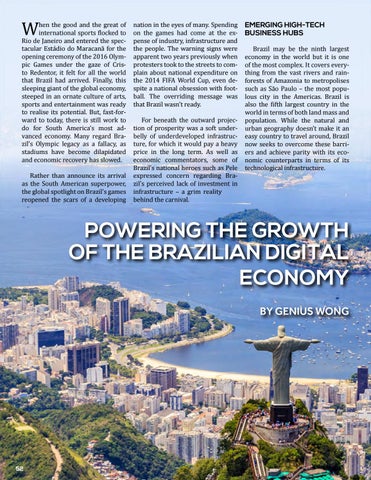
Powering The Growth Of The Brazilian Digital Economy
58
The Iox Cable System
64
Landing And Local Loop Lessons
72
Globally And Regionally, The Future Of The Cloud And Connected Things Is Beneath The Seas
By Genius Wong
By Arunachalam Kandasamy By Brian Crawford
By Stephen Scott
76
Quintillion’s Historic Subsea Cable System Lighting Up The North American Arctic By George Tronsrue Iii
80
Are Otts From Mars, And Carriers From Venus? By Larry Schwartz
84
Back Reflection: Forward Looking 30 Years Ago
92
From The Programme Committee
94
From the Conference Director
98
Advertiser’s Corner
By José Chesnoy
By Marc-Richard Fortin And Steve Dawe By Christopher Noyes By Kristian Nielsen
ADVERTISER INDEX
DOWNLOAD MEDIA KIT 2018 MEDIA INFORMATION
THE VOICE OF THE SUBMARINE CABLE INDUSTRY Submarine Telecom Forum’s independent editorial content ensures that it’s read by the industry’s top management, engineering and technical positions worldwide. The publication and reports provide the most up-to-date news and analysis of the industry.
12
OFS
18
STF Analytics
24
STF Analytics
31
STF Industry Report
38
SubOptic 2019 Conference
46
PTC 2018
56
WFN Strategies
70
Subtel Forum
90
Undersea Fiber Communication Systems, 2nd Edition
100
SubTel Forum Cables of the World Map – 2018 Edition
Conferences PTC’18
21–24 January 2018 Honolulu, HI, USA Website link
ICPC 2018 Plenary
10-12 April 2018 Cape Town, South Africa Website link
SubOptic 2019 8-11 April 2019 New Orleans, Louisiana USA Website link
Submarine Telecoms Forum, Inc. 21495 Ridgetop Circle, Suite 201 Sterling, Virginia 20166, USA Tel: [+1] 703.444.0845 Fax: [+1] 703.349.5562 www.stf-inc.com ISSN No. 1948-3031
PRESIDENT & PUBLISHER: Wayne Nielsen | wnielsen@subtelforum.com
VICE PRESIDENT: Kristian Nielsen | knielsen@subtelforum.com
SUBOPTIC 2019 CONFERENCE DIRECTOR: Christopher Noyes | cnoyes@subtelforum.com LEAD ANALYST: Kieran Clark | kclark@subtelforum.com
JOURNALIST & COPY EDITOR: Stephen Nielsen | snielsen@subtelforum.com LAYOUT & DESIGN: Allegra Printing
FEATURE WRITERS: Christopher Noyes, José Chesnoy, Kieran Clark, Kristian Nielsen, Marc-Richard Fortin, Steve Dawe and Wayne Nielsen
Voice of the
Industry
CONTRIBUTING AUTHORS: Arunachalam Kandasamy, Brian Crawford, Byron Clatterbuck, Chris Wood, Dag Aanensen, Genius Wong, George Tronsrue III, Larry Schwartz, Mattias Fridström, Paul Savill and Stephen Scott. NEXT ISSUE: March 2018 – Finance & Legal Contributions are welcomed, and should be forwarded to pressroom@ subtelforum.com.
Submarine Telecoms Forum magazine is published bimonthly by Submarine Telecoms Forum, Inc., and is an independent commercial publication, serving as a freely accessible forum for professionals in industries connected with submarine optical fiber technologies and techniques. Submarine Telecoms Forum may not be reproduced or transmitted in any form, in whole or in part, without the permission of the publishers. Liability: While every care is taken in preparation of this publication, the publishers cannot be held responsible for the accuracy of the information herein, or any errors which may occur in advertising or editorial content, or any consequence arising from any errors or omissions, and the editor reserves the right to edit any advertising or editorial material submitted for publication. Copyright © 2018 Submarine Telecoms Forum, Inc.
6
WEB HITS ANNUAL TOTAL
7,622,776
AVERAGE MONTHLY
92,040
MAGAZINE DOWNLOADS
ALMANAC DOWNLOADS
WEB TRAFFIC - HITS
WEB TRAFFIC - UNIQUE VISITS
7
SUBMARINE CABLE NEWS NOW CABLE FAULTS »» »» »» »» »» »» »»
SEA-ME-WE 3 Submarine Cable Cut Again SEA-ME-WE 3 To Be Fixed By December 26 Basslink Outage Caused By Exceeding Design Limit SEA-ME-WE 3 Down, Australia-Asia Traffic Slow SEA-ME-WE 3 Down For Second Time In Four Months APG Submarine Cable Damaged Again APG Submarine Cable To Be Fixed On January 6-7
CONFERENCES & ASSOCIATIONS
»» WFN Strategies To Present And Exhibit At PTC ’18
CURRENT SYSTEMS »» »» »» »» »» »» »» »»
Monet Cable System Is Ready For Service BSCC and NEC Complete Cable Linking Palau Quintillion Subsea Cable System Launched Retelit Agrees To 1.1 Tbps On AAE-1 Submarine Cable SKR1M Submarine Cable System Launched In Kuching GlobeNet, NIC.br Agree To Exchange In Fortaleza Samoa Completes Connection To New Submarine Cable Vietnam Submarine Cables Will Hit Pause This Weekend
»» »» »» »» »»
Metronode Data Center To Land Perth-Singapore Cable Supernap International Data Center Opens In Thailand Peak 10 + ViaWest to Expand Oregon Data Center Global Switch Launches Hong Kong Data Center Metronode Sold To Equinix For $1 billion
DATA CENTERS
FUTURE SYSTEMS
8
»» Australia Welcomes Solomons’ Commitment To Cable Project »» Tui Samoa Cable Live Next Month »» Vocus To Lay Australia-Singapore Cable In February
Submit Press Release
»» »» »» »» »» »» »» »» »» »» »» »»
Sunshine Coast Seeks Partners For New Submarine Cable Southern Cross Next To Receive $20 Mil From FINTEL Vocus ASC To Support Critical Indonesian IT Infrastructure China, Finland In Talks About Arctic Cable Algeria To Commission Transatlantic Cable TE SubCom, Djibouti Telecom Announce DARE CIF PEACE Cable About To Complete Desktop Study Huawei Marine To Begin PEACE Submarine Cable Survey Bulk Infrastructure, Facebook Partner On Mermaid Cable TE SubCom To Start Work On DARE Submarine Cable HAVFRUE Cable Selects Supplier TE SubCom Tui Samoa Submarine Cable Operation Delayed
OFFSHORE ENERGY
»» ASN To Deliver Breakthrough Control Infrastructure for Statoil
TECHNOLOGY & UPGRADES
»» SMD Completes Plough Upgrade For Orange Marine »» Xtera And Fortress Solutions to Extend Cable Life
STATE OF THE INDUSTRY »» »» »» »» »» »» »» »» »» »»
SBSS Secure Multiple Cable Installation Contracts Seaborn Networks Adds Industry Experts To Board Roles Prysmian To Acquire General Cable For USD 3 Billion Prysmian Sets Sights On Other M&A Targets Hexatronic To Acquire US-Based Blue Diamond Industries Tiger Infrastructure Invests in Crosslake Fibre Cable & Wireless CEO To Step Down Global Cloud Xchange Inks Deal With CMC Telecom Xtera Initiates Legal Action against Nokia and NEC Global Marine, SEAIOCMA Extend Contract
SUBOPTIC
»» SubOptic 2019 Conference Registration to Open March 1
9
RETURN OF THE FIBER BY KIERAN CLARK
This past year was one of the best the submarine fiber industry has enjoyed since the industry crash in the early 2000s – perhaps coming second only to 2009 from a system activity standpoint. Double digit numbers of systems hit the water and began feeding data to hungry consumers while paradigm shifts across the board continued to breathe life into what had been a stagnant market.
For only the second time since 2001, the 100 thousand-kilometer installation mark was hit. Additionally, 2017 saw a whopping $3.5 billion USD which is the most dollar amount invested since 2001. There is surely a lot from this past year to be proud of and excited by – not the least of which is the prospect that this level of activity might continue for the foreseeable future.
10
Welcome to SubTel Forum’s annual Global Outlook issue. This month, we’ll take a brief look at how the industry performed around the world last year, and see what 2018 might bring. The data used in this article is obtained from the public domain and is tracked by the ever evolving STF Analytics Submarine Cable Database, where products like the Submarine Cable Almanac, Submarine Cable Map and Submarine Telecoms Industry Report find their roots.
CABLE SYSTEMS BY THE NUMBERS
Prior to 2017, the world experienced a steady decline in new system development due to economic uncertainty and the prevalence of system upgrades. With a greater demand in new markets and route
diversity, system implementation experienced a boom in 2017. In all, 16 new systems were added to the global network in 2017 — nearly triple that of 2016.
Our last Global Outlook edition reported 30 systems planned to be ready for service in 2017 and 13 systems for 2018. One year later, these numbers look very different. Only 16 systems went live in 2017, 2018 saw an increase to 22 planned systems and 2019 currently has 15 systems planned (Figure 1). A few systems planned for 2017 simply slipped their RFS date to 2018 or 2019, while several other systems simply died outright. While 2018 has seen a swell of planned systems since this time last year, a few of these are carryovers from 2017 that were not able to finish their commissioning and acceptance phase
in time. A handful of others have slipped their RFS dates multiple times, and remain highly questionable as viable projects.
Systems Announced RFS 2016-2020 25
While there was a reduction in 2017 systems compared to plans from a year ago, there was still a sizeable increase in activity over 2016.
20
15
10
5
0
2016
2017
2018
2019
2020
Figure 1 - Systems Announced RFS, 2016-2020 KMS Added by Year 2016-2020 120000
Overall, 2017 saw the industry come within 63 percent of its target. This is a significant improvement compared to 2016 which was only able to hit 36 percent of initial expectations for that year. While the sharp contrast between beginning of year expectations and end of year realities has unfortunately become something of a recurring theme for the submarine cable industry, this past year bucks the trend.
100000
80000
60000
40000
20000
0
Naturally, with a reduction in the number of systems that were supposed to enter service for 2017, a decrease in the total kilometers of cable added is expected. At the start of 2017, over 158,000 kilometers of cable were planned to be added. However, when all was said and done, only 100,000 kilometers of cable were laid across the world for the entirety of 2017. While this is a noticeable decline, it is not nearly as drastic as past years – several of which saw reductions of 50 percent or higher.
2016
2017
2018
2019
Figure 2 - KMS Added by Year, 2016-2020 Planned System CIF Rate 2018-2019
Yes 39%
No 61%
Figure 3 - Planned System CIF Rate, 2018-2020
2020
Looking forward, 2018 has seen a 17,000 kilometer increase in announced cable from this time last year and is now up to 107,000 total kilometers planned for the year. With 2019 currently adding nearly 100,000 kilometers, and a sizeable amount already planned for 2020, the submarine fiber industry could potentially see several 100 thousand-kilometer years in a row. (Figure 2) Of course, the first real test of a system’s viability is whether it is contractin-force. As of the new year, 39 percent of all systems planned for 2018-2019 are contract-in-force – a slight improvement since the Submarine Telecoms Industry Report last October. (Figure 3) Looking at 2018 by itself shows a CIF rate of only 47 percent, which is a sign that some systems planned for 2018 may be having trouble with financing.
11
CAPACITY OUTLOOK The world continues to consume ever increasing amounts of data, with bandwidth demand projected to almost double every two years for the foreseeable future. This demand – largely driven by a continued shift towards cloud services and the continued explosion of mobile device usage – provides numerous opportunities for the submarine fiber industry. Over The Top (OTT) service providers continue to post strong earnings reports and grow at a rapid pace, which indicates that this bandwidth demand won’t be tapering off any time soon. Over the last five years, the submarine fiber industry has added an average of 32 percent capacity annually on major submarine cable routes, including upgrades and new system builds. With global demand increasing at such a rapid pace, this infrastructure growth rate may not be sustainable for very long, potentially causing demand to far exceed supply. So far, the industry has been
Average System Capacity by Year 2014-2020 90 80 70 60 50 40 30 20 10 0
2014
2015
2016
2017
2018
2019
2020
Figure 4 - Average System Capacity by Year, 2014-2020 able to keep up — but it will have to increase activity to stay ahead of demand.
A further sign of evidence the submarine fiber industry is up to the task of meeting global capacity demands is that the average new system capacity over the last five years has risen at a steady pace.
Averaging at just over 25 Tbps in 2014, new systems now average at well over 40 Tbps (Figure 4). With future systems being able to take advantage of higher wavelength capacities and potentially more fiber pairs, this average should continue to increase at a steady rate.
From shore to shore . . .
OFS’ complete portfolio of ocean fiber solutions enables industry-leading performance through high signal power and low-loss.
To learn more, ask your cabler about OFS or visit www.ofsoptics.com
like 200G and 400G – begins to see widespread commercial use.
Planned Capacity Growth 2018-2022 6000
REGIONAL RUNDOWN
5000
4000
3000
2000
1000
0
2017
2018
2019
2020
2021
2022
Figure 5 - Planned Capacity Growth, 2018-2022 Based on reported data and future capacity estimates, global capacity is estimated to increase up to 124 percent by the end of 2022 (Figure 5). Multiple systems slated for the next two years will have design capacities of more than 60 terabits per second, with many others boasting bandwidth between 20 and 50 terabits per second. Looking ahead
even further, 2019 already shows another strong increase in global capacity even with only a handful of systems announced so far. Nearly all the systems currently planned are being designed with at least 100G technology in mind, so expect to see an even more drastic increase as new wavelength technology –
While 2017 was a productive year overall for the submarine fiber industry, certain regions enjoyed larger growth than others. The Americas and EMEA regions came out ahead – largely due to the size and nature of the new systems installed – each seeing around 24,000 kilometers of cable added. The Indian Ocean Pan-East Asian region came next at 22,500 kilometers added due to the addition of a pair of large, transregional systems. The AustralAsia region only had a handful of smaller systems added in 2017 at 7,500 kilometers, but still saw more cable installed than the Transatlantic region’s 6,600 kilometers from a single new system. The Arctic region enjoyed its first system ever, and saw the addition of 1,200 kilometers as a result.
TeraWave™ | TrueWave® | AllWave® ZWP Ocean Fibers Coherent Transport High Signal Power Outstanding Bend Performance Simplified Network Design Long-term Reliability
For several years running, the bulk of planned system activity has occurred in the Pacific Ocean. However, based on announced systems through 2020, it appears that trend might finally be changing. Focus has started to shift towards the Atlantic, as OTT providers look to connect their disparate data centers in North America, South America, Europe and Africa. With 23 percent of all systems planned for 2018-2020 in the Americas, and 16 percent for the Transatlantic, new system growth in the Atlantic Ocean will exceed that of the Pacific Ocean for the first time in several years. (Figure 7) Transatlantic growth is primarily being driven by a desire to connect South America directly to Europe and Africa, alongside new interest in routes from Europe to the mid-Atlantic coast of the USA — specifically to connect to datacenters in Dulles, Virginia. The Americas region is characterized by replacing older systems in the Caribbean and increased demand for connectivity between the United States and Brazil.
Growth along Transpacific routes continues to be spurred on by an increased desire for lower latency between Asia, Australia and the United States. AustralAsia has finally shown signs of slowing down, with only 21 percent of systems planned for 2018-2020 in this region compared to 42 percent at this time last year. The Indian Ocean Pan-East Asian regions continue to see muted growth, largely due to continued political and economic instability in the Middle East. The EMEA region has seen an increase in planned system activity, due to new efforts along the eastern coast of Africa, and new connections to mainland Europe.
KMS Installed by Region 2017 Americas Arctic AustralAsia EMEA Indian Ocean Transatlantic Transpacific 0
5000
10000
14
20000
Figure 6 - KMS Installed by Region, 2017 Planned Systems by Region 2018-2020 Transpacific 16%
Americas 23%
Transatlantic 16%
AustralAsia 21%
Indian Ocean 5% EMEA 14%
Arctic 5%
Figure 7 - Planned Systems by Region, 2018-2020 Systems Driven by OTT Providers 2016-2017
Impacted 37%
THE OTT IMPACT
Since 2016, data center and cloud services providers have begun to change from capacity purchasers to cable system owners. Many of these companies have such large and complex infrastructure requirements that it has become more valuable for them to own their own cable systems
15000
Not Impacted 63%
Figure 8 - Systems Driven by OTT Providers, 2016-2017
25000
rather than buy capacity from a carrier. This new ownership paradigm has greatly changed the way cables are developed, and why. In fact, 37 percent of systems for 2016 and 2017 were driven by these OTT providers. (Figure 8)
Systems Driven by OTT Providers 2018-2022
Impacted 25%
Only 25 percent of all systems planned for 2018-2020 are directly impacted by OTT providers, which may indicate that the current players are reaching the end of their immediate infrastructure needs. (Figure 9) Until now, the OTT driven market has been exclusively the work of Facebook, Google and Microsoft. However, within the last few months several new OTT providers have joined the fray – most notably Amazon. This second wave, combined with the fact that several systems planned through 2020 will inevitably die off, should push this percentage higher over the long term.
Not Impacted 75%
Figure 9 - Systems Driven by OTT Providers, 2018-2022 Systems Supplied by Company 2017 Nexans, 1
Based on publicly available information, three companies seemingly dominate the submarine fiber system supply market activity. In 2017, these three companies accounted for 81 percent of all new cable systems. Alcatel Submarine Networks (ASN) was responsible for the highest system count at six, while NEC and TE SubCom came in at four and three systems, respectively. Huawei Marine was the supplier for two systems, while Nexans handled just a single system. (Figure 10)
Huawei Marine, 2
ASN, 6
TE SubCom, 3
NEC, 4
According to announced information on the amount of cable each company supplied in 2017, TE SubCom takes the lead with over 37,000 kilometers of cable produced. Despite not being responsible for as many systems as other companies, they produced cable for larger systems. NEC produced the next most at 34,000 kilometers, with ASN rounding out the three busiest companies at 27,000 kilometers produced (Figure 11). These three companies have been very dominant in recent years, being some of the few companies that can produce cable at a high enough volume to meet demand for large systems.
Figure 10 - Systems Supplied by Company, 2017 KMS Supplied by Company 2017 TE SubCom
NEC
ASN
Huawei Marine
Nexans 0
5000
10000
15000
20000
25000
30000
35000
Figure 11 - KMS Supplied by Company, 2017
40000
Certain companies seem to be winding down their production, or even pulling out of the submarine fiber market entirely. Fu-
Systems Supplied by Company 2018-2022
jitsu has not supplied a new system since 2013, NSW did not supply any systems this year, while Huawei Marine and Nexans seem to be keeping overall output low.
Huawei Marine 17% TE SubCom 34% Nexans 8% NEC 4% NSW 4% Xtera 4%
ASN 29%
Figure 12 - Systems Supplied by Company, 2018-2022 Systems Installed by Company 2017 GMSL 13%
SYSTEM INSTALLERS
Orange 6%
On the installation side, ASN and TE SubCom were the busiest by a wide margin, according to publicly announced information. Over 60 percent of all installation activity for 2017 was performed by these two companies. Elettra and Global Marine Systems Limited (GMSL) come in next, and were about equally active while Orange and S.B. Submarine Systems (S.B. SS) round out the list with the least amount of systems installed. (Figure 13)
S.B. SS 6% Elettra 13%
ASN 37%
TE SubCom 25%
As with the system suppliers, the busiest installers did not necessarily install the most amount of cable. While TE SubCom was responsible for fewer systems than ASN, it installed almost double the amount of cable. S.B. SS had only one announced project this year, but it was a large, transoceanic system over 15,000 kilometers in length. Meanwhile, Elettra, GMSL and Orange either had a few smaller systems or worked on portions of a larger system.
Figure 13 - Systems Installed by Company, 2017 KMS Installed by Company 2017 45000 40000 35000 30000 25000
THE CRYSTAL BALL
20000 15000 10000 5000 0
ASN
Elettra
GMSL
Orange
S.B. SS
Figure 14 - KMS Installed by Company, 2017 16
Looking forward, the dominance of TE SubCom and ASN should continue. Combined, these two companies are currently responsible for over 60 percent of all systems planned through 2020. Huawei Marine seems to be increasing its market activity, while NEC might be falling behind a bit. However, with well over a dozen supply contracts left to be handed out – not including entirely new systems that will inevitably be announced – these numbers are subject to heavy change as the years go by.
TE SubCom
Overall, this was a banner year for the industry. But, there is one question that must surely be at the back of everyone’s minds: “How long will this last?”
The long and short of it is, end user demand for data shows no signs of slowing down any time soon. The OTT providers are practically scrambling to scale up to demand, and that means more work for the submarine fiber industry. Across the globe, economies also seem to be prospering. Recent, bold mergers and acquisitions within the submarine fiber space also promise to keep things highly competitive so that no one will be able to rest on their laurels.
Compared to this time last year, there were barely any planned systems being discussed publicly three years out. Now, we have double digit numbers of systems in the works for 2020 and even a few for 2021. This is definitely an exciting time for the industry.
However, while all this positive outlook is a good thing there’s always the risk that some sort of unforeseen market force might disrupt everything. There is still a lot of uncertainty around the OTT activity and whether or not they will continue this rapid pace of system deployment. The possibility that some disaster might hit the submarine fiber industry also exists. Perhaps something on a similar level to the recently discovered and widespread hardware flaw that affects a wide range of CPUs…
With all these data points in mind, while the positive outlook is very much deserved it’s always important to be smart and cautious. The submarine fiber industry is the foundation of our modern world – we have quite the responsibility to be a solid one.
Kieran Clark is an Analyst for Submarine Telecoms Forum. He joined the company in 2013 as a Broadcast Technician to provide support for live event video streaming. In 2014, Kieran was promoted to Analyst and is currently responsible for the research and maintenance that supports the SubTel Forum International Submarine Cable Database; his analysis is featured in almost the entire array of SubTel Forum publications. He has 4+ years of live production experience and has worked alongside some of the premier organizations in video web streaming.
17
POWERFUL ANALYSIS
Customized Reporting Delivered in 10 Business Days Special Markets – Oil & Gas, Cableships, Upgrades and more From Regional to Global Market Reports Order Yours Today – STF Analytics Custom Reporting
THE CARRIER GUIDE TO 2018 - TRAFFIC, TECHNOLOGY AND UNSUNG HEROES BY MATTIAS FRIDSTRÖM
20
cial 5G services launched during 2018, it will still be the main area of focus for the majority of communication providers. Tests and trials will be completed and compared, new service possibilities discussed and everyone will make sure they are as ready as they can be for the imminent move towards a live 5G service environment.
22. The great Edge vs. Core battle.
I
t is often said that all good things come in threes and according to Chinese astrology, 2018 is not only the year of the dog but also happens to be a year when the number three is thought to be lucky. We decided therefore, that we’d share a selection of our ‘top-three’ predictions and trends for the months ahead. What are the major things that will shape the industry? Which traffic and technology trends will dominate, how can carriers improve customer focus? And who will be the unsung heroes of the industry?
TOP 3 OVERALL GLOBAL CARRIER INDUSTRY TRENDS
1. 1 Unrelenting traffic growth. It is no revelation that traffic has continued to grow but this has been mirrored by a concomitant fall in market prices. In 2018, traffic volumes will continue to grow significantly and in order to stay relevant, Carriers will need to continually optimize their production platform to handle this growth in the most cost-effective way (without compromising service quality). With a large network, this brings with it some major technical challenges
2. Small is Beautiful. The need for 2 smaller and cheaper gear for local
connections within data centers or into datacenters in close proximity has now caught on within the Wide Area Network domain. This gives backbone networks a real opportunity to absorb greater traffic volumes at a lower cost per Mb/s. The trick moving forward though, will be to seamlessly integrate new equipment and technology with legacy hardware which is already deployed and running in the network today.
3. The ‘softwareization’ of every3
thing. Whilst not really a new trend, 2017 was definitely the year it really started to take off and we saw the beginnings of some real-world solutions and use cases that actually brought tangible operational benefits for backbone providers. In 2018, we can expect to see a further uptake of SDN adoption in backbone networks as we move towards an environment where it becomes a common component of core network infrastructure.
TOP 3 TECHNOLOGY AND TRAFFIC TRENDS 2018
1. 1 5G will undoubtedly be one of the main themes of 2018. Whilst we won’t see that many commer-
An increasing amount of traffic will certainly be managed at the edge of the network and much of it will of course stay there. At the same time, the network core will assume even greater importance if the full potential of edge computing is to be realized. It is really only when vast amounts of data at the edge are combined with the formidable data crunching resources in a well-placed core data center that the full potential is realized. There will be an ongoing need for new datacenters both in centralized core locations and more remotely at the edge. Combined with an ever-increasing need for readily available green energy and natural cooling, the network will be the key to a sustainable and efficient future.
3. Rapid IoT adoption. During the 3
year, we will really see a lot more devices connected and even more data collected and analyzed. There will still be a debate around what technology should be used to collect the data (SIM card based or not) but the widely held belief is that both will have a natural place within the IoT ecosystem.
TOP 3 PRIORITIES FOR INCREASED CARRIER CUSTOMER SATISFACTION
1. 1 Self-service. While self-service for customers is not a new thing it has not yet really been fully implemented and adopted in the Carri-
21
er industry. There are still technical barriers to overcome and financial risks to be discussed but during 2018 we will definitely see a step change as customer demand for even greater control increases.
2. Daring to realize the full po2
tential of big data. Greater automation of fault management and prevention routines is an area that is being revolutionized by Software Defined Networking. Significant progress will be made here during 2018 and the potential for this to improve service quality and operational efficiency is almost limitless.
3. Greater transparency. It is really 3
only when you dare to show your customers everything that an atmosphere of genuine trust can be established. Everything from billing and traffic data to detailed routing information and candid delivery and operational processes. Carriers are not there yet but the industry heavyweights will
22
need to make real progress here if they are to thrive in the long term.
TOP 3 OBSTACLES TO CARRIER GREATNESS
to let machines take critical decisions that could potentially affect customers? 2018 will be a landmark year in this respect
2. IT literacy. Carriers are typical2
ly overwhelmed with skilled re1. 1 Failing to trust big data – how can sources for every IP protocol availCarriers truly rely on (and benefit able and there is no shortage of from) the wealth of operational personnel to manage the complex data that exists. More information network engineering tasks needthan ever before is available from ed to run a large global network. operational systems and we have But there is often a disconnect access to previously unavailable between the network engineers insights about the network and and their IT resources. Until there its components. This data is exis greater cross fertilization of IT tremely useful when we making and network expertise, we will changes in the network and esnot be able to automate inefficient pecially during outages, but it is manual tasks and full operationreally only when the data can be al efficiency will not be possible. trusted fully and machines themselves take remedial action in the 3 3. Excavators and boats. Sometimes, network that we will see the real it doesn’t seem to matter how benefits. It is rather like a drivmuch you care about your neterless car. The data is there and work and how often you keep recan be collected, but the trick is minding everyone about its locato manage that data reliably and tion and where and where not to systematically. The most importdig or trawl. At the end of the day, ant question is, at what point in you still find yourself stuck with time do we trust the data enough
those challenging outages, in the worst possible weather and with a remorseful but guilty contractor and his digger waiting for someone to splice a bunch of severed fiber strands.
TOP 3 BUZZWORDS THAT REFUSE TO DIE
indication of where to connect for maximum network centricity and the best service performance.
TOP 3 UNSUNG HEROES OF THE CARRIER INDUSTRY
1. 1 The cable coiling guy. Without someone to follow a submarine cable when it is loaded on to a deployment vessel, there wouldn’t be any submarine cables. Walking several kilometers in a tight circle to make sure the maximum amount of cable is loaded on the boat is no mean feat.
1. 1 Cloud. The simple fact that more and more content and applications are migrating to the cloud, followed by a dramatic increase in the number of data centers to house the servers needed to manage it all, is a clear sign that the “cloud” is here to stay. This 2 2. The squirrel chaser. According to also creates a fantastic opportu(www.cybersquirrel1.com), squirnity for the Carrier industry as rels cause an incredible number the strong backbone to enable it amount of Internet outages. Someall. A data center without connectimes their mischief takes out the tivity is not worth much (unless power but more often than not, you just want to mine bitcoins). they wreak havoc by simply biting The Carriers are critically importinto the cables themselves. These ant for a well-functioning cloud incidents cost time and money, but they need to stay relevant. and often require good detective work to identify the culprits. 2. Low latency. Even in a world where 2 more and more applications and 3 3. The sewer repair splicer. Apart systems can live with longer delay from the smell, sound and clitimes, there will always be niche mate, a sewer is actually an ideal applications and services that place to install fiber optic cables can’t function without the lowest since the risk of damage from hupossible latency. Edge computing man contact is virtually zero. Still, certainly creates a work around from time to time there are outagin some situations but some apes where a team of fiber splicers plications are simply not optineed to go down there and repair mized or manageable in a remote things. And of course, it’s a world site in the middle of nowhere. away from cable repair work in the sun and sand of Biarritz. 3. The Internet Ecosystem. There Life simply isn’t fair sometimes. 3 was a time not too long ago when the internet was made up of a Predications are of course just widely accepted and distinct Tier that. One thing is certain though, structure. Even if those days are 2018 is certain to be full of excitegone and everyone can more or ment. As we often say at Telia Carrier less connect to whoever they ‘You can’t predict the future, but you wish, the Internet hierarchy is can be ready.’ still a consideration when looking for optimal performance. The degree to which a specific network is connected, as shown by the DYN rankings that still provide a good
Mattias Fridström is Vice President & Chief Evangelist at Telia Carrier AB. With over 20 years in the telecommunications industry, Mattias Fridström can be considered a veteran – but his enthusiasm hasn’t faded. Mattias combines expert knowledge with anecdotes from behind the scenes and deep insight into the networked economy: What are the challenges of tomorrow for network providers? How can we meet ever-increasing traffic demand and customer quality expectations within the same cost frame? Mattias holds an MSc in Electrical Engineering from the University of Wollongong, Australia. Since joining Telia in 1996, he has worked in a number of senior roles within Telia Carrier and most recently as CTO. Since July 2016 he is Telia Carriers Chief Evangelist.
23
S L O O T T H G I R THE THE JOB f o e R m o O s F s n i a t l s in ma in
o s o t c i l t y a l ic a t n y l A a F n S T a r p e st a the sh ustry. d n i ed e e h F t s w e N c a m n u a r o m l F A l e e T l b b aSu ma rine Ca c oms aSub ma rine Tele aSub ustry Report orld Map W e Ind h t f o s e l b a aC
Dive Deeper with Custom Reporting: Global Cable ship Market Report Global & Reg ional Reports Contact Kier an Clark kclark@subte lforum.com
COMPLEX CHALLENGES: SOLUTIONS MADE SIMPLE OTT PLAYERS AND CONTENT PROVIDERS SHAPE AFRICA’S EVOLVING CONNECTIVITY LANDSCAPE BY CHRIS WOOD
26
H
ome to some 1.25 billion people, Africa is the second largest continent on the planet and presents a huge business opportunity to the entire telecoms bandwidth supply chain - including submarine and terrestrial cable manufacturers, installers and operators, Over The Top (OTT) players and Content Providers, capacity wholesalers, Internet Service Providers (ISPs) and telecoms operators.
OPPORTUNITY AFRICA
The rate of growth of Africa’s population is such that by 2050, UNICEF1 predicts a quarter of the world’s population and 40% of the world’s youth (those aged under 18), will be African.
The latest internet usage figures (June 2017) from Internet World Stats2 reveal that only 31.2% (circa 388 million people) of Africa’s population use the internet - which is significantly less than for the rest of the world, where the corresponding figure is 55.8%. However, despite the relatively low current internet usage figures, research3 conducted by telecoms industry consulting firm Analysys Mason suggests that by 2021 the telecoms markets in sub-Saharan Africa could be worth US$51 billion.
Clearly the business opportunities associated with telecommunications bandwidth supply in Africa are attractive now, and are set to become even more so moving forward.
EXPLOSIVE GROWTH IN CAPACITY DEMAND: FROM STM1S TO MULTIPLE 10GBPS WAVELENGTHS
Until quite recently, international wholesale capacity requirements for Africa were typically for STM1s (155Mbps of capacity). However, there has recently been a step change in demand driven largely, but not exclusively, by global OTT players and content providers such as Google, Microsoft, Facebook and Netflix - who have traditionally delivered their data-intensive applications over third-party networks. Drivers for this growth include dramatically increased uptake of bandwidth-hungry applications such as social networking, video and music streaming, educational media and online gaming, which continue to transform Africa’s connectivity landscape – and an evolution in the strategic approach of global OTT players and content providers.
Migrating their content from Europe and Asia into Africa brings such players significant perfor-
mance improvements, and helps boost customer acquisition and maximise revenue opportunities. Purchasing cost-effective and resilient international bandwidth over which to transfer this content, and the data centre space needed to host it, are key elements of this strategy.
Only the biggest capacity vendors, those that invest strategically in submarine cables and pan-African terrestrial infrastructure, have sufficient scale, expertise and agility to provide solutions that meet complex demands for ultra-high capacity into the continent’s beachhead markets - South Africa, Kenya and Nigeria – and the reach and flexibility required to support seamless expansion into further markets as demand increases in the future. Consequently, it is no longer unusual for leading wholesale African capacity providers such as WIOCC to be asked to deliver multiple 10Gbps wavelengths, and more, by a single customer.
WHAT ARE THE IMPLICATIONS FOR THE CABLE AND TERRESTRIAL CONNECTIVITY LANDSCAPE?
As consumer demand growth continues across the continent, ca-
27
only just over 5% (half a Tbps) of its 10 Tbps design capacity lit. And only 50% of that, a mere 2.5% of its total design capacity, was in use.
Even though the existing submarine cable systems are clearly capable of absorbing further significant increases in traffic, there is scope for some new cables to fill specific gaps in the existing infrastructure.
In 2017, two major new international cables with landings in Africa went live. The 24Tbps SEA-ME-WE 5 (South East-Middle East-Western Europe 5) submarine cable system now connects 17 countries across the Middle East, Asia, North Africa and Europe. Meanwhile, AAE-1 (Asia-Africa-Europe-1) connects South East Asia to Europe, via Egypt, and provides another alternative route between Asia and Europe. There has also been talk of further new cable deployment into Africa, and the South Atlantic Cable System (SACS) is already under construction between Angola and Brazil.
CONNECTING CARRIERS AND OTTS TO THEIR CUSTOMERS
pacity wholesalers need the ability to satisfy requirements for seamless extension on an ongoing basis - both into existing key markets and also into further countries.
There are two ways in which these increased demands are being met: firstly, through upgrading existing cables, enabling delivery of additional capacity in the most cost-effective manner through technology advances; and secondly through the construction of new submarine cable systems which offer the promise of new reach, extra capacity and/or diversity into key locations. 28
Operators of existing submarine cable systems are introducing the latest wavelength technology to boost capacity availability. This approach not only maximises their ability to deliver incremental capacity increases cost-effectively, but will also provide further design capacity boosts in the future as optical technologies continue to develop.
Partly because of this approach, Africa’s newer submarine cables currently operate at low levels of utilisation. For example, until very recently the 10,000 kilometre EASSy cable – which runs along Africa’s Eastern coastline from Mtunzini in South Africa up to Port Sudan - had
The provision of seamless, high-quality, end-to-end managed connectivity solutions which incorporate carrier-grade terrestrial networks, Points of Presence (PoPs) and metropolitan area networks that reach all the way to the premises of clients’ customers requires significant ongoing investment. For example, Africa’s carriers’ carrier WIOCC has spent in the region of $300 million on submarine cable system capacity and upgrades, terrestrial backhaul, local loop, PoPs and its IP network.
This level of investment is imperative in order to be able to continue satisfying demand for ever more cost-effective and scalable capacity,
delivered and managed end-to-end, and extending to in-country carrier PoPs and direct to the premises of end-customers. An excellent example of how direct connectivity solutions are provided to enterprises is the Johannesburg Metro Fibre Internet Access (MFIA) network, deployed by WIOCC in 2017. This is now enabling smallto-mid-sized Internet Service Providers (ISPs), wireless ISPs (WISPs) and operators to offer reliable, cost-effective, direct access to the global internet, over a redundant network, to enterprises in more than 2,000 business premises on 95 business parks and numerous shopping malls across business districts in Johannesburg and Pretoria.
WIOCC’s investment in building this network means that smaller ISPs can also now connect to its IP Transit and Ethernet services at their own premises, and carriers can use MFIA services to interconnect end-user locations throughout Johannesburg.
EXPLOITING THESE OPPORTUNITIES
To support the growth plans of OTTs, content providers and others looking to broaden their reach into new territories in Africa, capacity wholesalers must continue to invest in the right network infrastructure.
Innovations such as the implementation of 100Gbps OTN (Optical Transport Network) rings help ensure sufficient scale to deliver the required capacity increases into existing locations. The ability to seamlessly extend network reach into other key customer markets, now and in the future, and the flexibility to provide solutions that meet the often-complex challenges and changing requirements of a dynamic marketplace, are also critical. 29
The integration of local PoPs into diverse regional and cross-border networks plays a key part in securing the cost-effective, scalable and resilient footprint required to deliver and profit from the high-performance, revenue-generating services that will attract new customers in Africa’s many and varied markets. Given the relatively low utilisation levels of the newer African submarine cables, and the expectation that design capacities will continue to be boosted by further developments in optical technologies, the major focus for investment is on continuing to extend further the reach, reliability, capacity and accessibility of this international connectivity.
As investments in enhanced terrestrial networks, more metropolitan area networks, PoPs, Data Centres and improved last-mile connectivity continue, so too will the opportunities for businesses offering international connectivity into, out of and within Africa. UNICEF, August 2014. Generation 2030/Africa Report. Internet World Stats, Africa Stats, 2017. 3 Analysys Mason, October 2016. Sub-Saharan Africa telecoms market: trends and forecasts 2016–2021 1 2
30
Chris Wood is CEO of award-winning Africa’s carriers’ carrier WIOCC, which he has led since its formation in 2008 and swiftly built into the leading supplier of seamless, end-to-end managed service solutions into, out of and within Africa. For the past seven years Chris has been named (by Global Telecoms Business) one of the 100 most powerful people in global telecommunications, and acclaimed for his inspirational leadership, commitment to making an enduring contribution to African communications and for being central to the transformation of Africa’s connectivity landscape. He continues to invest in enhancing the reach, quality and diversity of WIOCC’s unique network, which currently offers customers seamless direct connectivity to over 550 locations across 30 African countries, and many more countries globally, through 55,000km of terrestrial fibre and more than 60,000km of submarine cable. Chris also co-Chairs the EASSy Management Committee and is a leader in the submarine cable system’s deployment, extension and incremental capacity upgrades.
Read the latest issue now
s u bmar i n e t e l e co m s
INDUSTRY
REPORT
ISSUE 6 | 2017/2018
31
THE TRANSFORMATIVE POWER OF GLOBALIZATION BY PAUL SAVILL
D
igital transformation may be one of the most hyped phrases in the industry, but it’s important to remember why it’s such a big deal. And it has to do with perhaps the next most overused term: globalization. Traditionally, globalization has been described as the trade of global goods: electronics, toys, clothing and anything else you can think of that comes with a “Made in XX country” tag or sticker. The trade of goods has seen a noticeable decline in capital flows for nearly 10 years; however, that doesn’t mean globalization has peaked. In fact, McKinsey Global Institute released research revealing digital flows now exert a larger impact on GDP growth than the trade in
32
goods. In fact, its research shows “the amount of cross-border bandwidth that is used has grown 45 times larger since 2005” and is projected to increase nine-fold by 2020. To put that into dollars, data and information comprised $2.8 trillion of the $7.8 trillion in global goods, services, finance, people and data that contributed to the world GDP in 2014.
In short, globalization wouldn’t be increasing without digital transformation, and digital transformation wouldn’t be so important without globalization. What’s more: none of it would be possible without the continued innovation and expansion of this global networking platform, an integral piece of which is the collec-
tion of submarine cables that allow cross-continent communication.
Leading the charge on the use and expansion of submarine cables is, unsurprisingly, internet content providers like Apple, Facebook, Google and Microsoft, all of which not only use subsea cables extensively, but also have invested in the development of new submarine cable systems. It makes sense when you consider the incredible amounts of data these content providers and their millions of users generate. Of course, ISPs play an integral role in the deployment and management of subsea cables, and we at CenturyLink work a lot with content providers to package and deliver data internationally.
One could easily argue the creation and increase of content from these heavyweights and others are part of the impetus for the global push around digital transformation, as they’ve forced business partners, government agencies and end users to radically reimagine the way they operate to account for new technologies.
A LOOK AT OUR SUBSEA NETWORK AND INTERNATIONAL NETWORK
From a global ISP perspective, we see on a daily basis not only the upward trajectory of traffic and capacity needs on a macro scale, but also among our customers – both big and small. For the most part, companies and government entities are global, thanks to the internet. To maintain or expand their ability to perform in an ever-evolving industry, these organizations must make digital transformation a priority. And our focus as an internet provider is to make sure we have the solutions, capacity and reach to meet demand – particularly when it comes to internet and private networks. With our recent acquisition of Level 3 Communications, CenturyLink’s network now reaches more than 60 countries, with approximately 360,000 international transport miles and 450,000 route miles of fiber globally. From a subsea perspective, we own approximately 33,000 route miles. Based on statistics from TeleGeography and our calculations (as of 2016), CenturyLink owns a little over 10 percent of total transatlantic subsea capacity; suffice to say, it’s a significant part of our network ecosystem and an important conduit for digital transformation.
WHAT WE DID TO SUPPORT DIGITAL TRANSFORMATION IN 2017 When we look back at 2017, it’s remarkable to see the vast changes that took place in the networking requirements for enterprises and government agencies. First and foremost, security took center stage given the prevalence of and significant damage caused by cybercrime; according to Cybersecurity Ventures, the annual cost of cybercrime damages will reach $6 trillion globally by 2021. For us, that meant launching encrypted wavelengths to address the need for secure, encrypted fiber optic networks that can manage the ever-increasing amounts of data and latency-sensitive information. With organizations transitioning from traditional, premises-based security measures to next-generation solutions that both simplify and bolster their defenses, we expanded our cloud-based, next-generation Adaptive Network Security footprint to new regions and additional gateways around the world, including Asia Pacific, Africa, Europe and North America. We also introduced our SD-WAN solution in response to the explosion of connected devices and applications in the cloud. SDN and its associated technologies have become a critical component of the network mix as more enterprises and government agencies need added control and flexibility to manage their applications. SD-WAN will become more popular, particularly given the fact that many organizations – particularly those that operate globally – use a variety of access networks and backbones to conduct their business. IDC’s Worldwide SD-WAN Forecast, 2017–2021 predicts the market for this technology will balloon from $225 million in 2015 to $8.05 billion in 2021.
As more of our customers are migrating their important applications and data to the cloud, many of them are using multiple cloud environments. This is why we introduced our Multi-Cloud Management in 2017, which allows customers to easily orchestrate the delivery of infrastructure, applications and services across multiple clouds. We also saw an uptick in deployment of our Cloud Connect Solutions, which allows customers to connect to any cloud provider or architecture via public, private or hybrid connections. Cloud will continue to be a foundational element for any digital transformation because of its ability to simplify and streamline operations, and it’s important to maintain that simplicity when multiple clouds enter the mix. Each of these networking solutions was developed in response to enterprises’ changing requirements predicated on their digital transformation needs. Our ability to launch and grow these solutions on a global scale relied heavily on our subsea footprint.
GLOBAL OUTLOOK FOR 2018
There will never be a time when companies and network providers can expect current momentum to allow them to sit back and coast. That’s why the introduction of new communications services and enhancements we brought to bear in 2017 will continue into 2018. With the telecom industry’s shift toward a globalized digital transformation mindset, we are focusing our efforts on a variety of areas.
Last year, we significantly expanded our Ethernet footprint, and our goals for 2018 will be to continue expanding that footprint while also providing higher bandwidth options – meaning 100Mbps and
33
above to as much of our footprint as possible. Along those lines, increasing the scale and speed of our network is a top priority, and that includes migrating to 100GE for 10GE/100GE enterprise access.
Of course, when we talk about Ethernet, we’d be remiss not to mention SDN and NFV, which will remain an important focus for us as we look to virtualize as many network functions as we can. Streamlining and simplifying are a significant part
of the digital transformation, and SDN/NFV are key enabling technologies to that end. Automation is important for any organization, and that includes a focus on a service-oriented approach to network management such as IET’s Network Configuration Protocol (NETCONF) and YANG, a data modeling language, as well as offering network technologies like segment routing. We’re also exploring fixed wireless access, where we provide flex-
ible options using various wireless technologies. Given traffic from wireless and mobile devices will account for more than 63 percent of total IP traffic by 2021 according to Cisco’s Visual Networking Index, we in the ISP community have to make sure our wireless networking infrastructure is ready to handle the load.
A NEW APPRECIATION FOR SUBSEA NETWORKS
The new CenturyLink. Your link to what’s next. The new CenturyLink, purpose-built to serve the connection needs of the networked world. CenturyLink understands the power of all that is digital. Life is powered by connections, and business is connections. Our extensive network reach, significant local presence, and innovative technology solutions combined with an experienced team of employees and relentless focus on the customer experience create a powerful choice for enterprise, government, and wholesale customers globally, and consumers nationally. The new CenturyLink is equipped to serve customers with reliable, flexible and secure connections — where, when and how they need them.
Approx.
Approx.
450,000 360,000
Route Miles of Fiber Globally
International Transport Miles
International Transport Route Miles are a combination of leased and owned, fiber and optical transport connectivity.
100,000
+
52,500 More Than
Proforma Revenue Approx.
60+
$24B
*Excluding revenue related to the colocation business sale and including estimated intercompany eliminations and purchase accounting adjustments. Approximately 75% of core revenue will come from business customers and nearly two-thirds of core revenue will come from strategic services. ©2017 CenturyLink. All Rights Reserved.
34
On-Net buildings
Employees Globally
Countries and Counting
(Estimated trailing twelve months ending June 30, 2017)*
The global network, thanks to an extensive subsea footprint, has done something no other technology could ever do, or at least do as effectively: allow businesses, organizations or individuals to cost effectively and easily reach their audiences, no matter where they’re located in the world. It has become one of the most important tools for any business, particularly given its ability to serve as the foundation for any number of communications technologies. Globalization of network infrastructure has given companies both big and small the ability to grow and change at an exponential pace, and that pace is only continuing to pick up. And for companies like us, the ones that build and maintain the global network infrastructure, we have to take digital transformation seriously. Last year showed us that digital transformation is nothing without an adaptive, secure and reliable network infrastructure that can connect to virtually anywhere in the world, and 2018 will only amplify those needs.
35
36
Paul Savill is the senior vice president of Core Network & Technology Solutions for CenturyLink. In this role, he sets the strategy and leads global product management, development and marketing for CenturyLink’s core networking services including Internet, Ethernet, Optical Networking, Private Line, Subsea, Dark Fiber, Professional Services, CDN, Vvyx and Colocation. Paul has 20 years of experience in the telecommunications industry, over which he spent the first half in a variety of technical roles in network planning, engineering, operations and service delivery. He joined Level 3 Communications (now CenturyLink) in 2006 with the WilTel acquisition, where he was managing WilTel’s data, transport and customer portal services. Paul holds a Bachelor of Science degree in electrical engineering and a master’s degree in Business Administration.
37
NEW ORLEANS
SPONSORSHIPS AND EXHIBITION SALES ARE NOW OPEN! THE EARLY BIRD GETS THE WORM DON’T MISS OUT ON EXCELLENT VISIBILITY DURING THE SUBOPTIC 2019 CONFERENCE.
REGULARLY WITH 650+ ATTENDEES, 50+ SPEAKERS AND REPRESENTING OVER 75 NATIONALITIES THERE IS NO BETTER PLACE FOR ACCESS TO THE SUBMARINE FIBER INDUSTRY. RESERVE TODAY! SPONSORSHIP PACKAGES EXHIBITION HALL
SUBOPTIC2019.COM
AFRICAN SUBMARINE NETWORK OPERATORS MOVE INTO THE TERRESTRIAL MARKET TO BOLSTER GROWTH AND SERVICE QUALITY BY BYRON CLATTERBUCK 40
systems. Most are already beyond their initial “design capacity” as a result of the technological development of fibre electronics.
For example, since starting out using 10G fibre electronics technology when SEACOM launched in 2009, we have since moved all fibre segments to 100G optical network transport technology, and last year lit up an additional 500G of capacity on the SEACOM Subsea Cable which connects Africa with Europe, in a matter of weeks. This changing of electronics technology increased each fibre’s bandwidth throughput while reducing unit costs. Additionally, the 100G platform allows SEACOM to implement further upgrades with very short lead times to meet potential customer and market requirements.
W
hat a difference a decade can make! Looking back to 2008, Africa was a bandwidth-starved continent with poor telecommunications links to the rest of the world. Many countries depended on slow and expensive satellite connectivity for international bandwidth; even the best served countries such as South Africa had only one or two older submarine cables with low bandwidth capability, and usually managed by an incumbent telecom operator for its exclusive benefit.
Today, there are multiple cables running along Africa’s east and west coasts, bringing abundant international bandwidth into the continent. Since 2009, privately funded telecoms players and operator consortiums have launched numerous cable systems, including: The East
African Marine System (TEAMS), West African Cable System (WACS), Main One, Africa Coast to Europe (ACE), East African Submarine Cable System (EASSy), and the SEACOM Subsea Cable.
This has brought about a revolution in African telecoms, bringing high-speed broadband connectivity to numerous people and businesses across the continent for the first time. Submarine cables are routed on both east and west coasts so as to offer a reliable and resilient “ring” of connectivity at faster and faster speeds. Most of these subsea cable operators have also made substantial investments in expanding capacity since going live, riding the wave of higher-speed and lower-cost electronics that can push up the capability of each fibre on their
All this additional bandwidth does not mean much if it is not connected to the international content and data that people and businesses want, so we have at the same time bolstered our direct connections to the multiple Tier-1 IP networks in Europe, as well as connectivity to major Internet Exchange Points (LINX, AMS-IX, De-CIX, France-IX) and peering relationships with most major African carriers. SEACOM is also Africa’s largest host of overthe-top and content delivery network traffic.
WHAT’S NEXT FOR AFRICAN SUBMARINE CABLES?
So, what’s next for the submarine cable market in Africa? As in the rest of the world, we are seeing operators continue to invest in expanding capacity on existing cables at lower costs and higher speeds. There is even talk, quite a lot of it in fact, of building new cables that would offer additional resiliency as well as position operators for continued growth well into the future. Building a sub-
41
sea cable into the continent from Europe would take more than two years, so planning and positioning now is essential. At this point, there are plans on the drawing board for a new cable in the Indian Ocean, another that will run from South Africa to Asia via the Indian Ocean islands, two cables that will connect Africa to Brazil and onto the US, two that may be routed up the east coast, and one that will go up both the east and west coasts. Obviously, not all projects will proceed, but it does indicate that demand growth is accelerating and will continue to do so.
Overall, we believe SEACOM is well positioned for the future with our cable upgrades on the east coast as well as resilient capacity for our key network platforms on the west coast. SEACOM currently carries more than 1Terabit of lit capacity between Africa and Europe, with more than 110G of traffic on our IP platform alone, which is growing rapidly. Fortunately, the SEACOM Subsea Cable can scale easily and quickly to meet market requirements for the foreseeable future, and we also believe resiliency on other routes that allow us to manage a reliable international network platform will only be improved over time. This capability is critical to serve the needs of international carriers as well as the web-scale content providers that have large plans for Africa, such as Google, Facebook, Microsoft, and Amazon. But equally important to SEACOM’s future growth is the increasing data network connectivity demands of enterprise customers, that are increasingly making the move to cloud-based communications and core IT function applications. SEACOM launched its SEACOM Business unit to directly serve enterprise customers in 2015, and has since seen an incredible uptake in customers and business in South Africa and Kenya. This drives increased demand for broadband connectivity
42
volumes, but also a need to support “always on” quality, delivered to the customer premises.
GETTING INTERNATIONAL BANDWIDTH TO THE END-CUSTOMER
Over the past five years in Africa, we have seen more infrastructure players in Africa invest in connecting metropolitan areas in major economies with fibre, as well as in building national and regional fibre backbones to connect towns and cities to the Internet. However, with fibre-to-building penetration still low, there is still much work to be done. At the same time, we’re also seeing the industry make investments in more fibre to the home as
well as LTE/4G in many of the larger cities.
Yet network coverage is patchy in many parts of the continent, and the industry needs to make significant investments to bring the connectivity from the undersea cables to the user’s doorstep. In addition, the quality of some fibre networks and how they are operated needs investment and improvement, to meet the changing quality requirements that enterprise customers require. Companies such as SEACOM are addressing the challenge through a multipronged approach, which includes: • making strategic acquisitions to build economies of scale
• building terrestrial network infrastructure where it makes sense • providing access to their infrastructure to other service providers in an open-access model • selling to businesses directly and to SMEs and consumers through channel partners • introducing value-added offerings, such as managed services products for enterprises • improving customer experience and operational efficiency, including deployment of technologies such as software-defined wide-area networks, network function virtualisation and software-defined networks • expanding into new countries and new cities in existing territories
SEACOM Business was launched to leverage the abundant and scalable capacity on our subsea cable system and continent-wide IP-MPLS network, as well as the capabilities of our cloud services, and deliver these capabilities to business customers. Our business offerings, depending on region, include Fibre Internet Access with options ranging from 25Mbps up to 1Gbps. Today, we have around 2,500 enterprise customers and are signing up around 150 new customer services each month.
SERVICING PENT-UP DEMAND SEACOM is continuing to evaluate acquisitions with an emphasis on companies in urban centres in South Africa and Kenya that could add enterprise customers or lastmile assets to our portfolio. There is an enormous pent-up demand for high-speed connectivity and quality bandwidth at an affordable cost, and there is plenty of international capacity in our backbone to support these customers. As a result, we are really bridging the gap with our terrestrial and metro fibre offerings. Looking to the future, we could imagine taking our business mod-
43
el from Kenya and South Africa to other African countries. The industry will be focusing on improving links to predominantly landlocked countries that don’t yet have access to affordable international bandwidth, and facilitating the hosting and creation of content at open and neutral data centres within African countries.
We believe that we will see innovative partnerships between governments, the private sector and multilateral financing institutions as the industry seeks to connect the smaller and landlocked countries that risk falling behind the rest of the continent. The digital divide isn’t just between Africa and wealthier economies in Europe,
44
North America and the Pacific-Rim, but also between the leading and lagging countries in Africa in terms of their access to quality high-speed connectivity. According to the World Bank, there are many countries in Sub-Saharan Africa with less than 2.5 Internet users per 100 people. By contrast, Kenya has 43 Internet users per 100 people and South Africa has 49 per 100. Figures from the Communications Authority of Kenya (CA) shows that there were nearly 55,000 fixed fibre optic subscriptions in the country in June 2017, double the 27,500 such connections recorded in June 2016. This shows how an enabling regulatory environment and private sector investment
can rapidly make a difference to improving internet connectivity which in turn helps grow economies. Â
POOLING RESOURCES
Building terrestrial fibre networks to connect towns and cities with each other, as well as to neighbouring countries and undersea cables is expensive and the wait for return on investment can be long. Thus, making it happen, demands governments to work with neighbouring countries, the telecoms industry, and multilateral financing institutions to pool resources and drive efficiency in how those resources get deployed.
Private telecoms operators, like SEACOM, have been driving expansion from the cable stations of key high-speed international subsea cables to more landlocked countries and to the borders of landlocked countries, where regulations often block new private operators from entry. The pace of this is accelerating as more governments recognise that liberalisation, clear regulations, and competition drive Internet growth and the benefits associated with access to quality high-speed Internet.
When it comes to hosting more content in Africa, the growing choice of reliable, carrier-neutral, data centres, open peering exchanges, content data networks and cloud ICT infrastructure are reshaping the market at rapid speed. In the business market, there is growing demand for cloud computing services such as those provided by Amazon, Microsoft, Google, Salesforce.com and a range of African service providers. African enterprise customers tend to want cloud services hosted in their own countries because laws and regulations in many countries demand that sensitive corporate data be stored within the nation’s borders rather than offshore, and because they want the best possible performance and lowest latency. Among consumers, we’re seeing mass adoption of services such as Facebook, YouTube, Skype, Netflix and so
on. As the end-user experience on the web improves, local content proliferates, and people become content creators as well as drivers rather than mere consumers.
VIDEO BOOM UNDERWAY
Video, user-generated content and collaboration are all driving massive increases in traffic, and, again, it’s in the last-mile, metro, and national networks where the bottlenecks are to be found – not in the international subsea connectivity space. While 3G and LTE are becoming more pervasive, there is little doubt that the speed and latency of fibre in the last-mile are the keys to really unlocking the potential of these services in Africa.
The submarine cables launched over the past decade have had a huge positive effect on African economies and people that is nothing short of transformative. In many countries, connectivity costs have fallen by a factor of ten and the quality of the Internet experience has dramatically improved for people across the continent.
The result is that organisations and consumers have been able to put the Internet to work in powerful ways that helps drive growth while reducing costs. We’ve been talking about the cloud, video-on-demand and many other concepts for years, but Africa didn’t have the infrastructure to support these services until recently.
Now it’s finally coming to fruition because market deregulation, growing competition and end-user demand in most parts of Africa have forced content, application and infrastructure providers to speed up the deployment of new offerings. We can expect significant social and economic benefits to follow in the
wake of closer digital integration across Africa.
Businesses will be able to become more efficient and more integrated with the rest of the world, thanks to the cloud. Governments will be able to deliver richer electronic services – for example, health and education – to their citizens. And for consumers, social media, video streaming, and other rich media services will quickly become a part of everyday life.
As Chief Executive Officer at SEACOM, Byron Clatterbuck is responsible for all aspects of the business and for leading the company in its transition to become a Pan-African communications service provider. Byron has more than 20 years experience managing and developing telecommunication businesses with revenue in the hundreds of millions of dollars. His career in the telecommunications industry has seen him drive large acquisitions, investment projects, and manage global sales and marketing for a range of leading global telecoms operators, including BT, Level 3 Communications, REACH Network Services and Tata Communications. Byron holds a Masters of Business Administration from the University of Hong Kong and is fluent in Mandarin Chinese.
45
NETWORK AND VENTURE The platform to connect, network, and venture. Opportunities, strategies, innovations, and partnerships.
40TH ANNIVERSARY OPENING CELEBRATION Sunday, 21 January 2018 | 7:00 to 9:30 PM
40 years. 40 CEOs. 40 reasons to celebrate. Join us for an evening of high-tech entertainment.
PTC’18 INNOVATION AWARDS GALA Tuesday, 23 January 2018 | 6:30 to 9:30 PM
A celebration of leadership. Inaugural, exclusive, and the best of our industry.
CXO KEYNOTE TALKS Monday–Wednesday, 22–24 January 2018
The visions and opinions that shift our industry.
ptc18@ptc.org
+1.808.941.3789
PTC.ORG/PTC18
EXPERIENCE PTC AS NEVER BEFORE. Be at the center of the ICT industry future. Be part of PTC’18 and demonstrate how your organization continues to connect the world and drive our industry. • •
Network with 7,000+ members and conference attendees Access to new 33,000+ connections created during our three-day program
•
Be part of 5,200+ executive meetings
•
Experience our 40th Anniversary Opening Celebration
•
Insights into technologies accelerating global disruption
Join us 21–24 January 2018 in Honolulu, Hawaii, USA for our 40TH Anniversary Celebration. Engage with our global community and gain immediate benefits by becoming a PTC Member today at PTC.ORG/JOIN.
PROVIDING DIRECT ACCESS TO THE NORDICS WITH THE NEXT GENERATION NETWORK BY DAG AANENSEN
48
A
new fiber optical sea cable system between Norway and the UK will open the door for the establishment of large data centers in Norway at a significantly reduced costs. The new sea cable system will deliver the next generation fiber pairs meeting the content providers requirements for dark fiber between large hyperscale datacenters. Cold air, ice-cold fjords and low priced green hydroelectric power, Norway is an attractive place to establish a solid data center industry. The climate is ideal and will reduce the cost for cooling a hyperscale data center using green hydroelectric power. The Norwegian authorities have acknowledged the need for alternative routes in and out of Norway to increase the international redundancy. They recently reduced several datacenter related taxes and will also provide financial support to new international fiber connections in an attempt to invite large international server houses to establish a presence in Norway. “Our vision is to deliver next generation high quality dark fiber connection between global international hyperscale datacenters and that Norway shall become a part of a global edge/ core network by 2020,” said Dag Aanensen, CTO NO-UK Com AS. “The future in data traffic growth comes from traffic between hyperscale datacenters and the edge datacenters. This requires access to redundant sea cable connections with further access to an abundant amount of power produced in region to minimize costs. We would rather export processed data than just pure electricity.”
According to Aanensen, “This cable is an open system. Up to 8 dark fiber pairs will be made available for the datacenter market. We are not locking this cable system into only one provider, creating a monopoly. Our prices for lit capacity (Wavelength/Dark spectrum) will be at a European continental price level.” “The new sea cable system is part of a much larger value proposition. In a very short time Norway has become a more data center friendly country,” Aanensen added. “We are geographically closer to the UK and US market than Sweden and Denmark. This cable will deliver the lowest latency route between the Nordics and the UK/US.”
49
• Next generation fiber - 8 pairs • Low latency with direct routes to UK/US • Open cable system • Datacentre to datacentre fiber • RFS Q419
INFORMATION ABOUT THE ENGLANDCABLE The cable landing station in Norway will be located in Green Mountain’s data center at Rennesøy in Rogaland (Tier III data center). The company is a data center for several major Norwegian and international companies. The technical infrastructure is strong with good physical safeguards.
The cable investors (several industrial telco´s in Norway) can provide fiber backhaul to major cities in the Nordics. In the UK the plan is to install a cable landing station in the Newcastle area. From the cable landing station the project is already in contact with partners providing backhaul to major cities in UK and US.
Picture Dag Aanensen CTO NO-UK Com AS
• Cable route approx. 720 km • Designed technical lifetime 25 years • Up to 8 dark fiber pairs system designed to provide in total 240 Tbit/s • Data wholesale service at 100/400 Gbit/s / Dark Spectrum • Expected RFS Q419
Dag Aanensen is CTO of NO-UK COM AS, and possesses more than 25 years’ experience in the international telecommunications industry. He was responsible for buying/selling many of today's active fiber optical telecommunications systems for both undersea and terrestrial applications, and personally conducted business in 25 countries. He is the Founder of Nordic Consulting AS, providing project support for Oil & Gas and Telecom industries.
50
NO-UK COM AS ENGLANDCABLE 51
W
hen the good and the great of international sports flocked to Rio de Janeiro and entered the spectacular Estádio do Maracanã for the opening ceremony of the 2016 Olympic Games under the gaze of Cristo Redentor, it felt for all the world that Brazil had arrived. Finally, this sleeping giant of the global economy, steeped in an ornate culture of arts, sports and entertainment was ready to realise its potential. But, fast-forward to today, there is still work to do for South America’s most advanced economy. Many regard Brazil’s Olympic legacy as a fallacy, as stadiums have become dilapidated and economic recovery has slowed. Rather than announce its arrival as the South American superpower, the global spotlight on Brazil’s games reopened the scars of a developing
nation in the eyes of many. Spending on the games had come at the expense of industry, infrastructure and the people. The warning signs were apparent two years previously when protesters took to the streets to complain about national expenditure on the 2014 FIFA World Cup, even despite a national obsession with football. The overriding message was that Brazil wasn’t ready. For beneath the outward projection of prosperity was a soft underbelly of underdeveloped infrastructure, for which it would pay a heavy price in the long term. As well as economic commentators, some of Brazil’s national heroes such as Pele expressed concern regarding Brazil’s perceived lack of investment in infrastructure – a grim reality behind the carnival.
EMERGING HIGH-TECH BUSINESS HUBS Brazil may be the ninth largest economy in the world but it is one of the most complex. It covers everything from the vast rivers and rainforests of Amazonia to metropolises such as São Paulo – the most populous city in the Americas. Brazil is also the fifth largest country in the world in terms of both land mass and population. While the natural and urban geography doesn’t make it an easy country to travel around, Brazil now seeks to overcome these barriers and achieve parity with its economic counterparts in terms of its technological infrastructure.
POWERING THE GROWTH OF THE BRAZILIAN DIGITAL ECONOMY BY GENIUS WONG
52
Five years ago Brazil lagged behind in the quality of its infrastructure, which presented a crucial strategic issue. It undermined industry, contributed to centralisation and drove inefficiencies in transport and utilities. However, despite the economic downturn, Brazil is on an upward trajectory technologically. And, it has been reported1 that Brazil’s tech sector is booming despite social and political challenges, and investments in its tech start-up scene have increased2. To maximise the value of economic centres such as Rio de Janei-
ro and São Paulo, Brazil can look to other nations and cities which have invested in smart infrastructure and established technology-centric business hubs. A great example of a smart city project from an emerging market that is already underway is in the western state of Gujarat in India. Gujarat International Finance Tec-City (GIFT) is looking to attract trillions of dollars of investment as the country’s first fully-fledged smart city, but also rival Hong Kong, London, New York City and Singapore as a major global financial services centre. The Bombay Stock Exchange has already set up an international exchange in GIFT, and the data centre and connectivity infrastructure to un-
derpin the smart systems of the city have been deployed. Looking at Europe, Barcelona is already one of the world’s best connected smart cities, but the Catalan capital is also using technology to encourage commerce and investment. Barcinno, a website dedicated to the city’s tech start-up scene, shows that there are dozens of accelerators and incubators throughout Catalunya designed to get fledgling tech businesses off the ground. They include start-ups such as Cl3ver and Trovit, the poster-children of Barcelona’s technology love affair. In addition, the Gran Via exhibition centre attracts thousands of delegates each year through global tech events such as Mobile World Congress (MWC), IoT Solutions World Congress and Smart City Expo.
53
TRANSFORMATIONAL IMPACT OF CONNECTIVITY In a world where Internet connectivity is seen like a utility - akin to running water - technology can be used to connect people to sources of employment, education and support. One extreme example of this is displayed in the 2017 edition of the Asian Development Bank’s (ADB) Pacific Economy Monitor3, which found that connectivity is no longer a luxury in the region, but necessary to economic prosperity. The report suggests that an estimated 75 percent of remote Pacific economies will be connected to subsea cables in the next 2-3 years – thanks to projects such as those in the Cook Islands, Kiribati, Nauru, Palau, Sa-
54
moa and Tonga. These technological advances will change the economic landscape of the countries and communities by reducing the limitations posed by physical distance and other geographic obstacles.
While Brazil is a huge economy in comparison to these Pacific islands, it is evident that high-speed connectivity can bring in outlier, rural communities which are located away from urban powerhouses. As around half of the world’s workforce is expected to work remotely in 2020, connectivity will play a critical role in ensuring employees in Brazil and beyond are able to access the data and applications they need to get the job done, while collaborating seamlessly with their colleagues who might well be on the other side of the world. One industry where technology could have a particularly positive impact with regards to productivity is agriculture: Brazil’s biggest export is currently soybeans – and as examples from other countries
show - there are huge opportunities for leveraging smart technologies in this market.
To illustrate, in Senegal, the West Africa Agricultural Productivity Program (WAAPP)4 and its partners have developed seven new high-yielding, early-maturing, drought resistant varieties of sorghum and millet. As the number of connected ‘things’ in the world is set to reach 20 billion by 2020, the powerful combination of Internet of Things (IoT) and data analytics technologies could have a truly transformational impact on Brazil’s soybean industry.
SEABRAS-1: NEW ENGINE OF BRAZIL’S ECONOMIC GROWTH
For many other industries such as financial services, retail, and media and entertainment, connectivity is now the lifeblood. Yet, reports5 show that Brazil’s progress in terms of its technological infrastructure investments slowed last year.
When it comes to high-speed connectivity, there is a massive opportunity for carriers to contribute to Brazil’s future economic growth through projects such as Seabras-1.
Tata Communications has invested in capacity in this new low latency cable system between Brazil and the US to address growing demand for high-bandwidth connectivity from carriers and enterprises. Seabras-1 provides enterprises and service providers with much needed secure, reliable, connectivity and access to our global subsea fibre optic cable network, the Tata Global Network (TGN). The new cable system lands at our Wall, NJ subsea cable landing station, avoiding the heavily-congested routes around Miami, FL, and making it the most direct link between the financial hubs of
New York City and São Paulo. This offers enterprises and carriers a seamless connection to not just Latin America, but also to London, the rest of Europe, and onwards to the emerging markets of Middle East and Asia over Tata Communications’ wholly-owned network.
Investing capacity in Seabras-1 is part of our mission of lowering the barriers for businesses in North America, Europe, Middle East and Asia to expand to Brazil, and for Brazilian businesses to grow internationally. It is all about ensuring that our network is able to address our customers and partners’ rapidly evolving business and technology demands today and in the future. Putting Brazil on the map in terms of global connectivity through new cables systems such as Seabras-1 will help fulfil the country’s potential as a South American superpower in the global digital economy. TechCrunch, 2016: https://techcrunch.com/2016/05/25/tech-inbrazil-is-booming-despite-the-countrys-political-troubles/ 2 Financial Times, 2017: https://www.ft.com/content/9553cd281947-11e7-9c35-0dd2cb31823a 3 Pacific Economic Monitor, 2017: https://www.adb.org/publications/ pacific-economic-monitor-july-2017 4 World Bank, 2016: http://projects.worldbank.org/P129565/west-africa-agricultural-productivity-program-2a?lang=en 5 ZDNet, 2016: http://www.zdnet.com/article/brazil-ranks-low-in-global-connectivity-ranking/ 1
Genius Wong is Chief Product Officer, Global Network, Cloud Infrastructure and Security Services for Tata Communications, part of the $100.39 billion Tata Group. With two decades of experience in the telecommunications industry, Genius heads up the Tata Communications’ Global Network, Cloud Infrastructure and Security business portfolios. This includes product, engineering, and global network and access partnerships for the network business lines, as well as product, engineering, and operations for Cloud Infrastructure, and Security business lines. Prior to joining Tata Communications, Genius served as Vice President of Product Management and Development for Asia Netcom, where she was responsible for the development, launch and management of Asia Netcom’s entire portfolio of products and services for both the enterprise and carrier markets. She also played a crucial role in the development of Asia Netcom’s product and network platforms as well as the formulation of complex solutions to meet the unique requirements of individual customers. Genius previously served as the General Manager of Technology Support and Development for New T&T, a FTNS operator in Hong Kong. In this role, she played a key part in the start-up of the organisation. Genius also worked for IBM IGN where she was an instrumental player in establishing the company’s presence in Hong Kong. Genius holds a bachelor’s degree in Computer Science and a Master’s degree in Electrical Engineering from the University of Washington in the United States.
55
.com
WFN Strategies designs and implements submarine fiber cable systems for commercial, governmental and oil & gas companies throughout the world.
THE IOX CABLE SYSTEM BY ARUNACHALAM KANDASAMY THE GENESIS
T
he world is currently witnessing a dynamic shift in the telecommunications industry, where new OTT providers and technologies have spurred an explosive demand for bandwidth. Rapid adoption of new mobile technologies, increased global demand for large application/ content provider services, data intensive research, and global enterprise migration to cloud services are responsible for an exponential increase in bandwidth use. As an increasing number of nations in Africa and South Asia begin to recognize the potential for powerful economic and social benefits by connecting to this wave of digital transformation,
IOX recognizes a strategic opportunity for market penetration and development.
To meet this demand IOX develops and implements next generation hybrid solutions combining an open network submarine fibre optic cable infrastructure and cloud system infrastructure services and related managed services to provide ultra-high speed multi-cloud and capacity solutions for global telecom carriers, mobile operators, major internet content providers, research institutions and multinational corporations.
OVERVIEW IOX Cable system is the new exciting project to connect more than 2 billion people by creating new intercontinental partnerships through improved connectivity. It is an Open Access Cable system extending approximately over 9000km and connecting Madagascar, La Réunion, Mauritius and Rodrigues to South Africa and India with onward connectivity to Europe and Asia Pacific. The IOX Cable System will allow easy onward interconnections with current and future undersea cables on the east and west coast of Africa. IOX Cable is the direct link between Africa and Asia and because there is a massive need for reliable and high-capacity network in the re-
“for some it’s just water, for us, an endless sea of possibilities”
58
gion, IOX Cable system will become the enabler which people and businesses are looking forward.
IOX is set to harness the significant and growing need for Bandwidth and niche services created by the convergence of high demand requirements from the largest data growth markets in the world - Africa and Asia. IOX is poised to meet this aggressive movement of the world’s multi-national tech giants, as services virtualize, including the new growth of “IOT and AI”, high capacity services, as they explode across the globe. The multiple Terabytes of capacity on the IOX network will therefore serve the high capacity requests of the migrating global market players and more importantly enable relevant service performance solutions for these clients.
The IOX network unquestionably represents a “True Independent Redundancy Option” to its global customers, as its unique route design affords clear diversity from the rest of the competition.
If you see the network map of Africa and Asia, the Southern Hemisphere Route is underserved. Telecom operators are looking for alternate routes to connect these continents to de-risk their networks and get new and alternate paths to connect the major global hubs and ensuring that their customers enjoy a seamless data experience and IOX we see this as a great opportunity.
THE IOX CABLE SYSTEM
We took this opportunity to promote the African region to Asia by creating a more defined route and become the digital enabler of all the countries we connect to as well as be the catalyst for Mauritius to be the strategic digital hub for the whole region and planned the IOX cable system.
As part of its first phase strategy, IOX is currently implementing 8,850 kilometers open access subsea cable infrastructure with a capacity of 52 Terabits per second and spanning from South Africa to India with a strategic centralized cloud based communications hub in Mauritius
built to stringent tier 4 data center requirements. The IOX System will have onward capacity to Asia and Europe to provide ultrafast, seamless and resilient integration with existing cloud based data centers. As part of its second phase strategy, IOX is looking to expand its hybrid solution into Egypt and Kenya.
IOX CABLE SYSTEM IN PHASE 1 PLANS TO
• India (Puducherry) to Mauritius and onwards to East London in South Africa • Connectivity planned to Sri Lanka, Madagascar and La Reunion.
IOX CABLE IN PHASE 2 PLANS TO
• Connect Mauritius to Seychelles and then to Kenya • Giving new routes to Seychelles and Kenya redundancy between Kenya and South Africa • Future availability to connect to Egypt
59
THE IOX PLAN IOX has elaborate plans for the markets it touches and some of them are listed below
• Leverage the IOX Cable System to drive new services to Enterprises, Application and Content Providers, Telecom Providers, Educational Institutions and Governments within Africa, India and onward to Asia and Europe • Be the digital enabler in all the countries that we connect • Transform the connectivity landscape by connecting continents seamlessly and durably • Be the catalyst for Mauritius becoming strategic digital hub for the region 60
• Provide innovative services through technology that meet the future needs of businesses
WHAT MAKES THE IOX CABLE UNIQUE? Greater Capacity
IOX cable capacity of 52TBs addresses the exploding connectivity needs of Africa and continued growth of India, as compared to other cables that have limited capacity. Diversification
The marketplace needs alternate Geographical diversification among the various cable systems due to outrages, capacity constraints, and intentional cuts. With the IOX design
that connects continents, it is an ideal fit to meet all diversity needs
THE IOX PRODUCT AND SERVICE SET
Cross-Connection
IOX Cable System
Unlike other conventional models, IOX’s independently managed system allows for open access to the other network providers “onward hubbing connections” to other regions such as Europe, Asia, and the Americas
The core of IOX is the IOX open access network submarine fiber optic cable system which will span 8,850 kilometers with a design capacity of 52 Terabits per second, connecting South Africa to India with a strategic communications hub in Mauritius.
IOX will use its capacity for services to enterprises (B2B) and consumers (B2C), IOX will have collaborations with SAAS and IAAS Multi-national providers seeking all variations of new market access services
Through both on-net IOX Cable System and off-net networks, IOX can provide carrier-grade fiber and capacity IRUs (Indefeasible Right of Use), IPLC (International Private Leased Circuits) and IP Transit solutions for cross-border connections on the IOX Cable System and
Vertical Integration
International Capacity Services
61
third-party carrier networks and seamlessly connect continents and offer new paths. Data Centre and Cloud Services
As a vertical integration to the IOX Cable System and International Capacity Services, IOX will provide carrier-grade enterprise colocation data center solutions, ensuring optimum security and availability through a Tier 4 data center in Mauritius. IOX will also manage cloud data licensed services for large enterprises and individual customers. Network Solutions for Operation and Maintenance
In addition to managing operations and maintenance of the IOX Cable System, IOX will leverage its expertise and operational systems to pro-
62
vide outsourced O&M for traditional telecom operators of subsea cable systems as well the rapidly emerging NextGen large application content providers.
THE JOURNEY SO FAR
The IOX project is on schedule and is progressing fast. The IOX team has been busy for the last one year and achieving some strategic key milestones. IOX finalized its supplier in the middle of the year after a lot of deliberations and negotiations and got on board its first anchor tenant later in the year. In Nov 2017 IOX went CIF and the work for the cable has started and is in line to give Mauritius its third cable by 2019.
WHAT IOX OFFERS TO DIFFERENT GEOGRAPHIES The IOX Cable has a very interesting route and is offering different things to different geographies and customers. For Mauritius, it is offering a high speed, open access submarine network that will bring abundant and resilient capacity to boost the economy. it will also be connecting to Rodrigues island where there is currently no submarine cable, and this will transform the connectivity and economic landscape for the island.
South Africa will also get its first direct route and shortest route to Asia and connectivity to fellow BRICS nation. For India, IOX has a multi layered proposition where we are connecting the Indian sub-continent to Africa and beyond. Also, all global carriers will get a new route in the southern hemisphere where they can connect continents very
efficiently through the IOX system and its partnerships. Eventually through the cable and partnerships IOX will connect Asia to Africa, Europe, South America and North America, creating routes that were not there before.
CREATING SYNERGIES AND NEW ROUTES
Started off in 2016, IOX Cable rapidly grew and went CIF in 2017. This year is going to be the build phase. Further to that IOX has entered into a partnership with Seaborn Networks, which will bring very exciting offering to our customers. Currently, India access the internet content in the US via two routes. One is from Mumbai into Europe via the Suez Canal and then onwards to the east coast of US over the Atlantic and the second one is from Chennai
to Singapore and onwards to Japan and then to the west coast of the US via the Pacific. Through the partnership with Seaborn IOX will be providing a completely new route for India where our customers can go from Puducherry to South Africa on the IOX cable and then connect to SABR and Seabras-1 which will take them to New York on a completely diverse route from the existing ones.
To summarize IOX is offering a host of benefits to our customers and partners, be it an open access policy which will allow seamless and easy connectivity or constantly creating new routes that will give the much-needed redundancy to current networks or constantly innovating new services in line with current technologies. At IOX “We go the Distance” for you.
Arunachalam Kandasamy is the founder and CEO of IOX Cable and a member of Mauritius Institute of Directors. He oversees the corporate direction and strategy for IOX’s global operations including infrastructure development, business growth, alliances, commercial and channels. Prior to IOX Cable, Arunachalam was Head of Operations for SEACOM, a Submarine Cable System company connecting South East Africa to the rest of the world. He was responsible for building SEACOM, FALCON, i2i Cable Systems as well as operating the telecom network with the different technologies. He pioneered innovation, growth and transformed the operation by building a state of the art operations support system (OSS) which automated all the network processes and procedures and integrating them with various business support systems which resulted in functional efficiency and better customer experience. Arunachalam earned a Bachelor Degree in Electronics and Communication Engineering and is an alumni of Indian Institute of Management Ahmedabad (IIMA)
63
LANDING AND LOCAL LOOP LESSONS BY BRIAN CRAWFORD
hen private investors rushed into the submarine cable industry with billions and billions of dollars around the turn of the century, most of them had little experience with the ownership and operation of international fiber optic cable networks. As a result, they were completely unaware of the Cable Landing Station (CLS) access negotiations that the “club cable” Landing Party (LP) and non-landing Party consortium members were forced into with each other. This was as the industry’s traditional “half-circuit” cable ownership scheme suffered an inconspicuous death around the same time. Neither the experienced network operators, nor the new private cable investors, could see that their bandwidth demand forecasts were unrealistic, and both rushed ahead with their own separate development plans. This caused the 2001 peak in system construction shown below.
Prior to the tumultuous peak in 2001, access inside the CLS to the cable system network interface at both ends of a point-to-point circuit was unnecessary before deregulation. This was because circuits were owned in bilateral partnerships with each partner taking responsibility for arranging connectivity to the “half-circuit” on their own side of the circuit. In those days, if one’s part-
ner proposed an expensive connection price on their end of the circuit, then one could also propose a high connection price on the other end. That effectively removed the cost of connections (Backhaul) from the negotiation (unless one did not own the underlying Backhaul network). Of course, in those days, verbal agreements were binding, and the term “repeater” exactly matched the com-
Total System Cost by RFS Year $9 $8 $7 $6
Billions
W
$5 $4 $3 $2 $1 $0
(Source: STF Analytics) 64
ponents inside the “repeater” housing before the “optical amplifier” came along—dramatically changing undersea cable system configuration design just as Wavelength Division Multiplexing (WDM) did when it came along.
For better or worse, many of the undersea cable industry’s successful development models, and “club cable” traditions, were suddenly drowned in a flood of global deregulation, new technologies, and billions upon billions of new investments. In response to deregulation and optimistic future bandwidth demand, new private cable ventures such as “Global Crossing,” “360 Networks,” and “FLAG Telecom,” to name a few, launched private undersea cable system plans seemingly without fully completed backhaul network plans.
(For those unfamiliar with certain industry terms, a high-level undersea cable component diagram is provided for reference.) As shown in the diagram, the “Typical Scope of Supply” from suppliers would normally deliver a complete system from CLS to CLS, with the cable system owner(s) developing the critical “Backhaul” network components. Many private system owners were not aware of
the importance of this “Backhaul” component. Therefore, in their rush to begin construction before the competition, many of them unwittingly weakened their own negotiating position when it came time to bridge the gap between the CLS and their customer’s primary Point Of Presence (POP) site(s), often located in the “City Center.”
Meanwhile, the consortium systems were struggling with their own deregulation challenges. Just prior to undersea cable industry’s bubble, the traditional “half-circuit” cable ownership model was replaced by the more popular “whole circuit” model. Coincidentally, this
happened as many new members were admitted into “club cable” consortium systems, because in most cases, the promise of deregulation suggested that access to “whole circuit” capacity would be essentially guaranteed at both ends.
Simultaneously, the promise of deregulation pushed many of the larger carriers to establish operations in new overseas markets, making “whole circuit” capacity attractive to them as well. Even some new consortium systems using a rather complex and confusing commercial structure known as the “MIU-KM” (Minimum Investment Unit per Kilometer of cable distance) model,
65
were able to successfully attract billions of dollars in investments for some very large projects.
In hindsight, it almost seems that some of these large projects might not have been able to raise the required investment, if it were not for the complexity of the MIU-KM model itself, in which the consortium members were often encouraged to make larger investments in return for attractive volume discount pricing incentives. These incentives clearly forced smaller investors to pay higher unit costs to cover the larger investor’s discounts, making it unlikely for any consortium member to pay the system’s actual unit cost, but for the individual(s) serving in the consortium management structure, the model’s complexity practically guaranteed job security.
For the individual(s) that calculate and report on the MIU-KM ownership percentages, system capacity (allocations, provisioning, activations, assignments, and utilization,) network operating expenses, etc., serving as Network Administrator (NA), Central Billing Party (CPB), Assignment Routing & Restoration (AR&R) Subcommittee, and/or Management Committee (MC) representatives, etc., they have guaranteed their own employment for the life of the system by creating and successfully implementing some of the most complex undersea cable owner models in existence. However, as is the case with any consortium model that will undergo various ownership and configuration changes over the years, many less experienced owners learned some rather expensive lessons from the long time “club cable” members.
Although there were many expensive lessons, the cable system construction 2001 peak period was very representative of an overly active and optimistic – but memorable – time in the undersea cable indus-
66
try. My photo shaking hands with former U.S. President George H.W. Bush during a private cable promotion event shows just how far private systems were willing to go for capacity sales at the time. Of course, there were attempts to bring some sanity and logic to the chaotic competitive rush of new cable projects. Those of us in attendance will never forget that fateful Japan-US project IMC (Interim Management Committee) meeting in Honolulu, Hawaii, where Global Crossing was invited to join Japan-US rather than building the separate competing Pacific Crossing-1 (PC-1) system along the same route(s). As history would soon show, they rejected the invitation, building PC-1 while trying to delay Japan-US with complaints to the FCC. Then, after virtually all potential customers were required by the FCC to publicly defend their Japan-US investment rationale, Global Crossing became one of many such private system owners to slide into bankruptcy. As the bubble burst, other private systems followed a similar path; and several “club cable” members also failed due to an unexpected, but very significant drop in the profit margin of International wholesale voice services. This caused several “club cable” member bankruptcies, despite data service diversification attempts. Private system bankruptcies could be broadly attributed to the ignorance of the so-called experts that contributed only cable supplier experience without enough cable owner experience, but one can also logically point to global deregulation for creating the market need for such experts in the first place. Naturally, overly positive predictions about future bandwidth growth should be factored in, along with new technologies aiming to meet that demand for future bandwidth. Both helped push deregulation forward, but de-
regulation itself was a necessary evil for the new private systems as well as the newly licensed international carriers seeking their own international network infrastructure. In their hunt for infrastructure, some of the newly licensed carriers joined the consortium cables being planned at the time, becoming new “club cable” members. In conclusion, deregulation was the primary enabler of the feverish cable system investment activity that peaked in 2001, followed immediately by the resulting slump occurring from 2002 through 2007. In short, deregulation facilitated both opportunities and challenges for private systems and consortium systems alike. Either way, the industry has clearly seen many tremendous changes since 2001, which could be the subject of many interesting articles.
One could write an article analyzing the cyclical nature of cable construction that is apparent in the chart, or discuss how the undersea cable industry’s long-awaited killer bandwidth application has seemingly arrived in the form of a new hand-held technology device. After all, it would be difficult to argue that AT&T’s iPhone introduction in 2007, and AT&T’s subsequent decade-long mobile data traffic upsurge of 250,000 percent, was a coincidence. At this point, it is unlikely that anyone would seriously suggest that today’s “smart devices” are not the industry’s long-awaited killer bandwidth demand source. Anyway, amidst many topics that could be discussed, this article presents some specific Landing and Local Loop Lessons from the perspective of someone that represented many cable system owners, including AT&T Communications, Pacific Gateway Exchange, New World Network (now C&W Networks), and WIS Telecom (via parent UNIFI
Communications), after also serving an undersea system supplier once known as AT&T Submarine Systems (now TE SubCom) in an Outside Plant (OSP) field engineering role. As we’ve already shown, the whole undersea cable industry, top to bottom, was learning many lessons from the flood of deregulation, technology, and new investment, which may, or may not have included this small selection of Landing & Local Loop Lessons presented below:
LESSON #1 – CABLE LANDING STATION (CLS) LICENSING & PERMITTING
Leading into this unusually active cable system investment period, many private systems were challenged with inexperience. They hired consultants with significant cable supply experience to assist, but with limited cable owner experience, such consultants weren’t always able to help their clients avoid some of the obvious pitfalls that would
not have impacted an experienced cable owner. As an example, while in the process of securing cable landing permits from local authorities, some private cable systems accepted new licensing and permitting terms that were much different than prior industry norms. In an unprecedented agreement with local authorities, certain private systems agreed to pay expensive recurring annual fees per unit of length along the entire Right Of Way (ROW) distance of the land section from the CLS to the Beach Man Hole (BMH), and then from the BMH into the territorial water line (12 nautical miles) of the sea. However, if they would have hired consultants with cable owner experience, then they would have known to push back and negotiate for an inexpensive one-time fee that had been the normal ROW permit arrangement for decades. Such inexperience not only contributed to millions of dollars of financial losses for the private system(s), it also created difficulties for
new projects making permit applications with the same local authorities. Having discovered a new source of tax revenue, the local authorities have developed new expensive expectations.
LESSON #2 – CABLE LANDING STATION (CLS) COSTS
The CLS costs in consortium systems have traditionally never been subject to the direct control of the Management Committee (MC), which is the governing body in consortium systems. Inside the consortium, the responsibility for each CLS, and the direct control of all related costs, is typically assigned to the Landing Party (LP) for each CLS. The LP is free to manage the CLS costs, and then the LP would pass along the CLS costs to be shared by consortium owners. If any of the CLS costs seem unreasonable, then the MC can complain to the LP, but the MC typically can do little more than this.
67
The LP is supposed to assign CLS costs to each project according to the percentage of the CLS (floor space, power, etc.) that is assigned to or used by that specific project as compared with the total floor space, power, etc., that is available for all cable projects. The LP is required to allocate the CLS costs proportionately among all cable systems using the same CLS, but this is very difficult to enforce.
In most consortium projects, the owners are basically relying on the LP to be honest, but there is certainly room for improvement here. For example, the LP could be required to disclose an actual budget for the new CLS, and then the MC could hold the LP accountable. Also, the LP could be compelled to share a budget for the first year’s O&M costs up front, before the signature of any agreements specifying the LP assignments. With respect to CLS costs, the private systems have an obvious advantage in being able to choose and fully control the CLS, but even a private system will still need to arrange for the Backhaul and/or local loop
68
to facilitate selling service from the CLS to each customer site, unless the customer makes the arrangements for the connectivity required to reach the CLS instead.
LESSON #3 – CABLE LANDING STATION (CLS) ACCESS
CLS access, including direct access to the cable system interface, and the ability to extend the connectivity from the CLS to another location under the capacity user’s full, direct control without any restrictions, unknown costs, etc., should be the top priority during the planning of any new subsea project, or during the purchase of any subsea fiber assets. Unfortunately, this is another area where inexperience can create challenges for network managers inheriting their predecessor’s decisions. As an example, the Italy-Greece 1 (IG-1) cable presently owned by WIS TELECOM was originally constructed for TERNA, the electric utility in Italy. At the time, TERNA planned to
construct a power cable from Italy to Greece, and sometime during the process, TERNA decided to install a fiber optic cable nearby, but separately as shown on the map below for their own internal communications needs. TERNA included many extra fiber pairs in the cable, which gave them plenty of extra fiber to sell, if necessary.
Eventually, TERNA decided to sell the entire IG-1 cable to WIND Italy, retaining only a few fibers for TERNA’s own use. During the purchase, TERNA agreed to extend some of the fibers to reach WIND’s nearest POP from the TERNA CLS, which was also TERNA’s electrical substation for the power cable. Eventually, WIND Italy transferred the ownership of the IG-1 undersea cable to the subsidiary, WIS Telecom, which was acquired by UNIFI Communications in 2016. Unfortunately, as was soon discovered, WIND did not extend all IG-1 fibers out of the TERNA power substation, leaving many dark fibers stranded, and presently unused, at the CLS and Beach Man Hole (BMH) in Italy.
With the power cable installed near IG-1 in the same BMH and CLS in Italy, neither routine nor emergency maintenance can be performed on IG-1 without shutting off the TERNA power cable for safe access, which requires navigating the TERNA bureaucracy with time consuming paperwork. However, for the customer that is prepared to overcome such challenges, the situation creates an interesting opportunity to obtain existing dark fiber between Italy and Greece. Any interested parties should contact WIS Telecom for more information, or to arrange for discussions with TERNA regarding access.
LESSON #4 – CABLE LANDING STATION (CLS) OWNERSHIP
In consortium systems, the CLS is typically owned by the LP, and the LP gives a right to use the CLS to the cable project, which includes the space, cable entrance facilities, power, cooling, etc., as required for the cable project. In deregulated markets, the individual project owners are also granted the right to use the CLS. However, each individual owner must negotiate separate terms and conditions, which are subject to agreement by the LP. Usually, the LP is broadly required to provide collocation space, power, and connectivity to all owners upon request, but the pricing and other details for the LP services are usually not included in the Construction & Maintenance Agreement (C&MA), the governing agreement of the consortium project. Oth-
er than regulatory obligations, this leaves the LP free to decide all terms and conditions for the owner’s requesting LP services at the CLS, which creates a conflict of interest as the LP is usually competing with the owner in the same market.
The solution for this, and possibly for the other lessons noted earlier, is rather obvious, and it can be used by any cable system, whether private, consortium, or hybrid. Fortunately, as the CLS equipment can be installed inside almost any “carrier-neutral” Data Center (DC), Network Access Point (NAP), or Internet eXchange Point (IXP), it makes perfect sense to move the CLS into one of these facilities after making sure that the facility offers reasonable pricing without any surprises down the road. In fact, this is exactly what Equinix proposes to do in their Blog: “Taking Subsea Cable Systems to the Heart of Interconnection.” https://blog.equinix. com/blog/2017/03/02/ t a k i n g - s u b s e a - c a b l e - s ys tems-to-the-heart-of-interconnection/ Naturally, for CLS locations where no “carrier-neutral” facility exists nearby, partnering with some of the “carrier-neutral” collocation providers could provide the same result. Some space inside the CLS could be assigned to such providers, and then they would resell it as “carrier neutral” space to others. This way, customers would be able to purchase space and connectivity without any conflict of interest from competitors, which might finally be the level playing field of deregulation.
Brian Crawford, an undersea cable industry veteran with over 20 years of personal involvement in many cable systems, is one of the industry’s few qualified cable system professionals that has served in both cable supplier and cable owner roles. Prior to co-founding an infrastructure consulting firm, Telequity Group, through which Mr. Crawford currently serves UNIFI Communications (and UNIFI’s subsidiary WIS Telecom) as a consultant, Mr. Crawford served as SVP of Networks for New World Network (now C&W Networks), Director of International Networks for Pacific Gateway Exchange, Director of International Cable Planning–Americas Region for AT&T Communications, and Field Engineering Supervisor–Land, Shore End, and Burial for AT&T Submarine Systems Inc. (“AT&T-SSI” now TE SubCom). During his tenure with these companies, Mr. Crawford was involved in the planning, development, operation, maintenance, or repair of many undersea cable projects, including AC1, Americas-I, Americas-II, Antillas-1, APCN, ARCOS-1, Bahamas-II, BUS-1, C-1, CANTAT-3, Chile Domestic, China-US, China-Japan, CIOS, FLAG, HICS, Japan-US, Maya-1, PANAM, SEAME-WE-2, Taino-Caribe, TAT-10, TAT-11, TAT-12/13, TAT-14, TCS-1, TPC-4, and Unisur. Before his career in undersea cable, Mr. Crawford earned his Bachelor’s of Science in Engineering degree, with a Marine Systems Engineering major and Nuclear Engineering minor, from the U.S. Merchant Marine Academy at Kings Point, New York, graduating with Cum Laude honors. While installing undersea cables, he earned his MBA from the University of Phoenix. He has been certified by ShoreTel as VoIP Telephone System Installer, and by the Project Management Institute as a Project Management Professional. He is a United States Coast Guard licensed marine engineering officer, an Engineer-In-Training in New Jersey, an EMT in New York, a former officer in the United States Naval Reserve, an Eagle Scout, and speaks Japanese nearly as well as English. 69
RISE ABOVE SUBTEL FORUM PUBLICATIONS ARE READ AND USED BY DECISION MAKERS ACROSS THE ENTIRE SUBMARINE CABLE INDUSTRY.
ELEVATE YOUR COMPANY ADVERTISE IN SUBTEL FORUM Contact Kristian Nielsen +1.703.444.0845 knielsen@subtelforum.com
GLOBALLY AND REGIONALLY, THE FUTURE OF THE CLOUD AND CONNECTED THINGS IS BENEATH THE SEAS BY STEPHEN SCOTT
72
S
ubsea cables support approximately $10 trillion worth of business globally every day, which includes financial institutions that settle transactions on these digital superhighways virtually every millisecond. These undersea arteries of global communications are so essential to the world’s commerce that between 2017 and 2018, investments in new subsea cable construction will reach approximately $7.5 billion. Subsea cable investments are largely being driven by demand from cloud providers, who are increasingly dominating traffic. Cloud is fast becoming dominant in the enterprise, with RightScale’s annual survey reporting that 95 percent of companies are now using some form of cloud computing. Meanwhile, as emerging technologies begin to put major pressure on multinational organizations – including the tsunami of data that billions of connected devices and the Internet of Things will generate, to say nothing of the rise in traffic from Over-the-Top (OTT) content providers – subsea cables have never been more essential. Approximately 70 percent of transatlantic subsea cable traffic alone is now content related. Subsea fibre-optic cables traverse thousands and even tens of thousands of kilometers to deliver valuable information between countries and continents. The underlying network of subsea cables wiring the globe is driving ubiquitous connectivity and new business and is anticipated to grow as subsea networks become increasingly
important to promoting global economic expansion. Subsea networks are valued not only by the businesses that are building and operating them for profit, but also by national governments across the globe.
Beyond the transatlantic, transpacific and Asia-Pacific routes, growth of the global subsea cable market is expected to thrive in other key regions such as Africa, Southeast Asia and Latin America. In the bigger picture, many of the factors that have driven submarine capacity investment over the last several years are similar to the terrestrial market. These drivers include an increase in global bandwidth demand, the need to meet the latency requirements of financial services institutions, and the enormous influence of webscale content providers such as Google, Facebook and Microsoft. In fact, TeleGeography estimated that in 2016 these content providers accounted for 38 percent of total worldwide international bandwidth consumption. As we’ve witnessed, increasing bandwidth requirements have led several webscale content providers to progress from being submarine cable system customers to owners. The past several years has seen Google taking ownership stakes in such systems as the transpacific cable FASTER, the South-East Asia Japan Cable, and Unity Cable System in Asia, as well the Monet cable linking the U.S. to Brazil. Microsoft
and Facebook partnered to construct the MAREA transatlantic cable system. While Microsoft also has an equity position in the New Cross Pacific system and Facebook owns a piece of the Asia Pacific Gateway network.
Among traditional subsea cable customers are service providers who seek to meet the growing need for international bandwidth among financial institutions, particularly traders. As has been the case with new regional terrestrial networks connecting global financial centers, the quest for lower latency has become a catalyst for new submarine cable builds as well. Improvements in Dense Wavelength Division Multiplexing (DWDM) technology has helped existing cable operators substantially increase the capacity of existing routes in order to extend the life of existing systems. However, overall capacity will eventually max out on older cables and on many routes total capacity will still not be sufficient to meet demand. The design life of submarine cables remains approximately 25 years, so many cable systems will eventually be withdrawn as maintenance costs increase and competitors offer more for less, enabled by developments in low-loss fibre and other technology improvements.
73
Additionally, the need for redundancy and route diversity has driven new subsea cable development together with demand from developing nations the world over wanting to participate in the digital economy.
FOR EMERGING AND UNDERSERVED MARKETS, REGIONAL SUBSEA CABLE DEVELOPMENT IS CRITICAL
As much as transoceanic subsea cable systems dominate the headlines, the need to develop or expand internet access into underserved areas globally is also driving new cable builds. This is something businesses and consumers in internet-rich countries can barely imagine, since internet access is assumed to be ubiquitous. In fact, live internet usage totals put internet access at just under half the global population of 7.5 billion. However, many places with limited internet are ready to expand, and subsea cables are a critical element in bringing that to fruition. This is especially true in countries across the Caribbean where there is a surge in demand for advanced telecommunications ser-
74
vices and the need for an advanced subsea network connecting the islands to the Americas has reached critical mass. And yet the region’s interconnectivity landscape is technologically limited and prohibitively expensive, particularly when compared to the U.S. and Europe. Caribbean bandwidth pricing is among the highest in the world, at least 12 times more expensive than transat-
lantic capacity and six times more expensive than transpacific capacity.
In fact, there have been no new pan-regional deployments over the past ten years and the Caribbean’s primary undersea cable links are close to or have already exceeded their planned technical lifespan of around 20 to 25 years. Moreover, many Caribbean island-based com-
panies are locked into decades-old agreements with consortium model cable systems that unfairly favour the operator. To look at the region en masse, Caribbean countries are demanding access to international and regional telecom operators, regional network and OTT content providers. Large enterprises in the region, such as financial services and oil & gas companies, are also seeking more reliable and lower latency connectivity. Caribbean bandwidth demand is strong, and high growth is forecast to continue due to ongoing regional investment in fixed and mobile broadband infrastructure. In fact, 10-year growth is predicted to reach a minimum of 50 times existing capacity because of the increased demand of social media, smart phones, HD cable TV, and Fiber-to-the-Building (FTTB). Investment in terrestrial backhaul and domestic network capacity has also led to an increase in aggregate demand for off-island capacity.
While the frequency of natural disasters has made establishing reliable and technologically advanced connectivity throughout the Caribbean an expensive and complex process, from a business development standpoint, the region has great potential. A well-educated and available workforce with multiple language skills, including English, Spanish, French and Dutch, means that improved connectivity will present an exceptional opportunity for foreign companies to invest in local operations. For a network to serve a region such as the Caribbean, the capacity demands are relatively modest compared to the big pipe transatlantic and transpacific routes where the challenge is to get as much capacity as possible from one end to the other. Instead, the objective is to design a system with sufficient capacity and redundancy, starting out with a relatively large number of landings – the islands comprise 28 individual nations – while building in flexibility through a network architecture that incorporates a trunk and branch-type design based on Optical Add Drop Multiplexing (OADM) technology. Such a network would provide direct fibre connectivity between major traffic hubs while cost-effectively supplying international bandwidth across a range of Caribbean markets, large and small, in a scalable manner over time.
According to Cisco, the “zettabyte era” began in 2016, when global internet traffic reached a run rate of 1 zettabyte (ZB). It may have taken the planet two decades to reach a zettabyte in annual traffic, spurred by an increase in cloud, OTT content and bandwidth-intensive applications, but Cisco predicts that figure will more than double in two years when it hits 2.3 ZBs.
While the world’s attention may be on the cloud and the billions of connected people, places and things to come, the future of the cloud and globally available connectivity truly lies beneath the seas. And so, the importance of subsea cables and new undersea cable investments, will only continue to grow.
Stephen Scott is CEO of Deep Blue Cable. Stephen has 25 years experience in telecoms and related industries including; Global Marine Systems (Commercial Director 6 years and Board Member 10 years), PSiNet Europe (CEO 2 years), Sentrum Data Centres (COO 2 Years), Global Switch (Sales Director 2 Years). Alongside his role at these organizations, Stephen spent 10 years as COO at Bridgehouse Capital (UK family office) where he gained significant private equity experience and participated in multiple sector M&A activities. Stephen is Non-Exec Chairman at Magnus Life Science and Virtual1. Stephen is an Honours Engineering Graduate. Earlier in his career Stephen served as a Royal Naval Engineering Officer resigning his commission in 1990.
75
The ROV used for subsea installation inspection
QUINTILLION’S HISTORIC SUBSEA CABLE SYSTEM LIGHTING UP THE NORTH AMERICAN ARCTIC BY GEORGE TRONSRUE III
O
ne need only look at a world map – or a globe – to understand why Alaska’s largest city once dubbed itself the ‘air crossroads of the world.’ Starting in the 1960s, as many as seven different international airlines stopped in Anchorage to refuel on their way back and forth to Asia. Commercial airlines routinely cross the Pacific nonstop, but for cargo flights, Anchorage remains a
76
major fuel stop for airlines trying to ensure maximum payload capability. FedEx and UPS both have prominent facilities at the airport, forging strategic inroads into the burgeoning Asian market. ‘Air crossroads of the cargo world’ is a moniker that still fits. Thanks to this strategic point on the globe, Alaska may soon be-
come a ‘digital crossroads of the world,’ serving as the midway point of a new fiber optic cable system that will connect Asia and Europe through North America. A few hundred miles north of Anchorage – in Alaska’s Arctic, a critical first phase of this project is already complete.
As with air travel, digital communications benefit from shorter
distances. The less distance data-embedded light must travel, the quicker it will arrive at its destination. The shorter distance between Europe and Asia through the Arctic off the northern coast of Alaska and Canada can shave precious milliseconds off the typical transit time. (There are more direct subsea and land routes, although they probably aren’t terribly practical as alternatives) While the idea of installing subsea fiber optic cable through the Arctic has been around for at least two decades, Quintillion, a small startup company headquartered in Anchorage, has been able to take advantage of favorable ice conditions – and install fiber optic cable in areas where it wasn’t possible before. Last summer, the last of the more than one thousand miles of cable was installed and on December 1, Quintillion turned up high speed internet capacity to five rural Alaska communities.
To understand the magnitude of this undertaking, a person needs to have a sense of the enormity and remoteness of Alaska. One in seven Alaskans lives in rural parts of the state. The Last Frontier has 255 remote, non-road-connected communities spread over 600,000 square miles – roughly an area twice the size of Texas! Distance between communities, together with the Arctic climate and geography, presents unique challenges to infrastructure development, particularly in the case of telecommunications. These isolated communities, often referred to as “The Bush,” epitomize the term “digital divide.” The vast majority are without reliable, affordable, highspeed broadband or any kind of cell service. Current technology serving the Bush is inefficient by
modern standards, and will become increasingly inadequate as the demand for broadband increases. This is severely affecting the ability of rural communities and their residents to realize opportunities that exist almost everywhere else in the US.
Over the past 20 years, the Lower 48 has seen the deployment of high speed broadband, 3 & 4 G wireless services, and IT Cloud services grow and become commodity expectations for both consumers and businesses. However, these same modern products and capabilities have eluded these northern Alaska communities, where the cost of inferior broadband delivered over satellite and microwave is 185 times the US average! The detrimental impact has been astounding. Until Quintillion brought fiber, data speeds were not sufficient for health providers using electronic health records. State-of-the-art hospitals and clinics in many rural hub communities have the latest medical and imaging equipment, which hasn’t been effectively utilized due to the lack of available bandwidth. A rural hospital could take a Computerized Tomography (CT) scan of a patient, but the digital image could
not be sent for evaluation due to the absence of proper bandwidth. Instead, patients needing a CT scan had to be medevac’d to Anchorage, at upwards of $100,000 per trip. Adequate, affordable bandwidth is eliminating the need for many of those costly trips and saving valuable time. As with health care, education in these isolated communities is extremely challenged. Being able to leverage virtual classrooms and online training programs can substantially improve education programs and available curriculum without adding substantial cost. Access to state of the art training and materials will help attract and retain quality teachers, a significant challenge at present, especially in remote, austere communities.
For consumers, the change is just as vivid. One resident of Wainwright, population 600, said before Quintillion went live, it took him a day and a half to download Windows Anniversary Edition. Those trying to download a movie joked that, prior to Quintillion turning up service, by the time they waited through seemingly endless buffering, they forgot which movie they were watching.
Repeater to be installed off Oliktok, signed by supporters 77
The Quintillion network is now providing access to high speed broadband capacity for telecommunication service providers at lower cost and improved quality of service than existing satellite and microwave options. When this kind of infrastructure is built, isolated communities become connected to the outside world. The possibilities are endless. Yes, they can now watch Netflix without incessant buffering. Based on historical evidence, in the larger picture, virtually limitless high-speed internet spurs innovation and economic development.
In the first month of service, residents are already seeing long overdue benefits. One school has had its internet bill cut by two thirds. Downloads are faster. Businesses are able to order supplies faster. One community has built a public center offering free wi-fi and video conferencing. Artists are planning to sell their crafts on-line. In Nome, finishing point of the famed Iditarod Trail Sled Dog race, city leaders believe Quintillion’s system will hasten its quest to build a deep-water port to accommodate cruise ships, which recently started to visit this part of the world because the ice is opening up in the summer. As Jens Laipenieks, president of the Arctic Slope Telephone Association Cooperative, told the New York Times, “The trigger to all of this is lower-cost broadband that will bring a whole new economy and hope” to these Alaska communities. [NYT Quintillion Article]
In addition, Quintillion’s new terrestrial fiber, installed last year between Fairbanks and Prudhoe Bay connect these northern Alaska communities to the Pacific Northwest, as well as serving the Prudhoe Bay oil fields, North America’s largest oil and gas field. Recent advancements in Congress have increased oil and gas exploration and production
78
employing three full-time Protected Species Observers to monitor the presence of Arctic wildlife 24/7.
Final bight prospects onshore and offshore of Alaska, creating even more opportunity in this multi-billion-dollar industry where Quintillion has built its world-class network.
Completing the Alaska phase is a significant step for Quintillion’s groundbreaking project. The design took years. Every inch of the ocean floor route was analyzed and mapped. Quintillion hired the best in the business to construct and install the cable, all of it buried in the seabed employing a variety of installation techniques, including two- three- and, for the first time, a four-meter sea plough. At the shore end, the cable is buried in steel conduit up to 24 meters deep to protect against interference from humans and natural conditions in the Arctic, as well as to protect the coastline from activity that would contribute to erosion. Quintillion worked closely with co-management groups, including the Alaska Eskimo Whaling Commission, Maniilaq Association, Barrow Whaling Captains and others, to schedule installation in consideration of marine mammal migratory patterns. Quintillion further invested in the protection of marine life by
The Quintillion team, including the roughly dozen contractors and service providers, overcame considerable challenges, including operating in a short, harsh and unpredictable Arctic construction season. During the summer of 2016 there were more than 400 individuals working in five remote communities and on 13 vessels off the coast of Alaska. Quintillion is proud of its work and what it will mean over the next decades to these Alaska communities and beyond.
Now, it’s onto the rest of the project. Ultimately, the Quintillion Subsea Cable System plan to link Europe and Asia by way of Quintillion’s U.S. Arctic network. The next phase, Phase II, will head west from Alaska to connect to an as-yet undetermined landing site in Asia. Phase III will head east from Alaska connecting to Canada and on to Western Europe.
Phase II – the plan to connect to Asia is in development with more details to be announced this summer. Quintillion is committed to connecting to Asia with this phase, to offer a critically needed diverse, redundant communication route, at speeds faster than existing transmission rates, particularly for Alaska, which currently lacks diverse telecommunications out of the state. With the completion of Phase III, Quintillion will have the ability to deliver broadband capacity between Pacific Rim and Europe, connecting key financial centers and business sectors. Quintillion will connect the Arctic to the global broadband fiber network, significantly enhance connectivity speeds between key global financial centers, and provide needed redundant and diverse com-
munication networks to the United States, from the Arctic.
Going forward, Quintillion expects there will be opportunities to attract outside investment. Senator Dan Sullivan (R-AK) wrote in a January 2018 e-newsletter, “Recent technological investments across our state — particularly in our telecommunications industry — have the potential to turn Alaska into a global tech corridor.” Quintillion couldn’t agree more. Norway recently announced it will build the world’s largest data center, Kolos, located north of the Arctic Circle. According to the Kolos website, the cold climate, which provides natural cooling, and access to renewable power are significant factors in allowing the data center to operate at a 60 percent reduction in energy costs. Strategically located in the U.S. Arctic, Quintillion’s network provides competitive attributes as a tech corridor. The average annual temperature in Utqiagvik, Alaska, on Quintillion’s network, is -19° to 47°F. Abundant natural cooling in this environment is an understatement, and low-cost energy sources are abundant.
Quintillion’s faster connection will be attractive to operators of data centers that store and send information for online retailers, social media platforms, and all those devices that connect to the internet. Alaska has a favorable business environment, a vast supply of land and energy. Not to mention, the global race to build cable systems through the Arctic. Future subsea cables that cross the Arctic would be well-served to connect at an international meet-me point, potentially in the U.S. Arctic. The Quintillion system is scalable, allowing it to meet future demands on an almost limitless basis. Of course, there are strategic and national security implications in a world that is ever evolving and the geographic proximity over Quintillion’s infrastructure to both allies and potential threats to international peace and stability. An increasing amount of political attention and monetary support is directed at Alaska’s Arctic, as evidenced by the 2018 National Defense Authorization Act which directs more than $300M to Alaska’s missile-defense and national security preparedness.
While the market in the five rural Alaska communities was beyond ready for investment in a worldclass fiber optic network, Quintillion is equally excited about the prospects of expanding its network footprint, services and infrastructure, to deliver a unique blend of opportunities for Alaska and the global marketplace.
Ile de Batz at port in Dutch Harbor prior to laying Cable on north coast of Alaska
George Tronsrue III, Interim CEO, joined Quintillion in early August 2017. Tronsrue has 20 years of prior experience in wireless, fiber optic and telecom infrastructure in more than 70 major U.S. markets, including executive leadership roles at Monet Mobile Networks, the first 3G data company in the world and with public and private Competitive Local Exchange Carriers (CLEC’s) including, XO/Nextlink Communications, espire/American Communications Services, Inc, Teleport Communications Group and MFS Communications Since 2010, George serves as President at MFSI Government Group, a Service Disabled Veteran Owned Small Business he founded. MFSI specializes in providing classified mission critical national security and warfighter support solutions/ services to DoD, the Intelligence Community and other federal agencies. A graduate of the US Military Academy at West Point, NY, he served in the US Army as an airborne, ranger infantry officer from 1978-1983, until a line of duty accident resulted in his medical/disability retirement from the Army. In his non-work life, George is an avid licensed skydiver and outdoor enthusiast, when not enjoying time with his family and grandkids.
79
ARE OTTS FROM MARS, AND CARRIERS FROM VENUS? BY LARRY SCHWARTZ
S
ome submarine cable industry parties allege that OTTs are negatively impacting the fundamental structural makeup of the industry with their ever-increasing involvement in the build and operations of subsea cables. And there is no shortage of carriers that would like to see OTTs go back to the days of buying wholesale transport for all routes.
80
Suffice to say that OTTs and carriers seemingly come from different worlds when they approach international transport. But the reality is the industry itself is changing, not just with OTTs’ greater involvement but with many carriers correspondingly moving away from leading subsea cable proj-
ects. Each market participant is rationally pursuing plans based on its own business objectives, which is exactly how participants in any industry sector should behave.
Perhaps the fundamental difference can be distilled down to the fact that OTTs (and an increasing number of carriers) view a submarine cable
as a necessary asset for their cost center, in contrast to other carriers who still perceive submarine cables as a separate standalone P&L. Understanding why these changes are happening and adapting to this new reality demonstrates how an independent cable owner-operator like Seaborn fits into the new subsea ecosystem to play a vital and beneficial role for all market participants. OTTs recognize subsea cable systems as assets that form an integral part of their cost structure. The network procurement team for this part of the cost center is charged with keeping that cost as low as possible while simultaneously addressing the seemingly insatiable appetite of their internal customers for capacity quantity and route diversity. There should be nothing surprising about that.
In the meantime, many of the largest carriers of the world who previously played leading roles in subsea builds have now realized that the “business” of new-build submarine cable projects is no longer an industry they want or need to lead. This is not due to OTTs pushing out the carriers, but is directly related to the greater margins that can be generated by carriers from other, more core lines of business for carriers – in particular, mobile, enterprise and pay TV. These carriers know they can buy, either prebuild or post-build, what they need for international transport. There is usually minimal benefit to them in owning the underlying fiber pair asset when they aspire to have lots of global routes at the most economical prices, but where they don’t need nearly the capacity quantities that OTTs need.
In short, large capex commitments of carriers are often best spent on their more profitable business units inside of their primary markets. In addition, many carriers have come to realize that the process of developing and operationalizing a new-build submarine cable system isn’t (and doesn’t need to be) their core competency. This of course makes sense. The large international carriers can focus their telecom priorities on being a one-stop shop for large enterprises who want to have a single point of access for routes around the world (along with mobile and pay TV objectives).
And yet, some remaining carriers still hold onto the idea of buying fiber pairs on subsea systems but often find the experience to be bitter-
81
sweet: tremendously low unit cost, but at an aggregate cost that provides them with far more capacity than they need today or in the future (especially when taking into account that the upgradeability of their dark fiber is usually greater than their own capacity growth needs). Of course, for the few carriers who still have an actual need for fiber pairs, so be it. But the point is there is no need to be preoccupied with that type of purchase when there is so much optionality available.
82
So how does that create opportunity for an operator like Seaborn? Â As an independent developer-owner-operator of subsea systems, we are best positioned to fill gaps created in this new ecosystem.
For example, Seaborn can work as a knowledgeable and experienced partner to OTTs to co-build new subsea systems. With our own NOCs and network management systems, as well as our experience in building and running landing stations, we can also be the party of choice to serve as
a landing party. And our regulatory and permitting expertise can provide a tag-team approach that complements the turnkey installer’s own permitting team and environmental advisors. With our own global sales team, we can collaborate with OTTs to help monetize their yet-to-beused extra capacity. In short, Seaborn is not a middleman between the network and an OTT, but instead has the ability to be an independent partner to OTTs to enable future builds. For carriers interested in prebuild purchases, Seaborn can ag-
gregate the demand that exists for pre-build capacity at compelling price points in an ideal way as we are noncompetitive to the carriers themselves. We can also slice up capacity quantities to be at practical levels that can be “future-proofed” while still not requiring fiber pair purchases and by avoiding a one-size-fitsall mindset. For carriers looking to acquire capacity post-build, we remain noncompetitive to their core businesses, and we provide the fastest activation in the industry, with a broad-
er and deeper definition of Quality of Service.
We are sometimes asked how Seaborn can compete against large carriers with thousands of routes to sell around the world and with a huge sales force. It simply depends on the customer’s priorities. If you are looking for the most trusted operator of transoceanic cables, one who was built from the ground up to serve the most demanding customer segment in the industry (high frequency traders) and you want to benefit from the exacting standards that we provide
to others, then check out www.seabornnetworks.com.
The subsea cable industry is at a unique inflection point that is accentuated by the “Mars vs Venus” perspectives of key market participants. But at Seaborn, we don’t bemoan the upheaval; we welcome it as our reason for being. We look forward to being able to accommodate the distinct needs of all large consumers of global transport.
Larry Schwartz is Chairman & CEO of Seaborn Networks. Seaborn is a leading developer-owner-operator of submarine fiber optic cable systems, including Seabras-1 between São Paulo - New York, ARBR between São Paulo - Buenos Aires (RFS 2019), and SABR between Brazil - Cape Town, South Africa (RFS 2019). Seabras-1 is the only direct POP to POP system between Brazil and the US, offering the lowest latency route between B3 (fka BM&FBovespa) and the trading exchanges of New Jersey. With Seabras-1 completed, Seaborn is now turning its attention to building out multiple branches on Seabras-1 as well as other routes around the world. 83
BACK REFLECTION: FORWARD LOOKING 30 YEARS AGO BY JOSÉ CHESNOY FOREWORD
S
ubOptic 1986 (Reference 1), first convention of this kind, took place in Versailles in 1986, a date that was at the corner stone of the optical fiber era. Nobody could really forecast the incredible progress that submarine cables technology had then achieved up to now (Book, Reference 2). To predict the future is a constant game in all conferences. This First SubOptic Convention was not an exception. It reveals usually to be a
84
hazardous exercise as long as one is checking these views 30 years later! The topic of this short article is to review a selection of forward looking views written in SubOptic 1986 proceedings, confronted to the today perspective. Some topics are selected here for which visionary sentences are quoted with few comments.
CAPACITY OF OPTICAL CABLES WILL TRIGGER A GLOBAL NETWORK WITH NEW APPLICATIONS
Z. Kochman, (Overseas Telecommunication Commission, Australia), “The availability of large capacity fiber optics cable whose performances is almost independent of length, provides the opportunity for a global ring main submarine cable network…. It is important that plans for future regional systems do not exclude that they form part of a larger global cable network” Australia, with its unique position in the oceans and its close relationship with the submarine cable industry, had identified early how
the new optical technology will open up the Australian continent.
An even more elaborated visionary message come from AT&T who was the main worldwide actor both from the industry and the operator sides:
R.S. Libenschek, T.K. McInerney, J.R. Spiller, J.R. Taylor (AT&T), New options: implication of the emerging worldwide lightwave network. “The new fiber undersea fiber cable systems…have provided the missing link in technology…. The development of the digital interworking standards…. provides the necessary convergence necessary to create the international digital network. The order of magnitude reduction of per circuit cost which these (optical cable) systems will provide, should result in rapid growth of applications and usage of international telecommunications and encourage the development of new related communication systems. Satellite will play a complementary role, although the most rapid growth will come in the undersea cable medium…” It is remarkable that AT&T had already identified in the early time of fiber optics that it will trigger new applications. This was highly visionary if one remembers that Arpanet, the ancestor of Internet, was demonstrated to the public 6 years later in 1972! And they had also the vision of the future global worldwide network while it is only 15 years later that the submarine community shared the view that submarine cables could create the “global village”, the moto of SubOptic 2001 in Kyoto. Other papers from AT&T in the same SubOptic 1986 convention provided similar messages, stressing either the global worldwide network coming or the enabling standardization of digital protocols to make it possible:
Figure 1: Constant increase of capacity over the Atlantic through the coaxial era D.G. Thomas (AT&T), “Interconnecting the ocean: progress and potential for terrestrial lightwave systems and universal information services” N.F. Dean (AT&T), Surmounting the tower of babel: digital interworking among diverse national network. One should note that the optimistic visionary view of AT&T for future communication capacity development was nourished by the observation during 20 years of coaxial cable development, that the capacity over the Atlantic was increasing at a constant rate close to 30 percent percent per year from TAT-1 to TAT-5, as published in the Bell System Technical Journal (Figure 1 from Reference 3). The more astonishing is that the trend had never dropped since that time and that the capacity still grows over the
Atlantic at the same constant rate of 30 percent per year since the advent of the first optical systems, above the more crazy dreams of that early time (Reference 4)
SATELLITES AND CABLES WILL SHARE THE GLOBAL NETWORK
J. Saraiva Mendes (Marconi), Comparison of the cost of optical fiber submarine systems and satellites. “It can be asserted that the current trend shows a more favorable evolution in the cost per circuit for submarine cables…but it is desirable that submarine cables and satellite maintain their complementary roles, in view of the different characteristics of each system.” M. Bull, R. Way, G. Saffrey, A. Billson (Cable & Wireless) Economics and opportunities: Satellite and 85
submarine optical submarine fiber compared. “For distances up to 70007500 km, optical submarine systems are an economical contender with satellite for large capacity communications…Cable & Wireless PLC have recently considered a transatlantic digital transmission system and favor an optical fiber submarine cable.” Decisions were made to consider that optical cables were not just experimental trial but a strong trend of the high capacity transmission. But nobody could bet that submarine cables will catch the monopoly of long distance high capacity telecommunications. The fight between satellites and submarine cables is well documented in Reference 5. In the public, the satellite “karma” keep going. A good example in France is the largest satellite station “Pleumeur Bodou” (Figure 2) that was decommissioned in 1985 as every other in the world, but it was
preserved (while USA destroyed these historical monuments) and became the impressive “Telecom City” with some room left to the submarine cables, while satellite communication keep the lion share of attractions around the theme of “new technologies”.
SUBMARINE CABLE INDUSTRY WILL PAIN TO RECOVER ITS INVESTMENT
In SubOptic 86, one could find some discussions expressing that part of the industry was afraid of the overinvestment in R&D induced by optical systems development. Some examples can be found below: J.F. Tilly (STC Submarine Systems), Optical fiber submarine systems: the technological possibilities and economical opportunities. “The development which could be applied to submerged repeatered optical systems is now becoming clear…. But It is not
yet clear whether traffic needs will justify all the developments”. E. Blanc (Submarcom), Likely marketing changes with the emerging optical systems. “……we forecast that 10 billion US$ will be invested by operators in submarine cables between 1985 and 2010. In view of the many uncertainties existing today, the optimism that these figures arise should be carefully measured…low industrialized countries will be definitely kept out of our activities...10 Billion$ represent about 325000 km of cable length. For the industrial point of view, there will not be a real increase in production, and which will be far from profitable for cable manufacturers”. This illustrate the other facet of the huge capacity at low cost promised by the new born optical cables. While the development of new cable systems is definitely fueled by the ever-increasing ultimate capacity of
“The psychological attraction of novelty and modernity must never be underestimated”.
optical cables, the industry was always afraid of putting too much capacity in the field with the expected result of a drop in demand. In fact, this resulted in a cyclical market, the optimist people and the prudent ones being alternatively right (See Figure 3 from 2017 SubTel Forum Industry Report). But in 2000, the industry believed that the rise will last forever, but once again mountains did not meet the sky…The well-known result was the dramatic explosion of the internet bubble. Prudent industrial actors and ambitious risk-taking entrepreneurs keep going safely together in a permanent negotiation. Figure 2: Pleumeur Bodou satellite station became “Telecom City” 86
Consortium Era
Dot.com Bubble
Post-bubble 10G Driven Pause
Coherent & GAFA 100G Driven
Figure 3: Submarine market cycles
OPTICAL CABLE DESIGN WILL STANDARDIZE Paper from V.I. Johannes, and P.K. Runge (AT&T), the wet connection, an international cooperation in the construction of the first transoceanic systems. “The first transatlantic (TAT-8) and transpacific (TPC-3) systems rely even more on international cooperation than did previous undersea systems. The system suppliers on both sides of the ocean are independently developing and manufacturing subsystems which will interface at a point in each ocean” In fact, wet interfacing did not become an historical milestone. After the success on the first transoceanic regenerated systems, the so-called “wet connection” that relied on a full standardization of submarine cable systems coordinated by AT&T was again performed successfully, but for the last time for the first ampli-
fied systems TAT12-13, and TPC-5, but soon the competition between the different world suppliers became harder, and standardization did not resist to the willingness to find differentiating factors between suppliers. SubOptic successive conventions supported during some time the spirit of “coopetition” that vanished definitely in years 2000 after the internet bubble. The standardization took place outside submarine cables, inside the digital communication standards, with SDH first, then OTN and Ethernet. There is still some fear that lack of standards in the submarine industry is slowing down the market expansion, but hopefully the technology bias that submarine cables must first be transparent end to end (client to client) had made the job, and permitted all required interworking.
PERCEPTION THAT THE KEY (OPTICAL AMPLIFIER) TECHNOLOGY WAS MISSING SubOptic 86 took place at the early time of regenerated systems and three years before the first realistic invention of optical amplification (Reference 6) that make the today systems so powerful empowering the capacity race and even opening the new business field of upgrades (Reference 7) Some authors in SubOptic 86 were obviously hoping that something should happen to simplify the wet plant repeater, but they had no intuition that it will be optical amplification. For example: A. Barbiani, M. Odone, (Italcable), M. De Bortoli, A. Moncalvo, (CSELT), G. Triolo (ASST), Coherent optical fiber communication: the impact of the submarine links. “It can be found
87
optical era was triggering a revolution despite they had indeed not a precise view of it. The more prudent authors in SubOptic 86 proceeding were the European actors, but I let nevertheless them behind Jean Devos the more open mind optimistic conclusion that was never denied by of our submarine cables engineers over the time (Reference 9):
REFERENCES:
First SubOptic Convention, 18-21 February 1986, Versailles, France
that the greater opportunity can be found in unrepeatered links…. the more complex situation in repeatered links, due to the more difficult structure of wet equipment, suggest for waiting for an improvement in technology”. P. Dellavalle, J. Devos (Submarcom), Let us explore the future. “Whereas, for short links, it is certain that all technical possibilities will be used as soon as they become available, so as to extend the non-regenerated range…, it is probable that their application to the regenerated systems will have to wait until the increase in the market can compensate for the cost reduction engendered” In the mean time before optical amplification, the more advanced technology studies were focused on unrepeatered systems that let the occasion to deploy all imagination of researchers. It was even a dream that longer and longer spans of unrepeatered systems will permit to cover an increasing part of the market. For example, the following paper: D.A. Frisch, and J.P. Ranner (BT), Unrepeatered submarine systems. 88
“Future improvements will make 150-200km spans practical at data rate beyond 1 Gbit/s…Finally there is the prospect of the fibers based on fluoride glasses offering a tenfold increase in the potential system span.” The progress of unrepeatered systems forecasted in the first part of the prediction revealed true but the fall was definitely too optimistic (other forecasts predicted Paris to New-York through unrepeatered links!). At the end the unrepeatered systems remained a niche market of submarine cables with deployment of bright advanced technology, but long-haul systems became simple and robust in the wet plant with the advent of optical amplifiers, and open to advanced terminal technologies, such as coherent technology or Forward error correction (Reference 8) in the terminal dry part Inherited fully from the pioneering unrepeatered studies.
EPILOGUE
The surprise was to encounter so many accurate predictions of the future 30 years in advance. Some authors had a clear view that the
Undersea Fiber Communication Systems, Ed.2, José Chesnoy ed., Elsevier/Academic Press ISBN: 978-0-12-804269-4 (book)
S.T. Bewer, SF Submarine Cable System, The Bell System Technical Journal, May-June 1970 SubTel Forum Magazine May 2016, p. 88, Back Reflection: The Capacity Epic of the Optical Era, http://SubTel Forum.com/STF88/#?page=88 Du Morse à l’Internet, R. Salvador, G. Fouchard, Y. Rolland, A.P. Leclerc, Edition Association des Amis des Câbles Sous Marins, 2006 (book) Desurvire E, Simpson JR, Becker PC. High-Gain Erbium Doped Fibre Amplifiers. Optics Lett 1987;12(11), p.888.
SubTel Forum Magazine November 2017, p.76, José Chesnoy, Back Reflection: Retrospective of Submarine Upgrades, http://SubTel Forum.com/STF-91/#?page=76 SubTel Forum Magazine July 2017, p. 49, José Chesnoy, Back Reflection: The Epic of forward Error Correction in Submarine Cables, https://issuu.com/SubTel Forum/docs/stf-95 P. Della Valle and Jean Devos (Submarcom), “Let Us Explore the Future”, p. 365, First SubOptic Convention, 18-21 February 1986, Versailles, France
José Chesnoy, PhD, is an independent expert in the field of submarine cable technology. After Ecole Polytechnique and a first 10 years academic career in the French CNRS, he joined Alcatel’s research organization in 1989, leading the advent of amplified submarine cables in the company. After several positions in R&D and sales, he became CTO of Alcatel-Lucent Submarine Networks until the end of 2014. He was member of several Suboptic Program Committees, then chaired the program committee for SubOptic 2004, and was nominated Bell Labs Fellow in 2010. José Chesnoy is the editor of the reference book “Undersea Fiber Communication Systems” (Elsevier/ Academic Press) having a new revised edition published end 2015.
89
Undersea Fiber Communica Communication Systems, 2e both Undersea Fiber Comm This comprehensiv sber comprehensive book provides a high-level This overview compreh Edited by:Edited José Chesnoy submarinesubmarin Telecom endent submarine Telecom Expert, former CTO of Alcatel-Lucent by: JoséIndependent Chesnoy Independent Submarine Network the detailed sp Networks the Submarine detailed specialist technical data forand design, and installatio the Submarin detai aspects of this field This comprehensive book provides both a high-level overview of submarine systems and the detailed specialist technical data for design, installation, repair, and all other aspects of this field
This comprehensive bo This compre and the detailed and thespecia deta
Undersea Fiber KEY FEATURES KEY FEATURES Com Communication Systems, 2e KEY FEATURES KEY FEATURES
ATURES KEY FEATURES new cont atures new content on: by: José Chesnoy • Features • • Features new Features content • Features new content on:Edited • new Features neo hau Ultra-long haul submarine transmission technologies for telecommunications Ult Ind Submarine Ultra-long Ultra-long haul transmission Ultra-long forUltr te Alternative sub AlternativeIndependent submarine cablesubmarine applications, such asTelecom scientific or oilExpert, and gas technologies Alt former former CTOof of Alcatel-Lucent Submarine developm • Addresses the development high-speed networks for multiplying Internet Networks and broadband • Addresses • the Addresses tC Alternativ services Alternative submarine cable applications, such as scientific Alte With contribu with: With With with:contributions of authors from key suppliers acting in the domain, services services wit Coherent optic such Coherent optical technology for 100Gbit/s channels or above Co such as Alcat as Alcatel-Lucent, Ciena, NEC, TE-Subcom, Xtera, from consultant such • Addresses the dev ddresses the development of high-speed networks • for Addresses multiplying th and Wetoperator plant opti and Wetoperators plant opticalsuch networking and configurability and We as Axiom, OSI, Orange, and from University and • Provides a full overview • Provides a full overview of the evolution of the field conveys the strategic importance of large • Provides af organization organization references such as TelecomParisTech, and Suboptic, orga services with: rvices with: services with undersea projects with: undersea projects with: undersea pr treating th treating the field in a broad, thorough and un-biased approach. t Technical Technical and organizational life cycle of a submarine network and Teco Coherent Coherent optical technology for 100Gbit/s channels Upgrades or abov ofUp am Upgrades of amplified submarine cables by coherent technology Coh KEY FEAT KEYplant FEATURES KE Wet Wet optical networking and configurability plan We DESCRIPTION DESCRIPTION DESCRIPTION •SinceFeatures • Features new content Since publication of the• 1st Since publication of the 1st edition in 2002,on: there has been a radical evolution of the global publication • Provides a full ove ovides a full overview of the evolution of the field • conveys Provides the astra fu wit •network Ultracommunication •network with the haul entry submarine of submarine transmission cables in the Terabit era. Thanksfor to optical communication communication Ultra-long technologies teleco telecommunications technologies, the transmissi technologies, the transmission on a single fiber can achieve 1 billion simultaneous phone calls technologies, th undersea projects ndersea projects with: undersea pro ISBN: 9780128042694 ISBN: 9780128042694 across the ocean! across ocean EISBN: 9780128043950 EISBN: • theAltern • Alternative submarine cable applications, such as9780128043950 scientific or oilacross the ocean! Technical Technical and organizational lifePREVIOUS cycle of a submarine netw Tecg and and gas PREVIOUS EDITION ISBN: EDITION ISBN: Modern submarine Modern submarine optical cables are fueling the global internet backbone,9780121714086 surpassing by far all Modernoptical submarc 9780121714086 • Addresse • Addresses of the development of high-speed networks for multiplying • Upgrades Upgrades amplified submarine cables by coherent techn Upg alternative techniques. This alternative techniques. This new edition of Undersea Fiber Communication Systems provides a alternative techn
Internet a PUB DATE:2015 December 2015 Internet and broadband services with:PUB DATE: December detailed explanation of all te detailed explanation of all technical aspects of undersea communications systems, with an detailed explana LIST PRICE:channels $195.00/ LIST PRICE: $195.00/ • Cohe • Coherent optical technology for 100Gbit/s or above emphasis onemphasis the moston recen emphasis on the most recent breakthroughs of optical submarine cable technologies. This fully the £120.00/€140.00 £120.00/€140.00 updated new edition is the updated new edition is theplant best resource demystifying enabling optical technologies, updated ed • new Wet pb • Wet optical for networking and configurability FORMAT: Paperback FORMAT: Paperback operations, ope up t equipment, operations, up to marine installations, and is an essential reference for those in contactequipment, equipment, • Provides • Provides a full overview of the evolution of the field conveys the • a PAGES: 702PAGES: 702 with this field. with this field. with this field. strategic i strategic importance of large undersea projects with: AUDIENCE: AUDIENCE: Techn Technical and organizational cycle a submarine network Professionals (technical,the Professionals (technical, Each chapter of •the book is Each chapter of •the book is written by key experts in theirlife fields. Theofbook assembles Each chapter of marketing, lines, etc) Xtera, marketing, product lines, etc) contributions of•authors fro contributions of•authors from keyof suppliers, suchsubmarine as Alcatel-Lucent, Ciena, NEC, TE-Subcom, contributions of Upgra Upgrades amplified cables byproduct coherent technology university faculty, advanced university faculty, advanced from consultant operato from consultant and operators such as Axiom, OSI, Orange, and from University and organization fromand consultant undergraduate and graduate undergraduate and graduate references such as TelecomP references such as TelecomParisTech, and Suboptic. references such Fo For more information, or to order visit students working in fiber opticin fiber optic students working s store.elsevier.com/9780128042694 communications. communications. thatensured the to This has ensured that the topic of submarine telecommunications is treated with a broad, thoroughThis has ensured This has Enter ENG Enter ENG315 to save up to 15% when you order via the store! and un-biased and un-biased approach. andapproach. un-biased aE
DESCRIPTION IPTION DESCRIPTION publication ofevol the publication of the 1st edition in 2002, there Since has been Since a radical publication This comprehensive book book provides both aboth a This comprehensive provides communication unication network with the entry of submarine cables communication in thenetwo Terabn high-level overview of submarine systems high-level overview of submarine systems technologies, the trans ologies, thedetailed transmission on a single fiber can achieve technologies, 1 billion simu the ISBN: 9780128042694 ISBN: 9780128042694 and the specialist technical data and the detailed specialist technical data across the ocean! the design, ocean! across the ocean for installation, repair,repair, and alland other EISBN: 9780128043950 for design, installation, all other EISBN: 9780128043950 aspects of this aspects offield. this field. PREVIOUS EDITION ISBN: ISBN: PREVIOUS EDITION Modern submarine op n submarine optical cables are fueling the global Modern internet submari backbon
ber sea Communication Fiber Communication Systems, Systems, 2e 2e aboth comprehensive This comprehensive book provides book provides both high-level a high-level overview overo
noy ndent Independent submarine submarine Telecom Expert, Telecom former Expert, CTOformer of Alcatel-Lucent CTO of Alcatel-Lucent SubmarineSubmarine Networks Networks
the and detailed the detailed specialist specialist technical technical data for data design, for design, installation insta aspects aspects of thisoffield this field This comprehensive This comprehensive book provides book both provides a high-level both aoverview high-level ofoverview submarine of systems submarine systems and the detailed and the specialist detailed technical specialist data technical for design, data installation, for design, installation, repair, and all repair, otherand all other aspects of this aspects field of this field
Undersea Undersea FiberFiber KEY ATURES FEATURES Communication Communication Systems, Systems, 2e 2e KEY FEATURES KEY FEATURES
atures Features new content new content on: on: • Features •newFeatures content new on:Edited content on:Edited by: José by:Chesnoy José Chesnoy Ultra-long haul Ultra-long submarine haul transmission submarine transmission technologies technologies for telecommunications for telecommunications Independent Independent Submarine Submarine Telecom Expert, Expert, Ultra-long Ultra-long haul submarine haul transmission transmission for tele Alternative submarine Alternative cable submarine applications, cablesubmarine applications, such asTelecom scientific suchor asoil scientific and gasor oiltechnologies and gas technologies former CTO former Alcatel-Lucent CTOofnetworks of Alcatel-Lucent Submarine Submarine Networks Networks • Addresses • the Addresses development the development of of high-speed high-speed for networks multiplying forInternet multiplying and Internet broadband and broadband services Alternative Alternative submarine submarine cable applications, cable applications, such assuch scientific as scieo With contributions With of authorsof from authors key suppliers from key acting suppliers in the acting domain, in the domain, with:services with:contributions such Coherent optical Coherent technology optical for technology 100Gbit/s for channels 100Gbit/s or above channels orfrom above as Alcatel-Lucent, such as Alcatel-Lucent, Ciena, NEC, Ciena, TE-Subcom, NEC, TE-Subcom, Xtera, Xtera, consultant from consultant dresses Addresses the development the development of high-speed of high-speed networks networks for multiplying for multipI and Wetoperators plant optical Wetoperators plant networking optical and networking configurability and configurability and such as Axiom, such as OSI, Axiom, Orange, OSI,and Orange, from University and from University and and • Provides •a fullProvides overview a full of the overview evolution ofsuch the of the evolution fieldTelecomParisTech, conveys of the as field the TelecomParisTech, strategic conveys the importance strategic ofimportance large of large organization organization references references as such and Suboptic, and Suboptic, vices services with: with: undersea projects undersea with: projects treating the treating fieldwith: inthe a broad, field inthorough a broad, and thorough un-biased and un-biased approach. approach. Technical andTechnical organizational and organizational life cycle of alife submarine cycle of network a submarine network Coherent Coherent optical optical technology for 100Gbit/s for 100Gbit/s channels channels or abovo Upgrades of amplified Upgrades submarine of amplified cables submarine by technology coherent cables technology by coherent technology KEY FEATURES KEYoptical FEATURES Wet plant Wet plant optical networking networking and configurability and configurability DESCRIPTIONDESCRIPTION • Since Features • edition new Features content new on: content on: Since publication ofpublication the 1st of the in1st 2002, edition there inhas 2002, been there a radical has been evolution a radical of the evolution global of the global ovides Provides a full overview a full overview of the of evolution the evolution of the of field the conveys field conveys the strath communication communication with•network the haul entry with of submarine the haul entry submarine of cables submarine in thetransmission cables Terabit inera. theThanks Terabit toera. optical Thanksfor to optical •network Ultra-long Ultra-long submarine transmission technologies technologies for telecommunications technologies, technologies, the transmission the transmission on telecommunications a singlewith: fiber on acan single achieve fiber1can billion achieve simultaneous 1 billion simultaneous phone calls phone calls dersea undersea projects projects with: across ocean! 0 across the ocean! • the Alternative • Alternative submarine submarine cable applications, cable applications, such as scientific such asorscientific oil or oil Technical Technical and organizational and organizational life cycle life of cycle a submarine of a submarine netwo and gas and gas BN: Modern submarine Modern optical submarine cablesoptical are fueling cablesthe areglobal fueling internet the global backbone, internet surpassing backbone, bysurpassing far all by far all • Addresses • Addresses the development the development of high-speed of high-speed networks for networks multiplying for coherent multiplying Upgrades Upgrades of amplified of amplified submarine submarine cables cables by bya coherent techno alternative techniques. alternativeThis techniques. new edition Thisof new Undersea edition Fiber of Undersea Communication Fiber Communication Systems provides Systems a provides
2015 Internet and Internet broadband and broadband services with: services with: detailed explanation detailedof explanation all technical ofaspects all technical of undersea aspectscommunications of undersea communications systems, withsystems, an with an • Coherent • optical Coherent technology optical technology for 100Gbit/s for channels 100Gbit/s or channels above above emphasis on emphasis the most recent on the breakthroughs most recent breakthroughs of optical submarine of optical cable submarine technologies. cable technologies. This fully orThis fully updated newupdated edition isnew theplant edition best is theplant best for demystifying resource demystifying enabling optical enabling technologies, optical technologies, • Wet • resource optical Wet networking optical for networking and configurability and configurability equipment, operations, equipment,up operations, to marineup installations, to marine installations, and is an essential and isreference an essential forreference those in contact for those in contact • Provides • aProvides full overview a fullofoverview the evolution of theofevolution the field of conveys the fieldthe conveys the with this field.with this field.
DESCRIPTION PTION ublication ince publication of the of 1stthe edition in 2002, in there 2002, has there been hasabeen radical a radica evolu strategic importance strategic importance of 1st large edition undersea of large projects undersea with: projects with: aal, Each chapterEach Technical •the book and Technical organizational and organizational life cycle ofbook life afields. submarine cycle athe submarine network network of •the chapter book isofwritten by key is written experts byinkey their experts fields. inThe their assembles Theofbook assembles the ommunication nication network network with the with entry the of entry submarine of submarine cables cables in the Terabi in the es,contributions etc) contributions of authors from of authors key suppliers, from key such suppliers, as Alcatel-Lucent, such as Alcatel-Lucent, Ciena, NEC, TE-Subcom, Ciena, NEC, Xtera, TE-Subcom, Xtera, • Upgrades • of Upgrades amplified of submarine amplified submarine cables by coherent cables by technology coherent technology sanced from consultant from and consultant operatorsand such operators as Axiom, such OSI,asOrange, Axiom, OSI, and from Orange, University and from and University organization and organization echnologies, ogies, the transmission the transmission on a single on a fiber single can fiber achieve can achieve 1 billion 1 billio simu references such references as TelecomParisTech, such as TelecomParisTech, and Suboptic.and Suboptic. aaduate For more For information, more information, or to order or to visit order visit ber optic across the ocean! the ocean! r This has ensured store.elsevier.com/9780128042694 store.elsevier.com/9780128042694 This that has ensured the topic that of submarine the topic of telecommunications submarine telecommunications is treated with is treated a broad,with thorough a broad, thorough Enter ENGIN317 up to 30% off15% andwhen free you shipping! Enter ENG315 EntertoENG315 savefor upto tosave 15% up when to you order via the order store! via the store! and un-biasedand approach. un-biased approach.
Modern n submarine submarine opticaloptical cables cables are fueling are fueling the global the global internet internet backbon ba
FROM THE PROGRAMME COMMITTEE BY MARC-RICHARD FORTIN AND STEVE DAWE
A
bsolutely humbled and honored to have been entrusted as Papers Co-Chairs for the SubOptic 2019 Papers Committee, we Stephen Dawe and Marc-Richard Fortin are pleased to provide a first installment of the journey to the next SubOptic via SubTel Forum. The unique city of New Orleans has already been announced as the host City of SubOptic 2019 where arrangements are being made to deliver an excellent event with the aim of enhancing further the reputation of SubOptic triennial conference, as the most popular and attended event in submarine cables industry. This January, the theme for SubOptic 2019 will be announced at PTC 2018 and our President Yves Ruggeri will share with delegates the latest vision for the organization. We will also introduce the eight respected industry colleagues, who have kindly ac-
92
cepted to join the Papers Committee as vice-chairman one for each topic. Shortly an industry wide invitation will be issued for colleagues to support SubOptic by offering their expertise and joining the papers review the panels.
In April 2018, the eight conference topic areas and their content will be finalized, and the Call for Papers issued! Look out for more details of this and the time table in later editions.
This pivotal time in the subsea industry led by the exponential internet growth and a change in paradigm will bring renewed energy to the conference. As the Papers Committee co-chairs, we aim to support the Programme Committee in produce a conference marked by the exceptional quality of its proceedings! See you in New Orleans
Marc-Richard Fortin began his career at Nortel in 1993 with a Master’s degree in Telecommunications from Laval University. He first started working on the GlobeNet Network in 1999 overseeing many aspects of the subsea network from terminal vendor selection, subsea cable deployment, marine maintenance and repair along with providing support to business development. He currently works at TE SubCom as Network Operation Center Director.
Stephen Dawe is the Engineering & New Business Manager for Vodafone Submarine Systems Engineering (VSSE), which is part of Vodafone Group Services, and is based in London. He has over 35 years’ experience in the submarine systems industry with an extensive background in engineering. Stephen is an experienced leader in international project implementation and his expertise includes international connectivity and carrier commercial arrangements for submarine cables. Career highlights include serving as Director of Submarine Systems Engineering at Cable & Wireless Communications, where his innovative solutions to meet customer requirements led to the development and implementation of four repurposed cable projects that redeployed a total cable length exceeding 6400 km. Stephen was Director of Submarine Systems Engineering at Cable & Wireless Global Networks where he led a team that grew C&W’s international consultancy business to over £11 million per annum. His work included giving strategic advice to telecoms companies on building and operating submarine networks to meet their future needs. Other roles included Network Manager for the Japan-US Cable System, independent advisor to the Southern Cross finance facilitator and Engineering Manager on CJFS Stephen is Vice Chairman of the European Subsea Cables Association (ESCA), an active member of the SubOptic Executive Committee; and Executive Committee Member of the ITU/WMO/UNESCO-IOC Joint Task Force on SMART Cables for Observing the Ocean, and Co-Chairman of its Business Model Committee.
SUBOPTIC 2019 TECHNICAL PROGRAM HIGHLIGHTS SubOptic Association is preparing an exciting conference for SubOptic 2019 where the theme will reflect the changing times in the submarine telecommunication industry. The new program will encompass the latest developments in software and hardware technologies, architectures, and ways to fund and deploy subsea communications networks.
The SubOptic 2019 Technical Program will include: Keynote Speakers - SubOptic Association is developing another outstanding keynote speaker program, discussing today’s technical and business issues alongside the future’s disruptive trends impacting the submarine fiber industry. Master Classes - SubOptic Association is developing another outstanding Master Class program, discussing today’s technical and business issues alongside the future’s disruptive trends impacting the submarine fiber industry.
Technical Program - SubOptic Association is developing another outstanding technical pro-
gram, discussing today’s technical and business issues alongside the future’s disruptive trends impacting the submarine fiber industry. Submission guidelines and timetable will be available in 1st QTR 2018. Poster Session - SubOptic Association is developing another outstanding poster session with maximized author visibility, discussing today’s technical and business issues alongside the future’s disruptive trends impacting the submarine fiber industry. Submission guidelines and timetable will be available in 1st QTR 2018. Excellence Awards - As in past conferences, awards for outstanding content will be presented by Submarine Telecoms Forum at SubOptic 2019, including:
• SubOptic 2019 Best Paper Presentation Award – Presented to a paper presenter for their innovative SubOptic paper presentation • SubOptic 2019 Best Oral Presentation Award – Presented to a paper presenter for their innovative SubOptic oral presentation
The wheels are already in motion to make SubOptic 2019 an exciting, progressive and memorable Conference! 93
FROM THE CONFERENCE DIRECTOR BY CHRIS NOYES
T
oday conferences offer an opportunity to change the way a traditional spouse program is offered to attendees as the world has changed so has who attendees are bringing with them to attend conferences. SubOptic has had a long history of including a wonderful spouse program and looking forward we wanted to continue to offer a program but redefine it for the future, so we have developed the “Plus One” program for SubOptic 2019. The Plus One registration will allow the individual to attend the social events such as the Opening Reception, the Poster Reception, the Mar-
94
di Gras Parade and Mardi Gras Gala, and could select and purchase separate tours. New Orleans is city that is rich in history and opportunities to explore the different aspects of this historic town. Here is a sampling of the tours that will be offered during SubOptic2019 for those that are registered as Plus One:
CAJUN SWAMP EXPERIENCE BY AIRBOAT (TOUR DURATION: ~4 HOURS)
Come join us for an exhilarating journey into the mystical swamps and bayous of southern Louisiana. On today’s airboat, you will view Louisiana wetlands as you swift-
ly glide into the depths of Cajun country. You will hear the tales of the Cajun folks and how they exist on everything available in their environment: trapping nutria, mink, otter, and muskrat; hunting frogs and alligators; and fishing for catfish and crabs. You will also soon discover the respect and knowledge the Cajun people have for the wildlife and vegetation indigenous to the swamp. You will have the opportunity to see exotic tropical plants and wildlife only found in the Louisiana wetlands. Majestic herons, nutria, and large turtles may be seen in abundance and the swamp’s favorite son, the alligator, will be witnessed in its glory, easing quietly through the
murky, cypress-shrouded waters of Louisiana.
MYSTERIES OF LOUISIANA SWAMPLANDS (TOUR DURATION: ~3.5 HOURS)
Join us for an incredible journey into the mysterious swamps and bayous of southern Louisiana. On today’s swamp boat tour, you will be introduced to the interesting history of our Louisiana wetlands and the rich Cajun heritage of the people who inhabit this region. Today, as your swamp boat travels into the depths of Cajun country, you will hear the tales of the Cajun folks and how they reap the bounty of their surroundings: they trap nutria, mink, otter, and muskrat; they hunt frogs, and alligators; and they fish for catfish and crabs. You will also soon discover the respect and knowledge the Cajun people have
for the wildlife and vegetation indigenous to the swamp. As your swamp boat glides through the waters, gently breaking the tranquility of the ancient bayous, you will see exotic tropical plants and wildlife only found in the Louisiana wetlands. Majestic herons, nutria, and large turtles sunning themselves on tree stumps are abundant; and, the swamp’s favorite son, the alligator, will be witnessed in its glory, easing quietly through the murky, cypress-shrouded waters of Louisiana. You will return with a true appreciation of the Acadian people and the unique region they call home!
CREOLE PROMENADE
(TOUR DURATION: ~3 HOURS)
Stroll the narrow streets of the French Quarter as a professional tour escort reconstructs life as it was in the city over 200 years ago.
In this complete walking tour of New Orleans’ famous and historical neighborhood, you will visit Jackson Square, site of the magnificent St. Louis Cathedral, and the Pontalba apartments, the oldest apartments in the country built in the 1700s by the Baroness Pontalba for visiting European royalty. You will behold the lacy ironwork balconies, lush tropical patios, and mule-drawn carriages, among other charming hallmarks in the Vieux Carré. As your guide points out the many prominent landmarks along the tour, you will hear the rich history behind them, including wonderful tales of Creole courtyard soirees, quadroon balls, and midnight duels. Your tour will include a visit to a Creole mansion, authentically restored and furnished with beautiful antiques created over two centuries ago by Louisiana craftsmen. 95
MANSIONS AND MAGNOLIAS (TOUR DURATION: ~3 HOURS)
The Garden District boasts one of the best-preserved collections of historic southern mansions in the United States. Its 19th century origins fashioned opulent estates built by wealthy newcomers who flocked to New Orleans after the Louisiana Purchase, a time of huge prosperity in the city. Guests will experience a knowledgeable and entertaining tour through one of these lavishly restored Garden District homes. This impressive neighborhood, dating back to the 1830s, is well known for its luxurious mansions of Greek Revival style architecture, as well as the lush semi-tropical gardens that surround the homes. Guests will also travel along beautiful St. Charles Avenue and get a glimpse of this famous thoroughfare. As a special treat, your guests will enjoy tea and sweets during the tour, southern-style! They will soon realize that the genteel manner of living - for which the South is known - still flourishes in the Garden District of New Orleans!
96
Your excursion will include a lovely walking tour through the Upper Garden District, admission to a historic New Orleans cemetery, and a drive through the Lower Garden District. You will return to your hotel with a true appreciation of the Garden District and the intriguing history behind it.
HAUNTED HISTORY TOUR (TOUR DURATION: ~2 HOURS)
New Orleans has an inordinately colorful history – ghosts, voodoo priestesses, and haunted mansions notwithstanding. Underneath the quaint streets and tidy shuttered cottages of the French Quarter lie secret and sinister legends of strange phenomena and paranormal residents who have dwelled in this 18th century historic neighborhood for hundreds of years. Whether you are lured by tales of hauntings, or intrigued with the historic nature of New Orleans legends, you are sure to enjoy this stroll within New Orleans’ mysterious landmarks. You will first enjoy a brief introduction to the history of the French Quarter. Then, amidst the narrow
streets of the Quarter, you will visit the many “ghost ridden” locations where unusual tales will unfold. You will see the home of famous Voodoo Queen Marie Laveau on Royal Street, the notorious Madame LaLaurie House where unthinkable atrocities were committed against slaves, the graceful Beauregard-Keys House where fighting sounds are still said to be heard, and, of course, Pirate’s Alley, where it is reputed that the ghost of Pirate Jean Lafitte resides. The uneasy dead on the deserted cobblestone streets of the old Vieux Carré are sure to give you chills and thrills on this unique tour!
CAJUN AND CREOLE CUISINE – HANDS-ON CLASS (TOUR DURATION: ~3.5 HOURS)
Our local chefs can be colorful characters and today one of the best New Orleans chefs will teach you the techniques and secrets that get to the very soul of New Orleans cooking. (Rule #1 – first you make a roux!) You will learn the differences in the various styles of cooking in Louisiana and receive copies of recipes to take home with you to dazzle family and friends with your newfound culinary skills. During the demonstrations, traditional New Orleans-style coffee will be served. Your meal will consist of the delicious Cajun and Creole dishes prepared in the demonstration, including: • New Orleans BBQ Shrimp • Soup • Chicken & Andouille • Sausage Gumbo • Crawfish Etouffee • Bananas Foster Crepes
CRESCENT CITY COCKTAILS (TOUR DURATION: ~3 HOURS)
Did you know that New Orleans is the birthplace of not only jazz but also the cocktail?! Today you will have the opportunity to experience and explore the history behind some of New Orleans most famous cocktails and have a taste of those libations as well in our behind the scenes walking adventure in the Big Easy. First, we take you to Napoleon House, a building Napoleon Bonaparte MIGHT have called home is our next stop. Nicholas Girod, mayor of New Orleans, offered his residence to Napoleon in 1821 as a refuge during his exile. Napoleon never made it but the name stuck, and since then, the Napoleon House has become one of the most famous bars in America, a haunt for artists and writers throughout most of the 20th century. Next, you’ll head over to Pat O’Brien’s where “two grand pianos and tons of rum” are the ingredients of a Pat O’s party. The famous Hurricane drink is comprised of fruit juice and 4.5 ounces of rum and marks a trip to New Orleans as “complete” after drinking. Your final stop will be at Jean Lafitte’s Blacksmith Shop where
guests can experience Lafitte’s special version known of the martini known as the “Obituary Cocktail.”
BUILD A FLOAT (TOUR DURATION: ~4 HOURS)
Mardi Gras has been called “The Greatest Free Show on Earth.” Although the parades are for the people of New Orleans, private organizations spend millions of dollars each year preparing for this event. Hundreds of artists work yearround to complete the spectacular floats that are used in the Mardi Gras parades. This afternoon, guests will enjoy a short ride to Blaine Kern’s Mardi Gras Design Studio where you will witness the elaborate work that goes into the making of carnival floats. Once inside, you will begin to understand the complexity and creativity behind the unusual art of float making. Your guests will have the opportunity to explore the prop shop where the artists create these spectacular floats. Then it’s down to business, as the artists themselves assist in the Float Building Contest. Each team will don white plastic aprons and commence the decorating of their 3’x2’ papier-mâché float on wheels. Judges can be on hand to deem the winners, and each guest
will truly have experienced the essence of Mardi Gras in their collective and most creative efforts!
This is just a sampling of the activities that will be offered with the Plus One program at SubOptic2019. Share these activities with your significant others and families to make this an experience that your entire family can enjoy. The Marriott New Orleans will have recommendations of child care services if they are needed for spouses or partners to attend social functions during the conference.
Christopher Noyes began his career in 1996 as the Meeting and Incentive Director for Spectrum Industries, providing company sales and incentives meetings. His experience includes producing meetings, trade shows and events in USA, Mexico, Bahamas, Canada, and Holland, and has produced meetings and events for the Urban Land Institute, Coca-Cola, Medtronic, Bank of America JER Partners, Legg Mason Wood Walker, and Avery Communications. He possesses the international designation of Certified Meeting Professional form the Convention Industry Council, and joined Submarine Telecoms Forum in 2016 as Conference Director to help develop and lead the company’s venture, STF Events. 97
ADVERTISER’S CORNER BY KRISTIAN NIELSEN Dear Readers, 2018, the future is now! When I was a kid, copper was still a widely used transmission medium and the world was being wowed by the potential of shooting conversations over beams of light down strands of spun glass. My entire life has been one extraordinary invention or innovation after another – from the miniaturization of circuits to a literal web spanning the globe, bringing messages and business faster than our predecessors could have dreamed. It’s 2018, and I still marvel at how far we’ve come as an industry!
98
Over the last 16+ years SubTel Forum has strived to bring this industry a medium and resource that keeps pace with the explosive innovation and constantly shifting business climate. 2018 is no exception to that trend, we are not slowing down.
in on the sales, design and marketing teams. A new approach to sales means simplified rates, releases and publication formats. Keen eyes will notice new design elements and media efforts, hit us up on Facebook and LnkedIn to keep current with the buzz!
By now, you should have received your complimentary copy of the annual Industry Calendar. And next, you’ll see your copy of the Submarine Cables of the World map. If you want copies of more, please swing by our stand at PTC’18 in Honolulu.
I’m pleased to announce another product coming later this year: The Submarine Cable Industry Directory. This will be a new annual publication released every June detailing listings for companies in every sector that touches this industry, ranging from suppliers, installers, surveyors, consultants, and more. This, like every other SubTel product, is completely free and can be advertised in.
With a new year we have a new schedule, new rates, and a new attitude! We’ve brought fresh talent
As always, advertising in multiples gets you access to special discounts, and in 2018 will also give you the bonus of direct marketing to the SubTel readership including a company specific survey and e-mailer. 2018 has barely laced up its cleats and we’re already at a dead sprint. Choose SubTel Forum to represent your company, you will not be disappointed with where this race is headed. Loyally yours,
Kristian Nielsen Vice President A run down of rate changes can be seen below:
STF Product Pricing Prices based on a single insertion in each product. Single Page $3,500 $3,500
Double Page $5,000 $1,250 $5,000
Single Page
Double Page
Company Logo
Industry Directory
$2,500 Single Month
$5,000
$1,000
Calendar
$5,000 Single Space
Double Space
Cable Map
$3,000 Single Month
$5,000 Whole Year
Web Banner
$500
$5,000
Magazine Almanac Industry Report
Kristian Nielsen literally grew up in the business since his first ‘romp’ on a BTM cableship in Southampton at age 5. He has been with Submarine Telecoms Forum for a little over 6 years; he is the originator of many products, such as the Submarine Cable Map, STF Today Live Video Stream, and the STF Cable Database. In 2013, Kristian was appointed Vice President and is now responsible for the vision, sales, and over-all direction and sales of SubTel Forum.
99
COMING TO A W
WALL NEAR YOU
SHIPPING AFTER PTC’18