SYSTEM UPGRADES & NEW TECHNOLOGY EDITION
November 2017
97
EXORDIUM BY WAYNE NIELSEN
I recently ran my 23rd marathon.
W
elcome to Issue 97, our Upgrades & New Technology, SubTel Forum 16th Anniversary and pre-PTC ’18 edition.
2
I am constantly amazed that no matter how much training, dieting, etc., goes into the long preparation, the day’s weather can almost negate this effort. So, for the six months before I had dutifully run multiple times a week, slowly increasing my long weekend distance by a mile a week until I reached 23 miles just a few weeks before the race. I even started a new strategy of tracking calories in an App, which benefited in the loss of a bunch of weight that was unceremoniously collected over the last decade or so. I went so far as to track the last 22
year’s marathon runs, graphing on an annual basis my weight versus total race time, and much to my astonishment, learned that there was a direct correlation between my weight on race day and the resulting time! Believe it or not, the more I weighed, the slower my time. Shocking. So, here I am. In my mind’s eye, I am Cut - Rested - Raring to go.
I’m almost to the point of measuring the non-existent mantel for the virtual trophy. And then the day before, something funny happened; Indian Summer came back with a vengeance. And perfect running temperatures were replaced with a warm spell that promised high 70s F by the time I planned to finish. So, two days before race time I did a re-think on my strategy, up-
ping Gatorade Endurance packs from every three miles to every two and Base Salts from every two miles to every one, and so on. I even added a water enacted microfiber cooling towel that I could wrap around my neck mid-way just in case.
try downturn, and with a budget consisting of the balance of a severance package from me and some “borrowed” software and pics from him, we published our first issue, which consisted of eight articles and seven complimentary advertisements. Both the initial authors and sponsors showed us a tremendous amount of faith.
And then race day comes, and I start strong and confident. The sun is low, and I cruise through the first three, six, nine miles ahead of pace. I head down the dreaded Hain’s Point, which along the Potomac River is typically breezy, but not today; so, at the bottom of the point I reach half marathon point and I am ahead of plan, but the shade is gone, and I am in full sun and it is warming by the minute.
In our now 16-year marathon publishing run we have pushed through more than a few walls in our time. We have had to up our game in ways never originally imagined, try novel approaches to businesses new to us, even recreate our mission statement as a part of our drive toward continuing education:
“To provide a freely accessible forum for the illumination and education of professionals in industries connected with submarine optical fiber technologies and techniques.”
The “wall” is something every marathoner faces. It can come upon you slowly, or it can smack you in the face without a moment’s notice. In my case, the wall snaps me away from miles of prior confidence to internalized pain and uncertainty; it’s like changing your wide peripheral vision to that of a microscope – though you’re staring at your feet. But that’s what hit me sometime after the half way mark, and I had only one choice to contend: bare the heat and pain, and push through that wall…
When Ted Breeze and I established our little magazine in 2001, our hope was to get enough interest to keep it going for a while. We were building on our previous successes of “Soundings” and “Real Time” from BT Marine and SAIC, respectively, and we realized that the in-
We continue to publish SubTel Forum with two key founding principles always in mind, which annually I reaffirm to you, our readers:
1. That we will provide a wide range of ideas and issues; 2. That we will seek to incite, entertain and provoke in a positive manner.
dustry that had sustained us was headed into a dark time; it would need a place to express itself like never before.
So, we kicked around a few ideas, talked with a few trusted industry friends, and took a BIG chance. And in November 2001, just after 9/11 and the start of our largest indus-
So, here’s to you, our readers and supporters. Thank you as always for honoring us with your interest. Push through that wall,
Wayne Nielsen Publisher
3
IN THIS ISSUE... SYSTEM UPGRADES & NEW TECHNOLOGY EDITION
November 2017
97
2
Exordium
6
Impressum
7
SubTel Forum Readership Statistics
8
News Now
10
Wavelength Upgrades – An Uncertain Future
16
16th Anniversary
22
PTC’18 Submarine Cable Events
28
From Sea Floor to the Shore
34
Scaling Subsea Business With The Cloud
40
High Performance Submarine Cable Products
44
Scientists Report First Data Transmission Through Terahertz Multiplexer
50
Evolution Of Submarine Fiber To Ultra-Large Effective Area And Ultra-Low Loss
By Wayne Nielsen
By Kieran Clark
By Paul Mccann
By Alan Mccurdy And Robert Lingle, Jr. By Dan Parsons
By Daishi Masuda
By Ian Davis
58
System Solutions To Establish A New Link For Expanding Existing Submarine Cable Networks By Xiaoyan Fan, Jiping Wen, Ling Zhao, Jing Ning, Tong Liu, Ran Li
64
Options For Increasing Subsea Cable System Capacity
70
Five Shades Of Upgrades
74
The Case For Space Fiber
80
Ultimate Capacity Upgrade With Spectrum Engineering On New And Legacy Systems – Current And Future Generations Of Slte Technology
By Bertrand Clesca By Tony Frisch
By Andrew Rush
By Alice Shelton
86
Back Reflection: Retrospective Of Wet Plant Supervision By Michel Martin, And José Chesnoy
96
From the Conference Director
98
Advertiser’s Corner
By Christopher Noyes By Kristian Nielsen
ADVERTISER INDEX
DOWNLOAD MEDIA KIT
INC
Submarine Telecoms Forum, Inc.
2017 MEDIA KIT
11
OFS
15
STF Analytics
26
PTC 18
38
Huawei Marine
47
STF Industry Report
48
SubOptic 2019 Conference
56
WFN Strategies
62
OilComm 2017
94
Undersea Fiber Communication Systems, 2nd Edition
100
SubTel Forum Cables of the World Map – 2018 Edition
Conferences OilComm’17
6-7 December 2017 Houston, TX USA Website link
PTC’18
21–24 January 2018 Honolulu, HI, USA Website link
ICPC 2018 Plenary
10-12 April 2018 Cape Town, South Africa Website link
SubOptic 2019 8-11 April 2019 New Orleans, Louisiana USA Website link
Voice of the
Industry
Submarine Telecoms Forum, Inc. 21495 Ridgetop Circle, Suite 201 Sterling, Virginia 20166, USA Tel: [+1] 703.444.0845 Fax: [+1] 703.349.5562 www.stf-inc.com ISSN No. 1948-3031
PRESIDENT & PUBLISHER: Wayne Nielsen | wnielsen@subtelforum.com
VICE PRESIDENT: Kristian Nielsen | knielsen@subtelforum.com
SUBOPTIC 2019 CONFERENCE DIRECTOR: Christopher Noyes | cnoyes@subtelforum.com LEAD ANALYST: Kieran Clark | kclark@subtelforum.com
JOURNALIST & COPY EDITOR: Stephen Nielsen | snielsen@subtelforum.com LAYOUT & DESIGN: Allegra Printing
FEATURE WRITERS: José Chesnoy, Kieran Clark, Kristian Nielsen, Wayne Nielsen, Christopher Noyes
CONTRIBUTING AUTHORS: Alan McCurdy, Alice Shelton, Andrew Rush, Bertrand Clesca, Brown University, Daishi Masuda, Dan Parsons, Ian Davis, Jing Ning, Jiping Wen, Jose Chesnoy, Ling Zhao, Michel Martin, Paul McCann, Ran Li, Robert Lingle, Jr., Tong Liu, Tony Frisch and Xiaoyan Fan. NEXT ISSUE: January 2018 – Global Outlook
Contributions are welcomed, and should be forwarded to pressroom@subtelforum.com.
Submarine Telecoms Forum magazine is published bimonthly by Submarine Telecoms Forum, Inc., and is an independent commercial publication, serving as a freely accessible forum for professionals in industries connected with submarine optical fiber technologies and techniques. Submarine Telecoms Forum may not be reproduced or transmitted in any form, in whole or in part, without the permission of the publishers.
Liability: While every care is taken in preparation of this publication, the publishers cannot be held responsible for the accuracy of the information herein, or any errors which may occur in advertising or editorial content, or any consequence arising from any errors or omissions, and the editor reserves the right to edit any advertising or editorial material submitted for publication. Copyright © 2017 Submarine Telecoms Forum, Inc.
6
WEB HITS ANNUAL TOTAL
7,622,776
AVERAGE MONTHLY
92,040
MAGAZINE DOWNLOADS
ALMANAC DOWNLOADS
WEB TRAFFIC - HITS
WEB TRAFFIC - UNIQUE VISITS
7
SUBMARINE CABLE NEWS NOW CABLE FAULTS »» Fresh Fault Found On SEA-ME-WE3 »» Vietnam’s International Capacity Fully Restored »» Maintenance Work To Disrupt Bangladesh Internet Mid-Oct »» AAG Submarine Cable Encounters Trouble Again »» (Bangladesh) Submarine Cable Repair Shifted To Oct 22 »» (Vietnam) International Cable Lines To Be Fixed Next Week »» Vietnam’s Internet Back Up To Speed Following Major Repair Work »» (Bangladesh) Internet Slow Due To Submarine Cable Work »» Slow Internet To Continue In Bangladesh Saturday For Cable Repairs »» Newly Repaired Cable In Vietnam Disrupted Again
CONFERENCES & ASSOCIATIONS
»» ICPC Returns To Cape Town To hold Its 2018 Diamond Jubilee Plenary
CURRENT SYSTEMS
»» Sabah, Sarawak Use 25 Per Cent Of SKR1M Capacity »» NEC Completes Construction Of “SKR1M” »» Bangladesh’s First Submarine Cable To Remain Shut For 3 Days »» Globe launches SEA-US cable system in Davao City »» Seaborn Networks And Aqua Comms Partner On Route Between South America and Europe »» SEA-ME-WE-5 Landing Station, Matara Inaugurated by President Sirisena »» Cinia Completes Hanko Branch For C-Lion1 »» PLDT to launch AAE-1 cable system by end-2017 8
Submit Press Release
»» PacketFabric Selects Aqua Comms’ AEConnect To Further Extend Its Network Footprint »» Nigeria: Submarine Cable System Underused After U.S.$1 Billion Investment »» NTT Communications’ Offers Lowest-level Latency Between JPX & Financial Market In Chicago »» Seaborn Networks Delivers ULL Routes Between Brazil And U.S. »» Tata Communications Extends Reach To Brazil
DATA CENTERS
»» Wave Completes Oregon Coast Route, Links Cable Landing Station, Data Centers »» Vodafone Launching In NextDC Perth Datacentre Angola Cables Collaborates With Microsoft In Africa »» 1025Connect and NJFX Plan Fiber Route Around Manhattan
FUTURE SYSTEMS
»» Installation Of Marea Is Now Complete »» Xtera Awarded Turnkey Submarine System Contract by DISA »» Nexans’ Subsea Cable To Bring A Boost In Bandwidth To The Malaysian Peninsula »» Hawaiki Ready For Installation »» Mauritius Telecom Becomes Anchor Tenant On IOX Cable System »» Nexans To Supply Fiber For SEAX-1 »» Hawaiki Cable Selects Peak 10 + ViaWest Hillsboro, Ore. Data Center as US PoP »» American Samoa Bandwidth To Increase »» Installation Of Europe-LatAm Cable To Start In 2018 »» Hawaiki Cable Lands In Oregon »» Cameroon Anticipating SAIL Submarine Cable Link With Brazil »» Greenlandic Cable Extension Will Hit Internet Services In Late October
»» Tropic Science Co., Ltd. And China-ASEAN Information Harbor Co., Ltd. Announce PEACE Cable Project »» CTR, Huawei Awarded Chile Southern Fibre Project »» FP Telecommunications And Alcatel Submarine Networks To Strengthen Connectivity In North, Central And South America »» Crosslake Fibre Begins Marine Survey »» Finland And Norway To Connect With China Through Trans-Arctic Data Cable »» Crosslake Fibre To Build Cable Connecting Long Island To Wall, New Jersey »» Quintillion Completes Installation »» Alcatel Submarine Networks And IOX Cable Ltd Announce IOX Cable System Contract In Force »» Deep Blue Cable To Extend Its Subsea Network To Colombia And Panama »» St Helena Signs MoU For South Atlantic Express, Set To Receive Cable By Early 2020 »» NTT Com To Construct JUPITER Cable Connecting Japan, U.S. and Philippines »» TE SubCom To Deploy Submarine Cable Between Japan And The US »» Laying Of Southern Portion Of Hawaiki Cable Set To Start »» Seaborn Networks And IOX Cable Ltd To Provide First Route Between U.S. And India Via Brazil And South Africa »» Huawei Marine and Tropical Science Commences Construction of the PEACE Cable »» Africa-Brazil Cable Sacs Nearing Completion »» GCX Announces “Cloud and Fiber Initiative”, EAGLE Cable System »» Superloop Details Progress On Indigo Cable System »» Tui-Samoa Cable Lands In Savai’i »» Sunshine Coast Submarine Cable Gets Labor Backing »» SACS Submarine Cable Enters Final Stretch »» Solomon Islands To Look At Australian Cable Offer
OFFSHORE ENERGY
»» Com4 Signs A 4G Roaming Agreement With Tampnet
»» Vocus Connects North-West Cable System To Ichthys LNG, Shell’s Prelude FLNG Facility »» Tampnet To Provide Communications To Platforms On Dutch Continental Shelf
STATE OF THE INDUSTRY
»» Broadband “Remarkable Tool” Says UN Secretary-General »» Global Marine To Acquire Fugro’s Trenching And Cable Laying Business »» AFC Signs Master Cooperation Agreement With International Finance Corporation »» Telefonica Completes Sale Of 24.8% Of Telxius To KKR For EUR 790.5 mln »» Nokia Still Reviewing Options For Undersea Cables Unit: CEO »» New Law Of The Sea Agreement On High Seas Biodiversity »» CenturyLink Completes Acquisition Of Level 3 »» PLDTs Cable Landing Stations Awarded International Certification »» Telefonica Sells 15.2% Telxius To KKR For EUR 484.5 Mln
SUBOPTIC
»» SubOptic Announces Appointment of Papers Co-Chairmen for 2019 Conference
SUBTEL FORUM
»» 2017-18 STF Submarine Telecoms Industry Report Is Now Available »» Submarine Cable Almanac Issue 24 Out Now
TECHNOLOGY & UPGRADES
»» TE SubCom Announces New Network Operations Center Solution »» Infinera, Seaborn Set Industry Benchmark For Capacity-Reach With XTS-3300 On Seabras-1 »» Transpacific encryption success at 100Gbps »» Sparkle And GO Upgrade Italy-Malta Cable »» Tele Greenland Finishes 100-Gbps Cable System Upgrade 9
WAVELENGTH UPGRADES – AN UNCERTAIN FUTURE BY KIERAN CLARK
U
ntil 2015, wavelength upgrades were an immensely popular option for submarine cable owners. The wide variety of upgrade suppliers resulted in fiercely competitive prices, allowing owners to increase capacity for extremely low cost. However, in the last 3 years the market dynamic for wavelength upgrades has completely changed. There are few systems left that would benefit from the jump to 100G, and many upgrades over the last 3 years are simply adding channels and go largely unreported. Very little has changed in the cable system upgrade market from a
10
Systems Upgraded by Year 2011-2017 19
20 18
14 12
16
15
16 12
10 7
8 5
6
4
4 2 0
2011
2012
2013
2014
2015
2016
Figure 1: Systems Upgrade by Year, 2011-2017
2017
year ago. It remains stagnant with an uncertain future.
Welcome to SubTel Forum’s annual Upgrades issue. This month, we’ll take a look at the market for submarine fiber in the world of offshore energy platforms. The data used in this article is obtained from the public domain and is tracked by the ever evolving STF Analytics database, where products like the Almanac, Cable Map, Online Cable Map and Industry Report find their roots.
At this time last year, a total of 83 reported wavelength upgrades have been performed around the globe, including systems that have been upgraded more than once. One year later, there have been an additional 4 wavelength upgrades, bringing the worldwide total to 87 upgrades. For 4 years straight from 2010-2013 the industry saw an ever-increasing amount of upgrades being performed as systems worked to keep up with global capacity demands, but the last 3 years have seen a sharp decline in activity. (Figure 1) While wavelength upgrades give system owners a way to stay competitive at a fraction of the cost of entirely new systems, at some point systems can only be upgraded so much further. With the bulk of systems along high traffic routes already being on the latest and greatest technology, there has simply been nowhere to go in recent years. Indeed, some systems have upgraded capacity so heavily that they run the risk of affecting their revenue by oversupplying large amounts of cheap bandwidth. The 100G wavelength upgrade continues to be the most prevalent, having been available since 2010 (Figure 2). The market share of older technologies continues to shrink, as system owners keep up with capacity demands by jumping to the
latest available wavelength technology. However, expect these numbers to remain static for the foreseeable future. Combined with new systems for the last several years starting with 100G, the bulk of submarine fiber systems around the world have not received a wavelength capacity upgrade.
upgrade to 150G and 200G in the future, but it remains to be seen if those end up being cost effective upgrades. As they are newer technologies with stricter requirements, it may not be worth the cost to only double existing bandwidth on a system. The promised 400G that has been talked about for several years will almost certainly not materialize as an upgrade to existing systems. The technology limitations of most current systems will not allow for them to upgrade to 400G.
A single system across the Atlantic has made use of the 150G wavelength for the first time in industry history. It is possible that additional existing systems may be able to
Wavelength Upgrade Capacity 60
50
40
30
20
10
0
10G
20G
40G
100G
150G
Figure 2: Wavelength Capacity Times Upgraded 50 45 40 35 30 25 20 15 10 5 0
1
2
3
Figure 3: Times Upgraded 11
While 150G and 200G wavelength technology is already seeing use on brand new systems, to date there has been only a single system that has performed a wavelength upgrade using 150G technology. Like 20G technology, expect 150G and 200G to be niche upgrades unless system owners become desperate for more bandwidth. The future of wavelength upgrade technology is in limbo right now, as existing systems have largely exhausted their options and newer technology is potentially incompatible. The vast majority of upgraded systems have only been upgraded a single time (Figure 3). With 100G having been made available as early as 2010, it’s no surprise to see that most systems have only been upgraded once. The longest a system has been active before being upgraded was 18 years, while the shortest amount of time was a single year of service. Of the 65 total systems that have been upgraded, the average age before being upgraded for the first time is just over 8 years. With 150G and 200G wavelength technology beginning to enter commercial service, it will be interesting to see if more recent systems decide to upgrade and start bringing that average down. Due to technology limitations of 400G preventing most current systems from utilizing that upgrade path, expect the low rate of wavelength upgrades observed over the last 3 years to continue. With bandwidth demand continuing to increase dramatically each year, new cable systems instead of upgrades will be required to keep up. While nearly every region has seen at least some wavelength upgrade activity, the Americas and EMEA region have seen the most. This should come as little surprise, as these are two of the largest
From shore to shore . . .
OFS’ complete portfolio of ocean fiber solutions enables industry-leading performance through high signal power and low-loss.
To learn more, ask your cabler about OFS or visit www.ofsoptics.com
Upgrade Distribution by Region 2011-2017 Transpacific 13% Americas 27%
Transatlantic 14%
Indian 6% AustralAsia 15%
EMEA 25%
Figure 4: Upgrade Distribution by Region, 2011-2017 regions in the world. A wavelength capacity upgrade can allow more customers to be served, and potentially drive out new systems by meeting or exceeding current bandwidth demands. Because of owners trying to stay on top of the competition, 26 systems in the Americas have received wavelength upgrades, with 24 in the EMEA region. Out of
all systems upgraded since 2010, these 2 regions account for more than half of all upgrades by themselves (Figure 4). Upgrades have impacted some regions around the world more than others. The Transatlantic and Transpacific regions have been affected the most by upgrades, due
to their highly competitive nature. The clear majority of systems in the Transatlantic and Transpacific regions have been upgraded – 73% and 86% respectively. By contrast, while the EMEA and Americas regions account for the most total upgrades, the impact of upgrades on these regions has been far less than the more competitive regions. Only 17% of all EMEA systems have been upgraded, while the Americas region has seen a 48% upgrade rate. The AustralAsia and Indian Ocean Pan-East Asian regions have also observed low upgrade rates, with the AustralAsia region seeing many systems installed brand new at 100G and the Indian Ocean PanEast Asian region being much lower traffic than others. There are many companies that provide upgrade services, but two companies in particular had managed to carve out their own niche in the submarine telecoms industry by focusing heavily on upgrades. Ciena and Infinera account for half of all
TeraWave™ | TrueWave® | AllWave® ZWP Ocean Fibers Coherent Transport High Signal Power Outstanding Bend Performance Simplified Network Design Long-term Reliability
Wavelength Upgrades by Region 100% 90% 80% 70% 60% 50% 40% 30% 20% 10% 0%
Americas
AustralAsia Not Upgraded
EMEA 10G
Indian Ocean PanEast Asian 20G
40G
100G
Transatlantic
Transpacific
150G
Figure 5: Wavelength Upgrades by Region global upgrade activity since 2011 (Figure 6). In general, upgrades have given equipment suppliers a new way to generate revenue, rather than relying on manufacturing entirely new systems. While the money brought in from performing an upgrade is much less than building an entirely new system, it is perhaps a more consistent form of income. However, now that wavelength upgrades have slowed down and existing systems having little room
to grow, expect most of these third-party upgrade suppliers to reduce their market activity significantly. Based on publicly announced projects, Infinera and Ciena — by far the busiest upgraders in the industry — have only performed a small handful of upgrades since 2014.
Current trends have shown wavelength upgrade activity come to a screeching halt. Third-party upgrade suppliers have been hit particularly hard, and continue to wind down their market presence. These
Upgrade Activity by Company 2011-2017 Infinera 21%
Fujitsu 2%
Ciena 30%
Huawei Marine 7% Mitsubishi 5% NEC 1% Nokia 1%
Alcatel-Lucent 9% Xtera 19%
TE SubCom 5%
Figure 6: Upgrade Activity by Company, 2011-2017 14
days, system suppliers tend to include future system upgrades as part of the supply contract, cutting out competition even further. While new wavelength technologies have become available, their cost effectiveness compared to past upgrade solutions remains questionable at best — and that is even if they can be used on existing systems. The one bright spot in all of this is that meeting future bandwidth demands will almost certainly require new system builds, which could be better for the submarine fiber industry as a whole. Kieran Clark is an Analyst for Submarine Telecoms Forum. He joined the company in 2013 as a Broadcast Technician to provide support for live event video streaming. In 2014, Kieran was promoted to Analyst and is currently responsible for the research and maintenance that supports the SubTel Forum International Submarine Cable Database; his analysis is featured in almost the entire array of SubTel Forum publications. He has 4+ years of live production experience and has worked alongside some of the premier organizations in video web streaming.
POWERFUL ANALYSIS AT YOUR FINGERTIPS Customized Reporting Delivered in 10 Business Days Special Markets – Oil & Gas, Cableships, Upgrades and more From Regional to Global Market Reports Order Yours Today – STF Analytics Custom Reporting
4th Quarter 2001
An international forum for the expression of ideas and opinions pertaining to the submarine telecoms industry
First Quarter 2002
An international forum for the expression of ideas and opinions pertaining to the submarine telecoms industry
An international forum for the expression of ideas and opinions pertaining to the submarine telecom industry
Second Quarter 2002
An international forum for the expression of ideas and 1 opinions pertaining to the submarine telecoms industry
1
1
1 An international forum for the expression of ideas and opinions pertaining to the submarine telecoms industry
Third Quarter 2002
Fourth Quarter 2002
1
An international forum for
the expression of ideas and opinions pertaining to the
the expression of ideas and opinions pertaining to the
submarine telecoms industry
submarine telecoms industry
submarine telecoms industry
Voice of the Industry
Voice of the Industry
Issue 7 March 2003
Issue 8 May 2003
Issue 9 July 2003
the expression of ideas and opinions pertaining to the
1
Issue 6 January 2003
An international forum for
An international forum for
An international forum for
submarine telecoms industry
the expression of ideas and opinions pertaining to the
1
1
FORUM
FORUM
SubmarineTelecoms
Issue 10 September 2003 1
1
FORUM
SubmarineTelecoms
FORUM
SubmarineTelecoms
SubmarineTelecoms
An international forum for the expression of ideas and opinions pertaining to the submarine telecoms industry
Issue 11 November 2003
y nd ar co rs Se ive sue n s I n A
1
FORUM
SubmarineTelecoms
Issue 12 January 2004
An international forum for the expression of ideas and opinions pertaining to the submarine telecoms industry
FORUM
1
FORUM
SubmarineTelecoms
SubmarineTelecoms
ia
As An international forum for the expression of ideas and opinions pertaining to the submarine telecoms industry
Issue 16 September 2004
FORUM SubmarineTelecoms FORUM
n N
CE
AN
AL
LEG
Issue 18 Issue 17 January 2005 January 2005 1
1
Issue 15 July 2004
SubmarineTelecoms
c Pa
An international forum for the expression of ideas and opinions pertaining to the submarine telecoms industry
Issue 17 November 2004
An international forum for the expression of ideas and opinions pertaining to the submarine telecoms industry
Issue 14 May 2004
tio
di
cE iďŹ
An international forum for the expression of ideas and opinions pertaining to the submarine telecoms industry
An international forum for the expression of ideas and opinions pertaining to the submarine telecoms industry
Issue 13 March 2004
An international forum for the expression of ideas and opinions pertaining to the submarine telecoms industry 1
An international forum for the expression of ideas and opinions pertaining to the submarine telecoms industry
&
FIN
ITIO
ED
S
TEM
YS
LS
NA
GIO
RE
Issue 19 Issue 17 March 2005 January 2005 1
An international forum for the expression of ideas and opinions pertaining to the submarine telecoms industry
Issue 20 Issue 17 May 2005 January 2005 1
s
e ssu SI GA se
s
tem
ys
lS
na
ea
bs
Su
ies
ce
an
&
l
e
R
Issue 3 April 2007
Issue 32 May 2007
e
su
k Is
oo
utl
cO cifi
Pa
ce
an
Fin
al ion dit e -tra su on s Is &N m se Syste fen De Cable Issue 35
Issue 38, May 2008
November 2007
Subsea Technology Issue
Issue 39, July 2008
Offshore Oil & Gas Issue
Issue 40, September 2008
ue
Iss
#38
#39
Regional Systems Issue
Issue 37 March 2008
Ma
An international forum for the expression of ideas and opinions pertaining to the submarine telecoms industry
y 200 8
#40
Subsea Technology Issue Ju ly
An international forum for the expression of ideas and opinions pertaining to the submarine telecoms industry
Offshore Oil & Gas Issue ep 0 tem ber 20
S
Issue 36 January 2008
al
eg
&L
Issue 34 September 2007
Regional Systems Issue
Issue 30 January 2007
as &G Oil sue ore ms Is sh Off eleco T
July 2007
ok
utlo
cO
cifi
Pa
s& gie ue olo p Iss hn Tec p-u ea c Wra bs Su Opti b Issue 33 Su
su
s Is
Issue 29 November 2006
tem
ys
lS
na
io eg
Issue 25 March 2006
ue l Iss na ary ditio ers -tra s m niv on An & N yste 5th nse le S fe Cab De
Ga
ga
Le
&
Issue 28 September 2006
Issue 27 July 2006
Fin
Oil
ion
dit
lE
ga
Le
s
ore
&
ce
an
Fin
Issue 24 January 2006
sh
Off
Issue 26 May 2006
Pa
1
log
no
ch
Te
ion
dit
cE
cifi
ia
As
Issue 23 November 2005 1
1
gio
tem Sys le ab sue Is lC na sary ditioiver -tra Ann Non4th –
D
Issue 22 September 2005
Issue 21 July 2005
Re
&
efen
200 8
An international forum for the expression of ideas and opinions pertaining to the submarine telecoms industry
8
L& OI
#44 Regional Systems Issue Ma
y 200 9
#43 Defense & Non-traditional Cable Systems Issue
Issue 41, November 2008
Pacific Outlook Issue
#45
Finance & Legal Issue
Issue 42, January 2009
M
a rc
Subsea Technology Issue
h 200 9
Ju ly
200 9
IN THIS ISSUE: Confronting the Crisis: Its Impact on the ICT Industry
#41
#42
7th Anniversary Issue
Pacific Outlook Issue
An international forum for the expression of ideas and opinions pertaining to the submarine telecoms industry
ember
200
8
N
ov
An international forum for the expression of ideas and opinions pertaining to the submarine telecoms industry
Ja nu a
ISSN 1948-3031
ry 2 0 0
IN THIS ISSUE: Greenland Connect
Economic Outlook: Gauging the Recession of 2007-09
How Will Undersea Cables Change Africa’s World?
Legal Claims: Assett or Liability?
Submarine Cable Systems In Latin America
Increasing Legal Hurdles as Subsea Cables Move to the Developing World
Dispelling The Myth: International Networks in the Australian IP Value Chain
9 An international forum for the expression of ideas and opinions pertaining to the submarine telecoms industry
An international forum for the expression of ideas and opinions pertaining to the submarine telecoms industry
ISSN 1948-3031
An international forum for the expression of ideas and opinions pertaining to the submarine telecoms industry
ISSN 1948-3031
ISSN 1948-3031
ďƒź
50
of the Industry
ISSN 1948-3031
Voice
an u a ry 2 0 1 0
#49
N
SubOptic 2010
Conference Preview
Special Edition eb rua ry 2 0 1 0
F
#48 Regional Outlook
ov emb 2009 er
J
#47 Defense & Nontraditional Cable Systems
Se
#46 Oil & Gas Issue pt emb 2009 er
march
2010
LaNDmarK Finance & Legal
IN THIS ISSUE: Revisiting Blind Man’s Bluff: Inside Operation Ivy Bells An international forum for the expression of ideas and opinions pertaining to the submarine telecoms industry
An international forum for the expression of ideas and opinions pertaining to the submarine telecoms industry
An international forum for the expression of ideas and opinions pertaining to the submarine telecoms industry
An international forum for the expression of ideas and opinions pertaining to the submarine telecoms industry
50
Th
ISSUE
52
51
M
Voice
a y
2010
of the Industry
ISSN 1948-3031
j u l y
Voice
2010
of the Industry
ISSN 1948-3031
Subsea Capacity
Subsea Technology
Featuring: SubOptic M a r
Voice
2011
of the Industry
ISSN 1948-3031
s e p t
2010 IssN 1948-3031
M a y
2011
ISSN 1948-3031
N o v
2010 ISSN 1948-3031
j u l y
2011
ISSN 1948-3031
J A N
2011
ISSN 1948-3031
Multipurpose Submarine Cable Repeaters Required To Monitor Climate Change
Special Insert:
Undersea Distributed Networks: open Architecture Connectivity
59
58
Voice
of the Industry
55
Voice
of the Industry
In This Issue:
Defense & Non-traditional Cable Systems
the Gulf Oil spill’s effect on the energy Market
57
Voice
of the Industry
54
voice
of the Industry
In this Issue:
Offshore energy
2010 Wrap-up
56
53
Voice
of the Industry
s e p
Voice
2011
of the Industry
IssN 1948-3031
60 n o v
voice
2011
of the Industry
ISSn 1948-3031
Subsea Technology Edition
Finance & Legal Edition
61
j a n
Voice
2012
of the Industry
ISSn 1948-3031
Regional Systems Edition
Offshore energy edition
In This Issue:
In This Issue:
The State of Submarine Cables in Africa The Communications Blockade SubOptic 2013 – April in Paris
The state of the Offshore O&G Market Fibre Installations Build A subsea Connection point From Ocean to Cloud - subOptic 2013
M A r
2012 ISSN 1948-3031
M a y
Voice
2012
of the Industry
ISSN 1948-3031
Cable Landing Station network Convergence Evolving new and Existing Submarine networks into the Terabit Age Real-Time Marine Environmental Monitoring
63
62
Voice
of the Industry
In This Issue:
10th
Anniversary Edition
64 j U L y
Voice
2012
of the Industry
ISSN 1948-3031
65 S E P T
Voice
2012
of the Industry
ISSN 1948-3031
Regional Systems Edition Subsea Capacity Edition
In This Issue:
In This Issue:
Global Outlook Edition
In This Issue:
In Cuba, Mystery Shrouds Fate Of Internet Cable
The Emergence Of Carrier Neutral Networks and The Increased Capacity
Finance & Legal Edition
2012: The Year of the Upgrade
In This Issue:
a Coherent Plan For Capacity Upgrades
Financing A Submarine Cable System
The Lit and the Pendulum: Will 2012 Bring a Paradigm Shift in the Fiber World?
Increasing Focus on Submarine Cable Operations Under Foreign Corrupt Practice Act
U.S. Regulatory Update: FCC Proposes Extraordinary Increases in Annual Regulatory Fees Paid by International Undersea Cable Operators
Submarine Cable Systems and the Rise of Privately Led Builds
Is It Time to Consider Landing in Canada? Proposed Changes to the FCC’s Universal Service Contribution Rules Threaten Undersea Cable Operators
Leveraging Subsea Cable Systems for Video Transport Solutions
66
16
th
11 Years of Excellence
All Optical Submarine Network Upgrades Upgrading Cables Systems? More Possibilities That You Originally Think Of! Reach, Reliability And Return On Investment: The 3R’s To Optimal Subsea Architecture
68
f e b
Voice
2013
of the Industry
ISSN 1948-3031
Special edition: Copyright © 2013 Submarine Telecoms Forum, Inc.
70
m a Y
Voice
2013
of the Industry
Behind The Scenes Of A Cable Repair: A Brief Overview Improving System Procurement: Can We Make a Difference?
67 J a n
2013
of the Industry
ISSn 1948-3031
In This Issue:
Important and Necessary: The Rising Requirement of Oil
Voice
2012
System Upgrades Edition
In This Issue:
n o v
voice
of the Industry
Offshore Energy Edition
ISSN 1948-3031
Global Outlook Edition
In This Issue: Global Outlook: 2013 Thoughts From The Industry Is This The Next New Major Cable?
In This Issue:
69
m a r
Voice
2013
of the Industry
ISSN 1948-3031
Finance & Legal Edition
In This Issue: Cybersecurity Developments Raise Growing Regulatory Concerns For Undersea Cable Industry Current Legal Trends And Contract Issues For Data Center Development And Leasing Eating A Cable: Internet Access Still Elusive In Cuba
71
j u l y
Voice
2013
of the Industry
ANNIVERSARY
Subsea Capacity Edition
ISSn 1948-3031
ISSN 1948-3031
Regional Systems Edition
In This Issue: Broadband – From Land To Sea To Economic Prosperity
Time Has Come For Taking Innovation Under Water: The How And Why Of A New Repeater SEACOM – Upgrading the African Internet
Cutting Through The Challenges Of Submarine Cable Repairs
‘Onwards and Eastwards’ E-marine MD & CEO Highlights The Challenges And Ambitions Of Hosting The Next SubOptic
Cable Companies Gearing up for Offshore Renewables
Trends In African International Capacity Purchasing
72
a u g
Voice
2013
of the Industry
ISSN 1948-3031
73 n o v
voice
2013
of the Industry
ISSn 1948-3031
74
j a n
Voice
2014
of the Industry
ISSn 1948-3031
75 m a r
Voice
2014
of the Industry
ISSN 1948-3031
76 M A Y
2014 ISSN 1948-3031
Offshore Energy Edition
System Upgrades Edition
In This Issue:
In This Issue:
• Outlook: Oil & Gas • U.S. Fracking Threatens Russia’s Energy Dominance • NASA, Astro Technology Develop Offshore Fiber-Optic Technology
• The Road to Upgrades • Upgrading Cables Systems: • An Opportunity to Turn Point-to-Point Links into More Global Networks • Challenges & Successes: Upgrading Trans-Pacific Cables with 100 Gb/s
Global Outlook Edition
In This Issue:
Subsea Capacity Edition
Finance & Legal Edition
• Global Outlook • Recent Trends in • Submarine Cable System Upgrades • Submarine Cables Add Resilience But Paths Still Matter
In This Issue:
In This Issue:
• How to Provide Subsea Capacity On Demand
• Snapshot Of U.S. Undersea Cable Regulation • Improving Critical Infrastructure Cybersecurity • Legal Innovations In Submarine Cable Projects • Financing A New Submarine Cable Project
• Africa Elevated To New Heights • Back to the Future: Control of the Oceans and Beyond?
SPECIAL FEATURE:
Global Outlook Edition Regional Systems Edition
Offshore Energy Edition
Upgrades Edition
77
78
79
Finance & Legal Edition
81
80
Subsea Capacity Edition
Regional Systems Edition
82
83
GLOBAL OUTLOOK EDITION
Offshore Energy Edition
Upgrades Edition
Global Outlook Edition
Finance & Legal Edition
84
85
86
87
FINANCE & LEGAL EDITION
ISSUE 92 | GLOBAL OUTLOOK
SUBSEA CAPACITY EDITION ISSUE 94 | SUBSEA CAPACITY
ISSUE 93 | FINANCE & LEGAL
REGIONAL SYSTEMS EDITION
OFFSHORE ENERGY EDITION
15th Anniversary Edition September 2017
Subsea Capacity Edition
Regional Systems Edition
Offshore Energy Edition
Upgrades Edition
88
89
90
91
92
93 1
94 1
95 1
96
THANK YOU TO ALL THE AUTHORS THAT HAVE CONTRIBUTED TO SUBTEL FORUM OVER THE LAST 16 YEARS: Abhijit Chitambar Abiodun Jagun, Ph.D. ACMA Adam Hotchkiss Adam Sharp Al Digabriele Alain Peuch Alan Mauldin Alan Robinson Alasdair Wilkie Alexei Pilipetskii Alfred Richardson Alice Leonard de Juvigny Alice Shelton Amanda Prudden Andrea Rodriguez. Andrés Fígoli Pacheco Andrew Evans Andrew Lipman Andrew Ray Andy Bax Andy Cole Andy Lumsden Andy Riga Andy Shaw Anne LeBoutillier Antoine Lécroart Anup Changaroth Arnaud Leroy Arunachalam Kandasamy Associated Press Barbara Dean, Ph.D. Basil Demeroutis Benoit Kowalski Bernard Logan Bertrand Clesca Bill Barney Bill Burns Bill Carter Bill Glover Bill Kolb Bill Wall Bob Fredrickson Bob Stuart Bran Herlihy 18
Brett Ferenchak Brett O’Riley Brett Worrall Brian Crawford Brian Lavallée Bruce Neilson-Watts Bruce Rein Captain Nick Parker Caroline Elliott Cate Stubbings Catherine Creese Catherine Dixon Catherine Kuersten Charles Foreman Charlotte Winter Chris Barnes Chris Butler Chris Ellis Christian Annoque Christian von der Ropp Christopher Noyes Chuck Kaplan Cliff Scapellati Clive McNamara Colin Anderson Craig Donovan Dallas Meggitt Daniel Carragher Daniel Hughes Daniel Perera Daniel Wiser Danielle Piñeres Daryl Chaires David Coughlan David Lassner David Latin David Lipp David Liu Jianmin David Martin David Mazzarese David Millar David Robles David Warnes Dean Veverka Debra Brask
Derek Cassidy Derek Greenham Devin Sappington Digital Energy Journal Dmitri Foursa Donald Hussong Doug Madory Doug Ranahan Doug Stroud Douglas Burnett Edward Saade Edwin Danson Edwin Muth Elaine Stafford Eric Handa Erick Contag Erlend Andersen Eyal Lichtman Fan Xiaoyan Fiona Beck Francis Audet Francis Charpentier Frank Cuccio Frank Donaghy, Ph.D. Gabriel Ruhan Gary Gibbs Geoff Ball Geoff Bennett Geoffrey Thornton Georg Mohs George Foote George Miller Georges Krebs Gerald Soloway Glenn Gerstell Glenn Wellbrock Gordon Duzevich Graham Cooper Graham Evans Graham Marle Graham White Greg Berlocher Greg Kunkle Greg Otto Greg Stoner
Gregor McPherson Gunnar Berthelsen Guy Arnos Harald Bock Herve Fevrier, Ph.D. Horst Etzkorn Howard Kidorf Hubert Souisa Hugh Thomson Hunter Newby Ian Douglas Ian Fletcher Ian Gaitch Igor Czajkowski Ilissa Miller Inge Vintermyr Ioannis Konstantinidis Iris Hong Jack Richards Jack Runfola James Barton James Case James Cowie James Halliday James Herron Jas Dhooper Jaymie Cutaia Jean Devos Jean Paul Colonna Jed Duvall Jeff Gardner, Ph.D. Jeffrey Hoel Jeffrey Snider Jim Bishop Jim Byous Jim Lemberg Jingwei Wang Ke Joe Capasso Joel Whitman Joerg Schwartz, Ph.D. John Golding John Hibbard John Horne John Kasdan John Manock John Pockett John Tibbles John Walker John Weisbruch Jon Seip Jorn Jespersen Jorn Wardeberg Jose Andres, Ph.D.
José Chesnoy Jose Duarte Joshua Henson Judi Clark Jules BenBenek Julian Rawle Kaori Shikinaka Karen Boman Karl Jeffery Katherine Edwards Katsuyoshi Kawaguchi Keith Schofield Ken Du Vall Ken Weiner Kent Bressie Kevin Summers Kieran Clark Kris Ohleth Kristian Nielsen Kurt Ruderman Kylie Wansink Larry Schwartz Leigh Frame Liam Talbot Linda Evans Lindsey McDonald Lionel Carter Lucia Bibolini M. Nedbal, Ph.D. Madeleine Findley Mai Abou-Shaban Marc Fullerbaum Marianne Murfett Mark Davidson Mark Enright Mark Hukill, Ph.D. Mark Wickham Marsha Spalding Martin Foster Matthew Milstead Maui Sanford Maxim Bolshtyansky Meredith Cleveland Merrion Edwards, Ph.D. Michael Carter Michael Craigs Michael Jones Michael Nedbal, Ph.D. Michael Ruddy Michael Schneider Michel Chbat Mickaël Marie Mike Conradi
Mike Hynes Mike Last Mikinori Niino Morgan Heim Motoyoshi Tokioka Murray Eldridge Nancy Poirier Neal Bergano Neil Lambert Neil Tagare Nguyen Vu Nicole Starosielski Nigel Bayliff Nigel Shaw Nikos Nikolopoulos Ning Jing Norma Spruce Olav Harald Nordgard Olivier Courtois Olivier Plomteux Omar Jassim Bin Kalban Pamela Barnett Paul Biddle Paul Davison, Ph.D. Paul Deslandes Paul Eastaugh Paul Gagnier Paul Grant Paul Kravis Paul McCann Paul Polishuk Paul Rudde Paul Szajowski Paul Treglia Paula Dobbyn Per Hansen Per Ingeberg Pete LeHardy Peter Evans Peter Lange Peter Liu Peter Phibbs Phil Footman-Williams Philip Roche Pierre Tremblay Puja Borries Raj Mishra Rannveig Bergerød Aase Raul Magallanes Ray Chrisner Ray Drabble Renzo Ravaglia Rex Ramsden 19
Rich Potter Richard Buchanan Richard Elliott Richard Faint Richard Nickelson Richard Romagnino Rigzone Rita Rukosueva Rob Hudome Rob Munier Robert Bannon Robert Mazer Robert McCabe Robert Mecarini Robin Russell Roche, Winter, Blann Rogan Hollis Roger Carver Roland Lim Rolf Boe Ron Crean Ross Buntrock Ross Pfeffer Russ Doig Rusty O’Connor Sally Sheedy Salon Ma Samir Seth Sammy Thomas Scott Foster Scott Griffith Scott Jackson Scott McMullen Sean Bergin Serena Seng Sergey Ten Seth Davis Sherry Sontag Siew Ying Oak Simon Brodie Simon Frater Sir Christopher Bland Stan Kramer Stephanie Ingle Stephany Fan Stephen Drew Stephen Grubb, Ph.D. Stephen Lentz Stephen Nielsen Stephen Scott Steve Arsenault Steve Dawe 20
Steve Misencik Steve Wells Steven Gringeri Steven Shamburek Stewart Ash Stuart Barnes Sverre Myren Sverre Torben Tayo Adelaja Ted Kitamura Ted R. Clem, Ph.D. Theresa Hyatte Thomas Soja Tiejun Xia Tim Janaitis Tim Pugh Tim Stronge Toby Bailey Todd Borkey Tom Davis Tom McMahon Tony Frisch Travis Kassay Troy Tanner Trygve Hagevik Tsunekazu Matsudaira Ulises Pin Vegard Briggar Larsen Vicky Liang Vinay Rathore Virginia Hoffman Vivian Hua Wang Wang Yanpu Wayne Nielsen Wesley Wright Wilfred Kwan William Barattino, Ph.D. William Harrington William Marra, Ph.D. William Wall Xu Yewei Yali Liu Yiannis Koulias Yoani Sanchez Yoshio Utsui Yuzhu You Yves Baribeau Yves Ruggeri Zatri Arbi Zhang Kai Zhao Ling Zhu Hongda
THANK YOU TO ALL THE SPONSORS THAT HAVE CONTRIBUTED TO SUBTEL FORUM OVER THE LAST 16 YEARS: A2Sea AIS Live Alcatel-Lucent Anritsu APAC APTelecom AquaComms atlantic-cable.com Australia Japan Cable Axiom AZEA BJ Marketing Communications Boss Portal Cable & Wireless Caldwell Marine Ciena Columbus Networks Corning Cable Systems CTC Marine Projects CYTA Global Deltaic Systems Digital Energy Journal Digital Oilfields EGS e-Marine Entelec Ericsson euNetworks FLAG Fugro General Offshore Global Marine Systems Ltd Global Netwave GlobeNet Great Eastern Group Hengtong Marine Cable Systems Hexatronic Huawei Marine Networks ICPC IEEE Workshop IHC EB Inchcape Shipping Services Infinera Information Gatekeepers International Subsea & Telecoms Services International Telecom
ISTS Kokusai Cable Ship Co., Ltd. KT Submarine Lloyds Register - Fairplay Makai MENA Submarine Cable System Mertech Marine Mobius Group NavaTel NEC Nexans Nortel Networks NSW OCC Offshore Communications Conference Offshore Site Investigation Conference OFS OilComm Optical Transmission Vision Parkburn PHS Promet PTC S. B. Submarine Services Smit-Oceaneering Cable Systems Southern Cross Cable Network Spellman High Voltage STF Analytics Submarine Cable Forum Submarine Cable Society Submarine Communications Submarine Networks World SubOptic Association Subsea Communications Conference T Soja and Associates TE SubCom Telecom Egypt TeleGeography Terabit Consulting Thales TMS International Tyco Telecommunications Undersea Fiber Communication Systems Virginia Beach Economic Development WFN Strategies Xtera 21
PTC’18 SUBMARINE CABLE EVENTS THE OVERALL THEME FOR PTC’18 CABLE SESSIONS IS “CABLES ARE CRITICAL INFRASTRUCTURE.”
BY PAUL MCCANN
22
SUBMARINE CABLES – THE CRITICAL CONNECTION
O
ver the past 40 years, tremendous developments across the submarine cable industry and technological differences between wired and wireless communications have driven a massive shift of the world’s international telecommunications traffic from satellite to cable connectivity. These developments have been exponential within the last 10 years and the trend/growth is getting bigger and bigger, driven by such things as the Top 10 Cloud, IoT, 5G, and other new technologies that rely on resilient industrialstrength submarine cable connectivity. This critical infrastructure, intricately meshing subsea systems across the world, supported the transformation
there remain open sponsorship opportunities for this luncheon of a global economy reliant on the Internet, data communications, and the global cable network. At PTC’18, the Cables sessions commence on Sunday at 9 a.m. with the Submarine Cable Workshop and Luncheon. The Workshop will feature with expert speakers who will take a look at what critical developments are currently occurring in regions around the world, with a review and update of submarine cable developments over the last twelve months around the globe. During this session, we will also consider what’s new on the legal and regulatory scene – and have a look at the status of our global marine maintenance fleet. After a morning tea break, Elaine Stafford (DRG) will lead a panel of experts representing virtually every corner of our industry. During this session, industry legends will share their thoughts about why undersea cables are so critical to today’s world, plus consider the challenges and methods to first deliver them on time and later assure their continued availability. This discussion will build on the critical infrastructure theme, complementing it with the comparative roles of satellite versus submarine cable globally. The panel will consider how each supports international communication and how each manages to be environmentally friendly. PTC’18 will then cap off the Sunday morning with the Annual Submarine Cable Luncheon. This year, the PTC Submarine Cable Ambassador is Graham Evans (EGS), who will moderate a dynamic and entertaining panel focused on the criticality of submarine cables to providing secure communications throughout the globe. You might think everyone knows
this already, but we need to help spread the word.
Submarine cables carry 95 percent of international communications including the Internet and USD 1 trillion worth of transactions is done each day over international submarine cables! The Sunday lunchtime panel will focus on evolving national and international regulation of the environment as it relates to international communication, and how these changes may affect our industry, and what stakeholders can specifically do to help influence evolving regulations. At present, there remain open sponsorship opportunities for this luncheon. Why not considering adding your name to the current list of industry sponsors: APTelecom, Ciena, SubOptic, Southern Cross and ICPC? We need additional sponsors. If you are interested, please contact me. I will be glad to help.
It’s not over yet! PTC’18 Submarine Cable Sessions continue on Monday at 2 p.m. with a Submarine Topical Session moderated by Keith Shaw from Equinix. This year Keith will host four presentations following the overall theme of “Cable Reality.” This session will comprise a selection of topical presentations on issues challenging the industry at present. The topics cover a broad spectrum including funding arrangements
for developing countries, the challenges of creating reliable power supplies for cable landing stations, connectivity arrangements across the Caribbean, and the trade-off between transmission limits and the options for lowering the costs of cables. Quite an exciting array of interesting topics for those interested in submarine cables! PTC Submarine Cable Sessions, like the world’s vast, global undersea network, just keep getting bigger and better – and PTC’18 is set to be bigger than ever! At PTC’18 we will share how our industry fulfils this fundamental communication need while at the same time, assuring that another critical element to our future is secure - the environment. Cable planners, installers, and environmental experts will share their thoughts on making sure the checks and balances are in place to achieve both goals - an expanding global network providing connectivity to all, without disruption to the ocean environment. At PTC’18 we will work to reinforce recognition of the criticality of undersea infrastructure globally, and outline ways in which we can all become engaged in positively influencing the environmental regulatory controls. The undersea infrastructure does not have a negative environmental impact, and does not need constraints on the industry to protect the ocean environment, given the necessity of the facilities.] We hope to see you at the PTC 40th Anniversary. There will be some very exciting events and special guests.
23
PTC ’18 SUNDAY SUBMARINE SESSIONS
SUBMARINE CABLE WORKSHOP 1 Regional Updates - Review and update submarine cable developments over the last twelve months around the globe. Presenters: • North Atlantic: Wayne Nielsen, WFN Strategies, LLC, USA • Asia/Pacific/Oceania: John Hibbard, Hibbard Consulting Pty Ltd, Australia • Middle East: Amr Eid, Gulf Bridge International Inc., United Arab Emirates • Europe & Artic: Jukka-Pekka Joensuu, Cinia Group Oy, Finland • Regulatory Updates: Kent Bressie, Harris, Wiltshire & Grannis, LLP, USA • An Ageing Cable Ship Fleet: Bruce Neilson-Watts, Global Marine, United Kingdom
Moderator: Paul McCann, Managing Director, McCann Consulting International, Australia 24
SUBMARINE CABLE WORKSHOP 2 The Critical Influencers of Network AvailabilityOn Time Delivery & Reliability
Panelists: • Sibesh Bhattacharya, Asian Development Bank, Philippines • Debbie Brask, TE SubCom, USA • Andy Palmer-Felgate, Facebook, United Kingdom • Keith Shaw, Equinix, United • Alasdair Wilkie, Deep Blue Cable, Saint Lucia
Imperative Permitting
Presenter: Grahman Evans, EGS Survey Group, Hong Kong SAR China
Cable Impact on the Environment Presenter: Lionel Carter, Victoria University, New Zealand
New Regulations Impacting Use of the Deep Ocean Environment in International Waters Presenter: Kristina Gjerde, International Union for the Conservation of Nature, Canada
Panelists: • Sibesh Bhattacharya, Senior Infrastructure Specialist-ICT, Asian Development Bank, Philippines • Debra Brask, VP, Project and Program Management, TE SubCom, USA • Andy Palmer-Felgate, Submarine Cable Engineer, Facebook, United Kingdom • Keith Shaw, VP, Business Development EMEA, Equinix, Netherlands • Alasdair Wilkie, CTO, Deep Blue Cable, Santa Lucia Presenters: • Graham Evans, Managing Director, Global Subsea Cable Business, EGS Survey Group, Hong Kong SAR China • Lionel Carter, Professor, Antarctic Research Center, Victoria University, New Zealand • Kristina Gjerde, Senior High Seas Policy Advisor, Global Marine and Polar Programme, International Union for the Conservation of Nature, and Adjunct Professor, Middlebury Institute of International Studies, Monterey, Canada
SUBMARINE CABLE LUNCHEON
Panelists: • Najam Ahmad, Vice-President, Network Engineering, Facebook, USA • Sean Bergin, President & Co-founder, APTelecom, Cambodia • Lionel Carter, Professor, Antarctic Research Center, Victoria University, New Zealand • Kristina Gjerde, Senior High Seas Policy Advisor, Global Marine and Polar Programme, International Union for the Conservation of Nature, and Adjunct Professor, Middlebury Institute of International Studies, Monterey, Canada
Moderator: Graham Evans, Managing Director, Global Subsea Cable Business, EGS Survey Group, Hong Kong SAR China
Paul McCann is Managing Director of McCann Consulting International Pty Ltd. Paul has over 40 years network planning & development experience in telecommunications both in international and domestic arenas. Prior to returning to consulting in 2012, Paul spent over 8 years with Verizon in Asia Pacific, driving growth of Verizon’s network across Asia by developing & implementing plans delivering major operational cost reductions and improved service performance. Paul is now Managing Director of his own consulting business where the core business focus is on “connectivity” with expertise spanning all aspects of planning and development for Satellite, Submarine cable and Domestic access technologies and business. Paul is well known for his personable nature, his rapport with customers and his ability to deliver on time.
25
NETWORK AND VENTURE The platform to connect, network, and venture. Opportunities, strategies, innovations, and partnerships.
40TH ANNIVERSARY OPENING CELEBRATION Sunday, 21 January 2018 | 7:00 to 9:30 PM
40 years. 40 CEOs. 40 reasons to celebrate. Join us for an evening of high-tech entertainment.
PTC’18 INNOVATION AWARDS GALA Tuesday, 23 January 2018 | 6:30 to 9:30 PM
A celebration of leadership. Inaugural, exclusive, and the best of our industry.
CXO KEYNOTE TALKS Monday–Wednesday, 22–24 January 2018
The visions and opinions that shift our industry.
ptc18@ptc.org
+1.808.941.3789
PTC.ORG/PTC18
EXPERIENCE PTC AS NEVER BEFORE. Be at the center of the ICT industry future. Be part of PTC’18 and demonstrate how your organization continues to connect the world and drive our industry. • •
Network with 7,000+ members and conference attendees Access to new 33,000+ connections created during our three-day program
•
Be part of 5,200+ executive meetings
•
Experience our 40th Anniversary Opening Celebration
•
Insights into technologies accelerating global disruption
Join us 21–24 January 2018 in Honolulu, Hawaii, USA for our 40TH Anniversary Celebration. Engage with our global community and gain immediate benefits by becoming a PTC Member today at PTC.ORG/JOIN.
FROM THE SEA FLOOR TO THE SHORE – EXTENDING THE TRANSOCEANIC LINK FROM THE OCEAN FLOOR TO THE INLAND DATA CENTER BY ALAN MCCURDY AND ROBERT LINGLE, JR.
28
OFS Fitel, LLC, Market and Technology Strategy Group, Norcross, GA 30071 USA
T
he massive changes in the telecom and datacom industries over the last ten years have made a significant impact in the submarine network space, which handles 99% of intercontinental internet traffic. Changes in consortium cable ownership, open cables, and the entrance of the new Cloud & Content Providers (CCPs) have dramatically changed the business environment. Many companies now want secure, redundant transmission paths across the oceans to connect hyperscale data centers on every continent. Growth of data in the cloud is a key factor in pushing data traffic over submarine links. This has driven an uptick in cable builds over the last few years with ever increasing expectations on performance. Now, not only traditional carriers but CCPs and private owners are vying to participate in new cable consortia, with CCPs often being the heavyweights amongst funding entities. These companies are interested in meeting the real-time demands of their customers and are therefore forced to store data closer to the end user. Table I shows a selection of current and recent submarine cable projects supported by some of these new investors.
Because of the “open cables” requirement of many investors today, there has been consolidation/ partnering between the terminal gear vendors for ocean and terrestrial transport gear. Historically, ocean networks were designed as a unit, with Submarine Line Termination Equipment (SLTE) and cable plus repeaters delivered by the same company. In that way, the SLTE could be designed to maximally exploit the capacity of the optical fiber, repeaters and dispersion compensation in the link. This was considered the key to cost effectiveness when sinking thousands of kilometers of fiber and hundreds of repeaters into the ocean at great expense. This arrangement had certain cost disadvantages to the network owner as very limited set of companies are capable of manufacturing and laying submarine cable. Largely due to the advent of coherent transport technology, SLTE can now be purchased separately from the “wet plant” and much later in the design/deployment cycle, so that the latest SLTE technology can always be used (line card technology cycles today are quite short).1 A related follow-on effect has been the choice of termination point for the subsea link. Landing stations right on the shore have been traditionally used to house SLTE, with the concomitant inconvenience of optically linking those limited
station locations to inland data centers or co-location facilities by a separate terrestrial transport link. As one example of the new trend, the Monet cable’s Florida cable landing equipment is being placed in the Equinix MI3 International Business Exchange. This provides simplification in the cable owners’ network design and eliminates the cost of a separate landing station. The users of this cable see advantage having the cable terminate in a multi-tenant data center with many options for connecting forwardgoing traffic.2
EXTENDING THE SUBMARINE LINK INLAND
Submarine optical fiber cable systems have always been highly engineered, compared to terrestrial ones. This is because of both the turnkey provision of a unified network of terminal equipment and cable (from the same vendor) as well as the natural isolation of the submarine cable installation (undersea, then terminating in standalone landing stations). In addition, the huge investment and difficulty of effecting repairs/changes tended to justify more upfront engineering. The predictable temperature and stress conditions of the ocean floor as well as a minimum number of
Name
Go-live date
Destinations
AEConnect Monet
2016 2017
Long Island - Ireland Miami - Brazil
Non-traditional Investor Aqua Comms Google
Marea NCP PLCN Hawaiki
2017 2017 2018 2018
Virginia Beach - Spain Oregon – China, Japan, Korea Hong Kong – Los Angeles Oregon - Sydney
Facebook, Microsoft Microsoft Facebook, Google Hawaiki Networks
Table I. Some recent submarine cable projects with ownership interests outside the traditional carriers. 29
switching points along the link allowed exotic engineering to be employed to optimally choose transmission formats, compensate impairments, and space wavelengths so that capacity could be maximized. The deployment of submarine systems has been handled by a professional, highly trained craft. Bringing the submarine link to an inland landing station introduces several new variables. All the uncertainties of the terrestrial environment come into play. The cable is deployed in short segments by a contract crew of uncertain training resulting in potential cable splicing and handling problems (every 5 km or so). The cable is exposed to more extreme environmental conditions, with constant day/night temperature and humidity changes. Amplifier hut spacing will likely vary along the route. After solving these issues, the question arises as to the fiber type to use on the terrestrial spans. Today’s submarine fiber is designed quite differently from terrestrial fiber, partly because of the radically different deployment circumstances outlined earlier. The link length plays a role as well, with submarine links extending two to five times further than terrestrial long-haul routes. This puts a huge premium on preserving optical signalto-noise ratio (OSNR) throughout the transmission path. The two properties of modern fibers which are most important in this regard are attenuation and optical mode field diameter (or equivalently mode effective area). Low attenuation preserves the signal through the link with lower required amplification. Amplifiers generate noise, so the less gain required from them, the cleaner the transmission. Because the optical fiber core is so small, the light is confined in a very small cross-sectional area. Over long transmission distances tiny nonlinear interactions between the light and the glass fiber add up to problems. This is alleviated by spreading the light over a larger core size. The largest mode field diameter submarine fibers today use a crosssectional area nearly twice that of standard single mode fibers. This allows more optical power to be launched into the fiber without hitting the nonlinear limits. Advanced ITU-T G.654.E terrestrial fibers, such as TeraWave® ULL pure silica-core fiber, can provide the leading-edge performance common on today’s most spectrally efficient fiber routes. Though these fibers do not have the ultimate lowest attenuations and largest mode field diameters of the best submarine fibers, they do have a well-established track record of success in the stressful environment of terrestrial installations. They also have substantially improved over the attenuation (only about half the optical loss over 100 km) and small mode field (50% larger cross-sectional area) of standard fibers. However, there is an interest, for some installations, in continuing the terrestrial portion of the link with the original, highest performance submarine fiber. A state-of-the-art fiber
A state-of-the-art fiber today, such as OFS’s TeraWave SCUBA fiber, will have a pure silica core and the largest practical mode field diameter yet demonstrated 30
Figure 1. (a) Detail of the aggressive coiling of the loose tube cable in 12” diameter loops, (b) schematic of the optical loss testing performed in C and L-bands though the equivalent of a 97-km span. today, such as OFS’s TeraWave SCUBA fiber, will have a pure silica core and the largest practical mode field diameter yet demonstrated, leading to ultra-low optical attenuation and allowing high optical power in transmission. Using the submarine fiber for the whole link will provide an advantage in OSNR as well as simplifying the link simulations during the design phase. An open question is “how well will the submarine fiber perform in the installed terrestrial cable?” This is a nontrivial issue as the resistance of the large mode field fiber to bending and stress is not as robust as for standard terrestrial fibers. In addition, the reach extensions of the link at either end could amount to 300 – 600 km or more, enough distance to seriously impair the performance should cabling issues arise in the terrestrial portion. So as a “bleeding edge” example of what could be achieved in a shore link, the next section describes a demonstration of the capabilities
of TeraWave SCUBA in a terrestrial environment.
DEMONSTRATION OF TERAWAVETM SCUBA PERFORMANCE IN TERRESTRIAL CABLE
OFS did a live demonstration of optical loss accumulation in a mocked-up 100 km terrestrial fiber span at OFC 2017. This showed the capability of the SCUBA fiber to be cabled in a conventional loose tube terrestrial design and to be installed using particularly aggressive coiling in a prototypical handhole. The cable used was an OFS DryBlockâ Armored Loose Tube design with four tubes with varying numbers of SCUBA fibers (tube fill varies from 4 to 12 fibers with 28 fibers total). A worst case handhole is chosen, one that requires a 12” coil diameter with no integrated splice tray. This occurs in space constrained stations where excess cable is stored outside
the equipment rack housing. The demo shows three 30-meter coils (typical slack cable lengths at splice points) coiled inside the handhole (see Fig. 1(a)) with splices looping back through the cable coils 20 times. This setup represents the effective optical loss seen over the approximately 20 splice points in a 100-km span (cable lengths are typically 5 km or so in a terrestrial installation). To fill out the rest of the span, 96 km of SCUBA fiber is spliced on to the fiber exiting the cable coils. This setup is outline in Figure 1(b). OTDRs measure the optical loss through the coils and fiber spools at 1550 and 1625 nm. Traces obtained from these tests are shown in Figure 2. Here we have an overall view of the loss through the link at 1550 nm, with a blow-up of the results through the coils at 1625 nm (worst case). Figure 2(a) shows that the bulk of the span has the low 0 0.154 dB/km loss of the TeraWave SCUBA optical fiber at 1550 nm (0.164 dB/
31
km at 1625 nm). A separate view (Fig. 2(b)) shows a detailed OTDR measurement of the loss through the coils and splices at 1625 nm. In this measurement, two 1 km sections are cut from the same SCUBA fiber spool and positioned at the ends of the coils (between the red markers 0 – 1 km into the span, and between the red markers from 2.75 – 3.75 km) also shown in the schematic in Fig. 1(b). These fiber spools (since they have identical mode field diameter) allow accurate unidirectional loss measurements to be made with the OTDR. The various OTDR features seen in the range 1 – 2.75 km are due to the OTDR backscatter differences in SCUBA fibers of slightly different mode field size. The apparent losses and “gainers” in this region are artifacts of the measurement, and not true optical loss. In fact, measurements of these
splices show an average loss below 0.03 dB. The net estimated loss of 1.051 dB is quite low considering the number of splices and length of fiber involved in the 20 looped passes through the cable coils. Using the average splice loss, the number of splices, the 1625 nm attenuation of the fiber, and the fiber length; one estimates an expected loss of 24 x 0.03 + 1.75 x 0.1644 = 1.008 dB. This implies that the effect of the cable coiling is very small, ~ 0.04 dB, which is added for each 100-km span. Measurements at 1550 nm show no measurable added loss from the cable coiling. So, we show here that the TeraWave SCUBA fiber design is sufficient to withstand the rigors of cabling and handling in a standard terrestrial loose tube construction. Even the most sensitive long wavelengths show little impairment from this application. To be sure, further consideration should be taken towards terrestrial craft capabilities, temperature variations and end-oflife performance before assuming that the link will behave simply as a longer submarine link.
CONCLUSIONS
Flexibility in terminating submarine cables in datacenters can be greatly aided by deploying a state-of-the-art G.654.E terrestrial fiber or – with careful engineering – a submarine fiber itself. These fibers have ultra-low loss and large effective areas to help make terrestrial link engineering as similar as possible to the submarine link engineering. Properly designed large modefield fibers can handle the bends and stresses normally incurred when deployed in terrestrial hand holes and splice enclosures. This flexibility allows network owners to consider alternative places to terminate their submarine links and forward traffic on to the terrestrial network with improved efficiency, simplified network control, higher reliability and lower cost.
REFERENCES
Figure 2. (a) shows overall low C-band (1550 nm) attenuation over the 97-km span, (b) shows a detailed loss view of the twenty transits through the cable coils and the 24 splices at L-band (1625 nm).
32
[1] M. Enright et al., “Open cables and integration with terrestrial networks,” SubOptic 2016. [2] M. R. Lingampalli and F. Salley, “Integrated submarine and terrestrial network architectures for emerging subsea cables,” SubOptic 2016
BIOGRAPHIES Alan McCurdy is a Distinguished Member of Technical Staff at OFS. He does technical business case development and support for new fiber products, marketing of the same, and, when time allows, works on advanced noise and fiber measurement problems in optical communications. Alan has worked in telecommunications since joining the Enterprise Networks Group at Lucent Technologies twenty years ago. Prior to that, he spent nine years on the Electrical Engineering faculty of the University of Southern California. He earned B.S. degrees in Chemical Engineering and Physics from Carnegie Mellon University, and a Ph.D. from Yale University. Robert Lingle, Jr. is Director of Market & Technology Strategy at OFS in Norcross, GA and has served as Adjunct Professor of Electrical and Computer Engineering at the Georgia Institute of Technology. He has a research background in short pulse lasers and their application to fundamental processes in liquids and interfaces, with a Ph.D. in physics from LSU and a postdoc in surface physics at UC Berkeley. At Bell Labs and now OFS, he worked in sol-gel materials chemistry and managed the development and commercialization of multiple new optical fibers. He is currently responsible for helping his colleagues at OFS understand and influence market and technology trends that drive our industry. His team also conducts applications research in the confluence of optical and electronic methods for mitigating impairments in optical communications systems, including advanced modulation formats for high speed interconnects over MMF and coherent transmission over large area and few-mode fibers. 33
SCALING SUBSEA BUSINESS WITH THE CLOUD BY DAN PARSONS
F
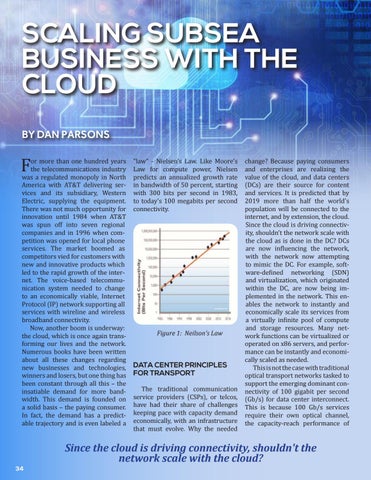
or more than one hundred years the telecommunications industry was a regulated monopoly in North America with AT&T delivering services and its subsidiary, Western Electric, supplying the equipment. There was not much opportunity for innovation until 1984 when AT&T was spun off into seven regional companies and in 1996 when competition was opened for local phone services. The market boomed as competitors vied for customers with new and innovative products which led to the rapid growth of the internet. The voice-based telecommunication system needed to change to an economically viable, Internet Protocol (IP) network supporting all services with wireline and wireless broadband connectivity. Now, another boom is underway: the cloud, which is once again transforming our lives and the network. Numerous books have been written about all these changes regarding new businesses and technologies, winners and losers, but one thing has been constant through all this – the insatiable demand for more bandwidth. This demand is founded on a solid basis – the paying consumer. In fact, the demand has a predictable trajectory and is even labeled a
“law” - Nielsen’s Law. Like Moore’s Law for compute power, Nielsen predicts an annualized growth rate in bandwidth of 50 percent, starting with 300 bits per second in 1983, to today’s 100 megabits per second connectivity.
Figure 1: Neilson's Law
DATA CENTER PRINCIPLES FOR TRANSPORT The traditional communication service providers (CSPs), or telcos, have had their share of challenges keeping pace with capacity demand economically, with an infrastructure that must evolve. Why the needed
change? Because paying consumers and enterprises are realizing the value of the cloud, and data centers (DCs) are their source for content and services. It is predicted that by 2019 more than half the world’s population will be connected to the internet, and by extension, the cloud. Since the cloud is driving connectivity, shouldn’t the network scale with the cloud as is done in the DC? DCs are now influencing the network, with the network now attempting to mimic the DC. For example, software-defined networking (SDN) and virtualization, which originated within the DC, are now being implemented in the network. This enables the network to instantly and economically scale its services from a virtually infinite pool of compute and storage resources. Many network functions can be virtualized or operated on x86 servers, and performance can be instantly and economically scaled as needed. This is not the case with traditional optical transport networks tasked to support the emerging dominant connectivity of 100 gigabit per second (Gb/s) for data center interconnect. This is because 100 Gb/s services require their own optical channel, the capacity-reach performance of
Since the cloud is driving connectivity, shouldn't the network scale with the cloud?
34
on much the same concept as x86 servers with their multiple processor cores. As with multi-core x86 integrated circuits, optical devices must have multiple optical cores, or channels, to have the same economic viability to scale instantly. Today, this is Figure 2: Cloud Scale Transport Technology not the norm in the coherent optical which is bound by a combination device market for transport of 100 of modulation, baud rate and transGb/s and more. mission distance. For x86 processors, performance is bound by clock rate, and to overcome the limitation, scaling performance is done by orchestrating multiple processors with their multiple cores within and across multiple servers for a given application. A similar scaling effect for optical transport is illustrated in Figure 2, whereby a third dimension of increasing capacity is added to that of modulation and baud rate – the adding of optical channels. While coherent optical techniques may provide a measure of improvement to a single channel, adding optical channels gives an order of magnitude of capacity gain. However, for an optical transport network to scale like a DC, a pool of available optical channels is required, based
SCALING LIKE A DATA CENTER
cessor. As with all technologies, performance has increased dramatically with each successive generation. Today, these engines are not only setting new capacity-reach industry benchmarks for one optical channel, they are doing so for six channels on a single device, with subsequent generations of engines having even more performance. What impact does the multi-channel optical engine have for a subsea cable operator whose business is connectivity? The same impact that the multi-core processor had for the DC - instant and economical cloud scale connectivity. Transport equipment with multi-channel optical engines can realize similar characteristics as servers in DCs with multi-core processors – the ability to instantly scale up and scale out performance utilizing a virtually infinite pool of capacity. A pool of resources appears infinite because resources can be returned to the
In the mid-2000s, the first photonic integrated circuit (PIC) was developed. It was later coupled it with a high-performance digital signal processor (DSP) to yield the multi-channel optical engine. This is the equivalent of six independent high-performance coherent optical transceivers on a single device, and is similar in concept to the multi-core x86 proFigure 3: Essential Devices for Cloud Scale
35
pool and used again, or in cloud terms, scaled up/down and out/ in. Scaling up is utilizing more resources within a server, while scaling down is relinquishing those resources. Scaling out is utilizing more resources among other servers within the same rack, DC or between DCs, while scaling in is relinquishing those resources when not needed. Similarly, with optical transport, capacity can be used when needed and then relinquished when not needed.
A SUBSEA EXAMPLE
The value of cloud scale transport can be seen in subsea applications in which only a few fiber pairs are typically available and distances can be more than 10,000 kilometers. In addition, subsea capacity demand increases at about 45 percent per year, driven primarily by the DC. A subsea CSP has two options to address these issues: either increase the capacity of the current optical channels on the transport network or add more channels. For subsea transport, increasing channel capacity may not be viable. For example, if the capacity-reach performance limits of the current technology have been reached, and 45 percent more capacity is required, the only option is to add more optical channels or wavelengths. The CSP faces the dilemma of how many channels to add, considering what will result in the best return on investment (ROI)? Subsea wavelengths are not cheap. Unless the CSP has idle optical channels on its transport network, the series of events illustrated in Figure 4 must take place to scale up the network with the new optical capacity. In this typical deployment example, the new capacity is only turned up after more than two months involving three different departments. Although the cloud drove the demand, the traditional subsea transport network could not scale
36
Figure 4: Traditional versus Cloud Scale Business Impact with it. The real impact was about three weeks’ worth of operational costs that was incurred and two months’ worth of revenue that was lost. In the age of agility, this is unacceptable. Clearly, cloud scale transport is more than just big fat pipes – it is the ability to scale up optical capacity instantly and economically from an infinite pool of resources, just like inside the DC. Consider transport equipment with multi-channel optical engine technology and SDN-based software for the same application. A flexible, pre-qualified, multi-terabit-per-second pool of capacity is available that can be accessed in minutes for scaling up and down services with a few clicks of a mouse. This is even more significant for expansive networks with numerous network elements (NEs), such as a subsea and terrestrial network operated by the same CSP. Each cloud scale transport NE equipped with technology like the multi-channel optical engine has multiple terabits of capacity commissioned and available for use. True, this could be accomplished with traditional transport NEs by pre-deploying multiple terabits of capacity in advance; however, the
cost of doing so without embedded multi-channel optical engine technology would be prohibitive. It would be like not having multi-core processer technology in DC servers and having to add a new server with each new application or when an application needs more compute and storage resources. This allows 100 Gb/s and even wavelength services from points of presence (PoPs) in the terrestrial network to be connected through the subsea network to the other end without the traditional process of planning, purchasing, delivery and then commissioning. The ramifications of this are enormous. Not only are almost two months of the traditional deployment cycle eliminated, but the CSP can respond to business opportunities quickly, realize faster time to revenue and offer new types of service such as on-demand wavelengths.
INVESTMENT PROTECTION THROUGH RESILIENCY
Another benefit that cloud scale transport offers is resiliency – the ability to overcome service-im-
pacting events in a timely fashion. This DC principle is based on having a pool of resources that can be assigned to perform tasks that once operated on servers that have since failed. The outage of a subsea link can have devastating business consequences and yet is not uncommon. Natural disasters such as hurricanes and earthquakes can damage both subsea cable and cable landing stations (CLS). Without the ability to redirect network traffic around the fault, a physical repair is needed, which can take weeks if the cable is broken or the CLS’s damage is extensive. In an IP-based terrestrial network, routing protocols enable routers to automatically find alternate paths, and in many cases, without the users being aware that a fault even occurred. However, with subsea networks, alternate paths are very limited, and the traditional technology and costs for the automatic redirection of multiple 100 Gb/s of traffic and wavelengths can be expensive, as capacity needs to be provisioned and reserved for a fault that has yet to occur. With cloud scale transport, capacity has already been software-defined during each NE installation and is
ready to be put into use in each NE in much the same manner as multicore processors are available on each server. As seen in Figure 5, for optical subsea restoration, not only must the channels and links be established, but the optimal modulation and baud rate will also need to be set, as the transmission distances may not be the same on the alternate route. Cloud scale technologies like the multi-channel optical engine and SDN-based software for open programming are DC-like elements that enable resiliency of subsea networks.
optical engine and SDN-based software enable the transport network to have scalability and resiliency characteristics like a DC. With cloud scale transport, a subsea CSP can offer competitive and differentiated services and realize better ROI, leading to higher brand value. Don’t let tradition get in the way of success.
WHY IS THIS NECESSARY?
The ability to scale up transport capacity at cloud scale is not only obvious in its value but also necessary. The CSPs that can effectively supply the almost insatiable demand and quickly match changing market needs better than others have the fundamental basis for success. The cloud market is growing, and the transport network must change from traditional to cloud scale to meet the demands of the DC. Technologies like the multi-channel
Dan Parsons is Senior Marketing Manager at Infinera. Dan Parsons has more than 30 years of experience bringing wireline and wireless products to market in engineering, product management and marketing roles. He’s been an early member of start-ups and a key contributor to multibillion-dollar companies. Dan’s optical career started in 1992 and he’s delighted to be a part of the product marketing team at Infinera. Dan received his B.Eng. at Carleton University in Ottawa, Canada.
Figure 5: Cloud Scale Resiliency for Subsea 37
The Power of Submarine Information Transmission
There’s a new power under ocean uniting the world in a whole new way. With unparalleled development expertise and outstanding technology, Huawei Marine is revolutionizing trans-ocean communications with a new generation of repeaters and highly reliable submarine cable systems that offer greater transmission capacity, longer transmission distances and faster response to customer needs. Huawei Marine: connecting the world one ocean at a time.
HIGH PERFORMANCE SUBMARINE CABLE PRODUCTS BY DAISHI MASUDA
T
he OCC-SCxxx series optical submarine cable, well known for its “3 Divided Steel Segment� core design, has a track record supported by more than 250,000km of cable that has been supplied for various projects worldwide since its first manufacturing in the 1980s. This unique core design, providing robust high-pressure resistance and low torque, offers the ideal structure to bring out the full advantages of recent high performance optical fibers. Also, OCC-SCxxx series design realizes the high level of reliability as well as electrical and mechanical
40
performance with long distance system requirements while realizing a compact and cost-effective design.
OPTICAL SUBMARINE CABLE DESIGN.
In order to look for the future, one should begin by looking back over the history of OCC SCxxx series, shown in Figure 1. The structure of submarine cables have been changing gradually. In 1983, the first commercial optical submarine cables were manufactured in Japan. OCCSC100 structure utilized a tight-unit
structure where fibers were fixed in an UV cured buffer that became the core of the submarine cable. In 2006, after 23 years of first optical submarine cables production, the submarine cable structure was modified to a loose tube design as called OCCSC3xx Series. While the OCC-SC100 structure utilized a tight-buffer fiber unit design, in the OCC-SC3xx Series fibers were directly inserted into the 3-Divided steel segments with the water blocking compound. By 2011, mass production of OCCSC5xx Series submarine cables started. The OCC-SC5xx series is a
size reduced variation of the OCCSC3xx series. The latest submarine cable structure is called OCC-SC520, SC530 and SC540 in which the 3-Divided steel segments size was optimized to allow for more fibers that can be inserted in the submarine cables. Also, we will be able to se-
lect the cable design depends on the various system requirements (Capacity, Length, Power Feeding Voltage and etc…). The structure change from tightunit to loose tube design was very important for cabling the large effective area fibers. The OCC-SC3xx
and SC5xx series, loose tube design submarine cable, optical fibers are loosely packed with minimum stress. This innovation in our cable manufacturing process has some advantages, especially for cabling large effective area fibers because of the inner space availability within the 3-Divided steel segments that allows cabling optical fibers with almost zero stress.
RESULTS FOR SUBMARINE CABLES EQUIPPED WITH LATEST OPTICAL FIBERS.
Figure 1, OCC-SCxxx Series Submarine Cable
The development towards higher bit rate optical communication systems has been rapidly evolving in recent years and the advances in transmission technologies have increased the level of requirements for each element of the system. For high capacity long haul submarine transmission systems, the deployment of “Ultra Low Loss” and “Ultra Large Effective Area” fibers have be-
41
Based on these results, we proved that our cabling process was capable of effectively cabling large effective area fibers without increasing the optical attenuation. come a must formance level for communication NEXT SUBMARINE CABLE to improve systems with bit rates of 100Gb/s DESIGN FOR NEAR OSNR and and higher. This report describes FUTURE SYSTEMS. system the optical performance results of perforsubmarine cables after completion It is desired to further increase mance. of mass production. Figure 2 and 3 the transmission capacity. However, S u c h shows the optical attenuation perthe increase in transmission capacglass formance of mass production subity using single mode fiber is limitdesign marine cables equipped with the ed, and it is difficult to increase the “ e n ultra large effective area fibers. We transmission capacity easily by limhanceconfirmed that our optical submaiting the size of the submarine caments” rine cable design can be successble and the submarine repeater, the affect fully equipped with the ultra large power feeding voltage (withstand the Maceffective area fibers by OCC-SCxxx voltage characteristics) and etc. As ro/Micro series with extremely low optical the most important matter, it is necbending senattenuation. Based on these results, essary to minimize the cost related sitivity/perforwe proved that our cabling process to the increase of the transmission mance of the fiber was capable of effectively cabling capacity. “Cost per Bit” is compared among other optical large effective area fibers without by the cost per transmission capacparameters. Accordingly, increasing the optical attenuation. ity, the balance between new techthe glass coating design is nology, the capacity that can be also modified from previous increased, and the cost. types as to cope with those “More Spectrum”, “More Fiissues and reduce Macro/ bers” and “More Cores” are reMicro bending sensitivity. quired to further increase the From the cable design point transmission capacity and will of view, our main objective become to an indispensable is to ensure that the optical solution in major network. fibers are not affected by the “More Spectrum”, solution cabling process and that the is C+L band transmission. The finished optical submarine Macro/Micro bending losses cable delivers all the benefits are the biggest concern over of such high performance L-band window as well as over optical fibers. the C-band. Macro bending, We completed the caespecially, is a key factor afbling evaluation and qualififecting the optical attenuation cation for “Ultra Low Loss” increase over the L-band. The and “Ultra Large Effective Macro bending loss rapidly inArea” fibers with excellent creases for longer wavelengths results. These results gave in comparison to Micro bendus the necessary confidence ing loss increases rate. While to assume that both OCCMicro bending loss increases SC3xx and SC5xx series cagradually and is less waveble designs would be ideal length dependent than Macro for cabling such recent high bending loss increases. These performance optical fibers optical attenuations increase for transoceanic submarine factors need to be controlled Figure 2, Averaged Att. Results (with 130μm2) cable systems and provide otherwise optical attenuation Figure 3, Averaged Att. Results (with 150μm2) the high-quality optical perperformance over L-band may
42
not be as good as performance obtained over C-band. We also confirmed the mass production performance over C+L band of submarine cables equipped with large effective area fibers, aiming to expand the available optical communication bandwidth (see Figure 4). These results confirmed that at L-band the optical attenuation of multiple fiber core has and standard deviation that was at the same level as that at C-band. This C+L band verification is a big step moving forward achieving the C+L band transmission ready submarine cables.
tion as a method that can divert many existing technologies and increase capacity. There are almost no optical technical challenges, but there are some challenges. Firstly, identification of optical fibers. Currently it is performing its identification in 16 colors, but it is very difficult to distinguish new colors. Identification by ring marking is also being considered, however there is concern about an increase in optical attenuation due to ring marking application like a Micro bending loss. Currently it applies only to conventional single mode fiber, and evaluation on application to ultra large “More Fibers”, solution is high effective area fiber is being carried count fiber cable. It attracts attenout. Secondly, it is necessary to deal with the increase of the power feeding voltage accompanying the increase of the amplifier. “More Cores”, There are approaches such as FMF (Few-mode fiber) and MCF (Multi-core fiber) to increase the number of cores, active research is underway, and the results of various transmission experiments have also Figure 4, Averaged Att. Results (with 110μm2)
been published. However, there are many challenges (behavior of cabling, long-term reliability, amplification, equalization, peripheral equipment and etc.) for realizing on a commercial basis, and continuous research and development activities are necessary.
Daishi Masuda received his BSEE degree from Kitakyushu College of Technology in 2000. He joined OCC’s Submarine Systems Division the same year and worked in quality assurance department for 12 years. He is currently Engineering Manager in the Submarine System Plant. 43
SCIENTISTS REPORT FIRST DATA TRANSMISSION THROUGH TERAHERTZ MULTIPLEXER REPRINTED WITH KIND PERMISSION FROM MITTLEMAN LAB/BROWN UNIVERSITY/ DUCOURNAU LAB/CNRS/UNIVERSITY OF LILLE.
M
ultiplexing, the ability to send multiple signals through a single channel, is a fundamental feature of any voice or data communication system. An international research team has demonstrated for the first time a method for multiplexing data carried on terahertz waves, high-frequency radiation that may enable the next generation of ultra-high bandwidth wireless networks. In the journal Nature Communications, the researchers report the transmission of two real-time video signals through a terahertz multiplexer at an aggregate data rate of 50 gigabits per second, approximately 100 times the optimal data rate of today’s fastest cellular network.
44
“We showed that we can transmit separate data streams on terahertz waves at very high speeds and with very low error rates,” said Daniel Mittleman, a professor in Brown’s School of Engineering and the paper’s corresponding author. “This is the first time anybody has characterized a terahertz multiplexing system using actual data, and our results show that our approach could be viable in future terahertz wireless networks.” Current voice and data networks use microwaves to carry signals wirelessly. But the demand for data transmission is quickly becoming more than microwave networks can handle. Terahertz waves have higher frequencies than microwaves and
therefore a much larger capacity to carry data. However, scientists have only just begun experimenting with terahertz frequencies, and many of the basic components necessary for terahertz communication don’t exist yet. A system for multiplexing and demultiplexing (also known as mux/ demux) is one of those basic components. It’s the technology that allows one cable to carry multiple TV channels or hundreds of users to access a wireless Wi-Fi network. The mux/demux approach Mittleman and his colleagues developed uses two metal plates placed parallel to each other to form a waveguide. One of the plates has a slit cut into it. When terahertz waves travel through
Researchers have demonstrated the transmission of two separate video signals through a terahertz multiplexer at a data rate more than 100 times faster than today’s fastest cellular data networks. the waveguide, some of the radiation leaks out of the slit. The angle at which radiation beams escape is dependent upon the frequency of the wave. “We can put several waves at several different frequencies — each of them carrying a data stream — into the waveguide, and they won’t interfere with each other because they’re different frequencies; that’s multiplexing,” Mittleman said. “Each of those frequencies leaks out of the slit at a different angle, separating the data streams; that’s demultiplexing.” Because of the nature of terahertz waves, signals in terahertz communications networks will propagate as directional beams, not omnidirectional broadcasts like in existing wireless systems. This directional relationship between propagation angle and frequency is the key to enabling mux/demux in terahertz systems. A user at a particular location (and therefore at a particular angle from the multiplex-
ing system) will communicate on a particular frequency. In 2015, Mittleman’s lab first published a paper describing their waveguide concept. For that initial work, the team used a broadband terahertz light source to confirm that different frequencies did indeed emerge from the device at different angles. While that was an effective proof of concept, Mittleman said, this latest work took the critical step of testing the device with real data. Working with Guillaume Ducournau at Institut d’Electronique de Microélectronique et de Nanotechnologie, CNRS/University of Lille, in France, the researchers encoded two high-definition television broadcasts onto terahertz waves of two different frequencies: 264.7 GHz and 322.5 GHz. They then beamed both frequencies together into the multiplexer system, with a television receiver set to detect the signals as they emerged from the device. When the researchers
aligned their receiver to the angle from which 264.7 GHz waves were emitted, they saw the first channel. When they aligned with 322.5 GHz, they saw the second. Further experiments showed that transmissions were error-free up to 10 gigabits per second, which is much faster than today’s standard Wi-Fi speeds. Error rates increased somewhat when the speed was boosted to 50 gigabits per second (25 gigabits per channel), but were still well within the range that can be fixed using forward error correction, which is commonly used in today’s communications networks. In addition to demonstrating that the device worked, Mittleman says the research revealed some surprising details about transmitting data on terahertz waves. When a terahertz wave is modulated to encode data — meaning turned on and off to make zeros and ones — the main wave is accompanied by sideband frequencies that also must be detected by a receiver in order to
45
transmit all the data. The research showed that the angle of the detector with respect to the sidebands is important to keeping the error rate down. “If the angle is a little off, we might be detecting the full power of the signal, but we’re receiving one sideband a little better than the other, which increases the error rate.” Mittleman explained. “So it’s important to have the angle right.” Fundamental details like that will be critical, Mittleman said, when it comes time to start designing the architecture for complete terahertz data systems. “It’s something we didn’t expect, and it shows how important it is to characterize these systems using data rather than just an unmodulated radiation source.” The researchers plan to continue developing this and other terahertz components. Mittleman recently received a license from the FCC to perform outdoor tests at terahertz frequencies on the Brown University campus (see sidebar). “We think that we have the highest-frequency license currently issued by the FCC, and we hope it’s a sign that the agency is starting to think seriously about terahertz communication,” Mittleman said. “Companies are going to be reluctant to develop terahertz technologies until there’s a serious effort by regulators to allocate frequency bands for specific uses, so this is a step in the right direction.” This work was supported by the U.S. National Science Foundation, the U.S. Army Research Office, the W.M. Keck Foundation and France’s Agence Nationale de la Recherche under the COM’TONIQ and TERALINKS research grants and in the framework of the CPER “Photonics for Society” developed within the Hauts-deFrance region. 46
BROWN RESEARCHERS ISSUED FCC LICENSE FOR TERAHERTZ TESTS The Federal Communications Commission has issued a license for testing terahertz wireless data links, which could be the backbone of next-generation high-speed data networks, on the Brown campus.
W
ith the ongoing massive growth in global wireless traffic, existing microwave wireless networks are rapidly becoming saturated. Terahertz waves have higher frequencies than microwaves and higher data-carrying capacity, but much more research needs to be done to make terahertz networks possible. “In many countries, research on terahertz wireless is proceeding rapidly, but it lags behind in the U.S.,” said Daniel Mittleman, an engineering professor at Brown University. “That’s at least in part because relevant federal agencies have been reluctant to provide the necessary regulatory environment to encourage innovation.” Mittleman is hopeful that might be about to change. Recently, his research group at Brown received a license from the Federal Communications
Commission (FCC) to perform outdoor tests of data transmission in several frequency bands in the terahertz range. “As far as we can tell, our license includes the highest frequency currently licensed by the FCC for any purpose,” Mittleman said. “The hope is that these steps will not only clarify the feasibility of such data links, but will also spur further policy discussions and federal investments in the research that will be necessary to make terahertz communication a reality.” In order for a non-federal entity to broadcast any wireless signal in the U.S., a license from the FCC is required. The licensing system ensures that new sources of radio emissions don’t interfere with any existing users on the ground and in the air. The FCC is responsible for managing and licensing the entire radio spectrum, which includes commercial radio broadcasts, aircraft communications, radar, cellular and bluetooth systems and more. Mittleman says that the FCC has rarely issued any licenses for any frequencies above 95 gigahertz (the terahertz range can be said to begin at 100 gigahertz). This new license could be a sign that the FCC is starting to take terahertz data communication seriously. Mittleman plans to begin outdoor testing in the fall. Their license includes four terahertz frequency bands that they are able to use for tests at any location within a 1.5-kilometer radius centered at the Barus and Holley building on campus. “These kinds of outdoor tests will be important for understanding what’s possible in terahertz communication,” Mittleman said. “And right now, Brown is the only place in the country where those tests can legally be done.”
Read the latest issue now
s u bmar i n e t e l e co m s
INDUSTRY
REPORT
ISSUE 6 | 2017/2018
47
NEW ORLEANS
SPONSORSHIPS AND EXHIBITION SALES ARE NOW OPEN! THE EARLY BIRD GETS THE WORM DON’T MISS OUT ON EXCELLENT VISIBILITY DURING THE SUBOPTIC 2019 CONFERENCE.
REGULARLY WITH 650+ ATTENDEES, 50+ SPEAKERS AND REPRESENTING OVER 75 NATIONALITIES THERE IS NO BETTER PLACE FOR ACCESS TO THE SUBMARINE FIBER INDUSTRY. RESERVE TODAY! SPONSORSHIP PACKAGES EXHIBITION HALL
SUBOPTIC2019.COM
EVOLUTION OF SUBMARINE FIBER TO ULTRA-LARGE EFFECTIVE AREA AND ULTRA-LOW LOSS BY IAN DAVIS
50
INTRODUCTION
S
ince installation of TAT-8, the first trans-Atlantic submarine cable in 1988, several generations of submarine cable systems have been evolved, driven by the abundance of data-hungry applications demanded by subscribers around the world. At each transition, increasingly advanced optical fibers have been developed to support the step-changes in capacity demanded of the systems by the network owners and these innovations have had to overcome increasingly demanding technological challenges to ensure reliable operation. Historically, only the most high quality and innovative optical fiber manufacturers have been trusted to supply products into the submarine sector of telecommunications. The current state of the art is fiber featuring ultra-low loss and ultra-large effective area, enabled by advances in both glass and coating technology.
Applications continue to emerge that will stress network capacity. Just one example is that of virtual and augmented reality, requiring around twenty times the data-rate to provide a satisfying experience to the subscriber as that currently needed to deliver high-density streamed video services. Submarine system providers are already looking to the next generation of capacity enhancing designs and supporting fiber innovations must be considered at the same time.
A side-benefit of developing high-performance submarine optical fiber technology is that advances in this field frequently find subsequent use in terrestrial networks as these also advance to support ever increasing data capacity needs. Once transferred to the terrestrial sector, the opportunity exists to deploy the technology in altogether larger volumes. Fiber advances in the areas of ultra-low loss, large-effective area and advanced coatings are already making their presence felt on land, as well as under water.
DISPERSION MANAGED FIBER When trans-oceanic submarine networks started to introduce 10 Gb/s Wave Division Multiplexed (WDM) operation in the mid-2000’s a new approach to dispersion management was established. Whearas previously, non-zero dispersion shifted fiber (NZDSF) was used in both long-haul terrestrial and submarine networks to allow dispersion to accumulate more slowly over the span, at these higher data rates a dispersion managed fiber (DMF) approach was preferred to avoid the need for dispersion compensation at each amplifier. In this approach, a combination of fibers, one with high positive dispersion in the C-Band (1530-1565 nm) and one with around twice as much negative dispersion, are deployed together in the same span to keep the accumlated dispersion from reaching extreme limits (Figure 1).
Figure 1. Qualitative schematic diagram of a dispersion managed fiber (DMF) link.
Submarine system providers are already looking to the next generation of capacity enhancing designs and supporting fiber innovations must be considered at the same time. 51
First generation DMF systems employed a positive dispersion fiber of typically +18.5 ps/nm.km dispersion and 0.187 dB/km attenuation at 1550 nm. The effective area of this fiber is slightly larger than a conventional single-mode fiber, typically 100 µm2. The combination of larger effective area and higher dispersion makes the fiber more resistant to introducing reach limiting non-linear signal distortions such as four wave mixing (FWM), self-phase modulation (SPM) and cross phase modulation (XPM) when the optical power in the fiber core is very intense just after each amplifier. Non-linear distortion is also suppressed by designing for net negative dispersion at the end of most spans until a fully positive dispersion span is required. To mitigate against the larger effective area introducing more bend sensitivity, cut-off wavelength is shifted from around 1310nm to just below the C-band. This design conforms to the ITU-T Recommendation G.654 Characteristics of a cut-off shifted single-mode optical fibre and cable.
ULTRA-LOW LOSS AND LARGE EFFECTIVE AREA FIBER
Second generation DMF systems in the early 2010‘s required further improvement in the positive dispersion fiber in order to support data rates up to 40 Gb/s at trans-oceanic distances. Employing a sili-
52
ca core instead of the traditional germania-doped silica core (whilst modifying the cladding composition to achieve the refractive index delta between the two regions necessary to trap light) moved 1550 nm attenuation from 0.18 - 0.21 dB/km to 0.15 – 0.17 dB/km (actual performance dependent on process). The significantly slower accumulation of optical power loss allowed longer spans to be built before amplification became necessary. In addition, the effective area of the core was further extended to typically 112 µm2 providing even more effective suppression of non-linear effects [1]. Although first appearing in dispersion managed systems, ultralow-loss and large effective area fiber was highly suited to the next advance in submarine transmission technology introduced to extend data carrying capacity. Migration to 100 Gb/s channel speed was achieved by discarding direct detection (in which only the signal amplitude carries data) and introducing coherent detection (in which the phase and polarization state of the signal also carry data). This transmission technology is much more spectrally efficient and the capability to compensate for high levels of chromatic and polarization mode dispersion at the digital coherent receiver renders the need for dispersion management obsolete. In fact, at very high data rates, higher
fiber dispersion is a positive advantage for suppression of non-linear distortion. In such systems, what becomes critical is the need for high optical to signal noise ratio (OSNR) at the end of every span.
Ultra-low loss and large effective area are the two fiber attributes that matter most in delivering high OSNR. Large effective area allows higher launch power from the transmitter before non-linear distortion is introduced, whilst ultra-low loss allows reach to be extended before the receiver power threshold is met and amplification becomes necessary. In conjunction with advanced amplification equipment, unrepeatered reach of over 600 km has been demonstrated with a 112 µm2 effective area and 0.157 dB/km loss fiber operating at 100 Gb/s [2].
To accomodate the very longest undersea links at 100 Gb/s channel speed, i.e. trans-Pacific routes of more than 10,000 km, it was natural for submarine fiber suppliers to develop products that deliver even better performance from these key attributes. The most recently introduced products feature fibers with typical effective area of 150 µm2 and loss around 0.155 dB/km at 1550 nm. An example of such a product, which in the last two years has been installed in several new trans-oceanic links, is Corning® Vascade® EX3000 optical fiber. Delivering such performance no trivial design feat. A particular chal-
lenge to overcome is ensuring that the ultra-large effective area is not achieved at the cost of high bending sensitivity. Generally speaking, when increasing the size of the core, light becomes more broadly distributed with a higher proportion transmitting close to the core-cladding interface and more susceptible to losses due to macrobending and microbending (Figure 2).
ber is coiled in the enclosed joint at the end of a span. Fiber refractive index profile must be designed to achieve controlled, low loss at bend radii associated with fiber storage in the range of joints used in the industry. This performance can be further protected by enhancements to joint design that ensure the fiber is not pulled into tighter coils during processing and installation [3].
per channel. Each of these presents new challenges to the fiber designer.
Higher fiber count cables Whereas 2 and 4 fiber pair cables were standard in the days of dispersion managed solutions, 6 and 8 fiber pairs are more common today. If challenges in delivering the necessary power to the optical amplifiers are overcome, doubling capacity to 16 fiber pairs is an obvious upgrade path. A challenge to address is ensuring that up to 32 fibers in the same tube can be uniquely identified and easily distinguished. The established 16 colors meet this need, but adding more colors that are clearly distinguishable by the naked eye becomes increasingly difficult (resorting to several shades of the same basic color e.g. dark green, lime green, olive green). A solution developed by the terrestrial cable industry is to apply ring-marks uniformly along the fiber at a fixed separation. In this way, each color
Such losses, if allowed by the fiber design, could rapidly negate the reach advantages derived from ultra-low loss. Although the submarine cable is a less crowded condition for the fiber than in a more tightly packed, higher fiber count OPTIONS AND CHALLENGES terrestrial cable, a high performance FOR HIGHER CAPACITY coating is necessary to ensure microbending losses, tiny deviations With no respite in sight, submaof the fiber core caused by external rine system designers are actively stresses, are protected against. The pursuing several different technical 2-layer coating, extending from the paths for increasing submarine ca125 Âľm diameter glass surface out ble capacity. Three intuitive paths to 250 Âľm diameter, combines a to achieving higher capacity are 1) particularly soft inner layer with a more fibers per cable 2) more chanhard, resilient outer layer. Between nels per fiber 3) higher data rate the two coating layers, lateral forces that could transmit through the fiber to generate core deviations are resisted and absorbed. Macrobending is the loss of light from the core through localized tight bending occuring, for example, where excess fiFigure 2 Macrobending and Microbending are more challenging to address for a large core fiber
53
can be used twice per tube (one with ring-marks, one without). Superior coating performance and care in defining the ring-mark separation are both necessary to ensure that the ring-marks themselves do not become sources of microbending
MIGRATING TO ANOTHER WAVELENGTH BAND
In addition to established operation in the C-band, the L-band (1565-1625 nm) has been proposed as a simultaneous region of operation. Fundamentally, transmitting at longer wavelengths has operational trade-offs as both the fundamental fiber attenuation and the bending sensitivity increase as wavelength increases. In addition, EDFA noise figure is slightly higher in the L-band compared to the C-band, leading to further operational trade-offs. For these reasons, it is likely that the practical upper bound of L-band operation will be set below 1625 nm, introducing a limit on the number of incremental channels that can be added. Attention must also be paid as to whether the existing combination of fiber bending sensitivity and the aspects of joint design that restrict the radius of coiled excess fiber are sufficient to ensure that performance in the L-band is reliable.
FASTER CHANNEL SPEEDS
Ultra-large effective area and ultra-low loss fibers were developed to deliver improved OSNR at the
54
end of each span. It follows that further increase in channel speed will lead to a need for further improvement in these attributes. Since the step-change delivered by silica core technology, further improvements in attenuation have so far been incremental. Increasing the allowed launch power by moving effective area beyond 150 µm2 is the alternative path to OSNR improvement, however, this will be achieved at the expense of abandoning single-moded design by using what is known as a few-moded fiber. Such fibers, with effective area of 220 µm2, have been investigated experimentally being deployed in quasi-single-moded operation [4] and successfully extended reach through a significantly higher allowed launch power. However, steps must be taken to mitigate the effects of multi-path interference (MPI) that are inherent when more than one mode is supported by the fiber and other advances in system design will be required.
MIGRATING SUBMARINE TECHNOLOGY TO TERRESTRIAL NETWORKS
Ultra-low loss fiber with effective area of 150 µm2 is described by Table D of ITU Recommendation G.654 and the earlier generation of112 µm2 is described by Table B. In November 2016, a new Table E was added to the standard.
Table E recognizes that ultra-low loss and large effective area fibers can also deliver advantage in terrestrial networks where channel data rates of 200 Gb/s are increasingly common. Table E is more restrictive than Tables B and D in a few respects to address important operational differences between the submarine and terrestrial environments. Firstly, the macrobending limit was set more tightly to provide assurance that the product can be used in splice trays of regular design that typically occur every 4 to 8km on backbone routes. Consequently, it was necessary to restrict the allowed nominal mode field diameter to the more limited range of 11.5 to 12.5 µm, excluding the possibility of more bend-sensitive designs. This restriction is also necessary to ensure a sufficiently microbending insensitive fiber as terrestrial cable designs are more tightly packed than submarine cables and can include ribbon as well as loose-tubed configurations. The first commercial offerings that were released following the introduction of G.654 Table E were ultra-low loss fibers (≤ 0.17 dB/km, typically 0.168 dB/km at 1550 nm) with nominal effective area of 125 µm2 and capable of extending reach by more than 60% compared to standard G.652.D single-mode fiber.
The emergence of terrestrial G.654.E fiber compliments another recent trend in submarine networks led by the Internet Content Providers (ICPs). Whereas traditionally, submarine links terminate at a submarine landing point station close to the water, network owners are increasingly removing this transition point and continuing to transmit much further inland to an established data center (Figure 3). The new configuration enjoys cost savings from removing the equipment based in the landing station and delivers a small improvement in latency through the removal of optical-electrical-optical signal regeneration. In this design, the extended reach is enabled by employing ultra-low loss and large effective area throughout the submarine and terrestrial sections where the latter can employ G.654.E compliant fiber such as Corning® TXF™ optical fiber.
CONCLUSIONS
REFERENCES
Highly advanced submarine fibers have been developed to support system providers as they endeavor to address the continuing need for higher capacity transmission. The most advanced fibers currently combine ultra-low loss with ultra-large effective area to deliver high data rates over trans-oceanic distances. In addition, submarine fibers are manufactured using the most demanding quality architecture, to ensure reliable, consistent performance over decades on the ocean floor. Whilst submarine networks continue to advance optical fiber innovation will surely continue alongside, making high-speed connections a global reality.
[1] Mishra eta l, “Ultra Low Loss and Large Effective Area Fiber for Next Generation Submarine Networks” Submarine Telecoms Forum, September 2010
Figure 3. Submarine systems are evolving from termination at a landing station (left) to extending the link out to an inland data center.
[2] Chang et al, “ Ultra-Low Loss Fiber and Advanced Raman Amplification Deliver Record Unrepeatered 100G Transmission” Suboptic, April 2016
[3] Palacios et al, “Ultra-Large Effective Area Fibre Performances in High Fibre Count Cables and Joints, A New Technical Challenge” Suboptic 2016 [4] Sui et al, “256 Gb/s PM-16-QAM Quasi Single-Mode Transmission over 2600 km using Few-Moded Fiber with Multi-Path Interference Compensation”, ECOC March 2014.
Ian Davis is the regional marketing manager for EMEA, responsible for developing and executing optical fiber product strategy within the region. He joined Corning in 1989 and has held various positions in marketing, product engineering, product line management, and applications engineering management. Davis received First Class Honors from Nottingham University, graduating with a Bachelor of Science Degree in Physics. He also received a diploma in Management Studies from St. Helens Technical College in Merseyside, England. 55
.com
WFN Strategies designs and implements submarine fiber cable systems for commercial, governmental and oil & gas companies throughout the world.
SYSTEM SOLUTIONS TO ESTABLISH A NEW LINK FOR EXPANDING EXISTING SUBMARINE CABLE NETWORKS BY XIAOYAN FAN, JIPING WEN, LING ZHAO, JING NING, TONG LIU, RAN LI
58
ABSTRACT Under the circumstance of establishing a new link to expand an existing submarine network, we investigate characteristics of dispersion tolerance and performance in different types of mixed system, emphasizing performance advantages of using D+ fiber.
INTRODUCTION
W
ith the continuous growth in the demand for international data traffic, the investment for new build regional or transoceanic-cable systems as well as the capacity upgrade of existing submarine cable systems has been greatly stimulated. An example of a new build link connecting with an existing network by branching unit (BU) is shown in Fig.1 (a), the new station C is connected with the existing A-B network by BU, hence in this way the existing submarine cable network is expanded to cover larger region, which can shorten the project construction period. This new scheme is mainly used in those networks with multiple landing stations, where most of the existing systems use the low-dispersion hybrid fibers as the transmission fiber, which is called hybrid link in this paper. When a new build system is connected with an existing legacy hybrid-fiber system, the combined system is called the mixed link. Several studies have been carried out to find out the dispersion pre-compensation (Pre-CD) would be useful in this new mixed fiber links [1-3]. In this paper, we will investigate characteristics of dispersion tolerance and performance comparison in two kinds of mixed fiber system. As shown in Fig.1 (b), the link between station C and B is named Segment1 (S1), and the link length of S1 is about 4000 km. Two kinds of mixed links are employed in our simulations based on S1 Segment. One is to combine an existing lega-
cy hybrid-fiber system with a new build D+ fiber system (scenario 1), the other is to combine the same legacy hybrid-fiber system with new build dispersion slope managed fiber (DSMF) system (scenario 2).
NETWORK CONFIGURATIONS
Our system model and configurations are shown in Fig.1 (a) shows the geographic diagram.
Fig. 1: (a) system model (b) system configuration The existing legacy hybrid-fiber link between station A and B is marked with blue line. Its length is about 1200 km with11 RPTs. In this hybrid link, the fiber1 and fiber2 are transmission fibers with average dispersion coefficient of -3 ps/ (nm·km). The fiber3 is used for dispersion compensation with dispersion coefficient of 16.8 ps/(nm·km). There is a pre-prepared fiber pair BU in the A-B link. The new build link (in thick red lines) is from existing BU to station C, whose length is about 3000km. On 100G PDM-QPSK modulation format, 66 loaded chan-
nels with 37.5GHz channel spacing occupied the whole bandwidth.
PRE-CD TOLERANCE AND Q IMPROVEMENT IN THE MIXED LINKS CORRESPONDING TO SCENARIO 1
In this section, we only consider the mixed link which is composed of D+ fiber link (dispersion coefficient is 21.5 ps/(nm·km)) and legacy hybrid-fiber link on S1 Segment. The sensitivity of the coherent D+ systems to Pre-CD is modest, as shown in ref. [2], there is only 0.1dB~0.15dB Q factor improvement. Though D+ fiber link only is insensitive to Pre-CD, this mixed link is sensitive to the Pre-CD. Fig. 2 (a) shows the deviation of transmission penalty from the optimum Pre-CD case in S1 link as a function of Pre-CD fiber length at the TX(transmitting terminal). The symbol±in abscissa represents the sign of dispersion coefficient (16.8 ps/ (nm·km)) of Pre-CD fiber. It can be seen that the performance for S1(C>B) is improved significantly by the optimization of Pre-CD applied at the transmitting terminal and the optimum Pre-CD fiber length at 1550.1 nm is -3920 km. Fig. 2(b) shows the Pre-CD scan results for the hybrid link only in S1. The optimum Pre-CD ranges from a 0km to -100km. Considering different constitute links have different sensitivity to Pre-CD, the optimum Pre-CD in S1 can be estimated as the sum of the negative value (-3860km @ 16.8 ps/(nm·km)) of accumulation dispersion of the D+ fiber link and the optimum Pre-CD value (0~100km @16.8 ps/(nm·km)) of the only legacy hybrid-fiber link. This estimated result is within the actual simulated results for optimum PreCD scope (-3980km~-3750km). From the Fig2, we can see the dispersion tolerance of the mixed link is better than that in the legacy hy59
brid-fiber link only if the Pre-CD is applied at TX. For the transmission of 66 loaded 100G PDM-QPSK signals with a 37.5GHz spacing in S1 segment, the maximum gain can reach ~15dB. Figure 3 shows Q2 factors in three different circumstances under different power pre-emphasis which is normalized with respect to the optimum launch power. The Q2 factor in red curve is obtained based on the -3920km optimal Pre-CD in the S1 link from station C to B and blue curve corresponds to no PreCD case. Green curve corresponds to the Q2 factor without dispersion pre-compensation in the opposite direction. As we can see, at the optimum power, the Q2 factor can achieve 7dB after reserving the necessary system margins such as manufacturing and environmental impairment, TVSP (Time Varying System Performance) and non-optimal optical pre-emphasis impairment. This is about 0.55dB improvement as compared with no Pre-CD case. And this indicates that the optimization of Pre-CD applied at the transmitting terminal can significantly improve system performance, and ensure that the performances in both forward and reverse transmission are roughly the same.
60
Fig. 2: The deviation of transmission penalty from the optimum Pre-CD case (a) the mixed link in scenario 1 (the combination of D+ and legacy hybrid fiber link) (b) legacy hybrid fiber link only.
Fig3: Q2 factor for S1 link; red: at the optimum Pre-CD (-3920km) in the mixed link from C to B; blue: without Pre-CD in the mixed link from C to B; green: without Pre-CD in the mixed link from B to C.
PRE-CD TOLERANCE AND PERFORMANCE IN THE MIXED LINKS CORRESPONDING TO SCENARIO 2 AND COMPARISON WITH SCENARIO 1
We also evaluate Q2 factor when the DSMF is employed in the new build link (scenario 2 as shown in Fig.1 (b)). The red and blue lines represent DSMF-only link and legacy hybrid- fiber only link respectively. The attenuation and dispersion coefficients are respectively 0.186 dB/km and 21.5 ps/(nm¡km) for the positive dispersion fiber in DSMF fiber, and 0.234dB/km and -44 ps/ (nm¡km) for the negative dispersion fiber in DSMF. Fig. 4(a) shows the dispersion scanning results for scenario 2. The optimal Pre-CD of all links satisfies the rule that the accumulated dispersion should near zero after half of the transmission distance. In addition, the dispersion tolerance in the mixed link corresponding to scenario 1 (as shown in Fig. 4(b)) is better than that in scenario 2. The main reason is the higher resistance to nonlinearity for coherent codes in D+ fiber link than in legacy hybrid fiber and in DSMF fiber.
Fig.4: Dispersion windows for different configurations. (a) purple: hybrid link only; green: DSMF link only; blue: the mixed link in scenario 2 (the combination of DSMF fiber link and legacy hybrid fiber links.) (b) red: the mixed link in scenario 1 (the combination of D+ fiber link and hybrid legacy fiber links)
hybrid-fiber link, the resultant dispersion tolerance in the case of employing D+ fiber in the new build link is wider than that in the case of employing DSMF fiber in the new build link. Furthermore, the former also exhibits pronounced advantages in the transmission performance, capacity and laying cost over the latter.
BIOS
CONCLUSIONS
Fig5: Q2 factor comparison between two types of mixed links; red: scenario 1; blue: scenario 2 (ditto); The transmission performance of the above-mentioned two kinds of mixed links at their own optimum launch powers is shown in Fig.5. The horizontal axis shows power deviation with respective to the optimal power of the mixed link, and the ‘zero’ is corresponding to the optimal power in scenario 2. The vertical axis shows the Q2 factor after transmission which reserves the necessary system margins (ditto). The blue curve shows the results for the mixed link corresponding to scenario 2, the best Q2 factor is almost 7dB. After replacing the DSMF fiber with the D+ fiber, the optimal launch power is higher by 2dB, and the corresponding Q2 factor is increased by 0.8~1.85dB. As a result, the system can transmit only 50 loaded 100G PDM-QPSK signals with 50GHz channel spacing in scenario 2, which corresponds to a 30% decrease in capacity as compared to the D+ fiber case. Our studies indicate that, for the coherent 100G PDM-QPSK modulation format, if we connect the new build link with the existing legacy
In this paper, under the circumstance of establishing a new link to expand existing networks, our simulation studies show that at least a 0.8dB of Q improvement can be observed by using D+ fibers instead of the DSMF fiber in the new build link in the optimum dispersion pre-compensation condition, This leads to about 30% capacity improvement. This indicates that the expansion of the existing network prefers employing D+ fiber for new build regional even transoceanic-cable systems.
REFERENCES
Xiaoyan Fan has 10 years’ experience within the Terrestrial and Submarine Telecommunication & Service Provider sectors, serving as Senior System simulation Engineer for Huawei Marine Networks (HMN) in China. She has gained experience in undersea system simulation and some trans-ocean turnkey project delivery. Christina has published paper on Suboptic’10’16 and output several patents in optical transmission field. She holds a Master’s degree in Optics Engineering from Nanjing University of Science and Technology.
José F. Pina et al., “Nonlinear tolerance of Polarization-Multiplexed QPSK transmission over mixed fiber links,” We.10.P1.63 (ecoc 2011).
A. Carena et al., Electronic, “Dispersion Pre-Compensation in PMQPSK Systems Over Mixed-Fiber Links,” P.5.24 (ecoc 2014)
Xiang Liu and S.Chandrasekhar, “Experimental Study of the Impact of Dispersion Pre-Compensation on PDM-QPSK and ODM-16QAM Performance in Inhomogeneous Fiber Transmission,” (ecoc 2011).
Jiping Wen is a system simulation manager with Huawei Marine Networks (HMN) based in Beijing, China. She has more than 10 years of experience in undersea optical communication field since receiving her PHD in photonics from University of Maryland Baltimore County and joined HMN in 2007. Her current work mostly focuses on high-speed transmission and design of fiber-optic communication systems. 61
TM
Conference & Exposition Co-located with:
DRIVING THE FUTURE OF COMMUNICATIONS
NEW DATES! DECEMBER 6-7 2017
Houston Marriott Westchase | Houston, TX We’re bringing the energy and transportation communities together to learn, collaborate and connect with first-class communications technology. The conference programs and exposition were designed as a one-stop-shop for those eager to explore the capabilities and efficiencies that can be recognized in an increasingly connected world. HEAR FROM EXPERTS AT: • SES Networks • Motorola • Carnival Corporation & PLC • National Oilwell Varco • US Fleet Tracking LLC • Hess Corporation
• Luminant Power • Comtech Telecommunications • And more
Register with VIP Code: SUBTEL for $100 off a Conference Pass or a free Expo Pass! Discounted group registration packages available – contact Jill Dean at jdean@accessintel.com or 713-343-1880 to start the conversation.
www.OilComm.com | www.FleetCommEvent.com
OPTIONS FOR INCREASING SUBSEA CABLE SYSTEM CAPACITY BY BERTRAND CLESCA
W
ith the development of numerous capacity-hungry applications and cloud-based services, the capacities that must be transported between data centers on different continents are skyrocketing, leading to the crucial need for increasing subsea cable system capacity. This article reviews the diverse options for increasing subsea cable system capacity, with a specific emphasis on the technologies to get close to the upper limit placed on the fiber capacity by the Shannon limit.
OPTIONS FOR INCREASING COMMUNICATION CHANNEL CAPACITY
A very common strategy throughout communication history for increasing the information rate transported by any communication channel, regardless its technology, has been to use multiple dimensions 64
for parallelizing/multiplexing the data to be transported. Focusing on optical fiber communication, we have several multiplexing dimensions to play with for increasing subsea cable system capacity: »» Time – Increasing the baud rate (number of symbols per second) linearly increases the system capacity. »» Multi-Level Modulation Format – Increasing the number of bits per symbol (e.g. QPSK encodes 2 bits per symbol, 8QAM 3 bits per symbol, 16QAM 4 bits per symbol) also linearly increases the system capacity. »» Wavelength – Increasing the wavelength (or carrier) count linearly increases the system capacity as well. The number of wavelengths is governed by their spectral spacing (itself
dictated by the signal spectrum due to modulation format and pre-propagation spectral shaping) and the submerged repeater bandwidth.
»» Polarization – In commercial products, two orthogonal States of Optical Polarization (SOPs) are combined and launched into the fiber core. These two SOPs effectively double the information rate transported by a single optical carrier. In the short term the SOP count will stay at 2 and there is no improvement to be expected there. »» Space – At the cable level, the space multiplexing dimension is the number of fiber pairs, assuming single-mode, single-core fibers. If multi-core/mode fibers suitable for long-haul transmission are achieved in the future, each core or each spatial mode will be considered as an
independent communication channel, and the fiber capacity will be increased linearly with the number of cores/modes (this corresponds to the Spatial Division Multiplexing – SDM – approach).
The capacity achievable inside single-mode fibers is governed by the Shannon limit, which is more and more discussed in the industry as it represents an absolute upper limit on the achievable capacity.
SHANNON LIMIT DRIVES MAXIMAL CAPACITY
The Shannon-Hartley theorem developed in the 1940s tells the maximal rate at which information can be transmitted with zero error, using ideal error-correcting code, over a communication channel of a specified bandwidth in the presence of additive white Gaussian noise:
_S đ??ś=đ??ľĂ—log2(1+ ) N
where  C is the channel capacity in bits per second, a theoretical upper bound on the net bit rate (information rate) excluding overhead for error-correction codes;
as a linear power ratio, not as logarithmic decibels).
This upper limit applies to any transmission channel (free space, twisted-pair wire, coaxial cable, etc.). In the case of optical fiber transmission, a communication channel must be understood as, e.g., a state of optical polarization, a fiber core or a fiber mode.
SHANNON LIMIT ALSO DRIVES MAXIMAL SPECTRAL EFFICIENCY
Spectral Efficiency (SE) refers to the information rate, expressed in bit/s, that can be transmitted over a given bandwidth in a specific communication system based on a given communication channel. Spectral efficiency is obtained by dividing the channel information rate by the channel bandwidth, and is expressed in bit/s/Hz:
đ?‘†đ??¸=
C _=log (1+ _S ) 2 N B
This is a measure of how efficiently a limited frequency spectrum (like the optical bandwidth offered by subsea cable system repeaters) is utilized.
SHANNON LIMIT CURVE In optical communication industry, the S/N ratio is measured under the form of Optical Signal-to-Noise Ratio (OSNR), which is the ratio between the signal power and the noise power in a 0.1Â nm optical bandwidth. OSNR are often expressed using the logarithmic decibel scale:
đ?‘‚đ?‘†đ?‘ đ?‘…đ?‘‘đ??ľ=10Ă—log10(đ?‘‚đ?‘†đ?‘ đ?‘…)
The Shannon limit was established for a quasi-ideal communication channel, where only additive white Gaussian noise was considered (blue line in Figure 1). Propagation inside optical fibers at high-capacity and over long distances requires high optical signal power and the use of periodic optical amplifiers that accumulate nonlinear effects along the optical path. The spectral efficiency is then capped by the so-called nonlinear Shannon limit, which depends on the actual link technology and design. An example of nonlinear Shannon limits is depicted in Figure 1 (based on a 2014 presentation from RenĂŠ-Jean Essiambre, Nokia Bell Labs). The regions corresponding to spectral efficiencies that can be reached are the areas between
 B is the bandwidth of the channel in hertz;  S is the average received signal power over the bandwidth, measured in watts;
 N is the average power of the noise and interference over the bandwidth, measured in watts; and
 S/N is the Signal-to-Noise Ratio (SNR) of the communication signal to the noise and interference at the receiver in the bandwidth of the signal (expressed
Figure 1: Spectral efficiency as a function of the OSNR for one communication channel 65
the curves and the horizontal axis. For the green curve (500 km), the maximal spectral efficiency is about 8.8 bit/s/Hz while it is about 5.4 bit/s/Hz for the red curve (8,000 km); a factor of 16 in distance does not lead to a drastic change in the spectral efficiency (the achievable capacity is not “even” halved).
LINEAR SHANNON LIMIT CURVE IN COHERENT OPTICAL NETWORKS
Coherent optical networking equipment uses the optical polarization multiplexing “trick”. The light beam from the laser transmitter is split into two orthogonal states of optical polarization. Each of them is modulated by an independent data stream; then the two states of optical polarization are combined before being launched into the optical fiber. Because the two states of optical polarization are orthogonal, there is no inter-modulation during fiber propagation between the data streams transported by each of them. This technique effectively doubles the amount of data transmitted by a single laser source (emitting a single wavelength) to effectively double the spectral efficiency (as there is no spectral broadening).
Figure 2 shows the linear Shannon limit over the practical OSNR range of interest where most of the coherent optical networks operate, considering both states of optical polarization.
GETTING CLOSER TO THE SHANNON LIMIT Three conditions are required to approach the Shannon limit: »» Nyquist Pulses – Ideal Nyquist pulse strings lead to zero Inter-Symbol Interference (ISI) at the sampling points if the receiver synchronization is perfectly carried out. In the spectral domain, an ideal Nyquist pulse string results into a quasi-rectangular spectrum with minimal spectral occupancy, allowing many optical carriers to be packed within a given optical spectrum (as imposed by the optical amplifier technology used in the submerged repeaters). »» Error-Correcting Code – Coding data for detecting long sequences of bits, detecting/ correcting errors and lowering bit error rate. Claude Shannon demonstrated that for any communication channel, there must be an error-correcting code that
Figure 2: Spectral efficiency as a function of the OSNR for two states of optical polarization 66
enables transmissions to approach the Shannon limit. Forward Error Correction (FEC) coding is an active R&D field with the recent introduction of soft-decision and adaptive-rate FEC decoding technologies. »» Two-Dimension Gaussian Distribution Across Symbol Constellation – In coherent transmission systems, the information is coded in the amplitude and phase of the optical pulses launched into the optical fiber. Multi-level modulation formats with two-dimension Gaussian distribution of the inphase and quadrature symbols enable operation close to the Shannon limit. In other words, the symbol patterns effectively launched into the fiber should use often low-amplitude symbols and rarely high-amplitude symbols. A two-dimension Gaussian distribution can be achieved in diverse ways, one of them being constellation shaping, which is a hot R&D topic in the subsea cable system industry.
BEFORE CONSTELLATION SHAPING
In most cases, the mapping table, which maps blocks of incoming information bits to the symbols to be transmitted, is such that the Probability Mass Function (PMF) of symbols over the constellation points is a uniform distribution (in other words, the symbols are equiprobable). Probability reminder: a probability mass function is a function that gives the probability that a discrete random variable (like a symbol from a 2mQAM constellation chart) is exactly equal to some value. If we take the example of a 16QAM modulation format in Figure 4, the constellation is made of 16 symbols. Four bits are encoded into each symbol. The mapping law
Figure 3: An example of two-dimension gaussian distribution across symbol constellation is the mechanism that assigns each block of four data bits to a symbol of the constellation. For instance, the 1011 four-bit block is assigned to the (3; 1) symbol in the figure below. In a conventional 16QAM constellation, each of the 16 symbols has an equal chance of being assigned and transmitted. The PMF of each of the four possible in-phase symbol levels is therefore 0.25 (with, of course, the sum of the PMF of the four in-phase symbols being equal to 1). The same applies to 64QAM modulation format, with a PMF of each of the eight possible in-phase symbol levels equal to 0.125 (with 8 x 0.125 = 1), as shown on the right side of Figure 4.
WHAT IS CONSTELLATION SHAPING? It has been shown that the gap between the practically achieved capacity and the theoretically achievable Shannon’s capacity is reduced if the modulation format exhibits a two-dimension Gaussian probability mass function for both the inphase and quadrature components of the constellation symbols. Constellation shaping techniques are an ensemble of various techniques to turn constellations with equidistant, equiprobable symbols (like standard square 16QAM or 64QAM constellations) into more “Gaussian” constellations, with symbols located in the center of the constellation more likely to occur. Proba-
bilistic Shaping (PS) and Geometric Shaping (GS) are the two main options to mimic a “Gaussian-like” shape of the constellation.
PROBABILISTIC CONSTELLATION SHAPING
Probabilistic shaping imposes a non-uniform distribution (i.e. non equiprobable symbols) on a set of equidistant constellation points. Probabilistic shaping relies on the use of a code (called distribution matcher) to gradually vary the probability distribution of the constellation points (from higher probability for the innermost constellation points, to lower probability for the outermost constellation points), resulting in probabilistic shaping of the constellation. Probabilistic shaping can be applied to any constellation type, including 64QAM constellation as shown in Figure 5,
Probabilistic shaping relies on the use of a code (called distribution matcher) to gradually vary the probability distribution of the constellation points
Figure 4: Photo of the cable manufactured in Saint-Tropez Figure 4: 16QAM and 64QAM signals with no constellation shaping
67
Figure 2: Spectral efficiency as a function of the OSNR for two states of optical polarization with a non-equally probability distribution of the individual constellation points: the inner constellation points carrying a lower energy are used with higher probability while the outer constellation points carrying a higher energy are used with lower probability.
GEOMETRIC CONSTELLATION SHAPING
Geometric shaping employs a uniform distribution (i.e. equiprobable symbols) on non-equidistant constellation points; this represents a change in the standard square 2mQAM constellation. In Geometric Shaping (GS) constellation (like the GS-64APSK modulation represented in Figure 6), the symbols are, by definition, not uniformly spaced across the constellation. APSK stands for Amplitude and Phase-Shift Keying or Asymmetric Phase-Shift Keying. The in-phase symbols depend on the quadrature symbols and there is no independent processing of in-phase and quadrature symbols; geometric shaping usually results in more
68
complex modulation and decoding schemes contrary to probabilistic shaping which is based on pragmatic square QAM modulation scheme.
HYBRID CONSTELLATION SHAPING, BEST OF BOTH WORLDS?
Some experimental works were based on constellation shaping done both geometrically and probabilistically. In a TE SubCom paper presented at OFC 2017 conference (70.4 Tb/s Capacity over 7,600 km in C+L Band Using Coded Modulation with Hybrid Constellation Shaping and Nonlinearity Compensation, by J. -X. Cai et al.), 56APSK constellation was used (Figure 7). In addition to the geometric shaping, which is achieved by selecting a ring-based constellation and optimizing the radii of the 4 rings, prob-
abilistic shaping is used as well. This is visible in Figure 7 where the yellow symbols are the most likely to be transmitted while the red symbols are those that are the least likely to be transmitted. Given that the shaping is done both geometrically and probabilistically, this constellation shaping is referred as Hybrid Shaping (HS), with non-uniform distribution (i.e. non equiprobable symbols) on non-equidistant constellation points.
HIGH SPECTRAL EFFICIENCY LABORATORY DEMONSTRATIONS
This section lists a selection of lab experiments about long-haul, ultra-high-capacity transmission along subsea cable systems reported in technical conferences or published in peer-reviewed technical journals since the beginning of year 2017: »» 34.9 Tbit/s fiber capacity at 8.3 bit/s/Hz over 6,375 km, using C-band EDFA (NEC) »» 70.4 Tbit/s fiber capacity at 7.23 bit/s/Hz over 7,600 km,
Figure 6: GS-64APSK signal with geometric constellation shaping
Gbit/s carrier on a 50 GHz grid 10 years ago… As technology is getting closer to the Shannon limit, the options identified for the short- to mid-term for further increasing the total subsea cable system capacity are wider repeater bandwidth and/or higher fiber count. Figure 7: 56APSK constellation mixing geometric and probabilistic shaping using C+L EDFA (TE SubCom)
»» 65 Tbit/s fiber capacity at 7.3 bit/s/Hz over 6,600 km, using C+L EDFA (Nokia Bell Labs)
»» 24.6 Tbit/s at 5.9 bit/s/Hz over 10,285 km, using C-band EDFA (ASN) »» 51.5 Tbit/s at 5.29 bit/s/Hz over 17,107 km, using C+L EDFA (TE SubCom)
FIELD TRIAL DEMONSTRATIONS
In parallel to lab demonstrations, we have seen several field trials during the first three quarters of 2017 aiming at assessing the upgrade capacity performance of long-haul subsea cable systems that were designed 2 to 4 years ago, with C-band repeaters: »» 17.2 Tbit/s fiber capacity at 4 bit/s/Hz over 5,523 km (AEC-1 subsea cable system), by Nokia Bell Labs / Facebook
»» 19 Tbit/s fiber capacity at 4.3 bit/s/Hz over an unnamed “modern transatlantic route”, by Infinera »» 4.0 bit/s/Hz over 10,940 km (FASTER subsea cable system), by Google / NEC / ASN
»» 18.2 Tbit/s at 4.5 bit/s/Hz over 10,500 km (Seabras-1), by Infinera
TO CONCLUDE WITH A FEW THOUGHTS
For the current subsea cable system design in commercial service, it looks like that the objective is to operate these submarine cable systems at the limit of the optical power regime where the nonlinear effects become noticeable, with an optical signal-to-noise ratio of about 13 dB/0.1 nm. Nyquist pulse-shaping and ultra-high wavelength stability enable to decrease the channel spacing down to the baud rate (for instance, if the optical carriers are modulated at the speed of 49 Gbaud, the carriers can be spaced 50 GHz apart). Starting from this remark, the game for increasing the fiber capacity becomes very simple. Assuming that C+L EDFA optical amplification offers a maximal spectrum of 10 THz, and that today’s commercially-available electronics speed is 50 Gbaud, the game is then to split the 10 THz optical bandwidth into 50 GHz slots and to find a way to maximize the capacity transmitted within in each of these 50 GHz slots. As an illustration, the work reported Nokia Bell Labs in the April 2017 issue of the Journal of Lightwave Technologies achieved an average net data rate of 363.1 Gbit/s per 50 GHz slot! This must be compared with the customary practice of placing one 10
Bertrand Clesca is delivering advice/consultation/ consultancy with OpticalCloudInfra for optical infrastructure planning/acquisition/development. Bertrand has thirty years of experience in the optical telecommunications industry, having held several research, engineering, business development and sales positions in both small and large organizations. Bertrand holds an MSC in Physics and Optical Engineering from Institut d’Optique Graduate School, Orsay (France), an MSC in Telecommunications from Telecom ParisTech (fka Ecole Nationale Supérieure des Télécommunications), Paris (France), and an MBA from Sciences Po (aka Institut d’Etudes Politiques), Paris (France).
69
FIVE SHADES OF UPGRADES BY TONY FRISCH
C
able system upgrades – mainly exploiting improvements in the terminal transmission technology – have provided significant capacity increases and extended the useful life of a number of systems. This article will review where we are now and speculate on what the future could offer. Most of the focus will be on increasing capacity simply by changing the terminal equipment, but the question of whether it is practical and worthwhile to consider wet-plant upgrades will also be addressed.
DRY-PLANT UPGRADES
In the last ten years, optical transmission has experienced dramatic improvements driven mainly by the move to coherent systems where traffic is carried on orthogonal polarisations. Digital Signal Processing (DSP)
70
completely compensates for both chromatic and polarisation-mode dispersion and removes the need for a number of optical components. At the same time, Forward Error Correction (FEC) has benefited from the use of soft-decision decoding, which has increased the coding gain over that possible with hard decisions. The combination means that today’s optical budgets have a lot of extra dBs compared with earlier systems which used On/Off Keying (OOK), simpler FEC schemes and only one polarisation. The result
is that we are now able to operate systems originally designed for 10G per wavelength at 100G per wavelength, and some system upgrades have achieved capacity increases of significantly more than ten times the original design capacity. The performance increase that is possible depends on what generation of system is being upgraded and the following diagram illustrates a few of steps in the last few years, although the numbers are not precise, as there is some variation between suppliers and
Reed-Solomon FEC 2nd generation FEC
2nd generation FEC and DPSK Coherent detection and 1St generation Soft Decision FEC Coherent detection and 2nd generation Soft Decision FEC 0
5
Benefit (dB)
10
15
there are more technology variants than shown. A key point is that the performance improvement that is possible depends on where one starts. The capacity increase for an early system is potentially quite large, while upgrading a fairly recent system will add a smaller performance difference and thus relatively less capacity. Looking at the figure, one also sees a hint that progress is slowing, as we are starting to approach fundamental limits. Nonetheless, there is still progress.
The latest modules use digital pulse-shaping to create almost Nyquist-shaped pulses, which allow the wavelengths to be spaced closer than before and to approach one of the fundamental limits. In effect, Nyquist’s law requires an optical bandwidth equal to the symbol rate or greater, but the symbols are not limited to ones and zeros, and the move to coherent DSP was accompanied by a move away from binary modulations. Quadrature Phase Shift Keying (QPSK) uses transmitted symbols that consist of one of four possible phase states, i.e., two bits of information. The next generation of modules offered additionally 8QAM and 16 QAM, where each symbol can encode three and four bits respectively, giving the potential for even greater capacity per wavelength. The arrangement of possible phase and amplitude states is known as a “constellation� and the following diagram shows QPSK, 8QAM and 16QAM.
01
11
QPS K
00
10
8QAM
These latest modules process two wavelengths, with QPSK, 8QAM and 16QAM offering 200G, 300G and 400G respectively. The extra capacity, however, comes at a price. The greater the number of points in a constellation, the greater the Optical Signal to Noise ratio (OSNR) needed to achieve a given error performance. The graph below shows how this increases. Penalty (dB) relative to QPSK 15
10
and allow a granularity of less than 100G per dual-wavelength. Bit Interleaved Coded Modulation and variants are one option, but there are other refinements, such as Probabilistic Constellation Shaping, where high power points in the constellation are transmitted less frequently than low power points, thus reducing non-linear penalties and improving the overall perfor64QAM
32QAM 16QAM
5 8QAM
0
0
QPSK
2
4
6
Bits per symbol
Going from QPSK to 16QAM doubles the capacity per wavelength, but it requires at least 7 dB extra OSNR, which may not be available on the system to be upgraded. If not, one would consider 8QAM, which needs around 4 dB more, but if there were only 3 dB of margin available, one would be limited to QPSK. Fortunately, the next generation of chips is offering a variety of more complicated modulations that effectively create schemes which fit between those shown on the graph 16QAM
mance, albeit by relatively small amounts. Another approach is Geometric Constellation Shaping, where the constellation is no longer a rectangular grid, but is distorted to improve the performance.
Refinement, rather than revolution, is the case for FEC, where it is becoming increasingly difficult to make significant improvements. Increasing the code overhead does provide better correction, but it also increases the symbol rate (and thus the required bandwidth), and most suppliers seems to have opted to make only minor increases, resulting in relatively small improvements in net coding gain. Processing at the receiver to mitigate the effects of non-linearity has for a long time been a hot topic at conferences and one might speculate that the ever-increasing com-
71
Keeping the shore-ends removes significant installation cost and usually simplifies the permitting process, although it could be considered as more like building a new cable system than a true upgrade plexity of available DSP chips must make this more practical. However, non-linearity mitigation involves a huge amount of computation and current practical implementations seem to add little benefit – it will be interesting to see if this changes in the future.
There are, however, other uses for the increased processing power. Highly secure traffic encryption is offered by some of the latest designs, which are also starting to offer features aimed at simplifying access to lower orders of traffic. While these don’t have a direct impact on performance, they do offer the potential for more compact and cost-effective circuit packs.
WET-PLANT UPGRADES
So far, almost all upgrades have been essentially to the terminal equipment, in some cases at the same time as recovering and relaying part of a cable system. While in general this remains the most cost-effective and quick solution, it’s worth considering upgrades of
72
the subsea plant. Of these, the most obvious is to keep the shore-ends and replace the cable and repeaters, or just the cable in the case of a repeaterless system. Keeping the shore-ends removes significant installation cost and usually simplifies the permitting process, although it could be considered as more like building a new cable system than a true upgrade. The only downside is that the old system must be cut before the new system can be implemented. A more ambitious idea is to retain the cable and replace only the repeaters, thus improving both the bandwidth and the OSNR. Clearly the potential benefit is the saving on the cable and the simplified permitting. Repeater replacement, however, is not a trivial task. Except in quite shallow water, it isn’t really practical simply to cut out and replace a repeater; attempting such an operation in deep water could take some time grappling for the cable and would add a significant amount of slack cable, which is undesirable for a number of reasons. In general, a better approach would be to recov-
er the cable and repeaters, replace all the repeaters with new ones and then re-lay the system. This solution also has the benefit of allowing the new repeaters to be spaced optimally, rather than being positioned at the points where the old system had them. However, it requires two marine operations and is likely to be cost-effective only if the majority of the cable and repeaters are not buried. Determining if it is cost-effective requires an assessment of the marine costs and comparing them with the alternative of sourcing new cable, transporting it and then having a single marine operation.
It’s important, however, not to dismiss changes in wet-plant, as upgrades such as that of HUGO, where the addition of two repeaters added significant potential capacity and operation margin. One can also envisage an unrepeatered system where the addition of two ROPAs (Remote Optically Pumped Amplifiers) could add the 7 dB performance needed to move from QPSK to 16QAM and thus double the system capacity. Another possibility is the insertion of a branching unit to
allow traffic to land in a new location; as before, the marine aspects will not be trivial and will depend on water depth. A further complication for a third-party upgrade will be to ensure electrical compatibility between the existing cable systems and the new branch and cable, assuming that the branch needs to be powered. It’s clear that wet-plant upgrades involve significant cost and disruption, and in any event, are likely to be accompanied by changes to the dry plant, which can be carried out with much less traffic disturbance.
SUMMARY
The simple fact that terminal developments have added huge performance and capacity gains means that we must now be closer to the fundamental limit set by Shannon’s law. This, combined
with the increasing need to upgrade more recent systems, which start from a higher level of technological sophistication, would suggest that capacity increases will not be as great as they were in the past. Of course, technical progress will continue and we are likely to see some refinements in terms of the modulation schemes used and some modest improvements in performance from this and better FEC. It’s also likely that terminal development will focus on other aspects of circuit pack performance, including features such as security, reduced power consumption, smaller size and the need to support Open Systems.he worked in Alcatel Submarine Networks’ Technical Sales before moving to head Product Marketing.
Tony Frisch joined Xtera in 2004 initially managing Marketing and Proposals for terminal equipment and upgrades and then responsible for products such as Repeaters and Branching Units, and now serves as CTO. Tony started work at BT’s Research labs investigating cable problems and then moved to Alcatel Australia, becoming involved in testing and commissioning submarine systems. A move to Bell Labs gave him experience in terminal design and troubleshooting, after which he went back to Alcatel France, where he worked in Alcatel Submarine Networks’ Technical Sales before moving to head Product Marketing.
73
INTRODUCTION
A
t the core of today’s electronic Information Age is an insatiable demand for data processing power. Under our oceans, vast lines of fiber optic cabling already connect us, revolutionizing the way we interact, communicate and conduct business across continents. Every year, new contracts are awarded for even more data lines, yet more than 50 percent of the world’s population remains without Internet connectivity. As new data hungry technologies come online including virtual and augmented reality, 4K and 8K televisions, and the expansion of the Internet of Things, demand for increased data transmission capabilities will only increase. In anticipation, we must evaluate our existing infrastructure. Will it support the rapid speeds and bandwidth needed for future data transmission? Right now, current submarine cables use fiber made from silica material. This material has been the industry standard for several decades with fiber achieving better results year over year. However, the material properties for silica have drawbacks which can hinder the use of the cable overall. Limited range for transmission wavelength, high attenuation and use of repeaters for underwater cable to amplify the light source are all opportunities for improvement in long telecommunications cables. By using specialized fiber optic cables for long haul telecommunications, an increase in the data rate and data capacity could remedy the looming prospect of reaching capacity within today’s current cable infrastructure.
74
OVERVIEW OF ZBLAN OPTICAL FIBER Exotic optical fiber, such as the fluoride-based fiber ZBLAN, theoretically provides ten to one hundred times better attenuation and significantly broader transmission spectrum, compared to traditional silica fiber (Figure 1). Such attributes enable high performance fiber lasers, more capable medical equipment such as laser scalpels and endoscopes, supercontinuum light sourc-
es, more sensitive sensors for the aerospace and defense industries, and significantly higher bandwidth long-haul telecommunications connections. If ZBLAN is produced in commercial quantities, this form of fiber could be used to replace large existing markets for silica fiber due to the enhanced material properties and intrinsic benefits. ZBLAN is terrestrially, commercially produced in small quantities today (<100 kg/yr) but the full potential of this material has not been
Figure 1 – Comparison Chart of Silica and ZBLAN Fibers
THE CASE FOR
realized. Despite the theoretical performance of ZBLAN, due to absorption and extrinsic scattering, typical losses for terrestrially produced ZBLAN fibers exceed that of silica fiber. Considering the amount of losses of terrestrially produced ZBLAN, using these fibers for telecommunications applications has not been viable.
Absorption losses are caused by impurities in the glass. These impurities are typically from the glass preform and can be dramatically reduced via efficient manufacturing process control which avoids the introduction of impurities in the preform. Several companies have developed technology that create a high purity preform glass used in today’s ZBLAN fiber. This modern ZBLAN fiber has minimal loss due to absorption. Scattering losses are caused by microcrystals forming in the fiber as it is pulled. The current state-ofthe-art manufacturing system for ZBLAN is a system that uses gravity to assist in the pull-
ing of the glass which causes microcrystals to form. Because of the density differences within the ZBLAN constituents, shear thinning is present when forming the glass. When pulling ZBLAN fiber in gravity, shear thinning and errors in the lattice arrangement cause the formation of microcrystals throughout the fiber. These microcrystals significantly impact the performance of the fiber, causing poor attenuation. As mentioned, ZBLAN theoretically has significantly lower attenuation and a much broader useful transmission spectrum compared to silica optical fibers. Due to scattering losses and absorption losses described above, the typical performance of ZBLAN does not match its theoretical performance, nor does ZBLAN optical fiber achieve an attenuation lower than silica optical fiber. If scattering can be suppressed, ZBLAN fiber would achieve its performance potential and be well positioned to disrupt the current long-haul telecommunications market and provide the bandwidth markets will demand in the future.
TERRESTRIAL MANUFACTURING FACILITIES
Like silica fiber, a typical exotic optical fiber
SPACE FIBER
Figure 2 – Typical schematic of Terrestrial fiber drawing tower systems. drawing towers are at least three meters tall and form optical fiber by dropping molten glass from a preform, forming a strand of fiber no thicker than a human hair. Gravity is relied upon to “pull” the molten glass down until it reaches the appropriate diameter. Fiber draw towers consist of five basic components. A preform heating assembly precisely positions and heats a glass preform within a furnace to the fiber’s draw temperature of 340-350° C. The position of the preform within the furnace is actively controlled based on the amount of fiber being pulled and the diameter of that fiber. The fiber is extruded down by the force of gravity until it reaches
BY ANDREW RUSH 75
RECENT NASA EXPERIMENTS
Figure 3 – Comparison of clarity of terrestrially produced ZBLAN (top) and ZBLAN fiber produced on a microgravity parabolic flight (bottom). the desired diameter (e.g., 125 microns). The diameter is monitored by fiber diameter monitors and concentricity monitors to ensure the proper profile and diameter of the fiber. Once pulled to the appropriate diameter and profile, the fiber is coated in a coating cup and subsequently cured via UV lamps to provide mechanical and corrosion protection. Finally, a fiber spooler assembly consisting of a spool, a fiber tractor and a capstan spools the coated fiber onto a spool for storage. A control system is connected to sensors, motors and actuators throughout the draw tower system and actively and automatically controls each portion of the system including the melt rate of the preform, the drawing speed of the fiber and the spooling rate of the spooler assembly. Without this active control, the quality of the produced fiber would be degraded and vary significantly.
76
Because of the benefits of ZBLAN fiber, there have been ongoing research efforts to test the effect of manufacturing this fiber in the absence of gravity. In 1994, NASA conducted parabolic flight experiments to heat Earth-created ZBLAN and reform it without crystallization. This flight experiment demonstrated that heterogeneous crystal formation does not occur in the microgravity environment and limits the amount of scattering that would be incurred by microcrystals. In 2012, Physical Optics Corporation demonstrated pulling fiber from a pre-form in microgravity (parabolic flight) for 20 seconds. This fiber that was manufactured created did not exhibit crystallization. These experiments have demonstrated that crystallization is not present when fibers are formed in microgravity (see figure at left, zero-g fiber at bottom). Such tests were performed on small pieces of ZBLAN fiber during parabolic and suborbital flights in short time periods. This research has definitively shown that microgravity suppresses ZBLAN crystallization, thereby reducing scattering loses and leading to significant performance improvements. In other words, the unique characteristics of microgravity enable a fundamentally superior material to be created. Crucially, due to the short duration of microgravity on such test flights, insufficient lengths of material were produced to quantitatively characterize these performance improvements associated with elimination of microcrystals within the fiber. Additional research is necessary in a persistent microgravity environment to perfect microgravity manufacturing techniques and quantify the positive effects of manufacturing ZBLAN in the microgravity environment.
MADE IN SPACE BACKGROUND Founded in 2010, Made In Space, Inc. (MIS) is the industry leader in developing manufacturing technologies for the space environment. Extreme temperature variation, microgravity, atomic oxygen and variable Earth atmosphere are only some of the design considerations MIS must overcome when developing these products. However, the outer space environment can be used as a benefit if directly implemented into the processes and design of the innovation. Discovering how material properties change due to microgravity when melting, solidifying, or transitioning is one of the main goals of MIS and has led to significant discoveries and breakthrough technologies being developed today. A revolutionary technology created by MIS was the first 3D printer designed to operate in the microgravity environment. Over several years, this technology was upgraded and adapted to become the Additive Manufacturing Facility (AMF) which is owned by MIS and is currently operating aboard the International Space Station (ISS). Taking up space roughly the size of a microwave, AMF commercially prints parts and tools in microgravity for astronauts and has produced dozens of items in use aboard the ISS. Additive manufacturing is a key to enabling long, deep space exploration missions and is regarded as an advancement that brings those missions one step closer to reality. Using the experience gained from additive manufacturing in space, MIS has expanded its product portfolio to create a machine which can manufacture ZBLAN optical fiber in a compact, efficient manner in the microgravity environment. By utilizing this machine, the amount of scattering and microcrystal formation within the glass should be minimal and increase the performance of the optical fiber closer to the theoretical limits of attenuation.
Figure 5 – Fiber Pilot Machine
77
MADE IN SPACE ZBLAN MANUFACTURING MACHINE
UPCOMING LAUNCH AND NEXT STEPS
Over the past year, MIS has developed a space-rated manufacturing machine designed to be used aboard the ISS and adhere to NASA safety protocols. The machine has also been developed to be completely autonomous when installed. Astronaut interaction is limited to connecting the unit to power and plugging in data connections and, after manufacturing, stowing for return to Earth. The unit is remotely run from the MIS command center in California including safety checks, general functionality and progress of the fiber manufacturing. Incorporating lessons learned and using both space and optical fiber industry experience, the team has been able to take today’s stateof-the-art three-meter-tall drawing tower and shrink the overall volume to a microwave size. This small volume includes all the necessary components to grab a glass preform, position it within the unit, heat the glass, pull the fiber, spool the fiber and then safely stow it internally. Several glass preforms can be stowed and then pulled into fiber within the unit allowing for large quantities of fiber to be created in a single shipment.
MIS has two main objectives for the initial launch. First, demonstrate manufacturing of ZBLAN optical fiber in the microgravity environment of space is efficient and effective. The fiber must be able to be manufactured in an autonomous, high-throughput fashion to create large quantities of fiber. Second, characterize the performance improvements of the ZBLAN fiber produced in space compared to terrestrially produced ZBLAN. MIS’ partner ThorLabs is providing pure ZBLAN preforms to reduce the amount of absorption loss. Along with manufacturing this in microgravity, the amount of loss in both absorption and scattering should dramatically reduce allowing the fiber to approach the theoretical limits. The ZBLAN space fiber manufacturing unit is scheduled to launch to the ISS on the SpaceX CRS-13 mission in December 2017. Barring any delays, the payload is expected to return to Earth the following month and then be distributed to several universities and scientific institutions for analysis. Once analysis
78
is completed, a direct comparison will be made to quantitively justify the use of ZBLAN compared to traditional fiber. With comparison results, this information leads to identifying the markets and products that can be created with the space manufactured ZBLAN. Improving the performance of ZBLAN optical fibers by even a small margin will have significant benefit to existing users of ZBLAN. Improving ZBLAN’s performance beyond the performance of silica fiber will not only benefit existing ZBLAN users, but unlock entire new markets that are currently addressed by silica fiber or other materials, such as optical fiber-based telecommunications. Without using microgravity to MIS’ advantage, the theoretical limits of this type of optical fiber may have never been realized. In the near future, space manufactured ZBLAN could become the industry standard for high end network cabling, long haul telecommunications, advanced medical equipment and specialized high-powered lasers.
Andrew Rush is President & CEO of Silicon Valley-based Made In Space, Inc. He oversees the operations, business development, and strategy of Made In Space (MIS) as it continues to push boundaries of manufacturing technology in space, at sea, and in other extreme
environments for government, commercial and defense customers. Andrew served as general counsel during MIS’s startup phase and became CEO in 2015. His vision of an interplanetary existence for humanity guides MIS to drive forward offerings that enable life and work in space. As the first manufacturing company to operate in space, MIS is uniquely positioned to unlock the tremendous potential of the space economy by creating the tools, infrastructure and equipment necessary for humankind to build among the stars. Previously, Andrew worked
in the intellectual property, business and ground crew/launch prep organizations at Masten Space Systems. Before becoming an attorney, he was a research assistant in a Solid State Physics Laboratory at the University of North Florida (UNF). He currently serves on the Physics Advisory Group at UNF. Andrew holds a B.S. in physics from UNF and a J.D. from Stetson University. He is also a recipient of the Young Alumni Achievement Award from UNF.
79
ULTIMATE CAPACITY UPGRADE WITH SPECTRUM ENGINEERING ON NEW AND LEGACY SYSTEMS – CURRENT AND FUTURE GENERATIONS OF SLTE TECHNOLOGY BY ALICE SHELTON
V
endors are currently deploying third generation coherent technology enabling upgrades on new and legacy systems at bit rates up to 400Gb/s boosting available capacity and lowering the cost per bit. ‘Legacy’ systems (those designed with in-line chromatic dispersion compensation) have benefitted enormously from coherent technology in increasing capacity tenfold compared to their original design capacities. With future technology these capacities will increase but not in the same scale and with diminishing returns as these systems reach their economic capacity limit. For these systems the objective is to provide maximum flexibility in the SLTE to fully optimise capacity versus reach over the full spectrum bandwidth.
80
‘New’ systems designed from the start for coherent technology (without in-line chromatic dispersion compensation) are upgradeable with each new generation of coherent technology. They will be able to take full benefit from the new technology in development today and will reach a point in the next couple of years where the ultimate capacities achievable approach the Shannon limit. For these systems we consider the new technologies in development that will take their capacities to a theoretical design limit.
INTRODUCTION
The first generation of coherent transponders was introduced to the submarine market in 2010 for the
upgrade to 40Gb/s per wavelength of systems previously running at 10Gb/s. Two options for modulation were available Polarisation Division Multiplexed Quaternary Phase Shift Keying (PDM QPSK) which transports 4 bits per symbol (2 along each polarisation) and Polarisation Division Multiplexed Binary Phase Shift Keying (PDM BPSK) which transports one bit per polarisation and displays a much-improved robustness to nonlinear effects compared to PDM QPSK. PDM BPSK could be transmitted over undersea distances and was also more robust to interactions with any existing intensity modulated signals at 10Gb/s. A second generation of coherent technology was introduced more adapted to undersea systems with soft decision FEC and higher chro-
matic dispersion capability which provided improvements in the performance of the equipment for legacy upgrades. A 30% capacity improvement was possible with this technology and PDM QPSK could then be deployed over longer and longer distances and with reduced channel spacing achieving spectral efficiencies higher than 2 b/s/Hz over any length of Digital Line Section (DLS). QPSK however, does not provide the route to future improvement in spectral efficiency as it was shown by Nokia Bell Laboratories (formerly Alcatel-Lucent Bell Laboratories) in 2011 that maintaining QPSK format provides the same capacity over the same reach, whatever the bit rate [1]. Generation three coherent technology was developed with 45nm CMOS technology which provided two new paths to increase capacity and spectral efficiency; new modulation formats and spectrum shaping. New modulation formats are multi-level formats called quadrature amplitude modulation (QAM) formats which carry multiple bits per symbol. Generation three technology combined with gridless architecture has now been widely deployed and shown to work very successfully over both legacy and new systems. After explaining the concept of tuning capacity with reach, the following sections describe the use of this technology over the two types of system.
TUNING CAPACITY WITH REACH
From the start of deployment of Wavelength-Division Multiplexing (WDM), increasing the bit-rate transported by each transmission source with a single carrier modulation technique has been the method of increasing capacity and the most efficient method to reduce the cost per bit. However experiments in 2011 [1] showed that increasing the bit rate of a single carrier signal, does
Fig. 1 Q2-factor v distance
Fig. 2 Capacity v distance (QPSK only)
not result in an increase in system formats. It is possible to increase capacity. The experiment showed spectral efficiency, but it must be that when operating at 100Gb/s, 80 paid for by a higher system OSNR. channels with 50GHz spacing could Table 1 shows the theoretical inbe transmitted while at 200Gb/s creased OSNR requirement versus it was possible to transmit only 40 the increased capacity and the imchannels with 100GHz spacing, so pact on achievable system reach. the two bit-rates have identical capacity versus distance as shown in Fig. 1. This means that no matter what the length of system the capacity achievable is constant with a QPSK only apTable 1 Modulation Format versus proach as shown in Fig. 2. Capacity and OSNR/Reach The solution to increasing capacity arrived in 2012-2013 with the advent of 45nm CMOS technology which allowed multi-level modulation formats to be utilised and with multiple formats within the same ASIC. Quadrature Amplitude Modulation (QAM) formats carry multiple bits per symbol; 8QAM transports 3 bits per symbol, 16QAM transports 4 bits per symbol. So it is possible to increase capacity by using these more complex constellations, but there is a strong impact on the Optical Signal to Noise Ratio (OSNR) needed to transmit and detect these
Rather than the flat capacity v distance curve for QPSK in Fig. 2, capacity is now dependant on distance as show in Fig. 3. Clearly this approach provides additional capacity over shorter reaches but does not maximise the Fig. 3 Capacity v distance (multi modulation format)
81
Keeping the shore-ends removes significant installation cost and usually simplifies the permitting process, although it could be considered as more like building a new cable system than a true upgrade capacity at every distance; more degrees of freedom are required to optimise capacity with reach. Alcatel Submarine Networks (ASN) uses spectrum engineering to fully tune capacity versus reach. Spectrum engineering encompasses a range of configurable settings within the line transponder; proprietary pulse shaping techniques determined through experimental work on full length representative test beds and on-site field trials, Nyquist filtering with grid-less capability, different settings of transmission baud rate to reduce channel spacing to the channel bandwidth and different methods of encoding and decoding. With these 80 different settings in the transponders it is possible to remove the steps from the capacity v distance chart and fully optimise capacity with reach as shown in Fig.4. Spectrum engineering can be used equally successfully over leg-
Fig. 4 Capacity v distance with intermediate steps acy systems and over new systems.
LEGACY SYSTEMS
Until the advent of coherent technology leading to fibre maps based only on single positive chromatic dispersion fibre, systems were designed for 2.5Gb/s and 10Gb/s technology which predominantly
82
used amplitude modulated signals such as Non Return to Zero (NRZ) and Return to Zero (RZ). Fibre maps were termed NZDSF, or later for longer distances an alternative fibre
Fig. 5 Legacy fibre maps
higher performing modulation format than QPSK was required in the centre of the bandwidth, with QPSK possible either side of the centre. Different channel spacings could also be mixed across the bandwidth to increase the upgrade capacity achievable as shown in Fig. 7. This principle has now been extended to the limit of the performance of the installed wet plant with the multiple adjustments in the transponder for different pulse shaping, different baud rates and in a fully grid-less SLTE architecture. Not only can the wet plant performance curve be fully matched to capacity as shown in Fig. 8, but the performance enhancements in latest generation coherent technology also pushes the spectral efficiency so that in many cases legacy systems can be upgraded with 8QAM on some parts of the bandwidth and QPSK in the centre of the spectrum. Apart from the innovations in SLTE technology and adaptive modulation formats to increase capacity on
map was introduced termed +D/-D or DSMF (see Fig. 5). Most legacy systems have NZDSF fibre maps, which were optimised for the legacy technology of amplitude modulated signals. The performance across the bandwidth of the system is not flat but generally follows the curve shown in Fig. 6. The spectral efficiency is lower in the centre of the band so for upgrades of legacy systems it is not just tuning capacity Fig. 6 Wet plant performance with reach but also tuning capacity with the wet plant performance profile that will provide maximum capacity. With early coherent technology, Binary Phase Shift Keying (BPSK), a Fig. 7 Increasing upgrade capacity
legacy systems, the ability to tune the legacy wet plant repeater output power has proven to be signifi-
Fig. 8 Maximising upgrade capacity on legacy systems cant benefit to those customers who have such adjustment available. An additional feature of later generation coherent technology is the introduction of Nyquist filtering to allow further reduction in channel spacing. An optical single can be transmitted without any Intersymbol interference (ISI), i.e. without any performance penalty, down to a channel spacing equivalent to the symbol rate and it is at this point that best spectral efficiency is achieved, a condition known as Nyquist carrier spacing. The high speed, CMOS-based, digital-to-an-
alogue converters (DAC) available for third generation coherent technology not only allowed the configurable multi-level modulation formats, but also the ability to precisely control the transmitted signal’s time domain waveform and spectral characteristics. A matched filter between transmitter and receiver is required and one family of filters often used is the ‘root raised cosine’ (RRC) family. Fig. 9 below shows the spectrum shape with and without Nyquist filtering. The introduction of the filtering allows the channel spacing to be reduced as shown. Reducing the channel spacing below the baud rate, a penalty will start to be seen due to ISI. However, in a recent ASN upgrade on a legacy system more than 15 years old, where the highest possible capacity is required on the trunk fibre to keep
the system economically viable, transmission with a channel spacing lower than the baud rate was proven to be possible without significant penalty, increasing further the ultimate capacity achievable.
UPGRADE OF NEW SYSTEMS
Since 2012 any new system has been designed for use with only coherent technology as once again the availability of 45 nm CMOS technology brought another game changer to submarine systems – the ability to compensate in the terminal equipment all the huge chromatic dispersion accumulated along the longest undersea link. No in-line compensation is required and the fibre maps shown in Fig. 5 above are simplified to a single straight line using positive chromatic dispersion fibre (+D) as the chromatic disper-
Fig. 9 Nyquist filtering to reduce channel spacing through channel multiplexer 83
sion simply builds up linearly along the line. The design capacities of new systems with a +D only fibre map jumped to 15-20 Tb/s per fibre pair and with the possibility to take advantage of any new and future improvements in the SLTE technology that will be increasingly developed specifically for new +D only systems. There are many new +D systems now deployed and in service. Many have been upgraded from their initial installation capacities and start to show the benefit of the tuning capacity versus reach approach taken in ASN SLTE technology. One such example is the deployment of 8QAM over a link close to 11,000km [2]. This system was deployed as an Open System with a design capacity of 100x100G QPSK per fibre pair over the longest link, a spectral efficiency of 2.0 b/s/Hz. ASN 1620 SOFTNODE was used to upgrade this longest link using 300G (dual channel) 8QAM modulation format at 45GHz channel spacing to provide better cost per bit and increase the design capacity, achieving a spectral efficiency better than 3.0 b/s/Hz and demonstrating the noteworthy improvement in capacity achieved versus the theoretical limit for 8QAM technology.
NEW TECHNOLOGY
As described above there have been significant improvements in coherent technology since the first generation and but there are further improvements coming with generation 4 technology which will improve the upgrade capability on both legacy and +D systems. As well as ongoing FEC improvement, two features in development are digi-
84
Fig. 10 8QAM technology over 11,000km
Fig. 11 Probablilistic Constellation Shaping (PCS) tal nonlinear effect compensation (NLC) and Probabilistic Constellation Shaping (PCS). To look at the capacity improvements these features will bring we can baseline current generation 3 technology capability as approximately 15 Tb/s per fibre pair transatlantic and 12 Tb/s transpacific. These are real system figures with acceptable industrial margin not lab hero experiments. NLC will globally allow more optical power to be transmitted by compensation of the nonlinear effects that limit power today. There will be additional improvements coming with generation 4 technology which will further push the capacity with an expected improvement in fibre pair capacity of 3.5 Tb/s per fibre pair for +D systems. For legacy systems it is harder to predict the capacity improvement, but it
will be between 2.2 – 3.5 Tb/s for a 36 nm system. Modulation techniques using Probabilistic Constellation Shaping (PCS) have been much talked about in the industry in the last few years, with Nokia Bell Labs reporting initially from lab experiments [3] and [4], and recently relating to field trials [5]. In [4], an experiment on ASN’s full length test bed in Villarceaux, a capacity of 24.6 Tb/s is demonstrated over 10,285km, a spectral efficiency of 5.9 b/s/Hz. PCS is encoding within high constellation formats, mostly 64QAM, which makes the signal appear more like Gaussian noise. A more Gaussian signal can get closer to the Shannon limit, the mmaximum theoretical limit of transmitted capacity over a communications channel of a specified bandwidth in the pres-
ence of noise. A pure Gaussian noise source can achieve the Shannon limit, so the more closely the encoding can make the signal appear as noise the closer to the limit that is possible. Fig. 11 shows the flat probability mass function (PMF) for a non PCS64QAM signal and the resultant Gaussian-like PMF for PCS64QAM. The graph on the right shows how the PCS64QAM single is significantly closer to the Shannon limit in the area of interest around 11dB SNR. When the experiments are translated to product with margin the achievable capacity is reduced by approximately 9 Tb/s assuming a 3dB margin is required (1dB customer, 1dB repair and 1dB industrialisation). Nevertheless, the achievable additional capacity with NLC and PCS is significant. Transatlantic fibre pair capacity increases from 15 Tb/s up to 24 Tb/s and transpacific up to 20 Tb/s. Again for legacy systems the prediction is harder to make but the combination of NLC and PCS will increase the upgrade capacity of legacy systems between 6 – 9 Tb/s per fibre pair.
CONCLUSION
In this article we have described the successive generations of coherent technology and their benefits on both legacy and ‘new’ +D systems. In particular we explained the techniques to maximise upgrade capacity with existing generation three coherent technology using spectrum engineering in the SLTE to fully tune capacity versus reach and to maximise the potential over the full bandwidth on legacy systems. ASN has had considerable success with this technology on upgrades, deploying more than 150 Tb/s waves on upgrades in the past two years corresponding to 50 new capacity upgrade contracts. ASN maintains more than 30% market share on upgrades warranting
the specific developments done to provide SLTE enhancements in support of upgrades and improving the offering to customers. A couple of specific examples were described including the upgrade of an open system over 11,000km with 8QAM technology. Development of the next generation of coherent technology for 2018 will further increase the upgrade capacity of existing systems. Legacy systems designed for 2.5 Gb/s and 10 Gb/s technology have reaped phenomenal benefits already from coherent technology, increasing their design capacities tenfold and beyond. Ultimate capacity on these systems will continue to increase and an additional 6 Tb/s on a 36 nm bandwidth system will be achieved with NLC and PCS. Up to 9 Tb/s of additional capacity will be seen on new +D systems taking the system capacity close to the Shannon limit.
REFERENCES
[1] M. Salsi, O. Bertran-Pardo, J. Renaudier, W. Idler, H. Mardoyan, P. Tran, G. Charlet and S. Bigo. WDM 200 Gb/s single-carrier PDMQPSK transmission over 12,000km, Th.13.C.5, ECOC 2011 [2] V Kamalov, L Jovanovski, V Vusirikala, E Mateo, Y Inada, T Ogata, K Yoneyama, P Pecci, D Seguela, O Rocher, H Takahashi. FASTER Open Submarine Cable, ECOC 2017 [3] Amirhossein Ghazisaeidi et al, 65 Tb/s Transoceanic Transmission Using Probabilistically-Shaped PDM-64QAM, Th.3.C.4, ECOC’2016 [4] Omar Ait et al, Near Capacity 24.6 Tb/s Transmission over 10,285km Straight Line Testbed at 5.9 b/s/Hz Spectral Efficiency Using PCS-64QAM and C-Band EDFA-Only; ECOC 2017 [5] J Cho et al, Trans-Atlantic Field Trial Using Probabilistically Shaped 64-QAM at High Spectral Efficiencies and Single-Carrier Real-Time 250 Gb/s 16-QAM, Th5B.3 OFC 2017
Alice Shelton Alice is Solution Marketing Manager for Alcatel Submarine Networks. Before joining the Marketing team in 2010, she was the Technical Project Manager for the development of the ASN 1620LM SLTE, leading the project through the implementation phase of several successful releases, culminating in the introduction of coherent technology. She started her career in Submarine Systems as a design engineer at STC on the historic Greenwich site in the UK where the submarine cable business started in the 1860s and apart from five years in France has remained based in Greenwich as the company has evolved through French, American and now Finnish ownership. Before joining STC she designed active infra-red proximity fuses for surface to air missiles. Alice is a Physics graduate from Durham University, a chartered engineer and was elected a Fellow of the UK Institute of Engineering and Technology (IET) in 2000.
85
BACK REFLECTION: RETROSPECTIVE OF WET PLANT SUPERVISION BY MICHEL MARTIN, AND JOSÉ CHESNOY
86
W
et plant supervision is as old as the submarine cables. Starting with the basic electrical measurements on the telegraphic cables, it evolved when active devices were included in the systems. Supervisory is a key feature for system maintenance and thus is preserved during the lifetime of the submarine system.
This issue of Subtelforum magazine is dedicated to “Upgraders and New Technology”, and focus as usual on transmission technology. What happened in the last decade is a replacement of all terminals by newer coherent technology transponders. To keep in service the original supervisory technique for each cable is sometimes surprisingly ignored in discussions of capacity upgrades. This short paper depicts the evolution of the wet plant supervision from the old ages to nowadays, throughout the coaxial era, the optical regenerated systems period and finally the “optically amplified era”. An amazing fact is that while the transmission technology have converged and are quite similar in all fiber optics WDM systems nowadays, the supervisory techniques are much more diverse and rely on quite different philosophy between the different cable suppliers. The historical perspective explains the origin of this diversity. The objectives of the wet plant supervision are threefold, monitoring the health of the equipment, helping the fault location, and sometimes providing means of control. Depending on how a technology is mature, the emphasis may change from one objective to the other. Although it has always been an engineer’s dream to get as much information from the wet plant, understandably the prior-
ity has always been the quality of transmission and its reliability. Supervision should meet these criteria: Characterization of each individual wet plant element. Very low penalty for the transmission Reliability, therefore simplicity This “Back Reflection” paper provides an occasion to recall the origin of the supervisory techniques illustrating the imagination of the engineers along the last century leading to actual questioning.
THE OLD AGE OF TELEGRAPHIC CABLES
The word “supervision” may not be appropriate for these systems since there was no active element in the wet plant. However, it was necessary to perform measurements to do a fault location. Not that many tools were available at that time and they were based on resistance and capacitance measurements: in case of shunt fault or cut of a cable system, the capacity and resistance of the remaining cable between the measurement point and the shunt fault is proportional to the length being measured. In addition, variant of the technique permits to localize the cable by its magnetic field and is still in use! One of the most famous brands associated to these technologies is the Tinsley Compa-
ny, which has crossed more than a century in that domain.
REPEATERED SYSTEMS DURING THE COAXIAL ERA
Things started to be more complex in the telephone era. It was no longer feasible to cross the Atlantic Ocean without any active device, i.e. repeaters. As previously, transmission faults could be caused by a cable external fault, but also by a faulty repeater. (Vacuum tubes were not immortal especially at their infancy!). In addition to the traditional electrical measurements, there was a definite need to know whether a repeater was alive and to get more information about its health.
TWIN COAXIAL CABLES WITH VACUUM TUBES.
The very first repeatered systems (Florida-Havana, TAT1 and TAT2) being actually twin cables (one coaxial cable for each transmission direction) the architecture was very simple. A power separating filter is inserted before the repeater to separate the high frequency signal and the DC powering current that feed the amplifier electronics. Figure 1: High level architecture of a repeater for a twin coaxial cable
87
The solution used for monitoring was smart: A resonant quartz at an out of band frequency (uniquely identifying the repeater) was inserted in the feedback loop of the amplifier. This resulted in having a very low feedback at this frequency, hence a high gain, mainly dependent on the vacuum tube characteristics and not the feedback circuitry. Each individual amplifier could therefore be monitored by sending a tone at the repeater quartz frequency, and measuring its level at the opposite station. In fact, for the ease of operation, the signal was looped at the B station, to allow monitoring at the A station. The intrinsic weakness of this system is that it did not permit operation in case of cable cut or complete amplifier failure since the propagation of the tone was interrupted.
BIDIRECTIONAL COAXIAL CABLES WITH VACUUM TUBES.
For the subsequent TAT, and this was also the solution adopted by the newcomers (French and British), a single coaxial cable carried the two transmission directions, using different frequency bands. (Lower frequency band from A to B and upper frequency from B to A). A HF frequency splitter was used to separate and recombine the low band HF signal propagating A to B and the high band HF signal transmitted from B to A. By simplicity, the same monitoring principle (resonant quartz in the loop back) was used for the TAT systems and the French 60 and 96 channels systems. As a tool to monitor the ageing of the vacuum tubes, it was very efficient and did not require any other active component for the supervision.
Taking advantage of the new architecture, it was soon recognized
88
Figure 2: Mono Amplifier architecture in a coaxial cable that the repeater permitted the monitoring even in case of cable or repeater fault by propagating the supervisory of each repeater in opposite direction. The British invented a different, more complex solution for the monitoring, with a modulator inside the repeater having this feature. As for the other systems, a quartz (uniquely identifying the repeater) is used. Its frequency is out of band, at the lower end of the lower band spectrum.
If a tone corresponding to the quartz frequency is sent from the A station, it is modulated into the high band and therefore returns to the transmitting station. This way a selective loop back is performed, which is a real advantage to locate an isolated faulty section as shown on figure 3. The system works in a symmetric way from the B side. By the same token, a high band supervisory tone is sent back in the low band.
Figure 3: STC Loop Back Supervision Path from A side
The use of a crystal band pass filter in the lower band and a Wide Band Pass Filter in the upper band (which is wide enough to be transparent for all modulated frequencies of the quartz used in the system) at the ports of the modulator ensures the uniqueness of the loop in the system (tagged by the quartz) and avoids any problem of quartz frequency matching. This system was used throughout the years 50’s and 60’s and also in the 70’s with the first generation of transistor amplifiers.
ments could be implemented. Monitoring the intrinsic gain of the transistor was no longer a requirement. Instead of sending the supervisory tone, it could be generated by an oscillator inside the repeater itself.
Therefore, the supervision mainly served as a fault location tool with a simple selective measurement equipment. However, because of the increasing bandwidth, frequency equal-
COAXIAL CABLES WITH TRANSISTORS.
The architecture of the repeater did not change when the transistors started to be used in the wet plant. But with better reliability of these new components, some improve-
Figure 4: Alcatel Identification Frequency Extinction System 89
izers had to be inserted. A way to monitor the gain at any point of the link would have been a “nice to have” tool. This was achieved in the Alcatel repeaters (1 Mhz system, up to the 25 Mhz). As for any other system, an identification frequency was generated in the repeater. This frequency was sent to the shore, via a gate, controlled by a broadband detector at the output of the amplifier. Unlike the optical amplifier that is a “constant output power” device, the HF electronic amplifiers are “constant gain” devices so that the output power depends on the traffic: no traffic, no power. Should the averaged output of the amplifier be above a certain level during a certain time (both chosen by design, and significantly above its average value when in traffic), the gate would close and cause the extinction of the identification frequency. Therefore, by sending test tones (either anywhere in the band when out
90
of traffic, or in specific frequency slots when in traffic) and recording the level needed to “extinguish” the identification frequency it was possible to measure the output power of the repeater and thus its gain at this frequency. In addition, in case of a fault, the associated reflection creating a steady wave at the output of the amplifier, it was possible to measure the distance of the fault by fine tuning the test frequency causing the extinction of the identification frequency. The introduction of two separate amplifiers (one for the lower band, one for the upper band) for the STC (14 MHz) and the Alcatel (S12 and S25) systems changed slightly the implementation, but not the principles used.
D. CONTROLLING THE COAXIAL WET PLANT WITH CONTROL-COMMAND Equalizers are already used in the early systems, to compensate for the misalignment of the amplifier gain and the cable attenuation. The selection of the compensating circuit among a set of predefined ones, is done on the cable ship, shortly before the lay of the equalizer. This takes care of the laying effect, but not of the aging of the system. With increasing bandwidths (30 MHz for the TAT6 and TAT7) this is becoming an issue that one can imagine considering that a transatlantic system had 690 repeaters in line! This was a good driver to introduce not only monitoring inside the repeater but also command of the repeater itself from the shore. A solution used on the Alcatel 25 MHz system was also adapted on TAT6 and TAT7. Inside the equalizer, a DC motor drives the switches to select the proper circuit.
This motor is controlled via a combination of two frequencies.
FIBER OPTICS
And then, came the optical revolution. Apart from the mechanical housing of the repeater which survived in most cases, and the Power Feeding Equipment, everything else changed: cable, terminal equipment, and of course the content of the repeater. There were two phases in this optical era, the first one with optoelectronic regeneration and the second revolution with transparent optical amplifiers. An overview of the optical cable systems is available in the book Undersea Fiber Optical Systems (Reference 6)
FIRST OPTICAL FIBER SYSTEMS: THE REGENERATION PERIOD
For the first time in the history, there was no more a chain of cascaded amplifiers, with the advent of digital signals and optical regeneration. The deployment of the bright new optical technology was accompanied by a fear of low reliability of the new laser and optical components leading to an over complexity of the redundancy and protection configurations. The consequence was a direct impact to the design of supervisory. The new digital technology excited the imagination of the engineers who invented infernal machines. Reliability of the lasers was a concern and did not seem compatible with a 25 years design life, hence a need for a level of redundancy, with its associated switching mechanism. Having an automatic laser switching mechanism was very tempting, except that finding the adequate criteria to trigger the switch was impossible. A faulty laser is most likely detect-
ed in the downstream repeater, not internally. Also, given the complexity of the repeaters with the optical to electrical conversion, clock retiming, laser modulation, there were a lot more potential failures. It is best to retrieve that information from each repeater through a command and response scheme, a feature which did not exist in the previous generations. Signaling from the shore to the wet plant element or vice versa must be transmitted transparently from one end to the other. This means that optical modulations are not applicable because of the intermediate conversion to electrical in the repeater. The only solution is to modulate the electrical signal to send commands or responses. All systems following the same standard of 24 bits packets transmitted with one parity bit, signaling from the shore to the repeaters quickly stabilized with the same method. The parity bit was violated by a low frequency modulation, which could be decoded in the electrical stage of the repeater. In the other direction, two methods were used for the modulation, parity bit violation or phase modulation of the clock. Once a digital control command circuitry was made available, the
number of parameters to retrieve from the repeaters was commensurate and just limited by the imagination of the engineers: typically, there are analogue parameters related to the receiver gain control, laser bias current as well as parity error counts, switching devices status… There was another decision to be made. For the first time, multiple systems could be hosted in the cable. Should the supervision be done on a per system basis (one fiber pair) or on a repeater basis. Solutions differed depending on the suppliers, with AT&T and STC proposing a “per repeater” solution. The complexity of these systems is illustrated by the switching mechanism. Laser switching required an electrical activation of the spare laser (this one obviously not being powered to avoid aging) and an optical switch to align the laser beam with the optical fiber ( using a coupler was another solution, but at the expense of an additional loss of 3-4 dB in the cable section power budget. At the electrical level, a loop back feature was also implemented, an efficient but traffic affecting method to identify the faulty equipment. Also worth mentioning, the transposition architecture implemented by AT&T and STC in some of their systems. The wet plant was
Figure 5 : Regenerated Systems transposition 91
equipped with a full-fledged spare fiber pair (fiber and regenerators); Such a system would have been very costly if it had been to survive only one fault. Therefore, referring to Figure 6, with the help of a transposition matrix, it was possible to bypass a fault (fiber, receiver or laser), on FP1 between Rn-1 and Rn and a fault on FP3 between Rn and Rn+1. The people that have operated these systems do not have nice souvenir of this time when supervisory became a nightmare. Their dream was to come back to something simpler and they have soon been granted.
92
B. THE OPTICAL FIBER AMPLIFIED ERA. Everything changed again with the “Erbium Doped Fiber Amplifier era� and the irony of history was that the systems were back to analog behavior without any digital regeneration inside the wet plant! The engineers had become much more confident in the optical technology and with the new designs based on passive fault tolerant redundancy and intense technology qualification, there was no need to suspect that the systems will fail before 25 years. For the supervisory of these optically amplified systems, simplicity was desired to rest after the nightmare of supervisory of the previous generation. There was thus no plan for complex exchange of information. Nevertheless, the solutions im-
plemented both sides of the Atlantic were completely opposite: While AT&T came back to very basic analog optical tones with loop back in each repeater, on the other side, Alcatel remained attached to the digital dream and had made the choice of the control command based on a digital integrated circuit, that still last since this early 1990 time. Each approach has its advantages and drawback and was the basis of permanent commercial fight during 25 years. A specific future issue of this magazine will be devoted to the details of the technical choices and battles.
EPILOGUE
Supervisory of the wet plant is the hidden part of the submarine cable. The engineers have trained
themselves during the old generations of submarine cables on this key feature. This paper has illustrated that clever designs took place in the past to avoid extra-complexity to operate during 25 years. What is instructive in the historical back reflection here is that one can find the root of the two technical choices of present optically amplified systems, inside the options of older systems, analog coaxial system for AT&T and the first optical regenerated system for Alcatel. Despite its role in the long-term support, the technology choice is considered only by wise customers during the commercial evaluations. Even when one considers so called “open cables”, supervisory equipment that are dry equipment, but a key part of the wet plant in the same way as network management, or PFE. During terminal upgrades that take place several times during the life of the system, there is each time a risk to lose all or part of the wet plant supervisory function. This brings us back to the topic of this magazine with the main lesson of the “back reflection”: considering the very long lifetime of a submarine cable, 25 years or possibly more, the advice is that one should never underestimate the future needs for supervisory of the wet plant when one upgrade the terminal, and one should not focus attention only on capacity. Special thanks to Stewart Ash, Richard Buchanan and Adrian Hilton for their contribution in our understanding of the STC systems.
REFERENCES : Du Morse à l’Internet, R.Salvador, G.Fouchard, Y.Rolland, A.P.Leclerc, Edition Association des Amis des Câbles Sous Marins, 2006 (book) Suboptic Conventions, 1986 & 1993, Versailles, Proceedings, The History of repeater by Stewart Ash :http://atlantic-able.com/Article/SA/65/index.htm Bell System Technical Journal: January 1951, 1957 (SB system ), 1964 (SD System, TAT3, TAT4), 1970 (SF System, TAT5), 1978 (SG System, TAT6, TAT7) covering AT&T choices L’echo des recherches Centre National d’Etudes des Télécommunications. No 48 Janvier 1970 (systemes 60 et 96 voies a tube), No 63 Janvier 1971; (systeme 120 voies et S5 a transistors), No 79 Janvier 1975; (systeme S25), L’echo des recherches Centre National d’Etudes des Télécommunications. No 109 Juillet 1982; (systeme S12) Undersea Fiber Communication Systems, Edition 2, José Chesnoy ed., Elsevier/Academic Press ISBN: 978-012-804269-4 (book)
ABOUT THE AUTHORS Michel Martin, graduated from Ecole Nationale Supérieure D’Ingenieurs de Toulouse, works presently as a technical consultant on submarine cable projects, after a career in Alcatel-Lucent Submarine Networks. He held various positions there, among which cable laying and commissioning engineer. When in charge of the Network Management System design, he was involved in the integration tests and deployment of the early optical systems (TAT8, TAT9). Later, as a technical bid manager he was particularly focused on the wet plant (System design and BU architectures). In this role, he participated to the negotiations of many recent submarine cable systems. José Chesnoy ( jose.chesnoy@free.fr ), PhD, is an independent expert in the field of submarine cable technology. He joining SubTel Forum as the feature writer and editor of the historically based “Back Reflection”. After Ecole Polytechnique and a first 10 years academic career in the French CNRS, he joined Alcatel’s research organization in 1989, leading the advent of amplified submarine cables in the company, and was nominated Bell Labs Fellow in 2010. After several positions in R&D and sales, he became CTO of Alcatel-Lucent Submarine Networks until the end of 2014. He was member of several Suboptic Program Committees, then chaired the program committee for SubOptic 2004. José Chesnoy is the editor of the reference book “Undersea Fiber Communication Systems” (Elsevier/ Academic Press) having a new revised edition published end 2015.
93
Communication Systems, 2e both Undersea Undersea Fiber Communica Fiber Comm sber comprehensive book provides a high-level This comprehensiv This overview compreh endent submarine Telecom Expert, former CTO of Alcatel-Lucent Edited by:Edited José Chesnoy by: JoséIndependent Chesnoy Independent submarinesubmarin Telecom Networks Submarine Network the Submarine detailed specialist technical data forand design, the and detailed installatio the Submarin detai sp aspects of this field This comprehensive book provides both a high-level overview of submarine systems and the detailed specialist technical data for design, installation, repair, and all other aspects of this field
This comprehensive This compre bo and the detailed and thespecia deta
Undersea Fiber KEY FEATURES KEY FEATURES Communication Systems, 2e KEY FEATURES Com KEY FEATURES
ATURES KEY FEATURES atures new content on: by: José Chesnoy • Features • • Features new cont new • Features new content on:Edited Features • new Features content neo Ultra-long haul submarine transmission technologies for telecommunications hau Ult Submarine Ind Ultra-long haul transmission Ultra-long Ultra-long forUltr te AlternativeIndependent submarine cablesubmarine applications, such asTelecom scientific or oilExpert, and gas technologies Alternative sub Alt former CTOof of Alcatel-Lucent Submarine former • Addresses the development high-speed networks for multiplying Internet Networks and broadband • Addresses • the Addresses developm tC services Alternative submarine cable applications, such as Alternativ scientific Alte With With contribu With with:contributions of authors from key suppliers acting in the domain, services with: services wit such Coherent optical technology for 100Gbit/s channels or above Coherent optic Co as Alcatel-Lucent, Ciena, NEC, TE-Subcom, Xtera, from consultant such as Alcat such ddresses the development of high-speed networks • Addresses • for Addresses multiplying the dev th and Wetoperators plant opticalsuch networking and configurability and Wetoperator plant and opti We as Axiom, OSI, Orange, and from University and • Provides a full overview of the evolution of the field conveys the strategic importance of large • Provides • a full Provides overview af organization references such as TelecomParisTech, and Suboptic, organization orga rvices with: services services with: with undersea projects with: undersea projects undersea with: pr treating the field in a broad, thorough and un-biased approach. treating th t Technical and organizational life cycle of a submarine network Technical and Teco Coherent optical technology for 100Gbit/s channels Coherent Upgrades or abov Upgrades of amplified submarine cables by coherent technology Coh ofUp am KEYplant FEATURES KEY FEAT KE Wet optical networking and configurability Wet plan We DESCRIPTION DESCRIPTION DESCRIPTION • Features new content •SinceFeatures Since publication of the 1st edition in 2002,on: there has been a radical evolution of the global Since publication publication of the• 1st ovides a full overview of the evolution of the • field Provides • conveys Provides a full the ove astra fu communication •network with the haul entry submarine of submarine transmission cables in the Terabit era. Thanksfor to optical communication communication wit Ultra-long technologies •network Ultratelecommunications teleco technologies, the transmission on a single fiber can achieve 1 billion simultaneous phone calls technologies, technologies, the transmissi th ndersea projects with: undersea undersea projects pro ISBN: 9780128042694 ISBN: 9780128042694 across the ocean! across ocean EISBN: 9780128043950 EISBN: • Alternative submarine cable applications, such as9780128043950 scientific or oilacross the ocean! • theAltern Technical and organizational lifePREVIOUS cycle of a submarine Technical netw Tecg and gas and PREVIOUS EDITION ISBN: EDITION ISBN: Modern submarine optical cables are fueling the global internet backbone,9780121714086 surpassing by far all Modern submarine Modernoptical submarc 9780121714086 • Addresses of the development of high-speed networks for multiplying • Addresse • Upgrades amplified submarine cables by coherent Upgrades techn Upg alternative techniques. This new edition of Undersea Fiber Communication Systems provides a alternative techniques. alternative techn This
PUB DATE:2015 December 2015 Internet and broadband services with:PUB DATE: December Internet a detailed explanation of all technical aspects of undersea communications systems, with an detailed explanation detailed explana of all te LIST PRICE: $195.00/ LIST PRICE: $195.00/ • Coherent optical technology for 100Gbit/s channels or above • Cohe emphasis on the most recent breakthroughs of optical submarine cable technologies. This fully emphasis onemphasis the moston recen the £120.00/€140.00 £120.00/€140.00 updated new edition is theplant best resource demystifying enabling optical technologies, updated new updated edition is the ed • Wet optical for networking and configurability • new Wet pb FORMAT: Paperback FORMAT: Paperback equipment, operations, up to marine installations, and is an essential reference for those in contactequipment, equipment, operations, ope up t • Provides a full overview of the evolution of the field conveys the • Provides • a PAGES: 702PAGES: 702 with this field. with this field. with this field. strategic importance of large undersea projects with: strategic i AUDIENCE: AUDIENCE: Technical and organizational cycle a submarine network Techn Professionals Professionals (technical,the (technical, Each chapter Each chapter of •the book is written by key experts in theirlife fields. Theofbook assembles Each of •the chapter book of is marketing, marketing, lines, product etc) Xtera, lines, etc) contributions of•authors from keyof suppliers, suchsubmarine as Alcatel-Lucent, Ciena, NEC, TE-Subcom, contributions contributions of•authors fro of Upgrades amplified cables byproduct coherent technology Upgra university faculty, university advanced faculty, advanced from consultant and operators such as Axiom, OSI, Orange, and from University and organization from consultant fromand consultant operato undergraduate undergraduate and graduate and graduate references such as TelecomParisTech, and Suboptic. references such references as TelecomP such For more information, or to order visit Fo students working students in fiber working opticin fiber optic store.elsevier.com/9780128042694 s communications. communications. This has ensured that the topic of submarine telecommunications is treated with a broad, thoroughThis has ensured This has thatensured the to
IPTION DESCRIPTION DESCRIPTION publication of the 1st edition in 2002, there Since has been publication Since a radical publication ofevol the This comprehensive This comprehensive book book provides provides both aboth a unication network with the entry of submarine communication cables communication in thenetwo Terabn high-level high-level overview overview of submarine of submarine systems systems ologies, thedetailed transmission on a single fiber can technologies, achieve technologies, 1 billion the trans simu the ISBN: ISBN: 9780128042694 9780128042694 and the and the detailed specialist specialist technical technical data data the design, ocean! across across the ocean! the ocean for for design, installation, installation, repair,repair, and alland other all other EISBN: EISBN: 9780128043950 9780128043950 Enter ENG315 to save up to 15% when you order via the store! and un-biased Enter ENG and un-biased approach. andapproach. un-biased aE aspects aspects of this of field. this field. PREVIOUS PREVIOUS EDITION EDITION ISBN: ISBN: n submarine optical cables are fueling the global Modern Modern internet submarine submari backbon op
ndersea ahis nication dersea Fiber Communication Fiber Systems, Communication 2e book Systems, 2e 2e overview ensive comprehensive This book comprehensive provides both provides book aSystems, high-level provides both aboth high-level a high-level of submari submar overvie o
éTelecom ndependent elecom ChesnoyExpert, Independent submarine former submarine CTO Telecom of Alcatel-Lucent Expert, Telecom former Expert, CTOformer of Alcatel-Lucent CTO of Alcatel-Lucent etworks SubmarineSubmarine Networks Networks
ed nd specialist the and detailed the technical detailed specialist specialist datatechnical for design, technical data installation, for data design, for design, repair, installat installa ina aspects of this aspects fieldaspects of thisoffield this field
nsive sive book provides This comprehensive both This a high-level comprehensive book provides overview book both ofprovides submarine a high-level both systems aoverview high-level ofoverview submarine of systems submarine systems d specialistand technical the detailed data andfor the specialist design, detailed installation, technical specialist data technical repair, for design, and data allinstallation, for other design, installation, repair, and all repair, otherand all other aspects of this field aspects of this aspects field of this field
Undersea Fiber Undersea Undersea FiberFiber FEATURES KEY FEATURES Communication Communication Communication Systems, 2eSystems, Systems, 2e 2e KEY FEATURES KEY FEATURES
content Features • Edited Features on: new newEdited content on:Edited by:content José Chesnoy by:on: José by:Chesnoy José Chesnoy -long haulUltra-long submarine Ultra-long haul transmission submarine haul submarine technologies transmission transmission for technologies telecommunic technolog for native submarine Alternative Alternative cable submarine applications, submarine cablesuch applications, cable as scientific applications, such or as oilsuch scienti andasga development Addresses • Addresses theof development high-speed the development networks of high-speed of high-speed for multiplying networks networks for Internet multiplyi forand mu services services with: with: rent optical Coherent technology Coherent optical foroptical technology 100Gbit/s technology channels for 100Gbit/s foror100Gbit/s above channels channe or a FEATURES KEY FEATURES KEYoptical FEATURES plant optical Wet networking plant Wet plant and optical networking configurability networking and configurability and configurability DESCRIPTIONDESCRIPTION atures new • Since on: Features •been new Features content new on: content on: the 1st edition Sincecontent publication in 2002, there ofpublication the has 1st edition aofradical the in1st 2002, evolution edition there inof has 2002, thebeen global there a radical has been evolution a radical of the evolution global of the global overview Provides • Provides a of full the overview a evolution full overview of of the the of evolution field the evolution conveys of the the of field the strategic conveys field convey conve impor the s work withcommunication the haul entry submarine of communication submarine cables with•network the in the entry Terabit with of submarine the era. entry Thanks of cables submarine to optical in thetransmission cables Terabit inera. theThanks Terabit toera. optical Thanksfor to optical Ultra-long •network Ultra-long transmission haul Ultra-long submarine technologies haul submarine transmission for technologies technologies for telecommunications telecommunications ansmission technologies, on undersea a singleprojects fiber technologies, the transmission cantelecommunications achieve the 1transmission on billion a single simultaneous fiber on acan single achieve phone fiber1calls can billion achieve simultaneous 1 billion simultaneous phone calls phone calls ects undersea with: projects with: with: 042694 acrosssubmarine the ocean! across the ocean! 8043950 Alternative • cable Alternative applications, • Alternative submarine suchsubmarine cable as scientific applications, cable or oilapplications, such as scientific such asorscientific oil or oil nical and organizational Technical Technical and organizational life and cycle organizational of a submarine life cycle life of network cycle a submarine of a submar ne andISBN: gas and gas and gas TION optical cables Modern are fueling submarine Modern the global optical submarine internet cablesoptical are backbone, fueling cablesthe surpassing areglobal fueling internet bythe farglobal all backbone, internet surpassing backbone, bysurpassing far all by far all 6 dresses the development • Addresses of •high-speed Addresses the development networks the development for of high-speed multiplying of high-speed networks for networks multiplying for coherent multiplying ades of amplified Upgrades Upgrades submarine of amplified of cables amplified submarine by coherent submarine cables technology cables by bya cohere tec es. This new alternative edition of techniques. alternative UnderseaThis Fiber techniques. new Communication edition Thisof new Undersea edition SystemsFiber ofprovides Undersea Communication a Fiber Communication Systems provides Systems a provides
ontent on:• Features•newFeatures content new on: content on: ong haul submarine transmission Ultra-long technologies haul Ultra-long submarine haul fortransmission telecommunications submarine transmission technologies technologies for telecommunications for telecommunications Submarine Independent Submarine Telecom Expert, ativeIndependent submarine cable applications, Alternative Independent submarine such Alternative asTelecom scientific cable submarine applications, orSubmarine oilExpert, and cable gas applications, such asTelecom scientific suchor asoil scientific and gasor oilExpert, and gas mer CTO of Alcatel-Lucent former CTO former Submarine of Alcatel-Lucent CTO of Networks Alcatel-Lucent Submarine Submarine Networks Networks development evelopment • ofAddresses high-speed • the Addresses networks development for the multiplying development of high-speed Internet ofnetworks high-speed and broadband for networks multiplying forInternet multiplying and Internet broadband and broadband ontributionsservices of authors With contributions from With keycontributions suppliers of authors acting of from authors in key the domain, suppliers from key acting suppliers in the acting domain, in the domain, with:services with: ent nt optical technology for Coherent 100Gbit/s optical Coherent channels technology or optical above for technology 100Gbit/s for channels 100Gbit/s or above channels or above s Alcatel-Lucent,such Ciena, asNEC, Alcatel-Lucent, such TE-Subcom, as Alcatel-Lucent, Ciena, Xtera,NEC, from Ciena, TE-Subcom, consultant NEC, TE-Subcom, Xtera, fromXtera, consultant from consultant ant opticalsuch networking and Wet andoperators configurability plant OSI, optical Wet plant networking optical and networking configurability and configurability erators as Axiom, and Orange, operators such asand Axiom, such from as OSI, University Axiom, Orange, OSI, and and Orange, from University and from University and and verview of • the Provides evolution • a full of Provides the overview field a conveys full of the overview evolution the strategic of the of the evolution importance field conveys of the of large field the strategic conveys the importance strategic of importance large of large zation references organization such asorganization TelecomParisTech, referencesreferences such as andTelecomParisTech, such Suboptic, as TelecomParisTech, and Suboptic, and Suboptic, cts with: undersea projects undersea with: projects with: ating ting the field in a broad, treating thorough the treating field and inthe a un-biased broad, field inthorough aapproach. broad, and thorough un-biased and un-biased approach. approach. cal and organizational life Technical cycle ofand a Technical submarine organizational and network organizational life cycle of alife submarine cycle of network a submarine network des of amplified submarine Upgrades cables ofbyamplified Upgrades coherentsubmarine of technology amplifiedcables submarine by coherent cables technology by coherent technology
cember emberand 2015broadband Internet ernet servicesand with: Internet broadband and broadband services with: services with:
n of all technical detailed aspects explanation detailed of undersea of explanation all technical communications ofaspects all technical of systems, undersea aspects with communications ofan undersea communications systems, withsystems, an with an 95.00/ 5.00/ Coherent optical technology • Coherent for • 100Gbit/s optical Coherent technology channels optical technology or for above 100Gbit/s for channels 100Gbit/s or channels above above st recent emphasis breakthroughs on emphasis theofmost optical recent onsubmarine the breakthroughs most recent cable technologies. breakthroughs of optical submarine This of optical fully cable submarine technologies. cable technologies. This fully orThis fully 00 n Wet is theplant best updated resource newfor updated edition demystifying isnew theplant edition best enabling resource is the optical best for demystifying resource technologies, demystifying enabling optical enabling technologies, optical technologies, optical networking • Wet and • configurability optical Wet plant networking optical for networking and configurability and configurability rback ons, up toequipment, marine installations, operations, equipment, andup operations, isto anmarine essential up installations, reference to marine for installations, andthose is an in essential contact and isreference an essential forreference those in contact for those in contact ovides vides a full overview • Provides of the evolution • aProvides full overview of the a full field ofoverview the conveys evolution ofthe theofevolution the field of conveys the fieldthe conveys the with this field.with this field.
CRIPTION DESCRIPTION of ce e the publication Since 1stpublication edition ofundersea the inimportance 2002, of 1st the edition there has in 2002, been in there 2002, awith: radical has there evolution been hasabeen radical of athe ra e ategic importance of large strategic strategic projects importance of 1st large with: edition undersea of large projects undersea projects with: th a Eachand Technical organizational Technical life •thecycle and Technical organizational aexperts submarine and organizational life network cycle ofbook life afields. submarine cycle athe submarine network network technical, echnical, book is written chapter by key Each experts of •the chapter book in their isof written fields. book The by of key is book written assembles byinkey their experts the fields. inThe their assembles Theofbook assembles the mmunication twork communication with the network entry network with of submarine the with entry the cables of entry submarine in of the submarine Terabit cables era. cables in the Thank Than Ter Te in c) duct lines,contributions etc)of hors from key suppliers, contributions of such authors as Alcatel-Lucent, from of authors key suppliers, from Ciena, key such NEC, suppliers, as TE-Subcom, Alcatel-Lucent, such as Xtera, Alcatel-Lucent, Ciena, NEC, TE-Subcom, Ciena, NEC, Xtera, TE-Subcom, Xtera, Upgrades amplified • submarine Upgrades • cables of Upgrades amplified by coherent of submarine amplified technology submarine cables by coherent cables by technology coherent technology ems ty, advanced operators from suchconsultant as Axiom, from and OSI, consultant operators Orange,and and such operators from as Axiom, University such OSI,asand Orange, Axiom, organization OSI, and from Orange, University and from and University organization and organization hnologies, ransmission technologies, the on transmission a the single transmission fiber on can a single achieve on a fiber single 1 billion can fiber achieve simultaneous can achieve 1 billion 1ph bsi s edata and graduate elecomParisTech, references and such references Suboptic. as TelecomParisTech, such as TelecomParisTech, and Suboptic.and Suboptic. For information, For more or For toinformation, order morevisit information, or to order or to visit order visit ng tic in fiber more optic oss across the ocean! the ocean! ther store.elsevier.com/9780128042694 store.elsevier.com/9780128042694 store.elsevier.com/9780128042694 ns. at t the topic This of has submarine ensured Thistelecommunications that has ensured the topic that of submarine the is topic treated of telecommunications with submarine a broad, telecommunications thorough is treated with is treated a broad,with thorough a broad, thorough
Enter ENGIN317 for up tothe 30% off15% andwhen free you shipping! er ENG315 to saveand Enter upun-biased to 15% ENG315 Enter when toENG315 you saveorder upto tovia save 15% up when store! to you order via the order store! via the store! oach. and un-biased approach. approach.
edern optical Modern submarine cables submarine are optical fueling optical cables thecables are global fueling are internet fueling the global backbone, the global internet surpassin interne backb
FROM THE CONFERENCE DIRECTOR BY CHRIS NOYES
CELEBRATING ITS 300TH ANNIVERSARY! New Orleans, which is the location for SubOptic 2019, is a city rich in history and is celebrating its 300th Anniversary in 2018, so I thought to share the colorful history of the city that has something for everyone – thanks to the New Orleans Convention and Visitors Bureau.
FRENCH FOUNDERS: 1718
In 1718, the Frenchman Sieur de Bienville founded strategic port city five feet below sea level, near the juncture of the Mississippi and the Gulf of Mexico. The new city, or ville, was named La nouvelle Orleans for Philippe, Duc d'Orleans, and centered around the Place d'Armes (later to be known as Jackson Square). The original city was confined to the area we now call the French Quarter or Vieux Carre (Old Square).
SPANISH RULE: 1762-1801
In 1762, either because he lost a bet or because the royal coffers were exhausted, Louis XV gave Louisiana to his Spanish cousin, King
96
Charles III. Spanish rule was relatively short -- lasting until 1801 -but Spain would leave a lasting imprint on the city. In 1788, the city went up in flames, incinerating over 800 buildings. New Orleans was still recovering when a second fire in 1794 destroyed 200 structures. One of the only French structures to survive these fires is the Old Ursuline Convent (1100 Chartres). Completed in 1752, it is the oldest building in the Mississippi River Valley. This means that most of the buildings you see in the French Quarter were actually constructed by the Spanish and feature distinctly Spanish architectural elements.
LOUISIANA PURCHASE: 1803
In 1801 Louisiana ceded back to France, but only two years later Napoleon sold the territory to the United States in the Louisiana Purchase of 1803, effectively doubling the size of the USA. At a cost of only $15 million, it was considered one of the greatest real estate bargains in history.
THE AMERICAN SECTOR AND HAITIAN IMMIGRATION After the Louisiana Purchase, Americans arrived en masse as did European immigrants from Germany, Ireland and Sicily. Tension existed between the European Creoles concentrated in the French Quarter and the new American residents. As a result, the Americans settled across Canal Street in what was known then as the American Sector, known today as The Central Business District. The two factions skirmished often, and the Canal Street median became a neutral area where the two groups could come together to do business without invading the other's territory. Ever since, all city medians have been called neutral grounds. And the Haitian Revolution of 1804 meant that for years to come thousands of Afro-Caribbean descent would come to call New Orleans home. These immigrants further diversified the population of New Orleans and made colorful contributions to the city's culture.
THE WAR OF 1812 AND THE BATTLE OF NEW ORLEANS
The war of 1812 culminated in the Battle of New Orleans three years after the war began. In January of 1815, 8,000 British troops were poised to attack and overtake the City of New Orleans. The American forces lead by General Andrew Jackson were grossly outnumbered. Due to the circumstances an unusual union formed - the notorious pirate Jean Lafitte and his men joined the American forces to defend New Orleans. On January 8, a polyglot band of 4,000 militia, frontiersmen, former Haitian slaves and Lafitte's pirates defeated the British at Chalmette Battlefield, just a few miles east of the French Quarter. The battlefield remains a place worthy of a visit.
THE NEW PARIS
By the mid-1800s, the city in the bend of the river became the fourth largest in the U.S. and one of the richest, dazzling visitors with chic Parisian couture, fabulous restaurants and sophisticated culture. Society centered around the French Opera House, where professional opera and theatre companies played to full houses. In fact, opera was performed in New Orleans seven years before the Louisiana Purchase, and more than 400 operas premiered in the Crescent City during the l9th century.
A CULTURAL GUMBO
Under French, Spanish and American flags, Creole society coalesced as Islanders, West Africans, slaves, free people of color and indentured servants poured into the city along with a mix of French and Spanish
aristocrats, merchants, farmers, soldiers, freed prisoners and nuns. New Orleans was, for its time, a permissive society that resulted an intermingling of peoples unseen in other communities, and it is New Orleans' diverse heritage that is the driving force behind this unique and exotic city. The contributions of Africans, Caribbean peoples, the French, Spanish, Germans, Irish, Sicilians and more created a society unlike any other. Over the years New Orleans has had a powerful influence on American and global culture. its cuisine is known across the world and rock and roll was born from the sounds of its sultry jazz. Literary giants from Tennessee Williams to William Faulkner have flocked to the city for inspiration. its food, music and cultural practices will capture your imagination and your heart. Diversity, creativity and celebration are at the core of the New Orleans way of life. All are welcome - the more ingredients, the more we can feed.
SUBOPTIC 2019 AND THE BIG EASY
SubOptic 2019 is shaping up like no conference in the past. We are regularly receiving inquiries about securing various tiered sponsorships, several which have already been sold. If you would like to have your company well represented at the premier Subsea cable industry conference, contact us to secure your sponsorship. Additionally, the exhibit floor is already securing exhibitors, and there are now 14 booths sold as of the end of October. If you are look-
ing at the exhibit floor diagram and have a preferred location that you would like, please contact us soon before your preferred booth location is sold. There exist numerous opportunities for companies and organizations of any size to benefit from SubOptic 2019.
Christopher Noyes began his career in 1996 as the Meeting and Incentive Director for Spectrum Industries, providing company sales and incentives meetings. His experience includes producing meetings, trade shows and events in USA, Mexico, Bahamas, Canada, and Holland, and has produced meetings and events for the Urban Land Institute, Coca-Cola, Medtronic, Bank of America JER Partners, Legg Mason Wood Walker, and Avery Communications. He possesses the international designation of Certified Meeting Professional form the Convention Industry Council, and joined Submarine Telecoms Forum in 2016 as Conference Director to help develop and lead the company’s venture, STF Events. 97
ADVERTISER’S CORNER BY KRISTIAN NIELSEN Dear Readers,
The end of 2017 is finally coming around what a year it’s been! Since January, we have revamped, reworked, updated and redesigned every single SubTel Forum publication.
Our first effort was to revamp the SubTel Forum website. While it was time for a new design, we also knew that the last site was far from what we wanted. It was harder to read; the layout wasn’t where we wanted it. All said, we took our lessons from the previous iteration and created a completely new site from the ground up. The breaking Submarine Telecoms News Now feed is now updated at regular intervals throughout the day, syndicated on at least five different news sites, available on three different platforms of social media and has solidified itself as the “must read” source of news for the submarine cable industry. The Submarine Telecoms News Now 98
feed is read by over 75,000 unique visitors every month, each visitor will come back at least 10 times during that time.
With a brand-new look and feel, who were we to stop with just the site? Building on the branding lessons learned and new feel for SubTel Forum, we set our sights on the publications. The Magazine say its first redesign in over five years this last July. The redesign wasn’t just visual - our entire content, editorial, and production process was completely rebuilt. We saw a need for deeper content, for more exhaustive reporting on the issues we face in the industry, so we expanded what the publishing industry calls an “issue budget”. By allowing for nearly double the articles from previous iterations of the magazine, we have tapped into an extraordinary new author base, ranging from deep technical writing on highly specific topics, to broad overviews of market health and opinion on things to come.
Frankly, the authors that support this Magazine are some of the finest minds in the industry. We are beyond fortunate to have their backing.
The STF Analytics Submarine Cable Database has a completely new infrastructure, designed by database engineers for the specific purpose of better understanding the submarine industry. With the new Database, our analysts have been able to track systems more effectively and draw entirely new and more accurate conclusions on the health and future of the market. We are looking at the raw data that defines our industry and are drawing new connections every day. It’s safe to say that we are far from finished defining what the new Database is capable of. Without the Database, we wouldn’t be able to produce the Almanac, Industry Report and Cable Map. Adding to the “whizz bang” functionality of the new Database, the Almanac is now almost entirely
automated. As part of our revamp, the database engineers added a little button that generates a document with each system on a page, you know it as the Submarine Cable Almanac. By removing more than five different steps performed by five different individuals, the Almanac is not only a timelier publication, but more accurate with less potential transcription errors. Every publication suffers the fatal flaw of human hands, it’s a fact of publishing. By automating the production of the Almanac, the document is cleaner, accurately updated, and the data is now accurate up to the morning that its published, not weeks before.
While the Almanac provides the data, the annual Industry Report provides the analysis. We asked ourselves 6 years ago, what good is data without a good understanding of what it means? And thus, the
Report was born. Every year we strive to make the report better – starting with partnerships, building on relationships with owners and suppliers, and even seeking entirely new avenues of analysis, such as cableship manufacturing. Each year we’ve added new data, new analysis, and most recently new ideas and opinions. This last edition of the Industry Report wasn’t just prettier than last year’s, it featured over 25 different industry thought leaders’ opinions about the health of the market. In no other publication will you find such a diverse range of data, analysis or opinion. I can’t wait to see what we’ll do for next year’s edition. The last two publications to see a design update are the annual Submarine Cables of the World wall map and Industry Calendar. The map is in the middle of a complete overhaul, right down to how the actual data is managed. We are employing a new mapping software that allows us to overlay any number of data layers, such as per capita mobile phone usage, GDP or even population density. Like the Database, the new mapping software gives us a broad array of tools to analysis that we are only scratching the surface on. I am excited to share that this will allow us to propel the Map to new heights. In January we are rolling out the entirely redrawn, reformatted, and reimagined Online Submarine Cable Map. The map has always been an accurate illustration of the world’s cables, but its lacked timely updates and detailed information about each system. After the roll-out in January, the Online Submarine Cable Map will be directly linked to the Submarine Cable Database. Each system will have detailed data attached to it, like what you’ve seen in the Submarine Cable Almanac, as well as a host of tools that will allow a user to analyze the visual data in ways never publicly available before.
The fruit of our investment, these huge leaps in analysis and breaking news, will remain totally free to our readers. Our model and mission statement remain unchanged - “To provide a freely accessible forum for the illumination and education of professionals in industries connected with submarine optical fiber technologies and techniques.” With that, I say “watch this space”, great things are happening here at SubTel Forum. Loyally yours,
Kristian Nielsen Vice President Kristian Nielsen literally grew up in the business since his first ‘romp’ on a BTM cableship in Southampton at age 5. He has been with Submarine Telecoms Forum for a little over 6 years; he is the originator of many products, such as the Submarine Cable Map, STF Today Live Video Stream, and the STF Cable Database. In 2013, Kristian was appointed Vice President and is now responsible for the vision, sales, and over-all direction and sales of SubTel Forum.
99
SUBTEL SUBTELFORUM FORUMCABLES CABLESOF OFTH T
Sponsorships are now open – P Reserve your space today – Contact for m
HE WORLD MAP – 2018 EDITION
Put your company on the map! more details knielsen@subtelforum.com