BACK REFLECTION
SOLAR POWERED CABLES BY PHILIP PILGRIM
T
hey say you age slowly, then suddenly. Well, I am suddenly able to provide personal recollections for this issue’s Back Reflections... oh dear. The topic is one that I have been considering for some time, but it is a tad on the technical side, so I will endeavor to cover the technical points at a more palatable high level. The recent burst of Aurora activity across the world has spurred me on. With this said, let’s jump in:
OVERVIEW OF SUBMARINE CABLE POWERING
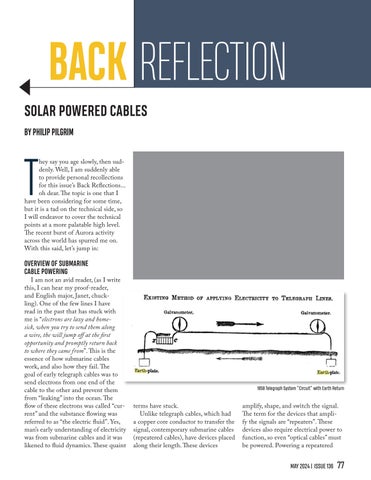
I am not an avid reader, (as I write this, I can hear my proof-reader, and English major, Janet, chuckling). One of the few lines I have read in the past that has stuck with me is “electrons are lazy and homesick, when you try to send them along a wire, the will jump off at the first opportunity and promptly return back to where they came from”. This is the essence of how submarine cables work, and also how they fail. The goal of early telegraph cables was to send electrons from one end of the cable to the other and prevent them from “leaking” into the ocean. The flow of these electrons was called “current” and the substance flowing was referred to as “the electric fluid”. Yes, man’s early understanding of electricity was from submarine cables and it was likened to fluid dynamics. These quaint
1859 Telegraph System “Circuit” with Earth Return
terms have stuck. Unlike telegraph cables, which had a copper core conductor to transfer the signal, contemporary submarine cables (repeatered cables), have devices placed along their length. These devices
amplify, shape, and switch the signal. The term for the devices that amplify the signals are “repeaters”. These devices also require electrical power to function, so even “optical cables” must be powered. Powering a repeatered MAY 2024 | ISSUE 136 77