SubTel Forum Issue #1 - Introduction and Market Insight
Submarine Telecoms Forum is published quarterly by WFN Strategies, L.L.C. The publication may not be reproduced or transmitted in any form, in whole or in part, without the permission of the publishers. Liability: while every care is taken in preparation of this publication, the publishers cannot be held responsible for the accuracy of the information herein, or any errors which may occur in advertising or editorial content, or any consequence arising from any errors or omissions.
Submarine Telecoms Forum is an independent commercial publication, serving as a freely accessible forum for professionals in industries connected with submarine optical fibre technologies and techniques. The publisher cannot be held responsible for any views expressed by contributors, and the editor reserves the right to edit any advertising or editorial material submitted for publication.
Contributions are welcomed and should be forwarded to the Managing Editor: Wayne F. Nielsen, WFN Strategies, 115 Environs Road, Sterling, Virginia 20165, USA.
Tel: +1 (703) 444-2527, Fax:+1 (703) 444-3047.
Email: editor@subtelforum.com.
Advertising enquiries:
Email: advertising @subtelforum.com Designed and produced by BJ Marketing Communications, Colchester, UK..
advertising @subtelforum.com
Editor’s
– a brief introduction to this magazine
The introduction to Submarine Telecoms Forum that I had planned to write changed a month ago – but only slightly.
I am pleased to be presenting the first edition of Submarine Telecoms Forum, dedicated to providing an international medium for the communication of ideas and opinions pertaining to the dynamics and technologies of the submarine telecom industry.
We envision Submarine Telecoms Forum as being a platform for discourse on submarine telecom cable and network operations where industry professionals can provide guest commentary and information on system and service provision.
We have established the magazine as electronic, for ease of dissemination as well as friendly to the environment. It is distributed electronically to subscribers, and simultaneously posted to the magazine web site, www.SubTelForum.com Subscribers who receive the magazine via email and others who access it on the Internet can quickly share the magazine, in whole or in part, by forwarding it to their colleagues.
We have shaped it around four quarterly themes, namely Industry in Review, Systems Update, Service Provision, and New Technologies.
Worldwide distribution targets senior government and international organization officials, telecom company executives and team, support and supply company management and technical, sales and purchasing staff, field and shipboard personnel, academicians, consultants, financiers, and regulatory and legal specialists.
We promise you, our readers, the following:
·That we will provide a wide range of ideas and issues;
·That we will seek to incite, entertain and provoke in a positive manner.
Lastly, in honor of the victims of September 11th and subsequent actions we ask that you give generously to your charity of choice.
Wayne F. Nielsen Editor
Emails to the Editor
Good luck with the launch of your magazine; I look forward to seeing the first issue.
Regards, Guy Arnos President, Arnos
Telecommunication Services, LLC
○○○○○○○○○○○○○○○○○○○○○○○○○○○○○○○
I would appreciate receiving a rate card for advertising purposes. I look forward to receiving the first edition.
Regards - Neil Lambert Chief Marketing Officer,
Australia Japan Cable Limited
○○○○○○○○○○○○○○○○○○○○○○○○○○○○○○○
I shall look forward to the first edition of Submarine Telecoms Forum. Please have it sent to me at my home office address. Jayne Stowell
Axone Networks Holdings Limited
I look forward to receiving the publication.
Thanks very much.
Best Regards
Emma Tompkins Sales and Marketing Executive
CTC Marine Projects
I would be interested in receiving the magazine. I will pass this notice on to a few others who may be interested in your offer.
Bruce Rein Program Manager, Network Development ○○○○○○○○○○○○○○○○○○○○○○○○○○○○○○○
General Communication, Inc.
I look forward to reading the publication.
Guthrie Robertson Business Manager, TSS (UK) Ltd.
I wish you a lot of success in your new publication. I will be reading the first edition as soon as it is published. I will be distributing your subscription invitation to my team and copying your message to Carlos Coimbra, International Network Operations, Maintenance and Restoration Manager. His team includes many of EMBRATEL’s Representatives in the submarine cable community.
Best Regards, José Almeida
EMBRATEL
I look forward to seeing your first issue.
Best Regards, Peter Tomfohrde Vice President of Sales GEOgraphics Network Affiliates-
International (GEO)
Thank you for this new tool for Submarine Telecom professionals.
Best regards Denis BOIREAU PerkinElmer Optoelectronics, Fiber Optics Division Sales
Manager
I look forward to receiving your first edition.
Best regards Julian Rawle Senior Market Analyst
Pioneer Consulting LLC
We all wish you every success with this venture.
best regards Alastair MacDonald Managing Director, Technical Marketing Solutions
International
I would be pleased to receive the new publication. Regards, Gene Hunt Director of Marketing
Communications, TyCom
360networks recently confirmed that the company expects to file its second quarter 2001 financial statements and the related management’s discussion and analysis by mid October 2001. This delay is due to additional requirements related to the complexity of the company’s various creditor protection and insolvency proceedings.
Alcatel recently announced the adaptation of its activities to the current downturn of the undersea network and optical fiber markets, following the exceptional growth experienced by both markets during the past years. In France, actions will be implemented in the Calais, Conflans SainteHonorine, Douvrin, Nanterre, Nozay and Ormes sites (3883 people at end September 2001). 172 employees in Alcatel’s undersea network activity are concerned by several measures, including early retirements and transfers to other sites. Moreover, temporary contracts of 873 people (temporary contracts, interim, subcontractors) in undersea networks and optical fiber will not be renewed. Adaptations to the workforce will be implemented in the undersea network site in Greenwich, UK, and optical fiber site in Claremont, US The decision also has been made to shift to standby mode the undersea cable production site in Port Botany, Australia, by mid 2002. These measures, combined with closing of the undersea cable plant in Portland (US), announced in May, represent a reduction of 2151 positions - or 48 percent - in Alcatel’s undersea network activity worldwide workforce. Most of these measures will be completed by summer 2002.
Global Crossing has recently announced its intention to divest two non-core assets, Global Marine Systems Limited and IPC.
The theme of the conference is “WTO, the Beijing Olympics and Your Opportunities.”
A one-day telecom executive summit will take place on January 10, 2002. The objective is to bring together Chinese telecom operators and those multinational companies who wish to enter the Chinese market. The Chinese operators and manufacturers will present their market development plans and their systems and components needs, while foreign companies will discuss solutions that will meet the requirements of the Chinese markets. This will be the best and most cost efficient opportunity for small and medium-sized foreign companies to gain entry into the China market.
Chinese companies to be invited include: China Telecom, China Unicom, China Mobile, China Netcom, Ji Tong Communications, China Railcom, State Administration of Radio, Film and TV (SARFT), Huawei, ZTE Corp., Datang, Great Dragon Telecom, Wuhan Research Institute, and many others.
In conjunction with China Telecom 2002, IGI will host five half-day pre-conference workshops on the various sectors of China¹s telecom markets. All workshops run concurrently on January 10.
International Internet bandwidth grew 174 percent between years 2000 and 2001, according to Washington, DC-based research group TeleGeography, Inc. Though strong, the overall rate of growth has slowed down from last year, when cross-border Internet links increased by 382 %.
Information Gatekeepers Inc., in cooperation with the Pacific Telecommunications Council, hold the China Telecom 2002 conference at the Westin Hawaii Prince Hotel, January 11-12.
IT International Telecom Inc. and Phoenix International, Inc. recently announced an agreement to pursue jointly business opportunities in the fields of submarine cable systems installation, maintenance and repair, as well as other marine industries. Based in Kirkland, Québec, Canada, IT International Telecom Inc., a member of the IT International Group, is an independent supplier of installation, maintenance and repair services to the submarine telecom and power industries and is an affiliate of General Dynamics Network Systems. Phoenix International is based in Landover, Maryland, USA, and is the US Navy’s pre-eminent ocean operations contractor for worldwide search and recovery, submarine rescue, underwater ship repair, and related support services, including the operation and management of deepwater ROVs.
KDD-SCS would like to inform our readers that the corporate name, KDD Submarine Cable Systems Inc., has been changed. The company will now be known as KDDI Submarine Cable Systems Inc. (KDDI-SCS). The business operation remains unchanged. They recently hosted the highly successful SubOptic 2001 conference and exhibition in Kyoto, Japan.
Lucent Technologies has announced that TyCom Ltd. will be its first customer for UltraWave(TM) optical fibers – a new family of fibers created by Lucent’s Optical Fiber Solutions business that enables submarine network providers to dramatically increase the capacity of ultra-long-haul undersea networks. TyCom will deploy the fiber in its TyCom Global Network Pacific North transoceanic network segment connecting Japan and the US.
Nava Networks and Fujitsu Australia announced recently they had begun marine & terrestrial surveys for the 9000km Nava-1 high capacity network.
The marine survey covers the shallow waters of the South China Sea and Java Sea between Singapore and Jakarta then through the Sunda Straits and on into the deep waters of the Indian Ocean for the link to Perth.
Nava Networks Director of Networks Mr. Brett Worrall said that he was pleased the marine and terrestrial surveys were underway. “Beginning final surveys in a cable system project is always an important milestone.”
Fujitsu Australia Executive Director of Telecommunications, Mr John Kranenburg, said that Nava-1 was the largest single project that Fujitsu Australia has undertaken. “This project is significant due to the downturn in the telecoms industry and will generate significant employment and additional contract positions in remote and regional Australia.
“The surveys and final route selection mark the beginning of the terrestrial project. Now we have Nava’s authorisation to proceed, we are confident we can achieve the expected RFS date of Q1 2003”.
Oceanology International, long established as the world’s benchmark ocean technology exhibition and conference, is moving from its former location in Brighton, to the ExCel exhibition and conference centre in London’s Docklands.
OI 2002 is set to be even bigger than the last event. The ExCeL Centre has allowed room for growth and should attract new companies. The single exhibit floor with no pillars, immediately alongside water, ensures all stands are in prime locations, but are still at an economic price. ExCeL offers great restaurants and bars with waterfront views, an ideal setting for networking opportunities.
There will also be a conference running alongside which is free of charge to attend and will run over the four days.
Smit-Oceaneering Cable Systems recently announced the successful completion of testing of Ocean-Rite, a new environment-friendly hydraulic fluid similar to food grade oil, for use in its work class ROVs.
The new fluid passed stringent Minerals Management Service shrimp impact studies and demonstrated that it is benign to the marine environment and sensitive ecosystems.
Extensive in-house component and full system testing was carried out, followed by a series of recently completed offshore tests.
The conversion of SOCS’ ROVs to the new fluid will be initiated, which reflects the company’s commitment to the environment and its importance to our industry.
Readers invited to go to www.scig.net to view the latest features on the website of Submarine Cable Improvement Group, the forum established by Alcatel Submarine Networks, Global Marine Systems, KDDI-SCS and TyCom (US) to focus on improved cable system reliability.
Two new sections at the site concern a presentation to ICPC and matters connected with SubOptic 2001. The latter section offers information in the form of papers, presentations and a poster on trends in submarine cable system faults, industry developments in Burial Assessment Surveying and the latest developments to ensure high quality cable protection.
Tyco International recently announced through its subsidiary TGN Holdings, that it has offered to acquire the outstanding 11% minority interest in TyCom Ltd. representing approximately 56 million common shares. Tyco currently holds 89% of all TyCom common shares. Acquiring outstanding minority shares would bring TyCom back into the Tyco International Ltd corporate structure as a wholly owned subsidiary.
In the wake of the September 11 attack, the US Coast Guard is instituting new port security measures. All deep-draft vessels coming to any port in the United States must include in their advance notice of arrival a crew list that includes the nationality of each crew member. This new measure is an effort to ensure suspect individuals and those
with criminal records do not enter the country unbeknownst to federal officials. This security measure will impact on crews associated with certain ocean survey and installation companies that are involved in the underwater telecoms industry. Other countries are expected to institute similar restrictions affecting their ports security measures regarding ship personnel.
The US House of Representatives is considering Resolution 2481 to improve maritime safety and quality of life for Coast Guard personnel, and for other purposes, requiring only US flag vessels may be used in the course of: (1) Laying a submarine cable between two landings in the US; (2) Making a shore landing of a submarine cable in the United States; (3) Laying or burying a submarine cable on or under the lands beneath the navigable waters of the United States; or (4) Servicing or maintaining a submarine cable between two landings in the United States, or on or under the lands beneath the navigable waters of the United States, if that cable is owned by, or operatedby, or for the US Government.
November Networking SubmarineCommunications2001
To become totally immersed in the “nuts and bolts” of networks, bandwidths and the mechanics of cable market drivers, participate in Submarine Communications 2001, to learn, or share knowledge with those with similar interests.
Entitled “Global Connectivity: The Future of the Subsea Industry”, this is the 4th annual IBC conference on submarine communications. Many companies that are held in high regard, and their leaders, are contributing vigorously to the November 6-8 event.
Axiom’s Jean Devos chairs Day One, Chris Lilly of Versyns Consulting chairs Day Two, and Peter B. Yinger of Maripro chairs Day Three.
Each an authority in their area, other scheduled speakers are Lisa Dadouris, Michael Ruddy, Jayne Stowell, Paul Gabla, Rajesh Kheny, Patrick Downey, Dave Happy, Rafael Arranz, Tom Soja, Richard Elliot, Michael Conradi, Geoffrey Thornton, Robert Kelly, Cheryl Karpowicz, Brian Tellam, Glenn Gerstell, Brett O’Riley, Adrian Moss, Alain-Paul Leclerc, Frank Denniston, Bill McGavin, Paolo Finzi, Marcelo Couto, Stephane
R. Teral, Colin Anderson, Kamal Raychaudhuri, Uwe Fischer, Keith Adcox, John R. Toth, Arthur Ayres Ragnar Vogt, Jan Stringer, Ove Smidt, Frank Cuccio, Jeremy Featherstone, Dave Slee, Mark Critchley, Susan J. Buchan, Graham Evans, Alastair MacDonald, Phil Harris, Mark Vorenkamp, John Vaccaro, Doug Cotton, Michael Cornish, P Allan, P Brunning, Lucas van Elsen, Peter Jordan and Dr. David Cathie.
Alongside the conference, an exhibition gives many companies an opportunity to draw key attention. A reception Monday evening hosted by Van Oord ACZ and CRP signals the start of a delightful networking schedule. Lucent Technologies host a black tie evening on Tuesday, with entertainment. On Wednesday, it International Telecom will host a gala cocktail reception. Van Oord ACZ and John Crane-Lips Precision Handling Systems sponsor lunches.
Prepared by the Telecoms Academy, a day of training sessions in optical network and DWDM technologies precedes the conference.
www.submarinecomms.com
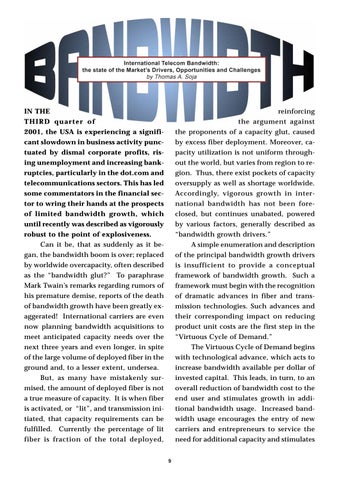
International Telecom Bandwidth: the state of the Market’s Drivers, Opportunities and Challenges
by Thomas A. Soja
IN THE
THIRD quarter of 2001, the USA is experiencing a significant slowdown in business activity punctuated by dismal corporate profits, rising unemployment and increasing bankruptcies, particularly in the dot.com and telecommunications sectors. This has led some commentators in the financial sector to wring their hands at the prospects of limited bandwidth growth, which until recently was described as vigorously robust to the point of explosiveness.
Can it be, that as suddenly as it began, the bandwidth boom is over; replaced by worldwide overcapacity, often described as the “bandwidth glut?” To paraphrase Mark Twain’s remarks regarding rumors of his premature demise, reports of the death of bandwidth growth have been greatly exaggerated! International carriers are even now planning bandwidth acquisitions to meet anticipated capacity needs over the next three years and even longer, in spite of the large volume of deployed fiber in the ground and, to a lesser extent, undersea.
A simple enumeration and description of the principal bandwidth growth drivers is insufficient to provide a conceptual framework of bandwidth growth. Such a framework must begin with the recognition of dramatic advances in fiber and transmission technologies. Such advances and their corresponding impact on reducing product unit costs are the first step in the “Virtuous Cycle of Demand.”
The Virtuous Cycle of Demand begins with technological advance, which acts to increase bandwidth available per dollar of invested capital. This leads, in turn, to an overall reduction of bandwidth cost to the end user and stimulates growth in additional bandwidth usage. Increased bandwidth usage encourages the entry of new carriers and entrepreneurs to service the need for additional capacity and stimulates
But, as many have mistakenly surmised, the amount of deployed fiber is not a true measure of capacity. It is when fiber is activated, or “lit”, and transmission initiated, that capacity requirements can be fulfilled. Currently the percentage of lit fiber is fraction of the total deployed, reinforcing the argument against the proponents of a capacity glut, caused by excess fiber deployment. Moreover, capacity utilization is not uniform throughout the world, but varies from region to region. Thus, there exist pockets of capacity oversupply as well as shortage worldwide. Accordingly, vigorous growth in international bandwidth has not been foreclosed, but continues unabated, powered by various factors, generally described as “bandwidth growth drivers.”
Tom Soja has ten years experience as a Senior Analyst in the fiber optics industry and as a Director of Submarine Cable Research. Prior to his involvement in the telecommunications industries, he was a research associate at the Harvard Business School. Tom is a frequent speaker on industry trends and opportunities in the international telecoms. He holds an MBA and a bachelor’s degree in mechanical engineering,
the introduction of new and innovative bandwidth intensive applications, products and service extensions. This in turn creates more users requiring more applications, and more opportunities for carriers and entrepreneurs, who seek to become more competitive via new investments in technology, perpetuating the cycle.
Having established the conceptual framework describing the cycle of demand, the next task is to identify and describe the basic international telecom bandwidth growth drivers, which power the cycle.
Perhaps the most venerable of bandwidth drivers is telecom privatization and de-regulation. Since 1992 the number of countries that have privatized their nationalized telephone monopolies has almost doubled, increasing from 76 to 150 in 2001. This represents an 8-10% annual growth rate. With privatization comes competitive private enterprise and with it lower enduser costs, leading to an increase in usage and, again, the need for more bandwidth.
The deregulation of markets has been a major driver in the boom in international telecom traffic growth. The pace of deregulation has demonstrated a high rate of acceleration during the past four years as
more countries have lifted onerous restrictions, which have, in the past, inhibited full potential for growth in telecom services. Yet it is insufficient to initiate positive regulatory change without continuous enforcement by an independent regulator to ensure real and fair competition.
Capacity utilization is not uniform worldwide and pockets of capacity oversupply, and shortage, exist worldwide. This is particularly true in under-served niche markets where shortages exist in contrast to more abundant capacity availability in other regions of the world.
Examples of these niche markets include local and/or regional loops and festoon systems, such as Pangea -1, Global West, Bahamas Internet Cable System and NAVA -1. Other under-served niche markets include those that are geographically remote and the major hubs. Here would be located such systems as GCL Irish Loop, Shetland Islands Project, Scottish Direct Link, links to Iceland and direct links to Russia. Other examples of under-served niche markets exist in secondary and tertiary markets worldwide, including Africa ONE, SAT-WASC/SAFE, ARCOS-1, and various proposals serving the Middle East and Eastern Europe.
Get in touch with the right staff by advertising your vacancies in Submarine Telecoms Forum and reaching all the key people in the submarine telecoms industry. advertising @subtelforum.com
Telecom traffic demand is progressively being driven by data traffic resulting from increased Internet usage, characterized by access and transmission of content through a PC connected to a telephone line or local area network (LAN). This has imposed limitations on developing markets, i.e., high equipment expense and usage at a fixed location only, and on developed markets as well, i.e., bandwidth bottlenecks and lack of content for broadband users.
In the future the Internet will be driven from the high end of the market by a host of yet to be imagined applications and content facilitated by high-speed access, a greater selection of low-cost PC and non-PC devices enabling less technologically inclined users to access the Internet for the first time, and by mobile users. There will be a greater number of choices for device types, e.g., telephone, computer, pager, PDA, web phone, wireless devices and other non-PC devices. There will be a multiplicity of providers including CATV, LECs, Wireless and Satellite. Bandwidth will become a pervasive utility for nearly all aspects of life. Some it will not be readily apparent or even noticeable, but one thing is certain: all will cost less!
of users is already being trained to expect a rich multi-media interface environment via such applications as audio and video downloads, computer games, e.g., Nintendo and Sony Play Stations, Launch Media’s 3-D virtual city interface, web phones providing access to current non PC users, etc.
There are significant implications surrounding rapid Internet and data growth. The first is the fact that as recently as 1998 almost half of today’s Internet users logged on for the first time. These new users may well have entirely different uses and expectations for new applications and ways of incorporating ubiquitous bandwidth into their lives. Moreover, the next generation
Yet as Internet usage grows and expectations for a rich multi-media interface environment become reality, there are those who suggest that Internet usage tops out at some percentage of the population. This is a myth. For as Michael O’Dell Chief Scientist, UUNet has said, “The fundamental error people make is believing that humans have something to do with this”. In other words, continued growth in the Internet is not based upon the diminishing returns of a high penetration percentage of the population.
The typical Internet demand model today forecasts growth by considering the
THE FUTURE OF THE SUBMARINE CABLE INDUSTRY
Navigational Waypoints
The submarine cable industry is driven by a handful of major influencing factors. The evolution of these will at any given point in time dictate the relative health of the industry going forward. These factors could be viewed and multiple tracks, which during past few years had all matured simultaneously to produce a cornucopia of new bandwidth as well as applications to use it provided by long-haul, regional, and domestic submarine cable networks. We view these major influencers as follows:
“
. . . opportunities for submarine cable owners, carriers and others to participate in this expanding market are great. ”
number and type of users that originate and terminate the majority of data traffic that could be carried on the network being modeled. It includes the level of Internet device penetration of the total population and number of households, based on demographic data and the degree of application sophistication, i.e., e-mail and static web page browsing versus high-speed continuous access, dynamic web browsing and a wide variety of broadband, content rich applications such as audio and video streaming, web conferencing, augmented communications, etc.
In addition, the model accounts for elements determining bandwidth requirements, type of access and speeds, number and type of applications, bandwidth intensity of applications, connect times and peak time usage.
The segmentation of population by age group can also be revealing. Many emergent markets have a young and educated population, more eager to embrace the Internet and often with the financial resources to pay for it.
Other inputs to the typical Internet model include growth rates in both PC and non-PC devices. Worldwide PC growth rates have continued to grow since 1997 to the present at an average annual rate of about 17.5 percent. By the end of this year (2001), the sale of non-PC Internet devices in the United States could indeed surpass PC sales. Since 1999 sales have risen at an
estimated rate of 77% annually. 26% of Japanese advanced users have more than three Internet devices in their households versus 13% in the United States and 7% in the United Kingdom. It appears clear that non-PC devices are likely be the main source of accessing the Internet.
The Internet can also be accessed through a variety of other means such as so-called dream devices, affordable devices such as mail stations, i-phones, i-stations, digital televisions including set top boxes and gaming devices capable of accessing the Internet. A surge in wireless subscribers adds a new dimension to Internet access through handheld mobile devices such as wireless access protocol (WAP, 2.5G wireless), telephones in the short term and third generation (3G) wireless in the longer term.
Coupled with Internet and data applications end-user delivery technology is a significant driver of bandwidth demand. High speed connections delivered through ADSL and cable modems together with WiFi wireless public access points, 2.5G and 3G wireless are but a few of the end-user delivery mechanisms bringing net based applications to the end-user today.
So the opportunities for submarine cable owners, carriers and others to participate in this expanding market are great. However, it requires both human and financial capital to see it through.
Up until 2000, ready availability of investment capital has been a potent driver of international bandwidth infrastructure growth. It is highly dependent upon investor confidence in
the venture and the expertise of participating venture capitalists and other knowledgeable investors and lenders who provide what is known as “intelligent equity.”
Today there are no “out of the Box” global IPOs as has been the case. Thus, investor confidence must be developed using a step-by-step approach based on a convincing first success. Venture capitalists and others in the investment banking community are now more knowledgeable regarding telecom and submarine cable systems and better able to gauge the investment risk-return levels and to communicate those opportunities in terms familiar to the larger, less specialized investment community.
In today’s business climate, the ultimate bandwidth growth driver is the availability of investment capital to provide the infrastructure in which drivers can operate. Contrary to reports that such capital is currently unavailable to the telecom industry, intelligent equity is available for projects demonstrating a solid management team with a well conceived business plan. Smart money will be able to distinguish between the longer-term strategic issues and short-term market perturbations. The drivers of international bandwidth growth are viable, sustainable and permanent, assuring that the long-term future of vigorous international bandwidth growth for decades to come.
by Jean Devos and Geoffrey Thornton
THE SUBMARINE CABLE industry is a global one in the fullest sense of the word. When therefore we talk of a view from one part of the globe as opposed to another, we are talking about looking at the same thing, but from a different angle. This means in effect that some issues will loom larger, and others smaller than the view from another part of the globe.
The global industry is in a deep depression, and the key questions are how deep is that depression, and when will the industry start to recover. Before we can address those questions we have to define the industry as it is today. Historically, it was very clear: it provided and maintained submarine cable systems from cable stations located close to the cable landing point. Systems were discrete entities: till TAT-8 they were simple point to point systems. Backhaul from the cable stations was terrestrial, part of an international activity within the carriers’ structure, but not part of the submarine activity.
In those days the typical cost breakdown of a transoceanic system was 90% for the supply and installation of the submerged plant, and 10% for the land based elements: terminal equipment, land cable etc. However within the last five years a fundamental shift has taken place, and a further one is in prospect. This shift is due
to the replacement of regenerative repeaters by optical amplifiers, and the introduction of Wave Division Multiplexing (WDM). The impact of this is manifested in three ways, two of which are already strongly influencing the industry, and the third is in prospect. The amplifier offers the prospect that the signal does not have to be put into the cable system at the beach, and therefore the system can potentially have a significant land content. WDM, and more particularly DWDM has had the effect of shifting the balance of system cost so that the land based equipment will be more than half the cost of a fully equipped DWDM system. Furthermore the implication of WDM is that it is not necessary to equip a system fully at the outset, so that more wavelengths can be equipped as traffic increases. Thus the interval between the installation of successive elements of submerged plant becomes much wider. This leads one to question what the essential nature of the submarine cable business is. For a provider of turnkey systems such as Alcatel who produces all the elements of a system there will have to be a major rebalancing of the business. With the present structure of the industry the outlook is for land based equipment to represent over 50% of sales value, and this is close in terms of R&D and manufacturing
“ . . . an economic upturn can be predicted for the first part of 2002. This will in turn stimulate both investment and demand for bandwidth.”
techniques to terrestrial equipment. Moreover, the requirement for submerged plant is likely to become even more cyclical than in the past. There is thus a pressing need to have a long-term strategy for the development and production of submerged plant that is difficult when the financial markets are concerned with short-term issues of cash flow and debt levels.
The recovery from the depression in our industry depends firstly on the global economic outlook, and this was showing no signs of improvement even before the terrorist attack on the USA. When the US economy weakened it was hoped that the global economy would be sustained by continuing strength in Europe and a turn round in Japan. It was also predicted that the US economy would start to improve by the 4 th Quarter. In fact the situation in Europe is weakening, there is no sign of improvement in Japan and the effect of the attack on the US economy is bound to be detrimental to an already fragile situation
The economic situation is the background against which we have to examine the prospects for our own industry. The telecoms industry as a whole is already in serious depression. The second half of the 1990’s saw massive investment in all aspects of telecoms on the back of the anticipated requirements of the Internet. While demand grew at a phenomenal rate, installed capacity in many areas grew even faster. As a result
prices of capacity on over built routes have fallen. This has in turn made it very difficult to raise finances for new systems, even for routes which are not overbuilt. The problem for investments involving new submerged plant is that all the systems installed in the last 5 years have been WDM and most have the capability to increase their capacity by the addition of extra wavelengths.
Identifying the timing of an upturn is particularly difficult. The most optimistic forecast for the global economy assumes that there will be no loss of consumer confidence in the USA, that Japanese restructuring does not have any significant impact outside Japan and that Europe does not go into deep recession. In those circumstances an economic upturn can be predicted for the first part of 2002. This will in turn stimulate both investment and
Jean Devos , the Past President of SUBOPTIC, was formerly Senior Vice President of Sales and Marketing for Tyco Submarine Systems Inc., and previously Director, SUBMARCOM and Director Marketing and Projects for Alcatel Submarine Networks.
demand for bandwidth. However the pick up in demand for submerged plant is likely to be slow, as many routes will see the demand for increased bandwidth being met by upgrading existing installed plant. A significant surge in the demand for new installed plant is not predicted until 40Gbit/s systems are available. At the moment this is forecast for 2004, but this assumes that the current climate in the telecoms industry does not result in the delay of existing R&D programmes.
The worst case scenario for the global economy is a collapse in consumer confidence in the West and a major banking crisis in Japan, which would have worldwide repercussions. In such a situation we would have to wait another 2 or 3 years before a full recovery was in place, though it is likely that telecoms would be one of the sectors leading the recovery
The period between now and a future recovery, however short or long, will be painful. There is a major overhand of capacity all the way from bandwidth to component production capacity, and with the banks unwilling to lend money to an industry that is already burdened with debt there are already signs of pain. Companies may well have great strategic plans, but the first priority for most firms is cash flow. It is against this background that we must examine the state of the industry. Our best estimate for the route length of systems to be contracted this year is about 100,000km: at the beginning of the year worldwide cable manufacturing capacity was approaching 340,000km. Already Alcatel have closed their Portland plant. Even so, it is difficult to see how long it will be
Geoffrey Thornton was born in the UK in 1937 and graduated in 1960 from St. Catharine’s College, Cambridge. He joined STC in 1962 and held marketing and general management positions in the Components and Defence Systems Groups over the next 25 years. In 1987 he joined STC Submarine Systems, London, as General Manager, Business Strategy, and was subsequently Director of Marketing and Sales. He retired from Alcatel Submarine Networks in 1996 and has since worked as a consultant to a rangeof clients. He is a founder member of the Don Quixote Association.
before the full capacity will be needed again, and in any case it costs money to keep plant standing idle. The same comment can be made about the marine fleet available for installation, though this is tempered by the maintenance demand. It is in this context that the structure will evolve. Twelve months ago there were strong indications that both Nortel and Lucent were keen to get into (or rather back into) the submarine cable business. Today they have neither the desire nor the resource. The existing system suppliers have very diverse bases, and it is likely that
their futures will be very different. Tycom is turning itself into a carriers’ carrier. It is also soon to be a wholly owned subsidiary of a major conglomerate, and its long-term future will depend on the needs and ambitions of its parent. In view of the potential for consolidation in the carrier business, one could envisage a merger with one of the other (surviving) carriers’ carriers. Alcatel on the other hand, although it has acquired capacity as a result of its vendor financing activities, is still fundamentally a telecoms equipment manufacturer. The increasing land based content of submarine systems suggests that for Alcatel the future is as a land based equipment manufacturer with a specialist unit looking after the submerged plant. How this would fit into Alcatel’s announced plans to subcontract manufacturing activities is not clear. The Japanese industry remains fragmented: the purchase of KDD
by DDI has put a question mark over the future of KDD-SCS. None of the Japanese suppliers is an integrated business in the way that Tycom and Alcatel are, and this must be a source of weakness in the lean years that we have entered. In the absence of any unifying action within the Japanese industry, one could envisage the individual businesses exiting the submarine business one by one.
The view at the moment therefore has to be one of great uncertainties: Firstly how long the present downturn in the market will last. There is no doubt that telecoms is one of the driving forces of the 21st century, but at the moment horizons are shortterm: the aim has to be to stay around long enough to enjoy the recovery when it comes. Secondly, what the submarine cable business will look like by then. The one certainty is that it will look very different from today.
THE SUBMARINE CABLE industry worldwide is in deep depression. Seen from Asia the view is complex. The concerns for the global economy were initially centred on the USA, and these are now spreading to Europe. So far consumer demand there is holding up and this is sustaining exports from the Asian region. However in Japan the economy is stagnant and the policies which the Government is proposing for the long-term problems may only bring more pain in the short term. Thus the background against which we are operating is poor, and if there is a collapse in consumer demand in the West, the region as a whole will suffer. In terms of submarine system capacity the Asia Pacific region is not as oversubscribed as the Atlantic, both in terms of lit capacity and upgrade potential. The collapse of the telecoms boom and the consequential difficulties in raising finance for new systems has come while a number of transpacific and regional projects had not been finalised and as a result there is
By Teijiro (Ted) Kitamura
less over capacity than in the Atlantic. Systems such as 360Pacific, FLAG Pacific and Singtel’s C2C extension across the Pacific have either been cancelled or absorbed into other projects.
The market issues for us in Asia are therefore partly global and partly local. We depend on Western consumer demand to provide healthy markets for our products, but at the same time the future of the Japanese economy is for us to manage. Within Japan the outlook is poor or very poor. A major restructuring of many of the institutions is needed and the choice is one of long slow pain or sharp strong pain, dependent on the speed at which the Government is willing or able to drive the pace of reform.
In the world at large the telecoms industry is in the process of major changes at every level. Carriers, equipment suppliers, service suppliers and component manufacturers are all struggling against high levels of debt and/or poor cash flow and decisions have of necessity often to be short term. Thus we see carriers collapsing,
such as 360 Networks and Viatel, and businesses not perceived as core being sold off. Thus companies with cash can make strategic acquisitions cheaply. For example, Furukawa have recently bought Lucent’s optical fibre business.
What is of major interest here is the future structure of the submarine cable industry. Apart from Alcatel’s facilities in Australia, the industry is concentrated in Japan under Japanese ownership. However there is no equivalent to the integrated system suppliers in the West, Tycom and Alcatel. The manufacture of electronics is the province of NEC, Fujitsu and Mitsubishi, OCC and Hitachi make cable, and KDD and NTT supply marine services, but NEC, Fujitsu and KDD compete to supply systems independently . This fragmentation is damaging to Japanese industry as a whole. As no single company can provide all the system in house, the temptation is for the individual suppliers
graduated from Kobe City University of Foreign Studies and joined Fujitsu Ltd. in 1961. From 1969 he was responsible for Fujitsu’s submarine telecommunications business, until his retirement from Fujitsu in 1999.
to bid with Alcatel or Tycom or other cable/ equipment manufacturers on the basis that their share of the work will be the elements that they themselves make.
In view of the unstable nature of the business at the present time it is particularly difficult to predict the future. What is clear when seen from Asia is that the integrated suppliers, Alcatel and Tycom, are moving from being system suppliers to carriers: Tycom as a clear strategy, Alcatel by default. Against this the Japanese industry remains fragmented, and therefore vulnerable to competitive tactics by the integrated suppliers: divide and rule tactics by their partners will progressively weaken the individual companies to the point that they will loose the ability to operate as system suppliers. One attempt has been made to build an integrated offering - the alliance between NEC and OCC, with Global Marine. However, the threat remains. What is also clear is that in Asia, we are not taking the lead, or even any significant position in the development of the global networks. All the new global networks have originated from the USA. PCCW did adopt 1Cybernet, but that is now dead, and Singtel is the only carrier trying to build out from Asia to the rest of the world. Even they have given up their plans for a Pacific crossing and joined AAN. Another factor that is changing our world is the way in which the financing of systems is becoming the province of the financial institutions. This means that we have a completely different process for the design and implementation of a project. In the Atlantic this is now the norm, but in Asia the traditional club system has not disappeared to the extent it has in the west.
Teijiro (Ted) Kitamura was born in 1937 in Osaka, Japan. He
“ One of the long-term opportunities for us is to supply not merely products but intellectual services to the rest of the world . . .”
Thus both in the way our systems market is developing, and in the way in which our supply industry is structured, we are in different position from the western world. Whether we are behind the West, or going in a different direction is difficult to tell at this stage.
In looking to the future of our market and our supply industry we see two very different pictures. The future outlook for our regional market will be very strongly influenced by events in other parts of the world. To the extent that our prosperity as a region is dependent on markets in the USA and Europe we can only hope for an economic recovery, and especially that the World Trade Centre atrocity does not damage consumer confidence. Nevertheless we can also influence our own future by the way in which we deal with the economic crisis in Japan. But we could take our future more into our own hands if we were ourselves willing to invest in one way or another in the development of the global networks originated and financed by Japan, rather than let the investment come from the outside to us. One of the long-term opportunities for us is to supply not merely products but intellectual services to the rest of the world, and that can be achieved by exporting the intellectual output over optical fibres. If we can export the services we can also build and own the means by which we export.
Our supply industry must also put its house in order if it is to survive. The submarine systems market is a global one, and to survive in it we must sell globally. TAT-14 was the first Atlantic system to be won by Japanese industry, and it has to be a cause for regret that this contract has not enhanced the reputation of our industry. By contrast, western suppliers have built, and are building many systems in Asia. However we will not achieve success while our industry remains fragmented. Without a rationalisation that creates a strong Japanese unit we are destined to have to rely increasingly on crumbs from Alcatel and Tycom’s tables. And today those tables are looking very bare.
For us therefore, the immediate future is not very bright. But we must live with this and find a way to ensure that when the market does recover we are in a position to exploit it alongside the rest of the world.
THE GLOBAL MARINE TELECOMMUNICATIONS MARKET
A Market Study Covering The Latest Developments And Opportunities
TMS International is pleased to announce the release of its latest market study - The Global Marine Telecommunications Market. The report has been commissioned by TMSI and compiled by industry experts from published information, reports from industry consulting and research organizations and from interviews with key players in the telecommunications industry.
The Global Marine Telecommunications Market Report is due to be released on November 15, 2001.
The Report reviews the current market situation, and includes comment and analysis on
Cable Systems, Routes and Landings
System Planning, Investment and Implementation
Trends in Production, Supply and Demand
The Repeatered and Unrepeatered Sectors
The Global Telecommunications Market Report is available on CD direct from TMSI at the special pre-launch price of US$1175 per copy. Orders received after November 15th will be charged $1395 per copy.
You can order your copy directly from the TMSI Web site at http://www.tmsico.com/cablereport
Or to order by phone or fax simply contact your nearest TMSI office at any of the numbers shown below.
Those who will benefit from this report will include: Telecommunications System Planners, Marine Surveying Services Providers, Cable System Installation Contractors, Cable Market Vessel Owners, Operators and Charterers, Marine Science and Environmental Organizations
TMS International is an independent consulting company specializing in business development. Its wide range of services encompasses market research, business planning, finance sourcing, business plan implementation and market communications.
WE AIM here to outline the present situation of Submarine Fiber Optic Cable Systems in the Americas, which includes North, South, and Central America.
Over the past two to three years, there have been a large number of cables installed. These have included cables which are part of international cable systems, regional systems, and local systems. Of the total number of Fiber Optics Cables installed
worldwide, those connecting and between the Americas represent 80% of the total investment planned for the period 20002003.
Of the total worldwide traffic, according to Telegeography, inter Americas traffic represents about 10% of the total world traffic. However, the amount of traffic terminating in the Americas and between the Americas represents approximately 70%.
International Systems
The following shows the major cables from the Americas to other parts of the world both planned and installed. These tables include both initial and final capacity of these cables. It is interesting to note that the cables have a tremendous potential final capacity compared to that initially lit.
North Atlantic Submarine Cable Systems
Cable SystemInitialFinal
AG-1 / IGR (GC)340960
Level 3 (yellow)160640
Apollo (C&W) 3803,280
TAT-14640640
360 Atlantic1601,920
TyCom5602,560
Total 2,24010,000
Pacific Submarine Cable Systems
Cable SystemInitialFinal
PC-1 (GC)240640
Japan - US400640
China - US8080
Southern Cross80480
Flag / TyCom6407,680
360 Pacific 1604,800
Total 1,60014,320
Americas Submarine Cable Systems
Cable SystemInitialFinal
SAC (GC) 401,280
Americas - 24080
Emergia401,920
360 Americas801,360
Total2004,640
Regional Systems
Many of the international America Systems shown in the above three tables, and in particular the Americas, have major parts that are regional in nature such as SAC(GC) and Emergia.
Tables Source: Global Crossing and IGI Consulting
Unrepeatered Systems
Unrepeatered submarine fiber optic cable systems include both festoon systems and single point-to-point systems. Festoon systems in South America include:
•Columbia Domestic Festoon
•Venezuela Domestic Festoon
•Brazil Domestic Festoon
Some of the first festoons were installed in the Caribbean region includng:
•Caribbean Fiber System (ECFS)
•Jamaica Domestic System
•Maya-1
•Arcos-1
There are many other point-to-point unrepeatered links existing in the Americas, which are too numerous to list.
In North America, the only festoon system is along the West Coast where the Global West Network is now being installed connecting six coastal cities including San Francisco, Santa Barbara, San Luis, Los Angeles, and San Diego.
The network when completed will be composed of multiple self healing rings providing route diversity along the West Coast.
Traffic Forecasts
IGI has forecasted the growth of traffic in the Atlantic, Pacific, and the Americas.
Dr. Paul Polishuk is president of the IGI Group, an expert on fiber optics technology and markets. He received a BS in 1956, and his MS and PhD in physics in 1962 and 1964. He was senior research scientist at the Air Force Flight Dynamics Laboratory 1956-1968, and director of planning 1968-1971. In 1971, he joined the Office of Telecommunications, as deputy director He founded Horizon House in 1976. He left to form Information Gatekeepers, Inc..
These forecasts are shown in the following tables. Two different assumptions have been used in these forecasts. These include:
Forecast Assumptions
Voice traffic is projected based on FCC statistics for Minutes of Use (MOU) from 1980 to 1997, using an exponential projection series. Assumes actual circuit holding time is 75% of the billed MOU, 260 business days/year, 10% of the traffic occurs in the busy hour, 25% traffic occurs in the busy hour for Demand 2 estimates, and 95% circuit usage efficiency (high) in order to estimate the number of 64 Kbps voice circuits (bandwidth) required for service.
Assumes data traffic will be 99% of total traffic in 2004.
Assumes data traffic will grow at annual rates of 150% (Trans-Pacific), 110% (Trans-Atlantic) and 120% (Americas) between 2001-2005.
Cables will be upgraded at equal increment per year between 2001 and 2005 from initial capacity to final design capacity.
New Systems
Based on the present economic situation, and the analysis presented here. There will not be any new long distance fiber optic submarine cable systems installed in the Americas in the next few years. Regional systems will not be as severely affected but the outlook is not promising. The major submarine activity will be in unrepeatered systems, which will be installed to funnel traffic to existing regional and long distance systems. The main reasons for this view is the decreasing cost of cable systems due to increase competition between suppliers and the improvements of technology allowing longer unrepeatered
distances and higher speeds. At lower cost per bit.
Conclusions
The following are the conclusions that reached with regard to the Submarine Fiber Optic Cable business in the Americas over the next five years.
Technology continues to drive the submarine cable network markets. Market likely to be volatile in the short run, more consolidation expected.
Further decrease in cost and pricing of submarine unit capacity; rate of price decline should be stabilized.
Growth of broadband access markets and new applications will continue to drive up demand for undersea capacity.
NEVER HAVE communications systems been more vital to our lives and none are more important than the worldwide network of submarine telecommunication systems.
Experts from companies responsible for the financial success, construction and maintenance of subsea optical networks will discuss strategic issues in submarine cable system development at PTC2002, the 24 th annual conference of the Pacific Telecommunications Council (PTC).
PTC2002 with its theme: “Next Generation Communications: Making IT Work, will convene 13-17 January 2002 in Honolulu, Hawaii.
Many consider PTC’s annual conference to be the premier telecom event in the Pacific region. In the words of NEC Corporation’s Koji Takahashi, “This is definitely the most important annual event.”
officials, carriers, ISPs, teleports, solutions providers, submarine telecom infrastructure development advisors, financiers, technologists, academicians, service and support company representatives, and developers and distributors of optical components and marine equipment.
Sponsors and exhibitors of PTC2002 include member companies Asia Global Crossing, BT Ignite, DishnetSEACN, France Telecom, Millennium 3 Communications, Qwest Communications International, NTT Communications Corporation, SmitOceaneering Cable Systems, T Soja & Associates and Tycom.
PTC2002
At SubOptic 2001 in May, Alcatel’s Hilly Peltier said, “The next most important event is PTC2002 in January, in Honolulu. It is a meeting of all the people in the business – the exchange of views and experience at the very highest level.”
At PTC2002, business leaders from systems supply companies will mix with telecommunications leaders, government
A promotional opportunity, PTC-TV, will establish round-the-clock delivery of a company’s sales message, providing a strong marketing presence for the company at the event.
PTC-TV will narrowcast a looped videotape that will be updated daily. It will permeate the exhibit arena and is cabled into the 28,000 conference hotel rooms, 24 hours a day. Time slots of 30 seconds through five minutes may be purchased. Companies may use a pre-produced commercial or one filmed at the event, interview-style, where the message can be tailored to the moment.
PTC membership is not a requirement for a company to utilize this marketing tool, though it entitles a company to a 50% discount on the already-low fee. PTC membership is open to all who share an interest in the development of telecommunications and related disciplines. The Council is an international, non-profit organization that brings together in a single forum the policymakers, providers and users of communication services.
For information on the benefits to your business of joining PTC (ask about PTCwire, and whether your specific customers or competitors are PTC members) and to discuss the diverse marketing options available in connection with PTC2002, please email Pamela Barnett at pamela@vtc.net , or call +1 (520) 384-6420.
......TSANEWSFEED......
Bullish Carriers Shatter the Myth of the Bandwidth Glut Bears
Amid the doom and gloom on Wall Street, especially in the tech and telecom sectors, more signs are emerging that the highly touted worldwide fiber glut has been vastly overblown.
In an effort to better understand the current state of the market, TSA has recently polled bandwidth buyers from the major market regions of the world. Among the major conclusions are that the market for capacity worldwide is poised for very strong growth over the next 18 months and that with few exceptions, capacity utilization levels do not support the notion of a capacity glut as many pundits have pronounced – not by a long shot.
• TSA finds bandwidth markets stronger than ever.
• Major carriers and other bandwidth customers are ready to buy – and buy big.
• Price stability is expected over the next 12-18 months, leading to sharply renewed interest in long-term IRU deals.
• Capacity utilization levels and capacity provisioning lead times – even while foreshortened in recent years –point toward an immediate need for new capacity.
• Beside the most obvious factors such as Price, On-time Delivery of Capacity and Network Quality, many customers are focusing on bandwidth Supplier Financial Stability as well.
• While the current financial environment does not favor new upstarts, the major carrier customers remain virtually unaffected by external capital constraints
Despite levels of capacity inventory among carrier customers that might lead
one to incorrectly conclude that carriers do not need to buy any more capacity for up to a year or more, most carriers have already reached or have neared their normal or even recently-foreshortened re-order point and are ready to buy and will buy big in today’s market.
How big? Planning increments for the next few years have already increased by a factor of five-to-ten times over previous levels from STM-1s, -4s, and -16s a little more than a year ago to STM-64s and multiples of whole 10-Gbps wavelengths. And these are expected to increase by a minimum of ten to fifty times over the next four years implying growth expectations of at least year-on-year doubling (100%+ CAGRs.)
In recent years, prices have dropped dramatically in some markets by as much as 60% per year. This has led many carriers to either delay purchases or opt for
Deltaic Systems
leased capacity in lieu of longer-term commitments to IRU ownership. This new research, however, shows overwhelmingly that most customers see a return to longterm IRUs going forward in favor of leases of any duration under the expectation that price levels will begin to stabilize in 2002 at annual, deflation rates of 15% to 20% for the longer term.
Why? The underlying drivers of demand are not a temporary blip on the radar screen but rather the result of a permanent shift in the way in which telecoms services have become entwined in virtually every aspect of business from the bleeding edge to the trailing edge of every industry type and segment.
Also, reported network utilization levels range between 45% and 60% (and in some instances, significantly higher). Past experience indicates that average utilization rates much beyond these levels would
create online collaborative communities that enable companies to plan and manage offshore operations more efficiently and effectively using a wide range of industry specific enabling tools.
lead to serious degradation of network quality and performance thus provides further evidence that new capacity needs to be added by carriers, and soon.
From an historical perspective, the new capacity coming on the market in the past several years has been an aberration along the continuum of ever-increasing transmission throughput and user demand. The past five years have witnessed the intense confluence of two groups of factors that has lead to immense growth in both demand and capacity availability.
On the demand side, growth has been fueled, in part by market deregulation worldwide, a surge in new applications ushered in by the Internet and worldwide web, and ongoing mass-market penetration of high-speed, always-on connections.
The supply side has been fueled by ongoing technological developments such as erbium-doped fiber amplifiers (EDFAs) and dense wavelength division multiplexing (DWDM) and also by the ready availability of capital for investment in large-scale infrastructure projects.
Among these key factors, the only part of the mix not still present in today’s market is the capital availability. Nothing else has decreased. Not the number of users –they continue to grow and spread further throughout the world. Not the applications – there is a virtually inexhaustible supply of new applications for telecom bandwidth waiting to be born, limited only by the human imagination. Not users’ increased reliance on an increasingly seamless and transparent telecom environment in all aspects of our daily work and personal lives.
Also undiminished are the technological advances – for as long as there has been
Give your exhibition or conference maximum exposure to the submarine telecoms industry.
Advertise your event in Submarine Telecoms Forum and reach all the key people.
Email advertising@subtelforum.com
advertising @subtelforum.com
humankind, there have been contests for the biggest, best, and the fastest and this applies to networks that people design and build as well.
But if capital for new infrastructure projects is missing won’t the industry collapse? In a word, no!
The place to be today is fully funded if not also fully built. But the building job doesn’t stop there, it’s just a pause until today’s lit capacity gets sold out to bandwidth-hungry telcos who lack the capital for their own greenfield builds – at least on acceptable terms.
The point of lit capacity availability is a very important distinction here. Despite the announcements of multi-terabit capacity networks spanning the world’s oceans, not one is yet fully equipped to handle even one terabit of traffic across any of the major market regions. Why? They don’t have to. But over the next three years, the initial installed capacity (typically only 2% to 15% of the ultimate design capacity) of many of these networks will be exhausted and upgrades will need to be implemented – HPOEs, line cards, routers, etc.
These upgrades will be funded on a pay-as-you go basis – the true beauty of the underlying technology – by international cable owners and operators with positive cash-flow operations and a well-served and satisfied customer base.
Among the most important ways in which cable operators can capture customers is by offering capacity at a fair price and following through on delivery of that capacity when the customer demands the circuits to be turned up.
Carriers are increasingly dissatisfied with the long delays associated with consortium-style committee planning processes that can take five or more years when the need for capacity is more on the order of 12 months and sometimes less.
In addition to these factors, network quality must be top-notch in terms of reliability, resiliency, and diversity. The same can be said for the operator itself. On-time delivery of circuits to the customer is a critical part of overall customer satisfaction.
Consistent with customers’ desire to buy on a long-term IRU basis, the cable operator must also demonstrate its ability to be around for the long haul. It is a classic “flight to quality” market environment that accompanies uncertainty in any market and will favor those operators with a sound balance sheet and a solid customer base.
Several of the carriers in the study cited supplier financial stability as the
number one factor influencing their capacity purchase decision.
The bottom line: Demand continues to grow unabated at both the retail and wholesale levels. The current financial environment does not favor new market entrants, leaving a relatively few financially stable, well-positioned players to execute on the operations side of the business. Make no mistake, the largest customers – which are also by far responsible for the majority of the aggregate capacity purchased year-in and year-out – are not constrained by lack of capital availability. Their capacity acquisition needs are funded by internally generated margins on services they provide to their end-user customers. It is a market primed for those cable owners and operators nimble enough to have aggressively availed themselves of the telecom-friendly financial markets, as the financing flood gates opened beginning in the late 1990s into 2000, and well enough along their network roll-outs to have established a solid customer base and service offerings in the market to begin producing strong revenue streams and positive EBITDAs in 2001 and 2002.
Now that the excitement of doing multi-billion development deals has settled down, the best players will concentrate on the relatively boring day-to-day details of running the business and producing nice “boring” profits for their investors.
Tracking the Cableships
A global guide to the latest known locations of the world’s cableships, as at 12 October, 2001. Data supplied by Lloyd’s Maritime Information Services Ltd
THERE IS continuing doom and gloom with respect to sub-sea cable systems and lit capacity. One needs only look at the equity prices of sub-sea cable systems operators over the last twelve months to gain a basic understanding of the markets’ view of this sector, with share prices of some sub-sea cable operators falling over 60% in the last twelve months.
Although the markets process numerous individual pieces of information in determining equity prices, foremost in their minds would no doubt be falling global capacity prices, dropping on average over 50% in the past, with price declines in certain geographical regions being even greater than this. One thing for sure though, no one is
A personal overview of the current subsea marketplace by
Steven R Wells, Director of PwC Submarine Cable Networks
forecasting that global capacity demand is shrinking.
Are the declining capacity prices a result of simple demand and supply economics? To a point, the financial characteristics of subsea cable systems are such that economies of scale rule. For the relatively commoditized service they provide there are significant upfront build costs and massively expensive upgrade costs. But other factors are involved. For example: technological development, in particular DWDM, which allows for significant capacity increases over previous systems; liberalisation of telecoms markets; and the advent of new players – all with aggressive build out plans. These economics, combined with, and partly due to, a period of relatively cheap capital, resulted in the yesterday’s building frenzy that is today’s capacity glut.
As the scenario that significant capacity build gets put back on the agenda is unlikely in the near future, it will require some form
of demand supply equilibrium to be reached. Whilst this statement is generically true, it does not apply for under-served regions.
So, where to from here?
In my view the sad news for those anticipating capacity price increases is that they will be disappointed. Technological development that we have witnessed, and which will continue to prevail, will mean that capacity will increase at a rate in excess of the incremental cost of providing it.
Observation of the market place would suggest we are already seeing a change in the way in which the sub-sea cable business is conducted. The significant price erosion witnessed has resulted in customers being less interested in committing themselves to long
Summary assumptions – base case
term IRUs and instead opting for shorter-term leases. The problem with this from a cable operator’s point of view is the time value of money.
The reason customers dislike IRUs, the up-front cash commitment for a long term “lease” of capacity in a price-declining environment, is the same reason why cable operators love them. So if we accept that the shift to leases from IRUs will continue, what opportunities exist for sub-sea cable companies to increase the value derived from projects?
Given that sub-sea cable operators have limited control over market prices and demand, they need to explore ways of reducing the cost of entry in to a cable market.
System spec4 fibre pair, 1.92 terabits
Build costUSD1.4b, over two years
Price of STM1 equivalent$1.5 m, decreasing 50% p.a. for 4 years 5% p.a. thereafter
Sales150 Gbps each year 1 to 10, equating to 78.1% of total capacity in year 10. Total revenues = $11.4 b
Ongoing operating costs4% of construction costs per annum
Ongoing lighting costs$20 million per 40Gbps increment
Tax rate30%
Discount rate20%
Resulting NPV$722 million
Summary assumptions – presale of 1 fibre pair
SalesPresales - 1 fibre pair, representing 480 Gbps for $350 mPost RFS – 113 Gbps each year increasing by 113Gbps per annum. Total revenues = $8.6b
Resulting NPV$503 million
Pre-sales
Pre-sales may provide a partial solution to the situation. An NPV analysis can demonstrate that a fibre pair can be pre-sold to a customer at a significant discount yet still produce favourable results.
We have performed an analysis based on the following inputs. These assume an aggressive price declining market over the first four years of operations.
In the example shown on the previous page, the sale of one whole fibre pair at $350 million, equating to 25% of the build cost, is priced at a significant discount to the price that capacity would be sold for in STM1 equivalents in year 1 (some $2.8 billion over
Steve Wells joined the subsea business in 1970 working for BT research on the last of coaxial technology. He moved into development of new laying techniques, later known as plough technology. In the late 80’s he became involved in optic technology and its introduction into submarine systems. Became head of BT subsea operations, cable and marine engineering and maintenance. In 2000 he joined PriceWaterhouseCoopers as Director of Submarine Cable Networks
the lifetime of the project!). Importantly, the risk exposure in this scenario is reduced.
Why build?
Another option available to potential entrants to the market is to avoid building assets altogether. We have already seen examples of companies foregoing plans to build sub-sea cable systems in favour of acquiring assets from distressed companies at prices at a significant discount to the cost to build. Indeed, there are recent examples of previously sold fibre pairs being bought back at significant discount to the original price.
The current state of sub-sea cable companies’ debt positions may well indicate that more distressed sales may eventuate. There are a number of large carriers that have been placed on a credit watch with negative implications.
Overselling redundancy
Ring architecture can provide a sub-sea cable operator with 1:1 redundancy where half of the ring’s capacity is used for mitigation of cable breaks or equipment failure. Any critical analysis of this strategy may prove that it is in fact, redundant. Because cable systems do not typically suffer significant outages to all cables at the same time, an opportunity exists for an operator to oversell capacity as semidedicated redundancy capacity to other systems that are at or near capacity, or which do not have a clear redundancy route. Obviously contractual arrangements with customers to whom redundancy is being sold will need to specifically address the fact that the redundancy capacity is being oversold, and the price for which an operator could
sell shared protection capacity would be less than for the price for which dedicated protection capacity could be sold, however the opportunity to sell this capacity more than once should outweigh these negatives.
Co-builds
The economics of building sub-sea systems, favouring large build-outs to achieve economies of scale, does not match with the capacity required by current and foreseeable demanded. Simply, an economic build size is too great for a single operator to absorb. The terrestrial environment has examples of one construction project being conducted for numerous fibre operators, with sometimes three or more otherwise competing operators laying conduit side by side in the same trench.
Since the up front construction costs in subsea systems are proportionally that much greater than terrestrial systems, it would make sense for more sub-sea operators to embark on co-builds. The risk of co-builds, unless correctly managed, is that the management structure becomes unwieldy and slows the whole process down, a fundamental reason for the demise of consortium cables.
Is Size Everything?
A review of the significant cable builds over the last 5 years will show emphasis on long haul trans-oceanic systems. Obviously these served a purpose and answered the need for capacity. But they were expensive to build, typically >$1billion for a tran-Atlantic ring and significantly more for Pacific networks; they took 18-24 months to construct and served the routes that have seen the greatest reduction in cost of capacity.
Demand for these routes is now well served and financiers are being more careful about projects they back. What we are seeing is a rationalisation of new builds with effort now concentrated on short-haul “repeaterless” systems that are quick to build and significantly cheaper. This reduces the exposure risk to the financier as the market dynamics of of short haul systems are considerably more favourable than those for long haul systems.
The opportunities are still there but not in the areas previously favoured. Areas previously under-served are seeing the benefit of this with new build in the Middle East, India and Latin America.
A well-funded entrant system purchaser could quickly position itself to serve the new demand for traffic in these regions. Moreover, the current financial climate makes it likely such an operator would receive favourable terms from a supplier but only until suppliers complete their down-sizing programs.
Conclusion
The build of new capacity has paused on high density routes already well served, however new build opportunities still exist on routes not yet suffering a capacity glut. Careful and well informed analysis can yield profitable opportunities for new build projects.
In my view, for the foreseeable future, we will continue to see further consolidation and fallout. We will see only a limited number of large system builds and a higher percentage of short haul systems. From a financing standpoint, it is imperative that when considering system builds you have a number of differentiators that set you apart from the rest.
29-31 October 2001
5-8 November 2001
6-8 November 2001
12-16 November 2001
11-12 January 2002
13-17 January 2002
18-20 February 2002
27 Feb- 3 March 2002
5 - 8 March 2002
May 2002
17-21 June 2002
5-6 September 2002
December 2002
Global IP Carriers Asia 2001 Hong Kong, www.carriersworld.com/ globalip_asia2001