adobe
mud bricks Bernard Oussoren
By exploring the usage of adobe bricks (mud bricks) in the past, we can rediscover their applications in the future of sustaibable architecture. Especially in dry climates, where the use of expensive concrete might not be the most straightforward option. What is adobe, and how is it made? (re)Introduction Adobe (no, not the popular Photoshop company) is an age-old building material mixed from sand, clay and straw or other fibrous materials. While usually shaped into bricks and dried in the sun, it is an example of an extremely durable structural material that accounts for some of the oldest extant buildings on the planet. Today, adobe bricks are regaining popularity as a low-cost, environmentally friendly way of building. Rediscovering its use in modern-day application could be beneficial for low-cost sustainable design, as all you need is dirt, water and sun.
Ancient Architecture Used as an effective building material by ancient humans, adobe structures have been dated as far back as the 8th century B.C. Originally, the word adobe derived from the old Arabic word al-tob, which means
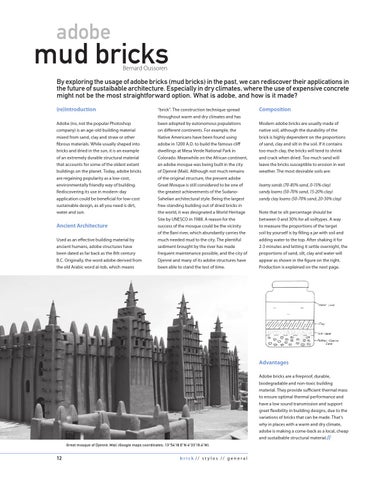
“brick”. The construction technique spread throughout warm and dry climates and has been adopted by autonomous populations on different continents. For example, the Native Americans have been found using adobe in 1200 A.D. to build the famous cliff dwellings at Mesa Verde National Park in Colorado. Meanwhile on the African continent, an adobe mosque was being built in the city of Djenné (Mali). Although not much remains of the original structure, the present adobe Great Mosque is still considered to be one of
Composition
the greatest achievements of the SudanoSahelian architectural style. Being the largest free-standing building out of dried bricks in the world, it was designated a World Heritage Site by UNESCO in 1988. A reason for the success of the mosque could be the vicinity of the Bani river, which abundantly carries the much needed mud to the city. The plentiful sediment brought by the river has made frequent maintenance possible, and the city of Djenné and many of its adobe structures have been able to stand the test of time.
sandy loams (50-70% sand, 15-20% clay) sandy clay loams (50-70% sand, 20-30% clay)
Modern adobe bricks are usually made of native soil, although the durability of the brick is highly dependent on the proportions of sand, clay and silt in the soil. If it contains too much clay, the bricks will tend to shrink and crack when dried. Too much sand will leave the bricks susceptible to erosion in wet weather. The most desirable soils are: loamy sands (70-85% sand, 0-15% clay)
Note that te silt percentage should be between 0 and 30% for all soiltypes. A way to measure the proportions of the target soil by yourself is by filling a jar with soil and adding water to the top. After shaking it for 2-3 minutes and letting it settle overnight, the proportions of sand, silt, clay and water will appear as shown in the figure on the right. Production is explained on the next page.
Advantages Adobe bricks are a fireproof, durable, biodegradable and non-toxic building material. They provide sufficient thermal mass to ensure optimal thermal performance and have a low sound transmission and support great flexibility in building designs, due to the variations of bricks that can be made. That’s why in places with a warm and dry climate, adobe is making a come-back as a local, cheap and sustaibable structural material.// Great mosque of Djenné, Mali (Google maps coordinates: 13°54’18.6”N 4°33’19.4”W)
12
b r i c k // s t y l o s // g e n e r a l