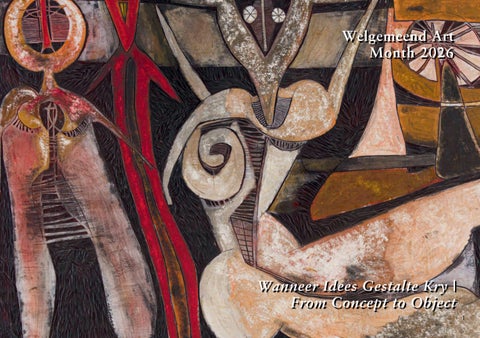
Welgemeend ArtArt Welgemeend Month 2026 Month 2026
Wanneer Idees Gestalte Kry Wanneer Idees Gestalte Kry | | From Concept to to Object From Concept Object 1
2
Wanneer Idees Gestalte Kry | From Concept to Object Exhibition of works from the Kilbourn Collection and other collections
Welgemeend Manor House, 1 – 31 August 2026 2 Welgemeend Street, Gardens, Cape Town
3
4
5
6
C olleCtor ’ s statement : W elgemeend 2026 From Concept to Object / Wanneer Idees Gestalte kry I have always been fascinated by the process of making art: the way an artist’s thoughts are transformed into a visible, tangible object through skill, craftsmanship and creative expression. At its starting point, before timber is carved, bronze is cast or pigment touches canvas, the artist needs to have an idea that requires exploration and manifestation. Such an idea or concept is by nature elusive, intangible and deeply personal. It may begin as an observation of the natural world, a remembered landscape, a spiritual revelation, a political conviction or private grief, or an emotion that the artist cannot yet name. The artist's challenge is to give this invisible thought a physical presence; to transform imagination into matter. Every mark, incision, weld, stitch or brushstroke represents a decision through which an idea
gradually acquires form. The resulting object becomes more than the sum of its materials; it embodies a way of seeing the world. From Concept to Object celebrates precisely that extraordinary act of transformation and recognises that the magic unlocked by this process can result in works that shape our perceptions of beauty and art, society and politics, philosophical ideas and real-life events for generations to come. The exhibition provides an opportunity to explore this dialogue between concept and object across generations and to present South African art not as a linear historical progression, but as the result of conversations between artists separated by decades yet connected through their desire to create.
Consequently, we selected works from our collection and those of our friends where early modernists stand alongside contemporary practitioners and each work contributes to an evolving narrative about material, imagination and human experience, expressing 120 years of South African Art practice. For this 13th edition of Welgemeend Art Month, which is held every August, we are privileged to welcome viewers and visitors yet again to the elegant and historically significant Welgemeend Homestead in Cape Town’s City Bowl. This year Welgemeend celebrates its 333rd birthday! It is located in the beautiful gardens of Jan van Riebeeck High School which, in turn, is celebrating its centenary. In this momentous year we wanted to honour an artist of significance—one who not only changed how art was perceived and
7
8
practiced in South Africa but also influenced and encouraged many aspiring artists through both example and teaching: Cecil Skotnes. His work forms the conceptual anchor of the exhibition. As serendipity would have it, Skotnes - an artist I greatly admire and who lived not far from Welgemeend - was born in 1926, exactly 100 years ago. A chance encounter with him in 1981 at the then Rand Afrikaans University (now University of Johannesburg) played a major role in awakening my awareness and appreciation of visual art. On my way to a Monday afternoon Latin lecture, I happened to pass an exhibition hall at the university and promptly deviated from my route to step into a lively gathering. It turned out to be the opening of Armando Baldinelli’s retrospective exhibition at RAU.
The exhibition was opened by Dr Albert Werth and attended by Baldinelli’s close friends, including Walter Battiss, Edoardo Villa and, of course, Cecil Skotnes. The opening took place on 7 September 1981 my 20th birthday. An exciting new world opened for me that day. The more I listened to these accomplished artists and looked, the more I saw, and the more I wanted to understand. After Edoardo Villa guided us through the many Villa sculptures dotted around the campus courtyard, I helped Walter Battiss find his car, which had somehow moved from its original spot in front of the library. After some animated conversation, we found his Rolls-Royce far away under a blue gum tree, with the driver asleep inside. Needless to say, I was deeply impressed by everything I saw, heard and experienced. That day, I decided that I wanted to become an art collector. It was this unexpected
birthday gift that set me - and later Lizelle, and hopefully our children - on a lifelong journey of discovery. In exploring the theme From Object to Concept / Wanneer Idees Gestalte kry the 2026 exhibition brings together 182 works by 106 artists: 78 from South Africa and 28 from elsewhere on the continent and abroad. Dating from 1920 to February 2026, these works span 106 years of artistic expression across a wide range of media. We are especially proud to include 22 works that might once have been classified as tribal artefacts but are now receiving the recognition their creators deserve within the art world. These works add greatly to the richness of the exhibition, deepen our experience of it, and broaden our understanding of the cultural context with which art movements such as the Amadlozi Group began to engage. In structuring this year’s exhibition, we have a modernist and a contemporary component. We chose to dedicate the
9
10
modernist section to Skotnes, his students at the Polly Street Art Centre, his Amadlozi Group colleagues, and members of his wider circle of family and friends. Within this group, we focused on artists who were also educators. As a personal homage, I also wanted to include works by the artists I met on that memorable day in September 1981. In the Zulu language, “Amadlozi” refers to “the spirit of the ancestors”. The Amadlozi Group was formed in 1963 at the initiative of the legendary gallerist and collector Egon Guenther. Its members sought to connect their predominantly Western art education with African artistic practices and culture, grounding their modernist work more firmly in African heritage, identity and aesthetics. The six core members were Cecil Skotnes, Sydney Kumalo, Edoardo Villa, Ezrom Legae, Cecily Sash and the enigmatic Giuseppe Cattaneo. We are deeply grateful to the Skotnes family for their wholehearted support of the exhibition and the loan of two important works, as well as the insightful and moving
essay on Cecil Skotnes as a father and an artist, written by Prof Pippa Skotnes and included in this catalogue. In my opinion, it is difficult to consider the work of the Amadlozi Group without first contemplating the role and impact of Walter Battiss who, amongst his peers, occupied the role of visionary explorer. Throughout his career he travelled extensively across southern Africa, studying San rock art, archaeological sites and indigenous material culture with extraordinary curiosity. Unlike many earlier scholars who approached these traditions primarily as historical artefacts, Battiss recognised within them sophisticated visual systems that possessed enduring contemporary relevance. His paintings increasingly abandoned conventional representation in favour of symbolic interlocking forms, invented alphabets, mythical creatures and richly layered surfaces. Colour became liberated from descriptive function, while line and
composition assumed an almost musical rhythm as is evidenced by Africans in Autumn, Black Palimpset and African Image. There are seven works by Battiss on display in the exhibition (several of which were exhibited at the Sao Paulo and Venice Biennales), and they are shown in the Voorkamer and Rosakamer, where they are engaging in a mesmerising conversation with works by Skotnes and Sibiya. Battiss was one of the first artists whose work we acquired, and he will always have a special place in our collection. If Battiss expanded the imaginative possibilities of painting, then Cecil Skotnes fundamentally transformed the relationship between image and material. Few artists have altered the physical language of South African art as profoundly as Skotnes did. His carved and painted timber panels defy traditional distinctions between painting, sculpture and printmaking. Rather than treating wood as a passive support, Skotnes
11
12
entered into collaboration with the material itself. Grain, density, texture and resistance all became active participants within the creative process. Every incision records a decision, and every carved line becomes simultaneously drawing and sculpture. Through this process, wood retains its identity even as it assumes new meaning and the resulting works possess an extraordinary physical presence. Skotnes' lifelong engagement with African sculpture, archaeology and mythology was neither decorative nor nostalgic. Instead, he recognised within these traditions a profound understanding of abstraction, symbolism and formal invention that resonated with the ambitions of international modernism while remaining distinctly African in origin. His work demonstrated that an authentic Southern African modernism could emerge through
dialogue with indigenous knowledge rather than over-dependence upon European precedent. The exhibition itself reflects the remarkable breadth of this achievement. Carved and painted panels, etchings, woodcuts and mixed-media works reveal an artist continually questioning the possibilities of material transformation. Whether depicting figures, masks, landscapes or still lifes, every object bears witness to the same underlying conviction: that carving is not simply a technique but a way of thinking. The significance of Skotnes extends beyond his own artistic production. As teacher, mentor and organiser, he became one of the principal architects of post-war South African art. His involvement with the Polly Street Art Centre helped nurture an extraordinary generation of Black South African artists whose contributions would permanently reshape the country's visual culture.
The exhibition features 28 works by Cecil Skotnes, alongside 40 works by artists connected to him as family members, friends, fellow educators or students, many of them associated with the Polly Street Art Centre. Together, these works testify to the remarkable depth and richness of his legacy and collectively, they fundamentally changed artistic practice in South Africa and our perception of painting, sculpture and most importantly, artists’ using wood as a medium for artistic expression. Among those artists were Sydney Kumalo, Ezrom Legae and later Lucky Sibiya, each represented within this exhibition. Their work illustrates how influence should never be confused with imitation. While each inherited aspects of Skotnes' respect for material and African sculptural traditions, they developed distinctly individual artistic voices shaped by personal histories and cultural experience.
13
Kumalo transformed simplified sculptural forms into timeless meditations on dignity and humanity. Legae invested bronze and drawing with psychological and political intensity, while extending the expressive possibilities of carved timber through rhythmic compositions rich in spiritual symbolism. Together they demonstrate how the ideas nurtured within the Amadlozi circle continued to evolve long after the group's formal activities had ceased. The influence of the Amadlozi Group’s philosophy also reaches beyond direct association. Jackson Hlungwani's visionary carvings, although emerging from entirely independent spiritual experience, share the conviction that wood possesses both physical and sacred presence. He in turn, had a significant influence on Noria Mabasa’s practice as their works in the Lesingkamer demonstrates. Edoardo Villa's sculptural investigations similarly reveal how abstraction may draw strength from African visual traditions without surrendering formal innovation and 14
the three works included sit very happily in conversation with the output from the Polly Street Team. Like Villa, who played an important role in developing Kumalo’s immense talent, Louis Maqhubela -an early attendant at the Art Centre - found a mentor in Douglas Portway and five of their paintings are presented in the exhibition. Another early attendant at the Art Centre was Ephraim Ngatane, and a beautiful 1966 township scene of his has children happily playing alongside those in Portway’s and Maqhubela’s paintings. The exhibition’s contemporary component explores the artists’ ability to transport us into imagined realms, where the visible world becomes less important than illusion, and what first appears on the surface merely hints at the inner world beyond. This is also true of Fred Page, an outsider artist whose work seems to inhabit a parallel world in which the surreal is inseparably entwined with the visible reality of Port
Elizabeth’s buildings and people. I find his work intelligent, unexpectedly funny, and quietly subversive; it always makes me smile, as the 14 works included in the exhibition should demonstrate. He combines reality, fantasy and the macabre with apparent ease. Dark humour runs through his finely drafted drawings, whimsical sketches, severe linocuts, and monochromatic paintings, all imbued with a sense of loneliness and isolation. Page’s works can be found in the Welgemeend entrance hall and in the small Proe Kamer (the Tasting Room, which in reality is the bar area, but Welgemeend being situated on school grounds this popular space requires a more dignified description) where his themes of isolation and detached observation are amplified by photographs by Abrie Fourie and David Goldblatt, and by drawings and etchings by Theresa Musoke and Dominique Edwards.
15
Among the contemporary artists in the exhibition, our theme is anchored by two dramatic, large-scale works by Ruby Swinney: Red Garden (2018) and Conservatory (2019). Both multi-panel paintings are suffused with intense, surreal colour and explore the threshold between reality and illusion. They are captivating and strange, yet oddly comforting. These lyrical paintings transform cultivated gardens and glasshouses into immersive emotional landscapes. Swinney’s translucent layers of oil on silk create atmospheric spaces where botanical observation merges with memory and contemplation. Rather than documenting nature, her gardens become metaphors for vulnerability and quiet reflection, while also hinting at more unsettling forces at work in the design of buildings, the collecting of rare plants, and the shaping of urban landscapes.
16
Ruby generously provided us with an essay giving insight into her work, practice and approach to art (see elsewhere in the catalogue). The scene for the exhibition is set at the entrance to Welgemeend where Vanessa Berlein welcomes us to the 333 year old home in a series of five intimate works executed in gold leaf, from the series Where ghosts roam. The building’s long history is hinted at by a powerful painting by JH Pierneef executed in 1920, Willow Tree; the earliest work on show. The reception room to the right of the entrance, die Voorkamer, presents a synopses of the ambit of the exhibition with smaller scale works by Cecil Skotnes, Walter Battiss, Alexis Preller, Edoardo Villa, Michael Zondi and Ezrom Legae as well as contemporary artists Pippa Skotnes, Mark Rautenbach, Judy Woodborne, Dale Lawrence and Goran
Trbuljak and weavers Mogetso Saxoba, Kelefi Zimona, Kelebogile Oshuka and Anastacia Nankali. I particularly enjoyed putting the intimate little tableaux together in this room to compliment the elegant, gentle works that Skotnes made in 1981, shortly after he moved to Cape Town, and my hope is that viewers will pause in this area to orientate themselves for the journey that awaits beyond the borders of this room! The exhibition’s “mindscape/dreamscape” section continues in the Rosakamer with a grouping of works by Michael Taylor, Lisa Brice, Alexi Karakashian, and Alessandro Papetti, in which desolate, empty spaces suggest the lingering presence of those who once occupied them. Opposite those works are two photographs of neglected, abandoned buildings: Michael Subotzky and Patrick Waterhouse’s Looking Up the Core, Ponte City, and Guy Tillim’s Grande Hotel, Beira, both of which intensify the sense of loss and abandonment.
In contrast, nearby are two reconstructed bookcase installations by Tom Cullberg and Bella Knemeyer. These works speak to the comfort of home and the quiet pleasure of arranging one’s shelves in a way that reflects personality, order, and peace. On the opposite side of the room, a similar sense of peace, together with a celebration of womanhood, coming of age, and deeprooted culture, is expressed in Buqaqawuli Nobakada’s inventive and tender ‘KwaGcina’ series, comprising photographs printed on lace. These scenes of rural harmony contrast with the loneliness captured in Senzeni Marasela’s ‘iXhesa’ series, which portrays a rural woman counting the days until her husband returns from the city and interpreting omens to seek reassurance about his safety. Two quiet sentinels by Ledelle Moe, an elegant reclining figure by Willem Strydom and a polished but quietly
menacing sculpture by Conrad Botes, keep a close guard over proceedings in the Rosakamer.
Gordon Froud (Icosahedron), all three of them being artists as well as educators, a poignant reminder of the Skotnes’ legacy.
The structural works by Strijdom van der Merwe, comprising maps, found material and painted wood, quietly anchors the room while being in perfect harmony, colour wise, with the bold works surrounding them.
Edoardo Villa’s imposing African Mask 1 stares down at two intense, deeply satirical works The Lion Tamer and Doorman, executed by David Brown, Skotnes’ late son-in-law in 2016. These works were created as part of his important Eleven Deadly Sinners series of works.
In the Klavierkamer, the central, elegant salon at the center of Welgemeend, 11 works by Skotnes, executed over several decades, bring the space to life and the patinated yellowwood floor, ceiling, symmetrical windows and bookcases compliment the incised wooden surfaces of his works beautifully.
Moving into the last section of the exhibition, contained in the Lesingkamer and two adjacent rooms, the Cecil Higgs kamer and the Boerneef Biblioteek we continue to examine Skotnes’ legacy and venture deeper into ‘Dreamscapes and Mindscapes’.
Two sculptural works by Willem Boshoff (Seven Pillars of Justice and City Book) an artist with a deep love for and mastery of wood are on display as well as two playful but powerful works by Bruce Arnott (Conjuror and Levitator) and one by
In die Cecil Higgs kamer het ons ‘n gesellige, intieme ruimte geskep waar die kyker uitgenooi word om stil te raak, rustig op die gemaklike bank te sit, en die verband tussen die uiteenlopende werke te ondersoek.
17
18
Daar is drie ankerwerke van Skotnes in die vertrek; twee gekerfde houtsneewerke Four Figures en Head en ‘n treffende ets in kleur - Untitled. Uit die beskrywing is dit duidelik dat Skotnes selde ’n naam of verklarende titel aan ‘n werk gegee het; benoemings is gewoonlik afwesig of generies. Tog het die werke deurlopende temas wat voortdurend in sy oevre voorkom. Dit was interessant om die werke te kontrasteer met ‘n somber donker werk van Fred Page - getiteld Anthills - waar ‘n surrealistiese, nihilistiese toneel geskep word wat bykans enigiets kan beteken, en met ‘n kragtige tekening van Alexis Preller genaamd African Head asook Puleng Mogale se Grounded wat met trots haarself en haar herkoms herdenk. ‘n Elegante werk van Hannes Hars, Composition with Kuba Cloth Design, is in harmonie met drie treffende geweefde mandjies uit die Tutsi, Kavango en Ngamiland gemeenskappe, asook twee pragtige Zulu kleipotte met 'n toumotief wat
geskep is deur Nesta Nala, die doyenne van Zulu pottebakkery, en haar wyle dogter Nonhlanhle Nala. Dylan Lewis se statige Falcon Table Lamp werp lig op twee Zulu geweefde mandjies geskep deur Reuben Ndwandwe (1990) en ‘n Mbukushu mandjie van Kashvli Kakona (1985). Die patrone en ragfyn weefwerk is treffend, simmetries en sprekend van organiese vorme in die natuur. In die Boerneef Biblioteek sit ons die gesprek voort wat in die Rosakamer begin het, met betrekking tot wat ‘n tuiste of woning kan beteken. Hoek Swarathle ondersoek die verskynsel dat die oorspronklike huisies in Soweto wat met die aanvang van Apartheid en die vestiging van Soweto opgerig is, nou ‘n status simbool geword het omdat dit bewys is van die eerste gesinne wat daar tuisgegaan het en as’t ware die vaders en moeders van Soweto is. Dit staan in teenstelling met ‘n foto van Jürgen Schadeberg waarin mense uitgebeeld word
wat wag op die vragmotor wat hulle uit die daklose kerk in Sophiatown gaan verwyder; ‘n baie hartseer gebeurtenis in ons geskiedenis. Die meedoënlose eensaamheid van lewe in ‘n woonwa buite Darling deur Ben Coutouvidis staan in kontras met Aimee Lindeque se warm oranje vertolking van die Kaapse middestad en Irma Stern se elegante stapelhuise in Madrid. So het elke huis maar sy kruis! The Lesingkamer (where the exhibition ends) continues to examine how artists create dreamworlds or mindscapes to transport us to a different place, mentally and intellectually speaking. Here the exhibition is divided into four sections. Section I is anchored by Deborah Bell’s magnificent and enigmatic large scale oil painting Traverse, showing Charon guiding a person on a boat across the river Styx, in what seems to be a happy ending….
19
Penny Siopis grapples with fear and the possibility of injury and death of a child in Magnified Waters Drop on a Woman’s Torso and Alfred Thoba speculates about the dream of having a multicultural ZCC school; the work is rendered in soft green and pastel colours, unlike the angry grey and black tonality of many of his other works. We have already referred to Ruby Swinney’s Conservatory which anchors the one end of the room. The concepts of the magical and often hidden rhythms of nature are further developed in larger scale works by Paul du Toit, Larry Scully, John Piper, Wendy Vincent and Geoffrey Armstrong. The final component of the room deals with the artists’ portrayal of dreams and memories of childhood and idyllic times, reflecting children at play (Louis Maqhubela, Douglas Portway, and Ephraim Ngatane), daydreaming (Marianne Podlashuc), remembering your
20
ancestors and cultural belief systems (Nirveda Alleck) and being dragged along by an impatient mother (Lucas Sithole). Conclusion: We really enjoyed putting this year’s exhibition together, which is significantly more comprehensive in scope and ambitious in depth, than we have endeavoured before. We continued to hang Welgemeend in the Salon-style, much like one would do at home as that is in line with the experience we try to create – a gentle space where one can contemplate a wide variety of works at your own pace, pausing and chatting as you meander along, allowing the works to seep into the subconscious. Every year, we just marvel at the incredible talent of our artists and the depth and complexity of our art history. There are so many stories to tell.
As always, it takes a community of art lovers to compile an exhibition, and a healthy dose of good fortune, serendipity and hard work. Some of the most impressive and generous people we know, were met around art. It has a secret language that draw people together and enhance our ability to find insight and joy in our engagement with art and artists. This year was no exception and we benefited from the generosity of people in sourcing works, hanging the exhibition and compiling the very extensive support programme. Somehow this time, it felt extra special. I attribute it to the fact that we experienced the powerful trio of friendship, love for art and expertise at its collective best. It was a pleasure to team up with my business partner and long-standing friend Anton Taljaard in presenting major works
21
by Skotnes and Battiss from their world class collection, may it add an extra bonus to the 60’th celebrations! We also got three other works by Skotnes from long standing friends, Tobin Prior and Auntie Charlotte Schachat as well as from Pippa Skotnes and her family, which greatly enhanced the exhibition. Our sincere thanks to you all, as well as the AVA and Strauss & Co who lent work as well. It is the generosity of people that oiled the wheels and set us on course. We were fortunate to get input from very skillful curators like Richard Ndimande and Jo Voysey, thank you for making it better and having fun along the way! It was great to re-connect with Ruby Swinney, now in foreign lands, and we thank her for bringing her mesmerizing works alive for us. Similarly, a heartfelt thank you to Tom Cullberg for his generous contribution and the fun of observing his meticulous installation (more than once!) of Gimme Some Truth! 22
Lizelle will thank the many other contributors on our behalf, but I conclude with my thanks to her for allowing me to indulge so wholeheartedly in this neverending quest to have a somewhat decent art collection! Frank Kilbourn 1 August 2026
23
a lloWing for U nCertainty The crossover between the familiar and the unexpected isn't incidental within my practice. I use images and subjects familiar to a past and present middle class — the garden, the family picnic, children swimming in a river. There is something about reproducing familiarity and the mundane that carries the comfort of nostalgia, enticing people to indulge in the warmth of the past. Once inside the work, they realise there is something not quite right; the people are faceless, the idyllic is shadowed with a strange sense of foreboding. My use of translucent media — oil paint on primed silk or tracing paper — allows me to paint using a reductive method where light itself becomes both medium and subject, much like a half-developed film photograph. This use of such delicate materials enhances the anxiety of the imagery, allowing these seemingly mundane scenes to sit somewhere between memory 24
and apparition, a dreamlike realm resistant to geographic placement, where figures dissolve, foliage overwhelms and architecture recedes. The monochrome palette intensifies a scene's emotion while keeping it at a slight remove, as though it belongs to a past — or present, on the edge of change. In 2017 I made my first ever visit to Western Europe, brought there through a residency in Sicily, then travelled through Italy, France and Portugal. I was blown away by works I'd only known in reproduction: the intensity of Renoir's colour palette in the Musée d'Orsay, the overwhelming scale of Géricault's Raft of the Medusa in the Louvre, the palpable emotion of Bernini's Apollo and Daphne in the Villa Borghese in Rome. One thing I hadn't expected, however, was the sublime scale of the public gardens across Europe, so different from Cape Town in scale, curation, and the ease with which these
leisure spaces are used. I was particularly in awe of the Calouste Gulbenkian Foundation in Lisbon — its 1960s Brutalist buildings looming out of curated wild gardens. I'd always disliked the Brutalism I grew up around in Cape Town, a reminder of such a violent regime, but the Gulbenkian somehow subverted that: it showed me nature's capacity to soften past brutalities, though in half-concealing it, the buildings' quiet domination held an even stronger foreboding presence. The idea of a familiar form quietly conveying an uncomfortable history became the seed for both works in this exhibition. When I returned from my travels, I went straight into preparing for a solo booth at the Cape Town Art Fair. I wanted to make something that would be noticed, a statement piece that would draw people in. Scale and visual impact mattered, which pushed me to move away from tracing paper for the first time and into developing stretched, primed silk canvases
25
— a similarly translucent ground that let me scale the work up and panel it into a much larger composition, taking inspiration from religious altarpieces. The garden is a significant symbol throughout art, literature and mythology. I drew from the Garden of Eden and the biblical narrative of the Fall, explored through Milton and Blake, and the literary spin on the English idiom "the great gardener in the sky" — wanting to give the highest status to what I believe is among the most sacred of work: nurturing the natural environment. I also referenced the Greek myth of Demeter and Persephone, and the Greek belief in three tiers of the world, with the River Styx as threshold between the living and the dead. My subject matter for Red Garden (2017) was composed from personal photographs and found images, collaged into one scene extending over six panels to create a huge crimson garden. I wanted to seduce the viewer into the work using colour, detail and the uncanny, into a world shadowed by unfamiliarity: ghostly figures watching, witnessing the potential
26
loss of these idyllic environments, caught between suspended joy and quiet foreboding. Conservatory (2019) applies the same strategy to a scene I return to often: people communing with, or observing, nature. Painted in the same reductive painterly technique and strong emerald palette, the greenhouse becomes a light-filled enclosure, leaving the viewer unsure whether the figures inside are unable to escape. Michael Pollan's line, "a lawn is nature under totalitarian rule," from his book Second Nature: A Gardener's Education, is one I think of on the subject of man-made natural environments like the garden or greenhouse. In a darker future, having damaged our natural environment, our new normal might be these laboratories of history. Where a laboratory suggests a controlled experiment, a conservatory suggests something more gentle — a curated botanical collection to be viewed for leisure. Yet these seemingly mundane objects are tied to a darker history. The rise
of the Victorian glasshouse was linked to imperial expansion, where conservatories were proving grounds and living storehouses for plants like rubber, tea and sugar, commodities that reshaped global trade. The Company's Gardens in Cape Town once held several such conservatories, though none survive today. Like a lab calibrating temperature and pressure, these glasshouses simulated distant tropical ecosystems, letting foreign species survive far from their natural habitat, in service of an economy built on moving nature — and its wealth — out of colonised land. I purposefully evade positioning my work within any specific time or place, and I wanted Conservatory (2019) to sit ambiguously between past and future. I imagined this Victorian object possibly existing in a climate-crisis future, acting more like an ecological lifeboat, keeping a baseline of biodiversity alive when the world outside can no longer sustain it. Stepping into a conservatory can already
feel like visiting a stale exhibit; in a hyperwarmed future, seeing a healthy oak tree or a once-ubiquitous wildflower might only be possible within the controlled environment of a greenhouse, turning nature into an artefact viewed inside glass rather than lived alongside. I am interested in human observation and inaction, and my figures are often still, silent, passive watchers or witnesses. Their inability to act reflects my own feelings of helplessness in the face of the climate crisis, imploding capitalism, and the impossibility of righting the wrongs of history.
In her 2004 book Hope in the Dark, she argues that hope is neither optimism nor pessimism, since both assume the outcome is already settled and excuse us from acting; hope, for her, locates itself in the premise that we don't know what will happen, and it's that same uncertainty that leaves room to act. She includes a quote by Patrisse Cullors, who described the mission of the Black Lives Matter movement as rooted in grief and rage but "pointed towards vision and dreams." Hope, in this sense, isn't a guarantee of a better outcome but a call to action, since action is impossible without it.
In a time of such uncertainty, it feels important to hold onto hope. Through my work, I want to convey the fragility of the knife-edge we stand upon — a fragility built into the materials themselves: thin layers of pigment on the delicate skin of silk, evoking anxiety through their very delicacy, a fine balance of beauty and fragility. Rebecca Solnit's writing has shaped my interest in hope as a political act.
Ruby Swinney London, July 2026
27
28
29
30
31
C eCil s kotnes : a rtist , f amily m an and f riend My father was always going to be an artist. He drew compulsively as a child, and made paintings and sculptures as a school boy. As a teenager he lied about his age to join the Second World War. He became a gunner in the 6th military division and after training in Egypt, his regiment joined the Italian campaign, liberating Florence on their way to the Apennines and the gruelling assault on German lines in the freezing winter. When the war was over he returned to Florence and was either employed, or hung out with those who were,to help recover artworks from their wartime hiding places and unpack the city’s art treasures. He loved to tell the story of the unpacking of Michaelangelo‘s David in the Uffizi, removing the sand bags and brick shell that had protected it. Standing above the sculpture he touched the rough patch on David’s head (non-finito) — a small vanity perhaps, Michelangelo was showing he had used the full height of the huge block of marble. Cecil remained in Florence for 32
many months, joining an art class and exploring the city, before taking the last opportunity to return home, and joined the Wits fine art department determined to become an artist. My father was born to missionaries. His mother and father were both officers in the Salvation Army. He was their fourth child, and they largely left him to run about barefoot on his own, exploring the outskirts of Johannesburg and Alexandra, and fishing in the Jukskei River. I remember my grandparents as rather severe. They would not tolerate smoking or drinking alcohol, prayed before each meal, before bedtime, even once, aloud, at the airport when my brother was about to fly off to Europe, bringing the place to a standstill. When they came to stay at our house while my parents went travelling, they made paper outfits for all the African sculptures, feeling far too uncomfortable living with their nudity. My parents were not similarly constrained by
piety. Cecil understood the church as a great patron of the arts. He persuaded various clerics to give his Polly Street students commissions to make stations of the cross, or scenes from the life of Christ, and he often returned to these themes throughout his life. But the stories he loved most were those of the great heroes of Greek literature and African history. At bedtime I would hear of Archilles and the story of Troy, of Schliemann’s discovery of the (mistakenly identified) mask of Agamemnon at Mycenae, of the bronze charioteer at Delphi and much later of the heroic life of the Shaka, the great military strategist and symbol of Zulu nationalism. He loved Cezanne, a legacy seen in the still lives Cecil made throughout his life, the British painter Paul Nash, the BauHaus, Ernst Kirchner, Karl Schmidt - Rottluff, and then, of course, Africa’s sculptural tradition largely introduced to him by Egon Guenther and later the charismatic and much loved
Vittorino Meneghelli. Cecil’s home, in the German sense of the word Heimat, was his studio. The sound of metal rasping through wood is the sound of my childhood. His studio was a place of great pleasure – for him but for me and my brother too. We joined him when we could, making drawings, woodcuts, or painting, trying out an enamelling kiln or making an etching. He was an enormously generous man, freely giving his time and care to students and fellow artists, all of whom would regularly drop into the studio for feedback on their work. He counted scholars and artists, playwrights and film stars, sangomas and opera singers, vintners and carpet dealers among st his friends, and traded art for dentistry, medical services and meals at restaurants throughout his life. Had he survived to celebrate one hundred years, we would have had a rather fabulous party. He had, what I can only describe, as a beautiful life, and I was immensely to Vittorino Meneghelli. Cecil’s home,lucky in the share a part of of it with him. Heimat, was his German sense the word studio. The sound of metal rasping through wood is the sound of my childhood. His studio was a place of great pleasure – for him but for me and my brother too. We joined him when we could, making
Pippa Skotnes Cape Town, July 2026
Pippa Skotnes Cape Town, July 2026
33
INGANG
VANESSA BERLEIN
VANESSA BERLEIN
1968 –
1968 –
Deep in the Red Rocks The Fish Fossil Sleeps / Diep in die Rooi Rotste Slaap Visfossiele (Part of the series "Where Ghosts Roam")
Katrientjie Come Home / Katrientjie Kom Huis Toe (Part of the series "Where Ghosts Roam")
2024
oil on gold leaf on paper board
oil on gold leaf on paper board
22 x 27 cm
22 x 27 cm From the Kilbourn Collection Image courtesy of the Artist
34
2024
From the Kilbourn Collection Image courtesy of the Artist
VANESSA BERLEIN 1968 –
"Where Ghosts Roam" series
Left to right: Nog God's Forsaken Land / Nie God se Verlate Land Nie (Part of the series "Where Ghosts Roam"); Searching Forever For The Lost Child / Soek Vir Ewig Na Die Verlore Kind (Part of the series "Where Ghosts Roam"); Still There Exists Gondwanaland / Nog Bestaan Daar Gondwanaland (Part of the series "Where Ghosts Roam")
2024 oil on gold leaf on paper board 22 x 27 cm From the Kilbourn Collection Image courtesy of the Artist
35
36
CECIL SKOTNES
DOUGLAS OWEN PORTWAY
1926 – 2009
1922 – 1993
Mask Forms
Abstract Composition
1976
1970
mixed media on paper
Gouache on Paper
46 x 72 cm
28 x 39,5 cm
From the Kilbourn Collection Photo Credit: Courtesy of Strauss & Co
From the Kilbourn Collection Photo Credit: Courtesy of Strauss & Co
Willow
HENK PIERNEEF
FRED SCHIMMEL
1886 – 1957
1928 – 2009
Willow
Abstract Landscape
1920
1978
oil on card
oil on paper laid down on board
29,5 x 39,5 cm
48 x 40 cm
From the Kilbourn Collection Photo Credit: Courtesy of Strauss & Co
From the Kilbourn Collection Photo Credit: Courtesy of Paul Colyn Photography
37
VOORKAMER
Rock Art Figures
WALTER BATTISS
WALTER BATTISS
1906 – 1982
1906 - 1982
Rock Art Figures
Abstract Composition
watercolour
watercolour on paper
37 x 54 cm
33 x 44,5 cm
From the Kilbourn Collection Photo Credit: Courtesy of Kristian Tobin Photography
38
From the Kilbourn Collection Courtesy of Strauss & Co
WALTER BATTISS 1906 - 1982
Primitive Drawing oil on slate left to right: 8 x 7, 5 cm; 7, 8 x 10 cm; 7, 8 x 7,6 cm Loan Tortilis Collection Courtesy of Strauss & Co
39
I Do Not Know
DALE LAWRENCE
DALE LAWRENCE
1988 –
1988 –
I Do Not Know 2023
Meaning and all its consequences, Extracts of "We are All Cannibals" by Claude Levi-Strauss
digital prints on paper with epoxy
2026
22 x 16 x 1,5 cm
digital prints on paper with epoxy
From the Kilbourn Collection Photo Credit: Courtesy of Strauss & Co
40
15 x 21 x 4 cm From the Kilbourn Collection Photo Credit: Courtesy of Reservoir
GERMAINE KELLER
digital print on paper
1938 – 2016
26 x 37 cm
True Fear
From the Kilbourn Collection Photo Credit: Courtesy of Strauss & Co
1996
41
EZROM LEGAE
EZROM LEGAE
1938 – 1999
1938 – 1999
Seated Female Form
Agonised Torso (EL24)
1989
1970
A.P. I
bronze with dark brown patina, on a wooden base
bronze with a black and dark brown patina on a wooden base 36 x 28 x 28 cm From the Kilbourn Collection Photo Credit: Courtesy of Strauss & Co
42
67 x 20 x 16 cm From the Kilbourn Collection Photo Credit: Courtesy of Strauss & Co
Left
EDOARDO VILLA 1915 – 2011
Heraldic Figure 1988 bronze with a grey patina; mounted on a steel base 45,5 cm From the Kilbourn Collection Photo Credit: Courtesy of Strauss & Co
Right
EDOARDO VILLA 1915 – 2011
Voortrekker Couple 1977 numbered 3/3 bronze 44 cm From the Kilbourn Collection Photo Credit: Photo Credit: Courtesy of Stephan Welz & Co
43
44
MARK RAUTENBACH
GORAN TRBULJAK
1964 –
1948 –
Most Loyal Companion
Anonymous Conceptual Artist
2024
1971
edition 1 of 5
print card, letterpress printing
buttons and glass
29 x 37,5 cm
40 x 30 x 30 cm
From the Kilbourn Collection Photo Credit: Courtesy of Gregor Podnar
From the Kilbourn Collection Photo Credit: Courtesy of Michelle Becker
JUDY WOODBORNE 1966 –
Oeil Amusé – Recto Verso 2021 1/6 engraved lino paper construction with page from encyclopedia & pins 29 x 20 cm From the Kilbourn Collection Photo Credit: Courtesy of Michelle Becker
45
CECIL SKOTNES 1926 - 2009
Three Figural Composition 1981 pencil and oil on board 29 x 39 cm each From the Kilbourn Collection Photo Credit: Courtesy of Kristian Tobin Photography
46
CECIL SKOTNES 1926 – 2009
Passage through an alien land 1981 oil on wood board 34 x 45 cm Loan Tortilis Collection Photo Credit: Courtesy of Strauss & Co
47
ALEXIS PRELLER 1911 – 1975
Still Life 1948 oil on canvas on board 9,5 x 14 cm
48
From the Kilbourn Collection Photo Credit: Courtesy of Kristian Tobin Photography
CECIL SKOTNES 1926 – 2009
Malmesbury, original woodblock and woodcut 1981 numbered 1/50 carved and incised woodblock with accompanying colour woodcut 24,5 x 30,5 cm Loan Tortilis Collection Photo Credit: Courtesy of Strauss & Co
49
ANASTACIA NANKALI
KELEBOGILE OSHUKA
21st century –
21st century –
Shambyu coiled basket, 2005
Tears of the Giraffe
Hyphaene petersiana palm for binding material and Eragrosti pallens grass for inner core with 'Stars Shining on Little Fish' design
fan palm fibre and natural dyes
height: 8 cm diameter: 29,5 cm
From the Kilbourn Collection Photo Credit: Courtesy of Strauss & Co
From the Kilbourn Collection Photo Credit: Courtesy of Strauss & Co
50
height: 11 cm diameter: 36,5 cm
MOGETSO SAXOBA
KELEFI ZIMONA
1958 –
1944 –
Yei coiled basket, 1986
Modern Yei Tray, 1986
Hyphaene petersiana palm for binding material and Eragrosti pallens grass for inner core
Hyphaene petersiana palm for wrapping over the core and Cocculus hirsutus vine for the inner core with 'Swallow’s Tail' design
height: 7 cm diameter: 31 cm From the Kilbourn Collection Photo Credit: Courtesy of Strauss & Co
4 x 31 x 24,5 cm From the Kilbourn Collection Photo Credit: Courtesy of Strauss & Co
51
PIPPA SKOTNES 1957 –
Jan Plat Convict No 7880 colour etching 76 x 56 cm
52
From the Kilbourn Collection Photo Credit: Courtesy of Strauss & Co
CECIL SKOTNES
MICHAEL ZONDI
1926 – 2009
1926 – 2008
Abstract Head
Head of a Man
1983
1978
incised and painted wood block
carved and incised wood
14 x 20,5 cm
23 cm
From the Kilbourn Collection (Quintus Kilbourn) Photo Credit: Courtesy of Strauss & Co
From the Kilbourn Collection Photo Credit: Courtesy of Denver Hendriks Photography
53
CECIL SKOTNES 1926 – 2009
Resonance XII incised woodpanel with pigment 43 x 68 cm Courtesy of a Private Collector Photo Credit: Courtesy of Strauss & Co
CECIL SKOTNES 1926 – 2009
Still Life with a Bowl of Fruit and Bottles carved, incised and painted woodpanel 40 x 80 cm From the Kilbourn Collection Photo Credit: Courtesy of Kristian Tobin Photography
54
CECIL SKOTNES 1926 – 2009
Coastal Gathering acrylic on wood 104,5 x 100 cm From the Kilbourn Collection Photo Credit: Courtesy of Strauss & Co
55
ROSAKAMER
WALTER BATTISS 1906 – 1982
Africans in the Autumn, the Long Yellow Grass oil on canvas 74 x 100 cm From the Kilbourn Collection Photo Credit: Courtesy of Kristian Tobin Photography
56
WALTER BATTISS 1906 - 1982
African Image oil on canvas 80 x 106 cm Loan Tortilis Collection Photo Credit: Courtesy of Strauss & Co
57
CECIL SKOTNES CECIL SKOTNES 1926 – 2009 1926 – 2009
Mythical Figures Mythical Figures carved, incised and painted woodpanel carved, incised 122 x 121 cm and painted woodpanel 122 x 121 cm
58
From the Kilbourn Collection Photothe Credit: Courtesy of Kristian Tobin From Kilbourn Collection Photography Photo Credit: Courtesy of Kristian Tobin Photography
CECIL SKOTNES 1926 – 2009
African Still Life carved and painted woodpanel 121,5 x 124 cm From the Kilbourn Collection Photo Credit: Courtesy of Kristian Tobin Photography
59
CECIL SKOTNES 1926 – 2009
Three Figures 1974 painted and carved wood 91,5 x 75 x 5,5 cm From the Kilbourn Collection Photo Credit: Courtesy of Strauss & Co
60
CECIL SKOTNES 1926 – 2009
Feast 1994 Carved Incised and Painted Wood 140 x 136,5 x 3,8 cm Loan Tortilis Collection Photo Credit: Courtesy of Strauss & Co
61
ARMANDO BALDINELLI 1908 – 2002
Untitled mixed media on board 70 x 45 cm
62
From the Kilbourn Collection Photo Credit: Courtesy of Strauss & Co
WALTER BATTISS 1906 - 1982
Black Palimpsest 1960 oil on canvas 51 x 41 cm From the Kilbourn Collection Photo Credit: Courtesy of Paul Colyn Photography
63
BELLA KNEMEYER 1991 –
Ailing things and fading things and railing things containing things 2026 mulched paper, charcoal powder, acrylic, gauze, wire, beeswax, konnayaku 150 x 100 x 6 cm
64
From the Kilbourn Collection Photo Credit: Courtesy of Reservoir
TOM CULLBERG 1972 –
Gimme Some Truth 2020 carved wood, wood, card 112 x 180 cm Loan from the Artist Image courtesy of the Artist
65
CONRAD BOTES 1969 –
CONRAD BOTES
Untitled (Tattooed Figure Skull) 1969 and – 2018
Untitled (Tattooed Figure and Skull)
carved wood and enamel 2018 61 x 35 x 29,5 cm
66
carved wood and enamel
61 x 35 x 29,5 cm From the Kilbourn Collection Photo Credit: Courtesy of Strauss & Co From the Kilbourn Collection Photo Credit: Courtesy of Strauss & Co
LEDELLE MOE 1971 –
Untitled 2025 concrete and steel Left: 27,5 x 14,5 x 22 cm Right: 24 x 12 x 16 cm From the Kilbourn Collection Photo Credit: Courtesy of the Artist and SMAC Gallery
67
68
ALESSANDRO PAPETTI
MICHAEL TAYLOR
1958 –
1979 –
Spazio Vuoto (Empty Space)
The Clubhouse
2002
2020
oil on canvas laid down on board
ink on paper
104 x 59 cm
86 x 66 cm
From the Kilbourn Collection Photo Credit: Courtesy of Strauss & Co
From the Kilbourn Collection Photo Credit: Courtesy of Strauss & Co
LISA BRICE
ALEXANDRA KARAKASHIAN
1968 –
1988 –
Figure X
Untitled
2010
oil on sized paper
oil on paper
53,5 x 37 cm
41,5 x 29,5 cm
From the Kilbourn Collection Photo Credit: Courtesy of Strauss & Co
Courtesy of the Association for Visual Arts Photo Credit: Courtesy of Strauss & Co
69
70
SAM NHLENGETHWA
RUBY SWINNEY
1955 –
1992 –
Abstract in Four Colours: Black, White, Red and Pink
Red Garden 2018
oil on canvas
oil on silkscreen
101 x 163 cm
300 x 450 cm
From the Kilbourn Collection Photo Credit: Courtesy of Strauss & Co
From the Kilbourn Collection Photo Credit: Courtesy of WHATIFTHEWORLD
71
MIKHAEL SUBOTZKY 1981 –
Looking up the core, Ponte City, Johannesburg (0320) 2008 c-print mounted on dibond 125,5 x 150 cm
72
From the Kilbourn Collection Photo Credit: Courtesy of Denver Hendricks Photography
GUY TILLIM 1962 –
Grande Hotel, Beira, Mozambique 2008 archival pigment ink on cotton rag paper 91,5 x 131,5 cm From the Kilbourn Collection Photo Credit: Courtesy of Denver Hendricks Photography
73
BUQAQAWULI NOBAKADA 2000 –
KwaGcina 01, KwaGcina 02, and KwaGcina 03 2026 35mm film photograph printed on lace 40 x 60 cm From the Kilbourn Collection Photo Credit: Courtesy of Denver Hendricks Photography
74
WILLEM STRYDOM 1954 – 2019
Water from Ancient Well II bronze and marble 80 x 57 x 27 cm From the Kilbourn Collection Photo Credit: Courtesy of Strauss & Co
75
76
STRIJDOM VAN DER MERWE
STRIJDOM VAN DER MERWE
1961 –
1961 –
Demarcation I
Demarcation II
2024
2024
found objects, road paint, wood and acrylic on canvas
found objects, road paint, wood and acrylic on canvas
111 x 107 x 4 cm
126 x 121 x 4 cm
From the Kilbourn Collection Photo Credit: Courtesy of Strauss & Co
From the Kilbourn Collection Photo Credit: Courtesy of Strauss & Co
LUCKY SIBIYA
LUCKY SIBIYA
1942 – 1999
1942 – 1999
Mystical Figures
Mystical Figure
carved, Incised and painted woodpanel
carved, incised and painted woodpanel
60 x 91 cm
91 x 60 cm
From the Kilbourn Collection Photo Credit: Courtesy of Kristian Tobin Photography
From the Kilbourn Collection Photo Credit: Courtesy of Kristian Tobin Photography
77
The Hay Cart
ALEXIS PRELLER 1911 – 1975
The Hay Cart 1952 oil on canvas laid down on board 25,5 x 30,5 cm From the Kilbourn Collection Photo Credit: Courtesy of Strauss & Co
78
ZAMBIAN, UNRECORDED ARTIST
ERIK LAUBSCHER
20th century –
1927 – 2013
A Pair of Chokwe Tuponya Figures, Zambia, 20th Century
Rocks at Night
wood
oil on canvasboard
38,5 cm
15,5 x 10,5 cm
From the Kilbourn Collection Photo Credit: Photo Credit: Courtesy of Stephan Welz & Co
From the Kilbourn Collection Photo Credit: Courtesy of Strauss & Co
79
KLAVIERKAMER
Untitled (Figures)
CECIL SKOTNES 1926 – 2009
Untitled (Figures) 1975 oil on wood panel 125,5 x 125,5 x 10,5 cm Loan Tortilis Collection Photo Credit: Courtesy of Strauss & Co
80
CECIL SKOTNES 1926 – 2009
Three Figures carved, incised and painted woodpanel 121 x 120,5 cm From the Kilbourn Collection Photo Credit: Courtesy of Kristian Tobin Photography
81
82
BRUCE ARNOTT
BRUCE ARNOTT
1938 – 2018
1938 – 2018
Conjuror (Conjuria series)
Levitator #2 (Conjuria series)
2012
2010
AP + 5, edition 4 of 5
AP + 5, edition 5 of 5
bronze
bronze
41 cm
40,8 cm
From the Kilbourn Collection Photo Credit: Courtesy of Denver Hendricks Photography
From the Kilbourn Collection Photo Credit: Courtesy of Denver Hendricks Photography
EDOARDO VILLA 1915 – 2011
African Mask I 1964 bronze with a brown patina 68 x 30 x 23 cm From the Kilbourn Collection Photo Credit: Courtesy of Strauss & Co
83
CECIL SKOTNES 1926 – 2009
Trees (Left) Carved Incised and Painted Wood 101,5 x 101,5 cm Loan Tortilis Collection Photo Credit: Courtesy of Strauss & Co
CECIL SKOTNES 1926 – 2009
Three figures (Right) Carved Incised and Painted Wood 120,5 x 182 cm Loan Tortilis Collection
84
Photo Credit: Courtesy of Strauss & Co
85
86
DAVID BROWN
DAVID BROWN
1951 – 2016
1951 – 2016
"Doorman" from the series Eleven Deadly Sinners (6 of 11)
"Lion Tamer" from the series Eleven Deadly Sinners (7 of 11)
2009
2009
edition 2/06
edition 2/06
bronze
bronze
71 cm
66,5 cm
From the Kilbourn Collection Photo Credit: Courtesy of Kristian Tobin Photography
From the Kilbourn Collection Photo Credit: Courtesy of Kristian Tobin Photography
SYDNEY KUMALO 1935 – 1988
Seated Woman 1965 bronze with green and brown patina on wooden base 58,5 x 22 x 40 cm From the Kilbourn Collection Photo Credit: Courtesy of Strauss & Co
87
The Figure
CECIL SKOTNES 1926 – 2009
The Figure “1977 and 1979” carved, incised and painted woodpanel 91 x 76 cm
88
From the Kilbourn Collection Photo Credit: Courtesy of Kristian Tobin Photography
CECIL SKOTNES 1926 – 2009
Gilgamesh of Uruk oil on carved wood 122 x 122 cm Courtesy of Die Kunskamer Image: Michelle54
89
WILLEM BOSHOFF 1951 –
7 Pillars of Justice 1997 wood 15 cm
90
From the Kilbourn Collection Photo Credit: Courtesy of Kristian Tobin Photography
WILLEM BOSHOFF 1951-
City Book 2007 wood 1/21 10,5 cm From the Kilbourn Collection Photo Credit: Kristian Tobin Photography
91
92
CECIL SKOTNES
CECIL SKOTNES
1926 – 2009
1926 – 2009
Crown of thorns
Head
Carved Incised and Painted Wood
Carved Incised and Painted Wood
42 x 37 cm
102 x 75,5 cm
Loan Tortilis Collection Photo Credit: Courtesy of Strauss & Co
Loan Tortilis Collection Photo Credit: Courtesy of Strauss & Co
CECIL SKOTNES 1926 – 2009
Untitled Carved Incised and Painted Wood 187 x 47 x 3,5 cm Loan Pippa Skotnes and Abigail Skotnes Photo Credit: Courtesy of Denver Hendricks Photography
CECIL SKOTNES 1926 – 2009
Untitled Tapestry 145 x 133 cm Loan Pippa Skotnes and Abigal Skotnes Photo Credit: Courtesy of Denver Hendricks Photography
93
94
KHULUMELENI MAGWAZA
THEMBI NALA
20th/21st Century –
1973 –
A burnished fired clay uphiso
A Zulu Clay Beer Pot, Kwazulu-Natal, South Africa
2015
1996
tapering elongated neck and ovoid body, the shoulder incised with a border of quadrilateral shapes, heightened with amasumpa, incised Khulumeleni Magwaza 2015
pit-fired and burnished earthenware
35,5 cm
From the Kilbourn Collection Photo Credit: Michelle54
From the Kilbourn Collection Photo Credit: Courtesy of Strauss & Co
25 cm
PJ ANDERSON
HANNAH MACFARLANE
20th century –
1996 –
A burnished earthernware vessel
I’m not Defensive, I Hunger
2012
2025
earthenware
stoneware
27 cm
27,5 x 14 x 13,5 cm
From the Kilbourn Collection Photo Credit: Courtesy of Strauss & Co
From the Kilbourn Collection Photo Credit: Courtesy of Denver Hendricks Photography
95
96
CECIL SKOTNES 1926 – 2009
Still Life with Landscape (Series of Four) 2/4 Carved Incised and Painted Wood 93 x 108,5 cm Loan work: Courtesy of Tobin and Sally Prior Photo Credit: Courtesy of Denver Hendricks Photography
97
THATO TOEBA 1990 –
Koko nje 2025 collage and wood 18,5 x 30 x 7 cm
98
From the Kilbourn Collection Photo Credit: Courtesy of Stevenson
GORDON FROUD 1963 –
Icosahedron powdercoated steel mesh 40 x 40 x 40 cm From the Kilbourn Collection Photo Credit: Courtesy of Michelle54
99
PASSAGE
100
DOMINIQUE EDWARDS
DOMINIQUE EDWARDS
1980 –
1980 –
Inside Out I
Inside Out II
2019
2019
ink on paper
ink on paper
26 x 43,5 cm
26 x 43,5 cm
From the Kilbourn Collection Photo Credit: Courtesy of Denver Hendricks Photography
From the Kilbourn Collection Courtesy: Vanessa Cowling and Dominique Edwards (Barnard Gallery)
WALTER BATTISS 1906 – 1982
Black Shadow of Red Bird on Blue Water 1965 oil on canvas 20 x 25 cm Loan Tortilis Collection Photo Credit: Courtesy of Strauss & Co
101
102
MICHAEL BECKURTS
ASHA ZERO
2000 –
1975 –
Dreams Translated
< x . xs . >
2024
2021
oil on canvas
collage
74 x 53,5 cm
42,5 x 21,5 cm
From the Kilbourn Collection Photo Credit: Courtesy of Denver Hendricks Photography
From the Kilbourn Collection Photo Credit: Courtesy of Barnard Gallery
iXesha 2
SENZENI MARASELA
iXesha 4
iXesha 15
Left to right: iXesha 2; iXesha 4; iXesha 15
1977 – 2021 Red Cotton thread on Cotton 44 x 42 cm From the Kilbourn Collection Photo Credit: Courtesy of Denver Hendricks Photography
103
104
JOHN CLARKE
CHEONAE KIM
1946 – 2021
1952-
Dam
S5
2005
1991
pencil, pastel on paper
screenprint on paper
14 x 20,5 cm
56 x 76 cm
From the Kilbourn Collection Photo Credit: Photo Credit: Courtesy of Kristian Tobin Photography
From the Kilbourn Collection Photo Credit: Courtesy of Strauss & Co
CECILY SASH 1924 – 2019
Abstract Composition with a Pear 1971 acrylic and pencil on paper 68 x 45 cm From the Kilbourn Collection Photo Credit: Courtesy of Strauss & Co
105
TASTING ROOM
ABRIE FOURIE 1969 –
Viale Principe di Piemonte, Noto, Sicily, Italy, 2013 (Notes on Entropy portfolio edition from River Notes). Title to Read: Viale Principe di Piemonte, Noto, Sicily, Italy, 2013 (Notes on Entropy portfolio edition from River Notes) 11 of 12 pigment print on archival cotton rag paper printed by Master Printer André Clements, Johannesburg 47,6 x 47,6 cm
106
From the Kilbourn Collection Photo Credit: Courtesy of the Artist
DAVID GOLDBLATT 1930 – 2018
Malmesbury 1985 vintage silver gelatin print on fibre-based paper adhered to board 44 x 55 cm From the Kilbourn Collection Photo Credit: Courtesy of Strauss & Co
107
ABRIE FOURIE 1969 –
Old Delhi, India, 2005 2011 print on Baryt Paper 32,5 x 15,5 cm
108
From the Kilbourn Collection Photo Credit: Denver Hendricks Photography
FRED PAGE 1908 – 1984
The Last 365 Days 1970 polymer on board 50 x 82,5 cm From the Kilbourn Collection Photo Credit: Courtesy of Denver Hendricks Photography
109
THERESA MUSOKE 1944 –
Butterfly I; Butterfly II, two 1963-1965 1/4 etching and aquatint on paper left: 28 x 22,5 cm | right: 29 x 22,5 cm
110
From the Kilbourn Collection Photo Credit: Courtesy of Strauss & Co
FRED PAGE 1908 – 1984
Back Yard 1981 ink and wash on paper 37 x 21,5 cm From the Kilbourn Collection Photo Credit: Courtesy of Strauss & Co
ERNEST FIENE 1894 – 1964
City Lights etching on paper 30 x 23,5 cm From the Kilbourn Collection Photo Credit: Courtesy of Strauss & Co
111
112
FRED PAGE
FRED PAGE
1908 – 1984
1908 – 1984
Car Park PE
Flyover HC
1966
linocut
linocut
34 x 46 cm
33 x 39,5 cm
From the Kilbourn Collection Photo Credit: Courtesy of Denver Hendricks Photography
From the Kilbourn Collection Photo Credit: Courtesy of Denver Hendricks Photography
Left
FRED PAGE 1908 – 1984
Be Seated 1975 felt tip pen and ink on paper 28 x 16 cm From the Kilbourn Collection Photo Credit: Courtesy of Strauss & Co
Right
FRED PAGE 1908 – 1984
The Window 1978 ink on paper 38 x 21,5 cm From the Kilbourn Collection Photo Credit: Courtesy of Stephan Welz & Co
113
114
FRED PAGE
FRED PAGE
1908 – 1984
1908 – 1984
Vicinity Parliament str P.E.
Albany Hotel PE
1966
1966
3/20
2/20
linocut
linocut
24 x 30,5 cm
30,5 x 30,5 cm
From the Kilbourn Collection Photo Credit: Courtesy of Michelle54
From the Kilbourn Collection Photo Credit: Courtesy of Michelle Becker
FRED PAGE
FRED PAGE
1908 – 1984
1908 – 1984
The Wall
Station PE
1966
1966
4/20
5/25
linocut
linocut
23 x 30,5 cm
25 x 43 cm
From the Kilbourn Collection Photo Credit: Courtesy of Michelle Becker
From the Kilbourn Collection Photo Credit: Courtesy of Michelle Becker
115
FRED PAGE FRED PAGE 1908 – 1984 1908 – 1984
Blissful Interludes Blissful Interludes
1978 1978 pen and ink over pencil pen and ink over pencil 30 x 33 cm 30 x 33 cm
116
From the Kilbourn Collection Photo Credit: Courtesy of Omni Fine Art Auctioneers From the Kilbourn Collection Photo Credit: Courtesy of Omni Fine Art Auctioneers
FRED PAGE 1908 – 1984
District Six Ct ink on paper 50 x 56,5 cm From the Kilbourn Collection Photo Credit: Courtesy of Denver Hendricks Photography
117
FRED PAGE 1908 – 1984
Cyler Crescent 1966 2/20 linocut 28,8 x 31 cm
118
From the Kilbourn Collection Photo Credit: Courtesy of Michelle Becker
WARREN MAROON 1985 –
9 to 5 2025 edition 1 of 10 print with found object clocks each: 35 x 35 cm From the Kilbourn Collection Photo Credit: Courtesy of Everard Read Cape Town
119
BOERNEEF BIBLIOTEEK
JULIAN TREVELYAN 1910 – 1988
Sienese Landscape-Variation II, Orange 1958 oil on canvas 40 x 50 cm
120
From the Kilbourn Collection Photo Credit: Courtesy of Strauss & Co
AIMEE LINDEQUE 1995 –
The roof top is nice, but you need your sunglasses 2025 acrylic on canvas 120 x 180 x 4 cm From the Kilbourn Collection Photo Credit: Courtesy of Denver Hendricks Photography
121
IRMA STERN 1894 – 1966
Madrid 1950 pen, ink and gouache on sketchbook paper 29,5 x 24,5 cm
122
From the Kilbourn Collection Photo Credit: Courtesy of Strauss & Co
BEN COUTOUVIDIS 1970 –
Caravan in Darling oil on canvas 81 x 100 cm From the Kilbourn Collection Photo Credit: Courtesy of Denver Hendricks Photography
123
DOMINIQUE CHEMINAIS
BETH ARMSTRONG
1980 –
1985 –
Hugh Alone
To skip the last step (People threw daggers at our castle and we ate smoked salmon safely inside) 16 of 27
2023 charcoal on paper 41,5 x 29,5 cm From the Kilbourn Collection Photo Credit: Courtesy of Denver Hendricks Photography
124
2010 edition 09/10 engraving 35 x 50 cm From the Kilbourn Collection Photo Credit: Courtesy of Denver Hendricks Photography
Vessel with incised floral decoration
IAN GARRETT 1971 –
Folia Spirae 2001 saggar-fired terracotta with mussel shell and porcupine quill impressions
Left to right: Folia Spirae - Correct as currently captured; Small vessel with incised floral decoration, burnished earthenware, 2007'; Right: Vessel with incised floral decoration, burnished earthenware, 2004
height: 25,5 cm diameter: 31,5 cm From the Kilbourn Collection Photo Credit: Courtesy of Strauss & Co
125
JANE TULLY HEATH 1913 – 1995
Mombasa 1959 watercolour 26 x 38 cm
JANE TULLY HEATH From the Kilbourn Collection 1913 – 1995 Photo Credit: Courtesy of Ebony/Curated
Mombasa 1959 watercolour 26 x 38 cm From the Kilbourn Collection Photo Credit: Courtesy of Ebony/Curated
126
HOEK SWARATLHE
JÜRGEN SCHADEBERG
1986 –
1931 – 2020
Kas ' Lam
The Schadeberg 50's Collection. 12 of 60 (Sophiatown Removals, Waiting for the Trucks, 1959)
2024 silkscreen 50 x 30 cm From the Kilbourn Collection Photo Credit: Courtesy of Strauss & Co
1980 silver gelatin archival hand prints dry mounted on acid free archival board and archivally framed 22,5 x 33 cm From the Kilbourn Collection Photo Credit: Courtesy of Strauss & Co
127
GEORGE RAMAGAGA 1952-2006
Moeder en Kind wood 39 cm From the Kilbourn Collection Photo Credit: Kristian Tobin Photography
128
TUTENE PATA
UNRECORDED ARTIST, BOTSWANA
20th century –
20th Century
Large Mbukushu carrying and winnowing basket, 1984
Botswana Coiled Basket
Hyphaene petersiana palm for binding material and Eragrosti pallens grass for inner core
woven ilala palm
high: 15 cm diameter: 53 cm From the Kilbourn Collection Photo Credit: Courtesy of Strauss & Co
high: 9,5 cm diameter: 45 cm From the Kilbourn Collection Photo Credit: Courtesy of Strauss & Co
129
CECIL HIGGS KAMER
Grounded
PULENG MONGALE 1991 –
Grounded 2022 10/25 photogravure with colour roll on surface gampi chine collé and Hahnemühle paper 48,5 x 62,5 cm
130
From the Kilbourn Collection Photo Credit: Courtesy of Strauss & Co
Anthills
FRED PAGE 1908 – 1984
Anthills 1964 polymer on paper laid down on board 73,5 x 60,5 cm From the Kilbourn Collection Photo Credit: Michelle54
131
DYLAN LEWIS 1964 –
Falcon Table Lamp (F009) bronze with a brown patina and paper lampshade 79 x 35 x 44 cm From the Kilbourn Collection Photo Credit: Courtesy of Strauss & Co
132
TUTSI PEOPLES UNRECORDED ARTIST 21st century –
Tall Rwandan gourd 2015 palm fibre woven into a black and rust interlacing zig-zag pattern height: 120 cm diameter: 26 cm From the Kilbourn Collection Photo Credit: Courtesy of Strauss & Co
NERMINE HAMMAM 1967 –
Destroyer of Manifest 2020 1/3 hand painted archival pigment print on Hahnemühle Japanese paper 60 x 79 cm From the Kilbourn Collection Photo Credit: Courtesy of Strauss & Co
133
KASHIVI KAKONA
BOSENYEGELE MPUSENG
20th century –
20th century –
Mbukushu carrying and winnowing coiled basket, 1985
Yei winnowing basket, 1990 Ngamiland Distrct Botswana
Hyphaene petersiana palm for binding material and Eragrosti pallens grass for inner core height: 14 cm diameter: 45,5 cm From the Kilbourn Collection Photo Credit: Courtesy of Strauss & Co
134
Hyphaene petersiana palm for binding material and Cocculus hirsutus vine for the inner core with 'Knees of the Tortoise' design height: 7 cm diameter: 33 cm From the Kilbourn Collection Photo Credit: Courtesy of Strauss & Co
CECIL SKOTNES 1926 – 2009
Four Figures carved, incised and painted woodpanel 90,5 x 122 cm From the Kilbourn Collection Photo Credit: Courtesy of Strauss & Co
135
Ukhamba basket with lid
136
REUBEN NDWANDWE
REUBEN NDWANDWE
1943 – 2007
1943 – 2007
Zulu basket with lid, early 21st centry
Ukhamba basket with lid
woven iala palm
1990
height: 27 cm diamter: 28 cm
woven iala palm
From the Kilbourn Collection Photo Credit: Courtesy of Strauss & Co
height: 24 cm diamter: 23 cm From the Kilbourn Collection Photo Credit: Courtesy of Strauss & Co
UNRECORDED ARTIST
HANNES HARRS
20th century –
1927 – 2006
Shambyu carrying basket, circa 1990
Composition with Kuba Cloth Design
1990
2002
Hyphaene petersiana palm for binding material and Eragrosti pallens grass for inner core with 'Forehead of the Zebra' design.
mixed media with animal hide on canvas
height: 20 cm diameter: 40,5 cm From the Kilbourn Collection Photo Credit: Courtesy of Strauss & Co
121 x 95 x 2,5 cm From the Kilbourn Collection Photo Credit: Courtesy of Strauss & Co
137
Left
DURANT SIHLALI 1935 – 2004
Abstract mixed media on paper 109 x 60 cm From the Kilbourn Collection Courtesy of Paul Colyn Photography
Right
CECIL SKOTNES 1926 – 2009
Untitled 1985 1/7 colour etching 69 x 50 cm
138
Loan: Courtesy of Die Kunskamer Photo Credit: Michelle54
ALEXIS PRELLER
CECIL SKOTNES
1911 – 1975
1926 – 2009
African Head
Head
1939
Carved Incised and Painted Wood
pen and ink on paper
28 x 21,5 cm
28 x 21,5 cm From the Kilbourn Collection Photo Credit: Courtesy of Kristian Tobin Photography
Loan Tortilis Collection Photo Credit: Courtesy of Strauss & Co
139
NGAMILAND DISTRICT, BAYEI/HAMBUKUSHU PEOPLES UNRECORDED ARTIST 21st century –
A Botswanan coiled mokolwane palm leaf woven basket 2015 conical, with plant and root dye grass binding height: 22 cm diameter: 38 cm
140
From the Kilbourn Collection Photo Credit: Courtesy of Strauss & Co
NESTA NALA
NONHLANLA NALA
1940 – 2005
South Africa 1976 – 2006
Ukhamba with rope and applied motifs
Ukhamba with rope and applied motifs
pit-fired and burnished earthenware with relief and incised decoration
pit-fired and burnished earthenware with relief and incised decoration
height: 14,5 cm diameter: 18 cm
height: 19 cm diameter: 22 cm
From the Kilbourn Collection Photo Credit: Courtesy of Strauss & Co
From the Kilbourn Collection Photo Credit: Courtesy of Strauss & Co
141
LESINGKAMER
JOHN PIPER 1903 – 1992
142
RUBY SWINNEY 1992 –
Kingston Deverill
Conservatory
1980
2019
gouache on paper
oil on silkscreen
40 x 57,5 cm
305 x 300 x 3 cm
From the Kilbourn Collection Photo Credit: Courtesy of Strauss & Co
From the Kilbourn Collection Photo Credit: Courtesy of Strauss & Co
143
REBAONE FINGER 2001 –
She's a Beauty, Permission to Clutch Your Pearls: Granted 2025 ceramic 70 x 66 x 43 cm
144
From the Kilbourn Collection Photo Credit: Courtesy of Everard Read Cape Town
HENNIE MEYER 1965 –
Oblation 2024 multi-fired earthenware with slip and glaze 50 x 33 x 30 cm From the Kilbourn Collection Photo Credit: Courtesy of Denver Hendricks Photography
145
PAUL DU TOIT 1965 – 2014
Abstract Composition 1979 acrylic on paper 115 x 100 cm
146
From the Kilbourn Collection Courtesy of Paul Colyn Photography
LARRY SCULLY 1922 – 2002
Abstract Landscape in Blue 1969 oil on canvas 151 x 121 cm From the Kilbourn Collection Photo Credit: Courtesy of Strauss & Co
147
Composition with Bicycle
148
LOUIS KHELA MAQHUBELA
LOUIS KHELA MAQHUBELA
1939 – 2021
1939 – 2021
Abstract Composition with Figure
Composition with Bicycle
1972
1970
mixed media on paper
oil on paper
54,5 x 57,5 cm
50,5 x 62,5 cm
From the Kilbourn Collection Photo Credit: Courtesy of Denver Hendricks Photography
From the Kilbourn Collection Photo Credit: Courtesy of Denver Hendricks Photography
MARIANNE PODLASHUC 1932 – 2004
Paper Doll Friends oil on board 72,5 x 53,5 cm From the Kilbourn Collection Photo Credit: Courtesy of Strauss & Co
149
150
HENDRICK TSHIVHANGWAHO NEKHOFHE
JACKSON HLUNGWANI
1955 –
1923 – 2010
Untitled
Strong Man - Abraham, Isaac, Angel and Serpent
wood
wood
89 x 50 x 30 cm
137 x 73 x 50 cm
From the Kilbourn Collection Photo Credit: Courtesy of Michelle Becker
From the Kilbourn Collection Photo Credit: Courtesy of Kristian Tobin Photography
NORIA MABASA 1938 –
Crocodile and Buck patinated and carved wood 24,5 x 127 x 53 cm From the Kilbourn Collection Photo Credit: Courtesy of Strauss & Co
151
PENNY SIOPIS 1953 –
Magnified Water Drops on Woman's Torso 1990 - 01 mixed media and collage 160 x 112 cm From the Kilbourn Collection Photo Credit: Courtesy of Strauss & Co
DEBORAH BELL 1957 –
Traverse 2014 oil on canvas 153 x 263 cm
152
From the Kilbourn Collection Photo Credit: Courtesy of Strauss & Co
153
WENDY VINCENT AND GEOFFREY ARMSTRONG 1941 –
Untitled (Caterpillar, Chrysalis, Butterfly) 2009 oil on canvas stretched over board 107 x 122,5 x 3,5 cm
154
From the Kilbourn Collection Photo Credit: Courtesy of Strauss & Co
GIUSEPPE CATTANEO 1929 – 2015
Deadline Pretoria Bureau mixed media and collage on board 120 x 89 cm From the Kilbourn Collection Photo Credit: Courtesy of Kristian Tobin Photography
155
NAZEER JAPPIE 1998 –
Empty Room 2026 oil on board in kiaat frame 67 x 70,1 cm From the Kilbourn Collection Photo credit: Courtesy of Untitled
156
NIRVEDA ALLECK 1975 –
Remains of a Heritage (diptych) 2024 oil on canvas left: 104 x 61 x 6,5 cm right: 105 x 104,5 x 6,5 cm From the Kilbourn Collection Photo Credit: Courtesy of Strauss & Co
157
ALFRED THOBA 1951 – 2022
ZCC Multicultural School 2012 oil on plywood 47,5 x 67,5 cm
158
From the Kilbourn Collection Photo Credit: Courtesy of Strauss & Co
TERENCE MALULEKE 1995 –
Calla Lilies
RICHARD (SPECS) NDIMANDE 1994 –
Kuningi
acrylic on unstretched canvas
2024
98 x 68 cm
oil on Belgian canvas
From the Kilbourn Collection Photo Credit: Courtesy of Strauss & Co
50,5 x 40,5 x 3,5 cm From the Kilbourn Collection Photo Credit: Courtesy of Strauss & Co
159
160
DOUGLAS OWEN PORTWAY
DOUGLAS OWEN PORTWAY
1922 – 1993
1922 – 1993
Untangling the Kite
Boys with Kite
oil on wood
mixed media
75 x 62 cm
31,5 x 49,5 cm
From the Kilbourn Collection Photo Credit: Courtesy of Kristian Tobin Photography
From the Kilbourn Collection Photo Credit: Courtesy of Denver Hendricks Photography
EPHRAIM NGATANE 1938 – 1971
Township Scene 1966 oil on board 73,5 x 103,5 cm From the Kilbourn Collection Photo Credit: Courtesy of Stephan Welz & Co
161
HERMAN VAN NAZARETH 1936 –
Untitled (Standing Figure) bronze 59 x 20 x 13 cm Courtesy of Axis Art Gallery Photo Credit: Courtesy of Michelle54
162
EZROM LEGAE
MICHAEL FLEISCHER
1938 – 1999
1915 – 1991
Mother and Child
Abstract Form
1966
copper with brown patina, wooden base
pencil on paper
86 cm
50 x 70,5 cm
From the Kilbourn Collection Photo Credit: Courtesy of Strauss & Co
From the Kilbourn Collection Photo Credit: Courtesy of Strauss & Co
163
INDEX Abrie Fourie (1969 –) p. 106, 108 Aimee Lindeque (1995 –) p. 121 Alessandro Papetti (1958 –) p. 68 Alexandra Karakashian (1988 –) p. 69 Alexis Preller (1911 – 1975) p. 48, 78, 139 Alfred Thoba (1951 – 2022) p. 158 Anastacia Nankali (21st century –) p. 50 Armando Baldinelli (1908 – 2002) p. 62 Asha Zero (1975 –) p. 102 Bella Knemeyer (1991 –) p. 64 Ben Coutouvidis (1970 –) p. 123 Beth Armstrong (1985 –) p. 124 Bosenyegele Mpuseng (20th century –) p. 134 Bruce Arnott (1938 – 2018) p. 82, 83 Buqaqawuli Nobakada (2000 –) p. 74 Cecil Skotnes (1926 – 2009) p. 36, 46, 47, 49, 52, 54, 55, 58, 59, 60, 61, 80, 81, 84, 85, 88, 89, 92, 93 96, 97, 135, 138, 139 Cecily Sash (1924 – 2019) p. 105 Cheonae Kim (1952 –) p. 104 Conrad Botes (1969 –) p. 66 Dale Lawrence (1988 –) p. 40, 41 David Brown (1951 – 2016) p. 86, 87 David Goldblatt (1930 – 2018) p. 107 Deborah Bell (1957 –) p. 152, 153 Dominique Cheminais (1980 –) p. 124 Dominique Edwards (1980 –) p. 100, 101 Douglas Owen Portway (1922 – 1993) p. 36, 160, 161 Durant Sihlali (1935 – 2004) p. 138
164
Dylan Lewis (1964 –) p. 132 Edoardo Villa (1915 – 2011) p. 42, 43, 83 Ephraim Ngatane (1938 – 1971) p. 161 Erik Laubscher (1927 – 2013) p. 79 Ernest Fiene (1894 – 1964) p. 111 Ezrom Legae (1938 – 1999) p. 42, 163 Fred Page (1908 – 1984) p. 109, 110, 111, 112, 113, 114, 115, 116, 117, 118, 131 Fred Schimmel (1928 – 2009) p. 37 Geoffrey Armstrong (1941 –) p. 154 George Ramagaga (1952 – 2006) p. 128 Germaine Keller (1938 – 2016) p. 41 Giuseppe Cattaneo (1929 – 2015) p. 155 Goran Trbuljak (1948 –) p. 44 Gordon Froud (1963 –) p. 99 Guy Tillim (1962 –) p. 73 Hannah Macfarlane (1996 –) p. 95 Hannes Harrs (1927 – 2006) p. 137 Hendrick Tshivhangwaho Nekhofhe (1955 –) p. 150 Henk Pierneef (1886 – 1957) p. 37 Hennie Meyer (1965 –) p. 145 Herman van Nazareth (1936 –) p. 162 Hoek Swarathle (1986 –) p. 127 Ian Garrett (1971 –) p. 125 Irma Stern (1894 – 1966) p. 122 Jackson Hlungwani (1923 – 2010) p. 150 Jane Tully Heath (1913 – 1995) p. 126 John Clarke (1946 – 2021) p. 104 John Piper (1903 – 1992) p. 142
Judy Woodborne (1966 –) p. 44, 45 Julian Trevelyan (1910 – 1988) p. 120 Jürgen Schadeberg (1931 – 2020) p. 127 Kashivi Kakona (20th century –) p. 134 Kelebogile Oshuka (21st century –) p. 50 Kelefi Zimona (1944 –) p. 51 Khulumeleni Magwaza (20th/21st century –) p. 94 Larry Scully (1922 – 2002) p. 147 Ledelle Moe (1971 –) p. 67 Lisa Brice (1968 –) p. 69 Louis Khela Maqhubela (1939 – 2021) p. 148 Lucky Sibiya (1942 – 1999) p. 76, 77 Marianne Podlashuc (1932 – 2004) p. 149 Mark Rautenbach (1964 –) p. 44 Michael Beckurts (2000 –) p. 102 Michael Fleischer (1915 – 1991) p. 163 Michael Taylor (1979 –) p. 68 Michael Zondi (1926 – 2008) p. 53 Mikhael Subotzky (1981 –) p. 72 Mogetso Saxoba (1958 –) p. 51 Nazeer Jappie (1998 –) p. 156 Nermine Hammam (1967 –) p. 133 Nesta Nala (1940 – 2005) p. 141 Nirveda Alleck (1975 –) p. 157 Nonhlanla Nala (1976 – 2006) p. 141 Noria Mabasa (1938 –) p. 151 Paul du Toit (1965 – 2014) p. 146 Penny Siopis (1953 –) p. 152 Pippa Skotnes (1957 –) p. 52 PJ Anderson (20th century –) p. 95 Puleng Mongale (1991 –) p. 130 Rebaone Finger (2001 –) p. 144
Reuben Ndwandwe (1943 – 2007) p. 136, 137 Richard (Specs) Ndimande (1994 –) p. 159 Ruby Swinney (1992 –) p. 70, 71, 143 Sam Nhlengethwa (1955 –) p. 70 Senzeni Marasela (1977 –) p. 103 Strijdom van der Merwe (1961 –) p. 76, 77 Sydney Kumalo (1935 – 1988) p. 87 Terence Maluleke (1995 –) p. 158 Thato Toeba (1990 –) p. 98 Thembi Nala (1973 –) p. 94 Theresa Musoke (1944 –) p. 110 Tom Cullberg (1972 –) p. 64, 65 Tutene Pata (20th century –) p. 129 Vanessa Berlein (1968 –) p. 34, 35 Walter Battiss (1906 – 1982) p. 38, 39, 56, 57, 63, 101 Warren Maroon (1985 –) p. 119 Wendy Vincent (1941 –) p. 154 Willem Boshoff (1951 –) p. 90, 91 Willem Strydom (1954 – 2019) p. 75
165
166
B edankings en e rkenning Geen kunswerk hys homself teen ‘n muur op, geen katalogus skryf haarself, en geen tafel dek homself nie. Welgemeend se Augustus Maand van Kuns het elke jaar 'n hele span mense agter die skerms nodig om aan die idee gestalte te gee en dit boonop moeiteloos te laat lyk. Graag wil ons hiermee dankie sê aan elke individu en instansie wat ‘n bydrae gelewer het en sodoende die 2026 uitgawe van hierdie lekker kunsgebeurtenis moontlik gemaak het. Eerstens ‘n woord van erkenning en dank aan Frank wat die oorhoofse rol speel in al die fasette van die Maand; in besonder die bepaling van die jaar se tema, uitsoek van die werke, sy rol as kurator van die uitstalling, en algemene leiding in hoe die maand se verrigtinge vorm aanneem. For Frank and me, joining forces with Strauss & Co each year to take on this project remains a tremendous pleasure and privilege; thank you for the generous provision of resources, in particular people,
time, funds and expertise, that made the exhibition and the many events centred around it possible. Special thanks go to Bina Genovese, Brooke Schafer, Frances Holmes, Armani Steinmann, Jo Voysey, Richard Ndimande, Justin de Bruin, Simbi Muzondo, Elmarie van Straten, Wilhelm van Rensburg and Kirstie Pietersen, as well as all other Strauss & Co colleagues who contributed to the Art Month. Without the generosity of our sponsors Welgemeend Month of Art will not be possible: Delaire Graff Estate, and Damien Joubert-Winn, for the wines that will be enjoyed at our upcoming gala dinner, and for your long standing support; Haute Cabriére and Tanja von Arnim, who sponsored the Cap Classique for the gala dinner and certain other events; Saronsberg and Nic and Mariëtte van Huyssteen, for sponsorship of wine at our annual gallerist cocktail event which will take place on the
11th of August; Lourensford and Caro Wiese for sponsorship of wines for Strauss & Co Talks and walkabouts; Thank you to Bloomia for bestowing arms full of tulips on us, and to Anine du Plessis who provided the beautiful flower arrangements which will be on display alongside the art throughout the month, as well as flowers at the gala dinner. Deckle Edge provided generous discounts on art material for our art classes and family day. Thank you also to those individuals and institutions who sponsored auction items; this is the heart of our focus, to generate funds for Welgemeend’s maintenance and restoration through the sale of high-quality experiences and art. Thank you especially to Julia Buchanan, Jake Aikman, Dodo House Villa, Thebe Magugu, Veronique Savigné, Annelize Buchanan and Ollie Swart, Jan du Toit, Saronsberg (Nic and Mariëtte van Huyssteen) Karel Nel, Strauss Co and others. Thanks to Helena le Roux, Peter 167
Schumann and the many Friends of Welgemeend who assist us during the month, the Principal, Governing body and learners of Hoërskool Jan van Riebeeck, Karen Koch, Alex Costa, Oom Japie, Anton, Phillip, Cynthia and her team. Thank you to Amanda Botha, Sean O’Toole, Dieter Holm and Truida Prekel, and everyone who contributed to the talks and walkabouts. Dankie aan Marysia Avis wat die kunsdatabasis met soveel bekwaamheid en liefde hanteer, (en Frank se kantoor bestuur!) sowel as Hanneli Higgs en die Kilbourn gesinskantoor span: Maria Shadford, Laura de Kok, Joleen van der Colff, Flora Jackson, Zelna Roxo, Amin Taliona and Peter Kapamalula. Hanneli is die operasionele hoof en ruggraat van die Kilbourn gesinskantoor, en aan haar is erkenning vir ‘n besondere bydrae verskuldig.
168
Dankie aan die versamelaars wat van hulle werke vir die uitstalling beskikbaar gemaak het; Frank verleen graag self aan julle die nodige erkenning in die voorwoord tot die katalogus. Lastly, to everyone who is not specifically named but made a contribution to the Art Month, you know who you are, and we will always be grateful. Lizelle Kilbourn Cape Town, July 2026
169
170
D E L A I R E
E S T A T E
171
SOUTH AFRICA
a whole bunch of beautiful Bloomia Suid Afrika is ’n spesialis-snyblomprodusent wat premium hidroponies gekweekde tulpe aan vooraanstaande kleinhandelaars en bloemiste verskaf. Gerugsteun deur internasionale kundigheid en ’n verbintenis tot gehalte, innovasie en konsekwentheid regdeur die jaar, ontwikkel Bloomia ’n kenmerkende blomaanbod vir die Suid-Afrikaanse mark, met die ambisie om Afrika se tulpkategorie te lei. Adriaan van Wyk, (Matriek ’94) staan aan die hoof van Bloomia se Suid Afrikaanse besigheid.
bloomia.com
172
173
INSPIRED BY HISTORY,
celebratedwithfriends
Rooted inF@anFchhoek, guidedbyimagination,andinte@twined with c@eativity,Pie@@e Jou@dancaptu@eFthemagicthat happenF when g@eat wine b@ingFpeopletogethe@.
174
CR AF TE D IN F R A N SCH H O EK, SO UTH AFRI CA B Y H A U TE C ABRI È R E | N OT F OR SA L E TO PE R SON S U N DE R 18 Y EARS
Your premier resource for exploring, collecting, and exhibiting contemporary art from Africa. www.buchananco.co.za | @buchanan.co_ Installation view from By Our Own Hands at Magugu House, Cape Town, featuring Zanele Muholi.
175
176
177
178