STRATEGIC VISION for Taiwan


Security
Implications for the Taiwan Strait War in Ukraine

Assessing the Media’s Narrative
Aswin Lin
Beijing looking Seaward
Hon-min Yau
Inspiring a Fighting Spirit in Taiwan
Dean Karalekas
Taipei Should Seek Peace
Charles Yang
Plus: A History of India-Japan Ties
Raviprasad Narayanan
Volume 11, Issue 52 w May, 2022 w ISSN 2227-3646
STRATEGIC VISION for

Taiwan Security
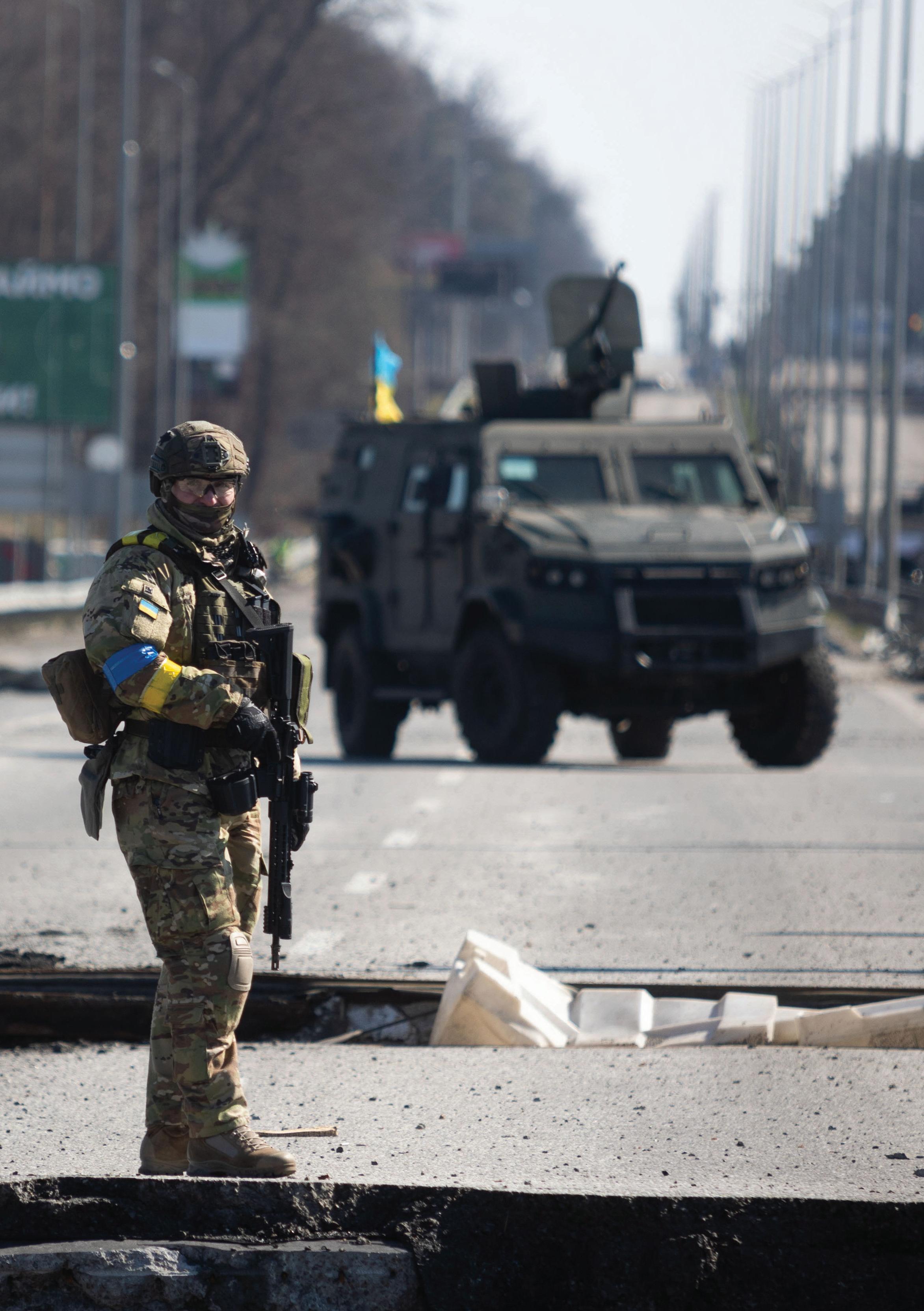
Submissions: Essays submitted for publication are not to exceed 2,000 words in length, and should conform to the following basic format for each 1200-1600 word essay: 1. Synopsis, 100-200 words; 2. Background description, 100-200 words; 3. Analysis, 800-1,000 words; 4. Policy Recommendations, 200-300 words. Book reviews should not exceed 1,200 words in length. Notes should be formatted as endnotes and should be kept to a minimum. Authors are encouraged to submit essays and reviews as attachments to emails; Microsoft Word documents are preferred. For questions of style and usage, writers should consult the Chicago Manual of Style. Authors of unsolicited manuscripts are encouraged to consult with the executive editor at xiongmu@gmail.com before formal submission via email. The views expressed in the articles are the personal views of the authors and do not necessarily represent the views of their affiliate institutions or of Strategic Vision. Once accepted for publication, manuscripts become the intellectual property of Strategic Vision. Manuscripts are subject to copyediting, both mechanical and substantive, as required and according to editorial guidelines. No major alterations may be made by an author once the type has been set. Arrangements for reprints should be made with the editor. The editors are responsible for the selection and acceptance of articles; responsibility for opinions expressed and accuracy of facts in articles published rests solely with individual authors. The editors are not responsible for unsolicited manuscripts; unaccepted manuscripts will be returned if accompanied by a stamped, self-addressed return envelope. Strategic Vision remains neutral with regard to jurisdictional claims in published maps and institutional affiliations. Cover photograph of a Ukrainian soldier in the ruins of war is courtesy of the government of Ukraine.
Volume 11, Issue 52 w May, 2022 Contents Beijing looks seaward to safeguard interests .................................4 Assessing media narratives on Ukraine war ................................ 10 Ukrainian resistance inspires fighting spirit in Taiwan .............. 14 History of India-Japan ties shows room for growth ................... 20 Russia attack shows Taipei should seek peace ............................. 25 Hon-min Yau Aswin Lin Dean Karalekas Raviprasad Narayanan
Charles Yang
Editor
Fu-Kuo Liu
Executive Editor
Aaron Jensen
Editor-at-Large
Dean Karalekas
Editorial Board
Chung-young Chang, Fo-kuan U
Richard Hu, NCCU
Ming Lee, NCCU
Raviprasad Narayanan, JNU
Hon-Min Yau, NDU
Ruei-lin Yu, NDU
Li-Chung Yuan, NDU
Osama Kubbar, QAFSSC
Rashed Hamad Al-Nuaimi, QAFSSC
Chang-Ching Tu, NDU
STRATEGIC VISION For Taiwan Security (ISSN 2227-3646) Volume 11, Number 52, May, 2022, published under the auspices of the Center for Security Studies and National Defense University.
All editorial correspondence should be mailed to the editor at STRATEGIC VISION, Taiwan Center for Security Studies. No. 64, Wanshou Road, Taipei City 11666, Taiwan, ROC.
Photographs used in this publication are used courtesy of the photographers, or through a creative commons license. All are attributed appropriately.
Any inquiries please contact the Associate Editor directly via email at: xiongmu@gmail.com.
Or by telephone at:
+886 (02) 8237-7228
Online issues and archives can be viewed at our website: https://en.csstw.org/
© Copyright 2022 by the Taiwan Center for Security Studies.
From The Editor
The editors and staff of Strategic Vision would like to wish our readers well this summer season. Since our last issue, the whole world watched in dismay as the armed forces of Russia marched across the border and began an unprecedented assault on the sovereign nation of Ukraine. Naturally, that event has caused analysts and policymakers here in Taiwan to take note, and examine what lessons can be learned in the aid of our own security. To that end, we offer in this issue the perspectives of a number of experts who offer their views on the situation in Eastern Europe and what it may mean for the Indo-Pacific region.
We open this issue with Hon-min Yau, a professor at the ROC National Defense University, who examines China’s evolving maritime strategy. Next, Aswin Lin, a PhD candidate at National Chengchi University in Taipei, challenges the dominant media narratives on the Russian-Ukraine War.
Next, Strategic Vision’s own Editor-at-Large Dean Karalekas looks at Russia’s war in Ukraine and the implications that it holds for Taiwan’s security. Dr. Raviprasad Narayanan, an associate professor at Jawaharlal Nehru University in New Delhi, examines the history of ties between Japan and India and how those relations continue to develop.
Finally, Dr. Charles Yang, a graduate of NTU’s Department of National Development, looks for ways in which China and Taiwan might foster peace and cooperation, to prevent a repeat of the type of aggression Russia has demonstrated in Ukraine.
We hope you enjoy this issue, and that our coverage helps to make sense of current geopolitical realities. We look forward to bringing you the finest analysis and reporting on the issues of importance to security in the Taiwan Strait and the Asia-Pacific region.
Dr. Fu-Kuo Liu Editor Strategic Vision
Articles in this periodical do not necessarily represent the views of either the TCSS, NDU, or the editors
China Looks Seaward
Beijing shaping maritime strategy to safeguard strategic Chinese interests
Hon-min Yau
The geopolitical pressure that had built up in the Donbas region since 2014 finally erupted with Russia’s “special military operation” against Ukraine on February 24, 2022. The war triggered a tectonic shift in global security and created one of the largest refugee migrations in modern-day Europe. However, by the end of April 2022, the events of the war had deviated from Russia’s original wish for a quick and decisive Blitzkrieg-style operation and had turned into another 21st century war of attrition. While much of the explanation for this development centered around the leadership of President Volodymyr Zelenskyy and the iron will of
the Ukrainian people to defend themselves, this article highlights the importance of supply chains in this conflict and how this single factor can be used to illuminate China’s two-ocean strategy in the IndoPacific region.
One of the distinct features of the 2022 RussiaUkraine War is the collective effort of Western sanctions on Russia. By 8 April, 2022, the European Union had imposed five sanctions on Russia. This action expelled Russian banks from the global financial SWIFT system and banned Russian personnel and entities from operating in the European market. Most significantly, the measures also denied Russian

4 b Strategic Vision vol. 11, no. 52 (May, 2022)
Dr. Hon-min Yau is associate professor and director of Graduate Institute of International Security (GIIS), College of International and National Defense Affairs (INDAC), ROC National Defense University. He can be reached
at cf22517855@gmail.com
Construction site of the Magampura port in Hambantota, Sri Lanka. The Chinese company CMPort owns a 70 percent stake and a 99-year lease on the port.
photo: Dhammika Heenpella
air carriers overflight of European Union (EU) airspace and access to EU airports, as well as banning all Russian vessels from accessing EU ports. While these sanctions may have had only a limited effect in changing Russian President Vladimir Putin’s decision on whether or not to continue his aggression, they have had a destructive effect on Russia’s domestic economy and reduced the resources available for the Russian war engine.
Strategic intentions
When we put this observation in the context of East Asia, a similar challenge will be presented to China. With its high-profile military build-up and expansionist activities, China’s strategic intentions in the Taiwan Strait and the South China Sea are apparent. Given that the most prosperous area of China is the southeast coastal region, which relies heavily on seaports to access global markets, a conflict over Taiwan, or in the South China Sea, could hinder China’s access to vital Sea Lines of Communication (SLOCs) and disrupt its logistics under direct pressure from the current US Indo-Pacific Strategy. What is China’s domestic security discourse regarding this concern?

This article aims to fill a gap in the literature to understand China’s strategy for securing its logistics in the Indo-Pacific region during a conflict.
China’s two-ocean (Liang Yang Chu Hai) strategy provides insight into how leaders in Beijing think about keeping SLOCs and supply chains secure. In fact, long before the Russia-Ukraine war, then-President Hu Jintao had already noted the importance of securing supplies from South East Asia during periods of conflict. In 2003, the Chinese Communist Party (CCP) worried that its SLOCs, mostly leading toward the Pacific Ocean, were in the first and second island chains, within the US sphere of influence. This presented a challenge to China’s expanding activities in the Pacific region. In addition, more than 80 percent of China’s energy supply came from foreign imports through the Strait of Malacca, a vulnerability that Hu termed “the Malacca Dilemma.” As the United States has a strong presence in the Pacific Ocean, the Indian Ocean has become an essential alternative for China’s strategic survival. Therefore, Beijing needed to secure its ownership and control over the network of essential military and commercial facilities along its SLOCs, particularly in the Indian Ocean. International scholars labeled this China’s
China Looks Seaward b 5
Admiral Cecil Haney, former commander of the US Pacific Fleet, greets Admiral Wei Gang during a Chinese Navy visit to Pearl Harbor.
photo: Nardel Gervacio
“string of pearls” strategy.
A closer examination of Beijing’s supply strategy reveals the original strategic intent of China’s push for energy security, which shifted in 2008 with the successful long-haul naval sailing to East Africa in the name of countering piracy. China’s strategic community pushed for the establishment of a two-ocean strategy to ensure national survival. These discussions envisioned China’s expansion of naval activity toward the Pacific Ocean as the result of its growing national power, and they argued that China should also expand its control over the important harbors or bases along the Indian Ocean. Most distinctly, Beijing should also invest in building land passages to connect important ports under its influence. This development is based on the following strategic calculus. First, militarily, securing two passages will offer China a better strategic position from which to compete for the status of first-rate world power. Second, economically, securing two passages will reduce the risk of foreign disruptions to its economic
development. Third, given that both Singapore and the Philippines have close relations with the United States, China could potentially be coerced by Western strategic leverage from sanctions, contested access to the sea, or even access-denial by a foreign military. Finally, the territorial disputes in the South China Sea could possibly increase the likelihood that access to SLOCs would be interrupted. Hence creating land channels with the Indian Ocean will mitigate foreign coercion in times of conflict in the South China Sea. Therefore, having an alternative access to the Indian Ocean without traversing through areas of US influence is extremely important for China.
By 2021, China’s navy already counted more than 355 vessels, which made it the largest navy in the world in terms of number of ships. However, China’s seaward-looking strategy seems different from the dominant sea power strategy proposed by Alfred Thayer Mahan, which emphasizes the importance of the fleet, choke points, and SLOCs. Instead, China’s two-ocean strategy could more likely have been in-
6 b
STRATEGIC VISION
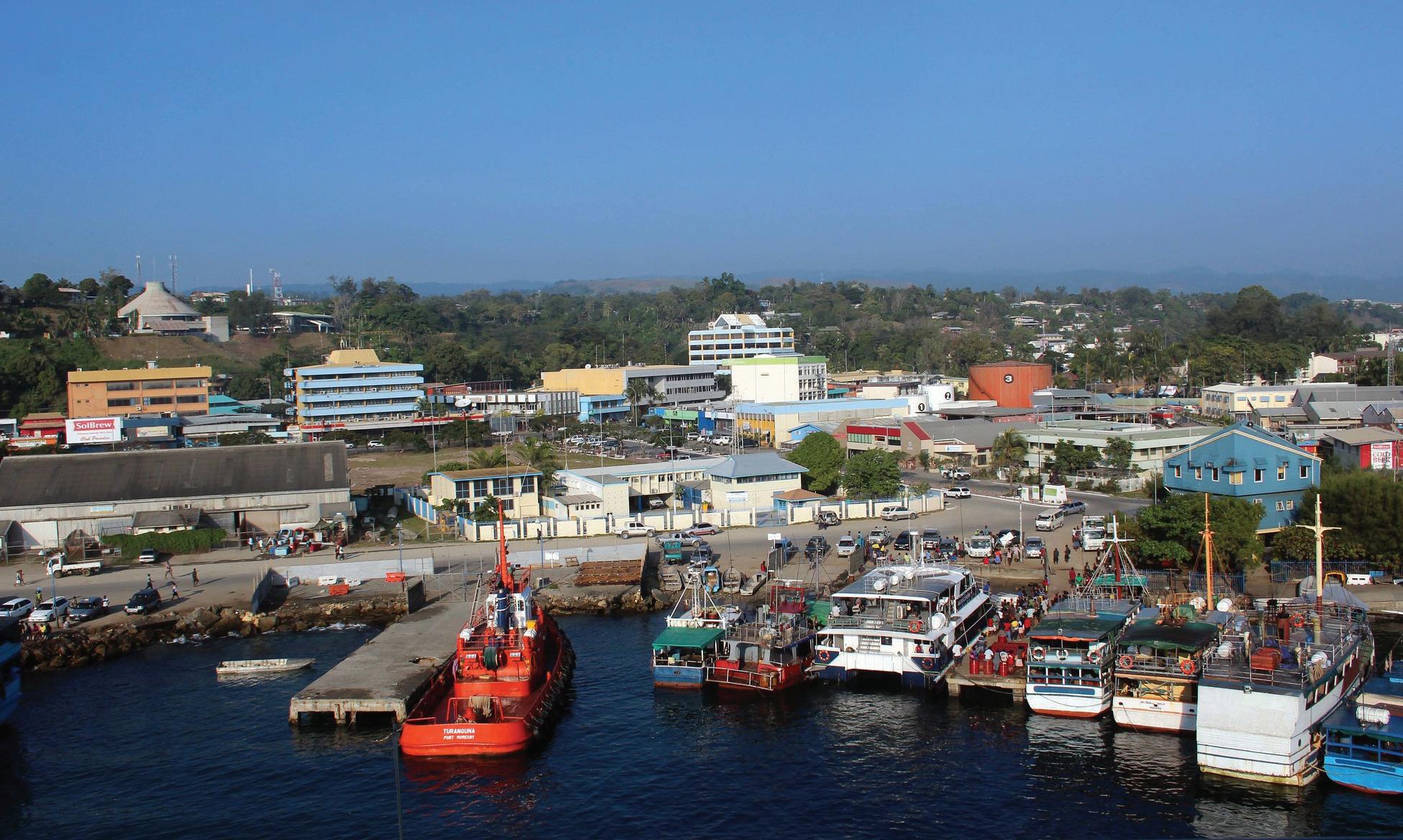
The Port of Honiara in the Solomon Islands, seen here, may be developed into a dual-use military facility by China.
photo: Jenny Scott
fluenced by Julian Corbett’s argument that pure navalism will not secure ocean supremacy, and that a maritime strategy could be successful only with the support of joint operations from land elements. In fact, scholars have talked about how China’s establishment of Anti-Access/Area Denial (A2/AD) capability is meant to secure its activities and resist foreign intervention in the western Pacific. This A2/AD strategy is certainly a combination of sea expansion with the support of the power from land. Likewise, the logic behind China’s Indian Ocean strategy has been very much influenced by Corbett’s thinking.
String of Pearls
The conventional String of Pearls conceptualization often focuses on China’s seizure and control of important harbors from Gwadar to Hambantota; from Chittagong to Kyaukpyu. The problem with this argument is that the SLOCs would still need to go through US-friendly choke points in the Malacca Strait, as well as the disputed and troublesome waters of the South China Sea. This challenge would remain, regardless of how influential China’s development of naval power
becomes. A pure Mahanian view would not secure China’s supply chains.
Hence, to break away from this geographical constraint, China’s two-ocean strategy emphasizes the need to establish Lines of Communication (LOC) via land to connect the southwest part of China with the ports mentioned above in order to circumvent the environmental challenge in the control of the choke point in South East Asia. Therefore, it is not surprising that the Belt and Road Initiative (BRI) has been geared toward developing a China-Pakistan, a China-Myanmar, and a China-Indochina Peninsula economic corridor (CICPEC). China’s two-ocean strategy for the Indian Ocean also suggests the importance of synergy between land and sea. This strategy could encircle India by coming from critical ports in the Indian Ocean and the land corridors mentioned above.
Such a manner of strategic development has the following implications. First, given that the LOC via land toward Gwadar in Pakistan is close to the troublesome tribal areas, and connects with China’s unstable Xinjiang Province, it will be too costly and risky to rely heavily on this corridor. China is working to
China Looks Seaward b 7
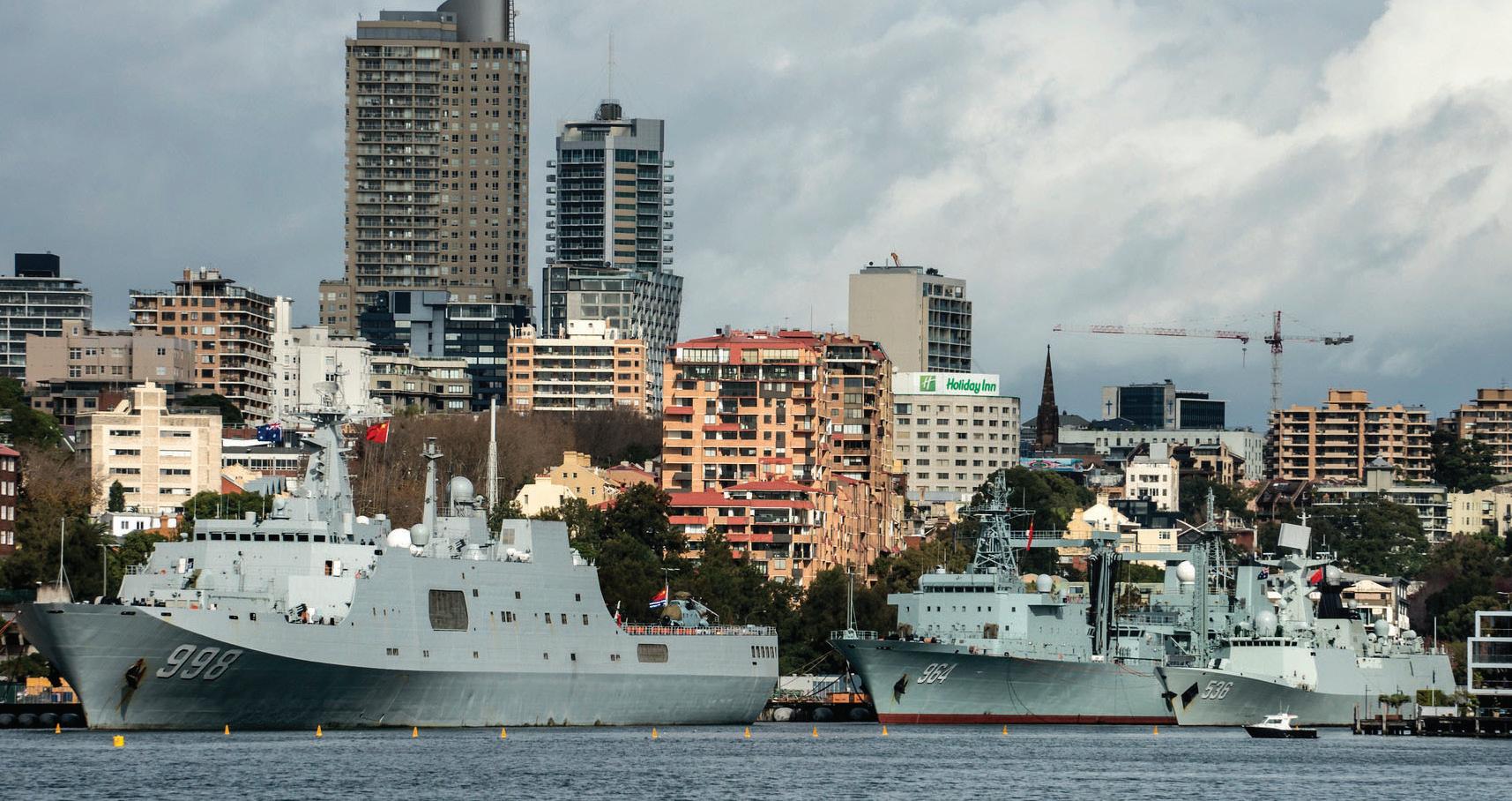
Three Chinese naval vessels at a port of call at Sydney Harbour, Australia.
photo: John
develop a solid grip on ports in the CICPEC area. For example, media reports have suggested that Beijing is diversifying the risk by building the Ream Naval Base, located just outside its close ally, Cambodia’s, port city of Sihanoukville.
Second, China established a closer relationship with Myanmar’s unpopular military rulers. Myanmar has been beleaguered by Western countries because of its treatment of the Rohingya ethnic group and the 2021 military coup d’état. China has become the major non-Western investor to advance its national development. From a security perspective, Myanmar shares a 2,204 kilometer-long border with China, and its strategic harbor, Kyaukpyu, offers an alternative land bridge via which China can access the Indian Ocean. In this case, China invested considerable resources in strengthening its military cooperation
with Myanmar. China supplies over 90 percent of Myanmar’s military vehicles and provides additional military equipment in the form of missiles, radar, naval vessels, and aircraft. The CCP has always been very accommodating in winning Myanmar’s support. Third, China’s focus on the Indian Ocean stems from is security concerns in a time of intensifying international competition. Most pressure comes from the US-dominated Pacific Ocean. Devising a strategy to secure access to the Indian Ocean would provide alternative access to supply chains and ensure its survival. However, China’s strategy in the Indian Ocean will not be a purely maritime military strategy, but one that combines political, economic, and military means coming both from sea and land. The continued effects of COVID-19 and the Russia-Ukraine War continue to disrupt world supply chains. On top of this development, the nature of the CCP’s domestic rhetoric continues to center around President Xi Jinping’s ambitions, such as the “rejuvenation of the Chinese nation” and “bringing China to the world stage.” All of these developments fuel China’s ambitious expansion and leave very little space for the CCP to concede ground for issues it views as its core inter-
8 b STRATEGIC VISION
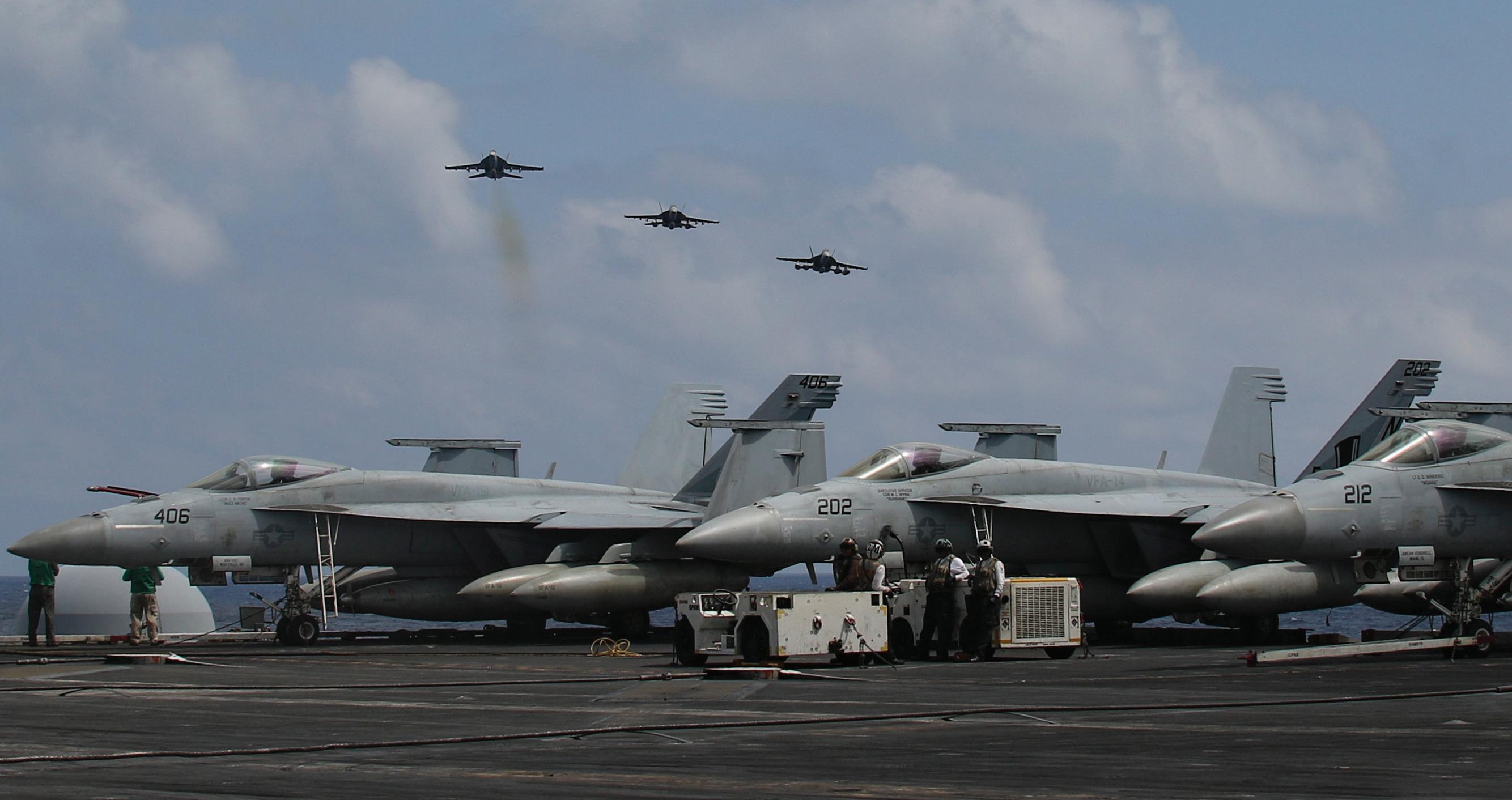
F/A-18E Super Hornets fly in formation during an in-flight change-of-command ceremony over the USS Abraham Lincoln.
photo: Julia Brockman
“China’sstrategyintheIndianOcean willnotbeapurelymaritimemilitary strategy,butonethatcombinespolitical,economic,andmilitarymeans comingbothfromseaandland.”
ests. Hence, the security challenges that China poses to South Asia require a careful strategic response and can longer be ignored. This may also explain why China has been so assertive in recent years regarding the disputed territories in the northern part of India, including the Doklam and Galwan River valleys. Therefore, China would still have complicated relations with India even though both have a similar stance on Russia’s war in Ukraine.
Finally, China’s intentions in the Indian Ocean are no longer about “sea control,” but are more practically about how to exploit it. The military aspect of the string of pearls framework was too centered on the “means” of the strategy, without digesting the implications of China’s “ends,” i.e., the ultimate goal of China’s strategic intention is to secure its external access to supplies. This is also to say that Beijing’s strategic calculations in the Indian Ocean are not only ideological but practical. Amid the lessons learned from the Russia-Ukraine war, this is a survival-driven decision for China.
As exemplified by the Russia-Ukraine War in March 2022, Russia’s failure to secure LOCs to Kyiv resulted in a shortage of resources to fuel operations and limited the progress of operations around Kyiv. Likewise, the mountainous region between India and China was considered an obstacle to China’s advancement toward the south, but today its seafaring strategic outlook and intentions to secure an LOC will naturally interpret this geographical feature as a strategic opportunity to exploit the sea passage provided by the Indian Ocean. China continues to invest in securing harbors on the coastline of the Indian Ocean; however, such a development will not only be for the enhancement of its future naval capabilities but also for practical diversification in securing an LOC in order to sustain its national survival. China’s future collaborations with Pakistan and the authoritarian regimes in South East Asia, namely Myanmar and Cambodia, will play significant roles in its two-ocean strategy, and these power dynamics will inevitably determine its future relations with countries in South Asia. n
China
Seaward b 9
Looks
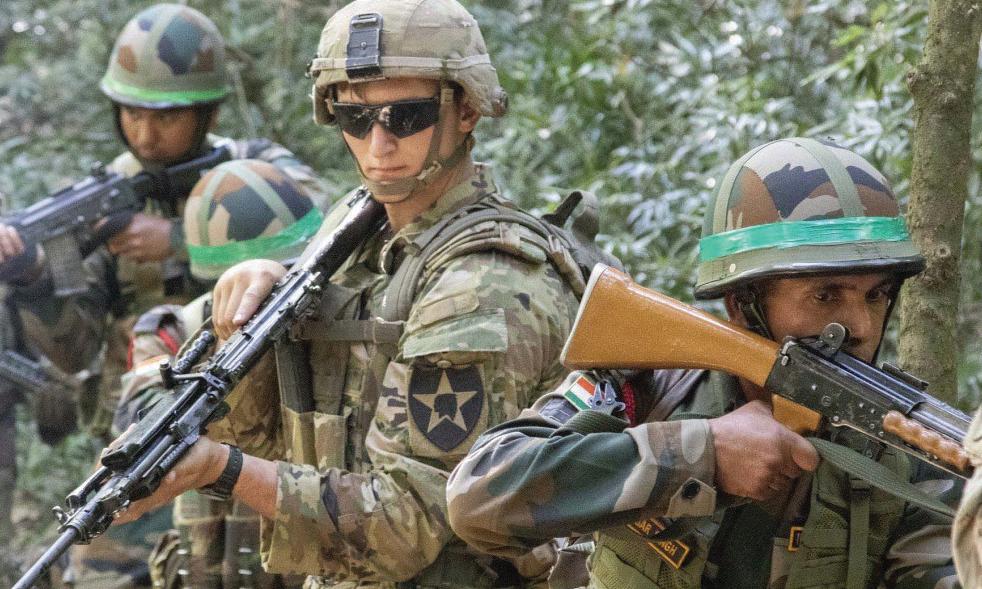
Soldiers take part in Yudh Abhyas, an exercise that enhances the joint capabilities of the US and Indian army through training and cultural exchange.
photo: Samuel Northrup
Balanced Perspective
Media narratives paint overly-simplistic view of Russian operations in Ukraine
Aswin Lin
It has been several months since Russia launched its military operation in Ukraine. The conflict—which was predicted to end quickly, just as the Crimea Conflict did in 2014—did not live up to these expectations. The media, especially Western media, reported that Russia was deadlocked and exhausted, thanks to the heroic efforts of the Ukrainian Armed Forces and people, and of course, the charismatic leadership of Ukrainian President Volodymyr Zelenskyy. Many media reports are saying that Russia is becoming desperate, tormented by the economic sanctions imposed by 39 countries. It is undeniable that the Russian economy has been hit hard by these sanctions. Protests took place in several places in Russia, and talk of a coup against Russian

President Vladimir Putin was also raised. However, is Russia really deadlocked in this conflict, or is there another interpretation of events that we do not hear because it is not being reported by the media? This article will examine why the operation seems to have been moving so slowly for the Russians.
Meaningful results
Many media outlets have speculated that Russia is desperate and Putin is very thirsty for meaningful results. There are already some reports that insisted Russian forces would eventually resort to chemical or nuclear weapons. Such speculation has been especially rife on social media. Is Russia really as miser-
photo: Manhhai
10 b
Vision
Aswin Lin is a PhD student in the International Doctoral Program in Asia-Pacific Studies at National Chengchi University in Taipei. He can be reached at: aswinagustinus7@gmail.com
Strategic
vol. 11, no. 52 (May, 2022)
Russian tanks roll through the streets of Ukraine.
able as the mainstream media describe? According to an interview conducted by The Harvard Gazette with Professor Matthew Bunn from the Harvard Kennedy School, from a purely military point of view, there is no military target that nuclear, biological, chemical (NBC) weapons can destroy that Russia cannot destroy with its conventional air power and missiles. The main purpose for using NBC weapons would be to frighten the Ukrainian people and force them to surrender.
If Putin wants to force the Ukrainian government to surrender, he could just give instructions to flatten Ukrainian cities with conventional weapons. Russia does not need to resort to NBC attacks. Unfortunately, a lot of Russia’s capabilities remain a secret, which means it is possible that those weapons are non-existent and that the media is reporting mere speculation.
According to the US Department of Defense, on 21 March, 2022, a senior defense official held a background briefing on the current situation regard-
ing Russia’s military operations in Ukraine up to week five. At the briefing, the officer stated that The Pentagon believes that Russia has committed more than 60 percent of its fixed-wing and rotary-wing capability to the Ukraine theater. So Russia has put a lot into this fight, and they still have a lot left. We have to recognize that the Russian Armed Forces are taking casualties every day. The overall situation is very fluid, and there are many different possible scenarios which might play out.
Information war
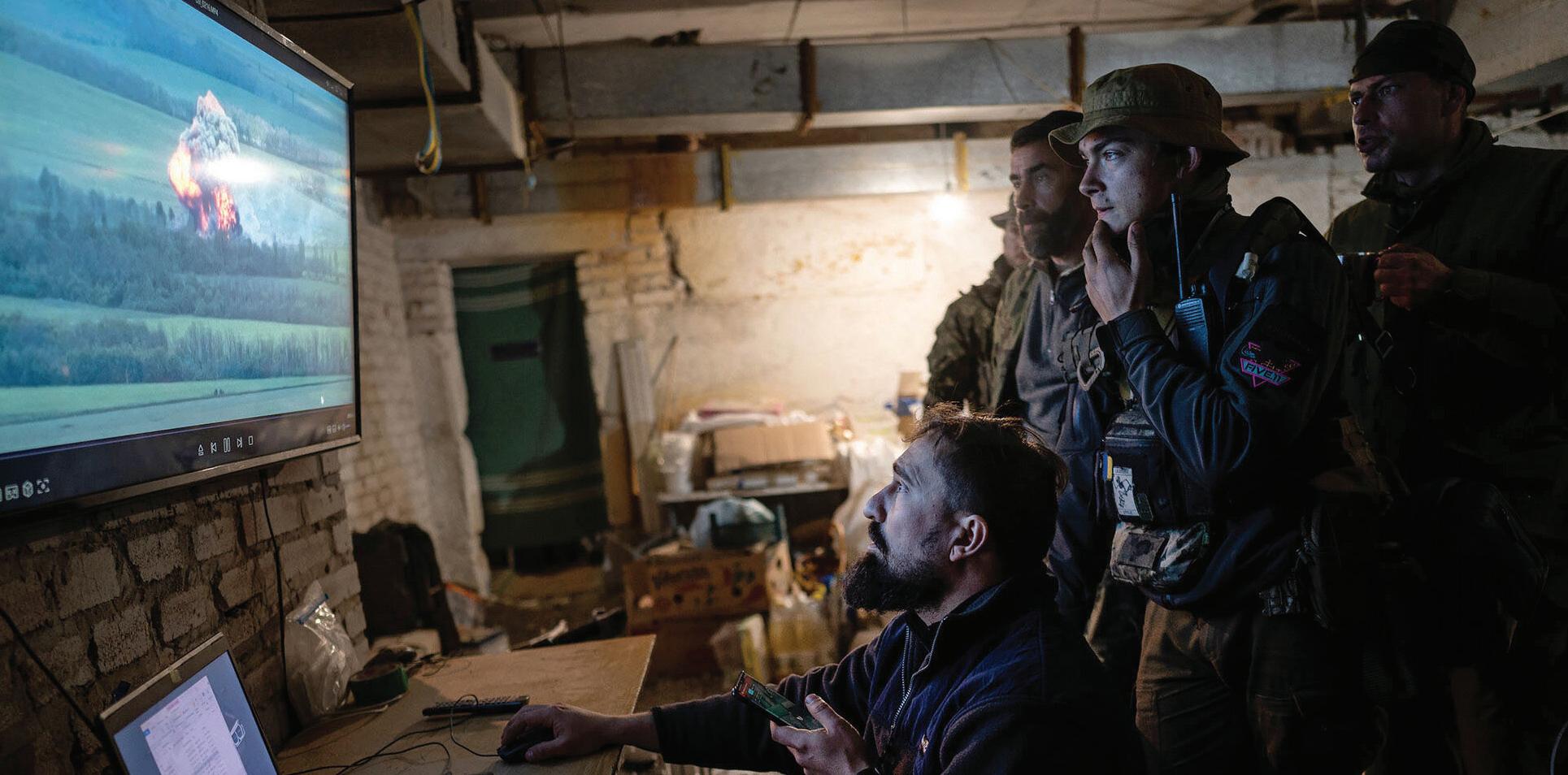
In the modern age, information is one of the most important weapons of war. Disinformation can sow chaos that can turn things around if properly deployed. Watching endless videos of exploding Russian tanks posted by Ukraine’s government can give Western viewers a false impression that Ukrainian forces are on the verge of victory, especially in the absence of any counter-information from Russia’s side, because
photo: Manhhai
BALANCED PERSPECTIVE b 11
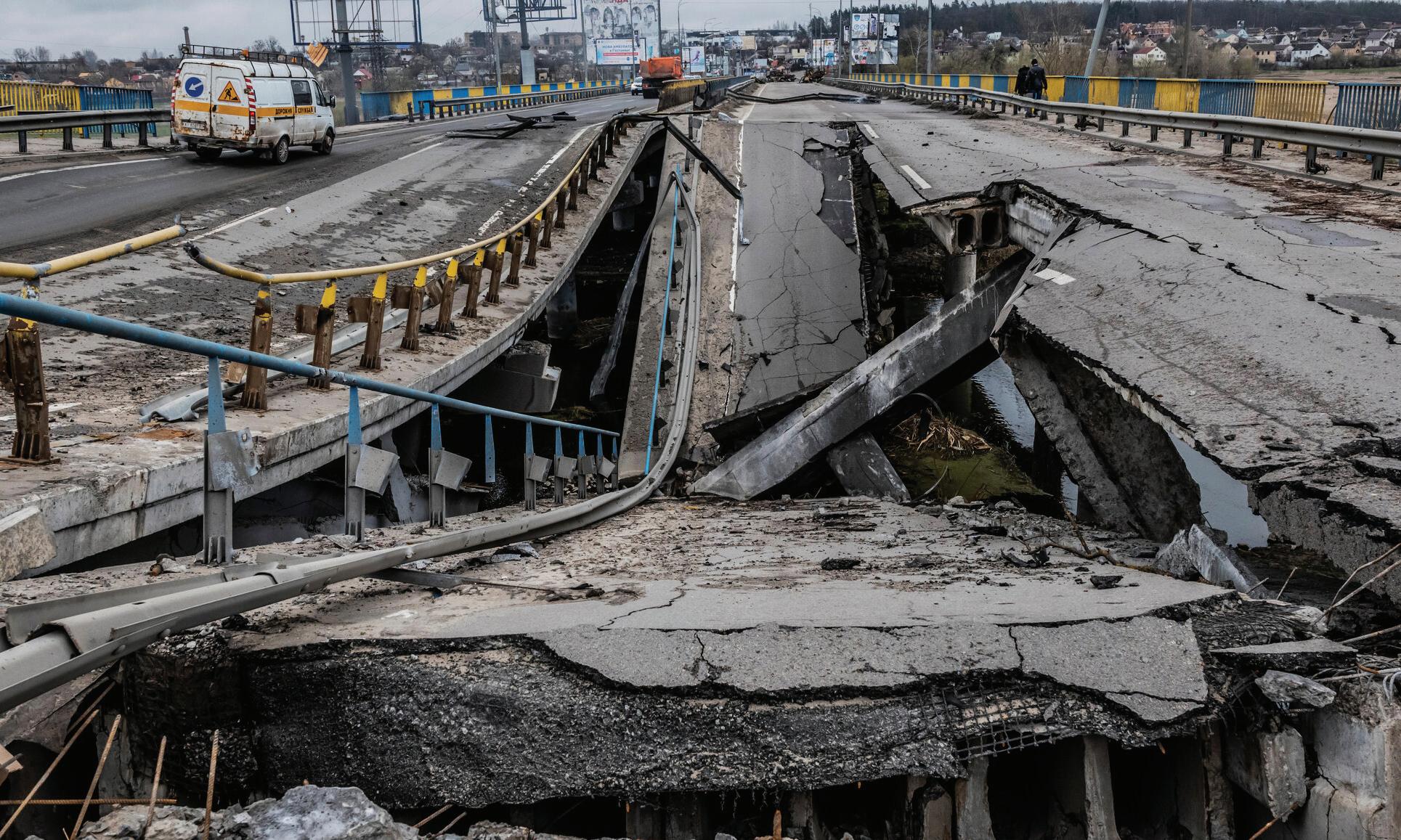
A bombed out bridge on the Irpin River in Ukraine demonstrates Russia’s destructive capabilities.
the Western media has completely censored that perspective. So far, the public has the impression that Ukraine is enjoying an overwhelming advantage over Russia and is completely crushing Russia’s military out in the field. The unvarnished truth may not be so simple.
In the aforementioned interview, the Pentagon official also emphasized that Russia is taking casualties
Hadath, Ukraine’s Foreign Minister Dmytro Kuleba pointed out that the Russian use of air power to destroy entire cities and villages in Syria prior to incursion by ground forces is being duplicated in Ukraine.
Moreover, “the former commander of the Russian army in Syria was recently appointed as commander of the Russian army in Ukraine,” Kuleba was reported as saying, concluding that this presaged more damage caused, more civilians dying, and more cities destroyed due to indiscriminate Russian attacks.
every day. They are losing tanks, artillery units, helicopters, and fighter jets. However, the Russians are not yet out of the fight. Russian troops are still using the tactics they used in Syria when Putin decided to intervene in 2015. It would be naive to think that Russia is currently carrying out maneuvers like the Soviet Union did in Afghanistan in the 1980s. Rather, the tactics Moscow is using in its military offensive in Ukraine are similar to those it employed in Syria. In an interview with the Arabic news channel Al
The US Congress provided US$13.6 billion in aid to Ukraine’s military in April, before US President Joe Biden in May signed the controversial US$40 billion aid package to help finance the country’s fight against Russia’s attack. Prior to this, Washington had sent Ukraine various weapons and other military equipment. An US$800 million security package announced on 16 March, 2022 included 800 Stinger and 2,000 Javelin missiles. According to Reuters, the United States has trained the Ukrainian armed forces on prior occasions. On 20 September, 2021, Ukrainian soldiers took part in joint military exercises with US and other NATO troops. Ukraine was invited to participate after Russia and Belarus began holding large-scale drills that alarmed the West. Given all this
12 b STRATEGIC VISION
Soldiers with the Carpathian Sich Battalion reviewing drone footage of an attack against Russian forces in the Kharkiv region.
“Russia is nowhere near exhausted in this battle, and as the war continues to grindon,thevictimswhowillcontinue tosufferthemostaretheinnocentpeopleofUkraine.”
photo: Manhhai
support, it would be foolhardy for Vladimir Putin to think this war will end quickly.
Col. Gen. Sergei Rudskoy, chief of the Russian General Staff’s Main Operational Directorate, told reporters that during the first month of the Russian operation in Ukraine a total of 1,351 Russian servicemen had been killed, with 3,825 injured. This is far below Western media estimates. Citing NATO, The Wall Street Journal reported that up to 40,000 Russian troops, of the 190,000 that had marched into Ukraine, had been killed, wounded, taken prisoner, or are missing in action. While this latter casualty estimate remains unconfirmed, if it proves to be even close to accurate, Ukrainian defenders can be said to have decimated their Russian invaders, according to the original meaning of that term.
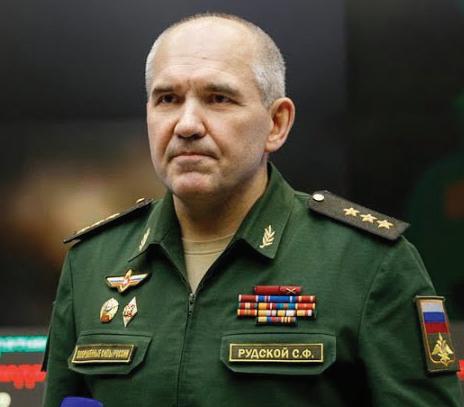
At the time of writing, the Pentagon had observed that Russian troops had withdrawn from cities to the north and west, such as Kiev and Kharkiv. Pentagon officials admit, however, that Russia is making progress in the Donbass Region. Judging from this situation, it can be assumed that the purpose of this military operation is the demilitarization of that contested Region. Currently, Russia is on the move, trying to make a circle by attacking Izyum, Lyman, and Severodonetsk. If Russia really can exert complete control in the eastern and southern zones, it will be easier to reinforce personnel and streamline logistics, which will make things more difficult for Ukraine. Based on this assessment, Russia is far from exhausted.
Holding power
On paper at least, the Russian military is one of the best equipped in the world. Putin is also not someone who does not understand conflict and geopolitics. As a former KGB agent, Putin knows very well how to
hold on to power. He predicted the sanctions placed on Russia when the military operation in Ukraine was launched. If Russia increases the number of personnel, and the West reacts in order to balance these forces, the priority placed on Ukraine’s defense needs would serve to worsen the economic and energy security of Western Europe.
Russia still has ways of evading sanctions. Barred from the global SWIFT global messaging network that banks use to make cross-border payments, Russian payments can still be made via the homegrown alternative, the System for Transfer of Financial Message (SPFS), which covers 20 percent of Russian trade. Russia is also still able to use the made-in-China Cross-Border Interbank Payment System (CIPS). According to David Oualaalou from Global Perspective Counseling LLC, several companies that have imposed sanctions on Russia, such as HSBC and Standard Chartered, are also incorporated into the CIPS system, meaning Russia can still make transactions with certain Western companies, while these companies can still claim to be complying with the sanctions regime. Moreover, Moscow’s main export, energy, continues to flow, with customers such as India and China agreeing to increase trade activity. Indeed, despite the sanctions, Russian oil exports rose by 620,000 barrels per day in April 2022, reaching 8.1 million barrels per day, according to statistics from the International Energy Agency.
Based on the current situation on the ground in the Ukraine war, Putin is unlikely to back down. On the surface, Russian soldiers seem to be stuck in a quagmire, and sanctions have shaken the Russian people. Still, Russia is nowhere near exhausted in this battle, and as the war continues to grind on, the victims who will continue to suffer the most are the innocent people of Ukraine. n
BAANCED PERSPECTIVE b 13
photo: Kremlin Col. Gen. Sergei Rudskoy
Finding the Fighting Spirit
Ukrainians’ defense against Russian onslaught offers inspiration to Taiwan
 Dean Karalekas
Far too much ink has been spilled by pundits and experts speculating on how the events playing out since the February 24, 2022, invasion of Ukraine by Russia will affect Taiwan. Some see direct parallels, and early on in the Ukraine conflict warned that Chinese General Secretary Xi Jinping might launch a simultaneous attack on his democratic neighbor, taking advantage of the world’s preoccupation with events in Eastern Europe as cover. This did not take place, as Xi seems to have settled on a “wait and see” approach. Indeed, there has been much to see, for both sides.
Beijing is no stranger to learning the lessons of war-
fare from others’ experience. The high-tech aspects of the American bombing of Iraq in the Gulf War of 1991, which led to a swift and decisive allied victory, so alarmed Chinese leaders that they launched a modernization effort on the People’s Liberation Army (PLA), turning what was then a corrupt, peasant army into a modern fighting force. The events unfolding today have the same potential to offer transformative lessons, not just to the PLA, but to Taiwan’s defense planners, as they play out in already surprising ways, not just in terms of military tactics, but in multidimensional aspects of social, economic and political life.
and
be reached for comment at dkaralekas@hotmail.com 14 b Strategic Vision vol. 11, no. 52 (May, 2022)
Dean
Karalekas
is an Editor-at-Large for Strategic Vision and the author of Civil-Military Relations in Taiwan: Identity
Transformation. He can
photo: Just Click’s With A Camera
A new T-90M tank, the pride of Russian tank building, was turned into scrap metal near Kharkiv.
There are tempting parallels between the Taiwan and Ukraine situations that have led to the prevalence of such comparisons. For one thing, both countries are threatened by larger, better-equipped neighbors with as much of an emotional as a geopolitical reason to attempt forceful annexation. To be sure, taking Taiwan would allow the PLA to extend its reach past the First Island Chain and deep into the Pacific, just as control over Crimea gave Russia access to Sevastopol and the Black Sea. But at a more visceral level, for Russian President Vladimir Putin, it is anathema to watch Ukraine—the ancestral birthplace of the Kievan Rus people; the forefathers of today’s Russians—inch closer to NATO. Likewise, the continued existence of the Republic of China (ROC), still in exile on Taiwan, is a constant reminder to the Chinese Communist Party (CCP) that their victory in the Chinese Civil War is less than complete. There are differences as well, of course, which must not be ignored. For one thing, Chinese forces would have to cross the treacherous Taiwan Strait to effect the kinetic phase of an invasion, whereas Russian tanks simply had to cross a border. Moreover, Putin
could rest reasonably assured that he would not have to face the deployment of troops by the United States, much less the European Union, as they would not have the fortitude to risk conflagrating an attack on a non-NATO member into a third World War. In contrast, Beijing remains unsure of whether a move on Taiwan would elicit a military response from the United States, due largely to the position of strategic ambiguity long employed by Washington for just this reason.
Shock and awe
It is for the latter reason that the consensus of opinion among analysts has been that Beijing will seek to overwhelm ROC forces and take Taiwan with the same shock-and-awe rapidity employed so effectively by US forces in taking Baghdad in 2003. If the PLA can occupy the entirety of Taiwan within two or three days, the thinking goes, the United States will not have enough time to intervene, and leaders in Washington would very likely accept such an occupation as a fait accompli. There might be sanctions
Finding the Fighting Spirit b 15
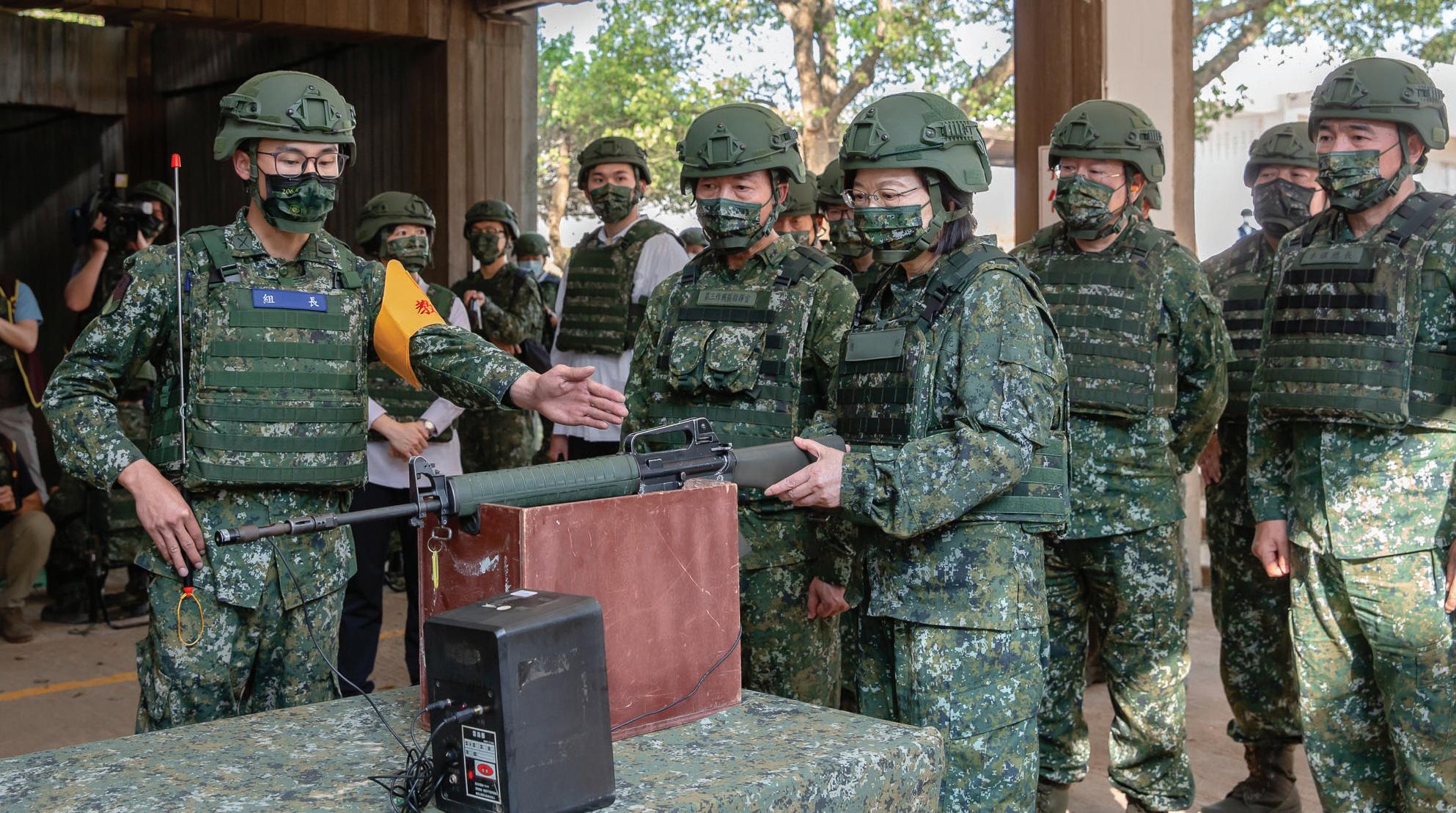
ROC President Tsai Ing-wen inspects training equipment at the ROC Army’s 206th Brigade.
photo: ROC Presidential Office
and some strongly worded letters, but America would certainly make no attempt to dislodge a Chinese occupying force from Taiwan. Before long, it would be accepted as the new status quo.
Events playing out in Ukraine, however, are calling into question the feasibility of such a plan. Despite all their advantages—including overwhelmingly superior forces such as Main Battle Tanks, towed artillery, Iskander short-range ballistic missiles, infantry fighting vehicles, and self-propelled howitzers, all having been pre-positioned in the weeks leading up to the attack, ostensibly as a diplomatic pressure tactic—Russian forces have had to fight for every inch of territory, and at the time of writing had not yet taken Kiev, much less effected a complete occupation of all of Ukraine. This raises the question of whether China can afford to spend the weeks, or perhaps months, this suggests it could take to effect an occupation of Taiwan. The world will be watching it happen, as it is in Ukraine, and the United States—which might be tempted to accept a swift fait accompli—would be un-
der tremendous international pressure to intervene.
The lesson for Beijing is a simple one: be damned sure the attack is one that will succeed quickly, or else don’t even make the attempt, and instead focus efforts on other, non-military avenues of coercing unification.
The lessons for Taiwan are rather more complex. By examining how Ukraine has managed to hold off the invading force for so long despite such long odds, planners in Taipei can seek to emulate what works, and adapt it to local conditions. The following are recommendations—some simple, some more difficult to accomplish—that should be considered by defense planners and the ruling elite in Taipei.
High morale
We have established the importance of holding out against invading forces to give allies time to muster the political will to respond. How was this accomplished in Ukraine? Quite simply, it was the high
16 b STRATEGIC
VISION
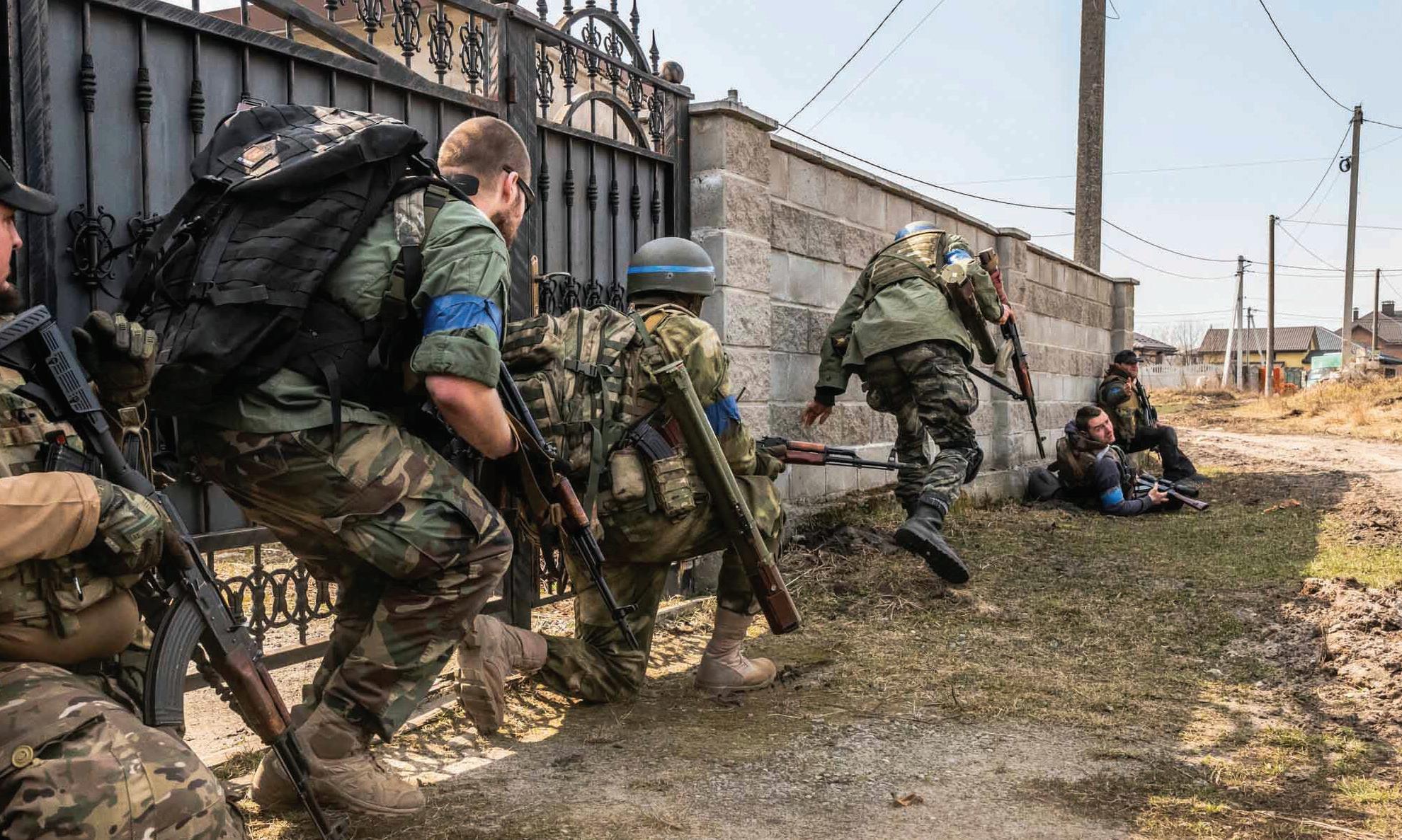
Fighters with the Ukrainian Odin Unit, including foreign volunteers, take cover behind a wall while engaging the enemy.
photo: manhhai
morale of the Ukrainian forces, leadership, and most crucially, its people. Unfortunately, morale—especially the morale of the armed forces—is something that is sorely lacking in Taiwan. There are a variety of reasons for this, but suffice it to say, this is an aspect of society that the administration of ROC President Tsai Ing-wen would be well advised to address if she is to prepare her nation to withstand a Chinese onslaught. What worked best in the international propaganda war raging alongside the shooting war in Eastern Europe has been the stories of the common people, or the lone hero, valiantly pushing back against the Russian advance. Fantastical reporting on the exploits of the “Ghost of Kyiv,” for example, or the tales of grandmothers gifting sunflower seeds (a flower with deep meaning in both Ukraine and Taiwan) to enemy soldiers, “so sunflowers will grow here when you die.” These stories have great resonance in shoring up the nation’s morale and hence willingness to fight, as well as playing extremely well in the global media, and thereby helping to boost foreign support for Taiwan in the face of an unprovoked attack by an authoritarian bully. True or not, these stories of courage and resistance help craft the narrative that
Taiwan will need if it is to survive such an assault.
Second is the imperative to stay and fight. Despite the refugee flight westward to Europe, evacuees are mostly comprised of women and children. Men aged 18 to 60 have been prohibited from leaving the country, to entice them to take up arms and defend their
“TheUkrainegovernmentbeganpassingouttensofthousandsofautomatic riflestoable-bodiedmen,allowingordinarycitizenstotakepartinthedefense of their nation.”
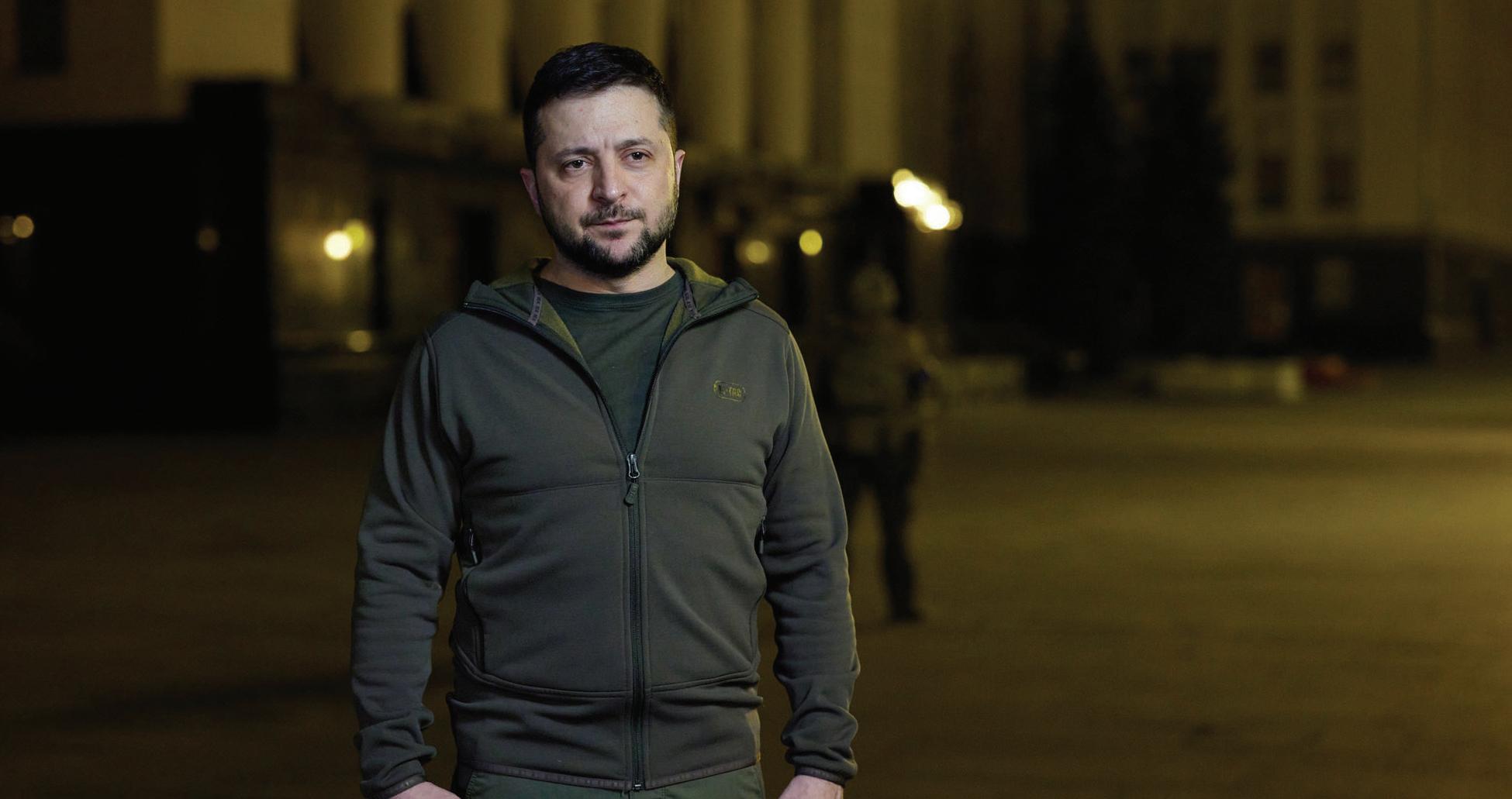
homeland. Although this is a clear human rights violation, it has been reported on favorably, especially since Ukraine’s President Volodymyr Zelenskyy himself stayed. He was widely reported to have refused a US offer to evacuate him to a more secure location with the words “I need ammunition, not a ride.” These are stories that would play as well in a Taiwan context as they have in Ukraine.
In order to arm the citizenry, the Ukraine government began passing out tens of thousands of automatic rifles to able-bodied men, allowing ordinary
Finding the Fighting Spirit b 17
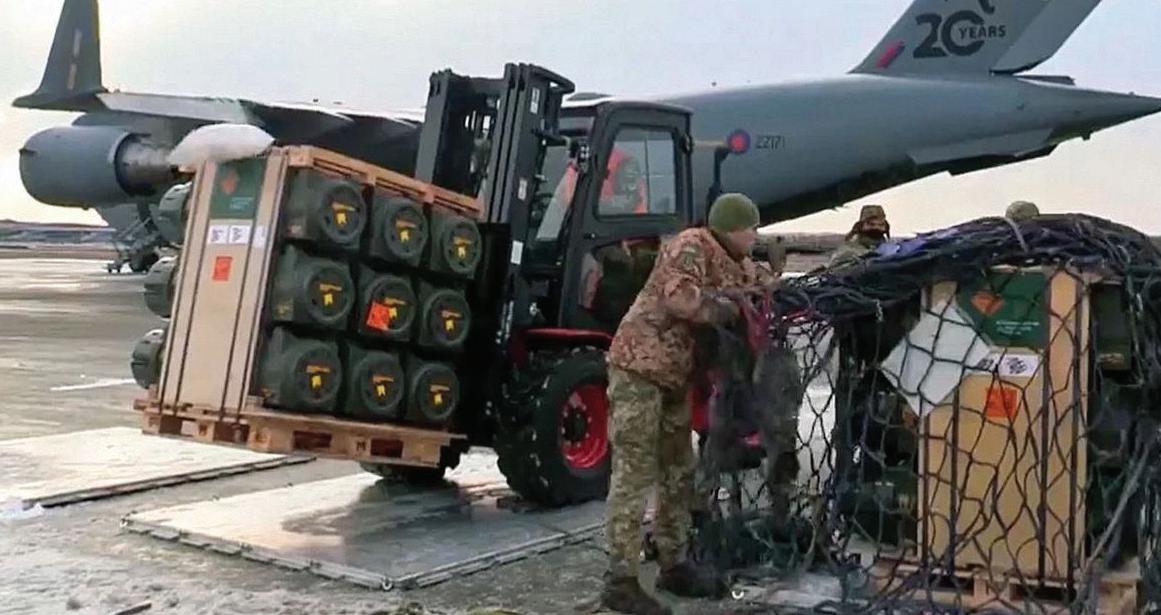
The Ukrainian resistance to the Russia invasion has led to donations of aid and equipment from around the world, including billions from Washington.
photo: Just Click’s With A Camera
citizens to take part in the defense of their nation, armed with little more than AK-47s and Molotov cocktails. The presence of an armed guerrilla force has not only helped to slow down the Russian advance, it has played an enormous role in the propaganda victory, showing the outside world that the Ukrainian people have not subcontracted out their security to foreign powers, but are themselves willing to fight and die for their freedom. This narrative is an absolute essential if Taiwan is to survive a PLA attack.
Exigent circumstances
While the idea of an armed citizenry is alien in the eyes of Taiwan society—it is only tolerated for the police and gangsters to have guns in Taiwan—this preconception must change under exigent circumstances. More than that, preparations must begin now so that elements are in place for future need. For one thing, stockpiles of weapons and ammunition must be cached at various covert, secure locations around the island, ready to be distributed when the time comes. Moreover, citizen firearms training must be resumed, as it was in the bad old days of Chiang Kai-
shek, when high-school students routinely received weapons training. Civilians should likewise receive training in guerrilla warfare and urban escape-andevasion. Not only would this help prepare the citizenry, but it would serve as a constant reminder to the population that the threat from across the strait is real and imminent.
Images on the nightly news of Taiwanese civilians defending their homeland against the PLA; of average people standing up to Chinese tanks; of captured PLA soldiers duct-taped to telephone polls and humiliated by Taiwanese civilians (all of which is imagery we are seeing from Ukraine) would convince Americans that this is a winnable fight, and would allay the fears of generations of analysts and commentators who have asserted that the Taiwanese lack the fortitude to defend themselves. “The biggest mistake Taiwan has made was to abolish the draft,” commented American political scientist Francis Fukuyama, who added, “America will not fight for a country that is not going to fight for itself.”
The aforementioned tactics have been so effective in Ukraine, in fact, that foreigners from around the world have independently made their way Kiev
18 b STRATEGIC VISION
The Ukraine President Volodymyr Zelenskyy has connected powerfully with different audiences, holding his nation together under the Russian attack.
photo: President Of Ukraine
to join the fight. So many thousands of volunteers have arrived that the government established an International Legion of Territorial Defense for them to join, and to be recognized for their gallantry in defense of the country. Taiwan would do well to set up a similar system. Indeed; given the current cross-strait threat level and the number of foreigners residing on the island—many with foreign military experience—there is no need to wait for hostilities to begin before working out the logistics and organizing such a Taiwanese Foreign Legion.
Finally, the military reserve system as it exists now is sorely ineffective and needs an overhaul. No-one, neither the men who run it nor those who undergo it, take the training seriously. This must change. Conscription must be brought back, and rather than the current four months of lackluster training, draftees must be instructed in weapons, tactics, and guerrilla and urban warfare techniques of the sort they would be expected to employ in the event of a Chinese occupation.
In explaining why Imperial Japan never seriously considered an attack on the continental United States,
Admiral Isoroku Yamamoto is famously quoted as saying, “there would be a rifle behind each blade of grass.” Taiwan must create the conditions for Chinese military planners to develop the same reservations.
There are a host of other preparations that Taipei would be wise to implement: beefing up its cyberoffensive capacity; establishing all-indigenous units in the military, led by indigenous officers; and most importantly, addressing the morale problem in the forces, as well as in society at large, that stands as the biggest impediment to a robust defense.
At the time of writing, the invasion of Ukraine has not yet played itself out, and only time will tell how this story will end: will the Ukrainians repel their Russian invaders? Will Russia annex the entire country, or split it in half like East and West Germany after the Second World War? Globally, will it conflagrate into a Third World War or, more likely, be the inciting incident of a Cold War 2.0? Whatever happens, the fighting spirit and courage of the Ukrainian people has been an inspiration to freedom-loving peoples around the world, including Taiwan. It is hoped that the lessons they have to teach will not go unheeded. n
Finding the Fighting Spirit b 19
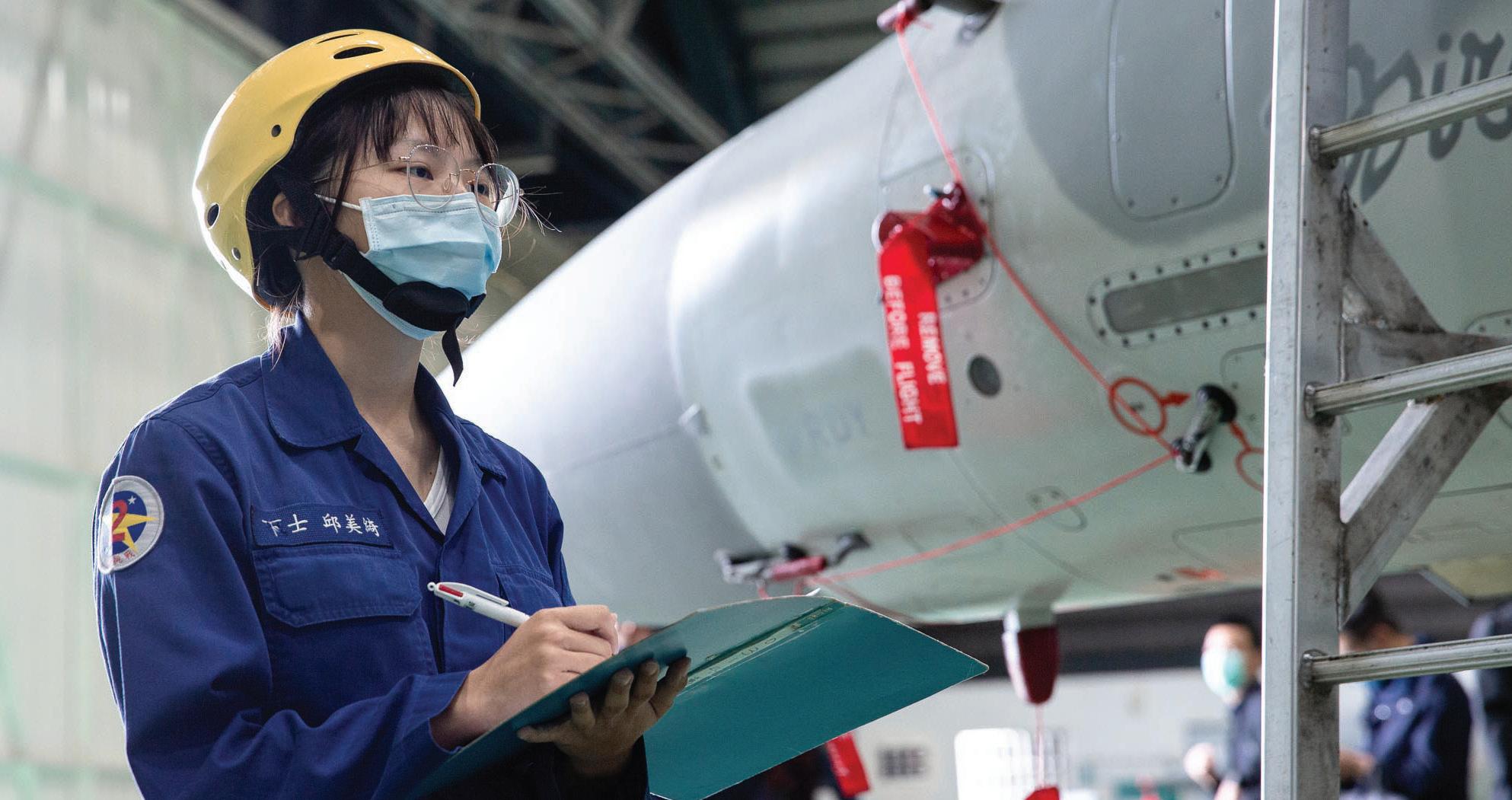
A maintanence officer from the 2nd Tactical Fighter Wing at Hsinchu Air Base, Taiwan, checks a Mirage 2000-5.
photo: ROC Presidential Office
Strategic Vision vol. 11, no. 52 (May 2022)
A History of Cooperation
Long history of India-Japan relations shows significant room for growth
 Raviprasad Narayanan
Asia’s most successful democracies, India and Japan, are, after seven decades, cognizing reality of a bilateral relationship that has alternately flattered and fallen short of what could have become determinants of Asia, in economic, political, social, and strategic terms. This article will critically examine a bilateral relationship that has been shaky for decades, but which now may be finding its moorings.
On 28 April, 1952, the two countries signed a peace treaty establishing diplomatic relations. This formal recognition of Japan by India came nearly five years after Japan became one of the first countries to recognize the sovereignty of an independent India in 1947. Was this time lag indicative of a gulf between the two
sides, owing to domestic factors in each country?
After the devastation caused by the Second World War, Japan wanted to revive its industrial potential, with newer political arrangements at home. The new political system facilitated economic growth, with innovation fostering industry, and the beginnings of an electronic age.
India’s path was very different, with independence achieved after a long period of opposition to colonial rule, policies of residual internal fragmentation— fragmentation that was visible politically, socially, and economically. Apart from being a beacon to new democracies, India was striving hard to write, discuss, and adopt a constitution; one that would be noteworthy for its liberalism and entrenched wisdom
20 b
Dr. Raviprasad Narayanan is an associate professor at the Center for East Asian Studies, School of International Studies, Jawaharlal Nehru University, New Delhi.
The amphibious assault ship USS Tripoli (LHA 7) prepares to dock at the Marine Corps Air Station Iwakuni, Japan.
photo: Isaac Orozco
of legal order being the standard of a new country looking beyond the practices of the past. Opinions in the country were oscillating between democratic centralism and a fractured polity, with federalism expressed, but not practiced.
These democratic departures, of India and Japan being strikingly different, perhaps played a role in efforts to fashion a bilateral relationship with no creases in the overall texture of relations between the two countries, each of which had gone through its collective privations.
The early decades of both countries were contrasts in most aspects. Japan, under the tutelage of the United States, was an anchor of democratic stability during the Cold War years.
India had embarked on a course where national identity was exemplified by creating an ethos in which the will of the people would be heard through regular balloting. Democracy and its various processes were thus enshrined in a manner where the ancient Latin adage Vox Populi, Vox Dei (the voice of the people is the voice of the divine) was—and is—a living reality. Seven and a half decades later, the country enjoys a
dynamic democracy with multiple domestic expressions. These may be witnessed in regions where local social permutations and combinations make for a complex electoral arithmetic, which may be puzzling to outsiders. Unlike Japan, where the Yamato majority is dominant, India is a mélange of ethnicities, languages, cultures, histories, and memories. Democracy has become enriched by these causative determinants.
Cold War paradigm
International relations and politics during this initial phase were dominated by the Cold War. Japan, with its new political expression as a democracy, was firmly with the United States, and still is. As an anchor, the United States is the lodestone for Japan’s security. The institutional links that the Pentagon has forged with Japan’s Self-Defense Forces is regime-neutral on both sides. Both Republicans and Democrats in Washington maintain exceptionally close ties with the ruling Liberal Democratic Party (LDP) and other Japanese political formations, the latter of whom,
India-Japan Relations b 21
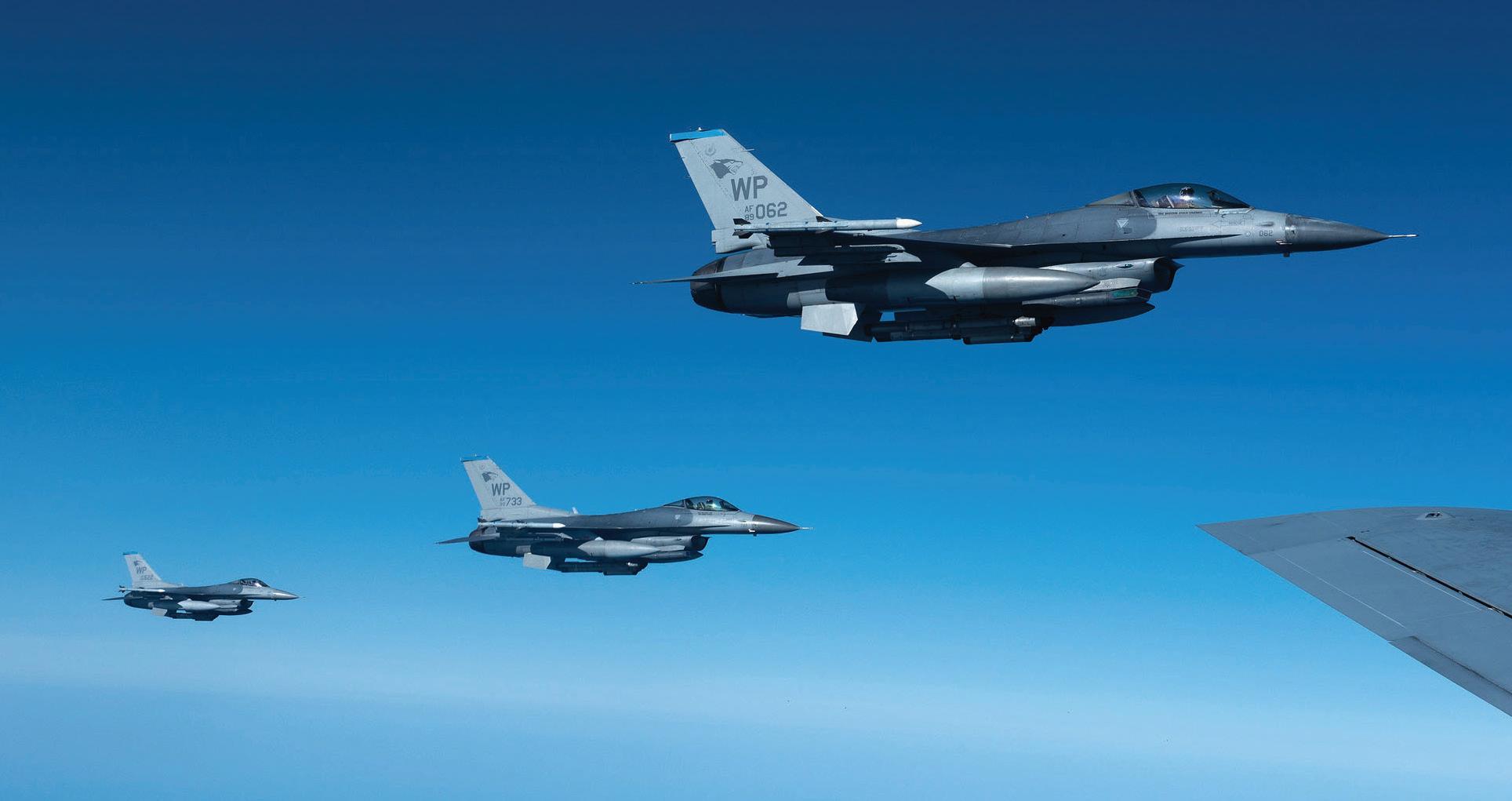
F-16s from Kunsan Air Base, Republic of Korea, wait to take on fuel from a KC-135 in the Indo-Pacific region.
photo: Yosselin Perla
while they may differ with the LDP, do not want to fall afoul of Washington.
To Japan, the objective for India as a democracy was to strengthen internal political structures, complemented with soft loans from abroad to build its economy. It was to this end that the Overseas Development Agency (ODA) provided its first yen loan in 1958, following Japan’s then Premier Nobusuke Kishi’s visit to India in 1957. This revealed Japan’s stalwart economic fundamentals being strong and the country having the wherewithal to provide economic loans to countries seeking development assistance. Perhaps this was when the early seeds of long-term economic cooperation were sown.
Commonality of purpose
This phase shows that these two proud countries could, despite their different traits, embrace a commonality of purpose, as new democracies with curious tempo: one post-colonial; the other, post-WWII.
Japan’s early interactions with India were marked by cultural influence, in particular, on Japan’s spiritual continuity with myths and legends from India. As far back as the 1940s, India’s quest for freedom
was noted in Japan by the powerful Minister of War Hideki Tojo, a former General and Chief of Staff with the Imperial Army. While reporting only to Emperor Hirohito (Showa), bypassing the cabinet of Premier Fumimaro Konoe, Tojo became premier in 1941, and was executed for war crimes in 1948.
Japan’s rapid economic success was celebrated by advanced Western economies, as it was geared toward supplementing those economies during the Cold War era. In those decades, India was striving to make an imprint as an economic alternative. This was largely owing to the implementation of the rupee-rouble mechanism in the Soviet era, along with all important economic activity being subsidized by state-owned Public Sector Undertakings (PSUs). In India, PSUs would come to dominate every aspect of the economy, and the wheels of economic progress rolled, albeit slowly. Private enterprise was considered profiteering, and efforts by entrepreneurs were stymied by bureaucratic rules and taxation beyond belief.
This self-limiting model of economic growth ended in 1991 when comprehensive economic reforms were introduced. The domestic economy since that year grew by leaps and bounds in various segments, many
22 b STRATEGIC VISION
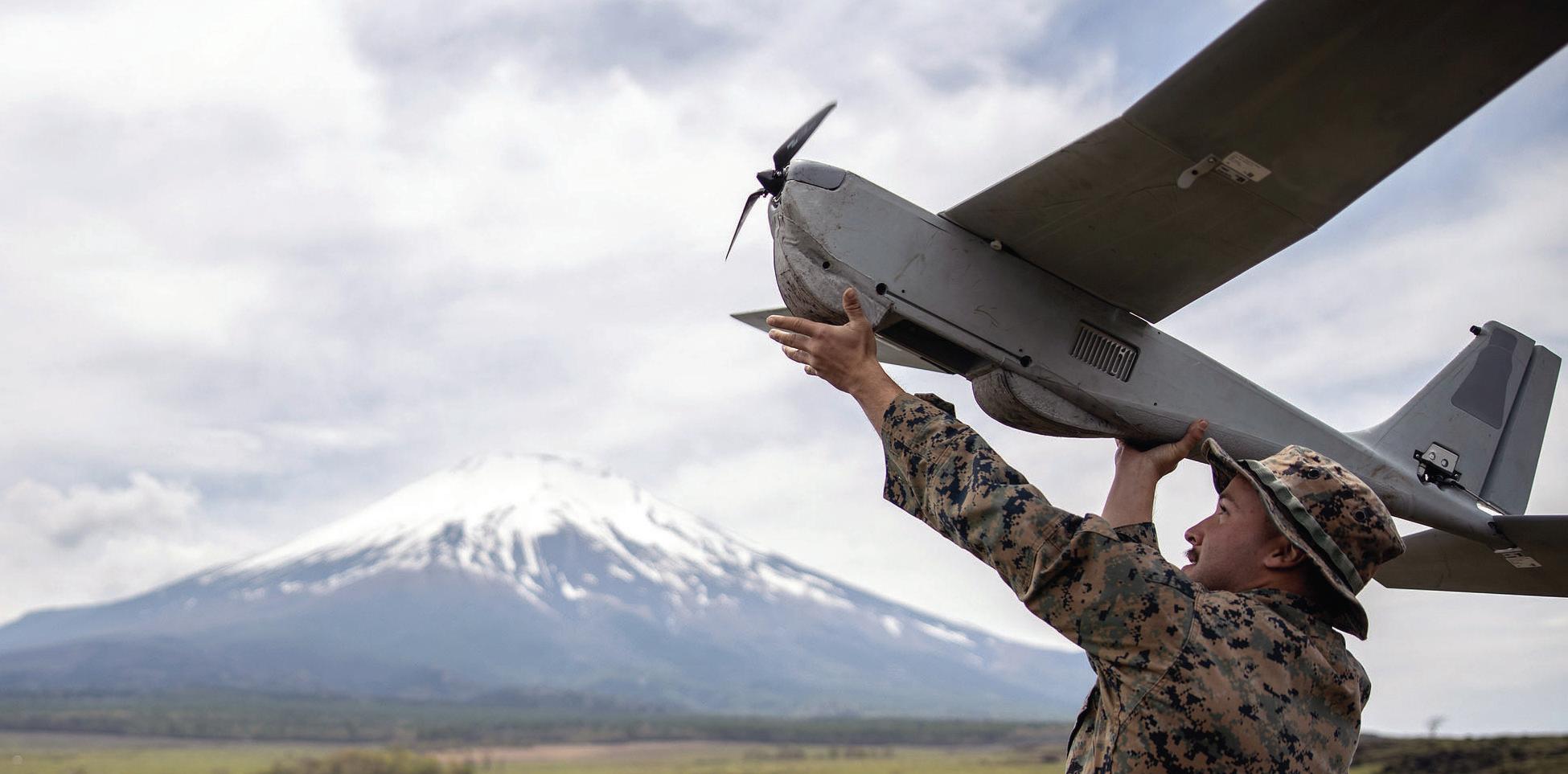
A US Marine launches an RQ-20 Puma drone at Camp Fuji, Japan.
photo: Sydni Jessee
of which have made an imprint on the entire political spectrum, plumping for more market-oriented reforms to be made and no reversal to the past decades following independence. Japan has been a very keen participant in India’s economic arrival, coincid-
the success of its automobiles, with Suzuki being at the forefront. Kasumigaseki, where the bureaucracy of Japan is located in Tokyo, was nonplussed owing to India’s record of being a waffler at international forums, sympathetic to the erstwhile Soviet weltanschauung.
ing with the World Trade Organization becoming regulator and mediator of matters economic globally. Japan, being a firm, long-standing ally of the United States and the guardian of US interests, especially strategic interests in East Asia, viewed the foreign policy adopted by India as illusory. India’s statements of non-alignment were seen by Japan as a smokescreen for the country’s sympathies with Soviet interests, both political and strategic. At that time the bilateral relationship became a casualty, where mutual suspicions did not give space to rational choices being made. Of course, over time, policies and perceptions change. India’s economic reforms were most welcomed by corporate giants in Japan, impressed by
It was the visit by Prime Minister Yoshiro Mori in 2000 that created a new ballast in bilateral relations. Mori’s visit established a global partnership, with annual summits held between prime ministers. In 2006, Asia’s two most successful democracies revealed an acknowledgement of commonalities by establishing a Strategic and Global Partnership. India’s growing economy was a determinant, as automobiles, telecom, electronics, and pharmaceuticals were sectors that welcomed investment from Japan. High-level interest in India from Japan continued under Prime Minister Shinzo Abe, grandson of the aforementioned Nobusuke Kishi. Abe was the chief guest at the 2014 Republic Day, and was the first Japanese prime minister to be honored so by India. His personal equations with Indian Prime Minister Narendra Modi was highlighted by upgrading bilateral relations to a Special Strategic and Global Partnership, which
India-Japan Relations b 23
“IndiaandJapanarenotonthesame page when it comes to the RussiaUkraine conflict.”
photo: Amy Biller
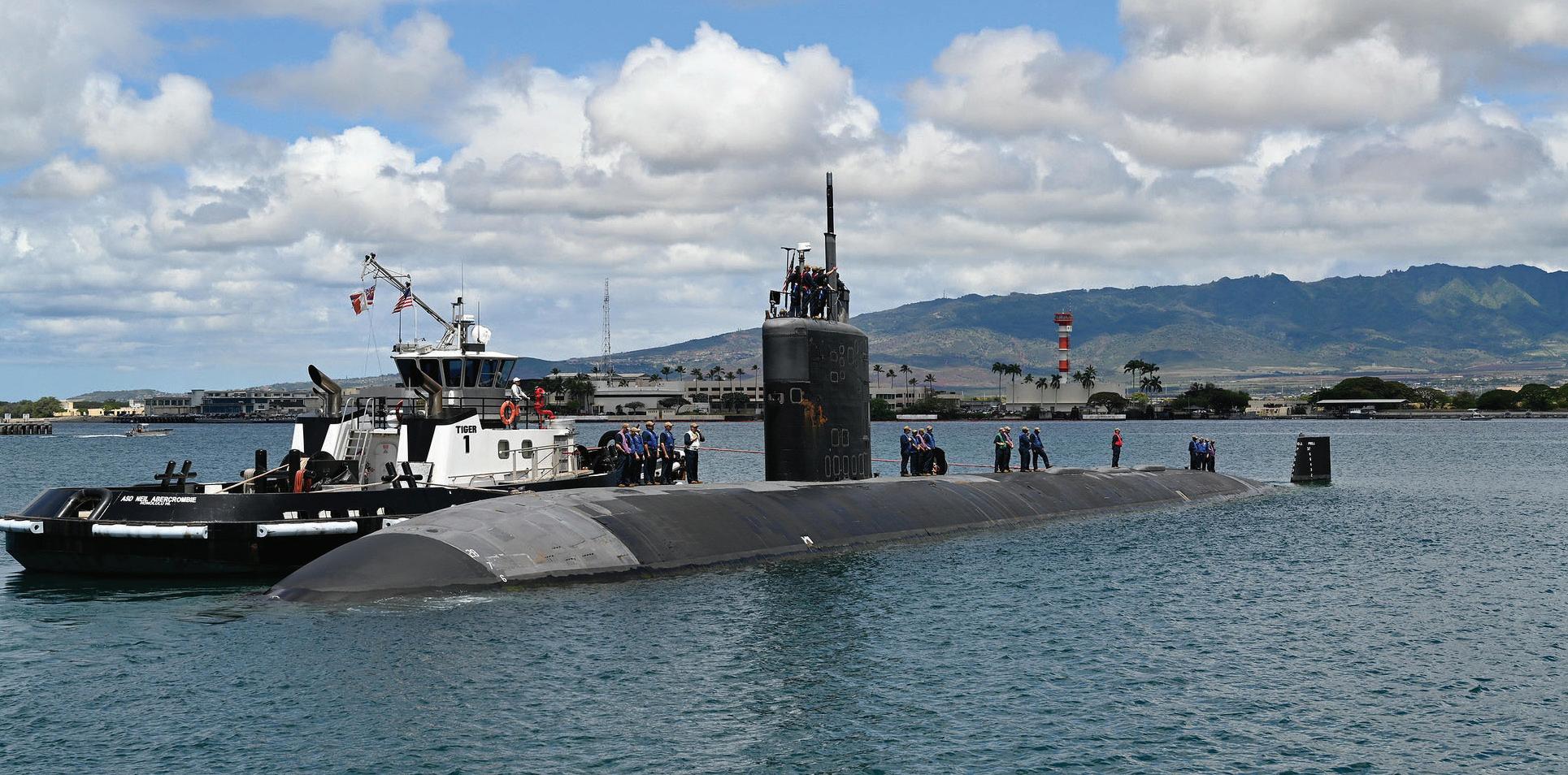
The Los Angeles-class fast-attack submarine USS Charlotte (SSN 766) departs Joint Base Pearl Harbor-Hickam.
can be considered a precursor to the Quadrilateral Security Dialogue, or Quad, in which Japan, the United States, Australia, and India banded together to create an informal strategic alliance of democracies, with a shared concern over China’s current expansionist trajectory.
India-Japan relations reveal several dichotomies. The current prime minister of Japan, Fumio Kishida, visited New Delhi in March this year bringing investment plans of around US$42 billion from Tokyo, earmarked for the coming five years. This reveals that bilateral strategic-economic relations are getting deeper owing to rapid geopolitical shifts in Asia. The US withdrawal from Afghanistan, the ongoing stalemate in Syria, tensions in the Middle East with Iran, and China busily establishing its economic and strategic dominance: all these issues have discomfited established democracies. The economic aspects of the bilateral relationship are embarrassing. India and Japan are not on the same page when it comes to the RussiaUkraine conflict. Despite the 2011 Comprehensive Economic Partnership Agreement, bilateral trade is just US$18 billion, with Japan’s trade surplus being US$5 billion. In contrast, China-India bilateral trade has just surpassed US$125 billion, with India’s trade
deficit nearing US$100 billion—this with a neighbor whose expansionist agenda considers India a light economic competitor. The state of India-Japan trade reveals a deep institutional prevarication on both sides, sidestepping political bonhomie.
For Asia’s two paramount democracies not to have commercial depth in bilateral relations is advantageous to China. Japan’s hesitancy to share technology, plus a wariness with India’s bureaucratic nightmare, ignores Japan’s own red tape. It is here that India has to take the initiative by encouraging fiscal decentralization and permitting states to establish trade bureaus, inviting investment, and permitting technical training with fewer taxation formalities. If all investment decisions have to get the nod from New Delhi, it will defeat the domestic economic aim of becoming one of the world’s largest economies by 2024.
In conclusion, India-Japan relations have not reached the level of camaraderie expected, in spite of the stated political desire to do so. The two countries must work to solve the bureaucratic hurdles and unnecessary regulations that inhibit trade and commercial relations. Neglecting commercial relations between the two countries will impact bilateral ties even more in the years ahead. n
24 b STRATEGIC VISION
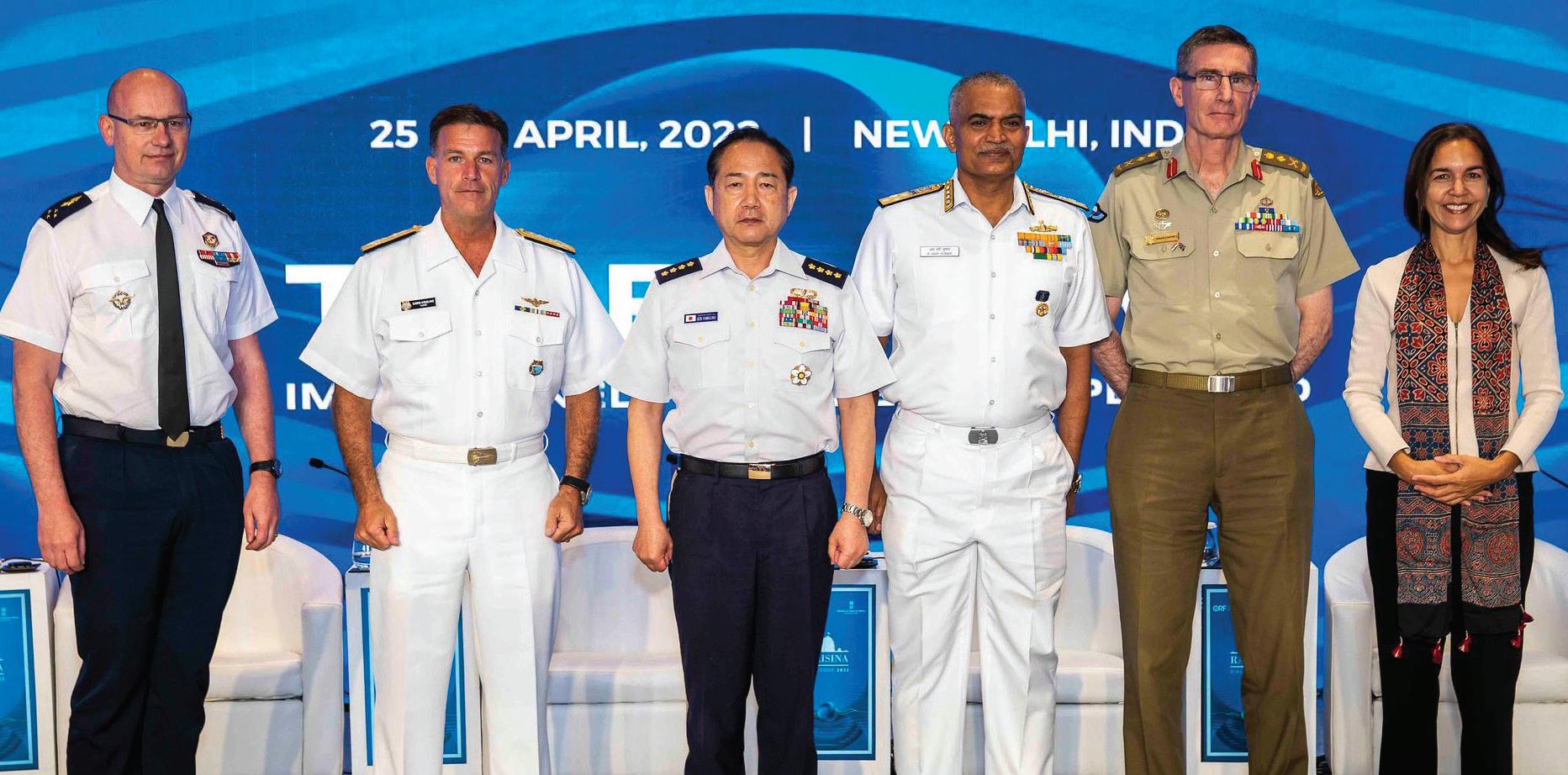
International participants pose for a photo at the 2022 Raisina Dialogue, India’s flagship forum for contemporary geopolitical issues.
photo: Anthony J. Rivera
Give Peace a Chance
Russia-Ukraine war should invigorate Taiwan’s efforts at cross-strait peace
Charles Yang
The ongoing Russian-Ukraine war has been called the largest military conflict in Europe since World War II. Most discussions about the war center on the strategies of the United States and the North Atlantic Treaty Organization (NATO), and speculation about Russia’s endgame. The Republic of China (ROC) has been paying close attention to Ukraine’s defensive actions and looking for lessons that it can apply to its own defenses. Despite the tragedy of war, the lessons of Ukraine do provide some reasons for optimism when it comes to Taiwan’s defense and security.

There have been increasing cross-strait tensions in recent years, and what happens in the Taiwan Strait has enormous ramifications for the entire Indo-
Pacific. The three major players—the United States, the ROC, and the People’s Republic of China (PRC) —should pay close attention to the Ukraine conflict and look for opportunities to foster peace and avoid war.
First, Ukrainian forces have shown a remarkable willingness to stand up to Russian aggression, surprising most observers with their ability to harass and destroy Russian forces. They have also shown that smaller countries can stand up to larger, more powerful countries. This has given hope to citizens in Taiwan, and has boosted public morale. For example, a March 2022 survey in Taiwan on the Ukraine war and Taiwan security revealed that 70.2 percent of respondents are willing to defend Taiwan if China takes
b 25 Strategic Vision vol. 11, no. 52 (May, 2022)
Dr. Charles Yang is an adjunct associate professor in the Department of Public Administration and Management at Chinese Culture University in Taipei. He graduated from the Graduate Institute of National Development at National Taiwan University. He can be reached at: d88341003@ntu.edu.tw
US Marine Cpl. Drizzt Garcia-Washburn of the 3d Marine Division, provides security on Okinawa, Japan,
photo: Ojian Gosun
military action against the country. This is a substantial increase from the 40.3 percent who said likewise in a poll published just three months prior, before the Russian invasion. It is obvious that Taiwanese do not view the PRC as invincible as they may have before—a development that may be helpful to deter conflict in the region.
Impact of globalization
Second, the war shows the impact of globalization. In the past, military analysts and experts had a challenging time predicting whether tensions would lead to open conflict, and the international community was usually taken by surprise when such conflagrations did occur. However, after having more than two decades to observe Russian President Vladimir Putin’s style of leadership, and especially after his 2014 military seizure of the Crimea, Western governments were able to determine with a high degree of confidence that Russia did indeed intend to wage war again in Ukraine. Moreover, Russia’s intentions and ambitions in Ukraine had been a subject of international scrutiny even before the first shots were
fired. Prior to the war, after witnessing an increase in the number of Russian troops massing on the RussiaUkraine border, the head of NATO urged Moscow to be transparent about its military intentions.
The largely unified use of sanctions against Russia by Western governments sends a message to wouldbe aggressors that a country should reduce financial ties with the West if they plan to start a conflict with countries in the Western camp. According to the Institute of International Finance, Russia has been working to sanction-proof its economy in recent years. Moscow has reduced its dependence on the US dollar and other common reserve currencies and built a fat reservoir of foreign exchange reserves as a bulwark against sanctions, trying to protect the value of the ruble. In addition to buying gold, Russia has shifted its holdings toward Chinese and Japanese assets and away from French, American, and German ones. According to a report by the Institute of International Finance, Russian banks have tried to reduce exposure to risks related to a loss of US dollar access in recent years. These steps were taken to turn Russia into an economic fortress.
Several signs show that China is following suit, try-
26 b STRATEGIC VISION
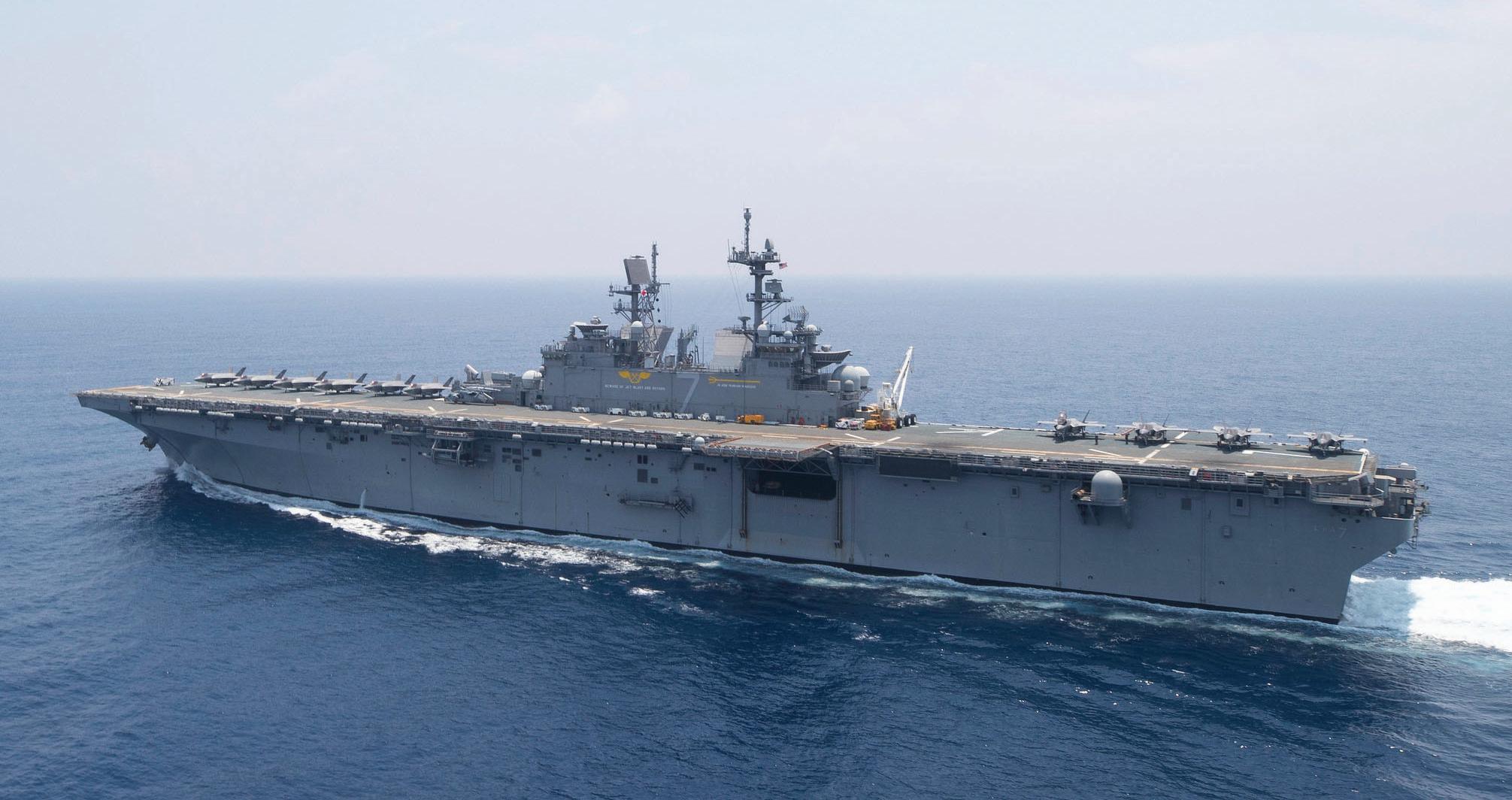
Amphibious assault carrier USS Tripoli (LHA 7) cruises through the Pacific Ocean.
photo: Christopher Sypert
ing to reduce its dependence on the US dollar, but Beijing has still steadily accumulated US Treasury securities over the last few decades. In addition, while subsequent US administrations have paid lip service to the need for policies of decoupling and diversifying their supply chains away from China, the PRC has followed Chinese President Xi Jinping’s position, enunciated in his keynote speech at the opening session of the 2017 World Economic Forum Annual Meeting, in which he rejected such protectionism and instead made the case for advancing the cause of economic globalization.
Following on this idea, PRC Foreign Minister Wang Yi chaired a 20 May, 2022, dialogue of foreign ministers from the BRICS countries and emerging markets, at which he called for linking instead of decoupling, and complementing the chain instead of disrupting the chain. In this way, Wang opined, developing countries could better integrate into the international division of labor and cooperation, and share the dividends of globalization.
The PRC has officially applied to join the Comprehensive and Progressive Agreement for
Trans-Pacific Partnership (CPTPP) trade pact. This is a big step for the PRC. After all, The Trans-Pacific Partnership (TPP), the CPTPP’s predecessor, was a deliberate attempt by the United States to counter China’s growing regional and global trade influence. Beijing promised that it would push deregulation of the private sector, reduce subsidies to state-owned enterprises (SOEs), and embrace globalization. This suggests that, like the days when “China’s peaceful rise” was being used as Beijing’s public-relations mantra, the PRC still needs a peaceful regional environment in which to complete its financial and geopolitical maneuvering and place its economy into an unassailable position of influence.
Economic backlash
China will need that level of leverage if it is to survive the sanctions and other economic backlash that will surely follow any military attempt to make good on Xi’s desire to annex Taiwan. As to the issue of Taiwan as a possible battlefield, there is one scenario and two trends: Taiwanese are increasingly concerned
Give Peace a Chance b 27
photo: ROC Presidential Office
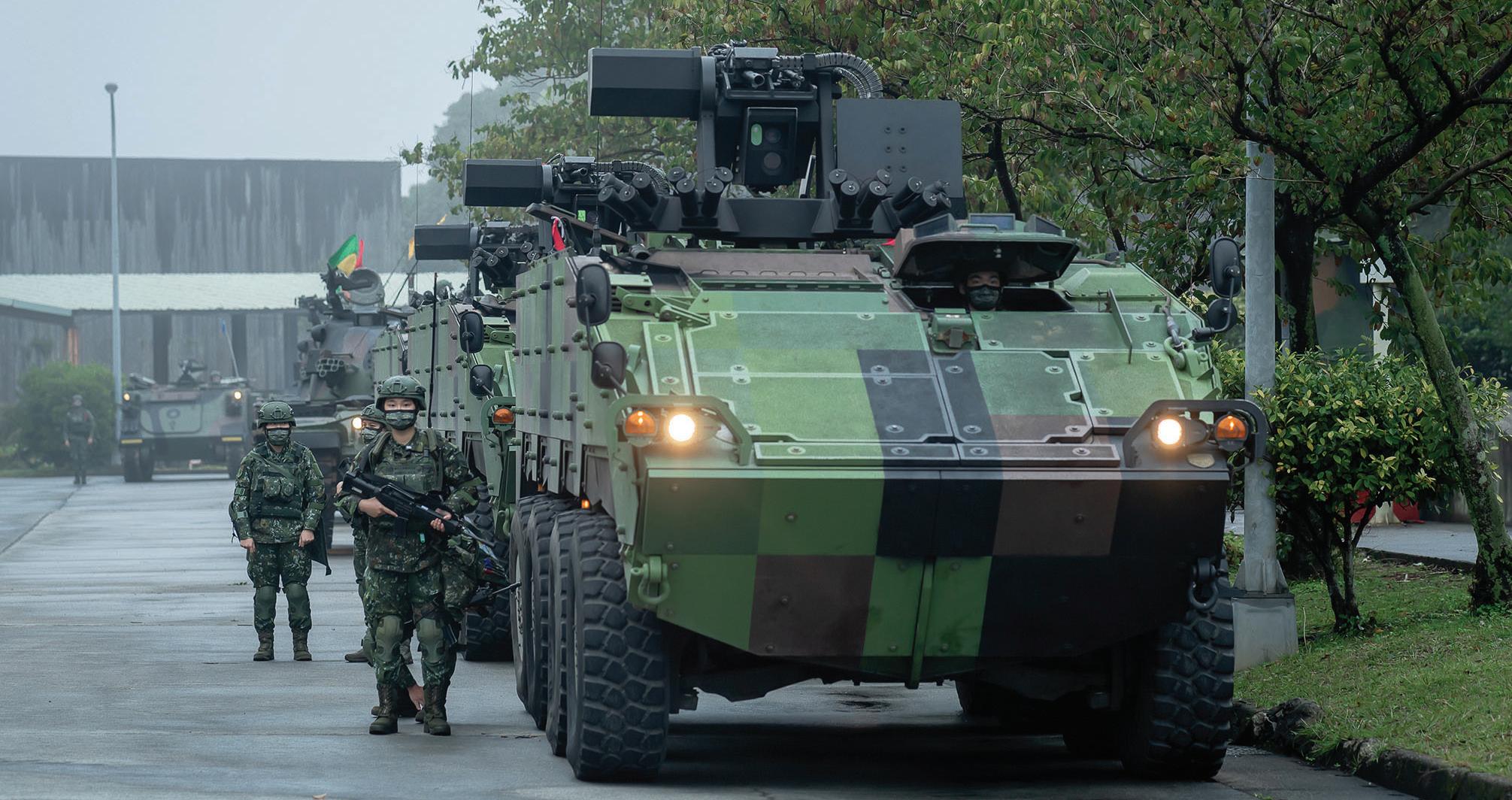
Soldiers from the ROC Army’s 269th Brigade take part in an exercise.
about the possibility of war, and this has produced some clear perspectives. One trend has been to discuss ways to bolster its defensive capabilities, such as by lengthening the country’s military conscription period from four months to one year. This is an important step to prepare for war. The other trend has been to examine possible ways to avoid war altogether. This is because Taiwanese see how bloody the war in Ukraine has been. It is unclear that which of these two trends—broadly speaking, resistance or appeasement—will gain the societal upper hand, but at the very least, this public conversation shows that the Taiwanese people understand they can no longer rest on their laurels, preferring the status quo for now, and putting off acting on the China threat for future generations to deal with.
Reduce tensions
It is therefore incumbent upon all three countries— the United States, the PRC and the ROC—to learn their respective lessons from Ukraine. For Taiwan, Taipei should have the willingness to see the signs and reduce the tensions in its relations with the
PRC. After all, people have generally drawn parallels between the war in Ukraine and Taiwan’s situation, and believe that Taiwan will become the main battlefield if war breaks out. For example, Ukrainian President Volodymyr Zelenskyy addressed the Australian Parliament on 31 March, 2022, via video link, where he suggested that a Russian victory over Ukraine would embolden China to attack Taiwan. “The most terrible thing is that if we don’t stop Russia now, if we don’t hold Russia accountable, then some other countries of the world who are looking forward to similar wars against their neighbors will decide that such things are possible for them as well,” Zelenskyy said.
Another example happened in Japan. During a joint news conference with Japanese Prime Minister Fumio Kishida in Tokyo on 23 May, 2022, US President Joe Biden was asked: “You didn’t want to get involved in the Ukraine conflict militarily for obvious reasons. Are you willing to get involved militarily to defend Taiwan if it comes to that?”Biden responded in the affirmative.
The ROC government has a responsibility to hold public discourse about the possibility of war in
28 b STRATEGIC VISION
photo: ROC MND
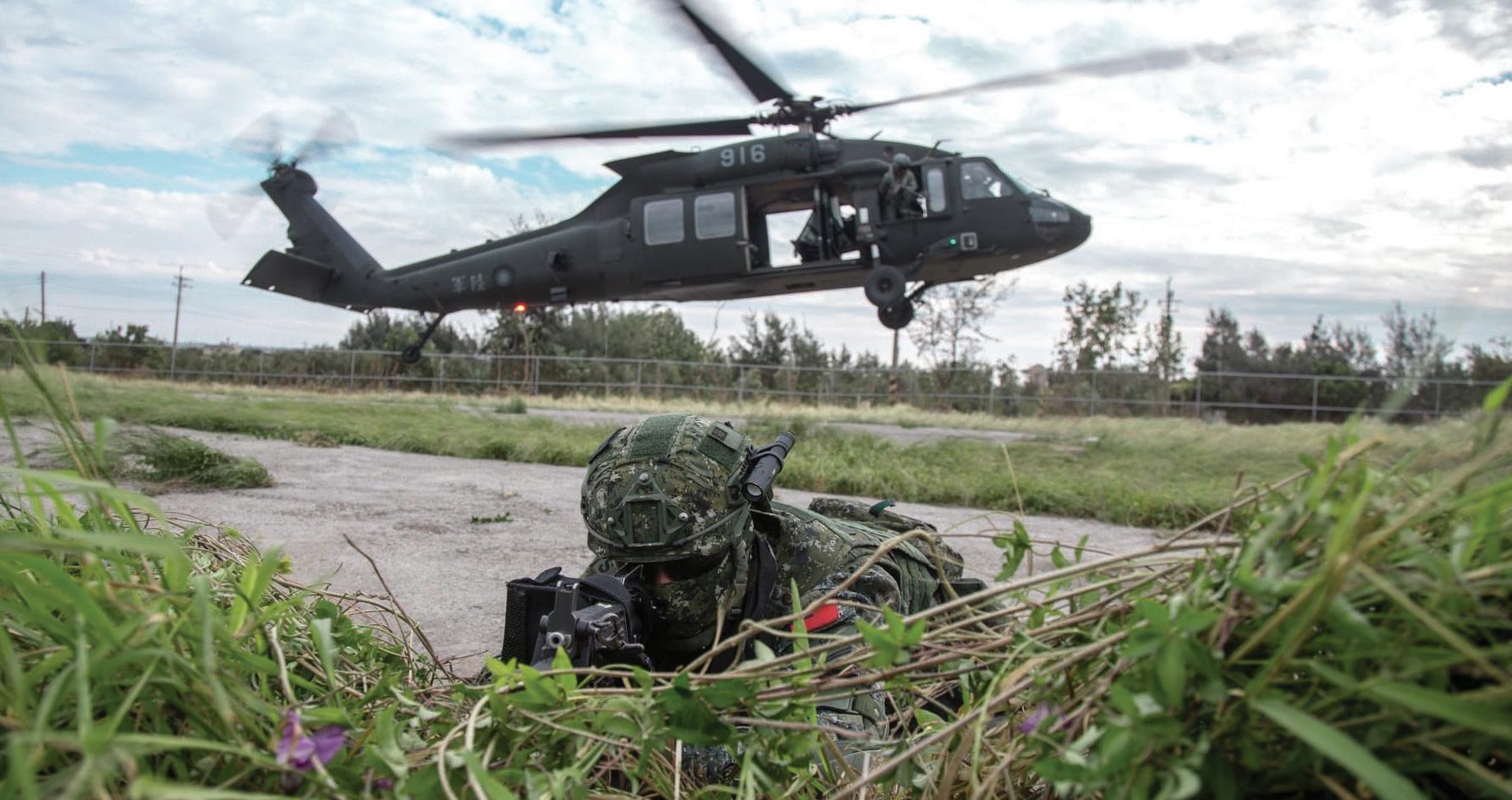
Taiwan’s Special Forces operators engage in a training exercise.
Taiwan. It is helpful to understand different positions while working towards a consensus. However, most discussions in Taiwan have magnified Ukraine’s advantages and focused on its high morale. For example, many media reports have ignored cases where Ukrainian troops have shot captured Russian soldiers. They tend only to report alleged atrocities committed by Russian soldiers. This media bias is not conducive to helping the public understand the horrible realities of war.
Most discussions about what Taiwan should do to strengthen its own defenses have included the need to lengthen the conscription period from four months to one year. ROC Minister of National Defense Chiu Kuo-cheng remarked that if a cross-strait conflict were to break out, four months of military training would be insufficient, as the soldiers would not be able to deal with the realities of combat. Some people, citing the results of various public surveys, claim that the political climate in Taiwan appears to be shifting, and the idea of extending mandatory service would be likely to get public support.
More emphasis should be placed on creating oppor-
tunities for dialogue between the ROC and the PRC. Unfortunately, while ROC President Tsai Ing-wen has signaled a willingness to engage in talks, Beijing continues to insist on adherence to its “One China” principle as a precondition for talks, essentially shutting down that potential avenue of cooperation. As a result, the PRC has not agreed to engage in dialogue with the ROC for several years. One step that Taiwan could take to improve relations with the PRC would be to restart cross-strait exchanges on non-political issues. Perhaps restrictions on the Three Mini Links and direct cross-strait flights could be lifted as a goodfaith gesture, once the Covid-19 pandemic is over.
True globalization
For its part, the PRC should do more to promote true economic globalization, rather than transparently seeking to supplant the Washington Consensus with the Beijing Consensus. China must also cease its provocative air and naval activities near Taiwan. Some countries believe that fair trade is a necessary route to make globe trade
Give Peace a Chance b 29
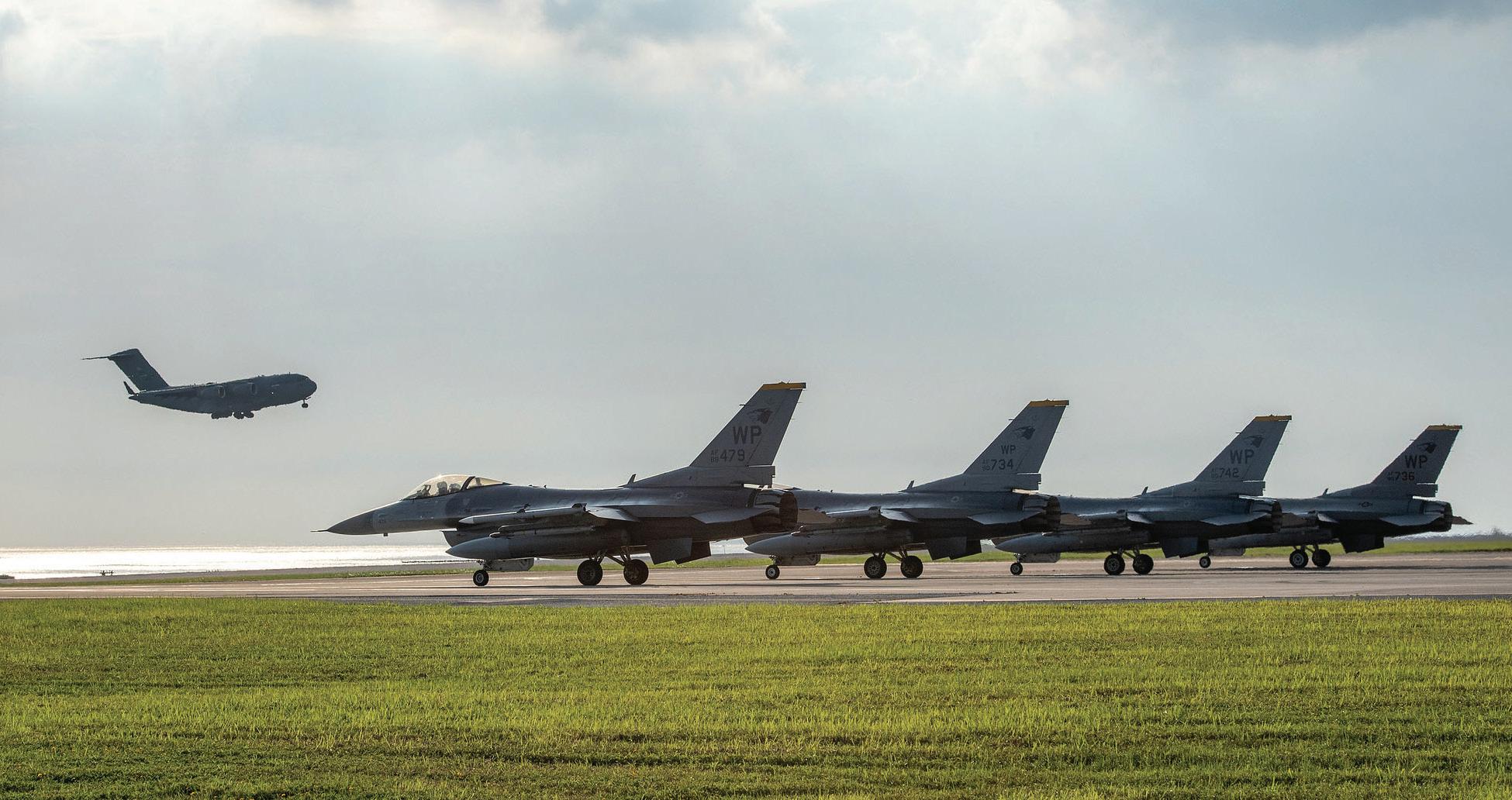
F-16s from the 80th Fighter Squadron are parked at the end of the runway at Kadena Air Base, Japan.
photo: Yosselin Perla
sustainable, and are still skeptical of Xi’s sincerity to fulfill CPTTP obligations for fair trade. They note that China has pledged to discipline SOEs, industrial subsidies, and other trade-distorting practices before, and it has a poor record of following through on these and other promises. Xi has sometimes been known to reverse previous reforms and to continue providing state support to SOEs. Therefore, the PRC should continually push development policies for private firms.
Next, there is a contradiction between the PRC’s provocative air and naval activity near Taiwan and Beijing’s claim that it desires to maintain a peaceful environment. According to the PRC, the provocative activity is aimed at people who support Taiwanese independence. However, most Taiwanese want to maintain the cross-strait status quo, rather than pursue independence right away. The PRC’s provocations increasingly make Taiwanese feel threatened. The PRC’s aggressive actions might actually be helping the Taiwan independence movement. China’s aggressive practices also raise concerns in the United States and Japan, and have resulted in a renewed debate in Tokyo over whether to alter Article 9 of its pacifist
Constitution, which prevents Japan from providing meaningful military assistance to Taiwan.
The lessons of the Ukraine war for United States are perhaps most important. For one thing, Biden’s economic sanctions have proven useless to influence Russia’s warmaking. Indeed, despite the US actions designed to dissuade Putin, CBS News reported on 27 May, 2022, that the Russian rouble was the best-performing currency in the world this year. It has been suggested that Western sanctions, far from harming Putin, have only strengthened him.
The US should therefore push the process of globalization when it meets such challenges. In addition, people will also wonder if the next US strategy can make deterrence work when it faces challenges in the western Pacific. Therefore, it may be a good time for the United States to join the CPTPP and return that body to its original stated goal.
In conclusion, although the Russo-Ukrainian War provides reasons for optimism over Taiwan’s security, it is important for Taipei to continue to debate the implications and lessons of this war. Reintroducing mandatory military service as a means to increase its security is but the first step. n
30 b STRATEGIC VISION
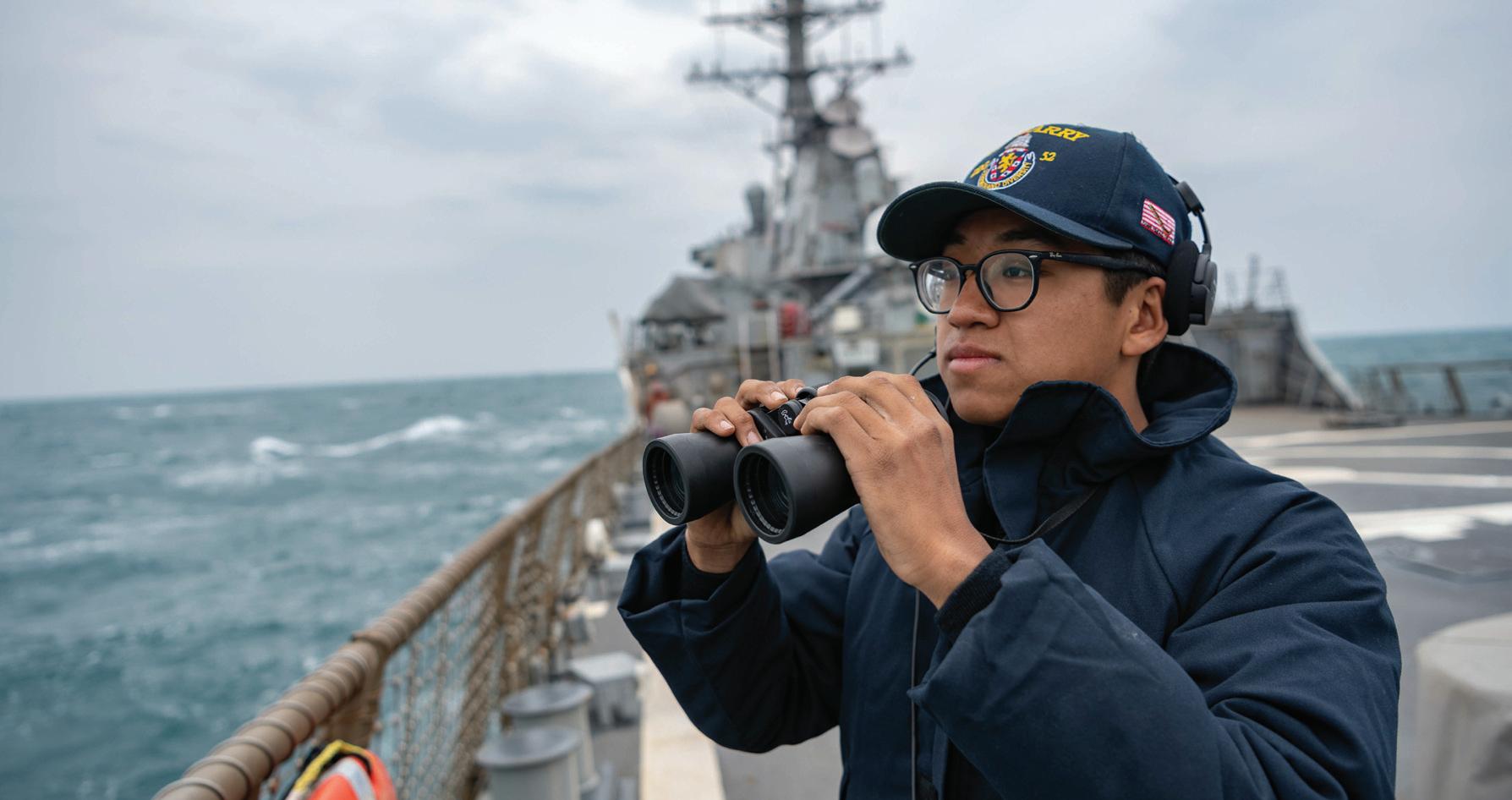
Seaman Xi Chan stands lookout on the flight deck of the guided missile destroyer USS Barry (DDG 52) as it transits through the Taiwan Strait.
photo: Samuel Hardgrove

STRATEGIC VISION for Taiwan Security Taiwan Center for Security Studies National Chengchi University No.64, Wanshou Road Wenshan Dist, Taipei City 11666 Taiwan (ROC) +886-2-8237-7228 https://en.csstw.org/


www.csstw.org/journal/1/1.htm Visit our website:
