
A lumni Horae
ST. PAUL’S SCHOOL | ISSUE IV 2023-24
Alumni Horae
VOL. 103 | ISSUE IV 2023-24
RECTOR
Kathleen C. Giles
EXECUTIVE EDITOR
Karen Ingraham
EDITOR
Kristin Duisberg
DESIGNER
Cindy L. Foote
SECTION EDITOR
Kate Dunlop
PHOTOGRAPHY
Ben Flanders
Jeremy Gasowski
Mary Schwalm
Michael Seamans
Derek Thomson
EDITORIAL CONTRIBUTORS
Ian Aldrich
Jana F. Brown
ALUMNI ADVISORY BOARD
Elise Loehnen Fissmer ’98
David M. Foxley ’02
Dana R. Goodyear ’94
Jonathan D. Jackson ’09
Malcolm Mackay ’59
Diego H. Nuñez ’08


Published by St. Paul’s School
8
CELEBRATING THE FORM OF 2024
KRISTIN DUISBERG
SPS awarded diplomas to 139 graduating Sixth Formers on June 2.
ON THE COVER
22
HOME AGAIN
More than 750 alumni and their guests returned to grounds for Anniversary Weekend 2024.


38 TO A “T”
IAN ALDRICH
St. Paul’s School and the sport of squash have been a perfect match for more than 140 years.
44
MILES FOR MIRACLES
JANA F. BROWN
As a Third Former, Britt Marien ’12 collapsed at SPS with a hole in her heart. Now, she’s running the NYC marathon.
UPDATE YOUR EMAIL ADDRESS: ALUMNI@SPS.EDU
Do you receive emails from SPS? If not, you may need to update your address with us or check your spam filter to make sure SPS is identified as a safe sender.
IN THIS ISSUE
2 FROM THE RECTOR
4 THE SCHOOL TODAY
The School’s new trustees and dean of college advising; Sixth Form standouts; Fine Arts teacher Brian Schroyer P’22 marks 25 years at SPS; athletics adds two sports to the roster; and more.
46 BOOKSHELF
“On the Tobacco Coast” Christopher Tilghman ’64 “Winning With Horses” Adam Snow ’82 and Shelley Onderdonk DVM
48 ALUMNI CONNECTIONS
With photos from Sparks Day of Service, summer receptions and the alumni events calendar for fall and winter.
50 PROFILE
Hugh Taylor ’69 is named president of the 25,000-member Massachusetts Medical Society.
51 PROFILE
Mimi Steward ’83 is making a cross-continental difference at USAID.
52 IN MEMORIAM
ALUMNI HORAE DEADLINE
Formnotes for the winter issue are due Friday, Nov. 15. Notes and photos may be sent to alumni@sps.edu. Please note the minimum allowable photo size for print publication is 1MB. Photos that are smaller than 1MB do not provide the resolution necessary for print and will be included only at the discretion of Alumni Horae editors.
The Covenants We Share
KATHLEEN C. GILES

Last spring, our Conroy Distinguished Visitor, retired Admiral John Richardson, talked to the assembled School about the covenants that define his life — with his spouse, his faith, and the U.S. Constitution. Implicit in his statement is the concept that our covenants temper our freedoms; and that the covenants that create mutual care, respect, and regard ultimately create order, purpose and meaning in our lives. The late Rabbi Lord Jonathan Sacks once noted, “Contracts are about interest; covenants are about identity. Contracts benefit; covenants transform.”
A covenant is a relationship in which parties make binding promises to each other and work together toward a common goal. Covenants are enforced ethically, morally, and spiritually, as well as legally; we abide by them because we agree to do so, in exchange for other peoples’ commitment to us, and covenants are effective only when we have the discipline to commit, to trust, to be trustworthy, to be credible, to be a partner in service to the greater good.
At St. Paul’s, we are connected by caring deeply about others and being cared for, as our covenants would have it, in return. Our mission and guiding principles, along with our School Prayer and School motto, embody our covenants within the community and in extension, as our alumni embrace these principles in their own lives
and work. Perhaps the most intensely personal covenant we consider takes the form of our School Prayer. This prayer was written by Bishop Charles Slattery and published around 1922, and it was written in the form of a personal covenant, starting with the request, “grant,” and later on, “help.” Think about it from the “I” perspective for just a minute: grant that I may never forget to be kind; grant that I will be generous in offering friendship to people who need it and not just people I like; grant that I will be thoughtful — attentive to, aware of — people who don’t enjoy my privileges, from basic education to expensive stuff; and grant that I will commit to learning to be eager to bear the burdens of others as my blanket approach to life. My covenants temper my freedom. When Dr. Drury changed the pronoun to “we” around 1937, our community adopted this covenant as our internal community covenant as well as our request to the Love Divine. Grant us these gifts so that in return, we live good lives, become good people, enjoy the joy of those connections. We try and fail and try and fail and try again to live it because we care about each other and our world and our purpose, dedicated as we are to the pursuit of excellence in character and scholarship in service to the greater good.
We heard another important statement about covenants and freedom when Dr. Bruce Duthu of Dartmouth College last fall referenced the concept of freedom as defined by Judge Learned Hand in his “Spirit of Liberty” speech. Judge Hand delivered this speech in May 1944, in front of a huge crowd in New York City’s Central Park celebrating “I am an American Day” during a time of worldwide upheaval and chaos 18 months before the end of the Second World War. During a time of intense national hardship, Judge Hand participated in the swearing in of thousands of immigrants as new citizens of the United States. He spoke as follows:
What do we mean when we say that first of all we seek liberty? I often wonder whether we do not rest

our hopes too much upon constitutions, upon laws and upon courts. These are false hopes; believe me, these are false hopes. Liberty lies in the hearts of men and women; when it dies there, no constitution, no law, no court can even do much to help it. While it lies there it needs no constitution, no law, no court to save it. And what is this liberty which must lie in the hearts of men and women? It is not the ruthless, the unbridled will; it is not freedom to do as one likes. That is the denial of liberty, and leads straight to its overthrow. A society in which men recognize no check upon their freedom soon becomes a society where freedom is the possession of only a savage few; as we have learned to our sorrow.
What then is the spirit of liberty? I cannot define it; I can only tell you my own faith. The spirit of
liberty is the spirit which is not too sure that it is right; the spirit of liberty is the spirit which seeks to understand the mind of other men and women; the spirit of liberty is the spirit which weighs their interests alongside its own without bias; the spirit of liberty remembers that not even a sparrow falls to earth unheeded; the spirit of liberty is the spirit of Him who, near two thousand years ago, taught mankind that lesson it has never learned but never quite forgotten; that there may be a kingdom where the least shall be heard and considered side by side with the greatest.
My covenants temper my freedoms; our covenants temper our freedoms. Food for thought as we all look ahead to the fall of 2024.

WITH ITS SOARING GLASS-AND-TIMBER COMMUNITY SPACE AND ITS REDBRICK FACADE, THE NEW FLEISCHNER FAMILY ADMISSIONS CENTER FEELS LIKE THE PERFECT BRIDGE BETWEEN THE HISTORIC ALUMNI HOUSE AND THE CONTEMPORARY LINDSAY CENTER FOR MATHEMATICS AND SCIENCE. SEEN FROM ABOVE, THE BUILDING’S ENVELOPE IS NEARLY FINISHED, READY SOON FOR THE INTERIOR WORK AND LANDSCAPING THAT WILL LEAD TO ITS COMPLETION IN EARLY 2025.
Alumni Horae

SPS BOARD UPDATE
SPS Welcomes Three New Trustees
On July 1, St. Paul’s School welcomed three new members to its Board of Trustees — SPS alumni and parents who join 19 others in overseeing the School’s management of its financial and physical assets and providing thought leadership to the strategic direction of the School. In this volunteer role, trustees are elected to three-year terms and may be re-elected to two subsequent terms.

ARTHUR W. ZEKENDORF ’77, P’05’07
A New York residential real estate developer and real estate company manager for more than 40 years, Arthur Zeckendorf is an owner, founder and co-chairman of Zeckendorf Development and co-chairman of Terra Holdings, the parent company of Brown Harris Stevens. Along with his brother, William, Zeckendorf has developed more than $4 billion of properties, the most recent of which is 520 Park Avenue, a project featuring full-floor apartments and a limestone façade designed by Robert A.M. Stern [P’86] Architects. Zeckendorf’s firm is also known for developing the iconic 15 Central Park West, an apartment house featured in numerous publications that continues to dominate the super-luxury residential market. Other projects of note include 18 Gramercy Park and 50 United Nations Plaza.
Zeckendorf is a trustee of the American Scandinavian Foundation, a member of the Yale School of Architecture Dean’s Council and a 2016 recipient of the Ellis Island Medal of Honor. He graduated cum laude from Tufts University in 1981. His son, Arthur “Artie” Zeckendorf III, is a member of the Form of 2005; daughter Jennifer Zeckendorf graduated with the Form of 2007.

REAR ADMIRAL ALEXANDER L. “ALEX” KRONGARD ’81 USN (RET.)
Alex Krongard received an A.B. from Princeton University in 1985 and is a distinguished graduate of the National War College. He most recently served for more than two years as chief executive officer of The COMMIT Foundation, a nonprofit that assists men and women separating from uniformed services and entering the professional civilian world. Previously, he was a managing director at the investment bank Signal Hill, working in the bank’s Aerospace, Defense & Government Service and Cybersecurity, Risk & Compliance groups from 2016 to 2021.
Krongard served in the Navy from 1985 to 2016. He was a Naval Special Warfare officer and held high-level positions dealing in military strategy and defense policy on the National Security Council Staff and at several military headquarters. He also served in multiple SEAL teams and associated units deploying to Europe, East and South Asia, Africa and the Middle East and served as the commander of the four West Coast SEAL Teams. He retired in 2016 as a Rear Admiral Lower Half.
An adviser to the board of the Navy SEAL Foundation, Krongard previously served SPS as a form agent from 1992 to 1996.

AMY SINGER ’97, P’27
Amy Singer has spent the past 20 years working at the intersection of media and technology. She currently serves as managing director, global strategy & operations at YouTube and has served in various leadership roles at YouTube since 2010. Prior to joining YouTube, Singer was vice president of business development for Viacom’s Enterprises business, where she was responsible for identifying and developing new revenue opportunities for the MTV Music Group. Previously, Amy was an analyst in J.P. Morgan’s M&A group.
Singer received her B.A. in economics from Harvard College and an MBA from Columbia Business School. She is an active SPS volunteer, serving as her form’s main agent for the past 12 years. Her daughter Daisy is a member of the Form of 2027.
VISIT THE TRUSTEES PAGE ON THE SPS WEBSITE

DECADES OF EXPERIENCE AND PERSPECTIVE
Meet New Dean of College Advising Greg Buckles
KRISTIN DUISBERG
n his multi-decade career in independent schools and colleges, Greg Buckles has been an English teacher and a football coach, worked in admissions, financial aid administration and college advising, and served as an assistant head of school. But the new St. Paul’s School dean of college advising chuckles a little at the idea that he’s followed a defined career path. “I feel like I’ve always been more opportunity-driven rather than career-path driven,” he says.
Buckles and his wife, Liz, who joins the faculty in the Humanities Department, were in New Hampshire last November for Thanksgiving when he learned about the opportunity at SPS created by the announced departure of longtime dean Tim Pratt P’17,’19,’21 and concluded that it was one he couldn’t pass up. “St. Paul’s School is the embodiment of what these schools should be about in terms of 100% residential,” he says. “I have strong feelings about size, I have opinions about the investment for families at this level and I think St. Paul’s is the best investment you can make, in a lot of ways.” Other draws were the School’s location — the couple’s four children, daughters Virginia, Grace and Charlotte and son Ben, all live in New England — as well as the opportunity to work with Rector Kathy Giles. “I’ve known and admired her for a long time,” Buckles says.
Still another draw was Liz Buckles’ connection to the School. Her father, the Rev. Bertrand Honea, served as SPS chaplain and head of the Religion Department from 1956 to 1965, and her brothers graduated from SPS — Bert in 1970 and Murph in 1972. “When we interviewed here, we passed the cemetery up the road and half the people there are names of old family friends and people she knew,” Buckles says. “She was born here in Concord, so this is kind of a sacred place for her family.”
Buckles is ready to forge his own SPS connections. He met his student advisees ahead of his official start at SPS and hadn’t even unpacked his office before taking his first parent meeting. “I was happy to do that,” he says. “I hope there’s some reassurance in seeing that while I’m the new guy here, they’re benefiting from someone with a lot of experience, and someone who’s gone through the college application process as a parent four times and maybe even brings some levity to what can be a pretty stressful time.”
The experience Buckles brings to the role includes leading admissions at both Kenyon and Middlebury

colleges and a decade at the Hill School overseeing both the admissions and college counseling offices. He comes to Millville from Lawrenceville, where since 2019 he was the dean of enrollment management, with responsibility for admission, student retention, communications and financial aid. At SPS, his focus will be on college advising, working with the office’s five-person team to help students navigate the ever-more complex college admissions landscape.
If Buckles has one message for students and their parents, it’s that his 40 years of working in high school and college admissions have shown him time and again that places like St. Paul’s equip students to thrive in any environment. “You’ll find your way somewhere that will be a great spot for you,” he says.
“I think [where you go to college] in the end is relational, it’s people. And then you get there, you find those people, they become your friends, they’re your mentors, your advisers; you have a great experience, move on to life and you look back and say, ‘Hey, it worked out just the way I hoped in a lot of ways most of the time.’”
In other words: It’s about finding opportunity, not following a path.
Greg and Liz Buckles
Celebrating the Form of 2024

For Sixth Form President Cris Ramirez, it was a journey that started when he joined the St. Paul’s School community as a new Fifth Former in the fall of 2022, sad to leave behind card games with his grandfather, impromptu sleepovers with his cousins and his grandmother’s cooking, as he shared during his Graduation speech, but excited for all that boarding school had to offer.
For many of his peers, it was a journey that started two years earlier under the cloud of COVID-19, with mandatory masks, Zoom chapels and socially distanced classes that students joined from time zones around the world. On Sunday, June 2, members of the Form of 2024 and their families gathered on Graduation Lawn to honor the end of their journeys as SPS students during an extraordinary few years for the School community and the world
at large, and to consider what they will carry with them from Millville to college and beyond.
In her opening remarks, Fourteenth Rector Kathy Giles spoke about the freedoms that college would offer the graduating form and encouraged students to draw on what SPS had taught them about ways to frame their ideas, values and beliefs within expectations and rules when exercising those new freedoms. “Today, as you cross the threshold of our community, I offer you the idea — not new, but worth repeating a final time — that caring matters; that our covenants temper our freedom; and that the covenants that create mutual care, respect and regard ultimately create order, purpose and meaning in our lives,” she said. “Those aren’t givens, but they are much needed.”
KRISTIN DUISBERG

Speaking to his formmates in his capacity as their president, Ramirez evoked the idea of covenants as well as he described the things that would forever bond them to one another — and not just late nights in Friedman, study sessions in Ohrstrom and long meals in Coit. “What we also share is genuine kindness,” he said. “What makes the people at St. Paul’s so special is that we all embrace this beautiful place and its values ... . We’ll walk away with far more than just memories. ... This school has taught us how to handle rigor ... and the value of hard work and discipline. And most importantly, this school has taught us to be better people.”
The Graduation Exercises were the culmination of a weekend of celebrations that started with Halcyon-Shattuck boat races on Saturday morning and included the
Classical Honors Program Latin Play, the Graduation Week Awards Ceremony, Baccalaureate, and the Sixth Form Parade from the Chapel of St. Peter and St. Paul to Stovell Tennis Courts, where graduating students and their families shared dinner on Saturday night.
And while there was no shortage of tears among the cheers and hugs on Sunday morning as Giles declared the session of 2023-24 closed for the Sixth Form of 2024 and the School’s newest alumni tossed their roses in the air, there also was the palpable sense that the ceremony was a commencement in every sense: the end of their journey as high school students and the beginning of their much longer journey as friends, colleagues and citizen leaders bonded by the covenants forged at SPS.


Alumni Horae | Issue IV 23/24
PHOTOS: Ben Flanders, Jeremy Gasowski, Michael Seamans


“REMEMBER, IT’S NOT WHAT YOU DO, IT’S THAT YOU DO THAT MATTERS. CHOOSE TO BE GENEROUS OF YOUR TIME, YOUR ABILITIES AND YOUR RESOURCES.
I HAVE LEARNED THAT THE GREATEST REWARD IN LIFE IS HELPING OTHERS. HELPING OTHERS CREATES MASSIVE SATISFACTION AND HUGE RIPPLE EFFECTS. CHOOSE TO MAKE A POSITIVE DIFFERENCE. CHOOSE TO BE FAIR AND JUST AND KIND.
AS THE DALAI LAMA SAYS, BE KIND WHENEVER POSSIBLE. IT IS ALWAYS POSSIBLE.”
— 2024 BACCALAUREATE SPEAKER TREVOR PATZER ’92 Co-founder and Executive Director of LIttle Sisters Fund


FULL CIRCLE
Triplets Eliza, Sam and Will Ekstrand on Growing Up Together at SPS
There’s a picture Eliza Ekstrand ’24 keeps on her cell phone that shows her at about the age of two, seated in front of a door outside the Chapel of St. Paul with three of her four siblings: her twin brothers Sam and Will, and their older sister Emmaline. There’s another picture of the foursome in the same spot taken more than a decade later, after the triplets had joined Emmaline ’21 at St. Paul’s School as members of the Form of 2024. “We’re going to try to do it again at graduation,” Eliza says, just days before she and her brothers join not just Emmaline but also their mother Samantha Sparks Ekstrand ’92 and their aunts Sarajane Sparks Verghese ’97 and Stefanie Sparks Smith ’01 as St. Paul’s School alumni. “It will be a nice little full-circle thing,” adds Sam.

Full circle is a resonant concept for a trio whose childhood memories of SPS are as rich as their connections to the campus. Sam remembers being five or six, attending one of their mother’s reunions and participating in the alumni parade down Rectory Road. Eliza recalls tagging along — with Emmaline — for head coach Heather Crutchfield’s SPS girls lacrosse spring break training trips, something her mother, who had played for Crutchfield during her own SPS student days, helped out with throughout her daughters’ childhoods. “I just remember so many piggyback rides at Walt Disney World and trying to keep up with the girls on their run of the monuments,” Eliza says. “I think my earliest memories about St. Paul’s were from those girls.” Will describes Family Weekend visits when the triplets were in middle school, watching Emmaline play field hockey, taking in SPS Ballet Company performances and getting an overall feel for life at SPS.
When the siblings started thinking about high school, their decision to apply to SPS was unanimous. “I remember walking down the admissions path on my way to my interview in my long black dress, and Will and Sam wearing their suits,” Eliza says. “It was just a really cool experience. Even then, it started to feel like this place was ours more than it was our sister’s or our mom’s or our aunts’.”
And while Eliza may have followed in her mother and sister’s footsteps at SPS in some respects, excelling at both field hockey and lacrosse (Emmaline was captain for both sports Eliza’s Third Form year; Eliza was a lacrosse
KRISTIN DUISBERG
Sam, Will and Eliza with older sister Emmaline ’21 — a few years ahead of their matriculations at SPS.
Will, Eliza and Sam Ekstrand ’24
captain this spring), the triplets have made the School their own. A member of the Classical Honors Program, Eliza also played basketball, served as an Advancement ambassador and this year was a prefect in Conover 20. Sam competed in club hockey, club soccer and Nordic skiing and played second base on the varsity baseball team — sharing the infield with Will, who was the team’s shortstop and served as one of its captains. Both boys were Sixth Form Chapel wardens, greeting their schoolmates with ready smiles at the doors to the Chapel of St. Peter and St. Paul, where Sam also sat on the Chapel Council. Will was a house representative for Middle, the dorm where he and Sam have roomed together since Third Form — this year, in fact, in the same room where their aunt Stefanie had lived more than two decades earlier.
Unsurprisingly, the long list of things the triplets say they’ll miss as they move on from SPS includes an array of shared experiences, including the Sunday sibling brunches at Coit that Emmaline instituted when they matriculated and that they’ve continued, with only the occasional missed week. “We go to brunch around 11 together,” Eliza explains, “and it’s like no matter what else is happening, I know I can count on Sunday with them.” More surprisingly, those experiences don’t include an inventory of shared classes, even though all three of them studied Latin. In fact, the triplets had never taken an SPS class together until this year, when they all signed up for Advanced Biology: Exercise Physiology with Science Teacher Theresa Gerardo-Gettens P’07,’11.
“It’s not like we took it to be together; the main driving force was that we all wanted to be in Dr. G’s class,” Will explains. “Emmaline had taken it, and we knew Dr. G only teaches one section of it, so we kind of saw this as a twobirds, one-stone kind of opportunity: we could have Dr. G’s class and finally take a class all together, which would be a really cool bonus.”
In the fall, Sam, Will and Eliza are headed to separate schools for the first time in their 18 years. Eliza is attending Columbia University in New York City, where she will continue her lacrosse career. Sam will be at Kenyon College in Ohio, where he hopes to walk on to the baseball team. Will is headed to their native North Carolina’s Davidson College, where, he jokes, “I’m just going to study.” It’s a bittersweet milestone none of them are ready to think too much about yet.
“I know my mom is always telling us this, but there really is no place like St. Paul’s, and so to be leaving here after four years is a very sad thing,” Sam says. “But I know the relationships that we’ve built here, especially the relationships we’ve grown into with each other, we’ll carry with us as we move on.”
Eliza marvels at the way the School has evolved from being a place that felt familiar to one that has become a true home. “I’m really, really grateful that I got to grow up with my brothers here,” she says. “When you think about the majority of our form, they’ve been away from their families, away from their siblings, for two or three or four years. I think the three of us got a really lucky draw.”
Sixth Form Standouts
The Ekstrand triplets are far from the only members of the Form of 2024 who are leaving their mark in Millville. In case you missed these highlights elsewhere:

When scheduling conflicts kept him from taking Greek as a new Fourth Former, Joaquim “Jack” Bocresion taught himself a year’s worth of the language the following summer and went on to earn the Oakes Greek Prize as both a Fifth and Sixth Former as well as Dickey Prizes for Latin and Advanced Math.
He was profiled in the spring for his work straddling the centuries between ancient languages and modern mathematical theory. Now, he’s headed to Harvard University, where he plans to double major in mathematics and classics.


Edith “Edie” Jones is enlisting as a midshipman this summer with the United States Naval Academy at Annapolis. Highlighted earlier this summer for her first-place Hugh Camp Cup Competition speech, Jones joined the SPS community from New York City as a Fourth Former and during her three years participated in a number of community, arts, academics and athletic pursuits — including crew, the sport she will continue at Annapolis.


Colter Sienkiewicz is one of 73 incoming students at the University of North Carolina at Chapel Hill who will comprise the university’s Class of 2028 Morehead-Cain Scholars. The first collegiate merit scholarship program in the United States, the Morehead-Cain provides full funding for all four years of college, including opportunities for summer internships, research, international travel and more. Sienkiewicz, a Montana native who joined the SPS community as a Fourth Former and plans to participate in the Navy ROTC program at UNC, was profiled last fall for his role as a prefect and mentor to new students.


Massachusetts resident Lidia Zur Muhlen was named one of 34 Class of 2028 Jefferson Scholars at the University of Virginia. Like the Morehead-Cain, the Jefferson is an intensely competitive, by-nomination-only merit scholarship that provides a fully funded four-year experience that includes access to a network of fellow scholars and alumni, professional development, entrepreneurial opportunities and more. Zur Muhlen, an Applied Science and Engineering Scholar and Sokoloff Grant recipient at SPS, was profiled in the spring.


ART EVERY DAY
Teacher Brian Schroyer Celebrates 25 Years at SPS
KATE DUNLOP
Brian Schroyer P’22 has taught in the Arts Department at St. Paul’s School since 1999.
That’s half his lifetime.
It’s a milestone that can be attributed in part to the influence of his parents, who recognized and fully encouraged his artistic abilities early on, and Carol Gargon, his high school art teacher who deputized him as a teaching assistant his senior year and later mentored him during his student teaching days as he prepared for his own classroom. It is a powerful testament when a student looks at a teacher and thinks, I want to be just like her someday, but that is the power of a teacher: to shape and change futures.
And that is the power Schroyer wields so well, as he teaches drawing, ceramics and web design. In the studio, he lives for the “aha moments,” when a student grasps a concept. Buzzing around his one-room schoolhouse of an art studio, with four levels of drawing students work-
ing side by side, he uses examples, metaphors and similes — anything that will help students tumble an idea over in their brains until, like a Rubik’s cube, it clicks and falls into place.
In his studio, everyone has the potential to draw — and to draw well. The rest of it is tips, tricks and techniques that he will share, along with his permission to make a mess and fail and to learn from that because seeing what doesn’t work is just as valuable as seeing what does.
“I have had one to three sections of Drawing I every term for 25 years, and I’m not sick of it because spending time with those students, that’s where the gains are most rapid,” Schroyer says. “I have to assume that everyone has zero experience and I tell them, “If you’re not here of your own free will, don’t tell me. Just give me one week and we’ll see.’ They begin to believe in themselves and are willing to try much more ambitious projects. We’ve had visiting artists who say there’s no way I can be asking
Brian Schroyer with a student in one of his drawing classes.
high school students to do certain things; then they see the results and can’t believe it.”
Schroyer grew up the oldest of five children in Vermont, studied studio art at Brigham Young University and art education at the University of Vermont, then earned an MFA at Lesley University. He was teaching on Nantucket when his sister, Carrie Johnson ’02, started at SPS and their mother encouraged him to look into teaching at private schools. His first year at SPS was Carrie’s second, and they saw each other every day.
Outside the studio, Brian has led four trips to Haiti and two cross-country bicycle trips with students. He has coached crew, soccer, alpine skiing, hockey, volleyball, rock climbing and wrestling. He draws, fences and games. He has married and raised his family, all while living and working at SPS.
Like his mentor Carol Gargon, Brian has seen students go on to become teachers themselves; one is now his colleague, Chair of the Art Department Leigh Kaulbach ’08, who was a Third Former in his Visual Design class. He’s
mentored Penn Fellows. And he’s had former students return to share the many ways in which he has shaped and changed their futures.
This summer, his middle daughter, Kayla Schroyer ’22, who took drawing at SPS and is now at Brigham Young learning in the same studios where her father once created art, returned to Millville as an Advanced Studies Program intern in Brian’s Studio Arts class. Art has long bonded the duo.
“Kayla sat right in front of me in chapel her first year, so we saw each other every day. The next year, she was all the way down at the other end and I could barely see her, so I got into the practice of leaving a drawing in her seat every day. Sometimes they were quick sketches and sometimes, after being on duty for three hours, they’d be pretty detailed. It was art every day, a way to be accountable to somebody else to produce art.”
After 25 years, Brian still finds his chosen path tremendously rewarding. And SPS? Well, it very much feels like home, with his family and his career right here.
SUMMER SCHOOL

Pictured here shortly after the start of the program — and before the start of a two-week stretch of 90-plus degree days that put the
“summer” in summer school — are (l. to r.) Tiffany Stafford ’92, who co-taught the class After the Rally; Amelia Dickinson ’12, who worked as a house supervisor in Conover 20; Kayla Schroyer ’22, a teaching intern for Studio Arts; After the Rally co-teacher Monique Bobb Schlichtman ’92; Sam Smith ’22, a teaching intern working alongside teacher
Bowman Dickson ’05 for Data Driven; Carolyn Lucey ’14, who taught Writing Workshop; Michael Gutwein ’22, a teaching intern for Law & Governance; and Forbidden Fictions teaching intern Zoe Dienes ’20. Also on grounds for the ASP but not pictured were Claire Bassi ’19, one of the program’s assistant directors, and Foster house supervisor Wyatt Ellinwood ’18.
Eleven St. Paul’s School alumni representing four decades spent six weeks back in Millville in June and July working at the Advanced Studies Program as teachers, teaching interns and staff.

“The Spring Term’s chapel speakers included many Sixth Formers, who shared reflections on their time at SPS and what they’ve learned about themselves and the world.
I have been asked several times over the years to give a chapel talk, but I have never been ready until now. Today, 948 days since I first set foot in the chapel, I am ready. On October 19, 2021, I was terrified as I sat here, believing that I didn’t belong anywhere on this whole planet. Through the roller coaster of the last three years, this beautiful place has held and supported me, allowing me to grieve and grow as I needed to. As I prepare to become one of few Afghan girls in the world to graduate from high school this year, I know I owe that in large part to this place which has finally become home.”
AYDIN SAHBA YAQUOBY / May 24, 2024

“For me, hobbying serves as a healthy escape from the constant grind, a focus on the joy of the present moment and an opportunity to do service for others. ... With the Sewing Circle and with Knitting Club, I’ve learned that hobbies ... can be activities that produce good and produce new connections. At St. Paul’s, I found that it’s been so hard, but so important to prioritize things that don’t seem like serious work. ... It’s worth it to take the time to laugh, to take care of yourself, and to take care of the people around you.”
SEBASTIAN
BRIGHAM / May 31, 2024

CC CASSIDY / May 21, 2024
“I’ve been able to find myself at St. Paul’s through the support of women. ... We are a community that is constantly changing. Fifty-three years ago, these seats were filled by boys. Every day, we have a chance to change the community for the better, and I try to do my part. ... We need to treat our neighbors as ourselves. We must do our part starting by challenging ourselves, then using the people around us for support. We are all in this together.”

ARMAAN ARORA / April 9, 2024
“Every one of us is similar to a matchstick. On the surface we might appear simple, but within us there’s a potential waiting to ignite. This inner fire remains hidden until we’re faced with challenges and these challenges, these rough surfaces, needed to strike a match that awaken our potential, turning it into a fire. ... I urge you all to reshift your perspective when it comes to challenges. Look at them as an opportunity to grow, not something that will set you back. ... Once our fire is lit, it does more than just light our own path. It serves as a beacon for others.”
SOFIA PACE / May 21, 2024
“Coming to a school like SPS, we all face challenges, expectations, pressures and the quest to find meaningful friendships. Before I came here, I didn’t feel challenged. I could have stayed where I was in that comfort of coasting through, but it wouldn’t have been as fulfilling and it wouldn’t have taught me what I needed to learn to be the person I am today. ... I’m grateful to St. Paul’s for allowing me to take a leap and experience the growth that comes from facing failure.”

ANQI HU / May 14, 2024
“In my Third Form Humanities class, I struggled with a poetry assignment on intersectionality. I got stumped by the first question on the prompt sheet, which should have been the easiest: What is your name? Well, my parents call me Anqi, meaning beautiful jade, but they also insisted on making up an English parallel for it: Angel. ... Every time I write down an answer to the question, what is your name? I pause on the third letter, knowing that to put down either “q” to make Anqi or “g” for Angel will only give one half of who I am.”

GORDON AND LOOMIS MEDAL AWARD WINNERS
Two Students Leave Lasting Marks on Big Red Athletics
KATE DUNLOP
Each spring, the varsity head coaches gather to hear nominations for the highest athletic awards at St. Paul’s School — the Loomis Medal for girls, the Gordon Medal for boys — weigh each nominee’s merits, and vote to select the winners. The medals, with other spring athletic awards, were presented during an afternoon ceremony on June 1, the day before Graduation.
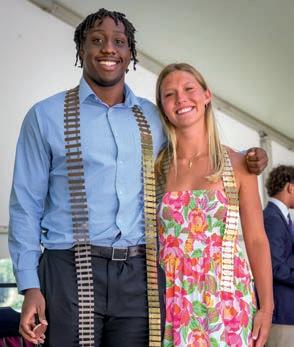
THE GORDON MEDAL
A gifted athlete and fierce competitor with a team-first attitude, Ernest Obiorah ’24 was recognized for his leadership, kindness, discipline and skill in football, track and field and wrestling with the Gordon Medal.
A major contributor to the Big Red football program’s success, Obiorah anchored the offensive line as a Fifth and Sixth Former and was recognized in the league with All-Evergreen Honorable Mention and All-NEPSAC Honorable Mention. In his final season, he was elected captain and awarded Offensive Most
Valuable Player. Obiorah, from Georgia, will continue his football career at Colby College.
As a four-year starter in wrestling at the heavyweight level, Obiorah was a leader on and off the mat known for his grace, agility, hard work in practice and determination at every match. His regular season record for his Fifth and Sixth Form years was 55-20 in a weight class that was one of the strongest in New England; he placed fourth in Class A’s as a Fifth Former and second in his final season; and at New England’s, he placed sixth last year and fourth this year, qualifying him for Nationals in both years. He was All-NEPSAC Honorable Mention two years in a row and was just two matches away from being an All-American this year.
“ERNEST WAS A TERRIFIC TRACK AND FIELD CAPTAIN. HE WAS FRIENDLY AND APPROACHABLE DURING PRACTICES, BUT QUIETLY INTENSE AND FOCUSED DURING COMPETITION.”
As a Fifth Former, Obiorah received the Track & Field Coaches Award and All-NEPSAC Honorable Mention distinction in discus. In his final season, he served as captain, and his discus talent earned him All-NEPSAC recognition. In his nomination of Obiorah, Humanities Teacher and Track and Field Head Coach Kevin Brooks noted that the four-year standout contributed more than just consistent performances to the team.
“Ernest was a terrific track and field captain,” says Brooks. “He was friendly and approachable during practices, but quietly intense and focused during competition. He always concentrated on team spirit and worked hard to ensure that all athletes, regardless of experience or ability, felt that they were valuable members of the team.”
THE LOOMIS MEDAL
When the Loomis Medal was again draped over the shoulders of Vermonter Camryn R. “Cami” Bell ’24, she became just the fifth two-time winner of the medal in its 53-year history.
In 2022-23, Bell was recognized for her outstanding athletic performances in field hockey, ice hockey and lacrosse — and a notable fourth-sport accomplishment. After a hockey wrist injury as a Fourth Former ruled her out for lacrosse season, she joined the track and field team and competed in the 100m, 200m and 4x100m relay. She also was a member of the 4x400m relay team that set a school record during the 2022 NEPSTA Championship meet.
The Yale-bound Bell captained the 202324 field hockey and ice hockey teams and earned All-NEPSAC honors in both sports. For her play on the ice, she also received Lakes Region All-Star, NH All-Star, Team MVP and Team Offensive MVP honors, and she recorded her 100th career point. Bell will be a member of the Yale Bulldogs’ ice hockey team.
In lacrosse, she was a shut-down defender assigned to the other team’s best player every game, wreaking havoc on opponents’ offensive sets.
Humanities Teacher and Girls Varsity Ice Hockey Head Coach Kelli Mackey says that these and other accolades Bell has collected still don’t paint the full picture of her as an athlete and teammate. “Her importance to athletics at SPS is way more than her performance in uniform,” says Mackey. “Cami is kind, determined, skilled, empathetic and a true leader.” SEE FULL LIST OF ATHLETIC AWARDS AND WHERE SPS ATHLETES WILL COMPTETE IN COLLEGE.

Ernest Obiorah ’24 and Cami Bell ’24 at the June 1 awards ceremony.

NEW VARSITY SPORTS OFFERED
Athletics Adds Golf, Swimming and Diving to the Roster
KRISTIN DUISBERG
Starting this academic year, St. Paul’s School studentathletes will have two new arenas in which to compete: the swimming pool and the golf course. In May, SPS Athletic Director Chris Smith announced the addition of boys and girls swimming and diving and coed golf to the School’s offerings of 17 varsity sports. The new options reflect the interests of both current and prospective students and are part of a roster of expanded afternoon programming that also includes club sports, arts and service-learning opportunities.
A winter sport, swimming and diving will be coached by Science Teacher Nick Babladelis and Math Teacher Laura Hrasky P’18, who previously served as advisers to the School’s club swim program, alongside new Science Teacher and Head Swim Coach Mike Carroll. The Athletic and Fitness Center’s 25-meter Ma Pool will serve as the host site for meets against other New England independent schools, including Exeter, Andover, Deerfield, Groton and Northfield Mount Hermon as well as local public high schools. The installation of a 1-meter diving board above the pool’s 11-foot diving well will allow both new and experienced divers the opportunity to practice and compete at SPS.
Noting that in a typical year 20 or more students participated in the club program for swimming, Smith says he expects the transition to a varsity program will be well-received. “I think we’re all excited to have the
opportunity to put Ma Pool to its full use,” he says.
A new addition to the spring sports lineup, golf will be coached by Associate Director of Admissions and Boys Varsity Ice Hockey Head Coach Scott Harff ’09 and Math Teacher Gannon Leech. The team will utilize a number of local Concord courses for practices and competitions, giving athletes experience with a variety of course layouts and terrain. A generous supporter has donated an indoor simulator to the program for practice at SPS.
“ There’s been tremendous interest in golf,” Smith says, noting that until now St. Paul’s has been the only Lakes Region school without a varsity golf team. For the 2025 season, the team will compete in the Lakes Region League and also plans to play against Exeter, Andover and other NEPSAC schools. Smith is confident that the School has the talent to get the team off to a strong start. “The first year might look a little different than three or four years from now, but the intent is that we will be competitive from day one.”
The announcement of both new sports generated considerable buzz among the student body, and Smith anticipates there may be some shifting of rosters where students have pursued different sports because they haven’t been able to swim or golf competitively. “That’s great for sports at SPS,” he says. “More teams means more opportunities for kids.”
The Ma Pool at the Athletics and Fitness Center, ready to welcome competition.


Home Again
“Millville holds our youth and memories. There was a feeling of being home again in a place that felt more like ours now than when we lived there because we no longer take the place or the people for granted. For us, this weekend was about emotional connection and feeling seen, and our buckets were filled in ways, I believe, none of us anticipated.”
— Jessica Mellon ’89

D
uring Anniversary 2024, St. Paul’s School alumni traveled from 41 states and seven countries to Concord to see and see anew the people and places at the core of one of the most formative times in their lives. Led by alumni in reunion years ending in 4 and 9, a total of 773 alumni and guests joined in on May 3 and 4 festivities that included dinners and receptions, boat races and a 5K, an alumni chapel and the ever-popular alumni parade. For some, the highlight of the weekend was the alumni panel featuring Alan Khazei ’79, Alexandra Fallon ’99 and Graham Browne ’04 and the presentation with Fourteenth Rector Kathy Giles and Board of Trustees President David Scully ’79, P’21 that followed. For others, it was the opportunity to be on the SPS grounds while school was in session. Anniversary Weekend was, for all who made the trip to Millville, a chance to reconnect with a place that will always be one of their homes in the world.

FORM OF 1949 — 75TH REUNION
Seventy-five years? Are you kidding? Where did the time go?
I was the only member of the Form of 1949 to return for our 75th reunion. Too bad for the others, because they missed a fun time at the School and the singular privilege of leading the Alumni Parade. The chore fell to me, and I did it admirably, holding our form sign high and walking the distance in the company of Truman Bidwell ’52 and his wife, Ludmila. Please, no golf cart.
What was most impressive to this visitor from another era was the amount of change that had taken place. Not only are there a multitude of new buildings but the choices for today’s students seems endless and astonishing. Cases in point: On Friday afternoon, I attended an art exhibition lecture at the Crumpacker Gallery after a visit to the Fine Arts Building, a center for the thriving arts program at the School. From there, I moved to the Dance Building to watch a dazzling rehearsal. Neither art nor dance were available to us in 1949.
And what about today’s dress code? T-shirts and shorts are common. Mix in the arrival of bright young ladies and to me it is near Nirvana. And hard not to mention all the new athletic facilities, including a big-time gym with pool. It makes this lifelong jock drool.
All of which makes one wonder what the School will look like 75 years from now. I can hardly wait.
P.S.: At my 50th Reunion, I told a graduating senior that when he returned for his 50th reunion, I would be coming back for my 100th. He rolled his eyes as if to say “Man, is this guy crazy.” Well, I only have 25 years to go.
FORM OF 1954 — 70TH REUNION
Hello, SPS 1954! “What was the best part of Anniversary Weekend?” my wife, Janet, asked me after we had returned from a 48-hour stay in Concord. “Chapel,” I replied. Call it a memorial service for 58 alumni, two former faculty and six former staff members; remarks from Rector Kathy Giles, a remarkable sermon by Rev. Inger Hanson ’99 and many familiar prayers, hymns and organ music transported me and nine other classmates back seven decades. I thought of Bennett Eppes, who had hoped to be there, as the alumni choir belted out “O Pray for the Peace of Jerusalem.” Eventually, life gets you to the front of the line.
If you have been to a past reunion, you know that we gather for lunch and photographs after the alumni parade. It was a fantastic opportunity for catching up and reminiscing.

Before the reunion, I decided that our form should make a gift to the School and my idea was a contemporary interpretation of what the School looked like in our day. I called on Pieter Greeff, whose artwork had been featured in a previous issue of Alumni Horae, and he worked from a black and white photograph to produce a 30" x 40" canvas with a view of Library Pond looking toward the Chapel and the former Lower School.
One of the awesome things you get to do at your 70th Reunion is to have dinner at the Rectory with the Rector, which would be a first for the Form of 1954. And what better place to present Pieter’s painting to the School?
This Anniversary Weekend was an experiment of sorts — the first in early May, it was separated from graduation for the third consecutive year. And here we were, standing on the grounds of an institution that had endured for 168 years — through good times and bad — still full of energy and purpose looking at the future with clarity and optimism. Not a bad way to spend 48 hours soaking up the past and coming away hopeful that those 140-ish students of the Form of 2024 would find a way to lead purposeful lives in service to the greater good. Until we meet again.
— Jay Cushman
Peter Van Doren
Peter Van Doren
(L. to r.) front: Reeve Schley, Harvey Sloane, Jay Cushman, Lee Ault, Bill McKim; Row 2: Peter Pool, David Watts, Woody Waldron, Pieter Greeff and Dick Perkins.

FORM OF 1959 — 65TH REUNION
Our 65th reunion went beyond our expectations. The get-together at the Woodstock Inn on May 1-2 gave 10 formmates and six wives the time, space and setting to catch up, share drinks and meals, wander around town, go for hikes up Mount Tom and into the Ottauquechee River valley, and play a couple sets of tennis.
The conversation in the round on Thursday afternoon followed in a tradition begun at our 50th reunion and gave us the opportunity to reflect on our experience at St. Paul’s and the impact it had on our lives. Most expressed gratitude for the School, but several shared some difficult challenges — their own and those of others. The consensus was that we all could have been kinder with ourselves and more sensitive to the needs of others, in the spirit of the School prayer.
In Millville on Friday, we were joined by 13 other formmates and eight wives and significant others for the traditional events, which included the alumni boat row, with four of us on (and in one case, briefly in) Turkey Pond for a short, crabless row. There followed the memorial service in the Chapel, where the memory of Channing Lefebvre’s rendition of Widor’s famed “Toccata” continued to move us all.
In the late afternoon, we celebrated a special memorial service in the Old Chapel for those formmates who had passed away since our 50th reunion. We read the names of each one, after which several of us gave testimonials. Woody Woodroofe did a beautiful job presiding over the service.
The service was followed by the famous Sydney Waud clambake in the Hockey Center, and began with a show prepared by Bill Eldridge with personal shots from our years together and copies of photos from old Pictorials. Kudos to Bill for a marvelous job; he said seeing all of us glued to the show was thanks enough. Melissa Walters made a cameo appearance, where she announced that we had reached a record level of donations for a 65th reunion, and we gave her a plaque making her a much-deserved honorary member of the Form of 1959.
— David Atkinson
FORM OF 1964 — 60TH REUNION
After tons of preparation and plenty of cajoling from form directors Rick Sperry and Rob Claflin, 28 members of the Form of 1964 and 22 spouses and significant others made their way to Concord for the first trial of an earlier reunion in May. We were delighted by this turnout.
One of our long-absent members, and someone who made it to our 50th, was Thierry Aube, who sent his regrets from his home in Paris and noted that he was the School’s first Weicker Scholar (1960-61). As of today, there have been more than a hundred Weicker Scholars.
Our form dinner on Friday night took place in the lovely Middle Dining Room at the Upper and we were joined by four other forms in our “age group.” Overall, a nice gathering and a delicious meal. Board of Trustees President David Scully ’79, P’21 gave an update on the School’s activities.

At dinner, Melissa Walters distributed our form gift, a thick SPS red fleece vest, which everyone seemed to like. Back at our Reunion HQ in town, Tony Parker hosted a well-attended get-together that kept the party going until the wee hours. Thank you, Tony.
Saturday started with a Chapel service in which Rector Kathy Giles gave a nice summary of the values of SPS and what the School hopes graduates take into the world after they leave. This was followed by a wonderful sermon by Rev. Inger Hanson ’99, a Lutheran pastor in Minnesota. The choir sang a terrific rendition of “O Pray for the Peace of Jerusalem.” The alumni parade and lunch in the Gordon Rink followed.
The centerpiece of the weekend was our fabulous form dinner at The Centennial Inn. Cocktails and hors d’oeuvres were served while we all chatted away. Livy Miller put together a wonderful “before and after” slideshow of reunion attendees. Form director Rick Sperry led us in a rendition of “La Marseillaise,” followed by a slideshow by Livy with a highly entertaining SPS trivia quiz that drew lots of laughs. The next morning, Kyri and Rob Claflin hosted us for a fabulous brunch at their house nearby. It was a wonderful way to say goodbye to everyone. A great reunion and a bit nostalgic as we all realized we were getting on in years. Who can forget being a student at SPS and hearing about the Gordon Medal at the Flagpole Ceremony; then seeing Mr. Gordon himself in a wheelchair and thinking that time was so, so far away? Sigh!
— Rick Sperry
(L. to r.) front: Joe Roby, Speedy Mettler, John Douglas, Bill Eldridge, Sydney Waud, Michael Sylvester, Bill Everdell, Peter Parsons, Kip Clark, Michael Gagarin; Row 2: Steve Hershey, Peter de Bretteville, Jerry Bogert, Peter Neill, Frank Nelson, Peter Morris, David Atkinson, Malcolm MacKay, Lang Marsh, Sam Callaway; Row 3: Hillyer Young, Woody Woodroofe, Grahame Wood, Hartmut Keil and Tony Carpenter.
(L. to r.) front: Peter Gerry, Jim Schutze, Ted Baehr, Jason Smith, Bob Walmsley, Ted Landsmark, Joe Tilghman, Hilton Foster; Row 2: Bill Gordon, Fred Morris, Rufus Botzow, Rick Sperry, Jim Cummins, Mike Howard, Sellers McKee, Dick Ranck; Row 3: Rick Bastian, Terry Lichty, Jim Goodwin, Livy Miller, Tony Parker, Chuck Coggeshall, Jos Wiley, Haven Pell, Rob Claflin and Jad Roberts.

to r.) front: Robin Lloyd, Bill Lane,
FORM OF 1969 55TH REUNION
Anniversary this year was held on the first weekend in May and 26 formmates made the trip to Millville. We enjoyed a pre-versary golf outing, a Friday night dinner sponsored by the School, a Saturday morning alumni row, the alumni memorial chapel service, the alumni parade and luncheon, and a variety of other afternoon activities, which offered everyone a chance to experience the School again in various ways.
In my mind, there were three highlights to the weekend. Our Saturday dinner at the Kimball-Jenkins Estate was, as one person described, like being stuck in a cabin during a snowstorm, where we shared wonderful memories, stories and the incomparable musical talents of Tom Whitney. Peter Flynn emceed, and Tom Iglehart put together a trivia quiz which tested the recollections of our youth.
Formmates also recalled the impact certain faculty members and educational opportunities had on their lives.
On Sunday morning in the Old Chapel, we conducted our own memorial service led by the Rev. Charlie Bradshaw to celebrate the lives of Chuck Dallyn, David Coombs, Bryan Wilkins and Bob Rettew, all of whom had passed away since our last reunion. Then we adjourned to the spot between Kittredge and Ohrstrom Library where a pelican statue will be installed in memory of Bob, who worked at the School for 22 years and was beloved by students, faculty, staff and parents. Bob’s wife, Annie, joined us for both the Saturday night dinner and for the outdoor gathering. Thanks to Charlie Hickox, Tom Iglehart and Rick Lyon, whose considerable energies and efforts made this memorial a reality.
Two concluding thoughts: The Form of 1969 is getting despairingly close to the front of the alumni parade line. But what made this weekend so special was the mindset that we are no longer competing 18-year-olds, but rather well-seasoned adults who see and value what we all have in common. It is in this spirit of friendship and fellowship that we look forward to our 60th Reunion.
— Eliot Larson
FORM OF 1979 45TH REUNION
Twenty-seven members of the Form of 1979 reconnected at SPS over Anniversary Weekend. Formmates balancing other obligations arrived and departed throughout the weekend. Long-distance award: Lili Cassels-Brown, from Vienna. Honorable mention: Elisa and Charlie Andrews, from California. Xonna Clark and her mother and niece represented three generations. HH for effort: Paul Spivey and Darrick Harris, for arriving despite car trouble.
Friday at the AFC was followed by a convivial gathering at T-Bones. On Saturday, George Brooke, Charlie Andrews and Clay Hunt were in the alumni boat row, while David Scully and Liz Robbins headed to board meetings. Those of us who wanted to sleep in started our day with chapel, which included “O Pray for the Peace of Jerusalem,” with Amy Feins, Miranda Cox, Miriam Gurniak, Kimball Halsey, Andy Schlosser, Lili Cassels-Brown and Jeanette Richmond in the choir.

Next came the alumni parade and lunch in the hockey rink, followed by athletic competitions and two presentations in the Friedman Community Center. The Excellence in Character and Scholarship panel, a conversation with alumni innovators who are making the world a better place, featured our own Alan Khazei. A School update from Rector Kathy Giles and Board President David Scully focused, in part, on efforts to make the School more resilient in the face of climate change.
and Paul Spivey.
Saturday’s dinner at The Concord Country Club featured a playlist curated by Andy Schlosser. The Rev. Barbara Talcott read her “Prayer for Friends,” which is included in the current SPS Chapel Services and Prayers book. Anne Benning led a lively round of ’79 trivia, during which George Brooke and Paul Leahy were surprised to learn that their team had hosted a Finnish hockey team in Sixth Form. Afterward, the smart people called it a night; the rest of us played foosball and lingered until 1:30 a.m.
Thanks to all who returned to Millville to renew old friendships and make new ones. Special thanks to form director Andy Schlosser for organizing Zooms, keeping us updated and coordinating reunion. Thanks also to Lili Cassels-Brown for collecting our formnotes. Finally, thanks to the incomparable Liz Robbins for a million little things that make all the difference. We hope to see you in five years for our 50th! — Anne Benning
(L.
Terry Hunt, John Adams, Chris Ross, Trip Farnsworth, Rick Lyon, Jesse Markham; Row 2: Bryona Besse, Procter Smith, Eliot Larson, Paul Reingold; Row 3: George Birchard, Bill Reedy, David LeBreton, Tom Whitney, Charlie Bradshaw; Row 4: John Bronson, Charlie Hickox, Doug Stewart, Peter Flynn and Tom Iglehart.
(L. to r.) front: Tim Stone, Liz Robbins, Kimball Halsey, Amy Matthews Feins, Kate Reid Koeze, Miriam Gurniak, David Scully, Xonna Clark; Row 2: Alan Khazei, Paul Leahy, Paula Salonen Paquette, Miranda Cox, Andy Schlosser, Waddell Stillman, Lili Cassels-Brown, Barbara Talcott; Row 3: Clay Hunt, Linda Love Mesler, Jeanette Camara Richmond, Anne Waskiewicz Benning; Row 4: George Brooke, Seth Ward, Jim Jordan, David Stevenson, Charlie Andrews. Not Pictured: Darrick Harris

Rod
Susan
Lee
Bruce Chan, Tom Painchaud, Tom Wiggin, Alan (Bo) Chesney, Alma Howard Graham, Bruce
Stockdale, Patti Glovsky, Mike French, Stuart Mackintosh, Karen Sawyer, Sue Palmer Ingram, Ken Williams; Row 3: Ben
Ed Shih, Pete Bostwick, Tad Montross, Steve Isaac, Matt Dallett, Steve Morton, David Clark, Jared Ward, Philip Laird, Mike Wert, Liz Munson, Ben Rice, Greg Wheeler, Henry King, Mike Harlan; Row 4: John Rhodes, Tim Mayer, Mitch Wondolowski, KC King, Jim Rutherfurd, Chris Rulon-Miller, Whit Fuller, Jim Milkey, Nat Goodspeed, James Caviston, Steve Minichiello, Jeff Keeler, Wayne Gilreath, Tim Murray, Vic Young, Art Sistare and Chris Tweedy.
FORM OF 1974 5OTH REUNION
We had an exceptional turnout of more than 70 formmates and another 35 guests for our 50th Reunion. Activities commenced with a Form of 1974 symposium exploring the grand experiment of our day: the integration of women and minorities into a New England boarding school. We concluded that the process, while not always smooth, was a success. Perhaps the success was a function of not being handed an instruction book. Who knows!
O ur memorial service, held at 5 p.m. in the Old Chapel, was moving. Formmates shared recollections and memories of those members of the Form of 1974 who have passed away.
Th e School hosted our 50th Reunion “kick-off” celebration Friday night with cocktails and dinner in the Upper Dining Room at Coit. The highlight of the evening was the presentation of a diploma by Rector Kathy Giles to Jeffrey Randall, who departed the School in the spring of 1973 — a year before graduation. Since then, he has been fully engaged as a form agent, cheerleader and reunion organizer. The standing ovation by the Form of 1974 closed the loop, bringing Jeff back into the fold.
A lumni rowing, parades, lunch and pictures punctuated Saturday. The Form of 1974 reunion dinner was held at the Stonebridge Country Club, some 15 miles southwest of Concord. The evening was an enormous success, featuring our beloved Form of ’74 band—Lester Boogie.
The weekend rekindled old friendships and opened the door to new ones. To the Form of 1974: keep coming back. We look forward to our 55th in 2029!
— Whit Wagner

(L. to r.) front: Whit Wagner, Roy Stevenson, Lock McShane, Welles Thurber, Pam Hudson, Tina Miller, Gabrielle Porter Dennison, Alison Betts DeWitt,
Giess,
Rueter Quintana,
Verville, Tom Vail, Ned Welbourn, Bill Short; Row 2: Jeff Randall,
Patton, Rick Witsell, Nancy “Kit”
Sperry,


Alumni Horae | Issue IV 23/24
PHOTOS: Ben Flanders, Jeremy Gasowski, Mary Schwalm, Michael Seamans



FORM OF 1984 40TH REUNION
The reunion was great — just an enormous success. Thanks to all who made the trek. Some notable travelers were Chris Chappell and Nina Houghton from the West Coast, who won the domestic distance award, and Angela Ong-Hans from Portugal and Mottchi Ohkawa all the way from Tokyo! So, salute to them. And a special notation for Mary Robins; she did not tell me the details of her trip, but I know the part of Colorado near New Mexico, as I had been to Telluride ages ago and it was quite a feat getting to an airport. I think she said she flew from Montrose, which I did not do, so maybe I am over-glamorizing it. But let it stand as an effort, and thanks to all who could make it!
For me, it is hard to pick a highlight from the weekend, but one thing I loved was when a large group took a walk around the ponds and wound up in the Chapel singing “Love Divine.” How great was that? We had a few Deli Line alums who acted as human pitch pipes and helped us carry the tune and fill the beautiful walls of the Chapel with that lovely sound.
There were several folks who sent regrets about reunion and that was nice, too — good to hear from everyone who was there in spirit, and maybe can make it next time. As Motel Six used to say, “We’ll leave the light on for you!”
— Bill Morrison
FORM OF 1989 35TH REUNION
The Form of 1989 rolled into our 35th Reunion with 25 attendees coming from as far afield as Hong Kong. Some could only make the Friday dinner and others were surprise guests dropping into the Saturday night event at the last minute, but all who were able to make it in whatever way possible experienced a group of like-minded, wise, graceful and kind people who, in some sense, they’d never met before. Simply put, we are an older group of thoughtful folks who have dropped our pretenses and just want to enjoy each other for the people we have become.
That said, we also know how to throw down on the pickleball court, where Dennis Lynch and Tim Manny reign as the tournament champions until we all meet again in 2029. On Saturday night at the Bedford Village Inn, our intimate group drank, dined and talked with old friends and formmates until the Grateful Red (Dennis Lynch, Tom Noe, Gretchen Giumarro and Sarah Richardson) hit the stage for a rousing vocal original, “We Didn’t Start the Butter.”

Whether watching the crew races, singing at the Saturday morning chapel service, or simply listening to the bells ring out your tardiness from the Chapel of St. Peter and St. Paul, Millville holds our youth and memories. There was a feeling of being home again in a place that felt more like ours now than when we lived there because we no longer take the place or the people for granted. For us, this weekend was about emotional connection and feeling seen, and our buckets were filled in ways, I believe, none of us anticipated.
—
Jessica Mellon
(L. to r.) front: Angela Ong-Hans, Lynn Hawley, Posey Houston Cochrane, Nina Houghton, Mary Robins; Row 2: Jane Kalinsky, Greg Selch, Alexandra Strawbridge Maurer, Theresa Ferns, Chris Sklarin, Truman Semans; Row 3: Maja Paumgarten-Parker, Deb Holloway, Edith Pepper Goltra, Stu Witt, Kipp Sylvester; Row 4: Bill Morrison, John Taws, Chris Chappell, Mottchi Ohkawa, Hillary Bidwell Mackay and Chris Forbes.
(L. to r.) front: Andrew Leonard, Paul Spadone, Alice Campbell, David Drinkwater, Lily Rutherfurd Kinlin, Charles Goodwin; Row 2: Tom Noe, Sarah Burleigh Richardson, Laura Clark Heard, Jessica Rogers Mellon, Lisa Tilney, John Roberts; Row 3: Gretchen Giumarro, Wright Ohrstrom, Helen Youngman Kunde, Kevin Saleeby, Harlem Logan, Jason Savage, Matthew Bell, Karl Peet. Not Pictured: Brian Berlandi and Sabrina Fung.

FORM OF 1994 30TH REUNION
The Form of 1994 celebrated its 30th Reunion in style over Anniversary Weekend with 30 formmates returning to Millville. We had people travel all the way from Brazil (Ian), Hong Kong (Eddie) and Milan (Isabel)! When reflecting on the weekend, the consistent and prominent themes are connection and comfort. The conversations, experiences and joy that we all enjoyed over the weekend are simply second to none.
The weekend started out with gathering at a few Concord favorites; the first stop was Hermanos and then the group moved on to Tandy’s for some Concord-style late-night fun. Saturday, we enjoyed walking around the grounds, marching in the parade, and joining the other reunion classes for lunch in the Hockey Center. The campus is simply spectacular and as much as things change, things stay the same. A few of the things that will never change at SPS
I WAS EITHER LAUGHING SO HARD I COULDN’T BREATHE OR LOST IN CONVERSATION AND THERE WAS JUST NO ADEQUATE TIME ... I AM LEFT MISSING YOU AND GRATEFUL FOR THE INTENSITY OF OUR SHARED EXPERIENCE THAT WAS SO LONG AGO AND YET FEELS LIKE YESTERDAY.
are the overwhelming beauty of the Chapel, the sounds and sights on the paths by the ponds, students playing and laughing on Chapel Lawn, and there was even a Big Guy sighting in the Upper; #1 funky still has it! Big thanks to SPS for hosting the Form of 1994 dinner at the Audubon Society on Saturday night and endless thanks and appreciation to Shannon and Dan Arndt for hosting the after party at their home.
As Libby so eloquently summarized, “I was either laughing so hard I couldn’t breathe or lost in conversation and there was just no adequate time ... I am left missing you and grateful for the intensity of our shared experience that was so long ago and yet feels like yesterday.”
We have a 1994 FormWhatsApp so please join us there for more updates and reflections (SPS ’94).
Thank you all for a weekend of joy, laughter and celebrating the goodly heritage. Already looking forward to the 35th!
—
Sara Leone
(L. to r.) front: Philip Warner, Isabel Smith Margulies, Judy Keefe Frost, Stacey Wagner Knapp, Tacy Connell, Marguerite Miller Johnson, Anne Stires, Libby Whitaker Kelly, Sara Imbriglia Leone, Everett Duncan, Dan Arndt, Scott Bohan; Row 2: Josiah Hornblower, Ian McKee, John Harden, Richard Relyea, Ned Rauch, Arelis Batista Mussell, Amory Blake, Kristen Connolly, Jon Watling, Barclay Howe, Ty Grant, Chris Gates, Chris Pachios, Ryan Dunn, Dylan Wolin and Eddie Park.
FORM OF 1999 25TH REUNION
The Form of 1999 turned out in record numbers for an epic 25th Reunion. The weekend commenced with a beautiful dinner in the Rectory, which was made lively by a spontaneous (yet requested!) oration by Ben Bleiman and good humor all around. Classmates enjoyed reminiscing late into the evening and some special readings by Greta Braddock.
On Saturday, ’99ers had a strong showing for the 5K run (Lulu Sandes, Sarah MacLaurin, Charlotte Evans Will and Lucy Stringer Rojansky) before gathering to hear Rev. Inger Hanson’s moving memorial homily, which was transcendent in its beauty and resonance … it moved us (Sheerin Florio Vesin and Adele Bruce Shartzer).
WE DELIGHTED IN WALKING THROUGH THE WOODS, ENJOYING A TIME CAPSULE LOVINGLY TUCKED IN THE LIBRARY,
a panel talk and was not at all distracted by her cheering section (Lida Shepherd, Mairzy Webster Krulic and Olivia Millard Davis). We delighted in walking through the woods, enjoying a time capsule lovingly tucked in the library, being with one another, frolicking on Chapel Lawn, and the sweet camaraderie of St. Paul’s friends. It was especially fun to see some alumni kids in the mix, including the children of Mike Yuann, Andrew Jarrett, Allie Dailey, Brian Chen and JP Aubry.
BEING WITH ONE ANOTHER, FROLICKING ON CHAPEL LAWN, AND THE SWEET CAMARADERIE OF ST. PAUL’S FRIENDS.
Some of our more active formmates rowed a men’s eight quite valiantly (Tom Schenck, Rob Cushman, Nate Johnson, Kevin Hackett, Tyler Waterhouse, Stuart Smith and Jake Keeler). The always-inspiring Alex Fallon participated in
Even though John Imbriglia had to depart on Saturday afternoon, the form decided to proceed with the weekend’s events, and luckily Amy Brown Graham arrived. On Saturday evening, ’99 gathered once again to enjoy fresh ravioli and capped off with a reminiscent trip downtown. Once gathered, we did not wish to part, and thus continued our merriment late into the evening at the Grappone Center. The love was strong this Anniversary Weekend amongst us ’99ers and endures … see you at the 30th, if not before.
—
Cybil Roehrenbeck

Ian
Morgan MacLaurin, Olivia Millard Davis, Lulu Sandes, Sheerin Vesin, Lucy Stringer Rojansky, Adele Bruce Shartzer; Row 3: Stuart Smith, Kevin Hackett, Angus McDougal, Tom McFadden, Neill Livingston, Ben Bleiman, Tom Schenck, Jake Keeler, Rob Cushman, DeWolf Emery, Tyler Waterhouse, Drewry Hanes, Nate Johnson, John Imbriglia and Luke Wolin.
(L. to r.) front: Charlotte Evans Will, Mairzy Webster Krulic, Brian Chen, Dustin Brauneck, Michael Yuann, Andrew Jarrett; Row 2: Cybil Roehrenbeck, JP Aubry, Mark DeVito, Duncan Sinclair, Greta Braddock Stimpson, Lida Shepherd,
Katz, Peter Pachios, Mike Getz, Inger Hanson, Brian Gilmore, Sarah

(L. to r.) front: Drew Camarda, Jessie Camarda, Mae Karwowski, Patricia Lamberti, Zach Meyer, Lindsay Deane-Mayer, Mariel Rodriguez-McGill, Blythe Winchester Brock, Eleanor Bowen Hamilton, Liz Host Adams, Gabriella de Araujo Iannacone, Jocelyn Friedlander; Row 2: Graham Browne, Corinne Donnini, Peter Hearne, James Hamilton, Marc Bouffard, Alexandra Hoffmann, Allison Plosser, Dan Marcy, Emily Cushman, Elliott Olson, Olivia Carreiro, Kate Williams Toftness, James Toftness. Row 3: Mike Wattles, Carmine Grimaldi, Laura Dean, Will Johnston, Rufus Nicoll, Michael O’Neil, Emily Schaeberle, Allie Lynch, Benji Nwachukwu, Charles Nelson, George Zoulias, James Isbell and Liz Zoulias.
FORM OF 2004 — 2OTH REUNION
The Form of 2004 celebrated its 20th Reunion at Anniversary Weekend with 30 formmates returning to Millville. People traveled all the way from California (James and Will) and Hong Kong (Drew)! With a reminder of the friendships and families we gained during our time at SPS, it was great to see the families we have built since. The Form of 2004 came back with partners and spouses, and lots of children, including a newborn (Graham), one on the way (Alex) and a puppy (Benji). The weekend kicked off Friday evening with a gathering at the Stovell Tennis Courts, where formmates took pictures and shared stories. Some classmates took the opportunity to walk up to the observatory for an evening under the stars, many mentioned they did not have the opportunity to visit there as students. On Saturday, we enjoyed the most incredible weather for walking around the grounds, marching in the parade and joining the
THANK YOU ALL FOR A WEEKEND OF SMILES, LAUGHTER AND CELEBRATING COMMUNITY. ALREADY LOOKING FORWARD TO THE 25TH!
other reunion classes for lunch in the Hockey Center. We took an incredible picture with all parties mentioned above. Graham Browne joined a leadership panel with other alumni and the Rector to discuss Excellence in Character and Scholarship at the Friedman Community Center.
The campus was a bit calmer this year as graduation and award ceremonies were held in June. Formmates took advantage of this to freely walk and enjoy the grounds. From enjoying Chapel Lawn and the Chapel bells to walking along the paths, to watching our children enjoy a place we called home many years ago, nothing quite compares to a sunny afternoon in Millville. Formmates shared a dinner at the Common Man in Concord on Saturday evening, where it was clear that no matter how many years go by, the friendships we built at SPS will last a lifetime. Thank you all for a weekend of smiles, laughter and celebrating community. Already looking forward to the 25th!
— Benjamin Nwachukwu

FORM OF 2009 15TH REUNION
The Form of 2009 had a small but mighty group of 16 formmates plus guests attend Anniversary Weekend for our 15th Reunion. Several formmates traveled from the West Coast — thank you to our California friends for traveling so far. Can’t pass up an opportunity to eat Checkmate Cheesy Bread on the crew docks! Spending time walking through campus as a group and sharing stories as we went was like walking through a museum exhibit of our own high school experience. So cool! We all loved learning about what our classmates were doing professionally. A few have started their own businesses (shout out to Grier Stockman and Block Shop Textiles!). Gathering at The Barley House for our form dinner on Saturday night was also a true throwback, as many of us used to love eating there as students. We all consider ourselves lucky to be part of such a wonderful class. The Form of 2009 is an eclectic mix and that’s what makes us great.
— Liza Rollins
FORM OF 2014 — 10TH REUNION
Thank you to everyone who returned for our 10th reunion and made it so memorable! This time around there were lots of weddings and engagements to celebrate! Being on campus is so special — its beauty never ceases to amaze. Even in early May, some of us braved the cold water to swim at the docks. At our form dinner at Beaver Meadow, it was great to see so many people chatting with formmates they didn’t know as well when we were at school. See everyone at our 15th Reunion if not sooner!
— Eleanor Reich

(L. to r.) front: Ian Petty, Lydia Hennessey, Aoi Yamamoto, Helen Wilkey, Irene Xiang, Hannah Richman, Elizabeth Rizzoni, Eleanor Reich, Tekla Monson, Thomasina Deering, Shayna Tomlinson, Hannah Hirschfeld, Emma Helms, Caroline Wyatt; Row 2: Isabel O’Connell, Katherine Spivey, Joe Fennessy, Jacqueline Clow, Emily Clark, Lucy Bostwick, Grey Sylvester, Lily Bogle, Aidan McKee, Colby Schofield, Anandita Cole, Madison Crutchfield, Anne Muller; Row 3: Kate Biddle, Carina Grand, Lowell Dorr, Aiden Rodd, Parker Clancy, Nikolai Romanov, Jackson Gates, David Storto, Nicholas Groomes, Juliana Neves; Row 4: Brett Clark, Andrew Thomson, Alex Cregg, Charlie Thompson, Matt Owen, Ian Ress and Jayant Raman.
(L. to r.) front: Olivia Moore, Tanya Shiu, Isabel Mitchell, Taylor Willis Getty, Liliana Hoversten, Brooke Camarda; Row 2: Helena Cross, Marlen Knusel, Grier Stockman, TJ Crutchfield, Scott Harff, Lowell Reeve; Row 3: Coleman Saunders, Liza Rollins and James Barker.

FORM OF 2019 — 5TH REUNION
The Form of 2019 had a terrific 5th Reunion with more than 60 formmates in attendance! Traveling the farthest was Erika Abe, who came all the way from Tokyo just to hang out with us! Bar hopping following our form reunion at Concord Craft Brewing was a blast. For many of us, it was our first time back in Concord since graduating and our first time getting to spend time catching up with classmates over beers, so we weren’t ready for the night to end. After closing the Draft Sports Bar, we walked the mile back to the hotel and stayed up enjoying late-night pizza and swapping stories.
BY MANY ACCOUNTS, HEARING THE SCHOOL SONG DURING
THE CHAPEL SERVICE WAS A HIGHLIGHT OF THE WEEKEND, AND BROUGHT MUCH OF OUR CLASS TO TEARS.
We all spoke about how the pandemic was a strong force at play in our lives following SPS. We were in college at the time and were sent home and many in our form took a semester or year off. Mostly, though, people spoke of using the time during the pandemic to learn more about themselves, picking up a new hobby, switching majors,
or even realizing that college wasn’t right for them. There was exciting news about Neel Banerjee, who was just admitted to an MD/PhD program at UCSD (we all knew he was super smart, but DOUBLE DOCTOR smart is awesome). And Lark White, who’s continuing acting (like we all knew she would) and performing in Shakespeare in the Park! SPS faculty were also a big part of our stories. Everyone had something to share about their favorite faculty members past and present. Many of us got to catch up with them in person during the weekend’s events! We reminisced about the senior pranks and traditions that we witnessed over the years. We were a part of a big transition period for the school and played roles in modernizing many traditions and it was great to hear from students today about how these traditions have held up or continued to change.
By many accounts, hearing the School song during the chapel service was a highlight of the weekend, and brought much of our class to tears.
— Alexes Merritt
FORM OF 2019 (L. to r.) front: Sydney Bednar, Jason Chen, Caroline Bonnett, Alex Tait, Gwen Tait, Isabelle Geneve, Alison Brawley, Mabry Sansbury, Elise Lesko, Olivia Fletcher, Isabelle Yonce, Charlie Kauffman; Row 2: Sophie Ward, Son Nguyen, Andrew Jung, Abbe Riffle, Alexes Merritt, Kristin Van Everen, Estela Lacombe Franca, Erika Abe, Alessandra Kimball, Annie Lee, Elena Guild, Josie Varney; Row 3: Alex Lee, Josh Morency, Tate Dubilier, Livia Hughes, Karinn Stellato, Hayley Wilcox, Lark Elison White, Delaney Eichorn, Elizabeth Bryant, Jonny Ettricks, Aaron Magloire, Alejandro Toledo-Navarro; Row 4: Jax Donohue, Mary Kate Langan, Patrick Fisher, Claire Bassi, Eloise Catlin, Olivia Chuang, Jesse Salazar; Row 5: Wiley Simonds, Harrison Hunt, Brian Cowhey, Sam Hobbs, David Roselle, Ellis Clark, Scott Spurzem, Steven Wang, Mateo Welch, Tsolaye Ogbemi, Cal Schrupp, Neel Banerjee, Jehmehl Fair.

Innovation, Education and a Little Magic
Excellence in Character and Scholarship Panel at Anniversary brings a surprise reunion and shares hard-earned wisdom.
KATE DUNLOP
Sometimes, Graham Browne ’04 contends, when you see schools that do great things, it feels like magic. The magic though, he says, is the people who are in a school: the community, and the details that make that community. Some of that school-community magic was present at St. Paul’s School on Anniversary Weekend in May during the School’s final panel in its Excellence in Character and Scholarship series.
“Well, thank you, because you changed my life. When you gave that speech on national service, I thought, ‘This is what I have to do ... .’”
Co-hosted by Rector Kathy Giles and Student Council President Cris Ramirez ’24, the panel focused on innovators in education and featured Browne, founder and executive director of Forte Preparatory Academy Charter School (Forte Prep), a middle and high school in Queens, New York; Alan Khazei ’79, co-founder and founding CEO of City Year, which unites young adults from all backgrounds for an intensive year of full-time community service in schools; and Alexandra Fallon ’99, chief academic officer for Rising Academy Network, a company delivering quality education in sub-Saharan Africa.
Explaining how he came to lead a life devoted to serving others, Khazei shared that his parents had laid the foundation, but that a speech at SPS about national service from Dickey Visitor Dr. Harvey Sloane ’54, then-mayor of Louisville, Kentucky, had really set him on his path.
And then a magical SPS community moment happened: Sloane, who decades before had unknowingly changed not just one SPS student’s life but all those who have been and will be impacted by City Year, stood up at the front of the audience and came forward, astonishing everyone in the room.
From left: Cris Ramirez ’24, Alan Khazei ’79, Graham Browne ’04, Alexandra Fallon ’99 and Rector Kathy Giles.
“Oh, hi. You’re here. Fantastic, wow,” Khazei said over applause. “Well, thank you, because you changed my life. When you gave that speech on national service, I thought, ‘This is what I have to do, because it would put into practice what my dad taught me about being an active-duty citizen promoting democracy, and what my mother taught me about spreading love in the world by giving people a chance to share their gifts.’”
For the next half hour after the surprise reunion, the panelists shared their thoughts on turning innovative ideas into reality, leadership, collaboration and more.
Fallon, who served in the Peace Corps, spoke about teaching in southern Africa before working in New Orleans’ charter school network after Hurricane Katrina, just as Liberia was emerging from the Ebola epidemic. Liberia’s minister of education looked to New Orleans as an example of how to turn around an educational system, and Fallon was able to take her varied experiences to Liberia through the company Rising Academies to help figure out how to reshape the educational landscape. Today, Rising Academies serves more than 250,000 students across 700 schools in Sierra Leone, Liberia, Ghana and Rwanda.
“I have this unique perspective where I’ve been in different environments, and what I can bring to the table is helping figure out how to take lessons and adapt them and apply them to new places,” she said.
When it comes to collaboration, she’s learned there are no shortcuts. “You have to let the process play out,” she said. “If you can give people a space to really let their voices be heard and understand where they’re coming from, then it gives you a chance to fight another day.”
That fight to make change for the greater good, and to make an idea real, requires a level of commitment and belief that in turn inspires others to join the effort.


“You can gain from giving [and often] that generosity ends up making its way back to you.”
“ The best leaders are people who aren’t ambitious for themselves but are ambitious to support others and be in service to others and to causes larger than themselves,” said Khazei.
Browne mused on the way in which energy expended returns in unforeseen ways.
“You can gain from giving [and often] that generosity ends up making its way back to you,” he said. “We are conditioned to perceive leaders as being takers, folks who have seized opportunities and made themselves bigger than others in order to succeed. I take the opposite approach: the more you pour into others, the better of a person you become.”
From the revelation of Sloane as Khazei’s long-held inspiration to Browne’s mentorship of Ramirez at Forte Pret over the last two summers and Fallon’s dedication to education in Africa, the afternoon session highlighted a wide swath of the lifelong, life-changing SPS community and some of the many ways the School and the people who are part of it are indeed doing great things — and sharing a little bit of magic with the world along the way.

WATCH THE PANEL
Audience member — and career insipiration — Dr. Harvey Sloane ’54 (r.) gives a copy of his book to panelist Alan Khazei ’79.
Trustee Liz Robbins ’79 visits with Cris Ramirez ’24.

To a

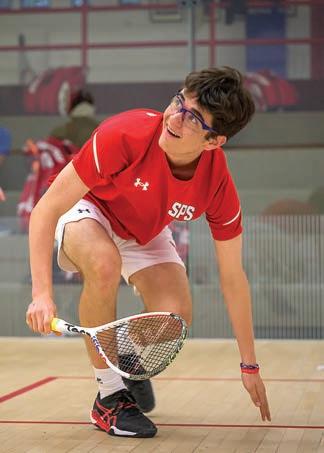

St. Paul’s School and squash have been a perfect match for more than 140 years. Now, the School is poised to take its position in the sport to the next level.
IAN ALDRICH
Above: Calla Yim ’25 and Nathan Rosenzweig ’24.
In t he fall of 2007, Chris Smith, then the men’s and women’s assistant squash coach at Harvard University, embarked on one of the most important recruitments of his young career: Will Ahmed ’08. In Ahmed, who a few months later would captain the St. Paul’s School boys squash team to its first New England Class A Championship in 18 years, Smith saw a potential anchor for his Harvard team. The fact that Ahmed had cut his competitive teeth at the oldest and one of the most prestigious high school squash programs in the country was a significant aspect of Smith’s interest in adding him to his own program.
Over the next several years, as Ahmed played for and ultimately captained the Crimson squad, Smith began to lay the groundwork for a different sort of recruitment: his own, to coach at SPS. “This wasn’t a case of me looking

Early planning is underway to construct a new state-of-the-art squash center that will be an extension of the Athletic and Fitness Center.
at five different prep schools and finding St. Paul’s to be better than the others,” says Smith, who’d previously been the founding coach of the Northeastern University squash program and head of the U.S. Junior National Team. “It was a direct target. With its amazing campus, its academics, its place among the boarding school landscape and its squash program, this is where I wanted to be.”
In the summer of 2014, Smith and his family left their lives in Medford, Massachusetts, and resettled in Millville. “Most college programs have one coach for both the men’s and women’s teams for a unified vision and that’s what I wanted to bring to St. Paul’s,” says Smith. “My whole pitch was: It doesn’t make sense for me to just work with half of the kids. Let me work with everyone and build a one-program mindset.”
In the decade since his arrival, Smith, who is head of Middle House and now the School’s athletic director, has raised the SPS program to new heights. The school’s two varsity teams are regularly among the best in the country, winning a host of New England Team Sportsmanship Awards and New England titles along the way. In 2015 and 2016, Smith was named to the U.S. Squash Top 50 Coaches list, the only high school coach to gain that honor in either year.
During that same time, Smith has also guided the modernization of the McLane Squash Courts, the school’s 10-court squash center originally built more than a century ago. The upgrades have included the addition of ball and stringing machines, bigger scoreboards, 4K live video streaming and an overhaul of the building’s audio system for drill-change announcements and all-important pump-up music for practices.
But upgrading an aging building can only take you so far, and SPS is now plotting the next era of its decorated program. Early planning is underway to construct a new state-of-the-art squash center that will be an extension of the Athletic and Fitness Center. Beyond the School’s larger mission to centralize its sports facilities, the new building’s configuration will better accommodate the growing interest in SPS squash from players and fans alike.
The timing couldn’t be better. If the necessary funding is secured over the next year, the new center is expected to come online just as squash — which was recently added to the 2028 Summer Olympic Games in Los Angeles — is preparing for its moment in the spotlight.
“We really feel good about the timing of this for St. Paul’s and for the sport in general,” says Smith. “It’s going to transform the spectator experience for us here. It’s going to change the coaching experience. And the players are going to get the best learning experience possible. There’s a level of passion for squash at St. Paul’s, including the amazing alumni who are behind the program, and we want this new center to build on that.”
Varsity Head Coach Chris Smith monitors multiple matchs at the McLane Squash Courts.

THE COUNTRY’S FIRST COURTS
The curious history of squash begins in mid-19th century London, when bored Fleet Prison inmates turned old rubber balls into whackable ovals and started experimenting with slapping one after the next against the prison yard’s towering stone walls. Versions of the game eventually migrated to other communities, most notably the Harrow School, an all-male British boarding academy founded in 1572, where students used rackets and added a growing set of game rules to the sport.
In 1881, the game arrived in Millville thanks to the efforts of The Rev. James Potter Conover, Form of 1876, a sports enthusiast who had returned to teach at his alma mater after attending Columbia University with Hyde Clark, a Harrow graduate and avid squash player. Conover’s own love of the sport propelled School leaders to build the country’s first squash facilities that year: a “Racquets Court” building near Lower School Pond where the first games were played, and to which four open-air courts were appended in 1883. As demand for the courts increased, Maurice Roche, Form of 1905, the son of an English Lord and the future maternal grandfather of Princess Diana, donated funds for the construction of a series of indoor courts along Library Road in 1915 that are today known as the McLane Squash Courts.
SPS’s early embrace of squash spawned a dominance by
alumni at the amateur ranks. Herb Rawlins of the Form of 1923, Larry Poole of the Form of 1924, Beekman Poole of the Form of 1928 and William Patterson of the Form of 1928 all won U.S. National titles — including back-toback crowns for the younger Poole in 1932 and 1933.
Over the ensuing decades, SPS has remained at the center of amateur squash. In all, the program has captured 22 New England team and individual titles. Alumni have played for some of the nation’s most elite college programs, including Harvard, Cornell, Yale, Princeton, UVA, Columbia and MIT, among others, winning three college individual national titles and seven U.S. Squash national championships.
In “A Proud Tradition,” a history of squash at SPS by professional player Rob Dinerman that tracks the program from its earliest years to Smith’s arrival, the notion of legacy figures prominently. “The members of the current St. Paul’s varsity teams are torch-bearers of an immensely proud tradition that has had, and continues to have, an enormous influence on squash as it is played and governed throughout the county and indeed the world,” Dinerman writes. “Everyone who has ever wielded a racquet while representing SPS, or who has coached and/or taught those who have, whether in the heat of a varsity meet against a prep-school arch-rival or in any other setting, has added to and enriched that tradition.”
FROM THE ARCHIVES: The balcony of the “new” Squash-Racquet Courts of 1915.
BEARING THE TORCH
As a student at St. Paul’s, Myles McIntyre ’20 appreciated the special legacy of which he knew he was part. Before matches and practices, McIntyre often stationed himself in the Waterbury Room, a wood paneled space located in the middle of the McLane Squash Courts that serves as a museum of sorts to the history of the squash program. On its walls hang team pictures and plaques that highlight the achievements of SPS players going back 11 decades.
“I would spend hours in there stretching and looking around at all the history, all those guys in tiny white shorts and tall, striped white socks with Converse shoes,” says McIntyre, who graduated in May from the University of Virginia, where he was a four-year squash player at the school and captained the squad as a senior. “That meant something to me. When you’re surrounded by the old team photos, you quickly realize the legacy that you’re playing for. It’s something that’s been there much longer than you have. You’re not just playing to beat your opponent from the other school. You’re representing St. Paul’s and what it stands for.”
It was the kind of mission that perfectly suited someone like McIntyre, who arrived at SPS in the fall of 2017 as a Fourth Former already armed with a celebrated squash career. A Massachusetts native, McIntyre learned the game at the feet of his father, flashing an early talent and focus that was only sharpened at the Union Boat Club (UBC) in Boston, one of the oldest private squash clubs in the country. There, he had been a pupil of Chris Smith, UBC’s head pro for several years.
As he progressed through different age divisions, McIntyre was at various times the number one player in the country, competing in tournaments up and down the East Coast. During the summer before his freshman year of high school, he convinced his parents to allow him to take a year off from school and tour the world as a junior professional squash player, and tournaments across Europe and in Egypt and Malaysia followed. But after eight months of steady travel, McIntyre longed for the consistency and community of everyday high school life. In the spring of 2017, he reached out to Smith about what might be possible at SPS. McIntyre was especially excited at the chance to not just reunite with his old coach, but also to play on a team.
“I had made the junior squads and the junior national teams but I was always playing as an individual player,” says McIntyre, who wants to become a Navy SEAL and is scheduled to begin the famously tough Basic Underwater Demolition/Seal School in Coronado, California, later this year. “To wear the School’s logo, to support one another and work toward something bigger than ourselves, meant something to me.”
McIntyre was the SPS team’s number-one player all three years, leading the program to a pair of top-five national finishes. His personal achievements included making the junior national teams for the Pan-American

Games and the British Open and becoming the first player in SPS history to qualify for the World Juniors squad. In 2020, he won the coveted DeRoy Sportsmanship Award, given to one female and one male high school senior in the country for their “exemplary behavior on and off the court.”
TEAM AND COMMUNITY
In recent years especially, SPS’s squash program has left its mark on college courts across the country: Over the last decade alone, 43 players have gone on to play at the college level. The lineup includes high-level recruits such as Lucy Bostwick ’14 and Lily Bogel ’14 at Middlebury College; Princeton captain Henry Parkhurst ’16; Yale University’s Jason Chu ’19; Ella Cohen ’20, a two-year captain at the University of Pennsylvania; and Sydney Bedar ’19, who captained the Cornell University squad her junior and senior years.
It also includes Nathan Rosenzweig ’24, whose career success has echoed some of McIntyre’s achievements. Before heading to UVA to play squash this fall, he was part of a US National Team to take third place at the World Junior Championships in July — only the second SPS player to make the squad. In 2022, he represented the United States in the Battle of the Border event, a high-stakes junior tournament between the U.S. and Canada.
Like McIntyre, Rosenzweig arrived at SPS as an already elite squash player, but he says the levels he reached during his three years at the School — twice named an All-American, he climbed to #5 in the country in both the U-19 and U-17 divisions — were born from the work he did in Millville. On top of the technical skills and conditioning the team emphasized, Rosenzweig says considerable attention was also paid to mental discipline and understanding how to push through tough moments.
“I developed a much more mature approach to the game,” he says. “I used to get pretty emotional at times. I’d hit an unforced error and lose my head. The work we did on being able to move on from those things, to realize it was just a single point that I lost and that there was more to play, was important. And that’s translated into other parts of my life. My mindset when it comes to
Myles McIntyre ’20
approaching anything these days is that the small things aren’t worth getting upset about. Don’t let it affect you and just continue on.”
Building that focus and mental dexterity, say current and former players, has other ripple effects as well. There’s a grounding to the practices and coaching that helps them navigate their busy high school lives.
“It keeps me disciplined,” says Calla Yim ’25, a topranked player from the Washington, D.C., area who will captain the 2024-25 girls team. “Having that schedule of going to practice or even practicing in the off-season really helps me stay motivated throughout the year.”
For Yim, the SPS squash team also offered the added benefit of helping her transition to the School when she arrived as a Third Former. Back home, few in her social circle played or even knew much about squash. At SPS, she says, her identity felt validated by the school’s longstanding embrace of the sport.
“It’s a social sport here,” she says. “It was a way for me to make friends along the way, both with people who are on the team and others who were just interested in it. I’ve had friends who’ve said to me, let’s go play, and they’ve never even picked up a racket before in their life.”
For many experienced athletes like Yim, the SPS program also represents their first significant exposure to playing as part of a team, where the outcome of an individual performance can determine whether the team continues on in a tournament or heads home. That in turn produces a special culture that fosters expectations, camaraderie and selflessness, says Shaoqian “Sam” Du ’25, while also doing the important work of lifting everyone’s game.
Du came to SPS from Shanghai as a Third Former in the fall of 2021. Within the close-knit Chinese squash community, he had risen to near the top of the ranks by the time he finished eighth grade, playing in many of the same tournaments as Rosenzweig. He joined SPS the same year as his onetime opponent for the opportunity to better integrate his serious squash training with his academics. Now argu-
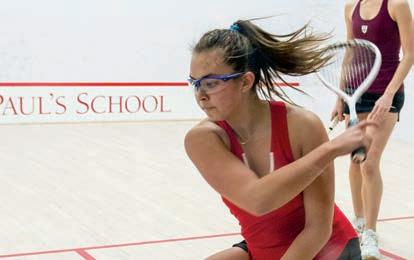

ably the best player in China in any age group, Du credits SPS for changing how he thinks about the game.
“Before coming to SPS, I only played for myself,” he says. “Playing for something that is bigger than myself motivates me to work harder on and off court. We are great friends off the court, helping each other with classes and having meals together … I think it is that support we show each other during school matches that bonds us.”
And those bonds cut across experience levels. One of the hallmarks of the SPS program is that even while it remains one of the best in the country, it also serves students who are new to the sport. As such, the lineups stay full. Today’s boys and girls teams each pack rosters of about 20 players across their respective varsity and junior varsity squads.
The number-one player on the girls squad during her four years at SPS, Sydney Bednar ’19 saw firsthand the impacts of the program’s welcoming culture. “Coach Smith’s whole thing is we are one team, the boys and girls,” says Bednar. “We travel together and we hang together. And that made it really special.”
THE NEXT GENERATION
If all goes according to plan, by the time the Summer Olympics open in Los Angeles on July 14, 2028, SPS’s new squash center will have already hosted its inaugural matches. It’s possible the facility becomes a place where athletes train in preparation for the Games, says Smith. Maybe Team USA even includes a few familiar SPS faces. In addition to Rosenzweig’s strong year for the boys team, the girls took seventh this past season, a record-high finish. This continued run and expectation of excellence is why Smith is excited about the prospect of a new squash center and what it may mean for the School’s next generation of players and its fans.
“We think a whole lot more people are going to know about squash in the coming years,” he says. “And we think a lot of people are going to know about St. Paul’s squash because of this center. The impact will be huge. We’ve got an opportunity to really build what we think will be a world-class venue that will continue the great legacy that’s been created here.”
Shaoqian “Sam” Du ’25
Sydney Bednar ’19
Miles for Miracles
At 14, Brit Marien ’12 had a medical scare that changed her life. Now she is sharing her heart with those who helped her regain her health.
JANA F. BROWN

With more than 50,000 runners commandeering the streets of New York City each fall, its namesake marathon is the largest 26.2-mile race in the world. Among the vast sea of entrants from around the globe who will gather at the starting line on Nov. 3, 2024, will be Washington, D.C., resident Brit Marien ’12.
The day will mark a significant achievement for the St. Paul’s School alumna, and one she never thought possible. First, while Marien is an accomplished athlete, she is not a distance runner. But, more significantly, the marathon will fall almost exactly 16 years to the day after Marien had surgery to repair a large hole in her heart.
As a Third Former in the fall of 2008, Marien collapsed on a run to the boat docks with the girls JV soccer team. She opened her eyes to teammates standing over her, calling her name. One of them brought her immediately to Clark House, where Marien was examined by Dr. John Bassi, the School’s medical director.
“I was convinced I was just dehydrated, and it wasn’t a big deal,” Marien recalls. “But Dr. Bassi said, ‘Wait, I think I hear a heart murmur.’ He asked me if I’d ever had any cardiac issues. I told him this was the first time anyone had mentioned this. He said he’d feel a lot better if I went for a second opinion.”
Within a few days, Marien was sitting in a cardiologist’s office at the Dartmouth Hitchcock Clinic in Concord. After undergoing a series of tests, her doctor came in and asked Marien if she wanted to hear the good news or the bad. She chose the latter first.
“He said, ‘The bad news is that you have a giant hole in your heart,’” Marien recalls, “‘and the good news is, I can get you in for open-heart surgery in the next month.’”
Though the Lincoln, New Hampshire, native was a competitive athlete who came to St. Paul’s to play varsity ice hockey, she realized after her diagnosis with atrial septal defect (ASD) — a congenital cardiac condition that features an abnormal opening in the dividing wall between the upper chambers of the heart — that she had for years felt out of breath while exercising and had always had difficulty gaining weight. What she believed was her optimal performance as an athlete was actually being significantly impacted by a condition she never knew she had.
A 17-hour surgery followed at Boston Children’s Hospital (BCHP), and four months later, Marien was back on the ice, skating and stickhandling, and playing on the varsity softball team at SPS in the spring of her Third Form year. During her surgery and recovery, Marien gained strength from the encouragement of the St. Paul’s community, learning that she was included in morning prayers in chapel, receiving visits, cards and get-well gifts from her adviser and friends. Because the surgery involved breaking Marien’s sternum, she was unable to car-
ry a backpack (“or sneeze or laugh without pain — you don’t realize how much pressure you put on your sternum on a day-to-day basis”), so her teachers allowed her to keep her books in their classrooms.
“I remember feeling really supported by the entire community,” Marien says, “and it was a very easy transition to come back. I was so eager to do so, which I think says everything about the School and the support system they had in place for me.”
Successful surgery not only increased Marien’s physical energy, but it also boosted her emotional health. Determined to expand her horizons, she signed up for a service trip to Ghana and, in her Fifth Form summer, joined the SPS Cyclists for a 3,438-mile journey from Seattle to Maine to raise money for Ride 2 Recovery, a nonprofit that helps military veterans in their rehabilitation through organized cycling events. The grueling cross-country trip was a literal and figurative test of Marien’s heart.
“ The surgery was a pretty severe wake-up call, especially hearing the doctor say I might not have lived past my 18th birthday if the condition had not been detected,” says Marien, who also served as a prefect and a student admissions officer at SPS while captaining the hockey and softball teams. “That changed my perspective as in: You have this one very short life to live, so you have to live it to the fullest.”
After completing her B.A. in political science and international affairs at the University of New Hampshire (where she co-founded the women’s club hockey team), Marien earned a master’s in security studies from Georgetown University and got a job with the Department of Defense. She now serves as the head of operations in the Intelligence and Space Division at Anduril Industries, a defense-tech startup in Washington, D.C. As part of her job training, Marien flew for three and a half hours in an F-16 fighter jet, another testament to her physical strength. “Being able to get medically certified to do that proved just how healthy my heart is, and it all comes back to my time at St. Paul’s and Dr. Bassi,” Marien says.
While seeking her most recent physical challenge, Marien decided to train for the 2024 NYC Marathon. As serendipity would have it, when she logged on to the marathon site to see which charity partners she might be able to represent, Boston Children’s Hospital was at the top of the list. “It felt like it was meant to be,” she says. Marien applied for a fundraising bib and was accepted as a member of the BCHP “Miles for Miracles” team. She is now raising $4,500 for the facility that helped to change — and save — her life.
Until the age of 14, no doctor had ever detected the heart murmur that was a potential ticking time bomb in Marien’s chest, and she remains grateful for the care she received from Dr. Bassi all those years ago. Now well into

his tenure as SPS medical director, Bassi says he remembers the day clearly when Marien came into Clark House, confused and scared by her collapse on an otherwise routine three-mile run.
“It reminds me that the care, consistency and dedication brought to small moments can yield important results,” Bassi says. “Like most physicians, I hope I can have some impact on various aspects of patient lives, and perhaps even alter one’s life for the better. The truth is, through it all, Brit is the one who did the hard work and persevered with resilience. I am so pleased to know that she is thriving and has dedicated part of her life to contributing to the betterment of others.”
Bassi further chalks up his role in the incident to “just doing what I was trained to do” but is humbled by Marien’s gratitude, and impressed by her continuing pursuit of demanding physical endeavors — this time 26.2 miles’ worth.

Third Former Marien with her younger cousin Madison at Boston Children’s Hospital following Marien’s open heart surgery.
Marien back on the ice at SPS.

ON THE TOBACCO COAST
Christopher Tilghman ’64
Farrar, Straus and Giroux, April 2024
It is the Fourth of July 2019, and at the behest of patriarch Harry Mason, the Mason family
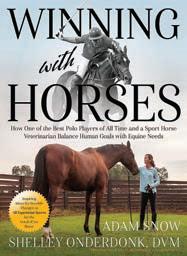
WINNING WITH HORSES
Adam Snow ’82 and Shelley Onderdonk, DVM
Trafalgar Square Books, June 2023
In the world of equestrian sports, where horses are at once modes of competition and athletes in their own right, much at-
is gathering for its annual Independence Day dinner at the family’s historic Chesapeake farm. It’s a reluctant group that has assembled at Mason’s Retreat: Harry’s wife, Kate, is recovering from chemotherapy. The couple’s adult children — Rosalie, Eleanor and Ethan — are wrestling with their own dramas that range from a troubled marriage to a stalled novel to a fraught first relationship. When the Masons sit down to their traditional meal of salmon and peas, joined by the children’s partners, a range of aging neighbors and a pair of cousins from France, it seems inevitable that the day’s fireworks will be figurative as well as literal as the family grapples not only with its present-day woes but also its complicated past.
“On the Tobacco Coast” is the fourth and final novel in a saga by Christopher Tilghman ’64 that begins with 1996’s “Mason’s Retreat” and follows the titular family across several generations, centuries and continents as it documents a history that includes Indigenous displacement and slave-owning on the thousand-acre estate. A member of the fourth

generation of his family to attend St. Paul’s School — great grandfather Benjamin Chew Tilghman was a member of the Form of 1879 — Tilghman comes by his understanding of the complex interplay between the personal and the familial, the present and the past, honestly. That Tilghman’s latest novel succeeds as a standalone as well as a satisfying conclusion to the multi-decade quartet by the professor emeritus and former Director of Creative Writing at the University of Virginia is a testament to his talent and the timelessness of the questions he considers.
— Kristin Duisberg
tention has been paid in recent years to the question of animal welfare. Is it possible to care equally about winning in sports like show jumping, dressage and horse racing and about the health and well-being of horses? For Hall of Fame polo player Adam Snow ’82 and his wife, sport horse veteri-

narian Shelley Onderdonk, the answer is an unequivocal yes that they explore in “Winning with Horses: How One of the Best Polo Players of All Time and a Sport Horse Veterinarian Balance Human Goals with Equine Needs.”
Snow and Onderdonk, who met in college, position the book as “an explicit acknowledgement that doing good for the horse is good for results in the competitive arena.”
At once a personal account and a guide for other competitive equestrians, “Winning with Horses” is the second title the pair has coauthored — a volume as much about how competitive equestrians can, and indeed must, train themselves for their horses’ welfare as about how to train their equine partners. Delving into topics that range from horsehuman communication and the cultivation of competitive mindset to the role of proper equipment for horse and rider to the veterinarian’s responsibilities as a member of an elite equestrian team, “our task is to explain our method,” they write, “and yours is to prove that it can be replicated.”
— Kristin Duisberg

SPS – then, now and always ...
John Hargate, Form of 1861, dedicated nearly 50 years to St. Paul’s School, first as a student and then as a teacher. The bequest he made of his estate will impact the place he loved forever.
As you make plans to care for all the people and places that matter to you, consider including St. Paul’s School in your estate planning.
Options for planned gifts include bequests; appreciated securities; gifts of retirement accounts; gifts of life insurance; and/or charitable income gifts, such as charitable gift annuities, charitable remainder unitrusts, or charitable remainder annuity trusts. Planned gifts of any amount qualify for membership in The Hargate Society.
To learn more about leaving a legacy at the School you love, contact Director of Leadership and Planned Giving Phillip Blackman at pblackman@sps.edu or 603-229-4781.
“WITHOUT KNOWING ALL THEIR STORIES, I THINK THE ALUMNI AND FACULTY WHO HAVE GONE BEFORE US FOUND MANY WAYS OF ABIDING WITH GOD, OF BEING WITH THE DIVINE: IN THEIR LOVE OF FAMILY. IN THEIR CONCERN FOR THE NEIGHBOR. IN THEIR CARE FOR AND NOTICING THE WONDERS OF CREATION. IN ADDITION TO RECOGNIZING AND ENJOYING THE PLACES PREPARED FOR THEM, DRAWING STRENGTH FROM AND DEEPLY VALUING RELATIONSHIPS, I THINK THEY FOUND THAT PREPARING PLACES FOR OTHERS WAS A WAY OF BEING WITH THE DIVINE, AND CONTRIBUTING TO THE WIDER WORLD.”
— THE REV. INGER B. HANSON ’99 Speaking at the Alumni Memorial Service during Anniversary Weekend, May 4, 2024

SPARKS DAY OF SERVICE
In Service to Others
In June, SPS alumni and families honored the School’s tradition of service initiatives and volunteered to clean up beaches and parks, help at food pantries and lend their support to nonprofit organizations. A special thanks to our site organizers: Tristan Besse ’02 in San Francisco; Renee Boey ’00 in Hong Kong; Valerie Frost P’26 and Kate Frost ’26 in Palm Beach, Florida; Ben Karp ’08 in New Orleans; Samantha Kerr ’08 in New York City; Dave Nelson ’80 in Decatur, Georgia; and Madeline Wang ’93, P’21 in Newton, Massachusetts.

SUMMER RECEPTIONS
Getting Together
This summer, SPS hosted gatherings across the country, from New England to California and locales in between. Thank you to all our gracious hosts who opened their homes and businesses to the SPS community.


Samantha Kerr ’08 organized volunteers in NYC’s Tompkins Square Park.
ABOVE: The Cook Scholarship Trust hosted a reception with Rector Kathy Giles in Livingston, Montana, on Aug. 5 at Glassybaby, the company owned by Lee Rhodes ’81.
BELOW: On July 28, Beth and Mark Andrews ’68 hosted a reception at their home on Fishers Island.
RECENT EVENTS
SPS in NYC
On Wednesday, July 17, more than 150 members of the extended SPS community gathered at The Yale Club for many happy reunions and to hear remarks from David Scully ’79, P’21, president of the SPS Board of Trustees, and Rector Kathy Giles.


ABOVE: Deep Ghosh ’23 (l.) and Brad Cox ’24 (r.) with Rector Kathy Giles at The Yale Club.
LEFT: Jose Maldonado ’73, P’17; Gabrielle Porter Dennison ’74; Trip Spencer ’71 and Jaymie Spencer catch up during the reception.
BELOW: The ’90s were well represented, in part by (l. to r.) Will Taft ’96; Dave Schwartz ‘96, Will McCulloch ’95; Kelsey Cummings and Kevin Cummings ’97; Sitso Bediako ’96; Carey Wagner ’96; Isaac Ro ’96 and Maria Bediako.


IN MILLVILLE AND BEYOND
SEPTEMBER
20-21 Alumni Volunteer Weekend St. Paul’s School
24 SPS College Dinner, Hartford, CT
25 SPS College Dinner, New Haven, CT
26 SPS College Dinner, New York City
OCTOBER
17 SPS College Dinner, Clinton, NY
18–19 Family Weekend St. Paul’s School
NOVEMBER
8 Alumni and Parent Reception with Rector Kathy Giles, Hong Kong
10 Alumni and Parent Reception with Rector Kathy Giles, Shanghai
12 Alumni and Parent Reception with Rector Kathy Giles, Taipei
14 Alumni and Parent Reception with Rector Kathy Giles, Seoul
DECEMBER
10 Merry and Bright Celebration St. Paul’s School
JANUARY
29 Luncheon for the Forms of 1940-1965 Harvard Club, New York
MAY
2-4 Anniversary Weekend St. Paul’s School
Visit sps.edu/events often as more opportunities to connect are added.
Follow us on social media


StPaulsSchoolNH
StPaulsSchoolAlumni


@StPaulsSchoolNH
StPaulsSchool
Many members of the SPS Board of Trustees attended, including President David Scully ’79, P’21, Amachie Ackah ’90, P’28 and Lauren McKenna Surzyn ’03.
CARING FOR PATIENTS AND PHYSICIANS
Hugh Taylor ’69 Named President of the Massachusetts Medical Society
KRISTIN DUISBERG

It was in a biology class taught by Nobel Prize-winning scientist George Wald that Hugh Taylor ’69, then a freshman at Harvard, decided he wanted to go into medicine, and during his first year at Harvard Medical School that he settled on practicing primary care. “Part of that was the idea of working in the community as opposed to in a hospital or specialty center,” Taylor explains. “I decided it was more my style of work, drawing on the concepts of social medicine and population health. That really felt to me like the way I could best contribute to the community.”
Four and a half decades into his medical career, Taylor, who has practiced as a family physician on Boston’s North Shore since 1982, has found yet another way to contribute to the community: In May, he was named
president of the Massachusetts Medical Society. The 243-year-old organization represents the state’s 25,000 physicians and medical students and owns the New England Journal of Medicine, one of the oldest and most prestigious peer-reviewed medical journals in the United States.
While Taylor still sees patients one or two days a week, as head of the state’s largest physician-led organization, the balance of his work has shifted toward advocating for both physicians and their patients — different groups with very similar concerns. “The biggest issues for patients right now are tied to the question of access to care,” he says. “Patients are having trouble finding doctors — there just aren’t enough of us around. And on the doctor side, we are trying to address the phenomenon of burnout, which includes any number of factors that make physicians decide they want to give up medicine and go do something else.”
“THE BIGGEST ISSUES FOR PATIENTS RIGHT NOW ARE TIED TO THE QUESTION OF ACCESS TO CARE. PATIENTS ARE HAVING TROUBLE FINDING DOCTORS — THERE JUST AREN’T ENOUGH OF US AROUND.”
While there are no easy answers, and there are limits to what Taylor can achieve over the course of his yearlong appointment, he sees health care policy as a powerful platform for change, whether that means working on legislation to address how primary care is paid for in the state; taking on insurance company practices that create administrative burdens
for doctors and prevent patients from getting timely care; or pushing back on employers who are overly prescriptive regarding how many patients doctors see in a day, how long they spend with each patient, what diagnoses they can make and what treatments they can prescribe. “Those are some of the factors that make it just less fun to practice,” he says. “So one of our goals is always to try to put the joy back into medical practice.’
Taylor’s own joy in medicine comes in part from continuing to care for some of the same patients that he saw when he established his Hamilton, Massachusetts, practice four decades ago, as well as from the sheer variety of the work. “In primary care family medicine,” he says, “we take care of the problems that affect people most — common infections, minor surgery ... we’re trained in dermatology and psychiatry, and we really do take care of all ages.” The patients he cares for range in age from newborn to centenarian.
There’s a parallel in Taylor’s enjoyment of the diversity of his work to what he recalls most fondly about his time at SPS. Raised in Connecticut, it was a family expectation that he’d attend boarding school (his grandfather Hugh MacColl, after whom he was named, was a member of the Form of 1903); St. Paul’s, he says, gave him the opportunity to try out activities including crew and theater that he wouldn’t have elsewhere. Roles that included serving as captain of the cross country team and president of the Library Association and the mathematics club were the first tastes of leadership experience that he drew on as a young physician establishing his own practice and still taps into today.
Next year, Taylor will become the immediate past president of the Massachusetts Medical Society, a position that will keep him involved in physician and patient advocacy, but in a somewhat less public-facing fashion. After that, he says, he might get around to retiring. “A number of my colleagues have told me that retirement’s pretty good,” he says. “So I may actually try it out.”

A VOICE FOR COLLABORATION
Mimi Steward ’83 is Making a Cross-continental Difference
JANA F. BROWN
Meeting people from all over the world was a highlight for Mimi Steward ’83, both in her years at St. Paul’s School and while studying romance languages and Latin American Studies at Harvard.
“ The more I learned about people who hailed from outside the U.S., the more I thought, ‘I want to see all this for myself,’” says Steward, who came to SPS from Washington, D.C., as a Fourth Former.
While she found her first year at SPS challenging, Steward immersed herself in School life. SPS sparked her innate curiosity, and the message she heard about making a positive impact on the world, coupled with her sense of adventure, influenced her desire to pursue international work.
“St. Paul’s taught me the best lesson,” she says, “which is that if you don’t succeed the first time, you get up, dust yourself off and try again.”
After Harvard, Steward earned a law degree from UC Berkeley and set to work applying her curiosity to her career. She took an indirect route to her current role as a senior trade advisor with the U.S. Agency for International Development, or USAID, beginning as a litigation attorney before moving on to international law at The
Hague. During a decade at the U.S. Department of Commerce working on trade remedies, Steward learned the intricacies of domestic trade practices, and realized she wanted to facilitate business relationships between U.S. and foreign companies.
Steward eventually began to focus on the prospects offered by the African Growth and Opportunity Act (AGOA), which allows African countries to export most products to the U.S. at preferential duty rates. She found the chance to help manage the specifics of those exports when she joined USAID.
Today, stationed in Kenya, Steward’s work prioritizes job creation, boosting exports and trade — particularly in the apparel industry — and supporting the private sector in East Africa. In that capacity, she facilitates economic growth by working with government agencies, private companies and donor partners to implement self-sustaining initiatives.
“I’ve always wanted to see that two-way partnership coming to life in a practical way,” Steward says. “It’s great that we have all these wonderful agreements, but I think for most people, whether you’re in Kenya or the U.S., they want to see sustainable jobs, and that’s starting to happen.”
Among Steward’s recent responsibilities has been managing a multi-million-dollar award for USAID. She describes the funding as a cooperative agreement the organization is implementing with a partner, with goals of stimulating job creation and promoting trade in the region. The award allows Steward to work with USAID in Kenya, Djibouti, Ethiopia, the Democratic Republic of Congo and Uganda.
“I focus more on the technical side of things,” she says. “How are we going to stimulate job creation? Are we going to do that through issuing smaller grants or training?”
Steward is also a voice of textile work for the African Trade and Investment Program, which boosts opportunities in East Africa. In particular, the work in Kenya entails supporting apparel manufacturers that are already preparing to export to the U.S. but may require additional funding for equipment or training. So far, Steward has fostered two-way trade partnerships between Kenya and the United States and collaborated with the government of Kenya, the U.S. Embassy and various private sector entities.
Last May, Steward witnessed the cooperative partnership between Kenya and the U.S. when a Kenyan company opened a retail store in Atlanta, Georgia. The event was attended by Kenyan President William Ruto, and the company brought with it several smaller apparel companies, an operation now creating jobs for American citizens.
“ That [partnership is] what I’ve always wanted to see, and I hope to see more of it,” she says. “There are plenty of law firms that support importers and exporters, but once you leave the continent of North America, it’s not necessarily going to make headlines. I want to leave a mark that allows people to thrive.”
The section was updated July 15, 2024. Please note that deaths are reported as we receive notice of them. Therefore, an alumni/alumna date of death and their obituary may appear in different issues.
1943 — Robert P. Kittredge April 4, 2024
1948 — George B. E. Hambleton June 27, 2024
1950 — Roy McG. Moise Feb. 25, 2024
1953 — Arthur G. Platt Aug. 4, 2023
1954 — Edward P. Bromley Jr. May 24, 2024
1955 — W. Lytle Nichol IV June 24, 2024
1956 — John Wilmerding June 6, 2024
1957 — George Cadwalader May 4, 2024
1958 — H. P. Baldwin Terry Jr. May 6, 2024
1959 — Edmond D. Johnson April 11, 2024
1960 — Ford B. “Pete” Draper Jr. June 22, 2024
1960 — Boardman Lloyd May 17, 2024
1961 — Peter Price Britton April 26, 2024
1962 — Harold E. Moore Jr. Jan. 17, 2024
1981 — Fergus Reid IV April 26, 2024
2001 — Paul J. Wright May 3, 2024
OBITUARY SUBMISSIONS
The Alumni Horae will reprint obituaries that have been previously published elsewhere or written in traditional obituary format and submitted directly to us. We encourage you to reach out to alumni@ sps.edu to submit an obituary but may contact you if we do not hear from you first. Obituaries may be edited for length and style and will appear in the next possible issue of Alumni Horae.

Robert P. Kittredge ’43
passed away peacefully on April 4, 2024, in Fort Worth, Texas, surrounded by family. Kit personified America’s Greatest Generation with a life of service to his community, entrepreneurial success and love of family.
The only child of Francis B. Kittredge and Mary Peebles of Bellevue, Pennsylvania, Kit’s childhood emphasized a good education above all. He spent his early years at the Fessenden School before arriving at St. Paul’s School in 1939, where he was involved with Horae Scholasticae and Der Deutscher Verein; rowed for Shattuck; and competed in baseball, football and ice hockey for Old Hundred. Summers with his grandparents at Kittredge Farm in North Andover, Massachusetts, provided the work ethic that only a farm can.
World War II interrupted Kit’s studies at Dartmouth College with a stint in the Marines learning Japanese. Post-war, he decided to try his hand in the Midwest to be “a big fish in a small pond,” finishing college on the GI Bill at the University of Michigan. There, he met Sallie Stevens from Owosso, Michigan; they married in 1950, raised four children in Kalamazoo and attended St. Luke’s Episcopal Church.
Kit worked for U.S. Rubber, where his sales territory provided post-war opportunity and fun in Chicago and Detroit. Noticed for his leadership skills, investors asked 25-year-old Kit to take over a foundering start-up plastics company. It became Fabri-Kal Corporation and grew to be the third-largest privately held thermoforming enterprise in the United States, sold with his blessing in 2021 after a 71-year-run. The iconic utterance of “Plastics!” from the 1967 film “The Graduate” was invoked hundreds of times over the years. In his 90s, Kit would regale his listeners with his good fortune at having been born during the 50 greatest years for American manufacturing. An eternal optimist with strong views, he
never failed to listen to differing points of view on any subject, sometimes morphing his own opinions as a result. His children and grandchildren marveled at this rare trait.
Kit lived his philosophy of keeping America strong through education by creating the Fabri-Kal Foundation in 1968 to provide college educations for his company’s employees. Two-plus generations of his employees’ children have directly benefited from this program, for which he was inducted into the Plastics Hall of Fame in 2012. He served as chair of The Michigan Chamber of Commerce, Bronson Hospital and The Society of the Plastics Industry and on the boards of The Gilmore, Kalamazoo College, First America Bank and other local nonprofits.
Driving only sports cars in British racing green with tan interiors, Kit drove in any Michigan winter weather. Coaching his sons’ hockey teams gave him great joy, as did following his daughters’ pursuits as students at St. Paul’s School. Before Title IX had a name, he advocated for equality in sports, and later rallied his fellow SPS girls crew parents to support the opportunity for the first varsity boat to compete in the 1976 National Rowing Championship in Long Beach, California — which they won, with Kit’s daughter Marny ’76 rowing in the second seat. He skied until the age of 82 from the family condo in Park City, Utah, reaching his goal of free skiing at age 75, and remained an avid tennis player into his 80s.
Kit met his second wife, Trisha, at a potluck in 1990, and she instantly became the love of his life. They traveled together and spent many happy winters on Treasure Cay in the Bahamas, golfing daily, attending The TC Community Centre Church and chairing the Corbett Medical Clinic board. Kit’s family is so grateful for the love Trish heaped on him for 33 years.
Kit is survived by Trisha, of Fort Worth, Texas; children Rob (Deb) Kittredge of Vicksburg, Michigan; Nan ’74 (Sid) Stockdale of Oakley, Utah; Marny ’76 (Keith) Kittredge of Quilcene, Washington; John (Lani) Kittredge of Richland, Michigan; stepchildren Jennifer (Murat) Kamacioglu of Fort Worth, Texas, and Clay (Amy) Ellwood of Boulder, Colorado; nine grandchildren, three step-grandchildren and seven great grandchildren.

Richard L. Duckoff ’52 of Manchester, New Hampshire, passed away peacefully on March 8, 2024, at the Community Hospice House in Merrimack after a period of declining health. Born and raised in Manchester, he was the son of the late Maxwell E. Duckoff and Florence (Perkins) Duckoff.
Dick attended Webster Elementary School and graduated from St. Paul’s School in 1952, Williams College in 1956 and Boston University School of Law in 1961. At SPS, he was a member of the Glee Club, played baseball and boxed.
After an early career of law practice, Dick turned his focus to issues of social justice and activism. He was intent on contributing his talents and energy to improving the quality of life for citizens in whatever way he could. This led him to engage in an extraordinary life of selfless commitment to the residents of Manchester and throughout New Hampshire.
Dick was a passionate advocate for the underprivileged in the areas of affordable housing and tenants’ rights. His desire to encourage and support others was reflected in every aspect of his life. Once referred to as “the standard-bearer of the little guy,” Dick’s influence was farreaching. He was the co-founder and president of New Hampshire Habitat for Humanity, chair of the board of Manchester Neighborhood Housing, a board member of The Way Home, a co-founder of the North End Neighborhood Association and a co-director of the Queen City Tenants Association. He also was a member of the New Hampshire Citizens’ Action Committee and the Low-Income Housing Network and served on various committees of NeighborWorks Southern New Hampshire. He was instrumental in the passage of the Just Cause Eviction Statute and the Certificate of Compliance Ordinance in Manchester.
Dick was a longtime trustee of the Manchester Historic Association and developed several historic walking tours with his associates that focused on the history of Manchester’s downtown, North End and cemeteries. He
was involved with the now-defunct Friends of the Valley Cemetery and succeeded in preserving a section of Saint Augustine Cemetery that was nearly lost. His thorough work in the field of history and his service memberships helped build the community through a shared culture and sense of continuity.
As a former vice president and long-time supporter of the Friends of Stark Park, he solicited funds and booked the bands for the Stark Park summer concert series.
Dick was a current associate member of the Sons of Union Veterans of the Civil War, W.W. Brown Camp #1, Manchester. Past memberships include the Grand Lodge of New Hampshire, Free and Accepted Masons, the New Hampshire Society Sons of the American Revolution and Queen City Rotary Club.
Dick’s service to his community left an impression on all who knew him. His recreational activities included playing ragtime piano, attending jazz concerts, educating others about the history of Manchester, doing research at local libraries and, in recent years, traveling in the Midwest.
Dick is survived by his devoted wife of 36 years, Diana; daughters Missy Susag of Edina, Minnesota, Anne Morciszek (Henry) of Irvington, New York, and Mary Ellen Aull (Luke) of Leesburg, Virginia; beloved granddaughter Lauren Spotkov Johnson (Ryan) of Brightwaters, New York; stepdaughter Carole Beekman of Clarksville, Tennessee, and other family members. He was predeceased by his stepdaughter Cheryl Beekman Tobin. He also leaves many close and cherished friends, including Manchester historian and collaborator John Jordan and fellow jazz aficionado Jim Townsend.

John Wilmerding ’56
a prolific author, esteemed professor, avid collector, generous philanthropist and luminary in the history of American art, passed away on June 6, 2024, at the age of 86. The son of John C. Wilmerding of the Form of 1930 and Lila
Vanderbilt Wilmerding, John was born in Boston and matriculated to St. Paul’s School as a Second Former in the fall of 1951. Attending SPS at the same time as two of his cousins, John was a member of the choir, the Library Association, the Cadmean-Concordian Society, the Shavian Society and the debate team. He served as editor of Horae Scholasticae and was named to Phi Beta Kappa. He also rowed crew and played soccer.
John received his bachelor’s degree from Harvard University in 1960. He returned to SPS that summer to serve as a teaching intern for the then-new Advanced Studies Program before going on to earn his master’s degree and his Ph.D. in American Art from Harvard.
After receiving his doctorate in 1965, John taught at Dartmouth College for 12 years, and then spent 11 years at the National Gallery of Art in Washington, D.C., first as a senior curator of American art and later as the museum’s deputy director under J. Carter Brown. In 1988, he became the inaugural Christopher Binyon Sarofim ’86 Professor of American Art at Princeton University, a position he held until 2007.
Always an art enthusiast, John had begun to collect American art as an undergraduate at Harvard, and by 2004, he had assembled a world-class collection of 51 paintings and drawings by American Masters that included Fitz Henry Lane, George Caleb Bingham, Winslow Homer and Thomas Eakins. In May 2004, at the National Gallery of Arts opening of the exhibition “American Masters from Bingham to Eakins: The John Wilmerding Collection,” John announced that the collection would remain in perpetuity at the National Gallery, a significant gift to the nation.
In 2016, Alice Walton and the Walton Family Foundation granted $10 million to the National Gallery of Art to establish the John Wilmerding Fund for Education in American Art in honor of John’s contribution to the National Gallery and to art history. In Ms. Walton’s words, “John has inspired generations of museum visitors to appreciate American art, and his contributions to the field are immeasurable and enduring. He was an insightful teacher, a trusted adviser and simply a dear friend who helped me explore American art more broadly and create a new museum. John’s impact in establishing Crystal Bridges Museum of American Art was enormous, and I cherish our time working together.”
John wrote numerous books and articles that helped define the nature of American art, a field that had been long neglected by scholars and collectors. In addition to his long teaching career, he served as a board member at many museums, some of which honored him by naming directorships and fellowships in his name. Among those institutions is the Shelburne Museum in Shelburne, Vermont, which established the John Wilmerding Directorship Fund, its first named position. A grandson of the museum’s founder, Electra Havemeyer Webb, John served as president of the board of trustees and as honorary chair of the campaign for Shelburne Museum.
John’s additional honors included being named emeritus professor of American Art at Princeton University; member of the Committee for the Preservation of the White House; chair of the board of trustees of the National Gallery of Art; trustee of the Guggenheim Museum; commissioner of The National Portrait Gallery; visiting curator in the Department of American Art at the Metropolitan Museum; senior curator of American Art at the National Gallery; member of the board of the Wyeth Foundation for American Art; board member at the Smithsonian Museum and Monticello and a trustee of the College of The Atlantic in Bar Harbor, Maine.
Following the donation of his collection of American art to the National Gallery, John started to collect pop art — an interest since his Dartmouth days. That collection was bequeathed to Princeton University.
John is survived by his sister, Lila Wilmerding Kirkland, and her husband, David Kirkland; a brother, James Watson Webb Wilmerding; three nieces and three nephews. John had homes in Northeast Harbor, Maine, and New York City. His enduring connection to SPS included membership in the Hargate Society and a remarkable 48-year streak of giving to The SPS Fund.
John Wilmerding was an inveterate and tireless hunter of antiques, a man of letters with great intellectual curiosity and a dry sense of humor, and a loyal friend with a capacity for joy and generosity. All who knew him regret his passing.

George Cadwalader ’57
died peacefully on Saturday, May 4, 2024, at the age of 84 at his home in Woods Hole, Massachusetts, surrounded by friends and three generations of family. He was born in Philadelphia on May 10, 1939, to Captain John Cadwalader of the Form of 1928, USNR (ret.) and Beatrice D’Este Penrose Cadwalader.
George entered St. Paul’s School in the fall of 1953. During his time at SPS, he was a member of the Student Council, Cadmean Literary Society, Pelican board and Missionary Society and served as a student supervisor in Lower. He played football for Old Hundred, served as the captain of the boxing team and rowed for Shattuck.
Following St. Paul’s, George attended Yale University, rowing crew and graduating in 1961 with a degree in history.
George completed Marine Corps Officer Candidate School during his undergraduate studies and earned his commission upon graduation. He served as an infantry officer until 1970, when he was medically retired due to combat injuries sustained in Vietnam. His military assignments included serving as the executive officer of the Marine Detachment aboard the USS Randolph, a reconnaissance company commander, an advisor to South Vietnamese Marines, and a member of the faculty at the U.S. Naval Academy. His decorations included the Purple Heart, the Vietnam Service Medal and the Vietnam Campaign Medal.
In his return to civilian life, George worked first at the Woods Hole Oceanographic Institute in Massachusetts and then, in 1973, he established the Penikese Island School, a wilderness-based program for teenage boys referred to the juvenile justice system. He led the school for 23 years and described his experiences in his book, “Castaways: The Penikese Island Experiment.” He then worked as a commercial lobsterman
until 2012 aboard his lobster boat, the F/V Frannie Cahoon.
George was passionate about boats in general and sailing in particular. In 1969, he and his lifelong friend Duncan Spencer sailed their CAL-20 sailboat, Nimbus, from Newport, Rhode Island, to Crookhaven, County Cork, Ireland. Their 29-day passage set a record for a transatlantic crossing in a boat under 20'. Later, he spent several years rebuilding Westflight, a 40'-Gauntlet class wooden sailboat built in 1948 by the Berthon Boat Company in Lymington, England, that provided many happy memories to George and his family.
In addition, George possessed a deep love for the English language, which expressed itself in everything from humorous poems for family to treatises on complex subjects. His articles, stories and essays appeared in publications ranging from Science to WoodenBoat and Cycle World magazines.
George was predeceased by his parents; his stepmother, Lea Aspinwall Cadwalader; and his brother, John ’56. He is survived by his wife of 55 years, Yara; his sons, George Jr. and Thomas; his daughters-in-law, Lisa and Karen; his grandchildren, John, Robert, Caroline, Catherine and Courtney; his brothers, David and Gardner; and his sister, Sandy.

Boardman Lloyd ’60
a thoughtful, kind and loving husband, father, grandfather and friend as well as a trusted and wise lawyer, died on May 18, 2024, at Fox Hill Village in Chestnut Hill, Massachusetts. He was 82.
B oardy was born on January 8, 1942 (a birthday he shared with Elvis, which always made him smile) in Concord, New Hampshire, the third of Elisabeth Boardman Lloyd and Francis Vernon Lloyd Jr.’s four children. He was raised on the St. Paul’s School campus, as his father taught English
and was the vice rector from 1935 to 1957. Boardy attended Millville School and started First Form at SPS in 1954. He attended the Institut Le Rosey in Switzerland for Second Form and returned to SPS to graduate in 1960. Boardy loved skating and gliding about the pond for Isthmian and played forward wing on the varsity hockey team. His children grew up hearing tales of black ice days and the horses Jack and Jill, who pulled the zamboni on Lower School Pond; his younger sister Molly fondly recalled skiing down the hill past Middle from their faculty house to skate. He rowed for Halcyon, was captain of SPS crew and competed at Henley his senior year in the first eight boat. He also was a member of the Glee Club and Le Cercle FranÇais.
B oardy attended Yale, where he continued to play hockey and row, graduating in 1964. He graduated from the University of Chicago Law School in 1967 and later passed the bar in New York and Massachusetts. He first worked at Casey, Lane & Mittendorf in New York City and then Choate Hall & Stewart in Boston, where he became a partner. He later became a partner in Harris and Lloyd in Cambridge, where he stayed until his retirement.
A naturally gifted and humble athlete, Boardy could pick up virtually any sport he tried — golf, paddleball, tennis, ping-pong and later curling. He loved skiing with his daughters and always had a Toblerone bar and a navel orange stashed in a pocket to share on the lift. Sailing was his joy both as a competitive sport and pastime. He grew up sailing on Cape Cod’s Bass River. He learned to race in his Beetle Cat, the Vite Vite, and then graduated to the family Wianno Senior, a 25' gaff-rigged sloop called Pertelote. He was a brilliant sailor and wind wizard — he could make a boat go on the stillest of days and find just the right heel. Boardy was an instrumental part of the Wianno Association team that designed the fiberglass Wianno Senior, thereby ensuring the future of the boat class. Many trophies later, he delighted in teaching his daughters to race and spent his later years cruising on Nantucket Sound with his wife Lyn — and often his grandchildren — on his sailboat Tashtego and later Owera. One of his favorite quotes from Kenneth Grahame’s book “The Wind in the
Willows” said it all for him: “There is nothing — absolutely nothing — half so much worth doing as simply messing about in boats.”
His family remembers his twinkling dark blue eyes, and that he loved salty snacks and all lemon desserts. His maxim to order one more dessert than there are people at the table continues to be a tradition his grandchildren love to uphold. He was a graceful dancer and loved to sing, finding harmony whenever he could while singing along to his favorites, including the Beatles, Beach Boys and Everly Brothers.
Boardy is survived by his wife, Lyn Conforti Lloyd; his daughters from his marriage to Barbara Lloyd, Pamela Boardman Lloyd ’86 (Renny Gleeson) and Emily Lloyd Shaw ’90 (Simon Shaw); grandchildren Jasper Gleeson, Rufus Gleeson, Sophie Shaw and Willow Shaw; his brother Francis Vernon Lloyd III ’55 (Lida Thompson Lloyd); sister Mary Emlen Lowell Lloyd Zaragoza (Joseph Zaragoza); stepchildren Andralyn Farro (William Ominsky) and Jay Farro (Dalia Ashurina); and step-grandchildren Matthew Farro and Dylan Ominsky. He was predeceased by his brother Malcolm Lloyd and daughter Amy Lloyd. He is dearly missed.

was born in Omaha, Nebraska, on the longest day of the year, and this might have contributed to his sunny optimism and boundless enthusiasm. “Tomorrow is a new day, make it what you want it to be,” he often said. He loved skiing with his family in Aspen and spending summers at Lake Miltona, Minnesota. He was an outdoors person and a waterfowl and upland game hunter as well as a committed conservationist.
Bruce entered St. Paul’s School as a Fifth Former in the fall of 1959 and was a member of the Concordian Literary Society, the Debate Team, the Rifle Club and La Junta.
He also played football, hockey and lacrosse for Old Hundred. As an alumnus, he served as a form agent and as a regional representative. His grandfather, Thomas L. Davis, was a member of the Form of 1900.
Bruce graduated from Princeton in 1965 and joined the Class of 1967 at Darden Business School at the University of Virginia. On his way back from Princeton to Omaha, he stopped in Chattanooga, Tennessee, where he met Kimball Bowles. They married the following year. Since Chattanooga is anything but on the way from Princeton to Omaha, he must have had a premonition. Kim and Bruce had three children: Margaret Lauritzen Dodge ’86, Blair Lauritzen Gogel and Clarkson Davis Lauritzen. Kim died in 2008; in 2011, Bruce married Gerry Morrow, who survives him.
Upon his graduation from Darden in 1967, Bruce joined the largely family owned First National Bank of Omaha. Twenty years later, he became president. The bank grew from $1 billion in assets and a few branches to $30 billion in assets and more than 100 branches in seven states as well as a national credit card portfolio. Bruce handed the reins to his son Clark in 2017. FNBO, as it is now called, is one of the largest family-owned banks in the United States. Formed shortly after Bruce’s ancestors arrived in Nebraska on July 4, 1854, it is also one of the longest tenured. At the Lauritzen Companies, he assembled a collection of 10 “country banks” in Nebraska and Iowa.
In the 1990s, the bank faced an expansion decision that could have gone to the suburbs, but with the encouragement of Omaha Mayor Hal Daub, Bruce committed to build a 45-story headquarters downtown, which served as a magnet for others and made a much-needed contribution to the revival of the central business district. In addition to the bank headquarters, Bruce created a series of parks featuring Western themes, including largerthan-life sculptures of pioneers, covered wagons, geese and buffalo.
In 2001, Bruce reigned as King of Ak-SarBen (Nebraska spelled backward). The title is an annual honor conferred in recognition of civic contributions in Omaha; his included board memberships at Clarkson Hospital, Nebraska Medical Center, Creighton University in Omaha, and Darden. He was consistently
Bruce R. Lauritzen ’61
and deeply involved in the Episcopal Diocese of Nebraska, and he served as honorary consul of Denmark, his family’s country of origin.
Bruce was a raconteur who, despite favoring the words “to make a long story short,” loved making a long story a little longer. St. Paul’s School encourages its students to serve their communities, and he emphatically did so. He left every campsite better than he found it.

James C. Gibbons ’65 passed away peacefully in his sleep on Jan. 10, 2024, after fighting for five years through a succession of operations and hospitalizations, for the most part complications of stepping on a nail.
He is survived by his wife and best friend of almost 53 years, Judy; three children, David (Kate) Gibbons, Jorie (Ryan) Widener and Wendy Gibbons; and three granddaughters, Brooke Gibbons, Madeline Widener and Eloise Widener. He was predeceased by a fourth granddaughter, Paige Gibbons.
Raised on the East Coast, Jim — “Gibbo” to some — came to St. Paul’s School as a Second Former in the fall of 1960. He was involved in the Library Association, Cadmean Literary Society, the Acolyte Guild, the Missionary Society, various choral groups, The Pelican, and drama and theater. He also served as a proctor and a prefect. An Old Hundred, he participated in boxing and football and rowed for Shattuck, also serving as the boat club’s treasurer.
Jim attended Amherst College, where he was a member of Psi Upsilon. After graduation, he served in the Army National Guard for six and a half years, then returned to school at New York University to earn his MBA and pursue a career in finance. He spent the majority of his career with Citibank and J.P. Morgan.
As an oil analyst, Jim’s career took him around the globe, but the center of his world was his family in New York. He and Judy married young, survived a tiny Manhattan apartment and five years in Buffalo (the banking equivalent of Siberia?) and raised their three children in Cold Spring Harbor.
Wherever he traveled, Jim’s soul remained with Judy and the kids, and he always spoke with pride of both their successes and their challenges. He had the perspicacity to see viable solutions to family members’ problems and the wisdom to allow them their mistakes as well as their triumphs.
During the last few years, Jim endured physical challenges, and his life necessarily became more sedentary, though it still took him from his home base in Williamstown, Massachusetts, to Sanibel, Florida, in winter and to Castine, Maine, in summer. Unable to remain active, Jim immersed himself in books, articles and television. His friends and family remember him fondly as a wonderful conversationalist with an extraordinary sense of humor and a habit of serving up insights that often expanded their own understanding and stimulated their imagination.

Hon. Gordon McG. Strauss ’65 passed away on March 10, 2024, age 77, due to acute myeloid leukemia.
He was born in Cincinnati, Ohio, to Victor and Dana (Maher) Strauss and grew up in the Indian Hill suburb of Cincinnati.
At St. Paul’s School, Gordon was part of the Maroon Key, an organization that, among other activities, was responsible for entertaining visiting athletic teams. He lettered in football, boxing and lacrosse; in the mid ’60s, they would have said he “liked to hit.” Lacrosse, which he learned to play at St. Paul’s, was his favorite sport; one of his fondest memories of his time at the School
was playing for one of the very best teams in New England during his Sixth Form year.
After Gordon attended Brown University, he spent three years on active duty as an officer in the United States Marine Corps, including a year in Vietnam. For his service there, he was awarded a Meritorious Bronze Star.
Following his military service, Gordon earned his law degree from the University of Cincinnati, and he practiced law for most of the next 40 years. The first part of his career was devoted to electoral politics and his first job was working for the general counsel to the Republican National Committee. After that, he represented candidates and political organizations both in Cincinnati and in Washington, D.C. As general counsel to the Ohio Republican party, he traveled to South Africa a month before Nelson Mandela was elected, one of four lawyers who educated 24 new political parties about their country’s new constitution and how to teach their members how to vote. During this time, he also was named parliamentarian for the Committee on Rules and Order of Business and served in four Republican National Conventions. The second part of his career was spent in Hamilton County, Ohio. He retired as a magistrate in Probate Court.
Upon retirement, Gordon reinvented himself for farm life, becoming an exemplary handyman and farmhand. He especially enjoyed the chickens, goats and horses, as well as any tractor work.
Gordon enjoyed serving others and was active in Episcopal churches wherever he lived. Helping young people succeed was his passion, and to that end he was involved with acolytes programs, taught Sunday school, tutored young students in after-school programs and cofounded the Hamilton County Juvenile Detention Center Ministry.
Gordon is survived by his wife, Julie Burdick; his son Kayser (Keiko) Strauss; and his grandchildren Ayleen, Oren, Ryan and Brennan. He was predeceased by his son Joshua Morton Strauss.
The

THE SPS FUND
There’s something very important members of the Form of 2024 would like to say on behalf of the entire St. Paul’s School community to the alumni, families and friends who made a gift this year, and that is thank you. They know their SPS experience wouldn’t have been the same without your belief in them and in the power of an SPS education.
Your tremendous example of generosity inspired them to give back, too — 100% of the form made a gift to the School in FY24.
Their gifts were among the 4,628 that collectively contributed more than $7.5 million toward funding the people, places and programs that define the SPS experience. We are so grateful for your support!

HEAR FROM MEMBERS OF THE FORM OF 2024 AS THEY EXPRESS THEIR APPRECIATION FOR YOUR GENEROSITY IN THEIR OWN WORDS.
Alumni Horae
St.
Paul’s School
325 Pleasant Street
Concord, NH 03301-2591
