News
Wednesday, May 4, 2016
Conestoga Ethics Bowl team ranks top ten nationally Cissy Ming Staff Reporter Describing her experience over two days at the National High School Ethics Bowl Competition, junior Jill Sharples says it “completely changed my view of the world” and “will affect (the team) for the rest of our lives.” From April 15-16, seven members of Conestoga’s Ethics Bowl team traveled to the University of North Carolina, Chapel Hill to present solutions to pressing ethical questions in competition with 23 of the nation’s top teams. Though the full rankings are unavailable, Ethics Bowl adviser John Koenig estimates the team’s final ranking at fifth or eighth place. In preparation for the competition, seniors Tyler Soutendijk, Evan Snyder and team captain Liz Lawton worked with juniors Jill Sharples, Caleigh Sturgeon, Will Youman and Daden Goldfinger to discuss the moral underpinnings of each case and create a persuasive argument for their point of view. Koenig attributes the team’s success to their teamwork, consigning himself to an advisory role. “The teams we had this year and in particular the team we had at na-
tionals worked exceptionally well together, as thinkers and in terms of accounting for each other’s ideas,” Koenig said. “In all moments, (they were) with charity to each other with recognition that they were all working towards the same goal. My job was just to facilitate the process.” The team members who participated in nationals at Chapel Hill represent the most outstanding competitors, as judged by Koenig and co-adviser Katie Buckley from an entire season of work. Throughout the school year, members of Ethics Bowl and philosophy club met in Koenig’s classroom to discuss the controversies covered by each case, considering various philosophies and the stakes for all parties. On Nov. 21, fourteen members of Ethics Bowl, divided into two groups, competed in the Delaware Valley Regional Bowl at Villanova University. Sharples’ team placed first out of 14 teams present while the second team placed within the top five. After the teams’ performance, Conestoga qualified for the National Bowl, since the finalists in each “large bowl” feed directly to the top level of competition. Though nobody who participated expected to advance to nationals, Koenig believes the team never-
Courtesy John Koenig
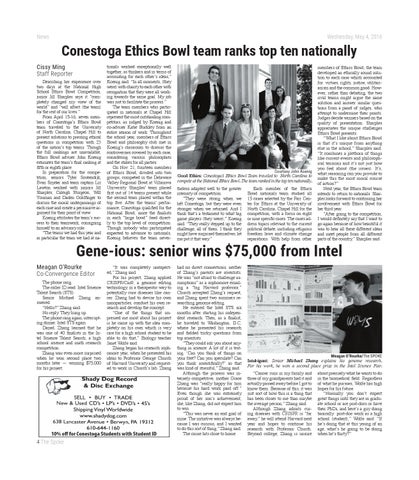
Good Ethics: Conestoga’s Ethics Bowl Team traveled to North Carolina to compete at the National Ethics Bowl. The team ranked in the top ten nationally. theless adapted well to the greater intensity of competition. “They were strong when we left Conestoga, but they were even stronger when we returned. And I think that’s a testament to what big game players (they were),” Koenig said. “They really stepped up to the challenge, all of them. I think they might have surprised themselves, let me put it that way.”
Each member of the Ethics Bowl nationals team studied all 15 cases selected by the Parr Center for Ethics at the University of North Carolina, Chapel Hill for the competition, with a focus on eight or nine specific cases. The cases address topics relevant to the current political debate, including religious freedom laws and climate change reparations. With help from other
members of Ethics Bowl, the team developed an ethically sound solution to each case which accounted for virtues, rights, justice, utilitarianism and the common good. However, rather than debating, the two rival teams might argue the same solution and answer similar questions from a panel of judges, who attempt to undermine their points. Judges decide winners based on the quality of presentation. Sharples appreciates the unique challenges Ethics Bowl presents. “What I like about Ethics Bowl is that it’s unique from anything else in the school,” Sharples said. “It combines a plethora of things like current events and philosophical tensions and it’s not just how you feel about (the issues). It’s, what reasoning can you provide to make this the most moral course of action?” Next year, the Ethics Bowl team intends to return to nationals. Sharples looks forward to continuing her involvement with Ethics Bowl for her third year. “After going to the competition, I would definitely say that I want to go again because of how beautiful it was to hear all these different ideas and meet people from all different parts of the country,” Sharples said.
Gene-ious: senior wins $75,000 from Intel Meagan O’Rourke Co-Convergence Editor The phone rang. The caller ID read: Intel Science Talent Search (STS). Senior Michael Zhang answered. “Hello?” Zhang said. No reply. They hung up. The phone rang again, interrupting dinner. Intel STS again. Dazed, Zhang learned that he was one of 40 finalists in the Intel Science Talent Search, a high school science and math research competition. Zhang was even more surprised when he won second place two months later — winning $75,000 for his project.
4 The Spoke
“It was completely unexpected,” Zhang said. For his project, Zhang applied CRISPR/Cas9, a genome editing technology, in a therapeutic way to potentially cure diseases like cancer. Zhang had to devise his own nanoparticles, conduct his own research and develop the concept. “One of the things that impressed me most about his project is he came up with the idea completely on his own which is very rare for a high school student to be able to do that,” Biology teacher Janet Wolfe said. Zhang began his research sophomore year, when he presented his ideas to Professor George Church of Harvard University and requested to work in Church’s lab. Zhang
had no direct connections; neither of Zhang’s parents are scientists. He was “not afraid to challenge assumptions” as a sophomore emailing a “big Harvard professor.” Church accepted Zhang’s request, and Zhang spent two summers researching genome editing. He entered the Intel STS six months after starting his independent research. Then, as a finalist, he traveled to Washington, D.C, where he presented his research and fielded tricky questions from top scientists. “They could ask you about anything in science. A lot of it is testing, ‘Can you think of things on your feet? Can you speculate? Can you think scientifically?’ so that was kind of stressful,” Zhang said. Although the process was intensely competitive, mother Grace Zhang was “really happy for him because his hard work paid off.” Even though she was extremely proud of her son’s achievement, she, like Zhang, did not expect him to win. “This was never an end goal of mine. The initiative was always because I was curious, and I wanted to do this sort of thing,” Zhang said. The cause hits close to home.
Meagan O’Rourke/The SPOKE
Intel-igent: Senior Michael Zhang explains his genome research. For his work, he won a second place prize in the Intel Science Fair. “Cancer runs in my family and three of my grandparents had it and actually passed away before I got to know them. Because of this, it was just sort of how this is a thing that has been closer to me than maybe the average person,” Zhang said. Although Zhang admits curing diseases with CRISPR is “far away,” he will attend Harvard next year and hopes to continue his research with Professor Church. Beyond college, Zhang is unsure
about precisely what he wants to do in the biomedical field. Regardless of what he pursues, Wolfe has high hopes for his future. “Normally you don’t expect great things until they are in graduate school or are post-docs or have their PhDs, and here’s a guy doing basically post-doc work as a high school (student),” Wolfe said. “If he’s doing that at this young of an age, what’s he going to be doing when he’s thirty?”