‘Taking Care of You’ A8
ST. LOUIS AMERICAN • MARCH 7 – 13, 2024
SSM Health provides doula support to area hospitals
What to know about young adult colorectal cancer
By Dr. Graham A. Colditz Siteman Cancer Center
“The model we have created is that of collaboration, we are incorporating doulas as a part of our health care team. They are vital to the services we provide to our patients,” said Dr. Carolyn Proyor MD, FACOG, SSM Health Medical Director for St. Louis Maternal Services. “We help patients learn how to advocate for themselves and educate them about the birthing journey pre-hospital,” said LaKisha Redditt, CHW-C, Doula Dr. Pryor said, “Community-based doulas are vital to addressing health disparities.” According to the health medical director, community-based
We’ve seen great progress in the fight against colorectal cancer. While it’s still one of the most common cancers in the U.S., annual rates of new cases have dropped by nearly half since the mid-1980s. More recently, though, there’s been a concerning increase in colorectal cancers in adults under age 50, with the rates appearing even higher among African American persons and residents of the South. And it’s unclear why. “That’s the million-dollar quesDr. Graham tion,” said Dr. Will A. Colditz Chapman Jr., an assistant professor at Washington University School of Medicine in St. Louis who specializes in colon and rectal surgery. “Though many people are working on the issue, we have not yet developed a clear understanding of what is driving cancer development in younger adults,” he said. “There n Screening certainly can find cancer are some suspects earlier when it’s – for example, diets higher more treatable. in processed foods and/or low in fiber, hormone changes related to obesity and diabetes or changes in the healthy bacteria living in the gut.” While the exact causes of younger adult colorectal cancer are still being studied, we do know some key steps can help protect against the disease. No. 1 is to get recommended screening tests. Screening can find cancer earlier when it’s more treatable. It can also help prevent colorectal cancer in the first place, by finding and removing growths that could become cancerous. Most people should get screened starting at age 45, and those at increased risk may need to start earlier and be screened more often.
See DOULA, A9
See COLDITZ, A9
Photo by Wiley Price / St. Louis American
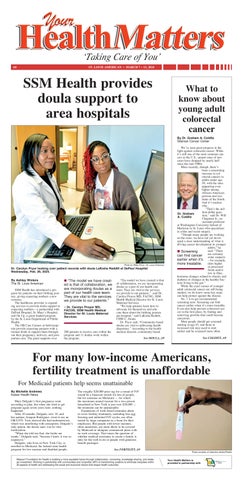
Dr. Carolyn Pryor looking over patient records with doula LaKisha Redditt at DePaul Hospital Wednesday, Feb. 28, 2024. By Ashley Winters The St. Louis American SSM Health has introduced a program for patients on their birthing journey, giving expecting mothers a new resource. The healthcare provider is expanding services to provide doula support to expecting mothers—a partnership with DePaul Hospital, St. Mary’s Hospital, and On Up, a grant-funded program by the St. Louis Department of Public Health. The OB Care Centers at both hospitals provide expecting patients with a trained doula to support them throughout their pregnancy, delivery, and postpartum care. The grant supports over
n “The model we have created is that of collaboration, we are incorporating doulas as a part of our health care team. They are vital to the services we provide to our patients.” – Dr. Carolyn Proyor MD, FACOG, SSM Health Medical Director for St. Louis Maternal Services
200 patients to receive care within the program and 11 doulas work within the program.
For many low-income Americans, fertility treatment is unaffordable
For Medicaid patients help seems unattainable By Michelle Andrews Kaiser Health News Mary Delgado’s first pregnancy went according to plan, but when she tried to get pregnant again seven years later, nothing happened. After 10 months, Delgado, now 34, and her partner, Joaquin Rodriguez, went to see an OB-GYN. Tests showed she had endometriosis, which was interfering with conception. Delgado’s only option, the doctor said, was In vitro fertilization. “When she told me that, she broke me inside,” Delgado said, “because I knew it was so expensive.” Delgado, who lives in New York City, is enrolled in Medicaid, the federal-state health program for low-income and disabled people.
The roughly $20,000 price tag for a round of IVF would be a financial stretch for lots of people, but for someone on Medicaid — for which the maximum annual income for a two-person household in New York is just over $26,000 — the treatment can be unattainable. Expansions of work-based insurance plans to cover fertility treatments, including free egg freezing and unlimited IVF cycles, are often touted by large companies as a boon for their employees. But people with lower incomes, often minorities, are more likely to be covered by Medicaid or skimpier commercial plans with no such coverage. That raises the question of whether medical assistance to create a family is only for the well-to-do or people with generous benefit packages. See FERTILITY, A9
Missouri Foundation for Health is building a more equitable future through collaboration, convening, knowledge sharing, and strategic investment. Working in partnership with communities and nonprofits, MFH is transforming systems to eliminate inequities within all aspects of health and addressing the social and economic factors that shape health outcomes.
Photo courtesy of cottonbro studio/Pexels
Your Health Matters is provided in partnership with