PAT B R A S S I N G T O N
Her works suggest an alternative plane for reality, a space where senses take precedence over the rational; where inner drives can be beautiful, brutal and unexpected.
Since the mid 1980s when her work came to prominence, Pat Brassington has continued to surprise and beguile audiences with images that are pitched, in her words, ‘just off the verge of normality, into those dense patches where the commonplace goes awry.’ The series In search of the marvellous, 2013 along with more recent works continues to take viewers into these uncharted terrains. Marvellous is a term quite closely associated with the Surrealists, whose writings and artworks have informed Brassington’s practice. Surrealist writer Louis Aragon concluded his book Paris Peasant (1926) with a declaration that: “The marvellous is the eruption of contradiction within the real.” Like the Surrealists, Brassington often rubs contradictory everyday objects up against each other to create a fantastic and electrifying essence.
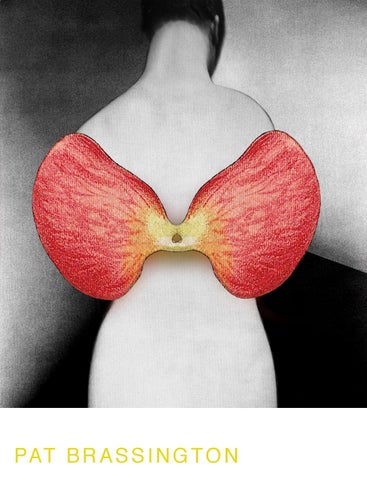
Take the work Blush, for instance, where flesh and flower converge. The flesh is monotone and textured like an old offset print, suggesting a certain two dimensionality and lack of animation. But a flower blooms in the centre of the flesh, colourful and unexpected, with the pinkness of a blush. The choice of title and colour, as with much of Brassington’s work, carries an emotional punch. What is a blush, after all, but a physical reaction to a thought or feeling, something unconscious and involuntary, something we can’t control. At the centre of the image a void hooks us in. Is that flesh or flower? It’s a wormhole, down which our questions can travel. There’s another such void at the centre of Quiescent, where a pair of bright red petals wrap themselves around a different monochrome figure, hinting at bodily workings that are nowhere near as dormant as the title suggests. Flowers recur elsewhere in the works. In Pansy, for instance, a woman’s mouth is obscured by a flower, as if the unconscious, having been rendered mute, has found other ways to be expressed. This muteness is echoed in other works too. The ‘beasts’ in Flamingo and Marvel have no language but knowing eyes. The red headed siren in By Catch holds one hand on her mouth and the other over her heart.
Brassington has described the creation of her images as ‘going on a hunt’. She starts with source material and a general idea and then looks for what’s going to happen next. The material may come from her own archive of prints or negatives, it may come from somewhere else, such as an old book or a knitting pattern or it may be something that has been scanned directly. If she doesn’t have the element she needs, she’ll pick up the camera to create it. Her initital playing around is subconscious, like doodling. She continues experimenting until something comes into her consciousness, then she hones in. Creation in this way is a process of trial and error, some works float, some sink and are discarded. Freud’s writings on the unconscious have also been an influence on her. “Year’s ago I read Freud’s Totem and Taboo,” she has said, “If I think about it, it must have been a catalyst for me in some ways. It was Freud’s musings on ‘the unconscious’ and the ‘return of the repressed’ that fuelled my desire to probe into some aspects of surrealist practice. The fascination is still with me. It’s not that I want to travel down the same road, but it is a lantern in the window.” Brassington’s lanterns, the lights that guide her way down the creative path, are many and varied. Certainly Freud and the Surrealists have had an impact but so too have more ordinary encounters, Saturday matinee movies, the girl-next-door’s coloured pencil set, the few prints and postcards in her childhood home, the wallpaper
and carpets in her mother’s house. She studied printmaking as well as photography at art school and that enjoyment of ink or pigment on paper, of texture and pattern, still informs her image making. Whilst Brassington initially worked with traditional black and white photographic techniques in the 1980s, the ‘photographic’ was never a destination for her. The lens was a means to an end. Once digital processes evolved Brassington, in her own words, “jumped in”. Brassington’s use of digital technology is sophisticated and subtle, her images have a seamlessness, which builds in a little moment for the viewer to initially accept what they are seeing, before they begin to question it. What are we to make of the lightbulb dangling between a pair of legs in Bayonet, for example? From such a low angle, it could be a child’s point of view, of a figure looming over them. Or is the body the source of the light? Who or what is the Bayonet - the weapon used at close range, embedded in another form – the knife at the end of a gun? Whilst the unexpected encounters favoured by the Surrealists could be either accidental or deliberate, we are left in no doubt that Brassington – with a lightness of touch, a gentle humour and deft use of colour and language – is in control of hers. Her ‘marvelous’ works create a frisson of uncertainty and excitement that lingers in the imagination. Bronwyn Rennex 11 July 2014
List of works (front cover) Quiescent, 2014 80 x 63cm Pansy, 2013 from In search of the marvellous 52 x 80cm Blush, 2014 80 x 72cm Flamingo, 2013 from In search of the marvellous 63 x 47cm The flight of the Duchess, 2013 from In search of the marvellous 83 x 120cm Asphalt, 2013 from In search of the marvellous 83 x 120cm Night Shade, 2014 80 x 63cm Marvel, 2013 from In search of the marvellous 43 x 65cm By catch, 2013 from In search of the marvellous 100 x 74cm (back cover) Gifted, 2013 from In search of the marvellous 100 x 80cm pigment prints, editions of 8 + 2AP
STILLS
36 Gosbell Street, Paddington NSW 2021 Australia tel 61 2 9331 7775 fax 61 2 9331 1648 email info@stillsgallery.com.au web stillsgallery.com.au