

state press magazine


EXECUTIVE EDITOR
Alexis Heichman
EDITOR-IN-CHIEF
Savannah Dagupion
MANAGING EDITORS
Audrey Eagerton
Leah Mesquita
DESIGN EDITOR
Lavanya Paliwal
ENGAGEMENT EDITOR
Paulina Soto WRITERS
Jude Banihani
Fatima Gabir
Claire Geare
Contents
03 Look behind you 09 An open letter to ‘Halloweekend’ 13 Baby blanket 14 Into the mystic 19 ‘They come back dancing, they come back singing’ 23 The anonymity of the dark web 33 I don’t vote
37 Nightmares, cults and spiders
41 Violence in vigilance: An investigation into the Phoenix Police Department
Editor’s letter


Gib Manrique
Bella Mazzilli
Evan Silverberg
Abigail Wilt
ILLUSTRATOR
Andrea Ramirez
PHOTOGRAPHER
Ollie Slade

As the sun sets earlier and the nights grow chillier, we invite you to step into this month’s issue where bold, risk-taking, provoking stories are unveiled and killer visuals are lurking. Unlike its predecessors over the years, this issue is seasonal, using the eerie atmosphere that comes with fall, October and Halloween to inspire stories that dive into the various facets of horror.
Some writers ventured into uncanny places, like the mystic community, “haunted” buildings on campus, horror film sets or the Phoenix Police Department. Others sought solace, whether it was through a short story about their baby blanket or poking fun at Halloweekend. One writer looked at this theme through the lens of culture, while another took the timing of this issue as an opportunity to satirize a specific kind of voter before the election. Finally, our feature story uncovers the dark web.
Look behind you
A history of haunted places at ASU
by Abigail Wilt
Photos by Ollie Slade
At first, I thought I was imagining it. The shadow that passed through my peripherals was just that — a shadow. I blamed it on the dying light bulbs reflecting off haphazardly arranged furniture. I didn’t have time to entertain supernatural possibilities.
I continued my student worker tasks, distracting myself with music and fixing my eyes on my computer. The room was incessantly warm. The hot Arizona weather always found a way to creep in through the thin walls. That’s why it caught my attention when my skin tightened and the tip of my nose grew numb — the temperature dropped unnaturally fast.
A sixth sense kicked in. I was acutely aware of something I didn’t believe in. The sound of my heartbeat amplified, drowning out the rhythm of my music. A sharp ringing pierced my ears causing me to stop what I was doing.
I felt an overwhelming urge to look behind me. To my surprise, nothing was there, but my body told me there was.
At that moment, a cynic started to believe. I heard stories about buildings on campus being haunted, but I never expected to have an encounter of my own.
Community Services Building
Tuberculosis is a fatal lung infection spread through airborne bacteria. More than 80% of people who contract tuberculosis will die. “The infected” die from coughing up blood until their bodies are inevitably ravaged by the disease.
In the 1960s, people with tuberculosis were housed in what is now the Community Services Building located on the corner of Curry Road and Mill Avenue.
After its time as a tuberculosis

sanatorium, the building was assigned a new purpose: Arizona’s first children’s hospital. Instead of tuberculosis patients, sick children occupied the 60-room building. The ghosts of tuberculosis patients and children who died are said to still roam the halls.
“I went to the bathroom upstairs on the second level, and I was by myself, and I heard little kids laughing, but it was six o’clock at night, so there was no one else here besides our class and then I ran back to the classroom because I was scared,” said Jillian Tisdale, a graduate student studying communication disorders.
As I toured the building, I felt a tangible presence guide me through the dim hallways. Ceiling tiles were few and far between, mold crept in the corners and cracked paint could be seen at every turn. The walls are plastered with muted yellow tiles and lined with metal grab bars, most likely used to prop up sick patients. The facility’s history makes itself known on every floor.
“In the summer when there’s nobody here, it’s scary,” said Jan Thompson, an emeritus professor who works in the building. “It feels kind of creepy to be here alone and to have the only car in the parking lot. Things fall apart in this building. Like, I’ve walked down that hallway and part of the ceiling fell down. I had to call facilities to come fix it. You never know if the building is going to be hot or cold.”
Virginia G. Piper Center for Creative Writing
The quaint cottage, nestled between Old Main and Palm Walk, feels out of place. A narrow pathway leads to the front porch where wooden rocking chairs are positioned, looking out at the students walking by. The house is the only facility on campus with a doorbell.
Ring it, and you are immediately transported back in time.
The Virginia G. Piper Center for Creative Writing was built in 1907, making it the second oldest building on campus, said Operations Coordinator Evan Senat in an official ASU tour. Former University President Grady Gammage once called it his home. He and his first wife Dixie moved into the house in 1933.
After years of being chronically ill, Dixie died in 1948. According to Senat, her ghost has been seen pacing the second floor, peering out of the windows wearing a large white hat and gown.
Grady married his second wife Kathryn in 1949. The two spent many years in the house with their son Grady Gammage Jr.
Grady died in the house in 1959, though there are no reports of his ghost lurking on the premises.
Currently, the house is used as a space for writers. Creative writing classes are held in some of the rooms, authors are invited to give readings and talks, and students can use the space to meet or study during specific hours of the day.
Graduate student Xiaolin Xu had an unsettling experience after she walked past the house on her way home.
“One day, it was still daytime, and I was walking past the writer’s center. There was no one around me, but I felt like someone just hardly pushed me, and I fell on the floor. I double-checked and there was no one around me,” Xu said.

“I felt like someone followed me home — that day was Halloween. When I was asleep, I felt like someone was in my living room — and I heard my fridge open. My roommate was not home. I heard someone use the cutting board … but nobody was there, so I went back to sleep. A few hours later, I felt like it was hard to breathe, and I couldn’t move, and I felt like someone grabbed my ankles and squeezed my neck. I tried to turn the lights on, but I felt powerless.”
To this day, Xu refuses to walk past the house and will intentionally walk out of her way to avoid crossing its path.
Matthews Center
Once the center of academic life, the Matthews Center was ASU’s first library, constructed in 1930.

The building’s age can be seen in its weathered exterior and felt through the musty, damp air hanging in the hallways.
According to a State Press article published in 2018, there are rumors that a fire killed a fireman and a librarian in the stairwell during the Great Depression. The librarian’s ghost is said to have been spotted roaming the halls.
As I walked down the dark stairwell, I felt uneasy. It didn’t help that there was a loud whirring from a group of fans airing out a room at the bottom. It made the entire stairwell sound like it was on fire — like the story.
“I used to go there at night to shut down classrooms and I always got a weird feeling. One time I felt dizzy as soon as I
walked into one of the rooms,” a user in the ASU subreddit said.
There have also been reports of another ghost who roams the basement at night. Ironically, The State Press newsroom was once located in the Matthews Center basement until 2021.
We asked a former State Press staff member if they had any ghostly encounters while spending late nights in the Matthews Center newsroom.
“Back in the mid-2000s, it was dark and dank and a little smelly and not well lit,” said Celeste Sepessy, a former State Press Magazine editor-in-chief and a professor in the Walter Cronkite School of Journalism and Mass Communication.


“It definitely had a creepy vibe. If I went there now, I would see it as just a basement, but in the moment when you’re by yourself and you’re sleep-deprived, there’s nothing spookier than the Matthews Center basement.”
As I climbed the stairwell out of the basement, I was overcome with every journalist’s persistent fear: my deadline.
Mona Plummer Aquatic Center
In 2011, an ASU student and a former ASU swim team member, James Rigg and Andrew Schneller, hopped the wall surrounding the Mona Plummer Aquatic Center with the intent to trespass and swim in the pool.
After swimming in the 18-foot-deep pool, Schneller exited but realized his friend was lying at the bottom of the pool unconscious.
Schneller pulled his friend out of the pool and began to give him CPR. After authorities arrived, Schneller was arrested for trespassing while Rigg was transported to the hospital. Rigg was pronounced dead at 3 a.m., and Schneller was released with a citation.
Opened in 1981, the Mona Plummer Aquatic Center is regarded as one of the country’s finest swimming and diving facilities. The complex features three pools, one of which is olympic-sized, diving towers and other smaller competition and warm-up pools.
“If the walls could talk, I’m sure there are lots of stories,” said Dorra Tang, an ASU alum and former swim team member. “It was dark and dim and musty in there, so it just gave you a creepy vibe.”
Over the years, swimmers, divers and coaches have reported instances where they felt like they were being “watched.”
“I worked at [the Mona Plummer Aquatic Center] my sophomore year, never heard any stories of it being haunted, but walking around the pool you sometimes felt like you were being watched,” said Thatcher Bennett, an ASU alum who graduated in 2022, in a post on Reddit. “And one time when I was cleaning the men’s showers I could’ve sworn I heard someone talking back by the lockers but I knew I was the
only person in the facility at the time.”
A sixth sense
Whether ghosts exist or not is a matter of personal opinion and experience. Some deny their existence until they have a supernatural encounter. But whether you believe in the supernatural or not, the history speaks for itself.
I once thought that if ghosts couldn’t be seen, they didn’t exist. I implore you to tune into your senses the next time you’re in one of these buildings. If you ever find yourself with a biting chill or nagged by a subtle ringing in your ear — you might want to look behind you. There might just be someone else in the room.


Ollie Slade is a State Press Magazine photographer and a fine artist specializing in horror photography

An open letter to ‘Halloweekend’
I literally hate this
by Claire Geare
Photos by Ollie Slade

Dear ‘Halloweekend,’
Well, well, well, it’s officially spooky season. And that brings me to my first complaint. Spooky season? Are you serious? Unless you’re 35, you should not be caught dead referring to the month of October as “spooky season.” I get it, I get it, it’s fun! Claire, just let us enjoy life for once! And to that I say, no. I’m a professional hater — I literally get paid to do this. And Halloween is no exception.
As they say, “to be cringe is to be free.” And I wholeheartedly agree. But sometimes, it is not freeing. It is, in fact, corny as hell. There’s something about “spooky season” that just… irks me. Stop it! Stop it now! I have no logical reasoning for this besides being a hater who, once again, gets paid.
Maybe it’s because everyone uses it as a pass to be blatantly racist. When I was in high school, a group of popular kids posted their dreaded Halloweekend photos where they conveniently had their only non-white friend dress as a prisoner… and they were cops. White girls, am I right? As a white girl, I’m allowed to say that. So naturally, I was
talking shit. To everyone. It was hilarious. I mean, how stupid could you be? Dressing up one of the only non-white kids in the school as your prisoner? Way to perpetuate stereotypes, guys.
A few days later, after a storm of shittalking, these girls approached me in the middle of AP Literature. And get this — they asked me not to show those photos to their colleges. At that moment in time, I had all the power in the world. I never planned to ruin these girls’ lives, they were just ignorant. I like to talk shit, but I’m not some life-ruining bitch.
I told them I wasn’t going to ruin their chance at a career over some stupid Halloween costume, and I’ve never seen someone so relieved. Who did they think I was, a supervillain? Let’s not unpack what that says about my reputation in high school, but that’s beside the point. Let’s just say… I wasn’t everyone’s favorite person.
The point is, stop being racist, please. Maybe then I won’t ruin your life for fun. The problem is, there’s simply too many opportunities to be racist for kicks and
giggles during Halloweekend. From Pocahontas to Borat, the chance to be ignorant and dumb calls to these people like a siren song. I mean, I’ve seen it all.
The weirdest one to me is sombreros. What the fuck is being Mexican for Halloween? Like, are you just trying out a different culture? What even makes that a costume? And the worst part is, they’re half-assing it! Toeing the line between pulling a full-on Justin Trudeau and a casual Moana costume. If you’re gonna say it, say it with your whole chest.
When I was a freshman in college I allegedly stole from a major frat house. They remain unnamed, not to protect myself, but simply because I don’t remember. They all sound the same to me, honestly. Sorry Greek lifers.
It was right around Halloween, and those idiots left their bathroom open. I peeked inside the cupboard beneath the sink and found the holy grail — Native deodorant. Do you know how expensive that stuff is? Like 10 dollars a pop. It might as well have been a Fabergé egg.
Listen, stealing is wrong. Stealing is bad. Unless it’s from a major corporation. Because fuck them honestly. But here’s my logic: Somebody in that frat house has probably made a woman or person of color uncomfortable at some point. I just know it in my heart. And maybe, just maybe, that person has expensive deodorant. And maybe, just maybe, that deodorant came home with me… allegedly.
The funniest part is, they checked my bag before I left that afternoon. They literally opened my bag, saw their own deodorant and let me walk out the back door. So basically, it was a freebie. I never even used it.
You could argue I shouldn’t confess to a literal crime in an article. And to that, I say… you’re right. I am objectively dumb for doing this.
Besides the rampant racism on Halloween, the absolute worst part is what I like to call the Party Superiority Complex™. Now, the Party Superiority Complex is exactly what it sounds like: Your coolness index increases in relation to the number of parties you’re at during Halloweekend. And to this I say, no it doesn’t.
This concept is straight out of the 1980s, where beer and cigarettes made you the coolest guy on the block — except now we have Instagram, unfortunately. Social media (somehow) becomes more of a hellscape on Oct. 31 than it already is.
It’s just party after party after party. Frat parties. House parties. Ragers. Daygers. Clubs. Bars. If you can name it, there’s a party at it. I bet even the goddamn airport throws one.
And one more thing about social media: Sometimes I wish the carousel feature never existed. I love a good photo dump as much as the next person, but oh, the vanity! I just simply do not care to see the same photo of you from 20 different angles. It’s not interesting, it’s not fun and I get the point in two pictures – max. I’m already doing you the favor of swiping through your photos, so don’t pull on my dick like this.
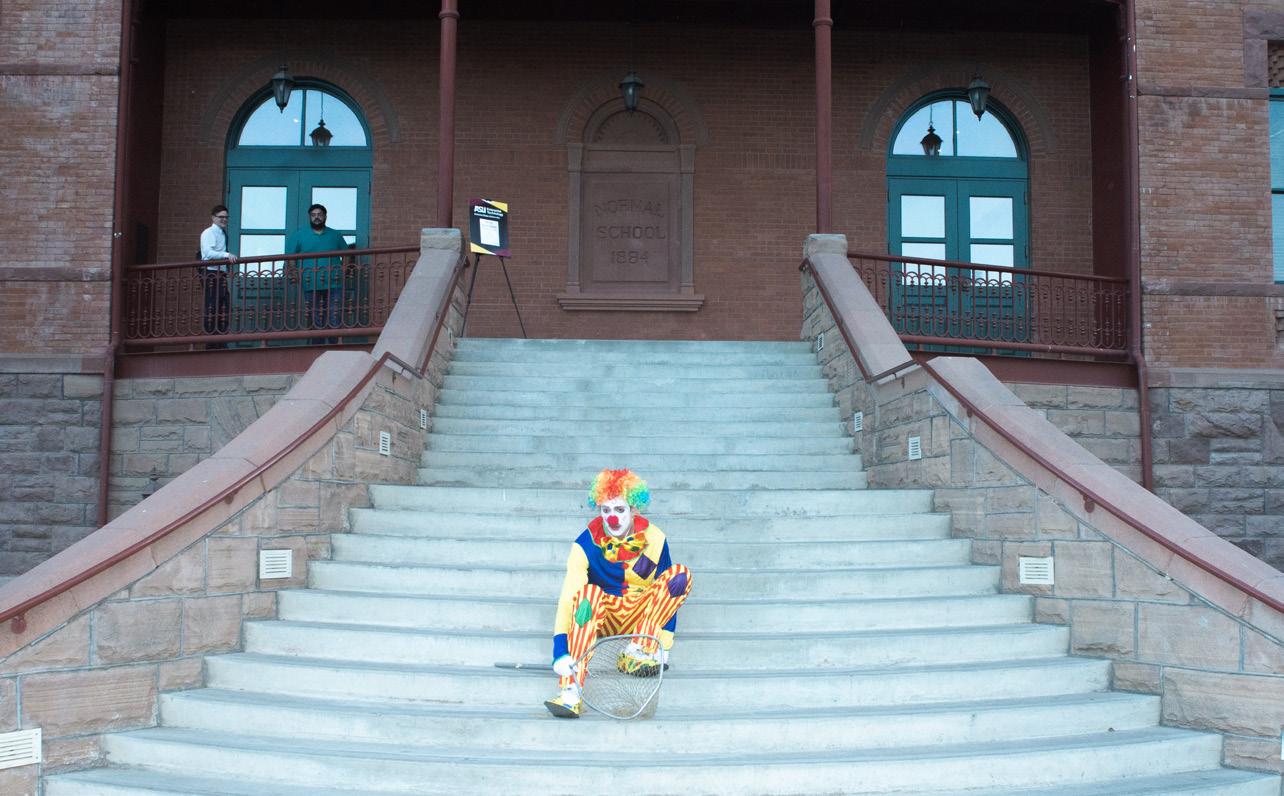
The point is: I hate you, Halloweekend. With my whole heart. It’s a giant popularity contest with a costume-clad spin, and I simply cannot stand it. Maybe you should just all dress up as clowns this year because that’s what you are.
Sincerely,
Claire (gets paid for this) Geare




Baby blanket
by Abigail Wilt
Photos by Ollie Slade
Istill sleep with my baby blanket. I’m 20. I’ve tried to part with it several times, but I can’t seem to.
Its hot pink ribbons frame a fleece fabric with a pattern depicting cartoon versions of little girls — much like I was when I received the blanket.
After 20 years, it’s safe to say my DNA has caused the blanket to age.
The corners have split, the bright colors are faded and its softness is now rough. Its imperfections reflect years of love and loyalty.
The love embedded into its fabric can be traced back to the loving hands that sewed it together. My nana began the tradition of making baby blankets for her grandkids when I was born. One reason I hold on to it is because I need to hold on to her.
I’ve met other adult blanket-havers and seen the dire states of their blankets. Some snuggle up to bits of fabric or balls of string. I’m grateful that my blanket is still very much a blanket.
Over the years, I’ve experienced an array of reactions to my baby blanket-having. Some laugh, some mock, some ridicule. Yet, none have convinced me to part with it.
When I watched a scary movie for the first time, my baby blanket was there, woven in between my fingers, fragrant with the same childhood smell, providing the same comfort.
When I was in a car accident at 10 years old, the one object I grabbed from the wreckage was my baby blanket. The texture of the fabric on my cheek as I fell asleep reminded me that I was safe.
When I went home crying after I was rejected by another boy I confessed my love to in high school, I cried into my blanket. I watched the wet spots dry up and so did my desire for the boy.
My baby blanket was always there. It was a ghost looking on at the turbulent changes that came with growing up. Soaking up tears, cooling sweat from fevers, balling up into angry fists and flying through the air like a cape when I danced.
At times, my blanket was a mirror I could look into and reflect. Now, when I breathe in its scent, I’m reminded of my resilience and joy.
Sometimes we need something to hold us and sometimes we need to let ourselves be held by something. There’s nothing wrong with that, even if it’s a baby blanket and even if you’re 20 years old.
I can’t say I’ll part with it anytime soon. My future partner will have to be okay with the third party in our bedtime routine. My blanket and I come as a complete set, and I’m okay with that.


Insight Into the mystic
An exploration into magic and spirituality at ASU and beyond
by Bella Mazzilli


Illustrations by Andrea Ramirez
When I was 11 years old, a palm reader told me I would die at the age of 30. I initially approached her with intrigue, having no experience with mysticism, but when she foretold my death, my face contorted with rage. Who says that to an 11-year-old? What gave her the right to predestine this for me?
I was, and still am, strong-willed. Some (anyone who has met me) would say stubborn and prone to sarcastic retorts. Nonetheless, this singular experience planted the following message into my young mind: psychics are bad.
This little seed of cynicism bloomed into a full-on dislike of anything to do with mysticism. Crystals? Just pieces of a pretty rock. Tarot cards? Highly decorative poker.
Now, I have to make one thing abundantly clear: I do not believe in any of the concepts above because I have had no religious experience or experience with the divine other than the message of my young demise. In other words, I have had no experience to give me reason to believe in anything spiritual. I was raised in an agnostic family and consider myself to be somewhere between agnostic and atheist.
I have always had a fair sense of suspicion about mysticism in its many forms. No rose quartz has brought me love, and no palm reading can determine my dinner plans. Despite this, I have always been curious about these communities.
For this month’s issue, I traveled to ‘parts unknown’ of ASU’s mystic tarot and crystal communities. Call me the Anthony Bourdain of the mystic arts.
I’ve decided to embark on my spiritual journey. Come along with me on this path, like Van Morrison once sang, “Into the Mystic.”
How do I charge a crystal?
Crystal healing, defined by Wikipedia: A pseudo-scientific alternativemedicine practice that uses semiprecious stones and crystals. People who practice claim that these have healing powers, but there is no scientific basis for this claim. Practitioners of crystal healing believe they can boost low energy, prevent bad energy, release blocked energy and transform a body’s aura.
Now, I interpret this to be a form of Wiki-speak satire. The writer of this definition is a skeptic, much like myself, and made sure to hammer it in that ‘crystal healing’ is a falsehood in and of itself. The instant ‘pseudo’ is mentioned, I’m out.
But, I could be an unreliable narrator — I probably am. To remedy this, I spoke to Destiny Anthon, a senior studying architecture.
Anthon’s experience with crystals
began as another outlet for her spirituality. She said her crystal collection consists of some given to her by her grandmother, as well as some she purchased at a zoo.
“I would say I practice with crystals the least,” Anthon said.
Despite this, she said she puts her crystals by a window when there is a full moon. Allegedly, this cleanses the crystals. Personally, I use CeraVe to cleanse. But, to each their own.
Anthon uses crystals as a “mindful practice.” She aims to improve certain aspects of her life but believes that the universe has a way of aligning things to be how they are meant to be. Her crystals serve as an anti-anxiety measure of sorts. For example, she occasionally wears a crystal around her neck, and the tactile feeling of rubbing the crystal soothes her worries.
I found this to be fascinating, as I struggle with intense anxiety. The concept of having what is essentially a worry stone is something I can relate to, as tangible objects have provided me with immense amounts of comfort over the years.

Can I WebMD my tarot reading?
“Tarot is a form of divination, which is to say a form of using physical objects to try to learn either more about oneself or about the world.
Divination is a practice that’s used in every culture across the world,” said Michael Ostling, a religious studies scholar and a Barrett professor.
Tarot cards, defined by Wikipedia: “Tarot is a pack of playing cards, used from at least the mid-15th century in various parts of Europe to play card games such as Tarochinni.”
Isn’t it interesting that the definition does not include anything relating to mysticism? It originated as a pack of cards, decorated uniquely.
The deck includes cards like the Hermit, the Fool, the Sun and the Devil — they seem like silly little guys. There’s also the High Priestess, Judgement and the Magician — they sound like a good time. All of the individual cards have general significance, but the real meaning comes when the reader of the deck gives a personal reading to the recipient. Tarot readings can be done for oneself or another person.
For Anthon, her experience with tarot began at ASU when she found the honors class Myth and Mysteries of the Tarot. After a few failed attempts due to seats filling quickly, she successfully enrolled in the popular class for the Fall 2023 semester and found many new lessons to be learned through her time under Professor Oscar Giner’s tutelage. Because of her major in architecture, Anthon explained that this class was a completely new experience for her.
“This class was very much like a passion class, something for fun,” Anthon said.

Although, her time in the class did enhance her spirituality, as tarot practice encourages the card reader to consider universal forces that are out of the reader’s control. She said spirituality comes into play when the reader has to have faith in the message of the deck to communicate what the reader needs to understand.
“I had a reading about my future, and they predicted that for the next year, I will go through suffering, but it’s kind of turned into motivation for me to go through that time,” said Nhi Huynh, a freshman studying health care coordination.
I agree more with Huynh than Anthon.
Using the tarot reading as positive motivation is fascinating, but I can also appreciate the excitement of a class like the one Anthon took. Knowing myself, I would curse the name of the tarot spirits that predestined suffering for me…
Can you tell I’m a sardonic person?
Religion or hobby?
Before my journey of exploring these communities with an open mind, I had never stopped to consider that this is more than a hobby — and could be considered a religion for some. Thankfully, Anthon had answers for me.
“It definitely helped me reflect on my spirituality,” Anthon said. “I was raised
Catholic, and from my understanding, there is somewhat of a pipeline of Roman Catholic to mystic arts that I had seemed to follow. A lot of the imagery and the symbolism can be very familiar in the way that it is in the Bible.”
Feelings of ostracization or questions about the nature of one’s faith are some examples that Anthon brought up when explaining this “pipeline.” She said that many individuals who are raised in organized religions grow up with these experiences and begin to question their faith. Then, at least in Anthon’s case, exposure to social media leads these individuals to a new outlet for their spirituality: the mystic arts. TikTok, according to Anthon, played a large role in this process.
“I fight between saying that I am and I am not Catholic. … Now I’m just generally spiritual,” Anthon said.
She added that moving from her home state of Michigan to Tempe affected her spirituality because she had a sense of distance from her family’s Catholicism. While she had questioned her sense of faith since elementary school, her time at ASU has provided a new perspective.
“When you’re in college … you’re questioning a lot of things, trying to make a lot of decisions, while also trying to make them responsibly with not a lot of time,” Anthon said.
Decision paralysis can occur for many students in college, and a higher power, or otherwise, can help students feel like there is something beyond them that is guiding them in “the right direction.”
She explained that her experience with tarot has helped her relinquish control of everything in her life and has allowed her to have faith in a higher power again. Anthon’s anxiety about her life has decreased as she has learned the process of tarot reading.
“It helps you break down the issues or problems in your life,” she said.
“I wish [skeptics of the mystic arts] knew that it was almost practiced or treated like a religion,” she added. “If people approached the topic as if it was a religion, they wouldn’t be as harsh or as skeptic, and they would maybe not feel the need to voice their skepticism to people’s faces.”

Where’s the organization?
This made a lot of sense to me. If I thought of mysticism as a religion, I would automatically respect it more, but hobbies don’t garner the same level of respect from me. Previously, I would have thought it was similar to nerdy Dungeons and Dragons-type activities, but now I see that this is a real outlet for some people to express their spirituality in a non-traditional way.
ASU has a plethora of outlets for students involved in organized religion. Everyone from Muslims to Christians can find a community to bond with and have discourse. However, apart from Professor Giner’s class, I did not find an outlet for students interested in the practice of crystals to express themselves. This saddened me, but mostly in a selfish way. I wanted to find a group of these people to talk to, just in the way my Bourdainian hero would have.
So instead, I traveled to what some
may call the crystal capital… of northern Arizona: Sedona.

Sedona is a small town with a population of about 9,800. Home to energy-radiating vortexes, holistic healers and spiritual seekers, this red rock paradise is where ASU students flock to escape the urban heat island that is Phoenix and experience a breath of fresh air.
Crystal shops pepper the streets, each containing a rainbow of sparkly rocks sold at steep prices. Now, if this town wasn’t one of Arizona’s primary tourist destinations, maybe this commercialized mystic community would feel more real to me.
Regardless, I decided to talk to a crystal shop owner to understand the allure.
Tina Dale, an employee of Spiritstone Gems, believes crystals can cleanse human pain. Dale found her mystic self when she left her previous Pentecostal church and began exploring things like massage, Reiki healing and acupuncture. When she first started learning about mysticism, Dale regularly drove from Phoenix to Sedona to have sessions with Native American healers and shamans.
Her experiences visiting Sedona prompted her to divorce her husband and move to Sedona permanently. She then began to work at Spiritstone, the only place she would purchase her crystals from.
“I use crystals to heal myself; I don’t believe in doctors — they’re all into that big pharma,” Dale said. “As you heal, you have to look at the emotions that are coming up, and people just want to sweep it back under the rug. I jumped in with both feet because I wanted to heal my soul.”
After my mysterious interaction with Dale, I traipsed my way to Sedona Heartlight Healing, owned and operated by Penny Buckman.
Buckman greeted me kindly and asked how she could help me. Her eyes had a strange glassy quality to them that was incredibly striking, almost heterochromatic.
Once her remaining customers left with pamphlets explaining her services, I perched in a plum-colored crushed velvet chair and began to interview her, albeit apprehensively. To use her words, her “aura” was peculiar, much like Dale’s. Buckman has owned a few “healing centers” and conducts “intuitive psychic readings,” as well as crystal beds and quantum crystal healing sessions with sound baths.
I don’t know, either.

When I asked Buckman how the crystal healing sessions worked, she was unable to provide an intelligible answer. I expected this, but was intrigued to hear that there is, in her opinion, a “healing field” anchored by the use of crystals. If you read that, and you’re still confused, dear reader, I am too! Moving on.
What I found reassuring was that
Buckman acknowledged the validity of skepticism in the practice of crystal healing.
“If [skeptics] don’t understand it, that’s totally okay because we experience it,” she said. “[I] just encourage people to… allow themselves to be somewhat open and to just have an experience, and that way, they don’t have to believe in anything.”
Do You Believe in Magic?

I truly believe the harm that skeptics, like myself, have caused to this community is immense. We’ve been too rude! The moral of the story is: Keep your opinions on mysticism to yourself and let these kind people practice (religion or otherwise) in peace. Their eccentricities are their own.
I may not believe the same things as those who practice the mystic arts, but my foray into their community was filled with nothing but kind answers to my curious questions.
I still have a bone to pick with the palm reader I met at 11, though. No amount of mystic questions will provide a concrete answer to the anger I feel toward that woman to this day.

‘They come back dancing, they come back singing’
Younger generations revive the meaning of Día de los Muertos through decolonization and celebration
by Gib Manrique
Photos by Lavanya Paliwal
Iwas 12 years old when a cheap plastic skull was hurled at my head for the first time. It was bright pink with fluorescent green carvings marking out its eyes, and it had a big bright smile.
I was standing on a stage in my custom-made traje — a long, light gray skirt and jacket with silver and black details. A large sombrero adorned my head, and I was playing guitar with my middle school mariachi group at one of the many Día de los Muertos-themed parties we had been hired to play at that year, which had become all the more popular thanks to Disney’s “Coco.”
At that point, I had played the famous songs from that movie — namely an upbeat “Remember Me” and “Un Poco Loco” — a nauseating number of times, and that plastic skull nearly sent me over a marigold-decorated edge.
I became disheartened by the holiday pretty quickly. Whatever magic I might have experienced as a kid seemed
lame excuse to get drunk off tequila.
The only time I saw my culture being represented outside of these parties was with 50% off sombreros at Party City in the “Day of the Dead” corner, or when some millennial with our sacred calaca, the image of a skull used in traditional Día de los Muertos art, tattooed on their shoulder passed by.
Día de los Muertos was something that had always comforted me growing up, as there was the idea that once those I love, and even myself, pass on, there was a chance to come back. There was the chance for my mom to say goodbye to her grandparents and the chance for my abuela to reconcile with her sister. It was meant to be a tradition for my family in Nogales, Douglas and Tucson to gather around graves in the local cemetery and be together with the bodies and, hopefully, souls of those who passed away.
Well, after a few cheap plastic skulls are thrown at your head by screaming
general population doesn’t care about it enough to cause endless Hallmark movies that show “the true meaning” of the holiday.
But it’s up to those who have this tradition in our bloodlines, flowing and rippling through our veins, to find the “true meaning.” Whatever that may be.
‘We’re going back again. We’re decolonizing.’
There is an active effort within our community to bring the holiday back to what it originally was and actively fight those who make it something it is not meant to be.
Zarco Guerrero, the artistic director and co-founder of the Cultural Coalition, a nonprofit arts organization, said he saw the commercialization of Día de los Muertos coming for years.
“People [outside of the culture] started adopting it,” Guerrero said. “They started incorporating it more and more into their daily lives,

He said seeing how the holiday has developed over the past 20 years has made him depressed, and he wishes more people would recognize the culture’s past as thousands of years of Indigeneity, rather than 500 years of Hispanic heritage.
“What happened was the last thing we wanted to happen,” Guerrero said. “We were against commercialization. We were against gentrification. It’s taken away from us, and it’s being taken away by institutions … and turned into a commercial tool to sell products.”
Guerrero and his wife Carmen help run the Cultural Coalition’s annual Mikiztli Festival, something he says isn’t a celebration of Día de los Muertos, as he believes the day has lost its meaning completely.
“It’s called Mikiztli because we’re celebrating the true idea, the true philosophy of our ancestors that goes back 3,000 years to the time of the Olmecs, making it an Indigenous Celebration,” Guerrero said. “We’re going back again. We’re decolonizing.”
According to the Cultural Coalition’s website, “Mikiztli” can be traced back to “Anáhuac, the original name of pre-colonial Meso America.”
The Indigenous people did not have a word for “death” in the original Náhuatl language. Instead, “Mikiztli” refers to the idea of death being a transition from this life to the next; the concept of “transformation” or “letting go.”
Guerrero believes that what is meant to happen on Día de los Muertos has been lost to time.
“It doesn’t represent death,” he said. “It represents transcendence. It represents letting go of the flesh, letting go of the ego, and we transcend to the next dimension. Now we can do that, supposedly, when we die, we let go of the flesh, we transcend.”
‘Our culture heals’
While Guerrero puts an emphasis on those who celebrate Día de los Muertos connecting with their Indigenous roots and acknowledging those who came before, he finds the most hope for the
holiday within today’s youth, especially college students, and feels that there is an increase in younger generations wanting to connect with their culture and heritage.
“All of these youth, they’re embracing our culture without even knowing the language,” Guerrero said. “They don’t even speak Spanish. … They’re not born in Mexico. So what’s going on? Our culture heals. It’s healing us.”
Amy Noriega Pineda, a junior studying psychology and transborder studies, used her role as president of the Hispanic Honor Society to start a Día de los Muertos celebration on the West Valley campus. At the event, students were encouraged to contribute to a community altar by placing photos of their loved ones on it.
Pineda said the practice of Día de los Muertos wasn’t always consistent in her childhood because her parents owned a small business and didn’t have the time to celebrate. However, her time in college has encouraged her to connect with her heritage.
“Once I moved out of my parents home and into the dorms, I started exploring more of my culture,” Pineda said. “I began practicing the tradition of making the altars around the Day of the Dead period.”
Pineda’s celebration of Día de los Muertos reflects Guerrero’s belief that the day isn’t meant to be about death at all.
“I do have people who are like, ‘Do you do this because you genuinely think they’re coming back?’” Pineda said, referring to the belief that the spirits of those who have passed visit their families on the holiday.
But to her, it doesn’t really matter if her family members are actually returning from the spirit world — Día de los Muertos has always been more about a comfort with her heritage and feeling connected to her roots.
“We don’t have proof that they come back,” she said. “But it’s that thing where just in case they do, I want them to know that I’m actively thinking about them. That’s what matters to me at least.”
‘To me, it’s completely different’
Younger generations are also the voices for those whose Día de los Muertos traditions are not shown in the media, with specific celebrations of families or states within Mexico being lost to modern audiences.
Sarah Martinez, a junior studying biochemistry, said that there are major differences in her celebration of Día de los Muertos than what is represented in the media.
She explained that because the holiday is celebrated differently in every state, the differences in traditions are not often acknowledged and are instead shoved away in favor of a known stereotype.
“In the movies, everyone’s together, everyone celebrates, everyone has a big party,” Martinez said. “What’s portrayed is very specific for la Ciudad de México. Like, that’s how they celebrate it, but the idea that for the rest of Mexico it’s the same … that’s just not true.”
Martinez said even the beliefs surrounding the holiday vary greatly from what’s represented in the media. The belief that family members are passing from the spirit world to the human world was never a part of her family celebrations.
“That was never heard of until I watched the movie ‘Coco,’” Martinez said. “That was something that just never occurred to me. It was something that was never spoken of.”
Martinez said any comfort she has gotten from the holiday came from remembering those who passed on and simply talking about happy memories of them with her family.
‘We can keep their memory alive’
Jessica Sanabria, a sophomore studying nursing, said that while she does not have the same access to the celebration as she did at home, she still finds a way to incorporate her own traditions into Día de los Muertos while in college. She mainly focuses on the family aspects of the celebration by calling her family and remembering loved ones together.
“With Día de los Muertos, you see a lot of big celebrations and festivals … people dressed as skeletons and dancing, and it’s like a big party,” Sanabria said. “Which yes, that’s a part of it. But the other part of it, like the family connection, can be overlooked sometimes.”
Sanabria said a major aspect of her celebration that is not always acknowledged is going to the actual cemetery where her family is laid to rest.
However, Sanabria believes that her ancestors and family are with her not just on the holiday, but all the time, especially her grandmother. She feels her in her family home, in the birds and in the wind, and says that if she ever needs to talk to her, she can.
She describes Día de los Muertos as being just another day with her family, but with something a bit extra.
“I was just always taught that their spirit is always with us, we can keep their memory alive” Sanabria said. “This is just a specific day for when we do it.”
‘As long as the people are together’
Guerrero said that even if some

practices are being exploited, diluted or gentrified, it doesn’t make a difference as long as it gives his community a chance to celebrate.
“It’s a great excuse to get the family together,” Guerrero said. “So what difference does it make? As long as the people are together and creating something new.”
Thankfully, the real meaning, a remembrance of those loved and lost, has remained true and at the very core of Día de los Muertos, despite any varying belief about whether or not spirits return or how big the celebrations are.
Guerrero said it’s inspiring to see the real point of Día de los Muertos coming back to the forefront of culture and being carried on the backs of young people. He said it’s beautiful to see them embracing their heritage and Indigenous past.
He added that the thousands of souls who have passed and may have been lost due to colonization have returned through the youth to heal the culture.
“Our ancestors are back,” Guerrero said. “They’re back, and they come back as our youth. They come back dancing, they come back singing.”


The anonymity of the dark web
A deep dive into the darkest corners of the internet and its modern implications
by Jude Banihani
Designs by Paulina Soto
Photo by Lavanya Paliwal


You see a green ombre screen, a graphic of a cut onion and a header that reads “Welcome to Tor Browser, you are now free to browse the internet anonymously.” You’re taken to a web directory. The screen is black and there are white and red links. You open them, one by one, and find drugs for sale, advertisements for hitmen, graphic content and other less Googlefriendly websites.
Being on the dark web means that your identity goes dark — you’re untraceable. Hackers, drug dealers and organized crime groups run rampant, using it as a playground for all their clandestine transactions. Ross Ulbricht, also known as Dread Pirate Roberts, made millions on it by creating and operating the darknet market website Silk Road — that is, until one small mistake sent him to prison for life.
It’s not illegal to access or surf the dark web, but it’s not above the law either. Everything considered illegal offline is still illegal here, too. However, there is one small difference from real life. Here, you are completely anonymous.
In the digital age where our online personas carry a lot of weight, we know maintaining a healthy digital footprint is crucial. However, this isn’t the reality of certain corners of the internet. You can think of the internet as a building where some doors are locked, others are left open to all and some are hidden in the basement.
The open doors are your regular websites and search engines. Closed doors are places you need a passcode to access, like your email or private accounts. Your basement is the dark web — not
widely known, it takes a few extra steps to access and it’s sketchy. You’re essentially invisible, thanks to the power of a virtual private network and an untraceable browser invented by the U.S. Navy in the 1990s that was originally intended for intelligence agencies to work on the internet without the risk of being identified by foreign entities.
How do I access the dark web?
Hassan Moustafa, a junior studying computer systems engineering, knows the ins-and-outs of the dark web and how you can conceal your true identity and traceability.
He explained that a VPN is something that anyone can access and use when
surfing the default web. It works by rerouting your location to other IP addresses all over the world. A VPN can give you a good first layer of online protection by avoiding cookies and tracking from websites, but it’s not foolproof.
A VPN alone will not allow you to access the dark web. For that, you need a special browser called the Tor Browser. This browser, unlike the general web, allows you to stay fully anonymous. There is no backdoor — a built-in encryption that allows another entity to access your private data — meaning no one can see what you are doing.


It was first invented by the U.S. Navy, and although it is not the only way to access the dark web, it is the most common way. Another common name for this is the onion router because the Tor Browser works by using a technique called onion routing, which connects your device to encrypted routers all over the world.
To understand how the dark web operates, a basic understanding of cryptocurrency is necessary.
When you purchase an illicit substance or goods on the dark web, you can’t use your debit card. This is where cryptocurrency comes into play. Bitcoin and other cryptocurrencies hold their value through supply and demand. There is no central banking involved, and your Bitcoin only exists online. You can buy Bitcoins using regular U.S. dollars, but it gets complicated when you want to stay anonymous.
“It’s not anonymous to buy it, it’s anonymous to transfer it,” Moustafa said, meaning that your purchase of Bitcoin can be tracked, but once you use your cryptocurrency, there is no paper trail left behind.
The connection between online anonymity and real life anonymity for criminals arises when they try to cash out their Bitcoins. Withdrawing large sums of cash from an ATM is an excellent way to have the IRS knock on your door.
Criminals often leave their money in their crypto wallets, or try to find creative exit nodes. Some travel to foreign countries with less regulations on crypto to withdraw their money and others launder it through lesserknown means.
How established is the dark web?
Moe Madouh is a PhD candidate in the Walter Cronkite School of Journalism and Mass Communication. He has been researching the dark web since 2019 and has extensive knowledge regarding privacy and anonymity online.
Madouh said that in order to access web pages on the dark web, you have to know the exact URL. On the dark web, you can’t just search a general area of interest. For this reason, there are plenty of directories for websites.
With websites being seized by the FBI and Interpol daily, the constant production of new sites and the existence of undiscovered pages, there is no way to estimate the size of the dark web. There isn’t even a directory that can show every URL on the dark web.
“The dark web has been estimated as roughly seven thousand times bigger than the clear web … [and] forums are just a gold mine for information,” Madouh said, since there isn’t another way to access the URLs.
Before there was the Tor Browser, there was the Advanced Research Project Agency Network, which was created during the Cold War. The goal was for U.S. operatives to communicate in case of attack. When the Soviet Union realized that only U.S. operatives were on the web, anonymity was broken, leading the U.S. government to release the technology to the general public. Since a backdoor was never built into it, once the public had their hands on it, it was already too late to add one.
“Many countries throughout the world like Poland, Russia, Hungary and China tried to dismantle the dark web, put a bounty and a reward for anyone who could do it, and till this day, the dark web is still standing,” Madouh said.
“I’ve seen underground markets for drugs, weapons, organs, trafficking and animals,” he said. Though the FBI and Interpol are able to seize drug markets daily, new ones are made almost instantly. When the infamous Silk Road was taken down, Silk Road 2.0 was born. It’s a never ending cycle.
Researching and understanding the dark web is difficult when you don’t know what you are going to see after clicking a link in a directory.
“I was very inexperienced to understand the dark web culture, to the point that I was clicking on whatever link was in front of me. I realized the significant majority of clickable links related to child abuse content,” Madouh said.
Dark web pages also include content featuring racism, nazi ideology, xenophobia and more. Its graphic nature makes it difficult to research.
Criminal behavior isn’t the only reason someone may want complete anonymity online.
Regular people who are concerned about privacy or government surveillance have taken to the dark web for completely legal activities. Many nation states do not have laws protecting journalists or whistleblowers, meaning some have leaked information or reports through the dark web’s anonymity.
The dark web and cryptocurrency


have been seen as threats by governments around the world. Saudi Arabia, for example, has banned the use of Bitcoin, but Madouh believes that crypto will only become more popular in the next decades.
“Blockchain technology can’t be dismantled. That’s it, it’s done,” he said. As society becomes more cashless, data gathering agencies are able to view your banking information and many citizens want to evade this. With the impossibility of building a backdoor or dismantling the dark web, it may be here forever.
How do hackers operate on the dark web?
Victor Benjamin, a professor in the W.P. Carey Department of Information Systems, has spent a decade researching the dark web and explained the importance of the dark web to hacking communities.
“To be a successful hacker you’re not just looking to break things because you can destroy and not learn. I think to be a successful hacker you have to really understand how something is engineered,” Benjamin said.
The ability to stay anonymous is crucial to hacking, but learning how to hack highly secure systems is just as important to these communities. Advanced tutorials on how to hack databases aren’t found on the default web, and they aren’t taught in school. Instead, these skills are often taught on dark web forums.
Communities of hackers congregate on the dark web to share and even show off their skills. Benjamin said that not all hackers are looking for financial gain, sometimes they are looking for social status, justice or
simply want to hack for the sake of it. There is even a market on the dark web for people to buy hacking services or equipment — freelance hacking does exist.
According to Benjamin, a decent portion of hacking is done by teenagers and average people with above average computing skills, but more high profile hacks are carried out by larger forces.
“In the past few years it has become more evident that a lot of the more sophisticated hacking is carried out by nation states,” Benjamin said. Intelligence agencies have grown more fearful of cyber attacks and database infiltration, something made easier than ever before with the dark web.
What are the societal implications of the dark web and anonymity?
The dark web is not solely utilized by people with the intent to harm. The hacking group Anonymous does not hack for any financial incentive; they are rather motivated by social causes such as the Arab Spring, a large uprising across the Arab world in the 2010s.
Benjamin has seen many cases of civilians using the dark web to get a hold of prescription drugs that are
either banned or unaffordable in their countries. These civilians typically take limited precautions when it comes to concealing their identity on the dark web whereas criminals take far more precautions.
Virgil Griffith, an American expert on cryptocurrency, was arrested in 2019 after traveling to North Korea to participate in a cryptocurrency seminar. The incident raises a new question. Are nation states using cryptocurrency to evade sanctions?
According to Benjamin, the answer is yes. He said, “[Nation states] find the most crazy means to acquire currency or perform trades because there is a shadow economy.” While cryptocurrency wouldn’t be the only tool used to evade sanctions, it is one that would leave an invisible trail.
As for regular people, the default web has led to increased cyber bullying and social scrutiny. The dark web adds another layer of social issues that have come along with the internet. Anyone can buy advanced hacking devices, illegal weapons, illicit drugs and produce graphic content in complete anonymity.
“There are more means now than ever before for an individual to cause mass harm or damage to society,” Benjamin said.


Photos by Ollie Slade


I don’t vote
Who cares?
by Claire Geare Illustrations by Paulina Soto
As a middle-class white woman with a savings account in America, I’ve made a bold and groundbreaking decision this election year — I have decided not to vote.
Sure, bodily autonomy is under attack, and fine, undocumented immigrants may be deported, and alright, I concede, a forced unified religion may be a very real possibility — but who gives a shit?
They say voting is your “civic duty” or whatever, but honestly, I have enough duties to begin with. I go to school and work, so why should I have to care about (yuck) politics?
Republicans, whales and bears, oh my!
I would vote if I could still vote for my beloved RFK Jr. That brainworm-having mystery of a man has my heart, what can I say? Yes, he’s linked to Jeffrey Epstein. And yes, he’s a Kennedy. But that man would drain this damn bureaucratic swamp! He’s a real pull ‘em up by your bootstraps kind of guy, despite being a member of one of the richest families in America. It’s a shame really because I hate bears… and whales.
Since I can’t cast my ballot for the only real American left, let’s start with Donald Trump and J.D. Vance. These two chuckleheads are the Republican nominations for the Oval Office, and let me just say they’ve done… some things.
One of them withdrew the country from the Paris Climate Agreement and Iran Nuclear Deal, gave a huge

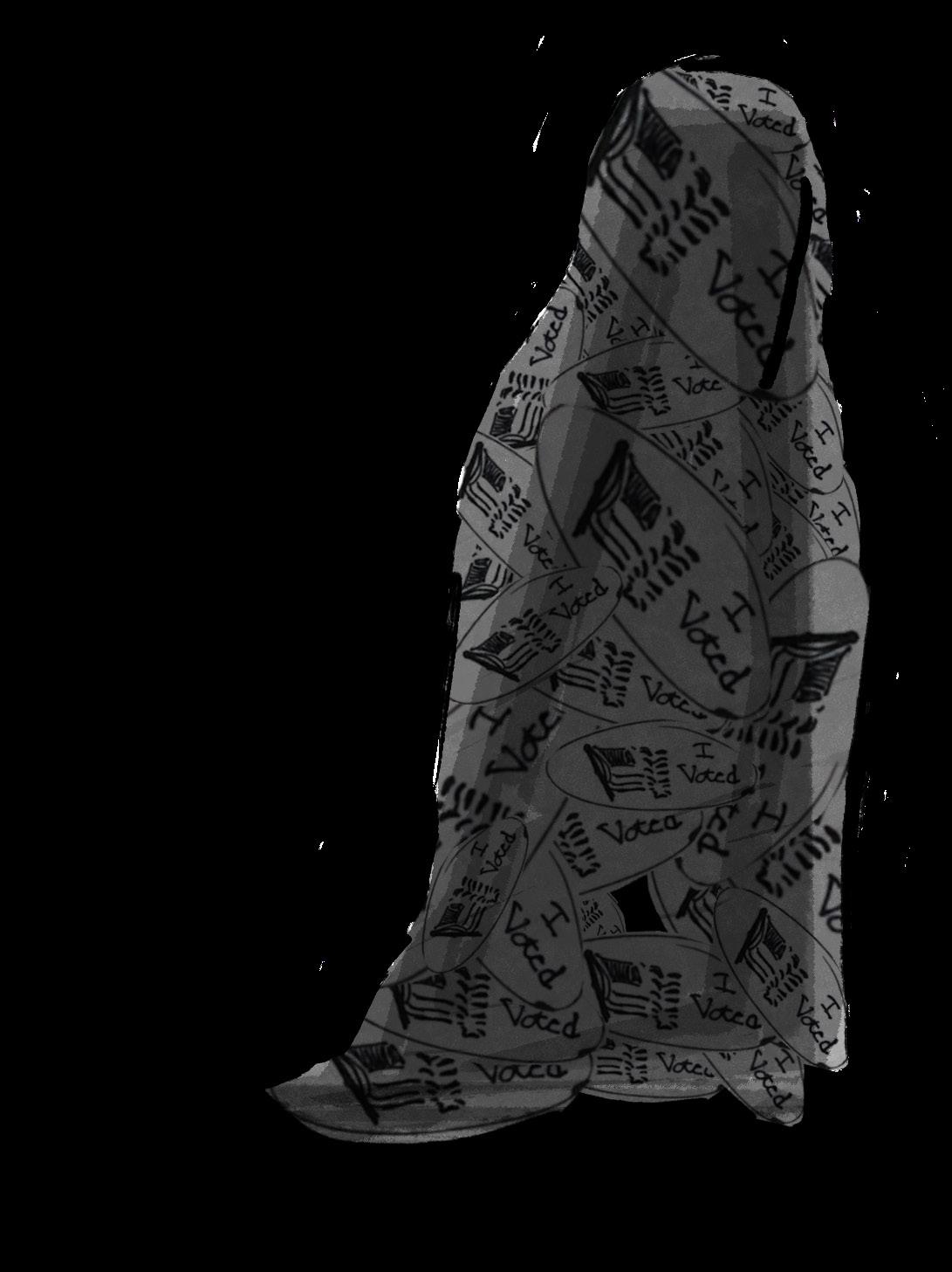

Now, all of this sounds bad, but none of it affects me! I’m middle class, white and privileged enough to have an IUD. I’m sittin’ pretty. And probably everyone else is, too. I don’t know, and I don’t really care.
Kamala and your local beekeeper, Tim
That brings us to our Democratic nominees this election season, Kamala Harris and Tim Walz — and let me tell you, these two are the subject of many a rumor. Kamala slept her way to the top, imprisoned over a thousand people for possession of marijuana and lied about the competency of the crypt keeper for four years. And only one of these things is true.
Seriously though, we saw an old man decaying right in front of our eyes and the woman
literally just gritted her teeth and said he was fine. That’s like saying Ricky Gervais is funny. That’s right Ricky Gervais, you’re not even safe in an article that has nothing to do with you. Fuck you.
Listen, in reality, Kamala was a pretty progressive prosecutor. She was against the death penalty, even in a case regarding the death of a police officer. She charged thousands of marijuana possessions as misdemeanors and co-founded The Coalition to End the Exploitation of Kids, a group designated to ending the human trafficking of children. Boring! I mean, who gives a fuck? I’ve never been human trafficked, so that means it’s a made-up thing that doesn’t happen to people.
One thing I love about Kamala is how wishy-washy her platform is. A lot of it is basically word salad, and isn’t that just awesome? I especially love her reluctance to make a clear plan regarding immigration. She’s
tried to distance herself from her more liberal immigration policies proposed back in 2020, but really, what does that mean?
Does she intend to keep immigrant children separated from their parents at the border? That’s right, we still do that. You’d think a Democratic president would fix that one, but really, what’s a Democrat but a Republican with a bow on top? That’s what I would say if I cared.
My other favorite Kamala fact is that she won’t ban fracking. That’s great news for me because I’m the heir to an oil fortune, actually. I guess it’s also good news for Pennsylvania, the birthplace of commercial oil production in the U.S., and we all know how crucial that is. Winning is more important than the environment.
Walz looks like your favorite grandparent. That’s just a fact.
Like, the guy looks like he’d offer you a caramel straight out of his pocket. But despite looking like the owner of your local flower market, he’s actually been the governor of Minnesota since 2019. During his time as governor, Tim actually did what he set out to accomplish. I may be a hater, but credit where credit is due.
Walz signed a bill codifying abortion rights after the court overturned Roe v. Wade, signed legislation that requires background checks for gun transfers, funded free meals for
all K-12 students and signed a bill last year that allows undocumented immigrants to get driver’s licenses in the state.
Too bad I’m not voting for him. See, I think guns should be given to all children at birth. And maybe if those free-lunch-receiving students pulled up their bootstraps like Vance and got a job at a local factory, they wouldn’t need meals funded by the radical left. What happened to the good old days?
I’m right and you’re wrong
Each candidate is bad. Equally so. One would strip the rights away from women and the queer community, create a dictatorship, ruin the economy and build a border wall — and one is a Democrat. Ew!
So see, I have a reason not to vote. Why choose the lesser evil when I could stand idly by? I may have endless information at my fingertips, be white, privileged and straightpassing, but I think I’ll sit this one out. Besides, what’s one vote?

Nightmares, cults and spiders
ASU horror artists dissect the dark aspects of humanity
by Fatima Gabir
In horror films, audiences’ worst fears and nightmares become reality. Sounds and visuals that explore dark and transgressive themes evoke elevated heartbeats, adrenaline and terror within those who dare to venture into the genre.
From slasher to supernatural to psychological, horror is chock-full of different ways to stimulate audiences.
According to the New York Film Academy, horror as a film genre began with George Méliès, a French filmmaker. His 1896 film “Le Manoir du Diable,” or “The House of the Devil,” is widely considered the first horror movie, and although it was not intended to be scary, it was “the first example of a film to include the supernatural and set a precedent for what was to come,” the New York Film Academy wrote.
Though the horror film genre can be creepy and disturbing, individuals who work behind the scenes on these projects see the genre as more than what it’s perceived as, and at ASU,
there is no shortage of professors and students who have experience in the industry.
Horror as an art form
According to Chris LaMont, an assistant professor in the Sidney Poitier New American Film School and a WGA screenwriter, horror films do more than just scare audiences — it can also tailor to other feelings.
“Horror is all about [whether people] will live or die,” he said. “[Therefore,] the audience is automatically invested in caring about the characters, hoping that they will be able to survive whatever challenges and conflicts come their way because we are all inherently afraid of death and being hurt.”
Horror films can also provide social or political commentary, like classic Jordan Peele movies such as “Get Out” and “Us,” in which Peele addresses race relations. Filmmakers have different stories

to tell and write their reflections on society using metaphors and analogies.
LaMont loves to tell stories that engage audiences emotionally and intellectually, and according to him, the horror genre is the best way to do that. His writing melds well with his writing partner, Joe Russo, as their films draw viewers into a “horror suspense world” with films like “The Au Pair Nightmare,” “The Inheritance” and “Soul Mates.”
“The Au Pair Nightmare” was the first film that LaMont and Russo sold, and “Soul Mates” was one of LaMont’s biggest films in 2023.
To LaMont, there is no difference between horror writing and other genres. At its core, horror has the typical elements of any other film genre.
“In ‘Soul Mates,’ the neat thing about horror is that they are regular people who are thrust into extraordinary situations, but at the end of the day, they are still people that you can relate to, that you could sympathize with,” he said.
Photo courtesy of A.T.

LaMont described “Soul Mates” as online dating meets “Saw.” A woman wakes up shackled to a guy she’s never seen before and they discover they are in a maze created by an online dating service called Soul Mates.
His other film “The Inheritance” is a supernatural horror starring Peyton List about a billionaire bringing his estranged children to their family’s mansion on the eve of his 75th birthday. While there, he tells them that someone is trying to kill him and the children have until midnight to save him — or they will lose their inheritance.
“And suffice to say, it’s not someone trying to kill him; it’s something, and just let your mind wander there,” LaMont said.
Falling in love with horror
As a child, Brian McAuley, an assistant professor in the Sidney Poitier New American Film School, fell in love with horror through the movie “Alien,” which he rented on VHS when he was eight or nine years old.
McAuley was drawn to the fun side of horror through the monsters and spookiness of the genre.
McAuley, who is a WGA screenwriter and a published novelist, has written films like “Dismissed,” a psychological horror starring Dylan Sprouse about a high school student who’s obsessed with keeping a perfect GPA.
During the production of “Dismissed,” McAuley was also writing episodes for the Netflix original “Fuller House.”
“It was funny to go from writing Kimmy Gibbler dialogue during the day into set writing dialogue for a psychopath,” he said.
In his book “Curse of the Reaper,” McAuley drew inspiration from his own experiences in Hollywood to create a character. The character is a horror film actor who played a slasher villain in the 1980s, but his career has since slowed. When the actor learns that his film franchise is being rebooted, the studio kicks him to the curb, claiming he’s too old for the role and recasts a younger, more popular actor instead.
“I got to tap into my own experiences in Hollywood working behind the scenes on film sets to really tell this kind of psychological horror story that is also built into it as this entire slasher franchise,” he said. “So I got to create all these kinds of campy films and one-liners. It’s been well received by horror fans because they understand all the references and appreciate the duality of that story.”
Horror as commentary
Kristen Semedo, an ASU alum, has been drawn to horror films like “Halloween” and “A Nightmare on Elm Street” since she was a child. As she’s gotten older, she’s realized that horror is more profound than just being scared.
“It’s a very intimate thing,” she said. “Learning about someone else’s fear or a group of people’s fears can say a lot about them as people and what’s going on in society. [Horror films] are a great refractive lens for viewing the world. Many horror movies make commentary on political and social issues, but also part of that [is] it’s fun to be scared.”
Photo courtesy of A.T. Etzweiler

Semedo, a director and scriptwriter, bounced around on the set of her first short film “Vermin,” running lines with actors, troubleshooting problems with cinematographers and setting up props with the art department. Work bled into the night, and they finally wrapped after 12 long hours.
Semedo graduated in May 2024 with a bachelor’s in film and media studies and wrote “Vermin” before graduating. She started the filming process the summer after graduation and looked forward to polishing it up and having it ready for ASU’s Student Showcase that took place on Oct. 23.
“Vermin” follows a recently divorced man who struggles to take responsibility for his life after separating from his wife, who filled the role of a caretaker — which a lot of women end up being for their partners in heterosexual relationships, Semedo said.
“It’s an allegory about men who fall into this category of self-made victims. This guy can’t get out of his way, and ultimately, things start happening to him when he doesn’t choose to grow up,” she said. “‘Vermin’ is my version of getting to do to a man what I’ve seen men do to women in horror films. It’s kind of like revenge, in a way.”
Semedo said the audience should pay attention to the spider in the film. She and her team hired a spider wrangler to bring it on set.
“The black widow was a really import-

ant piece to me,” she said. “The black widow female spiders are seen as vicious creatures who eat the male after mating. The title ‘Vermin’ refers to both the male lead and the way the male lead perceives women as disgusting creatures to sort of eradicate or trap or get rid of.”
For the past three years, she has been making a name for herself in the film industry. She worked as a prop master and an art assistant before shooting “Vermin,” and she’s puppeteered for indie horror films like “Destroy All Neighbors” and “V/H/S/85.” She was also a set decorator for a Headspace Super Bowl ad that featured John Legend.
Similarly, during spring break, Byron Roberson, a senior studying film and media production, shot his capstone film, “XLI.” The film’s production lasted two intense days inside a cabin in northeastern Arizona.
After her mother’s suicide, the main character, Willow, struggles to save her brother from his indoctrination into a cult. The film explores responses to trauma, family dynamics and the impact of religious iconography. “So many of us grow up in an environment where family is everything. To a lot of us, family is, but at the same time, how can that be distorted?” he said.
Dane Futrell, a graduate student studying dramatic writing, has been acting for 10 years. After taking a
playwriting class, he realized that he was filling his personal journals with dialogue. In other words, he was writing plays.
Today, he adds horror elements to his plays to make audiences feel unsettled.
“I love how simple dialogue can sometimes be so insightful and very scary at the same time,” he said. “It’s an ancient Greek tradition not to show the worst of it … but rather to have a character recount what happened to them. And I love that tradition very much because when the audience uses their imagination, it’s going to be the most scared that they can be.”
In Futrell’s plays, the characters are outcasts who are hard to like but easy to love. Their worst parts make them relatable and humanize them.
In his play “Dirty Kids,” the main character wants to live forever while maintaining sobriety after a lifetime of addiction. Throughout the story, the audience believes that he will persevere, but he ultimately ends up relapsing and returning to his old ways in a shocking twist.
When people think of horror, they may feel it is only meant to be scary. But horror creatives see it as a way to tell stories with deep messaging. Horror films can explore complex emotions, profound or relatable themes and even psychological depth.

Photo by Ollie Slade
Violence in vigilance: An investigation into the Phoenix Police Department
The Department of Justice and members of the ASU community express concerns over the local police department
by Evan Silverberg
Illustrations by Andrea Ramirez
The Phoenix Police Department is one of the most violent police departments in the United States.
If you follow local politics, that statement may have been blasted on your social media feed for a brief time in June. This came as the culmination of a three-year investigation into Phoenix PD by the U.S. Department of Justice. The DOJ concluded that Phoenix PD regularly uses excessive violence and unlawful practices that violate the Fourth Amendment, First Amendment, Civil Rights Act of 1964 and Americans with Disabilities Act.
While many people may have seen the bullet point summaries published by news outlets, over four months later, the vast majority of Phoenicians remain unaware of the report’s specific details and accounts.
‘Force first’ practices
The DOJ report suggests that the excessive violence displayed by Phoenix PD is the result of a fundamental flaw in the way the department teaches its officers how to de-escalate situations.
“Rather than teaching that de-escalation strategies are designed to eliminate or reduce the need to use force, PhxPD has misappropriated the concept and teaches officers that all force — even deadly force — is de-escalation,” the DOJ said.
This warped perception of de-escalation has led to “force first” practices among Phoenix PD, where violence is not something that officers must resort to, but instead the
quickest and easiest way to de-escalate almost any situation.
In one instance mentioned in the report, officers arrived at an apartment complex and heard screaming. An officer burst into the apartment, picked a woman up from behind, dragged her outside, then “kicked her legs out from under her and slammed her face-first into the sidewalk, splitting her chin on the concrete.” The DOJ said it was “unclear the woman even knew it was a police officer who grabbed her.”
On another occasion, officers spotted a man with a stolen car. He put his hands up as soon as police approached him, and officers told him to lie on the ground. Before the man had an opportunity to respond, an officer grabbed his hair and shoved him to the ground. Then, the officer wrapped his arm around the man’s neck while other officers held his limbs down.
These two instances are among 132 listed in the DOJ report, in which they concluded that unnecessarily violent arrests like these are fairly standard for Phoenix PD. Slightly less standard, but not entirely rare, are occurrences where lethal force is used. According to the DOJ, Phoenix has one of the highest rates of police-involved fatal shootings in the country, and while city officials have long blamed this on Arizona’s loose gun ownership laws, the DOJ said that’s not an excuse: “Possession of a weapon without threatening behavior does not justify lethal force.”
In one instance, police were called to de-escalate a suicide attempt before shooting the woman 10 times after noticing she had a gun. The woman died after the six officers failed to give

her any medical attention for nine minutes after the shooting.
“Officers violate the Constitution when they fire their weapons at people who present no immediate threat of harm, and they continue to shoot at people after they are no longer a threat,” the DOJ said.
In another situation, officers noticed a man throwing rocks at their car as they passed. The officers originally called dispatch to request that an officer with “less-lethal” weapons be sent out to deal with the situation. However, the original officers returned to the scene, stopped within “throwing distance” and drew their guns, demanding the man put down the rock he was holding. When he began to throw another rock, the officers shot him four times, killing him.
The DOJ also concluded that Phoenix PD endangers lives in ways that have nothing to do with guns. According to the DOJ, “PhxPD officers routinely keep handcuffed people face down and apply pressure to their head, back, and neck.”
Similarly, most Phoenix PD officers misuse leg restraints in a way that leaves arrestees face down on their stomach even while being transported in a police vehicle. The DOJ reported that several people died in Phoenix jails after being incorrectly restrained.
Although these practices can cause deadly asphyxiation — officers have been advised not to use them — they’ve remained standard in the Phoenix PD, “even when the person is plainly in distress or says they cannot breathe,” the DOJ said.
In one case, the DOJ reported, officers “pressed a deaf man’s neck and head down for over 20 minutes,” even continuing as his “breathing shallowed” and he “began to cry, cough, and eventually scream.” The officers had been informed before arrival that the man was deaf, but they repeatedly shouted at him.
Similarly, on Aug. 19, nearly two months after the DOJ released their report, bodycam footage captured Phoenix PD officers angrily shouting orders at a 34-year-old deaf man, Tyron McAlpin. On Oct. 16, CNN reported the footage of officers tackling, punching and tasing him almost immediately without warning.
After the altercation, McAlpin was charged with assault, with officers claiming he took a “fighting stance” as they approached him. The charges have since been dropped.
‘Less lethal’ practices
After Phoenix had a nationwide high of 44 police shootings in 2018, the police department invested heavily in “less-lethal” projectile weapons “designed to stop, but not kill, a person who presents a threat,” according to the DOJ.
Hoping it would prevent deaths, Phoenix PD heavily incentivized its officers to use these, even taking guns away from officers who didn’t use them enough. The result, according to the DOJ, is a system where lethal weapons are still being used where less-lethal weapons should be, and less-lethal weapons are being used in
unnecessary situations. One man, wanted for two open felony warrants related to probation violations, was standing outside a storage unit when officers surrounded him. Within 20 seconds, the man, who was unarmed, was tased and pelted with several rounds of foam bullets and over 20 PepperBalls.

The report added that these weapons were also used against peaceful protesters in 2020, usually without warning, and often against people trying to leave the scene. On one occasion, Phoenix PD boxed in a group of protesters and pelted them with less-lethal weapons. According to the report, the sergeant bragged, “We just lit ‘em up” and laughed as he said, “It was the perfect pitch ‘cause they can’t go anywhere.”
Phoenix police officers’ use of Tasers is particularly excessive. According to the DOJ, “PhxPD officers fire Tasers at people with little or no warning and when people pose no threat. Officers rarely attempt de-escalation before firing a Taser. Officers fire Tasers at people with their hands up, after they surrender, or when they are restrained.”
The DOJ report suggested that authority within Phoenix PD may encourage this behavior, citing one instance where a sergeant responded to a mental health crisis by spraying the man with pepper spray for seven seconds and then tasing him, all within minutes of arriving.
Discriminatory practices
In other cases, reasons for unlawful treatment have been discriminatory. “Though Hispanic and white people make up roughly even shares of the Phoenix population, PhxPD cites or arrests Hispanic people for traffic-equipment related offenses at three times the rate of white people,” the DOJ said.
“PhxPD cites or arrests Hispanic people 12 times as often as white people for improper tinting of windows, seven times as often for improper license plate lights, and more than eight times as often for squealing tires,” it added. On a per capita basis, Black people are also roughly three times more likely than white people to be cited or arrested on these kinds of charges.
“When I see a police officer and I’m driving, I get nervous, I get scared and I’m worried that they’re gonna try and find anything to pull me over for,” said V Shamsiddeen, a senior studying construction management and technology. “And once they pull me over, it’s their game. It doesn’t matter if I’m completely in compliance. Just for being Black, I’m at risk.”
Jessica Katzenstein, an assistant professor at ASU’s School of Social Transformation, said that although racism in policing has always existed, it has increased since the Black Lives Matter protests in 2020.
“The biggest thing that stands out is a structural issue that exceeds policing and is part of a larger backlash to the George Floyd protests,” Katzenstein said. “And that’s this idea that Black Americans have somehow gotten too much attention in policing. … And now it’s gone too far.
“Some officers have suggested or said relatively directly that they feel like reform diversity programs that originated in Chicago or the East Coast don’t really fit here because this area has a much lower Black population.”
However, Shamsiddeen rejected this line of thinking. “I lived in Arizona my whole life and can say I’ve never had a great interaction with any police officer ever,” they said.
“On the other hand, there’s also been some complaints around the invisibilization of Latinx and Native issues,” Katzenstein said.
While police departments have taken some measures to prevent anti-Black racism in recent years, other minorities have been largely left out of the equation. As a result, Katzenstein describes a culture within Phoenix PD where anti-Black racism is baked into the system, and racism against Latin and Indigenous Americans is also prevalent.
People of color face police injustice at a disproportionate rate, but according to Shamsiddeen, no one is safe. “They always start with minorities and then slowly get further and further up the totem pole,” Shamsiddeen said. “And we’re now at this point where cops can get away with anything.”
One of Phoenix PD’s most disproportionately-abused targets, however, is the city’s homeless community. Despite making up less than 1% of Phoenix residents, homeless people account for 37% of all arrests made by Phoenix PD.
“PhxPD stops, detains, and arrests people who are homeless without reasonable suspicion that they are engaged in criminal activity,” the DOJ said. “The City and PhxPD seize and destroy property belonging to people who are homeless without providing adequate notice or opportunity to collect their belongings.”
In 2023, the City of Phoenix conducted some of its largest clean-ups in “The Zone,” a homeless encampment with hundreds of people. During “clean-ups,” unhoused people’s property is seized and destroyed by police.
“For some homeless residents, the first notice they received was the sunrise announcement by PhxPD officers, just before the clean-ups began,” the DOJ said. “People who failed to move their property sometimes lost everything.”
ASU PD
ASU has its own police department, which holds jurisdiction over all four of the school’s campuses and much of the surrounding areas.
“The ASU Police Department includes many experienced officers who transferred from other law enforcement agencies in the valley, and throughout the U.S.,” ASU Spokesperson Jerry Gonzalez wrote in an email. “We have former officers from New York City, San Francisco, El Paso and many local cities…Mesa, Glendale, Paradise Valley, Peoria, Maricopa, etc.”
Many officers working for ASU PD are veterans of Phoenix PD. Consequently, they succumb to many of the same shortfalls.

Shamsiddeen described their experience as a Black student living on campus: “Every time I had to walk back from [the parking lot] to my dorm, I was worried about getting stopped by the police. I was stopped at least three separate times.”
One prevalent, recent example involving ASU PD is the pro-Palestine solidarity encampment that took place on April 26 outside Old Main. ASU PD — led by ASU Police Chief and former Mesa PD officer Michael Thompson — arrested three protesters. All three cases were dropped by Judge William Cawthorn, who ruled there was no probable cause for the arrests.
Late that night, officers also arrested almost 70 additional protesters and dismantled the encampment.
Thompson also admitted to slashing tents with knives, during which he was out of uniform, and other officers were seen forcibly removing the hijabs off several Muslim women. According to protest organizers, one protester fainted from a POTS episode (a chronic blood circulation disorder), and instead of letting medics help her, officers arrested the protester and the
and supervision at PhxPD,” the DOJ said. Officer training “has explicitly encouraged officers to use force when there is no legal justification to do so.”
The DOJ also said that Phoenix PD lacks avenues to hold officers accountable, and complaints filed are largely ignored by supervisors. Investigations into officer misconduct are almost always biased and often omit key information. When an officer does receive a misconduct violation, the discipline is usually extremely
less than a year, which you shouldn’t be able to,” Shamsiddeen said. “I think they’re given too much of a grace on what they are and aren’t allowed to do and what mistakes they make. I feel like if you have to be put on a Brady List, you should be fired.”
The Brady List is a list of officers with an established history of misconduct. Over 13% of all Phoenix police officers are on the list.
Regardless of the causes of the issues


Stay tuned on our Instagram for the crossword answers.

1. ____ refers to the idea of death being a transition from this life to the next.
2. The Community Services Building once housed patients with this fatal lung infection.
3. ____ is a built-in encryption that allows another entity to access your private data.
4. In “I don’t vote,” Tim Walz is said to look like your favorite ____.
5. “The ____” was a homeless encampment in Phoenix with hundreds of people.
6. According to SPM’s resident satirist, everyone uses Halloweekend as an excuse to be blatantly ____.
7. Amy Noriega Pineda, a junior studying psychology and transborder studies, used her role as president of the Hispanic Honor Society to start a Día de los Muertos celebration on the ____ campus.


8. Assistant Professor Brian McAuley fell in love with the movie ____ at eight or nine years old.
9. ____ is the proposed policy that turns every civil servant into a political appointee, meaning positions can be given in accordance to loyalty to the president rather than actual job experience.
10. The ghost of Dixie ____ has been spotted wearing a large white hat and gown.
11. What military branch is responsible for creating the dark web?
12. The crystal capital of northern Arizona is ____.
13. A deck of tarot cards includes the Hermit, the Fool, the Sun and the ____.
14. ____ are less-lethal projectile weapons used by police departments.
15. In “Nightmares, cults and spiders,” Chris LaMont described his film “Soul Mates” as online dating meets ____.
16. Complete the following sentence: To be cringe is to be ____.

