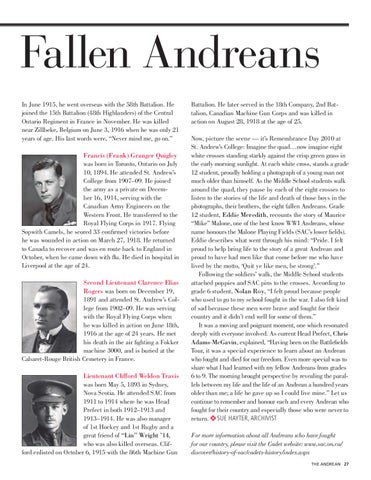
Fallen Andreans In June 1915, he went overseas with the 58th Battalion. He joined the 15th Battalion (48th Highlanders) of the Central Ontario Regiment in France in November. He was killed near Zillbeke, Belgium on June 3, 1916 when he was only 21 years of age. His last words were, “Never mind me, go on.” Francis (Frank) Granger Quigley was born in Toronto, Ontario on July 10, 1894. He attended St. Andrew’s College from 1907–09. He joined the army as a private on December 16, 1914, serving with the Canadian Army Engineers on the Western Front. He transferred to the Royal Flying Corps in 1917. Flying Sopwith Camels, he scored 33 confirmed victories before he was wounded in action on March 27, 1918. He returned to Canada to recover and was en route back to England in October, when he came down with flu. He died in hospital in Liverpool at the age of 24. Second Lieutenant Clarence Elias Rogers was born on December 19, 1891 and attended St. Andrew’s College from 1902–09. He was serving with the Royal Flying Corps when he was killed in action on June 18th, 1916 at the age of 24 years. He met his death in the air fighting a Fokker machine 3000, and is buried at the Cabaret-Rouge British Cemetery in France. Lieutenant Clifford Weldon Travis was born May 5, 1893 in Sydney, Nova Scotia. He attended SAC from 1911 to 1914 where he was Head Prefect in both 1912–1913 and 1913–1914. He was also manager of 1st Hockey and 1st Rugby and a great friend of “Lin” Wright ’14, who was also killed overseas. Clifford enlisted on October 6, 1915 with the 86th Machine Gun
Battalion. He later served in the 18th Company, 2nd Bat talion, Canadian Machine Gun Corps and was killed in action on August 28, 1918 at the age of 25. Now, picture the scene — it’s Remembrance Day 2010 at St. Andrew’s College: Imagine the quad…now imagine eight white crosses standing starkly against the crisp green grass in the early morning sunlight. At each white cross, stands a grade 12 student, proudly holding a photograph of a young man not much older than himself. As the Middle School students walk around the quad, they pause by each of the eight crosses to listen to the stories of the life and death of those boys in the photographs, their brothers, the eight fallen Andreans. Grade 12 student, Eddie Meredith, recounts the story of Maurice “Mike” Malone, one of the best know WWI Andreans, whose name honours the Malone Playing Fields (SAC’s lower fields). Eddie describes what went through his mind: “Pride. I felt proud to help bring life to the story of a great Andrean and proud to have had men like that come before me who have lived by the motto, ‘Quit ye like men, be strong’.” Following the soldiers’ walk, the Middle School students attached poppies and SAC pins to the crosses. According to grade 6 student, Nolan Roy, “I felt proud because people who used to go to my school fought in the war. I also felt kind of sad because these men were brave and fought for their country and it didn’t end well for some of them.” It was a moving and poignant moment, one which resonated deeply with everyone involved. As current Head Prefect, Chris Adams-McGavin, explained, “Having been on the Battlefields Tour, it was a special experience to learn about an Andrean who fought and died for our freedom. Even more special was to share what I had learned with my fellow Andreans from grades 6 to 9. The morning brought perspective by revealing the parallels between my life and the life of an Andrean a hundred years older than me; a life he gave up so I could live mine.” Let us continue to remember and honour each and every Andrean who fought for their country and especially those who were never to return. SUE HAYTER, ARCHIVIST For more information about all Andreans who have fought for our country, please visit the Cadet website: www.sac.on.ca/ discover/history-of-sac/cadets-history/index.aspx The Andrean 27