Remembering our L
ast November, Melissa Ramon’s grade 8 history class teamed up with SAC Archivist, Sue Hayter, to explore and honour the lives of some of the 104 young Andreans who died in the First World War. The students used documents from the School’s Archives to investigate the lives at SAC and in the military of 18 fallen Andreans. They created a memorial trading card for each fallen Andrean, some of which are displayed on the School website www.sac.on.ca/discover/history-of-sac/remembranceday-2010/index.aspx The grade 8s thoroughly enjoyed delving into the lives of their fellow Andreans, and they discovered that there were many connections to the past: 100 years ago SAC students played hockey and football, became Prefects, came from faraway places, and, occasionally, got into trouble. Of the 18 Andreans whose lives were commemorated in this way, eight were selected to be commemorated at the Middle School Remembrance Day ceremony:
where he escaped and was recaptured, and then in camps at Crefeld, Holzminden, and Schwarmsadt before being repatriated in 1918 because of bronchitis brought on by gas. He died of flu in London on November 23, 1918 and was buried in St. Jude’s Cemetery, Oakville on December 28, 1918. Tod earned the Silver Star for his service.
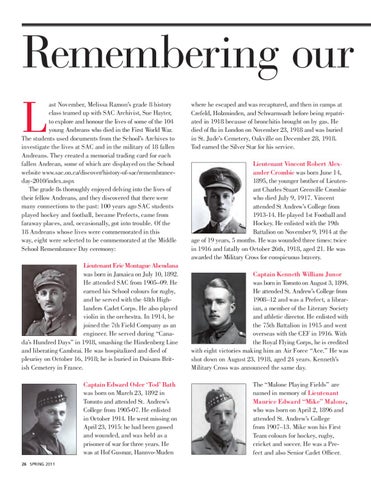
Lieutenant Vincent Robert Alexander Crombie was born June 14, 1895, the younger brother of Lieutenant Charles Stuart Grenville Crombie who died July 9, 1917. Vincent attended St Andrew’s College from 1913-14. He played 1st Football and Hockey. He enlisted with the 19th Battalion on November 9, 1914 at the age of 19 years, 5 months. He was wounded three times: twice in 1916 and fatally on October 26th, 1918, aged 21. He was awarded the Military Cross for conspicuous bravery.
Lieutenant Eric Montague Abendana was born in Jamaica on July 10, 1892. He attended SAC from 1905–09. He earned his School colours for rugby, and he served with the 48th Highlanders Cadet Corps. He also played violin in the orchestra. In 1914, he joined the 7th Field Company as an engineer. He served during “Canada’s Hundred Days” in 1918, smashing the Hindenberg Line and liberating Cambrai. He was hospitalized and died of pleurisy on October 16, 1918; he is buried in Duisans British Cemetery in France.
Captain Kenneth William Junor was born in Toronto on August 3, 1894. He attended St. Andrew’s College from 1908–12 and was a Prefect, a librarian, a member of the Literary Society and athletic director. He enlisted with the 75th Battalion in 1915 and went overseas with the CEF in 1916. With the Royal Flying Corps, he is credited with eight victories making him an Air Force “Ace.” He was shot down on August 23, 1918, aged 24 years. Kenneth’s Military Cross was announced the same day.
Captain Edward Osler ‘Tod’ Bath was born on March 23, 1892 in Toronto and attended St. Andrew’s College from 1905-07. He enlisted in October 1914. He went missing on April 23, 1915: he had been gassed and wounded, and was held as a prisoner of war for three years. He was at Hof Gusmar, Hannvo-Muden
The “Malone Playing Fields” are named in memory of Lieutenant Maurice Edward “Mike” Malone, who was born on April 2, 1896 and attended St. Andrew’s College from 1907–13. Mike won his First Team colours for hockey, rugby, cricket and soccer. He was a Prefect and also Senior Cadet Officer.
26 Spring 2011