SAS / ST. ANDREW’S MAGAZINE
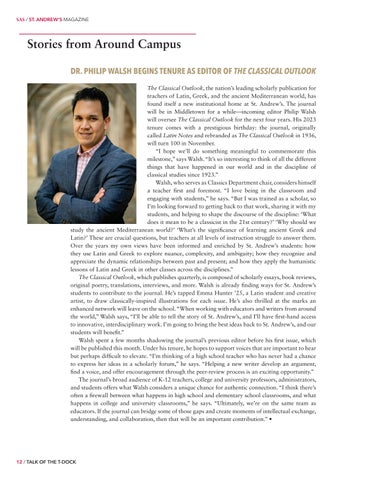
Stories from Around Campus DR. PHILIP WALSH BEGINS TENURE AS EDITOR OF THE CLASSICAL OUTLOOK The Classical Outlook, the nation’s leading scholarly publication for teachers of Latin, Greek, and the ancient Mediterranean world, has found itself a new institutional home at St. Andrew’s. The journal will be in Middletown for a while—incoming editor Philip Walsh will oversee The Classical Outlook for the next four years. His 2023 tenure comes with a prestigious birthday: the journal, originally called Latin Notes and rebranded as The Classical Outlook in 1936, will turn 100 in November. “I hope we’ll do something meaningful to commemorate this milestone,” says Walsh. “It’s so interesting to think of all the different things that have happened in our world and in the discipline of classical studies since 1923.” Walsh, who serves as Classics Department chair, considers himself a teacher first and foremost. “I love being in the classroom and engaging with students,” he says. “But I was trained as a scholar, so I’m looking forward to getting back to that work, sharing it with my students, and helping to shape the discourse of the discipline: ‘What does it mean to be a classicist in the 21st century?’ ‘Why should we study the ancient Mediterranean world?’ ‘What’s the significance of learning ancient Greek and Latin?’ These are crucial questions, but teachers at all levels of instruction struggle to answer them. Over the years my own views have been informed and enriched by St. Andrew’s students: how they use Latin and Greek to explore nuance, complexity, and ambiguity; how they recognize and appreciate the dynamic relationships between past and present; and how they apply the humanistic lessons of Latin and Greek in other classes across the disciplines.” The Classical Outlook, which publishes quarterly, is composed of scholarly essays, book reviews, original poetry, translations, interviews, and more. Walsh is already finding ways for St. Andrew’s students to contribute to the journal. He’s tapped Emma Hunter ’25, a Latin student and creative artist, to draw classically-inspired illustrations for each issue. He’s also thrilled at the marks an enhanced network will leave on the school. “When working with educators and writers from around the world,” Walsh says, “I’ll be able to tell the story of St. Andrew’s, and I’ll have first-hand access to innovative, interdisciplinary work. I’m going to bring the best ideas back to St. Andrew’s, and our students will benefit.” Walsh spent a few months shadowing the journal’s previous editor before his first issue, which will be published this month. Under his tenure, he hopes to support voices that are important to hear but perhaps difficult to elevate. “I’m thinking of a high school teacher who has never had a chance to express her ideas in a scholarly forum,” he says. “Helping a new writer develop an argument, find a voice, and offer encouragement through the peer-review process is an exciting opportunity.” The journal’s broad audience of K-12 teachers, college and university professors, administrators, and students offers what Walsh considers a unique chance for authentic connection. “I think there’s often a firewall between what happens in high school and elementary school classrooms, and what happens in college and university classrooms,” he says. “Ultimately, we’re on the same team as educators. If the journal can bridge some of those gaps and create moments of intellectual exchange, understanding, and collaboration, then that will be an important contribution.” •
12 / TALK OF THE T-DOCK