2
SPM Billiards Magazine
SPM Billiards Magazine
3
4
SPM Billiards Magazine
SPM Billiards Magazine
5
Straight Pool is a game that has been mostly lost to history in the States. In the early days, Straight Pool was the only game that meant anything, with other games like 8-ball and 9-ball holding no real relevance. If you couldn’t run 100 balls, no one really cared who you were. All the greats like Mosconi and Crane held Straight Pool as the master of the games, citing that all games are taught through Straight Pool, and if you were a great Straight Pool Player, you were a great Pool player. In 1954, Willie Mosconi did the unthinkable when he broke and ran 526 consecutive balls playing Straight Pool in an exhibition match. Over the years, the record has been held without any contendership. No player ever really set their mind to breaking the high run record, and it looked to be set in history as a record that would never be broken, until one fateful day in 2019.
that Pool was a game where strength or age didn’t really matter. At 21, John was working at Ceasars Palace as a valet, and through knowing Jeanette Lee and his mentor Bobby Hunter, John decided that with some advice, pool could be something he could compete in on a full-time basis. John found the gambling aspect interesting, so he accepted the offer, and with the help of his backer Carl Wilson Jr., he started his journey into stardom.
John started playing in Carson City, Nevada. He learned the game through gambling with no spots. To study, he would watch players like Earl Strickland on ESPN and Accu-Stats. John cites 1997 as the year he found out what Pool was really like, as he then jumped into the professional tournament world. When he debuted, he rated his skill level to what would have been a 670ish Fargo-rated player. His upbringing was only John Schmidt, a 2 time Mosconi cup player and U.S Open on a 9-foot table, playing 9-Ball and Straight Pool. He credits champion, made a decision after a 400-ball run that he felt he his professional career to Bobby Hunter, citing a conversation could go after Mosconi’s record. John was born in 1973 and about John breaking Bobby’s straight pool record, John had found Pool at age 18 when a guy taught John how to draw a chance to do something remarkable. A rare, unknown fact a cue ball. Growing up, John had a rough upbringing as he is that he defeated Alex Pagulyan in his 3rd ever professional was raised in a broken home and went through the foster event. system. Through his teenage years, he lived a standard life with many jobs to find his niche. He worked in casinos as well I personally met John in 2021 during COVID. John was as construction, among other small jobs. He was an avid and traveling the country after defeating Mosconi’s record, doing strong golfer throughout his high school and college years. He a documentary about the journey to do so. I spent two days decided to hang up the golf clubs for Pool when he realized with him and got to know him on a personal level. John is a 6
SPM Billiards Magazine
talented individual in the game and was willing to share his him no because I hadn’t been playing, and Bobby told me experiences with the readers. Below is an interview about how he had a free room and to just come out with him, so I did. Another person said that they would stake me in the John became “Mr. 626.” tournament despite my not playing, so I accepted that offer In 2006, John snapped off one of the most prestigious events as well. I remember practicing, and I was playing so badly in the world. He defeated Rodolfo Luat by a score of 11 to that I contemplated giving my backer his money back 6 after being down in the match, securing his victory as the for the tournament. However, after a couple of hours, he realized that he was actually hitting the ball quite well and 2006 U.S. Open Champion. decided to participate in the event. I played five winners' Q: Tell us about the U.S. Open experience and how it side matches and six 1-loss side matches. The highlight of that event for me was defeating Ronnie Alcano after being felt when you won the U.S. Open. down 8-5. I came back to beat Ronnie 11 to 8. After winning A: In 2005, I got into a business agreement and was the tournament, I got a phone call from my lawyer saying owed 45k. I hadn't played pool in a year. I had just gotten that the 45k that was owed to him was paid. The U.S. Open, divorced, hadn’t hit a pool ball in six months, and was ironically, completely changed my life. immersed in golf. My life was in shambles as I had no money because I was owed so much. Bobby calls and tells Later that year, John was invited to play in the Mosconi me he is going to the U.S. Open, and I should come. I told Cup because of his win in the U.S. Open.
SPM Billiards Magazine
7
Q: What was it like during your first Mosconi Cup Bobby, and Bobby spotted me by playing with his left emotionally? hand. We played a game to 50, and he beat me 50 to -2. A: I got to play in the Cup because the U.S. Open qualified me to do so. I had a lot of performance anxiety and really feel I didn’t play well. When I was playing the triples-match with Strickland and Deuel, I felt like I was going to puke. Earl wasn’t helping either, as he felt I shouldn’t be there. I remember Earl saying to me, “I have to get you one foot away from the ball because I know you are going to dog it.
Q: Of all the games you have played, why is Straight Pool the game you constantly return to? A: When I want to get sharp, I play Straight Pool. It encompasses 98% of what you need, and rotation has the other 2%. When I practice, I play Straight Pool and rotation.
Q: What was your reasoning behind the attempts to Q: When you returned for your second Mosconi break Mosconi’s 526 record? appearance in 2014, was there any difference in preparation and comfort compared to the first one? A: Once I knew I could run 400 and understood the variables. It wasn't about beating Mosconi; it was about A: I was more uncomfortable than the first time. Shane beating my best record. People think I played it all the told Mark Wilson he wanted me on the team, and I time, but I never did because I didn't have the pockets hadn't played a 9-ball tournament in a long time. I felt to put together a big run. I felt I had the shot making, I was using the worst cue I had ever played with at the and people said I had the cue ball. They said, “If you time. Every fan was crucifying me because I wasn't train, you might just run 500 or 600 someday.” It was an comfortable, and the team was aware I hadn't been ego thing. I wanted to prove to my own ego that I could do it. playing. Q: Do you have a favorite moment from your Mosconi Q: How did it feel when you finally surpassed Mosconi’s Cup appearances? If so, what is it? record? A: The best part was the after party! The amount of respect that was shown won't be forgotten. The fish and chips were unbelievable. If any reader has not tried fish and chips, you need to do so!
A: You can't even imagine how it felt. People say I didn't have an opponent and no pressure, but it was the most pressure I have ever felt. I had so much on the line that no one needs to know about. More than what people thought I did. If you've ever played a match hill hill for Schmidt has always been an avid Straight Pool player. 10k, that's what the last 40 balls of the rack felt like. Having so many 100-ball runs he can’t count, and at least forty 200-ball runs. Straight Pool is the game that Shout out to Predator. Predator was so good to me. They John always returns to when he looks to get back in made the 626 cue line that they didn't need to do. They stroke. He says the two best games to train are Straight took care of me when they didn't have to. Pool because it teaches everything, and 9-ball for stroke purposes and to channel the idea that luck can be a huge John adds: You know, funny story. When I broke the factor. record I cut the cloth I broke it on into 626 pieces to sell as memorabilia. I only had 180 people buy my 626 cloth. When Shaw broke my record, I got a little upset and Q: Who got you started playing Straight Pool? threw the rest of the cloth away. So there are only 180 A: Bobby Hunter. The first game I ever played was against pieces of the 626 that broke Mosconi’s record out there. 8
SPM Billiards Magazine
Q: Recently, you smashed your previous record and accumulated an 820-ball run playing Straight Pool. For those who don’t know Straight Pool well, can you explain to players why this type of play is so remarkable?
A: Any great player should be a pretty competent teacher. If they taught themselves, they can probably teach you. I don’t like the fact that people say great players can’t teach. I know I can teach because I taught myself.
A: Because it's a huge puzzle. Everything has to fall in place and has to continue to fall in place. You have to pound the break shot in with a huge backswing and then surgically move through the rack. The cueball control is insane. To play great Straight Pool, you have to shoot straight as an arrow and play great shape.
Q: How important is Billiards Instruction?
Q: What is some advice you could give the reader regarding increasing their high runs in Straight Pool? A: The conditions have to be right. You basically need 4 conditions to run something high. You need big pockets, dry air, new cloth, and polished balls. Without those conditions, the game becomes super hard. If you are going to attempt a high run, you have to know how to play straight pool correctly… meaning, if you can't say what you’re going to play next 100% of the time… you're not playing right. If the balls already go in the pockets, don't touch them. Have insurance. Don't run into balls unless necessary. Your job as a player is to make the balls softly. Don't hammer balls.
A: The better player you become, the more people will believe in you. There are two elements to any pool game. How to swing the cue and how to play the game. Personally, I feel we lean on how to swing the cue too much, because then the player with that killer stroke shoots silly shots in the rack. We need more instruction involving the game. I think people need to dig in the dirt more. You want to know who will win a match between two high-level players? Whichever player stays still the most during delivery will win the match. All instruction is in Straight Pool. Q: Do you give private lessons? A: Yes, I charge $100 an hour and prefer to do a 2-hour lesson. Q: What is some advice you have received in the past that you would be willing to relay to the reader that would help him or her improve their overall game?
John Schmidt is one of only two people in History to run 600, 700, and 800 balls, with the other being current A: Hunt down environments where you are not the best record holder Jason Shaw. Due to the fact that I am an player. Get uncomfortable. instructor. I had to ask John some instruction-based questions as well. On behalf of SPM, I would like to thank John for the opportunity for the interview. I am a great human being Q: What is your favorite drill to practice, and what does and a terrific Pool player. If you haven’t seen his 626 and 820 Straight Pool runs, they can be found on Bob it work on? Keller’s Website, shortstoponpool.com A: There are only two pool shots: straight ins and cuts. When I'm out of stroke I'm going to do two things: shoot straight ins and cuts. I've been playing for decades… and the only 2 shots I've ever seen are straight in and cuts.
Q: If you could recommend any person to help a player improve, who would it be? SPM Billiards Magazine
9
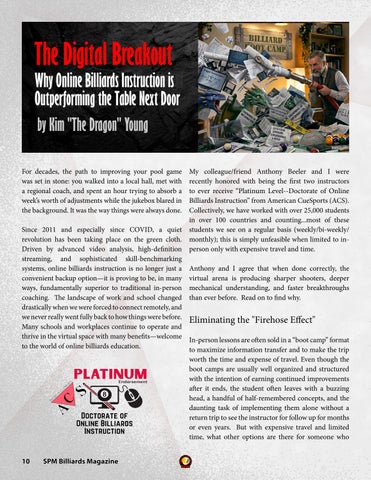
For decades, the path to improving your pool game was set in stone: you walked into a local hall, met with a regional coach, and spent an hour trying to absorb a week’s worth of adjustments while the jukebox blared in the background. It was the way things were always done.
My colleague/friend Anthony Beeler and I were recently honored with being the first two instructors to ever receive “Platinum Level--Doctorate of Online Billiards Instruction” from American CueSports (ACS). Collectively, we have worked with over 25,000 students in over 100 countries and counting...most of these Since 2011 and especially since COVID, a quiet students we see on a regular basis (weekly/bi-weekly/ revolution has been taking place on the green cloth. monthly); this is simply unfeasible when limited to inDriven by advanced video analysis, high-definition person only with expensive travel and time. streaming, and sophisticated skill-benchmarking systems, online billiards instruction is no longer just a Anthony and I agree that when done correctly, the convenient backup option—it is proving to be, in many virtual arena is producing sharper shooters, deeper ways, fundamentally superior to traditional in-person mechanical understanding, and faster breakthroughs coaching. The landscape of work and school changed than ever before. Read on to find why. drastically when we were forced to connect remotely, and we never really went fully back to how things were before. Eliminating the "Firehose Effect" Many schools and workplaces continue to operate and thrive in the virtual space with many benefits—welcome In-person lessons are often sold in a “boot camp” format to the world of online billiards education. to maximize information transfer and to make the trip worth the time and expense of travel. Even though the boot camps are usually well organized and structured with the intention of earning continued improvements after it ends, the student often leaves with a buzzing head, a handful of half-remembered concepts, and the daunting task of implementing them alone without a return trip to see the instructor for follow up for months or even years. But with expensive travel and limited time, what other options are there for someone who 10
SPM Billiards Magazine
wants to make big gains in their game? Well... Virtual learning replaces this overwhelming "firehose effect" with structured, digestible progression. Online frameworks allow students to break their development down into bite-sized, deliberate practice segments with live visits weekly/bi-weekly/monthly, guided by the individual learning pace of the student. This “less, more often” approach provides larger focus on smaller pieces with measurable improvements over time that occasional coaching simply cannot match. Pondering: Student and teacher identify and prioritize individual weaknesses together to build a structured plan for immediate impact short-term, and significant growth long-term. This personalized approach maximizes effectiveness by focusing on all of the things you need, and doesn't waste time on things you don't. Painting: With understanding of “the why's and the what's”, we can work on “the how's”, together, and show you how to be your own coach for continued growth even when we aren't together. Careful analysis in real time with a world-class coach from the comfort of your own pool table instead of pre-recorded videos without corrective feedback or other forms of self-coaching simply gets better results, faster.
Kim "The Dragon" Young 2025 PBIA Instructor of the Year PBIA Master Certified ACS Level 4 Instructor Senior Instructor at Billiard University
Performing: Executing the reinforcement drills, recording progress, noting shortfalls and obstacles SPM Billiards Magazine
11
Growth is self-paced, with most improvements coming during the time between coaching sessions. Coaching sessions then become a form of accountability (teacher This asynchronous cadence gives the brain and muscles can tell when homework wasn't done, student stays on time to build genuine permanence before introducing track better), and facilitate learning in a building blocks fashion, one block at a time. the next variable in each future session. along with successes. This is where the magic happens... focused and proper practice building subset skills.
Data-Driven Progress Over Subjective Feedback
Environmental Comfort and Consistency
Pool rooms can be chaotic. They are filled with shifting ambient light, varying table conditions, distracting Traditional coaching can sometimes suffer from conversations, and worst of all, the pressure of performing subjectivity. A great player might teach you "what in front of onlookers (a big deal when most students want works for them," which doesn't necessarily translate to lessons to remain confidential). Speaking of which, why your physical build or style. A great coach will help you is that? What a weird stigma. Nobody seems to bat an find what works best for you by matching solutions to eye when piano lessons are mentioned LOL! problems rather than matching techniques. When you learn online, you are practicing on your home table or your preferred local spot. You control the environment. This consistency allows you to isolate variables seamlessly. If you are trying to rebuild a foundational bridge technique or master core mechanical fundamentals, doing so in a distraction-free environment ensures that 100% of your mental bandwidth goes into the muscle memory, not blocking out the room's noise. And let's face it, time is limited. Working from your own home allows flexibility between dinner and putting the kids to bed that making an extra trip to your local pool hall simply can't compete with, never mind taking 3 days off from work and family to fly across the country for a weekend pool school. The modern online instructional landscape relies heavily on objective metrics. By integrating universal skill-benchmarking frameworks—such as standardized table drills, verified ratings like FargoRate, and continual reassessments of your growing skills—virtual coaching becomes completely data-driven. Instead of a coach saying, "Your position play looks better," an online curriculum uses precise data to show that your positional success rate on a specific drill jumped from 40% to 75%. Figures don't lie, and in the digital space, data guides the path forward.
12
SPM Billiards Magazine
Borderless Access to World-Class Minds
also limits our growth. As we all know, we need to leave our comfort zone in order to improve and grow. No Perhaps the greatest advantage of the digital shift is doubt there is an element of fear when writing an article the democratization of elite coaching. Geographics no on a highly controversial topic...especially in the online world of trolls and keyboard warriors...yet here we are. longer dictate your ceiling as a player. At Dragon Billiards Instruction I offer both in-person and live online instruction, and (believe it or not) I have found our online clients usually progress much faster than the in-person students. Live online coaching is done via live video chat, where I can see the player and they can see me in real time. The only difference is that I'm not there to set up the balls for them. Yes, things do look different on camera, but when you know what to look for and how to see it (table geometry, biomechanics, spatial reference points, tip finish positions), we can see all of the same smallest details that are visible in-person. In fact, not only are the majority of my clients online based, but my experience teaching online has absolutely enhanced my ability to coach in-person. Previously, unless you lived in a major metropolitan And if you would still rather come to NY and work with hub or were willing to fly out to a specialized academy, me in person, great, I'll look forward to your visit! The your choice of instructor was limited to whoever one thing online can't replace is a handshake. Come on happened to be the best player in your zip code. Today, out to NY and let's have fun learning together, or we can a player in a remote town can work directly with a smile and wave to each other on the screen and learn all master instructor or a certified mental performance the same, wherever you are. coach across the country. You have immediate access to cutting-edge sports psychology, tailored training plans, Kim “The Dragon” Young. MPM and elite mechanical analysis right on your smartphone. PBIA Master Instructor Not to mention the time and money saved on travel and 2025 PBIA Instructor of the Year lodging can be reinvested back into other areas while ACS Level 4 Instructor Doctorate of Online Billiards Instruction seeing your coach more often, not less. Senior Instructor at Billiard University
Quit Draggin' and Get Dragon The truth is, the same skeptics who think live online coaching can't offer effective improvement because “the coach isn't next to me” are the same ones relying on YouTube videos, books, and other “the coach isn't next to me” methods. Online instruction isn't for everyone— heck, billiards instruction isn't for everyone—but many write off the idea without ever giving it a try. Fear of the unknown is a human condition that keeps us safe, but
Train Better. Do Better. Shop Better. DragonBilliardsInstruction.com
SPM Billiards Magazine
13
14
SPM Billiards Magazine
SPM Billiards Magazine
15
Let’s take a minute to look at the most often replaced and probably the most often talked about component on a pool cue, the tip. It is frequently changed, it defines your cue, and everyone has their favorite. What works best, and what it contributes to a cue, does it actually have? It is commonly known that 30%-40% of the cues hit is generated from the tip, not just the shaft. Since everyone has their own playing style, this might make it the most controversial aspect of a cue. Let’s go over the points that a tip does on playability and performance so that you, as a player, can choose the right one for you.
feel as the tip acts like a shock absorber between the cue ball and the shaft. A soft tip has a muted hit compared to the others of a higher rating. There is more vibration absorption, and it can produce a more muted hit. Soft tips also feel more grippy. Let’s look at a hard tip. They have a very crisp hit. This produces more feedback through the shaft. This creates a stroke that feels faster and more direct. The medium tip approaches more of a balanced feel and feedback between the other two. What does this mean? Two identical shafts will feel completely different with different tips.
First, let’s look at spin generation or English. This is something players at all skill levels try to master and perform. Tip hardness determines how easily spin is transferred. In general, let's look at three hardnesses as a group. Soft tips are on the lower end of the scale. They grip the cue ball longer. This makes applying heavy spin easier. This makes them perfect for touch and finesse players. Then we have medium tips which balance spin and control. This makes them the obvious choice for allaround players and most often the factory setting for tips. Now we have a hard tip. A hard tip has less grip but is a very crisp hit. This makes the margin of error smaller. A hard tip requires a more precise contact to get the same spin.
What does a tip do to the power of the stroke? The answer is that the hardness of the tip changes how efficiently the energy is transferred to the cue ball. A hard tip has maximum energy transfer and is often why harder tips are used on break cues. They have less compression on the stroke. Soft tips absorb more of the energy. This produces slightly slower cue ball speeds. Once again, the medium is a blend. For example, a hard tip will more easily produce powerful, long draw shots. A tip should once again match your shooting style.
Now, let’s look at deflection or squirt. The tip will slightly influence and affect squirt, though the shaft is the main factor. Softer tips reduce the perceived squirt. This is due to the fact that they allow a little more dwell Now let’s look at feel and feedback. This is important for time on the shot. A hard tip increases the immediate 16
SPM Billiards Magazine
deflection feel of the shot. Once again, a medium targets the combination of both for this situation. While the tip does affect this, remember that most of the performance comes from the shaft itself. The tip hardness can change the deflection of the same shaft by up to 10%-15%. Now let’s look at another key performance factor. Cue ball control and touch in a shot. The tip affects fine cue ball control and can be a way to fine-tune a stick to your playing style. Soft tips are better for delicate shots. They can produce easier draw and extreme spin. Hard tips are better for precise stop shots. They are also more predictable at higher speed shots. These two are on both ends of the scale, and the medium gives a blend of the two different hardness performances.
hit tone that people often hear and judge a cue, without ever shooting with it. A soft tip will often produce a dull thud-sounding hit. On the contrary, a hard tip will often produce a sharp click sound. The medium is between these two, with the sound as they are in the median of the scale.
What does all this mean? With all the tips on the market and the variations between manufacturers, there are numerous combinations. Everyone’s playing style can accommodate and be improved by the right tip, even if the same hardness of a tip by different manufacturers. Tips rated the same by different manufacturers do not necessarily have the same Shure rating or the same material processing the tip. This can make for endless combinations. This can cause confusion and controversy What about miscues? This can be a player’s worst as to what is best. Talking to your local professional, nightmare for an unscary missed shot. Soft tips are more who often does installations, can help narrow this down forgiving when it comes to miscues. The hardness gives and help fine-tune your cue. a larger contact grip on the cue ball. A hard tip requires better accuracy. This is due to the smaller contact area Happy shooting! Hopefully, with a little research and or affective grip due to the hardness. For those shooting knowing your shooting style, you can fine-tune your for a blend of both hardnesses, the medium blends both game and make it more enjoyable. of the two tips' performances. Finally, let’s look at what a lot of people notice when they see someone shooting. The sound of the shot or SPM Billiards Magazine
17
18
SPM Billiards Magazine
SPM Billiards Magazine
19
I remember standing behind a player in a tournament, a solid player, talented, had the skills, but something kept breaking down at the worst times. He’d line up a routine shot, take a long, beautiful backswing, and then… miss. Not by much, but enough. Repeatedly, especially under pressure, the same pattern showed up. After the match, I asked him a simple question: “Why do you take it back so far?” He didn’t have an answer. Most players don’t. They’ve been taught, directly or indirectly, that a longer stroke equals more power, more control, more “feel.” But when you really start watching today’s elite players, something jumps out immediately. The long, exaggerated strokes of the past are quietly disappearing. In their place is something tighter, more efficient—something disciplined. For years, players have referred to this compact, efficient motion as the cinch stroke—a stroke controlled, no-wastedmovement approach built on a short backswing and precise timing. But more recently, some top professionals have started calling it the pop stroke. The name change reflects what you actually see and feel at impact: a clean, crisp “pop” through the cue ball, driven by acceleration and rhythm rather than length of stroke. While the terminology may 20
SPM Billiards Magazine
be evolving, the principle remains the same—tighten the motion, trust the timing, and deliver a direct, efficient hit that produces consistent, high-level results. One of the best examples of minimizing motion was Ron Rosas, who was known for playing with virtually no backswing at all. He would set his tip close to the cue ball and simply deliver a forward stroke—no draw
back, no extra movement. It looked unconventional, even extreme, but it was incredibly effective. As Nick Varner once told me, if there’s going to be a stroke error, it almost always shows up in the backswing. Ron eliminated that variable entirely. Now, as a teacher, I wouldn’t go so far as to tell every player to remove the backswing completely, but there’s a clear lesson there. The less unnecessary motion you have, the fewer chances there are for something to go wrong. Tighten it up, simplify it, and let the cue do the work. Most modern champions operate within a compact range, about a four-to-six-inch backswing. Nothing wasted. Nothing extra. And when you pair that with a consistent rhythm, roughly two seconds total, 1.5 seconds back and 0.5 seconds forward, you get something that looks simple, but is incredibly powerful: repeatability. And in this game, repeatability is everything.
Why the Cinch Stroke Works That player I mentioned earlier? His issue wasn’t talent— it was motion. Too much of it. The longer the backswing, the more room there is for error: • The cue can be pulled offline • Timing can break down • Unwanted spin is a real possibility • Rhythm is harder to find When you cinch the stroke down to four to six inches, you eliminate all of that excess. You create a motion that’s compact, controlled, and most importantly, repeatable under pressure. It’s like a great putter in golf. Nobody wins with a big, dramatic stroke. They win with something small, controlled, and reliable. Pool is no different.
Power Is Not Lost—It’s Refined
Anthony Beeler is the current Billiards Instructor of the Decade and is a former BCAPL National Champion. He has numerous “Top 25” national finishes and is the primary author of the ACS National Billiards Instructor’s Manual. He has also authored the book Unstoppable! Positive Thinking for Pool Players. Anthony currently has the highest established Fargo Rating of any Master Instructor. He has won over 300 tournaments and has defeated numerous professional players in tournament competition.
Here’s where most players hesitate. They think: If I SPM Billiards Magazine
21
That rhythm creates flow. It prevents: • Jerking the cue • Steering at the last second One of the best ways to train this is with a metronome. Not to make it robotic, but to build a natural internal timing. Once that rhythm is ingrained, it shows up on every shot— stop shots, draws, follow shots, and especially pressure shots. When things get tight, rhythm keeps you steady.
A Mental Anchor shorten my stroke, I’ll lose power.
Back to that player.
After working on shortening his stroke and cleaning But power doesn’t come from how far you pull the cue up his timing, something interesting happened. His back. It comes from: mechanics improved—but more importantly, his • Acceleration mindset changed. • Timing • A clean, smooth hit He stopped trying to “force” the cue ball. He stopped overthinking. He had something simple to rely on. In fact, when you remove unnecessary motion, the cue actually travels more efficiently. There’s less drag, less When the pressure came, he didn’t think about ten hesitation, less correction. The result? The cue ball often different things. He thought one thing: responds better, not worse. Cinch it. Watch players like Shane Van Boening and Joshua Filler. Their strokes aren’t long and dramatic—they’re That’s what the cinch stroke really is, a physical system tight, direct, and incredibly precise. Yet they move the that becomes a mental anchor. anchor It keeps you grounded cue ball effortlessly. when everything else wants to speed up. That’s not more stroke.That’s better stroke.
Training the Cinch Stroke
The Two-Second Rhythm
If you want to build this into your game: 1. Use a Metronome Now here’s where it all comes together. Stroke length Train the two-second rhythm (1.5 back, 0.5 forward) without rhythm is incomplete. 2. Record Yourself Compare your stroke to top players—look for The best players in the world aren’t just compact, they’re efficiency, not flair consistent in tempo. Roughly: 3. Start with Simplicity • One and a half seconds back • One half of a second forward
Continued on page 41
22
SPM Billiards Magazine
SPM Billiards Magazine
23
24
SPM Billiards Magazine
SPM Billiards Magazine
25
Most of you know me as the Editor-in-Chief of SPM Billiards Magazine. While I have been making this magazine for about a year and a half now, you may also know me as PoolBallArt, the billiard-lifestyle artist. I met Garret a few years ago, when he became a fan of my art. We quickly became friends, and he talked me into working with the magazine as a salesperson. I have likely contacted each and every one of you at one time or another before. Through SPM Magazine, I have continued to build my name, gain followers, sell merchandise and wall art, and create some beautiful, informative, and intriguing magazines. It has been an incredible journey. I thank you all. pencil after 25 years and start drawing pool balls. I woke up one morning and had to. Pool balls shaped like eggs, NOT, I asked Garret for this selfish opportunity to offer an and I'm very serious here, NOT, eggs painted like pool balls. article from me to show you everything I'm doing outside of SPM, and should you choose to be a cool Don't ask me why, I had no choice. I just had to. kid and want to be the first in your league to show off exactly how cool you are, how to get your own. I had an old sketchbook that I would pick up once every
Why 'Pool Balls Shaped Like Eggs'? I have no clue.
five years and draw my dog, or my Boba Fett and Han Solo Lego characters in some battle pose. But I never took it seriously. I was a reasonably good sketcher, but I never actually tried to be good at art until I was obsessed with drawing pool balls shaped like eggs.
You can call it a calling, or compulsion, or like that scene from Close Encounters where Richard Dreyfus makes a So I did. And it was pretty good. Nothing great, not mountain out of mashed potatoes. I didn't wake up one even close, but the idea worked, and I was pleased... morning and decide it would be a good idea to pick up a 26
SPM Billiards Magazine
One drawing leads to the next. Avocados with 7-ball pits, an M.C. Escher, a few famous album covers, then a few famous paintings remade with billiard themes... I was surprised to surprise myself. I was encouraged to try some completely original ideas.
like the devil's fiddle player, he is screwing together his cue. If you look extremely closely, you can see the threads of the cue's pin. This design is available on many products in my store, and the original pen drawing is still available for purchase. Serious inquiries only.
The Table Collection Over the years, I had toyed with using cues and balls arranged on a table to create intriguing designs. In an event of extreme boredom and poverty, I grabbed my sketchbook and sketched out a handful of ideas. These designs are colored pencil, not paint, as most assume. The paper stock is 24x36," and most designs can be hung with any of the four sides working as the top. A pen was used for black outlines. They show blacker, provide a better, longer, straight line, and are significantly less messy than most black pencils. Other than that, it's all colored pencils.
The skull drawing, known as 'King of Pain', started as a completely different idea. I wanted a hidden image, using a skull. I'm not a skull dude by nature, but every artist needs a skull in their portfolio; it's like law or something, and I wanted to draw my skull using a pool theme, using only pen. It was also very important to do something original and artistic, using a hidden image. I penciled out my idea, and as I did, I saw it pull together. From ten feet away, you see the detail of the skull. You see the texture of the bone in the forehead, the depth of the eyes, and the missing tooth. From three feet away, you look deeper into the nose to find the reaper, and
Fun Stuff About a year ago, I met some new friends who would challenge me to draw things that weren't billiard-themed. At first, someone wanted a fishing lure tattoo, another wanted a snake and a flower tattoo, another wanted a goldfish to hang at her desk... I wanted to try working SPM Billiards Magazine
27
Right Angles
Big Pool Fan 28
SPM Billiards Magazine
Ten in the Corner
Pointer SPM Billiards Magazine
29
in pen, so I took the ideas, and I loved the challenges. I still love that stupid goldfish. As others found out, the challenges became more difficult, including 'draw my cat', sticky frogs, and my personal favorite, 'I want a monkey riding a seahorse.' Truth... These are some of my best works, and they also have their place. Later, we decided it could even be a better idea if we made a war monkey riding a war seahorse... whose name was Gus. I love these dudes.
many sizes and proportions, up to 60". Those and other products, including clothing (shirts, sweatshirts, bathing suits, baby clothes, hats), phone cases, and hand towels for your pool case at my online store, poolballart.com. Many of my designs work best as wall art, while others look great on shirts and hoodies. Containing hundreds of products, covering over 100 different designs, my online store helps you search by either design or product type. My featured products are hand towels for your billiard cue case. These 16"x28" hand towels are printed with your favorite PoolBallArt design. They are a perfect accessory for your case to show off at your next league night. These are $19.95 each, and you get 10% off your order when you order three or more and use the code '10off3 10off3' at checkout. If you have a product that would look better with one of my designs on it, let me know!
Many originals, the small and the large, the pen and the pencil, are still available for purchase. I will bring some to shows and tournaments moving forward, so if you see one you like, contact me directly as soon as possible before someone else grabs it. All designs are always available as canvas-printed wall art. My high-resolution canvas prints are available in
30
SPM Billiards Magazine
SPM Billiards Magazine
31
During a 2007 note-taking session at Hal Houle’s Pennsylvania home, Houle informed me that American pool players do not have an objective center cue ball alignment system. The fact that Houle even raised the idea of an objective center-cue-ball system made me realize he was on to something. That’s why I was there; I wanted to be schooled by Houle on anything about objectifying the center of the cue ball for cut shots.
of center cue ball, the commentator was referring to the center for traditional aiming. During my schooling with Houle, he spoke of a professional center that is quite different from the traditional center. It should be a must for all American pool players to educate themselves about this professional center, the one center that objectively connects cue ball-object ball relationships to the right angles of a regulation pool table.
Center Cue Ball for Cut Shots? You’d Better Believe It!
Shot to the Side Pocket for Contrasting the Two Cue Ball Centers in Question
An International Pool Tour (IPT) Eight Ball challenge match took place in April 2008. The match was promoted as featuring a world-class veteran against a young pool prodigy. A USA champion sat in to provide expert commentary. I will never forget the suggestion this commentator made after the prodigy executed a cut shot with center cue ball. He stated something to the effect that the youngster could make a significant jump in his game if he’d do just one thing—add a little outside spin to his cut shots. He was essentially saying that using center cue ball as a frequent strategy for pocketing cut shots is detrimental to high-level play. Nothing could be further from the truth.
Shown in the setup is a simple cut shot to the side that A year before that 2008 IPT match, Houle had introduced naturally positions the player for the game-winning me to the idea that the center cue ball should be king in eight ball. The IPT match commentator would not our game, not just for straight-in shots but also for cut recommend center cue ball for the pictured cut shot. shots. Regarding the statement about the prodigy’s use Why? A traditional center alignment requires the tip 32
SPM Billiards Magazine
to be exactly between the two cue ball edges. This type of alignment indicates the use of ghost balls or contact points for aiming solutions. An alignment such as this for pocketing the ball into the center of the side pocket does not consider the negative effects of collisioninduced throw (CIT). Therefore, the conventional remedy for a center pocket entry is to add a bit of outside spin to counteract any CIT. The idea of adding outside spin to cut shots is a common strategy among professional players. In fact, this approach is universally recognized by instructors and players everywhere as the number one option for successfully handling cut shots. So, the cue ball center that the commentator referenced is the center that is 100% between the two edges of the cue ball. That center entails a guesswork-feel alignment.
The cue in the image splits the ghost ball's core. This setup depicts an alignment that dissects the cue ball into equal halves. A traditional center cue ball alignment, such as this, does not consider the negative effects of CIT, so outside spin is typically applied. The risk of executing such a shot with a traditional center cue ball alignment is that the CIT could drag the object ball away from the intended center pocket entry.
The Professional Center Enough about the amateur center. I’m leading you to a center that is professional through and through. Let’s get down to the business of the center of the cue ball that changed my pool life forever and can change your pool life too when you give it a chance.
Shown in the image is the traditional ghost ball alignment. The aim is exactly through the core of the ghost ball. Shown in the image is an objective CTE center cue ball,
SPM Billiards Magazine
33
over-cut alignment. A cut shot for CTE always yields a slight over-cut to the ghost ball core.
alignments. Top-level players are an hour’s worth of knowledge away from consciously using objective center cue ball alignments for many of their cuts instead CTE players frequently use a center cue ball alignment of iffy side spin. What I’m talking about here can make for cut shots. The over-cut alignment inherent to CTE a heck of a difference in the play of American players. is present for all cut shots. It’s the slight overcut that is a positive factor in mitigating the negative effects of CIT. Professional players, a one-hour investment with this Using side spin for this simple cut shot is unnecessary. CTE master will change your game for the remainder A center cue-ball alignment for the pictured cut shot of your pool life. As Justin Wilson, a Cajun chef, would will result in a center-pocket entry. Regardless of how say, “I GAR-ON-TEE!” simple this shot is, the introduction of unnecessary side spin adds a degree of “iffiness” to the equation. **Although CTE is a foundational center cue ball system, CTE lends itself beautifully to the application of Professional players do not move straight into their full side spin as desired. CTE is a professional visual system stance alignments. I have been saying the following with no limitations. since 2008: Professional players bend or rotate into their shot lines and base their alignments on one cue ball Stan Shuffett is the world’s foremost authority on Centeredge or the other. This is relatively new knowledge, but to-Edge Aiming. In 2011 and 2013, Stan produced two it’s already positively impacting instruction worldwide. top-shelf CTE videos: “Stan Shuffett Presents PRO ONE and Basic Center-to-Edge” and “Stan Shuffett’s CTE What must top players do to take advantage of this PRO ONE: The Final Chapter”. In 2021, Stan authored professional center cue ball knowledge? Not much, “Center Pocket Music: Using CTE PRO ONE to Improve actually. Houle clued in four Filipino champions on this Your Pool Game”. Shuffett is a master instructor and critical information in less than one hour. Professional has been with the PBIA since its beginning in 1992. players, all good players for that matter, who desire He specializes in individual instruction at his private to have an immediate impact on their game should teaching facility in Greensburg, Kentucky. Stan’s website avail themselves to an education based on half-ball is www.justcueit.com.
34
SPM Billiards Magazine
SPM Billiards Magazine
35
36
SPM Billiards Magazine
PRO POOL PLAYER THINKING: Set with your english (side spin) already on the shot. Never move your backhand or fronthand once you set on the shot. CHIP KLEIN THINKING: Learn new methods that are not taught by old school players. Does the old techniques of legends work? Absolutely! Tried and true. But do not discount things they were never taught and know very little about. I never pursued trophies. I chose to take out legends on the back tables and often took the tournament money they won AND MORE by using techniques they were unaware of. How? I understood the physics of what those players did by feel, better than they did. I often caught myself smiling when a strong player missed and looked baffled. I wasn’t baffled: I knew exactly why they missed and could tell they didn’t understand the science. I was using things that Dr Dave now teaches long before anyone ever heard of Dr Dave. I fully endorse his commitment and contributions to our game, as he has helped so many become better players. I understand he is becoming a very strong player now. Below, set on the one with dead center ball. Then move your front hand only, one tip of right. Then with your backhand only, apply two more tips of right. This shift pushes you thick into the ball, correcting for English throw. Then you get so much spin you avoid the 3-8. Terrific technique based on physics.
SPM Billiards Magazine
37
If you play pool, whether it’s in tournaments, in a weekly league, or just socially, it’s obvious that not all players will play at the same level. Even at the professional level, some players always seem to rise up when it gets right down to getting the wins. There are plenty of reasons for this, but many of my students tell me they feel they could be better than they are. We would all probably improve at the game. So why does it seem to happen for some players but not others? In a conversation with a fellow instructor this week, this question came up. Table time, knowledge, even physical limitations can all be factors in how your game progresses. But the single most important factor is your level of commitment. You say you want to get better, but do you WANT to get better? And what are you willing to do to make it happen? The cold, hard truth is that there are no shortcuts to improvement. It will take time, effort, and work for it to happen. In short, it takes commitment. commitment Your level of commitment determines how much improvement you will see.
Your instructor can show you the process, but only you determine whether or not to follow it. Since it’s your game, it’s your responsibility to make it work for you.
the time we do get to the table. All of my students get pretty much the same training. And I always tell them that three days at pool school won’t make you a better player. The improvement comes in the days and months after your training, when you put into practice what you learned. It takes time to replace bad habits with good I’m not saying you have to give up everything to improve ones. It takes effort to create routines and make them your game. Some of us have jobs, family, and obligations truly routine. Think of it as physical therapy after an that limit the amount of time we can work on improving injury. The more effort you put into it, the better results our pool game. But what we can do is make the most of you’ll get. 38
SPM Billiards Magazine
Pool is fun. Real practice, with focused drills, isn’t necessarily fun, but they are essential if you really want to take your game to a higher level. It takes dedication and commitment to bypass playing pool in favor of doing serious, results-oriented drills. But keeping a good balance between practice and play is important as well. If you’re learning a new skill, your time should be weighted toward practice. Once you start to feel comfortable with the new skill or routine, gradually shift to more playing, with practice time focused on maintenance. Just understand that you never want to attempt to play and practice at the same time. They are two very different activities that require a different kind of focus. Your instructor can show you the process, but only you determine whether or not to follow it. Since it’s your game, it’s your responsibility to make it work for you. We can be your road map, but you ultimately have to drive yourself. Improvement doesn’t come with a magic wand. It comes with a magic WANT WANT. Until next time Steve Jennings ACS/SPF/PBIA Master instructor
Playing pool since the age of 10, first learning on a table at home, and into pool rooms a few years later, I won several base championships while in the service. After my discharge, I continued to play recreationally, and in several regional tour events. I started coaching and teaching game strategies in the 90s. I worked with several Master instructors reaching Master instructor status in 2015. Now Director of Training for the Southeastern Billiard Academy, and teaching classes as often as I can. I train/certify new instructors and look forward to help every player achieve their fullest potential.
SPM Billiards Magazine
39
40
SPM Billiards Magazine
Continued from ANTHONY BEELER Master stop shots first, then build into follow and draw Make it feel natural. Make it feel automatic. A New Standard. The game is evolving. The days of long, sweeping, dramatic strokes are fading. Today’s game rewards efficiency, precision, and control. The players who win consistently aren’t doing more— they’re doing less, better. And that brings us back to that player. A few weeks later, I watched him again. Same situations. Same pressure. But this time, the stroke was different. Shorter. Cleaner. Quieter. And the results? Completely different. Balls dropped. Cue ball behaved. Confidence showed up. Nothing flashy. Nothing dramatic. Just one simple adjustment that changed everything.
Cinch It… In a game measured in fractions of an inch, the smallest details matter most. A four-to-six-inch stroke. A two-second rhythm. A calm, disciplined approach. It doesn’t look like much. But sometimes…the the smallest stroke makes the biggest difference.
SPM Billiards Magazine
41
CURRENT RATINGS 42
SPM Billiards Magazine
CURRENT RATINGS SPM Billiards Magazine
43
Over the years, I have picked up some especially useful rules of thumb for how pool balls react on the table. I have learned most of these from Jerry Briesath, Ralph Eckhart, Alex Lely, and others, too many to mention. Let us dive right in. Try these on your table with your stroke and adjust accordingly. I think you will like how these work out for you.
There is magic waiting to be revealed! You can easily predict the direction the cue ball will travel after pocketing the hanger. And with this knowledge, you can adjust to fall perfectly on the 9 ball. Let us dig in and see how this works. A pure rolling ball just clipping about 1/8th of the object ball, sends the cue ball straight to the ball location on the opposite side of the head string. So, for example, a cue ball coming from the one-ball direction after pocketing the 8 will travel directly toward the 5 ball! Likewise, a cue ball coming from where the 3-ball is on the head string will track right back at the 3-ball position!
The first rule is the soft roll, full hit distance rule. With a full in the face hit at the speed that the object ball just reaches the pocket, the cue ball rolls one-fifth or so of the distance from the object ball to the pocket. This is particularly useful when you need to soft roll the cue ball across the line for your next shot. The hard part is getting the speed down for the object ball to just reach Now this sounds great, but what if the cue ball is not on the pocket. Once you have that down, the shot is reliable the head string? Well, what you do is project your shot line from the cue ball to the hanger back to the head and easy to do. string, find where it crosses the head string, and then go The next rule of thumb comes from Jerry Briesath, and to the opposite side of the head string to see where the I guarantee you that you will win at least one game this cue ball will go with the rolling cue ball and a 1/8th hit. week, knowing this! (And I am being modest because That is a lot of words, but this idea is simple. this is strong!). Once you know the natural track line of the cue ball Your opponent dogs the 8 and leaves you up table with with a rolling ball, you can make small adjustments to the 8 in the jaws of the pocket and the 9 down table get the position you want! somewhere. Your problem is how to make the hanger and figure out where the cue ball will go. Do you go rail This rule of thumb comes from Ralph Eckhart from first, draw, thin hit? Lots of options, and when you are Germany and is especially useful in predicting the path of the cue ball for a cut shot, particularly when you have under pressure, bad things can happen. 44
SPM Billiards Magazine
after you over cut a “thin” cut shot, you will realize how much more you can cut balls! Practice this for an hour The object ball is on the spot, and the cue ball’s edge and it will forever change how you think about thin cut is just above the edge of the object ball. With a natural shots! rolling ball, the cue ball tracks towards the second diamond up the table. Of course, depending on the Next is a way to think about draw shots and how to rails, the cue ball size, and where the object ball enters control how far back we draw the cue ball. For a lot the pocket, the track will be altered a little. But once you of players, just getting the cue ball to draw back is challenging. But once we learn how to draw the cue know the reference track, you can adjust accordingly. ball, controlling how far it comes back is a whole new On my table, this reference line works down from challenge. In fact, most players ever really have a good the spot one diamond. Your table might play a feel for controlling draw shots. little differently, so you will have to experiment. The trick here with all these rules of thumb is to go What I will do here is give you a way to think about draw to your table, try them, and make them a part of your shots that will help you calibrate your stroke and start to game. I guarantee you that at least once this week, you develop the feel for controlling your draw stroke. will be glad you practiced these rules of thumb. In a layout where our problem is to pocket the 5 ball and Next, I want to share is a powerful addition to your draw back one diamond for the 6. How to we build a kicking game. If you aim at the back of the side pocket mental model to help us visualize and execute this shot. from anywhere on the short rail, the cue ball goes to the First is we see how far back we want to draw the cue ball. In this case we want to draw the cue ball back one same spot on the opposite short rail. diamond. To get a feel and image for this shot, image an If the cue ball is not on the short rail, project the line of object ball the same distance in front of the object ball the shot to the back of the side pocket to where it hits as the distance you want to draw back. Now, if you hit a the short rail. That is the spot on the opposite short rail stop shot to that imaginary ball, the cue ball will have the right backspin to where you need it to be. Of course the cue ball will hit. Knowing this, you can adjust that spot using spin or slightly changing the aim point to you must practice this to get the feeling down, but once control where you hit the opposite short rail. Again, time you do, precise drawing will be a valuable tool in your at the practice table gives you the skill and confidence to bag of tricks. execute this shot when you need it. I learned this last trick about 60 years ago. We were This next rule of thumb or trick will change how you playing a nickel on the 3,5, and 7 and a quarter on the look at thin cut shots and what is possible. First a quick 9. I left myself a back cut on the nine into the side. I detour to our human evolution! All of us here on earth pocketed the shot; the cue ball rolled two rails and have some inherent traits. One of them is hitting targets. scratched in the side! Lunch money was gone! Later that If our ancient ancestors could not hit targets, we would day an old pool room guy, asked me if I knew why I not be here! We are particularly good at hitting what we scratched. I told him no. He then said to always over-cut look at! And when it comes to thin cut shots, that is a back cuts to the side pocket to avoid the natural scratch problem because we will hit what we are looking at, and in the opposite side pocket. Try a few different ones that will be too thick. We will undercut the shot and hit to get a feel for this shot and you should never again the ball into the rail. What we need to do is not look at scratch on a side pocket back cut. the object ball but look at the ghost ball position outside the object ball. I know this will feel weird at first, but ball in hand, and the object ball is on the spot.
SPM Billiards Magazine
45