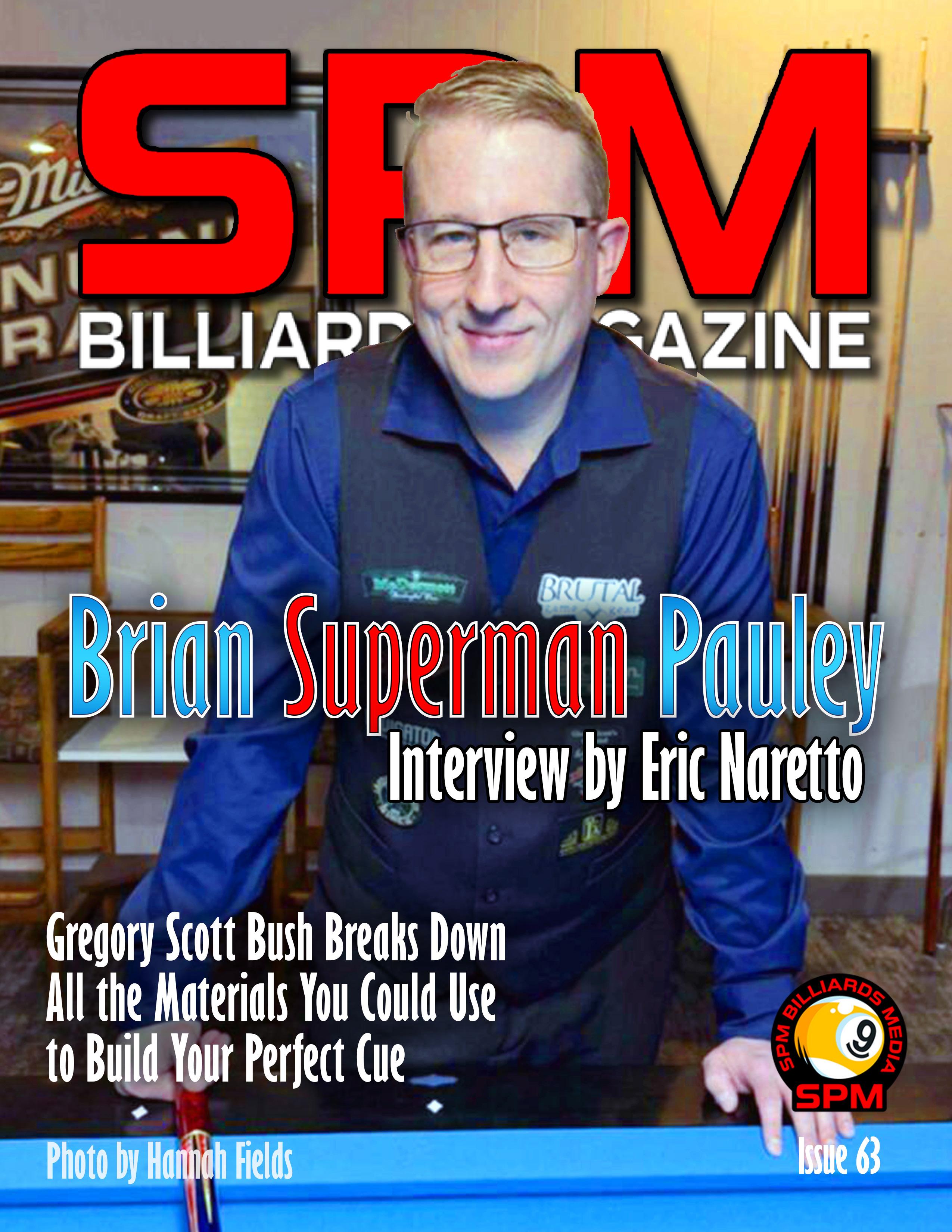
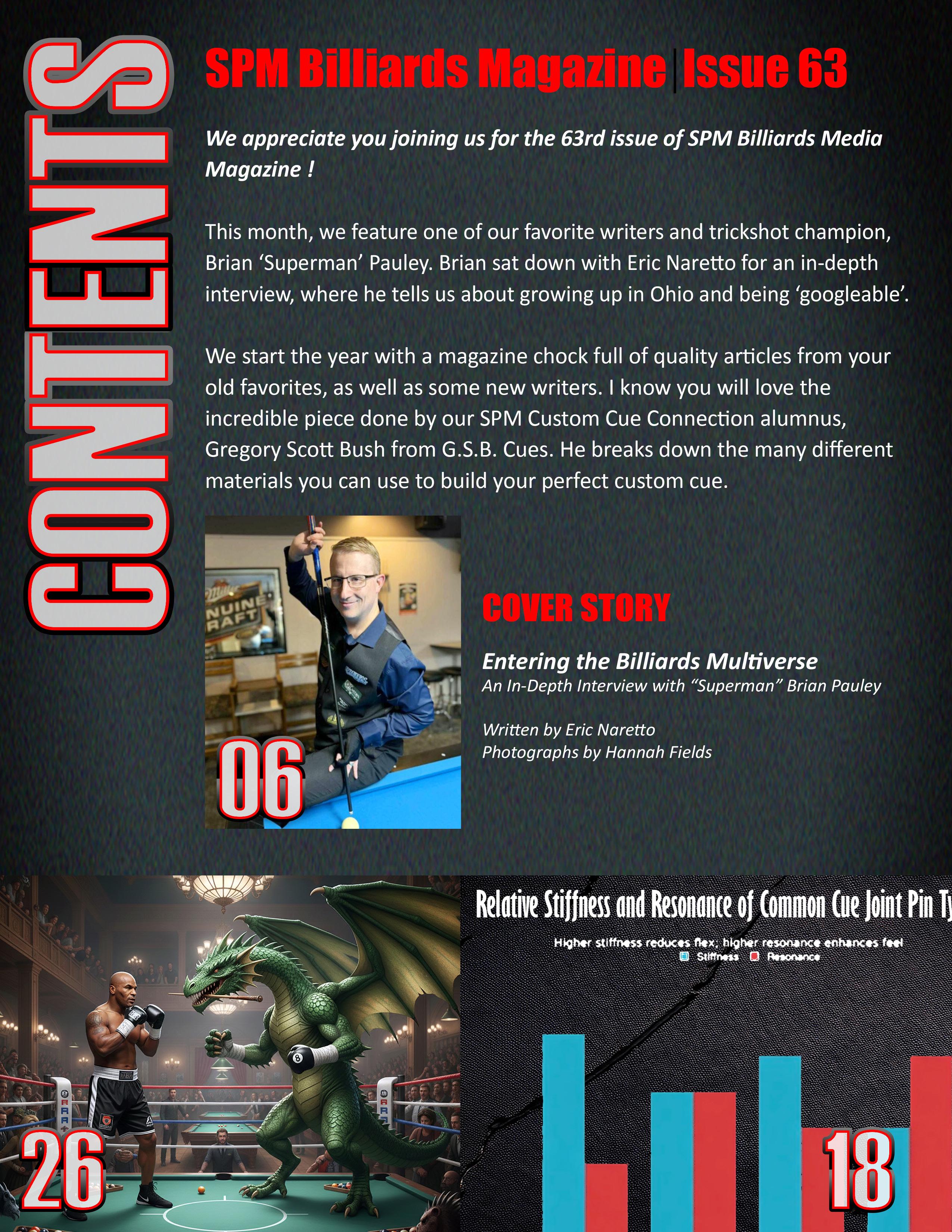
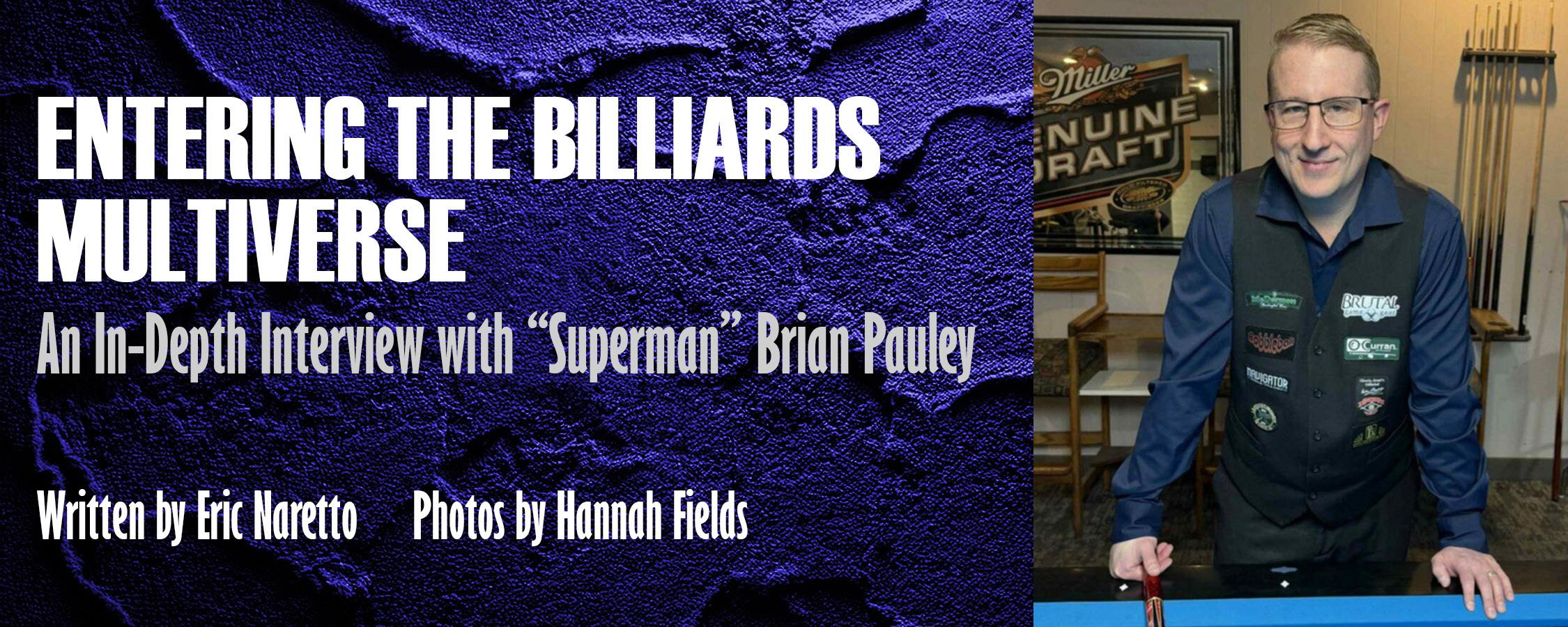
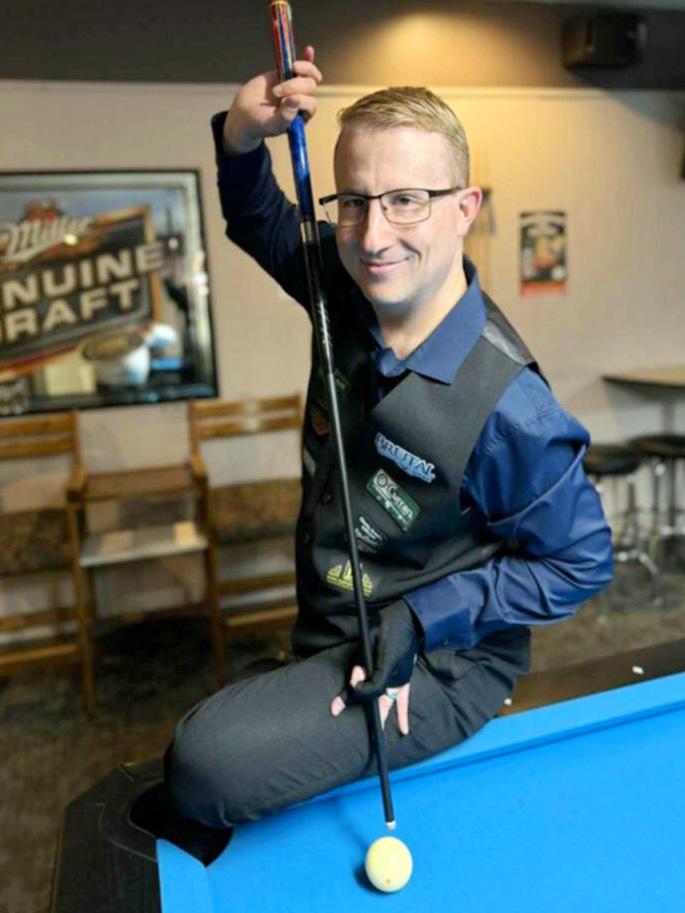
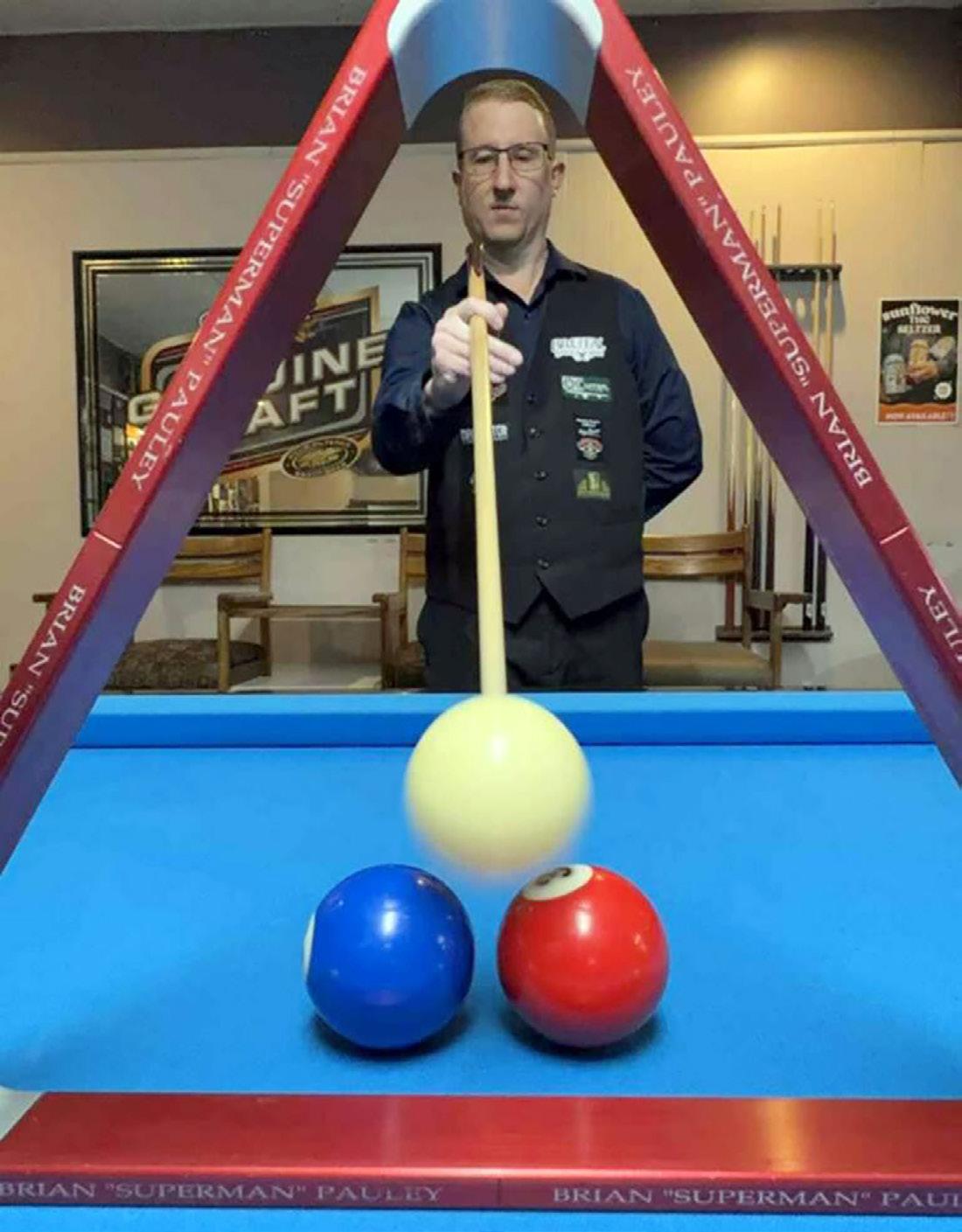
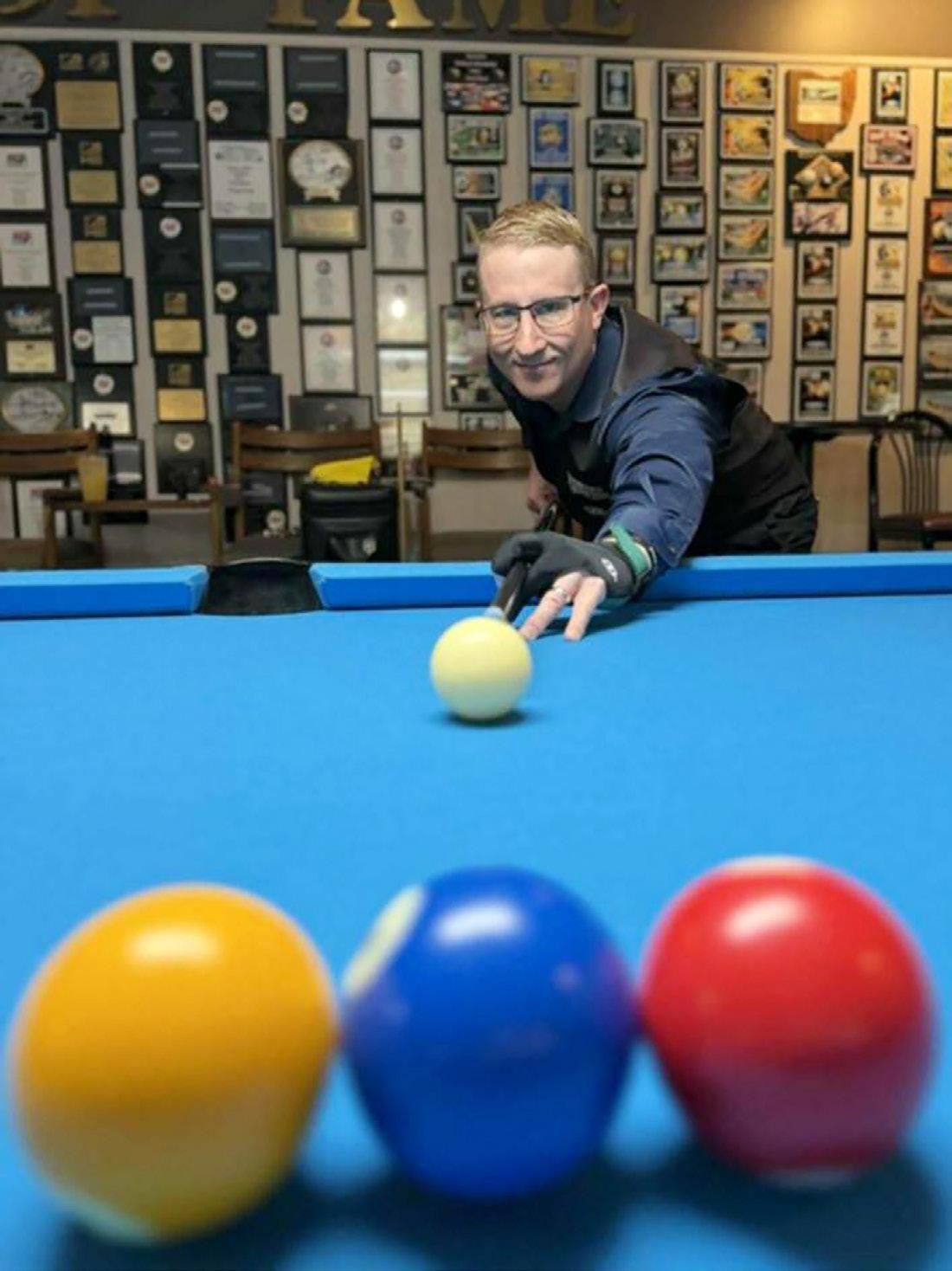
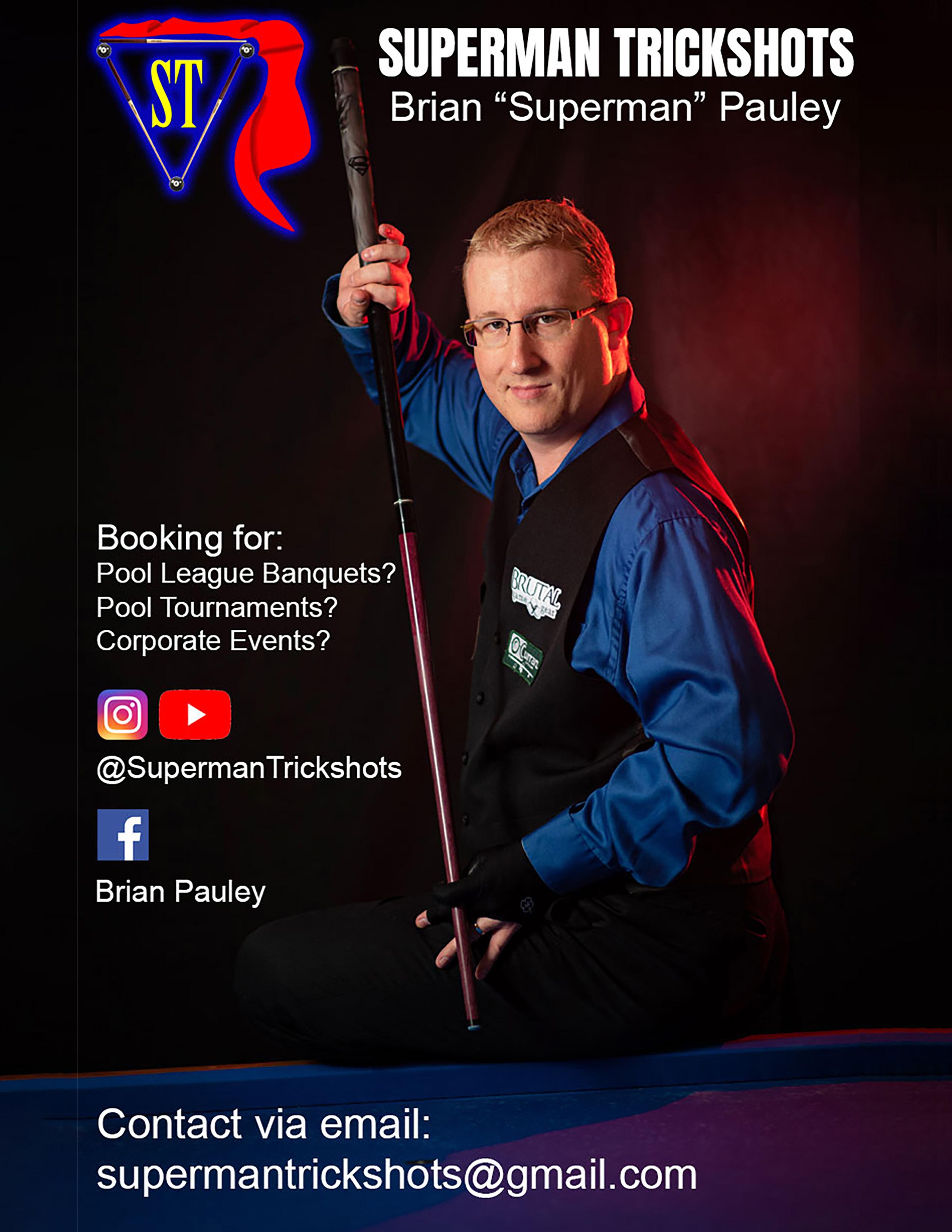
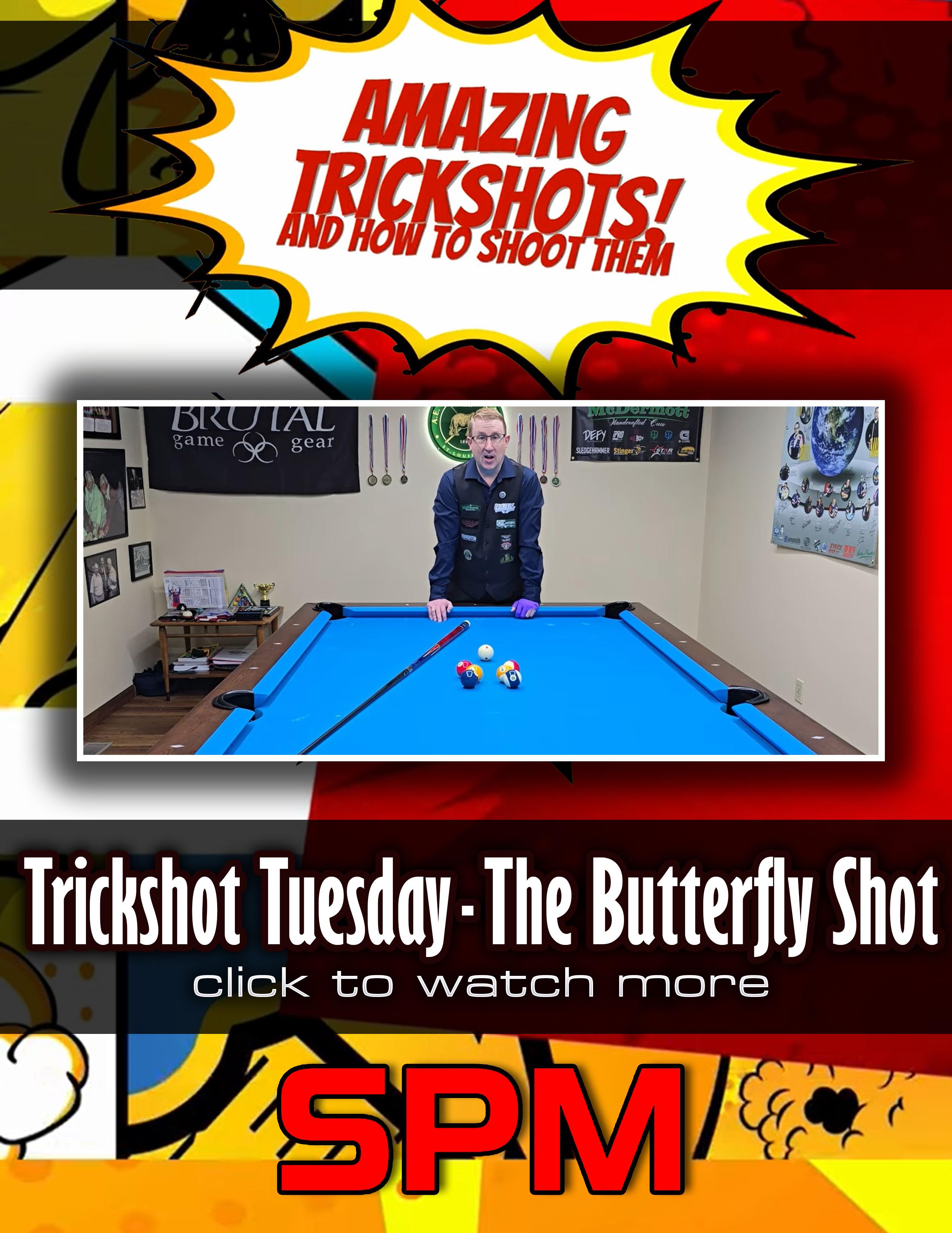
In our current timeline of professional billiards, nicknames are synonymous with certain players. We have nicknames like 'the ghost', 'eagle eye', 'the killer', 'the South Dakota Kid', and 'Superman'. When we hear the name Superman, many think of the billiards superstar Roberto Gomez. However, in a parallel universe not too far away, where trick shot artistry reigns supreme, a different player dons the Superman cape. This player's name is Brian Pauley.
Raised in Wilmington, Ohio, a young Brian Pauley found pool for the first time. When his family moved into the home, an oversized 8-foot table was left by the previous owners in a gaming room. Brian immediately took an interest in the game and spent countless hours a day playing pool. When Brian began watching pool on TV for the first time, he made the decision then that a career in billiards would be something he would want to pursue.
For the last 11 years, in the world of trick shots and trick shot competition, Brian has been a household name. Before the fame of world champion struck, Brian was just a regular guy participating in leagues and tournaments. When Brian placed high for the first time in a pool tournament, he was wearing a Superman shirt, and from that moment on, he started wearing a Superman shirt to every place he would compete in, earning him the nickname of “Superman”.
I interviewed Brian about his journey through the universe of trick shots. Here is what Brian had to say…
Q: Could you tell the audience a little about your family?
A: Emma is my wife of 9 years. She doesn’t play pool,
which is a nice balance for me. It keeps me from getting burnt out. My mom, Teresa, is my biggest fan. However, it doesn’t take her long to let me know when I didn’t play my best. My late father, Harry, was the one who got me started playing pool and challenged me to be the best I could be. I wear a bracelet with the phrase “Play the Table” on it, which is something he always told me about playing pool. Jennifer is my sister, who has supported me all this time and thinks it's cool that I am “Googleable.”
Q: Who are your close friends?
A: Shane Lieurnace has been a childhood friend of mine for over 30 years. He was the best man at my wedding, and I was his. “The Michigan Kid” Jasyon Lynch is my artistic pool road partner. He and I have traveled and competed together for over a decade. I do want to shout out my good friends from my pool teams: Udder Chaos, The Young Gunz, and PoolG’s LFG.
Q: When did you decide that becoming a trick shot artist was what you wanted to do, and how did that decision come about?
A: I had reached a plateau with my regular pool game. I didn’t feel I would go any further than where I was. I had dabbled in trick shots ever since I bought the VHS tape "Trickshot Magic" and tried to emulate shots, but I never really took it seriously.
In 2014, Tom Rossman put on a Partners Cup Artistic Pool Event. An amateur player was paired with a pro, with the amateur player getting the first two attempts and the pro player getting the third attempt if the amateur missed the first two. The pro player would aid in setup and adjustments. Every player knew the shots ahead of time, so the players knew what to practice.
This event was put on by Gospel Trickshot Ministries (GTS). I had met GTS founder and president Steve Lillis at a previous Derby City Classic and kept in contact with him. He told me of the event and suggested I play. At the event, I drew my future road partner, Jason Lynch, and
we got 2nd place. I felt really good about everything. The next year, I decided to try my first professional event to see if this was something I wanted to do. I scored pretty well for a first-time player. I was hooked after that.
Q: Did someone inspire you to become a trick shot artist?
A: A few people. My first inspiration was “The Miz” Steve Mizerak. He was featured on the VHS tape “Amazing Trickshots,” which was my first exposure to trickshots. I still use some of his material today. When I saw ESPN’s Trickshot Magic, I was blown away by "Tennessee Tarzan” Mike Massey, “Dr Cue” Tom Rossman, and “Mr Trickshot” Stefano Pelinga.
Q: How did you get your name out before fame struck?
A: I traveled to events on my own dime to get myself out there. I had already been going to the Derby City Classic for many years before I started playing artistic pool, so I already had a rapport with some people. Same with the
Super Billiards Expo. When I started helping out in the McDermott booth at the Super Billiards Expo and APA Worlds, as well as doing videos for their social media, my notoriety started to grow. As long as it was within reason, I took almost any show opportunity I could. My first two shows were unpaid. They were in senior centers and in front of maybe 10-15 people. I viewed it as a football player who probably won’t make a team, getting reps and getting things on tape.
Q: What is your personal mission as a trick shot artist in the Billiards industry?
A: A few things. Obviously, I would like as much personal success as I can, but I also want to show people the joy of what I do. The best feeling is seeing all the smiles when doing a show. Another goal is to show people that many of the shots we do in artistic pool are very difficult and take a lot of skill to accomplish. There is a mindset that everything is just setup shots and that you don’t need real skill to make them. Some shots are like that. However, most are not.
Q: What have you discovered easy and difficult about the marketing of Trick Shot Artistry (and events)?
A: One thing that is difficult when marketing artistic pool events is that there are not a lot of people who play in them. A room can put up the same amount of money and put on a regular pool tournament, and get more players who then spend money in the venue. However, once people experience an event, they can justify the expense because it is a fun and exciting time. The easy part is that an event or a show will cause people to be intrigued by it. Q: Can being a trick shot artist help a player play better pool?
A: It absolutely can. The more someone knows about the game, the better it makes them. I have used a number of the skills I have learned from artistic pool in regular pool games, such as full vertical masse shots and onehanded jump shots. This concept was one of the pillars of my YouTube channel.
In 2017, Superman captured his first discipline medal in the Masters Artistic Pool Championship.
Pauley: There are 8 disciplines in Artistic Pool. Players shoot 5 shots of varying difficulty in each discipline in the preliminary rounds. The shots are scored on their degree of difficulty, with 6 points being the easiest to 10 points being the most difficult. A perfect score is 40 points. I scored a 37/40 in the special arts discipline for the win. I didn’t win the overall event, however. It is similar to the gymnastics event at the Olympics. An athlete can win the Gold Medal in rings, but the team does not medal in the overall event.
Q: What went through your mind when you won that discipline, and how did it shape your mindset for future wins?
A: It meant the world to me. I beat out “The Redneck Cue Guy” Curtis Robertson for that medal. That medal means more now since Curtis passed away. The win
gave me the mindset that I could compete with anyone, and that mindset led to my three biggest wins. In 2019, I captured my first world discipline title, scoring 38/40 in draw at the World Artistic Pool Championships. At the 2023 Masters Artistic Pool Championships, I beat then world number one Abram “Too Tall” Diaz in a playoff match. We both shed tears and embraced after that match. The third one is my most recent event, where I won the 2025 Masters Trick & Fancy Discipline title. The reason that the win was special is who I had to beat to win it. I scored 36/40 and entered a sudden-death playoff for the discipline title. I defeated none other than Florian “Venom” Kohler for it. He finished higher in the event than I did, but I will take a win against him wherever I can get it.
Q: What does the path of training look like for a trick shot artist?
A: Practicing the shots until you can’t miss is the firs
step. You have to be comfortable with the shots. The next part is to learn the adjustments. Not every table plays the same, so you need to know how it affects the shot. Shot selection is also very important. Each level of difficulty has three shot options, from which you choose only one. Sometimes it takes discipline to pick the shot that is going more consistently versus the shot you normally shoot.
Q: How does it make you feel to know that you have achieved what you set out to do?
A: It makes me feel good. It makes me feel that all the work I put in, all the sacrifices, all the monetary investments, were worth it. It is also surreal for me. When I first started doing artistic pool, or just pool for that matter, I wouldn't have dreamed that I would be “known” or a celebrity of sorts to people. Having people ask for my autograph or take a picture with me at events is still a “pinch me moment.” That is why I always give a fan all the time I can to make sure they have a great experience. I don’t view myself as a celebrity, though. It is an interesting situation with my friends I shoot pool with.
I went to a big league tournament that had a junior event on the last day. I was asked to do a mini trickshot exhibition for the juniors, which I absolutely said yes to. After the show, I signed cases and took pictures with the kids. One of my friends who saw this said, “I keep forgetting you’re a big damn deal. To us, you're just Brian.”
Q: What advice do you have for anyone interested in getting into trick shot artistry?
A: Keep at it. It is very different from regular pool, from the stroke to the mindset. Don’t be afraid to ask people for help.
Q: What advice can you give a player to increase their pool game?
A: I have a few. Professional instruction is key in any sport. Kids go to specialized coaches for sports, whether it is a pitching camp or a punting camp, to help them get to the next level. It is no different in pool. Find an instructor of note and work with them. I am reminded of a cartoon I saw online some time back. There were two sales windows. One said, “New $600 shaft” with a long line. The other window said “Pool Lessons” with no one in that line. If you don’t know how to use your equipment, then how does that raise your game?
Practicing is the next thing. You have to put into practice what you learn. You need to put the work in, or you can’t expect to get better. Get regular competition. In any sport, you will hear coaches and athletes talk about needing reps (repetitions). You need to stay “in stroke,” so playing in a weekly tournament or league is great to keep the reps up.
The final part is to challenge yourself. Leagues and weekly tournaments are great at getting reps, but when those become easy, a player needs to challenge themselves. Play against players of your speed or better. Travel to tournaments to test yourself against unknown players and unknown conditions. You will only go as far as what you strive for. For some, that may be to go up
one or two handicap spots, which is awesome for them. For others, it may be to cash at an open tournament. Everyone has different goals. My final piece of advice was given to me by a very wise man, my late father, “Play the table.”
Pauley is currently sponsored by McDermott Cues, Brutal Game Gear, A.E. Schimdt Tables, Perimeter Billiard Lights, Bill Curran Optical, Navigator Tips, Iwan Simonis Ride the 9 Tour, Bobbleball, and Too Tall Custom Cues. Outside of pool, Pauley has the interest of a cosplayer.
Pauley: My main interest outside of pool is cosplay, which is short for costume play. I attend a handful of comic cons every year in costume. I am a member of two Star Wars costume clubs, one Superhero costume club, and one Pro Wrestling costume club. These clubs attend charity events and anything affiliated with that genre. Our main role is meet and greet. Taking pictures with kids who are less fortunate makes all the time and money invested in the costumes worth it. I even met my wife at a comic con. The characters I am known for are Luke Skywalker (various versions) and Superman (Christopher Reeve version)
As a billiards superfan, I encourage any player to check out a trick shot competition if they can. They are fun to watch, and you can even apply things you learn to your own pool game. I'd like to thank SPM for giving me the opportunity to have my second interview in their magazine, as well as a special thank you to Brian Pauley for allowing me the pleasure of putting this together.
Eric Naretto is a two time State and National Champion. An instructor for 13
years,
he is currently a Master Instructor with the PBIA and a Level 4 Instructor with the ACS.
In July of 2025, Eric was awarded the Inaugural American Cuesports
Outstanding Instructor of the Year Award.
A BRIEF LOOK AT CENTER-TOEDGE AIMING AND FRACTIONS
Comparing Center-to-Edge Aiming to fractional aiming is like comparing apples to oranges. CTE is the king of perfection, while the fractional approach is just another pawn among the various ways to align by feel. CTE is a multi-dimensional visual phenomenon that can handle nearly every shot on a pool table with just three objective aim lines. Fractional aiming, however, is an approximation system that yields a must-have judgement for every shot. Any party that seeks to engage in a thorough study of CTE versus fractions should quickly conclude that the two domains are indeed apples and oranges.
Hal Houle felt that it would be prudent to take a cursory check-the-box look at fractional aiming. During Houle’s initial study to discover how to really aim, he engaged in a mere formality to rule out fractional aiming as a center-pocket system. Houle chuckled as he shared with me that during his entire life, he never executed a single fractional shot. He added that when certain seekers of his CTE secrets would come knocking, he’d send them on their merry way with a doctored-up fractional system. They’d skip away licking their chops as if they possessed the Holy Grail. Houle was noted for being super reluctant to just hand over the keys to CTE.
Add the CTE 15, 45, and 60 to the 30, you have the most potent professional aiming system known to man.
Houle’s primary goal was nothing less than to solve, aiming for perfect center cue ball alignments. When Houle declared that the angles of 15, 30, and 45 could handle nearly all shots on a 2:1 table to the center pocket, his jaw-dropping assertion was a natural for his future critics to associate those numbers with the standard fractional angles of 14, 30, and 49. There may be similarities in the numbers, but it stops right there.
An Overview of the Fractional Quarters System
Fractional systems use the center of the cue ball for
aiming. The center is frequently aimed at the center of the object ball or at one of the quarter lines. Additionally, it’s important to highlight that the quarter line for thin cut shots is not on the object ball. The quarter lines are almost always a first reference for any fractional alignment. Having said that, quarter ball alignments can result in outright ball pocketing, especially on bar tables. Fractional aiming systems use the entire width of the pocket.
Players using fractional aiming must learn to adjust their alignments to play various parts of a pocket. An alignment that falls between any two quarter lines can be referred to as a “tweener”. Further refinements are required for proficient ball-pocketing. Fractional aiming, though, will forever be relegated to player judgment. Fractional aiming does not take into account the negative effects of collision-induced throw. Even if a shot is determined to be an exact half-ball hit, the “throw” adjustment must be factored in.
A Well-Known Half-Ball Cut Shot to the Corner
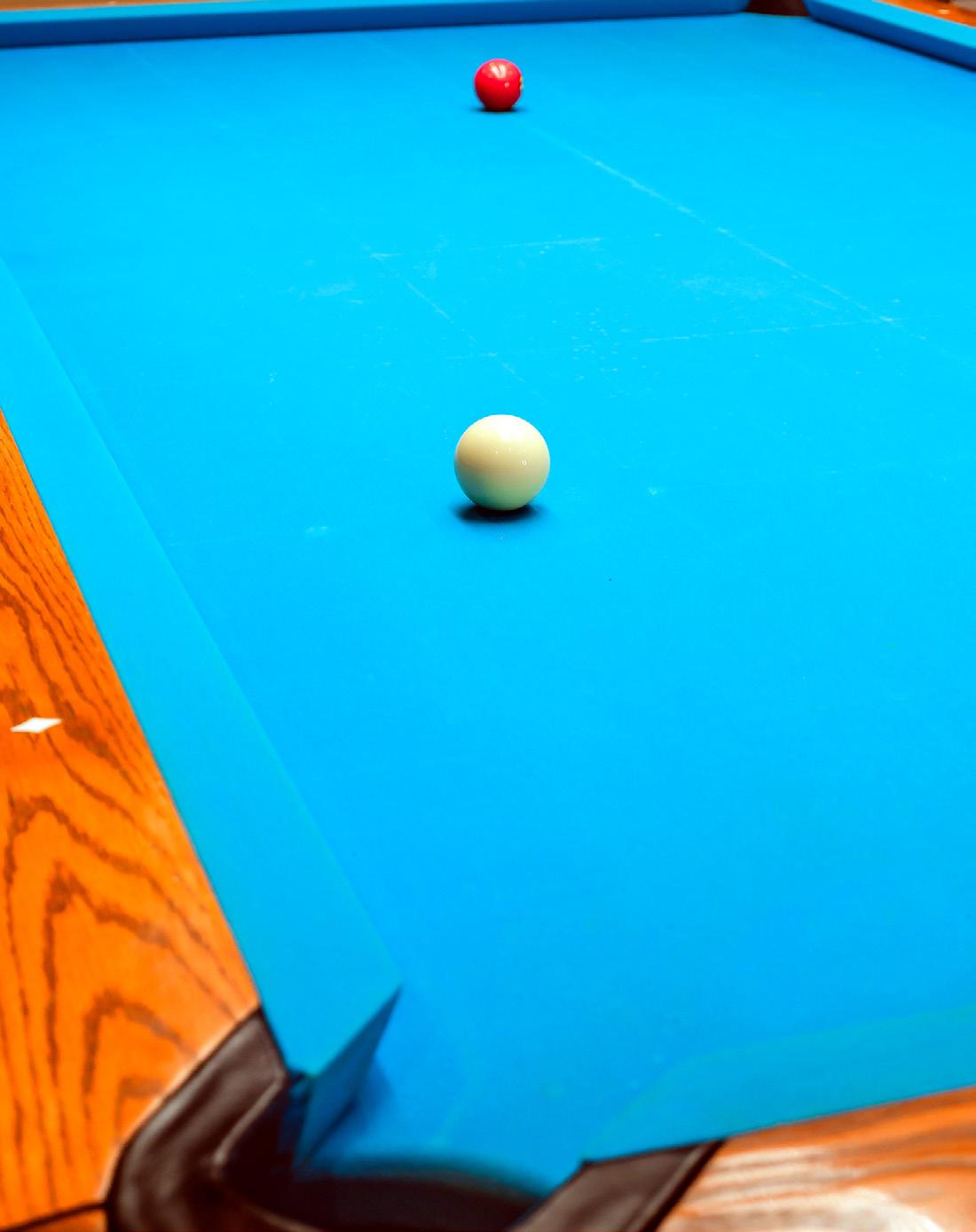
Shown in the image is a cut shot to the right corner. The center of the cue ball is aimed at the left edge of the object ball for solving the shot. The cue ball is on the headstring in a direct line from the center of the corner pocket to the core of the object ball positioned on the foot spot.
Even though this half-ball setup carries a degree of objectivity, there’s no way to avoid judgment and feel. For the record, there is another fractional alignment that is labeled as being objective: the straight-in. For a straight-in shot, a player cannot know absolutely if the shot is one hundred percent center-to-center. Once again, judgment and feel must be introduced.
The half-ball alignment, as shown in the image, might occur a few times during a year of play. Should the cue ball or the object ball deviate from the prescribed setup even by a millimeter, then an adjustment must take place. You get the idea. Judgement and feel must be employed. And then there’s still the negative effects of collision-induced throw to contend with.
There’s no need to belabor the feel of fractions any further. I seriously doubt that there’s a cueist anywhere on our planet that truly uses a fractional system. (Most players who believe they’re using ghost ball, contact points, or fractions are actually engaged in CTE gearing and half-ball alignments.) It’s time that you open your mind to what the top players in the world are actually doing. It’s been undercover long enough!
A Brief Look at the Uniqueness of Center-to-Edge Aiming
The center of the cue ball in CTE is never used for aiming. CTE players use one of two cue ball edges to aim at one of three object ball targets. Those targets on the object ball are located at the center and the two quarter lines. For center pocketing, there’s never a need to aim between any two of the object-ball targets. Essentially, three aim lines can handle nearly all shots to the center pocket.
CTE players and professional players alike do not move straight down into their shot lines. CTE players, as well as pro players, bring their cue in from the side to align with the center based on one side of the cue ball or the other. This results in half-ball alignments and typically unequal cue ball halves. (The goal for fractional, center cue ball alignments is to align between the two cue ball edges, dividing the cue ball into equal halves.)
CTE is a center cue-ball system that yields perfect alignments for nearly all cue ball-object ball relationships. Judgment and adjustments are not necessary. Pool balls must be thought of as having 360 ticks at their equators. When aiming with an edge of the cue ball, a player’s vision will naturally focus on the inside half of the cue ball. This visual attention toward the inside starts a gearing process for establishing visual connections between the cue ball and the object ball. Essentially, there are three objective gearings (15, 30, and 45) for handling nearly all shots. Each cue ballobject ball gearing always establishes a slight over-cut to the ghost ball core. This is precisely why CTE is a center cue ball, center-pocket system. It’s the ever-present over-cut alignments of CTE that largely counteract the negative effects of collision-induced throw.
Wow! Look at the CTE 30s That Make the Ball Center Pocket.
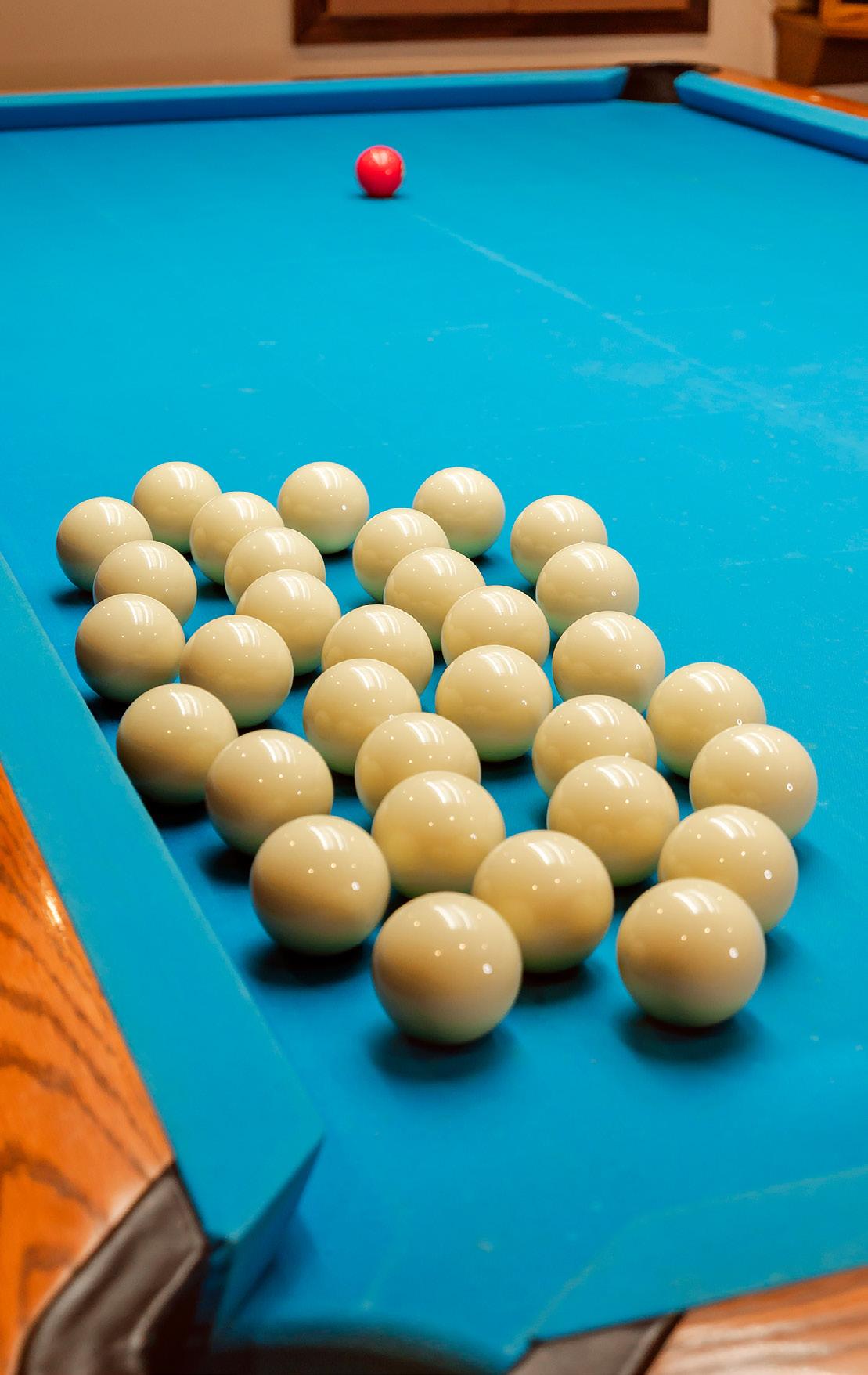
The CTE 30-degree, half-ball perception solves millions of cue ball-object ball relationships to the center pocket. Just look at the number of cue balls in this image. There’s not just one cue ball location that provides a half-ball look; there are thousands of cue ball places for this area of the table that, with a 30-degree perception, solve the shot to the center pocket.
I’ll close with this—the CTE 30 all by itself can make about any cue ball-object ball relationship to at least one of the six pockets. When you add the CTE 15, 45, and 60 to the 30, you have the most potent professional aiming system known to man.
Stan Shuffett is the world’s foremost authority on Centerto-Edge Aiming. In 2011 and 2013, Stan produced two top-shelf CTE videos: “Stan Shuffett Presents PRO ONE and Basic Center-to-Edge” and “Stan Shuffett’s CTE PRO ONE: The Final Chapter”. In 2021, Stan authored “Center Pocket Music: Using CTE PRO ONE to Improve Your Pool Game”. Shuffett is a master instructor and has been with the PBIA since its beginning in 1992. He specializes in individual instruction at his private teaching facility in Greensburg, Kentucky. Stan’s website is www.justcueit.com.
Ever wonder why a cue hits so well, and another does not? Why does this cue play so much better than that one? Why can I make so many more shots with this one? There are many more questions that hopefully this basic understanding will answer. To understand the true function and playability of any cue, there are a few standard but critical facts and statistics that need to be understood. This allows you to customize the complete build of a cue to a specific style or hit that is desired.
Before getting into the components of a cue and how it affects the cue plays, I want to review some basic facts on power, transfer from tip to ball, and ball to ball. After these are understood, we will look deeper into the components of the cue to understand how materials and construction can be a key factor in how a cue plays.
Transfer of power from the cue weight to the ball.
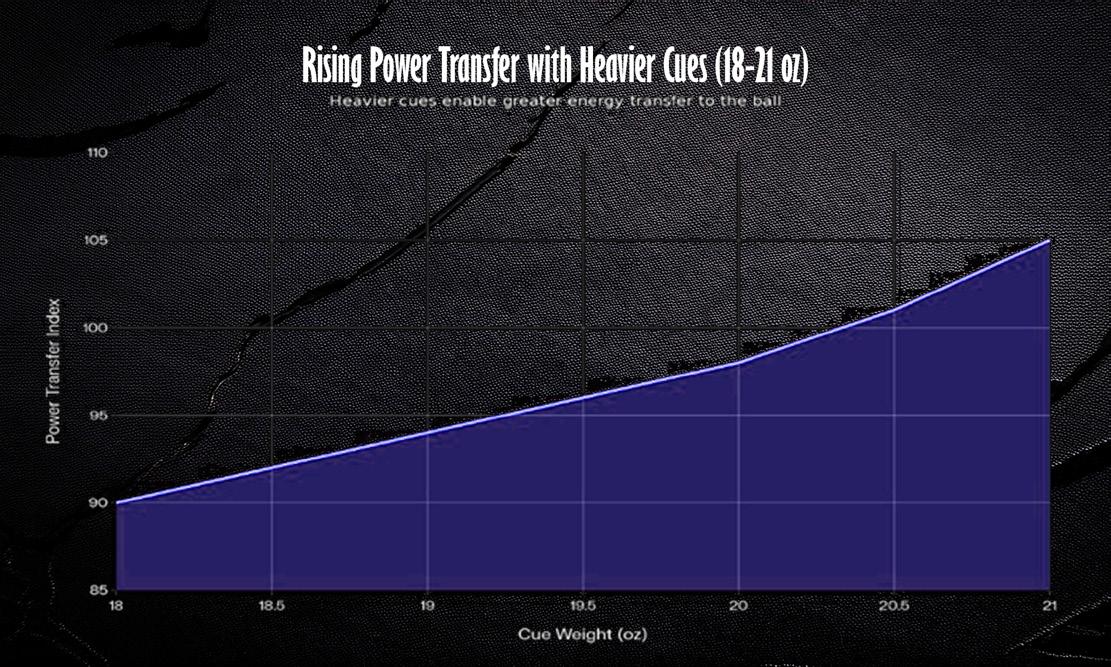
This is a factor in how you shoot and the speed of your stroke. There are many different factors that make up the answer. The higher the cue weight, the more power will be transferred at a slower or equal speed. This is key in selecting the correct weight of a cue you are comfortable playing with.
This is best shown in the graph below. If the ball is struck with the same speed every time, the curve rises exponentially as the weight of the cue increases. This
plays a role in what you are comfortable shooting with, as your stroke may be faster or slower than someone else's. The weight balance is a key factor in your stroke. The comfort and mechanics are easier with a correctly weighted cue and balance point.
Power transfer versus shaft stiffness and the taper.
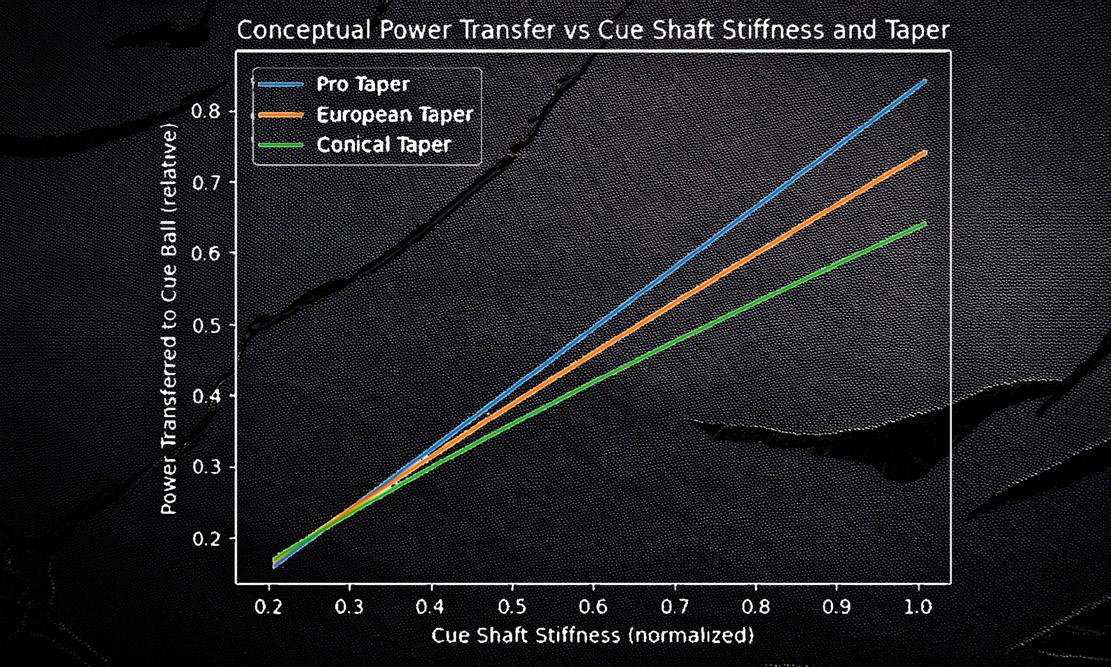
Choosing the right shaft taper also affects your playing style and can influence the game you are playing. This graph demonstrates that the stiffer a shaft is, the more power is transferred to the ball, keeping the same stroke speed.
This means changing the taper, and not the diameter or length, can get numerous outcomes for playability. This is a key factor when matching the cue up to a player. The game can change what plays best. It can be matched to the style
of play and customized to feel and action desired. There are many options for length and taper variations to each of these three basic tapers. The three tapers' performance in terms of power transfer is demonstrated in this graph.
Speed in terms of ball transfer of speed and then action.
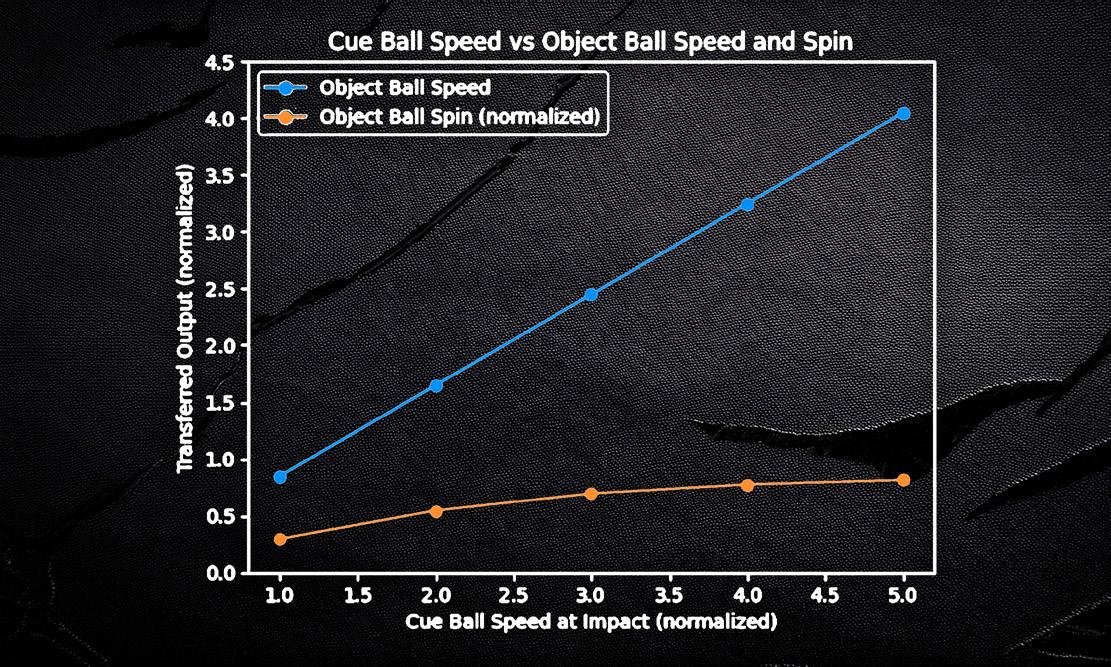
This graph shows a correlation between ball speed and the amount of spin or English transferred to the object ball. If we look at what has been discussed, we know that power and speed increase with weight if the same stroke speed is used. This graph shows that the curve begins to level out at a medium speed, and the English or spin transfer increases at a more rapid curve at slower to faster speeds. This tells us that there is a zone where stroke, ball speed, and spin are optimized. So, the cue needs to play across the whole range and perform well at all variations. For setup purposes in a cue build, unless a specialized cue, the performance is often aimed at the median or middle of the curve.
The basics of spin or 'English'.
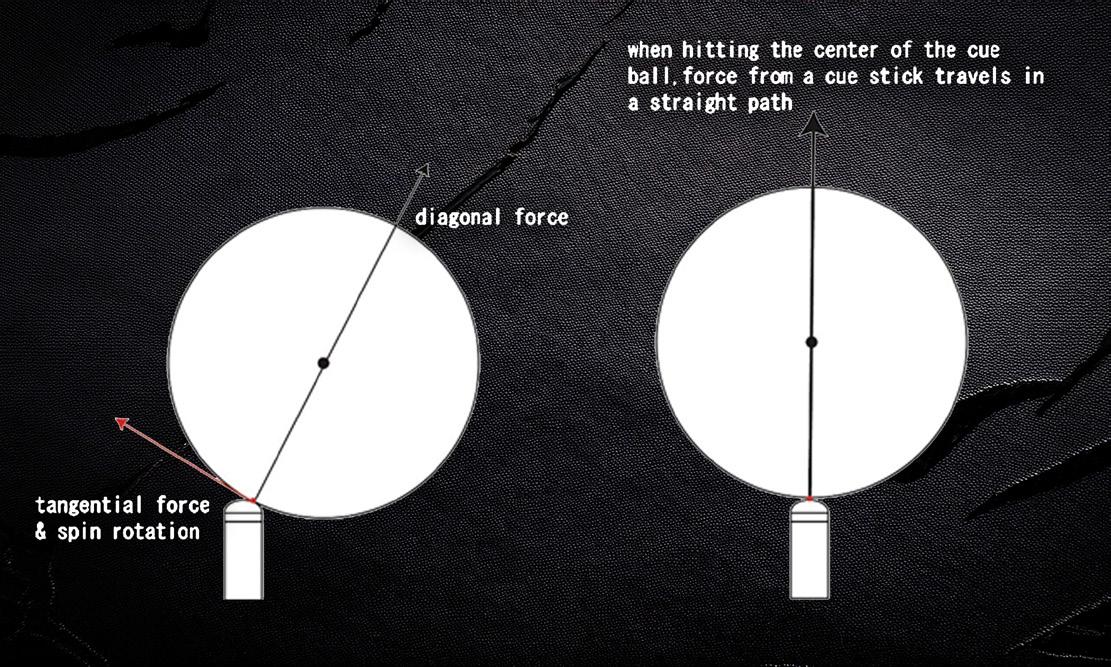
So now, let's take a minute to talk about the basics of spin or English so we can get into the aspects of a cue and how it is built to perform these basic functions. When the ball is hit in the center, the force of the cue stick travels in a straight line or path. This inverts no English or spin. When it is hit in a tangent, or force offcenter spin is created. When this happens, many factors such as stiffness, materials, tips, and ferrule combos, and the taper of the shaft all come into play.
The Construction of the Cue
We know that speed is a factor in spin transfer, with the aspects of weight and stroke speed. Now we can go further into the construction of the cue. We will not do a deep dive into the whole aspect of low-deflection shafts, as this is more centered on the entire construction of the cue. Hopefully, this will help in the selection and playability of the cue you want or are looking for. There are many aspects and combinations as to what will make a cue play and feed comfortable to you. This is a key factor in selecting materials in a cue and is the baseline before any ornamental factors, such as inlays and ring work.
Now we can take the time to get into the components of the cue. Let’s start with the shaft and what goes into it, and the components, and the effect of the playability of the shaft. This is an overview and not a deep dive into a specific style or design. This will explain the basics of the construction
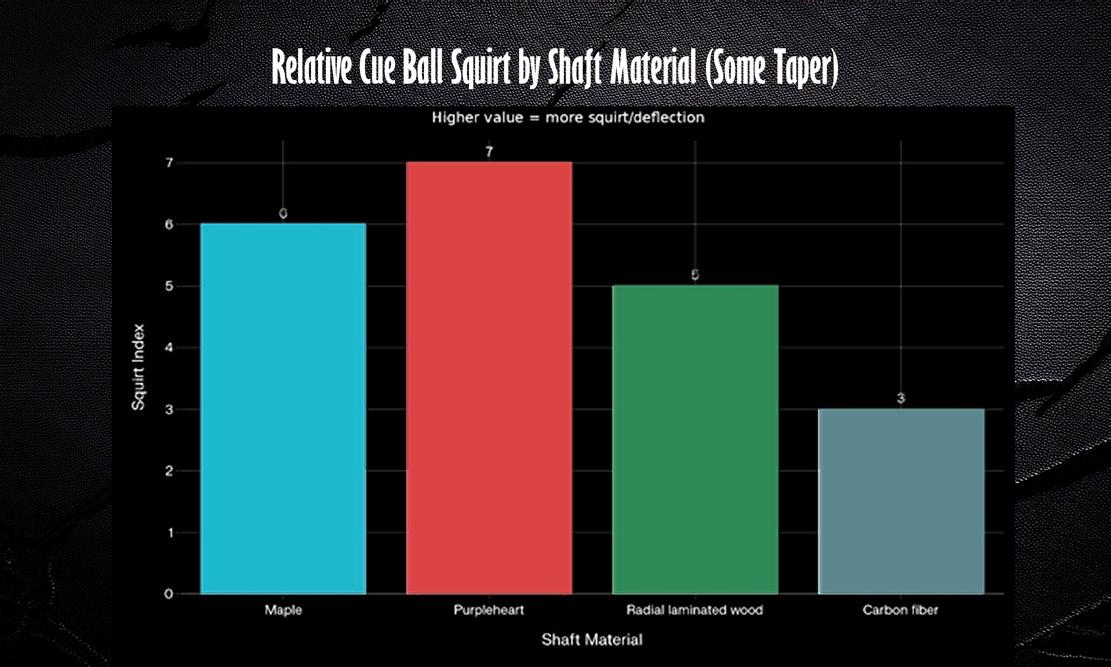
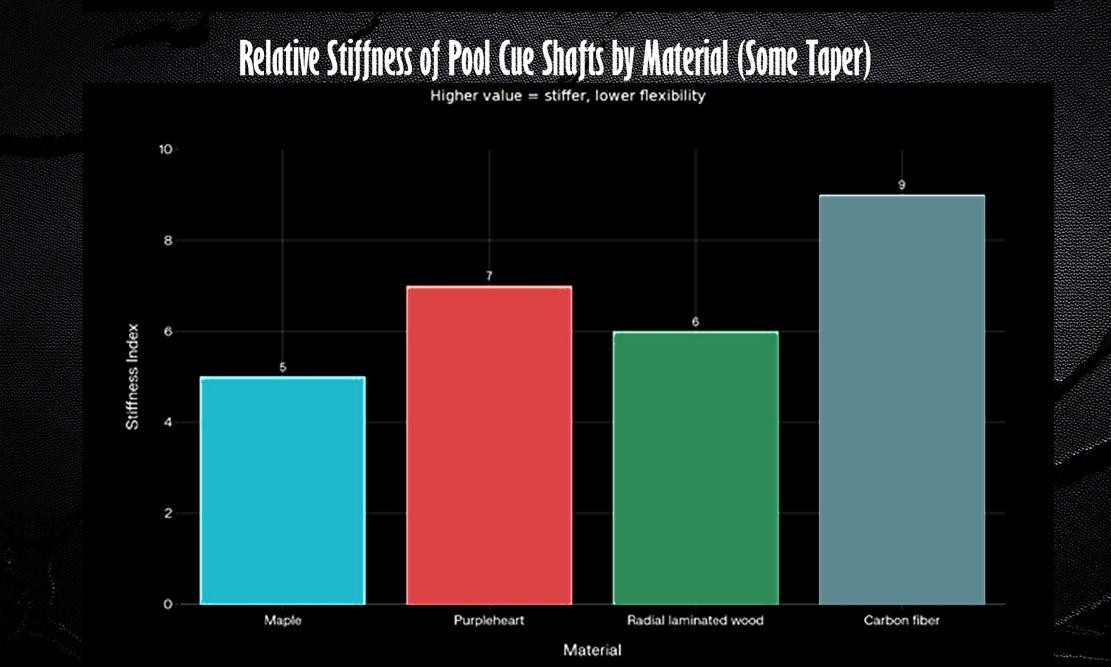
and fundamentals for any style shaft. This will look at how materials correlate to squirt. Stiffness based on shaft materials with a taper as a constant. The effect of selecting a tip and matching it to the play of the cue. Also, the effect of the ferrule on the shaft. All of these components come together to make a shaft play the way it does.
So here we can see the amount of deflection and squirt based on materials. This is key in selecting the correct shaft for your cue and shooting style. This graph represents the amount the cue ball travels off-center when it is hit with spin or English on its path to the object ball. As you can see, materials make a difference and play a factor in the style of play a person shoots with. Not that it can not be done, but someone who wants to spin or curve the cue ball is more subject to a different material than someone who wants to always shoot straight. Maple will allow a cue ball to curve far more than carbon. I am not getting into what is better or the aspects of how anyone shoots. What this explains is why materials matter in the selection of the cue. In a game that needs to throw and curve a ball more than straight shots, Maple or another wood material would be preferred. In a game that is straight shooting, carbon is obviously the better material for the game and a majority of the shot selections. For something in between, there are materials which can give a blend of both materials.
The stiffness of the material plays a role in the feel of the cue and the rest of the components of the cue to get the feel that a player is looking for. Understanding this can help combine a stiff shaft, such as a carbon, and get a softer feel, a maple, and get a firm feel.
When this is combined with the remaining components of a shaft and the remaining cue, this creates the hit and feel that every cue has. The combinations can be endless.
Tip Hardness
The tip on a shaft plays a vital role in the transfer of energy and the spin on a cue ball from the cue. After we dive into the effect of the cue tip. The effect of the ferrule of the shaft, and the entire picture of a shaft tip combination, will make sense. This will explain why certain tips and cues play better with the same or different tips.
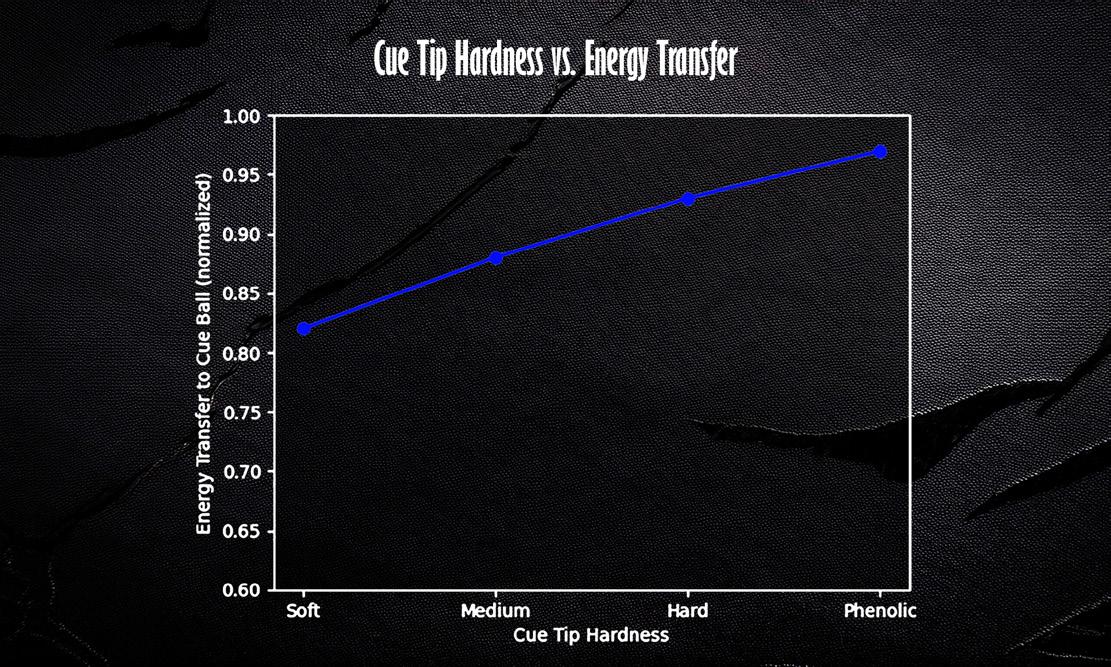
The first is the most obvious: the hardness of the tip and the transfer of energy. This also affects the spin. This will be explained through the next few graphs and charts. I play a role in finding the optimal combination for playability in a cue.
The hardness of the tip directly correlates to the amount of energy transferred to your shot. As one would assume, a harder tip transfers more energy while a softer tip transfers less energy. It’s like dropping an egg onto a pillow or concrete. One will form around the egg and cushion it, grabbing it with more contact points. The concrete, which is harder, has very little cushion, and the impact is hard and abrupt, with little to no cushion on the egg. One absorbs some of the force while the other absorbs little to none.
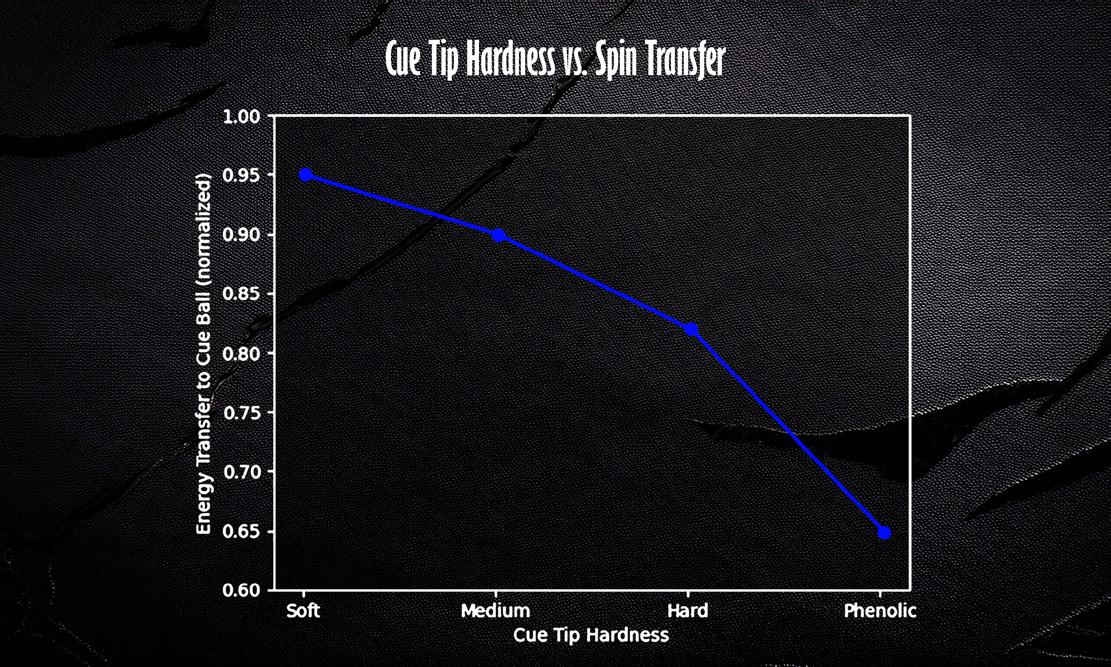
With the understanding of cushion or absorption, we can take into account the spin transfer when compared to the hardness of the tip. It is now known that the softer
the tip, the more contact time, and while minimal, the area of the tip in contact is greater. The ball actually goes farther into the tip in the contact point with a softer tip. What does this do with spin or English to the cue ball? With a softer tip, the English transfer is considerably higher than with a harder tip. The English or spin decreases as the tip goes up in the scale for hardness.
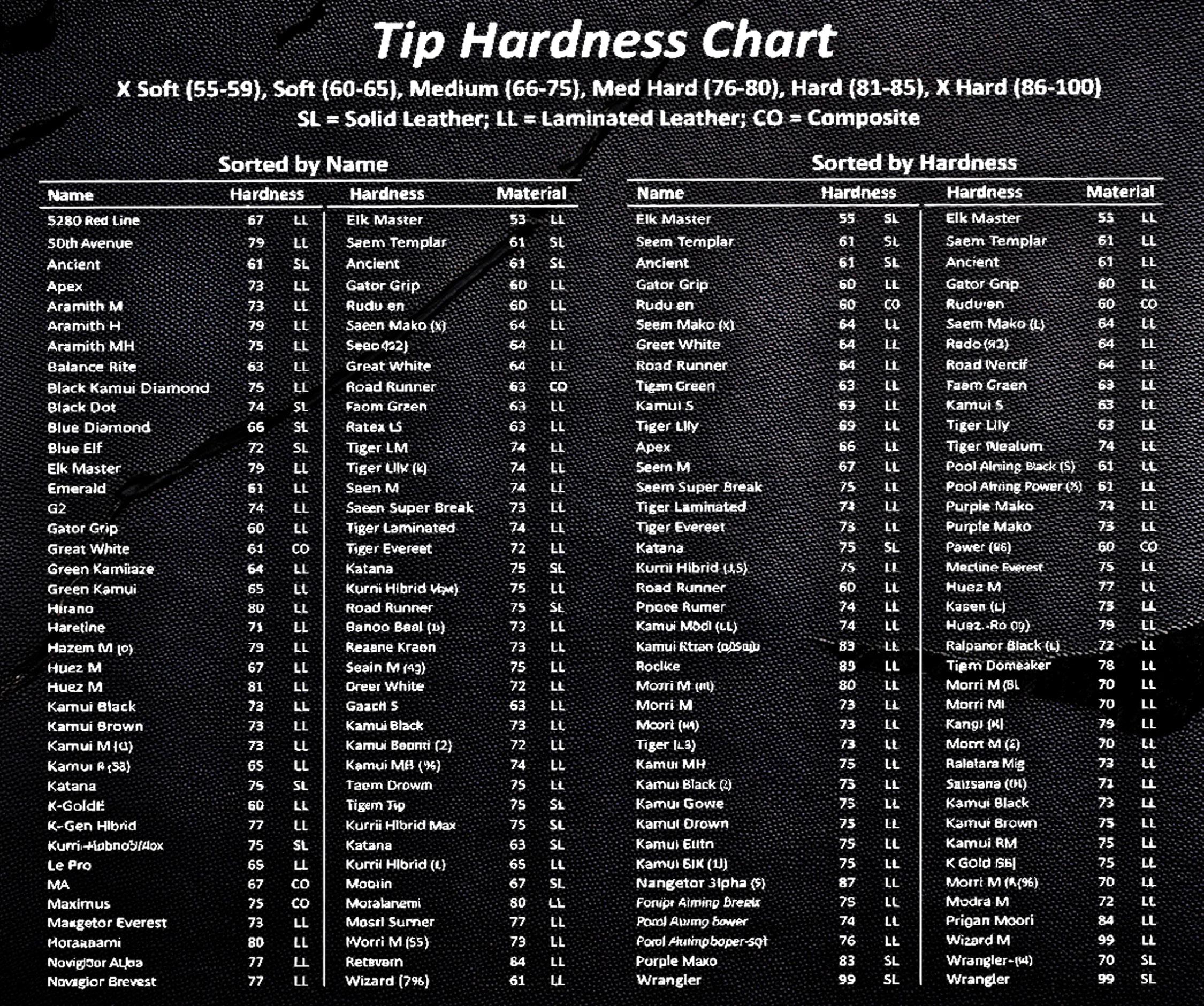
While there are advantages and disadvantages to every tip, finding the one for your style and cue can make a difference in the way you shoot. Below is a chart showing many of the tips and where they rank on the scale for hardness.
How the Ferrule and Tip Combine
Now let’s get into the ferrule and the understanding of how the tip and ferrule combination goes together in the playability and feel of the shaft. Just like the tip, the ferrule material and style have different hardnesses and energy transfers that affect feel and spin. It can be broken down
into soft, medium, and hard for the ferrule material. This can be further changed by a capped or sleeved ferrule, creating combinations or hybrids of the properties.
Soft Ferrules (50-65 Shore D):
• Low perceived stiffness with cushioned feel and longer dwell time.
• Mute resonance, less vibration feedback for a damped impact.
• Common in ABS plastics, suiting softer stroke preferences.
Medium Ferrules (65-80 Shore D)
• Medium stiffness for crisp, balanced energy transfer.
• Peak resonance with lively “ping” for optimal feedback
• Examples like Aegis or Ivorine provide versatile playability.
Hard Ferrules (80 + Shore D)
• High stiffness for rigid, efficient hits with minimal flex.
• Sharp ring or thud resonance, sometimes feeling harsh.
• Materials such as G10 or phenolic enhance control and precision.
The correct ferrule, in combination with the correct tip, creates a cue that plays distinctly. This, combined with the shaft material and taper, creates the entire shaft. This is why different shafts play the way they do and why even a tip change can change the way it plays completely.
The Butt and Joint
Now that we have looked at the upper half of the cue, let's look at the butt and connection of the two pieces to make the cue. This matters in both the playability and feel of the cue. The different materials and styles can play a vital role in getting something you enjoy playing with. Joint type and materials play a role in how the cue hits. When combined in different ways or with a combination of materials to create a hybrid material with traits from both, a cue can hit in numerous different
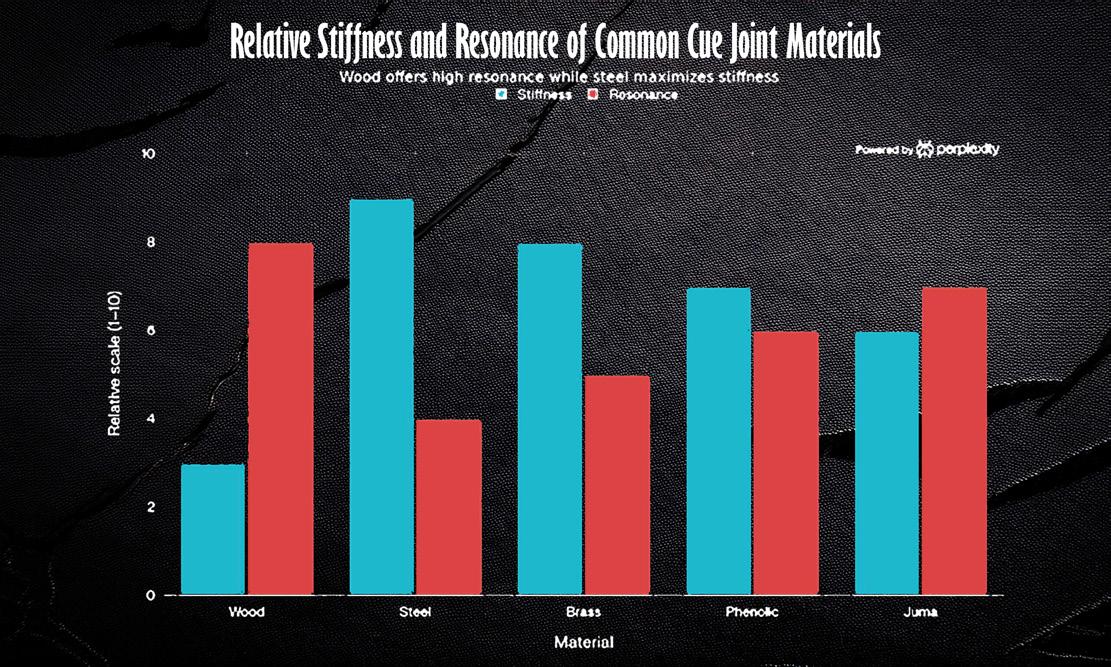
ways. First, we will look at common cue joint materials and the stiffness and resonance.
In summary, from the graph, we can come to several observations and understand how these affect the cue. With steel, we get an ultra-stiff and unforgiving feel if not combined with some form of other material, such as a wood shaft. Brass creates a very firm and heavy joint. Phenolic is about the median and develops a crisp and controlled feel. Wood has a balanced and natural hit when used at the joint. Juma is slightly softer. All of these materials can be combined in different combinations to give a feel that is specific to the cue.
The Joint
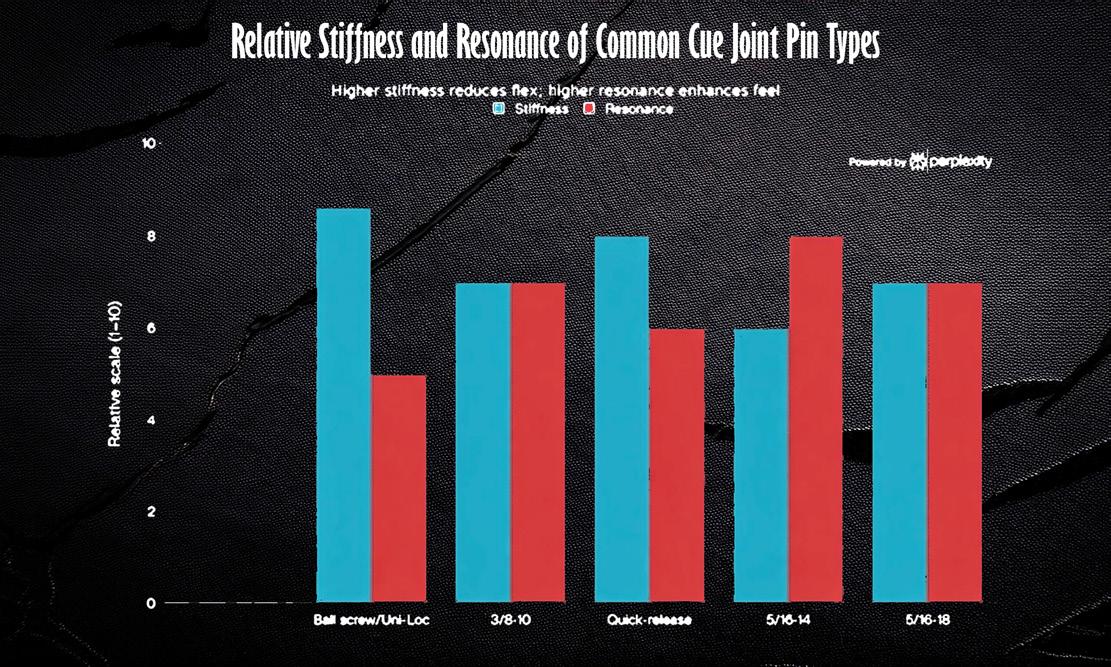
As a reference, we will now explore the different joints and effects of the different pins of the cues. These are just a few general and often used in a wide array of variations in the application of a cue joint. This gives a general overview of the characteristics based on
information collected using this AI platform. This ties the joint material together in combination with the joint to give the resonance and the feel of the cue when the shaft is combined with the Butt. These combinations will change when any of the materials or different pins are used. However, this is why many people have a preferred joint and pin type.
The final aspect of the cue is the material or wood the butt is made of. As many know, wood has resonance, and the best example is tone woods, which are used in musical instruments. They are picked because of the vibration and properties when being constructed into an
instrument. When you hit the ball, you feel the vibration of the cue in your hand from the contact of the tip to the cue ball. This is different for every species of wood. They all have a different rating on a scale of hardness or the Janka scale. With this, the density and flexibility of the wood change. Here is a small selection to show the differences in woods for a more comprehensible understanding.
With all these aspects of the components of a cue, the possibilities are endless. This is the foundation of the cue without getting into the beauty of a cue. All of these aspects are combined with the goal of producing a cue that will hit in a desired manner. While it takes a lot of
time and experience to become an expert in this area, it is a constant learning process. Hopefully, this will allow for an understanding of the basic materials and components of a cue and their effects on the build to give a general idea of what would work best for you.
For more information, you can contact G.S.B. Cues online at gsbcues.com.
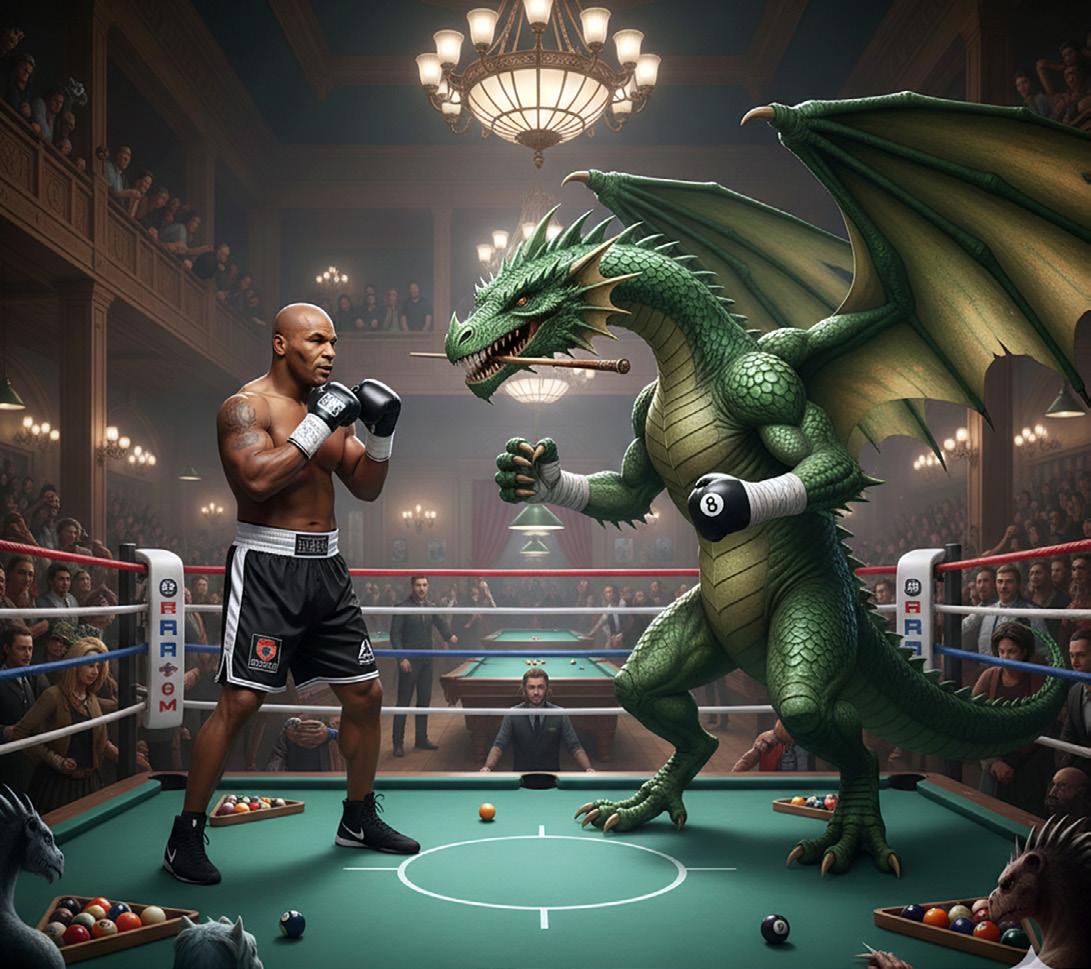
What
if Mike Tyson trained like an average pool player?
Imagine "Iron Mike" preparing for a title fight. Would he spend five nights a week in back-alley brawls, hoping the sheer volume of fights makes him a champion? Would he claim he hits harder after three beers, or spend his training camp complaining about things he can’t control—like his opponent "sandbagging"?
If Tyson approached boxing the way many amateurs approach pool, he would skip the roadwork and the heavy bag. Instead, he would only keep doing the things he was already good at. He would fight three nights a week, plus bigger fights on the weekend, and he might gamble increasing amounts of money, thinking that it is the path to improvement. He may ridicule anyone who suggests he hires a coach, use drills to reinforce techniques, or learn to block an uppercut. Maybe he watches "Learn to Take a Punch in 3 Easy Steps" and practices this new technique for the first time in competition.
Sound familiar? Feeling attacked? This article isn't meant to hurt your feelings. I want to inspire you to train better so you do better. If you're tired of hitting a million balls hoping for improvement and ready to hit a few hundred the right way with a plan, read on...
In reality, Tyson spent significantly more time running, lifting weights, and practicing isolated techniques than he ever spent fighting in a ring. He had a team: coaches for boxing, nutrition, and the mental game. He didn't just buy "really nice gloves" and hope for the best; he invested in himself.
The Trap of "Play Over Practice"
In the world of cue sports, we often confuse playing with improving, or think the only way to improve is by hitting a million balls. Not everyone has the same goals, and that’s perfectly fine—it is just a game, after all. But if
you are driven to be the best you can be, if you’re tired of slow progress and plateaued ratings, it’s time to look at your practice vs. play ratio.
The secret to breaking through isn't found in more gambling or more league nights; it’s found in identifying your specific weaknesses and isolating them.
Breaking Down the Game
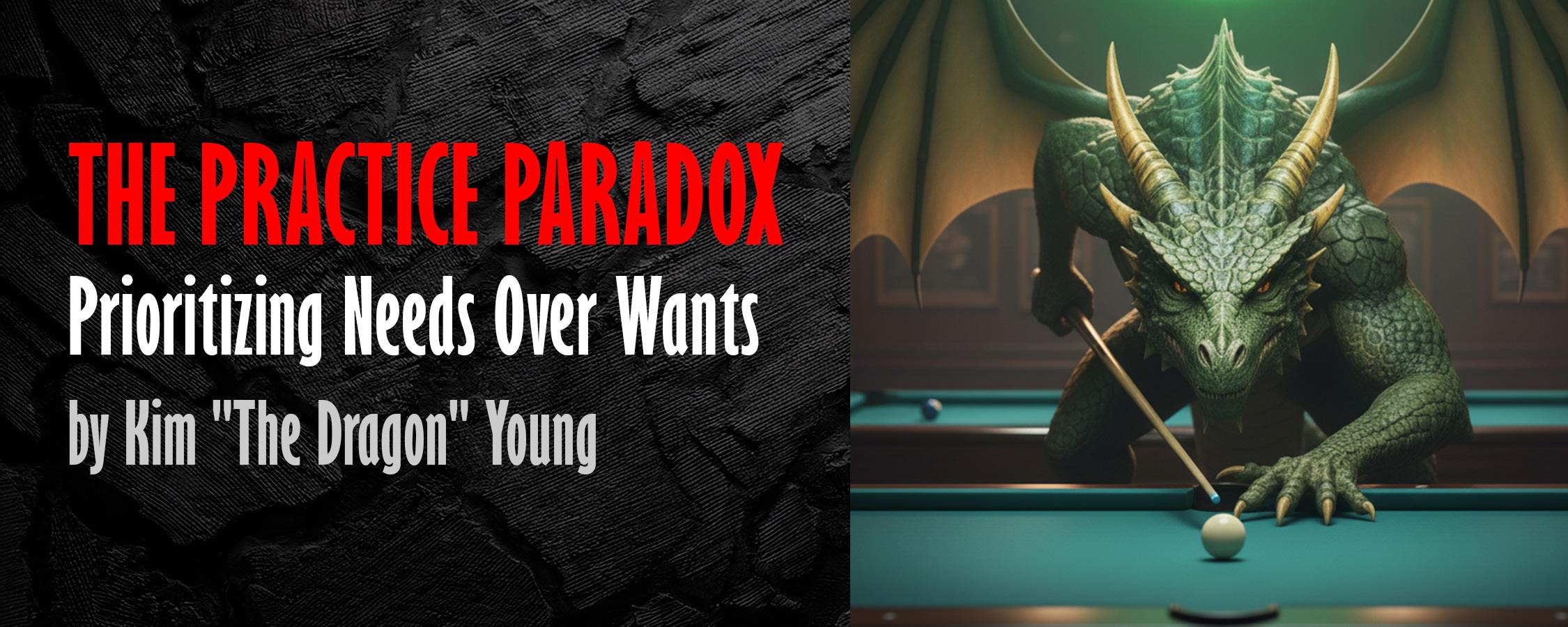
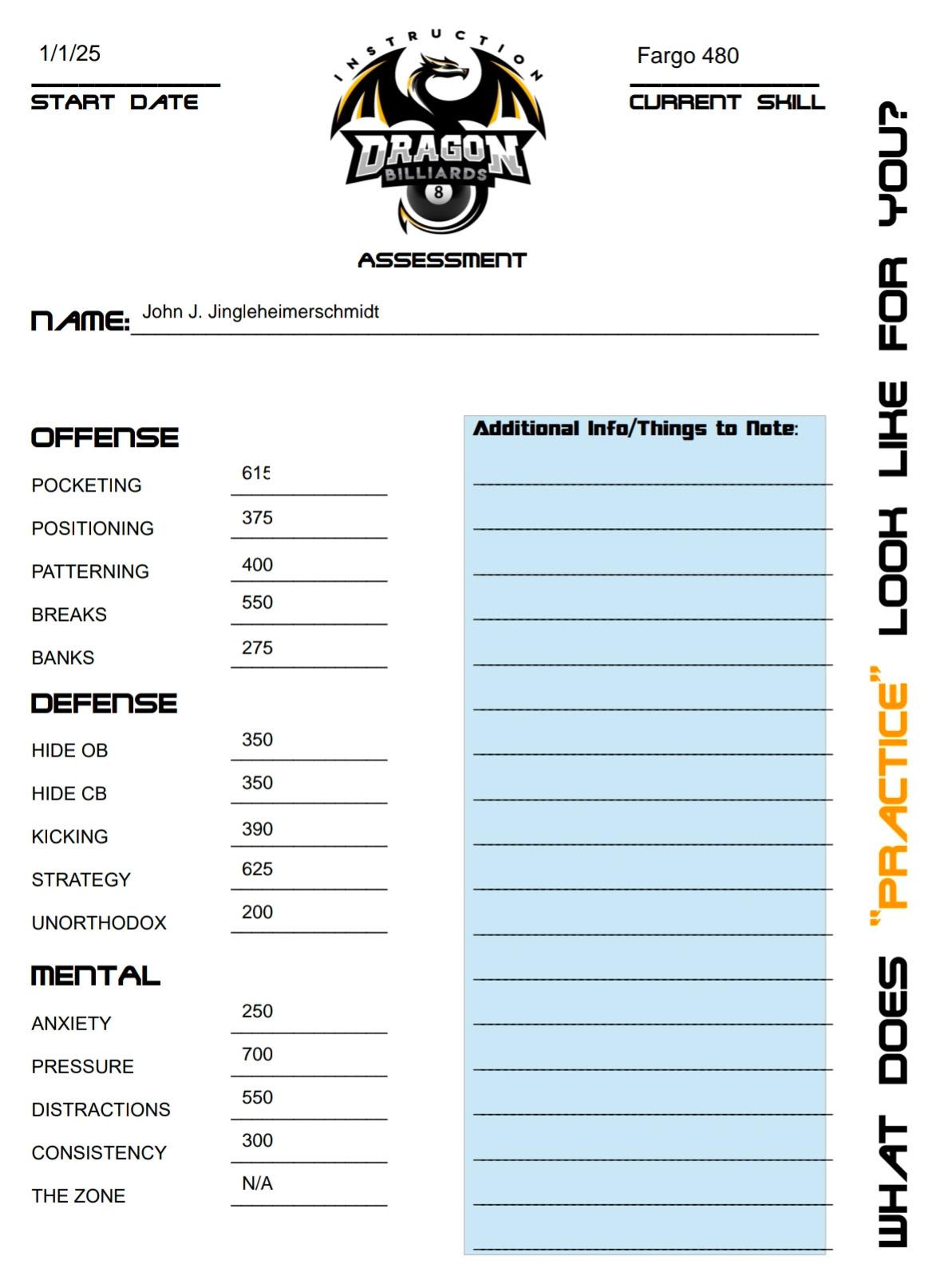
As a coach, one facet of my job is to guide students away from "autopilot" play and into routines that target the areas where improvement makes the largest impact. We do this at Dragon Billiards Instruction by breaking your total game into 15 specific pillars when doing an initial assessment and progress reports.
A player might have a high league rating, but when we look closer, we see a "story" of imbalances that tell where the player has invested their interests and efforts and ignored others. You might be a master at Pocketing, but if your Competitive Anxiety is high or your Strategy is weak, your progress will stall. Yet, any practice attempted continues to strengthen the already stronger strengths, while the weaknesses remain untouched.
The 15 Pillars of a Master Player
To reach the next level, you must first assess your strengths and weaknesses so you know where your attention needs to be focused. Consider using the Dragon Billiards Instruction Player Assessment to inventory your skills honestly and objectively across these categories:
Offense:
Pocketing, Positioning, Patterning, Breaks, and Banks.
Defense:
Hiding/Controlling the Object Ball or Cue Ball (different skills) in Defensive Situations, and Kicking.
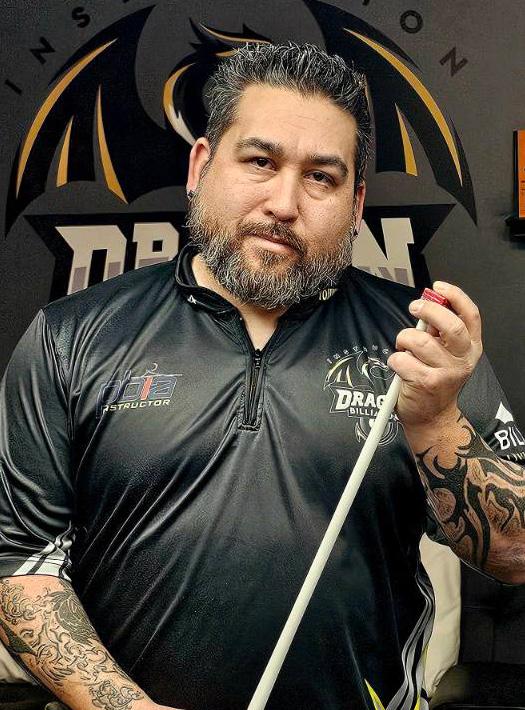
Kim "The Dragon" Young
2025 PBIA Instructor of the Year
PBIA Master Certified
ACS Level 4 Instructor
Senior Instructor at Billiard University
Tactical:
Strategy (knowing when to play defense--and the discipline to listen to yourself) and Unorthodox Defenses (intentional fouls or spotting balls).
Mental Management:
Managing Anxiety, Pressure, Distractions (both internal and external), Consistency, and "The Zone." Just because you play better under pressure does not mean this is a skill if you require an external influence to bring out your best game.
Workshop: Your 90-Day Blueprint
Are you ready to stop playing like a hobbyist and start training like an athlete? Follow this assessment protocol:
Rate Yourself:
Using your league rating system, give yourself a score for each of the 15 topics above.
Make it Objective:
Your overall skill should be close to an average of the 15 topics listed if your thoughts about yourself match what you've shown in competition. If the average of the 15 categories is significantly different than your current overall skill, you may need to true it up by adjusting your numbers to match reality. The math must match to separate Facts from Feelings.
Identify the Gaps:
Put a star next to your #1 strength. Circle your three weakest abilities.
Target the Impact:
Identify the one area that, if improved, would make the largest impact on your overall game. (Hint: It’s often the mental game or strategy, very seldom is pocketing the weakest link, since that's where most amateurs focus their attention.
The SMART Method:
Think about your 12-month goals. If you hired me as
your coach, what would your return on investment look like? Gain 100 Fargo points, move up 2 APA skill levels? Now work backwards...where do you need to be in 6 months to achieve that? How about 3 months? Next, create a 90-day goal sheet based on that 3-month checkpoint. Feel free to model yours after the one we've shared. Don’t just say "get better." Make it Specific, Measurable, Achievable, Relevant, and Time-based.
I'm Here to Help
Whether it’s in-person or via live online instruction, I specialize in helping you find the "what you don't know." My team and I can even help you navigate the "fun equipment stuff" once your skills outgrow your gear.
Stop fighting five nights a week and hoping for a miracle. Start training for the win with proper practice.
Ready to transform your game? Join over 8,000 other students in 63 countries who have chosen to “Quit Draggin' and Get Dragon” for live online and in-person training.
Email dragonbilliardskim@gmail.com or, you can call me at 607-743-2055 or. We can do an assessment and create goals together, make improvements immediately, focusing on where it matters most. Best of all, I'll show you how to be your own coach so you can continue improving even when we are apart.
Kim “The Dragon” Young
2025 PBIA Instructor of the Year
PBIA Master Instructor
ACS Level 4 Instructor
Senior Instructor at Billiard University
Train Better. Do Better. Shop Better. DragonBilliardsInstruction.com
Every time I work with amateur players, one problem I consistently see is improper use of the various rail bridges. In the game of pool, every shot demands focus, precision, and a strong foundation.
While most players are comfortable executing shots with a traditional hand bridge, rail bridges present unique challenges and opportunities. Mastering the rail bridge is essential for any player seeking consistency and accuracy, particularly when faced with shots that require the cue ball to be struck from near or against the rail.
What Is a Rail Bridge?
A rail bridge is a type of bridge formed when the cue ball is positioned close to or touching the rail. Instead of using a traditional open or closed hand bridge on the table surface, the rail itself supports the cue.
This technique ensures stability and allows the player to deliver an accurate stroke under constrained conditions.
Types of Rail Bridges:
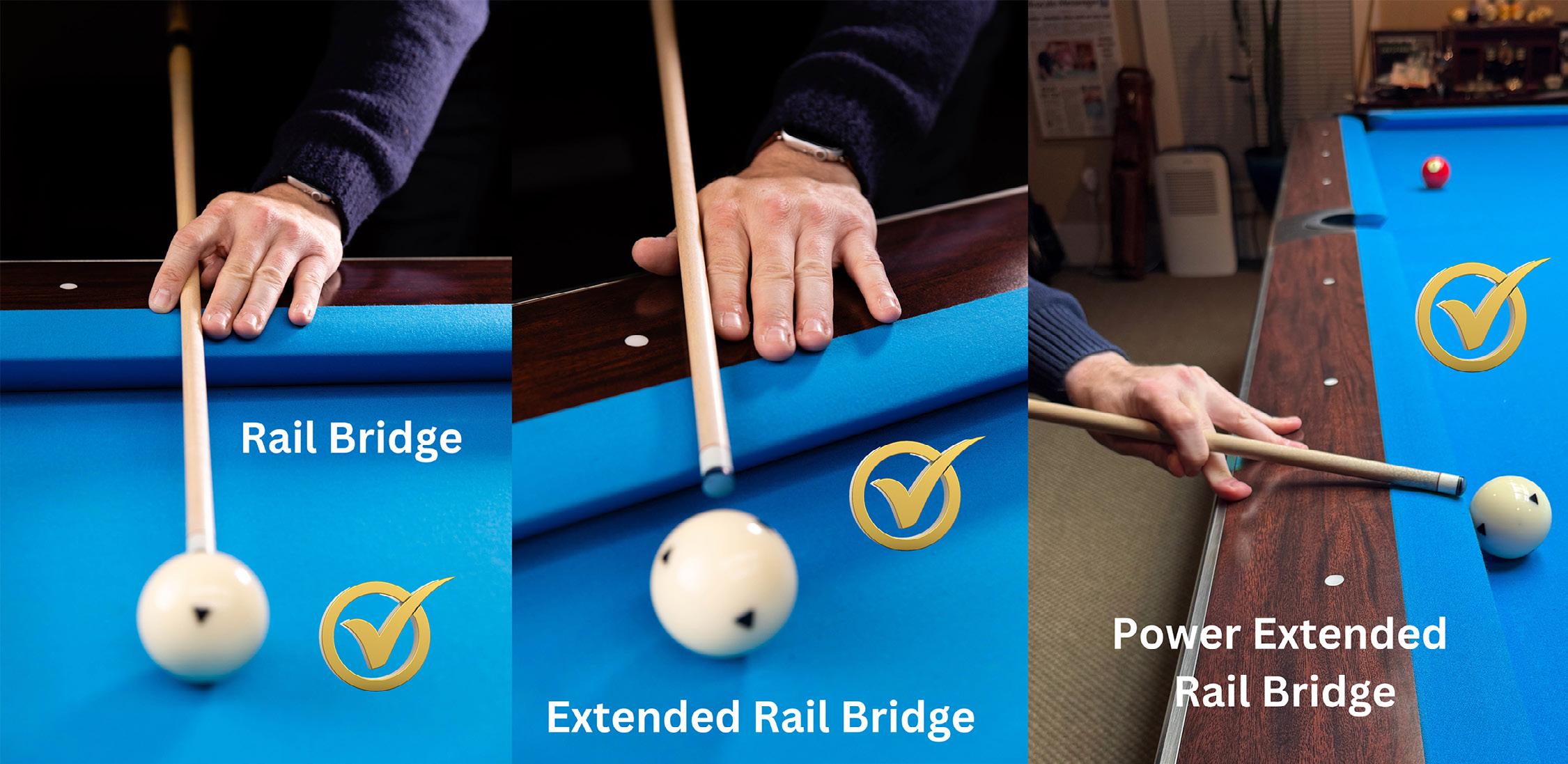
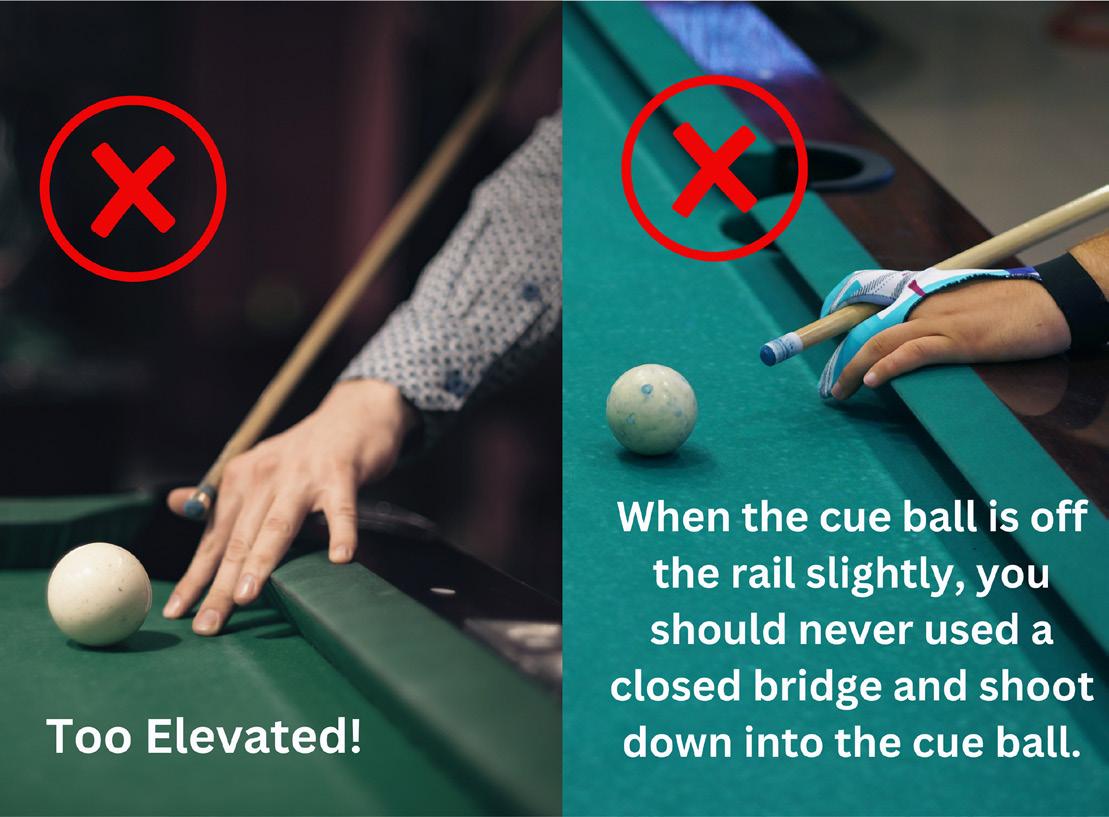
1. Rail Bridge - Used when the cue ball is off the rail slightly.
2. Extended Rail Bridge - Used when the cue ball is frozen to the rail.
3. Power Extended Rail Bridge - Used when the cue ball is frozen to the rail, and you need to strike the shot hard.
Why Rail Bridges Matter:
1. Essential for
Tight Positions
• In many games, the cue ball often ends up near the rail due to defensive plays or positional errors. A rail bridge becomes necessary to avoid fouling and still maintain precise control over the shot. Without a proper rail bridge, players risk miscues, poor accuracy, or unwanted spin.
2. Stability on Difficult Shots
• The rail provides a natural groove for the cue stick, offering stability and support. When executed correctly, a rail bridge can reduce unintended side spin and ensure that the cue ball reacts correctly.
3. Cue Elevation Management
• When the cue ball is against the rail, players must elevate their cue stick slightly to avoid miscuing. A good rail bridge ensures the proper angle and elevation, minimizing errors and keeping the stroke smooth. It is very important to keep the cue as level as possible. For every degree you elevate your cue, it is estimated that you lose 5 percent accuracy!
4. Improved Spin Control
• Effective rail bridges allow players to apply spin, even from tight positions. Mastering the angle and right amount of elevation helps execute draw, follow, or side spin with accuracy.
Anthony Beeler is the current Billiards Instructor of the Decade and is a former BCAPL National Champion. He has numerous “Top 25” national finishes and is the primary author of the ACS National Billiards Instructor’s Manual. He has also authored the book Unstoppable! Positive Thinking for Pool Players. Anthony currently has the highest established Fargo Rating of any Master Instructor. He has won over 300 tournaments and has defeated numerous professional players in tournament competition.
Rail bridges are a critical skill skill for every pool player.
How to Execute a Proper Rail Bridge
1. Placement:
• Rest the shaft of the cue on the rail, ensuring it glides smoothly along the groove formed by your fingers.
• Use your index finger or thumb to stabilize the cue stick on top of the rail.
2. Hand Position:
• If the cue ball is near the rail, you can use a rail bridge.
• If the cue ball is touching the rail, keep your hand low, and use an extended rail bridge.
• If you need to strike the shot hard, use power extended rail bridge.
3. Angle Adjustment:
• Elevate the back of your cue stick slightly to avoid hitting the rail during your stroke. Adjust the elevation based on the type of spin or speed required for the shot.
4. Stroke Execution:
• Keep your stroke smooth and deliberate. Avoid quick movements, as the elevated cue can amplify small errors.
Practicing Rail Bridges
To develop confidence with rail bridges:
• Practice straight shots with the cue ball close to the rail and frozen to the rail.
• Work on applying spin with the various bridge types.
Conclusion
Rail bridges are a critical skill for every pool player. Whether executing a straightforward shot or a complex one, mastering the rail bridge allows for precision, stability, and confidence in challenging scenarios. As you refine this technique, you’ll find yourself prepared to handle shots that leave others struggling—and that’s the hallmark of a player who has a complete game. So next time your cue ball nestles against the rail, remember it’s not an obstacle, but an opportunity to showcase your skill.
The Grip of Excellence: A Deep Dive into the Evolution and Impact of the Billiard Cue Wrap
In the world of high-stakes billiards, players often obsess over the "business end" of the cue. We talk at length about the taper of the shaft, the density of the leather tip, and the deflection rates of carbon fiber. Yet, there is a six-inch section of the butt—the bridge between the athlete’s hand and the instrument—that arguably dictates the feel of every single shot: the wrap.
Whether it is the classic "twang" of Irish Linen, the tacky security of rubber, or the sleek minimalism of a wrapless handle, the choice of wrap is one of the most personal decisions a player can make. It is the literal point of contact where intent meets execution.
A History of the Handle: From Bare Wood to High-Tech Fiber
The billiard cue began its life as a "mace"—a top-heavy club used to shove balls across a table. As the game migrated from the floor to elevated tables, the mace was flipped around, and players began using the narrower handle (the "queue") to strike the balls. For centuries, cues were simply tapered pieces of wood, often ash or maple.
The invention of the wrap didn't come from a desire for fashion, but from a practical need for moisture management. As billiards moved into the smoky, crowded pool rooms of the 19th and early 20th centuries, heat and nerves led to sweaty palms. A slick, finished wood handle became a liability, often slipping during the "hit" and causing a miscue.
The Irish Linen Revolution
The mid-20th century marked the golden age of the Irish Linen wrap. Custom cue makers like George Balabushka and Herman Rambow began utilizing tightly wound, pressed flax linen. This didn't just provide a better grip; it became a hallmark of craftsmanship. By the 1960s and 70s, the "look" of a pool cue was defined by that salt-and-pepper linen aesthetic.
As the professional circuit grew in the 1980s and 90s, material science caught up with the sport. We saw the introduction of exotic leathers, synthetic compounds, and eventually, the return of the "wrapless" cue, made possible by modern ultra-thin clear coats that provided grip without the need for fabric.
Why the Wrap Matters: The Physics of the Stroke
To an outsider, the wrap might seem like a decorative sleeve. To a professional, it is a vibration dampener and a friction regulator.
When you strike a cue ball, energy travels from the tip, through the shaft, and into the butt of the cue. This feedback (often called "feel") tells the player if they hit the ball center-high or with a touch of unintended "mush." A wrap modifies this feedback.
1. Consistency: Humidity changes how skin interacts with wood. A wrap provides a consistent texture regardless of whether you are playing in a dry basement or a humid beachfront pool hall.
2. Tension Reduction: A primary sin in billiards is "choking" the cue. If a handle is too slippery, a player subconsciously squeezes harder to maintain control. This tension travels up the arm, stiffening the wrist and ruining the fluidity of the stroke. A good wrap allows for a loose, relaxed grip while maintaining total control.
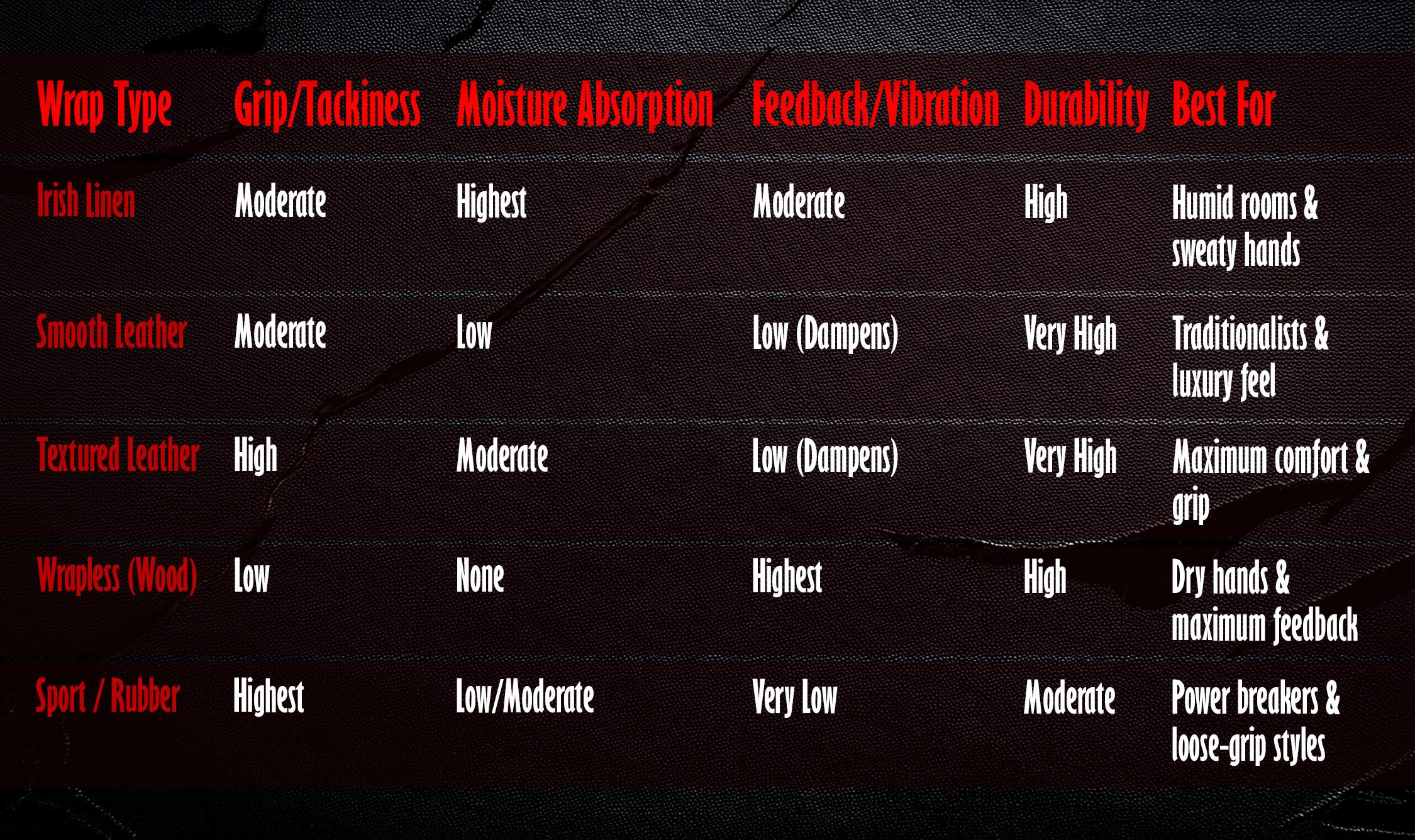
The Breakdown: Every Style and Its Benefits
Choosing a wrap is about balancing tactile preference
with your body chemistry (specifically, how much your hands sweat). Here is the definitive guide to the modern player's options.
Irish Linen (The Traditionalist’s Choice)
Made from 100% flax, genuine Irish Linen is applied by winding a single strand thousands of times around the handle, then pressing it under high pressure until it feels almost like a solid surface.
• The Feel: Crisp, cool, and slightly textured.
• Benefits: It is the best material for "wicking" moisture. If your hands sweat, the linen absorbs it, keeping the surface dry.
• Best For: Players who prefer a classic look and a firm, medium-friction feel.
Leather (The Luxury Standard)
Leather wraps come in various textures: smooth, embossed (lizard or elephant grain), or "genuine" exotics.
• The Feel: Soft, organic, and premium. Leather tends to feel "warmer" than linen.
• Benefits: Durability. A well-installed leather wrap can last decades. It offers a very "connected" feel to the cue, as it doesn't have the slight "give" that linen might. Embossed leathers provide extra channels for air, helping with grip.
• Best For: Players who want a sophisticated aesthetic and a grip that "molds" to their hand over time.
Wrapless (The Purist’s Choice)
A wrapless cue is simply the finished wood of the butt. This allows the beauty of the wood grain—like Birdseye Maple or Bocote—to shine through uninterrupted.
• The Feel: Extremely smooth and "hard." You feel every vibration of the hit with zero dampening.
• Benefits: Maintenance is easy—just wipe it down. There is no fabric to fray or leather to peel. It offers the most direct feedback of any handle style.
• Best For: Players with very dry hands who want maximum feedback and a sleek, modern look.
Rubber and Sport Grips (The Performance Edge)
Popularized by brands like Predator with their "Sport2" series, these wraps use high-traction synthetic compounds similar to those found on golf clubs or tennis rackets.
• The Feel: Tacky, soft, and highly cushioned.
• Benefits: Maximum "tack." It is nearly impossible for the cue to slip in your hand, even with a feather-light grip. These wraps are also excellent at absorbing the high-frequency vibrations of modern carbon fiber shafts.
• Best For: Power breakers and players who prefer a modern, athletic feel over traditional aesthetics.
Stacked Leather (The Hybrid)
Commonly seen on high-end custom cues, this involves stacking hundreds of thin leather washers, gluing them, and turning them on a lathe.
• The Feel: A unique "velvety" wood-like feel that offers the grip of leather with the firmness of wood.
• Benefits: Exceptional vibration dampening and a truly custom, high-art appearance.
• Best For: Collectors and serious players looking for a "forever" cue with a unique tactile profile.
How to Choose Your Perfect Match
If you are struggling to decide which wrap is right for you, consider these three questions:
How much do your hands sweat? If you deal with significant moisture, Irish Linen is the gold standard. If your hands stay dry, Wrapless or Smooth Leather will feel fantastic.
How "tight" do you grip the cue? If you have a habit of gripping too hard, a Sport/Rubber grip can help you relax your hand, as the tackiness does the work for you. If you already have a light, professional-style grip, Linen or Leather provides the subtle feedback you need. What is your shaft material? If you use a Carbon Fiber shaft, you might find that a Leather or Sport wrap helps balance the "pingy" feel of the material. If you use Traditional Maple, the classic pairing of Irish Linen remains unbeaten for a reason.
Conclusion
The billiard cue wrap is where the player ends and the tool begins. While the tip makes contact with the ball, the wrap makes contact with you. Whether you choose the historical prestige of Irish Linen, the rugged luxury of leather, or the high-tech performance of a sport grip, your choice should serve one ultimate goal: confidence. When you step into the box to face a game-winning 9-ball, the last thing you should be thinking about is your grip. With the right wrap, the cue becomes an extension of your arm, leaving your mind free to focus on the geometry of the table and the glory of the win.
What I want to do in this article is go over some of the fundamentals of pool again. This is especially important if you are an advanced player! Please make sure you read this. It is amazing to me that the more advanced I get, the more I am working on simple things like bridge,
Is your stick really level, or almost level?
level stick, grip, or eye patterns. Let us look at fundamentals from an advanced player's perspective. You will need to use your phone’s camera to get the most from this article. If you do not have a stand, you can use some chalk to prop up your camera.
First is having a level stick. Now, if you are an advanced player, you already know the benefits of a level stick, but what I want you to do is videotape yourself taking a series of shots with a camera. Is your stick really level, or almost level? My guess is that you are almost level and could get another 3 or 4 degrees of level into your stick! What is the big deal? Well, the more degrees off level you are, the accuracy goes down about 2 %. That is only 2 shots in a hundred, but I am betting you would like to be able to make at least one of those shots! The taller
you are, the harder this will be. I want you to work on the feeling that you are hitting the cue ball. Of course, you can’t usually do this, but work towards that feeling.
The next fundamental to look at is your grip. I like a loose grip, but the most important thing here is that you do not change the pressure in your grip during your shot. This is a huge error! Whatever grip pressure you start with, keep it constant. You can check this out by watching your grip pressure before the shot and then checking it after the shot. Did you grab the stick? Or punch the shot? Roll your wrist? Clench? The feeling here is a smooth underhand toss with no tightening or rolling. Make sure to use your camera to video your grip. Pay particular attention to what you do on long shots or shots that you hit harder.
Eye patterns are also an advanced fundamental that we sometimes lose sight of. I recommend that your eyes be focused on the object ball before you shoot. There are many ways of getting there, but the key point is that you give your eyes time to focus on the target (about 1 or 2 seconds) before you pull the trigger. I like stopping at the cue ball to make sure the spot I am aiming at on the cue ball will give me the result I want, then switching my eyes to the object ball and making sure I really look at where I want the cue ball to go. Then I pull back slowly, pause, and move my grip hand smoothly to my finish position. For this fundamental, put your camera
in front of you, make sure you take your hat off, and then shoot some shots that are not too close. You want to make sure that you shoot shots that require you to move your eyes for the shot.
One quick aside here. There are a lot of players who look at the cue ball last, and that works too. The point is that you look at the point you are trying to hit and not have your eyes jumping around.
The thing about all these advanced fundamentals is that intellectually you know these
You can test yourself on how accurately you are hitting the cue ball by putting a lot of chalk on your tip, using a 6-ball or 9-ball, and aiming inside the circle. Hit the ball hard up and down the table and see exactly where you hit the ball. My guess is that you will be surprised by how far off you are!! The better you can hit the spot you are aiming at, the better you will play!
The final advanced fundamental I want to look at is stillness. You will need a whole body shot with your camera here. Does your bridge hand move during the shot? Does it open? Does your head move? Do you jump up? All this movement causes errors in where you hit the cue ball, causing you to miss shots or miss position. Try not move until the balls stop rolling.
The thing about all these advanced fundamentals is that intellectually you know these, but when you watch your videos, you quickly realize that your body needs some time to catch up with your mind.
As a general rule, there are no quick fixes to improve your pool game. The only way to improve your game is to invest the time into building a foundation of fundamentals and routines that will keep your game on track. It takes time, commitment, and knowledge to build a solid and lasting quality game.
That ball that’s sitting all alone in the middle of the table is probably not the best choice to start a run
That being said, there are some simple things you can do that will quickly improve your chances for success on the table. Considering these common errors can help you work to eliminate them.
1 - Learn to read the table before you take your first shot.
That easy first shot may not be the best choice. Look for potential problems first. If it’s an open table, look for potential problems before you decide which balls you want. That easy 3-ball shot might cause major problems as you work through the rack.
2 - Ducks are like insurance.
A ball sitting in front of the corner might be taking away some options for your opponent. Save them for later, or for when you need to get out of trouble.
3 - Have a plan.
Walking up to the table and just starting to shoot balls into pockets with no plan of how you’re going to clear the table can get you in trouble. Making 3 or 4 balls and then turning the table over to your opponent often makes it easier for them to make a run. Having fewer balls remaining doesn’t mean you’re winning. It’s more important to have a winning plan than it is to make a few shots.
4 - Practice recognizing patterns.
Every game has a differ ent layout. But there are often
recurring patterns that you see frequently. Those familiar patterns can make your run outs easier. Look for them every time you come to the table.
5 - Learn to use the bridge.
Yeah, I know! I don’t like it either. But sometimes, it can be your best friend. Shooting off balance, or in an awkward stance, can result in missed shots or a poor position for your next shot. You need to use all the tools that are available to get the best outcome for a shot.
6 - Be smart with ball in hand.
BIH is a great advantage when used properly. It gives you the ability to eliminate problems that might otherwise end your run early. That ball that’s sitting all alone in the middle of the table is probably not the best choice to start a run. Get rid of your problems when you have the chance.
7 - While we’re on the subject of ball in hand, keep in mind that straight in shots are rarely the best shot for you to start with.
Even a slight angle gives you more options as far as playing for position. And it takes away the possibility of the cue ball accidentally following the object ball into the pocket.
This list is hardly all-inclusive, but it includes simple adjustments you can easily make to improve your chances for success. Even including one or two of them can help your game move ahead.
Until next time, Steve Jennings
SPF/ACS/PBIA Master Instructor
Playing pool since the age of 10, first learning on a table at home, and into pool rooms a few years later, I won several base championships while in the service. After my discharge, I continued to play recreationally, and in several regional tour events.
I started coaching and teaching game strategies in the 90s. I worked with several Master instructors reaching Master instructor status in 2015. Now Director of Training for the Southeastern Billiard Academy, and teaching classes as often as I can. I train/certify new instructors and look forward to help every player achieve their fullest potential.
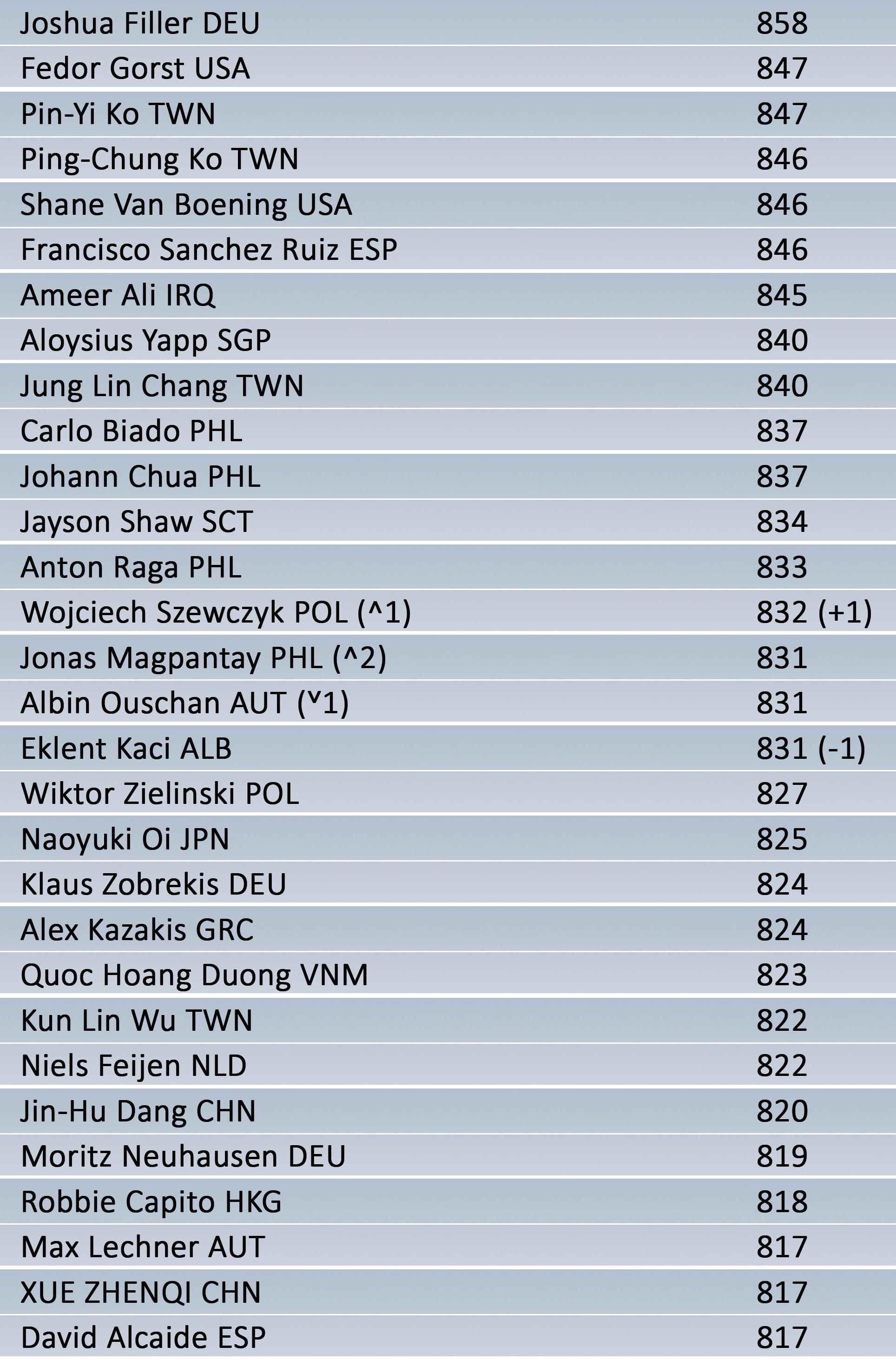
CURRENT RATINGS
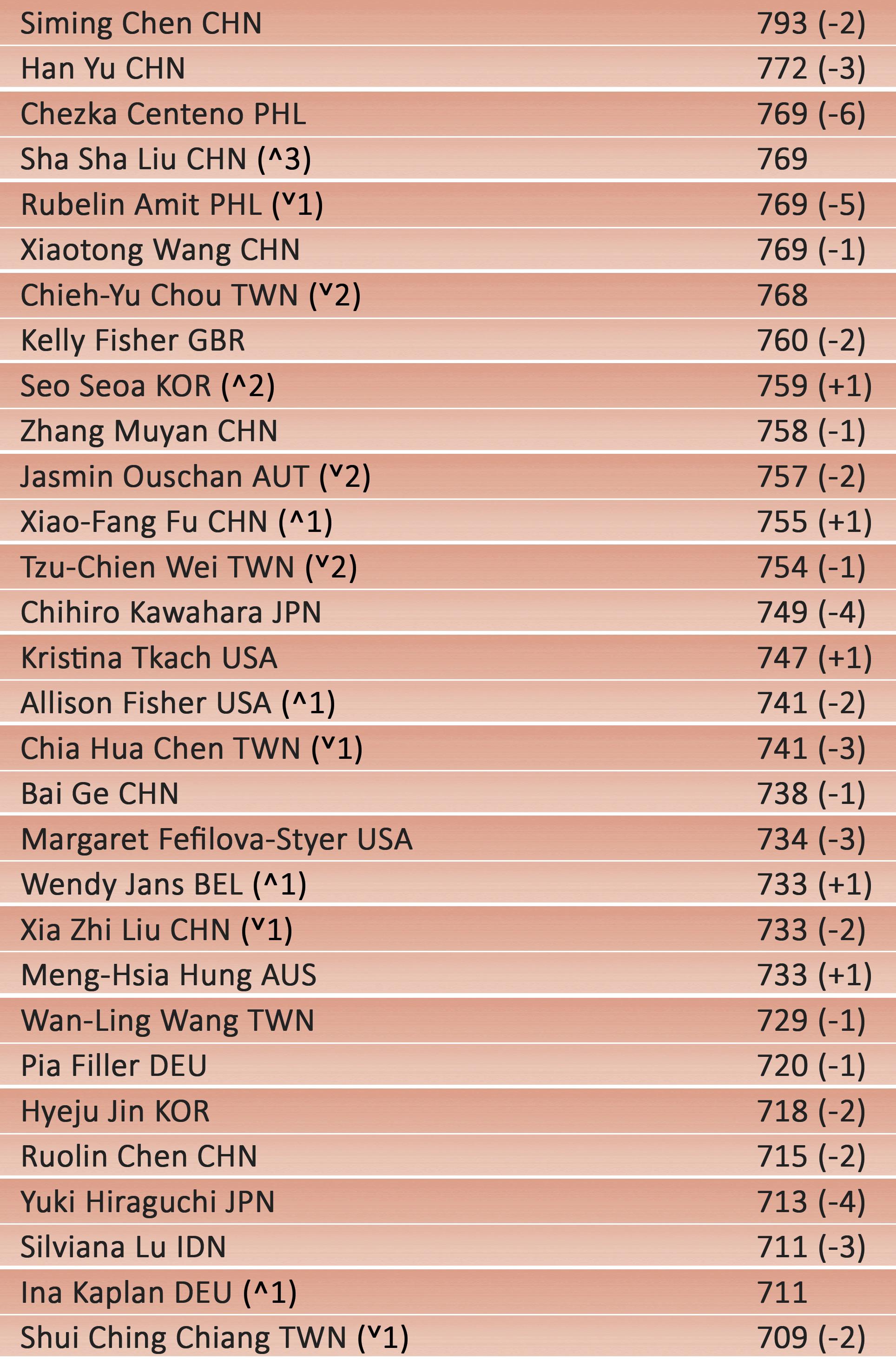
CURRENT RATINGS
Pool players are athletes with less physical demands but more mental skill requirements than athletes in other sports. Once fundamental pool skills are mastered, pool primarily becomes a mental venture. So, the work you do on your pool mental skills is just as important as your time spent working on shotmaking and position play. And yet, most pool players do not spend much time addressing the mental aspects of playing pool. The mental side of pool is often overlooked. It is more fun to play pool or practice running balls than to work on mental skills. But, fifteen to thirty minutes per week of mental training can significantly improve your pool playing abilities. This is because the words and images you put in your brain are what create your physical motions.
Self-Criticism
Self-criticism is the act of assigning a personal negative value to an action you have taken. The game of pool lends itself to many opportunities to do just that –missed shots, scratches, fouls, bad luck, games lost, and matches lost. When something goes wrong, the danger pool players face is attributing it to personal flaws rather than external factors. For instance, a pool player missing a bank shot might think “I’m a lousy banker” instead of trying to assess why the bank shot was missed.
While some self-reflection is healthy, excessive selfcriticism can significantly impact a player’s performance and well-being. Some examples:
1 - Performance Evaluation:
Players might harshly assess their performance during a game or competition. For instance, berating themselves for missing a crucial pool shot.
2 - Comparisons:
Players often compare themselves to others. This can lead to self-criticism if they perceive themselves as falling short in comparison. For example, an APA level 3 player might feel inadequate when comparing his/her skill to an APA level 7 teammate.
3 - Fear of Failure:
Fear of failure can trigger self-judgment. A player attempting a difficult kick shot might worry about failing and then judge themselves negatively if they do.
4 - Internal Dialogue:
The way pool players talk to themselves internally matters. Negative self-talk, such as “I’m not good enough” or “I always mess up,” can hinder performance and erode confidence. When you constantly criticize yourself, it fosters feelings of inadequacy and self-doubt. Over time, you may start to believe these self-criticisms, which can chip away at your self-esteem and confidence in your abilities.
5 - Anxiety and Depression:
Excessive self-judgment can lead to anxiety and depression. Harshly evaluating yourself for perceived mistakes, flaws, and imperfections—even minor ones— can take a toll on your mental well-being.
6 - Limiting Your Potential:
When you judge yourself harshly, you may limit your potential. The fear of making mistakes or being criticized can prevent you from taking risks, trying new things, and reaching your full capabilities.
players can navigate through slumps effectively and emerge stronger.
7 - Strained Relationships:
Constant self-criticism can strain your relationships. It may make you overly sensitive to criticism from others, leading to defensiveness and conflict.
8 - Unhealthy Perfectionism:
Self-criticism often fuels unhealthy perfectionism. You may set impossibly ambitious standards for yourself, leading to stress, burnout, and dissatisfaction.
Dealing with self-criticism can be challenging, but it is essential for pool players to maintain their mental wellbeing. Here are effective strategies to help you manage self-critical thoughts:
Pay Attention to Your Thoughts:
Start by noticing the negative messages you send yourself. Recognize when you call yourself names or talk yourself out of things.
Change the Channel:
Avoid reflecting on mistakes or negative events. Instead, engage in activities that temporarily distract you from those negative thought patterns. Take a break, chat with a teammate, or go for a walk. Do not let your brain beat you up.
Examine the Evidence:
Recognize that your self-critical thoughts are not always true. They are often exaggeratedly negative.
Replace Negative Thoughts:
Challenge negative thoughts with more realistic statements. For instance, replace “I’ll never run a rack” with “I know I can improve my shot making and position play.”
Practice Self-Compassion:
Treat yourself with kindness and understanding, just as you would a friend. Remember that everyone makes mistakes, and it is okay to be imperfect. Show yourself the same compassion you would extend to others.
Seek Professional Help:
Consider talking to a psychotherapist about any underlying trauma or persistent self-criticism. Be clear about this. Letting go of self-criticism does not mean ignoring errors. It simply means seeing events as they are and not adding negative values to them. Remember that self-compassion and positive self-talk are powerful tools for overcoming self-criticism. Be gentle with yourself; you deserve kindness and understanding.
Slumps
A slump is a decline in your pool game performance, a drop from a previous acceptable level. It can end in a brief time or seem like it will never end. If you think you are in a slump, the first thing to do is understand it.
Minislumpsoccur all the time during pool matches when a player misses one or more shots in close succession. If you know your game, these can be corrected on the spot, usually by focusing on your fundamentals.
A typicalslumpcan last for several days or weeks. Surprisingly, it is also a normal part of the game of pool, and most players can expect to experience it every one to two years.
A major slump is rare and can last an exceptionally long time (several months or longer).
Slumps often start with a few shot mistakes or an off day that turns into two, then three, etc. Self-criticism, negative thoughts, anxiety, and fear of failure fuel your performance in a negative direction. Being distracted, increased muscular tension, and decreased confidence are often the result.
Here are some tips and strategies to help you overcome slumps:
Identify the Root Cause:
Understand whether the slump is physical (e.g., recovering from injury) or mental. Try to recognize factors like low self-confidence, frustration, or overtraining that may be contributing to the slump
Focus on Process, Not Results:
Shift your attention away from wins or statistics. Concentrate on small performance gains and executing each shot correctly.
Stay Motivated and Committed:
Positive Self-Talk:
Remind yourself of your motivation for playing pool. Reconnect with your commitment to your goals.
Replace negative thoughts with positive affirmations. Boost your confidence with positive thoughts about your skills.
Visualize Success:
Use mental imagery to see yourself performing well. Visualize successful shots, movements, and outcomes.
Learn from Mistakes:
Analyze your performance objectively. Use setbacks as learning opportunities to refine your skills.
Stay Patient and Persistent:
Slumps take time to overcome. Trust that consistent effort and dedication will lead to improvement.
Seek Support:
Consider talking to a sports psychologist, coach, or mentor.
Stay Physically Fit:
Regular exercise and rest reduce fatigue and enhance performance.
Excessive self-criticism can lead to negative thoughts, anxiety, and fear of failure, which in turn fuel performance slumps. When players judge themselves for missed shots or mistakes, they experience increased muscular tension, decreased confidence, and a decline in their overall game. Recognizing the impact is crucial for overcoming slumps. By adopting positive selftalk, focusing on process not results, and practicing self-compassion, players can navigate through slumps effectively and emerge stronger. Slumps offer valuable opportunities for growth and learning, ultimately contributing to a player's overall improvement and resilience in the game.
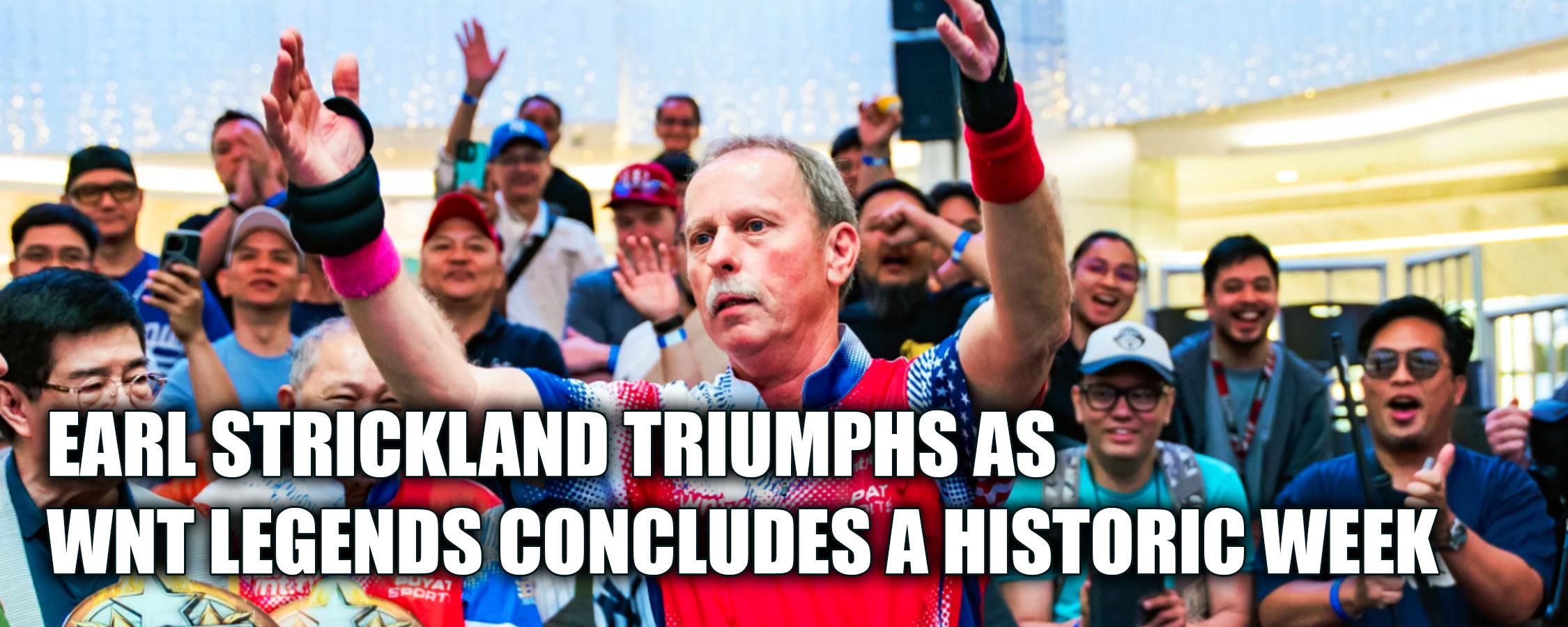
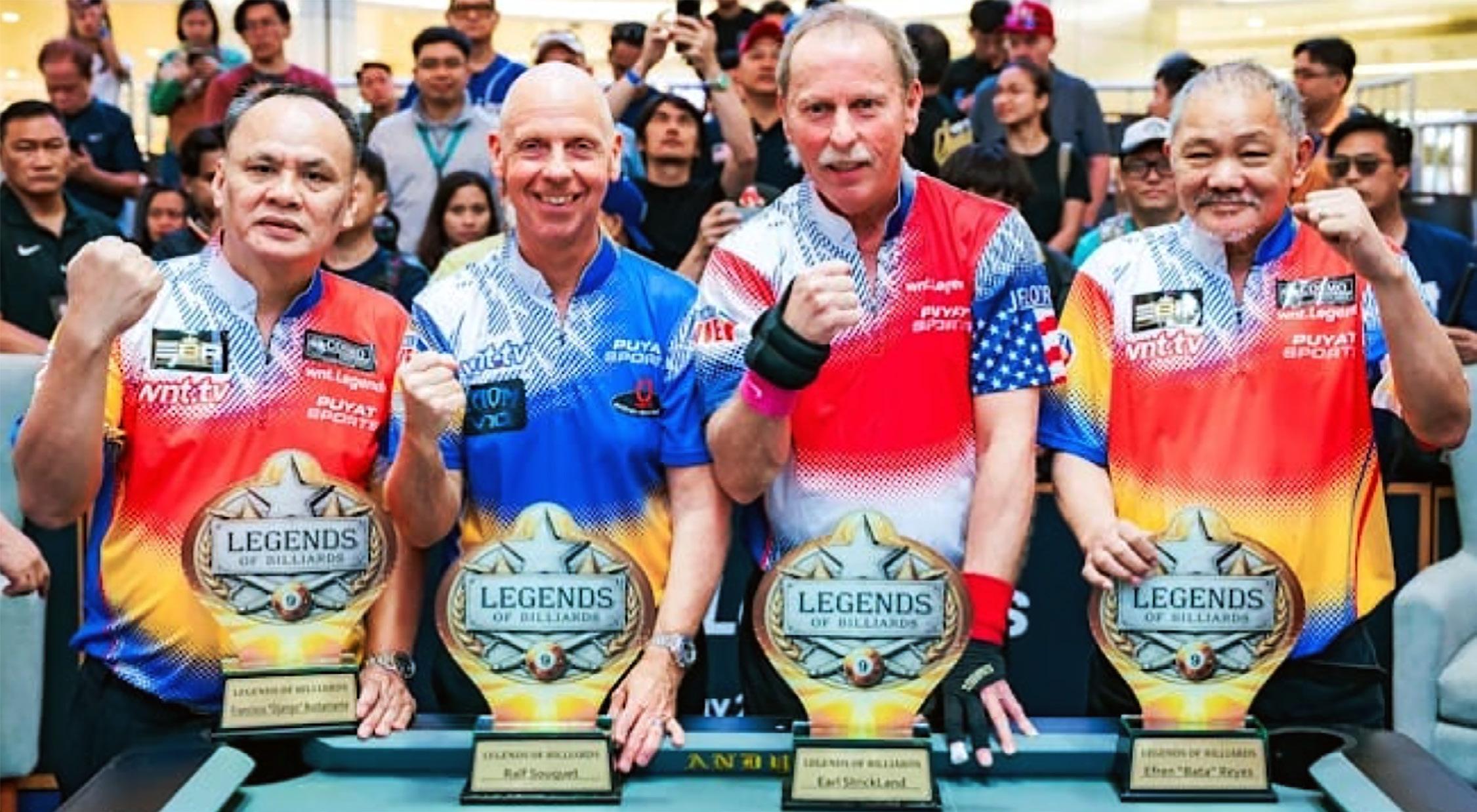
Earl Strickland was crowned WNT Legends Champion after producing a commanding performance to defeat Francisco Bustamante 11–6 in the final, lifting the title in front of a packed and passionate crowd at Gateway Mall, Quezon City.
The American completed a remarkable week in Manila, bouncing back from defeat on the opening day to close out the tournament in style and remind all he is still one of the greats of pool.
Reflecting on his victory, Strickland said:
“I’m thrilled to win, especially after falling short on Day One. I proved that you can never count an old dog out. I know my days are numbered, but if I keep shooting like that, who knows? I’m proud of myself.
This week is one I’ll never forget. It was an honour to share the stage with four great players. I’ve said it before, and I’ll say it again – there will never be another Efren Reyes, and this week was a reminder of that. Even though the crowd was rooting for the opposition, their passion added something really special to this event.”
Final
Earl Strickland 11–6 Francisco Bustamante
Strickland took early control of the final, opening up a
3–1 lead before Bustamante responded with trademark resilience to level the match at 6–6. However, the momentum soon swung decisively in Strickland’s favour.
Capitalising on a series of late errors, The Pearl surged clear, stringing together five straight racks to close out the match and secure the WNT Legends crown.
Bustamante said:
“I’m disappointed not to get the win. I made too many mistakes and Earl took full advantage of them – well done to him. But despite the result, I enjoyed this week. It was special to play against Ralf and Earl again, and to share the stage with Efren in front of our home crowd. I’ll never forget this experience. Even if we’re not in our primes anymore, this week showed that we’ve still got it.”
Third Place Playoff
Ralf Souquet 11–9 Efren Reyes
Earlier in the day, Ralf Souquet claimed third place with an 11–9 victory over Efren Reyes, gaining redemption after his opening-day defeat in a tense and closely fought contest.
Souquet said:
“I was happy to get some revenge after Day One, although it wasn’t my best performance. It’s never easy playing in front of a crowd that’s fully behind your
opponent. Of course I’m disappointed not to reach the final, but this week has been truly special. Thank you to all the fans who came out – it’s been a real pleasure to play in front of such a passionate audience.”
Reyes added:
"I didn’t make a ball off the break, which ultimately let me down, and the luck wasn’t on my side today. Congratulations to Ralf – he was the better player today. Even without winning, I’m happy. This week has been one I’ll never forget. Whether you were here in person or watching at home, thank you to everyone who supported us.”
Staged in partnership with Puyat Sports at Gateway Mall, Quezon City, WNT Legends marked a historic moment for the sport, as four of the greatest players the game has ever seen returned to the arena together one final time. A celebration of rivalry, respect, and camaraderie — a chapter in pool history that will long be remembered.
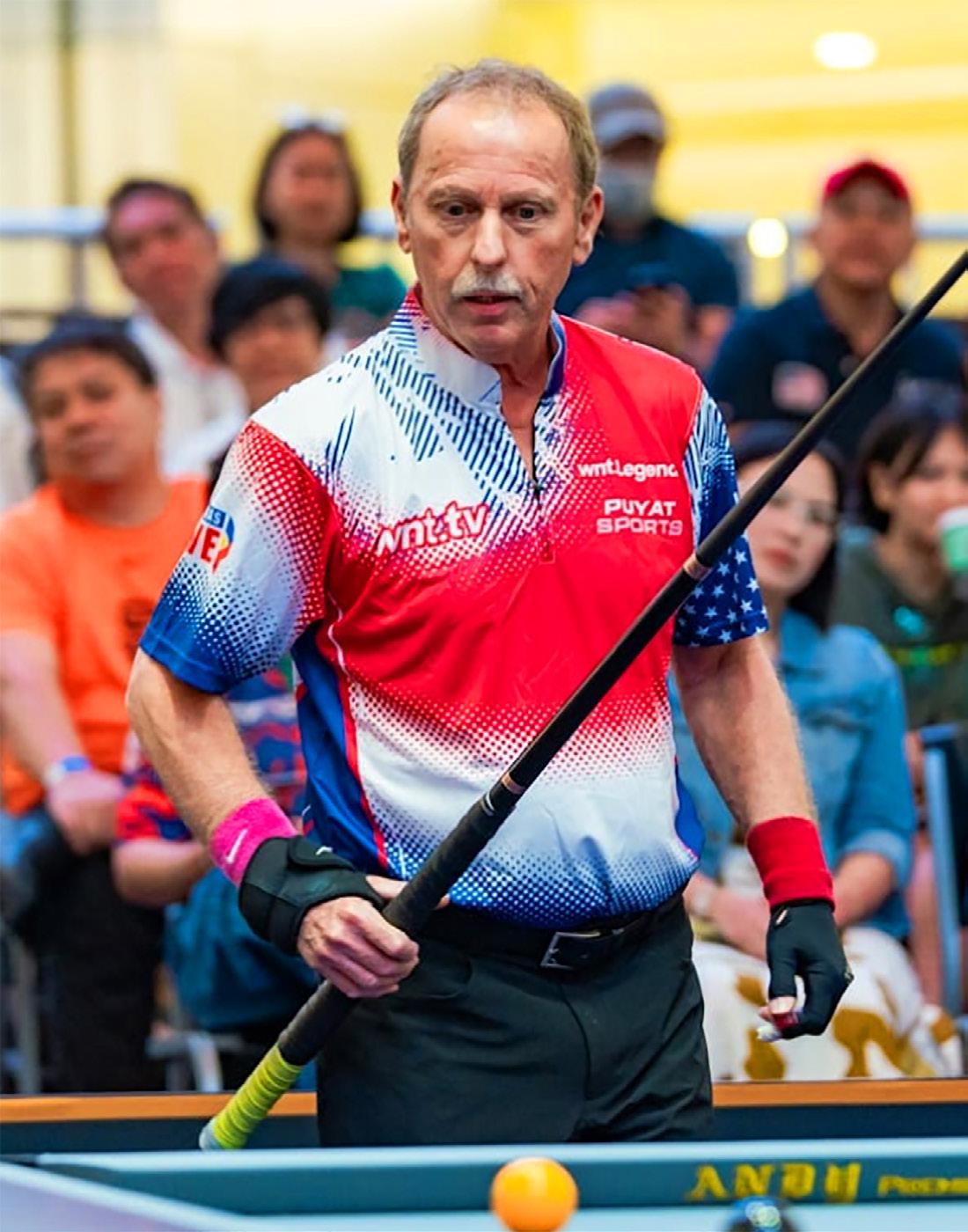
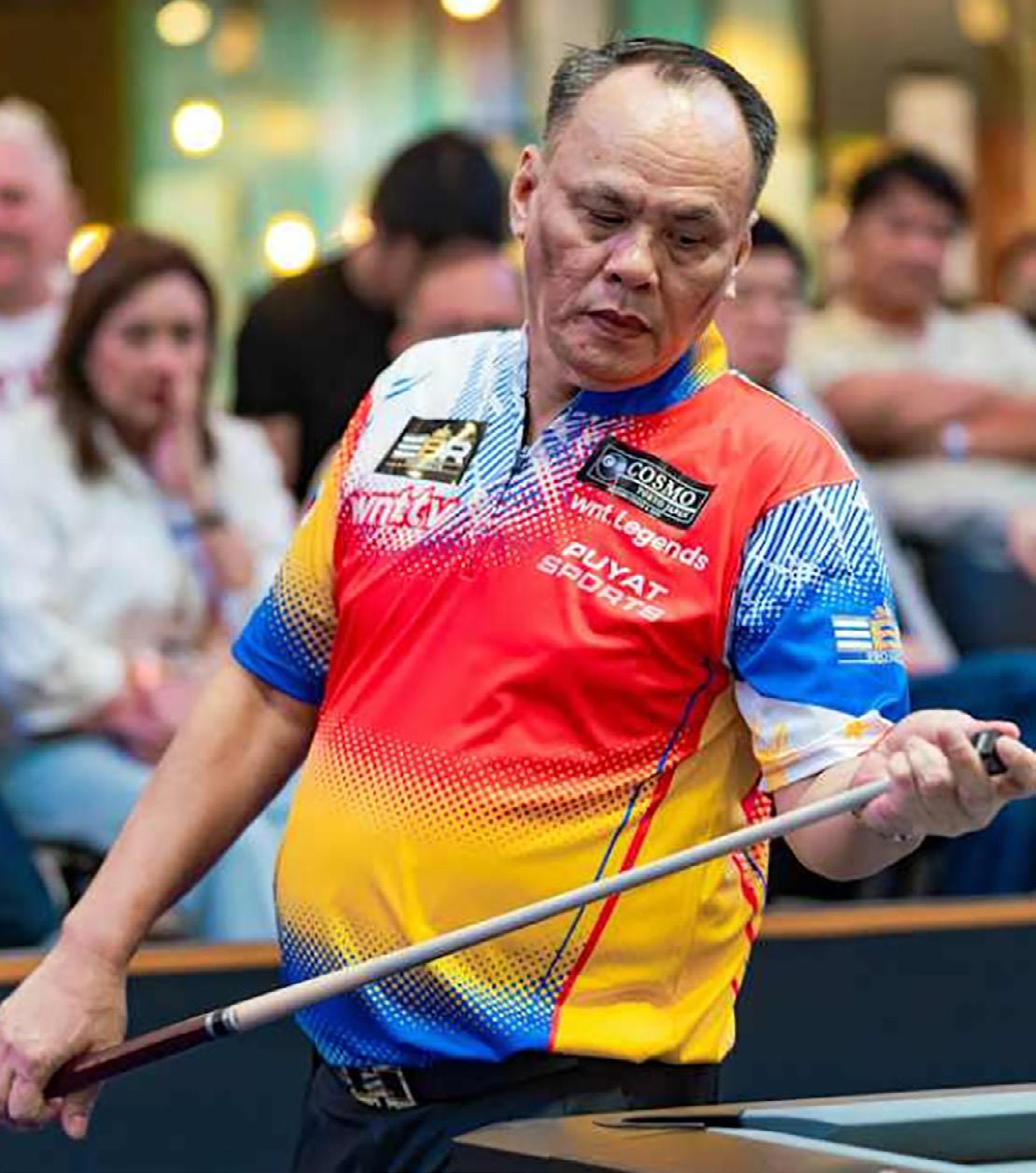
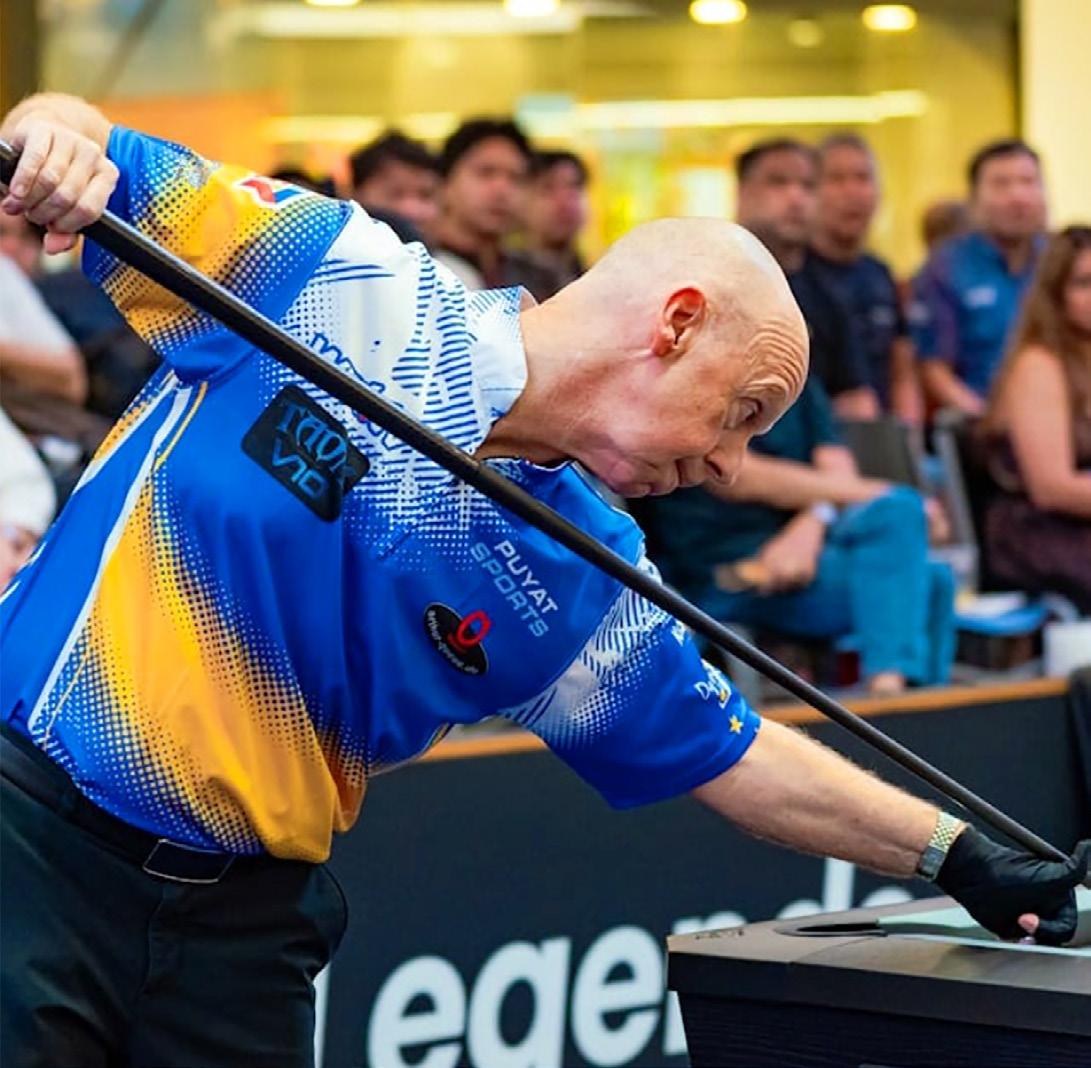
Francisco Bustamante, Ralf Souquet, Earl Strickland, & Earl Strickland at the Finals WNT Legends in Quezon City, Manila Photo Courtesy of Matchroom Pool/World Nineball Tour.
NEXT WNT RANKING EVENT
The World Nineball Tour continues with the inaugural Carabao International Open, taking place in Jakarta, Indonesia, from 4–8 February, featuring 128 players competing for a $100,000 prize fund.
NEXT MATCHROOM MAJOR
Following Jakarta, Premier League Pool returns, now heading to Florida, USA, from 18–22 February, where 16 of the world’s elite will battle it out. Player announcements will be revealed in the coming weeks.
For all the latest updates, follow Matchroom Pool on Facebook, Instagram, X, TikTok, and YouTube
Photo credit: MatchroomPool/World Nineball Tour
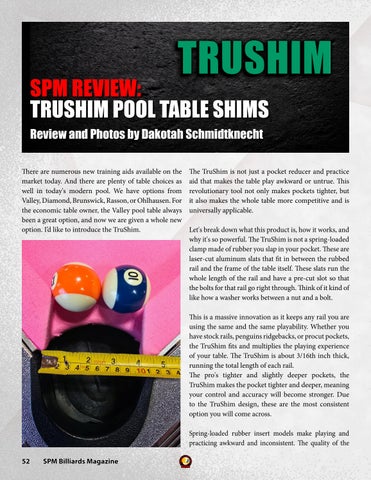
There are numerous new training aids available on the market today. And there are plenty of table choices as well in today's modern pool. We have options from Valley, Diamond, Brunswick, Rasson, or Ohlhausen. For the economic table owner, the Valley pool table always been a great option, and now we are given a whole new option. I’d like to introduce the TruShim.
The TruShim is not just a pocket reducer and practice aid that makes the table play awkward or untrue. This revolutionary tool not only makes pockets tighter, but it also makes the whole table more competitive and is universally applicable.
Let's break down what this product is, how it works, and why it's so powerful. The TruShim is not a spring-loaded clamp made of rubber you slap in your pocket. These are laser-cut aluminum slats that fit in between the rubbed rail and the frame of the table itself. These slats run the whole length of the rail and have a pre-cut slot so that the bolts for that rail go right through. Think of it kind of like how a washer works between a nut and a bolt.
This is a massive innovation as it keeps any rail you are using the same and the same playability. Whether you have stock rails, penguins ridgebacks, or procut pockets, the TruShim fits and multiplies the playing experience of your table. The TruShim is about 3/16th inch thick, running the total length of each rail.
The pro's tighter and slightly deeper pockets, the TruShim makes the pocket tighter and deeper, meaning your control and accuracy will become stronger. Due to the TruShim design, these are the most consistent option you will come across.
Spring-loaded rubber insert models make playing and practicing awkward and inconsistent. The quality of the
TruShim is immense, even having install labels on the shim to help guide you on the easy ten-minute install process.
The only downside is that they are a more costly product in comparison, but this is due entirely to the quality of the product. The old saying is you get what you pay for, and at $200 for the most consistent valley accessory that’s come out in a long time.
I felt it was worth the investment because the playing surface of the table does shrink all around the thickness of the shim. I currently have these installed on my personal table with pro-cut penguins, and there is absolutely no way you can tell or have it affect your play on the table.
These are a Valley exclusive product and are a huge win for us Valley owners. It is absolutely my favorite product at the moment. The TruShim isn’t just a training aid. It’s a revolution in table performance, and I urge any Valley owner(s) to pursue their options at https://trushim.com/
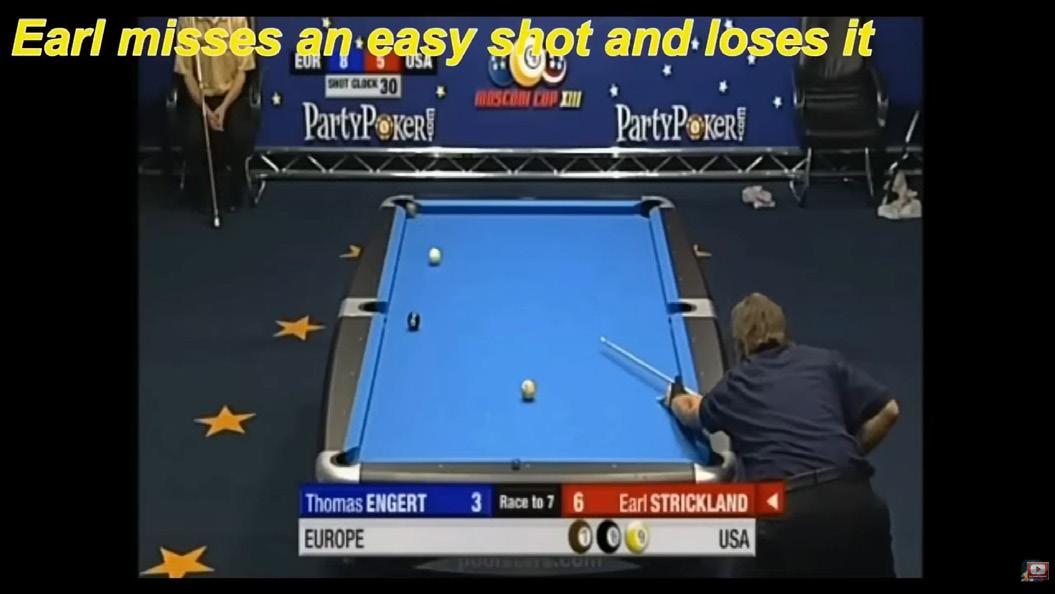
You can learn more in one hour of watching a great player than 10 hours of practicing alone.
Not because they’re flashy. Not because they’re perfect. But because they’re deliberate.
Watch their routine. Watch their tempo. Watch their patterns. Watch how they stay down.
Watch the way they stand up when something feels wrong.
Watch how they never force the cue ball somewhere unnatural.
You’re not just learning technique — you’re learning habits.
You’re absorbing good decisions and calm energy.
The brain learns through modeling. If you feed it great examples, it adapts.
Don’t just practice like a pool player — study like one too.
WISCONSIN — Outer Points Productions has officially announced the launch of "The Breaking Point", a bold new competition series designed to push players beyond traditional tournament play and into a pressure-packed, entertainment-driven spotlight.
Blending high-level pool with reality-style storytelling, "The Breaking Point" is a first-of-its-kind billiards production that challenges competitors not only to win matches but to perform under stress, adapt to unique formats, and survive elimination-based gameplay. The series is built around qualifiers, structured challenges, and intense matchups that test mental toughness just as much as cue-ball control.
Unlike standard tournaments, "The Breaking Point" incorporates specialty challenges, variable race formats, and situational pressure moments designed to expose strengths, weaknesses, and resilience. Only the most composed and complete players will advance.
“I wanted to create something different—something that feels bigger than just another bracket,” said Dale Lorenz ( Little Cheddar ) from Outer Points Productions. “This is about pressure, decision-making, and seeing how players respond when everything is on the line.”
Outer Points Productions, widely known throughout the Midwest for innovative formats, high-quality live streams, and player-focused events, continues to raise the bar for
billiards presentation. With "The Breaking Point", the company is expanding beyond traditional competition into a fully produced series that blends sport and entertainment.
The show features professional-level production, custom branding, live commentary, and an episodic structure that allows fans to follow storylines, rivalries, and momentum shifts as the season unfolds.
Qualifiers for "The Breaking Point" have already generated strong interest, with players competing for limited spots and a chance to earn their place in the main series. The project is expected to attract both dedicated pool fans and new audiences drawn to its reality-competition format.
More details, including episode releases, player announcements, and broadcast information, will be released in the coming weeks
There are a lot of pros out there nowadays that promote, endorse, or are producing products these days, so what’s good, what’s bad, and do they compare to established competitors?
Let's dive into billiard ball polish/cleaners. Fedor Gorst has a whole line of amazing items these days, and his ball polish is just as viable. This polish is amazing, easy to use, and a good bang for the buck.
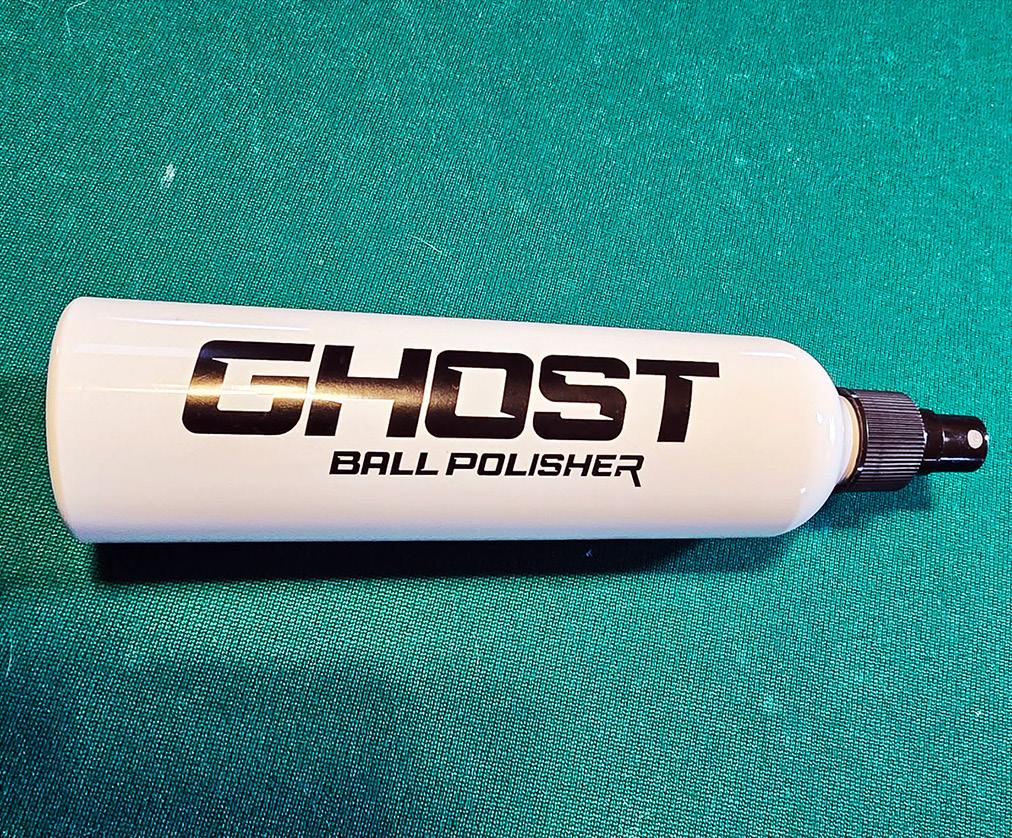
The container is a white 300 ml spritzer bottle, and if you have a polishing machine or just a microfiber cloth, this is an easy-to-use, fast-drying, quality product to team up with.
Before using the polish, shake the bottle well, and place
your balls into the ball polishing machine. Give the balls a couple of sprays, and it's off to the races. Within minutes, your balls will have a mirror shine.
When you're done with the machine, wipe the access material off, roll the ball onto your table, and try not to go blind from the light that shines off the balls. My Aramiths have never looked so good, and they play amazingly, thanks to the Ghost Ball polish by Fedor Gorst.
If you don’t have a machine, take each ball by hand with a microfiber cloth and spray and rub each ball down one by one. The results will show up just as well.
The small bottle fits in my case easily. I may keep it there for pool rooms, to help keep the cue balls playing better for all those around me.
I’ve compared this to the Aramith ball polish, and both work well, but they are different. I like how the ghost ball polish applies to the balls better. I think it's more even with the spray applicator. It is more user-friendly.
The purchase price is not bad either. You can buy the ball polish and a bonus shaft polish (to be reviewed later) as a combo for $30 on the Fedor Gorst website, linked below.
If you're interested in trying the ghost ball polish, look no further than https://fedorgorst.com/
Mosconi told me in 1988, when I was 19 years old, don’t ever play a guy on a trick table. He practices on that table on tight pockets and knows what he can do. It would take days to learn that table.
I always remembered those words.
Imagine any sport when you show up and the other team changed the goal posts. Or you have to play with their golf clubs. Can you adjust and maybe still win? Yes, maybe. I don’t like my money bet on maybe.
An old story when a player grabs a cue off the wall and still wins the tournament. Everyone marvels. Was he playing the best in the world? No. And if equipment didn’t matter, than why are pool cues a billion dollar industry? We can just grab a house cue and perform at peak level.
The old myth that tighter pockets gets you the better player has damaged many wallets. It would be true if it were just an accuracy contest. But when pockets are reduced it causes more safeties (huge luck in kicking).
Pool is spin, power, accuracy, choices, percentages
Reduced Pocket Size is a Circus Act
of position. The pockets need to be standard size and cut. Once the ball is inside the point, it should fall regardless of what speed. You should never have to say “I wonder if the pocket will accept this power?”
We as players did our job once it hits inside the point. Let the game be decided on position, patterns, smart choices and not on a stubborn pocket that was cut too wide ( angle) to funnel the ball to the back of the pocket.
I seen the greatest lose to players half their speed on tight pockets. Cheap wins on hung 7,8,9s. On regulation pockets, the weaker all around player sits and watches.
Tight pockets steal many shots that great players have in their arsenal. Pool is not snooker.
Chalk, chalk, chalk... There so many different kinds on the market now. From classic Masters to exclusive Kamui. But what if you want something different, something new, something that may be the new best chalk on the market today? Today, I have a new fan favorite. The exclusively made formula that billiard
legend Alex Pagulayan, along with billiard giant Taom, has worked together to create.
The Taom brand has recently taken the pool world by storm. They have a great list of products, but today we want to look at what they and Alex Pagulayan came up with.
This isn’t just square taom, let's keep the record straight. The goal was to create a custom product above all others. The shape is unique. The square body shows traditionalism and avoids pesky roll-away situations. The rounded corners provide a better gripping experience for the fingers, and the perforated label allows you to peel as needed.
The chalk is currently offered in green or blue. While my preference is blue aesthetically, they both perform well.
I want to talk about the application of the chalk onto the tip. I have used many chalks from pasty to gritty and even clay-feeling…. I would rank the Pagulayan chalk right in between V10 and Pyro. It goes on smoothly with a bit of a gritty feel, but as much as Predator 1080 or dark-blue Masters. The chalk goes on the tip, providing a smooth layer without chunking up, then building up to a heavier layer.
The last thing I wish to point out is that I often have a hard time with some chalk and synthetic break tips, because they don’t always apply well. The Pagulayan chalk does this very well.
As far as the chalk's performance, it is chalk and does exactly what it's meant to do. I can load the cue up with top spin or draw, and if I forget my pre-chalk routine, it holds up for quite a few shots between applications.
Chalk mess on the cue ball and billiard cloth is common with most chalks. It is a minimal issue with the Pagulayan chalk, outside of your lighter colored cloth. I would describe it as minimal cloth mess; they don’t stain or make a big streak. When the tip hits the cue ball, the chalk transfer from tip to ball is minimal at best, with fewer skids and better rolls.
Sneaky Pete Mafia loves this chalk, especially with the price point being comparable to their competitors. The chalk would be nicer if it were a taller cube. But that’s just because we like it so much we want more and more of it!
Alex Pagulayan, you have some great chalk. Keep up the great work.
The World Nineball Tour is excited to reveal the first wave of its 2026 schedule — a global slate of elite competition running from January through June. This lineup includes three major Matchroom Events, two WNT Junior Events, and 13 WNT Ranking Events across four continents, marking the most ambitious opening of a season in WNT history.
Fans around the world can catch the start of the 2026 season live on WNT TV — Sign up now to be part of all the action.
2026 WNT CALENDAR – JANUARY TO JUNE
With new destinations, returning favourites, and increased prize funds for players worldwide, the 2026 campaign sets the stage for Nineball’s biggest year yet.
• Carabao International Open ($100k), 4–8 February — Jakarta, Indonesia
• Premier League Pool, ($100k) 18-22 February — Florida, USA
• Pattaya Open ($40k), 2–6 March — Pattaya, Thailand
• European Open Pool Championship ($225k), 10–15 March — Sarajevo, Bosnia & Herzegovina
• WNT Junior Event, 13-14 March — Sarajevo, Bosnia & Herzegovina
• Cuetec Belgium Open ($32k), 19–23 March — Belgium
• Inthebx Open ($25k), 26–29 March — New York, USA
• McDermott Open ($29.3k), 1–4 April — Connecticut, USA
• Players Championship by Diamond at Expo ($80k), 9–12 April — Philadelphia, USA
• Beasley Open ($29.2k), 16–19 April — North Carolina, USA
• Bob Stocks Memorial ($45k), 22–26 April — Virginia, USA
• Costa Rica Open ($25k), 29 Apr–3 May — San Jose, Costa Rica
• Arena Open ($25k), 14–18 May — Kuala Lumpur, Malaysia
• Scottish Open ($50k), 20–23 May — Glasgow, Scotland
• UK Open Pool Championship ($225k), 25–30 May — Brentwood, UK
• WNT Junior Event, 28-29 May — Brentwood, UK
• Mezz Hill Hill Estonia Open ($25k), 5-7 June –Tallinn, Estonia
Total Prize Fund: $1,158,200
The season opens in Manila with a landmark showcase in one of pool’s most passionate heartlands. Legends Cup unites icons Efren Reyes, Earl Strickland, Francisco Bustamante, and Ralf Souquet for a special celebration of Nineball’s legacy and future.
Premier League Pool follows from 18–22 February at Classic Billiards in Miami, Florida, bringing together
an elite, invitation-only field for one of the tour’s most unique and tactical formats.
In March, the tour returns to Sarajevo for the European Open Pool Championship (10–15 March), where a world-class field will once again compete for one of the most prestigious titles on the calendar, now with a prize fund increased to $225,000.
May then marks a new chapter for a flagship UK event, as the UK Open Pool Championship (25–30 May) heads to Brentwood with a fresh venue, a massive field, and one of the most anticipated atmospheres of the season, also boasting an increased prize fund of $225,000.
The first wave of the 2026 calendar will also see the return of two WNT Junior Events, staged alongside the European Open and UK Open. Each will feature a 32-player field for competitors aged 16 and under, continuing the World Nineball Tour’s commitment to showcasing junior talent alongside its flagship open events and strengthening the grassroots of the game globally.
The 2026 calendar is anchored by these four flagship Matchroom events, supported by a global series of 13
WNT Ranking Events, giving players across Asia, Europe, and the Americas more chances than ever to climb the rankings. This diverse early-season slate underscores the WNT’s commitment to expanding competitive access, elevating regional scenes, and giving emerging talent the opportunity to break through on a global stage.
Emily Frazer, CEO of Matchroom Multi Sports, commented:
“The opening wave of the 2026 World Nineball Tour schedule shows exactly where our sport is heading. With more world-class events across more regions than ever before, we’re giving players a true international pathway from January through to the start of June. From the Legends Cup in Manila to new additions like the Costa Rica and Pattaya events, this is the strongest opening to our calendar we’ve ever assembled. Nineball is growing at a phenomenal pace — and 2026 will be a defining year.”
Further schedule announcements for the remainder of the 2026 World Nineball Tour season will be revealed in the coming months.
For full details on the 2026 World Nineball Tour season, visit matchroompool.com.