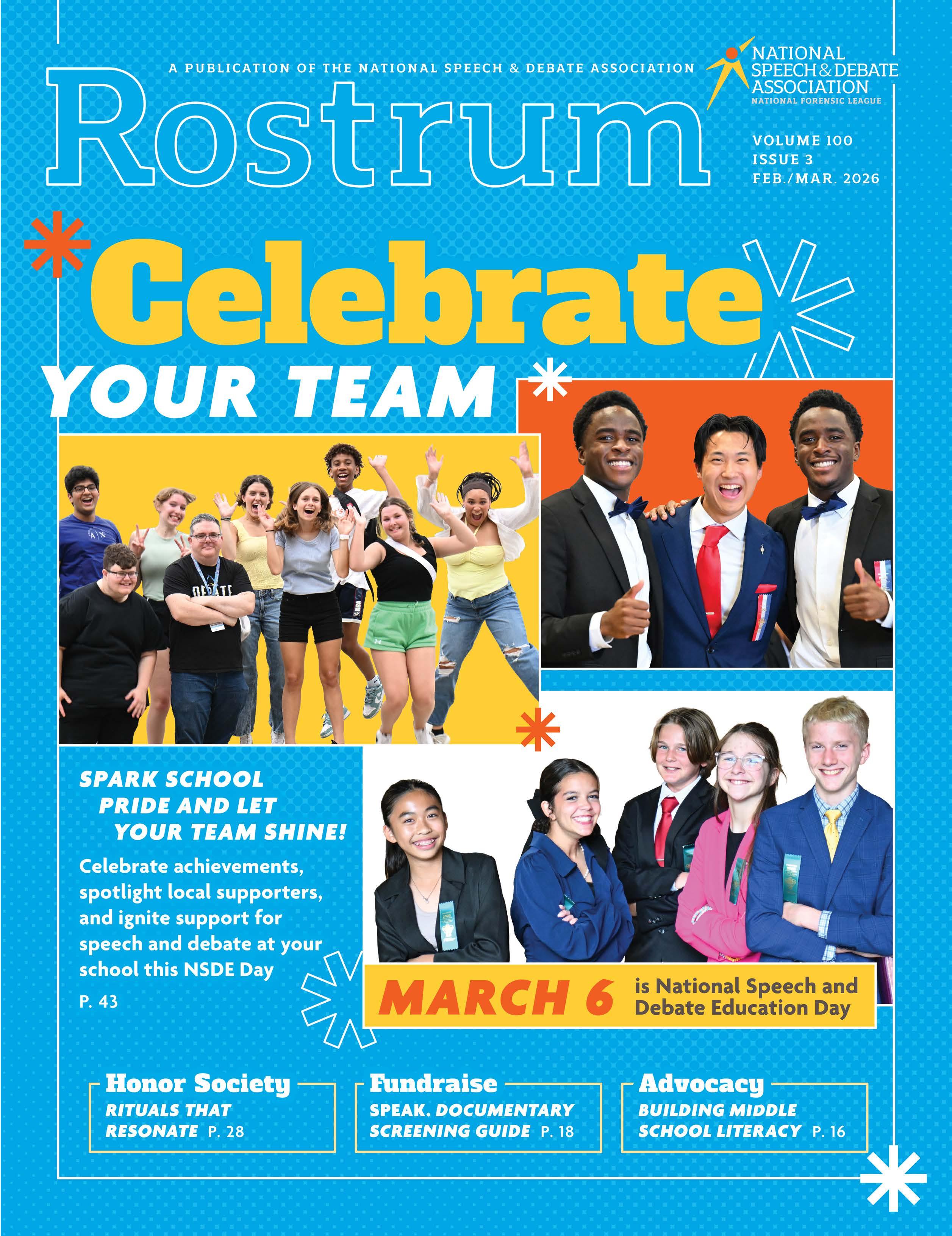
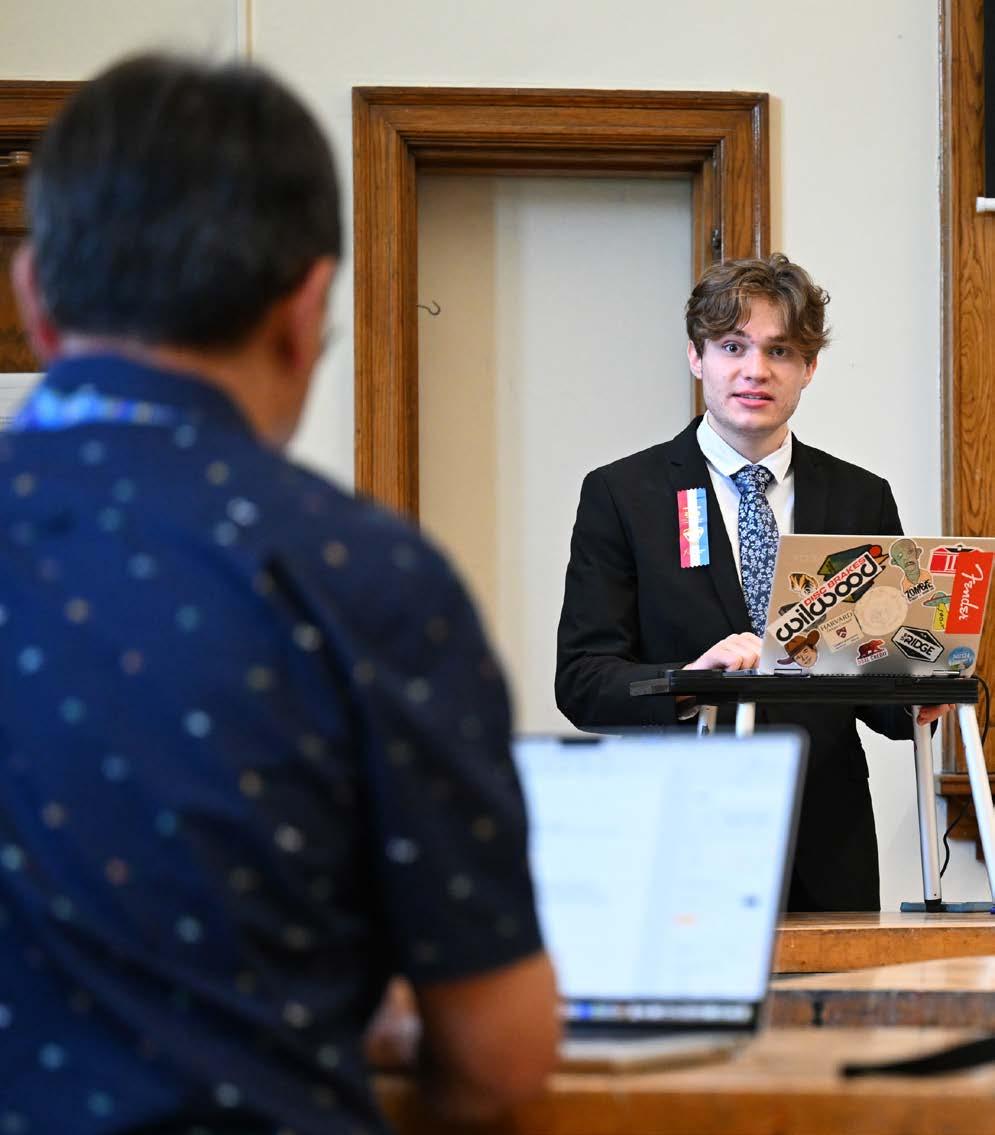
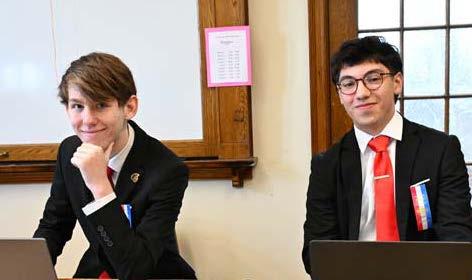
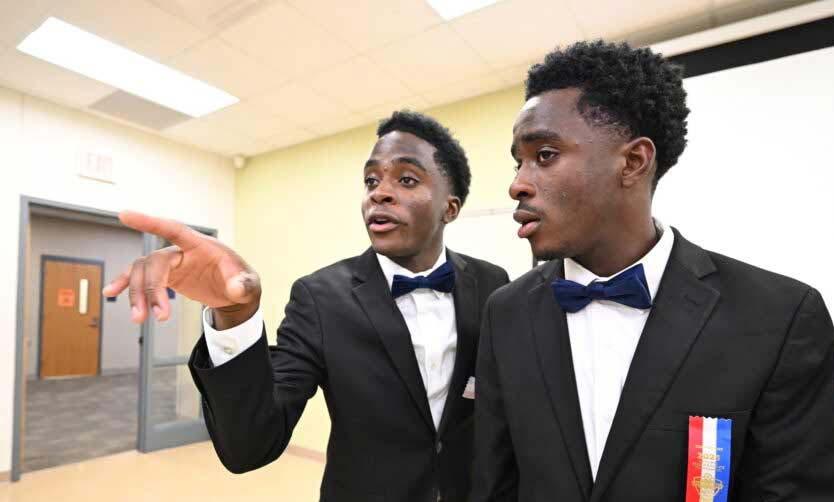
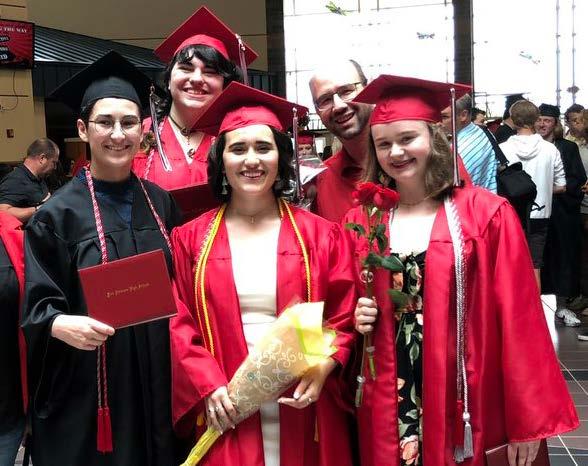
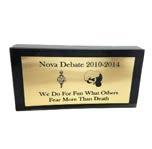
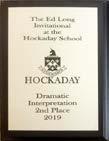
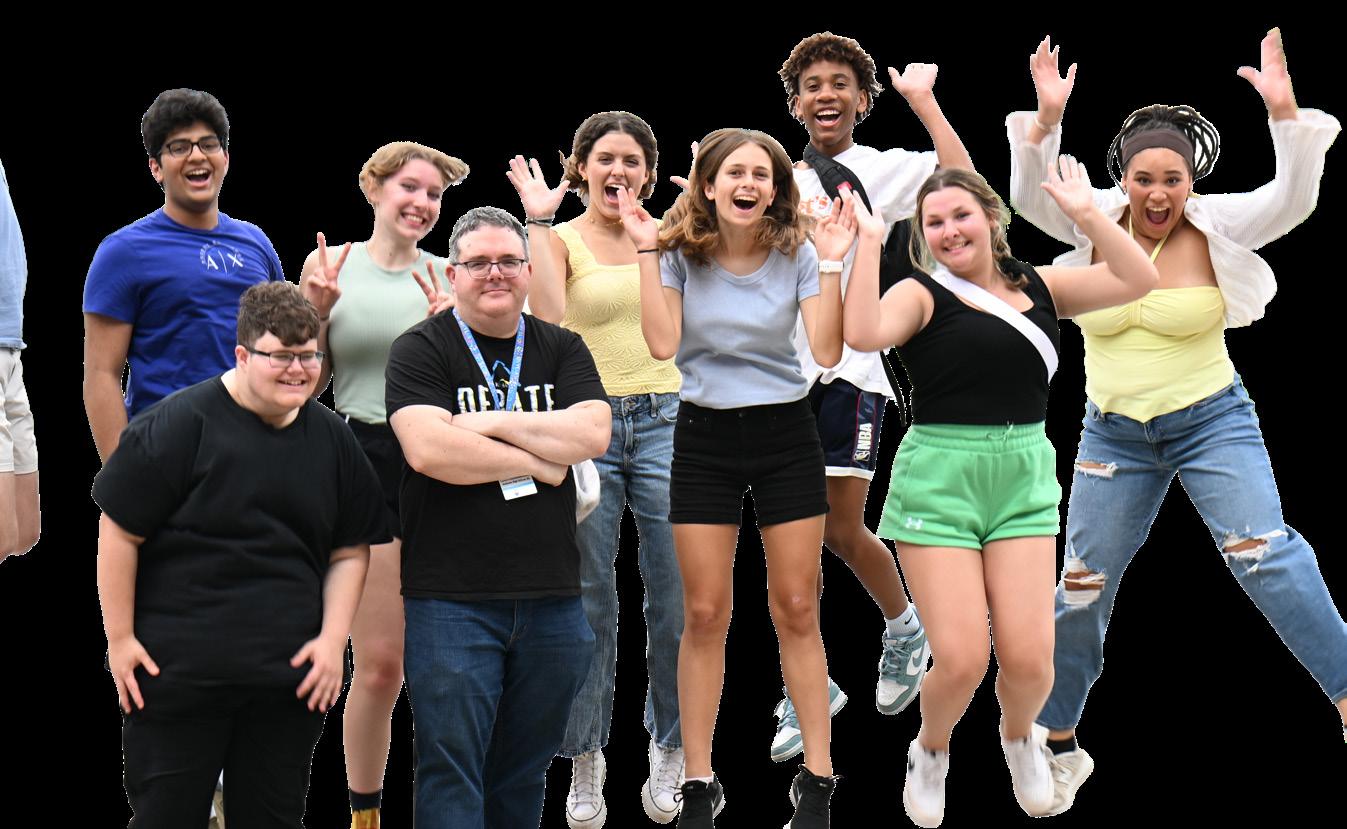
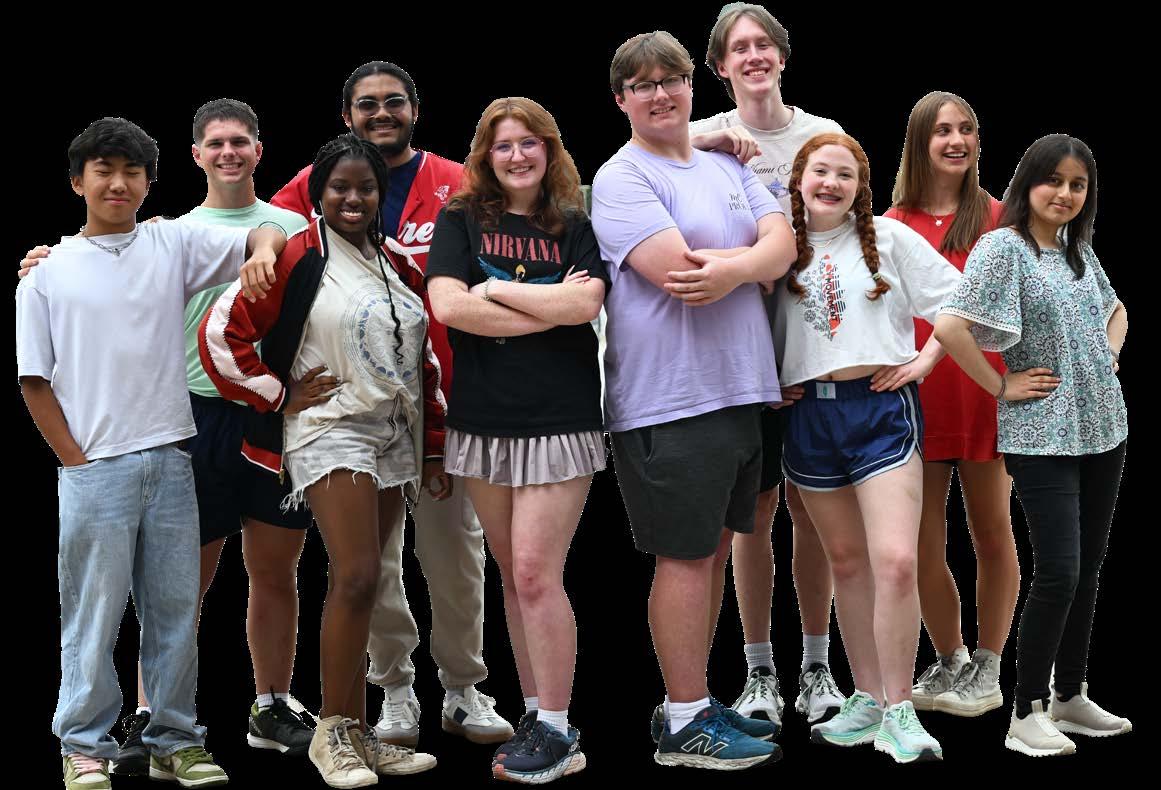
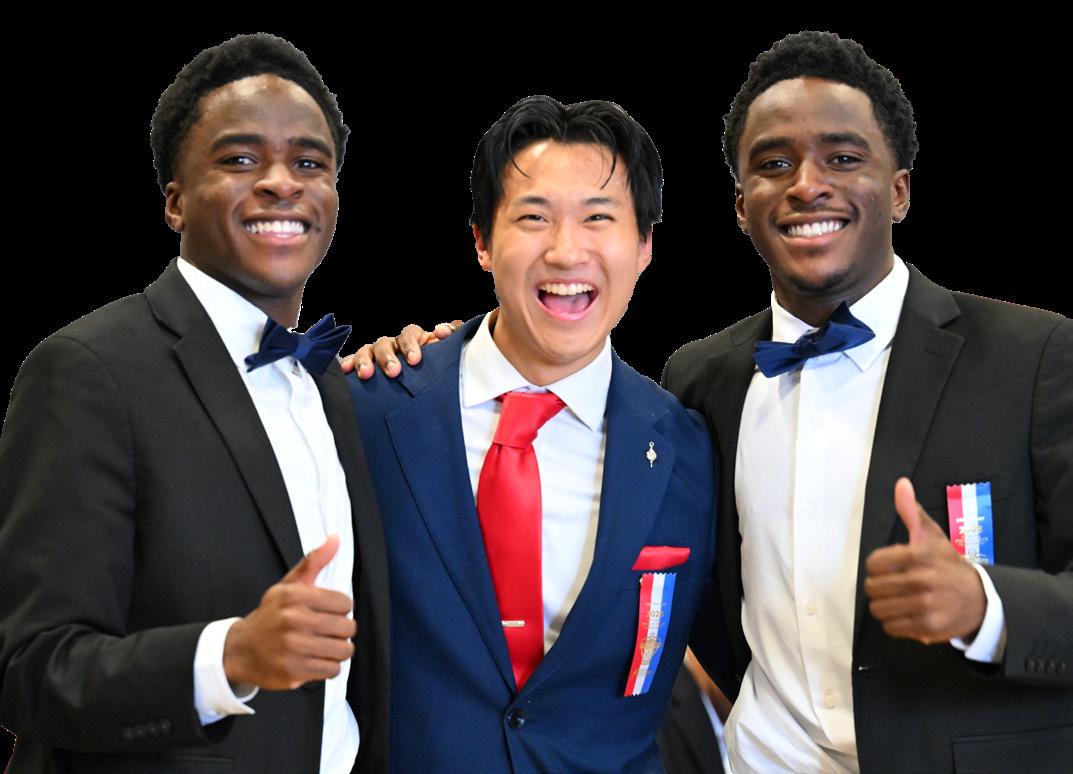
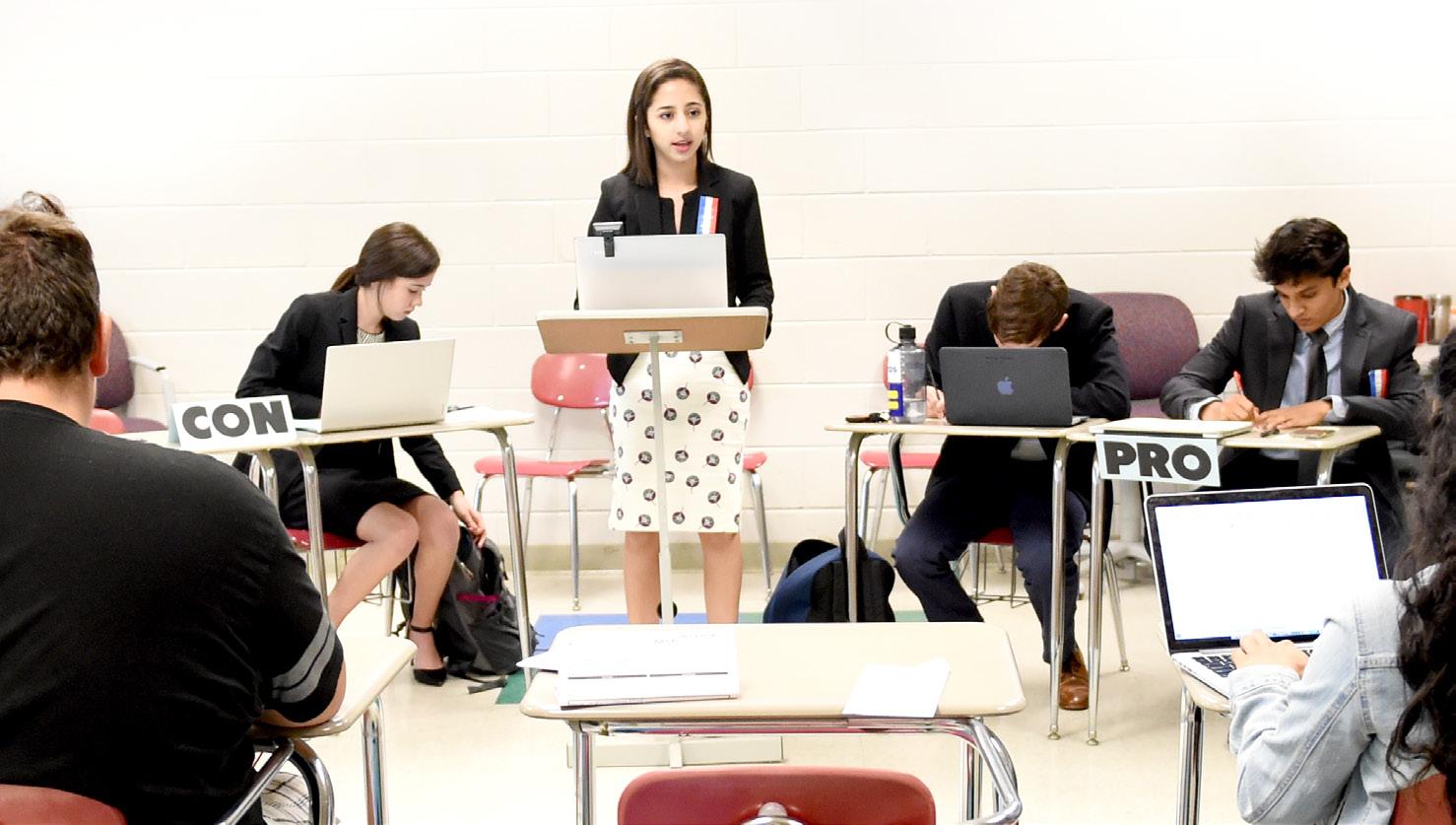
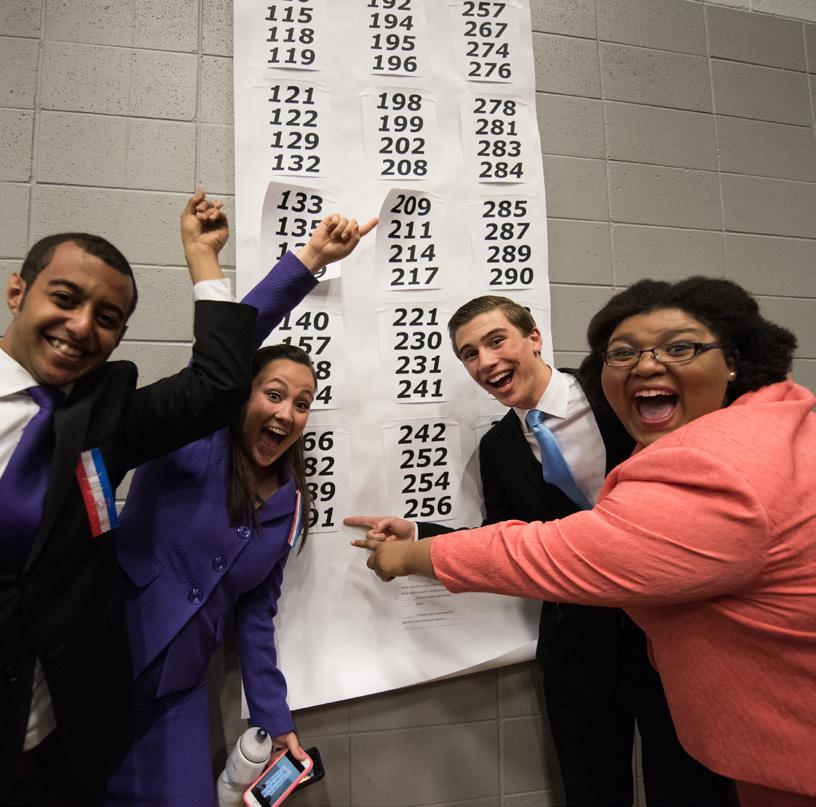
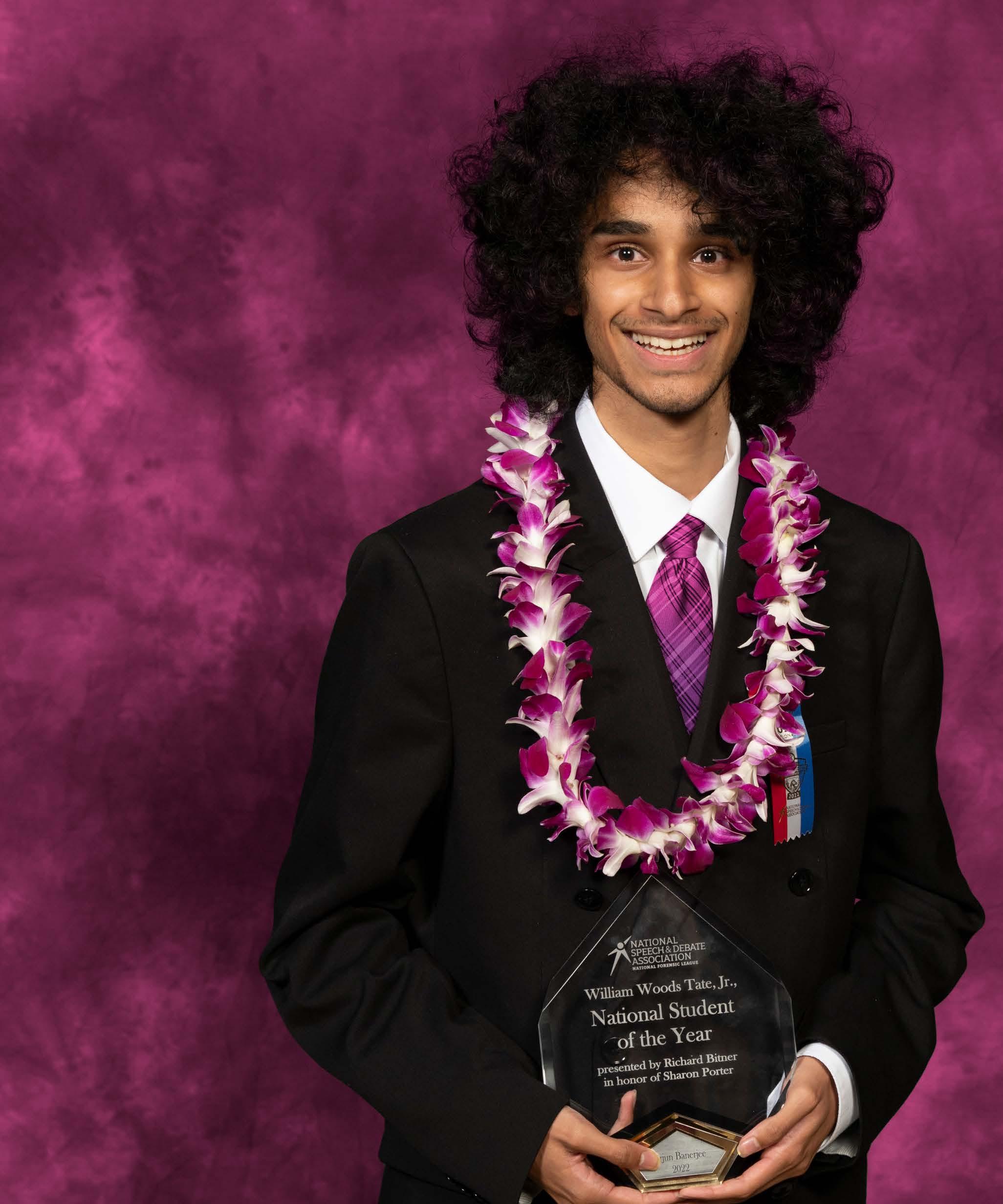
Celebration is one of the most powerful tools we have as educators. When we pause to honor our students, we remind them that their work matters and that they belong to something meaningful.
In this issue, we explore intentional ways programs can celebrate achievement and legacy. From Honor Society induction ceremonies to endof-year banquets, these events do more than distribute awards—they give shape to a season of hard work. Whether elaborate or simple, these gatherings affirm students’ character and commitment. They also invite families and supporters to witness the impact of speech and debate.
We also highlight the power of telling your team’s story. Through press coverage, display cases, and shared narratives, you can ensure the efforts of your students, coaches, and alumni do not go unnoticed. Recognizing local champions through district awards or other acknowledgments strengthens community ties and reminds supporters of the impact of speech and debate.
As we approach National Speech and Debate Education Day, these celebrations can also become acts of advocacy—opportunities to open our doors, share our stories, and help others see speech and debate as an essential space for student voice and leadership. At its core, speech and debate is literacy in action. It engages students in purposeful reading, authentic writing, and confident speaking, which research shows builds critical thinking and lasting academic growth.
When we celebrate intentionally, we reinforce that speech and debate is more than winning rounds. It is about belonging, leadership, and the enduring power of voice.
Sincerely,
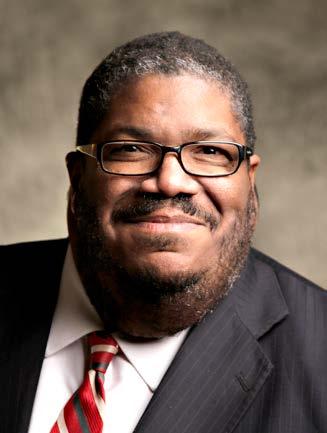
J. Scott Wunn
Executive Director
Rostrum A PUBLICATION OF THE NATIONAL SPEECH & DEBATE ASSOCIATION 6600 Westown Parkway, Suite 270, West Des Moines, IA 50266 | Phone (920) 748-6206
Holly Williams Secretary, Administrative Rep Arizona
To learn more about the Board, visit www.speechanddebate.org/ meet-the-team. You may also contact the Board by emailing board@speechanddebate.org.
this Issue
@nsda.speechanddebate
Topics
Member students and one chapter advisor per school are eligible to vote!
Topic Creation Hub
We’ve created a central hub to answer your frequently asked questions about how topics are generated throughout the school year, along with ways you can get involved in the process! Learn more at www.speechanddebate.org/topic-creation-hub
Share Your Topic Suggestions
We invite you and your students to send us your debate topic ideas for Lincoln-Douglas, Public Forum, and Big Questions as well as potential motions for consideration in World Schools Debate. Access the online submission forms at www.speechanddebate.org/ topic-creation-hub
Policy Debate Topic Fellowships
The NSDA has partnered with the National Federation of State High School Associations (NFHS) to offer two Policy Debate topic fellowships with a goal of increased representation in the topic selection process. High school Policy Debate coaches who are interested in writing a topic paper and attending the annual topic meeting to support the mission of choosing timely, accessible, and student-centered topics are encouraged to learn more and apply online by April 1, 2026. Learn more at www.speechanddebate.org/ policy-topic-fellowship.
Policy Debate Topic Selection Meeting
The 2026 Policy Debate Topic Selection Meeting will be held in Salt Lake City, Utah, from July 30 through August 2. Specific information regarding lodging, travel arrangements, and daily schedules will be made available at a later date. For additional questions regarding this meeting, please contact Chris Paulson (cpaulson@nfhs.org) at the NFHS.
Topic Rubric
The NSDA conducts an intentional and ongoing evaluation of the topics we encourage students to explore. Download a copy of the Topic Rubric Questions at www.speechanddebate.org/topic-rubric.
MARCH 2026
Public Forum Debate
Resolved: The United States federal government should ban corporate acquisition of single-family residences.
MARCH/APRIL 2026
Lincoln-Douglas Debate
Resolved: The United States military ought to abide by the principle of nonintervention.
NOVICE LINCOLN-DOUGLAS TOPIC
The NSDA also offers an optional resolution that may be used during the first two months of a novice LD season— Resolved: In the United States, national service ought to be mandatory. Coaches are encouraged to check with tournament hosts in their area before exclusively prepping for one topic over another.
2025–2026
Policy Debate
Resolved: The United States federal government should significantly increase its exploration and/or development of the Arctic.
2025–2026
Big Questions Debate
Resolved: Moral systems rooted in theism are preferable to non-theistic moral systems.
2026-2027 Policy Debate Topic
HEALTH INSURANCE – Resolved: The United States federal government should establish national health insurance in the United States.
Health care is a life and death issue that affects every single person in the United States. For those who are insured, technical terminology and a confusing layout make the American health care system immensely difficult to navigate. But for the millions of uninsured people in the United States, affording unexpected medical costs becomes an insurmountable goal that puts people at risk of worse health outcomes and high medical debt. Despite the fact that health care is a politically “dominant” issue in political campaigns and in the lives of most Americans, people across the country lack “health literacy,” especially as it relates to public policy and specific insurance terminology. Given that the last time the high school debate community had a topic about health care was 1993-1994, it is time for a topic about national health insurance.
Debating about health insurance reform would be an excellent entry point for students to learn the details of very technical policies in an approachable way. Considering that the United States is the only major developed country that lacks universal health care, there is a robust debate about whether and how the U.S. should change its health care system. Students at all levels will find something useful in the health care topic, ranging from introductory themes such as drug pricing and health disparities to more advanced policy discussions on administrative costs and precision medicine.
Under this proposed topic, affirmative teams would argue for increased government provision of health insurance. Affirmative plans could range from various single payer mechanisms, to providing a public option, to mandating individuals acquire health insurance, or providing universal catastrophic coverage. Affirmative arguments could highlight improved health outcomes, reduction of racial, gender, and class-based disparities, enhanced economic wellbeing, a strengthened international reputation, and better preparedness for chemical and biological threats.
Negative teams would have a wide arsenal of arguments at their disposal. They could introduce disadvantages that increased government provision of health insurance would cause longer wait times, more rationing of care, disrupt the private health care industry, undermine pharmaceutical innovation, undercut military recruiting advantages, or fracture doctor-patient trust. Negative teams could introduce several other courses of action, such as moving toward a more privatized health care system, subsidizing access to private insurance, or having states implement their own health insurance schemes. The negative could also challenge critical assumptions about national health insurance by pointing out the biopolitical surveillance necessary to implement the plan, the racialized nature of medical care, the border drawing required to demarcate health insurance as “national,” or the Western conception of “medicine.”
Topic synopsis courtesy of the National Federation of State High School Associations (NFHS). Learn more at www.tinyurl.com/bdfa7vc2
The National Speech & Debate Association (NSDA) is the largest speech and debate organization in the United States, supporting interscholastic tournaments, schools, coaches, and students since 1925. Students compete in more than 10 speech, public speaking, and acting events and five debate events across the country and around the world through our growing network of international schools.
One of the most beautiful truths about speech and debate is that no team simply appears. Every program begins because someone believed in young people strongly enough to build something for them—often from nothing. A classroom becomes a practice room. A handful of students becomes a team. A single coach becomes a mentor, a fundraiser, a driver, a counselor, and a lifelong advocate.
These beginnings matter.
I want to encourage our member schools to do something that often gets lost in the rush of competition: celebrate your history. Not just your trophies or your championship banners, but the stories—how your team began, who sustained it, and the people who gave of themselves so that students could find their voices.
This semester at Saint Augustine High School in New Orleans, we are making that commitment visible. We will be dedicating two cases in our main building—not merely to showcase awards, but to commemorate milestones in the life
of our speech and debate program. These cases will tell stories: how our team was built, who built it, and why it mattered.
One of those stories includes our Hall of Fame coach Leonard Augustine and his students, who desegregated speech and debate in New Orleans. Their courage, discipline, and excellence did more than win rounds—it reshaped what was possible. But this is not a story we tell simply to mark a historical first. It is a story about belief: belief in students, belief in dignity, belief in the power of preparation and poise to change the world one round at a time.
And it is only one of many stories worth telling. Because every program has its own origin story.
Somewhere in your school’s past, there was a first meeting with just three students. A coach who stayed long after the final bell. A parent who drove a van full of nervous novices across state lines. A principal who took a chance on a program that didn’t yet exist. Someone paid fees they could not really afford. Someone wrote ballots late into the night. Someone kept showing up.
These are the people who built your team. And too often, their stories disappear.
When we fail to preserve our history, we unintentionally teach our students that what they have was inevitable. That teams simply exist. That opportunity simply appears. But it does not. It is created—by those who choose, again and again, to invest in young people.
At Saint Augustine, our trophy cases will not just display hardware. They will tell stories. They will include photographs, names, programs, and memories. They will remind our students that they are not just competitors—they are inheritors of a rich legacy that has been left by the Purple Knights who came before them.
This matters more than we sometimes realize. When students see themselves as part of a larger story, something changes. They take more pride in their work. They feel a deeper sense of responsibility. They understand that what they do now will shape what comes next. They stop asking only, “How do I win?” and start asking, “What kind of teammate, leader, and speaker do I want to be?”
History gives them roots. And roots give them strength.
I encourage every member school to consider how you might honor your own story. This does not require a major budget or a
museum-level display. It can start small. Check out the sidebar for ways you can involve students and alumni.
When students learn about the people who came before them, they gain perspective. They learn that excellence is not accidental. That opportunity is built. That leadership often looks like quiet sacrifice.
Speech and debate has always been about more than winning rounds. It is about confidence.
Belonging. Expression. Courage. It is about helping young people realize that their words matter—and that they themselves matter.
None of that happens without people who care enough to make it happen.
So let us tell those stories.
Let us honor the coaches who stayed late, the parents who gave rides, the administrators who took chances, and the students who showed up even when it was hard.
Let us remind our teams that they are not just members of a roster— they are part of a living tradition.
And let us make sure that when future students enter our rooms, they know: you belong to something bigger than yourself.
Until next time,
Byron
R. Arthur NSDA Board President board@speechanddebate.org
NATIONAL SPEECH AND DEBATE
EDUCATION DAY
NATIONAL SPEECH AND DEBATE EDUCATION DAY
NATIONAL SPEECH AND DEBATE
As you gear up for National Speech and Debate Education Day this March, we encourage you and your team to celebrate your program’s history. This would be a great project for students! Below are some ideas to get started:
CELEBRATING EDUCATORS INSPIRING STUDENTS TRANSFORMING TOMORROW
• INTERVIEW alumni about how the team began.
EDUCATION DAY
USE YOUR VOICE CHANGE YOUR
• COLLECT old programs, photos, and ballots.
• CREATE a digital archive or a simple bulletin board.
MARCH 6, 2026
• INVITE former coaches, parents, and team members to speak.
FLAT FEE, FULL ACCESS A Refresher on Membership Updates
Our new flat-fee membership that takes effect for 2026-2027 removes barriers, expands access, and supports the people who open doors to speech and debate for students.
Across hundreds of conversations, coaches and administrators told us NSDA systems had become too complicated, unpredictable, and sometimes unfair— especially for smaller, rural, or under-resourced programs. Our goal with these changes is simple: remove friction, make membership easier, and support coaches who make student participation possible.
Starting next school year, every school will pay a flat $349 annual membership fee. This all-inclusive fee covers students, coaches, curriculum, professional development, and Honor Society resources—no per-student charges required.
CU RRIC ULAR RE SO UR CE S CO MPETITIV E RE SO UR CE S FL AT-FEE MEMBERSHIP
ST UDEN T MEMBERSHIP S
Timeline
Unlimited Student Access
• Unlimited Students: Entire classes, teams, or schools can access NSDA online resources without per-student fees or a separate Resource Package.
• Expanded Access: Students can join the Honor Society, earn points and awards, and monitor achievements regardless of school size or funding.
• Expanded Grants and Support: Extra financial and resource support is available for under-resourced schools.
• Note: Paper Certificates/Seals are optional at a small cost.
Coach Support and Resources
• Streamlined Management: Easy-to-use tools to track rosters, points, and Honor Society progress without the per student invoice hurdle.
PROFESSIONAL DEVE LO PM
EN T
HONO R SOCI ET Y
COAC H MEMBERSHIP S
NSDA membership is designed for schools and built for students, but it is powered by coaches! Our responsibility is to make that work easier, fairer, and more sustainable. We look forward to supporting you and whatever goals you have for your program in 2026-2027!
• Professional Development: On-demand resources and credit through NSDA Learn.
• All-Inclusive Resource Package: Access 1,000+ competitive practice resources, lesson plans, digital textbooks, and final-round videos—all included in membership.
• New Coach Support: The NSDA is expanding its new coach programming to provide additional tools and support to help coaches navigate the first years of running a program.
February 6, 2026: Last day to purchase prepaid student memberships for 20252026.
March 31, 2026: Last day to use prepaid memberships for 20252026.
Key Benefits of the Change
• Predictable Budgeting: Schools know exactly what membership will cost each year.
• Simplified Processes: Membership and payment systems are easier to manage, reducing administrative burden.
• Expanded Access: More students can participate, even in smaller or under-resourced schools.
• Sustainable Programs: Membership fees support shared infrastructure, including curriculum, technology, tournaments, and advocacy.
District Structure and Competition Updates
What’s Changing?
• All active member schools can enter up to four entries per speech and debate event in all NSDA district speech and debate competitions.
• House and Senate events: Up to two students in Senate, up to 10 students in House per school.
• Students must compete for the entirety of preliminary rounds.
Early April 2026: Prepaid memberships converted to account credits; $349 flatrate prepaid school memberships become available for programs with budget room.
• District classification is based on number of paid member schools in the district as of July 31 the prior year using the following scale:
— Level 1: Districts with between 8-14 active (paid) schools
— Level 2: Districts with between 15-29 active (paid) schools
— Level 3: Districts with 30 or more active (paid) schools
• Districts can earn additional national qualifiers in any event that meets the following entry and participation thresholds:
“Entries” refers to both partner and solo entries in the district tournament.
Note: If a district will DROP a level under the new system, we will honor its 20252026 level for two more years to allow time for recruitment or redistricting.
Why These District Changes?
• Entry rules are simpler and easier to understand (up to four entries per school, every school).
• Classification is transparent, based on paid membership, not complex formulas.
August 1, 2026: Membership and district structure changes take effect.
• Thresholds reflect realistic competitive field sizes.
• Encourages participation from smaller programs and reduces “gaming” of the system.
• Supports fairness across all districts.
July 31, 2028:
District-level exceptions expire after the 2027-2028 school year.
NEWS + NOTES
Competition and Rules Leadership Committee (CRLC) Election
The CRLC meets quarterly to establish policies governing NSDA competition rules and event procedures. At times, it may collaborate with the Board of Directors on matters that have broader governance implications. The committee also advises the Office of the Executive Director on the NSDA’s role in interscholastic speech and debate programming. In 2026, one coach from each of the following four regions will be elected to join the CRLC:
• Texas Region (all TX)
• Southeast Region (FL, GA, KY, NC, SC, VA)
• Mountain/Southwest Region (AZ, CO, HI, NM, NV, UT)
The election will take place April 1-22, 2026. One advisor per NSDA member school may vote within the region to which their school is assigned. Election results will be announced April 30, 2026. Learn more at www.speechanddebate.org/ competition-rules-leadership-committee
Save the Date: Hall of Fame Election
The highest honor for any high school speech and debate coach is election to the NSDA Hall of Fame. Each year, current Hall of Fame members and coaches with at least three diamonds vote to determine which nominees will be elected. Online voting will occur March 1-27, 2026. Additional reminders will be sent in future newsletters.
Seeking Applications for the 2026 Activating Equity Award
The Activating Equity Award recognizes a group committed to increasing participation and creating conditions of fairness in speech and debate. The recipient receives a $5,000 award, along with national recognition at the National Speech & Debate Tournament in June. Applications must be submitted by Friday, February 28, 2026. Visit www.speechanddebate. org/activating-equity-award to get started.
Recent Minutes
Stay up to date on recent rules changes and other decisions impacting your NSDA membership. Find minutes from past Board of Directors’ and Competition and Rules Leadership Committee (CRLC) meetings online at www.speechanddebate.org/minutes-archive
Change to Charter Awards
Earning a charter award as an NSDA member school is a point of pride for many high schools that represents hard work by coaches and students who contributed to the school’s status through the degrees they earned. Based on coach feedback and a continued effort to simplify systems for members, charter awards have changed from:
• A status renewed every three years that requires specific degree requirements be earned to maintain; to
• A one-time award that, once earned, high schools maintain each year their NSDA membership remains active
This change went into effect in January for the current school year. Any school that currently has their charter will retain it while their NSDA school membership is active. Page 24 of the High School Unified Manual (www.speechanddebate.org/ high-school-unified-manual) reflects this change and spells out the requirements to earn an initial charter award, which are unchanged. In 2026-2027, charters will no longer be used to determine district levels.
Streamline Your Instruction with Start Here
NSDA membership includes access to 14 expertly crafted units through our Start Here series, as well as online textbooks to supplement instruction for various events. These popular grab-and-go lessons are built to save you time planning and teaching events. Use the lessons in class, pull activities for practices, or share materials with students for peer coaching or independent learning! Download lessons at www.speechanddebate.org/start-here.
Coaching That Shows Up. Competition That Stands Out
Coaching That Shows Up. Competition Stands Out
.
At Whitman College, our nationally-recognized debate and forensics program is open to all students—regardless of your background or experience. You’ll train with full-time coaches who offer personalized guidance throughout the year, helping you grow as a competitor and a communicator.
At Whitman College, our nationally-recognized and forensics is open to all students—regardless of your or experience. You’ll train with full-time coaches who offer personalized guidance throughout the year, helping you grow as a competitor and a communicator
Our students major in everything from astronomy to politics, but they share one passion: using their voice to make an impact.
Our students major in everything from astronomy politics, they share one passion: using their voice to make an impact.
Learn more at whitman.edu/debate.
more at whitman.edu.
“I participate in Whitman Debate & Forensics because I am excited to improve my writing, interpretation, and public speaking skills while learning in an environment of intelligent, kind people with unique ideas!”
“I in Whitman Debate & Forensics because I to improve my writing, interpretation, and public speaking skills while learning in an environment of intelligent, people with unique ideas!”
—Ana, Biology major from Colorado
—Ana, Biology major from Colorado
Why Whitman Shines
Why Whitman Shines
• Full-time coaching staff
• Full-time coaching staff
• National competitive success
• National competitive success
• Inclusive, open-door philosophy
• Inclusive, open-door philosophy
• Opportunities across parliamentary debate, platform speaking, interp, limited prep & more
• Open to every major—compete no matter what you study
• Open every no what
• Debate & Forensics Scholarship available
• Debate & Scholarship available
Over the past decade, a reinvigorated conversation has surfaced about the science of reading, or how students actually learn to read, process text, and build lasting literacy skills. As a result, many schools and districts across the country are reimagining what it means to teach literacy well.
One of the clearest takeaways from this movement is that strong literacy instruction does not rely on reading alone. Research consistently shows that students need to read, write, and speak in order to truly understand text, make meaning, and grow as confident communicators.
Fortunately, in speech and debate, students do all three, and often at a high level and with remarkable engagement.
For middle school students in particular, speech and debate offers a powerful, research-
backed way to strengthen literacy while also building confidence, critical thinking, and student voice. When implemented intentionally, it doesn’t just support literacy, it drives it.
How Participation in Speech and Debate Improves Literacy
At its core, speech and debate is literacy in action. Students read complex texts, analyze arguments, write original material, and speak publicly using academic language. Unlike isolated literacy drills, these skills are applied with a purpose: to persuade, explain, interpret, or inform a real audience.
Research supports this connection. A 2011 large-scale study of urban debate programs (Mezuk, et al.) found that students who participated in debate showed significant gains in literacy test scores, including reading comprehension and written expression,
Read, Write, and Speak: How Speech and Debate Builds Middle School Literacy
by Megan West
compared to their peers who did not participate. These gains were especially pronounced for students from historically underserved communities, suggesting that speech and debate can be a powerful equity tool as well as an academic one.
Similarly, 2024 analysis by Education Next (Shueler, B. & Larned, K. E.) found that participation in debate programs boosted literacy achievement and increased long-term academic outcomes, including college enrollment rates. These findings reinforce what many educators already observe anecdotally: when students are motivated to read, write, and speak for a purpose, their literacy skills grow.
Sarah Field from the Buck Institute for Education makes this connection explicit, identifying literacy as one of four “equity levers” activated by debate-based instruction. According to her 2021 article, “When
implemented effectively, debate drives literacy development, as long as careful attention is paid to make sure debaters use evidence that includes culturally relevant texts and debate rounds include diverse viewpoints and language practices.”
In short, speech and debate doesn’t supplement literacy, it is literacy.
Strategies to Enhance Literacy through Speech and Debate
While participation alone is impactful, the way speech and debate is taught matters. Below are three helpful tips to maximize literacy growth for middle school students.
Students Need to Read Full Texts
One of the most important (and sometimes overlooked) literacy practices in speech and debate is ensuring that students read entire texts, not just excerpts.
If a student is cutting a card for debate, they should read the full article. If they are selecting an interpretation piece, they should read the entire book or script. If they are citing a source for Extemp, they should at least skim the full text for context and understanding.
Why does this matter? Because literacy is about more than extracting quotes; it’s about understanding structure, nuance, tone, and author intent. When students only interact with fragments of text, they miss the bigger picture. Reading full texts helps students build background knowledge, recognize bias, and make stronger analytical connections.
Debate is inherently challenging, and asking students to grapple with full texts pushes them to engage in complex intellectual work, often exceeding what they thought they were capable of. Reading deeply prepares students to argue more effectively and, perhaps most importantly, comprehend fully.
Students Need to Write in Their Own Voice
Speech and debate thrives on collaboration. Coaches guide, teammates brainstorm, and family members offer feedback.
But at the end of the day, students’ speeches, cases, and introductions should sound like them.
Research suggests a strong link between students’ ability to understand and express their own voice and their performance on literacy assessments. When students write in their own words, they demonstrate comprehension, synthesis, and ownership of ideas.
Writing original material forces students to process what they have read, decide what matters most, and organize ideas logically. These are the same skills assessed in reading comprehension and written response tasks, but speech and debate makes them feel authentic rather than abstract.
Encouraging student voice also reinforces what Sarah Field described as shared power: debate positions students as leaders of learning, actively shaping conversations and supporting one another’s growth. When students believe their voice matters, they are more willing to read closely, revise thoughtfully, and communicate clearly.
Students Need to Learn Speech and Debate Vocabulary
Visit almost any elementary classroom and you’ll find a “Word Wall,”
or new vocabulary words prominently displayed, defined, and practiced aloud. Too often, this intentional focus on vocabulary disappears after fifth grade. Speech and debate offers a natural opportunity to bring it back.
From terms like advantage, resolution, and ethos, to tournamentspecific language like those found in the NSDA Speech and Debate Glossary (https://tinyurl. com/2zt3ae9k), speech and debate is rich with academic vocabulary. Explicitly teaching these words (what they mean, how they’re pronounced, and how they’re used in context) strengthens both reading comprehension and oral fluency.
Vocabulary knowledge is one of the strongest predictors of reading success, especially in middle school when texts become more complex. Treating speech and
REFERENCES
debate vocabulary as a living “Word Wall” helps students internalize language they will encounter across content areas.
Literacy Equals Opportunity
Perhaps most importantly, speech and debate builds literacy in a way that is inclusive and empowering. At a time when educators are searching for meaningful, research-aligned ways to support literacy, speech and debate stands out as both effective and engaging. It asks students to read deeply, write authentically, and speak confidently, exactly what strong literacy instruction requires. And for middle school students, that combination can be transformative.
Field, S. (2021). 4 Equity Levers in Project Based Learning. Buck Institute for Education. https://www.pblworks.org/blog/4equity-levers-project-based-learning
Mezuk, et al. (2011). Impact of Participating in a Policy Debate Program on Academic Achievement: Evidence from the Chicago Urban Debate League. Educational Research and Reviews, 6. https://tinyurl.com/5n6zssz2
Shueler, B. & Larned, K. E. (2024). Resolved: Debate Programs Boost Literacy and College Enrollment. Education Next, 24(3). https://www.educationnext.org/resolved-debate-programsboost-literacy-and-college-enrollment
Megan West serves as Campaign Director at the NSDA.
SCREENINGS
A New Way to Fundraise with Purpose
SPEAK. is a documentary that follows five high school competitors as they prepare for the National Tournament. Along the way, the film reveals how speech and debate builds confidence, civic engagement, empathy, and student voice in ways that resonate well beyond tournament rooms. That broader appeal is exactly what makes SPEAK. such a powerful fundraising tool.
FUNDRAISING GUIDE
How to Host a Documentary Viewing Fundraiser
A STEP-BY-STEP GUIDE FOR HIGH SCHOOL SPEECH AND DEBATE PROGRAMS
The new SPEAK. Documentary Viewing
Fundraiser Guide from the National Speech & Debate Association and Vox Pop Films shows coaches how to host a community screening of the film as a fundraiser that doubles as advocacy, celebration, and outreach. Instead of selling candy bars or hosting another silent auction, this model invites your community to see what speech and debate already does best: amplifying student voices.
A Proven Model: Partnering with a Movie Theater
Helena High School in Montana used the model to raise approximately $2,000 with minimal overhead, while creating an event that felt celebratory, meaningful, and accessible to parents, administrators, alumni, and community leaders.
The school partnered with a local movie theater to host their screening, and the arrangement reduced logistical barriers while elevating the experience for attendees. The evening functioned as both a fundraiser and a community storytelling moment, giving attendees a clear sense of why speech and debate matters.
What Else Will You Find Inside the Guide?
In addition to the movie theater example, the resource includes:
• Event team roles to reduce the burden of prep work for the coach
• Multiple venue options, including school auditoriums and virtual screenings
• A realistic planning timeline that can be as short as one month
AOPTION A: PARTNER WITH A LOCAL MOVIE THEATER
(Easiest Logistically)
This model was used effectively by Helena High School in Montana. How it worked:
º The coach approached a local theater and asked if they would screen the film if the team acquired the rights. The theater agreed to donate the space one evening with a small ticket processing fee that was deducted from the ticket price.
º The theater:
• Handled ticket sales.
• Processed payments (credit cards, Apple Pay, etc.).
• Kept concessions revenue.
• Created a heightened cinematic experience that made a more dramatic impact on audience members.
º The school avoided money-handling complications entirely.
º The coach invited local business leaders and public officials to the screening to increase awareness about the sport and create more buy-in from the school district.
Real numbers from the event:
º Theater capacity: 100 seats
º Tickets sold: 80
º Ticket price: $20
º Processing fee: $1 per ticket
º Net ticket revenue: approximately $1,500
This model is especially helpful for schools with strict financial systems or limited ability to accept digital payments. The team was able to raise an additional $500 at the event. After the screening, students stood in the lobby with baskets and audience members made additional cash and check donations on the way out.
Speech & Debate Association
Note: Depending on the size and nature of the event, a licensing fee will apply and can be paid either by credit card, ACH, check, Zelle, or Venmo.
• Ticket pricing and donation strategies
• Zero-cost promotion ideas driven by students and school networks
• Night-of fundraising options like concessions, merchandise tables, digital giving stations, and “sponsor a student” opportunities
• Follow-up strategies that turn a single event into longterm advocacy
More Than a Fundraiser
The final takeaway is clear: this event works because it builds relationships. For coaches seeking a fundraiser that feels meaningful, studentcentered, and genuinely reflective of their program’s values, this guide offers a roadmap worth exploring. The full SPEAK.
Documentary Viewing Fundraiser Guide is available on our website.
JUDGE TRAINING BALLOT
by Shunta Jordan -
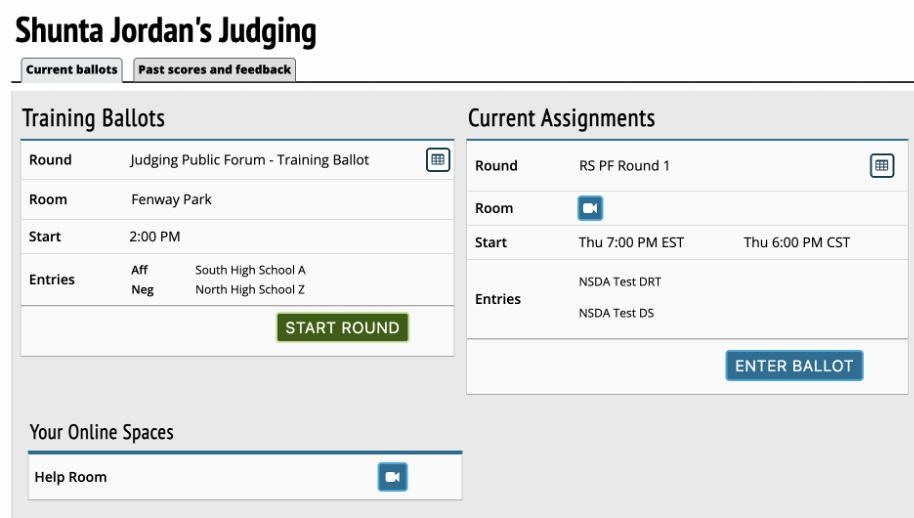
Tabroom.com now offers any program or tournament host the opportunity to use a Judge Training Ballot feature. If you have inexperienced judges or others who want additional training using Tabroom.com to judge, this feature is for you. Complete these preliminary tournament setup tasks to enable the use of the training ballot:
• Create and set up your tournament as you normally would.
• Enable the use of Online Ballots.
• Pay for your tournament (or have 50 or fewer entries to waive Tabroom.com fees) to make your tournament go live. This is required before you can pair and assign judges/rooms.
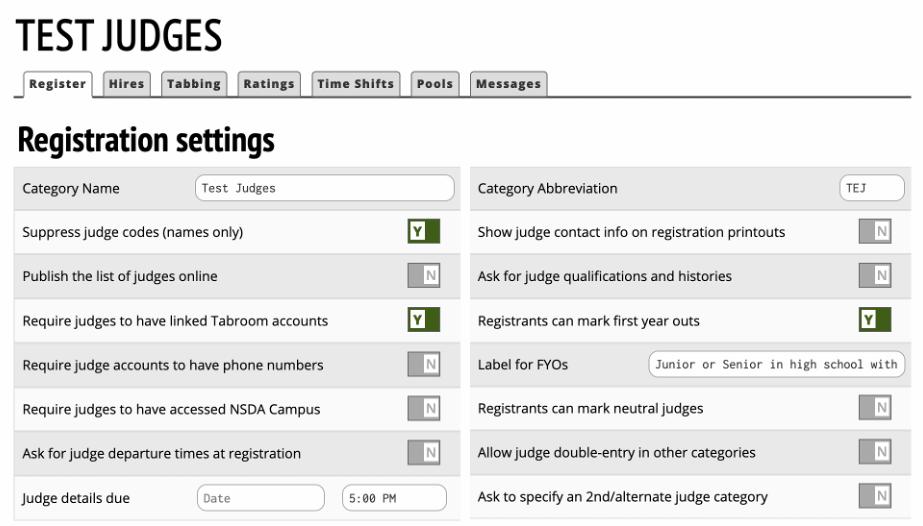
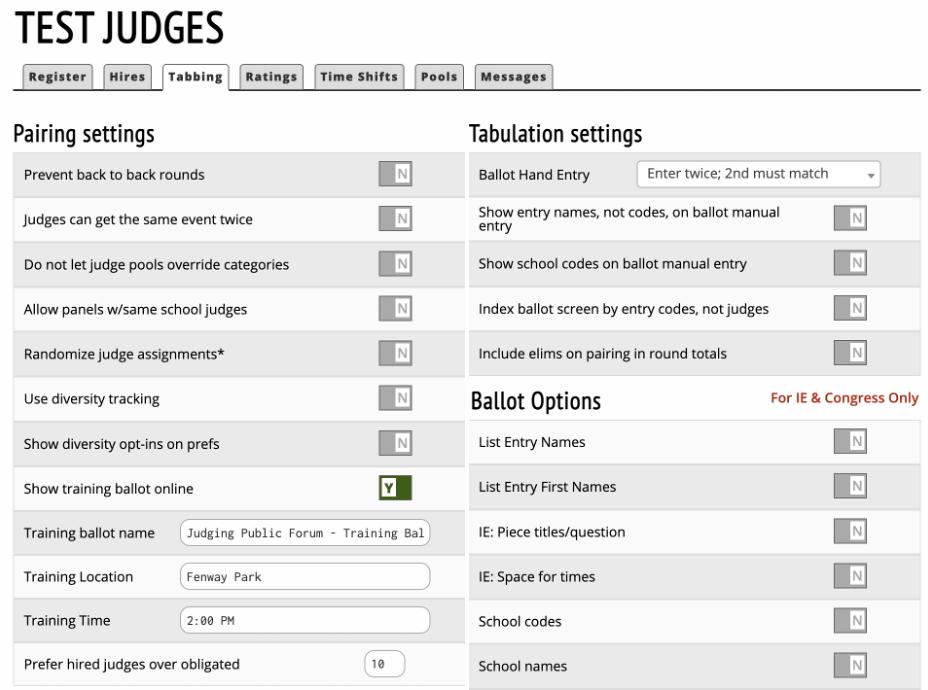
Once those steps are complete, you can set up the Judge Training Ballot feature. First, create a Test Judges category in Settings » Judges » Add New Category. Fill in your Category Name, Category Abbreviation, and any other information you need (figure 1).
Once you’ve created the category, visit the Tabbing section to complete the details
that will actually show on the training ballot. First, toggle the “Show training ballot online” to yes. Then, fill in the Training Ballot Name, Training Location, and Training Time (figure 2) before selecting the Save Settings button.
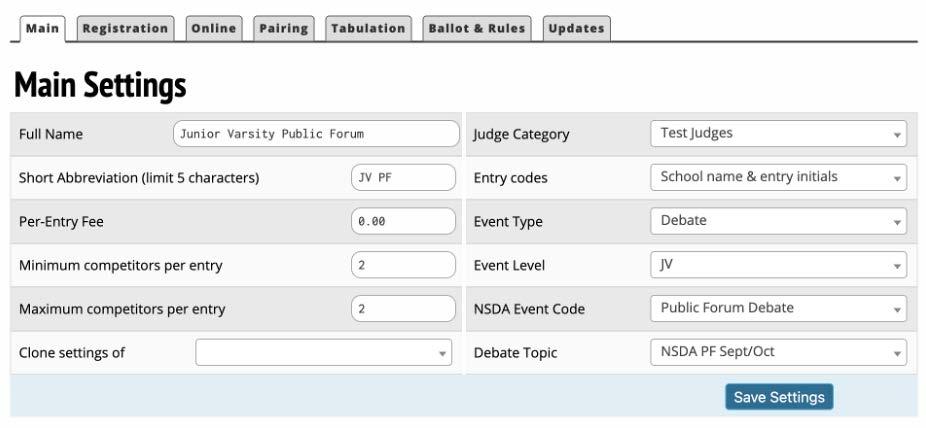
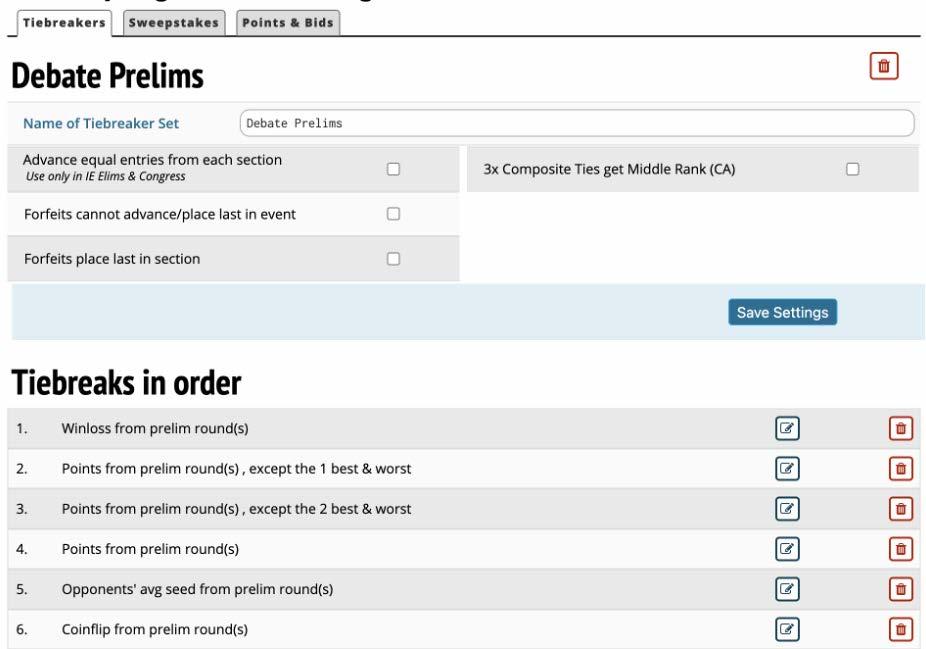
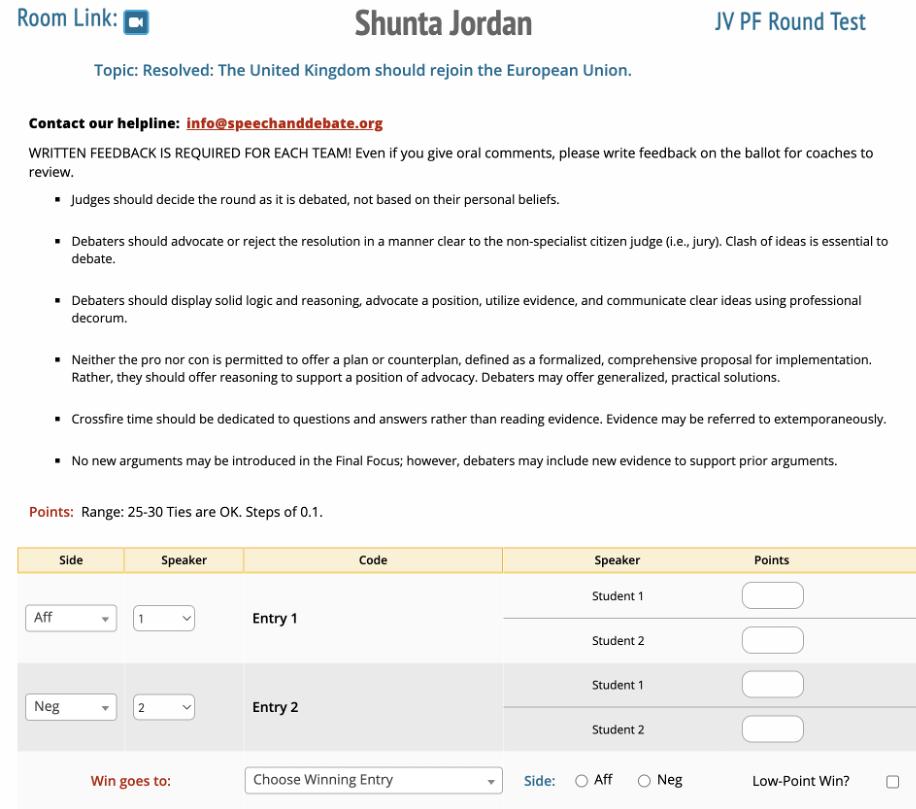
Next, assign an event to your Test Judges category and make sure the associated event has tiebreakers set, because Tabroom.com uses this as the
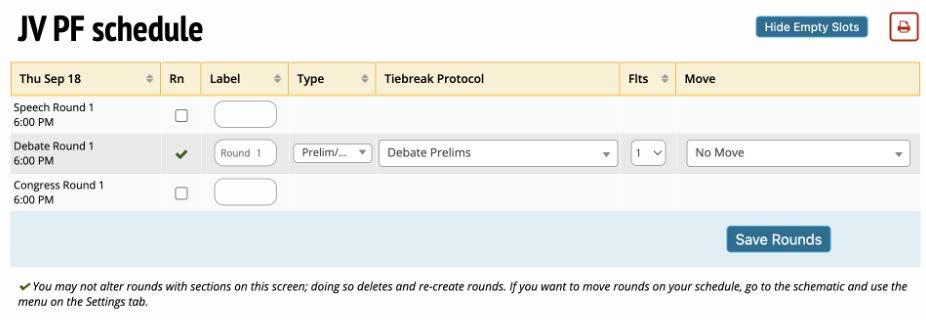
basis for making the ballot (figures 3 and 4). Be sure to set the appropriate tiebreakers in the schedule as well (figure 5).
Once you have completed all of these steps, you are ready to pair a round using the Test Judges category and related events.
Please note: In order for the training ballot to show on the judges’
dashboard, the start time of the tournament must have passed (figure 6). Finally, instruct your judges to select Start Round to access their training ballot and use it for practice (figure 7).
The new Judge Training Ballot empowers programs and tournament hosts to better prepare inexperienced or developing judges before they enter live rounds. By simulating a real ballot experience within Tabroom.com, this feature helps judges build confidence, accuracy, and familiarity with event expectations. With a few simple setup steps, coaches can strengthen judge quality, improve competitive fairness, and create a more educational tournament experience for everyone involved.
Shunta Jordan serves as Tournament Services Manager at the NSDA. -
figure 3
figure 4
figure 5
figure 6
figure 7
T H E 2 0 2 6 N A TI O NAL T OURN A ME N T
June 12–14, 2026 June 25–28, 2026
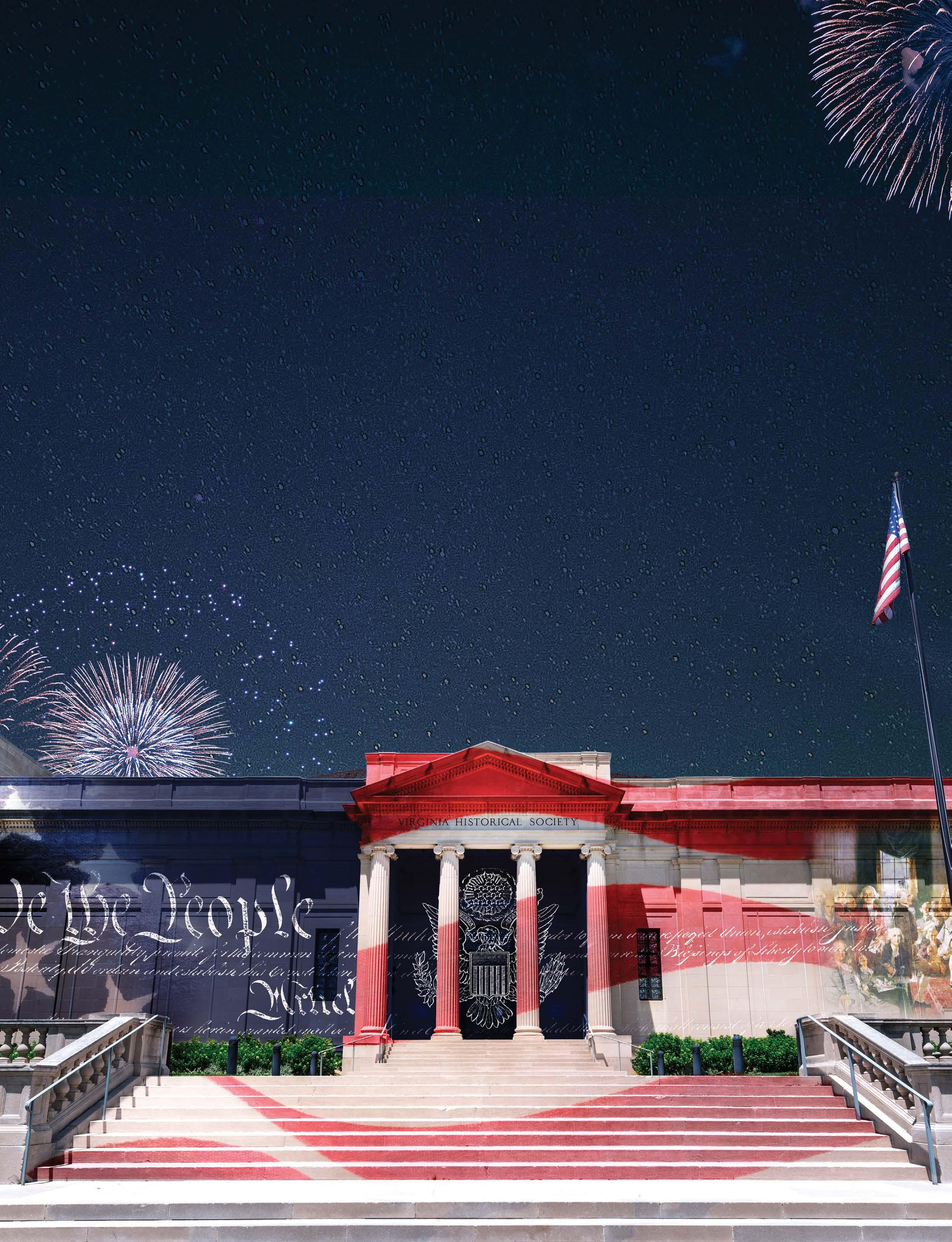
We the People: The World in Our Commonwealth Opens March 21, 2026–September 7, 2026
Mark America’s 250th anniversary with special events, commemorative exhibitions, and more at one of the oldest and most distinguished history organizations in the United States!
IT’S TIME FOR NATIONALS 2026!
IMPORTANT DATES AND DEADLINES:
NSDA LAST-CHANCE QUALIFIER
• April 17 – Deadline to register
• April 23-25 – Happening online
MIDDLE SCHOOL NATIONAL TOURNAMENT
• May 15 – Deadline to register
• June 16-19 – Happening in-person
HIGH SCHOOL NATIONAL TOURNAMENT
• May 15 – Deadline to register
• June 1 – Deadline to register alternates
• June 13 – Deadline for final scripts
• June 14-19 – Happening in-person
HIGH SCHOOL SUPPLEMENTAL EVENTS
• May 15 – Deadline for coaches to pre-register students
• June 16 – Coaches must re-register students in supps to confirm their participation
• June 17-19 – Happening in-person
THE WILLIAM WOODS TATE, JR., MEMORIAL FUND “ROAD TO NATIONALS” TRAVEL GRANTS
• The Road to Nationals Fund provides financal assistance to schools that are lacking financial resources to attend the National Tournament. Applications will open in the spring. Learn more at www.speechanddebate.org/road-to-nationals
NATS26 MERCH
• May 15 – Deadline to pre-order shirts via Tabroom.com for pick up at the National Tournament
• May 22 – Deadline to order shirts online via the NSDA Store (www.speechanddebate.org/store) and receive in the mail pre-tournament
NATIONAL TOURNAMENT UPDATES
Our annual National Speech & Debate Tournament will be held June 14-19, 2026, in Richmond, Virginia. Tournament info is now available on our website, including tentative schedules, logistics, hotel details, and more. As a reminder, staying in the hotel block saves your team 15% on main event and supplemental event entry fees! We also have day-by-day breakdowns for high school and middle school to get a feel for the flow of the event. Visit www.speechanddebate.org/nationals and use the tabs to navigate around. Read on for several highlights about event logistics and qualification.
New Safety Measures at the National Tournament
Your safety and well-being are our highest priorities. Over the past year, we’ve carefully reviewed and strengthened our safety protocols to ensure every participant feels secure and supported throughout the competition.
This year’s Richmond Tournament will be held at local venues with new security protocols. We will have enhanced screening at all event entrances and are working closely with professional security teams, Richmond emergency management (police, fire, EMS, and weather), school district security, and convention center and theater staff to ensure strong emergency response plans are in place.
As in previous years, security personnel and nurses/EMTs will be on staff at every tournament venue, and the Belonging and Inclusion Station (BIS) will be available as an additional support resource throughout the tournament. NSDA tournament officials will also be available at every venue to address any concerns you may have during the tournament.
Throughout the tournament, all participants are expected to follow the NSDA Code of Conduct, their school district policies, and applicable state and federal laws.
We are committed to keeping you informed about safety measures and updates as the tournament approaches. If you have any questions or concerns about safety or wellness, please reach out to us at info@speechanddebate.org
National Tournament Venue Policies
The following policies will be in place at all 2026 NSDA National Tournament sites to ensure the safety and comfort of our community. NSDA tournament officials with venue-specific security training will be onsite at every venue and available to address any questions or concerns.
• *NEW* Wristbands Required for Entry: All participants must wear a wristband for entry into tournament venues. Wristbands are non-transferrable and cannot be removed for the duration of the tournament. They will be distributed at registration. If a replacement wristband is required, the participant must present valid identification before being permitted entry into a tournament venue. If you have concerns about a participant from your school wearing a wristband, please complete the ADA Accommodations Request Form online at www.speechanddebate.org/accessibility
• Identification Badges/Ribbons: Within tournament venues, attendees must wear identifying ribbons at all times. This includes approved observers like parents and chaperones. Ribbons are distributed during registration and pinned to clothes.
• *NEW* Controlled Entry Points: Access to venues will be limited to designated entrances with security checkpoints for safety and monitoring. Details on entry point locations will be shared prior to the event.
• *NEW* Entry Inspection at All Venues: All attendees will be required to enter through OPENGATE weapons detection system at all tournament venues and may be subject to search. Items like laptops, glasses cases, and binders must be removed from bags and handed to security before going through the OPENGATE system.
• Prohibited Items: No weapons, illegal substances, or alcohol are permitted onsite. Security screening is mandatory for all attendees , and we encourage everyone to arrive early to allow enough time. Anyone who does not complete the required screening or does not have proper tournament identification will not be permitted to enter the venue. We will continue to provide updates on security protocols and provide venue-specific information closer to the event.
Stay In Touch
The Nats26 Guidebook app is the hub for all urgent tournament communications, including any emergency announcements. It will be available for download in June ahead of the tournament. Please make sure you have push notifications on in the app to stay up to date on all tournament announcements!
Nationals as a Member Benefit
Every member high school has the opportunity to enter up to two non-qualifying students in supplemental events at the 2026 National Tournament. To be eligible, students and their schools must be NSDA members. Participation at districts is not required.
Middle School Tournament
Middle school registration will take place in Richmond the evening of Tuesday, June 16 , and competition will run Wednesday through Friday.
High School Supplemental Events
Students will be able to re-register in up to two total supplemental speech events (one per pattern) at the 2026 Nationals. In late May, all pre-registered entries will learn which group they are competing in. Each group will compete at separate buildings and combine at the end of the tournament to determine the national champion.
Last-Chance Qualifier Returns
The Last-Chance Qualifier will be held online April 23-25, 2026. Eligibility requirements remain the same: schools must have attended their district tournament to participate, but students do not need to have attended the district tournament. Only students who did not qualify in a main event may enter.
Register for the Nats26 Info Session on February 19 with NSDA staff and members of the local host committee, or check out a recording later in the month! www.speechanddebate.org/nationals
Supporting visionaries
We proudly support the National Speech & Debate Association, investing in today’s young intellectuals to help shape tomorrow’s leaders, innovators, and changemakers.
troutman.com
S HOUT IT FROM THE ROOFTOPS! Celebrating Your Students
by Travis Rother and Shelby Young
Every team has its own culture, and that culture should include the megaphone. In speech and debate, our megaphone is the intentional act of celebrating students. When you amplify their work, you strengthen your community’s identity and advocate that what your students do matters. When you plan structured moments of recognition, you remind students that their efforts matter and that their voices echo far beyond round three on a Saturday morning.
Consider this a curated guide to lifting the megaphone and making sure your program’s triumphs ring through the halls and community.
HONOR SOCIETY INDUCTION CEREMONIES:
Rituals That Resonate
The NSDA Honor Society is one of our organization’s easiest ways to celebrate success. An induction ceremony gives coaches a structured, meaningful way to recognize students’ character, service, and competitive commitment. Many schools hold the induction ceremony
Think of these resources as a “ceremony kit” that protects coaches’ time while elevating the student experience. The scripts allow you to highlight the core values of humility, equity, integrity, respect, leadership, and service, while also providing space to spotlight local stories. The sample program ensures your event feels purposeful rather than improvised.
For a letter to principals in support of honor cords, visit www.speechanddebate.org/ graduation-honor-cordsletter-to-principals/
early in the season or as an end-of-season tribute.
The NSDA offers a full suite of resources for planning these ceremonies at www.speechanddebate. org/induction-ceremonies There, you’ll find scripts, templates, printable posters, press release templates, and suggested program outlines.
Coaches are encouraged to incorporate elements of flair to make the evening feel special: inviting alumni to speak, weaving in short student performances, or creating a symbolic passing of the torch from seniors to underclass leaders. An optional structure is provided; the personality is yours to embellish. It is also worth remembering that an induction ceremony does not need to be elaborate
Cords can be ordered at www.speechanddebate.org/ product/graduation-honorcords.
officially the past nearly two
As members to wear cords at their membership accomplishment.
the moment comes from recognition, tradition, and intentional celebration, not from a large budget. Teams that want a simple way to elevate the experience might consider purchasing
The National recognizes participation societies National Since 1925, allows member distinction activities. Members Honor, the respect, valued by were
CONGRATS Class
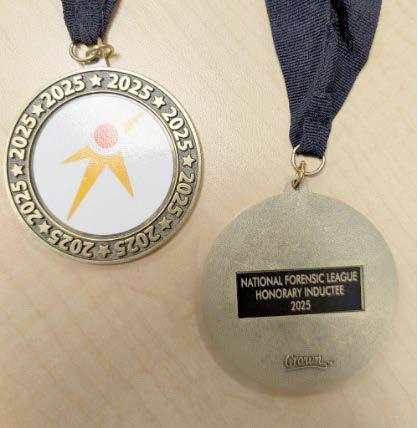
official NSDA insignia or honor cords from the NSDA Store, or medals from the NSDA Trophy Shop, as tangible symbols of students’ hard work and achievement.
The [NAME OF SCHOOL] Speech & Debate Team recognizes with the award for NAME OF STUDENT
CONGRATS Class of 22!
Show off your achievements NSDA Honor Society
END-OF-YEAR BANQUETS: A Season in Celebration
The [NAME OF SCHOOL] Speech & Debate Team recognizes with the award for NAME OF STUDENT
and gratitude segments for coaches, volunteers, and judges add texture and warmth.
Show off your achievements and wear your NSDA Honor Society cords at graduation!
As members of one of the oldest National Forensic League—students & Debate Association honor ceremonies to recognize
Whatever shape your ceremony takes, the goal remains constant: affirming that joining the National Speech & Debate Association’s Honor Society is not merely another checkmark, but a milestone worthy of applause.
As members of one of the oldest and largest honor societies—the National Forensic League—students are eligible to wear National Speech & Debate Association honor cords at induction or graduation ceremonies to recognize their accomplishments.
Order Your Honor Cords bit.ly/NSDAHonorCords 14$
The end-of-year banquet is a fabulous opportunity to honor the competitive journey, the growth that happens beyond final rounds, and the seniors whose final season deserves a spotlight.
Order Your Honor Cords Today! bit.ly/NSDAHonorCords $14
WE WANT YOU—CLASS OF !22 Stay and debate community after graduation Find out more at bit.ly/NSDAAlumni
Banquets benefit from clarity of purpose and a rhythm that moves between heartfelt and joyful. Many teams structure their banquet around awards (both official and lighthearted), senior tributes, recognition of state and national qualifiers, and moments to uplift first-year competitors. Slideshows, highlight reels,
A helpful approach is to align your banquet with your year’s narrative. What did your team overcome? What did they discover? How did they surprise themselves? When framed well, the banquet becomes more than a team meeting; it becomes the culminating chapter of your program’s story.
WE WANT YOU—CLASS OF 22! Stay connected with the speech and debate community after graduation by claiming your FREE alumni Find out more at bit.ly/NSDAAlumni
Team banquets can be a tremendous amount of work for coaches. Consider delegating tasks for the evening to team leaders and parents. Some teams leave the event planning to the junior parents,
which allows seniors and their families to sit back and enjoy the evening. Banquets can be elaborate meals at banquet halls or restaurants or intimate gatherings at the school with dessert or snacks. If the parents plan the invite, location, decorations, party favors, photo backdrop, and senior gifts, the coaching staff can focus on the program and content of the event.
Banquets provide another chance to put the megaphone to work, inviting families, administrators, and community members to witness the power of students who speak with purpose.
Check out our crowd-sourced, searchable collection of ideas for celebrating speech and debate students! The list highlights intentional ways teams amplify student achievements and recognize that their work matters. www.speechanddebate.org/team-celebrations-board
Photo Credit: Jeffrey Stoppenhagen
PRESS RELEASES AND PUBLIC RECOGNITION
Earning local press coverage for your team is not only a great way to publicly recognize their hard work and success, but an opportunity to build community awareness and support for speech and debate.
The NSDA frequently sends press releases to local communities recognizing students, coaches, and schools throughout the school year. We encourage schools to build local relationships with reporters to increase their knowledge of speech and debate and the opportunity for media coverage.
Find the Right Media Outlet. Focus on local media in your area. If there are media outlets that typically cover events at your school, reach out to them first. Education reporters, fine arts, or reporters who cover community events are great contacts to reach out to. Start by sending an email to one reporter at each outlet. Don’t forget about community newsletters, radio, TV, and newspapers!
TOP THREE REASONS TO GET LOCAL PRESS COVERAGE
1 BUILDS Community Awareness and Support
Media outlets inform the local community about what is happening at their schools. When activities are visible, the community is more likely to support your program and participate in events.
2 HIGHLIGHTS Student Success
Recognizing student success in the media adds value to your students, boosts confidence, encourages participation and empowers students to use their voice.
3 STRENGTHENS Speech and Debate Programs
Positive media coverage can strengthen your speech and debate team for years to come. Documented stories of success encourage long-term support and investment from the school, community, and administration.
We have created a number of press release templates available at www.speechanddebate. org/press-release-templates that you can easily edit and send to local media. From national qualifiers and diamond coach awards to leading chapters and more, you can download the templates, follow the prompts to add local information, and hit send!
Here are a few tips to help get your story published:
Identify a News Peg. To make it easy for a reporter to say yes to covering your team, use a peg—a timely, relevant “hook” that gives journalists a reason to cover your story immediately. Ask yourself, why is this story important now? What makes it unique? How does this impact the community? Are students achieving something notable? A few pegs that may work for your team include advancing to the National Tournament, earning an award, increased participation in your program, alumni success, and coach/student achievement.
Write a Short and Simple Pitch. When emailing reporters, include a short paragraph with the most important details in the first few sentences. Identify the five W’s—who, what, when, where, why
Make sure your subject line will catch their attention and always include your contact information— name, email, and cell phone.
Timing is Key. If you are sending information about an upcoming event, you will want to send your pitch a week in advance. Special announcements or tournament results should be sent within 24-48 hours following the event for the best pickup. (Try to avoid Friday afternoons, if possible.)
Offer Visuals. If you are sending results or a success story, make sure to include photos! If you are inviting a reporter to
an upcoming event, share some ideas for photo or video opportunities.
Be Sure to Follow Up. After you send your pitch or press release, you will want to follow up with the reporter two to three days later. Even if a reporter doesn’t cover your event, don’t be afraid to reach out to the reporter again in the future. The key is to build a long-term relationship, not a onetime pitch.
If you have any questions about how to find local reporters or a pitching local press, please email Shelby Young at shelby.young@ speechanddebate.org.
Travis Rother serves as Membership Coordinator at the NSDA. Shelby Young serves as Content Specialist at the NSDA.
The NSDA Last-Chance Qualifier is an opportunity for students who did not qualify through their district tournament to have a chance to attend the 2026 National Tournament in their main event.
DISTRICT AWARDS
T hanking Your Local Champions
A great way to build community is by thanking your local champions. Giving awards to those who go above and beyond in your area can help create long-term affinity for your speech and debate program.
NSDA district awards recognize excellence, offer a boost to new or rarely celebrated members, and uplift the members of your community who make speech and debate great. Check out the sidebar for an overview of award options!
Coaches can find links to the nomination forms at www.speechanddebate.org/ district-leader-forms-manuals.
District chairs, be sure to report your winners by April 16, 2026, for national award consideration using this form: www.speechanddebate.org/ district-awards-reporting-form
Each district award winner is automatically entered into the running for the national-level award when reported by the district chair. National winners are celebrated at the National Speech & Debate Tournament in June.
District chairs can purchase special district award plaques when ordering trophies for the qualifying tournament at www.speechanddebate.org/district-tournament-awards
If you have any questions about the district awards process, please email info@speechanddebate.org or call (920) 748-6206. We’re here to help!
We invite all District Committees to name winners for these five awards!
Award Options
District High School Coach of the Year Award » This award honors high school coaches who reflect outstanding leadership and commitment to speech and debate activities.
District New Coach of the Year Award »
This award recognizes an exemplary new high school coach who is in their first year of NSDA membership. If you’re not sure when a coach membership was paid, please reach out to us!
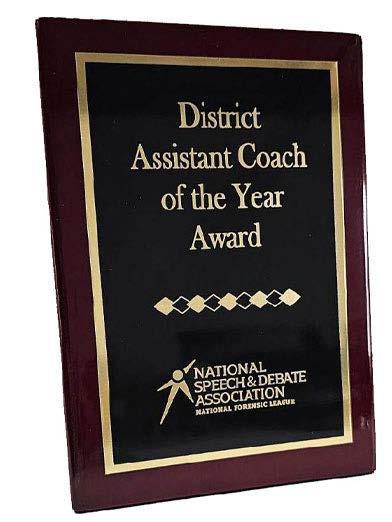
District Assistant Coach of the Year »
This award recognizes an exemplary assistant high school coach serving at an NSDA member school.
District Administrator of the Year »
This award honors an administrator who has succeeded in providing high-quality opportunities for students in speech and debate programming, as well as demonstrating exemplary contributions to the profession.
District Student of the Year Award »
This award honors a graduating senior who best represents the tenets of the Association’s Code of Honor: humility, equity, integrity, respect, leadership, and service.
From local competitions to national championships, we are proud to be the largest provider of awards for speech and debate tournaments.
From Extemp to Public Forum, we get the lingo and match awards to the competition.
Competitive pricing without sacrificing craftsmanship.
Quick turnarounds and last-minute fixes when you need them most.
We anticipate your needs to make next year’s orders simple.
www.speechanddebate.org/trophy-shop Visit our website to request a quote, order a replacement, or buy ready-made awards!
Electing to Build a New Framework for Congressional Debate
“The event we call ‘Congress’ has grown into one of the largest offerings in many districts, and yet its format has not kept pace with that growth. It’s time for a thoughtful modernization.” — by DJ Brynteson
For more than two decades, Congressional Debate has remained largely unchanged in structure. It still carries the vestiges of its earliest era—when a chamber was treated as its own self-contained event and when the “superchamber” concept was considered innovative. But the competitive landscape, student population, and educational goals of the activity have evolved dramatically. The event we call “Congress” has grown into one of the largest offerings in many districts, and yet its format has not kept pace with that growth. It’s time for a thoughtful modernization.
The Legacy Model— and Its Limits
Congress was originally designed to simulate
legislative procedure and civic discourse. Its unique structure—students gathered in one chamber for an entire tournament— made sense when entries were smaller and judging pools limited. But today, large chambers of 18 to 22 students often dilute the very deliberation the event seeks to teach. Many students speak only once per session or the session needs to be over three hours to ensure multiple speeches.
Even more concerning, the current scoring model gives each individual judge a disproportionate amount of power compared to other debate formats. In traditional debate events, a competitor can lose a round or two and still advance with a strong overall record—balance is built into the system. But in Congress, a pair of low ranks or “random 9s” from judges
can erase an otherwise exceptional performance. With chambers of 20 students, small variations in one judge’s evaluation can determine whether a student advances or is eliminated. The lack of multiple balancing rounds amplifies subjectivity, creating outcomes that feel more like luck than merit.
And unlike every other speech and debate event, Congress is the only format where competitors never rotate. Students remain in the same chamber for the entire tournament, hearing the same voices and debating the same handful of peers all day. This static environment limits exposure to diverse perspectives, argumentation styles, and questioning approaches—the very elements that make speech and debate an educational
experience. Would we ever ask a Public Forum team to debate the same opponents round after round? Or allow an orator to compete against the same five speakers all day? Yet in Congress, that’s the norm. Without rotation, bias accumulates, speakingorder luck compounds, and the educational breadth of the event narrows. Congress deserves the same dynamism, fairness, and variety that define every other competitive format.
Signs of Movement
The past few years have shown incremental progress. The NSDA’s introduction of preset recency brought longoverdue procedural clarity. Next year’s rule change— allowing up to 10 students per school at national qualifying tournaments, regardless of enrollment— marks another step toward equity. Yet these reforms, welcome as they are, stop short of addressing the structural inefficiencies inside the round itself
What We’ve Learned from Experimentation in Minnesota
The Minnesota Debate Teachers Assocation (MDTA) Congressional Debate Advisory Committee piloted several adjustments during the last few years, starting in 2022:
• Small chambers of 12 students for Varsity and up to 14 for Novice
• Varsity, JV, and Novice divisions at all tournaments
• Rotation between chambers between sessions
• Shorter, 120-minute sessions
After trying the new format at a couple of tournaments, a survey of coaches, judges, and students—an 80% response rate—revealed the support for change was overwhelming (figure 1)
The results defy the usual pattern of resistance to change. Most respondents favored smaller, rotating
chambers and shorter sessions, which made it possible for every student to deliver two speeches comfortably.
Even more telling, many coaches noted that novices who could previously “hide in the back” were now actively participating. Shorter sessions improved focus, energy, and overall engagement. Judges commented that smaller groups allowed for more meaningful questioning, clearer argument development, and stronger cross-chamber interaction. Students reported that debates felt “faster, smarter, and more like real debate,” with less downtime and more consistent opportunities to contribute.
From Experiment to Standard
Since the experiments of 2022, Minnesota
Congressional Debate has transformed. After collaboration among coaches, tournament directors, and students, the following standards are now common across all local tournaments:
• Divisions. Novice, JV, and Varsity to reflect differing skill levels.
• Chamber Sizes. Varsity 12 max up to Novice 14 max.
• Rotating Prelims. Students move to new chambers each round; two to three judges per section, with one serving as parliamentarian.
• Session Length. Twohour maximum.
• Preset Recency. Speech order is established before the round begins, ensuring transparency and fairness. No longer do we rely on the illusion of “random” recognition to determine who speaks next—students
and judges alike begin with a clear, equitable framework.
• Advancement. Use cumulative ranks, dropping the worst score—ensuring that a single judge cannot prevent a deserving student from advancing.
• Final Round Changes. At state and other major tournaments, finals should feature two sessions judged by the same panel to ensure that students show both leadership and speaking ability.
These changes align Congress more closely with the broader debate ecosystem—balancing fairness, educational value, and logistical feasibility. Over this same period, Minnesota has seen dramatic growth in Congressional Debate. Comparing participation from 2018 to 2025, the number of active students has nearly doubled, with no signs of slowing down. The culture has shifted from endurance-based to engagement-based. Students leave each round feeling heard, not just ranked.
And this movement is expanding beyond Minnesota. At the 2025
Harvard Tournament, JV Congress was added as a new division modeled on the Minnesota format. This year, organizers are planning to bring similar structures to Varsity as well.
Considerations for Implementation
Reform cannot happen overnight, but many improvements can begin immediately. The most significant adjustments are logistical rather than philosophical. Moving to smaller chambers requires additional classrooms
and slightly higher judge counts—typically improving the judge-tostudent ratio from 1:6 to around 1:5 or even 1:4. Because judges rotate alongside competitors, tournaments must plan for clean panels each round. Divisions make this easier: at a standard one-day tournament with two prelims and finals, judges can move between Novice, JV, and Varsity pools to maintain fairness. With coordination and a few schedule tweaks, these changes are entirely manageable.
Why It Matters
At its best, Congressional Debate teaches civic engagement, collaboration, and persuasion. But when chambers swell to 20+ students, when one judge’s rankings define outcomes, and when students sit through three-hour marathons, the event loses its educational potency. Reform is not
about discarding tradition; it’s about ensuring the activity remains vibrant and equitable for the next generation.
The experiment in Minnesota proved what many coaches nationwide have sensed: students, judges, and educators are ready for a more dynamic, inclusive model of Congress. It’s time to make that vision reality.
DJ Brynteson is the head coach for Robbinsdale Armstrong and Cooper High Schools in Minnesota. He serves as the Southern Minnesota district chair and president of the Minnesota Debate Teachers Association. A three-diamond coach, he has been a leading advocate for Congressional Debate reform and innovation.
Debating with a Disability S tuttering, Perception, and Fairness in Debate Rounds
by Chloe Swidler
Iam a Lincoln-Douglas debater from Marlborough School in Los Angeles, California, and I have a stutter.
A stutter is a type of speech impediment that can include repetitions (j-j-j-judge), prolongations (vvvvvvvote), and blocks (a period where a person is unable to say anything) Stuttering can inhibit my ability to speak fluently and has, at times, affected how I’ve been treated and judged during rounds.
Throughout my years of debating, I have had opponents make rude comments and judges announce they were
voting against me due to my lack of fluency.
Though debate is, by nature, a communication activity, speaker points should reflect overall performance. If students make the correct rebuttal choice, give solid judge instruction and thoughtful impact calculus, and their speech is well organized, they should receive higher speaker points.
However, some judges focus solely on how well students speak, including fluency, pronunciation, and articulation. This can be unfair when debaters who have a stutter or speech impediment
The nature of debate should never preclude participation. Every judge should try to navigate their unconscious biases when adjudicating debates and assigning speaker points.”
receive lower speaker points for a disability they cannot control. Lower speaker points make it harder to succeed for debaters who stutter, as they sometimes do not clear to the next round based on speaker points and get challenging first elimination round pairings.
Additionally, it’s common for people who stutter to be perceived as nervous and, as a result, less knowledgeable, despite evidence showing that these assumptions are false. These misconceptions can make it difficult for debaters who stutter to be perceived as dominant in debates.
The nature of debate should never preclude participation. We all rely on each other’s grace and accommodation in a variety of ways throughout a debate tournament; it should be no different for stutterers.
Every judge should try to navigate their unconscious biases when adjudicating debates and assigning speaker points. If a judge notices someone stuttering, they should make a conscious effort
to make the debater’s speaker points a reflection of their strategic choices. If the judge insists on evaluating speaking ability, they should not include the person’s stutter in the points. While this can be difficult, it would make the debate space much more welcoming.
If a debater ever mentions they have a stutter to a judge, the judge should ask how they can make the round more accessible, listen to what the debater says, and try their best to accommodate. If the debater is going out of their comfort zone to inform a judge about their stutter, the judge should not consider fluency in their assignment of speaker points to the best of their ability.
When a person stutters during a debate round, the best thing an observer, judge, or opponent can do is be patient. People who stutter often take longer to communicate their ideas because of their disfluencies, but that does not devalue what they are saying. Maintaining eye contact and listening patiently while a person
stutters indicates that you care about what they are saying.
Additionally, simplistic and unsolicited advice like “slow down” or “relax” can be harmful, as these suggestions disregard the complexities of the chronic and often lifelong condition that is stuttering. While it might be tempting to finish the sentence of the debater who is stuttering, please do not. You do not know what they want to say, and finishing their sentence implies that their ideas aren’t worth your time.
Furthermore, most people who stutter prefer that you not mention their stutter unless they tell you to. This can mean not talking about someone’s stutter unless you are a judge who was asked directly for feedback on their fluency, or the person themselves mentions it.
For judges and opponents alike, if you notice someone is stuttering, avoiding anything related to “I
couldn’t understand you” goes the extra mile. This is an especially effective way of ensuring the person feels valued in debate, as many people who stutter struggle with hearing that people can’t understand them.
Getting as many possible ideas out in a given round is important to be competitively successful; however, we all need to remember the pillars of mutual support and respect that this activity thrives on. Debate is a communication activity that can be negatively affected by ableism. However, if everyone made a conscious effort to listen to people who ask for help because of a disability, the debate space would be much more inclusive. An inclusive debate space allows debaters with disabilities to feel safe and remain in debate, which is something I know we all want.
Viewpoint Diversity
The National Speech & Debate Association believes that every student should have access to speech and debate. We are committed to promoting freedom of expression and celebrating diverse perspectives and ideas from all of our students and coaches.
NSDA Judge Accreditation
We offer an ever-growing set of self-paced online judge certification modules. Upon successful completion of each module, judges will be able to download a certificate and claim their badge in Tabroom.com. The Level 1: Intro to Impartial Judging module focuses on impartiality as a vital skill for all judges. It outlines three key characteristics necessary for impartial judging, examines how these qualities apply in practice, and offers practical strategies for providing fair, unbiased, and constructive feedback. Learn more at www.speechanddebate.org/judgeaccreditation
Reasonable ADA Accommodations
We are committed to providing reasonable ADA accommodations to ensure full access and participation for all individuals at the National Tournament. We encourage participants to submit requests as early as possible to ensure timely support. Judges and coaches may complete the online form, and coaches may submit requests on behalf of students. Visit www.speechanddebate.org/ accessibility to get started.
Questions?
If you have any questions about tournament accessibility, please contact Dr. Paul Porter at paul.porter@speechanddebate.org
Chloe Swidler (’27) is an NSDA member from Marlborough School in Los Angeles, California.
SPEECH & DEBATE Celebrate
BRING THE SPARK!
NATIONAL SPEECH AND DEBATE EDUCATION DAY recognizes all of the people who make this activity possible—students, coaches, educators, parents, and every supporter! Honor the energy, talent, and teamwork that powers speech and debate on MARCH 6, 2026!
MARCH 6 is National Speech and Debate Education Day!
TRANSFORMING TOMORROW THROUGH SPEECH AND DEBATE EDUCATION
Teachers, students, and alumni can work together to open the doors of their program to the community with a Speech and Debate Day. Invite teachers, students, parents, friends, administrators, and school board members to watch the team perform and speak with students and alumni about the value of speech and debate.
Download editable templates for promoting National Speech and Debate Education Day as well as local tournaments and general team news on our website: www.speechanddebate.org/press-release-templates
— Letter Templates/Examples
INCORPORATE THE NATIONAL FORENSIC LEAGUE HONOR SOCIETY INTO YOUR CELEBRATION
Share Your Story
Behind every team, champion, and coach, there is a moment, mentor, or story. With your words, photos, and videos, you help demonstrate the lasting impact of speech and debate. Share your story on social media and be sure to tag us @speechanddebate
• Invite an administrator to your tournament: www.speechanddebate.org/tournamentinvitation-school-admins
National Speech and Debate Education Day is a great time to celebrate the students on your team and all of their accomplishments. One of the best ways to recognize your students is to hold an induction into the National Forensic League Honor Society!
• Write a letter to an administrator as an alum: www.tinyurl.com/u9hhbdve
We have already curated special resources to host an induction ceremony that is exclusive for your school. Find them on our website at www.speechanddebate.org/honor-society.
Celebrate with Mentorship
• Write a letter to the editor: www.dailyinterlake.com/news/2022/dec/26/ letters-editor-dec-26
Consider modifying these resources to include acknowledgement of National Speech and Debate Education Day! Add the logo (available on our website) to your invitations, explain to your audience that we take this day every year to celebrate speech and debate, and/or ask your inductees to share the reasons the Honor Society (and speech and debate) are important to them!
Recognize National Speech and Debate Education Day by planning a day of mentorship for your program. To get started, reach out to teachers in local elementary schools or middle schools that don’t have existing programs and celebrate the day by introducing speech and debate to a new generation. Inspire them to speak up, engage, and think critically.
Use Posters to Promote the Team
Hang posters around the school or in your classroom to create awareness and honor success—or print them out to include in informational packets about the team for parents or students. Find dowloadable posters, templates, and more ideas at www.speechanddebate.org/teamrecruitment-strategies.
TEAM CHINA GOLD: Teamwork Really Does Make the Dream Work
in World Schools Debate
by Vivek Rajdev
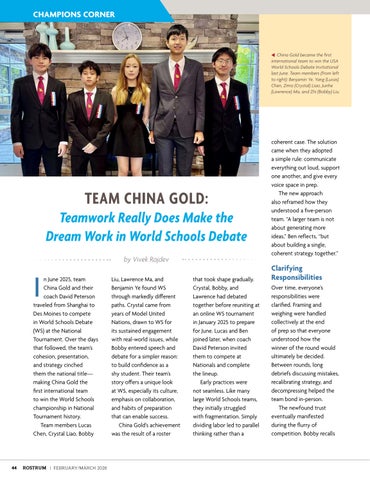
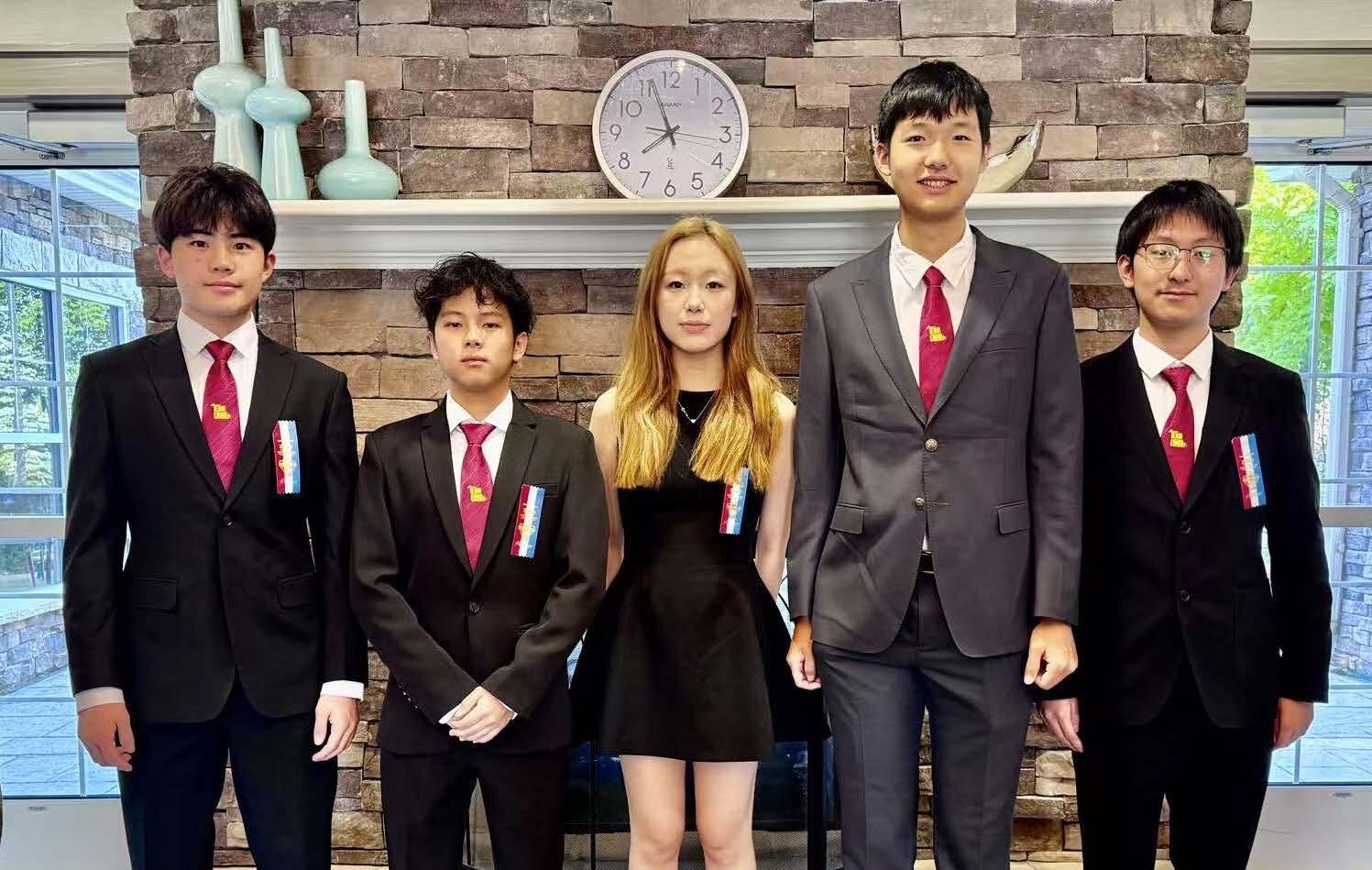
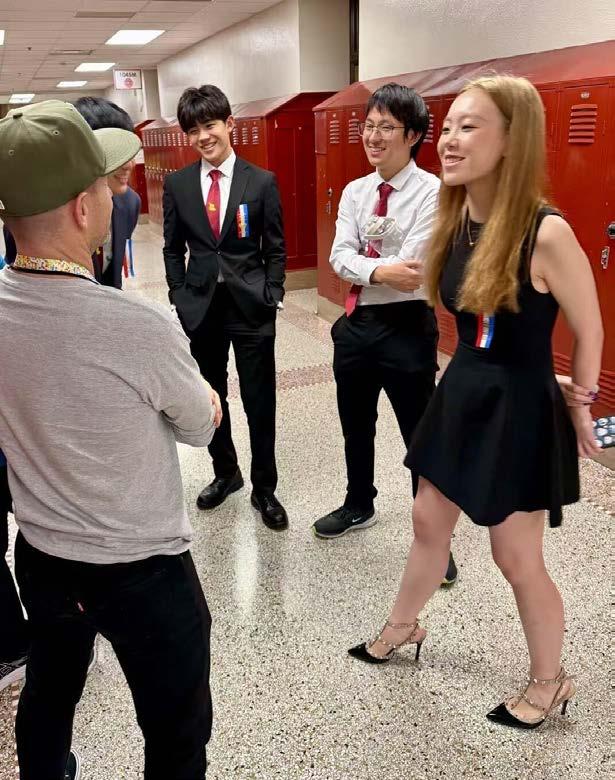
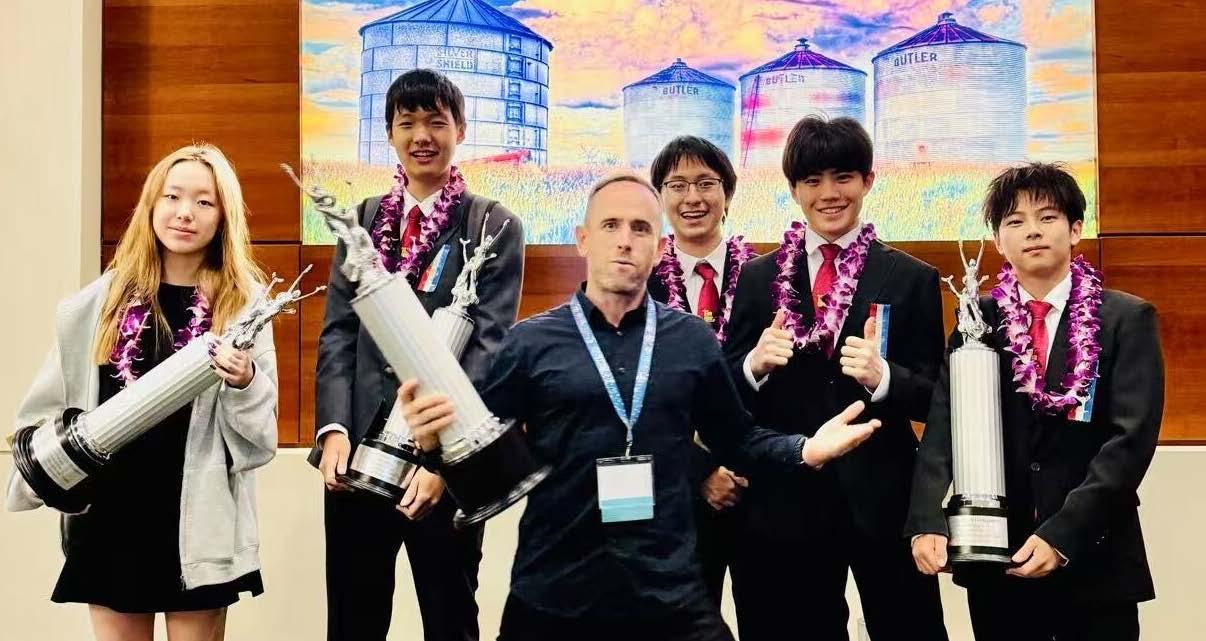
In June 2025, team China Gold and their coach David Peterson traveled from Shanghai to Des Moines to compete in World Schools Debate (WS) at the National Tournament. Over the days that followed, the team’s cohesion, presentation, and strategy cinched them the national title— making China Gold the first international team to win the World Schools championship in National Tournament history.
Team members Lucas Chen, Crystal Liao, Bobby
Liu, Lawrence Ma, and Benjamin Ye found WS through markedly different paths. Crystal came from years of Model United Nations, drawn to WS for its sustained engagement with real-world issues, while Bobby entered speech and debate for a simpler reason: to build confidence as a shy student. Their team’s story offers a unique look at WS, especially its culture, emphasis on collaboration, and habits of preparation that can enable success.
China Gold’s achievement was the result of a roster
that took shape gradually. Crystal, Bobby, and Lawrence had debated together before reuniting at an online WS tournament in January 2025 to prepare for June. Lucas and Ben joined later, when coach David Peterson invited them to compete at Nationals and complete the lineup.
Early practices were not seamless. Like many large World Schools teams, they initially struggled with fragmentation. Simply dividing labor led to parallel thinking rather than a
coherent case. The solution came when they adopted a simple rule: communicate everything out loud, support one another, and give every voice space in prep.
The new approach also reframed how they understood a five-person team. “A larger team is not about generating more ideas,” Ben reflects, “but about building a single, coherent strategy together.”
Clarifying Responsibilities
Over time, everyone’s responsibilities were clarified. Framing and weighing were handled collectively at the end of prep so that everyone understood how the winner of the round would ultimately be decided. Between rounds, long debriefs discussing mistakes, recalibrating strategy, and decompressing helped the team bond in-person.
The newfound trust eventually manifested during the flurry of competition. Bobby recalls
China Gold became the first international team to win the USA World Schools Debate Invitational last June. Team members (from left to right): Benjamin Ye, Yang (Lucas) Chen, Zimo (Crystal) Liao, Junhe (Lawrence) Ma, and Zhi (Bobby) Liu.
a debate where things felt scattered until something clicked mid-round. Without explicit coordination, each speaker gravitated toward the same two decisive clashes. “It felt like we were thinking as one unit rather than as separate speakers,” he says. Passing notes, abandoning flawed prep, and rebuilding on the fly finally became a welloiled, calm process rather than a panic. For the team, this round captured World Schools at its best: three debaters trading their chase for perfect speeches with a single strategy cleanly utilized across the bench. Clear speaker identities reinforced that alignment. Crystal’s fast, instinctive refutation complemented Bobby’s slower, more stylized delivery, while Lucas anchored rounds with emotional appeal. Roles also stabilized early—Crystal as third speaker, Bobby as second, with others rotating first. The lesson the team began to emphasize is
valuable: rounds are rarely lost for lack of arguments, but for lack of shared prioritization. Alignment, not volume, determines the round’s outcome and enjoyability.
Pre-tournament preparation reflected the same discipline. For prepared motions, first speakers split research and drafting, then reconvened to ensure the team could adapt the material midround. Practices also followed a structured format: an hour of lecturing on a specific topic followed by a mock debate, with drills tailored to the speaker roles. First speakers focused on delivery and presence, while second and third speakers drilled on clash identification and anticipation.
For impromptu motions, the team built a mental library of motion types, principled debates, common moral dilemmas, and recurring refutation patterns. As they describe it, the emphasis was on logical structure, clear models, and instinctive comparative analysis instead of depth of research—a mindset that kept them coherent with their limited prep time. One
recurring drill built that skill: short, structured weighing exercises where each speaker had to explain, in a minute, why their side still won on impact even if the opposing case were assumed to be true.
Style received equal attention. Lawrence notes that the team was aware that Nationals placed a premium on delivery—an important nuance compared to international circuits. Thus, the team ran drills that honed emotional range. One involved reciting random literature as emotionally as possible to break flat, technical cadences. Another eliminated prep entirely, requiring speakers to debate immediately against coaches. As Crystal explains, these exercises trained speakers to let delivery “complement your content when your material is not that solid.”
Underlying their experience was the crucial element of prioritization of individual specialities tempered with a willingness to subordinate them to the group’s needs. One necessary adjustment was replacing brute-force refutation with weighing. Crystal decided to emphasize “even if” analysis, engaging the opponent’s strongest case and explaining why her impacts still mattered more, using metrics like certainty, scope, and severity. Bobby prioritized
the same principle: identifying the opponent’s “path to victory” and dismantling it rhetorically. Most rounds, they believed, are decided not by missing arguments, but by missing a theme.
Kindness and Competition
Besides the ballots, the tournament itself created resilience and trust among the team. By the time they reached the final round, they jokingly described themselves as a “traveling pharmacy.” Every member was fighting the same cold and wondering whether the Chinese medicine they had taken that morning would last through their speeches. Before that, a 10-hour delay on their flight from Shanghai forced them to sleep on airport floors, shoulder to shoulder.
As a result, a sense of solidarity carried into the tournament itself, which felt far warmer than any of them had expected. Small gestures from peers—like competitors complimenting Crystal’s heels on the first day—underscored a culture that valued kindness alongside competition. The team enjoyed opponents stopping by after rounds to wish them luck, judges welcoming conversation, and the calm, open atmosphere of Des Moines
that made Nationals feel communal rather than isolating.
Leaving a Legacy
After the tournament, the team fully grasped the significance of their win: it was the first time ever that an international team won the tournament. This realization shaped the legacy they hope to leave. Many Chinese and international teams, they note, compete only within their national circuit. They want their successful run in Des Moines to challenge that boundary and encourage teams to test themselves across debate cultures.
The team has some advice for fellow teams eyeing 2026. As Bobby shares, “The goal is not to cater to one style, but to make the logic of the case persuasive across different judging preferences.”
For team China Gold, World Schools became exactly that—a shared language, spoken across regions. Their hope is that younger debaters see their win as an invitation: to debate boldly, perfect the basics, travel widely, and pursue excellence no matter the circumstances.
Coach David Peterson on Building Cohesion and Adapting for U.S. Style
After we formed the squad, the biggest early challenge was distance—our students were based in three different cities across China, so we had to build chemistry and shared standards online first. We ran a structured series of online training sessions that mirrored what makes USA Nationals unique: the unusually large set of prepared motions.
A lot of our work was motion-analysis based—students would co-build frameworks, practice weighing and comparative impact work, and align on what “winning vision” looked like across the prepared topics. To accelerate cohesion, we also brought in friends from around the world—students who had represented their own national WSDC teams—to do spar debates on the prepared motions, so our students could adapt to different styles and still operate as one unit.
Practically, our weeks were a mix of (a) guided motion analysis discussions, (b) spar debates with detailed feedback, and (c) fast-turnaround rebuttal/extension drills (e.g., impromptu response rounds where they had to identify the clash, prioritize two key responses, and deliver clean comparative extensions). Over time, that combination let them learn each other’s instincts, build trust, and develop a shared language for prep, strategy, and in-round role clarity.
The USA World Schools Debate Invitational is distinctive not only because it’s the largest WSDC-style competition, but also because the judging pool is exceptionally diverse. Many judges bring deep expertise from a wide range of U.S. formats and coaching backgrounds. We treated that diversity as a strength of the tournament and a real learning opportunity, and we prepared students for the terminology and habits they might encounter in U.S.influenced feedback (including concepts that may be less common at some international events).
At the same time, we emphasized the importance of not over-correcting based on assumptions about any individual judge. Our north star stayed the fundamentals that travel across all formats: clarity of claim, clear impacts, good comparison and weighing, strong characterization of the debate, and disciplined decision-making about what matters most in the round. In short: we equipped them to understand different judging “languages,” but we encouraged them to trust the overall expertise of the pool and to win through clean, persuasive, comparative debating rather than trying to game stylistic preferences.
Vivek Rajdev is a member of the NSDA Student Leadership Council from Khan Lab School in California.
How Michigan Teams Create Community at Mackinac
Each May, crowds of bustling high school students and midge flies alike step off Shepler’s Ferry onto the docks leading to the streets of Mackinac Island. Aromas of fresh fudge fill the air as horse-drawn carriages transport students to fudge shops, cafes, and the Grand Hotel. The views of Mackinac Island, dividing Lake Huron and Lake Michigan, paint a picturesque scene that feels more like a vacation than a competition. Yet every year, this iconic island becomes home to one of Michigan’s most beloved speech and debate traditions: the MSCI Mackinac Spring Tournament.
— by Brianna Zhang —
The Mackinac Spring Tournament brings together students from across the state at the end of the season to celebrate community, creativity, and a shared love of forensics. In contrast to the emphasis on rankings and pressure to perform well that many students face throughout the competitive season, the event promotes a positive spirit of competition—one that reminds students why they joined speech and debate in the first place.
Unique Format
Unlike a traditional tournament, Mackinac is known for its intentionally unconventional events. Competitors can be found participating in categories such as National Geographic Interpretation (imagine Dramatic Interpretation, but with students portraying flamingos from nature documentaries), Soapbox Sales where students sell products on bustling street corners, Pop Culture Analysis with a deep-dive into the latest trends, and even TikTok Impromptu, with the most famous soundbites and clips as speech prompts.
Tyler Baas-Peterson, head coach at Portage Central High School in southwest Michigan, recalls his favorite Mackinac events over the years. “When I was in high school, I competed in Mini Multiple, which is an ensemble group interpretation
category, and we did Dora the Explorer,” he explains. “In the past few years, I’ve really enjoyed Duo Broadcasting, After-Dinner Speaking, and Duo Pocket Sales,” a hybrid of both Duo Interp and Sales Public Address where students sell a pocket-sized item with all visual aids physically on their bodies.
On the first night of the tournament, students attend Night of the Champions. During this showcase, students named finalists at the state competition just weeks before perform their pieces on stage in the Grand Hotel’s historic theatre, giving other competitors the opportunity to watch and learn from some of the best performers in the state. As students from different schools cheer each other on in support, the evening sets the tone for the weekend as a celebration of excellence, expression, and creativity.
Mackinac also takes a different approach to tournament spaces. Rather than typical classrooms, events can take place anywhere on the island, ranging from historical conference rooms to the grand theatre. Over the weekend, many students stay at the Grand Hotel, a landmark known for its Queen Anne-style architecture and sweeping porch views. This unique environment stands in stark contrast to the classroom hallways and cafeterias where tournaments are typically
held. Because of this setting, the stakes feel lower, encouraging students to focus less on results and more on enjoyment.
Portage Central High School junior Justin Zhou reflects on his Mackinac experience: “In forensics, there are often people who are very competitive and results-oriented. At Mackinac, that kind of goes away. The judges are often seniors in high school, laughing with the performers and making the rounds feel very relaxed.”
Awards at Mackinac are just as memorable as the event itself. Finalists are called to the stage in the Grand Hotel’s historic theatre, where students gather around tables facing the spotlight. While the awards structure mirrors traditional tournaments, the trophies are uniquely Mackinac-themed, featuring iconic imagery from the island and engravings that celebrate
the event’s whimsical categories.
For many teams, Mackinac becomes an end-of-season celebration. Coach Baas-Peterson notes, “Mackinac has an exciting allure as an end-of-year celebration. After competing and working hard during the regular Michigan circuit, Mackinac is separate, fun, and lighthearted. This allows students to be more creative and less coached, so it’s fun to see what kids do on their own.”
For Portage Central, attending consistently has made Mackinac a defining part of their season, motivating students to work hard and grow in competitions leading up to Mackinac. Many competitors agree that the best moments happen between rounds: walking the island, visiting landmarks like Fort Mackinac or the Grand Hotel Gardens, and relaxing at favorite spots such as the Watercolor Café,
which offers stunning views of Lake Huron. Students bond by judging rounds, sharing meals at the Grand Hotel, exploring the island, and enjoying time together away from school stress. Justin Zhou particularly enjoys buying and eating fudge with friends while talking with students from across the state about their speech and debate experiences.
Professional Development
Beyond student competition, Mackinac also plays a vital role in coach development. At this annual event, coaches from across the state gather in one place to build camaraderie, share ideas, and support one another.
“Michigan is a large enough geographic region that we can forget that speech, theatre, and debate are understood differently,” Baas-Peterson explains. “Being in one space helps us build camaraderie and support. For rural coaches, they might be the only coach around. Being around others allows us to bounce ideas off each other.”
Ultimately, the joy of Mackinac helps draw new students into speech and debate, and keeps experienced students invested. “A few students join the forensics team because of Mackinac,” Baas-Peterson says. “Then they realize they also love speech, and it develops them in a different way. Because I require a full competitive season to attend Mackinac, students grow throughout the year.”
This year, the event is especially meaningful for BaasPeterson, who is excited to see his own high school forensic coach, Nancy Fitzgerald, inducted into the MSCI Hall of Fame. “I’m excited to get to honor someone who had a large impact on my life,” he shares.
Mackinac also helps connect Michigan’s unique circuit with broader NSDA opportunities. As Michigan runs on a separate forensic circuit, coach development introduces national programs, membership, and the National Speech & Debate Tournament to widen the perspectives on this transformative activity and its national community.
In the end, the Mackinac Spring Tournament represents a celebration of teamwork, creativity, mentorship, and community, proving that speech and debate can be both meaningful and joyful. For Michigan teams, Mackinac is a tradition that reminds students and coaches alike why their work and voices matter.
Brianna Zhang is a member of the NSDA Student Leadership Council from Portage Central High School, Michigan.
CLAIM YOUR SPEECH & DEBATE
Membership
In our centennial year, we are not just celebrating speech and debate. We are honoring 100 years of community and impact.
Anyone who participated in speech and/or debate in middle school, high school, or college can join the alumni community! Membership is open to all, regardless of prior NSDA affiliation.
Find your speech and debate connection to support and inspire future generations of public speakers.
BENEFITS:
SHAPE THE NEXT 100 YEARS
» Contribute to the legacy of speech and debate, ensuring that its benefits continue to influence future generations.
EXCLUSIVE WEBINARS
» Receive invitations to upcoming webinars and access past webinars, including “Transform Your Speaking Skills into a Career.”
NETWORKING OPPORTUNITIES
» Gain access to our Speech & Debate Alumni Community on LinkedIn and to our Community Calls, where alums can share stories, discussions, and professional development opportunities with one another.
GET PAID TO JUDGE
» Sign up for our Judge Board for the opportunity to get hired by schools in your area.
SUPPORT IN A WAY THAT WORKS FOR YOU:
SHARE YOUR STORY
Share your story of how speech and debate impacted your life, career, friendships, and opportunities.
ADVOCATE
Help create access to speech and debate education in your community by becoming an Alumni Ambassador.
DONATE
Each donation gives speech and debate opportunities to more students and schools. Visit our donation page
“Speech and debate taught me that our greatest achievements are measured not by trophies but by the relationships we build and the communities we nurture.”
— John Otto, Class of 2024
Q+A WITH CLAIRE CHI
Claire Chi, a 2023 graduate from State College Area School in Pennsylvania, shares her insights and experiences as a former speech and debate competitor and current non-profit community leader. — as told to Amber Gracia
You’re the Founder and Executive Director of Dancing Against Hunger, a 501(c)(3) non-profit organization that aims to relieve food insecurity while providing accessible dance education and sparking passions for dance for all. Can you share more about your journey to starting this organization and how you juggled it all being a student?
I believe everyone has something beautiful and impactful to share with the world. For me, that something was dance. I harnessed dance as a tool to bring my community together to fight hunger.
Serving my community through Dancing Against Hunger (DAH) was so fulfilling and impactful. It was also extremely fun—and never felt like work. I think I was only able to grow DAH to the extent that I did because
of this: my genuine love for service, my mentorship of other youth, and my eagerness to share the joy of dance.
What tips do you have for alumni who are interested in starting a non-profit?
The needs of your community can easily change and grow, so be ready to help where you are called to serve. Be eager to share opportunities and show your support. Above all, remember that true leadership serves others, not yourself.
What was your experience like doing a TED Talk? Did your competitive speech and debate experience help you?
I was assigned a very supportive speaker consultant, who guided me through the brainstorming,
drafting, and rehearsing process. My speech and debate experience definitely prepared me to write and speak eloquently, especially as I discussed social issues facing our society and how policy can combat them. (Fun fact: I actually used a Public Forum case-writing structure to draft my TED Talk!)
What part of your speech and debate experience do you reflect on most?
As a novice Public Forum debater who had no prior experience with public speaking, I really appreciated my captain and her mentorship in my public speaking journey. I cherish the moment when I became captain and realized the impact I had made on my own novice debaters, empowering them to develop strong research skills, grow confidence, and uplift one another’s voice.
Is there anything else you would like to share about yourself or your speech and debate experience?
Speech and debate changed my life so I could change others’ lives. Four years ago, I never would have imagined myself breaking into government, which is a historically inaccessible space for young people. Since I joined the NSDA, I’ve given speeches to thousands of people to help fundraise for charity, served on government advisory boards, and been appointed as a public official at age 18. For that and much more, I am filled with gratitude for speech and debate. As it did for me, speech and debate can equip you with strong public speaking and research skills, connect you with invaluable mentorship and lifelong friends, and prepare you to explore a whole world of great possibilities.
Find a link to Claire’s TED Talk and learn more about her non-profit at DancingAgainstHunger.org
Amber Gracia serves as Student and Alumni Engagement Specialist at the NSDA.
Speech and debate saved my life and helped me develop skills that have given me tremendous opportunities around the world. I added the NSDA to my will to ensure that this life-changing activity will continue for generations to come.”
Chase Williams NSDA COACH
THE SOCIETY 1925
Extend
Your Legacy with the National Speech & Debate Association
A bequest in your estate plan (also known as a planned gift) costs nothing today, but provides sustained support to the National Speech & Debate Association for years to come. It is a powerful way to create a lasting impact.
Ways to Leave a Legacy with the NSDA
y Designate the NSDA as a beneficiary of your retirement or insurance policies
y Make a charitable gift directly from your individual retirement account (IRA)
y Donate appreciated stock to benefit the NSDA’s future
Interested in Joining the 1925 Society?
Utilize FreeWill.com/NSDA . FreeWill is a secure and easy-to-use tool that lets you write your will in about 20 minutes, entirely for free. If you choose, you’ll also have the option to include a legacy gift to the NSDA.
OR – Add a simple paragraph to your will designating the NSDA as a beneficiary. Notify Nicole Wanzer-Serrano (nicole@speechanddebate.org) that the NSDA has been added to your will.
Faces in the crowd
ELIZABETH (LIBBY) DANIELS
North Lamar High School, Texas
Libby Daniels has brought optimism, humility, and passion to North Lamar Debate from the moment she arrived. A freshman shaped by years battling acute flaccid myelitis, a rare neurological condition that left her wheelchairbound in middle school, Libby now walks unassisted and leads with quiet strength. She is a gifted speechwriter and mentor who consistently supports her teammates, helping refine arguments and making debate a more inclusive space. Libby is more than a competitor; she is a reminder that the loudest, most effective voices often come from those who have faced the deepest silence.
— Nominated by Jerrett Jones
We’re thrilled to highlight individuals whose everyday actions embody the NSDA’s core value of equity and help make speech and debate a more inclusive and supportive activity. Through the actions, attitudes, and leadership shown, these stories are a gentle reminder that even in competition, our community is rich with kindness and care. The individuals in this piece were nominated by either their students, teammates, coaches, or members of the speech and debate community. Join us in celebrating these faces in the crowd!
CHIMEREMMA MATHEWS
Alief Elsik High School, Texas
Moving from Nigeria to the U.S. in the middle of high school is not for the faint of heart. Chimeremma Mathews has not only found a way to survive that experience, she is thriving. She has done so with absolute grace and dignity as well as devotion to her mother’s purpose—to make a better life. In doing so, she has started off her senior year competing in five tournaments and winning championships in 15 of the 20 events she has entered all the while serving as a mentor and team leader.
— Nominated by Heath Martin
Do you know someone who makes speech and debate a more inclusive space? Nominate them today!
www.speechanddebate.org/faces-in-the-crowd
IN MEMORIAM: CAPTAIN JOSEPH LYNN PIZZO
Monte Vista High School, California
Zacky Shalizi has become a defining presence in the Public Forum community, known as much for his kindness as for his competitive success. A nationally ranked debater, he qualified to the Tournament of Champions, won the Martin Luther King Jr. Invitational with an undefeated record, and placed highly at both the Cal Invitational and California State Championships. Yet Zacky’s greatest impact lies beyond trophies. A mentor, coach, and connector across programs, he leads with empathy, integrity, and generosity. He embodies the inclusive, student-centered spirit that makes debate a true community.
— Nominated by Sai Balaji, Avinash Gajjar, Vaibhav Muthuraman, Eesh Pant, and Vishnu Vasudeva
We are deeply saddened by the passing of Captain Joseph Lynn Pizzo. Lynn began judging speech and debate in 1988. He coached and judged in Colorado and Oregon, earning the Don Crabtree Distinguished Service Award – Second Honors. Lynn was named an Oregon NFHS Speech Educator of the Year and was inducted into the Oregon Speech Coaches Hall of Fame. He was a retired Army captain who served in Vietnam. He worked for the CIA and the American Red Cross. Lynn was born in Houston, Texas, but lived in Okinawa, France, and Germany before graduating high school. He earned an undergraduate degree in technical management from Regis College and a master’s degree in liberal arts from TCU. Lynn was a beloved father and grandfather. Before his passing, Lynn and his wife Jan generously pledged to extend their speech and debate legacy by joining The 1925 Society.
ZACKY SHALIZI
2026 Tournament of Champions Julia Burke Award for Character and Excellence in Policy Debate
Nominees are thought to represent the combination of characteristics that Julia displayed in her love for the activity. These values include excellence in and passion for debate, a commitment to helping others, love and respect for the Policy Debate community.
Nominations are open to all high school seniors who qualify in Policy Debate at the Tournament of Champions in Lexington, Kentucky.
About the Award
The annual award is presented at the Tournament of Champions (TOC) and includes:
y A perpetual trophy in the shape of a flame, which is inscribed, “The Julia Burke Flame for Character and Excellence in National High School Policy Debate.”
Ì A smaller replica of the perpetual trophy, to be given to the recipient.
y A $4,000 college scholarship to the recipient’s college.
y A $4,000 donation to the charity chosen by the award recipient.
The TOC Nomination Portal can be found at www.JuliaBurkeFoundation.com
Please send any questions regarding the nomination process directly to Joy Johnson, Executive Director, at JoyJohnson@JuliaBurkeFoundation.org
DEADLINE FOR ALL NOMINATIONS IS TUESDAY, MARCH 17, 2026
Nomination and Selection Process
Policy debaters, coaches, and judges are invited to nominate one individual per person. The finalists are determined by the Julia Burke Award Committee, composed of nationally active present and past high school policy debate coaches and a representative of The Julia Burke Foundation, as follows: Ms. Lexy Green, Director of Forensics, The College Preparatory School, Oakland, California; Ms. Maggie Berthiaume, Director of Debate, Woodward Academy, Atlanta, Georgia; Ms. Shuntā Jordan, Tournament Services Manager, National Speech and Debate Association; Mr. Eric Emerson, Director of Debate, Kinkaid High School, Houston, Texas; Mr. Eric Oddo, Director of Debate, Niles West High School, Skokie, Illinois; Mr. Daryl Burch, Director of Debate McDonogh High School, Owings Mills, Maryland; Mr. Mike Shackleford, Director of Debate Rowland Hall, Salt Lake City, Utah; Ms. Christina Tallungan, Director of Debate Notre Dame, Los Angeles, California; and Mr. Eric Zampol, Board of Directors of the Julia Burke Foundation, Woodward Academy and Dartmouth College. Voting for the award will be conducted during preliminary rounds of the Tournament of Champions. Each student competing in the Policy Division receives one vote; additionally, one coach with entries in the Policy Division receives one vote via a school ballot.
KEITH WEST MEMORIAL FUND
SCHOOL GRANTS
Keith West lived with compassion and care as cornerstone characteristics of his personality and dedicated his life to coaching and teaching youth in the ways of argumentation and debate. To honor his life and legacy, Keith’s family and friends have established the Keith West Memorial Fund. In 2024, the fund provided one $5,000 grant, two $2,500 grants, and five $1,000 grants to member schools that show strong potential but demonstrate a significant lack of financial resources. Learn more at www.speechanddebate.org/ keith-west-memorial-fund.
2025 GRANT RECIPIENTS
$5,000 GRANT RECIPIENT
Dardanelle High School, AR
Coached by Eric Gamble
$2,500 GRANT RECIPIENTS
Frederick A. Douglass
High School, LA
Coached by Ahlias Jones
Roosevelt High School, OR
Coached by Shawn Swanson
$1,000 GRANT RECIPIENTS
Hendersonville High School, TN
Coached by James Bingaman
Lake Nona High School, FL
Coached by Donald D’Orto
North High School, IN
Coached by Lauren McDaniel
Vista Del Lago High School, CA
Coached by Ananth Gopalakrishnan
Westchester Academy for International Studies, TX
Coached by Crystal Nguyen
Dear Colleagues,
As educators preparing young people for a rapidly changing world, we face challenges that transcend geography. The accelerating influence of AI on every industry, the persistence of misinformation, and increasingly divisive public discourse have reshaped what it means to be an informed citizen. In moments like this, the work we do in schools becomes even more vital. Our students need more than content knowledge; they need the habits of mind to think critically and creatively, communicate with clarity, and collaborate across cultures and perspectives. These skills are essential for the future they will inherit.
This is why speech and debate holds such a powerful place in our schools. It provides a transformative learning experience, going far beyond a typical extracurricular activity. Through research, argumentation, and performance, students learn to make sense of complexity, to listen deeply, and to advocate thoughtfully for ideas that matter to them and for ideas that are new to them. They practice civil discourse at a time when the world urgently needs models of how to disagree with respect and purpose. And perhaps most importantly, they discover their voice: not just the ability to speak, but the confidence to be heard.
My conviction about the importance of debate is not theoretical. Before becoming Head of School, I spent years as a competitor and coach, including the extraordinary privilege of coaching the Argentine national team at World Schools Debate competitions. I watched 15-year-olds wrestle with nuanced global issues and, in the process, grow into the most extraordinary young adults —thoughtful intellectuals, articulate public leaders, and even founders of tech companies. They became individuals who could confront any complex idea placed in front of them and engage it with rigor, empathy, and clarity. Those early coaching years remain some of the most inspiring of my career because they showed me what young people are capable of when we trust them with real intellectual challenges.
As National Speech and Debate Education Day approaches, I encourage all school leaders to celebrate the profound impact of these programs and to expand access wherever possible. Debate strengthens analytical skills, deepens students’ understanding of global issues, and fosters friendships with teammates and competitors that often last far beyond a single round. It builds not only thinkers and speakers but compassionate young people who are prepared to contribute to a more informed, connected, and hopeful future.
Thank you for the work you do to champion student voice, inquiry, and leadership in your communities. Whether in the U.S. or abroad, we remain united in our belief that empowering students to think well, speak well, and listen well is one of the greatest gifts we can offer the next generation.
Sincerely,
Frankenberg
David Frankenberg, Head of School Taipei American School, Taiwan
David
Julia Burke Foundation was established in memory of Julia Burke, a young woman of substance with a passion for debate. We are proud to partner with The Julia Burke Foundation to offer these opportunities in Julia’s memory.
www.speechanddebate.org
Speech and debate has taught me that with dedication I can change the world. If you have a good idea, the will to work, and the belief, there’s no stopping what you can do.