Under the previous structure, schools faced a tangle of separate fees, multiple invoices, and sometimes difficult conversations with school finance offices each time they wanted to add a new student member. Some programs simply avoided adding students to their rosters because of the per-student cost—meaning those students missed out on Honor Society benefits and weren’t being counted in the data that shapes the future of the activity.
Budget unpredictability was another persistent frustration. When your annual cost depends on fluctuating student enrollment, it’s difficult to advocate for a consistent budget with school administrators. A flat fee solves that: coaches can plan, schools can budget, and no one is penalized for growing their program.
Certificates and Degrees
Because the flat fee includes unlimited student memberships, physical certificates are not included in the base membership. Students and coaches will be able to print their degree certificates—displaying their appropriate NSDA degree—directly from the NSDA website at speechanddebate.org at any time. For those who prefer a traditional keepsake, physical certificates and seals will be available for purchase through the NSDA store at select points throughout the school year.
REMEMBER, this change also impacts the district qualifier structure . Access our PowerPoint for more information.
Pre-Pay for Next Year Starting This Spring
Schools that want to get a jump on next year can take advantage of a pre-pay option for 2026-2027 memberships. Beginning in April 2026, a $349 prepaid school membership will be available for purchase, allowing programs to lock in their membership for next year and simplify their budget planning.
A note for schools with existing prepaid memberships under the current system: the option to prepay for individual student memberships ended January 31, 2026, and the ability to apply any prepaid school or student membership toward this school year ended March 31, 2026. Any unused prepaid membership value will be automatically converted to credit for future application to school membership or National Tournament fees in early April.
Need-based Membership Assistance Available
The NSDA recognizes that even a streamlined flat fee can present a challenge for some programs. To support access for schools facing financial barriers and ease the transition for some, the NSDA is doubling its membership assistance budget for next year.
Assistance applications will be open to any school that can demonstrate need, including new programs, small teams, rural programs, under-resourced schools, and Title I eligible schools. Transition assistance will also be available to help schools currently paying significantly less than $349 offset a portion of the price increase in year one.
The application for 2026-2027 membership assistance is anticipated to open in early May 2026. To apply when the window opens, visit www.speechanddebate.org/programgrants
Looking Ahead
These membership changes are part of a broader effort to build a speech and debate community that is simpler to navigate and stronger in support. The goal has always been to deliver more for your membership—more advocacy, more recruitment tools, more mentorship, more curriculum, more local league support. A flat-fee model that removes transaction friction and opens the door to unlimited student enrollment, including more access in the classroom, is a meaningful step toward that goal.
NEWS + NOTES
Access Advocacy Lesson Plans
The Start Here: Teaching Advocacy lessons are a good end-of-year unit, highlighting the impact the skills learned in this activity can have—not only on students, but on the world around them. Students learn to:
• Critically examine their environment, identify a problem, and develop a solution.
• Pitch their ideas to decision makers by presenting information, findings, and supporting evidence clearly, concisely, and logically such that listeners can follow the line of reasoning.
• Work as part of a team to initiate and participate effectively in a range of collaborative discussions, building on others’ ideas and expressing their own clearly and persuasively.
Download the lesson plans at www.speechanddebate.org/ start-here-teaching-advocacy
Download Press Release Templates
Media coverage is important for speech and debate teams to build credibility, increase community awareness, increase support, and celebrate your students. We have created more than a dozen press release templates for schools to customize and send to local media. You can find the templates on our website at www.speechanddebate.org/press-release-templates
Recognize Middle School Coaches
Middle school speech and debate builds confidence and a sense of belonging at a critical age. We seek to celebrate the coaches who make it possible through their leadership, advocacy, and encouragement. Sound like someone you know? Recognize their work by completing a short nomination for Middle School Coach of the Year by May 1, 2026, at www.speechanddebate.org/middleschool-coach-of-the-year-nomination-form
Recent Minutes
Stay up to date on recent rules changes and other decisions impacting your NSDA membership. Find minutes from past Board of Directors’ and Competition and Rules Leadership Committee (CRLC) meetings online at www.speechanddebate.org/minutes-archive.
Judge Accreditation Requirements
As a reminder, all National Tournament judges must complete the required judge accreditation modules by May 15, 2026. To complete a module means that the judge has watched the video and scored 100% on the corresponding quiz. Confirmation will automatically appear on the judge’s Tabroom.com profile within 24 hours of completion. Judges can complete all required forms and training by logging in to Tabroom.com, selecting “National Speech and Debate Tournament” under the Judging header, and selecting “Judge Forms.”
Encourage Your Students to Join Our Alumni Community
As you nurture the talents of your current speech and debate students, don’t forget that our alumni community is a valuable resource for you and your team. Encourage your 2026 graduating seniors to join our alumni network so they can stay connected, access valuable resources, and give back. Learn more at www.speechanddebate.org/alumni
Share Your Plans for Next Year
Are you retiring? Leaving coaching? Changing schools? If you’re making a change for the upcoming school year, share the details with us so we can continue to support your program by advocating for or onboarding your replacement. Visit www.speechanddebate.org/coachdeparture to complete the online form.
2026 Student Summer Programs
Spirit of America
Youth Leadership
Multiple Dates
9th and 12th Grade I Cost: $850
Students learn about America’s founding and the first principles of freedom through mock congressional debates, a shark tank challenge, historical site visits, and more.
Service Learning in Public Policy
July 26-31,2026
9th-12th Grade I Cost: $1,150
An advanced leadership program where students work in teams to identify and solve real-life challenges in the public health, media and communications, legal, or STEM fields by crafting and presenting viable public policy solutions.
Debate and Leadership Institute
July 20-24, 2026 10-12th Grade I Cost: $1,150
Hosted in partnership with The Bill of Rights Institute, this unique, 5-day, overnight debate program is the perfect opportunity for students to make new friends while strengthening their debate and leadership skills.
Civic Explorers Day Camp
August 3-7, 2026, 8:30am-4:30pm daily 7th and 8th Grade I Cost: $600
A fun-filled, action-packed, and engaging day camp that allows students to learn about history in the places where it happened
T H E 2 0 2 6 N A TI O NAL T OURN A ME N T
June 12–14, 2026 June 25–28, 2026
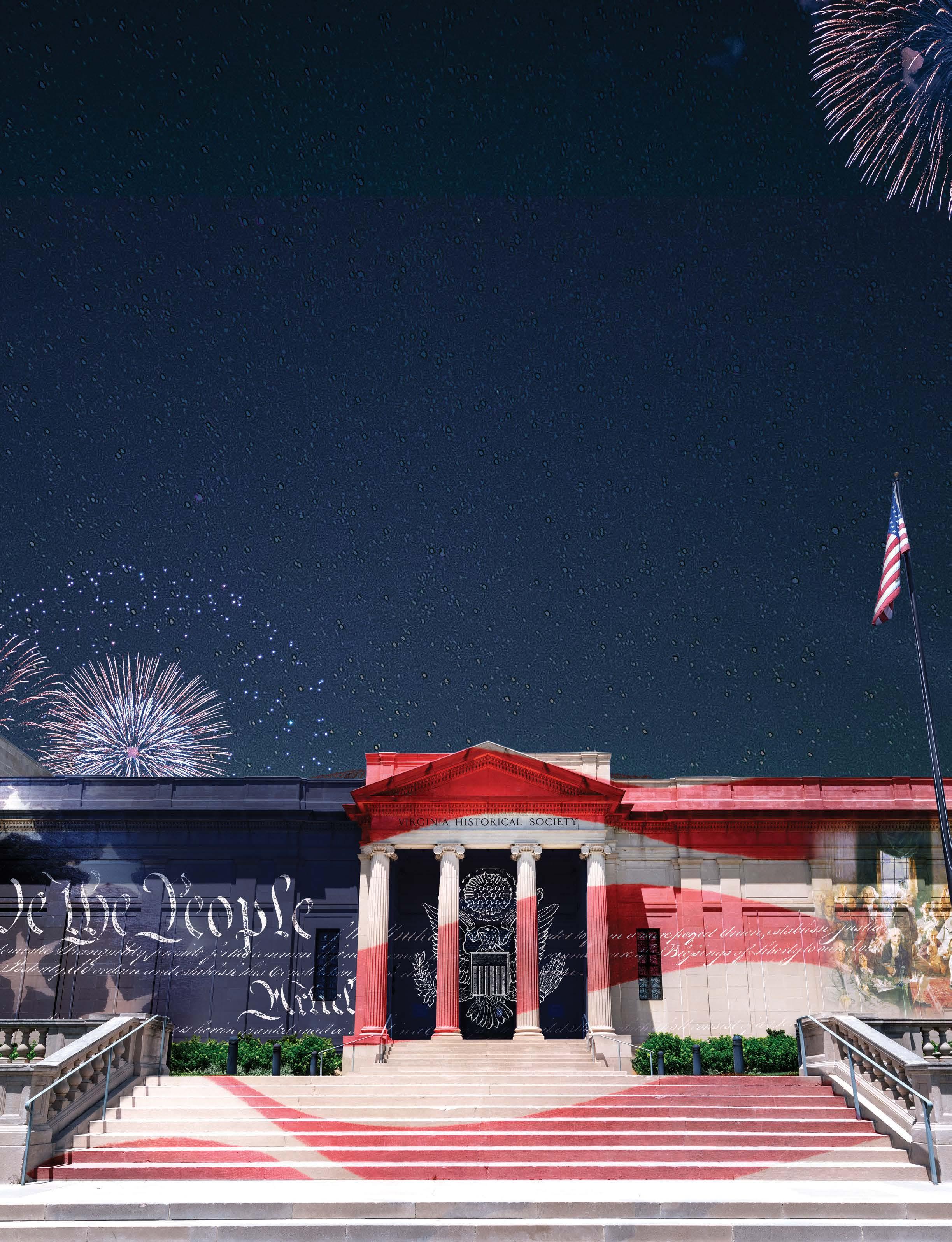
We the People: The World in Our Commonwealth Opens March 21, 2026–September 7, 2026
Mark America’s 250th anniversary with special events, commemorative exhibitions, and more at one of the oldest and most distinguished history organizations in the United States!
IT’S TIME FOR NATIONALS 2026!
IMPORTANT DATES AND DEADLINES:
NSDA LAST-CHANCE QUALIFIER
• April 17 – Deadline to register
• April 23-25 – Happening online
MIDDLE SCHOOL NATIONAL TOURNAMENT
• May 15 – Deadline to register
• June 16-19 – Happening in-person
HIGH SCHOOL NATIONAL TOURNAMENT
• May 15 – Deadline to register
• June 1 – Deadline to register alternates
• June 13 – Deadline for final scripts
• June 14-19 – Happening in-person
HIGH SCHOOL SUPPLEMENTAL EVENTS
• May 15 – Deadline for coaches to pre-register students
• June 16 – Coaches must re-register students in supps to confirm their participation
• June 17-19 – Happening in-person
“ROAD TO NATIONALS” TRAVEL GRANTS
• Generously supported by The Julia Burke Foundation, the Road to Nationals Fund—established through the William Woods Tate, Jr., Memorial Fund—provides financial assistance to teams with limited resources to help them attend the high school National Tournament. Learn more and apply by April 22 at www.speechanddebate.org/road-to-nationals
NATS26 MERCH
• May 15 – Deadline to pre-order shirts via Tabroom.com for pick up at the National Tournament
• May 22 – Deadline to order shirts online via the NSDA Store (www.speechanddebate.org/store) and receive in the mail pre-tournament
NATIONAL TOURNAMENT UPDATES
Our annual National Speech & Debate Tournament will be held June 14-19, 2026, in Richmond, Virginia. Tournament info is now available on our website, including tentative schedules, logistics, hotel details, and more. As a reminder, staying in the hotel block saves your team 15% on main event and supplemental event entry fees! We also have day-by-day breakdowns for high school and middle school to get a feel for the flow of the event. Visit www.speechanddebate.org/nationals and use the tabs to navigate around. Read on for updates on safety measures and venue policies.
New Safety Measures at the National Tournament
Your safety and well-being are our highest priorities. Over the past year, we’ve carefully reviewed and strengthened our safety protocols to ensure every participant feels secure and supported throughout the competition. This year’s Richmond Tournament will be held at local venues with new security protocols. We will have enhanced screening at all event entrances and are working closely with professional security teams, Richmond emergency management (police, fire, EMS, and weather), school district security, and convention center and theater staff to ensure strong emergency response plans are in place.
As in previous years, security personnel and nurses/EMTs will be on staff at every tournament venue, and the Belonging and Inclusion Station (BIS) will be available as an additional support resource throughout the tournament. NSDA tournament officials will also be available at every venue to address any concerns you may have during the tournament. Throughout the tournament, all participants are expected to follow the NSDA Code of Conduct, their school district policies, and applicable state and federal laws.
We appreciate your cooperation in helping us maintain a safe and secure environment for all participants and guests. We are committed to keeping you informed about safety measures and updates as the tournament approaches. If you have any questions or concerns, please reach out to us via email at info@speechanddebate.org.
National Tournament Venue Policies
The following policies will be in place at all 2026 NSDA National Tournament sites to ensure the safety and comfort of our community. NSDA tournament officials with venue-specific security training will be onsite at every venue and available to address any questions or concerns.
• *NEW* Wristbands Required for Entry: All participants must wear a wristband for entry into tournament venues. Wristbands are non-transferrable and cannot be removed for the duration of the tournament. They will be distributed at registration. If a replacement wristband is required, the participant must present valid identification before being permitted entry into a tournament venue. If you have concerns about a participant from your school wearing a wristband, please complete the online ADA Accommodations Request Form at www.speechanddebate.org/ accessibility.
• Identification Badges/Ribbons: Within tournament venues, attendees must wear identifying ribbons at all times. This includes approved observers like parents and chaperones. Ribbons are distributed during registration and pinned to clothes.
• *NEW* Controlled Entry Points: Access to venues will be limited to designated entrances with security checkpoints for safety and monitoring. Details on entry point locations will be shared prior to the event.
• *NEW* Entry Inspection at All Venues: All attendees will be required to enter through OPENGATE weapons detection system at all tournament venues and may be subject to search. Items like laptops, glasses cases, and binders must be removed
from bags and handed to security before going through the OPENGATE system.
• Prohibited Items: No weapons, illegal substances, or alcohol are permitted onsite.
Security screening is mandatory for all attendees, and we encourage everyone to arrive early to allow enough time. Anyone who does not complete the required screening or does not have proper tournament identification will not be permitted to enter the venue. We will continue to provide updates on security protocols and provide venue-specific information closer to the event.
Final Rounds at Altria Theater
In addition to the standard policies at all National Tournament venues, a clear bag policy will be in effect for all final round performances at the Altria Theater in accordance with venue security protocols to ensure the safety and security of all attendees.
What to Expect:
• Personal belongings must be placed in clear bags 12”x12”x6” or smaller to enter the Altria Theater. Non-clear bags will not be permitted.
• Each school will receive an allotment of clear bags at registration (one per student, plus two additional bags per team).
• Guests who wish to bring their own clear bags must ensure they meet the size requirements (12”x12”x6” or smaller).
• A complete list of prohibited items is available at www.speechanddebate.org/ nationals.
• This policy applies only to events held at the Altria Theater.
Additional Information:
• A separate process will be shared with final round competitors who need to bring materials such as visual aids into the theater.
• If you have an item that requires special accommodation and will not fit within the approved bag size, please contact us in advance at info@speechanddebate. org.
We believe it is imperative, not just for future lawyers, but for all citizens, to advance the next generation’s understanding of the value of being able to speak and debate, promote or defend their ideas, and to do so with civil, collegial, and respectful discourse.
1,000+ lawyers | 21 offices | mcguirewoods.com
STARTING EARLY
T he Power of Middle School Nationals
Two veteran coaches share how mentorship, preparation, and early national experiences shape the next generation of speech and debate competitors. — as told to Megan West
Last June, more than 800 students from nearly 200 middle schools gathered in Des Moines for the NSDA’s Middle School National Tournament. For many students, the tournament is their first experience competing on a national stage, which can be life-changing.
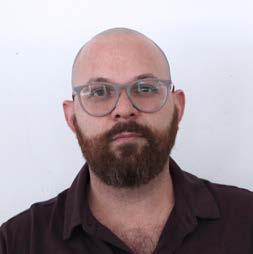
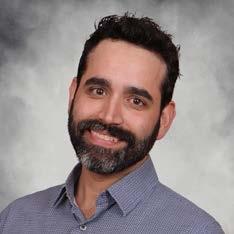
As we approach the 2026 National Tournament in Richmond, I spoke with two Florida coaches who know this journey well: Dr. Jacob Abraham, Director of Forensics at Marjory Stoneman Douglas High School, and Joele Denis, Director of Forensics at American Heritage SchoolBroward. They offer insight into how strong middle school relationships and thoughtful preparation can shape a meaningful Nationals experience.
BUILDING RELATIONSHIPS EARLY
How do your high school programs connect with middle school students and teams?
JACOB: At Marjory Stoneman Douglas, the relationship is probably easier than for most because we host a monthly middle school tournament for our whole district (Mr. Denis’ team included) and we share a fence line with one of our two feeder middle schools. I greet almost every student who comes through our gates, so they know me by name and face.
Selfishly, my life is easier if more ninth graders come into our team already knowing my expectations. When I started at MSD, I made sure to build those ties with our feeder schools. We send varsity students to
peer coach and, when I can, I show up to their practices myself. I might only work with one middle school student in a practice, but the other 40 students there are motivated to earn that coaching slot.
When I was competing in college, I realized my own competitive success spiked after I started coaching. Coaching helped me analyze performances more deeply and recognize what resonates with audiences. I shared that idea with my students, and it’s become a framework that’s worked for eight years now. Our varsity students help our feeder schools run practices every couple of weeks. We treat those coaching sessions as seriously as our competitions.
JOELE: At American Heritage, we operate what is essentially a unified K-12 speech and debate program. While elementary, junior high, and high school teams compete in separate divisions, we intentionally treat them as one vertically aligned ecosystem.
Elementary students practice once a week and compete in four
tournaments each year. In junior high, students engage more rigorously: many are enrolled in advanced classes that meet every other day, and they also attend afterschool practices. They compete regularly at local tournaments and progress to the Florida Forensic League State Tournament. By seventh grade, we begin inviting select students to the National Tournament.
What makes our structure distinctive is the mentorship model. High school students actively mentor and work with middle and elementary competitors. By the time junior high students become freshmen, they already have relationships with upperclassmen they admire and trust. The transition isn’t abrupt. Instead, it’s developmental, intentional, and relational.
As Director, my relationship with these students is long-term. I don’t just meet them in seventh grade; I watch them grow over many years. I see their skills sharpen, but more importantly, I see their confidence expand.
Megan West serves as Campaign Director at the NSDA.
Dr. Jacob Abraham Joele Denis
READY, SET, GO!
In your experience, when is a middle school student (or team) ready to attend the National Tournament?
JOELE: In my experience, a student is ready not because of their competitive ceiling but because of their maturity and commitment. We don’t decide based solely on whether a student is winning local tournaments. With a large program and a cross-country trip (especially with sixth through eighth graders) the more important question is: Are they ready to travel?
Nationals is a multiday commitment that requires focus, stamina, and responsibility. We look for students who consistently show up to practice, tournaments, and team obligations–and who contribute positively to the team culture.
Historically, when we prioritize maturity and commitment over raw talent, those students perform exceptionally well. Focus and drive are far better predictors of success at Middle School Nationals than early competitive rankings.
JACOB: I’ll defer a bit to Mr. Denis, since our middle school program attends independently from us. But I do want to reinforce that I think a school is ready when it has the logistical capacity to
attend. Especially at the middle school level, this trip should not be about competitive ability. The experience is worth it regardless of results.
WHY NATIONALS MATTERS
Why do you recommend this experience for middle school competitors?
JACOB: It’s about learning, observing, and experiencing—plus a little competing.
Our high school program has had some success at Nationals. We won Original Spoken Word in 2023 and reached the HI final stage in 2022, but most of our students don’t break into elimination rounds and they still love the experience.
Last year we started a tradition where I bought an Iowa state flag. Every student who attended Nationals signed it, and we hung it in our classroom. We’re building a legacy that decorates our team room. Being at Nationals and watching great performances live is a powerful learning experience.
I still remember watching Jeff Moscaritolo’s performance of “Rinse the Blood Off My Toga” in 2005. The video online just doesn’t capture what it felt like to be in that room. That kind of inspiration sticks with you, even 20+ years later. All kids deserve that experience.
JOELE: For many students, the Middle School National Tournament is the first truly national-scale academic event they’ve ever attended. Everything from registration night to professional photography, staging, and even the official ribbons signals to students that what they’re doing matters. It elevates their identity as competitors and scholars.
For our team, the experience is also deeply communal. On the Tuesday night before competition begins, our high school students dedicate their time to rehearsing with and mentoring our middle school competitors. That evening transforms the tournament from an individual milestone into a shared team ritual. Junior high students don’t feel like they’re attending a separate event; they feel fully integrated into something bigger.
ADVICE FOR NATIONALS NOVICES
What advice would you give middle school teams attending Nationals for the first time?
JACOB: Just have fun. Trophies are cool, but progress matters more than product. Watching great performances live, rather than streamed in a classroom, has a completely different impact.
Be inspired by what you see and bring those lessons back to your team. Qualifying for high school Nationals is incredibly difficult, so being part of the experience as a middle schooler is something special.
JOELE: First, if possible, build real collaboration between your high school and middle school programs before you leave. One coach cannot carry the emotional, competitive, and logistical weight of a national tournament alone, especially with younger students.
High school competitors are your greatest asset. Middle schoolers respect coaches, but they identify with older students. When high schoolers mentor younger teammates, it changes the entire energy of the experience.
Second, challenge middle schoolers intellectually. Don’t underestimate them. Today’s students are aware of the world around them—politics, culture, injustice, identity. Ask them what they care about and help them refine those perspectives. When students compete about issues that matter to them, their confidence grows and their performances elevate naturally.
If you build mentorship structures and nurture authentic voice, competitive success usually follows.
Excellence Without Exhaustion
P rioritizing Wellness for the Next Generation of Speech and Debate
by Renee Motter and the NSDA Wellness Committee
Priorities. Time Management. Balance. Health. Conflict. Commitment. Excellence. Exhaustion. Burnout.
In speech and debate, words are our world. Whether in the tab room, the cafeteria, the round, the judges’ lounge, the bus, or the classroom, we thrive on words, including the words above—words that you’ve probably found yourself using when describing the season; words that are often at odds.
As we enter the next 100 years of speech and debate, it’s time to ask ourselves: Is speech and debate where we want it to be? What does speech and debate need to be for the next generation? What changes are we willing to make in order to get there?
If we’re honest, we can probably admit that speech and debate doesn’t always foster the healthiest of lifestyles for anyone involved: one-day weekends (if that) and tournaments that start and end in the dark, not to mention grabbing a quick bag of chips before running to the next round, spending more time with our team than our loved ones, practicing and perfecting multiple events at once, expecting nothing less than perfection from ourselves, forgoing sleep for that last little bit of research, surviving a competition season that spans fall, winter, spring, and even summer athletic seasons, and on and on. More often than not, the result is burnout.
For decades, we’ve operated under the assumption that this is the way, there is no other—that to reform systems and traditions would cause more harm than good. But what if that weren’t true? What if instead we acknowledged the true cost of refusing to change?
What if we operated under a new assumption: that we can do better, that we can prioritize wellness for students, for coaches, for judges, for our loved ones. That is the mindset the Wellness Committee has tried to embrace for the last two and a half years: how can we make speech and debate sustainable to the next generation of coaches, students, families, judges?
In that time, we’ve begun to investigate some of the issues and barriers to wellness across our communities, but let us be clear: we know the issue isn’t simple; we know there are competing priorities, cultures, and values that impact why decisions are made, and we know that addressing one area can lead to issues in others.
So, while we don’t have all the answers, we are excited to offer you some practical ideas to move the needle. Will things change overnight? No. Will everyone embrace change? Also, no. But, can we make things better in our corner of the world? Yes, we believe we can, slowly but surely.
Moving the Needle on Wellness: Resources and Ideas
Wellness includes so many different aspects and approaches. Here are just a few resources the Wellness Committee has developed to help our community move toward wellness and sustainability. You can find details about these and more ideas and resources at www.speechanddebate.org/ wellness
Wellness Lens: The reality is that wellness is multifaceted, and when making decisions or planning, we need to think about more than logistics and details; we must think about how the implementation will impact people’s physical, mental, and occupational well-being. Check out this resource to consider how wellness can be incorporated and considered in all you do on your team and at your tournament.
Alternative Tournament Structure:
When was the last time your tournament explored new structures and schedules? Is a 12hour day just something everyone has come to expect? Maybe there are some changes you could implement that would allow for fewer rounds, fewer hours, fewer judges, or even competition during the week. Check out this resource with some different adaptations and ideas that might help your tournament, including some alternative awards options.
Emergency Checklists for Coaches and Tournament Directors: Being prepared in case of emergency as a coach or tournament director can help everyone should something happen, and having a plan can be helpful in the middle of chaos. Often schools and districts have their own requirements for emergency plans, but rarely do these consider the unique elements of speech and debate. Take a look at these checklists to help you think through whether you’ve got what you need to be prepared as a coach and as a tournament director.
Tournament Schedules: As a tournament director, the name of the game is balancing fair and efficient competition with healthy competition issues, a
challenging proposition as the two can often come into conflict. This guide offers practical and tested ideas for incorporating wellness into your tournament schedule.
Judge Recruitment:
Having enough judges to cover your entries is a stressor for everyone. Find some tips to more effective judge recruitment and retention.
If you’re feeling like wellness is just one more thing you need to tackle as a coach and this feels like too much, here are some relatively simple ideas that could be implemented on your team or at your tournament to help normalize decreasing stress and anxiety and moving toward wellness:
Emergency Kits. Often, we have a first aid kit for our students at tournaments, but consider adding other items that students may not carry with them but may need in the midst of a tournament: sewing kit; eyeglasses repair kit; hair ties, bobby pins, hair spray, etc.; repair items for visual aids like scissors and glue sticks.
Mindful Moment
Supplies: The stress and pressure of tournaments can be tremendous for students, and often, students find themselves stewing in their downtime. Consider providing some zen supplies like
colors and coloring pages, community games, etc. Hydration and Nutrition Therapy: Hydration and good nutrition is a must during competition. While it is important to support the hosting school’s efforts at providing a concession stand, consider providing team water bottles or having students set reminders to hydrate between rounds, and consider having parents or students donate a few balanced snack options to help sustain energy throughout the day.
Cross-team Tournament
Warm-ups: Students often experience nerves before performing, especially at high-stakes tournaments. To help them work these out, have a student or coach lead students in a few warm-ups before the tournament starts to settle them, and bonus, invite other teams to join you to build community.
Student Perspectives and Leadership: Who better to speak to student wellness than students? To this end, allow students on your team to help create wellness goals and ideas and consider
adding a wellness advocate as a leadership position on your team’s student leadership board. A new resource from the NSDA Student Leadership Council offers strategies and support for student wellness before, during, and after competitions. Learn more on page 24.
Community Tournament Cleanup: We all know one major stressor of hosting a tournament is the cleanup of the school at the end of a tournament. Creating a new culture where ALL competitors actively participate in the clean up of the host school could speed up the process and reduce stress on the host team and coach.
With everything we do, we know this can feel like one more thing on your plate, but we also know that without it, the plate may never even exist for some students, coaches, and judges. Change is never easy, and change that is really worth it is often slow, but it’s time we start acknowledging the necessity of bringing wellness into our communities to make speech and debate sustainable for the next generation.
Members of the NSDA Wellness Committee:
Jamelle Brown (MO)
Adam J. Jacobi (WI)
Renee Motter (CO)
Dr. Paul Porter (NSDA)
Angelique Ronald (CA)
Devin Sarno (CO)
Amy Seidelman (NSDA)
J. Scott Wunn (NSDA)
MENTAL HEALTH STRATEGIES
Q uick Tools for Staying Calm
Speech and debate is fast-paced and energizing, and moments of anticipation are a normal part of competition, especially right before a round begins. When you have 30 to 120 seconds, you don’t need a big reset, just something quick and practical.
Intentional breathing and grounding techniques can help you steady your body, sharpen your focus, and enter the round prepared. These tools are designed for short, high-energy moments when you want to feel present and confident.
With practice and consistent use, these tools can support focus and confidence, making it easier to stay engaged and present throughout a tournament.
You can access the full resource at www.speechanddebate.org/mentalhealth-strategies, which includes advice from past finalists, tips for mindfulness and self-care, and much more.
This project was led by SLC members Marcus Myers, Sarayu Pasumarthi, and Saniya Yamin with feedback from the NSDA Wellness Committee.
A new resource from the NSDA Student Leadership Council offers strategies and support for student wellness before, during, and after competitions.
4-7-8 Breathing
BEST FOR: a racing heart or moments when you feel overwhelmed. This breathing pattern activates your body’s natural calming response, helping slow a racing heart and reduce physical adrenaline so you can speak comfortably.
WHEN TO USE:
• Right before entering the competition room
• Immediately after learning your room assignment
• After a rough round when adrenaline is high
HOW TO DO IT:
• Inhale through your nose for 4 seconds.
• Hold your breath for 7 seconds.
• Exhale slowly through your mouth for 8 seconds.
If you feel... Use this tool... Why?
Heart Racing
4-7-8 Breathing Exercise Video
4-7-8 Breathing Settle your body and regain control.
Distracted or Jittery Box Breathing Create a steady rhythm for focus.
Overwhelmed or Stuck in Your Head 3-3-3 Rule Refocus on the present moment.
Restless or Fidgety Feet Grounding Release energy quietly.
Anxious While Waiting Fidget Object Stay relaxed between rounds.
Box Breathing (Square Breathing)
BEST FOR: steadying yourself and increasing focus without feeling drowsy. Box breathing gives your breathing a predictable structure, which helps organize your thoughts and maintain consistent pacing while you speak.
WHEN TO USE:
• Sitting outside the room
• During your prep time
• Right before you speak
HOW TO DO IT:
• Inhale for 4 seconds.
• Hold for 4 seconds.
• Exhale for 4 seconds.
• Hold for 4 seconds.
3-3-3 Grounding Rule
Box Breathing Technique Video
BEST FOR: racing thoughts, feeling overwhelmed, or difficulty staying present. This technique pulls your attention out of your head and back into the present moment by engaging your physical senses.
WHEN TO USE:
• When your thoughts are racing
• When you feel shaky or disconnected
• When you’re stuck replaying past rounds or worrying about outcomes
HOW TO DO IT:
• See – Name three objects you can see in the room.
• Hear – Name three sounds you can hear.
• Move – Move three parts of your body (e.g., wiggle your fingers, roll your shoulders, tap your toes).
Feet / Toe Grounding
BEST FOR: managing restless, “jittery” energy when you can’t sit still. Engaging your feet provides a stable physical anchor, allowing nervous energy to release through your body without being distracting to others.
WHEN TO USE:
• Sitting in a hallway
• In the room before you speak
• While listening to other competitors
HOW TO DO IT:
• Place both feet flat on the floor and notice the pressure.
• Slowly lift your toes, spread them wide, then place them back down.
• Gently press your heels into the floor, then release.
• Repeat for 20-30 seconds.
Discreet Fidget Object
BEST FOR: releasing nervous energy quietly and subtly. Small, repetitive movements provide an outlet for restlessness, making it easier to wait, listen, and stay composed between rounds.
WHEN TO USE:
• While waiting for your next round to begin
• Sitting outside competition rooms
• Between rounds
HOW TO DO IT:
• Use a small, quiet object (like a spinner ring, a smooth stone, or a coin).
• Keep your movements repetitive and subtle.
• Ensure the object is something you can use without looking at it, so you can stay engaged with your surroundings. Find these tools and more on our website! www.speechanddebate.org/mental-health-strategies
BREAK IT DOW N
A
nalyzing
Public Forum Topics
presented
by Champion Briefs
Explore a series of activities that you can do with your students to build familiarity with topics including collecting background knowledge, defining key words and phrases, mapping important issues, and understanding relevant impacts.
Public Forum Debate tackles timely and relevant topics that change on a regular basis. This means debaters must understand context, stay up-to-date, and be able to persuade a lay audience on a variety of topics (also known as resolutions) throughout the year.
STEP 1
Identify Resolution Type
Before you dig into the specific content of the resolution, have a discussion with your students about the type of resolution. This will frame the rest of the activities you do together. Public Forum topics generally fall into one of these categories:
GOOD/BAD
Weigh benefits and harms
E XAMPLE – Resolved: The benefits of the African Continental Free Trade Area outweigh the harms.
SHOULD/SHOULD NOT
X IS BETTER THAN Y Compare two options
E XAMPLE – Resolved: On balance, a one-day national primary would be more beneficial for the United States than our current presidential primary process.
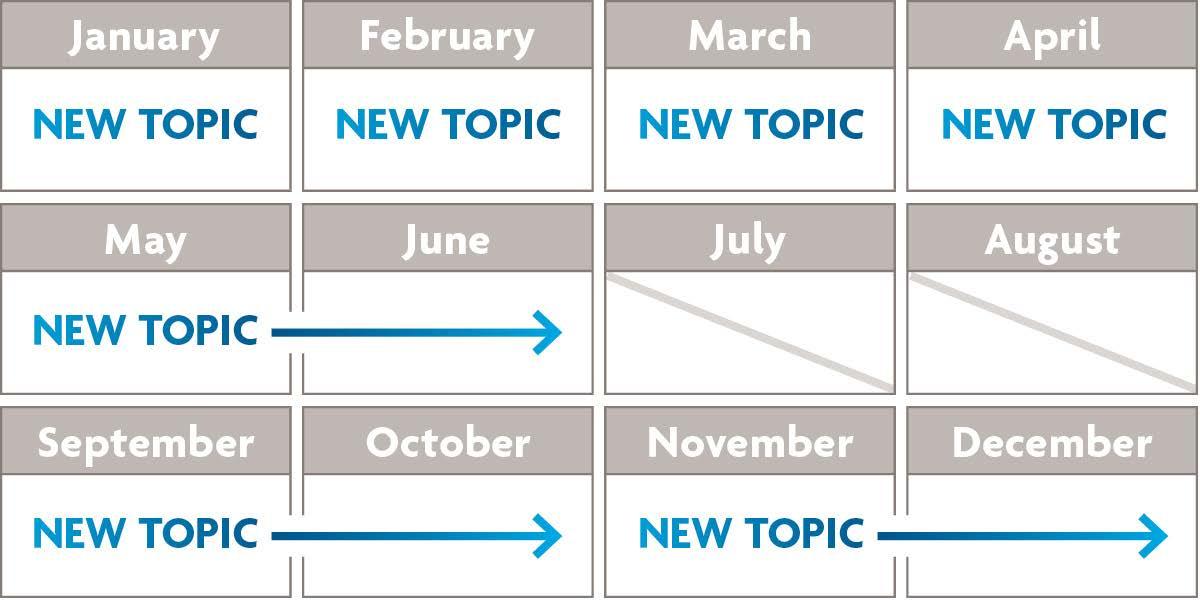
Learn more about Public Forum topics and topic voting at www.speechanddebate.org/topics Public Forum Debate Topic Release Schedule
Having a strong topic analysis process equips your team to research, create strong cases, and adapt during rounds. Use the following activities to analyze Public Forum topics with your students and prepare for a successful season.
Weigh the suitability of a future action
E XAMPLE – Resolved: The United States should eliminate the President’s authority to deploy military forces abroad without Congressional approval.
OUGHT/OUGHT NOT Explore obligation and duty
E XAMPLE – Resolved: In United States public K-12 schools, the probable cause standard ought to apply to searches of students.
The type of resolution influences the focus of the debates you will have. For example, a Should/Should Not resolution prompts debates about feasibility, trade-offs and other consequences of change. For the Should/Should Not resolution example, students can expect to explore questions like “Which situations require quick deployment of military forces?” or “What are the negative consequences of not getting Congressional approval for military action?”
STEP 2 Build Background Knowledge
Once you have determined the focus of the resolution, your team can build a bank of background knowledge.
• Assign individuals or teams to explore specific areas related to the resolution. This could include historical events, current controversies, related philosophies, etc.
• Ask each research group to share their findings with the rest of the team.
• Review and reinforce the research with a game of trivia. Build a bank of trivia questions (or clues, if you want to play Jeopardy! style) from the research. Use categories that mirror the research assignments you gave. For example, you might use “Historical Events, Current Events,” “Theories and Philosophies,” “Credible Sources,” etc.
• Host the game. Create teams that are different from the research
teams to ensure a balance of expertise on each team.
• Debrief after the game. Ask which areas students need more information or have questions about and assign additional research as necessary.
STEP 3
Define Words and Phrases
Equipped with strong background knowledge on the topic, you can now zoom in on the key words and phrases in the topic.
• Ask students to identify the most important words and phrases in the resolution (typically the nouns and verbs). For example: Resolved: The United States should eliminate the President’s authority to deploy military forces abroad without Congressional approval
• Then, they should create a bank of definitions for each word and phrase from dictionaries, legal dictionaries, court cases, scholarly literature, or government and non-governmental organization sources.
• Discuss the bank of definitions. You might ask students to compare and contrast definitions of the same word, talk about the merits of legal definitions vs. dictionary definitions, or categorize definitions based on how broad or narrow they are.
• Use the bank of definitions to engage in mini debates. Pair students with competing definitions and have them debate the pros and cons of each
definition. Ask students to debate the definitions based on clarity, fairness, accuracy, and so on.
• Debrief by discussing which definitions seemed to be the most useful or impactful on interpretations of the resolution. This discussion will help students understand how to use definitions strategically. For example, a Pro team might define the words and phrases in the resolution more broadly to expand their ground, while a Con team might prefer narrower definitions to limit the Pro’s ground.
STEP 4
Identify Clash Areas
The definitions of words and phrases indicate the specific debates that are likely to happen. Using the competing definitions of the important words and phrases, your team can map the likely clash areas, or issues that teams will debate under the resolution.
• Use the bank of definitions as the basis for a brainstorming session.
• Go through each definition and brainstorm how it influences the overall interpretation of the resolution. For example, if “deploy” refers to sending armed forces into battle then debates will likely be about military strength: hard power and military engagements. If “deploy” includes using armed forces for peacetime missions then debates will also be about diplomacy: soft power and peacekeeping.
• Create a list or mind map of all of the clash areas the team identifies.
• For each clash area, students should brainstorm the likely arguments for both sides of the resolution. For example, if “deploy” means sending armed forces into battle, the Pro side of the resolution will advocate for limiting military action abroad while the Con side of the resolution will make arguments about the necessity of quick military action.
STEP 5
Get Familiar with Impacts
Once you have clash areas, you can brainstorm the associated impacts.
• For each clash area from the previous step, brainstorm the major outcomes or consequences that Pro and Con teams might argue about. These are called impacts: the big end results that matter most in debates, like war, global warming, human rights, etc. For example, a Con team might argue that unrestricted Presidential authority to deploy troops is necessary for the US to protect global trade routes.
• Brainstorm enough impacts that your list is long enough to randomly assign an impact to each debater or team.
• Hold a tournament based on the range of impacts you identified.
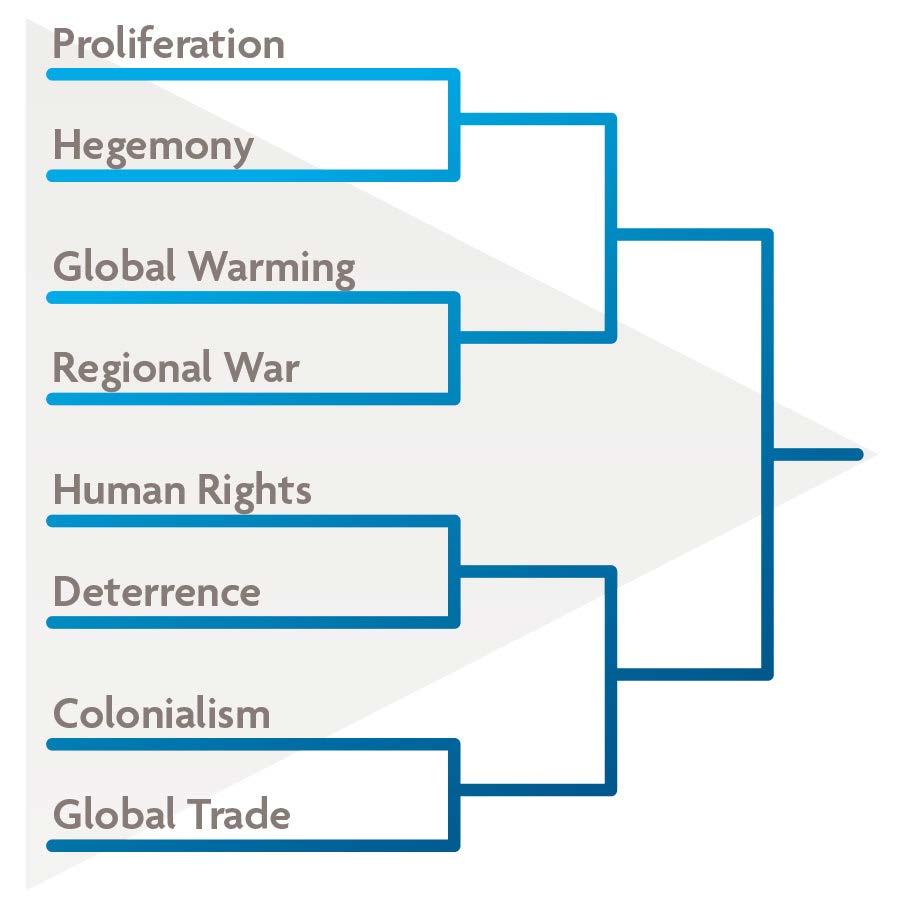
OPTION A: USE A BRACKET
Create a competition bracket and have students engage in mini debates until a winner is determined.
OPTION B: HAVE A ROUND ROBIN
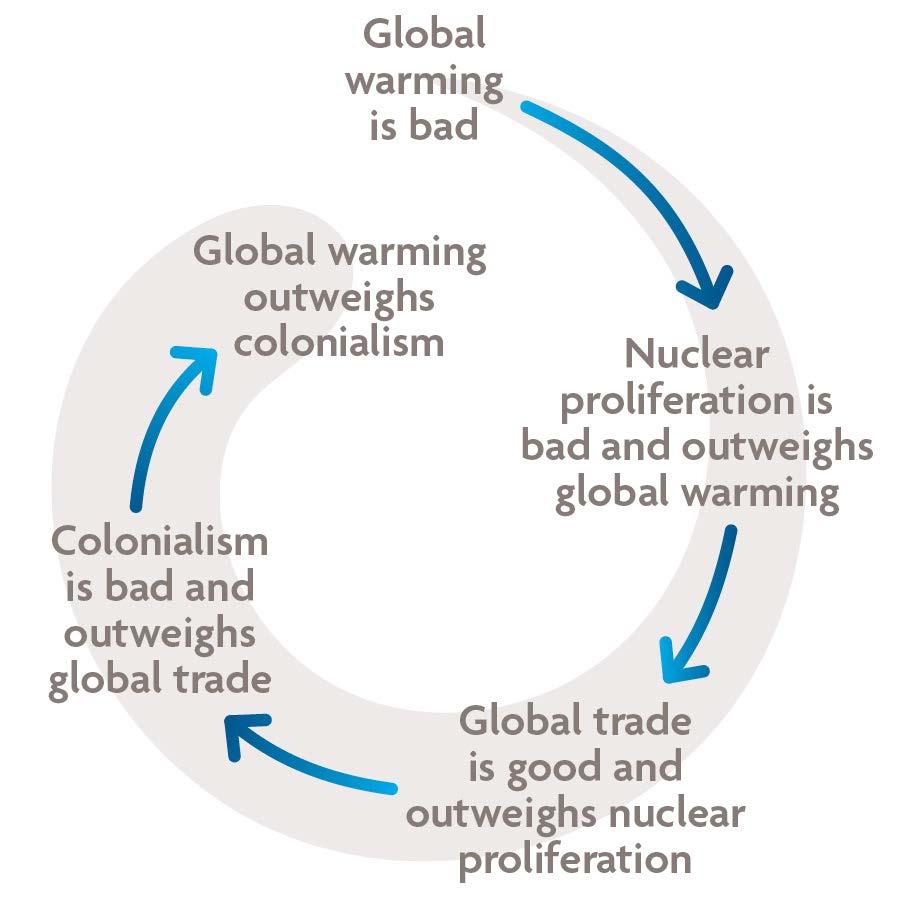
Have each student give a short speech about their impact, then weigh their impact against the impact from the previous speech. (The first speaker would give the first half of their speech first, and then the weighing part of their speech last). You can go around the circle multiple times and ask students to focus on different things each time. For example, you could focus on impact timeframe for the first round, impact magnitude for the second round, and so on.
• Encourage all debaters to flow the impact debates. They can use their flows to inform their case construction and block writing.
• Debrief by discussing which arguments most clearly and effectively weighed the impacts. Ideally, all debaters will be prepared to compare and contrast all of the impacts they’re likely to encounter while debating the resolution.
Final Thoughts
After you’ve completed these steps, your students will be prepared for the types of debates they’ll engage in, know the context of the resolution, have a bank of key terms and phrases, predict important issues, and articulate the relationships between likely impacts. Now, you’re ready to start deep and targeted research and build winning cases!
ADDITIONAL RESOURCES
Find a recording of the online workshop Break It Down: Analyzing Public Forum Topics – www.speechanddebate.org/ coach-academy-public-forum-topics.
Want to learn more about coaching Public Forum? Take the NSDA Learn course Intro to Coaching Public Forum –www.speechanddebate.org/learn/ courses/intro-to-coaching-public-forum
Access Public Forum lesson plans for high school ( www.speechanddebate.org/ start-here-teaching-public-forum ) and middle school ( www.speechanddebate. org/start-here-teaching-middle-schoolpublic-forum ).
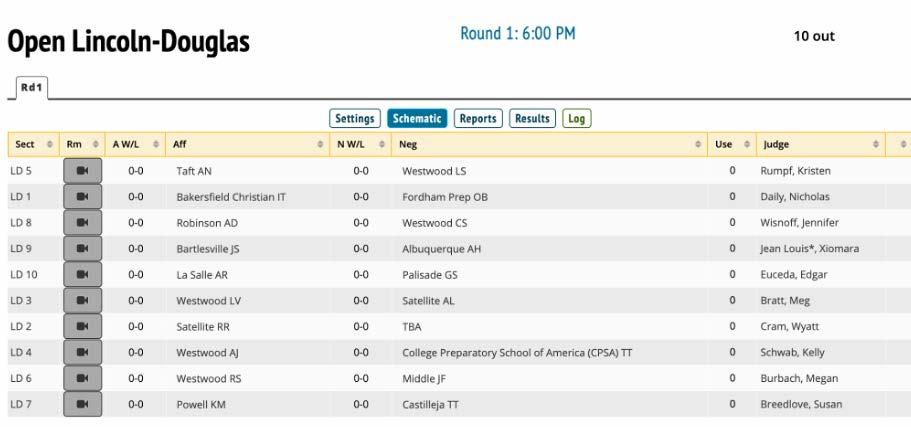
Tabroom.com offers a pairing feature that you may be unfamiliar with, but it could make running your tournament a bit easier.
Before using the Merge Timeslot Rounds feature, you should note two things. First, this feature can only be used in debate events. Second, the feature only works if you have two divisions of one debate event and those divisions share the same judge pool.
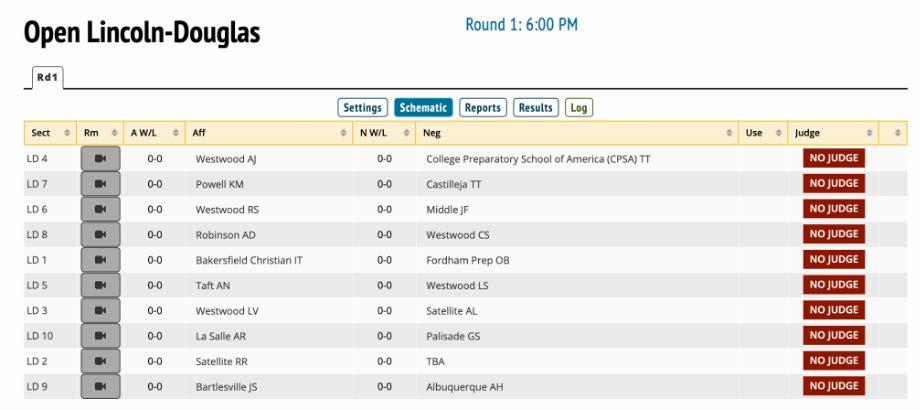
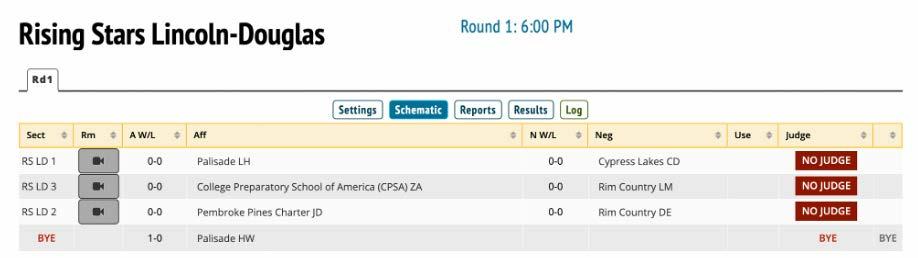
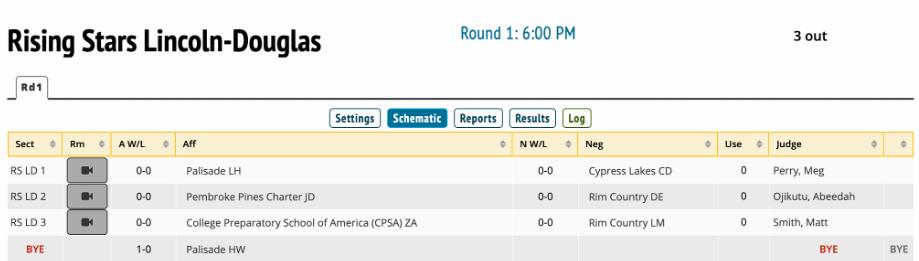
To begin using this feature, go to the Schematic tab in your tournament and select the first of the two debate divisions that you want to merge. Proceed with pairing that event. Then pair the second division (figure 1)
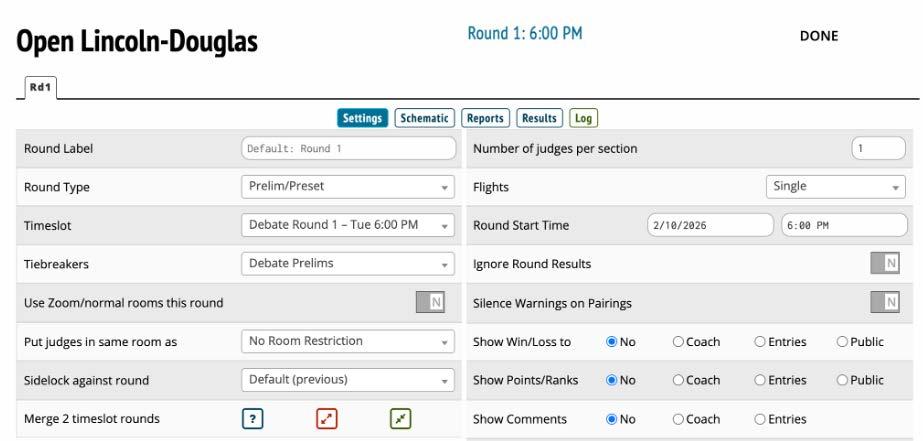
Once each division is paired, choose the Settings in one of those pairings. (Note: you can choose either of the pairings to proceed.)
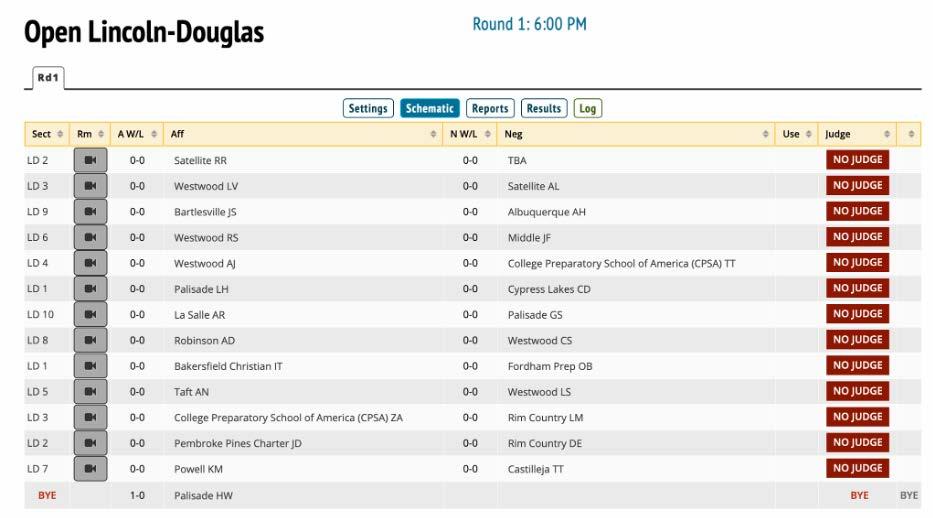
In the pairing’s Settings, find the section labeled Merge 2 timeslot rounds. To merge the two pairings, select the green box (figure 2). Once you’ve merged, return to the Schematic tab to view both divisions in one pairing (figure 3)
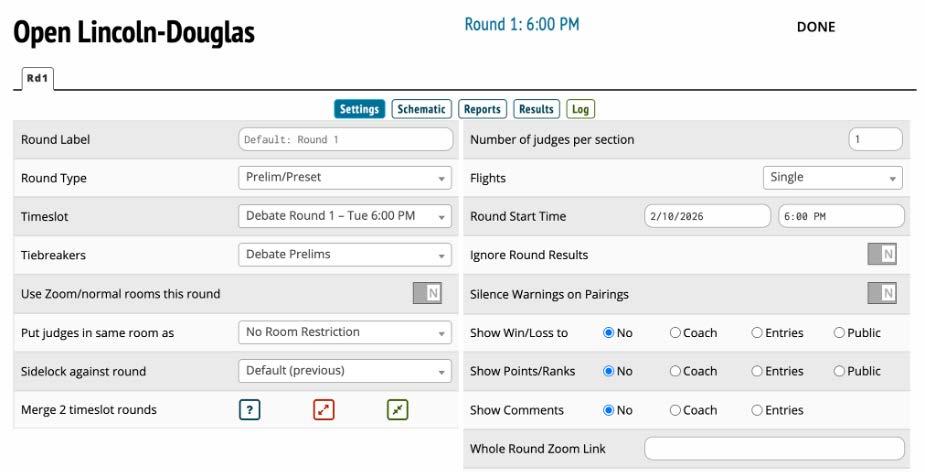
The next step is to Auto Assign Judges. In this instance, there is one LD judge pool. Once you have checked the pairing and made necessary judge changes, you will then Unmerge the pairings by selecting the red box in the Merge 2 timeslot rounds section (figure 4).
Once the pairing is unmerged, you can choose either of the two divisions’ pairings to view the final version (figure 5).
The final step is to set each pairing to blast and publish.
The Merge Timeslot Rounds feature in Tabroom. com offers tournament directors an efficient way to consolidate schedules while maintaining organization and competitive integrity. By selecting the correct rounds, verifying assignments, and reviewing pairings before publishing, users can ensure a smooth transition. When used carefully, this tool simplifies tournament management and supports a well-run event for all participants. We hope you give it a try!
Shunta Jordan serves as Tournament Services Manager at the NSDA.
figure 4
figure 5
to refute, how to weigh impacts. Instead, they found themselves translating deep, lived expertise into a debate format.
In one debate about artificial intelligence, a retired cardiologist and a former NASA scientist explained AI’s role in medicine and engineering in ways that forced the undergraduates to slow down and listen.
Their coaching became less about teaching people how to think and more about helping them shape what they already knew into speech order, timing, and clash. Louden describes his role as offering “structural help”—who speaks next, how cross-examination works—but leaving the content to the residents.
“Just let it happen and get out of the way,” he says. “They’re smart. They figure it out themselves.”
The Underdogs
Soon, Abbotswood Retirement Community in Greensboro joined the nascent league.
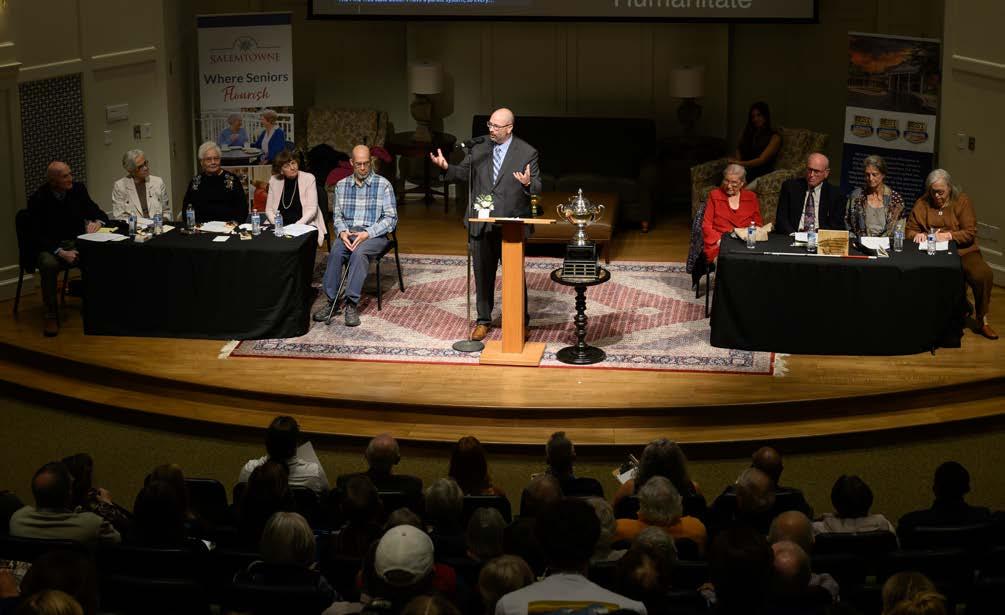
When the two communities agreed to meet for a public debate at Wake Forest, it felt like an underdog story. Salemtowne had been debating longer. Abbotswood had just six weeks to prepare for a serious, controversial resolution about repealing the Second Amendment
in front of judges and a large audience.
There were nerves. There was real preparation.
Abbotswood debaters developed a sophisticated response that any Policy Debate coach would recognize as a counter-plan approach, without using the jargon. They identified a strategic path that avoided opening constitutional revision at this polarized period in American history and instead advocated removing liability protections for gun manufacturers.
The Wake students were impressed.
And when the public debate ended, Abbotswood won on a 3-0 decision.
But the win wasn’t even the story. The story wasn’t about rediscovering jargon. It was about rediscovering the power of structure. Give people a resolution, equal time, and the discipline to listen, and debate does what it has always done. Debate activates minds.
The Moment That Unlocks the Room
Dr. Atchison says something happens almost every time they visit a new retirement community.
After explaining the idea, there is a pause. Then someone raises their hand and shares, “I did this in high school. It changed my life.”
That sentence unlocks the room—because that person is trusted, known,
respected in the community. When they say debate mattered to them 50 or 60 years ago, others listen.
At Abbotswood, one of the first volunteers had debated in high school in Missouri. Her willingness to step forward gave others courage.
For coaches and students reading this, that detail matters. The impact of high school debate does not expire at graduation.
The Wedding Tent
The next public debate will take place under a tent styled like a wedding ceremony, replete with chairs arranged, an “altar” up front, a crowd invited.
The topic? Resolved: Marriage is obsolete.
It’s playful. It’s provocative. It will draw attention. But underneath the theme is something serious: a community of older adults choosing research, disagreement, and intellectual risk over passivity.
Louden once looked at retirement activity calendars and saw plenty of crafts and social gatherings. What he didn’t see was structured intellectual challenge. Debate fills that gap. “It’s place and structure and time and purpose,” Louden says.
Then he added the line that should land with every coach: “If you quit having purpose, then what’s the point?”
The Full Circle
The project now carries a name: the National Retired Communities Debate League.
The goal is bold. Start debates in 100 retirement communities and eventually crown a national champion at Wake Forest.
And this is where the story comes back to us.
Because what’s happening in Winston-Salem isn’t just a creative retirement activity. It’s a reminder that retired debaters still belong in the speech and debate community, and that the community is stronger when they are part of it.
College students help retirees understand the format. Retirees gain something real in return: structure, challenge, intellectual rigor, and new friendships.
But they are not simply recipients of that experience. Retired debaters also bring decades of lived experience and civic judgment into the room. They ask harder questions. They see implications younger debaters might miss. And many are eager to step back into the broader world of speech and debate or excited to enter for the first time.
That’s where the circle quietly closes.
The National Retired Communities Debate League also envisions
retired debaters beginning to volunteer as judges for online or even local middle and high school tournaments. They return not as guests, but as alumni—not as a project, but as partners.
Why This Matters to High School Programs
This story is not just heartwarming. It is strategic. When communities view debate as lifelong learning, it becomes easier to defend and harder to cut.
When a retirement community debate draws hundreds of people and earns a standing ovation, debate becomes civic culture, not just competition.
When alumni stand up decades later and say, “I did this in high school,” the activity’s long-term value becomes visible.
And here is where we all come in. High school teams can:
• Reach out to local retirement communities.
• Host demonstration debates.
• Help coach format basics.
• Serve as moderators, timekeepers, or facilitators.
• Build service-based chapters focused on intergenerational debate.
• Encourage alumni to return and mentor.
Retirement communities already have book clubs and lectures. What they crave is intergenerational
connection. They want to talk with young people, not just about them.
The first day Wake Forest debaters walked into Salemtowne, they went to perform. They left having planted something much greater. Now, in meeting rooms and under wedding tents, retirees are writing speeches, rising for cross-examination, listening carefully, and taking ideas seriously.
They are proving something the NSDA has always known but doesn’t always say out loud: Debate is not an activity you age out of. It is a habit of mind, and a source of purpose, you carry for life.
Alan Coverstone serves as Director of Regional Partnerships at the NSDA.
From local competitions to national championships, we
provider of awards for
From Extemp to Public Forum, we get the lingo and match awards to the competition.
Competitive pricing without sacrificing craftsmanship.
Quick turnarounds and last-minute fixes when you need them most.
We anticipate your needs to make next year’s orders simple.
Visit our website to request a quote, order a replacement, or buy ready-made awards!
www.speechanddebate.org/trophy-shop
COMPETING STANDARDS REVISITED
by Claire Witalec and Rich Kawolics
Implicit Bias Awareness and its Impact on Gender-Based Success Disparity in
and Extemporaneous Speaking
JDebate
ust over 10 years ago, the speech and debate community began noticing a problem. Tournament outcomes in debate and Extemporaneous Speaking— from the smallest local tournaments through NSDA Nationals—seemed increasingly to be dominated by male/masculine-presenting competitors. Success rates for female/feminine-presenting competitors, indicated by the number placing at small tournaments and the number advancing in elimination tournaments, were at uncomfortable lows. Many in the speech and debate community expressed concern that female students might begin opting out of these events, turning to other activities that allowed them greater opportunity to shine. For young women in speech and debate, and those who coached them, something needed to change.
The Backstory
Concerns about gender disparity in speech and debate are nothing new, but neither are assumptions about the comparative abilities of masculine-presenting and feminine-presenting competitors, especially in the realm of debate and analytical speaking. For example, when Extemporaneous Speaking was added to the NSDA (then NFL) menu in the early 1930s, it was an event exclusively for male competitors. It took 20 years before a separate event for women was added, and another 30 before the
gendered categories were finally unified into the current United States and International Extemporaneous Speaking events.
For its part, the NSDA since the 1980s has worked to introduce new speech and debate opportunities for all students, irrespective of gender identity. A significant addition came in the 20022003 season with the creation of Public Forum Debate, then known as Controversy Debate. The new event proved to be immediately popular among female competitors, and for the first few years of the event, success rates for female
and male competitors at the NSDA National Tournament were on par. However, beginning in 2009, femininepresenting debaters were disproportionately eliminated in preliminary rounds, a trend that continued through the end of the next decade (Ronald and Kawolics, NSDA National Conference, 2019).
The diminishing success rate for feminine-presenting debaters did not go unnoticed, and by the end of the 2010s, some attempts to quantify the problem were being made.
One of the first attempts to do so came in 2017 when a group of high school debaters from Ohio published a qualitative analysis of ballots from a single tournament. Although their data were limited, they provided a strong indication that feminine-presenting debaters received more criticism while masculine-presenting debaters received more encouragement from judges (Reardon et al., 2017).
A year later, a group of student researchers from Laurel School conducted extensive analysis of entries and success in Public Forum, Lincoln-Douglas, and Extemporaneous Speaking from 50 tournaments across the U.S. The results, published in Rostrum in April 2018,
showed a significant and persistent disadvantage for feminine-presenting competitors in all four events (Lynn et al., 2018). This disadvantage was troubling in light of prior academic research that had shown parity or advantage for feminine-presenting students in all factors believed to be useful in effective debate and analytical speaking.
Subsequent scrutiny of debate ballots in a blind study conducted by the same researchers also confirmed the reality of more frequent criticism of feminine-presenting debaters for aggression, emotion, and tone, and that these criticisms were frequently linked to competitive outcomes (Ronald and Kawolics, NSDA National Conference, 2019).
Although far from comprehensive, the data indicated that the success deficit for feminine-presenting debaters was likely the result of structure. This conclusion was justified in part by mounting evidence that feminine-presenting debaters were criticized for their debating “style” more often than masculinepresenting debaters, as well as a growing body of scholarly work showing the impact of implicit bias in employment, education, and politics.
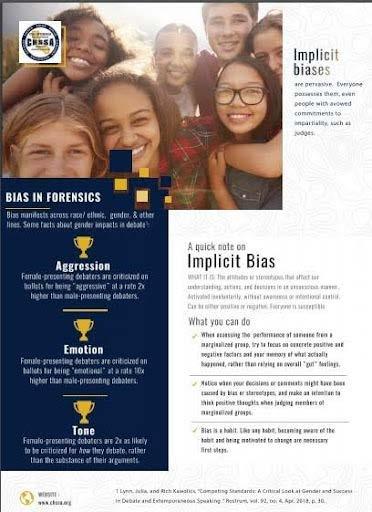
Armed with confirmation of what they had long suspected, leaders in the speech and debate community began crafting solutions. The California High School Speech Association (CHSSA) led the effort by pioneering judge training and ballot instruction on Implicit Bias (figure 1). Other state associations followed, and by 2020, the NSDA had included implicit bias language on its ballots. Today, the overwhelming majority of NSDA districts and state associations include implicit bias ballot language and training to some extent.
Seven Years Later
In the years that have passed since 2018, including a few that were turned upside-down by a global pandemic, the idea of implicit bias has become a familiar one to coaches and judges alike. And there has been a general sense that the playing field may be becoming
more level for femininepresenting competitors; at least it seems that way. However, to this time, data on the efficacy of that increased awareness has been lacking.
At the end of the 20242025 school year, we decided to repeat a portion of the 2018 study. Co-author Claire Witalec pored through NSDA National Tournament results from 2019 through 2025, using the same parameters as in the original analysis. Focusing on the same four events—Public Forum, Lincoln-Douglas, and U.S and International Extemporaneous Speaking— we determined the relative percentages of femininepresenting competitors from qualification through finals. The data were appended to that from the previous study, and statistical analysis on feminine-presenting representation at all levels was conducted.
As in the 2018 study, we were challenged by the task of accurately identifying gender presentation for each participant, as well as the implicit assumption that gender can be represented by a simple binary. The NSDA and other governing bodies do not collect demographic data on participants, so collecting statistically valid information on success rates based on gender was challenging.
Therefore, as we had seven years ago, we relied heavily on social media profiles,
competition photos and videos, and school websites to help categorize competitors, a method that proved to be most productive. For example, a search of “[School Name] Speech and Debate Team” will often lead to a dedicated site or page containing captioned photos and articles celebrating student accomplishment. These materials, which sometimes include chosen pronouns, were frequently useful in resolving uncertainty. However, in some cases we had to make assumptions based on competitors’ chosen names. That is, we assumed that if a student competed under a traditionally gendered name, such as John or Megan, the gender presentation was likely to match that name.
For the current analysis, we also included “nonbinary” as a designation for those competitors who clearly presented outside historically assumed gender designations. There was also a small number (fewer than 1% in all events and years) that we could not categorize by any means, and those were excluded from the analysis.
As in 2018, although we strove to be both accurate in our analysis and respectful of competitors’ identities, we cannot claim that our work is free from errors in classification. It also should be noted that classifying individuals by appearance alone should be avoided
whenever possible, but was undertaken in part for this project under specific, datadesirous conditions.
The Findings
Although there was not a clear “before” and “after” with respect to implementation of implicit bias awareness, we chose to treat the years 2010 through 2018 as our baseline, and 2019 through 2025 as our “post-bias awareness” sample. Our prior study had detailed two significant disparities for feminine-presenting competitors in all four events between 2010 and 2018.
First, the number of feminine-presenting qualifiers to the NSDA National Tournament was well below parity with their masculinepresenting counterparts, with the median qualification rate ranging from 37% for Lincoln-Douglas Debate down to 32% for International Extemporaneous Speaking.
Second, femininepresenting competitors faced disproportionate attrition as they moved through the tournament, so that the median percentage of feminine-presenting competitors making the stage was below 25% in all four events.
Our latest results are compelling. Figures 2 through 5 (next page) show that the percentage of femininepresenting qualifiers to NSDA
figure 1 – CHSSA Implicit Bias Handout, 2018
Nationals has increased to a statistically significant extent in all four events studied. The results are most dramatic in LincolnDouglas Debate, where the minimum number of feminine-presenting qualifiers between 2019 and 2025 is actually greater than the maximum number of qualifiers between 2010 and 2018. Statistical significance is high, with p values below .05 in all four events studied. With respect to attrition of feminine-presenting competitors, the findings are not quite as clear. In Lincoln-Douglas Debate and both Extemporaneous Speaking categories, the disproportionate attrition seems to have disappeared, with the percentage of feminine-presenting competitors in elimination and final rounds meeting or exceeding the percentage of qualifiers (figure 6). In Public Forum Debate, however, the disproportionate attrition of feminine-presenting competitors has persisted. The median percentage of feminine-presenting competitors in Public Forum final rounds between 2019 and 2025 drops by nearly 14 percentage points, an attrition rate nearly on par with that of the prior nine-year period. We can only speculate about the causes of this disparity, although we suspect that the partnership aspect of
Public Forum Debate likely plays a role.
It is important to note that while the increased success of femininepresenting competitors in these events appears to be strongly correlated to the introduction of implicit bias ballot language and training, we cannot claim a causal relationship. Confirming causation would require a carefully controlled study, a feat which would be impossible within the realm of competitive speech and debate. Despite that, the correlation to the introduction of anti-bias awareness is so strong that it is hard to imagine that this change did not play some role in the increased success rates for feminine-presenting debaters and extempers.
Going Forward
We are greatly encouraged by these findings, and we conclude that implicit bias ballot language and training likely have been impactful in reducing gender-based success disparity in debate and analytical speaking competition. We note, however, that success parity has not been achieved in any of these events; the number of feminine-presenting National Tournament qualifiers in these events has not reached 50% in any year studied. Clearly, there is more work to be done.
In the future, we would encourage others to do a deeper dive into the implementation and effect of implicit bias language and training throughout the speech and debate world. We know that not all districts adopted implicit bias ballot language at the same time, and we also know that many districts and state organizations do not include implicit bias training for judges at their tournaments. Therefore, we think an examination of potential correlations between the frequency and extent of bias training and the success of feminine-presenting competitors on a district level would be worthwhile.
References
Still, we think these are results to celebrate. The very public acknowledgement of and attention to gender bias in speech and debate over the past decade seem to have contributed to a real and significant shift in the success rates for femininepresenting competitors.
We commend and thank all those national, district, and state officials who acknowledged the problem that existed and took meaningful steps to address it. We look forward to continued work at all levels to eliminate bias and disparity from speech and debate, wherever and whenever it occurs.
Lynn, J. & Kawolics, R. (2018). Competing Standards: A Critical Look at Gender and Success in Debate and Extemporaneous Speaking. Rostrum, 92(4), 30.
Reardon, J., Haddad, G., Santor, A., & Francis, C. (2017) The Feminist Kritik. Ohio Speaks, https://ohiospeaks.net/2017/05/06/thefeminist-kritik (archived).
Ronald, A. & Kawolics, R. (2019) NSDA National Conference, https://www.speechanddebate.org/gender-inequity-speechdebate-discussion.
Claire Witalec (’28) is a tenth grade student at Laurel School in Shaker Heights, Ohio. She took on this research in May of 2025 after competing in speech and debate in eighth and ninth grades. Claire participates in Lincoln-Douglas Debate and recently earned her second qualification to the Ohio Speech and Debate Association State Finals, and has earned two fully qualified bids to the 2026 Tournament of Champions.
Rich Kawolics retired from teaching in 2022 but has continued coaching debate in Ohio since that time. He also serves as the Lincoln-Douglas Curriculum Director for Classic Debate Camp and is a member of the Ohio Speech and Debate Association Board of Directors.
The authors are grateful to Julia Lynn, currently a Ph.D. candidate at the University of Antwerp, Belgium, for her editorial assistance on this article.
Supporting visionaries
We proudly support the National Speech & Debate Association, investing in today’s young intellectuals to help shape tomorrow’s leaders, innovators, and changemakers.
troutman.com
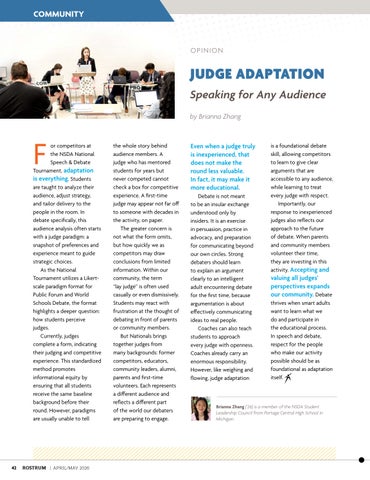
For competitors at the NSDA National Speech & Debate Tournament, adaptation is everything . Students are taught to analyze their audience, adjust strategy, and tailor delivery to the people in the room. In debate specifically, this audience analysis often starts with a judge paradigm: a snapshot of preferences and experience meant to guide strategic choices.
As the National Tournament utilizes a Likertscale paradigm format for Public Forum and World Schools Debate, the format highlights a deeper question: how students perceive judges.
Currently, judges complete a form, indicating their judging and competitive experience. This standardized method promotes informational equity by ensuring that all students receive the same baseline background before their round. However, paradigms are usually unable to tell
the whole story behind audience members. A judge who has mentored students for years but never competed cannot check a box for competitive experience. A first-time judge may appear not far off to someone with decades in the activity, on paper.
The greater concern is not what the form omits, but how quickly we as competitors may draw conclusions from limited information. Within our community, the term “lay judge” is often used casually or even dismissively. Students may react with frustration at the thought of debating in front of parents or community members.
But Nationals brings together judges from many backgrounds: former competitors, educators, community leaders, alumni, parents and first-time volunteers. Each represents a different audience and reflects a different part of the world our debaters are preparing to engage.
by Brianna Zhang OPINION
JUDGE ADAPTATION Speaking for Any Audience
Even when a judge truly is inexperienced, that does not make the round less valuable. In fact, it may make it more educational.
Debate is not meant to be an insular exchange understood only by insiders. It is an exercise in persuasion, practice in advocacy, and preparation for communicating beyond our own circles. Strong debaters should learn to explain an argument clearly to an intelligent adult encountering debate for the first time, because argumentation is about effectively communicating ideas to real people.
Coaches can also teach students to approach every judge with openness. Coaches already carry an enormous responsibility. However, like weighing and flowing, judge adaptation
is a foundational debate skill, allowing competitors to learn to give clear arguments that are accessible to any audience, while learning to treat every judge with respect.
Importantly, our response to inexperienced judges also reflects our approach to the future of debate. When parents and community members volunteer their time, they are investing in this activity. Accepting and valuing all judges’ perspectives expands our community. Debate thrives when smart adults want to learn what we do and participate in the educational process. In speech and debate, respect for the people who make our activity possible should be as foundational as adaptation itself.
Brianna Zhang (’26) is a member of the NSDA Student Leadership Council from Portage Central High School in Michigan.
IBETTER BALLOTS A Student Perspective
by Luke Kosner
was lucky to receive some of the best feedback of my four year speech and debate career when I was a freshman. Competing in my first Public Forum tournament, I had somehow advanced to elimination rounds. The panel spent 15 minutes deciding who won and then explained the decision to us in great detail. The judges knew that both teams were just starting out with the activity and made sure we understood everything. They provided feedback based on their personal experience and offered to answer any questions we had. Three years and nearly 30 tournaments later, I still think about that round and occasionally re-read the written ballots.
Of course, detailed feedback often requires significant speech and debate experience that many volunteer judges do not have. But recently, I learned more from a parent judge than many Policy Debate veterans. Before the round, this volunteer said he would take notes and vote for the team whose arguments were generally more persuasive. He asked us to speak slowly and not assume he knew
anything about the topic. Afterward, he wrote and read aloud a few paragraphs explaining his decision, argument by argument. This judge then told us why he enjoyed watching our debate and encouraged us to continue developing our research and speaking skills. He also gave us suggestions for future rounds in front of parent judges.
The experience was incredibly positive and educational. We might not have become better at high-speed, technical debating, but we received a reminder about why we compete—to better understand and explain our world.
Unfortunately, I have also endured my fair share of rough decisions and unproductive rounds. In one instance, a judge deducted speaker points from my partner because he touched his sock. In others, judges who are experienced former debaters ruled against us for responding to our opponents’ insensitive arguments.
In many of those rounds, we received neither substantive comments on our arguments nor constructive points of view about the uncomfortable discussions we experienced. Instead, my partner and I walked away from these rounds troubled and confused.
We were lucky that these negative experiences came well into our speech and debate careers. If we were still freshmen, we might have simply quit the activity altogether. As a senior and team cocaptain, I have watched many talented recruits decide not to continue after poor judging.
My goal in sharing these anecdotes is to make the point that anyone who is motivated can make a great judge— and that even outstanding judges can sometimes forget about their duties as educators and write unhelpful ballots.
I also hope that my words can serve as motivation for the thousands of volunteers completing judge accreditation in advance of this June’s National Tournament in Richmond, Virginia.
Drawing from my own experiences and those of Spencer Chaisanguanthum, my colleague on the NSDA Student Leadership Council, I have compiled some thoughts for all judges—whether veteran or brand new.
TO EVERYONE:
• Know that students appreciate your contribution to speech and debate—even when we do not make our gratitude obvious.
• Please be the adult and educator in the room. Hold us accountable for problematic behavior, but do not engage in it. Your actions have the power to support a student’s passion or turn them away from the activity. If you feel comfortable, consider providing words of encouragement to struggling students.
• Present your preferences clearly. For instance, a 10-second explanation of how you plan to evaluate a round before it starts is very helpful. If you feel unable to separate your decisions from your background knowledge, let the students know.
• Take your accreditation seriously. Unfair judging continues to be an issue in speech and debate. The training
includes proven methods to identify and handle bias. Your conscientious efforts will result in a better, more equitable tournament and help make the experience fulfilling for students.
TO COACHES:
• Know your audience. When I was new to the debate, many judges wrote feedback that was incomprehensible to me. A brief explanation of speech and debate jargon can make all the difference.
• Adapt to the style of the round, especially in debate. If competitors are more interested in careful examination of facts than rapid-fire arguments, consider reading evidence that students have sent to you or requesting it if they have not.
TO VOLUNTEER JUDGES:
• Be yourself. Students realize that not all judges will evaluate their round in the same way. In many formats, we change our
strategy substantially based on the adult in the room. Ballots will, and should, reflect your unique interpretation of the round.
• Do not shy away from specifics. Spencer notes that “detailed, observant judges encourage competitors to put in the extra effort.”
In debate, helpful decisions should “go a little deeper” than “I liked x argument”— include “some sort of comparative language that describes why exactly one side was more persuasive than the other.”
• Leave personal politics out of your decision. Students may make claims that conflict with your own beliefs or thinking. Provided they cite reputable sources and explain their reasoning, try not to discount their points.
• Be open-minded. Unexpected arguments can often be persuasive and backed by scholarly research.
TO FORMER COMPETITORS:
• Be mindful of time. While competitors appreciate detailed feedback, we sometimes need to prepare for upcoming rounds.
• Share your knowledge. Spencer appreciates when judges “call out specific evidence and suggest I read a different author or more recent article”—it “is an immediate fix I can make between rounds.” Insights about quick word changes can be helpful to students.
In my view, being a great judge does not necessarily require significant experience. It is about having an educator’s interest in providing guidance, clarity, and motivation for students at all levels.
Terrific judges have helped me and my peers from across the country develop as competitors and people. And for that, we are grateful.
Access a complete series of NSDA judge accreditation modules on our website!
www.speechanddebate.org/judge-accreditation
Luke Kosner (’26) is a member of the NSDA Student Leadership Council from Collegiate School in New York.
START STRONG, STAY LONGER
H ow intentional support is helping new speech and debate coaches thrive
by Joseph de Oliveira Tyler
Having participated in speech and debate in Idaho as both a competitor and a coach for the last 11 years, I’ve gotten to rub shoulders with some incredible individuals. Our local coaches are paragons of speech and debate, and I have learned so much from them all. With this wealth of knowledge and experience in Idaho, I was (and still am) floored to have been elected chair of the Idaho Mountain River (IMR) District. Only then did I finally decide I no longer counted as a new coach. Several coaches retired and left that year. With this in mind, our District Committee and a handful of other dedicated coaches took on the challenge of making coaching as accessible as possible. My hope is that these steps can help other regions encourage the participation and retention of new coaches.
1 Creating a New Coach Guide
One of the very first conversations we had was about how to best support the sudden influx of new coaches to our district. The answer was in writing and sharing an Idaho New Coach Guide ( www.tinyurl.com/yrmb7crs ). It contains everything you could possibly need to know in your very first year of coaching. There are step-by-step guides
of how to register for tournaments, tips and tricks on how to manage your team, how to preserve a work-life balance, and so much more. The guide is a living document where coaches continue adding to it as they think of new things or discover a new trick to coaching.
2 Coach Meetups
Upon learning who the new coaches were
in our district, Robin Christensen, Jethro Smith, Cynthia Browneller, and several members of the IMR committee had individual meetups with the new coaches. These were relatively informal events at cafes where the new coaches got to ask whatever questions they had for us. We would discuss some of the important things to be aware of early on when starting a new program, as well as upcoming deadlines and events they should attend.
We also hosted a large potluck at the beginning of the year for all the coaches in our region to get to enjoy each other’s company and allow our new coaches to meet the others in our circuit. Everyone had a great time, and any excuse for me to make some Brazilian pão de queijo is one I will happily take.
3 District Website
A major barrier for our new coaches was simply not knowing where to find information. This led to the creation of the Idaho Mountain River NSDA District website ( https:// sites.google.com/view/idahomountain-river/home ), with all the information coaches could need, as well as a massive compilation of
resources for new teachers and coaches.
4 Tab Room Partnerships
Here in Idaho, our tournament tab rooms are comprised entirely of coaches from local schools. Even though very few people are actually needed to tab a tournament, we often assign multiple people to the same role.
The best way to learn Tabroom.com is to use the software, so we like to pair our veteran coaches with our new coaches. This allows them to learn how tournaments work and gain the knowledge to be able to easily run tournaments in the future. We generally try to cycle through coaches so everyone has a chance to learn all the different positions.
5 Regular Check-Ins
In my opinion, this is the most important thing you can do for new coaches. At tournaments, I’ll find the new coaches and chat with them for a bit, to make sure that their season is going alright, and so they know they have a friend among the coaches who is thinking about them.
The best way to convince a new coach to stick around for another year is to make sure
they enjoy their time at tournaments. Whether that’s a friendly chat or being invited into a tab room game of Magic: The Gathering, fostering a sense of community and friendship is vital to long-term stability.
6 Being on Call to Answer Questions
All of the new coaches have my phone number and email and are encouraged to ask me any questions that they might have throughout the year. Having someone who can answer questions and provide some extra guidance was vital for my first few years as a coach, and still is to this day. My intent is to pass on the same warmth and kindness that was shown to me.
New coaches are some of the most important members in our organization. They ensure that the activity continues when a fivediamond coach retires. They are the ones who create brand new programs and help bring the joys of speech and debate to students who have never gotten the opportunity before. All of the greatest coaches in this organization started out as new coaches. We should give them as much support as possible to help them achieve that.
NEW COACH INSIGHT
The Power of Mentorship
by Taylor Clapp
Back in August, a coach reached out to me on Facebook. Jethro Smith had heard through the grapevine that I was the new coach for Blackfoot High School in Idaho and wanted to meet and offer his support.
I met with him and the Idaho High School Activities Association (IHSAA) Speech Commissioner, Robin Christensen, where they graciously taught me about the events with which I was unfamiliar and shared resources to aid me in teaching some of the more complex events. A few weeks later, I was invited to a coaches potluck. Before I had even signed my contract, I had met many of the coaches in the region, and I am so grateful for the community I stepped into!
Not only is this my first year as a coach, but it is also my first time teaching K-12. A week before classes began, I was informed it was my responsibility to develop the speech curriculum for my district and to lead the Speech PLC. In a panic, I reached out to Robin, and she invited me to observe her classes for a day. Afterward, I asked her close to a million questions at the end of the day! She shared copies of her assignments, and I was able to structure a lot of classes around that one day—though I am always looking for ways to grow.
One Friday, our region did not have a tournament planned and my school district was not in session, so I reached out to Jethro Smith and asked to shadow him; he excitedly agreed! Jethro is the head coach for the school that the NSDA has ranked first in the state of Idaho; my school is ranked second. It almost felt scandalous for me to be there! As Jethro puts it, “A rising tide raises all ships. Having stronger competition makes my own team stronger by forcing them to learn and adapt.”
Each time I observe another coach in the region, I am able to bring new techniques, strategies, and teaching methods back to my team and strengthen the overall competition in the region! In February, I was recognized as the Idaho Mountain River New Coach of the Year. My success was truly an accomplishment of the region because I could not have done it without the support of all the veteran coaches! I am profoundly grateful to have become a coach when I did, so I could meet so many wonderful coaches whose primary focus is the collective education of our students.
NEW IN 2026! The NSDA is launching a Coach Mentorship Program Pilot in August. We’re building a strong pool of volunteer mentors for matches that will begin on a rolling basis early next year. If you’re interested in serving as a mentor, please complete our interest form!
(left to right) Idaho Mountain River coaches Garrett Gaines, Cynthia Browneller, and Robin Christensen.
ANSWERING THE CALL
Ethan Gambriel and Kathy Tobin
by Annie Reisener
In the summer of 2019, Ethan Gambriel stood on the final round stage next to his partner Tyler Simpson as they nabbed a second place win with their Duo, A Tiny Miracle with a Fiberoptic Unicorn.
Six years later, he returned to the stage as his heart raced in the same way—but this time, he wasn’t waiting to hear his own name.
Kaeden Abraham and Isabella Windmiller, the Duo team he’d been working with since their eighth grade year, had made it to the final round. The third place outcome was similar, but the experience was entirely different.
The Way Back
Ethan didn’t leave high school expecting to become a speech and debate coach. He planned to be a theater teacher— focusing on his specific love of acting, character development, and bringing words to life—but the activity has a way of pulling people back in. Once you’ve witnessed the transformative power of speech and debate, it’s hard to ignore the opportunity to provide others with the same experience.
(Re)enter Kathy Tobin, Ethan’s former coach. When Kathy asked Ethan to take over coaching the middle school program in his
sophomore year of college, he accepted, thinking he’d found a solid position to support him through school. He spent the year working with a team of 10 students, primarily in interpretation events. The next year, the activity called to him again. Kathy needed a new assistant coach. Was he interested? What began as a “just for now” role began to take center stage. As he worked with students, Ethan found coaching was fun. He remembered how much he truly loved speech and debate. “The thing that made me really want to be a teacher, in retrospect, was the fact that speech and debate gave me this voice. Most of my best memories from high school were at tournaments, or with Kathy, or with my best friend, Tyler,” Ethan says. He made the decision to pursue a future in speech and debate. Now, he teaches English and coaches alongside Kathy Tobin at his alma mater, Willard High School in Missouri.
Familiar Pathways
Like Ethan, Kathy is a competitor turned coach. Her journey back was a longer road: She took on the team at Willard when her son’s school didn’t have a coach and built the program into the powerhouse it is today.
Team culture has always been a key element of Kathy’s approach to coaching. She focused on recognizing all progress, not just wins. Student investment in the
activity improved in tandem, with novice points increasing dramatically from 75 to 500. Celebrations were huge—the team cheered for all degree advancements, made a big deal out of birthdays, and built pomp and circumstance into the smaller wins.
It was this culture that shaped Ethan as both a competitor and a coach. He entered the classroom a hard worker who understood the process of continuous improvement and was ready to instill those same values in his students.
Early Adaptations
One of Ethan’s earliest lessons as a coach was learning to loosen his grip. When he encountered students whose sense of humor or take on material differed from his, he realized he needed to change his approach. “I had to learn to let go of exactly what I wanted them to do,” Ethan says. “When I actually started listening to them—what they thought was funny, what they wanted to say—it became a collaboration.” In that shift, he discovered a truth that would shape his coaching philosophy: If coaches tell students their voices matter, they also have to be ready to hear them.
As Ethan’s role with the team grew, so did Kathy’s trust in him. They became true partners, dividing roles to fit their skillsets. Kathy continued to use her experience to tackle the internal mechanics of the program—budgeting, logistics, administration, and the institutional memory that
Kathy Tobin and Ethan Gambriel
keeps a large team running smoothly. Ethan took on more outward-facing responsibilities, managing communications, social media, and team events that shaped how students experienced the program day to day. He was a good student, watching rounds in events he was unfamiliar with to prepare to work with students.
Growing through Partnership
For Ethan starting out, Kathy’s influence ran deeper than logistics. One of the biggest lessons he learned from her carried over from his time as a student. She modeled a fierce commitment to fairness and integrity, advocating for correct tournament procedures even when doing so didn’t benefit their own students—reinforcing that how you win matters as much as winning itself.
The pair didn’t split events; they both coached it all, running ideas by each other. That crossover has opened the door to both respectful disagreement over approach and further learning based on exchanging strategies and coming to final decisions together.
Kathy believes students seeing those interactions is valuable. “We’ve had different opinions about characters and scripts in front of the kids. They’ve seen us be passionate but still be able to have civil discourse.”
Ethan brought fresh energy and a different perspective to the team. As a former competitor, he had experience
GAMES FOR MIDDLE SCHOOL STUDENTS
1 STATUES IN THE GARDEN
WHAT IT BUILDS – physicality, commitment, nonverbal storytelling
HOW TO PLAY:
• Call out a prompt (fear, victory, jealousy, pride, embarrassment).
• Students freeze into a statue showing that idea.
• Move around the room like a museum curator.
• Tap a few students on the shoulder and ask them to come to life for five seconds with sound or movement.
• Reset and repeat.
2 TELLY CHANGER
WHAT IT BUILDS – character creation, physical awareness, improv skills
HOW TO PLAY:
• Put students in small groups (three to six).
• Two students start by acting out a scene. The audience gives them the first genre,
in all event types, and as a finalist himself, he was able to relate to students in high pressure situations in a powerful way. “I remember what it felt like to watch the posters drop, and I remember those times when my code wasn’t on the poster. I felt the loss. I felt the success. And all those things that I learned along the way—to value myself, to be confident no matter what, to embrace the story that I wanted to tell no matter what anybody else thought— carried with me. Because of that, it’s easier to coach
One of Ethan’s strategies for success for coaching middle school is to bake in a lot of fun to entice students to keep coming back (and to bring friends!) to practice. with confidence. The program she rebuilt, the culture she protected, and the values she instilled are being carried forward—by someone who once sat on a stool beside her desk rather than in his own seat in class, eager to learn and improve. Their legacies are forever intertwined, and each became a better coach because of the partnership they built. Kathy and Ethan are truly a champion duo.
such as cooking show, telenova, Olympics, documentary, reality television, etc.
• One student is the “changer” and gets to say “SWITCH!” when they want to change the channel. Groups act out a new scene in the new genre!
3 CHARACTER PARTY
WHAT IT BUILDS – character creation, physical awareness
HOW TO PLAY:
• Have students move around the room as if they’re at a party. You can set the theme!
• Call out invented character traits one at a time (old, confident, sneaky, exhausted, royal) or use characters they’re familiar with.
• Then combine traits (confident + nervous, royal + bored).
• Freeze and have students look around the room to get more ideas or get inspired.
• Have them add a character voice and talk to one another if they really get it!
students because I’ve been there and I know it from their perspective.”
Ethan’s energy also revitalized Kathy. “It’s exciting to collaborate with him because he’s so willing to work with other people and listen to the kids’ ideas,” Kathy says. She watched as Ethan took on a “big brother” role while drawing new boundaries in existing relationships with team members to reflect his responsibilities as a coach.
Tradition in Motion
As Kathy looks toward retirement, she does so
Annie Reisener serves as Director of Membership at the NSDA.
WHEN BELONGING TOOK THE STAGE
S outh Dakota’s First Unified Speech Event
At a speech and debate tournament, it is easy to assume the biggest moments will come from the biggest wins or the tallest trophies. However, sometimes the loudest truth in the building arrives in a round that isn’t trying to be the headline.
At the Brandon Valley Speaking Lynx Speech Tournament in South Dakota, a new category entered the schedule and quietly redefined the day. What happened there wasn’t born from a desire to award more trophies. It came from a belief that speech and debate should be
by Travis Rother
a universal activity, one that belongs to every student regardless of ability or background.
In the space of this small portion of a regular speech invitational, the NSDA mission moved beyond words on a website and became something tangible: a diverse community empowering students through speech and debate.
South Dakota hosted its first-ever Unified Speech category, created in partnership with Special Olympics, under the leadership of Gina Koehn of Brandon Valley High School and Michelle McIntyre of Sioux Falls
Washington. The Unified approach is exploding in high school sports, creating opportunities for students with disabilities to compete alongside students without disabilities. It was inspired by a simple principle: training together and playing together is a quick path to friendship and understanding.
Patrick Pope from Harrisburg High School, who attended the tournament, felt the beauty of the moment: “Gina arranged for a full audience of students, coaches, and judges to attend the final round. The atmosphere in that room was electric. The pride,
the empathy, and the genuine joy in witnessing something new and right were palpable. It was not merely a round—it was a statement of what inclusion can look like when it’s done with intention and heart.”
After speaking with Gina and Michelle, it became clear that Unified Speech didn’t begin as a grand initiative or a carefully engineered program. It began with a simple question: Who isn’t in the room yet? What followed was not a rewrite of speech and debate, but an expansion of it, shaped by collaboration, curiosity, and a willingness to build something new in real time. The result was a reminder that when coaches lead with belonging, the entire community learns to listen differently.
A Question They Couldn’t Ignore
Gina Koehn has coached for decades, and her entry into the activity will sound familiar to many coaches: “Somebody put a box of stuff on my desk and
(right) Savannah Koll, a Unified Speech contestant, receives an award during the Brandon Valley Speaking Lynx Speech Tournament in South Dakota.
Gina Koehn
Michelle McIntyre
(below) Unified Speech organizers Gina Koehn and Michelle McIntyre.
said, ‘Here’s the stuff you need, figure it out.’” After 11 years in South Texas, she returned to South Dakota and has spent the last 21 years at Brandon Valley.
Inclusion has always been part of how she sees speech and debate. “We have kids from every sport... we share our kids with every activity.” But there was one question she couldn’t stop thinking about: how do you get students with special needs involved?
Then came a conversation that turned the “someday” into “let’s do it.”
Gina had a parent approach her at conferences. The mother had done speech and debate at Brandon Valley when she was a student and she wondered if there was a way her daughter with special needs could do speech. Gina’s response was enthusiastic: “That would be fantastic.”
Gina called Michelle, a colleague from South Dakota, who got excited about the possibilities, and the idea took off.
Michelle McIntyre’s path into Unified Speech began from a different angle, but with the same destination. A former corporate professional who switched careers, she has taught and coached for 16 years, taking over speech
and interpretation events while teaching English. A few years ago, Michelle attended a tournament at Millard West in Nebraska where Unified events were already part of the program.
“The first year that I saw that, I just thought it was amazing,” she said.
Back in her own school, she started building partnerships with special education teachers and the staff supporting students whose voices were often quiet in classroom spaces. She remembered a Unified Basketball player in one of her classes. “He gave a presentation in class one day and lives and breathes basketball,” she said. “And I kind of saw how our school approached Unified Basketball—the energy and the inclusion.”
When Gina called, the timing clicked. Michelle said, “It’s been fun for us to be able to take this on... We are good buddies in this community. So it’s really nice to be able to do it together.”
Building the Event
Unified Speech in South Dakota didn’t start with the creation of a glossy handbook. “We didn’t know what to expect,” Gina said about their first tournament this past October. “We had two kids, one from our building and one from another school... We were
making up the rules as we were trying to figure out what to do.”
For the first tournament, they had two students enter in the Unified Speech category. Those students could perform any 10-minute speech, so one student did Storytelling and the other a Non-Original Oratory.
Their first instinct was comfort. They placed all three preliminary rounds of the category in a small conference room, thinking a quieter setting would help. Instead, they discovered something important: people wanted to be there. “We really quickly realized that we needed a bigger room,” Gina said, because families and teammates came to watch. “We had to leave the door open...so people could watch from the hallway.”
They handpicked judges and framed expectations carefully. Gina told judges to offer feedback in an encouraging way and to make their decisions as usual. “Absolutely rank them as you see them,” she instructed.
Then something happened that every coach recognizes: the moment someone experiences the activity for what it can be and falls in love.
Gina asked a former student’s mom to judge one round of the Unified Speech category. “She walked out of
there almost in tears, saying ‘That was so much fun.’” An alum judged a round and said, “This was the best part of my day.”
At another tournament, Washington High School Assistant Principal Heidi Jorgensen stepped in to judge a Unified round. She returned to school energized by what she witnessed and immediately shared the experience with head principal Kari Papke. As the administrator overseeing special education in the building and someone with a background in speech herself, Heidi quickly became an advocate for the initiative, helping identify students who will begin competing next year. Before the first tournament of the season, she met to talk through logistics and considerations so coaches could be prepared to best support Unified competitors.
And it wasn’t just judges getting involved in the fun; varsity speech members did, too. Gina’s eighth-grade daughter, Sabrina Reif, became a tournament guide, helping students navigate postings, hallways, and norms that veteran competitors take for granted. The whole endeavor was truly a family affair. Bella Reif, a senior on Gina’s team, who helped coach the Unified students, shared her passion for
building communication skills with them. “It’s been an honor,” she said.
Unified Speech doesn’t redefine competition. It invites more students into it.
As the idea grew, it needed an identity. In this case, the identity came with a real partnership. A coach who had run Unified events in the past encouraged Gina and Michelle to get approval from the local Special Olympics organization. Michelle explained, “You can’t call it a Unified team without their blessing.” Gina reached out on their behalf, and the Special Olympics was supportive. Many schools already had Unified athletics or activities; the addition was Unified Speech.
The Moment It Paid Off
Patrick Pope described that first awards ceremony where applause was “immediate, sustained, and emotional.”
Michelle spoke about a similar image she can’t shake. “I’ll never forget those two students standing on that stage,” she said. “It was such a moment.”
In a community where “we look after each other’s kids,” she said, Unified Speech didn’t feel like a separate program. It felt like a deeper version of what speech and debate already
claims to be. Michelle’s own tournament is built around a theme: Circle of Courage, with a pillar of belonging. “What a wonderful way to expand belonging,” she said. “Really... you’re one of us.”
For one student, Savannah Koll, Unified Speech was exciting because of the incredible speech people she got to meet. While she enjoyed “being there to support [the] team, [and] it was fun to go to different places... getting to know Bella Reif,” a new speech buddy, was her favorite part.
How to Start
Unified Speech is still small in South Dakota, but it’s spreading. Gina described how quickly other tournaments wanted in on the action, with some tournaments following suit this past season and even more hoping to get started next year.
If you’re inspired to begin, their advice is equal parts practical and philosophical:
• Plan for the audience, more than a typical preliminary round of speech. Unified rounds may draw parents, teammates, and staff.
• Allow students in the Unified category to choose from any of the events that are typical in your region. In South Dakota, they didn’t limit
students to a particular category of speech, but offered Storytelling as a nice entry point.
• Keep routines predictable. If you can, keep the Unified rounds in the same room. Predictability can be calming and supportive.
• Think about accessibility early. First-floor rooms can matter for mobility needs. Printed materials may need larger fonts. And sometimes, the biggest barrier is physical stamina: Gina had a student who struggles to hold a binder for the entire length of a speech, so she is purchasing choral binders with a hand strap for next year.
• Partner with school Specialized Education staff and honor accommodations. Remember that 504 and IEPs apply to activities as much as they do in the classroom. It is also helpful to have an administrator on board to help work through logistical considerations.
• Avoid “othering.” They debated details like dress code and timing, then decided: keep it consistent with the team culture.
• Don’t assume students can’t handle competition. Some
adults worried about the competition aspect. Their SPED department response was clear: these students are competitive and they want the opportunity to win.
A Bold Future
Both coaches have big hopes for Unified Speech. “I’d like to see it at every tournament,” Gina said. Michelle’s hope stretches even further, into a mindset of continual expansion.
That’s the quiet revolution inside this story: Unified Speech is not only a new category. It’s a prompt. It asks every coach, every tournament director, and every student leader to examine their team and ask who still doesn’t have a space to thrive.
Patrick Pope praised the work of his colleagues: “In a world where it’s easy to find fault, Gine and Michelle are creating possibilities.” They are creating a place where possibility gets a posting, a room number, an audience, and a microphone.
A place where, as Patrick said, “every voice is heard.”
Travis Rother serves as Membership Coordinator at the NSDA.
ALWAYS WRITING 4 U
Always Writing 4 U is a writing, publishing, editing and coaching company that prides itself on respecting the students creative essence by working with them where they are then, elevating that performance or presentation to the next level. With consistent National finalists, National champions, as well as the same on the state level all over the country, we have proven just how our community of hard work pays off. Be brilliant, and every opportunity you have “just tell stories.”
We would love to write for you or work with you at any point throughout the school year or you can attend speech camp with us in the summer.
To schedule a workshop, work session, editing session, or shop through our catalog of over 550 titles please visit us at: www.alwayswriting4u.com
Dr. Kristy Thomas Owner/ Writer/ Educator/ Publisher
In the championship round of Prose at the 2025 National Tournament in Des Moines, Henry Godar stood in front of a packed room with five minutes and a piece he describes unapologetically: “It’s absurd, at times stupid, and nonsensical. Even so, I always perform like it is the most important story that has ever and will ever be told.”
Making Every Line Count
With an electrifying, sharp delivery, Henry’s performance turned a “silly” topic into a full-throttle character study and exercise in empathy. In
FIVE MINUTES OF PROSE, FULLY HENRY GODAR
H ow Authenticity, Humor, and Precision Led to a National Title
by Vivek Rajdev
five spellbinding minutes, he resurrected Clippy—the maligned, nowforgotten digital assistant of Microsoft Office from 1997-2003—as a droll, wounded ghost offering not-so-subtle commentary on human nature and the new assistants of today, like Alexa and Siri.
The duality of beautifully delivering material many (including himself) would consider a little silly defines the way he approaches Prose. For Henry, the event truly wasn’t about chasing the styles of performances
that he saw winning. It was always about performing his way.
“Prose is a sprint where every line you deliver is important,” he explains. Given the event’s shorter five-minute time limit, “it is important to make sure every line of your piece is necessary and hits.”
To get his piece ready to perform at Nationals, his cutting was painstakingly coaxed from 15 minutes into what Henry desired: “a compact, punchy story.” To do that, he relied on strategy and his artistic eye: stopping the revision only after he felt like all the “empty space” was removed
and each line propelled the narrative forward.
While optimizing each word was undoubtedly an important part of his success, Henry believes what really set him apart was staying true to himself. Partly due to his experience with other Interp events, he never quite felt the pressure to conform to any of them.
“Rather than worrying about what would be the most optimal, I worried about what would be the most ‘me’ performance,” he says.
Finding Strength in Levity
Having particularly enjoyed Humorous Interpretation
(and possessing competitive experience in the event, too), Henry knew that his strength would be humor. So, in an event like Prose, where serious, heavy pieces are popular and lend themselves well to the format, Henry leaned into his humor. It wasn’t a gimmick, but his identity. “When you give a piece that resonates with you, it shows, both in the round and on the ballot,” he explains.
That sense of resonance has early roots. “When I was quite young, my dad showed me a lot of standup comedians, namely George Carlin and John Mulaney,” Henry says. These early influences, he’s found, manifest in everyday life but also in performances. From them, he absorbed a philosophy of comedy that involved more than punchlines.
“I think comedy works best to help work through grief,” he explains. “You can’t be crying if you are laughing.” And Henry’s favorite laughs arise from deep, observational, and occasionally dark comedy.
In his piece, Henry’s depiction of Clippy is exactly that: allowing audiences to laugh at a character while marveling at something uniquely human beneath. The
audience knows things are over for Clippy, yet as the story of the process of Clippy’s obsolescence is told, we’re encouraged to laugh at the humanization of the process.
The resulting mindset—laughing even when the metaphorical ship is sinking— has influenced his competitive style.
Henry was born without hearing in his left ear and uses a Cochlear™ Osia® implant. “It’s forced me to be more socially flexible and assertive to make sure I can get the same experience other people have,” he says.
Henry approaches speech as a space to refine and further discover who he already is. “I try to build my competitive philosophy around who I am rather than my hearing loss,” he says, a distinction that matters to him. “While my hearing loss has impacted me, I don’t consider it a large part of my identity.”
The way he sees it, challenges are universal. “Everyone has something that they have to overcome to perform, whether small or large,” Henry says. “Performing in speech is a really difficult thing, and everyone has to overcome difficulties to find success.”
Choosing Authenticity
While hearing loss may have been one of Henry’s challenges, staying true to himself made speech fun and rewarding. His philosophy also shaped how he viewed feedback.
Henry, who attended Theodore Roosevelt High School in Des Moines, competed in a smaller circuit where Interp events were often collapsed, so he frequently had the same judges multiple times in a season. As he explains, if you ignore a comment, “odds are they will see it again and have the same problem with it.” But when you adapt, “by the end of the year, the judges have seen your piece almost as much as your own coaches have, and you get this continuous and extensive feedback that can help you grow.”
At the same time, he is careful about what feedback he internalizes. “Judges’ feedback is one of the hardest things to dissect,” he reflects. “When reading your comments... think about whether implementing it would
fundamentally change what the piece is, and if not, consider implementing it.”
Henry believes the most important thing at the end of the day is choosing discernment rather than defensiveness. Nevertheless, he truly believes that every judge offers a valuable perspective, irrespective of their experience.
For students who feel their differences make speech and debate harder, Henry’s advice is direct. “No matter what difference you have, performing as who you are is the most important,” he says. How does one perform as who they are? For Henry Godar, it meant choosing a more humorous Prose piece, leaning into preexisting Humorous Interp experience, and attributing meaning to performing for friends and family instead of for positive ballots.
For each competitor, reflection and presence in the moment can yield answers to this inherently personal, but important, question.
Vivek Rajdev (’26) is a member of the NSDA Student Leadership Council from Khan Lab School in California.
VOICES ACROSS THE NATION
H ow students and educators celebrated National Speech and Debate Education Day 2026
compiled by Shelby Young
Students, coaches, and educators across the country celebrated National Speech and Debate Education Day on March 6, 2026. The day celebrates the impact of speech and debate on developing communication skills, critical thinking, leadership, and career and college readiness.
This is the 10th year the United States Senate has designated the first Friday in March as National Speech and Debate Education Day, celebrating the importance of speech and debate!
This year, U.S. Senator Chuck Grassley (R-IA) and Senator Christopher Coons (D-DE) once again introduced the resolution, which passed with bi-partisan support
from 17 U.S. Senators across the country.
Along with the national resolution, many speech and debate teams worked with local and state lawmakers to pass legislation celebrating speech and debate.
The Keystone Heights Junior and Senior High School speech and debate team in Keystone, Florida, worked with city leaders and the mayor to pass a proclamation celebrating Speech and Debate Day.
The city of Nampa in Idaho also officially recognized Speech and Debate Day!
Students from Nampa, Columbia, and Skyview High School attended a City Council meeting and shared how the activity has strengthened their confidence and helped
them become more informed and engaged citizens. Mayor Rick Hogaboam signed a proclamation celebrating the speech and debate team’s powerful role in their community.
Other teams celebrated National Speech and Debate Education Day with team service projects. The Star Valley speech and debate team volunteered at a local food bank in Afton, Wyoming.
Many speech and debate teams posted team photos on social media and shared why they love speech and debate.
debate on social media. He shared clips from final rounds at Nationals, calling NSDA students “the most talented students in America.”
We are proud to celebrate National Speech and Debate Education Day and the students, coaches, and educators across the country who dedicate their time and talents to speech and debate year round. Through speech and debate, your voice is shaping the future.
David Begnaud, CBS News correspondent and emcee of the National Speech & Debate Tournament, also shared his love for speech and www.speechanddebate.org/nationalspeech-debate-education-day
LEARN MORE!
Keystone Heights, Florida
Nampa, Idaho
Midlothian, Virginia
Afton, Wyoming
Shelby Young serves as Content Specialist at the NSDA.
TEAM USA: A Legacy In Motion
by Anthony Babu
When Shania Hunt first joined the USA Debate team as a student in 2013, she was taking a leap of faith: “I don’t think any of us fully realized what we were stepping into.”
Years later, new team members feel the same way. “I felt overjoyed to be a part of Team USA, but I honestly didn’t know what to expect,” echoes Aayush Appan (’26), current team member. “Putting 12 people together on a team who had never met seemed pretty daunting.”
Over more than a decade, Team USA has provided its members not just with memories around the globe, but more importantly, with family.
Shania now serves as one of USA Debate’s three coaches alongside Christopher Vincent and Aditya Dhar, another team alum. “We support one another for the long term,” Shania says. “When I stepped into a coaching role, continuing and expanding that culture became a priority.”
National and International Success
Team USA debuted the season with a unanimous victory at the Greenhill Fall Classic, including clinching the top three speaker awards (Anthony Babu, first; Alice Yi, second; and Aaron Tian, third). The team placed second at EurOpen in Stuttgart, Germany, debating collectively as three of the four teams in the semifinals.
For Aayush, placing second at EurOpen didn’t come easy. “The international format of World Schools is a pretty steep learning curve. It rewards extemporaneous analysis, and big picture thinking is essential to succeeding. It’s a challenging transition.”
This challenge is especially tough for debaters coming to World Schools Debate as novices after succeeding in other events, the case for half of the team this year. However, the team’s coaches embrace the
Members of USA Debate placed second
USA Debate members
Aaron Tian, Anthony Babu, and Ishaan Quazi debated against Team Singapore in an exhibition round with hundreds of spectators.
Encourage your students to apply for the 2026-2027 USA Debate team by June 25!
www.speechanddebate.org/usa-debate
challenge of helping students adapt to the event.
Shania explains that switching to this format is demanding because it requires balancing several highlevel skills simultaneously: foundational debating, extemporaneous analysis, and group-based case building. The coaches’ strategy involves starting students in roles that play to their existing talents and then broadening their range. By purposefully pairing teammates with different specialties, they attempt to ensure students push and support one another to reach a higher standard.
Work Not Finished
The team’s journey through the season continues in April, when the team competes at
the Harvard College World Schools Invitational. Then, the team will represent the nation at the World Schools Debating Championships (WSDC), held this July in Nairobi, Kenya.
All students are invited to apply for this rewarding opportunity of a lifetime. “Building connections across generations has been incredibly rewarding, and seeing the alumni network grow past 100 members this year is a special milestone for us,” Shania emphasizes.
From a fledgling program to a 2023 world championship and an experience-bonded community, Team USA has done well by its country on the international stage and hopes to continue to do so for years to come.
Team USA at the Greenhill Fall Classic in September 2025.
Anthony Babu (’26) is a member of the USA Debate team from Concord-Carlisle High School in Massachusetts.
at EurOpen in Stuttgart, Germany (left to right: Jiya Jolly, Alice Yi, Brooke Gemechu, and Aayush Appan).
Debate Flexbooks
Speech and debate saved my life and helped me develop skills that have given me tremendous opportunities around the world. I added the NSDA to my will to ensure that this life-changing activity will continue for generations to come.”
Chase Williams
NSDA COACH
The National Speech & Debate Association is grateful to acknowledge the following 1925 Society members for pledging a generous planned gift contribution.
Joojin Abaoag
Susan Anderson Anonymous
Byron Arthur
Phyllis Flory Barton
Jane Boyd
James Copeland
Don and Ann Crabtree
Rob Dekoven
Dr. Mike Edmonds
A. C. Eley
Vickie and Joe Fellers
Aaron Hardy
Bill and Charlotte Hicks
David and Judy Huston
Jennifer Jerome
Harold Keller
Kandi King
Cherian and Betsy Koshy
Paige Lalicker
Crawford Leavoy and Clayton Alfonso
Dr. Tommie Lindsey, Jr.
Aarzu Maknojia
Pam and Ray McComas
H. B. Mitchell
Athena Murray
Lanny and B. J. Naegelin
Khang Minh Ngo
Albert Odom, Jr.
Randi Oleson
J. W. Patterson
Capt. Joseph L. and Jan Pizzo
Zachary and Tova Prax
Brian Presnall
David Price
Dr. Polly and Bruce Reikowski
Donus and Lovila Roberts
James Rye, III
Steve and Anna Schappaugh
David Seikel
Michael Shapiro
Sandra Silvers
Yatesh Singh and Liz Vieira
Thadeus Hagan Smith
Richard Sodikow
Bob and Salli Stockton
William Woods Tate, Jr.
Joseph de Oliveira Tyler
Scott and Chan Waldrop
Nicole and Darrel Wanzer-Serrano
Cheryl Watkins
Dr. Sue Wenzlaff
Abigail Wichlacz
Chase Williams
J. Scott and Megan Wunn
Joe and Pam Wycoff
David and Tatiana Yastremski
THE SOCIETY 1925
Leaving your legacy with the NSDA can be done in three easy steps:
1. Add a simple paragraph to your will stating the NSDA as a beneficiary. You can revise your gift at any time.
2. Notify Nicole Wanzer-Serrano that the NSDA has been added to your will. nicole@speechanddebate.org
3. Celebrate knowing that you will impact future generations by joining The 1925 Society!
Contact Nicole for more information: nicole@speechanddebate.org
Faces in the crowd
We’re thrilled to highlight individuals whose everyday actions embody the NSDA’s core value of equity and help make speech and debate a more inclusive and supportive activity. Through the actions, attitudes, and leadership shown, these stories are a gentle reminder that even in competition, our community is rich with kindness and care. The individuals in this piece were nominated by either their students, teammates, coaches, or members of the speech and debate community. Join us in celebrating these faces in the crowd!
NOAH EVEREST
Blue Valley High School, Kansas
Noah is a senior attending Blue Valley High School in Kansas who has done debate for four years and speech for two years. He is one of the five hardworking speech and debate officers for the school. His favorite event is Policy Debate, in which he has excelled at varsity for the first time as a senior and absolutely crushes it. The competitiveness of debate seems to get into many students’ heads. However, Noah is one of the only students I know who is humble, dedicated, and caring for others, both in and outside of the speech and debate bubble. Noah’s exemplary character, kindness, and passion for speech and debate deserve to be recognized. — Nominated by Rameen Zaidi
CAROL GOODMAN Reno, Nevada
IN HER WORDS » I live in an independent senior building where we share meals and activities. People here know that I judge. I am always being asked when I’m judging, what the topics are, and what arguments or speeches I’ve heard. This often leads to group discussions giving opinions and thoughts on topics as well as learning new things. So speech and debate reaches far beyond the limits of classrooms and tournaments. It engages seniors—some with limited mobility, but sharp minds. This year, I will have judged ALL Springboard events as well as the December Capstone (and I’m planning on Last-Chance, too). I’m so happy to be able to share the joy of this activity! — Nominated by the NSDA staff
Louisville High School, Ohio
Gage is president of the Louisville High School speech and debate team. On top of being this year’s state runnerup in Congressional Debate, Gage is a kind, charismatic kid with a big heart. He works tirelessly to make our debaters feel welcome and even created and coordinated a GIANT social experiment at our school.
When you pass by people every day and don’t know their name, Gage helped fix the problem—with 800 rubber ducks!
The “duck game” included giving every student and staff member a small rubber duck with another student’s or staff member’s name on it. Everyone had a week to ask around and figure out a way to identify and locate their duck owner, while excitedly waiting for someone to find them. Freshmen tracking down seniors, art students introducing themselves to the custodians... Everyone was involved. The game concluded with roughly 75% of the population reporting they’d received their duck. The prize? Duct taping a principal to the wall during a pep rally! The real prize? Making the pond at Louisville a little bit smaller.
— Nominated by Katy Russell
Sioux Falls Lincoln High School, South Dakota
Tony Welter revived Policy Debate in South Dakota after years of Policy being de-sanctioned. Sioux Falls Lincoln debaters had been harassed in PF, so under Welter’s lead, we forged a new path in Policy. Welter makes everyone feel welcome and talented at practice, and his students can only say positive things he has done.
— Nominated by Connor Spaans
Do you know someone who makes speech and debate a more inclusive space? Nominate them today!
www.speechanddebate.org/faces-in-the-crowd
TONY WELTER
GAGE MARTIN
2026-2027 STUDENT LEADERSHIP COUNCIL NOMINEES
Congratulations to the students nominated for the Student Leadership Council! The SLC provides feedback and recommendations throughout the year to ensure we are meeting students’ needs. Each district’s nominee and selected international students will submit videos this spring sharing why they want to be part of the SLC. From this group of nominees, a range of students will be selected to serve for the 2026-2027 school year. Students marked with a gold star were SLC members in 2025-2026.
Alysia Aldea Medina Senior High School OH
Sanjeev Arora North Allegheny Senior High School PA
Kumail Askari La Cueva High School NM
Anna Benjamin Cary Academy NC
Hugo Betancourt Gregori High School CA
Bratati Chakraborty Fountain Inn High School SC
Adeleine Choi Lassiter High School GA
Peyton Connors Independence High School KS
Gavin Crayton David Thibodaux STEM Magnet Academy LA
Collette Crowley Grand Rapids City High School MI
Isabelle D’Mello Clovis North High School CA
Shriyan Daggubati Weddington High School NC
Bridget DeMelfi Cheyenne East High School WY
Price Denham Oak Grove High School MS
Aiden Eddleman-Kantor William Tennent High School PA
Lauren Engbloom Middleton High School WI
Clare Facchini Loyola School NY
Violet Farley Wichita East High School KS
Davey Glazer Milton Academy MA
Reagan Hall Bentonville West High School AR
Adam Hamadeh Heritage Hall High School OK
Audrey Huang University High School CA
Joseph Hwang Newport High School WA
Rahul Iyengar Colorado Academy CO
Rishi Jain Woodward Academy GA
Owen Jones The Montgomery Academy AL
Daphne Kalir-Starr College Prep CA
Wajd Katsha Phillipsburg High School NJ
Aria Kaul South Fork High School FL
Haley Kieper Stevens High School SD
Hailey King Scarsdale High School NY
Gabriel Lopez Carrollwood Day School FL
Amarah Manning Fergus High School MT
Michaeline McCreary Stadium High School WA
River Meury Capital High School MT
Gracie Mikan Widefield High School CO
Andre Miranda Eastwood High School TX
Sam Moffett Blue Springs High School MO
Esme Morris Lafayette High School KY
Gabriel Navarro Diamond High School MO
Sylvia Oglesbay Edina High School MN
Emma Parker Princeton High School TX
Izyk Pombar American Heritage School - Broward FL
Victor Pope III Midlothian High School TX
Anoushka Rajeshkumar Vista Del Lago High School CA
Khris Matul Rosales Hastings Senior High School NE
Cleo Sandler Corvallis High School OR
Solomon Schwartzman Charlottesville High School VA
Ashmiza Shaik Millard North High School NE
Lila Sisskind Emet Classical Academy NY
Melissa Song Clear Springs High School TX
Gideon Straw Cape Elizabeth High School ME
Samin Subah Flower Mound High School TX
Simon Sung Niskayuna High School NY
Samson Synn Canyon Crest Academy CA
Zakhar Teshukov Saigon South International School VN
Sofie Vaughn Saint Cecilia Academy TN
Simran Verma Cypress Ranch High School TX
Anagha Vippagunta Paradise Valley High School AZ
Rylee Weber Highland Park High School IL
Ella Wheeler Wheeling Park High School WV
Evan Winger Ridgeline High School UT
Jomei Woodruff Reynolds High School OR
Alexa Xiang Dublin Jerome High School OH
Hannah Yang Harvard-Westlake School CA
Cayla Zavorka Waterloo High School IL
Christine Zhong Palo Verde High School NV
LEARN MORE www.speechanddebate.org/student-leadership-council
At VCU, leadership isn’t just studied. It’s practiced. You’ve trained your voice to challenge ideas. To defend your position. To lead with integrity. At VCU, that momentum doesn’t stop.
As a globally recognized leader in research and innovation, VCU is where high-achieving students don’t just attend — they excel.
Thinkers become policymakers. Advocates become innovators. Debaters become leaders shaping what’s next.
Here, critical thinking meets courage. This isn’t just a university. It’s a movement.
Next-gen leaders have made VCU a TOP 50 PUBLIC RESEARCH UNIVERSITY
Competing in Richmond this June? Schedule a campus tour during NSDA Nationals.
Dear Administrators,
When Pew Research—one of the most esteemed think-tanks in the United States—surveyed U.S. residents about their outlook on the country, most responded with a single word: “divided.”
The fact-based journalism that prospered in the early 20th century has given way to AI deepfakes and polarized sources. We close doors on friends and family, increasingly trapped in echo chambers of our own creation. Gone are the days when two people with different points of view could truly listen to each other, without looking for chinks in one another’s armor or risking cancellation.
At this unprecedented time, I believe that speech and debate is a lighthouse for what our country is doing right. I began participating in Extemporaneous Speaking in the ninth grade and have since given more than 500 speeches over the past three years. I’ve read hundreds of congressional bills, Supreme Court decisions, and journal articles from every possible political viewpoint. Most importantly, I’ve been inspired by and told the stories of everyday Americans from different walks of life.
This is the superpower of speech and debate: It teaches us to listen to and empathize with other points of view —whether through a Dramatic Interpretation that lets us walk in the shoes of another person, a Policy Debate that exposes us to complex, pressing arguments we may have never considered before, or a Lincoln-Douglas Debate that invites us to question our own deeply held moral values. At the heart of each discipline in speech and debate is a call to listen and to empathize.
Through our events, we also foster a community of students from all walks of life. My closest friend in speech and debate is an extemper who ardently identifies as a Libertarian. We disagree on about 90% of what we talk about: prisons, gun rights, democracy, and welfare. Yet, at the end of the day, we have learned to listen to and laugh with each other, because Extemp has taught us to honor different perspectives. Speech and debate has given us a safe space to air our differences and, in that very process, to forge a friendship based on deep mutual respect.
Sincerely,
Daphne Kalir-Starr NSDA Student Leadership Council
I could say speech and debate has changed my life, because it has. But more importantly, it has illuminated the kind of world I want to live in—one in which we listen to one another’s stories, respond to differences with empathy, and resolve disagreements with evidence and civility. Amid the chaos of so much of our world today, speech and debate is the light that can help save us—if we invest in it.
Your team is invited to join fellow speech and debate students across the nation for a variety of FREE , after-school, synchronous and asynchronous online practice rounds through our Springboard Series!
The Julia Burke Foundation was established in memory of Julia Burke, a young woman of substance with a passion for debate. We are proud to partner with The Julia Burke Foundation to offer these opportunities in Julia’s memory.
www.speechanddebate.org
Speech and debate helped me focus my skills toward my passion of public service and politics. It enhanced my voice and raised my self-esteem to where I am today.
CHRISTOPHER WALTON
M essmer Catholic High School, WI – Class of 2007
O
rganizing Director, Delaware State Education Association