


A COMMUNITY OF COACHES




On behalf of Texas Speech Director Dr. Eva Margarita and Texas Debate Director Dr. Brendon Bankey, thank you to all of the students and coaches who joined us this past summer for the 31st Annual UT National Institute in Forensics. The UTNIF continues to be one of the largest and most accomplished summer forensic programs in the country. Just a few reasons why our students keep coming back year after year: incomparable education, superior resources, unmatched faculty, reasonable rates, tremendous alumni, and the background of the University of Texas at Austin.
Success in any academic activity is a product of excellent and immensely talented students, incredibly hard working coaches, supportive parents and schools, and an investment in time that may include summer opportunities. It is that understanding that makes UTNIF one of the largest comprehensive institutes in the country year after year, and why we have assembled some of the brightest forensic minds in the nation for our program. It is also that educational philosophy that has enabled alumni of our summer programs to succeed at every level, from high school and well into collegiate forensic competition. UTNIF is one of the best places to get your head start on the season.
We offer our most sincere congratulations to all of the students who qualified for and attended the 2024 NSDA National Speech & Debate Tournament. And to all of the students who were recognized with awards, congratulations on a task well-done. To all of our alumni and to our incoming Longhorns, Hook 'Em!


Community is such a huge part of who we are and what we do. Coaches play an especially vital role in fostering this community, working tirelessly to connect, support, and inspire their students—on top of countless other responsibilities. In this issue, we pay tribute to the recent NSDA Coach of the Year recipients—including Kerry Konda, Ashley Schulz, Jerenisha Thomas, and Adriena Toghia—who have made a lasting impact on the students in their area and beyond at both the middle school and high school level.
On page 20, we introduce the new Community Learning Series designed for coaches seeking ways to enhance their coaching practice and build a culture of inclusion on their teams and at tournaments. As your practices pick up for the year, we invite you to use the activities found on page 18 to have fun with new team members or challenge returning students to sharpen their skills!
Also inside, we chat with Calista Woo and Anik Chobe, two rising seniors from California who reached the final round stage in June after qualifying to Nationals via the NSDA Last-Chance Qualifier. We speak with 2008 alum Chloe Radcliffe to find out how speech and debate contributed to her career path as an NYC-based stand-up comedian, actor, and writer. Nine-diamond coach Jan Heiteen writes about her “Road to Nine” in the latest installment of “Words from the Hall.”
As our organization celebrates its 100th birthday in 2024-2025, we remain committed to increasing access to speech and debate activities and providing safe, welcoming environments for all participants. May the stories, tips, and resources shared within these pages help you kick off a new and exciting competition season!
Sincerely,
J. Scott Wunn
Executive Director
Have you renewed your membership?
Visit www.speechanddebate.org/signup by the end of October to ensure you receive the next issue of Rostrum and all the resources and recognition that NSDA membership provides!
Rostrum A PUBLICATION OF THE NATIONAL SPEECH & DEBATE ASSOCIATION
6600 Westown Parkway, Suite 270, West Des Moines, IA 50266 | Phone (920) 748-6206
J. Scott Wunn, Publisher
Amy Seidelman, Editor
Vicki Joss, Managing Editor
Annie Reisener, Associate Editor
Emily Bratton, Graphic Design Assistant
Newsstand Price
$9.99 per issue
Member Subscription Price
$24.99 for one year (5 issues)
Non-Member Subscription Price
$34.99 for one year (5 issues)
Rostrum (ISSN 1073-5526), Copyright © 2024 by the National Speech & Debate Association (NSDA), is published five times per year (Sept., Nov., Feb., Apr., and Aug.) by the NSDA, 6600 Westown Parkway, Suite 270, West Des Moines, IA 50266. Business and Editorial Offices: NSDA, 6600 Westown Parkway, Suite 270, West Des Moines, IA 50266. Accounting and Circulation Offices: 6600 Westown Parkway, Suite 270, West Des Moines, IA 50266. Call (920) 748-6206 to subscribe. Periodicals postage is paid at Des Moines, IA 50318, and additional mailing offices. POSTMASTER: Please send address changes to Rostrum, c/o NSDA, 6600 Westown Parkway, Suite 270, West Des Moines, IA 50266. Rostrum provides a forum for the speech and debate community. The opinions expressed by contributors are their own and not necessarily the opinions of the NSDA, its officers, or its members. The National Speech & Debate Association does not guarantee advertised products and services unless sold directly by the NSDA.
Byron R. Arthur
President
Louisiana
David Huston
Vice President
Texas
Jamelle M. Brown
Missouri
Dr. Alan H. Coverstone
Virginia
Sara Gibson Washington, D.C.
Adam J. Jacobi
Wisconsin
Erez Kalir
California
Anoop Mishra
Treasurer
Alabama
Renee C. Motter
Colorado
Wendy Orthman California
James W. Rye III
Alabama
Holly Williams
Secretary, Administrative Rep
Arizona
To learn more about the Board, visit www.speechanddebate.org/ meet-the-team. You may also contact the Board by emailing board@speechanddebate.org.
Topic specific, quality arguments
Provide excellent models of argument & presentation

The high quality Policy-CX evidence your debaters need to jump start their research Affirmatives, disadvantages, counterplans, kritiks, topicality arguments. Aff, Neg, Sept, Oct-March, and May supplements.

Public Forum debate: high quality evidence, topic analysis, and definitions for the NSDA Public Forum topics. Includes multiple case contentions and rebuttals.


Excellent topic specific LD evidence and topic analysis for your LD debaters. Aff and neg cases, definitions, topic arguments. We cover the NSDA & UIL LD topics for the year.

Clear, step-by-step instruction for LD, Policy-CX, Parli, Public Forum Debate, and Individual Events. Prepbooks are great handouts to help students prepare and Teacher Materials make instruction easier.

Like us on Facebook www.facebook.com/ speechanddebate
Share with us on Instagram @speechanddebate
Follow us on X @speechanddebate
Follow us on LinkedIn www.linkedin.com/company/nationalspeech-and-debate-association
Follow us on TikTok @nsda.speechanddebate


“A
CONSTITUTIONAL SPEECH CONTEST”
Over $203,000 in National American Legion Scholarships SCAN TO LEARN MORE

Member students and one chapter advisor per school are eligible to vote!
The PF Wording Committee creates a topic area with two resolutions for each topic cycle. All potential topics for the year are released in June. One week prior to the topic being released for that topic cycle, member students and one chapter adviser per active school will vote on which of the two topics they prefer. The topic that receives the most votes will be the topic for that cycle. The goal of this process is to increase transparency about topic selection and introduce new possibilities for coaches who teach debate in the classroom.
October 1 November/December PF Topic Announced
December 1 January PF Topic Announced
January 1 February PF Topic Announced
February 1 March PF Topic Announced
March 1 April PF Topic Announced
May 1 National Tournament PF Topic Announced
June 23 List of Potential PF Topic Areas Announced for 2025-2026
July 25-31 Voting for the 2025 September/October PF Topic Occurs
August 1 2025 September/October PF Topic Announced
The LD Wording Committee assigns a set of three topics to each bi-monthly topic cycle. All potential topics for the year are released in June. One week prior to the topic being released for that topic cycle, member students and one chapter adviser per active school will vote on which of the three topics they prefer. The topic that receives the most votes will be the topic for that cycle. The goal of this process is to increase transparency about topic selection and introduce new possibilities for coaches who teach debate in the classroom.
October 1 November/December LD Topic Announced
December 1 January/February LD Topic Announced
February 1 March/April LD Topic Announced
May 1 National Tournament LD Topic Announced
June 23 List of Potential LD Topics Announced for 2025-2026
July 25-31 Voting for the 2025 September/October LD Topic Occurs
August 1 2025 September/October LD Topic Announced
The National Federation of State High School Associations (NFHS) handles selection of the annual topic. Each state organization, the National Speech & Debate Association (NSDA), the National Catholic Forensic League (NCFL), and the National Debate Coaches Association (NDCA) all have voting privileges.
• Topic synopsis released at www.speechanddebate.org/topics in September
• Preliminary voting on five topics occurs online in September and October
• Final voting on two topics occurs online in November and December
• Topic for 2025-2026 released by the NFHS in January 2025
SEPTEMBER/OCTOBER 2024
Public Forum Debate
Resolved: The United States federal government should substantially expand its surveillance infrastructure along its southern border.
SEPTEMBER/OCTOBER 2024
Resolved: The United States ought to require that workers receive a living wage.
The NSDA also offers an optional resolution that may be used during the first two months of a novice LD season— Resolved: In the United States, national service ought to be mandatory. Coaches are encouraged to check with tournament hosts in their area before exclusively prepping for one topic over another.
Resolved: The United States federal government should significantly strengthen its protection of domestic intellectual property rights in copyrights, patents, and/or trademarks.
Resolved: Creativity is a more powerful force than intelligence.
We’ve created a central hub to answer your questions about how topics are generated throughout the school year—and ways you can get involved in the process! Visit www.speechanddebate.org/topic-creation-hub to learn more, including:
How do I suggest a debate topic/resolution for consideration by a wording committee? How are potential topics, prompts, and legislation written?
Who selects the topics, prompts, and legislation used in competition?
Any high school or middle school NSDA member student, regardless of their national qualification status, may submit legislation to be considered for the 2025 National Tournament Docket! Encourage your students to debate the topics they are passionate about—if they wrote it, they can submit it! Students may submit multiple pieces of legislation for consideration. If their legislation is selected to be part of the Nationals Docket, they will be recognized in Rostrum, receive a trophy after the tournament, and be awarded a $100 scholarship. This is a great way to boost students’ resumes and be recognized for their research and writing skills! The online form closes February 5, 2025. Get started at www.speechanddebate.org/congress-submission.

Beyond voting online, you and your students have several ways to contribute to the topics discussed throughout the year!
We invite you and your students to send us your debate topic ideas for Lincoln-Douglas and Public Forum as well as potential motions for consideration in World Schools Debate. Visit www.speechanddebate.org/topic-creationhub to access the online submission forms.
Member coaches and alums are encouraged to selfnominate to serve on one of our topic wording committees. Committees will either work on topics for the 2025 National Tournament or write potential resolutions for the 2025-2026 season. The work of these groups generally will be completed between March 1 and May 1, 2025. PF and LD committees may continue working into June. Access the online nomination form at www.speechanddebate.org/ topic-committee
The NSDA conducts an intentional and ongoing evaluation of the topics we encourage students to explore. Download a copy of the Topic Rubric Questions at www.speechanddebate.org/equity-topic-rubric

o, here is a bit of news... I am the President. I apologize in advance that these will no longer be the erudite and inspiring words to which you have become accustomed over the past six years, but I will do my best.
When I first walked into Amelia Dyer’s classroom in 1981 and asked if I could join the debate team, I never saw this coming. Yet here we are, and I am honored to have an opportunity to serve you.
My heart is full of gratitude as I think about the Board members with whom I have served. I am filled with hope and high expectation when I think about this current Board and the amount of talent that has been assembled. As you come to know them, I suspect that you will share those feelings. We look forward to working with Executive Director J. Scott Wunn and his outstanding team and pushing them to be better than they already are. Finally, I offer my love and appreciation to June Darensburg and Emily Sixkiller who are both making sacrifices to allow me to have this opportunity of a lifetime.
As I approached the start of this term on August 1, Dr. Tommie Lindsey, Jr., and Aaron Timmons separately asked me the same question: “What do you want to accomplish in your two years as President?”
I must admit that I had to take a step back and let it sink in that
I was actually going to hold this rather august position. To say that this activity has changed my life is a colossal understatement. I also realized that the past six years have changed the manner in which the organization is governed and opened avenues for more opportunities for leadership via term limits and newly created structures.
Pam Wycoff’s legacy is certainly impressive. My priorities, however, begin with the individuals who are the lifeblood of our organization— the coaches. Yes, I would love for every student, in every school, to be involved in this activity, but even as the hopeful sort that I am, realize that this will not happen in two years. My thoughts turned to my early years as a coach at New OrleansJesuit and how magical those days
were for me—not because we won our share of debates and found success in speech as well, but because of the cast of characters who made up the community of coaches during those early years and the impact that they had upon me and my students.
In Louisiana, people like Daryl Fisher at Isidore Newman, the late Leonard Augustine at Saint Augustine, Gladys Hughes at East Jefferson, and Barbara Fontenot of McDonough 35 each weekend modeled commitment to students and to the activity that left me inspired.
Nationally, coaches like Ted Belch, Richard Sodikow, Marilee Dukes, Pat Bailey, and Billy Tate chose to give me a front-row seat to the way in which they navigated this activity.
A young coach could have no greater opportunity than to have students compete against young people coached by Jeff Wortmann, Aaron Timmons, Greg Myhrberg, and Greg Varley. It is clear to me that for the first 100 years of this organization, an extraordinary community of coaches has made all
It is clear to me that for the first 100 years of this organization, an extraordinary community of coaches has made all of the difference. This difference is not measured in competitive success but in a willingness to support and inspire generations of coaches.”
of the difference. This difference is not measured in competitive success but in a willingness to support and inspire generations of coaches. My fear is that young coaches today do not have the same experiences that I had. More troubling is that I fear we have a dearth of young people looking to take up the mantle of coach.
For our organization to continue to thrive for the next 100 years, the recruitment, retention, and mentoring of coaches must be a priority. I find this compelling for a few reasons. First, developing young coaches will create sustainable programs. I am fortunate that two of my alums, Blake Ziegler and Jeffery David Swift, have chosen to be educators who want to coach debate. This gives me confidence that once I step away from this activity, there will individuals who will continue the program. In the process, I was able to find Hannah Stafford, who continues to develop as a coach.
Ask yourself which young people in your area or in your very own program might be willing and able to be developed to take over your program when you are ready to step away. Perhaps they might be positioned to take over another program when a need arises.
As much as we were excited to see Eloise Weisinger Blair and Jane Boyd return to active coaching for a time, that would not have been necessary if we were better about developing a pool of potential coaches who are poised and ready to assume leadership of historically strong programs when the time comes. Those who have given so much for so many years should be able to enjoy their retirement.
Second, building a stronger coach community will result in longer and more robust coaching careers. I marvel at my dear friend Eric DiMichele who has been a phenomenal coach for so many years. I asked him what about this coaching community has sustained him for so long in this activity, and he initially chuckled. His ultimate response was that other coaches are the only ones who truly understand and value what we do.
We are quick to respond to our students who are looking for a “safe space” or looking for “their people,” but are we doing the same for our fellow coaches? It will likely require that we step away from the challenges and tasks of our own bubble and embrace those who DiMichele refers to as our brothers and sisters.
Each year at the National Tournament, I meet a coach who is looking to be in a community with other coaches but doesn’t have such a network. My hope is that you will consider the ways you can increase the power of this coaching community in your own corner of the world.
Over the next two years, I will work with Scott and his team to create programs and opportunities that will grow our coaching community. If you have ideas, please feel free to email me—as the more creative voices, the better the outcome.
Until next time,

Byron R. Arthur NSDA Board President board@speechanddebate.org
This prestigious award celebrates the academic excellence and competitive success of high school students.
To be eligible, students must have earned the degree of Superior Distinction (750 points); completed at least five semesters of high school; demonstrated outstanding character and leadership; and earned a GPA of 3.7 on a 4.0 scale (or its equivalent). If a student is eligible, coaches will see a yellow box with “AAA?” under the “Awards” column on their Student Roster.
If students meet the other academic criteria outlined on the nomination form, advisors can submit an application online on their behalf. The entire process is done online!

www.speechanddebate.org/aaa
The Board of Directors is the legal governing entity of the NSDA and is responsible for the ultimate direction of the management of the affairs of the organization, including serving as primary policymakers and overseeing the Executive Director. The NSDA Board is composed of at least four active member coaches, at least one administrator, and other leaders with diverse education and/or nonprofit expertise. Board members are selected and appointed by the existing Board of Directors. You can read more about each Board member at www.speechanddebate.org/meet-the-team.

Byron R. Arthur President • Louisiana


David Huston Vice President • Texas


Arizona
This committee of speech and debate coaches and other members of various speech and debate communities will serve as a decision-making body dedicated to issues that focus on NSDA competitions and rules.

Lori Crews
Oklahoma
Appointed Representative

Adam J. Jacobi
Wisconsin
Board Representative

Xavier Liu
California
Elected Representative

Elisabeth Venetiou
Massachusetts
Appointed Representative

Jyleesa Hampton
California
Appointed Representative

Kelley Kirkpatrick
Washington
Appointed Representative
C. Motter
Colorado
Board Representative

Chase Williams
Taiwan
Appointed Representative
Byron R. Arthur
Louisiana
Board Representative

James Harris
Kansas
Elected Representative

Kerry Konda
South Dakota
Elected Representative
Jay Rye
Alabama
Board Representative

David Yastremski
New Jersey
Elected Representative
Jamelle M. Brown
Missouri
Board Representative

David Huston
Texas
Board Representative
Kim Lenger
Missouri
Appointed Representative
George Tennison
Texas
Appointed Representative
Learn

HUMILITY: A member does not regard oneself more highly than others. Regardless of a person’s level of success, an individual always looks beyond oneself to appreciate the inherent value of others.
EQUITY: A member is committed to processes, practices, and spaces that recognize and empower people from all backgrounds (including race, religion, gender, sexual orientation, and ability) and establish conditions of fairness in our organization.
INTEGRITY: A member is honest, ethical, and adheres to the competition and conduct rules of the organization. A member follows the NSDA discrimination and harassment policy and abides by the rules of their schools, tournaments, and localities.
RESPECT: A member demonstrates civil discourse in their interactions with others. A member maintains and contributes to a safe space and welcoming environment for all.
LEADERSHIP: A member is aware their words and actions influence others. A member commits to thoughtful and meaningful words and actions that reflect NSDA core values.
SERVICE: A member exercises their talents to provide service to peers, community, and the activity. At all times a member is prepared to work constructively to improve the lives of others.

I’m so glad I went to ISD. It is truly one of the best decisions I could have made for my speech career.

ISD: CAROLINA - SESSION ONE
JUNE 28 - JULY 11
ISD: COACHES CLINIC JUNE 28 - JULY 11
ISD: CAROLINA - SESSION TWO
ISD: ONLINE
JULY 13 - JULY 26
JULY 14 - JULY 25
As we begin a new school year, planning attendance at tournaments throughout the season is a crucial item on the “to do” list of most coaches. As you do so, and as you ask your students to work and prepare for competitions, please consider cultural observations that are often overlooked (especially those associated with faith traditions) and may have implications on student energy and focus. Access the 2024-2025 calendar online at www.speechanddebate.org/cultural-observations-calendar

Join us in honoring all of the Hispanic and Latine students, coaches, alumni, and supporters who help make speech and debate possible. Find classroom posters, lesson plans, competition resources, and more on our website. Visit www.speechanddebate.org/national-hispanic-heritagemonth to learn more.
Our Start Here series of lesson plans are included with NSDA membership and feature all the instruction needed for students to master events! Visit www.speechanddebate.org/start-here to use them in full, borrow activities or assessments, or share them with students as a tool for peer coaching.
Stay up to date on recent rules changes and other decisions impacting your NSDA membership. Find minutes from past Board of Directors’ and Competition and Rules Leadership Committee meetings online at www.speechanddebate.org/minutes-archive

Member students and one chapter advisor per active school are eligible to vote. Voting ends Thursday, October 10 at 4:00 p.m. CT. To vote for topics, log in to your Account page (www.speechanddebate.org/ account) and select “NSDA Voting” from the left side menu. Rank the topic areas 1 (best) through 5. The two areas receiving the lowest totals will be placed on the second ballot to select the 2025-2026 debate topic. Read a synoposis of the five proposed problem areas at www.speechanddebate.org/topics


Focus on foundational skill building
Access to award winning staff
Preparation for both local and circuit tournaments
Individualized programming
Emphasis on application and practice rounds
Opportunities to take electives
Commuter and residential options

by Annie Reisener
New this year, digital membership certificates with seals are available for active members! Have you ever lost a certificate or needed one ASAP at the end of the year? Do you wish you could have multiple copies, one for students to keep and one for your classroom wall? Now you can! Download and print digital certificates any time.
Advisors can bulk download all student or coach certificates from their roster to print (figure 1)

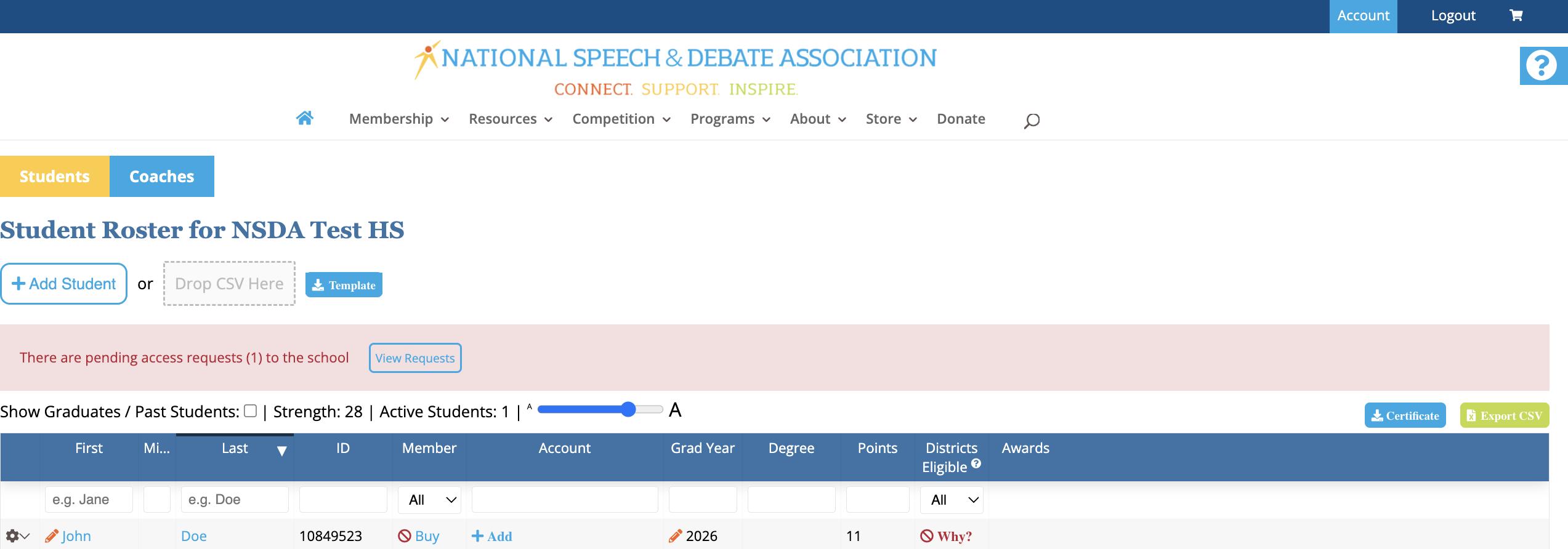




Plus, all active members can now download their individual certificates from the Degree section of their NSDA profile page (figure 2)
Advisors also can opt to go paperless for certificates and seals, meaning the school will not receive physical membership materials in the mail. Advisors may opt in or out of Paperless at any time from their School Profile page (figure 3).
Changes will only apply to future materials, not prior or in-progress mailings. International schools will all be paperless this year.

We hope you’ll give paperless a try if you:
• Want to go more green!
• Are a program that does not value member certificates.
• Want to streamline your process by either printing all certificates in bulk at the end of the year or encouraging students to print their own from their accounts.
• Have issues with school mail.
Be sure to visit your NSDA Account to check out your digital certificate. You might also notice something else new while you’re there—all membership certificates this year celebrate the Centennial in the wording of the certificate! This special version is available this year only and is the default for both printed and digital certificates as we celebrate our 100th this year.

www.speechanddebate.org/ centennial-stories

The bubble I existed in was so small before debate and forensics popped it and sent me flying through a world of infinite possibilites.”
— Maddix (’23), Great Bend High School, KS
Speech and debate was one of the best things I have ever done. It changed my life.”
— Rebekah (’08), Big Spring High School, TX
“Debate gave me skills I used throughout my career, from research and analysis to contract negotiations. It also gave me confidence speaking in front of others and thinking quickly on my feet. I consider it one of the most important keys to my success.”
— Dwayne (’80), Tates Creek High School, KY


compiled by Annie Reisener
As your practices pick up for the year, use these activities to have fun with new team members or challenge returning students to sharpen their skills!
Courtesy of Pam Cady Wycoff and Joe Wycoff
Students will take a piece of string. Hold the ends out, bring them together, tie it, and put it around their neck. Next, they will slip an arm through the hanging end. Now practice gesturing to the side. Notice that when the hand moves, the head moves with it. This is the way we naturally gesture. This activity shows students a fluid way to move while speaking.
Courtesy of Pat DeMartine, adapted from Forensics University
Divide students into two teams, one starting “in the bunker” and one trying to persuade those in the bunker that they are the most valuable to join them and be saved from the zombies. Students outside the bunker each have up to 30 seconds to persuade the students in the bunker why they are the most important person who should be selected to be in the bunker. Then each student is provided with another 30 seconds to refute all of the other people’s cases outside the bunker. The bunker-ites now get to vote for who gets to join them. Students practice quick thinking and persuasion in a fun format.
Courtesy of Robert Denzer
This game is similar to Pictionary or Charades, but instead of drawing a picture, students and their partners will act out an emotion for their parter/team to guess. Start with a list of emotions (20 or so), and act out as many as you can for your partner to guess within a minute. If you have enough people, it can become a fun competition to see who can guess the most emotions correctly! There is no specific speech work, but it is a great exercise to teach people about the fundamentals of nonverbal communications.
Courtesy of Pam Cady Wycoff and Joe Wycoff
Students should take a phrase, like “I think I can” and use it to explore rate, pitch, and volume. Beginning with rate, students should gradually speed up the phrase until they are saying it as fast as they can, then go back to the middle speed, then gradually slow it down until they’re saying it as slow as they can. Then do the same with pitch, moving gradually higher and gradually lower, or with volume, moving louder or softer.
Next, pick an emotion and its opposite, like excited and dejected. Students should take a phrase, like “I think I can,” and gradually repeat it until they are saying it as excitedly as they can, then go back to the middle emotion, then gradually repeat it until they are saying it as dejectedly as they can. Then do the same with pacing,
playing with delivery speed faster and faster, then slowly and dragging.
This activity is great as a warm-up, or to practice with specific lines in a piece. It challenges students to get out of the middle to discover what’s possible when they push the limits.
Courtesy of Renea Moss
Find a rap song that has a fast rhythm with a strong message (Enimem and Kendrick Lamar are examples, but there are so many out there). Begin with students setting up their flow chart. While the song plays, students flow it like they would a constructive speech. This supports the ability to identify contentions and evidence. Whereas normal constructives often have a certain framework, the students are set to how they identify and sometimes struggle with relating the concepts, etc. Flowing to music causes students to not look for a framework but identify the overall message and the contentions and evidence to support that message, just like in a debate, so they have the ability to flow any style of constructive.


For more skills and drills, visit:
w ww.speechanddebate.org/ running-practices
Submit an idea for the community:
w ww.speechanddebate.org/ practice-ideas
Courtesy of Dr. Seth Halvorson and Cherian Koshy
One person reads their case and another is required to give a rebuttal to it. The next debater must also give a rebuttal to the case but is not permitted to use any of the answers used before. Continue this process until everyone is stumped. Include the reader of the case. They should know where the flaws are!
Courtesy of Owen Davis
In a large group, take turns going to Wikipedia and selecting the random article button. (It might take multiple articles to find one with enough substance.) After finding an appropriate article, give the participating student five minutes to read or take notes. Once the five minutes is up, the student will deliver a two-minute speech on the article, attempting to make it as interesting and enticing to everyone else listening as possible.

Speech and debate is blessed with communities of students who bring various identities, ideologies, and lived experiences to teams and tournaments and coaches who serve as mentors and sources of support. Recognizing the importance of coaches in creating strong speech and debate communities, we aim to provide opportunities for them to sharpen their knowledge and awareness of diverse identities and discuss strategies to help make the best environment for students possible.
The Community Learning Series (CLS) is designed for coaches seeking ways to enhance their coaching practice and build a culture of inclusion on their teams and at tournaments. Participants will reflect on their communication practices and the environment they create for participation in speech and debate. Each unit includes a 45-minute video presenting the topic content and a short quiz. Additionally, we will offer monthly group-facilitated dialogues, during which we will discuss the video’s content and engage in activities that help us consider implementing the content.
MISSION: The Community Learning Series teaches foundational communication practices for building inclusive communities within speech and debate.
VISION: A community of coaches equipped with communication skills to help foster environments that welcome and retain participants on their speech and debate teams.
By participating in the CLS, you will:
• develop knowledge, awareness, and skills necessary to effectively and successfully interact with diverse identities and ideologies;
• learn ways to engage in effective communication and build inclusive communities within teams, tournaments, etc.;
• identify personal assumptions, preconceived notions, and biases that may lead to harmful communication practices; and
• learn new ways to encourage culturally responsive ballots and/ or create educational opportunities for judges attending a tournament for the first time.
The Community Learning Series comprises four one-hour units, including a video and quiz (found on NSDA Learn). Participants may complete individual sessions or all four. Completion of each unit earns a certificate indicating one hour of professional development.
Our group-facilitated dialogue sessions bring coaches together to discuss challenging topics, reflect on our communication practices, share our stories, and offer tips for providing a more equitable and inclusive community. We welcome participants’ identities, ideologies, lived experiences, and value systems. Regardless of our differences, the CLS is a safe and encouraging space.
Note: Participants in the Community Learning Series are expected to follow all NSDA guidelines, including our Core Values, Code of Honor, and Harassment and Discrimination Policy.
To encourage civil and constructive dialogue, the CLS employs the following conversation agreements:
LISTEN ACTIVELY | We will listen, reflect, and respond when appropriate. We will be present in the conversation.
PRACTICE MINDFUL COMMUNICATION | We recognize that we are a community of different identities, lived experiences, and ideologies. We will consider the consequences of our communication and how it might help or harm our goals.
BE PATIENT | We all have different levels of experience and knowledge. We will enter each dialogue with the mindset that we’re here to learn, not teach.
SHOW KINDNESS | The Community Learning Series aims to help make all of us better coaches. These are dialogues, not debates. We’re here to share our stories, listen, ask questions, and learn. We are insistent on kindness.
CALL PEOPLE FORWARD INSTEAD OF CALLING PEOPLE OUT | Calling out assumes malice. Calling forward invites people into a conversation and relies on patience, empathy, and grace.
Group-Facilitated Dialogue Schedule
All sessions start at 7:00 p.m. CT. Learn more at www.speechanddebate.org/cls.

• October 23, 2024 – Introducing the Community Learning Series
• November 20, 2024 – Multicultural Competence
• January 22, 2025 – Communication Errors: Unconscious Bias and Microaggressions
• February 19, 2025 – Building an Inclusive Community
• March 19, 2025 – Culturally Responsive Feedback
compiled by Dr. Paul Porter, Director of Diversity, Equity, and Inclusion at the NSDA


The Definitive Resource on Global Issues
Bring Foreign Affairs to your students, faculty, and employees—anywhere, anytime.

of organizations and businesses, including corporate, academic, and nonprofits.
Learn more at www.foreignaffairs.com/group-subscriptions
by Dr. Paul Porter and Amy Seidelman
In July 2023, the NSDA began a yearlong, threephase audit to assess the impact of our diversity, equity, and inclusion work and reflected on ways we can shape our programs and offerings to serve our participants better. In addition to inventorying our existing programs, we engaged in discussions with various staff and community members, solicited internal and external leaders, surveyed coaches, and analyzed archival data to determine where our time and focus is needed to guide our attention moving forward.
We created the DEI Map to help align our work with the objectives outlined in our strategic plan by using focus areas when building new efforts and revising existing ones. Based on the findings from our audit, we determined that the successful completion of our strategic objectives will require attention in the following areas:
Speech and debate serves diverse identities and ideologies. The activity should be a place for skill development, creative play, reflection, and joy for all participants. If we seek strategies that yield equitable outcomes, we must commit to building the knowledge, awareness, and skills necessary to successfully engage with diverse groups.
The wellness of our participants is critical to the success and sustainability of the activity our strategic plan seeks to build. The multidimensional factors of wellbeing (e.g., spiritual, emotional, social, mental, environmental, and physical) must be central to the growth and sustainability of this activity.
When the activity is perceived as inaccessible or restricted, our commitment to equity and inclusion and our growth potential are compromised. We want to ensure that existing programs maintain/increase access to participation while engaging potential new members to promote the benefits of speech and debate.
Our attention to the existing equity commitments will continue. Employing this map calls us to think about how the aforementioned focus areas are imbued in our programs and help us yield equitable outcomes.
Currently, the DEI Map and its focus areas influence three of the NSDA’s primary strategic objectives. Below is a summary of those objectives and the scope of their work.
Objective: Build infrastructure to embrace advocacy focused on demonstrating the return on investment of NSDA-supported speech and debate to school leadership.
The NSDA seeks to generate resources and work with school administrators to implement and grow speech and debate as both a staple in school curricula and a viable co-curricular activity.
For speech and debate programs to exist, center on our core values, and have long-term stability, a strategic communication strategy to persuade key decision-makers is warranted. It is important to highlight the role of the NSDA in creating these benefits for fundraising purposes, to open up the benefits of membership and partnership to a larger audience, and to embark on a coalitionbuilding effort as a credible leader focused on educational returns.
In 2024-2025, this objective’s scope includes:
• developing a communication and thought partnership strategy that speaks to the value of speech and debate for schools, especially in underrepresented communities;
• evaluating the NSDA membership structure and benefits to enable more school district-level advocacy; and
• continuing to utilize the National Tournament to draw attention to the activity’s benefits for youth.
Objective: Lower the barriers to entry for schools new to offering speech and debate programming and students new to speech and debate.
The NSDA works to provide welcoming on-ramps to the community for new coaches, students, and other contributors to speech and debate across the country, enabling meaningful participation in speech and debate for underrepresented and underserved students. This plan calls for the design of an outreach strategy for the schools and students who might be hardest to reach; as such, a significant analysis of NSDA and partner supports in place to implement speech and debate and create a welcoming community/sense of belonging for growth is essential.
In 2024-2025, this objective’s cope includes:
• identifying any changes to NSDA districts and/or the Honor Society that would enable the NSDA to devote more attention to coach and teacher professional development and instructional leadership supporting growth of speech and debate;
• assessing the creation and delivery of NSDA resources to maximize their approachability, accessibility, and impact for school-wide or districtwide instruction; and
• identifying opportunities to better support middle and novicelevel speakers and debaters through enhanced recognition, participation in Springboard or like offerings, and community-building efforts in partnership with the Student Leadership Council, state organizations, and others delivering speech and debate services at the local or regional level.
Objective: Continue to use districts and Nationals as bestin-class examples of inclusive tournament practices.
The NSDA aims to demonstrate how speech and debate promotes inclusion, fair play, and student growth in pursuit of learning outcomes. It also shares best practices for accessible and equitable participation, including competing, teaching, coaching, judging, and hosting events. This is achieved by maintaining standards of excellence in rules and guidelines, training, accreditation, certification opportunities, and student
recognition aligned with a Code of Honor and Equity Statement.
The National Tournament and its qualification system remain an important source of leverage for the organization, both in terms of demonstrating best practices and enforcing their use. Districts may be the only time in a competitive season that a student or coach will encounter a Belonging and Inclusion Station, and Nationals offers an important opportunity for the NSDA to enforce the training of thousands of judges as well as remind participating schools that these resources exist during the school year. By devoting resources to these practices, the NSDA can create structures we can promote and from which nationwide norms may, with time, emerge.
In 2024-2025, this objective’s scope includes increasing NSDA district use of Belonging and Inclusion Advocates and continuing the enhancement, promotion, and use of NSDA judge training and accreditation.
Our commitment to creating welcoming environments and conditions of fairness remains central to our work. As we enter our centennial year, our staff and leadership are working to acquire the skills and language necessary to advance our community over the next 100 years. The DEI Map encourages a shared responsibility to that end. We will provide annual updates to share our most current objectives and accomplishments in the spirit of transparency and accountability.


JUNE 2024-JUNE 2025


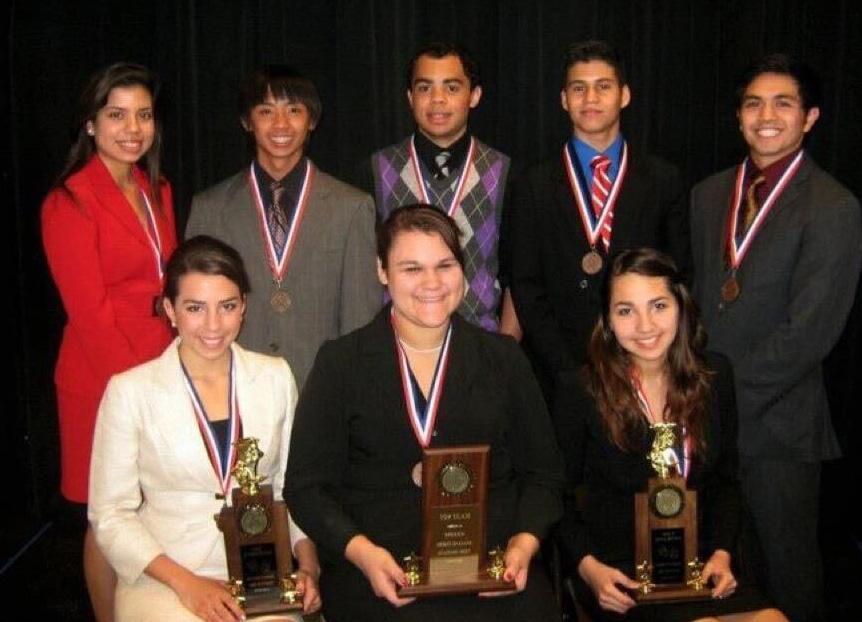


We are excited to recognize the positive impact of speech and debate activities on students, schools, and communities. From local celebrations to the National Speech & Debate Tournament, the educational value of speech and debate will be honored near and far from June 2024 to June 2025. In addition to special events and programs, thousands will share personal stories of how speech and debate changed their life on social media using the hashtag #SpeechAndDebate. We hope you will join in the festivities as we remember our past, support our present, and inspire our future.
Tear out the facing page to use as a poster and look for more resources with tips and ideas for commemorating our 100th anniversary coming soon! www.speechanddebate.org/centennial
Donate to support our next 100 years! You can provide this generation of young people the opportunity to unleash their true potential and change their world. raisedonors.com/speechanddebateorg/next100years

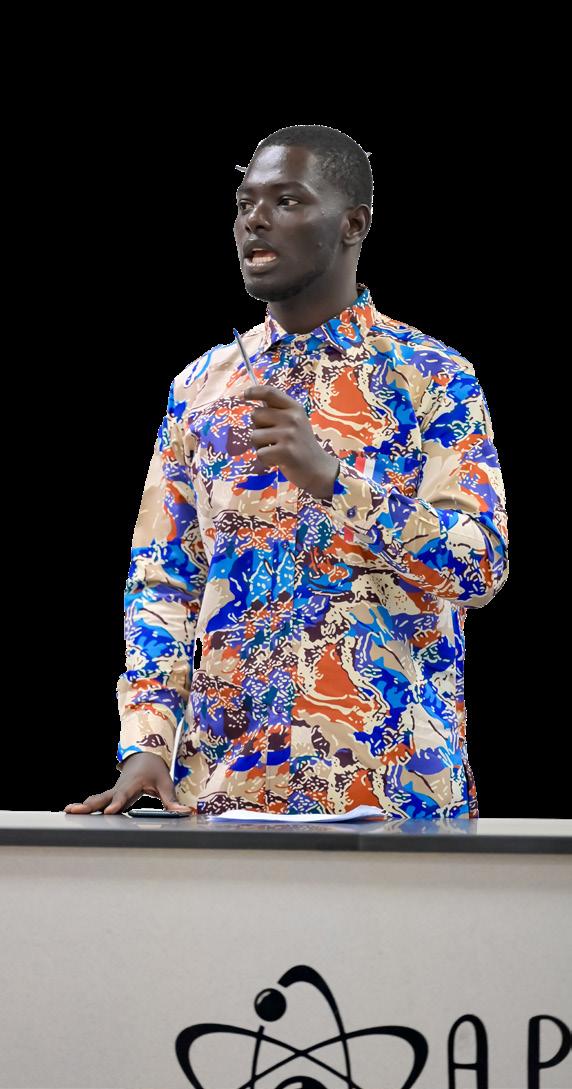


We invited the coaches, team parents, and alumni who nominated the recent NSDA Coach of the Year recipients to share their words of praise and gratitude for their nominees. Read on to learn how these winning coaches have had a profound impact on the students in their area and the activity at large.

Kerry is a three-diamond coach at Aberdeen Central High School in South Dakota.
Ijust drive the van.”
That is how my coach, Mr. Konda, always answered when asked about his role in the culture of success developed with our team—a team referred to as a “powerhouse” by our local magazine.
We have been the reigning state champs the past eight years. Yet, Mr. Konda always
attributed the success to the students and rarely highlighted his role in our excellence.
As I transitioned into college, I realized this couldn’t be further from the truth.
Mr. Konda—or “Kondad” as the team calls him— wasn’t merely the chauffeur steering us to competitions. He was the driving force
that changed my life, the heartbeat of the team I now consider my second family.
My first day of freshman year, I was petrified, having landed in Aberdeen the night before. I was insecure about my accent. I was insecure being the only Indian kid out of the 1,300 kids there. I was terrified of being myself.
The first class I walked into was Honors Debate and Democracy. I vividly remember thinking, “Wow, this teacher genuinely makes an effort to ensure everyone feels included and welcome.” Little did I know, that initial impression was just the beginning of Mr. Konda’s profound impact on me.
I decided to join the debate team, which would transform me from a timid 14-year-old to an NSDA Student of the Year runnerup. Through every step of that journey, Mr. Konda pushed me to find my voice, to “Work Hard, Be Heard” (our team motto).
Mr. Konda believed in our ability to choose topics that mattered to us. He pushed us to do the research and see where it took us. This method emboldened us to talk about extremely important but rarely discussed topics in our conservative state, like the dangers of whataboutism, human trafficking, and our antiquated immigration system.
Like a proud dad, Mr. Konda tried to find other
opportunities where we could highlight our public speaking skills—from encouraging us to apply to competitions like The American Legion Oratorical Contest (where he’s driven across the state eight hours for the past 10 years to cheer his students) or helping us become the first Top 64 team in the International Public Policy Forum (IPPF) from South Dakota. He was invested in our team and always ensured that we knew a father’s love and support aren’t just about blood— they’re about being there when it matters most.
Mr. Konda believed in us and in the extraordinary change that can emerge from the power of speech and debate. He raised us to be resilient individuals ready to tackle the pressing issues plaguing our communities—a testament to his five National Student of the Year finalists. He is persistent in pushing us to pursue our dreams and works tirelessly to help us make it happen.
As I look back on the impact of this incredible man, I’m thankful for the coach who became a father figure when I needed one the most. Mr. Konda shaped me into the person I am today, and for that, I am forever grateful.
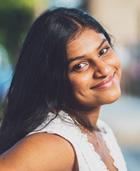
— Nominated by Abiah George (’23), alum from Aberdeen Central High School

Ashley is a four-diamond coach at Cheyenne East High School in Wyoming.
While Ashley may not seek recognition, her commitment and impact on our speech and debate team, and the activity itself, deserve the highest praise.
Beyond being a phenomenal mother and dedicated teacher, Ashley possesses a rare talent for
interpretation coaching. As a four-diamond coach, her list of accolades is impressive: countless national qualifiers, numerous top 60 and 30 breaks, main event national finalists, and even supplemental national champions.
Yet, her true strength lies in her ability to unlock
potential and nurture talent. She sees the spark in every student, patiently guiding them through the intricacies of performance and interpretation with passion, enthusiasm, and a wealth of knowledge.
However, Ashley’s contributions extend far beyond coaching prowess. She is an organizational powerhouse, the unseen engine that keeps our program running smoothly. From planning tournaments to handling logistics with unwavering dedication, she ensures every detail is meticulously addressed, allowing others to shine while she quietly ensures their success. She may not always be in the spotlight, but her contributions are invaluable and never go unnoticed by those who truly appreciate her efforts.
Ashley’s impact goes beyond our team, extending to the broader speech and debate community. She actively volunteers her time and expertise, judging tournaments, mentoring other coaches, and sharing her knowledge freely. Her willingness to invest in the success of others exemplifies her selfless dedication and passion for the activity.
While her impressive track record speaks
volumes, it is Ashley’s unwavering support and genuine care for each student that truly sets her apart. She celebrates their victories, empathizes with their struggles, and provides constant encouragement, fostering a sense of belonging and community within the team. Her positive influence extends beyond the competition stage, shaping wellrounded individuals with confidence and communication skills that benefit them long after high school.
Ashley Schulz is not just an assistant coach; she is an inspiring mentor, a meticulous organizer, and a passionate advocate for speech and debate. Her dedication, expertise, and positive impact on students, coaches, and the entire community make her the epitome of an exemplary assistant coach.
Ashley truly embodies the spirit and values of the National Speech & Debate Association. It is my hope that her recognition inspires other coaches nationwide.

— Nominated by Marcus Viney, one-diamond coach at Cheyenne East High School

Jerenisha is a coach at Sophie B. Wright Institute of Academic Excellence in Louisiana.
Just as Ms. Thomas is in her first year of coaching, her school is in its first year of competition. However, the team’s success, her commitment to students, and the example she sets for our community is that of an experienced coach of a wellestablished program.
Sophie B. Wright’s success this year, spearheaded by Ms.
Thomas, speaks for itself. In the school’s first year on the circuit, 14 students have accumulated 2,672 points. Seven of those students, or half of their squad, rank in the top 100 in our state. The team, competing in LincolnDouglas and Public Forum Debate, has accumulated a number of high placements
and championships at tournaments like the Southside Shark Showdown, DominiClash, Cougar Classic, and Benjamin Franklin. This success would not be possible without the leadership and work of Ms. Thomas.
Beyond competitive success, the dedication Ms. Thomas has shown her students is an example that any coach should strive to achieve. Like any new program, funding and resources are a challenge, especially for travel tournaments. However, this didn’t stop her from driving students to and from out-oftown tournaments during each day of competition. She also has overseen students for nearly every NSDA Springboard Series scrimmage, demonstrating her dedication to giving every possible opportunity to compete for her students. She routinely reaches out to different coaches for advice on team management, case strategy, and more.
During tournaments, Ms. Thomas can be found working closely with students to make sure they are prepared and confident for every round. Her balancing of high expectations and fun-loving attitude creates an enjoyable team culture that draws students into the activity. Her students also have performed a number of
service activities, indicative of the community-focused team culture she has developed.
Her work specifically at Sophie B. Wright promotes accessibility and inclusion in the Louisiana speech and debate community. Her school is a majorityminority school, where she has led a successful team in an activity that is predominantly white. Her diligent work and leadership have allowed for an underrepresented group in our community to better share their experiences and promote cross-cultural engagement. I can personally attest to this, as I have judged her students multiple times discussing the specific effects of the topic on minority communities. These are not arguments or experiences that would be as prevalent without her work.
The way our community benefits from Ms. Thomas should be lauded and celebrated. At a time when Louisiana is attempting to grow its speech and debate community, she is a shining example of this effort.

— Nominated by Blake Ziegler, assistant coach at The Delores Taylor Arthur School for Young Men in Lousiana

Adriena coaches at multiple elementary and middle schools in California, recently supporting the Fullerton Joint Union School District as their Program Director, before taking on the role as Vice President of Advantage Communications.
I can vividly remember my first interaction with Mrs. Toghia a few years back when I was a guilt-stricken workaholic parent teaching at an inner-city school. I was always so busy tending to the students at the schools I served that my child never received the attention she needed from her mother.
My daughter was a shy student, the smallest in frame in her class, often the youngest, and most vulnerable to bullying as a young child.
Seeing that my child needed more adult support, Mrs. Toghia and the coaching staff happily stepped up to the plate to serve in that role. They showed her how to express herself— her anger, sadness, excitement, happiness, creativity, and passion— through speech and debate.
The program literally changed my daughter’s life and transformed one of the shyest kids in class into a national champion. I am sure my daughter’s life isn’t the only one she’s touched and influenced in such an incredible way.
Any time I had concerns to address, Mrs. Toghia was quick to listen and adjust to feedback, all with a smile and a flexible attitude. I was just
one parent, but she made me feel like my opinion mattered and continued to improve the district program as the years went by.
Considering the vast number of districts and schools Mrs. Toghia served, that individual attention to a single parent, her humility, and her support made me feel so heard and affirmed.
Mrs. Toghia is passionate about serving our community, which is predominantly composed of immigrant families. This is evident in the success of our district’s speech and debate program, which was nationally recognized for five consecutive years and came home with three national championship titles last year.
While some parts of our neighborhood seem affluent on the outside, many pockets of underprivileged students lack access to upward mobility and self-expression. Mrs. Toghia and the coaching team worked tirelessly to provide coaching to our city’s most marginalized and voiceless areas.
— Nominated by Camille An-Choi, team parent from Parks Junior High School in California
Every student has a voice; we are simply supporting them in finding the power within it. I hope to give students tools to effectively share their stories and advocate for themselves and others,” Adriena says.
She competed in forensics for seven years and has been coaching since 2016. She has a Bachelor’s in Early Childhood Development and a Master’s in Education, focusing on English Learners. Her passion for education stems from her experiences as a first-generation American in her family. She further explains:
School was incredibly challenging for me, but I had the drive to excel. Speech and debate leveled the playing field. Your grit, skills, and worldview are challenged every day in this activity. I am forever grateful to this activity and aim to give as many students access to the skills and community that speech and debate provides.”


www.speechanddebate.org/start-here
The National Speech & Debate Association is here to help you throughout your coaching journey. Use these tools to get started!
Access easy to follow lesson plans that are backed up with ready-to-use resources and materials.
NSDA LEARN COURSES
www.speechanddebate.org/start-here
www.speechanddebate.org/learn
NSDA LEARN is a ever growing set of self-paced online professional development courses.
Access easy-to-follow lesson plans that are backed up with ready-to-use resources and materials.
Intro to Coaching Course
www.speechanddebate.org/learn
www.speechanddebate.org/learn/courses/ intro-to-nsda-coaching Ideal for new coaches, this course covers the basics of NSDA membership.
NSDA Learn is an ever-growing set of self-paced online professional development courses.
Getting Started Information Page
Adriena competed at Fullerton Union High School under threediamond coach Sal Tinajero. She then went on to compete at California Baptist University and holds two national titles in Prose and Duo Interpretation.

Before her time at Advantage, she was the Assistant Director of Forensics at Azusa Pacific University for three years, where she coached multiple local and national award-winning students.
Intro to Coaching Course
www.speechanddebate.org/getting-started The guides and resources on this page are designed to introduce new members to competitive speech and debate, team management, and all they can do with their membership.
JUDGE ACCREDITATION
www.speechanddebate.org/learn/courses/ intro-to-nsda-coaching
www.speechanddebate.org/learn/judge-accreditation
Ideal for new coaches, this course covers the basics of NSDA membership.
Judges are some of the most vital contributors to the speech and debate community. Without judges, tournaments would not be possible. Access our judge resources today!
Getting Started Information Page
www.speechanddebate.org/getting-started
www.speechanddebate.org/rostrum
Rostrum is the official magazine of the National Speech & Debate Association. Stay up to date with news, scholarly articles, and national updates published in the months of September, November, February, April, and August.
The guides and resources on this page are designed to introduce new members to competitive speech and debate, team management, and all they can do with their membership.
www.speechanddebate.org/learn/judge-accreditation Judges are some of the most vital contributors to the speech and debate community. Without judges, tournaments would not be possible. Access our judge resources today!


Coaches, share this opportunity with your students!
The Brewer Foundation and New York University (NYU) invite you to participate in the 24th annual International Public Policy Forum (IPPF)—the first and only contest that gives high school students around the world the opportunity to engage in written and oral debates on issues of public policy.
Founded in 2001 by the Brewer Foundation, the charitable arm of the Brewer law firm, the IPPF is open to all schools—public and private—for free. Teams compete for more than $30,000 in prize money and the opportunity to win an all-expenses-paid trip to the IPPF Finals in New York City.
The competition begins in October, as teams submit a 3,000-word qualifying round essay on the IPPF topic, “Resolved: Equitable access to pharmaceuticals should be prioritized over protecting intellectual property rights.” Judges evaluate each essay, and the top 64 teams advance into a single-elimination, written debate competition.
For the past 10 years, Dr. Michael Hester has had students participate in the IPPF as a coach at Ivy Bridge Academy in Georgia. Hester, who also coaches collegiate debate at The University of West Georgia, says that one of the best aspects of the IPPF is that students benefit “just by attempting to qualify for the round of 64 competition.”
“Qualification requires the students submit a persuasive essay, with researched arguments either affirming or negating that season’s resolution on a public policy topic,” Hester says. “The work done to learn about the topic, research the key issues, and construct a 3,000-word essay is a rigorous academic exercise.”
In the “Top 64” round, schools volley papers back and forth via email. Judges review the essays in the order they are presented (affirmative constructive, negative constructive, affirmative rebuttal, negative rebuttal) and select the advancing teams. This process begins anew as the “Top 32” teams compete for their chance to advance to the “Sweet 16” round.
“Because the first half of the competition is focused on written, rather than oral, argumentation, the IPPF is a fantastic opportunity to include and recognize students who, for whatever reason, may not feel confident in their public speaking skills,” says Hester.
In March, the “Elite 8” teams are announced. These teams win all-expenses-paid trips to New York City to compete during IPPF Finals Weekend, which, in 2025, will begin May 2. During the finals, teams supplement their written advocacy with oral argumentation.
“What made the IPPF a truly life-changing experience for me was its international nature: the competition not only connected me with peers from around the globe, but also deepened my understanding of the world through its thoughtprovoking topics centered on global issues,” says Jonathan Fan, whose team was a runner-up in the 2021 competition.
William A. Brewer III is chairman of the Brewer Foundation and founder of the IPPF. He says the IPPF is a new expression of a transformative activity.
“Debate challenges students to think critically and globally,” Brewer says. “They develop skills that benefit them personally—but also allow them to make a broader impact
The
in the world. Debate changed my life. I champion the activity, and the IPPF, to help see that it changes the lives of others.”
Judges for the oral rounds have included Brewer, NYU President Emeritus John Sexton, Council on Foreign Relations President Richard N. Haass, Ret. General Wesley Clark, National Speech & Debate Association Executive Director Scott Wunn, and NASA Astronaut Mike Massimino.
Judges engage the students during the final debates in a dynamic and challenging forum.
“The IPPF offers an unprecedented level of judge interaction, surpassing any other competition I’ve participated in,” says Fan. “By allowing the foremost authorities of a vast array of disciplines to actively engage with my arguments and question my line of reasoning, the IPPF improved my critical thinking and understanding of complex topics. While it was initially intimidating to engage with these knowledgeable experts, every speech I delivered and every question I answered instilled in me unparalleled confidence that will remain for a lifetime.”
The IPPF World Champion receives a $10,000 grand prize—$5,000 for the school debate program and $5,000 that is split between the individual team members. The IPPF also annually presents the John E. Sexton Award to the top oral debater from the final debate.
“Quite simply, the IPPF competition is the most educational, inclusive, and rigorous competition in interscholastic debate,” says Hester, whose team was a runner-up in the 2024 competition. “It is the only debate competition of its size that involves students engaging in both written and verbal argumentation—on par with graduate school thesis construction.”
Hester urges coaches and teams who are considering participating to try it.
“Having coached multiple national champions in intercollegiate debate in the U.S., as well as leading debate training programs in the Caribbean, Africa, and Asia, I can say unequivocally that the IPPF is unmatched in the benefits it offers students,” Hester says.
1. Work with your debate coach, English teacher, or Social Studies teacher to form a team of at least three students, then go to www.ippfdebate.com and register your team.
2. Next, prepare a qualifying round essay affirming or negating the topic, “Resolved: Equitable access to pharmaceuticals should be prioritized over protecting intellectual property rights.” Essays are limited to 3,000 words, not including the title page or Works Cited page(s).
3. Qualifying round essays must be submitted by noon CST on October 22, 2024, to ippf@brewerfoundation.com Essays will be reviewed by a panel of judges comprised of attorneys, business leaders, collegiate debaters, and former IPPF champions.
4. The Top 64 teams will be announced on November 6, 2024. These teams begin a single-elimination, written debate tournament, with one school affirming the resolution and the other negating it. Essays are volleyed back and forth via email. In December, judges will blindly review the essays in the order they were submitted and select the advancing teams. This process continues until the final eight teams are named on March 30, 2025.
5. Pack your bags! The final eight teams earn an all-expensespaid trip to New York City to compete in the IPPF Finals on May 3, 2025. During the finals, teams supplement their written advocacy with oral argumentation—debating in front of some of the world’s foremost experts in debate, business, law, and politics. The IPPF World Champion wins a $10,000 grand prize and the Brewer Cup!


Rikhil Ranjit from Ivy Bridge Academy received the second annual John E. Sexton Award, which honors an outstanding speaker in the final round as determined by the judges. The award is named after NYU President Emeritus Sexton, who serves on the IPPF Advisory Board.


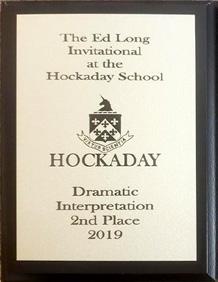







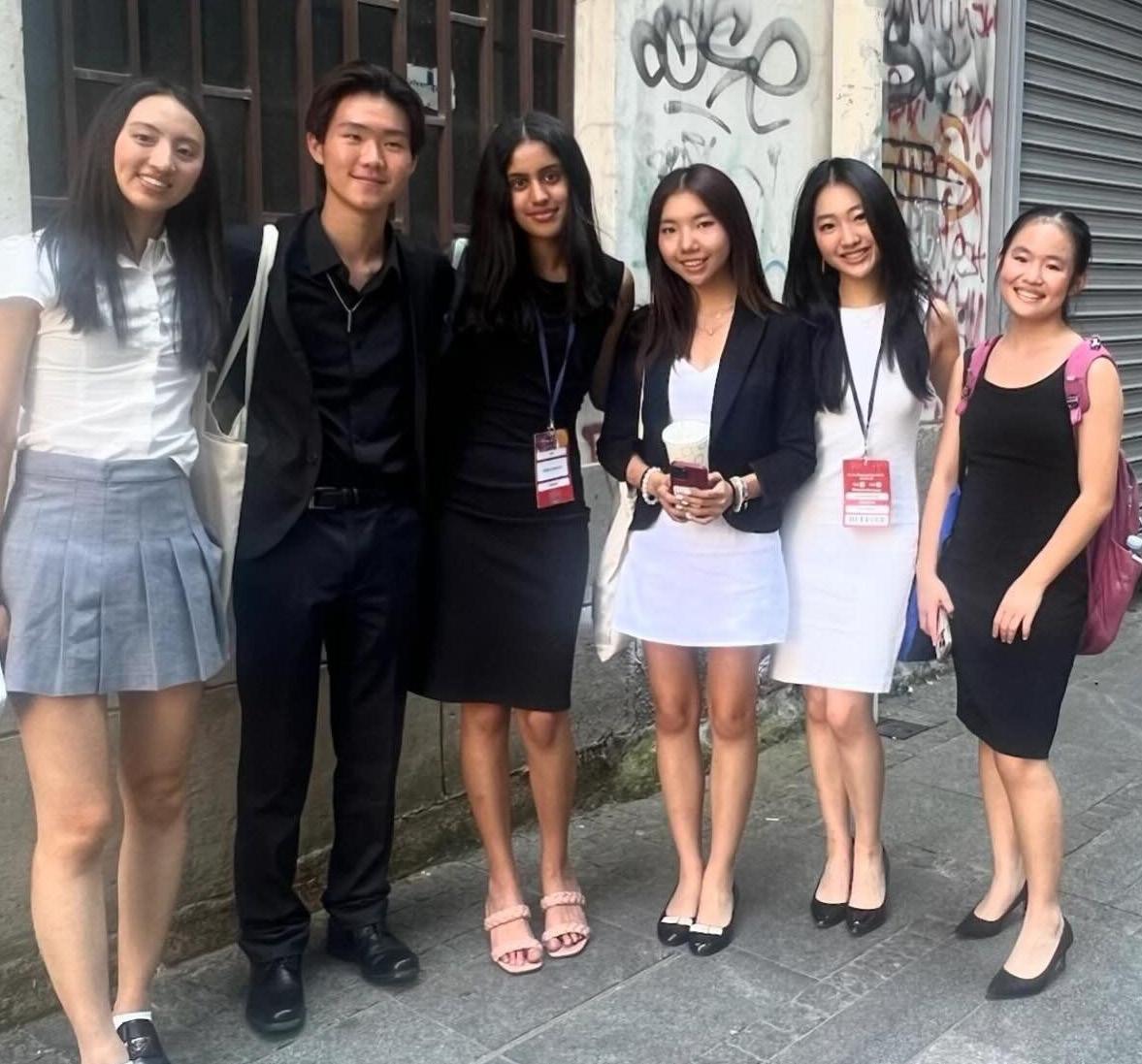
The USA Debate team spent two weeks in Serbia in July attending the 2024 World Schools Debating Championships. The team enjoyed meeting new friends and debating fun topics.
This year’s delegation consisted of seniors Cameron Hong from La Canada High School, CA; Chelsea Hu from Phillips Academy-Andover, MA; Alex Lee from Harvard-Westlake School, CA; Sophia Li from

Greenhill School, TX; and Advika Sadasivan from The Village School, TX. Junior Sherry Zhang of Greenhill School, TX was selected as alternate.
USA Debate had a great run, advancing to double octafinals. All five members placed in the top 30 individual speaker awards, with Alex Lee taking home the fifth place speaker award.
The graduating seniors wish to congratulate the newest members of USA

Debate who were selected for the 2024-2025 national team, including returning members Valerie Gu, Taite Kirkpatrick, and Sherry Zhang. The prestigious team will compete against top teams from around the globe during the upcoming school year.
The team is coached by Christopher Vincent, Director of Speech and Debate at Isidore Newman School, LA; Shania Hunt, J.D. recipient from UC Law San Francisco, CA; and Aditya Dhar, Ph.D. student in finance at the University of Chicago, IL.


Calista Woo and Anik Chobe are newly-minted friends and rising seniors who debated each other during the Last-Chance Qualifier back in April and ultimately qualified for Nationals in June. Read on to learn more about their journey to Des Moines this summer!
What first drew you to speech and debate?
CALISTA: Like most things in life, I first met speech and debate through my older brother. My first true introduction to speech and debate was a judge training session hosted by the head coach of my team. Of course, my dad was the one being trained, but elevenyear-old me followed along and watched a demo tech Public Forum round. Did I understand anything? Of course not—but I knew I wanted to be there.
ANIK: I heard about an afterschool public speaking club when I was in elementary school. I immediately took an interest and joined, and got my first exposure to speech and debate. I eventually started competing at tournaments in seventh grade and have remained in the activity since.
Tell us a little bit more about your Last-Chance Qualifier to National Tournament experience, practicing and competing as friends from different schools.
CALISTA: In the weeks before Last-Chance, we did practice rounds and topic analysis, observed rounds at state, and collaborated for the first time. I loved practicing with friends from other schools, and I learned a lot about different approaches
to research and case construction.
At Last-Chance, Anik and I actually ended up debating against each other in our sixth preliminary round. At that point, we were both undefeated and knew each other’s cases and evidence by heart. We even spent an hour calling before round promising to “have a fun round.” (I ended up losing. In fact, the only ballot I lost at Last-Chance was to Anik!)
The day before we flew out [to Des Moines], we had a practice round to finalize all of our preparation and wish each other luck. During that round, we never would have imagined hitting each other exactly a week later, on the final round stage of the Iowa Events Center. I couldn’t have thought of a better opponent to share such a special experience with than the first friend I made in Lincoln-Douglas.
ANIK: Prepping with Calista exposed me to arguments I hadn’t thought of and broadened my overall perspective on the topic. We continued to work with each other during the leadup to Nationals, along with others in our district. I don’t think either of us thought, while we were casually doing practice rounds, that we were having the equivalent of a Nationals final round, which is really amazing to think about in retrospect.
The Last-Chance Qualifier is made possible because of the generosity of The Julia Burke Foundation. You gave them a very nice shout-out during finals! Is there anything else you would like to say to them?
CALISTA: The Last-Chance Qualifier provided exactly what the name suggested: one last chance to reach Nationals, to demonstrate all that I had learned in my three years of debate. I’ll always be grateful for the spots that the NSDA saves for the hundreds of students who want to do more, compete more, and put in all their hard work into one last shot for an amazing experience at Nationals.
ANIK: All of the debaters who qualified for Nationals from my school did so through the Last-Chance Qualifier. The Julia Burke Foundation allows so many of us to finally see our hard work pay off in an activity that can often be frustratingly difficult; for that, I want to thank them again.
What advice would you give another student who is interested in doing speech or debate?
CALISTA: Find the people you want to be with. I joined speech and debate because I saw people I could imagine myself with and imagine myself becoming. In this community, I’ve met people who have completely changed my life, modeling the leadership, respect, and dedication I hope to uphold in
my own life. I’ve had so much fun making new friends within my team, neighboring schools, and even other states.
ANIK: Don’t be afraid to experiment and try new things. Whether it’s trying different events or changing up your style, flexibility can help you become much better in this activity, as it allows you to find out what works best for you. Additionally, the only way you can get better in this activity is by actually doing rounds and going to tournaments. It’s okay if you don’t do well, but you should continue to participate, because losing to another debater can be one of the best ways for you to become a better debater.
Do you have any speech and debate coaches or mentors you wish to thank?
CALISTA: I absolutely have to thank Doron Dorov, the coach who first introduced me to Lincoln-Douglas Debate. During that first practice, we watched the 2020 final round of LD. I never thought I’d stand on the finals stage with him, but I’m extremely grateful he was there. My head coach, Julie Herman, has been instrumental in my debate career. I’ve always valued her advice on how to lead our team as both captain and president, and my appreciation for all that she does for our team only grows with each practice I attend. Lastly, I’d love to thank [Los Altos High School alums] Anagha Rajesh and Flora Wang. They taught me how
to love a team and continue to be my inspiration for their dedication to what they do and the grace with which they carry themselves as leaders, mentors, and friends.
ANIK: I want to thank Jonathan Harris, one of our speech coaches, who has always been really helpful and is just a great person to talk to. I especially want to thank him for judging a bunch of LD rounds at Nationals, despite debate not being his area of expertise. I want to thank Karen Cruz, our team director and speech coach, who in many ways holds our team together. She always pushes us to do our absolute best. I also want to thank Mark Woodhead, our main debate coach, who has always supported me throughout my debate journey. He’s allowed me to compete at circuit tournaments that were not part of the team schedule, continuously provided insightful feedback on our prep, and so much more. I definitely wouldn’t be where I am today without him. In addition, I want to thank one of our recent alums, Sashank Balusu. During my freshman year, Sashank took second in state in LD, which was one of the most inspiring moments for me as a learning debater. He’s one of the nicest people I know and has always been very helpful to me throughout the past three years.
As the NSDA celebrates its 100th birthday, what is your hope for the next 100 years of speech and debate?
CALISTA: I hope to see even more diversity within the voices we elevate onto the national stage. Watching finals of events like Program Oral Interpretation was incredibly moving as I saw students of marginalized backgrounds share their stories and express their identities. Growing up, I struggled immensely to find role models in LD who looked like me. As we continue to expand access to opportunities within our community, I cannot wait to see even more diversity within the faces and stories we see, especially on that final stage.
ANIK: One of my biggest hopes, specifically in debate, is that the activity can become more inclusive of both traditional and progressive forms of debate. Having competed in traditional debate at local tournaments and in progressive debate on the national circuit, I’ve found that both forms of debate independently have immense value and that students should try doing both. I don’t want to see one supplant the other but would prefer to see both flourish.

as told to Amber Gracia
First off, where did you compete, in what events, and when did you graduate?
I competed in Humor and Prose at Prior Lake High School in Minnesota. Upon graduation in 2008, I went on to Gustavus Adolphus College in St. Peter, Minnesota. During my four years there, I competed in Prose, Drama, Duo, Poetry, Program Oral Interpretation, Informative, Extemporaneous Speaking, Impromptu Speaking, Communication Analysis, and After Dinner Speaking.
Why did you join your speech and debate team?
In middle school, I already
CHLOE RADCLIFFE is an NYC-based stand-up comedian, actor, and writer. She starred in Command Z from Steven Soderbergh and was a Writers Guild of America award nominee for also writing on the series. She has been seen on Comedy Central and After Midnight with Taylor Tomlinson . She was a staff writer on The Tonight Show with Jimmy Fallon , has a comedy feature in development with Sony, and was named a TBS Comic to Watch at the New York Comedy Festival. Chloe sold out her full-month run of her one-woman show Cheat at the 2023 Edinburgh Fringe Festival, with reviews calling it “hilarious and sharply-crafted” (Deadline) and “worthy of the greats like Mike Birbiglia” (Chortle). Vulture recently named her one of “2024’s Comedians You Should and Will Know.”
loved performing, and I saw it as an outlet that went hand-inhand with theatre. And then, by the time I finished the state tournament in high school, I knew I wasn’t ready to be done with the activity—I had more left to prove. So, I made my college decision in order to keep competing in speech.
You competed for 10 years and won two national championships at the college level. Did anything from your speech and debate training or
experience contribute to your career path in comedy?
Oh, 1,000 percent. I tried stand-up kind of as a “check it off the list,” not expecting to like it. And then, within the first minute, I realized it’s all the same corollary skills as speech: writing for yourself, editing your own writing, performing in front of two people or two hundred, being in a lineup, responding to time signals, dealing with weird things in the room, being judged (implicitly rather than explicitly).
Speech taught me how to handle pressure. It taught me how to take notes, and see the real meaning behind a variety of reactions. It taught me
how to be professional, how to think of the “job” as expanding way beyond just the performance (how you talk in the bathroom influences the opinion of the judges you don’t realize are in there with you). Frankly, it did not teach me how to write a joke. But I’ll take all the rest in exchange.
You carry a few different titles, including stand-up comedian, actor, and screenwriter. Do you have any advice for other alumni or current speech and debate competitors who are interested in obtaining these titles as well?
Work as hard as you can for the next 15 years without
burning yourself out; write everything down; follow the paths that open themselves up to you; trust your gut above all else (not your anxiety—your gut); think every few months about what you want at the broadest scale; keep your eyes on your own paper and don’t compare yourself to everyone around you; make things you’re proud of; make it a long game. Every good thing that’s happened to me in my career is something that I couldn’t have predicted six months previous.
You have done comedy on stage, behind the scenes, and on screen with the new TV mini series, Command Z. In which of these experiences did you feel most in your element? Which one would you want to do more of and why?
My guiding light is performing—whether that be acting, stand-up, a solo show, whatever. I love writing but feel the most fulfilled when I’m performing.
Comedy and comedy writing is so much about your point
of view, as are many elements of speech and debate. Why is it important to share your story or point of view as a competitor or comedian?
I mean, beyond the obvious for me: I get uninterrupted time to grind on about my personal neuroses. But also: Messages are always most powerful, most effective, when you genuinely believe in them. The shortest distance to that genuine belief is to create from your specific point of view. A joke I only kind of agree with will never be as funny as one that I am organically passionate about. A speech that doesn’t interest you will never be as compelling as one that feels genuinely close to home in some way.
Late night comedy has always been highly regarded and a marker of success for many. What was the process like becoming a writer for The Tonight Show with Jimmy Fallon, and what tips would you give others who want
to pursue a similar role?
Writers submit a “packet” to write on a late night show, which is one to 10 pages of jokes, sketches, and bit pitches, depending on the submission. Fallon was my 15th packet, which meant that I was in a position where the staffing team knew my name, I was already practiced at the writing, and I already felt (as) confident (as I ever was going to feel, which was still only medium).
What advice would you give students who are joining speech and debate?
Compete as often and for as long as you can. You will get better with every month and year that goes by. But don’t make it the only thing in your life.
Push yourself. And put maxi pads in your armpits so you don’t sweat through your suit.
Do you have any speech and debate mentors you would like to thank?
One of my college coaches, Josh Forsythe, was an anchor through my college competition years. I don’t know that I would have competed all four years without him. I still count him as one of my dearest friends. Megan Orcholski, who coached at a different school, is still one of my best friends and deepest confidantes. Her belief in me has sustained me through difficult moments for 15 years. Mike Chouinard, who coached me at high school speech camp, inspired me as a teenager to reach for better.

As we enter our centennial year, we are not just celebrating speech and debate. We are honoring 100 years of community and impact.


Find your speech and debate connection to support and inspire future generations of public speakers.
SHAPE THE NEXT 100 YEARS
» Contribute to the legacy of speech and debate, ensuring that its benefits continue to influence future generations.
EXCLUSIVE WEBINARS
» Receive invitations to upcoming webinars and access past webinars, including “Transform Your Speaking Skills into a Career.”
NETWORKING OPPORTUNITIES
» Gain access to our Speech & Debate Alumni Community on LinkedIn and to our Community Calls, where alums can share stories, discussions, and professional development opportunities with one another.
GET PAID TO JUDGE
» Sign up for our Judge Board for the opportunity to get hired by schools in your area.


SUPPORT IN A WAY THAT WORKS FOR YOU:
SHARE YOUR STORY
Share your story of how speech and debate impacted your life, career, friendships, and opportunities.
VOLUNTEER
Sign up as a Springboard Series judge. Opportunities for students to compete and learn are only possible because of our volunteers.
ADVOCATE
Help create access to speech and debate education in your community by becoming an Alumni Ambassador
“Speech and debate taught me that our greatest
achievements are measured not by trophies but by the relationships we build and the communities we nurture.”
— John Otto, Class of 2024


Afew diamonds ago, I got a call from a local reporter who was seeking information about my most recent Diamond Award. “Tell me,” she asked, almost giddy, “what kind of diamonds are they?” I took half a beat
and replied, “Symbolic... The diamonds are symbolic.” This was not the answer she was looking for, and she ended the conversation shortly thereafter. What will never end is my passion for this organization, for coaches, for all things speech and debate, and mostly, for kids who are the real diamonds in all of our stories.
Before I was old enough to resist, my parents would
pack us in the car for a “Sunday drive.” It was the 1960s, long before automatic windows, Sirius Radio, and the ability to ask Siri for directions.
“Where are we going?” I asked from the back seat as my brother put his finger inches from my face and called out, “I’m not touching you!” As I growled at him, my father replied, “You’ll know when we get there!” I rolled my eyes.
Over the years, I have come to understand that while you may need a

full tank of gas, knowing the precise destination is...optional. You have to trust your journey and just drive!
Call
One afternoon in the spring of 2009, my office phone rang. At that time, answering a phone was an adventure! No caller ID, just the hope that the news was “good news.”
On the line was a man who pronounced my three letter first name with what sounded like a full syllable for each letter. It was [then NSDA Board President] Billy Tate. He told me that I was to be inducted into the Hall of Fame. There is really no way to describe just how surreal it is to get such a call. He congratulated

(above) What a Ride! – With the late, great Billy Tate at the 2009 Hall of Fame dinner in Huntsville, Alabama.
(left) First Stop on the Road – The Maine East High School speech team in Park Ridge, Illinois (1974). I am pretty easy to spot!
(opposite) A Perfect Little Stop on the Journey – A coaching moment at Champaign Central High School (1977). How lucky was I to have this truly, transformative adventure!
me and told me that John Hires and Connie Link, two of my most significant mentors, both of whom left us too soon, would be so proud. That brought tears to my eyes. I thanked him and hung up the phone. With that, I was now ugly crying.
In that beat of time, standing alone in the middle of my office, humbled by the honor, so many memories of students and coaches flashed before me like a curated photo album.
How did I get here? WOW! Ride with me...
Those of us at a certain age will remember taking some form of a career

aptitude test. The tests are a game of “Would You Rather” of sorts. Would you rather break up rocks with a sledgehammer, or would you rather direct a play? Easy choice!
The results confirmed what I had always known. By the time I did the inventory, I had already clocked significant hours teaching and giving homework to my siblings in my basement classroom. Was teaching a calling? Maybe, but in truth, this was the only ride I wanted to take. But what would I teach?
By the time I was 14, I was already 5’9” and much sought after by athletic coaches. This was before Title IX, and while boys enjoyed the rough and tumble of competitive sports, girls participated in the Girls Athletic Association (GAA).
I gave it a try. It was the basketball coach who was most interested in this tall
girl. Unfortunately, as I awkwardly fell over a petite classmate while attempting a layup, spraining an ankle and bruising my ego, I knew instinctively that a journey with sports was not for me.
So, I drove on!
With my ankle tightly wrapped, I limped down to the auditorium where they were doing magical things: theatre, speech, debate, broadcasting!
I was in! All in! I had found my people! I had a direction, although the destination was still to be determined. While I didn’t realize it immediately, I was on a path...
In the fall of 1975, when I was a sophomore at the University of Illinois, I took the bus to Champaign Central High School to meet with the chair of the English Department and offer my
services as an assistant speech coach. She, in turn, introduced me to Mr. Gawayne Perkins, a young teacher who had just recently been assigned to the position of head speech and debate coach.
Gawayne seemed excited to meet me, and very quickly into our conversation, I understood why. It seems that while he knew precious little about speech or debate, he had agreed to run the program for two years until the head wrestling coach retired and he could take over that program.
He hatched a plan that he felt would be mutually beneficial. I would coach the team and teach him the ropes... and once he took over the grapplers, I would take over the speech and debate program.
To sweeten the deal, he told me that a day earlier he had spoken to

another University of Illinois student who had experience in “exempt” and debate and had agreed to coach. Realizing he meant Extemp, and that the other student who agreed to coach was Larry Rosenthal, the recent Illinois High School Association Extemp state champion, not to mention a National Forensic League finalist, how could I say anything but Yes!

I learned so much that shaped me as a coach and a colleague on this part of my journey. From Gawayne, I learned about school administration and how to say “I don’t know” without feeling diminished. From Larry, I learned about collaboration, how speech and debate can and should work in concert, and the value of involvement in the NFL/NSDA.
I spent three years at Champaign Central with some of my most precious diamonds. We were four years apart in age, so my graduation from college coincided with their graduation from high school—and in those three years, we were family. They trusted me before I trusted myself. I have always felt
that I learned more from them than they did from me. They were my first team, my first kids, and we grew up together.
This year, as they turn 64 and celebrate what I refer to as their “Beatles Birthday,” I feel so honored to have come of age with them. I will cherish those memories all my days!
While that might be a great off-ramp on this part of my journey, I have one more story to tell.
I qualified my first student to Nationals that year. The tournament was at Northwestern in Evanston, Illinois, not far from where I grew up. We had lots of enthusiasm and zero money. So, Joe,
my Humorous Interp kiddo, and I stayed at my parents’ home. My mom, ever the hostess, prepared steak dinners after the competition day. It was glorious!
When Joe did not advance, he headed back to Champaign, and I headed back to experience Nationals! Back in the day, there was a huge formal banquet during the tournament. The dinner was to be held in the grand ballroom at McCormick Place.
My friend Doug Springer (of blessed memory), a coach from Illinois who I had met when I was at Champaign, invited me to join him for the event. He told me this
was going to be quite a special evening and that my NFL experience was about to begin.
This was 1978, the year the organization established the Hall of Fame and inducted the first 12 individuals, a group that included founder Bruno E. Jacob, who was to address the room.

So, as the servers prepared to serve flaming Baked Alaska, Mr. Jacob stepped to the podium. As the dessert melted on the trays, the hearts of the coaches in the audience swelled. I don’t remember what he spoke about—I just remember there was a stillness in the room and a sense that this was a piece of history. Indeed, it was! At that moment, I knew that I would journey on!
While commonly used in reference to a soulmate, the Yiddish term “bashert” literally means “destiny.” I am still on the journey to teach, to learn, to love because it is meant to be. Bashert!


Big Questions is a debate format designed to open students’ minds and encourage them to engage in life discussion that may not align with their previously held beliefs. Whether or not students change their opinion, the rich experience of this debate event will advance their knowledge, comfort, and interest in learning more about the subject matter based on the intersection of science and philosophy.
f Big Questions Final Rounds Archive
f Big Questions Judge Training
f Big Questions Round Introduction
f Topic Resources
f Community-Provided Resources
Big Questions debate is a structured format for debating philosophical questions or issues of ethical significance. It encourages participants to engage in critical thinking, articulate arguments clearly, and defend their positions using evidence and reasoning. Overall, it fosters intellectual exploration and helps develop communication and analytical skills.

The NSDA introduced the Activating Equity Award in 2023 to honor the work of groups or collectives of individuals who, over the past year or years, have dedicated themselves to the enhancement of the culture of equity in middle and high school speech and debate activities.
The Activating Equity Award is presented by the Alben W. Barkley Forum for Debate, Deliberation, & Dialogue at Emory University in honor of all high school speech and debate coaches who daily plant the seeds of change through their teaching and support. The award supports that vision of community by rewarding organizations striving to ensure conditions of fairness and encouraging participation.
This year, we started with 35 outstanding nominations and ended with four finalists. The 2024 recipient received a monetary award of $5,000 to help them further their work in pursuing equity in speech and debate and were publicly recognized at this year’s Diamond Assembly during the National Tournament.
The NSDA is proud to highlight this year’s winner, Chicago Debates, as well as the finalists and semifinalists who have turned their conviction into action and strive to ensure fairness and justice in the context of speech and debate, both in round and beyond.
compiled by Dr.
Paul Porter, Director of Diversity, Equity, and Inclusion at the NSDA
Chicago Debates
www.chicagodebates.org

Launched in 1995 through the efforts of local business and civic leaders, Chicago Debates began by serving five schools on Chicago’s South Side. True to these origins, Chicago Debates continues to focus on creating debate teams at schools in the city’s most underresourced and underserved neighborhoods. Chicago Debates serves approximately 1,500 students each year at 90 middle and high schools across the greater metro area—one of the largest urban Policy Debate leagues in the country.
Two years ago, we established an Equity Expansion Plan, committing to expand our program into seven of the lowest income and most highly diverse neighborhoods in the city. We seek to close the 28-point economic achievement and 37-point racial achievement gaps reported by Chicago Public Schools. To accommodate these students’ academic disadvantages, we adopted Public Forum as a second, less intensive debate format to strengthen their literacy skills by meeting students where they are in their journey. We also piloted our first season of our Spanish-language debate program. This program will make debate more accessible to the nearly 40% of the Chicago population who identify as Hispanic/Latinx.
The $5,000 award will be used to create new Public Forum materials, offset transportation costs for Title I schools, and provide scholarships for low-income students to participate in our Summer Institute. — Nominated by Anthony Bolden

Anthony Bolden is the Executive Director for Chicago Debates. He works strategically and collaboratively with his staff to lead the organization’s development and program implementation, ensuring Chicago youth maintain access to the lifechanging activity of debate.
the Light Youth Association
www.bethelightyouth.org

Be the Light Youth Association (BTL) is a youth-run, youth-supported organization that seeks to use speech and debate to empower children across Texas. We host a variety of events every year in order to both enrich the community with knowledge about speech and debate and to raise funding for disadvantaged, underserved, abused, and/or neglected children. We have members from all across North Texas, including Plano West, Plano Senior, Jasper, and Lovejoy High School. We offer classes for a variety of speech and debate events, including Public Speaking, Extemporaneous Speaking, Professional Communications, and Public Forum Debate. Through these courses, which happen during the school year and during the summer, students can gain valuable knowledge to boost their everyday confidence and their competitive appeal. — Nominated by Katherine Lee

www.gallaudet.edu/center-democracy-deaf-america
The Center for Democracy in Deaf America (CDDA) aims to promote healthy democratic skills in the American deaf community through disagreement, civic engagement, and debate in English and American Sign Language. Since 2020, the CDDA has co-organized with Gallaudet University the annual Youth Debate Bowl—a unique debate competition open to all deaf and hard of hearing students currently attending middle school or high school. Through the Youth Debate Bowl, top debaters from around the country are given the opportunity to forge new friendships, strengthen community bonds, and sharpen their critical thinking skills. In addition, the CDDA launched a deaf collegiate debate team at Gallaudet—introducing the idea of a bilingual debate in English and American Sign Language through a debate exhibition with George Washington in April 2022. — Nominated by Brendan Stern
www.lamdl.org
The Los Angeles Metropolitan Debate League (LAMDL) was founded in 2007 to extend the benefits of debate programming to low-income students in Los Angeles public high schools. Since our inception, we have expanded to support debate programs at 30 high schools, serving more than 600 students per year. Our mission is to measurably improve these students’ academic achievement and their expectations of themselves by engaging as many high school students as possible through competitive policy debate. LAMDL is committed to serving Los Angeles’ most high-need and underserved high schools. We identify and work with schools that serve BIPOC, first-generation, and Title I students, and believe that the benefits of debate programs need to be available to our city’s most marginalized youth. We also work to engage college and career prep opportunities for our students and “normalize access” to college and careers paths that they would traditionally be denied. — Nominated by Michael Cirelli
The Boston Debate League (BDL) prepares young people for college, career, and engagement with the world through debate-inspired learning in the classroom and beyond. We create inclusive learning communities for all, centering the experiences and assets of Black, Latino, and other marginalized young people in Boston. Since our founding in 2005, the BDL has served thousands of students in public schools across Boston through our three anchor programs: After-School Debate, Debate-Inspired Classrooms, and now, Resolved. Each initiative creates inclusive learning communities that support all participants in achieving the transformative, lifelong benefits of debate, including developing academic abilities, confidence, leadership, and other 21st century skills. — Nominated by Kimberly Willingham
The Dardanelle High School speech and debate team is nestled within a school community brimming with diversity and has helped create a regional league devoted to small schools that do not have speech and debate programs. We have helped reactivate a team in a once-active school and have given access to competition to two brand new programs. This has led to the creation of two classes in one member school that was only an after-school program last year. We also have worked with national and regional partners to pioneer Spanish-speaking speech and debate events in Arkansas. — Nominated by Eric Gamble
Louisville Speech and Debate has over 75 years with the NSDA. As a district of small schools with limited budgets in Ohio, it became apparent that the best way to improve access to strong coaching/advising was pooling our resources and creating the Hall of Fame Debate Camp (HOFDC). Offering a series of skill building debate practices for students from five area schools, HOFDC is specialized for those competing in all forms of debate and extemp speaking. — Nominated by Katy Russell
Our school is located in the heart of the West Texas oil fields, and we have an unusually high percentage of emerging bilingual students that is rapidly growing. Approximately two-thirds of our students are considered
economically disadvantaged and at-risk of not graduating. Almost 90% of those are Hispanic and come from non-English speaking homes. It is the mission of our speech and debate program to improve the outcomes for these students through education. — Nominated by Joshua Wimberley
As one of the largest urban debate leagues in the nation, the New York City Urban Debate League creates equitable access to academic debate at lowincome and underresourced schools. We focus our efforts on students of color and other historically underserved populations, providing a scaffolded, multifaceted curriculum to empower the next generation of diverse, informed, and courageous leaders. Each year, we serve more than 3,000 students from over 200 schools, and 90% of our seniors go on to college. — Nominated by Amisha Mody Mehta
The Richmond Forum launched the Richmond Forum Speech & Debate Initiative in 2018 by awarding grants to Chesterfield County Public Schools and Richmond Public Schools to help elevate existing high school speech and debate teams and start new ones. We have provided resources through coaches’ training, heavily recruited and trained volunteer judges, and partnered with Virginia State University to host the 2023 National HBCU Speech and Debate Championship. — Nominated by Lucretia Anderson
LEARN MORE ! Visit our website for nomination details.
www.speechanddebate.org/activating-equity-award


Congratulations to the following schools that were granted charter chapter status in 2023-2024!
Becoming a charter chapter is the highest honor for high schools in the NSDA. A chapter is automatically chartered if, after at least one year at member status, it has earned at least 50 degrees within a three-year period. Small schools with a grade 9-12 enrollment of fewer than 500 students must earn at least 25 degrees within a three-year period. For more details, visit www.speechanddebate.org/school-recognition. Schools are listed in alphabetical order by state/country.
Abilene High School TX
Academy at Palumbo PA
Adrienne C. Nelson High School OR
Allen High School/Lowery Freshman Center TX
The Americas Bicultural Scahool Dominican Republic
Athenian School CA
The Awty International School TX
Barack Obama Leadership Academy TX
Barbers Hill High School TX
Bartlesville High School OK
BASIS Independent McLean VA
Battle Mountain High School CO
Bellingham High School WA
Benton High School MO
Bishop Gorman High School NV
BL Debate Academy Canada
Bloomington J. F. Kennedy High School MN
Borden County High School TX
Brighton High School UT
Brownfield High School TX
Callisburg High School TX
The Cambridge Rindge And Latin High School MA
Capital City High School MO
Capital High School ID
Caprock High School TX
Carroll High School IA
Central High School MN
Channelview High School TX
Charles Page High School OK
Charlottesville High School VA
Charter School Of Wilmington DE
Cherry Hill High School East NJ
Chugiak High School AK
Cody High School WY
Colegio del Apostolado Dominican Republic
Collegiate School VA
Colleyville Heritage High School TX
Colonial High School FL
Columbia City High School IN
Columbus North High School IN
Coon Rapids High School MN
Crater High School OR
Crystal Springs Uplands School CA
Cuthbertson High School NC
Cypress Woods High School TX
Davidson Academy Online NV
DaVinci Academy Of Science And The Arts UT
Delta High School WA
Democracy Prep Bronx Preparatory Charter School NY
Durant High School OK
Dutchtown High School LA
El Paso Coronado High School TX
Elizabeth High School NJ
Fort Bend Christian Academy TX
Fort Walton Beach High School FL
Foster High School TX
Francis Howell Central High School MO
Francis Howell High School MO
Franklin High School OR
Franklin High School TX
Freedom High School VA
Germantown High School MS
Grand Rapids City High School MI
Greenwood High School TX
Hamilton High School MT
Happy Valley High School TN
Hazen High School ND
Heritage Hall School OK
Heritage High School CA
Highlands Latin School IN
Hillsboro High School ND
Hope Christian School NM
J. L. Mann Academy SC
Jack Britt High School NC
John Paul II High School TX
Junction City High School KS
Junction City High School KS
Kasson Mantorville High School MN
Katz Yeshiva High School - Boca Raton FL
La Jolla High School CA
Laramie High School WY
Lassiter High School GA
Lead-Deadwood High School SD
Lincoln College Prep MO
Los Gatos High School CA
Lyons Township High School IL
Magnet Academy For Cultural Arts LA
Manchester Essex Regional High School MA
Mandan High School ND
Manville High School NJ
Maret School DC
Marion C. Early R5 High School MO
Maryknoll High School HI
McCutcheon High School IN
Miami Arts Studio 6-12 At Zelda Glazer FL
Miami High School OK
Mount Carmel School MP
Mt. SAC Early College Academy CA
Mulvane High School KS
Navajo Preparatory School NM
New Philadelphia High School OH
Newark Tech High School NJ
North Houston Early College High School TX
North Mesquite High School TX
North Sevier High School UT
North Shore Hebrew Academy High School NY
Northridge High School AL
Northwood High School CA
Oakland Catholic High School PA
Oakville High School MO
Oakwood School - Morgan Hill CA
Oliver Wendell Holmes High School TX
Olympia High School IL
Open High School VA
Ottawa Hills Sr. High School OH
Owyhee High School ID
Packer Collegiate Institute NY
Patrica E. Paetow High School TX
Poland Regional High School ME
Polson High School MT
Ponderosa High School CA
Porter High School TX
Rambam Mesivta NY
Rampart High School CO
Revere High School MA
Ridgeview High School CA
River Falls High School WI
Robbinsdale Cooper High School MN
Rolla Sr. High School MO
Royse City High School TX
Rufus King High School WI
Rush Springs High School OK
Saddle River Day School NJ
Salem High School VA
San Dieguito Academy CA
San Lorenzo Valley High School CA
Santiago High School CA
School For The Talented And Gifted At Townview TX
School Of The Woods High School TX
Seattle Academy Of Arts & Science WA
Sharon High School MA
Shawnee Mission North High School KS
Sitka High School AK
Skiatook High School OK
Snake River High School ID
Snow Canyon High School UT
South Anchorage High School AK
South Oldham High School KY
Spring Creek High School NV
St Mary’s Central High School ND
St. Ignatius College Prep CA
St. Mary’s Academy High School CO
Starkville High School MS
Summit High School TN
Sunnyslope High School AZ
Sunnyvale High School TX
T. C. Roberson High School NC
Taft Charter High School CA
Tocoi Creek High School FL
Tomball Memorial High School TX
Trinidad Garza Early College TX
Truman High School PA
University High School Charter CA
University Prep WA
Uplift Atlas Preparatory High School TX
Valencia High School CA
Vista Del Lago High School CA
Vista Ridge High School TX
Waukee Northwest High School IA
West Boca Raton High School FL
West Linn High School OR
Willamette High School OR
Winter Park High School FL

New York’s Albany High School was the inaugural chapter of the National Forensic League.
I decided to include the NSDA in my estate plans because speech and debate is an activity that teaches everything from argumentation and speaking skills to humility and gracefully losing. This activity made me a different and better person, and I want to make sure that students well into the future are afforded the opportunities I was.”
Aarzu Maknojia
NSDA ALUM


The National Speech & Debate Association is grateful to acknowledge the following 1925 Society members for pledging a generous planned gift contribution.
Anonymous
Byron Arthur
Phyllis Flory Barton
Jane Boyd
James Copeland
Don and Ann Crabtree
Rob Dekoven
Dr. Mike Edmonds
A. C. Eley
Vickie and Joe Fellers
Bill and Charlotte Hicks
David and Judy Huston
Jennifer Jerome
Harold Keller
Kandi King
Cherian and Betsy Koshy
Dr. Tommie Lindsey, Jr.
Aarzu Maknojia
Pam and Ray McComas
H. B. Mitchell
Lanny and B. J. Naegelin
Albert Odom, Jr.
J. W. Patterson
Capt. Joseph L. and Jan Pizzo
David Price
Dr. Polly and Bruce Reikowski
Donus and Lovila Roberts
James Rye, III
Steve and Anna Schappaugh
David Seikel
Michael Shapiro
Sandra Silvers
Thadeus Hagan Smith
Richard Sodikow
William Woods Tate, Jr.
Scott and Chan Waldrop
Nicole and Darrel Wanzer-Serrano
Cheryl Watkins
Chase Williams
J. Scott and Megan Wunn
Joe and Pam Wycoff
David and Tatiana Yastremski
Leaving your legacy with the NSDA can be done in three easy steps:
1. Add a simple paragraph to your will stating the NSDA as a beneficiary. You can revise your gift at any time.
2. Notify Nicole Wanzer-Serrano that the NSDA has been added to your will. nicole@speechanddebate.org
3. Celebrate knowing that you will impact future generations by joining The 1925 Society!
Contact Nicole for more information: nicole@speechanddebate.org
Congratulations to the following students who earned Speaking and Service Awards in 2023-2024! This award annually recognizes member students who go above and beyond in their service to their teams, schools, and communities. Students receive this award when they earn 200 service points in a given year, the maximum number possible in a school year in our Honor Society. Visit www.speechanddebate.org/student-recognition to learn more.
Anna Kardashyan South Anchorage HS AK
Thomas Armstrong Mountain Brook HS AL
Ameya Nambiar Bentonville West HS AR
Tyler Phillips Cabot HS AR
Tania Islas Conway HS AR
Daniel Taft Conway HS AR
Katharine Welky Conway HS AR
Mustfa Zia Conway HS AR
Margaret Baker Har-Ber HS AR
Emily Freeman Har-Ber HS AR
Omar Ghalayini Har-Ber HS AR
William Mitchell Har-Ber HS AR
Gowri Biju Hamilton HS AZ
Alexis Li Hamilton HS AZ
Abhijay Tambe Hamilton HS AZ
Emily Birrueta Alhambra HS CA
Nicole Jian Alhambra HS CA
Jada Leung Alhambra HS CA
Rinah Ng Alhambra HS CA
Cherry Ni Alhambra HS CA
Andy Taing Alhambra HS CA
Alton Zhang Alhambra HS CA
Nicanor Maina Bear Creek HS CA
Jason von Brandt Bear Creek HS CA
Aarnav Nagabhirava Bellarmine College Prep CA
Vincent Nguyen Bellarmine College Prep CA
Aidan Okyar Bellarmine College Prep CA
Aswin Surya Bellarmine College Prep CA
Alexis Bell Burbank HS CA
Nare Sheroyan Burbank HS CA
Aidan Hurtado Cajon HS CA
Tatiana Eden Ochoa Cajon HS CA
Melinda (Michi) Synn Canyon Crest Academy CA
Daphne Kalir-Starr College Prep CA
Ella Yu College Prep CA
Ruoxi Zhu College Prep CA
Chase Hikida Crystal Springs Uplands School CA
Lauren Liu Crystal Springs Uplands School CA
Reva Ukkadam Cupertino HS CA
Susie Gu Diamond Bar HS CA
Shufan Wang Diamond Bar HS CA
Evan Wei Diamond Bar HS CA
Emily Xie Diamond Bar HS CA
Jian Yuen Diamond Bar HS CA
Mayank Bharadwaj Dougherty Valley HS CA
Matthew Pitcher Edison Computech HS CA
Derek Zhang Eleanor Roosevelt HS CA
Vritti Chadha Folsom HS CA
Maira Jaswal Folsom HS CA
Shreeya Dayitha Ram Folsom HS CA
Harshitha Sheshala Folsom HS CA
Adeline Lee Foothill HS CA
Jane Kwak Fullerton Union HS CA
Samantha Saldana Fullerton Union HS CA
Alisha Hassanali Granada Hills Charter HS CA
Angel Song Harvard-Westlake School CA
Niranjan Ravichandran Heritage HS CA
Caden Tang Heritage HS CA
Karen Glenn Kehillah Jewish HS CA
Khedaar Kashyap Leland HS CA
Sarah Clay Los Altos HS CA
Aimee Ge Los Altos HS CA
Allyson Lingo Los Altos HS CA
Isabela Margain Los Altos HS CA
Ethan Park Los Altos HS CA
Chase Greenspan Loyola HS CA
Rohan Patel Lynbrook HS CA
Camille Barbara Mark Keppel HS CA
Trisha Buranabul Mark Keppel HS CA
Joshua Ferriere Mark Keppel HS CA
Kailia Garfield Mark Keppel HS CA
Kris (Kaiming) Huang Mark Keppel HS CA
Evelyn Lee Mark Keppel HS CA
Phuc Ly Mark Keppel HS CA
Hazel Quach Mark Keppel HS CA
Courtney Vu Mark Keppel HS CA
Elizabeth Vuong Mark Keppel HS CA
Matthew Wong Mark Keppel HS CA
Raymond Wong Mark Keppel HS CA
Vedesh Kodnani Mission San Jose HS CA
Yuvraj Walia Mission San Jose HS CA
Krishiv Bhatia Monta Vista HS CA
Jenna Ersheid Mountain View HS CA
Calista Woo Mountain View HS CA
Brystian Heine-VanFossen Oak Park HS CA
Ava Carnahan Oak Ridge HS CA
Andrew Ni Oak Ridge HS CA
Kiera Gallagher Oakwood School - Morgan Hill CA
Yozer Wang Oakwood School - Morgan Hill CA
Shane Masterson Palisades Charter HS CA
Arman Basu Palo Alto Senior HS CA
Tessa Berney Palo Alto Senior HS CA
Alex Chang Palo Alto Senior HS CA
Akansha Chatterjee Palo Alto Senior HS CA
Christopher Choi Palo Alto Senior HS CA
Tiffany Chou Palo Alto Senior HS CA
Zisen (Samantha) Fan Palo Alto Senior HS CA
Malcolm Ginwalla Palo Alto Senior HS CA
Karthi Gottipati Palo Alto Senior HS CA
Julian Hong Palo Alto Senior HS CA
Ean Hsiung Palo Alto Senior HS CA
Miles Hua Palo Alto Senior HS CA
Motoko Iwata Palo Alto Senior HS CA
Lea Kwan Palo Alto Senior HS CA
Marcus Ling Palo Alto Senior HS CA
Alara Martin Palo Alto Senior HS CA
Boris Nezlobin Palo Alto Senior HS CA
Oliver Payne Palo Alto Senior HS CA
Diana Sederzon Palo Alto Senior HS CA
Samarth Sethi Palo Alto Senior HS CA
Aaron Shone Palo Alto Senior HS CA
Aeshaan Singhal Palo Alto Senior HS CA
Joseph Sun Palo Alto Senior HS CA
William Tu Palo Alto Senior HS CA
Paul Wang Palo Alto Senior HS CA
Samantha Wu Palo Alto Senior HS CA
Jerry Yan Palo Alto Senior HS CA
Xander Yap Palo Alto Senior HS CA
Noelle Yoo Palo Alto Senior HS CA
Yichi Zhang Palo Alto Senior HS CA
Zhaosu Zhang Palo Alto Senior HS CA
Simran Kaur Ridgeview HS CA
Grace Willford San Ramon Valley HS CA
Timothy Leung Saratoga HS CA
Emma Mojibi Stockdale HS CA
Sarah Chen University HS CA
Joel Philip Vista Del Lago HS CA
Ahana Raghavan Vista Del Lago HS CA
Shruti Sahoo Vista Del Lago HS CA
Carissa Yu Walnut HS CA
Janelle-Marie Batiste Westlake HS CA
James Miller Westlake HS CA
Emily Wu Westlake HS CA
Jayden Yaejoon Jung BC Academy Canada
Sophie Kim BC Academy Canada
Emily Kwon BC Academy Canada
Jacqueline Ma BC Academy Canada
Hannah Park BC Academy Canada
Rex Juho Park BC Academy Canada
Danie Yao BC Academy Canada
Jonathan Zu BC Academy Canada
Sophia Zhang Vancouver Debate Academy Canada
Ilya Liev Battle Mountain HS CO
Collin Corkill Cherry Creek HS CO
Andrew Huang Cherry Creek HS CO
Kamran Molavi Cherry Creek HS CO
Gabe Xu Cherry Creek HS CO
Blake Miller Colorado Academy CO
Natalie Cappelletti Fairview HS CO
Nicholas Cappelletti Fairview HS CO
Greta Batchelor George Washington HS CO
Halle Guber George Washington HS CO
Diego Holguin George Washington HS CO
Benjamin Holland George Washington HS CO
Ethan Jani George Washington HS CO
Peter Jedlicka George Washington HS CO
Maristella Valore-Caplan George Washington HS CO
Kat Walsh George Washington HS CO
Samantha Bennett Holy Family HS CO
Raelynn Pickup Holy Family HS CO
Sterling Smith Holy Family HS CO
Anna Hacker Palmer Ridge HS CO
Jacob Cromley Resurrection Christian School CO
Gwyn Kingry Resurrection Christian School CO
Anderson Flores Smoky Hill HS CO
Joseph Hayes Admiral Farragut Academy FL
David Lopez Carrollwood Day School FL
Gabriel Lopez Carrollwood Day School FL
Jago Stokes Carrollwood Day School FL
Maria Alvarez Medrano Colegio Bilingue New Horizons FL
Carlota Montas Colegio Bilingue New Horizons FL
Kira Nichtawitz Cypress Bay HS FL
Tessa Kelly Lake Highland Preparatory School FL
Felipe Salamanca Lake Nona HS FL
Gabriela Price New Horizons Academy FL
Mansi Arora Nova HS FL
Indira Sugrim Nova HS FL
McKenna Hirten Olympia HS FL
Lucas Niemas Olympia HS FL
Raghav Rangaraj Olympia HS FL
Snehal Sahu Orlando Science Middle High Charter FL
Mehak Singh Orlando Science Middle High Charter FL
Shrika Velagapudi Orlando Science Middle High Charter FL
Anya Bhandari Ransom Everglades School FL
Ita Wilson Samuel Wolfson 9th-12th HS FL
Savannah Anderson Southeast HS FL
Aesha Bhavsar Stoneman Douglas HS FL
Jakob Lusskin Stoneman Douglas HS FL
Nikhil Daniel Trinity Preparatory School FL
Madison Burnett Cherokee HS GA
Sadie Cohen Cherokee HS GA
Samuel Goldberg Cherokee HS GA
Charli Hamde Cherokee HS GA
Cheyanne Hensley Cherokee HS GA
Annabella Hood Cherokee HS GA
Avery Hopson Cherokee HS GA
Makayla Jackson Cherokee HS GA
Mena Mitchell Cherokee HS GA
Soraya Oliveira Cherokee HS GA
John Palmieri Cherokee HS GA
Carlos Peinado Cherokee HS GA
Carlynn Puckett Cherokee HS GA
William Rose Cherokee HS GA
Katherine Townsend Cherokee HS GA
Ella Trenbeath Cherokee HS GA
Beth Wills Cherokee HS GA
Hanming Sun Lambert HS GA
Nathaniel Dsilva Milton HS GA
Bradyn Bohnsack CAM HS IA
Alexander Beveridge East HS IA
Christopher Chavez East HS IA
Karlie Flam East HS IA
Zander Ross East HS IA
Alison De Luna Hoover HS IA
Aidan Jones Hoover HS IA
Madi Esquibel Norwalk HS IA
Carson Guzman Norwalk HS IA
Samuel Raymond Norwalk HS IA
Hadley Harvey Theodore Roosevelt HS IA
Ansley Weaver Blackfoot HS ID
Avery Jessen Idaho Arts Charter HS ID
Taseen Abdallah College Preparatory School Of America IL
Ayaan Ahmad College Preparatory School Of America IL
Zehra Ahmed College Preparatory School Of America IL
Umar Ali College Preparatory School Of America IL
Samiha Amjad College Preparatory School Of America IL
Zain Cheema College Preparatory School Of America IL
Usman Faridi College Preparatory School Of America IL
Shayan Hamed College Preparatory School Of America IL
Ibraheem Husein College Preparatory School Of America IL
Ahmed Iqbal College Preparatory School Of America IL
Zaki Irfan College Preparatory School Of America IL
Ifraa Kalota College Preparatory School Of America IL
Sharmeen Sultana College Preparatory School Of America IL
Essa Surti College Preparatory School Of America IL
Muhammad Syed College Preparatory School Of America IL
Mustafa Tajammul College Preparatory School Of America IL
Mohammed Ullah College Preparatory School Of America IL
Zeshan Usmani College Preparatory School Of America IL
Saad Wahab College Preparatory School Of America IL
Olivia Clardy Glenwood HS IL
Samuel Emrick Glenwood HS IL
Georgette Gulley Glenwood HS IL
Emily Harris Glenwood HS IL
Mackenzie Jones Glenwood HS IL
Maya Koeppe Glenwood HS IL
Flossie Redwood Glenwood HS IL
Ava Williams Glenwood HS IL
Oliver Wood-Morris Glenwood HS IL
Creighton Getting Naperville Central HS IL
Mercy Olaniyan Avon HS IN
Precious Olaniyan Avon HS IN
Isabel Durkin Chesterton HS IN
Izzie Dulin Westfield HS IN
Elizabeth Schuth Westfield HS IN
Rishabh Barve Blue Valley West HS KS
Kelsey Crews Goddard HS KS
Emma Culver Goddard HS KS
Samantha Foster Goddard HS KS
Varonika Hernandez Goddard HS KS
Claire Meng Goddard HS KS
Landon Smith Goddard HS KS
Alessa Stephenson Goddard HS KS
Nicholas Connors Independence HS KS
Lynx Taylor Lansing HS KS
Katelyn Lasater Piper HS KS
Adiel Garcia Spring Hill HS KS
Daniel Hanke USD 439 Sedgwick HS KS
Liam Mabry USD 439 Sedgwick HS KS
Kayli Marsteller USD 439 Sedgwick HS KS
Morgan Olinger USD 439 Sedgwick HS KS
Arabella Taylor USD 439 Sedgwick HS KS
Cooper Miller Wichita Collegiate Upper School KS
Ayaan Parikh Wichita Collegiate Upper School KS
Lila Hayden Louisville Collegiate School KY
Hayden Watkins Rowan County Senior HS KY
Sawyer Bufkin Dutchtown HS LA
Jordan Brown The Delores Taylor Arthur School for Young Men LA
Riya Mehrotra Acton-Boxborough Regional HS MA
Hailey Coval Milton Academy MA
Soraya Darvish Milton Academy MA
Amiya Tess Needham HS MA
Aanchal Karthik Shrewsbury HS MA
Urvi Jain Reservoir HS MD
Sean Kim Reservoir HS MD
Jeremy Wong Reservoir HS MD
Harrison Walley Walt Whitman HS MD
Trevor Oakley Cape Elizabeth HS ME
Vagni Das Yarmouth HS ME
Julius Sawhney Yarmouth HS ME
Laura Schmidt Notre Dame Preparatory School MI
Juniper Kelly-Swing Duluth East HS MN
Jared Engh East Ridge HS MN
Meredith Leo Lakeville North HS MN
Maya Haugen Orono HS MN
McKinley Cherrier Two Rivers HS MN
Quinn Hendel Two Rivers HS MN
Kailey Archbold Wayzata HS MN
Moeen Ahmed Blue Springs HS MO
Mariah Barron Blue Springs HS MO
Lexee Berry Blue Springs HS MO
Kenny Brown Blue Springs HS MO
Kaylin Carrier Blue Springs HS MO
Jacob Crozier Blue Springs HS MO
Jacob Dance Blue Springs HS MO
Alonso De Haro Blue Springs HS MO
Chloe Denney Blue Springs HS MO
Isabella Flint Blue Springs HS MO
Henry Guerrero-Rice Blue Springs HS MO
Kylee Harris Blue Springs HS MO
Hailey Harwood Blue Springs HS MO
Maxton Hewitt Blue Springs HS MO
Lucy Johnson Blue Springs HS MO
Sean Long Blue Springs HS MO
Jayden Lowe Blue Springs HS MO
Hannah Lund Blue Springs HS MO
Zoe Manley Blue Springs HS MO
Sophie Martinez Blue Springs HS MO
Marissa Ralls Blue Springs HS MO
Natalie Sanchez Blue Springs HS MO
Ahalya Singh Blue Springs HS MO
Leah Slinkard Blue Springs HS MO
Corinne Smith Blue Springs HS MO
Angelyna Sperling Blue Springs HS MO
Eagan Swann Blue Springs HS MO
Langston Walker Blue Springs HS MO
Taytum Weir Blue Springs HS MO
Makaylyn Barnard Bolivar HS MO
Padma Brewer Bolivar HS MO
Ammishav McHugh Bolivar HS MO
Asher Neal Central HS MO
Tariq Ashraf Collegiate School Of Medicine & Bioscience MO
Gabriella Imbula Collegiate School Of Medicine & Bioscience MO
Isabella Mashburn Collegiate School Of Medicine & Bioscience MO
Kit Roesch Collegiate School Of Medicine & Bioscience MO
Bradyn Banasik Fort Osage HS MO
Adeline Law Francis Howell Central HS MO
Alia Barker Lebanon HS MO
Lillian Carlson Lebanon HS MO
Kaylie Hanks Lebanon HS MO
Tessa Kremer Lebanon HS MO
Corisa Tapp Lebanon HS MO
L. Abbott Lee’s Summit HS MO
Lukas Gillette Lee’s Summit HS MO
Addison Lusk Lee’s Summit HS MO
Theodore Mann Marshfield HS MO
John Otto New Covenant Academy MO
Hudson Boyle Pembroke Hill School MO
Nicholas Dunn Pembroke Hill School MO
Sarina Weinman Pembroke Hill School MO
Lilly Glaze Summit Christian Academy MO
Elena Michael Summit Christian Academy MO
Kaeden Abraham Willard HS MO
Reagan Thomas Willard HS MO
Eliana Vaughn Willard HS MO
Annabelle Henkins Big Sky HS MT
Quinn Fastnow Bozeman HS MT
Julian Staggs Gallatin HS MT
Connor Whitmer Glasgow HS MT
Mia Irving Carolina Day School NC
Soleil Demetry Charlotte Catholic HS NC
Mary-Patricia Kolenik Charlotte Catholic HS NC
John McCarter Charlotte Catholic HS NC
Julianna Taylor Charlotte Catholic HS NC
Ava Moore Pinecrest HS NC
Leeya Chaudhuri William G. Enloe HS NC
Saiakhil Chilaka William G. Enloe HS NC
Philip Dai William G. Enloe HS NC
Olivia Nelson Raymond Central HS NE
Andrew Chun Bergen County Academies NJ
Neil Kreibich Bergen County Academies NJ
Xavier Davis Long Branch HS NJ
Afonso Machado Long Branch HS NJ
Sarah Wilson Long Branch HS NJ
Ziyi Chen Ridge HS NJ
Andrew Cui Ridge HS NJ
Milie Gupta Ridge HS NJ
James Mathai Ridge HS NJ
Amandeep Prasankumar Cottonwood Classical Preparatory NM
Daniel Di Palma La Cueva HS NM
Alexis Eames La Cueva HS NM
Ishya Guha La Cueva HS NM
Venkata Menta La Cueva HS NM
Nora Sharp La Cueva HS NM
Sithara Subramanian La Cueva HS NM
Zoe Bent Los Alamos HS NM
Luke Favorite Los Alamos HS NM
Uxue Sansinena Los Alamos HS NM
Aspyn Kaskalla Navajo Preparatory School NM
Haylei Redhouse Navajo Preparatory School NM
Paola Sanjines Amplus Academy NV
Simar Jolly Bishop Gorman HS NV
Katharine Winer Elko HS NV
Jacob Brashear Avenues: The World School NY
Charles Bruno Chaminade HS NY
Richard Colasonno Chaminade HS NY
Anthony Gabrielli Chaminade HS NY
Joseph Nocella Chaminade HS NY
Chloe Quan Convent of the Sacred Heart NY
Rhea Sriram Convent of the Sacred Heart NY
Grey Webb Convent of the Sacred Heart NY
Amir Ali Canfield HS OH
Dajeun Dickerson Canton McKinley HS OH
Varshith Kamisetty Dublin Jerome HS OH
Shalin Patel Dublin Jerome HS OH
Karthik Thokala Dublin Jerome HS OH
Isabella Drummer Fairless HS OH
Kylie Daum GlenOak HS OH
Mari Orn GlenOak HS OH
Marley Carter Highland HS OH
James Duffy Highland HS OH
Lukas Graber Highland HS OH
Joseph Gray Highland HS OH
Cadence Heaton Highland HS OH
Lincoln Mast Highland HS OH
Ariana Murawski Highland HS OH
Emma Smicklas Highland HS OH
Aubrey Smith Highland HS OH
Irene Martin Hoover HS OH
Alec Pilati Hoover HS OH
Aidan Sylvester Howland HS OH
Katherine Toepfer Howland HS OH
Silas Graser Hudson HS OH
Naina Rahman Jackson HS OH
Sydni Wyant Jackson HS OH
Jacob Conde John F. Kennedy Catholic HS OH
Kip Anna Louisville Senior HS OH
Alexandra Mohr Louisville Senior HS OH
Camille Schmied Louisville Senior HS OH
Malayna Swope Louisville Senior HS OH
Molly Wolfe Louisville Senior HS OH
Sydney Parsons Massillon Washington HS OH
Abby Waugh Medina Senior HS OH
Trinity Bish New Philadelphia HS OH
Deidre Cannon New Philadelphia HS OH
Dawson Ohl New Philadelphia HS OH
Christopher Rhodes New Philadelphia HS OH
Vahin Kakarla Olentangy HS OH
Harshvardhan Vijay Olentangy HS OH
Penelope Covey Stow-Munroe Falls HS OH
Aleca Lautenschleger Strasburg HS OH
Isabelle Eribo The Columbus Academy OH
Grace Holbrook The Columbus Academy OH
Gavin Hunter The Columbus Academy OH
Akshaj Jagarapu The Columbus Academy OH
Jacob Khvalsky The Columbus Academy OH
Hyunyoung Lee The Columbus Academy OH
Jennifer Lee The Columbus Academy OH
Carolina Mize The Columbus Academy OH
Arnav Nawani The Columbus Academy OH
Meera Srini The Columbus Academy OH
Elina Tiwari The Columbus Academy OH
David Werstler The Columbus Academy OH
Abby Xiao The Columbus Academy OH
Hansheng Xu The Columbus Academy OH
Lynn Yoon The Columbus Academy OH
Daniel Jeon Wooster HS OH
Max Stavnezer Wooster HS OH
Jackson Schreiner Comanche HS OK
Matthew Lauw Crossings Christian School OK
Daven Daniel Durant HS OK
Kaydence Aplin MacArthur HS OK
Dylan Helvey MacArthur HS OK
Kelsie Roloff MacArthur HS OK
Atlas Evans Tulsa School of Arts & Sciences OK
Kylee Dee Verdigris HS OK
Morgan Bradley Cleveland HS OR
Henry Callahan Cleveland HS OR
Ethan Daley Cleveland HS OR
Eugene Fedutinov Cleveland HS OR
Ezra Greenhill Cleveland HS OR
Annika Jacobson Cleveland HS OR
Owen King Cleveland HS OR
Pannonica Maruna Cleveland HS OR
Xanthe Rollins Cleveland HS OR
Owen Rowe Cleveland HS OR
Vivian Sexton-Sayler Cleveland HS OR
Sana Hokawala Lake Oswego HS OR
Renee Liu Lake Oswego HS OR
William Sanchez Lincoln HS OR
Elaina Oommen Sam Barlow HS OR
Solana Sonnier Sandy HS OR
Jazveer Kaler Sunset HS OR
Anne Dolan Aquinas Academy Of Pittsburgh PA
John Ortiz Aquinas Academy Of Pittsburgh PA
Sia Abrol CR North HS PA
Neha Ambati CR North HS PA
Audrey Chan CR North HS PA
Anna Cheng CR North HS PA
Kathan Desai CR North HS PA
Sanika Jain CR North HS PA
Andrew Jin CR North HS PA
Kelly Lao CR North HS PA
Jane Leifer CR North HS PA
Andrew Loudon CR North HS PA
Ayaan Mattoo CR North HS PA
Josh Meyers CR North HS PA
Krithi Ramnath CR North HS PA
Dariel Rozinsky CR North HS PA
Shrey Sarangi CR North HS PA
Kailyn Smith CR North HS PA
Nathan Speert CR North HS PA
Alex Tao CR North HS PA
Jack Wattenmaker CR North HS PA
Shane Wattenmaker CR North HS PA
Joyce Xiao CR North HS PA
Aimee Zhang CR North HS PA
Rhianna Zhang CR North HS PA
Stephanie Seymour Danville Area HS PA
Ivo Braganza Holy Ghost Prep PA
Conner Kohler Holy Ghost Prep PA
Thomas Kohler Holy Ghost Prep PA
Cole Rosini Holy Ghost Prep PA
Jason Jiang La Salle College HS PA
Mahitha Bhonagiri North Allegheny HS PA
Hallie Dong North Allegheny HS PA
Alexander Du North Allegheny HS PA
Nitin Gupta North Allegheny HS PA
Manvi Kallavi North Allegheny HS PA
Cynthia Li North Allegheny HS PA
Neil Porwal North Allegheny HS PA
Zohaib Rahman North Allegheny HS PA
Neelansh Samanta North Allegheny HS PA
Mihir Sharma North Allegheny HS PA
Rinesh Sunthar North Allegheny HS PA
Kristina Wisniewski North Allegheny HS PA
Owen Casey Packer Collegiate Institute PA
Wyatt Mullins-Bell Southern Lehigh HS PA
Maria Giorgi Trinity HS PA
Addison Paul Trinity HS PA
Tiffany Liu Wissahickon HS PA
Zakhar Teshukov Saigon South Int’l School Vietnam
Kathleen Cropsey Bob Jones Academy SC
Madigan Lawlor Bob Jones Academy SC
Avery Meissner Bob Jones Academy SC
Arrington Snyder Bob Jones Academy SC
Kathryn Snyder Bob Jones Academy SC
Mikayla Sprout Bob Jones Academy SC
Treesa Abraham Riverside HS SC
Breanna Wollman Aberdeen Central HS SD
Emily Hua Brookings HS SD
Braydon McBride Little Wound School SD
Carly Butler Cookeville HS TN
Daisy Stockwell Cookeville HS TN
Noah Tolbert Cookeville HS TN
Grace Fair Pope John Paul II Preparatory School TN
Andrew Kritikos Pope John Paul II Preparatory School TN
Hayden Brillhart Amarillo HS TX
Kaylen Sanchez Buffalo HS TX
Gregory Stuart Clear Brook HS TX
Anushree De Coppell HS TX
Lakshmi Gorthi Coppell HS TX
Nidhi Ilanthalaivan Coppell HS TX
Pranav Krishnan Coppell HS TX
Kavya Sree Mandalapu Coppell HS TX
Shreyes Ram Coppell HS TX
Jenna Hall Dripping Springs HS TX
Everett Kling Dripping Springs HS TX
Alana Trevino Earl Warren HS TX
Bryanna Morales Godley HS TX
Jack Hasper Grapevine HS TX
Julian Jisha Hallsville HS TX
(continued)
Robert Underwood Hallsville HS TX
Arianna Ayala Henderson HS TX
Benjamin Houston Henderson HS TX
Natalie Mathews Hendrickson HS TX
Nasim Aleem Jersey Village HS TX
Jade Barry Jersey Village HS TX
Jason Brown Jersey Village HS TX
Nikhil Govindarajan Jersey Village HS TX
Alexandria Ornelas Jersey Village HS TX
Vivian Vu Jersey Village HS TX
Karim Al Kharsa Jordan HS TX
Abhishek Bhagat Jordan HS TX
Vibhu Kanna Jordan HS TX
Nihilesh Pari Jordan HS TX
Charlotte Williams Jordan HS TX
Kaylie Garcia Kenedy Secondary School TX
Ronak Patel LV Hightower HS TX
Mhyank Sekhar LV Hightower HS TX
Mihir Sekhar LV Hightower HS TX
Mabel Cotter McKinney HS TX
Alanna Powell McKinney HS TX
Kylie Brooks Midland Legacy Freshman TX
Chloe Scott Ore City HS TX
Ruth Gaite Pampa HS TX
Aiden McQueary Pine Tree HS TX
Chris Augustin Princeton HS TX
Joey Lopez Diaz Princeton HS TX
Hiba Fatima Princeton HS TX
Tanisha Kumar Princeton HS TX
Emma Parker Princeton HS TX
David Lu Seven Lakes HS TX
Achyut Nair Seven Lakes HS TX
Parth Nikumbh Seven Lakes HS TX
Kate Njeru Seven Lakes HS TX
Jason Zhao Seven Lakes HS TX
Muhammad Haris Stephen F. Austin HS TX
Constanza Jongkind Stephen F. Austin HS TX
Aliza Momin Stephen F. Austin HS TX
Rosmin Moonnumackal Stephen F. Austin HS TX
Zarya Smith Stephen F. Austin HS TX
Graham Erickson Strake Jesuit College Preparatory TX
Shahzeb Qurashi Strake Jesuit College Preparatory TX
Tanmay Rai The Village HS TX
Sahil Alam The Woodlands College Park HS TX
Samir ALam The Woodlands College Park HS TX
Allison Blease The Woodlands College Park HS TX
Daria Bobrovskikh The Woodlands College Park HS TX
Cameron Clifford The Woodlands College Park HS TX
Amrit Dhamija The Woodlands College Park HS TX
Layla Dudley The Woodlands College Park HS TX
Bailey Fischer The Woodlands College Park HS TX
Aaron Fox The Woodlands College Park HS TX
Raegan Gallon The Woodlands College Park HS TX
Lucy Garcia The Woodlands College Park HS TX
James Gerhard The Woodlands College Park HS TX
Emily Haygood The Woodlands College Park HS TX
Wyatt Hicks The Woodlands College Park HS TX
Jubaida Iftekhar The Woodlands College Park HS TX
Cameron Jones The Woodlands College Park HS TX
Alisa Lin The Woodlands College Park HS TX
Luke Liu
The Woodlands College Park HS TX
Jessie Merriwether The Woodlands College Park HS TX
Karlie Mitchell The Woodlands College Park HS TX
Audrey Nguyen The Woodlands College Park HS TX
Lillian Nixon
The Woodlands College Park HS TX
Dhruti Nukala The Woodlands College Park HS TX
Nina Obando The Woodlands College Park HS TX
Olivet Ojajni The Woodlands College Park HS TX
Natalia Pena The Woodlands College Park HS TX
Katelynn Reed The Woodlands College Park HS TX
Sorina Southern The Woodlands College Park HS TX
Sarah Synek The Woodlands College Park HS TX
Sydney Woodward The Woodlands College Park HS TX
Jack Yoast Victoria East HS TX
Aidan Armena W. B. Ray HS TX
Paul Klaus W. B. Ray HS TX
Julia Reed W. B. Ray HS TX
Evan Danek Westchester Academy For Int’l Studies TX
Pranav Balakrishnan Westwood HS TX
Mahita Bontu Westwood HS TX
Alex Correia Westwood HS TX
Eric Gong Westwood HS TX
Ayan Nagulapally Westwood HS TX
Mahin Naveen Westwood HS TX
Dhruv Patil Westwood HS TX
Vince Pham Westwood HS TX
Neha Reddy Westwood HS TX
Rutu Ruparel Westwood HS TX
Ishan Sharma Westwood HS TX
Zachary Stenglein Westwood HS TX
Aanya Ujjval Westwood HS TX
Jeremy Yang Westwood HS TX
Eric Zhu Westwood HS TX
Mary Ann Jensen Brighton HS UT
Jasmine Tran Clearfield HS UT
Aiden Whitney Cyprus HS UT
Haylie Whitney Cyprus HS UT
Landon Jacobs Davis HS UT
Inza Brown Lone Peak HS UT
Molly Gygi Lone Peak HS UT
Carson Hoffmann Lone Peak HS UT
Zachary Swanson Lone Peak HS UT
Ava Sophia Palacios Olympus HS UT
Shailynn Spangler Syracuse HS UT
Quinn Heiner Tooele HS UT
(continued)
Meredith Leaverton Utah Military Academy UT
Ethan Maher Fresta Valley Christian School VA
Katherine Ritter Glen Allen HS VA
Kathryn Price St. Catherine’s School VA
Sydney Sherrod St. Catherine’s School VA
Scarlett Townsend St. Catherine’s School VA
Rose Shulman-Garcia St. Christopher’s School VA
Anika Agarwal The Potomac School VA
Avi Agrawal The Potomac School VA
Anaahita Kaashyap The Potomac School VA
Kasim Khapra The Potomac School VA
Miqdad Khapra The Potomac School VA
Monica Mbakop The Potomac School VA
Charlotte Ross The Potomac School VA
Julia Saba The Potomac School VA
Sonali Sachdeva The Potomac School VA
Armaan Sethi The Potomac School VA
Meredith Vorndran The Potomac School VA
Andrew Wang Thomas Jefferson HS Science & Tech VA
Jonathan Correa Auburn Senior HS WA
Charles Gatlin Auburn Senior HS WA
Isaac Gerstner Auburn Senior HS WA
Holly Hacking Auburn Senior HS WA
Emelinae Lui Auburn Senior HS WA
Dalis Mean Auburn Senior HS WA
Taylor Moore Auburn Senior HS WA
Natalie Mugford Auburn Senior HS WA
Osiris Romero-Caldera Auburn Senior HS WA
Joseph Rush Auburn Senior HS WA
Summer Spah Auburn Senior HS WA
Jason Zachar Auburn Senior HS WA
Sidh Shroff Mercer Island HS WA
Ayaan Shariff Snohomish HS WA
Olivia Cassie University HS WA
Jonah Soderquist University HS WA
Mellynda Jia Brookfield East HS WI
Ethan Zhang Marquette University HS WI
Drew Benthein Neenah HS WI
Alexandra Blattner Neenah HS WI
Sarah Brunel Neenah HS WI
Sophie Buel Neenah HS WI
Isabella Chandik Neenah HS WI
Harrison Flint Neenah HS WI
Elise Hendrickson Neenah HS WI
Kale Hildebrandt Neenah HS WI
Kezia Manik River Falls High WI
Kira Sonnee River Falls High WI
Zora Penager Davidson Ronald Reagan College Prep HS WI
Alexandria Mitchell-Elsasser Cheyenne Central HS WY
Madeleine Nguyen Riverton HS WY

Like you, I have an incredible passion for the students and communities we serve! Every day, we have the opportunity to leverage our positional privilege to challenge the status quo, innovate, and empower students. In my mind, one of the best strategies we can execute in our roles is supporting competitive speech and debate through the National Speech & Debate Association (NSDA).
If you do not have a program, I invite you to check out the data from Broward County Public Schools—the sixth largest district in the United States—about the payoff they’ve received from investing significantly in competitive speech and debate. As a former administrator in South Florida, I witnessed the expansion and can provide countless anecdotal evidence to back up the quantitative data. The investment you make would help create more equitable data in many areas: student grades, attendance, sense of belonging, and state test scores. Starting a program doesn’t need to be scary! The NSDA has a bevy of resources to help. Not only that, I’m an email away.
If you have a program, I encourage you to reach out to your colleagues in surrounding schools who do not have one and see how you can help them get one going. Additionally, if you haven’t been to a tournament yet, I invite you to get to one and show the support you likely show the football team on Friday nights—students will light up and never forget you being there. Finally, ask your coach(es) how you can support them! They’ll appreciate the outreach and know you recognize the value they bring to your school.
Speech and debate changed my life. It’s because of this transformative activity I went to college and became an educator. The hard data and the stories from students, guardians, and coaches are moving if you take the opportunity to take them in. And while I know all too well, time is a delicate premium, I assure you there will be no regret if you carve out some more for the speech and debate team.
I’d be honored to answer questions or support you in your quest to bring more speech and debate support to your school. Feel free to email me at any time at steven.schappaugh@dmschools.org .


Respectfully,
Steven Schappaugh
Steven Schappaugh, Principal (he/him/his) Roosevelt High School – Des Moines Public Schools, Iowa
Steven is a speech and debate alum and former threediamond coach turned school administrator. He served on the NSDA Board of Directors and is the youngest member ever elected to the NSDA Hall of Fame.


Access the schedule and learn more:


Your team is invited to join fellow speech and debate students across the nation for a variety of FREE , after-school, synchronous and asynchronous online practice sessions through our Springboard Series!
• NON-MEMBERS WELCOME – NSDA membership is not required!

Tuesday, October 8
Thursday, October 17
Thursday, September 19
Thursday, September 26
Thursday, October 24
Thursday, November 7
Thursday, November 21
www.speechanddebate.org/springboard-series


SPEECH AND DEBATE HAS PREPARED ME FOR REAL-LIFE CHALLENGES BY DEVELOPING ESSENTIAL SKILLS AND OFFERING OPPORTUNITIES TO GROW, BOTH PERSONALLY AND PROFESSIONALLY.
ANGELICA MERCADO-FORD
Fremont High School, NE - Class of 2012 NSDA Coach