all about the water March 2019
Visit River Supply for all your 3M marine products!
The premier marine, aerospace, and industrial supplier on the Georgia Intracoastal Waterway
Life Raft Sales & Service Inflatable Boat Sales & Service Marine Paints Fire & Safety Equipment Yacht Chandlery & Supplies Saltwater Fishing Tackle Expedited Shipping & Deliveries •Superior Products •Competitive Pricing •Outstanding Customer Service •Exceptional Product Knowledge
2827 River Drive, Thunderbolt, GA 31404 (912) 354-7777 • (800) 673-9391 www.riversupply.com
Visit us on Facebook! www.facebook.com/riversupplyriverservices
all
about the
water
CREW Publisher/Editor - Amy Thurman amy@southerntidesmagazine.com Editorial Assistant - Tovah Swan tovah@southerntidesmagazine.com The Bitter End Columnist - Captain J. Gary "Gator" Hill theoriginalcaptaingator@gmail.com Around the Reef Columnist - Michelle Riley michelle.riley@noaa.gov Ebb & Flow Columnist - Trey Leggett info@southerntidesmagazine.com Consulting Naturalist - John "Crawfish" Crawford crawfish@uga.edu Contributing Writer - Erin Weeks weekse@dnr.sc.gov Contributing Writer - Emily Woodward ewoodward@uga.edu
I n the T ides 5
Editor's Note
7
Ebb & Flow
9
Around the Reef
11 Taste of the Tides Blackened Sheepshead 12 Sapelo Part II: The Science 15 Boating Safety: Marinas 17 Op Ed: House Bill 201 21 Erosion Tracked by Drone 21 Reader Survey 22 The Bitter End Spartina by Any Other Name
Copyright © 2015-2019
All content herein is copyright protected and may not be reproduced in whole or part without express written permission. Southern Tides is a free magazine published monthly and can be found at multiple locations from St. Marys, GA, to Beaufort, SC.
PO Box 30724 Wilmington Island, GA 31410 (912) 484-3611 info@southerntidesmagazine.com www.issuu.com/SouthernTidesMagazine.com Visit us on Facebook at facebook.com/southern-tides-magazine Follow us on Instagram @ southerntides_mag Southern Tides Magazine is printed by Walton Press, Monroe, GA
Subscribe to Southern Tides:
$25 for one year/12 issues. By check: Mail to the address above By credit card: Visit www.squareup.com/store/ southern-tides-magazine.com. Thank you for your support!
Letters to the Editor:
We love hearing from you! Questions, comments, ideas, or whatever you'd like to share, please do! Send your thoughts to any of our email addresses or our mailing address, listed above.
About the Cover:
This 25-foot tower served as a front beacon to Sapelo Lighthouse from 1877 through 1899 when it was dismanteled. However, some reports inidcate the USCG used it during WWII as a lookout for German subs. Photo by Amy Thurman
A CERTIFIED GOVERNMENT CONTRACTOR
AIR
LAND
MARINE
"We care about the health of our coast." At Zulu Marine, we combine advanced technology with traditional values in working to maintain and preserve the health and well-being of our coastal environment. We specialize in low-impact, precision removal of hazardous debris in the marine environment. • Precise aerial mapping & side scan sonar for debris location • Purpose-built, shallow-draft vessels • HAZWOPER certified, professional personnel
"We don't just work here. We live here."
zuludiscovery.com
(912) 544-5520
E ditor’s N ote I
n last month’s note I talked about reducing your work load by getting help, either by hiring someone, delegating to existing staff, or through using local college interns. But as we’re all well aware, there are some things you have to do yourself. So this month we’ll talk about some time and task management tactics you can use to get the most out of your work day. Develop Routines This can be challenging in a busy environment, especially if your attention is constantly being pulled away from what you need to be doing. But effective time management requires setting boundaries and sticking to them. Start by paying attention to your peak function times – for me it’s early mornings. That’s when I’m most creative, most alert, and when my brain is functioning at peak performance. That’s when I need to write, do difficult design work, or tackle projects that require concentration and strategic thinking. I know better than to start a difficult task at 3:30 in the afternoon. By that point I’ve been at my desk for eight hours, my concentration is shaky and my thinking tends to be haphazard rather than efficient. But whenever your peak function times are, set that block of time for working on the more challenging aspects of your job – budgets, long-term planning, difficult calculations, etc. Then plan the rest of your day around that block of time. Be rigid in sticking to this until it becomes both a habit for you and an accepted part of normal operations for coworkers and clients. Recognize Your Time Sinks Yes, responding to customer emails is important. Yes, marketing your business through social media is important. Yes, returning phone calls, getting that stack of filing off your desk, and updating your sales lead spreadsheet are all important, as are the dozen other tasks we have to do in the course of the day. The trick is to budget time for them, then fit them into your routine. If your peak hours are first thing in the morning, don’t even open your inbox until you’ve gotten your priority tasks taken care of. I promise you, if you don’t respond to an important email, someone’s going to get you on the phone if your input is that critical. How many times do you check email then look up and realize that an hour’s gone by? Or log in to Facebook to post information for your clients and end up watching funny cat videos? Or get off topic on a phone call and end up talking about fishing? The easiest way to avoid getting sucked down the drain in these time sinks is to determine how long the task should take, then set a timer. Know the guy you have to call likes to chat? Set a timer on your phone for ten minutes. When it goes off, say, “I’m sorry, I have to catch this call. Let’s talk again next week.” If 30 minutes is realistically all you need to respond to the morning’s emails, then set a timer. When you’re aware of the clock ticking, you tend to be more concise. The point of a timer isn’t to cause more stress, but to help you develop habits. If you get in the habit of organizing your thoughts before you reply to an email, you’ll type your reply faster and more concisely, then move on to the next one. Use Lists I’ve been laughed at for years about my obsession with lists, but they work. And the older I get, the more I have to rely on them. Not just one list, either. I have a list for home, a list for the magazine, a list for side projects, and a list for today, that pulls from all the others. The “Today” list is written in the order I’ll do things so I’m not jumping around the list looking to see what’s supposed to come next. It’s nearly impossible for me to use time blocks, but if that works for you then do it. Keep a Clean Slate At the end of every day, prep for the next day. Clean out your inbox by filing anything you no longer need to look March 2019
Southern Tides Magazine
A recent "Today" list. As I accomplish tasks, I mark them off (it's very satisfying!) and I write "W" beside tasks that are in progress but not yet complete, for "working." Develop a system that works for you!
at, file paperwork that’s completed and straighten what isn’t, clear off your desk or at least make it neat so you can sit down to order in the morning, and prepare your list for the next day so you can start your day in an organized way. I’ve found these last tasks to be almost the mort important part of my day. It mentally “finishes” the work day for me, freeing me to focus on life instead of work. It also allows me to return to my desk in the morning without feeling overwhelmed by clutter and I don’t even have to think about what needs to be done or where to start because my list for the day is right there. Of course things come along on occasion that disrupt our bestlaid plans, and then some flexibility is required, but overall, these strategies do help. While they may seem like common sense, it’s very easy to get caught up in everyday chaos and lose sight of them, so it’s important to stay focused and use the tools available to you. If you have specific areas or challenges that you struggle with, I’ll be happy to try to help you figure out a plan to get them under control. Shoot me an email! (I’ll be responding to emails between 10 and 10:45 each morning!)
See you out there!
Amy Thurman Editor in Chief
amy@southerntidesmagazine.com 5
Southern food with Caribbean flair, prepared with fresh local ingredients!
Your authorized Yamaha dealer, serving
South Carolina, Georgia and Florida.
Let us help you get on the water today!
(912) 201-3630
2827 River Drive (912) 354-7777 2323 Rowland Avenue (912) 354-0400 Thunderbolt, Georgia
Winter Boat Rental Special: 6 hours for $250 (plus fuel) 13-foot Boston Whaler
2815 River Drive Thunderbolt, GA Visit us on Facebook for daily specials!
Locally owned and operated
912-897-3474 36 Wilmington Island Road Wilmington Island Visit us on Facebook!
Dockage • Dry Storage • Bait House • Fuel Kayak & Boat Rentals • Snacks & Drinks • Parts• Tackle
Ebb & F low The Greening of the Fish By Trey Leggett
Austin Leggett with a slot red. Photo by Trey Leggett
W
come by right now, but as the temperatures rise the bait fish will show back up in numbers. Check with your local bait shops for availability. Another viable option is to tie an artificial shrimp or bait fish on a jighead under a popping cork. Many times, I’ll throw a weedlessrigged soft artificial bait, especially around oyster beds or structure. My all-time favorite way to catch redfish, and especially speckled trout, as the action kicks up is to throw a topwater plug. The thrill of having a fish knock the lure around or blast it straight up in the air is an awesome experience that sends your excitement into overdrive. It’s definitely a special time of year for inshore fishermen of the South as our coastal water temperatures rise. It’s almost like the end of hibernation, and now it’s feeding and playing time for the fish and for the angler. Before venturing out on the water be sure to check your fishing license status, renew your SIP (Saltwater Information Program), and check your safety gear. Good luck!
hile the northern states have been pounded with record breaking cold weather, here in the south we‘ve had a mild winter. Punxsutawney Phil's prediction this year is for an early spring and it looks like that will be the case. Many of us have had a pretty good dusting of pollen on our vehicles as the trees and shrubs are beginning to bud new growth. Of course, this is the south and our weather can change as often as our tides. The fact of the matter is the inshore water temperatures are on the rise and with that comes the arrival of green beer, the Savannah St. Patrick’s Day parade, bait fish and more active fish activity. Redfish are still in their winter patterns of traveling in larger schools for safety since the waters are clear. You’ll be better off targeting them in the shallows and around oyster beds on the lower end of outgoing and incoming tides. As the water warms and with the increase in desired bait sources, their bite will become a bit more aggressive. A popping cork with a 24-inch to 36-inch fluorocarbon leader enticed with an artificial shrimp or baitfish should get you bitten. If you prefer a stealthier approach, throw a weedless artificial shrimp or paddletail with a 1/16-ounce up to an 1/8-ounce weighted jighead, pinch weight, or bullet sinker. The redfish may be a bit lethargic if the water stays on the cool side. Fish your bait as slow as you can and occasionally stop your bait presentation in the targeted zone for a minute or two. Anglers have been enjoying the fight of catching redfish all winter long, but they’ve also been catching speckled trout more than in colder years. As the water temperatures warm up, so will the activity of the speckled trout. I enjoy fishing for trout on the middle outgoing tide, around smaller creek exit points, oyster beds, and anywhere an obstruction causes an eddy area. Live bait fish are a little tough to March 2019
Southern Tides Magazine
Stay safe and tight lines.
Trey fishes for Hobie Polarized Sunglasses, and ENGEL Coolers. 7
Email: info@southerntidesmagazine.com
If you don’t see this behind your boat ...
Call us. We’ll come get you! Serving Beaufort, Hilton Head, Savannah and St. Catherines Island Service provides for ALL recreational boats you own, borrow or charter, anywhere in the world!
• Call your local tower for special signup discounts • Fast, experienced, and reliable service • BoatU.S. 24-hour dispatch services, call: 800-888-4869 • Towing service with ALL the benefits of membership in BoatU.S.
Towing • Soft Ungroundings Jump Starts • Fuel Delivery
For 24/7 Response, Call:
912-507-BOAT (2628)
$159
an mem nual bersh ip
A round the Reef By Jody Patterson
Events and Volunteer Coordinator Gray’s Reef National Marine Sanctuary
T
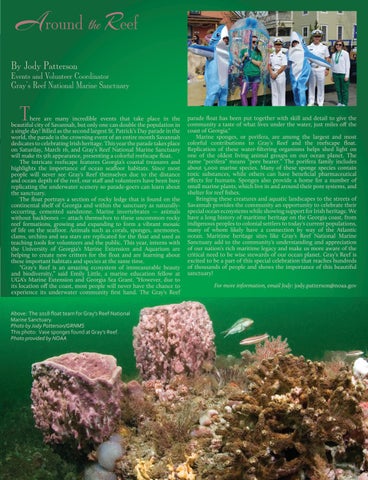
here are many incredible events that take place in the beautiful city of Savannah, but only one can double the population in a single day! Billed as the second largest St. Patrick’s Day parade in the world, the parade is the crowning event of an entire month Savannah dedicates to celebrating Irish heritage. This year the parade takes place on Saturday, March 16, and Gray’s Reef National Marine Sanctuary will make its 5th appearance, presenting a colorful reefscape float. The intricate reefscape features Georgia’s coastal treasures and highlights the importance of ocean seafloor habitats. Since most people will never see Gray's Reef themselves due to the distance and ocean depth of the reef, our staff and volunteers have been busy replicating the underwater scenery so parade-goers can learn about the sanctuary. The float portrays a section of rocky ledge that is found on the continental shelf of Georgia and within the sanctuary as naturallyoccurring, cemented sandstone. Marine invertebrates — animals without backbones — attach themselves to these uncommon rocky reef formations, growing and expanding to form a vibrant mosaic of life on the seafloor. Animals such as corals, sponges, anemones, clams, urchins and sea stars are replicated for the float and used as teaching tools for volunteers and the public. This year, interns with the University of Georgia’s Marine Extension and Aquarium are helping to create new critters for the float and are learning about these important habitats and species at the same time. "Gray's Reef is an amazing ecosystem of immeasurable beauty and biodiversity,” said Emily Little, a marine education fellow at UGA's Marine Extension and Georgia Sea Grant. “However, due to its location off the coast, most people will never have the chance to experience its underwater community first hand. The Gray's Reef Above: The 2018 float team for Gray's Reef National Marine Sanctuary. Photo by Jody Patterson/GRNMS This photo: Vase sponges found at Gray's Reef. Photo provided by NOAA
parade float has been put together with skill and detail to give the community a taste of what lives under the water, just miles off the coast of Georgia." Marine sponges, or porifera, are among the largest and most colorful contributions to Gray’s Reef and the reefscape float. Replication of these water-filtering organisms helps shed light on one of the oldest living animal groups on our ocean planet. The name “porifera” means “pore bearer.” The porifera family includes about 5,000 marine species. Many of these sponge species contain toxic substances, while others can have beneficial pharmaceutical effects for humans. Sponges also provide a home for a number of small marine plants, which live in and around their pore systems, and shelter for reef fishes. Bringing these creatures and aquatic landscapes to the streets of Savannah provides the community an opportunity to celebrate their special ocean ecosystems while showing support for Irish heritage. We have a long history of maritime heritage on the Georgia coast, from indigenous peoples to colonial settlers to today's current populations, many of whom likely have a connection by way of the Atlantic ocean. Maritime heritage sites like Gray’s Reef National Marine Sanctuary add to the community’s understanding and appreciation of our nation’s rich maritime legacy and make us more aware of the critical need to be wise stewards of our ocean planet. Gray’s Reef is excited to be a part of this special celebration that reaches hundreds of thousands of people and shows the importance of this beautiful sanctuary! For more information, email Jody: jody.patterson@noaa.gov
The Boatyard is proud to offer:
Marina: (912) 897-2896 Boatyard: (912) 897-1914 606 Wilmington Island Road Savannah, GA 31410 www.sailharbormarina.com
Air Conditioning Installation/Repair Electronics Installation/Repair Canvas/Sail Repair Emergency 24/7 haul out Complete Painting Services Fiberglass/Blister Repair Prop/Shaft Repair Gas/Diesel Mechanics Sailboat Rigging Services Marina Facilities on Site Deep Water Pickup/Delivery Services Over Land Pickup/Receiving
50 Ton 17-foot Beam Travel Lift Now allowing DIY bottom prep & painting!
Taste of the Tides
NAUTICAL FLEA MARKET Saturday, April 13
Blackened Sheepshead
8 am - 1 pm • Open to Public (Buyers & Sellers) • No Entry Fee - No Space Fee • Bring your own table, trailor or truck bed • Open to all boating/nautical items
Recipe by Tovah Swan
Living on the coast gives us ample access to fresh, seasonal seafood.What better way to celebrate the bounty of the lowcountry than with homemade blankened seasoning? Easy to make, blackened seasoning is delicious on any fish, and highlights one of the most iconic flavors of the South. If you don't catch it yourself, be sure to visit your local seafood market for fish!
Boat parts Electronics Props Hardware Boats & Motors
INGREDIENTS
1 tbsp sweet paprika (if desired, use ½ sweet and ½ smoked paprika) 2 tsp salt 1 tsp onion powder 1 tsp garlic powder 1 tsp cayenne pepper ¾ tsp white pepper ¾ tsp black pepper ½ tsp dried thyme ½ tsp dried oregano ¼ tsp dried tarragon 4 fish filets Olive oil Water Lemon slices for garnish
Fishing gear Sailing gear Canvas items Nautical decor Marine books
BARBOUR RIVER YACHT CLUB 912 - 832 - 6721 www.barbourriverclub.com
1636 Goulds Landing Road NE, Townsend
sea kayak
DIRECTIONS
• Prepare the blackened seasoning: in a small bowl, combine all dry spices. Stir until thoroughly combined. • Heat olive oil in a large skillet on medium-high heat. Season filets generously on both sides, to taste. (Leftover seasoning mix can be stored in an airtight container!) • When the pan is hot, sear one side of the filets for 2 minutes. Flip the filets and sear for another 2 minutes. Carefully add about a teaspoon of water to the pan and cover. Cook completely (about 2 minutes, depending on thickness of filet). • Serve with a seasonal salad and steak fries or coleslaw and grits. Garnish with lemon slices.
georgia Kayak, SUP, & Canoe Tours Instruction Group Educational Tours Sales
Photo by Gabriel Saldana
1102 Highway 80, Tybee Island
912-786-8732
seakayakgeorgia.com info@seakayakgeorgia.com
March 2019
Southern Tides Magazine
11
Exploring Sapelo Part II, The Science Our continuing series on Sapelo Island picks up again this month with a look at the scientific research being conducted on the island. The University of Georgia Marine Institute (UGAMI) and the Sapelo Island National Estuarine Research Reserve (SINERR) are both key to a better understanding of our delicate and vital coastal ecology. Many thanks to Merryl Alber (UGAMI) and Rachel Guy (SINERR) for the information compiled here!
UGAMI
T
he UGA Marine Institute was established in summer 1953 when Professors E.P. Odum and D.C. Scott from the University of Georgia Department of Zoology were awarded a contract to establish “a biological research laboratory on Sapelo Island.” Initial funding came from what was then known as the Sapelo Island Agriculture and Forestry Foundation, which was founded by R.J. Reynolds. The core of the Institute was formerly part of a farm complex developed by Howard Coffin and then R.J. Reynolds, Jr., in the early 1930s. Most of the buildings, constructed of structural tabby with clay tile roofs, are considered historically significant. Families were housed in the apartments on the eastern side of the central quadrangle, and the existing dairy barn was gradually converted into laboratory space. Early research conducted at Sapelo Island had a major influence on the field of ecology in general and salt marsh ecology in particular. E.P. Odum literally wrote the textbook on ecology, and early research conducted with John Teal on salt marshes as detritus-based food webs that exported material to the coastal ocean inspired a generation of coastal wetland and estuarine scientists. The Marine Institute hosted the first international Salt Marsh Conference in March 1958, which brought together 55 participants from all over the world. The scientific understanding generated by research conducted at the Marine Institute provided the Georgia state legislature with a solid scientific basis for drafting Georgia’s Coastal Marshlands Protection Act and Shoreline Protection Act in 1970s. These landmark pieces of legislation made a compelling case for the importance of protecting coastal marshlands and barrier islands, and became models used by other states and countries to conserve coastal wetlands. Although the number of researchers varied, a procession of devoted scientists and their families shared the experience of living and working together on Sapelo over the years. Through the 1970s and 80s, UGAMI had as many as 10 resident scientists involved in studies ranging from barrier island geology to nutrient cycling in estuaries to salt marsh food webs. Additionally, support staff, visiting researchers, and educational groups visited and worked on the island. Although there are no longer resident scientists, UGAMI continues to offer exceptional opportunities for research and education in coastal ecosystems. The Institute hosts from 50-60 groups of university students each year as well as training workshops,
Originally a dairy barn, the main laboratory building is a two-story, 23,000-square-foot structure that houses laboratories, a wet lab, offices, a library, and an auditorium. The 1,700-square-foot wet lab has the capacity to pump 75 gallons of filtered seawater per minute. DI water, drying ovens, freezers, balances and other basic equipment are available. Photo by Amy Thurman
professional meetings and environmental educators. In 2015 the Institute started a new residential academic program for college students, who come for summer courses in Marine Sciences and other subjects. UGAMI-based courses and field trips immerse university students in field-based academic studies. The Institute also hosts scientists who conduct research funded by the National Science Foundation, the National Oceanographic and Atmospheric Administration, the Environmental Protection Agency, and others. The largest of this is the NSF-sponsored Georgia Coastal Ecosystems Long-term Ecological Research Project (GCE LTER), which is one of 25 LTER sites around the country. The GCE project measures key variables in the marshes and estuaries of the Georgia coast to understand how these ecosystems function, to track how they respond to changes in river flow, sea level and other drivers, and to predict how they might be affected by future variations in climate and human activities. GCE scientists have published nearly 300 scientific papers since the project began in 2000, and have been at the forefront of studies of wetland salinization and the role of salt marshes in the global carbon cycle. There are currently 19 staff members who work full-time on Sapelo, seven of whom live at UGAMI. To learn more about the Institute, visit ugami.uga.edu/. 12
Southern Tides Magazine
March 2019
SINERR
This sign, above, posted outside the SINERR administrative offices, provides information about the Reserve and Sapelo Island. Below, a native plant garden overlooking the estuary. Photos by Amy Thurman
T
he National Estuarine Research Reserve System is a network of 29 estuarine areas established across the nation for long-term research, education, and coastal stewardship. The reserves are a partnership between NOAA and the coastal states and territories and administered by NOAA’s Office for Coastal Management. Each reserve is managed on a day-to-day basis by a lead state agency or university, with input from local partners. The 6,100 acres of the Sapelo Island National Estuarine Research Reserve (SINERR), located along the western perimeter of Sapelo, is dedicated to research, education, stewardship, and sound management of coastal resources. The Reserve’s outreach and research initiatives focus on the island’s natural ecosystems and the cultural and historical resources of Sapelo Island and the greater Altamaha River estuary. Research programs on Sapelo fall into two categories: Reserve led, and Reserve hosted. Reserve led projects are initiated and conducted entirely by the reserve. Two of the major long-term programs are the System-Wide Monitoring Program (SWMP) and the Sentinel Site program. The purpose of SWMP is to provide standardized, quantitative measures to determine how conditions are changing in the estuary in the short and long term. There are three major components focused on: a) abiotic (non-biological) indicators of water quality and weather, b) biological monitoring, and c) watershed, habitat, and land use mapping. Abiotic parameters include nutrients, temperature, salinity, pH, dissolved oxygen, relative humidity, barometric pressure, wind speed/direction, and precipitation. Biological (plant and animal) monitoring includes measures of biodiversity, habitat, and population characteristics. Watershed and land use classifications provide information on types of land use by humans and changes in land cover associated with the reserve. The Sentinel Site program is a newer installation on SINERR, and is connected to the SWMP program. The purpose of this program is to monitor the long-term effects of climate change and sea level rise on our estuary’s saltmarshes. Using research reserves as sentinel sites works well due to the capacity of each site to provide early detection of environmental change and enable timely management responses. A new program at SINERR is the National Phytoplankton March 2019
Southern Tides Magazine
Monitoring Network (PMN). This community-based network of volunteers monitors marine phytoplankton and harmful algal blooms (HABs). PMN recognizes the interrelationships between humans and coastal ecosystems while providing volunteer citizen scientists with meaningful opportunities for hands-on science engagement. The PMN enhances the ability to respond to and manage the growing threat posed by HABs by collecting important data for species composition and distribution in coastal waters and creating working relationships between volunteers and professional marine biotoxin researchers. To learn how you can help, visit: http://bit.ly/citizenscientist_volunteer Reserve Hosted programs are comprised of scientists and researchers who come to us to do their research on the reserve. Some current areas of study and research include horseshoe crabs, sea oats, marine debris, small mammals, fiddler crabs, and rattlesnakes, to name a few. To learn more about the Sapelo Island NERR, and to find out how you can visit, go to https://sapelonerr.org/
Coming soon, the next installment in the Sapelo Series: Part III, The People. 13
Join us at Fish Tales and Ft. McAllister Marina!
I’ve fetched this GREAT motor for you!
Oysters • Drink specials • Great menu items Live bait Dockage Dry Storage
Fish Tales 727.3473 • Ft. McAllister Marina 727.2632 3203 Ft. McAllister Road • Richmond Hill, GA • SM 605
Get out on the water with one of our Mercury Re-powers! 2604 Causton Bluff Road • Savannah, GA (912) 376-8776 • HaleMarineInc@gmail.com
Satilla Marine Family Owned and Operated Since 1977
Parts and Service - Boats - Trailers - Outboards Accessories - Boat Gear - Rods - Reels - Tackle Serving all of coastal and south Georgia for your fishing and boating needs!
1807 Old Reynolds Street • Waycross, GA • (912) 285•8115 • sales@satillamarine.com
BOAT SAFETY IN THE MARINA
ELECTRIC SAFETY TIPS ON THE DOCK Use caution around electricity on the dock. Your boat's AC electrical power could be dangerous or even deadly, so it is important to use extra care around the water. ▶ Report Electrical Problems. Report any observed problems to the dockmaster or marina manager immediately, such as: - Worn, rusty or poorly fitting electrical receptacles - Any visible signs of damage to a power pedestal - Shore power cords on the dock that are not fully plugged in or have a damaged outer insulation jacket ▶ Test Outlets First Before Plugging In. If your dock pedestal is equipped with GFCI outlets, test the GFCI unit using the test and reset functions on the outlet.
ELECTRIC SHOCK HAZARDS IN THE WATER Electrical accidents injure swimmers, boaters and others in marinas every year. Electricity may be present in the water in places where boats are connected to shore power or where marina wiring is defective. Never swim in a marina or in other areas where boats are connected to shore power. WHEN CONNECTING A BOAT TO SHORE POWER: ▶ Make sure there are no swimmers in the water ▶ Before connecting, turn off the boat's main AC breaker and the dock breaker ▶ Make sure shore power cord is clean and dry before use ▶ Have a certified electrician inspect a cord that has been submersed in salt or brackish water
For More Boating Safety Information, Visit: DiscoverBoating.Com
TO CONNECT A SHORE POWER CORD PROPERLY: ▶ Connect the cord to the boat first ▶ Connect the cord to the dock receptacle ▶ Turn on the dock breaker ▶ Turn on the boat's main AC breaker ▶ Check the boat's polarity alarm or light on the AC panel as soon as the breaker is turned on TO DISCONNECT A SHORE POWER CORD PROPERLY: ▶ Turn off the boat's main AC circuit breaker ▶ Turn off the dock breaker ▶ Disconnect the dock end of the shore power cord ▶ Remove the cord from the boat power receptacle ALWAYS: ▶ Use only UL marine approved shore power cords ▶ Once a year have a certified marine electrician check the boat's entire AC electrical system including the shore power grounding system IN THE EVENT OF AN IN-WATER ELECTRICAL ACCIDENT: ▶ Do NOT jump into the water - throw a floatation device and pull the victim to safety. ▶ Shut down power if possible ▶ Call 911 ▶ Notify the dockmaster or marina manager
Safe boating begins the moment you step on the dock. Whether you are preparing for a trip, returning home, loading equipment or performing boat maintenance, the following suggestions will help everyone have a safe and fun day on the water.
MARINA DOCK SAFETY HERE ARE SOME TIPS FOR AVOIDING INJURIES THAT CAN OCCUR ON A DOCK: ▶ Closely supervise children ▶ Keep hands and feet clear of pinch points ▶ Wear non-slip shoes and don't run ▶ Look for trip hazards such as lines or hoses ▶ Watch your step - don't carry large items that block view ▶ Wear a USCG-approved life jacket or PFD ▶ Make sure cabin is equipped with working CO detector ▶ Check the weather ▶ Know and follow marina rules and "no wake" rules ▶ Make sure all safety equipment is onboard and working ▶ Prepare passengers for man-overboard situations ▶ Know your system alarms and listen for them
March 2019
Southern Tides Magazine
15
• Apps, burgers & fresh local seafood • Full bar • Indoor & outdoor dining • Live music on weekends • Open seven days
JEKYLL HARBOR MARINA
Come by boat!
• • • • • • •
912-319-2174
Dockage and Dry Storage Gas/Diesel Wifi, Cable TV Courtesy bicycles Pool Pump-out Ship’s Store
912-635-3137
inquiry@jekyllharbor.com www.jekyllharbor.com
ZACHRY'S - Providing fresh seafood in Glynn County for over 35 years!
1 Harbor Road
Jekyll Island, Georgia
Boat Sales
Brokerage
Sail & Power
AND NOW
Text Dunbar to 77453 for info sales@dunbaryachts.com
912-638-8573
www.dunbaryachts.com
Opinion: House Bill 201
provisions for this in the State budget, but I’m disappointed to report that these lines were stricken from the bill in the House. Funds from permits will now go to general revenue and the DNR will then have to request them back through appropriations. This is a loss for our coast as funding for the removal of derelict vessels was a primary part of HB 201. Sewage Discharge While discharging raw sewage from holding tanks has long been prohibited under the Marshland Protection Act, the discharge of some types of treated waste was allowable. Under HB 201, discharge of waste from marine toilets by an anchorage permit holder is prohibited and the seacock must be closed and locked or have the handle removed. Vessels must now pump out at a pump-out facility and keep records of their pump-outs for one year, and the pump-out facility must also maintain records. This helps protect the cleanliness and health of our water. While some may disagree, arguing that treated waste is treated and therefore safe, I’m not here to debate the definition of safe waste. There are pump-out facilities along our entire coast, and it costs very little to use them. Our coastal waters are among the cleanest and healthiest in the country and I personally would like that to remain true. Establishing Anchorage Areas A lack of guidelines regarding anchoring has presented a multitude of issues. Boats anchoring too close to navigation channels in narrow creeks, anchoring too close to marinas or personal docks making it difficult to navigate around them when approaching or departing the docks, and boats anchoring near protected shellfish beds all present problems. HB 201 allows the DNR to establish areas where anchoring is not allowed, in order to reduce these issues. While this does give the DNR a great deal of leeway, GAMBA will be working with them to help establish these areas so that a healthy balance is achieved. The final critical part of HB 201 was to move it from Title 12, relating to coastal marshlands, to Title 52, relating to waters of the state. In a nutshell, this allows law enforcement (the DNR and city or county marine patrols) to actually enforce the law by responding to complaints about vessels pumping overboard or anchoring in restricted areas and issuing tickets or requiring them to move. This law will be complaint-driven, meaning that patrols won’t be riding around looking for violations, but will respond when a violation has been reported. Although this bill gives the DNR a slightly broader authority, GAMBA intends to closely observe. In addition, the current DNR leadership has been very transparent and reasonable in finding a balance between business and the environment. In short, I believe HB 201 to be beneficial to our coast and will continue to support it through GAMBA activities, as well as contact with elected officials. If you would like to comment, please email me: amy@ southerntidesmagazine.com. If you would like to read the bill and see where it is in the legislative process, visit: http://bit.ly/HB201
By Amy Thurman
T
he last week of February I went to Atlanta to attend House committee meetings in support of House Bill 201. I attended the meetings on behalf of the Georgia Marine Business Association (GAMBA) but also as a concerned coastal resident. The bill passed through committees then went on to the House floor. After one modification it passed the House and at print time, had gone on to the Senate. HB 201 covers some key issues in our coastal waters. Establishing an Anchoring Permit Much in the way you can go online and get a camping permit at a state park for a nominal fee, HB 201 would allow the DNR to establish a similar permit (also for a nominal fee) for liveaboard vessels anchoring in state waters. If that makes you cringe, let me explain why it’s included in the bill. In far too many locations along our coast, boat owners have tied their boats to moorings and left them for extended periods of time. All too often, these boats present problems: they haven’t been properly secured and drift into navigation channels with the tides, they aren’t properly lighted and therefor invisible at night, they have broken free and washed into other boats or the marsh, or they sink and leak fuel into the water. In many cases these boats don’t have current registration and tracking down the absentee owners is difficult or impossible. Boats such as these with absentee owners account for a majority of the derelict and sunken vessels in Georgia waters and they present hazards to both navigation and the health of our coastal environment. This is not an attempt to prevent people from living aboard their boats, but to prevent them from being abandoned in our waters. There was an additional part of this section that would allow for the fees from these permits to be used to fund the removal of sunken and derelict vessels in navigation channels, as there are currently no
At flood tide, this creek appears quite wide, but in reality the navigable channel is fairly narrow. Anchored boats can drift into the channel, break free of their moorings and cause damage to other boats or the marsh, or even sink. No one wants to prohibit transient boaters, who spend a great deal of money with Georgia businesses, but we do need to stop owners from leaving their boats unattended in areas where they could pose a liability to property or the environment. Photo by Amy Thurman March 2019
Southern Tides Magazine
17
river drive
Marine Products, Services and More
Waterline Up
Boat Protection Experts Serving the Savannah Area since 2003
Garmin Authorized Service Center
Marine Electronics Sales Troubleshooting Service Installation Wiring Installation/Repair
Proud to offer Dry Case Products! Visit Our Showroom!
Justin Hill 912-660-3763
a3opax@gmail.com
• Catering at your dock • Food cooked fresh to order • Menue designed to your needs • Call ahead service
Parties Open Houses Fishing Tournaments Poker Runs Follow Us to Find Our Location!
Billy Gartside 912-844-1804
billygartside@yahoo.com
We’ll come to you!
Facebook.com/TheBurgerBoatSAV instagram.com/theburgerboatsav
Keeping you headed in the right direction!
(912) 695-2617
912-777-4139
(315) 406-0804
maricomnavigation@comcast.net
steviedsenterprises@gmail.com
marine group
Serving the Coastal Empire and Lowcountry
• Prop Scan Technology • Propeller Repairs & Sales • Locally Owned & Operated
Now servicing outboard props!
Trucker Hats • Dad Hats Visors Ladies Racerback Tanks Short & Long-sleeved Ts Dri Fit Ts Koozies Hat/Tie Hooks More Products Coming!
t-tops half towers upper stations/crow’s nests leaning posts poling platforms bow rails custom aluminum/stainless needs
James Gartside
912-631-4104 j.gartside@comcast.net
PROP DOCTORS LLC
TopAnglerApparel.com
3327-B Russell Street Thunderbolt, GA 31404
(912) 429-5858 topanglerapparel@gmail.com
info@propdoctorsllc.com
Safe Harbor
Rigging Services, LLC Proudly Serving Southeast Georgia and Northeast Florida
We’re working for you! • Protects, defends and restores the watershed by monitoring pollution and polluters. • Talks with legislators about bills that could better protect the watershed.
CIRCA 1870
G OODBREA D
• The 14,000 miles of the Altamaha watershed includes Ocmulgee, Oconee, Ohopee and the Golden Isles.
HOUSE
BED & BREAKFAST INN Four andard gue r ms & two suites, all wi large private ba r ms. ay wi us and visit Cumberland Island and hi oric . Marys! Pet friendly. Dietary needs met.
912.510.6219
We can’t do it without you, become a member now! www.altamahariverkeeper.org
info@safeharborriggingservices.com www.safeharborriggingservices.com
John S. Ramsey, Owner Authorized
Call for special Southern Tides Rates!
(912) 882-7490
Dealer
Fishable Swimmable Drinkable Water!
www.g dbreadhouse.com info@g dbreadhouse.com 209 Osborne . . Marys, Georgia
IMAGE BY KAREN CARR
Captain Tripp Lang’s Charters
Coastal Expeditions Captain Eric Moody Jekyll Island, Georgia
We can’t give you this ... Inshore Fishing & Sightseeing Cruises 912-674-1085 or 912-674-0838
www.FishSaintMarys.com
But we can help you find this! G & W EXCURSIONS Call Captain Gator! 912 604 1587
Fishing Charters Dolphin Tours Sightseeing Trips
912.270.3526
www.coastalcharterfishing.com
Erosion Tracked by Drone
Reader Survey Ongoing
By Mike Sullivan UGA Skidaway Institute of Oceanography
Southern Tides Magazine is hosting a very important reader survey! Operational decisions will be made in 2019 and your opinions matter. Please participate! www.surveymonkey.com/r/ST_Reader_Poll
TOPIC EXAMPLES Your demographics The berm on the north channel of the Savannah River. Photo provided by UGA SkIO
Your personal interests
A
How you read Southern Tides
University of Georgia Skidaway Institute of Oceanography graduate student is using cutting-edge technology to help the National Park Service monitor erosion and sand accumulation on a man-made beach at Fort Pulaski National Monument near Tybee Island, Ga. Colby Peffer is using a drone to track changes to the shoreline as part of her research for a master’s degree at UGA. The beach was created by the U.S. Army Corps of Engineers in fall of 2015 as part of a defensive sand berm to protect important salt marsh habitat and historically significant structures at Ft. Pulaski that were being threatened by erosion caused by wave energy. Such projects are termed “beneficial-use dredge spoil” projects. Peffer uses a DJI Phantom 4 Pro drone and sophisticated flight planning and image processing software, which allows her to pre-program the drone to fly a specific pattern and take thousands of still pictures. “When we fly over the entire expanse of the beach, we are taking images with a high overlap between adjacent images and at a fairly low altitude,” Peffer said. “Each pixel in the image is the equivalent of only a couple square centimeters on the ground. Overall the accuracy of our 3D surfaces is pretty high.” Peffer began her monthly surveys in July 2018 and plans to continue at least until summer 2019. Early surface model comparisons show significant erosion occurring on the north and west side of the defensive berm. “Part of the escarpment is eroding away,” she said. “We don’t know where the sand is going. “We don’t know if the sand is staying on the beach or being removed completely, but as we process our sediment samples we may learn more about the beach’s sediment transport pathways.” The data Peffer collects will also have some practical benefit for the National Park Service. “For the first time, the National Park Service will be able to look at more specific erosion and sediment loss rates to evaluate how much longer the defensive berm will be able to prevent destructive wave energy from compromising the stability of vulnerable cultural resources,” Peffer said. “They will have more information about how they need to maintain the beach, the specific erosion rate and how often they will need to replenish the sand supply.” The project will also serve as case study for a larger look at the beneficial use of dredge spoil and characterizing erosion in the region. March 2019
Southern Tides Magazine
Your thoughts on print vs. digital www.surveymonkey.com/r/ST_Reader_Poll Results from this survey will aid in fine-tuning distribution, providing metrics for our advertisers, and providing both better digital content, and content geared towards our readers' interests.
Question Examples: Where do you pick up your copy of Southern Tides Magazine? How often do you read digital articles? Do you tell our advertisers that you saw their ad? How do you read digital material (phone, tablet or computer)? Which social media platforms do you use regularly? Do you live on or near the water? And much more. The information collected in this survey will directly impact Southern Tides in the months ahead. Please participate!
www.surveymonkey.com/r/ST_Reader_Poll 21
T he Bitter End Spartina by Any Other Name When overtaking a vessel, pass to his port when possible and hail the captain on VHF to let him know your intentions. Photo by Amy Thurman
By Captain J. Gary “Gator” Hill
What we locals call Spartina, just starting to green up. Our beloved editor swears it only starts turning green when spring is nigh. Photo by Amy Thurman
“W hat’s in a name? That which we call a rose By any other name would smell as sweet.”
adjusting well to the change. From what I gather neither did a group at a lecture that Professor Hosier was conducting when he let it slip before the change was made official. Professor Hosier said he was met with looks of surprise and disbelief. I can understand the shock! Imagine having to change all the road signs, business names, recipes and everything else called Spartina that runs through the low country! Just as the tiny rhizome roots from this same plant run through the marsh, holding it together. So, for now, I for one, will continue to call it Spartina.
I’m sure you’ll all recognize these classic lines from Romeo and Juliet. A question between Romeo Montague and Juliet Capulet, their families being enemies. Today we have another name conundrum between science and those of us who call the lowcountry home. “What’s in a name? That which we call Spartina By any other name would smell … like Sporobolus?” Confused yet? If not, you’re ahead of me, and I will do my best to make you so. For the last half of the 20th century Spartina alterniflora has become synonymous with our saltwater marshes. Now however, we have to get used to calling it Sporobolus alterniflora. Spartina, AKA smooth cord grass, gets its name for that very reason, being similar to a type of cord made from Spanish broom (Spartium junceum). It can be found along most of America’s coastline from Texas to New England. And now it has a new name. In 2014, Spartina was reclassified after a taxonomic revision based on the ground-breaking work of Professor Paul Hosier from the Department of Biology and Marine Biology, University of North Carolina Wilmington. It is now to be known as Sporobolus alterniflora. Just like when Pluto was a planet, then not a planet, new research has placed our beloved Spartina into the Sporobolinae genus. I suppose we shouldn't take it too hard as several other grasses, plants and such have been reclassified as well, due to things like DNA-based phylogenetic studies, and taxonomic research. Sporobolus comes from Greek and means “seed thrower.” Not once have I seen this plant throw its seeds! I guess I’m just not
As always, have a blessed life and safe boating, and I’ll See You On The Water.
Email: TheOriginalCaptainGator@gmail.com 22
Southern Tides Magazine
March 2019
113 Holcomb
ISLE OF HOPE This wonderful 2 BD 2.5 BA home was originally the location of a dairy farm. Two buildings for living. One two story with a wonderful master suite upstairs with new bath and large closet. Separate “bunkhouse” has full bath, bedroom, kitchen and living area. They are joined by a cozy courtyard and expansive deck. This deck overlooks a back yard for outdoor enthusiasts. Large detached workshop and several outdoor storage buildings. Welcome to the Isle of Hope area. You can walk everywhere. Down to the marina, over to the community pool, along Bluff Dr and views of the Intracoastal Waterway. The community is one of the few golf cart approved areas. This special historic home is for the special lover of beautiful and unique properties. $399,000 COTTAGES AT AUTUMN LAKE
36 Scarlet Maple
Here is a 3BD 2 BA opportunity that does not come along very often. The buyer just closed on this on December 20, 2018. His job is no longer here. We are relisting it. It is priced the same as it was when he purchased. Not many of these are complete at this time. Come be a part of a wonderful townhome community. Lots of amenities. Totally clear home inspection. Gated Community with lots of amenities. Pool, Clubhouse, Fitness Facility. Lake access with walking paths. Close to lots of shopping and restaurants. Completed June 2018. $269,900
110 Robin Road
Perfect home situated on 1.5 acres with beautiful marsh and deep water views. Amazing master suite on the main floor with luxurious bath and huge closet. Two additonal bedrooms on this floor plus two BRs and baths upstairs. Very open floor plan featuring living room, great room, office, dining room, breakfast area and fantastic kitchen. Beautiful hardwood and porcelain floors. Lovely patio. You will fall in love. $639,900
78 Shipwatch Road
Located in The Marshes. This 3BD 3BA is a wonderful place to call home. Large open rooms with two bedrooms on the first floor, great room and family room off of kitchen. Screened porch and deck enhance the amazing marsh views. The second floor has a large bonus room, third bedroom and a bath. Lots of amenities to include a community pool, community dock, and common areas. $399,000
12726 Largo
This wonderful family home is one of the nicest in Berkshire Woods. Ranch style with three bedrooms and two baths. The master bath has been redone and has an awesome shower. Two master closets. Newly painted throughout. New roof, water heater and newer HVAC. Huge lot on the LaVida golf course. Large bonus room, craft room and workshop. Parquet floors. Just unpack and settle in. $250,000
VERNONBURG
WHITEMARSH ISLAND
WINDSOR FOREST
6349 Abercorn St. Savannah, GA 912.352.1222
Lyn McCuen 912.224.0927
lyn@coldwellbanker.com www.lynmccuen.com
BURNSIDE ISLAND
This 4 BD, 3 BA home boasts one of the largest non estate lots on the island. Over an acre. Lots of beautiful camellias and mature flowering vegetation. Very open GR and a beautiful fireplace. Sun Room off the GR. Three BRs, 2 B on the first floor. Bonus is fourth BR and has its own private bath. Kitchen has eat in area with exposed brick. Gas stove. Plenty of outdoor storage. Lovely Pergola over a large outdoor deck area. Oyster Party Haven. This is a family home, ready for your personal updating. Great island living. Golf cart approved community. Optional Assoc. with annual picnic and golf cart parades. $389,000
505 Moon River
BURNSIDE ISLAND
OMG!! 4BRs, 3BAs. That is all you can say about these views over the marsh and Vernon River. The sunsets alone are breathtaking. This traditional Low Country home is located on 2.8 acres and has views out of every window. Inground pool and screened porch overlooking the view as well. This estate is perfect for the discerning owner with privacy and lots of potential for gardens or a family compound. Burnside Island is a unique island with single family homes and lots of walking, riding, etc. Golf cart approved island. Owner may apply for membership in the Burnside Island Yacht Club on the Intracoastal Waterway. $799,000
REDUCED
281 Shipyard
MIDTOWN
Wow!! No lots like this in Parkside. 4 total lots with amazing outdoor space. This charming bungalow will draw you in and make you want to settle in for life. Two bedrooms and bath down and a fantastic master suite and sitting area with bath on second floor. Hardwood floors and contemporary kitchen. There are two outdoor screened areas. Detached single car garage with lots of extra storage. Parkside is such a welcoming community with lots of friendly neighbors. Walk to Daffin Park for the dog park, watching games or enjoy the Banana games and fireworks. Ready for you now. $375,000
1205 E. 51st Street
TYBEE ISLAND
Neverending views of the Atlantic Ocean with amazing sunrises. 3 BR, 3.5 BA custom built home has all of the details that you desire. Ironwork, high end Gourmet kitchen, master suite, soaring ceilings and elevator are just a few of the special traits. Open floorplan with space for entertaining. Master Suite has private balcony, huge dressing room and luxurious tub with adjoining FP. Step directly out of the LR to the screened porch and adjacent walk way to the beach. $2,190,000
3 6th Terrace
ISLE OF HOPE MARINA
912-354-8187 www.iohmarina.com
Located in a Scenic Historic District; Listed on the National Register of Historic Places
The Best of Savannah, Georgia!
Complimentary Loaner Cars Drive in minutes to local restaurants, grocery stores, West Marine, and a Wal-Mart Supercenter.
Dockside Amenities • Complimentary High-Speed Wi-fi • 30 - 50 - 100 amp electrical service • 4,000 feet of floating concrete docks • 600 feet of deep water face docks • Gas and diesel facilities • Pump-out station Marina Amenities • Complimentary loaner cars & bicycles • Ship’s store and laundry facilities • 2,000 sq. ft. overwater pavilion • Private restrooms and showers • Seasonal swimming pool
50 W. Bluff Drive • Savannah, GA 31406 On ICW, Mile 590 - Marker 46A