TRASH
THE QUEST FOR BIODEGRADABLE JEANS STIRS UP NEW CERTIFICATION IT STARTED, as things sometimes do, with a stick of salami.
This was circa 2014. Alberto Candiani was grabbing lunch at a deli in Induno Olona, the picturesque Milan-adjacent town his family-founded denim mill calls home, when he spied a piece of sausage in a bouncy netting of natural rubber. Surrounded by cold cuts, inspiration struck. Could this be the key to the plastic-free flexible denim everyone was looking for?
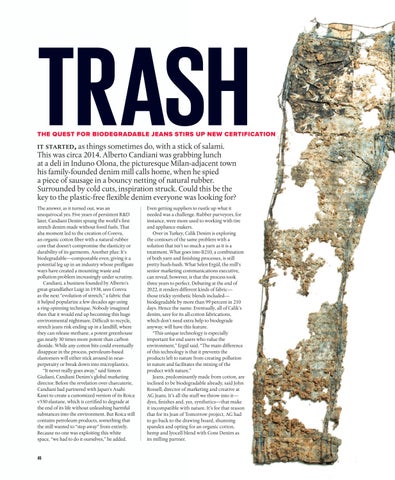
The answer, as it turned out, was an unequivocal yes. Five years of persistent R&D later, Candiani Denim sprang the world’s first stretch denim made without fossil fuels. That aha moment led to the creation of Coreva, an organic cotton fiber with a natural rubber core that doesn’t compromise the elasticity or durability of its garments. Another plus: It’s biodegradable—compostable even, giving it a potential leg up in an industry whose profligate ways have created a mounting waste and pollution problem increasingly under scrutiny. Candiani, a business founded by Alberto’s great-grandfather Luigi in 1938, sees Coreva as the next “evolution of stretch,” a fabric that it helped popularize a few decades ago using a ring-spinning technique. Nobody imagined then that it would end up becoming this huge environmental nightmare. Difficult to recycle, stretch jeans risk ending up in a landfill, where they can release methane, a potent greenhouse gas nearly 30 times more potent than carbon dioxide. While any cotton bits could eventually disappear in the process, petroleum-based elastomers will either stick around in nearperpetuity or break down into microplastics. “It never really goes away,” said Simon Giuliani, Candiani Denim’s global marketing director. Before the revelation over charcuterie, Candiani had partnered with Japan’s Asahi Kasei to create a customized version of its Roica v550 elastane, which is certified to degrade at the end of its life without unleashing harmful substances into the environment. But Roica still contains petroleum products, something that the mill wanted to “step away” from entirely. Because no one was exploiting this white space, “we had to do it ourselves,” he added.
46
Even getting suppliers to rustle up what it needed was a challenge. Rubber purveyors, for instance, were more used to working with tire and appliance makers. Over in Turkey, Calik Denim is exploring the contours of the same problem with a solution that isn’t so much a yarn as it is a treatment. What goes into B210, a combination of both yarn and finishing processes, is still pretty hush-hush. What Selen Ergül, the mill’s senior marketing communications executive, can reveal, however, is that the process took three years to perfect. Debuting at the end of 2022, it renders different kinds of fabric— those tricky synthetic blends included— biodegradable by more than 99 percent in 210 days. Hence the name. Eventually, all of Calik’s denim, save for its all-cotton fabrications, which don’t need extra help to biodegrade anyway, will have this feature. “This unique technology is especially important for end users who value the environment,” Ergül said. “The main difference of this technology is that it prevents the products left to nature from creating pollution in nature and facilitates the mixing of the product with nature.” Jeans, predominantly made from cotton, are inclined to be biodegradable already, said John Rossell, director of marketing and creative at AG Jeans. It’s all the stuff we throw into it— dyes, finishes and, yes, synthetics—that make it incompatible with nature. It’s for that reason that for its Jean of Tomorrow project, AG had to go back to the drawing board, shunning spandex and opting for an organic cotton, hemp and lyocell blend with Cone Denim as its milling partner.