SOAS SPIRIT
6 FEBRUARY 2020
FREE
YOUR INDEPENDENT STUDENT NEWSPAPER
THE QUEST TO DECOLONISE THE NATIONAL CURRICULUM
p6
ISSUE 11
TOP CULTURE PICKS FROM
UNDERSTANDING THE FIRES
2019
IN AUSTRALIA
p10
p29
Fractionals ‘attacked’: Latest round of cuts at SOAS announced
(Credit: Wikimedia Commons)
Hundreds of students, academics, and staff walkout amid the dispute over workers’ rights and research funding. (Credit: Goldsmiths UCU/Twitter)
Will Durrant & Sabrina Shah, BA History & BA International Relations SOAS’s senior management has announced a shock decision to suspend fractional workers’ contracts. Students, union members, and researchers are leading fresh protests against the plans. The latest round of protests are aimed at the School’s
management body, which comprises some of the best paid staff at SOAS. The Students’ Union, the University and Colleges Union (UCU), Fractionals for Fair Play (FFFP), the School’s academic steering body, and the student-led SOAS Assembly consortium have all moved to oppose the latest restructure. As they stood at the end of January, SOAS’s plans include major cuts to the fractional teaching budget in the 2020/21 academic year, and a cut to sabbatical research leave funded
by SOAS. Fractional staff are employed on ‘casual’ or fixedterm contracts and do not work at SOAS as full-time staff. After an all-school assembly meeting with four members of the directorate last month, members of the SOAS community have raised questions about the directorate’s handling of the School’s financial crisis. Last year, the Spirit revealed that the School’s cash reserves would run out by the end of 2021. Continued on page 3
6 FEBRUARY 2020
Contents
Letter from the Editor
News
Fractionals ‘attacked’: Latest round of Cuts at SOAS announced
p1
Food for All: The principles behind the Hare Krishna lunch
p4
Divisive and unconstitutional: The Citizenship Amendment Act, India
p12
Opinion The Taiwanese election result is a bittersweet victory for Hong Kongers On the shallowness and ignorance of present-day environmental activists
p14
p15
Features ‘I work therefore I am’: how hustle culture is eating up our lives
p17
A glimpse into my sketchbook
p19
Horoscopes as Degree Stereotypes
Dear Spirit readers, Happy new year! As the deadlines roll in and the library begins to fill, the SOAS Spirit welcomes our February edition - Issue #11. SOAS news covers the recent controversies concerning students and staff alike, following the school-wide assembly discussing changes to staff contracts and accountability of management, among other important topics. This section also has a fascinating deep-dive into the Hare Krishna stand, near and dear to our students, with a slightly different angle. As Brexit has recently been enacted, the national sentiment calls us to take a deeper look into the aftermath of elections. What may seem like a decision made long ago, affects us all. The nuances of this current climate are explored in our national news section. More on the waves Brexit is causing in legislation - child refugee protection takes a hit causing campaigners anguish. On the global platform, our international news section includes a spotlight on the Australian fires, Israel’s ICC investigations and the threats of war with the assassination of Soleimani. Our international coverage also expands to India, having a look at the altered citizenship laws that exclude and endanger many citizens, building on Modi’s cruel campaigns One of my favourite pieces this issue is in Opinions, discussing the protests for action against climate change, and the impact this has against powerful industries
Syraat Al Mustaqeem • Managing Editor • Maliha Shoaib• Co-Editor-in-Chief • Hana Qureshi • Co-Editor-in-Chief •
Culture p24
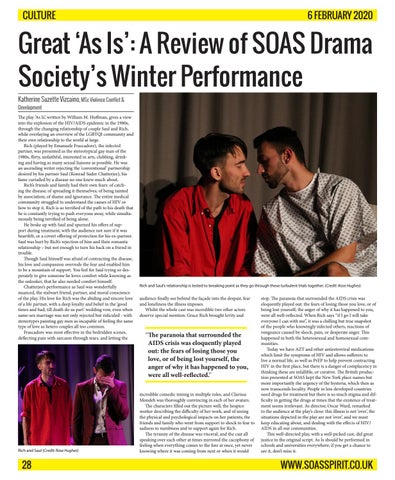
Great ‘As Is’: SOAS Drama Society’s Winter Performance
p28
Iran Faces Wave of Defecting Athletes
p31
Varsity Tables
p32
Maliha Shoaib • Co-Editor-in-Chief
Will Durrant • News Editor • Ludovica Longo • News Editor • Sabrina Shah • News Editor • Basit Mohammad • Opinion Editor • Fisayo Eniolorunda • Features Editor • Sasha Patel • Features Editor • Indigo Eve Lilburn-Quick • Culture Editor • Rami Shamel • Sport and Societies Editor • Adekunmi Olatunji • Senior Layout Editor • Maliha Shoaib • Senior Layout Editor • Tanzina Hassan • Junior Layout Editor • Mihaela Cojocaru • Copy Editor • Mubine Aydin • Copy Editor • Maryam Mirza • Copy Editor • Lyla Amini • Copy Editor • Hawa Noor • Copy Editor • Olivia Smith • Copy Editor •
Sport & Societies
2
Syraat Al Mustaqeem Managing Editor of The SOAS Spirit
Your SOAS Spirit Team
p21
Comfort food: the restaurants that cure home sickness
- further still, the shallow use of this protest by celebrities. (As I read this article, I could hear the sound of handcuffs closing on Jane Fonda and Ted Danson’s wrists.) Features, once again, challenges our psyche with our regular illustrator Gaia Tan’s comic on reading the world as poetry. As an English student, I wholeheartedly support this approach - but do expect a rise in melancholy if practiced before 7am. Our SOAS Street Style includes fashion statements from a recent cultural night, shared between a number of cultural societies at SOAS. Our very own Maliha Shoaib comments on productivity culture, followed by an enlightening piece on the practical use of our degrees by Imaan Khan. As always, the poetry and creativity is a kindness to lift your mood from the heaviness of this issue’s news section. The Culture section this issue boasts a worldwide expansion, looking at the food that reminds SOAS students of home, as well as travelling to the small screen in Pakistan with a review on the dramatic series ‘Meray Paas Tum Ho’. Our culture column by Rihab takes a critical look at Ricky Gervais’ speech at the Golden Globes. Finally, to wrap up the ending of a decade we have a look at what we’re letting fade into the 2010’s with the best of 2019. For all the Spirit Sports readers, our sports and societies section includes the varsity tables for February. The SOAS Warriors have been training hard so make sure to show support! As the decade draws to a close, and the news cycles continue, let the Spirit be a hopeful place of solace where we can hear and share the voices of our students. If you’re interested in writing for our last issue of the year or for our online platforms don’t hesitate to email us at spirit@soas. ac.uk and follow us on all of our social media platforms @ soasspirit. Keep reading!
Hana Qureshi • Co-Editor-in-Chief
Adekunmi Olatunji, • Online Editor • Arzu Abbasova • Online Editor • Amaani Master • Social Media Co-ordinator •
WWW.SOASSPIRIT.CO.UK
31 OCTOBER 2019 https://soasspirit.co.uk/category/news/ News Editors: Will Durant, Ludovica Longo, Sabrina Shah
SOAS News
News
Continued from page 1
The current dispute came to light after FFFP, a long-running campaign to award temporary teaching staff permanent contracts, sent a statement to staff and students noting changes to fractional workers’ terms and conditions of employment, effective from the next academic year. FFFP says that SOAS management will abolish fractional teaching posts, ‘effectively firing large numbers of people’ who have seen drastic cuts to their teaching hours. FFFP warns that this will be to the detriment of SOAS’s quality of teaching as lecturers and markers will be ‘woefully overstretched.’
“FFFP says that SOAS management will abolish fractional teaching posts, ‘effectively firing large numbers of people’ who have seen drastic cuts to their teaching hours.” The group warns that the move to suspend fractional teachers’ contracts will ‘disproportionately affect … those of us already on the margins of academia and the university,’
especially staff who are women, Black, or People of Colour. Stephen Hopgood, the School’s Vice-Director, appeared to deny that fractional staff would have their contracts suspended in the new year. At the all-school meeting last month, he said: ‘there will continue to be fractionals at SOAS. All we’ve done is, for one year, paused research leave that’s funded entirely by the School.’ Hopgood also said that fractionals are ‘absolutely not’ being sacked, but that a ‘review’ of casual contracts is a ‘standard’ procedure which takes place every year. He did not deny that the directorate is making a ‘major cut’ to the fractional budget at SOAS, nor that some staff will have their contracted teaching hours reduced to zero, as FFFP highlights. On the suspension of academic research leave funded by SOAS, the School’s academic steering group, the Academic Senate, seemed frustrated with the decision to suspend research leave. An email sent to staff on January 21 called for an extraordinary meeting to address the cuts which were made ‘seemingly without consultation with academic research leaders or union representatives.’ The Senate’s email hinted that there may be more cuts to come: ‘a number of staff are now asking questions about the wider situation and what measures are planned.’ 104 academics signed the petition for an extraordinary
Students and staff walk out in support of fractional workers. (Credit: Suzana Marie)
WWW.SOASSPIRIT.CO.UK
Stephen Hopgood, the School’s Vice-Director (Credit: SOAS)
meeting. The list of signatories includes several course convenors and heads of departments. Campaigners warn that cuts to research at SOAS in any form could threaten the School’s international reputation as a centre for knowledge on Africa, Asia, and the Middle East. The SOAS Library was designated one of five National Research Libraries by the now-defunct Higher Education Funding Council for England (HEFCE) in 2011. The protests against cuts gained traction quickly. A major student walkout took place on January 23, which boasted almost 500 students and 150 staff. The student-led SOAS Assembly, which includes representatives from the Preventing Prevent, BDSxSOAS, Demilitarise SOAS, and Justice for Workers campaigns, later presented Hopgood with a set of demands, all of which called for the senior management to consult students and staff on their plans. Hopgood ceded to the demands, prompting the all-school meeting on January 27. In the meeting, students grilled Hopgood and other members of the directorate - including Baroness Valerie Amos - on the cuts and their handling of the financial crisis. The Assembly appeared most concerned with workers’ rights and pay conditions for SOAS staff. The plans put pressure on fractionals to find new sources of income. Lecturers’ workloads will be increased, prompting concerns that staff will be ‘overstretched’ and stressed. Amos defended the cuts: ‘our situation is so serious that nothing can be taken off the table. But this angered members of the forum. Students’ Union co-president Youssra Elmagboul hit back that cuts to managers’ salaries should also be on the table, so as not to take funding away from teaching and research, which students say should remain at SOAS’s core. It is thought that overinflated management structures and ‘pointless’ meetings cost the UK economy somewhere in the region of £45billion, according to economists at consultancy.uk. The SOAS Assembly hopes that there will be more victories to come. The group has told the Spirit that they now hope to gain support for the cause at department-level. Meanwhile, protests continue.
3
News
6 FEBRUARY 2020
Food for All: The principles behind the Hare Krishna lunch Lyla Amini, MA Migration and Diaspora Studies, Persian It's no secret that the Hare Krishna lunch is served outside SOAS from Monday to Saturday. Dominique, the man frequently serving the meals, has become a familiar, almost integral presence on campus. He’s been coming to SOAS for more than 10 years, and the Hare Krishna lunch has been available at SOAS for about 20 years. Murmured exchanges, food scooped onto a plate, and off one goes with their lunch, appreciative perhaps of the free food that is a gesture in contrast to the otherwise grinding expense of living in London. But what is the story behind these meals, this organisation, and some of the people involved? To begin, the food is cooked and distributed by Food for All, which is a charity associated with Hare Krishna. Hare Krishna, also known as the International Society for Krishna Consciousness (ISKCON), is a religious organisation within the Gaudiya Vaishnavite tradition, which is part of the larger Vaishnava denomination of Hinduism. Gaudiya Vaishnavites view Krishna as the supreme deity. ISKCON was founded in 1966 in New York City by Abhaya Charanaravinda Bhaktivedanta Swami Prabhupada. It now has a global following of millions. A precept from Prabhupada is that, ‘No one within 10 miles of a temple should go
A place for offerings to Krishna, with miscellaneous food supplies in the background. Image taken at the Hare Krishna Food for All kitchen. (Credit: Lyla Amini)
hungry,’ and much of the guiding philosophy of Food for All correlates with religious principles. The free lunch program began on a university campus in New York to attract attention and interest to the organisation, but the programme has morphed beyond
proselytising into the realm of food justice. Food for All is the UK-based chapter of the free lunch program and has been operating since 1988, serving meals to a range of community members, including homeless people and students. On average, 500 to 700
people eat from the Hare Krishna rickshaw at SOAS daily. In Greater London, about 2,500 meals are distributed every day. The food is donated to the charity by stores such as Costco, Sainsbury's, and Natco Food Service, and cooked by volunteers, followers and non-followers of Hare Krishna alike. One could claim that eating a Hare Krishna meal is an act of resistance against systemic food waste. Food for All is situated use food that would otherwise be thrown out due to cosmetic imperfections, day-of expiry dates and various other reasons that prevent edible food from being sold. Every year in Britain, 18 million tonnes of consumable food ends up in landfills, a loss of around £23 billion annually. Those involved with Food for All readily engage with issues of food waste and environmentally conscious living, stemming from religious inspirations of vegetarianism virtues or otherwise. We spoke to Dominique, Alex (lead cook at Food for All), and Peter (Director of Food for All), who all referenced principles of environmentalism and mutual respect for people, which they hope is embodied in the distribution of free meals and understood by the community. The Hare Krishna lunch is vegetarian (often vegan) and also halal, and kosher, so it's consumable within a variety of dietary needs. It is fair to say that the SOAS community appreciates the presence of Food for All on campus.
Calls to rename Brunei Gallery renewed after indictment of gay man Josh Mock, BA Arabic and Persian
Brunei has used its anti-LGBT+ legislation for the first time since it introduced the death penalty for men who have sex with men. The legislation was passed last March prompting calls for the Brunei Gallery to be renamed. Md As-Shaliheen bin Abdul Quddus Ong was indicted in a magistrates court on 5 January 2020 and was remanded while further investigations take place. It is alleged that the defendant solicited the sexual services of one man, promising him payment, before stealing three pieces of his clothing on 18 December 2019. He is also accused of having obtained sexual services of a second man on 25 December, again promising payment before stealing three pieces of clothing and a Samsung S6 mobile phone, according to the Borneo Bulletin.
4
As-Shaliheen was released on bail on 11 January, and the prosecution has been given time to finalise their case. He has since hired a lawyer, Rajiv Prabhakaran, and the court adjourned the case to 20 January. The case continues. The theft charges each carry penalties of three years’ jail, a fine, or both, while buying sexual services from men carries a jail term of one year and a fine ranging between BND1,000 and BND5,000 (c.£570-£2850). Subsequent convictions of the same charges increase the penalties to three years’ jail, and fines ranging between BND2,000 and BND10,000 (c.£1100-£5700). The Sultan of Brunei, Hassanal Bolkiah, agreed that the death penalty for LGBT+ people, introduced in March 2019, would not be enforced following international outcry, boycotts of Brunei-owned hotels, such as the Dorchester Hotel near Hyde Park, and the revocation of honorary degrees
awarded to the Sultan, according to PinkNews. This case will set a precedent as to whether the Sultan will keep his promise to not use the death penalty for men having sex with men. The SOAS SU launched a petition in March 2019 to have the Brunei Gallery renamed following the Sultan’s decision to introduce the death penalty. SOAS responded in a press release saying, ‘the Sultan of Brunei made a donation to SOAS in 1995 to build the gallery and the gift was received before any introduction of Sharia Law in that country.’ The School also made it clear that ‘the donor has no role, influence, or involvement in the policy or operation of the gallery or the wider School.’ SOAS Director Baroness Valerie Amos said in an interview with the Guardian in 2016 that the School would ‘debate’ renaming the gallery, although no further action has been taken since .
WWW.SOASSPIRIT.CO.UK
News
6 FEBRUARY 2020
Renewed Support for Demilitarise SOAS Campaign Will Durrant, BA History
The Students’ Union has renewed its support for the Demilitarise SOAS campaign. In a statement sent to members of the Students’ Union earlier this month, Youssra Elmagboul said that the Union finds any partnership between SOAS and the Ministry of Defence (MOD) ‘unacceptable.’ The Union statement comes after Decolonising our Minds found that SOAS has received up to £400,000 in exchange for ‘Regional Study’ lessons given to members of the MOD. The SOAS Spirit published the findings in its December issue.
“SOAS has received up to £400,000 in exchange for ‘Regional Study’ lessons given to members of the MOD.” The Union began its support for the campaign in November after a Union General Meeting (UGM) motion was passed calling for an ‘end [to] institutional collaboration with the Defence Cultural Specialist Unit and Ministry of
(Credit: The SOAS Spirit)
WWW.SOASSPIRIT.CO.UK
Defence.’ In the statement, Elmagboul said: ‘We are deeply concerned that the specialist knowledge that SOAS prides itself on - from anthropology to geography, linguistics to politics - is being used, at best, to generate more inclusive forms of imperial governance, part of a broader military strategy to win 'hearts and minds’ in occupied countries. At worst, it is being used to neutralise or destroy potential sites of resistance to war and military occupation, thereby maintaining the compliance of local populations.’ Elmagboul also noted that conflicts and wars with which the British military is involved ‘have an immeasurable impact on the lives and livelihoods of millions around the globe.’ The statement continued, ‘We recognise that many members of our community are impacted in various ways by military interventions from Britain and its NATO allies.’ Environmental impacts of war were also addressed in the statement: ‘As fires and floods rage across the world, it is important to note that war and militarism contribute significantly to the climate and ecological crises… We emphasise the sentiment in the UGM motion that it is inconsistent for SOAS to declare a climate emergency, claiming to be responding to the gravity of these crises with the urgency required, whilst it collaborates with the most ecologically destructive industry in the world.’ Whilst the campaign has a wide student backing, one SOAS professor who has delivered training to the MOD came
(Credit: The SOAS Spirit)
out in public support of the partnership between the School and the MOD. Gilbert Achar, a Professor of Development Studies and International Relations, wrote an open letter to students last July, when the collaboration between SOAS and the MOD first came to light. In the three-page letter, Achar warned students that without MOD or state funding, the School would need to raise its tuition fees for international students and press the government to raise its caps on tuition fees for UK and EU students. He said: ‘Taken to its logical ends, the absolutist logic of [ending ties between universities and the British ‘neo-colonial’ state] would lead students to refuse to be educated in public academic institutions, which are arguably cogs in the capitalist/imperialist state system.’ Achar also asked: ‘Should we prefer that the military and security personnel of this country be solely exposed to rightwing education?’ He argued that the MOD should hear from SOAS as a ‘critical institution’ to break down right-wing ideologies present within the British military. He cited the ‘bunch of military right-wingers who were using Jeremy Corbyn’s portraits as targets for shooting training’ as topical evidence that more left-wing voices should be heard by armed forces leaders and staffers. The letter attributes this argument in part to Noam Chomsky, who ‘convinced [Achar] that it is important to let critical voices be heard even amongst the military.’ Despite the Professor’s criticism of the campaign, the Union says that more than 50 academics have signed the Demilitarise SOAS Open Letter calling for an end to ‘academic collaboration with the Defence Cultural Specialist Unit.’ Students, academics, and alumni are still invited to sign the letter. A Demilitarise SOAS blog has also been launched: https:// demilitarisesoas.blogspot.com/.
5
National News
6 FEBRUARY 2020
National News
The Quest to Decolonise the UK National Curriculum
Fisayo Eniolorunda, BA Politics and African Studies I remember getting up at 7 A.M. as a teenager doing my GCSE’s, which at the time felt like the most tiresome quest of all. A sequence that often began with me groaning at the piercing sound of my alarm clock, whilst reaching for the snooze button, fatigued from my lack of sleep. The same 10-minute snooze button that I would dismiss over and over again until my subconscious would prick me awake. Often, I’d be late and would spend half of my school day drowning in self-pity. But, as an oblivious teenager, I would delight myself as I arrived at my classes, knowing that I had spent the night before tirelessly memorising quotes from the likes of William Shakespeare and historical facts from Stuart Britain, ready to sit my exams. Like most others, the academic content of my secondary education here in Britain rarely exceeded the bounds of imperial and Eurocentric glorification. I was mindless of the fact that less than 70 years ago, teenagers in Kenya were being slaughtered in the Mau Mau uprisings of 1951-1960. A barbarity by the British colonial Empire that saw up to 100,000 Kenyans killed, mistreated, tortured, and raped in ‘British gulags’ by British colonial forces. Presently, the compulsory education system in England omits the demented realities of the British Empire that continue to contribute to the subjugation and systematic oppression faced by ethnic minorities in the country today. Certainly, the influence of this systematic prejudice manifests itself in the political thought of society. In the year 2014, for example, as found by a YouGov poll, 59% of Britons declared themselves ‘proud of the British Empire’, that is, proud of a history of violence that fails to be confronted, assessed, or accounted for. At 7 A.M. on the morning of Thursday 9 January 2020, a group of seven British youths from South London staged a city-wide campaign calling for the teaching of British colonial history for students all over the United Kingdom. The campaign involved the distribution of 5000 copies of their own version of some of the UK’s most widely read newspapers. These hijacked newspapers featured stories centred around black British history. One of them was a ‘METRU’ newspaper which claimed that the Department for Education had announced the mandatory teaching of the history of the British empire to all key stage three students. Why? The reason was simple: as stated by Jeremy Corbyn, ‘Black history is British history.’ These youths want to see a time where the history of people of colour is acknowledged as components of and contributors to the British nationstate. Ideological imperialism has systematically plagued the education system in England and British youths have simply had enough. As stated by the leaders of the campaign: ‘We want everyone to learn about the British Empire and its history
6
in the land we call home. We are a group of sixth-form students, who came together on The Advocacy Academy’s social justice fellowship programme, working to ensure that each young person in the UK will have the opportunity to be taught a history that reflects our country’s diversity. We would like to dismantle the institutional racism within our education system and curriculum one step at a time.’
“Ideological imperialism has systematically plagued the education system in England and British youths have simply had enough.”
The Black curriculum is an educational organisation directed by former SOAS student, Lavinya Stennett. It campaigns to include black British history in the education system. The black curriculum syllabus supports schools by working with year groups and small cohorts to extend their thoughtfully curated syllabus. The 12 topic curriculum aligns with the national KS3 and KS4 level curriculum and covers multiple facets of black British history. This concerns the
Logo of ‘The Black Curriculum’ (Credit: Instagram @theblackcurriculum)
teaching of History, Geography, PSHE, Citizenship, Music, and Art in a way that develops a deeper understanding of black British history. The education campaign effectively strives to embed black British history into the British curriculum, exceeding the limitations of Black History Month. One thing is clear, many hope to see a day where British students are mandatorily taught about all facets of British history, without the omission of systematically oppressed groups or the ghastly situational realities.
A group of Oxford students protesting for the decolonisation of education and the removal of the statue of Cecil Rhodes, in March 2016 (Credit: David Hartley, Shuttlecock)
WWW.SOASSPIRIT.CO.UK
National News
6 FEBRUARY 2020
Samira Ahmed Wins EqualPay Battle Against the BBC
(Credit: Rex/Shutterstock)
Ludovica Longo, BA Geography and Politics ‘No woman wants to have to take action against their own employer,’ but sadly that is what Newswatch presenter Samira Ahmed had to do by filing a lawsuit against the BBC in October 2019.
BBC presenter Samira Ahmed took the BBC to court and won her equal pay case (Credit: PressGazette)
WWW.SOASSPIRIT.CO.UK
After she became aware of Points of View presenter Jeremy Vine’s salary, she came to the conclusion that the extremely disproportionate pay, £440 per show versus £3,000, was a consequence of gender discrimination and therefore decided to take her case to court claiming over £700,000 in lost earnings. Her landmark victory is however nothing new to the BBC who have been facing increasing backlash since the public release of salary details of its top earners in 2017. The review showed that only one third of the company’s 96 top earners were women, with the top seven earners being all men. Carrie Gracie’s victory in 2018 could be seen as one of the main precedents to Ahmed’s gender pay inequality legal battle. The BBC China Editor had resigned in protest over pay disparities as compared to her male counterparts and finally received an apology and a payout from the company. Ever since, ex-BBC Director Tony Hall had publicly announced the channel’’s commitment to closing the gender pay gap by 2020. What rendered Ahmed’s case even more compelling, were the arguments that the BBC used in its defence.In terms of length and content the two shows share similarities, however, they were described in court as ‘significantly different’ in that they targeted different audiences. Furthermore, the BBC argued that Vine’s ‘glint in his eye’ and ‘cheekiness’ are what made most of the difference in comparison to Ahmed’s serious show. ‘For the BBC this became a battle over the differences as they saw it between their internal divisional silos of News and Entertainment. For the [National Union for Journalists], this was simply a case of two roles that were commensurate, on two programmes that were supremely comparable, carried
out by two high profile experienced presenters,’ said Michelle Stanistreet, NUJ general secretary. Ahmed’s show has repeatedly been downplayed in court as ‘niche’, despite data showing it attracts around 1.6 million combined viewers, representing more than double the views of Points of View.
“ The 1970 National Equality Act guarantees equal pay for women and has legally protected them from discrimination on the basis of their gender. However, many companies including the BBC still adopt extremely nebulous criteria such as ‘potential’ or ‘likability’ to establish their pay rates.” The 1970 National Equality Act guarantees equal pay for women and has legally protected them from discrimination on the basis of their gender. However, many companies including the BBC still adopt extremely nebulous criteria such as ‘potential’ or ‘likability’ to establish their pay rates. Not only should pay transparency in the newsroom be guaranteed, but also support for those women challenging their employers who fail to value their work.
7
National News
6 FEBRUARY 2020
A Royal Stepback: Harry and Meghan Announce Departure From Senior Positions Adela Begum, BA Poltics and International Relations Never the family to be concealed from media attention, another royal shock recently hit the news. It was not long ago that the palace was in the spotlight due to allegations against Prince Andrew in his relation to the Epstein scandal. Now it is another prince and a duchess who have made the headlines. A fortnight ago, Prince Harry, Duke of Sussex, and Meghan, Duchess of Sussex, released an unexpected statement through the unconventional means of Instagram announcing withdrawal from their position as senior royals. The Sussexes took to the platform, reportedly without informing the Queen or any member of the royal family, to express their desire for a ‘progressive new role’ within the institution. Anger poured on Meghan and flooded mainstream British media. This Morning host, Eamon Holmes, slammed the duchess as ‘weak’ and ‘manipulative,’ while frequent critic Piers Morgan branded her as a ‘piece of work’ and a ‘spoilt brat’. Larger institutions also demonstrated disapproval, one example being the decision by Madame Tussauds to immediately remove the wax figure of the royal couple. Talks between the Queen and the Sussexes concluded after ten days. Both sides finally
agreed that by spring 2020 the couple will no longer officially represent the Queen or hold their HRH titles, and they will repay the £2.4 million in taxpayer funds that was spent on renovating their home in Windsor. The Queen released a statement thanking them for their ‘dedicated work’ and expressing ‘support’ for their ‘wish for a more independent life’. Moving forward, the royal couple seeks to divide their residence between their homes in the UK and Canada. Canadian Prime Minister Justin Trudeau welcomed the new transition but raised concerns over the issue of funds for the couple’s security, a negotiation which remains to be disclosed. After only a year and a half into royal marriage, the couple took a bold move to step down. The prince, who has been outspoken against media attention, looks to protect his family from ‘the same powerful forces’ that led to his mother’s death. Royal watchers will not miss the resonance with that of Harry’s great-great Uncle, Edward VIII, who also sacrificed service to royalty for love and family. Already a symbol of a new era, their decision has laid a blueprint for a subsequent royal generation to challenge and push boundaries within the establishment. The decision has been coined as ‘Megxit’, and comes at a time where the future will undoubtedly bring change to the British monarchy and to the UK.
Meghan Markle and Prince Harry announcing their engagement at Kensington Palace, Spring 2018 (Credit: Jeremy Selwyn)
The Commons Reject Labour Amendment to Ensure the Reunion of Child Refugees Ryan David Prosser, BA Chinese (Modern and Classical) The commitment to reunite child refugees with family members living in the UK after Brexit has been dropped from the EU withdrawal bill, after MPs voted against it with 348 votes to 252. The proposals to guarantee the settlement of an estimated 4,000 unaccompanied children seeking asylum, which previously formed part of the Brexit deal agreed by the May Government, were the result of a successful campaign in 2016 by Labour peer Lord Alf Dubs. However, following its general election victory in December 2019, the Johnson Government retracted its support for all amendments to its withdrawal
8
agreement ahead of the UK’s departure from the EU on 31 January. Meanwhile Lord Dubs described the government’s decision to remove his provisions for child migrants as ‘very depressing’. His amendment, along with three other
additions to the Brexit bill, was reinstated in the House of Lords by 300 votes to 220. However given the government’s 80 strong majority in the Commons, these inserts did not survive the bill’s third reading. Following convention, Peers backed down to the lower
house after a brief phase of parliamentary ‘ping pong’. In the Commons, the shadow minister for exiting the EU, Thangam Debbonaire, defended the plan to enshrine the rights of child refugees in law, declaring the decision to be about ‘who we want to be as a country’. The amendment was also backed by the Liberal Democrats, the SNP, Plaid Cymru and the Green party, as well as the SDLP and the Alliance party of Northern Ireland. Speaking on behalf of the government, Robin Walker, the minister for Northern Ireland insisted that the government was still committed to reuniting families and that the policy ‘had not changed’ as a result of this vote, adding that this process would continue throughout the Brexit transition period.
(Credit: Creative Commons)
WWW.SOASSPIRIT.CO.UK
National News
6 FEBRUARY 2020
Labour Gears Up For Leadership Election
Rebecca Long-Bailey (Credit: Wikimedia Commons)
Anna Fenton-Jones, BA Middle Eastern Studies After a disappointing defeat for Labour in December, the race to become Jeremy Corbyn’s successor gets underway as young Labour activists throw their support behind Momentum-backed Rebecca Long-Bailey. In the weeks following Labour’s election defeat, several candidates suggested that they were interested in entering the leadership race. Six – Keir Starmer, Rebecca Long-Bailey,
(Credit: Nico Navarro)
WWW.SOASSPIRIT.CO.UK
Jess Phillips, Lisa Nandy, Emily Thornberry, Clive Lewis – entered, and five made it through to the second round, with Clive Lewis bowing out in the early stages. With less than a month to go until the ballot opens, the latest YouGov polling shows Starmer and Long-Bailey pulling ahead of the remaining candidates despite Lisa Nandy securing a spot on 22 January with the support of the GMB, the UK’s third-largest union, and Chinese For Labour. This comes after Jess Phillips announced she was quitting the leadership race on 21 January, citing an inability to unite the party. Phillips failed to secure any support from unions or affiliated groups and has since come out in support of Nandy, with Starmer ‘a close second’. Starmer, the current favourite to win, has been described as a soft-left ‘safe pair of hands’. With 88 nominations going into the race, he is viewed by many centrists as an antidote to Corbyn’s ‘unelectability’. As voter registration closed on 20 January, numbers indicated that 70,000 new members joined the Labour party since the election, with some suggesting this uptick in members is an attempt to push Labour towards the centre. 14,700 people also became ‘registered supporters’ for this upcoming election, a fraction of the 180,000 who did so for the 2015 election which saw Corbyn secure a landslide majority. Students were amongst Corbyn and Momentum’s biggest supporters. Thousands volunteered nationally to help with door-knocking, galvanised by what was considered as Labour’s most ambitious manifesto ever. Young candidates like Ali Milani and Nadia Whittome attracted volunteers with anti-austerity policies. Milani’s campaign in Boris Johnson’s seat of Uxbridge and South Ruislip was widely seen as a predominantly anti-Tory, ‘F*uck Boris’ movement. Many want the party to stay committed to this ethos, rather than elect a candidate from its centre. ‘Now is not the time to abandon Corbynism,’ says SOAS
student and Labour activist Nico Navarro. ‘This is the beginning, not the end.’ His fellow campaigners agreed: ‘We cannot give the party back to the Blairites.’
“Now is not the time to abandon Corbynism” say student activists.”
Like many of his peers, Nico is backing Rebecca LongBailey whose commitment to socialist policies and support from Momentum founder Jon Lansman makes her the most Corbyn-esque candidate. Does Nico feel despondent after what was seemingly a landslide victory for conservative, nationalist ideologies? ‘Losers learn lessons,’ he says, ‘and it’s important to remember that Labour received more votes in this election than it did in 2005.’ Whether or not student activists will unite behind the new leader may come down to the fractious state of Labour student organisations. The official Labour Students group was abolished by the National Executive Committee ahead of the party conference in September after Lansman argued the group should be replaced. Officially, the complaint was made over unpaid affiliation fees, but many student Labour groups had made their disappointment known after only 507 students purportedly took part in its last election. Commentator and Momentum supporter Owen Jones called the group a ‘rigged, undemocratic cult’ and the majority of University Labour Societies have publicly disaffiliated from them in recent years. Leftist groups including London Labour Students and Labour Student Left continue to provide networks for student organisation.
9
International News
International News
6 FEBRUARY 2020
Understanding the fires in Australia
A kangaroo escaping the fires (credit: The New York Times)
Yasmin Elsouda, BA International Relations The world watched in shock as a landscape larger than Belgium caught fire across New South Wales and Victoria in Australia. 80 people were killed not far from there in Indonesia, by flooding and landslides, the worst the country has seen since 2007. East Africa also experienced its worst flooding in two decades. These phenomena represent an intensification of extreme weather patterns underpinned by climate change. The connection between these weather patterns is often unnoticed but can be explained by examining the Indian Ocean Dipole (IOD). The IOD is a temperature gradient that affects the surface temperature of the Indian Ocean from the edge of Africa to the edge of Australia, and is the large scale climate driver, that combined with global warming, is affecting Australia and East Africa’s weather. The IOD is currently experiencing a positive phase where winds come in from the east and shift warm water towards the edge of Africa, resulting in high levels of evaporation and therefore high levels of rainfall, hence the flooding. Surface water temperatures by Australia are low, and thus no evaporation and no rainfall occurs, explaining the droughts and bushfire seasons. The strength of the positive IOD makes this bushfire season so
10
intense. The IOD has seen an extreme shift in water temperatures combined with record rises in Australian temperatures and abnormally dry vegetation. Conservative estimates suggest that over half a billion animals have perished in the Australian fires. 29 people have
“Climate change and the warming of the planet is directly responsible for these phenomena and it is likely that intense mega-fires like these will become the new norm.” been reported dead. More than 24 million acres of land has been destroyed, and plant regrowth will be much slower than usual due to the intensity of the fires. These fires appear to be the latest mega blazes following the Amazon fires in August 2019 and the California fires earlier in 2018. Climate change and the warming of the planet is directly responsible for these phenomena and it is likely that intense mega-fires like these will become the new norm. In Australia, fire is actually needed for ecosystems to
thrive and aboriginal people have used cultural burns for over 50,000 years to maintain a balanced environment. Mega-fires like the one we witnessed in Australia are actually preventable if indigenous knowledge of the land was utilised. Indigenous people are urging a revival of their traditional knowledge as it is the only way to prevent such a disaster from happening again. This would involve caring for the forest floor, dynamically examining the needs of each landscape, and seasonally burning off forest fuel (twigs, debris, leaves). Indigenous communities have not been allowed to continue their fire practices, which have left these lands more vulnerable to mega blazes. This is a direct consequence of the colonial suppression of indigenous forms of knowledge production, especially through the marginalisation of indigenous communities, and the erasure of oral histories. The UK Meteorological Office predicted that 2020 would witness one of the largest annual jumps of Carbon Dioxide in the atmosphere due to the fires, as not only did the burning release carbon emissions, but it also destroyed the vegetation that would normally absorb it. Furthermore, the UK MET office suggests that the fires could be responsible for a one to two percent increase in the rate of acceleration of the rise of atmospheric carbon dioxide. This is indicative of the global consequences of the fires that blackened New Zealand’s glaciers.
WWW.SOASSPIRIT.CO.UK
International News
6 FEBRUARY 2020
The repercussions of Soleimani’s death Rose-Aymone Sauvage de Brante, BA English and Japanese An estimated mass of one million filled the streets, swirling among displayed pictures of late Major General Soleimani in Tehran on January 6, 2020. As Iran mourned the death of one of its most senior military figures, the rest of the word caught itself debating the legitimacy and the repercussions of his death, going as far as forecasting the outbreak of World War Three.
“The official justification for the assassination was Iran’s ‘imminent threat’ to America, which is coincidently the only scenario in which the US President can order a military attack without congressional approval.” Major General Qasem Soleimani was assassinated on 3 January 2020 by a U.S. drone strike under the command of President Donald Trump. He was a senior commander of Iran’s Islamic Revolutionary
Tasnim News Agency. Funeral Of Iranian Qasem Soleimani In Ahvaz, Iran On 6 January 2020 (credit: Wikimedia Commons)
Guard Corps (IRGC), which was established by Ayatollah Ruhollah Khomeini in 1979 to protect the Islamic Republic’s political system against foreign interference and military coups. While the state paints him as a national hero and many Iranians credit their security to his war efforts against ISIS, many others, wishing for a more western style of democracy, were killed or arrested during protests by the IRGC this past November. In fact, student protests denouncing the
current regime erupted shortly after Soleimani’s funeral procession, after the IRGC publicly acknowledged that they “unintentionally” shot down the Ukraine International Airlines flight PS752 on January 3rd, with 176 civilians aboard. Soleimani’s murder seem to be the apogee of an escalation in a series tensions between the US and Iran, following the U.S. withdrawal reached from the Nuclear Deal in 2018. The United Nations Security Council
has imposed crippling economic sanctions on Iran. Iran responded by resuming uranium enrichment and imposing a tax on oil tankers. In June 2019 the Islamic Revolutionary Guard Corps (IRGC) shot down a U.S. surveillance drone. In September, the world’s biggest refinery in Saudi Arabia was hit by a drone strike, and despite Yemeni rebel groups claiming responsibility, the U.S. considers Iran as the culprit. In December, a U.S. strike in Iraq and Syria killed 25 militia fighters linked to Iran and pro-Iranian protesters stormed the U.S embassy in Iraq in response. However the assassination of Soleimani was authorized by Trump 7 months prior. The order came as a retribution for the death of an American contractor who died in a Strike on a Iraqi base in one of the proxy-wars between Saudi Arabia and Iran. The official justification for the assassination was Iran’s ‘imminent threat’ to America, which is coincidently the only scenario in which the US President can order a military attack without congressional approval. Trump claimed that Soleimani had been planning attacks on Americans in the region and that he was responsible for the deaths of numerous US soldiers. The consequences of the assassination were immediate. The US urged American citizens to leave Iraq and sent troops to the region in case of reprisal attacks. Iran announced it will no longer hold limits to its nuclear activities and warned of revenge.
ICC opens investigation into Israeli war crimes Samia Majid. MA History Chief prosecutor of the International Criminal Court (ICC), Fatou Bensouda, has opened an investigation into Israeli war crimes. These crimes will be investigated in the Occupied Palestinian Territories. According to UN Resolutions, the West Bank, including East Jerusalem, and Gaza, have been illegally occupied by Israel since 1967. Bensouda’s announcement on December 20, 2019, was welcomed by the Palestinian leadership, who hope that justice will be restored for the Palestinian people. Israeli Prime Minister Benjamin Netanyahu condemned the investigation and accused the ICC of undermining the cause of the Jewish people and espousing anti-Semitism.
“Netanyahu and other Israeli officials question the validity of the ICC’s jurisdiction inside the Palestinian Territories, which remains a matter of contention.” The news of a criminal probe into the West Bank and Gaza Strip are pending the confirmation of the ICC’s jurisdiction within Palestinian territory. Under the Rome Statute,
WWW.SOASSPIRIT.CO.UK
(credit: The Guardian)
which established the ICC, the court has the authority to investigate ‘serious crimes of international concern,’ involving genocide, crimes against humanity and war crimes in the territory of its member states. Although Palestine is a member state of the ICC, Israel is not. The ICC has jurisdiction to investigate states which are parties to the Statute or have accepted the jurisdiction of the Court. The Palestinian Authority has limited influence in the West Bank, and the Gaza Strip is controlled by its opposition, Hamas. Bensouda’s statement followed a five-year-long preliminary review which opened in January 2015 after the Palestinian Authority requested the court’s intervention and officially recognised its jurisdiction. Netanyahu and other Israeli officials question the validity of the ICC’s jurisdiction inside the Palestinian Territories, which remains a matter of
contention. Bensouda requested an ICC Pre-Trial Chamber to pass a ruling on the question of geographical jurisdiction within four months. If the Pre-Trial Chamber accepts the ICC’s jurisdiction inside the Occupied Palestinian Territories, the investigation will be authorised. If the Chamber denies the request because Palestine is not a sovereign state and therefore does not qualify as a member of the ICC, the investigation will be halted. Bensouda’s report on the Pre-Trial Chamber focuses on the 2014 Israeli war against Hamas in Gaza, which involved a 50-day attack which claimed the lives of over 2,000 Palestinians. The UN Human Rights Council’s 2015 report stated that ‘the scale of the devastation was unprecedented.’ Bensouda’s report concludes that ‘there is a reasonable basis to believe that war crimes were committed by soldiers of the Israel Defense Forces (IDF). The IDF launched disproportionate attacks against civilians and used non-lethal and lethal force against demonstrators at the border of the Gaza Strip. 200 deaths and thousands more casualties were recorded as a result of these attacks. Members of Hamas and Palestinian militant groups will also be under investigation for the alleged war crimes of directing attacks against civilians and using them as human shields for protection. The ICC currently has twelve open investigations of war crimes, including Myanmar, the Democratic Republic of Congo, Uganda, and Kenya, among others. ICC investigations are lengthy. Bensouda’s preliminary investigation lasted five years and pending authorisation, it is likely that an official examination will take even longer.
11
International News
6 FEBRUARY 2020
Divisive and unconstitutional:
The Citizenship Amendment Act, India Sasha Patel, History and South Asian Studies On 4 December 2019, India passed a law granting citizenship to refugees from Pakistan, Bangladesh, and Afghanistan. However, the law explicitly excludes Muslims. The Hindu Nationalist ruling party of India has made yet another move to link religion with citizenship. The Citizenship Amendment Act (CAA) allows migrants from Pakistan, Bangladesh, and Afghanistan to become Indian citizens, only if they are Hindu, Sikh, Parsi, Jain, or Christian. Legal experts and activists oppose the law arguing it violates the secular constitution of India. At least 30 people have been killed in the violence that ensued the anti-CAA protests, including two 17-year-old minors who were shot by the police in Assam. Protests began after the Bill was introduced into Parliament. The protests spread from North-Eastern states through to India’s major cities. Thousands of arrests and unlawful detainment of protesters continue to take place every day. People from all backgrounds have shown diversity in unity, in what is argued to be the first display of inter-community unity of this scale since the anti-colonial movement.
“The first display of such inter-community unity on this scale since the anti-colonial movement.” This Bill comes at a time of increased bureaucratic strategies aiming to exclude minorities who do not fit the Hindu nationalist agenda of the BJP state. The National Register of Citizens (NRC) is described as one of the ‘largest citizenship screening drives in the world’. Citizens of Assam have been forced to prove their roots in the state from before 1971. The NRC primarily targets migrants from neighbouring Bangladesh, meaning predominantly minorities. Muslims and Dalits, are affected most by the Bill. People unable to prove their presence in the state are classified as illegal immigrants and declared stateless. As a result, they either face deportation or imprisonment in inhumane detention centres. Protests from students at Jamia Millia Ismalia University and Aligarh Muslim University were met with vicious police brutality. Police have forcibly entered campuses and
12
Anti-CAA protestors with Bhim Army leader, Chandra Shekhar Azad at Jama Masjid, Delhi (credit: India Today)
have used tear-gas and batons to seriously injure at least 200 students of the predominantly Muslim student body. Campus violence continued on 5 January 2020. Over 50 masked ABVP (Student wing of the RSS) attackers entered Jawaharlal Nehru University, New Delhi. 39 students and teachers at the university were violently attacked with metal rods, sticks and acid. JNU, a campus synonymous with student activism has constantly been a target of right-wing and pro-government critics. Sectarian ideologies did not appear in India overnight. India’s ruling Bharatiya Janata Party (BJP), governs on the principles of ‘Hindutva’ (Hindu-ness). Narendra Modi, the current prime minister of India, is a member of the RSS (Rashtriya Swayamsevak Sangh) a far-right extremist Hindu organisation. Inspired by the far-right fascist ideology of early 20th century Europe, the paramilitary group seeks to promote Hindutva ideology which violently excludes Muslims and minorities under the guise of upholding ‘Indian culture.’ PM Modi is said to be complicit in initiating and condoning the anti-Muslim violence, which is estimated to have left 2000 dead. The combined strength of the BJP, RSS and other far-right organisations has enabled an explicitly anti-Muslim, Hindu majoritarian nation riddled with
communal divisions and violence both at a local and state level. The CAA has been enacted against the backdrop of the continued repressive military occupation of Kashmir. Kashmir has been under brutal lockdown since the Indian government revoked Article 370, which guaranteed partial autonomy to the Muslimmajority state. The internet and communication blockade in Kashmir contributes to a vast lack of coverage and information surrounding the effects of the settler-colonial tactics of India on Kashmiris. One of the most iconic sites of anti-CAA protests is the on-going peaceful protest at Shaheen Bagh, New Delhi. The protestors, predominantly comprising of Muslim women, began the sit-in on 15 December 2019. Shaheen Bagh has been continuously occupied for over a month. The protest is not only against the CAA and NRC but also in condemnation of the police brutality on students at Jamia Millia Islamia University. Anti-CAA agitation in India has been met with solidarity protests from all around the world. From New York to Amsterdam, and London to Tokyo, iconic songs of transnational protest such as Faiz’s ‘Hum Dekhenge’ or slogans of ‘Inquilab Zindabad’ have become synonymous with opposition to majoritarian rule both in and outside of
India. A recent sit-in on 8 January, organised by SOAS India Society and South Asian Students Against Fascism UK in solidarity with protestors and the nationwide strike, saw the attendance of nearly 200 students and members of the diaspora. Speeches from academics and activists detailing the presence of Hindutva in diaspora politics, Dalit struggles in the UK to the relevance of Bhagat Singh today, were made throughout the 12-hour sit-in. The CAA, NRC, and settler-colonial occupation of Kashmir and the NorthEastern states all demonstrate the continued attempts by the Indian state to turn India into a Hindu nation that is vehemently antiMuslim, anti-Dalit and anti-minority, rooted in Brahmanical patriarchy. The implementation of the CAA and NRC are a direct attack on the secular constitution of India. Despite the diversity of protestors, the Indian state continues to violently crack-down on any form of dissent. How can we celebrate ‘Independence’ when colonial tactics of divide and rule continue to be propagated by majoritarian regimes? What is the future of minorities in India when Modi continues to be supported by the likes of Trump, Netanyahu and Bolsonaro?
WWW.SOASSPIRIT.CO.UK
31 OCTOBER 2019 http://soasspirit.co.uk/category/opinion/ Opinion editor: Basit Mohammad
Opinion
History Matters: Iran
During the 1953 coup d’état in Iran, coordinated forces of dissent took to the streets. (credit: CNN)
Anonymous If you aren’t aware, Iran has recently been in the news, embroiled in a dizzying array of geopolitical events, tragedies, and exchanges. The progression of events has been rapid fire, difficult to stay up with and even more difficult to understand in a way that doesn’t perpetuate problematic biases or certain naivete pertaining to Iran. However, one cannot begin to understand, let alone contextualize and make nuanced, an understanding of present-day international relations with Iran without incorporating a critical, historical lens.
“It is vital to understand what transpired before, during, and after the coup d’état in Iran because it sheds light on the tangled regime change efforts of colonial powers that have impacted Iran and various other countries in the region, and characterizes politics in and concerning Iran today.” Most people think to the 1979 revolution and the hostage crisis at the American embassy as a, if not the, defining moment for
American politics towards Iran, and those events as setting the tone for terse geopolitics between Iran and other governments, namely the US and the UK. This op ed explores what may be considered as a formative moment for Iranian foreign policy in an effort to bring forward an understanding of why rejecting foreign influence is integral to the political identity of current Iranian leadership, and how this is related to recent, transpired events concerning Iran. Mohammad Mosaddegh may not be a name as widely known as Qassim Suleimani is now, but he was the democratically elected Prime Minister of Iran from 1951 to 1953. In 1953, he was overthrown in a coup d’état that was orchestrated by the United States CIA and United Kingdom MI6. It is vital to understand what transpired before, during, and after this coup d’état because it sheds light on the tangled regime change efforts of colonial powers that have impacted Iran and various other countries in the region. This helps glean clarity into what characterizes politics in and concerning Iran today. Both the US and UK secret intelligence services worked to bring down Mosaddegh because of his progressive social platform, which included nationalizing the Iranian oil industry. A more conventional portrayal is that the coup was related to the Cold War scare and communism. However, Iran’s decision to nationalize their oil was taken as a direct challenge to the world economic order at that time and the significance of this cannot be overstated. Their oil industry had been built up and controlled by the British via the Anglo-Persian Oil Company, now BP (British Petroleum). The arrangement of oil revenue was extremely one sided; Britain took 80% of profits, Iran received only 10-12%. Iran attempted to negotiate a more equal
WWW.SOASSPIRIT.CO.UK
power sharing agreement but broke off talks when Britain was unwilling and further denied Britain control or involvement in Iran’s oil industry. Mind you, Iran has 10% of the world’s proven oil reserves, they have discovered a new, 53-billion-gallon reserve, and they are currently the world’s fourth largest oil producer. This is no insignificant industry and, frankly, it has been a curse for Iran when it comes to the fervor of foreign interest in meddling with internal politics in order to control the oil. Kermit Roosevelt Jr, a CIA official during that time, led the coordinated efforts to destabilize the Iranian government following its decision to nationalize their oil and after receiving a call from Britain for assistance in the matter. Without going into too much detail, a brief overview highlights the level of involvement of imperial powers in internal politics. Kermit paid off Iranian media to publish and widely circulate anti-Mossadegh propaganda. Articles written by American CIA members involved in organizing the coup, under headlines claiming Mossadegh was an atheist, a Jew, and other allegations, were published in Iran specifically to undermine Mossadegh. The Islamic clergy was recruited to denounce Mossadegh through sermons. Kermit pitted Mohammad Reza Pahlavi, who was the Shah at the time, against Mosaddegh through repeated secret meetings in taxis at night. Kermit paid one group of Iranians to engage in destructive activities around Tehran while pledging allegiance to Mosaddegh and communism, and then paid another group to attack the first group. The level of chaos was disorienting and created exactly the kind of conditions Kermit was intending. The first coup d’état attempt was unsuccessful and the Shah fled to Rome, but
Kermit succeeded on the second attempt. Mosaddegh’s house was bombarded, and he fled, later turning himself in and was put on trial for treason. General Fazlollah Zahedi, handpicked by Kermit, replaced Mosaddegh. Pahlavi was restored to his throne with consolidated power and ruled akin to a dictator, giving easy oil access that contributed to maintaining the economic world order until 1979. His subsequent overthrow in 1979 is for another exposé. The takeaway of this op ed should be that an understanding of what defines relations between Iran and the world is greatly enhanced when the political identity of Iranian leadership is contextualized instead of isolated and portrayed as seemingly belligerent, incomprehensible politicking. The 1953 coup d’état transformed the country and greatly shaped the foundations of politicking in Iran. For example, the 1953 coup d’état was used to justify, in part, the seizure of the American embassy during the revolution. The US bolstered Saddam Hussein in Iraq somewhat as a retaliatory move against Iran and subsequently funded both sides of the Iran-Iraq war which saw over a million casualties. In addition, the context of Suleimani’s assassination is not simply Iran-backed militia attacking U.S. military bases in Iraq, or Suleimani representing an “imminent” threat. President Rouhani issued a statement likening the action of Suleimani’s assassination specifically to that of the 1953 coup, crimes which “will never be forgotten.” The hypocrisy of internal politics, not to mention socio-economic conditions, and international policy of Iran is undeniable, and yet the impact of political identity on foreign policy and how that interacts with the high stakes diplomacy, negotiations, sanctions, and on-going threats of war must not be disregarded.
13
Opinion
6 FEBRUARY 2020
The Taiwanese election result is a bittersweet victory for Hong Kongers Ruth Wetters, BA Chinese (Modern & Classical) Last week, the incumbent Taiwanese president Tsai Ing-wen was re-elected with a 58% vote share for the Democratic Progressive Party, running on a platform of freedom from Chinese aggression. In her acceptance speech, Tsai stated unequivocally that “democratic Taiwan, and our democratically-elected government, will not concede to threats and intimidation.”
“In her acceptance speech, Tsai stated unequivocally that ‘democratic Taiwan, and our democratically-elected government, will not concede to threats and intimidation.’” Taiwan is increasingly isolated on the world stage by the one China policy, with only a handful of small states officially recognising its independence. Despite this, it has been a beacon of progressive values in Asia, becoming the first Asian country to legalise same-sex marriage in May of last year. President Tsai’s election in 2016 has shown that the majority of Taiwanese people support these reforms. But the defining issue of this election came from another quarter. Neighbouring Hong Kong has been battered by seven months of continuous protests against an unpopular extradition bill, since withdrawn, which became a conduit for dissatisfaction with Chinese rule. Although Hong Kong and Taiwan are in very different situations, they share a commitment to democracy, a young demographic, and more liberal values than those of the mainland. The “one China, two systems” policy which forms
Tsai Ing-wen celebrates victory. (Credit: EPA-EFE)
(Credit: Wikimedia Commons)
14
the basis of Hong Kong governance has been floated as a potential strategy in managing a Taiwan under Chinese rule. The fact that voters have roundly rejected CCP money and aggression should serve as an example to potential Chinese allies in the fight against authoritarianism and human rights abuses. Whilst the battle for democracy rages in Asia, from Europe it looks almost as if the opposite is happening. Elections across Europe are swinging towards larger representations for parties with less respect for democracy, equality and human rights. Perhaps we have taken these privileges for granted for too long, and are no longer aware of their significance. This could be a costly mistake for us, as China is increasingly involved in the world economy. The many countries who have already clashed with the CCP know the strength of their enemy,
but economic self-interest in the West is likely to overrule these voices. Hong Kong people have fought for democracy for half a year - over one third of the population is now estimated to suffer from PTSD as a result of sustained police brutality and erosion of safety in public spaces - and although their fight may be doomed, they hold the line against China on behalf of and in solidarity with others such as the Uighur Muslims interned in Xinjiang. Despite this bravery, they have been abandoned by the UK. The US Hong Kong Human Rights and Democracy Act was also helpful. Taiwan’s election result shows a full and awful knowledge of the damage that China can do to its enemies: we would do well to pay attention.
WWW.SOASSPIRIT.CO.UK
Opinion
6 FEBRUARY 2020
On the shallowness and ignorance of present-day environmental activists
(Credit: Rose Sauvage de Brantes)
Rose Sauvage de Brantes, BA English and Japanese “What can a group of children possibly know about science?”- “Speeches are nice but it won’t help to change the world. Go back to school.” and “It’s too late now”. Those are the comments one can frequently find under Greta Thunberg’s videos. But where does all this hate come from? It’s not like Global Warming is a novelty so why are the older generations so keen on criticism of a good cause, or worse in denial of a great crisis? We had scientists raising concerns about Climate Change since the 60s, and agreeing on the fact that Global Warming has been human-induced since the 80s. Yet when you open the Wikipedia Page for Climate Activism the oldest recorded event dates from 2009 and there are only about two lines written about it. It’s not that there wasn’t any form of green activism before, it’s just that those movements, even the very successful ones would come and go, ending up forgotten. The reason for this green historical amnesia is that some of the most influential activist groups like Greenpeace were born in the 70s in the context of hippie youth movements. The “Hippies” were notorious for opposing the popular norms and
comprehensive agendas of the ’60s, promoting concepts like free love instead of marriage, drugs instead of sobriety and pursuing passions instead of carriers. The Hippie movement was not only an act of contraculture but also an escape from reality for those living in fear of seeing their friends
“While many activists are indeed naive children, we should keep in mind that those children grew up with the internet, know how to navigate its content and independently educate themselves.”
and family drafting into wars in faraway countries. Since the movement did neither align with America’s Cold War politics, nor with the mainstream culture, the hippies gained the label of “irrational”, “misguided”, “frivolous” youth, chasing ideals they know
WWW.SOASSPIRIT.CO.UK
little about. This unchanging stigma has been transported through the decades onto contemporary young climate activists. More unfortunately, the whole environmental discourse is often regarded as some “tree-hugger blabbering” and swept under the carpet by politicians reluctant to impose regulations on their most profitable industries. Thus many topics relating industrial production to environmental science would lack the credibility they deserved and escaped the radar of media, in those times limited to the radio and newspaper. The advent of the internet, with documentaries like “The True Cost” suddenly available on streaming services, was able to gradually change the public’s conscience about environmental issues. Movements like “Meatless Monday” and lifestyles like Minimalism, Zero Waste and Veganism became more and more widespread. However, young content creators, conscious of their limited credibility caused by the Hippie stigma and of their pears shortening attention spans, started capitalizing on commodities to attract wider audiences. Soon concepts like “minimalist aesthetics” or the infamous “VSCO girl” with her “hydro flask” and “save the turtles” bracelets started flooding everyone Instagram feeds. Sustainability turned into a trend that got recently picked up by Celebrities,
sending money to the Amazon fires while flying around in private jets. This dichotomy of consumerism and pretence adds a certain sense of shallowness to the movement, further compromising its validity. Having said so, Climate Strikes are not a useless waste of time as the cynicism of the elders makes it out to be. The protests have had an impact on how politicians and citizens view the crisis. Around the world, newspapers dedicate sections entirely to Climate Change and the issue is discussed more and more in politics. Global warming has finally gained a serious approach. While many activists are indeed naive children, we should keep in mind that those children grew up with the internet, know how to navigate its content and independently educate themselves. Climate Change is a direct concern to them. We should also be vigilant and not fall in the trap of green commodification. Instead of allowing celebrities to steal the spotlight, let’s shift our attention towards scientists and make them our celebrities. Instead of buying the latest eco-tableware as a pursuit of an “it” lifestyle, let’s push for concrete, well defined structural changes. The Earth conditions are changing fast and it is the greatest challenge of our times to keep pace and adapt. However, no battle is lost if we are still standing all well and healthy on the battlefield.
15
Opinion
6 FEBRUARY 2020
The Gambia takes Myanmar to top UN court
Gambia’s own violent past has not prevented it from seeking justice and reconciliation for the Rohingya people. Samia Majid, MA History Why is the small West African country known as The Gambia filing a lawsuit against Myanmar at the United Nations top court, the International Court of Justice (ICJ)? The predominantly Muslim country filed for emerency measures against Mynamar’s military, known officially as the Tatmadaw for violating the Genocide Convention of 1948 by engaging in acts of human rights violations in August 2017. This included the military’s ‘clearance’ operations against its Rohingya Muslim minority. This involved razing entire villages, widespread rape, murder, and torture. The case is expected to refocus attention on the plight of the 700,000 Rohingya refugees who fled their homes in the face of escalating atrocities. Many of them reside in neighbouring Bangladesh, in temporary shelters faced with no prospect of returning to Myanmar, where ethnic Rohingya are denied citizenship and left de jure stateless. Gambia’s own violent past has not prevented it from seeking justice and reconciliation for the Rohingya people. Abubacarr M Tambadou, Gambia’s Attorney-General and Justice Minister, cited the international community’s inaction against the former Gambian dictator, Yahya Jammeh, as a motivating factor to pursuing legal measures against Myanmar.
“Gambia’s own violent past has not prevented it from seeking justice and reconciliation for the Rohingya people.”
Meanwhile, Myanmar’s de facto leader and Nobel Peace Laureate, Aung San Suu Kyi (a SOAS alum), has defended her nation and rejected the claim that genocide was perpretated by the Burmese armed forces. However, the UN has labelled the Rohingya persecution as a “textbook example of ethnic cleansing.” They released a report which states the military indeed engaged with “genocidal intent.” The UN Independent fact-finding mission of August 2018 posited a conservative estimate of 10,000 as the death toll of the Rohingya population. The UN report was the harshest UN assessment of the Myanmar government, but the latter refuses to accept it’s findings and dismisses the legitimacy of the UN. The
16
Gambia’s Justice Minister, Abubacarr Tambadou, speaking on the first day of hearings against Myanmar (Credit: UN Photo/ICJ-CIJ/Frank van Beek)
entrenched Tatmadaw which had once persecuted Aung San Suu Kyi, is now being defended by her. Ironically, international condemnation has not propelled her to sympathise with the Rohingya minority, but aligning herself with the chauvinist Buddhist forces of the nation. A decision will be issued from The Hague responding to the emergency measures filed by Gambia in the genocide case on January 23rd. How is Gambia funding a legal case which is expected to last many years? The African nation is funded by the Organization of Islamic Cooperation (OIC). This is a group of 57 member states which represent the collective voice of the Muslim world. It is also funded by the U.S. law firm, Foley Hoag. Some may argue, too little, too late. Already, entire Rohingya villages have been pillaged and destroyed, replaced by government buildings. Thousands have died and many Rohingya have suffered from the effects of mass rape and displacement. The failure of Muslim-majority countries, bar the Maldives, to cut ties with the Myanmar government is indicative
of the fact that economic interests take precedence over human rights. Although the government of Turkey and Malaysia have pledged monetary aid for the Rohingya refugees, Muslim-majority governments purporting to represent the wider Muslim Ummah (community) have failed to meaningfully challenge Myanmar. Even worse, Saudi Arabia’s deportation of the Rohingya to Bangladesh, a country which the Rohingya do not identify with, shows a neglect of the Rohingya minority. Evidently, the OIC expressed regret over inaction and renewed their pledge to bring justice to the displaced refugees. A former UN Ambassador described the UN presence in Myanmar as “impotent” and ineffectual in its response to Tatmadaw brutality rampant in the Rakhine state. There has been criticism of UN staff and officials for deliberately de-dramatising events to maintain access to the Myanmar government. Ultimately, the responsibility lies in the government of Myanmar, but to what extent did international complacency facilitate the persecution and extermination of the Rohingya population?
WWW.SOASSPIRIT.CO.UK
6 FEBRUARY 2020 http://soasspirit.co.uk/category/features/ FEATURES EDITORS: Fisayo Eniolorunda, Sasha Patel
Features
Features
‘I work therefore I am’: how hustle culture is eating up our lives Maliha Shoaib, BA English and World Philosophies Welcome to your future: the race to success. The stakes are high. Fuelled by the double espressos that run through your veins, you’re ready to chase after your dreams and make something of yourself. We’ve all been warned that if we want to chase our dreams, we should expect to fall at some point – but when our culture glorifies the fall as ‘hustle’, sometimes it’s difficult to get back up. As students, we feel the pressure to step out into the real world with a game plan that maps out how we plan to build a successful career within the next five years. But in the era of the girl boss and social media hustle culture, we are not expected to simply work hard in order to enjoy a fulfilling career. Instead, we are expected to submit to our jobs, to sacrifice parts of our lives – our very being – in order to get ahead. We have been conditioned to believe that we must always strive to do better, to be better – and, above all, to enjoy the masochistic ‘hustle’ in the process. We endure the so-called ‘hustle’ because we believe that all our suffering will be worth it in the end, when we finally grasp our ‘dream job’ and reach the peak of our existence as adults. Parents, teachers, and the media alike have whispered the seductive suggestion that we can (and should) build a career from our passions. This is the secret to fulfillment. Yet, this often-toxic mindset privileges ‘careers’ over ‘jobs’,
and creates a classist paradigm of what a successful life looks like. If your work does not reflect your primary purpose for existing, then you are shunned as unsuccessful, or worse, unambitious.
“If your work does not reflect your primary purpose for existing, then you are shunned as unsuccessful, or worse, unambitious.” But chasing your dreams can go one of two ways: either you begin to resent the things that once gave you purpose, or you start to find it difficult to see where work ends and your life begins. By viewing all hobbies as career prospects, and monetising all our favourite parts of ourselves, we run the risk of becoming our jobs. We are told, ‘if you love what you do, you will never work a day in your life’. In reality, if you love what you do, you will work everyday of your life. It becomes far too easy to convince yourself to stay up a little bit later, to cancel on another friend, to make another meal of protein bars. If you love your work more than you love every other aspect of your life, it begins to consume these
other parts until nothing is left. And even still, no matter how healthy your work-life balance is, a job can never love you back. In fact, the nature of our ‘hustle’ begins to shift: exhaustion is no longer a side-effect, but rather the end goal. Here lies the danger of the hustle: seeing fulfillment in exhaustion and struggle can push us to sacrifice our health and parade it as a status symbol of success. We internalise a culture of hyper-productivity to the point where we treat ourselves the way a demanding boss would, self-regulating to our own detriment. Behind the humble-brags about losing sleep or our crazy work hours lies the burden of stress, anxiety, illness, and burnout – all which ironically decrease productivity. We sell our sanity and perform unrealistic work standards to achieve the respect that comes with the ‘hustle’. To exist we must strive for greatness; to achieve greatness we must break ourselves in the process. The solution? Set boundaries and stick to them. A good job is like a good relationship: it should push you to be better, it should inspire you, it should make you happy – but if it begins to take over your life, or affect your other relationships or your health, it can become toxic very quickly. As we step forward into the working world, it is important to resist equating our worth with our future careers. Our jobs should add to our lives – not take away from them. Only then can we ensure that we love ourselves more than we love the ‘hustle’.
SOAS Street Style: Cultural Night Edition The 16th of January marked a night of celebration of the cultural diversity of the student
body here at SOAS. Hosted by the SOAS MENA society in collaboration with PalSoc, Afghan Soc, Pakistani Soc, Bangladeshi Soc and SomSoc, the event was brimming with an array of different colours, textiles and cultural garb from across the globe.
Styled @ SOAS felt truly blessed to capture such a beautiful display of unity and solidarity in a world divided by borders. For more snaps from the MENA Cultural Night, keep an eye on our Instagram page, @ styledatsoas
Faiza (@faizatbh)
Saman (@_saman.k) and Hiba (@hibba_x)
Anzareen (@h4ns0lo)
Tara Bhat and Cyntheiah Siva , BA History and BA Global Liberal Arts
WWW.SOASSPIRIT.CO.UK
Ramin (@ramin_khuram)
17
Features
6 FEBRUARY 2020
Winds came into the city Iryna Kupchynska, MA Social Anthropology
Winds came into the city nobody waited for them so early nobody waited for them at all as for the return of the prodigal son returns of the prodigal sons rarely stays unnoticed especially when these returns annoy and irritate as crippled soldiers of the war “to which you didn’t send them” at first there was more dust in the air pieces of scattered newspapers started flying as mad gulls little tornadoes of the fallen leaves gathered their covens huge cellophane jellyfish set a dance macabre on the corner even when winds started changing the birds’ routes no one was worried only collars were raised higher, wider scarves were chosen and the Conservatives were elected next to the umbrellas, corner delis started selling swimming goggles for getting through the windstreams and sand forgetting how the city looked before winds captured the city winds captured the imagination began to seize abandoned houses when they realized their power they increased in amount no one hung clothes to dry outside in the Italian quarters anymore in Chinatown the lanterns were gone after several fires from the blown away Christmas lights they were gone too even before the New Year Christmas tree fell at the Covent Garden London Eye leaned after a massive wind attack people were getting down as little cherries no one was hurt yet
with the mere mention of the air conditioning in the foster families they shrunk and became even more distanced when Russia offered to tackle the issue radically Skripal’s case was forgotten for a moment weapons were delivered very quickly however after a ground-to-air missile strike the winds blew the roof off the Westminster Abbey and smashed all the bridges the city was paralyzed as a cherry on a top, the Golden Hind was brought on the top of the House of Parliament authorities tried to negotiate it was hard to walk against the wind from which the trees bowed and the supporting columns of the buildings shifted at least they tried, they told everyone, they shouted to everyone the news quickly fell silent: TV towers were broken by the winds
people started moving to the cellars and the underground stations metro stopped working after people took down turnstiles to get into their station-houses it soon became possible to move throughout the city by subway tunnels only few residents left in the city everyone who had a little bit of prudence, – left just fifty miles away London everything was quiet
the city was officially closed but it was always hospitable and welcomed fugitives, madmen, artists, prophets, hunters for the curiosities, and other marginals the most expensive dark tourism began to flourish several smugglers' pubs opened in the sewer even here the British were able to earn thousands of pounds not all tourists returned though at least not everyone returned alive the most popular souvenirs were pieces of the Big Ben it seems they have dismantled a few towers for the paraphernalia with the winds coming morals are gone capital moved to Birmingham, no one laughed at the local accent anymore did not despise industrial history in a few decades, when of London remained only a handful of ruins the winds left the city London became more popular than Stonehenge the rumour went that Birmingham hid their giant smith’s bellows that caused all the disaster as the blamed environmental crisis was still worsening Well who knows who knows sometimes the winds come to the cities like unwanted prodigal children as tired soldiers of the war to which ‘you did not send them.’
the city declared a state of emergency only after 5-year-old Peter from Baker Street was gone with the wind (the same has happened to several children of migrants from East London, but they were not news) city started looking for the Don Quixote air defence system only when the hospitals were filled with wind-injured people broken noses, bloody porridges of the kneecaps, knocked out eyes international assistance was asked for only when the winds began to evict people from their homes pulled them out by droughts, knocked out glasses and led them out of the door, left them under the porch in a sudden quietness loose dough of forced air migrants’ housing grew on yeast of the condescending mercy somewhere in Kent Londoners, usually confident and welcoming, were losing shape, wrinkles fell on their cheeks
18
London Before the Winds (Credit: Luke Stackpoole via Unsplash)
WWW.SOASSPIRIT.CO.UK
31 OCTOBER 2019
A glimpse into my sketchbook Tanzina Hassan, BA South Asian Studies and Social Anthropology
For more, check out @itstanzina on Instagram!
WWW.SOASSPIRIT.CO.UK
19
Features
6 FEBRUARY 2020
Humans of SOAS: Notes Edition In conversation with Yijia Sasha Patel, BA History and South Asian Studies (Hindi Pathway) Tell us about yourself, what do you play? I’m Yijia, a singer song-writer and instrumentalist. I prefer to use my voice and own creativity as my instrument rather than an actual instrument I love so many musical traditions from across the world, but I won’t be able to learn every single one of them, so I think voice is the best medium. In terms of instruments, I was classically trained in piano since the age of four, and I taught myself the guitar. I also play the Guzheng, a chinese pentatonic harp. I can’t choose a main instrument, so I would say it’s myself. How did your experience at a classical music school in China inform your musicianship? It’s kind of sad because a lot of music schools across China and the world are western-classically based. There’s this hierarchy of music style, and at the top is western music with traditional Chinese music right at the bottom. A lot of the young generation of China are losing a part of our culture, our music. The mainstream music we listen to everyday is western pop, so there’s no place for traditional folk music in society. So that’s what I’m trying to do now, be inspired by traditional folk music, but also I have to be mindful and respectful of the idea that I didn’t grow up with this tradition. So I’m trying to bring my own inspiration and creativity as a millenial who’s grown up in a globalised and cosmopolitan age. I’m adding all the elements I have grown up with that are authentic to my life, but still trying to connect with the past. Tell us about your experience on ‘Sing My Song’ in China When i was 16/17 I started writing my own songs, and I got discovered by one of the biggest TV shows in China called ‘Sing My Song’. I only did it to get out of going to classes in high school, but I wasn’t expecting it to change my life at all. Within the first two hours the episode was shared, everything changed, I guess because I was really young it made it more impressive. So many people were talking about it on the internet, when I walked down the street people recognised me and when I checked the news on my phone my face was right there. I was very lucky because my mentor for the show, Liu Huan (the godfather of Chinese pop music) really
Yija (Credit: Yousef Abu-Ghazaleh)
20
Yija (Credit: Yousef Abu-Ghazaleh)
encouraged me and appreciated my talent so he offered to produce an album for me. What brought you to SOAS? When the album came out it won a lot of awards. We worked with the top musicians that we could find in China, grammy award-winning engineers, the Chinese Philharmonic Orchestra and it won many Chinese music awards. All these crazy things were happening but I realised I didn’t just want to become a pop star, I wanted to study somewhere else. I had already learned from the best musicians in China but I thought London would be a great choice. A lot of important things happened in the UK, from the Beatles, to rock and punk. I wanted to study the music traditions I didn’t have access to. When I came to SOAS, I felt like I had a stronger power behind me from this ancient tradition that I can represent. I can learn and share music with my friends here who also have beautiful music traditions because music connects us despite barriers of languages and culture. How does the use of the term ‘World Music’ impact musicians? What is ‘world music’? The whole world? In comparison to the mainstream western-centric music industry, everything
in world music is marginalised, which isn’t good as everything isn’t given it’s platform of genre. So by giving it this name, you’re not allowing them to be individual but it could also help in finding other music. Because all of us are marginalised, so in a way it’s stronger that we’re together because through one music tradition, we can find another. Festivals like WOMAD do have a colonial history, but it’s still a good step up. How has moving to London impacted your musical experience? When you look at London it is really diverse, but if you listen to the music here, it’s not at diverse as you think. And I think that says a lot about it deep down. Look at food for example, you see so many types of food when you’re walking down the street, but if you look at Spotify top charts, you would then only be able to eat fish and chips for every meal. That’s just not very exciting. I don’t blame everyday folk, but even musicians don’t listen to different types. That’s why I appreciate the course at SOAS so much, you come across all the rhythms of african music and the scales in middle eastern and Indian music. If your painting was just three colours, there’s 30 more you can use.
WWW.SOASSPIRIT.CO.UK
Features
6 FEBRUARY 2020
The Responsibility to ‘Protect’
Soniya Nahata, BA Politics and International Relations
Horoscopes as Degree Stereotypes Aries International Relations (IR) students: basically Politics students but with less direction, thinly veiled anger
Libra English students: "SOAS does English?" (not anymore), hasn't read a book in 2 years, angsty
Taurus Politics students: "iM gOiNg tO bE pRiMe MiNiStEr", if you say Brexit one more time they'll implode
Scorpio Anthropology students: people watchers, deeps life more than philosophy students, joint honours to please their parents
Gemini Philosophy students: they all go to therapy, has seen some version of Timothée Chalamet in class
Sagittarius Language students: "tAkE mE bAcK" after their year abroad because they miss their friends who graduated, 'accidentally' mix languages so you know they're bilingual, what is a subjunctive?
Cancer Law students: bad memory (all their brain space is used for case studies), floor D, cash money dolla sign
Capricorn Music students: flatmates hate them, "we need more baritones", actually talented but sad :(
Leo History students: Harvard referencing, also somehow politics students but without the job security, TeachFirst
Aquarius African studies students: wanted to change the world but ends up hating it more, promotes natural hair on their ig, essays in a day
Virgo Economics students: everything is about efficiency, what is a notebook?, "Fallacy of composition" (Keynes, 1936)
Pisces History of Art: posh, was never good at art, wants to travel
WWW.SOASSPIRIT.CO.UK
21
Features
6 FEBRUARY 2020
Gaia Tan, BA Development Studies and Social Anthropology
My experience doing fieldwork for the first time Imaan Khan, BA Social Anthropology and Politics At one point or another, most people will go through the nervousness of trying something for the first time. While there are many ways to prepare for new experiences, nothing encapsulates them as accurately as experiencing it first hand.There exists a major difference between interacting with disciplines through readings versus through real life practice, whether it be with music, law or in this case; social anthropology. For the past two and a half years, being a student of social anthropology meant that I read countless ethnographies before embarking on my own fieldwork. Despite this background knowledge, I still found myself in a completely new situation when engaging in participant observation for a research paper. My project for the module New Religious Movements in Africa, Asia and the Middle East required fieldwork on any new religious movement of my choice which had a site in London. A strong personal interest in Black history and my American Upbringing led me to choose the Nation of Islam, based in Brixton. (The Nation of Islam was founded in Detroit, Michigain USA in 1930 with the aim of improving the mental and socioeconomic conditions of AfricanAmericans, suffering from the aftereffects of slavery and
22
segragation) The fieldwork task seemed simple; participate in events, compose a research question, conduct interviews and write a paper. However there are lots of points to consider when embarking on a research journey with people whom you have never met, and places you have never gone. How will I be received? Will I feel uncomfortable? Will I make others feel uncomfortable? Will I stand out? Moreover, conducting ethnographic fieldwork often times means placing yourself in a situation where you are noticeably new, and there solely to study others, this creates certain unavoidable power dynamics. How the group being studied ends up being represented, is almost entirely in the hands of the ethnographer. In the field of Anthropology, a discipline which emerged in the colonial era as a way to study and understand the ‘other’, this power dynamic was often seen with the description of foreign peoples as ‘savage’ or ‘uncivilized’. This depiction as the ‘other’ as ‘less than’ provided the framework upon which colonial projects and civilizing missions were founded. While the discipline has evolved and made considerable efforts to distance itself from its problematic past, these power dynamics nevertheless remain relevant. Being in charge of how I represented the Nation of Islam in my research paper was a great responsibility. Often times New Religious movements are surrounded with skepticism from the wider community.
On top of that, the limited time I had to conduct my research meant that I would have a surface level understanding of the movement. I was able to overcome these new challenges by engaging with the people of the field through interviews and casual interactions. What I learnt from these conversations, allowed me to direct my research paper within the scope of my fieldwork; The importance of community service to the Nation of Islam This was one that was well received by the people I was interacting with;. While I did feel like I stood out at certain times, I was made to feel very welcome throughout the process. I learnt that people are often very receptive to anthropology students. They took an interest in my project and were curious to know what led me to choose their movement for investigation. Mostly, I learnt that conducting real life fieldwork, as opposed to between the shelves of the SOAS library required motivation, and both attentive listening and observational skills. Much like any new experience, I'm glad I took on the challenge. If your degree allows it, I would recommend conducting ethnographic research at least once during your time at university. It allows you to learn about yourself and a topic of your choice. And dare I say; the sense of accomplishment felt when pressing ‘upload’ is much more powerful than when its a regular essay.
WWW.SOASSPIRIT.CO.UK
Features
6 FEBRUARY 2020
Poetry is Peng Breathing. It’s been hard to exhale lately, so why don’t you pay me a visit, you see I hit the point differently, grew up on a block that’s not too far from grenfell, so I’m still not one to tell,...WHY CANT THEY HEAR ME YELL because I feel suffocated and as of late I’ve been questioning my faith, does that make me an infidel because I’m living in this cell and hell is starting to seem like a comforting idea, I’m not protected like that, I’m like any another black soul asking to be respected and acknowledged. They said I lost myself but for the first time I feel as if I found myself. Death is now more a viable solution pass me that poison, neat liquor got me wavy and they’re asking me to be more political whilst I’m trying to attain more capital... call that capital living, I’m still giving more than I receive yes it’s repetitive, yet I still give and give and give till there is nothing left..I call that emotional theft. Still have debts to pay and debts to be collected, my younger self would have responded differently I say this because I pondered this a couple of times, it’s as if I surrendered myself yet I know I still have this chocolate chip on my shoulder, so I scream out...”GO ASK THE MANDEM ON THE STRIP, GO ASK FOR MY CREDENTIALS, GO ASK ABOUT THE DIRT I PUT IN, GO ASK THEM ABOUT MY INITIALS AND HOW THEY WILL NEVER BE FORGOTTEN” This is what seems to happen whenever they question my NAME as if that matters to me anymore, as if that matters to anyone, I used call that same strip home, I used love the feeling of belonging, that false sense of security only to rudely realise I was still under scrutiny and no one can commit harm with impunity if your skin isn’t white and yes I got lost in the city, 16 years of age and I felt the rage of my forefathers, traumatic experiences I now subdue, there in no due process when your skin is Black and mental health to us was that thing that those white people with wealth would complain about till they diagnosed me with PTSD and I move with stealth when it comes to who I really am, so lay me bare...lay me fucking bare and maybe one day I’ll allow her to care...
WWW.SOASSPIRIT.CO.UK
23
Culture
6 FEBRUARY 2020
http://soasspirit.co.uk/category/culture/ Culture Editor: Indigo Lilburn-Quick
Culture
Comfort Food: the Restaurants that Cure Homesickness Ludovica Longo & Timothy Lim, BA Politics BA & BA Burmese and Development 50 Kalò 7 Northumberland Ave, Westminster, London WC2N 5BY I am sure all international students would agree when I say that it was short-sighted of me to spend the full three weeks of the Christmas break at home, surrounded by delicious food and loving relatives. Three weeks is just long enough to settle in and to make the return in London just a little bit harder. However, food being a big part of the post-holiday home-sickness, London’s huge number of Italian restaurants can serve as an excellent medicine, 50 kalò above all others. This Neapolitan “pizzeria”, located just around the corner from Trafalgar Square, serves the softest of doughs, topped with the freshest Italian ingredients, making the waiting time of around 40 minutes (less than half of the time I had to wait in their location back in Naples) absolutely worth it. The colourfulness and the incredible variety of toppings make each pizza look more like a unique art-piece that I almost felt guilty eating. However, once I had the first bite, it was almost impossible to stop and began savouring each and every single slice with my eyes closed. Hearing mostly Italian conversations in the background and being served by an extremely friendly Italian staff transported me directly back to Italy, faster and more comfortably than any Ryanair flight ever has. SOAS Jawi class enjoying authentic Malay food at Tukdin (Credit: Timothy Lim)
Tukdin 41 Craven Road, Bayswater, London W2 3BX. Halal, of course. It’s a given truth that when you put Malaysians and Singaporeans in the same room, an argument about whose food is better will erupt. Break that composition down into Malays from both sides of the causeway, and suddenly claims of whose sambal is better will become personal.
“Tudkin serves Malay classics, the same kind that you would see at your local Malay eatery that dots villages and cities across Malaysia.”
The soft dough and fresh Italian ingredients make Kalò’s pizza stand out (Credit: Ludovica Longo)
24
So when the time came to pick a restaurant for our Jawi class dinner, the stakes were very high indeed. Yet, when our Jawi class arrived at the restaurant and glanced into the window, only to find a packed room of tudung-covered mak
ciks* glancing back, we knew we were in for a treat. Tukdin is located in Bayswater, the heart of Malaysian life in London, and centres around Malaysia Hall. Despite its name, Tukdin doesn’t serve ‘Malaysian classics’; restaurants claiming to serve Malaysian cuisine are a dime a dozen across London, many far closer to SOAS. No, Tukdin serves Malay classics, the same kind that you would see at your local Malay eatery that dots villages and cities across Malaysia. While Malaysian food has a reputation for being mercilessly spicy, Malay food tends to lean on the milder side, with a variety of sweet and sour flavours. After all, why would every meal be a Fear Factor challenge? What really made Tukdin stand out was when someone at the table ordered an Air Bandung soda (a rose syrup and condensed milk concoction with the added twist of cream soda), an order so niche half the table had never heard of it, the waitress didn’t even blink. If that doesn’t make you feel at home, I can’t think of anything else that will. *tudung: Malay term for the Islamic headscarf *mak cik: Malay for the colloquial aunty; she definitely loves you, but her pursed lips are far deadlier than Miranda Priestley’s.
WWW.SOASSPIRIT.CO.UK
31 OCTOBER 2019
The Pharaoh’s Last Hurrah: Saatchi Gallery’s Tutankhamun Exhibition Inès Rodier, BA Development Studies and Politics The Saatchi Gallery is currently hosting the ‘Tutankhamun: Treasures of the Golden Pharaoh’ exhibition, which runs from 2 November 2019 until 3 May 2020. This exhibition, displaying the artefacts present in the Pharaoh’s tomb, is indeed quite unique, not only because of the importance of the historical character they are linked to or their exclusivity but also regarding the
circumstances of their discovery. In fact, since the world found out about his existence in 1922, Tutankhamun has been considered one of the greatest Pharaohs that Egypt has ever had. He was, for instance, responsible for the overthrow of the monotheist worshipping of Aten, established by his father, and the restoration of the previous polytheist order, which brought back some stability in the region. What is more, his reign, from 1336 to 1326 B.C., happened during a period when Egypt was the most powerful civilization in the world.
However, the exhibition is centred on another aspect of the Pharaoh’s history, which is one of his tomb’s discovery. As such, the exhibition starts off with a screening of the history of the search for Tutankhamun’s tomb, with the two principal characters being the British Egyptologist Howard Carter and his patron, the wealthy Lord Carnarvon. Their discovery is set out as spectacular as the Pharaoh’s life had been completely written out of history by his successors so that there was no actual knowledge of such wealth before it was found.
“The aim of the exhibition is then to replicate the unparalleled sensation of the discovery of the sacred place.”
Tutankhamun’s Death Mask (Credit: Creative Commons)
The overall aim of the exhibition is then to replicate the unparalleled sensation of the discovery of the sacred place with, at the end of the visit, a virtual reality experience putting visitors in Carter’s and Carnarvon’s feet at the moment of the discovery. In regard to the artefacts, their display resembles what has been characterized as ‘pop archaeology’. They appear in a sensational fashion, plunged into darkness, with quite dramatic music in the background and some spiritual quotes from the ‘Book of the death’ written on the walls. This nevertheless does not prevent the viewer from appreciating the beauty of every object, with some 60 out of the 150 present
The Ankh, a hieroglyphic symbol that represents life. (Credit: Saatchi Gallery)
being out of Egypt for the first time. Additionally, there is one theme which is quite recurrent, that is the one of remembrance, in reference to the forgotten Pharaoh but maybe also to the explorers, which are at times stealing Tut’s limelight. Finally, this exhibition is a must-visit if you are not planning on going to Cairo in the following years or decades, as this tour is advertised as the last trip of the Pharaoh’s belongings before they go back to Egypt ‘forever’. The Grand Egyptian Museum is in fact being built at the moment in Cairo - partly thanks to the money collected through the tickets for this exhibition - and will be the place where the Pharaoh will now rest.
Medieval Fantasy to Escape the World: The Witcher Review Iryna Kupchynska, MA Social Anthropology
Netflix gave a Christmas gift to their subscribers this December by releasing the long-awaited new series, The Witcher. The story was based on a highly popular, Eastern European, fantasy saga by Polish writer Andrzej Sapkowski. Though it may be familiar to many owing to The Witcher video games. The Witcher - named Geralt is a white-haired mutant, fighting monsters for pay and searching for the child-princess Cyrilla to protect. The story is full of battles, magic, kingdoms, and so on. The eight episodes of The Witcher’s first season (with the second season due for release in 2021) will be easier and more enjoyable to those already familiar with its
fantasy world. Scattered parts of the plot are slowly gathered together through the episodes. So at the beginning just enjoy the rather clean and dressed up medieval times of the world called The Continent, rich with outbreaks of sword-fights, magic, and medieval folkish tunes and wait for it all to come together. Some may say Netflix was not generous enough with their gift. Why? First of all, you’ll never satisfy book addicts, who can always find what’s off. A few heroes were merged together in one, for example, Nilfgaard’s fanatic emperor Kahyr was not supposed to be the mysterious Black Rider with a feathered helm. Questions remain surrounding why the story of the becoming Yennefer, a powerful mage, whose road is quite often crossed with Geralt's, received
WWW.SOASSPIRIT.CO.UK
so much attention, although it was merely mentioned in the book. Yet the exciting and extreme transformation of The Witcher, colourfully described in the books, gets very little air time. Some of these details could have replaced quite a bit of the staring contest the viewers are forced to have with Geralt, played with Henry Cavill, and his chiselled cheekbones. Henry Cavill is a rather American variant of The Witcher. All the scars, generously mentioned in the book or games are almost gone on the muscled body. This kind of the video-game musculature looks so artificial, especially knowing that Geralt is supposed to be quick and agile in order to outspeed rare monsters! However, you’ll recognise the low whispering tones of Geralt from The Witcher game throughout the series.
The female characters seem to be more in keeping with the book. The series manages to celebrate the honest feminism of Sapkowski, with these characters often being powerful conquerors, having their pick of sexual partners and more generally fighting to have a choice. On these dreary winter nights, The Witcher is a good story to escape cold, wet London. The Continent is an exciting place where mutants happen to be knights who always manage to come in time to help. Not forgetting a few romantic storylines with traumatised but strong and beautiful heroes that meet each other with a spark. Though don’t get too lost in the story, as the show itself remarks ‘we cannot mistake the stars reflecting in the pond for those in the night sky.’
25
Culture
6 FEBRUARY 2020
‘Once Upon A Time in Hollywood Hypocrisy’: We Need to Start Questioning Hollywood’s Performative Politics Rihab Attioui, MA Postcolonial Studies By now, you will have all heard about the melodramatically controversial opening monologue given at the 2020 Golden Globes Awards by Ricky Gervais. On the star-studded evening of January 5th, Gervais’ caustic wit was weaponised for something more than his signature (but at this point: tired and played-out) attack on religion. The night of the Golden Globes, Gervais proclaimed that he ‘[doesn’t] care anymore’ and that ‘he never did’, and it was for this reason that he was about to treat his affluent audience of celebrities and industry moguls to a slew of scathing and welldeserved jokes at their expense. This piece, however, is about a broader culture of performative politics that Gervais’ monologue is merely symptomatic of. First, as a brief overview for those who are yet to encounter his speech, I believe it is best encapsulated with the following snapshots: ‘In this room are some of the most important TV and film executives in the world… They all have one thing in common: They’re all terrified of Ronan Farrow…Talking of all you perverts, it was a big year for pedophile movies.’ ‘Once Upon A Time In Hollywood, nearly three hours long. Leonardo DiCaprio attended the premiere and by the end his date was too old for him.’ For me, the real kicker of the evening, however, is what he concludes with: ‘So if you do win an award tonight, don't use it as a platform to make a political speech. You're
Once Upon a Time in Hollywood (Credit: IMDb)
26
in no position to lecture the public about anything. You know nothing about the real world.’ And what do you know of the ‘Real World’, Mr Gervais? Is your success not earned from the disproportionately distributed wealth of the very same tainted Hollywood money you made a spectacle of admonishing? Have you not worked on multiple projects distributed by The Weinstein Company, the founder of which (and his colluders) you so openly disparaged? My aim in highlighting Gervais’ multiple hypocrisies is absolutely not to defend those he condemns, but rather to bring the conversation of (pseudo-)political celebrity rhetoric under inspection, and critique the corruptive qualities of the industry more broadly, and the dangers of unquestioningly consuming the seemingly relatable politics of the rich and famous. We can take Hollywood as an echo-chamber of those on the highest socio-economic rungs of society. It is a space that distorts the boundaries of ‘conventional’ society and creates the conditions for a pernicious and toxic environment rooted in a collective sense of egomania and profit accumulation. It is a space where child actors to fall prey to powerful studio executives who weaponise their ability to ‘make careers’ into insidious tools of manipulation and assault. The machine of Hollywood is very much a concentrated space of inordinate wealth and stature in which such behaviour is simply commonplace. Unquestioned and expected. A space that effectively reproduces the structures of wealth disparity found in larger society and allows for the rich and famous to circumvent due punishment and continue to parade themselves behind a farcical veneer of ‘Liberal attitude’. This is not to say, of course, that every public figure working in the industry is innately iniquitous, nothing so simplistic. In fact when discussing the political consciousness of celebrities it would do a disservice to many not to include the very tangible and substantive work of stars like Mark Ruffalo, Akon, Colin Kaepernick etc. Even Gervais has been active in campaigning for causes such as marriage equality and animal rights. This piece is not about the erasure of celebrity charity, but rather the understanding that ‘You’re in no position to lecture the public about anything. You know nothing of the real world’ applied to everyone in that room the night of the Golden Globes – including Ricky Gervais. The stars of Hollywood and any figure with a public platform whose success relies on the continued support of the public occupy a unique position of affluence that is not necessarily shared by the rich and notso-famous. They are famous. A single tweet
Ricky Gervais hosting the Golden Globes back in 2012 (Credit: Creative Commons)
from Kim Kardashian will disseminate far more ubiquitously than one from a private, independently wealthy citizen. (Please refer to the notoriety of ‘climate change is real, ‘broken heart emoji’’. Such profundity.)
“The problem of performative politics exists across all spheres of public and popular culture.” The problem of performative politics exists across all spheres of public and popular culture. This applies even to something as seemingly innocuous as Michelle Williams’ Golden Globes acceptance speech. In it she invokes the safe Feminist call to remember that ‘[women] are the largest voting body in this country. Let’s make it look more like us’. This is so very reminiscent of the kind of White Feminism that propelled the inclusion of Hilary Clinton into feminist iconography despite the fact that many of her policies would have disproportionately disadvantaged
WOC and working-class women, the kind of White Feminism that forgets that it was white women who effectively voted Trump into power. Here, Williams addresses a sentiment that on the surface is righteous and innocent, but as her word choice indicates, lacks an imperative dialogue of intersectionality and the history behind the suppression of WOC votes. Ultimately, despite Gervais’ hypocrisy, we can commend him for delivering unflinching truths about the exploitative and manipulative actions of those in positions of power in Hollywood directly to their faces, not to mention the conversation he has instigated about the nature of the industry itself, and bringing into question the legitimacy of celebrity political discourse. I have very evidently painted a bleak and insidious picture of Hollywood and its stars here, and you may wholeheartedly disagree. But at least consider that there may be a modicum of truth to the idea of being just a little suspect of the incredibly rich and the incredibly famous, especially when they claim to have your best interests at heart and especially on the stage of prestigious nationally televised award ceremonies. You can find the full length version of this article online at the SOAS Spirit Website.
WWW.SOASSPIRIT.CO.UK
Culture
6 FEBRUARY 2020
Could You Ever Forgive Bewafi (Unfaithfulness)? A Review of Mere Paas Tum Ho Hafsah Janjua, BA International Relations Mere Paas Tum Ho (2019), a Pakistani romance drama aired on ARY TV, presents an addition to Khalil-Ur-Rehman Qamar’s portfolio of unconventional and groundbreaking screenwriting in Pakistani popular culture. The series, consisting of 23 episodes, has proved extremely popular and gained viewers across Pakistan and the Pakistani diaspora. The drama entails a story about
sweethearts, Daanish and Mehwish, who defied the cultural norms of Pakistani society and had a love marriage after meeting at university. The story takes a turn when Mehwish’s gaze turns to company director, Shehwaar Ahmed as she realises the limits of Daanish’s wealth and feels that she deserves more. Following developments in their relationship, Shehwaar tries to win over Mehwish and gives her a taste of a luxurious life that she supposedly deserves. The drama unfolds and reveals how Mehwish falls into the hands of Shehwaar and proves unfaithful to her first love, Daanish.
Mere Paas Tum Ho Finale to be screened across Pakistan (Credit: Business Recorder)
Qamar’s script has done a great job at breaking the silence by addressing the taboos surrounding infidelity and has been received positively amongst creatives in the Pakistani media. Often, Pakistani dramas have represented stories of infidelity as accompanied with male violence or revenge, however Mere Paas Tum Ho presents a different angle on healing and shows how patience prevails in truly letting go of someone you love. The unconventional plot of a husband dealing with the grief of losing his wife to a richer man is reframed through Daanish’s capacity to maintain humility in accepting his fate. ‘Regret, Loyalty and Forgiveness are the three words that come to mind when I think of Mere Paas Tum Ho’ says Mariam, a Pakistani student from London. Such terms often do not come to mind when thinking about unfaithfulness, particularly within South Asia. It is clear that the drama has opened up the discussion to how one would avenge the loss of a loved one. Despite the script having been written five years ago, the themes remain relevant today and capture some of the most pressing social issues and taboos in Pakistan. The drama was particularly captivating in its inclusion of unscripted scenes which genuinely reflected the emotions surrounding bewafai (unfaithfulness). The lead character, Daanish, played by actor Humayun Saeed, won over the audience for his ability to portray a vulnerable and modest persona, very different from the Alpha male roles that Saeed often plays. An avid viewer of the series, Sabrina, a Pakistani student in London, has said that ‘the choice of wardrobe, script and unfiltered emotions, including crying, for Daanish truly captured his vulnerability and represented a very
different image of a suffering and humiliated Pakistani male’. Interestingly, Qamar’s objective for the series was to show how dependent a man is on a woman. However, it problematically overemphasised the sin of a cheating woman, whom Qamar considered as a ‘non-woman’, yet glosses over the reputation of a cheating man, normalising infidelity for males. Thus, it comes as no surprise that feminist critiques emerged over the skewed negative persona of Mehwish. Nonetheless, it is important to remain sensitive to Pakistan’s social context and the gradual liberalisation of the popular culture realm in which conventionally taboo topics, including but not limited to sexuality and defiance to cultural norms, have been slowly normalised. Additionally, the series also traces a broader set of issues beyond infidelity and injects the experience of class and social currency in Pakistan into the journey of forgiveness, creating an opening for discussion. Overall, the drama has been one of the most-watched in Pakistan and the diaspora and has been trending on social media for its unconventional plot, (Twitter is full of spoilers so stay away until you have finished all the episodes!). ‘I usually watch Indian dramas and I am glued to Star Plus, but this series got me hooked for the sophistication of the plot development and how it really put me in the shoes of the characters’ said Mohammed, a Bangladeshi student from London. So, if you are looking for a different style of series and are a sucker for domestic altercations, venture into the world of this Pakistani drama series to see how the poetic plots can challenge or change your perception on the social issues in Pakistan.
When will white people stop appropriating black culture? Kai Jie Cai, MA Postcolonial Studies Swing dance emerged within the African American community alongside Jazz during the 1920s Harlem Renaissance era. Since the black body was excluded from the white material world, this free and joyful dance movement was inherently subversive. African American intellectuals and artists facilitated the Harlem renaissance to humanize the black body. This cultural explosion and its influence are still being felt today, reflected in music, art and dance all over the world. But, my experience with the dance class company, Swing Patrol, reflects nothing of this history. Swing Patrol is a UK company that holds classes across London and Brighton, teaching people vintage African American dances such as the Lindy Hop and Blue Dance. They host over 35 classes a week (which will cost you £10 a pop), and advertise their classes as a fun way to socialise and learn something new. This is a white institution, owned by white businessman Scott Cupit, profiting from African American culture and history. In its marketing, Swing Dance’s black history is completely ignored; the advertising website largely represents
WWW.SOASSPIRIT.CO.UK
white bodies as swing dancers. Looking at the Swing Patrol website, ethnic minorities are highly underrepresented: there are 20 Black people, less than 10 Asian people, and over 200 white people. Although the website has a page looking at famous swing dance stars including Frankie Manning and Norma Miller, this information is hard to find, making these two black Artists practically invisible. Despite white people being the vast majority of the UK, in London the population is made up of 44% ethnic minorities. This misrepresentation on Swing Patrol’s website isn’t just an erasure of Black history - it is an erasure of what London looks like today. There is no good reason for the website to portray the white body as the typical swing dancer. Swing dance today should be about recreating and celebrating that Harlem world. It is about Black cultural freedom. Furthermore, this institution is erasing the black history of Swing Dance as the overwhelmingly ‘white’ portrayal of the dance discourages black people from attending. I used my ‘yellow’ body to embrace classes at Swing Patrol. I was a minority in the classroom. Talking to a white woman who was also in my class, I asked her: ‘what makes you like swing dance?’ The white woman simply told me, ‘I like it, and you?’
‘I like it because it shows African American cultural freedom.’ Then, the white woman got upset. Indeed, she refused to dance with me. Riskily, I tried to interview the other white participants in my class, asking whether they were aware that Swing Dance is a part of black history. Unsurprisingly, most of the white participants were not happy with my questions and felt like I was offending the sensibilities of this white economic institution profiting from black culture. Certainly, they had never heard of W.E.B Du Bois, Charlie Parker, Red Garland, Duke Ellington (I remember the dance teachers used his songs to teach in class a lot, but they rarely informed participants about the musician), Dizzy Gillespie, and so many others. These white people danced along to black jazz music while smiling, but they did not realize that very music is mourning the slaves who were terrorised by their white ancestors. I am not saying white people should not and cannot do swing dance. But we need to recognise its history and ensure that it is black people who are benefitting from the current popularity of black culture, not Swing Patrol or any other white institution that uses cultural appropriation for profit.
27
Culture
6 FEBRUARY 2020
Great ‘As Is’: A Review of SOAS Drama Society’s Winter Performance Katherine Suzette Vizcaino, MSc Violence Conflict & Development The play ‘As Is’, written by William M. Hoffman, gives a view into the explosion of the HIV/AIDS epidemic in the 1980s, through the changing relationship of couple Saul and Rich, while overlaying an overview of the LGBTQI community and their own relationship to the world at large. Rich (played by Emanuele Frascadore), the infected partner, was presented as the stereotypical gay man of the 1980s, flirty, unfaithful, interested in arts, clubbing, drinking and having as many sexual liaisons as possible. He was an ascending writer rejecting the ‘conventional’ partnership desired by his partner Saul (Konrad Suder Chatterjee), his fame curtailed by a disease no one knew much about. Rich’s friends and family had their own fears: of catching the disease; of spreading it themselves; of being tainted by association; of shame and ignorance. The entire medical community struggled to understand the causes of HIV or how to stop it. Rich is so terrified of the path to his death that he is constantly trying to push everyone away, while simultaneously being terrified of being alone. He broke up with Saul and spurned his offers of support during treatment, with the audience not sure if it was heartfelt, or a covert offering of protection for his ex-partner. Saul was hurt by Rich’s rejection of him and their romantic relationship – but not enough to turn his back on a friend in trouble. Though Saul himself was afraid of contracting the disease, his love and compassion overrode the fear and enabled him to be a mountain of support. You feel for Saul trying so desperately to give someone he loves comfort while knowing as the onlooker, that he also needed comfort himself. Chatterjee’s performance as Saul was wonderfully nuanced, the stalwart friend, partner, and moral conscience of the play. His love for Rich was the abiding and sincere love of a life partner, with a deep loyalty and belief in the ‘good times and bad, till death do us part’ wedding vow, even when same-sex marriage was not only rejected but ridiculed - with stereotypes painting gay men as incapable of feeling the same type of love as hetero couples all too common. Frascadore was most effective in the bedridden scenes, deflecting pain with sarcasm through tears, and letting the
Rich and Saul (Credit: Rose Hughes)
28
Rich and Saul’s relationship is tested to breaking point as they go through these turbulent trials together. (Credit: Rose Hughes)
audience finally see behind the façade into the despair, fear and loneliness the illness imposes. Whilst the whole cast was incredible two other actors deserve special mention: Grace Rich brought levity and
“The paranoia that surrounded the AIDS crisis was eloquently played out: the fears of losing those you love, or of being lost yourself, the anger of why it has happened to you, were all well-reflected.” incredible comedic timing in multiple roles, and Clarissa Mondeh was thoroughly convincing in each of her avatars. The characters filled out the picture well, the hospice worker describing the difficulty of her work, and of seeing the physical and psychological impacts on her patients; the friends and family who went from support to shock to fear to sadness to numbness and to support again for Rich. The tyranny of the disease was visceral, and the cast all speaking over each other at times mirrored the cacophony of feeling when everything comes to the fore at once, yet never knowing where it was coming from next or when it would
stop. The paranoia that surrounded the AIDS crisis was eloquently played out: the fears of losing those you love, or of being lost yourself, the anger of why it has happened to you, were all well-reflected. When Rich says “if I go I will take everyone I can with me”, it was a chilling but true snapshot of the people who knowingly infected others, reactions of vengeance caused by shock, pain, or desperate anger. This happened in both the heterosexual and homosexual communities. Today we have AZT and other antiretroviral medications which limit the symptoms of HIV and allows sufferers to live a normal life, as well as PrEP to help prevent contracting HIV in the first place, but there is a danger of complacency in thinking these are infallible, or curative. The British production presented at SOAS kept the New York place names but more importantly the urgency of the hysteria, which then as now transcends locality. People in less developed countries need drugs for treatment but there is so much stigma and difficulty in getting the drugs at times that the existence of treatment seems irrelevant. As director, Oscar Ward, remarked to the audience at the play’s close: this illness is not ‘over’, the situations depicted in the play are not ‘over’, and we must keep educating about, and dealing with the effects of HIV/ AIDS in all our communities. This well-directed play, with a well-picked cast, did great justice to the original script. As Is should be performed in schools and universities everywhere; if you get a chance to see it, don’t miss it.
WWW.SOASSPIRIT.CO.UK
Culture
6 FEBRUARY 2020
Top Culture Picks from 2019 to Help You Forget the World is a Garbage Place Indigo Lilburn-Quick, BA History and Politics 2019 was not a good year by all accounts: the world is on fire, Boris Johnson has control of the country and we are turbulently heading towards Brexit. But in amongst the chaos we can find moments of release. For me, when I want to get away from the disaster of global politics I indulge in cultural pursuits that allow me to forget what a terrible place the world is. And as the SOAS Spirit Culture editor, I am officially SOAS’ arbiter of taste, and evidently you want to hear what I deemed great culture in 2019? Don’t you? Don’t you? ...Anyone…? Film Marriage Story - Netflix So here’s the thing, I am in love with Adam Driver. I don’t know what it is about him but he just makes me feel things… Luckily, he is also a great actor so you can watch pretty much any film that he’s in and it will be enjoyable. But marriage story is a whole other level of good. It’s both funny and heartbreaking and it feels incredibly real. As a child of divorced parents what I really recognised in the film was the purgatory of the divorce process, all the happy memories, habits and emotions you have with the person you once loved don’t just disappear and in many ways that is the hardest part.
Marriage Story has been recognised as one of the best films of the year. (Credit: IMDb)
Lizzo performing in New York City (Credit: Theo Wargo / Getty Images)
The acting and the writing oscillate between skillfully subtle and powerfully impassioned providing a rich tableau of human emotion. The two most affecting scenes, for me at least, were the (extremely meme-able) tearfilled screaming match which is the film’s emotional peak, and the quiet slip back into old habits during a power outage when Charlie (Adam Driver) drives across L.A. to help Nicole (Scarlett Johanson) close her gate and she notices his hair is getting shaggy so gives him a haircut. As it’s available on Netflix there really is no excuse to miss it. Music Cuz I Love You - Lizzo Lizzo’s music is literally free therapy. No one is as positivity-boosting or life-affirming as Lizzo. ‘Soulmate’ is basically an affirmation of self-love. ‘Truth Hurts’ is a certified banger which epitomises the “I don’t need no man attitude” that the world needs more of in the music video Lizzo marries herself! She is a Goddess and singing along helps you absorb some of her magical self-confidence. So listen to her album, then look into the mirror and repeat after me “I am 100% that bitch.”
WWW.SOASSPIRIT.CO.UK
Television I Think You Should Leave with Tim Robinson - Netflix In this ‘golden age’ of streaming, it’s easy to feel paralysed by the sheer volume of high quality ‘must-see’ television which is constantly being added to. This made choosing my top television show extremely difficult, no least because the overwhelming quantity of shows often leads me to a state of inertia where I simply watch The Office again. I could easily list plenty of shows that have reached such critical acclaim and popularity that it feels every man and his dog has seen them. Fleabag, Chernobyl, Top Boy, The Crown, When They See Us… the list goes on. That being said, a show that may have gone under the radar for many of our readers is I Think You Should Leave with Tim Robinson. This sketch show, created by and starring former SNL cast member Tim Robinson, is completely bizarre and absolutely hilarious. I can honestly say I cried from laughter at least three times watching the series. The episodes are short enough to be greedily gobbled up in one sitting - a gluttonous act I highly recommend, but the sketches can also be enjoyed separately - the perfect remedy for when you’re in the library crying over your dissertation (which is a purely hypothetical thing that I have never done).
Art In Real Life - Olafur Eliason at the Tate Modern Once in a blue moon, an art exhibition comes along and everyone can agree it’s great. Olafur Eliason’s In Real Life was one of those rare exhibitions. I had seen snapshots of the show across social media, although it looked interesting the ‘instagramable’ aspect of the art put me off - I felt like it had been staged for people to engage in art in a performative way to show their followers they too were cultured. Reluctantly I bought myself and my boyfriend (who likes to repeatedly declare that he does not “get art”) tickets, it may not be great art but it did look fun. However, I was surprised to find the exhibition was fascinating, insightful, and well-curated, as well as being extremely fun. It was a truly immersive experience for every sense, that inspired child-like wonder in most of the visitors. People audibly ‘oohed’ and ‘aahed’ and reached their hands out to touch the dazzling mist of Beauty (1993); giggles were heard as we collectively made our way through the dense tunnel of colourful fog in Your blind passenger (2010). Despite my grandma-esque disapproval of people whipping out their phones to document the experience for their Instagram stories, in response to which you are totally allowed to say “okay boomer”, I thoroughly enjoyed the show.
Olafur Eliason’s Beauty (2019) is a magical installation that inspires joy in every viewer (Credit: Anders Sune Berg)
Eliason’s work was a wonderful balance between political commentary, for example, The glacier melt series (1999/2019), and joyful interactive work. It certainly made me get off my high-horse and realise that art everyone can simply enjoy is a good thing.
29
31 OCTOBER 2019
Sport & Societies Muslim Women Athletes: A Global and Local Perspective https://soasspirit.co.uk/category/societiesandsport/ Sport & Societies Editor: Rami Shamel
Imaan Khan, BA Social Anthropology and Politics The topic of Muslim women in sports is multifaceted, including women from diverse national and ethnic backgrounds, of different ages and abilities, women who choose to wear hijab and those who choose not to. This topic seems to be rarely discussed, not only in the sports community but the Muslim community as well. All this to say; it’s not an easy topic to cover. However, difficulty should be viewed just as it is on the court or field: as a challenge. Something to tackle head on, as opposed to something to be swept under the rug or avoided. Underrepresentation of Muslim women in the world of sports is a twofold issue. There exists, at least in the western world, a relatively smaller amount of young Muslim women and girls going into sports, even at amateur levels. Muslim women athletes, often find themselves sanwiched between both the restrictions and judgement of wider soiciety and their own personal communites and therefor must overcome a myriad of obstacles on top of the physical and mental demands of her chosen sport. On a global scale in terms of recent history, Muslim women in sports have made numerous accomplishments, with some making headlines worldwide. These stories both praised the accomplishments of these talented athletes and highlight the struggle Muslim women must undergo to claim their space in the sporting arena. Most recently 18-year-old Khadijah Mellah reached national headlines making history as not only the first hijab wearing jockey to enter a race in Britain, but also the first to win a race. Ibtihaj Muhammad, a professional fencer, the first Muslim-American athlete to earn a medal at the Olympics also gained worldwide recognition.
Khadijah Mellah in action, claiming victory in the Magnolia Cup at Goodwood (Credit: Imaan Khan)
were in place until 2014. While these particular bans have been lifted, there still exist regulations preventing those who choose to dress differently from competing in the sport they love. As of late, global attention has been shifted to the consumer aspect of Muslim women in sports with Nike releasing the Nike Pro Hijab in 2017 more recently their modest swimsuit release in late 2019. While these developments are no doubt able to be critiqued through a lens of promoting diversity solely foreconomic gains, it nevertheless has made
the journey of Muslim women in sports slightly easier for the Muslim women who do choose to follow a certain dress code and can be seen as a step forward for Muslim athletes. The benefits of living an active and healthy lifestyle are countless. On top of these benefits the ability to interact and compete with team members of different beliefs and backgrounds provides a unique bonding opportunity, allowing for players to engage in a variety of interesting dialogues while all the while creating friendships and working towards a common goal. In terms of looking at Muslim women athletes more locally, SOAS provides an excellent example for the accomplishments of Muslim women in the field of sports. While the goal of SOAS sports team is to win and excel, it is insisting to see young women of different faiths and cultures working and improving together in such an inclusive environment. This year’s Sports officer is a Muslim woman and the women’s basketball team has been led by Muslim hijab wearing captains for two consecutive years, with this year’s committee being entirely composed of Muslim women. Athletes who identify as Muslim women and come from diverse backgrounds, are a part of a variety of teams at SOAS. These athletes contribute to the success of their respective teams and the spirit of SOAS both on and off the field, taking pride in stepping onto the court wearing the black and yellow colors of the SOAS warriors.
“As of late, global attention has been shifted to the consumer aspect of Muslim women in sports with Nike releasing the Nike Pro Hijab in 2017 more recently their modest swimsuit release in late 2019.” Despite the rigor with which Muslim women worldwide have shown in the area of sports certain structural setbacks have prevented the flourishment of these athletes. These setbacks are almost always regarding dress code regulations and the mainstream obsession with how Muslim women choose to dress. Internationally recognized organizations such as FIFA had placed bans on hijabs and other head coverings until 2014 while FIBA only just lifted their ban in 2017. Unfortunately, throughout history the prohibition of hijabs in sports has prevented the potential success of both individuals and whole national teams at the Olympic level, with certain countries pulling their teams in protest of these bans, which
30
Some of our very own Muslim sportswomen making SOAS proud! (Credit: Imaan Khan)
WWW.SOASSPIRIT.CO.UK
Sport & Societies
6 FEBRUARY 2020
Iran Faces Wave of Defecting Athletes Tobias Hochstöger, MSc International Politics Amid the current protests in Iran, the Islamic Republic is facing a wave of top athletes,
who are defecting the country, due to its strict standards for athletes in international competitions. Most recently, Taekwondo athlete Kimia Alizadeh, Iran’s first and sole female Olympic medal winner, announced on 12 Jan on her
Iran’s only female Olympic medalist, Kimia Alizadeh, at the 2016 Summer Olympics in Rio de Janeiro (Credit: Tasnim News Agency)
Instagram account, that she had defected to the Netherlands. She is being “one of the millions of oppressed women in Iran who they have been playing with for years.”, as she stated on Instagram and therefore “didn’t want to be part of hypocrisy, lies, injustice and flattery” anymore. After her historic win of bronze in Taekwondo, during the 2016 summer Olympic games in Rio de Janeiro, she felt increasingly used by the Iranian officials as a propaganda tool. Already earlier this year, Shohreh Bayat and Mitra Hejazipour, two prominent figures of Iranian chess, both clashed with Iranian authorities for violating the Islamic Republic’s dress code, when they reportedly were not wearing a hijab in competitions abroad. Bayat, the first and only female category A international arbiter within Asia, got criticized by the Iranian state media, when photographs from the Women’s World Chess Championship in Shanghai were published, where she appeared without a hijab. Hence, she revealed, that she will not return to Iran until her safety will be guaranteed, as she is afraid of consequences due to the row over her person. Hejazipour, female chess grandmaster, was suspended from the Iran Chess Federation for removing her Hijab during the Chess World Championships in Moscow last year. As a consequence, she announced, that she will move to France and compete henceforth in a private capacity. Yet, not only sportswomen get affected by Iran’s strict policy for athletes. The country’s top-ranked male chess player, Alireza Firouzja, decided in the run-up of the Chess World Championships in Moscow in
December 2019, that he will not play under the Iranian flag anymore. He explained his move with the consistent instruction by Iranian authorities to refuse to compete against Israeli players. Instead, Firouzja participated in the tournament with a licence of the International Chess Federation (FIDE). The World Championships finally saw him, as runner-up in the Rapid chess tournament, only placed behind winner Magnus Carlsen. Firouzja, who is currently residing in France, declared, that he might play under American or French flag in the future. However, these cases marked only the most recent examples, in which prominent Iranian sports figures got in conflict with the country’s authorities. In August 2019 judoka and then world champion, Saeid Mollaei, left to Germany after he was ordered by Iranian authorities to deliberately lose the semi-finals of the 2019 World Championship in Tokyo, in order to avoid a potential competition against the Israeli and later world champion Sagi Muki in the finals. As a response, Iran was suspended by the International Judo Federation (IJF) for an indefinite time, due to its refusal to compete with Israeli athletes. Mollaei later declared, he was instructed by Iranian officials and feared to return to the country. Since December 2019, when Mongolia granted him citizenship, Mollaei is continuing his career under Mongolian flag. Kimia Alizadeh for her part has ultimately turned her back to the Iranian officials. She decided to move to Germany, where she will continue her career, as her Dutch coach Mimoun el Boujjoufi told Reuters.
IOC Bans Political Demonstrations Ahead of Tokyo 2020 Ruth Wetters, BA Chinese (Modern and Classical) On Thursday 9th January, the International Olympic Committee announced new, stricter bans on political, religious and ethnic demonstrations for the upcoming Tokyo 2020 Olympics. According to the IOC, the Olympics “are not and must never be a platform to advance political or any other divisive ends.” This is widely seen as a preemptive move following a recent rise in political demonstrations at both national and international sporting events, in order to quell potential issues later on.
“According to the IOC, the Olympics ‘are not and must never be a platform to advance political or any other divisive ends.’” Although Rule 50 of the Olympic Charter bans “demonstration(s) or political, religious or racial propaganda,” the new regulations go into further depth, listing
WWW.SOASSPIRIT.CO.UK
examples of potential demonstrations which include kneeling, hand gestures, and displaying political signs or armbands. Athletes will still be permitted to express their personal views in interviews, digital and traditional media, and at team meetings, but not during official ceremonies such as the Opening and Closing ceremony, medal ceremonies, in the field of play or at the Olympic Village. Notably, the regulations state that protests outside of official events are permissible as long as they “comply with local legislation wherever local law forbids such actions,” which allows for the hosting of the Games by authoritarian governments. The ban has been criticised by athletes for contradicting the long history of protest in sport. Among them, Megan Rapinoe said, “so much [is] being done about the protests. So little [is] being done about what we are protesting about.” In fact, the Olympics have long been a battleground for political decisions, and the IOC has not been neutral. Most famously, in 1968 John Carlos and Tommie Smith used the medal ceremony to demonstrate on behalf of the black civil rights movement in the United States. This act of protest effectively ended their careers, and they were immediately sent home. Since then, Carlos and Smith have been inducted into the Olympic Hall of Fame, and this moment has been recognised by the IOC as one of the most iconic moments in the history of the Games. This ruling also comes in the wake of a debate around the
presence of the Japanese imperial “Rising Sun” flag, which South Korea, in particular, has requested be banned at the 2020 Games due to its association with Japanese wartime atrocities. The Japanese government has not indicated any plans to ban the flag, which could result in protests at events where the flag is allowed to fly.
IOC president Thomas Bach and former swimmer Kirsty Coventry during an IOC press conference in Lausanne (09/01/20) (Credit: Laurent Gillieron/Keystone via AP)
31
Sport & Societies
SOAS Warriors Fixtures List
6 FEBRUARY 2020
Come and support the SOAS Warriors at our home games! All information is accurate at the time of printing.
MONDAY 24TH FEBRUARY
TUESDAY 25TH FEBRUARY
MEN’S FUTSAL
NETBALL 2’S
5pm @ Science Centre
6pm @ Science Centre
WOMEN’S FUTSAL
WOMEN’S RUGBY
6pm @ Science Centre
6pm @ TBC
CHESS
TABLE TENNIS
6pm @ the Rocket
6pm @ Benwell Road
POOL
WOMEN’S BASKETBALL
6pm@ the Rocket
8pm @ Science Centre
MIXED VOLLEYBALL
MEN’S RUGBY
7:30pm @ Science Centre
8pm @TBC
DRAG LIP SYNC CHALLENGE
UNIVERSITY CHALLENGE
8pm @ the Rocket
8pm @ the Rocket
WEDNESDAY 26TH FEBRUARY MEN’S FOOTBALL 2 12pm @ Douglas Ayre MIXED BADMINTON 1.30pm @ Science Centre WOMEN’S FOOTBALL 2pm @ Douglas Ayre MEN’S FOOTBALL 1 3pm @ Douglas Ayre Astro DANCE 5pm @ TBC WOMEN’S NETBALL 5:30pm @ Science Centre CAPTAIN’S DODGEBALL 7:30pm @ Science Centre MEN’S BASKETBALL 8:15pm @ Science Centre (with Cheer team performing at the interval)
Join your student-run newspaper! Interested in journalism, writing, design, or photography? Want to gain valuable experience to pursue a career in the media or publishing? Want to express your opinions? Email spirit@soas.ac.uk to find out about your student-run newspaper! The SOAS Spirit is your independent student-run newspaper; an on campus presence since 1936. We publish monthly throughout the term. We have opportunities to join our team as a writer, photographer, and much more
: @soasspirit
SOAS SPIRIT